+
NCCN Clinical Practice Guidelines in Oncology (NCCN Guidelines®
)
Thyroid Carcinoma
Version 2.2017 — May 17, 2017
Continue
NCCN.org
Version 2.2017, 05/17/2017 © National Comprehensive Cancer Network, Inc. 2017, All rights reserved. The NCCN Guidelines®
and this illustration may not be reproduced in any form without the express written permission of NCCN®
.
NCCN Guidelines Index
Table of Contents
Discussion
Version 2.2017, 05/17/2017 © National Comprehensive Cancer Network, Inc. 2017, All rights reserved. The NCCN Guidelines®
and this illustration may not be reproduced in any form without the express written permission of NCCN®
.
NCCN Guidelines Version 2.2017 Panel Members
Thyroid Carcinoma
*Robert I. Haddad, MD/Chair †
Dana-Farber/Brigham and Women’s
Cancer Center
William M. Lydiatt, MD/Vice-Chair ¶ ζ
Fred & Pamela Buffett Cancer Center
Lindsay Bischoff. MD ð
Vanderbilt-Ingram Cancer Center
Naifa Lamki Busaidy, MD ð
The University of Texas
MD Anderson Cancer Center
David Byrd, MD ¶
Fred Hutchinson Cancer Research Center/
Seattle Cancer Care Alliance
Glenda Callender, MD ¶
Yale Cancer Center/Smilow Cancer Hospital
Paxton Dickson, MD ¶
St. Jude Children’s Research Hospital/
University of Tennessee
Health Science Center
Quan-Yang Duh, MD ¶
UCSF Helen Diller Family
Comprehensive Cancer Center
Hormoz Ehya, MD ≠
Fox Chase Cancer Center
Megan Haymart, MD Þ ð
University of Michigan
Comprehensive Cancer Center
NCCN
Lisa A. Gurski, PhD
Karin G. Hoffmann, RN, CCM
Miranda Hughes, PhD
Carl Hoh, MD Ф
UC San Diego Moores Cancer Center
Jason P. Hunt, MD ¶
Huntsman Cancer Institute
at the University of Utah
Andrei Iagaru, MD Ф
Stanford Cancer Institute
Fouad Kandeel, MD, PhD ð
City of Hope Comprehensive
Cancer Center
Peter Kopp, MD ð Þ
Robert H. Lurie Comprehensive Cancer
Center of Northwestern University
Dominick M. Lamonica, MD Þ Ф
Roswell Park Cancer Institute
Bryan McIver, MD, PhD ð
Moffitt Cancer Center
Jeffrey F. Moley, MD ¶
Siteman Cancer Center at Barnes-
Jewish Hospital and Washington
University School of Medicine
Christian Nasr, MD ð
Case Comprehensive Cancer Center/
University Hospitals Seidman Cancer
Center and Cleveland Clinic Taussig
Cancer Institute
Christopher D. Raeburn, MD ¶
University of Colorado Cancer Center
John A. Ridge, MD, PhD ¶
Fox Chase Cancer Center
Matthew D. Ringel, MD ð
The Ohio State University
Comprehensive Cancer Center
James Cancer Hospital and
Solove Research Institute
Randall P. Scheri, MD ¶
Duke Cancer Institute
Jatin P. Shah, MD, PhD ¶
Memorial Sloan Kettering
Cancer Center
Rebecca Sippel, MD ¶
University of Wisconsin
Carbone Cancer Center
Robert C. Smallridge, MD ð
Mayo Clinic Cancer Center
Cord Sturgeon, MD ¶
Robert H. Lurie Comprehensive Cancer
Center of Northwestern University
Thomas N. Wang, MD, PhD ¶
University of Alabama at Birmingham
Comprehensive Cancer Center
Lori J. Wirth, MD †
Massachusetts General Hospital
Cancer Center
Continue
NCCN Guidelines Panel Disclosures
ð Endocrinology
¶ Surgery/Surgical oncology
† Medical oncology
≠ Pathology
Þ Internal medicine
Ф Nuclear medicine
ζ Otolaryngology
*Writing Committee Member
Printed by Irfan Ashraf on 9/21/2017 12:01:47 PM. For personal use only. Not approved for distribution. Copyright © 2017 National Comprehensive Cancer Network, Inc., All Rights Reserved.
Version 2.2017, 05/17/2017 © National Comprehensive Cancer Network, Inc. 2017, All rights reserved. The NCCN Guidelines®
and this illustration may not be reproduced in any form without the express written permission of NCCN®
.
NCCN Guidelines Index
Table of Contents
Discussion
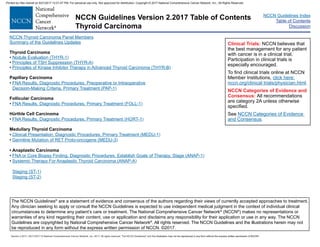
Clinical Trials: NCCN believes that
the best management for any patient
with cancer is in a clinical trial.
Participation in clinical trials is
especially encouraged.
To find clinical trials online at NCCN
Member Institutions, click here:
nccn.org/clinical trials/physician.html.
NCCN Categories of Evidence and
Consensus: All recommendations
are category 2A unless otherwise
specified.
See NCCN Categories of Evidence
and Consensus.
NCCN Thyroid Carcinoma Panel Members
Summary of the Guidelines Updates
Thyroid Carcinoma
• Nodule Evaluation (THYR-1)
• Principles of TSH Suppression (THYR-A)
• Principles of Kinase Inhibitor Therapy in Advanced Thyroid Carcinoma (THYR-B)
Papillary Carcinoma
• FNA Results, Diagnostic Procedures, Preoperative or Intraoperative
Decision-Making Criteria, Primary Treatment (PAP-1)
Follicular Carcinoma
• FNA Results, Diagnostic Procedures, Primary Treatment (FOLL-1)
Hürthle Cell Carcinoma
• FNA Results, Diagnostic Procedures, Primary Treatment (HÜRT-1)
Medullary Thyroid Carcinoma
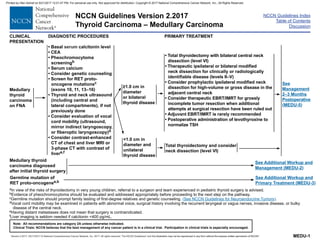
• Clinical Presentation, Diagnostic Procedures, Primary Treatment (MEDU-1)
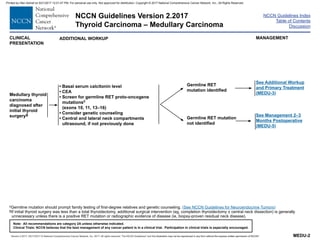
• Germline Mutation of RET Proto-oncogene (MEDU-3)
• Anaplastic Carcinoma
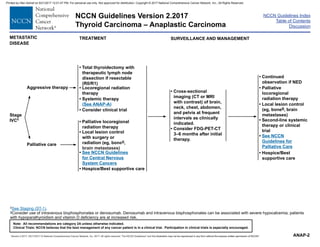
• FNA or Core Biopsy Finding, Diagnostic Procedures, Establish Goals of Therapy, Stage (ANAP-1)
• Systemic Therapy For Anaplastic Thyroid Carcinoma (ANAP-A)
Staging (ST-1)
Staging (ST-2)
The NCCN Guidelines®
are a statement of evidence and consensus of the authors regarding their views of currently accepted approaches to treatment.
Any clinician seeking to apply or consult the NCCN Guidelines is expected to use independent medical judgment in the context of individual clinical
circumstances to determine any patient’s care or treatment. The National Comprehensive Cancer Network®
(NCCN®
) makes no representations or
warranties of any kind regarding their content, use or application and disclaims any responsibility for their application or use in any way. The NCCN
Guidelines are copyrighted by National Comprehensive Cancer Network®
. All rights reserved. The NCCN Guidelines and the illustrations herein may not
be reproduced in any form without the express written permission of NCCN. ©2017.
NCCN Guidelines Version 2.2017 Table of Contents
Thyroid Carcinoma
Printed by Irfan Ashraf on 9/21/2017 12:01:47 PM. For personal use only. Not approved for distribution. Copyright © 2017 National Comprehensive Cancer Network, Inc., All Rights Reserved.
Note: All recommendations are category 2A unless otherwise indicated.
Clinical Trials: NCCN believes that the best management of any cancer patient is in a clinical trial. Participation in clinical trials is especially encouraged.
Version 2.2017, 05/17/2017 © National Comprehensive Cancer Network, Inc. 2017, All rights reserved. The NCCN Guidelines®
and this illustration may not be reproduced in any form without the express written permission of NCCN®
.
NCCN Guidelines Index
Table of Contents
Discussion
NCCN Guidelines Version 2.2017 Updates
Thyroid Carcinoma
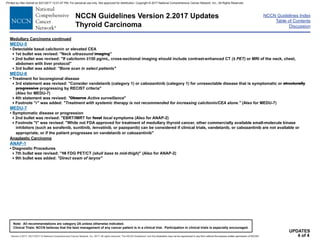
Updates in Version 2.2017 of the NCCN Guidelines for Thyroid Carcinoma from Version 1.2017 include:
Thyroid Carcinoma
THYR-1
• Clinical Presentation
2nd bullet was revised: “Ultrasound of thyroid and central neck”
3rd bullet was removed: “Ultrasound of lateral neck (category 2B)”
• Workup statement referring to “Thyroid nodule(s) with low TSH” was revised:
“Radioiodine imaging thyroid uptake and scan”
THYR-2
• Sonographic Features
Paragraph was revised: “The above criteria serve as general guidelines.
In patients with high-risk clinical features, evaluations of nodules smaller
than listed may be appropriate depending on clinical concern. Allowance
for informed patient desires would include excisional biopsy (lobectomy or
thyroidectomy) for definitive histology, especially in larger nodules (4 cm) or
higher risk clinical situations.”
�Footnote g was added: Suspicious lymph node features may include
hypoechoic, rounded, absence of fatty hilum, cystic or partially cystic, and/or
microcalcifications.
�A footnote was removed: “High-risk clinical features: radiation exposure as
child or adolescent; first-degree relative with thyroid cancer or MEN2; FDG
avid on PET scan; personal history of thyroid cancer-associated conditions
such as familial adenomatous polyposis, Carney complex, or Cowden
syndrome; personal history of thyroid cancer in lobectomy.”
UPDATES
1 of 4
Thyroid Carcinoma continued
THYR-3
• “Follicular or Hürthle cell neoplasm,” and “Atypia of undetermined
significance/Follicular lesion of undetermined significance (AUS/
FLUS)”
2nd bullets were revised: Consider molecular diagnostics for
follicular cell neoplasm (1st bullet only) may be employed (category
2B)
�Footnote “l” was added: “Total thyroidectomy may be considered
for Hürthle cell, history of radiation exposure, or contralateral lobe
lesions.”
�Footnote “m” was added: Molecular diagnostics are not
recommended for Hürthle cell neoplasm. (Also for THYR-4)
THYR-4
• This page was reformatted.
• FNA results
Statement was revised: Consider molecular diagnostics may be
employed (category 2B 2A)
Footnote o was added: Clinical risk factors, sonographic patterns,
and patient preference can help determine whether observation or
lobectomy is appropriate.
General
• For imaging, the target anatomy and the use of contrast was added to CT and whole-body was added to PET/CT as appropriate throughout the guidelines.
• For lenvatinib preferred was added as appropriate throughout the guidelines.
MS-1
The Discussion section has been updated to reflect the changes in the algorithm.
Printed by Irfan Ashraf on 9/21/2017 12:01:47 PM. For personal use only. Not approved for distribution. Copyright © 2017 National Comprehensive Cancer Network, Inc., All Rights Reserved.
Note: All recommendations are category 2A unless otherwise indicated.
Clinical Trials: NCCN believes that the best management of any cancer patient is in a clinical trial. Participation in clinical trials is especially encouraged.
Version 2.2017, 05/17/2017 © National Comprehensive Cancer Network, Inc. 2017, All rights reserved. The NCCN Guidelines®
and this illustration may not be reproduced in any form without the express written permission of NCCN®
.
NCCN Guidelines Index
Table of Contents
Discussion
NCCN Guidelines Version 2.2017 Updates
Thyroid Carcinoma
UPDATES
2 of 4
Papillary Carcinoma
PAP-1
• Diagnostic Procedures
3rd bullet was revised: “Consider evaluation of vocal cord mobility (ultrasound,
mirror indirect laryngoscopy, or fiberoptic laryngoscopy)” (Also for FOLL-1,
HÜRT-1, MEDU-1, and ANAP-1)
4th bullet was revised: “Consider FNA for suspicious lateral neck nodes in
lateral neck should be further evaluated by ultrasound-guided FNA for staging
and guiding extent of surgery”
A footnote was added: Vocal cord mobility may be examined in patients with
abnormal voice, surgical history involving the recurrent laryngeal or vagus
nerves, invasive disease, or bulky disease of the central neck.
(Also for FOLL-1, HÜRT-1, MEDU-1, and ANAP-1)
• Preoperative or Intraoperative Decision-Making Criteria
5th bullet under, “Indications for total thyroidectomy or lobectomy, if all criteria
present” was revised: “Tumor  ≤4 cm in diameter”
• Primary Treatment
1st statement was revised: “Total thyroidectomy Perform therapeutic neck
dissection of involved compartments for clinically apparent/biopsy-proven
disease Consider prophylactic central neck dissection (level VI) (category 2B)
Lobectomy + isthmusectomy (category 2B)
◊
◊ 3rd bullet was added under “All of the following”: “NIFTP pathologic
diagnosis” (Also for FOLL-1 and HÜRT-1)
◊
◊ A footnote was added: “RAI not recommended after lobectomy.”
(Also for FOLL-1 and HÜRT-1)
◊
◊ A footnote was added: “Formerly called encapsulated follicular variant of
PTC, noninvasive follicular thyroid neoplasm with papillary-like nuclear
features (NIFTP), has been reclassified and only lobectomy is needed.” (Also
for PAP-2, FOLL-1 and HÜRT-1)
• Footnote “b” was revised: “Use of iodinated contrast will delay treatment with
RAI but is required is required for optimal cervical imaging using CT, although
iodinated contrast will delay treatment with RAI.” (Also for FOLL-1 and HÜRT-1)
Papillary Carcinoma continued
PAP-1
• Footnote “d” was revised: “Completion thyroidectomy is not required
for small volume pathologic N1A micrometastases (≤ 5 involved
nodes with no micrometastasis, 2 mm 0.5 cm in largest dimension).
See (PAP-4).” (Also for PAP-2)
• A footnote was removed: Possible benefit to reduce recurrence for
patients with T3-T4 lateral disease must be balanced with risk of
hypoparathyroidism and recurrent laryngeal nerve damage.
PAP-4
• “RAI not typically recommended (if all present)”
2nd bullet was revised; “1 2 cm” (Also for HÜRT-3)
• “RAI selectively recommended (if any present)”
1st bullet was revised: “Primary tumor 1 2–4 cm” (Also for HÜRT-3)
PAP-5
• Original PAP-5 page was removed.
• Statement was revised: “Consider pretreatment 123I diagnostic
imaging with TSH stimulation (thyroid hormone withdrawal or rhTSH);
(category 2B)” (Also for FOLL-5 and HÜRT-5)
• Suspected or proven thyroid bed uptake statement was revised:
Follow without RAI ablation or Selective use of RAI for remnant
ablation (30–50 mCi) adjuvant therapy (50–100 mCi) post-treatment
imaging (whole body RAI scan) (Also for PAP-6, FOLL-5, FOLL-6, and
HÜRT-5)
• Suspected or proven radioiodine avid metastatic foci
Statement was revised: RAI therapy (100–200 mCi); post-treatment
imaging (whole body RAI scan) (Also for PAP-6, FOLL-5, FOLL-6,
HÜRT-5, and HÜRT-6)
Footnote q was added to statement: The administered activity of
RAI therapy should be adjusted for pediatric patients.
Printed by Irfan Ashraf on 9/21/2017 12:01:47 PM. For personal use only. Not approved for distribution. Copyright © 2017 National Comprehensive Cancer Network, Inc., All Rights Reserved.
Note: All recommendations are category 2A unless otherwise indicated.
Clinical Trials: NCCN believes that the best management of any cancer patient is in a clinical trial. Participation in clinical trials is especially encouraged.
Version 2.2017, 05/17/2017 © National Comprehensive Cancer Network, Inc. 2017, All rights reserved. The NCCN Guidelines®
and this illustration may not be reproduced in any form without the express written permission of NCCN®
.
NCCN Guidelines Index
Table of Contents
Discussion
NCCN Guidelines Version 2.2017 Updates
Thyroid Carcinoma
UPDATES
3 of 4
Papillary Carcinoma continued
PAP-7
• Long-term surveillance statement was revised: Patients treated
with131I ablation, with a negative ultrasound, stimulated Tg 2
ng/mL (with negative antithyroglobulin antibodies), and negative
RAI imaging (if performed) may be followed by unstimulated
thyroglobulin annually and by periodic neck ultrasound. TSH-
stimulated testing, or other imaging (CT or MRI with contrast
or bone scan or chest x-ray) as clinically appropriate, may be
considered if clinical suggestion of recurrent disease. (Also for
FOLL-7 and HÜRT-7)
PAP-8
• “Locoregional recurrence” statement was revised: “Surgery
(preferred) if resectable and/or Radioiodine treatment, if radioiodine
imaging positive and/or EBRT/IMRT, if radioiodine imaging negative
and/or local therapies when available (ethanol ablation, RFA) and/
or EBRT/IMRT, if radioiodine imaging negative for select patients
not responsive to other therapies, or observation for low-volume
disease that is stable and distant from critical structures (Also for
FOLL-8 and HÜRT-8)
PAP-9
• 4th bullet for Iodine-refractory unresectable locoregional recurrent/
persistent disease or Iodine-refractory soft tissue metastases
(eg, lung, liver, muscle) excluding CNS metastases (see below)
was revised: Active surveillance may be is often appropriate in
asymptomatic patients with indolent disease assuming no brain
metastasis.(Also for FOLL-9 and HÜRT-9)
• A footnote was revised: While not FDA approved for treatment of
differentiated thyroid cancer, commercially available small-molecule
kinase inhibitors (such as axitinib, everolimus, pazopanib, sunitinib,
or vandetanib, vemurafenib (BRAF-positive), or cabozantinib [all are
category 2A]) can be considered if clinical trials are not available or
appropriate.
(Also for PAP-10, FOLL-9, FOLL-10, HÜRT-9 and HÜRT-10)
PAP-10
• A bullet was removed: Active surveillance may be appropriate in
asymptomatic patients with indolent disease. (See PAP-8) (Also for
FOLL-10 and HURT-10)
Follicular Carcinoma
FOLL-9
• 4th bullet for Iodine-refractory unresectable loco-regional recurrent/
persistent disease and Iodine-refractory soft tissue metastases (eg,
lung, liver, muscle) excluding CNS metastases (see below) was revised:
Active surveillance may be is often appropriate in asymptomatic patients
with indolent disease assuming no brain metastasis. (See FOLL-7)
FOLL-10
• For CNS Metastases a bullet was removed: Active surveillance may be
approriate in asymptomatic patients with indolent disease. (see FOLL-7)
(Also for HURT-10)
Medullary Carcinoma
MEDU-1
• Primary Treatment
�A bullet was revised: “Consider Adjuvant EBRT/IMRT is for gross
residual disease rarely recommended)” (Also for MEDU-3, MEDU-4)
MEDU-2
• Additional Workup
3rd bullet was revised: Screen for germline RET proto-oncogene
mutations
• Management
Statement revised: Germline RET positive mutation identified
Statement revised: Germline RET negative mutation not identified
MEDU-3
• Primary Treatment
4th bullet was revised: Consider Adjuvant EBRT/IMRT for gross
residual disease is rarely recommended (Also for MEDU-4)
Printed by Irfan Ashraf on 9/21/2017 12:01:47 PM. For personal use only. Not approved for distribution. Copyright © 2017 National Comprehensive Cancer Network, Inc., All Rights Reserved.
NCCN Guidelines Index
Table of Contents
Discussion
Note: All recommendations are category 2A unless otherwise indicated.
Clinical Trials: NCCN believes that the best management of any cancer patient is in a clinical trial. Participation in clinical trials is especially encouraged.
Version 2.2017, 05/17/2017 © National Comprehensive Cancer Network, Inc. 2017, All rights reserved. The NCCN Guidelines®
and this illustration may not be reproduced in any form without the express written permission of NCCN®
.
NCCN Guidelines Version 2.2017 Updates
Thyroid Carcinoma
Medullary Carcinoma continued
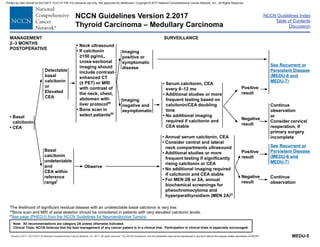
MEDU-5
• Detectable basal calcitonin or elevated CEA
�1st bullet was revised: Neck ultrasound imaging
2nd bullet was revised: If calcitonin ≥150 pg/mL, cross-sectional imaging should include contrast-enhanced CT (± PET) or MRI of the neck, chest,
abdomen with liver protocol
3rd bullet was added: Bone scan in select patients
MEDU-6
• Treatment for locoregional disease
3rd statement was revised: Consider vandetanib (category 1) or cabozantinib (category 1) for unresectable disease that is symptomatic or structurally
progressive progressing by RECIST criteria
(Also for MEDU-7)
4th statement was revised: Observe Active surveillance
Footnote r was added: Treatment with systemic therapy is not recommended for increasing calcitonin/CEA alone. (Also for MEDU-7)
MEDU-7
• Symptomatic disease or progression
2nd bullet was revised: EBRT/IMRT for focal local symptoms (Also for ANAP-2)
Footnote t was revised: While not FDA approved for treatment of medullary thyroid cancer, other commercially available small-molecule kinase
inhibitors (such as sorafenib, sunitinib, lenvatinib, or pazopanib) can be considered if clinical trials, vandetanib, or cabozantinib are not available or
appropriate, or if the patient progresses on vandetanib or cabozantinib
Anaplastic Carcinoma
ANAP-1
• Diagnostic Procedures
7th bullet was revised: 18 FDG PET/CT (skull base to mid-thigh) (Also for ANAP-2)
9th bullet was added: Direct exam of larynx
UPDATES
4 of 4
Printed by Irfan Ashraf on 9/21/2017 12:01:47 PM. For personal use only. Not approved for distribution. Copyright © 2017 National Comprehensive Cancer Network, Inc., All Rights Reserved.
NCCN Guidelines Index
Table of Contents
Discussion
Note: All recommendations are category 2A unless otherwise indicated.
Clinical Trials: NCCN believes that the best management of any cancer patient is in a clinical trial. Participation in clinical trials is especially encouraged.
Version 2.2017, 05/17/2017 © National Comprehensive Cancer Network, Inc. 2017, All rights reserved. The NCCN Guidelines®
and this illustration may not be reproduced in any form without the express written permission of NCCN®
. THYR-1
NCCN Guidelines Version 2.2017
Thyroid Carcinoma – Nodule Evaluation
CLINICAL PRESENTATION WORKUP
For thyroid nodule known or
suspected on exam or
incidental imaging finding:
• Measure thyroid-stimulating
hormone (TSH)
• Ultrasound of thyroid and
neck
Thyroid nodule(s)
with low TSH
Thyroid nodule(s) with
normal or elevated TSHa
aEvaluate and treat for hypothyroidism as clinically indicated.
bFor nodules not meeting criteria for FNA, or nodules that appear to be benign by ultrasound or FNA, surveillance should include repeat ultrasound
after 6–12 months; if stable for 1–2 years, then subsequent ultrasound can be considered at 3- to 5-year intervals.
Radioiodine
imaging
thyroid
uptake and
scan
Autonomously
functioning (hot)
Hypofunctional
Evaluate and treat for
thyrotoxicosis as indicated
(malignancy is rare)b
Consider fine-needle
aspiration (FNA) or
ultrasound-guided
FNA based on clinical
and sonographic
features
See
Sonographic
Featuresb
(THYR-2)
Printed by Irfan Ashraf on 9/21/2017 12:01:47 PM. For personal use only. Not approved for distribution. Copyright © 2017 National Comprehensive Cancer Network, Inc., All Rights Reserved.
Note: All recommendations are category 2A unless otherwise indicated.
Clinical Trials: NCCN believes that the best management of any cancer patient is in a clinical trial. Participation in clinical trials is especially encouraged.
Version 2.2017, 05/17/2017 © National Comprehensive Cancer Network, Inc. 2017, All rights reserved. The NCCN Guidelines®
and this illustration may not be reproduced in any form without the express written permission of NCCN®
.
NCCN Guidelines Index
Table of Contents
Discussion
THYR-2
NCCN Guidelines Version 2.2017
Thyroid Carcinoma – Nodule Evaluation
SONOGRAPHIC FEATURES
Solid nodule				
• With suspicious sonographic featuresc
• Without suspicious sonographic features
Mixed cystic-solid nodule
• With suspicious sonographic featuresc
• Without suspicious sonographic features
Spongiform noduled		
Simple cyst				
Suspicious cervical lymph nodef,g		
Threshold for FNA
≥1.0 cm
≥1.5 cm
Solid component 1 cm
Solid component 1.5 cm
≥2.0 cm
Not indicatede
FNA node ± FNA-associated thyroid nodule(s)
The above criteria serve as general guidelines. Allowance for informed patient desires would include
lobectomy or thyroidectomy for definitive histology, especially in larger nodules (4 cm) or higher risk
clinical situations.
bFor nodules not meeting criteria for FNA, or nodules that appear to be benign by ultrasound or FNA, surveillance should include repeat ultrasound after 6–12 months;
if stable for 1–2 years, then subsequent ultrasound can be considered at 3- to 5-year intervals.
cSuspicious sonographic features include hypoechoic, microcalcifications, infiltrative margins, and taller than wide in the transverse plane. Sonographic features
associated with a low risk of malignancy include spongiform nodules, isoechoic or hyperechoic solid nodules, and mixed solid-cystic nodules without any of the
suspicious features listed above.
dAggregation of multiple microcystic components in more than 50% of the volume of the nodule.
eExcept as therapeutic modality.
fTg washout may be helpful in diagnosis of lymph node metastases.
gSuspicious lymph node features may include hypoechoic, rounded, absence of fatty hilum, cystic or partially cystic, and/or microcalcifications.
FNA, if indicated
(See THYR-3 and THYR-4)
or
Observeb
Printed by Irfan Ashraf on 9/21/2017 12:01:47 PM. For personal use only. Not approved for distribution. Copyright © 2017 National Comprehensive Cancer Network, Inc., All Rights Reserved.
NCCN Guidelines Index
Table of Contents
Discussion
Note: All recommendations are category 2A unless otherwise indicated.
Clinical Trials: NCCN believes that the best management of any cancer patient is in a clinical trial. Participation in clinical trials is especially encouraged.
Version 2.2017, 05/17/2017 © National Comprehensive Cancer Network, Inc. 2017, All rights reserved. The NCCN Guidelines®
and this illustration may not be reproduced in any form without the express written permission of NCCN®
. THYR-3
NCCN Guidelines Version 2.2017
Thyroid Carcinoma – Nodule Evaluation
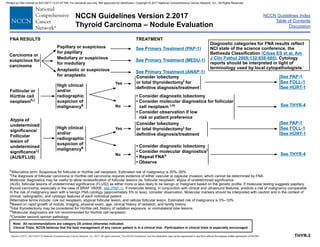
Follicular or
Hürthle cell
neoplasmh,i
Atypia of
undetermined
significance/
Follicular
lesion of
undetermined
significancei,j
(AUS/FLUS)
High clinical
and/or
radiographic
suspicion of
malignancyk No
See Primary Treatment (ANAP-1)
See Primary Treatment (MEDU-1)
See Primary Treatment (PAP-1)
FNA RESULTS TREATMENT
Diagnostic categories for FNA results reflect
NCI state of the science conference, the
Bethesda Classification (Cibas ES et al. Am
J Clin Pathol 2009;132:658-665). Cytology
reports should be interpreted in light of
terminology used by local cytopathologists.
hAlternative term: Suspicious for follicular or Hürthle cell neoplasm. Estimated risk of malignancy is 20%–30%.
iThe diagnosis of follicular carcinoma or Hürthle cell carcinoma requires evidence of either vascular or capsular invasion, which cannot be determined by FNA.
Molecular diagnostics may be useful to allow reclassification of follicular lesions (ie, follicular neoplasm, atypia of undetermined significance
(AUS), follicular lesions of undetermined significance (FLUS)) as either more or less likely to be benign or malignant based on the genetic profile. If molecular testing suggests papillary
thyroid carcinoma, especially in the case of BRAF V600E, see (PAP-1). If molecular testing, in conjunction with clinical and ultrasound features, predicts a risk of malignancy comparable
to the risk of malignancy seen with a benign FNA cytology (approximately 5% or less), consider observation. Molecular markers should be interpreted with caution and in the context of
clinical, radiographic, and cytologic features of each individual patient.
jAlternative terms include: rule out neoplasm, atypical follicular lesion, and cellular follicular lesion. Estimated risk of malignancy is 5%–10%.
kBased on rapid growth of nodule, imaging, physical exam, age, clinical history of radiation, and family history.
lTotal thyroidectomy may be considered for Hürthle cell, history of radiation exposure, or contralateral lobe lesions.
mMolecular diagnostics are not recommended for Hürthle cell neoplasm.
nConsider second opinion pathology.
No
Yes
• Consider diagnostic lobectomy
• Consider molecular diagnosticsi
• Repeat FNAn
• Observe
Consider lobectomy
or total thyroidectomyl for
definitive diagnosis/treatment
Carcinoma or
suspicious for
carcinoma
Papillary or suspicious
for papillary
Medullary or suspicious
for medullary
Anaplastic or suspicious
for anaplastic
Yes
Consider lobectomy
or total thyroidectomyl for
definitive diagnosis/treatment
• Consider diagnostic lobectomy
• Consider molecular diagnostics for follicular
cell neoplasm i,m
• Consider observation if low
risk or patient preference
See PAP-1
See FOLL-1
See HÜRT-1
See PAP-1
See FOLL-1
See HÜRT-1
See THYR-4
See THYR-4
High clinical
and/or
radiographic
suspicion of
malignancyk
Printed by Irfan Ashraf on 9/21/2017 12:01:47 PM. For personal use only. Not approved for distribution. Copyright © 2017 National Comprehensive Cancer Network, Inc., All Rights Reserved.
NCCN Guidelines Index
Table of Contents
Discussion
Note: All recommendations are category 2A unless otherwise indicated.
Clinical Trials: NCCN believes that the best management of any cancer patient is in a clinical trial. Participation in clinical trials is especially encouraged.
Version 2.2017, 05/17/2017 © National Comprehensive Cancer Network, Inc. 2017, All rights reserved. The NCCN Guidelines®
and this illustration may not be reproduced in any form without the express written permission of NCCN®
. THYR-4
NCCN Guidelines Version 2.2017
Thyroid Carcinoma – Nodule Evaluation
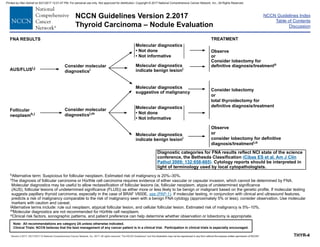
Observe
or
consider lobectomy for definitive
diagnosis/treatmenti,o
Consider lobectomy
or
total thyroidectomy for
definitive diagnosis/treatment
Consider molecular
diagnosticsi,m
Observe
or
Consider lobectomy for
definitive diagnosis/treatmento
Molecular diagnostics
indicate benign lesioni
Molecular diagnostics
• Not done
• Not informative
TREATMENT
hAlternative term: Suspicious for follicular neoplasm. Estimated risk of malignancy is 20%–30%.
iThe diagnosis of follicular carcinoma or Hürthle cell carcinoma requires evidence of either vascular or capsular invasion, which cannot be determined by FNA.
Molecular diagnostics may be useful to allow reclassification of follicular lesions (ie, follicular neoplasm, atypia of undetermined significance
(AUS), follicular lesions of undetermined significance (FLUS)) as either more or less likely to be benign or malignant based on the genetic profile. If molecular testing
suggests papillary thyroid carcinoma, especially in the case of BRAF V600E, see (PAP-1). If molecular testing, in conjunction with clinical and ultrasound features,
predicts a risk of malignancy comparable to the risk of malignancy seen with a benign FNA cytology (approximately 5% or less), consider observation. Use molecular
markers with caution and caveat.
jAlternative terms include: rule out neoplasm, atypical follicular lesion, and cellular follicular lesion. Estimated risk of malignancy is 5%–10%.
mMolecular diagnostics are not recommended for Hürthle cell neoplasm.
oClinical risk factors, sonographic patterns, and patient preference can help determine whether observation or lobectomy is appropriate.
Follicular
neoplasmh,i
FNA RESULTS
Diagnostic categories for FNA results reflect NCI state of the science
conference, the Bethesda Classification (Cibas ES et al. Am J Clin
Pathol 2009; 132:658-665). Cytology reports should be interpreted in
light of terminology used by local cytopathologists.
AUS/FLUSi,j
Consider molecular
diagnosticsi
Molecular diagnostics
suggestive of malignancy
Molecular diagnostics
• Not done
• Not informative
Molecular diagnostics
indicate benign lesioni
Printed by Irfan Ashraf on 9/21/2017 12:01:47 PM. For personal use only. Not approved for distribution. Copyright © 2017 National Comprehensive Cancer Network, Inc., All Rights Reserved.
NCCN Guidelines Index
Table of Contents
Discussion
Note: All recommendations are category 2A unless otherwise indicated.
Clinical Trials: NCCN believes that the best management of any cancer patient is in a clinical trial. Participation in clinical trials is especially encouraged.
Version 2.2017, 05/17/2017 © National Comprehensive Cancer Network, Inc. 2017, All rights reserved. The NCCN Guidelines®
and this illustration may not be reproduced in any form without the express written permission of NCCN®
.
NCCN Guidelines Version 2.2017
Thyroid Carcinoma – Nodule Evaluation
FNA RESULTS TREATMENT
Thyroid
lymphoma
Insufficient biopsy,
nondiagnostic
Benignp
Cystic
Solid
Repeat FNA with ultrasound guidance and immediate
cytologic review for adequacy of specimen (preferred)
or
Consider surgery
Correlate with ultrasound, re-aspirate suspicious areas
See NCCN Guidelines for B-cell Lymphomas
• Observeq
• If nodule growthr, repeat FNA or consider surgery
pIncludes nodular goiter, colloid nodule, hyperplastic/adenomatoid nodule, and
Hashimoto’s thyroiditis. Estimated risk of malignancy is approximately 5% or less;
consider observation.
qRepeat ultrasound after 6–12 mo, if stable for 1–2 years, then subsequent
ultrasound can be considered at 3- to 5-year intervals.
rGrowth defined as 50% increase in nodule volume or 20% increase in size of
2–3 dimensions. Size changes should be 2 mm and should be assessed by
direct comparison of images.
Diagnostic categories for FNA results reflect NCI state of the science
conference, the Bethesda Classification (Cibas ES et al. Am J Clin
Pathol 2009; 132:658-665). Cytology reports should be interpreted in
light of terminology used by local cytopathologists.
THYR-5
Printed by Irfan Ashraf on 9/21/2017 12:01:47 PM. For personal use only. Not approved for distribution. Copyright © 2017 National Comprehensive Cancer Network, Inc., All Rights Reserved.
NCCN Guidelines Index
Table of Contents
Discussion
Note: All recommendations are category 2A unless otherwise indicated.
Clinical Trials: NCCN believes that the best management of any cancer patient is in a clinical trial. Participation in clinical trials is especially encouraged.
Version 2.2017, 05/17/2017 © National Comprehensive Cancer Network, Inc. 2017, All rights reserved. The NCCN Guidelines®
and this illustration may not be reproduced in any form without the express written permission of NCCN®
.
NCCN Guidelines Version 2.2017
Thyroid Carcinoma – TSH Suppression
PRINCIPLES OF THYROID-STIMULATING HORMONE (TSH) SUPPRESSION
• Because TSH is a trophic hormone that can stimulate the growth of cells derived from thyroid
follicular epithelium, the use of levothyroxine to maintain low TSH levels is considered optimal
in treatment of patients with papillary, follicular, or Hürthle cell carcinoma. However, data are
lacking to permit precise specification of the appropriate serum levels of TSH.
In general, patients with known structural residual carcinoma or at high risk for recurrence
should have TSH levels maintained below 0.1 mU/L, whereas disease-free patients at low risk
for recurrence should have TSH levels maintained either slightly below or slightly above the
lower limit of the reference range.
For low-risk patients with biochemical evidence but no structural evidence of disease
(eg, Tg positive, but imaging negative), maintain TSH levels at 0.1–0.5 mU/L.
Patients who remain disease free for several years can probably have their TSH levels
maintained within the reference range.
• Given the potential toxicities associated with TSH-suppressive doses of levothyroxine—
including cardiac tachyarrhythmias (especially in the elderly) and bone demineralization
(particularly in post-menopausal women) as well as frank symptoms of thyrotoxicosis—the
risk and benefit of TSH-suppressive therapy must be balanced for each individual patient.
• Patients whose TSH levels are chronically suppressed should be counseled to ensure
adequate daily intake of calcium (1200 mg/d) and vitamin D (1000 units/d).
THYR-A
Printed by Irfan Ashraf on 9/21/2017 12:01:47 PM. For personal use only. Not approved for distribution. Copyright © 2017 National Comprehensive Cancer Network, Inc., All Rights Reserved.
NCCN Guidelines Index
Table of Contents
Discussion
Note: All recommendations are category 2A unless otherwise indicated.
Clinical Trials: NCCN believes that the best management of any cancer patient is in a clinical trial. Participation in clinical trials is especially encouraged.
Version 2.2017, 05/17/2017 © National Comprehensive Cancer Network, Inc. 2017, All rights reserved. The NCCN Guidelines®
and this illustration may not be reproduced in any form without the express written permission of NCCN®
.
NCCN Guidelines Version 2.2017
Thyroid Carcinoma – Kinase Inhibitor Therapy
THYR-B
PRINCIPLES OF KINASE INHIBITOR THERAPY IN ADVANCED THYROID CARCINOMA
• Oral kinase inhibitors demonstrate clinically significant activity in randomized, placebo-controlled clinical trials in locally recurrent
unresectable and metastatic medullary thyroid cancer (MTC) and in radio iodine-refractory differentiated thyroid cancer (DTC).1,2,3
• When considering kinase inhibitor therapy for individual patients, several factors should be considered.
 Kinase inhibitor therapy can be associated with progression-free survival, but is not curative.
 Kinase inhibitor therapy is expected to cause side effects that may have a significant effect on quality of life.
 The natural history of MTC and DTC is quite variable with rates of disease progression ranging from a few months to many years.
• The pace of disease progression should be factored into treatment decisions. Patients with very indolent disease who are asymptomatic
may not be appropriate for kinase inhibitor therapy, particularly if the side effects of treatment will adversely affect the patient’s quality
of life, whereas patients with more rapidly progressive disease may benefit from kinase inhibitor therapy, even if they have drug-induced
side effects.
• Optimal management of kinase inhibitor side effects is essential. Where available, guidelines outlining the management of the
dermatologic, hypertensive, and gastrointestinal side effects of kinase inhibitors can be used; side effects have been fatal.4,5,6,7
In addition, dose modification may be required, including dose holds and dose reductions.
1Wells SA Jr, Robinson BG, Gagel RF, et al. Vandetanib in patients with locally advanced or metastatic medullary thyroid cancer: a randomized, double-blind phase III
trial. J Clin Oncol 2012;30:134-141.
2Brose MS, Nutting CM, Jarzab B, et al. Sorafenib in radioactive iodine-refractory, locally advanced or metastatic differentiated thyroid cancer: a randomized, double-
blind, phase 3 trial. Lancet 2014;384(9940):319-328.
3Elisei R, Schlumberger MJ, Müller SP, et al. Cabozantinib in progressive medullary thyroid cancer. J Clin Oncol 2013;31:3639-3646.
4Burtness B, Anadkat M, Basti S, et al. NCCN Task Force Report: Management of dermatologic and other toxicities associated with EGFR inhibition in patients with
cancer. J Natl Compr Canc Netw 2009;7 Suppl 1:S5-S21.
5Brose MS, Frenette CT, Keefe SM, Stein SM. Management of sorafenib-related adverse events: a clinician’s perspective. Semin Oncol 2014;41 Suppl 2:S1-S16.
6Carhill AA, Cabanillas ME, Jimenez C, et al. The noninvestigational use of tyrosine kinase inhibitors in thyroid cancer: establishing a standard for patient safety and
monitoring. J Clin Endocrinol Metab 2013;98:31-42.
7Schlumberger M, Tahara M, Wirth LJ, et al. Lenvatinib versus placebo in radioiodine-refractory thyroid cancer. N Engl J Med 2015;372(7):621-30.
Printed by Irfan Ashraf on 9/21/2017 12:01:47 PM. For personal use only. Not approved for distribution. Copyright © 2017 National Comprehensive Cancer Network, Inc., All Rights Reserved.
NCCN Guidelines Index
Table of Contents
Discussion
Note: All recommendations are category 2A unless otherwise indicated.
Clinical Trials: NCCN believes that the best management of any cancer patient is in a clinical trial. Participation in clinical trials is especially encouraged.
Version 2.2017, 05/17/2017 © National Comprehensive Cancer Network, Inc. 2017, All rights reserved. The NCCN Guidelines®
and this illustration may not be reproduced in any form without the express written permission of NCCN®
.
NCCN Guidelines Version 2.2017
Thyroid Carcinoma – Papillary Carcinoma
FNA
RESULTS
DIAGNOSTIC
PROCEDURES
PREOPERATIVE OR
INTRAOPERATIVE
DECISION-MAKING CRITERIA
PRIMARY TREATMENT
Papillary
carcinomaa
• Thyroid and neck
ultrasound (including
central and lateral
compartments), if
not previously done
• CT/MRI with contrast
for fixed, bulky, or
substernal lesionsb
• Consider evaluation
of vocal cord mobility
(ultrasound, mirror
indirect laryngoscopy,
or fiber-optic
laryngoscopy)c
• Consider FNA for
suspicious lateral
neck nodes
Indications for total
thyroidectomy
(any present):
• Known distant metastases
• Extrathyroidal extension
• Tumor 4 cm in diameter
• Cervical lymph node
metastasesd
• Poorly differentiated
• Consider for prior radiation
exposure (category 2B)
• Consider bilateral nodularity
Indications for total
thyroidectomy or lobectomy,
if all criteria present:
• No prior radiation exposure
• No distant metastases
• No cervical lymph node
metastases
• No extrathyroidal extension
• Tumor ≤4 cm in diameter
Total thyroidectomy
Perform therapeutic neck dissection of involved
compartments for clinically apparent/biopsy-
proven disease
Total thyroidectomy
(category 2B)
or
Lobectomy
+ isthmusectomy
(category 2B)e
Any of the following:
• Tumor 4 cm
• Positive resection
margins
• Gross extrathyroidal
extension
• Macroscopic multifocal
disease
• Macroscopic nodal
metastasisd
• Vascular invasion
All of the following:
• Negative margins
• No contralateral lesion
• NIFTP pathologic
diagnosisf
See
Postsurgical
Evaluation
(PAP-3)
Completion of
thyroidectomy
• Consider
thyroglobulin
measurement
and anti-Tg
antibodies
6–12 wks
post-opg
• Consider
levothyroxine
therapy to keep
TSH low or
normalh
See Surveillance and
Maintenance (PAP-7)
aThere is a potential role for lobectomy with or without frozen section if FNA is suspicious but not diagnostic for papillary carcinoma.
bUse of iodinated contrast is required for optimal cervical imaging using CT, although iodinated contrast will delay treatment with RAI.
cVocal cord mobility may be examined in patients with abnormal voice, surgical history involving the recurrent laryngeal or vagus nerves,
invasive disease, or bulky disease of the central neck.
dCompletion thyroidectomy is not required for small volume pathologic N1A metastases (5 involved nodes with no metastasis 2 mm in
largest dimension). See (PAP-4).
eRAI not recommended after lobectomy.
fFormerly called encapsulated follicular variant of PTC, noninvasive follicular thyroid neoplasm with papillary-like nuclear features
(NIFTP), has been reclassified and only lobectomy is needed.
gUseful for future follow-up and assessing trend patterns.
hSee Principles of TSH Suppression (THYR-A).
PAP-1
Printed by Irfan Ashraf on 9/21/2017 12:01:47 PM. For personal use only. Not approved for distribution. Copyright © 2017 National Comprehensive Cancer Network, Inc., All Rights Reserved.
NCCN Guidelines Index
Table of Contents
Discussion
Note: All recommendations are category 2A unless otherwise indicated.
Clinical Trials: NCCN believes that the best management of any cancer patient is in a clinical trial. Participation in clinical trials is especially encouraged.
Version 2.2017, 05/17/2017 © National Comprehensive Cancer Network, Inc. 2017, All rights reserved. The NCCN Guidelines®
and this illustration may not be reproduced in any form without the express written permission of NCCN®
.
NCCN Guidelines Version 2.2017
Thyroid Carcinoma – Papillary Carcinoma
PAP-2
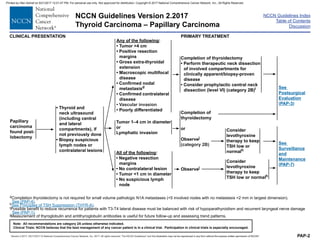
CLINICAL PRESENTATION PRIMARY TREATMENT
Papillary
carcinoma
found post-
lobectomy
• Thyroid and
neck ultrasound
(including central
and lateral
compartments), if
not previously done
• Biopsy suspicious
lymph nodes or
contralateral lesions
Any of the following:
• Tumor 4 cm
• Positive resection
margins
• Gross extra-thyroidal
extension
• Macroscopic multifocal
disease
• Confirmed nodal
metastasisd
• Confirmed contralateral
disease
• Vascular invasion
• Poorly differentiated
Tumor 1–4 cm in diameter
or
Lymphatic invasion
All of the following:
• Negative resection
margins
• No contralateral lesion
• Tumor 1 cm in diameter
• No suspicious lymph
node
Completion of thyroidectomy
• Perform therapeutic neck dissection
of involved compartments for
clinically apparent/biopsy-proven
disease
• Consider prophylactic central neck
dissection (level VI) (category 2B)i
Completion of
thyroidectomy
or
Observej
(category 2B)
Observej
Consider
levothyroxine
therapy to keep
TSH low or
normalh
Consider
levothyroxine
therapy to keep
TSH low or normalh
See
Postsurgical
Evaluation
(PAP-3)
See
Surveillance
and
Maintenance
(PAP-7)
dCompletion thyroidectomy is not required for small volume pathologic N1A metastases (5 involved nodes with no metastasis 2 mm in largest dimension).
See (PAP-4).
hSee Principles of TSH Suppression (THYR-A).
iPossible benefit to reduce recurrence for patients with T3-T4 lateral disease must be balanced with risk of hypoparathyroidism and recurrent laryngeal nerve damage
See (PAP-1).
jMeasurement of thyroglobulin and antithyroglobulin antibodies is useful for future follow-up and assessing trend patterns.
Printed by Irfan Ashraf on 9/21/2017 12:01:47 PM. For personal use only. Not approved for distribution. Copyright © 2017 National Comprehensive Cancer Network, Inc., All Rights Reserved.
NCCN Guidelines Index
Table of Contents
Discussion
Note: All recommendations are category 2A unless otherwise indicated.
Clinical Trials: NCCN believes that the best management of any cancer patient is in a clinical trial. Participation in clinical trials is especially encouraged.
Version 2.2017, 05/17/2017 © National Comprehensive Cancer Network, Inc. 2017, All rights reserved. The NCCN Guidelines®
and this illustration may not be reproduced in any form without the express written permission of NCCN®
.
NCCN Guidelines Version 2.2017
Thyroid Carcinoma – Papillary Carcinoma
PAP-3
POSTSURGICAL EVALUATION
No gross
residual
disease
in neck
Gross residual
disease in neck
Resectable
Unresectable
Resect, if
possible
No gross
residual disease
See Consideration for Initial Postoperative RAI Therapy After
Total Thyroidectomy (PAP-4)
Gross residual disease
• TSH + Tg
measurement
+ antithyroglobulin
antibodies (6–12 wk
postoperatively)
• Total body
radioiodine imaging
(category 2B)
Suspected
or proven
inadequate
RAI uptake
Observe
or
Consider
External-beam
radiation
therapy
(EBRT/IMRT)
if disease is
threatening
vital structures
Adequate
RAI uptake
No RAI
imaging
performed
• Radioiodine
treatment
(preferred)
• Post-
treatment
131I whole
body imaging
• Consider
EBRT/IMRT
Suppress
TSH with
levothyroxineh
See
Surveillance
and
Maintenance
(PAP-7)
hSee Principles of TSH Suppression (THYR-A).
Printed by Irfan Ashraf on 9/21/2017 12:01:47 PM. For personal use only. Not approved for distribution. Copyright © 2017 National Comprehensive Cancer Network, Inc., All Rights Reserved.
NCCN Guidelines Index
Table of Contents
Discussion
Note: All recommendations are category 2A unless otherwise indicated.
Clinical Trials: NCCN believes that the best management of any cancer patient is in a clinical trial. Participation in clinical trials is especially encouraged.
Version 2.2017, 05/17/2017 © National Comprehensive Cancer Network, Inc. 2017, All rights reserved. The NCCN Guidelines®
and this illustration may not be reproduced in any form without the express written permission of NCCN®
.
NCCN Guidelines Version 2.2017
Thyroid Carcinoma – Papillary Carcinoma
PAP-4
CLINICOPATHOLOGIC FACTORS CONSIDERATION FOR INITIAL POSTOPERATIVE RAI THERAPY
AFTER TOTAL THYROIDECTOMY
RAI not typically recommended (if all present):
• Classic papillary thyroid carcinoma (PTC)
• Primary tumor 2 cm
• Intrathyroidal
• Unifocal or multifocal
• No detectable anti-Tg antibodies
• Postoperative unstimulated Tg 1 ng/mLk
RAI selectively recommended (if any present):
• Primary tumor 2–4 cm
• High-risk histologyl
• Lymphatic invasion
• Cervical lymph node metastases
• Macroscopic multifocality (one focus 1 cm
• Postoperative unstimulated Tg 5–10 ng/mLk
RAI typically recommended (if any present):
• Gross extrathyroidal extension
• Primary tumor 4 cm
• Postoperative unstimulated Tg 5–10 ng/mLk,m
RAI ablation is not required in patients with classic
PTC who have T1b/T2 (1–4 cm) cN0 disease or
small-volume N1a disease (fewer than 3–5
metastatic lymph nodes with 2–5 mm of focus of
cancer in node), particularly if the postoperative
Tg is 1 ng/mL in the absence of interfering anti-Tg
antibodies.
RAI ablation is recommended when the
combination of individual clinical factors (such as
the size of the primary tumor, histology, degree
of lymphatic invasion, lymph node metastases,
postoperative thyroglobulin, and age at diagnosis)
predicts a significant risk of recurrence, distant
metastases, or disease-specific mortality.
RAI not typically
indicated,
See (PAP-7)
RAI being
considered,
See (PAP-5)
Known or suspected distant metastases at presentation
Amenable to RAI
See (PAP-6)
Gross residual disease not amenable to RAI therapy See (PAP-9)
kTg values obtained 6–12 weeks after total thyroidectomy.
lie, poorly differentiated, tall cell, columnar cell, and hobnail variants.
mAdditional cross-sectional imaging (CT or MRI of the neck with contrast and chest CT with contrast) should be considered
to rule out the presence of significant normal thyroid remnant or gross residual disease and to detect clinically significant
distant metastases.
For general principles related to radioactive
iodine therapy, See (Discussion)
Printed by Irfan Ashraf on 9/21/2017 12:01:47 PM. For personal use only. Not approved for distribution. Copyright © 2017 National Comprehensive Cancer Network, Inc., All Rights Reserved.
NCCN Guidelines Index
Table of Contents
Discussion
Note: All recommendations are category 2A unless otherwise indicated.
Clinical Trials: NCCN believes that the best management of any cancer patient is in a clinical trial. Participation in clinical trials is especially encouraged.
Version 2.2017, 05/17/2017 © National Comprehensive Cancer Network, Inc. 2017, All rights reserved. The NCCN Guidelines®
and this illustration may not be reproduced in any form without the express written permission of NCCN®
.
NCCN Guidelines Version 2.2017
Thyroid Carcinoma – Papillary Carcinoma
PAP-5
Clinicopathologic
findings prompting
consideration for
RAI, without gross
residual disease
or known distant
metastasis
See (PAP-4)
Consider
pretreatment 123I
diagnostic
imaging with
TSH stimulation
(thyroid hormone
withdrawal or
rhTSH);
(category 2B)n,o
No or minor
thyroid
bed uptake
on scan,
unstimulated
Tg 1 ng/mL
(with negative
anti-Tg
antibodies)
Suspectedo,p
or proven
radioiodine
avid
metastatic
foci
Follow without
RAI ablation
Selective use of
RAI for remnant
ablation (30–50
mCi)
or
adjuvant therapy
(50–100 mCi)q,r;
post-treatment
imaging (whole
body RAI scan)
RAI therapy
(100–200 mCi)q,r;
post-treatment
imaging (whole
body RAI scan)
See Surveillance
and Maintenance
(PAP-7)
and
Levothyroxine to
appropriate TSH target
See (THYR-A)
nAlternatively, low-dose 131I (1–3 mCi) may be used.
oWhile pre-ablation diagnostic scans in this setting are commonly done at NCCN Member Institutions, the panel recommends (category 2B) selective use of pre-ablation
diagnostic scans based on pathology, postoperative Tg, intraoperative findings, and available imaging studies. Furthermore, dosimetry studies are considered in
patients at high risk of having RAI-avid distant metastasis. Empiric RAI doses may exceed maximum tolerable activity levels in patients with decreased GFR. Dialysis
patients require special handling.
pClinically significant structural disease should be surgically resected if possible before radioiodine treatment.
qThe administered activity of RAI therapy should be adjusted for pediatric patients.
rIf RAI ablation is used in T1b/T2 (1–4 cm), clinical N0 disease, 30 mCi of 131I is recommended (category 1) following either recombinant human TSH stimulation or
thyroid hormone withdrawal. This dose of 30 mCi may also be considered (category 2B) for patients with T1b/T2 (1–4 cm) with small-volume N1a disease (fewer than
3–5 metastatic lymph node metastases 0.5 cm in diameter) and for patients with primary tumors 4 cm, clinical M0 with minor extrathyroidal extension.
RAI BEING CONSIDERED BASED ON CLINICOPATHOLOGIC FEATURES
6–12 weeks
post-
thyroidectomy
Suspectedo,p
or proven
thyroid
bed uptake
Follow without
RAI ablation
or
Printed by Irfan Ashraf on 9/21/2017 12:01:47 PM. For personal use only. Not approved for distribution. Copyright © 2017 National Comprehensive Cancer Network, Inc., All Rights Reserved.
NCCN Guidelines Index
Table of Contents
Discussion
Note: All recommendations are category 2A unless otherwise indicated.
Clinical Trials: NCCN believes that the best management of any cancer patient is in a clinical trial. Participation in clinical trials is especially encouraged.
Version 2.2017, 05/17/2017 © National Comprehensive Cancer Network, Inc. 2017, All rights reserved. The NCCN Guidelines®
and this illustration may not be reproduced in any form without the express written permission of NCCN®
.
NCCN Guidelines Version 2.2017
Thyroid Carcinoma – Papillary Carcinoma
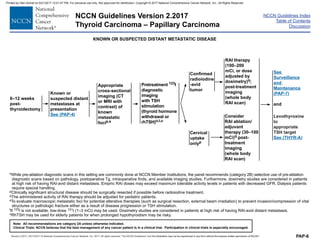
PAP-6
Known or
suspected distant
metastases at
presentation
See (PAP-4)
6–12 weeks
post-
thyroidectomy
Appropriate
cross-sectional
imaging (CT
or MRI with
contrast) of
known
metastatic
focip,s
Pretreatment 123I
diagnostic
imaging
with TSH
stimulation
(thyroid hormone
withdrawal or
rhTSH)o,t,u
Confirmed
radioiodine
-avid
tumor
RAI therapy
(100–200
mCi, or dose
adjusted by
dosimetry)q;
post-treatment
imaging
(whole body
RAI scan)
Cervical
uptake
onlyp
Consider
RAI ablation/
adjuvant
therapy (30–100
mCi)q post-
treatment
imaging
(whole body
RAI scan)
See
Surveillance
and
Maintenance
(PAP-7)
and
Levothyroxine
to
appropriate
TSH target
See (THYR-A)
KNOWN OR SUSPECTED DISTANT METASTATIC DISEASE
oWhile pre-ablation diagnostic scans in this setting are commonly done at NCCN Member Institutions, the panel recommends (category 2B) selective use of pre-ablation
diagnostic scans based on pathology, postoperative Tg, intraoperative finds, and available imaging studies. Furthermore, dosimetry studies are considered in patients
at high risk of having RAI-avid distant metastasis. Empiric RAI doses may exceed maximum tolerable activity levels in patients with decreased GFR. Dialysis patients
require special handling.
pClinically significant structural disease should be surgically resected if possible before radioiodine treatment.
qThe administered activity of RAI therapy should be adjusted for pediatric patients.
sTo evaluate macroscopic metastatic foci for potential alterative therapies (such as surgical resection, external beam irradiation) to prevent invasion/compression of vital
structures or pathologic fracture either as a result of disease progression or TSH stimulation.
tIf 123
I is not available, low-dose 131I (1–3 mCi) may be used. Dosimetry studies are considered in patients at high risk of having RAI-avid distant metastasis.
uRhTSH may be used for elderly patients for when prolonged hypothyroidism may be risky.
Printed by Irfan Ashraf on 9/21/2017 12:01:47 PM. For personal use only. Not approved for distribution. Copyright © 2017 National Comprehensive Cancer Network, Inc., All Rights Reserved.
NCCN Guidelines Index
Table of Contents
Discussion
Note: All recommendations are category 2A unless otherwise indicated.
Clinical Trials: NCCN believes that the best management of any cancer patient is in a clinical trial. Participation in clinical trials is especially encouraged.
Version 2.2017, 05/17/2017 © National Comprehensive Cancer Network, Inc. 2017, All rights reserved. The NCCN Guidelines®
and this illustration may not be reproduced in any form without the express written permission of NCCN®
.
NCCN Guidelines Version 2.2017
Thyroid Carcinoma – Papillary Carcinoma
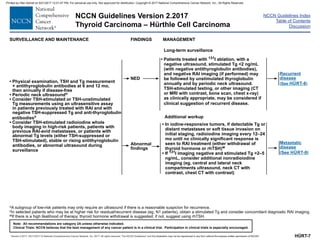
PAP-7
SURVEILLANCE AND MAINTENANCE
vA subgroup of low-risk patients may only require an ultrasound if there is a reasonable suspicion for recurrence.
wIn selected patients who may be at higher risk for residual/recurrent disease (eg, N1 patients), obtain a stimulated Tg and consider concomitant diagnostic RAI imaging.
xIf there is a high likelihood of therapy, thyroid hormone withdrawal is suggested; if not, suggest using rhTSH.
• Physical examination, TSH and Tg
measurement + antithyroglobulin antibodies at
6 and 12 mo, then annually if disease-free
• Periodic neck ultrasoundv
• Consider TSH-stimulated or TSH-unstimulated
Tg measurements using an ultrasensitive assay
in patients previously treated with RAI and
with negative TSH-suppressed Tg and anti-
thyroglobulin antibodiesw
• Consider TSH-stimulated radioiodine whole
body imaging in high-risk patients, patients
with previous RAI-avid metastases, or
patients with abnormal Tg levels (either TSH-
suppressed or TSH-stimulated), stable or rising
antithyroglobulin antibodies, or abnormal
ultrasound during surveillance
Long-term surveillance
MANAGEMENT
NED
Patients treated with 131I ablation, with a negative
ultrasound, stimulated Tg 2 ng/mL (with negative
antithyroglobulin antibodies), and negative
RAI imaging (if performed) may be followed by
unstimulated thyroglobulin annually and by
periodic neck ultrasound. TSH-stimulated testing,
or other imaging (CT or MRI with contrast, bone
scan, chest x-ray) as clinically appropriate, may
be considered if clinical suggestion of recurrent
disease.
Abnormal
findings
• In iodine-responsive tumors, if detectable Tg or
distant metastases or soft tissue invasion on
initial staging, radioiodine imaging every 12–24
mo until no clinically significant response is
seen to RAI treatment (either withdrawal of
thyroid hormone or rhTSH)x
• If 131I imaging negative and stimulated
Tg 2–5 ng/mL, consider additional
nonradioiodine imaging (eg, central and
lateral neck compartments ultrasound, neck CT
with contrast, chest CT with contrast)
Additional workup
Recurrent
disease
See (PAP-8)
Metastatic
disease
See (PAP-9)
FINDINGS
Printed by Irfan Ashraf on 9/21/2017 12:01:47 PM. For personal use only. Not approved for distribution. Copyright © 2017 National Comprehensive Cancer Network, Inc., All Rights Reserved.
NCCN Guidelines Index
Table of Contents
Discussion
Note: All recommendations are category 2A unless otherwise indicated.
Clinical Trials: NCCN believes that the best management of any cancer patient is in a clinical trial. Participation in clinical trials is especially encouraged.
Version 2.2017, 05/17/2017 © National Comprehensive Cancer Network, Inc. 2017, All rights reserved. The NCCN Guidelines®
and this illustration may not be reproduced in any form without the express written permission of NCCN®
.
NCCN Guidelines Version 2.2017
Thyroid Carcinoma – Papillary Carcinoma
PAP-8
• Stimulated Tg 1–10 ng/mL
• Non-resectable tumors
• Non-radioiodine responsive
Suppress TSH with levothyroxineh
Locoregional
recurrence
Surgery (preferred) if resectabley
and/or
Radioiodine treatment,q
if radioiodine imaging positive
and/or
local therapies when available (ethanol ablation, radiofrequency ablation [RFA])
and/or
EBRT/IMRT, if radioiodine imaging negative for select patients not responsive to other therapies
or
observation for low-volume disease that is stable and distant from critical structures
Metastatic disease
See Treatment of Metastatic
Disease (PAP-9)
and/or
local therapies when available
RECURRENT DISEASE
hSee Principles of TSH Suppression (THYR-A).
qThe administered activity of RAI therapy should be adjusted for pediatric patients.
yPreoperative vocal cord assessment, if central neck recurrence.
Continue surveillance with unstimulated Tg,
ultrasound, and other imaging as clinically indicated
(see PAP-7)
• Stimulated Tg 10
ng/mL and rising
• Scans (including
PET) negative
Consider radioiodine therapy with 100–150 mCiq
and
post-treatment 131I imaging (category 3); additional RAI treatments
should be limited to patients who responded to previous RAI therapy
Printed by Irfan Ashraf on 9/21/2017 12:01:47 PM. For personal use only. Not approved for distribution. Copyright © 2017 National Comprehensive Cancer Network, Inc., All Rights Reserved.
NCCN Guidelines Index
Table of Contents
Discussion
Note: All recommendations are category 2A unless otherwise indicated.
Clinical Trials: NCCN believes that the best management of any cancer patient is in a clinical trial. Participation in clinical trials is especially encouraged.
Version 2.2017, 05/17/2017 © National Comprehensive Cancer Network, Inc. 2017, All rights reserved. The NCCN Guidelines®
and this illustration may not be reproduced in any form without the express written permission of NCCN®
.
NCCN Guidelines Version 2.2017
Thyroid Carcinoma – Papillary Carcinoma
PAP-9
Structurally
persistent/recurrent
locoregional or
distant metastatic
disease not
amenable to RAI
therapy
• Continue to
suppress
TSH with
levothyroxineh
Iodine-refractory
soft tissue metastases
(eg, lung, liver, muscle)
excluding CNS
metastases (see below)
Iodine-
refractory
metastatic
bone
metastasesz
CNS metastases
TREATMENT OF METASTATIC DISEASE NOT AMENABLE TO RAI THERAPY
• For progressive and/or symptomatic disease, consider lenvatinib
(preferred) or sorafenib.aa
• While not FDA approved for the treatment of differentiated thyroid cancer,
other commercially available small molecular kinase inhibitors can be
considered for progressive and/or symptomatic disease if clinical trials or
other systemic therapies are not available or appropriate. bb,cc,dd
• Consider resection of distant metastases and/or EBRT/SBRT/IMRT/other
local therapiesee when available to metastatic lesions if progressive and/or
symptomatic.
• Active surveillance is often appropriate in asymptomatic patients with
indolent disease assuming no brain metastasis.bb (See PAP-7)
• Consider surgical palliation and/or EBRT/SBRT/other local therapiesee
when available if symptomatic, or asymptomatic in weight-bearing sites.
Embolization prior to surgical resection of bone metastases should be
considered to reduce the risk of hemorrhage.
• Consider embolization or other interventional procedures as alternatives to
surgical resection/EBRT/IMRT in select cases.
• Consider intravenous bisphosphonate or denosumab.z
• Active surveillance may be appropriate in asymptomatic patients with indolent
disease.bb (See PAP-7)
• For progressive and/or symptomatic disease, consider lenvatinib (preferred)
or sorafenib.bb While not FDA approved for the treatment of differentiated
thyroid cancer, other commercially available small molecular kinase inhibitors
can be considered for progressive and/or symptomatic disease if clinical
trials or other systemic therapies are not available or appropriate.bb,cc,dd
hSee Principles of TSH Suppression (THYR-A).
zDenosumab and intravenous bisphosphonates can be associated with severe hypocalcemia; patients with hypoparathyroidism and vitamin D deficiency are at increased risk.
aaThe decision of whether to use lenvatinib (preferred) or sorafenib should be individualized for each patient based on likelihood of response and comorbidities.
bbKinase inhibitor therapy may not be approriate for patients with stable or slowly progressive indolent disease. See Principles of Kinase Inhibitor Therapy (THYR-B).
ccWhile not FDA approved for treatment of differentiated thyroid cancer, commercially available small-molecule kinase inhibitors (such as axitinib, everolimus, pazopanib,
sunitinib, vandetanib, vemurafenib (BRAF-positive), or cabozantinib [all are category 2A]) can be considered if clinical trials are not available or appropriate.
ddCytotoxic chemotherapy has been shown to have minimal efficacy, although most studies were small and underpowered.
eeEthanol ablation, cryoablation, RFA, etc.
See (PAP-10)
Iodine-refractory
unresectable loco-
regional recurrent/
persistent disease
or
Printed by Irfan Ashraf on 9/21/2017 12:01:47 PM. For personal use only. Not approved for distribution. Copyright © 2017 National Comprehensive Cancer Network, Inc., All Rights Reserved.
NCCN Guidelines Index
Table of Contents
Discussion
Note: All recommendations are category 2A unless otherwise indicated.
Clinical Trials: NCCN believes that the best management of any cancer patient is in a clinical trial. Participation in clinical trials is especially encouraged.
Version 2.2017, 05/17/2017 © National Comprehensive Cancer Network, Inc. 2017, All rights reserved. The NCCN Guidelines®
and this illustration may not be reproduced in any form without the express written permission of NCCN®
.
NCCN Guidelines Version 2.2017
Thyroid Carcinoma – Papillary Carcinoma
PAP-10
• For solitary CNS lesions, either neurosurgical resection or stereotactic radiosurgery is preferred.
and/or
• For multiple CNS lesions, consider resection and/or radiotherapy, including image-guided radiotherapy.
and/or
• For progressive and/or symptomatic disease, consider lenvatinib (preferred), or sorafenib.aa,ff
and/or
• While not FDA approved for the treatment of differentiated thyroid cancer, other commercially available
small molecular kinase inhibitors can be considered for progressive and/or symptomatic disease if
clinical trials or other systemic therapies are not available or appropriate.bb,cc,dd,ff
and/or
• Consider resection of distant metastases and/or EBRT/IMRT to metastatic lesions if progressive and/or
symptomatic.
TREATMENT OF METASTATIC DISEASE NOT AMENABLE TO RAI THERAPY
CNS metastases
aaThe decision of whether to use lenvatinib (preferred) or sorafenib should be individualized for each patient based on likelihood of response and comorbidities.
bbKinase inhibitor therapy may not be appropriate for patients with stable or slowly progressive indolent disease. See Principles of Kinase Inhibitor Therapy (THYR-B).
ccWhile not FDA approved for treatment of differentiated thyroid cancer, commercially available small-molecule kinase inhibitors (such as axitinib, everolimus, pazopanib,
sunitinib, vandetanib, vemurafenib (BRAF-positive), or cabozantinib [all are category 2A]) can be considered if clinical trials are not available or appropriate.
ddCytotoxic chemotherapy has been shown to have minimal efficacy, although most studies were small and underpowered.
ffAfter consultation with neurosurgery and radiation oncology, data on the efficacy of lenvatinib or sorafenib for patients with brain metastases have not
been established.
Printed by Irfan Ashraf on 9/21/2017 12:01:47 PM. For personal use only. Not approved for distribution. Copyright © 2017 National Comprehensive Cancer Network, Inc., All Rights Reserved.
NCCN Guidelines Index
Table of Contents
Discussion
Note: All recommendations are category 2A unless otherwise indicated.
Clinical Trials: NCCN believes that the best management of any cancer patient is in a clinical trial. Participation in clinical trials is especially encouraged.
Version 2.2017, 05/17/2017 © National Comprehensive Cancer Network, Inc. 2017, All rights reserved. The NCCN Guidelines®
and this illustration may not be reproduced in any form without the express written permission of NCCN®
.
NCCN Guidelines Version 2.2017
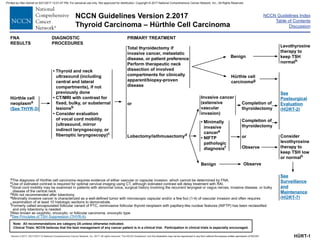
Thyroid Carcinoma – Follicular Carcinoma
FOLL-1
FNA
RESULTS
DIAGNOSTIC
PROCEDURES
PRIMARY TREATMENT
Follicular
neoplasma
or
Follicular
lesion of
undetermined
significance
(FLUS)a
See (THYR-3)
• Thyroid and neck ultrasound
(including central and
lateral compartments), if not
previously done
• CT/MRI with contrast for
fixed, bulky, or substernal
lesionsb
• Consider evaluation of vocal
cord mobility (ultrasound,
mirror indirect laryngoscopy,
or fiber-optic laryngoscopy)c
Total thyroidectomy if
invasive cancer, metastatic
cancer, or patient preference
Perform therapeutic neck
dissection of involved
compartments for clinically
apparent/biopsy-proven
disease
Benign
Levothyroxine
therapy to
keep TSH
normalg
Papillary carcinoma
Follicular
carcinoma
See (PAP-3)
or
Invasive cancer
(extensive
vascular
invasion)
Completion of
thyroidectomy
See
Postsurgical
Evaluation
(FOLL-2)
• Minimally
invasive
cancere
• NIFTP
pathologic
diagnosisf
Completion of
thyroidectomy
or
Observe
Consider
levothyroxine
therapy to
keep TSH low
or normalg
Benign Observe
See
Surveillance
and
Maintenance
(FOLL-7)
Papillary
carcinoma
See (PAP-2)
Lobectomy/isthmusectomyd
aThe diagnosis of follicular carcinoma requires evidence of either vascular or capsular invasion, which cannot
be determined by FNA. Molecular diagnostics (category 2B) may be useful to allow reclassification of follicular
lesions (follicular neoplasm or follicular lesions of undetermined significance (FLUS)) as either more or less likely
to be benign or malignant based on the genetic profile. If molecular testing (category 2B) in conjunction with
clinical and ultrasound features suggests papillary thyroid carcinoma, especially in the case of BRAF V600E,
see (PAP-1). Use molecular markers with caution and caveat.
bUse of iodinated contrast is required for optimal cervical imaging using CT, although iodinated contrast will delay
treatment with RAI.
cVocal cord mobility may be examined in patients with abnormal voice, surgical history involving the recurrent
laryngeal or vagus nerves, invasive disease, or bulky disease of the central neck.
dRAI not recommended after lobectomy.
eMinimally invasive cancer is characterized as a well-defined tumor with microscopic capsular and/or a few foci of
vascular invasion (1-4) and often requires examination of at least 10 histologic sections to demonstrate.
fFormerly called encapsulated follicular variant of PTC, noninvasive follicular thyroid neoplasm with papillary-like
nuclear features (NIFTP), has been reclassified and only lobectomy is needed.
gSee Principles of TSH Suppression (THYR-A).
Printed by Irfan Ashraf on 9/21/2017 12:01:47 PM. For personal use only. Not approved for distribution. Copyright © 2017 National Comprehensive Cancer Network, Inc., All Rights Reserved.
NCCN Guidelines Index
Table of Contents
Discussion
Note: All recommendations are category 2A unless otherwise indicated.
Clinical Trials: NCCN believes that the best management of any cancer patient is in a clinical trial. Participation in clinical trials is especially encouraged.
Version 2.2017, 05/17/2017 © National Comprehensive Cancer Network, Inc. 2017, All rights reserved. The NCCN Guidelines®
and this illustration may not be reproduced in any form without the express written permission of NCCN®
.
NCCN Guidelines Version 2.2017
Thyroid Carcinoma – Follicular Carcinoma
FOLL-2
POSTSURGICAL EVALUATION
No gross
residual
disease
in neck
Gross residual
disease in neck
Resectable
Resect, if
possible
No gross
residual disease
Gross residual disease
Unresectable
• TSH + Tg
measurement
+ antithyroglobulin
antibodies (6–12 wk
postoperatively)
• Total body
radioiodine imaging
(category 2B)
See Consideration for Initial Postoperative RAI Therapy After Total
Thyroidectomy (FOLL-3)
Suspected
or proven
inadequate
RAI uptake
Adequate
RAI uptake
No RAI
imaging
performed
Observe
or
Consider
EBRT/IMRT
if disease is
threatening
vital
structures
• Radioiodine
treatment
(preferred)
• Post-
treatment 131I
whole body
imaging
• Consider
EBRT/IMRT
Suppress
TSH with
levo-
thyroxineg
See
Surveillance
and
Maintenance
(FOLL-7)
gSee Principles of TSH Suppression (THYR-A).
Printed by Irfan Ashraf on 9/21/2017 12:01:47 PM. For personal use only. Not approved for distribution. Copyright © 2017 National Comprehensive Cancer Network, Inc., All Rights Reserved.
Note: All recommendations are category 2A unless otherwise indicated.
Clinical Trials: NCCN believes that the best management of any cancer patient is in a clinical trial. Participation in clinical trials is especially encouraged.
Version 2.2017, 05/17/2017 © National Comprehensive Cancer Network, Inc. 2017, All rights reserved. The NCCN Guidelines®
and this illustration may not be reproduced in any form without the express written permission of NCCN®
.
NCCN Guidelines Index
Table of Contents
Discussion
NCCN Guidelines Version 2.2017
Thyroid Carcinoma – Follicular Carcinoma
FOLL-3
CLINICOPATHOLOGIC FACTORS
RAI not typically recommended (if all present):
• Primary tumor 2 cm
• Intrathyroidal
• No vascular invasion
• Clinical N0
• No detectable anti-Tg antibodies
• Postoperative unstimulated Tg 1 ng/mLh
RAI not typically
indicated
RAI selectively recommended (if any present):
• Primary tumor 2–4 cm
• Minor vascular invasion
• Cervical lymph node metastases
• Postoperative unstimulated Tg 5–10 ng/mLh
RAI recommended (if any present):
• Gross extrathyroidal extension
• Primary tumor 4 cm
• Extensive vascular invasion
• Postoperative unstimulated Tg 5–10 ng/Lh,i
Known or suspected distant metastases at presentation
Amenable to RAI
See (FOLL-6)
RAI being
considered,
See (FOLL-5)
For general principles related to RAI
therapy, See (Discussion)
CONSIDERATION FOR INITIAL POSTOPERATIVE RAI THERAPY
AFTER TOTAL THYROIDECTOMY
Gross residual disease not amenable to RAI therapy See (FOLL-9)
RAI ablation is recommended when the
combination of individual clinical factors (such as
the size of the primary tumor, histology, degree
lymphatic invasion, lymph node metastases,
postoperative thyroglobulin, and age at diagnosis)
predicts a significant risk of recurrence, distant
metastases, or disease-specific mortality.
hTg values obtained 6–12 weeks after total thyroidectomy.
iAdditional cross-sectional imaging (CT or MRI of the neck with contrast and chest CT with contrast) should be considered to rule out the
presence of significant normal thyroid remnant or gross residual disease and to detect clinically significant distant metastases.
Printed by Irfan Ashraf on 9/21/2017 12:01:47 PM. For personal use only. Not approved for distribution. Copyright © 2017 National Comprehensive Cancer Network, Inc., All Rights Reserved.
NCCN Guidelines Index
Table of Contents
Discussion
Note: All recommendations are category 2A unless otherwise indicated.
Clinical Trials: NCCN believes that the best management of any cancer patient is in a clinical trial. Participation in clinical trials is especially encouraged.
Version 2.2017, 05/17/2017 © National Comprehensive Cancer Network, Inc. 2017, All rights reserved. The NCCN Guidelines®
and this illustration may not be reproduced in any form without the express written permission of NCCN®
.
NCCN Guidelines Version 2.2017
Thyroid Carcinoma – Follicular Carcinoma
FOLL-4
RAI NOT TYPICALLY INDICATED BASED ON CLINICOPATHOLOGIC FEATURES
6–12 weeks
post-
thyroidectomy
Clinicopatho-
logic findings
that would not
typically indicate
routine RAI
ablation
See (FOLL-3)
• Unstimulated
Tg
• Lateral neck
ultrasound
if not done
preoperatively
• Tg 5–10 ng/mL
(with negative
anti-Tg
antibodies)
• No
concerning
findings
on neck
ultrasound
• Consider additional
cross-sectional
imaging (CT or MRI
of the neck with
contrast and chest
CT with contrast)
Consider
RAI
ablation/
adjuvant
therapy;
See (FOLL-5)
Tg 5–10 ng/mL
(with negative
anti-Tg antibodies)
No concerning
finding on neck
ultrasound
Follow without
RAI ablation
and
See Surveillance
and Maintenance
(FOLL-7)
and
Levothyroxine to
appropriate TSH
target
See (THYR-A)
Clinically
significant,
indeterminate
or suspicious
cervical nodesj
Benign
FNA
Malignant
FNA
Consider further
surgery prior to
RAI See (FOLL-2)
jFor example, round morphology, calcifications, multiplicity, or growing enlarging nodes.
Consider
further
surgery
prior to
RAI
Printed by Irfan Ashraf on 9/21/2017 12:01:47 PM. For personal use only. Not approved for distribution. Copyright © 2017 National Comprehensive Cancer Network, Inc., All Rights Reserved.
NCCN Guidelines Index
Table of Contents
Discussion
Note: All recommendations are category 2A unless otherwise indicated.
Clinical Trials: NCCN believes that the best management of any cancer patient is in a clinical trial. Participation in clinical trials is especially encouraged.
Version 2.2017, 05/17/2017 © National Comprehensive Cancer Network, Inc. 2017, All rights reserved. The NCCN Guidelines®
and this illustration may not be reproduced in any form without the express written permission of NCCN®
.
NCCN Guidelines Version 2.2017
Thyroid Carcinoma – Follicular Carcinoma
FOLL-5
6–12 weeks
post-
thyroidectomy
Clinicopathologic
findings prompting
consideration for
RAI, without gross
residual disease
or known distant
metastasis
See (FOLL-3)
Consider
pretreatment 123I
diagnostic
imaging with
TSH stimulation
(thyroid hormone
withdrawal or
rhTSH);
(category 2B)k,l
No or minor
thyroid bed uptake
on scan,
unstimulated Tg
1 ng/mL (with
negative anti-Tg
antibodies)
Follow without
RAI ablation
See Surveillance
and Maintenance
(FOLL-7)
and
Levothyroxine to
appropriate TSH target
(See THYR-A)
Suspectedl,m or
proven thyroid
bed uptake
Follow without
RAI ablation
or
RAI for remnant
ablation (30–50
mCi) or
adjuvant therapy
(50–100 mCi)n,o
post-treatment
imaging (whole
body RAI scan)
RAI therapy
(100–200 mCi)n;
post-treatment
imaging (whole
body RAI scan)
RAI BEING CONSIDERED BASED ON CLINICOPATHOLOGIC FEATURES
kAlternatively, low-dose 131I (1–3 mCi) may be used.
lWhile pre-ablation diagnostic scans in this setting are commonly done at NCCN Member Institutions the panel recommends (category 2B) selective use of pre-ablation
diagnostic scans based on pathology, postoperative Tg, intraoperative findings, and available imaging studies. Furthermore, dosimetry studies are considered in
patients at high risk of having RAI-avid distant metastasis. Empiric RAI doses may exceed maximum tolerable activity levels in patients with decreased GFR. Dialysis
patients require special handling.
mClinically significant structural disease should be surgically resected if possible before radioiodine treatment.
nThe administered activity of RAI therapy should be adjusted for pediatric patients.
oIf RAI ablation is used in T1b/T2 (1–4 cm), clinical N0 disease, 30 mCi of 131I is recommended (category 1) following either recombinant human TSH stimulation or
thyroid hormone withdrawal. This dose of 30 mCi may also be considered (category 2B) for patients with T1b/T2 (1–4 cm) with small-volume N1a disease (fewer than
3–5 metastatic lymph node metastases 0.5 in diameter) and for patients with primary tumors 4 cm, clinical M0 with minor extrathyroidal extension.
Suspectedl,m or
proven radioiodine-
avid metastatic foci
Printed by Irfan Ashraf on 9/21/2017 12:01:47 PM. For personal use only. Not approved for distribution. Copyright © 2017 National Comprehensive Cancer Network, Inc., All Rights Reserved.
NCCN Guidelines Index
Table of Contents
Discussion
Note: All recommendations are category 2A unless otherwise indicated.
Clinical Trials: NCCN believes that the best management of any cancer patient is in a clinical trial. Participation in clinical trials is especially encouraged.
Version 2.2017, 05/17/2017 © National Comprehensive Cancer Network, Inc. 2017, All rights reserved. The NCCN Guidelines®
and this illustration may not be reproduced in any form without the express written permission of NCCN®
.
NCCN Guidelines Version 2.2017
Thyroid Carcinoma – Follicular Carcinoma
FOLL-6
KNOWN OR SUSPECTED DISTANT METASTATIC DISEASE
6–12 weeks
post-
thyroidectomy
Known or
suspected distant
metastases at
presentation
See (FOLL-3)
Appropriate
cross-sectional
imaging (CT
or MRI with
contrast) of
known
metastatic
focim,p
Pretreatment 123I
diagnostic
imaging
with TSH
stimulation
(thyroid hormone
withdrawal
or rhTSH)l,q,r
Confirmed
radioiodine
-avid
tumor
RAI therapy
(100–200
mCi, or dose
adjusted by
dosimetry)s;
post-treatment
imaging (whole
body RAI scan)
See
Surveillance
and
Maintenance
(FOLL-7)
and
Central-
cervical
(remnant)
uptake
only
Consider RAI
ablation/adjuvant
therapy (30–100
mCi)s; post
treatment
imaging (whole
body RAI scan)
Levothyroxine
to
appropriate TSH
target
See (THYR-A)
lWhile pre-ablation diagnostic scans in this setting are commonly done at NCCN Member Institutions the panel recommends (category 2B) selective use of pre-ablation
diagnostic scans based on pathology, postoperative Tg, intraoperative finds, and available imaging studies. Furthermore, dosimetry studies are considered in patients
at high risk of having RAI-avid distant metastasis. Empiric RAI doses may exceed maximum tolerable activity levels in patients with decreased GFR. Dialysis patients
require special handling.
mClinically significant structural disease should be surgically resected if possible before radioiodine treatment.
pTo evaluate macroscopic metastatic foci for potential alterative therapies (such as surgical resection and/or external beam radiation) to prevent invasion/compression of
vital structures or pathologic fracture either as a result of disease progression or TSH stimulation.
qIf I-123 is not available, low-dose 131I (1–3 mCi) may be used. Dosimetry studies are considered in patients at high risk of having RAI-avid distant metastasis.
rrhTSH may be used for elderly patients for whom prolonged hypothyroidism may be risky.
sThe administered activity of RAI therapy should be adjusted for pediatric patients.
Printed by Irfan Ashraf on 9/21/2017 12:01:47 PM. For personal use only. Not approved for distribution. Copyright © 2017 National Comprehensive Cancer Network, Inc., All Rights Reserved.
NCCN Guidelines Version 2.2017
Thyroid Carcinoma
NCCN Guidelines Index
Table of Contents
Discussion
Note: All recommendations are category 2A unless otherwise indicated.
Clinical Trials: NCCN believes that the best management of any cancer patient is in a clinical trial. Participation in clinical trials is especially encouraged.
Version 2.2017, 05/17/2017 © National Comprehensive Cancer Network, Inc. 2017, All rights reserved. The NCCN Guidelines®
and this illustration may not be reproduced in any form without the express written permission of NCCN®
.
– Follicular Carcinoma
FOLL-7
SURVEILLANCE AND MAINTENANCE
tA subgroup of low-risk patients may only require an ultrasound if there is a reasonable suspicion for recurrence.
uIn selected patients who may be at higher risk for residual/recurrent disease (eg, N1 patients), obtain a stimulated Tg and consider concomitant diagnostic RAI imaging
vIf there is a high likelihood of therapy, thyroid hormone withdrawal is suggested; if not, suggest using rhTSH.
• Physical examination, TSH and Tg measurement
+ antithyroglobulin antibodies at 6 and 12 mo, then
annually if disease-free
• Periodic neck ultrasoundt
• Consider TSH-stimulated or TSH-unstimulated
Tg measurements using an ultrasensitive assay
in patients previously treated with RAI and with
negative TSH-suppressed Tg and
anti-thyroglobulin antibodiesu
• Consider TSH-stimulated radioiodine whole
body imaging in high-risk patients, patients with
previous RAI-avid metastases, or patients with
abnormal Tg levels (either TSH-suppressed or
TSH-stimulated), stable or rising antithyroglobulin
antibodies, or abnormal ultrasound during
surveillance
Long-term surveillance
MANAGEMENT
NED
• Patients treated with 131I ablation, with a negative
ultrasound, stimulated Tg 2 ng/mL (with negative
antithyroglobulin antibodies), and negative
RAI imaging (if performed) may be followed by
unstimulated thyroglobulin annually and by
periodic neck ultrasound. TSH-stimulated testing,
or other imaging (CT with contrast or MRI, bone
scan, chest x-ray) as clinically appropriate, may
be considered if clinical suggestion of recurrent
disease.
Abnormal
findings
• In iodine-responsive tumors, if detectable Tg or
distant metastases or soft tissue invasion on initial
staging, radioiodine imaging every 12–24 mo until
no clinically significant response is seen to RAI
treatment (either withdrawal of thyroid hormone or
rhTSH)v
• If 131I imaging negative and stimulated Tg 2–5 ng/
mL, consider additional nonradioiodine imaging (eg,
central and lateral neck compartments ultrasound,
neck CT with contrast, chest CT with contrast)
Additional workup
Recurrent
disease
(See FOLL-8)
Metastatic
disease
(See FOLL-9)
FINDINGS
Printed by Irfan Ashraf on 9/21/2017 12:01:47 PM. For personal use only. Not approved for distribution. Copyright © 2017 National Comprehensive Cancer Network, Inc., All Rights Reserved.
NCCN Guidelines Index
Table of Contents
Discussion
Note: All recommendations are category 2A unless otherwise indicated.
Clinical Trials: NCCN believes that the best management of any cancer patient is in a clinical trial. Participation in clinical trials is especially encouraged.
Version 2.2017, 05/17/2017 © National Comprehensive Cancer Network, Inc. 2017, All rights reserved. The NCCN Guidelines®
and this illustration may not be reproduced in any form without the express written permission of NCCN®
.
NCCN Guidelines Version 2.2017
Thyroid Carcinoma – Follicular Carcinoma
FOLL-8
• Stimulated Tg 1–10 ng/mL
• Non-resectable tumors
• Non-radioiodine responsive
Suppress TSH with levothyroxineg
Locoregional
recurrence
Surgery (preferred) if resectablew
and/or
Radioiodine treatment,n
if radioiodine imaging positive
and/or
local therapies when available (ethanol ablation, RFA)
and/or
EBRT/IMRT, if radioiodine imaging negative for select patients not responsive to other therapies
or
observation for low-volume disease that is stable and distant from critical structures
Metastatic disease
See Treatment of Metastatic
Disease (FOLL-9)
and/or
local therapies when available
RECURRENT DISEASE
gSee Principles of TSH Suppression (THYR-A).
nThe administered activity of RAI therapy should be adjusted for pediatric patients.
wPreoperative vocal cord assessment, if central neck recurrence.
Continue surveillance with unstimulated Tg,
ultrasound, and other imaging as clinically indicated
(See FOLL-7)
• Stimulated Tg 10
ng/mL and rising
• Scans (including
PET) negative
Consider radioiodine therapy with 100–150 mCin
and post-treatment 131I imaging (category 3); additional RAI
treatments should be limited to patients who responded to previous
RAI therapy
Printed by Irfan Ashraf on 9/21/2017 12:01:47 PM. For personal use only. Not approved for distribution. Copyright © 2017 National Comprehensive Cancer Network, Inc., All Rights Reserved.
NCCN Guidelines Index
Table of Contents
Discussion
Note: All recommendations are category 2A unless otherwise indicated.
Clinical Trials: NCCN believes that the best management of any cancer patient is in a clinical trial. Participation in clinical trials is especially encouraged.
Version 2.2017, 05/17/2017 © National Comprehensive Cancer Network, Inc. 2017, All rights reserved. The NCCN Guidelines®
and this illustration may not be reproduced in any form without the express written permission of NCCN®
.
NCCN Guidelines Version 2.2017
Thyroid Carcinoma – Follicular Carcinoma
Structurally
persistent/recurrent
locoregional or
distant metastatic
disease not
amenable to RAI
therapy
• Continue to
suppress
TSH with
levothyroxineg
Iodine-refractory
unresectable loco-
regional recurrent/
persistent disease
or
Iodine-refractory
soft tissue metastases
(eg, lung, liver, muscle)
excluding CNS
metastases (see below)
Iodine-
refractory
metastatic
bone
metastasesx
CNS metastases
TREATMENT OF METASTATIC DISEASE NOT AMENABLE TO RAI THERAPY
• For progressive and/or symptomatic disease, consider lenvatinib
(preferred) or sorafenib.y
• While not FDA approved for the treatment of differentiated thyroid cancer,
other commercially available small molecular kinase inhibitors can be
considered for progressive and/or symptomatic disease if clinical trials or
other systemic therapies are not available or appropriate.z,aa,bb
• Consider resection of distant metastases and/or EBRT/SBRT/IMRT/other
local therapiescc when available to metastatic lesions if progressive and/or
symptomatic.
• Active surveillance is often appropriate in asymptomatic patients with
indolent disease assuming no brain metastasis.z (See FOLL-7)
• Consider surgical palliation and/or EBRT/SBRT/other local therapiescc
when available if symptomatic, or asymptomatic in weight-bearing sites.
Embolization prior to surgical resection of bone metastases should be
considered to reduce the risk of hemorrhage.
• Consider embolization or other interventional procedures as alternatives to
surgical resection/EBRT/IMRT in select cases.
• Consider intravenous bisphosphonate or denosumab.x
• Active surveillance may be appropriate in asymptomatic patients with indolent
disease.z (See FOLL-7)
• For progressive and/or symptomatic disease, consider lenvatinib (preferred) or
sorafenib.y While not FDA approved for the treatment of differentiated thyroid
cancer, other commercially available small molecular kinase inhibitors can
be considered for progressive and/or symptomatic disease if clinical trials or
other systemic therapies are not available or appropriate. z,aa,bb
gSee Principles of TSH Suppression (THYR-A).
xDenosumab and intravenous bisphosphonates can be associated with severe hypocalcemia; patients with hypoparathyroidism and vitamin D deficiency are at increased risk.
yThe decision of whether to use lenvatinib (preferred) or sorafenib should be individualized for each patient based on likelihood of response and comorbidities.
zKinase inhibitor therapy may not be appropriate for patients with stable or slowly progressive indolent disease.
See Principles of Kinase Inhibitor Therapy (THYR-B).
aaWhile not FDA approved for treatment of differentiated thyroid cancer, commercially available small-molecule kinase inhibitors (such as axitinib, everolimus, pazopanib,
sunitinib, vandetanib, vemurafenib (BRAF-positive), or cabozantinib [all are category 2A]) can be considered if clinical trials are not available or appropriate.
bbCytotoxic chemotherapy has been shown to have minimal efficacy, although most studies were small and underpowered.
ccEthanol ablation, cryoablation, RFA, etc.
See (FOLL-10)
FOLL-9
Printed by Irfan Ashraf on 9/21/2017 12:01:47 PM. For personal use only. Not approved for distribution. Copyright © 2017 National Comprehensive Cancer Network, Inc., All Rights Reserved.
NCCN Guidelines Index
Table of Contents
Discussion
Note: All recommendations are category 2A unless otherwise indicated.
Clinical Trials: NCCN believes that the best management of any cancer patient is in a clinical trial. Participation in clinical trials is especially encouraged.
Version 2.2017, 05/17/2017 © National Comprehensive Cancer Network, Inc. 2017, All rights reserved. The NCCN Guidelines®
and this illustration may not be reproduced in any form without the express written permission of NCCN®
.
NCCN Guidelines Version 2.2017
Thyroid Carcinoma – Follicular Carcinoma
FOLL-10
• For solitary CNS lesions, either neurosurgical resection or stereotactic radiosurgery is preferred.
and/or
• For multiple CNS lesions, consider resection and/or radiotherapy, including image-guided radiotherapy.
and/or
• For progressive and/or symptomatic disease, consider lenvatinib (preferred), or sorafenib.y,dd
and/or
• While not FDA approved for the treatment of differentiated thyroid cancer, other commercially available
small molecular kinase inhibitors can be considered for progressive and/or symptomatic disease if
clinical trials or other systemic therapies are not available or appropriate.z,aa,bb,dd
and/or
• Consider resection of distant metastases and/or EBRT/IMRT to metastatic lesions if progressive and/or
symptomatic.
TREATMENT OF METASTATIC DISEASE NOT AMENABLE TO RAI THERAPY
CNS metastases
yThe decision of whether to use lenvatinib (preferred) or sorafenib should be individualized for each patient based on likelihood of response and comorbidities.
zKinase inhibitor therapy may not be appropriate for patients with stable or slowly progressive indolent disease. See Principles of Kinase Inhibitor Therapy (THYR-B).
aaWhile not FDA approved for treatment of differentiated thyroid cancer, commercially available small-molecule kinase inhibitors (such as axitinib, everolimus,
pazopanib, sunitinib, vandetanib, vemurafenib (BRAF-positive), or cabozantinib [all are category 2A]) can be considered if clinical trials are not available or
appropriate.
bbCytotoxic chemotherapy has been shown to have minimal efficacy, although most studies were small and underpowered.
ddAfter consultation with neurosurgery and radiation oncology; data on the efficacy of lenvatinib or sorafenib for patients with brain metastases have not been
established.
Printed by Irfan Ashraf on 9/21/2017 12:01:47 PM. For personal use only. Not approved for distribution. Copyright © 2017 National Comprehensive Cancer Network, Inc., All Rights Reserved.
NCCN Guidelines Index
Table of Contents
Discussion
Note: All recommendations are category 2A unless otherwise indicated.
Clinical Trials: NCCN believes that the best management of any cancer patient is in a clinical trial. Participation in clinical trials is especially encouraged.
Version 2.2017, 05/17/2017 © National Comprehensive Cancer Network, Inc. 2017, All rights reserved. The NCCN Guidelines®
and this illustration may not be reproduced in any form without the express written permission of NCCN®
.
NCCN Guidelines Version 2.2017
Thyroid Carcinoma – Hürthle Cell Carcinoma
FNA
RESULTS
DIAGNOSTIC
PROCEDURES
PRIMARY TREATMENT
Hürthle cell
neoplasma
(See THYR-3)
• Thyroid and neck
ultrasound (including
central and lateral
compartments), if not
previously done
• CT/MRI with contrast for
fixed, bulky, or substernal
lesionsb
• Consider evaluation
of vocal cord mobility
(ultrasound, mirror
indirect laryngoscopy, or
fiberoptic laryngoscopy)c
Total thyroidectomy if
invasive cancer, metastatic
disease, or patient preference
Perform therapeutic neck
dissection of involved
compartments for clinically
apparent/biopsy-proven
disease
or
Benign
Hürthle cell
carcinomag
Lobectomy/isthmusectomyd
Invasive cancer
(extensive
vascular
invasion)
• Minimally
invasive
cancere
• NIFTP
pathologic
diagnosisf
Benign
Completion of
thyroidectomy
Levothyroxine
therapy to
keep TSH
normalh
See
Postsurgical
Evaluation
(HÜRT-2)
Completion of
thyroidectomy
or
Observe
Consider
levothyroxine
therapy to
keep TSH low
or normalh
Observe
See
Surveillance
and
Maintenance
(HÜRT-7)
aThe diagnosis of Hürthle cell carcinoma requires evidence of either vascular or capsular invasion, which cannot be determined by FNA.
bUse of iodinated contrast is required for optimal cervical imaging using CT, although iodinated contrast will delay treatment with RAI.
cVocal cord mobility may be examined in patients with abnormal voice, surgical history involving the recurrent laryngeal or vagus nerves, invasive disease, or bulky
disease of the central neck.
dRAI not recommended after lobectomy.
eMinimally invasive cancer is characterized as a well-defined tumor with microscopic capsular and/or a few foci (1-4) of vascular invasion and often requires
examination of at least 10 histologic sections to demonstrate.
fFormerly called encapsulated follicular variant of PTC, noninvasive follicular thyroid neoplasm with papillary-like nuclear features (NIFTP) has been reclassified
and only lobectomy is needed.
gAlso known as oxyphilic, oncocytic, or follicular carcinoma, oncocytic type.
hSee Principles of TSH Suppression (THYR-A).
HÜRT-1
Printed by Irfan Ashraf on 9/21/2017 12:01:47 PM. For personal use only. Not approved for distribution. Copyright © 2017 National Comprehensive Cancer Network, Inc., All Rights Reserved.
NCCN Guidelines Index
Table of Contents
Discussion
Note: All recommendations are category 2A unless otherwise indicated.
Clinical Trials: NCCN believes that the best management of any cancer patient is in a clinical trial. Participation in clinical trials is especially encouraged.
Version 2.2017, 05/17/2017 © National Comprehensive Cancer Network, Inc. 2017, All rights reserved. The NCCN Guidelines®
and this illustration may not be reproduced in any form without the express written permission of NCCN®
.
NCCN Guidelines Version 2.2017
Thyroid Carcinoma – Hürthle Cell Carcinoma
HÜRT-2
POSTSURGICAL EVALUATION
No gross
residual
disease
in neck No gross
residual disease
See Consideration for Initial Postoperative RAI Therapy (HÜRT-3)
Gross residual
disease in neck
Resectable
Resect, if
possible
Gross residual disease
Unresectable
• TSH + Tg
measurement
+ antithyroglobulin
antibodies (6–12 wk
postoperatively)
• Total body
radioiodine imaging
(category 2B)
Suspected
or proven
inadequate
RAI uptake
Adequate
RAI uptake
No RAI
imaging
performed
Observe
or
Consider
EBRT/IMRT
if disease is
threatening
vital
structures
• Radioiodine
treatment
(preferred)
• Post-
treatment
131I whole
body
imaging
• Consider
EBRT/IMRT
Suppress
TSH with
levothyroxineh
See
Surveillance
and
Maintenance
(HÜRT-7)
hSee Principles of TSH Suppression (THYR-A).
Printed by Irfan Ashraf on 9/21/2017 12:01:47 PM. For personal use only. Not approved for distribution. Copyright © 2017 National Comprehensive Cancer Network, Inc., All Rights Reserved.
NCCN Guidelines Index
Table of Contents
Discussion
Note: All recommendations are category 2A unless otherwise indicated.
Clinical Trials: NCCN believes that the best management of any cancer patient is in a clinical trial. Participation in clinical trials is especially encouraged.
Version 2.2017, 05/17/2017 © National Comprehensive Cancer Network, Inc. 2017, All rights reserved. The NCCN Guidelines®
and this illustration may not be reproduced in any form without the express written permission of NCCN®
.
NCCN Guidelines Version 2.2017
Thyroid Carcinoma – Hürthle Cell Carcinoma
HÜRT-3
CLINICOPATHOLOGIC FACTORS
RAI not typically recommended (if all present):
• Primary tumor 2 cm
• Intrathyroidal
• No vascular invasion
• Clinical N0
• No detectable anti-Tg antibodies
• Postoperative unstimulated Tg 1 ng/mLi
RAI not typically
indicated
See (HÜRT-4)
RAI being
considered
See (HÜRT-5)
CONSIDERATION FOR INITIAL POSTOPERATIVE RAI THERAPY
Known or suspected distant metastases at presentation
For general principles related to
RAI therapy, See (Discussion)
RAI selectively recommended (if any present):
• Primary tumor 2–4 cm
• Minor vascular invasion
• Cervical lymph node metastases
• Postoperative unstimulated Tg 5–10 ng/mLi
RAI ablation is recommended when the
combination of individual clinical factors (such as
the size of the primary tumor, histology, degree
of lymphatic invasion, lymph node metastases,
postoperative thyroglobulin, and age at diagnosis)
predicts a significant risk of recurrence, distant
metastases, or disease-specific mortality.
RAI recommended (if any present):
• Gross extrathyroidal extension
• Primary tumor 4 cm
• Extensive vascular invasion
• Postoperative unstimulated Tg 5–10 ng/Li,j
Amenable to RAI
See (HÜRT-6)
Gross residual disease not amenable to RAI therapy See (HÜRT-9)
iTg values obtained 6–12 weeks after total thyroidectomy.
jAdditional cross-sectional imaging (CT or MRI of the neck with contrast and chest CT with contrast) should be considered to rule out the
presence of significant normal thyroid remnant or gross residual disease and to detect clinically significant distant metastases.
Printed by Irfan Ashraf on 9/21/2017 12:01:47 PM. For personal use only. Not approved for distribution. Copyright © 2017 National Comprehensive Cancer Network, Inc., All Rights Reserved.
NCCN Guidelines Index
Table of Contents
Discussion
Note: All recommendations are category 2A unless otherwise indicated.
Clinical Trials: NCCN believes that the best management of any cancer patient is in a clinical trial. Participation in clinical trials is especially encouraged.
Version 2.2017, 05/17/2017 © National Comprehensive Cancer Network, Inc. 2017, All rights reserved. The NCCN Guidelines®
and this illustration may not be reproduced in any form without the express written permission of NCCN®
.
NCCN Guidelines Version 2.2017
Thyroid Carcinoma – Hürthle Cell Carcinoma
HÜRT-4
RAI NOT TYPICALLY INDICATED BASED ON CLINICOPATHOLOGIC FEATURES
6–12 weeks post-
thyroidectomy
Clinicopathologic
findings that
would not
typically indicate
routine RAI
ablation
(See HÜRT-3)
• Unstimulated
Tg
• Lateral neck
ultrasound
if not done
preoperatively
• Tg 5–10 ng/mL
(with negative
anti-Tg
antibodies)
• No
concerning
findings
on neck
ultrasound
Consider
RAI
ablation/
adjuvant
therapy;
See (HÜRT-5)
Tg 5–10 ng/mL
(with negative
anti-Tg antibodies)
No concerning
finding on neck
ultrasound
Follow without
RAI ablation
and
See Surveillance
and Maintenance
(HÜRT-7)
and
Levothyroxine to
appropriate TSH
target
(See THYR-A)
Clinically
significant,
indeterminate,
or suspicious
cervical nodesk
Benign
FNA
Malignant
FNA
Consider further
surgery prior to
RAI; See (HÜRT-2)
kFor example, round morphology, microcalcifications, multiplicity, or growing enlarging nodes.
• Consider additional
cross-sectional
imaging (CT or MRI
of the neck with
contrast and chest
CT with contrast)
Consider
further
surgery
prior to
RAI
Printed by Irfan Ashraf on 9/21/2017 12:01:47 PM. For personal use only. Not approved for distribution. Copyright © 2017 National Comprehensive Cancer Network, Inc., All Rights Reserved.
NCCN Guidelines Index
Table of Contents
Discussion
Note: All recommendations are category 2A unless otherwise indicated.
Clinical Trials: NCCN believes that the best management of any cancer patient is in a clinical trial. Participation in clinical trials is especially encouraged.
Version 2.2017, 05/17/2017 © National Comprehensive Cancer Network, Inc. 2017, All rights reserved. The NCCN Guidelines®
and this illustration may not be reproduced in any form without the express written permission of NCCN®
.
NCCN Guidelines Version 2.2017
Thyroid Carcinoma – Hürthle Cell Carcinoma
HÜRT-5
6–12 weeks post-
thyroidectomy
Clinicopathologic
findings prompting
consideration for
RAI, without gross
residual disease
or known distant
metastasis
(See HÜRT-3)
Consider
pretreatment 123I
diagnostic
imaging with
TSH stimulation
(thyroid hormone
withdrawal or
rhTSH);
(category 2B)l,m
No or minor
thyroid bed
uptake on scan,
unstimulated Tg
1 ng/mL (with
negative anti-Tg
antibodies)
Follow without
RAI ablation
See Surveillance
and Maintenance
(HÜRT-7)
and
Levothyroxine to
appropriate TSH target
(See THYR-A)
Suspectedm,n
or
proven thyroid
bed uptake
Follow without RAI
ablation
or
RAI for remnant
ablation (30–50 mCi)
or
adjuvant therapy
(50–100 mCi)o,p
post-treatment
imaging (whole
body RAI scan)
Suspectedm,n or
proven radioiodine
avid metastatic foci
RAI therapy
(100–200 mCi)o;
post-treatment
imaging (whole
body RAI scan)
RAI BEING CONSIDERED BASED ON CLINICOPATHOLOGIC FEATURES
lAlternatively, low-dose 131I (1–3 mCi) may be used.
mWhile pre-ablation diagnostic scans in this setting are commonly done at NCCN Member Institutions, the panel recommends (category 2B) selective use of pre-ablation
diagnostic scans based on pathology, postoperative Tg, intraoperative findings, and available imaging studies. Furthermore, dosimetry studies are considered in
patients at high risk of having RAI-avid distant metastasis. Empiric RAI doses may exceed maximum tolerable activity levels in patients with decreased GFR.
Dialysis patients require special handling.
nClinically significant structural disease should be surgically resected if possible before radioiodine treatment.
oThe administered activity of RAI therapy should be adjusted for pediatric patients.
pIf RAI ablation is used in T1b/T2 (1–4 cm), clinical N0 disease, 30 mCi of 131I is recommended (category 1) following either recombinant human TSH stimulation or
thyroid hormone withdrawal. This dose of 30 mCi may also be considered (category 2B) for patients with T1b/T2 (1–4 cm) with small-volume N1a disease (fewer
than 3–5 metastatic lymph node metastases 0.5 in diameter) and for patients with primary tumors 4 cm, clinical M0 with minor extrathyroidal extension.
Printed by Irfan Ashraf on 9/21/2017 12:01:47 PM. For personal use only. Not approved for distribution. Copyright © 2017 National Comprehensive Cancer Network, Inc., All Rights Reserved.
NCCN Guidelines Index
Table of Contents
Discussion
Note: All recommendations are category 2A unless otherwise indicated.
Clinical Trials: NCCN believes that the best management of any cancer patient is in a clinical trial. Participation in clinical trials is especially encouraged.
Version 2.2017, 05/17/2017 © National Comprehensive Cancer Network, Inc. 2017, All rights reserved. The NCCN Guidelines®
and this illustration may not be reproduced in any form without the express written permission of NCCN®
.
NCCN Guidelines Version 2.2017
Thyroid Carcinoma – Hürthle Cell Carcinoma
HÜRT-6
KNOWN OR SUSPECTED DISTANT METASTATIC DISEASE
6–12 weeks
post-
thyroidectomy
Known or
suspected distant
metastases at
presentation
(See HÜRT-3)
Appropriate
cross-sectional
imaging (CT or
MRI with
contrast) of
known
metastatic
focin,q
Pretreatment 123I
diagnostic
imaging
with TSH
stimulation
(thyroid hormone
withdrawal
or rhTSH)r,s,t
Confirmed
radioiodine
avid
tumor
RAI therapy
(100–200 mCi, or
dose adjusted
by dosimetry)o;
post treatment
imaging (whole
body RAI scan)
See
Surveillance
and
Maintenance
(HÜRT-7)
and
Central-
cervical
(remnant)
uptake
only
Consider
RAI ablation/
adjuvant
therapy (30–100
mCi)o; post
treatment
imaging (whole
body RAI scan)
Levothyroxine
to
appropriate
target
(See THYR-A)
nClinically significant structural disease should be surgically resected if possible before radioiodine treatment.
oThe administered activity of RAI therapy should be adjusted for pediatric patients.
qTo evaluate macroscopic metastatic foci for potential alterative therapies (such as surgical resection and/or external beam radiation) to prevent invasion/compression.
rIf 123I is not available, low-dose 131I(1-3 mCi) may be used. Dosimetry studies are considered in patients at high risk of having RAI-avid distant metastasis.
sWhile pre-ablation diagnostic scans in this setting are commonly done at NCCN Member Institutions, the panel recommends (category 2B) selective use of pre-ablation
diagnostic scans based on pathology, postoperative Tg, intraoperative finds, and available imaging studies. Furthermore, dosimetry studies are considered in patients
at high risk of having RAI-avid distant metastasis of vital structures or pathologic fracture either as a result of disease progression or TSH stimulation. Empiric RAI
doses may exceed maximum tolerable activity levels in patients with decreased GFR. Dialysis patients require special handling.
trhTSH may be used for elderly patients for whom prolonged hypothyroidism may be risky.
Printed by Irfan Ashraf on 9/21/2017 12:01:47 PM. For personal use only. Not approved for distribution. Copyright © 2017 National Comprehensive Cancer Network, Inc., All Rights Reserved.
NCCN Guidelines Index
Table of Contents
Discussion
Note: All recommendations are category 2A unless otherwise indicated.
Clinical Trials: NCCN believes that the best management of any cancer patient is in a clinical trial. Participation in clinical trials is especially encouraged.
Version 2.2017, 05/17/2017 © National Comprehensive Cancer Network, Inc. 2017, All rights reserved. The NCCN Guidelines®
and this illustration may not be reproduced in any form without the express written permission of NCCN®
.
NCCN Guidelines Version 2.2017
Thyroid Carcinoma – Hürthle Cell Carcinoma
SURVEILLANCE AND MAINTENANCE
uA subgroup of low-risk patients may only require an ultrasound if there is a reasonable suspicion for recurrence.
vIn selected patients who may be at higher risk for residual/recurrent disease (eg, N1 patients), obtain a stimulated Tg and consider concomitant diagnostic RAI imaging.
wIf there is a high likelihood of therapy, thyroid hormone withdrawal is suggested; if not, suggest using rhTSH.
• Physical examination, TSH and Tg measurement
+ antithyroglobulin antibodies at 6 and 12 mo,
then annually if disease-free
• Periodic neck ultrasoundu
• Consider TSH-stimulated or TSH-unstimulated
Tg measurements using an ultrasensitive assay
in patients previously treated with RAI and with
negative TSH-suppressed Tg and anti-thyroglobulin
antibodiesv
• Consider TSH-stimulated radioiodine whole
body imaging in high-risk patients, patients with
previous RAI-avid metastases, or patients with
abnormal Tg levels (either TSH-suppressed or
TSH-stimulated), stable or rising antithyroglobulin
antibodies, or abnormal ultrasound during
surveillance
Long-term surveillance
MANAGEMENT
NED
• Patients treated with 131I ablation, with a
negative ultrasound, stimulated Tg 2 ng/mL
(with negative antithyroglobulin antibodies),
and negative RAI imaging (if performed) may
be followed by unstimulated thyroglobulin
annually and by periodic neck ultrasound.
TSH-stimulated testing, or other imaging (CT
or MRI with contrast, bone scan, chest x-ray)
as clinically appropriate, may be considered if
clinical suggestion of recurrent disease.
Abnormal
findings
• In iodine-responsive tumors, if detectable Tg or
distant metastases or soft tissue invasion on
initial staging, radioiodine imaging every 12–24
mo until no clinically significant response is
seen to RAI treatment (either withdrawal of
thyroid hormone or rhTSH)w
• If 131I imaging negative and stimulated Tg 2–5
ng/mL, consider additional nonradioiodine
imaging (eg, central and lateral neck
compartments ultrasound, neck CT with
contrast, chest CT with contrast)
Additional workup
Recurrent
disease
(See HÜRT-8)
Metastatic
disease
(See HÜRT-9)
FINDINGS
HÜRT-7
Printed by Irfan Ashraf on 9/21/2017 12:01:47 PM. For personal use only. Not approved for distribution. Copyright © 2017 National Comprehensive Cancer Network, Inc., All Rights Reserved.
NCCN Guidelines Index
Table of Contents
Discussion
Note: All recommendations are category 2A unless otherwise indicated.
Clinical Trials: NCCN believes that the best management of any cancer patient is in a clinical trial. Participation in clinical trials is especially encouraged.
Version 2.2017, 05/17/2017 © National Comprehensive Cancer Network, Inc. 2017, All rights reserved. The NCCN Guidelines®
and this illustration may not be reproduced in any form without the express written permission of NCCN®
.
NCCN Guidelines Version 2.2017
Thyroid Carcinoma – Hürthle Cell Carcinoma
HÜRT-8
• Stimulated Tg 1–10 ng/mL
• Non-resectable tumors
• Non-radioiodine responsive
Suppress TSH with levothyroxineh
Locoregional
recurrence
Surgery (preferred) if resectablex
and/or
Radioiodine treatment,o
if radioiodine imaging positive
and/or
Local therapies when available (ethanol ablation, RFA)
and/or
EBRT/IMRT, if radioiodine imaging negative for select patients not responsive to other therapies
or
Observation for low-volume disease that is stable and distant from critical structures
Metastatic disease
See Treatment of Metastatic
Disease (HÜRT-9)
and/or
local therapies when available
RECURRENT DISEASE
hSee Principles of TSH Suppression (THYR-A).
oThe administered activity of RAI therapy should be adjusted for pediatric patients.
xPreoperative vocal cord assessment, if central neck recurrence.
Continue surveillance with unstimulated Tg,
ultrasound, and other imaging as clinically indicated (see HÜRT-7)
• Stimulated Tg 10
ng/mL and rising
• Scans (including
PET) negative
Consider radioiodine therapy with 100–150 mCio
and
post-treatment 131I imaging (category 3); additional RAI treatments
should be limited to patients who responded to previous RAI therapy
Printed by Irfan Ashraf on 9/21/2017 12:01:47 PM. For personal use only. Not approved for distribution. Copyright © 2017 National Comprehensive Cancer Network, Inc., All Rights Reserved.
NCCN Guidelines Index
Table of Contents
Discussion
Note: All recommendations are category 2A unless otherwise indicated.
Clinical Trials: NCCN believes that the best management of any cancer patient is in a clinical trial. Participation in clinical trials is especially encouraged.
Version 2.2017, 05/17/2017 © National Comprehensive Cancer Network, Inc. 2017, All rights reserved. The NCCN Guidelines®
and this illustration may not be reproduced in any form without the express written permission of NCCN®
.
NCCN Guidelines Version 2.2017
Thyroid Carcinoma – Hürthle Cell Carcinoma
HÜRT-9
Structurally
persistent/recurrent
locoregional or
distant metastatic
disease not
amenable to RAI
therapy
• Continue to
suppress
TSH with
levothyroxineh
Iodine-refractory
unresectable loco-
regional recurrent/
persistent disease
or
Iodine-refractory
soft tissue metastases
(eg, lung, liver, muscle)
excluding CNS
metastases (see below)
Iodine-
refractory
metastatic
bone
metastasesy
CNS metastases
TREATMENT OF METASTATIC DISEASE NOT AMENABLE TO RAI THERAPY
• For progressive and/or symptomatic disease, consider lenvatinib (preferred),
or sorafenib.z
• While not FDA approved for the treatment of differentiated thyroid cancer, other
commercially available small molecular kinase inhibitors can be considered
for progressive and/or symptomatic disease if clinical trials or other systemic
therapies are not available or appropriateaa,bb,cc
• Consider resection of distant metastases and/or EBRT/SBRT/IMRT/other
local therapiesdd when available to metastatic lesions if progressive and/or
symptomatic.
• Active surveillance is often appropriate in asymptomatic patients with indolent
disease assuming no brain metastasis.aa (HÜRT-7)
• Consider surgical palliation and/or EBRT/SBRT/other local therapiesdd
when available if symptomatic, or asymptomatic in weight-bearing sites.
Embolization prior to surgical resection of bone metastases should be
considered to reduce the risk of hemorrhage.
• Consider embolization or other interventional procedures as alternatives to
surgical resection/EBRT/IMRT in select cases.
• Consider intravenous bisphosphonate or denosumab.y
• Active surveillance may be appropriate in asymptomatic patients with indolent
disease.aa (HÜRT-7)
• For progressive and/or symptomatic disease, consider lenvatinib (preferred)
or sorafenib.v While not FDA approved for the treatment of differentiated
thyroid cancer, other commercially available small molecular kinase inhibitors
can be considered for progressive and/or symptomatic disease if clinical trials
or other systemic therapies are not available or appropriate.aa,bb,cc
hSee Principles of TSH Suppression (THYR-A).
yDenosumab and intravenous bisphosphonates can be associated with severe hypocalcemia; patients with hypoparathyroidism and vitamin D deficiency are at
increased risk.
zThe decision of whether to use lenvatinib (preferred) or sorafenib should be individualized for each patient based on likelihood of response and comorbidities.
aaKinase inhibitor therapy may not be approriate for patients with stable or slowly progressive indolent disease. See Principles of Kinase Inhibitor Therapy (THYR-B).
bbWhile not FDA approved for treatment of differentiated thyroid cancer, commercially available small-molecule kinase inhibitors (such as axitinib, everolimus, pazopanib,
sunitinib, vandetanib, vemurafenib (BRAF-positive), or cabozantinib [all are category 2A]) can be considered if clinical trials are not available or appropriate.
ccCytotoxic chemotherapy has been shown to have minimal efficacy, although most studies were small and underpowered.
ddEthanol ablation, cryoablation, RFA, etc.
See (HÜRT-10)
Printed by Irfan Ashraf on 9/21/2017 12:01:47 PM. For personal use only. Not approved for distribution. Copyright © 2017 National Comprehensive Cancer Network, Inc., All Rights Reserved.
NCCN Guidelines Index
Table of Contents
Discussion
Note: All recommendations are category 2A unless otherwise indicated.
Clinical Trials: NCCN believes that the best management of any cancer patient is in a clinical trial. Participation in clinical trials is especially encouraged.
Version 2.2017, 05/17/2017 © National Comprehensive Cancer Network, Inc. 2017, All rights reserved. The NCCN Guidelines®
and this illustration may not be reproduced in any form without the express written permission of NCCN®
.
NCCN Guidelines Version 2.2017
Thyroid Carcinoma – Hürthle Cell Carcinoma
HÜRT-10
• For solitary CNS lesions, either neurosurgical resection or stereotactic radiosurgery is preferred.
and/or
• For multiple CNS lesions, consider resection and/or radiotherapy, including image-guided radiotherapy.
and/or
• For progressive and/or symptomatic disease, consider lenvatinib (preferred) or sorafenib.z,ee
and/or
• While not FDA approved for the treatment of differentiated thyroid cancer, other commercially available
small molecular kinase inhibitors can be considered for progressive and/or symptomatic disease if clinical
trials or other systemic therapies are not available or appropriate. aa,bb,cc,ee
and/or
• Consider resection of distant metastases and/or EBRT/IMRT to metastatic lesions if progressive and/or
symptomatic.
TREATMENT OF METASTATIC DISEASE NOT AMENABLE TO RAI THERAPY
CNS metastases
zThe decision of whether to use lenvatinib (preferred) or sorafenib should be individualized for each patient based on likelihood of response and comorbidities.
aaKinase inhibitor therapy may not be appropriate for patients with stable or slowly progressive indolent disease. See Principles of Kinase Inhibitor Therapy (THYR-B).
bbWhile not FDA approved for treatment of differentiated thyroid cancer, commercially available small-molecule kinase inhibitors (such as axitinib, everolimus,
pazopanib, sunitinib, vandetanib, vemurafenib (BRAF-positive), or cabozantinib [all are category 2A]) can be considered if clinical trials are not available or
appropriate.
ccCytotoxic chemotherapy has been shown to have minimal efficacy, although most studies were small and underpowered.
eeAfter consultation with neurosurgery and radiation oncology; data on the efficacy of lenvatinib or sorafenib for patients with brain metastases have not been
established.
Printed by Irfan Ashraf on 9/21/2017 12:01:47 PM. For personal use only. Not approved for distribution. Copyright © 2017 National Comprehensive Cancer Network, Inc., All Rights Reserved.
NCCN Guidelines Index
Table of Contents
Discussion
Note: All recommendations are category 2A unless otherwise indicated.
Clinical Trials: NCCN believes that the best management of any cancer patient is in a clinical trial. Participation in clinical trials is especially encouraged.
Version 2.2017, 05/17/2017 © National Comprehensive Cancer Network, Inc. 2017, All rights reserved. The NCCN Guidelines®
and this illustration may not be reproduced in any form without the express written permission of NCCN®
.
NCCN Guidelines Version 2.2017
Thyroid Carcinoma – Medullary Carcinoma
MEDU-1
CLINICAL
PRESENTATION
PRIMARY TREATMENT
Medullary
thyroid
carcinoma
on FNA
Medullary thyroid
carcinoma diagnosed
after initial thyroid surgery
Germline mutation of
RET proto-oncogenea,b
aIn view of the risks of thyroidectomy in very young children, referral to a surgeon and team experienced in pediatric thyroid surgery is advised.
bEvidence of pheochromocytoma should be evaluated and addressed appropriately before proceeding to the next step on the pathway.
cGermline mutation should prompt family testing of first-degree relatives and genetic counseling. (See NCCN Guidelines for Neuroendocrine Tumors).
dVocal cord mobility may be examined in patients with abnormal voice, surgical history involving the recurrent laryngeal or vagus nerves, invasive disease, or bulky
disease of the central neck.
eHaving distant metastases does not mean that surgery is contraindicated.
fLiver imaging is seldom needed if calcitonin 400 pg/mL.
• Basal serum calcitonin level
• CEA
• Pheochromocytoma
screeningb
• Serum calcium
• Consider genetic counseling
• Screen for RET proto-
oncogene mutationsc
(exons 10, 11, 13–16)
• Thyroid and neck ultrasound
(including central and
lateral compartments), if not
previously done
• Consider evaluation of vocal
cord mobility (ultrasound,
mirror indirect laryngoscopy,
or fiberoptic laryngoscopy)d
• Consider contrast-enhanced
CT of chest and liver MRI or
3-phase CT with contrast of
livere,f
• Total thyroidectomy with bilateral central neck
dissection (level VI)
• Therapeutic ipsilateral or bilateral modified
neck dissection for clinically or radiologically
identifiable disease (levels II–V)
• Consider prophylactic ipsilateral modified neck
dissection for high-volume or gross disease in the
adjacent central neck
• Consider therapeutic EBRT/IMRT for grossly
incomplete tumor resection when additional
attempts at surgical resection have been ruled out
• Adjuvant EBRT/IMRT is rarely recommended
• Postoperative administration of levothyroxine to
normalize TSH
1.0 cm in
diameter and
unilateral
thyroid disease
Total thyroidectomy and consider
neck dissection (level VI)
See
Management
2–3 Months
Postoperative
(MEDU-5)
≥1.0 cm in
diameter
or bilateral
thyroid disease
See Additional Workup and
Management (MEDU-2)
See Additional Workup and
Primary Treatment (MEDU-3)
DIAGNOSTIC PROCEDURES
Printed by Irfan Ashraf on 9/21/2017 12:01:47 PM. For personal use only. Not approved for distribution. Copyright © 2017 National Comprehensive Cancer Network, Inc., All Rights Reserved.
NCCN Guidelines Index
Table of Contents
Discussion
Note: All recommendations are category 2A unless otherwise indicated.
Clinical Trials: NCCN believes that the best management of any cancer patient is in a clinical trial. Participation in clinical trials is especially encouraged.
Version 2.2017, 05/17/2017 © National Comprehensive Cancer Network, Inc. 2017, All rights reserved. The NCCN Guidelines®
and this illustration may not be reproduced in any form without the express written permission of NCCN®
.
NCCN Guidelines Version 2.2017
Thyroid Carcinoma – Medullary Carcinoma
MEDU-2
CLINICAL
PRESENTATION
ADDITIONAL WORKUP MANAGEMENT
Medullary thyroid
carcinoma
diagnosed after
initial thyroid
surgeryg
• Basal serum calcitonin level
• CEA
• Screen for germline RET proto-oncogene
mutationsc
(exons 10, 11, 13–16)
• Consider genetic counseling
• Central and lateral neck compartments
ultrasound, if not previously done
Germline RET
mutation identified
Germline RET mutation
not identified
See Additional Workup
and Primary Treatment
(MEDU-3)
See Management 2–3
Months Postoperative
(MEDU-5)
cGermline mutation should prompt family testing of first-degree relatives and genetic counseling. (See NCCN Guidelines for Neuroendocrine Tumors)
gIf initial thyroid surgery was less than a total thyroidectomy, additional surgical intervention (eg, completion thyroidectomy ± central neck dissection) is generally
unnecessary unless there is a positive RET mutation or radiographic evidence of disease (ie, biopsy-proven residual neck disease).
Printed by Irfan Ashraf on 9/21/2017 12:01:47 PM. For personal use only. Not approved for distribution. Copyright © 2017 National Comprehensive Cancer Network, Inc., All Rights Reserved.
NCCN Guidelines Index
Table of Contents
Discussion
Note: All recommendations are category 2A unless otherwise indicated.
Clinical Trials: NCCN believes that the best management of any cancer patient is in a clinical trial. Participation in clinical trials is especially encouraged.
Version 2.2017, 05/17/2017 © National Comprehensive Cancer Network, Inc. 2017, All rights reserved. The NCCN Guidelines®
and this illustration may not be reproduced in any form without the express written permission of NCCN®
.
NCCN Guidelines Version 2.2017
Thyroid Carcinoma – Medullary Carcinoma
MEDU-3
CLINICAL
PRESENTATION
ADDITIONAL WORKUP PRIMARY TREATMENT
Germline
mutation of
RET
proto-
oncogenea,c
MEN 2B
(codon 918, 883, or
compound heterozygous
[V804M + E805K, Y806C,
or S904C] RET mutations)h
MEN 2A/Familial medullary
thyroid carcinoma
(codon 609, 611, 618, 620,
630, 634, 768, 790, 791, 804,
or 891 RET mutations)h
• Basal serum
calcitonin leveli
• CEA
• Pheochromocytoma
screeningb,j
• Central and lateral
neck compartments
ultrasound, if not
previously done
• Basal serum calcitonin leveli
• CEA
• Pheochromocytoma screeningb,j
• Serum calcium ± parathyroid hormone [PTH])
• Central and lateral neck compartments
ultrasound, if not previously done
• Total thyroidectomy during the first year of
life or at diagnosisa
• Therapeutic neck dissection as indicated;
consider prophylactic bilateral central neck
dissection (level VI)
• Consider more extensive node dissection
(levels II–V) if tumor(s) 0.5 cm in diameter
• Adjuvant EBRT/IMRT is rarely recommended
• Postoperative administration of
levothyroxine to normalize TSH
See
Management
2–3 Months
Postoperative
(MEDU-5)
See Primary
Treatment
(MEDU-4)
aIn view of the risks of thyroidectomy in very young children, referral to a surgeon and team experienced in pediatric thyroid surgery is advised.
bEvidence of pheochromocytoma should be evaluated and treated appropriately before proceeding to the next step on the pathway.
cGermline mutation should prompt family testing of first-degree relatives and genetic counseling. (See NCCN Guidelines for Neuroendocrine Tumors)
hThe timing of prophylactic thyroidectomy generally depends on the aggressiveness of the inherited RET mutation. Codon 634 mutations are considered highest risk with
MTC usually presenting at a younger age, whereas other RET mutations associated with MEN2A or FMTC are generally lower risk. Prophylactic thyroidectomy may be
delayed in patients with less high risk RET mutations that have later onset of MTC, provided the annual basal calcitonin measurement is normal, the annual ultrasound
is unremarkable, there is no history of aggressive MTC in the family, and the family is in agreement. (Brandi ML, Gagel RF, Angeli A, et al. Consensus: Guidelines for
diagnosis and therapy of MEN type 1 and type 2. J Clin Endocrinol Metab 2001;86(12):5658-5671 and American Thyroid Association Guidelines Task Force. Kloos RT,
Eng C, et al. Medullary thyroid cancer: management guidelines of the American Thyroid Association. Thyroid 2009;19:565-612.)
iNormal calcitonin ranges have not been established for very young children.
jScreening for pheochromocytoma (MEN 2A and 2B) and hyperparathyroidism (MEN 2A) should be performed annually. For some RET mutations (codons 768, 790, 804,
or 891), less frequent screening may be appropriate.
Printed by Irfan Ashraf on 9/21/2017 12:01:47 PM. For personal use only. Not approved for distribution. Copyright © 2017 National Comprehensive Cancer Network, Inc., All Rights Reserved.
NCCN Guidelines Index
Table of Contents
Discussion
Note: All recommendations are category 2A unless otherwise indicated.
Clinical Trials: NCCN believes that the best management of any cancer patient is in a clinical trial. Participation in clinical trials is especially encouraged.
Version 2.2017, 05/17/2017 © National Comprehensive Cancer Network, Inc. 2017, All rights reserved. The NCCN Guidelines®
and this illustration may not be reproduced in any form without the express written permission of NCCN®
.
NCCN Guidelines Version 2.2017
Thyroid Carcinoma – Medullary Carcinoma
MEDU-4
CLINICAL
PRESENTATION
PRIMARY TREATMENT
MEN 2A/Familial
medullary thyroid
carcinoma
(codon 609, 611,
618, 620, 630, 634,
768, 790, 791,
804, or 891 RET
mutations)a,c,h
Measure
serum
calcium
± PTH
No primary
hyperparathyroidism
Primary
hyperparathyroidism
• Total thyroidectomy by age 5a,h or when mutation identifieda
(if mutation identified at older age)
• Therapeutic ipsilateral or bilateral central neck dissection
(level VI) if elevated calcitonink or CEA test or ultrasound
identified thyroid or nodal abnormality
• Consider prophylactic ipsilateral modified neck dissection if there
is high-volume or gross disease in the adjacent central neck
• Consider more extensive lymph node dissection (levels II–V) if
tumor(s) 1.0 cm or central node(s) positive
• Adjuvant EBRT/IMRT is rarely recommended
• Postoperative administration of levothyroxine to normalize TSH
See
Management
2–3 Months
Postoperative
(MEDU-5)
• See Primary Treatment as outlined above
• During primary operative procedure and parathyroid
exploration:
If single adenoma, excise
If multiglandular disease, autotransplant or leave the
equivalent mass of one normal parathyroid gland
Consider cryopreservation of parathyroid tissue
See
Management
2–3 Months
Postoperative
(MEDU-5)
aIn view of the risks of thyroidectomy in very young children, referral to a surgeon and team experienced in pediatric thyroid surgery is advised.
cGermline mutation should prompt family testing of first-degree relatives and genetic counseling. (See NCCN Guidelines for Neuroendocrine Tumors)
hThe timing of prophylactic thyroidectomy generally depends on the aggressiveness of the inherited RET mutation. Codon 634 mutations are considered highest risk
with MTC usually presenting at a younger age, whereas other RET mutations associated with MEN2A or FMTC are generally lower risk. Prophylactic thyroidectomy
may be delayed in patients with less-high-risk RET mutations that have later onset of MTC, provided the annual basal calcitonin measurement is normal, the annual
ultrasound is unremarkable, there is no history of aggressive MTC in the family, and the family is in agreement. (Brandi ML, Gagel RF, Angeli A, et al. Consensus:
Guidelines for diagnosis and therapy of MEN type 1 and type 2. J Clin Endocrinol Metab 2001;86(12):5658-5671 and American Thyroid Association Guidelines Task
Force. Kloos RT, Eng C, et al. Medullary thyroid cancer: management guidelines of the American Thyroid Association. Thyroid 2009;19:565-612.)
kProphylactic neck dissection may not be required if serum calcitonin is less than 40 ng/mL, because lymph node metastases are unlikely with minor calcitonin
elevations in this setting.
Printed by Irfan Ashraf on 9/21/2017 12:01:47 PM. For personal use only. Not approved for distribution. Copyright © 2017 National Comprehensive Cancer Network, Inc., All Rights Reserved.
NCCN Guidelines Index
Table of Contents
Discussion
Note: All recommendations are category 2A unless otherwise indicated.
Clinical Trials: NCCN believes that the best management of any cancer patient is in a clinical trial. Participation in clinical trials is especially encouraged.
Version 2.2017, 05/17/2017 © National Comprehensive Cancer Network, Inc. 2017, All rights reserved. The NCCN Guidelines®
and this illustration may not be reproduced in any form without the express written permission of NCCN®
.
NCCN Guidelines Version 2.2017
Thyroid Carcinoma – Medullary Carcinoma
MEDU-5
MANAGEMENT
2–3 MONTHS
POSTOPERATIVE
SURVEILLANCE
• Basal
calcitonin
• CEA
Detectable
basal
calcitonin
or
Elevated
CEA
Basal
calcitonin
undetectable
and
CEA within
reference
rangel
• Neck ultrasound
• If calcitonin
≥150 pg/mL,
cross-sectional
imaging should
include contrast-
enhanced CT
(± PET) or MRI
with contrast of
the neck, chest,
abdomen with
liver protocolm
• Bone scan in
select patientsm
Observe
Imaging
positive or
symptomatic
disease
Imaging
negative and
asymptomatic
• Serum calcitonin, CEA
every 6–12 mo
• Additional studies or more
frequent testing based on
calcitonin/CEA doubling
time
• No additional imaging
required if calcitonin and
CEA stable
• Annual serum calcitonin, CEA
• Consider central and lateral
neck compartments ultrasound
• Additional studies or more
frequent testing if significantly
rising calcitonin or CEA
• No additional imaging required
if calcitonin and CEA stable
• For MEN 2B or 2A, annual
biochemical screenings for
pheochromocytoma and
hyperparathyroidism (MEN 2A)n
Positive
result
Negative
result
Positive
result
Negative
result
See Recurrent or
Persistent Disease
(MEDU-6 and
MEDU-7)
Continue
observation
or
Consider cervical
reoperation, if
primary surgery
incomplete
See Recurrent or
Persistent Disease
(MEDU-6 and
MEDU-7)
Continue
observation
lThe likelihood of significant residual disease with an undetectable basal calcitonin is very low.
mBone scan and MRI of axial skeleton should be considered in patients with very elevated calcitonin levels.
nSee page (PHEO-I) from the NCCN Guidelines for Neuroendocrine Tumors.
Printed by Irfan Ashraf on 9/21/2017 12:01:47 PM. For personal use only. Not approved for distribution. Copyright © 2017 National Comprehensive Cancer Network, Inc., All Rights Reserved.
NCCN Guidelines Index
Table of Contents
Discussion
Note: All recommendations are category 2A unless otherwise indicated.
Clinical Trials: NCCN believes that the best management of any cancer patient is in a clinical trial. Participation in clinical trials is especially encouraged.
Version 2.2017, 05/17/2017 © National Comprehensive Cancer Network, Inc. 2017, All rights reserved. The NCCN Guidelines®
and this illustration may not be reproduced in any form without the express written permission of NCCN®
.
NCCN Guidelines Version 2.2017
Thyroid Carcinoma – Medullary Carcinoma
MEDU-6
RECURRENT OR PERSISTENT DISEASE
LOCOREGIONAL DISEASE
Locoregional
Surgical resection is the preferred
treatment modality
or
EBRT/IMRT can be considered for
unresectable disease or, less commonly,
after surgical resection
or
Consider vandetanibo,p (category
1) or cabozantinib (category 1)o for
unresectable disease that is symptomatic
or progressing by RECIST criteriaq,r
or
Active surveillance
Recurrent or
Persistent Disease;
Distant Metastases
See (MEDU-7)
oIncreasing tumor markers, in the absence of structural disease progression, are not an indication for treatment with vandetanib or cabozantinib.
pOnly health care professionals and pharmacies certified through the vandetanib Risk Evaluation and Mitigation Strategy (REMS) program, a restricted distribution
program, will be able to prescribe and dispense the drug.
qKinase inhibitor therapy may not be appropriate for patients with stable or slowly progressive indolent disease.
See Principles of Kinase Inhibitor Therapy in Advanced Thyroid Carcinoma (THYR-B).
rTreatment with systemic therapy is not recommended for increasing calcitonin/CEA alone.
TREATMENT
Printed by Irfan Ashraf on 9/21/2017 12:01:47 PM. For personal use only. Not approved for distribution. Copyright © 2017 National Comprehensive Cancer Network, Inc., All Rights Reserved.
NCCN Guidelines Index
Table of Contents
Discussion
Note: All recommendations are category 2A unless otherwise indicated.
Clinical Trials: NCCN believes that the best management of any cancer patient is in a clinical trial. Participation in clinical trials is especially encouraged.
Version 2.2017, 05/17/2017 © National Comprehensive Cancer Network, Inc. 2017, All rights reserved. The NCCN Guidelines®
and this illustration may not be reproduced in any form without the express written permission of NCCN®
.
NCCN Guidelines Version 2.2017
Thyroid Carcinoma – Medullary Carcinoma
MEDU-7
RECURRENT OR PERSISTENT DISEASE
DISTANT METASTASES
Asymptomatic
disease
Symptomatic
disease
or
progressionq
Observe
or
Consider resection (if possible), ablation (eg, RFA,
embolization, other regional therapy), or vandetanibo,p
(category 1), or cabozantinibo (category 1) if not
resectable and progressing by RECIST criteriaq,r
• Vandetanib (category 1)s
or
Cabozantinib (category 1)s
or
Clinical trial
or
Consider other small-molecule kinase inhibitorst
or
Dacarbazine (DTIC)-based chemotherapy
• EBRT/IMRT for local symptoms
• Consider intravenous bisphosphonate or denosumabu therapy for bone metastases
• Consider palliative resection, ablation (eg, radiofrequency ablation, embolization,
other regional therapy), or other regional treatment
• Best supportive care
Progressive disease,
see pathway below
oIncreasing tumor markers, in the absence of structural disease progression, are not an indication for treatment with vandetanib or cabozantinib.
pOnly health care professionals and pharmacies certified through the vandetanib Risk Evaluation and Mitigation Strategy (REMS) program, a restricted distribution
program, will be able to prescribe and dispense the drug.
qKinase inhibitor therapy may not be appropriate for patients with stable or slowly progressive indolent disease. See Principles of Kinase Inhibitor Therapy in Advanced
Thyroid Carcinoma (THYR-B).
rTreatment with systemic therapy is not recommended for increasing calcitonin/CEA alone.
sClinical benefit can be seen in both sporadic and familial MTC.
tWhile not FDA approved for treatment of medullary thyroid cancer, other commercially available small-molecule kinase inhibitors (such as sorafenib, sunitinib,
lenvatinib, or pazopanib) can be considered if clinical trials, vandetanib, or cabozantinib are not available or appropriate, or if the patient progresses on vandetanib or
cabozantinib.
uDenosumab and intravenous bisphosphonates can be associated with severe hypocalcemia; patients with hypoparathyroidism and vitamin D deficiency are at
increased risk.
Printed by Irfan Ashraf on 9/21/2017 12:01:47 PM. For personal use only. Not approved for distribution. Copyright © 2017 National Comprehensive Cancer Network, Inc., All Rights Reserved.
NCCN Guidelines Index
Table of Contents
Discussion
Note: All recommendations are category 2A unless otherwise indicated.
Clinical Trials: NCCN believes that the best management of any cancer patient is in a clinical trial. Participation in clinical trials is especially encouraged.
Version 2.2017, 05/17/2017 © National Comprehensive Cancer Network, Inc. 2017, All rights reserved. The NCCN Guidelines®
and this illustration may not be reproduced in any form without the express written permission of NCCN®
.
NCCN Guidelines Version 2.2017
Thyroid Carcinoma – Anaplastic Carcinoma
FNA OR CORE
BIOPSY FINDINGa
DIAGNOSTIC
PROCEDURES
Anaplastic
thyroid
carcinoma
(ATC)
• CBC with differential
• Comprehensive
chemistry
• TSH
• Neck ultrasound
• CT with contrast of
head, neck, chest,
abdomen, pelvis
• Laryngoscopy
• FDG PET/CT (skull
base to mid-thigh)
• In case of
airway invasion,
bronchoscopy
• Direct exam of larynx
• Consider evaluation
of vocal cord mobility
(ultrasound, mirror
indirect laryngoscopy,
or fiberoptic
laryngoscopy)d
ESTABLISH GOALS
OF THERAPYb
• Consultation
with multi-
disciplinary
management team
• Discuss prognosis
• Discuss risks/
benefits of
treatment options
• Discuss palliative
care options
aConsider core or open biopsy if FNA is “suspicious” for ATC or is not definitive. Morphologic diagnosis combined with immunohistochemistry is necessary in order to
exclude other entities such as poorly differentiated thyroid cancer, medullary thyroid cancer, squamous cell carcinoma, and lymphoma.
bPreoperative evaluations need to be completed as quickly as possible and involve integrated decision making in a multidisciplinary team and with the patient. Consider
referral to multidisciplinary high-volume center with expertise in treating ATC.
cSee Staging (ST-1).
dVocal cord mobility may be examined in patients with abnormal voice, surgical history involving the recurrent laryngeal or vagus nerves, invasive disease, or bulky disease
of the central neck.
eResectability for locoregional disease depends on extent of involved structures, potential morbidity, and mortality associated with resection. In most cases, there is no
indication for a debulking surgery. See Staging (ST-1) for definitions of R0/R1/R2.
fSee Systemic Therapy for Anaplastic Thyroid Carcinoma (ANAP-A).
STAGEc
Stage IVA or
IVBa,b
(Locoregional
disease)
R0/R1
resectione
achieved
(usually as
incidentally
discovered,
very small
ATC)
Incomplete (R2
resection)/
Unresectablee
Adjuvant EBRT/IMRT
± Chemotherapyf
EBRT/IMRT
±
Chemotherapyf
Surgery can be
reconsidered
after
neoadjuvant
therapy
depending
on response
Stage IVC
(metastatic
disease)b
See (ANAP-2)
ANAP-1
Printed by Irfan Ashraf on 9/21/2017 12:01:47 PM. For personal use only. Not approved for distribution. Copyright © 2017 National Comprehensive Cancer Network, Inc., All Rights Reserved.
NCCN Guidelines Index
Table of Contents
Discussion
Note: All recommendations are category 2A unless otherwise indicated.
Clinical Trials: NCCN believes that the best management of any cancer patient is in a clinical trial. Participation in clinical trials is especially encouraged.
Version 2.2017, 05/17/2017 © National Comprehensive Cancer Network, Inc. 2017, All rights reserved. The NCCN Guidelines®
and this illustration may not be reproduced in any form without the express written permission of NCCN®
. ANAP-2
NCCN Guidelines Version 2.2017
Thyroid Carcinoma – Anaplastic Carcinoma
METASTATIC
DISEASE
Stage
IVCc
Aggressive therapy
Palliative care
• Total thyroidectomy with
therapeutic lymph node
dissection if resectable
(R0/R1)
• Systemic therapy
(See ANAP-A)
• Locoregional radiation
therapy
• Consider clinical trial
• Palliative locoregional
radiation therapy
• Local lesion control
with surgery or
radiation (eg, boneg,
brain metastases)
cSee Staging (ST-1).
gConsider use of intravenous bisphosphonates or denosumab. Denosumab and intravenous bisphosphonates can be associated with severe hypocalcemia; patients
with hypoparathyroidism and vitamin D deficiency are at increased risk.
SURVEILLANCE AND MANAGEMENT
• Cross-sectional
imaging (CT or MRI
with contrast) of brain,
neck, chest, abdomen,
and pelvis at frequent
intervals as clinically
indicated.
• Consider FDG-PET-CT
3–6 months after initial
therapy.
• Continued
observation if NED
• Palliative
locoregional
radiation therapy
• Local lesion control
(eg, boneg, brain
metastases)
• Second-line systemic
therapy or clinical
trial
• See NCCN
Guidelines for
Palliative Care
• Hospice/Best
supportive care
TREATMENT
• See NCCN Guidelines
for Central Nervous
System Cancers
• Hospice/Best supportive care
Printed by Irfan Ashraf on 9/21/2017 12:01:47 PM. For personal use only. Not approved for distribution. Copyright © 2017 National Comprehensive Cancer Network, Inc., All Rights Reserved.
NCCN Guidelines Index
Table of Contents
Discussion
Note: All recommendations are category 2A unless otherwise indicated.
Clinical Trials: NCCN believes that the best management of any cancer patient is in a clinical trial. Participation in clinical trials is especially encouraged.
Version 2.2017, 05/17/2017 © National Comprehensive Cancer Network, Inc. 2017, All rights reserved. The NCCN Guidelines®
and this illustration may not be reproduced in any form without the express written permission of NCCN®
.
NCCN Guidelines Version 2.2017
Thyroid Carcinoma – Anaplastic Carcinoma
ANAP-A
SYSTEMIC THERAPY1
Regimen Agents/Dosages Frequency
Paclitaxel/carboplatin Paclitaxel 60–100 mg/m2, carboplatin AUC 2 mg/m2 IV Weekly
Paclitaxel/carboplatin Paclitaxel 135–175 mg/m2, carboplatin AUC 5–6 mg/m2 IV Every 3–4 weeks
Docetaxel/doxorubicin Docetaxel 60 mg/m2 IV, doxorubicin 60 mg/m2 IV (with pegfilgrastim) Every 3–4 weeks
or
Docetaxel 20 mg/m2 IV, doxorubicin 20 mg/m2 IV Weekly
Paclitaxel 60–90 mg/m2 IV Weekly
Paclitaxel 135–200 mg/m2 IV Every 3–4 weeks
Doxorubicin 60–75 mg/m2 IV Every 3 weeks
Doxorubicin 20 mg/m2 IV Weekly
1Reprinted with permission from Mary Ann Liebert, Inc.,Smallridge RC, et al. American Thyroid Association guidelines for management of patients with anaplastic
thyroid cancer. Thyroid 2012;22:1124.
Printed by Irfan Ashraf on 9/21/2017 12:01:47 PM. For personal use only. Not approved for distribution. Copyright © 2017 National Comprehensive Cancer Network, Inc., All Rights Reserved.
NCCN Guidelines Index
Table of Contents
Discussion
Version 2.2017, 05/17/2017 © National Comprehensive Cancer Network, Inc. 2017, All rights reserved. The NCCN Guidelines®
and this illustration may not be reproduced in any form without the express written permission of NCCN®
. ST-1
Table 1
American Joint Committee on Cancer (AJCC)
TNM Staging For Thyroid Cancer (7th ed., 2010)
Primary Tumor (T)
Note: All categories may be subdivided: (s) solitary tumor and (m) multifocal
tumor (the largest determines the classification).
TX Primary tumor cannot be assessed
T0 No evidence of primary tumor
T1 Tumor 2 cm or less in greatest dimension limited to the thyroid
T1a Tumor 1 cm or less, limited to the thyroid
T1b Tumor more than 1 cm but not more than 2 cm in greatest
dimension, limited to the thyroid
T2 Tumor more than 2 cm but not more than 4 cm in greatest
dimension limited to the thyroid
T3 Tumor more than 4 cm in greatest dimension limited to the thyroid
or any tumor with minimal extrathyroid extension (eg, extension to
sternothyroid muscle or perithyroid soft tissues)
T4a Moderately advanced disease
Tumor of any size extending beyond
the thyroid capsule to invade subcutaneous soft tissues, larynx,
trachea, esophagus, or recurrent laryngeal nerve
T4b Very advanced disease
Tumor invades prevertebral fascia or encases carotid artery or
mediastinal vessel
All anaplastic carcinomas are considered T4 tumors.
T4a Intrathyroidal anaplastic carcinoma
T4b Anaplastic carcinoma with gross extrathyroid extension
Regional Lymph Nodes (N)
Regional lymph nodes are the central compartment, lateral cervical,
and upper mediastinal lymph nodes.
NX Regional lymph nodes cannot be assessed
N0 No regional lymph node metastasis
N1 Regional lymph node metastasis
N1a Metastasis to Level VI (pretracheal, paratracheal, and
prelaryngeal/Delphian lymph nodes)
N1b Metastasis to unilateral, bilateral, or contralateral cervical
(Levels I, II, III, IV, or V) or retropharyngeal or superior
mediastinal lymph nodes (Level VII)
Distant Metastasis (M)
M0 No distant metastasis
M1 Distant metastasis
Residual Tumor (R)
Classification of relevance to assess impact
of surgery on outcomes:
R0 No residual tumor
R1 Microscopic residual tumor
R2 Macroscopic residual tumor
Rx Presence of residual tumor cannot be determined
Used with the permission of the American Joint Committee on Cancer (AJCC), Chicago, Illinois. The original and primary source for this information is the AJCC
Cancer Staging Manual, Seventh Edition (2010) published by Springer Science+Business Media, LLC (SBM). (For complete information and data supporting
the staging tables, visit www.springer.com.) Any citation or quotation of this material must be credited to the AJCC as its primary source. The inclusion of this
information herein does not authorize any reuse or further distribution without the expressed, written permission of Springer SBM, on behalf of the AJCC.
NCCN Guidelines Version 2.2017 Staging
Thyroid Carcinoma
Printed by Irfan Ashraf on 9/21/2017 12:01:47 PM. For personal use only. Not approved for distribution. Copyright © 2017 National Comprehensive Cancer Network, Inc., All Rights Reserved.
Version 2.2017, 05/17/2017 © National Comprehensive Cancer Network, Inc. 2017, All rights reserved. The NCCN Guidelines®
and this illustration may not be reproduced in any form without the express written permission of NCCN®
.
NCCN Guidelines Index
Table of Contents
Discussion
ST-2
NCCN Guidelines Version 2.2017 Staging
Thyroid Carcinoma
Stage IVA T4a N0 M0
T4a N1a M0
T1 N1b M0
T2 N1b M0
T3 N1b M0
T4a N1b M0
Stage IVB T4b Any N M0
Stage IVC Any T Any N M1
Anaplastic Carcinoma
All anaplastic carcinomas are considered Stage IV
Stage IVA T4a Any N M0
Stage IVB T4b Any N M0
Stage IVC Any T Any N M1
Histopathologic Type
There are four major histopathologic types:
• Papillary carcinoma (including follicular variant of papillary carcinoma)
• Follicular carcinoma (including Hürthle cell carcinoma)
• Medullary carcinoma
• Undifferentiated (anaplastic) carcinoma
Used with the permission of the American Joint Committee on Cancer (AJCC), Chicago, Illinois. The original and primary source for this information is the AJCC
Cancer Staging Manual, Seventh Edition (2010) published by Springer Science+Business Media, LLC (SBM). (For complete information and data supporting
the staging tables, visit www.springer.com.) Any citation or quotation of this material must be credited to the AJCC as its primary source. The inclusion of this
information herein does not authorize any reuse or further distribution without the expressed, written permission of Springer SBM, on behalf of the AJCC.
Stage grouping:
Separate stage groupings are recommended for papillary
or follicular (differentiated), medullary, and anaplastic
(undifferentiated) carcinoma.
Papillary or Follicular (differentiated)
Under 45 Years
Stage I Any T Any N M0
Stage II Any T Any N M1
Papillary or Follicular
45 Years and Older
Stage I T1 N0 M0
Stage II T2 N0 M0
Stage III T3 N0 M0
T1 N1a M0
T2 N1a M0
T3 N1a M0
Stage IVA T4a N0 M0
T4a N1a M0
T1 N1b M0
T2 N1b M0
T3 N1b M0
T4a N1b M0
Stage IVB T4b Any N M0
Stage IVC Any T Any N M1
Medullary Carcinoma (all age groups)
Stage I T1 N0 M0
Stage II T2 N0 M0
T3 N0 M0
Stage III T1 N1a M0
T2 N1a M0
T3 N1a M0
Printed by Irfan Ashraf on 9/21/2017 12:01:47 PM. For personal use only. Not approved for distribution. Copyright © 2017 National Comprehensive Cancer Network, Inc., All Rights Reserved.
Version 2.2017, 05/17/17 © National Comprehensive Cancer Network, Inc. 2017, All rights reserved. The NCCN Guidelines® and this illustration may not be reproduced in any form without the express written permission of NCCN®. MS-1
NCCN Guidelines Index
Table of Contents
Discussion
NCCN Guidelines Version 2.2017
Thyroid Carcinoma
Discussion
NCCN Categories of Evidence and Consensus
Category 1: Based upon high-level evidence, there is uniform
NCCN consensus that the intervention is appropriate.
Category 2A: Based upon lower-level evidence, there is uniform
NCCN consensus that the intervention is appropriate.
Category 2B: Based upon lower-level evidence, there is NCCN
consensus that the intervention is appropriate.
Category 3: Based upon any level of evidence, there is major
NCCN disagreement that the intervention is appropriate.
All recommendations are category 2A unless otherwise noted.
Table of Contents
Overview.......................................................................................MS-3
Epidemiology.............................................................................MS-3
Literature Search Criteria and Guidelines Update Methodology MS-4
Managing Differentiated Thyroid Carcinoma..............................MS-4
Radiation-Induced Thyroid Carcinoma ......................................MS-4
Differentiated Thyroid Carcinoma .................................................MS-5
Clinical Presentation and Diagnosis ..........................................MS-5
Initial Workup ............................................................................MS-5
FNA Results..............................................................................MS-7
Recurrence of Differentiated Thyroid Carcinoma.......................MS-9
Prognosis ................................................................................MS-10
Age, Stage, and Sex at Diagnosis............................................................. MS-10
Familial Syndromes .................................................................................. MS-10
Tumor Variables Affecting Prognosis ........................................................ MS-11
Histology .............................................................................................. MS-11
Primary Tumor Size.............................................................................. MS-12
Local Tumor Invasion ........................................................................... MS-12
Lymph Node Metastases ...................................................................... MS-13
Distant Metastases............................................................................... MS-13
Tumor Staging.........................................................................MS-13
Prognostic Scoring Strategies .................................................MS-14
Surgical Management of Differentiated Thyroid Carcinoma.....MS-14
Ipsilateral Lobectomy Versus Total Thyroidectomy ................................... MS-14
Completion Thyroidectomy ....................................................................... MS-16
Surgical Complications ............................................................................. MS-16
Radioactive Iodine Therapy.....................................................MS-16
Postoperative Radioactive Iodine (RAI)..................................................... MS-16
Diagnostic Total Body Imaging and Thyroid Stunning ............................... MS-18
Postoperative Administration of RAI.......................................................... MS-18
Post-Treatment 131I Imaging.................................................................... MS-19
Printed by Irfan Ashraf on 9/21/2017 12:01:47 PM. For personal use only. Not approved for distribution. Copyright © 2017 National Comprehensive Cancer Network, Inc., All Rights Reserved.
Version 2.2017, 05/17/17 © National Comprehensive Cancer Network, Inc. 2017, All rights reserved. The NCCN Guidelines® and this illustration may not be reproduced in any form without the express written permission of NCCN®. MS-2
NCCN Guidelines Index
Table of Contents
Discussion
NCCN Guidelines Version 2.2017
Thyroid Carcinoma
Assessment and Management After Initial Treatment .............MS-19
Recombinant Human TSH.........................................................................MS-19
Measuring Serum Tg and Anti-Tg Antibodies.............................................MS-20
Treating Patients With Positive Tg and Negative Imaging..........................MS-21
Thyroid Hormone Suppression of TSH ......................................................MS-21
Adjuvant External-Beam RT ......................................................................MS-22
External-Beam RT and Surgical Excision of Metastases............................MS-22
Systemic Therapy......................................................................................MS-22
Papillary Thyroid Carcinoma.......................................................MS-23
Surgical Therapy .....................................................................MS-23
Radioactive Iodine Therapy.....................................................MS-25
Surveillance and Maintenance.................................................MS-26
Recurrent Disease ..................................................................MS-27
Metastatic Disease Not Amenable to RAI Therapy..................MS-27
Follicular Thyroid Carcinoma ......................................................MS-29
Hürthle Cell Carcinoma...............................................................MS-30
Medullary Thyroid Carcinoma .....................................................MS-31
Nodule Evaluation and Diagnosis............................................MS-31
Sporadic MTC ...........................................................................................MS-31
Inherited MTC ...........................................................................................MS-32
Staging....................................................................................MS-33
Surgical Management .............................................................MS-33
Adjuvant RT ............................................................................MS-35
Persistently Increased Calcitonin ............................................MS-35
Postoperative Management and Surveillance..........................MS-36
Recurrent or Persistent Disease..............................................MS-36
Anaplastic Thyroid Carcinoma ....................................................MS-38
Diagnosis ................................................................................MS-38
Prognosis ................................................................................MS-39
Treatment................................................................................MS-39
Surgery..................................................................................................... MS-39
Radiation Therapy .................................................................................... MS-39
Systemic Therapy..................................................................................... MS-40
References .................................................................................MS-41
Printed by Irfan Ashraf on 9/21/2017 12:01:47 PM. For personal use only. Not approved for distribution. Copyright © 2017 National Comprehensive Cancer Network, Inc., All Rights Reserved.
Version 2.2017, 05/17/17 © National Comprehensive Cancer Network, Inc. 2017, All rights reserved. The NCCN Guidelines® and this illustration may not be reproduced in any form without the express written permission of NCCN®. MS-3
NCCN Guidelines Index
Table of Contents
Discussion
NCCN Guidelines Version 2.2017
Thyroid Carcinoma
Overview
Epidemiology
Thyroid nodules are approximately 4 times more common in women
than in men. Palpable nodules increase in frequency throughout life,
reaching a prevalence of about 5% in the U.S. population for individuals
ages 50 years and older.1-3
Nodules are even more prevalent when the
thyroid gland is examined at autopsy or surgery, or when using
ultrasonography; 50% of the thyroids studied have nodules, which are
almost always benign.2,4
New nodules develop at a rate of about 0.1%
per year, beginning in early life, but they develop at a much higher rate
(approximately 2% per year) after exposure to head and neck
irradiation.5,6
By contrast, thyroid carcinoma is uncommon. For the U.S. population,
the lifetime risk of being diagnosed with thyroid carcinoma is 1.2%.7
It is
estimated that approximately 56,870 new cases of thyroid carcinoma
will be diagnosed in the United States in 2017.8
As with thyroid nodules,
thyroid carcinoma occurs 2 to 3 times more often in women than in
men. Thyroid carcinoma is currently the fifth most common malignancy
diagnosed in women.8
The disease is also diagnosed more often in
white North Americans than in African Americans. Although thyroid
carcinoma can occur at any age, the peak incidence is approximately
age 50 years.7
The main histologic types of thyroid carcinoma are: 1) differentiated
(including papillary, follicular, and Hürthle cell); 2) medullary; and 3)
anaplastic, which is an aggressive undifferentiated tumor. An average of
63,229 patients per year were diagnosed with thyroid carcinoma from
2010 to 2014. Of these 63,229 patients, 89.4% had papillary carcinoma,
4.6% had follicular carcinoma, 2.0% had Hürthle cell carcinoma, 1.7%
had medullary carcinoma, and 0.8% had anaplastic carcinoma.7
The
5-year relative survival rates for patients with papillary and follicular
carcinomas (stages I–III) were 98% and 90%, respectively.9,10
In 2017, it is estimated that approximately 2010 cancer deaths will occur
among persons with thyroid carcinoma in the United States.8
Anaplastic
carcinoma is almost uniformly lethal; however, most thyroid carcinoma
deaths are from papillary, follicular, and Hürthle cell carcinomas, which
account for nearly 95% of all thyroid carcinoma cases. Thyroid
carcinoma occurs more often in women; however, mortality rates are
lower for younger women.7,11-13
Although the estimated incidence of
thyroid carcinoma previously increased by an average of ~5% annually
between 2004 and 2013, the incidence rate has recently stabilized,
likely due to more conservative indications for thyroid biopsy.8
Because
overall mortality has not dramatically increased since 1975 (1150 vs.
2010 deaths), the previous increase in incidence may reflect, at least in
part, earlier detection of subclinical disease (ie, small papillary
carcinomas).14-19
However, data show the incidence has increased by
varying degrees across all tumor sizes and age groups.20-29
The stable
age- and gender-adjusted mortality rate for thyroid carcinoma contrasts
distinctly with the declining rates for other solid tumors in adults.7,30,31
The NCCN Clinical Practice Guidelines in Oncology (NCCN
Guidelines®) for Thyroid Carcinoma address management for the
different types of thyroid carcinoma including papillary, follicular, Hürthle
cell, medullary, and anaplastic carcinoma. Additional sections in these
NCCN Guidelines® include Nodule Evaluation, Principles of Thyroid-
Stimulating Hormone (TSH) Suppression, Principles of Kinase Inhibitor
Therapy in Advanced Thyroid Carcinoma, and the AJCC staging
tables.9
This Discussion text describes the recommendations in the
algorithm in greater detail, for example, by including the clinical trial
data and other references that support the NCCN Panel’s
recommendations in the algorithm. These NCCN Guidelines for Thyroid
Printed by Irfan Ashraf on 9/21/2017 12:01:47 PM. For personal use only. Not approved for distribution. Copyright © 2017 National Comprehensive Cancer Network, Inc., All Rights Reserved.
Version 2.2017, 05/17/17 © National Comprehensive Cancer Network, Inc. 2017, All rights reserved. The NCCN Guidelines® and this illustration may not be reproduced in any form without the express written permission of NCCN®. MS-4
NCCN Guidelines Index
Table of Contents
Discussion
NCCN Guidelines Version 2.2017
Thyroid Carcinoma
Carcinoma are updated at least once a year and are available at
NCCN.org. By definition, the NCCN Guidelines cannot incorporate all
possible clinical variations and are not intended to replace good clinical
judgment or individualization of treatments. Exceptions to the rule were
discussed among the NCCN Panel during the process of developing
these guidelines.
Literature Search Criteria and Guidelines Update Methodology
Prior to the update of this version of the NCCN Guidelines for Thyroid
Carcinoma, an electronic search of the PubMed database was
performed to obtain key literature in thyroid carcinoma published
between October 8, 2015 and November 11, 2016, using the following
search term: thyroid carcinoma. The PubMed database was chosen
because it remains the most widely used resource for medical literature
and indexes only peer-reviewed biomedical literature. The search
results were narrowed by selecting studies in humans published in
English. Results were confined to the following article types: Clinical
Trial, Phase III; Clinical Trial, Phase IV; Guideline; Randomized
Controlled Trial; Meta-Analysis; Systematic Reviews; and Validation
Studies.
The PubMed search resulted in 168 citations and their potential
relevance was examined. The data from key PubMed articles as well as
articles from additional sources deemed as relevant to these guidelines
and discussed by the panel have been included in this version of the
Discussion section (eg, e-publications ahead of print, meeting
abstracts). Recommendations for which high-level evidence is lacking
are based on the panel’s review of lower-level evidence and expert
opinion.
The complete details of the Development and Update of the NCCN
Guidelines are available on the NCCN webpage.
Managing Differentiated Thyroid Carcinoma
Managing differentiated (ie, papillary, follicular, Hürthle cell) thyroid
carcinoma can be a challenge, because until recently, few prospective
randomized trials of treatment have been done.32,33
Most of the
information about treatment comes from studies of large cohorts of
patients for whom therapy has not been randomly assigned. This
accounts for much of the disagreement about managing differentiated
carcinoma. Nonetheless, most patients can be cured of this disease
when properly treated by experienced physicians and surgeons.34
The
treatment of choice is surgery, followed by radioactive iodine (RAI)
ablation (131I) in selected patients and thyroxine therapy in most
patients.
Radiation-Induced Thyroid Carcinoma
Exposure to ionizing radiation is the only known environmental cause of
thyroid carcinoma and usually causes papillary carcinoma.35
The thyroid
glands of children are especially vulnerable to ionizing radiation. A
child’s thyroid gland has one of the highest risks of developing cancer of
any organ. The thyroid gland is the only organ linked to risk at about
0.10 Gy.5
The risk for radiation-induced thyroid carcinoma is greater in
females, certain Jewish populations, and patients with a family history of
thyroid carcinoma.36
These data suggest that genetic factors are also
important in the development of thyroid carcinoma. Beginning within 5
years of irradiation during childhood, new nodules develop at a rate of
about 2% annually, reaching a peak incidence within 30 years of
irradiation but remaining high at 40 years.5,6
Adults have a very small risk of developing thyroid carcinoma after
exposure to 131I.37
After the Chernobyl nuclear reactor accident in
1986, many children and adolescents developed papillary carcinomas
after being exposed to 131I fallout.38
It became evident that 131I and
Printed by Irfan Ashraf on 9/21/2017 12:01:47 PM. For personal use only. Not approved for distribution. Copyright © 2017 National Comprehensive Cancer Network, Inc., All Rights Reserved.
Version 2.2017, 05/17/17 © National Comprehensive Cancer Network, Inc. 2017, All rights reserved. The NCCN Guidelines® and this illustration may not be reproduced in any form without the express written permission of NCCN®. MS-5
NCCN Guidelines Index
Table of Contents
Discussion
NCCN Guidelines Version 2.2017
Thyroid Carcinoma
other short-lived 131Is were potent thyroid carcinogens in these
children, particularly those younger than 10 years of age when they
were exposed.39
Iodine deficiency increases the risk for
radiation-induced thyroid cancer.40
Although radiation-induced papillary
carcinoma tends to appear more aggressive histologically and to have
high recurrence rates, the prognosis for survival is similar to that of
spontaneously occurring tumors.41-43
Iodine deficiency is associated with
follicular carcinoma and anaplastic carcinomas.
Differentiated Thyroid Carcinoma
Clinical Presentation and Diagnosis
Differentiated (ie, papillary, follicular, Hürthle cell) thyroid carcinoma is
usually asymptomatic for long periods and commonly presents as a
solitary thyroid nodule. However, evaluating all nodules for malignancy
is difficult, because benign nodules are so prevalent and because
thyroid carcinoma is so uncommon.1,44,45
Moreover, both benign and
malignant thyroid nodules are usually asymptomatic, giving no clinical
clue to their diagnosis. About 50% of the malignant nodules are
discovered during a routine physical examination, by serendipity on
imaging studies, or during surgery for benign disease. The other 50%
are usually first noticed by the patient, usually as an asymptomatic
nodule.1,44
Regrettably, the typically indolent nature of differentiated
thyroid carcinoma often leads to long delays in diagnosis that may
substantially worsen the course of the disease.12
Initial Workup
For a patient with a thyroid nodule, the first step is to measure the
serum thyrotropin (thyroid-stimulating hormone [TSH]) level and to do
an ultrasound of the thyroid and neck; all nodules (even incidentalomas)
should have this assessment; there is no size cutoff.3,46-48
The TSH
level, ultrasound results, and clinical features are used to determine
whether is it necessary to do fine-needle aspiration (FNA) of the nodule
or whether there is a low risk of malignancy (see Nodule Evaluation in
the NCCN Guidelines for Thyroid Carcinoma).45,49
FNA, with or without ultrasound guidance, is the procedure of choice for
evaluating suspicious thyroid nodules.3,45,50
Data show that higher TSH
levels are associated with an increased risk for differentiated thyroid
carcinoma in patients with thyroid nodules, although TSH and
thyroglobulin (Tg) do not appear to be useful for screening for thyroid
cancer.51-54
FNA should be considered in patients with normal or
elevated TSH, certain ultrasound features, and clinical findings. FNA of
clinically significant or suspicious cervical lymph nodes should also be
considered if identified in the ultrasonographic evaluation of the thyroid
and neck. Ultrasound features that increase the threshold for FNA are
described in the NCCN algorithm (see Sonographic Features in Nodule
Evaluation in the NCCN Guidelines for Thyroid Carcinoma). RAI
imaging is recommended in patients with low TSH.
Sonographic (ultrasound) features can be used to predict either benign
or malignant thyroid nodules. Suspicious sonographic features include
hypoechoic, microcalcifications, infiltrative margins, and nodules that
are taller than they are wide in the transverse plane. Ultrasound
features associated with a low suspicion of malignancy include
isoechoic or hyperechoic solid nodules, mixed solid/cystic nodules, or
spongiform nodules without the suspicious features listed above.47,55-57
Standardized systems for assessing ultrasound features have been
created to improve consistency across centers.56,58
Other than the
presence of a pure cyst and nodule size, the inter-observer variability is
reported to be high, making comparisons between centers
challenging.57
Nonetheless, a constellation of findings—such as a
nodule with internal echogenicity consistent with microcalcifications,
irregular borders, and increased internal vascularity—conveys a higher
Printed by Irfan Ashraf on 9/21/2017 12:01:47 PM. For personal use only. Not approved for distribution. Copyright © 2017 National Comprehensive Cancer Network, Inc., All Rights Reserved.
Version 2.2017, 05/17/17 © National Comprehensive Cancer Network, Inc. 2017, All rights reserved. The NCCN Guidelines® and this illustration may not be reproduced in any form without the express written permission of NCCN®. MS-6
NCCN Guidelines Index
Table of Contents
Discussion
NCCN Guidelines Version 2.2017
Thyroid Carcinoma
risk of malignancy. Because size is a comparatively reproducible
measure, its effect on likelihood of malignancy as an independent
variable has been assessed. Two articles suggest that size is a
relatively non-linear poor predictor of malignancy;47,59
however, it may
serve an important role in the setting of other concerning features.60
In the setting of a multinodular thyroid gland, selection of nodules for
FNA should be based on the pattern of radiographic features that
predict a higher likelihood of malignancy, such as the previous example,
or based on growth of a nodule over time. Similarly, choosing which
nodules are appropriate for active surveillance rather than FNA should
be based on the pattern of ultrasound features that predict benignity
(eg, spongiform appearance, a pure cyst, specific intranodular
appearances) or small size due to treatment considerations as
previously noted.55,56,61
At the time of thyroid ultrasound, a critical feature
that should be assessed is the presence or absence of concerning
lymphadenopathy in the central and lateral neck. The presence of a
node with concerning characteristics (eg, hypoechoic, rounded, absent
of fatty hilum, cystic or partially cystic, microcalcifications) should lead to
FNA of the node rather than, or in addition to, the most concerning
thyroid nodule.
Thyroid nodules smaller than 1 cm occur with such frequency in the
asymptomatic general population that they are often found by
serendipity when performing imaging studies for other head or neck
problems.17,62
Often termed “incidentalomas,” nodules smaller than 1 cm
are typically clinically insignificant lesions and usually do not require
FNA, unless there are suspicious findings (see Nodule Evaluation in the
NCCN Guidelines for Thyroid Carcinoma).4,14,47,63-67
In selected cases, it
may be reasonable to follow these nodules with serial ultrasounds. Data
indicate that older patients with intrathyroidal papillary microcarcinomas
may be good candidates for an active surveillance approach (rather
than immediate surgery) and usually show no evidence of clinically
significant disease progression over at least 5 to 10 years of follow-up.68
These observations cast doubt on the clinical benefit of diagnosing (and
treating) papillary microcarcinoma in these selected groups.69
Others
feel that surgery should be considered for select patients with papillary
carcinomas who are 45 years of age or older.70
The NCCN Panel uses recommendations from several organizations
(eg, American Thyroid Association [ATA], Society of Radiologists in
Ultrasound, NCI) and their expertise when formulating the NCCN
Guidelines for thyroid nodules (see Nodule Evaluation in the NCCN
Guidelines for Thyroid Carcinoma).3,49,71
The NCCN recommendations
describe which nodules require further assessment with FNA and which
can undergo active surveillance. In 2015, the ATA updated its
guidelines on the management of thyroid nodules and thyroid cancer; its
comprehensive guidelines also discuss ultrasound and FNA.72
In 2007,
the NCI had a conference on using FNA to manage thyroid nodules.
The NCI guidelines discuss which nodules should undergo FNA and
discuss the FNA results (ie, carcinoma, benign).45,49
The Society of
Radiologists in Ultrasound wrote a consensus statement in 2005 about
management of thyroid nodules identified at thyroid ultrasonography. Its
recommendations describe which nodules should undergo FNA based
on nodule size and ultrasound characteristics, and on clinical features
that might predict risk of morbidity from an undiagnosed malignancy.71
Suspicious criteria by ultrasound include increased central
hypervascularity, hypoechoic mass, microcalcifications, infiltrative
margins, and other features (see Sonographic Features in Nodule
Evaluation in the NCCN Guidelines for Thyroid Carcinoma).
Although more than 50% of all malignant nodules are asymptomatic, the
pretest probability of malignancy in a nodule increases considerably
when signs or symptoms are present (see Nodule Evaluation in the
Printed by Irfan Ashraf on 9/21/2017 12:01:47 PM. For personal use only. Not approved for distribution. Copyright © 2017 National Comprehensive Cancer Network, Inc., All Rights Reserved.
Version 2.2017, 05/17/17 © National Comprehensive Cancer Network, Inc. 2017, All rights reserved. The NCCN Guidelines® and this illustration may not be reproduced in any form without the express written permission of NCCN®. MS-7
NCCN Guidelines Index
Table of Contents
Discussion
NCCN Guidelines Version 2.2017
Thyroid Carcinoma
NCCN Guidelines for Thyroid Carcinoma).73,74
For example, the
likelihood that a nodule is malignant increases about 7-fold if it is very
firm, fixed to adjacent structures, rapidly growing, associated with
enlarged regional lymph nodes, causes vocal cord paralysis, or
symptoms of invasion into neck structures are present.74,75
Family
history of thyroid cancer is also indicative of malignancy. If 2 or more of
these features are present, the likelihood of thyroid cancer is virtually
assured; however, this is a rare situation.75
A patient’s age and gender
also affect the probability of malignancy. Other factors that increase the
suspicion of malignancy include: 1) a history of head and neck
irradiation; 2) a history of diseases associated with thyroid carcinoma,
such as familial adenomatous polyposis (formerly called Gardner’s
syndrome), Carney complex, Cowden’s syndrome, and multiple
endocrine neoplasia (MEN) types 2A or 2B; 3) evidence of other thyroid
cancer–associated diseases or syndromes, such as
hyperparathyroidism, pheochromocytoma, marfanoid habitus, and
mucosal neuromas (suggestive of MEN2B), which make the presence
of medullary carcinoma more likely; or 4) the presence of suspicious
findings detected by imaging, such as focal FDG uptake on PET or
central hypervascularity, irregular border, and/or microcalcifications on
ultrasound.3,76
Some clinicians, especially in Europe,77
recommend obtaining serum
calcitonin levels from all patients with thyroid nodules to assess for
medullary carcinoma. However, this is controversial in the United
States, especially in the absence of confirmatory pentagastrin
stimulation testing and because it may not be cost effective. The ATA is
equivocal about measuring serum calcitonin to screen all patients with
thyroid nodules for medullary carcinoma.3
A study showed that
calcitonin screening may be cost effective in the United States.78
However, false-positive calcitonin readings that can result from minimal
calcitonin elevations have traditionally been ruled out with pentagastrin
testing, and pentagastrin is not available in the United States. Some
authors have suggested high-dose calcium infusion as an alternative to
pentagastrin stimulation testing in patients with minimal calcitonin
elevations.79
FNA Results
Cytologic examination of an FNA specimen is typically categorized as:
1) carcinoma (papillary, medullary, or anaplastic) or suspicious for
carcinoma; 2) follicular or Hürthle cell neoplasm; 3) atypia of
undetermined significance (AUS) or follicular lesion of undetermined
significance (FLUS); 4) thyroid lymphoma; 5) benign (ie, nodular goiter,
colloid goiter, hyperplastic/adenomatoid nodule, Hashimoto’s
thyroiditis); or 6) insufficient biopsy (nondiagnostic) (see Nodule
Evaluation in the NCCN Guidelines for Thyroid Carcinoma). These
diagnostic categories for FNA results reflect the NCI’s state of the
science conference held in 2007.45,49,80
Pathology and cytopathology
slides should be reviewed at the treating institution by a pathologist with
expertise in the diagnosis of thyroid disorders. Although FNA is a very
sensitive test—particularly for papillary carcinoma—false-negative
results are sometimes obtained; therefore, a reassuring FNA should not
override worrisome clinical or radiographic findings.81,82
Molecular diagnostic testing to detect individual mutations (eg, BRAF
V600E, RET/PTC, RAS, PAX8/PPAR [peroxisome proliferator-activated
receptors] gamma) or pattern recognition approaches using molecular
classifiers may be useful in the evaluation of FNA samples that are
indeterminate to assist in management decisions.83-91
The BRAF V600E
mutation occurs in about 45% of patients with papillary carcinoma and
is the most common mutation.92
Although controversial, data suggest
that BRAF V600E mutations may predict for increased recurrence of
Printed by Irfan Ashraf on 9/21/2017 12:01:47 PM. For personal use only. Not approved for distribution. Copyright © 2017 National Comprehensive Cancer Network, Inc., All Rights Reserved.
Version 2.2017, 05/17/17 © National Comprehensive Cancer Network, Inc. 2017, All rights reserved. The NCCN Guidelines® and this illustration may not be reproduced in any form without the express written permission of NCCN®. MS-8
NCCN Guidelines Index
Table of Contents
Discussion
NCCN Guidelines Version 2.2017
Thyroid Carcinoma
papillary carcinoma.92-96
The choice of the precise molecular test
depends on the cytology and the clinical question being asked.97-100
Indeterminate groups include: 1) follicular or Hürthle cell neoplasms;
and 2) AUS/FLUS.101-103
The NCCN Panel recommends molecular
diagnostic testing for evaluating FNA results that are suspicious for
follicular cell neoplasms or AUS/FLUS (see Nodule Evaluation in the
NCCN Guidelines for Thyroid Carcinoma).104,105
Molecular diagnostic
testing is not recommended for suspected Hürthle cell neoplasms.
Molecular diagnostic testing may include multigene assays (eg, the
gene expression classifier) or individual mutational analysis. The gene
expression classifier measures the expression of at least 140
genes.84,106,107
BRAF V600E mutation analysis was recommended by
some panelists for the evaluation of thyroid nodules (not restricted to
the follicular lesions). Furthermore, a majority of the panelists would
recommend BRAF V600E testing in the evaluation of follicular lesions.
A minority of panelists expressed concern regarding observation of
follicular lesions because they were perceived as potentially
pre-malignant lesions with a very low, but unknown, malignant potential
if not surgically resected (leading to recommendations for either
observation or considering lobectomy in lesions classified as benign by
molecular testing). Clinical risk factors, sonographic patterns, and
patient preference can help determine whether observation or
lobectomy is appropriate for these patients (see Nodule Evaluation in
the NCCN Guidelines for Thyroid Carcinoma).
Rather than proceeding to immediate surgical resection to obtain a
definitive diagnosis for these indeterminate FNA cytology groups
(follicular lesions), patients can be followed with observation if the
application of a specific molecular diagnostic test (in conjunction with
clinical and ultrasound features) results in a predicted risk of malignancy
that is comparable to the rate seen in cytologically benign thyroid FNAs
(approximately ≤5%). It is important to note that the predictive value of
molecular diagnostics may be significantly influenced by the pre-test
probability of disease associated with the various FNA cytology groups.
Furthermore, in the cytologically indeterminate groups, the risk of
malignancy for FNA can vary widely between institutions.80,108-110
Because the published studies have focused primarily on adult patients
with thyroid nodules, the diagnostic utility of molecular diagnostics in
pediatric patients remains to be defined. Therefore, proper
implementation of molecular diagnostics into clinical care requires an
understanding of both the performance characteristics of the specific
molecular test and its clinical meaning across a range of pre-test
disease probabilities.105,111
Additional immunohistochemical studies (eg, calcitonin) may
occasionally be required to confirm the diagnosis of medullary
carcinoma.49
Hürthle cell neoplasms can sometimes mimic medullary
carcinoma cytologically and on frozen section. Sometimes it can be
difficult to discriminate between anaplastic carcinoma and other primary
thyroid malignancies (ie, medullary carcinoma, thyroid lymphoma) or
poorly differentiated cancer metastatic to the thyroid.112
Metastatic renal
carcinoma can mimic follicular neoplasm, melanoma can mimic
medullary carcinoma, and metastatic lung cancer can mimic anaplastic
carcinoma.49
Pathology synoptic reports (protocols), such as those from
the College of American Pathologists (CAP), are useful for reporting
results from examinations of surgical specimens. The CAP protocol was
updated in January 2016 and reflects the 2010 staging (7th edition) from
the AJCC (see Protocol for the Examination of Specimens From
Patients With Carcinomas of the Thyroid Gland on the CAP
website).9,113
Follicular and Hürthle cell carcinomas are rarely diagnosed by FNA,
because the diagnostic criterion for these malignancies requires
Printed by Irfan Ashraf on 9/21/2017 12:01:47 PM. For personal use only. Not approved for distribution. Copyright © 2017 National Comprehensive Cancer Network, Inc., All Rights Reserved.
Version 2.2017, 05/17/17 © National Comprehensive Cancer Network, Inc. 2017, All rights reserved. The NCCN Guidelines® and this illustration may not be reproduced in any form without the express written permission of NCCN®. MS-9
NCCN Guidelines Index
Table of Contents
Discussion
NCCN Guidelines Version 2.2017
Thyroid Carcinoma
demonstration of vascular or capsular invasion.34,45,81,114
Nodules that
yield an abundance of follicular cells with little or no colloid are nearly
impossible to categorize as benign or malignant on the basis of FNA.115
Approximately 20% of these lesions are malignant.74
Repeat FNA will
not resolve the diagnostic dilemma. However, molecular diagnostic
testing may be useful for follicular cell carcinomas (see Nodule
Evaluation in the NCCN Guidelines for Thyroid Carcinoma).73,105,116
In some patients with follicular lesions, serum TSH level and thyroid
123I or 99m technetium scanning may identify patients with an
autonomously functioning or “hot” nodule who often may be spared
surgery, because the diagnosis of follicular adenoma (ie, benign) is
highly likely.3,117
Patients who are clinically euthyroid with a low TSH and
a hot nodule on thyroid imaging should be evaluated and treated for
thyrotoxicosis as indicated even when cytology is suspicious for
follicular neoplasm. Those with a hypofunctional (cold or warm) nodule
and with suspicious clinical and sonographic features should proceed to
surgery (see Nodule Evaluation in the NCCN Guidelines for Thyroid
Carcinoma).2,3
Those patients with an increased or normal TSH and
with cytology suspicious for follicular or Hürthle cell neoplasm should
undergo diagnostic lobectomy or total thyroidectomy, depending on
patient preference unless molecular diagnostic testing predicts a low
risk of malignancy.
In patients with follicular or Hürthle cell neoplasm on FNA who are
selected for thyroid surgery in order to obtain a definitive diagnosis, total
thyroidectomy is recommended for bilateral disease, unilateral disease
greater than 4 cm (especially in men), invasive cancer, metastatic
cancer, or if the patient prefers this approach. An FNA that yields
insufficient cellular material for diagnosis and is solid should be
repeated, because approximately 50% of subsequent specimens are
adequate to assign a diagnosis (see Nodule Evaluation in the NCCN
Guidelines for Thyroid Carcinoma).74
Data suggest that
ultrasound-guided FNA may be useful in diagnosing thyroid carcinoma,
especially when repeating an FNA for a previously nondiagnostic
biopsy.3,118
In patients with serial nondiagnostic aspirates, 5% of women
and 30% of men may prove to have malignant nodules.119
Nodules
yielding benign cytology do not require repeat FNA unless the nodules
show evidence of significant growth.74
Significant nodule growth is
defined as a greater than 50% increase in nodule volume or 20%
increase in size of 2-3 dimensions.120
Size changes should be greater
than 2 mm and assessed by direct comparison of images. When a
diagnosis of thyroid carcinoma is promptly established using FNA, the
tumor is often confined to the thyroid or has metastasized only to
regional nodes; thus, patients can be cured. However, as many as 5%
of patients with papillary carcinoma and up to 10% of those patients
with follicular or Hürthle cell carcinoma have tumors that aggressively
invade structures in the neck or have produced distant metastases.
Such cancers are difficult to cure.
Recurrence of Differentiated Thyroid Carcinoma
Depending on initial therapy and other prognostic variables, up to 30%
of patients with differentiated thyroid carcinoma may have tumor
recurrences during several decades; 66% of these recurrences occur
within the first decade after initial therapy.12
Although not usually fatal, a
recurrence in the neck is serious and must be regarded as the first sign
of a potentially lethal outcome.121,122
In one large study, central neck
recurrences were seen most often in the cervical lymph nodes (74%),
followed by the thyroid remnant (20%), and then the trachea or muscle
(6%). Of the group with local recurrences, 8% eventually died of
cancer.12
Distant metastases were the sites of recurrence in 21% of
patients in this cohort, most often (63%) in the lungs alone. Of the
patients with distant metastases, 50% died of cancer.12
Printed by Irfan Ashraf on 9/21/2017 12:01:47 PM. For personal use only. Not approved for distribution. Copyright © 2017 National Comprehensive Cancer Network, Inc., All Rights Reserved.
Version 2.2017, 05/17/17 © National Comprehensive Cancer Network, Inc. 2017, All rights reserved. The NCCN Guidelines® and this illustration may not be reproduced in any form without the express written permission of NCCN®. MS-10
NCCN Guidelines Index
Table of Contents
Discussion
NCCN Guidelines Version 2.2017
Thyroid Carcinoma
It is important to recognize that the poor outcomes in this study were
probably related to the manner in which the recurrence was diagnosed.
In the past, disease recurrence was heralded by symptoms or palpable
disease on physical examination, reflecting relatively large-volume
disease recurrence. However, tools that are highly sensitive for
detecting disease (eg, sensitive Tg assays, high-resolution neck
ultrasound) appear to have resulted in earlier detection of disease
recurrence, which is now often found in the first 2 to 5 years of
follow-up.3,123
These non-palpable, small-volume lymph node
recurrences often show little evidence of disease progression over
many years and do not appear to be associated with an increase in
mortality.124,125
Prognosis
Age, Stage, and Sex at Diagnosis
Although many factors influence the outcome for patients with papillary
and follicular carcinomas, patient age at the time of initial therapy and
tumor stage are important.12,126-128
Age is the most important prognostic
variable for thyroid cancer mortality. However, thyroid cancer is more
aggressive in men. Thyroid carcinoma is more lethal in patients older
than 40 years of age, increasingly so with each subsequent decade of
life. The mortality rate increases dramatically after age 60 years.
However, tumor recurrence shows a remarkably different behavior with
respect to age. Recurrence frequencies are highest (40%) for those
younger than 20 years or older than 60 years; recurrence at other ages
ensues in only about 20% of patients.12,126-129
This disparity between
cancer-related mortality and the frequency of tumor recurrence probably
accounts for most of the disagreements among clinicians concerning
optimal treatment for patients with differentiated thyroid carcinoma. How
clinicians assess the importance of tumor recurrence (as opposed to
cancer-specific survival) accounts for much of the debate surrounding
the influence of age on the treatment plan for children and young adults.
Children typically present with more advanced disease and have more
tumor recurrences after therapy than adults, yet their prognosis for
survival is good.130,131
Although the prognosis of children with thyroid
carcinoma is favorable for long-term survival (90% at 20 years), the
standardized mortality ratio is 8-fold higher than predicted.132
Some
clinicians believe that young age imparts such a favorable influence on
survival that it overshadows the behavior expected from the
characteristics of the tumor. Therefore, they classify most thyroid
tumors as low-risk tumors that may be treated with lobectomy alone.133-
135
However, most physicians treating the disease believe that tumor
stage and its histologic features should be as significant as the patient’s
age in determining management.12,130,136,137
Prognosis is less favorable in
men than in women, but the difference is usually small.12,135
One study
found that gender was an independent prognostic variable for survival
and that the risk of death from cancer was about twice as high in men
as in women.12
Because of this risk factor, men with thyroid
carcinoma—especially those who are older than 40 years—may be
regarded with special concern.138
Familial Syndromes
Familial, non-medullary carcinoma accounts for about 5% of papillary
thyroid carcinoma (PTCs) and, in some cases, may be clinically more
aggressive than the sporadic form.139,140
For patients to be considered
as having familial papillary carcinoma, most studies require at least 3
first-degree relatives to be diagnosed with papillary carcinoma because
the finding of cancer in a single first-degree relative may just be a
chance event. Microscopic familial papillary carcinoma tends to be
multifocal and bilateral, often with vascular invasion, lymph node
metastases, and high rates of recurrence and distant metastases.141
Printed by Irfan Ashraf on 9/21/2017 12:01:47 PM. For personal use only. Not approved for distribution. Copyright © 2017 National Comprehensive Cancer Network, Inc., All Rights Reserved.
Version 2.2017, 05/17/17 © National Comprehensive Cancer Network, Inc. 2017, All rights reserved. The NCCN Guidelines® and this illustration may not be reproduced in any form without the express written permission of NCCN®. MS-11
NCCN Guidelines Index
Table of Contents
Discussion
NCCN Guidelines Version 2.2017
Thyroid Carcinoma
Other familial syndromes associated with papillary carcinoma are
familial adenomatous polyposis,142
Carney complex (multiple neoplasia
and lentiginosis syndrome, which affects endocrine glands),143
and
Cowden’s syndrome (multiple hamartomas).144
The prognosis for
patients with all of these syndromes is not different from the prognosis
of those with spontaneously occurring papillary carcinoma.
Tumor Variables Affecting Prognosis
Some tumor features have a profound influence on prognosis.129,145-147
The most important features are tumor histology, primary tumor size,
local invasion, necrosis, vascular invasion, BRAF V600E mutation
status, and metastases.148-150
For example, vascular invasion (even
within the thyroid gland) is associated with more aggressive disease
and with a higher incidence of recurrence.3,151-154
The CAP protocol
provides definitions of vascular invasion and other terms (see Protocol
for the Examination of Specimens From Patients With Carcinomas of
the Thyroid Gland on the CAP website).113
In patients with sporadic
medullary carcinoma, a somatic RET oncogene mutation confers an
adverse prognosis.155
Histology
Although survival rates with typical papillary carcinoma are quite good,
cancer-specific mortality rates vary considerably with certain histologic
subsets of tumors.1
A well-defined tumor capsule, which is found in
about 10% of PTCs, is a particularly favorable prognostic indicator. A
worse prognosis is associated with: 1) anaplastic tumor transformation;
2) tall-cell papillary variants, which have a 10-year mortality of up to
25%; 3) columnar variant papillary carcinoma (a rapidly growing tumor
with a high mortality rate); and 4) diffuse sclerosing variants, which
infiltrate the entire gland.34,156
Noninvasive follicular thyroid neoplasm with papillary-like nuclear
features (NIFTP), formerly known as encapsulated follicular variant of
papillary thyroid carcinoma (EFVPTC), is characterized by its follicular
growth pattern, encapsulation or clear demarcation of the tumor from
adjacent tissue with no invasion, and nuclear features of papillary
carcinoma.157,158
NIFTP tumors have a low risk for adverse outcomes
and, therefore, require less aggressive treatment.158-161
NIFTP was re-
classified to prevent overtreatment of this indolent tumor type as well as
the psychological consequences of a cancer diagnosis on the
patient.157,158
Molecular diagnostic testing may be useful for diagnosing
NIFTP.87,162
Follicular thyroid carcinoma is typically a solitary encapsulated tumor
that may be more aggressive than papillary carcinoma. It usually has a
microfollicular histologic pattern. It is identified as cancer by follicular
cell invasion of the tumor capsule and/or blood vessels. The latter has a
worse prognosis than capsular penetration alone.163
Many follicular
thyroid carcinomas are minimally invasive tumors, exhibiting only slight
tumor capsular penetration without vascular invasion. They closely
resemble follicular adenomas and are less likely to produce distant
metastases or to cause death.164
FNA or frozen section study cannot
differentiate a minimally invasive follicular thyroid carcinoma from a
follicular adenoma.45,114
Therefore, the tumor is often simply referred to
as a “follicular neoplasm” by the cytopathologist (see Nodule Evaluation
in the NCCN Guidelines for Thyroid Carcinoma).81
The diagnosis of
follicular thyroid carcinoma is assigned only after analysis of the
permanent histologic sections—obtained from diagnostic lobectomy or
thyroidectomy—shows tumor capsule invasion by follicular cells.
Highly invasive follicular thyroid carcinomas are much less common;
they are sometimes recognized at surgery by their invasion of
surrounding tissues and extensive invasion of blood vessels. Up to 80%
Printed by Irfan Ashraf on 9/21/2017 12:01:47 PM. For personal use only. Not approved for distribution. Copyright © 2017 National Comprehensive Cancer Network, Inc., All Rights Reserved.
Version 2.2017, 05/17/17 © National Comprehensive Cancer Network, Inc. 2017, All rights reserved. The NCCN Guidelines® and this illustration may not be reproduced in any form without the express written permission of NCCN®. MS-12
NCCN Guidelines Index
Table of Contents
Discussion
NCCN Guidelines Version 2.2017
Thyroid Carcinoma
of these cancers metastasize, causing death in about 20% of patients,
often within a few years of diagnosis.129
The poor prognosis is closely
related to older age at the time of diagnosis, advanced tumor stage, and
larger tumor size.12
The mortality rates for papillary and follicular thyroid
carcinomas are similar in patients of comparable age and disease
stage. Patients with either cancer have an excellent prognosis if the
tumors are confined to the thyroid, are small, and are minimally
invasive. However, patients with either papillary or follicular thyroid
carcinoma have far less favorable outcomes if their disease is highly
invasive or they develop distant metastases.12,165
When Hürthle (oncocytic) cells constitute most (or all) of the mass of a
malignant tumor, the disease is often classified as Hürthle cell
carcinoma, although the WHO classification and the AJCC consider it
as a variant of follicular thyroid carcinoma.9,166
Molecular studies
suggest, however, that this tumor may be more similar to papillary than
to follicular thyroid carcinomas.167,168
Benign and malignant Hürthle cell
tumors usually cannot be discriminated by FNA or frozen section
examination, although large (4 cm) tumors are more likely to be
malignant than smaller ones.169
Similar to follicular thyroid carcinoma,
the diagnosis of Hürthle cell carcinoma is only assigned after analysis of
the permanent histologic sections—obtained from diagnostic lobectomy
or thyroidectomy—shows tumor capsule invasion by Hürthle cells.
Hürthle cell carcinomas may be aggressive, especially when vascular
invasion or large tumors occur in older patients.170,171
In 2 large series,
pulmonary metastases occurred in 25% and 35% of patients with
Hürthle cell carcinoma, about twice the frequency of follicular thyroid
carcinoma metastases.172-174
In contrast to papillary or follicular
carcinomas, 131I may be not effective in patients with Hürthle cell
carcinoma because fewer Hürthle cell carcinomas concentrate 131I. In
a series of 100 patients with distant metastases, 131I uptake by
pulmonary metastases was seen in more than 50% of the follicular
(64%) and papillary (60%) carcinomas but in only 36% of Hürthle cell
carcinomas.172
In the National Cancer Data Base report, the 10-year
relative survival rates were 85% for follicular carcinomas and 76% for
Hürthle cell carcinoma.10
Primary Tumor Size
PTCs smaller than 1 cm, termed “incidentalomas” or “microcarcinomas,”
are typically found incidentally after surgery for benign thyroid
conditions. Their cancer-specific mortality rates are near zero.175
The
risk of recurrence in papillary microcarcinomas ranges from 1% to 2% in
unifocal papillary microcarcinomas, and from 4% to 6% in multifocal
papillary microcarcinomas.176,177
Other small PTCs become clinically
apparent. For example, about 20% of microcarcinomas are multifocal
tumors that commonly metastasize to cervical lymph nodes. Some
researchers report a 60% rate of nodal metastases from multifocal
microcarcinomas,178
which may be the presenting feature and also may
be associated with distant metastases.175
Otherwise, small (1.5 cm)
papillary or follicular carcinomas confined to the thyroid almost never
cause distant metastases. Furthermore, recurrence rates after 30 years
are one third of those associated with larger tumors; the 30-year
cancer-specific mortality is 0.4% compared to 7% (P  .001) for tumors
1.5 cm or larger.12
In fact, the prognosis for papillary and follicular
thyroid carcinomas is incrementally poorer as tumors increase in
size.165,179
There is a linear relationship between tumor size and
recurrence or cancer-specific mortality for both papillary and follicular
carcinomas.12
Local Tumor Invasion
Up to 10% of differentiated thyroid carcinomas invade through the outer
border of the gland and grow directly into surrounding tissues,
increasing both morbidity and mortality. The local invasion may be
Printed by Irfan Ashraf on 9/21/2017 12:01:47 PM. For personal use only. Not approved for distribution. Copyright © 2017 National Comprehensive Cancer Network, Inc., All Rights Reserved.
Version 2.2017, 05/17/17 © National Comprehensive Cancer Network, Inc. 2017, All rights reserved. The NCCN Guidelines® and this illustration may not be reproduced in any form without the express written permission of NCCN®. MS-13
NCCN Guidelines Index
Table of Contents
Discussion
NCCN Guidelines Version 2.2017
Thyroid Carcinoma
microscopic or gross; it can occur with both papillary and follicular
carcinomas.12,180
Recurrence rates are 2 times higher with locally
invasive tumors, and as many as 33% of patients with such tumors die
of cancer within a decade.12,181
Lymph Node Metastases
In one review, nodal metastases were found in 36% of 8029 adults with
papillary carcinoma, in 17% of 1540 patients with follicular thyroid
carcinoma, and in up to 80% of children with papillary carcinoma.129
An
enlarged cervical lymph node may be the only sign of thyroid
carcinoma. In these patients, multiple nodal metastases are usually
found at surgery.182
The prognostic importance of regional lymph node
metastases is controversial.3
However, an analysis of more than 9900
patients in the SEER database found a significant difference in survival
at 14 years for those with and without lymph node metastases (79% vs.
82%, respectively).183
Older patients (45 years) with papillary
carcinoma and lymph node metastases also have decreased survival.184
A 2012 review by Randolph et al emphasized the correlation between
the size and number of metastatic lymph nodes and the risk of
recurrence.185
Identification of fewer than 5 sub-cm metastatic lymph
nodes was associated with a low risk of recurrence. Conversely,
structural disease recurrence rates of more than 20% to 30% were seen
in large-volume lymph node metastases (3 cm, or 5–10 involved
lymph nodes).
Distant Metastases
Distant metastases are the principal cause of death from papillary and
follicular carcinomas.186,187
About 50% of these metastases are present
at the time of diagnosis.129
Distant metastases occur even more often in
patients with Hürthle cell carcinoma (35%) and in those patients who
are older than age 40 years at diagnosis.172,173
Among 1231 patients in
13 studies, the sites of reported distant metastases were lung (49%),
bone (25%), both lung and bone (15%), and the central nervous system
(CNS) or other soft tissues (10%). The main predictors of outcome for
patients with distant metastases are patient’s age, the site of the distant
metastasis, and whether the metastases concentrate 131I.172,173,188,189
Although some patients, especially younger ones, with distant
metastases survive for decades, about 50% die within 5 years
regardless of tumor histology.129
Even so, some pulmonary metastases
are compatible with long-term survival.190
For example, one study found
that when distant metastases were confined to the lung, more than 50%
of the patients were alive and free of disease at 10 years, whereas no
patients with skeletal metastases survived that long.191
The survival
rates are highest in young patients with diffuse lung metastases seen
only on 131I imaging and not on x-ray.189,191,192
Prognosis is worse with
large pulmonary metastases that do not concentrate 131I.172,173,188
Tumor Staging
The NCCN Guidelines for Thyroid Carcinoma do not use TNM stages
as the primary determinant of management. Instead, many
characteristics of the tumor and patient play important roles in these
NCCN Guidelines. Many specialists in thyroid cancer also follow this
paradigm. When treating differentiated thyroid carcinoma, many
clinicians place a stronger emphasis on potential morbidity than on
mortality (see Surgical Complications in this Discussion). Staging was
revised in the 2002 AJCC guidelines (6th edition) for patients with
papillary and follicular carcinomas who are older than 45 years of
age.193
Note that the AJCC considers Hürthle cell carcinoma as a
variant of follicular carcinoma, as does the WHO.9
The current 2010
AJCC staging guidelines (7th edition) for thyroid carcinoma may be
useful for prognosis (see Table 1 in the NCCN Guidelines for Thyroid
Carcinoma).9
Many studies (including those described in this
Printed by Irfan Ashraf on 9/21/2017 12:01:47 PM. For personal use only. Not approved for distribution. Copyright © 2017 National Comprehensive Cancer Network, Inc., All Rights Reserved.
Version 2.2017, 05/17/17 © National Comprehensive Cancer Network, Inc. 2017, All rights reserved. The NCCN Guidelines® and this illustration may not be reproduced in any form without the express written permission of NCCN®. MS-14
NCCN Guidelines Index
Table of Contents
Discussion
NCCN Guidelines Version 2.2017
Thyroid Carcinoma
Discussion) have been based on AJCC-TNM staging from earlier
editions, such as the 5th edition194
and not the 6th or 7th editions.9,193
Prognostic Scoring Strategies
Several staging and clinical prognostic scoring strategies use patient
age older than 40 years as a major feature to identify cancer mortality
risk from differentiated thyroid carcinoma.9,127,133,193,195
These strategies
include the EORTC, TNM 7th edition, AMES (Age, Metastases, Extent,
and Size), and AGES (Age, tumor Grade, Extent, and Size). All of these
strategies effectively distinguish between patients at low and high
risk.179
With incrementally worsening MACIS (Metastasis, Age,
Completeness of resection, Invasion, and Size) scores of less than 6, 6
to 6.99, 7 to 7.99, and 8+, however, the 20-year survival rates were
99%, 89%, 56%, and 24%, respectively.133
Unfortunately, a study that classified 269 patients with papillary
carcinoma according to 5 different prognostic paradigms found that
some patients in the lowest-risk group from each approach died of
cancer.136
This is particularly true of classification schemes that simply
categorize patients dichotomously as low or high risk.193,196
The AJCC
TNM staging approach (see Table 1 in the NCCN Guidelines for Thyroid
Carcinoma), which is perhaps the most widely used indicator of
prognosis, classifies tumors in all patients younger than 45 years as
stage I or stage II, even those with distant metastases. Although it
predicts cancer mortality reasonably well,197,198
TNM staging was not
established as a predictor of recurrence and therefore does not
accurately forecast the recurrences that often occur in patients who
developed thyroid carcinoma when they were young. Two studies have
shown the poor predictive value of most staging approaches for thyroid
carcinoma, including the TNM system.127,199
A three-tiered staging system—low, intermediate, high—that uses
clinicopathologic features to risk stratify with regard to the risk of
recurrence has been suggested and validated.3,200-203
This staging
system effectively risk stratifies patients with regard to the risk of
recurrence, risk of persistent disease after initial therapy, risk of having
persistent structural disease, likelihood of achieving remission in
response to initial therapy, and likelihood of being in remission at final
follow-up. In another approach, emphasis has been placed on
evaluation of response to therapy using a dynamic risk assessment
approach in which the initial risk estimates are modified during follow-up
as additional data are accumulated.204
This allows ongoing
re-assessment of risk and allows the management paradigm to be
better tailored to realistic estimates of risk that may change substantially
over time.
Surgical Management of Differentiated Thyroid Carcinoma
Ipsilateral Lobectomy Versus Total Thyroidectomy
The appropriate extent of thyroid resection—ipsilateral lobectomy
versus total thyroidectomy—is very controversial for lower-risk papillary
carcinoma, which is reflected in the NCCN category 2B
recommendations for these procedures (see Primary Treatment in the
NCCN Guidelines for Papillary [Thyroid] Carcinoma and Papillary
Thyroid Carcinoma in this Discussion). In most clinical settings,
decisions about the extent of thyroidectomy should be individualized
and done in consultation with the patient.205
Circumstances in which
lobectomy is not recommended are detailed in the NCCN Guidelines.
This debate reflects the limitations of prognostic scoring135
and the
morbidity often associated with total thyroidectomy performed outside of
major cancer centers. Patients treated at the Mayo Clinic Cancer Center
for low-risk PTCs (MACIS score ≤3.99) had no improvement in survival
rates after undergoing procedures more extensive than ipsilateral
Printed by Irfan Ashraf on 9/21/2017 12:01:47 PM. For personal use only. Not approved for distribution. Copyright © 2017 National Comprehensive Cancer Network, Inc., All Rights Reserved.
Version 2.2017, 05/17/17 © National Comprehensive Cancer Network, Inc. 2017, All rights reserved. The NCCN Guidelines® and this illustration may not be reproduced in any form without the express written permission of NCCN®. MS-15
NCCN Guidelines Index
Table of Contents
Discussion
NCCN Guidelines Version 2.2017
Thyroid Carcinoma
lobectomy. Thus, the authors concluded that more aggressive surgery
was indicated only for those with higher MACIS scores.206
Cancer-specific mortality and recurrence rates after unilateral or
bilateral lobectomy were assessed in patients with papillary carcinoma
considered to be low risk by AMES criteria.207
No significant differences
were found in cancer-specific mortality or distant metastasis rates
between the 2 groups. However, the 20-year frequencies of local
recurrence and nodal metastasis after unilateral lobectomy were 14%
and 19%, respectively, which were significantly higher (P = .0001) than
the frequencies of 2% and 6% seen after bilateral thyroid lobe resection.
Hay et al concluded that bilateral thyroid resection is the preferable
initial surgical approach for patients with AMES low-risk papillary
carcinoma.207
Most NCCN Panel Members recommend total thyroidectomy for
patients with biopsy-proven papillary carcinoma who have large-volume
pathologic N1 metastases (5 involved nodes with metastases 2 mm
in largest dimension),3,34,208
because this procedure is associated with
improved disease-free survival.121,137,207,209
Some centers report that
patients treated by lobectomy alone have a 5% to 10% recurrence rate
in the opposite thyroid lobe.129,206
After lobectomy, these patients also
have an overall long-term recurrence rate of more than 30% (vs. 1%
after total thyroidectomy and 131I therapy)12
and the highest frequency
(11%) of subsequent pulmonary metastases.210
However, in properly
selected patients treated with lobectomy alone, recurrence rates may be
as low as 4%.41
Higher recurrence rates are also observed with cervical
lymph node metastases and multicentric tumors, providing some
additional justification for total thyroidectomy.12
However, some prominent thyroid cancer specialists (including some at
NCCN Member Institutions) oppose this view and advocate unilateral
lobectomy for most patients with papillary and follicular carcinoma
based on 1) the low mortality among most patients (ie, those patients
categorized as low risk by the AMES and other prognostic classification
schemes); and 2) the high complication rates reported with more
extensive thyroidectomy.134,195,211
The large thyroid remnant remaining
after unilateral lobectomy, however, may complicate long-term follow-up
with serum Tg determinations and whole-body 131I imaging. Panel
members recommend total lobectomy (without radioactive iodine RAI
ablation) for patients with papillary carcinoma who have small-volume
pathologic N1A metastases (5 involved nodes with no metastasis 2
mm, in largest dimension).212
NCCN Panel Members believe that total lobectomy alone is adequate
treatment for papillary microcarcinomas provided the patient has not
been exposed to radiation, has no other risk factors, and has a tumor
smaller than 1 cm that is unifocal and confined to the thyroid without
vascular invasion (see Primary Treatment in the NCCN Guidelines for
Papillary [Thyroid] Carcinoma).3,12,175,213-216
Total lobectomy alone is also
adequate treatment for NIFTP pathologies (see Tumor Variables
Affecting Prognosis, Histology) and minimally invasive follicular thyroid
carcinomas (see Primary Treatment in the NCCN Guidelines for
Follicular [Thyroid] Carcinoma). However, completion thyroidectomy is
recommended for any of the following: tumor more than 4 cm in
diameter, positive resection margins, gross extrathyroidal extension,
macroscopic multifocal disease, macroscopic nodal metastases,
confirmed contralateral disease, or vascular invasion.3
Note that “gross
extrathyroidal extension” refers to spread of the primary tumor outside
of the thyroid capsule with invasion into the surrounding structures such
as strap muscles, trachea, larynx, vasculature, esophagus, and/or
recurrent laryngeal nerve.149,217,218
Printed by Irfan Ashraf on 9/21/2017 12:01:47 PM. For personal use only. Not approved for distribution. Copyright © 2017 National Comprehensive Cancer Network, Inc., All Rights Reserved.
Version 2.2017, 05/17/17 © National Comprehensive Cancer Network, Inc. 2017, All rights reserved. The NCCN Guidelines® and this illustration may not be reproduced in any form without the express written permission of NCCN®. MS-16
NCCN Guidelines Index
Table of Contents
Discussion
NCCN Guidelines Version 2.2017
Thyroid Carcinoma
Completion Thyroidectomy
This procedure is recommended when remnant ablation is anticipated
or if long-term follow-up is planned with serum Tg determinations and
with (or without) whole-body 131I imaging. Large thyroid remnants are
difficult to ablate with 131I.210
Completion thyroidectomy has a
complication rate similar to that of total thyroidectomy. Some experts
recommend completion thyroidectomy for routine treatment of tumors
1 cm or larger, because approximately 50% of patients with cancers this
size have additional cancer in the contralateral thyroid lobe.180,219-225
In
patients with local or distant tumor recurrence after lobectomy, cancer is
found in more than 60% of the resected contralateral lobes.222
Miccoli et al studied irradiated children from Chernobyl who developed
thyroid carcinoma and were treated by lobectomy; they found that 61%
had unrecognized lung or lymph node metastases that could only be
identified after completion thyroidectomy.137
In another study, patients
who underwent completion thyroidectomy within 6 months of their
primary operation developed significantly fewer lymph node and
hematogenous recurrences, and they survived significantly longer than
did those in whom the second operation was delayed for more than 6
months.223
Surgical Complications
The most common significant complications of thyroidectomy are
hypoparathyroidism and recurrent laryngeal nerve injury, which occur
more frequently after total thyroidectomy.205
Transient clinical
hypoparathyroidism after surgery is common in adults226
and
children137,227
undergoing total thyroidectomy. The rates of long-term
recurrent laryngeal nerve injury and hypoparathyroidism, respectively,
were 3% and 2.6% after total thyroidectomy and 1.9% and 0.2% after
subtotal thyroidectomy.228
One study reported hypocalcemia in 5.4% of
patients immediately after total thyroidectomy, persisting in only 0.5% of
patients 1 year later.229
Another study reported a 3.4% incidence of
long-term recurrent laryngeal nerve injury and a 1.1% incidence of
permanent hypocalcemia.230
When experienced surgeons perform
thyroidectomies, complications occur at a lower rate. A study of 5860
patients found that surgeons who performed more than 100
thyroidectomies a year had the lowest overall complication rate (4.3%),
whereas surgeons who performed fewer than 10 thyroidectomies a year
had 4 times as many complications.231
Radioactive Iodine Therapy
Postoperative Radioactive Iodine (RAI)
The NCCN Panel recommends a selective use approach to
postoperative RAI administration. The 3 general, but overlapping,
functions of postoperative RAI administration include: 1) ablation of the
normal thyroid remnant, which may help in surveillance for recurrent
disease (see below); 2) adjuvant therapy to try to eliminate suspected
micrometastases; or 3) RAI therapy to treat known persistent disease.
The NCCN Guidelines have 3 different pathways for postoperative RAI
administration based on clinicopathologic factors: 1) RAI typically
recommended; 2) RAI selectively recommended; and 3) RAI not
typically recommended (see Clinicopathologic Factors in the NCCN
Guidelines for Papillary, Follicular, and Hürthle Cell Carcinoma).
Postoperative RAI is typically recommended for patients at high risk of
having persistent disease remaining after total thyroidectomy and
includes patients with any of the following factors: 1) gross
extrathyroidal extension; 2) a primary tumor greater than 4 cm; or 3)
postoperative unstimulated Tg greater than 5 to 10 ng/mL (see
Clinicopathologic Factors in the NCCN Guidelines for Papillary,
Follicular, and Hürthle Cell Carcinoma).
Postoperative RAI is recommended or considered for patients with
known/suspected distant metastases at presentation. Postoperative RAI
Printed by Irfan Ashraf on 9/21/2017 12:01:47 PM. For personal use only. Not approved for distribution. Copyright © 2017 National Comprehensive Cancer Network, Inc., All Rights Reserved.
Version 2.2017, 05/17/17 © National Comprehensive Cancer Network, Inc. 2017, All rights reserved. The NCCN Guidelines® and this illustration may not be reproduced in any form without the express written permission of NCCN®. MS-17
NCCN Guidelines Index
Table of Contents
Discussion
NCCN Guidelines Version 2.2017
Thyroid Carcinoma
is also recommended for select patients who are at greater risk for
recurrence with any of the following clinical indications such as primary
tumor 2 to 4 cm, high-risk histology, lymphatic invasion, cervical lymph
node metastases, macroscopic multifocality (one focus 1 cm), or
unstimulated postoperative serum Tg (5–10 ng/mL).3,232,233
However,
the NCCN Panel does not routinely recommend RAI for patients with all
of the following factors: 1) either unifocal or multifocal classic papillary
microcarcinomas (1 cm) confined to the thyroid; 2) no detectable anti-
Tg antibodies; and 3) postoperative unstimulated Tg less than 1 ng/mL.
Guidelines from the ATA list very similar indications for postoperative
RAI use and also provide specific guidance regarding the safe use of
RAI in the outpatient setting.3,234
Studies show decreased recurrence and disease-specific mortality for
populations at intermediate or higher risk when postoperative 131I
therapy is administered as part of the initial treatment.12,128,136,235-237
In a
study assessing outcomes in 1004 patients with differentiated thyroid
carcinoma, tumor recurrence was about 3-fold higher in patients either
treated with thyroid hormone alone or given no postoperative medical
therapy when compared with patients who underwent postoperative
thyroid remnant ablation with 131I (P  .001). Moreover, fewer patients
developed distant metastases (P  .002) after thyroid remnant 131I
ablation than after other forms of postoperative treatment. However, this
effect is observed only in patients with primary tumors 1.5 cm or more in
diameter.235
Another study of 21,870 intermediate risk patients with
differentiated thyroid cancer found that postoperative RAI improved OS
(P  .001) and was associated with a 29% reduction in the risk of death
after adjustment for demographic and clinical factors (hazard risk, 0.71;
95% CI, .62–.82; P  .001).237
Some studies have found that remnant
ablation had less of a therapeutic effect, perhaps because more
extensive locoregional surgery had been done.179
Previously, it was reported that postoperative RAI was associated with
decreased overall survival in patients with stage I thyroid cancer,
although the deaths seemed unrelated to thyroid cancer.238
Longer
follow-up suggests that overall survival is not decreased or increased in
these patients.239
However, a more recent study reported that the
incidence of secondary malignancies, such as leukemia and salivary
gland malignancies, has increased in patients with low-risk thyroid
cancer (ie, T1N0) who received RAI.240
Debate continues about ablating
the thyroid bed with 131I after total thyroidectomy.3,179,235,241
In patients
with papillary carcinoma who were at low risk for recurrence, thyroid
remnant ablation did not decrease recurrence rates.216,233,242
A long-term
study (n=1298) found that overall survival is not improved in patients
who receive RAI ablation.243
Reasons favoring remnant ablation include:
1) simplified patient follow-up, because elimination of thyroid bed uptake
prevents misinterpretation of it as disease; 2) elimination of normal
tissue as a source of Tg production, which facilitates identification of
patients who are free of disease and may simplify their care while
promoting early identification of those with residual cancer; and 3)
elimination of normal tissue, which may eliminate the nidus for
continued confounding anti-Tg antibody production. Conversely, others
argue that most recurrences can be easily detected with neck
ultrasound and that serum Tg levels are often quite low after a total
thyroidectomy. Therefore, in patients at low and intermediate risk, the
clinical benefit of routine remnant ablation as a requirement for optimal
follow-up remains uncertain.
Data suggest that lower doses of RAI are as effective as higher doses—
30 versus 100 mCi—for ablation in patients with low-risk thyroid cancer
(eg, T1b/T2 [1–4 cm], clinical N0 disease).32,33
The NCCN Guidelines
reflect a more cautious approach to using RAI ablation based on these
randomized trials.244
If RAI ablation is used, the NCCN Guidelines
Printed by Irfan Ashraf on 9/21/2017 12:01:47 PM. For personal use only. Not approved for distribution. Copyright © 2017 National Comprehensive Cancer Network, Inc., All Rights Reserved.
Version 2.2017, 05/17/17 © National Comprehensive Cancer Network, Inc. 2017, All rights reserved. The NCCN Guidelines® and this illustration may not be reproduced in any form without the express written permission of NCCN®. MS-18
NCCN Guidelines Index
Table of Contents
Discussion
NCCN Guidelines Version 2.2017
Thyroid Carcinoma
recommend (category 1) 30 mCi of 131I for RAI ablation in patients at
low risk based on these randomized trials. This same ablation dose—30
mCi—may be considered (category 2B) in patients at slightly higher risk
(see RAI Being Considered Based on Clinicopathologic Features in the
NCCN Guidelines for Papillary, Follicular, and Hürthle Cell
Carcinoma).245
RAI ablation is not recommended in patients at very low
risk.
RAI therapy for thyroid cancer carries the risk of possible adverse
effects including salivary gland dysfunction, lacrimal gland dysfunction,
transient gonadal dysfunction, and secondary primary malignancies.246
The possible benefits of RAI should be weighed with the risk of adverse
effects as part of treatment decision making.244
Adverse effects may be
minimized by using lower doses of RAI.32
Diagnostic Total Body Imaging and Thyroid Stunning
When indicated, diagnostic total body 131I imaging is recommended
(category 2B) after surgery to assess the completeness of
thyroidectomy and to assess whether residual disease is present (see
RAI Being Considered Based on Clinicopathologic Features in the
NCCN Guidelines for Papillary, Follicular, and Hürthle Cell Carcinoma).
However, a phenomenon termed “stunning” may occur when imaging
doses of 131I induce follicular cell damage.247
Stunning decreases
uptake in the thyroid remnant or metastases, thus impairing the
therapeutic efficacy of subsequent 131I.248
To avoid or reduce the stunning effect, the following have been
suggested: 1) the use of 123I or small (2 or 3 mCi) doses of 131I;
and/or 2) a shortened interval (≤72 hours) between the diagnostic 131I
dose and the therapy dose. However, 123I is more expensive and
smaller 131I doses have reduced sensitivity when compared with larger
131I doses.247-249
In addition, a large thyroid remnant may obscure
detection of residual disease with 131I imaging. Some experts
recommend that diagnostic 131I imaging be avoided completely with
decisions based on the combination of tumor stage and serum Tg.247
Other experts advocate that whole-body 131I diagnostic imaging may
alter therapy, for example: 1) when unsuspected metastases are
identified; or 2) when an unexpectedly large remnant is identified that
requires additional surgery or a reduction in RAI dosage to avoid
substantial radiation thyroiditis.3,247,250-252
Thus, NCCN Panel Members
disagreed about using diagnostic total body 131I imaging before
postoperative RAI, which is reflected in the category 2B
recommendation for imaging.3,253-255
Note that diagnostic imaging is used
less often for patients at low risk.
Postoperative Administration of RAI
Historically, the 3 methods of determining 131I therapy activities (doses)
have included: empiric fixed doses, quantitative dosimetry, and
upper-bound limits that are set by blood dosimetry.3,247,250,256,257
Most
patients at NCCN Member Institutions receive postoperative RAI based
on empiric fixed dosing; a few centers use a combination of blood
dosimetry and quantitative lesional dosimetry. In the past,
hospitalization was required to administer therapeutic doses of 131I
greater than 30 mCi (1110 MBq). However, hospitalization is no longer
necessary in most states, because a change in federal regulations
permits the use of much larger 131I doses in patients who are
ambulatory.256
However, 131I therapy with high doses (200 mCi) is
best done in medical centers with experience using high doses.
Administration of a fixed dose of 131I is the most widely used and
simplest method. Most clinics use this method regardless of the
percentage uptake of 131I in the remnant or metastatic lesion. Patients
with uptake in tumor are routinely treated with large, fixed amounts of
131I. Lymph node metastases may be treated with about 100 to 175
Printed by Irfan Ashraf on 9/21/2017 12:01:47 PM. For personal use only. Not approved for distribution. Copyright © 2017 National Comprehensive Cancer Network, Inc., All Rights Reserved.
Version 2.2017, 05/17/17 © National Comprehensive Cancer Network, Inc. 2017, All rights reserved. The NCCN Guidelines® and this illustration may not be reproduced in any form without the express written permission of NCCN®. MS-19
NCCN Guidelines Index
Table of Contents
Discussion
NCCN Guidelines Version 2.2017
Thyroid Carcinoma
mCi (3700–6475 MBq) of 131I. Cancer growing through the thyroid
capsule (and incompletely resected) is treated with 150 to 200 mCi
(5550–7400 MBq). Patients with distant metastases are usually treated
with 100 to 200 mCi (3700–7400 MBq) of 131I, which typically will not
induce radiation sickness or produce serious damage to other
structures but may exceed generally accepted safety limits to the blood
in the elderly and in those with impaired kidney function.258,259
Diffuse
pulmonary metastases that concentrate 50% or more of the diagnostic
dose of 131I (which is very uncommon) are treated with 150 mCi of 131I
(5550 MBq) or less to avoid lung injury, which may occur when more
than 80 mCi remains in the whole body 48 hours after treatment. The
administered activity of RAI therapy should be adjusted for pediatric
patients.3,260-262
A pilot study demonstrated that targeted therapy of the
MAP kinase pathway with a MEK inhibitor (selumetinib) significantly
increased the effectiveness of RAI therapy in patients who were
previously RAI refractory.263
Post-Treatment 131I Imaging
When 131I therapy is given, whole-body 131I imaging should be
performed several days later to document 131I uptake by the tumor.
Post-treatment whole-body 131I imaging should be done, primarily
because up to 25% of images show lesions that may be clinically
important, which were not detected by the diagnostic imaging.256
In a
study of pre-treatment and post-treatment imaging, the 2 differed in
27% of the treatment cycles, but only 10% of the post-treatment
imaging showed clinically significant new foci of metastatic disease.264
Post-treatment imaging was most likely to reveal clinically important
new information in patients younger than 45 years who had received
131I therapy in the past. Conversely, in older patients and patients who
had not previously received 131I therapy, post-treatment imaging rarely
yielded new information that altered the patient’s prognosis.264
Assessment and Management After Initial Treatment
Serum Tg determinations, neck ultrasound, and whole-body 131I
imaging detect recurrent or residual disease in most patients who have
undergone total thyroid ablation.265
In contrast, neither serum Tg nor
whole-body 131I imaging is specific for thyroid carcinoma in patients
who have not undergone thyroidectomy and remnant ablation. When
initial ablative therapy has been completed, serum Tg should be
measured periodically. Serum Tg can be measured while the patient is
taking thyroxine, but the test is more sensitive when thyroxine has been
stopped or when recombinant human TSH (rhTSH) is given to increase
the serum TSH.266,267
Using current Tg assays, patients with measurable serum Tg levels
during TSH suppression and those with stimulated Tg levels more than
2 ng/mL are likely to have residual/recurrent disease that may be
localized in almost 50% promptly and in an additional 30% over the next
3 to 5 years.268
About 6% of patients with detectable serum Tg levels
(which are 2 ng/mL after stimulation) will have recurrences over the
next 3 to 5 years, whereas only about 2% of patients with completely
undetectable serum Tg after stimulation will have recurrences over the
next 3 to 5 years. The long-term clinical significance is uncertain for
disease only detected by minimally elevated Tg levels after stimulation.
Recombinant Human TSH
During follow-up, periodic withdrawal of thyroid hormone therapy has
traditionally been used to increase the serum TSH concentrations
sufficiently to stimulate thyroid tissue so that serum Tg measurements
with (or without) 131I imaging could be performed to detect residual
thyroid tissue or carcinoma. However, patients dislike thyroid hormone
withdrawal, because it causes symptomatic hypothyroidism. An
alternative to thyroid hormone withdrawal is the administration of rhTSH
intramuscularly, which stimulates thyroidal 131I uptake and Tg release
Printed by Irfan Ashraf on 9/21/2017 12:01:47 PM. For personal use only. Not approved for distribution. Copyright © 2017 National Comprehensive Cancer Network, Inc., All Rights Reserved.
Version 2.2017, 05/17/17 © National Comprehensive Cancer Network, Inc. 2017, All rights reserved. The NCCN Guidelines® and this illustration may not be reproduced in any form without the express written permission of NCCN®. MS-20
NCCN Guidelines Index
Table of Contents
Discussion
NCCN Guidelines Version 2.2017
Thyroid Carcinoma
while the patient continues thyroid hormone suppressive therapy and
avoids symptomatic hypothyroidism.269
Administration of rhTSH is well
tolerated; nausea (10.5%) and transient mild headache (7.3%) are its
main adverse effects.267
It is associated with significantly fewer
symptoms and dysphoric mood states than hypothyroidism induced by
thyroid hormone withdrawal.269
An international study was performed to assess the effects of 2 rhTSH
dosing schedules on whole-body 131I imaging and serum Tg levels
when compared with imaging and Tg levels obtained after thyroid
hormone withdrawal.267
Data showed that the combination of rhTSH–
stimulated whole-body imaging and serum Tg measurements detected
100% of metastatic carcinoma.267
In this study, 0.9 mg of rhTSH was
given intramuscularly every day for 2 days, followed by a minimum of 4
mCi of 131I on the third day. Whole-body imaging and Tg
measurements were performed on the fifth day. Whole-body 131I
images were acquired after 30 minutes of imaging or after obtaining
140,000 counts, whichever came first. A serum Tg of 2.0 ng/mL or
higher, obtained 72 hours after the last rhTSH injection, indicates that
thyroid tissue or thyroid carcinoma is present, regardless of the
whole-body imaging findings.267,270
Measuring Serum Tg and Anti-Tg Antibodies
Serum Tg measurement is the best means of detecting thyroid tissue,
including carcinoma. Tg can be measured when TSH has been
stimulated—either by thyroid hormone withdrawal or by rhTSH—
because in this setting, serum Tg has a lower false-negative rate than
whole-body 131I imaging.266-268,271
Serum Tg levels vary in response to
the increase in serum TSH after thyroid hormone withdrawal or rhTSH
stimulation. Serum Tg generally does not increase as much after rhTSH
administration as after withdrawal of thyroid hormone. The conditions
for rhTSH–stimulated, whole-body 131I imaging stipulate using 4-mCi
131I doses (based on the trial)267
and an imaging time of 30 minutes or
until 140,000 counts are obtained. Tg measurements may also be
obtained without stimulating TSH using ultrasensitive assays (ie,
second-generation Tg immunometric assays [TgIMAs]).272,273
It is useful
to measure serum Tg and anti-Tg antibody levels for follow-up and
assessing trend patterns.
The sensitivity and specificity of various Tg assays, however, vary
widely in different laboratories, even with the use of an international
standard (CRM 457).274,275
Thus, it is recommended that patients
undergo Tg monitoring via the same Tg assay performed in the same
laboratory. Ideally, serum is frozen and saved for future analyses if
needed, especially should a change in Tg assay be necessary. As the
sensitivity of commercially available Tg assays improves, the need for
stimulated Tg testing may become less important.
Anti-Tg antibodies should be measured in the same serum sample
taken for Tg assay, because these antibodies (which are found in ≤25%
of patients with thyroid carcinoma) invalidate serum Tg measurements
in most assays.272,275,276
These antibodies typically falsely lower the Tg
value in immunochemiluminometric assays (ICMAs) and
immunoradiometric assays (IRMAs), while raising the value in older
radioimmunoassays. Although the clinical importance of anti-Tg
antibodies is unclear, their persistence for more than 1 year after
thyroidectomy and RAI ablation probably indicates the presence of
residual thyroid tissue and possibly an increased risk of recurrence.276
In one study, 49% of patients had a recurrence if they had undetectable
serum Tg and serum anti-Tg antibody levels of 100 units/mL or more
when compared with only 3% of patients with undetectable serum Tg
and serum anti-Tg antibodies of less than 100 units/mL.277
In patients
with coexistent autoimmune thyroid disease at the time of surgery,
Printed by Irfan Ashraf on 9/21/2017 12:01:47 PM. For personal use only. Not approved for distribution. Copyright © 2017 National Comprehensive Cancer Network, Inc., All Rights Reserved.
Version 2.2017, 05/17/17 © National Comprehensive Cancer Network, Inc. 2017, All rights reserved. The NCCN Guidelines® and this illustration may not be reproduced in any form without the express written permission of NCCN®. MS-21
NCCN Guidelines Index
Table of Contents
Discussion
NCCN Guidelines Version 2.2017
Thyroid Carcinoma
anti-Tg antibodies may persist far longer. In a study of 116 patients with
anti-Tg antibodies before thyroidectomy, antibodies remained
detectable for up to 20 years in some patients without detectable thyroid
tissue, and the median time to disappearance of antibodies was 3
years.278
Patients with persistently undetectable serum Tg and anti-Tg
antibody levels have longer disease-free survival when compared with
patients who have detectable levels.279
Treating Patients With Positive Tg and Negative Imaging
Post-treatment 131I imaging may indicate the location of metastases
when the serum Tg level is increased, but a tumor [or metastases]
cannot be found by physical examination or other localizing techniques
such as diagnostic 131I imaging, neck ultrasonography, CT, MRI, or
PET. Pulmonary metastases may be found only after administering
therapeutic doses of 131I and obtaining whole-body imaging within a
few days of treatment.280
In a study of 283 patients treated with 100 mCi
(3700 MBq) of 131I, 6.4% had lung and bone metastases detected after
treatment that had been suspected based on high serum Tg
concentrations alone but that had not been detected after 2-mCi (74
MBq) diagnostic imaging.281
Unfortunately, most patients who are diagnostic imaging–negative and
Tg-positive are not rendered disease free by 131I therapy; however, the
tumor burden may be diminished.282
Thus, most patients with residual or
recurrent disease confined to the neck undergo re-operation rather than
RAI therapy in the hopes of a cure. RAI therapy is more commonly
considered for those with distant metastases or inoperable local
disease. Patients not benefiting from this therapy can be considered for
clinical trials, especially those patients with progressive metastatic
disease. When a large tumor is not visible on diagnostic whole-body
imaging, its ability to concentrate 131I is very low; thus, the tumor will
not respond to 131I therapy.
Thyroid Hormone Suppression of TSH
The use of postoperative levothyroxine to decrease TSH levels is
considered optimal in treatment of patients with papillary, follicular, or
Hürthle cell carcinoma, because TSH is a trophic hormone that can
stimulate the growth of cells derived from thyroid follicular
epithelium.3,250,283,284
However, the optimal serum levels of TSH have not
been defined because of a lack of specific data; therefore, the NCCN
Panel recommends tailoring the degree of TSH suppression to the risk
of recurrence and death from thyroid cancer for each individual patient.
For patients with known residual carcinoma or those at high risk for
recurrence, the recommended TSH level is below 0.1 milliunits/L. For
patients at low risk and for those patients with an excellent response to
initial therapy who are in remission, the recommended TSH level is
either slightly below or slightly above the lower limit of the reference
range. The risk and benefit of TSH-suppressive therapy must be
balanced for each individual patient because of the potential toxicities
associated with TSH-suppressive doses of levothyroxine, including
cardiac tachyarrhythmias (especially in the elderly), bone
demineralization (particularly in post-menopausal women), and frank
symptoms of thyrotoxicosis.3,285
An adequate daily intake of calcium
(1200 mg/d) and vitamin D (1000 units/d) is recommended for patients
whose TSH levels are chronically suppressed. However, reports do not
suggest that bone mineral density is altered in patients receiving
levothyroxine.286,287
Decreased recurrence and cancer-specific mortality rates for
differentiated thyroid carcinoma have been reported for patients treated
with thyroid hormone suppressive therapy.12,235,238,284,288-290
The average
dosage needed to attain serum TSH levels in the euthyroid range is
higher in patients who have been treated for thyroid carcinoma (2.11
mcg/kg per day) than in those patients with spontaneously occurring
primary hypothyroidism (1.62 mcg/kg per day).290
Even higher doses are
Printed by Irfan Ashraf on 9/21/2017 12:01:47 PM. For personal use only. Not approved for distribution. Copyright © 2017 National Comprehensive Cancer Network, Inc., All Rights Reserved.
Version 2.2017, 05/17/17 © National Comprehensive Cancer Network, Inc. 2017, All rights reserved. The NCCN Guidelines® and this illustration may not be reproduced in any form without the express written permission of NCCN®. MS-22
NCCN Guidelines Index
Table of Contents
Discussion
NCCN Guidelines Version 2.2017
Thyroid Carcinoma
required to suppress serum TSH in patients who have been treated for
thyroid carcinoma. The optimal TSH level to be achieved is uncertain in
patients who have been treated for thyroid carcinoma. Superior
outcomes were associated with aggressive thyroid hormone
suppression therapy in patients at high risk but were achieved with
modest suppression in patients with stage II disease.238
Excessive TSH
suppression (into the undetectable, thyrotoxic range) is not required to
prevent disease progression in all patients who have been treated for
differentiated thyroid carcinoma.
Adjuvant External-Beam RT
No prospective controlled trials have been completed using adjuvant
external-beam radiation therapy (EBRT).291-293
One retrospective study
reported a benefit of adjuvant EBRT after RAI in patients older than 40
years of age with invasive papillary carcinoma (T4) and lymph node
involvement (N1).294
Local recurrence and locoregional and distant
failure were significantly decreased. A second study reported increased
cause-specific survival and local relapse-free rate in select patients
treated with adjuvant EBRT (in addition to total thyroidectomy and
TSH-suppressive therapy with thyroid hormone) for papillary carcinoma
with microscopic residuum. Not all patients received RAI therapy.128
Benefit was not shown in patients with follicular thyroid carcinoma or
other subgroups of papillary carcinoma. Similarly, patients with
microscopic residual papillary carcinoma after surgery are more
commonly rendered disease free after receiving EBRT (90%) than
those who do not receive it (26%).295
In another study, patients with microscopically invasive follicular thyroid
carcinoma after surgery were also more often disease free when
postoperative EBRT was given (53%) than when it was not given
(38%).295
However, these patients had not received RAI. Similar benefit
was shown with RAI alone in comparable patients treated with RAI after
surgery.295
Another study found that recurrences did not occur in
patients at high risk who received EBRT, but recurrences did occur in
those who did not receive EBRT. However, the study was not powered
to detect a statistical significance.296
Other data from single institutions
also show that adjuvant EBRT yields long-term control of locoregional
disease.297-299
Studies suggest that intensity-modulated radiation therapy
(IMRT) is safe, effective, and less morbid in patients with thyroid
cancer.297,300
External-Beam RT and Surgical Excision of Metastases
Surgical excision, EBRT, stereotactic body radiation therapy (SBRT), or
other local therapies can be considered for symptomatic isolated
skeletal metastases or those that are asymptomatic in weight-bearing
sites.301,302
Brain metastases pose a special problem, because 131I
therapy may induce cerebral edema. Neurosurgical resection can be
considered for brain metastases. For solitary brain lesions, either
neurosurgical resection or stereotactic radiosurgery is preferred over
whole brain radiation.303,304
Once brain metastases are diagnosed,
disease-specific mortality is very high (67%), with a reported median
survival of 12.4 months in one retrospective study. Survival was
significantly improved by surgical resection of one or more tumor foci.305
Most recurrent tumors respond well to surgery; 131I therapy; EBRT,
SBRT, or IMRT; or other local therapies such as ethanol ablation,
cryoablation, or radiofrequency ablation (RFA).3,306
Systemic Therapy
Systemic therapy can be considered for tumors that are not surgically
resectable; are not responsive to 131I; are not amenable to EBRT
treatment, SBRT, IMRT, or other local therapies; and have clinically
significant structural disease progression during the last 6 to 12 months.
Among 49 patients with metastatic differentiated thyroid carcinoma who
were treated with 5 chemotherapy protocols, only 2 (3%) patients had
Printed by Irfan Ashraf on 9/21/2017 12:01:47 PM. For personal use only. Not approved for distribution. Copyright © 2017 National Comprehensive Cancer Network, Inc., All Rights Reserved.
Version 2.2017, 05/17/17 © National Comprehensive Cancer Network, Inc. 2017, All rights reserved. The NCCN Guidelines® and this illustration may not be reproduced in any form without the express written permission of NCCN®. MS-23
NCCN Guidelines Index
Table of Contents
Discussion
NCCN Guidelines Version 2.2017
Thyroid Carcinoma
objective responses.307
In a review of published series, 38% of patients
had a response (defined as a decrease in tumor mass) to
doxorubicin.308
Combination chemotherapy is not clearly superior to
doxorubicin therapy alone.129
Overall, traditional cytotoxic systemic
chemotherapy, such as doxorubicin, has minimal efficacy in patients
with metastatic differentiated thyroid disease.309
Novel treatments for
patients with metastatic differentiated thyroid carcinoma have been
evaluated.310-317
Agents include multitargeted kinase inhibitors, such as
lenvatinib,310,313,318-324
sorafenib,325-332
sunitinib,330,333
axitinib,334-336
everolimus,337
vandetanib,338
cabozantinib,311,339
and pazopanib;340
and
BRAF V600E mutation inhibitors, such as vemurafenib and
dabrafenib.341-344
Data suggest that anaplastic lymphoma kinase (ALK)
inhibitors may be effective in patients with papillary carcinoma who have
ALK gene fusion.345-348
Clinical trials suggest that kinase inhibitors have a clinical benefit
(partial response rates plus stable disease) in 50% to 60% of subjects,
usually for about 12 to 24 months.313,321,330,340,349-351
Lenvatinib and
sorafenib are recommended for the treatment of patients with RAI-
refractory differentiated thyroid cancer (see Papillary Thyroid Carcinoma
in this Discussion and the NCCN Guidelines for Papillary [Thyroid]
Carcinoma).320,325
Vandetanib and cabozantinib, oral kinase inhibitors,
are recommended for the treatment of medullary carcinoma in patients
with unresectable locally advanced or metastatic disease (see
Medullary Thyroid Carcinoma in this Discussion and the NCCN
Guidelines for Medullary [Thyroid] Carcinoma).352-355
Severe or fatal side
effects from kinase inhibitors include bleeding, hypertension, stroke,
and liver toxicity; however, most side effects can be managed and are
reversible with discontinuation of the drug.320,321,356-361
Dose modifications
of kinase inhibitors may be required. Pazopanib has been reported to
cause reversible hypopigmentation.362
Papillary Thyroid Carcinoma
Surgical Therapy
Imaging is performed before surgery to ascertain the extent of disease
and to aid in the surgical decision-making process. A cervical
ultrasound, including the thyroid and the central  lateral compartments,
is the principal imaging modality that is recommended.363
In one report,
cervical ultrasound performed before primary surgery for newly
diagnosed thyroid cancer identified metastatic sites not appreciated on
physical examination in 20% of patients, and surgical strategy was
altered in 39% of patients.364
Surgeon-performed preoperative
ultrasound identified nonpalpable metastatic lymph nodes in 24% of
patients.365
In more than 700 patients with PTC, preoperative ultrasound
detected nonpalpable nodal metastases in 33% of subjects.366
Preoperative ultrasound findings altered the operation in more than
40% of cases. In another report,367
operative management was altered
in 23% of the total group due to findings on the preoperative ultrasound.
These studies indicate that preoperative ultrasound has a high
sensitivity for nodal disease and will detect nonpalpable nodal
metastases in 20% to 33% of patients, and ultrasound should alter the
index operation in a similar percentage of patients. In most cases,
lesions suspicious for locoregional recurrence, which are amenable to
needle biopsy, should be interrogated with FNA biopsy before surgery.
Tg washout assay may be a useful adjunct to FNA biopsy in these
cases. Cross-sectional imaging (CT or MRI) should be performed if the
thyroid lesion is fixed, bulky, or substernal. Iodinated contrast is
required for optimal cervical imaging with CT, although iodinated
contrast will delay treatment with RAI. Evaluation of vocal cord mobility
may be considered for patients with abnormal voice, a surgical history
involving the recurrent laryngeal or vagus nerves, invasive disease, or
bulky disease of the central neck. Vocal cord mobility may be evaluated
Printed by Irfan Ashraf on 9/21/2017 12:01:47 PM. For personal use only. Not approved for distribution. Copyright © 2017 National Comprehensive Cancer Network, Inc., All Rights Reserved.
Version 2.2017, 05/17/17 © National Comprehensive Cancer Network, Inc. 2017, All rights reserved. The NCCN Guidelines® and this illustration may not be reproduced in any form without the express written permission of NCCN®. MS-24
NCCN Guidelines Index
Table of Contents
Discussion
NCCN Guidelines Version 2.2017
Thyroid Carcinoma
by ultrasound, mirror indirect laryngoscopy, or fiber-optic
laryngoscopy.368
The NCCN Panel agreed on the characteristics of patients at higher risk
who require total thyroidectomy and neck dissection as the primary
treatment (see Preoperative or Intraoperative Decision-Making Criteria
in the NCCN Guidelines for Papillary [Thyroid] Carcinoma).3,369,370
A total
thyroidectomy is recommended for patients with any one of the
following factors, including: known distant metastases, extrathyroidal
extension, tumor greater than 4 cm in diameter, cervical lymph node
metastases, or poorly differentiated histology. Total thyroidectomy may
be considered for patients with bilateral nodularity or a prior exposure to
radiation (category 2B for radiation exposure). Clinically positive and/or
biopsy-proven nodal metastases should be treated with a formal
compartmental resection. In the central neck, this is achieved through a
unilateral or bilateral level VI dissection. In the lateral compartment, a
formal modified radical neck dissection including levels II, III, IV, and Vb
should be performed.371
Extending the dissection field into levels I or Va
may be necessary when these levels are clinically involved. Based on
the results of a randomized controlled trial, the panel does not
recommend prophylactic central neck dissection if the cervical lymph
nodes are clinically negative. This trial of 181 patients with PTC
randomized patients to receive either total thyroidectomy alone or total
thyroidectomy plus central neck dissection and showed no difference in
outcomes between the two groups.372
Central neck dissection will be
required ipsilateral to a modified radical neck dissection done for
clinically involved lateral neck lymph nodes in most cases. Selective
dissection of individual nodal metastases (ie, cherry picking) is not
considered adequate surgery for nodal disease in a previously
undissected field.
The NCCN Panel did not uniformly agree about the preferred primary
surgery for patients with PTC who are assumed to be at lower risk of
cancer-specific mortality. As previously mentioned, the extent of thyroid
resection—ipsilateral lobectomy versus total thyroidectomy—is very
controversial for lower-risk PTC, which is reflected in the NCCN
category 2B recommendations for these procedures (see Ipsilateral
Lobectomy Versus Total Thyroidectomy in this Discussion). Lobectomy
plus isthmusectomy is recommended for patients who cannot (or refuse
to) take thyroid hormone replacement therapy for the remainder of their
lives.205
Note that some patients prefer to have total thyroidectomy to
avoid having a second surgery (ie, completion thyroidectomy). Other
patients prefer to have a lobectomy in an attempt to avoid thyroid
hormone replacement therapy.
A study of more than 5000 patients found that survival of patients after
partial thyroidectomy was similar to the survival after total thyroidectomy
for patients at low and high risk.373
An observational study (SEER
database) in more than 35,000 patients with PTC limited to the thyroid
gland suggests that survival is similar whether (or not) patients are
treated in the first year after diagnosis and whether they undergo
lobectomy or total thyroidectomy.374
However, most guidelines (eg,
NCCN, ATA) do not recommend active surveillance for patients with
PTC.3
Another study of 2784 patients with differentiated thyroid
carcinoma (86% with PTC) found that total thyroidectomy was
associated with increased survival in patients at high risk.238
A study in
52,173 patients found that total thyroidectomy reduces recurrence rates
and improves survival in patients with PTC of 1 cm or more when
compared with lobectomy.375
For patients at lower risk who undergo
lobectomy plus isthmusectomy, completion of thyroidectomy is
recommended for any one of the following risk factors: large tumor (4
cm), positive resection margins, gross extrathyroidal extension,
Printed by Irfan Ashraf on 9/21/2017 12:01:47 PM. For personal use only. Not approved for distribution. Copyright © 2017 National Comprehensive Cancer Network, Inc., All Rights Reserved.
Version 2.2017, 05/17/17 © National Comprehensive Cancer Network, Inc. 2017, All rights reserved. The NCCN Guidelines® and this illustration may not be reproduced in any form without the express written permission of NCCN®. MS-25
NCCN Guidelines Index
Table of Contents
Discussion
NCCN Guidelines Version 2.2017
Thyroid Carcinoma
macroscopic multifocal disease, vascular invasion, or macroscopic
nodal metastases. While a retrospective study using the National
Cancer Database has shown that a sizable percentage of patients with
differentiated thyroid cancer receive RAI therapy following lobectomy376
,
the panel does not support this practice due to a lack of data showing
benefit. Therefore, RAI is not recommended following lobectomy for
differentiated thyroid cancer.
Incidentally discovered PTCs 1 to 4 cm in size may warrant a
completion thyroidectomy (category 2B) for lymphatic invasion (see
Primary Treatment in the NCCN Guidelines for Papillary [Thyroid]
Carcinoma); observation (category 2B) is another option for these
patients (ie, with measurement of Tg and anti-Tg antibodies).
Levothyroxine therapy can be considered for these patients to maintain
the TSH levels at low or normal (see Principles of TSH Suppression in
the NCCN Guidelines for Thyroid Carcinoma). Lobectomy is sufficient
for tumors resected with all of the following: negative resection margins,
no contralateral lesion, no suspicious lymph node(s), and small (1 cm)
PTCs found incidentally on the final pathology sections; these patients
are observed (ie, with measurement of Tg and anti-Tg antibodies).
Levothyroxine therapy to reduce serum TSH to low or low-normal
concentrations can be considered for these patients (see Principles of
TSH Suppression in the NCCN Guidelines for Thyroid Carcinoma).
Radioactive Iodine Therapy
Postoperative RAI administration is recommended when a number of
clinical factors predict a significant risk of recurrence, distant
metastases, or disease-specific mortality. Clinicopathologic factors can
be used to guide decisions about whether to use initial postoperative
RAI (see Clinicopathologic Factors in the NCCN Guidelines for Papillary
[Thyroid] Carcinoma). For example, RAI may be recommended when
the primary tumor is 1 to 4 cm, but the final decision depends on the
combination of individual clinical factors as outlined in the NCCN
Guidelines. Algorithms can assist in decision making about use of RAI
in different settings: 1) RAI is not typically indicated for patients
classified as having a low risk of recurrence/disease-specific mortality;
2) RAI is not recommended after lobectomy; 3) RAI may be considered
for patients without gross residual disease, but data are conflicting
regarding the benefit of RAI in this setting; and 4) RAI is often used for
patients with known or suspected distant metastatic disease at
presentation. However, some patients may have metastatic disease that
may not be amenable to RAI therapy, which is also known as iodine-
refractory disease (see Treatment of Metastatic Disease Not Amenable
to RAI Therapy in the NCCN Guidelines for Papillary [Thyroid]
Carcinoma).
Therapy with 131I is typically recommended for patients with: 1) gross
extrathyroidal extension; 2) primary tumor greater than 4 cm; or 3)
postoperative unstimulated Tg greater than 5 to 10 ng/mL. All patients
should be examined, and palpable neck disease should be surgically
resected before any RAI treatment. A negative pregnancy test is
required before the administration of RAI in women of child-bearing
potential. The administered activity of RAI therapy should be adjusted
for pediatric patients.262
RAI is not typically recommended for patients
with either unifocal or multifocal papillary microcarcinomas (2 cm)
confined to the thyroid, and clinical N0 and M0.244
The NCCN Panel
agrees that postoperative RAI administration after total thyroidectomy is
not needed for patients with classic PTC with small-volume N1a disease
if the postoperative unstimulated Tg levels are less than 1 ng/mL, 131I
imaging is negative, there are no concerning findings on ultrasound,
and anti-Tg antibody level is negative. RAI is selectively recommended
if any of the following are present: 1) primary tumor 2 to 4 cm; 2) poorly
Printed by Irfan Ashraf on 9/21/2017 12:01:47 PM. For personal use only. Not approved for distribution. Copyright © 2017 National Comprehensive Cancer Network, Inc., All Rights Reserved.
Version 2.2017, 05/17/17 © National Comprehensive Cancer Network, Inc. 2017, All rights reserved. The NCCN Guidelines® and this illustration may not be reproduced in any form without the express written permission of NCCN®. MS-26
NCCN Guidelines Index
Table of Contents
Discussion
NCCN Guidelines Version 2.2017
Thyroid Carcinoma
differentiated histology, tall cell, columnar cell, and hobnail variants; 3)
lymphatic invasion; 4) cervical lymph node metastases; 5) macroscopic
multifocality (ie, one focus 1 cm); or 6) postoperative unstimulated Tg
less than 5 to 10 ng/mL. For patients with suspected or proven
RAI-responsive residual tumor, RAI treatment is recommended (100–
200 mCi) followed by post-treatment imaging; dosimetry can be
considered for distant metastases (see RAI Being Considered Based on
Clinicopathologic Features in the NCCN Guidelines for Papillary
[Thyroid] Carcinoma).3
For patients with unresectable gross residual disease in the neck
(suspected or proven) that is refractory to RAI, EBRT or IMRT can be
considered if disease is threatening vital structures (see Postsurgical
Evaluation in the NCCN Guidelines for Papillary [Thyroid]
Carcinoma).3,297,298,377-379
Surveillance and Maintenance
The recommendations for surveillance and maintenance are described
in the algorithm (see Surveillance and Maintenance in the NCCN
Guidelines for Papillary [Thyroid] Carcinoma).3
About 85% of patients
are considered to be low risk after surgery for papillary thyroid cancer.3
In patients who have had total (or near total) thyroidectomy and thyroid
remnant ablation, the ATA Guidelines define the absence of persistent
tumor (also known as no evidence of disease [NED]) as: 1) absence of
clinical evidence of tumor; 2) absence of imaging evidence of tumor;
and 3) undetectable Tg levels (during either TSH suppression or TSH
stimulation) and absence of anti-Tg antibodies.3
Patients treated with
131I ablation may be followed with unstimulated Tg annually and with
periodic neck ultrasound if they have negative ultrasounds, stimulated
Tg less than 2 ng/mL (with negative anti-Tg antibodies), and negative
RAI imaging (if performed). However, if they have a clinical suggestion
of recurrent disease, then TSH-stimulated testing (or other imaging)
may be considered. A subgroup of patients at low risk (eg,
micropapillary carcinomas entirely confined to the thyroid gland) may
only require periodic neck ultrasound follow-up (without stimulated Tg or
follow-up whole-body imaging) as long as their basal Tg remains low
(see Surveillance and Maintenance in the NCCN Guidelines for
Papillary [Thyroid] Carcinoma). Note that Tg should be measured using
the same laboratory and the same assay, because Tg levels vary widely
between laboratories.3
Patients with clinically significant residual
disease can typically be identified by the trend in Tg levels over time.3
RAI imaging (TSH-stimulated [during either TSH suppression or TSH
stimulation]) can be considered in patients at high risk for persistent or
recurrent disease, distant metastases, or disease-specific mortality;
patients with previous RAI-avid metastases; or patients with abnormal
Tg levels, stable or increasing anti-Tg antibodies, or abnormal
ultrasound results. In patients selected for monitoring with RAI imaging
it is recommended every 12 to 24 months until no clinically significant
response is seen to RAI treatment in patients with iodine-responsive
tumors and detectable Tg, distant metastases, or soft tissue invasion on
initial staging. Non-RAI imaging—such as ultrasound of the central and
lateral neck compartments, neck CT, chest CT, or FDG-PET/CT—may
be considered if RAI imaging is negative and stimulated Tg is greater
than 2 to 5 ng/mL. High-risk factors include incomplete tumor resection,
macroscopic tumor invasion, and distant metastases in patients at high
risk for persistent or recurrent disease, distant metastases, or disease-
specific mortality (see Consideration for Initial Postoperative RAI
Therapy in the NCCN Guidelines for Papillary [Thyroid] Carcinoma).3
Printed by Irfan Ashraf on 9/21/2017 12:01:47 PM. For personal use only. Not approved for distribution. Copyright © 2017 National Comprehensive Cancer Network, Inc., All Rights Reserved.
Version 2.2017, 05/17/17 © National Comprehensive Cancer Network, Inc. 2017, All rights reserved. The NCCN Guidelines® and this illustration may not be reproduced in any form without the express written permission of NCCN®. MS-27
NCCN Guidelines Index
Table of Contents
Discussion
NCCN Guidelines Version 2.2017
Thyroid Carcinoma
Recurrent Disease
The NCCN Panel agrees that surgery is the preferred therapy for
locoregional recurrent disease if the tumor is resectable (see Recurrent
Disease in the NCCN Papillary [Thyroid] Carcinoma algorithm). Cervical
ultrasound, including the central and lateral compartments, is the
principal imaging modality when locoregional recurrence is suspected.3
Cross-sectional imaging with CT or MRI may also be valuable for
evaluation and surgical planning, especially when reliable
high-resolution diagnostic ultrasound is unavailable and/or there is
suspicion of invasion into the aerodigestive tract. In most cases, lesions
suspicious for locoregional recurrence, which are amenable to needle
biopsy, should be interrogated with FNA biopsy before surgery. Tg
washout assay may be a useful adjunct to FNA biopsy in these cases.
Clinically significant nodal recurrence in a previously undissected nodal
basin should be treated with a formal compartmental resection.3
In the
central neck, this is usually achieved through a unilateral level VI
dissection and, occasionally, a level VII dissection. In the lateral
compartment, a formal modified radical neck dissection—including
levels II, III, IV, and Vb—should be performed. Extending the dissection
field into levels I or Va may be necessary when these levels are
clinically involved. Selective dissection of individual nodal metastases
(cherry picking) is not considered adequate surgery for nodal disease in
a previously undissected field, and is not recommended in the NCCN
Guidelines for Thyroid Carcinoma. Clinically significant nodal recurrence
detected in a previously dissected nodal basin may be treated with a
more focused dissection of the region containing the metastatic
disease. For example, a level II recurrence detected in a patient who
underwent a modified radical neck dissection as part of the primary
treatment may only require selective dissection of level II. Likewise, a
central neck recurrence detected in a patient who underwent a central
neck dissection as part of the primary treatment may only require a
focused resection of the region of recurrence.
For unresectable locoregional recurrence, RAI treatment and EBRT or
IMRT are recommended if the 131I imaging is positive.296,372
Local
therapies, such as ethanol ablation or RFA, are also an option if
available. EBRT or IMRT alone is another option in the absence of 131I
uptake for select patients not responsive to other therapies. 298,380 300,382
300,382
When recurrent disease is suspected based on high
serum-stimulated Tg values (10 ng/mL) and negative imaging studies
(including PET scans), RAI therapy can be considered using an empiric
fixed dose of 100 to 150 mCi of 131I (see Recurrent Disease in the
NCCN Guidelines for Papillary [Thyroid] Carcinoma). The NCCN Panel
had a major disagreement about recommending (category 3) post-
treatment 131I imaging in this setting, because some do not feel that
these patients should have imaging. No study has shown a decrease in
morbidity or mortality in patients treated with 131I on the basis of
increased Tg measurements alone. In a long-term follow-up study, no
survival advantage was associated with empiric high-dose RAI in
patients with negative imaging.381
Further, potential long-term side
effects (ie, xerostomia, nasolacrimal duct stenosis, bone marrow and
gonadal compromise, the risk of hematologic and other malignancies)
may negate any benefit.382,383
Observation may be considered for
patients with low-volume disease that is stable and distant from critical
structures.
Metastatic Disease Not Amenable to RAI Therapy
For metastatic disease not amenable to RAI therapy, several
therapeutic approaches are recommended, depending on the site and
number of tumor foci (see Treatment of Metastatic Disease Not
Amenable to RAI Therapy in the NCCN Guidelines for Papillary
Printed by Irfan Ashraf on 9/21/2017 12:01:47 PM. For personal use only. Not approved for distribution. Copyright © 2017 National Comprehensive Cancer Network, Inc., All Rights Reserved.
Version 2.2017, 05/17/17 © National Comprehensive Cancer Network, Inc. 2017, All rights reserved. The NCCN Guidelines® and this illustration may not be reproduced in any form without the express written permission of NCCN®. MS-28
NCCN Guidelines Index
Table of Contents
Discussion
NCCN Guidelines Version 2.2017
Thyroid Carcinoma
[Thyroid] Carcinoma).3,384
Patients should continue to receive
levothyroxine to suppress TSH levels. For skeletal metastases, consider
surgical palliation for symptomatic or asymptomatic tumors in
weight-bearing extremities; other therapeutic options are EBRT, SBRT,
or other local therapies.301,302,385-387
Intravenous bisphosphonate (eg,
pamidronate or zoledronic acid) or denosumab therapy may be
considered for bone metastases; data show that these agents prevent
skeletal-related events.388-390
Embolization (or other interventional
procedures) of metastases can also be considered either prior to
resection or as an alternative to resection.385,391
For solitary CNS lesions, either neurosurgical resection or stereotactic
radiosurgery is preferred (see the NCCN Guidelines for Central Nervous
System Cancers).303,304
For multiple CNS lesions, surgical resection
and/or EBRT can be considered (see Treatment of Metastatic Disease
Not Amenable to RAI Therapy in the NCCN Guidelines for Papillary
[Thyroid] Carcinoma).
For clinically progressive or symptomatic disease, recommended
options include: 1) lenvatinib (preferred) or sorafenib;320,325
2) clinical
trials for non-131I–responsive tumors; 3) consider other non-FDA
approved small molecule kinase inhibitors or systemic therapy if a
clinical trial is not available; or 4) consider resection of distant
metastases and/or EBRT or IMRT.392,393
The recommendations for
lenvatinib (preferred) or sorafenib are based on phase 3 randomized
trials.320,325
The NCCN Panel feels that lenvatinib is the preferred agent
in this setting based on a response rate of 65% for lenvatinib when
compared with 12% for sorafenib, although these agents have not been
directly compared.318,320,325
The decision to use lenvatinib or sorafenib
should be individualized for each patient based on likelihood of
response and comorbidities. The efficacy of lenvatinib or sorafenib for
patients with brain metastases has not been established; therefore,
consultation with neurosurgeons and radiation oncologists is
recommended. Kinase inhibitors have been used as second-line
therapy for thyroid cancer.321,322
Lenvatinib was compared with placebo in patients with metastatic
differentiated thyroid cancer that was refractory to RAI in a phase 3
randomized trial.320
Patients receiving lenvatinib had a progression-free
survival (PFS) of 18.3 months compared with 3.6 months for those
receiving placebo (hazard ratio [HR], 0.21; 99% CI, 0.14–0.31; P 
.001). Six treatment-related deaths occurred in the lenvatinib group.
Another phase 3 randomized trial compared sorafenib with placebo in
patients with RAI-refractory metastatic differentiated thyroid cancer.325
Patients receiving sorafenib had a PFS of 10.8 months compared with
5.8 months for those receiving placebo (HR, 0.59; 95% CI, 0.45–0.76; P
 .0001). One treatment-related death occurred in the sorafenib group.
Hand-foot syndrome is common with sorafenib and may require dose
adjustments.
Other commercially available small-molecule kinase inhibitors may also
be considered for progressive and/or symptomatic disease—including
axitinib, everolimus, pazopanib, sunitinib, vandetanib, cabozantinib, or
vemurafenib (for BRAF-positive disease)—although none have been
approved by the FDA for differentiated thyroid cancer (see Principles of
Kinase Inhibitor Therapy in Advanced Thyroid Carcinoma in the NCCN
Guidelines for Thyroid Carcinoma).392
Note that kinase inhibitor therapy
may not be appropriate for patients with stable or slowly progressive
indolent disease.320,325,357,394,395
Active surveillance is often appropriate for
asymptomatic patients with indolent disease and no brain
metastasis.321,357
Printed by Irfan Ashraf on 9/21/2017 12:01:47 PM. For personal use only. Not approved for distribution. Copyright © 2017 National Comprehensive Cancer Network, Inc., All Rights Reserved.
Version 2.2017, 05/17/17 © National Comprehensive Cancer Network, Inc. 2017, All rights reserved. The NCCN Guidelines® and this illustration may not be reproduced in any form without the express written permission of NCCN®. MS-29
NCCN Guidelines Index
Table of Contents
Discussion
NCCN Guidelines Version 2.2017
Thyroid Carcinoma
Because chemotherapy is usually not effective for non-RAI avid tumors,
the NCCN Guidelines recommend clinical trials for treatment of these
tumors; small molecule kinase inhibitors (ie, axitinib, sunitinib,
pazopanib, vandetanib) or traditional cytotoxic systemic therapy can be
considered if a trial is not available.3,326,328,331,332,334,340,357,396,397
However,
kinase inhibitor therapy may be most appropriate for patients with
unresectable recurrent disease that is threatening vital structures or is
not responsive to EBRT or IMRT.398
Of interest, hypothyroidism has
been reported in some patients receiving sunitinib or sorafenib, but it
also seems to be associated with increased PFS.359,395
Follicular Thyroid Carcinoma
The diagnosis and treatment of papillary and follicular thyroid carcinoma
are similar; therefore, only the important differences in the management
of follicular carcinoma are highlighted. The diagnosis of follicular thyroid
carcinoma requires evidence of invasion through the capsule of the
nodule or the presence of vascular invasion.45,399
Unlike PTC, FNA is not
specific for follicular thyroid carcinoma and accounts for the main
differences in management of the 2 tumor types.74,81,114,400
The FNA
cytologic diagnosis of “[suspicious for] follicular neoplasm” will prove to
be a benign follicular adenoma in 80% of cases. However, 20% of
patients with follicular neoplasms on FNA are ultimately diagnosed with
follicular thyroid carcinoma when the final pathology is assessed.
Molecular diagnostic testing may be useful to determine the status of
follicular lesions or lesions of indeterminate significance (including
follicular neoplasms, AUS, or FLUS) as more or less likely to be
malignant based on the genetic profile. Further diagnostic and treatment
decisions for patients who present with follicular neoplasms are based
on their TSH levels (see Nodule Evaluation in the NCCN Guidelines for
Thyroid Carcinoma).
Because most patients with follicular neoplasms on FNA actually have
benign disease, total thyroidectomy is recommended only if invasive
cancer or metastatic disease is apparent at the time of surgery or if the
patient opts for total thyroidectomy to avoid a second procedure (ie,
completion thyroidectomy) if cancer is found at pathologic review.399,401
Otherwise, lobectomy plus isthmusectomy is advised as the initial
surgery. If invasive follicular thyroid carcinoma (extensive vascular
invasion) is found on the final histologic sections after lobectomy plus
isthmusectomy, prompt completion of thyroidectomy is recommended
(see Primary Treatment in the NCCN Guidelines for Follicular [Thyroid]
Carcinoma).
Completion thyroidectomy is also recommended for tumors that, on final
histologic sections after lobectomy plus isthmusectomy, are identified as
minimally invasive follicular thyroid carcinomas. Minimally invasive
cancer is characterized as a well-defined tumor with microscopic
capsular and/or few (1-4) foci of vascular invasion and often requires
examination of at least 10 histologic sections.402
Minimally invasive
cancers, as well as NIFTP tumors, may also be simply followed
carefully, because minimally invasive follicular carcinomas and NIFTP
usually have an excellent prognosis. However, deaths attributed to
minimally invasive follicular carcinoma do occasionally occur. For
patients who have a central neck recurrence, preoperative vocal cord
assessment should be considered (see Recurrent Disease in the NCCN
Guidelines for Follicular [Thyroid] Carcinoma).
The other features of management and follow-up for follicular thyroid
carcinoma are similar to those of PTC. Clinicopathologic factors can be
used to guide decisions about whether to administer initial postoperative
RAI (see Clinicopathologic Factors in the NCCN Guidelines for
Follicular [Thyroid] Carcinoma). For example, RAI may be
recommended when the primary tumor is 2 to 4 cm, but the final
Printed by Irfan Ashraf on 9/21/2017 12:01:47 PM. For personal use only. Not approved for distribution. Copyright © 2017 National Comprehensive Cancer Network, Inc., All Rights Reserved.
Version 2.2017, 05/17/17 © National Comprehensive Cancer Network, Inc. 2017, All rights reserved. The NCCN Guidelines® and this illustration may not be reproduced in any form without the express written permission of NCCN®. MS-30
NCCN Guidelines Index
Table of Contents
Discussion
NCCN Guidelines Version 2.2017
Thyroid Carcinoma
decision depends on the combination of individual clinical factors as
outlined in the algorithm. The NCCN Guidelines provide algorithms to
assist in decision making about use of RAI in different settings: 1) RAI is
not typically indicated for patients classified as having a low risk of
recurrence/disease-specific mortality; 2) RAI may be considered for
patients without gross residual disease, but data are conflicting
regarding the benefit of RAI in this setting; and 3) RAI is often used for
patients with known or suspected distant metastatic disease (see
Clinicopathologic Factors in the NCCN Guidelines for Follicular
[Thyroid] Carcinoma).
RAI ablation may be used to destroy residual thyroid tissue for
suspected or proven thyroid bed uptake; alternatively, patients fitting
these criteria may be followed without RAI ablation. 131I ablation and
post-treatment imaging (with consideration of dosimetry for distant
metastasis) is recommended for suspected or proven 131I-avid
metastatic foci (see RAI Being Considered Based on Clinicopathologic
Features in the NCCN Guidelines for Follicular [Thyroid] Carcinoma).
The decision to perform diagnostic whole-body 131I imaging with
adequate TSH stimulation (thyroid withdrawal or rhTSH stimulation)
before 131I therapy is administered is a category 2B recommendation
for both follicular thyroid carcinoma and PTC because of the problem of
stunning (see section on Diagnostic Total Body Imaging and Thyroid
Stunning in this Discussion).
Hürthle Cell Carcinoma
This tumor (also known as oxyphilic cell carcinoma) is usually assumed
to be a variant of follicular thyroid carcinoma,9,166
although the prognosis
of Hürthle cell carcinoma is worse.171,399,401,403,404
Molecular diagnostic
testing is not currently recommended for Hürthle cell carcinomas due to
a lack of evidence showing benefit for molecular testing in this tumor
type. The Hürthle cell variant of PTC is rare and seems to have a
prognosis similar to follicular carcinoma.405
The management of Hürthle cell carcinoma is almost identical to
follicular thyroid carcinoma, except that 1) locoregional nodal
metastases may be more common, and therefore therapeutic lymph
node dissections of the affected compartment may be needed for
clinically apparent biopsy-proven disease; and 2) metastatic Hürthle cell
tumors are less likely to concentrate 131I (see Papillary Thyroid Cancer:
Surgical Therapy in this Discussion).406
Postoperative EBRT or IMRT
can be considered for: 1) unresectable primary Hürthle cell lesions that
do not concentrate 131I if disease is threatening vital structures; and 2)
unresectable locoregional recurrence (see Postsurgical Evaluation and
Recurrent Disease in the NCCN Guidelines for Hürthle Cell [Thyroid]
Carcinoma), similar to the management for follicular thyroid carcinoma.3
Clinicopathologic factors can be used to guide decisions about whether
to use initial postoperative RAI (see Clinicopathologic Factors in the
NCCN Guidelines for Hürthle Cell [Thyroid] Carcinoma). For example,
RAI may be recommended when the primary tumor is 2 to 4 cm, but the
final decision about whether to use RAI depends on the combination of
individual clinical factors as outlined in the algorithm. The NCCN
Guidelines provide algorithms to assist in decision making about use of
RAI in different settings: 1) RAI is not typically indicated for patients
classified as having a low risk of recurrence/disease-specific mortality;
2) RAI may be considered for patients without gross residual disease,
but data are conflicting regarding the benefit of RAI in this setting; and
3) RAI is often used for patients with known or suspected distant
metastatic disease (see Clinicopathologic Factors in the NCCN
Guidelines for Hürthle cell [Thyroid] Carcinoma).
Printed by Irfan Ashraf on 9/21/2017 12:01:47 PM. For personal use only. Not approved for distribution. Copyright © 2017 National Comprehensive Cancer Network, Inc., All Rights Reserved.
Version 2.2017, 05/17/17 © National Comprehensive Cancer Network, Inc. 2017, All rights reserved. The NCCN Guidelines® and this illustration may not be reproduced in any form without the express written permission of NCCN®. MS-31
NCCN Guidelines Index
Table of Contents
Discussion
NCCN Guidelines Version 2.2017
Thyroid Carcinoma
RAI therapy has been reported to decrease the risk of locoregional
recurrence and is recommended for unresectable disease with positive
131I imaging. 131I therapy (100–150 mCi) may be considered after
thyroidectomy for patients with stimulated Tg levels of more than 10
ng/mL who have negative scans (including FDG-PET) (see Recurrent
Disease in the NCCN Guidelines for Hürthle Cell [Thyroid]
Carcinoma).171
Pretreatment diagnostic imaging (123I or low-dose 131I)
with adequate TSH stimulation (thyroid withdrawal or rhTSH stimulation)
may be considered based on pathology, postoperative Tg, and
intraoperative findings (see RAI Being Considered Based on
Clinicopathologic Features in the NCCN Guidelines for Hürthle Cell
[Thyroid] Carcinoma). However, some NCCN Panel Members did not
feel that diagnostic total body imaging should be recommended before
131I therapy is administered, because the thyroid remnant may interfere
with the scan, making this a category 2B recommendation.3
Medullary Thyroid Carcinoma
Medullary thyroid carcinoma (MTC) arises from the neuroendocrine
parafollicular C cells of the thyroid.407-410
Sporadic MTC accounts for
about 80% of all cases of the disease. The remaining cases consist of
inherited tumor syndromes, such as: 1) MEN type 2A (MEN 2A), which
is the most common type; and 2) MEN 2B.411,412
Familial MTC is now
viewed as a variant of MEN 2A.407,408,413
Sporadic disease typically
presents in the fifth or sixth decade of life. Inherited forms of the disease
tend to present at earlier ages.407,408
The 5-year relative survival for
stages I to III is about 93%, whereas 5-year survival for stage IV is
about 28%.9,10
Because the C cells are predominantly located in the
upper portion of each thyroid lobe, patients with sporadic disease
typically present with upper pole nodules. Metastatic cervical
adenopathy appears in about 50% of patients at initial presentation.
Symptoms of upper aerodigestive tract compression or invasion are
reported by up to 15% of patients with sporadic disease.414
Distant
metastases in the lungs or bones cause symptoms in 5% to 10% of
patients. Many patients with advanced MTC can have diarrhea,
Cushing’s syndrome, or facial flushing, because the tumor can secrete
calcitonin and sometimes other hormonally active peptides (ie,
adrenocorticotropic hormone [ACTH], calcitonin gene-related peptide
[CGRP]). Treatment with somatostatin analogs (eg, octreotide,
lanreotide) may be useful in patients with these symptoms.415
Patients
with unresectable or metastatic disease may have either slowly
progressive or rapidly progressive disease.
Nodule Evaluation and Diagnosis
Patients with MTC can be identified by using pathologic diagnosis or by
prospective genetic screening. Separate pathways are included in the
algorithm (see Clinical Presentation in the NCCN Guidelines for
Medullary [Thyroid] Carcinoma) depending on the method of
identification.
Sporadic MTC
Sporadic MTC is usually suspected after FNA of a solitary nodule (see
Nodule Evaluation in the NCCN Guidelines for Thyroid Carcinoma).
Reports suggest that about 3% of patients with nodular thyroid disease
will have an increased serum calcitonin level when measured by a
sensitive immunometric assay; 40% of these patients will have MTC at
thyroidectomy.416-418
However, routine measurement of the basal serum
calcitonin concentration is not recommended by the NCCN Panel for
evaluating a patient with nodular thyroid disease because of the
expense of screening all thyroid nodules and only finding a few cases of
MTC, the lack of confirmatory pentagastrin stimulation testing, and the
resulting need for thyroidectomy in some patients who actually have
benign thyroid disease.419,420
The ATA is equivocal about routine
calcitonin measurement.3
Printed by Irfan Ashraf on 9/21/2017 12:01:47 PM. For personal use only. Not approved for distribution. Copyright © 2017 National Comprehensive Cancer Network, Inc., All Rights Reserved.
Version 2.2017, 05/17/17 © National Comprehensive Cancer Network, Inc. 2017, All rights reserved. The NCCN Guidelines® and this illustration may not be reproduced in any form without the express written permission of NCCN®. MS-32
NCCN Guidelines Index
Table of Contents
Discussion
NCCN Guidelines Version 2.2017
Thyroid Carcinoma
Inherited MTC
For patients in known kindreds with inherited MTC, prospective family
screening with testing for mutant RET genes can identify disease
carriers long before clinical symptoms or signs are noted.409,410
The
traditional approach of stimulating secretion of calcitonin by either
pentagastrin or calcium infusion to identify patients with MTC is no
longer recommended, because elevated calcitonin is not a specific or
adequately sensitive marker for MTC421
and because pentagastrin is no
longer available in the United States. When MEN 2A is suspected, the
NCCN Guidelines recommend measurement of calcium levels with (or
without) serum intact parathyroid hormone levels (see Additional
Workup in the NCCN Guidelines for Medullary [Thyroid] Carcinoma).
Compared with sporadic disease, the typical age of presentation for
familial disease is the third or fourth decade of life, without gender
preference. In patients with MEN 2A, signs or symptoms of
hyperparathyroidism or pheochromocytoma rarely present before those
of MTC, even in the absence of screening.
All familial forms of MTC and MEN 2 are inherited in an
autosomal-dominant fashion. Mutations in the RET proto-oncogene are
found in at least 95% of kindreds with MEN 2A and 88% of familial
MTC.409,410,422
The RET proto-oncogene codes for a cell
membrane-associated tyrosine kinase receptor for a glial, cell
line-derived neurotrophic factor. Mutations associated with MEN 2A and
familial MTC have been primarily identified in several codons of the
cysteine-rich extracellular domains of exons 10, 11, and 13; MEN 2B
and some familial MTC mutations are found within the intracellular
exons 14 to 16.407,408
Somatic mutations in exons 11, 13, and 16 have
also been found in at least 25% of sporadic MTC tumors—particularly
the codon 918 mutation that activates the tyrosine kinase function of the
receptor—and are associated with poorer prognosis of the patient.
About 6% of patients with clinically sporadic MTC carry a germline
mutation in RET, leading to identification of new kindreds with multiple
(previously undiagnosed) affected individuals.423,424
Genetic testing for
RET proto-oncogene mutations is recommended for all patients with
newly diagnosed clinically apparent sporadic MTC, and for screening
children and adults in known kindreds with inherited forms of MTC;425
genetic counseling should be considered. MTC can involve difficult
ethical decisions for clinicians if parents or guardians refuse screening
and/or treatment for children with possible MTC.426
The generally accepted preoperative workup includes measurement of
serum markers (basal serum calcitonin and serum carcinoembryonic
antigen [CEA]) and screening of patients with germline RET
proto-oncogene mutations for pheochromocytoma (MEN 2A and 2B)
and hyperparathyroidism (MEN 2A). Before surgery for MTC, it is
important to diagnose and address coexisting pheochromocytoma to
avoid hypertensive crisis during surgery (see
Pheochromocytoma/Paraganglioma in the NCCN Guidelines for
Neuroendocrine Tumors, available at NCCN.org). Pheochromocytoma
can be removed using laparoscopic adrenalectomy.407,408,427
Preoperative thyroid and neck ultrasound (including central and lateral
neck compartments) is recommended. Contrast-enhanced CT of chest
and liver MRI or 3-phase CT of liver can be considered, although distant
metastasis does not contraindicate surgery.407,408
Liver imaging is rarely
needed if the calcitonin is less than 400 pg/mL. Evaluation of vocal cord
mobility can also be considered for patients with abnormal voice,
surgical history involving the recurrent laryngeal or vagus nerves,
invasive disease, or bulky disease of the central neck.
Printed by Irfan Ashraf on 9/21/2017 12:01:47 PM. For personal use only. Not approved for distribution. Copyright © 2017 National Comprehensive Cancer Network, Inc., All Rights Reserved.
Version 2.2017, 05/17/17 © National Comprehensive Cancer Network, Inc. 2017, All rights reserved. The NCCN Guidelines® and this illustration may not be reproduced in any form without the express written permission of NCCN®. MS-33
NCCN Guidelines Index
Table of Contents
Discussion
NCCN Guidelines Version 2.2017
Thyroid Carcinoma
Staging
As previously mentioned, the NCCN Guidelines for Thyroid Carcinoma
do not use TNM stages to guide therapy. Instead, many characteristics
of the tumor and patient play important roles in these NCCN Guidelines.
Many specialists in thyroid cancer also follow this paradigm. The TNM
criteria for clinicopathologic tumor staging are based on tumor size, the
presence or absence of extrathyroidal invasion, locoregional nodal
metastases, and distant metastases (see Table 1 in the NCCN
Guidelines for Thyroid Carcinoma) (7th edition of the AJCC Cancer
Staging Manual).9
Staging for MTC slightly changed in the 2010 AJCC
update (ie, 7th edition of the AJCC Cancer Staging Manual).9
In the 7th
edition, T3, N0, M0 has been downstaged from stage III to stage II. All
follow-up studies (in this Discussion) reporting on AJCC-TNM staging
have referred to the 5th edition194
and not to the 6th or 7th editions.9,193
As
previously mentioned, the 5-year relative survival for stages I to III MTC
is about 93%, whereas 5-year survival for stage IV is about 28%.9
However, the TNM staging classification lacks other important
prognostic factors.428
Notably absent is the age at diagnosis. Patients
younger than 40 years at diagnosis have a 5- and 10-year
disease-specific survival rate of about 95% and 75%, respectively,
compared with 65% and 50% for those older than 40 years.414,428
Controlling for the effect of age at diagnosis, the prognosis of patients
with inherited disease (who typically are diagnosed at an earlier age) is
probably similar to those with sporadic disease.429,430
Despite an even
younger typical age at diagnosis, however, patients with MEN 2B who
have MTC are more likely than those with MEN 2A (or familial MTC) to
have locally aggressive disease.430
Other factors that may be important for predicting a worse prognosis
include: 1) the heterogeneity and paucity of calcitonin immunostaining
of the tumor;431
2) a rapidly increasing CEA level, particularly in the
setting of a stable calcitonin level;432
and 3) postoperative residual
hypercalcitoninemia.433
A study comparing different staging systems
found that a system incorporating age, gender, and distant metastases
(EORTC) had the greatest predictive value; however, the AJCC staging
system was deemed to be the most appropriate.428,434
Codon analysis is
useful for predicting prognosis.407,408,435
Presence of an exon 16
mutation, either within a sporadic tumor or associated with MEN 2B, is
associated with more aggressive disease.436
More than 95% of patients
with MEN 2B have a mutation in exon 16 (codon 918), whereas 2% to
3% have a mutation in exon 15 (codon 883).437
Surgical Management
Surgery is the main treatment for MTC. While no curative systemic
therapy for MTC is available, vandetanib and cabozantinib are
recommended for locally advanced and metastatic MTC (see Recurrent
or Persistent Disease in this Discussion).352-355
MTC cells do not
concentrate RAI, and MTC does not respond well to conventional
cytotoxic chemotherapy. Therefore, 131I imaging cannot be used, and
RAI treatment is not effective in these patients. Postoperative
levothyroxine is indicated for all patients; however, TSH suppression is
not appropriate because C cells lack TSH receptors. Thus, TSH should
be kept in the normal range by adjusting the levothyroxine dose.407,408
Patients should be assessed for hyperparathyroidism and
pheochromocytoma preoperatively, even in patients who have
apparently sporadic disease, because the possibility of MEN 2 should
dictate testing for a germline RET proto-oncogene mutation for all
patients with MTC. Pheochromocytomas should be removed (eg,
laparoscopic adrenalectomy) before surgery on the thyroid to avoid
hypertensive crisis during surgery (see
Printed by Irfan Ashraf on 9/21/2017 12:01:47 PM. For personal use only. Not approved for distribution. Copyright © 2017 National Comprehensive Cancer Network, Inc., All Rights Reserved.
Version 2.2017, 05/17/17 © National Comprehensive Cancer Network, Inc. 2017, All rights reserved. The NCCN Guidelines® and this illustration may not be reproduced in any form without the express written permission of NCCN®. MS-34
NCCN Guidelines Index
Table of Contents
Discussion
NCCN Guidelines Version 2.2017
Thyroid Carcinoma
Pheochromocytoma/Paraganglioma in the NCCN Guidelines for
Neuroendocrine Tumors, available at NCCN.org). Patients with
pheochromocytomas must be treated preoperatively with
alpha-adrenergic blockade (phenoxybenzamine) or with
alpha-methyltyrosine to avoid a hypertensive crisis during surgery.
Forced hydration and alpha-blockade are necessary to prevent
hypotension after the tumor is removed. After institution of
alpha-blockade and hydration, beta-adrenergic blockade may be
necessary to treat tachyarrhythmia.
Total thyroidectomy and bilateral central neck dissection (level VI) are
indicated in all patients with MTC whose tumor is 1 cm or larger or who
have bilateral thyroid disease; total thyroidectomy is recommended and
neck dissection can be considered for those whose tumor is less than 1
cm and for unilateral thyroid disease (see Primary Treatment in the
NCCN Guidelines for Medullary [Thyroid] Carcinoma).369,414
Given the
risks of thyroidectomy in very young children, referral to a surgeon and
team with experience in pediatric thyroid surgery is advised.
If a patient with inherited disease is diagnosed early enough, the
recommendation is to perform a prophylactic total thyroidectomy by age
5 years or when the mutation is identified (in older patients), especially
in patients with codon 609, 611, 618, 620, 630, or 634 RET
mutations.407,408,438
Note that C634 mutations are the most common
mutations.407,408
Total thyroidectomy is recommended in the first year of
life or at diagnosis for patients with MEN 2B who have codon 883 RET
mutations, 918 RET mutations, or compound heterozygous (V804M +
E805K, V804M + Y806C, or V804M + S904C) RET mutations (see
Clinical Presentation in the NCCN Guidelines for Medullary [Thyroid]
Carcinoma), because these RET mutations carry the highest risk for
MTC (ie, level D).407,408,439
However, for patients with codon 768, 790, 791, 804, and 891 RET (risk
level A) mutations, the lethality of MTC may be lower than with other
RET mutations.407,408,439,440
In patients with these less high-risk (ie,
lower-risk level A) RET mutations, annual basal calcitonin testing and
annual ultrasound are recommended; total thyroidectomy and central
node dissection may be deferred if these tests are normal, there is no
family history of aggressive MTC, and the family agrees to defer surgery
(see Additional Workup in the NCCN Guidelines for Medullary [Thyroid]
Carcinoma).407,408,441,442
Delaying thyroidectomy may also be appropriate
for children with lower-risk mutations (ie, level A) because of the late
onset of MTC development.407,408,440,441,443
A study found no evidence of
persistent or recurrent MTC 5 years or more after prophylactic total
thyroidectomy in young patients with RET mutations for MEN 2A; longer
follow-up is necessary to determine if these patients are cured.444
Variations in surgical strategy for MTC depend on the risk for
locoregional node metastases and on whether simultaneous parathyroid
resection for hyperparathyroidism is necessary.407,408
A bilateral central
neck dissection (level VI) can be considered for all patients with MEN
2B. For those patients with MEN 2A who undergo prophylactic
thyroidectomy, therapeutic ipsilateral or bilateral central neck dissection
(level VI) is recommended if patients have an increased calcitonin or
CEA test or if ultrasound shows a thyroid or nodal abnormality.
Similarly, more extensive lymph node dissection (levels II–V) is
considered for these patients with primary tumor(s) 1 cm or larger in
diameter (0.5 cm for patients with MEN 2B) or for patients with central
compartment lymph node metastases (see Primary Treatment in the
NCCN Guidelines for Medullary [Thyroid] Carcinoma).
With a concurrent diagnosis of hyperparathyroidism in MEN 2A or
familial MTC, the surgeon should leave or autotransplant the equivalent
mass of one normal parathyroid gland if multiglandular hyperplasia is
Printed by Irfan Ashraf on 9/21/2017 12:01:47 PM. For personal use only. Not approved for distribution. Copyright © 2017 National Comprehensive Cancer Network, Inc., All Rights Reserved.
Version 2.2017, 05/17/17 © National Comprehensive Cancer Network, Inc. 2017, All rights reserved. The NCCN Guidelines® and this illustration may not be reproduced in any form without the express written permission of NCCN®. MS-35
NCCN Guidelines Index
Table of Contents
Discussion
NCCN Guidelines Version 2.2017
Thyroid Carcinoma
present. Cryopreservation of resected parathyroid tissue should be
considered to allow future implantation in the event of iatrogenic
hypoparathyroidism. Disfiguring radical node dissections do not improve
prognosis and are not indicated. In the presence of grossly invasive
disease, more extended procedures with resection of involved neck
structures may be appropriate. Function-preserving approaches are
preferred. In some patients, MTC is diagnosed after thyroid surgery. In
these patients, additional workup is recommended to ascertain whether
they have RET proto-oncogene mutations (eg, exons 10, 11, 13–16),
which will determine whether they need additional surgery (eg,
completion thyroidectomy and/or neck dissection); genetic counseling
should be considered (see Additional Workup in the NCCN Guidelines
for Medullary [Thyroid] Carcinoma).
Adjuvant RT
EBRT and IMRT have not been adequately studied as adjuvant therapy
in MTC.299,407,445
Slight improvements in local disease-free survival have
been reported after EBRT for selected patients, such as those with
extrathyroidal invasion or extensive locoregional node involvement.446
However, most centers do not have extensive experience with adjuvant
EBRT or IMRT for this disease. While therapeutic EBRT or IMRT may
be considered for grossly incomplete resection when additional
attempts at surgical resection have been ruled out, adjuvant EBRT or
IMRT is rarely recommended (see Primary Treatment in the NCCN
Guidelines for Medullary [Thyroid] Carcinoma).407,408
EBRT or IMRT can
also be given to palliate painful or progressing bone
metastases.301,302,387,407,408
Persistently Increased Calcitonin
Basal serum concentrations of calcitonin and CEA should be measured
2 or 3 months postoperatively. About 80% of patients with palpable
MTC and 50% of those with nonpalpable but macroscopic MTC who
undergo supposedly curative resection have serum calcitonin values
indicative of residual disease. Those patients with residual disease may
benefit from further evaluation to detect either residual resectable
disease in the neck or the presence of distant metastases. Patients with
detectable basal calcitonin or elevated CEA who have negative imaging
and who are asymptomatic may be followed (see Surveillance in the
NCCN Guidelines for Medullary [Thyroid] Carcinoma). Patients with a
basal serum calcitonin value greater than 1000 pg/mL—and with no
obvious MTC in the neck and upper mediastinum—probably have
distant metastases, most likely in the liver. However, occasionally
patients have relatively low serum CEA and calcitonin levels but have
extensive metastatic disease; initial postoperative imaging is therefore
reasonable despite the absence of very high serum markers.
The prognosis for patients with postoperative hypercalcitoninemia
depends primarily on the extent of disease at the time of initial surgery.
In a study of 31 patients (10 patients with apparently sporadic disease,
15 patients with MEN 2A, and 6 patients with MEN 2B), the 5- and
10-year survival rates were 90% and 86%, respectively.447
Two studies
have reported higher mortality rates for patients with high postoperative
serum calcitonin values, with more than 50% of patients having a
recurrence during a mean follow-up of 10 years.433,448
Routine
lymphadenectomy or excision of palpable tumor generally fails to
normalize the serum calcitonin concentrations in such patients;
therefore, some have focused on detection and eradication of
microscopic tumor deposits with a curative intent in patients without
distant metastases. Extensive dissection to remove all nodal and
perinodal tissue from the neck and upper mediastinum was first
reported to normalize the serum calcitonin levels in 4 of 11 patients at
least 2 years postoperatively.449
In subsequent larger studies, 20% to
Printed by Irfan Ashraf on 9/21/2017 12:01:47 PM. For personal use only. Not approved for distribution. Copyright © 2017 National Comprehensive Cancer Network, Inc., All Rights Reserved.
Version 2.2017, 05/17/17 © National Comprehensive Cancer Network, Inc. 2017, All rights reserved. The NCCN Guidelines® and this illustration may not be reproduced in any form without the express written permission of NCCN®. MS-36
NCCN Guidelines Index
Table of Contents
Discussion
NCCN Guidelines Version 2.2017
Thyroid Carcinoma
40% of patients undergoing microdissection of the central and bilateral
neck compartments were biochemically cured, with minimal
perioperative morbidity.450,451
When repeat surgery is planned for
curative intent, preoperative assessment should include locoregional
imaging (ie, ultrasonography of the neck and upper mediastinum) and
attempts to exclude patients with distant metastases, which may include
contrast-enhanced CT or MRI of the neck, chest, and abdomen.451
Postoperative Management and Surveillance
Calcitonin is very useful for surveillance, because this hormone is only
produced in the parafollicular cells. Thus, measurements of serum
calcitonin and CEA levels are the cornerstone of postoperative
assessment for residual disease (see Surveillance in the NCCN
Guidelines for Medullary [Thyroid] Carcinoma). For patients with a
detectable basal calcitonin or elevated CEA level, neck ultrasound is
recommended. Patients with undetectable calcitonin levels and normal
CEA levels can subsequently be followed with annual measurements of
serum markers. Additional studies or more frequent testing can be done
for those with significantly rising calcitonin or CEA. Nonetheless, the
likelihood of significant residual disease is very low in patients with an
undetectable basal calcitonin level in a sensitive assay. If the patient
has MEN 2, annual screening for pheochromocytoma (MEN 2B or 2A)
and hyperparathyroidism (MEN 2A) should also be performed. For
some low-risk RET mutations (eg, codons 768, 790, 804, or 891), less
frequent screening may be appropriate.
Patients with detectable serum markers (ie, calcitonin levels ≥150
pg/mL) should have contrast-enhanced CT (±PET) or MRI of the neck,
chest, and abdomen with a liver protocol. Bone scan and MRI of axial
skeleton should be considered in select patients such as those with very
elevated calcitonin levels.407,408
The NCCN Panel recognizes that many
different imaging modalities may be used to examine for residual or
metastatic tumor, but there is insufficient evidence to recommend any
particular choice or combination of tests.407,408
For the asymptomatic patient with detectable markers in whom imaging
fails to identify foci of disease, the NCCN Panel recommends
conservative surveillance with repeat measurement of the serum
markers every 6 to 12 months. For patients who are asymptomatic with
abnormal markers and repeated negative imaging, continued
observation or consideration of cervical reoperation is recommended if
primary surgery was incomplete. For the patient with increasing serum
markers, more frequent imaging may be considered. Outside of clinical
trials, no therapeutic intervention is recommended on the basis of
abnormal markers alone.
Recurrent or Persistent Disease
Kinase inhibitors may be appropriate for select patients with recurrent or
persistent MTC that is not resectable (see Recurrent or Persistent
Disease in the NCCN Guidelines for Medullary [Thyroid] Carcinoma).
Although kinase inhibitors may be recommended for patients with MTC,
it is important to note that kinase inhibitors may not be appropriate for
patients with stable or slowly progressive indolent disease.321,452,453
Vandetanib and cabozantinib are oral receptor kinase inhibitors that
increase PFS in patients with metastatic MTC.353,355,454-456
Vandetanib is a multitargeted kinase inhibitor; it inhibits RET, vascular
endothelial growth factor receptor (VEGFR), and endothelial growth
factor receptor (EGFR).353
In a phase III randomized trial in patients with
unresectable, locally advanced, or metastatic MTC (n = 331),
vandetanib increased PFS when compared with placebo (HR, 0.46;
95% CI, 0.31–0.69; P  .001); overall survival data are not yet
available.353
The FDA approved the use of vandetanib for patients with
Printed by Irfan Ashraf on 9/21/2017 12:01:47 PM. For personal use only. Not approved for distribution. Copyright © 2017 National Comprehensive Cancer Network, Inc., All Rights Reserved.
Version 2.2017, 05/17/17 © National Comprehensive Cancer Network, Inc. 2017, All rights reserved. The NCCN Guidelines® and this illustration may not be reproduced in any form without the express written permission of NCCN®. MS-37
NCCN Guidelines Index
Table of Contents
Discussion
NCCN Guidelines Version 2.2017
Thyroid Carcinoma
locally advanced or metastatic MTC who are not eligible for surgery and
whose disease is causing symptoms or growing.352
However, access is
restricted through a vandetanib Risk Evaluation and Mitigation Strategy
(REMS) program because of potential cardiac toxicity.457
The NCCN
Panel recommends vandetanib (category 1) for patients with recurrent
or persistent MTC (see Recurrent or Persistent Disease in the NCCN
Guidelines for Medullary [Thyroid] Carcinoma).353
Cabozantinib is a multitargeted kinase inhibitor that inhibits RET,
VEGFR2, and MET. In a phase 3 randomized trial (EXAM) in patients
with locally advanced or metastatic MTC (n = 330), cabozantinib
increased median PFS when compared with placebo (11.2 vs. 4.0
months; HR, 0.28; 95% CI, 0.19–0.40; P  .001); overall survival data
are not yet available.355
In 2012, the FDA approved the use of
cabozantinib for patients with progressive, metastatic MTC.354,355,458,459
The NCCN Panel recommends cabozantinib (category 1) based on the
phase III randomized trial and FDA approval (see Recurrent or
Persistent Disease in the NCCN Guidelines for Medullary [Thyroid]
Carcinoma). Rare adverse events with cabozantinib include severe
bleeding and gastrointestinal perforations or fistulas; severe
hemorrhage is a contraindication for cabozantinib.
When locoregional disease is identified in the absence of distant
metastases, surgical resection is recommended with (or without)
postoperative EBRT or IMRT. For unresectable locoregional disease
that is symptomatic or progressing by Response Evaluation Criteria in
Solid Tumors (RECIST) criteria,460
the following options can be
considered: 1) EBRT or IMRT; 2) vandetanib (category 1); or 3)
cabozantinib (category 1). Treatment can be considered for
symptomatic distant metastases (eg, those in bone); recommended
options include: 1) palliative resection, ablation (eg, radiofrequency,
embolization), or other regional treatment; 2) vandetanib (category 1);
or 3) cabozantinib (category 1) (see Recurrent or Persistent Disease in
the NCCN Guidelines for Medullary [Thyroid] Carcinoma). These
interventions may be considered for asymptomatic distant metastases
(especially for progressive disease), but active surveillance is
acceptable given the lack of data regarding alteration in outcome. The
NCCN Panel does not recommend treatment with systemic therapy for
increasing calcitonin or CEA alone.
In the setting of symptomatic disease or progression, the NCCN Panel
recommends the following: 1) vandetanib (category 1);353,456,461
2)
cabozantinib (category 1);355
3) clinical trial; or 4) consider other small
molecule kinase inhibitors (ie, sorafenib, sunitinib, lenvatinib,
pazopanib) if clinical trials, vandetanib, or cabozantinib are not available
or appropriate.333,462-466
If the patient progresses on vandetanib or
cabozantinib, systemic chemotherapy can be administered using
dacarbazine or combinations including dacarbazine.407,467-469
EBRT or
IMRT can be used for local symptoms. Intravenous bisphosphonate
therapy or denosumab can be considered for bone metastases.388-390
Best supportive care is also recommended.
Results from clinical trials have shown the effectiveness of novel
multitargeted therapies including sunitinib,333
sorafenib,394,463
lenvatinib,466
and pazopanib465
in MTC. Severe or fatal side effects from
kinase inhibitors include bleeding, hypertension, and liver toxicity;
however, many side effects can be managed.357,360,392,395
Because some
patients may have indolent and asymptomatic disease, potentially toxic
therapy may not be appropriate.357
Novel therapies and the management of aggressive MTC have been
reviewed.315,407,470-473
Of interest, calcitonin levels decreased dramatically
after vandetanib therapy, which did not directly correlate with changes
in tumor volume; thus, calcitonin may not be a reliable marker of tumor
Printed by Irfan Ashraf on 9/21/2017 12:01:47 PM. For personal use only. Not approved for distribution. Copyright © 2017 National Comprehensive Cancer Network, Inc., All Rights Reserved.
Version 2.2017, 05/17/17 © National Comprehensive Cancer Network, Inc. 2017, All rights reserved. The NCCN Guidelines® and this illustration may not be reproduced in any form without the express written permission of NCCN®. MS-38
NCCN Guidelines Index
Table of Contents
Discussion
NCCN Guidelines Version 2.2017
Thyroid Carcinoma
response in patients receiving RET inhibitor therapy.461
A phase 2 trial in
patients with progressive metastatic MTC assessed treatment using
pretargeted anti–CEA radioimmunotherapy with 131I.474
Overall survival
was improved in the subset of patients with increased calcitonin
doubling times.475
Anaplastic Thyroid Carcinoma
Anaplastic thyroid carcinomas (ATCs) are aggressive undifferentiated
tumors, with a disease-specific mortality approaching 100%.476
Patients
with anaplastic carcinoma are older than those with differentiated
carcinomas, with a mean age at diagnosis of approximately 71 years.477
Fewer than 10% of patients are younger than age 50 years, and 60% to
70% of patients are women.126,477
The incidence of ATC is decreasing
because of better management of differentiated thyroid cancer and
because of increased iodine in the diet.476,478
As previously mentioned,
anaplastic carcinoma is the least common type of thyroid carcinoma. An
average of 63,229 patients/year were diagnosed with thyroid carcinoma
between 2010 to 2014. Of these 63,229 patients, only 514 patients
(0.8%) had anaplastic carcinoma.7
Approximately 50% of patients with ATC have either a prior or
coexistent differentiated carcinoma. Anaplastic carcinoma develops
from more differentiated tumors as a result of one or more
dedifferentiating steps, particularly loss of the p53 tumor suppressor
protein.479
No precipitating events have been identified, and the
mechanisms leading to anaplastic transformation of differentiated
carcinomas are uncertain. Iodine deficiency is associated with ATC.
More than 80% of patients with ATC have a history of goiter.478,480,481
Differentiated thyroid carcinomas can concentrate iodine, express TSH
receptor, and produce Tg, whereas poorly differentiated or
undifferentiated carcinomas typically do not. Therefore, 131I imaging
cannot be used and RAI treatment is not effective in these patients with
ATC.478
ATC is typically diagnosed based on clinical symptoms, unlike
differentiated thyroid carcinoma, which is typically diagnosed after FNA
on a suspicious thyroid nodule. Patients with ATC may present with
symptoms such as rapidly enlarging neck mass, dyspnea, dysphagia,
neck pain, Horner’s syndrome, stroke, and hoarseness due to vocal
cord paralysis.482
Patients with ATC present with extensive local
invasion, and distant metastases are found at initial disease
presentation in 15% to 50% of patients.402,483
The lungs and pleura are
the most common site of distant metastases (≤90% of patients with
distant disease). About 5% to 15% of patients have bone metastases;
5% have brain metastases; and a few have metastases to the skin,
liver, kidneys, pancreas, heart, and adrenal glands.
Diagnosis
The diagnosis of ATC is usually established by core or surgical biopsy.
If FNA is suspicious or not definitive, core or surgical biopsy should be
performed to establish the diagnosis of ATC.478
The appearance of
ATCs varies widely; many ATCs have mixed morphologies. The most
common morphology is biphasic spindle and giant cell tumor. Molecular
techniques are not recommended for diagnosis of ATC.478
Sometimes it
is difficult to discriminate between ATC and other primary thyroid
malignancies (ie, MTC, thyroid lymphoma) or poorly differentiated
cancer metastatic to the thyroid.112,478
Diagnostic procedures include a
CBC with differential, comprehensive chemistry, TSH level, direct exam
of larynx, and imaging studies. Neck ultrasound can rapidly assess
tumor extension and invasion.482
CT scans of the head, neck, chest,
abdomen, and pelvis can accurately determine the extent of the thyroid
tumor and identify tumor invasion of the great vessels and upper
Printed by Irfan Ashraf on 9/21/2017 12:01:47 PM. For personal use only. Not approved for distribution. Copyright © 2017 National Comprehensive Cancer Network, Inc., All Rights Reserved.
Version 2.2017, 05/17/17 © National Comprehensive Cancer Network, Inc. 2017, All rights reserved. The NCCN Guidelines® and this illustration may not be reproduced in any form without the express written permission of NCCN®. MS-39
NCCN Guidelines Index
Table of Contents
Discussion
NCCN Guidelines Version 2.2017
Thyroid Carcinoma
aerodigestive tract structures.484
PET/CT scans from skull base to mid-
thigh are recommended to accurately stage the patient. Bone
metastases are usually lytic. Evaluation of vocal cord mobility can also
be considered. All ATCs are considered stage IV (A, B, or C) (see
Table 1 in the NCCN Guidelines for Thyroid Carcinoma). The T4
category includes: T4a tumors that are intrathyroidal and T4b tumors
that are extrathyroidal. Clinically apparent anaplastic tumors are usually
unresectable.
Prognosis
No curative therapy exists for ATC; it is almost uniformly fatal.485,486
The
median survival from diagnosis is about 5 months.478,487
The 1-year
survival rate is about 20%.483,487
Death is attributable to upper airway
obstruction and suffocation (often despite tracheostomy) in 50% of
these patients; in the remaining patients, death is attributable to
complications of local and distant disease and/or therapy.488
Patients
with disease confined to the neck at diagnosis have a mean survival of
8 months compared with 3 months if the disease extends beyond the
neck.489
Other variables that may predict a worse prognosis include
older age at diagnosis, distant metastases, WBC count ≥10,000 mm3,
and dyspnea as a presenting symptom.490,491
Treatment
ATC has a very poor prognosis and responds poorly to conventional
therapy. The role of palliative and supportive care is paramount and
should be initiated early in the disease. At the outset of the diagnosis, it
is critical that conversations about end-of-life care be initiated so that a
clear understanding of how to manage the airway is undertaken, which
is clear to the family and all providers. Tracheostomy is often a morbid
and temporary treatment of the airway and may not be the option a
patient would choose.488,492
Surgery
Once the diagnosis of ATC is confirmed, it is essential to rapidly
determine whether local resection is an option.476
Before resection is
attempted, the extent of disease—particularly in the larynx, trachea, and
neck—should be accurately assessed by a very experienced surgeon
who is capable of performing extensive neck dissections if necessary.
However, most patients with ATC have unresectable or metastatic
disease. The patency of the airway should be assessed throughout the
patient’s course.488
If the patient appears to have resectable disease, an
attempt at total thyroidectomy with complete gross tumor resection
should be made, with selective resection of all involved local or regional
structures and nodes. Total thyroidectomy with attempted complete
tumor resection has not been shown to prolong survival except for the
few patients whose tumors are small and confined entirely to the thyroid
or readily excised structures.487,489,493,494
Patients need to receive
levothyroxine if total thyroidectomy is done.
Radiation Therapy
EBRT or IMRT can increase short-term survival in some patients; EBRT
or IMRT can also improve local control and can be used for palliation
(eg, to prevent asphyxiation).445,476,478,491,495-499
Surgical excision or
external irradiation should be considered for isolated skeletal
metastases. For solitary brain lesions, either neurosurgical resection or
radiation therapy is recommended. Once brain metastases are
diagnosed, disease-specific mortality is very high, with a reported
median survival of 1.3 months. Enteral nutrition may be useful for some
patients who have difficulty swallowing (see Principles of Nutrition:
Management and Supportive Care in the NCCN Guidelines for Head
and Neck Cancer, available at NCCN.org). If enteral feeding is
considered, a careful conversation should occur with the patient about
their wishes.
Printed by Irfan Ashraf on 9/21/2017 12:01:47 PM. For personal use only. Not approved for distribution. Copyright © 2017 National Comprehensive Cancer Network, Inc., All Rights Reserved.
Version 2.2017, 05/17/17 © National Comprehensive Cancer Network, Inc. 2017, All rights reserved. The NCCN Guidelines® and this illustration may not be reproduced in any form without the express written permission of NCCN®. MS-40
NCCN Guidelines Index
Table of Contents
Discussion
NCCN Guidelines Version 2.2017
Thyroid Carcinoma
Systemic Therapy
Treatment with single-drug chemotherapy is not very effective, although
some patients may show disease response or have stable disease.478,499
Hyperfractionated EBRT, combined with radiosensitizing doses of
doxorubicin, may increase the local response rate to about 80%, with
subsequent median survival of 1 year.500
Distant metastases then
become the leading cause of death.501
Similar improvement in local
disease control has been reported with a combination of
hyperfractionated RT and doxorubicin-based regimens, followed by
debulking surgery in responsive patients or other multimodality
approaches.499,502-504
IMRT may be useful to reduce toxicity.445,478,505-509
However, the addition of larger doses of other chemotherapeutic drugs
has not been associated with improved control of distant disease or with
improved survival.
Systemic therapy recommendations are described in the algorithm (see
Systemic Therapy for Anaplastic Thyroid Carcinoma in the NCCN
Guidelines for Anaplastic [Thyroid] Carcinoma).478,510
Recommended
regimens include paclitaxel and carboplatin combinations, docetaxel
and doxorubicin combinations, paclitaxel alone, or doxorubicin
alone.478,511
The dosage and frequency of administration of all the
recommended systemic therapy agents are provided in the algorithm.
Either concurrent chemoradiation or chemotherapy alone regimens may
be used depending on the clinical setting; however, chemoradiation is
generally more toxic. If using chemoradiation, the ATA Guidelines
recommend using weekly chemotherapy regimens.478
Chemotherapy
alone can be considered for patients with unresectable or metastatic
disease. Single-agent doxorubicin is the only agent that is approved by
the FDA for ATC.478
Single-agent paclitaxel may benefit some patients
with newly diagnosed ATC; increased survival has been reported in
patients with stage IVB disease.512-514
If weekly paclitaxel is used, the
ATA Guidelines recommend using paclitaxel at 60 to 90 mg/m2 IV
weekly and not the dose previously reported in the study by Ain et
al.478,514
Given the poor outcome with current standard therapy, all patients—
regardless of surgical resection—should be considered for clinical trials.
Previous clinical trials for ATC have tested therapies including
fosbretabulin (and its parent drug, combretastatin A4 phosphate
[CA4P], and crolibulin [EPC2407], which are vascular disrupting
agents), efatutazone (an oral PPAR gamma agonist), and novel
multitargeted therapies including bevacizumab with doxorubicin,
sorafenib, sunitinib, imatinib, and pazopanib.510,515-522
Outside of clinical
trials, targeted therapies are not currently recommended in the NCCN
Guidelines for patients with ATC, although some are recommended for
patients with papillary, follicular, Hürthle cell, or medullary carcinoma. A
trial in 80 patients (FACT) reported that the addition of fosbretabulin—to
a carboplatin/paclitaxel regimen—resulted in a nonsignificant increase
in median survival (5.2 vs. 4.0 months).510,523
Multimodality therapy is recommended in patients with locally
resectable disease (see Primary Treatment in the NCCN Guidelines for
Anaplastic [Thyroid] Carcinoma).478,505,510,524-528
Although optimal results
have been reported with hyperfractionated EBRT combined with
chemotherapy, the NCCN Panel acknowledged that considerable
toxicity is associated with such treatment and that prolonged remission
is uncommonly reported.529
Preliminary data suggest that ALK inhibitors
may be effective in a subset of patients with papillary thyroid cancer
who have ALK gene fusions; however, these ALK gene fusions are
rarely reported in patients with ATC.345-348
BRAF mutations have been
reported in patients with ATC.482,530-532
Printed by Irfan Ashraf on 9/21/2017 12:01:47 PM. For personal use only. Not approved for distribution. Copyright © 2017 National Comprehensive Cancer Network, Inc., All Rights Reserved.
Version 2.2017, 05/17/17 © National Comprehensive Cancer Network, Inc. 2017, All rights reserved. The NCCN Guidelines® and this illustration may not be reproduced in any form without the express written permission of NCCN®. MS-41
NCCN Guidelines Index
Table of Contents
Discussion
NCCN Guidelines Version 2.2017
Thyroid Carcinoma
References
1. Mazzaferri EL. Thyroid carcinoma: Papillary and follicular. In:
Mazzaferri EL, Samaan N, eds. Endocrine Tumors. Cambridge:
Blackwell Scientific Publications 1993:278-333.
2. Hegedus L. Clinical practice. The thyroid nodule. N Engl J Med
2004;351:1764-1771. Available at:
http://www.ncbi.nlm.nih.gov/pubmed/15496625.
3. Cooper DS, Doherty GM, Haugen BR, et al. Revised American
Thyroid Association management guidelines for patients with thyroid
nodules and differentiated thyroid cancer. Thyroid 2009;19:1167-1214.
Available at: http://www.ncbi.nlm.nih.gov/pubmed/19860577.
4. Ezzat S, Sarti DA, Cain DR, Braunstein GD. Thyroid incidentalomas.
Prevalence by palpation and ultrasonography. Arch Intern Med
1994;154:1838-1840. Available at:
http://www.ncbi.nlm.nih.gov/pubmed/8053752.
5. Ron E, Lubin JH, Shore RE, et al. Thyroid cancer after exposure to
external radiation: a pooled analysis of seven studies. Radiat Res
1995;141:259-277. Available at:
http://www.ncbi.nlm.nih.gov/pubmed/7871153.
6. Schneider AB, Bekerman C, Leland J, et al. Thyroid nodules in the
follow-up of irradiated individuals: comparison of thyroid ultrasound with
scanning and palpation. J Clin Endocrinol Metab 1997;82:4020-4027.
Available at: http://www.ncbi.nlm.nih.gov/pubmed/9398706.
7. Howlader N, Noone A, Krapcho M, et al. SEER Cancer Statistics
Review, 1975-2014, based on November 2016 SEER data submission,
posted to the SEER web site, April 2017. Bethesda, MD: National
Cancer Institute; 2017. Available at:
https://seer.cancer.gov/csr/1975_2014/.
8. Siegel RL, Miller KD, Jemal A. Cancer Statistics, 2017. CA Cancer J
Clin 2017;67:7-30. Available at:
https://www.ncbi.nlm.nih.gov/pubmed/28055103.
9. Edge SB, Byrd DR, Compton CC, et al. AJCC Cancer Staging
Manual, 7th ed. New York: Springer; 2010:1-646.
10. Hundahl SA, Fleming ID, Fremgen AM, Menck HR. A National
Cancer Data Base report on 53,856 cases of thyroid carcinoma treated
in the U.S., 1985-1995 [see comments]. Cancer 1998;83:2638-2648.
Available at: http://www.ncbi.nlm.nih.gov/pubmed/9874472.
11. Jonklaas J, Nogueras-Gonzalez G, Munsell M, et al. The impact of
age and gender on papillary thyroid cancer survival. J Clin Endocrinol
Metab 2012;97:E878-887. Available at:
http://www.ncbi.nlm.nih.gov/pubmed/22496497.
12. Mazzaferri EL, Jhiang SM. Long-term impact of initial surgical and
medical therapy on papillary and follicular thyroid cancer. Am J Med
1994;97:418-428. Available at:
http://www.ncbi.nlm.nih.gov/pubmed/7977430.
13. Stroup AM, Harrell CJ, Herget KA. Long-term survival in young
women: hazards and competing risks after thyroid cancer. J Cancer
Epidemiol 2012;2012:641372. Available at:
http://www.ncbi.nlm.nih.gov/pubmed/23091489.
14. Ito Y, Higashiyama T, Takamura Y, et al. Long-term follow-up for
patients with papillary thyroid carcinoma treated as benign nodules.
Anticancer Res 2007;27:1039-1043. Available at:
http://www.ncbi.nlm.nih.gov/pubmed/17465240.
15. Li N, Du XL, Reitzel LR, et al. Impact of enhanced detection on the
increase in thyroid cancer incidence in the United States: review of
incidence trends by socioeconomic status within the surveillance,
epidemiology, and end results registry, 1980-2008. Thyroid
2013;23:103-110. Available at:
http://www.ncbi.nlm.nih.gov/pubmed/23043274.
16. Davies L, Welch HG. Current thyroid cancer trends in the United
States. JAMA Otolaryngol Head Neck Surg 2014;140:317-322.
Available at: http://www.ncbi.nlm.nih.gov/pubmed/24557566.
Printed by Irfan Ashraf on 9/21/2017 12:01:47 PM. For personal use only. Not approved for distribution. Copyright © 2017 National Comprehensive Cancer Network, Inc., All Rights Reserved.
Version 2.2017, 05/17/17 © National Comprehensive Cancer Network, Inc. 2017, All rights reserved. The NCCN Guidelines® and this illustration may not be reproduced in any form without the express written permission of NCCN®. MS-42
NCCN Guidelines Index
Table of Contents
Discussion
NCCN Guidelines Version 2.2017
Thyroid Carcinoma
17. Wilhelm S. Evaluation of thyroid incidentaloma. Surg Clin North Am
2014;94:485-497. Available at:
http://www.ncbi.nlm.nih.gov/pubmed/24857572.
18. Davies L, Welch HG. Increasing incidence of thyroid cancer in the
United States, 1973-2002. JAMA 2006;295:2164-2167. Available at:
http://www.ncbi.nlm.nih.gov/pubmed/16684987.
19. Ito Y, Tomoda C, Uruno T, et al. Papillary microcarcinoma of the
thyroid: how should it be treated? World J Surg 2004;28:1115-1121.
Available at: http://www.ncbi.nlm.nih.gov/pubmed/15490053.
20. Vergamini LB, Frazier AL, Abrantes FL, et al. Increase in the
incidence of differentiated thyroid carcinoma in children, adolescents,
and young adults: a population-based study. J Pediatr 2014;164:1481-
1485. Available at: http://www.ncbi.nlm.nih.gov/pubmed/24630354.
21. Bann DV, Goyal N, Camacho F, Goldenberg D. Increasing
incidence of thyroid cancer in the Commonwealth of Pennsylvania.
JAMA Otolaryngol Head Neck Surg 2014;140:1149-1156. Available at:
http://www.ncbi.nlm.nih.gov/pubmed/25170647.
22. Aschebrook-Kilfoy B, Kaplan EL, Chiu BC, et al. The acceleration in
papillary thyroid cancer incidence rates is similar among racial and
ethnic groups in the United States. Ann Surg Oncol 2013;20:2746-2753.
Available at: http://www.ncbi.nlm.nih.gov/pubmed/23504142.
23. Schneider DF, Elfenbein D, Lloyd RV, et al. Lymph node
metastases do not impact survival in follicular variant papillary thyroid
cancer. Ann Surg Oncol 2015;22:158-163. Available at:
http://www.ncbi.nlm.nih.gov/pubmed/25092163.
24. Wang TS, Goffredo P, Sosa JA, Roman SA. Papillary thyroid
microcarcinoma: an over-treated malignancy? World J Surg
2014;38:2297-2303. Available at:
http://www.ncbi.nlm.nih.gov/pubmed/24791670.
25. Aschebrook-Kilfoy B, Grogan RH, Ward MH, et al. Follicular thyroid
cancer incidence patterns in the United States, 1980-2009. Thyroid
2013;23:1015-1021. Available at:
http://www.ncbi.nlm.nih.gov/pubmed/23360496.
26. Aschebrook-Kilfoy B, Ward MH, Sabra MM, Devesa SS. Thyroid
cancer incidence patterns in the United States by histologic type, 1992-
2006. Thyroid 2011;21:125-134. Available at:
http://www.ncbi.nlm.nih.gov/pubmed/21186939.
27. Yu GP, Li JC, Branovan D, et al. Thyroid cancer incidence and
survival in the national cancer institute surveillance, epidemiology, and
end results race/ethnicity groups. Thyroid 2010;20:465-473. Available
at: http://www.ncbi.nlm.nih.gov/pubmed/20384488.
28. Chen AY, Jemal A, Ward EM. Increasing incidence of differentiated
thyroid cancer in the United States, 1988-2005. Cancer 2009;115:3801-
3807. Available at: http://www.ncbi.nlm.nih.gov/pubmed/19598221.
29. Enewold L, Zhu K, Ron E, et al. Rising thyroid cancer incidence in
the United States by demographic and tumor characteristics, 1980-
2005. Cancer Epidemiol Biomarkers Prev 2009;18:784-791. Available
at: http://www.ncbi.nlm.nih.gov/pubmed/19240234.
30. Siegel R, Ward E, Brawley O, Jemal A. Cancer statistics, 2011: the
impact of eliminating socioeconomic and racial disparities on premature
cancer deaths. CA Cancer J Clin 2011;61:212-236. Available at:
http://www.ncbi.nlm.nih.gov/pubmed/21685461.
31. Jemal A, Siegel R, Ward E, et al. Cancer statistics, 2009. CA
Cancer J Clin 2009;59:225-249. Available at:
http://www.ncbi.nlm.nih.gov/pubmed/19474385.
32. Mallick U, Harmer C, Yap B, et al. Ablation with low-dose
radioiodine and thyrotropin alfa in thyroid cancer. N Engl J Med
2012;366:1674-1685. Available at:
http://www.ncbi.nlm.nih.gov/pubmed/22551128.
Printed by Irfan Ashraf on 9/21/2017 12:01:47 PM. For personal use only. Not approved for distribution. Copyright © 2017 National Comprehensive Cancer Network, Inc., All Rights Reserved.
Version 2.2017, 05/17/17 © National Comprehensive Cancer Network, Inc. 2017, All rights reserved. The NCCN Guidelines® and this illustration may not be reproduced in any form without the express written permission of NCCN®. MS-43
NCCN Guidelines Index
Table of Contents
Discussion
NCCN Guidelines Version 2.2017
Thyroid Carcinoma
33. Schlumberger M, Catargi B, Borget I, et al. Strategies of radioiodine
ablation in patients with low-risk thyroid cancer. N Engl J Med
2012;366:1663-1673. Available at:
http://www.ncbi.nlm.nih.gov/pubmed/22551127.
34. Sherman SI. Thyroid carcinoma. Lancet 2003;361:501-511.
Available at: http://www.ncbi.nlm.nih.gov/pubmed/12583960.
35. Pellegriti G, Frasca F, Regalbuto C, et al. Worldwide increasing
incidence of thyroid cancer: update on epidemiology and risk factors. J
Cancer Epidemiol 2013;2013:965212. Available at:
http://www.ncbi.nlm.nih.gov/pubmed/23737785.
36. Wong FL, Ron E, Gierlowski T, Schneider AB. Benign thyroid
tumors: general risk factors and their effects on radiation risk estimation.
Am J Epidemiol 1996;144:728-733. Available at:
http://www.ncbi.nlm.nih.gov/pubmed/8857821.
37. Ron E, Doody MM, Becker DV, et al. Cancer mortality following
treatment for adult hyperthyroidism. Cooperative Thyrotoxicosis
Therapy Follow-up Study Group. JAMA 1998;280:347-355. Available at:
http://www.ncbi.nlm.nih.gov/pubmed/9686552.
38. Tronko MD, Howe GR, Bogdanova TI, et al. A cohort study of
thyroid cancer and other thyroid diseases after the chornobyl accident:
thyroid cancer in Ukraine detected during first screening. J Natl Cancer
Inst 2006;98:897-903. Available at:
http://www.ncbi.nlm.nih.gov/pubmed/16818853.
39. Jacob P, Goulko G, Heidenreich WF, et al. Thyroid cancer risk to
children calculated. Nature 1998;392:31-32. Available at:
http://www.ncbi.nlm.nih.gov/pubmed/9510245.
40. Cardis E, Kesminiene A, Ivanov V, et al. Risk of thyroid cancer after
exposure to 131I in childhood. J Natl Cancer Inst 2005;97:724-732.
Available at: http://www.ncbi.nlm.nih.gov/pubmed/15900042.
41. Tuttle RM, Vaisman F, Tronko MD. Clinical presentation and clinical
outcomes in Chernobyl-related paediatric thyroid cancers: what do we
know now? What can we expect in the future? Clin Oncol (R Coll
Radiol) 2011;23:268-275. Available at:
http://www.ncbi.nlm.nih.gov/pubmed/21324656.
42. Schneider AB. Radiation-induced thyroid tumors. Endocrinol Metab
Clin North Am 1990;19:495-508. Available at:
http://www.ncbi.nlm.nih.gov/pubmed/2261904.
43. Nikiforov YE, Nikiforova M, Fagin JA. Prevalence of minisatellite and
microsatellite instability in radiation-induced post-Chernobyl pediatric
thyroid carcinomas. Oncogene 1998;17:1983-1988. Available at:
http://www.ncbi.nlm.nih.gov/pubmed/9788442.
44. Kaplan MM. Clinical evaluation and management of solitary thyroid
nodules. In: Braverman LE, Utiger RD, eds. Werner and Ingbar's The
Thyroid: A Fundamental and Clinical Text, 9th ed. Philadelphia:
Lippincott Williams  Wilkins; 2005:996-1010.
45. Layfield LJ, Cibas ES, Gharib H, Mandel SJ. Thyroid aspiration
cytology: current status. CA Cancer J Clin 2009;59:99-110. Available at:
http://www.ncbi.nlm.nih.gov/pubmed/19278960.
46. Czerwonka L, Freeman J, McIver B, et al. Summary of proceedings
of the second World Congress on Thyroid Cancer. Head Neck
2014;36:917-920. Available at:
http://www.ncbi.nlm.nih.gov/pubmed/24677329.
47. Shrestha M, Crothers BA, Burch HB. The impact of thyroid nodule
size on the risk of malignancy and accuracy of fine-needle aspiration: a
10-year study from a single institution. Thyroid 2012;22:1251-1256.
Available at: http://www.ncbi.nlm.nih.gov/pubmed/22962940.
48. Koike E, Noguchi S, Yamashita H, et al. Ultrasonographic
characteristics of thyroid nodules: prediction of malignancy. Arch Surg
2001;136:334-337. Available at:
http://www.ncbi.nlm.nih.gov/pubmed/11231857.
Printed by Irfan Ashraf on 9/21/2017 12:01:47 PM. For personal use only. Not approved for distribution. Copyright © 2017 National Comprehensive Cancer Network, Inc., All Rights Reserved.
Version 2.2017, 05/17/17 © National Comprehensive Cancer Network, Inc. 2017, All rights reserved. The NCCN Guidelines® and this illustration may not be reproduced in any form without the express written permission of NCCN®. MS-44
NCCN Guidelines Index
Table of Contents
Discussion
NCCN Guidelines Version 2.2017
Thyroid Carcinoma
49. Baloch ZW, Cibas ES, Clark DP, et al. The National Cancer Institute
Thyroid fine needle aspiration state of the science conference: a
summation. Cytojournal 2008;5:6. Available at:
http://www.ncbi.nlm.nih.gov/pubmed/18394201.
50. Yang J, Schnadig V, Logrono R, Wasserman PG. Fine-needle
aspiration of thyroid nodules: a study of 4703 patients with histologic
and clinical correlations. Cancer 2007;111:306-315. Available at:
http://www.ncbi.nlm.nih.gov/pubmed/17680588.
51. Rinaldi S, Plummer M, Biessy C, et al. Thyroid-stimulating hormone,
thyroglobulin, and thyroid hormones and risk of differentiated thyroid
carcinoma: the EPIC study. J Natl Cancer Inst 2014;106:dju097.
Available at: http://www.ncbi.nlm.nih.gov/pubmed/24824312.
52. McLeod DS, Watters KF, Carpenter AD, et al. Thyrotropin and
thyroid cancer diagnosis: a systematic review and dose-response meta-
analysis. J Clin Endocrinol Metab 2012;97:2682-2692. Available at:
http://www.ncbi.nlm.nih.gov/pubmed/22622023.
53. Jin J, Machekano R, McHenry CR. The utility of preoperative serum
thyroid-stimulating hormone level for predicting malignant nodular
thyroid disease. Am J Surg 2010;199:294-297; discussion 298.
Available at: http://www.ncbi.nlm.nih.gov/pubmed/20226898.
54. Haymart MR, Repplinger DJ, Leverson GE, et al. Higher serum
thyroid stimulating hormone level in thyroid nodule patients is
associated with greater risks of differentiated thyroid cancer and
advanced tumor stage. J Clin Endocrinol Metab 2008;93:809-814.
Available at: http://www.ncbi.nlm.nih.gov/pubmed/18160464.
55. Bonavita JA, Mayo J, Babb J, et al. Pattern recognition of benign
nodules at ultrasound of the thyroid: which nodules can be left alone?
AJR Am J Roentgenol 2009;193:207-213. Available at:
http://www.ncbi.nlm.nih.gov/pubmed/19542415.
56. Friedrich-Rust M, Meyer G, Dauth N, et al. Interobserver agreement
of Thyroid Imaging Reporting and Data System (TIRADS) and strain
elastography for the assessment of thyroid nodules. PLoS One
2013;8:e77927. Available at:
http://www.ncbi.nlm.nih.gov/pubmed/24205031.
57. Alexander EK, Cooper D. The importance, and important limitations,
of ultrasound imaging for evaluating thyroid nodules. JAMA Intern Med
2013;173:1796-1797. Available at:
http://www.ncbi.nlm.nih.gov/pubmed/23979653.
58. Horvath E, Majlis S, Rossi R, et al. An ultrasonogram reporting
system for thyroid nodules stratifying cancer risk for clinical
management. J Clin Endocrinol Metab 2009;94:1748-1751. Available
at: http://www.ncbi.nlm.nih.gov/pubmed/19276237.
59. Kamran SC, Marqusee E, Kim MI, et al. Thyroid nodule size and
prediction of cancer. J Clin Endocrinol Metab 2013;98:564-570.
Available at: http://www.ncbi.nlm.nih.gov/pubmed/23275525.
60. Smith-Bindman R, Lebda P, Feldstein VA, et al. Risk of thyroid
cancer based on thyroid ultrasound imaging characteristics: results of a
population-based study. JAMA Intern Med 2013;173:1788-1796.
Available at: http://www.ncbi.nlm.nih.gov/pubmed/23978950.
61. Yoo WS, Choi HS, Cho SW, et al. The role of ultrasound findings in
the management of thyroid nodules with atypia or follicular lesions of
undetermined significance. Clin Endocrinol (Oxf) 2014;80:735-742.
Available at: http://www.ncbi.nlm.nih.gov/pubmed/24117478.
62. Bertagna F, Treglia G, Piccardo A, Giubbini R. Diagnostic and
clinical significance of F-18-FDG-PET/CT thyroid incidentalomas. J Clin
Endocrinol Metab 2012;97:3866-3875. Available at:
http://www.ncbi.nlm.nih.gov/pubmed/22904176.
63. Ito Y, Miyauchi A, Inoue H, et al. An observational trial for papillary
thyroid microcarcinoma in Japanese patients. World J Surg 2010;34:28-
35. Available at: http://www.ncbi.nlm.nih.gov/pubmed/20020290.
Printed by Irfan Ashraf on 9/21/2017 12:01:47 PM. For personal use only. Not approved for distribution. Copyright © 2017 National Comprehensive Cancer Network, Inc., All Rights Reserved.
Version 2.2017, 05/17/17 © National Comprehensive Cancer Network, Inc. 2017, All rights reserved. The NCCN Guidelines® and this illustration may not be reproduced in any form without the express written permission of NCCN®. MS-45
NCCN Guidelines Index
Table of Contents
Discussion
NCCN Guidelines Version 2.2017
Thyroid Carcinoma
64. Neuhold N, Schultheis A, Hermann M, et al. Incidental papillary
microcarcinoma of the thyroid--further evidence of a very low malignant
potential: a retrospective clinicopathological study with up to 30 years of
follow-up. Ann Surg Oncol 2011;18:3430-3436. Available at:
http://www.ncbi.nlm.nih.gov/pubmed/21431405.
65. Takami H, Ito Y, Okamoto T, et al. Revisiting the guidelines issued
by the Japanese Society of Thyroid Surgeons and Japan Association of
Endocrine Surgeons: a gradual move towards consensus between
Japanese and western practice in the management of thyroid
carcinoma. World J Surg 2014;38:2002-2010. Available at:
http://www.ncbi.nlm.nih.gov/pubmed/24671301.
66. Ito Y, Uruno T, Nakano K, et al. An observation trial without surgical
treatment in patients with papillary microcarcinoma of the thyroid.
Thyroid 2003;13:381-387. Available at:
http://www.ncbi.nlm.nih.gov/pubmed/12804106.
67. Tan GH, Gharib H. Thyroid incidentalomas: management
approaches to nonpalpable nodules discovered incidentally on thyroid
imaging. Ann Intern Med 1997;126:226-231. Available at:
http://www.ncbi.nlm.nih.gov/pubmed/9027275.
68. Ito Y, Miyauchi A, Kihara M, et al. Patient age is significantly related
to the progression of papillary microcarcinoma of the thyroid under
observation. Thyroid 2014;24:27-34. Available at:
http://www.ncbi.nlm.nih.gov/pubmed/24001104.
69. Kim HJ, Kim NK, Choi JH, et al. Radioactive iodine ablation does
not prevent recurrences in patients with papillary thyroid
microcarcinoma. Clin Endocrinol (Oxf) 2013;78:614-620. Available at:
http://www.ncbi.nlm.nih.gov/pubmed/22957654.
70. Nilubol N, Kebebew E. Should small papillary thyroid cancer be
observed? A population-based study. Cancer 2015;121:1017-1024.
Available at: http://www.ncbi.nlm.nih.gov/pubmed/25425528.
71. Frates MC, Benson CB, Charboneau JW, et al. Management of
thyroid nodules detected at US: Society of Radiologists in Ultrasound
consensus conference statement. Radiology 2005;237:794-800.
Available at: http://www.ncbi.nlm.nih.gov/pubmed/16304103.
72. Haugen BR, Alexander EK, Bible KC, et al. 2015 American Thyroid
Association Management Guidelines for Adult Patients with Thyroid
Nodules and Differentiated Thyroid Cancer: The American Thyroid
Association Guidelines Task Force on Thyroid Nodules and
Differentiated Thyroid Cancer. Thyroid 2016;26:1-133. Available at:
https://www.ncbi.nlm.nih.gov/pubmed/26462967.
73. Bomeli SR, LeBeau SO, Ferris RL. Evaluation of a thyroid nodule.
Otolaryngol Clin North Am 2010;43:229-238, vii. Available at:
http://www.ncbi.nlm.nih.gov/pubmed/20510711.
74. Mazzaferri EL. Thyroid cancer in thyroid nodules: finding a needle in
the haystack. Am J Med 1992;93:359-362. Available at:
http://www.ncbi.nlm.nih.gov/pubmed/1415298.
75. Hamming JF, Goslings BM, van Steenis GJ, et al. The value of fine-
needle aspiration biopsy in patients with nodular thyroid disease divided
into groups of suspicion of malignant neoplasms on clinical grounds.
Arch Intern Med 1990;150:113-116. Available at:
http://www.ncbi.nlm.nih.gov/pubmed/2297281.
76. Chan BK, Desser TS, McDougall IR, et al. Common and uncommon
sonographic features of papillary thyroid carcinoma. J Ultrasound Med
2003;22:1083-1090. Available at:
http://www.ncbi.nlm.nih.gov/pubmed/14606565.
77. Henry JF, Denizot A, Puccini M, et al. [Early diagnosis of sporadic
medullary cancers of the thyroid: value of systematic assay of
calcitonin]. Presse Med 1996;25:1583-1588. Available at:
http://www.ncbi.nlm.nih.gov/pubmed/8952672.
78. Cheung K, Roman SA, Wang TS, et al. Calcitonin measurement in
the evaluation of thyroid nodules in the United States: a cost-
Printed by Irfan Ashraf on 9/21/2017 12:01:47 PM. For personal use only. Not approved for distribution. Copyright © 2017 National Comprehensive Cancer Network, Inc., All Rights Reserved.
Version 2.2017, 05/17/17 © National Comprehensive Cancer Network, Inc. 2017, All rights reserved. The NCCN Guidelines® and this illustration may not be reproduced in any form without the express written permission of NCCN®. MS-46
NCCN Guidelines Index
Table of Contents
Discussion
NCCN Guidelines Version 2.2017
Thyroid Carcinoma
effectiveness and decision analysis. J Clin Endocrinol Metab
2008;93:2173-2180. Available at:
http://www.ncbi.nlm.nih.gov/pubmed/18364376.
79. Doyle P, Duren C, Nerlich K, et al. Potency and tolerance of
calcitonin stimulation with high-dose calcium versus pentagastrin in
normal adults. J Clin Endocrinol Metab 2009;94:2970-2974. Available
at: http://www.ncbi.nlm.nih.gov/pubmed/19491231.
80. Cibas ES, Ali SZ, Conference NCITFSotS. The Bethesda System
For Reporting Thyroid Cytopathology. Am J Clin Pathol 2009;132:658-
665. Available at: http://www.ncbi.nlm.nih.gov/pubmed/19846805.
81. Eilers SG, LaPolice P, Mukunyadzi P, et al. Thyroid fine-needle
aspiration cytology: performance data of neoplastic and malignant
cases as identified from 1558 responses in the ASCP Non-GYN
Assessment program thyroid fine-needle performance data. Cancer
Cytopathol 2014;122:745-750. Available at:
http://www.ncbi.nlm.nih.gov/pubmed/24913410.
82. Yeh MW, Demircan O, Ituarte P, Clark OH. False-negative fine-
needle aspiration cytology results delay treatment and adversely affect
outcome in patients with thyroid carcinoma. Thyroid 2004;14:207-215.
Available at: http://www.ncbi.nlm.nih.gov/pubmed/15072703.
83. Giordano TJ, Beaudenon-Huibregtse S, Shinde R, et al. Molecular
testing for oncogenic gene mutations in thyroid lesions: a case-control
validation study in 413 postsurgical specimens. Hum Pathol
2014;45:1339-1347. Available at:
http://www.ncbi.nlm.nih.gov/pubmed/24830619.
84. Alexander EK, Kennedy GC, Baloch ZW, et al. Preoperative
diagnosis of benign thyroid nodules with indeterminate cytology. N Engl
J Med 2012;367:705-715. Available at:
http://www.ncbi.nlm.nih.gov/pubmed/22731672.
85. Nikiforov YE, Ohori NP, Hodak SP, et al. Impact of mutational
testing on the diagnosis and management of patients with cytologically
indeterminate thyroid nodules: a prospective analysis of 1056 FNA
samples. J Clin Endocrinol Metab 2011;96:3390-3397. Available at:
http://www.ncbi.nlm.nih.gov/pubmed/21880806.
86. Ohori NP, Nikiforova MN, Schoedel KE, et al. Contribution of
molecular testing to thyroid fine-needle aspiration cytology of follicular
lesion of undetermined significance/atypia of undetermined
significance. Cancer Cytopathol 2010;118:17-23. Available at:
http://www.ncbi.nlm.nih.gov/pubmed/20099311.
87. Rivera M, Ricarte-Filho J, Knauf J, et al. Molecular genotyping of
papillary thyroid carcinoma follicular variant according to its histological
subtypes (encapsulated vs infiltrative) reveals distinct BRAF and RAS
mutation patterns. Mod Pathol 2010;23:1191-1200. Available at:
http://www.ncbi.nlm.nih.gov/pubmed/20526288.
88. Nikiforov YE, Steward DL, Robinson-Smith TM, et al. Molecular
testing for mutations in improving the fine-needle aspiration diagnosis of
thyroid nodules. J Clin Endocrinol Metab 2009;94:2092-2098. Available
at: http://www.ncbi.nlm.nih.gov/pubmed/19318445.
89. Musholt TJ, Fottner C, Weber MM, et al. Detection of papillary
thyroid carcinoma by analysis of BRAF and RET/PTC1 mutations in
fine-needle aspiration biopsies of thyroid nodules. World J Surg
2010;34:2595-2603. Available at:
http://www.ncbi.nlm.nih.gov/pubmed/20652698.
90. Lassalle S, Hofman V, Ilie M, et al. Clinical impact of the detection of
BRAF mutations in thyroid pathology: potential usefulness as
diagnostic, prognostic and theragnostic applications. Curr Med Chem
2010;17:1839-1850. Available at:
http://www.ncbi.nlm.nih.gov/pubmed/20345340.
91. Chudova D, Wilde JI, Wang ET, et al. Molecular classification of
thyroid nodules using high-dimensionality genomic data. J Clin
Endocrinol Metab 2010;95:5296-5304. Available at:
http://www.ncbi.nlm.nih.gov/pubmed/20826580.
Printed by Irfan Ashraf on 9/21/2017 12:01:47 PM. For personal use only. Not approved for distribution. Copyright © 2017 National Comprehensive Cancer Network, Inc., All Rights Reserved.
Version 2.2017, 05/17/17 © National Comprehensive Cancer Network, Inc. 2017, All rights reserved. The NCCN Guidelines® and this illustration may not be reproduced in any form without the express written permission of NCCN®. MS-47
NCCN Guidelines Index
Table of Contents
Discussion
NCCN Guidelines Version 2.2017
Thyroid Carcinoma
92. Yarchoan M, LiVolsi VA, Brose MS. BRAF mutation and thyroid
cancer recurrence. J Clin Oncol 2015;33:7-8. Available at:
http://www.ncbi.nlm.nih.gov/pubmed/25422487.
93. Xing M, Alzahrani AS, Carson KA, et al. Association between BRAF
V600E mutation and recurrence of papillary thyroid cancer. J Clin Oncol
2015;33:42-50. Available at:
http://www.ncbi.nlm.nih.gov/pubmed/25332244.
94. Xing M, Alzahrani AS, Carson KA, et al. Association between BRAF
V600E mutation and mortality in patients with papillary thyroid cancer.
JAMA 2013;309:1493-1501. Available at:
http://www.ncbi.nlm.nih.gov/pubmed/23571588.
95. Gouveia C, Can NT, Bostrom A, et al. Lack of association of BRAF
mutation with negative prognostic indicators in papillary thyroid
carcinoma: the University of California, San Francisco, experience.
JAMA Otolaryngol Head Neck Surg 2013;139:1164-1170. Available at:
http://www.ncbi.nlm.nih.gov/pubmed/24030686.
96. Elisei R, Ugolini C, Viola D, et al. BRAF(V600E) mutation and
outcome of patients with papillary thyroid carcinoma: a 15-year median
follow-up study. J Clin Endocrinol Metab 2008;93:3943-3949. Available
at: http://www.ncbi.nlm.nih.gov/pubmed/18682506.
97. Sadow PM, Heinrich MC, Corless CL, et al. Absence of BRAF,
NRAS, KRAS, HRAS mutations, and RET/PTC gene rearrangements
distinguishes dominant nodules in Hashimoto thyroiditis from papillary
thyroid carcinomas. Endocr Pathol 2010;21:73-79. Available at:
http://www.ncbi.nlm.nih.gov/pubmed/20012784.
98. Rodrigues HG, AA DEP, Adan LF. Contribution of the BRAF
oncogene in the pre-operative phase of thyroid carcinoma. Oncol Lett
2013;6:191-196. Available at:
http://www.ncbi.nlm.nih.gov/pubmed/23946802.
99. Canadas-Garre M, Becerra-Massare P, Lopez de la Torre-Casares
M, et al. Reduction of false-negative papillary thyroid carcinomas by the
routine analysis of BRAF(T1799A) mutation on fine-needle aspiration
biopsy specimens: a prospective study of 814 thyroid FNAB patients.
Ann Surg 2012;255:986-992. Available at:
http://www.ncbi.nlm.nih.gov/pubmed/22504197.
100. Lee ST, Kim SW, Ki CS, et al. Clinical implication of highly
sensitive detection of the BRAF V600E mutation in fine-needle
aspirations of thyroid nodules: a comparative analysis of three
molecular assays in 4585 consecutive cases in a BRAF V600E
mutation-prevalent area. J Clin Endocrinol Metab 2012;97:2299-2306.
Available at: http://www.ncbi.nlm.nih.gov/pubmed/22500044.
101. Kleiman DA, Sporn MJ, Beninato T, et al. Preoperative
BRAF(V600E) mutation screening is unlikely to alter initial surgical
treatment of patients with indeterminate thyroid nodules: a prospective
case series of 960 patients. Cancer 2013;119:1495-1502. Available at:
http://www.ncbi.nlm.nih.gov/pubmed/23280049.
102. McIver B, Castro MR, Morris JC, et al. An independent study of a
gene expression classifier (Afirma) in the evaluation of cytologically
indeterminate thyroid nodules. J Clin Endocrinol Metab 2014;99:4069-
4077. Available at: http://www.ncbi.nlm.nih.gov/pubmed/24780044.
103. Kloos RT, Reynolds JD, Walsh PS, et al. Does addition of BRAF
V600E mutation testing modify sensitivity or specificity of the Afirma
Gene Expression Classifier in cytologically indeterminate thyroid
nodules? J Clin Endocrinol Metab 2013;98:E761-768. Available at:
http://www.ncbi.nlm.nih.gov/pubmed/23476074.
104. Theoharis C, Roman S, Sosa JA. The molecular diagnosis and
management of thyroid neoplasms. Curr Opin Oncol 2012;24:35-41.
Available at: http://www.ncbi.nlm.nih.gov/pubmed/22123232.
105. Hodak SP, Rosenthal DS, American Thyroid Association Clinical
Affairs C. Information for clinicians: commercially available molecular
diagnosis testing in the evaluation of thyroid nodule fine-needle
aspiration specimens. Thyroid 2013;23:131-134. Available at:
http://www.ncbi.nlm.nih.gov/pubmed/22984796.
Printed by Irfan Ashraf on 9/21/2017 12:01:47 PM. For personal use only. Not approved for distribution. Copyright © 2017 National Comprehensive Cancer Network, Inc., All Rights Reserved.
Version 2.2017, 05/17/17 © National Comprehensive Cancer Network, Inc. 2017, All rights reserved. The NCCN Guidelines® and this illustration may not be reproduced in any form without the express written permission of NCCN®. MS-48
NCCN Guidelines Index
Table of Contents
Discussion
NCCN Guidelines Version 2.2017
Thyroid Carcinoma
106. Duick DS, Klopper JP, Diggans JC, et al. The impact of benign
gene expression classifier test results on the endocrinologist-patient
decision to operate on patients with thyroid nodules with indeterminate
fine-needle aspiration cytopathology. Thyroid 2012;22:996-1001.
Available at: http://www.ncbi.nlm.nih.gov/pubmed/22873825.
107. Alexander EK, Schorr M, Klopper J, et al. Multicenter clinical
experience with the Afirma gene expression classifier. J Clin Endocrinol
Metab 2014;99:119-125. Available at:
http://www.ncbi.nlm.nih.gov/pubmed/24152684.
108. Wang CC, Friedman L, Kennedy GC, et al. A large multicenter
correlation study of thyroid nodule cytopathology and histopathology.
Thyroid 2011;21:243-251. Available at:
http://www.ncbi.nlm.nih.gov/pubmed/21190442.
109. Wong LQ, Baloch ZW. Analysis of the bethesda system for
reporting thyroid cytopathology and similar precursor thyroid
cytopathology reporting schemes. Adv Anat Pathol 2012;19:313-319.
Available at: http://www.ncbi.nlm.nih.gov/pubmed/22885380.
110. Bongiovanni M, Spitale A, Faquin WC, et al. The Bethesda System
for Reporting Thyroid Cytopathology: a meta-analysis. Acta Cytol
2012;56:333-339. Available at:
http://www.ncbi.nlm.nih.gov/pubmed/22846422.
111. Albarel F, Conte-Devolx B, Oliver C. From nodule to differentiated
thyroid carcinoma: contributions of molecular analysis in 2012. Ann
Endocrinol (Paris) 2012;73:155-164. Available at:
http://www.ncbi.nlm.nih.gov/pubmed/22503804.
112. Asa SL, Bedard YC. Fine-needle aspiration cytology and
histopathology. In: Clark OH, Noguchi S, eds. Thyroid Cancer:
Diagnosis and Treatment. St Louis: Quality Medical Publishing;
2000:105-126.
113. Seethala RR, Asa SL, Carty SE, et al. Protocol for the Examination
of Specimens From Patients With Carcinomas of the Thyroid Gland.
Based on AJCC/UICC TNM, 7th edition: Protocol web posting date:
January 2016: College of American Pathologists; 2016. Available at:
http://www.cap.org/ShowProperty?nodePath=/UCMCon/Contribution%2
0Folders/WebContent/pdf/cp-thyroid-16protocol-3200.pdf.
114. Baloch ZW, Fleisher S, LiVolsi VA, Gupta PK. Diagnosis of
follicular neoplasm: a gray zone in thyroid fine-needle aspiration
cytology. Diagn Cytopathol 2002;26:41-44. Available at:
http://www.ncbi.nlm.nih.gov/pubmed/11782086.
115. Horne MJ, Chhieng DC, Theoharis C, et al. Thyroid follicular lesion
of undetermined significance: Evaluation of the risk of malignancy using
the two-tier sub-classification. Diagn Cytopathol 2012;40:410-415.
Available at: http://www.ncbi.nlm.nih.gov/pubmed/22508675.
116. Moses W, Weng J, Sansano I, et al. Molecular testing for somatic
mutations improves the accuracy of thyroid fine-needle aspiration
biopsy. World J Surg 2010;34:2589-2594. Available at:
http://www.ncbi.nlm.nih.gov/pubmed/20703476.
117. Cersosimo E, Gharib H, Suman VJ, Goellner JR. Suspicious
thyroid cytologic findings: outcome in patients without immediate
surgical treatment. Mayo Clin Proc 1993;68:343-348. Available at:
http://www.ncbi.nlm.nih.gov/pubmed/8455392.
118. Yassa L, Cibas ES, Benson CB, et al. Long-term assessment of a
multidisciplinary approach to thyroid nodule diagnostic evaluation.
Cancer 2007;111:508-516. Available at:
http://www.ncbi.nlm.nih.gov/pubmed/17999413.
119. McHenry CR, Walfish PG, Rosen IB. Non-diagnostic fine needle
aspiration biopsy: a dilemma in management of nodular thyroid disease.
Am Surg 1993;59:415-419. Available at:
http://www.ncbi.nlm.nih.gov/pubmed/8323073.
120. Brauer VF, Eder P, Miehle K, et al. Interobserver variation for
ultrasound determination of thyroid nodule volumes. Thyroid
Printed by Irfan Ashraf on 9/21/2017 12:01:47 PM. For personal use only. Not approved for distribution. Copyright © 2017 National Comprehensive Cancer Network, Inc., All Rights Reserved.
Version 2.2017, 05/17/17 © National Comprehensive Cancer Network, Inc. 2017, All rights reserved. The NCCN Guidelines® and this illustration may not be reproduced in any form without the express written permission of NCCN®. MS-49
NCCN Guidelines Index
Table of Contents
Discussion
NCCN Guidelines Version 2.2017
Thyroid Carcinoma
2005;15:1169-1175. Available at:
https://www.ncbi.nlm.nih.gov/pubmed/16279851.
121. Newman KD, Black T, Heller G, et al. Differentiated thyroid cancer:
determinants of disease progression in patients 21 years of age at
diagnosis: a report from the Surgical Discipline Committee of the
Children's Cancer Group. Ann Surg 1998;227:533-541. Available at:
http://www.ncbi.nlm.nih.gov/pubmed/9563542.
122. Robie DK, Dinauer CW, Tuttle RM, et al. The impact of initial
surgical management on outcome in young patients with differentiated
thyroid cancer. J Pediatr Surg 1998;33:1134-1138; discussion 1139-
1140. Available at: http://www.ncbi.nlm.nih.gov/pubmed/9694109.
123. Leenhardt L, Erdogan MF, Hegedus L, et al. 2013 European
thyroid association guidelines for cervical ultrasound scan and
ultrasound-guided techniques in the postoperative management of
patients with thyroid cancer. Eur Thyroid J 2013;2:147-159. Available at:
http://www.ncbi.nlm.nih.gov/pubmed/24847448.
124. Robenshtok E, Fish S, Bach A, et al. Suspicious cervical lymph
nodes detected after thyroidectomy for papillary thyroid cancer usually
remain stable over years in properly selected patients. J Clin Endocrinol
Metab 2012;97:2706-2713. Available at:
http://www.ncbi.nlm.nih.gov/pubmed/22639292.
125. Rondeau G, Fish S, Hann LE, et al. Ultrasonographically detected
small thyroid bed nodules identified after total thyroidectomy for
differentiated thyroid cancer seldom show clinically significant structural
progression. Thyroid 2011;21:845-853. Available at:
http://www.ncbi.nlm.nih.gov/pubmed/21809914.
126. Gilliland FD, Hunt WC, Morris DM, Key CR. Prognostic factors for
thyroid carcinoma. A population-based study of 15,698 cases from the
Surveillance, Epidemiology and End Results (SEER) program 1973-
1991. Cancer 1997;79:564-573. Available at:
http://www.ncbi.nlm.nih.gov/pubmed/9028369.
127. Sherman SI, Brierley JD, Sperling M, et al. Prospective multicenter
study of thyroid carcinoma treatment: initial analysis of staging and
outcome. National Thyroid Cancer Treatment Cooperative Study
Registry Group. Cancer 1998;83:1012-1021. Available at:
http://www.ncbi.nlm.nih.gov/pubmed/9731906.
128. Tsang RW, Brierley JD, Simpson WJ, et al. The effects of surgery,
radioiodine, and external radiation therapy on the clinical outcome of
patients with differentiated thyroid carcinoma. Cancer 1998;82:375-388.
Available at: http://www.ncbi.nlm.nih.gov/pubmed/9445196.
129. Mazzaferri EL. Management of a solitary thyroid nodule. N Engl J
Med 1993;328:553-559. Available at:
http://www.ncbi.nlm.nih.gov/pubmed/8426623.
130. Dottorini ME, Vignati A, Mazzucchelli L, et al. Differentiated thyroid
carcinoma in children and adolescents: a 37-year experience in 85
patients. J Nucl Med 1997;38:669-675. Available at:
http://www.ncbi.nlm.nih.gov/pubmed/9170425.
131. Samuel AM, Rajashekharrao B, Shah DH. Pulmonary metastases
in children and adolescents with well-differentiated thyroid cancer. J
Nucl Med 1998;39:1531-1536. Available at:
http://www.ncbi.nlm.nih.gov/pubmed/9744337.
132. Schlumberger M, De Vathaire F, Travagli JP, et al. Differentiated
thyroid carcinoma in childhood: long term follow-up of 72 patients. J Clin
Endocrinol Metab 1987;65:1088-1094. Available at:
http://www.ncbi.nlm.nih.gov/pubmed/3680475.
133. Hay ID, Bergstralh EJ, Goellner JR, et al. Predicting outcome in
papillary thyroid carcinoma: development of a reliable prognostic
scoring system in a cohort of 1779 patients surgically treated at one
institution during 1940 through 1989. Surgery 1993;114:1050-1057;
discussion 1057-1058. Available at:
http://www.ncbi.nlm.nih.gov/pubmed/8256208.
Printed by Irfan Ashraf on 9/21/2017 12:01:47 PM. For personal use only. Not approved for distribution. Copyright © 2017 National Comprehensive Cancer Network, Inc., All Rights Reserved.
Version 2.2017, 05/17/17 © National Comprehensive Cancer Network, Inc. 2017, All rights reserved. The NCCN Guidelines® and this illustration may not be reproduced in any form without the express written permission of NCCN®. MS-50
NCCN Guidelines Index
Table of Contents
Discussion
NCCN Guidelines Version 2.2017
Thyroid Carcinoma
134. Shaha AR, Loree TR, Shah JP. Prognostic factors and risk group
analysis in follicular carcinoma of the thyroid. Surgery 1995;118:1131-
1136; discussion 1136-1138. Available at:
http://www.ncbi.nlm.nih.gov/pubmed/7491533.
135. Cady B. Staging in thyroid carcinoma. Cancer 1998;83:844-847.
Available at: http://www.ncbi.nlm.nih.gov/pubmed/9731884.
136. DeGroot LJ, Kaplan EL, Straus FH, Shukla MS. Does the method
of management of papillary thyroid carcinoma make a difference in
outcome? World J Surg 1994;18:123-130. Available at:
http://www.ncbi.nlm.nih.gov/pubmed/8197768.
137. Miccoli P, Antonelli A, Spinelli C, et al. Completion total
thyroidectomy in children with thyroid cancer secondary to the
Chernobyl accident. Arch Surg 1998;133:89-93. Available at:
http://www.ncbi.nlm.nih.gov/pubmed/9438766.
138. Palme CE, Waseem Z, Raza SN, et al. Management and outcome
of recurrent well-differentiated thyroid carcinoma. Arch Otolaryngol
Head Neck Surg 2004;130:819-824. Available at:
http://www.ncbi.nlm.nih.gov/pubmed/15262757.
139. Frankenthaler RA, Sellin RV, Cangir A, Goepfert H. Lymph node
metastasis from papillary-follicular thyroid carcinoma in young patients.
Am J Surg 1990;160:341-343. Available at:
http://www.ncbi.nlm.nih.gov/pubmed/2221231.
140. Hemminki K, Eng C, Chen B. Familial risks for nonmedullary
thyroid cancer. J Clin Endocrinol Metab 2005;90:5747-5753. Available
at: http://www.ncbi.nlm.nih.gov/pubmed/16030170.
141. Agostini L, Mazzi P, Cavaliere A. Multiple primary malignant
tumours: gemistocytic astrocytoma with leptomeningeal spreading and
papillary thyroid carcinoma. A case report. Acta Neurol (Napoli)
1990;12:305-310. Available at:
http://www.ncbi.nlm.nih.gov/pubmed/2251958.
142. Soravia C, Sugg SL, Berk T, et al. Familial adenomatous
polyposis-associated thyroid cancer: a clinical, pathological, and
molecular genetics study. Am J Pathol 1999;154:127-135. Available at:
http://www.ncbi.nlm.nih.gov/pubmed/9916927.
143. Stratakis CA, Courcoutsakis NA, Abati A, et al. Thyroid gland
abnormalities in patients with the syndrome of spotty skin pigmentation,
myxomas, endocrine overactivity, and schwannomas (Carney complex).
J Clin Endocrinol Metab 1997;82:2037-2043. Available at:
http://www.ncbi.nlm.nih.gov/pubmed/9215269.
144. Marsh DJ, Dahia PL, Caron S, et al. Germline PTEN mutations in
Cowden syndrome-like families. J Med Genet 1998;35:881-885.
Available at: http://www.ncbi.nlm.nih.gov/pubmed/9832031.
145. Mazzaferri EL. Papillary thyroid carcinoma: factors influencing
prognosis and current therapy. Semin Oncol 1987;14:315-332.
Available at: http://www.ncbi.nlm.nih.gov/pubmed/3306936.
146. LiVolsi VA. Follicular lesions of the thyroid. In: LiVolsi VA, ed.
Surgical Pathology of the Thyroid. Philadelphia: WB Saunders;
1990:173-212.
147. LiVolsi VA. Papillary lesions of the thyroid. In: LiVolsi VA, ed.
Surgical Pathology of the Thyroid. Philadelphia: WB Saunders;
1990:136-172.
148. Li C, Lee KC, Schneider EB, Zeiger MA. BRAF V600E mutation
and its association with clinicopathological features of papillary thyroid
cancer: a meta-analysis. J Clin Endocrinol Metab 2012;97:4559-4570.
Available at: http://www.ncbi.nlm.nih.gov/pubmed/23055546.
149. Ghossein R. Update to the College of American Pathologists
reporting on thyroid carcinomas. Head Neck Pathol 2009;3:86-93.
Available at: http://www.ncbi.nlm.nih.gov/pubmed/20596997.
150. Basolo F, Torregrossa L, Giannini R, et al. Correlation between the
BRAF V600E mutation and tumor invasiveness in papillary thyroid
Printed by Irfan Ashraf on 9/21/2017 12:01:47 PM. For personal use only. Not approved for distribution. Copyright © 2017 National Comprehensive Cancer Network, Inc., All Rights Reserved.
Version 2.2017, 05/17/17 © National Comprehensive Cancer Network, Inc. 2017, All rights reserved. The NCCN Guidelines® and this illustration may not be reproduced in any form without the express written permission of NCCN®. MS-51
NCCN Guidelines Index
Table of Contents
Discussion
NCCN Guidelines Version 2.2017
Thyroid Carcinoma
carcinomas smaller than 20 millimeters: analysis of 1060 cases. J Clin
Endocrinol Metab 2010;95:4197-4205. Available at:
http://www.ncbi.nlm.nih.gov/pubmed/20631031.
151. Gardner RE, Tuttle RM, Burman KD, et al. Prognostic importance
of vascular invasion in papillary thyroid carcinoma. Arch Otolaryngol
Head Neck Surg 2000;126:309-312. Available at:
http://www.ncbi.nlm.nih.gov/pubmed/10722002.
152. Mai KT, Khanna P, Yazdi HM, et al. Differentiated thyroid
carcinomas with vascular invasion: a comparative study of follicular,
Hurthle cell and papillary thyroid carcinoma. Pathology 2002;34:239-
244. Available at: http://www.ncbi.nlm.nih.gov/pubmed/12109784.
153. Furlan JC, Bedard YC, Rosen IB. Clinicopathologic significance of
histologic vascular invasion in papillary and follicular thyroid
carcinomas. J Am Coll Surg 2004;198:341-348. Available at:
http://www.ncbi.nlm.nih.gov/pubmed/14992733.
154. Falvo L, Catania A, D'Andrea V, et al. Prognostic importance of
histologic vascular invasion in papillary thyroid carcinoma. Ann Surg
2005;241:640-646. Available at:
http://www.ncbi.nlm.nih.gov/pubmed/15798466.
155. Elisei R, Cosci B, Romei C, et al. Prognostic significance of
somatic RET oncogene mutations in sporadic medullary thyroid cancer:
a 10-year follow-up study. J Clin Endocrinol Metab 2008;93:682-687.
Available at: http://www.ncbi.nlm.nih.gov/pubmed/18073307.
156. LiVolsi VA. Unusual variants of papillary thyroid carcinoma. In:
Mazzaferri EL, Kreisberg RA, Bar RS, eds. Advances in Endocrinology
and Metabolism. St. Louis: Mosby-Year Book; 1994:39-54.
157. Patel KN. Noninvasive Encapsulated Follicular Variant of Papillary
Thyroid Cancer (or Not): Time for a Name Change. JAMA Oncol
2016;2:1005-1006. Available at:
https://www.ncbi.nlm.nih.gov/pubmed/27077657.
158. Nikiforov YE, Seethala RR, Tallini G, et al. Nomenclature Revision
for Encapsulated Follicular Variant of Papillary Thyroid Carcinoma: A
Paradigm Shift to Reduce Overtreatment of Indolent Tumors. JAMA
Oncol 2016;2:1023-1029. Available at:
https://www.ncbi.nlm.nih.gov/pubmed/27078145.
159. Vivero M, Kraft S, Barletta JA. Risk stratification of follicular variant
of papillary thyroid carcinoma. Thyroid 2013;23:273-279. Available at:
https://www.ncbi.nlm.nih.gov/pubmed/23025507.
160. Piana S, Frasoldati A, Di Felice E, et al. Encapsulated well-
differentiated follicular-patterned thyroid carcinomas do not play a
significant role in the fatality rates from thyroid carcinoma. Am J Surg
Pathol 2010;34:868-872. Available at:
https://www.ncbi.nlm.nih.gov/pubmed/20463572.
161. Liu J, Singh B, Tallini G, et al. Follicular variant of papillary thyroid
carcinoma: a clinicopathologic study of a problematic entity. Cancer
2006;107:1255-1264. Available at:
http://www.ncbi.nlm.nih.gov/pubmed/16900519.
162. Paulson VA, Shivdasani P, Angell TE, et al. NIFTP Accounts for
Over Half of Carcinomas Harboring RAS Mutations. Thyroid 2017.
Available at:
http://onlinelibrary.wiley.com/wol1/doi/10.1002/cncy.21830/full.
163. van Heerden JA, Hay ID, Goellner JR, et al. Follicular thyroid
carcinoma with capsular invasion alone: a nonthreatening malignancy.
Surgery 1992;112:1130-1136; discussion 1136-1138. Available at:
http://www.ncbi.nlm.nih.gov/pubmed/1455315.
164. LiVolsi VA, Asa SL. The demise of follicular carcinoma of the
thyroid gland. Thyroid 1994;4:233-236. Available at:
http://www.ncbi.nlm.nih.gov/pubmed/7920009.
165. Brennan MD, Bergstralh EJ, van Heerden JA, McConahey WM.
Follicular thyroid cancer treated at the Mayo Clinic, 1946 through 1970:
initial manifestations, pathologic findings, therapy, and outcome. Mayo
Printed by Irfan Ashraf on 9/21/2017 12:01:47 PM. For personal use only. Not approved for distribution. Copyright © 2017 National Comprehensive Cancer Network, Inc., All Rights Reserved.
Version 2.2017, 05/17/17 © National Comprehensive Cancer Network, Inc. 2017, All rights reserved. The NCCN Guidelines® and this illustration may not be reproduced in any form without the express written permission of NCCN®. MS-52
NCCN Guidelines Index
Table of Contents
Discussion
NCCN Guidelines Version 2.2017
Thyroid Carcinoma
Clin Proc 1991;66:11-22. Available at:
http://www.ncbi.nlm.nih.gov/pubmed/1988751.
166. Hedinger CE. [Problems in the classification of thyroid tumors.
Their significance for prognosis and therapy]. Schweiz Med
Wochenschr 1993;123:1673-1681. Available at:
http://www.ncbi.nlm.nih.gov/pubmed/8211018.
167. Maxwell EL, Palme CE, Freeman J. Hurthle cell tumors: applying
molecular markers to define a new management algorithm. Arch
Otolaryngol Head Neck Surg 2006;132:54-58. Available at:
http://www.ncbi.nlm.nih.gov/pubmed/16415430.
168. Belchetz G, Cheung CC, Freeman J, et al. Hurthle cell tumors:
using molecular techniques to define a novel classification system. Arch
Otolaryngol Head Neck Surg 2002;128:237-240. Available at:
http://www.ncbi.nlm.nih.gov/pubmed/11886336.
169. Chen H, Nicol TL, Zeiger MA, et al. Hurthle cell neoplasms of the
thyroid: are there factors predictive of malignancy? Ann Surg
1998;227:542-546. Available at:
http://www.ncbi.nlm.nih.gov/pubmed/9563543.
170. Thompson NW, Dunn EL, Batsakis JG, Nishiyama RH. Hurthle cell
lesions of the thyroid gland. Surg Gynecol Obstet 1974;139:555-560.
Available at: http://www.ncbi.nlm.nih.gov/pubmed/4479589.
171. Lopez-Penabad L, Chiu AC, Hoff AO, et al. Prognostic factors in
patients with Hurthle cell neoplasms of the thyroid. Cancer
2003;97:1186-1194. Available at:
http://www.ncbi.nlm.nih.gov/pubmed/12599224.
172. Samaan NA, Schultz PN, Haynie TP, Ordonez NG. Pulmonary
metastasis of differentiated thyroid carcinoma: treatment results in 101
patients. J Clin Endocrinol Metab 1985;60:376-380. Available at:
http://www.ncbi.nlm.nih.gov/pubmed/3965495.
173. Ruegemer JJ, Hay ID, Bergstralh EJ, et al. Distant metastases in
differentiated thyroid carcinoma: a multivariate analysis of prognostic
variables. J Clin Endocrinol Metab 1988;67:501-508. Available at:
http://www.ncbi.nlm.nih.gov/pubmed/3410936.
174. Samaan NA, Schultz PN, Hickey RC, et al. The results of various
modalities of treatment of well differentiated thyroid carcinomas: a
retrospective review of 1599 patients. J Clin Endocrinol Metab
1992;75:714-720. Available at:
http://www.ncbi.nlm.nih.gov/pubmed/1517360.
175. Baudin E, Travagli JP, Ropers J, et al. Microcarcinoma of the
thyroid gland: the Gustave-Roussy Institute experience. Cancer
1998;83:553-559. Available at:
http://www.ncbi.nlm.nih.gov/pubmed/9690549.
176. Roti E, degli Uberti EC, Bondanelli M, Braverman LE. Thyroid
papillary microcarcinoma: a descriptive and meta-analysis study. Eur J
Endocrinol 2008;159:659-673. Available at:
http://www.ncbi.nlm.nih.gov/pubmed/18713843.
177. Mazzaferri EL. Management of low-risk differentiated thyroid
cancer. Endocr Pract 2007;13:498-512. Available at:
http://www.ncbi.nlm.nih.gov/pubmed/17872353.
178. Sugino K, Ito K, Jr., Ozaki O, et al. Papillary microcarcinoma of the
thyroid. J Endocrinol Invest 1998;21:445-448. Available at:
http://www.ncbi.nlm.nih.gov/pubmed/9766259.
179. Hay ID. Papillary thyroid carcinoma. Endocrinol Metab Clin North
Am 1990;19:545-576. Available at:
http://www.ncbi.nlm.nih.gov/pubmed/2261906.
180. Emerick GT, Duh QY, Siperstein AE, et al. Diagnosis, treatment,
and outcome of follicular thyroid carcinoma. Cancer 1993;72:3287-
3295. Available at: http://www.ncbi.nlm.nih.gov/pubmed/8080485.
Printed by Irfan Ashraf on 9/21/2017 12:01:47 PM. For personal use only. Not approved for distribution. Copyright © 2017 National Comprehensive Cancer Network, Inc., All Rights Reserved.
Version 2.2017, 05/17/17 © National Comprehensive Cancer Network, Inc. 2017, All rights reserved. The NCCN Guidelines® and this illustration may not be reproduced in any form without the express written permission of NCCN®. MS-53
NCCN Guidelines Index
Table of Contents
Discussion
NCCN Guidelines Version 2.2017
Thyroid Carcinoma
181. Salvesen H, Njolstad PR, Akslen LA, et al. Papillary thyroid
carcinoma: a multivariate analysis of prognostic factors including an
evaluation of the p-TNM staging system. Eur J Surg 1992;158:583-589.
Available at: http://www.ncbi.nlm.nih.gov/pubmed/1363062.
182. Pingpank JF, Jr., Sasson AR, Hanlon AL, et al. Tumor above the
spinal accessory nerve in papillary thyroid cancer that involves lateral
neck nodes: a common occurrence. Arch Otolaryngol Head Neck Surg
2002;128:1275-1278. Available at:
http://www.ncbi.nlm.nih.gov/pubmed/12431169.
183. Podnos YD, Smith D, Wagman LD, Ellenhorn JD. The implication
of lymph node metastasis on survival in patients with well-differentiated
thyroid cancer. Am Surg 2005;71:731-734. Available at:
http://www.ncbi.nlm.nih.gov/pubmed/16468507.
184. Zaydfudim V, Feurer ID, Griffin MR, Phay JE. The impact of lymph
node involvement on survival in patients with papillary and follicular
thyroid carcinoma. Surgery 2008;144:1070-1077; discussion 1077-
1078. Available at: http://www.ncbi.nlm.nih.gov/pubmed/19041020.
185. Randolph GW, Duh QY, Heller KS, et al. The prognostic
significance of nodal metastases from papillary thyroid carcinoma can
be stratified based on the size and number of metastatic lymph nodes,
as well as the presence of extranodal extension. Thyroid 2012;22:1144-
1152. Available at: http://www.ncbi.nlm.nih.gov/pubmed/23083442.
186. Benbassat CA, Mechlis-Frish S, Hirsch D. Clinicopathological
characteristics and long-term outcome in patients with distant
metastases from differentiated thyroid cancer. World J Surg
2006;30:1088-1095. Available at:
http://www.ncbi.nlm.nih.gov/pubmed/16736341.
187. Sampson E, Brierley JD, Le LW, et al. Clinical management and
outcome of papillary and follicular (differentiated) thyroid cancer
presenting with distant metastasis at diagnosis. Cancer 2007;110:1451-
1456. Available at: http://www.ncbi.nlm.nih.gov/pubmed/17705176.
188. Schlumberger M, Challeton C, De Vathaire F, Parmentier C.
Treatment of distant metastases of differentiated thyroid carcinoma. J
Endocrinol Invest 1995;18:170-172. Available at:
http://www.ncbi.nlm.nih.gov/pubmed/7629392.
189. Sisson JC, Giordano TJ, Jamadar DA, et al. 131-I treatment of
micronodular pulmonary metastases from papillary thyroid carcinoma.
Cancer 1996;78:2184-2192. Available at:
http://www.ncbi.nlm.nih.gov/pubmed/8918413.
190. Schlumberger M, Challeton C, De Vathaire F, et al. Radioactive
iodine treatment and external radiotherapy for lung and bone
metastases from thyroid carcinoma. J Nucl Med 1996;37:598-605.
Available at: http://www.ncbi.nlm.nih.gov/pubmed/8691248.
191. Brown AP, Greening WP, McCready VR, et al. Radioiodine
treatment of metastatic thyroid carcinoma: the Royal Marsden Hospital
experience. Br J Radiol 1984;57:323-327. Available at:
http://www.ncbi.nlm.nih.gov/pubmed/6704664.
192. Casara D, Rubello D, Saladini G, et al. Different features of
pulmonary metastases in differentiated thyroid cancer: natural history
and multivariate statistical analysis of prognostic variables. J Nucl Med
1993;34:1626-1631. Available at:
http://www.ncbi.nlm.nih.gov/pubmed/8410272.
193. Greene FL, Page DL, Fleming ID. AJCC Cancer Staging Manual,
6th ed. New York: Springer-Verlag; 2002.
194. Fleming ID, Cooper JS, Henson DE. AJCC Cancer Staging
Manual, 5th ed. Philadelphia: Lippincott Williams  Wilkins; 1997.
195. Cady B. Hayes Martin Lecture. Our AMES is true: how an old
concept still hits the mark: or, risk group assignment points the arrow to
rational therapy selection in differentiated thyroid cancer. Am J Surg
1997;174:462-468. Available at:
http://www.ncbi.nlm.nih.gov/pubmed/9374215.
Printed by Irfan Ashraf on 9/21/2017 12:01:47 PM. For personal use only. Not approved for distribution. Copyright © 2017 National Comprehensive Cancer Network, Inc., All Rights Reserved.
Version 2.2017, 05/17/17 © National Comprehensive Cancer Network, Inc. 2017, All rights reserved. The NCCN Guidelines® and this illustration may not be reproduced in any form without the express written permission of NCCN®. MS-54
NCCN Guidelines Index
Table of Contents
Discussion
NCCN Guidelines Version 2.2017
Thyroid Carcinoma
196. Cady B, Sedgwick CE, Meissner WA, et al. Risk factor analysis in
differentiated thyroid cancer. Cancer 1979;43:810-820. Available at:
http://www.ncbi.nlm.nih.gov/pubmed/427722.
197. Loh KC, Greenspan FS, Gee L, et al. Pathological tumor-node-
metastasis (pTNM) staging for papillary and follicular thyroid
carcinomas: a retrospective analysis of 700 patients. J Clin Endocrinol
Metab 1997;82:3553-3562. Available at:
http://www.ncbi.nlm.nih.gov/pubmed/9360506.
198. Lin JD, Kao PF, Weng HF, et al. Relative value of thallium-201 and
iodine-131 scans in the detection of recurrence or distant metastasis of
well differentiated thyroid carcinoma. Eur J Nucl Med 1998;25:695-700.
Available at: http://www.ncbi.nlm.nih.gov/pubmed/9662590.
199. Brierley JD, Panzarella T, Tsang RW, et al. A comparison of
different staging systems predictability of patient outcome. Thyroid
carcinoma as an example. Cancer 1997;79:2414-2423. Available at:
http://www.ncbi.nlm.nih.gov/pubmed/9191532.
200. Castagna MG, Maino F, Cipri C, et al. Delayed risk stratification, to
include the response to initial treatment (surgery and radioiodine
ablation), has better outcome predictivity in differentiated thyroid cancer
patients. Eur J Endocrinol 2011;165:441-446. Available at:
http://www.ncbi.nlm.nih.gov/pubmed/21750043.
201. Tuttle RM, Tala H, Shah J, et al. Estimating risk of recurrence in
differentiated thyroid cancer after total thyroidectomy and radioactive
iodine remnant ablation: using response to therapy variables to modify
the initial risk estimates predicted by the new American Thyroid
Association staging system. Thyroid 2010;20:1341-1349. Available at:
http://www.ncbi.nlm.nih.gov/pubmed/21034228.
202. Vaisman F, Momesso D, Bulzico DA, et al. Spontaneous remission
in thyroid cancer patients after biochemical incomplete response to
initial therapy. Clin Endocrinol (Oxf) 2012;77:132-138. Available at:
http://www.ncbi.nlm.nih.gov/pubmed/22248037.
203. Pitoia F, Bueno F, Urciuoli C, et al. Outcomes of patients with
differentiated thyroid cancer risk-stratified according to the American
thyroid association and Latin American thyroid society risk of recurrence
classification systems. Thyroid 2013;23:1401-1407. Available at:
http://www.ncbi.nlm.nih.gov/pubmed/23517313.
204. Tuttle RM. Risk-adapted management of thyroid cancer. Endocr
Pract 2008;14:764-774. Available at:
http://www.ncbi.nlm.nih.gov/pubmed/18996800.
205. Bilimoria KY, Zanocco K, Sturgeon C. Impact of surgical treatment
on outcomes for papillary thyroid cancer. Adv Surg 2008;42:1-12.
Available at: http://www.ncbi.nlm.nih.gov/pubmed/18953806.
206. Hay ID, Grant CS, Taylor WF, McConahey WM. Ipsilateral
lobectomy versus bilateral lobar resection in papillary thyroid carcinoma:
a retrospective analysis of surgical outcome using a novel prognostic
scoring system. Surgery 1987;102:1088-1095. Available at:
http://www.ncbi.nlm.nih.gov/pubmed/3686348.
207. Hay ID, Grant CS, Bergstralh EJ, et al. Unilateral total lobectomy:
is it sufficient surgical treatment for patients with AMES low-risk
papillary thyroid carcinoma? Surgery 1998;124:958-964; discussion
964-956. Available at: http://www.ncbi.nlm.nih.gov/pubmed/9854569.
208. Dackiw AP, Zeiger M. Extent of surgery for differentiated thyroid
cancer. Surg Clin North Am 2004;84:817-832. Available at:
http://www.ncbi.nlm.nih.gov/pubmed/15145237.
209. Mazzaferri EL. Treating differentiated thyroid carcinoma: where do
we draw the line? Mayo Clin Proc 1991;66:105-111. Available at:
http://www.ncbi.nlm.nih.gov/pubmed/1988750.
210. Massin JP, Savoie JC, Garnier H, et al. Pulmonary metastases in
differentiated thyroid carcinoma. Study of 58 cases with implications for
the primary tumor treatment. Cancer 1984;53:982-992. Available at:
http://www.ncbi.nlm.nih.gov/pubmed/6692296.
Printed by Irfan Ashraf on 9/21/2017 12:01:47 PM. For personal use only. Not approved for distribution. Copyright © 2017 National Comprehensive Cancer Network, Inc., All Rights Reserved.
Version 2.2017, 05/17/17 © National Comprehensive Cancer Network, Inc. 2017, All rights reserved. The NCCN Guidelines® and this illustration may not be reproduced in any form without the express written permission of NCCN®. MS-55
NCCN Guidelines Index
Table of Contents
Discussion
NCCN Guidelines Version 2.2017
Thyroid Carcinoma
211. Shaha AR. Implications of prognostic factors and risk groups in the
management of differentiated thyroid cancer. Laryngoscope
2004;114:393-402. Available at:
http://www.ncbi.nlm.nih.gov/pubmed/15091208.
212. Brito JP, Hay ID, Morris JC. Low risk papillary thyroid cancer. BMJ
2014;348:g3045. Available at:
http://www.ncbi.nlm.nih.gov/pubmed/24935445.
213. Mazzaferri EL. Managing thyroid microcarcinomas. Yonsei Med J
2012;53:1-14. Available at:
http://www.ncbi.nlm.nih.gov/pubmed/22187228.
214. Noguchi S, Yamashita H, Uchino S, Watanabe S. Papillary
microcarcinoma. World J Surg 2008;32:747-753. Available at:
http://www.ncbi.nlm.nih.gov/pubmed/18264828.
215. Matsuzu K, Sugino K, Masudo K, et al. Thyroid lobectomy for
papillary thyroid cancer: long-term follow-up study of 1,088 cases.
World J Surg 2014;38:68-79. Available at:
http://www.ncbi.nlm.nih.gov/pubmed/24081532.
216. Hay ID, Hutchinson ME, Gonzalez-Losada T, et al. Papillary
thyroid microcarcinoma: a study of 900 cases observed in a 60-year
period. Surgery 2008;144:980-987; discussion 987-988. Available at:
http://www.ncbi.nlm.nih.gov/pubmed/19041007.
217. Mete O, Rotstein L, Asa SL. Controversies in thyroid pathology:
thyroid capsule invasion and extrathyroidal extension. Ann Surg Oncol
2010;17:386-391. Available at:
http://www.ncbi.nlm.nih.gov/pubmed/19949881.
218. Ortiz S, Rodriguez JM, Soria T, et al. Extrathyroid spread in
papillary carcinoma of the thyroid: clinicopathological and prognostic
study. Otolaryngol Head Neck Surg 2001;124:261-265. Available at:
http://www.ncbi.nlm.nih.gov/pubmed/11240987.
219. Grigsby PW, Reddy RM, Moley JF, Hall BL. Contralateral papillary
thyroid cancer at completion thyroidectomy has no impact on
recurrence or survival after radioiodine treatment. Surgery
2006;140:1043-1047; discussion 1047-1049. Available at:
http://www.ncbi.nlm.nih.gov/pubmed/17188155.
220. Kim ES, Kim TY, Koh JM, et al. Completion thyroidectomy in
patients with thyroid cancer who initially underwent unilateral operation.
Clin Endocrinol (Oxf) 2004;61:145-148. Available at:
http://www.ncbi.nlm.nih.gov/pubmed/15212657.
221. DeGroot LJ, Kaplan EL. Second operations for completion of
thyroidectomy in treatment of differentiated thyroid cancer. Surgery
1991;110:936-939; discussion 939-940. Available at:
http://www.ncbi.nlm.nih.gov/pubmed/1745981.
222. Pasieka JL, Thompson NW, McLeod MK, et al. The incidence of
bilateral well-differentiated thyroid cancer found at completion
thyroidectomy. World J Surg 1992;16:711-716; discussion 716-717.
Available at: http://www.ncbi.nlm.nih.gov/pubmed/1413840.
223. Scheumann GF, Seeliger H, Musholt TJ, et al. Completion
thyroidectomy in 131 patients with differentiated thyroid carcinoma. Eur
J Surg 1996;162:677-684. Available at:
http://www.ncbi.nlm.nih.gov/pubmed/8908447.
224. Chao TC, Jeng LB, Lin JD, Chen MF. Completion thyroidectomy
for differentiated thyroid carcinoma. Otolaryngol Head Neck Surg
1998;118:896-899. Available at:
http://www.ncbi.nlm.nih.gov/pubmed/9627262.
225. Pacini F, Elisei R, Capezzone M, et al. Contralateral papillary
thyroid cancer is frequent at completion thyroidectomy with no
difference in low- and high-risk patients. Thyroid 2001;11:877-881.
Available at: http://www.ncbi.nlm.nih.gov/pubmed/11575858.
Printed by Irfan Ashraf on 9/21/2017 12:01:47 PM. For personal use only. Not approved for distribution. Copyright © 2017 National Comprehensive Cancer Network, Inc., All Rights Reserved.
Version 2.2017, 05/17/17 © National Comprehensive Cancer Network, Inc. 2017, All rights reserved. The NCCN Guidelines® and this illustration may not be reproduced in any form without the express written permission of NCCN®. MS-56
NCCN Guidelines Index
Table of Contents
Discussion
NCCN Guidelines Version 2.2017
Thyroid Carcinoma
226. Burge MR, Zeise TM, Johnsen MW, et al. Risks of complication
following thyroidectomy. J Gen Intern Med 1998;13:24-31. Available at:
http://www.ncbi.nlm.nih.gov/pubmed/9462491.
227. Dralle H, Gimm O, Simon D, et al. Prophylactic thyroidectomy in 75
children and adolescents with hereditary medullary thyroid carcinoma:
German and Austrian experience. World J Surg 1998;22:744-750;
discussion 750-741. Available at:
http://www.ncbi.nlm.nih.gov/pubmed/9606292.
228. Udelsman R, Lakatos E, Ladenson P. Optimal surgery for papillary
thyroid carcinoma. World J Surg 1996;20:88-93. Available at:
http://www.ncbi.nlm.nih.gov/pubmed/8588420.
229. Pattou F, Combemale F, Fabre S, et al. Hypocalcemia following
thyroid surgery: incidence and prediction of outcome. World J Surg
1998;22:718-724. Available at:
http://www.ncbi.nlm.nih.gov/pubmed/9606288.
230. Hassanain M, Wexler M. Conservative management of well-
differentiated thyroid cancer. Can J Surg 2010;53:109-118. Available at:
http://www.ncbi.nlm.nih.gov/pubmed/20334743.
231. Sosa JA, Bowman HM, Tielsch JM, et al. The importance of
surgeon experience for clinical and economic outcomes from
thyroidectomy. Ann Surg 1998;228:320-330. Available at:
http://www.ncbi.nlm.nih.gov/pubmed/9742915.
232. Hay ID. Selective use of radioactive iodine in the postoperative
management of patients with papillary and follicular thyroid carcinoma. J
Surg Oncol 2006;94:692-700. Available at:
http://www.ncbi.nlm.nih.gov/pubmed/17131429.
233. Sawka AM, Brierley JD, Tsang RW, et al. An updated systematic
review and commentary examining the effectiveness of radioactive
iodine remnant ablation in well-differentiated thyroid cancer. Endocrinol
Metab Clin North Am 2008;37:457-480, x. Available at:
http://www.ncbi.nlm.nih.gov/pubmed/18502337.
234. Sisson JC, Freitas J, McDougall IR, et al. Radiation safety in the
treatment of patients with thyroid diseases by radioiodine 131I : practice
recommendations of the American Thyroid Association. Thyroid
2011;21:335-346. Available at:
http://www.ncbi.nlm.nih.gov/pubmed/21417738.
235. Mazzaferri EL. Thyroid remnant 131I ablation for papillary and
follicular thyroid carcinoma. Thyroid 1997;7:265-271. Available at:
http://www.ncbi.nlm.nih.gov/pubmed/9133698.
236. Taylor T, Specker B, Robbins J, et al. Outcome after treatment of
high-risk papillary and non-Hurthle-cell follicular thyroid carcinoma. Ann
Intern Med 1998;129:622-627. Available at:
http://www.ncbi.nlm.nih.gov/pubmed/9786809.
237. Ruel E, Thomas S, Dinan M, et al. Adjuvant radioactive iodine
therapy is associated with improved survival for patients with
intermediate-risk papillary thyroid cancer. J Clin Endocrinol Metab
2015;100:1529-1536. Available at:
https://www.ncbi.nlm.nih.gov/pubmed/25642591.
238. Jonklaas J, Sarlis NJ, Litofsky D, et al. Outcomes of patients with
differentiated thyroid carcinoma following initial therapy. Thyroid
2006;16:1229-1242. Available at:
http://www.ncbi.nlm.nih.gov/pubmed/17199433.
239. Jonklaas J, Cooper DS, Ain KB, et al. Radioiodine therapy in
patients with stage I differentiated thyroid cancer. Thyroid
2010;20:1423-1424. Available at:
http://www.ncbi.nlm.nih.gov/pubmed/21054207.
240. Iyer NG, Morris LG, Tuttle RM, et al. Rising incidence of second
cancers in patients with low-risk (T1N0) thyroid cancer who receive
radioactive iodine therapy. Cancer 2011;117:4439-4446. Available at:
http://www.ncbi.nlm.nih.gov/pubmed/21432843.
241. Hay ID, Thompson GB, Grant CS, et al. Papillary thyroid
carcinoma managed at the Mayo Clinic during six decades (1940-1999):
Printed by Irfan Ashraf on 9/21/2017 12:01:47 PM. For personal use only. Not approved for distribution. Copyright © 2017 National Comprehensive Cancer Network, Inc., All Rights Reserved.
Version 2.2017, 05/17/17 © National Comprehensive Cancer Network, Inc. 2017, All rights reserved. The NCCN Guidelines® and this illustration may not be reproduced in any form without the express written permission of NCCN®. MS-57
NCCN Guidelines Index
Table of Contents
Discussion
NCCN Guidelines Version 2.2017
Thyroid Carcinoma
temporal trends in initial therapy and long-term outcome in 2444
consecutively treated patients. World J Surg 2002;26:879-885.
Available at: http://www.ncbi.nlm.nih.gov/pubmed/12016468.
242. Hu G, Zhu W, Yang W, et al. The Effectiveness of Radioactive
Iodine Remnant Ablation for Papillary Thyroid Microcarcinoma: A
Systematic Review and Meta-analysis. World J Surg 2016;40:100-109.
Available at: https://www.ncbi.nlm.nih.gov/pubmed/26578322.
243. Schvartz C, Bonnetain F, Dabakuyo S, et al. Impact on overall
survival of radioactive iodine in low-risk differentiated thyroid cancer
patients. J Clin Endocrinol Metab 2012;97:1526-1535. Available at:
http://www.ncbi.nlm.nih.gov/pubmed/22344193.
244. Haugen BR. Radioiodine remnant ablation: current indications and
dosing regimens. Endocr Pract 2012;18:604-610. Available at:
http://www.ncbi.nlm.nih.gov/pubmed/22849876.
245. Castagna MG, Cevenini G, Theodoropoulou A, et al. Post-surgical
thyroid ablation with low or high radioiodine activities results in similar
outcomes in intermediate risk differentiated thyroid cancer patients. Eur
J Endocrinol 2013;169:23-29. Available at:
http://www.ncbi.nlm.nih.gov/pubmed/23594687.
246. Clement SC, Peeters RP, Ronckers CM, et al. Intermediate and
long-term adverse effects of radioiodine therapy for differentiated
thyroid carcinoma--a systematic review. Cancer Treat Rev 2015;41:925-
934. Available at: https://www.ncbi.nlm.nih.gov/pubmed/26421813.
247. Robbins RJ, Schlumberger MJ. The evolving role of (131)I for the
treatment of differentiated thyroid carcinoma. J Nucl Med 2005;46 Suppl
1:28S-37S. Available at:
http://www.ncbi.nlm.nih.gov/pubmed/15653649.
248. Leger FA, Izembart M, Dagousset F, et al. Decreased uptake of
therapeutic doses of iodine-131 after 185-MBq iodine-131 diagnostic
imaging for thyroid remnants in differentiated thyroid carcinoma. Eur J
Nucl Med 1998;25:242-246. Available at:
http://www.ncbi.nlm.nih.gov/pubmed/9580856.
249. Muratet JP, Giraud P, Daver A, et al. Predicting the efficacy of first
iodine-131 treatment in differentiated thyroid carcinoma. J Nucl Med
1997;38:1362-1368. Available at:
http://www.ncbi.nlm.nih.gov/pubmed/9293788.
250. Cooper DS, Doherty GM, Haugen BR, et al. Management
guidelines for patients with thyroid nodules and differentiated thyroid
cancer. Thyroid 2006;16:109-142. Available at:
http://www.ncbi.nlm.nih.gov/pubmed/16420177.
251. Mazzaferri EL. Carcinoma of follicular epithelium: Radioiodine and
other treatment outcomes. In: Braverman LE, Utiger RD, eds. The
Thyroid: A Fundamental and Clinical Text. Philadelphia: Lippincott-
Raven; 1996:922-945.
252. Amdur RJ, Mazzaferri EL. Essentials of Thyroid Cancer
Management. New York: Springer Science; 2005.
253. Schlumberger MJ, Pacini F. The low utility of pretherapy scans in
thyroid cancer patients. Thyroid 2009;19:815-816. Available at:
http://www.ncbi.nlm.nih.gov/pubmed/19645614.
254. Van Nostrand D, Aiken M, Atkins F, et al. The utility of radioiodine
scans prior to iodine 131 ablation in patients with well-differentiated
thyroid cancer. Thyroid 2009;19:849-855. Available at:
http://www.ncbi.nlm.nih.gov/pubmed/19281428.
255. Salvatori M, Perotti G, Rufini V, et al. Are there disadvantages in
administering 131I ablation therapy in patients with differentiated thyroid
carcinoma without a preablative diagnostic 131I whole-body scan? Clin
Endocrinol (Oxf) 2004;61:704-710. Available at:
http://www.ncbi.nlm.nih.gov/pubmed/15579184.
Printed by Irfan Ashraf on 9/21/2017 12:01:47 PM. For personal use only. Not approved for distribution. Copyright © 2017 National Comprehensive Cancer Network, Inc., All Rights Reserved.
Version 2.2017, 05/17/17 © National Comprehensive Cancer Network, Inc. 2017, All rights reserved. The NCCN Guidelines® and this illustration may not be reproduced in any form without the express written permission of NCCN®. MS-58
NCCN Guidelines Index
Table of Contents
Discussion
NCCN Guidelines Version 2.2017
Thyroid Carcinoma
256. Brierley J, Maxon HR. Radioiodine and external radiation therapy
in the treatment of thyroid cancer. In: Fagin JA, ed. Thyroid Cancer.
Boston/Dordrecht/London: Kluwer Academic; 1998:285-317.
257. Hanscheid H, Lassmann M, Luster M, et al. Blood dosimetry from
a single measurement of the whole body radioiodine retention in
patients with differentiated thyroid carcinoma. Endocr Relat Cancer
2009;16:1283-1289. Available at:
http://www.ncbi.nlm.nih.gov/pubmed/19628649.
258. Tuttle RM, Leboeuf R, Robbins RJ, et al. Empiric radioactive iodine
dosing regimens frequently exceed maximum tolerated activity levels in
elderly patients with thyroid cancer. J Nucl Med 2006;47:1587-1591.
Available at: http://www.ncbi.nlm.nih.gov/pubmed/17015892.
259. Van Nostrand D, Wartofsky L. Radioiodine in the treatment of
thyroid cancer. Endocrinol Metab Clin North Am 2007;36:807-822, vii-
viii. Available at: http://www.ncbi.nlm.nih.gov/pubmed/17673129.
260. Lassmann M, Reiners C, Luster M. Dosimetry and thyroid cancer:
the individual dosage of radioiodine. Endocr Relat Cancer
2010;17:R161-172. Available at:
http://www.ncbi.nlm.nih.gov/pubmed/20448022.
261. Hay ID, Gonzalez-Losada T, Reinalda MS, et al. Long-term
outcome in 215 children and adolescents with papillary thyroid cancer
treated during 1940 through 2008. World J Surg 2010;34:1192-1202.
Available at: http://www.ncbi.nlm.nih.gov/pubmed/20087589.
262. Jarzab B, Handkiewicz-Junak D, Wloch J. Juvenile differentiated
thyroid carcinoma and the role of radioiodine in its treatment: a
qualitative review. Endocr Relat Cancer 2005;12:773-803. Available at:
http://www.ncbi.nlm.nih.gov/pubmed/16322322.
263. Ho AL, Grewal RK, Leboeuf R, et al. Selumetinib-enhanced
radioiodine uptake in advanced thyroid cancer. N Engl J Med
2013;368:623-632. Available at:
http://www.ncbi.nlm.nih.gov/pubmed/23406027.
264. Sherman SI, Tielens ET, Sostre S, et al. Clinical utility of
posttreatment radioiodine scans in the management of patients with
thyroid carcinoma. J Clin Endocrinol Metab 1994;78:629-634. Available
at: http://www.ncbi.nlm.nih.gov/pubmed/8126134.
265. Pacini F, Molinaro E, Castagna MG, et al. Recombinant human
thyrotropin-stimulated serum thyroglobulin combined with neck
ultrasonography has the highest sensitivity in monitoring differentiated
thyroid carcinoma. J Clin Endocrinol Metab 2003;88:3668-3673.
Available at: http://www.ncbi.nlm.nih.gov/pubmed/12915653.
266. Pacini F, Lari R, Mazzeo S, et al. Diagnostic value of a single
serum thyroglobulin determination on and off thyroid suppressive
therapy in the follow-up of patients with differentiated thyroid cancer.
Clin Endocrinol (Oxf) 1985;23:405-411. Available at:
http://www.ncbi.nlm.nih.gov/pubmed/4064348.
267. Haugen BR, Pacini F, Reiners C, et al. A comparison of
recombinant human thyrotropin and thyroid hormone withdrawal for the
detection of thyroid remnant or cancer. J Clin Endocrinol Metab
1999;84:3877-3885. Available at:
http://www.ncbi.nlm.nih.gov/pubmed/10566623.
268. Kloos RT, Mazzaferri EL. A single recombinant human thyrotropin-
stimulated serum thyroglobulin measurement predicts differentiated
thyroid carcinoma metastases three to five years later. J Clin Endocrinol
Metab 2005;90:5047-5057. Available at:
http://www.ncbi.nlm.nih.gov/pubmed/15972576.
269. Ladenson PW, Braverman LE, Mazzaferri EL, et al. Comparison of
administration of recombinant human thyrotropin with withdrawal of
thyroid hormone for radioactive iodine scanning in patients with thyroid
carcinoma. N Engl J Med 1997;337:888-896. Available at:
http://www.ncbi.nlm.nih.gov/pubmed/9302303.
270. Mazzaferri EL, Kloos RT. Is diagnostic iodine-131 scanning with
recombinant human TSH useful in the follow-up of differentiated thyroid
Printed by Irfan Ashraf on 9/21/2017 12:01:47 PM. For personal use only. Not approved for distribution. Copyright © 2017 National Comprehensive Cancer Network, Inc., All Rights Reserved.
Version 2.2017, 05/17/17 © National Comprehensive Cancer Network, Inc. 2017, All rights reserved. The NCCN Guidelines® and this illustration may not be reproduced in any form without the express written permission of NCCN®. MS-59
NCCN Guidelines Index
Table of Contents
Discussion
NCCN Guidelines Version 2.2017
Thyroid Carcinoma
cancer after thyroid ablation? J Clin Endocrinol Metab 2002;87:1490-
1498. Available at: http://www.ncbi.nlm.nih.gov/pubmed/11932270.
271. Castagna MG, Brilli L, Pilli T, et al. Limited value of repeat
recombinant human thyrotropin (rhTSH)-stimulated thyroglobulin testing
in differentiated thyroid carcinoma patients with previous negative
rhTSH-stimulated thyroglobulin and undetectable basal serum
thyroglobulin levels. J Clin Endocrinol Metab 2008;93:76-81. Available
at: http://www.ncbi.nlm.nih.gov/pubmed/17971424.
272. Spencer C, Petrovic I, Fatemi S, LoPresti J. Serum thyroglobulin
(Tg) monitoring of patients with differentiated thyroid cancer using
sensitive (second-generation) immunometric assays can be disrupted
by false-negative and false-positive serum thyroglobulin autoantibody
misclassifications. J Clin Endocrinol Metab 2014;99:4589-4599.
Available at: http://www.ncbi.nlm.nih.gov/pubmed/25226290.
273. Spencer C, LoPresti J, Fatemi S. How sensitive (second-
generation) thyroglobulin measurement is changing paradigms for
monitoring patients with differentiated thyroid cancer, in the absence or
presence of thyroglobulin autoantibodies. Curr Opin Endocrinol
Diabetes Obes 2014;21:394-404. Available at:
http://www.ncbi.nlm.nih.gov/pubmed/25122493.
274. Spencer CA, Takeuchi M, Kazarosyan M. Current status and
performance goals for serum thyroglobulin assays. Clin Chem
1996;42:164-173. Available at:
http://www.ncbi.nlm.nih.gov/pubmed/8565221.
275. Spencer CA, Lopresti JS. Measuring thyroglobulin and
thyroglobulin autoantibody in patients with differentiated thyroid cancer.
Nat Clin Pract Endocrinol Metab 2008;4:223-233. Available at:
http://www.ncbi.nlm.nih.gov/pubmed/18268520.
276. Spencer CA, Takeuchi M, Kazarosyan M, et al. Serum
thyroglobulin autoantibodies: prevalence, influence on serum
thyroglobulin measurement, and prognostic significance in patients with
differentiated thyroid carcinoma. J Clin Endocrinol Metab 1998;83:1121-
1127. Available at: http://www.ncbi.nlm.nih.gov/pubmed/9543128.
277. Chung JK, Park YJ, Kim TY, et al. Clinical significance of elevated
level of serum antithyroglobulin antibody in patients with differentiated
thyroid cancer after thyroid ablation. Clin Endocrinol (Oxf) 2002;57:215-
221. Available at: http://www.ncbi.nlm.nih.gov/pubmed/12153600.
278. Chiovato L, Latrofa F, Braverman LE, et al. Disappearance of
humoral thyroid autoimmunity after complete removal of thyroid
antigens. Ann Intern Med 2003;139:346-351. Available at:
http://www.ncbi.nlm.nih.gov/pubmed/12965943.
279. Phan HT, Jager PL, van der Wal JE, et al. The follow-up of
patients with differentiated thyroid cancer and undetectable
thyroglobulin (Tg) and Tg antibodies during ablation. Eur J Endocrinol
2008;158:77-83. Available at:
http://www.ncbi.nlm.nih.gov/pubmed/18166820.
280. Schlumberger M, Mancusi F, Baudin E, Pacini F. 131I therapy for
elevated thyroglobulin levels. Thyroid 1997;7:273-276. Available at:
http://www.ncbi.nlm.nih.gov/pubmed/9133699.
281. Schlumberger M, Tubiana M, De Vathaire F, et al. Long-term
results of treatment of 283 patients with lung and bone metastases from
differentiated thyroid carcinoma. J Clin Endocrinol Metab 1986;63:960-
967. Available at: http://www.ncbi.nlm.nih.gov/pubmed/3745409.
282. Pineda JD, Lee T, Ain K, et al. Iodine-131 therapy for thyroid
cancer patients with elevated thyroglobulin and negative diagnostic
scan. J Clin Endocrinol Metab 1995;80:1488-1492. Available at:
http://www.ncbi.nlm.nih.gov/pubmed/7744991.
283. Biondi B, Cooper DS. Benefits of thyrotropin suppression versus
the risks of adverse effects in differentiated thyroid cancer. Thyroid
2010;20:135-146. Available at:
http://www.ncbi.nlm.nih.gov/pubmed/20151821.
Printed by Irfan Ashraf on 9/21/2017 12:01:47 PM. For personal use only. Not approved for distribution. Copyright © 2017 National Comprehensive Cancer Network, Inc., All Rights Reserved.
Version 2.2017, 05/17/17 © National Comprehensive Cancer Network, Inc. 2017, All rights reserved. The NCCN Guidelines® and this illustration may not be reproduced in any form without the express written permission of NCCN®. MS-60
NCCN Guidelines Index
Table of Contents
Discussion
NCCN Guidelines Version 2.2017
Thyroid Carcinoma
284. McGriff NJ, Csako G, Gourgiotis L, et al. Effects of thyroid
hormone suppression therapy on adverse clinical outcomes in thyroid
cancer. Ann Med 2002;34:554-564. Available at:
http://www.ncbi.nlm.nih.gov/pubmed/12553495.
285. Klein Hesselink EN, Klein Hesselink MS, de Bock GH, et al. Long-
term cardiovascular mortality in patients with differentiated thyroid
carcinoma: an observational study. J Clin Oncol 2013;31:4046-4053.
Available at: http://www.ncbi.nlm.nih.gov/pubmed/24101052.
286. Reverter JL, Holgado S, Alonso N, et al. Lack of deleterious effect
on bone mineral density of long-term thyroxine suppressive therapy for
differentiated thyroid carcinoma. Endocr Relat Cancer 2005;12:973-981.
Available at: http://www.ncbi.nlm.nih.gov/pubmed/16322336.
287. Quan ML, Pasieka JL, Rorstad O. Bone mineral density in well-
differentiated thyroid cancer patients treated with suppressive thyroxine:
a systematic overview of the literature. J Surg Oncol 2002;79:62-69;
discussion 69-70. Available at:
http://www.ncbi.nlm.nih.gov/pubmed/11754378.
288. Pujol P, Daures JP, Nsakala N, et al. Degree of thyrotropin
suppression as a prognostic determinant in differentiated thyroid
cancer. J Clin Endocrinol Metab 1996;81:4318-4323. Available at:
http://www.ncbi.nlm.nih.gov/pubmed/8954034.
289. Cooper DS, Specker B, Ho M, et al. Thyrotropin suppression and
disease progression in patients with differentiated thyroid cancer:
results from the National Thyroid Cancer Treatment Cooperative
Registry. Thyroid 1998;8:737-744. Available at:
http://www.ncbi.nlm.nih.gov/pubmed/9777742.
290. Burmeister LA, Goumaz MO, Mariash CN, Oppenheimer JH.
Levothyroxine dose requirements for thyrotropin suppression in the
treatment of differentiated thyroid cancer. J Clin Endocrinol Metab
1992;75:344-350. Available at:
http://www.ncbi.nlm.nih.gov/pubmed/1639933.
291. Salama JK, Golden DW, Yom SS, et al. ACR Appropriateness
Criteria(R) thyroid carcinoma. Oral Oncol 2014;50:577-586. Available
at: http://www.ncbi.nlm.nih.gov/pubmed/24824115.
292. Powell C, Newbold K, Harrington KJ, et al. External beam
radiotherapy for differentiated thyroid cancer. Clin Oncol (R Coll Radiol)
2010;22:456-463. Available at:
http://www.ncbi.nlm.nih.gov/pubmed/20427166.
293. Biermann M, Pixberg MK, Schuck A, et al. Multicenter study
differentiated thyroid carcinoma (MSDS). Diminished acceptance of
adjuvant external beam radiotherapy. Nuklearmedizin 2003;42:244-250.
Available at: http://www.ncbi.nlm.nih.gov/pubmed/14668957.
294. Farahati J, Reiners C, Stuschke M, et al. Differentiated thyroid
cancer. Impact of adjuvant external radiotherapy in patients with
perithyroidal tumor infiltration (stage pT4). Cancer 1996;77:172-180.
Available at: http://www.ncbi.nlm.nih.gov/pubmed/8630926.
295. Simpson WJ, Panzarella T, Carruthers JS, et al. Papillary and
follicular thyroid cancer: impact of treatment in 1578 patients. Int J
Radiat Oncol Biol Phys 1988;14:1063-1075. Available at:
http://www.ncbi.nlm.nih.gov/pubmed/2454902.
296. Chen PV, Osborne R, Ahn E, et al. Adjuvant external-beam
radiotherapy in patients with high-risk well-differentiated thyroid cancer.
Ear Nose Throat J 2009;88:E01. Available at:
http://www.ncbi.nlm.nih.gov/pubmed/19623515.
297. Schwartz DL, Lobo MJ, Ang KK, et al. Postoperative external
beam radiotherapy for differentiated thyroid cancer: outcomes and
morbidity with conformal treatment. Int J Radiat Oncol Biol Phys
2009;74:1083-1091. Available at:
http://www.ncbi.nlm.nih.gov/pubmed/19095376.
298. Terezakis SA, Lee KS, Ghossein RA, et al. Role of external beam
radiotherapy in patients with advanced or recurrent nonanaplastic
thyroid cancer: Memorial Sloan-kettering Cancer Center experience. Int
Printed by Irfan Ashraf on 9/21/2017 12:01:47 PM. For personal use only. Not approved for distribution. Copyright © 2017 National Comprehensive Cancer Network, Inc., All Rights Reserved.
Version 2.2017, 05/17/17 © National Comprehensive Cancer Network, Inc. 2017, All rights reserved. The NCCN Guidelines® and this illustration may not be reproduced in any form without the express written permission of NCCN®. MS-61
NCCN Guidelines Index
Table of Contents
Discussion
NCCN Guidelines Version 2.2017
Thyroid Carcinoma
J Radiat Oncol Biol Phys 2009;73:795-801. Available at:
http://www.ncbi.nlm.nih.gov/pubmed/18676097.
299. Giuliani M, Brierley J. Indications for the use of external beam
radiation in thyroid cancer. Curr Opin Oncol 2014;26:45-50. Available
at: http://www.ncbi.nlm.nih.gov/pubmed/24225415.
300. Lee EK, Lee YJ, Jung YS, et al. Postoperative simultaneous
integrated boost-intensity modulated radiation therapy for patients with
locoregionally advanced papillary thyroid carcinoma: preliminary results
of a phase II trial and propensity score analysis. J Clin Endocrinol
Metab 2015;100:1009-1017. Available at:
http://www.ncbi.nlm.nih.gov/pubmed/25581596.
301. Expert Panel On Radiation Oncology-Bone M, Lutz ST, Lo SS, et
al. ACR Appropriateness Criteria(R) non-spine bone metastases. J
Palliat Med 2012;15:521-526. Available at:
http://www.ncbi.nlm.nih.gov/pubmed/22536988.
302. Expert Panel on Radiation Oncology-Bone M, Lo SS, Lutz ST, et
al. ACR Appropriateness Criteria (R) spinal bone metastases. J Palliat
Med 2013;16:9-19. Available at:
http://www.ncbi.nlm.nih.gov/pubmed/23167547.
303. Linskey ME, Andrews DW, Asher AL, et al. The role of stereotactic
radiosurgery in the management of patients with newly diagnosed brain
metastases: a systematic review and evidence-based clinical practice
guideline. J Neurooncol 2010;96:45-68. Available at:
http://www.ncbi.nlm.nih.gov/pubmed/19960227.
304. Kalkanis SN, Kondziolka D, Gaspar LE, et al. The role of surgical
resection in the management of newly diagnosed brain metastases: a
systematic review and evidence-based clinical practice guideline. J
Neurooncol 2010;96:33-43. Available at:
http://www.ncbi.nlm.nih.gov/pubmed/19960230.
305. Chiu AC, Delpassand ES, Sherman SI. Prognosis and treatment of
brain metastases in thyroid carcinoma. J Clin Endocrinol Metab
1997;82:3637-3642. Available at:
http://www.ncbi.nlm.nih.gov/pubmed/9360519.
306. Durante C, Haddy N, Baudin E, et al. Long-term outcome of 444
patients with distant metastases from papillary and follicular thyroid
carcinoma: benefits and limits of radioiodine therapy. J Clin Endocrinol
Metab 2006;91:2892-2899. Available at:
http://www.ncbi.nlm.nih.gov/pubmed/16684830.
307. Droz JP, Schlumberger M, Rougier P, et al. Chemotherapy in
metastatic nonanaplastic thyroid cancer: experience at the Institut
Gustave-Roussy. Tumori 1990;76:480-483. Available at:
http://www.ncbi.nlm.nih.gov/pubmed/2256195.
308. Ahuja S, Ernst H. Chemotherapy of thyroid carcinoma. J
Endocrinol Invest 1987;10:303-310. Available at:
http://www.ncbi.nlm.nih.gov/pubmed/3624802.
309. Sherman SI. Cytotoxic chemotherapy for differentiated thyroid
carcinoma. Clin Oncol (R Coll Radiol) 2010;22:464-468. Available at:
http://www.ncbi.nlm.nih.gov/pubmed/20452757.
310. Marotta V, Sciammarella C, Vitale M, et al. The evolving field of
kinase inhibitors in thyroid cancer. Crit Rev Oncol Hematol 2015;93:60-
73. Available at: http://www.ncbi.nlm.nih.gov/pubmed/25240824.
311. Cabanillas ME, Brose MS, Holland J, et al. A phase I study of
cabozantinib (XL184) in patients with differentiated thyroid cancer.
Thyroid 2014;24:1508-1514. Available at:
http://www.ncbi.nlm.nih.gov/pubmed/25102375.
312. Schlumberger M, Brose M, Elisei R, et al. Definition and
management of radioactive iodine-refractory differentiated thyroid
cancer. Lancet Diabetes Endocrinol 2014;2:356-358. Available at:
http://www.ncbi.nlm.nih.gov/pubmed/24795243.
313. Anderson RT, Linnehan JE, Tongbram V, et al. Clinical, safety,
and economic evidence in radioactive iodine-refractory differentiated
Printed by Irfan Ashraf on 9/21/2017 12:01:47 PM. For personal use only. Not approved for distribution. Copyright © 2017 National Comprehensive Cancer Network, Inc., All Rights Reserved.
Version 2.2017, 05/17/17 © National Comprehensive Cancer Network, Inc. 2017, All rights reserved. The NCCN Guidelines® and this illustration may not be reproduced in any form without the express written permission of NCCN®. MS-62
NCCN Guidelines Index
Table of Contents
Discussion
NCCN Guidelines Version 2.2017
Thyroid Carcinoma
thyroid cancer: a systematic literature review. Thyroid 2013;23:392-407.
Available at: http://www.ncbi.nlm.nih.gov/pubmed/23294230.
314. Bales SR, Chopra IJ. Targeted treatment of differentiated and
medullary thyroid cancer. J Thyroid Res 2011;2011:102636. Available
at: http://www.ncbi.nlm.nih.gov/pubmed/21826256.
315. Gild ML, Bullock M, Robinson BG, Clifton-Bligh R. Multikinase
inhibitors: a new option for the treatment of thyroid cancer. Nat Rev
Endocrinol 2011;7:617-624. Available at:
http://www.ncbi.nlm.nih.gov/pubmed/21862995.
316. Kapiteijn E, Schneider TC, Morreau H, et al. New treatment
modalities in advanced thyroid cancer. Ann Oncol 2012;23:10-18.
Available at: http://www.ncbi.nlm.nih.gov/pubmed/21471561.
317. Perez CA, Santos ES, Arango BA, et al. Novel molecular targeted
therapies for refractory thyroid cancer. Head Neck 2012;34:736-745.
Available at: http://www.ncbi.nlm.nih.gov/pubmed/21544895.
318. Wang E, Karedan T, Perez CA. New insights in the treatment of
radioiodine refractory differentiated thyroid carcinomas: to lenvatinib
and beyond. Anticancer Drugs 2015;26:689-697. Available at:
http://www.ncbi.nlm.nih.gov/pubmed/25974026.
319. Stjepanovic N, Capdevila J. Multikinase inhibitors in the treatment
of thyroid cancer: specific role of lenvatinib. Biologics 2014;8:129-139.
Available at: http://www.ncbi.nlm.nih.gov/pubmed/24748771.
320. Schlumberger M, Tahara M, Wirth LJ, et al. Lenvatinib versus
placebo in radioiodine-refractory thyroid cancer. N Engl J Med
2015;372:621-630. Available at:
http://www.ncbi.nlm.nih.gov/pubmed/25671254.
321. Gruber JJ, Colevas AD. Differentiated thyroid cancer: focus on
emerging treatments for radioactive iodine-refractory patients.
Oncologist 2015;20:113-126. Available at:
http://www.ncbi.nlm.nih.gov/pubmed/25616432.
322. Dadu R, Devine C, Hernandez M, et al. Role of salvage targeted
therapy in differentiated thyroid cancer patients who failed first-line
sorafenib. J Clin Endocrinol Metab 2014;99:2086-2094. Available at:
http://www.ncbi.nlm.nih.gov/pubmed/24628550.
323. Cabanillas ME, Schlumberger M, Jarzab B, et al. A phase 2 trial of
lenvatinib (E7080) in advanced, progressive, radioiodine-refractory,
differentiated thyroid cancer: A clinical outcomes and biomarker
assessment. Cancer 2015;121:2749-2756. Available at:
https://www.ncbi.nlm.nih.gov/pubmed/25913680.
324. Tahara M, Schlumberger M, Elisei R, et al. Exploratory analysis of
biomarkers associated with clinical outcomes from the study of
lenvatinib in differentiated cancer of the thyroid. Eur J Cancer
2017;75:213-221. Available at:
https://www.ncbi.nlm.nih.gov/pubmed/28237867.
325. Brose MS, Nutting CM, Jarzab B, et al. Sorafenib in radioactive
iodine-refractory, locally advanced or metastatic differentiated thyroid
cancer: a randomised, double-blind, phase 3 trial. Lancet
2014;384:319-328. Available at:
http://www.ncbi.nlm.nih.gov/pubmed/24768112.
326. Schneider TC, Abdulrahman RM, Corssmit EP, et al. Long-term
analysis of the efficacy and tolerability of sorafenib in advanced radio-
iodine refractory differentiated thyroid carcinoma: final results of a
phase II trial. Eur J Endocrinol 2012;167:643-650. Available at:
http://www.ncbi.nlm.nih.gov/pubmed/22918300.
327. Massicotte MH, Brassard M, Claude-Desroches M, et al. Tyrosine
kinase inhibitor treatments in patients with metastatic thyroid
carcinomas: a retrospective study of the TUTHYREF network. Eur J
Endocrinol 2014;170:575-582. Available at:
http://www.ncbi.nlm.nih.gov/pubmed/24424318.
328. Brose MS, Nutting CM, Sherman SI, et al. Rationale and design of
decision: a double-blind, randomized, placebo-controlled phase III trial
evaluating the efficacy and safety of sorafenib in patients with locally
Printed by Irfan Ashraf on 9/21/2017 12:01:47 PM. For personal use only. Not approved for distribution. Copyright © 2017 National Comprehensive Cancer Network, Inc., All Rights Reserved.
Version 2.2017, 05/17/17 © National Comprehensive Cancer Network, Inc. 2017, All rights reserved. The NCCN Guidelines® and this illustration may not be reproduced in any form without the express written permission of NCCN®. MS-63
NCCN Guidelines Index
Table of Contents
Discussion
NCCN Guidelines Version 2.2017
Thyroid Carcinoma
advanced or metastatic radioactive iodine (RAI)-refractory, differentiated
thyroid cancer. BMC Cancer 2011;11:349. Available at:
http://www.ncbi.nlm.nih.gov/pubmed/21834960.
329. Hoftijzer H, Heemstra KA, Morreau H, et al. Beneficial effects of
sorafenib on tumor progression, but not on radioiodine uptake, in
patients with differentiated thyroid carcinoma. Eur J Endocrinol
2009;161:923-931. Available at:
http://www.ncbi.nlm.nih.gov/pubmed/19773371.
330. Cabanillas ME, Waguespack SG, Bronstein Y, et al. Treatment
with tyrosine kinase inhibitors for patients with differentiated thyroid
cancer: the M. D. Anderson experience. J Clin Endocrinol Metab
2010;95:2588-2595. Available at:
http://www.ncbi.nlm.nih.gov/pubmed/20392874.
331. Kloos RT, Ringel MD, Knopp MV, et al. Phase II trial of sorafenib in
metastatic thyroid cancer. J Clin Oncol 2009;27:1675-1684. Available
at: http://www.ncbi.nlm.nih.gov/pubmed/19255327.
332. Gupta-Abramson V, Troxel AB, Nellore A, et al. Phase II trial of
sorafenib in advanced thyroid cancer. J Clin Oncol 2008;26:4714-4719.
Available at: http://www.ncbi.nlm.nih.gov/pubmed/18541894.
333. Carr LL, Mankoff DA, Goulart BH, et al. Phase II study of daily
sunitinib in FDG-PET-positive, iodine-refractory differentiated thyroid
cancer and metastatic medullary carcinoma of the thyroid with
functional imaging correlation. Clin Cancer Res 2010;16:5260-5268.
Available at: http://www.ncbi.nlm.nih.gov/pubmed/20847059.
334. Locati LD, Licitra L, Agate L, et al. Treatment of advanced thyroid
cancer with axitinib: Phase 2 study with
pharmacokinetic/pharmacodynamic and quality-of-life assessments.
Cancer 2014;120:2694-2703. Available at:
http://www.ncbi.nlm.nih.gov/pubmed/24844950.
335. Cohen EE, Rosen LS, Vokes EE, et al. Axitinib is an active
treatment for all histologic subtypes of advanced thyroid cancer: results
from a phase II study. J Clin Oncol 2008;26:4708-4713. Available at:
http://www.ncbi.nlm.nih.gov/pubmed/18541897.
336. Cohen EE, Tortorici M, Kim S, et al. A Phase II trial of axitinib in
patients with various histologic subtypes of advanced thyroid cancer:
long-term outcomes and pharmacokinetic/pharmacodynamic analyses.
Cancer Chemother Pharmacol 2014;74:1261-1270. Available at:
https://www.ncbi.nlm.nih.gov/pubmed/25315258.
337. Lim SM, Chang H, Yoon MJ, et al. A multicenter, phase II trial of
everolimus in locally advanced or metastatic thyroid cancer of all
histologic subtypes. Ann Oncol 2013;24:3089-3094. Available at:
https://www.ncbi.nlm.nih.gov/pubmed/24050953.
338. Leboulleux S, Bastholt L, Krause T, et al. Vandetanib in locally
advanced or metastatic differentiated thyroid cancer: a randomised,
double-blind, phase 2 trial. Lancet Oncol 2012;13:897-905. Available at:
http://www.ncbi.nlm.nih.gov/pubmed/22898678.
339. Shah MH, De Souza J, Wirth L, et al. Cabozantinib in patients with
radioiodine-refractory differentiated thryoid cancer who progressed on
prior VEGFR-targeted therapy: results of NCI- and ITOG-sponsored
multicenter phase II clinical trial [abstract]. 15th International Thyroid
Congress 2015;Oral Abstract 73. Available at:
http://online.liebertpub.com/doi/pdfplus/10.1089/thy.2015.29004.abstrac
ts.
340. Bible KC, Suman VJ, Molina JR, et al. Efficacy of pazopanib in
progressive, radioiodine-refractory, metastatic differentiated thyroid
cancers: results of a phase 2 consortium study. Lancet Oncol
2010;11:962-972. Available at:
http://www.ncbi.nlm.nih.gov/pubmed/20851682.
341. Falchook GS, Millward M, Hong D, et al. BRAF inhibitor dabrafenib
in patients with metastatic BRAF-mutant thyroid cancer. Thyroid
2015;25:71-77. Available at:
http://www.ncbi.nlm.nih.gov/pubmed/25285888.
Printed by Irfan Ashraf on 9/21/2017 12:01:47 PM. For personal use only. Not approved for distribution. Copyright © 2017 National Comprehensive Cancer Network, Inc., All Rights Reserved.
Version 2.2017, 05/17/17 © National Comprehensive Cancer Network, Inc. 2017, All rights reserved. The NCCN Guidelines® and this illustration may not be reproduced in any form without the express written permission of NCCN®. MS-64
NCCN Guidelines Index
Table of Contents
Discussion
NCCN Guidelines Version 2.2017
Thyroid Carcinoma
342. Rothenberg SM, McFadden DG, Palmer EL, et al. Redifferentiation
of iodine-refractory BRAF V600E-mutant metastatic papillary thyroid
cancer with dabrafenib. Clin Cancer Res 2015;21:1028-1035. Available
at: http://www.ncbi.nlm.nih.gov/pubmed/25549723.
343. Kim KB, Cabanillas ME, Lazar AJ, et al. Clinical responses to
vemurafenib in patients with metastatic papillary thyroid cancer
harboring BRAF(V600E) mutation. Thyroid 2013;23:1277-1283.
Available at: http://www.ncbi.nlm.nih.gov/pubmed/23489023.
344. Brose MS, Cabanillas ME, Cohen EE, et al. Vemurafenib in
patients with BRAF(V600E)-positive metastatic or unresectable papillary
thyroid cancer refractory to radioactive iodine: a non-randomised,
multicentre, open-label, phase 2 trial. Lancet Oncol 2016;17:1272-1282.
Available at: https://www.ncbi.nlm.nih.gov/pubmed/27460442.
345. Chou A, Fraser S, Toon CW, et al. A detailed clinicopathologic
study of ALK-translocated papillary thyroid carcinoma. Am J Surg
Pathol 2015;39:652-659. Available at:
http://www.ncbi.nlm.nih.gov/pubmed/25501013.
346. Park G, Kim TH, Lee HO, et al. Standard immunohistochemistry
efficiently screens for anaplastic lymphoma kinase rearrangements in
differentiated thyroid cancer. Endocr Relat Cancer 2015;22:55-63.
Available at: http://www.ncbi.nlm.nih.gov/pubmed/25527510.
347. Perot G, Soubeyran I, Ribeiro A, et al. Identification of a recurrent
STRN/ALK fusion in thyroid carcinomas. PLoS One 2014;9:e87170.
Available at: http://www.ncbi.nlm.nih.gov/pubmed/24475247.
348. Kelly LM, Barila G, Liu P, et al. Identification of the transforming
STRN-ALK fusion as a potential therapeutic target in the aggressive
forms of thyroid cancer. Proc Natl Acad Sci U S A 2014;111:4233-4238.
Available at: http://www.ncbi.nlm.nih.gov/pubmed/24613930.
349. Sherman SI. Targeted therapies for thyroid tumors. Mod Pathol
2011;24 Suppl 2:S44-52. Available at:
http://www.ncbi.nlm.nih.gov/pubmed/21455200.
350. Tuttle RM, Leboeuf R. Investigational therapies for metastatic
thyroid carcinoma. J Natl Compr Canc Netw 2007;5:641-646. Available
at: http://www.ncbi.nlm.nih.gov/pubmed/17623615.
351. Sherman SI. Tyrosine kinase inhibitors and the thyroid. Best Pract
Res Clin Endocrinol Metab 2009;23:713-722. Available at:
http://www.ncbi.nlm.nih.gov/pubmed/19942148.
352. Thornton K, Kim G, Maher VE, et al. Vandetanib for the treatment
of symptomatic or progressive medullary thyroid cancer in patients with
unresectable locally advanced or metastatic disease: U.S. Food and
Drug Administration drug approval summary. Clin Cancer Res
2012;18:3722-3730. Available at:
http://www.ncbi.nlm.nih.gov/pubmed/22665903.
353. Wells SA, Jr., Robinson BG, Gagel RF, et al. Vandetanib in
patients with locally advanced or metastatic medullary thyroid cancer: a
randomized, double-blind phase III trial. J Clin Oncol 2012;30:134-141.
Available at: http://www.ncbi.nlm.nih.gov/pubmed/22025146.
354. Traynor K. Cabozantinib approved for advanced medullary thyroid
cancer. Am J Health Syst Pharm 2013;70:88. Available at:
http://www.ncbi.nlm.nih.gov/pubmed/23292257.
355. Elisei R, Schlumberger MJ, Muller SP, et al. Cabozantinib in
progressive medullary thyroid cancer. J Clin Oncol 2013;31:3639-3646.
Available at: http://www.ncbi.nlm.nih.gov/pubmed/24002501.
356. Brose MS, Frenette CT, Keefe SM, Stein SM. Management of
sorafenib-related adverse events: a clinician's perspective. Semin Oncol
2014;41 Suppl 2:S1-S16. Available at:
http://www.ncbi.nlm.nih.gov/pubmed/24576654.
357. Klein Hesselink EN, Steenvoorden D, Kapiteijn E, et al. Therapy of
endocrine disease: response and toxicity of small-molecule tyrosine
kinase inhibitors in patients with thyroid carcinoma: a systematic review
and meta-analysis. Eur J Endocrinol 2015;172:R215-225. Available at:
http://www.ncbi.nlm.nih.gov/pubmed/25572389.
Printed by Irfan Ashraf on 9/21/2017 12:01:47 PM. For personal use only. Not approved for distribution. Copyright © 2017 National Comprehensive Cancer Network, Inc., All Rights Reserved.
Version 2.2017, 05/17/17 © National Comprehensive Cancer Network, Inc. 2017, All rights reserved. The NCCN Guidelines® and this illustration may not be reproduced in any form without the express written permission of NCCN®. MS-65
NCCN Guidelines Index
Table of Contents
Discussion
NCCN Guidelines Version 2.2017
Thyroid Carcinoma
358. Abdel-Rahman O, Fouad M. Risk of cardiovascular toxicities in
patients with solid tumors treated with sunitinib, axitinib, cediranib or
regorafenib: an updated systematic review and comparative meta-
analysis. Crit Rev Oncol Hematol 2014;92:194-207. Available at:
http://www.ncbi.nlm.nih.gov/pubmed/25028151.
359. Abdel-Rahman O, Fouad M. Risk of thyroid dysfunction in patients
with solid tumors treated with VEGF receptor tyrosine kinase inhibitors:
a critical literature review and meta analysis. Expert Rev Anticancer
Ther 2014;14:1063-1073. Available at:
http://www.ncbi.nlm.nih.gov/pubmed/24927771.
360. Cabanillas ME, Hu MI, Durand JB, Busaidy NL. Challenges
associated with tyrosine kinase inhibitor therapy for metastatic thyroid
cancer. J Thyroid Res 2011;2011:985780. Available at:
http://www.ncbi.nlm.nih.gov/pubmed/22007339.
361. Krajewska J, Kukulska A, Jarzab B. Drug safety evaluation of
lenvatinib for thyroid cancer. Expert Opin Drug Saf 2015;14:1935-1943.
Available at: https://www.ncbi.nlm.nih.gov/pubmed/26484847.
362. Sideras K, Menefee ME, Burton JK, et al. Profound hair and skin
hypopigmentation in an African American woman treated with the multi-
targeted tyrosine kinase inhibitor pazopanib. J Clin Oncol
2010;28:e312-313. Available at:
http://www.ncbi.nlm.nih.gov/pubmed/20516434.
363. Moreno MA, Agarwal G, de Luna R, et al. Preoperative lateral neck
ultrasonography as a long-term outcome predictor in papillary thyroid
cancer. Arch Otolaryngol Head Neck Surg 2011;137:157-162. Available
at: http://www.ncbi.nlm.nih.gov/pubmed/21339402.
364. Kouvaraki MA, Shapiro SE, Fornage BD, et al. Role of
preoperative ultrasonography in the surgical management of patients
with thyroid cancer. Surgery 2003;134:946-954; discussion 954-945.
Available at: http://www.ncbi.nlm.nih.gov/pubmed/14668727.
365. Solorzano CC, Carneiro DM, Ramirez M, et al. Surgeon-performed
ultrasound in the management of thyroid malignancy. Am Surg
2004;70:576-580; discussion 580-572. Available at:
http://www.ncbi.nlm.nih.gov/pubmed/15279178.
366. Stulak JM, Grant CS, Farley DR, et al. Value of preoperative
ultrasonography in the surgical management of initial and reoperative
papillary thyroid cancer. Arch Surg 2006;141:489-494; discussion 494-
486. Available at: http://www.ncbi.nlm.nih.gov/pubmed/16702521.
367. O'Connell K, Yen TW, Quiroz F, et al. The utility of routine
preoperative cervical ultrasonography in patients undergoing
thyroidectomy for differentiated thyroid cancer. Surgery 2013;154:697-
701; discussion 701-693. Available at:
http://www.ncbi.nlm.nih.gov/pubmed/24011674.
368. Sinclair CF, Duke WS, Barbu AM, Randolph GW. Laryngeal Exam
Indications and Techniques. In: Randolph GW, ed. The Recurrent and
Superior Laryngeal Nerves. Switzerland: Springer International
Publishing; 2016:17-29.
369. Carty SE, Cooper DS, Doherty GM, et al. Consensus statement on
the terminology and classification of central neck dissection for thyroid
cancer. Thyroid 2009;19:1153-1158. Available at:
http://www.ncbi.nlm.nih.gov/pubmed/19860578.
370. Caron NR, Tan YY, Ogilvie JB, et al. Selective modified radical
neck dissection for papillary thyroid cancer-is level I, II and V dissection
always necessary? World J Surg 2006;30:833-840. Available at:
http://www.ncbi.nlm.nih.gov/pubmed/16555024.
371. Stack BC, Jr., Ferris RL, Goldenberg D, et al. American Thyroid
Association consensus review and statement regarding the anatomy,
terminology, and rationale for lateral neck dissection in differentiated
thyroid cancer. Thyroid 2012;22:501-508. Available at:
http://www.ncbi.nlm.nih.gov/pubmed/22435914.
Printed by Irfan Ashraf on 9/21/2017 12:01:47 PM. For personal use only. Not approved for distribution. Copyright © 2017 National Comprehensive Cancer Network, Inc., All Rights Reserved.
Version 2.2017, 05/17/17 © National Comprehensive Cancer Network, Inc. 2017, All rights reserved. The NCCN Guidelines® and this illustration may not be reproduced in any form without the express written permission of NCCN®. MS-66
NCCN Guidelines Index
Table of Contents
Discussion
NCCN Guidelines Version 2.2017
Thyroid Carcinoma
372. Viola D, Materazzi G, Valerio L, et al. Prophylactic central
compartment lymph node dissection in papillary thyroid carcinoma:
clinical implications derived from the first prospective randomized
controlled single institution study. J Clin Endocrinol Metab
2015;100:1316-1324. Available at:
https://www.ncbi.nlm.nih.gov/pubmed/25590215.
373. Haigh PI, Urbach DR, Rotstein LE. Extent of thyroidectomy is not a
major determinant of survival in low- or high-risk papillary thyroid
cancer. Ann Surg Oncol 2005;12:81-89. Available at:
http://www.ncbi.nlm.nih.gov/pubmed/15827782.
374. Davies L, Welch HG. Thyroid cancer survival in the United States:
observational data from 1973 to 2005. Arch Otolaryngol Head Neck
Surg 2010;136:440-444. Available at:
http://www.ncbi.nlm.nih.gov/pubmed/20479371.
375. Bilimoria KY, Bentrem DJ, Ko CY, et al. Extent of surgery affects
survival for papillary thyroid cancer. Ann Surg 2007;246:375-381;
discussion 381-374. Available at:
http://www.ncbi.nlm.nih.gov/pubmed/17717441.
376. Kiernan CM, Parikh AA, Parks LL, Solorzano CC. Use of
radioiodine after thyroid lobectomy in patients with differentiated thyroid
cancer: does it change outcomes? J Am Coll Surg 2015;220:617-625.
Available at: http://www.ncbi.nlm.nih.gov/pubmed/25667136.
377. Brierley J, Tsang R, Panzarella T, Bana N. Prognostic factors and
the effect of treatment with radioactive iodine and external beam
radiation on patients with differentiated thyroid cancer seen at a single
institution over 40 years. Clin Endocrinol (Oxf) 2005;63:418-427.
Available at: http://www.ncbi.nlm.nih.gov/pubmed/16181234.
378. Chow SM, Yau S, Kwan CK, et al. Local and regional control in
patients with papillary thyroid carcinoma: specific indications of external
radiotherapy and radioactive iodine according to T and N categories in
AJCC 6th edition. Endocr Relat Cancer 2006;13:1159-1172. Available
at: http://www.ncbi.nlm.nih.gov/pubmed/17158761.
379. Lee N, Tuttle M. The role of external beam radiotherapy in the
treatment of papillary thyroid cancer. Endocr Relat Cancer 2006;13:971-
977. Available at: http://www.ncbi.nlm.nih.gov/pubmed/17158749.
380. Brierley JD, Tsang RW. External beam radiation therapy for thyroid
cancer. Endocrinol Metab Clin North Am 2008;37:497-509, xi. Available
at: http://www.ncbi.nlm.nih.gov/pubmed/18502339.
381. Pacini F, Agate L, Elisei R, et al. Outcome of differentiated thyroid
cancer with detectable serum Tg and negative diagnostic (131)I whole
body scan: comparison of patients treated with high (131)I activities
versus untreated patients. J Clin Endocrinol Metab 2001;86:4092-4097.
Available at: http://www.ncbi.nlm.nih.gov/pubmed/11549631.
382. Mazzaferri EL, Kloos RT. Clinical review 128: Current approaches
to primary therapy for papillary and follicular thyroid cancer. J Clin
Endocrinol Metab 2001;86:1447-1463. Available at:
http://www.ncbi.nlm.nih.gov/pubmed/11297567.
383. Burns JA, Morgenstern KE, Cahill KV, et al. Nasolacrimal
obstruction secondary to I(131) therapy. Ophthal Plast Reconstr Surg
2004;20:126-129. Available at:
http://www.ncbi.nlm.nih.gov/pubmed/15083081.
384. Haugen BR, Kane MA. Approach to the thyroid cancer patient with
extracervical metastases. J Clin Endocrinol Metab 2010;95:987-993.
Available at: http://www.ncbi.nlm.nih.gov/pubmed/20203334.
385. Wexler JA. Approach to the thyroid cancer patient with bone
metastases. J Clin Endocrinol Metab 2011;96:2296-2307. Available at:
http://www.ncbi.nlm.nih.gov/pubmed/21816796.
386. Orita Y, Sugitani I, Matsuura M, et al. Prognostic factors and the
therapeutic strategy for patients with bone metastasis from
differentiated thyroid carcinoma. Surgery 2010;147:424-431. Available
at: http://www.ncbi.nlm.nih.gov/pubmed/20176243.
Printed by Irfan Ashraf on 9/21/2017 12:01:47 PM. For personal use only. Not approved for distribution. Copyright © 2017 National Comprehensive Cancer Network, Inc., All Rights Reserved.
Version 2.2017, 05/17/17 © National Comprehensive Cancer Network, Inc. 2017, All rights reserved. The NCCN Guidelines® and this illustration may not be reproduced in any form without the express written permission of NCCN®. MS-67
NCCN Guidelines Index
Table of Contents
Discussion
NCCN Guidelines Version 2.2017
Thyroid Carcinoma
387. Lutz S, Berk L, Chang E, et al. Palliative radiotherapy for bone
metastases: an ASTRO evidence-based guideline. Int J Radiat Oncol
Biol Phys 2011;79:965-976. Available at:
http://www.ncbi.nlm.nih.gov/pubmed/21277118.
388. Henry DH, Costa L, Goldwasser F, et al. Randomized, double-
blind study of denosumab versus zoledronic acid in the treatment of
bone metastases in patients with advanced cancer (excluding breast
and prostate cancer) or multiple myeloma. J Clin Oncol 2011;29:1125-
1132. Available at: http://www.ncbi.nlm.nih.gov/pubmed/21343556.
389. Rosen LS, Gordon D, Tchekmedyian NS, et al. Long-term efficacy
and safety of zoledronic acid in the treatment of skeletal metastases in
patients with nonsmall cell lung carcinoma and other solid tumors: a
randomized, Phase III, double-blind, placebo-controlled trial. Cancer
2004;100:2613-2621. Available at:
http://www.ncbi.nlm.nih.gov/pubmed/15197804.
390. Vitale G, Fonderico F, Martignetti A, et al. Pamidronate improves
the quality of life and induces clinical remission of bone metastases in
patients with thyroid cancer. Br J Cancer 2001;84:1586-1590. Available
at: http://www.ncbi.nlm.nih.gov/pubmed/11401309.
391. Eustatia-Rutten CF, Romijn JA, Guijt MJ, et al. Outcome of
palliative embolization of bone metastases in differentiated thyroid
carcinoma. J Clin Endocrinol Metab 2003;88:3184-3189. Available at:
http://www.ncbi.nlm.nih.gov/pubmed/12843163.
392. Carhill AA, Cabanillas ME, Jimenez C, et al. The
noninvestigational use of tyrosine kinase inhibitors in thyroid cancer:
establishing a standard for patient safety and monitoring. J Clin
Endocrinol Metab 2013;98:31-42. Available at:
http://www.ncbi.nlm.nih.gov/pubmed/23185034.
393. Van Nostrand D, Atkins F, Yeganeh F, et al. Dosimetrically
determined doses of radioiodine for the treatment of metastatic thyroid
carcinoma. Thyroid 2002;12:121-134. Available at:
http://www.ncbi.nlm.nih.gov/pubmed/11916281.
394. Thomas L, Lai SY, Dong W, et al. Sorafenib in metastatic thyroid
cancer: a systematic review. Oncologist 2014;19:251-258. Available at:
http://www.ncbi.nlm.nih.gov/pubmed/24563075.
395. Fallahi P, Ferrari SM, Vita R, et al. Thyroid dysfunctions induced
by tyrosine kinase inhibitors. Expert Opin Drug Saf 2014;13:723-733.
Available at: http://www.ncbi.nlm.nih.gov/pubmed/24821006.
396. Crouzeix G, Michels JJ, Sevin E, et al. Unusual short-term
complete response to two regimens of cytotoxic chemotherapy in a
patient with poorly differentiated thyroid carcinoma. J Clin Endocrinol
Metab 2012;97:3046-3050. Available at:
http://www.ncbi.nlm.nih.gov/pubmed/22723320.
397. Cohen EE, Needles BM, Cullen KJ, et al. Phase 2 study of
sunitinib in refractory thyroid cancer [abstract]. J Clin Oncol
2008;26(Suppl 15):Abstract 6025. Available at:
http://meeting.ascopubs.org/cgi/content/abstract/26/15_suppl/6025.
398. Fagin JA, Tuttle RM, Pfister DG. Harvesting the low-hanging fruit:
kinase inhibitors for therapy of advanced medullary and nonmedullary
thyroid cancer. J Clin Endocrinol Metab 2010;95:2621-2624. Available
at: http://www.ncbi.nlm.nih.gov/pubmed/20525911.
399. McHenry CR, Sandoval BA. Management of follicular and Hurthle
cell neoplasms of the thyroid gland. Surg Oncol Clin N Am 1998;7:893-
910. Available at: http://www.ncbi.nlm.nih.gov/pubmed/9735140.
400. Ustun B, Chhieng D, Van Dyke A, et al. Risk stratification in
follicular neoplasm: a cytological assessment using the modified
Bethesda classification. Cancer Cytopathol 2014;122:536-545.
Available at: http://www.ncbi.nlm.nih.gov/pubmed/24753500.
401. Phitayakorn R, McHenry CR. Follicular and Hurthle cell carcinoma
of the thyroid gland. Surg Oncol Clin N Am 2006;15:603-623, ix-x.
Available at: http://www.ncbi.nlm.nih.gov/pubmed/16882500.
Printed by Irfan Ashraf on 9/21/2017 12:01:47 PM. For personal use only. Not approved for distribution. Copyright © 2017 National Comprehensive Cancer Network, Inc., All Rights Reserved.
Version 2.2017, 05/17/17 © National Comprehensive Cancer Network, Inc. 2017, All rights reserved. The NCCN Guidelines® and this illustration may not be reproduced in any form without the express written permission of NCCN®. MS-68
NCCN Guidelines Index
Table of Contents
Discussion
NCCN Guidelines Version 2.2017
Thyroid Carcinoma
402. Thompson LD, Wieneke JA, Paal E, et al. A clinicopathologic study
of minimally invasive follicular carcinoma of the thyroid gland with a
review of the English literature. Cancer 2001;91:505-524. Available at:
http://www.ncbi.nlm.nih.gov/pubmed/11169933.
403. Goffredo P, Roman SA, Sosa JA. Hurthle cell carcinoma: a
population-level analysis of 3311 patients. Cancer 2013;119:504-511.
Available at: http://www.ncbi.nlm.nih.gov/pubmed/22893587.
404. Sugino K, Ito K, Mimura T, et al. Hurthle cell tumor of the thyroid:
analysis of 188 cases. World J Surg 2001;25:1160-1163. Available at:
http://www.ncbi.nlm.nih.gov/pubmed/11571953.
405. Herrera MF, Hay ID, Wu PS, et al. Hurthle cell (oxyphilic) papillary
thyroid carcinoma: a variant with more aggressive biologic behavior.
World J Surg 1992;16:669-674; discussion 774-665. Available at:
http://www.ncbi.nlm.nih.gov/pubmed/1413835.
406. Chindris AM, Casler JD, Bernet VJ, et al. Clinical and molecular
features of Hurthle cell carcinoma of the thyroid. J Clin Endocrinol
Metab 2015;100:55-62. Available at:
http://www.ncbi.nlm.nih.gov/pubmed/25259908.
407. Wells SA, Jr., Asa SL, Dralle H, et al. Revised american thyroid
association guidelines for the management of medullary thyroid
carcinoma. Thyroid 2015;25:567-610. Available at:
http://www.ncbi.nlm.nih.gov/pubmed/25810047.
408. Kloos RT, Eng C, Evans DB, et al. Medullary thyroid cancer:
management guidelines of the American Thyroid Association. Thyroid
2009;19:565-612. Available at:
http://www.ncbi.nlm.nih.gov/pubmed/19469690.
409. Gagel RF, Hoff AO, Cote GJ. Medullary thyroid carcinoma. In:
Braverman LE, Utiger RD, eds. Werner and Ingbar's The Thyroid: A
Fundamental and Clinical Text, 9th ed. Philadelphia: Lippincott Williams
 Wilkins; 2005:967-988.
410. Gagel RF, Cote GJ. Pathogenesis of medullary thyroid carcinoma.
In: JA F, ed. Thyroid Cancer. Boston/Dordrecht/London: Kluwer
Academic; 1998:85-103.
411. Gertner ME, Kebebew E. Multiple endocrine neoplasia type 2. Curr
Treat Options Oncol 2004;5:315-325. Available at:
http://www.ncbi.nlm.nih.gov/pubmed/15233908.
412. Raue F, Frank-Raue K. Multiple endocrine neoplasia type 2: 2007
update. Horm Res 2007;68 Suppl 5:101-104. Available at:
http://www.ncbi.nlm.nih.gov/pubmed/18174721.
413. Moers AM, Landsvater RM, Schaap C, et al. Familial medullary
thyroid carcinoma: not a distinct entity? Genotype-phenotype correlation
in a large family. Am J Med 1996;101:635-641. Available at:
http://www.ncbi.nlm.nih.gov/pubmed/9003111.
414. Saad MF, Ordonez NG, Rashid RK, et al. Medullary carcinoma of
the thyroid. A study of the clinical features and prognostic factors in 161
patients. Medicine (Baltimore) 1984;63:319-342. Available at:
http://www.ncbi.nlm.nih.gov/pubmed/6503683.
415. Vitale G, Tagliaferri P, Caraglia M, et al. Slow release lanreotide in
combination with interferon-alpha2b in the treatment of symptomatic
advanced medullary thyroid carcinoma. J Clin Endocrinol Metab
2000;85:983-988. Available at:
http://www.ncbi.nlm.nih.gov/pubmed/10720027.
416. Pacini F, Fontanelli M, Fugazzola L, et al. Routine measurement of
serum calcitonin in nodular thyroid diseases allows the preoperative
diagnosis of unsuspected sporadic medullary thyroid carcinoma. J Clin
Endocrinol Metab 1994;78:826-829. Available at:
http://www.ncbi.nlm.nih.gov/pubmed/8157706.
417. Niccoli P, Wion-Barbot N, Caron P, et al. Interest of routine
measurement of serum calcitonin: study in a large series of
thyroidectomized patients. The French Medullary Study Group. J Clin
Printed by Irfan Ashraf on 9/21/2017 12:01:47 PM. For personal use only. Not approved for distribution. Copyright © 2017 National Comprehensive Cancer Network, Inc., All Rights Reserved.
Version 2.2017, 05/17/17 © National Comprehensive Cancer Network, Inc. 2017, All rights reserved. The NCCN Guidelines® and this illustration may not be reproduced in any form without the express written permission of NCCN®. MS-69
NCCN Guidelines Index
Table of Contents
Discussion
NCCN Guidelines Version 2.2017
Thyroid Carcinoma
Endocrinol Metab 1997;82:338-341. Available at:
http://www.ncbi.nlm.nih.gov/pubmed/9024213.
418. Ozgen AG, Hamulu F, Bayraktar F, et al. Evaluation of routine
basal serum calcitonin measurement for early diagnosis of medullary
thyroid carcinoma in seven hundred seventy-three patients with nodular
goiter. Thyroid 1999;9:579-582. Available at:
http://www.ncbi.nlm.nih.gov/pubmed/10411120.
419. Horvit PK, Gagel RF. The goitrous patient with an elevated serum
calcitonin--what to do? J Clin Endocrinol Metab 1997;82:335-337.
Available at: http://www.ncbi.nlm.nih.gov/pubmed/9024212.
420. Hodak SP, Burman KD. The calcitonin conundrum--is it time for
routine measurement of serum calcitonin in patients with thyroid
nodules? J Clin Endocrinol Metab 2004;89:511-514. Available at:
http://www.ncbi.nlm.nih.gov/pubmed/14764754.
421. Papi G, Corsello SM, Cioni K, et al. Value of routine measurement
of serum calcitonin concentrations in patients with nodular thyroid
disease: A multicenter study. J Endocrinol Invest 2006;29:427-437.
Available at: http://www.ncbi.nlm.nih.gov/pubmed/16794366.
422. Kouvaraki MA, Shapiro SE, Perrier ND, et al. RET proto-oncogene:
a review and update of genotype-phenotype correlations in hereditary
medullary thyroid cancer and associated endocrine tumors. Thyroid
2005;15:531-544. Available at:
http://www.ncbi.nlm.nih.gov/pubmed/16029119.
423. Wohllk N, Cote GJ, Bugalho MM, et al. Relevance of RET proto-
oncogene mutations in sporadic medullary thyroid carcinoma. J Clin
Endocrinol Metab 1996;81:3740-3745. Available at:
http://www.ncbi.nlm.nih.gov/pubmed/8855832.
424. Elisei R, Romei C, Cosci B, et al. RET genetic screening in
patients with medullary thyroid cancer and their relatives: experience
with 807 individuals at one center. J Clin Endocrinol Metab
2007;92:4725-4729. Available at:
http://www.ncbi.nlm.nih.gov/pubmed/17895320.
425. Elisei R, Alevizaki M, Conte-Devolx B, et al. 2012 European thyroid
association guidelines for genetic testing and its clinical consequences
in medullary thyroid cancer. Eur Thyroid J 2013;1:216-231. Available at:
http://www.ncbi.nlm.nih.gov/pubmed/24783025.
426. Rosenthal MS, Diekema DS. Pediatric ethics guidelines for
hereditary medullary thyroid cancer. Int J Pediatr Endocrinol
2011;2011:847603. Available at:
http://www.ncbi.nlm.nih.gov/pubmed/21436957.
427. Grubbs EG, Rich TA, Ng C, et al. Long-term outcomes of surgical
treatment for hereditary pheochromocytoma. J Am Coll Surg
2013;216:280-289. Available at:
http://www.ncbi.nlm.nih.gov/pubmed/23317575.
428. Kebebew E, Ituarte PH, Siperstein AE, et al. Medullary thyroid
carcinoma: clinical characteristics, treatment, prognostic factors, and a
comparison of staging systems. Cancer 2000;88:1139-1148. Available
at: http://www.ncbi.nlm.nih.gov/pubmed/10699905.
429. Samaan NA, Schultz PN, Hickey RC. Medullary thyroid carcinoma:
prognosis of familial versus sporadic disease and the role of
radiotherapy. J Clin Endocrinol Metab 1988;67:801-805. Available at:
http://www.ncbi.nlm.nih.gov/pubmed/2901430.
430. O'Riordain DS, O'Brien T, Weaver AL, et al. Medullary thyroid
carcinoma in multiple endocrine neoplasia types 2A and 2B. Surgery
1994;116:1017-1023. Available at:
http://www.ncbi.nlm.nih.gov/pubmed/7985081.
431. Lippman SM, Mendelsohn G, Trump DL, et al. The prognostic and
biological significance of cellular heterogeneity in medullary thyroid
carcinoma: a study of calcitonin, L-dopa decarboxylase, and
histaminase. J Clin Endocrinol Metab 1982;54:233-240. Available at:
http://www.ncbi.nlm.nih.gov/pubmed/6798062.
Printed by Irfan Ashraf on 9/21/2017 12:01:47 PM. For personal use only. Not approved for distribution. Copyright © 2017 National Comprehensive Cancer Network, Inc., All Rights Reserved.
Version 2.2017, 05/17/17 © National Comprehensive Cancer Network, Inc. 2017, All rights reserved. The NCCN Guidelines® and this illustration may not be reproduced in any form without the express written permission of NCCN®. MS-70
NCCN Guidelines Index
Table of Contents
Discussion
NCCN Guidelines Version 2.2017
Thyroid Carcinoma
432. Mendelsohn G, Wells SA, Jr., Baylin SB. Relationship of tissue
carcinoembryonic antigen and calcitonin to tumor virulence in medullary
thyroid carcinoma. An immunohistochemical study in early, localized,
and virulent disseminated stages of disease. Cancer 1984;54:657-662.
Available at: http://www.ncbi.nlm.nih.gov/pubmed/6378353.
433. Dottorini ME, Assi A, Sironi M, et al. Multivariate analysis of
patients with medullary thyroid carcinoma. Prognostic significance and
impact on treatment of clinical and pathologic variables. Cancer
1996;77:1556-1565. Available at:
http://www.ncbi.nlm.nih.gov/pubmed/8608543.
434. Byar DP, Green SB, Dor P, et al. A prognostic index for thyroid
carcinoma. A study of the E.O.R.T.C. Thyroid Cancer Cooperative
Group. Eur J Cancer 1979;15:1033-1041. Available at:
http://www.ncbi.nlm.nih.gov/pubmed/510341.
435. Szinnai G, Meier C, Komminoth P, Zumsteg UW. Review of
multiple endocrine neoplasia type 2A in children: therapeutic results of
early thyroidectomy and prognostic value of codon analysis. Pediatrics
2003;111:E132-139. Available at:
http://www.ncbi.nlm.nih.gov/pubmed/12563086.
436. Romei C, Elisei R, Pinchera A, et al. Somatic mutations of the ret
protooncogene in sporadic medullary thyroid carcinoma are not
restricted to exon 16 and are associated with tumor recurrence. J Clin
Endocrinol Metab 1996;81:1619-1622. Available at:
http://www.ncbi.nlm.nih.gov/pubmed/8636377.
437. Eng C, Clayton D, Schuffenecker I, et al. The relationship between
specific RET proto-oncogene mutations and disease phenotype in
multiple endocrine neoplasia type 2. International RET mutation
consortium analysis. JAMA 1996;276:1575-1579. Available at:
http://www.ncbi.nlm.nih.gov/pubmed/8918855.
438. Machens A, Dralle H. Genotype-phenotype based surgical concept
of hereditary medullary thyroid carcinoma. World J Surg 2007;31:957-
968. Available at: http://www.ncbi.nlm.nih.gov/pubmed/17453286.
439. Learoyd DL, Gosnell J, Elston MS, et al. Experience of
prophylactic thyroidectomy in multiple endocrine neoplasia type 2A
kindreds with RET codon 804 mutations. Clin Endocrinol (Oxf)
2005;63:636-641. Available at:
http://www.ncbi.nlm.nih.gov/pubmed/16343097.
440. Rich TA, Feng L, Busaidy N, et al. Prevalence by age and
predictors of medullary thyroid cancer in patients with lower risk
germline RET proto-oncogene mutations. Thyroid 2014;24:1096-1106.
Available at: http://www.ncbi.nlm.nih.gov/pubmed/24617864.
441. Niederle B, Sebag F, Brauckhoff M. Timing and extent of thyroid
surgery for gene carriers of hereditary C cell disease--a consensus
statement of the European Society of Endocrine Surgeons (ESES).
Langenbecks Arch Surg 2014;399:185-197. Available at:
http://www.ncbi.nlm.nih.gov/pubmed/24297502.
442. Brandi ML, Gagel RF, Angeli A, et al. Guidelines for diagnosis and
therapy of MEN type 1 and type 2. J Clin Endocrinol Metab
2001;86:5658-5671. Available at:
http://www.ncbi.nlm.nih.gov/pubmed/11739416.
443. Machens A, Niccoli-Sire P, Hoegel J, et al. Early malignant
progression of hereditary medullary thyroid cancer. N Engl J Med
2003;349:1517-1525. Available at:
http://www.ncbi.nlm.nih.gov/pubmed/14561794.
444. Skinner MA, Moley JA, Dilley WG, et al. Prophylactic
thyroidectomy in multiple endocrine neoplasia type 2A. N Engl J Med
2005;353:1105-1113. Available at:
http://www.ncbi.nlm.nih.gov/pubmed/16162881.
445. Brierley J, Sherman E. The role of external beam radiation and
targeted therapy in thyroid cancer. Semin Radiat Oncol 2012;22:254-
262. Available at: http://www.ncbi.nlm.nih.gov/pubmed/22687950.
446. Brierley J, Tsang R, Simpson WJ, et al. Medullary thyroid cancer:
analyses of survival and prognostic factors and the role of radiation
Printed by Irfan Ashraf on 9/21/2017 12:01:47 PM. For personal use only. Not approved for distribution. Copyright © 2017 National Comprehensive Cancer Network, Inc., All Rights Reserved.
Version 2.2017, 05/17/17 © National Comprehensive Cancer Network, Inc. 2017, All rights reserved. The NCCN Guidelines® and this illustration may not be reproduced in any form without the express written permission of NCCN®. MS-71
NCCN Guidelines Index
Table of Contents
Discussion
NCCN Guidelines Version 2.2017
Thyroid Carcinoma
therapy in local control. Thyroid 1996;6:305-310. Available at:
http://www.ncbi.nlm.nih.gov/pubmed/8875751.
447. van Heerden JA, Grant CS, Gharib H, et al. Long-term course of
patients with persistent hypercalcitoninemia after apparent curative
primary surgery for medullary thyroid carcinoma. Ann Surg
1990;212:395-400; discussion 400-391. Available at:
http://www.ncbi.nlm.nih.gov/pubmed/2222011.
448. Scopsi L, Sampietro G, Boracchi P, et al. Multivariate analysis of
prognostic factors in sporadic medullary carcinoma of the thyroid. A
retrospective study of 109 consecutive patients. Cancer 1996;78:2173-
2183. Available at: http://www.ncbi.nlm.nih.gov/pubmed/8918412.
449. Tisell LE, Hansson G, Jansson S, Salander H. Reoperation in the
treatment of asymptomatic metastasizing medullary thyroid carcinoma.
Surgery 1986;99:60-66. Available at:
http://www.ncbi.nlm.nih.gov/pubmed/3942001.
450. Moley JF, Debenedetti MK, Dilley WG, et al. Surgical management
of patients with persistent or recurrent medullary thyroid cancer. J Intern
Med 1998;243:521-526. Available at:
http://www.ncbi.nlm.nih.gov/pubmed/9681853.
451. Fleming JB, Lee JE, Bouvet M, et al. Surgical strategy for the
treatment of medullary thyroid carcinoma. Ann Surg 1999;230:697-707.
Available at: http://www.ncbi.nlm.nih.gov/pubmed/10561095.
452. Haddad RI. How to incorporate new tyrosine kinase inhibitors in
the treatment of patients with medullary thyroid cancer. J Clin Oncol
2013;31:3618-3620. Available at:
http://www.ncbi.nlm.nih.gov/pubmed/24002516.
453. Aleman JO, Farooki A, Girotra M. Effects of tyrosine kinase
inhibition on bone metabolism: untargeted consequences of targeted
therapies. Endocr Relat Cancer 2014;21:R247-259. Available at:
http://www.ncbi.nlm.nih.gov/pubmed/24478055.
454. Sherman SI. Lessons learned and questions unanswered from use
of multitargeted kinase inhibitors in medullary thyroid cancer. Oral Oncol
2013;49:707-710. Available at:
http://www.ncbi.nlm.nih.gov/pubmed/23582411.
455. Kurzrock R, Sherman SI, Ball DW, et al. Activity of XL184
(Cabozantinib), an oral tyrosine kinase inhibitor, in patients with
medullary thyroid cancer. J Clin Oncol 2011;29:2660-2666. Available at:
http://www.ncbi.nlm.nih.gov/pubmed/21606412.
456. Robinson BG, Paz-Ares L, Krebs A, et al. Vandetanib (100 mg) in
patients with locally advanced or metastatic hereditary medullary thyroid
cancer. J Clin Endocrinol Metab 2010;95:2664-2671. Available at:
http://www.ncbi.nlm.nih.gov/pubmed/20371662.
457. Grande E, Kreissl MC, Filetti S, et al. Vandetanib in advanced
medullary thyroid cancer: review of adverse event management
strategies. Adv Ther 2013;30:945-966. Available at:
http://www.ncbi.nlm.nih.gov/pubmed/24249433.
458. Haraldsdottir S, Shah MH. An update on clinical trials of targeted
therapies in thyroid cancer. Curr Opin Oncol 2014;26:36-44. Available
at: http://www.ncbi.nlm.nih.gov/pubmed/24240178.
459. Viola D, Cappagli V, Elisei R. Cabozantinib (XL184) for the
treatment of locally advanced or metastatic progressive medullary
thyroid cancer. Future Oncol 2013;9:1083-1092. Available at:
http://www.ncbi.nlm.nih.gov/pubmed/23902240.
460. Eisenhauer EA, Therasse P, Bogaerts J, et al. New response
evaluation criteria in solid tumours: revised RECIST guideline (version
1.1). Eur J Cancer 2009;45:228-247. Available at:
https://www.ncbi.nlm.nih.gov/pubmed/19097774.
461. Wells SA, Jr., Gosnell JE, Gagel RF, et al. Vandetanib for the
treatment of patients with locally advanced or metastatic hereditary
medullary thyroid cancer. J Clin Oncol 2010;28:767-772. Available at:
http://www.ncbi.nlm.nih.gov/pubmed/20065189.
Printed by Irfan Ashraf on 9/21/2017 12:01:47 PM. For personal use only. Not approved for distribution. Copyright © 2017 National Comprehensive Cancer Network, Inc., All Rights Reserved.
Version 2.2017, 05/17/17 © National Comprehensive Cancer Network, Inc. 2017, All rights reserved. The NCCN Guidelines® and this illustration may not be reproduced in any form without the express written permission of NCCN®. MS-72
NCCN Guidelines Index
Table of Contents
Discussion
NCCN Guidelines Version 2.2017
Thyroid Carcinoma
462. Sherman SI. Advances in chemotherapy of differentiated epithelial
and medullary thyroid cancers. J Clin Endocrinol Metab 2009;94:1493-
1499. Available at: http://www.ncbi.nlm.nih.gov/pubmed/19258410.
463. Lam ET, Ringel MD, Kloos RT, et al. Phase II clinical trial of
sorafenib in metastatic medullary thyroid cancer. J Clin Oncol
2010;28:2323-2330. Available at:
http://www.ncbi.nlm.nih.gov/pubmed/20368568.
464. Kelleher FC, McDermott R. Response to sunitinib in medullary
thyroid cancer. Ann Intern Med 2008;148:567. Available at:
http://www.ncbi.nlm.nih.gov/pubmed/18378960.
465. Bible KC, Suman VJ, Molina JR, et al. A multicenter phase 2 trial
of pazopanib in metastatic and progressive medullary thyroid
carcinoma: MC057H. J Clin Endocrinol Metab 2014;99:1687-1693.
Available at: http://www.ncbi.nlm.nih.gov/pubmed/24606083.
466. Schlumberger M, Jarzab B, Cabanillas ME, et al. A Phase II Trial
of the Multitargeted Tyrosine Kinase Inhibitor Lenvatinib (E7080) in
Advanced Medullary Thyroid Cancer. Clin Cancer Res 2016;22:44-53.
Available at: https://www.ncbi.nlm.nih.gov/pubmed/26311725.
467. Orlandi F, Caraci P, Berruti A, et al. Chemotherapy with
dacarbazine and 5-fluorouracil in advanced medullary thyroid cancer.
Ann Oncol 1994;5:763-765. Available at:
http://www.ncbi.nlm.nih.gov/pubmed/7826911.
468. Nocera M, Baudin E, Pellegriti G, et al. Treatment of advanced
medullary thyroid cancer with an alternating combination of doxorubicin-
streptozocin and 5 FU-dacarbazine. Groupe d'Etude des Tumeurs a
Calcitonine (GETC). Br J Cancer 2000;83:715-718. Available at:
http://www.ncbi.nlm.nih.gov/pubmed/10952773.
469. Schlumberger M, Abdelmoumene N, Delisle MJ, Couette JE.
Treatment of advanced medullary thyroid cancer with an alternating
combination of 5 FU-streptozocin and 5 FU-dacarbazine. The Groupe
d'Etude des Tumeurs a Calcitonine (GETC). Br J Cancer 1995;71:363-
365. Available at: http://www.ncbi.nlm.nih.gov/pubmed/7530987.
470. Gulati AP, Krantz B, Moss RA, et al. Treatment of multiple
endocrine neoplasia 1/2 tumors: case report and review of the literature.
Oncology 2013;84:127-134. Available at:
http://www.ncbi.nlm.nih.gov/pubmed/23235517.
471. Santarpia L, Ye L, Gagel RF. Beyond RET: potential therapeutic
approaches for advanced and metastatic medullary thyroid carcinoma. J
Intern Med 2009;266:99-113. Available at:
http://www.ncbi.nlm.nih.gov/pubmed/19522829.
472. Cakir M, Grossman AB. Medullary thyroid cancer: molecular
biology and novel molecular therapies. Neuroendocrinology
2009;90:323-348. Available at:
http://www.ncbi.nlm.nih.gov/pubmed/19468197.
473. Cerrato A, De Falco V, Santoro M. Molecular genetics of medullary
thyroid carcinoma: the quest for novel therapeutic targets. J Mol
Endocrinol 2009;43:143-155. Available at:
http://www.ncbi.nlm.nih.gov/pubmed/19383830.
474. Chatal JF, Campion L, Kraeber-Bodere F, et al. Survival
improvement in patients with medullary thyroid carcinoma who undergo
pretargeted anti-carcinoembryonic-antigen radioimmunotherapy: a
collaborative study with the French Endocrine Tumor Group. J Clin
Oncol 2006;24:1705-1711. Available at:
http://www.ncbi.nlm.nih.gov/pubmed/16549819.
475. Salaun PY, Campion L, Bournaud C, et al. Phase II trial of
anticarcinoembryonic antigen pretargeted radioimmunotherapy in
progressive metastatic medullary thyroid carcinoma: biomarker
response and survival improvement. J Nucl Med 2012;53:1185-1192.
Available at: http://www.ncbi.nlm.nih.gov/pubmed/22743249.
476. Are C, Shaha AR. Anaplastic thyroid carcinoma: biology,
pathogenesis, prognostic factors, and treatment approaches. Ann Surg
Printed by Irfan Ashraf on 9/21/2017 12:01:47 PM. For personal use only. Not approved for distribution. Copyright © 2017 National Comprehensive Cancer Network, Inc., All Rights Reserved.
Version 2.2017, 05/17/17 © National Comprehensive Cancer Network, Inc. 2017, All rights reserved. The NCCN Guidelines® and this illustration may not be reproduced in any form without the express written permission of NCCN®. MS-73
NCCN Guidelines Index
Table of Contents
Discussion
NCCN Guidelines Version 2.2017
Thyroid Carcinoma
Oncol 2006;13:453-464. Available at:
http://www.ncbi.nlm.nih.gov/pubmed/16474910.
477. Kebebew E, Greenspan FS, Clark OH, et al. Anaplastic thyroid
carcinoma. Treatment outcome and prognostic factors. Cancer
2005;103:1330-1335. Available at:
http://www.ncbi.nlm.nih.gov/pubmed/15739211.
478. Smallridge RC, Ain KB, Asa SL, et al. American Thyroid
Association guidelines for management of patients with anaplastic
thyroid cancer. Thyroid 2012;22:1104-1139. Available at:
http://www.ncbi.nlm.nih.gov/pubmed/23130564.
479. Moretti F, Farsetti A, Soddu S, et al. p53 re-expression inhibits
proliferation and restores differentiation of human thyroid anaplastic
carcinoma cells. Oncogene 1997;14:729-740. Available at:
http://www.ncbi.nlm.nih.gov/pubmed/9038381.
480. Maatouk J, Barklow TA, Zakaria W, Al-Abbadi MA. Anaplastic
thyroid carcinoma arising in long-standing multinodular goiter following
radioactive iodine therapy: report of a case diagnosed by fine needle
aspiration. Acta Cytol 2009;53:581-583. Available at:
http://www.ncbi.nlm.nih.gov/pubmed/19798888.
481. Aldinger KA, Samaan NA, Ibanez M, Hill CS, Jr. Anaplastic
carcinoma of the thyroid: a review of 84 cases of spindle and giant cell
carcinoma of the thyroid. Cancer 1978;41:2267-2275. Available at:
http://www.ncbi.nlm.nih.gov/pubmed/657091.
482. Keutgen XM, Sadowski SM, Kebebew E. Management of
anaplastic thyroid cancer. Gland Surg 2015;4:44-51. Available at:
http://www.ncbi.nlm.nih.gov/pubmed/25713779.
483. Sherman SI. Anaplastic carcinoma: Clinical aspects. In: Wartofsky
L, Van Nostrand D, eds. Thyroid Cancer: A Comprehensive Guide to
Clinical Management, 2nd ed. Totowa, NJ: Humana Press; 2006:629-
632.
484. Takashima S, Morimoto S, Ikezoe J, et al. CT evaluation of
anaplastic thyroid carcinoma. AJR Am J Roentgenol 1990;154:1079-
1085. Available at: http://www.ncbi.nlm.nih.gov/pubmed/2108546.
485. Neff RL, Farrar WB, Kloos RT, Burman KD. Anaplastic thyroid
cancer. Endocrinol Metab Clin North Am 2008;37:525-538, xi. Available
at: http://www.ncbi.nlm.nih.gov/pubmed/18502341.
486. Wein RO, Weber RS. Anaplastic thyroid carcinoma: palliation or
treatment? Curr Opin Otolaryngol Head Neck Surg 2011;19:113-118.
Available at: http://www.ncbi.nlm.nih.gov/pubmed/21252667.
487. Untch BR, Olson JA, Jr. Anaplastic thyroid carcinoma, thyroid
lymphoma, and metastasis to thyroid. Surg Oncol Clin N Am
2006;15:661-679, x. Available at:
http://www.ncbi.nlm.nih.gov/pubmed/16882503.
488. Shaha AR. Airway management in anaplastic thyroid carcinoma.
Laryngoscope 2008;118:1195-1198. Available at:
http://www.ncbi.nlm.nih.gov/pubmed/18438260.
489. Venkatesh YS, Ordonez NG, Schultz PN, et al. Anaplastic
carcinoma of the thyroid. A clinicopathologic study of 121 cases. Cancer
1990;66:321-330. Available at:
http://www.ncbi.nlm.nih.gov/pubmed/1695118.
490. Sugitani I, Miyauchi A, Sugino K, et al. Prognostic factors and
treatment outcomes for anaplastic thyroid carcinoma: ATC Research
Consortium of Japan cohort study of 677 patients. World J Surg
2012;36:1247-1254. Available at:
http://www.ncbi.nlm.nih.gov/pubmed/22311136.
491. Akaishi J, Sugino K, Kitagawa W, et al. Prognostic factors and
treatment outcomes of 100 cases of anaplastic thyroid carcinoma.
Thyroid 2011;21:1183-1189. Available at:
http://www.ncbi.nlm.nih.gov/pubmed/21936674.
Printed by Irfan Ashraf on 9/21/2017 12:01:47 PM. For personal use only. Not approved for distribution. Copyright © 2017 National Comprehensive Cancer Network, Inc., All Rights Reserved.
Version 2.2017, 05/17/17 © National Comprehensive Cancer Network, Inc. 2017, All rights reserved. The NCCN Guidelines® and this illustration may not be reproduced in any form without the express written permission of NCCN®. MS-74
NCCN Guidelines Index
Table of Contents
Discussion
NCCN Guidelines Version 2.2017
Thyroid Carcinoma
492. Mani N, McNamara K, Lowe N, et al. Management of the
compromised airway and role of tracheotomy in anaplastic thyroid
carcinoma. Head Neck 2016;38:85-88. Available at:
https://www.ncbi.nlm.nih.gov/pubmed/25215461.
493. Junor EJ, Paul J, Reed NS. Anaplastic thyroid carcinoma: 91
patients treated by surgery and radiotherapy. Eur J Surg Oncol
1992;18:83-88. Available at:
http://www.ncbi.nlm.nih.gov/pubmed/1582515.
494. McIver B, Hay ID, Giuffrida DF, et al. Anaplastic thyroid carcinoma:
a 50-year experience at a single institution. Surgery 2001;130:1028-
1034. Available at: http://www.ncbi.nlm.nih.gov/pubmed/11742333.
495. Stavas MJ, Shinohara ET, Attia A, et al. Short course high dose
radiotherapy in the treatment of anaplastic thyroid carcinoma. J Thyroid
Res 2014;2014:764281. Available at:
http://www.ncbi.nlm.nih.gov/pubmed/25379320.
496. Dumke AK, Pelz T, Vordermark D. Long-term results of
radiotherapy in anaplastic thyroid cancer. Radiat Oncol 2014;9:90.
Available at: http://www.ncbi.nlm.nih.gov/pubmed/24685141.
497. Burnison CM, Lim S. Multimodal approach to anaplastic thyroid
cancer. Oncology (Williston Park) 2012;26:378-384, 390-378. Available
at: http://www.ncbi.nlm.nih.gov/pubmed/22655531.
498. Wang Y, Tsang R, Asa S, et al. Clinical outcome of anaplastic
thyroid carcinoma treated with radiotherapy of once- and twice-daily
fractionation regimens. Cancer 2006;107:1786-1792. Available at:
http://www.ncbi.nlm.nih.gov/pubmed/16967442.
499. Nachalon Y, Stern-Shavit S, Bachar G, et al. Aggressive Palliation
and Survival in Anaplastic Thyroid Carcinoma. JAMA Otolaryngol Head
Neck Surg 2015;141:1128-1132. Available at:
https://www.ncbi.nlm.nih.gov/pubmed/26512447.
500. De Crevoisier R, Baudin E, Bachelot A, et al. Combined treatment
of anaplastic thyroid carcinoma with surgery, chemotherapy, and
hyperfractionated accelerated external radiotherapy. Int J Radiat Oncol
Biol Phys 2004;60:1137-1143. Available at:
http://www.ncbi.nlm.nih.gov/pubmed/15519785.
501. Kim JH, Leeper RD. Treatment of locally advanced thyroid
carcinoma with combination doxorubicin and radiation therapy. Cancer
1987;60:2372-2375. Available at:
http://www.ncbi.nlm.nih.gov/pubmed/3664425.
502. Mohebati A, Dilorenzo M, Palmer F, et al. Anaplastic thyroid
carcinoma: a 25-year single-institution experience. Ann Surg Oncol
2014;21:1665-1670. Available at:
http://www.ncbi.nlm.nih.gov/pubmed/24554064.
503. Derbel O, Limem S, Segura-Ferlay C, et al. Results of combined
treatment of anaplastic thyroid carcinoma (ATC). BMC Cancer
2011;11:469. Available at:
http://www.ncbi.nlm.nih.gov/pubmed/22044775.
504. Wallin G, Lundell G, Tennvall J. Anaplastic giant cell thyroid
carcinoma. Scand J Surg 2004;93:272-277. Available at:
http://www.ncbi.nlm.nih.gov/pubmed/15658667.
505. Smallridge RC. Approach to the patient with anaplastic thyroid
carcinoma. J Clin Endocrinol Metab 2012;97:2566-2572. Available at:
http://www.ncbi.nlm.nih.gov/pubmed/22869844.
506. Bhatia A, Rao A, Ang KK, et al. Anaplastic thyroid cancer: Clinical
outcomes with conformal radiotherapy. Head Neck 2010;32:829-836.
Available at: http://www.ncbi.nlm.nih.gov/pubmed/19885924.
507. Sun XS, Sun SR, Guevara N, et al. Chemoradiation in anaplastic
thyroid carcinomas. Crit Rev Oncol Hematol 2013;86:290-301. Available
at: http://www.ncbi.nlm.nih.gov/pubmed/23218594.
Printed by Irfan Ashraf on 9/21/2017 12:01:47 PM. For personal use only. Not approved for distribution. Copyright © 2017 National Comprehensive Cancer Network, Inc., All Rights Reserved.
Version 2.2017, 05/17/17 © National Comprehensive Cancer Network, Inc. 2017, All rights reserved. The NCCN Guidelines® and this illustration may not be reproduced in any form without the express written permission of NCCN®. MS-75
NCCN Guidelines Index
Table of Contents
Discussion
NCCN Guidelines Version 2.2017
Thyroid Carcinoma
508. Gregoire V, Mackie TR. State of the art on dose prescription,
reporting and recording in Intensity-Modulated Radiation Therapy (ICRU
report No. 83). Cancer Radiother 2011;15:555-559. Available at:
http://www.ncbi.nlm.nih.gov/pubmed/21802333.
509. Prescribing, Recording, and Reporting Photon-Beam Intensity-
Modulated Radiation Therapy (IMRT): Contents. J ICRU 2010;10:NP.
Available at: http://www.ncbi.nlm.nih.gov/pubmed/24173332.
510. Sosa JA, Balkissoon J, Lu SP, et al. Thyroidectomy followed by
fosbretabulin (CA4P) combination regimen appears to suggest
improvement in patient survival in anaplastic thyroid cancer. Surgery
2012;152:1078-1087. Available at:
http://www.ncbi.nlm.nih.gov/pubmed/23158178.
511. Swaak-Kragten AT, de Wilt JH, Schmitz PI, et al. Multimodality
treatment for anaplastic thyroid carcinoma--treatment outcome in 75
patients. Radiother Oncol 2009;92:100-104. Available at:
http://www.ncbi.nlm.nih.gov/pubmed/19328572.
512. Higashiyama T, Ito Y, Hirokawa M, et al. Induction chemotherapy
with weekly paclitaxel administration for anaplastic thyroid carcinoma.
Thyroid 2010;20:7-14. Available at:
http://www.ncbi.nlm.nih.gov/pubmed/20025538.
513. Ain KB. Anaplastic thyroid carcinoma: behavior, biology, and
therapeutic approaches. Thyroid 1998;8:715-726. Available at:
http://www.ncbi.nlm.nih.gov/pubmed/9737368.
514. Ain KB, Egorin MJ, DeSimone PA. Treatment of anaplastic thyroid
carcinoma with paclitaxel: phase 2 trial using ninety-six-hour infusion.
Collaborative Anaplastic Thyroid Cancer Health Intervention Trials
(CATCHIT) Group. Thyroid 2000;10:587-594. Available at:
http://www.ncbi.nlm.nih.gov/pubmed/10958311.
515. Smallridge RC, Marlow LA, Copland JA. Anaplastic thyroid cancer:
molecular pathogenesis and emerging therapies. Endocr Relat Cancer
2009;16:17-44. Available at:
http://www.ncbi.nlm.nih.gov/pubmed/18987168.
516. Savvides P, Nagaiah G, Lavertu P, et al. Phase II trial of sorafenib
in patients with advanced anaplastic carcinoma of the thyroid. Thyroid
2013;23:600-604. Available at:
http://www.ncbi.nlm.nih.gov/pubmed/23113752.
517. Perri F, Lorenzo GD, Scarpati GD, Buonerba C. Anaplastic thyroid
carcinoma: A comprehensive review of current and future therapeutic
options. World J Clin Oncol 2011;2:150-157. Available at:
http://www.ncbi.nlm.nih.gov/pubmed/21611089.
518. Deshpande HA, Gettinger SN, Sosa JA. Novel chemotherapy
options for advanced thyroid tumors: small molecules offer great hope.
Curr Opin Oncol 2008;20:19-24. Available at:
http://www.ncbi.nlm.nih.gov/pubmed/18043252.
519. Mooney CJ, Nagaiah G, Fu P, et al. A phase II trial of fosbretabulin
in advanced anaplastic thyroid carcinoma and correlation of baseline
serum-soluble intracellular adhesion molecule-1 with outcome. Thyroid
2009;19:233-240. Available at:
http://www.ncbi.nlm.nih.gov/pubmed/19265494.
520. Ha HT, Lee JS, Urba S, et al. A phase II study of imatinib in
patients with advanced anaplastic thyroid cancer. Thyroid 2010;20:975-
980. Available at: http://www.ncbi.nlm.nih.gov/pubmed/20718683.
521. Bible KC, Suman VJ, Menefee ME, et al. A multiinstitutional phase
2 trial of pazopanib monotherapy in advanced anaplastic thyroid cancer.
J Clin Endocrinol Metab 2012;97:3179-3184. Available at:
http://www.ncbi.nlm.nih.gov/pubmed/22774206.
522. Antonelli A, Fallahi P, Ulisse S, et al. New targeted therapies for
anaplastic thyroid cancer. Anticancer Agents Med Chem 2012;12:87-93.
Available at: http://www.ncbi.nlm.nih.gov/pubmed/22043992.
Printed by Irfan Ashraf on 9/21/2017 12:01:47 PM. For personal use only. Not approved for distribution. Copyright © 2017 National Comprehensive Cancer Network, Inc., All Rights Reserved.
Version 2.2017, 05/17/17 © National Comprehensive Cancer Network, Inc. 2017, All rights reserved. The NCCN Guidelines® and this illustration may not be reproduced in any form without the express written permission of NCCN®. MS-76
NCCN Guidelines Index
Table of Contents
Discussion
NCCN Guidelines Version 2.2017
Thyroid Carcinoma
523. Sosa JA, Elisei R, Jarzab B, et al. Randomized safety and efficacy
study of fosbretabulin with paclitaxel/carboplatin against anaplastic
thyroid carcinoma. Thyroid 2014;24:232-240. Available at:
http://www.ncbi.nlm.nih.gov/pubmed/23721245.
524. Foote RL, Molina JR, Kasperbauer JL, et al. Enhanced survival in
locoregionally confined anaplastic thyroid carcinoma: a single-institution
experience using aggressive multimodal therapy. Thyroid 2011;21:25-
30. Available at: http://www.ncbi.nlm.nih.gov/pubmed/21162687.
525. Nagaiah G, Hossain A, Mooney CJ, et al. Anaplastic thyroid
cancer: a review of epidemiology, pathogenesis, and treatment. J Oncol
2011;2011:542358. Available at:
http://www.ncbi.nlm.nih.gov/pubmed/21772843.
526. Siironen P, Hagstrom J, Maenpaa HO, et al. Anaplastic and poorly
differentiated thyroid carcinoma: therapeutic strategies and treatment
outcome of 52 consecutive patients. Oncology 2010;79:400-408.
Available at: http://www.ncbi.nlm.nih.gov/pubmed/21455012.
527. Brignardello E, Gallo M, Baldi I, et al. Anaplastic thyroid carcinoma:
clinical outcome of 30 consecutive patients referred to a single
institution in the past 5 years. Eur J Endocrinol 2007;156:425-430.
Available at: http://www.ncbi.nlm.nih.gov/pubmed/17389456.
528. Yau T, Lo CY, Epstein RJ, et al. Treatment outcomes in anaplastic
thyroid carcinoma: survival improvement in young patients with
localized disease treated by combination of surgery and radiotherapy.
Ann Surg Oncol 2008;15:2500-2505. Available at:
http://www.ncbi.nlm.nih.gov/pubmed/18581185.
529. Heron DE, Karimpour S, Grigsby PW. Anaplastic thyroid
carcinoma: comparison of conventional radiotherapy and
hyperfractionation chemoradiotherapy in two groups. Am J Clin Oncol
2002;25:442-446. Available at:
http://www.ncbi.nlm.nih.gov/pubmed/12393980.
530. Kunstman JW, Juhlin CC, Goh G, et al. Characterization of the
mutational landscape of anaplastic thyroid cancer via whole-exome
sequencing. Hum Mol Genet 2015;24:2318-2329. Available at:
http://www.ncbi.nlm.nih.gov/pubmed/25576899.
531. Rosove MH, Peddi PF, Glaspy JA. BRAF V600E inhibition in
anaplastic thyroid cancer. N Engl J Med 2013;368:684-685. Available
at: http://www.ncbi.nlm.nih.gov/pubmed/23406047.
532. Takano T, Ito Y, Hirokawa M, et al. BRAF V600E mutation in
anaplastic thyroid carcinomas and their accompanying differentiated
carcinomas. Br J Cancer 2007;96:1549-1553. Available at:
http://www.ncbi.nlm.nih.gov/pubmed/17453004.
Printed by Irfan Ashraf on 9/21/2017 12:01:47 PM. For personal use only. Not approved for distribution. Copyright © 2017 National Comprehensive Cancer Network, Inc., All Rights Reserved.

NCCN GUIDELINES THYROID .pdf

  • 1.
    + NCCN Clinical PracticeGuidelines in Oncology (NCCN Guidelines® ) Thyroid Carcinoma Version 2.2017 — May 17, 2017 Continue NCCN.org Version 2.2017, 05/17/2017 © National Comprehensive Cancer Network, Inc. 2017, All rights reserved. The NCCN Guidelines® and this illustration may not be reproduced in any form without the express written permission of NCCN® .
  • 2.
    NCCN Guidelines Index Tableof Contents Discussion Version 2.2017, 05/17/2017 © National Comprehensive Cancer Network, Inc. 2017, All rights reserved. The NCCN Guidelines® and this illustration may not be reproduced in any form without the express written permission of NCCN® . NCCN Guidelines Version 2.2017 Panel Members Thyroid Carcinoma *Robert I. Haddad, MD/Chair † Dana-Farber/Brigham and Women’s Cancer Center William M. Lydiatt, MD/Vice-Chair ¶ ζ Fred & Pamela Buffett Cancer Center Lindsay Bischoff. MD ð Vanderbilt-Ingram Cancer Center Naifa Lamki Busaidy, MD ð The University of Texas MD Anderson Cancer Center David Byrd, MD ¶ Fred Hutchinson Cancer Research Center/ Seattle Cancer Care Alliance Glenda Callender, MD ¶ Yale Cancer Center/Smilow Cancer Hospital Paxton Dickson, MD ¶ St. Jude Children’s Research Hospital/ University of Tennessee Health Science Center Quan-Yang Duh, MD ¶ UCSF Helen Diller Family Comprehensive Cancer Center Hormoz Ehya, MD ≠ Fox Chase Cancer Center Megan Haymart, MD Þ ð University of Michigan Comprehensive Cancer Center NCCN Lisa A. Gurski, PhD Karin G. Hoffmann, RN, CCM Miranda Hughes, PhD Carl Hoh, MD Ф UC San Diego Moores Cancer Center Jason P. Hunt, MD ¶ Huntsman Cancer Institute at the University of Utah Andrei Iagaru, MD Ф Stanford Cancer Institute Fouad Kandeel, MD, PhD ð City of Hope Comprehensive Cancer Center Peter Kopp, MD ð Þ Robert H. Lurie Comprehensive Cancer Center of Northwestern University Dominick M. Lamonica, MD Þ Ф Roswell Park Cancer Institute Bryan McIver, MD, PhD ð Moffitt Cancer Center Jeffrey F. Moley, MD ¶ Siteman Cancer Center at Barnes- Jewish Hospital and Washington University School of Medicine Christian Nasr, MD ð Case Comprehensive Cancer Center/ University Hospitals Seidman Cancer Center and Cleveland Clinic Taussig Cancer Institute Christopher D. Raeburn, MD ¶ University of Colorado Cancer Center John A. Ridge, MD, PhD ¶ Fox Chase Cancer Center Matthew D. Ringel, MD ð The Ohio State University Comprehensive Cancer Center James Cancer Hospital and Solove Research Institute Randall P. Scheri, MD ¶ Duke Cancer Institute Jatin P. Shah, MD, PhD ¶ Memorial Sloan Kettering Cancer Center Rebecca Sippel, MD ¶ University of Wisconsin Carbone Cancer Center Robert C. Smallridge, MD ð Mayo Clinic Cancer Center Cord Sturgeon, MD ¶ Robert H. Lurie Comprehensive Cancer Center of Northwestern University Thomas N. Wang, MD, PhD ¶ University of Alabama at Birmingham Comprehensive Cancer Center Lori J. Wirth, MD † Massachusetts General Hospital Cancer Center Continue NCCN Guidelines Panel Disclosures ð Endocrinology ¶ Surgery/Surgical oncology † Medical oncology ≠ Pathology Þ Internal medicine Ф Nuclear medicine ζ Otolaryngology *Writing Committee Member Printed by Irfan Ashraf on 9/21/2017 12:01:47 PM. For personal use only. Not approved for distribution. Copyright © 2017 National Comprehensive Cancer Network, Inc., All Rights Reserved.
  • 3.
    Version 2.2017, 05/17/2017© National Comprehensive Cancer Network, Inc. 2017, All rights reserved. The NCCN Guidelines® and this illustration may not be reproduced in any form without the express written permission of NCCN® . NCCN Guidelines Index Table of Contents Discussion Clinical Trials: NCCN believes that the best management for any patient with cancer is in a clinical trial. Participation in clinical trials is especially encouraged. To find clinical trials online at NCCN Member Institutions, click here: nccn.org/clinical trials/physician.html. NCCN Categories of Evidence and Consensus: All recommendations are category 2A unless otherwise specified. See NCCN Categories of Evidence and Consensus. NCCN Thyroid Carcinoma Panel Members Summary of the Guidelines Updates Thyroid Carcinoma • Nodule Evaluation (THYR-1) • Principles of TSH Suppression (THYR-A) • Principles of Kinase Inhibitor Therapy in Advanced Thyroid Carcinoma (THYR-B) Papillary Carcinoma • FNA Results, Diagnostic Procedures, Preoperative or Intraoperative Decision-Making Criteria, Primary Treatment (PAP-1) Follicular Carcinoma • FNA Results, Diagnostic Procedures, Primary Treatment (FOLL-1) Hürthle Cell Carcinoma • FNA Results, Diagnostic Procedures, Primary Treatment (HÜRT-1) Medullary Thyroid Carcinoma • Clinical Presentation, Diagnostic Procedures, Primary Treatment (MEDU-1) • Germline Mutation of RET Proto-oncogene (MEDU-3) • Anaplastic Carcinoma • FNA or Core Biopsy Finding, Diagnostic Procedures, Establish Goals of Therapy, Stage (ANAP-1) • Systemic Therapy For Anaplastic Thyroid Carcinoma (ANAP-A) Staging (ST-1) Staging (ST-2) The NCCN Guidelines® are a statement of evidence and consensus of the authors regarding their views of currently accepted approaches to treatment. Any clinician seeking to apply or consult the NCCN Guidelines is expected to use independent medical judgment in the context of individual clinical circumstances to determine any patient’s care or treatment. The National Comprehensive Cancer Network® (NCCN® ) makes no representations or warranties of any kind regarding their content, use or application and disclaims any responsibility for their application or use in any way. The NCCN Guidelines are copyrighted by National Comprehensive Cancer Network® . All rights reserved. The NCCN Guidelines and the illustrations herein may not be reproduced in any form without the express written permission of NCCN. ©2017. NCCN Guidelines Version 2.2017 Table of Contents Thyroid Carcinoma Printed by Irfan Ashraf on 9/21/2017 12:01:47 PM. For personal use only. Not approved for distribution. Copyright © 2017 National Comprehensive Cancer Network, Inc., All Rights Reserved.
  • 4.
    Note: All recommendationsare category 2A unless otherwise indicated. Clinical Trials: NCCN believes that the best management of any cancer patient is in a clinical trial. Participation in clinical trials is especially encouraged. Version 2.2017, 05/17/2017 © National Comprehensive Cancer Network, Inc. 2017, All rights reserved. The NCCN Guidelines® and this illustration may not be reproduced in any form without the express written permission of NCCN® . NCCN Guidelines Index Table of Contents Discussion NCCN Guidelines Version 2.2017 Updates Thyroid Carcinoma Updates in Version 2.2017 of the NCCN Guidelines for Thyroid Carcinoma from Version 1.2017 include: Thyroid Carcinoma THYR-1 • Clinical Presentation 2nd bullet was revised: “Ultrasound of thyroid and central neck” 3rd bullet was removed: “Ultrasound of lateral neck (category 2B)” • Workup statement referring to “Thyroid nodule(s) with low TSH” was revised: “Radioiodine imaging thyroid uptake and scan” THYR-2 • Sonographic Features Paragraph was revised: “The above criteria serve as general guidelines. In patients with high-risk clinical features, evaluations of nodules smaller than listed may be appropriate depending on clinical concern. Allowance for informed patient desires would include excisional biopsy (lobectomy or thyroidectomy) for definitive histology, especially in larger nodules (4 cm) or higher risk clinical situations.” �Footnote g was added: Suspicious lymph node features may include hypoechoic, rounded, absence of fatty hilum, cystic or partially cystic, and/or microcalcifications. �A footnote was removed: “High-risk clinical features: radiation exposure as child or adolescent; first-degree relative with thyroid cancer or MEN2; FDG avid on PET scan; personal history of thyroid cancer-associated conditions such as familial adenomatous polyposis, Carney complex, or Cowden syndrome; personal history of thyroid cancer in lobectomy.” UPDATES 1 of 4 Thyroid Carcinoma continued THYR-3 • “Follicular or Hürthle cell neoplasm,” and “Atypia of undetermined significance/Follicular lesion of undetermined significance (AUS/ FLUS)” 2nd bullets were revised: Consider molecular diagnostics for follicular cell neoplasm (1st bullet only) may be employed (category 2B) �Footnote “l” was added: “Total thyroidectomy may be considered for Hürthle cell, history of radiation exposure, or contralateral lobe lesions.” �Footnote “m” was added: Molecular diagnostics are not recommended for Hürthle cell neoplasm. (Also for THYR-4) THYR-4 • This page was reformatted. • FNA results Statement was revised: Consider molecular diagnostics may be employed (category 2B 2A) Footnote o was added: Clinical risk factors, sonographic patterns, and patient preference can help determine whether observation or lobectomy is appropriate. General • For imaging, the target anatomy and the use of contrast was added to CT and whole-body was added to PET/CT as appropriate throughout the guidelines. • For lenvatinib preferred was added as appropriate throughout the guidelines. MS-1 The Discussion section has been updated to reflect the changes in the algorithm. Printed by Irfan Ashraf on 9/21/2017 12:01:47 PM. For personal use only. Not approved for distribution. Copyright © 2017 National Comprehensive Cancer Network, Inc., All Rights Reserved.
  • 5.
    Note: All recommendationsare category 2A unless otherwise indicated. Clinical Trials: NCCN believes that the best management of any cancer patient is in a clinical trial. Participation in clinical trials is especially encouraged. Version 2.2017, 05/17/2017 © National Comprehensive Cancer Network, Inc. 2017, All rights reserved. The NCCN Guidelines® and this illustration may not be reproduced in any form without the express written permission of NCCN® . NCCN Guidelines Index Table of Contents Discussion NCCN Guidelines Version 2.2017 Updates Thyroid Carcinoma UPDATES 2 of 4 Papillary Carcinoma PAP-1 • Diagnostic Procedures 3rd bullet was revised: “Consider evaluation of vocal cord mobility (ultrasound, mirror indirect laryngoscopy, or fiberoptic laryngoscopy)” (Also for FOLL-1, HÜRT-1, MEDU-1, and ANAP-1) 4th bullet was revised: “Consider FNA for suspicious lateral neck nodes in lateral neck should be further evaluated by ultrasound-guided FNA for staging and guiding extent of surgery” A footnote was added: Vocal cord mobility may be examined in patients with abnormal voice, surgical history involving the recurrent laryngeal or vagus nerves, invasive disease, or bulky disease of the central neck. (Also for FOLL-1, HÜRT-1, MEDU-1, and ANAP-1) • Preoperative or Intraoperative Decision-Making Criteria 5th bullet under, “Indications for total thyroidectomy or lobectomy, if all criteria present” was revised: “Tumor ≤4 cm in diameter” • Primary Treatment 1st statement was revised: “Total thyroidectomy Perform therapeutic neck dissection of involved compartments for clinically apparent/biopsy-proven disease Consider prophylactic central neck dissection (level VI) (category 2B) Lobectomy + isthmusectomy (category 2B) ◊ ◊ 3rd bullet was added under “All of the following”: “NIFTP pathologic diagnosis” (Also for FOLL-1 and HÜRT-1) ◊ ◊ A footnote was added: “RAI not recommended after lobectomy.” (Also for FOLL-1 and HÜRT-1) ◊ ◊ A footnote was added: “Formerly called encapsulated follicular variant of PTC, noninvasive follicular thyroid neoplasm with papillary-like nuclear features (NIFTP), has been reclassified and only lobectomy is needed.” (Also for PAP-2, FOLL-1 and HÜRT-1) • Footnote “b” was revised: “Use of iodinated contrast will delay treatment with RAI but is required is required for optimal cervical imaging using CT, although iodinated contrast will delay treatment with RAI.” (Also for FOLL-1 and HÜRT-1) Papillary Carcinoma continued PAP-1 • Footnote “d” was revised: “Completion thyroidectomy is not required for small volume pathologic N1A micrometastases (≤ 5 involved nodes with no micrometastasis, 2 mm 0.5 cm in largest dimension). See (PAP-4).” (Also for PAP-2) • A footnote was removed: Possible benefit to reduce recurrence for patients with T3-T4 lateral disease must be balanced with risk of hypoparathyroidism and recurrent laryngeal nerve damage. PAP-4 • “RAI not typically recommended (if all present)” 2nd bullet was revised; “1 2 cm” (Also for HÜRT-3) • “RAI selectively recommended (if any present)” 1st bullet was revised: “Primary tumor 1 2–4 cm” (Also for HÜRT-3) PAP-5 • Original PAP-5 page was removed. • Statement was revised: “Consider pretreatment 123I diagnostic imaging with TSH stimulation (thyroid hormone withdrawal or rhTSH); (category 2B)” (Also for FOLL-5 and HÜRT-5) • Suspected or proven thyroid bed uptake statement was revised: Follow without RAI ablation or Selective use of RAI for remnant ablation (30–50 mCi) adjuvant therapy (50–100 mCi) post-treatment imaging (whole body RAI scan) (Also for PAP-6, FOLL-5, FOLL-6, and HÜRT-5) • Suspected or proven radioiodine avid metastatic foci Statement was revised: RAI therapy (100–200 mCi); post-treatment imaging (whole body RAI scan) (Also for PAP-6, FOLL-5, FOLL-6, HÜRT-5, and HÜRT-6) Footnote q was added to statement: The administered activity of RAI therapy should be adjusted for pediatric patients. Printed by Irfan Ashraf on 9/21/2017 12:01:47 PM. For personal use only. Not approved for distribution. Copyright © 2017 National Comprehensive Cancer Network, Inc., All Rights Reserved.
  • 6.
    Note: All recommendationsare category 2A unless otherwise indicated. Clinical Trials: NCCN believes that the best management of any cancer patient is in a clinical trial. Participation in clinical trials is especially encouraged. Version 2.2017, 05/17/2017 © National Comprehensive Cancer Network, Inc. 2017, All rights reserved. The NCCN Guidelines® and this illustration may not be reproduced in any form without the express written permission of NCCN® . NCCN Guidelines Index Table of Contents Discussion NCCN Guidelines Version 2.2017 Updates Thyroid Carcinoma UPDATES 3 of 4 Papillary Carcinoma continued PAP-7 • Long-term surveillance statement was revised: Patients treated with131I ablation, with a negative ultrasound, stimulated Tg 2 ng/mL (with negative antithyroglobulin antibodies), and negative RAI imaging (if performed) may be followed by unstimulated thyroglobulin annually and by periodic neck ultrasound. TSH- stimulated testing, or other imaging (CT or MRI with contrast or bone scan or chest x-ray) as clinically appropriate, may be considered if clinical suggestion of recurrent disease. (Also for FOLL-7 and HÜRT-7) PAP-8 • “Locoregional recurrence” statement was revised: “Surgery (preferred) if resectable and/or Radioiodine treatment, if radioiodine imaging positive and/or EBRT/IMRT, if radioiodine imaging negative and/or local therapies when available (ethanol ablation, RFA) and/ or EBRT/IMRT, if radioiodine imaging negative for select patients not responsive to other therapies, or observation for low-volume disease that is stable and distant from critical structures (Also for FOLL-8 and HÜRT-8) PAP-9 • 4th bullet for Iodine-refractory unresectable locoregional recurrent/ persistent disease or Iodine-refractory soft tissue metastases (eg, lung, liver, muscle) excluding CNS metastases (see below) was revised: Active surveillance may be is often appropriate in asymptomatic patients with indolent disease assuming no brain metastasis.(Also for FOLL-9 and HÜRT-9) • A footnote was revised: While not FDA approved for treatment of differentiated thyroid cancer, commercially available small-molecule kinase inhibitors (such as axitinib, everolimus, pazopanib, sunitinib, or vandetanib, vemurafenib (BRAF-positive), or cabozantinib [all are category 2A]) can be considered if clinical trials are not available or appropriate. (Also for PAP-10, FOLL-9, FOLL-10, HÜRT-9 and HÜRT-10) PAP-10 • A bullet was removed: Active surveillance may be appropriate in asymptomatic patients with indolent disease. (See PAP-8) (Also for FOLL-10 and HURT-10) Follicular Carcinoma FOLL-9 • 4th bullet for Iodine-refractory unresectable loco-regional recurrent/ persistent disease and Iodine-refractory soft tissue metastases (eg, lung, liver, muscle) excluding CNS metastases (see below) was revised: Active surveillance may be is often appropriate in asymptomatic patients with indolent disease assuming no brain metastasis. (See FOLL-7) FOLL-10 • For CNS Metastases a bullet was removed: Active surveillance may be approriate in asymptomatic patients with indolent disease. (see FOLL-7) (Also for HURT-10) Medullary Carcinoma MEDU-1 • Primary Treatment �A bullet was revised: “Consider Adjuvant EBRT/IMRT is for gross residual disease rarely recommended)” (Also for MEDU-3, MEDU-4) MEDU-2 • Additional Workup 3rd bullet was revised: Screen for germline RET proto-oncogene mutations • Management Statement revised: Germline RET positive mutation identified Statement revised: Germline RET negative mutation not identified MEDU-3 • Primary Treatment 4th bullet was revised: Consider Adjuvant EBRT/IMRT for gross residual disease is rarely recommended (Also for MEDU-4) Printed by Irfan Ashraf on 9/21/2017 12:01:47 PM. For personal use only. Not approved for distribution. Copyright © 2017 National Comprehensive Cancer Network, Inc., All Rights Reserved.
  • 7.
    NCCN Guidelines Index Tableof Contents Discussion Note: All recommendations are category 2A unless otherwise indicated. Clinical Trials: NCCN believes that the best management of any cancer patient is in a clinical trial. Participation in clinical trials is especially encouraged. Version 2.2017, 05/17/2017 © National Comprehensive Cancer Network, Inc. 2017, All rights reserved. The NCCN Guidelines® and this illustration may not be reproduced in any form without the express written permission of NCCN® . NCCN Guidelines Version 2.2017 Updates Thyroid Carcinoma Medullary Carcinoma continued MEDU-5 • Detectable basal calcitonin or elevated CEA �1st bullet was revised: Neck ultrasound imaging 2nd bullet was revised: If calcitonin ≥150 pg/mL, cross-sectional imaging should include contrast-enhanced CT (± PET) or MRI of the neck, chest, abdomen with liver protocol 3rd bullet was added: Bone scan in select patients MEDU-6 • Treatment for locoregional disease 3rd statement was revised: Consider vandetanib (category 1) or cabozantinib (category 1) for unresectable disease that is symptomatic or structurally progressive progressing by RECIST criteria (Also for MEDU-7) 4th statement was revised: Observe Active surveillance Footnote r was added: Treatment with systemic therapy is not recommended for increasing calcitonin/CEA alone. (Also for MEDU-7) MEDU-7 • Symptomatic disease or progression 2nd bullet was revised: EBRT/IMRT for focal local symptoms (Also for ANAP-2) Footnote t was revised: While not FDA approved for treatment of medullary thyroid cancer, other commercially available small-molecule kinase inhibitors (such as sorafenib, sunitinib, lenvatinib, or pazopanib) can be considered if clinical trials, vandetanib, or cabozantinib are not available or appropriate, or if the patient progresses on vandetanib or cabozantinib Anaplastic Carcinoma ANAP-1 • Diagnostic Procedures 7th bullet was revised: 18 FDG PET/CT (skull base to mid-thigh) (Also for ANAP-2) 9th bullet was added: Direct exam of larynx UPDATES 4 of 4 Printed by Irfan Ashraf on 9/21/2017 12:01:47 PM. For personal use only. Not approved for distribution. Copyright © 2017 National Comprehensive Cancer Network, Inc., All Rights Reserved.
  • 8.
    NCCN Guidelines Index Tableof Contents Discussion Note: All recommendations are category 2A unless otherwise indicated. Clinical Trials: NCCN believes that the best management of any cancer patient is in a clinical trial. Participation in clinical trials is especially encouraged. Version 2.2017, 05/17/2017 © National Comprehensive Cancer Network, Inc. 2017, All rights reserved. The NCCN Guidelines® and this illustration may not be reproduced in any form without the express written permission of NCCN® . THYR-1 NCCN Guidelines Version 2.2017 Thyroid Carcinoma – Nodule Evaluation CLINICAL PRESENTATION WORKUP For thyroid nodule known or suspected on exam or incidental imaging finding: • Measure thyroid-stimulating hormone (TSH) • Ultrasound of thyroid and neck Thyroid nodule(s) with low TSH Thyroid nodule(s) with normal or elevated TSHa aEvaluate and treat for hypothyroidism as clinically indicated. bFor nodules not meeting criteria for FNA, or nodules that appear to be benign by ultrasound or FNA, surveillance should include repeat ultrasound after 6–12 months; if stable for 1–2 years, then subsequent ultrasound can be considered at 3- to 5-year intervals. Radioiodine imaging thyroid uptake and scan Autonomously functioning (hot) Hypofunctional Evaluate and treat for thyrotoxicosis as indicated (malignancy is rare)b Consider fine-needle aspiration (FNA) or ultrasound-guided FNA based on clinical and sonographic features See Sonographic Featuresb (THYR-2) Printed by Irfan Ashraf on 9/21/2017 12:01:47 PM. For personal use only. Not approved for distribution. Copyright © 2017 National Comprehensive Cancer Network, Inc., All Rights Reserved.
  • 9.
    Note: All recommendationsare category 2A unless otherwise indicated. Clinical Trials: NCCN believes that the best management of any cancer patient is in a clinical trial. Participation in clinical trials is especially encouraged. Version 2.2017, 05/17/2017 © National Comprehensive Cancer Network, Inc. 2017, All rights reserved. The NCCN Guidelines® and this illustration may not be reproduced in any form without the express written permission of NCCN® . NCCN Guidelines Index Table of Contents Discussion THYR-2 NCCN Guidelines Version 2.2017 Thyroid Carcinoma – Nodule Evaluation SONOGRAPHIC FEATURES Solid nodule • With suspicious sonographic featuresc • Without suspicious sonographic features Mixed cystic-solid nodule • With suspicious sonographic featuresc • Without suspicious sonographic features Spongiform noduled Simple cyst Suspicious cervical lymph nodef,g Threshold for FNA ≥1.0 cm ≥1.5 cm Solid component 1 cm Solid component 1.5 cm ≥2.0 cm Not indicatede FNA node ± FNA-associated thyroid nodule(s) The above criteria serve as general guidelines. Allowance for informed patient desires would include lobectomy or thyroidectomy for definitive histology, especially in larger nodules (4 cm) or higher risk clinical situations. bFor nodules not meeting criteria for FNA, or nodules that appear to be benign by ultrasound or FNA, surveillance should include repeat ultrasound after 6–12 months; if stable for 1–2 years, then subsequent ultrasound can be considered at 3- to 5-year intervals. cSuspicious sonographic features include hypoechoic, microcalcifications, infiltrative margins, and taller than wide in the transverse plane. Sonographic features associated with a low risk of malignancy include spongiform nodules, isoechoic or hyperechoic solid nodules, and mixed solid-cystic nodules without any of the suspicious features listed above. dAggregation of multiple microcystic components in more than 50% of the volume of the nodule. eExcept as therapeutic modality. fTg washout may be helpful in diagnosis of lymph node metastases. gSuspicious lymph node features may include hypoechoic, rounded, absence of fatty hilum, cystic or partially cystic, and/or microcalcifications. FNA, if indicated (See THYR-3 and THYR-4) or Observeb Printed by Irfan Ashraf on 9/21/2017 12:01:47 PM. For personal use only. Not approved for distribution. Copyright © 2017 National Comprehensive Cancer Network, Inc., All Rights Reserved.
  • 10.
    NCCN Guidelines Index Tableof Contents Discussion Note: All recommendations are category 2A unless otherwise indicated. Clinical Trials: NCCN believes that the best management of any cancer patient is in a clinical trial. Participation in clinical trials is especially encouraged. Version 2.2017, 05/17/2017 © National Comprehensive Cancer Network, Inc. 2017, All rights reserved. The NCCN Guidelines® and this illustration may not be reproduced in any form without the express written permission of NCCN® . THYR-3 NCCN Guidelines Version 2.2017 Thyroid Carcinoma – Nodule Evaluation Follicular or Hürthle cell neoplasmh,i Atypia of undetermined significance/ Follicular lesion of undetermined significancei,j (AUS/FLUS) High clinical and/or radiographic suspicion of malignancyk No See Primary Treatment (ANAP-1) See Primary Treatment (MEDU-1) See Primary Treatment (PAP-1) FNA RESULTS TREATMENT Diagnostic categories for FNA results reflect NCI state of the science conference, the Bethesda Classification (Cibas ES et al. Am J Clin Pathol 2009;132:658-665). Cytology reports should be interpreted in light of terminology used by local cytopathologists. hAlternative term: Suspicious for follicular or Hürthle cell neoplasm. Estimated risk of malignancy is 20%–30%. iThe diagnosis of follicular carcinoma or Hürthle cell carcinoma requires evidence of either vascular or capsular invasion, which cannot be determined by FNA. Molecular diagnostics may be useful to allow reclassification of follicular lesions (ie, follicular neoplasm, atypia of undetermined significance (AUS), follicular lesions of undetermined significance (FLUS)) as either more or less likely to be benign or malignant based on the genetic profile. If molecular testing suggests papillary thyroid carcinoma, especially in the case of BRAF V600E, see (PAP-1). If molecular testing, in conjunction with clinical and ultrasound features, predicts a risk of malignancy comparable to the risk of malignancy seen with a benign FNA cytology (approximately 5% or less), consider observation. Molecular markers should be interpreted with caution and in the context of clinical, radiographic, and cytologic features of each individual patient. jAlternative terms include: rule out neoplasm, atypical follicular lesion, and cellular follicular lesion. Estimated risk of malignancy is 5%–10%. kBased on rapid growth of nodule, imaging, physical exam, age, clinical history of radiation, and family history. lTotal thyroidectomy may be considered for Hürthle cell, history of radiation exposure, or contralateral lobe lesions. mMolecular diagnostics are not recommended for Hürthle cell neoplasm. nConsider second opinion pathology. No Yes • Consider diagnostic lobectomy • Consider molecular diagnosticsi • Repeat FNAn • Observe Consider lobectomy or total thyroidectomyl for definitive diagnosis/treatment Carcinoma or suspicious for carcinoma Papillary or suspicious for papillary Medullary or suspicious for medullary Anaplastic or suspicious for anaplastic Yes Consider lobectomy or total thyroidectomyl for definitive diagnosis/treatment • Consider diagnostic lobectomy • Consider molecular diagnostics for follicular cell neoplasm i,m • Consider observation if low risk or patient preference See PAP-1 See FOLL-1 See HÜRT-1 See PAP-1 See FOLL-1 See HÜRT-1 See THYR-4 See THYR-4 High clinical and/or radiographic suspicion of malignancyk Printed by Irfan Ashraf on 9/21/2017 12:01:47 PM. For personal use only. Not approved for distribution. Copyright © 2017 National Comprehensive Cancer Network, Inc., All Rights Reserved.
  • 11.
    NCCN Guidelines Index Tableof Contents Discussion Note: All recommendations are category 2A unless otherwise indicated. Clinical Trials: NCCN believes that the best management of any cancer patient is in a clinical trial. Participation in clinical trials is especially encouraged. Version 2.2017, 05/17/2017 © National Comprehensive Cancer Network, Inc. 2017, All rights reserved. The NCCN Guidelines® and this illustration may not be reproduced in any form without the express written permission of NCCN® . THYR-4 NCCN Guidelines Version 2.2017 Thyroid Carcinoma – Nodule Evaluation Observe or consider lobectomy for definitive diagnosis/treatmenti,o Consider lobectomy or total thyroidectomy for definitive diagnosis/treatment Consider molecular diagnosticsi,m Observe or Consider lobectomy for definitive diagnosis/treatmento Molecular diagnostics indicate benign lesioni Molecular diagnostics • Not done • Not informative TREATMENT hAlternative term: Suspicious for follicular neoplasm. Estimated risk of malignancy is 20%–30%. iThe diagnosis of follicular carcinoma or Hürthle cell carcinoma requires evidence of either vascular or capsular invasion, which cannot be determined by FNA. Molecular diagnostics may be useful to allow reclassification of follicular lesions (ie, follicular neoplasm, atypia of undetermined significance (AUS), follicular lesions of undetermined significance (FLUS)) as either more or less likely to be benign or malignant based on the genetic profile. If molecular testing suggests papillary thyroid carcinoma, especially in the case of BRAF V600E, see (PAP-1). If molecular testing, in conjunction with clinical and ultrasound features, predicts a risk of malignancy comparable to the risk of malignancy seen with a benign FNA cytology (approximately 5% or less), consider observation. Use molecular markers with caution and caveat. jAlternative terms include: rule out neoplasm, atypical follicular lesion, and cellular follicular lesion. Estimated risk of malignancy is 5%–10%. mMolecular diagnostics are not recommended for Hürthle cell neoplasm. oClinical risk factors, sonographic patterns, and patient preference can help determine whether observation or lobectomy is appropriate. Follicular neoplasmh,i FNA RESULTS Diagnostic categories for FNA results reflect NCI state of the science conference, the Bethesda Classification (Cibas ES et al. Am J Clin Pathol 2009; 132:658-665). Cytology reports should be interpreted in light of terminology used by local cytopathologists. AUS/FLUSi,j Consider molecular diagnosticsi Molecular diagnostics suggestive of malignancy Molecular diagnostics • Not done • Not informative Molecular diagnostics indicate benign lesioni Printed by Irfan Ashraf on 9/21/2017 12:01:47 PM. For personal use only. Not approved for distribution. Copyright © 2017 National Comprehensive Cancer Network, Inc., All Rights Reserved.
  • 12.
    NCCN Guidelines Index Tableof Contents Discussion Note: All recommendations are category 2A unless otherwise indicated. Clinical Trials: NCCN believes that the best management of any cancer patient is in a clinical trial. Participation in clinical trials is especially encouraged. Version 2.2017, 05/17/2017 © National Comprehensive Cancer Network, Inc. 2017, All rights reserved. The NCCN Guidelines® and this illustration may not be reproduced in any form without the express written permission of NCCN® . NCCN Guidelines Version 2.2017 Thyroid Carcinoma – Nodule Evaluation FNA RESULTS TREATMENT Thyroid lymphoma Insufficient biopsy, nondiagnostic Benignp Cystic Solid Repeat FNA with ultrasound guidance and immediate cytologic review for adequacy of specimen (preferred) or Consider surgery Correlate with ultrasound, re-aspirate suspicious areas See NCCN Guidelines for B-cell Lymphomas • Observeq • If nodule growthr, repeat FNA or consider surgery pIncludes nodular goiter, colloid nodule, hyperplastic/adenomatoid nodule, and Hashimoto’s thyroiditis. Estimated risk of malignancy is approximately 5% or less; consider observation. qRepeat ultrasound after 6–12 mo, if stable for 1–2 years, then subsequent ultrasound can be considered at 3- to 5-year intervals. rGrowth defined as 50% increase in nodule volume or 20% increase in size of 2–3 dimensions. Size changes should be 2 mm and should be assessed by direct comparison of images. Diagnostic categories for FNA results reflect NCI state of the science conference, the Bethesda Classification (Cibas ES et al. Am J Clin Pathol 2009; 132:658-665). Cytology reports should be interpreted in light of terminology used by local cytopathologists. THYR-5 Printed by Irfan Ashraf on 9/21/2017 12:01:47 PM. For personal use only. Not approved for distribution. Copyright © 2017 National Comprehensive Cancer Network, Inc., All Rights Reserved.
  • 13.
    NCCN Guidelines Index Tableof Contents Discussion Note: All recommendations are category 2A unless otherwise indicated. Clinical Trials: NCCN believes that the best management of any cancer patient is in a clinical trial. Participation in clinical trials is especially encouraged. Version 2.2017, 05/17/2017 © National Comprehensive Cancer Network, Inc. 2017, All rights reserved. The NCCN Guidelines® and this illustration may not be reproduced in any form without the express written permission of NCCN® . NCCN Guidelines Version 2.2017 Thyroid Carcinoma – TSH Suppression PRINCIPLES OF THYROID-STIMULATING HORMONE (TSH) SUPPRESSION • Because TSH is a trophic hormone that can stimulate the growth of cells derived from thyroid follicular epithelium, the use of levothyroxine to maintain low TSH levels is considered optimal in treatment of patients with papillary, follicular, or Hürthle cell carcinoma. However, data are lacking to permit precise specification of the appropriate serum levels of TSH. In general, patients with known structural residual carcinoma or at high risk for recurrence should have TSH levels maintained below 0.1 mU/L, whereas disease-free patients at low risk for recurrence should have TSH levels maintained either slightly below or slightly above the lower limit of the reference range. For low-risk patients with biochemical evidence but no structural evidence of disease (eg, Tg positive, but imaging negative), maintain TSH levels at 0.1–0.5 mU/L. Patients who remain disease free for several years can probably have their TSH levels maintained within the reference range. • Given the potential toxicities associated with TSH-suppressive doses of levothyroxine— including cardiac tachyarrhythmias (especially in the elderly) and bone demineralization (particularly in post-menopausal women) as well as frank symptoms of thyrotoxicosis—the risk and benefit of TSH-suppressive therapy must be balanced for each individual patient. • Patients whose TSH levels are chronically suppressed should be counseled to ensure adequate daily intake of calcium (1200 mg/d) and vitamin D (1000 units/d). THYR-A Printed by Irfan Ashraf on 9/21/2017 12:01:47 PM. For personal use only. Not approved for distribution. Copyright © 2017 National Comprehensive Cancer Network, Inc., All Rights Reserved.
  • 14.
    NCCN Guidelines Index Tableof Contents Discussion Note: All recommendations are category 2A unless otherwise indicated. Clinical Trials: NCCN believes that the best management of any cancer patient is in a clinical trial. Participation in clinical trials is especially encouraged. Version 2.2017, 05/17/2017 © National Comprehensive Cancer Network, Inc. 2017, All rights reserved. The NCCN Guidelines® and this illustration may not be reproduced in any form without the express written permission of NCCN® . NCCN Guidelines Version 2.2017 Thyroid Carcinoma – Kinase Inhibitor Therapy THYR-B PRINCIPLES OF KINASE INHIBITOR THERAPY IN ADVANCED THYROID CARCINOMA • Oral kinase inhibitors demonstrate clinically significant activity in randomized, placebo-controlled clinical trials in locally recurrent unresectable and metastatic medullary thyroid cancer (MTC) and in radio iodine-refractory differentiated thyroid cancer (DTC).1,2,3 • When considering kinase inhibitor therapy for individual patients, several factors should be considered. Kinase inhibitor therapy can be associated with progression-free survival, but is not curative. Kinase inhibitor therapy is expected to cause side effects that may have a significant effect on quality of life. The natural history of MTC and DTC is quite variable with rates of disease progression ranging from a few months to many years. • The pace of disease progression should be factored into treatment decisions. Patients with very indolent disease who are asymptomatic may not be appropriate for kinase inhibitor therapy, particularly if the side effects of treatment will adversely affect the patient’s quality of life, whereas patients with more rapidly progressive disease may benefit from kinase inhibitor therapy, even if they have drug-induced side effects. • Optimal management of kinase inhibitor side effects is essential. Where available, guidelines outlining the management of the dermatologic, hypertensive, and gastrointestinal side effects of kinase inhibitors can be used; side effects have been fatal.4,5,6,7 In addition, dose modification may be required, including dose holds and dose reductions. 1Wells SA Jr, Robinson BG, Gagel RF, et al. Vandetanib in patients with locally advanced or metastatic medullary thyroid cancer: a randomized, double-blind phase III trial. J Clin Oncol 2012;30:134-141. 2Brose MS, Nutting CM, Jarzab B, et al. Sorafenib in radioactive iodine-refractory, locally advanced or metastatic differentiated thyroid cancer: a randomized, double- blind, phase 3 trial. Lancet 2014;384(9940):319-328. 3Elisei R, Schlumberger MJ, Müller SP, et al. Cabozantinib in progressive medullary thyroid cancer. J Clin Oncol 2013;31:3639-3646. 4Burtness B, Anadkat M, Basti S, et al. NCCN Task Force Report: Management of dermatologic and other toxicities associated with EGFR inhibition in patients with cancer. J Natl Compr Canc Netw 2009;7 Suppl 1:S5-S21. 5Brose MS, Frenette CT, Keefe SM, Stein SM. Management of sorafenib-related adverse events: a clinician’s perspective. Semin Oncol 2014;41 Suppl 2:S1-S16. 6Carhill AA, Cabanillas ME, Jimenez C, et al. The noninvestigational use of tyrosine kinase inhibitors in thyroid cancer: establishing a standard for patient safety and monitoring. J Clin Endocrinol Metab 2013;98:31-42. 7Schlumberger M, Tahara M, Wirth LJ, et al. Lenvatinib versus placebo in radioiodine-refractory thyroid cancer. N Engl J Med 2015;372(7):621-30. Printed by Irfan Ashraf on 9/21/2017 12:01:47 PM. For personal use only. Not approved for distribution. Copyright © 2017 National Comprehensive Cancer Network, Inc., All Rights Reserved.
  • 15.
    NCCN Guidelines Index Tableof Contents Discussion Note: All recommendations are category 2A unless otherwise indicated. Clinical Trials: NCCN believes that the best management of any cancer patient is in a clinical trial. Participation in clinical trials is especially encouraged. Version 2.2017, 05/17/2017 © National Comprehensive Cancer Network, Inc. 2017, All rights reserved. The NCCN Guidelines® and this illustration may not be reproduced in any form without the express written permission of NCCN® . NCCN Guidelines Version 2.2017 Thyroid Carcinoma – Papillary Carcinoma FNA RESULTS DIAGNOSTIC PROCEDURES PREOPERATIVE OR INTRAOPERATIVE DECISION-MAKING CRITERIA PRIMARY TREATMENT Papillary carcinomaa • Thyroid and neck ultrasound (including central and lateral compartments), if not previously done • CT/MRI with contrast for fixed, bulky, or substernal lesionsb • Consider evaluation of vocal cord mobility (ultrasound, mirror indirect laryngoscopy, or fiber-optic laryngoscopy)c • Consider FNA for suspicious lateral neck nodes Indications for total thyroidectomy (any present): • Known distant metastases • Extrathyroidal extension • Tumor 4 cm in diameter • Cervical lymph node metastasesd • Poorly differentiated • Consider for prior radiation exposure (category 2B) • Consider bilateral nodularity Indications for total thyroidectomy or lobectomy, if all criteria present: • No prior radiation exposure • No distant metastases • No cervical lymph node metastases • No extrathyroidal extension • Tumor ≤4 cm in diameter Total thyroidectomy Perform therapeutic neck dissection of involved compartments for clinically apparent/biopsy- proven disease Total thyroidectomy (category 2B) or Lobectomy + isthmusectomy (category 2B)e Any of the following: • Tumor 4 cm • Positive resection margins • Gross extrathyroidal extension • Macroscopic multifocal disease • Macroscopic nodal metastasisd • Vascular invasion All of the following: • Negative margins • No contralateral lesion • NIFTP pathologic diagnosisf See Postsurgical Evaluation (PAP-3) Completion of thyroidectomy • Consider thyroglobulin measurement and anti-Tg antibodies 6–12 wks post-opg • Consider levothyroxine therapy to keep TSH low or normalh See Surveillance and Maintenance (PAP-7) aThere is a potential role for lobectomy with or without frozen section if FNA is suspicious but not diagnostic for papillary carcinoma. bUse of iodinated contrast is required for optimal cervical imaging using CT, although iodinated contrast will delay treatment with RAI. cVocal cord mobility may be examined in patients with abnormal voice, surgical history involving the recurrent laryngeal or vagus nerves, invasive disease, or bulky disease of the central neck. dCompletion thyroidectomy is not required for small volume pathologic N1A metastases (5 involved nodes with no metastasis 2 mm in largest dimension). See (PAP-4). eRAI not recommended after lobectomy. fFormerly called encapsulated follicular variant of PTC, noninvasive follicular thyroid neoplasm with papillary-like nuclear features (NIFTP), has been reclassified and only lobectomy is needed. gUseful for future follow-up and assessing trend patterns. hSee Principles of TSH Suppression (THYR-A). PAP-1 Printed by Irfan Ashraf on 9/21/2017 12:01:47 PM. For personal use only. Not approved for distribution. Copyright © 2017 National Comprehensive Cancer Network, Inc., All Rights Reserved.
  • 16.
    NCCN Guidelines Index Tableof Contents Discussion Note: All recommendations are category 2A unless otherwise indicated. Clinical Trials: NCCN believes that the best management of any cancer patient is in a clinical trial. Participation in clinical trials is especially encouraged. Version 2.2017, 05/17/2017 © National Comprehensive Cancer Network, Inc. 2017, All rights reserved. The NCCN Guidelines® and this illustration may not be reproduced in any form without the express written permission of NCCN® . NCCN Guidelines Version 2.2017 Thyroid Carcinoma – Papillary Carcinoma PAP-2 CLINICAL PRESENTATION PRIMARY TREATMENT Papillary carcinoma found post- lobectomy • Thyroid and neck ultrasound (including central and lateral compartments), if not previously done • Biopsy suspicious lymph nodes or contralateral lesions Any of the following: • Tumor 4 cm • Positive resection margins • Gross extra-thyroidal extension • Macroscopic multifocal disease • Confirmed nodal metastasisd • Confirmed contralateral disease • Vascular invasion • Poorly differentiated Tumor 1–4 cm in diameter or Lymphatic invasion All of the following: • Negative resection margins • No contralateral lesion • Tumor 1 cm in diameter • No suspicious lymph node Completion of thyroidectomy • Perform therapeutic neck dissection of involved compartments for clinically apparent/biopsy-proven disease • Consider prophylactic central neck dissection (level VI) (category 2B)i Completion of thyroidectomy or Observej (category 2B) Observej Consider levothyroxine therapy to keep TSH low or normalh Consider levothyroxine therapy to keep TSH low or normalh See Postsurgical Evaluation (PAP-3) See Surveillance and Maintenance (PAP-7) dCompletion thyroidectomy is not required for small volume pathologic N1A metastases (5 involved nodes with no metastasis 2 mm in largest dimension). See (PAP-4). hSee Principles of TSH Suppression (THYR-A). iPossible benefit to reduce recurrence for patients with T3-T4 lateral disease must be balanced with risk of hypoparathyroidism and recurrent laryngeal nerve damage See (PAP-1). jMeasurement of thyroglobulin and antithyroglobulin antibodies is useful for future follow-up and assessing trend patterns. Printed by Irfan Ashraf on 9/21/2017 12:01:47 PM. For personal use only. Not approved for distribution. Copyright © 2017 National Comprehensive Cancer Network, Inc., All Rights Reserved.
  • 17.
    NCCN Guidelines Index Tableof Contents Discussion Note: All recommendations are category 2A unless otherwise indicated. Clinical Trials: NCCN believes that the best management of any cancer patient is in a clinical trial. Participation in clinical trials is especially encouraged. Version 2.2017, 05/17/2017 © National Comprehensive Cancer Network, Inc. 2017, All rights reserved. The NCCN Guidelines® and this illustration may not be reproduced in any form without the express written permission of NCCN® . NCCN Guidelines Version 2.2017 Thyroid Carcinoma – Papillary Carcinoma PAP-3 POSTSURGICAL EVALUATION No gross residual disease in neck Gross residual disease in neck Resectable Unresectable Resect, if possible No gross residual disease See Consideration for Initial Postoperative RAI Therapy After Total Thyroidectomy (PAP-4) Gross residual disease • TSH + Tg measurement + antithyroglobulin antibodies (6–12 wk postoperatively) • Total body radioiodine imaging (category 2B) Suspected or proven inadequate RAI uptake Observe or Consider External-beam radiation therapy (EBRT/IMRT) if disease is threatening vital structures Adequate RAI uptake No RAI imaging performed • Radioiodine treatment (preferred) • Post- treatment 131I whole body imaging • Consider EBRT/IMRT Suppress TSH with levothyroxineh See Surveillance and Maintenance (PAP-7) hSee Principles of TSH Suppression (THYR-A). Printed by Irfan Ashraf on 9/21/2017 12:01:47 PM. For personal use only. Not approved for distribution. Copyright © 2017 National Comprehensive Cancer Network, Inc., All Rights Reserved.
  • 18.
    NCCN Guidelines Index Tableof Contents Discussion Note: All recommendations are category 2A unless otherwise indicated. Clinical Trials: NCCN believes that the best management of any cancer patient is in a clinical trial. Participation in clinical trials is especially encouraged. Version 2.2017, 05/17/2017 © National Comprehensive Cancer Network, Inc. 2017, All rights reserved. The NCCN Guidelines® and this illustration may not be reproduced in any form without the express written permission of NCCN® . NCCN Guidelines Version 2.2017 Thyroid Carcinoma – Papillary Carcinoma PAP-4 CLINICOPATHOLOGIC FACTORS CONSIDERATION FOR INITIAL POSTOPERATIVE RAI THERAPY AFTER TOTAL THYROIDECTOMY RAI not typically recommended (if all present): • Classic papillary thyroid carcinoma (PTC) • Primary tumor 2 cm • Intrathyroidal • Unifocal or multifocal • No detectable anti-Tg antibodies • Postoperative unstimulated Tg 1 ng/mLk RAI selectively recommended (if any present): • Primary tumor 2–4 cm • High-risk histologyl • Lymphatic invasion • Cervical lymph node metastases • Macroscopic multifocality (one focus 1 cm • Postoperative unstimulated Tg 5–10 ng/mLk RAI typically recommended (if any present): • Gross extrathyroidal extension • Primary tumor 4 cm • Postoperative unstimulated Tg 5–10 ng/mLk,m RAI ablation is not required in patients with classic PTC who have T1b/T2 (1–4 cm) cN0 disease or small-volume N1a disease (fewer than 3–5 metastatic lymph nodes with 2–5 mm of focus of cancer in node), particularly if the postoperative Tg is 1 ng/mL in the absence of interfering anti-Tg antibodies. RAI ablation is recommended when the combination of individual clinical factors (such as the size of the primary tumor, histology, degree of lymphatic invasion, lymph node metastases, postoperative thyroglobulin, and age at diagnosis) predicts a significant risk of recurrence, distant metastases, or disease-specific mortality. RAI not typically indicated, See (PAP-7) RAI being considered, See (PAP-5) Known or suspected distant metastases at presentation Amenable to RAI See (PAP-6) Gross residual disease not amenable to RAI therapy See (PAP-9) kTg values obtained 6–12 weeks after total thyroidectomy. lie, poorly differentiated, tall cell, columnar cell, and hobnail variants. mAdditional cross-sectional imaging (CT or MRI of the neck with contrast and chest CT with contrast) should be considered to rule out the presence of significant normal thyroid remnant or gross residual disease and to detect clinically significant distant metastases. For general principles related to radioactive iodine therapy, See (Discussion) Printed by Irfan Ashraf on 9/21/2017 12:01:47 PM. For personal use only. Not approved for distribution. Copyright © 2017 National Comprehensive Cancer Network, Inc., All Rights Reserved.
  • 19.
    NCCN Guidelines Index Tableof Contents Discussion Note: All recommendations are category 2A unless otherwise indicated. Clinical Trials: NCCN believes that the best management of any cancer patient is in a clinical trial. Participation in clinical trials is especially encouraged. Version 2.2017, 05/17/2017 © National Comprehensive Cancer Network, Inc. 2017, All rights reserved. The NCCN Guidelines® and this illustration may not be reproduced in any form without the express written permission of NCCN® . NCCN Guidelines Version 2.2017 Thyroid Carcinoma – Papillary Carcinoma PAP-5 Clinicopathologic findings prompting consideration for RAI, without gross residual disease or known distant metastasis See (PAP-4) Consider pretreatment 123I diagnostic imaging with TSH stimulation (thyroid hormone withdrawal or rhTSH); (category 2B)n,o No or minor thyroid bed uptake on scan, unstimulated Tg 1 ng/mL (with negative anti-Tg antibodies) Suspectedo,p or proven radioiodine avid metastatic foci Follow without RAI ablation Selective use of RAI for remnant ablation (30–50 mCi) or adjuvant therapy (50–100 mCi)q,r; post-treatment imaging (whole body RAI scan) RAI therapy (100–200 mCi)q,r; post-treatment imaging (whole body RAI scan) See Surveillance and Maintenance (PAP-7) and Levothyroxine to appropriate TSH target See (THYR-A) nAlternatively, low-dose 131I (1–3 mCi) may be used. oWhile pre-ablation diagnostic scans in this setting are commonly done at NCCN Member Institutions, the panel recommends (category 2B) selective use of pre-ablation diagnostic scans based on pathology, postoperative Tg, intraoperative findings, and available imaging studies. Furthermore, dosimetry studies are considered in patients at high risk of having RAI-avid distant metastasis. Empiric RAI doses may exceed maximum tolerable activity levels in patients with decreased GFR. Dialysis patients require special handling. pClinically significant structural disease should be surgically resected if possible before radioiodine treatment. qThe administered activity of RAI therapy should be adjusted for pediatric patients. rIf RAI ablation is used in T1b/T2 (1–4 cm), clinical N0 disease, 30 mCi of 131I is recommended (category 1) following either recombinant human TSH stimulation or thyroid hormone withdrawal. This dose of 30 mCi may also be considered (category 2B) for patients with T1b/T2 (1–4 cm) with small-volume N1a disease (fewer than 3–5 metastatic lymph node metastases 0.5 cm in diameter) and for patients with primary tumors 4 cm, clinical M0 with minor extrathyroidal extension. RAI BEING CONSIDERED BASED ON CLINICOPATHOLOGIC FEATURES 6–12 weeks post- thyroidectomy Suspectedo,p or proven thyroid bed uptake Follow without RAI ablation or Printed by Irfan Ashraf on 9/21/2017 12:01:47 PM. For personal use only. Not approved for distribution. Copyright © 2017 National Comprehensive Cancer Network, Inc., All Rights Reserved.
  • 20.
    NCCN Guidelines Index Tableof Contents Discussion Note: All recommendations are category 2A unless otherwise indicated. Clinical Trials: NCCN believes that the best management of any cancer patient is in a clinical trial. Participation in clinical trials is especially encouraged. Version 2.2017, 05/17/2017 © National Comprehensive Cancer Network, Inc. 2017, All rights reserved. The NCCN Guidelines® and this illustration may not be reproduced in any form without the express written permission of NCCN® . NCCN Guidelines Version 2.2017 Thyroid Carcinoma – Papillary Carcinoma PAP-6 Known or suspected distant metastases at presentation See (PAP-4) 6–12 weeks post- thyroidectomy Appropriate cross-sectional imaging (CT or MRI with contrast) of known metastatic focip,s Pretreatment 123I diagnostic imaging with TSH stimulation (thyroid hormone withdrawal or rhTSH)o,t,u Confirmed radioiodine -avid tumor RAI therapy (100–200 mCi, or dose adjusted by dosimetry)q; post-treatment imaging (whole body RAI scan) Cervical uptake onlyp Consider RAI ablation/ adjuvant therapy (30–100 mCi)q post- treatment imaging (whole body RAI scan) See Surveillance and Maintenance (PAP-7) and Levothyroxine to appropriate TSH target See (THYR-A) KNOWN OR SUSPECTED DISTANT METASTATIC DISEASE oWhile pre-ablation diagnostic scans in this setting are commonly done at NCCN Member Institutions, the panel recommends (category 2B) selective use of pre-ablation diagnostic scans based on pathology, postoperative Tg, intraoperative finds, and available imaging studies. Furthermore, dosimetry studies are considered in patients at high risk of having RAI-avid distant metastasis. Empiric RAI doses may exceed maximum tolerable activity levels in patients with decreased GFR. Dialysis patients require special handling. pClinically significant structural disease should be surgically resected if possible before radioiodine treatment. qThe administered activity of RAI therapy should be adjusted for pediatric patients. sTo evaluate macroscopic metastatic foci for potential alterative therapies (such as surgical resection, external beam irradiation) to prevent invasion/compression of vital structures or pathologic fracture either as a result of disease progression or TSH stimulation. tIf 123 I is not available, low-dose 131I (1–3 mCi) may be used. Dosimetry studies are considered in patients at high risk of having RAI-avid distant metastasis. uRhTSH may be used for elderly patients for when prolonged hypothyroidism may be risky. Printed by Irfan Ashraf on 9/21/2017 12:01:47 PM. For personal use only. Not approved for distribution. Copyright © 2017 National Comprehensive Cancer Network, Inc., All Rights Reserved.
  • 21.
    NCCN Guidelines Index Tableof Contents Discussion Note: All recommendations are category 2A unless otherwise indicated. Clinical Trials: NCCN believes that the best management of any cancer patient is in a clinical trial. Participation in clinical trials is especially encouraged. Version 2.2017, 05/17/2017 © National Comprehensive Cancer Network, Inc. 2017, All rights reserved. The NCCN Guidelines® and this illustration may not be reproduced in any form without the express written permission of NCCN® . NCCN Guidelines Version 2.2017 Thyroid Carcinoma – Papillary Carcinoma PAP-7 SURVEILLANCE AND MAINTENANCE vA subgroup of low-risk patients may only require an ultrasound if there is a reasonable suspicion for recurrence. wIn selected patients who may be at higher risk for residual/recurrent disease (eg, N1 patients), obtain a stimulated Tg and consider concomitant diagnostic RAI imaging. xIf there is a high likelihood of therapy, thyroid hormone withdrawal is suggested; if not, suggest using rhTSH. • Physical examination, TSH and Tg measurement + antithyroglobulin antibodies at 6 and 12 mo, then annually if disease-free • Periodic neck ultrasoundv • Consider TSH-stimulated or TSH-unstimulated Tg measurements using an ultrasensitive assay in patients previously treated with RAI and with negative TSH-suppressed Tg and anti- thyroglobulin antibodiesw • Consider TSH-stimulated radioiodine whole body imaging in high-risk patients, patients with previous RAI-avid metastases, or patients with abnormal Tg levels (either TSH- suppressed or TSH-stimulated), stable or rising antithyroglobulin antibodies, or abnormal ultrasound during surveillance Long-term surveillance MANAGEMENT NED Patients treated with 131I ablation, with a negative ultrasound, stimulated Tg 2 ng/mL (with negative antithyroglobulin antibodies), and negative RAI imaging (if performed) may be followed by unstimulated thyroglobulin annually and by periodic neck ultrasound. TSH-stimulated testing, or other imaging (CT or MRI with contrast, bone scan, chest x-ray) as clinically appropriate, may be considered if clinical suggestion of recurrent disease. Abnormal findings • In iodine-responsive tumors, if detectable Tg or distant metastases or soft tissue invasion on initial staging, radioiodine imaging every 12–24 mo until no clinically significant response is seen to RAI treatment (either withdrawal of thyroid hormone or rhTSH)x • If 131I imaging negative and stimulated Tg 2–5 ng/mL, consider additional nonradioiodine imaging (eg, central and lateral neck compartments ultrasound, neck CT with contrast, chest CT with contrast) Additional workup Recurrent disease See (PAP-8) Metastatic disease See (PAP-9) FINDINGS Printed by Irfan Ashraf on 9/21/2017 12:01:47 PM. For personal use only. Not approved for distribution. Copyright © 2017 National Comprehensive Cancer Network, Inc., All Rights Reserved.
  • 22.
    NCCN Guidelines Index Tableof Contents Discussion Note: All recommendations are category 2A unless otherwise indicated. Clinical Trials: NCCN believes that the best management of any cancer patient is in a clinical trial. Participation in clinical trials is especially encouraged. Version 2.2017, 05/17/2017 © National Comprehensive Cancer Network, Inc. 2017, All rights reserved. The NCCN Guidelines® and this illustration may not be reproduced in any form without the express written permission of NCCN® . NCCN Guidelines Version 2.2017 Thyroid Carcinoma – Papillary Carcinoma PAP-8 • Stimulated Tg 1–10 ng/mL • Non-resectable tumors • Non-radioiodine responsive Suppress TSH with levothyroxineh Locoregional recurrence Surgery (preferred) if resectabley and/or Radioiodine treatment,q if radioiodine imaging positive and/or local therapies when available (ethanol ablation, radiofrequency ablation [RFA]) and/or EBRT/IMRT, if radioiodine imaging negative for select patients not responsive to other therapies or observation for low-volume disease that is stable and distant from critical structures Metastatic disease See Treatment of Metastatic Disease (PAP-9) and/or local therapies when available RECURRENT DISEASE hSee Principles of TSH Suppression (THYR-A). qThe administered activity of RAI therapy should be adjusted for pediatric patients. yPreoperative vocal cord assessment, if central neck recurrence. Continue surveillance with unstimulated Tg, ultrasound, and other imaging as clinically indicated (see PAP-7) • Stimulated Tg 10 ng/mL and rising • Scans (including PET) negative Consider radioiodine therapy with 100–150 mCiq and post-treatment 131I imaging (category 3); additional RAI treatments should be limited to patients who responded to previous RAI therapy Printed by Irfan Ashraf on 9/21/2017 12:01:47 PM. For personal use only. Not approved for distribution. Copyright © 2017 National Comprehensive Cancer Network, Inc., All Rights Reserved.
  • 23.
    NCCN Guidelines Index Tableof Contents Discussion Note: All recommendations are category 2A unless otherwise indicated. Clinical Trials: NCCN believes that the best management of any cancer patient is in a clinical trial. Participation in clinical trials is especially encouraged. Version 2.2017, 05/17/2017 © National Comprehensive Cancer Network, Inc. 2017, All rights reserved. The NCCN Guidelines® and this illustration may not be reproduced in any form without the express written permission of NCCN® . NCCN Guidelines Version 2.2017 Thyroid Carcinoma – Papillary Carcinoma PAP-9 Structurally persistent/recurrent locoregional or distant metastatic disease not amenable to RAI therapy • Continue to suppress TSH with levothyroxineh Iodine-refractory soft tissue metastases (eg, lung, liver, muscle) excluding CNS metastases (see below) Iodine- refractory metastatic bone metastasesz CNS metastases TREATMENT OF METASTATIC DISEASE NOT AMENABLE TO RAI THERAPY • For progressive and/or symptomatic disease, consider lenvatinib (preferred) or sorafenib.aa • While not FDA approved for the treatment of differentiated thyroid cancer, other commercially available small molecular kinase inhibitors can be considered for progressive and/or symptomatic disease if clinical trials or other systemic therapies are not available or appropriate. bb,cc,dd • Consider resection of distant metastases and/or EBRT/SBRT/IMRT/other local therapiesee when available to metastatic lesions if progressive and/or symptomatic. • Active surveillance is often appropriate in asymptomatic patients with indolent disease assuming no brain metastasis.bb (See PAP-7) • Consider surgical palliation and/or EBRT/SBRT/other local therapiesee when available if symptomatic, or asymptomatic in weight-bearing sites. Embolization prior to surgical resection of bone metastases should be considered to reduce the risk of hemorrhage. • Consider embolization or other interventional procedures as alternatives to surgical resection/EBRT/IMRT in select cases. • Consider intravenous bisphosphonate or denosumab.z • Active surveillance may be appropriate in asymptomatic patients with indolent disease.bb (See PAP-7) • For progressive and/or symptomatic disease, consider lenvatinib (preferred) or sorafenib.bb While not FDA approved for the treatment of differentiated thyroid cancer, other commercially available small molecular kinase inhibitors can be considered for progressive and/or symptomatic disease if clinical trials or other systemic therapies are not available or appropriate.bb,cc,dd hSee Principles of TSH Suppression (THYR-A). zDenosumab and intravenous bisphosphonates can be associated with severe hypocalcemia; patients with hypoparathyroidism and vitamin D deficiency are at increased risk. aaThe decision of whether to use lenvatinib (preferred) or sorafenib should be individualized for each patient based on likelihood of response and comorbidities. bbKinase inhibitor therapy may not be approriate for patients with stable or slowly progressive indolent disease. See Principles of Kinase Inhibitor Therapy (THYR-B). ccWhile not FDA approved for treatment of differentiated thyroid cancer, commercially available small-molecule kinase inhibitors (such as axitinib, everolimus, pazopanib, sunitinib, vandetanib, vemurafenib (BRAF-positive), or cabozantinib [all are category 2A]) can be considered if clinical trials are not available or appropriate. ddCytotoxic chemotherapy has been shown to have minimal efficacy, although most studies were small and underpowered. eeEthanol ablation, cryoablation, RFA, etc. See (PAP-10) Iodine-refractory unresectable loco- regional recurrent/ persistent disease or Printed by Irfan Ashraf on 9/21/2017 12:01:47 PM. For personal use only. Not approved for distribution. Copyright © 2017 National Comprehensive Cancer Network, Inc., All Rights Reserved.
  • 24.
    NCCN Guidelines Index Tableof Contents Discussion Note: All recommendations are category 2A unless otherwise indicated. Clinical Trials: NCCN believes that the best management of any cancer patient is in a clinical trial. Participation in clinical trials is especially encouraged. Version 2.2017, 05/17/2017 © National Comprehensive Cancer Network, Inc. 2017, All rights reserved. The NCCN Guidelines® and this illustration may not be reproduced in any form without the express written permission of NCCN® . NCCN Guidelines Version 2.2017 Thyroid Carcinoma – Papillary Carcinoma PAP-10 • For solitary CNS lesions, either neurosurgical resection or stereotactic radiosurgery is preferred. and/or • For multiple CNS lesions, consider resection and/or radiotherapy, including image-guided radiotherapy. and/or • For progressive and/or symptomatic disease, consider lenvatinib (preferred), or sorafenib.aa,ff and/or • While not FDA approved for the treatment of differentiated thyroid cancer, other commercially available small molecular kinase inhibitors can be considered for progressive and/or symptomatic disease if clinical trials or other systemic therapies are not available or appropriate.bb,cc,dd,ff and/or • Consider resection of distant metastases and/or EBRT/IMRT to metastatic lesions if progressive and/or symptomatic. TREATMENT OF METASTATIC DISEASE NOT AMENABLE TO RAI THERAPY CNS metastases aaThe decision of whether to use lenvatinib (preferred) or sorafenib should be individualized for each patient based on likelihood of response and comorbidities. bbKinase inhibitor therapy may not be appropriate for patients with stable or slowly progressive indolent disease. See Principles of Kinase Inhibitor Therapy (THYR-B). ccWhile not FDA approved for treatment of differentiated thyroid cancer, commercially available small-molecule kinase inhibitors (such as axitinib, everolimus, pazopanib, sunitinib, vandetanib, vemurafenib (BRAF-positive), or cabozantinib [all are category 2A]) can be considered if clinical trials are not available or appropriate. ddCytotoxic chemotherapy has been shown to have minimal efficacy, although most studies were small and underpowered. ffAfter consultation with neurosurgery and radiation oncology, data on the efficacy of lenvatinib or sorafenib for patients with brain metastases have not been established. Printed by Irfan Ashraf on 9/21/2017 12:01:47 PM. For personal use only. Not approved for distribution. Copyright © 2017 National Comprehensive Cancer Network, Inc., All Rights Reserved.
  • 25.
    NCCN Guidelines Index Tableof Contents Discussion Note: All recommendations are category 2A unless otherwise indicated. Clinical Trials: NCCN believes that the best management of any cancer patient is in a clinical trial. Participation in clinical trials is especially encouraged. Version 2.2017, 05/17/2017 © National Comprehensive Cancer Network, Inc. 2017, All rights reserved. The NCCN Guidelines® and this illustration may not be reproduced in any form without the express written permission of NCCN® . NCCN Guidelines Version 2.2017 Thyroid Carcinoma – Follicular Carcinoma FOLL-1 FNA RESULTS DIAGNOSTIC PROCEDURES PRIMARY TREATMENT Follicular neoplasma or Follicular lesion of undetermined significance (FLUS)a See (THYR-3) • Thyroid and neck ultrasound (including central and lateral compartments), if not previously done • CT/MRI with contrast for fixed, bulky, or substernal lesionsb • Consider evaluation of vocal cord mobility (ultrasound, mirror indirect laryngoscopy, or fiber-optic laryngoscopy)c Total thyroidectomy if invasive cancer, metastatic cancer, or patient preference Perform therapeutic neck dissection of involved compartments for clinically apparent/biopsy-proven disease Benign Levothyroxine therapy to keep TSH normalg Papillary carcinoma Follicular carcinoma See (PAP-3) or Invasive cancer (extensive vascular invasion) Completion of thyroidectomy See Postsurgical Evaluation (FOLL-2) • Minimally invasive cancere • NIFTP pathologic diagnosisf Completion of thyroidectomy or Observe Consider levothyroxine therapy to keep TSH low or normalg Benign Observe See Surveillance and Maintenance (FOLL-7) Papillary carcinoma See (PAP-2) Lobectomy/isthmusectomyd aThe diagnosis of follicular carcinoma requires evidence of either vascular or capsular invasion, which cannot be determined by FNA. Molecular diagnostics (category 2B) may be useful to allow reclassification of follicular lesions (follicular neoplasm or follicular lesions of undetermined significance (FLUS)) as either more or less likely to be benign or malignant based on the genetic profile. If molecular testing (category 2B) in conjunction with clinical and ultrasound features suggests papillary thyroid carcinoma, especially in the case of BRAF V600E, see (PAP-1). Use molecular markers with caution and caveat. bUse of iodinated contrast is required for optimal cervical imaging using CT, although iodinated contrast will delay treatment with RAI. cVocal cord mobility may be examined in patients with abnormal voice, surgical history involving the recurrent laryngeal or vagus nerves, invasive disease, or bulky disease of the central neck. dRAI not recommended after lobectomy. eMinimally invasive cancer is characterized as a well-defined tumor with microscopic capsular and/or a few foci of vascular invasion (1-4) and often requires examination of at least 10 histologic sections to demonstrate. fFormerly called encapsulated follicular variant of PTC, noninvasive follicular thyroid neoplasm with papillary-like nuclear features (NIFTP), has been reclassified and only lobectomy is needed. gSee Principles of TSH Suppression (THYR-A). Printed by Irfan Ashraf on 9/21/2017 12:01:47 PM. For personal use only. Not approved for distribution. Copyright © 2017 National Comprehensive Cancer Network, Inc., All Rights Reserved.
  • 26.
    NCCN Guidelines Index Tableof Contents Discussion Note: All recommendations are category 2A unless otherwise indicated. Clinical Trials: NCCN believes that the best management of any cancer patient is in a clinical trial. Participation in clinical trials is especially encouraged. Version 2.2017, 05/17/2017 © National Comprehensive Cancer Network, Inc. 2017, All rights reserved. The NCCN Guidelines® and this illustration may not be reproduced in any form without the express written permission of NCCN® . NCCN Guidelines Version 2.2017 Thyroid Carcinoma – Follicular Carcinoma FOLL-2 POSTSURGICAL EVALUATION No gross residual disease in neck Gross residual disease in neck Resectable Resect, if possible No gross residual disease Gross residual disease Unresectable • TSH + Tg measurement + antithyroglobulin antibodies (6–12 wk postoperatively) • Total body radioiodine imaging (category 2B) See Consideration for Initial Postoperative RAI Therapy After Total Thyroidectomy (FOLL-3) Suspected or proven inadequate RAI uptake Adequate RAI uptake No RAI imaging performed Observe or Consider EBRT/IMRT if disease is threatening vital structures • Radioiodine treatment (preferred) • Post- treatment 131I whole body imaging • Consider EBRT/IMRT Suppress TSH with levo- thyroxineg See Surveillance and Maintenance (FOLL-7) gSee Principles of TSH Suppression (THYR-A). Printed by Irfan Ashraf on 9/21/2017 12:01:47 PM. For personal use only. Not approved for distribution. Copyright © 2017 National Comprehensive Cancer Network, Inc., All Rights Reserved.
  • 27.
    Note: All recommendationsare category 2A unless otherwise indicated. Clinical Trials: NCCN believes that the best management of any cancer patient is in a clinical trial. Participation in clinical trials is especially encouraged. Version 2.2017, 05/17/2017 © National Comprehensive Cancer Network, Inc. 2017, All rights reserved. The NCCN Guidelines® and this illustration may not be reproduced in any form without the express written permission of NCCN® . NCCN Guidelines Index Table of Contents Discussion NCCN Guidelines Version 2.2017 Thyroid Carcinoma – Follicular Carcinoma FOLL-3 CLINICOPATHOLOGIC FACTORS RAI not typically recommended (if all present): • Primary tumor 2 cm • Intrathyroidal • No vascular invasion • Clinical N0 • No detectable anti-Tg antibodies • Postoperative unstimulated Tg 1 ng/mLh RAI not typically indicated RAI selectively recommended (if any present): • Primary tumor 2–4 cm • Minor vascular invasion • Cervical lymph node metastases • Postoperative unstimulated Tg 5–10 ng/mLh RAI recommended (if any present): • Gross extrathyroidal extension • Primary tumor 4 cm • Extensive vascular invasion • Postoperative unstimulated Tg 5–10 ng/Lh,i Known or suspected distant metastases at presentation Amenable to RAI See (FOLL-6) RAI being considered, See (FOLL-5) For general principles related to RAI therapy, See (Discussion) CONSIDERATION FOR INITIAL POSTOPERATIVE RAI THERAPY AFTER TOTAL THYROIDECTOMY Gross residual disease not amenable to RAI therapy See (FOLL-9) RAI ablation is recommended when the combination of individual clinical factors (such as the size of the primary tumor, histology, degree lymphatic invasion, lymph node metastases, postoperative thyroglobulin, and age at diagnosis) predicts a significant risk of recurrence, distant metastases, or disease-specific mortality. hTg values obtained 6–12 weeks after total thyroidectomy. iAdditional cross-sectional imaging (CT or MRI of the neck with contrast and chest CT with contrast) should be considered to rule out the presence of significant normal thyroid remnant or gross residual disease and to detect clinically significant distant metastases. Printed by Irfan Ashraf on 9/21/2017 12:01:47 PM. For personal use only. Not approved for distribution. Copyright © 2017 National Comprehensive Cancer Network, Inc., All Rights Reserved.
  • 28.
    NCCN Guidelines Index Tableof Contents Discussion Note: All recommendations are category 2A unless otherwise indicated. Clinical Trials: NCCN believes that the best management of any cancer patient is in a clinical trial. Participation in clinical trials is especially encouraged. Version 2.2017, 05/17/2017 © National Comprehensive Cancer Network, Inc. 2017, All rights reserved. The NCCN Guidelines® and this illustration may not be reproduced in any form without the express written permission of NCCN® . NCCN Guidelines Version 2.2017 Thyroid Carcinoma – Follicular Carcinoma FOLL-4 RAI NOT TYPICALLY INDICATED BASED ON CLINICOPATHOLOGIC FEATURES 6–12 weeks post- thyroidectomy Clinicopatho- logic findings that would not typically indicate routine RAI ablation See (FOLL-3) • Unstimulated Tg • Lateral neck ultrasound if not done preoperatively • Tg 5–10 ng/mL (with negative anti-Tg antibodies) • No concerning findings on neck ultrasound • Consider additional cross-sectional imaging (CT or MRI of the neck with contrast and chest CT with contrast) Consider RAI ablation/ adjuvant therapy; See (FOLL-5) Tg 5–10 ng/mL (with negative anti-Tg antibodies) No concerning finding on neck ultrasound Follow without RAI ablation and See Surveillance and Maintenance (FOLL-7) and Levothyroxine to appropriate TSH target See (THYR-A) Clinically significant, indeterminate or suspicious cervical nodesj Benign FNA Malignant FNA Consider further surgery prior to RAI See (FOLL-2) jFor example, round morphology, calcifications, multiplicity, or growing enlarging nodes. Consider further surgery prior to RAI Printed by Irfan Ashraf on 9/21/2017 12:01:47 PM. For personal use only. Not approved for distribution. Copyright © 2017 National Comprehensive Cancer Network, Inc., All Rights Reserved.
  • 29.
    NCCN Guidelines Index Tableof Contents Discussion Note: All recommendations are category 2A unless otherwise indicated. Clinical Trials: NCCN believes that the best management of any cancer patient is in a clinical trial. Participation in clinical trials is especially encouraged. Version 2.2017, 05/17/2017 © National Comprehensive Cancer Network, Inc. 2017, All rights reserved. The NCCN Guidelines® and this illustration may not be reproduced in any form without the express written permission of NCCN® . NCCN Guidelines Version 2.2017 Thyroid Carcinoma – Follicular Carcinoma FOLL-5 6–12 weeks post- thyroidectomy Clinicopathologic findings prompting consideration for RAI, without gross residual disease or known distant metastasis See (FOLL-3) Consider pretreatment 123I diagnostic imaging with TSH stimulation (thyroid hormone withdrawal or rhTSH); (category 2B)k,l No or minor thyroid bed uptake on scan, unstimulated Tg 1 ng/mL (with negative anti-Tg antibodies) Follow without RAI ablation See Surveillance and Maintenance (FOLL-7) and Levothyroxine to appropriate TSH target (See THYR-A) Suspectedl,m or proven thyroid bed uptake Follow without RAI ablation or RAI for remnant ablation (30–50 mCi) or adjuvant therapy (50–100 mCi)n,o post-treatment imaging (whole body RAI scan) RAI therapy (100–200 mCi)n; post-treatment imaging (whole body RAI scan) RAI BEING CONSIDERED BASED ON CLINICOPATHOLOGIC FEATURES kAlternatively, low-dose 131I (1–3 mCi) may be used. lWhile pre-ablation diagnostic scans in this setting are commonly done at NCCN Member Institutions the panel recommends (category 2B) selective use of pre-ablation diagnostic scans based on pathology, postoperative Tg, intraoperative findings, and available imaging studies. Furthermore, dosimetry studies are considered in patients at high risk of having RAI-avid distant metastasis. Empiric RAI doses may exceed maximum tolerable activity levels in patients with decreased GFR. Dialysis patients require special handling. mClinically significant structural disease should be surgically resected if possible before radioiodine treatment. nThe administered activity of RAI therapy should be adjusted for pediatric patients. oIf RAI ablation is used in T1b/T2 (1–4 cm), clinical N0 disease, 30 mCi of 131I is recommended (category 1) following either recombinant human TSH stimulation or thyroid hormone withdrawal. This dose of 30 mCi may also be considered (category 2B) for patients with T1b/T2 (1–4 cm) with small-volume N1a disease (fewer than 3–5 metastatic lymph node metastases 0.5 in diameter) and for patients with primary tumors 4 cm, clinical M0 with minor extrathyroidal extension. Suspectedl,m or proven radioiodine- avid metastatic foci Printed by Irfan Ashraf on 9/21/2017 12:01:47 PM. For personal use only. Not approved for distribution. Copyright © 2017 National Comprehensive Cancer Network, Inc., All Rights Reserved.
  • 30.
    NCCN Guidelines Index Tableof Contents Discussion Note: All recommendations are category 2A unless otherwise indicated. Clinical Trials: NCCN believes that the best management of any cancer patient is in a clinical trial. Participation in clinical trials is especially encouraged. Version 2.2017, 05/17/2017 © National Comprehensive Cancer Network, Inc. 2017, All rights reserved. The NCCN Guidelines® and this illustration may not be reproduced in any form without the express written permission of NCCN® . NCCN Guidelines Version 2.2017 Thyroid Carcinoma – Follicular Carcinoma FOLL-6 KNOWN OR SUSPECTED DISTANT METASTATIC DISEASE 6–12 weeks post- thyroidectomy Known or suspected distant metastases at presentation See (FOLL-3) Appropriate cross-sectional imaging (CT or MRI with contrast) of known metastatic focim,p Pretreatment 123I diagnostic imaging with TSH stimulation (thyroid hormone withdrawal or rhTSH)l,q,r Confirmed radioiodine -avid tumor RAI therapy (100–200 mCi, or dose adjusted by dosimetry)s; post-treatment imaging (whole body RAI scan) See Surveillance and Maintenance (FOLL-7) and Central- cervical (remnant) uptake only Consider RAI ablation/adjuvant therapy (30–100 mCi)s; post treatment imaging (whole body RAI scan) Levothyroxine to appropriate TSH target See (THYR-A) lWhile pre-ablation diagnostic scans in this setting are commonly done at NCCN Member Institutions the panel recommends (category 2B) selective use of pre-ablation diagnostic scans based on pathology, postoperative Tg, intraoperative finds, and available imaging studies. Furthermore, dosimetry studies are considered in patients at high risk of having RAI-avid distant metastasis. Empiric RAI doses may exceed maximum tolerable activity levels in patients with decreased GFR. Dialysis patients require special handling. mClinically significant structural disease should be surgically resected if possible before radioiodine treatment. pTo evaluate macroscopic metastatic foci for potential alterative therapies (such as surgical resection and/or external beam radiation) to prevent invasion/compression of vital structures or pathologic fracture either as a result of disease progression or TSH stimulation. qIf I-123 is not available, low-dose 131I (1–3 mCi) may be used. Dosimetry studies are considered in patients at high risk of having RAI-avid distant metastasis. rrhTSH may be used for elderly patients for whom prolonged hypothyroidism may be risky. sThe administered activity of RAI therapy should be adjusted for pediatric patients. Printed by Irfan Ashraf on 9/21/2017 12:01:47 PM. For personal use only. Not approved for distribution. Copyright © 2017 National Comprehensive Cancer Network, Inc., All Rights Reserved.
  • 31.
    NCCN Guidelines Version2.2017 Thyroid Carcinoma NCCN Guidelines Index Table of Contents Discussion Note: All recommendations are category 2A unless otherwise indicated. Clinical Trials: NCCN believes that the best management of any cancer patient is in a clinical trial. Participation in clinical trials is especially encouraged. Version 2.2017, 05/17/2017 © National Comprehensive Cancer Network, Inc. 2017, All rights reserved. The NCCN Guidelines® and this illustration may not be reproduced in any form without the express written permission of NCCN® . – Follicular Carcinoma FOLL-7 SURVEILLANCE AND MAINTENANCE tA subgroup of low-risk patients may only require an ultrasound if there is a reasonable suspicion for recurrence. uIn selected patients who may be at higher risk for residual/recurrent disease (eg, N1 patients), obtain a stimulated Tg and consider concomitant diagnostic RAI imaging vIf there is a high likelihood of therapy, thyroid hormone withdrawal is suggested; if not, suggest using rhTSH. • Physical examination, TSH and Tg measurement + antithyroglobulin antibodies at 6 and 12 mo, then annually if disease-free • Periodic neck ultrasoundt • Consider TSH-stimulated or TSH-unstimulated Tg measurements using an ultrasensitive assay in patients previously treated with RAI and with negative TSH-suppressed Tg and anti-thyroglobulin antibodiesu • Consider TSH-stimulated radioiodine whole body imaging in high-risk patients, patients with previous RAI-avid metastases, or patients with abnormal Tg levels (either TSH-suppressed or TSH-stimulated), stable or rising antithyroglobulin antibodies, or abnormal ultrasound during surveillance Long-term surveillance MANAGEMENT NED • Patients treated with 131I ablation, with a negative ultrasound, stimulated Tg 2 ng/mL (with negative antithyroglobulin antibodies), and negative RAI imaging (if performed) may be followed by unstimulated thyroglobulin annually and by periodic neck ultrasound. TSH-stimulated testing, or other imaging (CT with contrast or MRI, bone scan, chest x-ray) as clinically appropriate, may be considered if clinical suggestion of recurrent disease. Abnormal findings • In iodine-responsive tumors, if detectable Tg or distant metastases or soft tissue invasion on initial staging, radioiodine imaging every 12–24 mo until no clinically significant response is seen to RAI treatment (either withdrawal of thyroid hormone or rhTSH)v • If 131I imaging negative and stimulated Tg 2–5 ng/ mL, consider additional nonradioiodine imaging (eg, central and lateral neck compartments ultrasound, neck CT with contrast, chest CT with contrast) Additional workup Recurrent disease (See FOLL-8) Metastatic disease (See FOLL-9) FINDINGS Printed by Irfan Ashraf on 9/21/2017 12:01:47 PM. For personal use only. Not approved for distribution. Copyright © 2017 National Comprehensive Cancer Network, Inc., All Rights Reserved.
  • 32.
    NCCN Guidelines Index Tableof Contents Discussion Note: All recommendations are category 2A unless otherwise indicated. Clinical Trials: NCCN believes that the best management of any cancer patient is in a clinical trial. Participation in clinical trials is especially encouraged. Version 2.2017, 05/17/2017 © National Comprehensive Cancer Network, Inc. 2017, All rights reserved. The NCCN Guidelines® and this illustration may not be reproduced in any form without the express written permission of NCCN® . NCCN Guidelines Version 2.2017 Thyroid Carcinoma – Follicular Carcinoma FOLL-8 • Stimulated Tg 1–10 ng/mL • Non-resectable tumors • Non-radioiodine responsive Suppress TSH with levothyroxineg Locoregional recurrence Surgery (preferred) if resectablew and/or Radioiodine treatment,n if radioiodine imaging positive and/or local therapies when available (ethanol ablation, RFA) and/or EBRT/IMRT, if radioiodine imaging negative for select patients not responsive to other therapies or observation for low-volume disease that is stable and distant from critical structures Metastatic disease See Treatment of Metastatic Disease (FOLL-9) and/or local therapies when available RECURRENT DISEASE gSee Principles of TSH Suppression (THYR-A). nThe administered activity of RAI therapy should be adjusted for pediatric patients. wPreoperative vocal cord assessment, if central neck recurrence. Continue surveillance with unstimulated Tg, ultrasound, and other imaging as clinically indicated (See FOLL-7) • Stimulated Tg 10 ng/mL and rising • Scans (including PET) negative Consider radioiodine therapy with 100–150 mCin and post-treatment 131I imaging (category 3); additional RAI treatments should be limited to patients who responded to previous RAI therapy Printed by Irfan Ashraf on 9/21/2017 12:01:47 PM. For personal use only. Not approved for distribution. Copyright © 2017 National Comprehensive Cancer Network, Inc., All Rights Reserved.
  • 33.
    NCCN Guidelines Index Tableof Contents Discussion Note: All recommendations are category 2A unless otherwise indicated. Clinical Trials: NCCN believes that the best management of any cancer patient is in a clinical trial. Participation in clinical trials is especially encouraged. Version 2.2017, 05/17/2017 © National Comprehensive Cancer Network, Inc. 2017, All rights reserved. The NCCN Guidelines® and this illustration may not be reproduced in any form without the express written permission of NCCN® . NCCN Guidelines Version 2.2017 Thyroid Carcinoma – Follicular Carcinoma Structurally persistent/recurrent locoregional or distant metastatic disease not amenable to RAI therapy • Continue to suppress TSH with levothyroxineg Iodine-refractory unresectable loco- regional recurrent/ persistent disease or Iodine-refractory soft tissue metastases (eg, lung, liver, muscle) excluding CNS metastases (see below) Iodine- refractory metastatic bone metastasesx CNS metastases TREATMENT OF METASTATIC DISEASE NOT AMENABLE TO RAI THERAPY • For progressive and/or symptomatic disease, consider lenvatinib (preferred) or sorafenib.y • While not FDA approved for the treatment of differentiated thyroid cancer, other commercially available small molecular kinase inhibitors can be considered for progressive and/or symptomatic disease if clinical trials or other systemic therapies are not available or appropriate.z,aa,bb • Consider resection of distant metastases and/or EBRT/SBRT/IMRT/other local therapiescc when available to metastatic lesions if progressive and/or symptomatic. • Active surveillance is often appropriate in asymptomatic patients with indolent disease assuming no brain metastasis.z (See FOLL-7) • Consider surgical palliation and/or EBRT/SBRT/other local therapiescc when available if symptomatic, or asymptomatic in weight-bearing sites. Embolization prior to surgical resection of bone metastases should be considered to reduce the risk of hemorrhage. • Consider embolization or other interventional procedures as alternatives to surgical resection/EBRT/IMRT in select cases. • Consider intravenous bisphosphonate or denosumab.x • Active surveillance may be appropriate in asymptomatic patients with indolent disease.z (See FOLL-7) • For progressive and/or symptomatic disease, consider lenvatinib (preferred) or sorafenib.y While not FDA approved for the treatment of differentiated thyroid cancer, other commercially available small molecular kinase inhibitors can be considered for progressive and/or symptomatic disease if clinical trials or other systemic therapies are not available or appropriate. z,aa,bb gSee Principles of TSH Suppression (THYR-A). xDenosumab and intravenous bisphosphonates can be associated with severe hypocalcemia; patients with hypoparathyroidism and vitamin D deficiency are at increased risk. yThe decision of whether to use lenvatinib (preferred) or sorafenib should be individualized for each patient based on likelihood of response and comorbidities. zKinase inhibitor therapy may not be appropriate for patients with stable or slowly progressive indolent disease. See Principles of Kinase Inhibitor Therapy (THYR-B). aaWhile not FDA approved for treatment of differentiated thyroid cancer, commercially available small-molecule kinase inhibitors (such as axitinib, everolimus, pazopanib, sunitinib, vandetanib, vemurafenib (BRAF-positive), or cabozantinib [all are category 2A]) can be considered if clinical trials are not available or appropriate. bbCytotoxic chemotherapy has been shown to have minimal efficacy, although most studies were small and underpowered. ccEthanol ablation, cryoablation, RFA, etc. See (FOLL-10) FOLL-9 Printed by Irfan Ashraf on 9/21/2017 12:01:47 PM. For personal use only. Not approved for distribution. Copyright © 2017 National Comprehensive Cancer Network, Inc., All Rights Reserved.
  • 34.
    NCCN Guidelines Index Tableof Contents Discussion Note: All recommendations are category 2A unless otherwise indicated. Clinical Trials: NCCN believes that the best management of any cancer patient is in a clinical trial. Participation in clinical trials is especially encouraged. Version 2.2017, 05/17/2017 © National Comprehensive Cancer Network, Inc. 2017, All rights reserved. The NCCN Guidelines® and this illustration may not be reproduced in any form without the express written permission of NCCN® . NCCN Guidelines Version 2.2017 Thyroid Carcinoma – Follicular Carcinoma FOLL-10 • For solitary CNS lesions, either neurosurgical resection or stereotactic radiosurgery is preferred. and/or • For multiple CNS lesions, consider resection and/or radiotherapy, including image-guided radiotherapy. and/or • For progressive and/or symptomatic disease, consider lenvatinib (preferred), or sorafenib.y,dd and/or • While not FDA approved for the treatment of differentiated thyroid cancer, other commercially available small molecular kinase inhibitors can be considered for progressive and/or symptomatic disease if clinical trials or other systemic therapies are not available or appropriate.z,aa,bb,dd and/or • Consider resection of distant metastases and/or EBRT/IMRT to metastatic lesions if progressive and/or symptomatic. TREATMENT OF METASTATIC DISEASE NOT AMENABLE TO RAI THERAPY CNS metastases yThe decision of whether to use lenvatinib (preferred) or sorafenib should be individualized for each patient based on likelihood of response and comorbidities. zKinase inhibitor therapy may not be appropriate for patients with stable or slowly progressive indolent disease. See Principles of Kinase Inhibitor Therapy (THYR-B). aaWhile not FDA approved for treatment of differentiated thyroid cancer, commercially available small-molecule kinase inhibitors (such as axitinib, everolimus, pazopanib, sunitinib, vandetanib, vemurafenib (BRAF-positive), or cabozantinib [all are category 2A]) can be considered if clinical trials are not available or appropriate. bbCytotoxic chemotherapy has been shown to have minimal efficacy, although most studies were small and underpowered. ddAfter consultation with neurosurgery and radiation oncology; data on the efficacy of lenvatinib or sorafenib for patients with brain metastases have not been established. Printed by Irfan Ashraf on 9/21/2017 12:01:47 PM. For personal use only. Not approved for distribution. Copyright © 2017 National Comprehensive Cancer Network, Inc., All Rights Reserved.
  • 35.
    NCCN Guidelines Index Tableof Contents Discussion Note: All recommendations are category 2A unless otherwise indicated. Clinical Trials: NCCN believes that the best management of any cancer patient is in a clinical trial. Participation in clinical trials is especially encouraged. Version 2.2017, 05/17/2017 © National Comprehensive Cancer Network, Inc. 2017, All rights reserved. The NCCN Guidelines® and this illustration may not be reproduced in any form without the express written permission of NCCN® . NCCN Guidelines Version 2.2017 Thyroid Carcinoma – Hürthle Cell Carcinoma FNA RESULTS DIAGNOSTIC PROCEDURES PRIMARY TREATMENT Hürthle cell neoplasma (See THYR-3) • Thyroid and neck ultrasound (including central and lateral compartments), if not previously done • CT/MRI with contrast for fixed, bulky, or substernal lesionsb • Consider evaluation of vocal cord mobility (ultrasound, mirror indirect laryngoscopy, or fiberoptic laryngoscopy)c Total thyroidectomy if invasive cancer, metastatic disease, or patient preference Perform therapeutic neck dissection of involved compartments for clinically apparent/biopsy-proven disease or Benign Hürthle cell carcinomag Lobectomy/isthmusectomyd Invasive cancer (extensive vascular invasion) • Minimally invasive cancere • NIFTP pathologic diagnosisf Benign Completion of thyroidectomy Levothyroxine therapy to keep TSH normalh See Postsurgical Evaluation (HÜRT-2) Completion of thyroidectomy or Observe Consider levothyroxine therapy to keep TSH low or normalh Observe See Surveillance and Maintenance (HÜRT-7) aThe diagnosis of Hürthle cell carcinoma requires evidence of either vascular or capsular invasion, which cannot be determined by FNA. bUse of iodinated contrast is required for optimal cervical imaging using CT, although iodinated contrast will delay treatment with RAI. cVocal cord mobility may be examined in patients with abnormal voice, surgical history involving the recurrent laryngeal or vagus nerves, invasive disease, or bulky disease of the central neck. dRAI not recommended after lobectomy. eMinimally invasive cancer is characterized as a well-defined tumor with microscopic capsular and/or a few foci (1-4) of vascular invasion and often requires examination of at least 10 histologic sections to demonstrate. fFormerly called encapsulated follicular variant of PTC, noninvasive follicular thyroid neoplasm with papillary-like nuclear features (NIFTP) has been reclassified and only lobectomy is needed. gAlso known as oxyphilic, oncocytic, or follicular carcinoma, oncocytic type. hSee Principles of TSH Suppression (THYR-A). HÜRT-1 Printed by Irfan Ashraf on 9/21/2017 12:01:47 PM. For personal use only. Not approved for distribution. Copyright © 2017 National Comprehensive Cancer Network, Inc., All Rights Reserved.
  • 36.
    NCCN Guidelines Index Tableof Contents Discussion Note: All recommendations are category 2A unless otherwise indicated. Clinical Trials: NCCN believes that the best management of any cancer patient is in a clinical trial. Participation in clinical trials is especially encouraged. Version 2.2017, 05/17/2017 © National Comprehensive Cancer Network, Inc. 2017, All rights reserved. The NCCN Guidelines® and this illustration may not be reproduced in any form without the express written permission of NCCN® . NCCN Guidelines Version 2.2017 Thyroid Carcinoma – Hürthle Cell Carcinoma HÜRT-2 POSTSURGICAL EVALUATION No gross residual disease in neck No gross residual disease See Consideration for Initial Postoperative RAI Therapy (HÜRT-3) Gross residual disease in neck Resectable Resect, if possible Gross residual disease Unresectable • TSH + Tg measurement + antithyroglobulin antibodies (6–12 wk postoperatively) • Total body radioiodine imaging (category 2B) Suspected or proven inadequate RAI uptake Adequate RAI uptake No RAI imaging performed Observe or Consider EBRT/IMRT if disease is threatening vital structures • Radioiodine treatment (preferred) • Post- treatment 131I whole body imaging • Consider EBRT/IMRT Suppress TSH with levothyroxineh See Surveillance and Maintenance (HÜRT-7) hSee Principles of TSH Suppression (THYR-A). Printed by Irfan Ashraf on 9/21/2017 12:01:47 PM. For personal use only. Not approved for distribution. Copyright © 2017 National Comprehensive Cancer Network, Inc., All Rights Reserved.
  • 37.
    NCCN Guidelines Index Tableof Contents Discussion Note: All recommendations are category 2A unless otherwise indicated. Clinical Trials: NCCN believes that the best management of any cancer patient is in a clinical trial. Participation in clinical trials is especially encouraged. Version 2.2017, 05/17/2017 © National Comprehensive Cancer Network, Inc. 2017, All rights reserved. The NCCN Guidelines® and this illustration may not be reproduced in any form without the express written permission of NCCN® . NCCN Guidelines Version 2.2017 Thyroid Carcinoma – Hürthle Cell Carcinoma HÜRT-3 CLINICOPATHOLOGIC FACTORS RAI not typically recommended (if all present): • Primary tumor 2 cm • Intrathyroidal • No vascular invasion • Clinical N0 • No detectable anti-Tg antibodies • Postoperative unstimulated Tg 1 ng/mLi RAI not typically indicated See (HÜRT-4) RAI being considered See (HÜRT-5) CONSIDERATION FOR INITIAL POSTOPERATIVE RAI THERAPY Known or suspected distant metastases at presentation For general principles related to RAI therapy, See (Discussion) RAI selectively recommended (if any present): • Primary tumor 2–4 cm • Minor vascular invasion • Cervical lymph node metastases • Postoperative unstimulated Tg 5–10 ng/mLi RAI ablation is recommended when the combination of individual clinical factors (such as the size of the primary tumor, histology, degree of lymphatic invasion, lymph node metastases, postoperative thyroglobulin, and age at diagnosis) predicts a significant risk of recurrence, distant metastases, or disease-specific mortality. RAI recommended (if any present): • Gross extrathyroidal extension • Primary tumor 4 cm • Extensive vascular invasion • Postoperative unstimulated Tg 5–10 ng/Li,j Amenable to RAI See (HÜRT-6) Gross residual disease not amenable to RAI therapy See (HÜRT-9) iTg values obtained 6–12 weeks after total thyroidectomy. jAdditional cross-sectional imaging (CT or MRI of the neck with contrast and chest CT with contrast) should be considered to rule out the presence of significant normal thyroid remnant or gross residual disease and to detect clinically significant distant metastases. Printed by Irfan Ashraf on 9/21/2017 12:01:47 PM. For personal use only. Not approved for distribution. Copyright © 2017 National Comprehensive Cancer Network, Inc., All Rights Reserved.
  • 38.
    NCCN Guidelines Index Tableof Contents Discussion Note: All recommendations are category 2A unless otherwise indicated. Clinical Trials: NCCN believes that the best management of any cancer patient is in a clinical trial. Participation in clinical trials is especially encouraged. Version 2.2017, 05/17/2017 © National Comprehensive Cancer Network, Inc. 2017, All rights reserved. The NCCN Guidelines® and this illustration may not be reproduced in any form without the express written permission of NCCN® . NCCN Guidelines Version 2.2017 Thyroid Carcinoma – Hürthle Cell Carcinoma HÜRT-4 RAI NOT TYPICALLY INDICATED BASED ON CLINICOPATHOLOGIC FEATURES 6–12 weeks post- thyroidectomy Clinicopathologic findings that would not typically indicate routine RAI ablation (See HÜRT-3) • Unstimulated Tg • Lateral neck ultrasound if not done preoperatively • Tg 5–10 ng/mL (with negative anti-Tg antibodies) • No concerning findings on neck ultrasound Consider RAI ablation/ adjuvant therapy; See (HÜRT-5) Tg 5–10 ng/mL (with negative anti-Tg antibodies) No concerning finding on neck ultrasound Follow without RAI ablation and See Surveillance and Maintenance (HÜRT-7) and Levothyroxine to appropriate TSH target (See THYR-A) Clinically significant, indeterminate, or suspicious cervical nodesk Benign FNA Malignant FNA Consider further surgery prior to RAI; See (HÜRT-2) kFor example, round morphology, microcalcifications, multiplicity, or growing enlarging nodes. • Consider additional cross-sectional imaging (CT or MRI of the neck with contrast and chest CT with contrast) Consider further surgery prior to RAI Printed by Irfan Ashraf on 9/21/2017 12:01:47 PM. For personal use only. Not approved for distribution. Copyright © 2017 National Comprehensive Cancer Network, Inc., All Rights Reserved.
  • 39.
    NCCN Guidelines Index Tableof Contents Discussion Note: All recommendations are category 2A unless otherwise indicated. Clinical Trials: NCCN believes that the best management of any cancer patient is in a clinical trial. Participation in clinical trials is especially encouraged. Version 2.2017, 05/17/2017 © National Comprehensive Cancer Network, Inc. 2017, All rights reserved. The NCCN Guidelines® and this illustration may not be reproduced in any form without the express written permission of NCCN® . NCCN Guidelines Version 2.2017 Thyroid Carcinoma – Hürthle Cell Carcinoma HÜRT-5 6–12 weeks post- thyroidectomy Clinicopathologic findings prompting consideration for RAI, without gross residual disease or known distant metastasis (See HÜRT-3) Consider pretreatment 123I diagnostic imaging with TSH stimulation (thyroid hormone withdrawal or rhTSH); (category 2B)l,m No or minor thyroid bed uptake on scan, unstimulated Tg 1 ng/mL (with negative anti-Tg antibodies) Follow without RAI ablation See Surveillance and Maintenance (HÜRT-7) and Levothyroxine to appropriate TSH target (See THYR-A) Suspectedm,n or proven thyroid bed uptake Follow without RAI ablation or RAI for remnant ablation (30–50 mCi) or adjuvant therapy (50–100 mCi)o,p post-treatment imaging (whole body RAI scan) Suspectedm,n or proven radioiodine avid metastatic foci RAI therapy (100–200 mCi)o; post-treatment imaging (whole body RAI scan) RAI BEING CONSIDERED BASED ON CLINICOPATHOLOGIC FEATURES lAlternatively, low-dose 131I (1–3 mCi) may be used. mWhile pre-ablation diagnostic scans in this setting are commonly done at NCCN Member Institutions, the panel recommends (category 2B) selective use of pre-ablation diagnostic scans based on pathology, postoperative Tg, intraoperative findings, and available imaging studies. Furthermore, dosimetry studies are considered in patients at high risk of having RAI-avid distant metastasis. Empiric RAI doses may exceed maximum tolerable activity levels in patients with decreased GFR. Dialysis patients require special handling. nClinically significant structural disease should be surgically resected if possible before radioiodine treatment. oThe administered activity of RAI therapy should be adjusted for pediatric patients. pIf RAI ablation is used in T1b/T2 (1–4 cm), clinical N0 disease, 30 mCi of 131I is recommended (category 1) following either recombinant human TSH stimulation or thyroid hormone withdrawal. This dose of 30 mCi may also be considered (category 2B) for patients with T1b/T2 (1–4 cm) with small-volume N1a disease (fewer than 3–5 metastatic lymph node metastases 0.5 in diameter) and for patients with primary tumors 4 cm, clinical M0 with minor extrathyroidal extension. Printed by Irfan Ashraf on 9/21/2017 12:01:47 PM. For personal use only. Not approved for distribution. Copyright © 2017 National Comprehensive Cancer Network, Inc., All Rights Reserved.
  • 40.
    NCCN Guidelines Index Tableof Contents Discussion Note: All recommendations are category 2A unless otherwise indicated. Clinical Trials: NCCN believes that the best management of any cancer patient is in a clinical trial. Participation in clinical trials is especially encouraged. Version 2.2017, 05/17/2017 © National Comprehensive Cancer Network, Inc. 2017, All rights reserved. The NCCN Guidelines® and this illustration may not be reproduced in any form without the express written permission of NCCN® . NCCN Guidelines Version 2.2017 Thyroid Carcinoma – Hürthle Cell Carcinoma HÜRT-6 KNOWN OR SUSPECTED DISTANT METASTATIC DISEASE 6–12 weeks post- thyroidectomy Known or suspected distant metastases at presentation (See HÜRT-3) Appropriate cross-sectional imaging (CT or MRI with contrast) of known metastatic focin,q Pretreatment 123I diagnostic imaging with TSH stimulation (thyroid hormone withdrawal or rhTSH)r,s,t Confirmed radioiodine avid tumor RAI therapy (100–200 mCi, or dose adjusted by dosimetry)o; post treatment imaging (whole body RAI scan) See Surveillance and Maintenance (HÜRT-7) and Central- cervical (remnant) uptake only Consider RAI ablation/ adjuvant therapy (30–100 mCi)o; post treatment imaging (whole body RAI scan) Levothyroxine to appropriate target (See THYR-A) nClinically significant structural disease should be surgically resected if possible before radioiodine treatment. oThe administered activity of RAI therapy should be adjusted for pediatric patients. qTo evaluate macroscopic metastatic foci for potential alterative therapies (such as surgical resection and/or external beam radiation) to prevent invasion/compression. rIf 123I is not available, low-dose 131I(1-3 mCi) may be used. Dosimetry studies are considered in patients at high risk of having RAI-avid distant metastasis. sWhile pre-ablation diagnostic scans in this setting are commonly done at NCCN Member Institutions, the panel recommends (category 2B) selective use of pre-ablation diagnostic scans based on pathology, postoperative Tg, intraoperative finds, and available imaging studies. Furthermore, dosimetry studies are considered in patients at high risk of having RAI-avid distant metastasis of vital structures or pathologic fracture either as a result of disease progression or TSH stimulation. Empiric RAI doses may exceed maximum tolerable activity levels in patients with decreased GFR. Dialysis patients require special handling. trhTSH may be used for elderly patients for whom prolonged hypothyroidism may be risky. Printed by Irfan Ashraf on 9/21/2017 12:01:47 PM. For personal use only. Not approved for distribution. Copyright © 2017 National Comprehensive Cancer Network, Inc., All Rights Reserved.
  • 41.
    NCCN Guidelines Index Tableof Contents Discussion Note: All recommendations are category 2A unless otherwise indicated. Clinical Trials: NCCN believes that the best management of any cancer patient is in a clinical trial. Participation in clinical trials is especially encouraged. Version 2.2017, 05/17/2017 © National Comprehensive Cancer Network, Inc. 2017, All rights reserved. The NCCN Guidelines® and this illustration may not be reproduced in any form without the express written permission of NCCN® . NCCN Guidelines Version 2.2017 Thyroid Carcinoma – Hürthle Cell Carcinoma SURVEILLANCE AND MAINTENANCE uA subgroup of low-risk patients may only require an ultrasound if there is a reasonable suspicion for recurrence. vIn selected patients who may be at higher risk for residual/recurrent disease (eg, N1 patients), obtain a stimulated Tg and consider concomitant diagnostic RAI imaging. wIf there is a high likelihood of therapy, thyroid hormone withdrawal is suggested; if not, suggest using rhTSH. • Physical examination, TSH and Tg measurement + antithyroglobulin antibodies at 6 and 12 mo, then annually if disease-free • Periodic neck ultrasoundu • Consider TSH-stimulated or TSH-unstimulated Tg measurements using an ultrasensitive assay in patients previously treated with RAI and with negative TSH-suppressed Tg and anti-thyroglobulin antibodiesv • Consider TSH-stimulated radioiodine whole body imaging in high-risk patients, patients with previous RAI-avid metastases, or patients with abnormal Tg levels (either TSH-suppressed or TSH-stimulated), stable or rising antithyroglobulin antibodies, or abnormal ultrasound during surveillance Long-term surveillance MANAGEMENT NED • Patients treated with 131I ablation, with a negative ultrasound, stimulated Tg 2 ng/mL (with negative antithyroglobulin antibodies), and negative RAI imaging (if performed) may be followed by unstimulated thyroglobulin annually and by periodic neck ultrasound. TSH-stimulated testing, or other imaging (CT or MRI with contrast, bone scan, chest x-ray) as clinically appropriate, may be considered if clinical suggestion of recurrent disease. Abnormal findings • In iodine-responsive tumors, if detectable Tg or distant metastases or soft tissue invasion on initial staging, radioiodine imaging every 12–24 mo until no clinically significant response is seen to RAI treatment (either withdrawal of thyroid hormone or rhTSH)w • If 131I imaging negative and stimulated Tg 2–5 ng/mL, consider additional nonradioiodine imaging (eg, central and lateral neck compartments ultrasound, neck CT with contrast, chest CT with contrast) Additional workup Recurrent disease (See HÜRT-8) Metastatic disease (See HÜRT-9) FINDINGS HÜRT-7 Printed by Irfan Ashraf on 9/21/2017 12:01:47 PM. For personal use only. Not approved for distribution. Copyright © 2017 National Comprehensive Cancer Network, Inc., All Rights Reserved.
  • 42.
    NCCN Guidelines Index Tableof Contents Discussion Note: All recommendations are category 2A unless otherwise indicated. Clinical Trials: NCCN believes that the best management of any cancer patient is in a clinical trial. Participation in clinical trials is especially encouraged. Version 2.2017, 05/17/2017 © National Comprehensive Cancer Network, Inc. 2017, All rights reserved. The NCCN Guidelines® and this illustration may not be reproduced in any form without the express written permission of NCCN® . NCCN Guidelines Version 2.2017 Thyroid Carcinoma – Hürthle Cell Carcinoma HÜRT-8 • Stimulated Tg 1–10 ng/mL • Non-resectable tumors • Non-radioiodine responsive Suppress TSH with levothyroxineh Locoregional recurrence Surgery (preferred) if resectablex and/or Radioiodine treatment,o if radioiodine imaging positive and/or Local therapies when available (ethanol ablation, RFA) and/or EBRT/IMRT, if radioiodine imaging negative for select patients not responsive to other therapies or Observation for low-volume disease that is stable and distant from critical structures Metastatic disease See Treatment of Metastatic Disease (HÜRT-9) and/or local therapies when available RECURRENT DISEASE hSee Principles of TSH Suppression (THYR-A). oThe administered activity of RAI therapy should be adjusted for pediatric patients. xPreoperative vocal cord assessment, if central neck recurrence. Continue surveillance with unstimulated Tg, ultrasound, and other imaging as clinically indicated (see HÜRT-7) • Stimulated Tg 10 ng/mL and rising • Scans (including PET) negative Consider radioiodine therapy with 100–150 mCio and post-treatment 131I imaging (category 3); additional RAI treatments should be limited to patients who responded to previous RAI therapy Printed by Irfan Ashraf on 9/21/2017 12:01:47 PM. For personal use only. Not approved for distribution. Copyright © 2017 National Comprehensive Cancer Network, Inc., All Rights Reserved.
  • 43.
    NCCN Guidelines Index Tableof Contents Discussion Note: All recommendations are category 2A unless otherwise indicated. Clinical Trials: NCCN believes that the best management of any cancer patient is in a clinical trial. Participation in clinical trials is especially encouraged. Version 2.2017, 05/17/2017 © National Comprehensive Cancer Network, Inc. 2017, All rights reserved. The NCCN Guidelines® and this illustration may not be reproduced in any form without the express written permission of NCCN® . NCCN Guidelines Version 2.2017 Thyroid Carcinoma – Hürthle Cell Carcinoma HÜRT-9 Structurally persistent/recurrent locoregional or distant metastatic disease not amenable to RAI therapy • Continue to suppress TSH with levothyroxineh Iodine-refractory unresectable loco- regional recurrent/ persistent disease or Iodine-refractory soft tissue metastases (eg, lung, liver, muscle) excluding CNS metastases (see below) Iodine- refractory metastatic bone metastasesy CNS metastases TREATMENT OF METASTATIC DISEASE NOT AMENABLE TO RAI THERAPY • For progressive and/or symptomatic disease, consider lenvatinib (preferred), or sorafenib.z • While not FDA approved for the treatment of differentiated thyroid cancer, other commercially available small molecular kinase inhibitors can be considered for progressive and/or symptomatic disease if clinical trials or other systemic therapies are not available or appropriateaa,bb,cc • Consider resection of distant metastases and/or EBRT/SBRT/IMRT/other local therapiesdd when available to metastatic lesions if progressive and/or symptomatic. • Active surveillance is often appropriate in asymptomatic patients with indolent disease assuming no brain metastasis.aa (HÜRT-7) • Consider surgical palliation and/or EBRT/SBRT/other local therapiesdd when available if symptomatic, or asymptomatic in weight-bearing sites. Embolization prior to surgical resection of bone metastases should be considered to reduce the risk of hemorrhage. • Consider embolization or other interventional procedures as alternatives to surgical resection/EBRT/IMRT in select cases. • Consider intravenous bisphosphonate or denosumab.y • Active surveillance may be appropriate in asymptomatic patients with indolent disease.aa (HÜRT-7) • For progressive and/or symptomatic disease, consider lenvatinib (preferred) or sorafenib.v While not FDA approved for the treatment of differentiated thyroid cancer, other commercially available small molecular kinase inhibitors can be considered for progressive and/or symptomatic disease if clinical trials or other systemic therapies are not available or appropriate.aa,bb,cc hSee Principles of TSH Suppression (THYR-A). yDenosumab and intravenous bisphosphonates can be associated with severe hypocalcemia; patients with hypoparathyroidism and vitamin D deficiency are at increased risk. zThe decision of whether to use lenvatinib (preferred) or sorafenib should be individualized for each patient based on likelihood of response and comorbidities. aaKinase inhibitor therapy may not be approriate for patients with stable or slowly progressive indolent disease. See Principles of Kinase Inhibitor Therapy (THYR-B). bbWhile not FDA approved for treatment of differentiated thyroid cancer, commercially available small-molecule kinase inhibitors (such as axitinib, everolimus, pazopanib, sunitinib, vandetanib, vemurafenib (BRAF-positive), or cabozantinib [all are category 2A]) can be considered if clinical trials are not available or appropriate. ccCytotoxic chemotherapy has been shown to have minimal efficacy, although most studies were small and underpowered. ddEthanol ablation, cryoablation, RFA, etc. See (HÜRT-10) Printed by Irfan Ashraf on 9/21/2017 12:01:47 PM. For personal use only. Not approved for distribution. Copyright © 2017 National Comprehensive Cancer Network, Inc., All Rights Reserved.
  • 44.
    NCCN Guidelines Index Tableof Contents Discussion Note: All recommendations are category 2A unless otherwise indicated. Clinical Trials: NCCN believes that the best management of any cancer patient is in a clinical trial. Participation in clinical trials is especially encouraged. Version 2.2017, 05/17/2017 © National Comprehensive Cancer Network, Inc. 2017, All rights reserved. The NCCN Guidelines® and this illustration may not be reproduced in any form without the express written permission of NCCN® . NCCN Guidelines Version 2.2017 Thyroid Carcinoma – Hürthle Cell Carcinoma HÜRT-10 • For solitary CNS lesions, either neurosurgical resection or stereotactic radiosurgery is preferred. and/or • For multiple CNS lesions, consider resection and/or radiotherapy, including image-guided radiotherapy. and/or • For progressive and/or symptomatic disease, consider lenvatinib (preferred) or sorafenib.z,ee and/or • While not FDA approved for the treatment of differentiated thyroid cancer, other commercially available small molecular kinase inhibitors can be considered for progressive and/or symptomatic disease if clinical trials or other systemic therapies are not available or appropriate. aa,bb,cc,ee and/or • Consider resection of distant metastases and/or EBRT/IMRT to metastatic lesions if progressive and/or symptomatic. TREATMENT OF METASTATIC DISEASE NOT AMENABLE TO RAI THERAPY CNS metastases zThe decision of whether to use lenvatinib (preferred) or sorafenib should be individualized for each patient based on likelihood of response and comorbidities. aaKinase inhibitor therapy may not be appropriate for patients with stable or slowly progressive indolent disease. See Principles of Kinase Inhibitor Therapy (THYR-B). bbWhile not FDA approved for treatment of differentiated thyroid cancer, commercially available small-molecule kinase inhibitors (such as axitinib, everolimus, pazopanib, sunitinib, vandetanib, vemurafenib (BRAF-positive), or cabozantinib [all are category 2A]) can be considered if clinical trials are not available or appropriate. ccCytotoxic chemotherapy has been shown to have minimal efficacy, although most studies were small and underpowered. eeAfter consultation with neurosurgery and radiation oncology; data on the efficacy of lenvatinib or sorafenib for patients with brain metastases have not been established. Printed by Irfan Ashraf on 9/21/2017 12:01:47 PM. For personal use only. Not approved for distribution. Copyright © 2017 National Comprehensive Cancer Network, Inc., All Rights Reserved.
  • 45.
    NCCN Guidelines Index Tableof Contents Discussion Note: All recommendations are category 2A unless otherwise indicated. Clinical Trials: NCCN believes that the best management of any cancer patient is in a clinical trial. Participation in clinical trials is especially encouraged. Version 2.2017, 05/17/2017 © National Comprehensive Cancer Network, Inc. 2017, All rights reserved. The NCCN Guidelines® and this illustration may not be reproduced in any form without the express written permission of NCCN® . NCCN Guidelines Version 2.2017 Thyroid Carcinoma – Medullary Carcinoma MEDU-1 CLINICAL PRESENTATION PRIMARY TREATMENT Medullary thyroid carcinoma on FNA Medullary thyroid carcinoma diagnosed after initial thyroid surgery Germline mutation of RET proto-oncogenea,b aIn view of the risks of thyroidectomy in very young children, referral to a surgeon and team experienced in pediatric thyroid surgery is advised. bEvidence of pheochromocytoma should be evaluated and addressed appropriately before proceeding to the next step on the pathway. cGermline mutation should prompt family testing of first-degree relatives and genetic counseling. (See NCCN Guidelines for Neuroendocrine Tumors). dVocal cord mobility may be examined in patients with abnormal voice, surgical history involving the recurrent laryngeal or vagus nerves, invasive disease, or bulky disease of the central neck. eHaving distant metastases does not mean that surgery is contraindicated. fLiver imaging is seldom needed if calcitonin 400 pg/mL. • Basal serum calcitonin level • CEA • Pheochromocytoma screeningb • Serum calcium • Consider genetic counseling • Screen for RET proto- oncogene mutationsc (exons 10, 11, 13–16) • Thyroid and neck ultrasound (including central and lateral compartments), if not previously done • Consider evaluation of vocal cord mobility (ultrasound, mirror indirect laryngoscopy, or fiberoptic laryngoscopy)d • Consider contrast-enhanced CT of chest and liver MRI or 3-phase CT with contrast of livere,f • Total thyroidectomy with bilateral central neck dissection (level VI) • Therapeutic ipsilateral or bilateral modified neck dissection for clinically or radiologically identifiable disease (levels II–V) • Consider prophylactic ipsilateral modified neck dissection for high-volume or gross disease in the adjacent central neck • Consider therapeutic EBRT/IMRT for grossly incomplete tumor resection when additional attempts at surgical resection have been ruled out • Adjuvant EBRT/IMRT is rarely recommended • Postoperative administration of levothyroxine to normalize TSH 1.0 cm in diameter and unilateral thyroid disease Total thyroidectomy and consider neck dissection (level VI) See Management 2–3 Months Postoperative (MEDU-5) ≥1.0 cm in diameter or bilateral thyroid disease See Additional Workup and Management (MEDU-2) See Additional Workup and Primary Treatment (MEDU-3) DIAGNOSTIC PROCEDURES Printed by Irfan Ashraf on 9/21/2017 12:01:47 PM. For personal use only. Not approved for distribution. Copyright © 2017 National Comprehensive Cancer Network, Inc., All Rights Reserved.
  • 46.
    NCCN Guidelines Index Tableof Contents Discussion Note: All recommendations are category 2A unless otherwise indicated. Clinical Trials: NCCN believes that the best management of any cancer patient is in a clinical trial. Participation in clinical trials is especially encouraged. Version 2.2017, 05/17/2017 © National Comprehensive Cancer Network, Inc. 2017, All rights reserved. The NCCN Guidelines® and this illustration may not be reproduced in any form without the express written permission of NCCN® . NCCN Guidelines Version 2.2017 Thyroid Carcinoma – Medullary Carcinoma MEDU-2 CLINICAL PRESENTATION ADDITIONAL WORKUP MANAGEMENT Medullary thyroid carcinoma diagnosed after initial thyroid surgeryg • Basal serum calcitonin level • CEA • Screen for germline RET proto-oncogene mutationsc (exons 10, 11, 13–16) • Consider genetic counseling • Central and lateral neck compartments ultrasound, if not previously done Germline RET mutation identified Germline RET mutation not identified See Additional Workup and Primary Treatment (MEDU-3) See Management 2–3 Months Postoperative (MEDU-5) cGermline mutation should prompt family testing of first-degree relatives and genetic counseling. (See NCCN Guidelines for Neuroendocrine Tumors) gIf initial thyroid surgery was less than a total thyroidectomy, additional surgical intervention (eg, completion thyroidectomy ± central neck dissection) is generally unnecessary unless there is a positive RET mutation or radiographic evidence of disease (ie, biopsy-proven residual neck disease). Printed by Irfan Ashraf on 9/21/2017 12:01:47 PM. For personal use only. Not approved for distribution. Copyright © 2017 National Comprehensive Cancer Network, Inc., All Rights Reserved.
  • 47.
    NCCN Guidelines Index Tableof Contents Discussion Note: All recommendations are category 2A unless otherwise indicated. Clinical Trials: NCCN believes that the best management of any cancer patient is in a clinical trial. Participation in clinical trials is especially encouraged. Version 2.2017, 05/17/2017 © National Comprehensive Cancer Network, Inc. 2017, All rights reserved. The NCCN Guidelines® and this illustration may not be reproduced in any form without the express written permission of NCCN® . NCCN Guidelines Version 2.2017 Thyroid Carcinoma – Medullary Carcinoma MEDU-3 CLINICAL PRESENTATION ADDITIONAL WORKUP PRIMARY TREATMENT Germline mutation of RET proto- oncogenea,c MEN 2B (codon 918, 883, or compound heterozygous [V804M + E805K, Y806C, or S904C] RET mutations)h MEN 2A/Familial medullary thyroid carcinoma (codon 609, 611, 618, 620, 630, 634, 768, 790, 791, 804, or 891 RET mutations)h • Basal serum calcitonin leveli • CEA • Pheochromocytoma screeningb,j • Central and lateral neck compartments ultrasound, if not previously done • Basal serum calcitonin leveli • CEA • Pheochromocytoma screeningb,j • Serum calcium ± parathyroid hormone [PTH]) • Central and lateral neck compartments ultrasound, if not previously done • Total thyroidectomy during the first year of life or at diagnosisa • Therapeutic neck dissection as indicated; consider prophylactic bilateral central neck dissection (level VI) • Consider more extensive node dissection (levels II–V) if tumor(s) 0.5 cm in diameter • Adjuvant EBRT/IMRT is rarely recommended • Postoperative administration of levothyroxine to normalize TSH See Management 2–3 Months Postoperative (MEDU-5) See Primary Treatment (MEDU-4) aIn view of the risks of thyroidectomy in very young children, referral to a surgeon and team experienced in pediatric thyroid surgery is advised. bEvidence of pheochromocytoma should be evaluated and treated appropriately before proceeding to the next step on the pathway. cGermline mutation should prompt family testing of first-degree relatives and genetic counseling. (See NCCN Guidelines for Neuroendocrine Tumors) hThe timing of prophylactic thyroidectomy generally depends on the aggressiveness of the inherited RET mutation. Codon 634 mutations are considered highest risk with MTC usually presenting at a younger age, whereas other RET mutations associated with MEN2A or FMTC are generally lower risk. Prophylactic thyroidectomy may be delayed in patients with less high risk RET mutations that have later onset of MTC, provided the annual basal calcitonin measurement is normal, the annual ultrasound is unremarkable, there is no history of aggressive MTC in the family, and the family is in agreement. (Brandi ML, Gagel RF, Angeli A, et al. Consensus: Guidelines for diagnosis and therapy of MEN type 1 and type 2. J Clin Endocrinol Metab 2001;86(12):5658-5671 and American Thyroid Association Guidelines Task Force. Kloos RT, Eng C, et al. Medullary thyroid cancer: management guidelines of the American Thyroid Association. Thyroid 2009;19:565-612.) iNormal calcitonin ranges have not been established for very young children. jScreening for pheochromocytoma (MEN 2A and 2B) and hyperparathyroidism (MEN 2A) should be performed annually. For some RET mutations (codons 768, 790, 804, or 891), less frequent screening may be appropriate. Printed by Irfan Ashraf on 9/21/2017 12:01:47 PM. For personal use only. Not approved for distribution. Copyright © 2017 National Comprehensive Cancer Network, Inc., All Rights Reserved.
  • 48.
    NCCN Guidelines Index Tableof Contents Discussion Note: All recommendations are category 2A unless otherwise indicated. Clinical Trials: NCCN believes that the best management of any cancer patient is in a clinical trial. Participation in clinical trials is especially encouraged. Version 2.2017, 05/17/2017 © National Comprehensive Cancer Network, Inc. 2017, All rights reserved. The NCCN Guidelines® and this illustration may not be reproduced in any form without the express written permission of NCCN® . NCCN Guidelines Version 2.2017 Thyroid Carcinoma – Medullary Carcinoma MEDU-4 CLINICAL PRESENTATION PRIMARY TREATMENT MEN 2A/Familial medullary thyroid carcinoma (codon 609, 611, 618, 620, 630, 634, 768, 790, 791, 804, or 891 RET mutations)a,c,h Measure serum calcium ± PTH No primary hyperparathyroidism Primary hyperparathyroidism • Total thyroidectomy by age 5a,h or when mutation identifieda (if mutation identified at older age) • Therapeutic ipsilateral or bilateral central neck dissection (level VI) if elevated calcitonink or CEA test or ultrasound identified thyroid or nodal abnormality • Consider prophylactic ipsilateral modified neck dissection if there is high-volume or gross disease in the adjacent central neck • Consider more extensive lymph node dissection (levels II–V) if tumor(s) 1.0 cm or central node(s) positive • Adjuvant EBRT/IMRT is rarely recommended • Postoperative administration of levothyroxine to normalize TSH See Management 2–3 Months Postoperative (MEDU-5) • See Primary Treatment as outlined above • During primary operative procedure and parathyroid exploration: If single adenoma, excise If multiglandular disease, autotransplant or leave the equivalent mass of one normal parathyroid gland Consider cryopreservation of parathyroid tissue See Management 2–3 Months Postoperative (MEDU-5) aIn view of the risks of thyroidectomy in very young children, referral to a surgeon and team experienced in pediatric thyroid surgery is advised. cGermline mutation should prompt family testing of first-degree relatives and genetic counseling. (See NCCN Guidelines for Neuroendocrine Tumors) hThe timing of prophylactic thyroidectomy generally depends on the aggressiveness of the inherited RET mutation. Codon 634 mutations are considered highest risk with MTC usually presenting at a younger age, whereas other RET mutations associated with MEN2A or FMTC are generally lower risk. Prophylactic thyroidectomy may be delayed in patients with less-high-risk RET mutations that have later onset of MTC, provided the annual basal calcitonin measurement is normal, the annual ultrasound is unremarkable, there is no history of aggressive MTC in the family, and the family is in agreement. (Brandi ML, Gagel RF, Angeli A, et al. Consensus: Guidelines for diagnosis and therapy of MEN type 1 and type 2. J Clin Endocrinol Metab 2001;86(12):5658-5671 and American Thyroid Association Guidelines Task Force. Kloos RT, Eng C, et al. Medullary thyroid cancer: management guidelines of the American Thyroid Association. Thyroid 2009;19:565-612.) kProphylactic neck dissection may not be required if serum calcitonin is less than 40 ng/mL, because lymph node metastases are unlikely with minor calcitonin elevations in this setting. Printed by Irfan Ashraf on 9/21/2017 12:01:47 PM. For personal use only. Not approved for distribution. Copyright © 2017 National Comprehensive Cancer Network, Inc., All Rights Reserved.
  • 49.
    NCCN Guidelines Index Tableof Contents Discussion Note: All recommendations are category 2A unless otherwise indicated. Clinical Trials: NCCN believes that the best management of any cancer patient is in a clinical trial. Participation in clinical trials is especially encouraged. Version 2.2017, 05/17/2017 © National Comprehensive Cancer Network, Inc. 2017, All rights reserved. The NCCN Guidelines® and this illustration may not be reproduced in any form without the express written permission of NCCN® . NCCN Guidelines Version 2.2017 Thyroid Carcinoma – Medullary Carcinoma MEDU-5 MANAGEMENT 2–3 MONTHS POSTOPERATIVE SURVEILLANCE • Basal calcitonin • CEA Detectable basal calcitonin or Elevated CEA Basal calcitonin undetectable and CEA within reference rangel • Neck ultrasound • If calcitonin ≥150 pg/mL, cross-sectional imaging should include contrast- enhanced CT (± PET) or MRI with contrast of the neck, chest, abdomen with liver protocolm • Bone scan in select patientsm Observe Imaging positive or symptomatic disease Imaging negative and asymptomatic • Serum calcitonin, CEA every 6–12 mo • Additional studies or more frequent testing based on calcitonin/CEA doubling time • No additional imaging required if calcitonin and CEA stable • Annual serum calcitonin, CEA • Consider central and lateral neck compartments ultrasound • Additional studies or more frequent testing if significantly rising calcitonin or CEA • No additional imaging required if calcitonin and CEA stable • For MEN 2B or 2A, annual biochemical screenings for pheochromocytoma and hyperparathyroidism (MEN 2A)n Positive result Negative result Positive result Negative result See Recurrent or Persistent Disease (MEDU-6 and MEDU-7) Continue observation or Consider cervical reoperation, if primary surgery incomplete See Recurrent or Persistent Disease (MEDU-6 and MEDU-7) Continue observation lThe likelihood of significant residual disease with an undetectable basal calcitonin is very low. mBone scan and MRI of axial skeleton should be considered in patients with very elevated calcitonin levels. nSee page (PHEO-I) from the NCCN Guidelines for Neuroendocrine Tumors. Printed by Irfan Ashraf on 9/21/2017 12:01:47 PM. For personal use only. Not approved for distribution. Copyright © 2017 National Comprehensive Cancer Network, Inc., All Rights Reserved.
  • 50.
    NCCN Guidelines Index Tableof Contents Discussion Note: All recommendations are category 2A unless otherwise indicated. Clinical Trials: NCCN believes that the best management of any cancer patient is in a clinical trial. Participation in clinical trials is especially encouraged. Version 2.2017, 05/17/2017 © National Comprehensive Cancer Network, Inc. 2017, All rights reserved. The NCCN Guidelines® and this illustration may not be reproduced in any form without the express written permission of NCCN® . NCCN Guidelines Version 2.2017 Thyroid Carcinoma – Medullary Carcinoma MEDU-6 RECURRENT OR PERSISTENT DISEASE LOCOREGIONAL DISEASE Locoregional Surgical resection is the preferred treatment modality or EBRT/IMRT can be considered for unresectable disease or, less commonly, after surgical resection or Consider vandetanibo,p (category 1) or cabozantinib (category 1)o for unresectable disease that is symptomatic or progressing by RECIST criteriaq,r or Active surveillance Recurrent or Persistent Disease; Distant Metastases See (MEDU-7) oIncreasing tumor markers, in the absence of structural disease progression, are not an indication for treatment with vandetanib or cabozantinib. pOnly health care professionals and pharmacies certified through the vandetanib Risk Evaluation and Mitigation Strategy (REMS) program, a restricted distribution program, will be able to prescribe and dispense the drug. qKinase inhibitor therapy may not be appropriate for patients with stable or slowly progressive indolent disease. See Principles of Kinase Inhibitor Therapy in Advanced Thyroid Carcinoma (THYR-B). rTreatment with systemic therapy is not recommended for increasing calcitonin/CEA alone. TREATMENT Printed by Irfan Ashraf on 9/21/2017 12:01:47 PM. For personal use only. Not approved for distribution. Copyright © 2017 National Comprehensive Cancer Network, Inc., All Rights Reserved.
  • 51.
    NCCN Guidelines Index Tableof Contents Discussion Note: All recommendations are category 2A unless otherwise indicated. Clinical Trials: NCCN believes that the best management of any cancer patient is in a clinical trial. Participation in clinical trials is especially encouraged. Version 2.2017, 05/17/2017 © National Comprehensive Cancer Network, Inc. 2017, All rights reserved. The NCCN Guidelines® and this illustration may not be reproduced in any form without the express written permission of NCCN® . NCCN Guidelines Version 2.2017 Thyroid Carcinoma – Medullary Carcinoma MEDU-7 RECURRENT OR PERSISTENT DISEASE DISTANT METASTASES Asymptomatic disease Symptomatic disease or progressionq Observe or Consider resection (if possible), ablation (eg, RFA, embolization, other regional therapy), or vandetanibo,p (category 1), or cabozantinibo (category 1) if not resectable and progressing by RECIST criteriaq,r • Vandetanib (category 1)s or Cabozantinib (category 1)s or Clinical trial or Consider other small-molecule kinase inhibitorst or Dacarbazine (DTIC)-based chemotherapy • EBRT/IMRT for local symptoms • Consider intravenous bisphosphonate or denosumabu therapy for bone metastases • Consider palliative resection, ablation (eg, radiofrequency ablation, embolization, other regional therapy), or other regional treatment • Best supportive care Progressive disease, see pathway below oIncreasing tumor markers, in the absence of structural disease progression, are not an indication for treatment with vandetanib or cabozantinib. pOnly health care professionals and pharmacies certified through the vandetanib Risk Evaluation and Mitigation Strategy (REMS) program, a restricted distribution program, will be able to prescribe and dispense the drug. qKinase inhibitor therapy may not be appropriate for patients with stable or slowly progressive indolent disease. See Principles of Kinase Inhibitor Therapy in Advanced Thyroid Carcinoma (THYR-B). rTreatment with systemic therapy is not recommended for increasing calcitonin/CEA alone. sClinical benefit can be seen in both sporadic and familial MTC. tWhile not FDA approved for treatment of medullary thyroid cancer, other commercially available small-molecule kinase inhibitors (such as sorafenib, sunitinib, lenvatinib, or pazopanib) can be considered if clinical trials, vandetanib, or cabozantinib are not available or appropriate, or if the patient progresses on vandetanib or cabozantinib. uDenosumab and intravenous bisphosphonates can be associated with severe hypocalcemia; patients with hypoparathyroidism and vitamin D deficiency are at increased risk. Printed by Irfan Ashraf on 9/21/2017 12:01:47 PM. For personal use only. Not approved for distribution. Copyright © 2017 National Comprehensive Cancer Network, Inc., All Rights Reserved.
  • 52.
    NCCN Guidelines Index Tableof Contents Discussion Note: All recommendations are category 2A unless otherwise indicated. Clinical Trials: NCCN believes that the best management of any cancer patient is in a clinical trial. Participation in clinical trials is especially encouraged. Version 2.2017, 05/17/2017 © National Comprehensive Cancer Network, Inc. 2017, All rights reserved. The NCCN Guidelines® and this illustration may not be reproduced in any form without the express written permission of NCCN® . NCCN Guidelines Version 2.2017 Thyroid Carcinoma – Anaplastic Carcinoma FNA OR CORE BIOPSY FINDINGa DIAGNOSTIC PROCEDURES Anaplastic thyroid carcinoma (ATC) • CBC with differential • Comprehensive chemistry • TSH • Neck ultrasound • CT with contrast of head, neck, chest, abdomen, pelvis • Laryngoscopy • FDG PET/CT (skull base to mid-thigh) • In case of airway invasion, bronchoscopy • Direct exam of larynx • Consider evaluation of vocal cord mobility (ultrasound, mirror indirect laryngoscopy, or fiberoptic laryngoscopy)d ESTABLISH GOALS OF THERAPYb • Consultation with multi- disciplinary management team • Discuss prognosis • Discuss risks/ benefits of treatment options • Discuss palliative care options aConsider core or open biopsy if FNA is “suspicious” for ATC or is not definitive. Morphologic diagnosis combined with immunohistochemistry is necessary in order to exclude other entities such as poorly differentiated thyroid cancer, medullary thyroid cancer, squamous cell carcinoma, and lymphoma. bPreoperative evaluations need to be completed as quickly as possible and involve integrated decision making in a multidisciplinary team and with the patient. Consider referral to multidisciplinary high-volume center with expertise in treating ATC. cSee Staging (ST-1). dVocal cord mobility may be examined in patients with abnormal voice, surgical history involving the recurrent laryngeal or vagus nerves, invasive disease, or bulky disease of the central neck. eResectability for locoregional disease depends on extent of involved structures, potential morbidity, and mortality associated with resection. In most cases, there is no indication for a debulking surgery. See Staging (ST-1) for definitions of R0/R1/R2. fSee Systemic Therapy for Anaplastic Thyroid Carcinoma (ANAP-A). STAGEc Stage IVA or IVBa,b (Locoregional disease) R0/R1 resectione achieved (usually as incidentally discovered, very small ATC) Incomplete (R2 resection)/ Unresectablee Adjuvant EBRT/IMRT ± Chemotherapyf EBRT/IMRT ± Chemotherapyf Surgery can be reconsidered after neoadjuvant therapy depending on response Stage IVC (metastatic disease)b See (ANAP-2) ANAP-1 Printed by Irfan Ashraf on 9/21/2017 12:01:47 PM. For personal use only. Not approved for distribution. Copyright © 2017 National Comprehensive Cancer Network, Inc., All Rights Reserved.
  • 53.
    NCCN Guidelines Index Tableof Contents Discussion Note: All recommendations are category 2A unless otherwise indicated. Clinical Trials: NCCN believes that the best management of any cancer patient is in a clinical trial. Participation in clinical trials is especially encouraged. Version 2.2017, 05/17/2017 © National Comprehensive Cancer Network, Inc. 2017, All rights reserved. The NCCN Guidelines® and this illustration may not be reproduced in any form without the express written permission of NCCN® . ANAP-2 NCCN Guidelines Version 2.2017 Thyroid Carcinoma – Anaplastic Carcinoma METASTATIC DISEASE Stage IVCc Aggressive therapy Palliative care • Total thyroidectomy with therapeutic lymph node dissection if resectable (R0/R1) • Systemic therapy (See ANAP-A) • Locoregional radiation therapy • Consider clinical trial • Palliative locoregional radiation therapy • Local lesion control with surgery or radiation (eg, boneg, brain metastases) cSee Staging (ST-1). gConsider use of intravenous bisphosphonates or denosumab. Denosumab and intravenous bisphosphonates can be associated with severe hypocalcemia; patients with hypoparathyroidism and vitamin D deficiency are at increased risk. SURVEILLANCE AND MANAGEMENT • Cross-sectional imaging (CT or MRI with contrast) of brain, neck, chest, abdomen, and pelvis at frequent intervals as clinically indicated. • Consider FDG-PET-CT 3–6 months after initial therapy. • Continued observation if NED • Palliative locoregional radiation therapy • Local lesion control (eg, boneg, brain metastases) • Second-line systemic therapy or clinical trial • See NCCN Guidelines for Palliative Care • Hospice/Best supportive care TREATMENT • See NCCN Guidelines for Central Nervous System Cancers • Hospice/Best supportive care Printed by Irfan Ashraf on 9/21/2017 12:01:47 PM. For personal use only. Not approved for distribution. Copyright © 2017 National Comprehensive Cancer Network, Inc., All Rights Reserved.
  • 54.
    NCCN Guidelines Index Tableof Contents Discussion Note: All recommendations are category 2A unless otherwise indicated. Clinical Trials: NCCN believes that the best management of any cancer patient is in a clinical trial. Participation in clinical trials is especially encouraged. Version 2.2017, 05/17/2017 © National Comprehensive Cancer Network, Inc. 2017, All rights reserved. The NCCN Guidelines® and this illustration may not be reproduced in any form without the express written permission of NCCN® . NCCN Guidelines Version 2.2017 Thyroid Carcinoma – Anaplastic Carcinoma ANAP-A SYSTEMIC THERAPY1 Regimen Agents/Dosages Frequency Paclitaxel/carboplatin Paclitaxel 60–100 mg/m2, carboplatin AUC 2 mg/m2 IV Weekly Paclitaxel/carboplatin Paclitaxel 135–175 mg/m2, carboplatin AUC 5–6 mg/m2 IV Every 3–4 weeks Docetaxel/doxorubicin Docetaxel 60 mg/m2 IV, doxorubicin 60 mg/m2 IV (with pegfilgrastim) Every 3–4 weeks or Docetaxel 20 mg/m2 IV, doxorubicin 20 mg/m2 IV Weekly Paclitaxel 60–90 mg/m2 IV Weekly Paclitaxel 135–200 mg/m2 IV Every 3–4 weeks Doxorubicin 60–75 mg/m2 IV Every 3 weeks Doxorubicin 20 mg/m2 IV Weekly 1Reprinted with permission from Mary Ann Liebert, Inc.,Smallridge RC, et al. American Thyroid Association guidelines for management of patients with anaplastic thyroid cancer. Thyroid 2012;22:1124. Printed by Irfan Ashraf on 9/21/2017 12:01:47 PM. For personal use only. Not approved for distribution. Copyright © 2017 National Comprehensive Cancer Network, Inc., All Rights Reserved.
  • 55.
    NCCN Guidelines Index Tableof Contents Discussion Version 2.2017, 05/17/2017 © National Comprehensive Cancer Network, Inc. 2017, All rights reserved. The NCCN Guidelines® and this illustration may not be reproduced in any form without the express written permission of NCCN® . ST-1 Table 1 American Joint Committee on Cancer (AJCC) TNM Staging For Thyroid Cancer (7th ed., 2010) Primary Tumor (T) Note: All categories may be subdivided: (s) solitary tumor and (m) multifocal tumor (the largest determines the classification). TX Primary tumor cannot be assessed T0 No evidence of primary tumor T1 Tumor 2 cm or less in greatest dimension limited to the thyroid T1a Tumor 1 cm or less, limited to the thyroid T1b Tumor more than 1 cm but not more than 2 cm in greatest dimension, limited to the thyroid T2 Tumor more than 2 cm but not more than 4 cm in greatest dimension limited to the thyroid T3 Tumor more than 4 cm in greatest dimension limited to the thyroid or any tumor with minimal extrathyroid extension (eg, extension to sternothyroid muscle or perithyroid soft tissues) T4a Moderately advanced disease Tumor of any size extending beyond the thyroid capsule to invade subcutaneous soft tissues, larynx, trachea, esophagus, or recurrent laryngeal nerve T4b Very advanced disease Tumor invades prevertebral fascia or encases carotid artery or mediastinal vessel All anaplastic carcinomas are considered T4 tumors. T4a Intrathyroidal anaplastic carcinoma T4b Anaplastic carcinoma with gross extrathyroid extension Regional Lymph Nodes (N) Regional lymph nodes are the central compartment, lateral cervical, and upper mediastinal lymph nodes. NX Regional lymph nodes cannot be assessed N0 No regional lymph node metastasis N1 Regional lymph node metastasis N1a Metastasis to Level VI (pretracheal, paratracheal, and prelaryngeal/Delphian lymph nodes) N1b Metastasis to unilateral, bilateral, or contralateral cervical (Levels I, II, III, IV, or V) or retropharyngeal or superior mediastinal lymph nodes (Level VII) Distant Metastasis (M) M0 No distant metastasis M1 Distant metastasis Residual Tumor (R) Classification of relevance to assess impact of surgery on outcomes: R0 No residual tumor R1 Microscopic residual tumor R2 Macroscopic residual tumor Rx Presence of residual tumor cannot be determined Used with the permission of the American Joint Committee on Cancer (AJCC), Chicago, Illinois. The original and primary source for this information is the AJCC Cancer Staging Manual, Seventh Edition (2010) published by Springer Science+Business Media, LLC (SBM). (For complete information and data supporting the staging tables, visit www.springer.com.) Any citation or quotation of this material must be credited to the AJCC as its primary source. The inclusion of this information herein does not authorize any reuse or further distribution without the expressed, written permission of Springer SBM, on behalf of the AJCC. NCCN Guidelines Version 2.2017 Staging Thyroid Carcinoma Printed by Irfan Ashraf on 9/21/2017 12:01:47 PM. For personal use only. Not approved for distribution. Copyright © 2017 National Comprehensive Cancer Network, Inc., All Rights Reserved.
  • 56.
    Version 2.2017, 05/17/2017© National Comprehensive Cancer Network, Inc. 2017, All rights reserved. The NCCN Guidelines® and this illustration may not be reproduced in any form without the express written permission of NCCN® . NCCN Guidelines Index Table of Contents Discussion ST-2 NCCN Guidelines Version 2.2017 Staging Thyroid Carcinoma Stage IVA T4a N0 M0 T4a N1a M0 T1 N1b M0 T2 N1b M0 T3 N1b M0 T4a N1b M0 Stage IVB T4b Any N M0 Stage IVC Any T Any N M1 Anaplastic Carcinoma All anaplastic carcinomas are considered Stage IV Stage IVA T4a Any N M0 Stage IVB T4b Any N M0 Stage IVC Any T Any N M1 Histopathologic Type There are four major histopathologic types: • Papillary carcinoma (including follicular variant of papillary carcinoma) • Follicular carcinoma (including Hürthle cell carcinoma) • Medullary carcinoma • Undifferentiated (anaplastic) carcinoma Used with the permission of the American Joint Committee on Cancer (AJCC), Chicago, Illinois. The original and primary source for this information is the AJCC Cancer Staging Manual, Seventh Edition (2010) published by Springer Science+Business Media, LLC (SBM). (For complete information and data supporting the staging tables, visit www.springer.com.) Any citation or quotation of this material must be credited to the AJCC as its primary source. The inclusion of this information herein does not authorize any reuse or further distribution without the expressed, written permission of Springer SBM, on behalf of the AJCC. Stage grouping: Separate stage groupings are recommended for papillary or follicular (differentiated), medullary, and anaplastic (undifferentiated) carcinoma. Papillary or Follicular (differentiated) Under 45 Years Stage I Any T Any N M0 Stage II Any T Any N M1 Papillary or Follicular 45 Years and Older Stage I T1 N0 M0 Stage II T2 N0 M0 Stage III T3 N0 M0 T1 N1a M0 T2 N1a M0 T3 N1a M0 Stage IVA T4a N0 M0 T4a N1a M0 T1 N1b M0 T2 N1b M0 T3 N1b M0 T4a N1b M0 Stage IVB T4b Any N M0 Stage IVC Any T Any N M1 Medullary Carcinoma (all age groups) Stage I T1 N0 M0 Stage II T2 N0 M0 T3 N0 M0 Stage III T1 N1a M0 T2 N1a M0 T3 N1a M0 Printed by Irfan Ashraf on 9/21/2017 12:01:47 PM. For personal use only. Not approved for distribution. Copyright © 2017 National Comprehensive Cancer Network, Inc., All Rights Reserved.
  • 57.
    Version 2.2017, 05/17/17© National Comprehensive Cancer Network, Inc. 2017, All rights reserved. The NCCN Guidelines® and this illustration may not be reproduced in any form without the express written permission of NCCN®. MS-1 NCCN Guidelines Index Table of Contents Discussion NCCN Guidelines Version 2.2017 Thyroid Carcinoma Discussion NCCN Categories of Evidence and Consensus Category 1: Based upon high-level evidence, there is uniform NCCN consensus that the intervention is appropriate. Category 2A: Based upon lower-level evidence, there is uniform NCCN consensus that the intervention is appropriate. Category 2B: Based upon lower-level evidence, there is NCCN consensus that the intervention is appropriate. Category 3: Based upon any level of evidence, there is major NCCN disagreement that the intervention is appropriate. All recommendations are category 2A unless otherwise noted. Table of Contents Overview.......................................................................................MS-3 Epidemiology.............................................................................MS-3 Literature Search Criteria and Guidelines Update Methodology MS-4 Managing Differentiated Thyroid Carcinoma..............................MS-4 Radiation-Induced Thyroid Carcinoma ......................................MS-4 Differentiated Thyroid Carcinoma .................................................MS-5 Clinical Presentation and Diagnosis ..........................................MS-5 Initial Workup ............................................................................MS-5 FNA Results..............................................................................MS-7 Recurrence of Differentiated Thyroid Carcinoma.......................MS-9 Prognosis ................................................................................MS-10 Age, Stage, and Sex at Diagnosis............................................................. MS-10 Familial Syndromes .................................................................................. MS-10 Tumor Variables Affecting Prognosis ........................................................ MS-11 Histology .............................................................................................. MS-11 Primary Tumor Size.............................................................................. MS-12 Local Tumor Invasion ........................................................................... MS-12 Lymph Node Metastases ...................................................................... MS-13 Distant Metastases............................................................................... MS-13 Tumor Staging.........................................................................MS-13 Prognostic Scoring Strategies .................................................MS-14 Surgical Management of Differentiated Thyroid Carcinoma.....MS-14 Ipsilateral Lobectomy Versus Total Thyroidectomy ................................... MS-14 Completion Thyroidectomy ....................................................................... MS-16 Surgical Complications ............................................................................. MS-16 Radioactive Iodine Therapy.....................................................MS-16 Postoperative Radioactive Iodine (RAI)..................................................... MS-16 Diagnostic Total Body Imaging and Thyroid Stunning ............................... MS-18 Postoperative Administration of RAI.......................................................... MS-18 Post-Treatment 131I Imaging.................................................................... MS-19 Printed by Irfan Ashraf on 9/21/2017 12:01:47 PM. For personal use only. Not approved for distribution. Copyright © 2017 National Comprehensive Cancer Network, Inc., All Rights Reserved.
  • 58.
    Version 2.2017, 05/17/17© National Comprehensive Cancer Network, Inc. 2017, All rights reserved. The NCCN Guidelines® and this illustration may not be reproduced in any form without the express written permission of NCCN®. MS-2 NCCN Guidelines Index Table of Contents Discussion NCCN Guidelines Version 2.2017 Thyroid Carcinoma Assessment and Management After Initial Treatment .............MS-19 Recombinant Human TSH.........................................................................MS-19 Measuring Serum Tg and Anti-Tg Antibodies.............................................MS-20 Treating Patients With Positive Tg and Negative Imaging..........................MS-21 Thyroid Hormone Suppression of TSH ......................................................MS-21 Adjuvant External-Beam RT ......................................................................MS-22 External-Beam RT and Surgical Excision of Metastases............................MS-22 Systemic Therapy......................................................................................MS-22 Papillary Thyroid Carcinoma.......................................................MS-23 Surgical Therapy .....................................................................MS-23 Radioactive Iodine Therapy.....................................................MS-25 Surveillance and Maintenance.................................................MS-26 Recurrent Disease ..................................................................MS-27 Metastatic Disease Not Amenable to RAI Therapy..................MS-27 Follicular Thyroid Carcinoma ......................................................MS-29 Hürthle Cell Carcinoma...............................................................MS-30 Medullary Thyroid Carcinoma .....................................................MS-31 Nodule Evaluation and Diagnosis............................................MS-31 Sporadic MTC ...........................................................................................MS-31 Inherited MTC ...........................................................................................MS-32 Staging....................................................................................MS-33 Surgical Management .............................................................MS-33 Adjuvant RT ............................................................................MS-35 Persistently Increased Calcitonin ............................................MS-35 Postoperative Management and Surveillance..........................MS-36 Recurrent or Persistent Disease..............................................MS-36 Anaplastic Thyroid Carcinoma ....................................................MS-38 Diagnosis ................................................................................MS-38 Prognosis ................................................................................MS-39 Treatment................................................................................MS-39 Surgery..................................................................................................... MS-39 Radiation Therapy .................................................................................... MS-39 Systemic Therapy..................................................................................... MS-40 References .................................................................................MS-41 Printed by Irfan Ashraf on 9/21/2017 12:01:47 PM. For personal use only. Not approved for distribution. Copyright © 2017 National Comprehensive Cancer Network, Inc., All Rights Reserved.
  • 59.
    Version 2.2017, 05/17/17© National Comprehensive Cancer Network, Inc. 2017, All rights reserved. The NCCN Guidelines® and this illustration may not be reproduced in any form without the express written permission of NCCN®. MS-3 NCCN Guidelines Index Table of Contents Discussion NCCN Guidelines Version 2.2017 Thyroid Carcinoma Overview Epidemiology Thyroid nodules are approximately 4 times more common in women than in men. Palpable nodules increase in frequency throughout life, reaching a prevalence of about 5% in the U.S. population for individuals ages 50 years and older.1-3 Nodules are even more prevalent when the thyroid gland is examined at autopsy or surgery, or when using ultrasonography; 50% of the thyroids studied have nodules, which are almost always benign.2,4 New nodules develop at a rate of about 0.1% per year, beginning in early life, but they develop at a much higher rate (approximately 2% per year) after exposure to head and neck irradiation.5,6 By contrast, thyroid carcinoma is uncommon. For the U.S. population, the lifetime risk of being diagnosed with thyroid carcinoma is 1.2%.7 It is estimated that approximately 56,870 new cases of thyroid carcinoma will be diagnosed in the United States in 2017.8 As with thyroid nodules, thyroid carcinoma occurs 2 to 3 times more often in women than in men. Thyroid carcinoma is currently the fifth most common malignancy diagnosed in women.8 The disease is also diagnosed more often in white North Americans than in African Americans. Although thyroid carcinoma can occur at any age, the peak incidence is approximately age 50 years.7 The main histologic types of thyroid carcinoma are: 1) differentiated (including papillary, follicular, and Hürthle cell); 2) medullary; and 3) anaplastic, which is an aggressive undifferentiated tumor. An average of 63,229 patients per year were diagnosed with thyroid carcinoma from 2010 to 2014. Of these 63,229 patients, 89.4% had papillary carcinoma, 4.6% had follicular carcinoma, 2.0% had Hürthle cell carcinoma, 1.7% had medullary carcinoma, and 0.8% had anaplastic carcinoma.7 The 5-year relative survival rates for patients with papillary and follicular carcinomas (stages I–III) were 98% and 90%, respectively.9,10 In 2017, it is estimated that approximately 2010 cancer deaths will occur among persons with thyroid carcinoma in the United States.8 Anaplastic carcinoma is almost uniformly lethal; however, most thyroid carcinoma deaths are from papillary, follicular, and Hürthle cell carcinomas, which account for nearly 95% of all thyroid carcinoma cases. Thyroid carcinoma occurs more often in women; however, mortality rates are lower for younger women.7,11-13 Although the estimated incidence of thyroid carcinoma previously increased by an average of ~5% annually between 2004 and 2013, the incidence rate has recently stabilized, likely due to more conservative indications for thyroid biopsy.8 Because overall mortality has not dramatically increased since 1975 (1150 vs. 2010 deaths), the previous increase in incidence may reflect, at least in part, earlier detection of subclinical disease (ie, small papillary carcinomas).14-19 However, data show the incidence has increased by varying degrees across all tumor sizes and age groups.20-29 The stable age- and gender-adjusted mortality rate for thyroid carcinoma contrasts distinctly with the declining rates for other solid tumors in adults.7,30,31 The NCCN Clinical Practice Guidelines in Oncology (NCCN Guidelines®) for Thyroid Carcinoma address management for the different types of thyroid carcinoma including papillary, follicular, Hürthle cell, medullary, and anaplastic carcinoma. Additional sections in these NCCN Guidelines® include Nodule Evaluation, Principles of Thyroid- Stimulating Hormone (TSH) Suppression, Principles of Kinase Inhibitor Therapy in Advanced Thyroid Carcinoma, and the AJCC staging tables.9 This Discussion text describes the recommendations in the algorithm in greater detail, for example, by including the clinical trial data and other references that support the NCCN Panel’s recommendations in the algorithm. These NCCN Guidelines for Thyroid Printed by Irfan Ashraf on 9/21/2017 12:01:47 PM. For personal use only. Not approved for distribution. Copyright © 2017 National Comprehensive Cancer Network, Inc., All Rights Reserved.
  • 60.
    Version 2.2017, 05/17/17© National Comprehensive Cancer Network, Inc. 2017, All rights reserved. The NCCN Guidelines® and this illustration may not be reproduced in any form without the express written permission of NCCN®. MS-4 NCCN Guidelines Index Table of Contents Discussion NCCN Guidelines Version 2.2017 Thyroid Carcinoma Carcinoma are updated at least once a year and are available at NCCN.org. By definition, the NCCN Guidelines cannot incorporate all possible clinical variations and are not intended to replace good clinical judgment or individualization of treatments. Exceptions to the rule were discussed among the NCCN Panel during the process of developing these guidelines. Literature Search Criteria and Guidelines Update Methodology Prior to the update of this version of the NCCN Guidelines for Thyroid Carcinoma, an electronic search of the PubMed database was performed to obtain key literature in thyroid carcinoma published between October 8, 2015 and November 11, 2016, using the following search term: thyroid carcinoma. The PubMed database was chosen because it remains the most widely used resource for medical literature and indexes only peer-reviewed biomedical literature. The search results were narrowed by selecting studies in humans published in English. Results were confined to the following article types: Clinical Trial, Phase III; Clinical Trial, Phase IV; Guideline; Randomized Controlled Trial; Meta-Analysis; Systematic Reviews; and Validation Studies. The PubMed search resulted in 168 citations and their potential relevance was examined. The data from key PubMed articles as well as articles from additional sources deemed as relevant to these guidelines and discussed by the panel have been included in this version of the Discussion section (eg, e-publications ahead of print, meeting abstracts). Recommendations for which high-level evidence is lacking are based on the panel’s review of lower-level evidence and expert opinion. The complete details of the Development and Update of the NCCN Guidelines are available on the NCCN webpage. Managing Differentiated Thyroid Carcinoma Managing differentiated (ie, papillary, follicular, Hürthle cell) thyroid carcinoma can be a challenge, because until recently, few prospective randomized trials of treatment have been done.32,33 Most of the information about treatment comes from studies of large cohorts of patients for whom therapy has not been randomly assigned. This accounts for much of the disagreement about managing differentiated carcinoma. Nonetheless, most patients can be cured of this disease when properly treated by experienced physicians and surgeons.34 The treatment of choice is surgery, followed by radioactive iodine (RAI) ablation (131I) in selected patients and thyroxine therapy in most patients. Radiation-Induced Thyroid Carcinoma Exposure to ionizing radiation is the only known environmental cause of thyroid carcinoma and usually causes papillary carcinoma.35 The thyroid glands of children are especially vulnerable to ionizing radiation. A child’s thyroid gland has one of the highest risks of developing cancer of any organ. The thyroid gland is the only organ linked to risk at about 0.10 Gy.5 The risk for radiation-induced thyroid carcinoma is greater in females, certain Jewish populations, and patients with a family history of thyroid carcinoma.36 These data suggest that genetic factors are also important in the development of thyroid carcinoma. Beginning within 5 years of irradiation during childhood, new nodules develop at a rate of about 2% annually, reaching a peak incidence within 30 years of irradiation but remaining high at 40 years.5,6 Adults have a very small risk of developing thyroid carcinoma after exposure to 131I.37 After the Chernobyl nuclear reactor accident in 1986, many children and adolescents developed papillary carcinomas after being exposed to 131I fallout.38 It became evident that 131I and Printed by Irfan Ashraf on 9/21/2017 12:01:47 PM. For personal use only. Not approved for distribution. Copyright © 2017 National Comprehensive Cancer Network, Inc., All Rights Reserved.
  • 61.
    Version 2.2017, 05/17/17© National Comprehensive Cancer Network, Inc. 2017, All rights reserved. The NCCN Guidelines® and this illustration may not be reproduced in any form without the express written permission of NCCN®. MS-5 NCCN Guidelines Index Table of Contents Discussion NCCN Guidelines Version 2.2017 Thyroid Carcinoma other short-lived 131Is were potent thyroid carcinogens in these children, particularly those younger than 10 years of age when they were exposed.39 Iodine deficiency increases the risk for radiation-induced thyroid cancer.40 Although radiation-induced papillary carcinoma tends to appear more aggressive histologically and to have high recurrence rates, the prognosis for survival is similar to that of spontaneously occurring tumors.41-43 Iodine deficiency is associated with follicular carcinoma and anaplastic carcinomas. Differentiated Thyroid Carcinoma Clinical Presentation and Diagnosis Differentiated (ie, papillary, follicular, Hürthle cell) thyroid carcinoma is usually asymptomatic for long periods and commonly presents as a solitary thyroid nodule. However, evaluating all nodules for malignancy is difficult, because benign nodules are so prevalent and because thyroid carcinoma is so uncommon.1,44,45 Moreover, both benign and malignant thyroid nodules are usually asymptomatic, giving no clinical clue to their diagnosis. About 50% of the malignant nodules are discovered during a routine physical examination, by serendipity on imaging studies, or during surgery for benign disease. The other 50% are usually first noticed by the patient, usually as an asymptomatic nodule.1,44 Regrettably, the typically indolent nature of differentiated thyroid carcinoma often leads to long delays in diagnosis that may substantially worsen the course of the disease.12 Initial Workup For a patient with a thyroid nodule, the first step is to measure the serum thyrotropin (thyroid-stimulating hormone [TSH]) level and to do an ultrasound of the thyroid and neck; all nodules (even incidentalomas) should have this assessment; there is no size cutoff.3,46-48 The TSH level, ultrasound results, and clinical features are used to determine whether is it necessary to do fine-needle aspiration (FNA) of the nodule or whether there is a low risk of malignancy (see Nodule Evaluation in the NCCN Guidelines for Thyroid Carcinoma).45,49 FNA, with or without ultrasound guidance, is the procedure of choice for evaluating suspicious thyroid nodules.3,45,50 Data show that higher TSH levels are associated with an increased risk for differentiated thyroid carcinoma in patients with thyroid nodules, although TSH and thyroglobulin (Tg) do not appear to be useful for screening for thyroid cancer.51-54 FNA should be considered in patients with normal or elevated TSH, certain ultrasound features, and clinical findings. FNA of clinically significant or suspicious cervical lymph nodes should also be considered if identified in the ultrasonographic evaluation of the thyroid and neck. Ultrasound features that increase the threshold for FNA are described in the NCCN algorithm (see Sonographic Features in Nodule Evaluation in the NCCN Guidelines for Thyroid Carcinoma). RAI imaging is recommended in patients with low TSH. Sonographic (ultrasound) features can be used to predict either benign or malignant thyroid nodules. Suspicious sonographic features include hypoechoic, microcalcifications, infiltrative margins, and nodules that are taller than they are wide in the transverse plane. Ultrasound features associated with a low suspicion of malignancy include isoechoic or hyperechoic solid nodules, mixed solid/cystic nodules, or spongiform nodules without the suspicious features listed above.47,55-57 Standardized systems for assessing ultrasound features have been created to improve consistency across centers.56,58 Other than the presence of a pure cyst and nodule size, the inter-observer variability is reported to be high, making comparisons between centers challenging.57 Nonetheless, a constellation of findings—such as a nodule with internal echogenicity consistent with microcalcifications, irregular borders, and increased internal vascularity—conveys a higher Printed by Irfan Ashraf on 9/21/2017 12:01:47 PM. For personal use only. Not approved for distribution. Copyright © 2017 National Comprehensive Cancer Network, Inc., All Rights Reserved.
  • 62.
    Version 2.2017, 05/17/17© National Comprehensive Cancer Network, Inc. 2017, All rights reserved. The NCCN Guidelines® and this illustration may not be reproduced in any form without the express written permission of NCCN®. MS-6 NCCN Guidelines Index Table of Contents Discussion NCCN Guidelines Version 2.2017 Thyroid Carcinoma risk of malignancy. Because size is a comparatively reproducible measure, its effect on likelihood of malignancy as an independent variable has been assessed. Two articles suggest that size is a relatively non-linear poor predictor of malignancy;47,59 however, it may serve an important role in the setting of other concerning features.60 In the setting of a multinodular thyroid gland, selection of nodules for FNA should be based on the pattern of radiographic features that predict a higher likelihood of malignancy, such as the previous example, or based on growth of a nodule over time. Similarly, choosing which nodules are appropriate for active surveillance rather than FNA should be based on the pattern of ultrasound features that predict benignity (eg, spongiform appearance, a pure cyst, specific intranodular appearances) or small size due to treatment considerations as previously noted.55,56,61 At the time of thyroid ultrasound, a critical feature that should be assessed is the presence or absence of concerning lymphadenopathy in the central and lateral neck. The presence of a node with concerning characteristics (eg, hypoechoic, rounded, absent of fatty hilum, cystic or partially cystic, microcalcifications) should lead to FNA of the node rather than, or in addition to, the most concerning thyroid nodule. Thyroid nodules smaller than 1 cm occur with such frequency in the asymptomatic general population that they are often found by serendipity when performing imaging studies for other head or neck problems.17,62 Often termed “incidentalomas,” nodules smaller than 1 cm are typically clinically insignificant lesions and usually do not require FNA, unless there are suspicious findings (see Nodule Evaluation in the NCCN Guidelines for Thyroid Carcinoma).4,14,47,63-67 In selected cases, it may be reasonable to follow these nodules with serial ultrasounds. Data indicate that older patients with intrathyroidal papillary microcarcinomas may be good candidates for an active surveillance approach (rather than immediate surgery) and usually show no evidence of clinically significant disease progression over at least 5 to 10 years of follow-up.68 These observations cast doubt on the clinical benefit of diagnosing (and treating) papillary microcarcinoma in these selected groups.69 Others feel that surgery should be considered for select patients with papillary carcinomas who are 45 years of age or older.70 The NCCN Panel uses recommendations from several organizations (eg, American Thyroid Association [ATA], Society of Radiologists in Ultrasound, NCI) and their expertise when formulating the NCCN Guidelines for thyroid nodules (see Nodule Evaluation in the NCCN Guidelines for Thyroid Carcinoma).3,49,71 The NCCN recommendations describe which nodules require further assessment with FNA and which can undergo active surveillance. In 2015, the ATA updated its guidelines on the management of thyroid nodules and thyroid cancer; its comprehensive guidelines also discuss ultrasound and FNA.72 In 2007, the NCI had a conference on using FNA to manage thyroid nodules. The NCI guidelines discuss which nodules should undergo FNA and discuss the FNA results (ie, carcinoma, benign).45,49 The Society of Radiologists in Ultrasound wrote a consensus statement in 2005 about management of thyroid nodules identified at thyroid ultrasonography. Its recommendations describe which nodules should undergo FNA based on nodule size and ultrasound characteristics, and on clinical features that might predict risk of morbidity from an undiagnosed malignancy.71 Suspicious criteria by ultrasound include increased central hypervascularity, hypoechoic mass, microcalcifications, infiltrative margins, and other features (see Sonographic Features in Nodule Evaluation in the NCCN Guidelines for Thyroid Carcinoma). Although more than 50% of all malignant nodules are asymptomatic, the pretest probability of malignancy in a nodule increases considerably when signs or symptoms are present (see Nodule Evaluation in the Printed by Irfan Ashraf on 9/21/2017 12:01:47 PM. For personal use only. Not approved for distribution. Copyright © 2017 National Comprehensive Cancer Network, Inc., All Rights Reserved.
  • 63.
    Version 2.2017, 05/17/17© National Comprehensive Cancer Network, Inc. 2017, All rights reserved. The NCCN Guidelines® and this illustration may not be reproduced in any form without the express written permission of NCCN®. MS-7 NCCN Guidelines Index Table of Contents Discussion NCCN Guidelines Version 2.2017 Thyroid Carcinoma NCCN Guidelines for Thyroid Carcinoma).73,74 For example, the likelihood that a nodule is malignant increases about 7-fold if it is very firm, fixed to adjacent structures, rapidly growing, associated with enlarged regional lymph nodes, causes vocal cord paralysis, or symptoms of invasion into neck structures are present.74,75 Family history of thyroid cancer is also indicative of malignancy. If 2 or more of these features are present, the likelihood of thyroid cancer is virtually assured; however, this is a rare situation.75 A patient’s age and gender also affect the probability of malignancy. Other factors that increase the suspicion of malignancy include: 1) a history of head and neck irradiation; 2) a history of diseases associated with thyroid carcinoma, such as familial adenomatous polyposis (formerly called Gardner’s syndrome), Carney complex, Cowden’s syndrome, and multiple endocrine neoplasia (MEN) types 2A or 2B; 3) evidence of other thyroid cancer–associated diseases or syndromes, such as hyperparathyroidism, pheochromocytoma, marfanoid habitus, and mucosal neuromas (suggestive of MEN2B), which make the presence of medullary carcinoma more likely; or 4) the presence of suspicious findings detected by imaging, such as focal FDG uptake on PET or central hypervascularity, irregular border, and/or microcalcifications on ultrasound.3,76 Some clinicians, especially in Europe,77 recommend obtaining serum calcitonin levels from all patients with thyroid nodules to assess for medullary carcinoma. However, this is controversial in the United States, especially in the absence of confirmatory pentagastrin stimulation testing and because it may not be cost effective. The ATA is equivocal about measuring serum calcitonin to screen all patients with thyroid nodules for medullary carcinoma.3 A study showed that calcitonin screening may be cost effective in the United States.78 However, false-positive calcitonin readings that can result from minimal calcitonin elevations have traditionally been ruled out with pentagastrin testing, and pentagastrin is not available in the United States. Some authors have suggested high-dose calcium infusion as an alternative to pentagastrin stimulation testing in patients with minimal calcitonin elevations.79 FNA Results Cytologic examination of an FNA specimen is typically categorized as: 1) carcinoma (papillary, medullary, or anaplastic) or suspicious for carcinoma; 2) follicular or Hürthle cell neoplasm; 3) atypia of undetermined significance (AUS) or follicular lesion of undetermined significance (FLUS); 4) thyroid lymphoma; 5) benign (ie, nodular goiter, colloid goiter, hyperplastic/adenomatoid nodule, Hashimoto’s thyroiditis); or 6) insufficient biopsy (nondiagnostic) (see Nodule Evaluation in the NCCN Guidelines for Thyroid Carcinoma). These diagnostic categories for FNA results reflect the NCI’s state of the science conference held in 2007.45,49,80 Pathology and cytopathology slides should be reviewed at the treating institution by a pathologist with expertise in the diagnosis of thyroid disorders. Although FNA is a very sensitive test—particularly for papillary carcinoma—false-negative results are sometimes obtained; therefore, a reassuring FNA should not override worrisome clinical or radiographic findings.81,82 Molecular diagnostic testing to detect individual mutations (eg, BRAF V600E, RET/PTC, RAS, PAX8/PPAR [peroxisome proliferator-activated receptors] gamma) or pattern recognition approaches using molecular classifiers may be useful in the evaluation of FNA samples that are indeterminate to assist in management decisions.83-91 The BRAF V600E mutation occurs in about 45% of patients with papillary carcinoma and is the most common mutation.92 Although controversial, data suggest that BRAF V600E mutations may predict for increased recurrence of Printed by Irfan Ashraf on 9/21/2017 12:01:47 PM. For personal use only. Not approved for distribution. Copyright © 2017 National Comprehensive Cancer Network, Inc., All Rights Reserved.
  • 64.
    Version 2.2017, 05/17/17© National Comprehensive Cancer Network, Inc. 2017, All rights reserved. The NCCN Guidelines® and this illustration may not be reproduced in any form without the express written permission of NCCN®. MS-8 NCCN Guidelines Index Table of Contents Discussion NCCN Guidelines Version 2.2017 Thyroid Carcinoma papillary carcinoma.92-96 The choice of the precise molecular test depends on the cytology and the clinical question being asked.97-100 Indeterminate groups include: 1) follicular or Hürthle cell neoplasms; and 2) AUS/FLUS.101-103 The NCCN Panel recommends molecular diagnostic testing for evaluating FNA results that are suspicious for follicular cell neoplasms or AUS/FLUS (see Nodule Evaluation in the NCCN Guidelines for Thyroid Carcinoma).104,105 Molecular diagnostic testing is not recommended for suspected Hürthle cell neoplasms. Molecular diagnostic testing may include multigene assays (eg, the gene expression classifier) or individual mutational analysis. The gene expression classifier measures the expression of at least 140 genes.84,106,107 BRAF V600E mutation analysis was recommended by some panelists for the evaluation of thyroid nodules (not restricted to the follicular lesions). Furthermore, a majority of the panelists would recommend BRAF V600E testing in the evaluation of follicular lesions. A minority of panelists expressed concern regarding observation of follicular lesions because they were perceived as potentially pre-malignant lesions with a very low, but unknown, malignant potential if not surgically resected (leading to recommendations for either observation or considering lobectomy in lesions classified as benign by molecular testing). Clinical risk factors, sonographic patterns, and patient preference can help determine whether observation or lobectomy is appropriate for these patients (see Nodule Evaluation in the NCCN Guidelines for Thyroid Carcinoma). Rather than proceeding to immediate surgical resection to obtain a definitive diagnosis for these indeterminate FNA cytology groups (follicular lesions), patients can be followed with observation if the application of a specific molecular diagnostic test (in conjunction with clinical and ultrasound features) results in a predicted risk of malignancy that is comparable to the rate seen in cytologically benign thyroid FNAs (approximately ≤5%). It is important to note that the predictive value of molecular diagnostics may be significantly influenced by the pre-test probability of disease associated with the various FNA cytology groups. Furthermore, in the cytologically indeterminate groups, the risk of malignancy for FNA can vary widely between institutions.80,108-110 Because the published studies have focused primarily on adult patients with thyroid nodules, the diagnostic utility of molecular diagnostics in pediatric patients remains to be defined. Therefore, proper implementation of molecular diagnostics into clinical care requires an understanding of both the performance characteristics of the specific molecular test and its clinical meaning across a range of pre-test disease probabilities.105,111 Additional immunohistochemical studies (eg, calcitonin) may occasionally be required to confirm the diagnosis of medullary carcinoma.49 Hürthle cell neoplasms can sometimes mimic medullary carcinoma cytologically and on frozen section. Sometimes it can be difficult to discriminate between anaplastic carcinoma and other primary thyroid malignancies (ie, medullary carcinoma, thyroid lymphoma) or poorly differentiated cancer metastatic to the thyroid.112 Metastatic renal carcinoma can mimic follicular neoplasm, melanoma can mimic medullary carcinoma, and metastatic lung cancer can mimic anaplastic carcinoma.49 Pathology synoptic reports (protocols), such as those from the College of American Pathologists (CAP), are useful for reporting results from examinations of surgical specimens. The CAP protocol was updated in January 2016 and reflects the 2010 staging (7th edition) from the AJCC (see Protocol for the Examination of Specimens From Patients With Carcinomas of the Thyroid Gland on the CAP website).9,113 Follicular and Hürthle cell carcinomas are rarely diagnosed by FNA, because the diagnostic criterion for these malignancies requires Printed by Irfan Ashraf on 9/21/2017 12:01:47 PM. For personal use only. Not approved for distribution. Copyright © 2017 National Comprehensive Cancer Network, Inc., All Rights Reserved.
  • 65.
    Version 2.2017, 05/17/17© National Comprehensive Cancer Network, Inc. 2017, All rights reserved. The NCCN Guidelines® and this illustration may not be reproduced in any form without the express written permission of NCCN®. MS-9 NCCN Guidelines Index Table of Contents Discussion NCCN Guidelines Version 2.2017 Thyroid Carcinoma demonstration of vascular or capsular invasion.34,45,81,114 Nodules that yield an abundance of follicular cells with little or no colloid are nearly impossible to categorize as benign or malignant on the basis of FNA.115 Approximately 20% of these lesions are malignant.74 Repeat FNA will not resolve the diagnostic dilemma. However, molecular diagnostic testing may be useful for follicular cell carcinomas (see Nodule Evaluation in the NCCN Guidelines for Thyroid Carcinoma).73,105,116 In some patients with follicular lesions, serum TSH level and thyroid 123I or 99m technetium scanning may identify patients with an autonomously functioning or “hot” nodule who often may be spared surgery, because the diagnosis of follicular adenoma (ie, benign) is highly likely.3,117 Patients who are clinically euthyroid with a low TSH and a hot nodule on thyroid imaging should be evaluated and treated for thyrotoxicosis as indicated even when cytology is suspicious for follicular neoplasm. Those with a hypofunctional (cold or warm) nodule and with suspicious clinical and sonographic features should proceed to surgery (see Nodule Evaluation in the NCCN Guidelines for Thyroid Carcinoma).2,3 Those patients with an increased or normal TSH and with cytology suspicious for follicular or Hürthle cell neoplasm should undergo diagnostic lobectomy or total thyroidectomy, depending on patient preference unless molecular diagnostic testing predicts a low risk of malignancy. In patients with follicular or Hürthle cell neoplasm on FNA who are selected for thyroid surgery in order to obtain a definitive diagnosis, total thyroidectomy is recommended for bilateral disease, unilateral disease greater than 4 cm (especially in men), invasive cancer, metastatic cancer, or if the patient prefers this approach. An FNA that yields insufficient cellular material for diagnosis and is solid should be repeated, because approximately 50% of subsequent specimens are adequate to assign a diagnosis (see Nodule Evaluation in the NCCN Guidelines for Thyroid Carcinoma).74 Data suggest that ultrasound-guided FNA may be useful in diagnosing thyroid carcinoma, especially when repeating an FNA for a previously nondiagnostic biopsy.3,118 In patients with serial nondiagnostic aspirates, 5% of women and 30% of men may prove to have malignant nodules.119 Nodules yielding benign cytology do not require repeat FNA unless the nodules show evidence of significant growth.74 Significant nodule growth is defined as a greater than 50% increase in nodule volume or 20% increase in size of 2-3 dimensions.120 Size changes should be greater than 2 mm and assessed by direct comparison of images. When a diagnosis of thyroid carcinoma is promptly established using FNA, the tumor is often confined to the thyroid or has metastasized only to regional nodes; thus, patients can be cured. However, as many as 5% of patients with papillary carcinoma and up to 10% of those patients with follicular or Hürthle cell carcinoma have tumors that aggressively invade structures in the neck or have produced distant metastases. Such cancers are difficult to cure. Recurrence of Differentiated Thyroid Carcinoma Depending on initial therapy and other prognostic variables, up to 30% of patients with differentiated thyroid carcinoma may have tumor recurrences during several decades; 66% of these recurrences occur within the first decade after initial therapy.12 Although not usually fatal, a recurrence in the neck is serious and must be regarded as the first sign of a potentially lethal outcome.121,122 In one large study, central neck recurrences were seen most often in the cervical lymph nodes (74%), followed by the thyroid remnant (20%), and then the trachea or muscle (6%). Of the group with local recurrences, 8% eventually died of cancer.12 Distant metastases were the sites of recurrence in 21% of patients in this cohort, most often (63%) in the lungs alone. Of the patients with distant metastases, 50% died of cancer.12 Printed by Irfan Ashraf on 9/21/2017 12:01:47 PM. For personal use only. Not approved for distribution. Copyright © 2017 National Comprehensive Cancer Network, Inc., All Rights Reserved.
  • 66.
    Version 2.2017, 05/17/17© National Comprehensive Cancer Network, Inc. 2017, All rights reserved. The NCCN Guidelines® and this illustration may not be reproduced in any form without the express written permission of NCCN®. MS-10 NCCN Guidelines Index Table of Contents Discussion NCCN Guidelines Version 2.2017 Thyroid Carcinoma It is important to recognize that the poor outcomes in this study were probably related to the manner in which the recurrence was diagnosed. In the past, disease recurrence was heralded by symptoms or palpable disease on physical examination, reflecting relatively large-volume disease recurrence. However, tools that are highly sensitive for detecting disease (eg, sensitive Tg assays, high-resolution neck ultrasound) appear to have resulted in earlier detection of disease recurrence, which is now often found in the first 2 to 5 years of follow-up.3,123 These non-palpable, small-volume lymph node recurrences often show little evidence of disease progression over many years and do not appear to be associated with an increase in mortality.124,125 Prognosis Age, Stage, and Sex at Diagnosis Although many factors influence the outcome for patients with papillary and follicular carcinomas, patient age at the time of initial therapy and tumor stage are important.12,126-128 Age is the most important prognostic variable for thyroid cancer mortality. However, thyroid cancer is more aggressive in men. Thyroid carcinoma is more lethal in patients older than 40 years of age, increasingly so with each subsequent decade of life. The mortality rate increases dramatically after age 60 years. However, tumor recurrence shows a remarkably different behavior with respect to age. Recurrence frequencies are highest (40%) for those younger than 20 years or older than 60 years; recurrence at other ages ensues in only about 20% of patients.12,126-129 This disparity between cancer-related mortality and the frequency of tumor recurrence probably accounts for most of the disagreements among clinicians concerning optimal treatment for patients with differentiated thyroid carcinoma. How clinicians assess the importance of tumor recurrence (as opposed to cancer-specific survival) accounts for much of the debate surrounding the influence of age on the treatment plan for children and young adults. Children typically present with more advanced disease and have more tumor recurrences after therapy than adults, yet their prognosis for survival is good.130,131 Although the prognosis of children with thyroid carcinoma is favorable for long-term survival (90% at 20 years), the standardized mortality ratio is 8-fold higher than predicted.132 Some clinicians believe that young age imparts such a favorable influence on survival that it overshadows the behavior expected from the characteristics of the tumor. Therefore, they classify most thyroid tumors as low-risk tumors that may be treated with lobectomy alone.133- 135 However, most physicians treating the disease believe that tumor stage and its histologic features should be as significant as the patient’s age in determining management.12,130,136,137 Prognosis is less favorable in men than in women, but the difference is usually small.12,135 One study found that gender was an independent prognostic variable for survival and that the risk of death from cancer was about twice as high in men as in women.12 Because of this risk factor, men with thyroid carcinoma—especially those who are older than 40 years—may be regarded with special concern.138 Familial Syndromes Familial, non-medullary carcinoma accounts for about 5% of papillary thyroid carcinoma (PTCs) and, in some cases, may be clinically more aggressive than the sporadic form.139,140 For patients to be considered as having familial papillary carcinoma, most studies require at least 3 first-degree relatives to be diagnosed with papillary carcinoma because the finding of cancer in a single first-degree relative may just be a chance event. Microscopic familial papillary carcinoma tends to be multifocal and bilateral, often with vascular invasion, lymph node metastases, and high rates of recurrence and distant metastases.141 Printed by Irfan Ashraf on 9/21/2017 12:01:47 PM. For personal use only. Not approved for distribution. Copyright © 2017 National Comprehensive Cancer Network, Inc., All Rights Reserved.
  • 67.
    Version 2.2017, 05/17/17© National Comprehensive Cancer Network, Inc. 2017, All rights reserved. The NCCN Guidelines® and this illustration may not be reproduced in any form without the express written permission of NCCN®. MS-11 NCCN Guidelines Index Table of Contents Discussion NCCN Guidelines Version 2.2017 Thyroid Carcinoma Other familial syndromes associated with papillary carcinoma are familial adenomatous polyposis,142 Carney complex (multiple neoplasia and lentiginosis syndrome, which affects endocrine glands),143 and Cowden’s syndrome (multiple hamartomas).144 The prognosis for patients with all of these syndromes is not different from the prognosis of those with spontaneously occurring papillary carcinoma. Tumor Variables Affecting Prognosis Some tumor features have a profound influence on prognosis.129,145-147 The most important features are tumor histology, primary tumor size, local invasion, necrosis, vascular invasion, BRAF V600E mutation status, and metastases.148-150 For example, vascular invasion (even within the thyroid gland) is associated with more aggressive disease and with a higher incidence of recurrence.3,151-154 The CAP protocol provides definitions of vascular invasion and other terms (see Protocol for the Examination of Specimens From Patients With Carcinomas of the Thyroid Gland on the CAP website).113 In patients with sporadic medullary carcinoma, a somatic RET oncogene mutation confers an adverse prognosis.155 Histology Although survival rates with typical papillary carcinoma are quite good, cancer-specific mortality rates vary considerably with certain histologic subsets of tumors.1 A well-defined tumor capsule, which is found in about 10% of PTCs, is a particularly favorable prognostic indicator. A worse prognosis is associated with: 1) anaplastic tumor transformation; 2) tall-cell papillary variants, which have a 10-year mortality of up to 25%; 3) columnar variant papillary carcinoma (a rapidly growing tumor with a high mortality rate); and 4) diffuse sclerosing variants, which infiltrate the entire gland.34,156 Noninvasive follicular thyroid neoplasm with papillary-like nuclear features (NIFTP), formerly known as encapsulated follicular variant of papillary thyroid carcinoma (EFVPTC), is characterized by its follicular growth pattern, encapsulation or clear demarcation of the tumor from adjacent tissue with no invasion, and nuclear features of papillary carcinoma.157,158 NIFTP tumors have a low risk for adverse outcomes and, therefore, require less aggressive treatment.158-161 NIFTP was re- classified to prevent overtreatment of this indolent tumor type as well as the psychological consequences of a cancer diagnosis on the patient.157,158 Molecular diagnostic testing may be useful for diagnosing NIFTP.87,162 Follicular thyroid carcinoma is typically a solitary encapsulated tumor that may be more aggressive than papillary carcinoma. It usually has a microfollicular histologic pattern. It is identified as cancer by follicular cell invasion of the tumor capsule and/or blood vessels. The latter has a worse prognosis than capsular penetration alone.163 Many follicular thyroid carcinomas are minimally invasive tumors, exhibiting only slight tumor capsular penetration without vascular invasion. They closely resemble follicular adenomas and are less likely to produce distant metastases or to cause death.164 FNA or frozen section study cannot differentiate a minimally invasive follicular thyroid carcinoma from a follicular adenoma.45,114 Therefore, the tumor is often simply referred to as a “follicular neoplasm” by the cytopathologist (see Nodule Evaluation in the NCCN Guidelines for Thyroid Carcinoma).81 The diagnosis of follicular thyroid carcinoma is assigned only after analysis of the permanent histologic sections—obtained from diagnostic lobectomy or thyroidectomy—shows tumor capsule invasion by follicular cells. Highly invasive follicular thyroid carcinomas are much less common; they are sometimes recognized at surgery by their invasion of surrounding tissues and extensive invasion of blood vessels. Up to 80% Printed by Irfan Ashraf on 9/21/2017 12:01:47 PM. For personal use only. Not approved for distribution. Copyright © 2017 National Comprehensive Cancer Network, Inc., All Rights Reserved.
  • 68.
    Version 2.2017, 05/17/17© National Comprehensive Cancer Network, Inc. 2017, All rights reserved. The NCCN Guidelines® and this illustration may not be reproduced in any form without the express written permission of NCCN®. MS-12 NCCN Guidelines Index Table of Contents Discussion NCCN Guidelines Version 2.2017 Thyroid Carcinoma of these cancers metastasize, causing death in about 20% of patients, often within a few years of diagnosis.129 The poor prognosis is closely related to older age at the time of diagnosis, advanced tumor stage, and larger tumor size.12 The mortality rates for papillary and follicular thyroid carcinomas are similar in patients of comparable age and disease stage. Patients with either cancer have an excellent prognosis if the tumors are confined to the thyroid, are small, and are minimally invasive. However, patients with either papillary or follicular thyroid carcinoma have far less favorable outcomes if their disease is highly invasive or they develop distant metastases.12,165 When Hürthle (oncocytic) cells constitute most (or all) of the mass of a malignant tumor, the disease is often classified as Hürthle cell carcinoma, although the WHO classification and the AJCC consider it as a variant of follicular thyroid carcinoma.9,166 Molecular studies suggest, however, that this tumor may be more similar to papillary than to follicular thyroid carcinomas.167,168 Benign and malignant Hürthle cell tumors usually cannot be discriminated by FNA or frozen section examination, although large (4 cm) tumors are more likely to be malignant than smaller ones.169 Similar to follicular thyroid carcinoma, the diagnosis of Hürthle cell carcinoma is only assigned after analysis of the permanent histologic sections—obtained from diagnostic lobectomy or thyroidectomy—shows tumor capsule invasion by Hürthle cells. Hürthle cell carcinomas may be aggressive, especially when vascular invasion or large tumors occur in older patients.170,171 In 2 large series, pulmonary metastases occurred in 25% and 35% of patients with Hürthle cell carcinoma, about twice the frequency of follicular thyroid carcinoma metastases.172-174 In contrast to papillary or follicular carcinomas, 131I may be not effective in patients with Hürthle cell carcinoma because fewer Hürthle cell carcinomas concentrate 131I. In a series of 100 patients with distant metastases, 131I uptake by pulmonary metastases was seen in more than 50% of the follicular (64%) and papillary (60%) carcinomas but in only 36% of Hürthle cell carcinomas.172 In the National Cancer Data Base report, the 10-year relative survival rates were 85% for follicular carcinomas and 76% for Hürthle cell carcinoma.10 Primary Tumor Size PTCs smaller than 1 cm, termed “incidentalomas” or “microcarcinomas,” are typically found incidentally after surgery for benign thyroid conditions. Their cancer-specific mortality rates are near zero.175 The risk of recurrence in papillary microcarcinomas ranges from 1% to 2% in unifocal papillary microcarcinomas, and from 4% to 6% in multifocal papillary microcarcinomas.176,177 Other small PTCs become clinically apparent. For example, about 20% of microcarcinomas are multifocal tumors that commonly metastasize to cervical lymph nodes. Some researchers report a 60% rate of nodal metastases from multifocal microcarcinomas,178 which may be the presenting feature and also may be associated with distant metastases.175 Otherwise, small (1.5 cm) papillary or follicular carcinomas confined to the thyroid almost never cause distant metastases. Furthermore, recurrence rates after 30 years are one third of those associated with larger tumors; the 30-year cancer-specific mortality is 0.4% compared to 7% (P .001) for tumors 1.5 cm or larger.12 In fact, the prognosis for papillary and follicular thyroid carcinomas is incrementally poorer as tumors increase in size.165,179 There is a linear relationship between tumor size and recurrence or cancer-specific mortality for both papillary and follicular carcinomas.12 Local Tumor Invasion Up to 10% of differentiated thyroid carcinomas invade through the outer border of the gland and grow directly into surrounding tissues, increasing both morbidity and mortality. The local invasion may be Printed by Irfan Ashraf on 9/21/2017 12:01:47 PM. For personal use only. Not approved for distribution. Copyright © 2017 National Comprehensive Cancer Network, Inc., All Rights Reserved.
  • 69.
    Version 2.2017, 05/17/17© National Comprehensive Cancer Network, Inc. 2017, All rights reserved. The NCCN Guidelines® and this illustration may not be reproduced in any form without the express written permission of NCCN®. MS-13 NCCN Guidelines Index Table of Contents Discussion NCCN Guidelines Version 2.2017 Thyroid Carcinoma microscopic or gross; it can occur with both papillary and follicular carcinomas.12,180 Recurrence rates are 2 times higher with locally invasive tumors, and as many as 33% of patients with such tumors die of cancer within a decade.12,181 Lymph Node Metastases In one review, nodal metastases were found in 36% of 8029 adults with papillary carcinoma, in 17% of 1540 patients with follicular thyroid carcinoma, and in up to 80% of children with papillary carcinoma.129 An enlarged cervical lymph node may be the only sign of thyroid carcinoma. In these patients, multiple nodal metastases are usually found at surgery.182 The prognostic importance of regional lymph node metastases is controversial.3 However, an analysis of more than 9900 patients in the SEER database found a significant difference in survival at 14 years for those with and without lymph node metastases (79% vs. 82%, respectively).183 Older patients (45 years) with papillary carcinoma and lymph node metastases also have decreased survival.184 A 2012 review by Randolph et al emphasized the correlation between the size and number of metastatic lymph nodes and the risk of recurrence.185 Identification of fewer than 5 sub-cm metastatic lymph nodes was associated with a low risk of recurrence. Conversely, structural disease recurrence rates of more than 20% to 30% were seen in large-volume lymph node metastases (3 cm, or 5–10 involved lymph nodes). Distant Metastases Distant metastases are the principal cause of death from papillary and follicular carcinomas.186,187 About 50% of these metastases are present at the time of diagnosis.129 Distant metastases occur even more often in patients with Hürthle cell carcinoma (35%) and in those patients who are older than age 40 years at diagnosis.172,173 Among 1231 patients in 13 studies, the sites of reported distant metastases were lung (49%), bone (25%), both lung and bone (15%), and the central nervous system (CNS) or other soft tissues (10%). The main predictors of outcome for patients with distant metastases are patient’s age, the site of the distant metastasis, and whether the metastases concentrate 131I.172,173,188,189 Although some patients, especially younger ones, with distant metastases survive for decades, about 50% die within 5 years regardless of tumor histology.129 Even so, some pulmonary metastases are compatible with long-term survival.190 For example, one study found that when distant metastases were confined to the lung, more than 50% of the patients were alive and free of disease at 10 years, whereas no patients with skeletal metastases survived that long.191 The survival rates are highest in young patients with diffuse lung metastases seen only on 131I imaging and not on x-ray.189,191,192 Prognosis is worse with large pulmonary metastases that do not concentrate 131I.172,173,188 Tumor Staging The NCCN Guidelines for Thyroid Carcinoma do not use TNM stages as the primary determinant of management. Instead, many characteristics of the tumor and patient play important roles in these NCCN Guidelines. Many specialists in thyroid cancer also follow this paradigm. When treating differentiated thyroid carcinoma, many clinicians place a stronger emphasis on potential morbidity than on mortality (see Surgical Complications in this Discussion). Staging was revised in the 2002 AJCC guidelines (6th edition) for patients with papillary and follicular carcinomas who are older than 45 years of age.193 Note that the AJCC considers Hürthle cell carcinoma as a variant of follicular carcinoma, as does the WHO.9 The current 2010 AJCC staging guidelines (7th edition) for thyroid carcinoma may be useful for prognosis (see Table 1 in the NCCN Guidelines for Thyroid Carcinoma).9 Many studies (including those described in this Printed by Irfan Ashraf on 9/21/2017 12:01:47 PM. For personal use only. Not approved for distribution. Copyright © 2017 National Comprehensive Cancer Network, Inc., All Rights Reserved.
  • 70.
    Version 2.2017, 05/17/17© National Comprehensive Cancer Network, Inc. 2017, All rights reserved. The NCCN Guidelines® and this illustration may not be reproduced in any form without the express written permission of NCCN®. MS-14 NCCN Guidelines Index Table of Contents Discussion NCCN Guidelines Version 2.2017 Thyroid Carcinoma Discussion) have been based on AJCC-TNM staging from earlier editions, such as the 5th edition194 and not the 6th or 7th editions.9,193 Prognostic Scoring Strategies Several staging and clinical prognostic scoring strategies use patient age older than 40 years as a major feature to identify cancer mortality risk from differentiated thyroid carcinoma.9,127,133,193,195 These strategies include the EORTC, TNM 7th edition, AMES (Age, Metastases, Extent, and Size), and AGES (Age, tumor Grade, Extent, and Size). All of these strategies effectively distinguish between patients at low and high risk.179 With incrementally worsening MACIS (Metastasis, Age, Completeness of resection, Invasion, and Size) scores of less than 6, 6 to 6.99, 7 to 7.99, and 8+, however, the 20-year survival rates were 99%, 89%, 56%, and 24%, respectively.133 Unfortunately, a study that classified 269 patients with papillary carcinoma according to 5 different prognostic paradigms found that some patients in the lowest-risk group from each approach died of cancer.136 This is particularly true of classification schemes that simply categorize patients dichotomously as low or high risk.193,196 The AJCC TNM staging approach (see Table 1 in the NCCN Guidelines for Thyroid Carcinoma), which is perhaps the most widely used indicator of prognosis, classifies tumors in all patients younger than 45 years as stage I or stage II, even those with distant metastases. Although it predicts cancer mortality reasonably well,197,198 TNM staging was not established as a predictor of recurrence and therefore does not accurately forecast the recurrences that often occur in patients who developed thyroid carcinoma when they were young. Two studies have shown the poor predictive value of most staging approaches for thyroid carcinoma, including the TNM system.127,199 A three-tiered staging system—low, intermediate, high—that uses clinicopathologic features to risk stratify with regard to the risk of recurrence has been suggested and validated.3,200-203 This staging system effectively risk stratifies patients with regard to the risk of recurrence, risk of persistent disease after initial therapy, risk of having persistent structural disease, likelihood of achieving remission in response to initial therapy, and likelihood of being in remission at final follow-up. In another approach, emphasis has been placed on evaluation of response to therapy using a dynamic risk assessment approach in which the initial risk estimates are modified during follow-up as additional data are accumulated.204 This allows ongoing re-assessment of risk and allows the management paradigm to be better tailored to realistic estimates of risk that may change substantially over time. Surgical Management of Differentiated Thyroid Carcinoma Ipsilateral Lobectomy Versus Total Thyroidectomy The appropriate extent of thyroid resection—ipsilateral lobectomy versus total thyroidectomy—is very controversial for lower-risk papillary carcinoma, which is reflected in the NCCN category 2B recommendations for these procedures (see Primary Treatment in the NCCN Guidelines for Papillary [Thyroid] Carcinoma and Papillary Thyroid Carcinoma in this Discussion). In most clinical settings, decisions about the extent of thyroidectomy should be individualized and done in consultation with the patient.205 Circumstances in which lobectomy is not recommended are detailed in the NCCN Guidelines. This debate reflects the limitations of prognostic scoring135 and the morbidity often associated with total thyroidectomy performed outside of major cancer centers. Patients treated at the Mayo Clinic Cancer Center for low-risk PTCs (MACIS score ≤3.99) had no improvement in survival rates after undergoing procedures more extensive than ipsilateral Printed by Irfan Ashraf on 9/21/2017 12:01:47 PM. For personal use only. Not approved for distribution. Copyright © 2017 National Comprehensive Cancer Network, Inc., All Rights Reserved.
  • 71.
    Version 2.2017, 05/17/17© National Comprehensive Cancer Network, Inc. 2017, All rights reserved. The NCCN Guidelines® and this illustration may not be reproduced in any form without the express written permission of NCCN®. MS-15 NCCN Guidelines Index Table of Contents Discussion NCCN Guidelines Version 2.2017 Thyroid Carcinoma lobectomy. Thus, the authors concluded that more aggressive surgery was indicated only for those with higher MACIS scores.206 Cancer-specific mortality and recurrence rates after unilateral or bilateral lobectomy were assessed in patients with papillary carcinoma considered to be low risk by AMES criteria.207 No significant differences were found in cancer-specific mortality or distant metastasis rates between the 2 groups. However, the 20-year frequencies of local recurrence and nodal metastasis after unilateral lobectomy were 14% and 19%, respectively, which were significantly higher (P = .0001) than the frequencies of 2% and 6% seen after bilateral thyroid lobe resection. Hay et al concluded that bilateral thyroid resection is the preferable initial surgical approach for patients with AMES low-risk papillary carcinoma.207 Most NCCN Panel Members recommend total thyroidectomy for patients with biopsy-proven papillary carcinoma who have large-volume pathologic N1 metastases (5 involved nodes with metastases 2 mm in largest dimension),3,34,208 because this procedure is associated with improved disease-free survival.121,137,207,209 Some centers report that patients treated by lobectomy alone have a 5% to 10% recurrence rate in the opposite thyroid lobe.129,206 After lobectomy, these patients also have an overall long-term recurrence rate of more than 30% (vs. 1% after total thyroidectomy and 131I therapy)12 and the highest frequency (11%) of subsequent pulmonary metastases.210 However, in properly selected patients treated with lobectomy alone, recurrence rates may be as low as 4%.41 Higher recurrence rates are also observed with cervical lymph node metastases and multicentric tumors, providing some additional justification for total thyroidectomy.12 However, some prominent thyroid cancer specialists (including some at NCCN Member Institutions) oppose this view and advocate unilateral lobectomy for most patients with papillary and follicular carcinoma based on 1) the low mortality among most patients (ie, those patients categorized as low risk by the AMES and other prognostic classification schemes); and 2) the high complication rates reported with more extensive thyroidectomy.134,195,211 The large thyroid remnant remaining after unilateral lobectomy, however, may complicate long-term follow-up with serum Tg determinations and whole-body 131I imaging. Panel members recommend total lobectomy (without radioactive iodine RAI ablation) for patients with papillary carcinoma who have small-volume pathologic N1A metastases (5 involved nodes with no metastasis 2 mm, in largest dimension).212 NCCN Panel Members believe that total lobectomy alone is adequate treatment for papillary microcarcinomas provided the patient has not been exposed to radiation, has no other risk factors, and has a tumor smaller than 1 cm that is unifocal and confined to the thyroid without vascular invasion (see Primary Treatment in the NCCN Guidelines for Papillary [Thyroid] Carcinoma).3,12,175,213-216 Total lobectomy alone is also adequate treatment for NIFTP pathologies (see Tumor Variables Affecting Prognosis, Histology) and minimally invasive follicular thyroid carcinomas (see Primary Treatment in the NCCN Guidelines for Follicular [Thyroid] Carcinoma). However, completion thyroidectomy is recommended for any of the following: tumor more than 4 cm in diameter, positive resection margins, gross extrathyroidal extension, macroscopic multifocal disease, macroscopic nodal metastases, confirmed contralateral disease, or vascular invasion.3 Note that “gross extrathyroidal extension” refers to spread of the primary tumor outside of the thyroid capsule with invasion into the surrounding structures such as strap muscles, trachea, larynx, vasculature, esophagus, and/or recurrent laryngeal nerve.149,217,218 Printed by Irfan Ashraf on 9/21/2017 12:01:47 PM. For personal use only. Not approved for distribution. Copyright © 2017 National Comprehensive Cancer Network, Inc., All Rights Reserved.
  • 72.
    Version 2.2017, 05/17/17© National Comprehensive Cancer Network, Inc. 2017, All rights reserved. The NCCN Guidelines® and this illustration may not be reproduced in any form without the express written permission of NCCN®. MS-16 NCCN Guidelines Index Table of Contents Discussion NCCN Guidelines Version 2.2017 Thyroid Carcinoma Completion Thyroidectomy This procedure is recommended when remnant ablation is anticipated or if long-term follow-up is planned with serum Tg determinations and with (or without) whole-body 131I imaging. Large thyroid remnants are difficult to ablate with 131I.210 Completion thyroidectomy has a complication rate similar to that of total thyroidectomy. Some experts recommend completion thyroidectomy for routine treatment of tumors 1 cm or larger, because approximately 50% of patients with cancers this size have additional cancer in the contralateral thyroid lobe.180,219-225 In patients with local or distant tumor recurrence after lobectomy, cancer is found in more than 60% of the resected contralateral lobes.222 Miccoli et al studied irradiated children from Chernobyl who developed thyroid carcinoma and were treated by lobectomy; they found that 61% had unrecognized lung or lymph node metastases that could only be identified after completion thyroidectomy.137 In another study, patients who underwent completion thyroidectomy within 6 months of their primary operation developed significantly fewer lymph node and hematogenous recurrences, and they survived significantly longer than did those in whom the second operation was delayed for more than 6 months.223 Surgical Complications The most common significant complications of thyroidectomy are hypoparathyroidism and recurrent laryngeal nerve injury, which occur more frequently after total thyroidectomy.205 Transient clinical hypoparathyroidism after surgery is common in adults226 and children137,227 undergoing total thyroidectomy. The rates of long-term recurrent laryngeal nerve injury and hypoparathyroidism, respectively, were 3% and 2.6% after total thyroidectomy and 1.9% and 0.2% after subtotal thyroidectomy.228 One study reported hypocalcemia in 5.4% of patients immediately after total thyroidectomy, persisting in only 0.5% of patients 1 year later.229 Another study reported a 3.4% incidence of long-term recurrent laryngeal nerve injury and a 1.1% incidence of permanent hypocalcemia.230 When experienced surgeons perform thyroidectomies, complications occur at a lower rate. A study of 5860 patients found that surgeons who performed more than 100 thyroidectomies a year had the lowest overall complication rate (4.3%), whereas surgeons who performed fewer than 10 thyroidectomies a year had 4 times as many complications.231 Radioactive Iodine Therapy Postoperative Radioactive Iodine (RAI) The NCCN Panel recommends a selective use approach to postoperative RAI administration. The 3 general, but overlapping, functions of postoperative RAI administration include: 1) ablation of the normal thyroid remnant, which may help in surveillance for recurrent disease (see below); 2) adjuvant therapy to try to eliminate suspected micrometastases; or 3) RAI therapy to treat known persistent disease. The NCCN Guidelines have 3 different pathways for postoperative RAI administration based on clinicopathologic factors: 1) RAI typically recommended; 2) RAI selectively recommended; and 3) RAI not typically recommended (see Clinicopathologic Factors in the NCCN Guidelines for Papillary, Follicular, and Hürthle Cell Carcinoma). Postoperative RAI is typically recommended for patients at high risk of having persistent disease remaining after total thyroidectomy and includes patients with any of the following factors: 1) gross extrathyroidal extension; 2) a primary tumor greater than 4 cm; or 3) postoperative unstimulated Tg greater than 5 to 10 ng/mL (see Clinicopathologic Factors in the NCCN Guidelines for Papillary, Follicular, and Hürthle Cell Carcinoma). Postoperative RAI is recommended or considered for patients with known/suspected distant metastases at presentation. Postoperative RAI Printed by Irfan Ashraf on 9/21/2017 12:01:47 PM. For personal use only. Not approved for distribution. Copyright © 2017 National Comprehensive Cancer Network, Inc., All Rights Reserved.
  • 73.
    Version 2.2017, 05/17/17© National Comprehensive Cancer Network, Inc. 2017, All rights reserved. The NCCN Guidelines® and this illustration may not be reproduced in any form without the express written permission of NCCN®. MS-17 NCCN Guidelines Index Table of Contents Discussion NCCN Guidelines Version 2.2017 Thyroid Carcinoma is also recommended for select patients who are at greater risk for recurrence with any of the following clinical indications such as primary tumor 2 to 4 cm, high-risk histology, lymphatic invasion, cervical lymph node metastases, macroscopic multifocality (one focus 1 cm), or unstimulated postoperative serum Tg (5–10 ng/mL).3,232,233 However, the NCCN Panel does not routinely recommend RAI for patients with all of the following factors: 1) either unifocal or multifocal classic papillary microcarcinomas (1 cm) confined to the thyroid; 2) no detectable anti- Tg antibodies; and 3) postoperative unstimulated Tg less than 1 ng/mL. Guidelines from the ATA list very similar indications for postoperative RAI use and also provide specific guidance regarding the safe use of RAI in the outpatient setting.3,234 Studies show decreased recurrence and disease-specific mortality for populations at intermediate or higher risk when postoperative 131I therapy is administered as part of the initial treatment.12,128,136,235-237 In a study assessing outcomes in 1004 patients with differentiated thyroid carcinoma, tumor recurrence was about 3-fold higher in patients either treated with thyroid hormone alone or given no postoperative medical therapy when compared with patients who underwent postoperative thyroid remnant ablation with 131I (P .001). Moreover, fewer patients developed distant metastases (P .002) after thyroid remnant 131I ablation than after other forms of postoperative treatment. However, this effect is observed only in patients with primary tumors 1.5 cm or more in diameter.235 Another study of 21,870 intermediate risk patients with differentiated thyroid cancer found that postoperative RAI improved OS (P .001) and was associated with a 29% reduction in the risk of death after adjustment for demographic and clinical factors (hazard risk, 0.71; 95% CI, .62–.82; P .001).237 Some studies have found that remnant ablation had less of a therapeutic effect, perhaps because more extensive locoregional surgery had been done.179 Previously, it was reported that postoperative RAI was associated with decreased overall survival in patients with stage I thyroid cancer, although the deaths seemed unrelated to thyroid cancer.238 Longer follow-up suggests that overall survival is not decreased or increased in these patients.239 However, a more recent study reported that the incidence of secondary malignancies, such as leukemia and salivary gland malignancies, has increased in patients with low-risk thyroid cancer (ie, T1N0) who received RAI.240 Debate continues about ablating the thyroid bed with 131I after total thyroidectomy.3,179,235,241 In patients with papillary carcinoma who were at low risk for recurrence, thyroid remnant ablation did not decrease recurrence rates.216,233,242 A long-term study (n=1298) found that overall survival is not improved in patients who receive RAI ablation.243 Reasons favoring remnant ablation include: 1) simplified patient follow-up, because elimination of thyroid bed uptake prevents misinterpretation of it as disease; 2) elimination of normal tissue as a source of Tg production, which facilitates identification of patients who are free of disease and may simplify their care while promoting early identification of those with residual cancer; and 3) elimination of normal tissue, which may eliminate the nidus for continued confounding anti-Tg antibody production. Conversely, others argue that most recurrences can be easily detected with neck ultrasound and that serum Tg levels are often quite low after a total thyroidectomy. Therefore, in patients at low and intermediate risk, the clinical benefit of routine remnant ablation as a requirement for optimal follow-up remains uncertain. Data suggest that lower doses of RAI are as effective as higher doses— 30 versus 100 mCi—for ablation in patients with low-risk thyroid cancer (eg, T1b/T2 [1–4 cm], clinical N0 disease).32,33 The NCCN Guidelines reflect a more cautious approach to using RAI ablation based on these randomized trials.244 If RAI ablation is used, the NCCN Guidelines Printed by Irfan Ashraf on 9/21/2017 12:01:47 PM. For personal use only. Not approved for distribution. Copyright © 2017 National Comprehensive Cancer Network, Inc., All Rights Reserved.
  • 74.
    Version 2.2017, 05/17/17© National Comprehensive Cancer Network, Inc. 2017, All rights reserved. The NCCN Guidelines® and this illustration may not be reproduced in any form without the express written permission of NCCN®. MS-18 NCCN Guidelines Index Table of Contents Discussion NCCN Guidelines Version 2.2017 Thyroid Carcinoma recommend (category 1) 30 mCi of 131I for RAI ablation in patients at low risk based on these randomized trials. This same ablation dose—30 mCi—may be considered (category 2B) in patients at slightly higher risk (see RAI Being Considered Based on Clinicopathologic Features in the NCCN Guidelines for Papillary, Follicular, and Hürthle Cell Carcinoma).245 RAI ablation is not recommended in patients at very low risk. RAI therapy for thyroid cancer carries the risk of possible adverse effects including salivary gland dysfunction, lacrimal gland dysfunction, transient gonadal dysfunction, and secondary primary malignancies.246 The possible benefits of RAI should be weighed with the risk of adverse effects as part of treatment decision making.244 Adverse effects may be minimized by using lower doses of RAI.32 Diagnostic Total Body Imaging and Thyroid Stunning When indicated, diagnostic total body 131I imaging is recommended (category 2B) after surgery to assess the completeness of thyroidectomy and to assess whether residual disease is present (see RAI Being Considered Based on Clinicopathologic Features in the NCCN Guidelines for Papillary, Follicular, and Hürthle Cell Carcinoma). However, a phenomenon termed “stunning” may occur when imaging doses of 131I induce follicular cell damage.247 Stunning decreases uptake in the thyroid remnant or metastases, thus impairing the therapeutic efficacy of subsequent 131I.248 To avoid or reduce the stunning effect, the following have been suggested: 1) the use of 123I or small (2 or 3 mCi) doses of 131I; and/or 2) a shortened interval (≤72 hours) between the diagnostic 131I dose and the therapy dose. However, 123I is more expensive and smaller 131I doses have reduced sensitivity when compared with larger 131I doses.247-249 In addition, a large thyroid remnant may obscure detection of residual disease with 131I imaging. Some experts recommend that diagnostic 131I imaging be avoided completely with decisions based on the combination of tumor stage and serum Tg.247 Other experts advocate that whole-body 131I diagnostic imaging may alter therapy, for example: 1) when unsuspected metastases are identified; or 2) when an unexpectedly large remnant is identified that requires additional surgery or a reduction in RAI dosage to avoid substantial radiation thyroiditis.3,247,250-252 Thus, NCCN Panel Members disagreed about using diagnostic total body 131I imaging before postoperative RAI, which is reflected in the category 2B recommendation for imaging.3,253-255 Note that diagnostic imaging is used less often for patients at low risk. Postoperative Administration of RAI Historically, the 3 methods of determining 131I therapy activities (doses) have included: empiric fixed doses, quantitative dosimetry, and upper-bound limits that are set by blood dosimetry.3,247,250,256,257 Most patients at NCCN Member Institutions receive postoperative RAI based on empiric fixed dosing; a few centers use a combination of blood dosimetry and quantitative lesional dosimetry. In the past, hospitalization was required to administer therapeutic doses of 131I greater than 30 mCi (1110 MBq). However, hospitalization is no longer necessary in most states, because a change in federal regulations permits the use of much larger 131I doses in patients who are ambulatory.256 However, 131I therapy with high doses (200 mCi) is best done in medical centers with experience using high doses. Administration of a fixed dose of 131I is the most widely used and simplest method. Most clinics use this method regardless of the percentage uptake of 131I in the remnant or metastatic lesion. Patients with uptake in tumor are routinely treated with large, fixed amounts of 131I. Lymph node metastases may be treated with about 100 to 175 Printed by Irfan Ashraf on 9/21/2017 12:01:47 PM. For personal use only. Not approved for distribution. Copyright © 2017 National Comprehensive Cancer Network, Inc., All Rights Reserved.
  • 75.
    Version 2.2017, 05/17/17© National Comprehensive Cancer Network, Inc. 2017, All rights reserved. The NCCN Guidelines® and this illustration may not be reproduced in any form without the express written permission of NCCN®. MS-19 NCCN Guidelines Index Table of Contents Discussion NCCN Guidelines Version 2.2017 Thyroid Carcinoma mCi (3700–6475 MBq) of 131I. Cancer growing through the thyroid capsule (and incompletely resected) is treated with 150 to 200 mCi (5550–7400 MBq). Patients with distant metastases are usually treated with 100 to 200 mCi (3700–7400 MBq) of 131I, which typically will not induce radiation sickness or produce serious damage to other structures but may exceed generally accepted safety limits to the blood in the elderly and in those with impaired kidney function.258,259 Diffuse pulmonary metastases that concentrate 50% or more of the diagnostic dose of 131I (which is very uncommon) are treated with 150 mCi of 131I (5550 MBq) or less to avoid lung injury, which may occur when more than 80 mCi remains in the whole body 48 hours after treatment. The administered activity of RAI therapy should be adjusted for pediatric patients.3,260-262 A pilot study demonstrated that targeted therapy of the MAP kinase pathway with a MEK inhibitor (selumetinib) significantly increased the effectiveness of RAI therapy in patients who were previously RAI refractory.263 Post-Treatment 131I Imaging When 131I therapy is given, whole-body 131I imaging should be performed several days later to document 131I uptake by the tumor. Post-treatment whole-body 131I imaging should be done, primarily because up to 25% of images show lesions that may be clinically important, which were not detected by the diagnostic imaging.256 In a study of pre-treatment and post-treatment imaging, the 2 differed in 27% of the treatment cycles, but only 10% of the post-treatment imaging showed clinically significant new foci of metastatic disease.264 Post-treatment imaging was most likely to reveal clinically important new information in patients younger than 45 years who had received 131I therapy in the past. Conversely, in older patients and patients who had not previously received 131I therapy, post-treatment imaging rarely yielded new information that altered the patient’s prognosis.264 Assessment and Management After Initial Treatment Serum Tg determinations, neck ultrasound, and whole-body 131I imaging detect recurrent or residual disease in most patients who have undergone total thyroid ablation.265 In contrast, neither serum Tg nor whole-body 131I imaging is specific for thyroid carcinoma in patients who have not undergone thyroidectomy and remnant ablation. When initial ablative therapy has been completed, serum Tg should be measured periodically. Serum Tg can be measured while the patient is taking thyroxine, but the test is more sensitive when thyroxine has been stopped or when recombinant human TSH (rhTSH) is given to increase the serum TSH.266,267 Using current Tg assays, patients with measurable serum Tg levels during TSH suppression and those with stimulated Tg levels more than 2 ng/mL are likely to have residual/recurrent disease that may be localized in almost 50% promptly and in an additional 30% over the next 3 to 5 years.268 About 6% of patients with detectable serum Tg levels (which are 2 ng/mL after stimulation) will have recurrences over the next 3 to 5 years, whereas only about 2% of patients with completely undetectable serum Tg after stimulation will have recurrences over the next 3 to 5 years. The long-term clinical significance is uncertain for disease only detected by minimally elevated Tg levels after stimulation. Recombinant Human TSH During follow-up, periodic withdrawal of thyroid hormone therapy has traditionally been used to increase the serum TSH concentrations sufficiently to stimulate thyroid tissue so that serum Tg measurements with (or without) 131I imaging could be performed to detect residual thyroid tissue or carcinoma. However, patients dislike thyroid hormone withdrawal, because it causes symptomatic hypothyroidism. An alternative to thyroid hormone withdrawal is the administration of rhTSH intramuscularly, which stimulates thyroidal 131I uptake and Tg release Printed by Irfan Ashraf on 9/21/2017 12:01:47 PM. For personal use only. Not approved for distribution. Copyright © 2017 National Comprehensive Cancer Network, Inc., All Rights Reserved.
  • 76.
    Version 2.2017, 05/17/17© National Comprehensive Cancer Network, Inc. 2017, All rights reserved. The NCCN Guidelines® and this illustration may not be reproduced in any form without the express written permission of NCCN®. MS-20 NCCN Guidelines Index Table of Contents Discussion NCCN Guidelines Version 2.2017 Thyroid Carcinoma while the patient continues thyroid hormone suppressive therapy and avoids symptomatic hypothyroidism.269 Administration of rhTSH is well tolerated; nausea (10.5%) and transient mild headache (7.3%) are its main adverse effects.267 It is associated with significantly fewer symptoms and dysphoric mood states than hypothyroidism induced by thyroid hormone withdrawal.269 An international study was performed to assess the effects of 2 rhTSH dosing schedules on whole-body 131I imaging and serum Tg levels when compared with imaging and Tg levels obtained after thyroid hormone withdrawal.267 Data showed that the combination of rhTSH– stimulated whole-body imaging and serum Tg measurements detected 100% of metastatic carcinoma.267 In this study, 0.9 mg of rhTSH was given intramuscularly every day for 2 days, followed by a minimum of 4 mCi of 131I on the third day. Whole-body imaging and Tg measurements were performed on the fifth day. Whole-body 131I images were acquired after 30 minutes of imaging or after obtaining 140,000 counts, whichever came first. A serum Tg of 2.0 ng/mL or higher, obtained 72 hours after the last rhTSH injection, indicates that thyroid tissue or thyroid carcinoma is present, regardless of the whole-body imaging findings.267,270 Measuring Serum Tg and Anti-Tg Antibodies Serum Tg measurement is the best means of detecting thyroid tissue, including carcinoma. Tg can be measured when TSH has been stimulated—either by thyroid hormone withdrawal or by rhTSH— because in this setting, serum Tg has a lower false-negative rate than whole-body 131I imaging.266-268,271 Serum Tg levels vary in response to the increase in serum TSH after thyroid hormone withdrawal or rhTSH stimulation. Serum Tg generally does not increase as much after rhTSH administration as after withdrawal of thyroid hormone. The conditions for rhTSH–stimulated, whole-body 131I imaging stipulate using 4-mCi 131I doses (based on the trial)267 and an imaging time of 30 minutes or until 140,000 counts are obtained. Tg measurements may also be obtained without stimulating TSH using ultrasensitive assays (ie, second-generation Tg immunometric assays [TgIMAs]).272,273 It is useful to measure serum Tg and anti-Tg antibody levels for follow-up and assessing trend patterns. The sensitivity and specificity of various Tg assays, however, vary widely in different laboratories, even with the use of an international standard (CRM 457).274,275 Thus, it is recommended that patients undergo Tg monitoring via the same Tg assay performed in the same laboratory. Ideally, serum is frozen and saved for future analyses if needed, especially should a change in Tg assay be necessary. As the sensitivity of commercially available Tg assays improves, the need for stimulated Tg testing may become less important. Anti-Tg antibodies should be measured in the same serum sample taken for Tg assay, because these antibodies (which are found in ≤25% of patients with thyroid carcinoma) invalidate serum Tg measurements in most assays.272,275,276 These antibodies typically falsely lower the Tg value in immunochemiluminometric assays (ICMAs) and immunoradiometric assays (IRMAs), while raising the value in older radioimmunoassays. Although the clinical importance of anti-Tg antibodies is unclear, their persistence for more than 1 year after thyroidectomy and RAI ablation probably indicates the presence of residual thyroid tissue and possibly an increased risk of recurrence.276 In one study, 49% of patients had a recurrence if they had undetectable serum Tg and serum anti-Tg antibody levels of 100 units/mL or more when compared with only 3% of patients with undetectable serum Tg and serum anti-Tg antibodies of less than 100 units/mL.277 In patients with coexistent autoimmune thyroid disease at the time of surgery, Printed by Irfan Ashraf on 9/21/2017 12:01:47 PM. For personal use only. Not approved for distribution. Copyright © 2017 National Comprehensive Cancer Network, Inc., All Rights Reserved.
  • 77.
    Version 2.2017, 05/17/17© National Comprehensive Cancer Network, Inc. 2017, All rights reserved. The NCCN Guidelines® and this illustration may not be reproduced in any form without the express written permission of NCCN®. MS-21 NCCN Guidelines Index Table of Contents Discussion NCCN Guidelines Version 2.2017 Thyroid Carcinoma anti-Tg antibodies may persist far longer. In a study of 116 patients with anti-Tg antibodies before thyroidectomy, antibodies remained detectable for up to 20 years in some patients without detectable thyroid tissue, and the median time to disappearance of antibodies was 3 years.278 Patients with persistently undetectable serum Tg and anti-Tg antibody levels have longer disease-free survival when compared with patients who have detectable levels.279 Treating Patients With Positive Tg and Negative Imaging Post-treatment 131I imaging may indicate the location of metastases when the serum Tg level is increased, but a tumor [or metastases] cannot be found by physical examination or other localizing techniques such as diagnostic 131I imaging, neck ultrasonography, CT, MRI, or PET. Pulmonary metastases may be found only after administering therapeutic doses of 131I and obtaining whole-body imaging within a few days of treatment.280 In a study of 283 patients treated with 100 mCi (3700 MBq) of 131I, 6.4% had lung and bone metastases detected after treatment that had been suspected based on high serum Tg concentrations alone but that had not been detected after 2-mCi (74 MBq) diagnostic imaging.281 Unfortunately, most patients who are diagnostic imaging–negative and Tg-positive are not rendered disease free by 131I therapy; however, the tumor burden may be diminished.282 Thus, most patients with residual or recurrent disease confined to the neck undergo re-operation rather than RAI therapy in the hopes of a cure. RAI therapy is more commonly considered for those with distant metastases or inoperable local disease. Patients not benefiting from this therapy can be considered for clinical trials, especially those patients with progressive metastatic disease. When a large tumor is not visible on diagnostic whole-body imaging, its ability to concentrate 131I is very low; thus, the tumor will not respond to 131I therapy. Thyroid Hormone Suppression of TSH The use of postoperative levothyroxine to decrease TSH levels is considered optimal in treatment of patients with papillary, follicular, or Hürthle cell carcinoma, because TSH is a trophic hormone that can stimulate the growth of cells derived from thyroid follicular epithelium.3,250,283,284 However, the optimal serum levels of TSH have not been defined because of a lack of specific data; therefore, the NCCN Panel recommends tailoring the degree of TSH suppression to the risk of recurrence and death from thyroid cancer for each individual patient. For patients with known residual carcinoma or those at high risk for recurrence, the recommended TSH level is below 0.1 milliunits/L. For patients at low risk and for those patients with an excellent response to initial therapy who are in remission, the recommended TSH level is either slightly below or slightly above the lower limit of the reference range. The risk and benefit of TSH-suppressive therapy must be balanced for each individual patient because of the potential toxicities associated with TSH-suppressive doses of levothyroxine, including cardiac tachyarrhythmias (especially in the elderly), bone demineralization (particularly in post-menopausal women), and frank symptoms of thyrotoxicosis.3,285 An adequate daily intake of calcium (1200 mg/d) and vitamin D (1000 units/d) is recommended for patients whose TSH levels are chronically suppressed. However, reports do not suggest that bone mineral density is altered in patients receiving levothyroxine.286,287 Decreased recurrence and cancer-specific mortality rates for differentiated thyroid carcinoma have been reported for patients treated with thyroid hormone suppressive therapy.12,235,238,284,288-290 The average dosage needed to attain serum TSH levels in the euthyroid range is higher in patients who have been treated for thyroid carcinoma (2.11 mcg/kg per day) than in those patients with spontaneously occurring primary hypothyroidism (1.62 mcg/kg per day).290 Even higher doses are Printed by Irfan Ashraf on 9/21/2017 12:01:47 PM. For personal use only. Not approved for distribution. Copyright © 2017 National Comprehensive Cancer Network, Inc., All Rights Reserved.
  • 78.
    Version 2.2017, 05/17/17© National Comprehensive Cancer Network, Inc. 2017, All rights reserved. The NCCN Guidelines® and this illustration may not be reproduced in any form without the express written permission of NCCN®. MS-22 NCCN Guidelines Index Table of Contents Discussion NCCN Guidelines Version 2.2017 Thyroid Carcinoma required to suppress serum TSH in patients who have been treated for thyroid carcinoma. The optimal TSH level to be achieved is uncertain in patients who have been treated for thyroid carcinoma. Superior outcomes were associated with aggressive thyroid hormone suppression therapy in patients at high risk but were achieved with modest suppression in patients with stage II disease.238 Excessive TSH suppression (into the undetectable, thyrotoxic range) is not required to prevent disease progression in all patients who have been treated for differentiated thyroid carcinoma. Adjuvant External-Beam RT No prospective controlled trials have been completed using adjuvant external-beam radiation therapy (EBRT).291-293 One retrospective study reported a benefit of adjuvant EBRT after RAI in patients older than 40 years of age with invasive papillary carcinoma (T4) and lymph node involvement (N1).294 Local recurrence and locoregional and distant failure were significantly decreased. A second study reported increased cause-specific survival and local relapse-free rate in select patients treated with adjuvant EBRT (in addition to total thyroidectomy and TSH-suppressive therapy with thyroid hormone) for papillary carcinoma with microscopic residuum. Not all patients received RAI therapy.128 Benefit was not shown in patients with follicular thyroid carcinoma or other subgroups of papillary carcinoma. Similarly, patients with microscopic residual papillary carcinoma after surgery are more commonly rendered disease free after receiving EBRT (90%) than those who do not receive it (26%).295 In another study, patients with microscopically invasive follicular thyroid carcinoma after surgery were also more often disease free when postoperative EBRT was given (53%) than when it was not given (38%).295 However, these patients had not received RAI. Similar benefit was shown with RAI alone in comparable patients treated with RAI after surgery.295 Another study found that recurrences did not occur in patients at high risk who received EBRT, but recurrences did occur in those who did not receive EBRT. However, the study was not powered to detect a statistical significance.296 Other data from single institutions also show that adjuvant EBRT yields long-term control of locoregional disease.297-299 Studies suggest that intensity-modulated radiation therapy (IMRT) is safe, effective, and less morbid in patients with thyroid cancer.297,300 External-Beam RT and Surgical Excision of Metastases Surgical excision, EBRT, stereotactic body radiation therapy (SBRT), or other local therapies can be considered for symptomatic isolated skeletal metastases or those that are asymptomatic in weight-bearing sites.301,302 Brain metastases pose a special problem, because 131I therapy may induce cerebral edema. Neurosurgical resection can be considered for brain metastases. For solitary brain lesions, either neurosurgical resection or stereotactic radiosurgery is preferred over whole brain radiation.303,304 Once brain metastases are diagnosed, disease-specific mortality is very high (67%), with a reported median survival of 12.4 months in one retrospective study. Survival was significantly improved by surgical resection of one or more tumor foci.305 Most recurrent tumors respond well to surgery; 131I therapy; EBRT, SBRT, or IMRT; or other local therapies such as ethanol ablation, cryoablation, or radiofrequency ablation (RFA).3,306 Systemic Therapy Systemic therapy can be considered for tumors that are not surgically resectable; are not responsive to 131I; are not amenable to EBRT treatment, SBRT, IMRT, or other local therapies; and have clinically significant structural disease progression during the last 6 to 12 months. Among 49 patients with metastatic differentiated thyroid carcinoma who were treated with 5 chemotherapy protocols, only 2 (3%) patients had Printed by Irfan Ashraf on 9/21/2017 12:01:47 PM. For personal use only. Not approved for distribution. Copyright © 2017 National Comprehensive Cancer Network, Inc., All Rights Reserved.
  • 79.
    Version 2.2017, 05/17/17© National Comprehensive Cancer Network, Inc. 2017, All rights reserved. The NCCN Guidelines® and this illustration may not be reproduced in any form without the express written permission of NCCN®. MS-23 NCCN Guidelines Index Table of Contents Discussion NCCN Guidelines Version 2.2017 Thyroid Carcinoma objective responses.307 In a review of published series, 38% of patients had a response (defined as a decrease in tumor mass) to doxorubicin.308 Combination chemotherapy is not clearly superior to doxorubicin therapy alone.129 Overall, traditional cytotoxic systemic chemotherapy, such as doxorubicin, has minimal efficacy in patients with metastatic differentiated thyroid disease.309 Novel treatments for patients with metastatic differentiated thyroid carcinoma have been evaluated.310-317 Agents include multitargeted kinase inhibitors, such as lenvatinib,310,313,318-324 sorafenib,325-332 sunitinib,330,333 axitinib,334-336 everolimus,337 vandetanib,338 cabozantinib,311,339 and pazopanib;340 and BRAF V600E mutation inhibitors, such as vemurafenib and dabrafenib.341-344 Data suggest that anaplastic lymphoma kinase (ALK) inhibitors may be effective in patients with papillary carcinoma who have ALK gene fusion.345-348 Clinical trials suggest that kinase inhibitors have a clinical benefit (partial response rates plus stable disease) in 50% to 60% of subjects, usually for about 12 to 24 months.313,321,330,340,349-351 Lenvatinib and sorafenib are recommended for the treatment of patients with RAI- refractory differentiated thyroid cancer (see Papillary Thyroid Carcinoma in this Discussion and the NCCN Guidelines for Papillary [Thyroid] Carcinoma).320,325 Vandetanib and cabozantinib, oral kinase inhibitors, are recommended for the treatment of medullary carcinoma in patients with unresectable locally advanced or metastatic disease (see Medullary Thyroid Carcinoma in this Discussion and the NCCN Guidelines for Medullary [Thyroid] Carcinoma).352-355 Severe or fatal side effects from kinase inhibitors include bleeding, hypertension, stroke, and liver toxicity; however, most side effects can be managed and are reversible with discontinuation of the drug.320,321,356-361 Dose modifications of kinase inhibitors may be required. Pazopanib has been reported to cause reversible hypopigmentation.362 Papillary Thyroid Carcinoma Surgical Therapy Imaging is performed before surgery to ascertain the extent of disease and to aid in the surgical decision-making process. A cervical ultrasound, including the thyroid and the central lateral compartments, is the principal imaging modality that is recommended.363 In one report, cervical ultrasound performed before primary surgery for newly diagnosed thyroid cancer identified metastatic sites not appreciated on physical examination in 20% of patients, and surgical strategy was altered in 39% of patients.364 Surgeon-performed preoperative ultrasound identified nonpalpable metastatic lymph nodes in 24% of patients.365 In more than 700 patients with PTC, preoperative ultrasound detected nonpalpable nodal metastases in 33% of subjects.366 Preoperative ultrasound findings altered the operation in more than 40% of cases. In another report,367 operative management was altered in 23% of the total group due to findings on the preoperative ultrasound. These studies indicate that preoperative ultrasound has a high sensitivity for nodal disease and will detect nonpalpable nodal metastases in 20% to 33% of patients, and ultrasound should alter the index operation in a similar percentage of patients. In most cases, lesions suspicious for locoregional recurrence, which are amenable to needle biopsy, should be interrogated with FNA biopsy before surgery. Tg washout assay may be a useful adjunct to FNA biopsy in these cases. Cross-sectional imaging (CT or MRI) should be performed if the thyroid lesion is fixed, bulky, or substernal. Iodinated contrast is required for optimal cervical imaging with CT, although iodinated contrast will delay treatment with RAI. Evaluation of vocal cord mobility may be considered for patients with abnormal voice, a surgical history involving the recurrent laryngeal or vagus nerves, invasive disease, or bulky disease of the central neck. Vocal cord mobility may be evaluated Printed by Irfan Ashraf on 9/21/2017 12:01:47 PM. For personal use only. Not approved for distribution. Copyright © 2017 National Comprehensive Cancer Network, Inc., All Rights Reserved.
  • 80.
    Version 2.2017, 05/17/17© National Comprehensive Cancer Network, Inc. 2017, All rights reserved. The NCCN Guidelines® and this illustration may not be reproduced in any form without the express written permission of NCCN®. MS-24 NCCN Guidelines Index Table of Contents Discussion NCCN Guidelines Version 2.2017 Thyroid Carcinoma by ultrasound, mirror indirect laryngoscopy, or fiber-optic laryngoscopy.368 The NCCN Panel agreed on the characteristics of patients at higher risk who require total thyroidectomy and neck dissection as the primary treatment (see Preoperative or Intraoperative Decision-Making Criteria in the NCCN Guidelines for Papillary [Thyroid] Carcinoma).3,369,370 A total thyroidectomy is recommended for patients with any one of the following factors, including: known distant metastases, extrathyroidal extension, tumor greater than 4 cm in diameter, cervical lymph node metastases, or poorly differentiated histology. Total thyroidectomy may be considered for patients with bilateral nodularity or a prior exposure to radiation (category 2B for radiation exposure). Clinically positive and/or biopsy-proven nodal metastases should be treated with a formal compartmental resection. In the central neck, this is achieved through a unilateral or bilateral level VI dissection. In the lateral compartment, a formal modified radical neck dissection including levels II, III, IV, and Vb should be performed.371 Extending the dissection field into levels I or Va may be necessary when these levels are clinically involved. Based on the results of a randomized controlled trial, the panel does not recommend prophylactic central neck dissection if the cervical lymph nodes are clinically negative. This trial of 181 patients with PTC randomized patients to receive either total thyroidectomy alone or total thyroidectomy plus central neck dissection and showed no difference in outcomes between the two groups.372 Central neck dissection will be required ipsilateral to a modified radical neck dissection done for clinically involved lateral neck lymph nodes in most cases. Selective dissection of individual nodal metastases (ie, cherry picking) is not considered adequate surgery for nodal disease in a previously undissected field. The NCCN Panel did not uniformly agree about the preferred primary surgery for patients with PTC who are assumed to be at lower risk of cancer-specific mortality. As previously mentioned, the extent of thyroid resection—ipsilateral lobectomy versus total thyroidectomy—is very controversial for lower-risk PTC, which is reflected in the NCCN category 2B recommendations for these procedures (see Ipsilateral Lobectomy Versus Total Thyroidectomy in this Discussion). Lobectomy plus isthmusectomy is recommended for patients who cannot (or refuse to) take thyroid hormone replacement therapy for the remainder of their lives.205 Note that some patients prefer to have total thyroidectomy to avoid having a second surgery (ie, completion thyroidectomy). Other patients prefer to have a lobectomy in an attempt to avoid thyroid hormone replacement therapy. A study of more than 5000 patients found that survival of patients after partial thyroidectomy was similar to the survival after total thyroidectomy for patients at low and high risk.373 An observational study (SEER database) in more than 35,000 patients with PTC limited to the thyroid gland suggests that survival is similar whether (or not) patients are treated in the first year after diagnosis and whether they undergo lobectomy or total thyroidectomy.374 However, most guidelines (eg, NCCN, ATA) do not recommend active surveillance for patients with PTC.3 Another study of 2784 patients with differentiated thyroid carcinoma (86% with PTC) found that total thyroidectomy was associated with increased survival in patients at high risk.238 A study in 52,173 patients found that total thyroidectomy reduces recurrence rates and improves survival in patients with PTC of 1 cm or more when compared with lobectomy.375 For patients at lower risk who undergo lobectomy plus isthmusectomy, completion of thyroidectomy is recommended for any one of the following risk factors: large tumor (4 cm), positive resection margins, gross extrathyroidal extension, Printed by Irfan Ashraf on 9/21/2017 12:01:47 PM. For personal use only. Not approved for distribution. Copyright © 2017 National Comprehensive Cancer Network, Inc., All Rights Reserved.
  • 81.
    Version 2.2017, 05/17/17© National Comprehensive Cancer Network, Inc. 2017, All rights reserved. The NCCN Guidelines® and this illustration may not be reproduced in any form without the express written permission of NCCN®. MS-25 NCCN Guidelines Index Table of Contents Discussion NCCN Guidelines Version 2.2017 Thyroid Carcinoma macroscopic multifocal disease, vascular invasion, or macroscopic nodal metastases. While a retrospective study using the National Cancer Database has shown that a sizable percentage of patients with differentiated thyroid cancer receive RAI therapy following lobectomy376 , the panel does not support this practice due to a lack of data showing benefit. Therefore, RAI is not recommended following lobectomy for differentiated thyroid cancer. Incidentally discovered PTCs 1 to 4 cm in size may warrant a completion thyroidectomy (category 2B) for lymphatic invasion (see Primary Treatment in the NCCN Guidelines for Papillary [Thyroid] Carcinoma); observation (category 2B) is another option for these patients (ie, with measurement of Tg and anti-Tg antibodies). Levothyroxine therapy can be considered for these patients to maintain the TSH levels at low or normal (see Principles of TSH Suppression in the NCCN Guidelines for Thyroid Carcinoma). Lobectomy is sufficient for tumors resected with all of the following: negative resection margins, no contralateral lesion, no suspicious lymph node(s), and small (1 cm) PTCs found incidentally on the final pathology sections; these patients are observed (ie, with measurement of Tg and anti-Tg antibodies). Levothyroxine therapy to reduce serum TSH to low or low-normal concentrations can be considered for these patients (see Principles of TSH Suppression in the NCCN Guidelines for Thyroid Carcinoma). Radioactive Iodine Therapy Postoperative RAI administration is recommended when a number of clinical factors predict a significant risk of recurrence, distant metastases, or disease-specific mortality. Clinicopathologic factors can be used to guide decisions about whether to use initial postoperative RAI (see Clinicopathologic Factors in the NCCN Guidelines for Papillary [Thyroid] Carcinoma). For example, RAI may be recommended when the primary tumor is 1 to 4 cm, but the final decision depends on the combination of individual clinical factors as outlined in the NCCN Guidelines. Algorithms can assist in decision making about use of RAI in different settings: 1) RAI is not typically indicated for patients classified as having a low risk of recurrence/disease-specific mortality; 2) RAI is not recommended after lobectomy; 3) RAI may be considered for patients without gross residual disease, but data are conflicting regarding the benefit of RAI in this setting; and 4) RAI is often used for patients with known or suspected distant metastatic disease at presentation. However, some patients may have metastatic disease that may not be amenable to RAI therapy, which is also known as iodine- refractory disease (see Treatment of Metastatic Disease Not Amenable to RAI Therapy in the NCCN Guidelines for Papillary [Thyroid] Carcinoma). Therapy with 131I is typically recommended for patients with: 1) gross extrathyroidal extension; 2) primary tumor greater than 4 cm; or 3) postoperative unstimulated Tg greater than 5 to 10 ng/mL. All patients should be examined, and palpable neck disease should be surgically resected before any RAI treatment. A negative pregnancy test is required before the administration of RAI in women of child-bearing potential. The administered activity of RAI therapy should be adjusted for pediatric patients.262 RAI is not typically recommended for patients with either unifocal or multifocal papillary microcarcinomas (2 cm) confined to the thyroid, and clinical N0 and M0.244 The NCCN Panel agrees that postoperative RAI administration after total thyroidectomy is not needed for patients with classic PTC with small-volume N1a disease if the postoperative unstimulated Tg levels are less than 1 ng/mL, 131I imaging is negative, there are no concerning findings on ultrasound, and anti-Tg antibody level is negative. RAI is selectively recommended if any of the following are present: 1) primary tumor 2 to 4 cm; 2) poorly Printed by Irfan Ashraf on 9/21/2017 12:01:47 PM. For personal use only. Not approved for distribution. Copyright © 2017 National Comprehensive Cancer Network, Inc., All Rights Reserved.
  • 82.
    Version 2.2017, 05/17/17© National Comprehensive Cancer Network, Inc. 2017, All rights reserved. The NCCN Guidelines® and this illustration may not be reproduced in any form without the express written permission of NCCN®. MS-26 NCCN Guidelines Index Table of Contents Discussion NCCN Guidelines Version 2.2017 Thyroid Carcinoma differentiated histology, tall cell, columnar cell, and hobnail variants; 3) lymphatic invasion; 4) cervical lymph node metastases; 5) macroscopic multifocality (ie, one focus 1 cm); or 6) postoperative unstimulated Tg less than 5 to 10 ng/mL. For patients with suspected or proven RAI-responsive residual tumor, RAI treatment is recommended (100– 200 mCi) followed by post-treatment imaging; dosimetry can be considered for distant metastases (see RAI Being Considered Based on Clinicopathologic Features in the NCCN Guidelines for Papillary [Thyroid] Carcinoma).3 For patients with unresectable gross residual disease in the neck (suspected or proven) that is refractory to RAI, EBRT or IMRT can be considered if disease is threatening vital structures (see Postsurgical Evaluation in the NCCN Guidelines for Papillary [Thyroid] Carcinoma).3,297,298,377-379 Surveillance and Maintenance The recommendations for surveillance and maintenance are described in the algorithm (see Surveillance and Maintenance in the NCCN Guidelines for Papillary [Thyroid] Carcinoma).3 About 85% of patients are considered to be low risk after surgery for papillary thyroid cancer.3 In patients who have had total (or near total) thyroidectomy and thyroid remnant ablation, the ATA Guidelines define the absence of persistent tumor (also known as no evidence of disease [NED]) as: 1) absence of clinical evidence of tumor; 2) absence of imaging evidence of tumor; and 3) undetectable Tg levels (during either TSH suppression or TSH stimulation) and absence of anti-Tg antibodies.3 Patients treated with 131I ablation may be followed with unstimulated Tg annually and with periodic neck ultrasound if they have negative ultrasounds, stimulated Tg less than 2 ng/mL (with negative anti-Tg antibodies), and negative RAI imaging (if performed). However, if they have a clinical suggestion of recurrent disease, then TSH-stimulated testing (or other imaging) may be considered. A subgroup of patients at low risk (eg, micropapillary carcinomas entirely confined to the thyroid gland) may only require periodic neck ultrasound follow-up (without stimulated Tg or follow-up whole-body imaging) as long as their basal Tg remains low (see Surveillance and Maintenance in the NCCN Guidelines for Papillary [Thyroid] Carcinoma). Note that Tg should be measured using the same laboratory and the same assay, because Tg levels vary widely between laboratories.3 Patients with clinically significant residual disease can typically be identified by the trend in Tg levels over time.3 RAI imaging (TSH-stimulated [during either TSH suppression or TSH stimulation]) can be considered in patients at high risk for persistent or recurrent disease, distant metastases, or disease-specific mortality; patients with previous RAI-avid metastases; or patients with abnormal Tg levels, stable or increasing anti-Tg antibodies, or abnormal ultrasound results. In patients selected for monitoring with RAI imaging it is recommended every 12 to 24 months until no clinically significant response is seen to RAI treatment in patients with iodine-responsive tumors and detectable Tg, distant metastases, or soft tissue invasion on initial staging. Non-RAI imaging—such as ultrasound of the central and lateral neck compartments, neck CT, chest CT, or FDG-PET/CT—may be considered if RAI imaging is negative and stimulated Tg is greater than 2 to 5 ng/mL. High-risk factors include incomplete tumor resection, macroscopic tumor invasion, and distant metastases in patients at high risk for persistent or recurrent disease, distant metastases, or disease- specific mortality (see Consideration for Initial Postoperative RAI Therapy in the NCCN Guidelines for Papillary [Thyroid] Carcinoma).3 Printed by Irfan Ashraf on 9/21/2017 12:01:47 PM. For personal use only. Not approved for distribution. Copyright © 2017 National Comprehensive Cancer Network, Inc., All Rights Reserved.
  • 83.
    Version 2.2017, 05/17/17© National Comprehensive Cancer Network, Inc. 2017, All rights reserved. The NCCN Guidelines® and this illustration may not be reproduced in any form without the express written permission of NCCN®. MS-27 NCCN Guidelines Index Table of Contents Discussion NCCN Guidelines Version 2.2017 Thyroid Carcinoma Recurrent Disease The NCCN Panel agrees that surgery is the preferred therapy for locoregional recurrent disease if the tumor is resectable (see Recurrent Disease in the NCCN Papillary [Thyroid] Carcinoma algorithm). Cervical ultrasound, including the central and lateral compartments, is the principal imaging modality when locoregional recurrence is suspected.3 Cross-sectional imaging with CT or MRI may also be valuable for evaluation and surgical planning, especially when reliable high-resolution diagnostic ultrasound is unavailable and/or there is suspicion of invasion into the aerodigestive tract. In most cases, lesions suspicious for locoregional recurrence, which are amenable to needle biopsy, should be interrogated with FNA biopsy before surgery. Tg washout assay may be a useful adjunct to FNA biopsy in these cases. Clinically significant nodal recurrence in a previously undissected nodal basin should be treated with a formal compartmental resection.3 In the central neck, this is usually achieved through a unilateral level VI dissection and, occasionally, a level VII dissection. In the lateral compartment, a formal modified radical neck dissection—including levels II, III, IV, and Vb—should be performed. Extending the dissection field into levels I or Va may be necessary when these levels are clinically involved. Selective dissection of individual nodal metastases (cherry picking) is not considered adequate surgery for nodal disease in a previously undissected field, and is not recommended in the NCCN Guidelines for Thyroid Carcinoma. Clinically significant nodal recurrence detected in a previously dissected nodal basin may be treated with a more focused dissection of the region containing the metastatic disease. For example, a level II recurrence detected in a patient who underwent a modified radical neck dissection as part of the primary treatment may only require selective dissection of level II. Likewise, a central neck recurrence detected in a patient who underwent a central neck dissection as part of the primary treatment may only require a focused resection of the region of recurrence. For unresectable locoregional recurrence, RAI treatment and EBRT or IMRT are recommended if the 131I imaging is positive.296,372 Local therapies, such as ethanol ablation or RFA, are also an option if available. EBRT or IMRT alone is another option in the absence of 131I uptake for select patients not responsive to other therapies. 298,380 300,382 300,382 When recurrent disease is suspected based on high serum-stimulated Tg values (10 ng/mL) and negative imaging studies (including PET scans), RAI therapy can be considered using an empiric fixed dose of 100 to 150 mCi of 131I (see Recurrent Disease in the NCCN Guidelines for Papillary [Thyroid] Carcinoma). The NCCN Panel had a major disagreement about recommending (category 3) post- treatment 131I imaging in this setting, because some do not feel that these patients should have imaging. No study has shown a decrease in morbidity or mortality in patients treated with 131I on the basis of increased Tg measurements alone. In a long-term follow-up study, no survival advantage was associated with empiric high-dose RAI in patients with negative imaging.381 Further, potential long-term side effects (ie, xerostomia, nasolacrimal duct stenosis, bone marrow and gonadal compromise, the risk of hematologic and other malignancies) may negate any benefit.382,383 Observation may be considered for patients with low-volume disease that is stable and distant from critical structures. Metastatic Disease Not Amenable to RAI Therapy For metastatic disease not amenable to RAI therapy, several therapeutic approaches are recommended, depending on the site and number of tumor foci (see Treatment of Metastatic Disease Not Amenable to RAI Therapy in the NCCN Guidelines for Papillary Printed by Irfan Ashraf on 9/21/2017 12:01:47 PM. For personal use only. Not approved for distribution. Copyright © 2017 National Comprehensive Cancer Network, Inc., All Rights Reserved.
  • 84.
    Version 2.2017, 05/17/17© National Comprehensive Cancer Network, Inc. 2017, All rights reserved. The NCCN Guidelines® and this illustration may not be reproduced in any form without the express written permission of NCCN®. MS-28 NCCN Guidelines Index Table of Contents Discussion NCCN Guidelines Version 2.2017 Thyroid Carcinoma [Thyroid] Carcinoma).3,384 Patients should continue to receive levothyroxine to suppress TSH levels. For skeletal metastases, consider surgical palliation for symptomatic or asymptomatic tumors in weight-bearing extremities; other therapeutic options are EBRT, SBRT, or other local therapies.301,302,385-387 Intravenous bisphosphonate (eg, pamidronate or zoledronic acid) or denosumab therapy may be considered for bone metastases; data show that these agents prevent skeletal-related events.388-390 Embolization (or other interventional procedures) of metastases can also be considered either prior to resection or as an alternative to resection.385,391 For solitary CNS lesions, either neurosurgical resection or stereotactic radiosurgery is preferred (see the NCCN Guidelines for Central Nervous System Cancers).303,304 For multiple CNS lesions, surgical resection and/or EBRT can be considered (see Treatment of Metastatic Disease Not Amenable to RAI Therapy in the NCCN Guidelines for Papillary [Thyroid] Carcinoma). For clinically progressive or symptomatic disease, recommended options include: 1) lenvatinib (preferred) or sorafenib;320,325 2) clinical trials for non-131I–responsive tumors; 3) consider other non-FDA approved small molecule kinase inhibitors or systemic therapy if a clinical trial is not available; or 4) consider resection of distant metastases and/or EBRT or IMRT.392,393 The recommendations for lenvatinib (preferred) or sorafenib are based on phase 3 randomized trials.320,325 The NCCN Panel feels that lenvatinib is the preferred agent in this setting based on a response rate of 65% for lenvatinib when compared with 12% for sorafenib, although these agents have not been directly compared.318,320,325 The decision to use lenvatinib or sorafenib should be individualized for each patient based on likelihood of response and comorbidities. The efficacy of lenvatinib or sorafenib for patients with brain metastases has not been established; therefore, consultation with neurosurgeons and radiation oncologists is recommended. Kinase inhibitors have been used as second-line therapy for thyroid cancer.321,322 Lenvatinib was compared with placebo in patients with metastatic differentiated thyroid cancer that was refractory to RAI in a phase 3 randomized trial.320 Patients receiving lenvatinib had a progression-free survival (PFS) of 18.3 months compared with 3.6 months for those receiving placebo (hazard ratio [HR], 0.21; 99% CI, 0.14–0.31; P .001). Six treatment-related deaths occurred in the lenvatinib group. Another phase 3 randomized trial compared sorafenib with placebo in patients with RAI-refractory metastatic differentiated thyroid cancer.325 Patients receiving sorafenib had a PFS of 10.8 months compared with 5.8 months for those receiving placebo (HR, 0.59; 95% CI, 0.45–0.76; P .0001). One treatment-related death occurred in the sorafenib group. Hand-foot syndrome is common with sorafenib and may require dose adjustments. Other commercially available small-molecule kinase inhibitors may also be considered for progressive and/or symptomatic disease—including axitinib, everolimus, pazopanib, sunitinib, vandetanib, cabozantinib, or vemurafenib (for BRAF-positive disease)—although none have been approved by the FDA for differentiated thyroid cancer (see Principles of Kinase Inhibitor Therapy in Advanced Thyroid Carcinoma in the NCCN Guidelines for Thyroid Carcinoma).392 Note that kinase inhibitor therapy may not be appropriate for patients with stable or slowly progressive indolent disease.320,325,357,394,395 Active surveillance is often appropriate for asymptomatic patients with indolent disease and no brain metastasis.321,357 Printed by Irfan Ashraf on 9/21/2017 12:01:47 PM. For personal use only. Not approved for distribution. Copyright © 2017 National Comprehensive Cancer Network, Inc., All Rights Reserved.
  • 85.
    Version 2.2017, 05/17/17© National Comprehensive Cancer Network, Inc. 2017, All rights reserved. The NCCN Guidelines® and this illustration may not be reproduced in any form without the express written permission of NCCN®. MS-29 NCCN Guidelines Index Table of Contents Discussion NCCN Guidelines Version 2.2017 Thyroid Carcinoma Because chemotherapy is usually not effective for non-RAI avid tumors, the NCCN Guidelines recommend clinical trials for treatment of these tumors; small molecule kinase inhibitors (ie, axitinib, sunitinib, pazopanib, vandetanib) or traditional cytotoxic systemic therapy can be considered if a trial is not available.3,326,328,331,332,334,340,357,396,397 However, kinase inhibitor therapy may be most appropriate for patients with unresectable recurrent disease that is threatening vital structures or is not responsive to EBRT or IMRT.398 Of interest, hypothyroidism has been reported in some patients receiving sunitinib or sorafenib, but it also seems to be associated with increased PFS.359,395 Follicular Thyroid Carcinoma The diagnosis and treatment of papillary and follicular thyroid carcinoma are similar; therefore, only the important differences in the management of follicular carcinoma are highlighted. The diagnosis of follicular thyroid carcinoma requires evidence of invasion through the capsule of the nodule or the presence of vascular invasion.45,399 Unlike PTC, FNA is not specific for follicular thyroid carcinoma and accounts for the main differences in management of the 2 tumor types.74,81,114,400 The FNA cytologic diagnosis of “[suspicious for] follicular neoplasm” will prove to be a benign follicular adenoma in 80% of cases. However, 20% of patients with follicular neoplasms on FNA are ultimately diagnosed with follicular thyroid carcinoma when the final pathology is assessed. Molecular diagnostic testing may be useful to determine the status of follicular lesions or lesions of indeterminate significance (including follicular neoplasms, AUS, or FLUS) as more or less likely to be malignant based on the genetic profile. Further diagnostic and treatment decisions for patients who present with follicular neoplasms are based on their TSH levels (see Nodule Evaluation in the NCCN Guidelines for Thyroid Carcinoma). Because most patients with follicular neoplasms on FNA actually have benign disease, total thyroidectomy is recommended only if invasive cancer or metastatic disease is apparent at the time of surgery or if the patient opts for total thyroidectomy to avoid a second procedure (ie, completion thyroidectomy) if cancer is found at pathologic review.399,401 Otherwise, lobectomy plus isthmusectomy is advised as the initial surgery. If invasive follicular thyroid carcinoma (extensive vascular invasion) is found on the final histologic sections after lobectomy plus isthmusectomy, prompt completion of thyroidectomy is recommended (see Primary Treatment in the NCCN Guidelines for Follicular [Thyroid] Carcinoma). Completion thyroidectomy is also recommended for tumors that, on final histologic sections after lobectomy plus isthmusectomy, are identified as minimally invasive follicular thyroid carcinomas. Minimally invasive cancer is characterized as a well-defined tumor with microscopic capsular and/or few (1-4) foci of vascular invasion and often requires examination of at least 10 histologic sections.402 Minimally invasive cancers, as well as NIFTP tumors, may also be simply followed carefully, because minimally invasive follicular carcinomas and NIFTP usually have an excellent prognosis. However, deaths attributed to minimally invasive follicular carcinoma do occasionally occur. For patients who have a central neck recurrence, preoperative vocal cord assessment should be considered (see Recurrent Disease in the NCCN Guidelines for Follicular [Thyroid] Carcinoma). The other features of management and follow-up for follicular thyroid carcinoma are similar to those of PTC. Clinicopathologic factors can be used to guide decisions about whether to administer initial postoperative RAI (see Clinicopathologic Factors in the NCCN Guidelines for Follicular [Thyroid] Carcinoma). For example, RAI may be recommended when the primary tumor is 2 to 4 cm, but the final Printed by Irfan Ashraf on 9/21/2017 12:01:47 PM. For personal use only. Not approved for distribution. Copyright © 2017 National Comprehensive Cancer Network, Inc., All Rights Reserved.
  • 86.
    Version 2.2017, 05/17/17© National Comprehensive Cancer Network, Inc. 2017, All rights reserved. The NCCN Guidelines® and this illustration may not be reproduced in any form without the express written permission of NCCN®. MS-30 NCCN Guidelines Index Table of Contents Discussion NCCN Guidelines Version 2.2017 Thyroid Carcinoma decision depends on the combination of individual clinical factors as outlined in the algorithm. The NCCN Guidelines provide algorithms to assist in decision making about use of RAI in different settings: 1) RAI is not typically indicated for patients classified as having a low risk of recurrence/disease-specific mortality; 2) RAI may be considered for patients without gross residual disease, but data are conflicting regarding the benefit of RAI in this setting; and 3) RAI is often used for patients with known or suspected distant metastatic disease (see Clinicopathologic Factors in the NCCN Guidelines for Follicular [Thyroid] Carcinoma). RAI ablation may be used to destroy residual thyroid tissue for suspected or proven thyroid bed uptake; alternatively, patients fitting these criteria may be followed without RAI ablation. 131I ablation and post-treatment imaging (with consideration of dosimetry for distant metastasis) is recommended for suspected or proven 131I-avid metastatic foci (see RAI Being Considered Based on Clinicopathologic Features in the NCCN Guidelines for Follicular [Thyroid] Carcinoma). The decision to perform diagnostic whole-body 131I imaging with adequate TSH stimulation (thyroid withdrawal or rhTSH stimulation) before 131I therapy is administered is a category 2B recommendation for both follicular thyroid carcinoma and PTC because of the problem of stunning (see section on Diagnostic Total Body Imaging and Thyroid Stunning in this Discussion). Hürthle Cell Carcinoma This tumor (also known as oxyphilic cell carcinoma) is usually assumed to be a variant of follicular thyroid carcinoma,9,166 although the prognosis of Hürthle cell carcinoma is worse.171,399,401,403,404 Molecular diagnostic testing is not currently recommended for Hürthle cell carcinomas due to a lack of evidence showing benefit for molecular testing in this tumor type. The Hürthle cell variant of PTC is rare and seems to have a prognosis similar to follicular carcinoma.405 The management of Hürthle cell carcinoma is almost identical to follicular thyroid carcinoma, except that 1) locoregional nodal metastases may be more common, and therefore therapeutic lymph node dissections of the affected compartment may be needed for clinically apparent biopsy-proven disease; and 2) metastatic Hürthle cell tumors are less likely to concentrate 131I (see Papillary Thyroid Cancer: Surgical Therapy in this Discussion).406 Postoperative EBRT or IMRT can be considered for: 1) unresectable primary Hürthle cell lesions that do not concentrate 131I if disease is threatening vital structures; and 2) unresectable locoregional recurrence (see Postsurgical Evaluation and Recurrent Disease in the NCCN Guidelines for Hürthle Cell [Thyroid] Carcinoma), similar to the management for follicular thyroid carcinoma.3 Clinicopathologic factors can be used to guide decisions about whether to use initial postoperative RAI (see Clinicopathologic Factors in the NCCN Guidelines for Hürthle Cell [Thyroid] Carcinoma). For example, RAI may be recommended when the primary tumor is 2 to 4 cm, but the final decision about whether to use RAI depends on the combination of individual clinical factors as outlined in the algorithm. The NCCN Guidelines provide algorithms to assist in decision making about use of RAI in different settings: 1) RAI is not typically indicated for patients classified as having a low risk of recurrence/disease-specific mortality; 2) RAI may be considered for patients without gross residual disease, but data are conflicting regarding the benefit of RAI in this setting; and 3) RAI is often used for patients with known or suspected distant metastatic disease (see Clinicopathologic Factors in the NCCN Guidelines for Hürthle cell [Thyroid] Carcinoma). Printed by Irfan Ashraf on 9/21/2017 12:01:47 PM. For personal use only. Not approved for distribution. Copyright © 2017 National Comprehensive Cancer Network, Inc., All Rights Reserved.
  • 87.
    Version 2.2017, 05/17/17© National Comprehensive Cancer Network, Inc. 2017, All rights reserved. The NCCN Guidelines® and this illustration may not be reproduced in any form without the express written permission of NCCN®. MS-31 NCCN Guidelines Index Table of Contents Discussion NCCN Guidelines Version 2.2017 Thyroid Carcinoma RAI therapy has been reported to decrease the risk of locoregional recurrence and is recommended for unresectable disease with positive 131I imaging. 131I therapy (100–150 mCi) may be considered after thyroidectomy for patients with stimulated Tg levels of more than 10 ng/mL who have negative scans (including FDG-PET) (see Recurrent Disease in the NCCN Guidelines for Hürthle Cell [Thyroid] Carcinoma).171 Pretreatment diagnostic imaging (123I or low-dose 131I) with adequate TSH stimulation (thyroid withdrawal or rhTSH stimulation) may be considered based on pathology, postoperative Tg, and intraoperative findings (see RAI Being Considered Based on Clinicopathologic Features in the NCCN Guidelines for Hürthle Cell [Thyroid] Carcinoma). However, some NCCN Panel Members did not feel that diagnostic total body imaging should be recommended before 131I therapy is administered, because the thyroid remnant may interfere with the scan, making this a category 2B recommendation.3 Medullary Thyroid Carcinoma Medullary thyroid carcinoma (MTC) arises from the neuroendocrine parafollicular C cells of the thyroid.407-410 Sporadic MTC accounts for about 80% of all cases of the disease. The remaining cases consist of inherited tumor syndromes, such as: 1) MEN type 2A (MEN 2A), which is the most common type; and 2) MEN 2B.411,412 Familial MTC is now viewed as a variant of MEN 2A.407,408,413 Sporadic disease typically presents in the fifth or sixth decade of life. Inherited forms of the disease tend to present at earlier ages.407,408 The 5-year relative survival for stages I to III is about 93%, whereas 5-year survival for stage IV is about 28%.9,10 Because the C cells are predominantly located in the upper portion of each thyroid lobe, patients with sporadic disease typically present with upper pole nodules. Metastatic cervical adenopathy appears in about 50% of patients at initial presentation. Symptoms of upper aerodigestive tract compression or invasion are reported by up to 15% of patients with sporadic disease.414 Distant metastases in the lungs or bones cause symptoms in 5% to 10% of patients. Many patients with advanced MTC can have diarrhea, Cushing’s syndrome, or facial flushing, because the tumor can secrete calcitonin and sometimes other hormonally active peptides (ie, adrenocorticotropic hormone [ACTH], calcitonin gene-related peptide [CGRP]). Treatment with somatostatin analogs (eg, octreotide, lanreotide) may be useful in patients with these symptoms.415 Patients with unresectable or metastatic disease may have either slowly progressive or rapidly progressive disease. Nodule Evaluation and Diagnosis Patients with MTC can be identified by using pathologic diagnosis or by prospective genetic screening. Separate pathways are included in the algorithm (see Clinical Presentation in the NCCN Guidelines for Medullary [Thyroid] Carcinoma) depending on the method of identification. Sporadic MTC Sporadic MTC is usually suspected after FNA of a solitary nodule (see Nodule Evaluation in the NCCN Guidelines for Thyroid Carcinoma). Reports suggest that about 3% of patients with nodular thyroid disease will have an increased serum calcitonin level when measured by a sensitive immunometric assay; 40% of these patients will have MTC at thyroidectomy.416-418 However, routine measurement of the basal serum calcitonin concentration is not recommended by the NCCN Panel for evaluating a patient with nodular thyroid disease because of the expense of screening all thyroid nodules and only finding a few cases of MTC, the lack of confirmatory pentagastrin stimulation testing, and the resulting need for thyroidectomy in some patients who actually have benign thyroid disease.419,420 The ATA is equivocal about routine calcitonin measurement.3 Printed by Irfan Ashraf on 9/21/2017 12:01:47 PM. For personal use only. Not approved for distribution. Copyright © 2017 National Comprehensive Cancer Network, Inc., All Rights Reserved.
  • 88.
    Version 2.2017, 05/17/17© National Comprehensive Cancer Network, Inc. 2017, All rights reserved. The NCCN Guidelines® and this illustration may not be reproduced in any form without the express written permission of NCCN®. MS-32 NCCN Guidelines Index Table of Contents Discussion NCCN Guidelines Version 2.2017 Thyroid Carcinoma Inherited MTC For patients in known kindreds with inherited MTC, prospective family screening with testing for mutant RET genes can identify disease carriers long before clinical symptoms or signs are noted.409,410 The traditional approach of stimulating secretion of calcitonin by either pentagastrin or calcium infusion to identify patients with MTC is no longer recommended, because elevated calcitonin is not a specific or adequately sensitive marker for MTC421 and because pentagastrin is no longer available in the United States. When MEN 2A is suspected, the NCCN Guidelines recommend measurement of calcium levels with (or without) serum intact parathyroid hormone levels (see Additional Workup in the NCCN Guidelines for Medullary [Thyroid] Carcinoma). Compared with sporadic disease, the typical age of presentation for familial disease is the third or fourth decade of life, without gender preference. In patients with MEN 2A, signs or symptoms of hyperparathyroidism or pheochromocytoma rarely present before those of MTC, even in the absence of screening. All familial forms of MTC and MEN 2 are inherited in an autosomal-dominant fashion. Mutations in the RET proto-oncogene are found in at least 95% of kindreds with MEN 2A and 88% of familial MTC.409,410,422 The RET proto-oncogene codes for a cell membrane-associated tyrosine kinase receptor for a glial, cell line-derived neurotrophic factor. Mutations associated with MEN 2A and familial MTC have been primarily identified in several codons of the cysteine-rich extracellular domains of exons 10, 11, and 13; MEN 2B and some familial MTC mutations are found within the intracellular exons 14 to 16.407,408 Somatic mutations in exons 11, 13, and 16 have also been found in at least 25% of sporadic MTC tumors—particularly the codon 918 mutation that activates the tyrosine kinase function of the receptor—and are associated with poorer prognosis of the patient. About 6% of patients with clinically sporadic MTC carry a germline mutation in RET, leading to identification of new kindreds with multiple (previously undiagnosed) affected individuals.423,424 Genetic testing for RET proto-oncogene mutations is recommended for all patients with newly diagnosed clinically apparent sporadic MTC, and for screening children and adults in known kindreds with inherited forms of MTC;425 genetic counseling should be considered. MTC can involve difficult ethical decisions for clinicians if parents or guardians refuse screening and/or treatment for children with possible MTC.426 The generally accepted preoperative workup includes measurement of serum markers (basal serum calcitonin and serum carcinoembryonic antigen [CEA]) and screening of patients with germline RET proto-oncogene mutations for pheochromocytoma (MEN 2A and 2B) and hyperparathyroidism (MEN 2A). Before surgery for MTC, it is important to diagnose and address coexisting pheochromocytoma to avoid hypertensive crisis during surgery (see Pheochromocytoma/Paraganglioma in the NCCN Guidelines for Neuroendocrine Tumors, available at NCCN.org). Pheochromocytoma can be removed using laparoscopic adrenalectomy.407,408,427 Preoperative thyroid and neck ultrasound (including central and lateral neck compartments) is recommended. Contrast-enhanced CT of chest and liver MRI or 3-phase CT of liver can be considered, although distant metastasis does not contraindicate surgery.407,408 Liver imaging is rarely needed if the calcitonin is less than 400 pg/mL. Evaluation of vocal cord mobility can also be considered for patients with abnormal voice, surgical history involving the recurrent laryngeal or vagus nerves, invasive disease, or bulky disease of the central neck. Printed by Irfan Ashraf on 9/21/2017 12:01:47 PM. For personal use only. Not approved for distribution. Copyright © 2017 National Comprehensive Cancer Network, Inc., All Rights Reserved.
  • 89.
    Version 2.2017, 05/17/17© National Comprehensive Cancer Network, Inc. 2017, All rights reserved. The NCCN Guidelines® and this illustration may not be reproduced in any form without the express written permission of NCCN®. MS-33 NCCN Guidelines Index Table of Contents Discussion NCCN Guidelines Version 2.2017 Thyroid Carcinoma Staging As previously mentioned, the NCCN Guidelines for Thyroid Carcinoma do not use TNM stages to guide therapy. Instead, many characteristics of the tumor and patient play important roles in these NCCN Guidelines. Many specialists in thyroid cancer also follow this paradigm. The TNM criteria for clinicopathologic tumor staging are based on tumor size, the presence or absence of extrathyroidal invasion, locoregional nodal metastases, and distant metastases (see Table 1 in the NCCN Guidelines for Thyroid Carcinoma) (7th edition of the AJCC Cancer Staging Manual).9 Staging for MTC slightly changed in the 2010 AJCC update (ie, 7th edition of the AJCC Cancer Staging Manual).9 In the 7th edition, T3, N0, M0 has been downstaged from stage III to stage II. All follow-up studies (in this Discussion) reporting on AJCC-TNM staging have referred to the 5th edition194 and not to the 6th or 7th editions.9,193 As previously mentioned, the 5-year relative survival for stages I to III MTC is about 93%, whereas 5-year survival for stage IV is about 28%.9 However, the TNM staging classification lacks other important prognostic factors.428 Notably absent is the age at diagnosis. Patients younger than 40 years at diagnosis have a 5- and 10-year disease-specific survival rate of about 95% and 75%, respectively, compared with 65% and 50% for those older than 40 years.414,428 Controlling for the effect of age at diagnosis, the prognosis of patients with inherited disease (who typically are diagnosed at an earlier age) is probably similar to those with sporadic disease.429,430 Despite an even younger typical age at diagnosis, however, patients with MEN 2B who have MTC are more likely than those with MEN 2A (or familial MTC) to have locally aggressive disease.430 Other factors that may be important for predicting a worse prognosis include: 1) the heterogeneity and paucity of calcitonin immunostaining of the tumor;431 2) a rapidly increasing CEA level, particularly in the setting of a stable calcitonin level;432 and 3) postoperative residual hypercalcitoninemia.433 A study comparing different staging systems found that a system incorporating age, gender, and distant metastases (EORTC) had the greatest predictive value; however, the AJCC staging system was deemed to be the most appropriate.428,434 Codon analysis is useful for predicting prognosis.407,408,435 Presence of an exon 16 mutation, either within a sporadic tumor or associated with MEN 2B, is associated with more aggressive disease.436 More than 95% of patients with MEN 2B have a mutation in exon 16 (codon 918), whereas 2% to 3% have a mutation in exon 15 (codon 883).437 Surgical Management Surgery is the main treatment for MTC. While no curative systemic therapy for MTC is available, vandetanib and cabozantinib are recommended for locally advanced and metastatic MTC (see Recurrent or Persistent Disease in this Discussion).352-355 MTC cells do not concentrate RAI, and MTC does not respond well to conventional cytotoxic chemotherapy. Therefore, 131I imaging cannot be used, and RAI treatment is not effective in these patients. Postoperative levothyroxine is indicated for all patients; however, TSH suppression is not appropriate because C cells lack TSH receptors. Thus, TSH should be kept in the normal range by adjusting the levothyroxine dose.407,408 Patients should be assessed for hyperparathyroidism and pheochromocytoma preoperatively, even in patients who have apparently sporadic disease, because the possibility of MEN 2 should dictate testing for a germline RET proto-oncogene mutation for all patients with MTC. Pheochromocytomas should be removed (eg, laparoscopic adrenalectomy) before surgery on the thyroid to avoid hypertensive crisis during surgery (see Printed by Irfan Ashraf on 9/21/2017 12:01:47 PM. For personal use only. Not approved for distribution. Copyright © 2017 National Comprehensive Cancer Network, Inc., All Rights Reserved.
  • 90.
    Version 2.2017, 05/17/17© National Comprehensive Cancer Network, Inc. 2017, All rights reserved. The NCCN Guidelines® and this illustration may not be reproduced in any form without the express written permission of NCCN®. MS-34 NCCN Guidelines Index Table of Contents Discussion NCCN Guidelines Version 2.2017 Thyroid Carcinoma Pheochromocytoma/Paraganglioma in the NCCN Guidelines for Neuroendocrine Tumors, available at NCCN.org). Patients with pheochromocytomas must be treated preoperatively with alpha-adrenergic blockade (phenoxybenzamine) or with alpha-methyltyrosine to avoid a hypertensive crisis during surgery. Forced hydration and alpha-blockade are necessary to prevent hypotension after the tumor is removed. After institution of alpha-blockade and hydration, beta-adrenergic blockade may be necessary to treat tachyarrhythmia. Total thyroidectomy and bilateral central neck dissection (level VI) are indicated in all patients with MTC whose tumor is 1 cm or larger or who have bilateral thyroid disease; total thyroidectomy is recommended and neck dissection can be considered for those whose tumor is less than 1 cm and for unilateral thyroid disease (see Primary Treatment in the NCCN Guidelines for Medullary [Thyroid] Carcinoma).369,414 Given the risks of thyroidectomy in very young children, referral to a surgeon and team with experience in pediatric thyroid surgery is advised. If a patient with inherited disease is diagnosed early enough, the recommendation is to perform a prophylactic total thyroidectomy by age 5 years or when the mutation is identified (in older patients), especially in patients with codon 609, 611, 618, 620, 630, or 634 RET mutations.407,408,438 Note that C634 mutations are the most common mutations.407,408 Total thyroidectomy is recommended in the first year of life or at diagnosis for patients with MEN 2B who have codon 883 RET mutations, 918 RET mutations, or compound heterozygous (V804M + E805K, V804M + Y806C, or V804M + S904C) RET mutations (see Clinical Presentation in the NCCN Guidelines for Medullary [Thyroid] Carcinoma), because these RET mutations carry the highest risk for MTC (ie, level D).407,408,439 However, for patients with codon 768, 790, 791, 804, and 891 RET (risk level A) mutations, the lethality of MTC may be lower than with other RET mutations.407,408,439,440 In patients with these less high-risk (ie, lower-risk level A) RET mutations, annual basal calcitonin testing and annual ultrasound are recommended; total thyroidectomy and central node dissection may be deferred if these tests are normal, there is no family history of aggressive MTC, and the family agrees to defer surgery (see Additional Workup in the NCCN Guidelines for Medullary [Thyroid] Carcinoma).407,408,441,442 Delaying thyroidectomy may also be appropriate for children with lower-risk mutations (ie, level A) because of the late onset of MTC development.407,408,440,441,443 A study found no evidence of persistent or recurrent MTC 5 years or more after prophylactic total thyroidectomy in young patients with RET mutations for MEN 2A; longer follow-up is necessary to determine if these patients are cured.444 Variations in surgical strategy for MTC depend on the risk for locoregional node metastases and on whether simultaneous parathyroid resection for hyperparathyroidism is necessary.407,408 A bilateral central neck dissection (level VI) can be considered for all patients with MEN 2B. For those patients with MEN 2A who undergo prophylactic thyroidectomy, therapeutic ipsilateral or bilateral central neck dissection (level VI) is recommended if patients have an increased calcitonin or CEA test or if ultrasound shows a thyroid or nodal abnormality. Similarly, more extensive lymph node dissection (levels II–V) is considered for these patients with primary tumor(s) 1 cm or larger in diameter (0.5 cm for patients with MEN 2B) or for patients with central compartment lymph node metastases (see Primary Treatment in the NCCN Guidelines for Medullary [Thyroid] Carcinoma). With a concurrent diagnosis of hyperparathyroidism in MEN 2A or familial MTC, the surgeon should leave or autotransplant the equivalent mass of one normal parathyroid gland if multiglandular hyperplasia is Printed by Irfan Ashraf on 9/21/2017 12:01:47 PM. For personal use only. Not approved for distribution. Copyright © 2017 National Comprehensive Cancer Network, Inc., All Rights Reserved.
  • 91.
    Version 2.2017, 05/17/17© National Comprehensive Cancer Network, Inc. 2017, All rights reserved. The NCCN Guidelines® and this illustration may not be reproduced in any form without the express written permission of NCCN®. MS-35 NCCN Guidelines Index Table of Contents Discussion NCCN Guidelines Version 2.2017 Thyroid Carcinoma present. Cryopreservation of resected parathyroid tissue should be considered to allow future implantation in the event of iatrogenic hypoparathyroidism. Disfiguring radical node dissections do not improve prognosis and are not indicated. In the presence of grossly invasive disease, more extended procedures with resection of involved neck structures may be appropriate. Function-preserving approaches are preferred. In some patients, MTC is diagnosed after thyroid surgery. In these patients, additional workup is recommended to ascertain whether they have RET proto-oncogene mutations (eg, exons 10, 11, 13–16), which will determine whether they need additional surgery (eg, completion thyroidectomy and/or neck dissection); genetic counseling should be considered (see Additional Workup in the NCCN Guidelines for Medullary [Thyroid] Carcinoma). Adjuvant RT EBRT and IMRT have not been adequately studied as adjuvant therapy in MTC.299,407,445 Slight improvements in local disease-free survival have been reported after EBRT for selected patients, such as those with extrathyroidal invasion or extensive locoregional node involvement.446 However, most centers do not have extensive experience with adjuvant EBRT or IMRT for this disease. While therapeutic EBRT or IMRT may be considered for grossly incomplete resection when additional attempts at surgical resection have been ruled out, adjuvant EBRT or IMRT is rarely recommended (see Primary Treatment in the NCCN Guidelines for Medullary [Thyroid] Carcinoma).407,408 EBRT or IMRT can also be given to palliate painful or progressing bone metastases.301,302,387,407,408 Persistently Increased Calcitonin Basal serum concentrations of calcitonin and CEA should be measured 2 or 3 months postoperatively. About 80% of patients with palpable MTC and 50% of those with nonpalpable but macroscopic MTC who undergo supposedly curative resection have serum calcitonin values indicative of residual disease. Those patients with residual disease may benefit from further evaluation to detect either residual resectable disease in the neck or the presence of distant metastases. Patients with detectable basal calcitonin or elevated CEA who have negative imaging and who are asymptomatic may be followed (see Surveillance in the NCCN Guidelines for Medullary [Thyroid] Carcinoma). Patients with a basal serum calcitonin value greater than 1000 pg/mL—and with no obvious MTC in the neck and upper mediastinum—probably have distant metastases, most likely in the liver. However, occasionally patients have relatively low serum CEA and calcitonin levels but have extensive metastatic disease; initial postoperative imaging is therefore reasonable despite the absence of very high serum markers. The prognosis for patients with postoperative hypercalcitoninemia depends primarily on the extent of disease at the time of initial surgery. In a study of 31 patients (10 patients with apparently sporadic disease, 15 patients with MEN 2A, and 6 patients with MEN 2B), the 5- and 10-year survival rates were 90% and 86%, respectively.447 Two studies have reported higher mortality rates for patients with high postoperative serum calcitonin values, with more than 50% of patients having a recurrence during a mean follow-up of 10 years.433,448 Routine lymphadenectomy or excision of palpable tumor generally fails to normalize the serum calcitonin concentrations in such patients; therefore, some have focused on detection and eradication of microscopic tumor deposits with a curative intent in patients without distant metastases. Extensive dissection to remove all nodal and perinodal tissue from the neck and upper mediastinum was first reported to normalize the serum calcitonin levels in 4 of 11 patients at least 2 years postoperatively.449 In subsequent larger studies, 20% to Printed by Irfan Ashraf on 9/21/2017 12:01:47 PM. For personal use only. Not approved for distribution. Copyright © 2017 National Comprehensive Cancer Network, Inc., All Rights Reserved.
  • 92.
    Version 2.2017, 05/17/17© National Comprehensive Cancer Network, Inc. 2017, All rights reserved. The NCCN Guidelines® and this illustration may not be reproduced in any form without the express written permission of NCCN®. MS-36 NCCN Guidelines Index Table of Contents Discussion NCCN Guidelines Version 2.2017 Thyroid Carcinoma 40% of patients undergoing microdissection of the central and bilateral neck compartments were biochemically cured, with minimal perioperative morbidity.450,451 When repeat surgery is planned for curative intent, preoperative assessment should include locoregional imaging (ie, ultrasonography of the neck and upper mediastinum) and attempts to exclude patients with distant metastases, which may include contrast-enhanced CT or MRI of the neck, chest, and abdomen.451 Postoperative Management and Surveillance Calcitonin is very useful for surveillance, because this hormone is only produced in the parafollicular cells. Thus, measurements of serum calcitonin and CEA levels are the cornerstone of postoperative assessment for residual disease (see Surveillance in the NCCN Guidelines for Medullary [Thyroid] Carcinoma). For patients with a detectable basal calcitonin or elevated CEA level, neck ultrasound is recommended. Patients with undetectable calcitonin levels and normal CEA levels can subsequently be followed with annual measurements of serum markers. Additional studies or more frequent testing can be done for those with significantly rising calcitonin or CEA. Nonetheless, the likelihood of significant residual disease is very low in patients with an undetectable basal calcitonin level in a sensitive assay. If the patient has MEN 2, annual screening for pheochromocytoma (MEN 2B or 2A) and hyperparathyroidism (MEN 2A) should also be performed. For some low-risk RET mutations (eg, codons 768, 790, 804, or 891), less frequent screening may be appropriate. Patients with detectable serum markers (ie, calcitonin levels ≥150 pg/mL) should have contrast-enhanced CT (±PET) or MRI of the neck, chest, and abdomen with a liver protocol. Bone scan and MRI of axial skeleton should be considered in select patients such as those with very elevated calcitonin levels.407,408 The NCCN Panel recognizes that many different imaging modalities may be used to examine for residual or metastatic tumor, but there is insufficient evidence to recommend any particular choice or combination of tests.407,408 For the asymptomatic patient with detectable markers in whom imaging fails to identify foci of disease, the NCCN Panel recommends conservative surveillance with repeat measurement of the serum markers every 6 to 12 months. For patients who are asymptomatic with abnormal markers and repeated negative imaging, continued observation or consideration of cervical reoperation is recommended if primary surgery was incomplete. For the patient with increasing serum markers, more frequent imaging may be considered. Outside of clinical trials, no therapeutic intervention is recommended on the basis of abnormal markers alone. Recurrent or Persistent Disease Kinase inhibitors may be appropriate for select patients with recurrent or persistent MTC that is not resectable (see Recurrent or Persistent Disease in the NCCN Guidelines for Medullary [Thyroid] Carcinoma). Although kinase inhibitors may be recommended for patients with MTC, it is important to note that kinase inhibitors may not be appropriate for patients with stable or slowly progressive indolent disease.321,452,453 Vandetanib and cabozantinib are oral receptor kinase inhibitors that increase PFS in patients with metastatic MTC.353,355,454-456 Vandetanib is a multitargeted kinase inhibitor; it inhibits RET, vascular endothelial growth factor receptor (VEGFR), and endothelial growth factor receptor (EGFR).353 In a phase III randomized trial in patients with unresectable, locally advanced, or metastatic MTC (n = 331), vandetanib increased PFS when compared with placebo (HR, 0.46; 95% CI, 0.31–0.69; P .001); overall survival data are not yet available.353 The FDA approved the use of vandetanib for patients with Printed by Irfan Ashraf on 9/21/2017 12:01:47 PM. For personal use only. Not approved for distribution. Copyright © 2017 National Comprehensive Cancer Network, Inc., All Rights Reserved.
  • 93.
    Version 2.2017, 05/17/17© National Comprehensive Cancer Network, Inc. 2017, All rights reserved. The NCCN Guidelines® and this illustration may not be reproduced in any form without the express written permission of NCCN®. MS-37 NCCN Guidelines Index Table of Contents Discussion NCCN Guidelines Version 2.2017 Thyroid Carcinoma locally advanced or metastatic MTC who are not eligible for surgery and whose disease is causing symptoms or growing.352 However, access is restricted through a vandetanib Risk Evaluation and Mitigation Strategy (REMS) program because of potential cardiac toxicity.457 The NCCN Panel recommends vandetanib (category 1) for patients with recurrent or persistent MTC (see Recurrent or Persistent Disease in the NCCN Guidelines for Medullary [Thyroid] Carcinoma).353 Cabozantinib is a multitargeted kinase inhibitor that inhibits RET, VEGFR2, and MET. In a phase 3 randomized trial (EXAM) in patients with locally advanced or metastatic MTC (n = 330), cabozantinib increased median PFS when compared with placebo (11.2 vs. 4.0 months; HR, 0.28; 95% CI, 0.19–0.40; P .001); overall survival data are not yet available.355 In 2012, the FDA approved the use of cabozantinib for patients with progressive, metastatic MTC.354,355,458,459 The NCCN Panel recommends cabozantinib (category 1) based on the phase III randomized trial and FDA approval (see Recurrent or Persistent Disease in the NCCN Guidelines for Medullary [Thyroid] Carcinoma). Rare adverse events with cabozantinib include severe bleeding and gastrointestinal perforations or fistulas; severe hemorrhage is a contraindication for cabozantinib. When locoregional disease is identified in the absence of distant metastases, surgical resection is recommended with (or without) postoperative EBRT or IMRT. For unresectable locoregional disease that is symptomatic or progressing by Response Evaluation Criteria in Solid Tumors (RECIST) criteria,460 the following options can be considered: 1) EBRT or IMRT; 2) vandetanib (category 1); or 3) cabozantinib (category 1). Treatment can be considered for symptomatic distant metastases (eg, those in bone); recommended options include: 1) palliative resection, ablation (eg, radiofrequency, embolization), or other regional treatment; 2) vandetanib (category 1); or 3) cabozantinib (category 1) (see Recurrent or Persistent Disease in the NCCN Guidelines for Medullary [Thyroid] Carcinoma). These interventions may be considered for asymptomatic distant metastases (especially for progressive disease), but active surveillance is acceptable given the lack of data regarding alteration in outcome. The NCCN Panel does not recommend treatment with systemic therapy for increasing calcitonin or CEA alone. In the setting of symptomatic disease or progression, the NCCN Panel recommends the following: 1) vandetanib (category 1);353,456,461 2) cabozantinib (category 1);355 3) clinical trial; or 4) consider other small molecule kinase inhibitors (ie, sorafenib, sunitinib, lenvatinib, pazopanib) if clinical trials, vandetanib, or cabozantinib are not available or appropriate.333,462-466 If the patient progresses on vandetanib or cabozantinib, systemic chemotherapy can be administered using dacarbazine or combinations including dacarbazine.407,467-469 EBRT or IMRT can be used for local symptoms. Intravenous bisphosphonate therapy or denosumab can be considered for bone metastases.388-390 Best supportive care is also recommended. Results from clinical trials have shown the effectiveness of novel multitargeted therapies including sunitinib,333 sorafenib,394,463 lenvatinib,466 and pazopanib465 in MTC. Severe or fatal side effects from kinase inhibitors include bleeding, hypertension, and liver toxicity; however, many side effects can be managed.357,360,392,395 Because some patients may have indolent and asymptomatic disease, potentially toxic therapy may not be appropriate.357 Novel therapies and the management of aggressive MTC have been reviewed.315,407,470-473 Of interest, calcitonin levels decreased dramatically after vandetanib therapy, which did not directly correlate with changes in tumor volume; thus, calcitonin may not be a reliable marker of tumor Printed by Irfan Ashraf on 9/21/2017 12:01:47 PM. For personal use only. Not approved for distribution. Copyright © 2017 National Comprehensive Cancer Network, Inc., All Rights Reserved.
  • 94.
    Version 2.2017, 05/17/17© National Comprehensive Cancer Network, Inc. 2017, All rights reserved. The NCCN Guidelines® and this illustration may not be reproduced in any form without the express written permission of NCCN®. MS-38 NCCN Guidelines Index Table of Contents Discussion NCCN Guidelines Version 2.2017 Thyroid Carcinoma response in patients receiving RET inhibitor therapy.461 A phase 2 trial in patients with progressive metastatic MTC assessed treatment using pretargeted anti–CEA radioimmunotherapy with 131I.474 Overall survival was improved in the subset of patients with increased calcitonin doubling times.475 Anaplastic Thyroid Carcinoma Anaplastic thyroid carcinomas (ATCs) are aggressive undifferentiated tumors, with a disease-specific mortality approaching 100%.476 Patients with anaplastic carcinoma are older than those with differentiated carcinomas, with a mean age at diagnosis of approximately 71 years.477 Fewer than 10% of patients are younger than age 50 years, and 60% to 70% of patients are women.126,477 The incidence of ATC is decreasing because of better management of differentiated thyroid cancer and because of increased iodine in the diet.476,478 As previously mentioned, anaplastic carcinoma is the least common type of thyroid carcinoma. An average of 63,229 patients/year were diagnosed with thyroid carcinoma between 2010 to 2014. Of these 63,229 patients, only 514 patients (0.8%) had anaplastic carcinoma.7 Approximately 50% of patients with ATC have either a prior or coexistent differentiated carcinoma. Anaplastic carcinoma develops from more differentiated tumors as a result of one or more dedifferentiating steps, particularly loss of the p53 tumor suppressor protein.479 No precipitating events have been identified, and the mechanisms leading to anaplastic transformation of differentiated carcinomas are uncertain. Iodine deficiency is associated with ATC. More than 80% of patients with ATC have a history of goiter.478,480,481 Differentiated thyroid carcinomas can concentrate iodine, express TSH receptor, and produce Tg, whereas poorly differentiated or undifferentiated carcinomas typically do not. Therefore, 131I imaging cannot be used and RAI treatment is not effective in these patients with ATC.478 ATC is typically diagnosed based on clinical symptoms, unlike differentiated thyroid carcinoma, which is typically diagnosed after FNA on a suspicious thyroid nodule. Patients with ATC may present with symptoms such as rapidly enlarging neck mass, dyspnea, dysphagia, neck pain, Horner’s syndrome, stroke, and hoarseness due to vocal cord paralysis.482 Patients with ATC present with extensive local invasion, and distant metastases are found at initial disease presentation in 15% to 50% of patients.402,483 The lungs and pleura are the most common site of distant metastases (≤90% of patients with distant disease). About 5% to 15% of patients have bone metastases; 5% have brain metastases; and a few have metastases to the skin, liver, kidneys, pancreas, heart, and adrenal glands. Diagnosis The diagnosis of ATC is usually established by core or surgical biopsy. If FNA is suspicious or not definitive, core or surgical biopsy should be performed to establish the diagnosis of ATC.478 The appearance of ATCs varies widely; many ATCs have mixed morphologies. The most common morphology is biphasic spindle and giant cell tumor. Molecular techniques are not recommended for diagnosis of ATC.478 Sometimes it is difficult to discriminate between ATC and other primary thyroid malignancies (ie, MTC, thyroid lymphoma) or poorly differentiated cancer metastatic to the thyroid.112,478 Diagnostic procedures include a CBC with differential, comprehensive chemistry, TSH level, direct exam of larynx, and imaging studies. Neck ultrasound can rapidly assess tumor extension and invasion.482 CT scans of the head, neck, chest, abdomen, and pelvis can accurately determine the extent of the thyroid tumor and identify tumor invasion of the great vessels and upper Printed by Irfan Ashraf on 9/21/2017 12:01:47 PM. For personal use only. Not approved for distribution. Copyright © 2017 National Comprehensive Cancer Network, Inc., All Rights Reserved.
  • 95.
    Version 2.2017, 05/17/17© National Comprehensive Cancer Network, Inc. 2017, All rights reserved. The NCCN Guidelines® and this illustration may not be reproduced in any form without the express written permission of NCCN®. MS-39 NCCN Guidelines Index Table of Contents Discussion NCCN Guidelines Version 2.2017 Thyroid Carcinoma aerodigestive tract structures.484 PET/CT scans from skull base to mid- thigh are recommended to accurately stage the patient. Bone metastases are usually lytic. Evaluation of vocal cord mobility can also be considered. All ATCs are considered stage IV (A, B, or C) (see Table 1 in the NCCN Guidelines for Thyroid Carcinoma). The T4 category includes: T4a tumors that are intrathyroidal and T4b tumors that are extrathyroidal. Clinically apparent anaplastic tumors are usually unresectable. Prognosis No curative therapy exists for ATC; it is almost uniformly fatal.485,486 The median survival from diagnosis is about 5 months.478,487 The 1-year survival rate is about 20%.483,487 Death is attributable to upper airway obstruction and suffocation (often despite tracheostomy) in 50% of these patients; in the remaining patients, death is attributable to complications of local and distant disease and/or therapy.488 Patients with disease confined to the neck at diagnosis have a mean survival of 8 months compared with 3 months if the disease extends beyond the neck.489 Other variables that may predict a worse prognosis include older age at diagnosis, distant metastases, WBC count ≥10,000 mm3, and dyspnea as a presenting symptom.490,491 Treatment ATC has a very poor prognosis and responds poorly to conventional therapy. The role of palliative and supportive care is paramount and should be initiated early in the disease. At the outset of the diagnosis, it is critical that conversations about end-of-life care be initiated so that a clear understanding of how to manage the airway is undertaken, which is clear to the family and all providers. Tracheostomy is often a morbid and temporary treatment of the airway and may not be the option a patient would choose.488,492 Surgery Once the diagnosis of ATC is confirmed, it is essential to rapidly determine whether local resection is an option.476 Before resection is attempted, the extent of disease—particularly in the larynx, trachea, and neck—should be accurately assessed by a very experienced surgeon who is capable of performing extensive neck dissections if necessary. However, most patients with ATC have unresectable or metastatic disease. The patency of the airway should be assessed throughout the patient’s course.488 If the patient appears to have resectable disease, an attempt at total thyroidectomy with complete gross tumor resection should be made, with selective resection of all involved local or regional structures and nodes. Total thyroidectomy with attempted complete tumor resection has not been shown to prolong survival except for the few patients whose tumors are small and confined entirely to the thyroid or readily excised structures.487,489,493,494 Patients need to receive levothyroxine if total thyroidectomy is done. Radiation Therapy EBRT or IMRT can increase short-term survival in some patients; EBRT or IMRT can also improve local control and can be used for palliation (eg, to prevent asphyxiation).445,476,478,491,495-499 Surgical excision or external irradiation should be considered for isolated skeletal metastases. For solitary brain lesions, either neurosurgical resection or radiation therapy is recommended. Once brain metastases are diagnosed, disease-specific mortality is very high, with a reported median survival of 1.3 months. Enteral nutrition may be useful for some patients who have difficulty swallowing (see Principles of Nutrition: Management and Supportive Care in the NCCN Guidelines for Head and Neck Cancer, available at NCCN.org). If enteral feeding is considered, a careful conversation should occur with the patient about their wishes. Printed by Irfan Ashraf on 9/21/2017 12:01:47 PM. For personal use only. Not approved for distribution. Copyright © 2017 National Comprehensive Cancer Network, Inc., All Rights Reserved.
  • 96.
    Version 2.2017, 05/17/17© National Comprehensive Cancer Network, Inc. 2017, All rights reserved. The NCCN Guidelines® and this illustration may not be reproduced in any form without the express written permission of NCCN®. MS-40 NCCN Guidelines Index Table of Contents Discussion NCCN Guidelines Version 2.2017 Thyroid Carcinoma Systemic Therapy Treatment with single-drug chemotherapy is not very effective, although some patients may show disease response or have stable disease.478,499 Hyperfractionated EBRT, combined with radiosensitizing doses of doxorubicin, may increase the local response rate to about 80%, with subsequent median survival of 1 year.500 Distant metastases then become the leading cause of death.501 Similar improvement in local disease control has been reported with a combination of hyperfractionated RT and doxorubicin-based regimens, followed by debulking surgery in responsive patients or other multimodality approaches.499,502-504 IMRT may be useful to reduce toxicity.445,478,505-509 However, the addition of larger doses of other chemotherapeutic drugs has not been associated with improved control of distant disease or with improved survival. Systemic therapy recommendations are described in the algorithm (see Systemic Therapy for Anaplastic Thyroid Carcinoma in the NCCN Guidelines for Anaplastic [Thyroid] Carcinoma).478,510 Recommended regimens include paclitaxel and carboplatin combinations, docetaxel and doxorubicin combinations, paclitaxel alone, or doxorubicin alone.478,511 The dosage and frequency of administration of all the recommended systemic therapy agents are provided in the algorithm. Either concurrent chemoradiation or chemotherapy alone regimens may be used depending on the clinical setting; however, chemoradiation is generally more toxic. If using chemoradiation, the ATA Guidelines recommend using weekly chemotherapy regimens.478 Chemotherapy alone can be considered for patients with unresectable or metastatic disease. Single-agent doxorubicin is the only agent that is approved by the FDA for ATC.478 Single-agent paclitaxel may benefit some patients with newly diagnosed ATC; increased survival has been reported in patients with stage IVB disease.512-514 If weekly paclitaxel is used, the ATA Guidelines recommend using paclitaxel at 60 to 90 mg/m2 IV weekly and not the dose previously reported in the study by Ain et al.478,514 Given the poor outcome with current standard therapy, all patients— regardless of surgical resection—should be considered for clinical trials. Previous clinical trials for ATC have tested therapies including fosbretabulin (and its parent drug, combretastatin A4 phosphate [CA4P], and crolibulin [EPC2407], which are vascular disrupting agents), efatutazone (an oral PPAR gamma agonist), and novel multitargeted therapies including bevacizumab with doxorubicin, sorafenib, sunitinib, imatinib, and pazopanib.510,515-522 Outside of clinical trials, targeted therapies are not currently recommended in the NCCN Guidelines for patients with ATC, although some are recommended for patients with papillary, follicular, Hürthle cell, or medullary carcinoma. A trial in 80 patients (FACT) reported that the addition of fosbretabulin—to a carboplatin/paclitaxel regimen—resulted in a nonsignificant increase in median survival (5.2 vs. 4.0 months).510,523 Multimodality therapy is recommended in patients with locally resectable disease (see Primary Treatment in the NCCN Guidelines for Anaplastic [Thyroid] Carcinoma).478,505,510,524-528 Although optimal results have been reported with hyperfractionated EBRT combined with chemotherapy, the NCCN Panel acknowledged that considerable toxicity is associated with such treatment and that prolonged remission is uncommonly reported.529 Preliminary data suggest that ALK inhibitors may be effective in a subset of patients with papillary thyroid cancer who have ALK gene fusions; however, these ALK gene fusions are rarely reported in patients with ATC.345-348 BRAF mutations have been reported in patients with ATC.482,530-532 Printed by Irfan Ashraf on 9/21/2017 12:01:47 PM. For personal use only. Not approved for distribution. Copyright © 2017 National Comprehensive Cancer Network, Inc., All Rights Reserved.
  • 97.
    Version 2.2017, 05/17/17© National Comprehensive Cancer Network, Inc. 2017, All rights reserved. The NCCN Guidelines® and this illustration may not be reproduced in any form without the express written permission of NCCN®. MS-41 NCCN Guidelines Index Table of Contents Discussion NCCN Guidelines Version 2.2017 Thyroid Carcinoma References 1. Mazzaferri EL. Thyroid carcinoma: Papillary and follicular. In: Mazzaferri EL, Samaan N, eds. Endocrine Tumors. Cambridge: Blackwell Scientific Publications 1993:278-333. 2. Hegedus L. Clinical practice. The thyroid nodule. N Engl J Med 2004;351:1764-1771. Available at: http://www.ncbi.nlm.nih.gov/pubmed/15496625. 3. Cooper DS, Doherty GM, Haugen BR, et al. Revised American Thyroid Association management guidelines for patients with thyroid nodules and differentiated thyroid cancer. Thyroid 2009;19:1167-1214. Available at: http://www.ncbi.nlm.nih.gov/pubmed/19860577. 4. Ezzat S, Sarti DA, Cain DR, Braunstein GD. Thyroid incidentalomas. Prevalence by palpation and ultrasonography. Arch Intern Med 1994;154:1838-1840. Available at: http://www.ncbi.nlm.nih.gov/pubmed/8053752. 5. Ron E, Lubin JH, Shore RE, et al. Thyroid cancer after exposure to external radiation: a pooled analysis of seven studies. Radiat Res 1995;141:259-277. Available at: http://www.ncbi.nlm.nih.gov/pubmed/7871153. 6. Schneider AB, Bekerman C, Leland J, et al. Thyroid nodules in the follow-up of irradiated individuals: comparison of thyroid ultrasound with scanning and palpation. J Clin Endocrinol Metab 1997;82:4020-4027. Available at: http://www.ncbi.nlm.nih.gov/pubmed/9398706. 7. Howlader N, Noone A, Krapcho M, et al. SEER Cancer Statistics Review, 1975-2014, based on November 2016 SEER data submission, posted to the SEER web site, April 2017. Bethesda, MD: National Cancer Institute; 2017. Available at: https://seer.cancer.gov/csr/1975_2014/. 8. Siegel RL, Miller KD, Jemal A. Cancer Statistics, 2017. CA Cancer J Clin 2017;67:7-30. Available at: https://www.ncbi.nlm.nih.gov/pubmed/28055103. 9. Edge SB, Byrd DR, Compton CC, et al. AJCC Cancer Staging Manual, 7th ed. New York: Springer; 2010:1-646. 10. Hundahl SA, Fleming ID, Fremgen AM, Menck HR. A National Cancer Data Base report on 53,856 cases of thyroid carcinoma treated in the U.S., 1985-1995 [see comments]. Cancer 1998;83:2638-2648. Available at: http://www.ncbi.nlm.nih.gov/pubmed/9874472. 11. Jonklaas J, Nogueras-Gonzalez G, Munsell M, et al. The impact of age and gender on papillary thyroid cancer survival. J Clin Endocrinol Metab 2012;97:E878-887. Available at: http://www.ncbi.nlm.nih.gov/pubmed/22496497. 12. Mazzaferri EL, Jhiang SM. Long-term impact of initial surgical and medical therapy on papillary and follicular thyroid cancer. Am J Med 1994;97:418-428. Available at: http://www.ncbi.nlm.nih.gov/pubmed/7977430. 13. Stroup AM, Harrell CJ, Herget KA. Long-term survival in young women: hazards and competing risks after thyroid cancer. J Cancer Epidemiol 2012;2012:641372. Available at: http://www.ncbi.nlm.nih.gov/pubmed/23091489. 14. Ito Y, Higashiyama T, Takamura Y, et al. Long-term follow-up for patients with papillary thyroid carcinoma treated as benign nodules. Anticancer Res 2007;27:1039-1043. Available at: http://www.ncbi.nlm.nih.gov/pubmed/17465240. 15. Li N, Du XL, Reitzel LR, et al. Impact of enhanced detection on the increase in thyroid cancer incidence in the United States: review of incidence trends by socioeconomic status within the surveillance, epidemiology, and end results registry, 1980-2008. Thyroid 2013;23:103-110. Available at: http://www.ncbi.nlm.nih.gov/pubmed/23043274. 16. Davies L, Welch HG. Current thyroid cancer trends in the United States. JAMA Otolaryngol Head Neck Surg 2014;140:317-322. Available at: http://www.ncbi.nlm.nih.gov/pubmed/24557566. Printed by Irfan Ashraf on 9/21/2017 12:01:47 PM. For personal use only. Not approved for distribution. Copyright © 2017 National Comprehensive Cancer Network, Inc., All Rights Reserved.
  • 98.
    Version 2.2017, 05/17/17© National Comprehensive Cancer Network, Inc. 2017, All rights reserved. The NCCN Guidelines® and this illustration may not be reproduced in any form without the express written permission of NCCN®. MS-42 NCCN Guidelines Index Table of Contents Discussion NCCN Guidelines Version 2.2017 Thyroid Carcinoma 17. Wilhelm S. Evaluation of thyroid incidentaloma. Surg Clin North Am 2014;94:485-497. Available at: http://www.ncbi.nlm.nih.gov/pubmed/24857572. 18. Davies L, Welch HG. Increasing incidence of thyroid cancer in the United States, 1973-2002. JAMA 2006;295:2164-2167. Available at: http://www.ncbi.nlm.nih.gov/pubmed/16684987. 19. Ito Y, Tomoda C, Uruno T, et al. Papillary microcarcinoma of the thyroid: how should it be treated? World J Surg 2004;28:1115-1121. Available at: http://www.ncbi.nlm.nih.gov/pubmed/15490053. 20. Vergamini LB, Frazier AL, Abrantes FL, et al. Increase in the incidence of differentiated thyroid carcinoma in children, adolescents, and young adults: a population-based study. J Pediatr 2014;164:1481- 1485. Available at: http://www.ncbi.nlm.nih.gov/pubmed/24630354. 21. Bann DV, Goyal N, Camacho F, Goldenberg D. Increasing incidence of thyroid cancer in the Commonwealth of Pennsylvania. JAMA Otolaryngol Head Neck Surg 2014;140:1149-1156. Available at: http://www.ncbi.nlm.nih.gov/pubmed/25170647. 22. Aschebrook-Kilfoy B, Kaplan EL, Chiu BC, et al. The acceleration in papillary thyroid cancer incidence rates is similar among racial and ethnic groups in the United States. Ann Surg Oncol 2013;20:2746-2753. Available at: http://www.ncbi.nlm.nih.gov/pubmed/23504142. 23. Schneider DF, Elfenbein D, Lloyd RV, et al. Lymph node metastases do not impact survival in follicular variant papillary thyroid cancer. Ann Surg Oncol 2015;22:158-163. Available at: http://www.ncbi.nlm.nih.gov/pubmed/25092163. 24. Wang TS, Goffredo P, Sosa JA, Roman SA. Papillary thyroid microcarcinoma: an over-treated malignancy? World J Surg 2014;38:2297-2303. Available at: http://www.ncbi.nlm.nih.gov/pubmed/24791670. 25. Aschebrook-Kilfoy B, Grogan RH, Ward MH, et al. Follicular thyroid cancer incidence patterns in the United States, 1980-2009. Thyroid 2013;23:1015-1021. Available at: http://www.ncbi.nlm.nih.gov/pubmed/23360496. 26. Aschebrook-Kilfoy B, Ward MH, Sabra MM, Devesa SS. Thyroid cancer incidence patterns in the United States by histologic type, 1992- 2006. Thyroid 2011;21:125-134. Available at: http://www.ncbi.nlm.nih.gov/pubmed/21186939. 27. Yu GP, Li JC, Branovan D, et al. Thyroid cancer incidence and survival in the national cancer institute surveillance, epidemiology, and end results race/ethnicity groups. Thyroid 2010;20:465-473. Available at: http://www.ncbi.nlm.nih.gov/pubmed/20384488. 28. Chen AY, Jemal A, Ward EM. Increasing incidence of differentiated thyroid cancer in the United States, 1988-2005. Cancer 2009;115:3801- 3807. Available at: http://www.ncbi.nlm.nih.gov/pubmed/19598221. 29. Enewold L, Zhu K, Ron E, et al. Rising thyroid cancer incidence in the United States by demographic and tumor characteristics, 1980- 2005. Cancer Epidemiol Biomarkers Prev 2009;18:784-791. Available at: http://www.ncbi.nlm.nih.gov/pubmed/19240234. 30. Siegel R, Ward E, Brawley O, Jemal A. Cancer statistics, 2011: the impact of eliminating socioeconomic and racial disparities on premature cancer deaths. CA Cancer J Clin 2011;61:212-236. Available at: http://www.ncbi.nlm.nih.gov/pubmed/21685461. 31. Jemal A, Siegel R, Ward E, et al. Cancer statistics, 2009. CA Cancer J Clin 2009;59:225-249. Available at: http://www.ncbi.nlm.nih.gov/pubmed/19474385. 32. Mallick U, Harmer C, Yap B, et al. Ablation with low-dose radioiodine and thyrotropin alfa in thyroid cancer. N Engl J Med 2012;366:1674-1685. Available at: http://www.ncbi.nlm.nih.gov/pubmed/22551128. Printed by Irfan Ashraf on 9/21/2017 12:01:47 PM. For personal use only. Not approved for distribution. Copyright © 2017 National Comprehensive Cancer Network, Inc., All Rights Reserved.
  • 99.
    Version 2.2017, 05/17/17© National Comprehensive Cancer Network, Inc. 2017, All rights reserved. The NCCN Guidelines® and this illustration may not be reproduced in any form without the express written permission of NCCN®. MS-43 NCCN Guidelines Index Table of Contents Discussion NCCN Guidelines Version 2.2017 Thyroid Carcinoma 33. Schlumberger M, Catargi B, Borget I, et al. Strategies of radioiodine ablation in patients with low-risk thyroid cancer. N Engl J Med 2012;366:1663-1673. Available at: http://www.ncbi.nlm.nih.gov/pubmed/22551127. 34. Sherman SI. Thyroid carcinoma. Lancet 2003;361:501-511. Available at: http://www.ncbi.nlm.nih.gov/pubmed/12583960. 35. Pellegriti G, Frasca F, Regalbuto C, et al. Worldwide increasing incidence of thyroid cancer: update on epidemiology and risk factors. J Cancer Epidemiol 2013;2013:965212. Available at: http://www.ncbi.nlm.nih.gov/pubmed/23737785. 36. Wong FL, Ron E, Gierlowski T, Schneider AB. Benign thyroid tumors: general risk factors and their effects on radiation risk estimation. Am J Epidemiol 1996;144:728-733. Available at: http://www.ncbi.nlm.nih.gov/pubmed/8857821. 37. Ron E, Doody MM, Becker DV, et al. Cancer mortality following treatment for adult hyperthyroidism. Cooperative Thyrotoxicosis Therapy Follow-up Study Group. JAMA 1998;280:347-355. Available at: http://www.ncbi.nlm.nih.gov/pubmed/9686552. 38. Tronko MD, Howe GR, Bogdanova TI, et al. A cohort study of thyroid cancer and other thyroid diseases after the chornobyl accident: thyroid cancer in Ukraine detected during first screening. J Natl Cancer Inst 2006;98:897-903. Available at: http://www.ncbi.nlm.nih.gov/pubmed/16818853. 39. Jacob P, Goulko G, Heidenreich WF, et al. Thyroid cancer risk to children calculated. Nature 1998;392:31-32. Available at: http://www.ncbi.nlm.nih.gov/pubmed/9510245. 40. Cardis E, Kesminiene A, Ivanov V, et al. Risk of thyroid cancer after exposure to 131I in childhood. J Natl Cancer Inst 2005;97:724-732. Available at: http://www.ncbi.nlm.nih.gov/pubmed/15900042. 41. Tuttle RM, Vaisman F, Tronko MD. Clinical presentation and clinical outcomes in Chernobyl-related paediatric thyroid cancers: what do we know now? What can we expect in the future? Clin Oncol (R Coll Radiol) 2011;23:268-275. Available at: http://www.ncbi.nlm.nih.gov/pubmed/21324656. 42. Schneider AB. Radiation-induced thyroid tumors. Endocrinol Metab Clin North Am 1990;19:495-508. Available at: http://www.ncbi.nlm.nih.gov/pubmed/2261904. 43. Nikiforov YE, Nikiforova M, Fagin JA. Prevalence of minisatellite and microsatellite instability in radiation-induced post-Chernobyl pediatric thyroid carcinomas. Oncogene 1998;17:1983-1988. Available at: http://www.ncbi.nlm.nih.gov/pubmed/9788442. 44. Kaplan MM. Clinical evaluation and management of solitary thyroid nodules. In: Braverman LE, Utiger RD, eds. Werner and Ingbar's The Thyroid: A Fundamental and Clinical Text, 9th ed. Philadelphia: Lippincott Williams Wilkins; 2005:996-1010. 45. Layfield LJ, Cibas ES, Gharib H, Mandel SJ. Thyroid aspiration cytology: current status. CA Cancer J Clin 2009;59:99-110. Available at: http://www.ncbi.nlm.nih.gov/pubmed/19278960. 46. Czerwonka L, Freeman J, McIver B, et al. Summary of proceedings of the second World Congress on Thyroid Cancer. Head Neck 2014;36:917-920. Available at: http://www.ncbi.nlm.nih.gov/pubmed/24677329. 47. Shrestha M, Crothers BA, Burch HB. The impact of thyroid nodule size on the risk of malignancy and accuracy of fine-needle aspiration: a 10-year study from a single institution. Thyroid 2012;22:1251-1256. Available at: http://www.ncbi.nlm.nih.gov/pubmed/22962940. 48. Koike E, Noguchi S, Yamashita H, et al. Ultrasonographic characteristics of thyroid nodules: prediction of malignancy. Arch Surg 2001;136:334-337. Available at: http://www.ncbi.nlm.nih.gov/pubmed/11231857. Printed by Irfan Ashraf on 9/21/2017 12:01:47 PM. For personal use only. Not approved for distribution. Copyright © 2017 National Comprehensive Cancer Network, Inc., All Rights Reserved.
  • 100.
    Version 2.2017, 05/17/17© National Comprehensive Cancer Network, Inc. 2017, All rights reserved. The NCCN Guidelines® and this illustration may not be reproduced in any form without the express written permission of NCCN®. MS-44 NCCN Guidelines Index Table of Contents Discussion NCCN Guidelines Version 2.2017 Thyroid Carcinoma 49. Baloch ZW, Cibas ES, Clark DP, et al. The National Cancer Institute Thyroid fine needle aspiration state of the science conference: a summation. Cytojournal 2008;5:6. Available at: http://www.ncbi.nlm.nih.gov/pubmed/18394201. 50. Yang J, Schnadig V, Logrono R, Wasserman PG. Fine-needle aspiration of thyroid nodules: a study of 4703 patients with histologic and clinical correlations. Cancer 2007;111:306-315. Available at: http://www.ncbi.nlm.nih.gov/pubmed/17680588. 51. Rinaldi S, Plummer M, Biessy C, et al. Thyroid-stimulating hormone, thyroglobulin, and thyroid hormones and risk of differentiated thyroid carcinoma: the EPIC study. J Natl Cancer Inst 2014;106:dju097. Available at: http://www.ncbi.nlm.nih.gov/pubmed/24824312. 52. McLeod DS, Watters KF, Carpenter AD, et al. Thyrotropin and thyroid cancer diagnosis: a systematic review and dose-response meta- analysis. J Clin Endocrinol Metab 2012;97:2682-2692. Available at: http://www.ncbi.nlm.nih.gov/pubmed/22622023. 53. Jin J, Machekano R, McHenry CR. The utility of preoperative serum thyroid-stimulating hormone level for predicting malignant nodular thyroid disease. Am J Surg 2010;199:294-297; discussion 298. Available at: http://www.ncbi.nlm.nih.gov/pubmed/20226898. 54. Haymart MR, Repplinger DJ, Leverson GE, et al. Higher serum thyroid stimulating hormone level in thyroid nodule patients is associated with greater risks of differentiated thyroid cancer and advanced tumor stage. J Clin Endocrinol Metab 2008;93:809-814. Available at: http://www.ncbi.nlm.nih.gov/pubmed/18160464. 55. Bonavita JA, Mayo J, Babb J, et al. Pattern recognition of benign nodules at ultrasound of the thyroid: which nodules can be left alone? AJR Am J Roentgenol 2009;193:207-213. Available at: http://www.ncbi.nlm.nih.gov/pubmed/19542415. 56. Friedrich-Rust M, Meyer G, Dauth N, et al. Interobserver agreement of Thyroid Imaging Reporting and Data System (TIRADS) and strain elastography for the assessment of thyroid nodules. PLoS One 2013;8:e77927. Available at: http://www.ncbi.nlm.nih.gov/pubmed/24205031. 57. Alexander EK, Cooper D. The importance, and important limitations, of ultrasound imaging for evaluating thyroid nodules. JAMA Intern Med 2013;173:1796-1797. Available at: http://www.ncbi.nlm.nih.gov/pubmed/23979653. 58. Horvath E, Majlis S, Rossi R, et al. An ultrasonogram reporting system for thyroid nodules stratifying cancer risk for clinical management. J Clin Endocrinol Metab 2009;94:1748-1751. Available at: http://www.ncbi.nlm.nih.gov/pubmed/19276237. 59. Kamran SC, Marqusee E, Kim MI, et al. Thyroid nodule size and prediction of cancer. J Clin Endocrinol Metab 2013;98:564-570. Available at: http://www.ncbi.nlm.nih.gov/pubmed/23275525. 60. Smith-Bindman R, Lebda P, Feldstein VA, et al. Risk of thyroid cancer based on thyroid ultrasound imaging characteristics: results of a population-based study. JAMA Intern Med 2013;173:1788-1796. Available at: http://www.ncbi.nlm.nih.gov/pubmed/23978950. 61. Yoo WS, Choi HS, Cho SW, et al. The role of ultrasound findings in the management of thyroid nodules with atypia or follicular lesions of undetermined significance. Clin Endocrinol (Oxf) 2014;80:735-742. Available at: http://www.ncbi.nlm.nih.gov/pubmed/24117478. 62. Bertagna F, Treglia G, Piccardo A, Giubbini R. Diagnostic and clinical significance of F-18-FDG-PET/CT thyroid incidentalomas. J Clin Endocrinol Metab 2012;97:3866-3875. Available at: http://www.ncbi.nlm.nih.gov/pubmed/22904176. 63. Ito Y, Miyauchi A, Inoue H, et al. An observational trial for papillary thyroid microcarcinoma in Japanese patients. World J Surg 2010;34:28- 35. Available at: http://www.ncbi.nlm.nih.gov/pubmed/20020290. Printed by Irfan Ashraf on 9/21/2017 12:01:47 PM. For personal use only. Not approved for distribution. Copyright © 2017 National Comprehensive Cancer Network, Inc., All Rights Reserved.
  • 101.
    Version 2.2017, 05/17/17© National Comprehensive Cancer Network, Inc. 2017, All rights reserved. The NCCN Guidelines® and this illustration may not be reproduced in any form without the express written permission of NCCN®. MS-45 NCCN Guidelines Index Table of Contents Discussion NCCN Guidelines Version 2.2017 Thyroid Carcinoma 64. Neuhold N, Schultheis A, Hermann M, et al. Incidental papillary microcarcinoma of the thyroid--further evidence of a very low malignant potential: a retrospective clinicopathological study with up to 30 years of follow-up. Ann Surg Oncol 2011;18:3430-3436. Available at: http://www.ncbi.nlm.nih.gov/pubmed/21431405. 65. Takami H, Ito Y, Okamoto T, et al. Revisiting the guidelines issued by the Japanese Society of Thyroid Surgeons and Japan Association of Endocrine Surgeons: a gradual move towards consensus between Japanese and western practice in the management of thyroid carcinoma. World J Surg 2014;38:2002-2010. Available at: http://www.ncbi.nlm.nih.gov/pubmed/24671301. 66. Ito Y, Uruno T, Nakano K, et al. An observation trial without surgical treatment in patients with papillary microcarcinoma of the thyroid. Thyroid 2003;13:381-387. Available at: http://www.ncbi.nlm.nih.gov/pubmed/12804106. 67. Tan GH, Gharib H. Thyroid incidentalomas: management approaches to nonpalpable nodules discovered incidentally on thyroid imaging. Ann Intern Med 1997;126:226-231. Available at: http://www.ncbi.nlm.nih.gov/pubmed/9027275. 68. Ito Y, Miyauchi A, Kihara M, et al. Patient age is significantly related to the progression of papillary microcarcinoma of the thyroid under observation. Thyroid 2014;24:27-34. Available at: http://www.ncbi.nlm.nih.gov/pubmed/24001104. 69. Kim HJ, Kim NK, Choi JH, et al. Radioactive iodine ablation does not prevent recurrences in patients with papillary thyroid microcarcinoma. Clin Endocrinol (Oxf) 2013;78:614-620. Available at: http://www.ncbi.nlm.nih.gov/pubmed/22957654. 70. Nilubol N, Kebebew E. Should small papillary thyroid cancer be observed? A population-based study. Cancer 2015;121:1017-1024. Available at: http://www.ncbi.nlm.nih.gov/pubmed/25425528. 71. Frates MC, Benson CB, Charboneau JW, et al. Management of thyroid nodules detected at US: Society of Radiologists in Ultrasound consensus conference statement. Radiology 2005;237:794-800. Available at: http://www.ncbi.nlm.nih.gov/pubmed/16304103. 72. Haugen BR, Alexander EK, Bible KC, et al. 2015 American Thyroid Association Management Guidelines for Adult Patients with Thyroid Nodules and Differentiated Thyroid Cancer: The American Thyroid Association Guidelines Task Force on Thyroid Nodules and Differentiated Thyroid Cancer. Thyroid 2016;26:1-133. Available at: https://www.ncbi.nlm.nih.gov/pubmed/26462967. 73. Bomeli SR, LeBeau SO, Ferris RL. Evaluation of a thyroid nodule. Otolaryngol Clin North Am 2010;43:229-238, vii. Available at: http://www.ncbi.nlm.nih.gov/pubmed/20510711. 74. Mazzaferri EL. Thyroid cancer in thyroid nodules: finding a needle in the haystack. Am J Med 1992;93:359-362. Available at: http://www.ncbi.nlm.nih.gov/pubmed/1415298. 75. Hamming JF, Goslings BM, van Steenis GJ, et al. The value of fine- needle aspiration biopsy in patients with nodular thyroid disease divided into groups of suspicion of malignant neoplasms on clinical grounds. Arch Intern Med 1990;150:113-116. Available at: http://www.ncbi.nlm.nih.gov/pubmed/2297281. 76. Chan BK, Desser TS, McDougall IR, et al. Common and uncommon sonographic features of papillary thyroid carcinoma. J Ultrasound Med 2003;22:1083-1090. Available at: http://www.ncbi.nlm.nih.gov/pubmed/14606565. 77. Henry JF, Denizot A, Puccini M, et al. [Early diagnosis of sporadic medullary cancers of the thyroid: value of systematic assay of calcitonin]. Presse Med 1996;25:1583-1588. Available at: http://www.ncbi.nlm.nih.gov/pubmed/8952672. 78. Cheung K, Roman SA, Wang TS, et al. Calcitonin measurement in the evaluation of thyroid nodules in the United States: a cost- Printed by Irfan Ashraf on 9/21/2017 12:01:47 PM. For personal use only. Not approved for distribution. Copyright © 2017 National Comprehensive Cancer Network, Inc., All Rights Reserved.
  • 102.
    Version 2.2017, 05/17/17© National Comprehensive Cancer Network, Inc. 2017, All rights reserved. The NCCN Guidelines® and this illustration may not be reproduced in any form without the express written permission of NCCN®. MS-46 NCCN Guidelines Index Table of Contents Discussion NCCN Guidelines Version 2.2017 Thyroid Carcinoma effectiveness and decision analysis. J Clin Endocrinol Metab 2008;93:2173-2180. Available at: http://www.ncbi.nlm.nih.gov/pubmed/18364376. 79. Doyle P, Duren C, Nerlich K, et al. Potency and tolerance of calcitonin stimulation with high-dose calcium versus pentagastrin in normal adults. J Clin Endocrinol Metab 2009;94:2970-2974. Available at: http://www.ncbi.nlm.nih.gov/pubmed/19491231. 80. Cibas ES, Ali SZ, Conference NCITFSotS. The Bethesda System For Reporting Thyroid Cytopathology. Am J Clin Pathol 2009;132:658- 665. Available at: http://www.ncbi.nlm.nih.gov/pubmed/19846805. 81. Eilers SG, LaPolice P, Mukunyadzi P, et al. Thyroid fine-needle aspiration cytology: performance data of neoplastic and malignant cases as identified from 1558 responses in the ASCP Non-GYN Assessment program thyroid fine-needle performance data. Cancer Cytopathol 2014;122:745-750. Available at: http://www.ncbi.nlm.nih.gov/pubmed/24913410. 82. Yeh MW, Demircan O, Ituarte P, Clark OH. False-negative fine- needle aspiration cytology results delay treatment and adversely affect outcome in patients with thyroid carcinoma. Thyroid 2004;14:207-215. Available at: http://www.ncbi.nlm.nih.gov/pubmed/15072703. 83. Giordano TJ, Beaudenon-Huibregtse S, Shinde R, et al. Molecular testing for oncogenic gene mutations in thyroid lesions: a case-control validation study in 413 postsurgical specimens. Hum Pathol 2014;45:1339-1347. Available at: http://www.ncbi.nlm.nih.gov/pubmed/24830619. 84. Alexander EK, Kennedy GC, Baloch ZW, et al. Preoperative diagnosis of benign thyroid nodules with indeterminate cytology. N Engl J Med 2012;367:705-715. Available at: http://www.ncbi.nlm.nih.gov/pubmed/22731672. 85. Nikiforov YE, Ohori NP, Hodak SP, et al. Impact of mutational testing on the diagnosis and management of patients with cytologically indeterminate thyroid nodules: a prospective analysis of 1056 FNA samples. J Clin Endocrinol Metab 2011;96:3390-3397. Available at: http://www.ncbi.nlm.nih.gov/pubmed/21880806. 86. Ohori NP, Nikiforova MN, Schoedel KE, et al. Contribution of molecular testing to thyroid fine-needle aspiration cytology of follicular lesion of undetermined significance/atypia of undetermined significance. Cancer Cytopathol 2010;118:17-23. Available at: http://www.ncbi.nlm.nih.gov/pubmed/20099311. 87. Rivera M, Ricarte-Filho J, Knauf J, et al. Molecular genotyping of papillary thyroid carcinoma follicular variant according to its histological subtypes (encapsulated vs infiltrative) reveals distinct BRAF and RAS mutation patterns. Mod Pathol 2010;23:1191-1200. Available at: http://www.ncbi.nlm.nih.gov/pubmed/20526288. 88. Nikiforov YE, Steward DL, Robinson-Smith TM, et al. Molecular testing for mutations in improving the fine-needle aspiration diagnosis of thyroid nodules. J Clin Endocrinol Metab 2009;94:2092-2098. Available at: http://www.ncbi.nlm.nih.gov/pubmed/19318445. 89. Musholt TJ, Fottner C, Weber MM, et al. Detection of papillary thyroid carcinoma by analysis of BRAF and RET/PTC1 mutations in fine-needle aspiration biopsies of thyroid nodules. World J Surg 2010;34:2595-2603. Available at: http://www.ncbi.nlm.nih.gov/pubmed/20652698. 90. Lassalle S, Hofman V, Ilie M, et al. Clinical impact of the detection of BRAF mutations in thyroid pathology: potential usefulness as diagnostic, prognostic and theragnostic applications. Curr Med Chem 2010;17:1839-1850. Available at: http://www.ncbi.nlm.nih.gov/pubmed/20345340. 91. Chudova D, Wilde JI, Wang ET, et al. Molecular classification of thyroid nodules using high-dimensionality genomic data. J Clin Endocrinol Metab 2010;95:5296-5304. Available at: http://www.ncbi.nlm.nih.gov/pubmed/20826580. Printed by Irfan Ashraf on 9/21/2017 12:01:47 PM. For personal use only. Not approved for distribution. Copyright © 2017 National Comprehensive Cancer Network, Inc., All Rights Reserved.
  • 103.
    Version 2.2017, 05/17/17© National Comprehensive Cancer Network, Inc. 2017, All rights reserved. The NCCN Guidelines® and this illustration may not be reproduced in any form without the express written permission of NCCN®. MS-47 NCCN Guidelines Index Table of Contents Discussion NCCN Guidelines Version 2.2017 Thyroid Carcinoma 92. Yarchoan M, LiVolsi VA, Brose MS. BRAF mutation and thyroid cancer recurrence. J Clin Oncol 2015;33:7-8. Available at: http://www.ncbi.nlm.nih.gov/pubmed/25422487. 93. Xing M, Alzahrani AS, Carson KA, et al. Association between BRAF V600E mutation and recurrence of papillary thyroid cancer. J Clin Oncol 2015;33:42-50. Available at: http://www.ncbi.nlm.nih.gov/pubmed/25332244. 94. Xing M, Alzahrani AS, Carson KA, et al. Association between BRAF V600E mutation and mortality in patients with papillary thyroid cancer. JAMA 2013;309:1493-1501. Available at: http://www.ncbi.nlm.nih.gov/pubmed/23571588. 95. Gouveia C, Can NT, Bostrom A, et al. Lack of association of BRAF mutation with negative prognostic indicators in papillary thyroid carcinoma: the University of California, San Francisco, experience. JAMA Otolaryngol Head Neck Surg 2013;139:1164-1170. Available at: http://www.ncbi.nlm.nih.gov/pubmed/24030686. 96. Elisei R, Ugolini C, Viola D, et al. BRAF(V600E) mutation and outcome of patients with papillary thyroid carcinoma: a 15-year median follow-up study. J Clin Endocrinol Metab 2008;93:3943-3949. Available at: http://www.ncbi.nlm.nih.gov/pubmed/18682506. 97. Sadow PM, Heinrich MC, Corless CL, et al. Absence of BRAF, NRAS, KRAS, HRAS mutations, and RET/PTC gene rearrangements distinguishes dominant nodules in Hashimoto thyroiditis from papillary thyroid carcinomas. Endocr Pathol 2010;21:73-79. Available at: http://www.ncbi.nlm.nih.gov/pubmed/20012784. 98. Rodrigues HG, AA DEP, Adan LF. Contribution of the BRAF oncogene in the pre-operative phase of thyroid carcinoma. Oncol Lett 2013;6:191-196. Available at: http://www.ncbi.nlm.nih.gov/pubmed/23946802. 99. Canadas-Garre M, Becerra-Massare P, Lopez de la Torre-Casares M, et al. Reduction of false-negative papillary thyroid carcinomas by the routine analysis of BRAF(T1799A) mutation on fine-needle aspiration biopsy specimens: a prospective study of 814 thyroid FNAB patients. Ann Surg 2012;255:986-992. Available at: http://www.ncbi.nlm.nih.gov/pubmed/22504197. 100. Lee ST, Kim SW, Ki CS, et al. Clinical implication of highly sensitive detection of the BRAF V600E mutation in fine-needle aspirations of thyroid nodules: a comparative analysis of three molecular assays in 4585 consecutive cases in a BRAF V600E mutation-prevalent area. J Clin Endocrinol Metab 2012;97:2299-2306. Available at: http://www.ncbi.nlm.nih.gov/pubmed/22500044. 101. Kleiman DA, Sporn MJ, Beninato T, et al. Preoperative BRAF(V600E) mutation screening is unlikely to alter initial surgical treatment of patients with indeterminate thyroid nodules: a prospective case series of 960 patients. Cancer 2013;119:1495-1502. Available at: http://www.ncbi.nlm.nih.gov/pubmed/23280049. 102. McIver B, Castro MR, Morris JC, et al. An independent study of a gene expression classifier (Afirma) in the evaluation of cytologically indeterminate thyroid nodules. J Clin Endocrinol Metab 2014;99:4069- 4077. Available at: http://www.ncbi.nlm.nih.gov/pubmed/24780044. 103. Kloos RT, Reynolds JD, Walsh PS, et al. Does addition of BRAF V600E mutation testing modify sensitivity or specificity of the Afirma Gene Expression Classifier in cytologically indeterminate thyroid nodules? J Clin Endocrinol Metab 2013;98:E761-768. Available at: http://www.ncbi.nlm.nih.gov/pubmed/23476074. 104. Theoharis C, Roman S, Sosa JA. The molecular diagnosis and management of thyroid neoplasms. Curr Opin Oncol 2012;24:35-41. Available at: http://www.ncbi.nlm.nih.gov/pubmed/22123232. 105. Hodak SP, Rosenthal DS, American Thyroid Association Clinical Affairs C. Information for clinicians: commercially available molecular diagnosis testing in the evaluation of thyroid nodule fine-needle aspiration specimens. Thyroid 2013;23:131-134. Available at: http://www.ncbi.nlm.nih.gov/pubmed/22984796. Printed by Irfan Ashraf on 9/21/2017 12:01:47 PM. For personal use only. Not approved for distribution. Copyright © 2017 National Comprehensive Cancer Network, Inc., All Rights Reserved.
  • 104.
    Version 2.2017, 05/17/17© National Comprehensive Cancer Network, Inc. 2017, All rights reserved. The NCCN Guidelines® and this illustration may not be reproduced in any form without the express written permission of NCCN®. MS-48 NCCN Guidelines Index Table of Contents Discussion NCCN Guidelines Version 2.2017 Thyroid Carcinoma 106. Duick DS, Klopper JP, Diggans JC, et al. The impact of benign gene expression classifier test results on the endocrinologist-patient decision to operate on patients with thyroid nodules with indeterminate fine-needle aspiration cytopathology. Thyroid 2012;22:996-1001. Available at: http://www.ncbi.nlm.nih.gov/pubmed/22873825. 107. Alexander EK, Schorr M, Klopper J, et al. Multicenter clinical experience with the Afirma gene expression classifier. J Clin Endocrinol Metab 2014;99:119-125. Available at: http://www.ncbi.nlm.nih.gov/pubmed/24152684. 108. Wang CC, Friedman L, Kennedy GC, et al. A large multicenter correlation study of thyroid nodule cytopathology and histopathology. Thyroid 2011;21:243-251. Available at: http://www.ncbi.nlm.nih.gov/pubmed/21190442. 109. Wong LQ, Baloch ZW. Analysis of the bethesda system for reporting thyroid cytopathology and similar precursor thyroid cytopathology reporting schemes. Adv Anat Pathol 2012;19:313-319. Available at: http://www.ncbi.nlm.nih.gov/pubmed/22885380. 110. Bongiovanni M, Spitale A, Faquin WC, et al. The Bethesda System for Reporting Thyroid Cytopathology: a meta-analysis. Acta Cytol 2012;56:333-339. Available at: http://www.ncbi.nlm.nih.gov/pubmed/22846422. 111. Albarel F, Conte-Devolx B, Oliver C. From nodule to differentiated thyroid carcinoma: contributions of molecular analysis in 2012. Ann Endocrinol (Paris) 2012;73:155-164. Available at: http://www.ncbi.nlm.nih.gov/pubmed/22503804. 112. Asa SL, Bedard YC. Fine-needle aspiration cytology and histopathology. In: Clark OH, Noguchi S, eds. Thyroid Cancer: Diagnosis and Treatment. St Louis: Quality Medical Publishing; 2000:105-126. 113. Seethala RR, Asa SL, Carty SE, et al. Protocol for the Examination of Specimens From Patients With Carcinomas of the Thyroid Gland. Based on AJCC/UICC TNM, 7th edition: Protocol web posting date: January 2016: College of American Pathologists; 2016. Available at: http://www.cap.org/ShowProperty?nodePath=/UCMCon/Contribution%2 0Folders/WebContent/pdf/cp-thyroid-16protocol-3200.pdf. 114. Baloch ZW, Fleisher S, LiVolsi VA, Gupta PK. Diagnosis of follicular neoplasm: a gray zone in thyroid fine-needle aspiration cytology. Diagn Cytopathol 2002;26:41-44. Available at: http://www.ncbi.nlm.nih.gov/pubmed/11782086. 115. Horne MJ, Chhieng DC, Theoharis C, et al. Thyroid follicular lesion of undetermined significance: Evaluation of the risk of malignancy using the two-tier sub-classification. Diagn Cytopathol 2012;40:410-415. Available at: http://www.ncbi.nlm.nih.gov/pubmed/22508675. 116. Moses W, Weng J, Sansano I, et al. Molecular testing for somatic mutations improves the accuracy of thyroid fine-needle aspiration biopsy. World J Surg 2010;34:2589-2594. Available at: http://www.ncbi.nlm.nih.gov/pubmed/20703476. 117. Cersosimo E, Gharib H, Suman VJ, Goellner JR. Suspicious thyroid cytologic findings: outcome in patients without immediate surgical treatment. Mayo Clin Proc 1993;68:343-348. Available at: http://www.ncbi.nlm.nih.gov/pubmed/8455392. 118. Yassa L, Cibas ES, Benson CB, et al. Long-term assessment of a multidisciplinary approach to thyroid nodule diagnostic evaluation. Cancer 2007;111:508-516. Available at: http://www.ncbi.nlm.nih.gov/pubmed/17999413. 119. McHenry CR, Walfish PG, Rosen IB. Non-diagnostic fine needle aspiration biopsy: a dilemma in management of nodular thyroid disease. Am Surg 1993;59:415-419. Available at: http://www.ncbi.nlm.nih.gov/pubmed/8323073. 120. Brauer VF, Eder P, Miehle K, et al. Interobserver variation for ultrasound determination of thyroid nodule volumes. Thyroid Printed by Irfan Ashraf on 9/21/2017 12:01:47 PM. For personal use only. Not approved for distribution. Copyright © 2017 National Comprehensive Cancer Network, Inc., All Rights Reserved.
  • 105.
    Version 2.2017, 05/17/17© National Comprehensive Cancer Network, Inc. 2017, All rights reserved. The NCCN Guidelines® and this illustration may not be reproduced in any form without the express written permission of NCCN®. MS-49 NCCN Guidelines Index Table of Contents Discussion NCCN Guidelines Version 2.2017 Thyroid Carcinoma 2005;15:1169-1175. Available at: https://www.ncbi.nlm.nih.gov/pubmed/16279851. 121. Newman KD, Black T, Heller G, et al. Differentiated thyroid cancer: determinants of disease progression in patients 21 years of age at diagnosis: a report from the Surgical Discipline Committee of the Children's Cancer Group. Ann Surg 1998;227:533-541. Available at: http://www.ncbi.nlm.nih.gov/pubmed/9563542. 122. Robie DK, Dinauer CW, Tuttle RM, et al. The impact of initial surgical management on outcome in young patients with differentiated thyroid cancer. J Pediatr Surg 1998;33:1134-1138; discussion 1139- 1140. Available at: http://www.ncbi.nlm.nih.gov/pubmed/9694109. 123. Leenhardt L, Erdogan MF, Hegedus L, et al. 2013 European thyroid association guidelines for cervical ultrasound scan and ultrasound-guided techniques in the postoperative management of patients with thyroid cancer. Eur Thyroid J 2013;2:147-159. Available at: http://www.ncbi.nlm.nih.gov/pubmed/24847448. 124. Robenshtok E, Fish S, Bach A, et al. Suspicious cervical lymph nodes detected after thyroidectomy for papillary thyroid cancer usually remain stable over years in properly selected patients. J Clin Endocrinol Metab 2012;97:2706-2713. Available at: http://www.ncbi.nlm.nih.gov/pubmed/22639292. 125. Rondeau G, Fish S, Hann LE, et al. Ultrasonographically detected small thyroid bed nodules identified after total thyroidectomy for differentiated thyroid cancer seldom show clinically significant structural progression. Thyroid 2011;21:845-853. Available at: http://www.ncbi.nlm.nih.gov/pubmed/21809914. 126. Gilliland FD, Hunt WC, Morris DM, Key CR. Prognostic factors for thyroid carcinoma. A population-based study of 15,698 cases from the Surveillance, Epidemiology and End Results (SEER) program 1973- 1991. Cancer 1997;79:564-573. Available at: http://www.ncbi.nlm.nih.gov/pubmed/9028369. 127. Sherman SI, Brierley JD, Sperling M, et al. Prospective multicenter study of thyroid carcinoma treatment: initial analysis of staging and outcome. National Thyroid Cancer Treatment Cooperative Study Registry Group. Cancer 1998;83:1012-1021. Available at: http://www.ncbi.nlm.nih.gov/pubmed/9731906. 128. Tsang RW, Brierley JD, Simpson WJ, et al. The effects of surgery, radioiodine, and external radiation therapy on the clinical outcome of patients with differentiated thyroid carcinoma. Cancer 1998;82:375-388. Available at: http://www.ncbi.nlm.nih.gov/pubmed/9445196. 129. Mazzaferri EL. Management of a solitary thyroid nodule. N Engl J Med 1993;328:553-559. Available at: http://www.ncbi.nlm.nih.gov/pubmed/8426623. 130. Dottorini ME, Vignati A, Mazzucchelli L, et al. Differentiated thyroid carcinoma in children and adolescents: a 37-year experience in 85 patients. J Nucl Med 1997;38:669-675. Available at: http://www.ncbi.nlm.nih.gov/pubmed/9170425. 131. Samuel AM, Rajashekharrao B, Shah DH. Pulmonary metastases in children and adolescents with well-differentiated thyroid cancer. J Nucl Med 1998;39:1531-1536. Available at: http://www.ncbi.nlm.nih.gov/pubmed/9744337. 132. Schlumberger M, De Vathaire F, Travagli JP, et al. Differentiated thyroid carcinoma in childhood: long term follow-up of 72 patients. J Clin Endocrinol Metab 1987;65:1088-1094. Available at: http://www.ncbi.nlm.nih.gov/pubmed/3680475. 133. Hay ID, Bergstralh EJ, Goellner JR, et al. Predicting outcome in papillary thyroid carcinoma: development of a reliable prognostic scoring system in a cohort of 1779 patients surgically treated at one institution during 1940 through 1989. Surgery 1993;114:1050-1057; discussion 1057-1058. Available at: http://www.ncbi.nlm.nih.gov/pubmed/8256208. Printed by Irfan Ashraf on 9/21/2017 12:01:47 PM. For personal use only. Not approved for distribution. Copyright © 2017 National Comprehensive Cancer Network, Inc., All Rights Reserved.
  • 106.
    Version 2.2017, 05/17/17© National Comprehensive Cancer Network, Inc. 2017, All rights reserved. The NCCN Guidelines® and this illustration may not be reproduced in any form without the express written permission of NCCN®. MS-50 NCCN Guidelines Index Table of Contents Discussion NCCN Guidelines Version 2.2017 Thyroid Carcinoma 134. Shaha AR, Loree TR, Shah JP. Prognostic factors and risk group analysis in follicular carcinoma of the thyroid. Surgery 1995;118:1131- 1136; discussion 1136-1138. Available at: http://www.ncbi.nlm.nih.gov/pubmed/7491533. 135. Cady B. Staging in thyroid carcinoma. Cancer 1998;83:844-847. Available at: http://www.ncbi.nlm.nih.gov/pubmed/9731884. 136. DeGroot LJ, Kaplan EL, Straus FH, Shukla MS. Does the method of management of papillary thyroid carcinoma make a difference in outcome? World J Surg 1994;18:123-130. Available at: http://www.ncbi.nlm.nih.gov/pubmed/8197768. 137. Miccoli P, Antonelli A, Spinelli C, et al. Completion total thyroidectomy in children with thyroid cancer secondary to the Chernobyl accident. Arch Surg 1998;133:89-93. Available at: http://www.ncbi.nlm.nih.gov/pubmed/9438766. 138. Palme CE, Waseem Z, Raza SN, et al. Management and outcome of recurrent well-differentiated thyroid carcinoma. Arch Otolaryngol Head Neck Surg 2004;130:819-824. Available at: http://www.ncbi.nlm.nih.gov/pubmed/15262757. 139. Frankenthaler RA, Sellin RV, Cangir A, Goepfert H. Lymph node metastasis from papillary-follicular thyroid carcinoma in young patients. Am J Surg 1990;160:341-343. Available at: http://www.ncbi.nlm.nih.gov/pubmed/2221231. 140. Hemminki K, Eng C, Chen B. Familial risks for nonmedullary thyroid cancer. J Clin Endocrinol Metab 2005;90:5747-5753. Available at: http://www.ncbi.nlm.nih.gov/pubmed/16030170. 141. Agostini L, Mazzi P, Cavaliere A. Multiple primary malignant tumours: gemistocytic astrocytoma with leptomeningeal spreading and papillary thyroid carcinoma. A case report. Acta Neurol (Napoli) 1990;12:305-310. Available at: http://www.ncbi.nlm.nih.gov/pubmed/2251958. 142. Soravia C, Sugg SL, Berk T, et al. Familial adenomatous polyposis-associated thyroid cancer: a clinical, pathological, and molecular genetics study. Am J Pathol 1999;154:127-135. Available at: http://www.ncbi.nlm.nih.gov/pubmed/9916927. 143. Stratakis CA, Courcoutsakis NA, Abati A, et al. Thyroid gland abnormalities in patients with the syndrome of spotty skin pigmentation, myxomas, endocrine overactivity, and schwannomas (Carney complex). J Clin Endocrinol Metab 1997;82:2037-2043. Available at: http://www.ncbi.nlm.nih.gov/pubmed/9215269. 144. Marsh DJ, Dahia PL, Caron S, et al. Germline PTEN mutations in Cowden syndrome-like families. J Med Genet 1998;35:881-885. Available at: http://www.ncbi.nlm.nih.gov/pubmed/9832031. 145. Mazzaferri EL. Papillary thyroid carcinoma: factors influencing prognosis and current therapy. Semin Oncol 1987;14:315-332. Available at: http://www.ncbi.nlm.nih.gov/pubmed/3306936. 146. LiVolsi VA. Follicular lesions of the thyroid. In: LiVolsi VA, ed. Surgical Pathology of the Thyroid. Philadelphia: WB Saunders; 1990:173-212. 147. LiVolsi VA. Papillary lesions of the thyroid. In: LiVolsi VA, ed. Surgical Pathology of the Thyroid. Philadelphia: WB Saunders; 1990:136-172. 148. Li C, Lee KC, Schneider EB, Zeiger MA. BRAF V600E mutation and its association with clinicopathological features of papillary thyroid cancer: a meta-analysis. J Clin Endocrinol Metab 2012;97:4559-4570. Available at: http://www.ncbi.nlm.nih.gov/pubmed/23055546. 149. Ghossein R. Update to the College of American Pathologists reporting on thyroid carcinomas. Head Neck Pathol 2009;3:86-93. Available at: http://www.ncbi.nlm.nih.gov/pubmed/20596997. 150. Basolo F, Torregrossa L, Giannini R, et al. Correlation between the BRAF V600E mutation and tumor invasiveness in papillary thyroid Printed by Irfan Ashraf on 9/21/2017 12:01:47 PM. For personal use only. Not approved for distribution. Copyright © 2017 National Comprehensive Cancer Network, Inc., All Rights Reserved.
  • 107.
    Version 2.2017, 05/17/17© National Comprehensive Cancer Network, Inc. 2017, All rights reserved. The NCCN Guidelines® and this illustration may not be reproduced in any form without the express written permission of NCCN®. MS-51 NCCN Guidelines Index Table of Contents Discussion NCCN Guidelines Version 2.2017 Thyroid Carcinoma carcinomas smaller than 20 millimeters: analysis of 1060 cases. J Clin Endocrinol Metab 2010;95:4197-4205. Available at: http://www.ncbi.nlm.nih.gov/pubmed/20631031. 151. Gardner RE, Tuttle RM, Burman KD, et al. Prognostic importance of vascular invasion in papillary thyroid carcinoma. Arch Otolaryngol Head Neck Surg 2000;126:309-312. Available at: http://www.ncbi.nlm.nih.gov/pubmed/10722002. 152. Mai KT, Khanna P, Yazdi HM, et al. Differentiated thyroid carcinomas with vascular invasion: a comparative study of follicular, Hurthle cell and papillary thyroid carcinoma. Pathology 2002;34:239- 244. Available at: http://www.ncbi.nlm.nih.gov/pubmed/12109784. 153. Furlan JC, Bedard YC, Rosen IB. Clinicopathologic significance of histologic vascular invasion in papillary and follicular thyroid carcinomas. J Am Coll Surg 2004;198:341-348. Available at: http://www.ncbi.nlm.nih.gov/pubmed/14992733. 154. Falvo L, Catania A, D'Andrea V, et al. Prognostic importance of histologic vascular invasion in papillary thyroid carcinoma. Ann Surg 2005;241:640-646. Available at: http://www.ncbi.nlm.nih.gov/pubmed/15798466. 155. Elisei R, Cosci B, Romei C, et al. Prognostic significance of somatic RET oncogene mutations in sporadic medullary thyroid cancer: a 10-year follow-up study. J Clin Endocrinol Metab 2008;93:682-687. Available at: http://www.ncbi.nlm.nih.gov/pubmed/18073307. 156. LiVolsi VA. Unusual variants of papillary thyroid carcinoma. In: Mazzaferri EL, Kreisberg RA, Bar RS, eds. Advances in Endocrinology and Metabolism. St. Louis: Mosby-Year Book; 1994:39-54. 157. Patel KN. Noninvasive Encapsulated Follicular Variant of Papillary Thyroid Cancer (or Not): Time for a Name Change. JAMA Oncol 2016;2:1005-1006. Available at: https://www.ncbi.nlm.nih.gov/pubmed/27077657. 158. Nikiforov YE, Seethala RR, Tallini G, et al. Nomenclature Revision for Encapsulated Follicular Variant of Papillary Thyroid Carcinoma: A Paradigm Shift to Reduce Overtreatment of Indolent Tumors. JAMA Oncol 2016;2:1023-1029. Available at: https://www.ncbi.nlm.nih.gov/pubmed/27078145. 159. Vivero M, Kraft S, Barletta JA. Risk stratification of follicular variant of papillary thyroid carcinoma. Thyroid 2013;23:273-279. Available at: https://www.ncbi.nlm.nih.gov/pubmed/23025507. 160. Piana S, Frasoldati A, Di Felice E, et al. Encapsulated well- differentiated follicular-patterned thyroid carcinomas do not play a significant role in the fatality rates from thyroid carcinoma. Am J Surg Pathol 2010;34:868-872. Available at: https://www.ncbi.nlm.nih.gov/pubmed/20463572. 161. Liu J, Singh B, Tallini G, et al. Follicular variant of papillary thyroid carcinoma: a clinicopathologic study of a problematic entity. Cancer 2006;107:1255-1264. Available at: http://www.ncbi.nlm.nih.gov/pubmed/16900519. 162. Paulson VA, Shivdasani P, Angell TE, et al. NIFTP Accounts for Over Half of Carcinomas Harboring RAS Mutations. Thyroid 2017. Available at: http://onlinelibrary.wiley.com/wol1/doi/10.1002/cncy.21830/full. 163. van Heerden JA, Hay ID, Goellner JR, et al. Follicular thyroid carcinoma with capsular invasion alone: a nonthreatening malignancy. Surgery 1992;112:1130-1136; discussion 1136-1138. Available at: http://www.ncbi.nlm.nih.gov/pubmed/1455315. 164. LiVolsi VA, Asa SL. The demise of follicular carcinoma of the thyroid gland. Thyroid 1994;4:233-236. Available at: http://www.ncbi.nlm.nih.gov/pubmed/7920009. 165. Brennan MD, Bergstralh EJ, van Heerden JA, McConahey WM. Follicular thyroid cancer treated at the Mayo Clinic, 1946 through 1970: initial manifestations, pathologic findings, therapy, and outcome. Mayo Printed by Irfan Ashraf on 9/21/2017 12:01:47 PM. For personal use only. Not approved for distribution. Copyright © 2017 National Comprehensive Cancer Network, Inc., All Rights Reserved.
  • 108.
    Version 2.2017, 05/17/17© National Comprehensive Cancer Network, Inc. 2017, All rights reserved. The NCCN Guidelines® and this illustration may not be reproduced in any form without the express written permission of NCCN®. MS-52 NCCN Guidelines Index Table of Contents Discussion NCCN Guidelines Version 2.2017 Thyroid Carcinoma Clin Proc 1991;66:11-22. Available at: http://www.ncbi.nlm.nih.gov/pubmed/1988751. 166. Hedinger CE. [Problems in the classification of thyroid tumors. Their significance for prognosis and therapy]. Schweiz Med Wochenschr 1993;123:1673-1681. Available at: http://www.ncbi.nlm.nih.gov/pubmed/8211018. 167. Maxwell EL, Palme CE, Freeman J. Hurthle cell tumors: applying molecular markers to define a new management algorithm. Arch Otolaryngol Head Neck Surg 2006;132:54-58. Available at: http://www.ncbi.nlm.nih.gov/pubmed/16415430. 168. Belchetz G, Cheung CC, Freeman J, et al. Hurthle cell tumors: using molecular techniques to define a novel classification system. Arch Otolaryngol Head Neck Surg 2002;128:237-240. Available at: http://www.ncbi.nlm.nih.gov/pubmed/11886336. 169. Chen H, Nicol TL, Zeiger MA, et al. Hurthle cell neoplasms of the thyroid: are there factors predictive of malignancy? Ann Surg 1998;227:542-546. Available at: http://www.ncbi.nlm.nih.gov/pubmed/9563543. 170. Thompson NW, Dunn EL, Batsakis JG, Nishiyama RH. Hurthle cell lesions of the thyroid gland. Surg Gynecol Obstet 1974;139:555-560. Available at: http://www.ncbi.nlm.nih.gov/pubmed/4479589. 171. Lopez-Penabad L, Chiu AC, Hoff AO, et al. Prognostic factors in patients with Hurthle cell neoplasms of the thyroid. Cancer 2003;97:1186-1194. Available at: http://www.ncbi.nlm.nih.gov/pubmed/12599224. 172. Samaan NA, Schultz PN, Haynie TP, Ordonez NG. Pulmonary metastasis of differentiated thyroid carcinoma: treatment results in 101 patients. J Clin Endocrinol Metab 1985;60:376-380. Available at: http://www.ncbi.nlm.nih.gov/pubmed/3965495. 173. Ruegemer JJ, Hay ID, Bergstralh EJ, et al. Distant metastases in differentiated thyroid carcinoma: a multivariate analysis of prognostic variables. J Clin Endocrinol Metab 1988;67:501-508. Available at: http://www.ncbi.nlm.nih.gov/pubmed/3410936. 174. Samaan NA, Schultz PN, Hickey RC, et al. The results of various modalities of treatment of well differentiated thyroid carcinomas: a retrospective review of 1599 patients. J Clin Endocrinol Metab 1992;75:714-720. Available at: http://www.ncbi.nlm.nih.gov/pubmed/1517360. 175. Baudin E, Travagli JP, Ropers J, et al. Microcarcinoma of the thyroid gland: the Gustave-Roussy Institute experience. Cancer 1998;83:553-559. Available at: http://www.ncbi.nlm.nih.gov/pubmed/9690549. 176. Roti E, degli Uberti EC, Bondanelli M, Braverman LE. Thyroid papillary microcarcinoma: a descriptive and meta-analysis study. Eur J Endocrinol 2008;159:659-673. Available at: http://www.ncbi.nlm.nih.gov/pubmed/18713843. 177. Mazzaferri EL. Management of low-risk differentiated thyroid cancer. Endocr Pract 2007;13:498-512. Available at: http://www.ncbi.nlm.nih.gov/pubmed/17872353. 178. Sugino K, Ito K, Jr., Ozaki O, et al. Papillary microcarcinoma of the thyroid. J Endocrinol Invest 1998;21:445-448. Available at: http://www.ncbi.nlm.nih.gov/pubmed/9766259. 179. Hay ID. Papillary thyroid carcinoma. Endocrinol Metab Clin North Am 1990;19:545-576. Available at: http://www.ncbi.nlm.nih.gov/pubmed/2261906. 180. Emerick GT, Duh QY, Siperstein AE, et al. Diagnosis, treatment, and outcome of follicular thyroid carcinoma. Cancer 1993;72:3287- 3295. Available at: http://www.ncbi.nlm.nih.gov/pubmed/8080485. Printed by Irfan Ashraf on 9/21/2017 12:01:47 PM. For personal use only. Not approved for distribution. Copyright © 2017 National Comprehensive Cancer Network, Inc., All Rights Reserved.
  • 109.
    Version 2.2017, 05/17/17© National Comprehensive Cancer Network, Inc. 2017, All rights reserved. The NCCN Guidelines® and this illustration may not be reproduced in any form without the express written permission of NCCN®. MS-53 NCCN Guidelines Index Table of Contents Discussion NCCN Guidelines Version 2.2017 Thyroid Carcinoma 181. Salvesen H, Njolstad PR, Akslen LA, et al. Papillary thyroid carcinoma: a multivariate analysis of prognostic factors including an evaluation of the p-TNM staging system. Eur J Surg 1992;158:583-589. Available at: http://www.ncbi.nlm.nih.gov/pubmed/1363062. 182. Pingpank JF, Jr., Sasson AR, Hanlon AL, et al. Tumor above the spinal accessory nerve in papillary thyroid cancer that involves lateral neck nodes: a common occurrence. Arch Otolaryngol Head Neck Surg 2002;128:1275-1278. Available at: http://www.ncbi.nlm.nih.gov/pubmed/12431169. 183. Podnos YD, Smith D, Wagman LD, Ellenhorn JD. The implication of lymph node metastasis on survival in patients with well-differentiated thyroid cancer. Am Surg 2005;71:731-734. Available at: http://www.ncbi.nlm.nih.gov/pubmed/16468507. 184. Zaydfudim V, Feurer ID, Griffin MR, Phay JE. The impact of lymph node involvement on survival in patients with papillary and follicular thyroid carcinoma. Surgery 2008;144:1070-1077; discussion 1077- 1078. Available at: http://www.ncbi.nlm.nih.gov/pubmed/19041020. 185. Randolph GW, Duh QY, Heller KS, et al. The prognostic significance of nodal metastases from papillary thyroid carcinoma can be stratified based on the size and number of metastatic lymph nodes, as well as the presence of extranodal extension. Thyroid 2012;22:1144- 1152. Available at: http://www.ncbi.nlm.nih.gov/pubmed/23083442. 186. Benbassat CA, Mechlis-Frish S, Hirsch D. Clinicopathological characteristics and long-term outcome in patients with distant metastases from differentiated thyroid cancer. World J Surg 2006;30:1088-1095. Available at: http://www.ncbi.nlm.nih.gov/pubmed/16736341. 187. Sampson E, Brierley JD, Le LW, et al. Clinical management and outcome of papillary and follicular (differentiated) thyroid cancer presenting with distant metastasis at diagnosis. Cancer 2007;110:1451- 1456. Available at: http://www.ncbi.nlm.nih.gov/pubmed/17705176. 188. Schlumberger M, Challeton C, De Vathaire F, Parmentier C. Treatment of distant metastases of differentiated thyroid carcinoma. J Endocrinol Invest 1995;18:170-172. Available at: http://www.ncbi.nlm.nih.gov/pubmed/7629392. 189. Sisson JC, Giordano TJ, Jamadar DA, et al. 131-I treatment of micronodular pulmonary metastases from papillary thyroid carcinoma. Cancer 1996;78:2184-2192. Available at: http://www.ncbi.nlm.nih.gov/pubmed/8918413. 190. Schlumberger M, Challeton C, De Vathaire F, et al. Radioactive iodine treatment and external radiotherapy for lung and bone metastases from thyroid carcinoma. J Nucl Med 1996;37:598-605. Available at: http://www.ncbi.nlm.nih.gov/pubmed/8691248. 191. Brown AP, Greening WP, McCready VR, et al. Radioiodine treatment of metastatic thyroid carcinoma: the Royal Marsden Hospital experience. Br J Radiol 1984;57:323-327. Available at: http://www.ncbi.nlm.nih.gov/pubmed/6704664. 192. Casara D, Rubello D, Saladini G, et al. Different features of pulmonary metastases in differentiated thyroid cancer: natural history and multivariate statistical analysis of prognostic variables. J Nucl Med 1993;34:1626-1631. Available at: http://www.ncbi.nlm.nih.gov/pubmed/8410272. 193. Greene FL, Page DL, Fleming ID. AJCC Cancer Staging Manual, 6th ed. New York: Springer-Verlag; 2002. 194. Fleming ID, Cooper JS, Henson DE. AJCC Cancer Staging Manual, 5th ed. Philadelphia: Lippincott Williams Wilkins; 1997. 195. Cady B. Hayes Martin Lecture. Our AMES is true: how an old concept still hits the mark: or, risk group assignment points the arrow to rational therapy selection in differentiated thyroid cancer. Am J Surg 1997;174:462-468. Available at: http://www.ncbi.nlm.nih.gov/pubmed/9374215. Printed by Irfan Ashraf on 9/21/2017 12:01:47 PM. For personal use only. Not approved for distribution. Copyright © 2017 National Comprehensive Cancer Network, Inc., All Rights Reserved.
  • 110.
    Version 2.2017, 05/17/17© National Comprehensive Cancer Network, Inc. 2017, All rights reserved. The NCCN Guidelines® and this illustration may not be reproduced in any form without the express written permission of NCCN®. MS-54 NCCN Guidelines Index Table of Contents Discussion NCCN Guidelines Version 2.2017 Thyroid Carcinoma 196. Cady B, Sedgwick CE, Meissner WA, et al. Risk factor analysis in differentiated thyroid cancer. Cancer 1979;43:810-820. Available at: http://www.ncbi.nlm.nih.gov/pubmed/427722. 197. Loh KC, Greenspan FS, Gee L, et al. Pathological tumor-node- metastasis (pTNM) staging for papillary and follicular thyroid carcinomas: a retrospective analysis of 700 patients. J Clin Endocrinol Metab 1997;82:3553-3562. Available at: http://www.ncbi.nlm.nih.gov/pubmed/9360506. 198. Lin JD, Kao PF, Weng HF, et al. Relative value of thallium-201 and iodine-131 scans in the detection of recurrence or distant metastasis of well differentiated thyroid carcinoma. Eur J Nucl Med 1998;25:695-700. Available at: http://www.ncbi.nlm.nih.gov/pubmed/9662590. 199. Brierley JD, Panzarella T, Tsang RW, et al. A comparison of different staging systems predictability of patient outcome. Thyroid carcinoma as an example. Cancer 1997;79:2414-2423. Available at: http://www.ncbi.nlm.nih.gov/pubmed/9191532. 200. Castagna MG, Maino F, Cipri C, et al. Delayed risk stratification, to include the response to initial treatment (surgery and radioiodine ablation), has better outcome predictivity in differentiated thyroid cancer patients. Eur J Endocrinol 2011;165:441-446. Available at: http://www.ncbi.nlm.nih.gov/pubmed/21750043. 201. Tuttle RM, Tala H, Shah J, et al. Estimating risk of recurrence in differentiated thyroid cancer after total thyroidectomy and radioactive iodine remnant ablation: using response to therapy variables to modify the initial risk estimates predicted by the new American Thyroid Association staging system. Thyroid 2010;20:1341-1349. Available at: http://www.ncbi.nlm.nih.gov/pubmed/21034228. 202. Vaisman F, Momesso D, Bulzico DA, et al. Spontaneous remission in thyroid cancer patients after biochemical incomplete response to initial therapy. Clin Endocrinol (Oxf) 2012;77:132-138. Available at: http://www.ncbi.nlm.nih.gov/pubmed/22248037. 203. Pitoia F, Bueno F, Urciuoli C, et al. Outcomes of patients with differentiated thyroid cancer risk-stratified according to the American thyroid association and Latin American thyroid society risk of recurrence classification systems. Thyroid 2013;23:1401-1407. Available at: http://www.ncbi.nlm.nih.gov/pubmed/23517313. 204. Tuttle RM. Risk-adapted management of thyroid cancer. Endocr Pract 2008;14:764-774. Available at: http://www.ncbi.nlm.nih.gov/pubmed/18996800. 205. Bilimoria KY, Zanocco K, Sturgeon C. Impact of surgical treatment on outcomes for papillary thyroid cancer. Adv Surg 2008;42:1-12. Available at: http://www.ncbi.nlm.nih.gov/pubmed/18953806. 206. Hay ID, Grant CS, Taylor WF, McConahey WM. Ipsilateral lobectomy versus bilateral lobar resection in papillary thyroid carcinoma: a retrospective analysis of surgical outcome using a novel prognostic scoring system. Surgery 1987;102:1088-1095. Available at: http://www.ncbi.nlm.nih.gov/pubmed/3686348. 207. Hay ID, Grant CS, Bergstralh EJ, et al. Unilateral total lobectomy: is it sufficient surgical treatment for patients with AMES low-risk papillary thyroid carcinoma? Surgery 1998;124:958-964; discussion 964-956. Available at: http://www.ncbi.nlm.nih.gov/pubmed/9854569. 208. Dackiw AP, Zeiger M. Extent of surgery for differentiated thyroid cancer. Surg Clin North Am 2004;84:817-832. Available at: http://www.ncbi.nlm.nih.gov/pubmed/15145237. 209. Mazzaferri EL. Treating differentiated thyroid carcinoma: where do we draw the line? Mayo Clin Proc 1991;66:105-111. Available at: http://www.ncbi.nlm.nih.gov/pubmed/1988750. 210. Massin JP, Savoie JC, Garnier H, et al. Pulmonary metastases in differentiated thyroid carcinoma. Study of 58 cases with implications for the primary tumor treatment. Cancer 1984;53:982-992. Available at: http://www.ncbi.nlm.nih.gov/pubmed/6692296. Printed by Irfan Ashraf on 9/21/2017 12:01:47 PM. For personal use only. Not approved for distribution. Copyright © 2017 National Comprehensive Cancer Network, Inc., All Rights Reserved.
  • 111.
    Version 2.2017, 05/17/17© National Comprehensive Cancer Network, Inc. 2017, All rights reserved. The NCCN Guidelines® and this illustration may not be reproduced in any form without the express written permission of NCCN®. MS-55 NCCN Guidelines Index Table of Contents Discussion NCCN Guidelines Version 2.2017 Thyroid Carcinoma 211. Shaha AR. Implications of prognostic factors and risk groups in the management of differentiated thyroid cancer. Laryngoscope 2004;114:393-402. Available at: http://www.ncbi.nlm.nih.gov/pubmed/15091208. 212. Brito JP, Hay ID, Morris JC. Low risk papillary thyroid cancer. BMJ 2014;348:g3045. Available at: http://www.ncbi.nlm.nih.gov/pubmed/24935445. 213. Mazzaferri EL. Managing thyroid microcarcinomas. Yonsei Med J 2012;53:1-14. Available at: http://www.ncbi.nlm.nih.gov/pubmed/22187228. 214. Noguchi S, Yamashita H, Uchino S, Watanabe S. Papillary microcarcinoma. World J Surg 2008;32:747-753. Available at: http://www.ncbi.nlm.nih.gov/pubmed/18264828. 215. Matsuzu K, Sugino K, Masudo K, et al. Thyroid lobectomy for papillary thyroid cancer: long-term follow-up study of 1,088 cases. World J Surg 2014;38:68-79. Available at: http://www.ncbi.nlm.nih.gov/pubmed/24081532. 216. Hay ID, Hutchinson ME, Gonzalez-Losada T, et al. Papillary thyroid microcarcinoma: a study of 900 cases observed in a 60-year period. Surgery 2008;144:980-987; discussion 987-988. Available at: http://www.ncbi.nlm.nih.gov/pubmed/19041007. 217. Mete O, Rotstein L, Asa SL. Controversies in thyroid pathology: thyroid capsule invasion and extrathyroidal extension. Ann Surg Oncol 2010;17:386-391. Available at: http://www.ncbi.nlm.nih.gov/pubmed/19949881. 218. Ortiz S, Rodriguez JM, Soria T, et al. Extrathyroid spread in papillary carcinoma of the thyroid: clinicopathological and prognostic study. Otolaryngol Head Neck Surg 2001;124:261-265. Available at: http://www.ncbi.nlm.nih.gov/pubmed/11240987. 219. Grigsby PW, Reddy RM, Moley JF, Hall BL. Contralateral papillary thyroid cancer at completion thyroidectomy has no impact on recurrence or survival after radioiodine treatment. Surgery 2006;140:1043-1047; discussion 1047-1049. Available at: http://www.ncbi.nlm.nih.gov/pubmed/17188155. 220. Kim ES, Kim TY, Koh JM, et al. Completion thyroidectomy in patients with thyroid cancer who initially underwent unilateral operation. Clin Endocrinol (Oxf) 2004;61:145-148. Available at: http://www.ncbi.nlm.nih.gov/pubmed/15212657. 221. DeGroot LJ, Kaplan EL. Second operations for completion of thyroidectomy in treatment of differentiated thyroid cancer. Surgery 1991;110:936-939; discussion 939-940. Available at: http://www.ncbi.nlm.nih.gov/pubmed/1745981. 222. Pasieka JL, Thompson NW, McLeod MK, et al. The incidence of bilateral well-differentiated thyroid cancer found at completion thyroidectomy. World J Surg 1992;16:711-716; discussion 716-717. Available at: http://www.ncbi.nlm.nih.gov/pubmed/1413840. 223. Scheumann GF, Seeliger H, Musholt TJ, et al. Completion thyroidectomy in 131 patients with differentiated thyroid carcinoma. Eur J Surg 1996;162:677-684. Available at: http://www.ncbi.nlm.nih.gov/pubmed/8908447. 224. Chao TC, Jeng LB, Lin JD, Chen MF. Completion thyroidectomy for differentiated thyroid carcinoma. Otolaryngol Head Neck Surg 1998;118:896-899. Available at: http://www.ncbi.nlm.nih.gov/pubmed/9627262. 225. Pacini F, Elisei R, Capezzone M, et al. Contralateral papillary thyroid cancer is frequent at completion thyroidectomy with no difference in low- and high-risk patients. Thyroid 2001;11:877-881. Available at: http://www.ncbi.nlm.nih.gov/pubmed/11575858. Printed by Irfan Ashraf on 9/21/2017 12:01:47 PM. For personal use only. Not approved for distribution. Copyright © 2017 National Comprehensive Cancer Network, Inc., All Rights Reserved.
  • 112.
    Version 2.2017, 05/17/17© National Comprehensive Cancer Network, Inc. 2017, All rights reserved. The NCCN Guidelines® and this illustration may not be reproduced in any form without the express written permission of NCCN®. MS-56 NCCN Guidelines Index Table of Contents Discussion NCCN Guidelines Version 2.2017 Thyroid Carcinoma 226. Burge MR, Zeise TM, Johnsen MW, et al. Risks of complication following thyroidectomy. J Gen Intern Med 1998;13:24-31. Available at: http://www.ncbi.nlm.nih.gov/pubmed/9462491. 227. Dralle H, Gimm O, Simon D, et al. Prophylactic thyroidectomy in 75 children and adolescents with hereditary medullary thyroid carcinoma: German and Austrian experience. World J Surg 1998;22:744-750; discussion 750-741. Available at: http://www.ncbi.nlm.nih.gov/pubmed/9606292. 228. Udelsman R, Lakatos E, Ladenson P. Optimal surgery for papillary thyroid carcinoma. World J Surg 1996;20:88-93. Available at: http://www.ncbi.nlm.nih.gov/pubmed/8588420. 229. Pattou F, Combemale F, Fabre S, et al. Hypocalcemia following thyroid surgery: incidence and prediction of outcome. World J Surg 1998;22:718-724. Available at: http://www.ncbi.nlm.nih.gov/pubmed/9606288. 230. Hassanain M, Wexler M. Conservative management of well- differentiated thyroid cancer. Can J Surg 2010;53:109-118. Available at: http://www.ncbi.nlm.nih.gov/pubmed/20334743. 231. Sosa JA, Bowman HM, Tielsch JM, et al. The importance of surgeon experience for clinical and economic outcomes from thyroidectomy. Ann Surg 1998;228:320-330. Available at: http://www.ncbi.nlm.nih.gov/pubmed/9742915. 232. Hay ID. Selective use of radioactive iodine in the postoperative management of patients with papillary and follicular thyroid carcinoma. J Surg Oncol 2006;94:692-700. Available at: http://www.ncbi.nlm.nih.gov/pubmed/17131429. 233. Sawka AM, Brierley JD, Tsang RW, et al. An updated systematic review and commentary examining the effectiveness of radioactive iodine remnant ablation in well-differentiated thyroid cancer. Endocrinol Metab Clin North Am 2008;37:457-480, x. Available at: http://www.ncbi.nlm.nih.gov/pubmed/18502337. 234. Sisson JC, Freitas J, McDougall IR, et al. Radiation safety in the treatment of patients with thyroid diseases by radioiodine 131I : practice recommendations of the American Thyroid Association. Thyroid 2011;21:335-346. Available at: http://www.ncbi.nlm.nih.gov/pubmed/21417738. 235. Mazzaferri EL. Thyroid remnant 131I ablation for papillary and follicular thyroid carcinoma. Thyroid 1997;7:265-271. Available at: http://www.ncbi.nlm.nih.gov/pubmed/9133698. 236. Taylor T, Specker B, Robbins J, et al. Outcome after treatment of high-risk papillary and non-Hurthle-cell follicular thyroid carcinoma. Ann Intern Med 1998;129:622-627. Available at: http://www.ncbi.nlm.nih.gov/pubmed/9786809. 237. Ruel E, Thomas S, Dinan M, et al. Adjuvant radioactive iodine therapy is associated with improved survival for patients with intermediate-risk papillary thyroid cancer. J Clin Endocrinol Metab 2015;100:1529-1536. Available at: https://www.ncbi.nlm.nih.gov/pubmed/25642591. 238. Jonklaas J, Sarlis NJ, Litofsky D, et al. Outcomes of patients with differentiated thyroid carcinoma following initial therapy. Thyroid 2006;16:1229-1242. Available at: http://www.ncbi.nlm.nih.gov/pubmed/17199433. 239. Jonklaas J, Cooper DS, Ain KB, et al. Radioiodine therapy in patients with stage I differentiated thyroid cancer. Thyroid 2010;20:1423-1424. Available at: http://www.ncbi.nlm.nih.gov/pubmed/21054207. 240. Iyer NG, Morris LG, Tuttle RM, et al. Rising incidence of second cancers in patients with low-risk (T1N0) thyroid cancer who receive radioactive iodine therapy. Cancer 2011;117:4439-4446. Available at: http://www.ncbi.nlm.nih.gov/pubmed/21432843. 241. Hay ID, Thompson GB, Grant CS, et al. Papillary thyroid carcinoma managed at the Mayo Clinic during six decades (1940-1999): Printed by Irfan Ashraf on 9/21/2017 12:01:47 PM. For personal use only. Not approved for distribution. Copyright © 2017 National Comprehensive Cancer Network, Inc., All Rights Reserved.
  • 113.
    Version 2.2017, 05/17/17© National Comprehensive Cancer Network, Inc. 2017, All rights reserved. The NCCN Guidelines® and this illustration may not be reproduced in any form without the express written permission of NCCN®. MS-57 NCCN Guidelines Index Table of Contents Discussion NCCN Guidelines Version 2.2017 Thyroid Carcinoma temporal trends in initial therapy and long-term outcome in 2444 consecutively treated patients. World J Surg 2002;26:879-885. Available at: http://www.ncbi.nlm.nih.gov/pubmed/12016468. 242. Hu G, Zhu W, Yang W, et al. The Effectiveness of Radioactive Iodine Remnant Ablation for Papillary Thyroid Microcarcinoma: A Systematic Review and Meta-analysis. World J Surg 2016;40:100-109. Available at: https://www.ncbi.nlm.nih.gov/pubmed/26578322. 243. Schvartz C, Bonnetain F, Dabakuyo S, et al. Impact on overall survival of radioactive iodine in low-risk differentiated thyroid cancer patients. J Clin Endocrinol Metab 2012;97:1526-1535. Available at: http://www.ncbi.nlm.nih.gov/pubmed/22344193. 244. Haugen BR. Radioiodine remnant ablation: current indications and dosing regimens. Endocr Pract 2012;18:604-610. Available at: http://www.ncbi.nlm.nih.gov/pubmed/22849876. 245. Castagna MG, Cevenini G, Theodoropoulou A, et al. Post-surgical thyroid ablation with low or high radioiodine activities results in similar outcomes in intermediate risk differentiated thyroid cancer patients. Eur J Endocrinol 2013;169:23-29. Available at: http://www.ncbi.nlm.nih.gov/pubmed/23594687. 246. Clement SC, Peeters RP, Ronckers CM, et al. Intermediate and long-term adverse effects of radioiodine therapy for differentiated thyroid carcinoma--a systematic review. Cancer Treat Rev 2015;41:925- 934. Available at: https://www.ncbi.nlm.nih.gov/pubmed/26421813. 247. Robbins RJ, Schlumberger MJ. The evolving role of (131)I for the treatment of differentiated thyroid carcinoma. J Nucl Med 2005;46 Suppl 1:28S-37S. Available at: http://www.ncbi.nlm.nih.gov/pubmed/15653649. 248. Leger FA, Izembart M, Dagousset F, et al. Decreased uptake of therapeutic doses of iodine-131 after 185-MBq iodine-131 diagnostic imaging for thyroid remnants in differentiated thyroid carcinoma. Eur J Nucl Med 1998;25:242-246. Available at: http://www.ncbi.nlm.nih.gov/pubmed/9580856. 249. Muratet JP, Giraud P, Daver A, et al. Predicting the efficacy of first iodine-131 treatment in differentiated thyroid carcinoma. J Nucl Med 1997;38:1362-1368. Available at: http://www.ncbi.nlm.nih.gov/pubmed/9293788. 250. Cooper DS, Doherty GM, Haugen BR, et al. Management guidelines for patients with thyroid nodules and differentiated thyroid cancer. Thyroid 2006;16:109-142. Available at: http://www.ncbi.nlm.nih.gov/pubmed/16420177. 251. Mazzaferri EL. Carcinoma of follicular epithelium: Radioiodine and other treatment outcomes. In: Braverman LE, Utiger RD, eds. The Thyroid: A Fundamental and Clinical Text. Philadelphia: Lippincott- Raven; 1996:922-945. 252. Amdur RJ, Mazzaferri EL. Essentials of Thyroid Cancer Management. New York: Springer Science; 2005. 253. Schlumberger MJ, Pacini F. The low utility of pretherapy scans in thyroid cancer patients. Thyroid 2009;19:815-816. Available at: http://www.ncbi.nlm.nih.gov/pubmed/19645614. 254. Van Nostrand D, Aiken M, Atkins F, et al. The utility of radioiodine scans prior to iodine 131 ablation in patients with well-differentiated thyroid cancer. Thyroid 2009;19:849-855. Available at: http://www.ncbi.nlm.nih.gov/pubmed/19281428. 255. Salvatori M, Perotti G, Rufini V, et al. Are there disadvantages in administering 131I ablation therapy in patients with differentiated thyroid carcinoma without a preablative diagnostic 131I whole-body scan? Clin Endocrinol (Oxf) 2004;61:704-710. Available at: http://www.ncbi.nlm.nih.gov/pubmed/15579184. Printed by Irfan Ashraf on 9/21/2017 12:01:47 PM. For personal use only. Not approved for distribution. Copyright © 2017 National Comprehensive Cancer Network, Inc., All Rights Reserved.
  • 114.
    Version 2.2017, 05/17/17© National Comprehensive Cancer Network, Inc. 2017, All rights reserved. The NCCN Guidelines® and this illustration may not be reproduced in any form without the express written permission of NCCN®. MS-58 NCCN Guidelines Index Table of Contents Discussion NCCN Guidelines Version 2.2017 Thyroid Carcinoma 256. Brierley J, Maxon HR. Radioiodine and external radiation therapy in the treatment of thyroid cancer. In: Fagin JA, ed. Thyroid Cancer. Boston/Dordrecht/London: Kluwer Academic; 1998:285-317. 257. Hanscheid H, Lassmann M, Luster M, et al. Blood dosimetry from a single measurement of the whole body radioiodine retention in patients with differentiated thyroid carcinoma. Endocr Relat Cancer 2009;16:1283-1289. Available at: http://www.ncbi.nlm.nih.gov/pubmed/19628649. 258. Tuttle RM, Leboeuf R, Robbins RJ, et al. Empiric radioactive iodine dosing regimens frequently exceed maximum tolerated activity levels in elderly patients with thyroid cancer. J Nucl Med 2006;47:1587-1591. Available at: http://www.ncbi.nlm.nih.gov/pubmed/17015892. 259. Van Nostrand D, Wartofsky L. Radioiodine in the treatment of thyroid cancer. Endocrinol Metab Clin North Am 2007;36:807-822, vii- viii. Available at: http://www.ncbi.nlm.nih.gov/pubmed/17673129. 260. Lassmann M, Reiners C, Luster M. Dosimetry and thyroid cancer: the individual dosage of radioiodine. Endocr Relat Cancer 2010;17:R161-172. Available at: http://www.ncbi.nlm.nih.gov/pubmed/20448022. 261. Hay ID, Gonzalez-Losada T, Reinalda MS, et al. Long-term outcome in 215 children and adolescents with papillary thyroid cancer treated during 1940 through 2008. World J Surg 2010;34:1192-1202. Available at: http://www.ncbi.nlm.nih.gov/pubmed/20087589. 262. Jarzab B, Handkiewicz-Junak D, Wloch J. Juvenile differentiated thyroid carcinoma and the role of radioiodine in its treatment: a qualitative review. Endocr Relat Cancer 2005;12:773-803. Available at: http://www.ncbi.nlm.nih.gov/pubmed/16322322. 263. Ho AL, Grewal RK, Leboeuf R, et al. Selumetinib-enhanced radioiodine uptake in advanced thyroid cancer. N Engl J Med 2013;368:623-632. Available at: http://www.ncbi.nlm.nih.gov/pubmed/23406027. 264. Sherman SI, Tielens ET, Sostre S, et al. Clinical utility of posttreatment radioiodine scans in the management of patients with thyroid carcinoma. J Clin Endocrinol Metab 1994;78:629-634. Available at: http://www.ncbi.nlm.nih.gov/pubmed/8126134. 265. Pacini F, Molinaro E, Castagna MG, et al. Recombinant human thyrotropin-stimulated serum thyroglobulin combined with neck ultrasonography has the highest sensitivity in monitoring differentiated thyroid carcinoma. J Clin Endocrinol Metab 2003;88:3668-3673. Available at: http://www.ncbi.nlm.nih.gov/pubmed/12915653. 266. Pacini F, Lari R, Mazzeo S, et al. Diagnostic value of a single serum thyroglobulin determination on and off thyroid suppressive therapy in the follow-up of patients with differentiated thyroid cancer. Clin Endocrinol (Oxf) 1985;23:405-411. Available at: http://www.ncbi.nlm.nih.gov/pubmed/4064348. 267. Haugen BR, Pacini F, Reiners C, et al. A comparison of recombinant human thyrotropin and thyroid hormone withdrawal for the detection of thyroid remnant or cancer. J Clin Endocrinol Metab 1999;84:3877-3885. Available at: http://www.ncbi.nlm.nih.gov/pubmed/10566623. 268. Kloos RT, Mazzaferri EL. A single recombinant human thyrotropin- stimulated serum thyroglobulin measurement predicts differentiated thyroid carcinoma metastases three to five years later. J Clin Endocrinol Metab 2005;90:5047-5057. Available at: http://www.ncbi.nlm.nih.gov/pubmed/15972576. 269. Ladenson PW, Braverman LE, Mazzaferri EL, et al. Comparison of administration of recombinant human thyrotropin with withdrawal of thyroid hormone for radioactive iodine scanning in patients with thyroid carcinoma. N Engl J Med 1997;337:888-896. Available at: http://www.ncbi.nlm.nih.gov/pubmed/9302303. 270. Mazzaferri EL, Kloos RT. Is diagnostic iodine-131 scanning with recombinant human TSH useful in the follow-up of differentiated thyroid Printed by Irfan Ashraf on 9/21/2017 12:01:47 PM. For personal use only. Not approved for distribution. Copyright © 2017 National Comprehensive Cancer Network, Inc., All Rights Reserved.
  • 115.
    Version 2.2017, 05/17/17© National Comprehensive Cancer Network, Inc. 2017, All rights reserved. The NCCN Guidelines® and this illustration may not be reproduced in any form without the express written permission of NCCN®. MS-59 NCCN Guidelines Index Table of Contents Discussion NCCN Guidelines Version 2.2017 Thyroid Carcinoma cancer after thyroid ablation? J Clin Endocrinol Metab 2002;87:1490- 1498. Available at: http://www.ncbi.nlm.nih.gov/pubmed/11932270. 271. Castagna MG, Brilli L, Pilli T, et al. Limited value of repeat recombinant human thyrotropin (rhTSH)-stimulated thyroglobulin testing in differentiated thyroid carcinoma patients with previous negative rhTSH-stimulated thyroglobulin and undetectable basal serum thyroglobulin levels. J Clin Endocrinol Metab 2008;93:76-81. Available at: http://www.ncbi.nlm.nih.gov/pubmed/17971424. 272. Spencer C, Petrovic I, Fatemi S, LoPresti J. Serum thyroglobulin (Tg) monitoring of patients with differentiated thyroid cancer using sensitive (second-generation) immunometric assays can be disrupted by false-negative and false-positive serum thyroglobulin autoantibody misclassifications. J Clin Endocrinol Metab 2014;99:4589-4599. Available at: http://www.ncbi.nlm.nih.gov/pubmed/25226290. 273. Spencer C, LoPresti J, Fatemi S. How sensitive (second- generation) thyroglobulin measurement is changing paradigms for monitoring patients with differentiated thyroid cancer, in the absence or presence of thyroglobulin autoantibodies. Curr Opin Endocrinol Diabetes Obes 2014;21:394-404. Available at: http://www.ncbi.nlm.nih.gov/pubmed/25122493. 274. Spencer CA, Takeuchi M, Kazarosyan M. Current status and performance goals for serum thyroglobulin assays. Clin Chem 1996;42:164-173. Available at: http://www.ncbi.nlm.nih.gov/pubmed/8565221. 275. Spencer CA, Lopresti JS. Measuring thyroglobulin and thyroglobulin autoantibody in patients with differentiated thyroid cancer. Nat Clin Pract Endocrinol Metab 2008;4:223-233. Available at: http://www.ncbi.nlm.nih.gov/pubmed/18268520. 276. Spencer CA, Takeuchi M, Kazarosyan M, et al. Serum thyroglobulin autoantibodies: prevalence, influence on serum thyroglobulin measurement, and prognostic significance in patients with differentiated thyroid carcinoma. J Clin Endocrinol Metab 1998;83:1121- 1127. Available at: http://www.ncbi.nlm.nih.gov/pubmed/9543128. 277. Chung JK, Park YJ, Kim TY, et al. Clinical significance of elevated level of serum antithyroglobulin antibody in patients with differentiated thyroid cancer after thyroid ablation. Clin Endocrinol (Oxf) 2002;57:215- 221. Available at: http://www.ncbi.nlm.nih.gov/pubmed/12153600. 278. Chiovato L, Latrofa F, Braverman LE, et al. Disappearance of humoral thyroid autoimmunity after complete removal of thyroid antigens. Ann Intern Med 2003;139:346-351. Available at: http://www.ncbi.nlm.nih.gov/pubmed/12965943. 279. Phan HT, Jager PL, van der Wal JE, et al. The follow-up of patients with differentiated thyroid cancer and undetectable thyroglobulin (Tg) and Tg antibodies during ablation. Eur J Endocrinol 2008;158:77-83. Available at: http://www.ncbi.nlm.nih.gov/pubmed/18166820. 280. Schlumberger M, Mancusi F, Baudin E, Pacini F. 131I therapy for elevated thyroglobulin levels. Thyroid 1997;7:273-276. Available at: http://www.ncbi.nlm.nih.gov/pubmed/9133699. 281. Schlumberger M, Tubiana M, De Vathaire F, et al. Long-term results of treatment of 283 patients with lung and bone metastases from differentiated thyroid carcinoma. J Clin Endocrinol Metab 1986;63:960- 967. Available at: http://www.ncbi.nlm.nih.gov/pubmed/3745409. 282. Pineda JD, Lee T, Ain K, et al. Iodine-131 therapy for thyroid cancer patients with elevated thyroglobulin and negative diagnostic scan. J Clin Endocrinol Metab 1995;80:1488-1492. Available at: http://www.ncbi.nlm.nih.gov/pubmed/7744991. 283. Biondi B, Cooper DS. Benefits of thyrotropin suppression versus the risks of adverse effects in differentiated thyroid cancer. Thyroid 2010;20:135-146. Available at: http://www.ncbi.nlm.nih.gov/pubmed/20151821. Printed by Irfan Ashraf on 9/21/2017 12:01:47 PM. For personal use only. Not approved for distribution. Copyright © 2017 National Comprehensive Cancer Network, Inc., All Rights Reserved.
  • 116.
    Version 2.2017, 05/17/17© National Comprehensive Cancer Network, Inc. 2017, All rights reserved. The NCCN Guidelines® and this illustration may not be reproduced in any form without the express written permission of NCCN®. MS-60 NCCN Guidelines Index Table of Contents Discussion NCCN Guidelines Version 2.2017 Thyroid Carcinoma 284. McGriff NJ, Csako G, Gourgiotis L, et al. Effects of thyroid hormone suppression therapy on adverse clinical outcomes in thyroid cancer. Ann Med 2002;34:554-564. Available at: http://www.ncbi.nlm.nih.gov/pubmed/12553495. 285. Klein Hesselink EN, Klein Hesselink MS, de Bock GH, et al. Long- term cardiovascular mortality in patients with differentiated thyroid carcinoma: an observational study. J Clin Oncol 2013;31:4046-4053. Available at: http://www.ncbi.nlm.nih.gov/pubmed/24101052. 286. Reverter JL, Holgado S, Alonso N, et al. Lack of deleterious effect on bone mineral density of long-term thyroxine suppressive therapy for differentiated thyroid carcinoma. Endocr Relat Cancer 2005;12:973-981. Available at: http://www.ncbi.nlm.nih.gov/pubmed/16322336. 287. Quan ML, Pasieka JL, Rorstad O. Bone mineral density in well- differentiated thyroid cancer patients treated with suppressive thyroxine: a systematic overview of the literature. J Surg Oncol 2002;79:62-69; discussion 69-70. Available at: http://www.ncbi.nlm.nih.gov/pubmed/11754378. 288. Pujol P, Daures JP, Nsakala N, et al. Degree of thyrotropin suppression as a prognostic determinant in differentiated thyroid cancer. J Clin Endocrinol Metab 1996;81:4318-4323. Available at: http://www.ncbi.nlm.nih.gov/pubmed/8954034. 289. Cooper DS, Specker B, Ho M, et al. Thyrotropin suppression and disease progression in patients with differentiated thyroid cancer: results from the National Thyroid Cancer Treatment Cooperative Registry. Thyroid 1998;8:737-744. Available at: http://www.ncbi.nlm.nih.gov/pubmed/9777742. 290. Burmeister LA, Goumaz MO, Mariash CN, Oppenheimer JH. Levothyroxine dose requirements for thyrotropin suppression in the treatment of differentiated thyroid cancer. J Clin Endocrinol Metab 1992;75:344-350. Available at: http://www.ncbi.nlm.nih.gov/pubmed/1639933. 291. Salama JK, Golden DW, Yom SS, et al. ACR Appropriateness Criteria(R) thyroid carcinoma. Oral Oncol 2014;50:577-586. Available at: http://www.ncbi.nlm.nih.gov/pubmed/24824115. 292. Powell C, Newbold K, Harrington KJ, et al. External beam radiotherapy for differentiated thyroid cancer. Clin Oncol (R Coll Radiol) 2010;22:456-463. Available at: http://www.ncbi.nlm.nih.gov/pubmed/20427166. 293. Biermann M, Pixberg MK, Schuck A, et al. Multicenter study differentiated thyroid carcinoma (MSDS). Diminished acceptance of adjuvant external beam radiotherapy. Nuklearmedizin 2003;42:244-250. Available at: http://www.ncbi.nlm.nih.gov/pubmed/14668957. 294. Farahati J, Reiners C, Stuschke M, et al. Differentiated thyroid cancer. Impact of adjuvant external radiotherapy in patients with perithyroidal tumor infiltration (stage pT4). Cancer 1996;77:172-180. Available at: http://www.ncbi.nlm.nih.gov/pubmed/8630926. 295. Simpson WJ, Panzarella T, Carruthers JS, et al. Papillary and follicular thyroid cancer: impact of treatment in 1578 patients. Int J Radiat Oncol Biol Phys 1988;14:1063-1075. Available at: http://www.ncbi.nlm.nih.gov/pubmed/2454902. 296. Chen PV, Osborne R, Ahn E, et al. Adjuvant external-beam radiotherapy in patients with high-risk well-differentiated thyroid cancer. Ear Nose Throat J 2009;88:E01. Available at: http://www.ncbi.nlm.nih.gov/pubmed/19623515. 297. Schwartz DL, Lobo MJ, Ang KK, et al. Postoperative external beam radiotherapy for differentiated thyroid cancer: outcomes and morbidity with conformal treatment. Int J Radiat Oncol Biol Phys 2009;74:1083-1091. Available at: http://www.ncbi.nlm.nih.gov/pubmed/19095376. 298. Terezakis SA, Lee KS, Ghossein RA, et al. Role of external beam radiotherapy in patients with advanced or recurrent nonanaplastic thyroid cancer: Memorial Sloan-kettering Cancer Center experience. Int Printed by Irfan Ashraf on 9/21/2017 12:01:47 PM. For personal use only. Not approved for distribution. Copyright © 2017 National Comprehensive Cancer Network, Inc., All Rights Reserved.
  • 117.
    Version 2.2017, 05/17/17© National Comprehensive Cancer Network, Inc. 2017, All rights reserved. The NCCN Guidelines® and this illustration may not be reproduced in any form without the express written permission of NCCN®. MS-61 NCCN Guidelines Index Table of Contents Discussion NCCN Guidelines Version 2.2017 Thyroid Carcinoma J Radiat Oncol Biol Phys 2009;73:795-801. Available at: http://www.ncbi.nlm.nih.gov/pubmed/18676097. 299. Giuliani M, Brierley J. Indications for the use of external beam radiation in thyroid cancer. Curr Opin Oncol 2014;26:45-50. Available at: http://www.ncbi.nlm.nih.gov/pubmed/24225415. 300. Lee EK, Lee YJ, Jung YS, et al. Postoperative simultaneous integrated boost-intensity modulated radiation therapy for patients with locoregionally advanced papillary thyroid carcinoma: preliminary results of a phase II trial and propensity score analysis. J Clin Endocrinol Metab 2015;100:1009-1017. Available at: http://www.ncbi.nlm.nih.gov/pubmed/25581596. 301. Expert Panel On Radiation Oncology-Bone M, Lutz ST, Lo SS, et al. ACR Appropriateness Criteria(R) non-spine bone metastases. J Palliat Med 2012;15:521-526. Available at: http://www.ncbi.nlm.nih.gov/pubmed/22536988. 302. Expert Panel on Radiation Oncology-Bone M, Lo SS, Lutz ST, et al. ACR Appropriateness Criteria (R) spinal bone metastases. J Palliat Med 2013;16:9-19. Available at: http://www.ncbi.nlm.nih.gov/pubmed/23167547. 303. Linskey ME, Andrews DW, Asher AL, et al. The role of stereotactic radiosurgery in the management of patients with newly diagnosed brain metastases: a systematic review and evidence-based clinical practice guideline. J Neurooncol 2010;96:45-68. Available at: http://www.ncbi.nlm.nih.gov/pubmed/19960227. 304. Kalkanis SN, Kondziolka D, Gaspar LE, et al. The role of surgical resection in the management of newly diagnosed brain metastases: a systematic review and evidence-based clinical practice guideline. J Neurooncol 2010;96:33-43. Available at: http://www.ncbi.nlm.nih.gov/pubmed/19960230. 305. Chiu AC, Delpassand ES, Sherman SI. Prognosis and treatment of brain metastases in thyroid carcinoma. J Clin Endocrinol Metab 1997;82:3637-3642. Available at: http://www.ncbi.nlm.nih.gov/pubmed/9360519. 306. Durante C, Haddy N, Baudin E, et al. Long-term outcome of 444 patients with distant metastases from papillary and follicular thyroid carcinoma: benefits and limits of radioiodine therapy. J Clin Endocrinol Metab 2006;91:2892-2899. Available at: http://www.ncbi.nlm.nih.gov/pubmed/16684830. 307. Droz JP, Schlumberger M, Rougier P, et al. Chemotherapy in metastatic nonanaplastic thyroid cancer: experience at the Institut Gustave-Roussy. Tumori 1990;76:480-483. Available at: http://www.ncbi.nlm.nih.gov/pubmed/2256195. 308. Ahuja S, Ernst H. Chemotherapy of thyroid carcinoma. J Endocrinol Invest 1987;10:303-310. Available at: http://www.ncbi.nlm.nih.gov/pubmed/3624802. 309. Sherman SI. Cytotoxic chemotherapy for differentiated thyroid carcinoma. Clin Oncol (R Coll Radiol) 2010;22:464-468. Available at: http://www.ncbi.nlm.nih.gov/pubmed/20452757. 310. Marotta V, Sciammarella C, Vitale M, et al. The evolving field of kinase inhibitors in thyroid cancer. Crit Rev Oncol Hematol 2015;93:60- 73. Available at: http://www.ncbi.nlm.nih.gov/pubmed/25240824. 311. Cabanillas ME, Brose MS, Holland J, et al. A phase I study of cabozantinib (XL184) in patients with differentiated thyroid cancer. Thyroid 2014;24:1508-1514. Available at: http://www.ncbi.nlm.nih.gov/pubmed/25102375. 312. Schlumberger M, Brose M, Elisei R, et al. Definition and management of radioactive iodine-refractory differentiated thyroid cancer. Lancet Diabetes Endocrinol 2014;2:356-358. Available at: http://www.ncbi.nlm.nih.gov/pubmed/24795243. 313. Anderson RT, Linnehan JE, Tongbram V, et al. Clinical, safety, and economic evidence in radioactive iodine-refractory differentiated Printed by Irfan Ashraf on 9/21/2017 12:01:47 PM. For personal use only. Not approved for distribution. Copyright © 2017 National Comprehensive Cancer Network, Inc., All Rights Reserved.
  • 118.
    Version 2.2017, 05/17/17© National Comprehensive Cancer Network, Inc. 2017, All rights reserved. The NCCN Guidelines® and this illustration may not be reproduced in any form without the express written permission of NCCN®. MS-62 NCCN Guidelines Index Table of Contents Discussion NCCN Guidelines Version 2.2017 Thyroid Carcinoma thyroid cancer: a systematic literature review. Thyroid 2013;23:392-407. Available at: http://www.ncbi.nlm.nih.gov/pubmed/23294230. 314. Bales SR, Chopra IJ. Targeted treatment of differentiated and medullary thyroid cancer. J Thyroid Res 2011;2011:102636. Available at: http://www.ncbi.nlm.nih.gov/pubmed/21826256. 315. Gild ML, Bullock M, Robinson BG, Clifton-Bligh R. Multikinase inhibitors: a new option for the treatment of thyroid cancer. Nat Rev Endocrinol 2011;7:617-624. Available at: http://www.ncbi.nlm.nih.gov/pubmed/21862995. 316. Kapiteijn E, Schneider TC, Morreau H, et al. New treatment modalities in advanced thyroid cancer. Ann Oncol 2012;23:10-18. Available at: http://www.ncbi.nlm.nih.gov/pubmed/21471561. 317. Perez CA, Santos ES, Arango BA, et al. Novel molecular targeted therapies for refractory thyroid cancer. Head Neck 2012;34:736-745. Available at: http://www.ncbi.nlm.nih.gov/pubmed/21544895. 318. Wang E, Karedan T, Perez CA. New insights in the treatment of radioiodine refractory differentiated thyroid carcinomas: to lenvatinib and beyond. Anticancer Drugs 2015;26:689-697. Available at: http://www.ncbi.nlm.nih.gov/pubmed/25974026. 319. Stjepanovic N, Capdevila J. Multikinase inhibitors in the treatment of thyroid cancer: specific role of lenvatinib. Biologics 2014;8:129-139. Available at: http://www.ncbi.nlm.nih.gov/pubmed/24748771. 320. Schlumberger M, Tahara M, Wirth LJ, et al. Lenvatinib versus placebo in radioiodine-refractory thyroid cancer. N Engl J Med 2015;372:621-630. Available at: http://www.ncbi.nlm.nih.gov/pubmed/25671254. 321. Gruber JJ, Colevas AD. Differentiated thyroid cancer: focus on emerging treatments for radioactive iodine-refractory patients. Oncologist 2015;20:113-126. Available at: http://www.ncbi.nlm.nih.gov/pubmed/25616432. 322. Dadu R, Devine C, Hernandez M, et al. Role of salvage targeted therapy in differentiated thyroid cancer patients who failed first-line sorafenib. J Clin Endocrinol Metab 2014;99:2086-2094. Available at: http://www.ncbi.nlm.nih.gov/pubmed/24628550. 323. Cabanillas ME, Schlumberger M, Jarzab B, et al. A phase 2 trial of lenvatinib (E7080) in advanced, progressive, radioiodine-refractory, differentiated thyroid cancer: A clinical outcomes and biomarker assessment. Cancer 2015;121:2749-2756. Available at: https://www.ncbi.nlm.nih.gov/pubmed/25913680. 324. Tahara M, Schlumberger M, Elisei R, et al. Exploratory analysis of biomarkers associated with clinical outcomes from the study of lenvatinib in differentiated cancer of the thyroid. Eur J Cancer 2017;75:213-221. Available at: https://www.ncbi.nlm.nih.gov/pubmed/28237867. 325. Brose MS, Nutting CM, Jarzab B, et al. Sorafenib in radioactive iodine-refractory, locally advanced or metastatic differentiated thyroid cancer: a randomised, double-blind, phase 3 trial. Lancet 2014;384:319-328. Available at: http://www.ncbi.nlm.nih.gov/pubmed/24768112. 326. Schneider TC, Abdulrahman RM, Corssmit EP, et al. Long-term analysis of the efficacy and tolerability of sorafenib in advanced radio- iodine refractory differentiated thyroid carcinoma: final results of a phase II trial. Eur J Endocrinol 2012;167:643-650. Available at: http://www.ncbi.nlm.nih.gov/pubmed/22918300. 327. Massicotte MH, Brassard M, Claude-Desroches M, et al. Tyrosine kinase inhibitor treatments in patients with metastatic thyroid carcinomas: a retrospective study of the TUTHYREF network. Eur J Endocrinol 2014;170:575-582. Available at: http://www.ncbi.nlm.nih.gov/pubmed/24424318. 328. Brose MS, Nutting CM, Sherman SI, et al. Rationale and design of decision: a double-blind, randomized, placebo-controlled phase III trial evaluating the efficacy and safety of sorafenib in patients with locally Printed by Irfan Ashraf on 9/21/2017 12:01:47 PM. For personal use only. Not approved for distribution. Copyright © 2017 National Comprehensive Cancer Network, Inc., All Rights Reserved.
  • 119.
    Version 2.2017, 05/17/17© National Comprehensive Cancer Network, Inc. 2017, All rights reserved. The NCCN Guidelines® and this illustration may not be reproduced in any form without the express written permission of NCCN®. MS-63 NCCN Guidelines Index Table of Contents Discussion NCCN Guidelines Version 2.2017 Thyroid Carcinoma advanced or metastatic radioactive iodine (RAI)-refractory, differentiated thyroid cancer. BMC Cancer 2011;11:349. Available at: http://www.ncbi.nlm.nih.gov/pubmed/21834960. 329. Hoftijzer H, Heemstra KA, Morreau H, et al. Beneficial effects of sorafenib on tumor progression, but not on radioiodine uptake, in patients with differentiated thyroid carcinoma. Eur J Endocrinol 2009;161:923-931. Available at: http://www.ncbi.nlm.nih.gov/pubmed/19773371. 330. Cabanillas ME, Waguespack SG, Bronstein Y, et al. Treatment with tyrosine kinase inhibitors for patients with differentiated thyroid cancer: the M. D. Anderson experience. J Clin Endocrinol Metab 2010;95:2588-2595. Available at: http://www.ncbi.nlm.nih.gov/pubmed/20392874. 331. Kloos RT, Ringel MD, Knopp MV, et al. Phase II trial of sorafenib in metastatic thyroid cancer. J Clin Oncol 2009;27:1675-1684. Available at: http://www.ncbi.nlm.nih.gov/pubmed/19255327. 332. Gupta-Abramson V, Troxel AB, Nellore A, et al. Phase II trial of sorafenib in advanced thyroid cancer. J Clin Oncol 2008;26:4714-4719. Available at: http://www.ncbi.nlm.nih.gov/pubmed/18541894. 333. Carr LL, Mankoff DA, Goulart BH, et al. Phase II study of daily sunitinib in FDG-PET-positive, iodine-refractory differentiated thyroid cancer and metastatic medullary carcinoma of the thyroid with functional imaging correlation. Clin Cancer Res 2010;16:5260-5268. Available at: http://www.ncbi.nlm.nih.gov/pubmed/20847059. 334. Locati LD, Licitra L, Agate L, et al. Treatment of advanced thyroid cancer with axitinib: Phase 2 study with pharmacokinetic/pharmacodynamic and quality-of-life assessments. Cancer 2014;120:2694-2703. Available at: http://www.ncbi.nlm.nih.gov/pubmed/24844950. 335. Cohen EE, Rosen LS, Vokes EE, et al. Axitinib is an active treatment for all histologic subtypes of advanced thyroid cancer: results from a phase II study. J Clin Oncol 2008;26:4708-4713. Available at: http://www.ncbi.nlm.nih.gov/pubmed/18541897. 336. Cohen EE, Tortorici M, Kim S, et al. A Phase II trial of axitinib in patients with various histologic subtypes of advanced thyroid cancer: long-term outcomes and pharmacokinetic/pharmacodynamic analyses. Cancer Chemother Pharmacol 2014;74:1261-1270. Available at: https://www.ncbi.nlm.nih.gov/pubmed/25315258. 337. Lim SM, Chang H, Yoon MJ, et al. A multicenter, phase II trial of everolimus in locally advanced or metastatic thyroid cancer of all histologic subtypes. Ann Oncol 2013;24:3089-3094. Available at: https://www.ncbi.nlm.nih.gov/pubmed/24050953. 338. Leboulleux S, Bastholt L, Krause T, et al. Vandetanib in locally advanced or metastatic differentiated thyroid cancer: a randomised, double-blind, phase 2 trial. Lancet Oncol 2012;13:897-905. Available at: http://www.ncbi.nlm.nih.gov/pubmed/22898678. 339. Shah MH, De Souza J, Wirth L, et al. Cabozantinib in patients with radioiodine-refractory differentiated thryoid cancer who progressed on prior VEGFR-targeted therapy: results of NCI- and ITOG-sponsored multicenter phase II clinical trial [abstract]. 15th International Thyroid Congress 2015;Oral Abstract 73. Available at: http://online.liebertpub.com/doi/pdfplus/10.1089/thy.2015.29004.abstrac ts. 340. Bible KC, Suman VJ, Molina JR, et al. Efficacy of pazopanib in progressive, radioiodine-refractory, metastatic differentiated thyroid cancers: results of a phase 2 consortium study. Lancet Oncol 2010;11:962-972. Available at: http://www.ncbi.nlm.nih.gov/pubmed/20851682. 341. Falchook GS, Millward M, Hong D, et al. BRAF inhibitor dabrafenib in patients with metastatic BRAF-mutant thyroid cancer. Thyroid 2015;25:71-77. Available at: http://www.ncbi.nlm.nih.gov/pubmed/25285888. Printed by Irfan Ashraf on 9/21/2017 12:01:47 PM. For personal use only. Not approved for distribution. Copyright © 2017 National Comprehensive Cancer Network, Inc., All Rights Reserved.
  • 120.
    Version 2.2017, 05/17/17© National Comprehensive Cancer Network, Inc. 2017, All rights reserved. The NCCN Guidelines® and this illustration may not be reproduced in any form without the express written permission of NCCN®. MS-64 NCCN Guidelines Index Table of Contents Discussion NCCN Guidelines Version 2.2017 Thyroid Carcinoma 342. Rothenberg SM, McFadden DG, Palmer EL, et al. Redifferentiation of iodine-refractory BRAF V600E-mutant metastatic papillary thyroid cancer with dabrafenib. Clin Cancer Res 2015;21:1028-1035. Available at: http://www.ncbi.nlm.nih.gov/pubmed/25549723. 343. Kim KB, Cabanillas ME, Lazar AJ, et al. Clinical responses to vemurafenib in patients with metastatic papillary thyroid cancer harboring BRAF(V600E) mutation. Thyroid 2013;23:1277-1283. Available at: http://www.ncbi.nlm.nih.gov/pubmed/23489023. 344. Brose MS, Cabanillas ME, Cohen EE, et al. Vemurafenib in patients with BRAF(V600E)-positive metastatic or unresectable papillary thyroid cancer refractory to radioactive iodine: a non-randomised, multicentre, open-label, phase 2 trial. Lancet Oncol 2016;17:1272-1282. Available at: https://www.ncbi.nlm.nih.gov/pubmed/27460442. 345. Chou A, Fraser S, Toon CW, et al. A detailed clinicopathologic study of ALK-translocated papillary thyroid carcinoma. Am J Surg Pathol 2015;39:652-659. Available at: http://www.ncbi.nlm.nih.gov/pubmed/25501013. 346. Park G, Kim TH, Lee HO, et al. Standard immunohistochemistry efficiently screens for anaplastic lymphoma kinase rearrangements in differentiated thyroid cancer. Endocr Relat Cancer 2015;22:55-63. Available at: http://www.ncbi.nlm.nih.gov/pubmed/25527510. 347. Perot G, Soubeyran I, Ribeiro A, et al. Identification of a recurrent STRN/ALK fusion in thyroid carcinomas. PLoS One 2014;9:e87170. Available at: http://www.ncbi.nlm.nih.gov/pubmed/24475247. 348. Kelly LM, Barila G, Liu P, et al. Identification of the transforming STRN-ALK fusion as a potential therapeutic target in the aggressive forms of thyroid cancer. Proc Natl Acad Sci U S A 2014;111:4233-4238. Available at: http://www.ncbi.nlm.nih.gov/pubmed/24613930. 349. Sherman SI. Targeted therapies for thyroid tumors. Mod Pathol 2011;24 Suppl 2:S44-52. Available at: http://www.ncbi.nlm.nih.gov/pubmed/21455200. 350. Tuttle RM, Leboeuf R. Investigational therapies for metastatic thyroid carcinoma. J Natl Compr Canc Netw 2007;5:641-646. Available at: http://www.ncbi.nlm.nih.gov/pubmed/17623615. 351. Sherman SI. Tyrosine kinase inhibitors and the thyroid. Best Pract Res Clin Endocrinol Metab 2009;23:713-722. Available at: http://www.ncbi.nlm.nih.gov/pubmed/19942148. 352. Thornton K, Kim G, Maher VE, et al. Vandetanib for the treatment of symptomatic or progressive medullary thyroid cancer in patients with unresectable locally advanced or metastatic disease: U.S. Food and Drug Administration drug approval summary. Clin Cancer Res 2012;18:3722-3730. Available at: http://www.ncbi.nlm.nih.gov/pubmed/22665903. 353. Wells SA, Jr., Robinson BG, Gagel RF, et al. Vandetanib in patients with locally advanced or metastatic medullary thyroid cancer: a randomized, double-blind phase III trial. J Clin Oncol 2012;30:134-141. Available at: http://www.ncbi.nlm.nih.gov/pubmed/22025146. 354. Traynor K. Cabozantinib approved for advanced medullary thyroid cancer. Am J Health Syst Pharm 2013;70:88. Available at: http://www.ncbi.nlm.nih.gov/pubmed/23292257. 355. Elisei R, Schlumberger MJ, Muller SP, et al. Cabozantinib in progressive medullary thyroid cancer. J Clin Oncol 2013;31:3639-3646. Available at: http://www.ncbi.nlm.nih.gov/pubmed/24002501. 356. Brose MS, Frenette CT, Keefe SM, Stein SM. Management of sorafenib-related adverse events: a clinician's perspective. Semin Oncol 2014;41 Suppl 2:S1-S16. Available at: http://www.ncbi.nlm.nih.gov/pubmed/24576654. 357. Klein Hesselink EN, Steenvoorden D, Kapiteijn E, et al. Therapy of endocrine disease: response and toxicity of small-molecule tyrosine kinase inhibitors in patients with thyroid carcinoma: a systematic review and meta-analysis. Eur J Endocrinol 2015;172:R215-225. Available at: http://www.ncbi.nlm.nih.gov/pubmed/25572389. Printed by Irfan Ashraf on 9/21/2017 12:01:47 PM. For personal use only. Not approved for distribution. Copyright © 2017 National Comprehensive Cancer Network, Inc., All Rights Reserved.
  • 121.
    Version 2.2017, 05/17/17© National Comprehensive Cancer Network, Inc. 2017, All rights reserved. The NCCN Guidelines® and this illustration may not be reproduced in any form without the express written permission of NCCN®. MS-65 NCCN Guidelines Index Table of Contents Discussion NCCN Guidelines Version 2.2017 Thyroid Carcinoma 358. Abdel-Rahman O, Fouad M. Risk of cardiovascular toxicities in patients with solid tumors treated with sunitinib, axitinib, cediranib or regorafenib: an updated systematic review and comparative meta- analysis. Crit Rev Oncol Hematol 2014;92:194-207. Available at: http://www.ncbi.nlm.nih.gov/pubmed/25028151. 359. Abdel-Rahman O, Fouad M. Risk of thyroid dysfunction in patients with solid tumors treated with VEGF receptor tyrosine kinase inhibitors: a critical literature review and meta analysis. Expert Rev Anticancer Ther 2014;14:1063-1073. Available at: http://www.ncbi.nlm.nih.gov/pubmed/24927771. 360. Cabanillas ME, Hu MI, Durand JB, Busaidy NL. Challenges associated with tyrosine kinase inhibitor therapy for metastatic thyroid cancer. J Thyroid Res 2011;2011:985780. Available at: http://www.ncbi.nlm.nih.gov/pubmed/22007339. 361. Krajewska J, Kukulska A, Jarzab B. Drug safety evaluation of lenvatinib for thyroid cancer. Expert Opin Drug Saf 2015;14:1935-1943. Available at: https://www.ncbi.nlm.nih.gov/pubmed/26484847. 362. Sideras K, Menefee ME, Burton JK, et al. Profound hair and skin hypopigmentation in an African American woman treated with the multi- targeted tyrosine kinase inhibitor pazopanib. J Clin Oncol 2010;28:e312-313. Available at: http://www.ncbi.nlm.nih.gov/pubmed/20516434. 363. Moreno MA, Agarwal G, de Luna R, et al. Preoperative lateral neck ultrasonography as a long-term outcome predictor in papillary thyroid cancer. Arch Otolaryngol Head Neck Surg 2011;137:157-162. Available at: http://www.ncbi.nlm.nih.gov/pubmed/21339402. 364. Kouvaraki MA, Shapiro SE, Fornage BD, et al. Role of preoperative ultrasonography in the surgical management of patients with thyroid cancer. Surgery 2003;134:946-954; discussion 954-945. Available at: http://www.ncbi.nlm.nih.gov/pubmed/14668727. 365. Solorzano CC, Carneiro DM, Ramirez M, et al. Surgeon-performed ultrasound in the management of thyroid malignancy. Am Surg 2004;70:576-580; discussion 580-572. Available at: http://www.ncbi.nlm.nih.gov/pubmed/15279178. 366. Stulak JM, Grant CS, Farley DR, et al. Value of preoperative ultrasonography in the surgical management of initial and reoperative papillary thyroid cancer. Arch Surg 2006;141:489-494; discussion 494- 486. Available at: http://www.ncbi.nlm.nih.gov/pubmed/16702521. 367. O'Connell K, Yen TW, Quiroz F, et al. The utility of routine preoperative cervical ultrasonography in patients undergoing thyroidectomy for differentiated thyroid cancer. Surgery 2013;154:697- 701; discussion 701-693. Available at: http://www.ncbi.nlm.nih.gov/pubmed/24011674. 368. Sinclair CF, Duke WS, Barbu AM, Randolph GW. Laryngeal Exam Indications and Techniques. In: Randolph GW, ed. The Recurrent and Superior Laryngeal Nerves. Switzerland: Springer International Publishing; 2016:17-29. 369. Carty SE, Cooper DS, Doherty GM, et al. Consensus statement on the terminology and classification of central neck dissection for thyroid cancer. Thyroid 2009;19:1153-1158. Available at: http://www.ncbi.nlm.nih.gov/pubmed/19860578. 370. Caron NR, Tan YY, Ogilvie JB, et al. Selective modified radical neck dissection for papillary thyroid cancer-is level I, II and V dissection always necessary? World J Surg 2006;30:833-840. Available at: http://www.ncbi.nlm.nih.gov/pubmed/16555024. 371. Stack BC, Jr., Ferris RL, Goldenberg D, et al. American Thyroid Association consensus review and statement regarding the anatomy, terminology, and rationale for lateral neck dissection in differentiated thyroid cancer. Thyroid 2012;22:501-508. Available at: http://www.ncbi.nlm.nih.gov/pubmed/22435914. Printed by Irfan Ashraf on 9/21/2017 12:01:47 PM. For personal use only. Not approved for distribution. Copyright © 2017 National Comprehensive Cancer Network, Inc., All Rights Reserved.
  • 122.
    Version 2.2017, 05/17/17© National Comprehensive Cancer Network, Inc. 2017, All rights reserved. The NCCN Guidelines® and this illustration may not be reproduced in any form without the express written permission of NCCN®. MS-66 NCCN Guidelines Index Table of Contents Discussion NCCN Guidelines Version 2.2017 Thyroid Carcinoma 372. Viola D, Materazzi G, Valerio L, et al. Prophylactic central compartment lymph node dissection in papillary thyroid carcinoma: clinical implications derived from the first prospective randomized controlled single institution study. J Clin Endocrinol Metab 2015;100:1316-1324. Available at: https://www.ncbi.nlm.nih.gov/pubmed/25590215. 373. Haigh PI, Urbach DR, Rotstein LE. Extent of thyroidectomy is not a major determinant of survival in low- or high-risk papillary thyroid cancer. Ann Surg Oncol 2005;12:81-89. Available at: http://www.ncbi.nlm.nih.gov/pubmed/15827782. 374. Davies L, Welch HG. Thyroid cancer survival in the United States: observational data from 1973 to 2005. Arch Otolaryngol Head Neck Surg 2010;136:440-444. Available at: http://www.ncbi.nlm.nih.gov/pubmed/20479371. 375. Bilimoria KY, Bentrem DJ, Ko CY, et al. Extent of surgery affects survival for papillary thyroid cancer. Ann Surg 2007;246:375-381; discussion 381-374. Available at: http://www.ncbi.nlm.nih.gov/pubmed/17717441. 376. Kiernan CM, Parikh AA, Parks LL, Solorzano CC. Use of radioiodine after thyroid lobectomy in patients with differentiated thyroid cancer: does it change outcomes? J Am Coll Surg 2015;220:617-625. Available at: http://www.ncbi.nlm.nih.gov/pubmed/25667136. 377. Brierley J, Tsang R, Panzarella T, Bana N. Prognostic factors and the effect of treatment with radioactive iodine and external beam radiation on patients with differentiated thyroid cancer seen at a single institution over 40 years. Clin Endocrinol (Oxf) 2005;63:418-427. Available at: http://www.ncbi.nlm.nih.gov/pubmed/16181234. 378. Chow SM, Yau S, Kwan CK, et al. Local and regional control in patients with papillary thyroid carcinoma: specific indications of external radiotherapy and radioactive iodine according to T and N categories in AJCC 6th edition. Endocr Relat Cancer 2006;13:1159-1172. Available at: http://www.ncbi.nlm.nih.gov/pubmed/17158761. 379. Lee N, Tuttle M. The role of external beam radiotherapy in the treatment of papillary thyroid cancer. Endocr Relat Cancer 2006;13:971- 977. Available at: http://www.ncbi.nlm.nih.gov/pubmed/17158749. 380. Brierley JD, Tsang RW. External beam radiation therapy for thyroid cancer. Endocrinol Metab Clin North Am 2008;37:497-509, xi. Available at: http://www.ncbi.nlm.nih.gov/pubmed/18502339. 381. Pacini F, Agate L, Elisei R, et al. Outcome of differentiated thyroid cancer with detectable serum Tg and negative diagnostic (131)I whole body scan: comparison of patients treated with high (131)I activities versus untreated patients. J Clin Endocrinol Metab 2001;86:4092-4097. Available at: http://www.ncbi.nlm.nih.gov/pubmed/11549631. 382. Mazzaferri EL, Kloos RT. Clinical review 128: Current approaches to primary therapy for papillary and follicular thyroid cancer. J Clin Endocrinol Metab 2001;86:1447-1463. Available at: http://www.ncbi.nlm.nih.gov/pubmed/11297567. 383. Burns JA, Morgenstern KE, Cahill KV, et al. Nasolacrimal obstruction secondary to I(131) therapy. Ophthal Plast Reconstr Surg 2004;20:126-129. Available at: http://www.ncbi.nlm.nih.gov/pubmed/15083081. 384. Haugen BR, Kane MA. Approach to the thyroid cancer patient with extracervical metastases. J Clin Endocrinol Metab 2010;95:987-993. Available at: http://www.ncbi.nlm.nih.gov/pubmed/20203334. 385. Wexler JA. Approach to the thyroid cancer patient with bone metastases. J Clin Endocrinol Metab 2011;96:2296-2307. Available at: http://www.ncbi.nlm.nih.gov/pubmed/21816796. 386. Orita Y, Sugitani I, Matsuura M, et al. Prognostic factors and the therapeutic strategy for patients with bone metastasis from differentiated thyroid carcinoma. Surgery 2010;147:424-431. Available at: http://www.ncbi.nlm.nih.gov/pubmed/20176243. Printed by Irfan Ashraf on 9/21/2017 12:01:47 PM. For personal use only. Not approved for distribution. Copyright © 2017 National Comprehensive Cancer Network, Inc., All Rights Reserved.
  • 123.
    Version 2.2017, 05/17/17© National Comprehensive Cancer Network, Inc. 2017, All rights reserved. The NCCN Guidelines® and this illustration may not be reproduced in any form without the express written permission of NCCN®. MS-67 NCCN Guidelines Index Table of Contents Discussion NCCN Guidelines Version 2.2017 Thyroid Carcinoma 387. Lutz S, Berk L, Chang E, et al. Palliative radiotherapy for bone metastases: an ASTRO evidence-based guideline. Int J Radiat Oncol Biol Phys 2011;79:965-976. Available at: http://www.ncbi.nlm.nih.gov/pubmed/21277118. 388. Henry DH, Costa L, Goldwasser F, et al. Randomized, double- blind study of denosumab versus zoledronic acid in the treatment of bone metastases in patients with advanced cancer (excluding breast and prostate cancer) or multiple myeloma. J Clin Oncol 2011;29:1125- 1132. Available at: http://www.ncbi.nlm.nih.gov/pubmed/21343556. 389. Rosen LS, Gordon D, Tchekmedyian NS, et al. Long-term efficacy and safety of zoledronic acid in the treatment of skeletal metastases in patients with nonsmall cell lung carcinoma and other solid tumors: a randomized, Phase III, double-blind, placebo-controlled trial. Cancer 2004;100:2613-2621. Available at: http://www.ncbi.nlm.nih.gov/pubmed/15197804. 390. Vitale G, Fonderico F, Martignetti A, et al. Pamidronate improves the quality of life and induces clinical remission of bone metastases in patients with thyroid cancer. Br J Cancer 2001;84:1586-1590. Available at: http://www.ncbi.nlm.nih.gov/pubmed/11401309. 391. Eustatia-Rutten CF, Romijn JA, Guijt MJ, et al. Outcome of palliative embolization of bone metastases in differentiated thyroid carcinoma. J Clin Endocrinol Metab 2003;88:3184-3189. Available at: http://www.ncbi.nlm.nih.gov/pubmed/12843163. 392. Carhill AA, Cabanillas ME, Jimenez C, et al. The noninvestigational use of tyrosine kinase inhibitors in thyroid cancer: establishing a standard for patient safety and monitoring. J Clin Endocrinol Metab 2013;98:31-42. Available at: http://www.ncbi.nlm.nih.gov/pubmed/23185034. 393. Van Nostrand D, Atkins F, Yeganeh F, et al. Dosimetrically determined doses of radioiodine for the treatment of metastatic thyroid carcinoma. Thyroid 2002;12:121-134. Available at: http://www.ncbi.nlm.nih.gov/pubmed/11916281. 394. Thomas L, Lai SY, Dong W, et al. Sorafenib in metastatic thyroid cancer: a systematic review. Oncologist 2014;19:251-258. Available at: http://www.ncbi.nlm.nih.gov/pubmed/24563075. 395. Fallahi P, Ferrari SM, Vita R, et al. Thyroid dysfunctions induced by tyrosine kinase inhibitors. Expert Opin Drug Saf 2014;13:723-733. Available at: http://www.ncbi.nlm.nih.gov/pubmed/24821006. 396. Crouzeix G, Michels JJ, Sevin E, et al. Unusual short-term complete response to two regimens of cytotoxic chemotherapy in a patient with poorly differentiated thyroid carcinoma. J Clin Endocrinol Metab 2012;97:3046-3050. Available at: http://www.ncbi.nlm.nih.gov/pubmed/22723320. 397. Cohen EE, Needles BM, Cullen KJ, et al. Phase 2 study of sunitinib in refractory thyroid cancer [abstract]. J Clin Oncol 2008;26(Suppl 15):Abstract 6025. Available at: http://meeting.ascopubs.org/cgi/content/abstract/26/15_suppl/6025. 398. Fagin JA, Tuttle RM, Pfister DG. Harvesting the low-hanging fruit: kinase inhibitors for therapy of advanced medullary and nonmedullary thyroid cancer. J Clin Endocrinol Metab 2010;95:2621-2624. Available at: http://www.ncbi.nlm.nih.gov/pubmed/20525911. 399. McHenry CR, Sandoval BA. Management of follicular and Hurthle cell neoplasms of the thyroid gland. Surg Oncol Clin N Am 1998;7:893- 910. Available at: http://www.ncbi.nlm.nih.gov/pubmed/9735140. 400. Ustun B, Chhieng D, Van Dyke A, et al. Risk stratification in follicular neoplasm: a cytological assessment using the modified Bethesda classification. Cancer Cytopathol 2014;122:536-545. Available at: http://www.ncbi.nlm.nih.gov/pubmed/24753500. 401. Phitayakorn R, McHenry CR. Follicular and Hurthle cell carcinoma of the thyroid gland. Surg Oncol Clin N Am 2006;15:603-623, ix-x. Available at: http://www.ncbi.nlm.nih.gov/pubmed/16882500. Printed by Irfan Ashraf on 9/21/2017 12:01:47 PM. For personal use only. Not approved for distribution. Copyright © 2017 National Comprehensive Cancer Network, Inc., All Rights Reserved.
  • 124.
    Version 2.2017, 05/17/17© National Comprehensive Cancer Network, Inc. 2017, All rights reserved. The NCCN Guidelines® and this illustration may not be reproduced in any form without the express written permission of NCCN®. MS-68 NCCN Guidelines Index Table of Contents Discussion NCCN Guidelines Version 2.2017 Thyroid Carcinoma 402. Thompson LD, Wieneke JA, Paal E, et al. A clinicopathologic study of minimally invasive follicular carcinoma of the thyroid gland with a review of the English literature. Cancer 2001;91:505-524. Available at: http://www.ncbi.nlm.nih.gov/pubmed/11169933. 403. Goffredo P, Roman SA, Sosa JA. Hurthle cell carcinoma: a population-level analysis of 3311 patients. Cancer 2013;119:504-511. Available at: http://www.ncbi.nlm.nih.gov/pubmed/22893587. 404. Sugino K, Ito K, Mimura T, et al. Hurthle cell tumor of the thyroid: analysis of 188 cases. World J Surg 2001;25:1160-1163. Available at: http://www.ncbi.nlm.nih.gov/pubmed/11571953. 405. Herrera MF, Hay ID, Wu PS, et al. Hurthle cell (oxyphilic) papillary thyroid carcinoma: a variant with more aggressive biologic behavior. World J Surg 1992;16:669-674; discussion 774-665. Available at: http://www.ncbi.nlm.nih.gov/pubmed/1413835. 406. Chindris AM, Casler JD, Bernet VJ, et al. Clinical and molecular features of Hurthle cell carcinoma of the thyroid. J Clin Endocrinol Metab 2015;100:55-62. Available at: http://www.ncbi.nlm.nih.gov/pubmed/25259908. 407. Wells SA, Jr., Asa SL, Dralle H, et al. Revised american thyroid association guidelines for the management of medullary thyroid carcinoma. Thyroid 2015;25:567-610. Available at: http://www.ncbi.nlm.nih.gov/pubmed/25810047. 408. Kloos RT, Eng C, Evans DB, et al. Medullary thyroid cancer: management guidelines of the American Thyroid Association. Thyroid 2009;19:565-612. Available at: http://www.ncbi.nlm.nih.gov/pubmed/19469690. 409. Gagel RF, Hoff AO, Cote GJ. Medullary thyroid carcinoma. In: Braverman LE, Utiger RD, eds. Werner and Ingbar's The Thyroid: A Fundamental and Clinical Text, 9th ed. Philadelphia: Lippincott Williams Wilkins; 2005:967-988. 410. Gagel RF, Cote GJ. Pathogenesis of medullary thyroid carcinoma. In: JA F, ed. Thyroid Cancer. Boston/Dordrecht/London: Kluwer Academic; 1998:85-103. 411. Gertner ME, Kebebew E. Multiple endocrine neoplasia type 2. Curr Treat Options Oncol 2004;5:315-325. Available at: http://www.ncbi.nlm.nih.gov/pubmed/15233908. 412. Raue F, Frank-Raue K. Multiple endocrine neoplasia type 2: 2007 update. Horm Res 2007;68 Suppl 5:101-104. Available at: http://www.ncbi.nlm.nih.gov/pubmed/18174721. 413. Moers AM, Landsvater RM, Schaap C, et al. Familial medullary thyroid carcinoma: not a distinct entity? Genotype-phenotype correlation in a large family. Am J Med 1996;101:635-641. Available at: http://www.ncbi.nlm.nih.gov/pubmed/9003111. 414. Saad MF, Ordonez NG, Rashid RK, et al. Medullary carcinoma of the thyroid. A study of the clinical features and prognostic factors in 161 patients. Medicine (Baltimore) 1984;63:319-342. Available at: http://www.ncbi.nlm.nih.gov/pubmed/6503683. 415. Vitale G, Tagliaferri P, Caraglia M, et al. Slow release lanreotide in combination with interferon-alpha2b in the treatment of symptomatic advanced medullary thyroid carcinoma. J Clin Endocrinol Metab 2000;85:983-988. Available at: http://www.ncbi.nlm.nih.gov/pubmed/10720027. 416. Pacini F, Fontanelli M, Fugazzola L, et al. Routine measurement of serum calcitonin in nodular thyroid diseases allows the preoperative diagnosis of unsuspected sporadic medullary thyroid carcinoma. J Clin Endocrinol Metab 1994;78:826-829. Available at: http://www.ncbi.nlm.nih.gov/pubmed/8157706. 417. Niccoli P, Wion-Barbot N, Caron P, et al. Interest of routine measurement of serum calcitonin: study in a large series of thyroidectomized patients. The French Medullary Study Group. J Clin Printed by Irfan Ashraf on 9/21/2017 12:01:47 PM. For personal use only. Not approved for distribution. Copyright © 2017 National Comprehensive Cancer Network, Inc., All Rights Reserved.
  • 125.
    Version 2.2017, 05/17/17© National Comprehensive Cancer Network, Inc. 2017, All rights reserved. The NCCN Guidelines® and this illustration may not be reproduced in any form without the express written permission of NCCN®. MS-69 NCCN Guidelines Index Table of Contents Discussion NCCN Guidelines Version 2.2017 Thyroid Carcinoma Endocrinol Metab 1997;82:338-341. Available at: http://www.ncbi.nlm.nih.gov/pubmed/9024213. 418. Ozgen AG, Hamulu F, Bayraktar F, et al. Evaluation of routine basal serum calcitonin measurement for early diagnosis of medullary thyroid carcinoma in seven hundred seventy-three patients with nodular goiter. Thyroid 1999;9:579-582. Available at: http://www.ncbi.nlm.nih.gov/pubmed/10411120. 419. Horvit PK, Gagel RF. The goitrous patient with an elevated serum calcitonin--what to do? J Clin Endocrinol Metab 1997;82:335-337. Available at: http://www.ncbi.nlm.nih.gov/pubmed/9024212. 420. Hodak SP, Burman KD. The calcitonin conundrum--is it time for routine measurement of serum calcitonin in patients with thyroid nodules? J Clin Endocrinol Metab 2004;89:511-514. Available at: http://www.ncbi.nlm.nih.gov/pubmed/14764754. 421. Papi G, Corsello SM, Cioni K, et al. Value of routine measurement of serum calcitonin concentrations in patients with nodular thyroid disease: A multicenter study. J Endocrinol Invest 2006;29:427-437. Available at: http://www.ncbi.nlm.nih.gov/pubmed/16794366. 422. Kouvaraki MA, Shapiro SE, Perrier ND, et al. RET proto-oncogene: a review and update of genotype-phenotype correlations in hereditary medullary thyroid cancer and associated endocrine tumors. Thyroid 2005;15:531-544. Available at: http://www.ncbi.nlm.nih.gov/pubmed/16029119. 423. Wohllk N, Cote GJ, Bugalho MM, et al. Relevance of RET proto- oncogene mutations in sporadic medullary thyroid carcinoma. J Clin Endocrinol Metab 1996;81:3740-3745. Available at: http://www.ncbi.nlm.nih.gov/pubmed/8855832. 424. Elisei R, Romei C, Cosci B, et al. RET genetic screening in patients with medullary thyroid cancer and their relatives: experience with 807 individuals at one center. J Clin Endocrinol Metab 2007;92:4725-4729. Available at: http://www.ncbi.nlm.nih.gov/pubmed/17895320. 425. Elisei R, Alevizaki M, Conte-Devolx B, et al. 2012 European thyroid association guidelines for genetic testing and its clinical consequences in medullary thyroid cancer. Eur Thyroid J 2013;1:216-231. Available at: http://www.ncbi.nlm.nih.gov/pubmed/24783025. 426. Rosenthal MS, Diekema DS. Pediatric ethics guidelines for hereditary medullary thyroid cancer. Int J Pediatr Endocrinol 2011;2011:847603. Available at: http://www.ncbi.nlm.nih.gov/pubmed/21436957. 427. Grubbs EG, Rich TA, Ng C, et al. Long-term outcomes of surgical treatment for hereditary pheochromocytoma. J Am Coll Surg 2013;216:280-289. Available at: http://www.ncbi.nlm.nih.gov/pubmed/23317575. 428. Kebebew E, Ituarte PH, Siperstein AE, et al. Medullary thyroid carcinoma: clinical characteristics, treatment, prognostic factors, and a comparison of staging systems. Cancer 2000;88:1139-1148. Available at: http://www.ncbi.nlm.nih.gov/pubmed/10699905. 429. Samaan NA, Schultz PN, Hickey RC. Medullary thyroid carcinoma: prognosis of familial versus sporadic disease and the role of radiotherapy. J Clin Endocrinol Metab 1988;67:801-805. Available at: http://www.ncbi.nlm.nih.gov/pubmed/2901430. 430. O'Riordain DS, O'Brien T, Weaver AL, et al. Medullary thyroid carcinoma in multiple endocrine neoplasia types 2A and 2B. Surgery 1994;116:1017-1023. Available at: http://www.ncbi.nlm.nih.gov/pubmed/7985081. 431. Lippman SM, Mendelsohn G, Trump DL, et al. The prognostic and biological significance of cellular heterogeneity in medullary thyroid carcinoma: a study of calcitonin, L-dopa decarboxylase, and histaminase. J Clin Endocrinol Metab 1982;54:233-240. Available at: http://www.ncbi.nlm.nih.gov/pubmed/6798062. Printed by Irfan Ashraf on 9/21/2017 12:01:47 PM. For personal use only. Not approved for distribution. Copyright © 2017 National Comprehensive Cancer Network, Inc., All Rights Reserved.
  • 126.
    Version 2.2017, 05/17/17© National Comprehensive Cancer Network, Inc. 2017, All rights reserved. The NCCN Guidelines® and this illustration may not be reproduced in any form without the express written permission of NCCN®. MS-70 NCCN Guidelines Index Table of Contents Discussion NCCN Guidelines Version 2.2017 Thyroid Carcinoma 432. Mendelsohn G, Wells SA, Jr., Baylin SB. Relationship of tissue carcinoembryonic antigen and calcitonin to tumor virulence in medullary thyroid carcinoma. An immunohistochemical study in early, localized, and virulent disseminated stages of disease. Cancer 1984;54:657-662. Available at: http://www.ncbi.nlm.nih.gov/pubmed/6378353. 433. Dottorini ME, Assi A, Sironi M, et al. Multivariate analysis of patients with medullary thyroid carcinoma. Prognostic significance and impact on treatment of clinical and pathologic variables. Cancer 1996;77:1556-1565. Available at: http://www.ncbi.nlm.nih.gov/pubmed/8608543. 434. Byar DP, Green SB, Dor P, et al. A prognostic index for thyroid carcinoma. A study of the E.O.R.T.C. Thyroid Cancer Cooperative Group. Eur J Cancer 1979;15:1033-1041. Available at: http://www.ncbi.nlm.nih.gov/pubmed/510341. 435. Szinnai G, Meier C, Komminoth P, Zumsteg UW. Review of multiple endocrine neoplasia type 2A in children: therapeutic results of early thyroidectomy and prognostic value of codon analysis. Pediatrics 2003;111:E132-139. Available at: http://www.ncbi.nlm.nih.gov/pubmed/12563086. 436. Romei C, Elisei R, Pinchera A, et al. Somatic mutations of the ret protooncogene in sporadic medullary thyroid carcinoma are not restricted to exon 16 and are associated with tumor recurrence. J Clin Endocrinol Metab 1996;81:1619-1622. Available at: http://www.ncbi.nlm.nih.gov/pubmed/8636377. 437. Eng C, Clayton D, Schuffenecker I, et al. The relationship between specific RET proto-oncogene mutations and disease phenotype in multiple endocrine neoplasia type 2. International RET mutation consortium analysis. JAMA 1996;276:1575-1579. Available at: http://www.ncbi.nlm.nih.gov/pubmed/8918855. 438. Machens A, Dralle H. Genotype-phenotype based surgical concept of hereditary medullary thyroid carcinoma. World J Surg 2007;31:957- 968. Available at: http://www.ncbi.nlm.nih.gov/pubmed/17453286. 439. Learoyd DL, Gosnell J, Elston MS, et al. Experience of prophylactic thyroidectomy in multiple endocrine neoplasia type 2A kindreds with RET codon 804 mutations. Clin Endocrinol (Oxf) 2005;63:636-641. Available at: http://www.ncbi.nlm.nih.gov/pubmed/16343097. 440. Rich TA, Feng L, Busaidy N, et al. Prevalence by age and predictors of medullary thyroid cancer in patients with lower risk germline RET proto-oncogene mutations. Thyroid 2014;24:1096-1106. Available at: http://www.ncbi.nlm.nih.gov/pubmed/24617864. 441. Niederle B, Sebag F, Brauckhoff M. Timing and extent of thyroid surgery for gene carriers of hereditary C cell disease--a consensus statement of the European Society of Endocrine Surgeons (ESES). Langenbecks Arch Surg 2014;399:185-197. Available at: http://www.ncbi.nlm.nih.gov/pubmed/24297502. 442. Brandi ML, Gagel RF, Angeli A, et al. Guidelines for diagnosis and therapy of MEN type 1 and type 2. J Clin Endocrinol Metab 2001;86:5658-5671. Available at: http://www.ncbi.nlm.nih.gov/pubmed/11739416. 443. Machens A, Niccoli-Sire P, Hoegel J, et al. Early malignant progression of hereditary medullary thyroid cancer. N Engl J Med 2003;349:1517-1525. Available at: http://www.ncbi.nlm.nih.gov/pubmed/14561794. 444. Skinner MA, Moley JA, Dilley WG, et al. Prophylactic thyroidectomy in multiple endocrine neoplasia type 2A. N Engl J Med 2005;353:1105-1113. Available at: http://www.ncbi.nlm.nih.gov/pubmed/16162881. 445. Brierley J, Sherman E. The role of external beam radiation and targeted therapy in thyroid cancer. Semin Radiat Oncol 2012;22:254- 262. Available at: http://www.ncbi.nlm.nih.gov/pubmed/22687950. 446. Brierley J, Tsang R, Simpson WJ, et al. Medullary thyroid cancer: analyses of survival and prognostic factors and the role of radiation Printed by Irfan Ashraf on 9/21/2017 12:01:47 PM. For personal use only. Not approved for distribution. Copyright © 2017 National Comprehensive Cancer Network, Inc., All Rights Reserved.
  • 127.
    Version 2.2017, 05/17/17© National Comprehensive Cancer Network, Inc. 2017, All rights reserved. The NCCN Guidelines® and this illustration may not be reproduced in any form without the express written permission of NCCN®. MS-71 NCCN Guidelines Index Table of Contents Discussion NCCN Guidelines Version 2.2017 Thyroid Carcinoma therapy in local control. Thyroid 1996;6:305-310. Available at: http://www.ncbi.nlm.nih.gov/pubmed/8875751. 447. van Heerden JA, Grant CS, Gharib H, et al. Long-term course of patients with persistent hypercalcitoninemia after apparent curative primary surgery for medullary thyroid carcinoma. Ann Surg 1990;212:395-400; discussion 400-391. Available at: http://www.ncbi.nlm.nih.gov/pubmed/2222011. 448. Scopsi L, Sampietro G, Boracchi P, et al. Multivariate analysis of prognostic factors in sporadic medullary carcinoma of the thyroid. A retrospective study of 109 consecutive patients. Cancer 1996;78:2173- 2183. Available at: http://www.ncbi.nlm.nih.gov/pubmed/8918412. 449. Tisell LE, Hansson G, Jansson S, Salander H. Reoperation in the treatment of asymptomatic metastasizing medullary thyroid carcinoma. Surgery 1986;99:60-66. Available at: http://www.ncbi.nlm.nih.gov/pubmed/3942001. 450. Moley JF, Debenedetti MK, Dilley WG, et al. Surgical management of patients with persistent or recurrent medullary thyroid cancer. J Intern Med 1998;243:521-526. Available at: http://www.ncbi.nlm.nih.gov/pubmed/9681853. 451. Fleming JB, Lee JE, Bouvet M, et al. Surgical strategy for the treatment of medullary thyroid carcinoma. Ann Surg 1999;230:697-707. Available at: http://www.ncbi.nlm.nih.gov/pubmed/10561095. 452. Haddad RI. How to incorporate new tyrosine kinase inhibitors in the treatment of patients with medullary thyroid cancer. J Clin Oncol 2013;31:3618-3620. Available at: http://www.ncbi.nlm.nih.gov/pubmed/24002516. 453. Aleman JO, Farooki A, Girotra M. Effects of tyrosine kinase inhibition on bone metabolism: untargeted consequences of targeted therapies. Endocr Relat Cancer 2014;21:R247-259. Available at: http://www.ncbi.nlm.nih.gov/pubmed/24478055. 454. Sherman SI. Lessons learned and questions unanswered from use of multitargeted kinase inhibitors in medullary thyroid cancer. Oral Oncol 2013;49:707-710. Available at: http://www.ncbi.nlm.nih.gov/pubmed/23582411. 455. Kurzrock R, Sherman SI, Ball DW, et al. Activity of XL184 (Cabozantinib), an oral tyrosine kinase inhibitor, in patients with medullary thyroid cancer. J Clin Oncol 2011;29:2660-2666. Available at: http://www.ncbi.nlm.nih.gov/pubmed/21606412. 456. Robinson BG, Paz-Ares L, Krebs A, et al. Vandetanib (100 mg) in patients with locally advanced or metastatic hereditary medullary thyroid cancer. J Clin Endocrinol Metab 2010;95:2664-2671. Available at: http://www.ncbi.nlm.nih.gov/pubmed/20371662. 457. Grande E, Kreissl MC, Filetti S, et al. Vandetanib in advanced medullary thyroid cancer: review of adverse event management strategies. Adv Ther 2013;30:945-966. Available at: http://www.ncbi.nlm.nih.gov/pubmed/24249433. 458. Haraldsdottir S, Shah MH. An update on clinical trials of targeted therapies in thyroid cancer. Curr Opin Oncol 2014;26:36-44. Available at: http://www.ncbi.nlm.nih.gov/pubmed/24240178. 459. Viola D, Cappagli V, Elisei R. Cabozantinib (XL184) for the treatment of locally advanced or metastatic progressive medullary thyroid cancer. Future Oncol 2013;9:1083-1092. Available at: http://www.ncbi.nlm.nih.gov/pubmed/23902240. 460. Eisenhauer EA, Therasse P, Bogaerts J, et al. New response evaluation criteria in solid tumours: revised RECIST guideline (version 1.1). Eur J Cancer 2009;45:228-247. Available at: https://www.ncbi.nlm.nih.gov/pubmed/19097774. 461. Wells SA, Jr., Gosnell JE, Gagel RF, et al. Vandetanib for the treatment of patients with locally advanced or metastatic hereditary medullary thyroid cancer. J Clin Oncol 2010;28:767-772. Available at: http://www.ncbi.nlm.nih.gov/pubmed/20065189. Printed by Irfan Ashraf on 9/21/2017 12:01:47 PM. For personal use only. Not approved for distribution. Copyright © 2017 National Comprehensive Cancer Network, Inc., All Rights Reserved.
  • 128.
    Version 2.2017, 05/17/17© National Comprehensive Cancer Network, Inc. 2017, All rights reserved. The NCCN Guidelines® and this illustration may not be reproduced in any form without the express written permission of NCCN®. MS-72 NCCN Guidelines Index Table of Contents Discussion NCCN Guidelines Version 2.2017 Thyroid Carcinoma 462. Sherman SI. Advances in chemotherapy of differentiated epithelial and medullary thyroid cancers. J Clin Endocrinol Metab 2009;94:1493- 1499. Available at: http://www.ncbi.nlm.nih.gov/pubmed/19258410. 463. Lam ET, Ringel MD, Kloos RT, et al. Phase II clinical trial of sorafenib in metastatic medullary thyroid cancer. J Clin Oncol 2010;28:2323-2330. Available at: http://www.ncbi.nlm.nih.gov/pubmed/20368568. 464. Kelleher FC, McDermott R. Response to sunitinib in medullary thyroid cancer. Ann Intern Med 2008;148:567. Available at: http://www.ncbi.nlm.nih.gov/pubmed/18378960. 465. Bible KC, Suman VJ, Molina JR, et al. A multicenter phase 2 trial of pazopanib in metastatic and progressive medullary thyroid carcinoma: MC057H. J Clin Endocrinol Metab 2014;99:1687-1693. Available at: http://www.ncbi.nlm.nih.gov/pubmed/24606083. 466. Schlumberger M, Jarzab B, Cabanillas ME, et al. A Phase II Trial of the Multitargeted Tyrosine Kinase Inhibitor Lenvatinib (E7080) in Advanced Medullary Thyroid Cancer. Clin Cancer Res 2016;22:44-53. Available at: https://www.ncbi.nlm.nih.gov/pubmed/26311725. 467. Orlandi F, Caraci P, Berruti A, et al. Chemotherapy with dacarbazine and 5-fluorouracil in advanced medullary thyroid cancer. Ann Oncol 1994;5:763-765. Available at: http://www.ncbi.nlm.nih.gov/pubmed/7826911. 468. Nocera M, Baudin E, Pellegriti G, et al. Treatment of advanced medullary thyroid cancer with an alternating combination of doxorubicin- streptozocin and 5 FU-dacarbazine. Groupe d'Etude des Tumeurs a Calcitonine (GETC). Br J Cancer 2000;83:715-718. Available at: http://www.ncbi.nlm.nih.gov/pubmed/10952773. 469. Schlumberger M, Abdelmoumene N, Delisle MJ, Couette JE. Treatment of advanced medullary thyroid cancer with an alternating combination of 5 FU-streptozocin and 5 FU-dacarbazine. The Groupe d'Etude des Tumeurs a Calcitonine (GETC). Br J Cancer 1995;71:363- 365. Available at: http://www.ncbi.nlm.nih.gov/pubmed/7530987. 470. Gulati AP, Krantz B, Moss RA, et al. Treatment of multiple endocrine neoplasia 1/2 tumors: case report and review of the literature. Oncology 2013;84:127-134. Available at: http://www.ncbi.nlm.nih.gov/pubmed/23235517. 471. Santarpia L, Ye L, Gagel RF. Beyond RET: potential therapeutic approaches for advanced and metastatic medullary thyroid carcinoma. J Intern Med 2009;266:99-113. Available at: http://www.ncbi.nlm.nih.gov/pubmed/19522829. 472. Cakir M, Grossman AB. Medullary thyroid cancer: molecular biology and novel molecular therapies. Neuroendocrinology 2009;90:323-348. Available at: http://www.ncbi.nlm.nih.gov/pubmed/19468197. 473. Cerrato A, De Falco V, Santoro M. Molecular genetics of medullary thyroid carcinoma: the quest for novel therapeutic targets. J Mol Endocrinol 2009;43:143-155. Available at: http://www.ncbi.nlm.nih.gov/pubmed/19383830. 474. Chatal JF, Campion L, Kraeber-Bodere F, et al. Survival improvement in patients with medullary thyroid carcinoma who undergo pretargeted anti-carcinoembryonic-antigen radioimmunotherapy: a collaborative study with the French Endocrine Tumor Group. J Clin Oncol 2006;24:1705-1711. Available at: http://www.ncbi.nlm.nih.gov/pubmed/16549819. 475. Salaun PY, Campion L, Bournaud C, et al. Phase II trial of anticarcinoembryonic antigen pretargeted radioimmunotherapy in progressive metastatic medullary thyroid carcinoma: biomarker response and survival improvement. J Nucl Med 2012;53:1185-1192. Available at: http://www.ncbi.nlm.nih.gov/pubmed/22743249. 476. Are C, Shaha AR. Anaplastic thyroid carcinoma: biology, pathogenesis, prognostic factors, and treatment approaches. Ann Surg Printed by Irfan Ashraf on 9/21/2017 12:01:47 PM. For personal use only. Not approved for distribution. Copyright © 2017 National Comprehensive Cancer Network, Inc., All Rights Reserved.
  • 129.
    Version 2.2017, 05/17/17© National Comprehensive Cancer Network, Inc. 2017, All rights reserved. The NCCN Guidelines® and this illustration may not be reproduced in any form without the express written permission of NCCN®. MS-73 NCCN Guidelines Index Table of Contents Discussion NCCN Guidelines Version 2.2017 Thyroid Carcinoma Oncol 2006;13:453-464. Available at: http://www.ncbi.nlm.nih.gov/pubmed/16474910. 477. Kebebew E, Greenspan FS, Clark OH, et al. Anaplastic thyroid carcinoma. Treatment outcome and prognostic factors. Cancer 2005;103:1330-1335. Available at: http://www.ncbi.nlm.nih.gov/pubmed/15739211. 478. Smallridge RC, Ain KB, Asa SL, et al. American Thyroid Association guidelines for management of patients with anaplastic thyroid cancer. Thyroid 2012;22:1104-1139. Available at: http://www.ncbi.nlm.nih.gov/pubmed/23130564. 479. Moretti F, Farsetti A, Soddu S, et al. p53 re-expression inhibits proliferation and restores differentiation of human thyroid anaplastic carcinoma cells. Oncogene 1997;14:729-740. Available at: http://www.ncbi.nlm.nih.gov/pubmed/9038381. 480. Maatouk J, Barklow TA, Zakaria W, Al-Abbadi MA. Anaplastic thyroid carcinoma arising in long-standing multinodular goiter following radioactive iodine therapy: report of a case diagnosed by fine needle aspiration. Acta Cytol 2009;53:581-583. Available at: http://www.ncbi.nlm.nih.gov/pubmed/19798888. 481. Aldinger KA, Samaan NA, Ibanez M, Hill CS, Jr. Anaplastic carcinoma of the thyroid: a review of 84 cases of spindle and giant cell carcinoma of the thyroid. Cancer 1978;41:2267-2275. Available at: http://www.ncbi.nlm.nih.gov/pubmed/657091. 482. Keutgen XM, Sadowski SM, Kebebew E. Management of anaplastic thyroid cancer. Gland Surg 2015;4:44-51. Available at: http://www.ncbi.nlm.nih.gov/pubmed/25713779. 483. Sherman SI. Anaplastic carcinoma: Clinical aspects. In: Wartofsky L, Van Nostrand D, eds. Thyroid Cancer: A Comprehensive Guide to Clinical Management, 2nd ed. Totowa, NJ: Humana Press; 2006:629- 632. 484. Takashima S, Morimoto S, Ikezoe J, et al. CT evaluation of anaplastic thyroid carcinoma. AJR Am J Roentgenol 1990;154:1079- 1085. Available at: http://www.ncbi.nlm.nih.gov/pubmed/2108546. 485. Neff RL, Farrar WB, Kloos RT, Burman KD. Anaplastic thyroid cancer. Endocrinol Metab Clin North Am 2008;37:525-538, xi. Available at: http://www.ncbi.nlm.nih.gov/pubmed/18502341. 486. Wein RO, Weber RS. Anaplastic thyroid carcinoma: palliation or treatment? Curr Opin Otolaryngol Head Neck Surg 2011;19:113-118. Available at: http://www.ncbi.nlm.nih.gov/pubmed/21252667. 487. Untch BR, Olson JA, Jr. Anaplastic thyroid carcinoma, thyroid lymphoma, and metastasis to thyroid. Surg Oncol Clin N Am 2006;15:661-679, x. Available at: http://www.ncbi.nlm.nih.gov/pubmed/16882503. 488. Shaha AR. Airway management in anaplastic thyroid carcinoma. Laryngoscope 2008;118:1195-1198. Available at: http://www.ncbi.nlm.nih.gov/pubmed/18438260. 489. Venkatesh YS, Ordonez NG, Schultz PN, et al. Anaplastic carcinoma of the thyroid. A clinicopathologic study of 121 cases. Cancer 1990;66:321-330. Available at: http://www.ncbi.nlm.nih.gov/pubmed/1695118. 490. Sugitani I, Miyauchi A, Sugino K, et al. Prognostic factors and treatment outcomes for anaplastic thyroid carcinoma: ATC Research Consortium of Japan cohort study of 677 patients. World J Surg 2012;36:1247-1254. Available at: http://www.ncbi.nlm.nih.gov/pubmed/22311136. 491. Akaishi J, Sugino K, Kitagawa W, et al. Prognostic factors and treatment outcomes of 100 cases of anaplastic thyroid carcinoma. Thyroid 2011;21:1183-1189. Available at: http://www.ncbi.nlm.nih.gov/pubmed/21936674. Printed by Irfan Ashraf on 9/21/2017 12:01:47 PM. For personal use only. Not approved for distribution. Copyright © 2017 National Comprehensive Cancer Network, Inc., All Rights Reserved.
  • 130.
    Version 2.2017, 05/17/17© National Comprehensive Cancer Network, Inc. 2017, All rights reserved. The NCCN Guidelines® and this illustration may not be reproduced in any form without the express written permission of NCCN®. MS-74 NCCN Guidelines Index Table of Contents Discussion NCCN Guidelines Version 2.2017 Thyroid Carcinoma 492. Mani N, McNamara K, Lowe N, et al. Management of the compromised airway and role of tracheotomy in anaplastic thyroid carcinoma. Head Neck 2016;38:85-88. Available at: https://www.ncbi.nlm.nih.gov/pubmed/25215461. 493. Junor EJ, Paul J, Reed NS. Anaplastic thyroid carcinoma: 91 patients treated by surgery and radiotherapy. Eur J Surg Oncol 1992;18:83-88. Available at: http://www.ncbi.nlm.nih.gov/pubmed/1582515. 494. McIver B, Hay ID, Giuffrida DF, et al. Anaplastic thyroid carcinoma: a 50-year experience at a single institution. Surgery 2001;130:1028- 1034. Available at: http://www.ncbi.nlm.nih.gov/pubmed/11742333. 495. Stavas MJ, Shinohara ET, Attia A, et al. Short course high dose radiotherapy in the treatment of anaplastic thyroid carcinoma. J Thyroid Res 2014;2014:764281. Available at: http://www.ncbi.nlm.nih.gov/pubmed/25379320. 496. Dumke AK, Pelz T, Vordermark D. Long-term results of radiotherapy in anaplastic thyroid cancer. Radiat Oncol 2014;9:90. Available at: http://www.ncbi.nlm.nih.gov/pubmed/24685141. 497. Burnison CM, Lim S. Multimodal approach to anaplastic thyroid cancer. Oncology (Williston Park) 2012;26:378-384, 390-378. Available at: http://www.ncbi.nlm.nih.gov/pubmed/22655531. 498. Wang Y, Tsang R, Asa S, et al. Clinical outcome of anaplastic thyroid carcinoma treated with radiotherapy of once- and twice-daily fractionation regimens. Cancer 2006;107:1786-1792. Available at: http://www.ncbi.nlm.nih.gov/pubmed/16967442. 499. Nachalon Y, Stern-Shavit S, Bachar G, et al. Aggressive Palliation and Survival in Anaplastic Thyroid Carcinoma. JAMA Otolaryngol Head Neck Surg 2015;141:1128-1132. Available at: https://www.ncbi.nlm.nih.gov/pubmed/26512447. 500. De Crevoisier R, Baudin E, Bachelot A, et al. Combined treatment of anaplastic thyroid carcinoma with surgery, chemotherapy, and hyperfractionated accelerated external radiotherapy. Int J Radiat Oncol Biol Phys 2004;60:1137-1143. Available at: http://www.ncbi.nlm.nih.gov/pubmed/15519785. 501. Kim JH, Leeper RD. Treatment of locally advanced thyroid carcinoma with combination doxorubicin and radiation therapy. Cancer 1987;60:2372-2375. Available at: http://www.ncbi.nlm.nih.gov/pubmed/3664425. 502. Mohebati A, Dilorenzo M, Palmer F, et al. Anaplastic thyroid carcinoma: a 25-year single-institution experience. Ann Surg Oncol 2014;21:1665-1670. Available at: http://www.ncbi.nlm.nih.gov/pubmed/24554064. 503. Derbel O, Limem S, Segura-Ferlay C, et al. Results of combined treatment of anaplastic thyroid carcinoma (ATC). BMC Cancer 2011;11:469. Available at: http://www.ncbi.nlm.nih.gov/pubmed/22044775. 504. Wallin G, Lundell G, Tennvall J. Anaplastic giant cell thyroid carcinoma. Scand J Surg 2004;93:272-277. Available at: http://www.ncbi.nlm.nih.gov/pubmed/15658667. 505. Smallridge RC. Approach to the patient with anaplastic thyroid carcinoma. J Clin Endocrinol Metab 2012;97:2566-2572. Available at: http://www.ncbi.nlm.nih.gov/pubmed/22869844. 506. Bhatia A, Rao A, Ang KK, et al. Anaplastic thyroid cancer: Clinical outcomes with conformal radiotherapy. Head Neck 2010;32:829-836. Available at: http://www.ncbi.nlm.nih.gov/pubmed/19885924. 507. Sun XS, Sun SR, Guevara N, et al. Chemoradiation in anaplastic thyroid carcinomas. Crit Rev Oncol Hematol 2013;86:290-301. Available at: http://www.ncbi.nlm.nih.gov/pubmed/23218594. Printed by Irfan Ashraf on 9/21/2017 12:01:47 PM. For personal use only. Not approved for distribution. Copyright © 2017 National Comprehensive Cancer Network, Inc., All Rights Reserved.
  • 131.
    Version 2.2017, 05/17/17© National Comprehensive Cancer Network, Inc. 2017, All rights reserved. The NCCN Guidelines® and this illustration may not be reproduced in any form without the express written permission of NCCN®. MS-75 NCCN Guidelines Index Table of Contents Discussion NCCN Guidelines Version 2.2017 Thyroid Carcinoma 508. Gregoire V, Mackie TR. State of the art on dose prescription, reporting and recording in Intensity-Modulated Radiation Therapy (ICRU report No. 83). Cancer Radiother 2011;15:555-559. Available at: http://www.ncbi.nlm.nih.gov/pubmed/21802333. 509. Prescribing, Recording, and Reporting Photon-Beam Intensity- Modulated Radiation Therapy (IMRT): Contents. J ICRU 2010;10:NP. Available at: http://www.ncbi.nlm.nih.gov/pubmed/24173332. 510. Sosa JA, Balkissoon J, Lu SP, et al. Thyroidectomy followed by fosbretabulin (CA4P) combination regimen appears to suggest improvement in patient survival in anaplastic thyroid cancer. Surgery 2012;152:1078-1087. Available at: http://www.ncbi.nlm.nih.gov/pubmed/23158178. 511. Swaak-Kragten AT, de Wilt JH, Schmitz PI, et al. Multimodality treatment for anaplastic thyroid carcinoma--treatment outcome in 75 patients. Radiother Oncol 2009;92:100-104. Available at: http://www.ncbi.nlm.nih.gov/pubmed/19328572. 512. Higashiyama T, Ito Y, Hirokawa M, et al. Induction chemotherapy with weekly paclitaxel administration for anaplastic thyroid carcinoma. Thyroid 2010;20:7-14. Available at: http://www.ncbi.nlm.nih.gov/pubmed/20025538. 513. Ain KB. Anaplastic thyroid carcinoma: behavior, biology, and therapeutic approaches. Thyroid 1998;8:715-726. Available at: http://www.ncbi.nlm.nih.gov/pubmed/9737368. 514. Ain KB, Egorin MJ, DeSimone PA. Treatment of anaplastic thyroid carcinoma with paclitaxel: phase 2 trial using ninety-six-hour infusion. Collaborative Anaplastic Thyroid Cancer Health Intervention Trials (CATCHIT) Group. Thyroid 2000;10:587-594. Available at: http://www.ncbi.nlm.nih.gov/pubmed/10958311. 515. Smallridge RC, Marlow LA, Copland JA. Anaplastic thyroid cancer: molecular pathogenesis and emerging therapies. Endocr Relat Cancer 2009;16:17-44. Available at: http://www.ncbi.nlm.nih.gov/pubmed/18987168. 516. Savvides P, Nagaiah G, Lavertu P, et al. Phase II trial of sorafenib in patients with advanced anaplastic carcinoma of the thyroid. Thyroid 2013;23:600-604. Available at: http://www.ncbi.nlm.nih.gov/pubmed/23113752. 517. Perri F, Lorenzo GD, Scarpati GD, Buonerba C. Anaplastic thyroid carcinoma: A comprehensive review of current and future therapeutic options. World J Clin Oncol 2011;2:150-157. Available at: http://www.ncbi.nlm.nih.gov/pubmed/21611089. 518. Deshpande HA, Gettinger SN, Sosa JA. Novel chemotherapy options for advanced thyroid tumors: small molecules offer great hope. Curr Opin Oncol 2008;20:19-24. Available at: http://www.ncbi.nlm.nih.gov/pubmed/18043252. 519. Mooney CJ, Nagaiah G, Fu P, et al. A phase II trial of fosbretabulin in advanced anaplastic thyroid carcinoma and correlation of baseline serum-soluble intracellular adhesion molecule-1 with outcome. Thyroid 2009;19:233-240. Available at: http://www.ncbi.nlm.nih.gov/pubmed/19265494. 520. Ha HT, Lee JS, Urba S, et al. A phase II study of imatinib in patients with advanced anaplastic thyroid cancer. Thyroid 2010;20:975- 980. Available at: http://www.ncbi.nlm.nih.gov/pubmed/20718683. 521. Bible KC, Suman VJ, Menefee ME, et al. A multiinstitutional phase 2 trial of pazopanib monotherapy in advanced anaplastic thyroid cancer. J Clin Endocrinol Metab 2012;97:3179-3184. Available at: http://www.ncbi.nlm.nih.gov/pubmed/22774206. 522. Antonelli A, Fallahi P, Ulisse S, et al. New targeted therapies for anaplastic thyroid cancer. Anticancer Agents Med Chem 2012;12:87-93. Available at: http://www.ncbi.nlm.nih.gov/pubmed/22043992. Printed by Irfan Ashraf on 9/21/2017 12:01:47 PM. For personal use only. Not approved for distribution. Copyright © 2017 National Comprehensive Cancer Network, Inc., All Rights Reserved.
  • 132.
    Version 2.2017, 05/17/17© National Comprehensive Cancer Network, Inc. 2017, All rights reserved. The NCCN Guidelines® and this illustration may not be reproduced in any form without the express written permission of NCCN®. MS-76 NCCN Guidelines Index Table of Contents Discussion NCCN Guidelines Version 2.2017 Thyroid Carcinoma 523. Sosa JA, Elisei R, Jarzab B, et al. Randomized safety and efficacy study of fosbretabulin with paclitaxel/carboplatin against anaplastic thyroid carcinoma. Thyroid 2014;24:232-240. Available at: http://www.ncbi.nlm.nih.gov/pubmed/23721245. 524. Foote RL, Molina JR, Kasperbauer JL, et al. Enhanced survival in locoregionally confined anaplastic thyroid carcinoma: a single-institution experience using aggressive multimodal therapy. Thyroid 2011;21:25- 30. Available at: http://www.ncbi.nlm.nih.gov/pubmed/21162687. 525. Nagaiah G, Hossain A, Mooney CJ, et al. Anaplastic thyroid cancer: a review of epidemiology, pathogenesis, and treatment. J Oncol 2011;2011:542358. Available at: http://www.ncbi.nlm.nih.gov/pubmed/21772843. 526. Siironen P, Hagstrom J, Maenpaa HO, et al. Anaplastic and poorly differentiated thyroid carcinoma: therapeutic strategies and treatment outcome of 52 consecutive patients. Oncology 2010;79:400-408. Available at: http://www.ncbi.nlm.nih.gov/pubmed/21455012. 527. Brignardello E, Gallo M, Baldi I, et al. Anaplastic thyroid carcinoma: clinical outcome of 30 consecutive patients referred to a single institution in the past 5 years. Eur J Endocrinol 2007;156:425-430. Available at: http://www.ncbi.nlm.nih.gov/pubmed/17389456. 528. Yau T, Lo CY, Epstein RJ, et al. Treatment outcomes in anaplastic thyroid carcinoma: survival improvement in young patients with localized disease treated by combination of surgery and radiotherapy. Ann Surg Oncol 2008;15:2500-2505. Available at: http://www.ncbi.nlm.nih.gov/pubmed/18581185. 529. Heron DE, Karimpour S, Grigsby PW. Anaplastic thyroid carcinoma: comparison of conventional radiotherapy and hyperfractionation chemoradiotherapy in two groups. Am J Clin Oncol 2002;25:442-446. Available at: http://www.ncbi.nlm.nih.gov/pubmed/12393980. 530. Kunstman JW, Juhlin CC, Goh G, et al. Characterization of the mutational landscape of anaplastic thyroid cancer via whole-exome sequencing. Hum Mol Genet 2015;24:2318-2329. Available at: http://www.ncbi.nlm.nih.gov/pubmed/25576899. 531. Rosove MH, Peddi PF, Glaspy JA. BRAF V600E inhibition in anaplastic thyroid cancer. N Engl J Med 2013;368:684-685. Available at: http://www.ncbi.nlm.nih.gov/pubmed/23406047. 532. Takano T, Ito Y, Hirokawa M, et al. BRAF V600E mutation in anaplastic thyroid carcinomas and their accompanying differentiated carcinomas. Br J Cancer 2007;96:1549-1553. Available at: http://www.ncbi.nlm.nih.gov/pubmed/17453004. Printed by Irfan Ashraf on 9/21/2017 12:01:47 PM. For personal use only. Not approved for distribution. Copyright © 2017 National Comprehensive Cancer Network, Inc., All Rights Reserved.