We will begin shortly…
Welcome
1
Using Zoom
 Turn your webcam on!
 Please remember to
mute yourself during the
presentations.
 If you have a question,
you may un-mute
yourself and ask after
each presentation, OR
use the Q&A button
Team Based Care (TBC)
Learning Collaborative
Session Two
November 2, 2016
3:35 - 4:30 EST
Developing a core team’s capabilities for implementing an advanced team based care model.
Introductions
TBC Collaborative Design, Facilitation, Faculty
 Ann Marie R Hess NP, MS
National Cooperative Agreement
 Anna Rogers, Director
 Reema Mistry, Program Coordinator
Mentors , Coaching Faculty
 Deborah Ward, RN (1:8)
 Kasey Harding (1:8)
3:35
Evaluation Faculty
 Kathleen Thies, PhD, RN
Improvement Science Faculty
 Patti Feeney
 Mark Splaine, MD
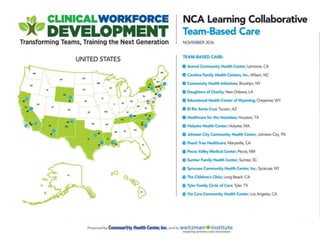
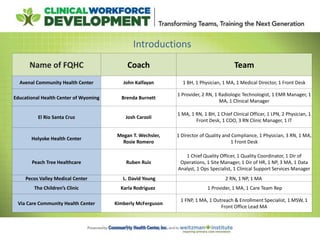
Name of FQHC Coach Team
Avenal Community Health Center John Kalfayan 1 BH, 1 Physician, 1 MA, 1 Medical Director, 1 Front Desk
Educational Health Center of Wyoming Brenda Burnett
1 Provider, 2 RN, 1 Radiologic Technologist, 1 EMR Manager, 1
MA, 1 Clinical Manager
El Rio Santa Cruz Josh Carzoli
1 MA, 1 RN, 1 BH, 1 Chief Clinical Officer, 1 LPN, 2 Physician, 1
Front Desk, 1 COO, 3 RN Clinic Manager, 1 IT
Holyoke Health Center
Megan T. Wechsler,
Rosie Romero
1 Director of Quality and Compliance, 1 Physician, 3 RN, 1 MA,
1 Front Desk
Peach Tree Healthcare Ruben Ruiz
1 Chief Quality Officer, 1 Quality Coordinator, 1 Dir of
Operations, 1 Site Manager, 1 Dir of HR, 1 NP, 3 MA, 1 Data
Analyst, 1 Ops Specialist, 1 Clinical Support Services Manager
Pecos Valley Medical Center L. David Young 2 RN, 1 NP, 1 MA
The Children’s Clinic Karla Rodriguez 1 Provider, 1 MA, 1 Care Team Rep
Via Care Community Health Center Kimberly McFerguson
1 FNP, 1 MA, 1 Outreach & Enrollment Specialist, 1 MSW, 1
Front Office Lead MA
Introductions
Introductions
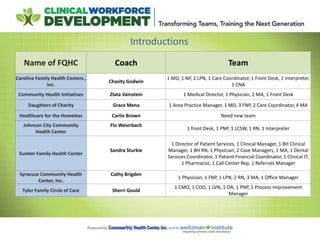
Name of FQHC Coach Team
Carolina Family Health Centers ,
Inc.
Chasity Godwin
1 MD, 1 NP, 2 LPN, 1 Care Coordinator, 1 Front Desk, 1 Interpreter,
1 CNA
Community Health Initiatives Zlata Vainstein 1 Medical Director, 1 Physician, 2 MA, 1 Front Desk
Daughters of Charity Grace Mena 1 Area Practice Manager, 1 MD, 3 FNP, 2 Care Coordinator, 4 MA
Healthcare for the Homeless Carlie Brown Need new team
Johnson City Community
Health Center
Flo Weierbach
1 front Desk, 1 PNP, 1 LCSW, 1 RN, 1 Interpreter
Sumter Family Health Center
Sandra Sturkie
1 Director of Patient Services, 1 Clinical Manager, 1 BH Clinical
Manager, 1 BH RN, 1 Physician, 2 Case Managers, 1 MA, 1 Dental
Services Coordinator, 1 Patient Financial Coordinator, 1 Clinical IT,
1 Pharmacist, 1 Call Center Rep, 1 Referrals Manager
Syracuse Community Health
Center, Inc.
Cathy Brigden
1 Physician, 1 FNP, 1 LPN, 2 RN, 3 MA, 1 Office Manager
Tyler Family Circle of Care Sherri Gould
1 CMO, 1 COO, 1 LVN, 1 OA, 1 PNP, 1 Process Improvement
Manager
Objectives Session 2
 Summarize Action Period 1 Milestones (6 weeks)
 Provide concept overview
 Learn from team assignments
→ Adjusting Core and Extended Team Structure (Sumter)
→ Practicing Effective Meeting Skills (Teams)
→ Testing Daily Huddles (Carolina Family Health Center)
→ Completing cycle time data collection (Johnson City Community Health Center)
→ Completing role activity data collection (El Rio Santa Cruz| K Harding)
 Learn new skills: Process Mapping and PDSA Methodology
 “Moodle” TBC Website Refresh
 Provide path forward and resources for Action Period 2
Agenda (3:00-4:30)
3:00 10 min Welcome and Introductions
3:10 35 min Action Period 1 Milestones
Key TBC Concepts Overview
Learn From Collaborative Teams
3:45 30 min Teach New Improvement Skills for Action Period 2
Process Mapping
Methodology
4:15 7 min “Moodle” TBC Website : A Refresh
4:22 5 min Path Forward and Resources : Action Period 2 Assignments
4:27 3 min Evaluate Meeting and Wrap Up
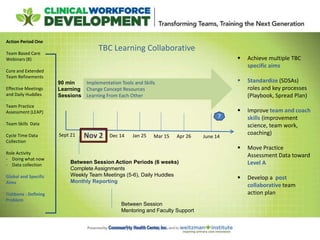
 Achieve multiple TBC
specific aims
 Standardize (SDSAs)
roles and key processes
(Playbook, Spread Plan)
 Improve team and coach
skills (improvement
science, team work,
coaching)
 Move Practice
Assessment Data toward
Level A
 Develop a post
collaborative team
action plan
TBC Learning Collaborative
90 min
Learning
Sessions
Between Session Action Periods (6 weeks)
Complete Assignments
Weekly Team Meetings (5-6), Daily Huddles
Monthly Reporting
Implementation Tools and Skills
Change Concept Resources
Learning From Each Other
Action Period One
Team Based Care
Webinars (8)
Core and Extended
Team Refinements
Effective Meetings
and Daily Huddles
Team Practice
Assessment (LEAP)
Team Skills Data
Cycle Time Data
Collection
Role Activity
- Doing what now
- Data collection
Global and Specific
Aims
Fishbone : Defining
Problem
Between Session
Mentoring and Faculty Support
7
Sept 21 Nov 2 Dec 14 Jan 25 Mar 15 Apr 26 June 14
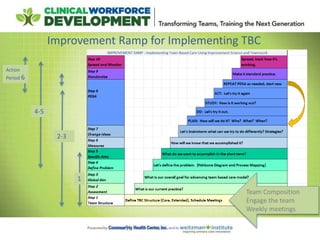
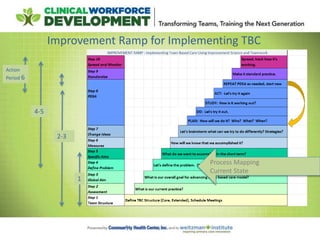
Improvement Ramp for Implementing TBC
Team Composition
Engage the team
Weekly meetings
1
Action
Period 6
4-5
2-3
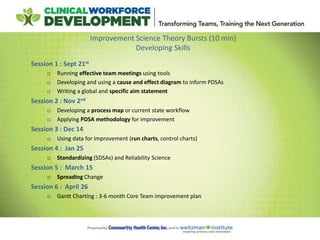
Improvement Science Theory Bursts (10 min)
Developing Skills
Session 1 : Sept 21st
o Running effective team meetings using tools
o Developing and using a cause and effect diagram to inform PDSAs
o Writing a global and specific aim statement
Session 2 : Nov 2nd
o Developing a process map or current state workflow
o Applying PDSA methodology for improvement
Session 3 : Dec 14
o Using data for improvement (run charts, control charts)
Session 4 : Jan 25
o Standardizing (SDSAs) and Reliability Science
Session 5 : March 15
o Spreading Change
Session 6 : April 26
o Gantt Charting : 3-6 month Core Team improvement plan
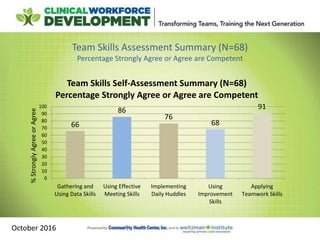
Team Skills Assessment Summary (N=68)
Percentage Strongly Agree or Agree are Competent
66
86
76
68
91
0
10
20
30
40
50
60
70
80
90
100
Gathering and
Using Data Skills
Using Effective
Meeting Skills
Implementing
Daily Huddles
Using
Improvement
Skills
Applying
Teamwork Skills
%StronglyAgreeorAgree
Team Skills Self-Assessment Summary (N=68)
Percentage Strongly Agree or Agree are Competent
October 2016
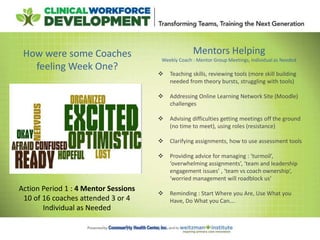
How were some Coaches
feeling Week One?
Mentors Helping
Weekly Coach : Mentor Group Meetings, Individual as Needed
 Teaching skills, reviewing tools (more skill building
needed from theory bursts, struggling with tools)
 Addressing Online Learning Network Site (Moodle)
challenges
 Advising difficulties getting meetings off the ground
(no time to meet), using roles (resistance)
 Clarifying assignments, how to use assessment tools
 Providing advice for managing : ‘turmoil’,
‘overwhelming assignments’, ‘team and leadership
engagement issues’ , ‘team vs coach ownership’,
‘worried management will roadblock us’
 Reminding : Start Where you Are, Use What you
Have, Do What you Can….
Action Period 1 : 4 Mentor Sessions
10 of 16 coaches attended 3 or 4
Individual as Needed
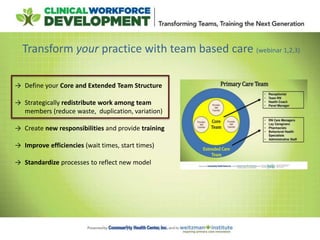
Transform your practice with team based care (webinar 1,2,3)
→ Define your Core and Extended Team Structure
→ Strategically redistribute work among team
members (reduce waste, duplication, variation)
→ Create new responsibilities and provide training
→ Improve efficiencies (wait times, start times)
→ Standardize processes to reflect new model
Action Period 1 MILESTONES
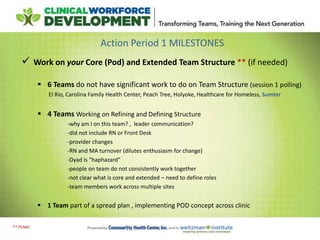
 Work on your Core (Pod) and Extended Team Structure ** (if needed)
 6 Teams do not have significant work to do on Team Structure (session 1 polling)
El Rio, Carolina Family Health Center, Peach Tree, Holyoke, Healthcare for Homeless, Sumter
 4 Teams Working on Refining and Defining Structure
-why am I on this team? , leader communication?
-did not include RN or Front Desk
-provider changes
-RN and MA turnover (dilutes enthusiasm for change)
-Dyad is “haphazard”
-people on team do not consistently work together
-not clear what is core and extended – need to define roles
-team members work across multiple sites
 1 Team part of a spread plan , implementing POD concept across clinic
** PCMH
Core (POD) and Extended Team Structure
Refining and Defining
Sumter Family Health Center
How did you refine and why?
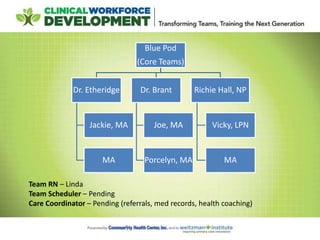
Blue Pod
(Core Teams)
Dr. Etheridge
Jackie, MA
MA
Dr. Brant
Joe, MA
Porcelyn, MA
Richie Hall, NP
Vicky, LPN
MA
Team RN – Linda
Team Scheduler – Pending
Care Coordinator – Pending (referrals, med records, health coaching)
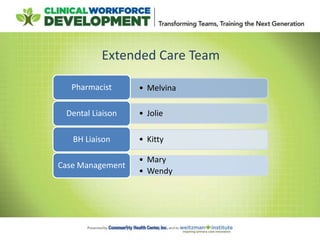
• MelvinaPharmacist
• JolieDental Liaison
• KittyBH Liaison
• Mary
• Wendy
Case Management
Extended Care Team
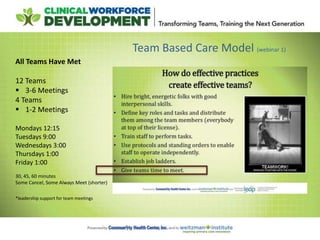
Team Based Care Model (webinar 1)
All Teams Have Met
12 Teams
 3-6 Meetings
4 Teams
 1-2 Meetings
Mondays 12:15
Tuesdays 9:00
Wednesdays 3:00
Thursdays 1:00
Friday 1:00
30, 45, 60 minutes
Some Cancel, Some Always Meet (shorter)
*leadership support for team meetings
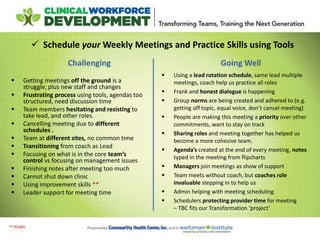
 Schedule your Weekly Meetings and Practice Skills using Tools
Challenging
 Getting meetings off the ground is a
struggle, plus new staff and changes
 Frustrating process using tools, agendas too
structured, need discussion time
 Team members hesitating and resisting to
take lead, and other roles.
 Cancelling meeting due to different
schedules .
 Team at different sites, no common time
 Transitioning from coach as Lead
 Focusing on what is in the core team’s
control vs focusing on management issues
 Finishing notes after meeting too much
 Cannot shut down clinic
 Using improvement skills **
 Leader support for meeting time
Going Well
 Using a lead rotation schedule, same lead multiple
meetings, coach help us practice all roles
 Frank and honest dialogue is happening
 Group norms are being created and adhered to (e.g.
getting off topic, equal voice, don’t cancel meeting)
 People are making this meeting a priority over other
commitments, want to stay on track
 Sharing roles and meeting together has helped us
become a more cohesive team.
 Agenda’s created at the end of every meeting, notes
typed in the meeting from flipcharts
 Managers join meetings as show of support
 Team meets without coach, but coaches role
invaluable stepping in to help us
 Admin helping with meeting scheduling
 Schedulers protecting provider time for meeting
– TBC fits our Transformation ‘project’
** PCMH
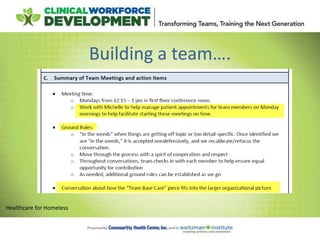
Building a team….
Healthcare for Homeless
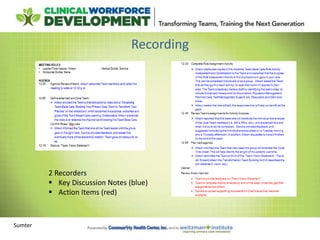
Recording
Sumter
2 Recorders
 Key Discussion Notes (blue)
 Action Items (red)
Running Effective Team Meetings
What is working well or not working well
for your team?
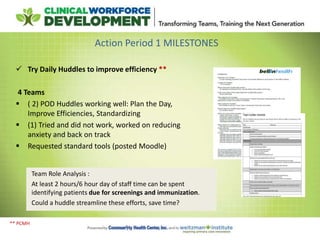
Action Period 1 MILESTONES
 Try Daily Huddles to improve efficiency **
4 Teams
 ( 2) POD Huddles working well: Plan the Day,
Improve Efficiencies, Standardizing
 (1) Tried and did not work, worked on reducing
anxiety and back on track
 Requested standard tools (posted Moodle)
** PCMH
Team Role Analysis :
At least 2 hours/6 hour day of staff time can be spent
identifying patients due for screenings and immunization.
Could a huddle streamline these efforts, save time?
Huddle Experience
Carolina Family Health Center
 When do you huddle and who attends?
 How long have you been testing huddles?
How are huddles going?
 Overall going well
 Took some time to get into a good routine and iron out the logistics
 In the process of modifying a huddle template to use daily to log our efforts
 Tool will help standardize our huddles:
• Everyone on the team knows the expectations
• We have a record of the discussion
Huddle Experience
Carolina Family Health Center
What do we talk about?
1. What patients are scheduled today and how many appt slots
are available for each provider?
2. Are there outstanding orders or referrals on each patient?
3. Does the patient have any recent hospital visits? If so, obtain the records.
4. Discuss patient specific needs : Interpreter? More time during visit needed?
5. Discuss staffing for the day and go over roles for the day.
Carolina Family Health
Action Period One Milestones
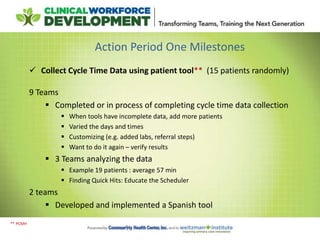
 Collect Cycle Time Data using patient tool** (15 patients randomly)
9 Teams
 Completed or in process of completing cycle time data collection
 When tools have incomplete data, add more patients
 Varied the days and times
 Customizing (e.g. added labs, referral steps)
 Want to do it again – verify results
 3 Teams analyzing the data
 Example 19 patients : average 57 min
 Finding Quick Hits: Educate the Scheduler
2 teams
 Developed and implemented a Spanish tool
** PCMH
Cycle Time Data Collection
Johnson City Community Health Center
Time 1 October 26, 2016 30
0
20
40
60
80
100
120
140
160
180
total time
in office
check in
time
waiting
room time
time with
the nurse
exam
room wait
time
time with
provider
check out
time
Cycle Time: Johnson City CHC
Mean Minimum Maximum
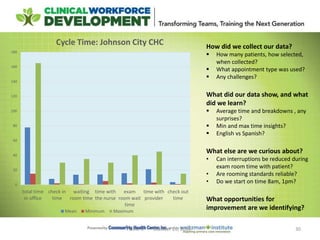
How did we collect our data?
 How many patients, how selected,
when collected?
 What appointment type was used?
 Any challenges?
What did our data show, and what
did we learn?
 Average time and breakdowns , any
surprises?
 Min and max time insights?
 English vs Spanish?
What else are we curious about?
• Can interruptions be reduced during
exam room time with patient?
• Are rooming standards reliable?
• Do we start on time 8am, 1pm?
What opportunities for
improvement are we identifying?
Action Period 1 Milestones
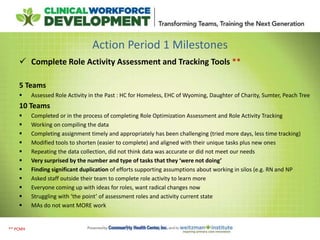
 Complete Role Activity Assessment and Tracking Tools **
5 Teams
 Assessed Role Activity in the Past : HC for Homeless, EHC of Wyoming, Daughter of Charity, Sumter, Peach Tree
10 Teams
 Completed or in the process of completing Role Optimization Assessment and Role Activity Tracking
 Working on compiling the data
 Completing assignment timely and appropriately has been challenging (tried more days, less time tracking)
 Modified tools to shorten (easier to complete) and aligned with their unique tasks plus new ones
 Repeating the data collection, did not think data was accurate or did not meet our needs
 Very surprised by the number and type of tasks that they ‘were not doing’
 Finding significant duplication of efforts supporting assumptions about working in silos (e.g. RN and NP
 Asked staff outside their team to complete role activity to learn more
 Everyone coming up with ideas for roles, want radical changes now
 Struggling with ‘the point’ of assessment roles and activity current state
 MAs do not want MORE work
** PCMH
Role Activity Tracking
El Rio Santa Cruz
How did they collect the data?
How did they display the data?
What did the data show ?
What are the next steps?
Preliminary Report
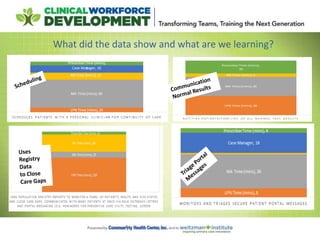
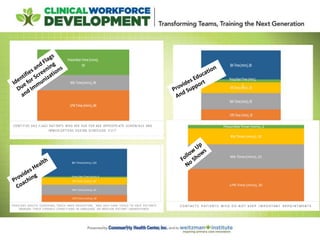
What did the data show and what are we learning?
Please share your work TBC Online Learning Network (Moodle)
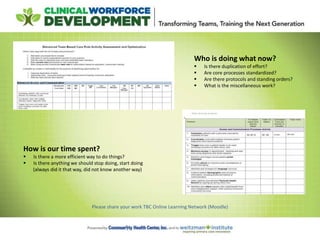
Who is doing what now?
 Is there duplication of effort?
 Are core processes standardized?
 Are there protocols and standing orders?
 What is the miscellaneous work?
How is our time spent?
 Is there a more efficient way to do things?
 Is there anything we should stop doing, start doing
(always did it that way, did not know another way)
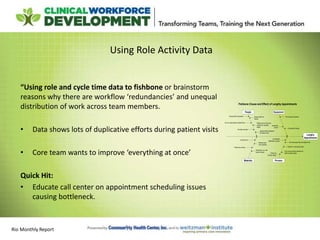
“Using role and cycle time data to fishbone or brainstorm
reasons why there are workflow ‘redundancies’ and unequal
distribution of work across team members.
• Data shows lots of duplicative efforts during patient visits
• Core team wants to improve ‘everything at once’
Quick Hit:
• Educate call center on appointment scheduling issues
causing bottleneck.
Lengthy
Appointments
People Equipment
Materials Process
Clinical staff inconsistent Support staff not
trained
No one responsible for patient flow Patients arrive with more
needs than originally
stated
Providers are late
Support staff unprepared
for patient visits
Equipment
broken
Not enough computers
Equipment missing
Inventory low
Missing exam
room supplies
Charts are missing
Information, e.g. test
results missing
No standard
registration process
MA does paper flow and patient flow
Variation in rooming process
Check out
process delays
Poor communication between all
staff on patient status
Fishbone (Cause and Effect) of Lengthy Appointments
Rio Monthly Report
Using Role Activity Data
If there are No Standards for Roles that are ‘doing the same activity’, or current
standards are inconsistently followed – this is waste and inefficient
For example : Data for Closing Gaps in Care Using Registry Data
• MA 6% of time
• LPN 33% of time
Leveraging Waste Elimination and Standardization Creates Capacity
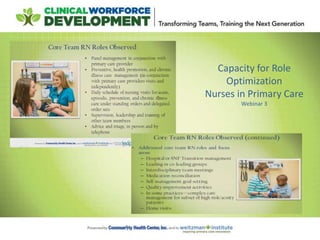
Capacity for Role
Optimization
Nurses in Primary Care
Webinar 3
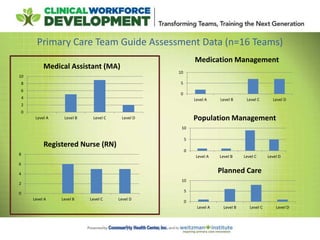
Primary Care Team Guide Assessment Data (n=16 Teams)
0
2
4
6
8
10
Level A Level B Level C Level D
Medical Assistant (MA)
0
2
4
6
8
Level A Level B Level C Level D
Registered Nurse (RN)
0
5
10
Level A Level B Level C Level D
Medication Management
0
5
10
Level A Level B Level C Level D
Planned Care
0
5
10
Level A Level B Level C Level D
Population Management
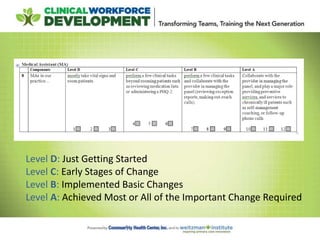
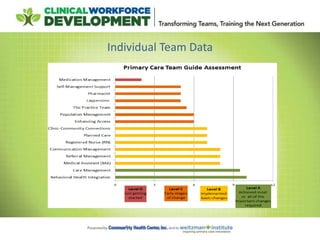
Level D: Just Getting Started
Level C: Early Stages of Change
Level B: Implemented Basic Changes
Level A: Achieved Most or All of the Important Change Required
Individual Team Data
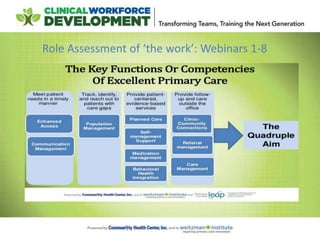
Role Assessment of ‘the work’: Webinars 1-8
Improvement Ramp for Implementing TBC
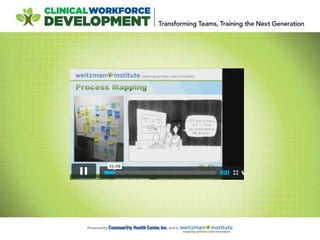
Process Mapping
Current State
1
Action
Period 6
4-5
2-3
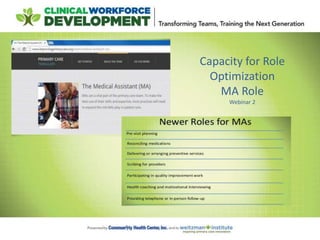
Capacity for Role
Optimization
MA Role
Webinar 2
Benchmarking
Primary Care
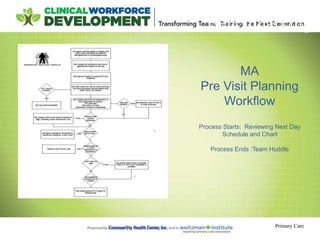
MA
Pre Visit Planning
Workflow
Process Starts: Reviewing Next Day
Schedule and Chart
Process Ends :Team Huddle
Hess.CPM.2010
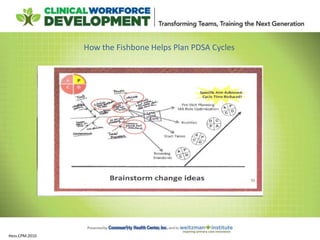
How the Fishbone Helps Plan PDSA Cycles
50
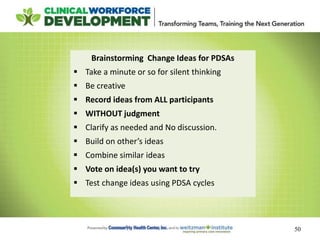
Brainstorming Change Ideas for PDSAs
 Take a minute or so for silent thinking
 Be creative
 Record ideas from ALL participants
 WITHOUT judgment
 Clarify as needed and No discussion.
 Build on other’s ideas
 Combine similar ideas
 Vote on idea(s) you want to try
 Test change ideas using PDSA cycles
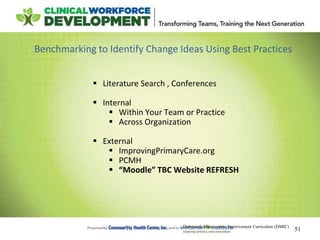
Benchmarking to Identify Change Ideas Using Best Practices
51
 Literature Search , Conferences
 Internal
 Within Your Team or Practice
 Across Organization
 External
 ImprovingPrimaryCare.org
 PCMH
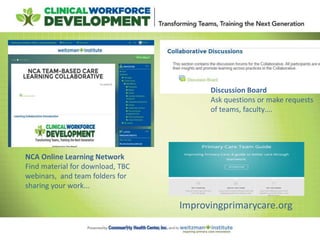
 “Moodle” TBC Website REFRESH
Dartmouth Microsystem Improvement Curriculum (DMIC)
NCA Online Learning Network
Find material for download, TBC
webinars, and team folders for
sharing your work...
Improvingprimarycare.org
Discussion Board
Ask questions or make requests
of teams, faculty….
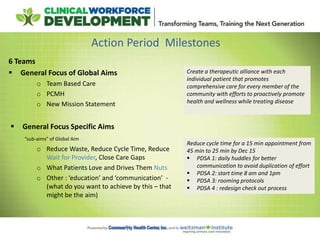
Action Period Milestones
6 Teams
 General Focus of Global Aims
o Team Based Care
o PCMH
o New Mission Statement
 General Focus Specific Aims
“sub-aims” of Global Aim
o Reduce Waste, Reduce Cycle Time, Reduce
Wait for Provider, Close Care Gaps
o What Patients Love and Drives Them Nuts
o Other : ‘education’ and ‘communication’ -
(what do you want to achieve by this – that
might be the aim)
Create a therapeutic alliance with each
individual patient that promotes
comprehensive care for every member of the
community with efforts to proactively promote
health and wellness while treating disease
Reduce cycle time for a 15 min appointment from
45 min to 25 min by Dec 15
 PDSA 1: daily huddles for better
communication to avoid duplication of effort
 PDSA 2: start time 8 am and 1pm
 PDSA 3: rooming protocols
 PDSA 4 : redesign check out process
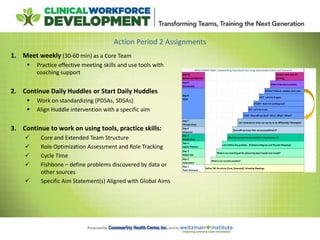
Action Period 2 Assignments
1. Meet weekly (30-60 min) as a Core Team
 Practice effective meeting skills and use tools with
coaching support
2. Continue Daily Huddles or Start Daily Huddles
 Work on standardizing (PDSAs, SDSAs)
 Align Huddle intervention with a specific aim
3. Continue to work on using tools, practice skills:
 Core and Extended Team Structure
 Role Optimization Assessment and Role Tracking
 Cycle Time
 Fishbone – define problems discovered by data or
other sources
 Specific Aim Statement(s) Aligned with Global Aims
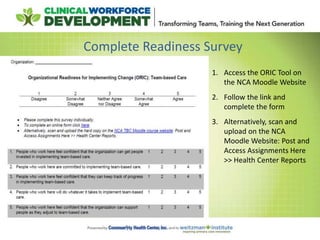
Complete Readiness Survey
1. Access the ORIC Tool on
the NCA Moodle Website
2. Follow the link and
complete the form
3. Alternatively, scan and
upload on the NCA
Moodle Website: Post and
Access Assignments Here
>> Health Center Reports
Action Period 2 Assignments
4. Complete Readiness Survey
5. Develop a process map of a workflow you want to improve
6. Plan your tests of change
7. Do some PDSA cycles to achieve your specific aim
8. Upload monthly progress report to inform Session 3 Planning
Action Period 2 Assignments
Mentoring and Faculty Support
 Continue Weekly Mentor meetings for 2 groups of Coaches
 Individual coaching support as needed
 Teach improvement skills, how to use tools – helping teams learn
 Analyze and post Readiness Survey data
 Improve everyone’s experience using the Online Learning Network
 Prepare for Session 3 : Identify | support teams for sharing their improvement work
Looking Ahead Session 3
Has your POD and Extended Team model evolved?
What have you continued to learn from all assessments, other data?
How are your meetings and huddles going?
How are you defining problems using a fishbone diagram?
How are you doing with specific aims and PDSAs? Aligned with Global aim?
What TBC change ideas are you testing? (guidelines, tools, protocols, role descriptions, processes)
New
Learning about data sampling, run charts and control charts
Update from CHCI : MA Training Program
Thank You All
Evaluate the Session
Survey Post Session

NCA TBC Learning Collaborative Session 2 Slides

  • 1.
    We will beginshortly… Welcome 1
  • 2.
    Using Zoom  Turnyour webcam on!  Please remember to mute yourself during the presentations.  If you have a question, you may un-mute yourself and ask after each presentation, OR use the Q&A button
  • 3.
    Team Based Care(TBC) Learning Collaborative Session Two November 2, 2016 3:35 - 4:30 EST Developing a core team’s capabilities for implementing an advanced team based care model.
  • 4.
    Introductions TBC Collaborative Design,Facilitation, Faculty  Ann Marie R Hess NP, MS National Cooperative Agreement  Anna Rogers, Director  Reema Mistry, Program Coordinator Mentors , Coaching Faculty  Deborah Ward, RN (1:8)  Kasey Harding (1:8) 3:35 Evaluation Faculty  Kathleen Thies, PhD, RN Improvement Science Faculty  Patti Feeney  Mark Splaine, MD
  • 6.
    Name of FQHCCoach Team Avenal Community Health Center John Kalfayan 1 BH, 1 Physician, 1 MA, 1 Medical Director, 1 Front Desk Educational Health Center of Wyoming Brenda Burnett 1 Provider, 2 RN, 1 Radiologic Technologist, 1 EMR Manager, 1 MA, 1 Clinical Manager El Rio Santa Cruz Josh Carzoli 1 MA, 1 RN, 1 BH, 1 Chief Clinical Officer, 1 LPN, 2 Physician, 1 Front Desk, 1 COO, 3 RN Clinic Manager, 1 IT Holyoke Health Center Megan T. Wechsler, Rosie Romero 1 Director of Quality and Compliance, 1 Physician, 3 RN, 1 MA, 1 Front Desk Peach Tree Healthcare Ruben Ruiz 1 Chief Quality Officer, 1 Quality Coordinator, 1 Dir of Operations, 1 Site Manager, 1 Dir of HR, 1 NP, 3 MA, 1 Data Analyst, 1 Ops Specialist, 1 Clinical Support Services Manager Pecos Valley Medical Center L. David Young 2 RN, 1 NP, 1 MA The Children’s Clinic Karla Rodriguez 1 Provider, 1 MA, 1 Care Team Rep Via Care Community Health Center Kimberly McFerguson 1 FNP, 1 MA, 1 Outreach & Enrollment Specialist, 1 MSW, 1 Front Office Lead MA Introductions
  • 7.
    Introductions Name of FQHCCoach Team Carolina Family Health Centers , Inc. Chasity Godwin 1 MD, 1 NP, 2 LPN, 1 Care Coordinator, 1 Front Desk, 1 Interpreter, 1 CNA Community Health Initiatives Zlata Vainstein 1 Medical Director, 1 Physician, 2 MA, 1 Front Desk Daughters of Charity Grace Mena 1 Area Practice Manager, 1 MD, 3 FNP, 2 Care Coordinator, 4 MA Healthcare for the Homeless Carlie Brown Need new team Johnson City Community Health Center Flo Weierbach 1 front Desk, 1 PNP, 1 LCSW, 1 RN, 1 Interpreter Sumter Family Health Center Sandra Sturkie 1 Director of Patient Services, 1 Clinical Manager, 1 BH Clinical Manager, 1 BH RN, 1 Physician, 2 Case Managers, 1 MA, 1 Dental Services Coordinator, 1 Patient Financial Coordinator, 1 Clinical IT, 1 Pharmacist, 1 Call Center Rep, 1 Referrals Manager Syracuse Community Health Center, Inc. Cathy Brigden 1 Physician, 1 FNP, 1 LPN, 2 RN, 3 MA, 1 Office Manager Tyler Family Circle of Care Sherri Gould 1 CMO, 1 COO, 1 LVN, 1 OA, 1 PNP, 1 Process Improvement Manager
  • 8.
    Objectives Session 2 Summarize Action Period 1 Milestones (6 weeks)  Provide concept overview  Learn from team assignments → Adjusting Core and Extended Team Structure (Sumter) → Practicing Effective Meeting Skills (Teams) → Testing Daily Huddles (Carolina Family Health Center) → Completing cycle time data collection (Johnson City Community Health Center) → Completing role activity data collection (El Rio Santa Cruz| K Harding)  Learn new skills: Process Mapping and PDSA Methodology  “Moodle” TBC Website Refresh  Provide path forward and resources for Action Period 2
  • 9.
    Agenda (3:00-4:30) 3:00 10min Welcome and Introductions 3:10 35 min Action Period 1 Milestones Key TBC Concepts Overview Learn From Collaborative Teams 3:45 30 min Teach New Improvement Skills for Action Period 2 Process Mapping Methodology 4:15 7 min “Moodle” TBC Website : A Refresh 4:22 5 min Path Forward and Resources : Action Period 2 Assignments 4:27 3 min Evaluate Meeting and Wrap Up
  • 10.
     Achieve multipleTBC specific aims  Standardize (SDSAs) roles and key processes (Playbook, Spread Plan)  Improve team and coach skills (improvement science, team work, coaching)  Move Practice Assessment Data toward Level A  Develop a post collaborative team action plan TBC Learning Collaborative 90 min Learning Sessions Between Session Action Periods (6 weeks) Complete Assignments Weekly Team Meetings (5-6), Daily Huddles Monthly Reporting Implementation Tools and Skills Change Concept Resources Learning From Each Other Action Period One Team Based Care Webinars (8) Core and Extended Team Refinements Effective Meetings and Daily Huddles Team Practice Assessment (LEAP) Team Skills Data Cycle Time Data Collection Role Activity - Doing what now - Data collection Global and Specific Aims Fishbone : Defining Problem Between Session Mentoring and Faculty Support 7 Sept 21 Nov 2 Dec 14 Jan 25 Mar 15 Apr 26 June 14
  • 11.
    Improvement Ramp forImplementing TBC Team Composition Engage the team Weekly meetings 1 Action Period 6 4-5 2-3
  • 12.
    Improvement Science TheoryBursts (10 min) Developing Skills Session 1 : Sept 21st o Running effective team meetings using tools o Developing and using a cause and effect diagram to inform PDSAs o Writing a global and specific aim statement Session 2 : Nov 2nd o Developing a process map or current state workflow o Applying PDSA methodology for improvement Session 3 : Dec 14 o Using data for improvement (run charts, control charts) Session 4 : Jan 25 o Standardizing (SDSAs) and Reliability Science Session 5 : March 15 o Spreading Change Session 6 : April 26 o Gantt Charting : 3-6 month Core Team improvement plan
  • 13.
    Team Skills AssessmentSummary (N=68) Percentage Strongly Agree or Agree are Competent 66 86 76 68 91 0 10 20 30 40 50 60 70 80 90 100 Gathering and Using Data Skills Using Effective Meeting Skills Implementing Daily Huddles Using Improvement Skills Applying Teamwork Skills %StronglyAgreeorAgree Team Skills Self-Assessment Summary (N=68) Percentage Strongly Agree or Agree are Competent October 2016
  • 14.
    How were someCoaches feeling Week One? Mentors Helping Weekly Coach : Mentor Group Meetings, Individual as Needed  Teaching skills, reviewing tools (more skill building needed from theory bursts, struggling with tools)  Addressing Online Learning Network Site (Moodle) challenges  Advising difficulties getting meetings off the ground (no time to meet), using roles (resistance)  Clarifying assignments, how to use assessment tools  Providing advice for managing : ‘turmoil’, ‘overwhelming assignments’, ‘team and leadership engagement issues’ , ‘team vs coach ownership’, ‘worried management will roadblock us’  Reminding : Start Where you Are, Use What you Have, Do What you Can…. Action Period 1 : 4 Mentor Sessions 10 of 16 coaches attended 3 or 4 Individual as Needed
  • 15.
    Transform your practicewith team based care (webinar 1,2,3) → Define your Core and Extended Team Structure → Strategically redistribute work among team members (reduce waste, duplication, variation) → Create new responsibilities and provide training → Improve efficiencies (wait times, start times) → Standardize processes to reflect new model
  • 16.
    Action Period 1MILESTONES  Work on your Core (Pod) and Extended Team Structure ** (if needed)  6 Teams do not have significant work to do on Team Structure (session 1 polling) El Rio, Carolina Family Health Center, Peach Tree, Holyoke, Healthcare for Homeless, Sumter  4 Teams Working on Refining and Defining Structure -why am I on this team? , leader communication? -did not include RN or Front Desk -provider changes -RN and MA turnover (dilutes enthusiasm for change) -Dyad is “haphazard” -people on team do not consistently work together -not clear what is core and extended – need to define roles -team members work across multiple sites  1 Team part of a spread plan , implementing POD concept across clinic ** PCMH
  • 17.
    Core (POD) andExtended Team Structure Refining and Defining Sumter Family Health Center How did you refine and why?
  • 18.
    Blue Pod (Core Teams) Dr.Etheridge Jackie, MA MA Dr. Brant Joe, MA Porcelyn, MA Richie Hall, NP Vicky, LPN MA Team RN – Linda Team Scheduler – Pending Care Coordinator – Pending (referrals, med records, health coaching)
  • 19.
    • MelvinaPharmacist • JolieDentalLiaison • KittyBH Liaison • Mary • Wendy Case Management Extended Care Team
  • 20.
    Team Based CareModel (webinar 1) All Teams Have Met 12 Teams  3-6 Meetings 4 Teams  1-2 Meetings Mondays 12:15 Tuesdays 9:00 Wednesdays 3:00 Thursdays 1:00 Friday 1:00 30, 45, 60 minutes Some Cancel, Some Always Meet (shorter) *leadership support for team meetings
  • 21.
     Schedule yourWeekly Meetings and Practice Skills using Tools Challenging  Getting meetings off the ground is a struggle, plus new staff and changes  Frustrating process using tools, agendas too structured, need discussion time  Team members hesitating and resisting to take lead, and other roles.  Cancelling meeting due to different schedules .  Team at different sites, no common time  Transitioning from coach as Lead  Focusing on what is in the core team’s control vs focusing on management issues  Finishing notes after meeting too much  Cannot shut down clinic  Using improvement skills **  Leader support for meeting time Going Well  Using a lead rotation schedule, same lead multiple meetings, coach help us practice all roles  Frank and honest dialogue is happening  Group norms are being created and adhered to (e.g. getting off topic, equal voice, don’t cancel meeting)  People are making this meeting a priority over other commitments, want to stay on track  Sharing roles and meeting together has helped us become a more cohesive team.  Agenda’s created at the end of every meeting, notes typed in the meeting from flipcharts  Managers join meetings as show of support  Team meets without coach, but coaches role invaluable stepping in to help us  Admin helping with meeting scheduling  Schedulers protecting provider time for meeting – TBC fits our Transformation ‘project’ ** PCMH
  • 22.
  • 23.
    Recording Sumter 2 Recorders  KeyDiscussion Notes (blue)  Action Items (red)
  • 24.
    Running Effective TeamMeetings What is working well or not working well for your team?
  • 25.
    Action Period 1MILESTONES  Try Daily Huddles to improve efficiency ** 4 Teams  ( 2) POD Huddles working well: Plan the Day, Improve Efficiencies, Standardizing  (1) Tried and did not work, worked on reducing anxiety and back on track  Requested standard tools (posted Moodle) ** PCMH Team Role Analysis : At least 2 hours/6 hour day of staff time can be spent identifying patients due for screenings and immunization. Could a huddle streamline these efforts, save time?
  • 26.
    Huddle Experience Carolina FamilyHealth Center  When do you huddle and who attends?  How long have you been testing huddles? How are huddles going?  Overall going well  Took some time to get into a good routine and iron out the logistics  In the process of modifying a huddle template to use daily to log our efforts  Tool will help standardize our huddles: • Everyone on the team knows the expectations • We have a record of the discussion
  • 27.
    Huddle Experience Carolina FamilyHealth Center What do we talk about? 1. What patients are scheduled today and how many appt slots are available for each provider? 2. Are there outstanding orders or referrals on each patient? 3. Does the patient have any recent hospital visits? If so, obtain the records. 4. Discuss patient specific needs : Interpreter? More time during visit needed? 5. Discuss staffing for the day and go over roles for the day. Carolina Family Health
  • 28.
    Action Period OneMilestones  Collect Cycle Time Data using patient tool** (15 patients randomly) 9 Teams  Completed or in process of completing cycle time data collection  When tools have incomplete data, add more patients  Varied the days and times  Customizing (e.g. added labs, referral steps)  Want to do it again – verify results  3 Teams analyzing the data  Example 19 patients : average 57 min  Finding Quick Hits: Educate the Scheduler 2 teams  Developed and implemented a Spanish tool ** PCMH
  • 29.
    Cycle Time DataCollection Johnson City Community Health Center
  • 30.
    Time 1 October26, 2016 30 0 20 40 60 80 100 120 140 160 180 total time in office check in time waiting room time time with the nurse exam room wait time time with provider check out time Cycle Time: Johnson City CHC Mean Minimum Maximum How did we collect our data?  How many patients, how selected, when collected?  What appointment type was used?  Any challenges? What did our data show, and what did we learn?  Average time and breakdowns , any surprises?  Min and max time insights?  English vs Spanish? What else are we curious about? • Can interruptions be reduced during exam room time with patient? • Are rooming standards reliable? • Do we start on time 8am, 1pm? What opportunities for improvement are we identifying?
  • 31.
    Action Period 1Milestones  Complete Role Activity Assessment and Tracking Tools ** 5 Teams  Assessed Role Activity in the Past : HC for Homeless, EHC of Wyoming, Daughter of Charity, Sumter, Peach Tree 10 Teams  Completed or in the process of completing Role Optimization Assessment and Role Activity Tracking  Working on compiling the data  Completing assignment timely and appropriately has been challenging (tried more days, less time tracking)  Modified tools to shorten (easier to complete) and aligned with their unique tasks plus new ones  Repeating the data collection, did not think data was accurate or did not meet our needs  Very surprised by the number and type of tasks that they ‘were not doing’  Finding significant duplication of efforts supporting assumptions about working in silos (e.g. RN and NP  Asked staff outside their team to complete role activity to learn more  Everyone coming up with ideas for roles, want radical changes now  Struggling with ‘the point’ of assessment roles and activity current state  MAs do not want MORE work ** PCMH
  • 32.
    Role Activity Tracking ElRio Santa Cruz How did they collect the data? How did they display the data? What did the data show ? What are the next steps?
  • 33.
  • 34.
    What did thedata show and what are we learning?
  • 36.
    Please share yourwork TBC Online Learning Network (Moodle) Who is doing what now?  Is there duplication of effort?  Are core processes standardized?  Are there protocols and standing orders?  What is the miscellaneous work? How is our time spent?  Is there a more efficient way to do things?  Is there anything we should stop doing, start doing (always did it that way, did not know another way)
  • 37.
    “Using role andcycle time data to fishbone or brainstorm reasons why there are workflow ‘redundancies’ and unequal distribution of work across team members. • Data shows lots of duplicative efforts during patient visits • Core team wants to improve ‘everything at once’ Quick Hit: • Educate call center on appointment scheduling issues causing bottleneck. Lengthy Appointments People Equipment Materials Process Clinical staff inconsistent Support staff not trained No one responsible for patient flow Patients arrive with more needs than originally stated Providers are late Support staff unprepared for patient visits Equipment broken Not enough computers Equipment missing Inventory low Missing exam room supplies Charts are missing Information, e.g. test results missing No standard registration process MA does paper flow and patient flow Variation in rooming process Check out process delays Poor communication between all staff on patient status Fishbone (Cause and Effect) of Lengthy Appointments Rio Monthly Report Using Role Activity Data
  • 38.
    Using Role ActivityData If there are No Standards for Roles that are ‘doing the same activity’, or current standards are inconsistently followed – this is waste and inefficient For example : Data for Closing Gaps in Care Using Registry Data • MA 6% of time • LPN 33% of time Leveraging Waste Elimination and Standardization Creates Capacity
  • 39.
    Capacity for Role Optimization Nursesin Primary Care Webinar 3
  • 40.
    Primary Care TeamGuide Assessment Data (n=16 Teams) 0 2 4 6 8 10 Level A Level B Level C Level D Medical Assistant (MA) 0 2 4 6 8 Level A Level B Level C Level D Registered Nurse (RN) 0 5 10 Level A Level B Level C Level D Medication Management 0 5 10 Level A Level B Level C Level D Planned Care 0 5 10 Level A Level B Level C Level D Population Management
  • 41.
    Level D: JustGetting Started Level C: Early Stages of Change Level B: Implemented Basic Changes Level A: Achieved Most or All of the Important Change Required
  • 42.
  • 43.
    Role Assessment of‘the work’: Webinars 1-8
  • 44.
    Improvement Ramp forImplementing TBC Process Mapping Current State 1 Action Period 6 4-5 2-3
  • 46.
  • 47.
    Benchmarking Primary Care MA Pre VisitPlanning Workflow Process Starts: Reviewing Next Day Schedule and Chart Process Ends :Team Huddle
  • 49.
    Hess.CPM.2010 How the FishboneHelps Plan PDSA Cycles
  • 50.
    50 Brainstorming Change Ideasfor PDSAs  Take a minute or so for silent thinking  Be creative  Record ideas from ALL participants  WITHOUT judgment  Clarify as needed and No discussion.  Build on other’s ideas  Combine similar ideas  Vote on idea(s) you want to try  Test change ideas using PDSA cycles
  • 51.
    Benchmarking to IdentifyChange Ideas Using Best Practices 51  Literature Search , Conferences  Internal  Within Your Team or Practice  Across Organization  External  ImprovingPrimaryCare.org  PCMH  “Moodle” TBC Website REFRESH Dartmouth Microsystem Improvement Curriculum (DMIC)
  • 52.
    NCA Online LearningNetwork Find material for download, TBC webinars, and team folders for sharing your work... Improvingprimarycare.org Discussion Board Ask questions or make requests of teams, faculty….
  • 53.
    Action Period Milestones 6Teams  General Focus of Global Aims o Team Based Care o PCMH o New Mission Statement  General Focus Specific Aims “sub-aims” of Global Aim o Reduce Waste, Reduce Cycle Time, Reduce Wait for Provider, Close Care Gaps o What Patients Love and Drives Them Nuts o Other : ‘education’ and ‘communication’ - (what do you want to achieve by this – that might be the aim) Create a therapeutic alliance with each individual patient that promotes comprehensive care for every member of the community with efforts to proactively promote health and wellness while treating disease Reduce cycle time for a 15 min appointment from 45 min to 25 min by Dec 15  PDSA 1: daily huddles for better communication to avoid duplication of effort  PDSA 2: start time 8 am and 1pm  PDSA 3: rooming protocols  PDSA 4 : redesign check out process
  • 54.
    Action Period 2Assignments 1. Meet weekly (30-60 min) as a Core Team  Practice effective meeting skills and use tools with coaching support 2. Continue Daily Huddles or Start Daily Huddles  Work on standardizing (PDSAs, SDSAs)  Align Huddle intervention with a specific aim 3. Continue to work on using tools, practice skills:  Core and Extended Team Structure  Role Optimization Assessment and Role Tracking  Cycle Time  Fishbone – define problems discovered by data or other sources  Specific Aim Statement(s) Aligned with Global Aims
  • 55.
    Complete Readiness Survey 1.Access the ORIC Tool on the NCA Moodle Website 2. Follow the link and complete the form 3. Alternatively, scan and upload on the NCA Moodle Website: Post and Access Assignments Here >> Health Center Reports
  • 56.
    Action Period 2Assignments 4. Complete Readiness Survey 5. Develop a process map of a workflow you want to improve 6. Plan your tests of change 7. Do some PDSA cycles to achieve your specific aim 8. Upload monthly progress report to inform Session 3 Planning
  • 57.
    Action Period 2Assignments Mentoring and Faculty Support  Continue Weekly Mentor meetings for 2 groups of Coaches  Individual coaching support as needed  Teach improvement skills, how to use tools – helping teams learn  Analyze and post Readiness Survey data  Improve everyone’s experience using the Online Learning Network  Prepare for Session 3 : Identify | support teams for sharing their improvement work
  • 58.
    Looking Ahead Session3 Has your POD and Extended Team model evolved? What have you continued to learn from all assessments, other data? How are your meetings and huddles going? How are you defining problems using a fishbone diagram? How are you doing with specific aims and PDSAs? Aligned with Global aim? What TBC change ideas are you testing? (guidelines, tools, protocols, role descriptions, processes) New Learning about data sampling, run charts and control charts Update from CHCI : MA Training Program
  • 59.
    Thank You All Evaluatethe Session Survey Post Session

Editor's Notes

  • #4 Welcome everyone to the TBC Learning Collaborative. This is session 1 of 7 over the next 9 months.
  • #10 Our agenda after more introductions…
  • #12 We will be referring to this ramp throughout the collaborative as a road map, or the structure to a proven approach to change.
  • #13 As shown by the skills assessments, there is opportunity to close some gaps by building improvement science into the sessions over time. What you need, when you need it – to be successful. For example -
  • #16 During our interviews, this was the model we used to help you identify the core team members for collaborative participation. Core team can be 1-3 provider and MA dyads. At a minimum , your core team is a dyad.
  • #27 When huddel, who attends, how long, focus, any prep, tools, achieve? Get in routine – PDSA TOOL standarize (SDSA)
  • #28 When huddle, who attends, how long, focus, any prep, tools, achieve? Get in routine – PDSA TOOL standarize (SDSA) Does the scheduler attend for question ONE
  • #31 This shows cycle time for all the patients at JCCHC, cycle time sheets were distributed to English (n=9) and Spanish (n=6) speaking patients over a weeks time, most of the cycle times were completed in the morning (n=10), afternoon (n=2) unknown time of day (n=3) the days they were completed were predominantly on Wednesday and Friday with 2-3 on either Monday (n=2) or Thursday (n=5), 3 unknown day of the week
  • #39 Missing miscellaneous activity – other than what is on their tool – just as important
  • #42 We also have some preliminary information from the primary care assessment from each 11 teams to date, not individuals.
  • #44 What are the roles and activities associated with 10 Key Functions or processes that define team based care Assess the elephant – Over 9 months we will be understanding current state before implementing strategies to optimize and standardiz BOTH roles of team members and processes or clinical workflows We will help you understa We will also work break it down into small achievable aims
  • #45 We will be referring to this ramp throughout the collaborative as a road map, or the structure to a proven approach to change.
  • #48 TRISHA: Can you give an overview of what we do now vs what this might have from the past process? What to revisit?