NGI stockholm
NGI-RNAseq
Processing RNA-seq data at the
National Genomics Infrastructure
Phil Ewels
phil.ewels@scilifelab.se
NBIS RNA-seq tutorial
2017-11-09
NGI stockholm
SciLifeLab NGI
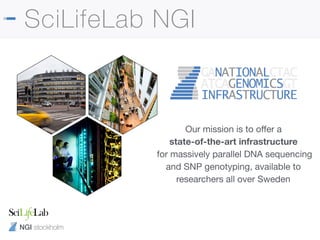
Our mission is to offer a

state-of-the-art infrastructure

for massively parallel DNA sequencing
and SNP genotyping, available to
researchers all over Sweden
NGI stockholm
SciLifeLab NGI
National resource
State-of-the-art
infrastructure
Guidelines and
support
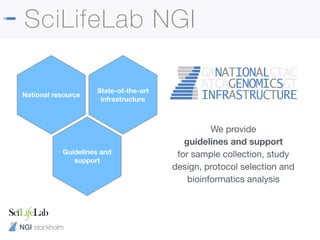
We provide 

guidelines and support

for sample collection, study
design, protocol selection and
bioinformatics analysis
NGI stockholm
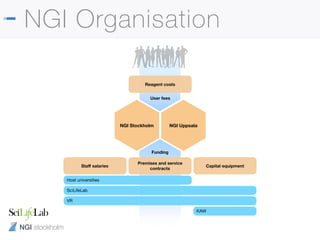
NGI Organisation
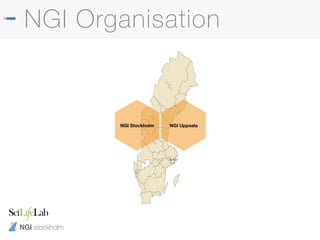
NGI Stockholm NGI Uppsala
NGI stockholm
NGI Organisation
Funding
Staff salaries
Premises and service
contracts
Capital equipment
Host universities
SciLifeLab
VR
KAW
User fees
Reagent costs
NGI Stockholm NGI Uppsala
NGI stockholm
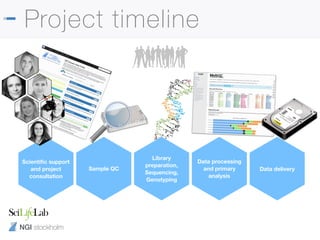
Project timeline
Sample QC
Library
preparation,
Sequencing,
Genotyping
Data processing
and primary
analysis
Scientific support
and project
consultation
Data delivery
NGI stockholm
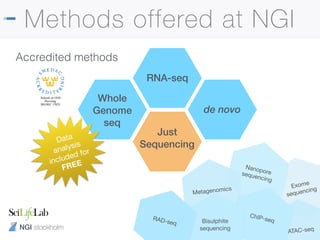
Methods offered at NGI
Exome

sequencing
Nanoporesequencing
ATAC-seq
Metagenomics
ChIP-seqBisulphite

sequencing
RAD-seq
RNA-seq
de novo
Whole
Genome
seq
Data
analysis
included for
FREE
Just

Sequencing
Accredited methods
NGI stockholm
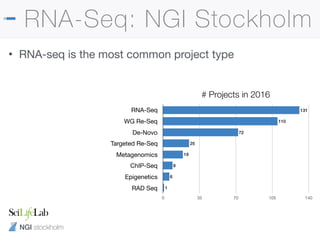
RNA-Seq: NGI Stockholm
# Projects in 2016
RNA-Seq
WG Re-Seq
De-Novo
Targeted Re-Seq
Metagenomics
ChIP-Seq
Epigenetics
RAD Seq
0 35 70 105 140
1
6
9
19
25
72
110
131
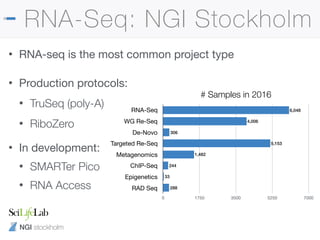
• RNA-seq is the most common project type
NGI stockholm
RNA-Seq: NGI Stockholm
• RNA-seq is the most common project type
# Samples in 2016
RNA-Seq
WG Re-Seq
De-Novo
Targeted Re-Seq
Metagenomics
ChIP-Seq
Epigenetics
RAD Seq
0 1750 3500 5250 7000
288
33
244
1,482
5,153
306
4,006
6,048
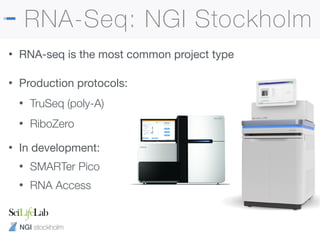
• Production protocols:

• TruSeq (poly-A)
• RiboZero
• In development:

• SMARTer Pico
• RNA Access
NGI stockholm
RNA-Seq: NGI Stockholm
• RNA-seq is the most common project type
• Production protocols:

• TruSeq (poly-A)
• RiboZero
• In development:

• SMARTer Pico
• RNA Access
NGI stockholm
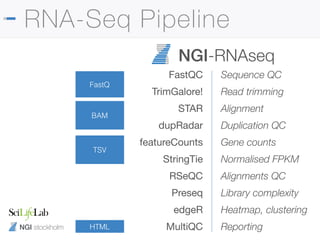
RNA-Seq Pipeline
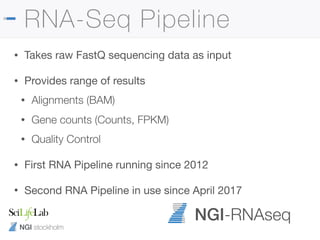
• Takes raw FastQ sequencing data as input

• Provides range of results

• Alignments (BAM)
• Gene counts (Counts, FPKM)
• Quality Control
• First RNA Pipeline running since 2012

• Second RNA Pipeline in use since April 2017
NGI-RNAseq
NGI stockholm
RNA-Seq Pipeline
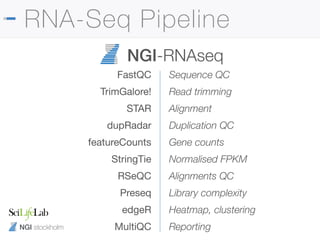
FastQC

TrimGalore!

STAR

dupRadar

featureCounts

StringTie

RSeQC

Preseq

edgeR

MultiQC
Sequence QC
Read trimming
Alignment
Duplication QC
Gene counts
Normalised FPKM
Alignments QC
Library complexity
Heatmap, clustering
Reporting
NGI-RNAseq
NGI stockholm
RNA-Seq Pipeline
FastQC

TrimGalore!

STAR

dupRadar

featureCounts

StringTie

RSeQC

Preseq

edgeR

MultiQC
NGI-RNAseq
FastQ
BAM
TSV
HTML
Sequence QC
Read trimming
Alignment
Duplication QC
Gene counts
Normalised FPKM
Alignments QC
Library complexity
Heatmap, clustering
Reporting
NGI stockholm
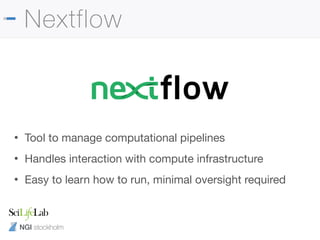
Nextflow
• Tool to manage computational pipelines

• Handles interaction with compute infrastructure

• Easy to learn how to run, minimal oversight required
NGI stockholm
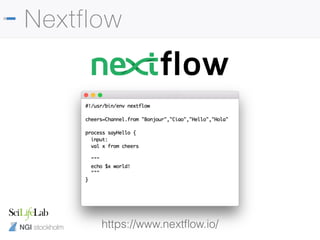
Nextflow
https://www.nextflow.io/
NGI stockholm
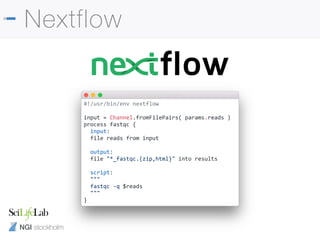
Nextflow
#!/usr/bin/env nextflow
input = Channel.fromFilePairs( params.reads )
process fastqc {
input:
file reads from input
output:
file "*_fastqc.{zip,html}" into results
script:
"""
fastqc -q $reads
"""
}
NGI stockholm
Default: Run locally, assume
software is installed
Nextflow
#!/usr/bin/env nextflow
input = Channel.fromFilePairs( params.reads )
process fastqc {
input:
file reads from input
output:
file "*_fastqc.{zip,html}" into results
script:
"""
fastqc -q $reads
"""
} process {
executor = 'slurm'
clusterOptions = { "-A b2017123" }
cpus = 1
memory = 8.GB
time = 2.h
$fastqc {
module = ['bioinfo-tools', ‘FastQC']
}
}
Submit jobs to SLURM queue
Use environment modules
NGI stockholm
Nextflow
#!/usr/bin/env nextflow
input = Channel.fromFilePairs( params.reads )
process fastqc {
input:
file reads from input
output:
file "*_fastqc.{zip,html}" into results
script:
"""
fastqc -q $reads
"""
} process {
executor = 'slurm'
clusterOptions = { "-A b2017123" }
cpus = 1
memory = 8.GB
time = 2.h
$fastqc {
module = ['bioinfo-tools', ‘FastQC']
}
}
docker {
enabled = true
}
process {
container = 'biocontainers/fastqc'
cpus = 1
memory = 8.GB
time = 2.h
}
Run locally, use docker container
for all software dependencies
NGI stockholm
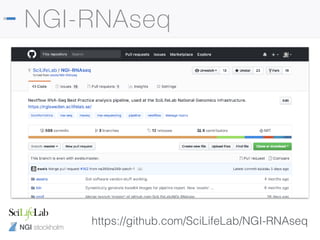
NGI-RNAseq
https://github.com/SciLifeLab/NGI-RNAseq
NGI stockholm
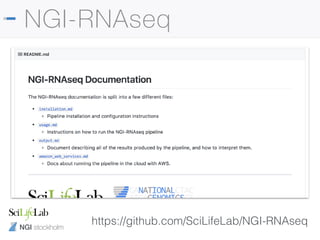
NGI-RNAseq
https://github.com/SciLifeLab/NGI-RNAseq
NGI stockholm
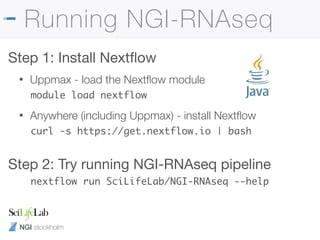
Running NGI-RNAseq
Step 1: Install Nextflow

• Uppmax - load the Nextflow module
module load nextflow
• Anywhere (including Uppmax) - install Nextflow
curl -s https://get.nextflow.io | bash
Step 2: Try running NGI-RNAseq pipeline

nextflow run SciLifeLab/NGI-RNAseq --help
NGI stockholm
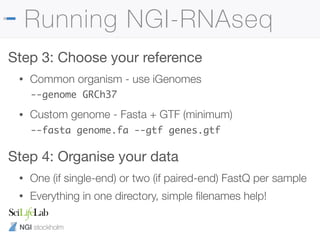
Running NGI-RNAseq
Step 3: Choose your reference

• Common organism - use iGenomes
--genome GRCh37
• Custom genome - Fasta + GTF (minimum)
--fasta genome.fa --gtf genes.gtf
Step 4: Organise your data

• One (if single-end) or two (if paired-end) FastQ per sample
• Everything in one directory, simple filenames help!
NGI stockholm
Running NGI-RNAseq
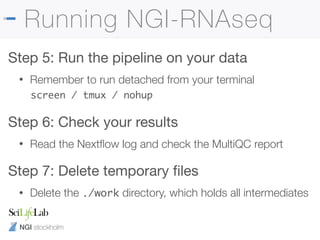
Step 5: Run the pipeline on your data

• Remember to run detached from your terminal
screen / tmux / nohup
Step 6: Check your results

• Read the Nextflow log and check the MultiQC report
Step 7: Delete temporary files

• Delete the ./work directory, which holds all intermediates
NGI stockholm
Typical pipeline output
NGI stockholm
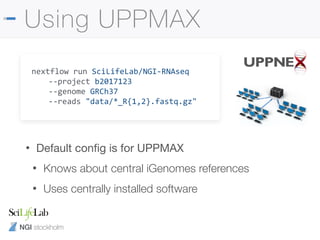
Using UPPMAX
nextflow run SciLifeLab/NGI-RNAseq
--project b2017123
--genome GRCh37
--reads "data/*_R{1,2}.fastq.gz"
• Default config is for UPPMAX

• Knows about central iGenomes references
• Uses centrally installed software
NGI stockholm
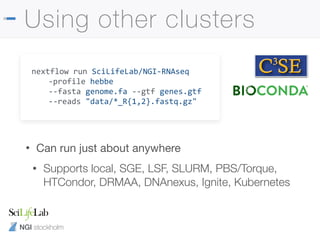
Using other clusters
nextflow run SciLifeLab/NGI-RNAseq
-profile hebbe
--fasta genome.fa --gtf genes.gtf
--reads "data/*_R{1,2}.fastq.gz"
• Can run just about anywhere

• Supports local, SGE, LSF, SLURM, PBS/Torque,
HTCondor, DRMAA, DNAnexus, Ignite, Kubernetes
NGI stockholm
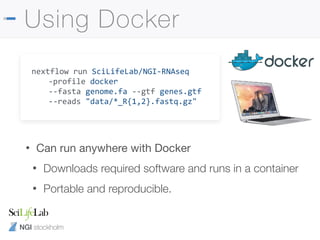
Using Docker
nextflow run SciLifeLab/NGI-RNAseq
-profile docker
--fasta genome.fa --gtf genes.gtf
--reads "data/*_R{1,2}.fastq.gz"
• Can run anywhere with Docker

• Downloads required software and runs in a container
• Portable and reproducible.
NGI stockholm
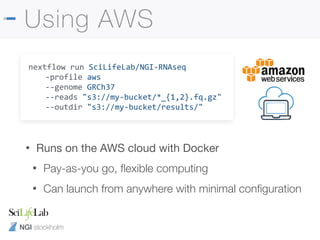
Using AWS
nextflow run SciLifeLab/NGI-RNAseq
-profile aws
--genome GRCh37
--reads "s3://my-bucket/*_{1,2}.fq.gz"
--outdir "s3://my-bucket/results/"
• Runs on the AWS cloud with Docker

• Pay-as-you go, flexible computing
• Can launch from anywhere with minimal configuration
NGI stockholm
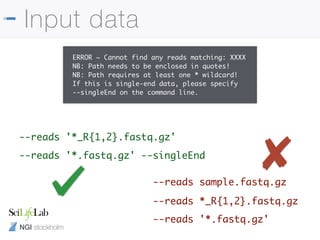
Input data
ERROR ~ Cannot find any reads matching: XXXX
NB: Path needs to be enclosed in quotes!
NB: Path requires at least one * wildcard!
If this is single-end data, please specify

--singleEnd on the command line.
--reads '*_R{1,2}.fastq.gz'
--reads '*.fastq.gz' --singleEnd
--reads *_R{1,2}.fastq.gz
--reads '*.fastq.gz'
--reads sample.fastq.gz
NGI stockholm
Read trimming
• Pipeline runs TrimGalore! to remove adapter
contamination and low quality bases automatically

• Some library preps also include additional adapters

• Will get poor alignment rates without additional trimming
--clip_r1 [int]
--clip_r2 [int]
--three_prime_clip_r1 [int]
--three_prime_clip_r2 [int]
NGI stockholm
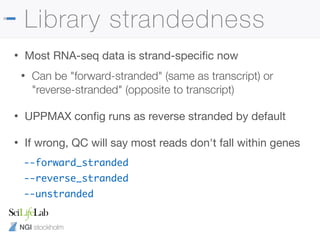
Library strandedness
• Most RNA-seq data is strand-specific now

• Can be "forward-stranded" (same as transcript) or
"reverse-stranded" (opposite to transcript)
• UPPMAX config runs as reverse stranded by default

• If wrong, QC will say most reads don't fall within genes

--forward_stranded
--reverse_stranded
--unstranded
NGI stockholm
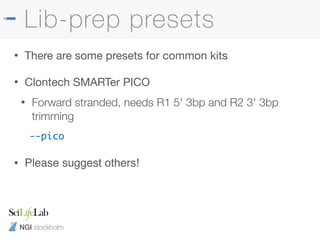
Lib-prep presets
• There are some presets for common kits

• Clontech SMARTer PICO

• Forward stranded, needs R1 5' 3bp and R2 3' 3bp
trimming
--pico
• Please suggest others!
NGI stockholm
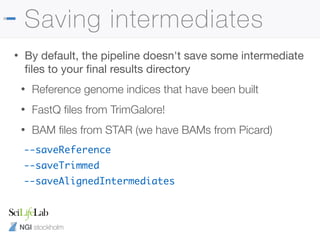
Saving intermediates
• By default, the pipeline doesn't save some intermediate
files to your final results directory

• Reference genome indices that have been built
• FastQ files from TrimGalore!
• BAM files from STAR (we have BAMs from Picard)
--saveReference
--saveTrimmed
--saveAlignedIntermediates
NGI stockholm
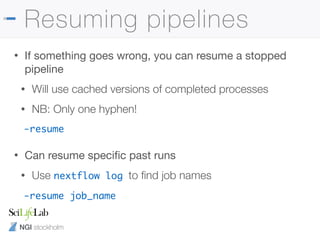
Resuming pipelines
• If something goes wrong, you can resume a stopped
pipeline

• Will use cached versions of completed processes
• NB: Only one hyphen!
-resume
• Can resume specific past runs

• Use nextflow log to find job names
-resume job_name
NGI stockholm
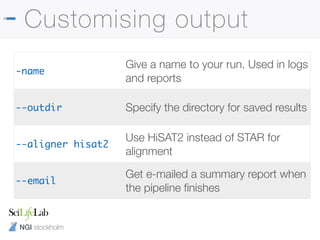
Customising output
-name
Give a name to your run. Used in logs
and reports
--outdir Specify the directory for saved results
--aligner hisat2
Use HiSAT2 instead of STAR for
alignment
--email
Get e-mailed a summary report when
the pipeline finishes
NGI stockholm
Nextflow config files
• Can save a config file with defaults

• Anything with two hyphens is a params
params {
email = 'phil.ewels@scilifelab.se'
project = "b2017123"
}
process.$multiqc.module = []
./nextflow.config
~/.nextflow/config
-c /path/to/my.config
NGI stockholm
NGI-RNAseq config
N E X T F L O W ~ version 0.25.5
Launching `/home/phil/GitHub/NGI-RNAseq/main.nf` [amazing_laplace] - revision: 8b9f416d01
=========================================
NGI-RNAseq : RNA-Seq Best Practice v1.3.1
=========================================
Run Name : amazing_laplace
Reads : data/7_111116_AD0341ACXX_137_*_{1,2}.fastq.gz
Data Type : Paired-End
Genome : GRCh37
Strandedness : Reverse
Trim R1 : 0
Trim R2 : 0
Trim 3' R1 : 0
Trim 3' R2 : 0
Aligner : STAR
STAR Index : /sw/data/uppnex/igenomes//Homo_sapiens/Ensembl/GRCh37/Sequence/STARIndex/
GTF Annotation : /sw/data/uppnex/igenomes//Homo_sapiens/Ensembl/GRCh37/Annotation/Genes/genes.gtf
BED Annotation : /sw/data/uppnex/igenomes//Homo_sapiens/Ensembl/GRCh37/Annotation/Genes/genes.bed
Save Reference : Yes
Save Trimmed : No
Save Intermeds : No
Output dir : ./results
Working dir : /pica/h1/phil/nbis_rnaseq/work
Current home : /home/phil
Current user : phil
Current path : /home/phil/nbis_rnaseq
R libraries : /home/phil/R/nxtflow_libs/
Script dir : /home/phil/GitHub/NGI-RNAseq
Config Profile : UPPMAX
UPPMAX Project : b2017123
E-mail Address : phil.ewels@scilifelab.se
=========================================
NGI stockholm
Version control
$makeSTARindex.module = ['bioinfo-tools', 'star/2.5.1b']
$makeHisatSplicesites.module = ['bioinfo-tools', 'HISAT2/2.1.0']
$makeHISATindex.module = ['bioinfo-tools', 'HISAT2/2.1.0']
$fastqc.module = ['bioinfo-tools', 'FastQC/0.11.5']
$trim_galore.module = ['bioinfo-tools', 'FastQC/0.11.5',
'TrimGalore/0.4.1']
$star.module = ['bioinfo-tools', 'star/2.5.1b']
NGI stockholm
Version control
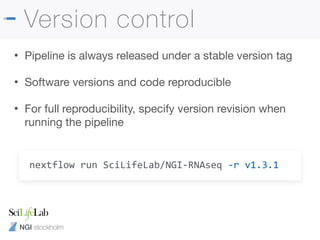
• Pipeline is always released under a stable version tag

• Software versions and code reproducible

• For full reproducibility, specify version revision when
running the pipeline
nextflow run SciLifeLab/NGI-RNAseq -r v1.3.1
Conclusion
• Use NGI-RNAseq to prepare your data if you want:

• To not have to remember every parameter for STAR
• Extreme reproducibility
• Ability to run on virtually any environment
• Now running for all RNA projects at NGI-Stockholm
Conclusion
NGI stockholm
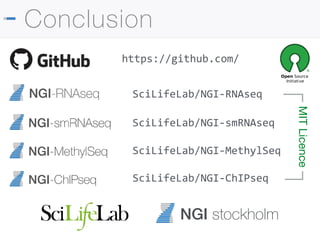
SciLifeLab/NGI-RNAseq
https://github.com/
SciLifeLab/NGI-MethylSeq
SciLifeLab/NGI-smRNAseq
SciLifeLab/NGI-ChIPseq
MITLicence
Conclusion
NGI stockholm
SciLifeLab/NGI-RNAseq
https://github.com/
SciLifeLab/NGI-MethylSeq
SciLifeLab/NGI-smRNAseq
SciLifeLab/NGI-ChIPseq
Acknowledgements

Phil Ewels
Rickard Hammarén
Anders Jemt
Max Käller
Denis Moreno
Chuan Wang
NGI Stockholm Genomics Applications
Development Group
support@ngisweden.se
http://opensource.scilifelab.se

NBIS RNA-seq course

  • 1.
    NGI stockholm NGI-RNAseq Processing RNA-seqdata at the National Genomics Infrastructure Phil Ewels phil.ewels@scilifelab.se NBIS RNA-seq tutorial 2017-11-09
  • 2.
    NGI stockholm SciLifeLab NGI Ourmission is to offer a
 state-of-the-art infrastructure
 for massively parallel DNA sequencing and SNP genotyping, available to researchers all over Sweden
  • 3.
    NGI stockholm SciLifeLab NGI Nationalresource State-of-the-art infrastructure Guidelines and support We provide 
 guidelines and support
 for sample collection, study design, protocol selection and bioinformatics analysis
  • 4.
  • 5.
    NGI stockholm NGI Organisation Funding Staffsalaries Premises and service contracts Capital equipment Host universities SciLifeLab VR KAW User fees Reagent costs NGI Stockholm NGI Uppsala
  • 6.
    NGI stockholm Project timeline SampleQC Library preparation, Sequencing, Genotyping Data processing and primary analysis Scientific support and project consultation Data delivery
  • 7.
    NGI stockholm Methods offeredat NGI Exome
 sequencing Nanoporesequencing ATAC-seq Metagenomics ChIP-seqBisulphite
 sequencing RAD-seq RNA-seq de novo Whole Genome seq Data analysis included for FREE Just
 Sequencing Accredited methods
  • 8.
    NGI stockholm RNA-Seq: NGIStockholm # Projects in 2016 RNA-Seq WG Re-Seq De-Novo Targeted Re-Seq Metagenomics ChIP-Seq Epigenetics RAD Seq 0 35 70 105 140 1 6 9 19 25 72 110 131 • RNA-seq is the most common project type
  • 9.
    NGI stockholm RNA-Seq: NGIStockholm • RNA-seq is the most common project type # Samples in 2016 RNA-Seq WG Re-Seq De-Novo Targeted Re-Seq Metagenomics ChIP-Seq Epigenetics RAD Seq 0 1750 3500 5250 7000 288 33 244 1,482 5,153 306 4,006 6,048 • Production protocols: • TruSeq (poly-A) • RiboZero • In development: • SMARTer Pico • RNA Access
  • 10.
    NGI stockholm RNA-Seq: NGIStockholm • RNA-seq is the most common project type • Production protocols: • TruSeq (poly-A) • RiboZero • In development: • SMARTer Pico • RNA Access
  • 11.
    NGI stockholm RNA-Seq Pipeline •Takes raw FastQ sequencing data as input • Provides range of results • Alignments (BAM) • Gene counts (Counts, FPKM) • Quality Control • First RNA Pipeline running since 2012 • Second RNA Pipeline in use since April 2017 NGI-RNAseq
  • 12.
    NGI stockholm RNA-Seq Pipeline FastQC TrimGalore! STAR dupRadar featureCounts StringTie RSeQC Preseq edgeR MultiQC SequenceQC Read trimming Alignment Duplication QC Gene counts Normalised FPKM Alignments QC Library complexity Heatmap, clustering Reporting NGI-RNAseq
  • 13.
    NGI stockholm RNA-Seq Pipeline FastQC TrimGalore! STAR dupRadar featureCounts StringTie RSeQC Preseq edgeR MultiQC NGI-RNAseq FastQ BAM TSV HTML SequenceQC Read trimming Alignment Duplication QC Gene counts Normalised FPKM Alignments QC Library complexity Heatmap, clustering Reporting
  • 14.
    NGI stockholm Nextflow • Toolto manage computational pipelines • Handles interaction with compute infrastructure • Easy to learn how to run, minimal oversight required
  • 15.
  • 16.
    NGI stockholm Nextflow #!/usr/bin/env nextflow input= Channel.fromFilePairs( params.reads ) process fastqc { input: file reads from input output: file "*_fastqc.{zip,html}" into results script: """ fastqc -q $reads """ }
  • 17.
    NGI stockholm Default: Runlocally, assume software is installed Nextflow #!/usr/bin/env nextflow input = Channel.fromFilePairs( params.reads ) process fastqc { input: file reads from input output: file "*_fastqc.{zip,html}" into results script: """ fastqc -q $reads """ } process { executor = 'slurm' clusterOptions = { "-A b2017123" } cpus = 1 memory = 8.GB time = 2.h $fastqc { module = ['bioinfo-tools', ‘FastQC'] } } Submit jobs to SLURM queue Use environment modules
  • 18.
    NGI stockholm Nextflow #!/usr/bin/env nextflow input= Channel.fromFilePairs( params.reads ) process fastqc { input: file reads from input output: file "*_fastqc.{zip,html}" into results script: """ fastqc -q $reads """ } process { executor = 'slurm' clusterOptions = { "-A b2017123" } cpus = 1 memory = 8.GB time = 2.h $fastqc { module = ['bioinfo-tools', ‘FastQC'] } } docker { enabled = true } process { container = 'biocontainers/fastqc' cpus = 1 memory = 8.GB time = 2.h } Run locally, use docker container for all software dependencies
  • 19.
  • 20.
  • 21.
    NGI stockholm Running NGI-RNAseq Step1: Install Nextflow • Uppmax - load the Nextflow module module load nextflow • Anywhere (including Uppmax) - install Nextflow curl -s https://get.nextflow.io | bash Step 2: Try running NGI-RNAseq pipeline nextflow run SciLifeLab/NGI-RNAseq --help
  • 22.
    NGI stockholm Running NGI-RNAseq Step3: Choose your reference • Common organism - use iGenomes --genome GRCh37 • Custom genome - Fasta + GTF (minimum) --fasta genome.fa --gtf genes.gtf Step 4: Organise your data • One (if single-end) or two (if paired-end) FastQ per sample • Everything in one directory, simple filenames help!
  • 23.
    NGI stockholm Running NGI-RNAseq Step5: Run the pipeline on your data • Remember to run detached from your terminal screen / tmux / nohup Step 6: Check your results • Read the Nextflow log and check the MultiQC report Step 7: Delete temporary files • Delete the ./work directory, which holds all intermediates
  • 24.
  • 25.
    NGI stockholm Using UPPMAX nextflowrun SciLifeLab/NGI-RNAseq --project b2017123 --genome GRCh37 --reads "data/*_R{1,2}.fastq.gz" • Default config is for UPPMAX • Knows about central iGenomes references • Uses centrally installed software
  • 26.
    NGI stockholm Using otherclusters nextflow run SciLifeLab/NGI-RNAseq -profile hebbe --fasta genome.fa --gtf genes.gtf --reads "data/*_R{1,2}.fastq.gz" • Can run just about anywhere • Supports local, SGE, LSF, SLURM, PBS/Torque, HTCondor, DRMAA, DNAnexus, Ignite, Kubernetes
  • 27.
    NGI stockholm Using Docker nextflowrun SciLifeLab/NGI-RNAseq -profile docker --fasta genome.fa --gtf genes.gtf --reads "data/*_R{1,2}.fastq.gz" • Can run anywhere with Docker • Downloads required software and runs in a container • Portable and reproducible.
  • 28.
    NGI stockholm Using AWS nextflowrun SciLifeLab/NGI-RNAseq -profile aws --genome GRCh37 --reads "s3://my-bucket/*_{1,2}.fq.gz" --outdir "s3://my-bucket/results/" • Runs on the AWS cloud with Docker • Pay-as-you go, flexible computing • Can launch from anywhere with minimal configuration
  • 29.
    NGI stockholm Input data ERROR~ Cannot find any reads matching: XXXX NB: Path needs to be enclosed in quotes! NB: Path requires at least one * wildcard! If this is single-end data, please specify
 --singleEnd on the command line. --reads '*_R{1,2}.fastq.gz' --reads '*.fastq.gz' --singleEnd --reads *_R{1,2}.fastq.gz --reads '*.fastq.gz' --reads sample.fastq.gz
  • 30.
    NGI stockholm Read trimming •Pipeline runs TrimGalore! to remove adapter contamination and low quality bases automatically • Some library preps also include additional adapters • Will get poor alignment rates without additional trimming --clip_r1 [int] --clip_r2 [int] --three_prime_clip_r1 [int] --three_prime_clip_r2 [int]
  • 31.
    NGI stockholm Library strandedness •Most RNA-seq data is strand-specific now • Can be "forward-stranded" (same as transcript) or "reverse-stranded" (opposite to transcript) • UPPMAX config runs as reverse stranded by default • If wrong, QC will say most reads don't fall within genes --forward_stranded --reverse_stranded --unstranded
  • 32.
    NGI stockholm Lib-prep presets •There are some presets for common kits • Clontech SMARTer PICO • Forward stranded, needs R1 5' 3bp and R2 3' 3bp trimming --pico • Please suggest others!
  • 33.
    NGI stockholm Saving intermediates •By default, the pipeline doesn't save some intermediate files to your final results directory • Reference genome indices that have been built • FastQ files from TrimGalore! • BAM files from STAR (we have BAMs from Picard) --saveReference --saveTrimmed --saveAlignedIntermediates
  • 34.
    NGI stockholm Resuming pipelines •If something goes wrong, you can resume a stopped pipeline • Will use cached versions of completed processes • NB: Only one hyphen! -resume • Can resume specific past runs • Use nextflow log to find job names -resume job_name
  • 35.
    NGI stockholm Customising output -name Givea name to your run. Used in logs and reports --outdir Specify the directory for saved results --aligner hisat2 Use HiSAT2 instead of STAR for alignment --email Get e-mailed a summary report when the pipeline finishes
  • 36.
    NGI stockholm Nextflow configfiles • Can save a config file with defaults • Anything with two hyphens is a params params { email = 'phil.ewels@scilifelab.se' project = "b2017123" } process.$multiqc.module = [] ./nextflow.config ~/.nextflow/config -c /path/to/my.config
  • 37.
    NGI stockholm NGI-RNAseq config NE X T F L O W ~ version 0.25.5 Launching `/home/phil/GitHub/NGI-RNAseq/main.nf` [amazing_laplace] - revision: 8b9f416d01 ========================================= NGI-RNAseq : RNA-Seq Best Practice v1.3.1 ========================================= Run Name : amazing_laplace Reads : data/7_111116_AD0341ACXX_137_*_{1,2}.fastq.gz Data Type : Paired-End Genome : GRCh37 Strandedness : Reverse Trim R1 : 0 Trim R2 : 0 Trim 3' R1 : 0 Trim 3' R2 : 0 Aligner : STAR STAR Index : /sw/data/uppnex/igenomes//Homo_sapiens/Ensembl/GRCh37/Sequence/STARIndex/ GTF Annotation : /sw/data/uppnex/igenomes//Homo_sapiens/Ensembl/GRCh37/Annotation/Genes/genes.gtf BED Annotation : /sw/data/uppnex/igenomes//Homo_sapiens/Ensembl/GRCh37/Annotation/Genes/genes.bed Save Reference : Yes Save Trimmed : No Save Intermeds : No Output dir : ./results Working dir : /pica/h1/phil/nbis_rnaseq/work Current home : /home/phil Current user : phil Current path : /home/phil/nbis_rnaseq R libraries : /home/phil/R/nxtflow_libs/ Script dir : /home/phil/GitHub/NGI-RNAseq Config Profile : UPPMAX UPPMAX Project : b2017123 E-mail Address : phil.ewels@scilifelab.se =========================================
  • 38.
    NGI stockholm Version control $makeSTARindex.module= ['bioinfo-tools', 'star/2.5.1b'] $makeHisatSplicesites.module = ['bioinfo-tools', 'HISAT2/2.1.0'] $makeHISATindex.module = ['bioinfo-tools', 'HISAT2/2.1.0'] $fastqc.module = ['bioinfo-tools', 'FastQC/0.11.5'] $trim_galore.module = ['bioinfo-tools', 'FastQC/0.11.5', 'TrimGalore/0.4.1'] $star.module = ['bioinfo-tools', 'star/2.5.1b']
  • 39.
    NGI stockholm Version control •Pipeline is always released under a stable version tag • Software versions and code reproducible • For full reproducibility, specify version revision when running the pipeline nextflow run SciLifeLab/NGI-RNAseq -r v1.3.1
  • 40.
    Conclusion • Use NGI-RNAseqto prepare your data if you want: • To not have to remember every parameter for STAR • Extreme reproducibility • Ability to run on virtually any environment • Now running for all RNA projects at NGI-Stockholm
  • 41.
  • 42.
    Conclusion NGI stockholm SciLifeLab/NGI-RNAseq https://github.com/ SciLifeLab/NGI-MethylSeq SciLifeLab/NGI-smRNAseq SciLifeLab/NGI-ChIPseq Acknowledgements Phil Ewels RickardHammarén Anders Jemt Max Käller Denis Moreno Chuan Wang NGI Stockholm Genomics Applications Development Group support@ngisweden.se http://opensource.scilifelab.se