TAMMO S. STEENHUIS, DAWIT ASMARE, MOHAMMAD ENKAMIL, CHRISTIAN
GUZMAN, TIGIST Y. TEBEBU, HAIMANOTE BAYABIL, ASSEFA D. ZEGEYE, SEIFU
TILAHUN CHARLOTTE MACALISTER AND SIMON LANGAN
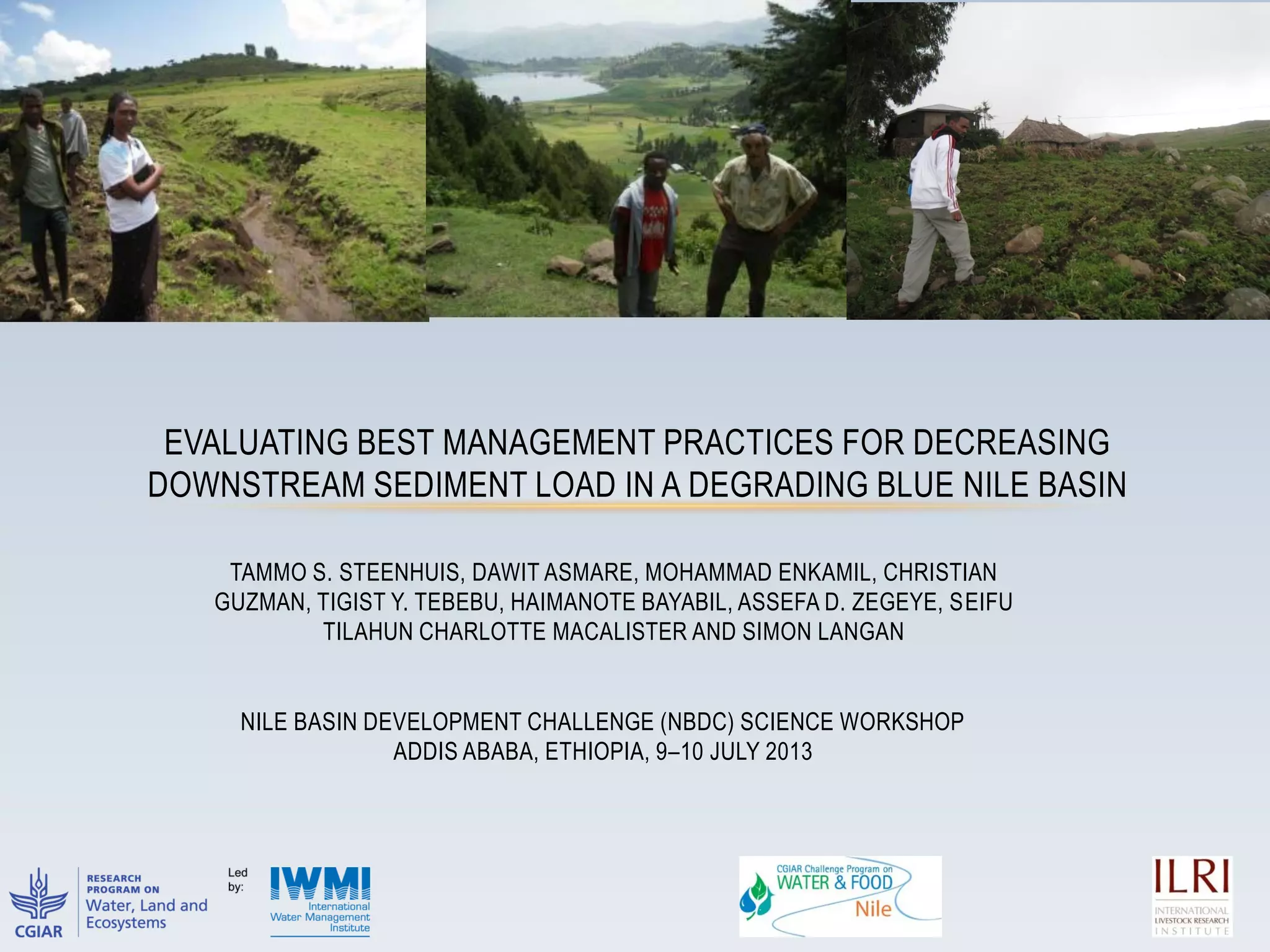
EVALUATING BEST MANAGEMENT PRACTICES FOR DECREASING
DOWNSTREAM SEDIMENT LOAD IN A DEGRADING BLUE NILE BASIN
NILE BASIN DEVELOPMENT CHALLENGE (NBDC) SCIENCE WORKSHOP
ADDIS ABABA, ETHIOPIA, 9–10 JULY 2013
What is the effect of improved rainwater
productivity in Ethiopia on the discharge
and sediment load downstream?
QUESTIONS TO BE ANSWERED
RAINWATER PRODUCTIVITY EFFECTS ON SEDIMENT AND DISCHARGE
What was the discharge and sediment
concentration in the past?
Is there a trend?
What will be discharge and concentration in
the future with improved rainwater productivity
PAST DISCHARGE AND SEDIMENT
CONCENTRATION TRENDS
Very little data available, therefore
• Use mathematical model to relate the existing
discharge and sediment concentrations with rainfall
• Assume that changes in parameters reflects trends
• Assume that the main impact on the hydrology and
sediment load is an increase in degraded areas in the
landscape
• Climate changes (that has been minimal over the past)
are included in the mathematical model
WHAT WE DID
Obtained discharge and sediment
concentration data for
Blue Nile at the Sudanese border
Gumura
Anjeni
Debre Mawi
Calibrated model to historical and recent data
Used historical parameters for current period
and visa versa to predict change
Parameter Efficient Distributed Model (PED model)
BASICS OF THE MODEL
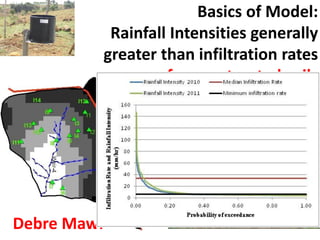
Basics of Model:
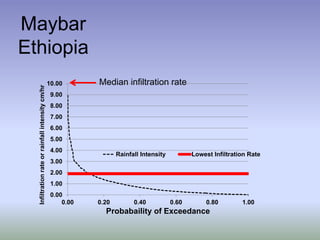
Rainfall Intensities generally
greater than infiltration rates
for unsaturated soils
Debre Mawi
Maybar
Ethiopia
0.00
1.00
2.00
3.00
4.00
5.00
6.00
7.00
8.00
9.00
10.00
0.00 0.20 0.40 0.60 0.80 1.00
Infiltrationrateorrainfallintensitycm/hr
Probabaility of Exceedance
Rainfall Intensity Lowest Infiltration Rate
Median infiltration rate
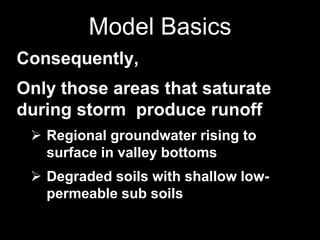
Model Basics
Consequently,
Only those areas that saturate
during storm produce runoff
 Regional groundwater rising to
surface in valley bottoms
 Degraded soils with shallow low-
permeable sub soils
1
2
3
4
5
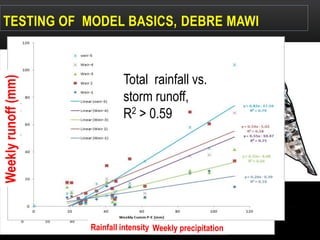
TESTING OF MODEL BASICS, DEBRE MAWI
Rainfall intensity vs.
storm runoff
R2 <0.4
Total rainfall vs.
storm runoff,
R2 > 0.59
Weeklyrunoff(mm)
Rainfall intensity Weekly precipitation
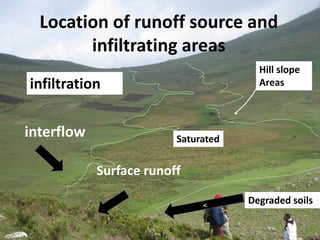
Location of runoff source and
infiltrating areas
Hill slope
Areas
Degraded soils
Saturated
Surface runoff
infiltration
interflow
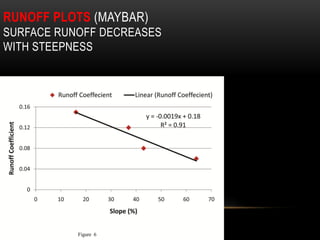
RUNOFF PLOTS (MAYBAR)
SURFACE RUNOFF DECREASES
WITH STEEPNESS
16 37 43 64
slope of land
Runoff Coefficients
HYDROLOGY MODEL
There is a constant area for storm outflow after the
threshold is exceeded.
In the remaining part of the watershed, rain
infiltrates and becomes stream flow at some point
The threshold value can be obtained by simulating
a water balance. The threshold value is exceeded
when the soil exceeds field capacity.
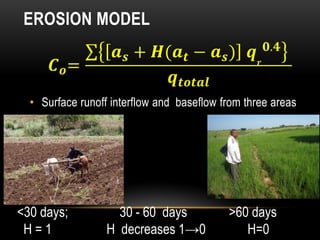
EROSION MODEL
• Surface runoff interflow and baseflow from three areas
<30 days; 30 - 60 days >60 days
H = 1 H decreases 1→0 H=0
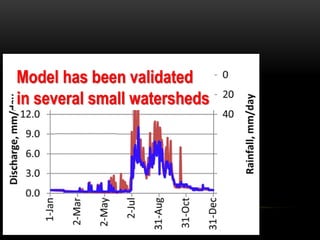
Model has been validated
in several small watersheds
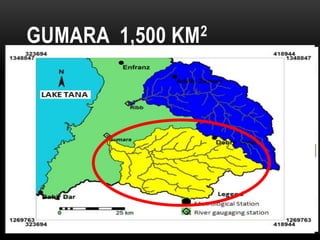
GUMARA 1,500 KM2
0
0.1
0.2
0.3
0.4
0.5
0.6
0.7
0.8
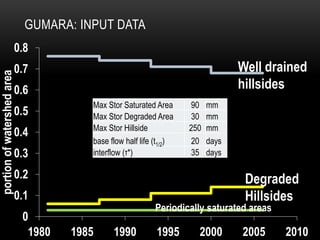
1980 1985 1990 1995 2000 2005 2010
portionofwatershedarea
GUMARA: INPUT DATA
Well drained
hillsides
Max Stor Saturated Area 90 mm
Max Stor Degraded Area 30 mm
Max Stor Hillside 250 mm
base flow half life (t1/2) 20 days
interflow (τ*) 35 days
Degraded
Hillsides
Periodically saturated areas
0
2
4
6
8
10
12
14
16
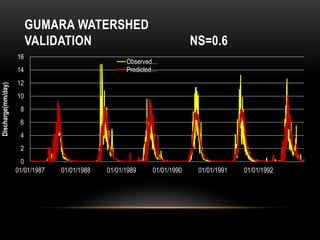
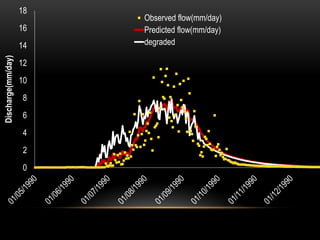
01/01/1987 01/01/1988 01/01/1989 01/01/1990 01/01/1991 01/01/1992
Discharge(mm/day)
Observed…
Predicted…
GUMARA WATERSHED
VALIDATION NS=0.6
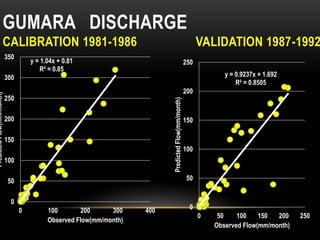
GUMARA DISCHARGE
CALIBRATION 1981-1986 VALIDATION 1987-1992
y = 1.04x + 0.81
R² = 0.85
0
50
100
150
200
250
300
350
0 100 200 300 400
PredictedFlow(mm/month)
Observed Flow(mm/month)
y = 0.9237x + 1.692
R² = 0.8505
0
50
100
150
200
250
0 50 100 150 200 250
PredictedFlow(mm/month)
Observed Flow(mm/month)
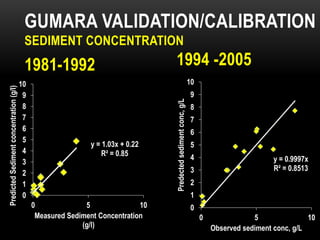
GUMARA VALIDATION/CALIBRATION
SEDIMENT CONCENTRATION
1981-1992 1994 -2005
y = 0.9997x
R² = 0.8513
0
1
2
3
4
5
6
7
8
9
10
0 5 10
Predectedsedimentconc,g/L
Observed sediment conc, g/L
y = 1.03x + 0.22
R² = 0.85
0
1
2
3
4
5
6
7
8
9
10
0 5 10
PredictedSedimentconcentration(g/l)
Measured Sediment Concentration
(g/l)
0
2
4
6
8
10
12
14
16
18Discharge(mm/day)
Observed flow(mm/day)
Predicted flow(mm/day)
degraded
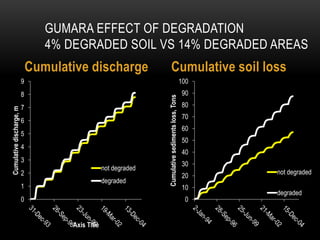
GUMARA EFFECT OF DEGRADATION
4% DEGRADED SOIL VS 14% DEGRADED AREAS
Cumulative discharge Cumulative soil loss
0
1
2
3
4
5
6
7
8
9
Cumulativedischarge,m
Axis Title
not degraded
degraded
0
10
20
30
40
50
60
70
80
90
100
Cumulativesedimentsloss,Tons not degraded
degraded
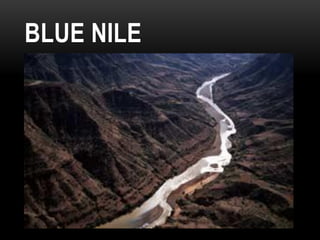
BLUE NILE
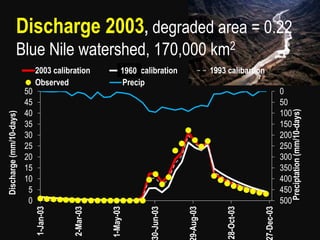
Discharge 2003, degraded area = 0.22
Blue Nile watershed, 170,000 km2
0
50
100
150
200
250
300
350
400
450
5000
5
10
15
20
25
30
35
40
45
50
1-Jan-03
2-Mar-03
1-May-03
0-Jun-03
9-Aug-03
28-Oct-03
7-Dec-03
Preciptation(mm/10-days)
Discharge(mm/10-days)
2003 calibration 1993 calibration 1993 calibartion
Observed Precip
1960
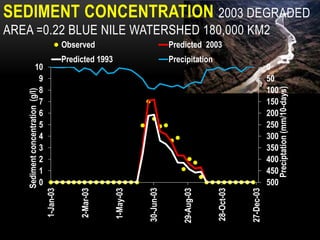
SEDIMENT CONCENTRATION 2003 DEGRADED
AREA =0.22 BLUE NILE WATERSHED 180,000 KM2
0
50
100
150
200
250
300
350
400
450
5000
1
2
3
4
5
6
7
8
9
10
1-Jan-03
2-Mar-03
1-May-03
30-Jun-03
29-Aug-03
28-Oct-03
27-Dec-03
Preciptation(mm/10-days)
Sedimentconcentration(g/l)
Observed Predicted 2003
Predicted 1993 Precipitation
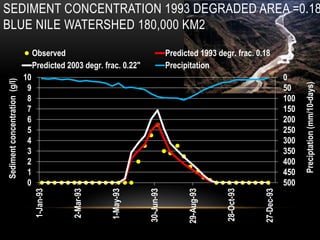
SEDIMENT CONCENTRATION 1993 DEGRADED AREA =0.18
BLUE NILE WATERSHED 180,000 KM2
0
50
100
150
200
250
300
350
400
450
5000
1
2
3
4
5
6
7
8
9
10
1-Jan-93
2-Mar-93
1-May-93
30-Jun-93
29-Aug-93
28-Oct-93
27-Dec-93
Preciptation(mm/10-days)
Sedimentconcentration(g/l)
Observed Predicted 1993 degr. frac. 0.18
Predicted 2003 degr. frac. 0.22" Precipitation
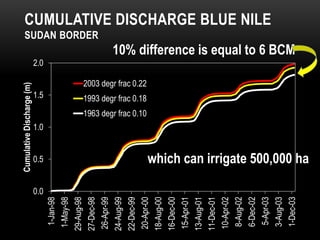
CUMULATIVE DISCHARGE BLUE NILE
SUDAN BORDER
0.0
0.5
1.0
1.5
2.0
1-Jan-98
1-May-98
29-Aug-98
27-Dec-98
26-Apr-99
24-Aug-99
22-Dec-99
20-Apr-00
18-Aug-00
16-Dec-00
15-Apr-01
13-Aug-01
11-Dec-01
10-Apr-02
8-Aug-02
6-Dec-02
5-Apr-03
3-Aug-03
1-Dec-03
CumulativeDischarge(m)
2003 degr frac 0.22
1993 degr frac 0.18
1963 degr frac 0.10
10% difference is equal to 6 BCM
which can irrigate 500,000 ha
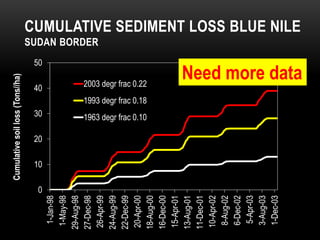
CUMULATIVE SEDIMENT LOSS BLUE NILE
SUDAN BORDER
0
10
20
30
40
50
1-Jan-98
1-May-98
29-Aug-98
27-Dec-98
26-Apr-99
24-Aug-99
22-Dec-99
20-Apr-00
18-Aug-00
16-Dec-00
15-Apr-01
13-Aug-01
11-Dec-01
10-Apr-02
8-Aug-02
6-Dec-02
5-Apr-03
3-Aug-03
1-Dec-03
Cumulativesoilloss(Tons//ha)
2003 degr frac 0.22
1993 degr frac 0.18
1963 degr frac 0.10
Need more data
ARE THESE RESULTS
REASONABLE?
ALMOST NO EFFECT ON DISCHARGE
LARGE EFFECT ON SEDIMENT
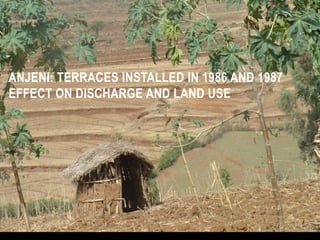
ANJENI: TERRACES INSTALLED IN 1986 AND 1987
EFFECT ON DISCHARGE AND LAND USE
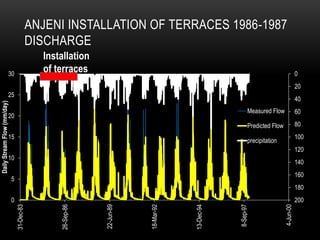
ANJENI INSTALLATION OF TERRACES 1986-1987
DISCHARGE
0
20
40
60
80
100
120
140
160
180
2000
5
10
15
20
25
30
31-Dec-83
26-Sep-86
22-Jun-89
18-Mar-92
13-Dec-94
8-Sep-97
4-Jun-00
DailyStreamFlow(mm/day)
Measured Flow
Predicted Flow
precipitation
Installation
of terraces
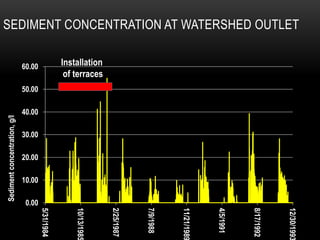
SEDIMENT CONCENTRATION AT WATERSHED OUTLET
0.00
10.00
20.00
30.00
40.00
50.00
60.00
5/31/1984
10/13/1985
2/25/1987
7/9/1988
11/21/1989
4/5/1991
8/17/1992
12/30/1993
Sedimentconcentration,g/l
Installation
of terraces
Rain water Management
Practices for Erosion
Control
EFFECT OF INSTALLATION OF TERRACES
•
• Virtually no effect on total runoff and distribution
between various discharge components
• Reduces sediment by what can be stored behind the
terraces. Once terraces are level, sediment
concentration are nearly back to old levels
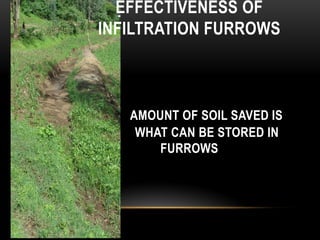
EFFECTIVENESS OF
INFILTRATION FURROWS
AMOUNT OF SOIL SAVED IS
WHAT CAN BE STORED IN
FURROWS
PERMANENT PLANT COVER ON DEGRADED AREAS
This will stop erosion and provides income
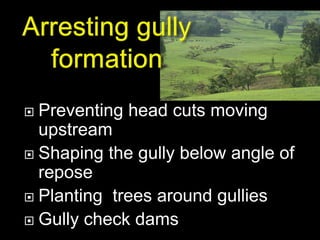
 Preventing head cuts moving
upstream
 Shaping the gully below angle of
repose
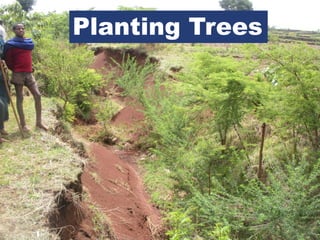
 Planting trees around gullies
 Gully check dams
Planting Trees
 Only by reversing the degradation of the land
further increases in sediment load can be
prevented
 Structural soil and conservation measures are
only effective for a limited time to control
erosion
 Arresting gully formation will save land and
reduce sediment in streams
 No-till will conserve soil, but might increase soil
degradation due to increased pesticide use
Supporting Publications at
soilandwaterbeecornell.edu
Search for soilandwater Ethiopia Cornell

Evaluating best management practices for decreasing downstream sediment load in a degrading Blue Nile basin

  • 1.
    TAMMO S. STEENHUIS,DAWIT ASMARE, MOHAMMAD ENKAMIL, CHRISTIAN GUZMAN, TIGIST Y. TEBEBU, HAIMANOTE BAYABIL, ASSEFA D. ZEGEYE, SEIFU TILAHUN CHARLOTTE MACALISTER AND SIMON LANGAN EVALUATING BEST MANAGEMENT PRACTICES FOR DECREASING DOWNSTREAM SEDIMENT LOAD IN A DEGRADING BLUE NILE BASIN NILE BASIN DEVELOPMENT CHALLENGE (NBDC) SCIENCE WORKSHOP ADDIS ABABA, ETHIOPIA, 9–10 JULY 2013
  • 2.
    What is theeffect of improved rainwater productivity in Ethiopia on the discharge and sediment load downstream?
  • 3.
    QUESTIONS TO BEANSWERED RAINWATER PRODUCTIVITY EFFECTS ON SEDIMENT AND DISCHARGE What was the discharge and sediment concentration in the past? Is there a trend? What will be discharge and concentration in the future with improved rainwater productivity
  • 4.
    PAST DISCHARGE ANDSEDIMENT CONCENTRATION TRENDS Very little data available, therefore • Use mathematical model to relate the existing discharge and sediment concentrations with rainfall • Assume that changes in parameters reflects trends • Assume that the main impact on the hydrology and sediment load is an increase in degraded areas in the landscape • Climate changes (that has been minimal over the past) are included in the mathematical model
  • 5.
    WHAT WE DID Obtaineddischarge and sediment concentration data for Blue Nile at the Sudanese border Gumura Anjeni Debre Mawi Calibrated model to historical and recent data Used historical parameters for current period and visa versa to predict change
  • 6.
    Parameter Efficient DistributedModel (PED model) BASICS OF THE MODEL
  • 7.
    Basics of Model: RainfallIntensities generally greater than infiltration rates for unsaturated soils Debre Mawi
  • 8.
    Maybar Ethiopia 0.00 1.00 2.00 3.00 4.00 5.00 6.00 7.00 8.00 9.00 10.00 0.00 0.20 0.400.60 0.80 1.00 Infiltrationrateorrainfallintensitycm/hr Probabaility of Exceedance Rainfall Intensity Lowest Infiltration Rate Median infiltration rate
  • 9.
    Model Basics Consequently, Only thoseareas that saturate during storm produce runoff  Regional groundwater rising to surface in valley bottoms  Degraded soils with shallow low- permeable sub soils
  • 10.
    1 2 3 4 5 TESTING OF MODELBASICS, DEBRE MAWI Rainfall intensity vs. storm runoff R2 <0.4 Total rainfall vs. storm runoff, R2 > 0.59 Weeklyrunoff(mm) Rainfall intensity Weekly precipitation
  • 11.
    Location of runoffsource and infiltrating areas Hill slope Areas Degraded soils Saturated Surface runoff infiltration interflow
  • 12.
    RUNOFF PLOTS (MAYBAR) SURFACERUNOFF DECREASES WITH STEEPNESS 16 37 43 64 slope of land Runoff Coefficients
  • 13.
    HYDROLOGY MODEL There isa constant area for storm outflow after the threshold is exceeded. In the remaining part of the watershed, rain infiltrates and becomes stream flow at some point The threshold value can be obtained by simulating a water balance. The threshold value is exceeded when the soil exceeds field capacity.
  • 14.
    EROSION MODEL • Surfacerunoff interflow and baseflow from three areas <30 days; 30 - 60 days >60 days H = 1 H decreases 1→0 H=0
  • 15.
    Model has beenvalidated in several small watersheds
  • 16.
  • 17.
    0 0.1 0.2 0.3 0.4 0.5 0.6 0.7 0.8 1980 1985 19901995 2000 2005 2010 portionofwatershedarea GUMARA: INPUT DATA Well drained hillsides Max Stor Saturated Area 90 mm Max Stor Degraded Area 30 mm Max Stor Hillside 250 mm base flow half life (t1/2) 20 days interflow (τ*) 35 days Degraded Hillsides Periodically saturated areas
  • 18.
    0 2 4 6 8 10 12 14 16 01/01/1987 01/01/1988 01/01/198901/01/1990 01/01/1991 01/01/1992 Discharge(mm/day) Observed… Predicted… GUMARA WATERSHED VALIDATION NS=0.6
  • 19.
    GUMARA DISCHARGE CALIBRATION 1981-1986VALIDATION 1987-1992 y = 1.04x + 0.81 R² = 0.85 0 50 100 150 200 250 300 350 0 100 200 300 400 PredictedFlow(mm/month) Observed Flow(mm/month) y = 0.9237x + 1.692 R² = 0.8505 0 50 100 150 200 250 0 50 100 150 200 250 PredictedFlow(mm/month) Observed Flow(mm/month)
  • 20.
    GUMARA VALIDATION/CALIBRATION SEDIMENT CONCENTRATION 1981-19921994 -2005 y = 0.9997x R² = 0.8513 0 1 2 3 4 5 6 7 8 9 10 0 5 10 Predectedsedimentconc,g/L Observed sediment conc, g/L y = 1.03x + 0.22 R² = 0.85 0 1 2 3 4 5 6 7 8 9 10 0 5 10 PredictedSedimentconcentration(g/l) Measured Sediment Concentration (g/l)
  • 21.
  • 22.
    GUMARA EFFECT OFDEGRADATION 4% DEGRADED SOIL VS 14% DEGRADED AREAS Cumulative discharge Cumulative soil loss 0 1 2 3 4 5 6 7 8 9 Cumulativedischarge,m Axis Title not degraded degraded 0 10 20 30 40 50 60 70 80 90 100 Cumulativesedimentsloss,Tons not degraded degraded
  • 23.
  • 24.
    Discharge 2003, degradedarea = 0.22 Blue Nile watershed, 170,000 km2 0 50 100 150 200 250 300 350 400 450 5000 5 10 15 20 25 30 35 40 45 50 1-Jan-03 2-Mar-03 1-May-03 0-Jun-03 9-Aug-03 28-Oct-03 7-Dec-03 Preciptation(mm/10-days) Discharge(mm/10-days) 2003 calibration 1993 calibration 1993 calibartion Observed Precip 1960
  • 25.
    SEDIMENT CONCENTRATION 2003DEGRADED AREA =0.22 BLUE NILE WATERSHED 180,000 KM2 0 50 100 150 200 250 300 350 400 450 5000 1 2 3 4 5 6 7 8 9 10 1-Jan-03 2-Mar-03 1-May-03 30-Jun-03 29-Aug-03 28-Oct-03 27-Dec-03 Preciptation(mm/10-days) Sedimentconcentration(g/l) Observed Predicted 2003 Predicted 1993 Precipitation
  • 26.
    SEDIMENT CONCENTRATION 1993DEGRADED AREA =0.18 BLUE NILE WATERSHED 180,000 KM2 0 50 100 150 200 250 300 350 400 450 5000 1 2 3 4 5 6 7 8 9 10 1-Jan-93 2-Mar-93 1-May-93 30-Jun-93 29-Aug-93 28-Oct-93 27-Dec-93 Preciptation(mm/10-days) Sedimentconcentration(g/l) Observed Predicted 1993 degr. frac. 0.18 Predicted 2003 degr. frac. 0.22" Precipitation
  • 27.
    CUMULATIVE DISCHARGE BLUENILE SUDAN BORDER 0.0 0.5 1.0 1.5 2.0 1-Jan-98 1-May-98 29-Aug-98 27-Dec-98 26-Apr-99 24-Aug-99 22-Dec-99 20-Apr-00 18-Aug-00 16-Dec-00 15-Apr-01 13-Aug-01 11-Dec-01 10-Apr-02 8-Aug-02 6-Dec-02 5-Apr-03 3-Aug-03 1-Dec-03 CumulativeDischarge(m) 2003 degr frac 0.22 1993 degr frac 0.18 1963 degr frac 0.10 10% difference is equal to 6 BCM which can irrigate 500,000 ha
  • 28.
    CUMULATIVE SEDIMENT LOSSBLUE NILE SUDAN BORDER 0 10 20 30 40 50 1-Jan-98 1-May-98 29-Aug-98 27-Dec-98 26-Apr-99 24-Aug-99 22-Dec-99 20-Apr-00 18-Aug-00 16-Dec-00 15-Apr-01 13-Aug-01 11-Dec-01 10-Apr-02 8-Aug-02 6-Dec-02 5-Apr-03 3-Aug-03 1-Dec-03 Cumulativesoilloss(Tons//ha) 2003 degr frac 0.22 1993 degr frac 0.18 1963 degr frac 0.10 Need more data
  • 29.
    ARE THESE RESULTS REASONABLE? ALMOSTNO EFFECT ON DISCHARGE LARGE EFFECT ON SEDIMENT
  • 30.
    ANJENI: TERRACES INSTALLEDIN 1986 AND 1987 EFFECT ON DISCHARGE AND LAND USE
  • 31.
    ANJENI INSTALLATION OFTERRACES 1986-1987 DISCHARGE 0 20 40 60 80 100 120 140 160 180 2000 5 10 15 20 25 30 31-Dec-83 26-Sep-86 22-Jun-89 18-Mar-92 13-Dec-94 8-Sep-97 4-Jun-00 DailyStreamFlow(mm/day) Measured Flow Predicted Flow precipitation Installation of terraces
  • 32.
    SEDIMENT CONCENTRATION ATWATERSHED OUTLET 0.00 10.00 20.00 30.00 40.00 50.00 60.00 5/31/1984 10/13/1985 2/25/1987 7/9/1988 11/21/1989 4/5/1991 8/17/1992 12/30/1993 Sedimentconcentration,g/l Installation of terraces
  • 33.
  • 34.
    EFFECT OF INSTALLATIONOF TERRACES • • Virtually no effect on total runoff and distribution between various discharge components • Reduces sediment by what can be stored behind the terraces. Once terraces are level, sediment concentration are nearly back to old levels
  • 35.
    EFFECTIVENESS OF INFILTRATION FURROWS AMOUNTOF SOIL SAVED IS WHAT CAN BE STORED IN FURROWS
  • 36.
    PERMANENT PLANT COVERON DEGRADED AREAS This will stop erosion and provides income
  • 37.
     Preventing headcuts moving upstream  Shaping the gully below angle of repose  Planting trees around gullies  Gully check dams
  • 38.
  • 39.
     Only byreversing the degradation of the land further increases in sediment load can be prevented  Structural soil and conservation measures are only effective for a limited time to control erosion  Arresting gully formation will save land and reduce sediment in streams  No-till will conserve soil, but might increase soil degradation due to increased pesticide use
  • 40.