Miss.Nayana Joshi
B.E. 6th SEM
1.
2.
3.
4.

Self describing nature of database system
Insulation between programs data and data
abstraction.
Support of multiple views of data
Sharing of data and multiuser transaction






The database system contains not only the
database itself but also a complete definition or
description of database structure and
constraints.
This definition is stored in DBMS catalog which
contains information such as structure of each
file type and storage format of data item and
various constraints on data.
File processing software can access only specific
databases , where as DBMS software can access
different databases by extracting the database
definition from the catalog and using these
definitions.






In traditional file processing, the structure of
data file is embedded in application program
so any changes to the structure of file may
require change in all programs that access
that files.

Program operation independence.
Object oriented and object relational
database system, users can define operation
in data as a part of database definition.




The data typically has many users , each of
whose may require a different perspective or
view of the database.
The view may be a set of database or it may
contain virtual data i.e. derived from database
file but is not explicitly stored.






The database must allow multiple users to
access the database at the same time, the
DBMS must include concurrency control
software to ensure that several users trying to
update the same data.
Ex : reservation (online)
The DBMS must enforce several transaction
properties.


The isolation property ensures that either all
database operations in transactions are
executed or none are excuted.
1.
2.
3.
4.
5.

Simple versus composite
Single valued versus multivalued
Stored versus derived
Null values
Complex attributes








Simple attributes cannot be divided.
Composite attributes may be divided into
smaller subparts, which represent more basic
attributes with independent meanings.
The values of a composite attributes is the
concatenation of the values of its consistent
simple attributes.
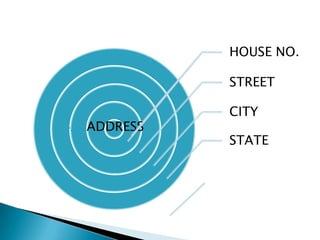
Ex: address attribute of EMPLOYEE entity
HOUSE NO.

STREET
ADDRESS

CITY
STATE








Most attributes have single value for a
particular entity, such attributes are called
single valued.
ex: age attribute of a person is single valued.

In some cases an attributes have a set of
values for same entity.
ex: colour attribute for a car.








In some cases two attribute values are
related.
Ex: age and birthdate attributes of a person.
For a particular person entity, the value of
age can be determined from the current date
and the value of that person’s birthdate.
The age attribute is hence called a “derived
attribute” and said to be derivable from the
birthdate attribute , which is called “stored

attribute”.






In some cases for a particular entity may not
have an applicable value for an attribute.
Ex: the apartment no attribute applies only to
addres that are in apartment not for other
type of residences.
An address of a single-family house would
have NULL for its apartment no attribute.






Compoaite and multivalued attributes can be
nested arbitrarily.
We can represent arbitrary nesting by
grouping ,components of a composite
attribute between ( ) and separating the
components with commas, and displaying
multivalued attributes with { } braces.
Such attributes are called “complex

attributes”
Nayana

Nayana

  • 1.
  • 3.
    1. 2. 3. 4. Self describing natureof database system Insulation between programs data and data abstraction. Support of multiple views of data Sharing of data and multiuser transaction
  • 4.
       The database systemcontains not only the database itself but also a complete definition or description of database structure and constraints. This definition is stored in DBMS catalog which contains information such as structure of each file type and storage format of data item and various constraints on data. File processing software can access only specific databases , where as DBMS software can access different databases by extracting the database definition from the catalog and using these definitions.
  • 5.
       In traditional fileprocessing, the structure of data file is embedded in application program so any changes to the structure of file may require change in all programs that access that files. Program operation independence. Object oriented and object relational database system, users can define operation in data as a part of database definition.
  • 6.
      The data typicallyhas many users , each of whose may require a different perspective or view of the database. The view may be a set of database or it may contain virtual data i.e. derived from database file but is not explicitly stored.
  • 7.
       The database mustallow multiple users to access the database at the same time, the DBMS must include concurrency control software to ensure that several users trying to update the same data. Ex : reservation (online) The DBMS must enforce several transaction properties.
  • 8.
     The isolation propertyensures that either all database operations in transactions are executed or none are excuted.
  • 10.
    1. 2. 3. 4. 5. Simple versus composite Singlevalued versus multivalued Stored versus derived Null values Complex attributes
  • 11.
        Simple attributes cannotbe divided. Composite attributes may be divided into smaller subparts, which represent more basic attributes with independent meanings. The values of a composite attributes is the concatenation of the values of its consistent simple attributes. Ex: address attribute of EMPLOYEE entity
  • 12.
  • 13.
        Most attributes havesingle value for a particular entity, such attributes are called single valued. ex: age attribute of a person is single valued. In some cases an attributes have a set of values for same entity. ex: colour attribute for a car.
  • 14.
        In some casestwo attribute values are related. Ex: age and birthdate attributes of a person. For a particular person entity, the value of age can be determined from the current date and the value of that person’s birthdate. The age attribute is hence called a “derived attribute” and said to be derivable from the birthdate attribute , which is called “stored attribute”.
  • 15.
       In some casesfor a particular entity may not have an applicable value for an attribute. Ex: the apartment no attribute applies only to addres that are in apartment not for other type of residences. An address of a single-family house would have NULL for its apartment no attribute.
  • 16.
       Compoaite and multivaluedattributes can be nested arbitrarily. We can represent arbitrary nesting by grouping ,components of a composite attribute between ( ) and separating the components with commas, and displaying multivalued attributes with { } braces. Such attributes are called “complex attributes”