CHAPTER-4
Navigational Aids
Necessity of navigational aids
• For safe , efficient, economic and comfortable
travel of ships in various water bodies.
• Types of navigational aids – kind of waterway, its
function
• Guiding proper path, gives indication about
danger points
• Important – during night time, bad weather
condition
Types of navigational aids
• Either fixed or floating structures
• Equipped with beacon lights, sound warning devices and radar
reflectors – standardized
• Fixed signals – constructed on land close to the shore
• Floating structure – light ships, buoys
• Depending on service provided and visibility range types are as
follows:
1. Coast approach light station
2. Obstruction light station
3. Approach channel lighting
4. Harbour light signal
Fixed navigation structures
A. Navigation lights on piers, wharves, dolphin, etc..
To outline the limits of piers, wharves, mooring dolphin
Navigation lanterns are installed at each end
In the form of fixed white lights
Fastened directly to structure
Powered by shore electric current
B. Beacon lights on breakwaters, shores etc..
On projecting ends of breakwaters, on salient points of land
projecting into navigable waters, on the points of special danger to
shipping.
Mounted on top of metal framed tower – galvanized, unpainted or
coloured
For proper visibility – installed at proper height
Types of lights: Fixed light, Occulting light, Flashing light and
Coloured light
Powered by shore electric current, electric storage batteries
Radar reflector plates can be erected
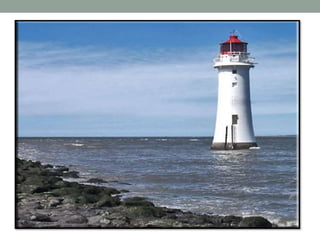
C. Light house:
 Tall tower structure – masonry or reinforced concrete
 Beacon light lantern – on top of the tower
 Tower – divided in number of floors
 Lower floors – as service and store rooms for maintenance and working of light house
 Located – on points along the shore or on reefs and other points of danger
 Strong – to withstand heavy wave action
 Foundation depends on characteristics of soil
 Thick concrete bed – hard soil or rocky bed
 Deep foundation (pile or caisson foundation) - marshy location
 Basement – stone or concrete block
 joggled both vertically and horizontally
 Floors are accessible by a flight of winding stairs
Floating navigational aids
A. Light ships:
At location – where it is not possible to built light house
Lightships vary in size
Operation – automatic or mannual
Propulsion – steam powered or diesel
Lantern – located at height of 9 to 12 m above water levels
Light apparatus – 4 no. of mirror reflectors placed around light and
revolved at a suitable speed emitting a predetermined no. of
flashes
Painted in red colour, station name painted in white colour
Held in position by a single anchor
Observations – about all passing ships and any other navigational
aids
Storm warning signals are also installed
B. Buoys:
 Small sized floating structures, in the form of large cylindrical cans and drums
 For demarcations at entrances, approach channel boundaries
 Two rows of buoys along each end indicate width of entrance
 Left hand side of the approaching ship – star board hand and Right hand side of
the approaching ship – port hand
 Mooring buoys – hook is secured at top and anchor chain at the bottom, at fixed
positions in harbour interiors, designed to have sufficient buoyancy to take the
resultant downward component between the pull of ship’s mooring line and
ground chain
 Depth to diameter ratio should be 1:2
 Mooring hook – self releasing type
Cont..
 As per British and Indian practice – shape of buoys is used to indicate
its purpose while as per French practice color of buoys is used
 Types of buoys – spar, can, nun, spherical, lighted, sound warning etc..
Chapter-4 Navigatinal Aids.pptx

Chapter-4 Navigatinal Aids.pptx

  • 1.
  • 2.
    Necessity of navigationalaids • For safe , efficient, economic and comfortable travel of ships in various water bodies. • Types of navigational aids – kind of waterway, its function • Guiding proper path, gives indication about danger points • Important – during night time, bad weather condition
  • 3.
    Types of navigationalaids • Either fixed or floating structures • Equipped with beacon lights, sound warning devices and radar reflectors – standardized • Fixed signals – constructed on land close to the shore • Floating structure – light ships, buoys • Depending on service provided and visibility range types are as follows: 1. Coast approach light station 2. Obstruction light station 3. Approach channel lighting 4. Harbour light signal
  • 4.
    Fixed navigation structures A.Navigation lights on piers, wharves, dolphin, etc.. To outline the limits of piers, wharves, mooring dolphin Navigation lanterns are installed at each end In the form of fixed white lights Fastened directly to structure Powered by shore electric current
  • 5.
    B. Beacon lightson breakwaters, shores etc.. On projecting ends of breakwaters, on salient points of land projecting into navigable waters, on the points of special danger to shipping. Mounted on top of metal framed tower – galvanized, unpainted or coloured For proper visibility – installed at proper height Types of lights: Fixed light, Occulting light, Flashing light and Coloured light Powered by shore electric current, electric storage batteries Radar reflector plates can be erected
  • 6.
    C. Light house: Tall tower structure – masonry or reinforced concrete  Beacon light lantern – on top of the tower  Tower – divided in number of floors  Lower floors – as service and store rooms for maintenance and working of light house  Located – on points along the shore or on reefs and other points of danger  Strong – to withstand heavy wave action  Foundation depends on characteristics of soil  Thick concrete bed – hard soil or rocky bed  Deep foundation (pile or caisson foundation) - marshy location  Basement – stone or concrete block  joggled both vertically and horizontally  Floors are accessible by a flight of winding stairs
  • 10.
    Floating navigational aids A.Light ships: At location – where it is not possible to built light house Lightships vary in size Operation – automatic or mannual Propulsion – steam powered or diesel Lantern – located at height of 9 to 12 m above water levels Light apparatus – 4 no. of mirror reflectors placed around light and revolved at a suitable speed emitting a predetermined no. of flashes Painted in red colour, station name painted in white colour Held in position by a single anchor Observations – about all passing ships and any other navigational aids Storm warning signals are also installed
  • 12.
    B. Buoys:  Smallsized floating structures, in the form of large cylindrical cans and drums  For demarcations at entrances, approach channel boundaries  Two rows of buoys along each end indicate width of entrance  Left hand side of the approaching ship – star board hand and Right hand side of the approaching ship – port hand  Mooring buoys – hook is secured at top and anchor chain at the bottom, at fixed positions in harbour interiors, designed to have sufficient buoyancy to take the resultant downward component between the pull of ship’s mooring line and ground chain  Depth to diameter ratio should be 1:2  Mooring hook – self releasing type
  • 13.
    Cont..  As perBritish and Indian practice – shape of buoys is used to indicate its purpose while as per French practice color of buoys is used  Types of buoys – spar, can, nun, spherical, lighted, sound warning etc..