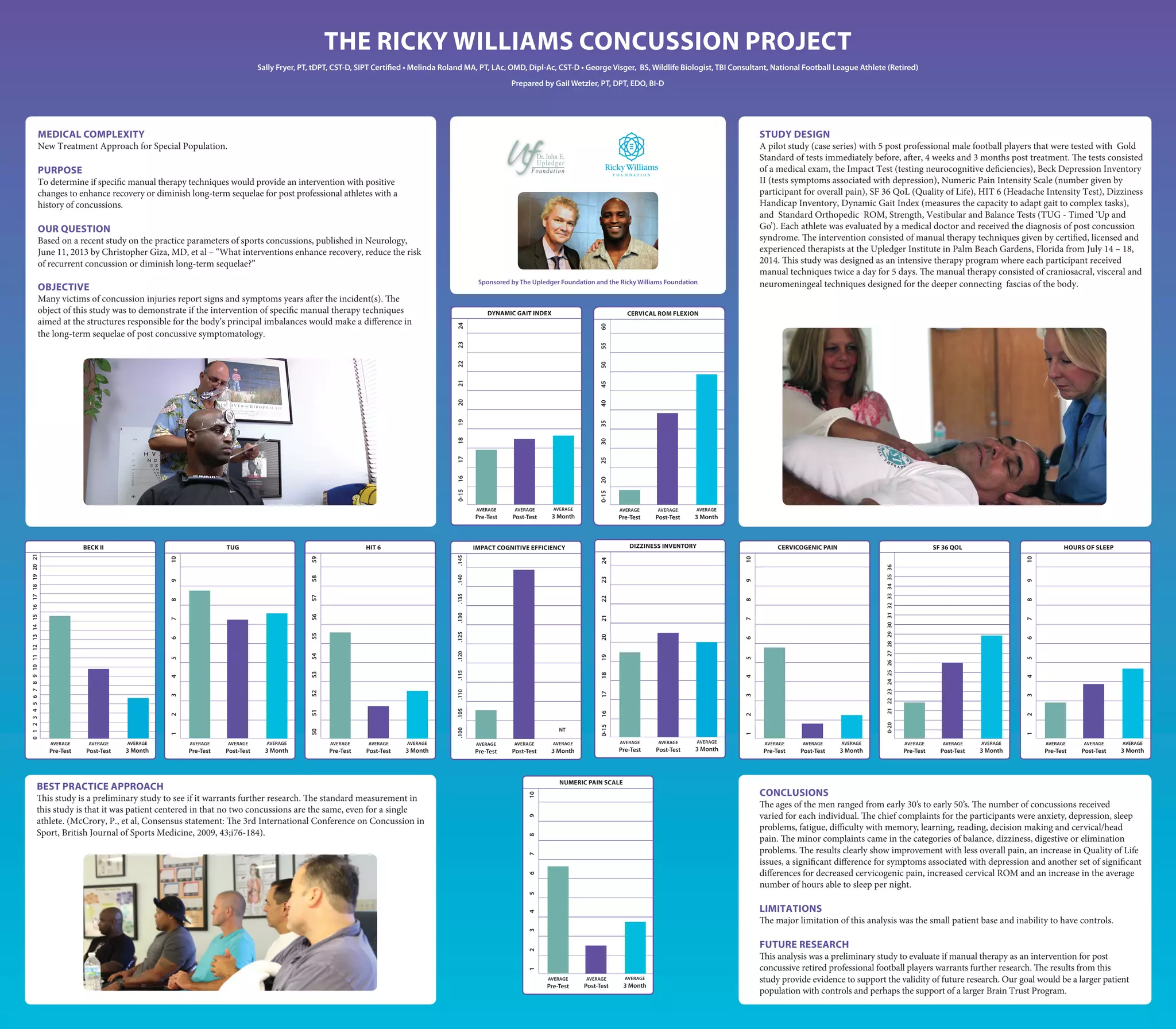
The Ricky Williams Concussion Project
Sally Fryer, PT, tDPT, CST-D, SIPT Certified • Melinda Roland MA, PT, LAc, OMD, Dipl-Ac, CST-D • George Visger, BS, Wildlife Biologist, TBI Consultant, National Football League Athlete (Retired)
Prepared by Gail Wetzler, PT, DPT, EDO, BI-D
0-15	16	17	18	19	20	21	22	23	24	
Average
Pre-Test
Average
Post-Test
Average
3 Month
Dynamic Gait Index
Medical Complexity
New Treatment Approach for Special Population.
Purpose
To determine if specific manual therapy techniques would provide an intervention with positive
changes to enhance recovery or diminish long-term sequelae for post professional athletes with a
history of concussions.
Our Question
Based on a recent study on the practice parameters of sports concussions, published in Neurology,
June 11, 2013 by Christopher Giza, MD, et al – “What interventions enhance recovery, reduce the risk
of recurrent concussion or diminish long-term sequelae?”
Objective
Many victims of concussion injuries report signs and symptoms years after the incident(s). The
object of this study was to demonstrate if the intervention of specific manual therapy techniques
aimed at the structures responsible for the body’s principal imbalances would make a difference in
the long-term sequelae of post concussive symptomatology.
Best Practice Approach
This study is a preliminary study to see if it warrants further research. The standard measurement in
this study is that it was patient centered in that no two concussions are the same, even for a single
athlete. (McCrory, P., et al, Consensus statement: The 3rd International Conference on Concussion in
Sport, British Journal of Sports Medicine, 2009, 43;i76-184).
Study Design
A pilot study (case series) with 5 post professional male football players that were tested with Gold
Standard of tests immediately before, after, 4 weeks and 3 months post treatment. The tests consisted
of a medical exam, the Impact Test (testing neurocognitive deficiencies), Beck Depression Inventory
II (tests symptoms associated with depression), Numeric Pain Intensity Scale (number given by
participant for overall pain), SF 36 QoL (Quality of Life), HIT 6 (Headache Intensity Test), Dizziness
Handicap Inventory, Dynamic Gait Index (measures the capacity to adapt gait to complex tasks),
and Standard Orthopedic ROM, Strength, Vestibular and Balance Tests (TUG - Timed ‘Up and
Go’). Each athlete was evaluated by a medical doctor and received the diagnosis of post concussion
syndrome. The intervention consisted of manual therapy techniques given by certified, licensed and
experienced therapists at the Upledger Institute in Palm Beach Gardens, Florida from July 14 – 18,
2014. This study was designed as an intensive therapy program where each participant received
manual techniques twice a day for 5 days. The manual therapy consisted of craniosacral, visceral and
neuromeningeal techniques designed for the deeper connecting fascias of the body.
Conclusions
The ages of the men ranged from early 30’s to early 50’s. The number of concussions received
varied for each individual. The chief complaints for the participants were anxiety, depression, sleep
problems, fatigue, difficulty with memory, learning, reading, decision making and cervical/head
pain. The minor complaints came in the categories of balance, dizziness, digestive or elimination
problems. The results clearly show improvement with less overall pain, an increase in Quality of Life
issues, a significant difference for symptoms associated with depression and another set of significant
differences for decreased cervicogenic pain, increased cervical ROM and an increase in the average
number of hours able to sleep per night.
Limitations
The major limitation of this analysis was the small patient base and inability to have controls.
Future Research
This analysis was a preliminary study to evaluate if manual therapy as an intervention for post
concussive retired professional football players warrants further research. The results from this
study provide evidence to support the validity of future research. Our goal would be a larger patient
population with controls and perhaps the support of a larger Brain Trust Program.
0-15	20	25	30	35	40	45	50	55	60	
Cervical ROM Flexion
Average
Pre-Test
Average
Post-Test
Average
3 Month
0-20	21	22	23	24	25	26	27	28	29	30	31	32	33	34	35	36
Average
Pre-Test
Average
Post-Test
Average
3 Month
SF 36 QoL
Average
Pre-Test
Average
Post-Test
Average
3 Month
Hours of Sleep
1	2	3	4	5	6	7	8	9	10
Average
Pre-Test
Average
Post-Test
Average
3 Month
TUG
1	2	3	4	5	6	7	8	9	10
Average
Pre-Test
Average
Post-Test
Average
3 Month
Numeric Pain Scale
1	2	3	4	5	6	7	8	9	10
Average
Pre-Test
Average
Post-Test
Average
3 Month
HIT 6
50	51	52	53	54	55	56	57	58	59
Average
Pre-Test
Average
Post-Test
Average
3 Month
Cervicogenic Pain
1	2	3	4	5	6	7	8	9	10
Average
Pre-Test
Average
Post-Test
Average
3 Month
Impact cognitive efficiency
.100	.105	.110	.115	.120	.125	.130	.135	.140	.145
NT
Average
Pre-Test
Average
Post-Test
Average
3 Month
DiZziness Inventory
0-15	16	17	18	19	20	21	22	23	24
Sponsored by The Upledger Foundation and the Ricky Williams Foundation
0123456789101112131415161718192021
Average
Pre-Test
Average
Post-Test
Average
3 Month
Beck II

Concussion-Poster

  • 1.
    The Ricky WilliamsConcussion Project Sally Fryer, PT, tDPT, CST-D, SIPT Certified • Melinda Roland MA, PT, LAc, OMD, Dipl-Ac, CST-D • George Visger, BS, Wildlife Biologist, TBI Consultant, National Football League Athlete (Retired) Prepared by Gail Wetzler, PT, DPT, EDO, BI-D 0-15 16 17 18 19 20 21 22 23 24 Average Pre-Test Average Post-Test Average 3 Month Dynamic Gait Index Medical Complexity New Treatment Approach for Special Population. Purpose To determine if specific manual therapy techniques would provide an intervention with positive changes to enhance recovery or diminish long-term sequelae for post professional athletes with a history of concussions. Our Question Based on a recent study on the practice parameters of sports concussions, published in Neurology, June 11, 2013 by Christopher Giza, MD, et al – “What interventions enhance recovery, reduce the risk of recurrent concussion or diminish long-term sequelae?” Objective Many victims of concussion injuries report signs and symptoms years after the incident(s). The object of this study was to demonstrate if the intervention of specific manual therapy techniques aimed at the structures responsible for the body’s principal imbalances would make a difference in the long-term sequelae of post concussive symptomatology. Best Practice Approach This study is a preliminary study to see if it warrants further research. The standard measurement in this study is that it was patient centered in that no two concussions are the same, even for a single athlete. (McCrory, P., et al, Consensus statement: The 3rd International Conference on Concussion in Sport, British Journal of Sports Medicine, 2009, 43;i76-184). Study Design A pilot study (case series) with 5 post professional male football players that were tested with Gold Standard of tests immediately before, after, 4 weeks and 3 months post treatment. The tests consisted of a medical exam, the Impact Test (testing neurocognitive deficiencies), Beck Depression Inventory II (tests symptoms associated with depression), Numeric Pain Intensity Scale (number given by participant for overall pain), SF 36 QoL (Quality of Life), HIT 6 (Headache Intensity Test), Dizziness Handicap Inventory, Dynamic Gait Index (measures the capacity to adapt gait to complex tasks), and Standard Orthopedic ROM, Strength, Vestibular and Balance Tests (TUG - Timed ‘Up and Go’). Each athlete was evaluated by a medical doctor and received the diagnosis of post concussion syndrome. The intervention consisted of manual therapy techniques given by certified, licensed and experienced therapists at the Upledger Institute in Palm Beach Gardens, Florida from July 14 – 18, 2014. This study was designed as an intensive therapy program where each participant received manual techniques twice a day for 5 days. The manual therapy consisted of craniosacral, visceral and neuromeningeal techniques designed for the deeper connecting fascias of the body. Conclusions The ages of the men ranged from early 30’s to early 50’s. The number of concussions received varied for each individual. The chief complaints for the participants were anxiety, depression, sleep problems, fatigue, difficulty with memory, learning, reading, decision making and cervical/head pain. The minor complaints came in the categories of balance, dizziness, digestive or elimination problems. The results clearly show improvement with less overall pain, an increase in Quality of Life issues, a significant difference for symptoms associated with depression and another set of significant differences for decreased cervicogenic pain, increased cervical ROM and an increase in the average number of hours able to sleep per night. Limitations The major limitation of this analysis was the small patient base and inability to have controls. Future Research This analysis was a preliminary study to evaluate if manual therapy as an intervention for post concussive retired professional football players warrants further research. The results from this study provide evidence to support the validity of future research. Our goal would be a larger patient population with controls and perhaps the support of a larger Brain Trust Program. 0-15 20 25 30 35 40 45 50 55 60 Cervical ROM Flexion Average Pre-Test Average Post-Test Average 3 Month 0-20 21 22 23 24 25 26 27 28 29 30 31 32 33 34 35 36 Average Pre-Test Average Post-Test Average 3 Month SF 36 QoL Average Pre-Test Average Post-Test Average 3 Month Hours of Sleep 1 2 3 4 5 6 7 8 9 10 Average Pre-Test Average Post-Test Average 3 Month TUG 1 2 3 4 5 6 7 8 9 10 Average Pre-Test Average Post-Test Average 3 Month Numeric Pain Scale 1 2 3 4 5 6 7 8 9 10 Average Pre-Test Average Post-Test Average 3 Month HIT 6 50 51 52 53 54 55 56 57 58 59 Average Pre-Test Average Post-Test Average 3 Month Cervicogenic Pain 1 2 3 4 5 6 7 8 9 10 Average Pre-Test Average Post-Test Average 3 Month Impact cognitive efficiency .100 .105 .110 .115 .120 .125 .130 .135 .140 .145 NT Average Pre-Test Average Post-Test Average 3 Month DiZziness Inventory 0-15 16 17 18 19 20 21 22 23 24 Sponsored by The Upledger Foundation and the Ricky Williams Foundation 0123456789101112131415161718192021 Average Pre-Test Average Post-Test Average 3 Month Beck II