Prolog
The language of logic
History
• Kowalski: late 60’s Logician who showed
logical proof can support computation.
• Colmerauer: early 70’s Developed early
version of Prolog for natural language
processing, mainly multiple parses.
• Warren: mid 70’s First version of Prolog
that was efficient.
Characteristics
• Prolog approximates first-order logic.
• Every program is a set of Horn clauses.
• Inference is by resolution.
• Search is by backtracking with unification.
• Basic data structure is term or tree.
• Variables are unknowns not locations.
• Prolog does not distinguish between inputs
and outputs. It solves relations/predicates.
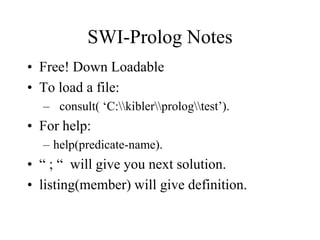
SWI-Prolog Notes
• Free! Down Loadable
• To load a file:
– consult( ‘C:kiblerprologtest’).
• For help:
– help(predicate-name).
• “ ; “ will give you next solution.
• listing(member) will give definition.
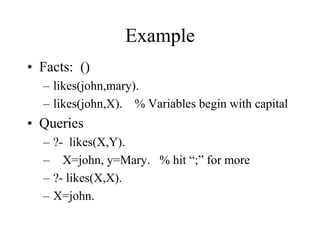
Example
• Facts: ()
– likes(john,mary).
– likes(john,X). % Variables begin with capital
• Queries
– ?- likes(X,Y).
– X=john, y=Mary. % hit “;” for more
– ?- likes(X,X).
– X=john.
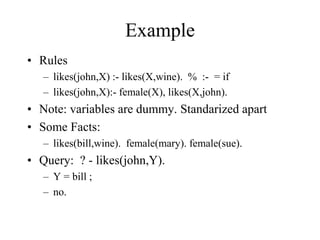
Example
• Rules
– likes(john,X) :- likes(X,wine). % :- = if
– likes(john,X):- female(X), likes(X,john).
• Note: variables are dummy. Standarized apart
• Some Facts:
– likes(bill,wine). female(mary). female(sue).
• Query: ? - likes(john,Y).
– Y = bill ;
– no.
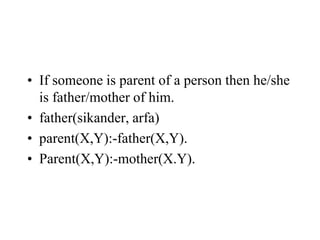
• If someone is parent of a person then he/she
is father/mother of him.
• father(sikander, arfa)
• parent(X,Y):-father(X,Y).
• Parent(X,Y):-mother(X.Y).
Family
father(a,b).
father(e,d).
mother(c,b).
mother(d,f).
parent(X,Y) :- father(X,Y).
parent(X,Y) :- mother(X,Y).
grandfather(X,Y):- father(X,Z),parent(Z,Y).
% Do your own for practice.
Informal Summary
• Program is facts + rules. (horn clauses).
• Query = conjunct of predicates.
• First set of bindings for variables that solve
query are reported. If none, then Prolog
returns no.
• Use “;” to get other solutions.
• Can be viewed as constraint satisfaction
program.
MapColoring
• color(r). color(g). color(b).
• colormap(C1,C2,C3):-
color(C1),color(C2),color(C3), C1==C2,
C1==C3, C2==C3.
• Query: colormap(X,Y,Z).
– X = r, Y= g, Z=b.
• Is that it. Yes! Turn on trace.
Unification: (matching) terms
• Two terms UNIFY if there is a common
substitution for all variables which makes them
identical.
• f(g(X),Y) = f(Z,Z). % = cheap unification
– X = _G225, Y=g(_G225).
• Look at parse tree for each term.
– variables match
– variable matches anything (set the binding)
– function symbols only match identical function
symbols.
Satisfiability: uses unification
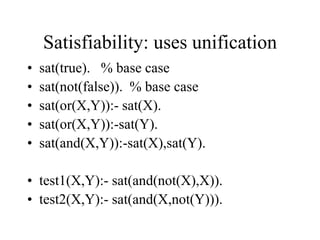
• sat(true). % base case
• sat(not(false)). % base case
• sat(or(X,Y)):- sat(X).
• sat(or(X,Y)):-sat(Y).
• sat(and(X,Y)):-sat(X),sat(Y).
• test1(X,Y):- sat(and(not(X),X)).
• test2(X,Y):- sat(and(X,not(Y))).
Semantic Network representation
in prolog
Semantic Network representation
in prolog
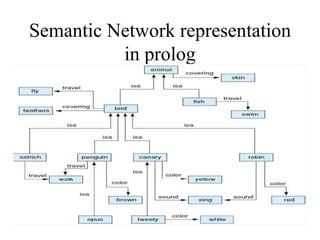
• nodes represent individuals such as the
canary tweety and classes such as ostrich,
crow, robin, bird, and vertebrate.
• isa links represent the class hierarchy
relationship.
• We adopt canonical forms for the data
relationships within the net.
Semantic Network
Representation
• We use an isa(Type, Parent) predicate to
indicate that Type is a member of Parent
and a hasprop(Object, Property, Value)
predicate to represent property relations.
• hasprop indicates that Object has Property
with Value. Object and Value are nodes in
the network, and Property is the name of the
link that joins them.
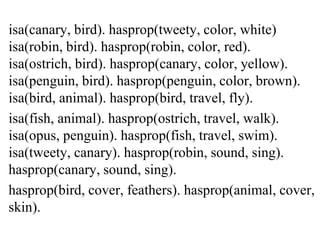
isa(canary, bird). hasprop(tweety, color, white)
isa(robin, bird). hasprop(robin, color, red).
isa(ostrich, bird). hasprop(canary, color, yellow).
isa(penguin, bird). hasprop(penguin, color, brown).
isa(bird, animal). hasprop(bird, travel, fly).
isa(fish, animal). hasprop(ostrich, travel, walk).
isa(opus, penguin). hasprop(fish, travel, swim).
isa(tweety, canary). hasprop(robin, sound, sing).
hasprop(canary, sound, sing).
hasprop(bird, cover, feathers). hasprop(animal, cover,
skin).
Semantic Network
Representation
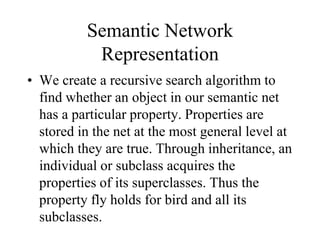
• We create a recursive search algorithm to
find whether an object in our semantic net
has a particular property. Properties are
stored in the net at the most general level at
which they are true. Through inheritance, an
individual or subclass acquires the
properties of its superclasses. Thus the
property fly holds for bird and all its
subclasses.
Semantic Network
Representation
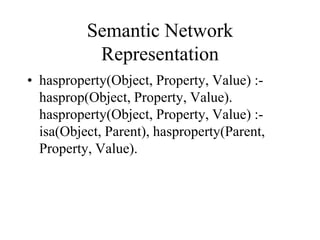
• hasproperty(Object, Property, Value) :-
hasprop(Object, Property, Value).
hasproperty(Object, Property, Value) :-
isa(Object, Parent), hasproperty(Parent,
Property, Value).
Frame Representation
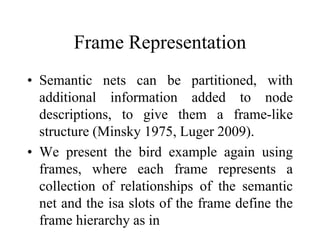
• Semantic nets can be partitioned, with
additional information added to node
descriptions, to give them a frame-like
structure (Minsky 1975, Luger 2009).
• We present the bird example again using
frames, where each frame represents a
collection of relationships of the semantic
net and the isa slots of the frame define the
frame hierarchy as in
Frame Representation
• One way
• frame(name(bird), isa(animal),[travel(flies),
feathers]).
• Other way
• bird(isa,animal).
• bird(fly,wings).
Frame Representation
• Which method will be easy for query?
DFS
% solve(goal, solution Path)
% s(state, successor-state)
dfs(N,[N]) :- goal(N).
dfs(N,[N|Sol1]):- s(N,N1), dfs(N1,Sol1).
s(a,b). s(a,c). s(b,d). s(b,e). s(c,f).
s(c,g). s(d,h). s(e,i). s(e,j). s(f,k).
goal(i). goal(f).
?- dfs(a,N).
N = [a, b, e, i] ;
N = [a, c, f] ;
Limitations
• 2nd order: Can’t ask what is relationship
between heart and lungs?
• Probabilities: What is likelihood of fire
destroying Julian?

Prolog

  • 1.
  • 2.
    History • Kowalski: late60’s Logician who showed logical proof can support computation. • Colmerauer: early 70’s Developed early version of Prolog for natural language processing, mainly multiple parses. • Warren: mid 70’s First version of Prolog that was efficient.
  • 3.
    Characteristics • Prolog approximatesfirst-order logic. • Every program is a set of Horn clauses. • Inference is by resolution. • Search is by backtracking with unification. • Basic data structure is term or tree. • Variables are unknowns not locations. • Prolog does not distinguish between inputs and outputs. It solves relations/predicates.
  • 4.
    SWI-Prolog Notes • Free!Down Loadable • To load a file: – consult( ‘C:kiblerprologtest’). • For help: – help(predicate-name). • “ ; “ will give you next solution. • listing(member) will give definition.
  • 5.
    Example • Facts: () –likes(john,mary). – likes(john,X). % Variables begin with capital • Queries – ?- likes(X,Y). – X=john, y=Mary. % hit “;” for more – ?- likes(X,X). – X=john.
  • 6.
    Example • Rules – likes(john,X):- likes(X,wine). % :- = if – likes(john,X):- female(X), likes(X,john). • Note: variables are dummy. Standarized apart • Some Facts: – likes(bill,wine). female(mary). female(sue). • Query: ? - likes(john,Y). – Y = bill ; – no.
  • 7.
    • If someoneis parent of a person then he/she is father/mother of him. • father(sikander, arfa) • parent(X,Y):-father(X,Y). • Parent(X,Y):-mother(X.Y).
  • 8.
    Family father(a,b). father(e,d). mother(c,b). mother(d,f). parent(X,Y) :- father(X,Y). parent(X,Y):- mother(X,Y). grandfather(X,Y):- father(X,Z),parent(Z,Y). % Do your own for practice.
  • 9.
    Informal Summary • Programis facts + rules. (horn clauses). • Query = conjunct of predicates. • First set of bindings for variables that solve query are reported. If none, then Prolog returns no. • Use “;” to get other solutions. • Can be viewed as constraint satisfaction program.
  • 10.
    MapColoring • color(r). color(g).color(b). • colormap(C1,C2,C3):- color(C1),color(C2),color(C3), C1==C2, C1==C3, C2==C3. • Query: colormap(X,Y,Z). – X = r, Y= g, Z=b. • Is that it. Yes! Turn on trace.
  • 11.
    Unification: (matching) terms •Two terms UNIFY if there is a common substitution for all variables which makes them identical. • f(g(X),Y) = f(Z,Z). % = cheap unification – X = _G225, Y=g(_G225). • Look at parse tree for each term. – variables match – variable matches anything (set the binding) – function symbols only match identical function symbols.
  • 12.
    Satisfiability: uses unification •sat(true). % base case • sat(not(false)). % base case • sat(or(X,Y)):- sat(X). • sat(or(X,Y)):-sat(Y). • sat(and(X,Y)):-sat(X),sat(Y). • test1(X,Y):- sat(and(not(X),X)). • test2(X,Y):- sat(and(X,not(Y))).
  • 13.
  • 14.
    Semantic Network representation inprolog • nodes represent individuals such as the canary tweety and classes such as ostrich, crow, robin, bird, and vertebrate. • isa links represent the class hierarchy relationship. • We adopt canonical forms for the data relationships within the net.
  • 15.
    Semantic Network Representation • Weuse an isa(Type, Parent) predicate to indicate that Type is a member of Parent and a hasprop(Object, Property, Value) predicate to represent property relations. • hasprop indicates that Object has Property with Value. Object and Value are nodes in the network, and Property is the name of the link that joins them.
  • 16.
    isa(canary, bird). hasprop(tweety,color, white) isa(robin, bird). hasprop(robin, color, red). isa(ostrich, bird). hasprop(canary, color, yellow). isa(penguin, bird). hasprop(penguin, color, brown). isa(bird, animal). hasprop(bird, travel, fly). isa(fish, animal). hasprop(ostrich, travel, walk). isa(opus, penguin). hasprop(fish, travel, swim). isa(tweety, canary). hasprop(robin, sound, sing). hasprop(canary, sound, sing). hasprop(bird, cover, feathers). hasprop(animal, cover, skin).
  • 17.
    Semantic Network Representation • Wecreate a recursive search algorithm to find whether an object in our semantic net has a particular property. Properties are stored in the net at the most general level at which they are true. Through inheritance, an individual or subclass acquires the properties of its superclasses. Thus the property fly holds for bird and all its subclasses.
  • 18.
    Semantic Network Representation • hasproperty(Object,Property, Value) :- hasprop(Object, Property, Value). hasproperty(Object, Property, Value) :- isa(Object, Parent), hasproperty(Parent, Property, Value).
  • 19.
    Frame Representation • Semanticnets can be partitioned, with additional information added to node descriptions, to give them a frame-like structure (Minsky 1975, Luger 2009). • We present the bird example again using frames, where each frame represents a collection of relationships of the semantic net and the isa slots of the frame define the frame hierarchy as in
  • 20.
    Frame Representation • Oneway • frame(name(bird), isa(animal),[travel(flies), feathers]). • Other way • bird(isa,animal). • bird(fly,wings).
  • 21.
    Frame Representation • Whichmethod will be easy for query?
  • 22.
    DFS % solve(goal, solutionPath) % s(state, successor-state) dfs(N,[N]) :- goal(N). dfs(N,[N|Sol1]):- s(N,N1), dfs(N1,Sol1). s(a,b). s(a,c). s(b,d). s(b,e). s(c,f). s(c,g). s(d,h). s(e,i). s(e,j). s(f,k). goal(i). goal(f). ?- dfs(a,N). N = [a, b, e, i] ; N = [a, c, f] ;
  • 23.
    Limitations • 2nd order:Can’t ask what is relationship between heart and lungs? • Probabilities: What is likelihood of fire destroying Julian?