INSTRUMENT OF
NATUROPATHY
•Jal Neti
•Hip Bath
•Arm and Leg Pack
•Lemon Juice
•Black Mud
Presented By :
Dr. Megha Kochar
(BNYS)
JALA NETI
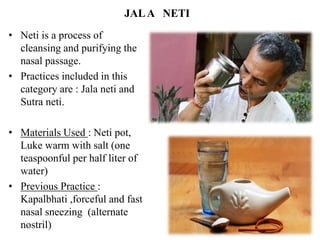
• Neti is a process of
cleansing and purifying the
nasal passage.
• Practices included in this
category are : Jala neti and
Sutra neti.
• Materials Used : Neti pot,
Luke warm with salt (one
teaspoonful per half liter of
water)
• Previous Practice :
Kapalbhati ,forceful and fast
nasal sneezing (alternate
nostril)
Technique :
• Stand squarely, legs apart, body
weight evenly distributed
between the two feet and lean
forward.
• Tilt the head to right side and
place pot’s nozzle in left
nostril.
• Open mouth slightly and breath
through the mouth.
• Keep whole body relaxed and
let water pass out through right
nostril.
• Due to gravitational force water
feeded in left nostril comes out
from right nostril.
• When you have used half of water, remove the pot, remain bending
forward from neck, centre the head and let the water run out of nose.
• Close right nostril with fingers and blow gently through left nostril so
that all remaining water comes out.
• Practice in same way from other nose also.
• If head is slightly tilted forward, no water comes in the mouth.
Precautions :
• Preparation of water.
• Clean and check Neti pot before use.
• Empty stomach
• Timing.
• Position of head : Nasal passage should be parallel to each other for
easy flow of water.
• Keep your mouth opened and breath through mouth during practice.
• Mixing of more salt burning sensation . No Salt painful
• Avoid spectacles. One gets sneezing if water touches sensitive
olfactory mucosa present in roof of the nose. There will be cough if
water enters into trachea / bronchial tree.
• When blowing the nose, do not blow very hard, otherwise any
remaining water may be pushed into ears.
• It is important to remove all the water after practice so irritation of
sinuses and mucous membrane does not occur.
Indication :
 Cold
 Sinusitis
 Asthma, bronchitis etc.
 Eye disorder like myopia etc.
 Tonsillitis
 Mouth breathing in children.
 Epilepsy, migraine
 Alleviates anxiety, anger and
depression.
Hence balances both sides of
nostril (Nadi)
Contra-indication :
• Chronic bleeding from nose.
• Structural deformity/
blockage.
HIP BATH
1. Definition : It is the treatment where hip region is immersed in
water of required temperature to get desired effect.
2. Requirements : Hip bath tub, foot rest, wet cloth, water of required
temperature.
3. Pre- operative :
• 3/4th of tub should be filled with water of required temperature.
• In case of hot or neutral water patient should drink adequate
amount of water.
• Patient should be in empty stomach and in minimum clothing for
treatment.
4. Operative :
• Patient lowers the body inside the tub so that whole hip region is
immersed in water.
• In cold hip bath continuous friction on abdomen (clockwise
direction) is given using a small towel.
• In case of hot hip bath a small wet cloth is kept over head.
5. Post – operative :
• Patient should take bath after 20 min.
6. Precaution :
• Patient should be comfortable and give support to his head and
neck.
• Other parts of body should not come in contact with water.
• Minimum 20 min gap should be their between treatment and bath.
7. Types :
1. Cold hip bath
2. Hot hip bath
3. Revulsive hip bath
4. Neutral hip bath
5. Kuhne’s friction Sitz bath
HIP
BATH
TEMP.
(in *C)
DURA
TION
(min.)
INDICATION CONTRA
INDICATION
Cold 18-24 20-30 Constipation, piles,
indigestion, obesity,
hypertension etc.
Diarrhoea, dysentery,
fever, low back pain,
menstruation etc.
Neutral 32-36 10-15 Acute and subacute
inflammation,
indigestion etc.
Open wound, recent
surgery of abdominal
organs, etc.
Hot 40-48 7-10 Sciatica, delayed
menstruation, pain in
piles, painful urination
Fever, weakness,
hypertension etc.
Revulsive 40-45
18-24
5:5*2
3:1*5
Flatulence, backache,
pain (severe
constipation), renal
stones
-
Kuhne’s
friction
Sitz bath
18-24 10 Infertility, general
weakness of body
Bleeding piles, fracture
of hip joint etc.
ARM AND LEG PACK
1. Definition : Hydriatic application made over arm and leg with wet
cotton cloth over which a woolen flannel is wrapped.
2. Requirement : cotton cloth, woolen flannel, water of required
temperature.
3. Pre-operative : area to be wrapped should be naked, cotton cloth is
dipped in water and excess water is squeezed out.
4. Operative : Each leg and arm should be wrapped separately with
wet cotton sheet. Temperature should be 60* for the cold pack, and
as hot as con be borne for hot pack. A linen sheet should be used
for former, a blanket for the latter.
5. Post-operative : Due to soothening effect patient may feel sleepy
hence should not be disturbed.
6. Duration: 15-20 min.
7. Precautions: Empty stomach, wet cotton cloth should not be seen
outside the woolen flannel.
8. Effects :
Derivative in Analgesic in Stimulating in
•Cerebral
congestion
•Pulmonary
congestion
•Paralysis
•Neuralgia of legs
•Joint pain
•Stroke
•paraplegia
LEMON JUICE
• Taste – sour/ slightly bitter
• Property – light, sharp or
piercing
• Potency – hot
• Effect on doshas – Vata
balancing, Pitta nourishing,
Kapha balancing.
• Nutrient content – Lemons are
an excellent source of vitamin
C, and are low calorie and
relatively high in fiber. They
provide minimal amounts of
other vitamins and minerals
such as thiamin, vitamin B6,
calcium, and potassium.
These are the main plant compounds in lemons:
Citric acid. The most abundant organic acid in lemons, citric acid may
help prevent the formation of kidney stones.
Hesperidin. This antioxidant may strengthen your blood vessels and
prevent atherosclerosis — the buildup of fatty deposits (plaque) inside
your arteries.
Diosmin. An antioxidant which improves muscle tone and reduces
chronic inflammation in blood vessels.
Eriocitrin. This antioxidant is found in lemon peel and juice.
D-limonene. Found primarily in the peel, d-limonene is the main
component of lemon essential oils. In isolation, it can relieve heartburn
and stomach reflux .
Mode of use :
1. a. Add 1-2 teaspoon of lemon
juice to a glass of water.
b. Drink this water after
taking food twice a day.
2. a. Take 1-2 teaspoon of
Lemon juice.
b. Add Glycerin to it.
c. Apply evenly on the face,
hands and neck.
d. Use this remedy preferably
before going to bed to get rid
of mild acne, blemishes,
dryness and wrinkles.
• Indication :
1. Scurvy
2. Kidney stones
3. Throat infection
4. Dental problem
5. Obesity
6. Respiratory disorder
7. Hypertension etc.
• Contra indication :
1. Severe acidity
2. GERD
3. Ulcers
4. Cold etc.
BLACK MUD
Mud found below the surface of sediments in lakes and rivers, the
blackness is due to the occurrence of metal sulphides.
Mud baths may contain minerals like sulfur, zinc, magnesium, and
bromine .
Effects :
Draw out impurities from the skin
Exfoliate dead skin cells
Relax sore muscles and joints
Improve skin conditions, like eczema and psoriasis
Relieve pain from rheumatoid arthritis.
Vivid applications of earth :
• Hot bandage of earth.
• Cold bandage of earth.
• Bandage of hot earth.
• Damp mud pit bath.
• Magical mud of dead sea.
• Mud swimming
• Mud plaster
• Mud pack.
Naturopathy Instrument.pptx

Naturopathy Instrument.pptx

  • 1.
    INSTRUMENT OF NATUROPATHY •Jal Neti •HipBath •Arm and Leg Pack •Lemon Juice •Black Mud Presented By : Dr. Megha Kochar (BNYS)
  • 2.
    JALA NETI • Netiis a process of cleansing and purifying the nasal passage. • Practices included in this category are : Jala neti and Sutra neti. • Materials Used : Neti pot, Luke warm with salt (one teaspoonful per half liter of water) • Previous Practice : Kapalbhati ,forceful and fast nasal sneezing (alternate nostril)
  • 3.
    Technique : • Standsquarely, legs apart, body weight evenly distributed between the two feet and lean forward. • Tilt the head to right side and place pot’s nozzle in left nostril. • Open mouth slightly and breath through the mouth. • Keep whole body relaxed and let water pass out through right nostril. • Due to gravitational force water feeded in left nostril comes out from right nostril.
  • 4.
    • When youhave used half of water, remove the pot, remain bending forward from neck, centre the head and let the water run out of nose. • Close right nostril with fingers and blow gently through left nostril so that all remaining water comes out. • Practice in same way from other nose also. • If head is slightly tilted forward, no water comes in the mouth.
  • 5.
    Precautions : • Preparationof water. • Clean and check Neti pot before use. • Empty stomach • Timing. • Position of head : Nasal passage should be parallel to each other for easy flow of water. • Keep your mouth opened and breath through mouth during practice. • Mixing of more salt burning sensation . No Salt painful • Avoid spectacles. One gets sneezing if water touches sensitive olfactory mucosa present in roof of the nose. There will be cough if water enters into trachea / bronchial tree. • When blowing the nose, do not blow very hard, otherwise any remaining water may be pushed into ears. • It is important to remove all the water after practice so irritation of sinuses and mucous membrane does not occur.
  • 6.
    Indication :  Cold Sinusitis  Asthma, bronchitis etc.  Eye disorder like myopia etc.  Tonsillitis  Mouth breathing in children.  Epilepsy, migraine  Alleviates anxiety, anger and depression. Hence balances both sides of nostril (Nadi) Contra-indication : • Chronic bleeding from nose. • Structural deformity/ blockage.
  • 7.
    HIP BATH 1. Definition: It is the treatment where hip region is immersed in water of required temperature to get desired effect. 2. Requirements : Hip bath tub, foot rest, wet cloth, water of required temperature. 3. Pre- operative : • 3/4th of tub should be filled with water of required temperature. • In case of hot or neutral water patient should drink adequate amount of water. • Patient should be in empty stomach and in minimum clothing for treatment. 4. Operative : • Patient lowers the body inside the tub so that whole hip region is immersed in water. • In cold hip bath continuous friction on abdomen (clockwise direction) is given using a small towel. • In case of hot hip bath a small wet cloth is kept over head.
  • 8.
    5. Post –operative : • Patient should take bath after 20 min. 6. Precaution : • Patient should be comfortable and give support to his head and neck. • Other parts of body should not come in contact with water. • Minimum 20 min gap should be their between treatment and bath. 7. Types : 1. Cold hip bath 2. Hot hip bath 3. Revulsive hip bath 4. Neutral hip bath 5. Kuhne’s friction Sitz bath
  • 9.
    HIP BATH TEMP. (in *C) DURA TION (min.) INDICATION CONTRA INDICATION Cold18-24 20-30 Constipation, piles, indigestion, obesity, hypertension etc. Diarrhoea, dysentery, fever, low back pain, menstruation etc. Neutral 32-36 10-15 Acute and subacute inflammation, indigestion etc. Open wound, recent surgery of abdominal organs, etc. Hot 40-48 7-10 Sciatica, delayed menstruation, pain in piles, painful urination Fever, weakness, hypertension etc. Revulsive 40-45 18-24 5:5*2 3:1*5 Flatulence, backache, pain (severe constipation), renal stones - Kuhne’s friction Sitz bath 18-24 10 Infertility, general weakness of body Bleeding piles, fracture of hip joint etc.
  • 10.
    ARM AND LEGPACK 1. Definition : Hydriatic application made over arm and leg with wet cotton cloth over which a woolen flannel is wrapped. 2. Requirement : cotton cloth, woolen flannel, water of required temperature. 3. Pre-operative : area to be wrapped should be naked, cotton cloth is dipped in water and excess water is squeezed out. 4. Operative : Each leg and arm should be wrapped separately with wet cotton sheet. Temperature should be 60* for the cold pack, and as hot as con be borne for hot pack. A linen sheet should be used for former, a blanket for the latter. 5. Post-operative : Due to soothening effect patient may feel sleepy hence should not be disturbed. 6. Duration: 15-20 min. 7. Precautions: Empty stomach, wet cotton cloth should not be seen outside the woolen flannel.
  • 11.
    8. Effects : Derivativein Analgesic in Stimulating in •Cerebral congestion •Pulmonary congestion •Paralysis •Neuralgia of legs •Joint pain •Stroke •paraplegia
  • 12.
    LEMON JUICE • Taste– sour/ slightly bitter • Property – light, sharp or piercing • Potency – hot • Effect on doshas – Vata balancing, Pitta nourishing, Kapha balancing. • Nutrient content – Lemons are an excellent source of vitamin C, and are low calorie and relatively high in fiber. They provide minimal amounts of other vitamins and minerals such as thiamin, vitamin B6, calcium, and potassium.
  • 13.
    These are themain plant compounds in lemons: Citric acid. The most abundant organic acid in lemons, citric acid may help prevent the formation of kidney stones. Hesperidin. This antioxidant may strengthen your blood vessels and prevent atherosclerosis — the buildup of fatty deposits (plaque) inside your arteries. Diosmin. An antioxidant which improves muscle tone and reduces chronic inflammation in blood vessels. Eriocitrin. This antioxidant is found in lemon peel and juice. D-limonene. Found primarily in the peel, d-limonene is the main component of lemon essential oils. In isolation, it can relieve heartburn and stomach reflux .
  • 14.
    Mode of use: 1. a. Add 1-2 teaspoon of lemon juice to a glass of water. b. Drink this water after taking food twice a day. 2. a. Take 1-2 teaspoon of Lemon juice. b. Add Glycerin to it. c. Apply evenly on the face, hands and neck. d. Use this remedy preferably before going to bed to get rid of mild acne, blemishes, dryness and wrinkles. • Indication : 1. Scurvy 2. Kidney stones 3. Throat infection 4. Dental problem 5. Obesity 6. Respiratory disorder 7. Hypertension etc. • Contra indication : 1. Severe acidity 2. GERD 3. Ulcers 4. Cold etc.
  • 15.
    BLACK MUD Mud foundbelow the surface of sediments in lakes and rivers, the blackness is due to the occurrence of metal sulphides. Mud baths may contain minerals like sulfur, zinc, magnesium, and bromine . Effects : Draw out impurities from the skin Exfoliate dead skin cells Relax sore muscles and joints Improve skin conditions, like eczema and psoriasis Relieve pain from rheumatoid arthritis.
  • 16.
    Vivid applications ofearth : • Hot bandage of earth. • Cold bandage of earth. • Bandage of hot earth. • Damp mud pit bath. • Magical mud of dead sea. • Mud swimming • Mud plaster • Mud pack.