Natureview Farm Case
Study
By- Karan Pimpale
Basic Information About
Natureview
• Yogurt manufacturer in the US
• Based in Vermont
• Founded in 1989
Main POD’s
• Organic and natural ingredients
• Longer shelf-life
• Better quality and taste due to special techniques
by the founder
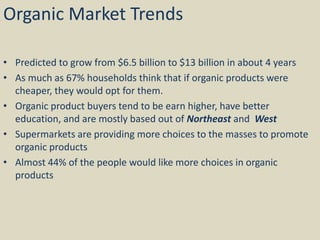
Organic Market Trends
• Predicted to grow from $6.5 billion to $13 billion in about 4 years
• As much as 67% households think that if organic products were
cheaper, they would opt for them.
• Organic product buyers tend to be earn higher, have better
education, and are mostly based out of Northeast and West
• Supermarkets are providing more choices to the masses to promote
organic products
• Almost 44% of the people would like more choices in organic
products
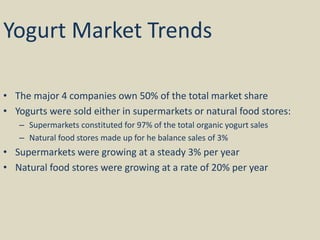
Yogurt Market Trends
• The major 4 companies own 50% of the total market share
• Yogurts were sold either in supermarkets or natural food stores:
– Supermarkets constituted for 97% of the total organic yogurt sales
– Natural food stores made up for he balance sales of 3%
• Supermarkets were growing at a steady 3% per year
• Natural food stores were growing at a rate of 20% per year
Factors Influencing Purchasing
Decisions
• Package size
• Package design
• Flavour
• Price
• Freshness
• Organic materials
Main Challenge For Natureview
• Increase revenue from $13 million to $20 million from the year 2000
to 2001.
• Attain highest possible valuation to secure new investors or attract
investors for acquisition.
• Dilemma:
• To expand into supermarket chains OR
• Strengthen existing strategies to increase revenues
Options Available For
Natureview Farm
• Option 1: Expand 6 SKU’s of 8 oz. units into select supermarket
regions.
• Option 2: Expand 4 SKU’s of 32 oz. product line nationally
• Option3: Expand 2 SKU’s of children’s multipack into natural food
chains
Pros & Cons Of Option 1:
Pros:
• High incremental demand for 8 oz.
• Other brands have successfully expanded into supermarkets
• Natural food chains are threatening supermarkets which is why
expanding can be easier.
Cons:
• High competition
• Conflict between natural food stores and supermarket
• Natureview has zero experience with supermarkets and their
mechanics
Pros & Cons Of Option 2:
Pros:
• 32 oz. provide better profit margin
• Less competition
• Less expenses incurred from promotions as opposed to option 1
Cons
• Higher shipping and slotting charges for national delivery
• Doubt on ability to effectively sell enough 32 oz. in 12 months
• Expenses estimated to increase by up to $160,000
Pros & Cons Of Option 3:
Pros
• Existing Good relationship with many natural food stores can boost
profits
• Financial potential was very attractive
• Higher growth rate of natural food chains compared to supermarkets
would prove beneficial
Cons
• Fast growth of natural food channels will lead to a burst in demand
• Many potential conflicts
• Can miss the opportunity to expand into supermarkets before
competitors
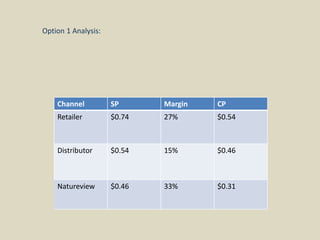
Channel SP Margin CP
Retailer $0.74 27% $0.54
Distributor $0.54 15% $0.46
Natureview $0.46 33% $0.31
Option 1 Analysis:
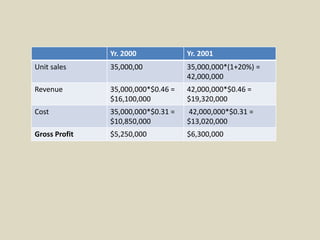
Yr. 2000 Yr. 2001
Unit sales 35,000,00 35,000,000*(1+20%) =
42,000,000
Revenue 35,000,000*$0.46 =
$16,100,000
42,000,000*$0.46 =
$19,320,000
Cost 35,000,000*$0.31 =
$10,850,000
42,000,000*$0.31 =
$13,020,000
Gross Profit $5,250,000 $6,300,000
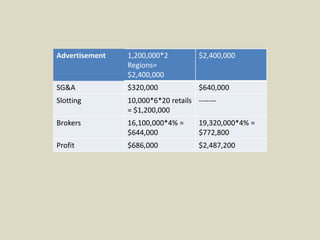
Advertisement 1,200,000*2
Regions=
$2,400,000
$2,400,000
SG&A $320,000 $640,000
Slotting 10,000*6*20 retails
= $1,200,000
-------
Brokers 16,100,000*4% =
$644,000
19,320,000*4% =
$772,800
Profit $686,000 $2,487,200
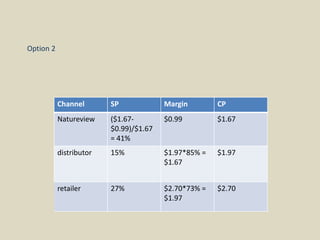
Option 2
Channel SP Margin CP
Natureview ($1.67-
$0.99)/$1.67
= 41%
$0.99 $1.67
distributor 15% $1.97*85% =
$1.67
$1.97
retailer 27% $2.70*73% =
$1.97
$2.70
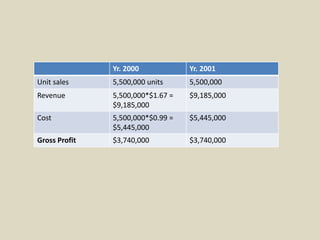
Yr. 2000 Yr. 2001
Unit sales 5,500,000 units 5,500,000
Revenue 5,500,000*$1.67 =
$9,185,000
$9,185,000
Cost 5,500,000*$0.99 =
$5,445,000
$5,445,000
Gross Profit $3,740,000 $3,740,000
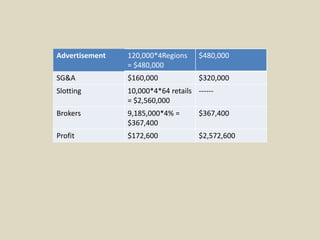
Advertisement 120,000*4Regions
= $480,000
$480,000
SG&A $160,000 $320,000
Slotting 10,000*4*64 retails
= $2,560,000
------
Brokers 9,185,000*4% =
$367,400
$367,400
Profit $172,600 $2,572,600
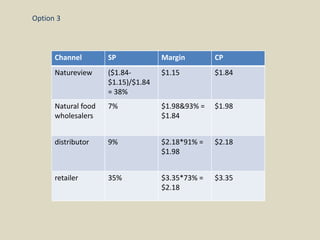
Option 3
Channel SP Margin CP
Natureview ($1.84-
$1.15)/$1.84
= 38%
$1.15 $1.84
Natural food
wholesalers
7% $1.98&93% =
$1.84
$1.98
distributor 9% $2.18*91% =
$1.98
$2.18
retailer 35% $3.35*73% =
$2.18
$3.35
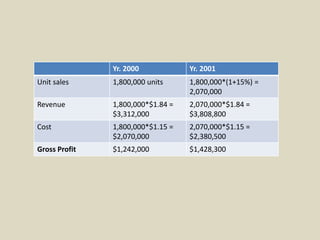
Yr. 2000 Yr. 2001
Unit sales 1,800,000 units 1,800,000*(1+15%) =
2,070,000
Revenue 1,800,000*$1.84 =
$3,312,000
2,070,000*$1.84 =
$3,808,800
Cost 1,800,000*$1.15 =
$2,070,000
2,070,000*$1.15 =
$2,380,500
Gross Profit $1,242,000 $1,428,300
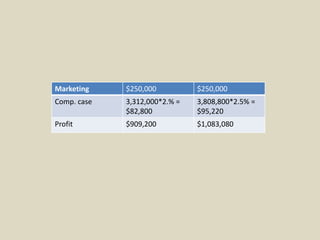
Marketing $250,000 $250,000
Comp. case 3,312,000*2.% =
$82,800
3,808,800*2.5% =
$95,220
Profit $909,200 $1,083,080
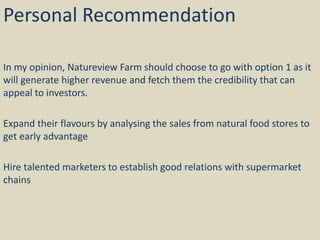
Personal Recommendation
In my opinion, Natureview Farm should choose to go with option 1 as it
will generate higher revenue and fetch them the credibility that can
appeal to investors.
Expand their flavours by analysing the sales from natural food stores to
get early advantage
Hire talented marketers to establish good relations with supermarket
chains

Natureview

  • 1.
  • 2.
    Basic Information About Natureview •Yogurt manufacturer in the US • Based in Vermont • Founded in 1989
  • 3.
    Main POD’s • Organicand natural ingredients • Longer shelf-life • Better quality and taste due to special techniques by the founder
  • 4.
    Organic Market Trends •Predicted to grow from $6.5 billion to $13 billion in about 4 years • As much as 67% households think that if organic products were cheaper, they would opt for them. • Organic product buyers tend to be earn higher, have better education, and are mostly based out of Northeast and West • Supermarkets are providing more choices to the masses to promote organic products • Almost 44% of the people would like more choices in organic products
  • 5.
    Yogurt Market Trends •The major 4 companies own 50% of the total market share • Yogurts were sold either in supermarkets or natural food stores: – Supermarkets constituted for 97% of the total organic yogurt sales – Natural food stores made up for he balance sales of 3% • Supermarkets were growing at a steady 3% per year • Natural food stores were growing at a rate of 20% per year
  • 6.
    Factors Influencing Purchasing Decisions •Package size • Package design • Flavour • Price • Freshness • Organic materials
  • 7.
    Main Challenge ForNatureview • Increase revenue from $13 million to $20 million from the year 2000 to 2001. • Attain highest possible valuation to secure new investors or attract investors for acquisition. • Dilemma: • To expand into supermarket chains OR • Strengthen existing strategies to increase revenues
  • 8.
    Options Available For NatureviewFarm • Option 1: Expand 6 SKU’s of 8 oz. units into select supermarket regions. • Option 2: Expand 4 SKU’s of 32 oz. product line nationally • Option3: Expand 2 SKU’s of children’s multipack into natural food chains
  • 9.
    Pros & ConsOf Option 1: Pros: • High incremental demand for 8 oz. • Other brands have successfully expanded into supermarkets • Natural food chains are threatening supermarkets which is why expanding can be easier. Cons: • High competition • Conflict between natural food stores and supermarket • Natureview has zero experience with supermarkets and their mechanics
  • 10.
    Pros & ConsOf Option 2: Pros: • 32 oz. provide better profit margin • Less competition • Less expenses incurred from promotions as opposed to option 1 Cons • Higher shipping and slotting charges for national delivery • Doubt on ability to effectively sell enough 32 oz. in 12 months • Expenses estimated to increase by up to $160,000
  • 11.
    Pros & ConsOf Option 3: Pros • Existing Good relationship with many natural food stores can boost profits • Financial potential was very attractive • Higher growth rate of natural food chains compared to supermarkets would prove beneficial Cons • Fast growth of natural food channels will lead to a burst in demand • Many potential conflicts • Can miss the opportunity to expand into supermarkets before competitors
  • 12.
    Channel SP MarginCP Retailer $0.74 27% $0.54 Distributor $0.54 15% $0.46 Natureview $0.46 33% $0.31 Option 1 Analysis:
  • 13.
    Yr. 2000 Yr.2001 Unit sales 35,000,00 35,000,000*(1+20%) = 42,000,000 Revenue 35,000,000*$0.46 = $16,100,000 42,000,000*$0.46 = $19,320,000 Cost 35,000,000*$0.31 = $10,850,000 42,000,000*$0.31 = $13,020,000 Gross Profit $5,250,000 $6,300,000
  • 14.
    Advertisement 1,200,000*2 Regions= $2,400,000 $2,400,000 SG&A $320,000$640,000 Slotting 10,000*6*20 retails = $1,200,000 ------- Brokers 16,100,000*4% = $644,000 19,320,000*4% = $772,800 Profit $686,000 $2,487,200
  • 15.
    Option 2 Channel SPMargin CP Natureview ($1.67- $0.99)/$1.67 = 41% $0.99 $1.67 distributor 15% $1.97*85% = $1.67 $1.97 retailer 27% $2.70*73% = $1.97 $2.70
  • 16.
    Yr. 2000 Yr.2001 Unit sales 5,500,000 units 5,500,000 Revenue 5,500,000*$1.67 = $9,185,000 $9,185,000 Cost 5,500,000*$0.99 = $5,445,000 $5,445,000 Gross Profit $3,740,000 $3,740,000
  • 17.
    Advertisement 120,000*4Regions = $480,000 $480,000 SG&A$160,000 $320,000 Slotting 10,000*4*64 retails = $2,560,000 ------ Brokers 9,185,000*4% = $367,400 $367,400 Profit $172,600 $2,572,600
  • 18.
    Option 3 Channel SPMargin CP Natureview ($1.84- $1.15)/$1.84 = 38% $1.15 $1.84 Natural food wholesalers 7% $1.98&93% = $1.84 $1.98 distributor 9% $2.18*91% = $1.98 $2.18 retailer 35% $3.35*73% = $2.18 $3.35
  • 19.
    Yr. 2000 Yr.2001 Unit sales 1,800,000 units 1,800,000*(1+15%) = 2,070,000 Revenue 1,800,000*$1.84 = $3,312,000 2,070,000*$1.84 = $3,808,800 Cost 1,800,000*$1.15 = $2,070,000 2,070,000*$1.15 = $2,380,500 Gross Profit $1,242,000 $1,428,300
  • 20.
    Marketing $250,000 $250,000 Comp.case 3,312,000*2.% = $82,800 3,808,800*2.5% = $95,220 Profit $909,200 $1,083,080
  • 21.
    Personal Recommendation In myopinion, Natureview Farm should choose to go with option 1 as it will generate higher revenue and fetch them the credibility that can appeal to investors. Expand their flavours by analysing the sales from natural food stores to get early advantage Hire talented marketers to establish good relations with supermarket chains