nature nanotechnology | VOL 6 | FEBRUARY 2011 | www.nature.com/naturenanotechnology 73
commentary
Science policy considerations
for responsible nanotechnology
decisions
Jeff Morris, Jim Willis, Domenico De Martinis, Bjorn Hansen, Henrik Laursen, Juan Riego Sintes,
Peter Kearns and Mar Gonzalez
There is a growing literature on the use of science to inform decisions on the environmental, health
and safety implications of nanotechnology, but little has been published by those who make such
decisions. Here, as officials of the US Environmental Protection Agency, the European Commission and
the Organisation for Economic Co-operation and Development, we discuss the types of decision facing
government regulators, the new considerations nanotechnology brings to decision-making, the role
of science in informing decisions, how regulators cooperate internationally on policy issues, and the
challenges that lie ahead.
E
fforts by academia1
, industry2
and
non-governmental organizations3,4
to identify and define policies
related to the environmental, health
and safety (EHS) aspects of engineered
nanomaterials suggest a shared interest in
the responsible development and application
of nanotechnologies. As administrators
of nanotechnology programmes in North
American and European regulatory bodies,
and as part of an international collaborative
effort through the Working Party on
Manufactured Nanomaterials5
(WPMN) of
the Organisation for Economic Co-operation
and Development (OECD), we offer our
perspectives on possible approaches to
maximizing the environmental benefits of
nanotechnology and products that contain
nanomaterials while minimizing the
negative impacts.
North American and European
governments have addressed whether or not
certain nanomaterials should be considered
new and how they fit within the existing
regulations for chemicals. Countries around
the world have moved beyond sharing
information to forming partnerships to
generate new information on the properties,
fate, exposure and toxicity of certain
nanomaterials. Worldwide, both voluntary
and mandated programmes have been
implemented to provide data on the safety of
nanomaterials. Regulators also understand
the importance of investigating how various
nanomaterials can be used to prevent, control
or remediate environmental contaminants
that have been difficult to manage with
conventional technology6
, so decisions on
nanomaterial risk ought also to consider
potential benefits.
The first widely read report to evaluate
both the benefits and risks of nanotechnology
was published by the Royal Society and the
Royal Academy of Engineering in the UK in
20047
. The first EU (European Union) action
plan on nanosciences and nanotechnologies
(covering the period 2005–2009) was adopted
a year later8
, and was followed in 2006 by a
report about the environmental and health
aspects of nanotechnology from the Scientific
Committee on Emerging and Newly
Identified Health Risks9,10
(a committee of
independent scientific experts appointed by
the European Commission (EC)). In Europe,
the EU action plan for 2005–2009 was
reviewed in 200911
and a new action plan for
2011–2015 is in preparation.
The first US document to examine
the environmental science implications
of nanotechnology from a public policy
perspective was the Nanotechnology White
Paper12
published by the US Environmental
Protection Agency (EPA) in 2007, which was
followed by the EPA’s Nanomaterials Research
Strategy13
in 2009. Other US federal agencies,
such as the Food and Drug Administration
and the National Institute for Occupational
Safety and Health, have also issued
framework documents or research strategies
specific to their respective missions14,15
.
Since 2005, the EPA has received more
than 100 pre-manufacture notifications
for specific nanomaterials under the Toxic
Substances Control Act (TSCA). Because
not all nanomaterials in use in the USA are
new chemicals, the EPA implemented a
voluntary stewardship programme to gather
information, the better to understand the
potential risks of nanomaterials already in
use either commercially or for research and
development purposes. The EPA issued
a report on the programme in 2008 and,
because of limited participation, is now
following up on it by issuing regulations for
mandatory reporting and testing16,17
. The EPA
also implements pesticide safety laws in the
USA and is in the process of considering a
number of nanotechnology-based pesticides
such as antimicrobial agents.
In Europe, the EU’s REACH regulation,
concerning the registration, evaluation,
authorization and restriction of chemicals,
requires most manufacturers and importers
to register their chemical substances,
including nanomaterials18
. Although it
contains no provisions referring specifically
to nanomaterials, REACH addresses chemical
substances in whatever size, shape or physical
state19
. However, more work is needed to
develop or adapt existing implementation
provisions to nanomaterials, and the European
Parliament has asked the EC to address the
case of nanomaterials specifically20
. In 2009,
the Scientific Committee on Emerging and
Newly Identified Health Risks issued an
© 2011 Macmillan Publishers Limited. All rights reserved
74 nature nanotechnology | VOL 6 | FEBRUARY 2011 | www.nature.com/naturenanotechnology
commentary
up-to-date literature review of current risk
assessments on nanomaterials relevant to
both humans and the environment21
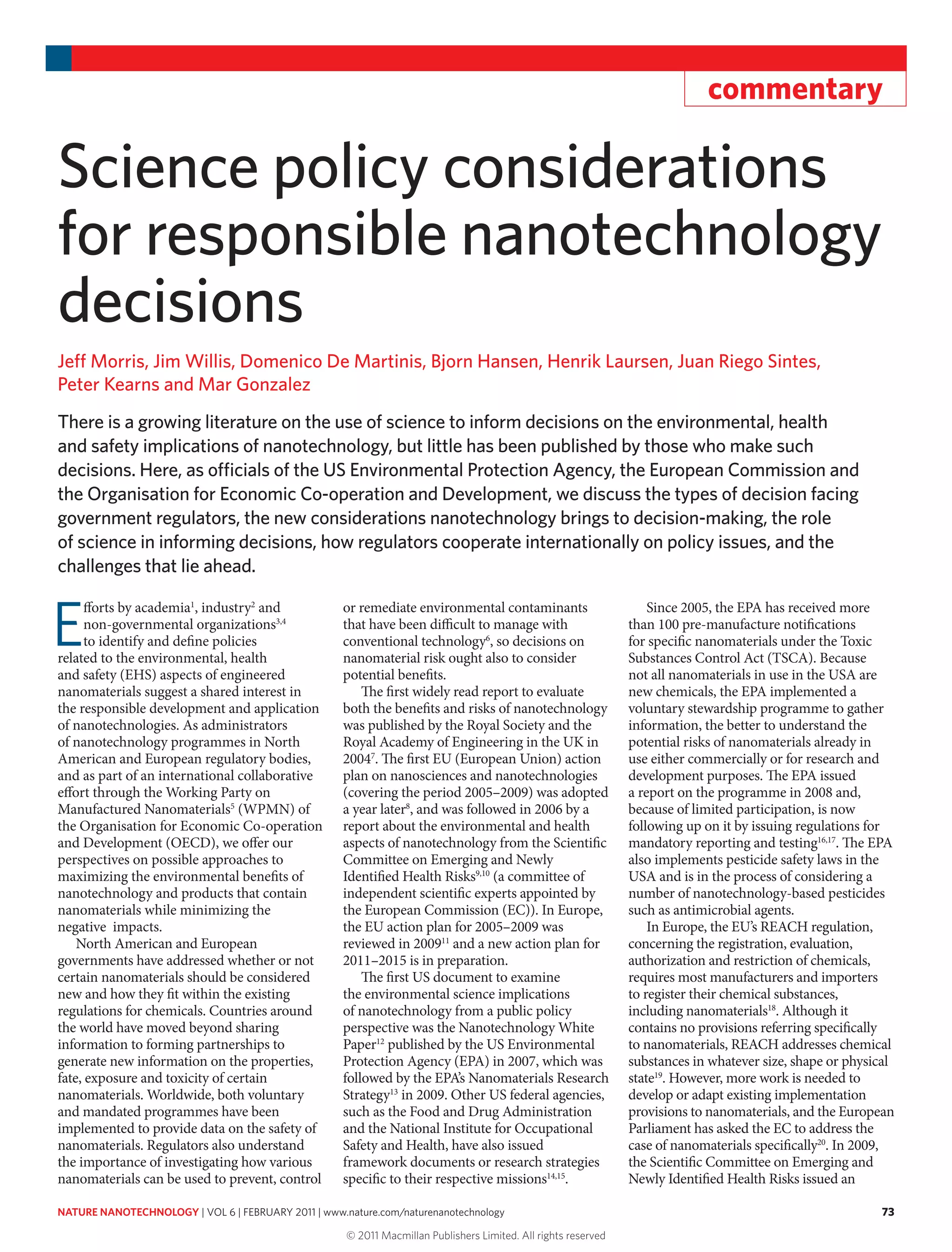
. Table 1
provides a comparison of chemical regulations
under TSCA and REACH.
On the international stage, the WPMN
focuses on testing and assessment
methods related to the EHS implications
of nanomaterials (focusing mostly on
the science-based needs of regulatory
decision-makers), and a separate Working
Party on Nanotechnology (established in
2007) advises on the emerging science,
technology and innovation policy issues
related to the responsible development of
nanotechnology and nanomaterials for
applications. These two working parties
are open to OECD member countries,
non-member economies, industry, trade
union representatives and environmental
non-government organizations.
use of science in government decisions
Governments are charged with determining
whether chemical substances, and products
that include those substances, can be used
without adversely affecting humans and
other living beings. Science helps inform
policy decisions by providing information on
the benefits and drawbacks of a technology
or a product of that technology. To gain
an understanding of hazards, exposure
and consequent risks to humans and
other biological systems, nanomaterials
need to be characterized and tested. These
tests include mammalian and ecological
toxicity, environmental fate and behaviour
(transport and transformation), and exposure
measurement and modelling. To make
inferences about potential risk, information
gained through this testing must be
considered in conjunction with information
on potential exposure and transformation
throughout the life cycle of a material.
Conducting such testing requires valid test
methods and appropriate dose metrics, in
addition to robust characterization of the
material being tested.
The risk assessment of nanomaterials
follows the general approaches applied to
other substances and is moving towards
an increased use of in vitro methods and
computational toxicity, including more-
integrated use of available information.
Table 1 | Comparison of regulations for new chemicals and existing chemicals under TSCA and REACH
tSca reach
new chemicals
Baseline: TSCA Chemical Substance Inventory, 1979 Baseline: European Inventory of Existing Commercial Chemical Substances
(EINECS, 1971–1981) and European List of Notified Chemical Substances
(ELINCS, a cumulative listing of newly notified chemicals)
Requirement: Manufacturers must notify EPA 90 days before manufacturing
a chemical substance not on the TSCA Chemical Substance Inventory.
Information on chemical identity, production, use, exposure and hazard is
required if available.
Registration: Chemicals produced in quantities ≥1 t yr−1
per manufacturer must
be registered. Registration is required 21 days before manufacturing. Scope
and amount of data required depend on tonnage. A Chemical Safety Report for
production ≥10 t yr−1
per manufacturer is compulsory. Companies must update
registration on the basis of new risk-related information and change in status
(for example use and production volume).
Chemicals are added to inventory after a Notice of Commencement has
been filed.
Chemicals are added to inventory after a completeness check.
Some exemptions are possible when submitter demonstrates that no
unreasonable risk exists.
All uses of the same chemical must be included in the registration dossier.
Updates for new uses are compulsory.
The EPA can request additional information, require testing and impose
conditions of use through orders, and can regulate additional uses through a
‘significant new use’ rule.
The European Chemicals Agency can request further information, and
substances of very high concern (whether new or existing) are prioritized for
evaluation. The EC maintains a candidate list of substances of very high concern
that are considered for authorization.
existing chemicals
Routine reporting by Inventory Update Rule every 5 yrs for chemicals with
production ≥25,000 lb yr−1
per site. The EPA can, by rule, require exposure and
health and safety data to be reported, and chemicals to be tested.
Registration required for production ≥1 t yr−1
per manufacturer. The timetable
(2010–2018) is dictated by tonnage (≥1,000 t; ≥100 t; ≥1 t). Registration is
required by deadline to continue manufacturing. The scope and amount of
required data depend on tonnage. A Chemical Safety Report for production
≥10 t yr−1
per manufacturer is compulsory.
Existing chemicals are reviewed and prioritized on the basis of a number of
factors, including hazard, persistence, bioaccumulation and exposure.
Companies update registration on the basis of new risk-related information
and change in status (for example use and production volume).
Chemicals remain on inventory after a completeness check.
Chemical management takes place through rule-making to address possible
significant new uses or unreasonable risks.
Chemical management takes place through an Authorization List and a
Restriction List.
Substances of very high concern are treated as described above.
© 2011 Macmillan Publishers Limited. All rights reserved
nature nanotechnology | VOL 6 | FEBRUARY 2011 | www.nature.com/naturenanotechnology 75
commentary
Material properties are an important
consideration in generating data on
nanomaterials. Because nanomaterials
may change in size and/or composition as
they are incorporated into products, used
and, ultimately, disposed of or recycled, it
is important to understand how they may
transform throughout their life cycles. Joint
application of risk assessment and life cycle
assessment for nanomaterials has the potential
to provide more comprehensive answers to
the human and ecological questions associated
with their production and use22
.
In the USA, agencies such as the EPA
(for industrial chemicals and pesticides), the
Food and Drug Administration (food, drugs
and medical devices) and the Occupational
Safety and Health Administration (work
environment) determine the safety of
chemical substances. In some instances,
these agencies generate scientific information
to inform their decisions; in other cases,
they rely on data developed by industry,
the academic community or other
governmental research bodies. For example,
the EPA has its own research laboratories
but it also funds academic research and uses
information from other sources to inform its
regulatory decisions.
In Europe, the EC directorates-general
for the environment and for enterprise
and industry share responsibility for the
implementation of REACH and also for
proposing amendments to the legislation. A
range of other bodies, including the EC Joint
Research Centre, the European Food Safety
Authority, the EC Bureau of European Policy
Advisers and various other EC directorates-
general (those for research; employment,
social affairs and equal opportunities; external
relations; and health and consumers), are
also involved, as are non-governmental
organizations, industry associations and
various national organizations. For all
these regulatory bodies and agencies, one
of the challenges raised by nanomaterials
is to make balanced, sound decisions when
relatively little nanomaterial-specific hazard
and exposure data are available to inform
such decisions, in particular given that many
products containing nanomaterials are
already on the market.
The different approaches of the EU and the
USA in managing chemicals under REACH
and TSCA have received considerable
attention elsewhere and are not the subject of
this Commentary. Fundamentally, however,
there are more similarities than differences,
because the governments in both jurisdictions
share the goal of providing for the health and
safety of their citizens and environments. The
state of nanomaterials science has resulted in
an increased number of points of convergence
among the relevant bodies in Europe, the
USA and other countries, particularly in
grappling with how best to protect human
health and the environment in the complete
or partial absence of information, and with
the substantive challenges in developing
the information needed to make decisions.
The proceedings of the NATO workshop
Nanomaterials: Environmental Risks and
Benefits and Emerging Consumer Products
contain a useful summary of the nanomaterial
assessment and decision issues related to
international governance23
.
Although questions exist about the
EHS implications of nanomaterials,
governments around the world understand
that nanomaterials may have considerable
environmentally beneficial applications: these
include technologies with increased energy
efficiency, improved solar technologies,
self-cleaning surfaces, alternatives to highly
toxic chemicals, opportunities to use less
of a given chemical, and the remediation of
contaminated sites. This creates a conundrum
for regulators who on the one hand may wish
to see an environmentally beneficial material
enter the marketplace, yet on the other hand
may have unanswered concerns about its
possible risks.
Related issues discussed at the OECD
conference Potential Environmental
Benefits of Nanotechnology: Fostering
Safe Innovation-Led Growth24
, which was
held in Paris in July 2009, included the
use of scarce materials (such as indium,
cerium and lithium) in nanotechnology,
energy consumption in manufacturing the
nanomaterials and the use of toxic materials
in producing the nanomaterials25
. In such
comparative assessments, state-of-the-art
applications not based on nanotechnologies
should be included for reference purposes
in the comparison. The OECD is one of
many bodies that consider and can address
nanotechnology governance issues. Another
is, for example, the International Risk
Governance Council, which has published a
white paper that covers a number of key issues
related to nanotechnology governance26
.
Working together
The overall objectives of the WPMN fit
within the goals of the OECD’s chemicals
programme, which include cooperation in
research and development relevant to human
health and the environment; harmonization of
approaches to avoid obstacles to trade; burden
sharing to fill data gaps in understanding the
risks of chemicals; and promoting cleaner,
climate-friendly alternatives. National
governments, as well as regional governing
bodies such as the EC, directly apply OECD
approaches to their respective activities.
(Under the OECD Mutual Acceptance of
Data programme, data generated by one
member country in accord with OECD test
guidelines and good laboratory practices must
be accepted for review by another member
country27
.) They also use OECD activities
more indirectly, to inform their decisions and
actions on the governance of chemicals.
A key WPMN effort is its sponsorship
programme on conducting exploratory
testing to develop information on selected
nanomaterials, which covers 59 areas
of testing related to mammalian and
environmental toxicity, environmental fate,
materials characterization, physicochemical
properties and safety. To this end, the OECD
launched the Sponsorship Programme for
the Testing of Manufactured Nanomaterials,
the aim of which is to advance progress
in ensuring that harmonized OECD test
guidelines are available for use in the Mutual
Acceptance of Data programme, and to
provide guidance useful for members and
participants in the programme to determine
nanomaterials’ EHS implications. As of
July 2010, the following nanomaterial types
were sponsored for testing: single-walled and
multiwalled carbon nanotubes, C60 fullerenes,
aluminium oxide, cerium oxide, silicon
dioxide, titanium dioxide, zinc oxide, silver,
iron, gold, dendrimers and clays.
Data dossiers are being generated for
these materials, and although there has been
some success in applying the OECD test
guidelines to these nanomaterials, various
methodological issues (such as the need to
maintain nanoparticles dispersed in liquids
for toxicity testing) have caused delays.
To help overcome these technical issues,
the WPMN has formed ‘communities of
practice’ that are engaging experts in specific
environmental science disciplines to reach
scientific consensus on the best approaches
for specific testing needs. An example of such
a community of practice was one established
to address sample preparation and dosimetry
issues related to silver nanoparticles.
The WPMN already includes a number
of non-OECD countries (China, India,
Russia, Singapore, South Africa and
Thailand), but broader engagement of such
non-OECD economies will be increasingly
important, and in May 2009 the International
Conference on Chemicals Management
adopted a resolution, as a development of
the Strategic Approach to International
Chemicals Management28
, which among
other things recommended that international
organizations engage in a dialogue with
stakeholders with a view to gaining further
understanding of nanotechnologies and
manufactured nanomaterials. In response to
this, the United Nations Institute for Training
and Research and the OECD have held
several workshops to raise awareness of both
the potential applications of nanotechnologies
© 2011 Macmillan Publishers Limited. All rights reserved
76 nature nanotechnology | VOL 6 | FEBRUARY 2011 | www.nature.com/naturenanotechnology
commentary
and manufactured nanomaterials, and the
potential risks associated with them29
. The
workshop also identified opportunities for
awareness-raising activities to be undertaken
in developing countries and countries with
economies in transition.
challenges ahead
To assess commercial nanomaterials
in a regulatory context, regulators and
manufacturers need high-quality data
to determine whether certain nanoscale
materials, under specific use conditions, have
the potential to create adverse impacts on
workers, consumers and the environment.
These data need to be developed for specific
nanomaterials, or the means must be
available to extrapolate reliably from data
on other similar nanomaterials (a technique
known as ‘read-across’). Currently, there
are significant limitations in the EHS data
available for nanomaterials (including
the fact that commercialization is still
at a relative early stage and that testing
costs could be significant). Furthermore,
although a wide variety of test methods
and guidance for regulatory testing of
bulk chemicals is available, a number of
them will need significant modification
before being applicable to nanomaterials.
It is not yet clear to what extent data can be
extrapolated, if at all, from a bulk chemical to
its nanoscale form, or between similar but not
identical nanomaterials.
Adding to complexity, and possibly to
costs, is the possibility that the approaches
developed to test the low-volume, high-value
complex nanoparticles that are beginning
to emerge from laboratories may need to be
rethought, especially in countries with legal
systems where the burden of proof resides
with the public authorities. For instance,
is it necessary to perform inhalation tests
(which often require kilogram quantities of
the material being tested) on nanomaterials
that are typically produced in gram or
milligram quantities?
Data development for chemical regulation
makes use of testing strategies that integrate
animal and non-animal testing to assess
environmental and health safety. However, it
is not clear whether many available alternative
methods are effective at the nanoscale, and
none of them have yet been validated for
nanomaterials. Hence, there is considerable
interest in exploratory research into alternative
methods and, in particular, their potential
application as part of an integrated testing
strategy for nanomaterials. The WPMN has
established a steering group on alternative
methods in nanotoxicology that will develop
a number of case studies to better understand
how to implement integrated testing strategies
for nanomaterials.
The need also exists for screening
approaches that inform decision-making
on how to prioritize different nanomaterials
for testing in more depth. Combining
greater understanding of what material
properties drive hazard or exposure with
high-throughput computational and
toxicogenomic approaches, to evaluate the
gene responses of an organism when exposed
to a substance, will be important in focusing
scientific resources on those materials,
products and uses that have the greatest
potential for EHS impact.
Because many results are not expected to
be available for a number of years, regulatory
agencies must act in the absence of complete
or even substantial toxicology and effects
data sets. To allow better-informed decision-
making in the absence of such data, we need
more-robust exposure measurements and
information on the effectiveness of exposure
mitigation approaches. So far, much of the
effort has focused on occupational settings.
In the USA, the National Institute for
Occupational Safety and Health has made
a number of recommendations in this area,
and it is an area of emphasis for the WPMN30
.
The German Chemical Industry Association
and Federal Institute for Occupational Safety
and Health have prepared guidance for the
handling and use of nanomaterials in the
workplace31
(and have also contributed to the
WPMN). However, the data on the levels and
identity of nanomaterials that consumers,
the environment and general populations are
exposed to are either limited or non-existent,
which makes it difficult to quantify exposures.
Responsibility for addressing this
information gap resides as much, if not more,
with those who produce nanomaterials
as it does with those who regulate them.
Although there are legitimate confidentiality
concerns, information on actual and
estimated production volumes, material use
and usage in products, and processes used to
manufacture nanomaterials will be critical to
understanding, from a life cycle perspective,
the environmental impacts of specific
nanomaterials. To obtain such information,
enhanced collaboration between industry
and regulators will be a necessary part of
successful governance strategies. (In the USA,
for example, a Cooperative Research and
Development Agreement is one mechanism
that is suitable for industry–government
collaboration on nanomaterials research.)
Path forward
For some nanomaterials, it will take
considerable time to address the many
environmental science questions in a manner
that is adequate to develop quantitative risk
assessments. Therefore, we recommend that
researchers and risk managers work together
to develop approaches to limit exposure, and
to identify and address those properties of
specific nanomaterial types that appear to be
the source of potential hazards or exposures.
Industry should contribute significantly
to this work because it best understands
the characteristics and performance of the
materials it produces, as well as what types
of controls (such as personal protective
equipment for workers) will function best in
particular occupational situations. In some
cases, it may be necessary to take action to
mitigate exposure even while environmental
and health risks are being assessed.
It is important to note that there is a
discrepancy between what information we as
regulators would like to have when making
solid, scientifically informed regulatory
decisions and what information is available to
us. For example, the EPA has frequently seen
pre-manufacture notices for nanomaterials
with the potential to be released into water,
and in the absence of well-tested approaches
for monitoring or modelling environmental
concentrations (such as those that exist for
most bulk chemicals), the agency generally
stipulates that such nanomaterials must not
be released into water. The discrepancy exists
because it takes time to develop a body of
scientific information, whereas regulations
must be promulgated and decisions made on
the basis of existing information. However,
this is not new. History has taught us that
it is important for all interested parties,
in particular those who manufacture and
market nanomaterials, to play leadership
roles in taking action to anticipate and
minimize any potential negative impacts on
humans and the environment, for instance
by controlling releases or identifying and
eliminating those material properties that
may produce adverse environmental impacts.
A number of authors have provided useful
approaches for preventing or managing
nanomaterial risks in the absence of data32
,
such as: qualitative risk assessment; adaptation
and redefinition of safety strategies and
requirements; exercising an appropriate level
of precaution; and involving stakeholders
and obtaining voluntary cooperation from
industry. What is often missing from such
discussions, however, is how regulators
can demonstrate that such approaches are
Responsibility for addressing
this information gap resides as
much, if not more, with those
who produce nanomaterials
as it does with those who
regulate them.
© 2011 Macmillan Publishers Limited. All rights reserved
nature nanotechnology | VOL 6 | FEBRUARY 2011 | www.nature.com/naturenanotechnology 77
commentary
scientifically and legally sound, given chemical
regulation’s history of relying on data sets that
are large enough to allow for the development
of quantifiable estimates of risk. Lacking such
data for nanomaterials, the science policy
analysis for regulators may be built in part
through strong international collaboration and
general agreement on governance approaches.
For instance, the USA and the EU share
information on their respective proposed
policies and decisions on nanomaterial
safety so that they both can understand how
decisions are formulated when little scientific
data are available. This is crucial to a rational
and credible path forward for nanotechnology
governance. Accordingly, we support a new
project started by the WPMN in 2009 (after
the OECD conference in Paris mentioned
above) to identify and assess existing
frameworks and tools for applying life cycle
considerations to nano-enabled applications.
Frameworks and tools being investigated aim
to facilitate decision-making by streamlining
the analysis of positive and negative impacts
on environment and health at different
decision points (research, innovation, scaling
up of production, marketing, end-of-life and
regulatory decisions).
The new WPMN effort will result in the
identification of key parameters controlling
positive and negative environmental impacts
and ways to measure them. This new
project embodies what we, as government
regulators and scientists, see as the path
forward for making decisions about the
EHS implications of new nanomaterials:
precautionary approaches to protecting
people and the environment through the
control of releases by changing nanomaterial
production techniques or modifying
how they are incorporated into products,
and gaining better understanding of the
potential for impacts across material and
product life cycles. This should be coupled
with an appreciation not only of potential
environmental benefits that nanotechnology
will bring, but also of the need to identify
ways to enable nanotechnology to be used
in as responsible and environmentally
sustainable a way as possible and ensure that
this happens. Through the WPMN and other
efforts, policy-makers are off to a good start in
coordinating and collaborating internationally
on nanotechnology EHS issues.
The EU has established an expert group
to review the decision-making process
under REACH. It has also launched a project
on dealing with nanomaterials within
REACH. Building on four case studies,
this project includes questions about the
identity of the substance; about information
requirements necessary to assess the safety
of nanomaterials; and about exposure
assessment, hazard and risk characterization
of nanomaterials using REACH. The
project should deliver its recommendations
by spring 2011. Registration of chemical
substances (including nanomaterials)
under REACH started in June 2008, and
as of 30 November 2010, 24,675 dossiers
had been registered. A generic description
of how nanomaterials must be treated in
the registration process is set out in an EC
document concerning nanomaterials in
REACH33
. An overarching obligation is
that manufacturers and importers must
demonstrate the safe use of a substance, and
this could include risk management measures.
The European Parliament has raised
concerns over the timescale and adequacy
of the existing regulation for its application
to nanomaterials in the EU, and in
legislation has requested a precise definition
of nanomaterials and strict application
of the notion ‘no data, no market’. Also,
some EU member states are concerned
about the uncertainty over what is already
available on the market and how safety
can be ensured given the gaps in scientific
knowledge. For example, France is developing
a national compulsory reporting scheme
for nanomaterials34
. In response to these
queries, the EC will deliver a review of
relevant legislation in the second half of 2011,
which will determine what extra steps may
be required to ensure that the regulatory
system is geared to the challenges posed by
nanomaterials. Therefore, 2011 is sure to
be a milestone year for the governance of
nanomaterials in Europe.
All these developments take place within a
context of much discussion and information
sharing between governments, both bilaterally
as well as within such venues as the OECD.
Maintaining this environment of open
communication will be important to facilitate,
to the extent possible, consistent approaches
among governments.
Finally, we recognize that risk assessment
is not the only means of using scientific
information to inform decision-making, and
that there exist opportunities to avoid risk
before nanomaterials enter the environment.
Therefore, we support the application of
a life cycle perspective and encourage the
development of safer-by-design methods
and approaches such as green chemistry
for sustainable production of chemicals in
ways that reduce environmental impact35,36
.
This will advance our understanding of how
nanomaterial properties may be modified or
contained to minimize and manage potential
risks from products with nanomaterials;
it will also point to ways of minimizing
inputs, including energy usage, during the
production of nanomaterials. Doing so will
put us on a path towards responsible and
sustainable nanotechnology. ❐
Jeff Morris1
*, Jim Willis1
, Domenico De Martinis2†
,
Bjorn Hansen2
, Henrik Laursen2
,Juan Riego Sintes3
,
Peter Kearns4
and Mar Gonzalez4
are at
1
Environmental Protection Agency, Office of Research
and Development, Washington DC 20460, USA,
2
European Commission, Environment DG, B-1049
Brussels, Belgium, 3
European Commission, Joint
Research Centre, Institute for Health and Consumer
Protection, 21027 Ispra (Varese), Italy, 4
Organisation
for Economic Co-operation and Development,
Environment Directorate, 75775 Paris Cedex 16,
France. †
Present address: Italian National Agency for
New Technologies, Energy and Sustainable Economic
Development (ENEA), Rome, Italy.
*e-mail: morris.jeff@epamail.epa.gov
References
1. Dosh, H. & Van de Voorde, M. H. (eds) GENNESYS White Paper
(Max Planck Inst. Metallforsch., 2009); http://go.nature.com/vloWd9
2. http://go.nature.com/h2sjoe
3. Miller, G. et al. Nanomaterials, Sunscreens and Cosmetics: Small
Ingredients, Big Risks (Friends of the Earth, 2006).
4. Miller, G. et al. Out of the Laboratory and on to Our Plates:
Nanotechnology in Food and Agriculture (Friends of the Earth, 2008).
5. www.oecd.org/env/nanosafety
6. Choi, H., Agarwal, S. & Al-Abed, S. R. Environ. Sci. Technol.
43, 488–493 (2009).
7. http://go.nature.com/bQ6WFI
8. http://go.nature.com/eFAe46
9. http://go.nature.com/uEkfQt
10. http://go.nature.com/lTJy5e
11. http://go.nature.com/pGeQ7u
12. http://go.nature.com/lniOPR
13. http://go.nature.com/3kOFiW
14. http://go.nature.com/FKa9Q2
15. http://go.nature.com/D8dnlI
16. http://go.nature.com/BOUWOA
17. http://go.nature.com/Rw8Qw9
18. Official Journal of the European Union L136 50, 3281 (29 May 2007).
19. Schlyter, C. Regulatory Aspects of Nanomaterials (European
Commission, 2008).
20. Resolution on Regulatory Aspects of Nanomaterials. Resolution
P6_TA(2009).0328 (European Parliament, 2009).
21. http://go.nature.com/LcZ5mn
22. Christensen, F. M. & Olsen, S. I. Int. J. Life Cycle Assess.
5, 327–332 (2004).
23. Linkov, I. J. et al. J. Nanopart. Res. 11, 513–529 (2009).
24. http://go.nature.com/xB8D8h
25. Norris, C. B., Joseph, P. R., Mackiewicz, M. R. & Reed, S. M.
Chem. Mater. 22, 3637–3645 (2010).
26. Renn, O. & Roco, M. Nanotechnology Risk Governance: White
Paper No. 2 (International Risk Governance Council, 2006).
27. www.oecd.org/ehs/mad
28. http://go.nature.com/wk4rgb
29. http://go.nature.com/bti334
30. http://go.nature.com/rGNFu8
31. http://go.nature.com/8CgPeg
32. Murashov, V. & Howard, J. Nature Nanotech. 4, 467–470 (2009).
33. http://go.nature.com/xLANvZ
34. http://go.nature.com/M2BDGO
35. www.epa.gov/greenchemistry
36. Anastas, P. T. & Warner, J. C. Green Chemistry: Theory and
Practice (Oxford Univ. Press, 1998).
Disclaimer
The findings and conclusions in this report are those of the
authors and do not necessarily represent the views of their
respective employers.
Published online: 12 December 2010
© 2011 Macmillan Publishers Limited. All rights reserved

NatureNanotechnology2011

  • 1.
    nature nanotechnology |VOL 6 | FEBRUARY 2011 | www.nature.com/naturenanotechnology 73 commentary Science policy considerations for responsible nanotechnology decisions Jeff Morris, Jim Willis, Domenico De Martinis, Bjorn Hansen, Henrik Laursen, Juan Riego Sintes, Peter Kearns and Mar Gonzalez There is a growing literature on the use of science to inform decisions on the environmental, health and safety implications of nanotechnology, but little has been published by those who make such decisions. Here, as officials of the US Environmental Protection Agency, the European Commission and the Organisation for Economic Co-operation and Development, we discuss the types of decision facing government regulators, the new considerations nanotechnology brings to decision-making, the role of science in informing decisions, how regulators cooperate internationally on policy issues, and the challenges that lie ahead. E fforts by academia1 , industry2 and non-governmental organizations3,4 to identify and define policies related to the environmental, health and safety (EHS) aspects of engineered nanomaterials suggest a shared interest in the responsible development and application of nanotechnologies. As administrators of nanotechnology programmes in North American and European regulatory bodies, and as part of an international collaborative effort through the Working Party on Manufactured Nanomaterials5 (WPMN) of the Organisation for Economic Co-operation and Development (OECD), we offer our perspectives on possible approaches to maximizing the environmental benefits of nanotechnology and products that contain nanomaterials while minimizing the negative impacts. North American and European governments have addressed whether or not certain nanomaterials should be considered new and how they fit within the existing regulations for chemicals. Countries around the world have moved beyond sharing information to forming partnerships to generate new information on the properties, fate, exposure and toxicity of certain nanomaterials. Worldwide, both voluntary and mandated programmes have been implemented to provide data on the safety of nanomaterials. Regulators also understand the importance of investigating how various nanomaterials can be used to prevent, control or remediate environmental contaminants that have been difficult to manage with conventional technology6 , so decisions on nanomaterial risk ought also to consider potential benefits. The first widely read report to evaluate both the benefits and risks of nanotechnology was published by the Royal Society and the Royal Academy of Engineering in the UK in 20047 . The first EU (European Union) action plan on nanosciences and nanotechnologies (covering the period 2005–2009) was adopted a year later8 , and was followed in 2006 by a report about the environmental and health aspects of nanotechnology from the Scientific Committee on Emerging and Newly Identified Health Risks9,10 (a committee of independent scientific experts appointed by the European Commission (EC)). In Europe, the EU action plan for 2005–2009 was reviewed in 200911 and a new action plan for 2011–2015 is in preparation. The first US document to examine the environmental science implications of nanotechnology from a public policy perspective was the Nanotechnology White Paper12 published by the US Environmental Protection Agency (EPA) in 2007, which was followed by the EPA’s Nanomaterials Research Strategy13 in 2009. Other US federal agencies, such as the Food and Drug Administration and the National Institute for Occupational Safety and Health, have also issued framework documents or research strategies specific to their respective missions14,15 . Since 2005, the EPA has received more than 100 pre-manufacture notifications for specific nanomaterials under the Toxic Substances Control Act (TSCA). Because not all nanomaterials in use in the USA are new chemicals, the EPA implemented a voluntary stewardship programme to gather information, the better to understand the potential risks of nanomaterials already in use either commercially or for research and development purposes. The EPA issued a report on the programme in 2008 and, because of limited participation, is now following up on it by issuing regulations for mandatory reporting and testing16,17 . The EPA also implements pesticide safety laws in the USA and is in the process of considering a number of nanotechnology-based pesticides such as antimicrobial agents. In Europe, the EU’s REACH regulation, concerning the registration, evaluation, authorization and restriction of chemicals, requires most manufacturers and importers to register their chemical substances, including nanomaterials18 . Although it contains no provisions referring specifically to nanomaterials, REACH addresses chemical substances in whatever size, shape or physical state19 . However, more work is needed to develop or adapt existing implementation provisions to nanomaterials, and the European Parliament has asked the EC to address the case of nanomaterials specifically20 . In 2009, the Scientific Committee on Emerging and Newly Identified Health Risks issued an © 2011 Macmillan Publishers Limited. All rights reserved
  • 2.
    74 nature nanotechnology| VOL 6 | FEBRUARY 2011 | www.nature.com/naturenanotechnology commentary up-to-date literature review of current risk assessments on nanomaterials relevant to both humans and the environment21 . Table 1 provides a comparison of chemical regulations under TSCA and REACH. On the international stage, the WPMN focuses on testing and assessment methods related to the EHS implications of nanomaterials (focusing mostly on the science-based needs of regulatory decision-makers), and a separate Working Party on Nanotechnology (established in 2007) advises on the emerging science, technology and innovation policy issues related to the responsible development of nanotechnology and nanomaterials for applications. These two working parties are open to OECD member countries, non-member economies, industry, trade union representatives and environmental non-government organizations. use of science in government decisions Governments are charged with determining whether chemical substances, and products that include those substances, can be used without adversely affecting humans and other living beings. Science helps inform policy decisions by providing information on the benefits and drawbacks of a technology or a product of that technology. To gain an understanding of hazards, exposure and consequent risks to humans and other biological systems, nanomaterials need to be characterized and tested. These tests include mammalian and ecological toxicity, environmental fate and behaviour (transport and transformation), and exposure measurement and modelling. To make inferences about potential risk, information gained through this testing must be considered in conjunction with information on potential exposure and transformation throughout the life cycle of a material. Conducting such testing requires valid test methods and appropriate dose metrics, in addition to robust characterization of the material being tested. The risk assessment of nanomaterials follows the general approaches applied to other substances and is moving towards an increased use of in vitro methods and computational toxicity, including more- integrated use of available information. Table 1 | Comparison of regulations for new chemicals and existing chemicals under TSCA and REACH tSca reach new chemicals Baseline: TSCA Chemical Substance Inventory, 1979 Baseline: European Inventory of Existing Commercial Chemical Substances (EINECS, 1971–1981) and European List of Notified Chemical Substances (ELINCS, a cumulative listing of newly notified chemicals) Requirement: Manufacturers must notify EPA 90 days before manufacturing a chemical substance not on the TSCA Chemical Substance Inventory. Information on chemical identity, production, use, exposure and hazard is required if available. Registration: Chemicals produced in quantities ≥1 t yr−1 per manufacturer must be registered. Registration is required 21 days before manufacturing. Scope and amount of data required depend on tonnage. A Chemical Safety Report for production ≥10 t yr−1 per manufacturer is compulsory. Companies must update registration on the basis of new risk-related information and change in status (for example use and production volume). Chemicals are added to inventory after a Notice of Commencement has been filed. Chemicals are added to inventory after a completeness check. Some exemptions are possible when submitter demonstrates that no unreasonable risk exists. All uses of the same chemical must be included in the registration dossier. Updates for new uses are compulsory. The EPA can request additional information, require testing and impose conditions of use through orders, and can regulate additional uses through a ‘significant new use’ rule. The European Chemicals Agency can request further information, and substances of very high concern (whether new or existing) are prioritized for evaluation. The EC maintains a candidate list of substances of very high concern that are considered for authorization. existing chemicals Routine reporting by Inventory Update Rule every 5 yrs for chemicals with production ≥25,000 lb yr−1 per site. The EPA can, by rule, require exposure and health and safety data to be reported, and chemicals to be tested. Registration required for production ≥1 t yr−1 per manufacturer. The timetable (2010–2018) is dictated by tonnage (≥1,000 t; ≥100 t; ≥1 t). Registration is required by deadline to continue manufacturing. The scope and amount of required data depend on tonnage. A Chemical Safety Report for production ≥10 t yr−1 per manufacturer is compulsory. Existing chemicals are reviewed and prioritized on the basis of a number of factors, including hazard, persistence, bioaccumulation and exposure. Companies update registration on the basis of new risk-related information and change in status (for example use and production volume). Chemicals remain on inventory after a completeness check. Chemical management takes place through rule-making to address possible significant new uses or unreasonable risks. Chemical management takes place through an Authorization List and a Restriction List. Substances of very high concern are treated as described above. © 2011 Macmillan Publishers Limited. All rights reserved
  • 3.
    nature nanotechnology |VOL 6 | FEBRUARY 2011 | www.nature.com/naturenanotechnology 75 commentary Material properties are an important consideration in generating data on nanomaterials. Because nanomaterials may change in size and/or composition as they are incorporated into products, used and, ultimately, disposed of or recycled, it is important to understand how they may transform throughout their life cycles. Joint application of risk assessment and life cycle assessment for nanomaterials has the potential to provide more comprehensive answers to the human and ecological questions associated with their production and use22 . In the USA, agencies such as the EPA (for industrial chemicals and pesticides), the Food and Drug Administration (food, drugs and medical devices) and the Occupational Safety and Health Administration (work environment) determine the safety of chemical substances. In some instances, these agencies generate scientific information to inform their decisions; in other cases, they rely on data developed by industry, the academic community or other governmental research bodies. For example, the EPA has its own research laboratories but it also funds academic research and uses information from other sources to inform its regulatory decisions. In Europe, the EC directorates-general for the environment and for enterprise and industry share responsibility for the implementation of REACH and also for proposing amendments to the legislation. A range of other bodies, including the EC Joint Research Centre, the European Food Safety Authority, the EC Bureau of European Policy Advisers and various other EC directorates- general (those for research; employment, social affairs and equal opportunities; external relations; and health and consumers), are also involved, as are non-governmental organizations, industry associations and various national organizations. For all these regulatory bodies and agencies, one of the challenges raised by nanomaterials is to make balanced, sound decisions when relatively little nanomaterial-specific hazard and exposure data are available to inform such decisions, in particular given that many products containing nanomaterials are already on the market. The different approaches of the EU and the USA in managing chemicals under REACH and TSCA have received considerable attention elsewhere and are not the subject of this Commentary. Fundamentally, however, there are more similarities than differences, because the governments in both jurisdictions share the goal of providing for the health and safety of their citizens and environments. The state of nanomaterials science has resulted in an increased number of points of convergence among the relevant bodies in Europe, the USA and other countries, particularly in grappling with how best to protect human health and the environment in the complete or partial absence of information, and with the substantive challenges in developing the information needed to make decisions. The proceedings of the NATO workshop Nanomaterials: Environmental Risks and Benefits and Emerging Consumer Products contain a useful summary of the nanomaterial assessment and decision issues related to international governance23 . Although questions exist about the EHS implications of nanomaterials, governments around the world understand that nanomaterials may have considerable environmentally beneficial applications: these include technologies with increased energy efficiency, improved solar technologies, self-cleaning surfaces, alternatives to highly toxic chemicals, opportunities to use less of a given chemical, and the remediation of contaminated sites. This creates a conundrum for regulators who on the one hand may wish to see an environmentally beneficial material enter the marketplace, yet on the other hand may have unanswered concerns about its possible risks. Related issues discussed at the OECD conference Potential Environmental Benefits of Nanotechnology: Fostering Safe Innovation-Led Growth24 , which was held in Paris in July 2009, included the use of scarce materials (such as indium, cerium and lithium) in nanotechnology, energy consumption in manufacturing the nanomaterials and the use of toxic materials in producing the nanomaterials25 . In such comparative assessments, state-of-the-art applications not based on nanotechnologies should be included for reference purposes in the comparison. The OECD is one of many bodies that consider and can address nanotechnology governance issues. Another is, for example, the International Risk Governance Council, which has published a white paper that covers a number of key issues related to nanotechnology governance26 . Working together The overall objectives of the WPMN fit within the goals of the OECD’s chemicals programme, which include cooperation in research and development relevant to human health and the environment; harmonization of approaches to avoid obstacles to trade; burden sharing to fill data gaps in understanding the risks of chemicals; and promoting cleaner, climate-friendly alternatives. National governments, as well as regional governing bodies such as the EC, directly apply OECD approaches to their respective activities. (Under the OECD Mutual Acceptance of Data programme, data generated by one member country in accord with OECD test guidelines and good laboratory practices must be accepted for review by another member country27 .) They also use OECD activities more indirectly, to inform their decisions and actions on the governance of chemicals. A key WPMN effort is its sponsorship programme on conducting exploratory testing to develop information on selected nanomaterials, which covers 59 areas of testing related to mammalian and environmental toxicity, environmental fate, materials characterization, physicochemical properties and safety. To this end, the OECD launched the Sponsorship Programme for the Testing of Manufactured Nanomaterials, the aim of which is to advance progress in ensuring that harmonized OECD test guidelines are available for use in the Mutual Acceptance of Data programme, and to provide guidance useful for members and participants in the programme to determine nanomaterials’ EHS implications. As of July 2010, the following nanomaterial types were sponsored for testing: single-walled and multiwalled carbon nanotubes, C60 fullerenes, aluminium oxide, cerium oxide, silicon dioxide, titanium dioxide, zinc oxide, silver, iron, gold, dendrimers and clays. Data dossiers are being generated for these materials, and although there has been some success in applying the OECD test guidelines to these nanomaterials, various methodological issues (such as the need to maintain nanoparticles dispersed in liquids for toxicity testing) have caused delays. To help overcome these technical issues, the WPMN has formed ‘communities of practice’ that are engaging experts in specific environmental science disciplines to reach scientific consensus on the best approaches for specific testing needs. An example of such a community of practice was one established to address sample preparation and dosimetry issues related to silver nanoparticles. The WPMN already includes a number of non-OECD countries (China, India, Russia, Singapore, South Africa and Thailand), but broader engagement of such non-OECD economies will be increasingly important, and in May 2009 the International Conference on Chemicals Management adopted a resolution, as a development of the Strategic Approach to International Chemicals Management28 , which among other things recommended that international organizations engage in a dialogue with stakeholders with a view to gaining further understanding of nanotechnologies and manufactured nanomaterials. In response to this, the United Nations Institute for Training and Research and the OECD have held several workshops to raise awareness of both the potential applications of nanotechnologies © 2011 Macmillan Publishers Limited. All rights reserved
  • 4.
    76 nature nanotechnology| VOL 6 | FEBRUARY 2011 | www.nature.com/naturenanotechnology commentary and manufactured nanomaterials, and the potential risks associated with them29 . The workshop also identified opportunities for awareness-raising activities to be undertaken in developing countries and countries with economies in transition. challenges ahead To assess commercial nanomaterials in a regulatory context, regulators and manufacturers need high-quality data to determine whether certain nanoscale materials, under specific use conditions, have the potential to create adverse impacts on workers, consumers and the environment. These data need to be developed for specific nanomaterials, or the means must be available to extrapolate reliably from data on other similar nanomaterials (a technique known as ‘read-across’). Currently, there are significant limitations in the EHS data available for nanomaterials (including the fact that commercialization is still at a relative early stage and that testing costs could be significant). Furthermore, although a wide variety of test methods and guidance for regulatory testing of bulk chemicals is available, a number of them will need significant modification before being applicable to nanomaterials. It is not yet clear to what extent data can be extrapolated, if at all, from a bulk chemical to its nanoscale form, or between similar but not identical nanomaterials. Adding to complexity, and possibly to costs, is the possibility that the approaches developed to test the low-volume, high-value complex nanoparticles that are beginning to emerge from laboratories may need to be rethought, especially in countries with legal systems where the burden of proof resides with the public authorities. For instance, is it necessary to perform inhalation tests (which often require kilogram quantities of the material being tested) on nanomaterials that are typically produced in gram or milligram quantities? Data development for chemical regulation makes use of testing strategies that integrate animal and non-animal testing to assess environmental and health safety. However, it is not clear whether many available alternative methods are effective at the nanoscale, and none of them have yet been validated for nanomaterials. Hence, there is considerable interest in exploratory research into alternative methods and, in particular, their potential application as part of an integrated testing strategy for nanomaterials. The WPMN has established a steering group on alternative methods in nanotoxicology that will develop a number of case studies to better understand how to implement integrated testing strategies for nanomaterials. The need also exists for screening approaches that inform decision-making on how to prioritize different nanomaterials for testing in more depth. Combining greater understanding of what material properties drive hazard or exposure with high-throughput computational and toxicogenomic approaches, to evaluate the gene responses of an organism when exposed to a substance, will be important in focusing scientific resources on those materials, products and uses that have the greatest potential for EHS impact. Because many results are not expected to be available for a number of years, regulatory agencies must act in the absence of complete or even substantial toxicology and effects data sets. To allow better-informed decision- making in the absence of such data, we need more-robust exposure measurements and information on the effectiveness of exposure mitigation approaches. So far, much of the effort has focused on occupational settings. In the USA, the National Institute for Occupational Safety and Health has made a number of recommendations in this area, and it is an area of emphasis for the WPMN30 . The German Chemical Industry Association and Federal Institute for Occupational Safety and Health have prepared guidance for the handling and use of nanomaterials in the workplace31 (and have also contributed to the WPMN). However, the data on the levels and identity of nanomaterials that consumers, the environment and general populations are exposed to are either limited or non-existent, which makes it difficult to quantify exposures. Responsibility for addressing this information gap resides as much, if not more, with those who produce nanomaterials as it does with those who regulate them. Although there are legitimate confidentiality concerns, information on actual and estimated production volumes, material use and usage in products, and processes used to manufacture nanomaterials will be critical to understanding, from a life cycle perspective, the environmental impacts of specific nanomaterials. To obtain such information, enhanced collaboration between industry and regulators will be a necessary part of successful governance strategies. (In the USA, for example, a Cooperative Research and Development Agreement is one mechanism that is suitable for industry–government collaboration on nanomaterials research.) Path forward For some nanomaterials, it will take considerable time to address the many environmental science questions in a manner that is adequate to develop quantitative risk assessments. Therefore, we recommend that researchers and risk managers work together to develop approaches to limit exposure, and to identify and address those properties of specific nanomaterial types that appear to be the source of potential hazards or exposures. Industry should contribute significantly to this work because it best understands the characteristics and performance of the materials it produces, as well as what types of controls (such as personal protective equipment for workers) will function best in particular occupational situations. In some cases, it may be necessary to take action to mitigate exposure even while environmental and health risks are being assessed. It is important to note that there is a discrepancy between what information we as regulators would like to have when making solid, scientifically informed regulatory decisions and what information is available to us. For example, the EPA has frequently seen pre-manufacture notices for nanomaterials with the potential to be released into water, and in the absence of well-tested approaches for monitoring or modelling environmental concentrations (such as those that exist for most bulk chemicals), the agency generally stipulates that such nanomaterials must not be released into water. The discrepancy exists because it takes time to develop a body of scientific information, whereas regulations must be promulgated and decisions made on the basis of existing information. However, this is not new. History has taught us that it is important for all interested parties, in particular those who manufacture and market nanomaterials, to play leadership roles in taking action to anticipate and minimize any potential negative impacts on humans and the environment, for instance by controlling releases or identifying and eliminating those material properties that may produce adverse environmental impacts. A number of authors have provided useful approaches for preventing or managing nanomaterial risks in the absence of data32 , such as: qualitative risk assessment; adaptation and redefinition of safety strategies and requirements; exercising an appropriate level of precaution; and involving stakeholders and obtaining voluntary cooperation from industry. What is often missing from such discussions, however, is how regulators can demonstrate that such approaches are Responsibility for addressing this information gap resides as much, if not more, with those who produce nanomaterials as it does with those who regulate them. © 2011 Macmillan Publishers Limited. All rights reserved
  • 5.
    nature nanotechnology |VOL 6 | FEBRUARY 2011 | www.nature.com/naturenanotechnology 77 commentary scientifically and legally sound, given chemical regulation’s history of relying on data sets that are large enough to allow for the development of quantifiable estimates of risk. Lacking such data for nanomaterials, the science policy analysis for regulators may be built in part through strong international collaboration and general agreement on governance approaches. For instance, the USA and the EU share information on their respective proposed policies and decisions on nanomaterial safety so that they both can understand how decisions are formulated when little scientific data are available. This is crucial to a rational and credible path forward for nanotechnology governance. Accordingly, we support a new project started by the WPMN in 2009 (after the OECD conference in Paris mentioned above) to identify and assess existing frameworks and tools for applying life cycle considerations to nano-enabled applications. Frameworks and tools being investigated aim to facilitate decision-making by streamlining the analysis of positive and negative impacts on environment and health at different decision points (research, innovation, scaling up of production, marketing, end-of-life and regulatory decisions). The new WPMN effort will result in the identification of key parameters controlling positive and negative environmental impacts and ways to measure them. This new project embodies what we, as government regulators and scientists, see as the path forward for making decisions about the EHS implications of new nanomaterials: precautionary approaches to protecting people and the environment through the control of releases by changing nanomaterial production techniques or modifying how they are incorporated into products, and gaining better understanding of the potential for impacts across material and product life cycles. This should be coupled with an appreciation not only of potential environmental benefits that nanotechnology will bring, but also of the need to identify ways to enable nanotechnology to be used in as responsible and environmentally sustainable a way as possible and ensure that this happens. Through the WPMN and other efforts, policy-makers are off to a good start in coordinating and collaborating internationally on nanotechnology EHS issues. The EU has established an expert group to review the decision-making process under REACH. It has also launched a project on dealing with nanomaterials within REACH. Building on four case studies, this project includes questions about the identity of the substance; about information requirements necessary to assess the safety of nanomaterials; and about exposure assessment, hazard and risk characterization of nanomaterials using REACH. The project should deliver its recommendations by spring 2011. Registration of chemical substances (including nanomaterials) under REACH started in June 2008, and as of 30 November 2010, 24,675 dossiers had been registered. A generic description of how nanomaterials must be treated in the registration process is set out in an EC document concerning nanomaterials in REACH33 . An overarching obligation is that manufacturers and importers must demonstrate the safe use of a substance, and this could include risk management measures. The European Parliament has raised concerns over the timescale and adequacy of the existing regulation for its application to nanomaterials in the EU, and in legislation has requested a precise definition of nanomaterials and strict application of the notion ‘no data, no market’. Also, some EU member states are concerned about the uncertainty over what is already available on the market and how safety can be ensured given the gaps in scientific knowledge. For example, France is developing a national compulsory reporting scheme for nanomaterials34 . In response to these queries, the EC will deliver a review of relevant legislation in the second half of 2011, which will determine what extra steps may be required to ensure that the regulatory system is geared to the challenges posed by nanomaterials. Therefore, 2011 is sure to be a milestone year for the governance of nanomaterials in Europe. All these developments take place within a context of much discussion and information sharing between governments, both bilaterally as well as within such venues as the OECD. Maintaining this environment of open communication will be important to facilitate, to the extent possible, consistent approaches among governments. Finally, we recognize that risk assessment is not the only means of using scientific information to inform decision-making, and that there exist opportunities to avoid risk before nanomaterials enter the environment. Therefore, we support the application of a life cycle perspective and encourage the development of safer-by-design methods and approaches such as green chemistry for sustainable production of chemicals in ways that reduce environmental impact35,36 . This will advance our understanding of how nanomaterial properties may be modified or contained to minimize and manage potential risks from products with nanomaterials; it will also point to ways of minimizing inputs, including energy usage, during the production of nanomaterials. Doing so will put us on a path towards responsible and sustainable nanotechnology. ❐ Jeff Morris1 *, Jim Willis1 , Domenico De Martinis2† , Bjorn Hansen2 , Henrik Laursen2 ,Juan Riego Sintes3 , Peter Kearns4 and Mar Gonzalez4 are at 1 Environmental Protection Agency, Office of Research and Development, Washington DC 20460, USA, 2 European Commission, Environment DG, B-1049 Brussels, Belgium, 3 European Commission, Joint Research Centre, Institute for Health and Consumer Protection, 21027 Ispra (Varese), Italy, 4 Organisation for Economic Co-operation and Development, Environment Directorate, 75775 Paris Cedex 16, France. † Present address: Italian National Agency for New Technologies, Energy and Sustainable Economic Development (ENEA), Rome, Italy. *e-mail: morris.jeff@epamail.epa.gov References 1. Dosh, H. & Van de Voorde, M. H. (eds) GENNESYS White Paper (Max Planck Inst. Metallforsch., 2009); http://go.nature.com/vloWd9 2. http://go.nature.com/h2sjoe 3. Miller, G. et al. Nanomaterials, Sunscreens and Cosmetics: Small Ingredients, Big Risks (Friends of the Earth, 2006). 4. Miller, G. et al. Out of the Laboratory and on to Our Plates: Nanotechnology in Food and Agriculture (Friends of the Earth, 2008). 5. www.oecd.org/env/nanosafety 6. Choi, H., Agarwal, S. & Al-Abed, S. R. Environ. Sci. Technol. 43, 488–493 (2009). 7. http://go.nature.com/bQ6WFI 8. http://go.nature.com/eFAe46 9. http://go.nature.com/uEkfQt 10. http://go.nature.com/lTJy5e 11. http://go.nature.com/pGeQ7u 12. http://go.nature.com/lniOPR 13. http://go.nature.com/3kOFiW 14. http://go.nature.com/FKa9Q2 15. http://go.nature.com/D8dnlI 16. http://go.nature.com/BOUWOA 17. http://go.nature.com/Rw8Qw9 18. Official Journal of the European Union L136 50, 3281 (29 May 2007). 19. Schlyter, C. Regulatory Aspects of Nanomaterials (European Commission, 2008). 20. Resolution on Regulatory Aspects of Nanomaterials. Resolution P6_TA(2009).0328 (European Parliament, 2009). 21. http://go.nature.com/LcZ5mn 22. Christensen, F. M. & Olsen, S. I. Int. J. Life Cycle Assess. 5, 327–332 (2004). 23. Linkov, I. J. et al. J. Nanopart. Res. 11, 513–529 (2009). 24. http://go.nature.com/xB8D8h 25. Norris, C. B., Joseph, P. R., Mackiewicz, M. R. & Reed, S. M. Chem. Mater. 22, 3637–3645 (2010). 26. Renn, O. & Roco, M. Nanotechnology Risk Governance: White Paper No. 2 (International Risk Governance Council, 2006). 27. www.oecd.org/ehs/mad 28. http://go.nature.com/wk4rgb 29. http://go.nature.com/bti334 30. http://go.nature.com/rGNFu8 31. http://go.nature.com/8CgPeg 32. Murashov, V. & Howard, J. Nature Nanotech. 4, 467–470 (2009). 33. http://go.nature.com/xLANvZ 34. http://go.nature.com/M2BDGO 35. www.epa.gov/greenchemistry 36. Anastas, P. T. & Warner, J. C. Green Chemistry: Theory and Practice (Oxford Univ. Press, 1998). Disclaimer The findings and conclusions in this report are those of the authors and do not necessarily represent the views of their respective employers. Published online: 12 December 2010 © 2011 Macmillan Publishers Limited. All rights reserved