for over Twenty Years
Our education programs for over two hundred of California's public and independent schools have introduced thousands of students to environments as diverse as the… Independent Schools Charter Schools Public Schools Waldorf Schools Montessori Schools Who do we serve ?
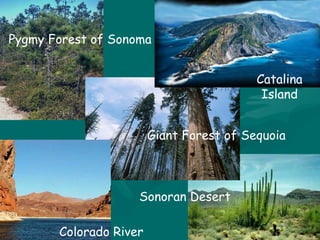
Pygmy Forest of Sonoma Giant Forest of Sequoia Sonoran Desert Colorado River Catalina Island
What does Naturalists at Large do ?
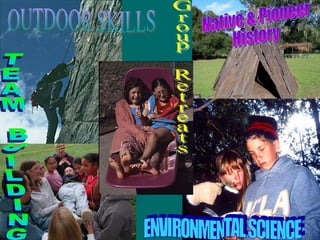
TEAM BUILDING ENVIRONMENTAL SCIENCE OUTDOOR SKILLS Native & Pioneer History Group Retreats
We work with each school every step of the way to identify their outdoor education goals and then tailor a program to meet those specific needs.
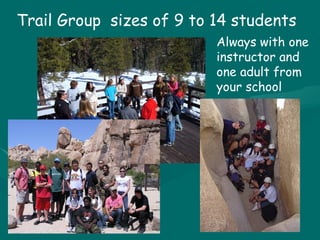
Trail Group  sizes of 9 to 14 students Always with one instructor and one adult from your school
Naturalists at Large provides a complete outdoor curriculum for primary through high school level students. We can accommodate trips for 15 students to over 200.
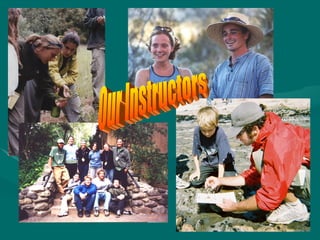
Our Instructors
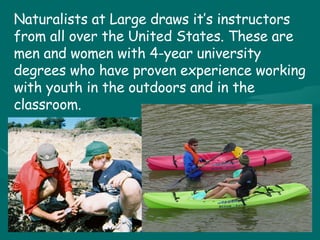
Naturalists at Large draws it’s instructors from all over the United States. These are men and women with 4-year university degrees who have proven experience working with youth in the outdoors and in the classroom.
 
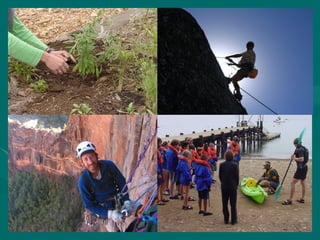
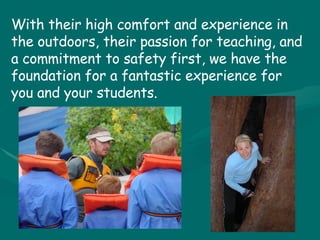
With their high comfort and experience in the outdoors, their passion for teaching, and a commitment to safety first, we have the foundation for a fantastic experience for you and your students.
All of our instructors are CPR and First Aid Certified. 80 % of them hold advanced certifications such as Wilderness Emergency Medical Training, Wilderness First Responders and Wilderness Advanced First Aid. RESPONSE TIMES: for Emergency Services Ambulance:  5-7 minutes from Boulder Creek Medivac Helicopter:  available Law Enforcement:  5 minutes
BOULDER CREEK SCOUT RESERVATION
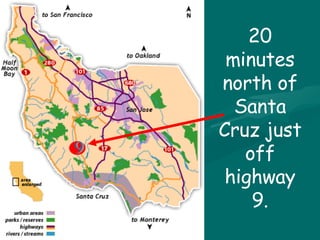
20 minutes north of Santa Cruz just off highway 9. 9
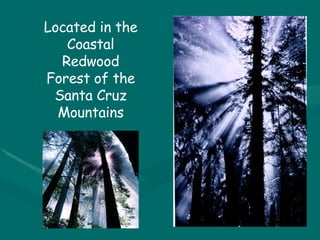
Located in the Coastal Redwood Forest of the Santa Cruz Mountains
Take a close up view of the Santa Cruz Mountains Experience, which can be provided by Naturalists at Large for you and your students.
Let's Go !
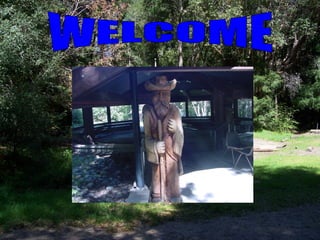
WELCOME
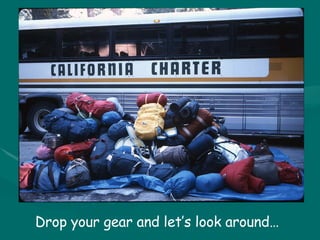
Drop your gear and let’s look around…
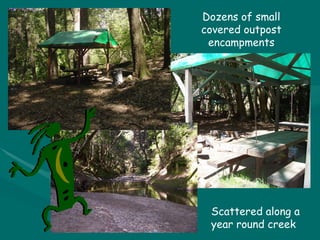
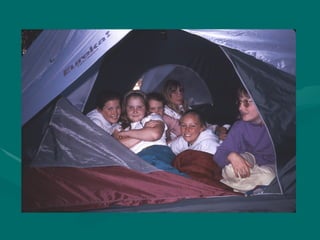
Dozens of small covered outpost encampments Scattered along a year round creek
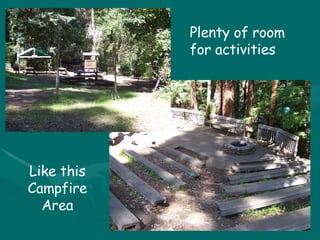
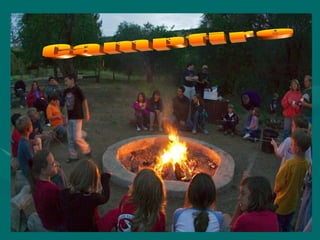
Plenty of room for activities Like this Campfire Area
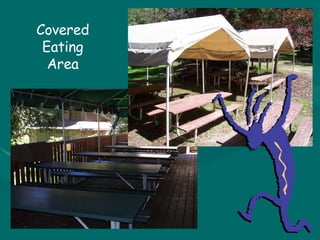
Covered Eating Area
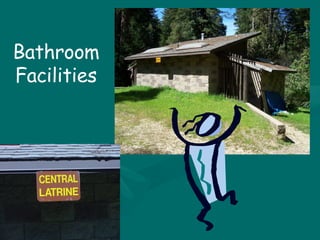
Bathroom Facilities
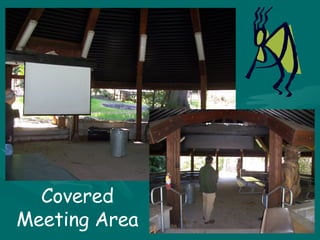
Covered Meeting Area
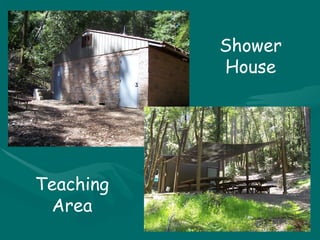
Shower House Teaching Area
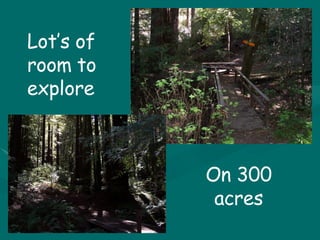
Lot’s of room to explore On 300 acres
 
 
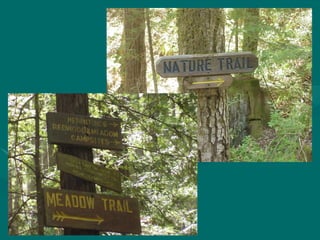
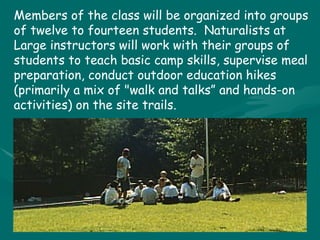
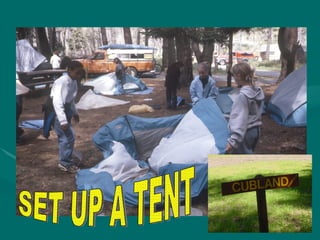
Members of the class will be organized into groups of twelve to fourteen students.  Naturalists at Large instructors will work with their groups of students to teach basic camp skills, supervise meal preparation, conduct outdoor education hikes (primarily a mix of "walk and talks” and hands-on activities) on the site trails.
SET UP A TENT
 
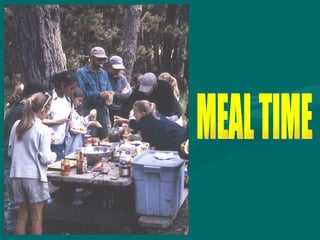
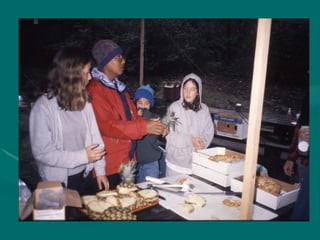
MEAL TIME
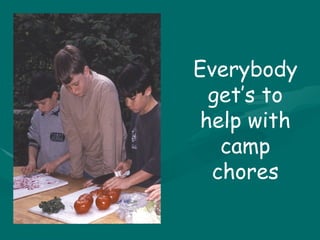
Everybody get’s to help with camp chores
 
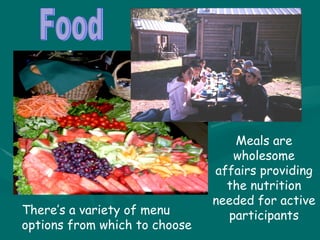
Food Meals are wholesome affairs providing the nutrition needed for active participants There’s a variety of menu options from which to choose
Allergies and Special Food Needs Program meals offer vegetarian food options. For those with specific needs due to allergies or personal reasons, we suggest discussion with your faculty.  Naturalists at Large can help guide those with special diets to supplement their meals in ways which everyone can most easily manage.
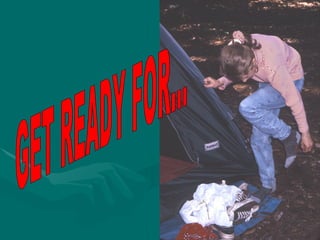
GET READY FOR...
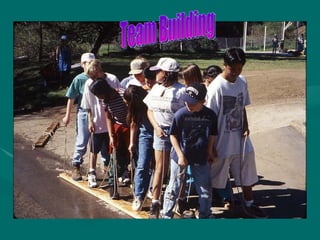
Team Building
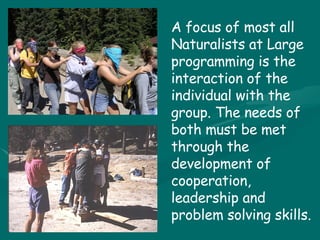
A focus of most all Naturalists at Large programming is the interaction of the individual with the group. The needs of both must be met through the development of cooperation, leadership and problem solving skills.
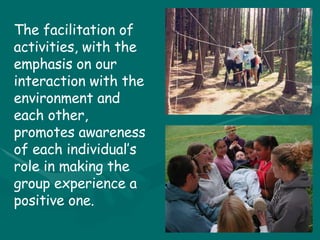
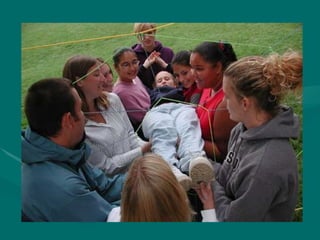
The facilitation of activities, with the emphasis on our interaction with the environment and each other, promotes awareness of each individual’s role in making the group experience a positive one.
 
Environmental Education
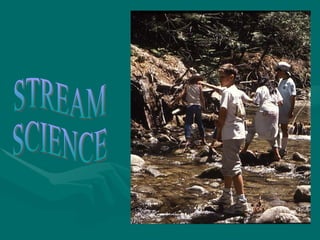
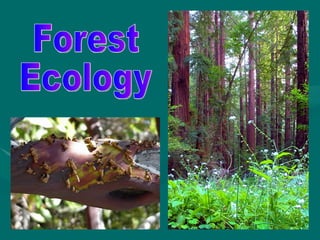
Educational themes include the grassland community, north coast forests, stream science, ecology of the redwoods, forests and humans -- a historical perspective, local geology, the stars, and environmental influences on plant species and diversity.  Emphasis will be tailored to complement the academic goals of the school.
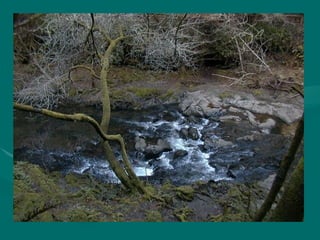
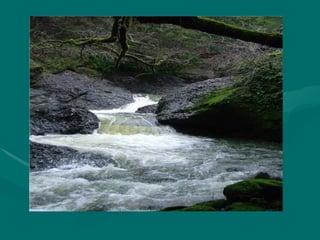
STREAM SCIENCE
 
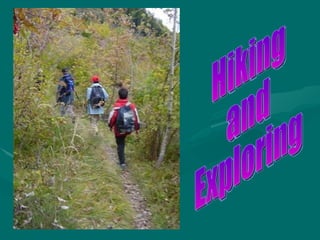
Hiking and Exploring
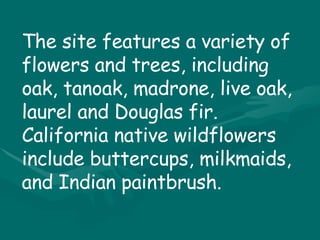
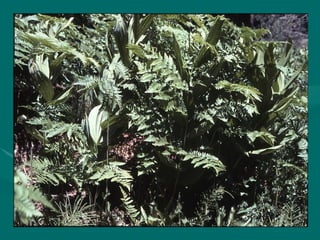
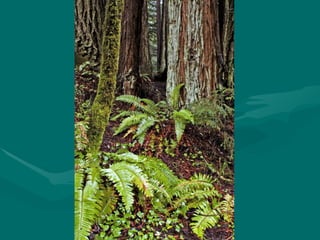
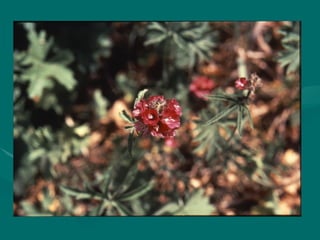
The site features a variety of flowers and trees, including oak, tanoak, madrone, live oak, laurel and Douglas fir. California native wildflowers include buttercups, milkmaids, and Indian paintbrush.
Forest Ecology


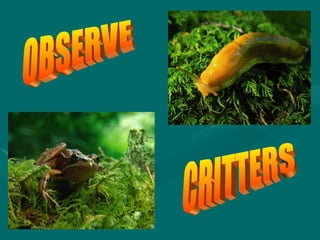
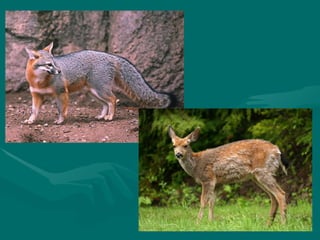
OBSERVE CRITTERS
 
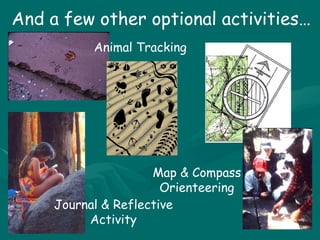
And a few other optional activities… Journal & Reflective Activity Map & Compass Orienteering Animal Tracking
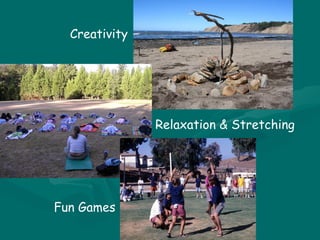
Creativity Relaxation & Stretching Fun Games
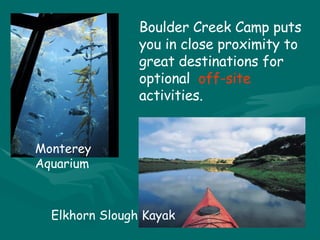
Monterey Aquarium Elkhorn Slough Kayak Boulder Creek Camp puts you in close proximity to great destinations for optional  off-site  activities.
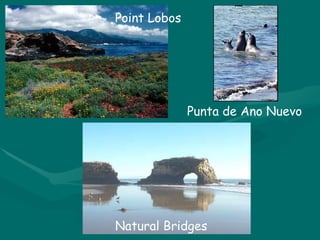
Point Lobos   Natural Bridges Punta de Ano Nuevo
And when the  sun goes down...
Star studies and the night sky
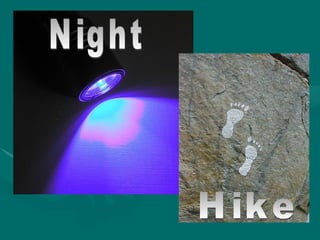
Night Hike
Campfire
Outdoor Education
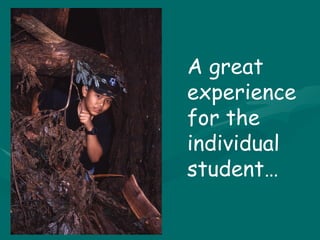
A great experience for the individual student…
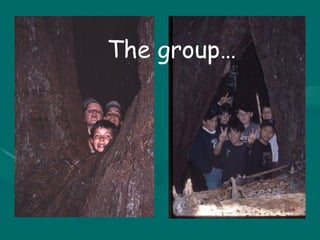
The group…
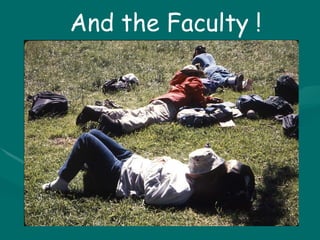
And the Faculty !
The following is a sample three-day schedule that has been used by several schools. Four-day and five-day trips often add off-site options and allow for a more in-depth experience of the region.  All Naturalists at Large trips are tailored to meet each school’s outdoor education goals .
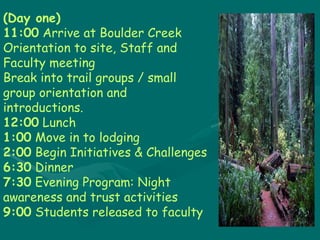
(Day one) 11:00  Arrive at Boulder Creek Orientation to site, Staff and Faculty meeting Break into trail groups / small group orientation and introductions.  12:00  Lunch 1:00 Move in to lodging 2:00 Begin Initiatives & Challenges 6:30 Dinner  7:30 Evening Program: Night awareness and trust activities 9:00 Students released to faculty
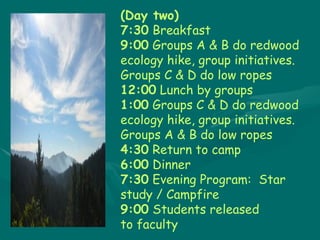
(Day two) 7:30 Breakfast  9:00 Groups A & B do redwood ecology hike, group initiatives. Groups C & D do low ropes 12:00  Lunch by groups 1:00 Groups C & D do redwood ecology hike, group initiatives. Groups A & B do low ropes 4:30 Return to camp 6:00 Dinner  7:30 Evening Program:  Star study / Campfire 9:00 Students released  to faculty
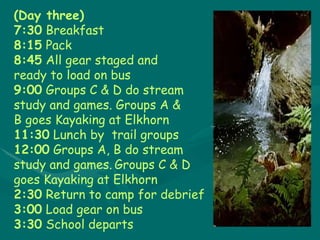
(Day three) 7:30 Breakfast 8:15 Pack 8:45 All gear staged and  ready to load on bus  9:00 Groups C & D do stream  study and games. Groups A &  B goes Kayaking at Elkhorn 11:30  Lunch by  trail groups 12:00  Groups A, B do stream  study and games.   Groups C & D  goes Kayaking at Elkhorn 2:30 Return to camp for debrief 3:00 Load gear on bus 3:30 School departs
Boulder Creek & the Santa Cruz Mountains DISCOVER IT !
Medications, Allergies, and Special Dietary Needs
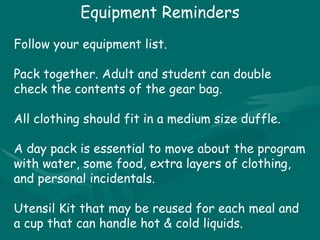
Equipment Reminders Follow your equipment list. Pack together. Adult and student can double check the contents of the gear bag. All clothing should fit in a medium size duffle. A day pack is essential to move about the program with water, some food, extra layers of clothing, and personal incidentals. Utensil Kit that may be reused for each meal and a cup that can handle hot & cold liquids.
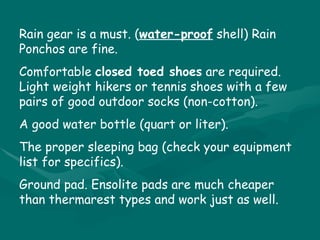
Rain gear is a must. ( water-proof  shell) Rain Ponchos are fine. Comfortable  closed toed shoes  are required. Light weight hikers or tennis shoes with a few pairs of good outdoor socks (non-cotton). A good water bottle (quart or liter). The proper sleeping bag (check your equipment list for specifics). Ground pad. Ensolite pads are much cheaper than thermarest types and work just as well.
Plastic bag protection. A half dozen, 1 or 2 gallon storage ziplocks are good for protecting clothing in a gear bag from moisture. Along with a couple hefty 15 to 30 gallon bags to line your gear bag and sleeping bag (& daypack). Don’t send gear that you could not afford lost or broken (expensive cameras, cell phones, and other electronics). A handy disposable camera would be just fine. Follow your equipment list, ask questions, borrow from friends.
www.natsatlarge.com For more information check us out at …

Boulder Creek: Naturalists at Large

  • 1.
  • 2.
    Our education programsfor over two hundred of California's public and independent schools have introduced thousands of students to environments as diverse as the… Independent Schools Charter Schools Public Schools Waldorf Schools Montessori Schools Who do we serve ?
  • 3.
    Pygmy Forest ofSonoma Giant Forest of Sequoia Sonoran Desert Colorado River Catalina Island
  • 4.
    What does Naturalistsat Large do ?
  • 5.
    TEAM BUILDING ENVIRONMENTALSCIENCE OUTDOOR SKILLS Native & Pioneer History Group Retreats
  • 6.
    We work witheach school every step of the way to identify their outdoor education goals and then tailor a program to meet those specific needs.
  • 7.
    Trail Group sizes of 9 to 14 students Always with one instructor and one adult from your school
  • 8.
    Naturalists at Largeprovides a complete outdoor curriculum for primary through high school level students. We can accommodate trips for 15 students to over 200.
  • 9.
  • 10.
    Naturalists at Largedraws it’s instructors from all over the United States. These are men and women with 4-year university degrees who have proven experience working with youth in the outdoors and in the classroom.
  • 11.
  • 12.
    With their highcomfort and experience in the outdoors, their passion for teaching, and a commitment to safety first, we have the foundation for a fantastic experience for you and your students.
  • 13.
    All of ourinstructors are CPR and First Aid Certified. 80 % of them hold advanced certifications such as Wilderness Emergency Medical Training, Wilderness First Responders and Wilderness Advanced First Aid. RESPONSE TIMES: for Emergency Services Ambulance: 5-7 minutes from Boulder Creek Medivac Helicopter: available Law Enforcement: 5 minutes
  • 14.
  • 15.
    20 minutes northof Santa Cruz just off highway 9. 9
  • 16.
    Located in theCoastal Redwood Forest of the Santa Cruz Mountains
  • 17.
    Take a closeup view of the Santa Cruz Mountains Experience, which can be provided by Naturalists at Large for you and your students.
  • 18.
  • 19.
  • 20.
    Drop your gearand let’s look around…
  • 21.
    Dozens of smallcovered outpost encampments Scattered along a year round creek
  • 22.
    Plenty of roomfor activities Like this Campfire Area
  • 23.
  • 24.
  • 25.
  • 26.
  • 27.
    Lot’s of roomto explore On 300 acres
  • 28.
  • 29.
  • 30.
    Members of theclass will be organized into groups of twelve to fourteen students. Naturalists at Large instructors will work with their groups of students to teach basic camp skills, supervise meal preparation, conduct outdoor education hikes (primarily a mix of "walk and talks” and hands-on activities) on the site trails.
  • 31.
  • 32.
  • 33.
  • 34.
    Everybody get’s tohelp with camp chores
  • 35.
  • 36.
    Food Meals arewholesome affairs providing the nutrition needed for active participants There’s a variety of menu options from which to choose
  • 37.
    Allergies and SpecialFood Needs Program meals offer vegetarian food options. For those with specific needs due to allergies or personal reasons, we suggest discussion with your faculty. Naturalists at Large can help guide those with special diets to supplement their meals in ways which everyone can most easily manage.
  • 38.
  • 39.
  • 40.
    A focus ofmost all Naturalists at Large programming is the interaction of the individual with the group. The needs of both must be met through the development of cooperation, leadership and problem solving skills.
  • 41.
    The facilitation ofactivities, with the emphasis on our interaction with the environment and each other, promotes awareness of each individual’s role in making the group experience a positive one.
  • 42.
  • 43.
  • 44.
    Educational themes includethe grassland community, north coast forests, stream science, ecology of the redwoods, forests and humans -- a historical perspective, local geology, the stars, and environmental influences on plant species and diversity. Emphasis will be tailored to complement the academic goals of the school.
  • 45.
  • 46.
  • 47.
  • 48.
    The site featuresa variety of flowers and trees, including oak, tanoak, madrone, live oak, laurel and Douglas fir. California native wildflowers include buttercups, milkmaids, and Indian paintbrush.
  • 49.
  • 50.
  • 51.
  • 52.
  • 53.
  • 54.
  • 55.
  • 56.
    And a fewother optional activities… Journal & Reflective Activity Map & Compass Orienteering Animal Tracking
  • 57.
    Creativity Relaxation &Stretching Fun Games
  • 58.
    Monterey Aquarium ElkhornSlough Kayak Boulder Creek Camp puts you in close proximity to great destinations for optional off-site activities.
  • 59.
    Point Lobos Natural Bridges Punta de Ano Nuevo
  • 60.
    And when the sun goes down...
  • 61.
    Star studies andthe night sky
  • 62.
  • 63.
  • 64.
  • 65.
    A great experiencefor the individual student…
  • 66.
  • 67.
  • 68.
    The following isa sample three-day schedule that has been used by several schools. Four-day and five-day trips often add off-site options and allow for a more in-depth experience of the region. All Naturalists at Large trips are tailored to meet each school’s outdoor education goals .
  • 69.
    (Day one) 11:00 Arrive at Boulder Creek Orientation to site, Staff and Faculty meeting Break into trail groups / small group orientation and introductions. 12:00 Lunch 1:00 Move in to lodging 2:00 Begin Initiatives & Challenges 6:30 Dinner 7:30 Evening Program: Night awareness and trust activities 9:00 Students released to faculty
  • 70.
    (Day two) 7:30Breakfast 9:00 Groups A & B do redwood ecology hike, group initiatives. Groups C & D do low ropes 12:00 Lunch by groups 1:00 Groups C & D do redwood ecology hike, group initiatives. Groups A & B do low ropes 4:30 Return to camp 6:00 Dinner 7:30 Evening Program: Star study / Campfire 9:00 Students released to faculty
  • 71.
    (Day three) 7:30Breakfast 8:15 Pack 8:45 All gear staged and ready to load on bus 9:00 Groups C & D do stream study and games. Groups A & B goes Kayaking at Elkhorn 11:30 Lunch by trail groups 12:00 Groups A, B do stream study and games. Groups C & D goes Kayaking at Elkhorn 2:30 Return to camp for debrief 3:00 Load gear on bus 3:30 School departs
  • 72.
    Boulder Creek &the Santa Cruz Mountains DISCOVER IT !
  • 73.
    Medications, Allergies, andSpecial Dietary Needs
  • 74.
    Equipment Reminders Followyour equipment list. Pack together. Adult and student can double check the contents of the gear bag. All clothing should fit in a medium size duffle. A day pack is essential to move about the program with water, some food, extra layers of clothing, and personal incidentals. Utensil Kit that may be reused for each meal and a cup that can handle hot & cold liquids.
  • 75.
    Rain gear isa must. ( water-proof shell) Rain Ponchos are fine. Comfortable closed toed shoes are required. Light weight hikers or tennis shoes with a few pairs of good outdoor socks (non-cotton). A good water bottle (quart or liter). The proper sleeping bag (check your equipment list for specifics). Ground pad. Ensolite pads are much cheaper than thermarest types and work just as well.
  • 76.
    Plastic bag protection.A half dozen, 1 or 2 gallon storage ziplocks are good for protecting clothing in a gear bag from moisture. Along with a couple hefty 15 to 30 gallon bags to line your gear bag and sleeping bag (& daypack). Don’t send gear that you could not afford lost or broken (expensive cameras, cell phones, and other electronics). A handy disposable camera would be just fine. Follow your equipment list, ask questions, borrow from friends.
  • 77.
    www.natsatlarge.com For moreinformation check us out at …