Native Americans 
Mr. Scullion Erwin Middle School
New Connections
In the late 1400s, Europeans developed strong, fast sailing ships and 
learned to navigate across long distances. European merchants and 
rulers began to finance expeditions to explore the globe. They were 
curious about the land and eager to make money. Some also wanted to 
spread Christianity. 
Explorers first sailed down the West African coast, looking for gold and 
spices. Then they set out across the Atlantic and ran into the Americas. 
Christopher Columbus made his famous voyage in 1492, and other 
explorers quickly followed. 
Soon, the lands that bordered the Atlantic Ocean—the west coast of 
Africa, the east coast of the Americas, and the western nations of 
Europe—were linked together. Large numbers of Europeans began to 
sail to the Americas. Many brought enslaved Africans with them. 
African, European, and Native American societies all had unique 
traditions and practices. As people from these cultures began building 
what would become North Carolina, many traditions were lost. 
However, cultures also blended together to create new ways of living. 
To understand the cultures that shaped North Carolina, it is important 
to know about Africa, Europe, and the Americas before they became 
connected with one another. Today we will learn about the Americas.
Introduction 
Exactly when and how humans came to the Americas 
remains something of a mystery. But the Indians we know 
through history developed over time, through today’s lesson 
we are going to study where they came from, how they 
developed over time and when their lives would be changed 
forever.
Where did the Native Americans come From 
? 
For many years, scientists thought humans first came to the Americas 
from Asia some time between 14,000 and 25,000 years ago, during a 
major Ice Age. According to this theory, the dropping temperatures that 
created the Ice Age caused seawater to freeze and ocean levels to fall. 
When the oceans fell, a land bridge emerged between North America 
and Siberia. Asian people from Siberia walked across the bridge and 
spread across the Americas. Over time, they developed cultures and 
economies that ranged from the vast farming empires of South America 
to the small fishing communities of the eastern coast of North America.
A Developing Culture 
Paleo Indians 
20,000 to 8,000 B.C.
A Developing Culture 
Paleo Indians 
20,000 to 8,000 B.C. 
When humans first came to the Carolinas, the climate was quite cold, 
and large beasts, such as mammoths, roamed freely. People survived 
by hunting. We call this time the Paleo-Indian period. Archaeologists 
believe Paleo-Indians were nomads, who moved from place to place 
in search of large game. Paleo-Indians are known for large stone 
spear points that have been found across the South and in other parts 
of the country.
A Developing Culture 
Archaic Indians 
8,000 to 700 B.C.
A Developing Culture 
Archaic Indians 
8,000 to 700 B.C. 
When the climate warmed, native societies changed and the Archaic 
period began. A warmer climate brought a greater variety of plants 
and animals. Archaic people hunted new kinds of game, learned to 
fish, and gathered nuts and berries. Some time around 4000 B.C., 
the Archaic people also began to farm. Groups moved around less. 
Instead of constantly following game, they moved between a few 
specific places: farm fields in summer, hunting grounds in winter, the 
coast in spring. They began to make pottery and trade with other 
groups.
A Developing Culture 
Mississippian 
Indians 
700 B.C. to 1600 
A.D.
A Developing Culture 
Mississippian 
Indians 
700 B.C. to 1600 
A.D. 
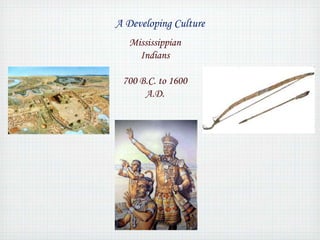
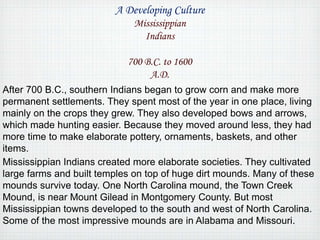
After 700 B.C., southern Indians began to grow corn and make more 
permanent settlements. They spent most of the year in one place, living 
mainly on the crops they grew. They also developed bows and arrows, 
which made hunting easier. Because they moved around less, they had 
more time to make elaborate pottery, ornaments, baskets, and other 
items. 
Mississippian Indians created more elaborate societies. They cultivated 
large farms and built temples on top of huge dirt mounds. Many of these 
mounds survive today. One North Carolina mound, the Town Creek 
Mound, is near Mount Gilead in Montgomery County. But most 
Mississippian towns developed to the south and west of North Carolina. 
Some of the most impressive mounds are in Alabama and Missouri.
North Carolina Tribes
Indian Life
Indian Life 
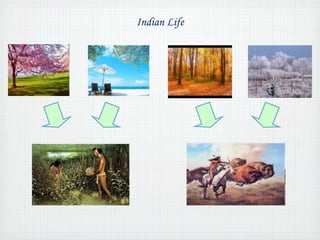
Although the native groups in North Carolina were different from one 
another, they shared many common characteristics. Natives lived in 
small towns that were based on family ties. Their lives revolved around 
the seasons. In late spring, men cleared brush and trees away from 
community fields. Women planted corn, peas, and beans. During the 
winter, men hunted and women gathered nuts, berries, and roots. In 
early spring, people living near the shore headed to the beach to feast 
on oysters and spawning fish. 
Few of North Carolina’s Indians sought to grow rich. They enjoyed 
luxuries like pearls, exotic shells, or copper ornaments. Still, individual 
bands rarely produced more food than they needed for a year. Fields 
required little attention and game was plentiful. English explorer John 
Lawson once called the Indians “the freest People in the World.”

Native Americans

  • 1.
    Native Americans Mr.Scullion Erwin Middle School
  • 2.
  • 3.
    In the late1400s, Europeans developed strong, fast sailing ships and learned to navigate across long distances. European merchants and rulers began to finance expeditions to explore the globe. They were curious about the land and eager to make money. Some also wanted to spread Christianity. Explorers first sailed down the West African coast, looking for gold and spices. Then they set out across the Atlantic and ran into the Americas. Christopher Columbus made his famous voyage in 1492, and other explorers quickly followed. Soon, the lands that bordered the Atlantic Ocean—the west coast of Africa, the east coast of the Americas, and the western nations of Europe—were linked together. Large numbers of Europeans began to sail to the Americas. Many brought enslaved Africans with them. African, European, and Native American societies all had unique traditions and practices. As people from these cultures began building what would become North Carolina, many traditions were lost. However, cultures also blended together to create new ways of living. To understand the cultures that shaped North Carolina, it is important to know about Africa, Europe, and the Americas before they became connected with one another. Today we will learn about the Americas.
  • 4.
    Introduction Exactly whenand how humans came to the Americas remains something of a mystery. But the Indians we know through history developed over time, through today’s lesson we are going to study where they came from, how they developed over time and when their lives would be changed forever.
  • 5.
    Where did theNative Americans come From ? For many years, scientists thought humans first came to the Americas from Asia some time between 14,000 and 25,000 years ago, during a major Ice Age. According to this theory, the dropping temperatures that created the Ice Age caused seawater to freeze and ocean levels to fall. When the oceans fell, a land bridge emerged between North America and Siberia. Asian people from Siberia walked across the bridge and spread across the Americas. Over time, they developed cultures and economies that ranged from the vast farming empires of South America to the small fishing communities of the eastern coast of North America.
  • 6.
    A Developing Culture Paleo Indians 20,000 to 8,000 B.C.
  • 7.
    A Developing Culture Paleo Indians 20,000 to 8,000 B.C. When humans first came to the Carolinas, the climate was quite cold, and large beasts, such as mammoths, roamed freely. People survived by hunting. We call this time the Paleo-Indian period. Archaeologists believe Paleo-Indians were nomads, who moved from place to place in search of large game. Paleo-Indians are known for large stone spear points that have been found across the South and in other parts of the country.
  • 8.
    A Developing Culture Archaic Indians 8,000 to 700 B.C.
  • 9.
    A Developing Culture Archaic Indians 8,000 to 700 B.C. When the climate warmed, native societies changed and the Archaic period began. A warmer climate brought a greater variety of plants and animals. Archaic people hunted new kinds of game, learned to fish, and gathered nuts and berries. Some time around 4000 B.C., the Archaic people also began to farm. Groups moved around less. Instead of constantly following game, they moved between a few specific places: farm fields in summer, hunting grounds in winter, the coast in spring. They began to make pottery and trade with other groups.
  • 10.
    A Developing Culture Mississippian Indians 700 B.C. to 1600 A.D.
  • 11.
    A Developing Culture Mississippian Indians 700 B.C. to 1600 A.D. After 700 B.C., southern Indians began to grow corn and make more permanent settlements. They spent most of the year in one place, living mainly on the crops they grew. They also developed bows and arrows, which made hunting easier. Because they moved around less, they had more time to make elaborate pottery, ornaments, baskets, and other items. Mississippian Indians created more elaborate societies. They cultivated large farms and built temples on top of huge dirt mounds. Many of these mounds survive today. One North Carolina mound, the Town Creek Mound, is near Mount Gilead in Montgomery County. But most Mississippian towns developed to the south and west of North Carolina. Some of the most impressive mounds are in Alabama and Missouri.
  • 12.
  • 13.
  • 14.
    Indian Life Althoughthe native groups in North Carolina were different from one another, they shared many common characteristics. Natives lived in small towns that were based on family ties. Their lives revolved around the seasons. In late spring, men cleared brush and trees away from community fields. Women planted corn, peas, and beans. During the winter, men hunted and women gathered nuts, berries, and roots. In early spring, people living near the shore headed to the beach to feast on oysters and spawning fish. Few of North Carolina’s Indians sought to grow rich. They enjoyed luxuries like pearls, exotic shells, or copper ornaments. Still, individual bands rarely produced more food than they needed for a year. Fields required little attention and game was plentiful. English explorer John Lawson once called the Indians “the freest People in the World.”

Editor's Notes

  • #3 In the late 1400s, Europeans developed strong, fast sailing ships and learned to navigate across long distances. European merchants and rulers began to finance expeditions to explore the globe. They were curious about the land and eager to make money. Some also wanted to spread Christianity. Explorers first sailed down the West African coast, looking for gold and spices. Then they set out across the Atlantic and ran into the Americas. Christopher Columbus made his famous voyage in 1492, and other explorers quickly followed. Soon, the lands that bordered the Atlantic Ocean—the west coast of Africa, the east coast of the Americas, and the western nations of Europe—were linked together. Large numbers of Europeans began to sail to the Americas. Many brought enslaved Africans with them. African, European, and Native American societies all had unique traditions and practices. As people from these cultures began building what would become North Carolina, many traditions were lost. However, cultures also blended together to create new ways of living. To understand the cultures that shaped North Carolina, it is important to know about Africa, Europe, and the Americas before they became connected with one another. Today we will learn about the Americas.
  • #5 Exactly when and how humans came to the Americas remains something of a mystery. But the Indians we know through history developed over time, through today’s lesson we are going to study where they came from, how they developed over time and when their lives would be changed forever.
  • #6 For many years, scientists thought humans first came to the Americas from Asia some time between 14,000 and 25,000 years ago, during a major Ice Age. According to this theory, the dropping temperatures that created the Ice Age caused seawater to freeze and ocean levels to fall. When the oceans fell, a land bridge emerged between North America and Siberia. Asian people from Siberia walked across the bridge and spread across the Americas. Over time, they developed cultures and economies that ranged from the vast farming empires of South America to the small fishing communities of the eastern coast of North America.
  • #7 Paleo-Indian about 20,000 to 8000 B.C. When humans first came to the Carolinas, the climate was quite cold, and large beasts, such as mammoths, roamed freely. People survived by hunting. We call this time the Paleo-Indian period. Archaeologists believe Paleo-Indians were nomads, who moved from place to place in search of large game. Paleo-Indians are known for large stone spear points that have been found across the South and in other parts of the country.
  • #8 Paleo-Indian about 20,000 to 8000 B.C. When humans first came to the Carolinas, the climate was quite cold, and large beasts, such as mammoths, roamed freely. People survived by hunting. We call this time the Paleo-Indian period. Archaeologists believe Paleo-Indians were nomads, who moved from place to place in search of large game. Paleo-Indians are known for large stone spear points that have been found across the South and in other parts of the country.
  • #9 Archaic 8000-700 B.C. When the climate warmed, native societies changed and the Archaic period began. A warmer climate brought a greater variety of plants and animals. Archaic people hunted new kinds of game, learned to fish, and gathered nuts and berries. Some time around 4000 B.C., the Archaic people also began to farm. Groups moved around less. Instead of constantly following game, they moved between a few specific places: farm fields in summer, hunting grounds in winter, the coast in spring. They began to make pottery and trade with other groups.
  • #10 Archaic 8000-700 B.C. When the climate warmed, native societies changed and the Archaic period began. A warmer climate brought a greater variety of plants and animals. Archaic people hunted new kinds of game, learned to fish, and gathered nuts and berries. Some time around 4000 B.C., the Archaic people also began to farm. Groups moved around less. Instead of constantly following game, they moved between a few specific places: farm fields in summer, hunting grounds in winter, the coast in spring. They began to make pottery and trade with other groups.
  • #11 After 700 B.C., southern Indians began to grow corn and make more permanent settlements. They spent most of the year in one place, living mainly on the crops they grew. They also developed bows and arrows, which made hunting easier. Because they moved around less, they had more time to make elaborate pottery, ornaments, baskets, and other items. Mississippian Indians created more elaborate societies. They cultivated large farms and built temples on top of huge dirt mounds. Many of these mounds survive today. One North Carolina mound, the Town Creek Mound, is near Mount Gilead in Montgomery County. But most Mississippian towns developed to the south and west of North Carolina. Some of the most impressive mounds are in Alabama and Missouri.
  • #12 After 700 B.C., southern Indians began to grow corn and make more permanent settlements. They spent most of the year in one place, living mainly on the crops they grew. They also developed bows and arrows, which made hunting easier. Because they moved around less, they had more time to make elaborate pottery, ornaments, baskets, and other items. Mississippian Indians created more elaborate societies. They cultivated large farms and built temples on top of huge dirt mounds. Many of these mounds survive today. One North Carolina mound, the Town Creek Mound, is near Mount Gilead in Montgomery County. But most Mississippian towns developed to the south and west of North Carolina. Some of the most impressive mounds are in Alabama and Missouri.
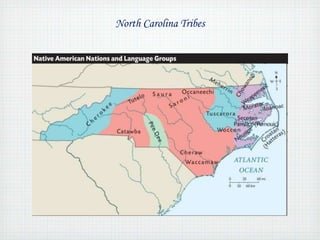
  • #13 Several groups of indigenous people have been living in what is now North Carolina for thousands of years.
  • #14 Although the native groups in North Carolina were different from one another, they shared many common characteristics. Natives lived in small towns that were based on family ties. Their lives revolved around the seasons. In late spring, men cleared brush and trees away from community fields. Women planted corn, peas, and beans. During the winter, men hunted and women gathered nuts, berries, and roots. In early spring, people living near the shore headed to the beach to feast on oysters and spawning fish. Few of North Carolina’s Indians sought to grow rich. They enjoyed luxuries like pearls, exotic shells, or copper ornaments. Still, individual bands rarely produced more food than they needed for a year. Fields required little attention and game was plentiful. English explorer John Lawson once called the Indians “the freest People in the World.”
  • #15 Although the native groups in North Carolina were different from one another, they shared many common characteristics. Natives lived in small towns that were based on family ties. Their lives revolved around the seasons. In late spring, men cleared brush and trees away from community fields. Women planted corn, peas, and beans. During the winter, men hunted and women gathered nuts, berries, and roots. In early spring, people living near the shore headed to the beach to feast on oysters and spawning fish. Few of North Carolina’s Indians sought to grow rich. They enjoyed luxuries like pearls, exotic shells, or copper ornaments. Still, individual bands rarely produced more food than they needed for a year. Fields required little attention and game was plentiful. English explorer John Lawson once called the Indians “the freest People in the World.”