Native American
Oral Stories
BY ELIZABETH TOMALÁ
A Legacy of Storytelling
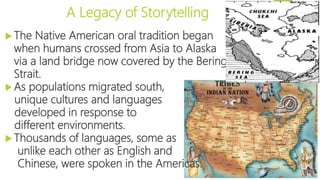
 The Native American oral tradition began
when humans crossed from Asia to Alaska
via a land bridge now covered by the Bering
Strait.
 As populations migrated south,
unique cultures and languages
developed in response to
different environments.
 Thousands of languages, some as
unlike each other as English and
Chinese, were spoken in the Americas.
A Legacy of Storytelling
 Each of these native cultures developed its own
stories and mythology.
 Sacred stories were often at the heart of
religious ceremonies, and in societies where
myth and reality merged, rituals were thought to
link the spirits of hunters and animals.
 Versions of these earliest stories have evolved
through hundreds of generations and are still a
living part of Native American traditions.
Storyteller
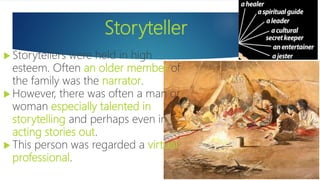
 Storytellers were held in high
esteem. Often an older member of
the family was the narrator.
 However, there was often a man or
woman especially talented in
storytelling and perhaps even in
acting stories out.
 This person was regarded a virtual
professional.
Myths
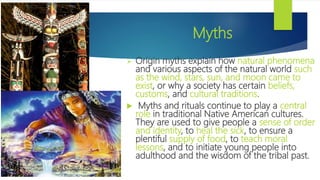
 Origin myths explain how natural phenomena
and various aspects of the natural world such
as the wind, stars, sun, and moon came to
exist, or why a society has certain beliefs,
customs, and cultural traditions.
 Myths and rituals continue to play a central
role in traditional Native American cultures.
They are used to give people a sense of order
and identity, to heal the sick, to ensure a
plentiful supply of food, to teach moral
lessons, and to initiate young people into
adulthood and the wisdom of the tribal past.
A
hero’s j
o
u
r
n
e
y
There are hundreds of
American Indian nations, all
with their own language and
culture. However, one thing
that they share in common is
a rich oral tradition.
That is, they have
stories passed down
from generation to
generation through
spoken language.
 The stories passed down through
the oral tradition of Native
Americans are ways of recording the
history, culture, and beliefs of each
nation. And the environment and
problems facing each nation also
affected the stories the tribe told.
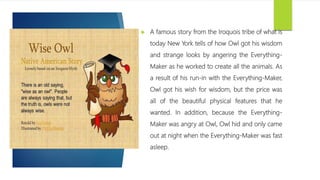
 A famous story from the Iroquois tribe of what is
today New York tells of how Owl got his wisdom
and strange looks by angering the Everything-
Maker as he worked to create all the animals. As
a result of his run-in with the Everything-Maker,
Owl got his wish for wisdom, but the price was
all of the beautiful physical features that he
wanted. In addition, because the Everything-
Maker was angry at Owl, Owl hid and only came
out at night when the Everything-Maker was fast
asleep.
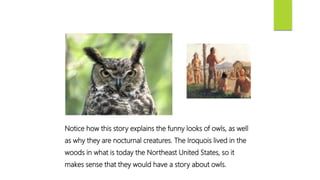
Notice how this story explains the funny looks of owls, as well
as why they are nocturnal creatures. The Iroquois lived in the
woods in what is today the Northeast United States, so it
makes sense that they would have a story about owls.

Native american oral stories

  • 1.
  • 3.
    A Legacy ofStorytelling  The Native American oral tradition began when humans crossed from Asia to Alaska via a land bridge now covered by the Bering Strait.  As populations migrated south, unique cultures and languages developed in response to different environments.  Thousands of languages, some as unlike each other as English and Chinese, were spoken in the Americas.
  • 4.
    A Legacy ofStorytelling  Each of these native cultures developed its own stories and mythology.  Sacred stories were often at the heart of religious ceremonies, and in societies where myth and reality merged, rituals were thought to link the spirits of hunters and animals.  Versions of these earliest stories have evolved through hundreds of generations and are still a living part of Native American traditions.
  • 6.
    Storyteller  Storytellers wereheld in high esteem. Often an older member of the family was the narrator.  However, there was often a man or woman especially talented in storytelling and perhaps even in acting stories out.  This person was regarded a virtual professional.
  • 7.
    Myths  Origin mythsexplain how natural phenomena and various aspects of the natural world such as the wind, stars, sun, and moon came to exist, or why a society has certain beliefs, customs, and cultural traditions.  Myths and rituals continue to play a central role in traditional Native American cultures. They are used to give people a sense of order and identity, to heal the sick, to ensure a plentiful supply of food, to teach moral lessons, and to initiate young people into adulthood and the wisdom of the tribal past.
  • 8.
  • 9.
    There are hundredsof American Indian nations, all with their own language and culture. However, one thing that they share in common is a rich oral tradition.
  • 10.
    That is, theyhave stories passed down from generation to generation through spoken language.
  • 11.
     The storiespassed down through the oral tradition of Native Americans are ways of recording the history, culture, and beliefs of each nation. And the environment and problems facing each nation also affected the stories the tribe told.
  • 12.
     A famousstory from the Iroquois tribe of what is today New York tells of how Owl got his wisdom and strange looks by angering the Everything- Maker as he worked to create all the animals. As a result of his run-in with the Everything-Maker, Owl got his wish for wisdom, but the price was all of the beautiful physical features that he wanted. In addition, because the Everything- Maker was angry at Owl, Owl hid and only came out at night when the Everything-Maker was fast asleep.
  • 13.
    Notice how thisstory explains the funny looks of owls, as well as why they are nocturnal creatures. The Iroquois lived in the woods in what is today the Northeast United States, so it makes sense that they would have a story about owls.