Before There Was TimeNative American Literature
Living Oral TraditionStories kept alive by word of mouth.Native American literature recognized in late 1800’s.Stories, poems, songs, oratory, chantsStories to teach moral lessonsConvey practical information re: natural world
The Natural WorldAnimals and human are interchangeable in myths & folk tales.Animals often instrument of creation.Universe not dominate by humans (like in Western tales)
Power of WordsMany metaphorsWords are as powerful & alive as the human breathing them.Songs & chants can make things happenDraws of similes from nature
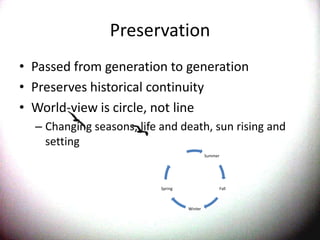
PreservationPassed from generation to generationPreserves historical continuityWorld-view is circle, not lineChanging seasons, life and death, sun rising and setting
Devices    1. Repetition 2. Enumeration 3. Incremental development 4. Ritual beginnings and endings 5. Use of archaic language
Devices6. Specific structure (Pima, Papago) a. Introduction: harmonious situation b. Thesis: one or more episodes showing disruption of harmony c. Antithesis: measures employed to overcome disruption d. Conclusion: restored harmony completed by cycles of four or some power of four (four songs four nights, etc.)7. Terse style
Functions	1. Beliefs about nature of physical world 2. Beliefs about social order and appropriate behavior 3. Beliefs about human nature and the problem of good and evil
Characteristics of Myths	1. Myths: primal world 2. Beings are animals spirits in more or less human form: monsters, confusions of nature 3. Mythic age flows into age of transformation (legends)
Characteristics of Legends	1. Culture hero or transformer orders the world 2. Culture hero or transformer turns animal people into animals 3. Other beings become landmarks 4. Flows into historical time (real heroes)
Night ChantPart of Navajo ceremony to lend support to sick person.Ill health = imbalance of natureRestores balance to sick person
Figures – Culture Heroes	a. Dramatize prototypical events and behaviors b. Show how to do what is right and how we become the people we are c. Shape the world and gives it its character by theft of sun, fire, or water d. Often of divine birth e. Myths are not concerned with original owners, only with culture hero's acquisition of them
Figures – Trickster HeroesUsually animalsLive by witsSymbolize dual nature of humansProtagonists  are complexMix humor & seriousnessEarthiness & spirituality
Themes	1. Formation of the world through struggle and robbery (Pacific coast) 2. Movement from a sky world to a water world by means of a fall (Iroquoian) 3. Fortunate fall; creation story 4. Earth-diver myth 	Recreation/creation of the present world out of mud brought up from under the water by the earth-diver (muskrat or waterbird)
Themes, Cont.	5. Theft of fire 6. Emergence myths: 	a. ascent of beings from under the surface of the earth to its surface b. ascent from a series of underworlds	7. Migration myths: accompany emergence myths
AssignmentJigsaw (p22-24)  Discuss as a group:1:  The Sky Trees – What other myth involves fruit?  What does the rooting of the tree symbolize?2:  From The House Made of Dawn – What do the old men mean?3:  Coyote Finishes His Work – How would you characterize (describe) Coyote?  What lesson could be drawn from this incident?4:  Lakota Creation Myth – In what way is this myth similar to the Judeo-Christian creation story?
Project Option #1Trickster Talk Show:Find other trickster tales in the literature from other countries.With your group, make a talk show where these characters are interviewed regarding the traditions, lessons, and culture surrounding their tales.

Native American

  • 1.
    Before There WasTimeNative American Literature
  • 4.
    Living Oral TraditionStorieskept alive by word of mouth.Native American literature recognized in late 1800’s.Stories, poems, songs, oratory, chantsStories to teach moral lessonsConvey practical information re: natural world
  • 5.
    The Natural WorldAnimalsand human are interchangeable in myths & folk tales.Animals often instrument of creation.Universe not dominate by humans (like in Western tales)
  • 6.
    Power of WordsManymetaphorsWords are as powerful & alive as the human breathing them.Songs & chants can make things happenDraws of similes from nature
  • 7.
    PreservationPassed from generationto generationPreserves historical continuityWorld-view is circle, not lineChanging seasons, life and death, sun rising and setting
  • 8.
    Devices 1. Repetition 2. Enumeration 3. Incremental development 4. Ritual beginnings and endings 5. Use of archaic language
  • 9.
    Devices6. Specific structure(Pima, Papago) a. Introduction: harmonious situation b. Thesis: one or more episodes showing disruption of harmony c. Antithesis: measures employed to overcome disruption d. Conclusion: restored harmony completed by cycles of four or some power of four (four songs four nights, etc.)7. Terse style
  • 10.
    Functions 1. Beliefs aboutnature of physical world 2. Beliefs about social order and appropriate behavior 3. Beliefs about human nature and the problem of good and evil
  • 11.
    Characteristics of Myths 1.Myths: primal world 2. Beings are animals spirits in more or less human form: monsters, confusions of nature 3. Mythic age flows into age of transformation (legends)
  • 12.
    Characteristics of Legends 1.Culture hero or transformer orders the world 2. Culture hero or transformer turns animal people into animals 3. Other beings become landmarks 4. Flows into historical time (real heroes)
  • 13.
    Night ChantPart ofNavajo ceremony to lend support to sick person.Ill health = imbalance of natureRestores balance to sick person
  • 14.
    Figures – CultureHeroes a. Dramatize prototypical events and behaviors b. Show how to do what is right and how we become the people we are c. Shape the world and gives it its character by theft of sun, fire, or water d. Often of divine birth e. Myths are not concerned with original owners, only with culture hero's acquisition of them
  • 15.
    Figures – TricksterHeroesUsually animalsLive by witsSymbolize dual nature of humansProtagonists are complexMix humor & seriousnessEarthiness & spirituality
  • 16.
    Themes 1. Formation ofthe world through struggle and robbery (Pacific coast) 2. Movement from a sky world to a water world by means of a fall (Iroquoian) 3. Fortunate fall; creation story 4. Earth-diver myth Recreation/creation of the present world out of mud brought up from under the water by the earth-diver (muskrat or waterbird)
  • 17.
    Themes, Cont. 5. Theftof fire 6. Emergence myths: a. ascent of beings from under the surface of the earth to its surface b. ascent from a series of underworlds 7. Migration myths: accompany emergence myths
  • 18.
    AssignmentJigsaw (p22-24) Discuss as a group:1: The Sky Trees – What other myth involves fruit? What does the rooting of the tree symbolize?2: From The House Made of Dawn – What do the old men mean?3: Coyote Finishes His Work – How would you characterize (describe) Coyote? What lesson could be drawn from this incident?4: Lakota Creation Myth – In what way is this myth similar to the Judeo-Christian creation story?
  • 19.
    Project Option #1TricksterTalk Show:Find other trickster tales in the literature from other countries.With your group, make a talk show where these characters are interviewed regarding the traditions, lessons, and culture surrounding their tales.