National Security
TOPIC 10
What is Security?
- being free from danger and having freedom as a
human being (vocabulary.com)
- being free it is a multidimensional, broad and
complex concept that still evolving since the
human civilization (essay.uk)
- Security does not only focus in safeguarding
oneself to the conflict that may harm them it is
also focused on the needs of a person.
- Currently, every country has its own way of
defending and maintaining its human and
national security.
Two types of Security
• Traditional Security
“military security”
• Human Security
“human security”
needs of people to live
What is National Security of The
Philippines?
According to the National Security Policy for 2017-2022 of the National
Security Council,
national security defined as “a state or conditions
wherein the people’s welfare, well
being, ways of life; government and its
institution; territorial integrity;
sovereignty; and core values are
enhanced and protected.
Three (3) major pillars of the National Security Policy:
1. Safeguarding the Philippine’s National Unity, its democracy and its social institution. All citizens’
shares one national identity. Regardless of their ethnic, religious and cultural and ideological
orientations all citizens are Filipino.
2. Security of the State and preserving and protecting its sovereignty, territorial integrity and
institutions – This is provided in the Constitution as stated in the following:
– Definition of national territory consistent with new international covenants (Art.I)
– Renunciation of war as an instrument of national policy (Art.IISec.2)
– Civilian supremacy over military (Art.IISec.3)
– Role of the armed forces as protector of the people and the State (Art.IISec.3)
– Maintenance of peace and order, the protection of life, liberty and property and the promotion of
the general welfare (Art.IISec.5)
– Pursuit of an independent foreign policy based on national sovereignty and national interest
(Art.IISec.7)
– Right to self-determination (Art.IISec.7)
– Freedom from nuclear weapons (ArtIISec.8)
– Suspension of the writ of habeas corpus (Art.IIISec.15)
– Concept of a citizen army (ArtXVISec.4)
3. Protection of properties, infrastructures and keeping the people safe from all forms of threats,
both here and abroad, and to the extent possible, creating jobs in order to bring back home
overseas Filipino workers where their physical safety can be fully guaranteed by the
Government.
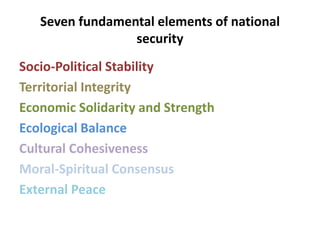
Seven fundamental elements of national
security
Socio-Political Stability
Territorial Integrity
Economic Solidarity and Strength
Ecological Balance
Cultural Cohesiveness
Moral-Spiritual Consensus
External Peace
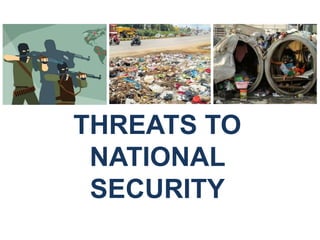
THREATS TO
NATIONAL
SECURITY
TYPES OF
THREATS
Rebellion or Insurrection
Terrorism
Murder
Kidnapping and Serious Illegal Detention
Hijacking/Highway Robbery
Crimes involving destruction
INTERNAL
THREATS
-Moro Islamic Liberation Front (MILF) and
Abu Sayyaf Group (ASG)
-Communist Party of the Philippines / New
People’s Army / National Democratic Front
(CPP / NPA / NDF)
-Organized Crime
-Grave Incidence of Poverty
-Economic Sabotage
-Graft and Corruption ities
-Persistent Environment Degradation
-Severe Calamities
EXTERNAL
THREATS
- Multilateral dispute over the Spratlys Islands
- Smuggling of firearms and contraband, illegal
migration and the occasional movement of foreign
terrorists through the porous borders of our
southwestern frontier
- Lingering effects of the currency crisis affecting the
countries within the Association of Southeast Asian
Nations (ASEAN)
- Serious economic disparity between rich and poor
nations
- Ethnic, religious and cultural conflict
- Proliferation of weapons of mass destruction
(WMD)
-Natural disasters and environmental issues
-Transnational organized crime
-Cybernetic crime
NSTP and the National Security
According to the constitution the Filipinos has
duty to protect the country under conditions
provided by law and to render personal,
military and civil service.
Sec. 11.Creation of the National Service
Reserve Corps
Mission
“To provide a trained and motivated manpower
pool that can be tapped by the State for civic
welfare, literacy and other similar endeavors
in the service of the nation.”
Functions
• to assist in the disaster preparedness, mitigation,
response and rehabilitation programs
• to serve as an auxiliary to the Disaster Coordinating
Council (DCC) response units;
• to assist in the promotion of civic welfare activities;
• to assist in the implementation of literacy program
• to assist in socio-economic development;
• to assist in environmental protection; and
• to perform other similar endeavors.
COMPOSITION
• The NSRC shall be composed of the graduates of
the CWTS and LTS components of NSTP.In
accordance with the Memorandum From the
Chairperson, Commission on Higher education
beingissued on March 18,2003,the NSRC has
been established effective Summer of
2003.Graduates of the CWTS and LTS for SY 2002-
2003 are the pioneering members of the NSRC.
The following are the 10 responsibilities of
youth in the national security according to the
United Nations.
1. Know your rights
2. Learn about local issues
3. Speak out
4. Network
5. Spread the word
6. Join online campaigns
7. Host a youth summit
8. Use your creativity
9. Join/create a youth organization
10.Be an inspiration

National Security.pptx

  • 1.
  • 2.
    What is Security? -being free from danger and having freedom as a human being (vocabulary.com) - being free it is a multidimensional, broad and complex concept that still evolving since the human civilization (essay.uk) - Security does not only focus in safeguarding oneself to the conflict that may harm them it is also focused on the needs of a person. - Currently, every country has its own way of defending and maintaining its human and national security.
  • 3.
    Two types ofSecurity • Traditional Security “military security” • Human Security “human security” needs of people to live
  • 4.
    What is NationalSecurity of The Philippines? According to the National Security Policy for 2017-2022 of the National Security Council, national security defined as “a state or conditions wherein the people’s welfare, well being, ways of life; government and its institution; territorial integrity; sovereignty; and core values are enhanced and protected.
  • 5.
    Three (3) majorpillars of the National Security Policy: 1. Safeguarding the Philippine’s National Unity, its democracy and its social institution. All citizens’ shares one national identity. Regardless of their ethnic, religious and cultural and ideological orientations all citizens are Filipino. 2. Security of the State and preserving and protecting its sovereignty, territorial integrity and institutions – This is provided in the Constitution as stated in the following: – Definition of national territory consistent with new international covenants (Art.I) – Renunciation of war as an instrument of national policy (Art.IISec.2) – Civilian supremacy over military (Art.IISec.3) – Role of the armed forces as protector of the people and the State (Art.IISec.3) – Maintenance of peace and order, the protection of life, liberty and property and the promotion of the general welfare (Art.IISec.5) – Pursuit of an independent foreign policy based on national sovereignty and national interest (Art.IISec.7) – Right to self-determination (Art.IISec.7) – Freedom from nuclear weapons (ArtIISec.8) – Suspension of the writ of habeas corpus (Art.IIISec.15) – Concept of a citizen army (ArtXVISec.4) 3. Protection of properties, infrastructures and keeping the people safe from all forms of threats, both here and abroad, and to the extent possible, creating jobs in order to bring back home overseas Filipino workers where their physical safety can be fully guaranteed by the Government.
  • 6.
    Seven fundamental elementsof national security Socio-Political Stability Territorial Integrity Economic Solidarity and Strength Ecological Balance Cultural Cohesiveness Moral-Spiritual Consensus External Peace
  • 7.
  • 8.
    TYPES OF THREATS Rebellion orInsurrection Terrorism Murder Kidnapping and Serious Illegal Detention Hijacking/Highway Robbery Crimes involving destruction
  • 9.
    INTERNAL THREATS -Moro Islamic LiberationFront (MILF) and Abu Sayyaf Group (ASG) -Communist Party of the Philippines / New People’s Army / National Democratic Front (CPP / NPA / NDF) -Organized Crime -Grave Incidence of Poverty -Economic Sabotage -Graft and Corruption ities -Persistent Environment Degradation -Severe Calamities
  • 10.
    EXTERNAL THREATS - Multilateral disputeover the Spratlys Islands - Smuggling of firearms and contraband, illegal migration and the occasional movement of foreign terrorists through the porous borders of our southwestern frontier - Lingering effects of the currency crisis affecting the countries within the Association of Southeast Asian Nations (ASEAN) - Serious economic disparity between rich and poor nations - Ethnic, religious and cultural conflict - Proliferation of weapons of mass destruction (WMD) -Natural disasters and environmental issues -Transnational organized crime -Cybernetic crime
  • 11.
    NSTP and theNational Security According to the constitution the Filipinos has duty to protect the country under conditions provided by law and to render personal, military and civil service. Sec. 11.Creation of the National Service Reserve Corps
  • 12.
    Mission “To provide atrained and motivated manpower pool that can be tapped by the State for civic welfare, literacy and other similar endeavors in the service of the nation.”
  • 13.
    Functions • to assistin the disaster preparedness, mitigation, response and rehabilitation programs • to serve as an auxiliary to the Disaster Coordinating Council (DCC) response units; • to assist in the promotion of civic welfare activities; • to assist in the implementation of literacy program • to assist in socio-economic development; • to assist in environmental protection; and • to perform other similar endeavors.
  • 14.
    COMPOSITION • The NSRCshall be composed of the graduates of the CWTS and LTS components of NSTP.In accordance with the Memorandum From the Chairperson, Commission on Higher education beingissued on March 18,2003,the NSRC has been established effective Summer of 2003.Graduates of the CWTS and LTS for SY 2002- 2003 are the pioneering members of the NSRC.
  • 15.
    The following arethe 10 responsibilities of youth in the national security according to the United Nations. 1. Know your rights 2. Learn about local issues 3. Speak out 4. Network 5. Spread the word 6. Join online campaigns 7. Host a youth summit 8. Use your creativity 9. Join/create a youth organization 10.Be an inspiration