GRADE 8 ENGLISH
LESSON 2
Reading the Text - Narratives
KEY IDEA
Locating information and interpreting the
text – Narratives
MOST ESSENTIAL LEARNING COMPETENCIES
• Recognize positive and negative message
conveyed in a text (Q2)
• Determine various social, moral and
economic issues discussed in the text
listened to ( Q3) (EN8LCIII-7.4).
Short Review
(7 mins)
01
Lesson Purpose
(3 mins)
02
Language Practice
(5 mins)
03
Lesson Activity
(25 mins)
04
Lesson
Components
English- Enhancement
Lesson Conclusion
(5 minutes)
05
SHORT REVIEW
(7 minutes)
01
Listen to this song entitled The Reading
Song-World Book Day 2019 and sing it
afterwards.
https://youtube.com/watch?v=5n9V2NR-
gqk&feature=share
Note to the teacher: Play the song up to 0:55 only
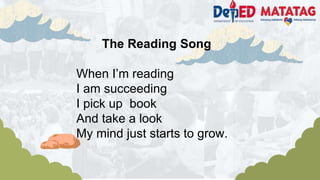
The Reading Song
When I’m reading
I am succeeding
I pick up book
And take a look
My mind just starts to grow.
When I’m reading
I feel so free…and
Turning pages,
Spending ages,
With friends of my own.
I love to read
I love to read
I love to read
And read and read and read
I love to read
Repeat
once
Note to the teacher: Play the song up to 0:55 only
COMPONENT 1: SHORT REVIEW
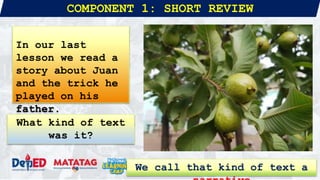
In our last
lesson we read a
story about Juan
and the trick he
played on his
father.
We call that kind of text a
What kind of text
was it?
COMPONENT 1: SHORT REVIEW
Q1. What information do
we usually find in the
first part of a
narrative?
A. Character and Setting
B. Crisis and Climax
C. Resolution
D. Moral Lesson
COMPONENT 1: SHORT REVIEW
Q2. How does the narrative get
going?
A. A problem arises
B. The events heightens
and reaches climax
C. Both A and B
D. A only
COMPONENT 1: SHORT REVIEW
Q3. How is the narrative
ended?
A. It ends with a climax
B. It ends with a crisis
C. The problem is
resolved
D. All of the above
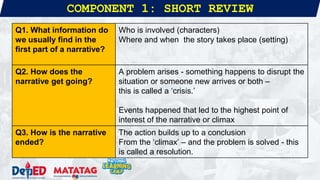
COMPONENT 1: SHORT REVIEW
Q1. What information do
we usually find in the
first part of a narrative?
Who is involved (characters)
Where and when the story takes place (setting)
Q2. How does the
narrative get going?
A problem arises - something happens to disrupt the
situation or someone new arrives or both –
this is called a ‘crisis.’
Events happened that led to the highest point of
interest of the narrative or climax
Q3. How is the narrative
ended?
The action builds up to a conclusion
From the ‘climax’ – and the problem is solved - this
is called a resolution.
LESSON PURPOSE
(3 minutes)
02
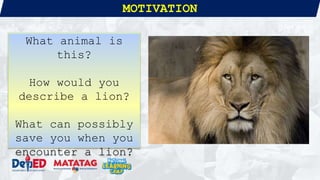
MOTIVATION
What animal is
this?
How would you
describe a lion?
What can possibly
save you when you
encounter a lion?
COMPONENT 3: LANGUAGE PRACTICE
In this lesson we are going to read
another narrative text.
Before that, we are going to look at words
and expressions that you need to know to
be able to understand this narrative.
After that let’s see if you can identify
each stage of the narrative as we read it.
LANGUAGE PRACTICE
(5 minutes)
03
COMPONENT 2: LESSON PURPOSE
The narrative you are about to read is,
Androcles and the Lion. It is a story from
ancient Rome.
We may meet some words that are important in
the narrative and that you may have not seen
before.
I listed such words and we will work on
their meanings so you will be able to
understand the narrative when we read it
shortly.
These words are written on your Workbook (see
COMPONENT 3: LANGUAGE PRACTICE
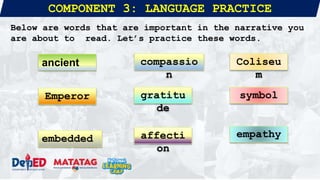
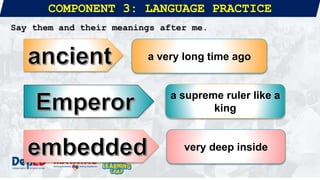
ancient
Emperor
embedded
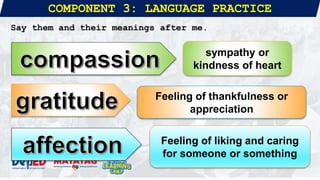
compassio
n
gratitu
de
affecti
on
Below are words that are important in the narrative you
are about to read. Let’s practice these words.
Coliseu
m
symbol
empathy
COMPONENT 3: LANGUAGE PRACTICE
Say them and their meanings after me.
a very long time ago
a supreme ruler like a
king
very deep inside
COMPONENT 3: LANGUAGE PRACTICE
Say them and their meanings after me.
sympathy or
kindness of heart
Feeling of thankfulness or
appreciation
Feeling of liking and caring
for someone or something
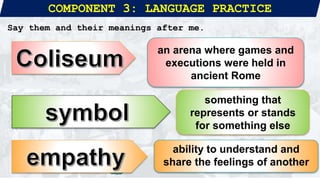
COMPONENT 3: LANGUAGE PRACTICE
Say them and their meanings after me.
an arena where games and
executions were held in
ancient Rome
something that
represents or stands
for something else
ability to understand and
share the feelings of another
COMPONENT 3: LANGUAGE PRACTICE
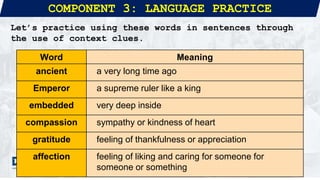
Word Meaning
ancient a very long time ago
Emperor a supreme ruler like a king
embedded very deep inside
compassion sympathy or kindness of heart
gratitude feeling of thankfulness or appreciation
affection feeling of liking and caring for someone for
someone or something
Let’s practice using these words in sentences through
the use of context clues.
COMPONENT 3: LANGUAGE PRACTICE
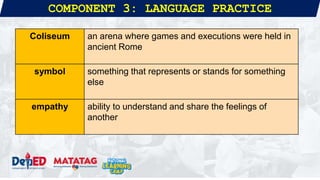
Coliseum an arena where games and executions were held in
ancient Rome
symbol something that represents or stands for something
else
empathy ability to understand and share the feelings of
another
COMPONENT 3: LANGUAGE PRACTICE
1. She cared for her patients with great __________.
2. The __________ ordered the kings to raise the taxes on
salt.
3. The __________ in Rome was a famous circular stadium
where gladiator combat were held.
4. In __________ times or around 230 million years ago,
dinosaurs were the dominant species.
5. She developed an __________ to the place and find it
hard to go home after her vacation.
6. His kindness and all-out support earned him the students’
__________.
7. They went to the doctor because the bone of the fish was
__________ in her throat.
8. An owl is a __________ of wisdom and intelligence.
9. He has __________ for the poor because he was a son a
janitor before he became a millionaire.
LESSON ACTIVITY
(25 minutes)
04
COMPONENT 4: LESSON ACTIVITY
1. Listen as I read the first paragraph
aloud. Then, read the paragraph
assigned to your group.
2. Identify any additional unfamiliar
language in the
narrative.
Component 4A: Reading the
Text
COMPONENT 4: LESSON ACTIVITY
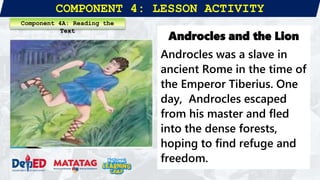
Androcles and the Lion
Androcles was a slave in
ancient Rome in the time of
the Emperor Tiberius. One
day, Androcles escaped
from his master and fled
into the dense forests,
hoping to find refuge and
freedom.
Component 4A: Reading the
Text
COMPONENT 4: LESSON ACTIVITY
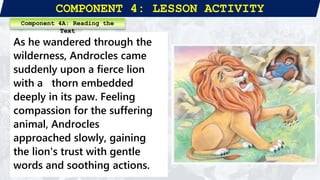
As he wandered through the
wilderness, Androcles came
suddenly upon a fierce lion
with a thorn embedded
deeply in its paw. Feeling
compassion for the suffering
animal, Androcles
approached slowly, gaining
the lion's trust with gentle
words and soothing actions.
Component 4A: Reading the
Text
COMPONENT 4: LESSON ACTIVITY
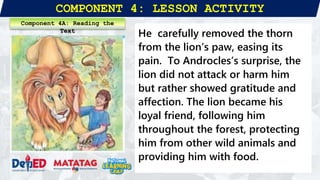
He carefully removed the thorn
from the lion’s paw, easing its
pain. To Androcles’s surprise, the
lion did not attack or harm him
but rather showed gratitude and
affection. The lion became his
loyal friend, following him
throughout the forest, protecting
him from other wild animals and
providing him with food.
Component 4A: Reading the
Text
COMPONENT 4: LESSON ACTIVITY
One day, Androcles was caught by Roman soldiers and
brought back to the city. He was sentenced to death for
his act of escape. The day of his execution arrived, and
he was thrown into the Coliseum, where a ferocious lion
was released to attack him.
Component 4A: Reading the
Text
COMPONENT 4: LESSON ACTIVITY
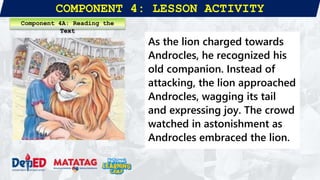
As the lion charged towards
Androcles, he recognized his
old companion. Instead of
attacking, the lion approached
Androcles, wagging its tail
and expressing joy. The crowd
watched in astonishment as
Androcles embraced the lion.
Component 4A: Reading the
Text
COMPONENT 4: LESSON ACTIVITY
Amazed by this remarkable display of loyalty and compassion, the
Emperor Tiberius spared Androcles' life and granted him freedom.
Androcles and the lion became a symbol of the power of kindness
and the bond that can develop between humans and animals.
The story of Androcles and the lion teaches us that even the
fiercest of creatures can show gratitude and love when treated
with kindness and compassion. It reminds us of the value of
empathy and the potential for friendship that exists in the most
unexpected places.
Component 4A: Reading the
Text
COMPONENT 4: LESSON ACTIVITY
THINK-PAIR-SHARE ACTIVITY
Here are some questions about the story from your
Workbook.
1. Read each question carefully. Then, locate the
needed information that answers each question.
2. Take note of the paragraph number where you found
the answer.
3. Share your thoughts with your seatmate.
Component 4B: Questions
Question Answer
Evidence from the Text
(Write the paragraph
number where you
found the answer)
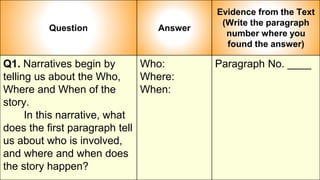
Q1. Narratives begin by
telling us about the Who,
Where and When of the
story.
In this narrative, what
does the first paragraph tell
us about who is involved,
and where and when does
the story happen?
Who:
Where:
When:
Paragraph No. ____
COMPONENT 4: LESSON ACTIVITY
Component 4B: Questions
Question Answer Evidence from the
Text
Q2. How was
Androcles able to
avoid being killed
by the lion in the
forest?
COMPONENT 4: LESSON ACTIVITY
Component 4B: Questions
Question Answer Evidence from
the Text
Q3. Find evidence
of the bravery of
Androcles in the
narrative.
COMPONENT 4: LESSON ACTIVITY
Component 4C: Questions
Let’s look at each the next questions carefully.
What information do we need to answer the question?
Where can we find the answer?
• Is it here in the words?
• Is it hidden in the words?
• Is it in your head?
COMPONENT 4: LESSON ACTIVITY
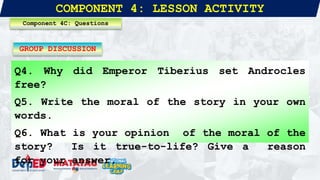
Q4. Why did Emperor Tiberius set Androcles
free?
Q5. Write the moral of the story in your own
words.
Q6. What is your opinion of the moral of the
story? Is it true-to-life? Give a reason
for your answer.
Component 4C: Questions
GROUP DISCUSSION
COMPONENT 4: LESSON ACTIVITY
Question Answer Where did you find
the answer?
(In the words,
Hidden in the words,
In our head)
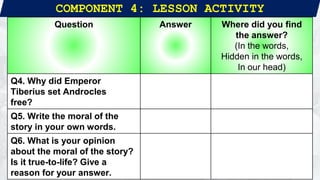
Q4. Why did Emperor
Tiberius set Androcles
free?
Q5. Write the moral of the
story in your own words.
Q6. What is your opinion
about the moral of the story?
Is it true-to-life? Give a
reason for your answer.
COMPONENT 4: LESSON ACTIVITY
Component 4C: Questions
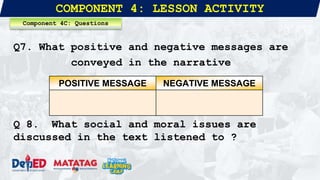
Q7. What positive and negative messages are
conveyed in the narrative
Q 8. What social and moral issues are
discussed in the text listened to ?
POSITIVE MESSAGE NEGATIVE MESSAGE
LESSON CONCLUSION
(5 minutes)
05
COMPONENT 5: CONCLUSION
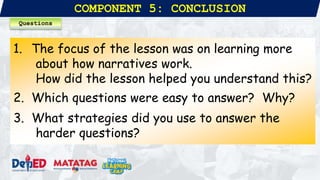
1. The focus of the lesson was on learning more
about how narratives work.
How did the lesson helped you understand this?
2. Which questions were easy to answer? Why?
3. What strategies did you use to answer the
harder questions?
Questions
COMPONENT 5: CONCLUSION
In the next lesson
we will look at
another, more
complex Narrative to
give your
more practice at
interpreting
narrative texts.
HOPE YOU ENJOYED
TODAY’S
LEARNING CAMP!
THANK YOU!

National Learning Camp English 8_Lesson 2.pptx

  • 2.
    GRADE 8 ENGLISH LESSON2 Reading the Text - Narratives
  • 3.
    KEY IDEA Locating informationand interpreting the text – Narratives
  • 4.
    MOST ESSENTIAL LEARNINGCOMPETENCIES • Recognize positive and negative message conveyed in a text (Q2) • Determine various social, moral and economic issues discussed in the text listened to ( Q3) (EN8LCIII-7.4).
  • 5.
    Short Review (7 mins) 01 LessonPurpose (3 mins) 02 Language Practice (5 mins) 03 Lesson Activity (25 mins) 04 Lesson Components English- Enhancement Lesson Conclusion (5 minutes) 05
  • 6.
  • 7.
    Listen to thissong entitled The Reading Song-World Book Day 2019 and sing it afterwards. https://youtube.com/watch?v=5n9V2NR- gqk&feature=share Note to the teacher: Play the song up to 0:55 only
  • 8.
    The Reading Song WhenI’m reading I am succeeding I pick up book And take a look My mind just starts to grow.
  • 9.
    When I’m reading Ifeel so free…and Turning pages, Spending ages, With friends of my own. I love to read
  • 10.
    I love toread I love to read And read and read and read I love to read Repeat once Note to the teacher: Play the song up to 0:55 only
  • 11.
    COMPONENT 1: SHORTREVIEW In our last lesson we read a story about Juan and the trick he played on his father. We call that kind of text a What kind of text was it?
  • 12.
    COMPONENT 1: SHORTREVIEW Q1. What information do we usually find in the first part of a narrative? A. Character and Setting B. Crisis and Climax C. Resolution D. Moral Lesson
  • 13.
    COMPONENT 1: SHORTREVIEW Q2. How does the narrative get going? A. A problem arises B. The events heightens and reaches climax C. Both A and B D. A only
  • 14.
    COMPONENT 1: SHORTREVIEW Q3. How is the narrative ended? A. It ends with a climax B. It ends with a crisis C. The problem is resolved D. All of the above
  • 15.
    COMPONENT 1: SHORTREVIEW Q1. What information do we usually find in the first part of a narrative? Who is involved (characters) Where and when the story takes place (setting) Q2. How does the narrative get going? A problem arises - something happens to disrupt the situation or someone new arrives or both – this is called a ‘crisis.’ Events happened that led to the highest point of interest of the narrative or climax Q3. How is the narrative ended? The action builds up to a conclusion From the ‘climax’ – and the problem is solved - this is called a resolution.
  • 16.
  • 17.
    MOTIVATION What animal is this? Howwould you describe a lion? What can possibly save you when you encounter a lion?
  • 18.
    COMPONENT 3: LANGUAGEPRACTICE In this lesson we are going to read another narrative text. Before that, we are going to look at words and expressions that you need to know to be able to understand this narrative. After that let’s see if you can identify each stage of the narrative as we read it.
  • 19.
  • 20.
    COMPONENT 2: LESSONPURPOSE The narrative you are about to read is, Androcles and the Lion. It is a story from ancient Rome. We may meet some words that are important in the narrative and that you may have not seen before. I listed such words and we will work on their meanings so you will be able to understand the narrative when we read it shortly. These words are written on your Workbook (see
  • 21.
    COMPONENT 3: LANGUAGEPRACTICE ancient Emperor embedded compassio n gratitu de affecti on Below are words that are important in the narrative you are about to read. Let’s practice these words. Coliseu m symbol empathy
  • 22.
    COMPONENT 3: LANGUAGEPRACTICE Say them and their meanings after me. a very long time ago a supreme ruler like a king very deep inside
  • 23.
    COMPONENT 3: LANGUAGEPRACTICE Say them and their meanings after me. sympathy or kindness of heart Feeling of thankfulness or appreciation Feeling of liking and caring for someone or something
  • 24.
    COMPONENT 3: LANGUAGEPRACTICE Say them and their meanings after me. an arena where games and executions were held in ancient Rome something that represents or stands for something else ability to understand and share the feelings of another
  • 25.
    COMPONENT 3: LANGUAGEPRACTICE Word Meaning ancient a very long time ago Emperor a supreme ruler like a king embedded very deep inside compassion sympathy or kindness of heart gratitude feeling of thankfulness or appreciation affection feeling of liking and caring for someone for someone or something Let’s practice using these words in sentences through the use of context clues.
  • 26.
    COMPONENT 3: LANGUAGEPRACTICE Coliseum an arena where games and executions were held in ancient Rome symbol something that represents or stands for something else empathy ability to understand and share the feelings of another
  • 27.
    COMPONENT 3: LANGUAGEPRACTICE 1. She cared for her patients with great __________. 2. The __________ ordered the kings to raise the taxes on salt. 3. The __________ in Rome was a famous circular stadium where gladiator combat were held. 4. In __________ times or around 230 million years ago, dinosaurs were the dominant species.
  • 28.
    5. She developedan __________ to the place and find it hard to go home after her vacation. 6. His kindness and all-out support earned him the students’ __________. 7. They went to the doctor because the bone of the fish was __________ in her throat. 8. An owl is a __________ of wisdom and intelligence. 9. He has __________ for the poor because he was a son a janitor before he became a millionaire.
  • 29.
  • 30.
    COMPONENT 4: LESSONACTIVITY 1. Listen as I read the first paragraph aloud. Then, read the paragraph assigned to your group. 2. Identify any additional unfamiliar language in the narrative. Component 4A: Reading the Text
  • 31.
    COMPONENT 4: LESSONACTIVITY Androcles and the Lion Androcles was a slave in ancient Rome in the time of the Emperor Tiberius. One day, Androcles escaped from his master and fled into the dense forests, hoping to find refuge and freedom. Component 4A: Reading the Text
  • 32.
    COMPONENT 4: LESSONACTIVITY As he wandered through the wilderness, Androcles came suddenly upon a fierce lion with a thorn embedded deeply in its paw. Feeling compassion for the suffering animal, Androcles approached slowly, gaining the lion's trust with gentle words and soothing actions. Component 4A: Reading the Text
  • 33.
    COMPONENT 4: LESSONACTIVITY He carefully removed the thorn from the lion’s paw, easing its pain. To Androcles’s surprise, the lion did not attack or harm him but rather showed gratitude and affection. The lion became his loyal friend, following him throughout the forest, protecting him from other wild animals and providing him with food. Component 4A: Reading the Text
  • 34.
    COMPONENT 4: LESSONACTIVITY One day, Androcles was caught by Roman soldiers and brought back to the city. He was sentenced to death for his act of escape. The day of his execution arrived, and he was thrown into the Coliseum, where a ferocious lion was released to attack him. Component 4A: Reading the Text
  • 35.
    COMPONENT 4: LESSONACTIVITY As the lion charged towards Androcles, he recognized his old companion. Instead of attacking, the lion approached Androcles, wagging its tail and expressing joy. The crowd watched in astonishment as Androcles embraced the lion. Component 4A: Reading the Text
  • 36.
    COMPONENT 4: LESSONACTIVITY Amazed by this remarkable display of loyalty and compassion, the Emperor Tiberius spared Androcles' life and granted him freedom. Androcles and the lion became a symbol of the power of kindness and the bond that can develop between humans and animals. The story of Androcles and the lion teaches us that even the fiercest of creatures can show gratitude and love when treated with kindness and compassion. It reminds us of the value of empathy and the potential for friendship that exists in the most unexpected places. Component 4A: Reading the Text
  • 37.
    COMPONENT 4: LESSONACTIVITY THINK-PAIR-SHARE ACTIVITY Here are some questions about the story from your Workbook. 1. Read each question carefully. Then, locate the needed information that answers each question. 2. Take note of the paragraph number where you found the answer. 3. Share your thoughts with your seatmate. Component 4B: Questions
  • 38.
    Question Answer Evidence fromthe Text (Write the paragraph number where you found the answer) Q1. Narratives begin by telling us about the Who, Where and When of the story. In this narrative, what does the first paragraph tell us about who is involved, and where and when does the story happen? Who: Where: When: Paragraph No. ____
  • 39.
    COMPONENT 4: LESSONACTIVITY Component 4B: Questions Question Answer Evidence from the Text Q2. How was Androcles able to avoid being killed by the lion in the forest?
  • 40.
    COMPONENT 4: LESSONACTIVITY Component 4B: Questions Question Answer Evidence from the Text Q3. Find evidence of the bravery of Androcles in the narrative.
  • 41.
    COMPONENT 4: LESSONACTIVITY Component 4C: Questions Let’s look at each the next questions carefully. What information do we need to answer the question? Where can we find the answer? • Is it here in the words? • Is it hidden in the words? • Is it in your head?
  • 42.
    COMPONENT 4: LESSONACTIVITY Q4. Why did Emperor Tiberius set Androcles free? Q5. Write the moral of the story in your own words. Q6. What is your opinion of the moral of the story? Is it true-to-life? Give a reason for your answer. Component 4C: Questions GROUP DISCUSSION
  • 43.
    COMPONENT 4: LESSONACTIVITY Question Answer Where did you find the answer? (In the words, Hidden in the words, In our head) Q4. Why did Emperor Tiberius set Androcles free? Q5. Write the moral of the story in your own words. Q6. What is your opinion about the moral of the story? Is it true-to-life? Give a reason for your answer.
  • 44.
    COMPONENT 4: LESSONACTIVITY Component 4C: Questions Q7. What positive and negative messages are conveyed in the narrative Q 8. What social and moral issues are discussed in the text listened to ? POSITIVE MESSAGE NEGATIVE MESSAGE
  • 45.
  • 46.
    COMPONENT 5: CONCLUSION 1.The focus of the lesson was on learning more about how narratives work. How did the lesson helped you understand this? 2. Which questions were easy to answer? Why? 3. What strategies did you use to answer the harder questions? Questions
  • 47.
    COMPONENT 5: CONCLUSION Inthe next lesson we will look at another, more complex Narrative to give your more practice at interpreting narrative texts.
  • 48.

Editor's Notes

  • #13   Individually write your answers to Question 1 on the Workbook. Q1.What information do we usually find in the first part of a narrative? (What do we call this part? Did the story stop there? Why?  Teacher seeks answers from students and writes the 3 parts of a narrative and their names on the board/whiteboard. Characters, Setting, Plot
  • #14   Individually write your answers to Question 1 on the Workbook. Q1.What information do we usually find in the first part of a narrative? (What do we call this part? Did the story stop there? Why?  Teacher seeks answers from students and writes the 3 parts of a narrative and their names on the board/whiteboard. Characters, Setting, Plot
  • #15   Individually write your answers to Question 1 on the Workbook. Q1.What information do we usually find in the first part of a narrative? (What do we call this part? Did the story stop there? Why?  Teacher seeks answers from students and writes the 3 parts of a narrative and their names on the board/whiteboard. Characters, Setting, Plot
  • #16   Individually write your answers to Question 1 of your Workbook.  Teacher seeks answers from students and writes the 3 parts of a narrative and their names on the board/whiteboard. In short, yesterday we have located some important parts of the narrative: Characters, Setting, Plot These leads us to the theme or lesson in the story
  • #23 Let’s practice these words. Say them and their meanings after me. Look at their spelling.
  • #24 Let’s practice these words. Say them and their meanings after me. Look at their spelling.
  • #25 Let’s practice these words. Say them and their meanings after me. Look at their spelling.
  • #26 Let’s practice these words. Say them and their meanings after me. Look at their spelling.
  • #27 Let’s practice these words. Say them and their meanings after me. Look at their spelling
  • #38 [Questions can be answered orally for lower level students.]
  • #39 Suggested Answers: Q1.Who: Androcles and the Emperor Tiberius; Where: Ancient Rome; When: ancient times.  Teacher samples answers to the questions from the students.  Teacher provides appropriate feedback to answers
  • #40 Q2. How did Androcles avoid being killed by the lion in the forest? Q2 Possible Answer: He removed the thorn from the lion’s paw and he made friends with him.
  • #41 Suggested Answers: Q3. He escaped from Rome because he wanted to have freedom from slavery ; he approached the lion and removed the thorn from the lion’s paw..  Students answer the questions.  Teacher samples answers to the questions from the students.  Teacher provides appropriate feedback to answers
  • #42 Suggested Answers: Q1. Who: Androcles and the Emperor Tiberius; Where: Ancient Rome; When: ancient times. Q2. He makes friends with the lion and removes the thorn from the lion’s paw. Q3. He escapes from Rome; he approaches the lion with friendly gestures; he removes the thorn from the lion’s paw..  Students answer the questions in the Workbook.  Teacher samples answers to the questions from the students.  Teacher provides appropriate feedback to answers
  • #44 Students write answers.  Teacher samples answers to the questions from the students.  Teacher provides feedback to answers. Suggested Answers Q1. He and the crowd are amazed that the lion and Androcles are friends. Q2. Be prepared for a range of answers covering the last 2 paragraphs of the narrative. Q3. Be prepared for a range of answers including agreement and disagreement about the story being true-to-life. Focus on the reasons given. [Teacher Notes: Feel free to do Q4 as a class discussion if running short of time for Questions 5 and 6.]
  • #45 Positive message example: Kindness begets kindness Negative Message: None Social and moral issue: It touches the social and moral issue of slavery which has the potential to harm a person.
  • #47 [Teacher Notes: It would be worthwhile to do this by getting students to write on the Worksheet so you have some feedback on the effectiveness of the lesson and how they feel about their learning experience. However, if pressed for time, you may want to do this section as a class discussion.] REMINDER: Collect student worksheets to review and analyze students’ learning – focus on answers to Question 1 under Component 5 for quality and clarity of writing and understanding of the content.  
  • #48 REMINDER: Collect student worksheets to review and analyze students’ learning – focus on answers to Question 1 under Component 5 for quality and clarity of writing and understanding of the content.