NATIONAL
HEALTH
POLICY &
PRIORITY
National:
 National is used to describe something
that belongs to or is typical of a particular
country or nation.
Health:
Health is a state of complete physical,
mental and social well-being and not
merely the absence of disease or infirmity.
POLICY: -
A course or
principle of
action adopted
or proposed by
an organization
or individual.
STEPS FOR
IMPLEMENTATION OF A POLICY:
-
Identification and issue recognition.
Policy formulation.
Policy implementation.
Policy evaluation.
NATIONAL HEALTH POLICY
 National health policy in India was not framed and
announced until 1983.
 The ministry of health and family welfare evolved a
National Health Policy in 1983, keeping in view the
national commitment to attain the goal health for all by
2000 A.D.
 The policy lays stress on the preventive, promotive,
public health and rehabilitation aspects of health
care.
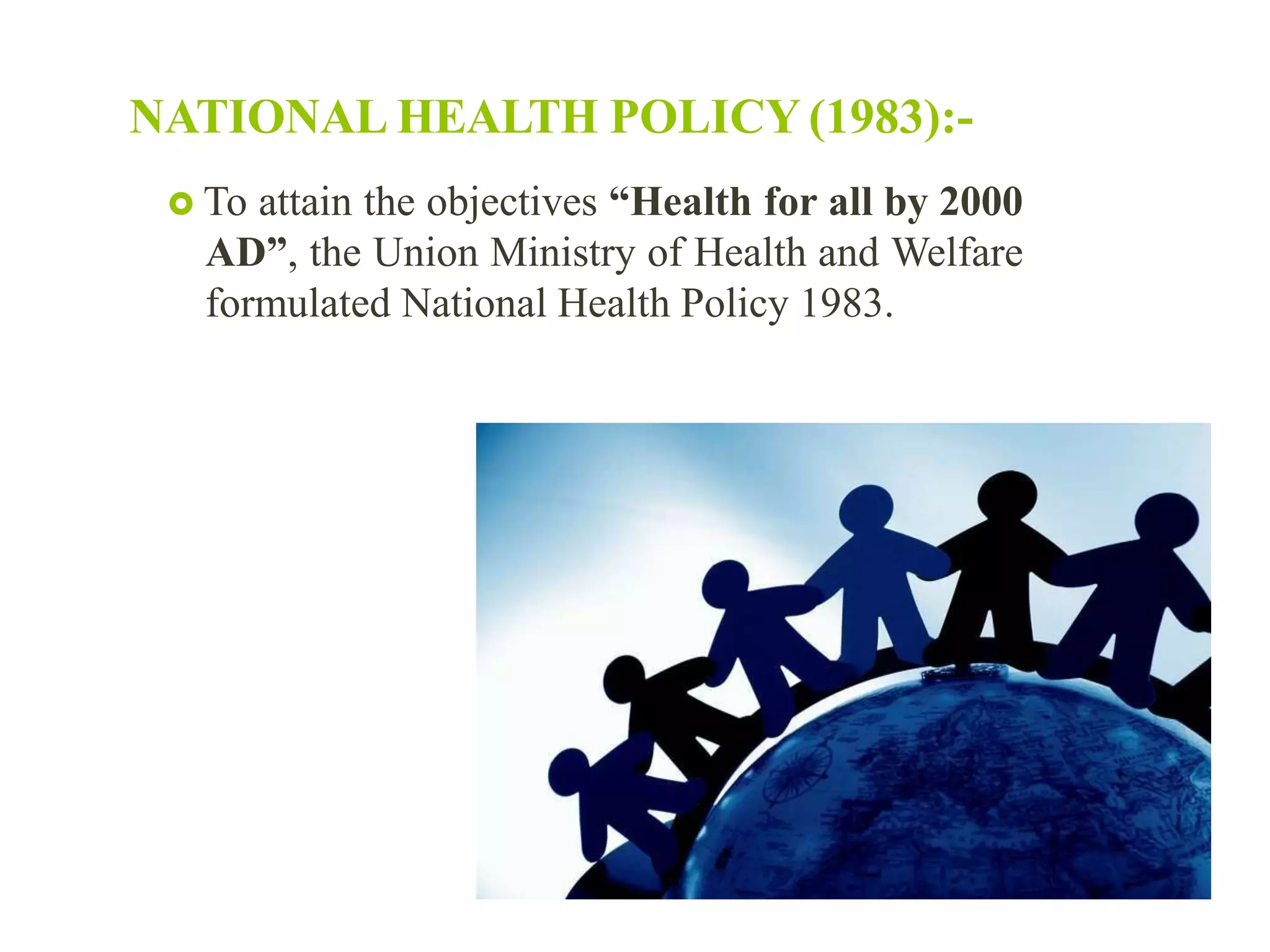
NATIONAL HEALTH POLICY (1983):-
 To attain the objectives “Health for all by 2000
AD”, the Union Ministry of Health and Welfare
formulated National Health Policy 1983.
Key elements of National Health
Policy 1983:-
Creation of greater awareness of health problems in
the community and means to solve the problems by
the community.
 Supply of safe drinking water sanitation using
technologies that affords.
 Reduction of existing imbalance in health services by
concentrating more on the rural health infrastructure.
 Establishing of dynamic health management
information system to support health planning and
health program implementation.
 Provision of legislative support to health
protection and promotion.
 Concerned actions to combat wide spread
malnutrition.
 Research in alternative method of health care
delivery and low cost health technologies.
 Greater co-ordination of different system of
medicine.
Factors interfering with the progress towards
health for all:-
 Insufficient political commitment to the
implementation on Health for All.
 Failure to achieve equity in access to all primary
health care elements.
 The continuing low status of women.
 Slow socio-economic development.
 Difficulty in achieving intersectoral action for health.
 Unbalanced distributionof and weak support for
human resources.
 Widespread inadequacy of health promotion activities.
 Weak health information system and no baseline data.
 Pollution, poor food, safety, and lack of water supply
and sanitation.
 Rapid demographic and epidemiological
changes.
 Inappropriate use of and allocation of
resources, high-cost technology.
 Natural and man-made disasters.
NATIONAL HEALTH POLICY
2001:-
Health and Family Welfare felt it necessary to
formulate a new health policy frameworks as
Considering the kind and level of progress, the barriers and the
change in health problems and the circumstances, the department
of Health, Ministry of Health & family welfare make new policy
The main objective of National Health Policy 2001 is
to achieve acceptable standard of good health
amongst the general population of the country.
Goals to be achieved by 2000-2001 to 2015:-
 Eradicate Polio and Yaws - 2005
 Eliminate Leprosy - 2005
 Eliminate Kala- Azar - 2010
 Eliminate Lymphatic Filariasis - 2015
 Achieve zero level growth of HIV/AIDS - 2007
 Reduce mortality by 50% on account of
TB,Malaria Other vector born and water
born diseases.
- 2010
 Prevalence of blindness to 0.5% - 2010
 Reduce IMR to 30/1000 and MMR
to 100/lakh
- 2010
 Improve nutrition and reduce
LBW Babies from 30% to 10%
- 2010
-2010
Increase the utilization of Public Health
Facilities from current >20 to <75%
Establish an integrated system of
surveillance -
-2005
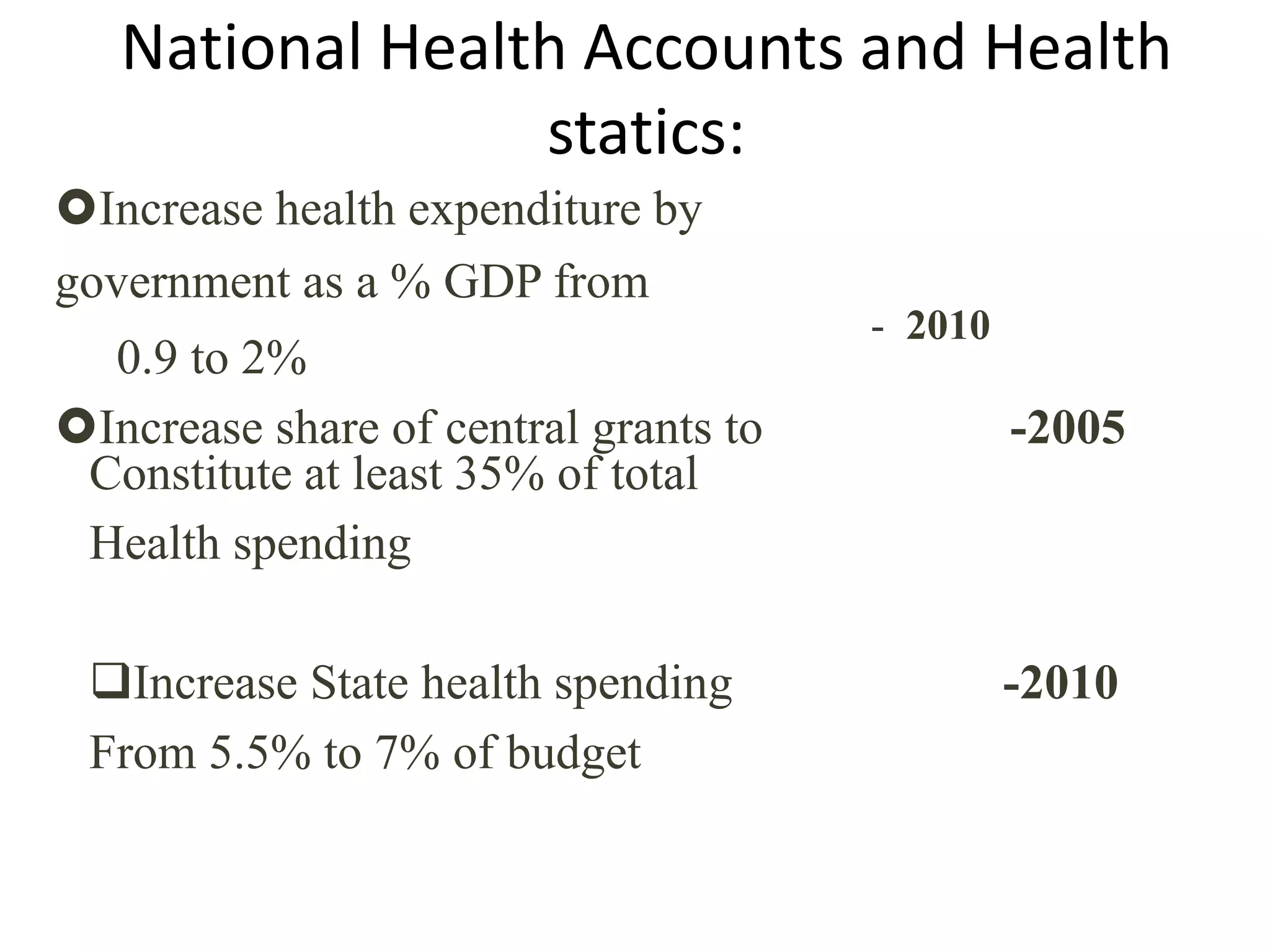
National Health Accounts and Health
statics:
- 2010
Increase health expenditure by
government as a % GDP from
0.9 to 2%
Increase share of central grants to -2005
Constitute at least 35% of total
Health spending
Increase State health spending -2010
From 5.5% to 7% of budget
Problems Prevellence
CURRENTS STAT’S
PROBLEM STAT’S
Small pox, Polio
Dracunculiasis
Eradicated
Leprosy .72/10,000
HIV/Aids 0.36%
Tuberculosis 1.8/100,000
Malaria 28.8/100,000
IMR 36/1000
MMR 167/100,000
WHO’S CONTRIBUTION FOR
HEALTH FOR ALL IN 21st CENTURY:-
 Serve as the world’s health advocate, by providing leadership for
Health for all to all its member countries.
o Develop global, ethical and scientific norms and standards.
Develop international instruments that promote global health.
 Engage in technical co-operative with all countries
Contd…..
Performance of essential public health
functions.
›Strengthen countries capabilities of building
sustainable health system and improve the
communities and countries.
Faster the use of the innovation in scienceand
technology for health.
 Provide leadership for eradication, elimination,
or control of selected diseases.
 Provide technical support to prevention of public
health emergencies and post-emergency
rehabilitation.
 Build partnership of health.
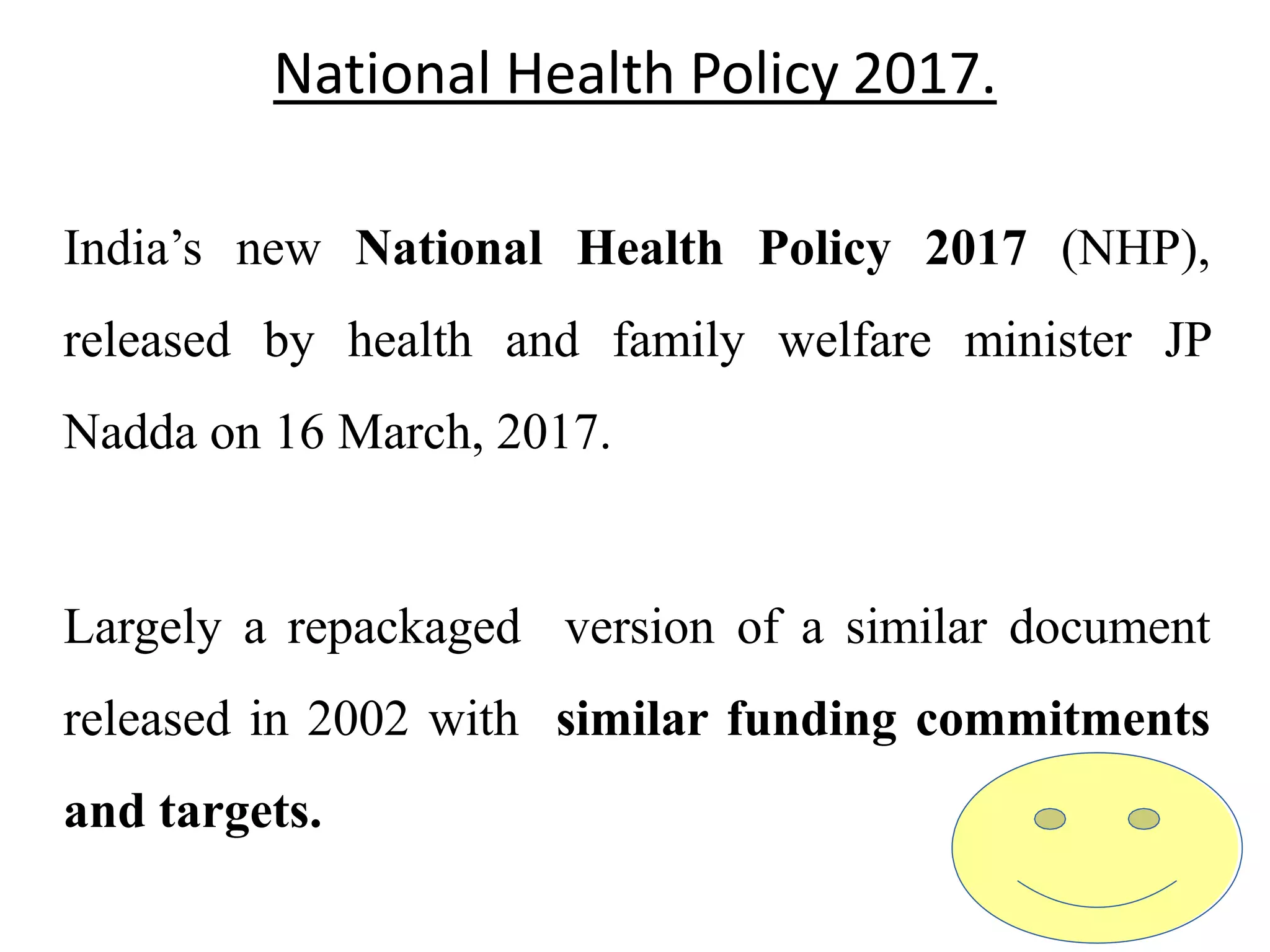
National Health Policy 2017.
India’s new National Health Policy 2017 (NHP),
released by health and family welfare minister JP
Nadda on 16 March, 2017.
Largely a repackaged version of a similar document
released in 2002 with similar funding commitments
and targets.
Contd……
• Ambitious infant- and maternal-mortality and
disease elimination targets rolled out under the
NHP 2017 are the same targets fixed 15 years
ago; these targets were to be achieved by 2010.
• The new health policy has now fixed 2019 or
later to achieve these targets.
National Health Policy, 2017
• The Policy seeks to reach everyone in a
comprehensive integrated way to move towards
wellness.
• It aims at achieving universal health coverage and
delivering quality health care services to all at
affordable cost.
The National Health Policy, 2017
The National Health Policy, 2017 adopted an
elaborate procedure for its formulation involving
stakeholder consultations.
• Accordingly, the Government of India formulated the
Draft National Health Policy and placed it in public
domain on 30thDecember, 2014.
The National Health Policy (NHP), 2017
• Consultations with the stakeholders and State
Governments, based on the suggestions received, the
Draft National Health Policy was further fine-tuned.
• It received the endorsement of the Central Council for
Health & Family Welfare, the apex policy making body,
in its Twelfth Conference
• The socio economic and epidemiological changes since
then necessitated the form NHP to address emerging
challenges.
Goal NHP-2017
Attainment of the highest possible level of health
and well-being for all at all ages, through a
preventive and promotive health care
 Orientation in all developmental policies, and
universal access to good quality health care
services without anyone having to face financial
hardship as a consequence.
Through increasing access, improving quality and
lowering the cost of healthcare delivery.
Objectives NHP-2017
Improve health status through concerted policy
action in all sectors and expand preventive,
promotive, curative, palliative and rehabilitative
services provided through the public health sector
with focus on quality.
Financing:
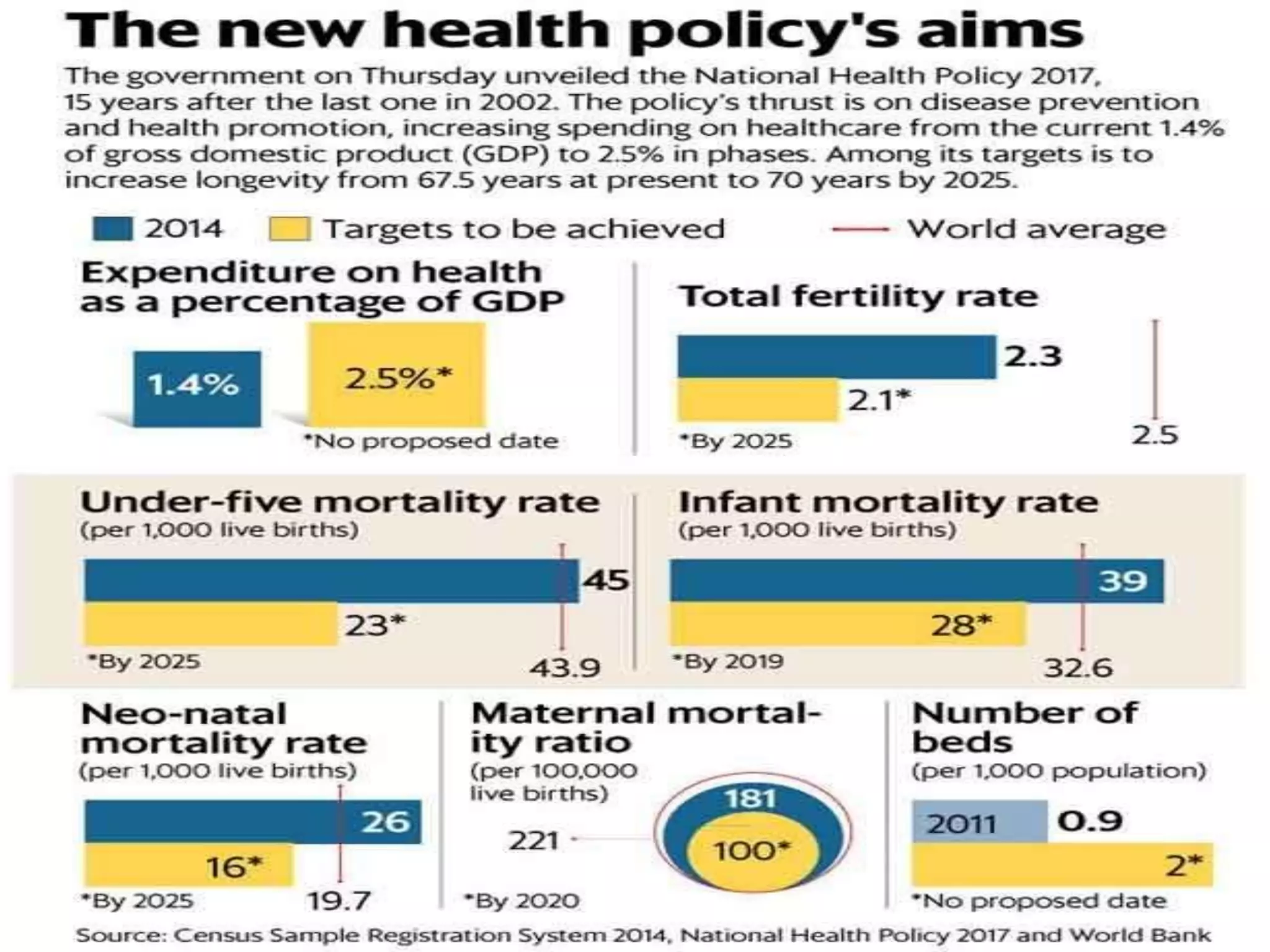
The policy proposes raising public health
expenditure to 2.5% of the GDP in a time bound
manner.
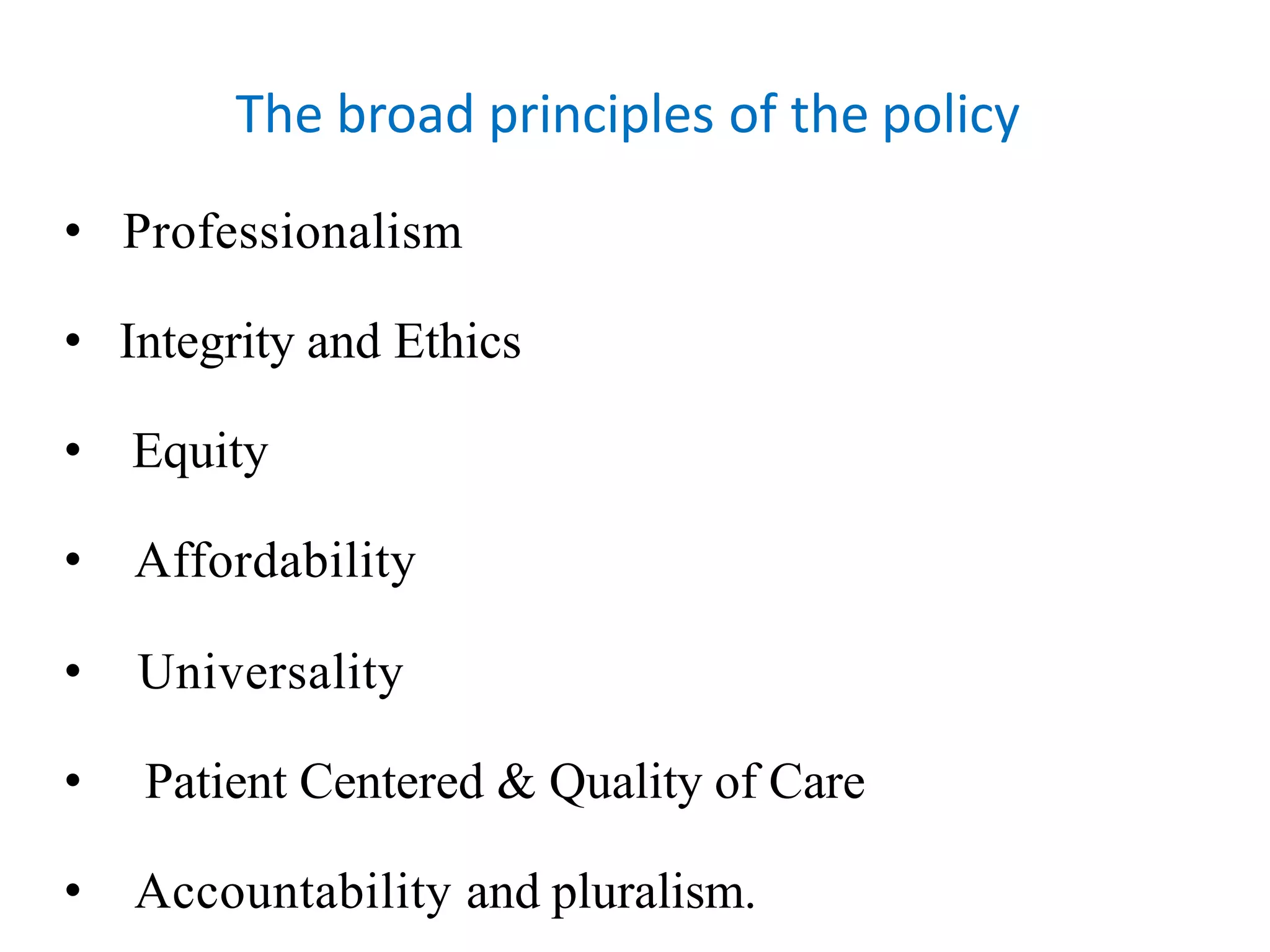
The broad principles of the policy
• Professionalism
• Integrity and Ethics
• Equity
• Affordability
• Universality
• Patient Centered & Quality of Care
• Accountability and pluralism.
Specific Quantitative Goals and objectives
FR to 2.1 at national and sub-
national
HEALTH STATUS & PROGRAMME
IMPACT-Life Expectancy and healthy life
 Increase Life Expectancy at birth from
67.5 to 70 by 2025.
 Establish regular tracking of Disability
Adjusted Life Years (DALY) Index as
a measure of burden of disease and its
trends by major categories by 2022.
 Reduction of TFR level by 2025.
Mortality by Age and/ or cause
• Reduce Under Five Mortality to 23 by 2025 and
MMR from current levels to 100 by 2020.
• Reduce infant mortality rate to 28 by 2019.
• Reduce neo-natal mortality to 16 and still birth rate
to “single digit” by 2025.
Reduction of disease prevalence/ incidence
• Achieve global target of 2020 which is also termed as
target of 90:90:90, for HIV/AIDS
- 90% of all people living with HIV know their HIV
status, - 90% of all people diagnosed with HIV
infection receive sustained antiretroviral therapy and
90% of all people receiving antiretroviral therapy will
have viral suppression.
• Achieve and maintain elimination status of Leprosy by
2018, Kala-Azar by 20 Filariasis in endemic pockets
by 17 and lymphatic 2017.
Reduction of disease prevalence/ incidence...
• To achieve and maintain a cure rate of >85% in new
sputum positive patients for TB and reduce incidence
of new cases, to reach elimination status by 2025.
• To reduce the prevalence of blindness to 0.25/ 1000
by 2025 and disease burden by one third from current
levels.
• To reduce premature mortality from cardiovascular
diseases, cancer, diabetes or chronic respiratory
diseases by 25% by 2025.
Health Systems strengthening
Health finance
• Increase health expenditure by Government as a
percentage of GDP from the existing 1.1 5 % to 2.5
% by 2025.
• Increase State sector health spending to > 8% of their
budget by 2020.
• Decrease in proportion of hous catastrophic health
expenditure levels by 25%, by 2025.
Health Systems strengthening………
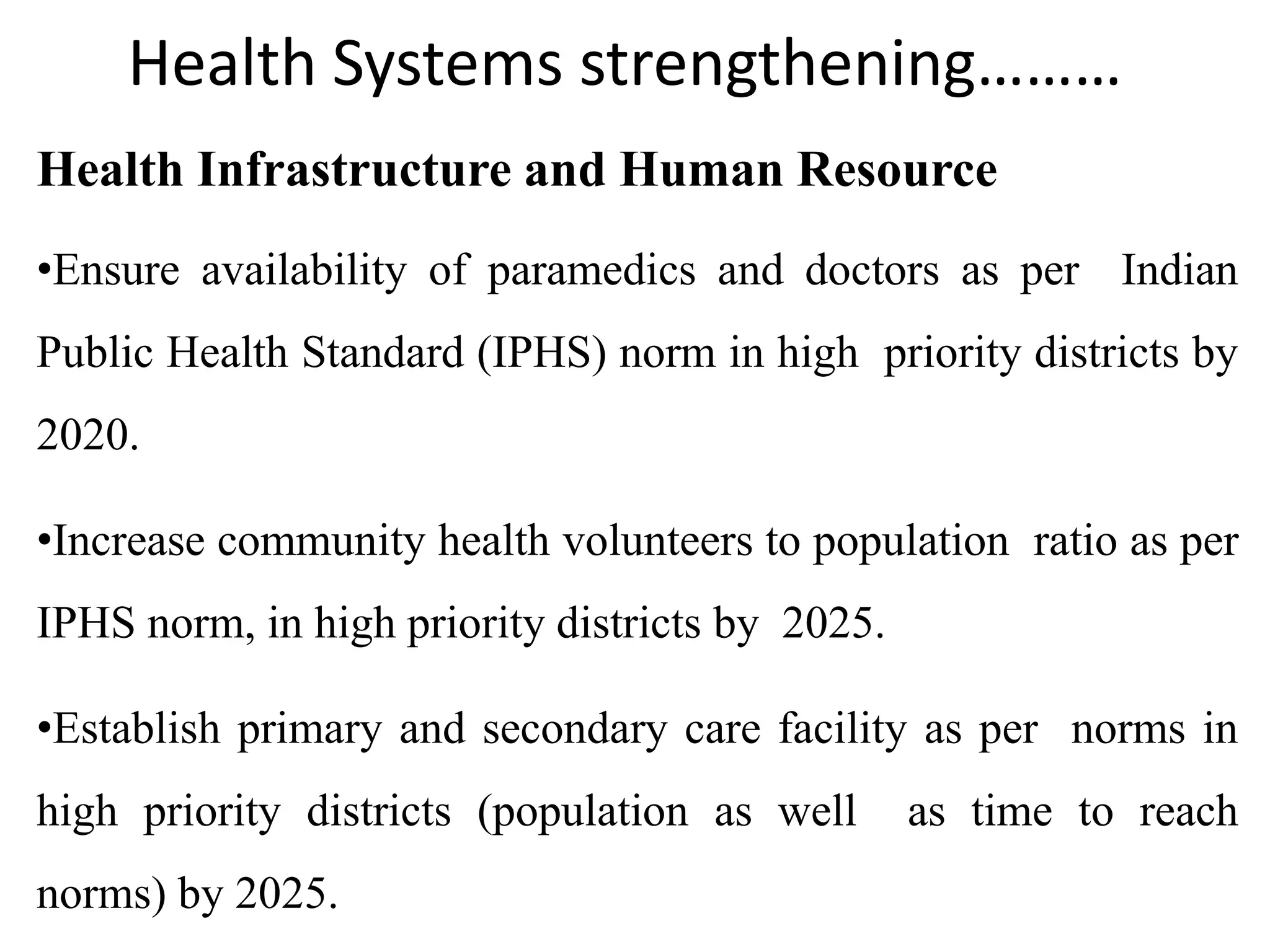
Health Infrastructure and Human Resource
•Ensure availability of paramedics and doctors as per Indian
Public Health Standard (IPHS) norm in high priority districts by
2020.
•Increase community health volunteers to population ratio as per
IPHS norm, in high priority districts by 2025.
•Establish primary and secondary care facility as per norms in
high priority districts (population as well as time to reach
norms) by 2025.
Health Management Information
• Ensure district - level electronic database of
information on health system components by 2020.
• Strengthen the health surveillance system and
establish registries for diseases of public health
importance by 2020.
• Establish federated integrated health information
architecture, Health Information Exchanges and
National Health Information Network by 2025.
Policy thrust
Ensuring Adequate Investment - The policy
proposes a potentially achievable target of raising
public health expenditure to 2.5% of the GDP in a
time bound manner.
Preventive and Promotive Health
The policy identifies coordinated action on seven priority
areas for improving the environment for health:
•The Swachh Bharat Abhiyan
•Balanced, healthy diets and regular exercises.
•Addressing tobacco, alcohol and substance abuse
•Yatri Suraksha – preventing deaths due to rail and road
traffic accidents
•Nirbhaya Nari – action against gender violence
SCHOOL HEALTH PROGRAMME
•The policy affirms commitment to pre-emptive care
(aimed at pre-empting the occurrence of diseases) to
achieve optimum levels of child and adolescent health.
•School health programmes as a major focus area as
also health and hygiene being made a part of the school
curriculum.
YOGA
Main streaming the different health systems.
Towards main streaming the potential of AYUSH
The policy envisages better access to AYUSH
remedies through co-location in public facilities.
Yoga would also be introduced much more widely
in school and work places as part of promotion of
good health.
National Digital Health Authority (NDHA)
National Digital Health Authority (NDHA) to
regulate, develop and deploy digital health across
the continuum of care.
Fact check of main targets fixed by the NHP of
2017 found:
1.The NHP 2017 sets a target of reducing infant mortality rate
(IMR, or infant deaths per 1,000 live births) to 28 by 2019; the
target set in the 2002 health policy was to reduce it to 30 by 2010.
The IMR in 2015-16 was 41.
2.The NHP 2017 sets the target for maternal mortality ratio–
deaths of women per 100,000 live births–at 100 to be achieved by
2020; the target set in 2002 was to reduce it to 100 by 2010. The
MMR in 2015-16 is 167.
Fact check of main targets fixed by the national
health policy of 2017 found......
The NHP 2017 has set the target to eliminate leprosy by
2018, kala azar (black fever or visceral
leishmaniasis) by 2017 and lymphatic filariasis
(elephantiasis) in endemic pockets by 2017.
 The 2002 NHP had set the target of eliminating
leprosy by 2005, kala azar by 2010 and
lymphatic filariasis by 2015–none of which
could be achieved yet.
Fact check of main targets fixed by the national
health policy of 2017 found......
The NHP 2017 has set the target of reducing the
incidence of new tuberculosis cases and reach
elimination status by 2025. This would mean a
reduction of 95 percent in new cases
The 2002 document set the target of reducing mortality
due to TB by 50 percent by 2010. The mortality
rate for TB was 59.7 per 100,000 population in
2000, which reduced to 42.6 in 2010, missing
the target set. In 2015, TB mortality rate was
35.9 per 100,000 population.
Public health priorities for India
• Indian states are in different phases of
epidemiological transition.
• However, the public health priorities across
the country remain similar.
• Only 21% of all registered deaths in India had
a medically certified cause of death available
in 2019.
• Addressing this gap in data is among the most
urgent public health priority for the country.
• We are facing the problem of communicable as
well as non communicable diseases.
• The continuing burden of malnutrition in India
highlights the need for coordinated and
intersectoral action between the relevant
ministries to address this complex and
persistent health challenge.
• The neglect of injuries, despite their substantial
burden.
NATIONAL  HEALTH  POLICY  & PRIORITY.pptx

NATIONAL HEALTH POLICY & PRIORITY.pptx

  • 1.
  • 2.
    National:  National isused to describe something that belongs to or is typical of a particular country or nation.
  • 3.
    Health: Health is astate of complete physical, mental and social well-being and not merely the absence of disease or infirmity.
  • 4.
    POLICY: - A courseor principle of action adopted or proposed by an organization or individual.
  • 5.
    STEPS FOR IMPLEMENTATION OFA POLICY: - Identification and issue recognition. Policy formulation. Policy implementation. Policy evaluation.
  • 6.
    NATIONAL HEALTH POLICY National health policy in India was not framed and announced until 1983.  The ministry of health and family welfare evolved a National Health Policy in 1983, keeping in view the national commitment to attain the goal health for all by 2000 A.D.  The policy lays stress on the preventive, promotive, public health and rehabilitation aspects of health care.
  • 7.
    NATIONAL HEALTH POLICY(1983):-  To attain the objectives “Health for all by 2000 AD”, the Union Ministry of Health and Welfare formulated National Health Policy 1983.
  • 8.
    Key elements ofNational Health Policy 1983:- Creation of greater awareness of health problems in the community and means to solve the problems by the community.  Supply of safe drinking water sanitation using technologies that affords.  Reduction of existing imbalance in health services by concentrating more on the rural health infrastructure.
  • 9.
     Establishing ofdynamic health management information system to support health planning and health program implementation.  Provision of legislative support to health protection and promotion.  Concerned actions to combat wide spread malnutrition.  Research in alternative method of health care delivery and low cost health technologies.  Greater co-ordination of different system of medicine.
  • 10.
    Factors interfering withthe progress towards health for all:-  Insufficient political commitment to the implementation on Health for All.  Failure to achieve equity in access to all primary health care elements.  The continuing low status of women.  Slow socio-economic development.
  • 11.
     Difficulty inachieving intersectoral action for health.  Unbalanced distributionof and weak support for human resources.  Widespread inadequacy of health promotion activities.  Weak health information system and no baseline data.  Pollution, poor food, safety, and lack of water supply and sanitation.
  • 12.
     Rapid demographicand epidemiological changes.  Inappropriate use of and allocation of resources, high-cost technology.  Natural and man-made disasters.
  • 13.
    NATIONAL HEALTH POLICY 2001:- Healthand Family Welfare felt it necessary to formulate a new health policy frameworks as Considering the kind and level of progress, the barriers and the change in health problems and the circumstances, the department of Health, Ministry of Health & family welfare make new policy The main objective of National Health Policy 2001 is to achieve acceptable standard of good health amongst the general population of the country.
  • 14.
    Goals to beachieved by 2000-2001 to 2015:-  Eradicate Polio and Yaws - 2005  Eliminate Leprosy - 2005  Eliminate Kala- Azar - 2010  Eliminate Lymphatic Filariasis - 2015  Achieve zero level growth of HIV/AIDS - 2007  Reduce mortality by 50% on account of TB,Malaria Other vector born and water born diseases. - 2010
  • 15.
     Prevalence ofblindness to 0.5% - 2010  Reduce IMR to 30/1000 and MMR to 100/lakh - 2010  Improve nutrition and reduce LBW Babies from 30% to 10% - 2010 -2010 Increase the utilization of Public Health Facilities from current >20 to <75% Establish an integrated system of surveillance - -2005
  • 16.
    National Health Accountsand Health statics: - 2010 Increase health expenditure by government as a % GDP from 0.9 to 2% Increase share of central grants to -2005 Constitute at least 35% of total Health spending Increase State health spending -2010 From 5.5% to 7% of budget
  • 17.
    Problems Prevellence CURRENTS STAT’S PROBLEMSTAT’S Small pox, Polio Dracunculiasis Eradicated Leprosy .72/10,000 HIV/Aids 0.36% Tuberculosis 1.8/100,000 Malaria 28.8/100,000 IMR 36/1000 MMR 167/100,000
  • 18.
    WHO’S CONTRIBUTION FOR HEALTHFOR ALL IN 21st CENTURY:-  Serve as the world’s health advocate, by providing leadership for Health for all to all its member countries. o Develop global, ethical and scientific norms and standards. Develop international instruments that promote global health.  Engage in technical co-operative with all countries
  • 19.
    Contd….. Performance of essentialpublic health functions. ›Strengthen countries capabilities of building sustainable health system and improve the communities and countries. Faster the use of the innovation in scienceand technology for health.
  • 20.
     Provide leadershipfor eradication, elimination, or control of selected diseases.  Provide technical support to prevention of public health emergencies and post-emergency rehabilitation.  Build partnership of health.
  • 23.
    National Health Policy2017. India’s new National Health Policy 2017 (NHP), released by health and family welfare minister JP Nadda on 16 March, 2017. Largely a repackaged version of a similar document released in 2002 with similar funding commitments and targets.
  • 24.
    Contd…… • Ambitious infant-and maternal-mortality and disease elimination targets rolled out under the NHP 2017 are the same targets fixed 15 years ago; these targets were to be achieved by 2010. • The new health policy has now fixed 2019 or later to achieve these targets.
  • 25.
    National Health Policy,2017 • The Policy seeks to reach everyone in a comprehensive integrated way to move towards wellness. • It aims at achieving universal health coverage and delivering quality health care services to all at affordable cost.
  • 26.
    The National HealthPolicy, 2017 The National Health Policy, 2017 adopted an elaborate procedure for its formulation involving stakeholder consultations. • Accordingly, the Government of India formulated the Draft National Health Policy and placed it in public domain on 30thDecember, 2014.
  • 27.
    The National HealthPolicy (NHP), 2017 • Consultations with the stakeholders and State Governments, based on the suggestions received, the Draft National Health Policy was further fine-tuned. • It received the endorsement of the Central Council for Health & Family Welfare, the apex policy making body, in its Twelfth Conference • The socio economic and epidemiological changes since then necessitated the form NHP to address emerging challenges.
  • 32.
    Goal NHP-2017 Attainment ofthe highest possible level of health and well-being for all at all ages, through a preventive and promotive health care  Orientation in all developmental policies, and universal access to good quality health care services without anyone having to face financial hardship as a consequence. Through increasing access, improving quality and lowering the cost of healthcare delivery.
  • 33.
    Objectives NHP-2017 Improve healthstatus through concerted policy action in all sectors and expand preventive, promotive, curative, palliative and rehabilitative services provided through the public health sector with focus on quality.
  • 34.
    Financing: The policy proposesraising public health expenditure to 2.5% of the GDP in a time bound manner.
  • 35.
    The broad principlesof the policy • Professionalism • Integrity and Ethics • Equity • Affordability • Universality • Patient Centered & Quality of Care • Accountability and pluralism.
  • 37.
    Specific Quantitative Goalsand objectives FR to 2.1 at national and sub- national HEALTH STATUS & PROGRAMME IMPACT-Life Expectancy and healthy life  Increase Life Expectancy at birth from 67.5 to 70 by 2025.  Establish regular tracking of Disability Adjusted Life Years (DALY) Index as a measure of burden of disease and its trends by major categories by 2022.  Reduction of TFR level by 2025.
  • 38.
    Mortality by Ageand/ or cause • Reduce Under Five Mortality to 23 by 2025 and MMR from current levels to 100 by 2020. • Reduce infant mortality rate to 28 by 2019. • Reduce neo-natal mortality to 16 and still birth rate to “single digit” by 2025.
  • 39.
    Reduction of diseaseprevalence/ incidence • Achieve global target of 2020 which is also termed as target of 90:90:90, for HIV/AIDS - 90% of all people living with HIV know their HIV status, - 90% of all people diagnosed with HIV infection receive sustained antiretroviral therapy and 90% of all people receiving antiretroviral therapy will have viral suppression. • Achieve and maintain elimination status of Leprosy by 2018, Kala-Azar by 20 Filariasis in endemic pockets by 17 and lymphatic 2017.
  • 40.
    Reduction of diseaseprevalence/ incidence... • To achieve and maintain a cure rate of >85% in new sputum positive patients for TB and reduce incidence of new cases, to reach elimination status by 2025. • To reduce the prevalence of blindness to 0.25/ 1000 by 2025 and disease burden by one third from current levels. • To reduce premature mortality from cardiovascular diseases, cancer, diabetes or chronic respiratory diseases by 25% by 2025.
  • 41.
    Health Systems strengthening Healthfinance • Increase health expenditure by Government as a percentage of GDP from the existing 1.1 5 % to 2.5 % by 2025. • Increase State sector health spending to > 8% of their budget by 2020. • Decrease in proportion of hous catastrophic health expenditure levels by 25%, by 2025.
  • 42.
    Health Systems strengthening……… HealthInfrastructure and Human Resource •Ensure availability of paramedics and doctors as per Indian Public Health Standard (IPHS) norm in high priority districts by 2020. •Increase community health volunteers to population ratio as per IPHS norm, in high priority districts by 2025. •Establish primary and secondary care facility as per norms in high priority districts (population as well as time to reach norms) by 2025.
  • 43.
    Health Management Information •Ensure district - level electronic database of information on health system components by 2020. • Strengthen the health surveillance system and establish registries for diseases of public health importance by 2020. • Establish federated integrated health information architecture, Health Information Exchanges and National Health Information Network by 2025.
  • 44.
    Policy thrust Ensuring AdequateInvestment - The policy proposes a potentially achievable target of raising public health expenditure to 2.5% of the GDP in a time bound manner.
  • 45.
    Preventive and PromotiveHealth The policy identifies coordinated action on seven priority areas for improving the environment for health: •The Swachh Bharat Abhiyan •Balanced, healthy diets and regular exercises. •Addressing tobacco, alcohol and substance abuse •Yatri Suraksha – preventing deaths due to rail and road traffic accidents •Nirbhaya Nari – action against gender violence
  • 46.
    SCHOOL HEALTH PROGRAMME •Thepolicy affirms commitment to pre-emptive care (aimed at pre-empting the occurrence of diseases) to achieve optimum levels of child and adolescent health. •School health programmes as a major focus area as also health and hygiene being made a part of the school curriculum.
  • 47.
    YOGA Main streaming thedifferent health systems. Towards main streaming the potential of AYUSH The policy envisages better access to AYUSH remedies through co-location in public facilities. Yoga would also be introduced much more widely in school and work places as part of promotion of good health.
  • 48.
    National Digital HealthAuthority (NDHA) National Digital Health Authority (NDHA) to regulate, develop and deploy digital health across the continuum of care.
  • 49.
    Fact check ofmain targets fixed by the NHP of 2017 found: 1.The NHP 2017 sets a target of reducing infant mortality rate (IMR, or infant deaths per 1,000 live births) to 28 by 2019; the target set in the 2002 health policy was to reduce it to 30 by 2010. The IMR in 2015-16 was 41. 2.The NHP 2017 sets the target for maternal mortality ratio– deaths of women per 100,000 live births–at 100 to be achieved by 2020; the target set in 2002 was to reduce it to 100 by 2010. The MMR in 2015-16 is 167.
  • 50.
    Fact check ofmain targets fixed by the national health policy of 2017 found...... The NHP 2017 has set the target to eliminate leprosy by 2018, kala azar (black fever or visceral leishmaniasis) by 2017 and lymphatic filariasis (elephantiasis) in endemic pockets by 2017.  The 2002 NHP had set the target of eliminating leprosy by 2005, kala azar by 2010 and lymphatic filariasis by 2015–none of which could be achieved yet.
  • 51.
    Fact check ofmain targets fixed by the national health policy of 2017 found...... The NHP 2017 has set the target of reducing the incidence of new tuberculosis cases and reach elimination status by 2025. This would mean a reduction of 95 percent in new cases The 2002 document set the target of reducing mortality due to TB by 50 percent by 2010. The mortality rate for TB was 59.7 per 100,000 population in 2000, which reduced to 42.6 in 2010, missing the target set. In 2015, TB mortality rate was 35.9 per 100,000 population.
  • 52.
    Public health prioritiesfor India • Indian states are in different phases of epidemiological transition. • However, the public health priorities across the country remain similar. • Only 21% of all registered deaths in India had a medically certified cause of death available in 2019. • Addressing this gap in data is among the most urgent public health priority for the country.
  • 53.
    • We arefacing the problem of communicable as well as non communicable diseases. • The continuing burden of malnutrition in India highlights the need for coordinated and intersectoral action between the relevant ministries to address this complex and persistent health challenge. • The neglect of injuries, despite their substantial burden.