
BREAST SELF
EXAMINATION
Mrs. U SREEVIDYA,
Msc. NURSING,
Associate Professor,
Apollo college of nursing,
CHITTOOR
DEFINITION
• Breast self-examination (BSE) is a
screening method used in an attempt to
detect early breast cancer.
• The method involves the woman herself
looking at and feeling each breast for
possible lumps, distortions or swelling.
WHEN?
• Women older than 20 years should perform
monthly breast self-examinations (BSE).
• If still have menstrual periods, ……… should
perform the examination a few days after period
has ended. During this time, breasts are not
tender.
• If not menstruating (such as in menopause), BSE
should be performed on the same day each month.
METHOD
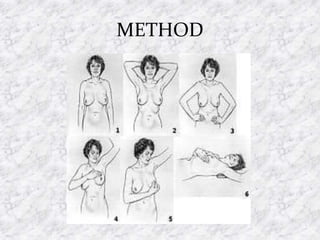
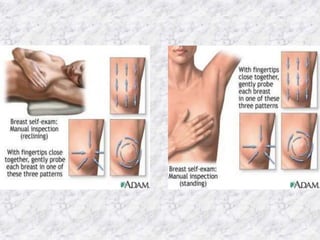
• This pictorial example of breast self-
examination in six steps. . .
• Steps 1-3 involve inspection of the breast with the
arms hanging next to the body, behind the head
and in the side.
• Step 4 is palpation of the breast.
• Step 5 is palpation of the nipple.
• Step 6 is palpation of the breast while lying down.
TYPES OF PALPATION
• Circular movements
• Linear method
• Wedge method
HOW?
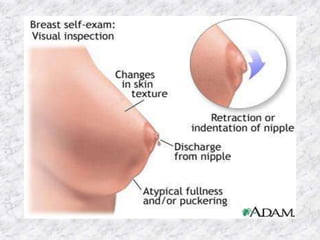
1. Facing a mirror……..
• Stand before a mirror and compare both
breasts for differences in size, nipple
inversion (turning in), bulging, or
dimpling. Note any skin or nipple changes,
such as a hard knot or nipple discharge.
STEPS OF INSPECTION
FOUR STEPS……
With your arms at your sides
With your arms over head
With your hands on hips and press firmly to flex chest
muscles
Bent forward to inspect the breasts
In these positions, pectoral muscles are contracted,
and a subtle dimpling of the skin may appear, if a
growing tumor has affected a ligament.
2. Lying down…………………
RIGHT BREAST
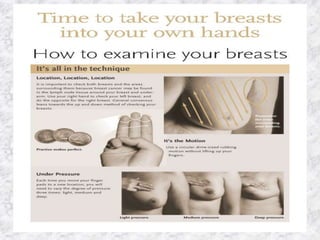
• Place a pillow under right shoulder
• Put right hand under head
• Check the entire breast area with the finger pads of
left hand
• Use small circles and follow an up-and-down
pattern
• Use light, medium and firm pressure over each area
of the breast
• Feel the breast with the surfaces of the second, third
and fourth fingers, moving systematically and using
small, circular motions from the nipple to the outer
margins
• Gently squeeze the nipple for any discharge.
LEFT BREAST
• Repeat the same steps on left breast using
right hand.
3. In the shower……….
• A BSE can easily be performed while the woman is
in the bath or shower. Some women discover breast
masses when their skin is moist.
STEPS:
1. Raise the right arm
2. With soapy hands and fingers flat, check
the right breast
3. Use the same small circles and up-and-
down pattern to exam the breast
4. Repeat on the left breast.
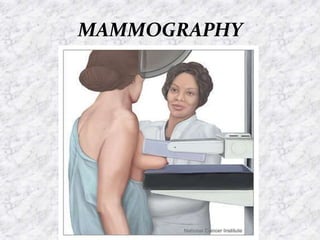
MAMMOGRAPHY
• Mammography is the process of using low-dose
amplitude-X-rays to examine the human breast
and is used as a diagnostic and a screening tool.
Goal. .
Early detection of breast cancer, typically
through detection of characteristic masses and/or
micro calcifications.
Mammography is believed to reduce mortality from
breast cancer.
MAMMOGRAPHY
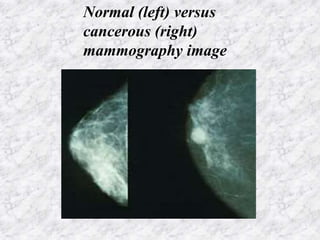
Normal (left) versus
cancerous (right)
mammography image
THANK YOU

Self breast examination

  • 1.
    BREAST SELF EXAMINATION Mrs. USREEVIDYA, Msc. NURSING, Associate Professor, Apollo college of nursing, CHITTOOR
  • 2.
    DEFINITION • Breast self-examination(BSE) is a screening method used in an attempt to detect early breast cancer. • The method involves the woman herself looking at and feeling each breast for possible lumps, distortions or swelling.
  • 3.
    WHEN? • Women olderthan 20 years should perform monthly breast self-examinations (BSE). • If still have menstrual periods, ……… should perform the examination a few days after period has ended. During this time, breasts are not tender. • If not menstruating (such as in menopause), BSE should be performed on the same day each month.
  • 4.
  • 5.
    • This pictorialexample of breast self- examination in six steps. . . • Steps 1-3 involve inspection of the breast with the arms hanging next to the body, behind the head and in the side. • Step 4 is palpation of the breast. • Step 5 is palpation of the nipple. • Step 6 is palpation of the breast while lying down.
  • 6.
    TYPES OF PALPATION •Circular movements • Linear method • Wedge method
  • 9.
    HOW? 1. Facing amirror…….. • Stand before a mirror and compare both breasts for differences in size, nipple inversion (turning in), bulging, or dimpling. Note any skin or nipple changes, such as a hard knot or nipple discharge.
  • 10.
    STEPS OF INSPECTION FOURSTEPS…… With your arms at your sides With your arms over head With your hands on hips and press firmly to flex chest muscles Bent forward to inspect the breasts In these positions, pectoral muscles are contracted, and a subtle dimpling of the skin may appear, if a growing tumor has affected a ligament.
  • 11.
    2. Lying down………………… RIGHTBREAST • Place a pillow under right shoulder • Put right hand under head • Check the entire breast area with the finger pads of left hand • Use small circles and follow an up-and-down pattern • Use light, medium and firm pressure over each area of the breast • Feel the breast with the surfaces of the second, third and fourth fingers, moving systematically and using small, circular motions from the nipple to the outer margins • Gently squeeze the nipple for any discharge.
  • 12.
    LEFT BREAST • Repeatthe same steps on left breast using right hand.
  • 13.
    3. In theshower………. • A BSE can easily be performed while the woman is in the bath or shower. Some women discover breast masses when their skin is moist. STEPS: 1. Raise the right arm 2. With soapy hands and fingers flat, check the right breast 3. Use the same small circles and up-and- down pattern to exam the breast 4. Repeat on the left breast.
  • 15.
  • 16.
    • Mammography isthe process of using low-dose amplitude-X-rays to examine the human breast and is used as a diagnostic and a screening tool. Goal. . Early detection of breast cancer, typically through detection of characteristic masses and/or micro calcifications. Mammography is believed to reduce mortality from breast cancer. MAMMOGRAPHY
  • 17.
    Normal (left) versus cancerous(right) mammography image
  • 18.