
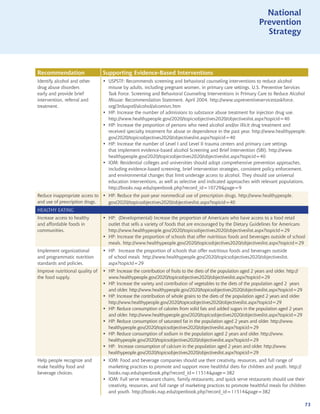
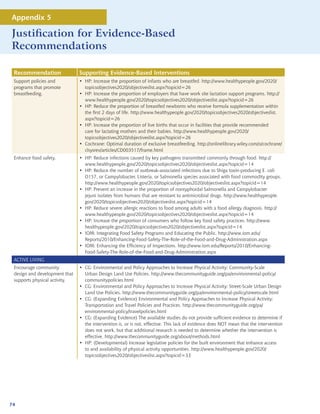
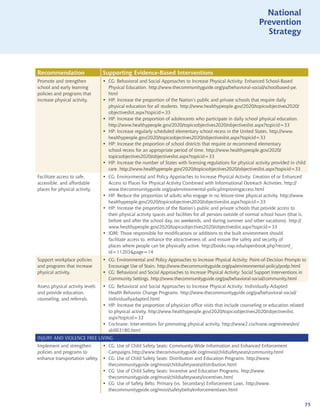
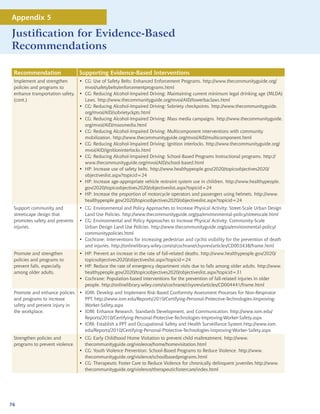


National Prevention Strategy
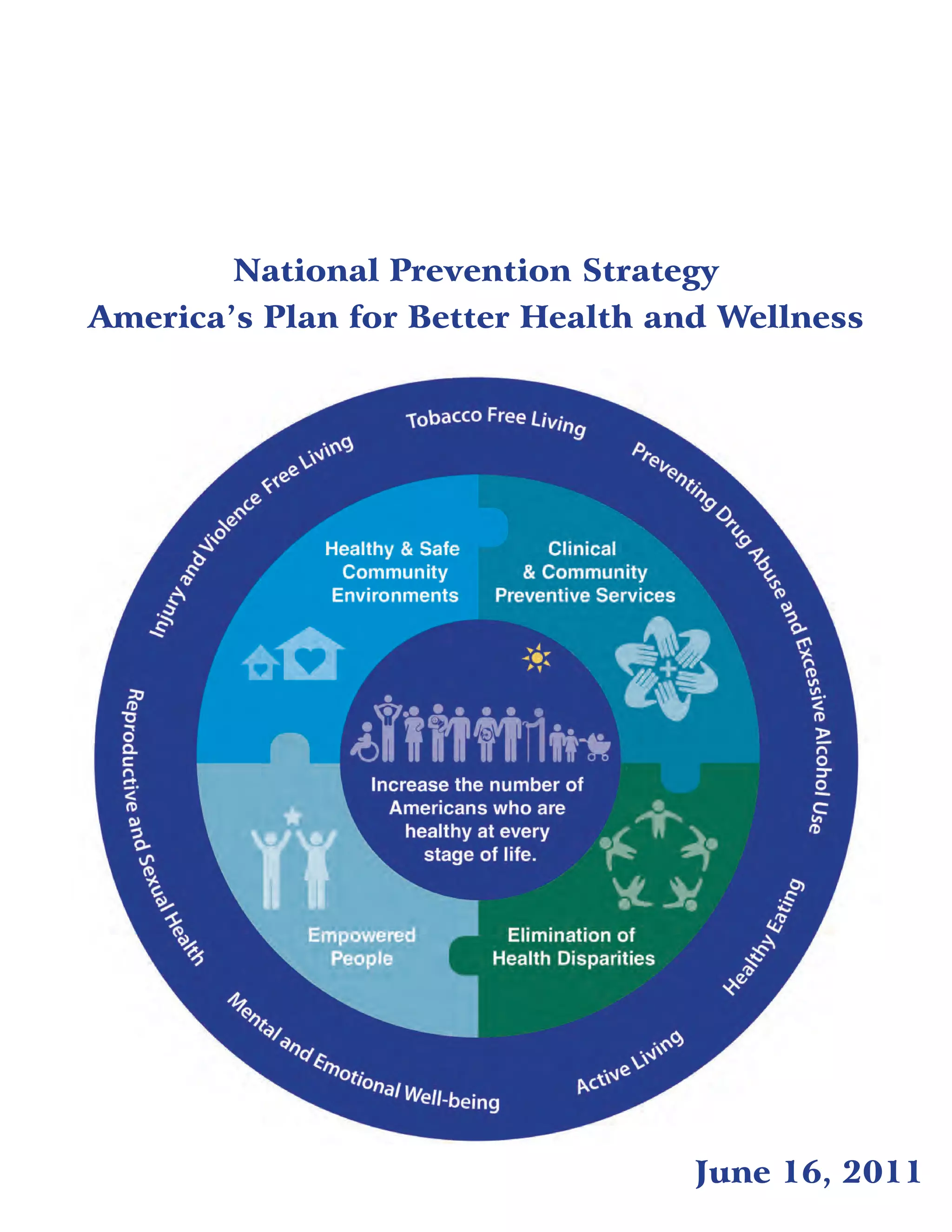
America’s Plan for Better Health and Wellness


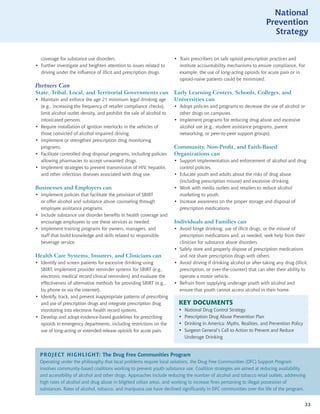
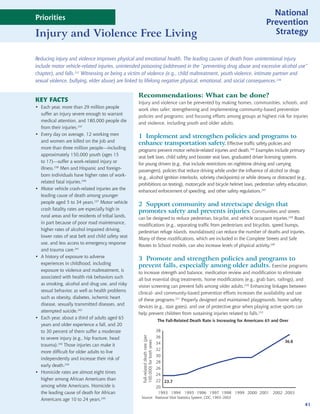
                                   June 16, 2011
2
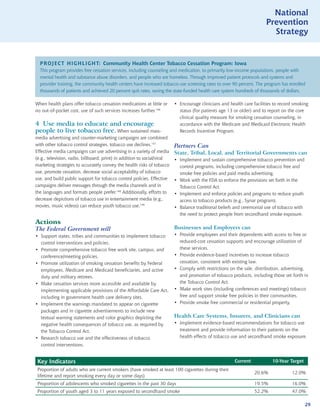
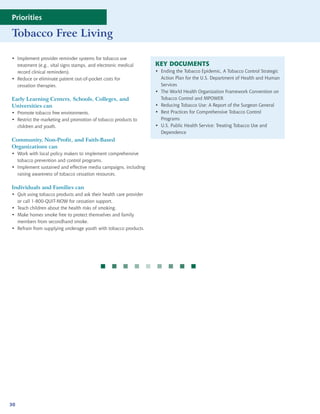
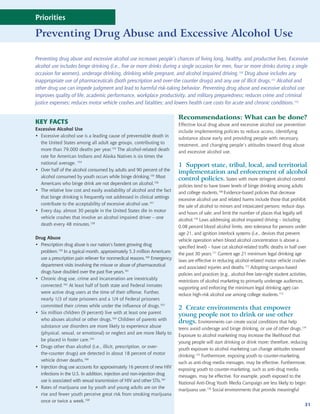
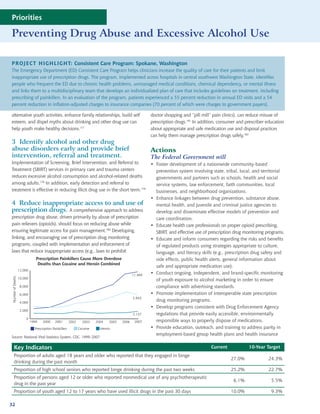
National
                                                                                                            Prevention
Message from the Chair of the National                                                                        Strategy
                                                                                                        Prevention,
Health Promotion, and Public Health Council
As U.S. Surgeon General and Chair of the National Prevention, Health Promotion, and Public Health Council (National Prevention
Council), I am honored to present the nation’s first ever National Prevention and Health Promotion Strategy (National Prevention
Strategy). This strategy is a critical component of the Affordable Care Act, and it provides an opportunity for us to become a more
healthy and fit nation.

The National Prevention Council comprises 17 heads of departments, agencies, and offices across the Federal government who are
committed to promoting prevention and wellness. The Council provides the leadership necessary to engage not only the federal
government but a diverse array of stakeholders, from state and local policy makers, to business leaders, to individuals, their families
and communities, to champion the policies and programs needed to ensure the health of Americans prospers. With guidance from the
public and the Advisory Group on Prevention, Health Promotion, and Integrative and Public Health, the National Prevention Council
developed this Strategy.

The National Prevention Strategy will move us from a system of sick care to one based on wellness and prevention. It builds upon the
state-of-the-art clinical services we have in this country and the remarkable progress that has been made toward understanding how to
improve the health of individuals, families, and communities through prevention.

The National Prevention Strategy encourages partnerships among Federal, state, tribal, local, and territorial governments; business,
industry, and other private sector partners; philanthropic organizations; community and faith-based organizations; and everyday
Americans to improve health through prevention. For the first time in the history of our nation, we have developed a cross-sector,
integrated national strategy that identifies priorities for improving the health of Americans. Through these partnerships, the National
Prevention Strategy will improve America’s health by helping to create healthy and safe communities, expand clinical and community-
based preventive services, empower people to make healthy choices, and eliminate health disparities.

We know that preventing disease before it starts is critical to helping people live longer, healthier lives and keeping health care costs
down. Poor diet, physical inactivity, tobacco use, and alcohol misuse are just some of the challenges we face. We also know that many
of the strongest predictors of health and well-being fall outside of the health care setting. Our housing, transportation, education,
workplaces, and environment are major elements that impact the physical and mental health of Americans. This is why the National
Prevention Strategy helps us understand how to weave prevention into the fabric of our everyday lives.

The National Prevention Council members and I are fully committed to implementing the National Prevention Strategy. We look
forward to continuing our dialogue with all stakeholders as we strive to ensure that programs and policies effectively help us
accomplish our vision of a healthy and fit nation.


Regina M. Benjamin, MD,
Surgeon General
Chair of the National Prevention, Health Promotion, and Public Health Council


                                                                                                                                            3
National Prevention, Health Promotion, and
Public Health Council

Members

•   Surgeon General Regina M. Benjamin, Council Chair
•   Secretary Kathleen Sebelius, Department of Health and Human Services
•   Secretary Tom Vilsack, Department of Agriculture
•   Secretary Arne Duncan, Department of Education
•   Chairman Jon Leibowitz, Federal Trade Commission
•   Secretary Ray LaHood, Department of Transportation
•   Secretary Hilda L. Solis, Department of Labor
•   Secretary Janet A. Napolitano, Department of Homeland Security
•   Administrator Lisa P. Jackson, Environmental Protection Agency
•   Director R. Gil Kerlikowske, Office of National Drug Control Policy
•   Director Melody Barnes, Domestic Policy Council
•   Assistant Secretary-Indian Affairs Larry Echo Hawk, Department of the Interior
•   Acting Chief Executive Officer Robert Velasco II, Corporation for National and Community Service
•   Secretary Robert M. Gates, Department of Defense
•   Secretary Shaun Donovan, Department of Housing and Urban Development
•   Attorney General Eric H. Holder, Jr., Department of Justice
•   Secretary Eric K. Shinseki, Department of Veterans Affairs
•   Director Jacob J. Lew, Office of Management and Budget


4
Table of Contents


Message from the Chair of the National Prevention, Health Promotion, and Public Health Council...........................3
National Prevention, Health Promotion, and Public Health Council .........................................................................4
Table of Contents ..................................................................................................................................................5
Introduction .........................................................................................................................................................6
National Leadership ..............................................................................................................................................8
Partners in Prevention ...........................................................................................................................................9
Strategic Directions and Priorities ........................................................................................................................11
  Strategic Directions
     Healthy and Safe Community Environments..................................................................................................14
     Clinical and Community Preventive Services ..................................................................................................18
     Empowered People ......................................................................................................................................22
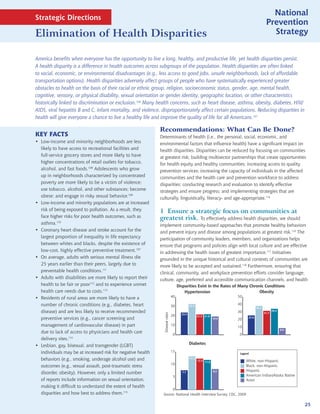
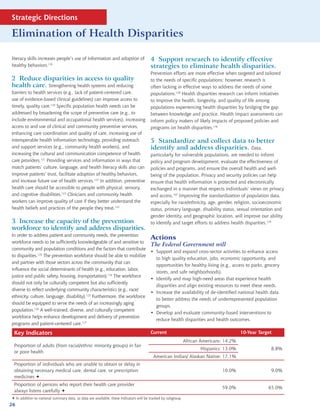
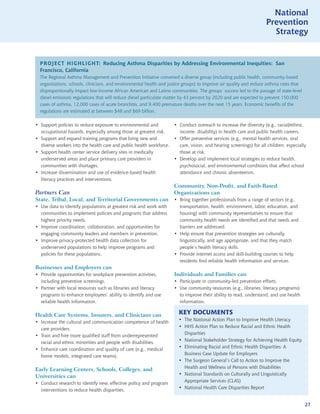
     Elimination of Health Disparities ...................................................................................................................25
  Priorities
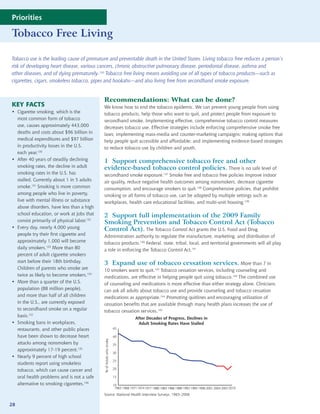
     Tobacco Free Living......................................................................................................................................28
     Preventing Drug Abuse and Excessive Alcohol Use .......................................................................................31
     Healthy Eating .............................................................................................................................................34
     Active Living ................................................................................................................................................38
     Injury and Violence Free Living .....................................................................................................................41
     Reproductive and Sexual Health ...................................................................................................................44
     Mental and Emotional Well-being .................................................................................................................48
Appendices
  Appendix 1: Economic Benefits of Preventing Disease ......................................................................................51
  Appendix 2: National Prevention Strategy Indicators .......................................................................................52
  Appendix 3: Stakeholder Outreach and Input ...................................................................................................61
  Appendix 4: Advisory Group on Prevention, Health Promotion, and Integrative and Public Health ....................62
  Appendix 5: Justification for Evidence-Based Recommendations ........................................................................63
  Appendix 6: References for the Key Documents ................................................................................................82
  Appendix 7: End Notes ...................................................................................................................................87


                                                                                                                                                                          5
Introduction

The strength and ingenuity of America’s people and communities have driven America’s success. A healthy and fit nation is vital
to that strength and is the bedrock of the productivity, innovation, and entrepreneurship essential for our future. Healthy people
can enjoy their lives, go to work, contribute to their communities, learn, and support their families and friends. A healthy nation
is able to educate its people, create and sustain a thriving economy, defend itself, and remain prepared for emergencies.

The Affordable Care Act, landmark health legislation passed           basic needs and providing information about personal health and
in 2010, created the National Prevention Council and called           health care can empower people to make healthy choices, laying
for the development of the National Prevention Strategy to            a foundation for lifelong wellness.
realize the benefits of prevention for all Americans’ health. The
National Prevention Strategy is critical to the prevention focus      Preventing disease requires more than providing people with
of the Affordable Care Act and builds on the law’s efforts to         information to make healthy choices. While knowledge is critical,
lower health care costs, improve the quality of care, and provide     communities must reinforce and support health, for example, by
coverage options for the uninsured.                                   making healthy choices easy and affordable. We will succeed in
                                                                      creating healthy community environments when the air and water
Preventing disease and injuries is key to improving America’s         are clean and safe; when housing is safe and affordable; when
health. When we invest in prevention, the benefits are broadly        transportation and community infrastructure provide people
shared. Children grow up in communities, homes, and families          with the opportunity to be active and safe; when schools serve
that nurture their healthy development, and people are                children healthy food and provide quality physical education; and
productive and healthy, both inside and outside the workplace.        when businesses* provide healthy and safe working conditions
Businesses benefit because a healthier workforce reduces long-        and access to comprehensive wellness programs. When all
term health care costs and increases stability and productivity.      sectors (e.g., housing, transportation, labor, education, defense)
Furthermore, communities that offer a healthy, productive, stable     promote prevention-oriented environments and policies, they all
workforce can be more attractive places for families to live and      contribute to health.
for businesses to locate.
                                                                      The National Prevention Strategy builds on the fact that lifelong
Although America provides some of the world’s best health care        health starts at birth and continues throughout all stages of life.
and spent over $2.5 trillion for health in 2009, the U.S. still       Prevention begins with planning and having a healthy pregnancy,
ranks below many countries in life expectancy, infant mortality,      develops into good eating and fitness habits in childhood,
and many other indicators of healthy life.1 Most of our nation’s      is supported by preventive services at all stages of life, and
pressing health problems can be prevented. Eating healthfully         promotes the ability to remain active, independent, and involved
and engaging in regular physical activity, avoiding tobacco,          in one’s community as we age. Students who are healthy and
excessive alcohol use, and other drug abuse, using seat belts, and    fit come to school ready to learn; employees who are free from
receiving preventive services and vaccinations are just a few of      mental and physical conditions take fewer sick days, are more
the ways people can stay healthy. Health is more than merely the      productive, and help strengthen the economy; and older adults
absence of disease; it is physical, mental, and social well-being.2   who remain physically and mentally active are more likely to live
Investments in prevention complement and support treatment            independently.4
and care. Prevention policies and programs can be cost-effective,
reduce health care costs, and improve productivity (Appendix 1).      To ensure that all Americans share in the benefits of prevention,
The National Prevention Strategy’s core value is that Americans       the National Prevention Strategy includes an important focus
can live longer and healthier through prevention.                     on those who are disproportionately burdened by poor health.
                                                                      In the United States, significant health disparities exist and
Many of the strongest predictors of health and well-being             these disparities are closely linked with social, economic, and
fall outside of the health care setting. Social, economic, and        environmental disadvantage (e.g., lack of access to quality
environmental factors all influence health.3 People with a quality    affordable health care, healthy food, safe opportunities for
education, stable employment, safe homes and neighborhoods,           physical activity, and educational and employment opportunities).
and access to high quality preventive services tend to be healthier
throughout their lives and live longer. When organizations,
whether they are governmental, private, or nonprofit, succeed
in meeting these basic needs, people are more likely to exercise,
eat healthy foods, and seek preventive health services. Meeting
                                                                      * Consistent with existing laws

6
National
                                                                                                                     Prevention
                                                                                                                       Strategy


The National Prevention Strategy                                       leading causes of preventable death and major illness. The seven
The National Prevention Strategy aims to guide our nation in the       Priorities are
most effective and achievable means for improving health and
well-being. The Strategy prioritizes prevention by integrating         •	   Tobacco Free Living
recommendations and actions across multiple settings to improve        •	   Preventing Drug Abuse and Excessive Alcohol Use
health and save lives.                                                 •	   Healthy Eating
                                                                       •	   Active Living
  The National Prevention Strategy’s vision is Working                 •	   Injury and Violence Free Living
  together to improve the health and quality of life for               •	   Reproductive and Sexual Health
  individuals, families, and communities by moving the                 •	   Mental and Emotional Well-Being
  nation from a focus on sickness and disease to one based
  on prevention and wellness.                                          Moving Forward
                                                                       National leadership is critical to implementing this Strategy.
                                                                       This leadership includes aligning and focusing Federal prevention
This Strategy envisions a prevention-oriented society where all        efforts. However, the Federal government will not be successful
sectors recognize the value of health for individuals, families,       acting alone. Partners in prevention from all sectors in American
and society and work together to achieve better health for all         society are needed for the Strategy to succeed. All of us must
Americans..                                                            act together, implementing the Strategic Directions and Priorities,
                                                                       so that all Americans can live longer and healthier at every stage
  The National Prevention Strategy’s overarching goal is               of life.
  Increase the number of Americans who are healthy at
  every stage of life.

This Strategy focuses on both increasing the length of people’s
lives and ensuring that people’s lives are healthy and productive.
Currently Americans can expect to live 78 years, but only 69 of
these years would be spent in good health.5 Implementing the
National Prevention Strategy can increase both the length and
quality of life. To monitor progress on this goal, the Council will
track and report measures of the length and quality of life at key
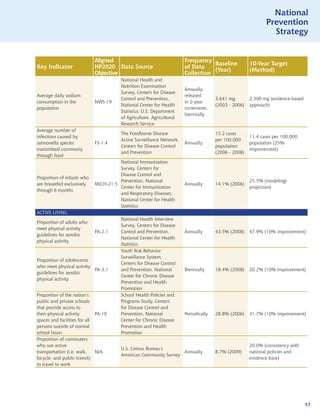
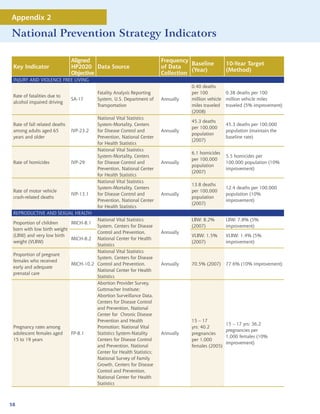
life stages (Appendix 2 for baselines and targets). To realize this
vision and achieve this goal, the Strategy identifies four Strategic
Directions and seven targeted Priorities. The Strategic Directions
provide a strong foundation for all of our nation’s prevention
efforts and include core recommendations necessary to build a
prevention-oriented society. The Strategic Directions are

•	 Healthy and Safe Community Environments: Create,
   sustain, and recognize communities that promote health and
   wellness through prevention.
•	 Clinical and Community Preventive Services: Ensure that
   prevention-focused health care and community prevention
   efforts are available, integrated, and mutually reinforcing.
•	 Empowered People: Support people in making healthy
   choices.
•	 Elimination of Health Disparities: Eliminate disparities,
   improving the quality of life for all Americans.

Within this framework, the Priorities provide evidence-based
recommendations that are most likely to reduce the burden of the

                                                                                                                                             7
National Leadership

National leadership is critical to support our nation’s focus on prevention, catalyze action across society, and implement the
Strategic Directions and Priorities of the National Prevention Strategy. The National Prevention Council, created through the
Affordable Care Act, comprises 17 Federal departments, agencies and offices and is chaired by the Surgeon General. The
National Prevention Council developed the Strategy with input from the Prevention Advisory Group, stakeholders, and the
public (Appendix 3). The Council will continue to provide national leadership, engage a diverse array of stakeholders, facilitate
coordination and alignment among Federal departments, agencies, and offices and non-Federal partners, champion the
implementation of effective policies and programs, and ensure accountability.

Provide National Leadership                                                policy and program recommendations as new evidence becomes
The National Prevention Council provides coordination and                  available. The Council will review new and emerging data and
leadership at the Federal level and identifies ways that agencies can      evidence, prioritizing our nation’s health needs and providing
work individually, as well as together, to improve our nation’s health.    information to the President and Congress concerning the most
The Council helps each agency incorporate health considerations            pressing health issues confronting the United States.
into decision making, enhances collaboration on implementing
prevention and health promotion initiatives, facilitates sharing of best   Ensure Accountability – Annual Status
practices, and, as appropriate, coordinates guidance and funding           Report
streams. The Council will identify specific, measurable actions and        The National Prevention Council will track progress in
timelines to carry out the Strategy, and will determine accountability     implementing the National Prevention Strategy, report on
for meeting those timelines within and across Federal departments          successes and challenges, and identify actions that are working,
and agencies.                                                              as well as areas where additional effort is needed. The Strategy
                                                                           contains metrics that will be used to measure progress. Key
Engage Partners                                                            indicators are identified for the overarching goal, the leading
The Council will ensure ongoing engagement of partners from                causes of death, and each of the Strategic Directions and
all parts of society to understand and act upon advancements               Priorities. Each year, the National Prevention Council will deliver
and developments that may affect health and wellness through               an Annual Status Report to the President and Congress.
prevention. Partners are necessary to implement the Strategy at the
national, state, tribal, local, and territorial levels. The Council will   The Prevention Advisory Group
foster partnerships, identify areas for enhanced coordination and          The Advisory Group on Prevention, Health Promotion, and
alignment, and disseminate best practices.                                 Integrative and Public Health (Prevention Advisory Group),
                                                                           also created by the Affordable Care Act, brings a non-
Align Policies and Programs                                                Federal perspective to the Strategy’s policy and program
Aligning policies and programs at the national, state, tribal,             recommendations and to its implementation. The Presidentially
local, and territorial levels can help ensure that actions are             appointed Prevention Advisory Group (Appendix 4) will assist
synergistic and complementary. When all sectors are working                in the implementation of the Strategy, working with partners
toward common prevention priorities, improvements in health                throughout the nation. The Prevention Advisory Group will advise
can be amplified. The National Prevention Council will work to             the National Prevention Council in developing public, private,
identify and facilitate the sharing of best practices to support the       and nonprofit partnerships that will leverage opportunities to
alignment of actions with what has been shown to be effective.             improve our nation’s health. The Prevention Advisory Group
                                                                           will also continue to develop and suggest policy and program
Assess New and Emerging Trends and                                         recommendations to the Council.

Evidence
The prevention landscape continuously evolves as scientific
evidence, new plans and reports, new legislation, and innovative
partnerships emerge. The Strategy will adapt its approaches as new
information becomes available. The National Prevention Council
will gather input to identify promising practices and innovative
approaches to prevention and integrative health. The Council will
maintain close ties to prevention practice and research, updating


8
National
                                                                                                                          Prevention
Partners in Prevention                                                                                                      Strategy


Aligning and coordinating prevention efforts across a wide range of partners is central to the success of the National Prevention
Strategy. Engaging partners across disciplines, sectors, and institutions can change the way communities conceptualize and solve
problems, enhance implementation of innovative strategies, and improve individual and community well-being.


Who are the Partners in Prevention?                                        Employer
                                                                           Employers have the ability           Building a Prevention
The Federal government alone cannot create healthier communities.
                                                                           to implement policies and            Foundation through
State, tribal, local, and territorial governments, businesses, health
                                                                           programs that foster health,         Partnerships
care, education, and community and faith-based organizations are all
                                                                           wellness, and safety among           Improving the health of
essential partners in this effort.
                                                                           their employees. Evidence-           our nation’s workforce is
                                                                           based work-site employee             good for both employees
Roles that Partners Play                                                                                        and employers – it
                                                                           wellness and safety policies and
A wide range of actions contribute to and support prevention,
                                                                           programs can reduce health           improves employee
ranging, for example, from a small business that supports
                                                                           risks and improve the quality        productivity, reduces
evidence-based workplace wellness efforts, to a community-based
                                                                           of life for millions of workers in   health care expenditures,
organization that provides job training for the unemployed, to
                                                                           the United States. For example,      and encourages economic
the parent of young children who works to provide healthy foods
                                                                           employers can provide tailored,      growth. Employers can
and ensure they receive appropriate preventive services. Partners
                                                                           confidential counseling to           implement policies and
play a variety of roles and, at their best, are trusted members of
                                                                           promote life skills, combat          programs to improve the
the communities and populations they serve. Opportunities for
                                                                           depression, address substance        health of their workers, for
prevention increase when those working in housing, transportation,
                                                                           use problems, and enhance            example, by protecting their
education, and other sectors incorporate health and wellness into
                                                                           overall emotional well-being         workers from illness and
their decision making. The following roles exemplify opportunities
                                                                           for employees.                       injury, ensuring access to
that partners can take to support prevention:
                                                                                                                healthy foods, and providing
                                                                           Funder                               health coverage for clinical
Policy Maker                                                                                                    preventive services.
                                                                           Funding for research, programs,
Individuals, organizations, and communities have a role in
                                                                           operations, and infrastructure
developing, implementing, and enforcing policies, laws, and
                                                                           (e.g., roads) can be used to improve prevention. Organizations
regulations within their jurisdictions, whether they are states, cities,
                                                                           that provide financial support can encourage funding recipients
communities, work sites, schools, or recreation areas. Organizations
                                                                           to adhere to health principles and standards, leverage cross-sector
can explicitly consider the potential health impact of policy options
                                                                           collaboration, and support development of healthy communities.
and choose to implement those policies that improve health. For
                                                                           For example, state, tribal, local, and territorial governments can
example, a metropolitan planning organization can institutionalize
                                                                           incorporate recommendations for physical activity and standards for
the use of health criteria when making planning decisions on land
                                                                           healthy eating into performance standards for schools and child care
use and design to provide opportunities for safe physical activity.
                                                                           centers.
Purchaser
Individuals, agencies, and organizations purchase various goods
                                                                           Data Collector and Researcher
                                                                           Data and research can be used to strengthen implementation of
and services, such as food, vehicles, health insurance, and supplies,
                                                                           the National Prevention Strategy. For example, a university can
and some finance the construction of infrastructure projects, such as
                                                                           help demonstrate the business case for prevention and share
buildings, housing, and roads. They can use their purchasing power
                                                                           these findings with corporate decision makers (e.g., board chairs,
to promote health and wellness. For example, businesses can adopt
                                                                           corporate officers). Further, researchers can work with communities
policies to procure healthy foods and build healthier environments
                                                                           by providing data that present a comprehensive community
for their workers and customers.
                                                                           profile (e.g., community health status and data on transportation,
                                                                           recreation, labor, environment, and education), helping identify
                                                                           evidence-based strategies, and measuring progress.


                                                                                                                                                  9
Partners in Prevention

Health Care Provider                                                     Communicator and Educator
Individuals and organizations that deliver health care services          Individuals and communities provide and receive information
can implement policies and systems to support the delivery of            through many sources. Advertising, educational campaigns,
high-impact clinical preventive services and enhance linkages            informational websites, and trainings can raise awareness,
between clinical and community prevention efforts. For example,          provide people with knowledge and skills, and create supportive
a health care system can adopt a decision support system that            environments to help people make healthy decisions.
prompts clinicians to deliver appropriate clinical preventive
services to patients.


PROJECT HIGHLIGHT: Incorporating Health in Regional Transportation Planning: Nashville, Tennessee
Recognizing the relationship between the built environment, transportation, and health, the Nashville Area Metropolitan Planning
Organization adopted a set of guiding principles, goals, and objectives to help the region pursue quality growth as a central part
of its 25-year regional transportation plan. Emphasizing mass transit, active transportation (e.g., biking, walking), and preservation
and enhancement of roadways, the plan incorporates health considerations into infrastructure project selection. Sixty percent of the
selection criteria are related to health, safety, congestion reduction, and active transportation, which has resulted in the inclusion of
sidewalks, bicycle lanes, or shared-use lanes in 70 percent of funded roadway projects (up from 2 percent). The plan also reserves a
minimum of 25 percent of Federal Surface Transportation Project dollars for active transportation.


                                                      


10
National
                                                                                                                        Prevention
Strategic Directions and Priorities                                                                                       Strategy


We know a great deal about how to improve the health of the nation; decades of research and practice have built the evidence
base and identified effective prevention approaches. Improving socioeconomic factors (e.g., poverty, education) and providing
healthful environments (e.g., ensuring clean water, air and safe food, designing communities to promote increased physical
activity) reinforce prevention across broad segments of society. Broad-based changes that benefit everyone in a community
should be supplemented by clinical services that meet individual health needs (e.g., immunization, colonoscopy, tobacco
cessation counseling, blood pressure and cholesterol monitoring and control). Through health promotion, education, and
counseling, we can provide people with the knowledge, tools, and options they need to make healthy choices.

Strategic Directions                                                    and resources, they are empowered to make healthier choices.
The National Prevention Strategy identifies four Strategic              Efforts to educate and motivate people to make healthy choices
Directions. These Strategic Directions are the foundation for all       should occur across the lifespan, with a particular emphasis on
prevention efforts and form the basis for a prevention-oriented         ensuring that young people are provided with the knowledge,
society. Each Strategic Direction can stand alone and can guide         skills, and opportunities they need to allow them to become
actions that will demonstrably improve health. Together, the            healthy adults. In addition, we should provide knowledge and
Strategic Directions create the web needed to fully support             opportunities that support the unique needs of our growing older
Americans in leading longer and healthier lives.                        adult population.


Healthy and Safe Community Environments: Create,                        Elimination of Health Disparities: Eliminate disparities,
sustain, and recognize communities that promote health and wellness     improving the quality of life for all Americans. All Americans should
through prevention. Many elements of our communities affect             have the opportunity to live long, healthy, independent, and
health directly and also influence individuals’ health-related          productive lives, regardless of their race or ethnicity; religion;
choices. A healthy community environment can help make                  socioeconomic status; gender; age; mental health; cognitive,
healthy choices easy and affordable. Many factors influence             sensory, or physical disability; sexual orientation or gender
individual choices, including the availability of resources to          identity; geographic location; or other characteristics. In the
meet daily needs (e.g., educational and job opportunities,              United States, health disparities are often closely linked with
safe and affordable housing, healthy and affordable foods);             social, economic, or environmental disadvantage. Clear evidence
community structures (e.g., accessible and safe buildings, parks,       exists that with appropriate focus and investment, health
transportation); and the natural environment (e.g., absence of          disparities can be eliminated while simultaneously improving the
toxic substances and other physical hazards). Federal, state, tribal,   health of all Americans.
local, and territorial policies that improve these factors within
communities are often interrelated.                                     Priorities
                                                                        Americans aspire to live long, healthy, and productive lives;
Clinical and Community Preventive Services: Ensure                      however, obesity, tobacco use, misuse of alcohol and other
that prevention-focused health care and community prevention efforts    substances, and community stressors (e.g., job and home losses,
are available, integrated, and mutually reinforcing. The provision of   discrimination, family separations, and violence) are serious
evidence-based clinical and community preventive services and           threats to health. In addition, too many Americans do not receive
the integration of these activities are central to improving and        the preventive services that help maintain health, prevent or
enhancing physical and mental health. Certain clinical preventive       delay the onset of disease, and reduce health care costs. Each
services have proven to be both effective and cost-saving through       year, injuries and chronic diseases such as heart disease, cancer,
decades of practice and research; The Affordable Care Act reduces       and diabetes are responsible
barriers to people receiving many clinical preventive services.         for millions of premature
Clinical preventive services can be supported and reinforced by         deaths among Americans. In            Together, chronic illnesses
community prevention efforts that have the potential to reach           2005, 133 million Americans           (e.g., cancer, obesity,
large numbers of people.                                                – almost one in two adults –          depression) cause
                                                                        had at least one chronic illness.     Americans to miss 2.5
Empowered People: Support people in making healthier                    Furthermore, injuries are the         billion days of work each
choices. Although policies and programs can make healthy options        leading cause of death among          year, resulting in lost
available, people still need to make healthy choices. When people       infants, youth, and young             productivity totaling more
have access to actionable and easy-to-understand information            adults.6 Most of these early          than $1 trillion.7


                                                                                                                                            11
Strategic Directions and Priorities

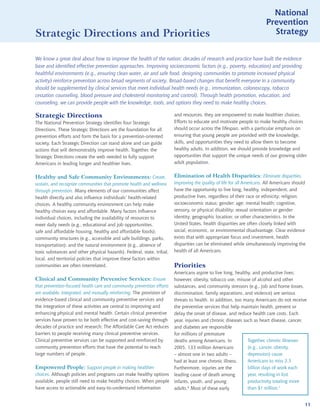
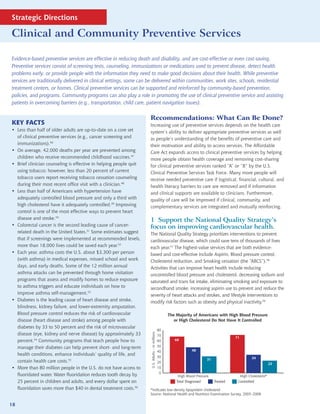
deaths can be avoided, adding extra years of productivity and                           Five Causes Account for the Majority of Deaths
enjoyment for millions of people.                                                                                               5 leading causes
                                                                                                                                (66% of all deaths):
The Strategy’s seven Priorities are designed to improve health and                                                                    Heart disease
wellness for the entire U.S. population, including those groups                                                                       Cancer
                                                                                      27%                All other causes
disproportionately affected by disease and injury.                                                       34%                          Chronic lower
                                                                                                                                      respiratory disease
•    Tobacco Free Living                                                                                                              Stroke
•    Preventing Drug Abuse and Excessive Alcohol Use
                                                                                                                                      Unintentional injuries
•    Healthy Eating
                                                                                        23%
•    Active Living                                                                                                5%
•    Injury and Violence Free Living                                                                         5%
•    Reproductive and Sexual Health                                                                  6%

•    Mental and Emotional Well-Being
                                                                          Source: National Vital Statistics Report, CDC, 2008


Recommendations and Actions
The Strategy provides evidence-based recommendations for                  In addition to the recommendations, the Strategy identifies
                                                                                                         All other causes
improving health and wellness and addressing leading causes of            actions that the Federal government will take and that
disability and death. Recommended policy, program, and systems            partners can take to promote health and wellness. The
approaches are identified for each Strategic Direction and Priority.      “Federal government will” statements identify actions that the
Preference has been given to efforts that will have the greatest          National Prevention Council departments will take to guide the
impact on the largest number of people and can be sustained               implementation of the Strategy. These statements represent
over time. Each recommendation is based on the best recent                both new and existing initiatives. Some may include newly
scientific evidence (Appendix 5).                                         incorporating prevention into policies and regulations, while
                                                                          others may incorporate or enhance prevention as part of existing
Current evidence for prevention is strong, and when effective             programs. Whether in new or existing initiatives, all actions
strategies are implemented they drive significant improvement in          will be subject to the annual budget processes that require
the public’s health. Effective types of strategies fall into five major   balancing priorities within available resources. The “partners can”
categories: policy, systems change, environment, communications           statements identify actions that different partners can voluntarily
and media, and program and service delivery. Policy, system               pursue to promote prevention. These evidence-based options
change, and environmental strategies can be very cost-effective           draw from a variety of sources, including public input.
ways to improve the public’s health. There are, however,
areas where additional effective strategies are needed. Future            Measuring Progress
research and evaluation, including well designed trials for many          The Strategy includes key indicators for a) the overarching goal,
complementary and alternative medicine therapies, will be critical        b) the leading causes of death, and c) each Strategic Direction
to addressing unmet prevention and wellness needs, and new                and Priority. These indicators will be used to measure progress in
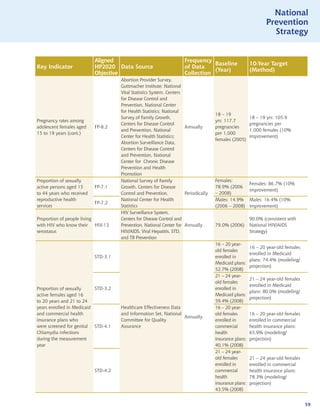
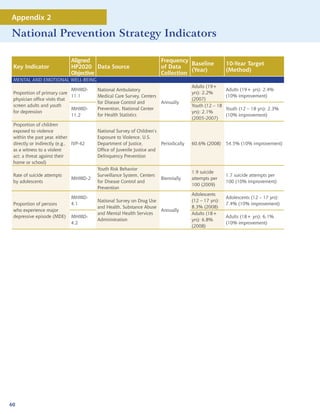
evidence-based strategies will be incorporated as they emerge.            prevention and to plan and implement future prevention efforts.
                                                                          Key indicators will be reported for the overall population and by
Actions by Federal agencies and partners should build on and              subgroups as data are available. Indicators and 10-year targets
complement existing strategies, plans, and guidelines to improve          are drawn from existing measurement efforts, especially Healthy
health. Key documents that provide a more detailed set of                 People 2020. Detailed information about the key indicators
recommendations or offer tools and resources are listed for               can be found in Appendix 2. In some cases, data that can help
each Strategic Direction and Priority (Appendix 6). In addition,          describe the health status of certain populations are limited (e.g.,
because Healthy People 2020 is a foundational resource for all            data on sexual orientation and gender identity, disability status).
of the Strategic Directions and Priorities, relevant objectives are       As data sources and metrics are developed or enhanced, National
provided for each of the Strategy’s recommendations (Appendix             Prevention Strategy’s key indicators and targets will be updated.
5). The Strategic Directions and Priorities also include include
project highlights that show how communities have advanced
prevention. These are provided for illustrative purposes to help          * Examples do not indicate an official review or endorsement of any program or
                                                                            initiative. Programs must always be administered in accordance with applicable
others consider ways in which they too can take action.*                    state and Federal laws.

12
National
                                                                                                                                              Prevention
                                                                                                                                                Strategy


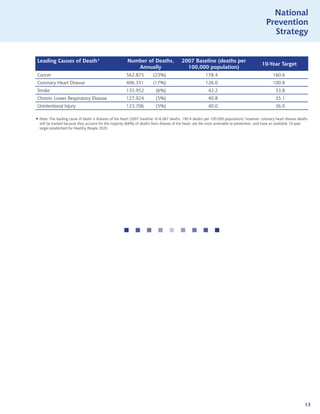
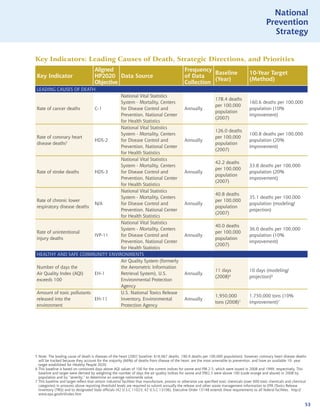
 Leading Causes of Death                               Number of Deaths,                 2007 Baseline (deaths per
                                                                                                                                           10-Year Target
                                                           Annually                         100,000 population)
 Cancer                                                 562,875         (23%)                            178.4                                    160.6
 Coronary Heart Disease                                 406,351         (17%)                            126.0                                    100.8
 Stroke                                                 135,952           (6%)                            42.2                                      33.8
 Chronic Lower Respiratory Disease                      127,924           (5%)                            40.8                                      35.1
 Unintentional Injury                                   123,706           (5%)                            40.0                                      36.0

 Note: The leading cause of death is diseases of the heart (2007 baseline: 616,067 deaths, 190.9 deaths per 100,000 population); however, coronary heart disease deaths
  will be tracked because they account for the majority (66%) of deaths from disease of the heart, are the most amenable to prevention, and have an available 10-year
  target established for Healthy People 2020.


                                                              


                                                                                                                                                                      13
Strategic Directions

 Healthy and Safe Community Environments

 Health and wellness are influenced by the places in which people live, learn, work, and play. Communities, including homes,
 schools, public spaces, and work sites, can be transformed to support well-being and make healthy choices easy and affordable.
 Healthy and safe community environments include those with clean air and water, affordable and secure housing, sustainable
 and economically vital neighborhoods (e.g., efficient transportation, good schools), and supportive structures (e.g., violence free
 places to be active, access to affordable healthy foods, streetscapes designed to prevent injury).8 Healthy and safe community
 environments are able to detect and respond to both acute (emergency) and chronic (ongoing) threats to health.9

                                             Recommendations: What can be done?
 KEY FACTS                                   Making places healthier requires capacity for planning, delivering, and evaluating
 • A variety of health-related hazards       prevention efforts. A prevention-oriented society can be supported by integrating health
   are disproportionately found in           and health equity criteria into community planning and decision making whenever
   low-income housing, including             appropriate; maintaining a skilled, cross-trained, and diverse prevention workforce;
   excess moisture or mold, allergens,       strengthening the capacity of state, tribal, local, and territorial health departments;
   poor indoor air quality, structural       implementing effective policies and programs that promote health and safety; and
   deficiencies, and lead contamination.10   enhancing cross-sector data sharing and collaboration.16
 • Exposures to environmental and
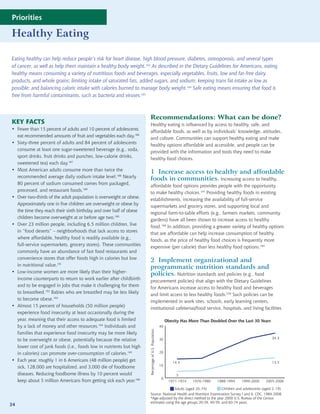
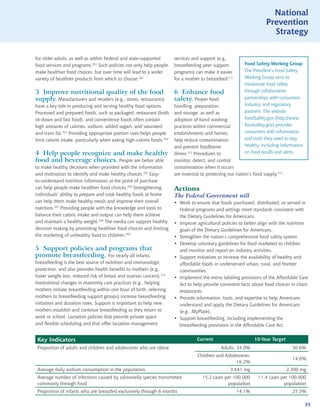
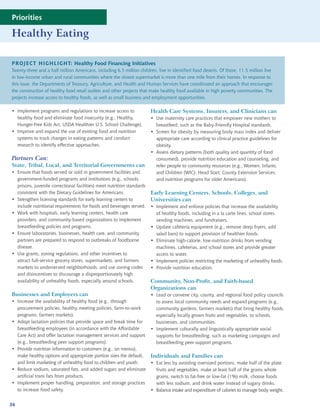
   occupational hazards before and           1 Improve quality of air, land, and water. Safe air, land, and water
   during pregnancy can increase risk        are fundamental to a healthy community environment.17 Implementing and enforcing
   of subsequent health problems for         environmental standards and regulations, monitoring pollution levels and human exposures,
   infants and children, such as birth       and considering the risks of pollution in decision making can all improve health and the
   defects, developmental disabilities,      quality of the environment.18 For example, air quality standards, improved fuel efficiency and
   and childhood cancer.11                   use of cleaner fuels, and transportation choices that reduce dependency on automobiles all
 • Children may be more vulnerable to        improve air quality and health.19 Safe drinking water is assured through routine monitoring,
   environmental exposures than adults       detection, and notification of water-related risks to prevent chemical and biological
   because their bodily systems are still    contamination.20 Monitoring and research to understand the extent of people’s exposure to
   developing and their behavior can         environmental hazards, the extent of disparities in exposures and risks from environmental
   expose them more to chemicals and         hazards and the impact of these exposures on health, and identifying how to reduce
   organisms.12                              exposures, especially among vulnerable populations, will inform future efforts.18
 • Nearly one in 10 (approximately 7
   million) children aged 17 and under       2 Design and promote affordable, accessible, safe, and
   have asthma. Black children are more      healthy housing. Living environments, including housing and institutional settings,
   likely to have asthma (17 percent)        can support health.21 Quality housing is associated with positive physical and mental
   than Hispanic children (8 percent)        well-being.22 How homes are designed, constructed, and maintained, their physical
   or non-Hispanic white children (8         characteristics, and the presence or absence of safety devices have many effects on injury,
   percent). Environmental factors (e.g.,    illness, and mental health.23 Housing free of hazards, such as secondhand smoke, pests,
   pests, mold and pollen, tobacco or        carbon monoxide, allergens, lead, and toxic chemicals, helps prevent disease and other
   wood smoke, indoor and outdoor air        health problems.24 Housing that meets universal design standards allows people, including
   pollution) exacerbate asthma.13           those with disabilities and older adults, to live safely in their homes.25
 • Work-related factors, including
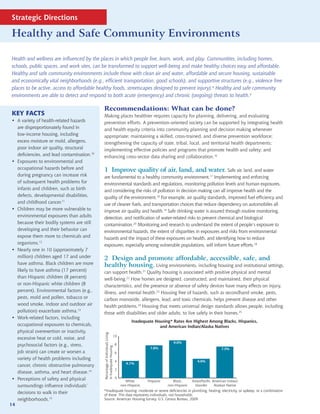
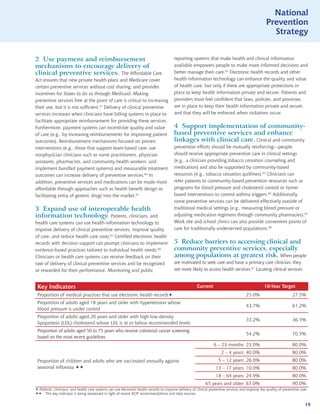
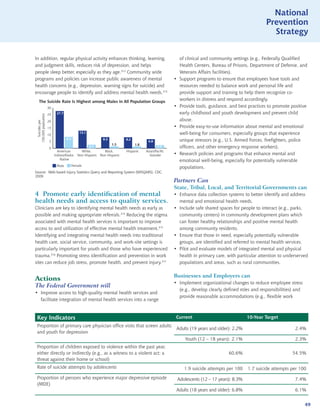
                                                                                          Inadequate Housing* Rates Are Highest Among Blacks, Hispanics,
   occupational exposures to chemicals,                                                                and American Indian/Alaska Natives
   physical overexertion or inactivity,
                                             Percentage of Individuals Living


                                                                            10
   excessive heat or cold, noise, and
                                                                                                                 9.0%
   psychosocial factors (e.g., stress,                                          8
                                             in Inadequate Housing


                                                                                                    7.8%                                        7.5%
   job strain) can create or worsen a                                           6
   variety of health problems including
                                                                                4                                               4.6%
                                                                                       4.1%
   cancer, chronic obstructive pulmonary
                                                                                2
   disease, asthma, and heart disease.14
 • Perceptions of safety and physical                                           0
                                                                                       White,      Hispanic      Black,      Asian/Pacific American Indian/
   surroundings influence individuals’                                              non-Hispanic              non-Hispanic     Islander     Alaskan Native
                                             *Inadequate housing: moderate or severe deficiencies in plumbing, heating, electricity, or upkeep, or a combination
   decisions to walk in their                of these. This data represents individuals, not households.
   neighborhoods.15                          Source: American Housing Survey, U.S. Census Bureau, 2009
14
National
                                                                                                                       Prevention
                                                                                                                         Strategy


3 Strengthen state, tribal, local, and                                 and optimize investments
                                                                                                           Green Technologies
territorial public health departments to                               can help foster livable,
                                                                                                           Using green technologies
provide essential services. Public health departments                  affordable, and healthy
                                                                       communities.33 Community            (e.g., green buildings,
provide the cornerstone of our nation’s public health capacity
                                                                       measures that include health        renewable energy, energy
and are critical in identifying and responding to the needs of their
                                                                       can be used to benchmark            efficiency, and green
communities.26 Strengthening surveillance and laboratory capacity
                                                                       existing conditions, set            chemistry) can help reduce
allows health departments to identify communities at greatest risk;
                                                                       performance targets, track          use of energy, water, and
measure the impact of policy, systems, and environmental changes;
                                                                       and communicate progress            other resources as well as
detect, control, and prevent infectious diseases; and respond to
                                                                       toward achieving community          decrease pollution. Green
outbreaks and emergencies.27 Systems to support quality—such
                                                                       outcomes, and increase              technologies not only
as quality improvement and management systems—promote
                                                                       accountability.34 Integrating       improve the environment
accountability and performance improvements.28
                                                                       diverse measures (e.g.,             but can also make people
                                                                                                           healthier. For example,
4 Integrate health criteria into decision                              health, transportation,
                                                                                                           improving air quality
making, where appropriate, across multiple                             economic, housing, public
                                                                                                           reduces respiratory and
sectors. Assessments and audits (e.g., health impact                   safety, education, land use,
                                                                       air quality) provides a more        cardiovascular diseases such
assessments) can be used to help decision makers evaluate
                                                                       comprehensive assessment of         as asthma and heart attacks.
project or policy choices to increase positive health outcomes
and minimize adverse health outcomes and health inequities.            community well-being.35
Understanding all risks and impacts of municipal planning or
investment decisions, including those that can affect health,          6 Expand and increase access to information technology
will help ensure that land use and transportation investments          and integrated data systems to promote cross-sector
are aligned with positive and equitable health outcomes.29             information exchange. Timely, reliable, and coordinated data,
Communities can be designed to increase physical activity,             information, and communication increase capacity to plan and
decrease motor vehicle and pedestrian injuries and fatalities,         implement prevention strategies as well as detect and respond
improve air quality, and reduce greenhouse gas emissions.30            to threats to the public’s health.36 Access to high quality, timely
Locating schools, housing, nursing homes, and other key                information is dependent on interoperable data systems, including
community resources away from high-pollution areas such as             mechanisms for data sharing and standards for data collection,
highways and factories can reduce hospitalizations due to heart        privacy protection, and analysis.37 Linked data systems and metrics
attacks and respiratory disease.31 Providing affordable, accessible    from a wide range of sectors and partners (e.g., health care, public
transportation options and safe and navigable streets helps            health, emergency response, environmental, justice, transportation,
people, especially older adults, people with disabilities, and         labor, worker safety, and housing) can support decision making.38
those with low incomes, to live safely in their communities, reach     Integrating key data systems can also help streamline eligibility
essential destinations (e.g., grocery stores, schools, employment,     requirements and expedite enrollment to facilitate access to health
health care, and public health services), and lead more rewarding      and social services.39
and productive lives.32
                                                                       7 Identify and implement strategies that
5 Enhance cross-sector collaboration                                   are proven to work and conduct research
in community planning and design to                                    where evidence is lacking. Community-level
promote health and safety. Coordinating efforts                        implementation of prevention policies and programs that have
across sectors and governmental jurisdictions to prioritize needs      a strong evidence base and are cost-effective can help ensure


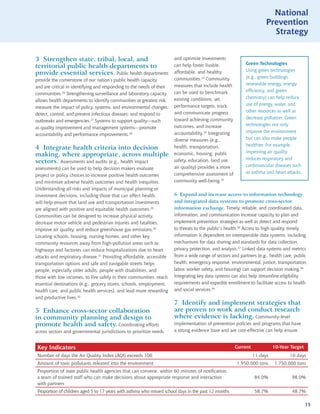
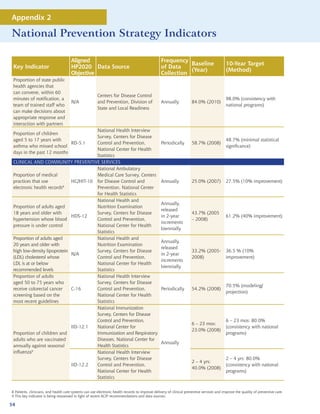
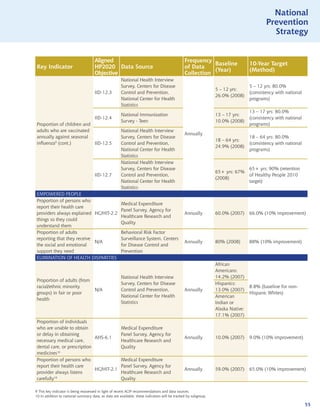
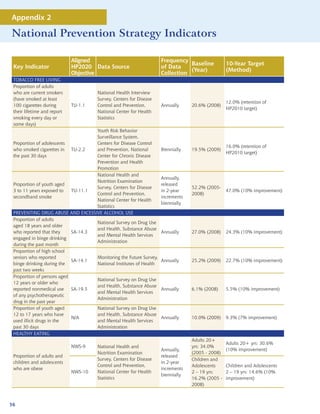
 Key Indicators                                                                                        Current             10-Year Target
 Number of days the Air Quality Index (AQI) exceeds 100                                                          11 days          10 days
 Amount of toxic pollutants released into the environment                                              1,950,000 tons      1,750,000 tons
 Proportion of state public health agencies that can convene, within 60 minutes of notification,
 a team of trained staff who can make decisions about appropriate response and interaction                       84.0%             98.0%
 with partners
 Proportion of children aged 5 to 17 years with asthma who missed school days in the past 12 months              58.7%             48.7%

                                                                                                                                            15
Strategic Directions

Healthy and Safe Community Environments

that efforts are effective and efficient.40 Additionally, promising,         chronic diseases, promote
innovative approaches to improve health and wellness, especially             safety, and eliminate health     Increasing the Ability of
those drawn from practice-based experience, are important to                 disparities.                     Health Professionals to
test.41 Cross-sector collaborative research (e.g., transportation,       •   Use housing development          Identify, Prevent, and
education, labor, environment, criminal justice, housing, health)            subsidies to promote             Reduce Environmental
can identify opportunities for policy and program alignment and              mixed-income                     Health Threats
be used to guide decision making.42                                          neighborhoods and                Clinicians can provide
                                                                             access to safe and healthy       information and counseling
8 Maintain a skilled, cross-trained, and                                     housing.                         on how to prevent, treat,
diverse prevention workforce. Recruiting and                             •   Support state, tribal, local,    and manage environmental-
retaining a skilled and diverse prevention workforce strengthens             and territorial partners to      related exposures. Through
our capacity to promote health and respond to emergencies.43 To              enhance epidemiology and         Pediatric Environmental
be effective, the prevention workforce must include health care              laboratory capacity, health      Health Specialty Units,
providers, public health workers, community health workers, and              information technology,          Federal agencies are
also professionals outside of traditional health-related fields (e.g.,       and performance                  partnering with the health
transportation, education, housing, labor). The workforce must               improvement.                     care community to help
have the tools and skills needed to promote health in the 21st           •   Support state, tribal, local,    clinicians assist parents in
century, including health information technology, informatics,               and territorial partners in      addressing environmental
health literacy, and policy analysis and implementation.44 Cross-            strategic health security        health concerns (e.g., indoor
training and recruiting diverse professionals (e.g., economists,             planning efforts for             air pollutants, lead, mercury,
scientists, psychologists, criminologists, urban planners, architects,       pandemics, biological and        and pesticides).
engineers, home inspectors) can enhance delivery of prevention               chemical attacks, incidents
and health promotion strategies.45                                           affecting food and agriculture, natural disasters, and other
                                                                             catastrophic events.
                                                                         •   Support effective public safety measures, such as community-
Actions
                                                                             based anti-crime and anti-gang initiatives to facilitate physical
The Federal Government will
                                                                             activity and prevent injury and violence.
• Coordinate investments in transportation, housing,
  environmental protection, and community infrastructure to
  promote sustainable and healthy communities.                           Partners Can
• Enhance capacity of state, tribal, local, and territorial              State, Tribal, Local, and Territorial Governments can
  governments to create healthy, livable and sustainable                 • Facilitate collaboration among diverse sectors (e.g.,
  communities (e.g., increase access to healthy food and                   planning, housing, transportation, energy, education,
  opportunities for physical activity, revitalize brownfields,             environmental regulation, agriculture, business associations,
  enhance alternative transportation options, and develop green            labor organizations, health and public health) when making
  facilities and buildings).                                               decisions likely to have a significant effect on health.
• Support standards to reduce pollution and environmental                • Include health criteria as a component of decision making
  exposure to ensure that all communities are protected from               (e.g., policy making, land use and transportation planning).
  environmental and health hazards.                                      • Conduct comprehensive community health needs assessments
• Support healthy housing while addressing unsafe housing                  and develop state and community health improvement plans.
  conditions and health-related hazards, including injury hazards,       • Promote the use of interoperable systems to support data-
  asthma triggers, and lead-based paint hazards.                           driven prevention decisions and implement evidence-based
• Increase availability and use of prevention research to identify         prevention policies and programs, such as those listed in the
  effective environmental, policy, and systems that reduce                 Guide to Community Preventive Services.


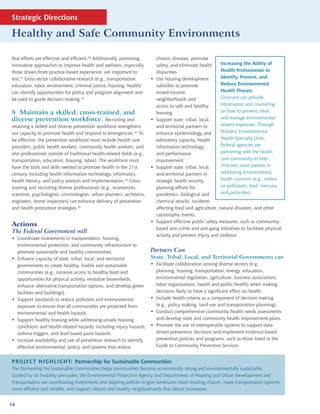
PROJECT HIGHLIGHT: Partnership for Sustainable Communities
The Partnership for Sustainable Communities helps communities become economically strong and environmentally sustainable.
Guided by six livability principles, the Environmental Protection Agency and Departments of Housing and Urban Development and
Transportation are coordinating investments and aligning policies to give Americans more housing choices, make transportation systems
more efficient and reliable, and support vibrant and healthy neighborhoods that attract businesses.


16
National
                                                                                                                      Prevention
                                                                                                                        Strategy


  PROJECT HIGHLIGHT: Neighborhood Revitalization Initiative
  The Neighborhood Revitalization Initiative (led by the White House Domestic Policy Council, White House Office of Urban Affairs, and the
  Departments of Housing and Urban Development, Education, Justice, Health and Human Services, and Treasury) supports the transformation
  of distressed neighborhoods into neighborhoods of opportunity – places that provide the right combination of circumstances, resources, and
  environments that both children and adults need to thrive. Key elements include high-quality schools and educational programs; safe and
  affordable housing; thriving commercial establishments; varied cultural amenities; and parks and other recreational spaces.

• Strengthen and enforce housing and sanitary code                        related to community planning and development (e.g.,
  requirements and ensure rapid remediation or alternative                urban planning, architecture and design, transportation,
  housing options.                                                        civil engineering, agriculture) and encourage innovation in
• Participate in national voluntary accreditation of health               designing livable, sustainable communities.
  departments.                                                          • Implement policies and practices that promote healthy
                                                                          and safe environments (e.g., improving indoor air quality;
Businesses and Employers can                                              addressing mold problems; reducing exposure to pesticides
• Ensure that homes and workplaces are healthy, including                 and lead; ensuring that drinking water sources are free from
  eliminating safety hazards (e.g., trip hazards, unsafe stairs),         bacteria and other toxins; implementing and enforcing tobacco
  ensuring that buildings are free of water intrusion, indoor             free policies).
  environmental pollutants (e.g., radon, mold, tobacco smoke),
  and pests, and performing regular maintenance of heating and          Community, Non-Profit, and Faith-Based
  cooling systems.                                                      Organizations can
• Adopt practices to increase physical activity and reduce              • Convene diverse partners and promote strong cross-sector
  pollution (e.g., workplace flexibility, rideshare and vanpool           participation in planning, implementing, and evaluating
  programs, park-and-ride incentives, travel demand                       community health efforts.
  management initiatives, and telecommuting options).                   • Implement processes to ensure that people are actively
• Identify and implement green building siting, design,                   engaged in decisions that affect health.
  construction, operations, and maintenance solutions that over
  time will improve the environment and health.                         Individuals and Families can
• Adhere to best practices to promote safety and health,                • Use alternative transportation (e.g., biking, walking, public
  including participatory approaches to hazard identification and         transportation, car and vanpooling).
  remediation as well as supervisory and worker training.               • Conduct home assessments and modifications (e.g., installing
                                                                          smoke and carbon monoxide detectors, testing for lead,
Health Care Systems, Insurers, and Clinicians can                         checking for mold and radon).
• Partner with state, tribal, local, and territorial governments,       • Purchase energy-efficient products, support local vendors,
  business leaders, and community-based organizations to                  and recycle.
  conduct comprehensive community health needs assessments
  and develop community health improvement plans.
• Support integration of prevention and public health skills into
  health care professional training and cross train health care
  practitioners to implement prevention strategies.                       KEY DOCUMENTS
• Increase the use of certified electronic health records to identify     • Environmental Protection Agency’s Report on the
  populations at risk and develop policies and programs.                    Environment
                                                                          • America’s Children: Key National Indicators of Well-Being
Early Learning Centers, Schools, Colleges, and                            • The Surgeon General’s Call to Action to Promote Healthy
Universities can                                                            Homes
• Integrate appropriate core public health competencies                   • Recommendations for Improving Health through
  into relevant curricula (e.g., nursing, medicine, dentistry,              Transportation Policy
  allied health, pharmacy, social work, education) and train              • Partnership for Sustainable Communities: A Year of Progress
  professionals to collaborate across sectors to promote health             for American Communities
  and wellness.                                                           • Priority Areas for Improvement of Quality in Public Health
• Include training on assessing health impact within fields

                                                                                                                                          17
Strategic Directions

Clinical and Community Preventive Services

Evidence-based preventive services are effective in reducing death and disability, and are cost-effective or even cost-saving.
Preventive services consist of screening tests, counseling, immunizations or medications used to prevent disease, detect health
problems early, or provide people with the information they need to make good decisions about their health. While preventive
services are traditionally delivered in clinical settings, some can be delivered within communities, work sites, schools, residential
treatment centers, or homes. Clinical preventive services can be supported and reinforced by community-based prevention,
policies, and programs. Community programs can also play a role in promoting the use of clinical preventive service and assisting
patients in overcoming barriers (e.g., transportation, child care, patient navigation issues).

                                                                   Recommendations: What Can Be Done?
KEY FACTS                                                          Increasing use of preventive services depends on the health care
• Less than half of older adults are up-to-date on a core set      system’s ability to deliver appropriate preventive services as well
  of clinical preventive services (e.g., cancer screening and      as people’s understanding of the benefits of preventive care and
  immunizations).46                                                their motivation and ability to access services. The Affordable
• On average, 42,000 deaths per year are prevented among           Care Act expands access to clinical preventive services by helping
  children who receive recommended childhood vaccines.47           more people obtain health coverage and removing cost-sharing
• Brief clinician counseling is effective in helping people quit   for clinical preventive services ranked “A” or “B” by the U.S.
  using tobacco; however, less than 20 percent of current          Clinical Preventive Services Task Force. Many more people will
  tobacco users report receiving tobacco cessation counseling      receive needed preventive care if logistical, financial, cultural, and
  during their most recent office visit with a clinician.48        health literacy barriers to care are removed and if information
• Less than half of Americans with hypertension have               and clinical supports are available to clinicians. Furthermore,
  adequately controlled blood pressure and only a third with       quality of care will be improved if clinical, community, and
  high cholesterol have it adequately controlled.49 Improving      complementary services are integrated and mutually reinforcing.
  control is one of the most effective ways to prevent heart
  disease and stroke.50                                            1 Support the National Quality Strategy’s
• Colorectal cancer is the second leading cause of cancer-         focus on improving cardiovascular health.
  related death in the United States.51 Some estimates suggest     The National Quality Strategy prioritizes interventions to prevent
  that if screenings were implemented at recommended levels,       cardiovascular disease, which could save tens of thousands of lives
  more than 18,000 lives could be saved each year.52               each year.57 The highest-value services that are both evidence-
• Each year, asthma costs the U.S. about $3,300 per person         based and cost-effective include Aspirin, Blood pressure control,
  (with asthma) in medical expenses, missed school and work        Cholesterol reduction, and Smoking cessation (the “ABCS”).58
  days, and early deaths. Some of the 12 million annual            Activities that can improve heart health include reducing
  asthma attacks can be prevented through home visitation          uncontrolled blood pressure and cholesterol, decreasing sodium and
  programs that assess and modify homes to reduce exposure         saturated and trans fat intake, eliminating smoking and exposure to
  to asthma triggers and educate individuals on how to             secondhand smoke, increasing aspirin use to prevent and reduce the
  improve asthma self-management.53                                severity of heart attacks and strokes, and lifestyle interventions to
• Diabetes is the leading cause of heart disease and stroke,       modify risk factors such as obesity and physical inactivity.59
  blindness, kidney failure, and lower-extremity amputation.
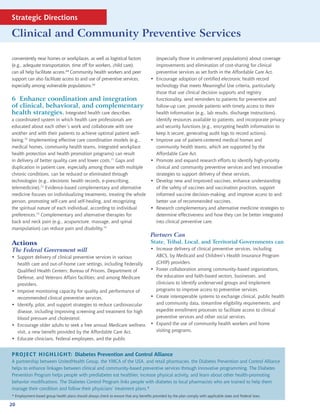
  Blood pressure control reduces the risk of cardiovascular                                          The Majority of Americans with High Blood Pressure
  disease (heart disease and stroke) among people with                                                  or High Cholesterol Do Not Have It Controlled
  diabetes by 33 to 50 percent and the risk of microvascular
                                                                                                80
  disease (eye, kidney and nerve disease) by approximately 33
                                                                    U.S. Adults – in millions


                                                                                                70
                                                                                                                                           71
  percent.54 Community programs that teach people how to                                        60      68

  manage their diabetes can help prevent short- and long-term                                   50
                                                                                                40                48
  health conditions, enhance individuals’ quality of life, and                                  30
                                                                                                                            31                         34
  contain health care costs.55                                                                  20                                                                  23
• More than 80 million people in the U.S. do not have access to                                 10
                                                                                                 0
  fluoridated water. Water fluoridation reduces tooth decay by                                            High Blood Pressure                   High Cholesterol*
  25 percent in children and adults, and every dollar spent on                                           Total Diagnosed         Treated    Controlled
  fluoridation saves more than $40 in dental treatment costs.56    *Indicates low-density lipoprotein cholesterol
                                                                   Source: National Health and Nutrition Examination Survey, 2005–2008

18
National
                                                                                                                                                     Prevention
                                                                                                                                                       Strategy


2 Use payment and reimbursement                                                          reporting systems that make health and clinical information
mechanisms to encourage delivery of                                                      available empowers people to make more informed decisions and
clinical preventive services. The Affordable Care                                        better manage their care.62 Electronic health records and other
Act ensures that new private health plans and Medicare cover                             health information technology can enhance the quality and value
certain preventive services without cost sharing, and provides                           of health care, but only if there are appropriate protections in
incentives for States to do so through Medicaid. Making                                  place to keep health information private and secure. Patients and
preventive services free at the point of care is critical to increasing                  providers must feel confident that laws, policies, and processes
their use, but it is not sufficient.57 Delivery of clinical preventive                   are in place to keep their health information private and secure,
services increases when clinicians have billing systems in place to                      and that they will be enforced when violations occur.
facilitate appropriate reimbursement for providing these services.
Furthermore, payment systems can incentivize quality and value                           4 Support implementation of community-
of care (e.g., by increasing reimbursements for improving patient                        based preventive services and enhance
outcomes). Reimbursement mechanisms focused on proven                                    linkages with clinical care. Clinical and community
interventions (e.g., those that support team-based care; use                             prevention efforts should be mutually reinforcing—people
nonphysician clinicians such as nurse practitioners, physician                           should receive appropriate preventive care in clinical settings
assistants, pharmacists, and community health workers; and                               (e.g., a clinician providing tobacco cessation counseling and
implement bundled payment systems) and measurable treatment                              medication) and also be supported by community-based
outcomes can increase delivery of preventive services.60 In                              resources (e.g., tobacco cessation quitlines).63 Clinicians can
addition, preventive services and medications can be made more                           refer patients to community-based prevention resources such as
affordable through approaches such as health benefit design or                           programs for blood pressure and cholesterol control or home-
facilitating entry of generic drugs into the market.61                                   based interventions to control asthma triggers.64 Additionally,
                                                                                         some preventive services can be delivered effectively outside of
3 Expand use of interoperable health                                                     traditional medical settings (e.g., measuring blood pressure or
information technology. Patients, clinicians, and                                        adjusting medication regimens through community pharmacies).65
health care systems can use health information technology to                             Work site and school clinics can also provide convenient points of
improve delivery of clinical preventive services, improve quality                        care for traditionally underserved populations.66
of care, and reduce health care costs.62 Certified electronic health
records with decision support can prompt clinicians to implement                         5 Reduce barriers to accessing clinical and
evidence-based practices tailored to individual health needs.60                          community preventive services, especially
Clinicians or health care systems can receive feedback on their                          among populations at greatest risk. When people
rate of delivery of clinical preventive services and be recognized                       are motivated to seek care and have a primary care clinician, they
or rewarded for their performance. Monitoring and public                                 are more likely to access health services.67 Locating clinical services


 Key Indicators                                                                                         Current                                    10-Year Target
 Proportion of medical practices that use electronic health records                                                                    25.0%                         27.5%
 Proportion of adults aged 18 years and older with hypertension whose
                                                                                                                                        43.7%                         61.2%
 blood pressure is under control
 Proportion of adults aged 20 years and older with high low-density
                                                                                                                                        33.2%                         36.5%
 lipoprotein (LDL) cholesterol whose LDL is at or below recommended levels
 Proportion of adults aged 50 to 75 years who receive colorectal cancer screening
                                                                                                                                        54.2%                         70.5%
 based on the most recent guidelines
                                                                                                                   6 – 23 months: 23.0%                               80.0%
                                                                                                                        2 – 4 years: 40.0%                            80.0%
 Proportion of children and adults who are vaccinated annually against                                                5 – 12 years: 26.0%                             80.0%
 seasonal influenza                                                                                               13 – 17 years: 10.0%                              80.0%
                                                                                                                    18 – 64 years: 24.9%                              80.0%
                                                                                                             65 years and older: 67.0%                                90.0%
 Patients, clinicians, and health care systems can use electronic health records to improve delivery of clinical preventive services and improve the quality of preventive care.

This key indicator is being reassessed in light of recent ACIP recommendations and data sources.


                                                                                                                                                                              19
Strategic Directions

Clinical and Community Preventive Services

conveniently near homes or workplaces, as well as logistical factors                     (especially those in underserved populations) about coverage
(e.g., adequate transportation, time off for workers, child care),                       improvements and elimination of cost-sharing for clinical
can all help facilitate access.68 Community health workers and peer                      preventive services as set forth in the Affordable Care Act.
support can also facilitate access to and use of preventive services,                •   Encourage adoption of certified electronic health record
especially among vulnerable populations.69                                               technology that meets Meaningful Use criteria, particularly
                                                                                         those that use clinical decision supports and registry
6 Enhance coordination and integration                                                   functionality, send reminders to patients for preventive and
of clinical, behavioral, and complementary                                               follow-up care, provide patients with timely access to their
health strategies. Integrated health care describes                                      health information (e.g., lab results, discharge instructions),
a coordinated system in which health care professionals are                              identify resources available to patients, and incorporate privacy
educated about each other’s work and collaborate with one                                and security functions (e.g., encrypting health information to
another and with their patients to achieve optimal patient well-                         keep it secure, generating audit logs to record actions).
being.70 Implementing effective care coordination models (e.g.,                      •   Improve use of patient-centered medical homes and
medical homes, community health teams, integrated workplace                              community health teams, which are supported by the
health protection and health promotion programs) can result                              Affordable Care Act.
in delivery of better quality care and lower costs.71 Gaps and                       •   Promote and expand research efforts to identify high-priority
duplication in patient care, especially among those with multiple                        clinical and community preventive services and test innovative
chronic conditions, can be reduced or eliminated through                                 strategies to support delivery of these services.
technologies (e.g., electronic health records, e-prescribing,                        •   Develop new and improved vaccines, enhance understanding
telemedicine).72 Evidence-based complementary and alternative                            of the safety of vaccines and vaccination practices, support
medicine focuses on individualizing treatments, treating the whole                       informed vaccine decision-making, and improve access to and
person, promoting self-care and self-healing, and recognizing                            better use of recommended vaccines.
the spiritual nature of each individual, according to individual                     •   Research complementary and alternative medicine strategies to
preferences.73 Complementary and alternative therapies for                               determine effectiveness and how they can be better integrated
back and neck pain (e.g., acupuncture, massage, and spinal                               into clinical preventive care.
manipulation) can reduce pain and disability.74
                                                                                     Partners Can
Actions                                                                              State, Tribal, Local, and Territorial Governments can
The Federal Government will                                                          • Increase delivery of clinical preventive services, including
• Support delivery of clinical preventive services in various                          ABCS, by Medicaid and Children’s Health Insurance Program
  health care and out-of-home care settings, including Federally                       (CHIP) providers.
  Qualified Health Centers; Bureau of Prisons, Department of                         • Foster collaboration among community-based organizations,
  Defense, and Veterans Affairs facilities; and among Medicare                         the education and faith-based sectors, businesses, and
  providers.                                                                           clinicians to identify underserved groups and implement
• Improve monitoring capacity for quality and performance of                           programs to improve access to preventive services.
  recommended clinical preventive services.                                          • Create interoperable systems to exchange clinical, public health
• Identify, pilot, and support strategies to reduce cardiovascular                     and community data, streamline eligibility requirements, and
  disease, including improving screening and treatment for high                        expedite enrollment processes to facilitate access to clinical
  blood pressure and cholesterol.                                                      preventive services and other social services.
• Encourage older adults to seek a free annual Medicare wellness                     • Expand the use of community health workers and home
  visit, a new benefit provided by the Affordable Care Act.                            visiting programs.
• Educate clinicians, Federal employees, and the public


PROJECT HIGHLIGHT: Diabetes Prevention and Control Alliance
A partnership between UnitedHealth Group, the YMCA of the USA, and retail pharmacies, the Diabetes Prevention and Control Alliance
helps to enhance linkages between clinical and community-based preventive services through innovative programming. The Diabetes
Prevention Program helps people with prediabetes eat healthier, increase physical activity, and learn about other health-promoting
behavior modifications. The Diabetes Control Program links people with diabetes to local pharmacists who are trained to help them
manage their condition and follow their physicians’ treatment plans.*
* Employment-based group health plans should always check to ensure that any benefits provided by the plan comply with applicable state and Federal laws.

20
National
                                                                                                                    Prevention
                                                                                                                      Strategy


  PROJECT HIGHLIGHT: Colonoscopy Patient Navigator Programs: New York City, New York
  These programs are working to eliminate barriers to care, improve patient understanding of colonoscopy, reduce patient “no-show”
  rates, and improve colonoscopy screening rates. “Navigators” explain to patients why the procedure is important, how to prepare for
  it, and alleviate fears by answering questions and explaining what the patient can expect. In a 12-month period, the New York City
  Department of Health and Mental Hygiene saw a 61 percent increase in colonoscopy volume in hospitals with a colonoscopy patient
  navigator (versus a 12 percent increase at comparison hospitals) and a 25 percent increase in the number of patients completing their
  procedure (compared with a 1 percent decrease in completion rates in comparison hospitals over the same time).

Businesses and Employers can                                           Early Learning Centers, Schools, Colleges and
• Offer health coverage that provides employees and their              Universities can
  families with access to a range of clinical preventive services      • Train providers (e.g., doctors, nurses, dentists, allied health
  with no or reduced out-of-pocket costs.                                professionals) to use health information technology and offer
• Provide incentives for employees and their families to access          patients recommended clinical preventive services as a routine
  clinical preventive services, consistent with existing law.            part of their health care.
• Give employees time off to access clinical preventive services.      • Promote the use of evidence-based preventive services within
• Provide employees with on-site clinical preventive services and        their health services (e.g., school health program).
  comprehensive wellness programs, consistent with existing law.
• Provide easy-to-use employee information about clinical              Community, Non-Profit, and Faith-Based
  preventive services covered under the Affordable Care Act.           Organizations can
                                                                       • Inform people about the range of preventive services they
Health Care Systems, Insurers and Clinicians can                         should receive and the benefits of preventive services.
• Inform patients about the benefits of preventive services and        • Support use of retail sites, schools, churches, and community
  offer recommended clinical preventive services, including the          centers for the provision of evidence-based preventive services.
  ABCS, as a routine part of care.                                     • Expand public-private partnerships to implement community
• Adopt and use certified electronic health records and personal         preventive services (e.g., school-based oral health programs,
  health records.                                                        community-based diabetes prevention programs).
• Adopt medical home or team-based care models.                        • Support community health workers, patient navigators, patient
• Reduce or eliminate client out-of pocket costs for certain             support groups, and health coaches.
  preventive services, as required for most health plans by the
  Affordable Care Act, and educate and encourage enrollees to          Individuals and Families can
  access these services.                                               • Visit their health care providers to receive clinical preventive
• Establish patient (e.g., mailing cards, sending e-mails, or            services.
  making phone calls when a patient is due for a preventive            • Use various tools to access and learn about health and
  health service) and clinical (e.g., electronic health records with     prevention and ways they can better manage their health (e.g.,
  reminders or cues, chart stickers, vital signs stamps, medical         personal health records, text reminder services, smart phone
  record flow sheets) reminder systems for preventive services.          applications).
• Expand hours of operation, provide child care, offer services in
  convenient locations (e.g., near workplaces), or use community         KEY DOCUMENTS
  or retail sites to provide preventive services.                        • The National Strategy for Quality Improvement in Health
• Create linkages with and connect patients to community                   Care
  resources (e.g., tobacco quitlines), family support, and               • The Guide to Clinical Preventive Services, U.S. Preventive
  education programs.                                                      Services Task Force
• Facilitate coordination among diverse care providers (e.g.,            • The Guide to Community Preventive Services, Task Force
  clinical care, behavioral health, community health workers,              on Community Preventive Services
  complementary and alternative medicine).                               • Recommendations of the Advisory Committee on
• Communicate with patients in an appropriate manner so that               Immunization Practices
  patients can understand and act on their advice and directions.        • The National Vaccine Plan
                                                                         • Multiple Chronic Conditions: A Strategic Framework
                                                                         • National Health Care Quality Report


                                                                                                                                          21
Strategic Directions

Empowered People

Although policies and programs can make healthy options available, people still have the responsibility to make healthy choices.
People are empowered when they have the knowledge, ability, resources, and motivation to identify and make healthy choices.75
When people are empowered, they are able to take an active role in improving their health, support their families and friends in
making healthy choices, and lead community change.76


                                            Recommendations: What Can Be Done?
KEY FACTS                                   Decision making is a complex process, influenced by personal, cultural, social, economic,
• Health information is often presented     and environmental factors, including individuals’ ability to meet their daily needs, the
  in a way that many Americans find         opinions and behaviors of their peers, and their own knowledge and motivation.85
  difficult to understand and put           Information alone is often not enough to change behavior—communities, workplaces,
  into action.77 Nearly 9 in 10 adults      schools, and neighborhoods can support people in making and sustaining healthy
  have problems using the health            choices.86 Providing tools and information, making healthy choices easy and affordable,
  information available to them in          and improving the social environment and context in which decisions are made all
  health care facilities, retail outlets,   support people in making healthy choices.87
  media, and communities.78
                                            1 Provide people with tools and information to make
• A person’s decisions are influenced       healthy choices. Information needs to be available to people in ways that make
  by how choices are presented (i.e.,       it easy for them to make informed decisions about their health.88 Providing people with
  choice architecture).79 For example,      accurate information that is culturally and linguistically appropriate and matches their
  presenting fruit in a more attractive     health literacy skills helps them search for and use health information and adopt healthy
  way to school children can more           behaviors.89 For example, providing people with information about the risks and benefits
  than double the amount of fruit they      of preventive health services can motivate them to seek preventive care.90 Providing
  purchase.80                               people with information (e.g., nutrition information on menus and food product labels)
                                            can help increase demand for healthy options and may influence supply, because
                                            companies are more likely to provide healthy options when they perceive consumer
• Discrimination, stigma, or unfair
                                            demand for such products.91
  treatment in the workplace can have
  a profound impact on health.81 For
  example, discrimination can increase
                                            2 Promote positive social interactions and support
  blood pressure, heart rate, and stress,
                                            healthy decision making. Interactions with family members, friends,
                                            and coworkers, involvement in community life, and cultural attitudes, norms, and
  as well as undermine self-esteem and
                                            expectations, have a profound effect on the choices people make and on their overall
  self-efficacy.82
                                            health.92 Enhanced social networks and social connectedness (e.g., through volunteer
                                            opportunities, transportation services, or workplace safety and health initiatives) can
• Education, employment, and health         help encourage people to be physically active, reduce stress, eat healthier, and live
  are linked. Without a good education,     independently.93 Mass media and social media can be used to help promote health and
  prospects for a stable and rewarding      well-being.94 Individuals’ decisions are influenced by how environments are designed
  job with good earnings decrease.83        and how choices are presented.95 Small changes to the environment in which people
  Education is associated with living       make decisions can support an individual’s ability to make healthy choices.96 For
  longer, experiencing better health,       example, making stairwells more attractive and safe increases their use and placing
  and practicing health-promoting           healthy options near cash registers can increase their likelihood of purchase. 97
  behaviors such as exercising regularly,
  refraining from smoking, and              3 Engage and empower people and communities to plan
  obtaining timely health checkups and      and implement prevention policies and programs. Providing
  screenings.84                             people with tools and skills needed to plan and implement prevention policies and
                                            programs can help create and sustain community change.98 Effective public participation
                                            can help ensure that health equity and sustainability are considered in decision making


22
National
                                                                                                                                                      Prevention
                                                                                                                                                        Strategy


  (e.g., community planning, zoning, and land use decisions).99                                          benefits of products and services.
  Community coalitions can be effective in raising awareness and                                       • Support research and programs that help people make healthy
  attention to a broad range of issues (e.g., alcohol and other                                          choices (e.g., understand how choices should be presented).
  substance abuse, teen pregnancy, cancer prevention and control)
  and implementing effective policies and programs.100                                                 Partners Can
                                                                                                       State, Tribal, Local, and Territorial Governments can
  4 Improve education and employment                                                                   • Create healthy environments that support people’s ability to
  opportunities. Without employment and education,                                                       make healthy choices (e.g., smoke-free buildings, attractive
  people are often ill-equipped to make healthy choices.101                                              stairwells, cafeterias with healthy options).
  Education can lead to improved health by increasing health                                           • Offer accurate, accessible, and actionable health information in
  knowledge, enabling people to adopt healthier behaviors                                                diverse settings and programs.
  and make better-informed choices for themselves and their
  families.102 Employment that provides sufficient income allows                                       Businesses and Employers can
  people to obtain health coverage, medical care, healthy and                                          • Implement work-site health initiatives in combination with
  safe neighborhoods and housing, healthy food, and other basic                                          illness and injury prevention policies and programs that
  goods.103 Employment can also influence a range of social and                                          empower employees to act on health and safety concerns.
  psychological factors, including sense of control, social standing,                                  • Use media (e.g., television, Internet, social networking) to
  and social support.104 Programs and policies to reduce high school                                     promote health.
  dropout rates make advanced education more affordable, and
  promote job growth and quality can have a large impact on                                            Health Care Systems, Insurers, and Clinicians can
  people’s ability to make healthy choices.105                                                         • Use proven methods of checking and confirming patient
                                                                                                         understanding of health promotion and disease prevention
                                     Smoking Rates are Associated with Education
                                                                                                         (e.g., teach-back method).
                           40%
                                                                                                       • Involve consumers in planning, developing, implementing,
Percent of Adult Smokers


                           30%                                                                           disseminating, and evaluating health and safety information.
                                      30%               30%
                                                                                                       • Use alternative communication methods and tools (e.g.,
                           20%                                           22%                             mobile phone applications, personal health records, credible
                           10%                                                                           health websites) to support more traditional written and oral
                                                                                          9%             communication.
                           0%                                                                          • Refer patients to adult education and English-language
                                 Less than a high     High school    Some college   College graduate
                                 school diploma     diploma or GED                                       instruction programs to help enhance understanding of health
  Source: National Health Interview Survey, CDC, 2009                                                    promotion and disease prevention messages.

                                                                                                       Early Learning Centers, Schools, Colleges, and
  Actions                                                                                              Universities can
  The Federal Government will
                                                                                                       • Provide input, guidance, and technical assistance to state,
  • Identify and address barriers to the dissemination and use of
                                                                                                         tribal, local, and territorial health departments in assessing
    reliable health information.
                                                                                                         health impacts and conducting comprehensive health
  • Use plain language in health information for the public in
                                                                                                         improvement planning.
    alignment with the Plain Writing Act.
                                                                                                       • Incorporate health education into coursework (e.g., by
  • Support research and evaluation studies that examine health
                                                                                                         embedding health-related tasks, skills, and examples into
    literacy factors in the study of other issues (e.g., patient safety,
                                                                                                         lesson plans).
    emergency preparedness, health care costs).
  • Work to reduce false or misleading claims about the health


              Key Indicators                                                                                      Current                            10-Year Target
             Proportion of persons who report their health care provider always
                                                                                                                                            60.0%                  66.0%
             explained things so they could understand them
             Proportion of adults reporting that they receive the social and emotional
                                                                                                                                            80.0%                  88.0%
             support they need

                                                                                                                                                                          23
Strategic Directions

Empowered People

Community, Non-Profit, and Faith-Based
Organizations can                                                       KEY DOCUMENTS
• Empower individuals and their families to develop and                 •   National Action Plan to Improve Health Literacy
  participate in health protection and health promotion                 •   Questions are the Answer
  programs through neighborhood associations, labor unions,             •   Health Literacy Online
  volunteer/service projects, or community coalitions.                  •   Healthfinder.gov (http://www.healthfinder.gov)
• Identify and help connect people to key resources (e.g., for
  health care, education, and safe playgrounds).
• Support and expand continuing and adult education programs
  (e.g., English language instruction, computer skills, health
  literacy training).

Individuals and Families can
• Actively participate in personal as well as community
  prevention efforts.
• Participate in developing health information and provide
  feedback regarding the types of health information that are
  most useful and effective.
• Provide clinicians with relevant information (e.g., health history,
  symptoms, medications, allergies), ask questions and take
  notes during appointments, learn more about their diagnosis or
  condition, and follow up with recommended appointments.


PROJECT HIGHLIGHT: Active Living by Design: Albuquerque, New Mexico
Working to create community-led change, Active Living By Design helps support individual’s choices to eat healthier and increase
physical activity. Albuquerque’s Healthy Eating School-Based Partnership includes school districts, individual schools, and local
farmers working to increase student, parent, and teacher consumption of fresh fruits and vegetables by expanding access to locally
grown produce.


                                                      


24
National
Strategic Directions
                                                                                                                                           Prevention
Elimination of Health Disparities                                                                                                            Strategy


America benefits when everyone has the opportunity to live a long, healthy, and productive life, yet health disparities persist.
A health disparity is a difference in health outcomes across subgroups of the population. Health disparities are often linked
to social, economic, or environmental disadvantages (e.g., less access to good jobs, unsafe neighborhoods, lack of affordable
transportation options). Health disparities adversely affect groups of people who have systematically experienced greater
obstacles to health on the basis of their racial or ethnic group, religion, socioeconomic status, gender, age, mental health,
cognitive, sensory, or physical disability, sexual orientation or gender identity, geographic location, or other characteristics
historically linked to discrimination or exclusion.106 Many health concerns, such as heart disease, asthma, obesity, diabetes, HIV/
AIDS, viral hepatitis B and C, infant mortality, and violence, disproportionately affect certain populations. Reducing disparities in
health will give everyone a chance to live a healthy life and improve the quality of life for all Americans.107

                                                             Recommendations: What Can Be Done?
KEY FACTS                                                    Determinants of health (i.e., the personal, social, economic, and
• Low-income and minority neighborhoods are less             environmental factors that influence health) have a significant impact on
  likely to have access to recreational facilities and       health disparities. Disparities can be reduced by focusing on communities
  full-service grocery stores and more likely to have        at greatest risk; building multisector partnerships that create opportunities
  higher concentrations of retail outlets for tobacco,       for health equity and healthy communities; increasing access to quality
  alcohol, and fast foods.108 Adolescents who grow           prevention services; increasing the capacity of individuals in the affected
  up in neighborhoods characterized by concentrated          communities and the health care and prevention workforce to address
  poverty are more likely to be a victim of violence;        disparities; conducting research and evaluation to identify effective
  use tobacco, alcohol, and other substances; become         strategies and ensure progress; and implementing strategies that are
  obese; and engage in risky sexual behavior.109             culturally, linguistically, literacy- and age-appropriate.116
• Low-income and minority populations are at increased
  risk of being exposed to pollution. As a result, they      1 Ensure a strategic focus on communities at
  face higher risks for poor health outcomes, such as        greatest risk. To effectively address health disparities, we should
  asthma.110                                                 implement community-based approaches that promote healthy behaviors
• Coronary heart disease and stroke account for the          and prevent injury and disease among populations at greatest risk.116 The
  largest proportion of inequality in life expectancy        participation of community leaders, members, and organizations helps
  between whites and blacks, despite the existence of        ensure that programs and policies align with local culture and are effective
  low-cost, highly effective preventive treatment.107        in addressing the health issues of greatest importance.117 Initiatives
• On average, adults with serious mental illness die         grounded in the unique historical and cultural contexts of communities are
  25 years earlier than their peers, largely due to          more likely to be accepted and sustained.118 Furthermore, ensuring that
  preventable health conditions.111                          clinical, community, and workplace prevention efforts consider language,
• Adults with disabilities are more likely to report their   culture, age, preferred and accessible communication channels, and health
  health to be fair or poor112 and to experience unmet                              Disparities Exist in the Rates of Many Chronic Conditions
  health care needs due to costs.113                                                    Hypertension                            Obesity
• Residents of rural areas are more likely to have a                           40                                       50
                                                                                                                       Asian                                   Asian
  number of chronic conditions (e.g., diabetes, heart                          30            32.5
                                                                                                                       American Indian/Alaska Native
                                                                                                                        40                                     American In
                                                                                                                                    38.1
                                                                                                                       Hispanic                                Hispanic
  disease) and are less likely to receive recommended                                                                   30              31.7
                                                                                                                                               34.4
                                                               Disease rates


                                                                                      23.5
                                                                               20                   21.5 21.8          Black, non-Hispanic                     Black, non-
  preventive services (e.g., cancer screening and                                                               19.4    20
                                                                                                                               25.6
                                                                                                                       White, non-Hispanic                     White, non
  management of cardiovascular disease) in part                                10
                                                                                                                        10
                                                                                                                                                      9.0
  due to lack of access to physicians and health care                           0                                        0
  delivery sites.114
                                                                                             Diabetes
• Lesbian, gay, bisexual, and transgender (LGBT)
  individuals may be at increased risk for negative health                     15
                                                                                                                         Legend

  behaviors (e.g., smoking, underage alcohol use) and                                        13.2
                                                                                                    12.3 11.8                  White, non-Hispanic
                                                                               10
  outcomes (e.g., sexual assault, post-traumatic stress                                                                        Black, non-Hispanic
                                                                                                                8.2            Hispanic
  disorder, obesity). However, only a limited number                                  7.7
                                                                                                                               American Indian/Alaska Native
                                                                                5
  of reports include information on sexual orientation,                                                                        Asian
  making it difficult to understand the extent of health
                                                                    0
  disparities and how best to address them.115                 Source: National Health Interview Survey, CDC, 2009

                                                                                                                                                                25
Strategic Directions

Elimination of Health Disparities

literacy skills increases people’s use of information and adoption of                  4 Support research to identify effective
healthy behaviors.119                                                                  strategies to eliminate health disparities.
                                                                                       Prevention efforts are more effective when targeted and tailored
2 Reduce disparities in access to quality                                              to the needs of specific populations; however, research is
health care. Strengthening health systems and reducing                                 often lacking in effective ways to address the needs of some
barriers to health services (e.g., lack of patient-centered care,                      populations.128 Health disparities research can inform initiatives
use of evidence-based clinical guidelines) can improve access to                       to improve the health, longevity, and quality of life among
timely, quality care.120 Specific population health needs can be                       populations experiencing health disparities by bridging the gap
addressed by broadening the scope of preventive care (e.g., to                         between knowledge and practice. Health impact assessments can
include environmental and occupational health services), increasing                    inform policy makers of likely impacts of proposed policies and
access to and use of clinical and community preventive services,                       programs on health disparities.116
enhancing care coordination and quality of care, increasing use of
interoperable health information technology, providing outreach                        5 Standardize and collect data to better
and support services (e.g., community health workers), and                             identify and address disparities. Data,
increasing the cultural and communication competence of health                         particularly for vulnerable populations, are needed to inform
care providers.121 Providing services and information in ways that                     policy and program development, evaluate the effectiveness of
match patients’ culture, language, and health literacy skills also can                 policies and programs, and ensure the overall health and well-
improve patients’ trust, facilitate adoption of healthy behaviors,                     being of the population. Privacy and security policies can help
and increase future use of health services.122 In addition, preventive                 ensure that health information is protected and electronically
health care should be accessible to people with physical, sensory,                     exchanged in a manner that respects individuals’ views on privacy
and cognitive disabilities.123 Clinicians and community health                         and access.107 Improving the standardization of population data,
workers can improve quality of care if they better understand the                      especially for race/ethnicity, age, gender, religion, socioeconomic
health beliefs and practices of the people they treat.122                              status, primary language, disability status, sexual orientation and
                                                                                       gender identity, and geographic location, will improve our ability
3 Increase the capacity of the prevention                                              to identify and target efforts to address health disparities.129
workforce to identify and address disparities.
In order to address patient and community needs, the prevention
                                                                                       Actions
workforce needs to be sufficiently knowledgeable of and sensitive to
                                                                                       The Federal Government will
community and population conditions and the factors that contribute
                                                                                       • Support and expand cross-sector activities to enhance access
to disparities.124 The prevention workforce should be able to mobilize
                                                                                         to high quality education, jobs, economic opportunity, and
and partner with those sectors across the community that can
                                                                                         opportunities for healthy living (e.g., access to parks, grocery
influence the social determinants of health (e.g., education, labor,
                                                                                         stores, and safe neighborhoods).
justice and public safety, housing, transportation).116 The workforce
                                                                                       • Identify and map high-need areas that experience health
should not only be culturally competent but also sufficiently
                                                                                         disparities and align existing resources to meet these needs.
diverse to reflect underlying community characteristics (e.g., race/
                                                                                       • Increase the availability of de-identified national health data
ethnicity, culture, language, disability).125 Furthermore, the workforce
                                                                                         to better address the needs of underrepresented population
should be equipped to serve the needs of an increasingly aging
                                                                                         groups.
population.126 A well-trained, diverse, and culturally competent
                                                                                       • Develop and evaluate community-based interventions to
workforce helps enhance development and delivery of prevention
                                                                                         reduce health disparities and health outcomes.
programs and patient-centered care.127

 Key Indicators                                                                        Current                                           10-Year Target
                                                                                                              African Americans: 14.2%
 Proportion of adults (from racial/ethnic minority groups) in fair
                                                                                                                     Hispanics: 13.0%                 8.8%
 or poor health
                                                                                         American Indian/ Alaskan Native: 17.1%
 Proportion of individuals who are unable to obtain or delay in
 obtaining necessary medical care, dental care, or prescription                                                                10.0%                  9.0%
 medicines 
 Proportion of persons who report their health care provider
                                                                                                                               59.0%                 65.0%
 always listens carefully 
  addition to national summary data, as data are available, these indicators will be tracked by subgroup.
  In
26
National
                                                                                                                     Prevention
                                                                                                                       Strategy


  PROJECT HIGHLIGHT: Reducing Asthma Disparities by Addressing Environmental Inequities: San
  Francisco, California
  The Regional Asthma Management and Prevention Initiative convened a diverse group (including public health, community-based
  organizations, schools, clinicians, and environmental health and justice groups) to improve air quality and reduce asthma rates that
  disproportionally impact low-income African American and Latino communities. The groups’ success led to the passage of state-level
  diesel emissions regulations that will reduce diesel particulate matter by 43 percent by 2020 and are expected to prevent 150,000
  cases of asthma, 12,000 cases of acute bronchitis, and 9,400 premature deaths over the next 15 years. Economic benefits of the
  regulations are estimated at between $48 and $69 billion.

• Support policies to reduce exposure to environmental and            • Conduct outreach to increase the diversity (e.g., racial/ethnic,
  occupational hazards, especially among those at greatest risk.        income, disability) in health care and public health careers.
• Support and expand training programs that bring new and             • Offer preventive services (e.g., mental health services, oral
  diverse workers into the health care and public health workforce.     care, vision, and hearing screenings) for all children, especially
• Support health center service delivery sites in medically             those at risk.
  underserved areas and place primary care providers in               • Develop and implement local strategies to reduce health,
  communities with shortages.                                           psychosocial, and environmental conditions that affect school
• Increase dissemination and use of evidence-based health               attendance and chronic absenteeism.
  literacy practices and interventions.
                                                                      Community, Non-Profit, and Faith-Based
Partners Can                                                          Organizations can
State, Tribal, Local, and Territorial Governments can                 • Bring together professionals from a range of sectors (e.g.,
• Use data to identify populations at greatest risk and work with       transportation, health, environment, labor, education, and
  communities to implement policies and programs that address           housing) with community representatives to ensure that
  highest priority needs.                                               community health needs are identified and that needs and
• Improve coordination, collaboration, and opportunities for            barriers are addressed.
  engaging community leaders and members in prevention.               • Help ensure that prevention strategies are culturally,
• Improve privacy-protected health data collection for                  linguistically, and age appropriate, and that they match
  underserved populations to help improve programs and                  people’s health literacy skills.
  policies for these populations.                                     • Provide internet access and skill-building courses to help
                                                                        residents find reliable health information and services.
Businesses and Employers can
• Provide opportunities for workplace prevention activities,          Individuals and Families can
  including preventive screenings.                                    • Participate in community-led prevention efforts.
• Partner with local resources such as libraries and literacy         • Use community resources (e.g., libraries, literacy programs)
  programs to enhance employees’ ability to identify and use            to improve their ability to read, understand, and use health
  reliable health information.                                          information.

Health Care Systems, Insurers, and Clinicians can                       KEY DOCUMENTS
                                                                        • The National Action Plan to Improve Health Literacy
• Increase the cultural and communication competence of health
                                                                        • HHS Action Plan to Reduce Racial and Ethnic Health
  care providers.
                                                                          Disparities
• Train and hire more qualified staff from underrepresented
                                                                        • National Stakeholder Strategy for Achieving Health Equity
  racial and ethnic minorities and people with disabilities.
                                                                        • Eliminating Racial and Ethnic Health Disparities: A
• Enhance care coordination and quality of care (e.g., medical
                                                                          Business Case Update for Employers
  home models, integrated care teams).
                                                                        • The Surgeon General’s Call to Action to Improve the
                                                                          Health and Wellness of Persons with Disabilities
Early Learning Centers, Schools, Colleges, and
                                                                        • National Standards on Culturally and Linguistically
Universities can
                                                                          Appropriate Services (CLAS)
• Conduct research to identify new, effective policy and program
                                                                        • National Health Care Disparities Report
  interventions to reduce health disparities.


                                                                                                                                         27
Priorities

Tobacco Free Living

Tobacco use is the leading cause of premature and preventable death in the United States. Living tobacco free reduces a person’s
risk of developing heart disease, various cancers, chronic obstructive pulmonary disease, periodontal disease, asthma and
other diseases, and of dying prematurely.130 Tobacco free living means avoiding use of all types of tobacco products—such as
cigarettes, cigars, smokeless tobacco, pipes and hookahs—and also living free from secondhand smoke exposure.


                                            Recommendations: What can be done?
KEY FACTS                                   We know how to end the tobacco epidemic. We can prevent young people from using
• Cigarette smoking, which is the           tobacco products, help those who want to quit, and protect people from exposure to
  most common form of tobacco               secondhand smoke. Implementing effective, comprehensive tobacco control measures
  use, causes approximately 443,000         decreases tobacco use. Effective strategies include enforcing comprehensive smoke free
  deaths and costs about $96 billion in     laws; implementing mass-media and counter-marketing campaigns; making options that
  medical expenditures and $97 billion      help people quit accessible and affordable; and implementing evidence-based strategies
  in productivity losses in the U.S.        to reduce tobacco use by children and youth.
  each year.130
• After 40 years of steadily declining      1 Support comprehensive tobacco free and other
  smoking rates, the decline in adult       evidence-based tobacco control policies. There is no safe level of
  smoking rates in the U.S. has             secondhand smoke exposure.137 Smoke free and tobacco free policies improve indoor
  stalled. Currently about 1 in 5 adults    air quality, reduce negative health outcomes among nonsmokers, decrease cigarette
  smoke.131 Smoking is more common          consumption, and encourage smokers to quit.138 Comprehensive policies, that prohibit
  among people who live in poverty,         smoking or all forms of tobacco use, can be adopted by multiple settings such as
  live with mental illness or substance     workplaces, health care educational facilities, and multi-unit housing.139
  abuse disorders, have less than a high
  school education, or work at jobs that    2 Support full implementation of the 2009 Family
  consist primarily of physical labor.132   Smoking Prevention and Tobacco Control Act (Tobacco
• Every day, nearly 4,000 young             Control Act). The Tobacco Control Act grants the U.S. Food and Drug
  people try their first cigarette and      Administration authority to regulate the manufacture, marketing, and distribution of
  approximately 1,000 will become           tobacco products.140 Federal, state, tribal, local, and territorial governments will all play
  daily smokers.133 More than 80            a role in enforcing the Tobacco Control Act.141
  percent of adult cigarette smokers
  start before their 18th birthday.         3 Expand use of tobacco cessation services. More than 7 in
  Children of parents who smoke are         10 smokers want to quit.142 Tobacco cessation services, including counseling and
  twice as likely to become smokers.134     medications, are effective in helping people quit using tobacco.143 The combined use
• More than a quarter of the U.S.           of counseling and medications is more effective than either strategy alone. Clinicians
  population (88 million people),           can ask all adults about tobacco use and provide counseling and tobacco cessation
  and more than half of all children        medications as appropriate.144 Promoting quitlines and encouraging utilization of
  in the U.S., are currently exposed        cessation benefits that are available through many health plans increases the use of
  to secondhand smoke on a regular          tobacco cessation services.145
  basis.132                                                                       After Decades of Progress, Declines in
• Smoking bans in workplaces,                                                       Adult Smoking Rates Have Stalled
  restaurants, and other public places                              45

  have been shown to decrease heart                                 40
                                            % of Adults who smoke


  attacks among nonsmokers by                                       35
  approximately 17-19 percent.135
                                                                    30
• Nearly 9 percent of high school
                                                                    25
  students report using smokeless
  tobacco, which can cause cancer and                               20

  oral health problems and is not a safe                            15

  alternative to smoking cigarettes.136                             10
                                                                     1965 1968 19711974 1977 1980 1983 1986 1989 1992 1995 1998 2001 2004 2007 2010
                                            Source: National Health Interview Surveys, 1965–2006

28
National
                                                                                                                       Prevention
                                                                                                                         Strategy


  PROJECT HIGHLIGHT: Community Health Center Tobacco Cessation Program: Iowa
  This program provides free cessation services, including counseling and medication, to primarily low-income populations, people with
  mental health and substance abuse disorders, and people who are homeless. Through improved patient protocols and systems and
  provider training, the community health centers have increased tobacco use screening rates to over 90 percent. The program has enrolled
  thousands of patients and achieved 20 percent quit rates, saving the state-funded health care system hundreds of thousands of dollars.

When health plans offer tobacco cessation medications at little or        • Encourage clinicians and health care facilities to record smoking
no out-of-pocket cost, use of such services increases further.146           status (for patients age 13 or older) and to report on the core
                                                                            clinical quality measure for smoking cessation counseling, in
4 Use media to educate and encourage                                        accordance with the Medicare and Medicaid Electronic Health
people to live tobacco free. When sustained mass-                           Records Incentive Program.
media advertising and counter-marketing campaigns are combined
with other tobacco control strategies, tobacco use declines.147           Partners Can
Effective media campaigns can use advertising in a variety of media       State, Tribal, Local, and Territorial Governments can
(e.g., television, radio, billboard, print) in addition to social/viral   • Implement and sustain comprehensive tobacco prevention and
marketing strategies to accurately convey the health risks of tobacco       control programs, including comprehensive tobacco free and
use, promote cessation, decrease social acceptability of tobacco            smoke free policies and paid media advertising.
use, and build public support for tobacco control policies. Effective     • Work with the FDA to enforce the provisions set forth in the
campaigns deliver messages through the media channels and in                Tobacco Control Act.
the languages and formats people prefer.148 Additionally, efforts to      • Implement and enforce policies and programs to reduce youth
decrease depictions of tobacco use in entertainment media (e.g.,            access to tobacco products (e.g., Synar program).
movies, music videos) can reduce youth tobacco use.149                    • Balance traditional beliefs and ceremonial use of tobacco with
                                                                            the need to protect people from secondhand smoke exposure.
Actions
The Federal Government will                                               Businesses and Employers can
• Support states, tribes and communities to implement tobacco             • Provide employees and their dependents with access to free or
  control interventions and policies.                                       reduced-cost cessation supports and encourage utilization of
• Promote comprehensive tobacco free work site, campus, and                 these services.
  conference/meeting policies.                                            • Provide evidence-based incentives to increase tobacco
• Promote utilization of smoking cessation benefits by Federal              cessation, consistent with existing law.
  employees, Medicare and Medicaid beneficiaries, and active              • Comply with restrictions on the sale, distribution, advertising,
  duty and military retirees.                                               and promotion of tobacco products, including those set forth in
• Make cessation services more accessible and available by                  the Tobacco Control Act.
  implementing applicable provisions of the Affordable Care Act,          • Make work sites (including conferences and meetings) tobacco
  including in government health care delivery sites.                       free and support smoke free policies in their communities.
• Implement the warnings mandated to appear on cigarette                  • Provide smoke free commercial or residential property.
  packages and in cigarette advertisements to include new
  textual warning statements and color graphics depicting the             Health Care Systems, Insurers, and Clinicians can
  negative health consequences of tobacco use, as required by             • Implement evidence-based recommendations for tobacco use
  the Tobacco Control Act.                                                  treatment and provide information to their patients on the
• Research tobacco use and the effectiveness of tobacco                     health effects of tobacco use and secondhand smoke exposure.
  control interventions.


 Key Indicators                                                                                         Current            10-Year Target
 Proportion of adults who are current smokers (have smoked at least 100 cigarettes during their
                                                                                                                  20.6%             12.0%
 lifetime and report smoking every day or some days)
 Proportion of adolescents who smoked cigarettes in the past 30 days                                              19.5%             16.0%
 Proportion of youth aged 3 to 11 years exposed to secondhand smoke                                               52.2%             47.0%

                                                                                                                                             29
Priorities

Tobacco Free Living

• Implement provider reminder systems for tobacco use
  treatment (e.g., vital signs stamps, and electronic medical      KEY DOCUMENTS
  record clinical reminders).                                      • Ending the Tobacco Epidemic, A Tobacco Control Strategic
• Reduce or eliminate patient out-of-pocket costs for                Action Plan for the U.S. Department of Health and Human
  cessation therapies.                                               Services
                                                                   • The World Health Organization Framework Convention on
Early Learning Centers, Schools, Colleges, and                       Tobacco Control and MPOWER
Universities can                                                   • Reducing Tobacco Use: A Report of the Surgeon General
• Promote tobacco free environments.                               • Best Practices for Comprehensive Tobacco Control
• Restrict the marketing and promotion of tobacco products to        Programs
  children and youth.                                              • U.S. Public Health Service: Treating Tobacco Use and
                                                                     Dependence
Community, Non-Profit, and Faith-Based
Organizations can
• Work with local policy makers to implement comprehensive
  tobacco prevention and control programs.
• Implement sustained and effective media campaigns, including
  raising awareness of tobacco cessation resources.

Individuals and Families can
• Quit using tobacco products and ask their health care provider
  or call 1-800-QUIT-NOW for cessation support.
• Teach children about the health risks of smoking.
• Make homes smoke free to protect themselves and family
  members from secondhand smoke.
• Refrain from supplying underage youth with tobacco products.


                                                    


30
National
Priorities
                                                                                                             Prevention
Preventing Drug Abuse and Excessive                                                                            Strategy
                                                                                                       Alcohol Use

Preventing drug abuse and excessive alcohol use increases people’s chances of living long, healthy, and productive lives. Excessive
alcohol use includes binge drinking (i.e., five or more drinks during a single occasion for men, four or more drinks during a single
occasion for women), underage drinking, drinking while pregnant, and alcohol impaired driving.150 Drug abuse includes any
inappropriate use of pharmaceuticals (both prescription and over-the counter drugs) and any use of illicit drugs.151 Alcohol and
other drug use can impede judgment and lead to harmful risk-taking behavior. Preventing drug abuse and excessive alcohol use
improves quality of life, academic performance, workplace productivity, and military preparedness; reduces crime and criminal
justice expenses; reduces motor vehicle crashes and fatalities; and lowers health care costs for acute and chronic conditions.152

                                                                          Recommendations: What can be done?
KEY FACTS                                                                 Effective local drug abuse and excessive alcohol use prevention
Excessive Alcohol Use
                                                                          include implementing policies to reduce access, identifying
• Excessive alcohol use is a leading cause of preventable death in
                                                                          substance abuse early and providing people with necessary
  the United States among all adult age groups, contributing to
                                                                          treatment, and changing people’s attitudes toward drug abuse
  more than 79,000 deaths per year.153 The alcohol-related death
                                                                          and excessive alcohol use.
  rate for American Indians and Alaska Natives is six times the
  national average. 154
                                                                          1 Support state, tribal, local, and territorial
• Over half of the alcohol consumed by adults and 90 percent of the
                                                                          implementation and enforcement of alcohol
  alcohol consumed by youth occurs while binge drinking.155 Most
                                                                          control policies. States with more stringent alcohol control
  Americans who binge drink are not dependent on alcohol.156
                                                                          policies tend to have lower levels of binge drinking among adults
• The relative low cost and easily availability of alcohol and the fact
                                                                          and college students.169 Evidence-based policies that decrease
  that binge drinking is frequently not addressed in clinical settings
                                                                          excessive alcohol use and related harms include those that prohibit
  contribute to the acceptability of excessive alcohol use.157
                                                                          the sale of alcohol to minors and intoxicated persons; reduce days
• Every day, almost 30 people in the United States die in motor
                                                                          and hours of sale; and limit the number of places that legally sell
  vehicle crashes that involve an alcohol impaired driver – one
                                                                          alcohol.170 Laws addressing alcohol impaired driving – including
  death every 48 minutes.158
                                                                          0.08 percent blood alcohol limits, zero tolerance for persons under
                                                                          age 21, and ignition interlock systems (i.e., devices that prevent
Drug Abuse
                                                                          vehicle operation when blood alcohol concentration is above a
• Prescription drug abuse is our nation’s fastest growing drug
                                                                          specified level) – have cut alcohol-related traffic deaths in half over
  problem.159 In a typical month, approximately 5.3 million Americans
                                                                          the past 30 years.171 Current age 21 minimum legal drinking age
  use a prescription pain reliever for nonmedical reasons.160 Emergency
                                                                          laws are effective in reducing alcohol-related motor vehicle crashes
  department visits involving the misuse or abuse of pharmaceutical
                                                                          and associated injuries and deaths.172 Adopting campus-based
  drugs have doubled over the past five years.161
                                                                          policies and practices (e.g., alcohol-free late-night student activities,
• Chronic drug use, crime and incarceration are inextricably
                                                                          restrictions of alcohol marketing to primarily underage audiences,
  connected.162 At least half of both state and Federal inmates
                                                                          supporting and enforcing the minimum legal drinking age) can
  were active drug users at the time of their offense. Further,
                                                                          reduce high-risk alcohol use among college students.173
  nearly 1/3 of state prisoners and a 1/4 of Federal prisoners
  committed their crimes while under the influence of drugs.163
                                                                          2 Create environments that empower
• Six million children (9 percent) live with at least one parent
                                                                          young people not to drink or use other
  who abuses alcohol or other drugs.164 Children of parents with
                                                                          drugs. Environments can create social conditions that help
  substance use disorders are more likely to experience abuse
                                                                          teens avoid underage and binge drinking, or use of other drugs.174
  (physical, sexual, or emotional) or neglect and are more likely to
                                                                          Exposure to alcohol marketing may increase the likelihood that
  be placed in foster care.165
                                                                          young people will start drinking or drink more; therefore, reducing
• Drugs other than alcohol (i.e., illicit, prescription, or over-
                                                                          youth exposure to alcohol marketing can change attitudes toward
  the-counter drugs) are detected in about 18 percent of motor
                                                                          drinking.175 Furthermore, exposing youth to counter-marketing,
  vehicle driver deaths.166
                                                                          such as anti-drug media messages, may be effective. Furthermore,
• Injection drug use accounts for approximately 16 percent of new HIV
                                                                          exposing youth to counter-marketing, such as anti-drug media
  infections in the U.S. In addition, injection and non-injection drug
                                                                          messages, may be effective. For example, youth exposed to the
  use is associated with sexual transmission of HIV and other STIs.167
                                                                          National Anti-Drug Youth Media Campaign are less likely to begin
• Rates of marijuana use by youth and young adults are on the
                                                                          marijuana use.176 Social environments that provide meaningful
  rise and fewer youth perceive great risk from smoking marijuana
  once or twice a week.168
                                                                                                                                                 31
Priorities

Preventing Drug Abuse and Excessive Alcohol Use

PROJECT HIGHLIGHT: Consistent Care Program: Spokane, Washington
The Emergency Department (ED) Consistent Care Program helps clinicians increase the quality of care for their patients and limit
inappropriate use of prescription drugs. The program, implemented across hospitals in central southwest Washington State, identifies
people who frequent the ED due to chronic health problems, unmanaged medical conditions, chemical dependency, or mental illness
and links them to a multidisciplinary team that develops an individualized plan of care that includes guidelines on treatment, including
prescribing of painkillers. In an evaluation of the program, patients experienced a 55 percent reduction in annual ED visits and a 54
percent reduction in inflation-adjusted charges to insurance companies (70 percent of which were charges to government payers).

alternative youth activities, enhance family relationships, build self                                   doctor shopping and “pill mill” pain clinics), can reduce misuse of
esteem, and dispel myths about drinking and other drug use can                                           prescription drugs.181 In addition, consumer and prescriber education
help youth make healthy decisions.177                                                                    about appropriate and safe medication use and disposal practices
                                                                                                         can help them manage prescription drugs safely.182
3 Identify alcohol and other drug
abuse disorders early and provide brief                                                                  Actions
intervention, referral and treatment.                                                                    The Federal Government will
Implementation of Screening, Brief Intervention, and Referral to                                         • Foster development of a nationwide community-based
Treatment (SBIRT) services in primary care and trauma centers                                              prevention system involving state, tribal, local, and territorial
reduces excessive alcohol consumption and alcohol-related deaths                                           governments and partners such as schools, health and social
among adults.178 In addition, early detection and referral to                                              service systems, law enforcement, faith communities, local
treatment is effective in reducing illicit drug use in the short term.179                                  businesses, and neighborhood organizations.
                                                                                                         • Enhance linkages between drug prevention, substance abuse,
4 Reduce inappropriate access to and use of                                                                mental health, and juvenile and criminal justice agencies to
prescription drugs. A comprehensive approach to address                                                    develop and disseminate effective models of prevention and
prescription drug abuse, driven primarily by abuse of prescription                                         care coordination.
pain relievers (opioids), should focus on reducing abuse while                                           • Educate health care professionals on proper opioid prescribing,
ensuring legitimate access for pain management.180 Developing,                                             SBIRT, and effective use of prescription drug monitoring programs.
linking, and encouraging use of prescription drug monitoring                                             • Educate and inform consumers regarding the risks and benefits
programs, coupled with implementation and enforcement of                                                   of regulated products using strategies appropriate to culture,
laws that reduce inappropriate access (e.g., laws to prohibit                                              language, and literacy skills (e.g., prescription drug safety and
                                Prescription Painkillers Cause More Overdose                               side effects, public health alerts, general information about
                                 Deaths than Cocaine and Heroin Combined
                                                                                                           safe and appropriate medication use).
                    12,000
                                                                                                11,499
                                                                                                         • Conduct ongoing, independent, and brand-specific monitoring
 Number of Deaths


                    10,000
                                                                                                           of youth exposure to alcohol marketing in order to ensure
                     8,000                                                                                 compliance with advertising standards.
                     6,000                                                                               • Promote implementation of interoperable state prescription
                                                                                                5,943
                     4,000
                                                                                                           drug monitoring programs.
                                                                                                         • Develop programs consistent with Drug Enforcement Agency
                     2,000
                                                                                                2,137      regulations that provide easily accessible, environmentally
                        0
                             1999   2000      2001        2002     2003    2004   2005   2006    2007      responsible ways to properly dispose of medications.
                               Prescription Painkillers          Cocaine     Heroin                      • Provide education, outreach, and training to address parity in
                                                                                                           employment-based group health plans and health insurance
Source: National Vital Statistics System, CDC, 1999–2007


      Key Indicators                                                                                                                    Current            10-Year Target
      Proportion of adults aged 18 years and older who reported that they engaged in binge
                                                                                                                                                  27.0%               24.3%
      drinking during the past month
      Proportion of high school seniors who reported binge drinking during the past two weeks                                                     25.2%               22.7%
      Proportion of persons aged 12 or older who reported nonmedical use of any psychotherapeutic
                                                                                                                                                   6.1%                5.5%
      drug in the past year
      Proportion of youth aged 12 to 17 years who have used illicit drugs in the past 30 days                                                     10.0%                9.3%

32
National
                                                                                                                       Prevention
                                                                                                                         Strategy


  coverage for substance use disorders.                                • Train prescribers on safe opioid prescription practices and
• Further investigate and heighten attention to issues related to        institute accountability mechanisms to ensure compliance. For
  driving under the influence of illicit and prescription drugs.         example, the use of long-acting opioids for acute pain or in
                                                                         opioid-naïve patients could be minimized.
Partners Can
State, Tribal, Local, and Territorial Governments can                  Early Learning Centers, Schools, Colleges, and
• Maintain and enforce the age 21 minimum legal drinking age           Universities can
  (e.g., increasing the frequency of retailer compliance checks),      • Adopt policies and programs to decrease the use of alcohol or
  limit alcohol outlet density, and prohibit the sale of alcohol to      other drugs on campuses.
  intoxicated persons.                                                 • Implement programs for reducing drug abuse and excessive
• Require installation of ignition interlocks in the vehicles of         alcohol use (e.g., student assistance programs, parent
  those convicted of alcohol impaired driving.                           networking, or peer-to-peer support groups).
• Implement or strengthen prescription drug monitoring
  programs.                                                            Community, Non-Profit, and Faith-Based
• Facilitate controlled drug disposal programs, including policies     Organizations can
  allowing pharmacies to accept unwanted drugs.                        • Support implementation and enforcement of alcohol and drug
• Implement strategies to prevent transmission of HIV, hepatitis         control policies.
  and other infectious diseases associated with drug use.              • Educate youth and adults about the risks of drug abuse
                                                                         (including prescription misuse) and excessive drinking.
Businesses and Employers can                                           • Work with media outlets and retailers to reduce alcohol
• Implement policies that facilitate the provision of SBIRT              marketing to youth.
  or offer alcohol and substance abuse counseling through              • Increase awareness on the proper storage and disposal of
  employee assistance programs.                                          prescription medications.
• Include substance use disorder benefits in health coverage and
  encourage employees to use these services as needed.                 Individuals and Families can
• Implement training programs for owners, managers, and                • Avoid binge drinking, use of illicit drugs, or the misuse of
  staff that build knowledge and skills related to responsible           prescription medications and, as needed, seek help from their
  beverage service.                                                      clinician for substance abuse disorders.
                                                                       • Safely store and properly dispose of prescription medications
Health Care Systems, Insurers, and Clinicians can                        and not share prescription drugs with others.
• Identify and screen patients for excessive drinking using            • Avoid driving if drinking alcohol or after taking any drug (illicit,
  SBIRT, implement provider reminder systems for SBIRT (e.g.,            prescription, or over-the-counter) that can alter their ability to
  electronic medical record clinical reminders) and evaluate the         operate a motor vehicle.
  effectiveness of alternative methods for providing SBIRT (e.g.,      • Refrain from supplying underage youth with alcohol and
  by phone or via the internet).                                         ensure that youth cannot access alcohol in their home.
• Identify, track, and prevent inappropriate patterns of prescribing   •
  and use of prescription drugs and integrate prescription drug          KEY DOCUMENTS
  monitoring into electronic health record systems.                      •   National Drug Control Strategy
• Develop and adopt evidence-based guidelines for prescribing            •   Prescription Drug Abuse Prevention Plan
  opioids in emergency departments, including restrictions on the        •   Drinking in America: Myths, Realities, and Prevention Policy
  use of long-acting or extended-release opioids for acute pain.         •   Surgeon General’s Call to Action to Prevent and Reduce
                                                                             Underage Drinking


  PROJECT HIGHLIGHT: The Drug Free Communities Program
  Operating under the philosophy that local problems require local solutions, the Drug Free Communities (DFC) Support Program
  involves community-based coalitions working to prevent youth substance use. Coalition strategies are aimed at reducing availability
  and accessibility of alcohol and other drugs. Approaches include reducing the number of alcohol and tobacco retail outlets, addressing
  high rates of alcohol and drug abuse in blighted urban areas, and working to increase fines pertaining to illegal possession of
  substances. Rates of alcohol, tobacco, and marijuana use have declined significantly in DFC communities over the life of the program.


                                                                                                                                            33
Priorities

Healthy Eating

Eating healthy can help reduce people’s risk for heart disease, high blood pressure, diabetes, osteoporosis, and several types
of cancer, as well as help them maintain a healthy body weight.183 As described in the Dietary Guidelines for Americans, eating
healthy means consuming a variety of nutritious foods and beverages, especially vegetables, fruits, low and fat-free dairy
products, and whole grains; limiting intake of saturated fats, added sugars, and sodium; keeping trans fat intake as low as
possible; and balancing caloric intake with calories burned to manage body weight.184 Safe eating means ensuring that food is
free from harmful contaminants, such as bacteria and viruses.185


                                                                     Recommendations: What can be done?
KEY FACTS                                                            Healthy eating is influenced by access to healthy, safe, and
• Fewer than 15 percent of adults and 10 percent of adolescents
                                                                     affordable foods, as well as by individuals’ knowledge, attitudes,
  eat recommended amounts of fruit and vegetables each day.186
                                                                     and culture. Communities can support healthy eating and make
• Sixty-three percent of adults and 84 percent of adolescents
                                                                     healthy options affordable and accessible, and people can be
  consume at least one sugar-sweetened beverage (e.g., soda,
                                                                     provided with the information and tools they need to make
  sport drinks, fruit drinks and punches, low-calorie drinks,
                                                                     healthy food choices.
  sweetened tea) each day.187
• Most American adults consume more than twice the
                                                                     1 Increase access to healthy and affordable
  recommended average daily sodium intake level.188 Nearly
                                                                     foods in communities. Increasing access to healthy,
  80 percent of sodium consumed comes from packaged,
                                                                     affordable food options provides people with the opportunity
  processed, and restaurant foods.189
                                                                     to make healthy choices.197 Providing healthy foods in existing
• Over two-thirds of the adult population is overweight or obese.
                                                                     establishments, increasing the availability of full-service
  Approximately one in five children are overweight or obese by
                                                                     supermarkets and grocery stores, and supporting local and
  the time they reach their sixth birthday and over half of obese
                                                                     regional farm-to-table efforts (e.g., farmers markets, community
  children become overweight at or before age two.190
                                                                     gardens) have all been shown to increase access to healthy
• Over 23 million people, including 6.5 million children, live
                                                                     food.198 In addition, providing a greater variety of healthy options
  in “food deserts” – neighborhoods that lack access to stores
                                                                     that are affordable can help increase consumption of healthy
  where affordable, healthy food is readily available (e.g.,
                                                                     foods, as the price of healthy food choices is frequently more
  full-service supermarkets, grocery stores). These communities
                                                                     expensive (per calorie) than less healthy food options.199
  commonly have an abundance of fast food restaurants and
  convenience stores that offer foods high in calories but low
                                                                     2 Implement organizational and
  in nutritional value.191
                                                                     programmatic nutrition standards and
• Low-income women are more likely than their higher-
                                                                     policies. Nutrition standards and policies (e.g., food
  income counterparts to return to work earlier after childbirth
                                                                     procurement policies) that align with the Dietary Guidelines
  and to be engaged in jobs that make it challenging for them
                                                                     for Americans increase access to healthy food and beverages
  to breastfeed.192 Babies who are breastfed may be less likely
                                                                     and limit access to less healthy foods.200 Such policies can be
  to become obese.193
                                                                     implemented in work sites, schools, early learning centers,
• Almost 15 percent of households (50 million people)
                                                                     institutional cafeterias/food service, hospitals, and living facilities
  experience food insecurity at least occasionally during the
  year, meaning that their access to adequate food is limited                                            Obesity Has More Than Doubled Over the Last 30 Years
  by a lack of money and other resources.194 Individuals and                                        40
                                                                                                                                                                       Adul
                                                                    Percentage of U.S. Population


  families that experience food insecurity may be more likely
                                                                                                                                                                34.3   Child
  to be overweight or obese, potentially because the relative                                       30

  lower cost of junk foods (i.e., foods low in nutrients but high
  in calories) can promote over-consumption of calories.195                                         20

• Each year, roughly 1 in 6 Americans (48 million people) get                                               14.5                                                15.5
  sick, 128,000 are hospitalized, and 3,000 die of foodborne                                        10

  diseases. Reducing foodborne illness by 10 percent would                                                    5
                                                                                                     0
  keep about 5 million Americans from getting sick each year.196                                          1971-1974   1976-1980   1988-1994   1999-2000   2005-2006

                                                                                     Adults (aged 20–74)          Children and adolescents (aged 2–19)
                                                                     Source: National Health and Nutrition Examination Survey I and II, CDC, 1984-2008
                                                                     *Age-adjusted by the direct method to the year 2000 U.S. Bureau of the Census
                                                                     estimates using the age groups 20-39, 40-59, and 60-74 years.
34
National
                                                                                                                       Prevention
                                                                                                                         Strategy


for older adults, as well as within Federal and state-supported         services and support (e.g.,
food services and programs.201 Such policies not only help people       breastfeeding peer support          Food Safety Working Group
make healthier food choices, but over time will lead to a wider         programs) can make it easier        The President’s Food Safety
variety of healthier products from which to choose.202                  for a mother to breastfeed.211      Working Group aims to
                                                                                                            modernize food safety
3 Improve nutritional quality of the food                               6 Enhance food                      through collaborative
supply. Manufacturers and retailers (e.g., stores, restaurants)         safety. Proper food                 partnerships with consumers,
have a key role in producing and serving healthy food options.          handling, preparation,              industry, and regulatory
Processed and prepared foods, such as packaged, restaurant (both        and storage, as well as             partners. The website
sit-down and fast food), and convenience foods often contain            adoption of hand washing            FoodSafety.gov (http://www.
high amounts of calories, sodium, added sugars, and saturated           practices within commercial         foodsafety.gov) provides
and trans fat.203 Providing appropriate portion sizes helps people      establishments and homes,           consumers with information
limit calorie intake, particularly when eating high-calorie foods.204   help reduce contamination           and tools they need to stay
                                                                        and prevent foodborne               healthy, including information
4 Help people recognize and make healthy                                illness.212 Procedures to           on food recalls and alerts.
food and beverage choices. People are better able                       monitor, detect, and control
to make healthy decisions when provided with the information            contamination when it occurs
and motivation to identify and make healthy choices.205 Easy-           are essential to protecting our nation’s food supply.213
to-understand nutrition information at the point of purchase
can help people make healthier food choices.206 Strengthening           Actions
individuals’ ability to prepare and cook healthy foods at home          The Federal Government will
can help them make healthy meals and improve their overall              • Work to ensure that foods purchased, distributed, or served in
nutrition.207 Providing people with the knowledge and tools to            Federal programs and settings meet standards consistent with
balance their caloric intake and output can help them achieve             the Dietary Guidelines for Americans.
and maintain a healthy weight.208 The media can support healthy         • Improve agricultural policies to better align with the nutrition
decision making by promoting healthier food choices and limiting          goals of the Dietary Guidelines for Americans.
the marketing of unhealthy food to children.209                         • Strengthen the nation’s comprehensive food safety system.
                                                                        • Develop voluntary guidelines for food marketed to children
5 Support policies and programs that                                      and monitor and report on industry activities.
promote breastfeeding. For nearly all infants,                          • Support initiatives to increase the availability of healthy and
breastfeeding is the best source of nutrition and immunologic             affordable foods in underserved urban, rural, and frontier
protection, and also provides health benefits to mothers (e.g.,           communities.
faster weight loss, reduced risk of breast and ovarian cancers).210     • Implement the menu labeling provisions of the Affordable Care
Institutional changes in maternity care practices (e.g., helping          Act to help provide consistent facts about food choices in chain
mothers initiate breastfeeding within one hour of birth, referring        restaurants.
mothers to breastfeeding support groups) increase breastfeeding         • Provide information, tools, and expertise to help Americans
initiation and duration rates. Support is important to help new           understand and apply the Dietary Guidelines for Americans
mothers establish and continue breastfeeding as they return to            (e.g., MyPlate).
work or school. Lactation policies that provide private space           • Support breastfeeding, including implementing the
and flexible scheduling and that offer lactation management               breastfeeding provisions in the Affordable Care Act.


 Key Indicators                                                                    Current                       10-Year Target
 Proportion of adults and children and adolescents who are obese                                Adults: 34.0%                        30.6%
                                                                                    Children and Adolescents:
                                                                                                                                     14.6%
                                                                                                      16.2%
 Average daily sodium consumption in the population                                                  3,641 mg                      2,300 mg
 Average number of infections caused by salmonella species transmitted                15.2 cases per 100,000       11.4 cases per 100,000
 commonly through food                                                                            population                   population
 Proportion of infants who are breastfed exclusively through 6 months                                    14.1%                       25.5%

                                                                                                                                             35
Priorities

Healthy Eating

PROJECT HIGHLIGHT: Healthy Food Financing Initiatives
Twenty-three and a half million Americans, including 6.5 million children, live in identified food deserts. Of those, 11.5 million live
in low-income urban and rural communities where the closest supermarket is more than one mile from their homes. In response to
this issue, the Departments of Treasury, Agriculture, and Health and Human Services have coordinated an approach that encourages
the construction of healthy food retail outlets and other projects that make healthy food available in high poverty communities. The
projects increase access to healthy foods, as well as small business and employment opportunities.

• Implement programs and regulations to increase access to              Health Care Systems, Insurers, and Clinicians can
  healthy food and eliminate food insecurity (e.g., Healthy,            • Use maternity care practices that empower new mothers to
  Hunger-Free Kids Act, USDA Healthier U.S. School Challenge).            breastfeed, such as the Baby-Friendly Hospital standards.
• Improve and expand the use of existing food and nutrition             • Screen for obesity by measuring body mass index and deliver
  systems to track changes in eating patterns and conduct                 appropriate care according to clinical practice guidelines for
  research to identify effective approaches.                              obesity.
                                                                        • Assess dietary patterns (both quality and quantity of food
Partners Can:                                                             consumed), provide nutrition education and counseling, and
State, Tribal, Local, and Territorial Governments can                     refer people to community resources (e.g., Women, Infants,
• Ensure that foods served or sold in government facilities and           and Children (WIC); Head Start; County Extension Services;
  government-funded programs and institutions (e.g., schools,             and nutrition programs for older Americans).
  prisons, juvenile correctional facilities) meet nutrition standards
  consistent with the Dietary Guidelines for Americans.                 Early Learning Centers, Schools, Colleges, and
• Strengthen licensing standards for early learning centers to          Universities can
  include nutritional requirements for foods and beverages served.      • Implement and enforce policies that increase the availability
• Work with hospitals, early learning centers, health care                of healthy foods, including in a la carte lines, school stores,
  providers, and community-based organizations to implement               vending machines, and fundraisers.
  breastfeeding policies and programs.                                  • Update cafeteria equipment (e.g., remove deep fryers, add
• Ensure laboratories, businesses, health care, and community             salad bars) to support provision of healthier foods.
  partners are prepared to respond to outbreaks of foodborne            • Eliminate high-calorie, low-nutrition drinks from vending
  disease.                                                                machines, cafeterias, and school stores and provide greater
• Use grants, zoning regulations, and other incentives to                 access to water.
  attract full-service grocery stores, supermarkets, and farmers        • Implement policies restricting the marketing of unhealthy foods.
  markets to underserved neighborhoods, and use zoning codes            • Provide nutrition education.
  and disincentives to discourage a disproportionately high
  availability of unhealthy foods, especially around schools.           Community, Non-Profit, and Faith-based
                                                                        Organizations can
Businesses and Employers can                                            • Lead or convene city, county, and regional food policy councils
• Increase the availability of healthy food (e.g., through                to assess local community needs and expand programs (e.g.,
  procurement policies, healthy meeting policies, farm-to-work            community gardens, farmers markets) that bring healthy foods,
  programs, farmers markets).                                             especially locally grown fruits and vegetables, to schools,
• Adopt lactation policies that provide space and break time for          businesses, and communities.
  breastfeeding employees (in accordance with the Affordable            • Implement culturally and linguistically appropriate social
  Care Act) and offer lactation management services and support           supports for breastfeeding, such as marketing campaigns and
  (e.g., breastfeeding peer support programs).                            breastfeeding peer support programs.
• Provide nutrition information to customers (e.g., on menus),
  make healthy options and appropriate portion sizes the default,       Individuals and Families can
  and limit marketing of unhealthy food to children and youth.          • Eat less by avoiding oversized portions, make half of the plate
• Reduce sodium, saturated fats, and added sugars and eliminate           fruits and vegetables, make at least half of the grains whole
  artificial trans fats from products.                                    grains, switch to fat-free or low-fat (1%) milk, choose foods
• Implement proper handling, preparation, and storage practices           with less sodium, and drink water instead of sugary drinks.
  to increase food safety.                                              • Balance intake and expenditure of calories to manage body weight.


36
National
                                                                                                                     Prevention
                                                                                                                       Strategy


• Breastfeed their babies exclusively for the first 6 months after
  birth when able.                                                      KEY DOCUMENTS
• Prevent foodborne illness by following key safety practices—          • The Surgeon General’s Vision for a Healthy and Fit Nation
  clean (wash hands and surfaces often), separate (do not cross-        • The White House Task Force on Childhood Obesity Report
  contaminate), cook (cook food to proper temperatures), and              to the President
  chill (refrigerate promptly).                                         • The Surgeon General’s Call to Action on Breastfeeding
                                                                        • The Dietary Guidelines for Americans and MyPlate


  PROJECT HIGHLIGHT: Let’s Move!
  Let’s Move! is a comprehensive initiative dedicated to solving the problem of obesity within a generation. Let’s Move! has sparked
  national awareness and attention among all sectors of the nation. This past year, groundbreaking legislation ensuring all children have
  healthier food in school was passed; Walmart announced a Nutrition Charter to bring healthier and more affordable foods to their
  stores; national sports leagues are operating clinics across the nation to encourage children to be physically active for 60 minutes a
  day; and Let’s Move! has also released new public service announcements to help parents make healthier food choices and be more
  physically active with their families. More than 500 communities across the nation have signed up to be a Let’s Move! city or town
  committed to improving the health of their residents.


                                                    


                                                                                                                                            37
Priorities

Active Living

Engaging in regular physical activity is one of the most important things that people of all ages can do to improve their health.
Physical activity strengthens bones and muscles, reduces stress and depression, and makes it easier to maintain a healthy body
weight or to reduce weight if overweight or obese.214 Even people who do not lose weight get substantial benefits from regular
physical activity, including lower rates of high blood pressure, diabetes, and cancer.215 Healthy physical activity includes aerobic
activity, muscle strengthening activities, and activities to increase balance and flexibility. As described by the Physical Activity
Guidelines for Americans, adults should engage in at least 150 minutes of moderate-intensity activity each week, and children
and teenagers should engage in at least one hour of activity each day.214

                                              Recommendations: What can be done?
KEY FACTS                                     Personal, social, economic, and environmental factors all influence physical activity
• At least 40 percent of adults and 80
                                              levels among youth, adults, and seniors. Americans should live, work, and learn in
  percent of adolescents do not meet
                                              environments that provide safe and accessible options for physical activity, regardless of
  the Physical Activity Guidelines for
                                              age, income level, or disability status.
  Americans.214
                                              1 Encourage community design and development that
• Less than 4 percent of elementary           supports physical activity. Sidewalks, adequate lighting, and traffic
  schools, 8 percent of middle schools,       slowing devices (e.g., modern roundabouts) improve the walkability of communities
  and 2 percent of high schools provide       and promote physical activity.223 Increasing access to public transportation helps
  opportunities for daily physical            people maintain active lifestyles.224 People are also more likely to use active modes of
  education.216                               transportation (e.g., walking, biking) for their daily activities when homes, workplaces,
                                              stores, schools, health care facilities, and other community services are located within
• Only 13 percent of children walk or         close proximity and neighborhoods are perceived as safe.225
  bike to school, compared with 44
  percent a generation ago.217                2 Promote and strengthen school and early learning
                                              policies and programs that increase physical activity. Schools,
• The average 8- to 18-year-old is            early learning centers, and before- and after-school programs can all adopt standards,
  exposed to nearly 7.5 hours of passive      policies, and programs that support active lifestyles.226 Programs that increase the length
  screen time (e.g., television, videos,      or quality (i.e., time spent being active) of school-based physical education improve
  computers, smart phones, video              overall student activity levels and academic performance.227
  games) every day.218
                                              3 Facilitate access to safe, accessible, and affordable
• More than a quarter of trips made by        places for physical activity. Safe, accessible, and affordable places for
  car are within one mile of home.219         physical activity (e.g., parks, playgrounds, community centers, schools, fitness centers,
                                              trails, gardens) can increase activity levels.228 Ensuring availability of transportation
• Physical activity levels are lower in       and developing these places with universal design features facilitates access and use by
  low-income communities and among            people of all ages and functional abilities.229 Public areas that are well-lit and patrolled
  racial/ethnic minority children due in      by law enforcement have been shown to make communities safer and increase use of
  part to people feeling unsafe in their      these places for physical activity.230 Implementing joint use or after-hours agreements for
  communities.220                             school gymnasiums and community recreation centers increases the use of these facilities

• Activity levels decline with age, despite                                   More Youth Watch 3 Hours of TV than Exercise
  physical (e.g., falls prevention) and                                35
  emotional (e.g., decreased levels of                                 30                  33%               9.0%
                                                 Percentage of Youth


  depression) benefits.221                                             25                                                                  7.5%
                                                                       20
                                                                       15                                                      18%
• Physical inactivity is a primary                                     10
  contributor to one-third of the adult                                 5
  population being overweight or                                        0
                                                                            Watched 3 or more hours of TV daily     Were physically active daily
  obese and one in six children and
                                              Source: Youth Risk Behavior Surveillance System, CDC, 2009
  adolescents being obese.222
38
National
                                                                                                                         Prevention
                                                                                                                           Strategy


  PROJECT HIGHLIGHT: Safe Routes to School
  Community leaders, schools, and parents across the United States are encouraging more children, including children with disabilities, to
  walk and bicycle to school. Safe Routes to School programs improve safety and accessibility as well as reduce traffic and air pollution in
  the vicinity of schools. As a result, these programs help make bicycling and walking to school a safer and more appealing transportation
  choice, thus encouraging a healthy and active lifestyle from an early age.


by community members.231 In addition, providing opportunities             • Develop and disseminate
for older adults to participate in physical activity (e.g., low-cost        clinical guidelines, best         Moderate-Intensity
fitness classes at community centers) promotes functional health,           practices, and tools on           Physical Activity
lowers the risk of falls, and improves cognitive function.232               increasing physical activity      Moderate-intensity
                                                                            and reducing the number           activities include brisk
4 Support workplace policies and                                            of overweight and obese           walking, bicycling, dancing,
programs that increase physical activity.                                   individuals.                      swimming, basketball, tennis,
Effective workplace programs and policies can reduce health risks                                             water aerobics, mowing the
and improve the quality of life for millions of U.S. workers.233          Partners Can                        lawn, and general gardening.
Workplace initiatives such as flextime policies, lunchtime walking        State, Tribal, Local,               Aerobic activity should be
groups, and access to fitness facilities, bicycle racks, walking paths,   and Territorial                     supplemented with resistance
and changing facilities with showers can increase the number of           Governments can                     training for muscular strength
employees who are physically active during the work day.234               • Design safe                       and endurance.
                                                                            neighborhoods that
5 Assess physical activity levels and                                       encourage physical activity (e.g., include sidewalks, bike lanes,
provide education, counseling, and                                          adequate lighting, multi-use trails, walkways, and parks).
referrals. Health professionals in a variety of settings can              • Convene partners (e.g., urban planners, architects, engineers,
provide education, counseling, and referrals to community                   developers, transportation, law enforcement, public health) to
resources to help people lead more active lifestyles.235 Programs           consider health impacts when making transportation or land
that are tailored to individual interests and preferences can be            use decisions.
more effective in increasing physical activity.236                        • Support schools and early learning centers in meeting physical
                                                                            activity guidelines.
Actions
The Federal Government will                                               Businesses and Employers can
• Promote the development of transportation options                       • Adopt policies and programs that promote walking, bicycling,
  and systems that encourage active transportation and                      and use of public transportation (e.g., provide access to fitness
  accommodate diverse needs.                                                equipment and facilities, bicycle racks, walking paths, and
• Support adoption of active living principles in community                 changing facilities with showers).
  design, such as mixed land use, compact design, and inclusion           • Design or redesign communities to promote opportunities for
  of safe and accessible parks and green space.                             active transportation (e.g., include places for physical activity
• Support coordinated, comprehensive, and multicomponent                    in building and development plans).
  programs and policies to encourage physical activity and                • Sponsor a new or existing park, playground, or trail, recreation
  physical education, especially in schools and early learning              or scholastic program, or beautification or maintenance project.
  centers.


 Key Indicators                                                                                            Current           10-Year Target
 Proportion of adults who meet physical activity guidelines for aerobic physical activity                            43.5%            47.9%
 Proportion of adolescents who meet physical activity guidelines for aerobic physical activity                       18.4%            20.2%
 Proportion of the nation’s public and private schools that provide access to their physical
                                                                                                                     28.8%            31.7%
 activity spaces and facilities for all persons outside of normal school hours
 Proportion of commuters who use active transportation (i.e., walk, bicycle, and public transit)
                                                                                                                     8.7%             20.0%
 to travel to work

                                                                                                                                               39
Priorities

Active Living

PROJECT HIGHLIGHT: America’s Great Outdoors
America’s Great Outdoors promotes efforts to conserve outdoor spaces and to reconnect Americans to the outdoors. It supports local
efforts such as the Piedmont Environmental Council of Virginia which promotes active living by supporting efficient transportation
networks that connect people in both urban and rural communities to parks and other outdoor recreation venues.


Health Care Systems, Insurers, and Clinicians can                        Community, Non-Profit, and Faith-Based
• Conduct physical activity assessments, provide counseling,             Organizations can
  and refer patients to allied health care or health and fitness         • Offer low or no-cost physical activity programs (e.g., intramural
  professionals.                                                           sports, physical activity clubs).
• Support clinicians in implementing physical activity                   • Develop and institute policies and joint use agreements
  assessments, counseling, and referrals (e.g., provide training to        that address liability concerns and encourage shared use of
  clinicians, implement clinical reminder systems).                        physical activity facilities (e.g., school gymnasiums, community
                                                                           recreation centers).
Early Learning Centers, Schools, Colleges, and                           • Offer opportunities for physical activity across the lifespan
Universities can                                                           (e.g., aerobic and muscle strengthening exercise classes for
• Provide daily physical education and recess that focuses on              seniors).
  maximizing time physically active.
• Participate in fitness testing (e.g., the President’s Challenge) and   Individuals and Families can
  support individualized self improvement plans.                         • Engage in at least 150 minutes of moderate-intensity activity
• Support walk and bike to schools programs (e.g., “Safe Routes            each week (adults) or at least one hour of activity each day
  to School”) and work with local governments to make decisions            (children).
  about selecting school sites that can promote physical activity.       • Supplement aerobic activities with muscle strengthening
• Limit passive screen time.                                               activities on two or more days a week that involve all major
• Make physical activity facilities available to the local community.      muscle groups.
                                                                         • Consider following the American Academy of Pediatrics (AAP)
                                                                           recommendations for limiting TV time among children.


                                                                           KEY DOCUMENTS
                                                                           • Physical Activity Guidelines for Americans
                                                                           • The White House Task Force on Childhood Obesity Report
                                                                             to the President


                                                      


40
National
Priorities
                                                                                                                                           Prevention
Injury and Violence Free Living                                                                                                              Strategy


Reducing injury and violence improves physical and emotional health. The leading causes of death from unintentional injury
include motor vehicle-related injuries, unintended poisoning (addressed in the “preventing drug abuse and excessive alcohol use”
chapter), and falls.237 Witnessing or being a victim of violence (e.g., child maltreatment, youth violence, intimate partner and
sexual violence, bullying, elder abuse) are linked to lifelong negative physical, emotional, and social consequences.238

                                                   Recommendations: What can be done?
KEY FACTS                                          Injury and violence can be prevented by making homes, communities, schools, and
• Each year, more than 29 million people
                                                   work sites safer; strengthening and implementing community-based prevention
  suffer an injury severe enough to warrant
                                                   policies and programs; and focusing efforts among groups at highest risk for injuries
  medical attention, and 180,000 people die
                                                   and violence, including youth and older adults.
  from their injuries.237
• Every day on average, 12 working men
                                                   1 Implement and strengthen policies and programs to
  and women are killed on the job and
                                                   enhance transportation safety. Effective traffic safety policies and
  more than three million people—including
                                                   programs prevent motor vehicle-related injuries and death.246 Examples include primary
  approximately 150,000 youth (ages 15
                                                   seat belt laws, child safety and booster seat laws, graduated driver licensing systems
  to 17)—suffer a work-related injury or
                                                   for young drivers (e.g., that include restrictions on nighttime driving and carrying
  illness.239 Men and Hispanic and foreign-
                                                   passengers), policies that reduce driving while under the influence of alcohol or drugs
  born individuals have higher rates of work-
                                                   (e.g., alcohol ignition interlocks, sobriety checkpoints) or while drowsy or distracted (e.g.,
  related fatal injuries.240
                                                   prohibitions on texting), motorcycle and bicycle helmet laws, pedestrian safety education,
• Motor vehicle crash-related injuries are the     enhanced enforcement of speeding, and other safety regulations.247
  leading cause of death among younger
  people aged 5 to 34 years.237 Motor vehicle
                                                   2 Support community and streetscape design that
  crash fatality rates are especially high in
                                                   promotes safety and prevents injuries. Communities and streets
  rural areas and for residents of tribal lands,
                                                   can be designed to reduce pedestrian, bicyclist, and vehicle occupant injuries.248 Road
  in part because of poor road maintenance,
                                                   modifications (e.g., separating traffic from pedestrians and bicyclists, speed bumps,
  higher rates of alcohol impaired driving,
                                                   pedestrian refuge islands, roundabouts) can reduce the number of deaths and injuries.
  lower rates of seat belt and child safety seat
                                                   Many of these modifications, which are included in the Complete Streets and Safe
  use, and less access to emergency response
                                                   Routes to School models, can also increase levels of physical activity.249
  and trauma care.241
• A history of exposure to adverse
                                                   3 Promote and strengthen policies and programs to
  experiences in childhood, including
                                                   prevent falls, especially among older adults. Exercise programs
  exposure to violence and maltreatment, is
                                                   to increase strength and balance, medication review and modification to eliminate
  associated with health risk behaviors such
                                                   all but essential drug treatments, home modifications (e.g., grab bars, railings), and
  as smoking, alcohol and drug use, and risky
                                                   vision screening can prevent falls among older adults.250 Enhancing linkages between
  sexual behavior, as well as health problems
                                                   clinical- and community-based prevention efforts increases the availability and use
  such as obesity, diabetes, ischemic heart
                                                   of these programs.251 Properly designed and maintained playgrounds, home safety
  disease, sexually transmitted diseases, and
                                                   devices (e.g., stair gates), and use of protective gear when playing active sports can
  attempted suicide.242
                                                   help prevent children from sustaining injuries related to falls.252
• Each year, about a third of adults aged 65
                                                                                    The Fall-Related Death Rate is Increasing for Americans 65 and Over
  years and older experience a fall, and 20
  to 30 percent of them suffer a moderate                                           38
                                                                                    36
                                                     Fall-related death rate (per


  to severe injury (e.g., hip fracture, head
                                                                                                                                       36.8
                                                     100,000) for both sexes


  trauma).243 Those injuries can make it                                            34
                                                                                    32
  more difficult for older adults to live
                                                                                    30
  independently and increase their risk of
                                                                                    28
  early death.244
                                                                                    26
• Homicide rates are almost eight times                                             24
  higher among African Americans than                                               22 23.7
  among white Americans. Homicide is                                                20
  the leading cause of death for African                                             1993 1994 1995 1996 1997 1998 1999 2000 2001 2002 2003
                                                    Source: National Vital Statistics System, CDC, 1993–2003
  Americans age 10 to 24 years.245                                                                                   Year
                                                                                                                                                          41
Priorities

Injury and Violence Free Living

PROJECT HIGHLIGHT: Teenage and Adult Driver Responsibility Act: Georgia
The Georgia General Assembly passed the Teenage and Adult Driver Responsibility Act requiring graduated driver licensing and
imposing additional restrictions on young drivers, including automatic license revocation for excessive speeding. As a result, the
number of fatal crashes among drivers subject to the law has dropped by 38 percent. These drivers are also less likely to be convicted
of speeding or driving under the influence of alcohol.


4 Promote and enhance policies and                                      school-based programs to prevent violence (e.g., bullying, teen
programs to increase safety and prevent                                 dating violence) and reduce unintentional injury risks (e.g., bike
injury in the workplace. Comprehensive workplace                        helmet use); intimate partner violence prevention efforts; social
prevention programs that include management commitment,                 development strategies that teach children how to handle difficult
employee participation, hazard identification and remediation,          social and peer situations without violence; parent and family
worker training, and program evaluation can successfully reduce         skill-based programs that support positive family interactions
workplace injuries and illnesses.253 Effective prevention strategies    and prevent infant and early childhood exposure to trauma
for workplace deaths and injuries include developing and                and violence; and youth development programs.260 In addition,
implementing engineering controls and protective technologies;          workplace interventions (e.g., worker training, security systems,
comprehensive, written programs that are part of formal work            safety procedures) can reduce violence, bullying, and other
site safety training initiatives; and training on work practices that   negative behaviors.261
promote a culture of safety within the workplace.254 Electronic
tracking systems help identify hazards, inform prevention               Actions
planning, and measure progress. In multiemployer work sites,            The Federal Government will
enhanced safety communication is also critical.255                      • Support state, tribal, local and territorial agencies in
                                                                          implementing, strengthening, and enforcing transportation
5 Strengthen policies and programs to                                     safety policies and programs.
prevent violence. Modifications to the physical                         • Enhance enforcement of current safety regulations, provide
environment (e.g., windows that overlook sidewalks and                    training and technical assistance to improve worker safety, and
parking lots, landscape designs that facilitate lines of sight)           empower workers to report health and safety concerns.
can deter criminal behavior and enhance community safety.256            • Develop and test innovative and promising strategies to
Decreasing the number of businesses selling alcohol has also              prevent injuries and violence.
been shown to reduce violent crime.257 In addition, housing and         • Educate adults and youth on actions they can take to prevent
economic development and education initiatives (e.g., reducing            injury at home, work, and school and in their communities.
concentrated poverty, increasing high school graduation rates)
show promise in reducing rates of crime and violence.258                Partners Can
                                                                        State, Tribal, Local, and Territorial Governments can
6 Provide individuals and families with                                 • Strengthen and enforce transportation safety policies and
the knowledge, skills, and tools to make                                  programs (e.g., primary seat belt laws, child safety and booster
safe choices that prevent violence and                                    seat laws, graduated driver licensing systems for young drivers,
injuries. Education and skills-building programs can provide              motorcycle helmet use laws, ignition interlock policies).
individuals and families with knowledge, skills, and tools to           • Implement traffic engineering strategies (e.g., sidewalks and
help them prevent violence and injuries.259 Strategies include            pedestrian safety medians) that allow pedestrians, bicyclists,

 Key Indicators                                                  Current                               10-Year Target
                                                                        0.40 deaths per 100 million          0.38 deaths per 100 million
 Rate of fatalities due to alcohol impaired driving
                                                                              vehicle miles traveled               vehicle miles traveled
                                                                           45.3 deaths per 100,000              45.3 deaths per 100,000
 Rate of fall-related deaths among adults age 65 and older
                                                                                        population                           population
                                                                        6.1 homicides per 100,000             5.5 homicides per 100,000
 Rate of homicides
                                                                                       population                            population
                                                                           13.8 deaths per 100,000              12.4 deaths per 100,000
 Rate of motor vehicle crash-related deaths
                                                                                        population                           population

42
National
                                                                                                                         Prevention
                                                                                                                           Strategy


    motorists, and public transportation users to safely move along      • Implement policies, practices, and environmental design
    and across streets.                                                    features to reduce school violence and crime (e.g., classroom
•   Implement countermeasures for impaired driving (e.g., alcohol          management practices, cooperative learning techniques, student
    sobriety checkpoints) and enhance enforcement of speeding              monitoring and supervision, limiting and monitoring access to
    and other safety regulations.                                          buildings and grounds, performing timely maintenance).
•   Implement per se drug impairment laws (presence of any
    illegal drug in one’s system), train law enforcement personnel       Community, Non-Profit, and Faith-Based
    to identify drugged drivers, and develop standard screening          Organizations can
    methodologies to detect the presence of drugs.                       • Promote safer and more connected communities that prevent
•   Develop systems to increase access to trauma care.                     injury and violence (e.g., by designing safer environments,
•   Implement policies to support modifications to the physical            fostering economic growth).
    environment to deter crime (e.g., crime prevention through           • Build public awareness about preventing falls, promote fall
    environmental design).                                                 prevention programs in home and community settings, and
                                                                           educate older adults on how to prevent falls.
Businesses and Employers can                                             • Implement programs that assist juveniles and adults who are
• Implement and enforce safety policies for all drivers (e.g., seat        re-entering their communities following incarceration that
  belts or restraint use, zero tolerance for distracted driving).          support their returning to school, securing employment, and
• Implement comprehensive workplace injury prevention                      leading healthy lifestyles.
  programs that include management commitment, employee
  participation, hazard identification and remediation, worker           Individuals and Families can
  training, and evaluation.                                              • Refrain from driving while under the influence of alcohol or
• Expand and improve occupational injury and illness reporting             drugs or while drowsy or distracted (e.g., texting).
  systems.                                                               • Use seat belts, bicycle helmets, motorcycle helmets, and
                                                                           protective sports gear.
Health Care Systems, Insurers, and Clinicians can                        • Establish clear expectations and consequences with teenagers
• Conduct falls-risk assessments for older adults, including               about safe driving, including speeding, seat belt use, alcohol-
  medication review and modification and vision screening.                 or drug-impaired driving, and distracted driving.
• Implement and test models for increasing falls-risk assessments        • Engage in regular physical activity to increase strength and
  (e.g., physician education, and linkages with community-based            balance to help prevent falls.
  services).
• Include occupational and environmental risk assessment in
  patient medical history-taking.
                                                                            KEY DOCUMENTS
Early Learning Centers, Schools, Colleges, and                              • National Highway Traffic Safety Administration: Traffic
Universities can                                                              Safety Fact Sheets
• Encourage youth to use seat belts, bicycle helmets, and                   • Best Practices for a Safe Community
  motorcycle helmets, and not drive while distracted or under the           • Essential Elements of Effective Workplace Programs and
  influence of alcohol or drugs.                                              Policies for Improving Worker Health and Well-Being
• Collect and report statistics on crimes that occur and result in          • Youth Violence: A Report of the Surgeon General
  injuries on or around campuses and issue timely warnings to               • Preventing Falls: What Works
  campus communities about crimes that may threaten safety
  and health.


    PROJECT HIGHLIGHT: Urban Networks to Increase Thriving Youth (UNITY)
    Promoting effective, sustainable efforts to prevent violence before it occurs, UNITY cities and communities emphasize collaboration
    across multiple sectors and disciplines, including justice, education, labor, social services, public health and safety, and youth-serving
    organizations. For example, in Louisville, Kentucky, a multidisciplinary coalition worked to implement policies that limit alcohol
    promotion, increase neighborhood lighting, and decrease graffiti and neighborhood blight. In Boston, a community coalition connects
    students to employment opportunities and to after-school and summer activities that build coping skills and prevent violence.


                                                                                                                                             43
Priorities

Reproductive and Sexual Health

Healthy reproductive and sexual practices can play a critical role in enabling people to remain healthy and actively contribute to
their community. Planning and having a healthy pregnancy is vital to the health of women, infants, and families and is especially
important in preventing teen pregnancy and childbearing, which will help raise educational attainment, increase employment
opportunities, and enhance financial stability.262 Access to quality health services and support for safe practices can improve
physical and emotional well-being and reduce teen and unintended pregnancies, HIV/AIDS, viral hepatitis, and other sexually
transmitted infections (STIs).263


                                                              Recommendations: What can be done?
KEY FACTS                                                     Improving reproductive and sexual health requires empowering people
• Infant mortality rates are higher among women of
                                                              with the information they need to make healthy, respectful, and responsible
  color, adolescents, unmarried mothers, people who
                                                              choices and increasing effective utilization of health care services.279
  smoke, those with lower educational attainment, and
  those who did not obtain adequate prenatal care.264
                                                              1 Increase use of preconception and prenatal
• Nearly half of all pregnancies are unintended.265
                                                              care. Preconception and prenatal care can reduce birth defects,
  Risks associated with unintended pregnancy
                                                              low birth weight, and other preventable problems.280 Comprehensive
  include low birth weight, postpartum depression,
                                                              preconception and prenatal care includes encouraging women to stop
  and family stress.266
                                                              smoking, refrain from using alcohol and other drugs, eat a healthy diet,
• Black, Hispanic and American Indian/Alaska
                                                              take folic acid supplements, maintain a healthy weight, control high
  Native youth experience the highest rates of teen
                                                              blood pressure and diabetes, and reduce exposure to workplace and
  childbearing.267
                                                              environmental hazards.281 In addition, screening and providing services to
• The preterm birth rate has risen by more than 20
                                                              prevent intimate partner violence and infections (e.g., HIV, STI, and viral
  percent during the past 20 years.268 Preterm infants
                                                              hepatitis) help to improve the health of the mother and the baby.282
  are more likely to suffer complications at birth (e.g.,
  respiratory distress), die within the first year of life,
                                                              2 Support reproductive and sexual health
  and have lifelong health challenges (e.g., cerebral
                                                              services and support services for pregnant
  palsy, learning disabilities).269
                                                              and parenting women. Reproductive and sexual health
• There are approximately 19 million new cases of STIs
                                                              care services can help prevent unintended pregnancy, HIV, and other
  in the United States each year—almost half of these
                                                              STIs.283 Supporting access to affordable contraceptive services can
  in young people ages 15 to 24.270 Rates of gonorrhea
                                                              reduce unintended pregnancy.284 Health services can also help promote
  are 20 times higher in blacks than whites, and rates of
                                                              knowledge about, and compliance with, recommended screening and
  chlamydia are 8 times higher.271
                                                              vaccination for specific STIs.285 Providing pregnant and parenting teens
• More than one million people in the United States
                                                              and women with supportive services during this time can help ensure
  are estimated to be living with HIV infection, and
                                                              positive outcomes for both moms and children, such as graduation rates
  more than 50,000 people become infected each
                                                              and parenting skills. These supports can include services needed to help
  year.272 Men who have sex with men (MSM) account
                                                              these teens and women complete school, access health care services,
  for only about 2 percent of the U.S. population, yet
                                                              child care, and other critical support services. It can also include efforts to
  they account for 57 percent of new HIV infections
                                                              combat violence against women.286
  (including MSM who have also injected drugs).273
  Blacks, Latinos, and substance users are also at                              The U.S. Infant Mortality Rate is Higher than 45 Other Countries
  elevated risk for infection.274 Major contributors to
  these disparities include poverty and STIs.275               1       Monaco                      1.79
                                                               5          Japan
• Binge drinking and illicit drug use are associated with     10            Italy
                                                              15      Germany                                                                        7.5%
  intimate partner violence and risky sexual behaviors,       20        Ireland
                                                              25   South Korea
  including unprotected sex and multiple sex partners.276     30       Belgium
  These activities increase the risk of unintended            35       Portugal                                                               15.4
                                                              40        Canada
  pregnancy and acquiring HIV and other STIs.277              45 New Caledonia
                                                              46 United States                                                              6.06
• One in four females and one in 12 males have                50        Belarus
                                                                                    0     1         2          3        4          5    6            7      8
  experienced sexual violence at some time in                                                                   Infant mortality rate
  their lives.278                                             Source: The World Factbook, Central Intelligence Agency, 2011 Estimates

44
National
                                                                                                                   Prevention
                                                                                                                     Strategy


3 Provide effective sexual health                                    health292; for example, people living with HIV who receive
education, especially for adolescents.                               antiretroviral therapy are 92 percent less likely to transmit
Medically accurate, developmentally appropriate, and evidence-       HIV to others.293 Early identification and treatment of HIV and
based sexual health education provides people with the skills and    chronic viral hepatitis infections can halt disease progression
resources to help make informed and responsible decisions.287 In     and improve the quality and length of life. Many common STIs
adolescents, this decision making may delay initiation of sexual     (e.g., gonorrhea, chlamydia) can generally be cured with a single
behavior; in adults, including seniors, it may encourage safe        treatment. Increasing access to and fostering linkages between
sex even if pregnancy is no longer a concern.288 Effective sexual    health care and community systems, especially those that provide
health education, mentoring programs, and other evidence-            low cost services, can improve early detection and treatment.294
based activities can reduce risks associated with unintended
pregnancy or HIV and other STIs and increase communication,          Actions
decision-making, and healthy relationship skills needed to foster    The Federal Government will
relationships free of sexual violence.289 Parental and caregiver     • Increase access to comprehensive preconception and prenatal
monitoring, support, and effective communication with their            care, especially for low-income and at-risk women.
children about sexual topics can decrease sexual risk-taking         • Research and disseminate ways to effectively prevent
behavior among adolescents.290 Programs that empower parents           premature birth, birth defects, and Sudden Infant Death
and caregivers with the knowledge and skills to effectively guide      Syndrome (SIDS).
their children about sexual health can effectively prevent sexual    • Support states, tribes, and communities to implement
risk behavior among youth.291                                          evidence-based sexual health education.
                                                                     • Promote and disseminate national screening recommendations
4 Enhance early detection of HIV viral     ,                           for HIV and other STIs.
hepatitis, and other STIs and improve                                • Promote and disseminate best practices and tools to reduce
linkage to care. Routine screening can enhance early                   behavioral risk factors (e.g., sexual violence, alcohol and other
detection of HIV, viral hepatitis, chlamydia, and other STIs.          drug use) that contribute to high rates of HIV/STIs and teen
Linking people to treatment reduces transmission and improves          pregnancy.


 Key Indicators                                        Current                                                10-Year Target

 Proportion of children born with low birth weight                                  Low birth weight: 8.2%                        7.8%
 and very low birth weight                                                     Very low birth weight: 1.5%                        1.4%
 Proportion of pregnant females who received early
                                                                                                     70.5%                      77.6%
 and adequate prenatal care
                                                                                                                  36.2 pregnancies per
                                                        15–17 years: 40.2 pregnancies per 1,000 females
 Pregnancy rates among adolescent females aged                                                                          1,000 females
 15 to 19 years                                                                                                 105.9 pregnancies per
                                                       18–19 years: 117.7 pregnancies per 1,000 females
                                                                                                                       1,000 females

 Proportion of sexually active persons aged 15 to 44                                       Females: 78.9%              Females: 86.7%
 years who received reproductive health services                                             Males: 14.9%                Males: 16.4%
 Proportion of people living with HIV who know
                                                                                                     79.0%                      90.0%
 their serostatus
                                                          16–20 years enrolled in Medicaid plans: 52.7%                         74.4%
 Proportion of sexually active females aged 16 to
                                                          21–24 years enrolled in Medicaid plans: 59.4%                         80.0%
 20 years and 21 to 24 years enrolled in Medicaid
 and commercial health insurance plans who were                  16–20 years enrolled in commercial health
                                                                                                                                65.9%
 screened for genital Chlamydia infections during                                   insurance plans: 40.1%
 the measurement year                                            21–24 years enrolled in commercial health
                                                                                                                                78.3%
                                                                                    insurance plans: 43.5%

                                                                                                                                       45
Priorities

Reproductive and Sexual Health

• Encourage HIV testing and treatment, align programs to better       Schools,
  identify people living with HIV, and link those who test positive   Colleges, and            Home visitation transforms the lives
  to care.                                                            Universities can         of moms and their babies
• Research and disseminate effective methods to prevent               • Support                Ongoing home visits from trained
  intimate partner violence and sexual violence.                        medically              professionals provide low-income,
                                                                        accurate,              first-time moms the care and
                                                                        developmentally        support they need to have a healthy
Partners Can
                                                                        appropriate, and       pregnancy, provide responsible and
State, Tribal, Local, and Territorial Governments can
                                                                        evidence-based         competent care for their children,
• Increase access to comprehensive preconception and prenatal
                                                                        sexual health          and become more economically
  care, especially for low-income and at-risk women.
                                                                        education.             self-sufficient. Evidence based home
• Strengthen delivery of quality reproductive and sexual health
                                                                      • Support teen           visitation programs can result in
  services (e.g., family planning, HIV/STI testing).
                                                                        parenting              improved prenatal health, reduced
• Implement evidence-based practices to prevent teen pregnancy
                                                                        programs and           childhood injuries, increased intervals
  and HIV/STIs and ensure that resources are targeted to
                                                                        assist parents in      between births, increased maternal
  communities at highest risk.
                                                                        completing high        employment, and improved school
• Use social marketing, support services and policies to increase
                                                                        school, which          readiness.
  the number of people tested and linked to care for HIV, viral
  hepatitis, and other STIs.                                            can promote
                                                                        health for teen parents and children.
Businesses and Employers can                                          • Provide students with confidential, affordable reproductive and
• Provide health coverage and employee assistance programs              sexual health information and services consistent with Federal,
  that include family planning and reproductive health services.        state, and local regulations and laws.
• Provide time off for pregnant employees to access prenatal          • Implement mentoring or skills-based activities that promote
  care.                                                                 healthy relationships and change social norms about teen
• Implement and enforce policies that address sexual                    dating violence.
  harassment.
                                                                      Community, Non-Profit, and Faith-Based
Health Care Systems, Insurers, and Clinicians can                     Organizations can
• Advise patients about factors that affect birth outcomes, such      • Support pregnant women obtaining prenatal care in the first
  as alcohol, tobacco and other drugs, poor nutrition, stress, lack     trimester (e.g., transportation services, patient navigators).
  of prenatal care, and chronic illness or other medical problems.    • Educate communities, clinicians, pregnant women, and
• Include sexual health risk assessments as a part of routine           families on how to prevent infant mortality (e.g., nutrition,
  care, help patients identify ways to reduce risk for unintended       stress reduction, postpartum and newborn care).
  pregnancy, HIV and other STIs, and provide recommended              • Promote and offer HIV and other STI testing and enhance
  testing and treatment for HIV and other STIs to patients and          linkages with reproductive and sexual health services (e.g.,
  their partners when appropriate.                                      counseling, contraception, HIV/STI testing and treatment).
• Provide vaccination for Hepatitis B virus and Human                 • Provide information and educational tools to both men and
  Papillomavirus, as recommended by the Advisory Committee              women to promote respectful, nonviolent relationships.
  on Immunization Practices.                                          • Promote teen pregnancy prevention and positive youth
• Offer counseling and services to patients regarding the range         development, support the development of strong
  of contraceptive choices either onsite or through referral            communication skills among parents, and provide supervised
  consistent with Federal, state, and local regulations and laws.       after-school activities.
• Implement policies and procedures to ensure culturally
  competent and confidential reproductive and sexual health
  services.


46
National
                                                                                                                    Prevention
                                                                                                                      Strategy


Individuals and Families can
• Eat healthfully, take a daily supplement of folic acid, stay          KEY DOCUMENTS
  active, stop tobacco use and drinking alcohol and see their           • National HIV/AIDS Strategy for the United States
  doctor before and during pregnancy.                                   • CDC’s Recommendations to Improve Preconception
• Discuss their sexual health history, getting tested for HIV and         Health and Health Care
  other STIs, and birth control options with potential partners.        • The Surgeon General’s Call to Action to Promote Sexual
• Notify their partner if they find out they have HIV or another          Health and Responsible Sexual Behavior
  STI.                                                                  • CDC’s Recommendations for HIV Testing of Adults,
• Discuss sexual health concerns with their health care provider.         Adolescents, and Pregnant Women in Health-Care Settings
• Use recommended and effective prevention methods to                   • Combating the Silent Epidemic: U.S. Department of Health
  prevent HIV and other STIs and reduce risk for unintended               and Human Services Action Plan for the Prevention, Care
  pregnancy.                                                              and Treatment of Viral Hepatitis
• Communicate with children regarding their knowledge, values,
  and attitudes related to sexual activity, sexuality, and healthy
  relationships.
• Make efforts to know where their children are, and what
  they’re doing and make sure they are supervised by adults in
  the after-school hours.


  PROJECT HIGHLIGHT: Get Yourself Tested (GYT)
  Supported by a cross section of public and private partners, the GYT: Get Yourself Tested campaign seeks to reduce the spread of STIs
  among young people through information, communication, testing, and treatment as necessary.


                                                    


                                                                                                                                          47
Priorities

Mental and Emotional Well-being

Mental and emotional well-being is essential to overall health. Positive mental health allows people to realize their full potential,
cope with the stresses of life, work productively, and make meaningful contributions to their communities. Early childhood
experiences have lasting, measurable consequences later in life; therefore, fostering emotional well-being from the earliest stages
of life helps build a foundation for overall health and well-being. Anxiety, mood (e.g., depression) and impulse control disorders
are associated with a higher probability of risk behaviors (e.g., tobacco, alcohol and other drug use, risky sexual behavior),
intimate partner and family violence, many other chronic and acute conditions (e.g., obesity, diabetes, cardiovascular disease,
HIV/STIs), and premature death.295

                                                 Recommendations: What can be done?
KEY FACTS                                        Positive mental and emotional well-being depends on many factors, including
• Many mental health and emotional
                                                 quality relationships with family and friends, employment in a positive workplace
  disorders are preventable and treatable.
                                                 environment, the ability to participate and contribute to the community, and the
  Early identification and treatment can help
                                                 ability to access appropriate mental health services when needed.
  prevent the onset of disease, decrease
  rates of chronic disease, and help people
                                                 1 Promote positive early childhood development,
  lead longer, healthier lives.296
                                                 including positive parenting and violence-free homes.
• A child experiencing mental health
                                                 The early years of life are crucial to a child’s social, emotional, and cognitive
  issues is more likely to have problems in
                                                 development.301 Positive parenting practices (e.g., spending time interacting with
  school and is at greater risk of entering
                                                 children, communication and supportive supervision, appropriate disciplinary actions,
  the criminal justice system.297 About
                                                 lack of alcohol and other drug abuse in the home, and lack of violence directed to
  one in five youths experience a mental,
                                                 children and others) reduce the likelihood of child maltreatment and of the emergence
  emotional, or behavior disorder at some
                                                 of child behavioral problems.302 Family interventions (e.g., home visitation, parenting
  point in their lifetime.296
                                                 training), and comprehensive center-based early childhood development programs
• In a given year, less than half of people
                                                 (e.g., Head Start) reduce the development of aggressive and antisocial behaviors in
  diagnosed with a mental illness receive
                                                 children (e.g., bullying) and their associated problems, such as substance abuse and
  treatment. The unmet need for mental
                                                 delinquency.303 Such programs also improve parent-child interactions and promote
  health services is greatest among
                                                 healthy development and well-being in both parents and children.304
  underserved groups, including elderly
  persons, racial/ethnic minorities, those
                                                 2 Facilitate social connectedness and community
  with low incomes, those without health
                                                 engagement across the lifespan. Safe shared places for people
  insurance, and residents of rural areas.296
                                                 to interact (e.g., parks, faith-based and community organizations) foster healthy
• More than 34,000 Americans die every
                                                 relationships and positive mental health among community residents and help prevent
  year as a result of suicide—approximately
                                                 depression and suicide.305 Supportive relationships, such as family connections, long-
  one suicide every 15 minutes.237 Suicide
                                                 term friendships, and meaningful connections between youth and adults including
  rates are highest among American Indian/
                                                 students and teachers or coaches, build resilience and well-being.306 Adolescents
  Alaska Native youth.298 Risk factors for
                                                 who feel more connected to their families, schools, and society are less likely to have
  suicide include alcohol or substance abuse,
                                                 suicidal thoughts or behavior.307 Creating safe, supportive, and healthy schools also
  isolation, extreme emotional stress, history
                                                 promotes student attendance and academic achievement.308 Support for older adults
  of child maltreatment, and mental health
                                                 who choose to remain in their homes and communities and retain their independence
  conditions such as depression.296
                                                 (“aging in place”) helps promote and maintain positive mental and emotional health.
• Racial discrimination is associated with
                                                 Increasing accessibility and employment opportunities for people with disabilities
  chronic stress and can lead to negative
                                                 helps improve social connectedness, life satisfaction, and sense of fulfillment.309
  health outcomes such as high blood
  pressure and depression.299
                                                 3 Provide individuals and families with the support
• Family and community rejection of
                                                 necessary to maintain positive mental well-being.
  lesbian, gay, bisexual, and transgender
                                                 Enhancing problem-solving and coping skills and improving relationships supports
  (LGBT) youth, including bullying, can
                                                 mental and emotional well-being.310 Social developmental strategies (e.g., enhancing
  have profound and long-term impacts
                                                 social and life skills, positive peer-bonding) can enhance self-esteem, help people
  (e.g., depression, use of illegal drugs, and
                                                 handle difficult social situations, and empower people to seek help when needed.311
  suicidal behavior).300

48
National
                                                                                                                                                   Prevention
                                                                                                                                                     Strategy


In addition, regular physical activity enhances thinking, learning,                                     of clinical and community settings (e.g., Federally Qualified
and judgment skills, reduces risk of depression, and helps                                              Health Centers, Bureau of Prisons, Department of Defense, and
people sleep better, especially as they age.312 Community wide                                          Veterans Affairs facilities).
programs and policies can increase public awareness of mental                                      •    Support programs to ensure that employees have tools and
health concerns (e.g., depression, warning signs for suicide) and                                       resources needed to balance work and personal life and
encourage people to identify and address mental health needs.313                                        provide support and training to help them recognize co-
     The Suicide Rate Is Highest among Males in All Population Groups
                                                                                                        workers in distress and respond accordingly.
                      30                                                                           •    Provide tools, guidance, and best practices to promote positive
                      25    27.7                                                                        early childhood and youth development and prevent child
 100,000 popluation


                      20                                                                                abuse.
    Suicides per


                      15                                                                           •    Provide easy-to-use information about mental and emotional
                      10
                                            13.1                                                        well-being for consumers, especially groups that experience
                                   8.5                    8.3          8.2                              unique stressors (e.g., U.S. Armed Forces, firefighters, police
                       5                                                            6.8
                                                               1.5           1.8
                       0                          2.7                                     2.4           officers, and other emergency response workers).
                             American        White,       Black,       Hispanic    Asian/Pacific
                           Indian/Alaska   Non Hispanic Non Hispanic                 Islander      •    Research policies and programs that enhance mental and
                               Native                                                                   emotional well-being, especially for potentially vulnerable
                            Male      Female
                                                                                                        populations.
Source: Web-based Injury Statistics Query and Reporting System (WISQARS), CDC,
2009
                                                                                                   Partners Can
                                                                                                   State, Tribal, Local, and Territorial Governments can
4 Promote early identification of mental                                                           • Enhance data collection systems to better identify and address
health needs and access to quality services.                                                         mental and emotional health needs.
Clinicians are key to identifying mental health needs as early as                                  • Include safe shared spaces for people to interact (e.g., parks,
possible and making appropriate referrals.314 Reducing the stigma                                    community centers) in community development plans which
associated with mental health services is important to improve                                       can foster healthy relationships and positive mental health
access to and utilization of effective mental health treatment.315                                   among community residents.
Identifying and integrating mental health needs into traditional                                   • Ensure that those in need, especially potentially vulnerable
health care, social service, community, and work-site settings is                                    groups, are identified and referred to mental health services.
particularly important for youth and those who have experienced                                    • Pilot and evaluate models of integrated mental and physical
trauma.316 Promoting stress identification and prevention in work                                    health in primary care, with particular attention to underserved
sites can reduce job stress, promote health, and prevent injury.317                                  populations and areas, such as rural communities.

                                                                                                   Businesses and Employers can
Actions
                                                                                                   • Implement organizational changes to reduce employee stress
The Federal Government will
                                                                                                     (e.g., develop clearly defined roles and responsibilities) and
• Improve access to high-quality mental health services and
                                                                                                     provide reasonable accommodations (e.g., flexible work
  facilitate integration of mental health services into a range


 Key Indicators                                                                                     Current                                10-Year Target
 Proportion of primary care physician office visits that screen adults
                                                                                                    Adults (19 years and older): 2.2%                            2.4%
 and youth for depression
                                                                                                          Youth (12 – 18 years): 2.1%                            2.3%
 Proportion of children exposed to violence within the past year,
 either directly or indirectly (e.g., as a witness to a violent act; a                                                           60.6%                          54.5%
 threat against their home or school)
 Rate of suicide attempts by adolescents                                                                  1.9 suicide attempts per 100     1.7 suicide attempts per 100
 Proportion of persons who experience major depressive episode                                         Adolescents (12 – 17 years): 8.3%                         7.4%
 (MDE)
                                                                                                    Adults (18 years and older): 6.8%                            6.1%


                                                                                                                                                                      49
Priorities

Mental and Emotional Well-being

PROJECT HIGHLIGHT: Wellness Resources for the Military Community
Afterdeployment.org (http://www.afterdeployment.org) is a proactive Department of Defense program designed to help families
and service members identify their own symptoms and access assistance before a mental health or stress-related problem becomes
serious. Through anonymous online self-assessments, the program provides a non-threatening way for military families to gauge their
emotional well-being while providing information on how and where to seek help.

  schedules, assistive technology, adapted work stations).            Community, Non-Profit, and Faith-Based
• Ensure that mental health services are included as a benefit on     Organizations can
  health plans and encourage employees to use these services as       • Provide space and organized activities (e.g., opportunities for
  needed.                                                               volunteering) that encourage social participation and inclusion
• Provide education, outreach, and training to address mental           for all people, including older people and persons with
  health parity in employment-based health insurance coverage           disabilities.
  and group health plans.                                             • Support child and youth development programs (e.g., peer
                                                                        mentoring programs, volunteering programs) and promote
Health Care Systems, Insurers, and Clinicians can                       inclusion of youth with mental, emotional, and behavioral
• Educate parents on normal child development and conduct               problems.
  early childhood interventions to enhance mental and                 • Train key community members (e.g., adults who work with the
  emotional well-being and provide support (e.g., home visits for       elderly, youth, and armed services personnel) to identify the
  pregnant women and new parents).                                      signs of depression and suicide and refer people to resources.
• Screen for mental health needs among children and adults,           • Expand access to mental health services (e.g., patient
  especially those with disabilities and chronic conditions, and        navigation and support groups) and enhance linkages between
  refer people to treatment and community resources as needed.          mental health, substance abuse, disability, and other social
• Develop integrated care programs to address mental health,            services.
  substance abuse, and other needs within primary care settings.
• Enhance communication and data sharing (with patient                Individuals and Families can
  consent) with social services networks to identify and treat        • Build strong, positive relationships with family and friends.
  those in need of mental health services.                            • Become more involved in their community (e.g., mentor or
                                                                        tutor youth, join a faith or spiritual community).
Early Learning Centers, Schools, Colleges, and                        • Encourage children and adolescents to participate in
Universities can                                                        extracurricular and out-of-school activities.
• Implement programs and policies to prevent abuse, bullying,         • Work to make sure children feel comfortable talking about
  violence, and social exclusion, build social connectedness, and       problems such as bullying and seek appropriate assistance as
  promote positive mental and emotional health.                         needed.
• Implement programs to identify risks and early indicators of
  mental, emotional, and behavioral problems among youth
  and ensure that youth with such problems are referred to              KEY DOCUMENTS
  appropriate services.                                                 • Mental Health: A Report of the Surgeon General
• Ensure students have access to comprehensive health services,         • Preventing Mental, Emotional, and Behavioral Disorders
  including mental health and counseling services.                        Among Young People: Progress and Possibilities


PROJECT HIGHLIGHT: Triple P: Positive Parenting Program
Enhancing practical parenting strategies and strengthening parent-child relationships, the Positive Parenting Program (Triple P)
incorporates community wide media strategies, outreach to primary care services and community agencies, and behavioral counseling
into a system of parenting and family support. Systems of support, such as Triple P, contribute to reduced rates of child maltreatment,
out-of-home placements, and child injuries.318


50
National
Appendix 1
                                                                                                                  Prevention
Economic Benefits of Preventing Disease                                                                             Strategy


Prevention can reduce the significant economic burden of disease in addition to improving the length and quality of people’s
lives. Treatment, lost productivity, and health care costs are significant burdens to the economy, families, and businesses.
Prevention policies and programs often are cost-effective, reduce health care costs, and improve productivity. The following
examples show why prevention is the best buy in health.

Prevention lowers health care costs
• For every HIV infection prevented, an estimated $355,000 is saved in the cost of providing lifetime HIV treatment.319
• A proven program that prevents diabetes may save costs within three years.320 One of every five U.S. health care dollars is spent
  on caring for people with diagnosed diabetes.321 People who increased physical activity (2½ hours a week) and had 5 to 7 percent
  weight loss reduced their risk of developing type 2 diabetes by 58 percent regardless of race, ethnicity, or gender.322
• A 5 percent reduction in the prevalence of hypertension would save $25 billion in 5 years.323
• Annual health care costs are $2,000 higher for smokers, $1,400 higher for people who are obese, and $6,600 higher for those who
  have diabetes than for nonsmokers, people who are not obese, or people do not have diabetes.324
• A 1 percent reduction in weight, blood pressure, glucose, and cholesterol risk factors would save $83 to $103 annually in medical
  costs per person.325
• Increasing use of preventive services, including tobacco cessation screening, alcohol abuse screening and aspirin use, to 90 percent
  of the recommended levels could save $3.7 billion annually in medical costs.326
• Medical costs are reduced by approximately $3.27 for every dollar spent on workplace wellness programs, according to a
  recent study.327
• Dietary sodium is linked to increased prevalence of hypertension, a primary risk factor for cardiovascular and renal diseases.
  Cardiovascular disease alone accounts for nearly 20 percent of medical expenditures and 30 percent of Medicare expenditures.328
• Reducing average population sodium intake to 2,300 milligrams per day could save $18 billion in health care costs annually.329
• Tobacco use accounts for 11 percent of Medicaid costs and nearly 10 percent of Medicare costs.330
• Tobacco screening is estimated to result in lifetime savings of $9,800 per person.331


Prevention increases productivity
• Indirect costs to employers of employee poor health—lower productivity, higher rates of disability, higher rates of injury, and more
  workers’ compensation claims—can be two to three times the costs of direct medical expenses.332
• Asthma, high blood pressure, smoking, and obesity each reduce annual productivity by between $200 and $440 per person.333
• Workers with diabetes average two more work days absent per year than workers without diabetes.334
• Absenteeism costs are reduced by approximately $2.73 for every dollar spent on workplace wellness programs, according to a
  recent study.327
• Research from the Milken Institute suggests that a modest reduction in avoidable risk factors could lead to a gain of more than $1
  trillion annually in labor supply and efficiency by 2023.335


                                                                                                                                     51
Appendix 2

National Prevention Strategy Indicators

Key Indicators: Goal
                                     Aligned                                                   Frequency
                                                                                                          Baseline                      Target for 2030
 Key Indicator                       HP2020 Data Source                                        of Data
                                                                                                          (Year)                        (Method)
                                     Objective                                                 Collection
 GOAL INDICATORS
                                                      National Vital Statistics System,                                                 4.5 per 1,000 live
                                                                                                                  6.7 per 1,000
 Rate of infant mortality                             Centers for Disease Control                                                       births (additional 15%
                                     MICH-1.3                                                  Annually           live births
 per 1,000 live births                                and Prevention, National                                                          improvement after linear
                                                                                                                  (2007)
                                                      Center for Health Statistics                                                      extrapolation to 2030)1, 2
                                                      National Vital Statistics System,
                                                                                                                                        98.9% (additional 15%
 Proportion of Americans                              Centers for Disease Control
                                     N/A                                                       Annually           98.3% (2007)          improvement after linear
 who live to age 25                                   and Prevention, National
                                                                                                                                        extrapolation to 2030)2
                                                      Center for Health Statistics
                                                      National Vital Statistics System,
                                                                                                                                        90.6% (additional 15%
 Proportion of Americans                              Centers for Disease Control
                                     N/A                                                       Annually           83.6% (2007)          improvement after linear
 who live to age 65                                   and Prevention, National
                                                                                                                                        extrapolation to 2030)2
                                                      Center for Health Statistics
                                                      National Vital Statistics System,
                                                                                                                                        57.7% (additional 15%
 Proportion of Americans                              Centers for Disease Control
                                     N/A                                                       Annually           38.6% (2007)          improvement after linear
 who live to age 85                                   and Prevention, National
                                                                                                                                        extrapolation to 2030)2
                                                      Center for Health Statistics
                                                      National Health Interview
 Proportion of 0 to 24 year                           Survey, Centers for Disease                                                       97.9% (additional 15%
 old Americans in good or N/A                         Control and Prevention,                  Annually           97.7% (2009)          improvement after linear
 better health                                        National Center for Health                                                        extrapolation to 2030)3
                                                      Statistics
                                                      National Health Interview
 Proportion of 25-64 year                             Survey, Centers for Disease                                                       87.2% (additional 15%
 old Americans in good or            N/A              Control and Prevention,                  Annually           88.6% (2009)          improvement after linear
 better health                                        National Center for Health                                                        extrapolation to 2030)3, 4
                                                      Statistics
                                                      National Health Interview
 Proportion of 65 to 84                               Survey, Centers for Disease                                                       83.3% (additional 15%
 year old Americans in               N/A              Control and Prevention,                  Annually           77.5% (2009)          improvement after linear
 good or better health                                National Center for Health                                                        extrapolation to 2030)3
                                                      Statistics
                                                      National Health Interview
 Proportion of 85+ year                               Survey, Centers for Disease                                                       71.7% (additional 15%
 old Americans in good or            N/A              Control and Prevention,                  Annually           64.9% (2009)          improvement after linear
 better health                                        National Center for Health                                                        extrapolation to 2030)3
                                                      Statistics


1 The National Prevention Strategy provides a 20 year target in order measure progress on the goal over a generation, while Healthy People 2020 provides a 10 year target.
2 These calculations involved a linear extrapolation of the age-specific death rates for 2008-2030 based on the trend in age-specific mortality from 1980-2007. However,
  in some cases the trend was not linear during this period. As a result, for some age groups, the extrapolation was based on the most recent, approximately linear trend.
  Extrapolations for infant mortality, ages 20-24 and 25-29 were based on data from 1995-2007. Extrapolations for ages 1-4, 5-9, 10-14 and 15-19 were based on data for
  2000-2007. Extrapolations for all other age groups were based on data for 1980-2007. A life table was then calculated for 2030 based on these extrapolated age-specific
  rates.
3 Linear extrapolation to 2030 was based on the trend for proportions from 1997-2009.
4 Due to the increasing percentage of adults in this age cohort who reported “fair” or “poor” health status, the aim for the target is to slow the decline in those who report
  “good” or “better” health status.

52
National
                                                                                                                                                      Prevention
                                                                                                                                                        Strategy


Key Indicators: Leading Causes of Death, Strategic Directions, and Priorities
                                      Aligned                                                    Frequency
                                                                                                            Baseline                       10-Year Target
Key Indicator                         HP2020 Data Source                                         of Data
                                                                                                            (Year)                         (Method)
                                      Objective                                                  Collection
LEADING CAUSES OF DEATH
                                  National Vital Statistics
                                                                                                                     178.4 deaths
                                  System - Mortality, Centers                                                                              160.6 deaths per 100,000
                                                                                                                     per 100,000
Rate of cancer deaths      C-1    for Disease Control and                                        Annually                                  population (10%
                                                                                                                     population
                                  Prevention, National Center                                                                              improvement)
                                                                                                                     (2007)
                                  for Health Statistics
                                  National Vital Statistics
                                                                                                                     126.0 deaths
                                  System - Mortality, Centers                                                                              100.8 deaths per 100,000
Rate of coronary heart                                                                                               per 100,000
                           HDS-2  for Disease Control and                                        Annually                                  population (20%
disease deaths5                                                                                                      population
                                  Prevention, National Center                                                                              improvement)
                                                                                                                     (2007)
                                  for Health Statistics
                                  National Vital Statistics
                                                                                                                     42.2 deaths
                                  System - Mortality, Centers                                                                              33.8 deaths per 100,000
                                                                                                                     per 100,000
Rate of stroke deaths      HDS-3  for Disease Control and                                        Annually                                  population (20%
                                                                                                                     population
                                  Prevention, National Center                                                                              improvement)
                                                                                                                     (2007)
                                  for Health Statistics
                                  National Vital Statistics
                                                                                                                     40.8 deaths
                                  System - Mortality, Centers                                                                              35.1 deaths per 100,000
Rate of chronic lower                                                                                                per 100,000
                           N/A    for Disease Control and                                        Annually                                  population (modeling/
respiratory disease deaths                                                                                           population
                                  Prevention, National Center                                                                              projection)
                                                                                                                     (2007)
                                  for Health Statistics
                                  National Vital Statistics
                                                                                                                     40.0 deaths
                                  System - Mortality, Centers                                                                              36.0 deaths per 100,000
Rate of unintentional                                                                                                per 100,000
                           IVP-11 for Disease Control and                                        Annually                                  population (10%
injury deaths                                                                                                        population
                                  Prevention, National Center                                                                              improvement)
                                                                                                                     (2007)
                                  for Health Statistics
HEALTHY AND SAFE COMMUNITY ENVIRONMENTS
                                  Air Quality System (formerly
Number of days the                the Aerometric Information
                                                                                                                     11 days               10 days (modeling/
Air Quality Index (AQI)    EH-1   Retrieval System), U.S.                                        Annually
                                                                                                                     (2008)6               projection)6
exceeds 100                       Environmental Protection
                                  Agency
Amount of toxic pollutants        U.S. National Toxics Release
                                                                                                                     1,950,000             1,750,000 tons (10%
released into the          EH-11  Inventory, Environmental                                       Annually
                                                                                                                     tons (2008)7          improvement)7
environment                       Protection Agency


5 Note: The leading cause of death is diseases of the heart (2007 baseline: 616,067 deaths, 190.9 deaths per 100,000 population); however, coronary heart disease deaths
  will be tracked because they account for the majority (66%) of deaths from disease of the heart, are the most amenable to prevention, and have an available 10- year
  target established for Healthy People 2020.
6 This baseline is based on combined days above AQI values of 100 for the current indices for ozone and PM 2.5, which were issued in 2008 and 1999, respectively. This
  baseline and target were derived by weighting the number of days the air quality indices for ozone and PM2.5 were above 100 (code orange and above) in 2008 by
  population and by “severity,” to determine an average nationwide value.
7 This baseline and target reflect that certain industrial facilities that manufacture, process or otherwise use specified toxic chemicals (over 600 toxic chemicals and chemical
  categories) in amounts above reporting threshold levels are required to submit annually the release and other waste management information to EPA (Toxics Release
  Inventory (TRI)) and to designated State officials (42 U.S.C 11023; 42 U.S.C 13106). Executive Order 13148 extends these requirements to all federal facilities. http://
  www.epa.gov/tri/index.htm

                                                                                                                                                                                53
Appendix 2

National Prevention Strategy Indicators

                                      Aligned                                                    Frequency
                                                                                                            Baseline                       10-Year Target
 Key Indicator                        HP2020 Data Source                                         of Data
                                                                                                            (Year)                         (Method)
                                      Objective                                                  Collection
 Proportion of state public
 health agencies that
 can convene, within 60
                                                       Centers for Disease Control
 minutes of notification, a                                                                                                                98.0% (consistency with
                                      N/A              and Prevention, Division of               Annually            84.0% (2010)
 team of trained staff who                                                                                                                 national programs)
                                                       State and Local Readiness
 can make decisions about
 appropriate response and
 interaction with partners
                                        National Health Interview
 Proportion of children
                                        Survey, Centers for Disease
 aged 5 to 17 years with                                                                                                                   48.7% (minimal statistical
                            RD-5.1      Control and Prevention,                                  Periodically        58.7% (2008)
 asthma who missed school                                                                                                                  significance)
                                        National Center for Health
 days in the past 12 months
                                        Statistics
 CLINICAL AND COMMUNITY PREVENTIVE SERVICES
                                        National Ambulatory
 Proportion of medical                  Medical Care Survey, Centers
 practices that use           HC/HIT-10 for Disease Control and                                  Annually            25.0% (2007)          27.5% (10% improvement)
 electronic health records8             Prevention, National Center
                                        for Health Statistics
                                        National Health and
                                                                                                 Annually,
 Proportion of adults aged              Nutrition Examination
                                                                                                 released
 18 years and older with                Survey, Centers for Disease                                                  43.7% (2005
                              HDS-12                                                             in 2-year                                 61.2% (40% improvement)
 hypertension whose blood               Control and Prevention,                                                      – 2008)
                                                                                                 increments
 pressure is under control              National Center for Health
                                                                                                 biennially
                                        Statistics
 Proportion of adults aged              National Health and
                                                                                                 Annually,
 20 years and older with                Nutrition Examination
                                                                                                 released
 high low-density lipoprotein           Survey, Centers for Disease                                                  33.2% (2005-          36.5 % (10%
                              N/A                                                                in 2-year
 (LDL) cholesterol whose                Control and Prevention,                                                      2008)                 improvement)
                                                                                                 increments
 LDL is at or below                     National Center for Health
                                                                                                 biennially
 recommended levels                     Statistics
 Proportion of adults                   National Health Interview
 aged 50 to 75 years who                Survey, Centers for Disease
                                                                                                                                           70.5% (modeling/
 receive colorectal cancer    C-16      Control and Prevention,                                  Periodically        54.2% (2008)
                                                                                                                                           projection)
 screening based on the                 National Center for Health
 most recent guidelines                 Statistics
                                        National Immunization
                                        Survey, Centers for Disease
                                        Control and Prevention,                                                                            6 – 23 mos: 80.0%
                                                                                                                     6 – 23 mos:
                              IID-12.1  National Center for                                                                                (consistency with national
                                                                                                                     23.0% (2008)
 Proportion of children and             Immunization and Respiratory                                                                       programs)
 adults who are vaccinated              Diseases, National Center for
                                                                                                 Annually
 annually against seasonal              Health Statistics
 influenza9                             National Health Interview
                                        Survey, Centers for Disease                                                                        2 – 4 yrs: 80.0%
                                                                                                                     2 – 4 yrs:
                              IID-12.2  Control and Prevention,                                                                            (consistency with national
                                                                                                                     40.0% (2008)
                                        National Center for Health                                                                         programs)
                                        Statistics


8 Patients, clinicians, and health care systems can use electronic health records to improve delivery of clinical preventive services and improve the quality of preventive care.
9 This key indicator is being reassessed in light of recent ACIP recommendations and data sources.

54
National
                                                                                                                                         Prevention
                                                                                                                                           Strategy


                                     Aligned                                                   Frequency
                                                                                                          Baseline               10-Year Target
Key Indicator                        HP2020 Data Source                                        of Data
                                                                                                          (Year)                 (Method)
                                     Objective                                                 Collection
                                                      National Health Interview
                                                      Survey, Centers for Disease                                                5 – 12 yrs: 80.0%
                                                                                                                5 – 12 yrs:
                                     IID-12.3         Control and Prevention,                                                    (consistency with national
                                                                                                                26.0% (2008)
                                                      National Center for Health                                                 programs)
                                                      Statistics
                                                                                                                                 13 – 17 yrs: 80.0%
                                                      National Immunization                                     13 – 17 yrs:
                                     IID-12.4                                                                                    (consistency with national
                                                      Survey - Teen                                             10.0% (2008)
Proportion of children and                                                                                                       programs)
adults who are vaccinated                             National Health Interview
                                                                                               Annually
annually against seasonal                             Survey, Centers for Disease                                                18 – 64 yrs: 80.0%
                                                                                                                18 – 64 yrs:
influenza9 (cont.)         IID-12.5                   Control and Prevention,                                                    (consistency with national
                                                                                                                24.9% (2008)
                                                      National Center for Health                                                 programs)
                                                      Statistics
                                                      National Health Interview
                                                      Survey, Centers for Disease                                                65+ yrs: 90% (retention
                                                                                                                65+ yrs: 67%
                                     IID-12.7         Control and Prevention,                                                    of Healthy People 2010
                                                                                                                (2008)
                                                      National Center for Health                                                 target)
                                                      Statistics
EMPOWERED PEOPLE
Proportion of persons who
                                                      Medical Expenditure
report their health care
                                                      Panel Survey, Agency for
providers always explained HC/HIT-2.2                                                          Annually         60.0% (2007)     66.0% (10% improvement)
                                                      Healthcare Research and
things so they could
                                                      Quality
understand them
Proportion of adults                                  Behavioral Risk Factor
reporting that they receive                           Surveillance System, Centers
                            N/A                                                                Annually         80% (2008)       88% (10% improvement)
the social and emotional                              for Disease Control and
support they need                                     Prevention
ELIMINATION OF HEALTH DISPARITIES
                                                                                                                African
                                                                                                                Americans:
                                                      National Health Interview                                 14.2% (2007)
Proportion of adults (from
                                                      Survey, Centers for Disease                               Hispanics:
racial/ethnic minority                                                                                                           8.8% (baseline for non-
                                     N/A              Control and Prevention,                  Annually         13.0% (2007)
groups) in fair or poor                                                                                                          Hispanic Whites)
                                                      National Center for Health                                American
health
                                                      Statistics                                                Indian or
                                                                                                                Alaska Native:
                                                                                                                17.1% (2007)
Proportion of individuals
who are unable to obtain                              Medical Expenditure
or delay in obtaining                                 Panel Survey, Agency for
                             AHS-6.1                                                           Annually         10.0% (2007)     9.0% (10% improvement)
necessary medical care,                               Healthcare Research and
dental care, or prescription                          Quality
medicines10
Proportion of persons who                             Medical Expenditure
report their health care                              Panel Survey, Agency for
                             HC/HIT-2.1                                                        Annually         59.0% (2007)     65.0% (10% improvement)
provider always listens                               Healthcare Research and
carefully10                                           Quality

9 This key indicator is being reassessed in light of recent ACIP recommendations and data sources.
10 In addition to national summary data, as data are available, these indicators will be tracked by subgroup.

                                                                                                                                                              55
Appendix 2

National Prevention Strategy Indicators

                             Aligned                                Frequency
                                                                               Baseline          10-Year Target
 Key Indicator               HP2020 Data Source                     of Data
                                                                               (Year)            (Method)
                             Objective                              Collection
 TOBACCO FREE LIVING
 Proportion of adults
 who are current smokers              National Health Interview
 (have smoked at least                Survey, Centers for Disease
                                                                                                 12.0% (retention of
 100 cigarettes during       TU-1.1   Control and Prevention,       Annually     20.6% (2008)
                                                                                                 HP2010 target)
 their lifetime and report            National Center for Health
 smoking every day or                 Statistics
 some days)
                                    Youth Risk Behavior
                                    Surveillance System,
 Proportion of adolescents          Centers for Disease Control
                                                                                                 16.0% (retention of
 who smoked cigarettes in TU-2.2    and Prevention, National        Biennially   19.5% (2009)
                                                                                                 HP2010 target)
 the past 30 days                   Center for Chronic Disease
                                    Prevention and Health
                                    Promotion
                                    National Health and
                                                                    Annually,
                                    Nutrition Examination
 Proportion of youth aged                                           released
                                    Survey, Centers for Disease                  52.2% (2005-
 3 to 11 years exposed to   TU-11.1                                 in 2-year                    47.0% (10% improvement)
                                    Control and Prevention,                      2008)
 secondhand smoke                                                   increments
                                    National Center for Health
                                                                    biennially
                                    Statistics
 PREVENTING DRUG ABUSE AND EXCESSIVE ALCOHOL USE
 Proportion of adults
                                    National Survey on Drug Use
 aged 18 years and older
                                    and Health, Substance Abuse
 who reported that they     SA-14.3                                 Annually     27.0% (2008)    24.3% (10% improvement)
                                    and Mental Health Services
 engaged in binge drinking
                                    Administration
 during the past month
 Proportion of high school
 seniors who reported               Monitoring the Future Survey,
                            SA-14.1                                 Annually     25.2% (2009)    22.7% (10% improvement)
 binge drinking during the          National Institutes of Health
 past two weeks
 Proportion of persons aged
                                    National Survey on Drug Use
 12 years or older who
                                    and Health, Substance Abuse
 reported nonmedical use    SA-19.5                                 Annually     6.1% (2008)     5.5% (10% improvement)
                                    and Mental Health Services
 of any psychotherapeutic
                                    Administration
 drug in the past year
 Proportion of youth aged           National Survey on Drug Use
 12 to 17 years who have            and Health, Substance Abuse
                            N/A                                     Annually     10.0% (2009)    9.3% (7% improvement)
 used illicit drugs in the          and Mental Health Services
 past 30 days                       Administration
 HEALTHY EATING
                                                                                 Adults 20+
                                                                                                 Adults 20+ yrs: 30.6%
                             NWS-9    National Health and                        yrs: 34.0%
                                                                    Annually,                    (10% improvement)
                                      Nutrition Examination                      (2005 - 2008)
 Proportion of adults and                                           released
                                      Survey, Centers for Disease                Children and
 children and adolescents                                           in 2-year
                                      Control and Prevention,                    Adolescents     Children and Adolescents
 who are obese                                                      increments
                             NWS-10   National Center for Health                 2 – 19 yrs:     2 – 19 yrs: 14.6% (10%
                                                                    biennially
                                      Statistics                                 16.2% (2005 -   improvement)
                                                                                 2008)


56
National
                                                                                                            Prevention
                                                                                                              Strategy


                            Aligned                                   Frequency
                                                                                 Baseline            10-Year Target
Key Indicator               HP2020 Data Source                        of Data
                                                                                 (Year)              (Method)
                            Objective                                 Collection
                                       National Health and
                                       Nutrition Examination
                                                                      Annually,
                                       Survey, Centers for Disease
Average daily sodium                                                  released
                                       Control and Prevention,                       3,641 mg        2,300 mg (evidence-based
consumption in the          NWS-19                                    in 2-year
                                       National Center for Health                    (2003 - 2006)   approach)
population                                                            increments
                                       Statistics; U.S. Department
                                                                      biennially
                                       of Agriculture, Agricultural
                                       Research Service
Average number of
                                       The Foodborne Disease                         15.2 cases
infections caused by                                                                                 11.4 cases per 100,000
                                       Active Surveillance Network,                  per 100,000
salmonella species          FS-1.4                                    Annually                       population (25%
                                       Centers for Disease Control                   population
transmitted commonly                                                                                 improvement)
                                       and Prevention                                (2006 - 2008)
through food
                                      National Immunization
                                      Survey, Centers for
                                      Disease Control and
Proportion of infants who
                                      Prevention, National                                           25.5% (modeling/
are breastfed exclusively   MICH-21.5                                 Annually       14.1% (2006)
                                      Center for Immunization                                        projection)
through 6 months
                                      and Respiratory Diseases,
                                      National Center for Health
                                      Statistics
ACTIVE LIVING
                                       National Health Interview
Proportion of adults who
                                       Survey, Centers for Disease
meet physical activity
                            PA-2.1     Control and Prevention,        Annually       43.5% (2008)    47.9% (10% improvement)
guidelines for aerobic
                                       National Center for Health
physical activity
                                       Statistics
                                       Youth Risk Behavior
                                       Surveillance System,
Proportion of adolescents
                                       Centers for Disease Control
who meet physical activity
                           PA-3.1      and Prevention, National       Biennially     18.4% (2008)    20.2% (10% improvement)
guidelines for aerobic
                                       Center for Chronic Disease
physical activity
                                       Prevention and Health
                                       Promotion
Proportion of the nation’s             School Health Policies and
public and private schools             Programs Study, Centers
that provide access to                 for Disease Control and
their physical activity       PA-10    Prevention, National           Periodically   28.8% (2006)    31.7% (10% improvement)
spaces and facilities for all          Center for Chronic Disease
persons outside of normal              Prevention and Health
school hours                           Promotion
Proportion of commuters
who use active                                                                                       20.0% (consistency with
                                       U.S. Census Bureau’s
transportation (i.e. walk,    N/A                                Annually            8.7% (2009)     national policies and
                                       American Community Survey
bicycle, and public transit)                                                                         evidence base)
to travel to work


                                                                                                                                57
Appendix 2

National Prevention Strategy Indicators

                               Aligned                                   Frequency
                                                                                    Baseline         10-Year Target
 Key Indicator                 HP2020 Data Source                        of Data
                                                                                    (Year)           (Method)
                               Objective                                 Collection
 INJURY AND VIOLENCE FREE LIVING
                                                                                    0.40 deaths
                                           Fatality Analysis Reporting              per 100         0.38 deaths per 100
 Rate of fatalities due to
                               SA-17       System, U.S. Department of    Annually   million vehicle million vehicle miles
 alcohol impaired driving
                                           Transportation                           miles traveled traveled (5% improvement)
                                                                                    (2008)
                                           National Vital Statistics
                                                                                    45.3 deaths
 Rate of fall related deaths               System-Mortality, Centers                                 45.3 deaths per 100,000
                                                                                    per 100,000
 among adults aged 65          IVP-23.2    for Disease Control and       Annually                    population (maintain the
                                                                                    population
 years and older                           Prevention, National Center                               baseline rate)
                                                                                    (2007)
                                           for Health Statistics
                                           National Vital Statistics
                                                                                    6.1 homicides
                                           System-Mortality, Centers                                 5.5 homicides per
                                                                                    per 100,000
 Rate of homicides             IVP-29      for Disease Control and       Annually                    100,000 population (10%
                                                                                    population
                                           Prevention, National Center                               improvement)
                                                                                    (2007)
                                           for Health Statistics
                                           National Vital Statistics
                                                                                    13.8 deaths
                                           System-Mortality, Centers                                 12.4 deaths per 100,000
 Rate of motor vehicle                                                              per 100,000
                               IVP-13.1    for Disease Control and       Annually                    population (10%
 crash-related deaths                                                               population
                                           Prevention, National Center                               improvement)
                                                                                    (2007)
                                           for Health Statistics
 REPRODUCTIVE AND SEXUAL HEALTH
                                         National Vital Statistics                  LBW: 8.2%        LBW: 7.8% (5%
 Proportion of children     MICH-8.1
                                         System, Centers for Disease                (2007)           improvement)
 born with low birth weight
                                         Control and Prevention,         Annually
 (LBW) and very low birth                                                           VLBW: 1.5%       VLBW: 1.4% (5%
                            MICH-8.2     National Center for Health
 weight (VLBW)                                                                      (2007)           improvement)
                                         Statistics
                                         National Vital Statistics
 Proportion of pregnant
                                         System, Centers for Disease
 females who received
                               MICH-10.2 Control and Prevention,         Annually   70.5% (2007)     77.6% (10% improvement)
 early and adequate
                                         National Center for Health
 prenatal care
                                         Statistics
                                         Abortion Provider Survey,
                                         Guttmacher Institute;
                                         Abortion Surveillance Data,
                                         Centers for Disease Control
                                         and Prevention, National
                                         Center for Chronic Disease
                                         Prevention and Health                      15 – 17
                                                                                                     15 – 17 yrs: 36.2
 Pregnancy rates among                   Promotion; National Vital                  yrs: 40.2
                                                                                                     pregnancies per
 adolescent females aged       FP-8.1    Statistics System-Natality      Annually   pregnancies
                                                                                                     1,000 females (10%
 15 to 19 years                          Centers for Disease Control                per 1,000
                                                                                                     improvement)
                                         and Prevention, National                   females (2005)
                                         Center for Health Statistics;
                                         National Survey of Family
                                         Growth, Centers for Disease
                                         Control and Prevention,
                                         National Center for Health
                                         Statistics


58
National
                                                                                                               Prevention
                                                                                                                 Strategy


                           Aligned                                   Frequency
                                                                                Baseline                10-Year Target
Key Indicator              HP2020 Data Source                        of Data
                                                                                (Year)                  (Method)
                           Objective                                 Collection
                                     Abortion Provider Survey,
                                     Guttmacher Institute; National
                                     Vital Statistics System, Centers
                                     for Disease Control and
                                     Prevention, National Center
                                     for Health Statistics; National
                                                                                     18 – 19
                                     Survey of Family Growth,                                           18 – 19 yrs: 105.9
Pregnancy rates among                                                                yrs: 117.7
                                     Centers for Disease Control                                        pregnancies per
adolescent females aged    FP-8.2                                     Annually       pregnancies
                                     and Prevention, National                                           1,000 females (10%
15 to 19 years (cont.)                                                               per 1,000
                                     Center for Health Statistics;                                      improvement)
                                                                                     females (2005)
                                     Abortion Surveillance Data,
                                     Centers for Disease Control
                                     and Prevention, National
                                     Center for Chronic Disease
                                     Prevention and Health
                                     Promotion
Proportion of sexually               National Survey of Family                       Females:
                                                                                                        Females: 86.7% (10%
active persons aged 15     FP-7.1    Growth, Centers for Disease                     78.9% (2006
                                                                                                        improvement)
to 44 years who received             Control and Prevention,          Periodically   – 2008)
reproductive health                  National Center for Health                      Males: 14.9%       Males: 16.4% (10%
                           FP-7.2
services                             Statistics                                      (2006 – 2008)      improvement)
                                     HIV Surveillance System,
Proportion of people living          Centers for Disease Control and                                    90.0% (consistent with
with HIV who know their HIV-13       Prevention, National Center for Annually        79.0% (2006)       National HIV/AIDS
serostatus                           HIV/AIDS, Viral Hepatitis, STD,                                    Strategy)
                                     and TB Prevention
                                                                                     16 – 20 year-
                                                                                                        16 – 20 year-old females
                                                                                     old females
                                                                                                        enrolled in Medicaid
                           STD-3.1                                                   enrolled in
                                                                                                        plans: 74.4% (modeling/
                                                                                     Medicaid plans:
                                                                                                        projection)
                                                                                     52.7% (2008)
                                                                                     21 – 24 year-
                                                                                                        21 – 24 year-old females
                                                                                     old females
                                                                                                        enrolled in Medicaid
Proportion of sexually     STD-3.2                                                   enrolled in
                                                                                                        plans: 80.0% (modeling/
active females aged 16                                                               Medicaid plans:
                                                                                                        projection)
to 20 years and 21 to 24                                                             59.4% (2008)
years enrolled in Medicaid           Healthcare Effectiveness Data                   16 – 20 year-
and commercial health                and Information Set, National                   old females        16 – 20 year-old females
                                                                   Annually
insurance plans who                  Committee for Quality                           enrolled in        enrolled in commercial
were screened for genital STD-4.1    Assurance                                       commercial         health insurance plans:
Chlamydia infections                                                                 health             65.9% (modeling/
during the measurement                                                               insurance plans:   projection)
year                                                                                 40.1% (2008)
                                                                                     21 – 24 year-
                                                                                     old females        21 – 24 year-old females
                                                                                     enrolled in        enrolled in commercial
                           STD-4.2                                                   commercial         health insurance plans:
                                                                                     health             78.3% (modeling/
                                                                                     insurance plans:   projection)
                                                                                     43.5% (2008)


                                                                                                                                   59
Appendix 2

National Prevention Strategy Indicators

                              Aligned                                  Frequency
                                                                                  Baseline             10-Year Target
 Key Indicator                HP2020 Data Source                       of Data
                                                                                  (Year)               (Method)
                              Objective                                Collection
 MENTAL AND EMOTIONAL WELL-BEING
                                                                                      Adults (19+
                              MHMD-     National Ambulatory                                            Adults (19+ yrs): 2.4%
 Proportion of primary care                                                           yrs): 2.2%
                              11.1      Medical Care Survey, Centers                                   (10% improvement)
 physician office visits that                                                         (2007)
                                        for Disease Control and        Annually
 screen adults and youth                                                              Youth (12 – 18
                              MHMD-     Prevention, National Center                                    Youth (12 – 18 yrs): 2.3%
 for depression                                                                       yrs): 2.1%
                              11.2      for Health Statistics                                          (10% improvement)
                                                                                      (2005-2007)
 Proportion of children
 exposed to violence                    National Survey of Children’s
 within the past year, either           Exposure to Violence, U.S.
 directly or indirectly (e.g., IVP-42   Department of Justice,         Periodically   60.6% (2008)     54.5% (10% improvement)
 as a witness to a violent              Office of Juvenile Justice and
 act; a threat against their            Delinquency Prevention
 home or school)
                                        Youth Risk Behavior
                                                                                      1.9 suicide
 Rate of suicide attempts               Surveillance System, Centers                                   1.7 suicide attempts per
                              MHMD-2                                   Biennially     attempts per
 by adolescents                         for Disease Control and                                        100 (10% improvement)
                                                                                      100 (2009)
                                        Prevention
                                                                                      Adolescents
                              MHMD-                                                                    Adolescents (12 – 17 yrs):
                                        National Survey on Drug Use                   (12 – 17 yrs):
 Proportion of persons        4.1                                                                      7.4% (10% improvement)
                                        and Health, Substance Abuse                   8.3% (2008)
 who experience major                                               Annually
                                        and Mental Health Services                    Adults (18+
 depressive episode (MDE)     MHMD-                                                                    Adults (18+ yrs): 6.1%
                                        Administration                                yrs): 6.8%
                              4.2                                                                      (10% improvement)
                                                                                      (2008)


60
National
Appendix 3
                                                                                                                    Prevention
Stakeholder Outreach and Input                                                                                        Strategy


The National Prevention Strategy reflects the prevention priorities of a diverse array of cross-sector stakeholders. The Strategy
development process actively engaged individuals within and outside of the Federal government to gather input on key
components of the Strategy.

Materials were developed that outlined the Strategy framework and draft recommendations and made available for review by subject
matter experts, sector leaders, partner organizations and the public. All comments received were documented and analyzed for
applicability and relevance, and a systematic review process was used to incorporate updates and feedback into the Strategy where
applicable. Input was evaluated against the following criteria:

•   Alignment with evidence base
•   Association with leading causes of death
•   Feasibility within current resource and policy environments
•   Alignment to the scope of the strategic direction, priority, and/or recommendation
•   Consistency with the findings of relevant subject matter experts

We obtained input from stakeholders through the following efforts.
 Outreach Mechanism                         Description
 Engagement Sessions held at                The Surgeon General and other Council leadership conducted engagement sessions at
 National Conferences or Meetings           conferences or meetings across the country. These sessions were held to share information
                                            about the Strategy and to obtain feedback on the draft framework and the Strategy’s
                                            overall development and implementation.
 National Webinars                          The Surgeon General and other Council leadership hosted webinars for large organizations
                                            to solicit input from their constituents throughout the nation. Presentations were
                                            conducted on the Strategy and its draft framework; attendees were encouraged to
                                            go to the hhs.gov (http://www.hhs.gov) input form to provide their individual comments
                                            on the Strategy.
 Sector Outreach Events                     Federal staff facilitated sessions, similar to the ones held at the national conferences, to
 (i.e., business, state and local           engage participants in a discussion on the draft framework and to obtain feedback on the
 government, etc.)                          Strategy’s development and implementation.
 E-mail/Web Submissions                     Two opportunities to view the draft Strategy framework (vision, goals, Priorities
                                            recommendations) as it evolved were provided on the hhs.gov (http://www.hhs.
                                            gov) landing page. An input form with specific questions about each draft was
                                            promoted on the National Prevention Council website (http://www.healthcare.gov/
                                            nationalpreventioncouncil), as well through an electronic badge placed on several of the
                                            Council member websites. In total, 240 submissions were received via the online portal.
 Letters from organizations                 In addition to the online input form, dozens of organizations submitted letters directly
                                            to the National Prevention Council or the Office of the Surgeon General, or both. Those
                                            letters were documented and analyzed similarly to the web submissions.


                                                                                                                                       61
Appendix 4

Advisory Group on Prevention, Health
Promotion, and Integrative and Public Health

Members

Jeffrey Levi, Ph.D., Chairperson
JudyAnn Bigby, M.D.
Richard Binder, M.D.
Valerie Brown, M.A.
Jonathan Fielding, M.D., M.P.H, M.A., M.B.A
Ned Helms, Jr., M.A.
Patrik Johansson, M.D., M.P.H.
Charlotte Kerr, R.S.M., B.S.N., M.P.H., M.Ac.
Elizabeth Mayer-Davis, Ph.D.
Vivek Murthy, M.D., M.B.A.
Barbara Otto, B.A.
Judith S. Palfrey, M.D.
Linda Rosenstock, M.D., M.P.H.
John Seffrin, Ph.D.
Ellen Semonoff, B.A., J.D.
Susan Swider, Ph.D.
Sharon Van Horn, M.D., M.P.H.


62
National
Appendix 5
                                                                                                                        Prevention
Justification for Evidence-Based                                                                                          Strategy
Recommendations

The recommendations detailed within the National Prevention Strategy are consistent with available scientific standards and
evidence and with ongoing goal setting activities of the respective Council departments. Five major scientific resources were used
to validate the evidence base for each recommendation. Each of these resources applies systematic review to all recommended
interventions and indicators to ensure the appropriate level of scientific rigor. New or additional evidence-based interventions
not included in the table below may be found at the websites for each of these resources. If these five resources did not validate
the scope of the full recommendation, additional sources were used to ensure that all content is evidence-based. These sources
can be found in the full reference section included in Appendix 7. Below are descriptions of the five resources and their alignment
to each Strategy recommendation.

The Guide to Community Preventive                                       and clinicians (grade C). For some services, the USPSTF concludes
Services (CG), or Community Guide, is a resource to help                that the evidence is insufficient to assess the benefits and harms (I
states, communities, and other organizations choose population-         statement). All USPSTF recommendations included as part of this
based programs and policies to improve health and prevent               Strategy received either an A or B grade.
disease. It is based on systematic scientific reviews of evidence and
recommendations by the Task Force on Community Preventive               Healthy People 2020 (HP) provides science-based,
Services, an independent, non-Federal, volunteer body of public         10-year national objectives for promoting health and preventing
health and prevention experts, whose members are appointed by           disease. Since 1979, Healthy People has set and monitored
the Director of CDC. The purpose of the Community Guide is to           national health objectives to meet a broad range of health needs,
provide information and recommendations about interventions             encourage collaborations across sectors, guide individuals toward
including their effectiveness; population specific guidance;            making informed health decisions, and measure the impact
economic considerations and return on investment; additional            of our prevention activity. The development process strives to
benefits or harms associated with the intervention; and, areas for      maximize transparency, public input, and stakeholder dialogue
further research. By providing these tools, the Community Guide         to ensure that Healthy People 2020 is relevant to diverse public
aims to reduce bias in how conclusions are reached, improve the         health needs and seizes opportunities to achieve its goals. Since
power and precision of results, summarize evidence about the            its inception, Healthy People has become a broad-based, public
effectiveness of particular approaches for addressing a public health   engagement initiative with thousands of citizens helping to shape
problem, analyze application of findings, and identify knowledge        it at every step along the way. Drawing on the expertise of a
gaps and needs for additional research.                                 Secretary’s Advisory Committee on National Health Promotion
                                                                        and Disease Prevention Objectives for 2020, public input and
The U.S. Preventive Services Task Force                                 a Federal Interagency Workgroup, Healthy People provides a
(USPSTF) is a leading independent panel of non-Federal                  framework to address risk factors and determinants of health and
experts in prevention and evidence-based medicine. The USPSTF           the diseases and disorders that affect our communities.
makes recommendations about the use of clinical preventive
services including screening, counseling, and preventive                The Institute of Medicine (IOM) applies the
medications. Their recommendations focus on services delivered          National Academies’ rigorous research process, aimed at providing
in primary care to people without signs or symptoms of particular       objective and straightforward answers to difficult questions
conditions. USPSTF recommendations are used by primary care             of national importance. Consensus studies are conducted by
teams and the patients they serve to determine together which           committees carefully composed to ensure the requisite expertise and
services are right for each individual. The USPSTF utilizes a           to avoid conflicts of interest. The committee’s task is developed in
transparent process and bases its recommendations on independent        collaboration with the study’s sponsor, which may be a government
systematic reviews of the published medical evidence conducted by       agency, a foundation, or an independent organization. Once
AHRQ Evidence-based Practice Centers. The USPSTF recommends             the statement of task and budget are finalized, the committee
clinical preventive services when the benefits for the population       works independently to come to consensus on the questions
outweigh the harms (grade A and B). It recommends against               raised. Committees may gather information from many sources
services when the harms for the population outweigh the benefits        in public meetings; they carry out their deliberations in private in
(grade D). For some clinical preventive services, the balance of        order to avoid any external influence. All IOM reports undergo
benefits and harms may be small or too close to call, in which case     an independent external review by a second, independent group
the USPSTF recommends shared decision making between patients           of experts whose comments are provided anonymously to the
                                                                        committee members.
                                                                                                                                                63
Appendix 5

Justification for Evidence-Based
Recommendations

Cochrane Reviews (Cochrane)                       are systematic reviews of primary research in human health care and health policy.
They are sponsored by the Cochrane Collaboration, an international network of people helping health care providers, policy makers,
patients and their advocates make well-informed decisions about human health care. They investigate the effects of interventions for
prevention, treatment, and rehabilitation. Each systematic review addresses a clearly formulated question. All the existing primary
research on a topic that meets certain criteria is searched for and collated, and then assessed using stringent guidelines, to establish
whether or not there is conclusive evidence about a specific treatment. The reviews are updated regularly, ensuring that treatment
decisions can be based on the most up-to-date and reliable evidence. They also assess the accuracy of a diagnostic test for a given
condition in a specific patient group and setting.


 Recommendation                     Supporting Evidence-Based Interventions
 HEALTHY AND SAFE COMMUNITY ENVIRONMENTS
 Improve quality of air, land,      • HP: Reduce exposure to selected environmental chemicals in the population, as measured by
 and water.                           blood and urine concentrations of the substances or their metabolites. http://www.healthypeople.
                                      gov/2020/topicsobjectives2020/objectiveslist.aspx?topicid=12
                                    • HP: Improve quality, utility, awareness, and use of existing information systems for environmental
                                      health. http://www.healthypeople.gov/2020/topicsobjectives2020/objectiveslist.aspx?topicid=12
                                    • HP: Increase the number of States, Territories, Tribes, and the District of Columbia that monitor
                                      diseases or conditions that can be caused by exposure to environmental hazards. http://www.
                                      healthypeople.gov/2020/topicsobjectives2020/objectiveslist.aspx?topicid=12
 Design and promote                 • HP: Reduce indoor allergen levels. http://www.healthypeople.gov/2020/topicsobjectives2020/
 affordable, accessible, safe,        objectiveslist.aspx?topicid=12
 and healthy housing.               • HP: Increase the number of homes with an operating radon mitigation system for persons living
                                      in homes at risk for radon exposure. http://www.healthypeople.gov/2020/topicsobjectives2020/
                                      objectiveslist.aspx?topicid=12
                                    • HP: Increase the percentage of new single family homes (SFH) constructed with radon-reducing
                                      features, especially in high-radon-potential areas. http://www.healthypeople.gov/2020/
                                      topicsobjectives2020/objectiveslist.aspx?topicid=12
                                    • HP: Increase the percentage of new single family homes (SFH) constructed with radon-reducing
                                      features, especially in high-radon-potential areas. http://www.healthypeople.gov/2020/
                                      topicsobjectives2020/objectiveslist.aspx?topicid=12
                                    • HP: Reduce the number of U.S. homes that are found to have lead-based paint or
                                      related hazards. http://www.healthypeople.gov/2020/topicsobjectives2020/objectiveslist.
                                      aspx?topicid=12
                                    • HP: Reduce the proportion of occupied housing units that have moderate or severe
                                      physical problems. http://www.healthypeople.gov/2020/topicsobjectives2020/objectiveslist.
                                      aspx?topicid=12
 Strengthen state, tribal, local,   • HP: Increase the proportion of Tribal and State public health agencies that provide or assure
 and territorial public health        comprehensive laboratory services to support essential public health services. http://www.
 departments to provide               healthypeople.gov/2020/topicsobjectives2020/objectiveslist.aspx?topicid=35
 essential services.                • HP: Increase the proportion of Tribal, State, and local public health agencies that provide or
                                      assure comprehensive epidemiology services to support essential public health services. http://
                                      www.healthypeople.gov/2020/topicsobjectives2020/objectiveslist.aspx?topicid=35
                                    • IOM: The committee finds that the core functions of public health agencies at all levels of
                                      government are assessment, policy development, and assurance. http://books.nap.edu/openbook.
                                      php?record_id=10548page=411
 Integrate health criteria into     • HP: Reduce the number of new schools sited within 500 feet of an interstate or Federal or
 decision making, where               State highway. http://www.healthypeople.gov/2020/topicsobjectives2020/objectiveslist.
 appropriate, across multiple         aspx?topicid=12
 sectors.


64
National
                                                                                                               Prevention
                                                                                                                 Strategy


Recommendation                  Supporting Evidence-Based Interventions
Enhance cross-sector            • IOM: Private and public purchasers, health care organizations, clinicians, and patients
collaboration in community        should work together to redesign health care. http://www.nap.edu/openbook.php?record_
planning and design to            id=10027page=8
promote health and safety.
Expand and increase access      • HP: Increase the number of States that record vital events using the latest U.S. standard
to information technology         certificates and report. http://www.healthypeople.gov/2020/topicsobjectives2020/objectiveslist.
and integrated data systems       aspx?topicid=35
to promote cross-sector         • HP: Increase the proportion of quality, health-related websites. http://www.healthypeople.
information exchange.             gov/2020/topicsobjectives2020/objectiveslist.aspx?topicid=18
                                • HP: Increase the proportion of online health information seekers who report easily accessing
                                  health information http://www.healthypeople.gov/2020/topicsobjectives2020/objectiveslist.
                                  aspx?topicid=18
                                • HP: Increase the proportion of medical practices that use electronic health records. http://www.
                                  healthypeople.gov/2020/topicsobjectives2020/objectiveslist.aspx?topicid=18
Identify and implement          • IOM: Making evidence the foundation of decision making and the measure of success. http://
strategies that are proven to     books.nap.edu/openbook.php?record_id=10548page=4
work and conduct research
where evidence is lacking.
Maintain a skilled, cross-      • IOM: Greater emphasis in public health curricula should be placed on managerial and leadership
trained, and diverse              skills, such as the ability to communicate important agency values to employees and enlist their
prevention workforce.             commitment; to sense and deal with important changes in the environment; to plan, mobilize,
                                  and use resources effectively; and to relate the operation of the agency to its larger community
                                  role. http://books.nap.edu/openbook.php?record_id=10548page=418
                                • IOM: Schools of public health should strengthen their response to the needs for qualified
                                  personnel for important, but often neglected aspects of public health such as the health
                                  of minority groups and international health. http://books.nap.edu/openbook.php?record_
                                  id=10548page=418
                                • IOM: Schools of public health should encourage and assist other institutions to prepare
                                  appropriate, qualified public health personnel for positions in the field. When educational
                                  institutions other than schools of public health undertake to train personnel for work in the field,
                                  careful attention to the scope and capacity of the educational program is essential. http://books.
                                  nap.edu/openbook.php?record_id=10548page=418
CLINICAL AND COMMUNITY PREVENTIVE SERVICES
Support the National Quality    • CG: Increasing Tobacco Use Cessation: Provider Reminders When Used Alone. http://www.
Strategy’s focus on improving     thecommunityguide.org/tobacco/cessation/providerreminders.html
cardiovascular health.          • CG: Increasing Tobacco Use Cessation: Provider Reminders With Provider Education. http://www.
                                  thecommunityguide.org/tobacco/cessation/providerreminderedu.html
                                • CG: Increasing Tobacco Use Cessation: Reducing Client Out-of-Pocket Costs for Cessation Therapies.
                                  http://www.thecommunityguide.org/tobacco/cessation/outofpocketcosts.html
                                • CG: Increasing Tobacco Use Cessation: Multicomponent Interventions that Include Telephone
                                  Support. http://www.thecommunityguide.org/tobacco/cessation/multicomponentinterventions.html
                                • USPSTF: Recommends that clinicians ask all adults about tobacco use and provide tobacco cessation
                                  interventions for those who use tobacco products. http://www.uspreventiveservicestaskforce.org/
                                  uspstf/uspstbac2.htm
                                • USPSTF: Recommends that clinicians ask all pregnant women about tobacco use and
                                  provide augmented, pregnancy-tailored counseling for those who smoke. http://www.
                                  uspreventiveservicestaskforce.org/uspstf/uspstbac2.htm


                                                                                                                                         65
Appendix 5

Justification for Evidence-Based
Recommendations

 Recommendation                   Supporting Evidence-Based Interventions
 Support the National Quality     • USPSTF: Recommends the use of aspirin for men age 45 to 79 years when the potential benefit
 Strategy’s focus on improving      due to a reduction in myocardial infarctions outweighs the potential harm due to an increase in
 cardiovascular health. (cont.)     gastrointestinal hemorrhage. http://www.uspreventiveservicestaskforce.org/uspstf/uspsasmi.htm
                                  • USPSTF: Recommends the use of aspirin for women age 55 to 79 years when the potential
                                    benefit of a reduction in ischemic strokes outweighs the potential harm of an increase in
                                    gastrointestinal hemorrhage. http://www.uspreventiveservicestaskforce.org/uspstf/uspsasmi.htm
                                  • USPSTF: Recommends screening for high blood pressure in adults aged 18 years or older. http://
                                    www.uspreventiveservicestaskforce.org/uspstf/uspshype.htm
                                  • USPSTF: Strongly recommends screening men aged 35 years or older for lipid disorders. http://
                                    www.uspreventiveservicestaskforce.org/uspstf/uspschol.htm
                                  • USPSTF: Recommends screening men aged 20 to 35 years for lipid disorders if they are at
                                    increased risk for coronary heart disease. http://www.uspreventiveservicestaskforce.org/uspstf/
                                    uspschol.htm
                                  • USPSTF: Strongly recommends screening women aged 45 years or older for lipid disorders if they
                                    are at increased risk for coronary heart disease. http://www.uspreventiveservicestaskforce.org/
                                    uspstf/uspschol.htm
                                  • USPSTF: Recommends screening women aged 20 to 45 years for lipid disorders if they are at
                                    increased risk for coronary heart disease. http://www.uspreventiveservicestaskforce.org/uspstf/
                                    uspschol.htm
                                  • USPSTF: Recommends that clinicians ask all adults about tobacco use and provide
                                    tobacco cessation interventions for those who use tobacco products. http://www.
                                    uspreventiveservicestaskforce.org/uspstf/uspstbac2.htm
                                  • USPSTF: Recommends that clinicians ask all pregnant women about tobacco use and
                                    provide augmented, pregnancy-tailored counseling for those who smoke. http://www.
                                    uspreventiveservicestaskforce.org/uspstf/uspstbac2.htm
                                  • HP: Increase the proportion of adults who have had their blood pressure measured within the
                                    preceding 2 years and can state whether their blood pressure was normal or high. http://www.
                                    healthypeople.gov/2020/topicsobjectives2020/objectiveslist.aspx?topicid=21
                                  • HP: Increase the proportion of adults who have had their blood cholesterol checked within the
                                    preceding 5 years. http://www.healthypeople.gov/2020/topicsobjectives2020/objectiveslist.
                                    aspx?topicid=21
                                  • HP: Increase the proportion of adults with hypertension who are taking the prescribed
                                    medications to lower their blood pressure. http://www.healthypeople.gov/2020/
                                    topicsobjectives2020/objectiveslist.aspx?topicid=21
                                  • HP: Increase the proportion of adults with hypertension whose blood pressure is under control.
                                    http://www.healthypeople.gov/2020/topicsobjectives2020/objectiveslist.aspx?topicid=21
                                  • HP: Increase smoking cessation attempts by adult smokers. http://www.healthypeople.gov/2020/
                                    topicsobjectives2020/objectiveslist.aspx?topicid=41
                                  • HP: Increase recent smoking cessation success by adult smokers. http://www.healthypeople.
                                    gov/2020/topicsobjectives2020/objectiveslist.aspx?topicid=41
                                  • HP: Increase tobacco cessation counseling in health care settings. http://www.healthypeople.
                                    gov/2020/topicsobjectives2020/objectiveslist.aspx?topicid=41
 Use payment and                  • IOM: That purchasers, regulators, health professions, educational institutions, and the
 reimbursement mechanisms           Department of Health and Human Services create an environment that fosters and rewards
 to encourage delivery of           improvement by (1) creating an infrastructure to support evidence-based practice, (2) facilitating
 clinical preventive services.      the use of information technology, (3) aligning payment incentives, and (4) preparing the
                                    workforce to better serve patients in a world of expanding knowledge and rapid change. http://
                                    www.nap.edu/openbook.php?record_id=10027page=5


66
National
                                                                                                                 Prevention
                                                                                                                   Strategy


Recommendation                    Supporting Evidence-Based Interventions
Expand use of interoperable       • HP: Increase the proportion of persons who use electronic personal health management tools.
health information                  http://www.healthypeople.gov/2020/topicsobjectives2020/objectiveslist.aspx?topicid=18
technology.                       • HP: Increase the proportion of quality, health-related websites. http://www.healthypeople.
                                    gov/2020/topicsobjectives2020/objectiveslist.aspx?topicid=18
                                  • HP: Increase the proportion of medical practices that use electronic health records. http://www.
                                    healthypeople.gov/2020/topicsobjectives2020/objectiveslist.aspx?topicid=18
Support implementation of         • USPSTF: Integrating Evidence-Based Clinical and Community Strategies to Improve Health.
community-based preventive          http://www.uspreventiveservicestaskforce.org/uspstf07/methods/tfmethods.htm
services and enhance linkages     • IOM: Clinicians and patients, and the health care organizations that support care delivery, adopt
with clinical care.                 a new set of principles to guide the redesign of care processes. http://www.nap.edu/openbook.
                                    php?record_id=10027page=5
Reduce barriers to accessing      • HP: Increase the proportion of persons with a usual primary care provider. http://www.
clinical and community              healthypeople.gov/2020/topicsobjectives2020/objectiveslist.aspx?topicid=1
preventive services, especially   • HP: Increase the proportion of persons who have a specific source of ongoing care. http://www.
among populations at                healthypeople.gov/2020/topicsobjectives2020/objectiveslist.aspx?topicid=1
greatest risk.                    • HP: Reduce the proportion of individuals who are unable to obtain or delay in obtaining
                                    necessary medical care, dental care, or prescription medicines. http://www.healthypeople.
                                    gov/2020/topicsobjectives2020/objectiveslist.aspx?topicid=1
Enhance coordination              • HP: Increase the proportion of persons who use electronic personal health management tools.
and integration of                  http://www.healthypeople.gov/2020/topicsobjectives2020/objectiveslist.aspx?topicid=18
clinical, behavioral and          • HP: Increase the proportion of quality, health-related websites. http://www.healthypeople.
complementary health                gov/2020/topicsobjectives2020/objectiveslist.aspx?topicid=18
strategies.                       • HP: Increase the proportion of medical practices that use electronic health records. http://www.
                                    healthypeople.gov/2020/topicsobjectives2020/objectiveslist.aspx?topicid=18
                                  • IOM: All health care organizations, professional groups, and private and public purchasers should
                                    pursue six major aims; specifically, health care should be safe, effective, patient-centered, timely,
                                    efficient, and equitable. http://books.nap.edu/openbook.php?record_id=10027page=6
                                  • IOM: Private and public purchasers, health care organizations, clinicians, and patients should
                                    work together to redesign health care processes. http://books.nap.edu/openbook.php?record_
                                    id=10027page=8
EMPOWERED PEOPLE
Provide people with tools and     • HP: Increase the proportion of elementary, middle, and senior high schools that provide school
information to make healthy         health education to promote personal health and wellness in the following areas: hand washing
choices.                            or hand hygiene; oral health; growth and development; sun safety and skin cancer prevention;
                                    benefits of rest and sleep; ways to prevent vision and hearing loss; and the importance of
                                    health screenings and checkups. http://www.healthypeople.gov/2020/topicsobjectives2020/
                                    objectiveslist.aspx?topicid=11
                                  • HP: Increase the proportion of college and university students who receive information
                                    from their institution on each of the priority health risk behavior areas (all priority areas;
                                    unintentional injury; violence; suicide; tobacco use and addiction; alcohol and other drug use;
                                    unintended pregnancy, HIV/AIDS, and STD infection; unhealthy dietary patterns; and inadequate
                                    physical activity). http://www.healthypeople.gov/2020/topicsobjectives2020/objectiveslist.
                                    aspx?topicid=11


                                                                                                                                        67
Appendix 5

Justification for Evidence-Based
Recommendations

 Recommendation                  Supporting Evidence-Based Interventions
 Provide people with tools and   • IOM: Industry should make obesity prevention in children and youth a priority by developing
 information to make healthy       and promoting products, opportunities, and information that will encourage healthful
 choices.                          eating behaviors and regular physical activity. http://www.nap.edu/openbook.php?record_
                                   id=11015page=8
                                 • IOM: Nutrition labeling should be clear and useful so that parents and youth can make informed
                                   product comparisons and decisions to achieve and maintain energy balance at a healthy weight.
                                   http://www.nap.edu/openbook.php?record_id=11015page=8
 Promote positive social         • HP: Increase the proportion of the Nation’s elementary, middle, and high schools that have
 interactions and support          official school policies and engage in practices that promote a healthy and safe physical
 healthy decision making.          school environment. http://www.healthypeople.gov/2020/topicsobjectives2020/objectiveslist.
                                   aspx?topicid=12
                                 • IOM: Schools should provide a consistent environment that is conducive to healthful
                                   eating behaviors and regular physical activity. http://www.nap.edu/openbook.php?record_
                                   id=11015page=13
                                 • IOM: Parents should promote healthful eating behaviors and regular physical activity for their
                                   children. http://www.nap.edu/openbook.php?record_id=11015page=15
                                 • IOM: Local governments, private developers, and community groups should expand
                                   opportunities for physical activity including recreational facilities, parks, playgrounds, sidewalks,
                                   bike paths, routes for walking or bicycling to school, and safe streets and neighborhoods,
                                   especially for populations at high risk of childhood obesity. http://www.nap.edu/openbook.
                                   php?record_id=11015page=11
 Engage and empower people       • HP: Increase the proportion of elementary, middle, and senior high schools that have health
 and communities to plan           education goals or objectives that address the knowledge and skills articulated in the National
 and implement prevention          Health Education Standards (high school, middle, elementary). http://www.healthypeople.
 policies and programs.            gov/2020/topicsobjectives2020/objectiveslist.aspx?topicid=11
                                 • HP: Increase the proportion of the Nation’s public and private schools that require daily physical
                                   education for all students. http://healthypeople.gov/2020/topicsobjectives2020/objectiveslist.
                                   aspx?topicid=33
                                 • IOM: Local governments, public health agencies, schools, and community organizations should
                                   collaboratively develop and promote programs that encourage healthful eating behaviors and
                                   regular physical activity, particularly for populations at high risk of childhood obesity. Community
                                   coalitions should be formed to facilitate and promote cross-cutting programs and community-
                                   wide efforts. http://www.nap.edu/openbook.php?record_id=11015page=10
                                 • IOM: Industry should develop and strictly adhere to marketing and advertising guidelines that
                                   minimize the risk of obesity in children and youth. http://www.nap.edu/openbook.php?record_
                                   id=11015page=9
 Improve education and           • HP: Eliminate very low food security among children. http://www.healthypeople.gov/2020/
 employment opportunities.         topicsobjectives2020/objectiveslist.aspx?topicid=29
                                 • HP: Reduce household food insecurity and in doing so, reduce hunger. http://www.
                                   healthypeople.gov/2020/topicsobjectives2020/objectiveslist.aspx?topicid=29
                                 • IOM: Health professions educational institutions (HPEI) governing bodies should develop
                                   institutional objectives consistent with community benefit principles that support the goal
                                   of increasing health-care workforce diversity including, but not limited to efforts to ease
                                   financial and nonfinancial obstacles to URM participation, increase involvement of diverse local
                                   stakeholders in key decision-making processes, and undertake initiatives that are responsive
                                   to local, regional, and societal imperatives. http://www.nap.edu/openbook.php?record_
                                   id=10885page=17


68
National
                                                                                                                     Prevention
                                                                                                                       Strategy


Recommendation                    Supporting Evidence-Based Interventions
ELIMINATION OF HEALTH DISPARITIES
Ensure a strategic focus on       • HP: Increase the number of community-based organizations (including local health departments,
communities at greatest risk.       tribal health services, nongovernmental organizations, and State agencies) providing population-
                                    based primary prevention services in the following areas: injury, violence, mental illness, tobacco use,
                                    substance abuse, unintended pregnancy, chronic disease programs, nutrition, and physical activity.
                                    http://www.healthypeople.gov/2020/topicsobjectives2020/objectiveslist.aspx?topicid=11
                                  • IOM: Private and public (e.g., Federal, state, and local governments) entities should convene major
                                    community benefit stakeholders (e.g., community advocates, academic institutions, health-care
                                    providers), to inform them about community benefit standards and to build awareness that placing a
                                    priority on diversity and cultural competency programs is a societal expectation of all institutions that
                                    receive any form of public funding. http://www.nap.edu/openbook.php?record_id=10885page=17
Reduce disparities in access to   • USPSTF: To continue the improvement in the health of the people in the United States, we need to
quality health care.                use the complete array of effective prevention tools at our disposal, increase their effectiveness and
                                    utilization by connecting them where possible, and systematically apply them at all levels of influence
                                    on behavior. http://www.uspreventiveservicestaskforce.org/uspstf07/methods/tfmethods.htm
                                  • HP: Increase individuals’ access to the Internet. http://www.healthypeople.gov/2020/
                                    topicsobjectives2020/objectiveslist.aspx?topicid=18
                                  • IOM: All health care organizations, professional groups, and private and public purchasers should
                                    pursue six major aims; specifically, health care should be safe, effective, patient-centered, timely,
                                    efficient, and equitable. http://books.nap.edu/openbook.php?record_id=10027page=6
                                  • IOM: HPEIs should be encouraged to affiliate with community-based health-care facilities in order to
                                    attract and train a more diverse and culturally competent workforce and to increase access to health
                                    care. http://www.nap.edu/openbook.php?record_id=10885page=15
Increase the capacity of          • IOM: Health professions education accreditation bodies should develop explicit policies
the prevention workforce            articulating the value and importance of providing culturally competent health care and the role
to identify and address             it sees for racial and ethnic diversity among health professionals in achieving this goal. http://
disparities.                        www.nap.edu/openbook.php?record_id=10885page=12
                                  • IOM: Health professions education accreditation bodies should develop standards and criteria
                                    that more effectively encourage health professions schools to recruit URM students and faculty,
                                    to develop cultural competence curricula, and to develop an institutional climate that encourages
                                    and sustains the development of a critical mass of diversity. http://www.nap.edu/openbook.
                                    php?record_id=10885page=12
                                  • IOM: Private entities should be encouraged to collaborate through business partnerships and
                                    other entrepreneurial relationships with HPEIs to support the common goal of developing a more
                                    diverse health-care workforce. http://www.nap.edu/openbook.php?record_id=10885page=12
Support research to identify      • IOM: Additional data collection and research are needed to more thoroughly characterize URM
effective strategies to             participation in the health professions and in health professions education and to further assess
eliminate health disparities.       the benefits of diversity among health professionals, particularly with regard to the potential
                                    economic benefits of diversity. http://www.nap.edu/openbook.php?record_id=10885page=18
Standardize and collect data      • IOM: Collect data on granular ethnicity using categories that are applicable to the populations it
to better identify and address      serves or studies. Categories should be selected from a national standard on the basis of health
disparities.                        and health care quality issues, evidence or likelihood of disparities, or size of subgroups within the
                                    population. The selection of categories should also be informed by analysis of relevant data (e.g.,
                                    Census data) on the service or study population. In addition, an open-ended option of “Other, please
                                    specify:—” should be provided for persons whose granular ethnicity is not listed as a response option.
                                    http://www.ahrq.gov/research/iomracereport/reldatasum.htm
                                  • IOM: Pursue studies on different ways of framing the questions and related response categories for
                                    collecting race and ethnicity data at the level of the OMB categories, focusing on completeness and
                                    accuracy of response among all groups. http://www.ahrq.gov/research/iomracereport/reldatasum.htm


                                                                                                                                                69
Appendix 5

Justification for Evidence-Based
Recommendations

 Recommendation                 Supporting Evidence-Based Interventions
 TOBACCO FREE LIVING
 Support comprehensive          • CG: Reducing Exposure to Environmental Tobacco Smoke: Smoking Bans and Restrictions. http://
 tobacco free policies and        www.thecommunityguide.org/tobacco/environmental/smokingbans.html
 other evidence-based tobacco   • CG: Decreasing Tobacco Use Among Workers: Smoke-Free Policies to Reduce Tobacco Use. http://
 control policies.                www.thecommunityguide.org/tobacco/worksite/smokefreepolicies.html
                                • HP: Reduce the proportion of nonsmokers exposed to secondhand smoke. http://www.
                                  healthypeople.gov/2020/topicsobjectives2020/objectiveslist.aspx?topicid=41
                                • HP: Increase the proportion of persons covered by indoor work-site policies that prohibit smoking.
                                  http://www.healthypeople.gov/2020/topicsobjectives2020/objectiveslist.aspx?topicid=41
                                • HP: Increase tobacco-free environments in schools, including all school facilities, property, vehicles,
                                  and school events. http://www.healthypeople.gov/2020/topicsobjectives2020/objectiveslist.
                                  aspx?topicid=41
 Support full implementation    • CG: Restricting Minors’ Access to Tobacco Products: Community Mobilization with
 of the 2009 Family Smoking       Additional Interventions. http://www.thecommunityguide.org/tobacco/restrictingaccess/
 Prevention and Tobacco           communityinterventions.html
 Control Act (Tobacco Control   • HP: Reduce tobacco use by adolescents. http://www.healthypeople.gov/2020/
 Act).                            topicsobjectives2020/objectiveslist.aspx?topicid=41
                                • HP: Reduce the initiation of tobacco use among children, adolescents, and young adults. http://
                                  www.healthypeople.gov/2020/topicsobjectives2020/objectiveslist.aspx?topicid=41
                                • HP: Reduce the proportion of adolescents and young adults grades 6 through 12 who
                                  are exposed to tobacco advertising and promotion. http://www.healthypeople.gov/2020/
                                  topicsobjectives2020/objectiveslist.aspx?topicid=41
                                • HP: Reduce the illegal sales rate to minors through enforcement of laws prohibiting the sale
                                  of tobacco products to minors. http://www.healthypeople.gov/2020/topicsobjectives2020/
                                  objectiveslist.aspx?topicid=41
 Expand use of tobacco          • CG: Decreasing Tobacco use Among Workers: Incentives  competitions when combined with
 cessation services.              additional interventions. http://www.thecommunityguide.org/tobacco/worksite/incentives.html
                                • CG: Increasing Tobacco Use Cessation: Provider Reminders When Used Alone. http://www.
                                  thecommunityguide.org/tobacco/cessation/providerreminders.html
                                • CG: Increasing Tobacco Use Cessation: Provider Reminders With Provider Education. http://www.
                                  thecommunityguide.org/tobacco/cessation/providerreminderedu.html
                                • CG: Increasing Tobacco Use Cessation: Reducing Client Out-of-Pocket Costs for Cessation Therapies.
                                  http://www.thecommunityguide.org/tobacco/cessation/outofpocketcosts.html
                                • CG: Increasing Tobacco Use Cessation: Multicomponent Interventions that Include Telephone
                                  Support. http://www.thecommunityguide.org/tobacco/cessation/multicomponentinterventions.html
                                • USPSTF: Clinicians ask all adults about tobacco use and provide tobacco cessation interventions for
                                  those who use tobacco products. http://www.uspreventiveservicestaskforce.org/uspstf/uspstbac2.
                                  htm
                                • USPSTF: Clinicians ask all pregnant women about tobacco use and provide augmented, pregnancy-
                                  tailored counseling for those who smoke. http://www.uspreventiveservicestaskforce.org/uspstf/
                                  uspstbac2.htm
                                • HP: Increase smoking cessation attempts by adult smokers. http://www.healthypeople.gov/2020/
                                  topicsobjectives2020/objectiveslist.aspx?topicid=41
                                • HP: Increase recent smoking cessation success by adult smokers. http://www.healthypeople.
                                  gov/2020/topicsobjectives2020/objectiveslist.aspx?topicid=41
                                • HP: Increase smoking cessation during pregnancy. http://www.healthypeople.gov/2020/
                                  topicsobjectives2020/objectiveslist.aspx?topicid=41
                                • HP: Increase smoking cessation attempts by adolescent smokers. http://www.healthypeople.
                                  gov/2020/topicsobjectives2020/objectiveslist.aspx?topicid=41


70
National
                                                                                                                   National
                                                                                                              Prevention
                                                                                                                Prevention
                                                                                                                 Strategy
                                                                                                                   Strategy


Recommendation                 Supporting Evidence-Based Interventions
Expand use of tobacco          • HP: Increase tobacco screening in health care settings. http://www.healthypeople.gov/2020/
cessation services. (cont.)      topicsobjectives2020/objectiveslist.aspx?topicid=41
                               • HP: Increase tobacco cessation counseling in health care settings. http://www.healthypeople.
                                 gov/2020/topicsobjectives2020/objectiveslist.aspx?topicid=41
Use media to educate and       • CG: Reducing Tobacco Use Initiation: Mass Media Campaigns When Combined with Other
encourage people to live         Interventions. http://www.thecommunityguide.org/tobacco/initiation/massmediaeducation.html
tobacco free.                  • HP: Reduce the proportion of adolescents and young adults in grades 6 through 12 who
                                 are exposed to tobacco advertising and promotion. http://www.healthypeople.gov/2020/
                                 topicsobjectives2020/objectiveslist.aspx?topicid=41
                               • IOM: A national, youth-oriented media campaign should be funded as a permanent component
                                 of the nation’s strategy to reduce tobacco use. State and community tobacco control programs
                                 should supplement the national media campaign with coordinated youth prevention activities.
                                 The campaign should be implemented by an established public health organization with funds
                                 provided by the Federal government, public-private partnerships, or the tobacco industry
                                 (voluntarily or under litigation settlement agreements or court orders) for media development,
                                 testing, and purchases of advertising time and space. Institute of Medicine. Ending the Tobacco
                                 Problem: A Blueprint for the Nation. ttp://books.nap.edu/catalog/11795.html
PREVENTING DRUG ABUSE AND EXCESSIVE ALCOHOL USE
Support state, tribal local,   • CG: Preventing Excessive Alcohol Consumption: Enhanced Enforcement of Laws Prohibiting Sales
and territorial implementation   to Minors. http://www.thecommunityguide.org/alcohol/lawsprohibitingsales.html
and enforcement of alcohol     • CG: Reducing Alcohol-Impaired Driving: Maintaining Current Minimum Legal Drinking Age
control policies.                (MLDA) Laws. http://www.thecommunityguide.org/mvoi/AID/mlda-laws.html
                               • CG: Reducing Alcohol-Impaired Driving: School-Based Programs. http://www.thecommunityguide.
                                 org/mvoi/AID/school-based.html
                               • IOM: States should strengthen their compliance check programs in retail outlets, using media
                                 campaigns and license revocation to increase deterrence. http://books.nap.edu/openbook.
                                 php?record_id=10729page=6
                               • IOM: States should require all sellers and servers of alcohol to complete state-approved training
                                 as a condition of employment. http://books.nap.edu/openbook.php?record_id=10729page=7
                               • IOM: States and localities should implement enforcement programs to deter adults from
                                 purchasing alcohol for minors. http://books.nap.edu/openbook.php?record_id=10729page=7
                               • IOM: States and communities should establish and implement a system requiring registration of
                                 beer kegs that records information on the identity of purchasers. http://books.nap.edu/openbook.
                                 php?record_id=10729page=8
                               • IOM: States should facilitate enforcement of zero tolerance laws in order to increase their
                                 deterrent effect. http://books.nap.edu/openbook.php?record_id=10729page=8
                               • IOM: States and localities should routinely implement sobriety checkpoints. http://books.nap.edu/
                                 openbook.php?record_id=10729page=8
                               • IOM: Local police, working with community leaders, should adopt and announce policies
                                 for detecting and terminating underage drinking parties. http://books.nap.edu/openbook.
                                 php?record_id=10729page=8
                               • IOM: States should strengthen efforts to prevent and detect use of false identification by minors
                                 to make alcohol purchases. http://books.nap.edu/openbook.php?record_id=10729page=8
                               • IOM: States should establish administrative procedures and noncriminal penalties, such as
                                 fines or community service, for alcohol infractions by minors. http://books.nap.edu/openbook.
                                 php?record_id=10729page=9


                                                                                                                                   71
Appendix 5

Justification for Evidence-Based
Recommendations

 Recommendation                 Supporting Evidence-Based Interventions
 Create environments that       • CG: Adolescent Health: Person-to-Person Interventions to Improve Caregivers’ Parenting Skills.
 empower young people not         http://www.thecommunityguide.org/adolescenthealth/PersonToPerson.html
 to drink or use other drugs.   • HP: Reduce the proportion of adolescents who report that they rode, during the previous
                                  30 days, with a driver who had been drinking alcohol. http://www.healthypeople.gov/2020/
                                  topicsobjectives2020/objectiveslist.aspx?topicid=40
                                • HP: Increase the proportion of adolescents never using substances. http://www.healthypeople.
                                  gov/2020/topicsobjectives2020/objectiveslist.aspx?topicid=40
                                • HP: Increase the proportion of adolescents who disapprove of substance abuse. http://www.
                                  healthypeople.gov/2020/topicsobjectives2020/objectiveslist.aspx?topicid=40
                                • HP: Increase the proportion of adolescents who perceive great risk associated with substance
                                  abuse. http://www.healthypeople.gov/2020/topicsobjectives2020/objectiveslist.aspx?topicid=40
                                • HP: Reduce past-month use of illicit substances. http://www.healthypeople.gov/2020/
                                  topicsobjectives2020/objectiveslist.aspx?topicid=40
                                • HP: Reduce the proportion of persons engaging in binge drinking of alcoholic beverages. http://
                                  www.healthypeople.gov/2020/topicsobjectives2020/objectiveslist.aspx?topicid=40
                                • HP: Reduce the proportion of adolescents who have been offered, sold, or given an illegal drug
                                  on school property. http://www.healthypeople.gov/2020/topicsobjectives2020/objectiveslist.
                                  aspx?topicid=2
                                • IOM: Alcohol companies, advertising companies, and commercial media should refrain from
                                  marketing practices (including product design, advertising, and promotional techniques) that
                                  have substantial underage appeal and should take reasonable precautions in the time, place, and
                                  manner of placement and promotion to reduce youthful exposure to other alcohol advertising
                                  and marketing activity. http://books.nap.edu/openbook.php?record_id=10729page=4
                                • IOM: The alcohol industry trade associations, as well as individual companies, should strengthen
                                  their advertising codes to preclude placement of commercial messages in venues where a
                                  significant proportion of the expected audience is underage, to prohibit the use of commercial
                                  messages that have substantial underage appeal, and to establish independent external review
                                  boards to investigate complaints and enforce the codes. http://books.nap.edu/openbook.
                                  php?record_id=10729page=4
                                • IOM: The entertainment industries should use rating systems and marketing codes to reduce the
                                  likelihood that underage audiences will be exposed to movies, recordings, or television programs
                                  with unsuitable alcohol content, even if adults are expected to predominate in the viewing or
                                  listening audiences. http://books.nap.edu/openbook.php?record_id=10729page=5
                                • IOM: The film rating board of the Motion Picture Association of America should consider alcohol
                                  content in rating films, avoiding G or PG ratings for films with unsuitable alcohol content, and
                                  assigning mature ratings for films that portray underage drinking in a favorable light. http://
                                  books.nap.edu/openbook.php?record_id=10729page=5
                                • IOM: The music recording industry should not market recordings that promote or glamorize
                                  alcohol use to young people; should include alcohol content in a comprehensive rating system,
                                  similar to those used by the television, film, and video game industries; and should establish
                                  an independent body to assign ratings and oversee the industry code. http://books.nap.edu/
                                  openbook.php?record_id=10729page=5
                                • IOM: Television broadcasters and producers should take appropriate precautions to ensure that
                                  programs do not portray underage drinking in a favorable light, and that unsuitable alcohol
                                  content is included in the category of mature content for purposes of parental warnings. http://
                                  books.nap.edu/openbook.php?record_id=10729page=5
                                • Cochrane: Social norms interventions to reduce alcohol misuse in university and college students.
                                  http://www2.cochrane.org/reviews/en/ab006748.html


72
National
                                                                                                                       National
                                                                                                                  Prevention
                                                                                                                    Prevention
                                                                                                                     Strategy
                                                                                                                       Strategy


Recommendation                   Supporting Evidence-Based Interventions
Identify alcohol and other       • USPSTF: Recommends screening and behavioral counseling interventions to reduce alcohol
drug abuse disorders               misuse by adults, including pregnant women, in primary care settings. U.S. Preventive Services
early and provide brief            Task Force. Screening and Behavioral Counseling Interventions in Primary Care to Reduce Alcohol
intervention, referral and         Misuse: Recommendation Statement. April 2004. http://www.uspreventiveservicestaskforce.
treatment.                         org/3rduspstf/alcohol/alcomisrs.htm
                                 • HP: Increase the number of admissions to substance abuse treatment for injection drug use.
                                   http://www.healthypeople.gov/2020/topicsobjectives2020/objectiveslist.aspx?topicid=40
                                 • HP: Increase the proportion of persons who need alcohol and/or illicit drug treatment and
                                   received specialty treatment for abuse or dependence in the past year. http://www.healthypeople.
                                   gov/2020/topicsobjectives2020/objectiveslist.aspx?topicid=40
                                 • HP: Increase the number of Level I and Level II trauma centers and primary care settings
                                   that implement evidence-based alcohol Screening and Brief Intervention (SBI). http://www.
                                   healthypeople.gov/2020/topicsobjectives2020/objectiveslist.aspx?topicid=40
                                 • IOM: Residential colleges and universities should adopt comprehensive prevention approaches,
                                   including evidence-based screening, brief intervention strategies, consistent policy enforcement,
                                   and environmental changes that limit underage access to alcohol. They should use universal
                                   education interventions, as well as selective and indicated approaches with relevant populations.
                                   http://books.nap.edu/openbook.php?record_id=10729page=9
Reduce inappropriate access to • HP: Reduce the past-year nonmedical use of prescription drugs. http://www.healthypeople.
and use of prescription drugs.   gov/2020/topicsobjectives2020/objectiveslist.aspx?topicid=40
HEALTHY EATING
Increase access to healthy       • HP: (Developmental) Increase the proportion of Americans who have access to a food retail
and affordable foods in            outlet that sells a variety of foods that are encouraged by the Dietary Guidelines for Americans
communities.                       http://www.healthypeople.gov/2020/topicsobjectives2020/objectiveslist.aspx?topicId=29
                                 • HP: Increase the proportion of schools that offer nutritious foods and beverages outside of school
                                   meals. http://www.healthypeople.gov/2020/topicsobjectives2020/objectiveslist.aspx?topicid=29
Implement organizational         • HP: Increase the proportion of schools that offer nutritious foods and beverages outside
and programmatic nutrition         of school meals http://www.healthypeople.gov/2020/topicsobjectives2020/objectiveslist.
standards and policies.            aspx?topicId=29
Improve nutritional quality of   • HP: Increase the contribution of fruits to the diets of the population aged 2 years and older. http://
the food supply.                   www.healthypeople.gov/2020/topicsobjectives2020/objectiveslist.aspx?topicid=29
                                 • HP: Increase the variety and contribution of vegetables to the diets of the population aged 2 years
                                   and older. http://www.healthypeople.gov/2020/topicsobjectives2020/objectiveslist.aspx?topicid=29
                                 • HP: Increase the contribution of whole grains to the diets of the population aged 2 years and older.
                                   http://www.healthypeople.gov/2020/topicsobjectives2020/objectiveslist.aspx?topicid=29
                                 • HP: Reduce consumption of calories from solid fats and added sugars in the population aged 2 years
                                   and older. http://www.healthypeople.gov/2020/topicsobjectives2020/objectiveslist.aspx?topicid=29
                                 • HP: Reduce consumption of saturated fat in the population aged 2 years and older. http://www.
                                   healthypeople.gov/2020/topicsobjectives2020/objectiveslist.aspx?topicid=29
                                 • HP: Reduce consumption of sodium in the population aged 2 years and older. http://www.
                                   healthypeople.gov/2020/topicsobjectives2020/objectiveslist.aspx?topicid=29
                                 • HP: Increase consumption of calcium in the population aged 2 years and older. http://www.
                                   healthypeople.gov/2020/topicsobjectives2020/objectiveslist.aspx?topicid=29
Help people recognize and        • IOM: Food and beverage companies should use their creativity, resources, and full range of
make healthy food and              marketing practices to promote and support more healthful diets for children and youth. http://
beverage choices.                  books.nap.edu/openbook.php?record_id=11514page=382
                                 • IOM: Full serve restaurant chains, family restaurants, and quick serve restaurants should use their
                                   creativity, resources, and full range of marketing practices to promote healthful meals for children
                                   and youth. http://books.nap.edu/openbook.php?record_id=11514page=382

                                                                                                                                            73
Appendix 5

Justification for Evidence-Based
Recommendations

 Recommendation                Supporting Evidence-Based Interventions
 Support policies and          • HP: Increase the proportion of infants who are breastfed. http://www.healthypeople.gov/2020/
 programs that promote           topicsobjectives2020/objectiveslist.aspx?topicid=26
 breastfeeding.                • HP: Increase the proportion of employers that have work site lactation support programs. http://
                                 www.healthypeople.gov/2020/topicsobjectives2020/objectiveslist.aspx?topicid=26
                               • HP: Reduce the proportion of breastfed newborns who receive formula supplementation within
                                 the first 2 days of life. http://www.healthypeople.gov/2020/topicsobjectives2020/objectiveslist.
                                 aspx?topicid=26
                               • HP: Increase the proportion of live births that occur in facilities that provide recommended
                                 care for lactating mothers and their babies. http://www.healthypeople.gov/2020/
                                 topicsobjectives2020/objectiveslist.aspx?topicid=26
                               • Cochrane: Optimal duration of exclusive breastfeeding. http://onlinelibrary.wiley.com/o/cochrane/
                                 clsysrev/articles/CD003517/frame.html
 Enhance food safety.          • HP: Reduce infections caused by key pathogens transmitted commonly through food. http://
                                 www.healthypeople.gov/2020/topicsobjectives2020/objectiveslist.aspx?topicid=14
                               • HP: Reduce the number of outbreak-associated infections due to Shiga toxin-producing E. coli
                                 O157, or Campylobacter, Listeria, or Salmonella species associated with food commodity groups.
                                 http://www.healthypeople.gov/2020/topicsobjectives2020/objectiveslist.aspx?topicid=14
                               • HP: Prevent an increase in the proportion of nontyphoidal Salmonella and Campylobacter
                                 jejuni isolates from humans that are resistant to antimicrobial drugs. http://www.healthypeople.
                                 gov/2020/topicsobjectives2020/objectiveslist.aspx?topicid=14
                               • HP: Reduce severe allergic reactions to food among adults with a food allergy diagnosis. http://
                                 www.healthypeople.gov/2020/topicsobjectives2020/objectiveslist.aspx?topicid=14
                               • HP: Increase the proportion of consumers who follow key food safety practices. http://www.
                                 healthypeople.gov/2020/topicsobjectives2020/objectiveslist.aspx?topicid=14
                               • IOM: Integrating Food Safety Programs and Educating the Public. http://www.iom.edu/
                                 Reports/2010/Enhancing-Food-Safety-The-Role-of-the-Food-and-Drug-Administration.aspx
                               • IOM: Enhancing the Efficiency of Inspections. http://www.iom.edu/Reports/2010/Enhancing-
                                 Food-Safety-The-Role-of-the-Food-and-Drug-Administration.aspx
 ACTIVE LIVING
 Encourage community           • CG: Environmental and Policy Approaches to Increase Physical Activity: Community-Scale
 design and development that     Urban Design Land Use Policies. http://www.thecommunityguide.org/pa/environmental-policy/
 supports physical activity.     communitypolicies.html
                               • CG: Environmental and Policy Approaches to Increase Physical Activity: Street-Scale Urban Design
                                 Land Use Policies. http://www.thecommunityguide.org/pa/environmental-policy/streetscale.html
                               • CG: (Expanding Evidence) Environmental and Policy Approaches to Increase Physical Activity:
                                 Transportation and Travel Policies and Practices. http://www.thecommunityguide.org/pa/
                                 environmental-policy/travelpolicies.html
                               • CG: (Expanding Evidence) The available studies do not provide sufficient evidence to determine if
                                 the intervention is, or is not, effective. This lack of evidence does NOT mean that the intervention
                                 does not work, but that additional research is needed to determine whether the intervention is
                                 effective. http://www.thecommunityguide.org/about/methods.html
                               • HP: (Developmental) Increase legislative policies for the built environment that enhance access
                                 to and availability of physical activity opportunities. http://www.healthypeople.gov/2020/
                                 topicsobjectives2020/objectiveslist.aspx?topicid=33


74
National
                                                                                                                       National
                                                                                                                  Prevention
                                                                                                                    Prevention
                                                                                                                     Strategy
                                                                                                                       Strategy


Recommendation                    Supporting Evidence-Based Interventions
Promote and strengthen            • CG: Behavioral and Social Approaches to Increase Physical Activity: Enhanced School-Based
school and early learning           Physical Education. http://www.thecommunityguide.org/pa/behavioral-social/schoolbased-pe.
policies and programs that          html
increase physical activity.       • HP: Increase the proportion of the Nation’s public and private schools that require daily
                                    physical education for all students. http://www.healthypeople.gov/2020/topicsobjectives2020/
                                    objectiveslist.aspx?topicid=33
                                  • HP: Increase the proportion of adolescents who participate in daily school physical education.
                                    http://www.healthypeople.gov/2020/topicsobjectives2020/objectiveslist.aspx?topicid=33
                                  • HP: Increase regularly scheduled elementary school recess in the United States. http://www.
                                    healthypeople.gov/2020/topicsobjectives2020/objectiveslist.aspx?topicid=33
                                  • HP: Increase the proportion of school districts that require or recommend elementary
                                    school recess for an appropriate period of time. http://www.healthypeople.gov/2020/
                                    topicsobjectives2020/objectiveslist.aspx?topicid=33
                                  • HP: Increase the number of States with licensing regulations for physical activity provided in child
                                    care. http://www.healthypeople.gov/2020/topicsobjectives2020/objectiveslist.aspx?topicid=33
Facilitate access to safe,        • CG: Environmental and Policy Approaches to Increase Physical Activity: Creation of or Enhanced
accessible, and affordable          Access to Places for Physical Activity Combined with Informational Outreach Activities. http://
places for physical activity.       www.thecommunityguide.org/pa/environmental-policy/improvingaccess.html
                                  • HP: Reduce the proportion of adults who engage in no leisure-time physical activity. http://www.
                                    healthypeople.gov/2020/topicsobjectives2020/objectiveslist.aspx?topicid=33
                                  • HP: Increase the proportion of the Nation’s public and private schools that provide access to
                                    their physical activity spaces and facilities for all persons outside of normal school hours (that is,
                                    before and after the school day, on weekends, and during summer and other vacations). http://
                                    www.healthypeople.gov/2020/topicsobjectives2020/objectiveslist.aspx?topicid=33
                                  • IOM: Those responsible for modifications or additions to the built environment should
                                    facilitate access to, enhance the attractiveness of, and ensure the safety and security of
                                    places where people can be physically active. http://books.nap.edu/openbook.php?record_
                                    id=11203page=14
Support workplace policies        • CG: Environmental and Policy Approaches to Increase Physical Activity: Point-of-Decision Prompts to
and programs that increase          Encourage Use of Stairs. http://www.thecommunityguide.org/pa/environmental-policy/podp.html
physical activity.                • CG: Behavioral and Social Approaches to Increase Physical Activity: Social Support Interventions in
                                    Community Settings. http://www.thecommunityguide.org/pa/behavioral-social/community.html
Assess physical activity levels   • CG: Behavioral and Social Approaches to Increase Physical Activity: Individually-Adapted
and provide education,              Health Behavior Change Programs. http://www.thecommunityguide.org/pa/behavioral-social/
counseling, and referrals.          individuallyadapted.html
                                  • HP: Increase the proportion of physician office visits that include counseling or education related
                                    to physical activity. http://www.healthypeople.gov/2020/topicsobjectives2020/objectiveslist.
                                    aspx?topicid=33
                                  • Cochrane: Interventions for promoting physical activity. http://www2.cochrane.org/reviews/en/
                                    ab003180.html
INJURY AND VIOLENCE FREE LIVING
Implement and strengthen       • CG: Use of Child Safety Seats: Community-Wide Information and Enhanced Enforcement
policies and programs to         Campaigns.http://www.thecommunityguide.org/mvoi/childsafetyseats/community.html
enhance transportation safety. • CG: Use of Child Safety Seats: Distribution and Education Programs. http://www.
                                 thecommunityguide.org/mvoi/childsafetyseats/distribution.html
                               • CG: Use of Child Safety Seats: Incentive and Education Programs. http://www.
                                 thecommunityguide.org/mvoi/childsafetyseats/incentives.html
                               • CG: Use of Safety Belts: Primary (vs. Secondary) Enforcement Laws. http://www.
                                 thecommunityguide.org/mvoi/safetybelts/enforcementlaws.html


                                                                                                                                             75
Appendix 5

Justification for Evidence-Based
Recommendations

 Recommendation                  Supporting Evidence-Based Interventions
 Implement and strengthen       • CG: Use of Safety Belts: Enhanced Enforcement Programs. http://www.thecommunityguide.org/
 policies and programs to         mvoi/safetybelts/enforcementprograms.html
 enhance transportation safety. • CG: Reducing Alcohol-Impaired Driving: Maintaining current minimum legal drinking age (MLDA)
 (cont.)                          Laws. http://www.thecommunityguide.org/mvoi/AID/lowerbaclaws.html
                                • CG: Reducing Alcohol-Impaired Driving: Sobriety checkpoints. http://www.thecommunityguide.
                                  org/mvoi/AID/sobrietyckpts.html
                                • CG: Reducing Alcohol-Impaired Driving: Mass media campaigns. http://www.thecommunityguide.
                                  org/mvoi/AID/massmedia.html
                                • CG: Reducing Alcohol-Impaired Driving: Multicomponent interventions with community
                                  mobilization. http://www.thecommunityguide.org/mvoi/AID/multicomponent.html
                                • CG: Reducing Alcohol-Impaired Driving: Ignition interlocks. http://www.thecommunityguide.org/
                                  mvoi/AID/ignitioninterlocks.html
                                • CG: Reducing Alcohol-Impaired Driving: School-Based Programs Instructional programs. http://
                                  www.thecommunityguide.org/mvoi/AID/school-based.html
                                • HP: Increase use of safety belts. http://www.healthypeople.gov/2020/topicsobjectives2020/
                                  objectiveslist.aspx?topicid=24
                                • HP: Increase age-appropriate vehicle restraint system use in children. http://www.healthypeople.
                                  gov/2020/topicsobjectives2020/objectiveslist.aspx?topicid=24
                                • HP: Increase the proportion of motorcycle operators and passengers using helmets. http://www.
                                  healthypeople.gov/2020/topicsobjectives2020/objectiveslist.aspx?topicid=24
 Support community and           • CG: Environmental and Policy Approaches to Increase Physical Activity: Street-Scale Urban Design
 streetscape design that           Land Use Policies. http://www.thecommunityguide.org/pa/environmental-policy/streetscale.html
 promotes safety and prevents    • CG: Environmental and Policy Approaches to Increase Physical Activity: Community-Scale
 injuries.                         Urban Design Land Use Policies. http://www.thecommunityguide.org/pa/environmental-policy/
                                   communitypolicies.html
                                 • Cochrane: Interventions for increasing pedestrian and cyclist visibility for the prevention of death
                                   and injuries. http://onlinelibrary.wiley.com/o/cochrane/clsysrev/articles/CD003438/frame.html
 Promote and strengthen          • HP: Prevent an increase in the rate of fall-related deaths. http://www.healthypeople.gov/2020/
 policies and programs to          topicsobjectives2020/objectiveslist.aspx?topicid=24
 prevent falls, especially       • HP: Reduce the rate of emergency department visits due to falls among older adults. http://www.
 among older adults.               healthypeople.gov/2020/topicsobjectives2020/objectiveslist.aspx?topicid=31
                                 • Cochrane: Population-based interventions for the prevention of fall-related injuries in older
                                   people. http://onlinelibrary.wiley.com/o/cochrane/clsysrev/articles/CD004441/frame.html
 Promote and enhance policies • IOM: Develop and Implement Risk-Based Conformity Assessment Processes for Non-Respirator
 and programs to increase       PPT. http://www.iom.edu/Reports/2010/Certifying-Personal-Protective-Technologies-Improving-
 safety and prevent injury in   Worker-Safety.aspx
 the workplace.               • IOM: Enhance Research, Standards Development, and Communication. http://www.iom.edu/
                                Reports/2010/Certifying-Personal-Protective-Technologies-Improving-Worker-Safety.aspx
                              • IOM: Establish a PPT and Occupational Safety and Health Surveillance System.http://www.iom.
                                edu/Reports/2010/Certifying-Personal-Protective-Technologies-Improving-Worker-Safety.aspx
 Strengthen policies and         • CG: Early Childhood Home Visitation to prevent child maltreatment. http://www.
 programs to prevent violence.     thecommunityguide.org/violence/home/homevisitation.html
                                 • CG: Youth Violence Prevention: School-Based Programs to Reduce Violence. http://www.
                                   thecommunityguide.org/violence/schoolbasedprograms.html
                                 • CG: Therapeutic Foster Care to Reduce Violence for chronically delinquent juveniles http://www.
                                   thecommunityguide.org/violence/therapeuticfostercare/index.html


76
National
                                                                                                                   National
                                                                                                              Prevention
                                                                                                                Prevention
                                                                                                                 Strategy
                                                                                                                   Strategy


Recommendation                   Supporting Evidence-Based Interventions
Provide individuals and          • HP: Increase the proportion of adolescents who are connected to a parent or other positive
families with the knowledge,       adult caregiver. http://www.healthypeople.gov/2020/topicsobjectives2020/objectiveslist.
skills, and tools to make safe     aspx?topicid=2
choices that prevent violence    • HP: Reduce bullying among adolescents http://www.healthypeople.gov/2020/
and injuries.                      topicsobjectives2020/objectiveslist.aspx?topicId=24
                                 • HP: Reduce children’s exposure to violence http://www.healthypeople.gov/2020/
                                   topicsobjectives2020/objectiveslist.aspx?topicId=24
                                 • Cochrane: School-based secondary prevention programs for preventing violence. http://
                                   onlinelibrary.wiley.com/o/cochrane/clsysrev/articles/CD004606/frame.html
                                 • Cochrane: Safety education of pedestrians for injury prevention. http://onlinelibrary.wiley.com/o/
                                   cochrane/clsysrev/articles/CD001531/frame.html
REPRODUCTIVE AND SEXUAL HEALTH
Increase utilization of          • USPSTF: Recommends that all women planning or capable of pregnancy take a daily supplement
preconception and prenatal         containing 0.4 to 0.8 mg (400 to 800 µg) of folic acid. http://www.uspreventiveservicestaskforce.
care.                              org/uspstf09/folicacid/folicacidrs.htm
                                 • USPSTF: Recommends that clinicians screen all pregnant women for syphilis infection. http://
                                   www.uspreventiveservicestaskforce.org/uspstf/uspssyphpg.htm
                                 • HP: Increase the proportion of pregnant women who receive early and adequate prenatal care.
                                   http://healthypeople.gov/2020/topicsobjectives2020/objectiveslist.aspx?topicid=26
                                 • HP: Increase abstinence from alcohol, cigarettes, and illicit drugs among pregnant women. http://
                                   healthypeople.gov/2020/topicsobjectives2020/objectiveslist.aspx?topicid=26
                                 • HP: Increase the proportion of women of childbearing potential with intake of at least 400
                                   µg of folic acid from fortified foods or dietary supplements. http://healthypeople.gov/2020/
                                   topicsobjectives2020/objectiveslist.aspx?topicid=26
                                 • HP: Reduce the proportion of women of childbearing potential who have low red blood cell
                                   folate concentrations. http://healthypeople.gov/2020/topicsobjectives2020/objectiveslist.
                                   aspx?topicid=26
                                 • HP: Increase the proportion of women delivering a live birth who received preconception care
                                   services and practiced key recommended preconception health behaviors. http://healthypeople.
                                   gov/2020/topicsobjectives2020/objectiveslist.aspx?topicid=26
                                 • CG: Prevention of Birth Defects: Community-Wide Campaigns to Promote the Use of Folic Acid
                                   Supplements. http://www.thecommunityguide.org/birthdefects/community.html
                                 • CG: Interventions to fortify food products with folic acid. http://www.thecommunityguide.org/
                                   birthdefects/index.html
                                 • Cochrane: Smoking cessation interventions in pregnancy reduce the proportion of women who
                                   continue to smoke in late pregnancy, and reduce low birthweight and preterm birth. Smoking
                                   cessation interventions in pregnancy need to be implemented in all maternity care settings.
                                   Given the difficulty many pregnant women addicted to tobacco have quitting during pregnancy,
                                   population-based measures to reduce smoking and social inequalities should be supported.
                                   http://onlinelibrary.wiley.com/o/cochrane/clsysrev/articles/CD001055/frame.html


                                                                                                                                        77
Appendix 5

Justification for Evidence-Based
Recommendations

 Recommendation                  Supporting Evidence-Based Interventions
 Support reproductive and        • CG: Prevention of HIV/AIDS, other STIs and Pregnancy: Interventions to Reduce Sexual Risk
 sexual health services and        Behaviors or Increase Protective Behaviors to Prevent Acquisition of HIV in Men Who Have Sex
 support services for pregnant     with Men (MSM). http://www.thecommunityguide.org/hiv/msm.html
 and parenting women.            • USPSTF: Recommends high-intensity behavioral counseling to prevent STIs for all sexually active
                                   adolescents and for adults at increased risk for STIs. http://www.uspreventiveservicestaskforce.org/
                                   uspstf/uspsstds.htm
                                 • HP: Increase the proportion of sexually active persons who received reproductive health services.
                                   http://healthypeople.gov/2020/topicsobjectives2020/objectiveslist.aspx?topicid=13
                                 • HP: Increase the proportion of sexually active persons aged 15 to 19 years who use condoms
                                   to both effectively prevent pregnancy and provide barrier protection against disease. http://
                                   healthypeople.gov/2020/topicsobjectives2020/objectiveslist.aspx?topicid=13
                                 • HP: Increase the proportion of sexually active persons aged 15 to 19 years who use condoms and
                                   hormonal or intrauterine contraception to both effectively prevent pregnancy and provide barrier
                                   protection against disease. http://healthypeople.gov/2020/topicsobjectives2020/objectiveslist.
                                   aspx?topicid=13
                                 • HP: Increase the proportion of females in need of publicly supported contraceptive services
                                   and supplies who receive those services and supplies. http://healthypeople.gov/2020/
                                   topicsobjectives2020/objectiveslist.aspx?topicid=13
                                 • HP: Increase the proportion of sexually active persons who use condoms. http://healthypeople.
                                   gov/2020/topicsobjectives2020/objectiveslist.aspx?topicid=22
 Provide effective sexual health • CG: Prevention of HIV/AIDS, other STIs and Pregnancy: Group-Based Comprehensive Risk Reduction
 education, especially for         Interventions for Adolescents. http://www.thecommunityguide.org/hiv/riskreduction.html
 adolescents.                    • CG: Youth Development Behavioral Interventions Coordinated with Community Service to Reduce
                                   Sexual Risk Behaviors in Adolescents. http://www.thecommunityguide.org/hiv/youthdev-community.
                                   html
                                 • HP: Increase the proportion of adolescents who received formal instruction on reproductive
                                   health topics before they were 18 years old. http://healthypeople.gov/2020/topicsobjectives2020/
                                   objectiveslist.aspx?topicid=13
                                 • HP: Increase the proportion of adolescents who talked to a parent or guardian about reproductive
                                   health topics before they were 18 years old. http://healthypeople.gov/2020/topicsobjectives2020/
                                   objectiveslist.aspx?topicid=13
                                 • HP: Increase the proportion of substance abuse treatment facilities that offer HIV/AIDS education,
                                   counseling, and support. http://healthypeople.gov/2020/topicsobjectives2020/objectiveslist.
                                   aspx?topicid=22


78
National
                                                                                                                           National
                                                                                                                      Prevention
                                                                                                                        Prevention
                                                                                                                         Strategy
                                                                                                                           Strategy


Recommendation                    Supporting Evidence-Based Interventions
Enhance early detection of        • CG: Interventions to Identify HIV-Positive People through Partner Counseling and Referral Services. http://
HIV, viral hepatitis and other      www.thecommunityguide.org/hiv/partnercounseling.html
STIs and improve linkage to       • USPSTF: Recommends screening for hepatitis B virus (HBV) infection in pregnant women at their first
care.                               prenatal visit. http://www.uspreventiveservicestaskforce.org/uspstf/uspshepbpg.htm
                                  • USPSTF: Strongly recommends that clinicians screen persons at increased risk for syphilis infection. http://
                                    www.uspreventiveservicestaskforce.org/uspstf/uspssyph.htm
                                  • HP: Increase the proportion of sexually active females aged 24 years and under enrolled in Medicaid
                                    plans who are screened for genital Chlamydia infections during the measurement year. http://www.
                                    healthypeople.gov/2020/topicsobjectives2020/objectiveslist.aspx?topicid=37
                                  • HP: Increase the proportion of sexually active females aged 24 years and under enrolled in commercial
                                    health insurance plans who are screened for genital Chlamydia infections during the measurement year.
                                    http://www.healthypeople.gov/2020/topicsobjectives2020/objectiveslist.aspx?topicid=37
                                  • HP: Increase the proportion of people living with HIV who know their serostatus. http://healthypeople.
                                    gov/2020/topicsobjectives2020/objectiveslist.aspx?topicid=22
                                  • HP: Increase the proportion of adolescents and adults who have been tested for HIV in the past 12
                                    months. http://healthypeople.gov/2020/topicsobjectives2020/objectiveslist.aspx?topicid=22
                                  • HP: Increase the proportion of adults with tuberculosis (TB) who have been tested for HIV. http://
                                    healthypeople.gov/2020/topicsobjectives2020/objectiveslist.aspx?topicid=22
                                  • IOM: Hepatitis and Liver Cancer: A National Strategy for Prevention and Control of Hepatitis B and C.
                                    http://www.iom.edu/Reports/2010/Hepatitis-and-Liver-Cancer-A-National-Strategy-for-Prevention-and-
                                    Control-of-Hepatitis-B-and-C.aspx. 2010.
MENTAL AND EMOTIONAL WELL-BEING
Promote positive early            • CG: Early Childhood Development Programs: Comprehensive, Center-Based Programs for Children
childhood development,              of Low-Income Families. http://www.thecommunityguide.org/social/centerbasedprograms.html
including positive parenting      • CG: Violence Prevention Focused on Children and Youth: Early Childhood Home Visitation. http://
and violence-free homes.            www.thecommunityguide.org/violence/home/index.html
                                  • CG: Violence Prevention Focused on Children and Youth: Reducing Psychological Harm from
                                    Traumatic Events. http://www.thecommunityguide.org/violence/traumaticevents/index.html
                                  • CG: Violence Prevention Focused on Children and Youth: Therapeutic Foster Care. http://www.
                                    thecommunityguide.org/violence/therapeuticfostercare/index.html
                                  • HP: Increase the proportion of parents who use positive parenting and communicate with their
                                    doctors or other health care professionals about positive parenting. http://www.healthypeople.
                                    gov/2020/topicsobjectives2020/objectiveslist.aspx?topicid=10
                                  • HP: Increase the proportion of children with disabilities, birth through age 2 years, who receive
                                    early intervention services in home or community-based settings. http://www.healthypeople.
                                    gov/2020/topicsobjectives2020/objectiveslist.aspx?topicid=9
Facilitate social connectedness • CG: School-Based Programs to Reduce Violence. http://www.thecommunityguide.org/violence/
and community engagement          schoolbasedprograms.html
across the lifespan.            • HP: Increase the proportion of children and youth with disabilities who spend at least 80 percent of
                                  their time in regular education programs. http://www.healthypeople.gov/2020/topicsobjectives2020/
                                  objectiveslist.aspx?topicid=9
                                • HP: Increase the number of community-based organizations (including local health departments,
                                  tribal health services, nongovernmental organizations, and State agencies) providing population-
                                  based primary prevention services in the following areas: injury, violence, mental illness, tobacco use,
                                  substance abuse, unintended pregnancy, chronic disease programs, nutrition, physical activity. http://
                                  www.healthypeople.gov/2020/topicsobjectives2020/objectiveslist.aspx?topicid=11


                                                                                                                                               79
Appendix 5

Justification for Evidence-Based
Recommendations

 Recommendation                 Supporting Evidence-Based Interventions
 Provide individuals and        • CG: Adolescent Health: Person-to-Person Interventions to Improve Caregivers’ Parenting Skills.
 families with the support        http://www.thecommunityguide.org/adolescenthealth/PersonToPerson.html
 necessary to maintain positive • HP: Increase the proportion of students in grades 9 through 12 who get sufficient sleep. http://
 mental well-being.               www.healthypeople.gov/2020/topicsobjectives2020/objectiveslist.aspx?topicid=38
                                • HP: Increase the proportion of adults who get sufficient sleep. http://www.healthypeople.
                                  gov/2020/topicsobjectives2020/objectiveslist.aspx?topicid=38
                                • HP: Increase the proportion of elementary, middle, and senior high schools that have health
                                  education goals or objectives that address the knowledge and skills articulated in the National
                                  Health Education Standards (high school, middle, elementary). http://www.healthypeople.
                                  gov/2020/topicsobjectives2020/objectiveslist.aspx?topicid=11
                                • HP: Increase the proportion of college and university students who receive information
                                  from their institution on each of the priority health risk behavior areas (all priority areas;
                                  unintentional injury; violence; suicide; tobacco use and addiction; alcohol and other drug use;
                                  unintended pregnancy, HIV/AIDS, and STD infection; unhealthy dietary patterns; and inadequate
                                  physical activity). http://www.healthypeople.gov/2020/topicsobjectives2020/objectiveslist.
                                  aspx?topicid=11
                                • IOM: States and communities should develop networked systems to apply resources to the
                                  promotion of mental health and prevention of mental, emotional, and behavioral disorders
                                  among their young people. These systems should involve individuals, families, schools, justice
                                  systems, health care systems, and relevant community-based programs. Such approaches
                                  should build on available evidence-based programs and involve local evaluators to assess the
                                  implementation process of individual programs or policies and to measure community-wide
                                  outcomes. http://books.nap.edu/openbook.php?record_id=12480page=6
 Promote early identification   • CG: Collaborative Care for the Management of Depressive Disorders. http://www.
 of mental health needs and       thecommunityguide.org/mentalhealth/collab-care.html
 access to quality services.    • CG: Interventions to Reduce Depression Among Older Adults: Clinic-Based Depression Care
                                  Management. http://www.thecommunityguide.org/mentalhealth/depression-clinic.html
                                • CG: Interventions to Reduce Depression Among Older Adults: Home-Based Depression Care
                                  Management. http://www.thecommunityguide.org/mentalhealth/depression-home.html
                                • USPSTF: Recommends screening of adolescents (12 – 18 years of age) for MDD when
                                  systems are in place to ensure accurate diagnosis, psychotherapy (e.g., cognitive-behavioral,
                                  interpersonal), and follow-up. In 2002, the USPSTF concluded that there was insufficient
                                  evidence to recommend for or against routine screening of children or adolescents for MDD (I
                                  recommendation). http://www.uspreventiveservicestaskforce.org/uspstf09/depression/chdeprrs.
                                  htm
                                • HP: Increase depression screening by primary care providers. http://www.healthypeople.
                                  gov/2020/topicsobjectives2020/objectiveslist.aspx?topicid=28
                                • HP: Increase the proportion of homeless adults with mental health problems who receive
                                  mental health services. http://www.healthypeople.gov/2020/topicsobjectives2020/objectiveslist.
                                  aspx?topicid=28
                                • Cochrane: Prompts to encourage appointment attendance for people with serious mental illness.
                                  http://onlinelibrary.wiley.com/o/cochrane/clsysrev/articles/CD002085/frame.html


80
National
     National
Prevention
  Prevention
   Strategy
     Strategy


            81
Appendix 6

References for the Key Documents

 Key Document                     Reference
 HEALTHY AND SAFE COMMUNITY ENVIRONMENTS
 Environmental Protection         U.S. Environmental Protection Agency. EPA’s 2008 Report on the Environment. National Center for
 Agency’s Report on the           Environmental Assessment, Washington, DC; EPA/600/R-07/045; 2008. Available at http://www.epa.
 Environment                      gov/roe/docs/roe_final/EPAROE_FINAL_2008.PDF. Accessed May 25, 2011.
 America's Children: Key          Federal Interagency Forum on Child and Family Statistics. America’s Children in Brief: Key National
 National Indicators of Well-     Indicators of Well-Being, 2010. Washington, DC: U.S. Government Printing Office; 2010. Available
 Being                            at http://www.childstats.gov/pdf/ac2010/ac_10.pdf. Accessed May 25, 2011.
 The Surgeon General’s Call to    U.S. Department of Health and Human Services. The Surgeon General’s Call to Action To
 Action to Promote Healthy        Promote Healthy Homes. U.S. Department of Health and Human Services, Office of the
 Homes                            Surgeon General. 2009. Available at http://www.surgeongeneral.gov/topics/healthyhomes/
                                  calltoactiontopromotehealthyhomes.pdf. Accessed May 25, 2011.
 Recommendations for              Centers for Disease Control and Prevention. Recommendations for Improving Health through
 Improving Health through         Transportation Policy. 2010. Available at http://www.cdc.gov/transportation/docs/FINAL%20
 Transportation Policy            CDC%20Transportation%20Recommendations-4-28-2010.pdf. Accessed May 25, 2011.
 Partnership for Sustainable      U.S. Environmental Protection Agency. Partnership for Sustainable Communities: A Year of Progress
 Communities: A Year of           for American Communities. 2010. Available at http://www.epa.gov/dced/pdf/partnership_year1.pdf.
 Progress for American            Accessed May 25, 2011.
 Communities
 Priority Areas for               Honoré PA, Scott W. Priority Areas for Improvement of Quality in Public Health. Washington,
 Improvement of Quality in        DC: U.S. Department of Health and Human Services. 2010. Available at http://www.hhs.gov/ash/
 Public Health                    initiatives/quality/quality/improvequality2010.pdf. Accessed May 25, 2011
 CLINICAL AND COMMUNITY PREVENTIVE SERVICES
 The National Strategy for        U.S. Department of Health and Human Services. National Strategy for Quality Improvement in
 Quality Improvement in           Health Care. 2011. Available at http://www.healthcare.gov/center/reports/quality03212011a.html.
 Health Care                      Accessed May 25, 2011.
 The Guide to Clinical            U.S. Preventive Services Task Force. The Guide to Clinical Preventive Services 2010 – 2011:
 Preventive Services, U.S.        Recommendations of the U.S. Preventive Services Task Force. 2010. Available at http://www.ahrq.
 Preventive Services Task Force   gov/clinic/pocketgd1011/pocketgd1011.pdf. Accessed May 25, 2011.
 The Guide to Community          Task Force on Community Preventive Services. The Guide to Community Preventive Services. New
 Preventive Services, Task Force York: Oxford University Press; 2005. Available at http://www.thecommunityguide.org/library/book/
 on Community Preventive         Front-Matter.pdf. Accessed May 25, 2011.
 Services
 Recommendations of the           Centers for Disease Control and Prevention. Recommendations of the Advisory Committee on
 Advisory Committee on            Immunization Practices; 2011. Available on http://www.cdc.gov/vaccines/pubs/ACIP-list.htm.
 Immunization Practices           Accessed May 25, 2011.
 The National Vaccine Plan        U.S. Department of Health and Human Services. 2010 National Vaccine Plan: Protecting the
                                  Nation’s Health through Immunization. 2010. Available at http://www.hhs.gov/nvpo/vacc_
                                  plan/2010%20Plan/nationalvaccineplan.pdf. Accessed May 25, 2011.
 Multiple Chronic Conditions:     U.S. Department of Health and Human Services. Multiple Chronic Conditions—A Strategic
 A Strategic Framework            Framework: Optimum Health and Quality of Life for Individuals with Multiple Chronic Conditions.
                                  Washington, DC. December 2010. Available at http://www.hhs.gov/ash/initiatives/mcc/mcc_
                                  framework.pdf. Accessed May 25, 2011.
 National Health Care Quality     U.S. Department of Health and Human Services. National Health care Quality Report. U.S.
 Report                           Department of Health and Human Services, Agency for Health care Research and Quality. 2007.
                                  Available at http://www.ahrq.gov/qual/nhqr07/nhqr07.pdf. Accessed May 25, 2011.


82
National
                                                                                                                Prevention
                                                                                                                  Strategy


Key Document                    Reference
EMPOWERED PEOPLE
National Action Plan to         U.S. Department of Health and Human Services. National Action Plan to Improve Health Literacy.
Improve Health Literacy         Washington, DC: U.S. Department of Health and Human Services, Office of Disease Prevention and
                                Health Promotion. 2010. Available at http://www.health.gov/communication/hlactionplan/pdf/
                                Health_Literacy_Action_Plan.pdf. Accessed May 25, 2011.
Questions are the Answer        U.S. Department of Health and Human Services. Questions are the Answer. U.S. Department of
                                Health and Human Services, Agency for Health care Research and Quality. Available on http://www.
                                ahrq.gov/questionsaretheanswer/. Accessed May 25, 2011.
Health Literacy Online          U.S. Department of Health and Human Services. Health literacy online: A guide to writing and
                                designing easy-to-use health Web sites. Washington, DC: Office of Disease Prevention and Health
                                Promotion. 2010. Available at http://www.health.gov/healthliteracyonline/Web_Guide_Health_Lit_
                                Online.pdf. Accessed May 25, 2011.
Healthfinder.gov                U.S. Department of Health and Human Services. Healthfinder.gov. 2011. Available on http://www.
                                healthfinder.gov/. Accessed May 25, 2011.
ELIMINATION OF HEALTH DISPARITIES
The National Action Plan to     U.S. Department of Health and Human Services. National Action Plan to Improve Health Literacy.
Improve Health Literacy         Washington, DC: Office of Disease Prevention and Health Promotion. 2010. Available at http://www.
                                health.gov/communication/hlactionplan/pdf/Health_Literacy_Action_Plan.pdf. Accessed May 25,
                                2011.
HHS Action Plan to Reduce       U.S. Department of Health and Human Services. HHS Action Plan to Reduce Racial and Ethnic
Racial and Ethnic Health        Health Disparities: A NATION FREE OF DISPARITIES IN HEALTH AND HEALTH CARE. 2011.
Disparities                     Available at http://minorityhealth.hhs.gov/npa/files/Plans/HHS/HHS_Plan_complete.pdf. Accessed
                                May 25, 2011.
National Stakeholder Strategy   U.S. Department of Health and Human Services. National Stakeholder Strategy for Achieving Health
for Achieving Health Equity     Equity. U.S. Department of Health and Human Services, National Partnership for Action. 2011.
                                Available on http://minorityhealth.hhs.gov/npa/templates/content.aspx?lvl=1lvlid=33ID=286.
                                Accessed May 25, 2011.
Eliminating Racial and Ethnic Trahan LC, Williamson P. Eliminating Racial and Ethnic Health Disparities: A Business Case Update
Health Disparities: A Business for Employers. U.S. Department of Health and Human Services. 2009. Available at http://
Case Update for Employers      minorityhealth.hhs.gov/Assets/pdf/checked/1/Eliminating_Racial_Ethnic_Health_Disparities_A_
                               Business_Case_Update_for_Employers.pdf. Accessed May 25, 2011.
The Surgeon General’s Call to   U.S. Department of Health and Human Services. The Surgeon General’s Call To Action To Improve
Action to Improve the Health    the Health and Wellness of Persons with Disabilities. U.S. Department of Health and Human
and Wellness of Persons with    Services, Office of the Surgeon General, 2005. Available at http://www.surgeongeneral.gov/library/
Disabilities                    disabilities/calltoaction/calltoaction.pdf. Accessed May 25, 2011.
National Standards on           U.S. Department of Health and Human Services. National Standards on Culturally and Linguistically
Culturally and Linguistically   Appropriate Services in Health Care. U.S. Department of Health and Human Services, Office the
Appropriate Services (CLAS)     Minority Health. March 2001. Available at http://minorityhealth.hhs.gov/assets/pdf/checked/
                                finalreport.pdf. Accessed May 25, 2011.
National Health Care            U.S. Department of Health and Human Service. National Healthcare Disparities Report. U.S.
Disparities Report              Department of Health and Human Services, Agency for Health care Research and Quality. February
                                2008. Available at http://www.ahrq.gov/qual/nhdr07/nhdr07.pdf. Accessed May 25, 2011.
TOBACCO FREE LIVING
Ending the Tobacco Epidemic,    U.S. Department of Health and Human Services. Ending the Tobacco Epidemic: A Tobacco Control
A Tobacco Control Strategic     Strategic Action Plan for the U.S. Department of Health and Human Services. Washington, DC:
Action Plan For the U.S.        Office of the Assistant Secretary for Health, November 2010. Available at http://www.hhs.gov/ash/
Department of Health and        initiatives/tobacco/tobaccostrategicplan2010.pdf. Accessed May 25, 2011.
Human Services


                                                                                                                                     83
Appendix 6

References for the Key Documents

 Key Document                   Reference
 The World Health               World Health Organization. World Health Organization Framework Convention on Tobacco Control.
 Organization Framework         2005. Available at http://www.who.int/tobacco/framework/WHO_FCTC_english.pdf. Accessed May
 Convention on Tobacco          25, 2011.
 Control and MPOWER
 Reducing Tobacco Use: A       U.S. Department of Health and Human Services. Reducing Tobacco Use: A Report of the Surgeon
 Report of the Surgeon General General. Atlanta, Georgia: U.S. Department of Health and Human Services, Centers for Disease
                               Control and Prevention, National Center for Chronic Disease Prevention and Health Promotion,
                               Office on Smoking and Health, 2000. Available at http://www.cdc.gov/tobacco/data_statistics/
                               sgr/2000/complete_report/pdfs/fullreport.pdf. Accessed May 25, 2011.
 Best Practices for             Centers for Disease Control and Prevention. Best Practices for Comprehensive Tobacco Control
 Comprehensive Tobacco          Programs—2007. Atlanta, GA: U.S. Department of Health and Human Services, Centers for
 Control Programs               Disease Control and Prevention, National Center for Chronic Disease Prevention and Health
                                Promotion, Office on Smoking and Health; October 2007. Available at http://www.cdc.gov/tobacco/
                                stateandcommunity/best_practices/pdfs/2007/BestPractices_Complete.pdf, Accessed May 25, 2011.
 U.S. Public Health Service:    U.S. Department of Health and Human Services. Clinical Practice Guideline: Treating Tobacco Use
 Treating Tobacco Use and       and Dependence. U.S. Department of Health and Human Services, U.S. Public Health Service, June
 Dependence                     2000. Available at http://www.surgeongeneral.gov/tobacco/treating_tobacco_use.pdf. Accessed May
                                25, 2011.
 PREVENTING DRUG ABUSE AND EXCESSIVE ALCOHOL USE
 National Drug Control          Office of National Drug Control Policy. National Drug Control Strategy. 2010. Available at http://
 Strategy                       www.whitehousedrugpolicy.gov/publications/policy/ndcs10/ndcs2010.pdf. Accessed May 25, 2011.
 Prescription Drug Abuse        Office of National Drug Control Policy. Epidemic: Responding to America’s Prescription Drug Abuse
 Prevention Plan                Crisis. 2011. Available at http://www.whitehousedrugpolicy.gov/publications/pdf/rx_abuse_plan.pdf.
                                Accessed May 25, 2011.
 Drinking in America: Myths,    U.S. Department of Justice. Drinking in America: Myths, Realities, and Prevention Policy. U.S.
 Realities, and Prevention      Department of Justice, Office of Justice Programs, Office of Juvenile Justice and Delinquency
 Policy                         Prevention. 2002. Available at http://www.udetc.org/documents/Drinking_in_America.pdf. Accessed
                                May 25, 2011.
 Surgeon General’s Call to      U.S. Department of Health and Human Services. The Surgeon General’s Call to Action To Prevent
 Action to Prevent and Reduce   and Reduce Underage Drinking. U.S. Department of Health and Human Services, Office of the
 Underage Drinking              Surgeon General, 2007. Available at http://www.surgeongeneral.gov/topics/underagedrinking/
                                calltoaction.pdf. Accessed May 25, 2011.
 HEALTHY EATING
 The Surgeon General’s Vision   U.S. Department of Health and Human Services. The Surgeon General’s Vision for a Healthy
 for a Healthy and Fit Nation   and Fit Nation. Rockville, MD: U.S. Department of Health and Human Services, Office of the
                                Surgeon General, January 2010. Available at http://www.surgeongeneral.gov/library/obesityvision/
                                obesityvision2010.pdf. Accessed May 25, 2011.
 The White House Task Force     White House Task Force on Childhood Obesity. Solving the Problem of Childhood Obesity within a
 on Childhood Obesity Report    Generation: The White House Task Force on Childhood Obesity Report to the President. May 2010.
 to the President               Available at http://www.letsmove.gov/sites/letsmove.gov/files/TaskForce_on_Childhood_Obesity_
                                May2010_FullReport.pdf. Accessed May 25, 2011.
 The Surgeon General’s          U.S. Department of Health and Human Services. The Surgeon General’s Call to Action to Support
 Call to Action to Support      Breastfeeding. Washington, DC: U.S. Department of Health and Human Services, Office of
 Breastfeeding                  the Surgeon General, 2011. Available at http://www.surgeongeneral.gov/topics/breastfeeding/
                                calltoactiontosupportbreastfeeding.pdf. Accessed May 25, 2011.
 The Dietary Guidelines for     U.S. Department of Agriculture and U.S. Department of Health and Human Services. Dietary
 Americans and MyPlate          Guidelines for Americans, 2010. 7th Edition, Washington, DC: U.S. Government Printing Office,
                                December 2010. Available on http://www.choosemyplate.gov. Accessed June 3, 2011.


84
National
                                                                                                                    Prevention
                                                                                                                      Strategy


Key Document                      Reference
ACTIVE LIVING
Physical Activity Guidelines      U.S. Department of Health and Human Services. 2008 Physical Activity Guidelines for Americans.
for Americans                     2008. Available at http://www.health.gov/paguidelines/pdf/paguide.pdf. Accessed May 25, 2011.
The White House Task Force        White House Task Force on Childhood Obesity. Solving the Problem of Childhood Obesity within a
on Childhood Obesity Report       Generation: The White House Task Force on Childhood Obesity Report to the President. May 2010.
to the President                  Available at http://www.letsmove.gov/sites/letsmove.gov/files/TaskForce_on_Childhood_Obesity_
                                  May2010_FullReport.pdf. Accessed May 25, 2011.
INJURY AND VIOLENCE FREE LIVING
National Highway Traffic          National Highway Traffic Safety Administration. National Highway Traffic Safety Administration:
Safety Administration: Traffic    Traffic Safety Fact Sheets. 2011. Available on http://www-nrd.nhtsa.dot.gov/cats/listpublications.
Safety Fact Sheets                aspx?Id=AShowBy=DocType. Accessed May 25, 2011.
Best Practices for a Safe         National Highway Traffic Safety Administration. Best Practices for a Safe Community. 2002.
Community                         Available on http://www.nhtsa.gov/Driving+Safety/Safe+Communities/Best+Practices+for+a+Saf
                                  e+Community. Accessed May 25, 2011.
Essential Elements of Effective   U.S. Department of Health and Human Services. Essential Elements of Effective Workplace Programs
Workplace Programs and            and Policies for Improving Worker Health and Well-Being. U.S. Department of Health and Human
Policies for Improving Worker     Services, Centers for Disease Control and Prevention, National Institute for Occupational Safety and
Health and Well-Being             Health. October 2008. Available at http://www.cdc.gov/niosh/docs/2010-140/pdfs/2010-140.pdf.
                                  Accessed May 25, 2011.
Youth Violence: A Report of       U.S. Department of Health and Human Services. Youth Violence: A Report of the Surgeon General.
the Surgeon General               U.S. Department of Health and Human Services, Office of the Surgeon General, 2001. Available on
                                  http://www.surgeongeneral.gov/library/youthviolence/toc.html. Accessed May 25, 2011.
Preventing Falls: What Works      Stevens JA, Sogolow ED. Preventing Falls: What Works. A CDC Compendium of Effective
                                  Community-Based Interventions from Around the World. Atlanta, GA: Centers for Disease Control
                                  and Prevention, National Center for Injury Prevention and Control, 2008. Available at http://www.
                                  cdc.gov/ncipc/preventingfalls/CDCCompendium_030508.pdf. Accessed May 25, 2011.
REPRODUCTIVE AND SEXUAL HEALTH
National HIV/AIDS Strategy        The White House Office of National AIDS Policy. National HIV/AIDS Strategy for the United States.
for the United States             July 2010. Available at http://www.whitehouse.gov/sites/default/files/uploads/NHAS.pdf. Accessed
                                  May 25, 2011.
CDC’s Recommendations             Centers for Disease Control and Prevention. Recommendations to improve preconception health and
to Improve Preconception          health care — United States: a report of the CDC/ ATSDR Preconception Care Work Group and the
Health and Health Care            Select Panel on Preconception Care. MMWR 2006; 55(No. RR-6). Available at http://www.cdc.gov/
                                  mmwr/pdf/rr/rr5506.pdf. Accessed May 25, 2011.
The Surgeon General’s Call        U.S. Department of Health and Human Services. The Surgeon General’s Call to Action to Promote
to Action to Promote Sexual       Sexual Health and Responsible Sexual Behavior. U.S. Department of Health and Human Services,
Health and Responsible            Office of the Surgeon General. July 2001. Available at http://www.surgeongeneral.gov/library/
Sexual Behavior                   sexualhealth/call.pdf. Accessed May 25, 2011.
CDC’s Recommendations             Centers for Disease Control and Prevention. Recommendations for HIV Testing of Adults,
for HIV Testing of Adults,        Adolescents, and Pregnant Women in Health-Care Settings. MMWR 2006; 55(No. RR-14). Available
Adolescents, and Pregnant         at http://www.cdc.gov/mmwr/pdf/rr/rr5514.pdf. Accessed May 25, 2011.
Women in Health-Care
Settings
Combating the Silent              U.S. Department of Health and Human Services. Combating the Silent Epidemic: Action Plan for
Epidemic: U.S. Department         the Prevention, Care and Treatment of Viral Hepatitis. 2011. Available at http://www.hhs.gov/ash/
of Health and Human               initiatives/hepatitis/actionplan_viralhepatitis2011.pdf. Accessed May 25, 2011.
Services Action Plan for
the Prevention, Care and
Treatment of Viral Hepatitis

                                                                                                                                       85
Appendix 6

References for the Key Documents

 Key Document                 Reference
 MENTAL AND EMOTIONAL WELL-BEING
 Mental Health: A Report of   U.S. Department of Health and Human Services. Mental Health: A Report of the Surgeon General.
 the Surgeon General          Rockville, MD: U.S. Department of Health and Human Services, Substance Abuse and Mental
                              Health Services Administration, Center for Mental Health Services, National Institutes of Health,
                              National Institute of Mental Health, 1999. Available at http://www.surgeongeneral.gov/library/
                              mentalhealth/pdfs/front.pdf. Accessed May 25, 2011.
 Preventing Mental,           National Research Council and Institute of Medicine. Preventing Mental, Emotional, and Behavioral
 Emotional, and Behavioral    Disorders Among Young People: Progress and Possibilities. Committee on the Prevention of Mental
 Disorders Among Young        Disorders and Substance Abuse Among Children, Youth, and Young Adults: Research Advances
 People: Progress and         and Promising Interventions. Mary Ellen O’Connell, Thomas Boat, and Kenneth E. Warner, Editors.
 Possibilities                Board on Children, Youth, and Families, Division of Behavioral and Social Sciences and Education.
                              Washington, DC: The National Academies Press, 2009. Available at http://books.nap.edu/openbook.
                              php?record_id=12480. Accessed May 25, 2011.


86
National
Appendix 7
                                                                                                                                 Prevention
End Notes                                                                                                                          Strategy


1.    Centers for Medicare and Medicaid Services, Office of the Actuary, National Health Statistics Group, National Healthcare Expenditures Data,
      www.cms.gov/NationalHealthExpendData/downloads/highlights.pdf.
2.    World Health Organization. Constitution of the World Health Organization - Basic Documents. October 2006; 45, Supplement.; Centers for
      Medicare and Medicaid Services, National Health Care Expenditures Data. National Health Statistics Group. January 2010. Available from https://
      www.cms.gov/NationalHealthExpendData/01_Overview.asp#TopOfPage. Accessed May 16, 2011.; Hartman M, Martin A, Nuccio O, Catlin A.
      Health spending growth at a historic low in 2008. Health Aff (Millwood) 2010.
3.    Schroeder S. We Can Do Better – Improving the Health of the American People, N Engl J Med 2007; 357: 1221-28.
4.    Sternberg BJ. Action Guide for School Nutrition and Physical Activity Policies. Available at http://www.sde.ct.gov/sde/cwp/view.
      asp?a=2678q=322436. Accessed May 25, 2011.; Burton WN, Chen CY, Conti DJ, Schultz AB, Edington DW. The Association Between
      Self-reported Health Risks and Presenteeism. Journal of Health and Productivity. 2006;48(3):252-63.; U.S. Department of Health and Human
      Services. Physical Activity and Health: A Report of the Surgeon General. Atlanta, GA: U.S. Department of Health and Human Services, Centers
      for Disease Control and Prevention, National Center for Chronic Disease Prevention and Health Promotion, 1996.;U.S. Department of Health
      and Human Services. Physical Activity and Health: A Report of the Surgeon General. Available at http://www.cdc.gov/nccdphp/sgr/pdf/sgrfull.pdf,
      Updated 1996, Accessed May 25, 2011.
5.    Adams PF, Barnes PM, Vickerie JL. Summary health statistics for the U.S. population: National Health Interview Survey, 2007. National Center for
      Health Statistics. Vital Health Stat 10(238). 2008. Available at http://www.cdc.gov/nchs/data/series/sr_10/sr10_238.pdf. Accessed June 6, 2011.
6.    Wu SY, Green A. Projection of chronic illness prevalence and cost inflation. Santa Monica, CA: RAND Health; 2000.; Centers for Disease Control
      and Prevention, National Center for Injury Prevention and Control. Web-based Injury Statistics Query and Reporting System; 2010 Mar 4.
      Available from http://www.cdc.gov/ncipc/wisqars. Accessed May 25, 2011.
7.    Kessler RC, Greenberg PE, Mickelson KD, Meneades LM, Wang PS. The effects of chronic medical conditions on work loss and work cutback. J
      Occup Environ Med. 2001;43: 218–225.; DeVol R, Bedroussian A, Charuworn A, Chatterjee A, Kim I, Kim S,Klowden K. An Unhealthy America:
      The Economic Burden of Chronic Disease. Santa Monica, Calif.: Milken Institute. 2007.
8.    Frumkin H, Frank L, Jackson R. Urban sprawl and public health: designing, planning, and building for healthy communities. Washington, D.C.:
      Island Press; 2004.; Institute of Medicine. The Future of the Public’s Health in the 21st Century. Washington, D.C.: National Academies Press;
      2002.; The Surgeon General’s Call to Action To Promote Healthy Homes. U.S. Department of Health and Human Services, Office of the Surgeon
      General, 2009. Available at http://www.surgeongeneral.gov/topics/healthyhomes/calltoactiontopromotehealthyhomes.pdf. Accessed May 16,
      2011.; Perdue WC, Stone LA, Gostin LO. The built environment and its relationship to the public’s health: the legal framework. AmJ Public
      Health 2003 93(9):1390-1394.;Larson NI, Story MT, Nelson MC. Neighborhood environments: disparities in access to healthy foods in the U.S.
      Am J Prev Med. 2009; 36(1): 74-81.
9.    Levi J, Vinter S, Segal LM, St Laurent R. Ready or Not? Protecting the Public’s Health From Diseases, Disasters, and Bioterrorism. Prepared on
      behalf of Trust for America’s Health. Available from http://www.rwjf.org/files/research/20101214tfah2010readyornot.pdf. Published December
      2010. Accessed May 16, 2011.; Institute of Medicine. The Future of the Public’s Health in the 21st Century. Washington, D.C.: National
      Academies Press; 2002.
10.   Levin R, Brown MJ, Kashtock ME, Jacobs DE, Whelan EA, Rodman J. Children’s lead exposures in the United States, 2008: Implications for
      primary lead poisoning prevention strategies. Environ Health Perspect. 2008; 116(10):1285–93.; U.S. Census Bureau. Current housing reports,
      series H150/05, American Housing Survey for the United States: 2005. Washington, D.C.: U.S. Government Printing Office; 2006.; Joint Center
      for Housing Studies of Harvard University. The state of the nation’s housing: 2008. Cambridge, MA: President and Fellows of Harvard College;
      2008. Available at http://www.jchs.harvard.edu/publications/markets/son2008/son2008.pdf. Accessed May 16, 2011.; Flores G, Tomany-Korman
      SC, Olson L. Does disadvantage start at home? Racial and ethnic disparities in health-related early childhood home routines and safety practices.
      Arch Pediatr Adolesc Med. 2005; 159:158–65.; National Institute of Building Sciences. IEQ Indoor environmental quality. Washington, D.C.:
      National Institute of Building Sciences; 2005. http://www.nibs.org/client/assets/files/nibs/ieq_project.pdf. Accessed May 16, 2011.; Arbes SJ,
      Cohn RD, Yin M, et al. House dust mite allergen in U.S. beds: results from the first National Survey of Lead and Allergens in Housing. J Allergy
      Clin Immunol. 2003;111(2):408–414.; Pirkle JL, Bernert JT, Caudill SP, Sosnoff CS, Pechacek TF. Trends in the exposure of nonsmokers in the
      U.S. population to secondhand smoke: 1988–2002. Environ Health Perspect 2006; 114:853–8.; Institute of Medicine. Damp indoor spaces and
      health. Washington, D.C.: The National Academies Press; 2004.
11.   Stillerman K, Mattison DR, Giudice LC, et al. Environmental exposures and adverse pregnancy outcomes: A review of the science. Reprod Sci.
      2008;15(7):631-50.; Selevan SG, Kimmel CA, Mendola P. Identifying critical windows of exposure for children’s health. Environ Health Perspect.
      2000;108(suppl 3):451-5.; American Academy of Pediatrics. Committee on Environmental Health. Preconceptional and prenatal exposures. In:
      Etzel RA, Balk SJ, eds. Pediatric Environmental Health. 2nd ed. Elk Grove Village, IL: American Academy of Pediatrics; 2003;2:xiii,721.
12.   U.S. Environmental Protection Agency. Child-Specific Exposure Factors Handbook (Final Report) 2008. U.S. Environmental Protection Agency,
      Washington, D.C., EPA/600/R-06/096F, 2008. Available at http://cfpub.epa.gov/ncea/cfm/recordisplay.cfm?deid=199243. Accessed May 16,
      2011.
13.   Bloom B, Cohen RA, Freeman G. Summary health statistics for U.S. children: National Health Interview Survey, 2009. National Center for Health
      Statistics. Vital Health Stat. 2010;10(247).;Akinbami L, Moorman J, Liu X, et al. Asthma prevalence, health care use, and mortality: United States,
      2005-2009. Hyattsville, MD: U.S. Dept. of Health and Human Services, Centers for Disease Control and Prevention, National Center for Health
      Statistics. 2011.; Woodruff TJ, Axelrad DA, Kyle AD, Nweke O, Miller GG. America’s Children and the Environment: Measures of Contaminants,
      Body Burdens, and Illnesses. Washington, D.C.: U.S. Environmental Protection Agency 2003;(2):EPA 240-R-03-001.; National Asthma Education
      and Prevention Program. Expert Panel Report 3 (EPR-3): Guidelines for the diagnosis and management of asthma — Summary report 2007. J
      Allergy Clin Immunol 2007.


                                                                                                                                                       87
Appendix 7

End Notes

14.   U.S. Department of Labor, Bureau of Labor Statistics. National census of fatal occupational injuries in 2007. Washington, D.C.: U.S. Department
      of Labor; 2008. Available from http://www.bls.gov/news.release/pdf/cfoi.pdf. Accessed May 16, 2011.; Steenland K, Burnett C, Lalich N,
      Ward E, Hurrell J. Dying for work: the magnitude of U.S. mortality from selected causes of death associated with occupation. Am J Ind Med.
      2003;43:461-82.;U.S. Department of Labor, Bureau of Labor Statistics. Workplace injuries and illnesses in 2007. Washington, D.C.: U.S.
      Department of Labor; 2008. Available from http://www.bls.gov/news.release/pdf/osh.pdf. Accessed May 16, 2011.;Derk SJ, March SM, Jackson
      LL. Non-fatal occupational injuries and illnesses---United States, 2004. MMWR 2007;56: 393-397.; Sengupta I, Reno V, Burton JF Jr. Workers’
      compensation: benefits, coverage, and costs, 2006. Washington, D.C.: National Academy of Social Insurance; 2008. Available from http://www.
      nasi.org/usr_doc/NASI_Workers_Comp_Report_2006.pdf. Accessed May 16, 2011.
15.   Vest, J., Valadez, A. Perceptions of neighborhood characteristics and leisure-time physical inactivity— Austin/Travis County, Texas. MMWR. 2005;
      54(37): 926-928.; Loukaitou-Sideris A. Is it safe to walk? Neighborhood safety and security considerations and their effects on walking. J Plan
      Lit. 2006; 20:219–232.
16.   Institute of Medicine. The Future of the Public’s Health in the 21st Century. Washington, D.C.: National Academies Press; 2002.; Partnership for
      Sustainable Communities: A Year of Progress for American Communities. Available at http://www.epa.gov/smartgrowth/pdf/partnership_year1.
      pdf. Accessed May 16, 2011.
17.   U.S. Environmental Protection Agency. Water Infrastructure. Available at http://water.epa.gov/infrastructure/. Accessed May 16, 2011.;National
      Environmental Public Health Tracking Network Water. Available at http://ephtracking.cdc.gov/showWaterLanding.action. Accessed May 16,
      2011.; U.S. Senate. Comprehensive Environmental Response, Compensation, and Liability Act. Superfund. Available at http://epw.senate.gov/
      cercla.pdf. Accessed May 16, 2011.; Brauer M, Hoek G, Smit HA, et al. Air pollution and development of asthma, allergy and infections in a
      birth cohort. Eur Respir J. 2007;29(5):879-888.; Brook RD, Franklin B, Cascio W, et al. Air pollution and cardiovascular disease: a statement
      for healthcare professionals from the expert panel on population and prevention science of the American Heart Association. Circulation 2004;
      109:2655-2671.; Frumkin H, McMichael A, Hess J. Climate Change and the Health of the Public. Am J Prev Med. 2008;35(5):401-402.; Luber
      G, Hess J. Climate change and human health in the United States. J of Env Health 2007;70(5):43-44.; U.S. Environmental Protection Agency.
      Clean Air Act. Available at http://www.epa.gov/air/caa/. Accessed May 16, 2011; U.S. Environmental Protection Agency. National-Scale Air Toxics
      Assessment (NATA). Available at http://www.epa.gov/ttn/atw/natamain/. Accessed May 16, 2011.; U.S. Environmental Protection Agency. Air
      Quality System (AQS) Database. Available at http://www.epa.gov/air/data/aqsdb.html. Accessed May 16, 2011.; U.S. Environmental Protection
      Agency. National Emission Inventory (NEI) Database for Criteria and Hazardous Air Pollutants. Available at http://www.epa.gov/air/data/neidb.
      html. Accessed May 16, 2011.; U.S. Environmental Protection Agency. National Environmental Public Health Tracking Network Outdoor Air.
      Available at http://ephtracking.cdc.gov/showAirLanding.action. Accessed May 16, 2011.; U.S. Environmental Protection Agency. Safe Drinking
      Water Act (SDWA). Available at http://water.epa.gov/lawsregs/rulesregs/sdwa/index.cfm. Accessed May 16, 2011; U.S. Environmental Protection
      Agency. Surface Water Standards  Guidance. Available at http://water.epa.gov/scitech/swguidance/. Accessed May 16, 2011.
18.   America’s Environmental Health Gap: Why the Country Needs a Nationwide Health Tracking Network, Technical Report September 2000.
      Available at http://www.jhsph.edu/bin/y/v/pew_technical_report.pdf. Accessed May 16, 2011.
19.   Friedman MS, Powell KE, Hutwagner L, Graham LM, Teague WG. Impact of changes in transportation and commuting behaviors during the 1996
      Summer Olympic Games in Atlanta on air quality and childhood asthma. JAMA 2001; 285:897-905.; Brauer M, Hoek G, Smit HA, et al. Air
      pollution and development of asthma, allergy and infections in a birth cohort. Eur Respir J. 2007;29(5):879-888.; Brook RD, Franklin B, Cascio
      W, et al. Air pollution and cardiovascular disease: a statement for healthcare professionals from the expert panel on population and prevention
      science of the American Heart Association. Circulation 2004; 109:2655-2671.; Frumkin H, McMichael A, Hess J. Climate Change and the Health
      of the Public. Am J Prev Med. 2008;35(5):401-402.; Luber G, Hess J. Climate change and human health in the United States. J of Env Health
      2007;70(5):43-44.; Gauderman WJ, Vora H, McConnell R, et al. Effect of exposure to traffic on lung development from 10 to 18 years of age:
      a cohort study. Lancet 2007;369(9561):571-577.; Hoffmann B, Moebus S, Mohlenkamp S, et al. Residential exposure to traffic is associated
      with coronary atherosclerosis. Circulation 2007; 116:489–96.; Lipfert FW, Wyzga RE. On exposure and response relationships for health effects
      associated with exposure to vehicular traffic. J Expo Sci Environ Epidemiol. 2008;18(6):588–599. doi:10.1038/jes.2008.4; published online
      5 March 2008.; Maheswaran R, Elliott P. Stroke mortality associated with living near main roads in England and wales: a geographical study.
      Stroke 2003;34(12):2776-2780.; Pierse N, Rushton L, Harris RS, Kuehni CE, Silverman M, Grigg J. Locally generated particulate pollution and
      respiratory symptoms in young children. Thorax. 2006; 61(3):216-220.; Rosenlund M, Berglind N, Pershagen GO, Hallqvist J, Jonson T, Bellander
      T. Long-term exposure to urban air pollution and myocardial infarction. Epidemiology. 2006;17(4):383–390.
20.   U.S. Environmental Protection Agency. Water Infrastructure. Available at http://water.epa.gov/infrastructure/. Accessed May 16, 2011.; U.S.
      Environmental Protection Agency. Water Safety Plans. Available at http://www.who.int/water_sanitation_health/dwq/gdwq3_4.pdf. Accessed May
      16, 2011.; Environmental Protection Agency. Safe Drinking Water Act (SDWA). Available at http://water.epa.gov/lawsregs/rulesregs/sdwa/index.
      cfm. Accessed May 16, 2011.; Environmental Protection Agency. Surface Water Standards  Guidance. Available at http://water.epa.gov/scitech/
      swguidance/. Accessed May 16, 2011.
21.   U.S. Census Bureau. Data documentation: Definitions of population and housing variables. Available from http://www.census.gov/acs/www/
      data_documentation/documentation_main/. Accessed May 16, 2011.
22.   The Surgeon General’s Call to Action To Promote Healthy Homes. U.S. Department of Health and Human Services, Office of the Surgeon General,
      2009. Available at http://www.surgeongeneral.gov/topics/healthyhomes/calltoactiontopromotehealthyhomes.pdf. Accessed May 16, 2011.
23.   Barlow B, Niemirska M, Gandhi RP, Leblanc W. Ten years of experience with falls from a height in children. J Pediatr Surg. 1983:18:509–11.; The
      Surgeon General’s Call to Action To Promote Healthy Homes. U.S. Department of Health and Human Services, Office of the Surgeon General,
      2009. Available at http://www.surgeongeneral.gov/topics/healthyhomes/calltoactiontopromotehealthyhomes.pdf. Accessed May 16, 2011.;
      Marshall SW, Runyan CW, Yang J, Coyne-Beasley T, et al. Prevalence of selected risk and protective factors for falls in the home. Am J Prev Med.
      2005;28:95–101.; Miller M, Azrael D, Hemenway D, Vriniotis M. Firearm storage practices and rates of unintentional firearm deaths in the
      United States. Accid Anal Prev. 2005;37:661–667.; Evans GW, Lepore SJ, Schroeder A. The role of interior design elements in human responses

88
National
                                                                                                                                 Prevention
                                                                                                                                   Strategy


      to crowding. J Pers Soc Psychol. 1996;70:41–6.; Ballesteros MF, Kresnow MJ. Prevalence of residential smoke alarms and fire escape plans in the
      U.S.: results from the Second Injury Control and Risk Survey (ICARIS-2). Publ Health Rep. 2007;122:224–31.
24.   Arbes SJ, Cohn RD, Yin M, et al. House dust mite allergen in U.S. beds: results from the first National Survey of Lead and Allergens in Housing.
      J Allergy Clin Immunol. 2003;111(2):408–414.; Ballesteros MF, Kresnow MJ. Prevalence of residential smoke alarms and fire escape plans in
      the U.S.: results from the Second Injury Control and Risk Survey (ICARIS-2). Publ Health Rep. 2007;122:224–31.; Barlow B, Niemirska M,
      Gandhi RP, Leblanc W. Ten years of experience with falls from a height in children. J Pediatr Surg. 1983:18:509–11.; Bornehag C-G, Sundell J,
      Sigsgaard T. Dampness in buildings and health (DBH): report from an ongoing epidemiological investigation on the association between indoor
      environmental factors and health effects among children in Sweden. Indoor Air 2004;14(7):59–66.; Brown MJ, Gardner J, Sargent J, Swartz K,
      Hu H, Timperi R. Effectiveness of housing policies in reducing children’s lead exposure. Am J Public Health. 2001;91:621–4. ; Vajani M, Annest
      JL, Ballesteros M, Gilchrist J, Stock A. Unintentional non–fire-related carbon monoxide exposures—United States, 2001–2003. MMWR 2005.
      54(2):36–9.; Cohn RD, Arbes SJ Jr, Yin M, Jaramillo R, Zeldin DC. National prevalence and exposure risk for mouse allergen in U.S. households.
      J Allergy Clin Immunol. 2004;113(6):1167–71.; Cohn RD, Arbes SJ Jr, Jaramillo R, Reid LH, Zeldin DC. National prevalence and exposure risk
      for cockroach allergen in U.S. households. Environ Health Perspect. 2006;114:522–6.; Colford JM, Roy SL, Beach MJ, Hightower A, Shaw SE,
      Wade TJ. A review of household drinking water intervention trials and an approach to the estimation of endemic waterborne gastroenteritis
      in the United States. J Water Health 2006;4(2):71–88.; Committee on Health Risks of Exposure to Radiation (BEIR VI). Health effects of
      exposure to radon. Washington, D.C.: The National Academies Press. 1999.; Cummins SK, Jackson RJ. The built environment and children’s
      health. Pediatr Clin N Am. 2001;48:1241–52.; Evans GW, Lepore SJ, Schroeder A. The role of interior design elements in human responses
      to crowding. J Pers Soc Psychol. 1996;70:41–6.; Field RW, Steck DJ, Smith BJ, et al. Residential radon gas exposure and lung cancer: the Iowa
      radon lung cancer study. Am J Epidemiol. 2000;151:1091–102.; Institute of Medicine. Clearing the air: asthma and indoor air exposures.
      Washington, D.C.: The National Academies Press; 2000.; Institute of Medicine. Damp indoor spaces and health. Washington, D.C.: The National
      Academies Press; 2004.; Jacobs DE, Clickner RP, Zhou JY, et al. The prevalence of lead-based paint hazards in U.S. housing. Environ Health
      Perspect 2002;110:A599–A606.; Jacobs DE, Kelly T, Sobolewski J. Linking public health, housing and indoor environmental policy: successes
      and challenges at the local and federal agencies in the United States. Environ Health Perspect 2007;115:976–82.; Levin R, Brown MJ, Kashtock
      ME, Jacobs DE, Whelan EA, Rodman J. Children’s lead exposures in the United States, 2008: implications for primary lead poisoning prevention
      strategies. Environ Health Perspect. 2008;116(10):1285–93.; Lu C, Knutson DE, Fisker-Andersen J, Fenske RA. Biological monitoring survey of
      organophosphorous pesticide exposure among preschool children in the Seattle metropolitan area. Environ Health Perspect. 2001;109:299–303.;
      Marshall SW, Runyan CW, Yang J, Coyne-Beasley T, et al. Prevalence of selected risk and protective factors for falls in the home. Am J Prev
      Med. 2005;28:95–101.; Pirkle JL, Bernert JT, Caudill SP, Sosnoff CS, Pechacek TF. Trends in the exposure of nonsmokers in the U.S. population
      to secondhand smoke: 1988–2002. Environ Health Perspect 2006; 114:853–8.; Raub JA, Mathieu-Nolf M, Hampson NB. Carbon monoxide
      poisoning—a public health perspective. Toxicology. 200;145:1–14.; Shenassa ED, Liebhaber A, Braubach M, Brown M. Dampness and mold in
      the home and depression: an examination of mold-related illness and perceived control of one’s home as possible depression pathways. Am J of
      Public Health 2007; 97 (10), 1893-1900.;
25.   Residential Remodeling and Universal Design: Making Homes More Comfortable and Accessible. Available at http://www.huduser.org/portal/
      publications/destech/resid.html. Accessed May 17, 2011.
26.   U.S. Department of Health and Human Services. Goal 5: Strengthen the Nation’s Health and Human Service Infrastructure and Workforce.
      Available at http://www.hhs.gov/secretary/about/goal5.html. Accessed May 16, 2011.; Institute of Medicine. The Future of the Public’s Health in
      the 21st Century. Washington, D.C.: National Academies Press; 2002.
27.   Association of Public Health Laboratories. Laboratory System Improvement Program. Available from http://www.aphl.org/aphlprograms/lss/
      pages/default.aspx. Accessed May 16, 2011.; Institute of Medicine. The Future of the Public’s Health in the 21st Century. Washington, D.C.:
      National Academies Press; 2002.; U.S. Department of Health and Human Services. Goal 5: Strengthen the Nation’s Health and Human Service
      Infrastructure and Workforce. Available at http://www.hhs.gov/secretary/about/goal5.html. Accessed May 16, 2011.
28.   Center for Disease Control and Prevention. Environmental Public Health Performance Standards. Available at http://www.cdc.gov/nceh/ehs/
      envphps/default.htm. Accessed May 16, 2011.; Institute of Medicine. Performance Measurement: Accelerating Improvement. Washington,
      D.C.: National Academies Press; 2006.; Institute of Medicine. The Future of the Public’s Health in the 21st Century. Washington, D.C.: National
      Academies Press; 2002.; National Public Health Performance Standards Program. Available at http://www.cdc.gov/od/ocphp/nphpsp. Accessed
      May 16, 2011.; Public Health Accreditation Board. Available from http://www.phaboard.org. Accessed May 16, 2011
29.   Dannenberg AL, Bhatia R, Cole BL, Dora C, Fielding JE, et al. Growing the field of health impact assessment in the United States: an agenda
      for research and practice. Am. J. Public Health 2006;96(2):262–70 doi:10.2105/AJPH.2005.069880.; Health Impact Assessment (HIA):
      International Polices and Regulations for HIA. Available at http://www.who.int/hia/about/why/en/index2.html. Accessed May 16, 2011.
30.   Brook RD, Franklin B, Cascio W, et al. Air pollution and cardiovascular disease: a statement for healthcare professionals from the expert panel
      on population and prevention science of the American Heart Association. Circulation 2004; 109:2655-2671.; Kaczynski A, Potwarka L, Smale
      B, Havitz M: Association of parkland proximity with neighborhood and park-based physical activity: Variations by gender and age. Leisure
      Sciences. 2009; 31(2): 174-191.; Friedman MS, Powell KE, Hutwagner L, Graham LM, Teague WG. Impact of changes in transportation and
      commuting behaviors during the 1996 Summer Olympic Games in Atlanta on air quality and childhood asthma. JAMA 2001; 285:897-905.;
      Gauderman WJ, Vora H, McConnell R, et al. Effect of exposure to traffic on lung development from 10 to 18 years of age: a cohort study.
      Lancet 2007;369(9561):571-577.; Hoffmann B, Moebus S, Mohlenkamp S, et al. Residential exposure to traffic is associated with coronary
      atherosclerosis. Circulation 2007; 116:489–96.; Lipfert FW, Wyzga RE. On exposure and response relationships for health effects associated
      with exposure to vehicular traffic. J Expo Sci Environ Epidemiol. 2008;18(6):588–599. doi:10.1038/jes.2008.4; published online 5 March
      2008.; Pierse N, Rushton L, Harris RS, Kuehni CE, Silverman M, Grigg J. Locally generated particulate pollution and respiratory symptoms
      in young children. Thorax. 2006; 61(3):216-220.; Rosenlund M, Berglind N, Pershagen GO, Hallqvist J, Jonson T, Bellander T. Long-term
      exposure to urban air pollution and myocardial infarction. Epidemiology. 2006;17(4):383–390.; Berrigan D, Troiano RP, McNeel T, DiSogra
      C, Ballard-Barbash R. Active transportation increases adherence to activity recommendations. Am J Prev Med. 2006;31:210-6.; Brownson RC,

                                                                                                                                                        89
Appendix 7

End Notes

      Hoehner CM, Day K, Forsyth A, Sallis JF. Measuring the built environment for physical activity state of the science. Am J Prev Med. Apr 2009;
      36(4):S99-S123.; Frank LD. Economic determinants of urban form - Resulting trade-offs between active and sedentary forms of travel. Am J
      Prev Med. 2004; 27(3):146-153.; Frank LD, Andresen MA, Schmid TL. Obesity relationships with community design, physical activity, and time
      spent in cars. Am J Prev Med. 2004; 27(2):87-96.;Frank L, Kerr J, Chapman J, Sallis J. Urban form relationships with walk trip frequency and
      distance among youth. Am J Health Promot. 2007;21(4 Suppl):305-311.; Hume C, Timperio A, Salmon J, Carver A, Giles-Corti B, Crawford D.
      Walking and cycling to school: predictors of increases among children and adolescents. Am J Prev Med. 2009; 36(3):195-200.; Rosenberg DE,
      Sallis JF, Conway TL, Cain KL, McKenzie TL. Active transportation to school over 2 years in relation to weight status and physical activity. Obesity
      2006; 14(10):1771-1776.; Salmon J, Salmon L, Crawford DA, Hume C, Timperio A. Associations among individual, social, and environmental
      barriers and children’s walking or cycling to school. Am J Health Promot. 2007; 22(2):107-113.; Cohen DA, McKenzie TL, Sehgal A, Williamson
      S, Golinelli D, Lurie N. Contribution of public parks to physical activity. Am J Public Health 2007;97(3):509-514.; de Vries SI, Bakker I, van
      Mechelen W, Hopman-Rock M. Determinants of activity-friendly neighborhoods for children: results from the SPACE study. Am J Health Promot.
      2007; 21(4 Suppl):312-316.; Handy S, Sallis JF, Weber D, Maibach EW, Hollander M. Is support for traditionally designed communities growing?
      J Am Plann Assoc. 2008;74(2):209–221.; Leyden KM. Social capital and the built environment: The importance of walkable neighborhoods.
      Am J Public Health. 2007;93(9):1546-1551.; Perdue WC, Stone LA, Gostin LO. The built environment and its relationship to the public’s
      health: the legal framework. Am J Public Health. 2003; 93(9):1390-1394.; Sallis JF, Glanz K. The role of built environments in physical activity,
      eating, and obesity in childhood. Future Child. 2006;16(1):89-108.; Sallis JF, Glanz K. Physical activity and food environments: Solutions to the
      obesity epidemic. Milbank Quarterly 2009;87(1):123-154.; Sallis JF, Saelens BE, Frank LD, et al. Neighborhood built environment and income:
      examining multiple health outcomes. Soc Sci Med. 2009;68:1285-1293.; Schlossberg M, Greene J, Phillips PP, Johnson B, Parker B. School trips
      - Effects of urban form and distance on travel mode. JAPA 2006;72(3):337-346.; Tonne C, Melly S, Mittleman M, Coull B, Goldberg R, Schwartz
      J. A case-control analysis of exposure to traffic and acute myocardial infarction. Environ. Health Perspect. 2007;115(1):53-57.; Younger M,
      Morrow-Almeida HR, Vindigni SM, Dannenberg AL. The built environment, climate change, and health: Opportunities for co-benefits. Am J Prev
      Med. 2008;35(5):517-526.; Durkin MS, Laraque D, Lubman I, Barlow B. Epidemiology and prevention of traffic injuries to urban children and
      adolescents. Pediatrics 1999;103: e74.; Wendel AM, Dannenberg AL, Frumkin H. Designing and Building Healthy Places for Children. IJEnvH
      2008;2:338-355.; Rutt C, Dannenberg AL, Kochtitzky C. Using policy and built environment interventions to improve public health. J Public
      Health Manag Pract. 2008;14(3):221-3.
31.   Boothe VL, Shendell DG. Potential health effects associated with residential proximity to freeways and primary roads: review of scientific
      literature, 1999-2006. Journal of Environmental Health 2008; 70(8): 33-55.; McConnell R, Berhane K, Yao L, et al. Traffic, sustainability, and
      childhood asthma. Environ. Health Perspect. 2006; 114(5): 766-772.; Grahame TJ, Schlesinger RB. Cardiovascular health and particulate
      vehicular emissions: a critical evaluation of the evidence. Air Qual Atmos Health 2010; 3: 3-27.
32.   Schlossberg M, Greene J, Phillips PP, Johnson B, Parker B. School trips - Effects of urban form and distance on travel mode. JAPA 2006;72(3):337-
      346.; Shoup DC. The High Cost of Free Parking. JPER 1997;17(1):3-20.; Stansfeld SA, Berglund B, Clark C, et al. Aircraft and road traffic noise and
      children’s cognition and health: a cross-national study. Lancet 2005;365(9475):1942-1949.; Thorpe KE, Florence CS, Howard DH, Joski P. Trends:
      the impact of obesity on rising medical spending. Health Aff, Web Exclusive, October 2004: 480-486.; Tonne, C., Melly, S., Mittleman, M., Coull,
      B., Goldberg, R. and Schwartz, J. A case-control analysis of exposure to traffic and acute myocardial infarction. Environ. Health Perspect. 2007;115,
      53–57.; Trayers T, Deem R, Fox KR, et al. Improving health through neighbourhood environmental change: Are we speaking the same language? A
      qualitative study of views of different stakeholders. J Public Health (Oxf) 2006;28:49 –55.; Van Renterghem T, Botteldooren D. Numerical evaluation
      of tree canopy shape near noise barriers to improve downwind shielding. J. Acoust. Soc. Am. 2008; 123(2):648-657.; von Mutius E, Schwartz J,
      Neas LM, Dockery D, Weiss ST. Relation of body mass index to asthma and atopy in children: the National Health and Nutrition Examination Study
      III. Thorax 2001;56(11):835-838.; Watson M, Dannenberg AL. Investment in safe routes to school projects: public health benefits for the larger
      community. Preventing Chronic Disease 2008;5(3):A90.; Younger M, Morrow-Almeida HR, Vindigni SM, Dannenberg AL. The built environment,
      climate change, and health: Opportunities for co-benefits. Am J Prev Med. 2008;35(5):517-526.; Sallis JF, Saelens BE, Frank LD, et al. Neighborhood
      built environment and income: examining multiple health outcomes. Soc Sci Med. 2009;68:1285-1293.; Abercrombie LC, Sallis JF, Conway TL,
      Frank LD, Saelens BE, Chapman JE. Income and racial disparities in access to public parks and private recreation facilities. Am J Prev Med. 2008;
      34(1):9-15.; Auchincloss AH, Diez Roux AV, Brown DG, Erdmann CA, Bertoni AG. Neighborhood resources for physical activity and healthy foods
      and their association with insulin resistance. Epidemiology 2008;19(1):146-157.; Baldauf RW, Khlystov A, Isakov V, et al. Impacts of Noise Barriers
      on Near-Road Air Quality. Atmos Environ. 2008; 42(32):7502-7507.; Boothe VL, Shendell DG. Potential health effects associated with residential
      proximity to freeways and primary roads: Review of scientific literature, 1999-2006. Journal of Environmental Health 2008;70(8):33-41.; Clark DE,
      Cushing BM. Rural and urban traffic fatalities, vehicle miles, and population density. Accid Anal Prev. 2004;36(6):967–72.; Cohen DA, McKenzie
      TL, Sehgal A, Williamson S, Golinelli D, Lurie N. Contribution of public parks to physical activity. Am J Public Health 2007; 97(3):509-514.; de
      Vries SI, Bakker I, van Mechelen W, Hopman-Rock M. Determinants of activity-friendly neighborhoods for children: results from the SPACE study.
      Am J Health Promot. 2007; 21(4 Suppl):312-316.; Traffic Safety Facts 2001: Rural/Urban Comparison. Washington, D.C.: National Highway Traffic
      Safety Administration; 2001. Available at http://www-nrd.nhtsa.dot.gov/pubs/809524.pdf. Accessed May 16, 2011.; National Household Travel
      Survey (NHTS) Brief. Congestion: Who is Traveling at the Peak? August 2007. Available at http://nhts.ornl.gov/briefs/Congestion%20-%20Peak%20
      Travelers.pdf. Accessed May 16, 2011.; Travel and environmental implications of school siting. October 2003. Available at http://www.epa.gov/
      smartgrowth/pdf/school_travel.pdf. Accessed May 16, 2011.; Ewing R, Brownson RC, Berrigan D. Relationship between urban sprawl and weight
      of United States youth. Am J Prev Med.2006;31(6):464-474.; Gordon-Larsen P, Nelson MC, Page P, Popkin BM. Inequality in the built environment
      underlies key health disparities in physical activity and obesity. Pediatrics 2006;117(2):417-424.;Guide to Community Preventive Services.
      Promoting physical activity: environmental and policy approaches. Available at http://www.thecommunityguide.org/pa/environmental-policy/index.
      html. Updated: March 30, 2010. Accessed May 16, 2011.;Handy S, Sallis JF, Weber D, Maibach EW, Hollander M. Is support for traditionally
      designed communities growing? J Am Plann Assoc. 2008;74(2):209–221.; Leyden KM. Social capital and the built environment: The importance
      of walkable neighborhoods. Am J Public Health. 2007;93(9):1546-1551.; Marshall WE, Garrick NW, Hansen G. Reassessing on-street parking.
      Transportation Research Record: Journal of the Transportation Research Board 2008; 2046:45-52. DOI: 10.3141/2046-06.; Ogden CL, Carroll MD,
      Curtin LR, McDowell MA, Tabak CJ, Flegal KM. Prevalence of overweight and obesity in the United States, 1999-2004. JAMA 2006;295(13):1549-
      1555.; Passchier-Vermeer W, Passchier WF. Noise exposure and public health. Environ. Health Perspect. 2000;s108,(1Suppl):123-131.; Pearce N,

90
National
                                                                                                                                      Prevention
                                                                                                                                        Strategy


      Ait-Khaled N, Beasley R, et al. Worldwide trends in the prevalence of asthma symptoms: phase III of the International Study of Asthma and Allergies
      in Childhood (ISAAC). Thorax 2001;62(9):758-766.; Perdue WC, Stone LA, Gostin LO. The built environment and its relationship to the public’s
      health: the legal framework. Am J Public Health. 2003;93(9):1390-1394.; Plumb J, Brawer R, Brisbon N. The interplay of obesity and asthma.
      Current Allergy and Asthma Reports 2007;7(5):385-389.; Ristovska G, Gjorgjev D, Pop Jordanova N. Psychosocial effects of community noise: cross
      sectional study of school children in urban center of Skopje, Macedonia. Croatian Medical Journal 2004;45(4):473-476.; Sallis JF, Glanz K. The role
      of built environments in physical activity, eating, and obesity in childhood. Future Child. 2006;16(1):89-108.; Sallis JF, Glanz K. Physical activity and
      food environments: Solutions to the obesity epidemic. Milbank Quarterly 2009;87(1):123-154.
33.   A Call to Action for Individuals  Their Communities 2009 Edition. Available at http://www.americashealthrankings.org/2009/report/
      AHR2009%20Final%20Report.pdf. Accessed May 16, 2011.
34.   A Call to Action for Individuals  Their Communities 2009 Edition. Available at http://www.americashealthrankings.org/2009/report/
      AHR2009%20Final%20Report.pdf. Accessed May 16, 2011.; County health rankings. Available at http://www.countyhealthrankings.org.
      Accessed May 16, 2011
35.   Institute of Medicine. The Future of the Public’s Health in the 21st Century. Washington, D.C.: National Academies Press; 2002.; Institute of
      Medicine. The Future of the Public’s Health in the 21st Century. Washington, D.C.: National Academies Press; 2002: 1-14.
36.   German RR, Westmoreland D, Armstrong G, et al. Updated Guidelines for Evaluating Public Health Surveillance Systems: Recommendations from
      the Guidelines Working Group. MMWR. 2001;50(RR13): 1-35.; Institute of Medicine. The Future of the Public’s Health in the 21st Century.
      Washington, D.C.: National Academies Press; 2002.
37.   Institute of Medicine. The Future of the Public’s Health in the 21st Century. Washington, D.C.: National Academies Press; 2002.; Building a
      roadmap for health information systems interoperability for public health: Public health uses of electronic health record data. 2007. Available
      from http://www.ihe.net/Technical_Framework/upload/IHE_PHDSC_Public_Health_White_Paper_2007_10_11.pdf. Accessed June 9, 2011.; P
      Stark. Congressional Intent for the HITECH Act. Am J Manag Care. 2010;16 (12 Spect No.): SP24-SP28.; The Health Information Technology
      for Economic and Clinical Health Act (HITECH) Act ARRA Components—January 6, 2009. Available at http://www.hipaasurvivalguide.com/
      hitech-act-text.php. Accessed May 16, 2011.; Honoré PA, Scott W. Priority areas for improvement of quality in public health. Washington, DC:
      U.S. Department of Health and Human Services. 2010. Available at http://www.hhs.gov/ash/initiatives/quality/quality/improvequality2010.pdf.
      Accessed May 17, 2011.; Buntin MB, Burke MF, Hoaglin MC, Blumenthal D. The Benefits Of Health Information Technology: A Review Of The
      Recent Literature Shows Predominantly Positive Results. Health Aff. 2011;30(3):464-47.
38.   U.S Department of Health and Human Services. Action Plan to Reduce Racial and Ethnic Health Disparities A National Free of Disparities in
      health and health care. Available at http://www.minorityhealth.hhs.gov/npa/files/Plans/HHS/HHS_Plan_complete.pdf. Accessed May 17, 2011.;
      Honoré PA, Scott W. Priority areas for improvement of quality in public health. Washington, DC: U.S. Department of Health and Human
      Services. 2010. Available at http://www.hhs.gov/ash/initiatives/quality/quality/improvequality2010.pdf. Accessed May 17, 2011.; Framework and
      Standards for Country Health Information Systems Second Edition, Geneva: 2008. Available at http://www.who.int/healthmetrics/documents/
      hmn_framework200803.pdf. Accessed May 17, 2011.; Institute of Medicine. The Future of the Public’s Health in the 21st Century. Washington,
      D.C.: National Academies Press; 2002.; Institues of Medicine. Key Capabilities of an Electronic Health Record System. Washington, D.C: National
      Academies Press; 2003.
39.   Honoré PA, Scott W. Priority areas for improvement of quality in public health. Washington, DC: U.S. Department of Health and Human Services.
      2010. Available at http://www.hhs.gov/ash/initiatives/quality/quality/improvequality2010.pdf. Accessed May 17, 2011.; U.S Department of
      Health and Human Services. Action Plan to Reduce Racial and Ethnic Health Disparities A National Free of Disparities in health and health care.
      Available at http://www.minorityhealth.hhs.gov/npa/files/Plans/HHS/HHS_Plan_complete.pdf. Accessed May 17, 2011.
40.   Wandersman A, Imm P, Chinman M, Kaftarian S. Getting to outcomes: A results based approach to accountability. Evaluation and Program
      Planning. 2000; 23: 389–395.; Plescia M, Young S, Ritzman RL. Statewide community-based health promotion: a North Carolina model to build
      local capacity for chronic disease prevention. Prev Chronic Dis. 2005 Nov. Available from http://www.cdc.gov/pcd/issues/2005/nov/05_0058.
      htm. Accessed May 17, 2011.; Kindig DA, Booske BC, Siemering KQ, Henry BL, Remington PL. Observations and recommendations From the
      Mobilizing Action Toward Community Health (MATCH) Expert Meeting. Prev Chronic Dis 2010;7(6). Available at http://www.cdc.gov/pcd/
      issues/2010/nov/10_0132.htm. Accessed May 17, 2011.; Bilheimer LT. Evaluating metrics to improve population health. Prev Chronic Dis
      2010;7(4). Available at http://www.cdc.gov/pcd/issues/2010/jul/10_0016.htm. Accessed May 17, 2011.; Pestronk RM. Using metrics to improve
      population health. Prev Chronic Dis 2010;7(4). Available at http://www.cdc.gov/pcd/issues/2010/jul/10_0018.htm. Accessed May 17, 2011.
41.   Institute of Medicine. The Future of the Public’s Health in the 21st Century. Washington, D.C.: National Academies Press; 2002. U.S. Department
      of Health and Human Services. Goal 2: Advance Scientific Knowledge and Innovation. Available at http://www.hhs.gov/secretary/about/goal2.
      html. Accessed May 17, 2011.; Honoré PA, Scott W. Priority areas for improvement of quality in public health. Washington, DC: U.S. Department
      of Health and Human Services. 2010. Available at http://www.hhs.gov/ash/initiatives/quality/quality/improvequality2010.pdf. Accessed May 17,
      2011
42.   Health in All Policies Task Force Report to the Strategic Growth Council. December 2010. Available at http://www.cdph.ca.gov/programs/CCDPHP/
      Documents/HiAP_Final_Report_12%203%2010.pdf. Accessed May 17, 2011.; Kickbusch, Buckett K. Health in All Policies: The Evolution,
      Implementing Health in All Policies. Government of South Australia: Adelaide, 2010.; T Ståhl T, M Wismar, E Ollila, E Lahtinen, K Leppo.
      Health in All Policies: Prospects and Potentials. Finland: Ministry of Social Affairs and Health, 2006.; Interagency Collaboration: Key Issues for
      Congressional Oversight of National Security Strategies, Organizations, Workforce, and Information Sharing. GAO-09-904SP. Washington, D.C.:
      Government Accountability Office, September 2009.
43.   Public Health Preparedness: Mobilizing State by State. A CDC Report on the Public Health Emergency Preparedness Cooperative Agreement
      February 2008. Available at http://www.bt.cdc.gov/publications/feb08phprep/pdf/feb08phprep.pdf. Accessed May 17, 2011.; Institute of
      Medicine. The Future of the Public’s Health in the 21st Century. Washington, D.C.: National Academies Press; 2002.; U.S. Department of Health

                                                                                                                                                             91
Appendix 7

End Notes

      and Human Services. Goal 5: Strengthen the Nation’s Health and Human Service Infrastructure and Workforce. Available at http://www.hhs.gov/
      secretary/about/goal5.html. Accessed May 16, 2011.; U.S. Department of Health and Human Services. Action Plan to Reduce Racial and Ethnic
      Health Disparities A National Free of Disparities in health and health care. Available at http://www.minorityhealth.hhs.gov/npa/files/Plans/HHS/
      HHS_Plan_complete.pdf. Accessed May 17, 2011.
44.   Public Health Steering Committee Recommendations. Available at http://www.naccho.org/topics/HPDP/upload/PHSC-Report_FINAL.PDF. Accessed
      May 17, 2011.; Institute of Medicine. The Future of the Public’s Health in the 21st Century. Washington, D.C.: National Academies Press; 2002.
45.   Potter MA, Burns HK, Barron G, Grofebert A, Bednarz DG. Cross-Sector Leadership Development for Preparedness. Public Health Rep. 2005;
      120(Suppl 1): 109–115; Institute of Medicine. The Future of the Public’s Health in the 21st Century. Washington, D.C.: National Academies
      Press; 2002.; U.S. Department of Health and Human Services. Goal 5: Strengthen the Nation’s Health and Human Service Infrastructure and
      Workforce. Available at http://www.hhs.gov/secretary/about/goal5.html. Accessed May 16, 2011.
46.   Bolen J, Adams M, Shenson D. Routine Preventive Services for Women: a Composite Measure Highlights Gaps in Delivery. Journal of Women’s
      Health. 2007;16(5).; Shenson D, Bolen, Adams M, Seeff L, Blackman D. Are older adults up-to-date with cancer screening and vaccinations?
      Preventing Chronic Disease: Public Health Research, Practice, and Policy 2005;2(3).; Shenson D, Bolen J, Adams M. Receipt of Preventive
      Services by Elders Based on Composite Measures, 1997–2004. Am J Prev Med. 2007;32:11–8.
47.   Centers for Disease Control and Prevention. Ten Great Public Health Achievements---United States, 2001—2010. MMWR 2011; 60(19):619-623.
      Available at http://www.cdc.gov/mmwr/preview/mmwrhtml/mm6019a5.htm?s_cid=mm6019a5_w. Accessed May 27, 2011.
48.   U.S. Department of Health and Human Services. Women and smoking: A report of the Surgeon General. Washington, D.C.: U.S. Department of
      Health and Human Services, Public Health Service, Office of the Surgeon General; 2001.; Centers for Disease Control and Prevention, Center
      for Chronic Disease Prevention and Health Promotion, Office on Smoking and Health. The health benefits of smoking cessation: A report of the
      Surgeon General. Atlanta: CDC; 1990.; Survey conducted by Harris Interactive and commissioned by American Legacy Foundation and Pfizer Inc.
      Smokers’ Perceptions of Healthcare Providers. January 2009.
49.   Hyre AD, Muntner P, Menke A, Raggi P, He J. Trends in ATP-III-defined high blood cholesterol prevalence, awareness, treatment and control
      among U.S. adults. Ann Epidemiol. 2007;17(7):548–55.; Ong KL, Cheung BM, Man YB, Lau CP, Lam KS. Prevalence, awareness, treatment, and
      control of hypertension among United States adults 1999-2004. Hypertension. 2007;49(1):69–75.
50.   Ong KL, Cheung BM, Man YB, Lau CP, Lam KS. Prevalence, awareness, treatment, and control of hypertension among United States adults 1999-
      2004. Hypertension 2007;49(1):69–75, pmid:17159087.; Hyre AD, Muntner P, Menke A, Raggi P, He J. Trends in ATP-III-defined high blood
      cholesterol prevalence, awareness, treatment and control among U.S. adults. Ann Epidemiol. 2007;17(7):548–555, pmid:17395483.
51.   U.S. Cancer Statistics Working Group. United States cancer statistics: 1999--2006 incidence and mortality web-based report. Atlanta, GA: U.S.
      Department of Health and Human Services, CDC, and National Cancer Institute; 2010. Available at http://www.cdc.gov/uscs. Accessed May 18,
      2011.
52.   Maciosek MV, Solberg LI, Coffield AB, Edwards NM, Goodman MJ. The health impact and cost effectiveness of colorectal cancer screening.
      Am J Prev Med. 2006;31:80-9.; Joseph DA, Rim SH, Seef LC. Use of colorectal cancer tests---United States, 2002, 2004, and 2006. MMWR
      2008;57:253-8.; U.S. Cancer Statistics Working Group. United States cancer statistics: 1999--2006 incidence and mortality web-based report.
      Atlanta, GA: U.S. Department of Health and Human Services, CDC, and National Cancer Institute; 2010. Available at http://www.cdc.gov/uscs.
      Accessed June 23, 2010.
53.   Center for Disease Control and Prevention. Asthma in the U.S., Growing every year. Available at http://www.cdc.gov/vitalsigns/Asthma/index.
      html#LatestFindings. Accessed on May 25, 2011.; Guide to Community Preventive Services. Asthma control. www.thecommunityguide.org/
      asthma/index.html. Accessed on May 23, 2011.
54.   Curb JD, Pressel SL, Cutler JA, et al. Effect of diuretic-based antihypertensive treatment on cardiovascular disease risk in older diabetic patients
      with isolated systolic hypertension. Systolic Hypertension in the Elderly Program Cooperative Research Group. JAMA. 1996;276:1886-1892.;
      Hansson L, Zanchetti A, Carruthers SG, et al. Effects of intensive blood-pressure lowering and low-dose aspirin in patients with hypertension:
      principal results of the Hypertension Optimal Treatment (HOT) randomised trial. HOT Study Group. Lancet. 1998;351:1755-1762.; UK
      Prospective Diabetes Study Group. Efficacy of atenolol and captopril in reducing risk of macrovascular and microvascular complications in type 2
      diabetes (UKPDS 39). BMJ 1998;317:713-720.; Adler AI, Stratton IM, Neil HA, et al. Association of systolic blood pressure with macrovascular
      and microvascular complications of type 2 diabetes (UKPDS 36): prospective observational study. BMJ. 2000;321:412-419.
55.   Aubert RE, Herman WH, Waters J, et al. Nurse case management to improve glycemic control in diabetic patients in a health maintenance
      organization. A randomized, controlled trial. Ann Intern Med. 1998;129:605–12.; Caravalho JY, Saylor CR. Continuum of care. An evaluation of
      a nurse case-managed program for children with diabetes. Pediatr Nurs. 2000;26:296–300,328.; Chicoye L, Roethel CR, Hatch MH, Wesolowski
      W. Diabetes care management: a managed care approach. WMJ 1998;97:32–4.; Cook CB, Ziemer DC, El-Kebbi IM, et al. Diabetes in urban
      African-Americans. XVI. Overcoming clinical inertia improves glycemic control in patients with type 2 diabetes. Diabetes Care 1999;22:1494–
      500.; Davidson MB. Incorporating diabetes care into a health maintenance organization setting: a practical guide. Disease Manage Health
      Outcomes 1998;3:71–80.; Domurat ES. Diabetes managed care and clinical outcomes: the Harbor City, California Kaiser Permanente diabetes
      care system. Am J Manag Care 1999;5:1299–307.; Foulkes A, Kinmonth AL, Frost S, MacDonald D. Organized personal care—an effective choice
      for managing diabetes in general practice. J R Coll Gen Pract. 1989;39:444–7.; Humphry J, Jameson LM, Beckham S. Overcoming social and
      cultural barriers to care for patients with diabetes. West J Med. 1997;167:138–44.; Legorreta A, Peters A, Ossorio RC, Lopez R, Jatulis D,
      Davidson M. Effect of a comprehensive nurse-managed diabetes program: an HMO prospective study. Am J Manag Care 1996;2:1024–30.;
      O’Connor PJ, Rush WA, Peterson J, et al. Continuous quality improvement can improve glycemic control for HMO patients with diabetes. Arch
      Fam Med. 1996;5:502–6.; Peters AL, Davidson MB, Ossorio RC. Management of patients with diabetes by nurses with support of subspecialists.
      HMO Pract. 1995;9:8–13.; Peters AL, Davidson MB. Application of a diabetes managed care program. The feasibility of using nurses and a


92
National
                                                                                                                               Prevention
                                                                                                                                 Strategy


      computer system to provide effective care. Diabetes Care 1998;21:1037–43.; Rubin RJ, Dietrich KA, Hawk AD. Clinical and economic impact of
      implementing a comprehensive diabetes management program in managed care. J Clin Endocrinol Metab. 1998;83:2635–42. ; Sadur CN,
      Moline N, Costa M, et al. Diabetes management in a health maintenance organization. Efficacy of care management using cluster visits. Diabetes
      Care 1999;22:2011–7.; Sikka R, Waters J, Moore W, Sutton DR, Herman WH, Aubert RE. Renal assessment practices and the effect of nurse case
      management of health maintenance organization patients with diabetes. Diabetes Care 1999;22:1–6.; Weinberger M, Kirkman MS, Samsa GP, et
      al. A nurse-coordinated intervention for primary care patients with non-insulin-dependent diabetes mellitus: impact on glycemic control and
      health-related quality of life. J Gen Intern Med. 1995;10:59–66.; Weinberger M, Oddone EZ, Henderson WG. Does increased access to primary
      care reduce hospital readmissions? Veterans Affairs Cooperative Study Group on Primary Care and Hospital Readmission. N Engl J Med.
      1996;334:1441–7.; Whitlock WL, Brown A, Moore K, et al. Telemedicine improved diabetic management. Mil Med. 2000;165:579–84.; Acton
      K, Valway S, Helgerson S, et al. Improving diabetes care for American Indians. Diabetes Care 1993;16:372–5.; Aubert RE, Herman WH, Waters J,
      et al. Nurse case management to improve glycemic control in diabetic patients in a health maintenance organization. A randomized, controlled
      trial. Ann Intern Med. 1998;129:605–12.; Carlson A, Rosenqvist U. Diabetes care organization, process, and patient outcomes: effects of a
      diabetes control program. Diabetes Educ. 1991;17:42–8.; Casey DE Jr, Egede LE. Effect of a disease management tool on residents’ compliance
      with American Diabetes Association standard of care for type 2 diabetes mellitus. American Diabetes Association. Md Med. J 1999;48:119–21.;
      Chicoye L, Roethel CR, Hatch MH, Wesolowski W. Diabetes care management: a managed care approach. WMJ 1998;97:32–4.; Cook CB, Ziemer
      DC, El-Kebbi IM, et al. Diabetes in urban African-Americans. XVI. Overcoming clinical inertia improves glycemic control in patients with type 2
      diabetes. Diabetes Care 1999;22:1494–500.; de Sonnaville JJ, Bouma M, Colly LP, Deville W, Wijkel D, Heine RJ. Sustained good glycaemic
      control in NIDDM patients by implementation of structured care in general practice: 2-year follow-up study. Diabetologia 1997;40:1334–40.;
      Deichmann R, Castello E, Horswell R, Friday KE. Improvements in diabetic care as measured by HbA1c after a physician education project.
      Diabetes Care 1999;22:1612–6.; Diabetes Integrated Care Evaluation Team. Integrated care for diabetes: clinical, psychosocial, and economic
      evaluation. BMJ 1994;308:1208–12.; Domurat ES. Diabetes managed care and clinical outcomes: the Harbor City, California Kaiser Permanente
      diabetes care system. Am J Manag Care 1999;5:1299–307.; Foulkes A, Kinmonth AL, Frost S, MacDonald D. Organized personal care—an
      effective choice for managing diabetes in general practice. J R Coll Gen Pract. 1989;39:444–7. ; Friedman NM, Gleeson JM, Kent MJ, Foris M,
      Rodriguez DJ, Cypress M. Management of diabetes mellitus in the Lovelace Health Systems’ Episodes of Care program. Eff Clin Pract. 1998;1:5–
      11.; Goldfracht M, Porath A. Nationwide program for improving the care of diabetic patients in Israeli primary care centers. Diabetes Care
      2000;23:495–9.; Johnston C, Ponsonby E. Northwest Herts diabetic management system. Comput Methods Programs BioMed. 2000;62:177–
      89.; Legorreta A, Peters A, Ossorio RC, Lopez R, Jatulis D, Davidson M. Effect of a comprehensive nurse-managed diabetes program: an HMO
      prospective study. Am J Manag Care 1996;2:1024–30.; McCulloch DK, Price MJ, Hindmarsh M, Wagner EH. A population-based approach to
      diabetes management in a primary care setting: early results and lessons learned. Eff Clin Pract. 1998;1:12–22.; North Tyneside Diabetes Team.
      The diabetes annual review as an educational tool: assessment and learning integrated with care, screening, and audit. Diabet Med. 1992;9:389–
      94.; O’Connor PJ, Rush WA, Peterson J, et al. Continuous quality improvement can improve glycemic control for HMO patients with diabetes.
      Arch Fam Med. 1996;5:502–6.; Payne TH, Galvin M, Taplin SH, Austin B, Savarino J, Wagner EH. Practicing population-based care in an HMO:
      evaluation after 18 months. HMO Pract. 1995;9:101–6.; Peters AL, Davidson MB. Application of a diabetes managed care program. The
      feasibility of using nurses and a computer system to provide effective care. Diabetes Care 1998;21:1037–43.; Rubin RJ, Dietrich KA, Hawk AD.
      Clinical and economic impact of implementing a comprehensive diabetes management program in managed care. J Clin Endocrinol Metab.
      1998;83:2635–42.; Sadur CN, Moline N, Costa M, et al. Diabetes management in a health maintenance organization. Efficacy of care
      management using cluster visits. Diabetes Care 1999;22:2011–7.; Sidorov J, Gabbay R, Harris R, et al. Disease management for diabetes
      mellitus: impact on hemoglobin A1c. Am J Manag Care 2000;6:1217–26.; Sikka R, Waters J, Moore W, Sutton DR, Herman WH, Aubert RE.
      Renal assessment practices and the effect of nurse case management of health maintenance organization patients with diabetes. Diabetes Care
      1999;22:1–6.; Sperl-Hillen J, O’Connor PJ, Carlson RR, et al. Improving diabetes care in a large health care system: an enhanced primary care
      approach. The Joint Commission Journal on Quality Improvement 2000;26:615–22.; Taplin S, Galvin MS, Payne T, Coole D, Wagner E. Putting
      population-based care into practice: real option or rhetoric? J Am Board Fam Pract. 1998;11:116–26.; Tom-Orme L. Chronic disease and the
      social matrix: a Native American diabetes intervention. Recent Adv Nurs. 1988;22:89–109.; Varroud-Vial M, Mechaly P, Joannidis S, et al.
      Cooperation between general practitioners and diabetologists and clinical audit improve the management of Type 2 diabetic patients. Diabetes
      Metab. 1999;25:55–63.; Guide to Community Preventive Services. Diabetes prevention and control. www.thecommunityguide.org/diabetes/
      index.html. Accessed on May 23, 2011
56.   Centers for Medicare and Medicaid Services. National Health Expenditures 2009 Highlights. Available at https://www.cms.gov/
      NationalHealthExpendData/downloads/highlights.pdf, Accessed May 25, 2011.; Griffin SO, Regnier E, Griffin PM, Huntley V (2007). Effectiveness
      of fluoride in preventing caries in adults. J Dent Res 86:410–415.; Truman BI, Gooch BF, Sulemana I, Gift HC, Horowitz AM, et al. 2002. Reviews
      of evidence on interventions to prevent dental caries, oral and pharyngeal cancers, and sports-related craniofacial injuries. Am J Prev Med. 23(1
      suppl).; Griffin SO, Jones KA, Hagtvedt R. Cost Calculator to Project the Cost-Effectiveness of Community Water Fluoridation. 137th American
      Public Health Association Annual Meeting, Philadelphia, November 2009.; Griffin SO, Jones K, Tomar SL. An economic evaluation of community
      water fluoridation. J Publ Health Dent 2001;61(2):78–86.
57.   U.S. Department of Health and Human Services. National Strategy for Quality Improvement in Health Care, 2011. Available at http://www.
      healthcare.gov/center/reports/quality03212011a.html. Accessed May 17, 2011.
58.   Centers for Disease Control and Prevention. Strategies for States to Address the ABCS of Heart Disease and Stroke Prevention. 2010. Available
      at http://www.cdc.gov/DHDSP/programs/nhdsp_program/docs/ABCs_Guide.pdf. Accessed May 17, 2011.; Gillespie C, Kuklina EV, Briss PA, Blair
      NA, Hong Y. Vital Signs: Prevalence, Treatment, and Control of Hypertension --- United States, 1999--2002 and 2005—2008. MMWR. 2011:
      60(04);103-108.
59.   Ong KL, Cheung BM, Man YB, Lau CP, Lam KS. Prevalence, awareness, treatment, and control of hypertension among United States adults
      1999-2004. Hypertension. 2007;49(1):69–75.; Hyre AD, Muntner P, Menke A, Raggi P, He J. Trends in ATP-III-defined high blood cholesterol
      prevalence, awareness, treatment and control among U.S. adults. Ann Epidemiol. 2007;17(7):548–555.; Centers for Disease Control and
      Prevention, Center for Chronic Disease Prevention and Health Promotion, Office on Smoking and Health. The health benefits of smoking


                                                                                                                                                      93
Appendix 7

End Notes

      cessation: A report of the Surgeon General. Atlanta: CDC. 1990.; U.S. Department of Agriculture and U.S. Department of Health and Human
      Services. Dietary Guidelines for Americans, 2010. 7th Edition, Washington, D.C.: U.S. Government Printing Office, December 2010. Available at
      http://www.cnpp.usda.gov/dietaryguidelines.htm. Accessed May 17, 2011.; U.S. Department of Health and Human Services, Office of Disease
      Prevention and Health Promotion. 2008 Physical activity guidelines for Americans. Washington: U.S. Department of Health and Human Services.
      2008. Available at http://www.health.gov/paguidelines/guidelines/default.aspx. Accessed May 17, 2011.
60.   U.S. Department of Health and Human Services. HHS Strategic Plan FY 2010-2015. Washington, D.C. Available at http://www.hhs.gov/secretary/
      about/priorities/priorities.html. Accessed May 17, 2011.; U.S. Department of Health and Human Services. National Strategy for Quality
      Improvement in Health Care, 2011. Available at http://www.healthcare.gov/center/reports/quality03212011a.html. Accessed May 17, 2011.
61.   U.S. Department of Health and Human Services. National Strategy for Quality Improvement in Health Care, 2011. Available at http://www.
      healthcare.gov/center/reports/quality03212011a.html. Accessed May 17, 2011.; Food and Drug Administration. FDA Strategic Action Plan, 2007.
      Available at http://www.fda.gov/AboutFDA/ReportsManualsForms/Reports/StrategicActionPlan/default.htm. Accessed May 17, 2011.
62.   U.S. Department of Health and Human Services. HHS Strategic Plan FY 2010-2015. Washington, D.C. Available at http://www.hhs.gov/secretary/
      about/priorities/priorities.html. Accessed May 17, 2011.
63.   U.S. Department of Health and Human Services. National Strategy for Quality Improvement in Health Care, 2011. Available at http://www.
      healthcare.gov/center/reports/quality03212011a.html. Accessed May 17, 2011.; Connor SE, Snyder ME, Snyder ZJ, Steinmetz Pater K. Provision
      of clinical pharmacy services in two safety net provider settings. Pharmacy Practice (Internet) 2009;7(2):94-9.; U.S. Department of Health and
      Human Services. HHS Strategic Plan FY 2010-2015. Washington, D.C. Available at http://www.hhs.gov/secretary/about/priorities/priorities.html.
      Accessed May 17, 2011.
64.   Gillespie C, Kuklina EV, Briss PA, Blair NA, Hong Y. Vital Signs: Prevalence, Treatment, and Control of Hypertension --- United States, 1999--2002
      and 2005—2008. MMWR. 2011: 60(04);103-8.; Bronar C, Saul J0 Increasing Reach of Tobacco Cessation Quitlines: A Review of the Literature
      and Promising Practices.Phoenix, AZ. North American Quitline Consortium. 2009. Available at http://www.naquitline.org/resource/resmgr/issue_
      papers/naqc_issuepaper_increasingre.pdf. Accessed May 17, 2011.; Guide to Community Preventive Services. Diabetes Prevention Prevention
      and Control. Available at http://www.thecommunityguide.org/diabetes/index.html. Accessed May 17, 2011.
65.   U.S. Department of Health and Human Services. National Strategy for Quality Improvement in Health Care, 2011. Available at http://www.
      healthcare.gov/center/reports/quality03212011a.html. Accessed May 17, 2011.; Shenson D. Putting prevention in its place: The shift from clinic
      to community. Health Aff. 2006;25(4):1012-1015.; Heaney CA, Goetzel RZ. A review of health-related outcomes of multicomponent worksite
      health promotion programs. Am J Health Promot. 1997;11(4):290 –308.; Task Force on Community Preventive Services. Recommendations for
      worksite-based interventions to improve workers’ health. Am J Prev Med. 2010;38(2S):232-236.; Centers for Disease Control and Prevention.
      Preventing Chronic Disease by Activating Grassroots Change: At A Glance 2010. Using Chronic Disease Case Management to Reduce Emergency
      Department Visits. Available at http://www.cdc.gov/chronicdisease/resources/publications/AAG/healthy_communities.htm#success. Accessed May
      17, 2011.
66.   Soler RE, Griffith M, Hopkins DP, Leeks KD. The assessment of health risks with feedback: results of a systematic review. In Pronk, NP, editor.
      ACSM’s Worksite Health Handbook: A Guide to Building Healthy and Productive Companies (2nd edition). Champaign, IL: Human Kinetics;
      2009:82-91.; Fielding JE, Hopkins DP. An introduction to evidence on worksite health promotion. In Pronk NP, editor. ACSM’s Worksite Health
      Handbook: A Guide to Building Healthy and Productive Companies (2nd edition). Champaign, IL: Human Kinetics; 2009:75-81.
67.   Shaw C, Brittain K, Tansey R, Williams K. How people decide to seek health care: a qualitative study. Int J Nurs Stud. 2008 Oct;45(10):1516-24.;
      Nyweide DJ, Anthony DL, Chang CH, Goodman D. Seniors’ Perceptions Of Health Care Not Closely Associated With Physician Supply Health
      Aff. 2011:30(2);219-227.; Guttmann A, Shipman SA, Lam K, Goodman DC, Stuke TA. Primary Care Physician Supply and Children’s Health Care
      Use, Access, and Outcomes: Findings From Canada Pediatrics June 2010;125(6):1119-1126.; U.S Department of Health and Human Services.
      Healthy People 2020. Available from http://www.healthypeople.gov/2020/topicsobjectives2020/objectiveslist.aspx?topicid=1. Accessed May
      17, 2011.; Strickland BB, Jones JR, Ghandour RM, Kogan MD, Newacheck PW. The Medical Home: Health Care Access and Impact for Children
      and Youth in the United States. Pediatrics. Mar 14, 2011; DOI: 10.1542/peds.2009-3555. Available at http://pediatrics.aappublications.org/
      content/127/4/604.abstract. Accessed May 17, 2011.
68.   U.S Department of Health and Human Services. Action Plan to Reduce Racial and Ethnic Health Disparities A National Free of Disparities in
      health and health care. Available at http://www.minorityhealth.hhs.gov/npa/files/Plans/HHS/HHS_Plan_complete.pdf. Accessed May 17, 2011.;
      Smedley BD, Stith AY, Nelson AR, eds. Unequal Treatment: Confronting Racial and Ethnic Disparities in Healthcare. Washington, D.C.: National
      Academies Press; 2002.; Jennings-Dozier K, Simpson E, Howard M, Marquez M. Perceptions of health and healthcare barriers among minority
      women in public housing: it’s not like it used to be. Journal of the National Black Nurses Association 2001;12(1):18-24.; Pickett KE, Pearl M.
      Multilevel analyses of neighborhood socioeconomic context and health outcomes: a critical review. Journal of Epidemiology and Community
      Health 2001;55:111-122.; Sampselle CM. Nickel-and-Dimed in America: Underserved, Understudied, and Underestimated. Family 
      Community Health 2007;30(Suppl1):S4-S14. Available at http://www.nursingcenter.com/library/JournalArticle.asp?Article_ID=691983. Accessed
      May 17, 2011.
69.   U.S Department of Health and Human Services. Action Plan to Reduce Racial and Ethnic Health Disparities A National Free of Disparities in
      health and health care. Available at http://www.minorityhealth.hhs.gov/npa/files/Plans/HHS/HHS_Plan_complete.pdf. Accessed May 17, 2011.;
      Agency for Healthcare Research and Quality. Clinical Preventive Services for Normal-Risk Adults Recommended by the U.S. Preventive Services
      Task Force. Put Prevention into Practice. Rockville, MD: U.S. Department of Health and Human Services, Agency for Healthcare Research and
      Quality; 2004.; Brodeur P. SPARC—Sickness Prevention Achieved Through Regional Collaboration. In: Isaacs SL, Knickman JR, eds. To Improve
      Health and Health Care: Vol X. The Robert Wood Johnson Anthology. San Francisco, CA: Jossey-Bass 2006:145–67.; Shenson D, Adams M, Bolen
      J. Delivery of preventive services to adults aged 50–64: Monitoring performance using a composite measure, 1997–2004. Journal of General
      Internal Medicine 2008;23(6):733-40.; Centers for Disease Control and Prevention, AARP, American Medical Association. Promoting Preventive


94
National
                                                                                                                               Prevention
                                                                                                                                 Strategy


      Services for Adults 50-64: Community and Clinical Partnerships. Atlanta, GA: National Association of Chronic Disease Directors; 2009. Available
      at http://www.cdc.gov/aging. Accessed May 17, 2011.; Health Resources and Services Administration. Telehealth. Available at http://www.hrsa.
      gov/ruralhealth/about/telehealth/. Accessed May 17, 2011.; Health Resources and Services Administration. Innovation, Demand, and Investment
      in Telehealth February 2004. Available at http://www.hrsa.gov/ruralhealth/about/telehealth/innovation.pdf. Accessed May 17, 2011.; American
      Academy of Pediatrics. The Role of Home-Visitation Programs in Improving Health Outcomes for Children and Families. Pediatrics March
      1998;101(3):486-489.; The Role of Home-Visitation Programs in Improving Health Outcomes for Children and Families, Council on Child and
      Adolescent Health. Available at http://aappolicy.aappublications.org/cgi/content/full/pediatrics;101/3/486. Accessed May 17, 2011.
70.   U.S. Preventive Services Task Force. Integrating Evidence-Based Clinical and Community Strategies to Improve Health. Available at http://www.
      uspreventiveservicestaskforce.org/uspstf07/methods/tfmethods.htm. Accessed May 17, 2011.; Institute of Medicine. Crossing the Quality Chasm:
      A New Health System for the 21st Century. Washington, D.C.: National Academies Press; 2001.
71.   Crabtree BF, Nutting PA, Miller WL, Stange KC, Stewart EE, Jaen CR. Summary of the National Demonstration Project and Recommendations
      for the Patient-Centered Medical Home. Annals of Family Medicine 2010;8(1). Available at http://www.annfammed.org/content/vol8/Suppl_1/.
      Accessed May 17, 2011.; Silow-Carroll S, Bitterman J. Colorado Children‘s Healthcare Access Program: Helping Pediatric Practices Become
      Medical Homes for Low-Income Children. The Commonwealth Fund. 2010;47. Available at http://www.commonwealthfund.org/~/media/
      Files/Publications/Case%20Study/2010/Jun/1415_SilowCarroll_Colorado_Child_case_study_628.pdf. Accessed May 17, 2011.; Jaen CR, Ferrer
      RL, Miller WL, Palmer RF, Wood R, Davila M, Stewart EE, Crabtree BF, Nutting PA, Stange KC. Patient Outcomes at 26 Months in the Patient-
      Centered Medical Home National Demonstration Project. Annals of Family Medicine 2010;8(1). Available at http://www.annfammed.org/cgi/
      content/short/8/Suppl_1/S57. Accessed May 17, 2011.; Reid RJ, Fishman PA, Yu O, Ross TR, Tufano JT, Soman MP, Larson EB. Patient-Centered
      Medical Home Demonstration: A Prospective, Quasi-Experimental, Before and After Evaluation. American Journal of Managed Care 2009;15(9).
      Available at http://www.ajmc.com/articles/managed-care/AJMC_09sep_ReidWEbX_e71toe87. Accessed May 17, 2011.; Kaiser Commission on
      Medicaid and the Uninsured. Community Care of North Carolina: Putting Health Reform Ideas into Practice in Medicaid 2009. Available at
      http://www.kff.org/medicaid/upload/7899.pdf. Accessed May 17, 2011.; Paulus RA, Davis K, Steele GD.Continuous Innovation in Health Care:
      Implications of the Geisinger Experience Health Affair. 2010;29(5). Available at http://www.geisinger.org/info/innov_conf/medicalHomeConf/
      references/2008%20Continuous%20Innovation.pdf. Accessed May 17, 2011.; Next-Generation Primary Care: Coming To a VA Clinic Near You.
      Veterans Health Administration Research and Development. 2010. Available at http://www.research.va.gov/news/features/primary_care.cfm.
      Accessed May 17, 2011.; Fields D, Leshen E, Patel K. Driving Quality Gains and Cost Savings Through Adoption of Medical Homes. Health Aff.
      2010;29(5). Available at http://content.healthaffairs.org/cgi/content/abstract/29/5/819. Accessed May 17, 2011.; Kilo CM, Wasson JH.Practice
      Redesign and the Patient-Centered Medical Home: History, Promises and Challenges. Health Aff. 2010;29(5). Available at http://content.
      healthaffairs.org/cgi/content/abstract/29/5/773. Accessed May 17, 2011.; Scholle SH, Torda P, Peikes D, Han E, Genevro J. Engaging Patients and
      Families in the Medical Home. Agency for Healthcare Research and Policy. June 2010;10. Available at http://www.pcmh.ahrq.gov/portal/server.
      pt/community/pcmh__home/1483. Accessed May 17, 2011.; Reid RJ, Coleman K, Johnson EA, Fishman PA, Hsu C, Soman MP, Trescott CE,
      Erikson M, Larson MB. The Group Health Medical Home At Year Two: Cost Savings, Higher Patient Satisfaction, And Less Burnout For Providers.
      Health Aff. 2010;29(5).; Devers K, Berenson R. Can Accountable Care Organizations Improve the Value of Health Care by Solving the Cost and
      Quality Quandaries? Robert Wood Johnson Foundation. 2009. Available at http://www.rwjf.org/qualityequality/product.jsp?id=50609. Accessed
      May 17, 2011.; The Medical Home: Disruptive Innovation for a New Primary Care Model. Deloitte Center for Health Solutions. 2008. Available
      at http://www.deloitte.com/view/en_US/us/Insights/centers/center-for-health-solutions/c67f5264b03fb110VgnVCM100000ba42f00aRCRD.htm.
      Accessed May 17, 2011.; Fisher EF. Building a Medical Neighborhood for the Medical Home. New Eng J Med. September 2008. Available at
      http://www.nejm.org/doi/full/10.1056/NEJMp0806233. Accessed May 17, 2011.; Health Policy Brief: Patient-Centered Medical Homes. Health
      Aff. and Robert Wood Johnson Foundation. 2010. Available at http://www.rwjf.org/pr/product.jsp?id=68929. Accessed May 17, 2011.; Broccolo
      B. Toward Accountable Care: How Healthcare Reform Will Shape Provider Integration. McDermott, Will  Emery LLP. 2010. Available at http://
      www.healthlawyers.org/Events/Programs/Materials/Documents/HCRII/broccolo.pdf.
72.   Institute of Medicine. The Computer-Based Patient Record: An Essential Technology for Health Care. Richard S. Dick and Elaine B. Steen, eds.
      Washington, D.C.: National Academy Press; 1991.; Institute of Medicine. Crossing the Quality Chasm: A New Health System for the 21st Century.
      2001.; U.S. Department of Health and Human Services. National Quality Strategy, March 2011. Available at http://www.healthcare.gov/center/
      reports/nationalqualitystrategy032011.pdf. Accessed May 18, 2011.; Work Group on Computerization of Patient Records. Toward a National
      Health Information Infrastructure: Report of the Work Group on Computerization of Patient Records. Washington, D.C.: U.S. Department of
      Health and Human Services, 2000.
73.   Institute of Medicine The Computer-Based Patient Record: An Essential Technology for Health Care. Richard S. Dick and Elaine B. Steen, eds.
      Washington, D.C.: National Academy Press; 1991.; Institute of Medicine. Crossing the Quality Chasm: A New Health System for the 21st
      Century. Washington, D.C.: National Academies Press; 2001.; U.S. Department of Health and Human Services. National Quality Strategy.
      March 2011. Available at http://www.healthcare.gov/center/reports/nationalqualitystrategy032011.pdf. Accessed May 17, 2011.; Work Group
      on Computerization of Patient Records. Toward a National Health Information Infrastructure: Report of the Work Group on Computerization
      of Patient Records. Washington, D.C.: U.S. Department of Health and Human Services. 2000.; Muscat, M. Beth Israel’s Center for Health and
      Healing: Realizing the Goal of Fully Integrative Care. Alternative Thearapies in Health and Medicine. 2000; 6(5):100-1.; Eisenberg DM, Kessler
      RC, Foster C, et al. Unconventional medicine in the United States: Prevalence, costs, and patterns of use. New Eng J Med. 1993;328:246-52.;
      Ernst E. Complementary medicine: Common misconceptions. Journal of the Royal Society of Medicine 1995;88(5):244-47.; Astin JA. Why
      patients use alternative medicine: Results of a national study. JAMA 1998;279: 1548-53.; Berliner HS, Salmon JW. The holistic alternative to
      scientific medicine: History and analysis. International Journal of Health Services. 1980;10:133-47.; Richardson MA, Sanders T, Palmer JL, et
      al. Complementary/alternative medicine use in a comprehensive cancer center and the implications for oncology. Journal of Clinical Oncology.
      2000;18(13):2501-04.; Rao JK, Mihaliak K, Kroenke K, Bradley J, et al. Use of complementary therapies for arthritis among patients of
      rheumatologists. Ann Int Med. 1999;131:409-16.; Eisenberg DM, Davis RB, Ettner SL, et al. Trends in alternative medicine use in the United
      States. JAMA 1998;280:1569-675.; Elder NC, Gillerist A, Mina R. Use of alternative health care by family practice patients. Archives of Family
      Medicine 1997;6:1131-4.; van Tulder MW, Cherkin DC, Berman B, et al. The effectiveness of acupuncture in the management of acute and


                                                                                                                                                       95
Appendix 7

End Notes

      chronic low back pain. A systematic review within the framework of the Cochrane Collaboration Back Review Group. Spine 1999;24(11):1113-
      23.; Clinical practice guidelines in complementary and alternative medicine. An analysis of opportunities and obstacles. Practice and Policy
      Guidelines Panel, National Institutes of Health Office of Alternative Medicine. Archives of Family Medicine 1997;6(2):149-54.
74.   Furlan A, Yazdi F, Tsertsvadze A, et al. Complementary and Alternative Therapies for Back Pain II. Evidence Report/Technology Assessment No.
      194. Prepared by the University of Ottawa Evidence-based Practice Center under Contract No. 290-2007-10059-I (EPCIII). AHRQ Publication
      No. 10(11)E007. Rockville, MD: Agency for Healthcare Research and Quality. October 2010.
75.   Institute of Medicine. The Future of the Public’s Health in the 21st Century. Washington, D.C.: National Academies Press; 2002.
76.   Sen G. Empowerment as an approach to poverty. Geneva, World Health Organization, 1997 (Working Paper) .; Wallerstein N. What is the
      evidence on effectiveness of empowerment to improve health? Copenhagen, WHO Regional Office for Europe. Health Evidence Network Report
      2006. Available at http://www.euro.who.int/__data/assets/pdf_file/0010/74656/E88086.pdf.; Zenz, A. Evaluating empowerment: the World
      Vision Area Development Programme. Pp. 8 in DevNet Conference 2000 - Poverty, Prosperity and Progress. internet conference: DevNet.
77.   Kutner M, Greenberg E, Jin, Y, Paulsen C. The health literacy of America’s adults: Results from the 2003 National Assessment of Adult Literacy.
      Washington, D.C.: U.S. Department of Education, National Center for Education Statistics 2006:483.; Rothman R L, Housam R, Weiss H, Davis D,
      Gregory R, Gebretsadik T, Elasy T A. Patient understanding of food labels: The role of literacy and numeracy. Am J Prev Med. 2006;31(5), 391-
      398.
78.   Rothman R L, Housam R, Weiss H, Davis D, Gregory R, Gebretsadik T, Elasy T A. Patient understanding of food labels: The role of literacy and
      numeracy. Am J Prev Med. 2006;31(5), 391-8.; Kutner M, Greenberg E, Jin, Y, Paulsen C. The health literacy of America’s adults: Results from
      the 2003 National Assessment of Adult Literacy. Washington, D.C.: U.S. Department of Education, National Center for Education Statistics
      2006:483.
79.   Thaler RH, Sunstein CR. Nudge. Improving decisions about health, wealth, and happiness. Caravan Book. 2008.; Cullen KW, Baranowski T,
      Owens E, Marsh T, Rittenberry L, de Moor C. Availability, accessibility, and preferences for fruit, 100% fruit juice, and vegetables influence
      children’s dietary behavior. Health Educ Behav. 2003;30:615–26.
80.   Jansen E, Mulkensa S, Jansena A. How to promote fruit consumption in children. Visual appeal versus restriction. Appetite. June 2010;
      54(3):599-602.
81.   Brownell K, Puhl R. Stigma and Discrimination in Weight Management and Obesity. The Permanente Journal 2003;7(3), 21-3.; Smedley BD,
      Stith AY, Nelson AR, eds. Unequal Treatment: Confronting Racial and Ethnic Disparities in Healthcare. Washington, D.C.: National Academies
      Press; 2002.; Kessler RC, Mickelson KD, Williams DR. The prevalence, distribution, and mental health correlates of perceived discrimination in the
      United States. J Health Soc Behav. 1999;40:208–30.; Stuber JP, Stuber J, Galea J, Link BG. Smoking and the emergence of a stigmatized social
      status, Social Science  Medicine 2008;68:420–30.
82.   Krieger N, Sidney S. Racial discrimination and blood pressure: the CARDIA study of young black and white adults. Am J Public Health.
      1996;86:1370–8.; Krieger N. Racial and gender discrimination: risk factors for high blood pressure?, Social Science  Medicine
      1990;30(12):1273–1281.
83.   Winkleby MA, Fortmann SP, Barrett DC. Social Class Disparities in Risk Factors for Disease: Eight-Year Prevalence Patterns by Level of Education.
      Prev Med. 1990;19(1): 1-12.; Ross CE, Mirowsky J. Refining the Association between Education and Health: The Effects of Quantity, Credential,
      and Selectivity. Demography 1999;36(4): 445-60.; Low MD, Low BJ, Baumler ER, et al. Can Education Policy Be Health Policy? Implications of
      Research on the Social Determinants of Health. J Health Polit Policy Law 2005;30(6): 1131-62.; Mirowsky J, Ross CE. Education, Social Status,
      and Health. Hawthorne, NY: Aldine de Gruyter, 2003.; Cutler D, Lleras-Muney A. Education and Health: Evaluating Theories and Evidence.
      Bethesda, MD: National Bureau of Economic Research, 2006.; Grossman M, Kaestner R. Effects of Education on Health. In: The Social Benefits of
      Education, Behrman JR and Stacey N (eds). Ann Arbor, MI: University of Michigan Press, 1997.
84.   Ross CE, Wu C. The Links between Education and Health. Am Sociol Rev. 1995;60: 719-45.; Cutler D, Lleras-Muney A. Education and Health:
      Evaluating Theories and Evidence. Bethesda, MD: National Bureau of Economic Research, 2006.; Braveman P, Egerter S. Overcoming Obstacles
      to Health: Report from the Robert Wood Johnson Foundation to the Commission to Build a Healthier America. Washington, D.C.: Robert
      Wood Johnson Foundation Commission to Build a Healthier America, 2008.; Richards H, Barry R. U.S. Life Tables for 1990 by Sex, Race, and
      Education. J Forensic Econ. 1998;11(1): 9-26.
85.   Lau RR, Quadrel MJ, Hartman KA: Development and change of young adults’ preventive health beliefs and behavior: Influence from parents and
      peers. J Health Soc Behav. 1990;31:240–59.; Patrick H, Nicklas TA. A Review of Family and Social Determinants of Children’s Eating Patterns
      and Diet Quality. Journal of the American College of Nutrition, 2005;24( 2): 83–92.; Story M, Neumark-Sztainer D, French S: Individual and
      environmental influences on adolescent eating behaviors. J Am Diet Assoc 1002;102(3Suppl):S40–S51.; Kelder SD, Perry CL, Klepp KI, Lytle LL:
      Longitudinal tracking of adolescent smoking, physical activity, and food choice behaviors. Am J Pub Health 1994;84:1121–6.; Baranowski T,
      Nader PR: Family health behavior. In Turk DC, Kerns RD (eds): Health, Illness, and Families: A Life-Span Perspective. New York: Wiley, 1985:51–
      80, 1985.
86.   Singh GK, Siahpush M, Kogan MD. Neighborhood socioeconomic conditions, built environments, and childhood obesity. Health Aff. 2010;29(3),
      503-12.; Handy SL, Boarnet MG, Ewing R, Killingsworth RE. How the Built Environment Affects Physical Activity: Views from Urban Planning. Am
      J Prev Med. 2002; 23(2): 64-73.; Community Design for Healthy Eating: How Land Use and Transportation Solutions Can Help. Robert Wood
      Johnson Foundation 2006. Available at http://www.rwjf.org/files/publications/other/communitydesignhealthyeating.pdf. Accessed May 17, 2011.;
      Transportation Research Board.Driving and the Built Environment: The Effects of Compact Development on Motorized Travel, Energy Use, and
      CO2 Emissions. Washington, D.C.: National Academy of Sciences 2009.
87.   Wisdom J, Downs JS, Loewenstein G. Promoting Healthy Choices: Information versus Convenience. American Economic Journal: Applied


96
National
                                                                                                                                   Prevention
                                                                                                                                     Strategy


      Economics 2010;2, 164–78.; Yarcheski A, Mahon NE, Yarcheski TJ, Cannella BL. A meta-analysis of predictors of positive health practices. J Nurs
      Scholarsh. 2004;36:102-108.; Giles-Corti B, Donovan RJ. Relative Influences of Individual, Social Environmental, and Physical Environmental
      Correlates of Walking. Am J Public Health. 2003;93: 1583-9.
88.   Nestle, M.Health Care Reform in Action—Calorie Labeling Goes National. New Eng J Med. 2009.; Nutrition labeling of standard menu items
      at chain restaurants. Section 4205 - Patient Protection and Affordable Care Act of 2010, Pub.L.No 111-148. Available from http://www.
      healthreformgps.org/resources/nutrition-labeling-of-standard-menu-items-at-chain-restaurants/. Accessed May 17, 2011.
89.   Davis TC, Wolf MS, Bass PF 3rd, Middlebrooks M, Kennen E, Baker DW, Parker RM. Low literacy impairs comprehension of prescription drug
      warning labels. J Genl Intl Med. 2006;145(12), 887-94.; Moeykens RR, Colton TC. Health and literacy: A review of the medical and public
      health literature. In J. P. Comings, B. Garner,  C. Smith (Eds.), Annual review of adult learning and literacy. New York: Jossey-Bass 2000.; Davis
      TC, Wolf MS, Bass PF 3rd, Middlebrooks M, Kennen E, Baker DW, Parker RM. Low literacy impairs comprehension of prescription drug warning
      labels. J Genl Intl Med. 2006;21(8), 847-51.; Kutner M, Greenberg E, Jin Y, Paulsen C. The health literacy of America’s adults: Results from
      the 2003 National Assessment of Adult Literacy 2006:483.; Washington, D.C.: U. S. Department of Education, National Center for Education
      Statistics. Nielsen-Bohlman L., Panzer A. M., Kindig D. A. (Eds.). Health literacy: A prescription to end confusion. Washington DC: Institute of
      Medicine, National Academies Press; 2004.; Rudd RE, Anderson JE, Oppenheimer S, Nath C. Health literacy: An update of public health and
      medical literature. In J. P. Comings, B. Garner,  C. Smith. (Eds.). Mahwah, NJ: Lawrence Erlbaum Associates Review of adult learning and
      literacy 2007; 7:175–204.; Berkman ND, DeWalt DA, Pignone MP, Sheridan SL, Lohr KN, Lux L, Bonito AJ. Literacy and health outcomes.
      Rockville, MD: Agency for Healthcare Research and Quality 2004.
90.   Hopkins DP, Briss PA, Ricard CJ. Reviews of evidence regarding interventions to reduce tobacco use and exposure to environmental tobacco
      smoke. Am J Prev Med. 2001;20(2S):16–66.; U.S. Preventive Services Task Force. Screening for High Blood Pressure: U.S. Preventive Services
      Task Force Reaffirmation Recommendation Statement. AHRQ Publication No. 08-05105-EF-2, December 2007 First published in Ann Intern
      Med. 2007:147-783-786. Available at http://www.uspreventiveservicestaskforce.org/uspstf07/hbp/hbprs.htm. Accessed May 17, 2011.
91.   Wisdom J, Downs JS, Loewenstein G. Promoting Healthy Choices: Information versus Convenience. American Economic Journal: Applied
      Economics 2010;2, 164–78.
92.   Giles-Corti B, Donovan RJ. Relative Influences of Individual, Social Environmental, and Physical Environmental Correlates of Walking, Am J Public
      Health. 2003;93: 1583-9.; Berkman LF, Glass T, Brissette I, Seeman TE. From social integration to health: Durkheim in the new millennium. Soc
      Sci Med. 2000;51:843-57.; Yarcheski A, Mahon NE, Yarcheski TJ, Cannella BL. A meta-analysis of predictors of positive health practices. J Nurs
      Scholarsh. 2004;36:102-108.; County Health Rankings. Family and Social Support. Available at http://www.countyhealthrankings.org/health-
      factors/family-and-social-support. Accessed May 17, 2011.
93.   Institute of Medicine, Committee on the Future Health Care Workforce for Older Americans. Retooling for an aging America. Washington, D.C.:
      National Academies Press; 2008.; Gill AA, Veigl VL, Shuster JJ, Notelovitz M. A well woman’s health maintenance study comparing physical
      fitness and group support programs. Occup Therapy J Res. 1984;4:286–308.; Jason LA, Greiner BJ, Naylor K, Johnson SP, Van Egeren L. A
      large-scale, short-term, media-based weight loss program. Am J Health Promot. 1991;5:432–7.; King AC, Frederiksen LW. Low-cost strategies
      for increasing exercise behavior: relapse preparation training and social support. Behav Modif. 1984;8:3–21.; King AC, Taylor CB, Haskell WL,
      Debusk RF. Strategies for increasing early adherence to and long-term maintenance of home-based training in healthy middle-aged men and
      women. Am J Cardiol. 1988;61:628–32.; Kriska AM, Bayles C, Cauley JA, LaPorte RE, Sandler RB, Pambianco G. A randomized exercise trial in
      older women: increased activity over two years and the factors associated with compliance. Med Sci Sports Exerc. 1986;18:557–62.; Lombard
      DN, Lombard TN, Winett RA. Walking to meet health guidelines: the effect of prompting frequency and prompt structure. Health Psychol.
      1995;14:164–70.; Simmons D, Fleming C, Voyle J, Fou F, Feo S, Gatland B. A pilot urban church-based programme to reduce risk factors for
      diabetes among Western Samoans in New Zealand. Diabet Med. 1998;15:136–42.; Wankel LM, Yardley JK, Graham J. The effects of motivational
      interventions upon the exercise adherence of high and low self-motivated adults. Can J Appl Sport Sci. 1985;10:147–56.
94.   Escobar-Chaves SL, Anderson CA. Media and Risky Behaviors.Children and Electronic Media 2008;18(1). Available from: http://futureofchildren.
      org/futureofchildren/publications/docs/18_01_07.pdf. Accessed May 17, 2011.; Guide to Community Preventive Services. Obesity Prevention and
      Control: Technology-Supported Multicomponent Coaching or Counseling Interventions to Reduce Weight and Maintain Weight Loss. Available
      at. http://www.thecommunityguide.org/obesity/TechnologicalCoaching.html. Accessed May 17, 2011.; Patrick K, Intille SS, Zabinski MF. An
      Ecological Framework for Cancer Communication: Implications for Research. J Med Internet Res. 2005 Jul–Aug; 7(3): e23.; Harris JL, Bargh
      JA, Brownell KD.Priming effects of television advertising on eating behavior. Health Psychology 2009;28(4), 404–13.; Taveras EM, Sandora TJ,
      Shih M-C, Ross-Degnan D, Goldmann DA, Gillman MW. The association of television and video viewing with fast food intake by preschool age
      children. Obesity 2006;14:2034-41
95.   Nielsen SJ, Popkin BM. Patterns and trends in food portion sizes. JAMA 1977-1998;289(4), 450-3.; Wisdom J, Downs JS, Loewenstein G.
      Promoting Healthy Choices: Information versus Convenience. American Economic Journal: Applied Economics 2010;2, 164–78.; Wansink B, Kim
      J. Bad Popcorn in Big Buckets: Portion Size Can Influence Intake as Much as Taste. Journal of Nutrition Education and Behavior 2005;37(5):242-
      5.
96.   Sallis JF, Glanz K. Physical activity and food environments: Solutions to the obesity epidemic. Milbank Quarterly 2009;87(1):123-54.; Pucher
      D, Handy. Infrastructure programs, and policies to increase bicycling. Preventive Medicine 2009;7(28).; Jacobson PL. Safety in numbers: More
      walkers and bicyclists, safer walking and bicycling.Injury Prevention, 2007;9: 205-9.; Institute of Medicine.Nutrition Standards for Foods in
      Schools: Leading the Way toward Healthier Youth. Washington, D.C.: The National Academies Press; 2007;85.; Institute of Medicine.Preventing
      Childhood Obesity: Health in the Balance. Washington, D.C.: The National Academies Press; 2005.; Transportation Research Board.Driving and
      the Built Environment: The Effects of Compact Development on Motorized Travel, Energy Use, and CO2 Emissions. Washington, D.C.: National
      Academy of Sciences 2009.
97.   King AC, Carl F, Birkel L, Haskell WL. Increasing exercise among blue-collar employees: the tailoring of worksite programs to meet specific needs.


                                                                                                                                                            97
Appendix 7

End Notes

      Prev Med. 1988;17:357–65.; Kerr NA, Yore MM, Ham SA, Dietz WH. Increasing stair use in a worksite through environmental changes. Am
      J Health Promot. 2004;18(4):312–5.; U.S. Department of Health and Human Services. Physical Activity and Health: A Report of the Surgeon
      General. Atlanta, GA: U.S. Department of Health and Human Services, Centers for Disease Control and Prevention, National Center for Chronic
      Disease Prevention and Health Promotion, 1996.; Russell WD, Hutchinson J. Comparison of health promotion and deterrent prompts in
      increasing use of stairs over escalators. Percept Mot Skills 2000;91(1):55-61.; Bertera RL. Behavioral risk factor and illness day changes with
      workplace health promotion: two-year results. Am J Health Promot. 1993;7:365–73.; Blair SN, Piserchia PV, Wilbur CS, Crowder JH. A public
      health intervention model for work-site health promotion. Impact on exercise and physical fitness in a health promotion plan after 24 months.
      JAMA 1986;255:921–6.; Thaler RH, Sunstein CR. Nudge. Improving decisions about health, wealth, and happiness. Caravan Book. 2008.
98.   Wallerstein N . What is the evidence on effectiveness of empowerment to improve health? Copenhagen, WHO Regional Office for Europe. Health
      Evidence Network report 2006. Available at http://www.euro.who.int/__data/assets/pdf_file/0010/74656/E88086.pdf. Accessed May 16, 2011.;
      Work Group for Community Health and Development, University of Kansas. The Community Tool Box--Implement Best Processes for Community
      Change and Improvement. Available at http://ctb.ku.edu/en/promisingapproach/index.aspx. Accessed May 16, 2011.; Institute of Medicine. The
      Future of the Public’s Health in the 21st Century. Washington, D.C.: National Academies Press; 2002.; Connell JP, Kubisch AC. Applying a theory
      of change approach to the evaluation of comprehensive community initiatives: progress, prospects, and problems. In: Fulbright-Anderson K,
      Kubisch AC, Connell JP, eds. New approaches to evaluating community initiatives: theory, measurement, and analysis. Washington, D.C.: Aspen
      Institute, 1998.
99.   Institute of Medicine. The Future of the Public’s Health in the 21st Century. Washington, D.C.: National Academies Press; 2002.; Koplan JP,
      Milstein RL, Wetterhall SF. For the CDC Evaluation Working Group. Framework for Program Evaluation in Public Health. MMWR. September 17,
      1999 / 48(RR11);1-40.; Environmental Protection Agency. Plan Ej 2014 Supporting Community Based Action Programs – Draft Implementation
      Plan. Available at http://www.epa.gov/compliance/ej/resources/policy/plan-ej-2014/plan-ej-community-action-2011-03.pdf. Accessed May 16,
      2011.
100. Connell JP, Kubisch AC. Applying a theory of change approach to the evaluation of comprehensive community initiatives: progress, prospects,
     and problems. In: Fulbright-Anderson K, Kubisch AC, Connell JP, eds. New approaches to evaluating community initiatives: theory, measurement,
     and analysis. Washington, D.C.: Aspen Institute, 1998.; Nu’Man J, King W, Bhalakia A, Criss S. A Framework for Building Organizational Capacity
     Integrating Planning, Monitoring, and EvaluationJ Public Health Management Practice 2007; (1Suppl), S24–S32.; Work Group for Community
     Health and Development, University of Kansas. The Community Tool Box--Implement Best Processes for Community Change and Improvement.
     Available from http://ctb.ku.edu/en/promisingapproach/index.aspx. Accessed May 16, 2011.; Institute of Medicine. The Future of the Public’s
     Health in the 21st Century. Washington, D.C.: National Academies Press; 2002.
101. Ross CE, Mirowsky J. Refining the Association between Education and Health: The Effects of Quantity, Credential, and Selectivity. Demography
     1999;36(4): 445-60.; Low MD, Low BJ, Baumler ER, et al. Can Education Policy Be Health Policy? Implications of Research on the Social
     Determinants of Health. J Health Polit Policy Law 2005;30(6): 1131-62.; Mirowsky J, Ross CE. Education, Social Status, and Health. Hawthorne,
     NY: Aldine de Gruyter, 2003.; Cutler D, Lleras-Muney A. Education and Health: Evaluating Theories and Evidence. Bethesda, MD: National
     Bureau of Economic Research, 2006.; Grossman M and Kaestner R. Effects of Education on Health. In: The Social Benefits of Education, Behrman
     JR and Stacey N (eds). Ann Arbor, MI: University of Michigan Press, 1997.; Ross CE, Wu C. The Links between Education and Health. Am Sociol
     Rev. 1995;60: 719-45.; Cutler D, Lleras-Muney A. Education and Health: Evaluating Theories and Evidence. Bethesda, MD: National Bureau of
     Economic Research, 2006.; Braveman P, Egerter S. Overcoming Obstacles to Health: Report from the Robert Wood Johnson Foundation to the
     Commission to Build a Healthier America. Washington, D.C.: Robert Wood Johnson Foundation Commission to Build a Healthier America, 2008.;
     Richards H, Barry R. U.S. Life Tables for 1990 by Sex, Race, and Education. J Forensic Econ. 1998;11(1): 9-26.
102. Idler EL and Benyamini Y. Self-Rated Health and Mortality: A Review of Twenty-Seven Community Studies. J Health Soc Behav. 1997; 38(1):
     21-37.; Dewalt DA, Berkman ND, Sheridan S, et al. Literacy and Health Outcomes: A Systematic Review of the Literature. J Gen Intern Med.
     2004;19(12): 1228-39, 2004.; Idler EL and Kasl SV. Self-Ratings of Health: Do They Also Predict Change in Functional Ability? J Gerontol B
     Psychol Sci Soc Sci, 50(6): S344-53, 1995.; Kutner M, Greenberg E, Jin Y, et al. The Health Literacy of America’s Adults: Results from the 2003
     National Assessment of Adult Literacy. Washington, D.C.: U.S. Department of Education, National Center for Education Statistics, 2006.; Baker D,
     Parker R, Williams MV, et al. The Relationship of Patient Reading Ability to Self-Reported Health and Use of Health Services. Am J Public Health
     1997;87(6): 1027-1039.; Cutler D and Lleras-Muney A. Education and Health: Evaluating Theories and Evidence. Bethesda, MD: National
     Bureau of Economic Research, 2006.; Lee PP. Why Literacy Matters. Links between Reading Ability and Health. Arch Ophthalmol. 1999;117(1):
     100-3.; Sanders LM, Federico S, Klass P, et al. Literacy and Child Health: A Systematic Review. Arch Pediatr Adolesc Med. 2009;163(2): 131-40.;
     Schillinger D, Grumbach K, Piette J, et al. Association of Health Literacy with Diabetes Outcomes. JAMA 2002;288(4): 475-82.; Williams MV,
     Baker DW, Parker RM, et al. Relationship of Functional Health Literacy to Patients’ Knowledge of Their Chronic Disease. A Study of Patients with
     Hypertension and Diabetes. Arch Intern Med 1998;158(2): 166-72.; Barbeau E, Krieger N, Soobader MJ. Working Class Matters: Socioeconomic
     Disadvantage, Race/Ethnicity, Gender, and Smoking in NHIS 2000. Am J Public Health 2004;94(2): 269-78.; Kant AK, Graubard BI, Kumanyika
     SK. Trends in Black-White Differentials in Dietary Intakes of U.S. Adults, 1971-2002. Am J Prev Med. 2007;32(4): 264-72.; Serdula MK, Coates
     RJ, Byers T, et al. Fruit and Vegetable Intake among Adults in 16 States: Results of a Brief Telephone Survey. Am J Public Health. 1995;85(2):
     236-9.; Zhu BP, Giovino GA, Mowery PD, et al. The Relationship between Cigarette Smoking and Education Revisited: Implications for
     Categorizing Persons’ Educational Status. Am J Public Health. 1996;86(11): 1582-9.; de Walque D. Education, Information, and Smoking
     Decisions: Evidence from Smoking Histories, 1940-2000. Washington, D.C.: The World Bank, 2004.; Schillinger D, Barton LR, Karter AJ, et al.
     Does Literacy Mediate the Relationship between Education and Health Outcomes? A Study of Low-Income Population with Diabetes. Public
     Health Rep. 2006;121(3): 245-54.
103. Wilkinson RG. The Impact of Inequality: How to Make Sick Societies Healthier. New York, NY: The New Press; 2005.; County Health Rankings
     (MATCH). Income. Available at http://www.countyhealthrankings.org/health-factors/income. Accessed May 16, 2011.; Brooks-Gunn J, Duncan
     GJ. The effects of poverty on children. Future Child. 1997;7(2):55-71.; Subramanian SV, Kawachi I. Income inequality and health: What have we
     learned so far? Epidemiol Rev. 2004;26:78-91.; Brunner E. Socioeconomic determinants of health: Stress and the biology of inequality. Br Med J.


98
National
                                                                                                                               Prevention
                                                                                                                                 Strategy


      1997;314:1472.
104. Campbell KE, Marsden PV and Hurlbert JS. Social Resources and Socioeconomic Status. Soc Networks 1986;8(1): 97-117.; Fomby P, Cherlin AJ.
     Family Instability and Child Well-Being. Am Sociol Rev. 2007;72(April): 181-204.; Osborne C, McLanahan S. Partnership Instability and Child
     Well-Being. J Marriage Fam. 2007;69: 1065-83.; Sandelfur GD, Wells T. Does Family Structure Really Influence Educational Attainment? Social
     Science Research,1997;28: 331-357.; Lepore SJ, Allen KA, Evans GW. Social Support Lowers Cardiovascular Reactivity to an Acute Stressor.
     Psychosom Med 1993;55(6): 518-524.; Uchino B. Social Support and Health: A Review of Physiological Processes Potentially Underlying Links
     to Disease Outcomes. J Behav Med. 2006;29: 377-387.; Cohen S, Wills TA. Stress, Social Support, and the Buffering Hypothesis. Psychol Bull
     1985;98(2): 310-357.; Huang G, Tausig M. Network Range in Personal Networks. Social Networks 1990;12(3): 261-268.; Cutler D, Lleras-
     Muney A. Education and Health: Evaluating Theories and Evidence. In: Making Americans Healthier: Social and Economic Policy as Health
     Policy, Schoeni RF, House JS, Kaplan GA, et al. (eds). New York: Russell Sage Foundation, 2008.; Berkman LF, Glass T. Social Integration,
     Social Networks, Social Support, and Health. In: Social Epidemiology, Berkman LF, Kawachi I (eds). New York: Oxford University Press, 2000.;
     Brummett BH, Barefoot JC, Siegler IC, et al. Characteristics of Socially Isolated Patients with Coronary Artery Disease Who Are at Elevated Risk
     for Mortality. Psychosom Med, 2001;63: 267-272.; Cohen S, Gottlieb B and Underwood L. Social Relationships and Health. In: Measuring and
     Intervening in Social Support, Cohen S, Underwood L, Gottlieb B (eds). New York: Oxford Unviersity Press, 2000.; Kawachi I, Berkman LF. Social
     Ties and Mental Health. J Urban Health 2001;78(3): 458-67.; Hughes ME, Waite LJ. Marital Biography and Health at Mid-Life. J Health Soc
     Behav. 2009;50: 344-358.; Berkman LF, Syme SL. Social Networks, Host Resistance, and Mortality: A Nine-Year Follow-up Study of Alemeda
     County Residents. Am J Epidemiol. 1979;109(2): 186-204.; Ross CE and Van Willigen M. Education and the Subjective Quality of Life. J Health
     Soc Behav. 1997;38(3): 275-97.; Mirowsky J, Ross C. Education, Personal Control, Lifestyle, and Health. A Human Capital Hypothesis. Res Aging
     1998;20(4): 415-449.; Cohen S, Kaplan GA, Salonen JT. The Role of Psychological Characteristics in the Relation between Socioeconomic Status
     and Perceived Health. J Appl Soc Psychol 1999;29: 445-68.; Leganger A, Kraft P. Control Constructs: Do They Mediate the Relation between
     Educational Attainment and Health Behaviour? J Health Psychol. 2003;8: 361-72.; Bailis DS, Segall A, Mahon MJ, et al. Perceived Control in
     Relation to Socioeconomic and Behavioral Resources for Health. Soc Sci Med. 2001;52(11): 1661-76.; AbuSabha R, Achterberg C. Review of
     Self-Efficacy and Locus of Control for Nutrition- and Health-Related Behavior. J Am Diet Assoc. 1997;97(10): 1122-32.; Eden D, Aviram A.
     Self-Efficacy Training to Speed Reemployment: Helping People to Help Themselves. J Appl Psychol. 1993;78(3): 352-360.; Sherer M, Maddux
     JE, Mercadante B, et al. The Self-Efficacy Scale: Construction and Validation. Psychol Rep. 1982;51: 663-71.; Stajkovic AD and Luthans F. Self-
     Efficacy and Work-Related Performance: A Meta-Analysis. Psychol Bull. 1998;124(2): 240-61.; Black D, Morris JN, Smith C, et al. Inequalities
     in Health. The Black Report: The Health Divide. London: Penguin Books, 1988.; Davis JA. Status Symbols and the Measurement of Status
     Perception. Sociometry 1956;19: 154-65. .; Demakakos P, Nazroo J, Breeze E, et al. Socioeconomic Status and Health: The Role of Subjective
     Social Status. Soc Sci Med. 2008;67(2): 330-40.; Singh-Manoux A, Adler NE and Marmot M. Subjective Social Status: Its Determinants and Its
     Association with Measures of Ill-Health in the Whitehall II Study. Soc Sci Med. 2003;56(6): 1321-33.; Almeida J, Molnar BE, Kawach I, et al.
     Ethnicity and Nativity Status as Determinants of Perceived Social Support: Testing the Concept of Familism. Soc Sci Med. 2009;68(10): 1852-8.;
     Mickelson KD, Kubzansky LD. Social Distribution of Social Support: The Mediating Role of Life Events. Am J Commun Psychol 2003;32(3-4): 265-
     81.; Turner J, Marino F. Social Support and Social Structure: A Descriptive Epidemiology. J Health Soc Behav. 1994;35(3): 193-212.
105. Cheeseman DJ, Newburger EC. The Big Payoff: Educational Attainment and Synthetic Estimates of Work-Life Earnings. Washington, D.C.: U.S.
     Census Bureau 2002.; Braveman P, Egerter S. Overcoming Obstacles to Health: Report from the Robert Wood Johnson Foundation to the
     Commission to Build a Healthier America. Washington, D.C.: Robert Wood Johnson Foundation Commission to Build a Healthier America 2008.;
     Employment Status of the Civilian Population 25 Years and over by Educational Attainment. Economic News Release. Washington, D.C.: U.S.
     Bureau of Labor Statistics 2009.; Bartley M, Plewis I. Accumulated Labour Market Disadvantage and Limiting Long-Term Illness: Data from the
     1971-1991 Office for National Statistics’ Longitudinal Study. Int J Epidemiol 2002;31(2): 336-41.; Martikainen P, Valkonen T. Excess Mortality of
     Unemployed Men and Women During a Period of Rapidly Increasing Unemployment. Lancet 1996;348(9032): 909-12.; Wilkinson R, Marmot
     M. Social Determinants of Health: The Solid Facts. Geneva: World Health Organization, 2003.; Bartley M, Ferrie J, Montgomery SM. Health and
     Labor Market Disadvantage: Unemployment, Non-Employment, and Job Insecurity. In: Social Determinants of Health, 2nd ed. Marmot M and
     Wilkinson RG (eds). Oxford: Oxford University Press, 2006.; Cubbin C, LeClere FB, Smith G. Socioeconomic Status and the Occurence of Fatal and
     Nonfatal Injury in the United States. Am J Public Health 2000;90(1): 70-7.; Almeida D. Resilience and Vulnerability to Daily Stressors Assessed
     Via Diary Methods. Curr Dir Psychol Sci, 2005;14(2): 64-8.; Almeida D, Neupert SD, Banks SR, et al. Do Daily Stress Processes Account for
     Socioeconomic Health Disparities? J Gerontol B Psychol Sci Soc Sci. 2005l;60(2): 34-9.; Grzywacz J, Almeida D, Neupert SD, et al. Socioeconomic
     Status and Health: A Micro-Level Analysis of Exposure and Vulnerability to Daily Stressors. J Health Soc Behav. 2004;45: 1-16.; Gabel J, Levitt
     L, Holve E, et al. Job-Based Health Benefits in 2002: Some Important Trends. Health Aff. 2002;21(5): 143-151.; Stanton MW, Rutherford MK.
     Employer-Sponsed Health Insurance: Trends in Cost and Access. Rockville, MD: Agency for Healthcare Research and Quality, 2004.; Rouse CE,
     Barrow L. U.S. Elementary and Secondary Schools: Equalizing Opportunity or Replicating the Status Quo? Future Child, 16(2): 99-123, 2006.;
     Crissey SR. Educational Attainment in the United States: 2007. Washington, D.C.: U.S. Census Bureau, 2009.
106. U.S Department of Health and Human Services. Action Plan to Reduce Racial and Ethnic Health Disparities A National Free of Disparities in
     health and health care. Available at http://www.minorityhealth.hhs.gov/npa/files/Plans/HHS/HHS_Plan_complete.pdf. Accessed May 17, 2011.;
     Smedley BD, Stith AY, Nelson AR, eds. Unequal Treatment: Confronting Racial and Ethnic Disparities in Healthcare. Washington, D.C.: National
     Academies Press; 2002.
107. Frieden TR, Jaffe HW, Stephens JW, Thacker SB, Zaza S. CDC Health Disparities and Inequalities Report – United States, 2011. MMWR
     2011;60(Suppl): 1-114.
108. Morland K, Wing S, Roux AD, Poole C, Neighborhood Characteristics Associated With the Location of Food Stores and Food Service Places,
     Am J Prev Med. January 2002;22(1): 23–9.; U.S. Department of Health and Human Services. National Center on Minority Health and Health
     Disparities. Social Determinants of Health Initiative. Available at http://www.nimhd.nih.gov/recovery/goSocialDeterm.asp. Accessed May 16,
     2011.; Sloane DC, Diamant AL, Lewis LB, Yancey AK, et al, and the REACH Coalition of the African American Building a Legacy of Health Project,
     Improving the Nutritional Resource Environment for Healthy Living Through Community-Based Participatory Research, Journal of General


                                                                                                                                                    99
Appendix 7

End Notes

      Internal Medicine. July 2003; 18(7): 568–75.
109. Sloane DC, Diamant AL, Lewis LB, Yancey AK, et al, and the REACH Coalition of the African American Building a Legacy of Health Project,
     Improving the Nutritional Resource Environment for Healthy Living Through Community-Based Participatory Research, Journal of General
     Internal Medicine. July 2003; 18(7): 568–75.; Morland K,Wing S, Diez Roux A, Poole C. Neighborhood Characteristics Associated With the
     Location of Food Stores and Food Service Places, Am J Prev Med. 2003;22(1):23–9.; U.S. Department of Health and Human Services. National
     Center on Minority Health and Health Disparities. Social Determinants of Health Initiative. Available at http://www.nimhd.nih.gov/recovery/
     goSocialDeterm.asp. Accessed May 16, 2011.
110. Sram RJ, Binkova B, Dejmek J, Bobak M. Ambient air pollution and pregnancy outcomes: A review of the literature. Environ. Health Perspect.
     2005;113(4):375-382.; Kiely JS, Brett KM, Yu S, Rowley DL. Low birthweight and intrauterine growth retardation. In: Wilcox, L.S., and J.S.
     Marks, eds. From data to action: CDC’s public health surveillance for women, infants, and children. CDC’s maternal and child health monograph.
     Atlanta, GA: Centers for Disease Control and Prevention. 1994.; Baibergenova A, Kudyakov R, Zdeb M, Carpenter DO. Low birth weight and
     residential proximity to PCB-contaminated waste sites. Environ Health Perspect 2003; 111:1352–7. Available at http://www.ncbi.nlm.nih.
     gov/pmc/articles/PMC1241618/pdf/ehp0111-001352.pdf. Accessed May 16, 2011.; Berry M, Bove F. Birth Weight Reduction Associated with
     Residence near a Hazardous Waste Landfill Environ Health Perspect 1997;105:856-61.; U.S. Environmental Protection Agency (EPA). EPA’s 2008
     Report on the Environment. National Center for Environmental Assessment, Washington, D.C.: 2008;EPA/600/R-07/045F.; Kiely JS, Brett KM,
     Yu S, Rowley DL. Low birthweight and intrauterine growth retardation. In: Wilcox, L.S., and J.S. Marks, eds. From data to action: CDC’s public
     health surveillance for women, infants, and children. CDC’s maternal and child health monograph. Atlanta, GA: Centers for Disease Control and
     Prevention. 1994.; Sram RJ, Binkova B, Dejmek J, Bobak M. Ambient air pollution and pregnancy outcomes: A review of the literature. Environ.
     Health Perspect. 2005;113(4):375-382.
111. Manderscheid R, Druss B, Freeman E. Data to manage the mortality crisis: Recommendations to the Substance Abuse and Mental Health Services
     Administration. Washington,D.C.: Int J Mental Health 2007; DOI: 10.2753/IMH0020-7411370202.
112. Wolf LA, Armour BA, Campbell VA.Racial/Ethnic disparities in self-rated health status among adults With and Without Disabilities -- United
     States, 2004 – 2006. MMWR 2008;57(39):1069-73.
113. QuickStats: Delayed or Forgone Medical Care Because of Cost Concerns Among Adults Aged 18--64 Years, by Disability and Health Insurance
     Coverage Status --- National Health Interview Survey, United States, 2009. MMWR 2009;59(44):1456.
114. Muskie School of Public Service and Kaiser Commission on Medicaid and the Uninsured. Health insurance coverage in rural America.
     Washington, D.C.: Kaiser Family Foundation; 2003.; Rural primary care. American College of Physicians. Ann Intern Med. 1995 Mar
     1;122(5):380-90.; Larson SL, Fleishman JA. Rural urban differences in usual source of care and ambulatory service use: analyses of national
     data using Urban Influence Codes. Med Care. 2003 Jul;41(7 Suppl):III65-III74.; Hartley DL, Quam L, Lurie N. Urban and rural differences in
     health insurance and access to care. J Rural Health. 1994 Spring;10(2):98-108.; Slifkin RT, Goldsmith LJ, Ricketts TC. Race and place: urban-rural
     differences in health for racial and ethnic minorities. Chapel Hill, NC: University of North Carolina at Chapel Hill; 2000.; van Dis J. MSJAMA.
     Where we live: health care in rural vs urban America. JAMA. 2002 Jan 2;287(1):108.
115. Diamant AL, Wold C, Spritzer K, Gelberg L. Health behaviors, health status, and access to and use of health care: a population-based study of
     lesbian, bisexual, and heterosexual women. Arch Fam Med. 2000;9:1043–51.; Gruskin EP, Greenwood GL, Matevia M, Pollack LM, Bye LL.
     Disparities in Smoking Between the Lesbian, Gay, and Bisexual Population and the General Population in California. Am J Public Health. 2007;
     97:1496–1502.; Meyer IH. Prejudice, social stress, and mental health in lesbian, gay, and bisexual populations: conceptual issues and research
     evidence. Psychol Bull. 2003;129:674–697.; Greenwood GL, Relf MV, Huang B, Pollack LM, Canchola JA, Catania JA. Battering victimization
     among a probability-based sample of men who have sex with men. Am J Public Health 2002;92:1964–9.
116. U.S Department of Health and Human Services. Action Plan to Reduce Racial and Ethnic Health Disparities A National Free of Disparities in
     health and health care. Available at http://www.minorityhealth.hhs.gov/npa/files/Plans/HHS/HHS_Plan_complete.pdf. Accessed May 17, 2011.
117. Zakocs RC, Edwards EM. What explains community coalition effectiveness?: a review of the literature. Am J Prev Med. 2006 Apr;30(4):351-61.;
     Berkowitz B. Studying the outcomes of community-based coalitions. Am J Community Psychol. 2001;29(2), 213–227.
118. Handy SL, Boarnet MG, Ewing R, Killingsworth RE. How the Built Environment Affects Physical Activity: Views from Urban Planning. Am J
     Prev Med. 2002; 23(2): 64-73.; U.S Department of Health and Human Services. Action Plan to Reduce Racial and Ethnic Health Disparities A
     National Free of Disparities in health and health care. Available at http://www.minorityhealth.hhs.gov/npa/files/Plans/HHS/HHS_Plan_complete.
     pdf. Accessed May 17, 2011.
119. U.S. Department of Health and Human Services, Office of Disease Prevention and Health Promotion. National Action Plan to Improve Health
     Literacy. Washington, D.C. 2010. http://www.health.gov/communication/HLActionPlan/pdf/Health_Literacy_Action_Plan.pdf.; U.S Department of
     Health and Human Services. Action Plan to Reduce Racial and Ethnic Health Disparities A National Free of Disparities in health and health care.
     Available at http://www.minorityhealth.hhs.gov/npa/files/Plans/HHS/HHS_Plan_complete.pdf. Accessed May 17, 2011.
120. U.S. Preventive Services Task Force. Integrating Evidence-Based Clinical and Community Strategies to Improve Health. Available at http://www.
     uspreventiveservicestaskforce.org/uspstf07/methods/tfmethods.htm. Accessed May 17, 2011.
121. U.S. Department of Health and Human Services. National Strategy for Quality Improvement in Health Care, 2011. Available at http://www.
     healthcare.gov/center/reports/quality03212011a.html. Accessed May 17, 2011.; Kreuter MW, Farrell D, Olevitch L, Brennan L. What is tailored
     communication? In J. Bryant and D. Zillmann (Eds.). Tailoring health messages: Customizing communication with computer technology. Mahwah,
     NJ: Lawrence Erlbaum Association 2000:1-23.; Agency for Healthcare Research and Quality (AHRQ). National Healthcare Disparities Report,
     2008. Rockville, MD; 2009. Available at http://www.ahrq.gov/qual/measurix.htm. Accessed May 17, 2011.
122. U.S. Department of Health and Human Services, Office of Disease Prevention and Health Promotion. National Action Plan to Improve Health


100
National
                                                                                                                               Prevention
                                                                                                                                 Strategy


      Literacy. Washington, D.C. 2010. Available at http://www.health.gov/communication/HLActionPlan/pdf/Health_Literacy_Action_Plan.pdf.
      Accessed May 17, 2011.
123. Simeonsson RJ, McDevitt LN, eds. Issues in disability  health. The role of secondary conditions  quality of life. Chapel Hill, North Carolina:
     North Carolina Office on Disability and Health; 1999.; Rimmer JH. Health promotion for people with disabilities: the emerging paradigm shift
     from disability prevention to prevention of secondary conditions. Phys Ther. 1999;79(5): 495-502.; Marge M. Health promotion for persons
     with disabilities: Moving beyond rehabilitation. Am J Health Promot. 1988; 2(4), 29-44.; Nosek MA. Women with disabilities and the delivery
     of empowerment medicine. Arch Phys Med Rehab. 1997;78(12 Suppl. 5), S1-S2.; Patrick DL. Rethinking prevention for people with disabilities,
     part I: a conceptual model for promoting health. Am J Health Promot. 1997;11(4), 257-60.; Thierry JM. Promoting the health and wellness of
     women with disabilities. J Womens Health. 1998;7(5), 505-7.; Ravesloot C, Seekins T, Young Q. Health Promotion for People with Chronic Illness
     and Physical Disabilities: The Connection between Health Psychology and Disability Prevention. Clin Psychol Psychotherapy. 1998;5: 76-85.;
     Heath GW, Fentem PH. Physical activity among persons with disabilities--a public health perspective. Exerc Sport Sci Rev. 1997;25: 195-234.;
     Sands DJ, Kosleski EB. Quality of life differences between adults with and without disabilities. Educ Train Ment Retard Dev Disabil. 1995;29: 90-
     101.
124. Institute of Medicine. In the Nation’s Compelling Interest: Ensuring Diversity in the Health Care Workforce. Washington, D.C.: The National
     Academies Press; 2004.; U.S Department of Health and Human Services. Action Plan to Reduce Racial and Ethnic Health Disparities A National
     Free of Disparities in health and health care. Available at http://www.minorityhealth.hhs.gov/npa/files/Plans/HHS/HHS_Plan_complete.pdf.
     Accessed May 17, 2011.
125. U.S. Department of Health and Human Services’ Office of Minority Health. Guidance for Integrating Culturally Diverse Communities into
     Planning for and Responding to Emergencies: A Toolkit, Recommendations of the National Consensus Panel on Emergency Preparedness and
     Cultural Diversity February 2011. Available at http://www.hhs.gov/ocr/civilrights/resources/specialtopics/emergencypre/omh_diversitytoolkit.pdf.
     Accessed May 16, 2011.; Institute of Medicine. The Future of the Public’s Health in the 21st Century. Washington, D.C.: National Academies
     Press; 2002.; U.S. Department of Health and Human Services. Goal 5: Strengthen the Nation’s Health and Human Service Infrastructure
     and Workforce. Available at http://www.hhs.gov/secretary/about/goal5.html. Accessed May 16, 2011.; Institute of Medicine. In the Nation’s
     Compelling Interest: Ensuring Diversity in the Health Care Workforce. Washington, D.C.: The National Academies Press; 2004.
126. U.S. Department of Health and Human Services. Goal 5: Strengthen the Nation’s Health and Human Service Infrastructure and Workforce.
     Available at http://www.hhs.gov/secretary/about/goal5.html. Accessed May 16, 2011.; Center for Health Workforce Studies. The Impact of the
     Aging Population on the Health Workforce in the United States: Summary of Key Findings. Rensselaer, NY. 2006.; Howe JL, Bowen L, Frank J, et
     al. Environmental Scan Report: Certification in the Field of Gerontology. Association of Gerontology in Higher Education; March 2007.
127. Howe JL, Bowen L, Frank J, et al. Environmental Scan Report: Certification in the Field of Gerontology. Association of Gerontology in Higher
     Education; March 2007.; U.S Department of Health and Human Services. Action Plan to Reduce Racial and Ethnic Health Disparities A National
     Free of Disparities in health and health care. Available at http://www.minorityhealth.hhs.gov/npa/files/Plans/HHS/HHS_Plan_complete.pdf.
     Accessed May 17, 2011.; Institute of Medicine. In the Nation’s Compelling Interest: Ensuring Diversity in the Health Care Workforce. Washington,
     D.C.: The National Academies Press; 2004.; U.S. Department of Health and Human Services’ Office of Minority Health. Guidance for Integrating
     Culturally Diverse Communities into Planning for and Responding to Emergencies: A Toolkit, Recommendations of the National Consensus
     Panel on Emergency Preparedness and Cultural Diversity February 2011. Available at http://www.hhs.gov/ocr/civilrights/resources/specialtopics/
     emergencypre/omh_diversitytoolkit.pdf. Accessed May 16, 2011.; Institute of Medicine. The Future of the Public’s Health in the 21st Century.
     Washington, D.C.: National Academies Press; 2002.; U.S. Department of Health and Human Services. Goal 5: Strengthen the Nation’s Health
     and Human Service Infrastructure and Workforce. Available at http://www.hhs.gov/secretary/about/goal5.html. Accessed May 16, 2011.; Center
     for Health Workforce Studies. The Impact of the Aging Population on the Health Workforce in the United States: Summary of Key Findings.
     Rensselaer, NY. 2006.
128. Low A. Measuring the gap: quantifying and comparing local health inequalities. J Public Health (Oxford) 2004;26:388–95.; Asada Y. Assessment
     of the health of Americans: the average health-related quality of life and its inequality across individuals and groups. Popul Health Metr.
     2005;3:7.; Nelson AR. Unequal treatment: report of the Institute of Medi¬cine on racial and ethnic disparities in healthcare. Ann Thorac Surg.
     2003;76:S1377–81.; Frieden TR, Jaffe HW, Stephens JW, Thacker SB, Zaza S. CDC Health Disparities and Inequalities Report – United States,
     2011. MMWR 2011;60(Suppl): 1-114.
129. Frieden TR, Jaffe HW, Stephens JW, Thacker SB, Zaza S. CDC Health Disparities and Inequalities Report – United States, 2011. MMWR
     2011;60(Suppl): 1-114.; Low A. Measuring the gap: quantifying and comparing local health inequalities. J Public Health (Oxford) 2004;26:388–
     95.; Asada Y. Assessment of the health of Americans: the average health-related quality of life and its inequality across individuals and groups.
     Popul Health Metr. 2005;3:7.; Nelson AR. Unequal treatment: report of the Institute of Medi¬cine on racial and ethnic disparities in healthcare.
     Ann Thorac Surg. 2003;76:S1377–81.
130. Adhikari B, Kahende J, Malarcher A, Pechacek T, Tong V. Smoking-Attributable Mortality, Years of Potential Life Lost, and Productivity Losses—
     United States, 2000–2004. MMWR 2008;57(45):1226–8.; Centers for Disease Control and Prevention. Smoking-attributable mortality,
     morbidity, and economic costs (SAMMEC). Available at https://apps.nccd.cdc.gov/sammec/index.asp. Accessed May 17, 2011.
131. Dube SR, Asman K, Malarcher, A, Carabollo R. Cigarette smoking among adults and trends in smoking cessation---United States, 2008. MMWR
     2009;58:1227-32.; Dube SR, McClave A, James C, Caraballo R, Kaufmann R, Pechacek T. Vital Signs: Current Cigarette Smoking Among Adults
     Aged ≥18 Years --- United States, 2009. MMWR. September 10, 2010. 59(35);1135-1140.
132. Dube SR, McClave A, James C, Caraballo R, Kaufmann R, Pechacek T. Vital Signs: Current Cigarette Smoking Among Adults Aged ≥18 Years ---
     United States, 2009. MMWR. September 10, 2010. 59(35);1135-1140.
133. Substance Abuse and Mental Health Services Administration. Results from the 2008 National Survey on Drug Use and Health: Detailed
     Tables. U.S. Department of Health and Human Services, SAMHSA, Office of Applied Studies Web site. Available at http://oas.samhsa.gov/

                                                                                                                                                      101
Appendix 7

End Notes

      NSDUH/2K8NSDUH/tabs/Sect4peTabs10to11.pdf. Accessed May 17, 2011.
134. Gilman SE, Rende R, Boergers J, et al., Parental Smoking and Adolescent Smoking Initiation: An Intergenerational Perspective on Tobacco Control,
     Pediatrics 2009 Feb;123(2): e274-e281.; Bauman KE, Foshee VA, Linzer MA, Koch GG. Effect of parental smoking classification on the association
     between parental and How Parents Can Protect Their Kids From Becoming Addicted Smokers / 4 adolescent smoking, Addictive Behaviors
     1990;15(5):413-22.; Osler M, Clausen J, Ibsen KK, Jensen G, Maternal smoking during childhood and increased risk of smoking in young
     adulthood, International Journal of Epidemiology 1995 Aug;24(4):710-4.
135. Institute of Medicine. Secondhand Smoke Exposure and Cardiovascular Effects: Making Sense of the Evidence. 2009. Available at http://www.
     iom.edu/Reports/2009/Secondhand-Smoke-Exposure-and-Cardiovascular-Effects-Making-Sense-of-the-Evidence.aspx. Accessed May 17, 2011.
136. National Cancer Institute. Smokeless Tobacco or Health: An International Perspective . Bethesda: U.S. Department of Health and Human Services,
     National Institutes of Health, National Cancer Institute, 1992.; Eaton DK, Kann L, Kinchen Steve, et al. Youth Risk Behavior Surveillance—United
     States, 2009. MMWR 2010;59(SS-5):1–142.
137. Kaufmann RB, Babb S, O’Halloran A, et al. Vital Signs: Nonsmokers’ Exposure to Secondhand Smoke --- United States, 1999—2008. MMWR.
     2010:59(35);1141-1146.; U.S. Department of Health and Human Services. The health consequences of involuntary exposure to tobacco
     smoke: a report of the Surgeon General. Atlanta, GA: U.S. Department of Health and Human Services, CDC; 2006. Available at http://www.
     surgeongeneral.gov/library/secondhandsmoke/report/fullreport.pdf. Accessed May 17, 2011.
138. Guide to Community Preventive Services. Reducing Exposure to Environmental Tobacco Smoke: Smoking Bans and Restrictions. http://www.
     thecommunityguide.org/tobacco/environmental/smokingbans.html. Accessed May 16, 2011.; Guide to Community Preventive Services.
     Decreasing Tobacco Use Among Workers: Smoke-Free Policies to Reduce Tobacco Use. http://www.thecommunityguide.org/tobacco/worksite/
     smokefreepolicies.html. Accessed May 16, 2011.; Scollo M, Lal A, Hyland A, Glantz S. Review of the quality of studies on the economic
     effects of smoke-free policies on the hospitality industry. Tobacco Control 2003;12: 13–20.; Siegel M. Economic impact of 100% smoke-free
     restaurant ordinances. In Smoking and restaurants: A guide for policymakers. UC Berkeley/UCSF Preventive Medicine Residency Program
     American Heart Association, California Affiliate Alameda County Health Care Services Agency, 1992. Available at http://tobaccodocuments.org/
     lor/87604525-4587.html?pattern=ocr_position=rotation=0zoom=750start_page=1end_page=59. Accessed May 16, 2011.; Scollo
     M, Lal A. Summary of studies assessing the impact of smoking restrictions on the hospitality industry: Includes studies produced to July 2005.
     2008. Available at http://www.vctc.org.au/tc-res/Hospitalitysummary.pdf. Accessed May 16, 2011.; Bartosch W, Pope G. The economic effect of
     smoke-free restaurant policies on restaurant businesses in Massachusetts. Journal of Public Health Management Practices 1999;5: 53–62.; Dai C,
     Denslow D, Hyland A, Lotfinia B. The economic impact of Florida’s smoke-free workplace law. 2004. Available at http://www.tobaccoscam.ucsf.
     edu/pdf/109-Florida+Economic+Impact+Final+Report.pdf. Accessed May 16, 2011.; Adhikari B, Kahende J, Malarcher A, Pechacek T, Tong V.
     Smoking-Attributable Mortality, Years of Potential Life Lost, and Productivity Losses—United States, 2000–2004. MMWR 2008;57(45):1226–8.;
     Centers for Disease Control and Prevention. Smoking-attributable mortality, morbidity, and economic costs (SAMMEC). Available at https://apps.
     nccd.cdc.gov/sammec/index.asp. Accessed May 17, 2011.
139. Institute of Medicine. Ending the tobacco problem: a blueprint for the nation. Washington, D.C.: National Academies Press; 2007.; Guide
     to Community Preventive Services. Reducing Exposure to Environmental Tobacco Smoke: Smoking Bans and Restrictions. http://www.
     thecommunityguide.org/tobacco/environmental/smokingbans.html. Accessed May 16, 2011.; Guide to Community Preventive Services.
     Decreasing Tobacco Use Among Workers: Smoke-Free Policies to Reduce Tobacco Use. http://www.thecommunityguide.org/tobacco/worksite/
     smokefreepolicies.html. Accessed May 16, 2011.
140. 111th Congress (2009-2010). Family Smoking Prevention and Tobacco Control Act H.R. 1256. Available at http://www.gpo.gov/fdsys/pkg/BILLS-
     111hr1256ih/pdf/BILLS-111hr1256ih.pdf. Accessed May 4, 2011.
141. Guide to Community Preventive Services. Restricting minors’ access to tobacco products: community mobilization with additional interventions.
     Available at www.thecommunityguide.org/tobacco/restrictingaccess/communityinterventions.html. Accessed May 4, 2011.; 111th Congress
     (2009-2010). Family Smoking Prevention and Tobacco Control Act H.R. 1256. Available at http://www.gpo.gov/fdsys/pkg/BILLS-111hr1256ih/
     pdf/BILLS-111hr1256ih.pdf. Accessed May 4, 2011.
142. Trosclair A, Husten C, Pederson L, Dhillon I. Cigarette Smoking Among Adults—United States, 2000. MMWR 2002;51:642–5.; Dube SR, Asman
     K, Malarcher, A, Carabollo R. Cigarette smoking among adults and trends in smoking cessation---United States, 2008. MMWR 2009;58:1227-32.
143. Guide to Community Preventive Services. Decreasing Tobacco Use Among Workers: Smoke-Free Policies to Reduce Tobacco Use. http://www.
     thecommunityguide.org/tobacco/worksite/smokefreepolicies.html. Accessed May 16, 2011.; Trosclair A, Husten C, Pederson L, Dhillon I. Cigarette
     Smoking Among Adults—United States, 2000. MMWR 2002;51:642–5.; Dube SR, Asman K, Malarcher, A, Carabollo R. Cigarette smoking
     among adults and trends in smoking cessation---United States, 2008. MMWR 2009;58:1227-32.
144. U.S. Department of Health and Human Services. Ending the Tobacco Epidemic: A Tobacco Control Strategic Action Plan for the U.S. Department
     of Health and Human Services. Washington, D.C.: Office of the Assistant Secretary for Health, November 2010. Available at http://www.hhs.
     gov/ash/initiatives/tobacco/tobaccostrategicplan2010.pdf. Accessed May 16, 2011.; Guide to Community Preventive Services. Increasing Tobacco
     Use Cessation: Provider Reminders When Used Alone http://www.thecommunityguide.org/tobacco/cessation/providerreminders.html. Accessed
     May 4, 2011.; Guide to Community Preventive Services. Increasing Tobacco Use Cessation: Provider Reminders When Used Alone http://www.
     thecommunityguide.org/tobacco/cessation/providerreminders.html. Accessed May 4, 2011.
145. Centers for Disease Control and Prevention. Telephone Quitlines: A Resource for Development, Implementation, and Evaluation, 2005. http://
     www.cdc.gov/tobacco/quit_smoking/cessation/quitlines/index.htm. Accessed May 4, 2011.; Guide to Community Preventive Services. Increasing
     Tobacco Use Cessation: Multicomponent Interventions that Include Telephone Support http://www.thecommunityguide.org/tobacco/cessation/
     multicomponentinterventions.html. Accessed May 4, 2011.; Trosclair A, Husten C, Pederson L, Dhillon I. Cigarette Smoking Among Adults—
     United States, 2000. MMWR 2002;51:642–5.; Dube SR, Asman K, Malarcher, A, Carabollo R. Cigarette smoking among adults and trends in


102
National
                                                                                                                              Prevention
                                                                                                                                Strategy


      smoking cessation---United States, 2008. MMWR 2009;58:1227-32.
146. 111th Congress (2009-2010). Family Smoking Prevention and Tobacco Control Act H.R. 1256. Available at http://www.gpo.gov/fdsys/pkg/BILLS-
     111hr1256ih/pdf/BILLS-111hr1256ih.pdf. Accessed May 4, 2011.; Guide to Community Preventive Services. Increasing Tobacco Use Cessation:
     Reducing Client Out-of-Pocket Costs for Cessation Therapies http://www.thecommunityguide.org/tobacco/cessation/outofpocketcosts.html.
     Accessed May 4, 2011.; Cox JL, McKenna JP. Nicotine gum: does providing it free in a smoking cessation program alter success rates? J Fam Pract.
     1990;31:278–80.; Curry SJ, Grothaus LC, McAfee T, Pabiniak C. Use and cost effectiveness of smoking-cessation services under four insurance
     plans in a health maintenance organization. N Engl J Med. 1998;339:673–9.; Hughes JR, Wadland WC, Fenwick JW, Lewis J, Bickel WK. Effect
     of cost on the self-administration and efficacy of nicotine gum: a preliminary study. Prev Med. 1991;20:486 –96.; Johnson RE, Hollis JF, Stevens
     VJ, Woodson GT. Patterns of nicotine gum use in a health maintenance organization. DICP 1991;25:730 –5.; Schauffler H. A randomized
     controlled trial to assess the impact of first dollar coverage of a comprehensive smoking cessation treatment benefit on smokers in IPA model
     HMOs. Final report to the Robert Wood Johnson Foundation. 2000.; Fiore MC, Bailey WC, Cohen SJ, et al. Treating tobacco use and dependence.
     Clinical practice guideline. Rockville, MD: U.S. Department of Health and Human Services, Public Health Service, 2000. Available from www.
     surgeongeneral.gov/tobacco. Accessed May 4, 2011.; Hopkins DP, Briss PA, Ricard CJ, et al. Task Force on Community Preventive Services. Am J
     Prev Med. 2001;20(2 Suppl):16–66.
147. Institute of Medicine. Ending the tobacco problem: a blueprint for the nation. Washington, D.C.: National Academies Press; 2007.; Guide to
     Community Preventive Services. Reducing tobacco use initiation: mass media campaigns when combined with other interventions. Available at
     www.thecommunityguide.org/tobacco/initiation/massmediaeducation.html. Accessed May 4, 2011.
148. National Cancer Institute. The Role of the Media in Promoting and Reducing Tobacco Use. Tobacco Control Monograph No. 19. Bethesda, MD:
     U.S. Department of Health and Human Services, National Institutes of Health, National Cancer Institute. 2008.; Institute of Medicine. Ending the
     tobacco problem: a blueprint for the nation. Washington, D.C.: National Academies Press; 2007.
149. U.S. Department of Health and Human Services. Ending the Tobacco Epidemic: A Tobacco Control Strategic Action Plan for the U.S. Department
     of Health and Human Services. Washington, D.C.: Office of the Assistant Secretary for Health, November 2010. Available at http://www.hhs.
     gov/ash/initiatives/tobacco/tobaccostrategicplan2010.pdf. Accessed May 16, 2011.; Sargent JD, Tanski SE, Gibson J. Exposure to movie smoking
     among U.S. adolescents aged 10 to 14 years: a population estimate. Pediatrics 2007 May;119(5):e1167–76.; National Cancer Institute. The
     Role of the Media in Promoting and Reducing Tobacco Use. Tobacco Control Monograph No. 19. Bethesda, MD: U.S. Department of Health and
     Human Services, National Institutes of Health, National Cancer Institute. 2008.; Institute of Medicine. Ending the Tobacco Problem: A Blueprint
     for the Nation. Washington: National Academies Press; 2007.
150. Wechsler H, Austin SB. Binge drinking: the five/four measure. J Stud Alcohol. 1998;59:122-4.; Wechsler H, Nelson TF. Binge drinking and the
     American college student: what’s five drinks? Psychol Addict Behav. 2001;15:287-91.
151. U.S. Department of Health and Human Services. NIDA InfoFacts on Trends  Statistics. Available at http://www.drugabuse.gov/DrugPages/Stats.
     html. Accessed May 16, 2011.
152. Lesher SDH, Lee YTM. Acute pancreatitis in a military hospital. Military Med. 1989;154(11):559–64.; Kelly JP, Kaufman DW, Koff RS, Laszlo A,
     Wilholm BE, Shapiro S. Alcohol consumption and the risk of major upper gastrointestinal bleeding. Am J Gastroenterol 1995;90(7):1058–64.;
     Smith GS, Branas CC, Miller TR. Fatal nontraffic injuries involving alcohol: a metaanalysis. Ann of Emer Med. 1999;33(6):659–68.; Greenfield
     LA. Alcohol and Crime: An Analysis of National Data on the Prevalence of Alcohol Involvement in Crime. Report prepared for the Assistant
     Attorney General’s National Symposium on Alcohol Abuse and Crime. Washington, D.C.: U.S. Department of Justice, 1998.; The National
     Center on Addiction and Substance Abuse at Columbia University, 1999. No safe haven: children of substance-abusing parents. 2010. Available
     at http://www.casacolumbia.org/templates/publications_reports.aspx. Accessed April 1, 2010.; Naimi TS, Lipscomb LE, Brewer RD, Colley
     BG. Binge drinking in the preconception period and the risk of unintended pregnancy: Implications for women and their children. Pediatrics
     2003;11(5):1136–41.; Wechsler H, Davenport A, Dowdall G, Moeykens B, Castillo S. Health and behavioral consequences of binge drinking in
     college. JAMA 1994;272(21):1672–1677.; Kesmodel U, Wisborg K, Olsen SF, Henriksen TB, Sechler NJ. Moderate alcohol intake in pregnancy
     and the risk of spontaneous abortion. Alcohol  Alcoholism 2002;37(1):87–92.; American Academy of Pediatrics, Committee on Substance
     Abuse and Committee on Children with Disabilities. 2000. Fetal alcohol syndrome and alcohol-related neurodevelopmental disorders. Pediatrics
     2000;106:358–61.; Sanap M, Chapman MJ. Severe ethanol poisoning: a case report and brief review. Crit Care Resusc 2003;5(2):106–8.;
     Corrao G, Rubbiati L, Zambon A, Arico S. Alcohol-attributable and alcohol-preventable mortality in Italy. A balance in 1983 and 1996. European
     J of Public Health 2002;12:214–23.; Corrao G, Bagnardi V, Zambon A, La Vecchia C. A meta-analysis of alcohol consumption and the risk of
     15 diseases. Prev Med. 2004;38:613–19.; Rehm J, Gmel G, Sepos CT, Trevisan M. Alcohol-related morbidity and mortality. Alcohol Research
     and Health 2003;27(1)39–51.; Castaneda R, Sussman N, Westreich L, Levy R, O’Malley M. A review of the effects of moderate alcohol intake
     on the treatment of anxiety and mood disorders. J Clin Psychiatry 1996;57(5):207–12.; Booth BM, Feng W. The impact of drinking and
     drinking consequences on short-term employment outcomes in at-risk drinkers in six southern states. J Behavioral Health Services and Research
     2002;29(2):157–166.; Leonard KE, Rothbard JC. Alcohol and the marriage effect. J Stud Alcohol Suppl 1999;13:139–146.; Baan R, Straif K,
     Grosse Y, Secretan B, et al. on behalf of the WHO International Agency for Research on Cancer Monograph Working Group. Carcinogenicity of
     alcoholic beverages. Lancet Oncol. 2007;8:292–293.; Heron MP. Deaths: Leading causes for 2004. National vital statistics reports; vol 56 no 5.
     Hyattsville, MD: National Center for Health Statistics. 2007. Available at http://www.cdc.gov/nchs/data/nvsr/nvsr56/nvsr56_05.pdf. Accessed
     March 28, 2008.; Schiff ER. Hepatitis C and alcohol. Hepatology 1997;26 (Suppl 1): 39S–42S.
153. Mokdad AH, Marks JS, Stroup DF, Gerberding JL. Actual causes of death in the United States, 2000. JAMA 2004;291(10):1238–45.; Centers for
     Disease Control and Prevention. Alcohol-Related Disease Impact (ARDI). Atlanta, GA: CDC. Available at http://www.cdc.gov/alcohol/ardi.htm.
     Updated July 20, 2010. Accessed May 16, 2011.
154. Naimi TS, Cobb N, Boyd D, et al. Alcohol-Attributable Deaths and Years of Potential Life Lost Among American Indians and Alaska Natives ---
     United States, 2001--2005. MMWR. August 29, 2008 / 57(34);938-41.


                                                                                                                                                   103
Appendix 7

End Notes

155. Office of Juvenile Justice and Delinquency Prevention. Drinking in America: Myths, Realities, and Prevention Policy. Washington, D.C.: U.S.
     Department of Justice, Office of Justice Programs, Office of Juvenile Justice and Delinquency Prevention, 2005. Available at http://www.udetc.
     org/documents/Drinking_in_America.pdf. Accessed March 28, 2008.
156. Dawson DA, Grant BF, LI T-K. Quantifying the risks associated with exceeding recommended drinking limits. Alcohol Clin Exp Res. 2005;29:902–
     908.
157. Chaloupka FJ, Saffer H, Grossman M. Alcoholcontrol policies and motor-vehicle fatalities. J Legal Stud. 1993;22:161-86.; Partnership for
     Prevention. Alcohol and Health: When Risky Use Means Costly Problems. Washington, D.C.: Partnership for Prevention; 2002.; Chaloupka
     FJ, Grossman M, Saffer H. The effects of price on alcohol consumption. Alcohol Res Health 2002;26:22-34.; Rogers JD, Greenfield TK. Beer
     drinking accounts for most of the hazardous alcohol consumption reported in the United States. J Stud Alcohol. 1999; 60:732-739.; U.S.
     Preventive Services Task Force, Screening for Problem Drinking. Guide to Clinical Preventive Services. Washington, D.C.: U.S. Dept of Health
     and Human Services; 1996:567-82.; Coffield AB, Maciosek MV, McGinnis MJ, et al. Priorities among recommended clinical preventive services.
     Am J Prev Med. 2001;21:1-9.; Fleming MF, Barry KL, Manwell LB, Johnson K. London, R. Brief physician advice for problem drinkers. JAMA.
     1997;277:1039-45.; Federal Trade Commission. Self-regulation in the alcohol industry. Available at: http://www.ftc.gov/opa/1999/09/
     alcoholrep.shtm. Accessed October 3, 2002.; Lender ME,Martin JK. Drinking in America. New York, NY: The Free Press; 1987.; Rae S, ed. Drink,
     Drinkers, and Drinking. London, England: Faber; 1991.
158. Department of Transportation, National Highway Traffic Safety Administration (NHTSA). Traffic Safety Facts 2009: Alcohol-Impaired Driving.
     Washington, D.C.: NHTSA; 2010. Available at http://www-nrd.nhtsa.dot.gov/Pubs/811385.PDF. Accessed May 16, 2011.
159. Executive Office of the President, Office of National Drug Control Policy. Epidemic: Responding to America’s Prescription Drug Abuse Crisis. 2011.
     Available at http://www.whitehousedrugpolicy.gov/publications/pdf/rx_abuse_plan.pdf. Accessed May 23, 2011.
160. Office of Applied Studies. Substance Abuse and Mental Health Services Administration. National Survey on Drug Use and Health, 2004.
     Available at http://www.oas.samhsa.gov/nsduh/reports.htm#Standard. Accessed May 16, 2011.
161. Mokdad AH, Marks JS, Stroup DF, Gerberding JL. Actual causes of death in the United States, 2000 JAMA 2004;291(10):1238-45.
162. Karberg JC, Mumola CJ. Drug Use and Dependence, State and Federal Prisons, 2004. Washington D.C.: Bureau of Justice Statistics. 2006: NCJ
     213530.
163. U.S. Department of Justice Office of Justice Programs Bureau of Justice Statistics Special Report Drug Use and Dependence, State and Federal
     Prisoners, 2004. October 2006, NCJ 213530. Available from http://bjs.ojp.usdoj.gov/content/pub/ascii/dudsfp04.txt. Accessed May 16, 2011.;
     Karberg JC, Mumola CJ. Drug Use and Dependence, State and Federal Prisons, 2004. Washington D.C.: Bureau of Justice Statistics. 2006: NCJ
     213530.
164. Office of Applied Studies. Children living with substance-abusing or substance-dependent parents. Rockville, MD: Substance Abuse and Mental
     Health Services Administration. 2003. Available from http://www.DrugAbuseStatistics.samhsa.gov. Accessed May 16, 2011.
165. Kelleher K, Chaffin M, Hollenberg J, Fischer E. Alcohol and drug disorders among physically abusive and neglectful parents in a community-
     based sample. Am J Public Health 1994;84(10): 1586-90.; Young N., Gardner S. A preliminary review of alcohol and other drug issues in the
     states’ children and family service reviews and program improvement plans. April 14, 2003. Available from http://www.ncsacw.samhsa.gov/
     files/SummaryofCFSRs.pdf. Accessed May 16, 2011.; Chaffin M, Kelleher K, Hollenberg J. Onset of physical abuse and neglect: Psychiatric,
     substance abuse, and social risk factors from prospective community data. Child Abuse  Neglect 1996;20(3), 191-203.; Child Welfare League
     of America. Alcohol, other drugs,  child welfare. Washington, D.C.: 2001. Available at www.cwla.org/programs/bhd/aodbrochure.pdf. Accessed
     May 16, 2011.; DeBellis, Broussard ER, Herring DJ, Wexler S, Moritz G., Benitez JG. Psychiatric co-morbidity in caregivers and children involved
     in maltreatment: A pilot research study with policy implications. Child Abuse  Neglect 2001;25: 923-44.; Dube SR, Anda RF, Felitti VJ, Croft JB,
     Edwards VJ, Giles WH. Growing up with parental alcohol abuse: Exposure to childhood abuse, neglect, and household dysfunction. Child Abuse
      Neglect 2001;25: 1627-40.; General Accounting Office. Foster care: States focusing on finding permanent homes for children, but long-
     standing barriers remain (GAO-03-626T). Washington, D.C.: United States General Accounting Office. 2003.; National Center on Child Abuse
     Prevention Research. Current trends in child abuse prevention, reporting, and fatalities: The 1999 fifty state survey. Chicago: Prevent Child Abuse
     America. 2001.; Califano JA, Rosenbloom DL, Bollinger LC, et al. Shoveling up: The impact of substance abuse on state budgets. New York:
     National Center on Addiction and Substance Abuse at Columbia University. 2009. Available from http://www.casacolumbia.org/absolutenm/
     templates/articles.asp?articleid=239zoneid=31. Accessed May 16, 2011.; Office of Applied Studies. Children living with substance-abusing
     or substance-dependent parents. Rockville, MD: Substance Abuse and Mental Health Services Administration. 2003. Available from http://www.
     DrugAbuseStatistics.samhsa.gov. Accessed May 16, 2011.; U.S. Department of Health and Human Services. Blending perspectives and building
     common ground: A report to Congress on substance abuse and child protection. Washington, D.C.: U.S. Government Printing Office. 1999.;
     Young N, Gardner S. Navigating the pathways: Lessons and promising practices in linking alcohol and drug services with child welfare. Technical
     Assistance Publication (TAP) 27. Rockville, MD: Substance Abuse and Mental Health Services Administration, Center for Substance Abuse
     Treatment. 2002.
166. National Highway Traffic Safety Administration. Drug Involvement of Fatally Injured Drivers. U.S. Department of Transportation Report No. DOT
     HS 811 415. Washington, D.C.: National Highway Traffic Safety Administration, 2010.
167. Executive Office of the President, National HIV/AIDS Strategy for the United States, 2010. Available at http://www.whitehouse.gov/sites/default/
     files/uploads/NHAS.pdf. Accessed May 23, 2011.
168. Substance Abuse and Mental Health Services Administration, Center for Behavioral Health Statistics and Quality. Trends and Program Directions
     in Substance Abuse Prevention, Vol VIII, 2002-2009: Key Findings. 2011;8.
169. Lujan CC. An emphasis on solutions rather than problems. Am Indian Alsk Native Ment Health Res. 1992;4(3):101-4; discussion 126-32.;


104
National
                                                                                                                                  Prevention
                                                                                                                                    Strategy


      Babor TF, Caetano R, Casswell S, et al. Alcohol and Public Policy: No Ordinary Commodity. New York: Oxford University Press, 2003.; Guide
      to Community Preventive Services. Preventing excessive alcohol consumption. Available at www.thecommunityguide.org/alcohol/index.html.
      Accessed May 17, 2011.; U.S. Department of Health and Human Services. The Surgeon General’s Call to Action to Prevent and Reduce Underage
      Drinking. U.S. Department of Health and Human Services, Office of the Surgeon General, 2007.
170. Guide to Community Preventive Services. Preventing excessive alcohol consumption. Available at www.thecommunityguide.org/alcohol/index.
     html. Accessed May 17, 2011.; Guide to Community Preventive Services. Preventing excessive alcohol consumption: maintaining limits on
     hours of sale. Available at http://www.thecommunityguide.org/alcohol/limitinghourssale.html. Accessed May 17, 2011.; Guide to Community
     Preventive Services. Preventing excessive alcohol consumption: regulation of alcohol outlet density. Available at http://www.thecommunityguide.
     org/alcohol/outletdensity.html. Accessed May 17, 2011.; Guide to Community Preventive Services. Preventing excessive alcohol consumption:
     enhanced enforcement of laws prohibiting sales to minors. Available at http://www.thecommunityguide.org/alcohol/lawsprohibitingsales.html.
     Accessed May 17, 2011.; Guide to Community Preventive Services. Preventing excessive alcohol consumption: dram shop liability. Available
     at http://www.thecommunityguide.org/alcohol/dramshop.html. Accessed May 17, 2011.; Bonnie RJ, O’Connell ME. for the Committee on
     Developing a Strategy to Reduce and Prevent Underage Drinking, Board on Children, Youth, and Families, National Research Council. Reducing
     Underage Drinking: A Collective Responsibility. 2004: 1-12.
171. Apsler R, Char AR, Harding W, Klein T. The Effects of 0.08% BAC Laws. National Highway Traffic Safety Administration, 1999.; Beck K, Rooch
     WJ, Baker E. Effects of Ignition Interlock License Restrictions on Drivers with Multiple Alcohol Offenses: A Randomized Trial in Maryland. Am J
     Public Health 1999;89(11): 1646-1700.; National Institutes of Health. Alcohol-Related Traffic Deaths. 2011. Available at http://report.nih.gov/
     NIHfactsheets/ViewFactSheet.aspx?csid=24. Updated on February 14, 2011. Accessed May 17, 2011.
172. Guide to Community Preventive Services . Reducing alcohol-impaired driving: maintaining current minimum legal drinking age laws. Available
     at http://www.thecommunityguide.org/mvoi/AID/mlda-laws.html. Accessed May 4th, 2011.; Bonnie RJ, O’Connell ME. for the Committee on
     Developing a Strategy to Reduce and Prevent Underage Drinking, Board on Children, Youth, and Families, National Research Council. Reducing
     Underage Drinking: A Collective Responsibility. 2004: 1-12.
173. Moreira MT, Smith LA, Foxcroft D. Social norms interventions to reduce alcohol misuse in University or College students. Cochrane Database of
     Systematic Reviews. 2009;3.; Bonnie RJ, O’Connell ME. for the Committee on Developing a Strategy to Reduce and Prevent Underage Drinking,
     Board on Children, Youth, and Families, National Research Council. Reducing Underage Drinking: A Collective Responsibility. 2004: 1-12.
174. Komro KA, Toomey TL. National Strategies to Prevent Underage Drinking. Institute on Alcohol Abuse and Alcoholism. August 2002. Available at
     http://pubs.niaaa.nih.gov/publications/arh26-1/5-14.htm. Accessed May 16, 2011.
175. U.S. Department of Health and Human Services. The Surgeon General’s Call to Action to Prevent and Reduce Underage Drinking. U.S.
     Department of Health and Human Services, Office of the Surgeon General, 2007.; Bonnie RJ, O’Connell ME. for the Committee on Developing
     a Strategy to Reduce and Prevent Underage Drinking, Board on Children, Youth, and Families, National Research Council. Reducing Underage
     Drinking: A Collective Responsibility. 2004: 1-12.; Snyder LB, Milici FF, Slater M, Sun H, Strizhakova Y. Effects of alcohol advertising exposure on
     drinking among youth. Arch Pediatr Adolesc Med. 2006 Jan;160(1):18-24.; Dal Cin S, Worth KA, Gerrard M, Gibbons FX, Sargent JD. Watching
     and drinking: expectancies, prototypes, and peer affiliations mediate the effect of exposure to alcohol use in movies on adolescent drinking.
     Health Psychology. 2009;28:473-83.; Rideout VJ, Foehr UG, Roberts DF. Generation M2: media in the lives of 8-18 year-olds. Kaiser Family
     Foundation. January 2010. Available at: http://www.kff.org/entmedia/upload/8010.pdf. Accessed 30 June 2010.
176. Carpenter CS, Pechmann C. Exposure to the Above the Influence Antidrug Advertisements and Adolescent Marijuana Use in the United
     States, 2006–2008. Am J Public Health 2011;101: 948-954, 10.2105/AJPH.2010.300040.; Substance Abuse and Mental Health Services
     Administration, Center for Behavioral Health Statistics and Quality. Trends and Program Directions in Substance Abuse Prevention, 2002-2009.
     2011;8:Key Findings.; Slater MD, Kelly KJ, Lawrence F, Stanley L, Comello MLG. Assessing media campaigns linking marijuana non-use with
     autonomy and aspirations: “Be Under Your Own Influence” and ONDCP’s “Above the Influence.” Santa Monica, CA. 2010; 12(1):12-22.
177. Moreira MT, Smith LA, Foxcroft D. Social norms interventions to reduce alcohol misuse in University or College students. Cochrane Database of
     Systematic Reviews 2009;(3): Art. No.: CD006748. DOI: 10.1002/14651858.CD006748.pub2.; Douyon M, Chavez M, Bunte D, Horsburgh CR,
     Strunin L. The GirlStars program: challenges to recruitment and retention in a physical activity and health education program for adolescent girls
     living in public housing. Prev Chronic Dis 2010;7(2). Available at http://www.cdc.gov/pcd/issues/2010/mar/08_0248.htm. Accessed May 16,
     2011.; Institute of Medicine. Dispelling the myths about addiction: strategies to increase understanding and strengthen research: psychosocial
     factors and prevention. 1997. Available from http://www.nap.edu/openbook.php?record_id=5802page=55. Accessed May 16, 2011.; Ashery
     R, Robertson E, Kumper, eds. Drug Abuse Prevention Through Family Interventions. NIDA Research Monograph Number 177, Pub. No. 99–
     4135. Rockville, MD: National Institute on Drug Abuse, 1998.; Bry BH, Catalona RF, Kumpfer KL, et al. Scientific findings from family prevention
     intervention research. In: Ashery, R.; Robertson, E.; and Kumpfer, K., eds. Drug Abuse Prevention Through Family Interventions. NIDA Research
     Monograph Number 177, Pub. No. 99–4135. Rockville, MD: National Institute on Drug Abuse, 1998:103–29.
178. Bonnie RJ, O’Connell ME. for the Committee on Developing a Strategy to Reduce and Prevent Underage Drinking, Board on Children, Youth,
     and Families, National Research Council. Reducing Underage Drinking: A Collective Responsibility. 2004: 1-12.; U.S. Preventive Services Task
     Force. Screening and Behavioral Counseling Interventions in Primary Care to Reduce Alcohol Misuse: Recommendation Statement. April 2004.
     Available at http://www.uspreventiveservicestaskforce.org/3rduspstf/alcohol/alcomisrs.htm. Accessed May 4, 2011.
179. Madras BK, Compton WM, Avula D, Stegbauer T, Stein JB, Clark HW. Screening, brief interventions, referral to treatment for illicit drug and
     alcohol use at multiple healthcare sites: comparison at intake and 6 months later. Drug and Alcohol Dependence, 2009;99(1-3):280-95.;World
     Health Organization. The effectiveness of a brief intervention for illicit drugs linked to the alcohol, smoking, and substance involvement screening
     test (ASSIST) in primary health care settings: a technical report of phase III findings of the WHO ASSIST Randomized control trial. 2008. Available
     at http://www.who.int/substance_abuse/activities/assist_technicalreport_phase3_final.pdf. Accessed May 23, 2011.
180. Bollinger LC, Bush C, Califano JA, et al. Under the counter: the diversion and abuse of controlled prescription drugs in the U.S. The National

                                                                                                                                                      105
Appendix 7

End Notes

      Center on Addiction and Substance Abuse at Columbia University (CASA), July 2005.; Katz NP, Adams EH, Chilcoat H, et al. Challenges in the
      Development of Prescription Opioid Abuse-deterrent Formulations. Clin J Pain. 2007 Oct;23(8):648-60.; Inciardi JA, Surratt HL, Kurtz SP, Cicero
      TJ. Mechanisms of prescription drug diversion among drug-involved club- and street-based populations. Pain Med. 2007 Mar;8(2):171-83.;
      Goldsworthy RC, Schwartz NC, Mayhorn CB. Beyond abuse and exposure: framing the impact of prescription-medication sharing. Am J Pub
      Health. 2008 Jun;98(6):1115-21.; Wu LT, Pilowsky DJ, Patkar AA. Non-Prescribed Use of Pain Relievers Among Adolescents in the United States.
      Drug Alcohol Depend. 2008 April;94(1-3):1-11. Epub 2007 Dec 3.
181. Office of National Drug Control Policy. National Drug Control Strategy. 2010. http://www.whitehousedrugpolicy.gov/publications/policy/ndcs10/
     ndcs2010.pdf. Accessed May 16, 2011.
182. Office of National Drug Control Policy. The President’s National Drug Control Strategy. 2009 and 2010. http://www.whitehousedrugpolicy.gov/
     policy/ndcs.html. Accessed May 16, 2011.; A Guide to Safe Use of Pain Medicine for Consumers. U.S. Food and Drug Administration. Journal of
     Pain  Palliative Care Pharmacotherapy. 2009; 23(3): 304-06.
183. Horn LV, Fukagawa NK, Achterberg C, et al. for the Dietary Guidelines for Americans Committee. 2010 Dietary Guidelines for Americans. U.S.
     Department of Agriculture and U.S. Department of Health and Human Services. 2010;7.; U.S. Department of Agriculture, Agricultural Research
     Service, Beltsville Human Nutrition Research Center, Food Surveys Research Group (Beltsville, MD) and U.S. Department of Health and Human
     Services, Centers for Disease Control and Prevention, National Center for Health Statistics (Hyattsville, MD). What We Eat in America. Available
     from http://www.ars.usda.gov/Services/docs.htm?docid=13793. Accessed May 16, 2011.
184. U.S. Department of Agriculture, Agricultural Research Service, Beltsville Human Nutrition Research Center, Food Surveys Research Group
     (Beltsville, MD) and U.S. Department of Health and Human Services, Centers for Disease Control and Prevention, National Center for Health
     Statistics (Hyattsville, MD). What We Eat in America. Available from http://www.ars.usda.gov/Services/docs.htm?docid=13793. Accessed
     May 16, 2011.; Horn LV, Fukagawa NK, Achterberg C, et al. for the Dietary Guidelines for Americans Committee. 2010 Dietary Guidelines for
     Americans. U.S. Department of Agriculture and U.S. Department of Health and Human Services. 2010;7.
185. U.S. Department of Agriculture and U.S. Department of Health and Human Services. Dietary Guidelines for Americans, 2010. 7th Edition,
     Washington, D.C.: U.S. Government Printing Office, December 2010. Available at http://www.cnpp.usda.gov/dietaryguidelines.htm.
     Accessed May 17, 2011.; U.S. Department of Agriculture, Agricultural Research Service, Beltsville Human Nutrition Research Center, Food
     Surveys Research Group (Beltsville, MD) and U.S. Department of Health and Human Services, Centers for Disease Control and Prevention,
     National Center for Health Statistics (Hyattsville, MD). What We Eat in America. Available from http://www.ars.usda.gov/Services/docs.
     htm?docid=13793. Accessed May 16, 2011.
186. Kimmons J, Gillespie C, Seymour J, Serdula M, Blanck HM. Fruit and vegetable intake among adolescents and adults in the United States:
     percentage meeting individualized recommendations. Medscape J Med. 2009;11(1):26.
187. Wang YC, Bleich SN, Gortmaker SL. Increasing caloric contribution from sugar-sweetened beverages and 100% fruit juices among U.S. children
     and adolescents, 1988-2004. Pediatrics 2008;121(6):e1604-14.; Bleich SN, Wang YC, Wang Y, Gortmaker SL. Increasing consumption of sugar-
     sweetened beverages among U.S. adults: 1988-1994 to 1999-2004. Am J Clin Nutr. 2009;89(1):372-81.
188. Gunn JP, Keenan NL, Labarthe DR. Sodium intake among adults—United States, 2005-2006. MMWR 59(24);746-9.
189. Mattes RD, Donnelly D. Relative contributions of dietary sodium sources. J Am Coll Nutr. 1991;10:383–93.
190. Ogden CL, Carroll MD. Prevalence of Obesity Among Children and Adolescents: United States, Trends 1963–1965 Through 2007–2008. 2010.
     Available at http://www.cdc.gov/NCHS/data/hestat/obesity_child_07_08/obesity_child_07_08.pdf. Accessed May 16, 2011.; Ogden CL, Carroll
     MD, Curtin LR, et al. Prevalence of high body mass index in U.S. children and adolescents, 2007-2008. Journal of the American Medical
     Association 303(3), 242-9. 2010.; Harrington, JW et al.,Identifying the Tipping Point Age for Overweight Pediatric Patients, Clinical Pediatrics,
     49(3). 2010.
191. United states Department of Agriculture. Access to Affordable and Nutritious Food: Measuring and Understanding Food Deserts and Their
     Consequences, United States Department of Agriculture, Economic Research Service, June 2009.
192. Fein SB, Roe B. The effect of work status on initiation and duration of breastfeeding. Am J Public Health. 1998;88(7):1042–6.; Lindberg
     LD. Trends in the relationship between breastfeeding and postpartum employment in the United States. Social Biology 1996;43(3-4):191–
     202.; McLeod D, Pullon S, Cookson T. Factors influencing continuation of breastfeeding in a cohort of women. Journal of Human Lactation
     2002;18(4):335–43.; Whaley SE, Meehan K, Lange L, Slusser W, Jenks E. Predictors of breastfeeding duration for employees of the Special
     Supplemental Nutrition Program for Women, Infants, and Children (WIC). Journal of the American Dietetic Association 2002;102(9):1290–3.
193. U.S Department of Health and Human Services. Action Plan to Reduce Racial and Ethnic Health Disparities A National Free of Disparities in
     health and health care. Available at . Accessed May 17, 2011.; Frieden TR, Jaffe HW, Stephens JW, Thacker SB, Zaza S. CDC Health Disparities
     and Inequalities Report – United States, 2011. MMWR 2011;60(Suppl): 1-114.; Low A. Measuring the gap: quantifying and comparing local
     health inequalities. J Public Health (Oxford) 2004;26:388–95.
194. Nord M, Coleman-Jensen A, Andrews M, Carlson S. Household Food Security in the United States, 2009. Economic Research Report No. 108,
     2010 Nov:1-68. Available at http://www.ers.usda.gov/Publications/ERR108/ERR108.pdf. Accessed May 16,2011.
195. Wilde PE, Peterman JN. Individual Weight Change Is Associated with Household Food Security Status. Journal of Nutrition 2006,136(5):
     1395–1400.; Drewnoski A. Specter SE. Poverty and Obesity: The Role of Energy Density and Energy Costs. American Journal of Climical Nutrition
     2004;79(1): 6–16.; Jyoti DF, Frongillo EA, Jones SJ. Food Insecurity Affects School Children’s Academic Performance, Weight Gain, and Social
     Skills. Journal of Nutrition 2005;135(12): 2831–9.; Bhattacharya J, Currie J, Haider S. Poverty, Food Insecurity, and Nutritional Outcomes
     in Children and Adults. Journal of Health Economics 2004;23(4): 839–62.; Alaimo K, Olson CM, Frongillo EA. Low Family Income and Food
     Insufficiency in Relation to Overweight in U.S. Children. Archives of Pediatrics and Adolescent Medicine 2001;155(10): 1161–7.; Martin KS,


106
National
                                                                                                                               Prevention
                                                                                                                                 Strategy


      Ferris AM. Food Insecurity and Gender Are Risk Factors for Obesity. Journal of Nutrition, Education, and Behavior, 2007;39(1): 31–6.
196. Morris JG Jr. How safe is our food? Center for Disease Control and Prevention. Emergency Infectious Disease. 2011.; Centers for Disease Control
     and Prevention. CDC Estimates of Foodborne Illness in the United States -- CDC 2011 Estimates: Methods 2011. Available at http://www.cdc.gov/
     foodborneburden/2011-methods.html. Updated April 19, 2011. Accessed May 17, 2011.; Scallan E, Griffin PM, Angulo FJ, Tauxe RV, Hoekstra
     RM. Foodborne illness acquired in the United States—unspecified agents. Emerg Infect Dis. 2011 Jan.; Scallan E, Hoekstra RM, Angulo FJ, et al.
     Foodborne illness acquired in the United States—major pathogens. Emerg Infect Dis. 2011 Jan.
197. Solving The problem of Childhood obesity Within a Generation, White House Task Force on Childhood Obesity Report to the President. Access
     to Healthy, Affordable Food. 2010 May:49-63. Available at http://www.letsmove.gov/sites/letsmove.gov/files/TaskForce_on_Childhood_Obesity_
     May2010_FullReport.pdf. Accessed May 17, 2011.; Beaulac J, Kristjansson E, Cummins S. A systematic review of food deserts. Prevention of
     Chronic Disease 1966–2007;6(3). Available from http://www.cdc.gov/pcd/issues/2009/jul/pdf/08_0163.pdf. Accessed August 5, 2009.; Institute
     of Medicine. Report Brief September 2009. Local Government Actions to Prevent Childhood Obesity. 2009. Available at http://www.iom.edu/~/
     media/Files/Report%20Files/2009/ChildhoodObesityPreventionLocalGovernments/local%20govts%20obesity%20report%20brief%20FINAL%20
     for%20web.ashx. Accessed May 17, 2011.
198. Institute of Medicine. Report Brief September 2009. Local Government Actions to Prevent Childhood Obesity. 2009. Available at http://www.iom.
     edu/Reports/2009/Local-Government-Actions-to-Prevent-Childhood-Obesity.aspx. Accessed May 17, 2011.; Ragland E, Tropp D. USDA National
     Farmers’ Market Manager Survey, 2006. Available at http://www.ams.usda.gov/AMSv1.0/getfile?dDocName=STELPRDC5077203acct=wdmg
     eninfo. Accessed May 17, 2011.; U.S. Department of Agriculture Sustainable Agriculture Research and Education Program, Adding Values to Our
     Food System: An Economic Analysis of Sustainable Community Food Systems. Everson, Wash.: Integrity Systems Cooperative, 1997.; Southland
     Farmers’ Market Association, Value Pricing at Southland Farmers’ Markets. Available from http://www.cafarmersmarkets.org/consumer/pricestudy.
     html. Accessed May 17, 2011.; The Ford Foundation, Project for Public Spaces, Inc., and Partners for Livable Communities, Public Markets as a
     Vehicle for Social Integration and Upward Mobility, Phase I Report: An Overview of Existing Programs and Assessment of Opportunities, 2003.
     Available at http://www.pps.org/pdf/Ford_Report.pdf. Accessed May 17, 2011.; Food and Nutrition Service, EBT Farmers’ Market Demonstration
     Project Update. Available at http://www.fns.usda.gov/fsp/ebt/ebt_farmers_markstatus.htm. Accessed May 17, 2011.
199. Institute of Medicine. Report Brief September 2009. Local Government Actions to Prevent Childhood Obesity. 2009. Available at http://www.iom.
     edu/Reports/2009/Local-Government-Actions-to-Prevent-Childhood-Obesity.aspx. Accessed May 17, 2011.; Solving The problem of Childhood
     obesity Within a Generation, White House Task Force on Childhood Obesity Report to the President. Access to Healthy, Affordable Food. 2010
     May:49-63. Available at http://www.letsmove.gov/sites/letsmove.gov/files/TaskForce_on_Childhood_Obesity_May2010_FullReport.pdf. Accessed
     May 17, 2011.; Bell J, Standish M. Building Healthy Communities Through Equitable Food Access. Community Development Investment Review.
     Available at http://www.frbsf.org/publications/community/review/vol5_issue3/bell_standish.pdf. Accessed May 17, 2011.; Drenowski A, Specter
     SE . Drewnowski and Obesity: The Role of Energy Density and Energy Costs. American Journal of Clinical Nutrition 2004;79(1), 6-16.; Drenowski
     A, Darmon N. The Economics of Obesity: Dietary Energy Density and Energy Cost. American Journal of Clinical Nutrition, 2005;82(supplement),
     265S-273S.; Cheung K, Dawkins N, Leviton L, Kettel Khan L. Early assessment of programs and policies to prevent childhood obesity evaluability
     assessment synthesis report: Access to healthy foods. Atlanta: U.S. Department of Health and Human Services, Centers for Disease Control and
     Prevention. 2009. Available at http://www.cdc.gov/obesity/downloads/food_access_synthesis_report.pdf. Accessed May 17, 2011.
200. Solving The problem of Childhood obesity Within a Generation, White House Task Force on Childhood Obesity Report to the President. Access
     to Healthy, Affordable Food. 2010 May:49-63. Available at http://www.letsmove.gov/sites/letsmove.gov/files/TaskForce_on_Childhood_Obesity_
     May2010_FullReport.pdf. Accessed May 17, 2011.; Horn LV, Fukagawa NK, Achterberg C, et al. for the Dietary Guidelines for Americans
     Committee. 2010 Dietary Guidelines for Americans. U.S. Department of Agriculture and U.S. Department of Health and Human Services.
     2010;7.
201. Solving The problem of Childhood obesity Within a Generation, White House Task Force on Childhood Obesity Report to the President. Access
     to Healthy, Affordable Food. 2010 May:49-63. Available at http://www.letsmove.gov/sites/letsmove.gov/files/TaskForce_on_Childhood_Obesity_
     May2010_FullReport.pdf. Accessed May 17, 2011.; Stallings VA,Yaktine AL. Nutrition Standards for Foods in Schools: Leading the Way toward
     Healthier Youth. Washington, D.C.: The National Academies Press;2007.; Koplan JP, Liverman CT, Kraak VI, eds. Preventing Childhood Obesity:
     Health in the Balance. Washington, D.C.: The National Academies Press; 2005.
202. Institute of Medicine. Report Brief September 2009. Local Government Actions to Prevent Childhood Obesity. 2009. Available at http://www.
     iom.edu/Reports/2009/Local-Government-Actions-to-Prevent-Childhood-Obesity.aspx. Accessed May 17, 2011.; Solving The problem of
     Childhood obesity Within a Generation, White House Task Force on Childhood Obesity Report to the President. Access to Healthy, Affordable
     Food. 2010 May:49-63. Available at http://www.letsmove.gov/sites/letsmove.gov/files/TaskForce_on_Childhood_Obesity_May2010_FullReport.
     pdf. Accessed May 17, 2011.
203. U.S. Department of Agriculture and U.S. Department of Health and Human Services. Dietary Guidelines for Americans, 2010. 7th Edition,
     Washington, D.C.: U.S. Government Printing Office, December 2010. Available at http://www.cnpp.usda.gov/dietaryguidelines.htm. Accessed
     May 17, 2011.; Institute of Medicine. Report Brief September 2009. Local Government Actions to Prevent Childhood Obesity. 2009. Available
     at http://www.iom.edu/Reports/2009/Local-Government-Actions-to-Prevent-Childhood-Obesity.aspx. Accessed May 17, 2011.; Solving The
     problem of Childhood obesity Within a Generation, White House Task Force on Childhood Obesity Report to the President. Access to Healthy,
     Affordable Food. 2010 May:49-63. Available at http://www.letsmove.gov/sites/letsmove.gov/files/TaskForce_on_Childhood_Obesity_May2010_
     FullReport.pdf. Accessed May 17, 2011.; U.S. Department of Agriculture, Agricultural Research Service, Beltsville Human Nutrition Research
     Center, Food Surveys Research Group (Beltsville, MD) and U.S. Department of Health and Human Services, Centers for Disease Control and
     Prevention, National Center for Health Statistics (Hyattsville, MD). What We Eat in America. Available from http://www.ars.usda.gov/Services/
     docs.htm?docid=13793. Accessed May 16, 2011.; Mattes RD, Donnelly D. Relative contributions of dietary sodium sources. J Am Coll Nutr.
     1991;10:383–93.
204. U.S. Department of Agriculture and U.S. Department of Health and Human Services. Dietary Guidelines for Americans, 2010. 7th Edition,

                                                                                                                                                107
Appendix 7

End Notes

      Washington, D.C.: U.S. Government Printing Office, December 2010. Available at http://www.cnpp.usda.gov/dietaryguidelines.htm.
      Accessed May 17, 2011.; Young LR, Nestle M. The contribution of expanding portion sizes to the U.S. obesity epidemic. Amer J Pub Health,
      2002;92(2):246-9.; Nielsen SJ, Popkin BM. Patterns and trends in food portion sizes, 1977-1998. JAMA 2003;289(4):450-3.; Rolls BJ, Morris EL,
      Roe LS. Portion size of food affects energy intake in normal-weight and overweight men and women. Am J Clin Nutr 2002;76:1207-13.; Young
      LR, Nestle MS. Portion sizes in dietary assessment: issues and policy implications. Nutr Rev 1995;53:149-58.; U.S. Department of Agriculture,
      Agricultural Research Service, Beltsville Human Nutrition Research Center, Food Surveys Research Group (Beltsville, MD) and U.S. Department of
      Health and Human Services, Centers for Disease Control and Prevention, National Center for Health Statistics (Hyattsville, MD). What We Eat in
      America. Available from http://www.ars.usda.gov/Services/docs.htm?docid=13793. Accessed May 16, 2011.
205. Wisdom J, Downs JS, Loewenstein G. Promoting Healthy Choices: Information versus Convenience. American Economic Journal: Applied
     Economics 2010;2, 164–78.; Solving The problem of Childhood obesity Within a Generation, White House Task Force on Childhood Obesity
     Report to the President. Access to Healthy, Affordable Food. 2010 May:49-63. Available at http://www.letsmove.gov/sites/letsmove.gov/files/
     TaskForce_on_Childhood_Obesity_May2010_FullReport.pdf. Accessed May 17, 2011.
206. Institute of Medicine. The Smart Bites Toolkit. Available from http://www.iom.edu/About-IOM/Making-a-Difference/Community-Outreach/Smart-
     Bites-Toolkit.aspx. Accessed May 17, 2011.; Institute of Medicine. Report Brief September 2009. Local Government Actions to Prevent Childhood
     Obesity. 2009. Available at http://www.iom.edu/Reports/2009/Local-Government-Actions-to-Prevent-Childhood-Obesity.aspx. Accessed May 17,
     2011.; Solving The problem of Childhood obesity Within a Generation, White House Task Force on Childhood Obesity Report to the President.
     Access to Healthy, Affordable Food. 2010 May:49-63. Available at http://www.letsmove.gov/sites/letsmove.gov/files/TaskForce_on_Childhood_
     Obesity_May2010_FullReport.pdf. Accessed May 17, 2011.
207. Lardner J. World-class workaholics: are crazy hours and takeout dinners the elixir of America’s success? U.S. News and World Report. December
     20th, 1999;127:42-53.; Foerster SB, Wu S, Gregson J, Hudes M, Fierro MP. California Dietary Practices Survey: Overall Trends in Healthy Eating
     among Adults, 1989–1997, A Call to Action, Part 2. California Department of Health Services, Sacramento, Calif, 1999.; Kennedy E, Goldberg
     JP. What are American children eating? Implications for public policy. Nutrition Reviews. 1995;53:111-26.; Kennedy E, Blaylock J, Kuhn B.
     Introduction: on the road to better nutrition. In: Frazao E, ed. America’s Eating Habits: Changes and Consequences. Washington, D.C.: Economic
     Research Service, United States Dept of Agriculture; 1999;750:1-4.; Foerster SB, Wu S, Gregson J, Hudes M, Fierro MP. California Dietary
     Practices Survey: Overall Trends in Healthy Eating among Adults, 1989–1997, A Call to Action, Part 2. California Department of Health Services,
     Sacramento, Calif, 1999.; Sherman A, Munoz C, True L, Radigan D, Cowell C. Barriers to adequate nutrition for very young children. Zero to
     Three. August/September 2000;21:37-42.
208. U.S. Department of Agriculture and U.S. Department of Health and Human Services. Dietary Guidelines for Americans, 2010. 7th Edition,
     Washington, D.C.: U.S. Government Printing Office, December 2010. Available at http://www.cnpp.usda.gov/dietaryguidelines.htm. Accessed
     May 17, 2011.; U.S. Department of Agriculture. Dietary Guidance. Available at http://fnic.nal.usda.gov/nal_display/index.php?info_
     center=4tax_level=2tax_subject=256topic_id=1325. Accessed May 17, 2011.; U.S. Department of Agriculture, Agricultural Research
     Service, Beltsville Human Nutrition Research Center, Food Surveys Research Group (Beltsville, MD) and U.S. Department of Health and Human
     Services, Centers for Disease Control and Prevention, National Center for Health Statistics (Hyattsville, MD). What We Eat in America. Available
     from http://www.ars.usda.gov/Services/docs.htm?docid=13793. Accessed May 16, 2011.; Institute of Medicine. Report Brief September 2009.
     Local Government Actions to Prevent Childhood Obesity. 2009. Available at http://www.iom.edu/Reports/2009/Local-Government-Actions-to-
     Prevent-Childhood-Obesity.aspx. Accessed May 17, 2011.
209. Solving The problem of Childhood obesity Within a Generation, White House Task Force on Childhood Obesity Report to the President. Access
     to Healthy, Affordable Food. 2010 May:49-63. Available at http://www.letsmove.gov/sites/letsmove.gov/files/TaskForce_on_Childhood_Obesity_
     May2010_FullReport.pdf. Accessed May 17, 2011.
210. Chien PF, Howie PW. Breast milk and the risk of opportunistic infection in infancy in industrialized and non-industrialized settings. Adv Nutr
     Res. 2001;10:69–104.; Bachrach VR, Schwarz E, Bachrach LR. Breastfeeding and the risk of hospitalization for respiratory disease in infancy: a
     meta-analysis. Arch Pediatr Adolesc Med. 2003;157:237–43.; Kwan ML, Buffler PA, Abrams B, Kiley VA. Breastfeeding and the risk of childhood
     leukemia: a meta-analysis. Public Health Rep. 2004;119:521–35.; Martin RM, Whincup PH, Smith GD, Cook DG. Owen Guide to Community
     Preventive Services, Does breastfeeding influence risk of type 2 diabetes in later life? A quantitative analysis of published evidence. Am J Clin
     Nutr 2006;84:1043–54.; O’Hara MW, Swain AM. Rates and risk of postpartum depression—a meta-analysis. Int Rev Psychiatry 1996;8:37–54.;
     Bernier MO, Plu-Bureau G, Bossard N, Ayzac L, Thalabard JC. Breastfeeding and risk of breast cancer: a meta-analysis of published studies.
     Hum Reprod Update 2000;6:374–86.; Dennis CL, McQueen K. The relationship between infant-feeding outcomes and postpartum depression:
     a qualitative systematic review. Pediatrics 2009;123:e736– e751.; Scariati PD, Grummer-Strawn LM, Fein SB. A longitudinal analysis of infant
     morbidity and the extent of breastfeeding in the United States. Pediatrics. 1997;99(6):E5.; Riman T, Dickman PW, Nilsson S. et al. Risk factors for
     invasive epithelial ovarian cancer: results from a Swedish case-control study. Am J Epidemiol. 2002;156(4):363–73.; Stuebe AM, Rich-Edwards
     JW, Willett WC, Manson JE, Michels KB. Duration of Lactation and Incidence of Type 2 Diabetes. JAMA 2005;294(20):2601-2610. doi: 10.1001/
     jama.294.20.2601.
211. U.S. Department of Health and Human Services. Executive Summary: The Surgeon General’s Call to Action to Support Breastfeeding.
     Washington, D.C.: U.S. Department of Health and Human Services, Office of the Surgeon General; January 20, 2011. Available at http://www.
     surgeongeneral.gov/topics/breastfeeding/executivesummary.pdf. Accessed May 17, 2011.
212. Centers for Disease Control and Prevention. Rules of Food Safety. Available at http://www.cdc.gov/features/befoodsafe/. Accessed May 17, 2011.
213. Centers for Disease Control and Prevention. Food Safety is a CDC Winnable Battle. Available at http://www.cdc.gov/foodsafety/resources/
     CDCandFoodSafety_121410.pdf. Accessed May 17, 2011.
214. U.S. Department of Health and Human Services, Office of Disease Prevention and Health Promotion. 2008 Physical activity guidelines for
     Americans. Washington: U.S. Department of Health and Human Services; 2008. Available at http://www.health.gov/paguidelines/guidelines/


108
National
                                                                                                                                   Prevention
                                                                                                                                     Strategy


      default.aspx. Accessed May 17, 2011.
215. Buchner DM, Bishop J, Brown DR, et al; for the Physical Activity Guidelines Writing Group. 2008 Physical Activity Guidelines for Americans:
     Chapter 2 - Physical Activity Has Many Health Benefits. U.S. Department of Health and Human Services. 2008. Available at http://www.health.
     gov/paguidelines/guidelines/chapter2.aspx. Accessed May 17, 2011.
216. Lee S, Burgeson C, Fulton J, Spain C. Physical Education and Physical Activity: Results from the School Health Policies and Programs Study 2006.
     Journal of School Health 2007; 77: 435-463.
217. Centers for Disease Control and Prevention. The association between school based physical activity, including physical education, and academic
     performance. Atlanta, GA: U.S. Department of Health and Human Services; 2010. Available at http://www.cdc.gov/healthyyouth/health_and_
     academics/pdf/pa-pe_paper.pdf. Accessed May 17, 2011.
218. Rideout VJ, Foehr UG, Roberts DF. Generation M2 media in the lives of 8- to 18 year-olds: A Kaiser Family Foundation Study January 2010.
     Available at http://www.kff.org/entmedia/upload/8010.pdf. Accessed February 11, 2011.
219. Nationwide Personal Transportation Survey. U.S. Department of Transportation, Federal Highway Administration, Research and Technical Support
     Center. Lanham, MD: Federal Highway Administration, 1997.
220. Sallis JF, Prochaska JJ, Taylor WC. A review of correlates of physical activity of children and adolescents. Med Sci Sports Exerc. 2000; 32: 963-75.
221. Trost SG, Owen N, Bauman AE, et al. Correlates of adults’ participation in physical activity: Review and update,1996–2001. Med Sci Sports
     Exerc. 2002 Dec;34(12). Available at http://www.healthypeople.gov/2020/topicsobjectives2020/overview.aspx?topicid=33. Accessed May 16,
     2011.; U.S. Department of Health and Human Services 2008 Physical Activity Guidelines for Americans. Available from http://www.health.gov/
     paguidelines. Accessed May 16, 2011.
222. Ogden CL, Carroll MD. Prevalence of Overweight, Obesity, and Extreme Obesity Among Adults: United States, Trends 1976–1980 Through
     2007–2008. NCHS Health E-Stat. June 2010. Available at http://www.cdc.gov/NCHS/data/hestat/obesity_adult_07_08/obesity_adult_07_08.
     pdf. Accessed May 16, 2011.; Ogden CL, Carroll MD. Prevalence of Obesity Among Children and Adolescents: United States, Trends 1963–1965
     Through 2007–2008. 2010. Available at http://www.cdc.gov/NCHS/data/hestat/obesity_child_07_08/obesity_child_07_08.pdf. Accessed May
     16, 2011.
223. Solving The problem of Childhood obesity Within a Generation, White House Task Force on Childhood Obesity Report to the President. Access
     to Healthy, Affordable Food. 2010 May:49-63. Available at http://www.letsmove.gov/sites/letsmove.gov/files/TaskForce_on_Childhood_Obesity_
     May2010_FullReport.pdf. Accessed May 17, 2011.; Guide to Community Preventive Services. Environmental and Policy Approaches to Increase
     Physical Activity: Community-Scale Urban Design Land Use Policies. Available at http://www.thecommunityguide.org/pa/environmental-policy/
     communitypolicies.html. Accessed May 16, 2011.; Guide to Community Preventive Services. Environmental and Policy Approaches to Increase
     Physical Activity: Street-Scale Urban Design Land Use Policies. Available at http://www.thecommunityguide.org/pa/environmental-policy/
     streetscale.html. Accessed May 16, 2011.
224. Besser LM, Dannenberg AL. Walking to Public Transit: Steps to Help Meet Physical Activity Recommendations, Am J Prev Med. 2005;29:273-80.;
     Transportation Research Board of the National Academies, Synthesis 62: Integration of Bicycles and Transit. Available at http://www.trb.org/news/
     blurb_detail.asp?id=5615. Accessed May 16, 2011.; Frumkin H. Health, Equity, and the Built Environment, Environ. Health Perspect. 2005;113:
     A290-A291.; Surface Transportation Policy Project. Available from http://www.transact.org/library/factsheets/equity.asp. Accessed May 16, 2011.
225. Khan LK, Sobush K, Keener D, et al. Recommended Community Strategies and Measurements to Prevent Obesity in the United States. MMWR.
     July 24, 2009;58(RR07);1-26. http://www.cdc.gov/mmwr/preview/mmwrhtml/rr5807a1.htm.; Guide to Community Preventive Services.
     (Insufficient Evidence). Environmental and Policy Approaches to Increase Physical Activity: Transportation and Travel Policies and Practices.
     Available at http://www.thecommunityguide.org/pa/environmental-policy/travelpolicies.html. Accessed May 16, 2011.
226. Guide to Community Preventive Services. Behavioral and social approaches to increase physical activity: enhanced school-based physical
     education. Available at www.thecommunityguide.org/pa/behavioral-social/schoolbased-pe.html. Accessed May 4, 2011.; Centers for Disease
     Control and Prevention. The association between school based physical activity, including physical education, and academic performance.
     Atlanta, GA: U.S. Department of Health and Human Services; 2010.; Tenenbaum IM. South Carolina Department of Education Recommendations
     for Improving Student Nutrition and Physical Activity, Report of the SDE Task Force on Student Nutrition and Physical Activity. 2004.; Kaphingst K
     and Story M. Child care as an untapped setting for obesity prevention: state child care licensing regulations related to nutrition, physical activity,
     and media use for preschool-aged children in the United States. Prev Chronic Dis, 2009;6(1). Available at http://www.cdc.gov/pcd/issues/2009/
     jan/07_0240.htm. Accessed May 16, 2011.
227. Guide to Community Preventive Services. Behavioral and social approaches to increase physical activity: enhanced school-based physical
     education. Available at http://www.thecommunityguide.org/pa/behavioral-social/schoolbased-pe.html. Accessed May 4, 2011.
228. Centers for Disease Control and Prevention. State Indicator Report on Physical Activity, 2010. Atlanta, GA: U.S. Department of Health and
     Human Services, 2010. Available at http://www.cdc.gov/physicalactivity/downloads/PA_State_Indicator_Report_2010.pdf. Accessed May 16,
     2011.; Centers for Disease Control and Prevention. Communities putting prevention to work: communities addressing obesity. Available at
     http://www.cdc.gov/CommunitiesPuttingPreventiontoWork/communities/obesity.htm. Accessed May 16, 2011.; Guide to Community Preventive
     Services. Environmental and Policy Approaches to Increase Physical Activity: Creation of or Enhanced Access to Places for Physical Activity
     Combined with Informational Outreach Activities. Available at http://www.thecommunityguide.org/pa/environmental-policy/improvingaccess.
     html. Accessed May 16, 2011.; Institute of Medicine. Does the Built Environment Influence Physical Activity? Examining the Evidence.
     Washington, D.C.: National Academies Press; 2005. Available from http://books.nap.edu/openbook.php?record_id=11203page=14. Accessed
     May 16, 2011.
229. Besser LM, Dannenberg AL. Walking to Public Transit: Steps to Help Meet Physical Activity Recommendations, Am J Prev Med. 2005;29:273-


                                                                                                                                                       109
Appendix 7

End Notes

      280.; Covington GA, Hannah B, Access by Design. New York, NY: John Wiley  Sons, Inc., 1996.; The Principles of Universal Design, Version 2.0
      by The Center for Universal Design. North Carolina State University; 1997.
230. Giles-Corti B, Donovan RJ, PhD. Relative Influences of Individual, Social Environmental, and Physical Environmental Correlates of Walking, Am
     J Public Health. 2003;93: 1583-9.; Brownson RC, Baker EA, Housemann RA, Brennan LK, Bacak SJ. Environmental and Policy Determinants
     of Physical Activity in the United States, Am J Public Health. 2001;91: 1995-2003.; Giles-Corti B, Donovan RJ, PhD, The Relative Influence of
     Individual, Social, and Physical Environment Determinants of Physical Activity, Social Science  Medicine. 2002;54: 1793-1812.; The Built
     Environment and Physical Activity: What is the Relationship? The Synthesis Project Policy Brief No. 11. Robert Wood Johnson Foundation, April
     2001. Available at http://www.rwjf.org/pr/synthesis/reports_and_briefs/pdf/no11_policybrief.pdf. Accessed May 16, 2011.; Brown HS, Pérez A,
     Mirchandani GG, Hoelscher DM, Kelder SH. Crime rates and sedentary behavior among 4th grade Texas school children. International Journal of
     Behavioral Nutrition and Physical Activity 2008; 5:28 doi:10.1186/1479-5868-5-28.; Harrison RA, Gemmell I, Heller RF. The population effect
     of crime and neighbourhood on physical activity: an analysis of 15 461 adults. Epidemiol Community Health 2007;61:34-39 doi:10.1136/
     jech.2006.048389.; McGinn AP, Evenson KR, Herring AH, Huston SL, Rodriguez DA. The association of perceived and objectively measured
     crime with physical activity: a cross-sectional analysis. J Phys Act Health. 2008;5(1):117–31.
231. Kahn EB, Ramsey LT, Brownson R, et al. The effectiveness of interventions to increase physical activity: a systematic review. Am J Prev Med.
     2002;22(4S):73-107.; Task Force on Community Preventive Services. Recommendations to increase physical activity in communities. Am J Prev
     Med. 2002;22(4S):67-72.; Kahn EB, Ramsey LT, Heath GW, Howze EH. Increasing physical activity. A report on recommendations of the Task
     Force on Community Preventive Services. MMWR 2001;50 (RR-18):1-16.
232. Centers for Disease Control and Prevention. Preventing Falls: how to develop community-based fall prevention programs for older adults.
     Available at http://www.cdc.gov/ncipc/preventingfalls/CDC_Guide.pdf. Accessed May 16, 2011.
233. Davis L, Loyo K, Glowka A, et al. A comprehensive worksite wellness program in Austin, Texas: partnership between Steps to a Healthier Austin
     and Capital Metropolitan Transportation Authority. Prev Chronic Dis 2009;6(2). Available at http://www.cdc.gov/pcd/issues/2009/apr/08_0206.
     htm. Accessed May 16, 2011.; Brissette I, Fisher B, Spicer DA, King L. Worksite characteristics and environmental and policy supports for
     cardiovascular disease prevention in New York State. Prev Chronic Dis 2008;5(2). Available at http://www.cdc.gov/pcd/issues/2008/apr/07_0196.
     htm. Accessed May 16, 2011.; McGinnis JM. Observations on incentives to improve population health. Prev Chronic Dis 2010;7(5). Available
     at http://www.cdc.gov/pcd/issues/2010/sep/10_0078.htm. Accessed May 16, 2011.; Centers for Disease Control and Prevention. Motivation via
     Worksite Wellness Programs. Available at http://www.cdc.gov/Features/WorksiteWellness/. Accessed May 16, 2011.
234. Healthy Workforce 2010: An Essential Health Promotion Sourcebook for Employers, Large and Small. 2001. Available at http://www.
     acsworkplacesolutions.com/documents/Healthy_Workforce_2010.pdf. Accessed May 18, 2011.; Centers for Disease Control and Prevention.
     StairWELL to Health. Available at http://www.cdc.gov/nccdphp/dnpao/hwi/toolkits/stairwell/index.htm. Accessed May 18, 2011.; Healthy Maine
     Partnerships. Flextime Policy Physical Activity Success Stories, Good Work! Resource Kit. Available from http://www.healthymainepartnerships.
     org/goodwork-resource-kit.aspx. Accessed May 18, 2011.; Centers for Disease Control and Prevention. Healthy Worksite Initiative, Alternative
     Work Schedule. Available from www.cdc.gov/nccdphp/dnpa/hwi/policies/. Accessed May 18, 2011.; Centers for Disease Control and Prevention.
     Worksite Walkability. Available from http://www.cdc.gov/nccdphp/dnpao/hwi/toolkits/walkability/index.htm. Accessed May 18, 2011.; Walking
     Information Pedestrian and Bicycle Information Center. Available from www.walkinginfo.org. Accessed May 18, 2011.; Guide to Community
     Preventive Services. Environmental and Policy Approaches to Increase Physical Activity: Point-of-Decision Prompts to Encourage Use of Stairs.
     Available at http://www.thecommunityguide.org/pa/environmental-policy/podp.html. Accessed May 18, 2011.; Guide to Community Preventive
     Services. Behavioral and Social Approaches to Increase Physical Activity: Social Support Interventions in Community Settings. Available at http://
     www.thecommunityguide.org/pa/behavioral-social/community.html. Accessed May 18, 2011.
235. Foster C, Hillsdon M, Thorogood M. Interventions for promoting physical activity. Cochrane Database of Systematic Reviews 2005; Art. No.:
     CD003180 (1): DOI: 10.1002/14651858.CD003180.pub2. Available at http://www2.cochrane.org/reviews/en/ab003180.html. Accessed May
     18, 2011.
236. Guide to Community Preventive Services. Behavioral and Social Approaches to Increase Physical Activity: Individually-Adapted Health Behavior
     Change Programs. Available at http://www.thecommunityguide.org/pa/behavioral-social/individuallyadapted.html. Accessed May 18, 2011.
237. Centers for Disease Control and Prevention, National Center for Injury Prevention and Control. Web-based Injury Statistics Query and Reporting
     System; 2010. Available from http://www.cdc.gov/injury/wisqars. Accessed May 18, 2011.
238. Widom C, Marmorstein N, White H. Childhood victimization and illicit drug use in middle adulthood. Psychology of Addictive Behaviors
     2006;20(4):394–403.; Widom CS, Maxfield MG. An update on the cycle of violence. Washington, D.C.: National Institute of Justice; 2001.
     Available from http://www.ncjrs.gov/pdffiles1/nij/184894.pdf. Accessed May 18, 2011.; Colman R, Widom C. Childhood abuse and neglect
     and adult intimate relationships: a prospective study. Child Abuse and Neglect 2004;28(11):1133–51.; Dallam SJ. The long-term medical
     consequences of childhood maltreatment. In: Franey K, Geffner R, Falconer Reditors. The cost of child maltreatment: Who pays? We all do.
     San Diego, CA: Family Violence  Sexual Assault Institute; 2001.; Danese A, Moffitt TE, Harrington H, et al. Adverse childhood experiences
     and adult risk factors for age-related disease. Archives of Pediatrics and Adolescent Medicine 2009;163(12):1135–43.; Department of Health
     and Human Services , Administration on Children, Youth, and Families. Child Maltreatment 2007. Available from http://www.acf.hhs.gov/
     programs/cb/pubs/cm07/index.htm. Accessed April 7, 2009.; Department of Health and Human Services, Administration on Children, Youth,
     and Families. Understanding the effects of maltreatment on early brain development. Washington, D.C.: Government Printing Office; 2001.
     Available from http://www.childwelfare.gov/pubs/issue_briefs/brain_development/brain_development.pdf. Accessed May 18, 2011.; Felitti V,
     Anda R, Nordenberg D, et al. Relationship of childhood abuse and household dysfunction to many of the leading causes of death in adults.
     Am J Prev Med. 1998;14(4):245–58.; Finkelhor D, Ormrod R, Turner H, Hamby S. The victimization of children and youth: a comprehensive
     national survey. Child Maltreatment 2005;10(1):5–25.; Kelley BT, Thornberry T P, Smith CA. In the wake of childhood maltreatment. Washington
     D.C.: National Institute of Justice; 1997.; Langsford JE, Miller-Johnson S, Berlin LJ, Dodge KA, Bates JE, Pettit GS. Early physical abuse and later
     violent delinquency: a prospective longitudinal study. Child Maltreatment 2007;12(3):233–45.; National Center on Shaken Baby Syndrome.

110
National
                                                                                                                                    Prevention
                                                                                                                                      Strategy


      2009. Available from http://www.dontshake.com. Accessed April 7, 2009.; Perry BD. The neurodevelopmental impact of violence in childhood.
      In: Schetky D, Benedek E, editors. Textbook of child and adolescent forensic psychiatry. Washington D.C.: American Psychiatric Press; 2001. p.
      221–38.; Runyan D, Wattam C, Ikeda R, Hassan F, Ramiro L. Child abuse and neglect by parents and other caregivers. In: Krug E, Dahlberg LL,
      Mercy JA, Zwi AB, Lozano R, editors. World report on violence and health. Geneva,Switzerland: World Health Organization; 2002. p. 59-86.
      Available from URL: http://www.who.int/violence_injury_prevention/violence/world_report/en/index.html. Accessed April 7, 2009.; Silverman
      AB, Reinherz HZ, Giaconia RM. The long-term sequelae of child and adolescent abuse: a longitudinal community study. Child Abuse and Neglect
      1996;20(8):709–723.
239. United States Department of Labor. Bureau of Labor Statistics. Injuries, Illnesses, and Fatalities -- Census of Fatal Occupational Injuries - Archived
     Data. Available from http://www.bls.gov/iif/oshcfoiarchive.htm. Accessed May 18, 2011.; Center for Disease Control and Prevention. National
     Institute of Occupational Safety and Health. Publication No. 2000-127: Worker Health Chartbook 2000. Available at http://www.cdc.gov/niosh/
     docs/2000-127/chartbook.htm. Accessed May 18, 2011.; Center for Disease Control and Prevention. National Institute for Occupational Safety
     and Health Division of Safety Research. Young Worker Safety and Health. 2010. Available at http://www.cdc.gov/niosh/topics/youth/. Accessed
     May 18, 2011.
240. United States Department of Labor. Bureau of Labor Statistics. Injuries, Illnesses, and Fatalities -- Census of Fatal Occupational Injuries - Archived
     Data. Available from http://www.bls.gov/iif/oshcfoiarchive.htm. Accessed May 18, 2011.; Center for Disease Control and Prevention. National
     Institute of Occupational Safety and Health. Publication No. 2000-127: Worker Health Chartbook 2000. Available at http://www.cdc.gov/niosh/
     docs/2000-127/chartbook.htm. Accessed May 18, 2011.
241. U.S. Department of Transportation, National Highway Traffic Safety Administration. Traffic Safety Facts. Available at http://www-nrd.nhtsa.
     dot.gov/departments/nrd-30/ncsa/AvailInf.html. Accessed May 18, 2011.; U.S. Department of Transportation, National Highway Traffic Safety
     Administration. Traffic Safety Facts 2002: A Compilation of Motor Vehicle Crash Data from the Fatality Analysis Reporting System and the
     General Estimates System. Report DOT HS 809 620, January 2004. Available at http://www-nrd.nhtsa.dot.gov/pdf/nrd-30/NCSA/TSFAnn/
     TSF2002Final.pdf. Accessed May 18, 2011.; U.S. Department of Transportation, National Highway Traffic Safety Administration (NHTSA).
     Traffic Safety Facts 2002:Rural/Urban Comparison. Report DOT-HS-809-739. Available at http://www-nrd.nhtsa.dot.gov/pdf/nrd-30/NCSA/
     TSF2002/2002RuralUrban.pdf. Accessed May 18, 2011.; Rawlinson C, Crews P. Access to Quality Health Services in Rural Areas – Emergency
     Medical Services: A Literature Review. In Rural Healthy People 2010. Texas AM University System Health Science Center, 2003;1. Available at
     http://www.srph.tamhsc.edu/centers/rhp2010/03Volume2accessems.pdf. Accessed May 18, 2011.; U.S. Department of Transportation, Federal
     Highway Administration. Highway Statistics. Available at http://www.fhwa.dot.gov/policy/ohpi/hss/hsspubs.cfm. Accessed May 18, 2011.;
     U.S. Department of Transportation, National Highway Traffic Safety Administration. Fatality Analysis Reporting System (FARS) Web-Based
     Encyclopedia. Available at http://www-fars.nhtsa.dot.gov/. Accessed May 18, 2011.; U.S. Department of Transportation, National Highway
     Traffic Safety Administration. Safety Belt Use in 2002 – Demographic Characteristics. Report DOT HS 809 557, March 2003. Available at http://
     www.nhtsa.dot.gov/people/injury/airbags/demographic03-03/demographic.htm. Accessed May 18, 2011.; U.S. Department of Transportation,
     National Highway Traffic Safety Administration. Emergency Medical Services Outcomes Evaluation: An Examination of Key Issues and Future
     Directions: Report DOT HS 808 163, September 1997.; Fulgham R, Dauphinais L. Fatal rollover crashes in the Navajo Area. In: Indian Health
     Service Injury Prevention Specialist Fellowship Program--A Compendium of Project Papers, 1987-1998. Prepared by LR Berger. 2000: 9-12.;
     Short D. A retrospective study of measures taken to prevent over the embankment motor vehicle crashes in the Hoopa Area of Northern
     California. In: Indian Health Service Injury Prevention Specialist Fellowship Program--A Compendium of Project Papers, 1987-1998. Prepared
     by LR Berger. 2000: 21-4.; Bill N. Pedestrian fatalities on U.S. Highway 666 in New Mexico. In: Indian Health Service Injury Prevention
     Specialist Fellowship Program--A Compendium of Project Papers, 1987-1998. Prepared by LR Berger. 2000: pages 29-32.; Frieden TR, Jaffe
     HW, Stephens JW, Thacker SB, Zaza S. CDC Health Disparities and Inequalities Report – United States, 2011. MMWR 2011;60(Suppl): 52-5. ;
     Centers for Disease Control and Prevention, National Center for Injury Prevention and Control. Web-based Injury Statistics Query and Reporting
     System. Atlanta, GA: U.S. Department of Health and Human Services, CDC, NCIPC; 2010. Available at http://www.cdc.gov/injury/wisqars/index.
     html. Accessed May 18, 2011.; Hilton J. Race and ethnicity: factors in fatal motor vehicle traffic crashes 1999–2004. Washington, D.C.: U.S.
     Department of Transportation, National Highway Traffic Safety Administration. 2006; Publication no. DOT HS 809 956. Available at http://
     www-nrd.nhtsa.dot.gov/Pubs/809956.PDF. Accessed May 18, 2011.; Wallace LJD, Sleet DA, James SP. Injuries and the ten leading causes of
     death for Native Americans in the U.S.: opportunities for prevention. The IHS Primary Care Provider 1997;22:140–5.; Baker SP, Whitfield RA,
     O’Neill B. Geographic Variations in Mortality from Motor Vehicle Crashes, New Eng J Med. 1987;316(22).; Champion HR. Reducing Highway
     Deaths and Disabilities with Automatic Wireless Transmission of Serious Injury Probability Ratings from Crash Recorders to Emergency Medical
     Services Providers. Arlington, VA: International Symposium on Transportation Recorders. May 3-5, 1999. Available at http://www.nhtsa.dot.gov/
     cars/problems/studies/acns/champion.htm. Accessed May 18, 2011.; Esposito TJ, Sanddal TL, Reynolds SA, Sanddal ND. Effect of a Voluntary
     Trauma System on Preventable Death and Inappropriate Care in a Rural State. In The Journal of Trauma Injury, Infection, and Critical Care April
     2003;54(4).
242. Chartier MJ, Walker JR, Naimark B. Childhood abuse, adult health, and health care utilization: results from a representative community sample.
     Am J Epidemiol 2007; 165: 1031-8 doi: 10.1093/aje/kwk113 pmid: 17309899.; Centers for Disease Control and Prevention. Adverse childhood
     experiences study. Publications on major findings by health outcomes. Atlanta, GA: CDC; 2009. Available at http://www.cdc.gov/nccdphp/ACE/
     outcomes.htm. Accessed May 18, 2011.
243. Stevens JA, Corso PS, Finkelstein EA, Miller TR. The costs of fatal and nonfatal falls among older adults. Injury Prevention 2006;12:290–5.;
     Hausdorff JM, Rios DA, Edelber HK. Gait variability and fall risk in community-living older adults: a 1-year prospective study. Archives of Physical
     Medicine and Rehabilitation 2001;82(8):1050–6.; Hornbrook MC, Stevens VJ, Wingfield DJ, Hollis JF, Greenlick MR, Ory MG. Preventing falls
     among community-dwelling older persons: results from a randomized trial. The Gerontologist 1994:34(1):16–23.
244. Alexander BH, Rivara FP, Wolf ME. The cost and frequency of hospitalization for fall-related injuries in older adults. Am J Public Health.
     1992;82(7):1020–3.
245. Centers for Disease Control and Prevention. Web-based Injury Statistics Query and Reporting System. National Center for Injury Prevention and

                                                                                                                                                        111
Appendix 7

End Notes

      Control, Centers for Disease Control and Prevention 2007. Available from www.cdc.gov/injury. Accessed June 14, 2010.
246. Task Force on Community Preventive Services. Recommendations to reduce injuries to motor vehicle occupants: increasing child safety seat
     use, increasing safety belt use, and reducing alcohol-impaired driving. Am J Prev Med. 2001;21(4S):16–22.; Shults RA, Begg D, Mayhew DR,
     Simpson HM. Graduated Driver Licensing, Injury Prevention  Control: Motor Vehicle Safety. April 23, 2010. Available at http://www.cdc.gov/
     MotorVehicleSafety/Teen_Drivers/GDL/GradDrvLic.html. Accessed May 18, 2011.
247. Wilson D. The Effectiveness of Motorcycle Helmets in Preventing Fatalities. U.S. Department of Transportation. DOT HS 807 416, NHTSA
     Technical Report. March 1989.; National Highway Traffic Safety Administration. Motorcycle helmet use laws. 2004. Available at http://www.
     nhtsa.gov/people/injury/new-fact-sheet03/motorcyclehelmet.pdf. Accessed May 18, 2011.; Guide to Community Preventive Services. Use of
     Child Safety Seats: Laws Mandating Use. Available at http://www.thecommunityguide.org/mvoi/childsafetyseats/mandatinguse.html. Accessed
     May 18, 2011.; Guide to Community Preventive Services. Use of Child Safety Seats: Community-Wide Information and Enhanced Enforcement
     Campaigns. Available at http://www.thecommunityguide.org/mvoi/childsafetyseats/community.html. Accessed May 18, 2011.; Guide to
     Community Preventive Services. Use of Child Safety Seats: Distribution and Education Programs. Available at http://www.thecommunityguide.org/
     mvoi/childsafetyseats/distribution.html. Accessed May 18, 2011.; Guide to Community Preventive Services. Use of Child Safety Seats: Incentive
     and Education Programs. Available at http://www.thecommunityguide.org/mvoi/childsafetyseats/incentives.html. Accessed May 18, 2011.; Guide
     to Community Preventive Services. Use of Safety Belts: Laws Mandating Use. Available at http://www.thecommunityguide.org/mvoi/safetybelts/
     lawsmandatinguse.html. Accessed May 18, 2011.; Guide to Community Preventive Services. Use of Safety Belts: Primary (vs. Secondary)
     Enforcement Laws. Available at http://www.thecommunityguide.org/mvoi/safetybelts/enforcementlaws.html. Accessed May 18, 2011.; Guide to
     Community Preventive Services. Use of Safety Belts: Enhanced Enforcement Programs. Available at http://www.thecommunityguide.org/mvoi/
     safetybelts/enforcementprograms.html. Accessed May 18, 2011.; Guide to Community Preventive Services. Reducing Alcohol-Impaired Driving:
     0.08% blood alcohol. Concentration (BAC) laws. Available at http://www.thecommunityguide.org/mvoi/AID/BAC-laws.html. Accessed May
     18, 2011.; Guide to Community Preventive Services. Reducing Alcohol-Impaired Driving: Lower BAC laws for young or inexperienced drivers.
     Available at http://www.thecommunityguide.org/mvoi/AID/mlda-laws.html. Accessed May 18, 2011.; Guide to Community Preventive Services.
     Reducing Alcohol-Impaired Driving: Maintaining current minimum legal drinking age (MLDA) Laws. Available at http://www.thecommunityguide.
     org/mvoi/AID/lowerbaclaws.html. Accessed May 18, 2011.; Guide to Community Preventive Services. Reducing Alcohol-Impaired Driving:
     Sobriety checkpoints. Available at http://www.thecommunityguide.org/mvoi/AID/sobrietyckpts.html. Accessed May 18, 2011.; Guide to
     Community Preventive Services. Reducing Alcohol-Impaired Driving: Mass media campaigns. Available at http://www.thecommunityguide.
     org/mvoi/AID/massmedia.html. Accessed May 18, 2011.; Guide to Community Preventive Services. Reducing Alcohol-Impaired Driving:
     Multicomponent interventions with community mobilization. Available at http://www.thecommunityguide.org/mvoi/AID/multicomponent.html.
     Accessed May 18, 2011.; Guide to Community Preventive Services. Reducing Alcohol-Impaired Driving: Ignition interlocks. Available at http://
     www.thecommunityguide.org/mvoi/AID/ignitioninterlocks.html. Accessed May 18, 2011.; Guide to Community Preventive Services. Reducing
     Alcohol-Impaired Driving: School-Based Programs Instructional programs. Available at http://www.thecommunityguide.org/mvoi/AID/school-
     based.html. Accessed May 18, 2011.; Strohl KP, Merritt SL, Blatt J, et al. NCSDR/NHTSA Expert Panel On Driver Fatigue and Sleepiness. Drowsy
     Driving and Automobile Crashes. Available at http://www.nhlbi.nih.gov/health/prof/sleep/drsy_drv.pdf. Accessed May 18, 2011.; Governor’s
     Highway Safety Association. Cell Phone and Texting Laws: September 2010. Available at http://www.ghsa.org/html/stateinfo/laws/cellphone_laws.
     html. Accessed May 18, 2011.; National Highway Traffic Safety Administration. Overview of the National Highway Traffic Safety Administration’s
     Driver Distraction Program. DOT HS 811 299. Washington, D.C.: National Highway Traffic Safety Administration, Washington 2010, Available
     at www.distraction.gov/files/dot/6835_DriverDistractionPlan_4-14_v6_tag.pdf. Accessed May 18, 2011.; Governors Highway Safety Association.
     Curbing Distracted Driving: 2010 Survey of State Safety Programs GHSA, 2010. Available at http://www.distraction.gov/research/PDF-Files/GHSA-
     2010_distraction.pdf. Accessed May 18, 2011.
248. Centers for Disease Control and Prevention. CDC Transportation Recommendations. Available at http://www.cdc.gov/transportation/
     recommendation.htm. Accessed May 18, 2011.
249. Retting RA, Ferguson SA, McCartt AT. A Review of Evidence-Based Traffic Engineering Measures Designed to Reduce Pedestrian–Motor Vehicle
     Crashes. Am J Public Health. 2003 September; 93(9): 1456–63.; National Complete Streets Coalition. Available at http://www.completestreets.
     org/. Accessed May 18, 2011.; National Center for Safe Routes to School. Available at http://www.saferoutesinfo.org/. Accessed May 18, 2011.
250. McClure RJ, Turner C, Peel N, Spinks A, Eakin E, Hughes K. Population-based interventions for the prevention of fall-related injuries in older
     people. Cochrane Database of Systematic Reviews 2005;(1). Art. No.: CD004441. DOI: 10.1002/14651858.CD004441.pub2. Available at
     http://onlinelibrary.wiley.com/o/cochrane/clsysrev/articles/CD004441/frame.html. Accessed May 18, 2011.; Hausdorff JM, Rios DA, Edelber
     HK. Gait variability and fall risk in community–living older adults: a 1–year prospective study. Archives of Physical Medicine and Rehabilitation
     2001;82(8):1050–6.; Hornbrook MC, Stevens VJ, Wingfield DJ, Hollis JF, Greenlick MR, Ory MG. Preventing falls among community–dwelling
     older persons: results from a randomized trial. The Gerontologist 1994:34(1):16–23.; Stevens JA. Falls among older adults–risk factors and
     prevention strategies. NCOA Falls Free: Promoting a National Falls Prevention Action Plan. Research Review Papers. Washington 340;DC358;
     The National Council on the Aging; 2005.
251. Centers for Disease Control and Prevention. Falls from elevations. National Institute for Occupational Safety and Health Division of Safety
     Research. 2009. Available at http://www.cdc.gov/niosh/topics/falls/. Accessed May 18, 2011.; Centers for Disease Control and Prevention.
     National Institute for Occupational Safety and Health Division, Preventing Falls of Workers through Skylights and Roof and Floor Openings
     Publication No. 2004-156. August 2004. Available at http://www.cdc.gov/niosh/docs/2004-156/. Accessed May 18, 2011.; Centers for Disease
     Control and Prevention. Preventing Falls: What works—a CDC Compendium. Available at http://www.cdc.gov/HomeandRecreationalSafety/
     images/CDCCompendium_030508-a.pdf. Accessed May 18, 2011.; McClure RJ, Turner C, Peel N, Spinks A, Eakin E, Hughes K. Population-based
     interventions for the prevention of fall-related injuries in older people. Cochrane Database of Systematic Reviews 2005;(1). Art. No.: CD004441.
     DOI: 10.1002/14651858.CD004441.pub2. Avaiable at http://onlinelibrary.wiley.com/o/cochrane/clsysrev/articles/CD004441/frame.html.
     Accessed May 18, 2011.; The Surgeon General’s Call to Action To Promote Healthy Homes. U.S. Department of Health and Human Services,
     Office of the Surgeon General, 2009. Available at http://www.surgeongeneral.gov/topics/healthyhomes/calltoactiontopromotehealthyhomes.pdf.


112
National
                                                                                                                              Prevention
                                                                                                                                Strategy


      Accessed May 16, 2011.
252. Keeping kids safe from home falls. National Safety Council. Available at http://downloads.nsc.org/pdf/factsheets/Keeping_Kids_Safe_from_
     Home_Falls.pdf. Accessed May 16, 2011.; Childproofing your home: 12 safety devices to protect your children. U.S. Consumer Product Safety
     Commission. Available at http://www.cpsc.gov/cpscpub/pubs/252.pdf. Accessed May 16, 2011.; Playground safety guide. American Academy of
     Orthopaedic Surgeons. Available at http://orthoinfo.aaos.org/topic.cfm?topic=A00313. Accessed May 16, 2011.; Safety for your child: 6 to 12
     months. American Academy of Pediatrics. Available from http://www.healthychildren.org/english/tips-tools/Pages/Safety-for-Your-Child-6-to-12-
     Months.aspx. Accessed May 16, 2011.; Falls prevention. Home Safety Council. http://www.homesafetycouncil.org/SafetyGuide/sg_falls_w001.
     asp. Accessed May 16, 2011.; Centers for Disease Control and Prevention. Protect the Ones You Love: Child Injuries are Preventable. Available at
     http://www.cdc.gov/safechild/Falls/index.html. Accessed May 16, 2011.
253. LaMontagne AD, Barbeau E, Youngstrom RA, Lewiton M, Stoddard AM, McLellan D, Wallace LM, Sorensen G. Assessing and intervening on OSH
     programmes: effectiveness evaluation of the Wellworks-2 intervention in 15 manufacturing worksites. Occup Environ Med. 2004 Aug;61(8):651-
     60.; Lander L, Eisen EA, Stentz TL, Spanjer KJ, Wendland BE, Perry MJ. Near-miss reporting system as an occupational injury preventive
     intervention in manufacturing. Am J Ind Med. 2011 Jan;54(1):40-8.; American Industrial Hygiene Association Injury and Illness Prevention
     Program Task Force, December 17, 2010, Available at http://www.aiha.org/news-pubs/govtaffairs/Documents/whitepaper10_W-I2P2-12-17-10.
     pdf Accessed May 16, 2011.; The National Institute for Occupational Safety and Health’s Partnering in Workplace Violence Prevention:
     Translating Research to Practic. Available http://www.cdc.gov/niosh/docs/2006-144/pdfs/2006-144.pdf Accessed May 16, 2011.
254. Centers for Disease Control and Prevention. Falls from elevations. National Institute for Occupational Safety and Health Division of Safety
     Research. 2009. Available at http://www.cdc.gov/niosh/topics/falls/. Accessed May 18, 2011.; Centers for Disease Control and Prevention.
     National Institute for Occupational Safety and Health Division, Preventing Falls of Workers through Skylights and Roof and Floor Openings
     Publication No. 2004-156. August 2004. Available at http://www.cdc.gov/niosh/docs/2004-156/. Accessed May 18, 2011.; NA Stout, HI Linn.
     Occupational injury prevention research: progress and Priorities Inj Prev 2002;8:iv9-iv14 doi:10.1136/ip.8.suppl_4.iv9.; Department of Labor.
     OSHA Publications. Available from http://www.osha.gov/pls/publications/publication.athruz?pType=TypespID=3. Accessed May 18, 2011.
255. LaMontagne AD, Barbeau E, Youngstrom RA, Lewiton M, Stoddard AM, McLellan D, Wallace LM, Sorensen G. Assessing and intervening on OSH
     programmes: effectiveness evaluation of the Wellworks-2 intervention in 15 manufacturing worksites. Occup Environ Med. 2004 Aug;61(8):651-
     60.; Lander L, Eisen EA, Stentz TL, Spanjer KJ, Wendland BE, Perry MJ. Near-miss reporting system as an occupational injury preventive
     intervention in manufacturing. Am J Ind Med. 2011 Jan;54(1):40-8.
256. Mair JS, Mair M. Violence prevention and control through environmental design. Annu Rev Public Health 2003;24:209-25.; Crowe TD.
     Crime prevention through environmental design: applications of architectural design and space management concepts. Boston: Butterworth-
     Heinemann; 2000.; Department of Education, National Center for Educational Statistics. Indicators of school crime and safety: 2006.
     Washington, D.C.: Department of Education; 2006. Available from http://www.nces.ed.gov/programs/crimeindicators/ind_06.asp. Accessed July
     26, 2007.; Eaton DK, Kann L, Kinchen Steve, et al. Youth Risk Behavior Surveillance—United States, 2009. MMWR 2010;59(SS-5):1–142.; Crime
     Prevention Through Environmental Design: The School Demonstration in Broward County, FLA. 1980. Available at http://www.popcenter.org/
     library/scp/pdf/185-Wallis_and_Ford.pdf. Accessed May 17, 2011.
257. Wagenaar AC, Toomey TL. Environmental Influences on Young Adult Drinking. Available at http://pubs.niaaa.nih.gov/publications/arh284/230-
     235.htm. Accessed May 17, 2011.; Campbell CA, MHSc, Hahn RA, PhD, MPH, Elder R, PhD, et al. for the Task Force on Community Preventive
     Services. The Effectiveness of Limiting Alcohol Outlet Density As a Means of Reducing Excessive Alcohol Consumption and Alcohol-Related
     Harms. Am J Prev Med. 2009;37(6):556–569. Available at http://www.thecommunityguide.org/alcohol/EffectivenessLimitingAlcoholOutletDensit
     yMeansReducingExcessiveAlcoholConsumptionAlcohol-RelatedHarms.pdf. Accessed May 17, 2011.
258. Guide to Community Preventive Services. Housing: Tenant-Based Rental Assistance Programs. Available at http://www.thecommunityguide.org/
     social/tenantrental.html. Accessed May 17, 2011.; Goetz EG. National Housing Institute. Clearing the Way: Deconcentrating the Poor in Urban
     America, The Urban Institute Press; 2003. Available at http://www.nhi.org/online/issues/138/deconcentration.html. Accessed May 17, 2011.
259. Duperrex OJM, Roberts IG, Bunn F. Safety education of pedestrians for injury prevention. Cochrane Database of Systematic Reviews
     2002;(2). Art. No.: CD001531. DOI: 10.1002/14651858.CD001531.; Mytton JA, DiGuiseppi C, Gough D, Taylor RS, Logan S. School-based
     secondary prevention programmes for preventing violence. Cochrane Database of Systematic Reviews 2006;(3). Art. No.: CD004606. DOI:
     10.1002/14651858.CD004606.pub2.; Guide to Community Preventive Services. Early childhood home visitation to prevent violence. Available
     at http://www.thecommunityguide.org/violence/home/homevisitation.html. Accessed May 4, 2011.; Guide to Community Preventive Services.
     School-based programs to reduce violence. Available at http://www.thecommunityguide.org/violence/schoolbasedprograms.html. Accessed May
     4, 2011.
260. Macpherson A, Spinks A. Bicycle helmet legislation for the uptake of helmet use and prevention of head injuries. Cochrane Database of
     Systematic Reviews 2009. Available at http://onlinelibrary.wiley.com/o/cochrane/clsysrev/articles/CD005401/frame.html. Accessed May 16,
     2011.; Hahn R, Fuqua-Whitley D, Wethington H, et al. The Effectiveness of Universal School-Based Programs for the Prevention of Violent and
     Aggressive Behavior. MMWR. August 10, 2007 / 56(RR07);1-12.; Guide to Community Preventive Services. Early Childhood Home Visitation
     to prevent child. Available at maltreatmenthttp://www.thecommunityguide.org/violence/home/homevisitation.html. Accessed May 16, 2011.;
     Guide to Community Preventive Services. Youth Violence Prevention: School-Based Programs to Reduce Violence. Available at http://www.
     thecommunityguide.org/violence/schoolbasedprograms.html. Accessed May 16, 2011.; Guide to Community Preventive Services. Reducing
     Alcohol-Impaired Driving: School-Based Programs Instructional programs. Available at http://www.thecommunityguide.org/mvoi/AID/school-
     based.html. Accessed May 16, 2011.; Avery-Leaf S, Cascardi M. Dating violence education: Prevention and early intervention strategies.
     In: Schewe PA, ed. Preventing violence in relationships: Interventions across the life span. Washington, D.C., U.S.: American Psychological
     Association; 2002:79-105.; Foshee VA, Reyes HLM. Primary Prevention of Adolescent Dating Abuse Perpetration: When to Begin, Whom
     to Target, and How to Do It. In: Whitaker DJ, Lutzker JR. Preventing partner violence: Research and evidence-based intervention strategies.
     Washington, D.C.: American Psychological Association; 2009:141-68.; Whitaker DJ, Baker CK, Arias I. Interventions to prevent intimate partner

                                                                                                                                                  113
Appendix 7

End Notes

      violence. In: Doll L, Bonzo S, Sleet D, Mercy J, Hass E, eds. Handbook of Injury and Violence Prevention. New York, NY: Springer; 2007:183-
      201.; Whitaker DJ, Morrison S, Lindquist CA, et al. A critical review of interventions for the primary prevention of perpetration of partner
      violence. Aggression Violent Behav. 2006;11:151-66.; Centers for Disease Control and Prevention. Sexual violence prevention: Beginning the
      dialogue. Atlanta, GA: Centers for Disease Control and Prevention; 2004.
261. Department of Labor. OSHA Workplace Violence. Available at http://www.osha.gov/SLTC/workplaceviolence/. Accessed May 16, 2011.
262. Moore KA, Morrison DR, Greene AD. Effects on the children born to adolescent mothers. In R. Maynard (Ed.), Kids having kids. Washington,
     D.C.: The Urban Institute Press; 1997:145-80.; Brooks-Gunn J, Furstenberg FF. The children of adolescent mothers: Physical, academic and
     psychological outcomes. Developmental Review 6 1986:224-51.; Whitman TL, Borkowski JG, Schellenbach CJ, Nath PS. Predicting and
     understanding developmental delay of children of adolescent mothers: A multidimensional approach. American Journal of Mental Deficiency,
     1997;92(1), 40-56.; Wolfe B, Peroze M. Teen children’s health care and health use. In R. Maynard (Ed.), Kids having kids.Washington, D.C.:
     The Urban Institute Press; 1997:181-204.; George RM, Lee BJ. Abuse and neglect of the children. In R. Maynard (Ed.), Kids having kids.
     Washington, D.C.: The Urban Institute Press; 1997:205-30.; Flanagan P, Coll C, Andreozzi L, Riggs S. Predicting maltreatment of children of teen
     mothers. Pediatrics  Adolescent Medicine, 1995;149:451-5.; Zahn-Waxler C, Kochanska G, Krupnik J, McKnew D. Patterns of guilt in children
     of depressed and well mothers. Developmental Psychology, 1990;26, 51-9.; Moore KA, Morrison DR, Greene AD. Effects on the children born
     to adolescent mothers. In R. Maynard (Ed.), Kids having kids. Washington, D.C.: The Urban Institute Press; 1997:145-80.; Haveman R, Wolfe B,
     Peterson E. Children of early child bearers as young adults. In R. Maynard (Ed.), Kids having kids. Washington, D.C.: The Urban Institute Press;
     1997:257-84.; GroggerJ. Incarceration-related costs of early child bearing. In R. Maynard (Ed.), Kids having kids (pp. 232-255). Washington,
     D.C.: The Urban Institute Press; 1997.; Furstenberg FF, Levine JA, Brooks-Gunn J. The children of teenage mothers: Patterns of early child bearing
     in two generations. Family Planning Perspectives 1990;22(2), 54-61.; Haveman R, Wolfe B, Peterson E. Children of early child bearers as young
     adults. In R. Maynard (Ed.), Kids having kids. Washington, D.C.: The Urban Institute Press; 1997:257-84.
263. Kirby D. Emerging answers 2007: Research findings on programs to reduce teen pregnancy and sexually transmitted diseases. The national
     campaign to prevent teen and unplanned pregnancy: Washington, DC. 2007.; Campbell JC. Health consequences of intimate partner violence.
     Lancet 2002;359:1331–1336. doi:10.1016/S0140-6736(02)08336-8 PMID:11965295.; World Health Organization/London School of Hygiene
     and Tropical Medicine. Preventing intimate partner and sexual violence against women: taking action and generating evidence. Geneva, World
     Health Organization,2010. Available at http://whqlibdoc.who.int/publications/2010/9789241564007_eng.pdf. Accessed May 16, 2011.
264. Frieden TR, Jaffe HW, Stephens JW, Thacker SB, Zaza S. CDC Health Disparities and Inequalities Report – United States, 2011. MMWR
     2011;60(Suppl): 49-51.; Mathews TJ, MacDorman MF. Infant mortality statistics from the 2006 period linked birth/infant death data set.
     Hyattsville, MD: U.S. Department of Health and Human Services, CDC, National Center for Health Statistics, National Vital Statistics Reports
     2010;58(17). Available at http://www.cdc.gov/nchs/data/nvsr/nvsr58/nvsr58_17.pdf. Accessed on May 18, 2011.; Krieger N, Rehkopf DH, Chen
     JT, et al. The fall and rise of U.S. inequities in premature mortality: 1960–2002. PLoS Med. 2008;5(2):e46.; DeNavas-Walt, Carmen, Proctor
     BD, Lee CH. U.S. Census Bureau, Current Population Reports, P60-231, Income, Poverty, and Health Insurance Coverage in the United States:
     2005,U.S. Government Printing Office,Washington, D.C., 2006. Available at http://www.census.gov/prod/2006pubs/p60-231.pdf. Accessed
     on May 18, 2011.; Geronimus AT. Black/white differences in the relationship of maternal age to birthweight: a population-based test of the
     weathering hypothesis. Soc Sci Med. 1996;42:589–97.
265. Finer LB, Henshaw SK. Disparities in rates of unintended pregnancy in the United States, 1994 and 2001, Perspectives on Sexual and
     Reproductive Health 2006, 38(2):90–6.
266. Pulley L, Klerman L, Tang H, Baker B. The extent of pregnancy mistiming and its association with maternal characteristics and behaviors and
     pregnancy outcomes. Perspectives on Sexual and Reproductive Health 2002;34(4):206–11.; Gross KH, Wells CS, Radigan-Garcia A, Dietz PM.
     Correlates of self-reports of being very depressed in the months after delivery: results from the Pregnancy Risk Assessment Monitoring System.
     Matern Child Health J 2002;6(4):247–53.; Kost K, Landry DJ, Darroch JE. Predicting maternal behaviors during pregnancy: does intention status
     matter? Family Planning Perspectives 1998;30(2):79–88.; Hellerstedt WL, Pirie P, Lando HA, et al. Differences in preconceptional and prenatal
     behaviors in women with intended and unintended pregnancies. Am J Public Health. 1998;88(4):663–6.; Dye T, Wojtowycz, Aubry RH, Quade
     J, Kilburn H. Unintended pregnancy and breast-feeding behavior. Am J Public Health. 1997;87(10):1709–11.; Kost K, Landry DJ, Darroch JE. The
     effects of pregnancy planning status on birth outcomes and infant care. Family Planning Perspectives 1998;30(5):223–30.
267. Hamilton BE, Martin JA, Ventura SJ. Births: Preliminary data for 2009. National Vital Statistics Reports 2010;59(3):Table 2.
268. Martin J, Osterman MJK, Sutton PD. Are preterm births on the decline in the United States? Recent data from the National Vital Statistics System.
     NCHS Data Brief No. 39. Hyattsville, MD: U.S. Department of Health and Human Services, CDC, National Center for Health Statistics; 2010.
     Available at http://www.cdc.gov/nchs/data/databriefs/db39.pdf. Accessed on May 18, 2011.; Amy B, Schoendorf KC. Changing patterns of low
     birthweight and preterm birth in the United States, 1981–98. Paediatr and Perinat Epidemiol. 2002;16:8-15.
269. Behrman RE, Butler AS, Editors. Preterm birth: causes, consequences, and prevention. Washington, D.C.: National Academies Press; 2007.
     Institute of Medicine. Preterm Birth: Causes, Consequences, and Prevention. Washington, D.C.: National Academies Press; 2007.
270. Weinstock H, Berman S, Cates Jr. W. Sexually transmitted diseases among American youth: incidence and prevalence estimates, 2000.
     Perspectives on Sexual and Reproductive Health 2004;36( 1):6-10.
271. Centers for Disease Control and Prevention. Sexually Transmitted Disease Surveillance, 2008. Atlanta, GA: U.S. Department of Health and Human
     Services; November 2009.
272. Hall HI, Song R, Rhodes P, et al. Estimation of HIV incidence in the United States. JAMA 2008;300(5):520-9.
273. Purcell DW, Johnson C, Lansky A, et al. Calculating HIV and Syphilis Rates for Risk Groups: Estimating the National Population Size of Men
     Who Have Sex with Men 2010 National STD Prevention Conference; Atlanta, GA Latebreaker #22896. March 10, 2010.; Frieden TR, Jaffe HW,
     Stephens JW, Thacker SB, Zaza S. CDC Health Disparities and Inequalities Report – United States, 2011. MMWR 2011;60(Suppl): 87-9.


114
National
                                                                                                                               Prevention
                                                                                                                                 Strategy


274. Hall HI, Song R, Rhodes P, et al. Estimation of HIV incidence in the United States. JAMA 2008;300(5):520-9.; Frieden TR, Jaffe HW, Stephens JW,
     Thacker SB, Zaza S. CDC Health Disparities and Inequalities Report – United States, 2011. MMWR 2011;60(Suppl): 87-9.
275. Hall HI, Song R, Rhodes P, et al. Estimation of HIV incidence in the United States. JAMA 2008;300(5):520-9.; Johnson AS, Heitgerd J, Koenig
     LJ, et al. Vital Signs: HIV Testing and Diagnosis Among Adults --- United States, 2001--MMWR. December 3, 2010 / 59(47);1550-5.; Centers for
     Disease Control and Prevention. HIV prevalence estimates---United States, 2006. MMWR 2008;57:1073-6.
276. Wechsler H, Lee JE, Kuo M, Lee H. College binge drinking in the 1990s⎯A continuing problem: Results of the Harvard School of Public Health
     1999 College Alcohol Study. Journal of American College Health 2000;48:199-210.; Abbey A, Saenz C, Buck PO, Parkhill MR, Hayman LW. The
     effects of acute alcohol consumption, cognitive reserve, partner risk, and gender on sexual decision making. Journal of Studies on Alcohol 2006;
     67:113-21.; Anderson PB, Mathieu DA. College students’ high-risk sexual behavior following alcohol consumption. Journal of Sex  Marital
     Therapy 1996;22:259-64.; Bon SR, Hittner JB, Lawandales JP. Normative perceptions in relation to substance use and HIV-risky sexual behaviors
     of college students. The Journal of Psychology 2001;135:165-178.; Cooper ML. Alcohol use and risky sexual behavior among college students
     and youth: Evaluating the evidence. Journal of Studies on Alcohol Supplement 2002;63:101-17.; Dermen KH, Cooper ML. Inhibition conflict and
     alcohol expectancy as moderators of alcohol’s relationship to condom use. Experimental and Clinical Psychopharmacology 2000;8:198-206.;
     Basile KC, Chen J, Lynberg MC, Saltzman LE. Prevalence and characteristics of sexual violence victimization. Violence and Victims 2007;22(4):
     437-448.
277. Wechsler H, Lee JE, Kuo M, Lee H. College binge drinking in the 1990s⎯A continuing problem: Results of the Harvard School of Public Health
     1999 College Alcohol Study. Journal of American College Health 2000;48:199-210.; Abbey A, Saenz C, Buck PO, Parkhill MR, Hayman LW. The
     effects of acute alcohol consumption, cognitive reserve, partner risk, and gender on sexual decision making. Journal of Studies on Alcohol 2006;
     67:113-21.; Anderson PB, Mathieu DA. College students’ high-risk sexual behavior following alcohol consumption. Journal of Sex  Marital
     Therapy 1996;22:259-264.; Bon SR, Hittner JB, Lawandales JP. Normative perceptions in relation to substance use and HIV-risky sexual behaviors
     of college students. The Journal of Psychology 2001;135:165-178.; Cooper ML. Alcohol use and risky sexual behavior among college students
     and youth: Evaluating the evidence. Journal of Studies on Alcohol Supplement 2002;63:101-17.; Dermen KH, Cooper ML. Inhibition conflict and
     alcohol expectancy as moderators of alcohol’s relationship to condom use. Experimental and Clinical Psychopharmacology 2000;8:198-206.
278. Patricia T, Nancy T. National Institute of Justice and the Centers of Disease Control and Prevention, Extent, Nature and Consequences of Intimate
     Partner Violence: Findings from the National Violence Against Women Survey 2000.; Basile KC, Chen J, Lynberg MC, Saltzman LE. Prevalence and
     characteristics of sexual violence victimization. Violence and Victims 2007;22(4): 437-48.
279. Berer M. Integration of sexual and reproductive health services: a health sector policy. Reproductive Health Matters 2003;11: 6–15.; Sexuality
     Information and Education Council of the United States. Sexual Education Library, Adolescent Sexual Behavior. Available at http://www.
     sexedlibrary.org/index.cfm?pageId=802. Accessed on May 18, 2011.
280. Centers for Disease Control and Prevention. Preconception health and care, 2006. Available at http://www.cdc.gov/ncbddd/preconception/
     documents/At-a-glance-4-11-06.pdf. Accessed on May 18, 2011.
281. Markus AR, Atrash H, Johnson K. Women’s Health Issues: Policy and Financing Issues for Preconception and Interconception Health Med.
     2008;18(6). Available at http://whijournal.com/issues/contents?issue_key=S10493867%2808%29X0007-6. Accessed on May 18, 2011.; Tinker
     SC, Cogswell ME, Devine O, Berry RJ. Folic Acid Intake Among U.S. Women Aged 15-44 Years, National Health and Nutrition Examination
     Survey, 2003-2006. Am J Prev Med.March 2010.; The health consequences of smoking: a report of the Surgeon General. Atlanta, GA:
     Department of Health and Human Services, Centers for Disease Control and Prevention, National Center for Chronic Disease Prevention and
     Health Promotion, Office on Smoking and Health; Washington, D.C.: Supt of Docs, USGPO, 2004.
282. Brome M, Saul J, Lang K, Lee-Pethel R, Rainford N, Wheaton J. Centers for Disease Control and Prevention Internal Worgroup. Sexual violence
     prevention: beginning the dialogue. Centers for Disease Control and Prevention. 2004.; Boy A, Salihu HM. Intimate partner violence and birth
     outcomes: a systematic review. International Journal of Fertility and Women’s Medicine 2004;49:159–64.; Foshee VA, Bauman KE, Ennett
     ST, Linder GF, Benefield T, Suchindran C. Assessing the long-term effects of the Safe Dates program and a booster in preventing and reducing
     adolescent dating violence victimization and perpetration. Am J Public Health. 2004;94(4):619–624.; World Health Organization/London School
     of Hygiene and Tropical Medicine. Preventing intimate partner and sexual violence against women: taking action and generating evidence.
     Geneva, World Health Organization,2010. Available at http://whqlibdoc.who.int/publications/2010/9789241564007_eng.pdf. Accessed May 16,
     2011.
283. World Health Organization. Providing the foundation for sexual and reproductive health: a record of achievement. Available at http://www.who.
     int/reproductivehealth/publications/general/hrp_brochure.pdf. Accessed May 16, 2011.
284. Promoting the Sexual and Reproductive Health of Adolescents, World Health Organization, 2010. World Health Organization website. Available
     at http://www.who.int/reproductivehealth/topics/adolescence/en/index.html. Accessed May 16, 2011.; Puberty, National Institute of Child
     Health and Human Development, National Institutes of Health. 2007. National Institutes of Health website. Available at http://www.nichd.
     nih.gov/health/topics/puberty.cfm. Accessed May 16, 2011.; Gavin LE, Catalano RF, David-Ferdon C, Gloppen KM, Markham CM. A Review of
     Positive Youth Development Programs That Promote Adolescent Sexual and Reproductive Health. Journal of Adolescent Health 2010;46(3):
     S75-S91.; Ford C, English A, Sigman G. Confidential Health Care for Adolescents: Position Paper of the Society for Adolescent Medicine. Journal
     of Adolescent Health 2004;35(2): 160-7.; Schuster MA, Bell RM, Berry SH, Kanouse DE. Impact of a high school condom availability program
     on sexual attitudes and behaviors. Fam Plann Perspect. 1998;30(2):67–72.; U.S. Agency for International Development. Condom Use: How It
     Relates to HIV and STI Prevention. 2009. Available at http://www.usaid.gov/our_work/global_health/aids/TechAreas/prevention/condomuse.html.
     Accessed May 18, 2011.; Blake SM, Ledsky R, Goodenow C, Sawyer R, Lohrmann D, Windsor R. Condom Availability Programs in Massachusetts
     High Schools: Relationships with Condom Use and Sexual Behavior. Am J Public Health. 2003;93(6): 955-62.
285. Markowitz LE, Dunne EF, Saraiya M, Lawson HW, Chesson H, Unger ER. Quadrivalent human papillomavirus vaccine: recommendations of
     the Advisory Committee on Immunization Practices (ACIP). MMWR 2007;56(RR-2). ; Workowski KA, Berman S. SexuallyTransmitted Diseases

                                                                                                                                                      115
Appendix 7

End Notes

      Treatment Guidelines, 2010. MMWR. December 17, 2010 ;59(RR12):1-110.; Mast EE, Margolis HS, Fiore AE, Brink EW, Goldstein ST, Wang SA,
      et al. A comprehensive immunization strategy to eliminate transmission of hepatitis B virus infection in the United States: recommendations of
      the Advisory Committee on Immunization Practices (ACIP) part 1: immunization of infants, children, and adolescents. MMWR Recomm Rep.
      2005;54:1-31.
286. Elster AB, et al. The medical and psychosocial impact of comprehensive care on adolescent pregnancy and parenthood.
     JAMA.1987;258(9):1187-92.; Omar HA, Fowler A, and McClanahan KK. Significant reduction of repeat teen pregnancy in a comprehensive
     young parent program. J Pediatr Adolesc Gynecol. 2008;21(5):283-7.; Rabin JM, Seltzer V, and Pollack S. The long term benefits of a
     comprehensive teenage pregnancy program. Clin Pediatr (Phila). 1991;30(5):305-9.; Stevens-Simon C, Kelly L, and Kulick R. A village would be
     nice but...it takes a long-acting contraceptive to prevent repeat adolescent pregnancies. Am J Prev Med. 2001;21(1):60-5.
287. Martinez G, Abma J, Copen C. Educating teenagers about sex in the United States. NCHS data brief no. 44. Hyattsville, MD: U.S. Department
     of Health and Human Services, CDC, 2010.; American Public Health Association. Sexuality Education As Part Of A Comprehensive Health
     Education Program in K-12 Schools: Policy Statement Database. 2005; 10. Available at http://www.apha.org/advocacy/policy/policysearch/
     default.htm?id=1304. Accessed May 16, 2011.; Beckett MK, Elliott MN, Martino S, et al. Timing of parent and child communication about
     sexuality relative to children’s sexual behaviors. Pediatrics. 2010;125:33.; Lindau ST, Schumm LP, Laumann EO, et al. A study of sexuality and
     health among older adults in the United States. The New Eng J Med. 2007;357:762.; Peate I. Sexuality and sexual health promotion for the
     older person. British Journal of Nursing. 2004;13:188.; Lindberg L, Santelli J, Singh S. Changes in formal sex education: 1995–2002. Perspect
     Sex Reprod Health 2006;38:182–9.
288. Martinez G, Abma J, Copen C. Educating teenagers about sex in the United States. NCHS data brief no. 44. Hyattsville, MD: U.S. Department of
     Health and Human Services, CDC, 2010.; American Public Health Association. Sexuality Education As Part Of A Comprehensive Health Education
     Program in K-12 Schools: Policy Statement Database. 2005; 10. Available at http://www.apha.org/advocacy/policy/policysearch/default.
     htm?id=1304. Accessed May 16, 2011.; Beckett MK, Elliott MN, Martino S, et al. Timing of parent and child communication about sexuality
     relative to children’s sexual behaviors. Pediatrics. 2010;125:33.; Lindau ST, Schumm LP, Laumann EO, et al. A study of sexuality and health
     among older adults in the United States. The New Eng J Med. 2007;357:762.; Peate I. Sexuality and sexual health promotion for the older
     person. British Journal of Nursing. 2004;13:188.
289. Martinez G, Abma J, Copen C. Educating Teenagers About Sex in the United States. NCHS Data Brief 2010;44. Available at http://www.cdc.
     gov/nchs/data/databriefs/db44.pdf. Accessed May 16, 2011.; Kirby D. Emerging answers 2007: Research findings on programs to reduce teen
     pregnancy and sexually transmitted diseases. Washington, D.C.: The national campaign to prevent teen and unplanned pregnancy 2007.;
     Lindberg L, Santelli J, Singh S. Changes in formal sex education: 1995–2002. Perspect Sex Reprod Health 2006;38:182–9.; Coker AL, Hall P,
     McKeown RE. Frequency and correlates of intimate partner violence by type: physical, sexual and psychological battering. Am J Public Health.
     2000;90:553-9.; Foshee VA, Reyes ML, Wyckoff S. Approaches to preventing psychological, physical, and sexual partner abuse. In O’Leary D,
     Woodin E, eds. Psychological and physical aggression in couples: Causes and Interventions. Washington D.C.: American Psychological Association
     2009:165-190.; Hahn RA, Fuqua-Whitley D, Wethington H, et al. Effectiveness of universal school-based programs to prevent violent and
     aggressive behavior: a systematic review. Am J Prev Med. 2007;33(2):S114–S129.; Morrison S, Hardison J, Mathew A, O’Neil J. An evidence-
     based review of sexual assault preventive intervention programs. Department of Justice, 2004. Available at: http://www.ncjrs.gov/pdffiles1/nij/
     grants/207262.pdf. Accessed May 16, 2011.; World Health Organization/London School of Hygiene and Tropical Medicine. Preventing intimate
     partner and sexual violence against women: taking action and generating evidence. Geneva, World Health Organization,2010. Available at http://
     whqlibdoc.who.int/publications/2010/9789241564007_eng.pdf. Accessed May 16, 2011.
290. Talking with your teen about sex. American Academy of Pediatrics. Available at http://patiented.aap.org/content.aspx?aid=5059. Accessed
     May 16, 2011.; Parenting corner QA: Talking with your young child about sex. American Academy of Pediatrics. Available at http://www.aap.
     org/publiced/BR_TalkSexChild.htm. Accessed May 16, 2011.; At what age should I start talking to my child about sex? American Academy of
     Pediatrics. Available at http://www.aap.org/publiced/BR_TalkSexChild.htm. Accessed May 16, 2011.; What is sexuality education and why is it
     important? American Social Health Association. Available at http://www.ashastd.org/parents/parents_overview.cfm. Accessed May 16, 2011.;
     National Institutes of Health. Age Page – HIV, AIDS, and Older People. Available at http://www.nia.nih.gov/healthinformation/publications/hiv-
     aids.htm. Accessed May 16, 2011.; American Psychological Association. Working Group on Child Maltreatment Prevention in Community Health
     Centers. Effective Strategies to Support Positive Parenting in Community Health Centers. 2009. Available at http://www.apa.org/pi/prevent-
     violence/resources/positive-parenting-summary.pdf. Accessed May 16, 2011.
291. Kotchick BA, Shaffer A, Miller KS, Forehand R. Adolescent sexual risk behavior: a multi-system perspective Clinical Psychology Review. June
     2001;21(4): 493-519.; Centers for Disease Control and Prevention. Program operations: guidelines for STD prevention. Available at http://www.
     cdc.gov/std/program/community.pdf. Accessed May 16, 2011.; Kirby D, Short L, Collins J, et al. School-based programs to reduce sexual risk
     behaviors: a review of effectiveness. Public Health Rep. 1994. 109; 339-60.
292. Workowski KA, Berman S. SexuallyTransmitted Diseases Treatment Guidelines, 2010. MMWR. December 17, 2010; 59(RR12):1-110.; Institute
     of Medicine. Hepatitis and Liver Cancer: A National Strategy for Prevention and Control of Hepatitis B and C. 2010. Available from http://www.
     iom.edu/Reports/2010/Hepatitis-and-Liver-Cancer-A-National-Strategy-for-Prevention-and-Control-of-Hepatitis-B-and-C.aspx. Accessed May 18,
     2011.; Centers for Disease Control and Prevention. The Role of STD Detection and Treatment in HIV Prevention - CDC Fact Sheet. Available at
     http://www.cdc.gov/std/hiv/STDFact-STD-HIV.htm. Accessed May 18, 2011.; Centers for Disease Control and Prevention. HIV Prevention Through
     Early Detection and Treatment of Other Sexually Transmitted Diseases -- United States Recommendations of the Advisory Committee for HIV and
     STD Prevention. MMWR 1998;47(RR-12):1-24.; Fleming DT, Wasserheit JN. From epidemiological synergy to public health policy and practice:
     The contribution of other sexually transmitted diseases to sexual transmission of HIV infection. Sexually Transmitted Infections 1999;75:3-17.;
     Wasserheit JN. Epidemiologic synergy: Interrelationships between human immunodeficiency virus infection and other sexually transmitted
     diseases. Sexually Transmitted Diseases 1992;9:61-77.
293. Donnell D, Baeten JM, Kiarie J, et al. Heterosexual HIV-1 transmission after initiation of antiretroviral therapy: a prospective cohort analysis.


116
National
                                                                                                                              Prevention
                                                                                                                                Strategy


      Lancet. 2010.
294. Institute of Medicine. Hepatitis and Liver Cancer: A National Strategy for Prevention and Control of Hepatitis B and C. 2010. Available from
     http://www.iom.edu/Reports/2010/Hepatitis-and-Liver-Cancer-A-National-Strategy-for-Prevention-and-Control-of-Hepatitis-B-and-C.aspx.
     Accessed May 18, 2011.; Centers for Disease Control and Prevention. HIV Prevention Through Early Detection and Treatment of Other Sexually
     Transmitted Diseases -- United States Recommendations of the Advisory Committee for HIV and STD Prevention. MMWR 1998;47(RR-12):1-24.;
     Workowski KA, Berman S. SexuallyTransmitted Diseases Treatment Guidelines, 2010. MMWR. December 17, 2010 ;59(RR12):1-110.
295. Chapman DP, Perry GS, Strine TW. The vital link between chronic disease and depressive disorders. Prev Chronic Dis. 2005 Jan. Available from
     http://www.cdc.gov/pcd/issues/2005/jan/04_0066.htm. Accessed May 18, 2011.
296. Kessler RC, Berglund P, Demler O, Jin R, Merikangas KR, Walters EE. Lifetime prevalence and age-of-onset distributions of DSM-IV disorders in the
     National Comorbidity Survey Replication. Archives of General Psychiatry, 2005;62(6), 593-602.
297. National Research Council and Institute of Medicine Committee on the Prevention of Mental Disorders and Substance Abuse Among Children,
     Youth, and Young Adults: Research Advances and Promising Interventions; O’Connell ME, Boat T, Warner KE, editors. Washington, D.C.: National
     Academies Press; 2009;1-14.
298. Heron M, Hoyert DL, Murphy SL, Xu J, Kochanek KD, Tejada-Vera B. National Vital Statistics Report Deaths: Final Data for 2006. 2009;57(14).
299. Harrell SP. A Multidimensional Conceptualization of Racism Related Stress: Implications for the Well-Being of People of Color. Am J
     Orthopsychiat. 2000:70(1):42-57.; Clark VR, Moore CL, Adams J. Cholesterol concentration and cardivascular reactivity in stress in African-
     American college volunteers. J Behav Med. 1998;2:205–15.; Landrine H, Klonoff EA. The schedule of racist events: a measure of racial
     discrimination and a study of its negative physical and mental consequences. J Black Psychol. 1996;22:141–68.; Kreiger N, Rowley DL, Avery B,
     Phillips M. Racism, sexism, and social class: implication for studies of health, disease, and well-being. Am J Prev Med. 1993;9:82–132.
300. Ryan C, Huebner D, Diaz RM, Sanchez J. Family Rejection as a Predictor of Negative Health Outcomes in White and Latino Lesbian, Gay, and
     Bisexual Young Adults. Pediatrics 2009;123:346–352.
301. Kessler RC, Berglund P, Demler O, Jin R, Merikangas KR, Walters EE. Lifetime prevalence and age-of-onset distributions of DSM-IV disorders in
     the National Comorbidity Survey Replication. Archives of General Psychiatry, 2005;62(6), 593-602.; Guide to Community Preventive Services.
     Early Childhood Development Programs: Comprehensive, Center-Based Programs for Children of Low-Income Families. Available at http://www.
     thecommunityguide.org/social/centerbasedprograms.html. Accessed May 18, 2011Guide to Community Preventive Services. Violence Prevention
     Focused on Children and Youth: early childhood home visitation. Available at www.thecommunityguide.org/violence/home/index.html. Accessed
     May 4, 2011.
302. Guide to Community Preventive Services. Early Childhood Development Programs: Comprehensive, Center-Based Programs for Children of
     Low-Income Families. Available at http://www.thecommunityguide.org/social/centerbasedprograms.html. Accessed May 18, 2011.; Guide to
     Community Preventive Services. Violence Prevention Focused on Children and Youth: early childhood home visitation. Available at http://www.
     thecommunityguide.org/violence/home/index.html. Accessed May 4, 2011.; Guide to Community Preventive Services. Violence Prevention
     Focused on Children and Youth: Reducing Psychological Harm from Traumatic Events. Available at http://www.thecommunityguide.org/violence/
     traumaticevents/index.html. Accessed May 18, 2011 Guide to Community Preventive Services. Violence Prevention Focused on Children and
     Youth: Therapeutic Foster Care. Available at http://www.thecommunityguide.org/violence/therapeuticfostercare/index.html. Accessed May 18,
     2011.
303. Guide to Community Preventive Services. Violence Prevention Focused on Children and Youth: therapeutic foster care. Available at http://
     www.thecommunityguide.org/violence/therapeuticfostercare/index.html. Accessed May 4, 2011.; Guide to Community Preventive Services.
     Guide to Community Preventive Services. Adolescent health: person-to-person interventions to improve caregivers’ parenting skills. Available
     at http://www.thecommunityguide.org/adolescenthealth/PersonToPerson.html. Accessed May 4, 2011.; National Research Council and Institute
     of Medicine Committee on the Prevention of Mental Disorders and Substance Abuse Among Children, Youth, and Young Adults: Research
     Advances and Promising Interventions; O’Connell ME, Boat T, Warner KE, editors. Washington, D.C.: National Academies Press; 2009;1-14.;
     Guide to Community Preventive Services. Early Childhood Development Programs: Comprehensive, Center-Based Programs for Children of
     Low-Income Families. Available at http://www.thecommunityguide.org/social/centerbasedprograms.html. Accessed May 18, 2011.; Guide to
     Community Preventive Services. Violence Prevention Focused on Children and Youth: early childhood home visitation. Available at http://www.
     thecommunityguide.org/violence/home/index.html. Accessed May 4, 2011.
304. Guide to Community Preventive Services. Early Childhood Development Programs: Comprehensive, Center-Based Programs for Children of
     Low-Income Families. Available at http://www.thecommunityguide.org/social/centerbasedprograms.html. Accessed May 18, 2011.; Guide to
     Community Preventive Services. Violence Prevention Focused on Children and Youth: early childhood home visitation. Available at http://www.
     thecommunityguide.org/violence/home/index.html. Accessed May 4, 2011.; Guide to Community Preventive Services. Violence Prevention
     Focused on Children and Youth: Reducing Psychological Harm from Traumatic Events. Available at http://www.thecommunityguide.org/violence/
     traumaticevents/index.html. Accessed May 18, 2011.; Guide to Community Preventive Services. Violence Prevention Focused on Children and
     Youth: therapeutic foster care. Available at http://www.thecommunityguide.org/violence/therapeuticfostercare/index.html. Accessed May 4, 2011.
305. Substance Abuse and Mental Health Services Administration, Promoting Emotional Health and Preventing Suicide: A Toolkit for Senior Living
     Communities. HHS Publication No. SMA 4515, CMHS-NSPL-0197. Rockville, MD: Center for Mental Health Services, Substance Abuse and
     Mental Health Services Administration, 2011. Available at http://store.samhsa.gov/shin/content//SMA10-4515/SMA10-4515.ToolkitOverview.
     pdf. Accessed May 18, 2011. .; Centers for Disease Control and Prevention. Promoting Individual, Family, and Community Connectedness to
     Prevent Suicidal Behavior. Available at http://www.cdc.gov/ViolencePrevention/pdf/Suicide_Strategic_Direction_Full_Version-a.pdf. Accessed May
     18, 2011.; Crosby AE, Sacks JJ. Exposure to suicide: Incidence and association with suicidal ideation and behavior. Suicide Life Threat Behav.
     2002;32;321–28.; Santa Mina EE, Gallop RM. Childhood sexual and physical abuse and adult self-harm and suicidal behavior: A literature


                                                                                                                                                    117
Appendix 7

End Notes

      review. Can J Psychiatry 1998;43:793–800.; Duberstein PR, Conwell Y, Conner KR, Eberly S, Evinger JS, Caine ED. Poor social integration and
      suicide: fact or artifact? A case-control study. Psychol Med. 2004;34:1331–7.; Lubell KM, Vetter JB. Suicide and youth violence prevention:
      The promise of an integrated approach. Aggression and violent behavior 2006;11:167–75.; Durkheim E. Suicide: A study in sociology. Glencoe
      Press: New York; 1951.; Cohen S. Social relationships and health. Am Psychol 2004;59:676–84.; Uchino BN, Cacioppo JT, Kiecolt-Glaser JK.
      The relationship between social support and physiological processes: a review with emphasis on underlying mechanisms and implications for
      health. Psychol Bull. 1996;119:488–531.; Bearman PS, Moody J. Suicide and friendships among American adolescents. Am J Public Health
      2004 94:89–95.; Donald M, Dower J, Correa-Velez I, Jones M. Risk and protective factors for medically serious suicide attempts: a comparison of
      hospital-based with population-based samples of young adults. Aust N Z J Psychiatry 2006;40:87–96.; Tulvey CL, Conwell Y, Jones MP, et al. Risk
      factors for late-life suicide: a prospective, community-based study. Am J Geriatr Psychiatry 2002;10:398–406.; Duberstein PR, Conwell Y, Conner
      KR, Eberly S, Evinger JS, Caine ED. Poor social integration and suicide: fact or artifact? A case-control study. Psychol Med. 2004;34:1331–337.;
      Beautrais AL. A case control study of suicide and attempted suicide in older adults. Suicide Life Threat Behav. 2002;32:1– 9.; Rubenowitz E,
      Waern M, Wilhelmsson K, Allebeck P. Life events and psychosocial factors in elderly suicides – a case-control study. Psychol Med. 2001;31:1193–
      1202.; Resnick MD, Bearman PS, Blum RW, et al. Protecting adolescents from harm: findings from the National Longitudinal Study on Adolescent
      Health. JAMA 1997;278:823–32.; Rubenstein JL, Heeren T, Housman D, Rubin C, Stechler G. Suicidal behavior in normal adolescents: risk and
      protective factors. Am J Orthopsychiatry 1989;1:59–71.; Blum, RW, Halcon L, Beuhring T, Pate E, Campbell-Forrester S, Venema A. Adolescent
      health in the Caribbean: risk and protective factors. Am J Public Health 2003;93:456–60.; Guiao IZ, Esparza D. Suicidality correlates in Mexican
      American teens. Issues Ment Health Nurs. 1995;16:461–79.
306. Centers for Disease Control and Prevention, National Center for Injury Prevention and Control. Web-based Injury Statistics Query and Reporting
     System; 2010. Available from . Accessed May 18, 2011.; Widom C, Marmorstein N, White H. Childhood victimization and illicit drug use in
     middle adulthood. Psychology of Addictive Behaviors 2006;20(4):394–403.; Widom CS, Maxfield MG. An update on the cycle of violence.
     Washington, D.C.: National Institute of Justice; 2001. Available from . Accessed May 18, 2011.; Colman R, Widom C. Childhood abuse and
     neglect and adult intimate relationships: a prospective study. Child Abuse and Neglect 2004;28(11):1133–51.; Dallam SJ. The long-term medical
     consequences of childhood maltreatment. In: Franey K, Geffner R, Falconer Reditors. The cost of child maltreatment: Who pays? We all do. San
     Diego, CA: Family Violence  Sexual Assault Institute; 2001.; Danese A, Moffitt TE, Harrington H, et al. Adverse childhood experiences and adult
     risk factors for age-related disease. Archives of Pediatrics and Adolescent Medicine 2009;163(12):1135–43.; Department of Health and Human
     Services , Administration on Children, Youth, and Families. Child Maltreatment 2007. Available from . Accessed April 7, 2009.; Department
     of Health and Human Services, Administration on Children, Youth, and Families. Understanding the effects of maltreatment on early brain
     development. Washington, D.C.: Government Printing Office; 2001. Available from http://www.childwelfare.gov/pubs/focus/earlybrain/earlybrain.
     pdf. Accessed May 18, 2011.; Felitti V, Anda R, Nordenberg D, et al. Relationship of childhood abuse and household dysfunction to many of
     the leading causes of death in adults. Am J Prev Med. 1998;14(4):245–58.; Finkelhor D, Ormrod R, Turner H, Hamby S. The victimization of
     children and youth: a comprehensive national survey. Child Maltreatment 2005;10(1):5–25.; Kelley BT, Thornberry T P, Smith CA. In the wake
     of childhood maltreatment. Washington D.C.: National Institute of Justice; 1997.; Langsford JE, Miller-Johnson S, Berlin LJ, Dodge KA, Bates JE,
     Pettit GS. Early physical abuse and later violent delinquency: a prospective longitudinal study. Child Maltreatment 2007;12(3):233–45.; National
     Center on Shaken Baby Syndrome. 2009.; Perry BD. The neurodevelopmental impact of violence in childhood. In: Schetky D, Benedek E, editors.
     Textbook of child and adolescent forensic psychiatry. Washington D.C.: American Psychiatric Press; 2001. p. 221–38.; Runyan D, Wattam C, Ikeda
     R, Hassan F, Ramiro L. Child abuse and neglect by parents and other caregivers. In: Krug E, Dahlberg LL, Mercy JA, Zwi AB, Lozano R, editors.
     World report on violence and health. Geneva,Switzerland: World Health Organization; 2002. p. 59-86. Available from: http://www.childwelfare.
     gov/pubs/issue_briefs/brain_development/brain_development.pdf. Accessed April 7, 2009.; Silverman AB, Reinherz HZ, Giaconia RM. The long-
     term sequelae of child and adolescent abuse: a longitudinal community study. Child Abuse and Neglect 1996;20(8):709–723.
307. Resnick MD, Bearman PS, Blum RW, et al. Protecting adolescents from harm: findings from the National Longitudinal Study on Adolescent
     Health. JAMA 1997;278:823–32.; Rubenstein JL, Heeren T, Housman D, Rubin C, Stechler G. Suicidal behavior in normal adolescents: risk and
     protective factors. Am J Orthopsychiatry 1989;1:59–71.; Blum, RW, Halcon L, Beuhring T, Pate E, Campbell-Forrester S, Venema A. Adolescent
     health in the Caribbean: risk and protective factors. Am J Public Health 2003;93:456–60.; Bearman PS, Moody J. Suicide and friendships among
     American adolescents. Am J Public Health 2004:94:89–95.; Guiao IZ, Esparza D. Suicidality correlates in Mexican American teens. Issues Ment
     Health Nurs. 1995;16:461–79.; Lubell KM, Vetter JB0 Suicide and youth violence prevention: The promise of an integrated approach. Aggression
     and violent behavior 2006;11:167–75.
308. Eaton DK, Kann L, Kinchen Steve, et al. Youth Risk Behavior Surveillance—United States, 2009. MMWR 2010;59(SS-5):1–142.; Sellstrom
     E, Bremberg S. Is there a school effect on pupil outcomes? A review of multilevel studies. J Epidemiol Community Health. 2006;60(2):149-
     55. Available from http://www.ncbi.nlm.nih.gov/pmc/articles/PMC2566146/pdf/149.pdf. Accessed May 18, 2011.; Blum RW, McNeely C,
     Nonnemaker J. Vulnerability. Risk and protection. In: Adolescent risk and vulnerability: Concepts and measures. Fischhoff B, Nightingale
     EO, Iannotta JG, editors. Board on Children, Youth and Families, National Research Council and Institute of Medicine. Washington: The
     National Academies Press; 2001. Available from http://www.nap.edu/catalog.php?record_id=10209. Accessed May 18, 2011.; Bontempo
     DE, D’Augelli AR. Effects of at-school victimization and sexual orientation on lesbian, gay, or bisexual youths’ health risk behavior. J Adolesc
     Health. 2002;30(5):364-74. Available from http://download.journals.elsevierhealth.com/pdfs/journals/1054-139X/PIIS1054139X01004153.
     pdf. Accessed May 18, 2011.; Henderson M, Ecob R, Wight D, et al. What explains between-school differences in rates of smoking? BMC
     Public Health. 2008;8:218. Available from http://www.ncbi.nlm.nih.gov/pmc/articles/PMC2442834/pdf/1471-2458-8-218.pdf or http://www.
     biomedcentral.com/1471-2458/8/218. Accessed May 18, 2011.; Aveyard P, Markham WA, Lancashire E, et al. The influence of school culture on
     smoking among pupils. Soc Sci Med. 2004;58(9):1767-80. Available from http://www.ncbi.nlm.nih.gov/pubmed/14990377. Accessed May 18,
     2011.
309. U.S. Department of Health and Human Services. The Surgeon General’s Call to Action to Improve the Health and Wellness of Persons with
     Disabilities. U.S. Department of Health and Human Services, Office of the Surgeon General, 2005. Available from http://www.surgeongeneral.
     gov/library/disabilities/. Accessed May 18, 2011.; Hough J. Disability and Health. A national public health agenda. In: Simeonsson RJ, McDevitt
     LN (Eds.). Issues in Disability and Health. The Role of Secondary Conditions and Quality of Life. Chapel Hill NC, University of North Carolina


118
National
                                                                                                                                Prevention
                                                                                                                                  Strategy


      Press, 1999.; Iezzoni LI, Davis RB, Soukup J, O’Day B. Satisfaction with quality and access to health care among people with disabling conditions.
      International Journal on Quality of Health Care 2002;14:369-381Satisfaction with quality and access to health care among people with disabling
      conditions. International JournaMcMillen JS, Simeonsson RJ, McDevitt L. Preventing secondary conditions and promoting health, wellbeing and
      quality of life. In RJ Simeonsson, McDevitt (Eds.) Issues in Disability and Health: The Role of Secondary Conditions and Quality of Life. Chapel
      Hill NC, University of North Carolina Press, 1999.
310. World Health Organization. Mental health, resilience and inequalities, 2009. Available at http://www.euro.who.int/__data/assets/pdf_
     file/0012/100821/E92227.pdf. Accessed May 18, 2011.
311. Moody KA, Childs JC, Sepples SB. Intervening with at-risk youth: evaluation of the youth empowerment and support program. Pediatr Nurs.
     2003 Jul-Aug;29(4):263-70.; Children’s Bureau, Office on Child Abuse and Neglect. Child Neglect: A Guide for Prevention, Assessment and
     Intervention. 2006. Available at http://www.childwelfare.gov/pubs/usermanuals/neglect/chaptersix.cfm. Accessed May 18, 2011.
312. Centers for Disease Control and Prevention. Physical Activity for Everyone: Improve Your Mental Health and Mood. Available at http://www.cdc.
     gov/physicalactivity/everyone/health/index.html#ImproveMentalHealth. Accessed May 18, 2011.
313. Substance Abuse and Mental Health Services Administration. Leading Change: A Plan for SAMHSA’s Roles and Actions 2011 – 2014 (DRAFT
     2010). Available at http://www.samhsa.gov/about/sidocs/SAMHSA_SI_paper.pdf. Accessed May 18, 2011.; National Research Council and
     Institute of Medicine Committee on the Preventing Mental, Emotional, and Behavioral Disorders Among Young People: Progress and Possibilities;
     O’Connell ME, Boat T, Warner KE, editors. Washington, D.C.: National Academies Press; 2009.
314. U.S. Preventive Services Task Force. Screening for Depression in Adults: Recommendation Statement. AHRQ Publication No. 10-05143-EF-2,
     December 2009. Available at http://www.uspreventiveservicestaskforce.org/uspstf09/adultdepression/addeprrs.htm. Accessed May 18, 2011.;
     U.S. Preventive Services Task Force. Screening and Treatment for Major Depressive Disorder in Children and Adolescents: Recommendation
     Statement. March 2009. Available at http://www.uspreventiveservicestaskforce.org/uspstf09/depression/chdeprrs.htm. Accessed May 18,
     2011.; Pignone M, Gaynes BN, Rushton JL, et al. Screening for Depression: Systematic Evidence Review Number 6. Rockville, MD: Agency for
     Healthcare Research and Quality; 2002.
315. Corrigan PW, Penn DL. Lessons from social psychology on discrediting psychiatric stigma. American Psychologist 1999;54:765–776.; Jones AH.
     Mental illness made public: Ending the stigma? Lancet 1998;352:1060.; Link BG, Phelan J, Bresnahan M, Stueve A, Pescosolido BA. Public
     conceptions of mental illness: labels, causes, dangerousness, and social distance. Am JPublic Health. 1999;89:1328-33.; Veroff J, Douvan E,
     Kulka RA. Mental health in America: Patterns of help-seeking from 1957 to 1976. New York: Basic Books. 1981.
316. Substance Abuse and Mental Health Services Administration. Leading Change: A Plan for SAMHSA’s Roles and Actions 2011 – 2014 (DRAFT
     2010). Available at http://www.samhsa.gov/about/sidocs/SAMHSA_SI_paper.pdf. Accessed May 18, 2011.; National Research Council and
     Institute of Medicine Committee on the Preventing Mental, Emotional, and Behavioral Disorders Among Young People: Progress and Possibilities;
     O’Connell ME, Boat T, Warner KE, editors. Washington, D.C.: National Academies Press; 2009.; Lubell KM, Vetter JB. Suicide and youth violence
     prevention: The promise of an integrated approach. Aggression and violent behavior 2006;11:167–75.; Substance Abuse and Mental Health
     Services Administration, Promoting Emotional Health and Preventing Suicide: A Toolkit for Senior Living Communities. HHS Publication No.
     SMA 4515, CMHS-NSPL-0197. Rockville, MD: Center for Mental Health Services, Substance Abuse and Mental Health Services Administration,
     2011. Available at http://store.samhsa.gov/shin/content//SMA10-4515/SMA10-4515.ToolkitOverview.pdf. Accessed May 18, 2011.; Centers for
     Disease Control and Prevention. Promoting Individual, Family, and Community Connectedness to Prevent Suicidal Behavior. Available at http://
     www.cdc.gov/ViolencePrevention/pdf/Suicide_Strategic_Direction_Full_Version-a.pdf. Accessed May 18, 2011.; U.S. Preventive Services Task
     Force. Screening for Depression in Adults: Recommendation Statement. AHRQ Publication No. 10-05143-EF-2, December 2009. Available at
     http://www.uspreventiveservicestaskforce.org/uspstf09/adultdepression/addeprrs.htm. Accessed May 18, 2011.; U.S. Preventive Services Task
     Force. Screening and Treatment for Major Depressive Disorder in Children and Adolescents: Recommendation Statement. March 2009. Available
     at http://www.uspreventiveservicestaskforce.org/uspstf09/depression/chdeprrs.htm. Accessed May 18, 2011.; Hornberger S, Martin T, Collins J,
     Integrating Systems of Care: Improving Quality of Care for theMost Vulnerable Children and Families. Washington, D.C.: Child Welfare League
     of America Press: 2006.; Institute of Medicine. Improving the Quality of Health Care for Mental Health and Substance-Use Conditions: Quality
     Chasm Series. Committee on Crossing the Quality Chasm: Adaptation to Mental Health and Addictive Disorders. Board on Health Care Services.
     Washington, D.C.: National Academy Press, 2006.; Substance Abuse and Mental Health Services Administration. Compendium of Primary Care
     and Mental Health Integration Activities across Various Participating Federal Agencies. 2008. Available at http://www.samhsa.gov/Matrix/MHST/
     Compendium_Mental%20Health.pdf. Accessed May 18, 2011.
317. Elisburg D. Workplace stress: legal developments, economic pressures, and violence. In: Burton JF, ed. 1995 Workers’ Compensation Year
     Book. Horsham, PA: LRP Publications, 1995:I-217-I-222.; Sauter SL, Murphy LR, Hurrell JJ. Prevention of work-related psychological disorders.
     American Psychologist 1990;45(10):1146-58.; Sauter S, Hurrell J, Murphy L, Levi L. Psychosocial and organizational factors. In: Stellman J,
     ed. Encyclopaedia of Occupational Health and Safety. Vol. 1. Geneva, Switzerland: International Labour Office, 1997;1:34.1-34.77.; Bond JT,
     Galinsky E, Swanberg JE. The 1997 national study of the changing workforce. New York, NY: Families and Work Institute. 1998.; Jones JW, Barge
     BN, Steffy BD, Fay LM, Kuntz LK, Wuebker LJ. Stress and medical malpractice: organizational risk assessment and intervention. Journal of Applied
     Psychology 1988;73(4):727-735.; Goetzel RZ, Anderson DR, Whitmer RW, Ozminkowski RJ, Dunn RL, Wasserman J, Health Enhancement
     Research Organization Research Committee. The relationship between modifiable health risks and health care expenditures: an analysis of
     the multi-employer Health Enhancement Research Organization health risk and cost database. Journal of Occupational and Environmental
     Medicine 1998;40(10) .; Northwestern National Life Insurance Company. Employee burnout: America’s newest epidemic. Minneapolis, MN:
     Northwestern National Life Insurance Company. 1995.; Northwestern National Life Insurance Company. Employee burnout: causes and cures.
     Minneapolis, MN: Northwestern National Life Insurance Company. 1992.; Princeton Survey Research Associates. Labor day survey: state of
     workers. Princeton, NJ: Princeton Survey Research Associates. 1997.; St. Paul Fire and Marine Insurance Company. American workers under
     pressure technical report. St. Paul, MN: St. Paul Fire and Marine Insurance Company. 1992.; Barsade S, Wiesenfeld B, The Marlin Company.
     Attitudes in the American workplace III. New Haven, CT: Yale University School of Management. 1997.


                                                                                                                                                     119
Appendix 7

End Notes

318. Prinz RJ, Sanders MR, Shapiro CJ, Whitaker DJ, Lutzker JR. Population-Based Prevention of Child Maltreatment: The U.S. Triple P System
     Population Trial. Prev Sci. 2009;10:1–12. DOI 10.1007/s11121-009-0123-3.
319. Schackman BR, Gebo KA, Walensky RP, et al. The lifetime cost of current human immunodeficiency virus care in the United States. Med Care
     November 2006;44(11):990-97.
320. Ackermann RT, Marrero DG, Hicks KA, Hoerger TJ, Sorensen S, Zhang P, Engelgau MM, RatnerRE, Herman WH. An evaluation of cost sharing
     to finance a diet and physical activity intervention to prevent diabetes. Diabetes care, 2006;29(6):1237-41.; Ackermann RT, Finch EA,
     Brizendine E, Zhou H, Marrero DG. Translating the diabetes prevention program into the community: The deploy pilot study. Am J Prev Med.
     2008;35(4):357-363.
321. American Diabetes Program. Economic Costs of Diabetes in the U.S. in 2007. Erratum in Diabetes Care. 2008 June;31(6):1271.
322. Diabetes Prevention Program Research Group. Reduction in the incidence of type 2 diabetes with lifestyle intervention or metformin. New Engl J
     Med. 2002;346:393-403.
323. Ormond BA, Spillman BC, Waidmann TA, Caswell KJ, Tereschchenko B. Potential National and State Medical Care Savings from Primary Disease
     Prevention. Am J Public Health 2011;101(1): 157-164.
324. Solberg LI, Maciosek MV, Edwards NM, Khanchandani HS, Goodman MJ. Repeated tobacco-use screening and intervention in clinical practice:
     health impact and cost effectiveness. Am J Prev Med., 2006;31(1):62-71.; Finkelstein EA, Trogdon JG, Cohen JW, Dietz W. Annual medical
     spending attributable to obesity: payer and service- specific estimates. Health Aff. 2009;28: w822-w831.; American Diabetes Association.
     Economic costs of diabetes in the U.S. in 2007. Diabetes Care, 2008;31:596-615.
325. Henke RM, Carls GS, Short ME, Pei X, Wang S, Moley S, Sullivan M, Goetzel RZ. The Relationship between Health Risks and Health and
     Productivity Costs Among Employees at Pepsi Bottling Group. Journal of Occupational  Environmental Medicine 2010;52(5): 519-527.
326. Maciosek MV, Coffield AB, Flottemesch TJ, Edwards NM, Solberg LI. Greater Use of Preventive Services in U.S. Health Care Could Save Lives At
     Little Or No Cost. Health Aff. 2010;29(9):1656-60.
327. Baicker K, Cutler D, Song Z. Workplace Wellness Programs Can Generate Savings. Health Aff. 2010;29 (2):304-311.
328. Trogdon JG, Finkelstein EA, Nwaise IA, Tangka FK, Orenstein D. The economic burden of chronic cardiovascular disease for major insurers. Health
     Promot Pract. 2007 July;8(3):234-42.
329. Palar K, Sturm R. Potential Societal Savings From Reduced Sodium Consumption in the U.S. Adult Population Am J Health Promot.
     2009;24(1):49–57.
330. Zhang X, Miller L, Max W, Rice DP. Cost of Smoking to the Medicare Program, 1993. Health Care Financing Review 1999; 20(4):179-96.
331. Solberg, LI, Maciosek, MV, Edwards, NM, Khanchandani, HS, Goodman, MJ , Repeated Tobacco-Use Screening and Intervention in Clinical
     Practice. Am J Prev Med. 2006;31(1):62–71.
332. Partnership for Prevention and U.S. Chamber of Commerce. Leading by Example. Washington, D.C.: Partnership for Prevention. 2007.
333. Mitchell RJ, Bates P. Measuring Health-Related Productivity Loss. Population Health Management, 2010;14.
334. American Diabetes Association. Economic Costs of Diabetes in the U.S. in 2007. Diabetes Care 2008;31, 596-615.
335. DeVol R, Bedroussian A. An Unhealthy America: The Economic Burden of Chronic Disease. Santa Monica, CA: Milken Institute. 2007.


120
National
Prevention
  Strategy


        121
122

NATIONAL PREVENTION STRATEGY 2011

  • 1.
    National Prevention Strategy America’sPlan for Better Health and Wellness June 16, 2011
  • 2.
  • 3.
    National Prevention Message from the Chair of the National Strategy Prevention, Health Promotion, and Public Health Council As U.S. Surgeon General and Chair of the National Prevention, Health Promotion, and Public Health Council (National Prevention Council), I am honored to present the nation’s first ever National Prevention and Health Promotion Strategy (National Prevention Strategy). This strategy is a critical component of the Affordable Care Act, and it provides an opportunity for us to become a more healthy and fit nation. The National Prevention Council comprises 17 heads of departments, agencies, and offices across the Federal government who are committed to promoting prevention and wellness. The Council provides the leadership necessary to engage not only the federal government but a diverse array of stakeholders, from state and local policy makers, to business leaders, to individuals, their families and communities, to champion the policies and programs needed to ensure the health of Americans prospers. With guidance from the public and the Advisory Group on Prevention, Health Promotion, and Integrative and Public Health, the National Prevention Council developed this Strategy. The National Prevention Strategy will move us from a system of sick care to one based on wellness and prevention. It builds upon the state-of-the-art clinical services we have in this country and the remarkable progress that has been made toward understanding how to improve the health of individuals, families, and communities through prevention. The National Prevention Strategy encourages partnerships among Federal, state, tribal, local, and territorial governments; business, industry, and other private sector partners; philanthropic organizations; community and faith-based organizations; and everyday Americans to improve health through prevention. For the first time in the history of our nation, we have developed a cross-sector, integrated national strategy that identifies priorities for improving the health of Americans. Through these partnerships, the National Prevention Strategy will improve America’s health by helping to create healthy and safe communities, expand clinical and community- based preventive services, empower people to make healthy choices, and eliminate health disparities. We know that preventing disease before it starts is critical to helping people live longer, healthier lives and keeping health care costs down. Poor diet, physical inactivity, tobacco use, and alcohol misuse are just some of the challenges we face. We also know that many of the strongest predictors of health and well-being fall outside of the health care setting. Our housing, transportation, education, workplaces, and environment are major elements that impact the physical and mental health of Americans. This is why the National Prevention Strategy helps us understand how to weave prevention into the fabric of our everyday lives. The National Prevention Council members and I are fully committed to implementing the National Prevention Strategy. We look forward to continuing our dialogue with all stakeholders as we strive to ensure that programs and policies effectively help us accomplish our vision of a healthy and fit nation. Regina M. Benjamin, MD, Surgeon General Chair of the National Prevention, Health Promotion, and Public Health Council 3
  • 4.
    National Prevention, HealthPromotion, and Public Health Council Members • Surgeon General Regina M. Benjamin, Council Chair • Secretary Kathleen Sebelius, Department of Health and Human Services • Secretary Tom Vilsack, Department of Agriculture • Secretary Arne Duncan, Department of Education • Chairman Jon Leibowitz, Federal Trade Commission • Secretary Ray LaHood, Department of Transportation • Secretary Hilda L. Solis, Department of Labor • Secretary Janet A. Napolitano, Department of Homeland Security • Administrator Lisa P. Jackson, Environmental Protection Agency • Director R. Gil Kerlikowske, Office of National Drug Control Policy • Director Melody Barnes, Domestic Policy Council • Assistant Secretary-Indian Affairs Larry Echo Hawk, Department of the Interior • Acting Chief Executive Officer Robert Velasco II, Corporation for National and Community Service • Secretary Robert M. Gates, Department of Defense • Secretary Shaun Donovan, Department of Housing and Urban Development • Attorney General Eric H. Holder, Jr., Department of Justice • Secretary Eric K. Shinseki, Department of Veterans Affairs • Director Jacob J. Lew, Office of Management and Budget 4
  • 5.
    Table of Contents Messagefrom the Chair of the National Prevention, Health Promotion, and Public Health Council...........................3 National Prevention, Health Promotion, and Public Health Council .........................................................................4 Table of Contents ..................................................................................................................................................5 Introduction .........................................................................................................................................................6 National Leadership ..............................................................................................................................................8 Partners in Prevention ...........................................................................................................................................9 Strategic Directions and Priorities ........................................................................................................................11 Strategic Directions Healthy and Safe Community Environments..................................................................................................14 Clinical and Community Preventive Services ..................................................................................................18 Empowered People ......................................................................................................................................22 Elimination of Health Disparities ...................................................................................................................25 Priorities Tobacco Free Living......................................................................................................................................28 Preventing Drug Abuse and Excessive Alcohol Use .......................................................................................31 Healthy Eating .............................................................................................................................................34 Active Living ................................................................................................................................................38 Injury and Violence Free Living .....................................................................................................................41 Reproductive and Sexual Health ...................................................................................................................44 Mental and Emotional Well-being .................................................................................................................48 Appendices Appendix 1: Economic Benefits of Preventing Disease ......................................................................................51 Appendix 2: National Prevention Strategy Indicators .......................................................................................52 Appendix 3: Stakeholder Outreach and Input ...................................................................................................61 Appendix 4: Advisory Group on Prevention, Health Promotion, and Integrative and Public Health ....................62 Appendix 5: Justification for Evidence-Based Recommendations ........................................................................63 Appendix 6: References for the Key Documents ................................................................................................82 Appendix 7: End Notes ...................................................................................................................................87 5
  • 6.
    Introduction The strength andingenuity of America’s people and communities have driven America’s success. A healthy and fit nation is vital to that strength and is the bedrock of the productivity, innovation, and entrepreneurship essential for our future. Healthy people can enjoy their lives, go to work, contribute to their communities, learn, and support their families and friends. A healthy nation is able to educate its people, create and sustain a thriving economy, defend itself, and remain prepared for emergencies. The Affordable Care Act, landmark health legislation passed basic needs and providing information about personal health and in 2010, created the National Prevention Council and called health care can empower people to make healthy choices, laying for the development of the National Prevention Strategy to a foundation for lifelong wellness. realize the benefits of prevention for all Americans’ health. The National Prevention Strategy is critical to the prevention focus Preventing disease requires more than providing people with of the Affordable Care Act and builds on the law’s efforts to information to make healthy choices. While knowledge is critical, lower health care costs, improve the quality of care, and provide communities must reinforce and support health, for example, by coverage options for the uninsured. making healthy choices easy and affordable. We will succeed in creating healthy community environments when the air and water Preventing disease and injuries is key to improving America’s are clean and safe; when housing is safe and affordable; when health. When we invest in prevention, the benefits are broadly transportation and community infrastructure provide people shared. Children grow up in communities, homes, and families with the opportunity to be active and safe; when schools serve that nurture their healthy development, and people are children healthy food and provide quality physical education; and productive and healthy, both inside and outside the workplace. when businesses* provide healthy and safe working conditions Businesses benefit because a healthier workforce reduces long- and access to comprehensive wellness programs. When all term health care costs and increases stability and productivity. sectors (e.g., housing, transportation, labor, education, defense) Furthermore, communities that offer a healthy, productive, stable promote prevention-oriented environments and policies, they all workforce can be more attractive places for families to live and contribute to health. for businesses to locate. The National Prevention Strategy builds on the fact that lifelong Although America provides some of the world’s best health care health starts at birth and continues throughout all stages of life. and spent over $2.5 trillion for health in 2009, the U.S. still Prevention begins with planning and having a healthy pregnancy, ranks below many countries in life expectancy, infant mortality, develops into good eating and fitness habits in childhood, and many other indicators of healthy life.1 Most of our nation’s is supported by preventive services at all stages of life, and pressing health problems can be prevented. Eating healthfully promotes the ability to remain active, independent, and involved and engaging in regular physical activity, avoiding tobacco, in one’s community as we age. Students who are healthy and excessive alcohol use, and other drug abuse, using seat belts, and fit come to school ready to learn; employees who are free from receiving preventive services and vaccinations are just a few of mental and physical conditions take fewer sick days, are more the ways people can stay healthy. Health is more than merely the productive, and help strengthen the economy; and older adults absence of disease; it is physical, mental, and social well-being.2 who remain physically and mentally active are more likely to live Investments in prevention complement and support treatment independently.4 and care. Prevention policies and programs can be cost-effective, reduce health care costs, and improve productivity (Appendix 1). To ensure that all Americans share in the benefits of prevention, The National Prevention Strategy’s core value is that Americans the National Prevention Strategy includes an important focus can live longer and healthier through prevention. on those who are disproportionately burdened by poor health. In the United States, significant health disparities exist and Many of the strongest predictors of health and well-being these disparities are closely linked with social, economic, and fall outside of the health care setting. Social, economic, and environmental disadvantage (e.g., lack of access to quality environmental factors all influence health.3 People with a quality affordable health care, healthy food, safe opportunities for education, stable employment, safe homes and neighborhoods, physical activity, and educational and employment opportunities). and access to high quality preventive services tend to be healthier throughout their lives and live longer. When organizations, whether they are governmental, private, or nonprofit, succeed in meeting these basic needs, people are more likely to exercise, eat healthy foods, and seek preventive health services. Meeting * Consistent with existing laws 6
  • 7.
    National Prevention Strategy The National Prevention Strategy leading causes of preventable death and major illness. The seven The National Prevention Strategy aims to guide our nation in the Priorities are most effective and achievable means for improving health and well-being. The Strategy prioritizes prevention by integrating • Tobacco Free Living recommendations and actions across multiple settings to improve • Preventing Drug Abuse and Excessive Alcohol Use health and save lives. • Healthy Eating • Active Living The National Prevention Strategy’s vision is Working • Injury and Violence Free Living together to improve the health and quality of life for • Reproductive and Sexual Health individuals, families, and communities by moving the • Mental and Emotional Well-Being nation from a focus on sickness and disease to one based on prevention and wellness. Moving Forward National leadership is critical to implementing this Strategy. This leadership includes aligning and focusing Federal prevention This Strategy envisions a prevention-oriented society where all efforts. However, the Federal government will not be successful sectors recognize the value of health for individuals, families, acting alone. Partners in prevention from all sectors in American and society and work together to achieve better health for all society are needed for the Strategy to succeed. All of us must Americans.. act together, implementing the Strategic Directions and Priorities, so that all Americans can live longer and healthier at every stage The National Prevention Strategy’s overarching goal is of life. Increase the number of Americans who are healthy at every stage of life. This Strategy focuses on both increasing the length of people’s lives and ensuring that people’s lives are healthy and productive. Currently Americans can expect to live 78 years, but only 69 of these years would be spent in good health.5 Implementing the National Prevention Strategy can increase both the length and quality of life. To monitor progress on this goal, the Council will track and report measures of the length and quality of life at key life stages (Appendix 2 for baselines and targets). To realize this vision and achieve this goal, the Strategy identifies four Strategic Directions and seven targeted Priorities. The Strategic Directions provide a strong foundation for all of our nation’s prevention efforts and include core recommendations necessary to build a prevention-oriented society. The Strategic Directions are • Healthy and Safe Community Environments: Create, sustain, and recognize communities that promote health and wellness through prevention. • Clinical and Community Preventive Services: Ensure that prevention-focused health care and community prevention efforts are available, integrated, and mutually reinforcing. • Empowered People: Support people in making healthy choices. • Elimination of Health Disparities: Eliminate disparities, improving the quality of life for all Americans. Within this framework, the Priorities provide evidence-based recommendations that are most likely to reduce the burden of the 7
  • 8.
    National Leadership National leadershipis critical to support our nation’s focus on prevention, catalyze action across society, and implement the Strategic Directions and Priorities of the National Prevention Strategy. The National Prevention Council, created through the Affordable Care Act, comprises 17 Federal departments, agencies and offices and is chaired by the Surgeon General. The National Prevention Council developed the Strategy with input from the Prevention Advisory Group, stakeholders, and the public (Appendix 3). The Council will continue to provide national leadership, engage a diverse array of stakeholders, facilitate coordination and alignment among Federal departments, agencies, and offices and non-Federal partners, champion the implementation of effective policies and programs, and ensure accountability. Provide National Leadership policy and program recommendations as new evidence becomes The National Prevention Council provides coordination and available. The Council will review new and emerging data and leadership at the Federal level and identifies ways that agencies can evidence, prioritizing our nation’s health needs and providing work individually, as well as together, to improve our nation’s health. information to the President and Congress concerning the most The Council helps each agency incorporate health considerations pressing health issues confronting the United States. into decision making, enhances collaboration on implementing prevention and health promotion initiatives, facilitates sharing of best Ensure Accountability – Annual Status practices, and, as appropriate, coordinates guidance and funding Report streams. The Council will identify specific, measurable actions and The National Prevention Council will track progress in timelines to carry out the Strategy, and will determine accountability implementing the National Prevention Strategy, report on for meeting those timelines within and across Federal departments successes and challenges, and identify actions that are working, and agencies. as well as areas where additional effort is needed. The Strategy contains metrics that will be used to measure progress. Key Engage Partners indicators are identified for the overarching goal, the leading The Council will ensure ongoing engagement of partners from causes of death, and each of the Strategic Directions and all parts of society to understand and act upon advancements Priorities. Each year, the National Prevention Council will deliver and developments that may affect health and wellness through an Annual Status Report to the President and Congress. prevention. Partners are necessary to implement the Strategy at the national, state, tribal, local, and territorial levels. The Council will The Prevention Advisory Group foster partnerships, identify areas for enhanced coordination and The Advisory Group on Prevention, Health Promotion, and alignment, and disseminate best practices. Integrative and Public Health (Prevention Advisory Group), also created by the Affordable Care Act, brings a non- Align Policies and Programs Federal perspective to the Strategy’s policy and program Aligning policies and programs at the national, state, tribal, recommendations and to its implementation. The Presidentially local, and territorial levels can help ensure that actions are appointed Prevention Advisory Group (Appendix 4) will assist synergistic and complementary. When all sectors are working in the implementation of the Strategy, working with partners toward common prevention priorities, improvements in health throughout the nation. The Prevention Advisory Group will advise can be amplified. The National Prevention Council will work to the National Prevention Council in developing public, private, identify and facilitate the sharing of best practices to support the and nonprofit partnerships that will leverage opportunities to alignment of actions with what has been shown to be effective. improve our nation’s health. The Prevention Advisory Group will also continue to develop and suggest policy and program Assess New and Emerging Trends and recommendations to the Council. Evidence The prevention landscape continuously evolves as scientific evidence, new plans and reports, new legislation, and innovative partnerships emerge. The Strategy will adapt its approaches as new information becomes available. The National Prevention Council will gather input to identify promising practices and innovative approaches to prevention and integrative health. The Council will maintain close ties to prevention practice and research, updating 8
  • 9.
    National Prevention Partners in Prevention Strategy Aligning and coordinating prevention efforts across a wide range of partners is central to the success of the National Prevention Strategy. Engaging partners across disciplines, sectors, and institutions can change the way communities conceptualize and solve problems, enhance implementation of innovative strategies, and improve individual and community well-being. Who are the Partners in Prevention? Employer Employers have the ability Building a Prevention The Federal government alone cannot create healthier communities. to implement policies and Foundation through State, tribal, local, and territorial governments, businesses, health programs that foster health, Partnerships care, education, and community and faith-based organizations are all wellness, and safety among Improving the health of essential partners in this effort. their employees. Evidence- our nation’s workforce is based work-site employee good for both employees Roles that Partners Play and employers – it wellness and safety policies and A wide range of actions contribute to and support prevention, programs can reduce health improves employee ranging, for example, from a small business that supports risks and improve the quality productivity, reduces evidence-based workplace wellness efforts, to a community-based of life for millions of workers in health care expenditures, organization that provides job training for the unemployed, to the United States. For example, and encourages economic the parent of young children who works to provide healthy foods employers can provide tailored, growth. Employers can and ensure they receive appropriate preventive services. Partners confidential counseling to implement policies and play a variety of roles and, at their best, are trusted members of promote life skills, combat programs to improve the the communities and populations they serve. Opportunities for depression, address substance health of their workers, for prevention increase when those working in housing, transportation, use problems, and enhance example, by protecting their education, and other sectors incorporate health and wellness into overall emotional well-being workers from illness and their decision making. The following roles exemplify opportunities for employees. injury, ensuring access to that partners can take to support prevention: healthy foods, and providing Funder health coverage for clinical Policy Maker preventive services. Funding for research, programs, Individuals, organizations, and communities have a role in operations, and infrastructure developing, implementing, and enforcing policies, laws, and (e.g., roads) can be used to improve prevention. Organizations regulations within their jurisdictions, whether they are states, cities, that provide financial support can encourage funding recipients communities, work sites, schools, or recreation areas. Organizations to adhere to health principles and standards, leverage cross-sector can explicitly consider the potential health impact of policy options collaboration, and support development of healthy communities. and choose to implement those policies that improve health. For For example, state, tribal, local, and territorial governments can example, a metropolitan planning organization can institutionalize incorporate recommendations for physical activity and standards for the use of health criteria when making planning decisions on land healthy eating into performance standards for schools and child care use and design to provide opportunities for safe physical activity. centers. Purchaser Individuals, agencies, and organizations purchase various goods Data Collector and Researcher Data and research can be used to strengthen implementation of and services, such as food, vehicles, health insurance, and supplies, the National Prevention Strategy. For example, a university can and some finance the construction of infrastructure projects, such as help demonstrate the business case for prevention and share buildings, housing, and roads. They can use their purchasing power these findings with corporate decision makers (e.g., board chairs, to promote health and wellness. For example, businesses can adopt corporate officers). Further, researchers can work with communities policies to procure healthy foods and build healthier environments by providing data that present a comprehensive community for their workers and customers. profile (e.g., community health status and data on transportation, recreation, labor, environment, and education), helping identify evidence-based strategies, and measuring progress. 9
  • 10.
    Partners in Prevention HealthCare Provider Communicator and Educator Individuals and organizations that deliver health care services Individuals and communities provide and receive information can implement policies and systems to support the delivery of through many sources. Advertising, educational campaigns, high-impact clinical preventive services and enhance linkages informational websites, and trainings can raise awareness, between clinical and community prevention efforts. For example, provide people with knowledge and skills, and create supportive a health care system can adopt a decision support system that environments to help people make healthy decisions. prompts clinicians to deliver appropriate clinical preventive services to patients. PROJECT HIGHLIGHT: Incorporating Health in Regional Transportation Planning: Nashville, Tennessee Recognizing the relationship between the built environment, transportation, and health, the Nashville Area Metropolitan Planning Organization adopted a set of guiding principles, goals, and objectives to help the region pursue quality growth as a central part of its 25-year regional transportation plan. Emphasizing mass transit, active transportation (e.g., biking, walking), and preservation and enhancement of roadways, the plan incorporates health considerations into infrastructure project selection. Sixty percent of the selection criteria are related to health, safety, congestion reduction, and active transportation, which has resulted in the inclusion of sidewalks, bicycle lanes, or shared-use lanes in 70 percent of funded roadway projects (up from 2 percent). The plan also reserves a minimum of 25 percent of Federal Surface Transportation Project dollars for active transportation.          10
  • 11.
    National Prevention Strategic Directions and Priorities Strategy We know a great deal about how to improve the health of the nation; decades of research and practice have built the evidence base and identified effective prevention approaches. Improving socioeconomic factors (e.g., poverty, education) and providing healthful environments (e.g., ensuring clean water, air and safe food, designing communities to promote increased physical activity) reinforce prevention across broad segments of society. Broad-based changes that benefit everyone in a community should be supplemented by clinical services that meet individual health needs (e.g., immunization, colonoscopy, tobacco cessation counseling, blood pressure and cholesterol monitoring and control). Through health promotion, education, and counseling, we can provide people with the knowledge, tools, and options they need to make healthy choices. Strategic Directions and resources, they are empowered to make healthier choices. The National Prevention Strategy identifies four Strategic Efforts to educate and motivate people to make healthy choices Directions. These Strategic Directions are the foundation for all should occur across the lifespan, with a particular emphasis on prevention efforts and form the basis for a prevention-oriented ensuring that young people are provided with the knowledge, society. Each Strategic Direction can stand alone and can guide skills, and opportunities they need to allow them to become actions that will demonstrably improve health. Together, the healthy adults. In addition, we should provide knowledge and Strategic Directions create the web needed to fully support opportunities that support the unique needs of our growing older Americans in leading longer and healthier lives. adult population. Healthy and Safe Community Environments: Create, Elimination of Health Disparities: Eliminate disparities, sustain, and recognize communities that promote health and wellness improving the quality of life for all Americans. All Americans should through prevention. Many elements of our communities affect have the opportunity to live long, healthy, independent, and health directly and also influence individuals’ health-related productive lives, regardless of their race or ethnicity; religion; choices. A healthy community environment can help make socioeconomic status; gender; age; mental health; cognitive, healthy choices easy and affordable. Many factors influence sensory, or physical disability; sexual orientation or gender individual choices, including the availability of resources to identity; geographic location; or other characteristics. In the meet daily needs (e.g., educational and job opportunities, United States, health disparities are often closely linked with safe and affordable housing, healthy and affordable foods); social, economic, or environmental disadvantage. Clear evidence community structures (e.g., accessible and safe buildings, parks, exists that with appropriate focus and investment, health transportation); and the natural environment (e.g., absence of disparities can be eliminated while simultaneously improving the toxic substances and other physical hazards). Federal, state, tribal, health of all Americans. local, and territorial policies that improve these factors within communities are often interrelated. Priorities Americans aspire to live long, healthy, and productive lives; Clinical and Community Preventive Services: Ensure however, obesity, tobacco use, misuse of alcohol and other that prevention-focused health care and community prevention efforts substances, and community stressors (e.g., job and home losses, are available, integrated, and mutually reinforcing. The provision of discrimination, family separations, and violence) are serious evidence-based clinical and community preventive services and threats to health. In addition, too many Americans do not receive the integration of these activities are central to improving and the preventive services that help maintain health, prevent or enhancing physical and mental health. Certain clinical preventive delay the onset of disease, and reduce health care costs. Each services have proven to be both effective and cost-saving through year, injuries and chronic diseases such as heart disease, cancer, decades of practice and research; The Affordable Care Act reduces and diabetes are responsible barriers to people receiving many clinical preventive services. for millions of premature Clinical preventive services can be supported and reinforced by deaths among Americans. In Together, chronic illnesses community prevention efforts that have the potential to reach 2005, 133 million Americans (e.g., cancer, obesity, large numbers of people. – almost one in two adults – depression) cause had at least one chronic illness. Americans to miss 2.5 Empowered People: Support people in making healthier Furthermore, injuries are the billion days of work each choices. Although policies and programs can make healthy options leading cause of death among year, resulting in lost available, people still need to make healthy choices. When people infants, youth, and young productivity totaling more have access to actionable and easy-to-understand information adults.6 Most of these early than $1 trillion.7 11
  • 12.
    Strategic Directions andPriorities deaths can be avoided, adding extra years of productivity and Five Causes Account for the Majority of Deaths enjoyment for millions of people. 5 leading causes (66% of all deaths): The Strategy’s seven Priorities are designed to improve health and Heart disease wellness for the entire U.S. population, including those groups Cancer 27% All other causes disproportionately affected by disease and injury. 34% Chronic lower respiratory disease • Tobacco Free Living Stroke • Preventing Drug Abuse and Excessive Alcohol Use Unintentional injuries • Healthy Eating 23% • Active Living 5% • Injury and Violence Free Living 5% • Reproductive and Sexual Health 6% • Mental and Emotional Well-Being Source: National Vital Statistics Report, CDC, 2008 Recommendations and Actions The Strategy provides evidence-based recommendations for In addition to the recommendations, the Strategy identifies All other causes improving health and wellness and addressing leading causes of actions that the Federal government will take and that disability and death. Recommended policy, program, and systems partners can take to promote health and wellness. The approaches are identified for each Strategic Direction and Priority. “Federal government will” statements identify actions that the Preference has been given to efforts that will have the greatest National Prevention Council departments will take to guide the impact on the largest number of people and can be sustained implementation of the Strategy. These statements represent over time. Each recommendation is based on the best recent both new and existing initiatives. Some may include newly scientific evidence (Appendix 5). incorporating prevention into policies and regulations, while others may incorporate or enhance prevention as part of existing Current evidence for prevention is strong, and when effective programs. Whether in new or existing initiatives, all actions strategies are implemented they drive significant improvement in will be subject to the annual budget processes that require the public’s health. Effective types of strategies fall into five major balancing priorities within available resources. The “partners can” categories: policy, systems change, environment, communications statements identify actions that different partners can voluntarily and media, and program and service delivery. Policy, system pursue to promote prevention. These evidence-based options change, and environmental strategies can be very cost-effective draw from a variety of sources, including public input. ways to improve the public’s health. There are, however, areas where additional effective strategies are needed. Future Measuring Progress research and evaluation, including well designed trials for many The Strategy includes key indicators for a) the overarching goal, complementary and alternative medicine therapies, will be critical b) the leading causes of death, and c) each Strategic Direction to addressing unmet prevention and wellness needs, and new and Priority. These indicators will be used to measure progress in evidence-based strategies will be incorporated as they emerge. prevention and to plan and implement future prevention efforts. Key indicators will be reported for the overall population and by Actions by Federal agencies and partners should build on and subgroups as data are available. Indicators and 10-year targets complement existing strategies, plans, and guidelines to improve are drawn from existing measurement efforts, especially Healthy health. Key documents that provide a more detailed set of People 2020. Detailed information about the key indicators recommendations or offer tools and resources are listed for can be found in Appendix 2. In some cases, data that can help each Strategic Direction and Priority (Appendix 6). In addition, describe the health status of certain populations are limited (e.g., because Healthy People 2020 is a foundational resource for all data on sexual orientation and gender identity, disability status). of the Strategic Directions and Priorities, relevant objectives are As data sources and metrics are developed or enhanced, National provided for each of the Strategy’s recommendations (Appendix Prevention Strategy’s key indicators and targets will be updated. 5). The Strategic Directions and Priorities also include include project highlights that show how communities have advanced prevention. These are provided for illustrative purposes to help * Examples do not indicate an official review or endorsement of any program or initiative. Programs must always be administered in accordance with applicable others consider ways in which they too can take action.* state and Federal laws. 12
  • 13.
    National Prevention Strategy Leading Causes of Death Number of Deaths, 2007 Baseline (deaths per 10-Year Target Annually 100,000 population) Cancer 562,875 (23%) 178.4 160.6 Coronary Heart Disease 406,351 (17%) 126.0 100.8 Stroke 135,952 (6%) 42.2 33.8 Chronic Lower Respiratory Disease 127,924 (5%) 40.8 35.1 Unintentional Injury 123,706 (5%) 40.0 36.0  Note: The leading cause of death is diseases of the heart (2007 baseline: 616,067 deaths, 190.9 deaths per 100,000 population); however, coronary heart disease deaths will be tracked because they account for the majority (66%) of deaths from disease of the heart, are the most amenable to prevention, and have an available 10-year target established for Healthy People 2020.          13
  • 14.
    Strategic Directions Healthyand Safe Community Environments Health and wellness are influenced by the places in which people live, learn, work, and play. Communities, including homes, schools, public spaces, and work sites, can be transformed to support well-being and make healthy choices easy and affordable. Healthy and safe community environments include those with clean air and water, affordable and secure housing, sustainable and economically vital neighborhoods (e.g., efficient transportation, good schools), and supportive structures (e.g., violence free places to be active, access to affordable healthy foods, streetscapes designed to prevent injury).8 Healthy and safe community environments are able to detect and respond to both acute (emergency) and chronic (ongoing) threats to health.9 Recommendations: What can be done? KEY FACTS Making places healthier requires capacity for planning, delivering, and evaluating • A variety of health-related hazards prevention efforts. A prevention-oriented society can be supported by integrating health are disproportionately found in and health equity criteria into community planning and decision making whenever low-income housing, including appropriate; maintaining a skilled, cross-trained, and diverse prevention workforce; excess moisture or mold, allergens, strengthening the capacity of state, tribal, local, and territorial health departments; poor indoor air quality, structural implementing effective policies and programs that promote health and safety; and deficiencies, and lead contamination.10 enhancing cross-sector data sharing and collaboration.16 • Exposures to environmental and occupational hazards before and 1 Improve quality of air, land, and water. Safe air, land, and water during pregnancy can increase risk are fundamental to a healthy community environment.17 Implementing and enforcing of subsequent health problems for environmental standards and regulations, monitoring pollution levels and human exposures, infants and children, such as birth and considering the risks of pollution in decision making can all improve health and the defects, developmental disabilities, quality of the environment.18 For example, air quality standards, improved fuel efficiency and and childhood cancer.11 use of cleaner fuels, and transportation choices that reduce dependency on automobiles all • Children may be more vulnerable to improve air quality and health.19 Safe drinking water is assured through routine monitoring, environmental exposures than adults detection, and notification of water-related risks to prevent chemical and biological because their bodily systems are still contamination.20 Monitoring and research to understand the extent of people’s exposure to developing and their behavior can environmental hazards, the extent of disparities in exposures and risks from environmental expose them more to chemicals and hazards and the impact of these exposures on health, and identifying how to reduce organisms.12 exposures, especially among vulnerable populations, will inform future efforts.18 • Nearly one in 10 (approximately 7 million) children aged 17 and under 2 Design and promote affordable, accessible, safe, and have asthma. Black children are more healthy housing. Living environments, including housing and institutional settings, likely to have asthma (17 percent) can support health.21 Quality housing is associated with positive physical and mental than Hispanic children (8 percent) well-being.22 How homes are designed, constructed, and maintained, their physical or non-Hispanic white children (8 characteristics, and the presence or absence of safety devices have many effects on injury, percent). Environmental factors (e.g., illness, and mental health.23 Housing free of hazards, such as secondhand smoke, pests, pests, mold and pollen, tobacco or carbon monoxide, allergens, lead, and toxic chemicals, helps prevent disease and other wood smoke, indoor and outdoor air health problems.24 Housing that meets universal design standards allows people, including pollution) exacerbate asthma.13 those with disabilities and older adults, to live safely in their homes.25 • Work-related factors, including Inadequate Housing* Rates Are Highest Among Blacks, Hispanics, occupational exposures to chemicals, and American Indian/Alaska Natives physical overexertion or inactivity, Percentage of Individuals Living 10 excessive heat or cold, noise, and 9.0% psychosocial factors (e.g., stress, 8 in Inadequate Housing 7.8% 7.5% job strain) can create or worsen a 6 variety of health problems including 4 4.6% 4.1% cancer, chronic obstructive pulmonary 2 disease, asthma, and heart disease.14 • Perceptions of safety and physical 0 White, Hispanic Black, Asian/Pacific American Indian/ surroundings influence individuals’ non-Hispanic non-Hispanic Islander Alaskan Native *Inadequate housing: moderate or severe deficiencies in plumbing, heating, electricity, or upkeep, or a combination decisions to walk in their of these. This data represents individuals, not households. neighborhoods.15 Source: American Housing Survey, U.S. Census Bureau, 2009 14
  • 15.
    National Prevention Strategy 3 Strengthen state, tribal, local, and and optimize investments Green Technologies territorial public health departments to can help foster livable, Using green technologies provide essential services. Public health departments affordable, and healthy communities.33 Community (e.g., green buildings, provide the cornerstone of our nation’s public health capacity measures that include health renewable energy, energy and are critical in identifying and responding to the needs of their can be used to benchmark efficiency, and green communities.26 Strengthening surveillance and laboratory capacity existing conditions, set chemistry) can help reduce allows health departments to identify communities at greatest risk; performance targets, track use of energy, water, and measure the impact of policy, systems, and environmental changes; and communicate progress other resources as well as detect, control, and prevent infectious diseases; and respond to toward achieving community decrease pollution. Green outbreaks and emergencies.27 Systems to support quality—such outcomes, and increase technologies not only as quality improvement and management systems—promote accountability.34 Integrating improve the environment accountability and performance improvements.28 diverse measures (e.g., but can also make people healthier. For example, 4 Integrate health criteria into decision health, transportation, improving air quality making, where appropriate, across multiple economic, housing, public reduces respiratory and sectors. Assessments and audits (e.g., health impact safety, education, land use, air quality) provides a more cardiovascular diseases such assessments) can be used to help decision makers evaluate comprehensive assessment of as asthma and heart attacks. project or policy choices to increase positive health outcomes and minimize adverse health outcomes and health inequities. community well-being.35 Understanding all risks and impacts of municipal planning or investment decisions, including those that can affect health, 6 Expand and increase access to information technology will help ensure that land use and transportation investments and integrated data systems to promote cross-sector are aligned with positive and equitable health outcomes.29 information exchange. Timely, reliable, and coordinated data, Communities can be designed to increase physical activity, information, and communication increase capacity to plan and decrease motor vehicle and pedestrian injuries and fatalities, implement prevention strategies as well as detect and respond improve air quality, and reduce greenhouse gas emissions.30 to threats to the public’s health.36 Access to high quality, timely Locating schools, housing, nursing homes, and other key information is dependent on interoperable data systems, including community resources away from high-pollution areas such as mechanisms for data sharing and standards for data collection, highways and factories can reduce hospitalizations due to heart privacy protection, and analysis.37 Linked data systems and metrics attacks and respiratory disease.31 Providing affordable, accessible from a wide range of sectors and partners (e.g., health care, public transportation options and safe and navigable streets helps health, emergency response, environmental, justice, transportation, people, especially older adults, people with disabilities, and labor, worker safety, and housing) can support decision making.38 those with low incomes, to live safely in their communities, reach Integrating key data systems can also help streamline eligibility essential destinations (e.g., grocery stores, schools, employment, requirements and expedite enrollment to facilitate access to health health care, and public health services), and lead more rewarding and social services.39 and productive lives.32 7 Identify and implement strategies that 5 Enhance cross-sector collaboration are proven to work and conduct research in community planning and design to where evidence is lacking. Community-level promote health and safety. Coordinating efforts implementation of prevention policies and programs that have across sectors and governmental jurisdictions to prioritize needs a strong evidence base and are cost-effective can help ensure Key Indicators Current 10-Year Target Number of days the Air Quality Index (AQI) exceeds 100 11 days 10 days Amount of toxic pollutants released into the environment 1,950,000 tons 1,750,000 tons Proportion of state public health agencies that can convene, within 60 minutes of notification, a team of trained staff who can make decisions about appropriate response and interaction 84.0% 98.0% with partners Proportion of children aged 5 to 17 years with asthma who missed school days in the past 12 months 58.7% 48.7% 15
  • 16.
    Strategic Directions Healthy andSafe Community Environments that efforts are effective and efficient.40 Additionally, promising, chronic diseases, promote innovative approaches to improve health and wellness, especially safety, and eliminate health Increasing the Ability of those drawn from practice-based experience, are important to disparities. Health Professionals to test.41 Cross-sector collaborative research (e.g., transportation, • Use housing development Identify, Prevent, and education, labor, environment, criminal justice, housing, health) subsidies to promote Reduce Environmental can identify opportunities for policy and program alignment and mixed-income Health Threats be used to guide decision making.42 neighborhoods and Clinicians can provide access to safe and healthy information and counseling 8 Maintain a skilled, cross-trained, and housing. on how to prevent, treat, diverse prevention workforce. Recruiting and • Support state, tribal, local, and manage environmental- retaining a skilled and diverse prevention workforce strengthens and territorial partners to related exposures. Through our capacity to promote health and respond to emergencies.43 To enhance epidemiology and Pediatric Environmental be effective, the prevention workforce must include health care laboratory capacity, health Health Specialty Units, providers, public health workers, community health workers, and information technology, Federal agencies are also professionals outside of traditional health-related fields (e.g., and performance partnering with the health transportation, education, housing, labor). The workforce must improvement. care community to help have the tools and skills needed to promote health in the 21st • Support state, tribal, local, clinicians assist parents in century, including health information technology, informatics, and territorial partners in addressing environmental health literacy, and policy analysis and implementation.44 Cross- strategic health security health concerns (e.g., indoor training and recruiting diverse professionals (e.g., economists, planning efforts for air pollutants, lead, mercury, scientists, psychologists, criminologists, urban planners, architects, pandemics, biological and and pesticides). engineers, home inspectors) can enhance delivery of prevention chemical attacks, incidents and health promotion strategies.45 affecting food and agriculture, natural disasters, and other catastrophic events. • Support effective public safety measures, such as community- Actions based anti-crime and anti-gang initiatives to facilitate physical The Federal Government will activity and prevent injury and violence. • Coordinate investments in transportation, housing, environmental protection, and community infrastructure to promote sustainable and healthy communities. Partners Can • Enhance capacity of state, tribal, local, and territorial State, Tribal, Local, and Territorial Governments can governments to create healthy, livable and sustainable • Facilitate collaboration among diverse sectors (e.g., communities (e.g., increase access to healthy food and planning, housing, transportation, energy, education, opportunities for physical activity, revitalize brownfields, environmental regulation, agriculture, business associations, enhance alternative transportation options, and develop green labor organizations, health and public health) when making facilities and buildings). decisions likely to have a significant effect on health. • Support standards to reduce pollution and environmental • Include health criteria as a component of decision making exposure to ensure that all communities are protected from (e.g., policy making, land use and transportation planning). environmental and health hazards. • Conduct comprehensive community health needs assessments • Support healthy housing while addressing unsafe housing and develop state and community health improvement plans. conditions and health-related hazards, including injury hazards, • Promote the use of interoperable systems to support data- asthma triggers, and lead-based paint hazards. driven prevention decisions and implement evidence-based • Increase availability and use of prevention research to identify prevention policies and programs, such as those listed in the effective environmental, policy, and systems that reduce Guide to Community Preventive Services. PROJECT HIGHLIGHT: Partnership for Sustainable Communities The Partnership for Sustainable Communities helps communities become economically strong and environmentally sustainable. Guided by six livability principles, the Environmental Protection Agency and Departments of Housing and Urban Development and Transportation are coordinating investments and aligning policies to give Americans more housing choices, make transportation systems more efficient and reliable, and support vibrant and healthy neighborhoods that attract businesses. 16
  • 17.
    National Prevention Strategy PROJECT HIGHLIGHT: Neighborhood Revitalization Initiative The Neighborhood Revitalization Initiative (led by the White House Domestic Policy Council, White House Office of Urban Affairs, and the Departments of Housing and Urban Development, Education, Justice, Health and Human Services, and Treasury) supports the transformation of distressed neighborhoods into neighborhoods of opportunity – places that provide the right combination of circumstances, resources, and environments that both children and adults need to thrive. Key elements include high-quality schools and educational programs; safe and affordable housing; thriving commercial establishments; varied cultural amenities; and parks and other recreational spaces. • Strengthen and enforce housing and sanitary code related to community planning and development (e.g., requirements and ensure rapid remediation or alternative urban planning, architecture and design, transportation, housing options. civil engineering, agriculture) and encourage innovation in • Participate in national voluntary accreditation of health designing livable, sustainable communities. departments. • Implement policies and practices that promote healthy and safe environments (e.g., improving indoor air quality; Businesses and Employers can addressing mold problems; reducing exposure to pesticides • Ensure that homes and workplaces are healthy, including and lead; ensuring that drinking water sources are free from eliminating safety hazards (e.g., trip hazards, unsafe stairs), bacteria and other toxins; implementing and enforcing tobacco ensuring that buildings are free of water intrusion, indoor free policies). environmental pollutants (e.g., radon, mold, tobacco smoke), and pests, and performing regular maintenance of heating and Community, Non-Profit, and Faith-Based cooling systems. Organizations can • Adopt practices to increase physical activity and reduce • Convene diverse partners and promote strong cross-sector pollution (e.g., workplace flexibility, rideshare and vanpool participation in planning, implementing, and evaluating programs, park-and-ride incentives, travel demand community health efforts. management initiatives, and telecommuting options). • Implement processes to ensure that people are actively • Identify and implement green building siting, design, engaged in decisions that affect health. construction, operations, and maintenance solutions that over time will improve the environment and health. Individuals and Families can • Adhere to best practices to promote safety and health, • Use alternative transportation (e.g., biking, walking, public including participatory approaches to hazard identification and transportation, car and vanpooling). remediation as well as supervisory and worker training. • Conduct home assessments and modifications (e.g., installing smoke and carbon monoxide detectors, testing for lead, Health Care Systems, Insurers, and Clinicians can checking for mold and radon). • Partner with state, tribal, local, and territorial governments, • Purchase energy-efficient products, support local vendors, business leaders, and community-based organizations to and recycle. conduct comprehensive community health needs assessments and develop community health improvement plans. • Support integration of prevention and public health skills into health care professional training and cross train health care practitioners to implement prevention strategies. KEY DOCUMENTS • Increase the use of certified electronic health records to identify • Environmental Protection Agency’s Report on the populations at risk and develop policies and programs. Environment • America’s Children: Key National Indicators of Well-Being Early Learning Centers, Schools, Colleges, and • The Surgeon General’s Call to Action to Promote Healthy Universities can Homes • Integrate appropriate core public health competencies • Recommendations for Improving Health through into relevant curricula (e.g., nursing, medicine, dentistry, Transportation Policy allied health, pharmacy, social work, education) and train • Partnership for Sustainable Communities: A Year of Progress professionals to collaborate across sectors to promote health for American Communities and wellness. • Priority Areas for Improvement of Quality in Public Health • Include training on assessing health impact within fields 17
  • 18.
    Strategic Directions Clinical andCommunity Preventive Services Evidence-based preventive services are effective in reducing death and disability, and are cost-effective or even cost-saving. Preventive services consist of screening tests, counseling, immunizations or medications used to prevent disease, detect health problems early, or provide people with the information they need to make good decisions about their health. While preventive services are traditionally delivered in clinical settings, some can be delivered within communities, work sites, schools, residential treatment centers, or homes. Clinical preventive services can be supported and reinforced by community-based prevention, policies, and programs. Community programs can also play a role in promoting the use of clinical preventive service and assisting patients in overcoming barriers (e.g., transportation, child care, patient navigation issues). Recommendations: What Can Be Done? KEY FACTS Increasing use of preventive services depends on the health care • Less than half of older adults are up-to-date on a core set system’s ability to deliver appropriate preventive services as well of clinical preventive services (e.g., cancer screening and as people’s understanding of the benefits of preventive care and immunizations).46 their motivation and ability to access services. The Affordable • On average, 42,000 deaths per year are prevented among Care Act expands access to clinical preventive services by helping children who receive recommended childhood vaccines.47 more people obtain health coverage and removing cost-sharing • Brief clinician counseling is effective in helping people quit for clinical preventive services ranked “A” or “B” by the U.S. using tobacco; however, less than 20 percent of current Clinical Preventive Services Task Force. Many more people will tobacco users report receiving tobacco cessation counseling receive needed preventive care if logistical, financial, cultural, and during their most recent office visit with a clinician.48 health literacy barriers to care are removed and if information • Less than half of Americans with hypertension have and clinical supports are available to clinicians. Furthermore, adequately controlled blood pressure and only a third with quality of care will be improved if clinical, community, and high cholesterol have it adequately controlled.49 Improving complementary services are integrated and mutually reinforcing. control is one of the most effective ways to prevent heart disease and stroke.50 1 Support the National Quality Strategy’s • Colorectal cancer is the second leading cause of cancer- focus on improving cardiovascular health. related death in the United States.51 Some estimates suggest The National Quality Strategy prioritizes interventions to prevent that if screenings were implemented at recommended levels, cardiovascular disease, which could save tens of thousands of lives more than 18,000 lives could be saved each year.52 each year.57 The highest-value services that are both evidence- • Each year, asthma costs the U.S. about $3,300 per person based and cost-effective include Aspirin, Blood pressure control, (with asthma) in medical expenses, missed school and work Cholesterol reduction, and Smoking cessation (the “ABCS”).58 days, and early deaths. Some of the 12 million annual Activities that can improve heart health include reducing asthma attacks can be prevented through home visitation uncontrolled blood pressure and cholesterol, decreasing sodium and programs that assess and modify homes to reduce exposure saturated and trans fat intake, eliminating smoking and exposure to to asthma triggers and educate individuals on how to secondhand smoke, increasing aspirin use to prevent and reduce the improve asthma self-management.53 severity of heart attacks and strokes, and lifestyle interventions to • Diabetes is the leading cause of heart disease and stroke, modify risk factors such as obesity and physical inactivity.59 blindness, kidney failure, and lower-extremity amputation. Blood pressure control reduces the risk of cardiovascular The Majority of Americans with High Blood Pressure disease (heart disease and stroke) among people with or High Cholesterol Do Not Have It Controlled diabetes by 33 to 50 percent and the risk of microvascular 80 disease (eye, kidney and nerve disease) by approximately 33 U.S. Adults – in millions 70 71 percent.54 Community programs that teach people how to 60 68 manage their diabetes can help prevent short- and long-term 50 40 48 health conditions, enhance individuals’ quality of life, and 30 31 34 contain health care costs.55 20 23 • More than 80 million people in the U.S. do not have access to 10 0 fluoridated water. Water fluoridation reduces tooth decay by High Blood Pressure High Cholesterol* 25 percent in children and adults, and every dollar spent on Total Diagnosed Treated Controlled fluoridation saves more than $40 in dental treatment costs.56 *Indicates low-density lipoprotein cholesterol Source: National Health and Nutrition Examination Survey, 2005–2008 18
  • 19.
    National Prevention Strategy 2 Use payment and reimbursement reporting systems that make health and clinical information mechanisms to encourage delivery of available empowers people to make more informed decisions and clinical preventive services. The Affordable Care better manage their care.62 Electronic health records and other Act ensures that new private health plans and Medicare cover health information technology can enhance the quality and value certain preventive services without cost sharing, and provides of health care, but only if there are appropriate protections in incentives for States to do so through Medicaid. Making place to keep health information private and secure. Patients and preventive services free at the point of care is critical to increasing providers must feel confident that laws, policies, and processes their use, but it is not sufficient.57 Delivery of clinical preventive are in place to keep their health information private and secure, services increases when clinicians have billing systems in place to and that they will be enforced when violations occur. facilitate appropriate reimbursement for providing these services. Furthermore, payment systems can incentivize quality and value 4 Support implementation of community- of care (e.g., by increasing reimbursements for improving patient based preventive services and enhance outcomes). Reimbursement mechanisms focused on proven linkages with clinical care. Clinical and community interventions (e.g., those that support team-based care; use prevention efforts should be mutually reinforcing—people nonphysician clinicians such as nurse practitioners, physician should receive appropriate preventive care in clinical settings assistants, pharmacists, and community health workers; and (e.g., a clinician providing tobacco cessation counseling and implement bundled payment systems) and measurable treatment medication) and also be supported by community-based outcomes can increase delivery of preventive services.60 In resources (e.g., tobacco cessation quitlines).63 Clinicians can addition, preventive services and medications can be made more refer patients to community-based prevention resources such as affordable through approaches such as health benefit design or programs for blood pressure and cholesterol control or home- facilitating entry of generic drugs into the market.61 based interventions to control asthma triggers.64 Additionally, some preventive services can be delivered effectively outside of 3 Expand use of interoperable health traditional medical settings (e.g., measuring blood pressure or information technology. Patients, clinicians, and adjusting medication regimens through community pharmacies).65 health care systems can use health information technology to Work site and school clinics can also provide convenient points of improve delivery of clinical preventive services, improve quality care for traditionally underserved populations.66 of care, and reduce health care costs.62 Certified electronic health records with decision support can prompt clinicians to implement 5 Reduce barriers to accessing clinical and evidence-based practices tailored to individual health needs.60 community preventive services, especially Clinicians or health care systems can receive feedback on their among populations at greatest risk. When people rate of delivery of clinical preventive services and be recognized are motivated to seek care and have a primary care clinician, they or rewarded for their performance. Monitoring and public are more likely to access health services.67 Locating clinical services Key Indicators Current 10-Year Target Proportion of medical practices that use electronic health records 25.0% 27.5% Proportion of adults aged 18 years and older with hypertension whose 43.7% 61.2% blood pressure is under control Proportion of adults aged 20 years and older with high low-density 33.2% 36.5% lipoprotein (LDL) cholesterol whose LDL is at or below recommended levels Proportion of adults aged 50 to 75 years who receive colorectal cancer screening 54.2% 70.5% based on the most recent guidelines 6 – 23 months: 23.0% 80.0% 2 – 4 years: 40.0% 80.0% Proportion of children and adults who are vaccinated annually against 5 – 12 years: 26.0% 80.0% seasonal influenza  13 – 17 years: 10.0% 80.0% 18 – 64 years: 24.9% 80.0% 65 years and older: 67.0% 90.0% Patients, clinicians, and health care systems can use electronic health records to improve delivery of clinical preventive services and improve the quality of preventive care.  This key indicator is being reassessed in light of recent ACIP recommendations and data sources. 19
  • 20.
    Strategic Directions Clinical andCommunity Preventive Services conveniently near homes or workplaces, as well as logistical factors (especially those in underserved populations) about coverage (e.g., adequate transportation, time off for workers, child care), improvements and elimination of cost-sharing for clinical can all help facilitate access.68 Community health workers and peer preventive services as set forth in the Affordable Care Act. support can also facilitate access to and use of preventive services, • Encourage adoption of certified electronic health record especially among vulnerable populations.69 technology that meets Meaningful Use criteria, particularly those that use clinical decision supports and registry 6 Enhance coordination and integration functionality, send reminders to patients for preventive and of clinical, behavioral, and complementary follow-up care, provide patients with timely access to their health strategies. Integrated health care describes health information (e.g., lab results, discharge instructions), a coordinated system in which health care professionals are identify resources available to patients, and incorporate privacy educated about each other’s work and collaborate with one and security functions (e.g., encrypting health information to another and with their patients to achieve optimal patient well- keep it secure, generating audit logs to record actions). being.70 Implementing effective care coordination models (e.g., • Improve use of patient-centered medical homes and medical homes, community health teams, integrated workplace community health teams, which are supported by the health protection and health promotion programs) can result Affordable Care Act. in delivery of better quality care and lower costs.71 Gaps and • Promote and expand research efforts to identify high-priority duplication in patient care, especially among those with multiple clinical and community preventive services and test innovative chronic conditions, can be reduced or eliminated through strategies to support delivery of these services. technologies (e.g., electronic health records, e-prescribing, • Develop new and improved vaccines, enhance understanding telemedicine).72 Evidence-based complementary and alternative of the safety of vaccines and vaccination practices, support medicine focuses on individualizing treatments, treating the whole informed vaccine decision-making, and improve access to and person, promoting self-care and self-healing, and recognizing better use of recommended vaccines. the spiritual nature of each individual, according to individual • Research complementary and alternative medicine strategies to preferences.73 Complementary and alternative therapies for determine effectiveness and how they can be better integrated back and neck pain (e.g., acupuncture, massage, and spinal into clinical preventive care. manipulation) can reduce pain and disability.74 Partners Can Actions State, Tribal, Local, and Territorial Governments can The Federal Government will • Increase delivery of clinical preventive services, including • Support delivery of clinical preventive services in various ABCS, by Medicaid and Children’s Health Insurance Program health care and out-of-home care settings, including Federally (CHIP) providers. Qualified Health Centers; Bureau of Prisons, Department of • Foster collaboration among community-based organizations, Defense, and Veterans Affairs facilities; and among Medicare the education and faith-based sectors, businesses, and providers. clinicians to identify underserved groups and implement • Improve monitoring capacity for quality and performance of programs to improve access to preventive services. recommended clinical preventive services. • Create interoperable systems to exchange clinical, public health • Identify, pilot, and support strategies to reduce cardiovascular and community data, streamline eligibility requirements, and disease, including improving screening and treatment for high expedite enrollment processes to facilitate access to clinical blood pressure and cholesterol. preventive services and other social services. • Encourage older adults to seek a free annual Medicare wellness • Expand the use of community health workers and home visit, a new benefit provided by the Affordable Care Act. visiting programs. • Educate clinicians, Federal employees, and the public PROJECT HIGHLIGHT: Diabetes Prevention and Control Alliance A partnership between UnitedHealth Group, the YMCA of the USA, and retail pharmacies, the Diabetes Prevention and Control Alliance helps to enhance linkages between clinical and community-based preventive services through innovative programming. The Diabetes Prevention Program helps people with prediabetes eat healthier, increase physical activity, and learn about other health-promoting behavior modifications. The Diabetes Control Program links people with diabetes to local pharmacists who are trained to help them manage their condition and follow their physicians’ treatment plans.* * Employment-based group health plans should always check to ensure that any benefits provided by the plan comply with applicable state and Federal laws. 20
  • 21.
    National Prevention Strategy PROJECT HIGHLIGHT: Colonoscopy Patient Navigator Programs: New York City, New York These programs are working to eliminate barriers to care, improve patient understanding of colonoscopy, reduce patient “no-show” rates, and improve colonoscopy screening rates. “Navigators” explain to patients why the procedure is important, how to prepare for it, and alleviate fears by answering questions and explaining what the patient can expect. In a 12-month period, the New York City Department of Health and Mental Hygiene saw a 61 percent increase in colonoscopy volume in hospitals with a colonoscopy patient navigator (versus a 12 percent increase at comparison hospitals) and a 25 percent increase in the number of patients completing their procedure (compared with a 1 percent decrease in completion rates in comparison hospitals over the same time). Businesses and Employers can Early Learning Centers, Schools, Colleges and • Offer health coverage that provides employees and their Universities can families with access to a range of clinical preventive services • Train providers (e.g., doctors, nurses, dentists, allied health with no or reduced out-of-pocket costs. professionals) to use health information technology and offer • Provide incentives for employees and their families to access patients recommended clinical preventive services as a routine clinical preventive services, consistent with existing law. part of their health care. • Give employees time off to access clinical preventive services. • Promote the use of evidence-based preventive services within • Provide employees with on-site clinical preventive services and their health services (e.g., school health program). comprehensive wellness programs, consistent with existing law. • Provide easy-to-use employee information about clinical Community, Non-Profit, and Faith-Based preventive services covered under the Affordable Care Act. Organizations can • Inform people about the range of preventive services they Health Care Systems, Insurers and Clinicians can should receive and the benefits of preventive services. • Inform patients about the benefits of preventive services and • Support use of retail sites, schools, churches, and community offer recommended clinical preventive services, including the centers for the provision of evidence-based preventive services. ABCS, as a routine part of care. • Expand public-private partnerships to implement community • Adopt and use certified electronic health records and personal preventive services (e.g., school-based oral health programs, health records. community-based diabetes prevention programs). • Adopt medical home or team-based care models. • Support community health workers, patient navigators, patient • Reduce or eliminate client out-of pocket costs for certain support groups, and health coaches. preventive services, as required for most health plans by the Affordable Care Act, and educate and encourage enrollees to Individuals and Families can access these services. • Visit their health care providers to receive clinical preventive • Establish patient (e.g., mailing cards, sending e-mails, or services. making phone calls when a patient is due for a preventive • Use various tools to access and learn about health and health service) and clinical (e.g., electronic health records with prevention and ways they can better manage their health (e.g., reminders or cues, chart stickers, vital signs stamps, medical personal health records, text reminder services, smart phone record flow sheets) reminder systems for preventive services. applications). • Expand hours of operation, provide child care, offer services in convenient locations (e.g., near workplaces), or use community KEY DOCUMENTS or retail sites to provide preventive services. • The National Strategy for Quality Improvement in Health • Create linkages with and connect patients to community Care resources (e.g., tobacco quitlines), family support, and • The Guide to Clinical Preventive Services, U.S. Preventive education programs. Services Task Force • Facilitate coordination among diverse care providers (e.g., • The Guide to Community Preventive Services, Task Force clinical care, behavioral health, community health workers, on Community Preventive Services complementary and alternative medicine). • Recommendations of the Advisory Committee on • Communicate with patients in an appropriate manner so that Immunization Practices patients can understand and act on their advice and directions. • The National Vaccine Plan • Multiple Chronic Conditions: A Strategic Framework • National Health Care Quality Report 21
  • 22.
    Strategic Directions Empowered People Althoughpolicies and programs can make healthy options available, people still have the responsibility to make healthy choices. People are empowered when they have the knowledge, ability, resources, and motivation to identify and make healthy choices.75 When people are empowered, they are able to take an active role in improving their health, support their families and friends in making healthy choices, and lead community change.76 Recommendations: What Can Be Done? KEY FACTS Decision making is a complex process, influenced by personal, cultural, social, economic, • Health information is often presented and environmental factors, including individuals’ ability to meet their daily needs, the in a way that many Americans find opinions and behaviors of their peers, and their own knowledge and motivation.85 difficult to understand and put Information alone is often not enough to change behavior—communities, workplaces, into action.77 Nearly 9 in 10 adults schools, and neighborhoods can support people in making and sustaining healthy have problems using the health choices.86 Providing tools and information, making healthy choices easy and affordable, information available to them in and improving the social environment and context in which decisions are made all health care facilities, retail outlets, support people in making healthy choices.87 media, and communities.78 1 Provide people with tools and information to make • A person’s decisions are influenced healthy choices. Information needs to be available to people in ways that make by how choices are presented (i.e., it easy for them to make informed decisions about their health.88 Providing people with choice architecture).79 For example, accurate information that is culturally and linguistically appropriate and matches their presenting fruit in a more attractive health literacy skills helps them search for and use health information and adopt healthy way to school children can more behaviors.89 For example, providing people with information about the risks and benefits than double the amount of fruit they of preventive health services can motivate them to seek preventive care.90 Providing purchase.80 people with information (e.g., nutrition information on menus and food product labels) can help increase demand for healthy options and may influence supply, because companies are more likely to provide healthy options when they perceive consumer • Discrimination, stigma, or unfair demand for such products.91 treatment in the workplace can have a profound impact on health.81 For example, discrimination can increase 2 Promote positive social interactions and support blood pressure, heart rate, and stress, healthy decision making. Interactions with family members, friends, and coworkers, involvement in community life, and cultural attitudes, norms, and as well as undermine self-esteem and expectations, have a profound effect on the choices people make and on their overall self-efficacy.82 health.92 Enhanced social networks and social connectedness (e.g., through volunteer opportunities, transportation services, or workplace safety and health initiatives) can • Education, employment, and health help encourage people to be physically active, reduce stress, eat healthier, and live are linked. Without a good education, independently.93 Mass media and social media can be used to help promote health and prospects for a stable and rewarding well-being.94 Individuals’ decisions are influenced by how environments are designed job with good earnings decrease.83 and how choices are presented.95 Small changes to the environment in which people Education is associated with living make decisions can support an individual’s ability to make healthy choices.96 For longer, experiencing better health, example, making stairwells more attractive and safe increases their use and placing and practicing health-promoting healthy options near cash registers can increase their likelihood of purchase. 97 behaviors such as exercising regularly, refraining from smoking, and 3 Engage and empower people and communities to plan obtaining timely health checkups and and implement prevention policies and programs. Providing screenings.84 people with tools and skills needed to plan and implement prevention policies and programs can help create and sustain community change.98 Effective public participation can help ensure that health equity and sustainability are considered in decision making 22
  • 23.
    National Prevention Strategy (e.g., community planning, zoning, and land use decisions).99 benefits of products and services. Community coalitions can be effective in raising awareness and • Support research and programs that help people make healthy attention to a broad range of issues (e.g., alcohol and other choices (e.g., understand how choices should be presented). substance abuse, teen pregnancy, cancer prevention and control) and implementing effective policies and programs.100 Partners Can State, Tribal, Local, and Territorial Governments can 4 Improve education and employment • Create healthy environments that support people’s ability to opportunities. Without employment and education, make healthy choices (e.g., smoke-free buildings, attractive people are often ill-equipped to make healthy choices.101 stairwells, cafeterias with healthy options). Education can lead to improved health by increasing health • Offer accurate, accessible, and actionable health information in knowledge, enabling people to adopt healthier behaviors diverse settings and programs. and make better-informed choices for themselves and their families.102 Employment that provides sufficient income allows Businesses and Employers can people to obtain health coverage, medical care, healthy and • Implement work-site health initiatives in combination with safe neighborhoods and housing, healthy food, and other basic illness and injury prevention policies and programs that goods.103 Employment can also influence a range of social and empower employees to act on health and safety concerns. psychological factors, including sense of control, social standing, • Use media (e.g., television, Internet, social networking) to and social support.104 Programs and policies to reduce high school promote health. dropout rates make advanced education more affordable, and promote job growth and quality can have a large impact on Health Care Systems, Insurers, and Clinicians can people’s ability to make healthy choices.105 • Use proven methods of checking and confirming patient understanding of health promotion and disease prevention Smoking Rates are Associated with Education (e.g., teach-back method). 40% • Involve consumers in planning, developing, implementing, Percent of Adult Smokers 30% disseminating, and evaluating health and safety information. 30% 30% • Use alternative communication methods and tools (e.g., 20% 22% mobile phone applications, personal health records, credible 10% health websites) to support more traditional written and oral 9% communication. 0% • Refer patients to adult education and English-language Less than a high High school Some college College graduate school diploma diploma or GED instruction programs to help enhance understanding of health Source: National Health Interview Survey, CDC, 2009 promotion and disease prevention messages. Early Learning Centers, Schools, Colleges, and Actions Universities can The Federal Government will • Provide input, guidance, and technical assistance to state, • Identify and address barriers to the dissemination and use of tribal, local, and territorial health departments in assessing reliable health information. health impacts and conducting comprehensive health • Use plain language in health information for the public in improvement planning. alignment with the Plain Writing Act. • Incorporate health education into coursework (e.g., by • Support research and evaluation studies that examine health embedding health-related tasks, skills, and examples into literacy factors in the study of other issues (e.g., patient safety, lesson plans). emergency preparedness, health care costs). • Work to reduce false or misleading claims about the health Key Indicators Current 10-Year Target Proportion of persons who report their health care provider always 60.0% 66.0% explained things so they could understand them Proportion of adults reporting that they receive the social and emotional 80.0% 88.0% support they need 23
  • 24.
    Strategic Directions Empowered People Community,Non-Profit, and Faith-Based Organizations can KEY DOCUMENTS • Empower individuals and their families to develop and • National Action Plan to Improve Health Literacy participate in health protection and health promotion • Questions are the Answer programs through neighborhood associations, labor unions, • Health Literacy Online volunteer/service projects, or community coalitions. • Healthfinder.gov (http://www.healthfinder.gov) • Identify and help connect people to key resources (e.g., for health care, education, and safe playgrounds). • Support and expand continuing and adult education programs (e.g., English language instruction, computer skills, health literacy training). Individuals and Families can • Actively participate in personal as well as community prevention efforts. • Participate in developing health information and provide feedback regarding the types of health information that are most useful and effective. • Provide clinicians with relevant information (e.g., health history, symptoms, medications, allergies), ask questions and take notes during appointments, learn more about their diagnosis or condition, and follow up with recommended appointments. PROJECT HIGHLIGHT: Active Living by Design: Albuquerque, New Mexico Working to create community-led change, Active Living By Design helps support individual’s choices to eat healthier and increase physical activity. Albuquerque’s Healthy Eating School-Based Partnership includes school districts, individual schools, and local farmers working to increase student, parent, and teacher consumption of fresh fruits and vegetables by expanding access to locally grown produce.          24
  • 25.
    National Strategic Directions Prevention Elimination of Health Disparities Strategy America benefits when everyone has the opportunity to live a long, healthy, and productive life, yet health disparities persist. A health disparity is a difference in health outcomes across subgroups of the population. Health disparities are often linked to social, economic, or environmental disadvantages (e.g., less access to good jobs, unsafe neighborhoods, lack of affordable transportation options). Health disparities adversely affect groups of people who have systematically experienced greater obstacles to health on the basis of their racial or ethnic group, religion, socioeconomic status, gender, age, mental health, cognitive, sensory, or physical disability, sexual orientation or gender identity, geographic location, or other characteristics historically linked to discrimination or exclusion.106 Many health concerns, such as heart disease, asthma, obesity, diabetes, HIV/ AIDS, viral hepatitis B and C, infant mortality, and violence, disproportionately affect certain populations. Reducing disparities in health will give everyone a chance to live a healthy life and improve the quality of life for all Americans.107 Recommendations: What Can Be Done? KEY FACTS Determinants of health (i.e., the personal, social, economic, and • Low-income and minority neighborhoods are less environmental factors that influence health) have a significant impact on likely to have access to recreational facilities and health disparities. Disparities can be reduced by focusing on communities full-service grocery stores and more likely to have at greatest risk; building multisector partnerships that create opportunities higher concentrations of retail outlets for tobacco, for health equity and healthy communities; increasing access to quality alcohol, and fast foods.108 Adolescents who grow prevention services; increasing the capacity of individuals in the affected up in neighborhoods characterized by concentrated communities and the health care and prevention workforce to address poverty are more likely to be a victim of violence; disparities; conducting research and evaluation to identify effective use tobacco, alcohol, and other substances; become strategies and ensure progress; and implementing strategies that are obese; and engage in risky sexual behavior.109 culturally, linguistically, literacy- and age-appropriate.116 • Low-income and minority populations are at increased risk of being exposed to pollution. As a result, they 1 Ensure a strategic focus on communities at face higher risks for poor health outcomes, such as greatest risk. To effectively address health disparities, we should asthma.110 implement community-based approaches that promote healthy behaviors • Coronary heart disease and stroke account for the and prevent injury and disease among populations at greatest risk.116 The largest proportion of inequality in life expectancy participation of community leaders, members, and organizations helps between whites and blacks, despite the existence of ensure that programs and policies align with local culture and are effective low-cost, highly effective preventive treatment.107 in addressing the health issues of greatest importance.117 Initiatives • On average, adults with serious mental illness die grounded in the unique historical and cultural contexts of communities are 25 years earlier than their peers, largely due to more likely to be accepted and sustained.118 Furthermore, ensuring that preventable health conditions.111 clinical, community, and workplace prevention efforts consider language, • Adults with disabilities are more likely to report their culture, age, preferred and accessible communication channels, and health health to be fair or poor112 and to experience unmet Disparities Exist in the Rates of Many Chronic Conditions health care needs due to costs.113 Hypertension Obesity • Residents of rural areas are more likely to have a 40 50 Asian Asian number of chronic conditions (e.g., diabetes, heart 30 32.5 American Indian/Alaska Native 40 American In 38.1 Hispanic Hispanic disease) and are less likely to receive recommended 30 31.7 34.4 Disease rates 23.5 20 21.5 21.8 Black, non-Hispanic Black, non- preventive services (e.g., cancer screening and 19.4 20 25.6 White, non-Hispanic White, non management of cardiovascular disease) in part 10 10 9.0 due to lack of access to physicians and health care 0 0 delivery sites.114 Diabetes • Lesbian, gay, bisexual, and transgender (LGBT) individuals may be at increased risk for negative health 15 Legend behaviors (e.g., smoking, underage alcohol use) and 13.2 12.3 11.8 White, non-Hispanic 10 outcomes (e.g., sexual assault, post-traumatic stress Black, non-Hispanic 8.2 Hispanic disorder, obesity). However, only a limited number 7.7 American Indian/Alaska Native 5 of reports include information on sexual orientation, Asian making it difficult to understand the extent of health 0 disparities and how best to address them.115 Source: National Health Interview Survey, CDC, 2009 25
  • 26.
    Strategic Directions Elimination ofHealth Disparities literacy skills increases people’s use of information and adoption of 4 Support research to identify effective healthy behaviors.119 strategies to eliminate health disparities. Prevention efforts are more effective when targeted and tailored 2 Reduce disparities in access to quality to the needs of specific populations; however, research is health care. Strengthening health systems and reducing often lacking in effective ways to address the needs of some barriers to health services (e.g., lack of patient-centered care, populations.128 Health disparities research can inform initiatives use of evidence-based clinical guidelines) can improve access to to improve the health, longevity, and quality of life among timely, quality care.120 Specific population health needs can be populations experiencing health disparities by bridging the gap addressed by broadening the scope of preventive care (e.g., to between knowledge and practice. Health impact assessments can include environmental and occupational health services), increasing inform policy makers of likely impacts of proposed policies and access to and use of clinical and community preventive services, programs on health disparities.116 enhancing care coordination and quality of care, increasing use of interoperable health information technology, providing outreach 5 Standardize and collect data to better and support services (e.g., community health workers), and identify and address disparities. Data, increasing the cultural and communication competence of health particularly for vulnerable populations, are needed to inform care providers.121 Providing services and information in ways that policy and program development, evaluate the effectiveness of match patients’ culture, language, and health literacy skills also can policies and programs, and ensure the overall health and well- improve patients’ trust, facilitate adoption of healthy behaviors, being of the population. Privacy and security policies can help and increase future use of health services.122 In addition, preventive ensure that health information is protected and electronically health care should be accessible to people with physical, sensory, exchanged in a manner that respects individuals’ views on privacy and cognitive disabilities.123 Clinicians and community health and access.107 Improving the standardization of population data, workers can improve quality of care if they better understand the especially for race/ethnicity, age, gender, religion, socioeconomic health beliefs and practices of the people they treat.122 status, primary language, disability status, sexual orientation and gender identity, and geographic location, will improve our ability 3 Increase the capacity of the prevention to identify and target efforts to address health disparities.129 workforce to identify and address disparities. In order to address patient and community needs, the prevention Actions workforce needs to be sufficiently knowledgeable of and sensitive to The Federal Government will community and population conditions and the factors that contribute • Support and expand cross-sector activities to enhance access to disparities.124 The prevention workforce should be able to mobilize to high quality education, jobs, economic opportunity, and and partner with those sectors across the community that can opportunities for healthy living (e.g., access to parks, grocery influence the social determinants of health (e.g., education, labor, stores, and safe neighborhoods). justice and public safety, housing, transportation).116 The workforce • Identify and map high-need areas that experience health should not only be culturally competent but also sufficiently disparities and align existing resources to meet these needs. diverse to reflect underlying community characteristics (e.g., race/ • Increase the availability of de-identified national health data ethnicity, culture, language, disability).125 Furthermore, the workforce to better address the needs of underrepresented population should be equipped to serve the needs of an increasingly aging groups. population.126 A well-trained, diverse, and culturally competent • Develop and evaluate community-based interventions to workforce helps enhance development and delivery of prevention reduce health disparities and health outcomes. programs and patient-centered care.127 Key Indicators Current 10-Year Target African Americans: 14.2% Proportion of adults (from racial/ethnic minority groups) in fair Hispanics: 13.0% 8.8% or poor health American Indian/ Alaskan Native: 17.1% Proportion of individuals who are unable to obtain or delay in obtaining necessary medical care, dental care, or prescription 10.0% 9.0% medicines  Proportion of persons who report their health care provider 59.0% 65.0% always listens carefully   addition to national summary data, as data are available, these indicators will be tracked by subgroup. In 26
  • 27.
    National Prevention Strategy PROJECT HIGHLIGHT: Reducing Asthma Disparities by Addressing Environmental Inequities: San Francisco, California The Regional Asthma Management and Prevention Initiative convened a diverse group (including public health, community-based organizations, schools, clinicians, and environmental health and justice groups) to improve air quality and reduce asthma rates that disproportionally impact low-income African American and Latino communities. The groups’ success led to the passage of state-level diesel emissions regulations that will reduce diesel particulate matter by 43 percent by 2020 and are expected to prevent 150,000 cases of asthma, 12,000 cases of acute bronchitis, and 9,400 premature deaths over the next 15 years. Economic benefits of the regulations are estimated at between $48 and $69 billion. • Support policies to reduce exposure to environmental and • Conduct outreach to increase the diversity (e.g., racial/ethnic, occupational hazards, especially among those at greatest risk. income, disability) in health care and public health careers. • Support and expand training programs that bring new and • Offer preventive services (e.g., mental health services, oral diverse workers into the health care and public health workforce. care, vision, and hearing screenings) for all children, especially • Support health center service delivery sites in medically those at risk. underserved areas and place primary care providers in • Develop and implement local strategies to reduce health, communities with shortages. psychosocial, and environmental conditions that affect school • Increase dissemination and use of evidence-based health attendance and chronic absenteeism. literacy practices and interventions. Community, Non-Profit, and Faith-Based Partners Can Organizations can State, Tribal, Local, and Territorial Governments can • Bring together professionals from a range of sectors (e.g., • Use data to identify populations at greatest risk and work with transportation, health, environment, labor, education, and communities to implement policies and programs that address housing) with community representatives to ensure that highest priority needs. community health needs are identified and that needs and • Improve coordination, collaboration, and opportunities for barriers are addressed. engaging community leaders and members in prevention. • Help ensure that prevention strategies are culturally, • Improve privacy-protected health data collection for linguistically, and age appropriate, and that they match underserved populations to help improve programs and people’s health literacy skills. policies for these populations. • Provide internet access and skill-building courses to help residents find reliable health information and services. Businesses and Employers can • Provide opportunities for workplace prevention activities, Individuals and Families can including preventive screenings. • Participate in community-led prevention efforts. • Partner with local resources such as libraries and literacy • Use community resources (e.g., libraries, literacy programs) programs to enhance employees’ ability to identify and use to improve their ability to read, understand, and use health reliable health information. information. Health Care Systems, Insurers, and Clinicians can KEY DOCUMENTS • The National Action Plan to Improve Health Literacy • Increase the cultural and communication competence of health • HHS Action Plan to Reduce Racial and Ethnic Health care providers. Disparities • Train and hire more qualified staff from underrepresented • National Stakeholder Strategy for Achieving Health Equity racial and ethnic minorities and people with disabilities. • Eliminating Racial and Ethnic Health Disparities: A • Enhance care coordination and quality of care (e.g., medical Business Case Update for Employers home models, integrated care teams). • The Surgeon General’s Call to Action to Improve the Health and Wellness of Persons with Disabilities Early Learning Centers, Schools, Colleges, and • National Standards on Culturally and Linguistically Universities can Appropriate Services (CLAS) • Conduct research to identify new, effective policy and program • National Health Care Disparities Report interventions to reduce health disparities. 27
  • 28.
    Priorities Tobacco Free Living Tobaccouse is the leading cause of premature and preventable death in the United States. Living tobacco free reduces a person’s risk of developing heart disease, various cancers, chronic obstructive pulmonary disease, periodontal disease, asthma and other diseases, and of dying prematurely.130 Tobacco free living means avoiding use of all types of tobacco products—such as cigarettes, cigars, smokeless tobacco, pipes and hookahs—and also living free from secondhand smoke exposure. Recommendations: What can be done? KEY FACTS We know how to end the tobacco epidemic. We can prevent young people from using • Cigarette smoking, which is the tobacco products, help those who want to quit, and protect people from exposure to most common form of tobacco secondhand smoke. Implementing effective, comprehensive tobacco control measures use, causes approximately 443,000 decreases tobacco use. Effective strategies include enforcing comprehensive smoke free deaths and costs about $96 billion in laws; implementing mass-media and counter-marketing campaigns; making options that medical expenditures and $97 billion help people quit accessible and affordable; and implementing evidence-based strategies in productivity losses in the U.S. to reduce tobacco use by children and youth. each year.130 • After 40 years of steadily declining 1 Support comprehensive tobacco free and other smoking rates, the decline in adult evidence-based tobacco control policies. There is no safe level of smoking rates in the U.S. has secondhand smoke exposure.137 Smoke free and tobacco free policies improve indoor stalled. Currently about 1 in 5 adults air quality, reduce negative health outcomes among nonsmokers, decrease cigarette smoke.131 Smoking is more common consumption, and encourage smokers to quit.138 Comprehensive policies, that prohibit among people who live in poverty, smoking or all forms of tobacco use, can be adopted by multiple settings such as live with mental illness or substance workplaces, health care educational facilities, and multi-unit housing.139 abuse disorders, have less than a high school education, or work at jobs that 2 Support full implementation of the 2009 Family consist primarily of physical labor.132 Smoking Prevention and Tobacco Control Act (Tobacco • Every day, nearly 4,000 young Control Act). The Tobacco Control Act grants the U.S. Food and Drug people try their first cigarette and Administration authority to regulate the manufacture, marketing, and distribution of approximately 1,000 will become tobacco products.140 Federal, state, tribal, local, and territorial governments will all play daily smokers.133 More than 80 a role in enforcing the Tobacco Control Act.141 percent of adult cigarette smokers start before their 18th birthday. 3 Expand use of tobacco cessation services. More than 7 in Children of parents who smoke are 10 smokers want to quit.142 Tobacco cessation services, including counseling and twice as likely to become smokers.134 medications, are effective in helping people quit using tobacco.143 The combined use • More than a quarter of the U.S. of counseling and medications is more effective than either strategy alone. Clinicians population (88 million people), can ask all adults about tobacco use and provide counseling and tobacco cessation and more than half of all children medications as appropriate.144 Promoting quitlines and encouraging utilization of in the U.S., are currently exposed cessation benefits that are available through many health plans increases the use of to secondhand smoke on a regular tobacco cessation services.145 basis.132 After Decades of Progress, Declines in • Smoking bans in workplaces, Adult Smoking Rates Have Stalled restaurants, and other public places 45 have been shown to decrease heart 40 % of Adults who smoke attacks among nonsmokers by 35 approximately 17-19 percent.135 30 • Nearly 9 percent of high school 25 students report using smokeless tobacco, which can cause cancer and 20 oral health problems and is not a safe 15 alternative to smoking cigarettes.136 10 1965 1968 19711974 1977 1980 1983 1986 1989 1992 1995 1998 2001 2004 2007 2010 Source: National Health Interview Surveys, 1965–2006 28
  • 29.
    National Prevention Strategy PROJECT HIGHLIGHT: Community Health Center Tobacco Cessation Program: Iowa This program provides free cessation services, including counseling and medication, to primarily low-income populations, people with mental health and substance abuse disorders, and people who are homeless. Through improved patient protocols and systems and provider training, the community health centers have increased tobacco use screening rates to over 90 percent. The program has enrolled thousands of patients and achieved 20 percent quit rates, saving the state-funded health care system hundreds of thousands of dollars. When health plans offer tobacco cessation medications at little or • Encourage clinicians and health care facilities to record smoking no out-of-pocket cost, use of such services increases further.146 status (for patients age 13 or older) and to report on the core clinical quality measure for smoking cessation counseling, in 4 Use media to educate and encourage accordance with the Medicare and Medicaid Electronic Health people to live tobacco free. When sustained mass- Records Incentive Program. media advertising and counter-marketing campaigns are combined with other tobacco control strategies, tobacco use declines.147 Partners Can Effective media campaigns can use advertising in a variety of media State, Tribal, Local, and Territorial Governments can (e.g., television, radio, billboard, print) in addition to social/viral • Implement and sustain comprehensive tobacco prevention and marketing strategies to accurately convey the health risks of tobacco control programs, including comprehensive tobacco free and use, promote cessation, decrease social acceptability of tobacco smoke free policies and paid media advertising. use, and build public support for tobacco control policies. Effective • Work with the FDA to enforce the provisions set forth in the campaigns deliver messages through the media channels and in Tobacco Control Act. the languages and formats people prefer.148 Additionally, efforts to • Implement and enforce policies and programs to reduce youth decrease depictions of tobacco use in entertainment media (e.g., access to tobacco products (e.g., Synar program). movies, music videos) can reduce youth tobacco use.149 • Balance traditional beliefs and ceremonial use of tobacco with the need to protect people from secondhand smoke exposure. Actions The Federal Government will Businesses and Employers can • Support states, tribes and communities to implement tobacco • Provide employees and their dependents with access to free or control interventions and policies. reduced-cost cessation supports and encourage utilization of • Promote comprehensive tobacco free work site, campus, and these services. conference/meeting policies. • Provide evidence-based incentives to increase tobacco • Promote utilization of smoking cessation benefits by Federal cessation, consistent with existing law. employees, Medicare and Medicaid beneficiaries, and active • Comply with restrictions on the sale, distribution, advertising, duty and military retirees. and promotion of tobacco products, including those set forth in • Make cessation services more accessible and available by the Tobacco Control Act. implementing applicable provisions of the Affordable Care Act, • Make work sites (including conferences and meetings) tobacco including in government health care delivery sites. free and support smoke free policies in their communities. • Implement the warnings mandated to appear on cigarette • Provide smoke free commercial or residential property. packages and in cigarette advertisements to include new textual warning statements and color graphics depicting the Health Care Systems, Insurers, and Clinicians can negative health consequences of tobacco use, as required by • Implement evidence-based recommendations for tobacco use the Tobacco Control Act. treatment and provide information to their patients on the • Research tobacco use and the effectiveness of tobacco health effects of tobacco use and secondhand smoke exposure. control interventions. Key Indicators Current 10-Year Target Proportion of adults who are current smokers (have smoked at least 100 cigarettes during their 20.6% 12.0% lifetime and report smoking every day or some days) Proportion of adolescents who smoked cigarettes in the past 30 days 19.5% 16.0% Proportion of youth aged 3 to 11 years exposed to secondhand smoke 52.2% 47.0% 29
  • 30.
    Priorities Tobacco Free Living •Implement provider reminder systems for tobacco use treatment (e.g., vital signs stamps, and electronic medical KEY DOCUMENTS record clinical reminders). • Ending the Tobacco Epidemic, A Tobacco Control Strategic • Reduce or eliminate patient out-of-pocket costs for Action Plan for the U.S. Department of Health and Human cessation therapies. Services • The World Health Organization Framework Convention on Early Learning Centers, Schools, Colleges, and Tobacco Control and MPOWER Universities can • Reducing Tobacco Use: A Report of the Surgeon General • Promote tobacco free environments. • Best Practices for Comprehensive Tobacco Control • Restrict the marketing and promotion of tobacco products to Programs children and youth. • U.S. Public Health Service: Treating Tobacco Use and Dependence Community, Non-Profit, and Faith-Based Organizations can • Work with local policy makers to implement comprehensive tobacco prevention and control programs. • Implement sustained and effective media campaigns, including raising awareness of tobacco cessation resources. Individuals and Families can • Quit using tobacco products and ask their health care provider or call 1-800-QUIT-NOW for cessation support. • Teach children about the health risks of smoking. • Make homes smoke free to protect themselves and family members from secondhand smoke. • Refrain from supplying underage youth with tobacco products.          30
  • 31.
    National Priorities Prevention Preventing Drug Abuse and Excessive Strategy Alcohol Use Preventing drug abuse and excessive alcohol use increases people’s chances of living long, healthy, and productive lives. Excessive alcohol use includes binge drinking (i.e., five or more drinks during a single occasion for men, four or more drinks during a single occasion for women), underage drinking, drinking while pregnant, and alcohol impaired driving.150 Drug abuse includes any inappropriate use of pharmaceuticals (both prescription and over-the counter drugs) and any use of illicit drugs.151 Alcohol and other drug use can impede judgment and lead to harmful risk-taking behavior. Preventing drug abuse and excessive alcohol use improves quality of life, academic performance, workplace productivity, and military preparedness; reduces crime and criminal justice expenses; reduces motor vehicle crashes and fatalities; and lowers health care costs for acute and chronic conditions.152 Recommendations: What can be done? KEY FACTS Effective local drug abuse and excessive alcohol use prevention Excessive Alcohol Use include implementing policies to reduce access, identifying • Excessive alcohol use is a leading cause of preventable death in substance abuse early and providing people with necessary the United States among all adult age groups, contributing to treatment, and changing people’s attitudes toward drug abuse more than 79,000 deaths per year.153 The alcohol-related death and excessive alcohol use. rate for American Indians and Alaska Natives is six times the national average. 154 1 Support state, tribal, local, and territorial • Over half of the alcohol consumed by adults and 90 percent of the implementation and enforcement of alcohol alcohol consumed by youth occurs while binge drinking.155 Most control policies. States with more stringent alcohol control Americans who binge drink are not dependent on alcohol.156 policies tend to have lower levels of binge drinking among adults • The relative low cost and easily availability of alcohol and the fact and college students.169 Evidence-based policies that decrease that binge drinking is frequently not addressed in clinical settings excessive alcohol use and related harms include those that prohibit contribute to the acceptability of excessive alcohol use.157 the sale of alcohol to minors and intoxicated persons; reduce days • Every day, almost 30 people in the United States die in motor and hours of sale; and limit the number of places that legally sell vehicle crashes that involve an alcohol impaired driver – one alcohol.170 Laws addressing alcohol impaired driving – including death every 48 minutes.158 0.08 percent blood alcohol limits, zero tolerance for persons under age 21, and ignition interlock systems (i.e., devices that prevent Drug Abuse vehicle operation when blood alcohol concentration is above a • Prescription drug abuse is our nation’s fastest growing drug specified level) – have cut alcohol-related traffic deaths in half over problem.159 In a typical month, approximately 5.3 million Americans the past 30 years.171 Current age 21 minimum legal drinking age use a prescription pain reliever for nonmedical reasons.160 Emergency laws are effective in reducing alcohol-related motor vehicle crashes department visits involving the misuse or abuse of pharmaceutical and associated injuries and deaths.172 Adopting campus-based drugs have doubled over the past five years.161 policies and practices (e.g., alcohol-free late-night student activities, • Chronic drug use, crime and incarceration are inextricably restrictions of alcohol marketing to primarily underage audiences, connected.162 At least half of both state and Federal inmates supporting and enforcing the minimum legal drinking age) can were active drug users at the time of their offense. Further, reduce high-risk alcohol use among college students.173 nearly 1/3 of state prisoners and a 1/4 of Federal prisoners committed their crimes while under the influence of drugs.163 2 Create environments that empower • Six million children (9 percent) live with at least one parent young people not to drink or use other who abuses alcohol or other drugs.164 Children of parents with drugs. Environments can create social conditions that help substance use disorders are more likely to experience abuse teens avoid underage and binge drinking, or use of other drugs.174 (physical, sexual, or emotional) or neglect and are more likely to Exposure to alcohol marketing may increase the likelihood that be placed in foster care.165 young people will start drinking or drink more; therefore, reducing • Drugs other than alcohol (i.e., illicit, prescription, or over- youth exposure to alcohol marketing can change attitudes toward the-counter drugs) are detected in about 18 percent of motor drinking.175 Furthermore, exposing youth to counter-marketing, vehicle driver deaths.166 such as anti-drug media messages, may be effective. Furthermore, • Injection drug use accounts for approximately 16 percent of new HIV exposing youth to counter-marketing, such as anti-drug media infections in the U.S. In addition, injection and non-injection drug messages, may be effective. For example, youth exposed to the use is associated with sexual transmission of HIV and other STIs.167 National Anti-Drug Youth Media Campaign are less likely to begin • Rates of marijuana use by youth and young adults are on the marijuana use.176 Social environments that provide meaningful rise and fewer youth perceive great risk from smoking marijuana once or twice a week.168 31
  • 32.
    Priorities Preventing Drug Abuseand Excessive Alcohol Use PROJECT HIGHLIGHT: Consistent Care Program: Spokane, Washington The Emergency Department (ED) Consistent Care Program helps clinicians increase the quality of care for their patients and limit inappropriate use of prescription drugs. The program, implemented across hospitals in central southwest Washington State, identifies people who frequent the ED due to chronic health problems, unmanaged medical conditions, chemical dependency, or mental illness and links them to a multidisciplinary team that develops an individualized plan of care that includes guidelines on treatment, including prescribing of painkillers. In an evaluation of the program, patients experienced a 55 percent reduction in annual ED visits and a 54 percent reduction in inflation-adjusted charges to insurance companies (70 percent of which were charges to government payers). alternative youth activities, enhance family relationships, build self doctor shopping and “pill mill” pain clinics), can reduce misuse of esteem, and dispel myths about drinking and other drug use can prescription drugs.181 In addition, consumer and prescriber education help youth make healthy decisions.177 about appropriate and safe medication use and disposal practices can help them manage prescription drugs safely.182 3 Identify alcohol and other drug abuse disorders early and provide brief Actions intervention, referral and treatment. The Federal Government will Implementation of Screening, Brief Intervention, and Referral to • Foster development of a nationwide community-based Treatment (SBIRT) services in primary care and trauma centers prevention system involving state, tribal, local, and territorial reduces excessive alcohol consumption and alcohol-related deaths governments and partners such as schools, health and social among adults.178 In addition, early detection and referral to service systems, law enforcement, faith communities, local treatment is effective in reducing illicit drug use in the short term.179 businesses, and neighborhood organizations. • Enhance linkages between drug prevention, substance abuse, 4 Reduce inappropriate access to and use of mental health, and juvenile and criminal justice agencies to prescription drugs. A comprehensive approach to address develop and disseminate effective models of prevention and prescription drug abuse, driven primarily by abuse of prescription care coordination. pain relievers (opioids), should focus on reducing abuse while • Educate health care professionals on proper opioid prescribing, ensuring legitimate access for pain management.180 Developing, SBIRT, and effective use of prescription drug monitoring programs. linking, and encouraging use of prescription drug monitoring • Educate and inform consumers regarding the risks and benefits programs, coupled with implementation and enforcement of of regulated products using strategies appropriate to culture, laws that reduce inappropriate access (e.g., laws to prohibit language, and literacy skills (e.g., prescription drug safety and Prescription Painkillers Cause More Overdose side effects, public health alerts, general information about Deaths than Cocaine and Heroin Combined safe and appropriate medication use). 12,000 11,499 • Conduct ongoing, independent, and brand-specific monitoring Number of Deaths 10,000 of youth exposure to alcohol marketing in order to ensure 8,000 compliance with advertising standards. 6,000 • Promote implementation of interoperable state prescription 5,943 4,000 drug monitoring programs. • Develop programs consistent with Drug Enforcement Agency 2,000 2,137 regulations that provide easily accessible, environmentally 0 1999 2000 2001 2002 2003 2004 2005 2006 2007 responsible ways to properly dispose of medications. Prescription Painkillers Cocaine Heroin • Provide education, outreach, and training to address parity in employment-based group health plans and health insurance Source: National Vital Statistics System, CDC, 1999–2007 Key Indicators Current 10-Year Target Proportion of adults aged 18 years and older who reported that they engaged in binge 27.0% 24.3% drinking during the past month Proportion of high school seniors who reported binge drinking during the past two weeks 25.2% 22.7% Proportion of persons aged 12 or older who reported nonmedical use of any psychotherapeutic 6.1% 5.5% drug in the past year Proportion of youth aged 12 to 17 years who have used illicit drugs in the past 30 days 10.0% 9.3% 32
  • 33.
    National Prevention Strategy coverage for substance use disorders. • Train prescribers on safe opioid prescription practices and • Further investigate and heighten attention to issues related to institute accountability mechanisms to ensure compliance. For driving under the influence of illicit and prescription drugs. example, the use of long-acting opioids for acute pain or in opioid-naïve patients could be minimized. Partners Can State, Tribal, Local, and Territorial Governments can Early Learning Centers, Schools, Colleges, and • Maintain and enforce the age 21 minimum legal drinking age Universities can (e.g., increasing the frequency of retailer compliance checks), • Adopt policies and programs to decrease the use of alcohol or limit alcohol outlet density, and prohibit the sale of alcohol to other drugs on campuses. intoxicated persons. • Implement programs for reducing drug abuse and excessive • Require installation of ignition interlocks in the vehicles of alcohol use (e.g., student assistance programs, parent those convicted of alcohol impaired driving. networking, or peer-to-peer support groups). • Implement or strengthen prescription drug monitoring programs. Community, Non-Profit, and Faith-Based • Facilitate controlled drug disposal programs, including policies Organizations can allowing pharmacies to accept unwanted drugs. • Support implementation and enforcement of alcohol and drug • Implement strategies to prevent transmission of HIV, hepatitis control policies. and other infectious diseases associated with drug use. • Educate youth and adults about the risks of drug abuse (including prescription misuse) and excessive drinking. Businesses and Employers can • Work with media outlets and retailers to reduce alcohol • Implement policies that facilitate the provision of SBIRT marketing to youth. or offer alcohol and substance abuse counseling through • Increase awareness on the proper storage and disposal of employee assistance programs. prescription medications. • Include substance use disorder benefits in health coverage and encourage employees to use these services as needed. Individuals and Families can • Implement training programs for owners, managers, and • Avoid binge drinking, use of illicit drugs, or the misuse of staff that build knowledge and skills related to responsible prescription medications and, as needed, seek help from their beverage service. clinician for substance abuse disorders. • Safely store and properly dispose of prescription medications Health Care Systems, Insurers, and Clinicians can and not share prescription drugs with others. • Identify and screen patients for excessive drinking using • Avoid driving if drinking alcohol or after taking any drug (illicit, SBIRT, implement provider reminder systems for SBIRT (e.g., prescription, or over-the-counter) that can alter their ability to electronic medical record clinical reminders) and evaluate the operate a motor vehicle. effectiveness of alternative methods for providing SBIRT (e.g., • Refrain from supplying underage youth with alcohol and by phone or via the internet). ensure that youth cannot access alcohol in their home. • Identify, track, and prevent inappropriate patterns of prescribing • and use of prescription drugs and integrate prescription drug KEY DOCUMENTS monitoring into electronic health record systems. • National Drug Control Strategy • Develop and adopt evidence-based guidelines for prescribing • Prescription Drug Abuse Prevention Plan opioids in emergency departments, including restrictions on the • Drinking in America: Myths, Realities, and Prevention Policy use of long-acting or extended-release opioids for acute pain. • Surgeon General’s Call to Action to Prevent and Reduce Underage Drinking PROJECT HIGHLIGHT: The Drug Free Communities Program Operating under the philosophy that local problems require local solutions, the Drug Free Communities (DFC) Support Program involves community-based coalitions working to prevent youth substance use. Coalition strategies are aimed at reducing availability and accessibility of alcohol and other drugs. Approaches include reducing the number of alcohol and tobacco retail outlets, addressing high rates of alcohol and drug abuse in blighted urban areas, and working to increase fines pertaining to illegal possession of substances. Rates of alcohol, tobacco, and marijuana use have declined significantly in DFC communities over the life of the program. 33
  • 34.
    Priorities Healthy Eating Eating healthycan help reduce people’s risk for heart disease, high blood pressure, diabetes, osteoporosis, and several types of cancer, as well as help them maintain a healthy body weight.183 As described in the Dietary Guidelines for Americans, eating healthy means consuming a variety of nutritious foods and beverages, especially vegetables, fruits, low and fat-free dairy products, and whole grains; limiting intake of saturated fats, added sugars, and sodium; keeping trans fat intake as low as possible; and balancing caloric intake with calories burned to manage body weight.184 Safe eating means ensuring that food is free from harmful contaminants, such as bacteria and viruses.185 Recommendations: What can be done? KEY FACTS Healthy eating is influenced by access to healthy, safe, and • Fewer than 15 percent of adults and 10 percent of adolescents affordable foods, as well as by individuals’ knowledge, attitudes, eat recommended amounts of fruit and vegetables each day.186 and culture. Communities can support healthy eating and make • Sixty-three percent of adults and 84 percent of adolescents healthy options affordable and accessible, and people can be consume at least one sugar-sweetened beverage (e.g., soda, provided with the information and tools they need to make sport drinks, fruit drinks and punches, low-calorie drinks, healthy food choices. sweetened tea) each day.187 • Most American adults consume more than twice the 1 Increase access to healthy and affordable recommended average daily sodium intake level.188 Nearly foods in communities. Increasing access to healthy, 80 percent of sodium consumed comes from packaged, affordable food options provides people with the opportunity processed, and restaurant foods.189 to make healthy choices.197 Providing healthy foods in existing • Over two-thirds of the adult population is overweight or obese. establishments, increasing the availability of full-service Approximately one in five children are overweight or obese by supermarkets and grocery stores, and supporting local and the time they reach their sixth birthday and over half of obese regional farm-to-table efforts (e.g., farmers markets, community children become overweight at or before age two.190 gardens) have all been shown to increase access to healthy • Over 23 million people, including 6.5 million children, live food.198 In addition, providing a greater variety of healthy options in “food deserts” – neighborhoods that lack access to stores that are affordable can help increase consumption of healthy where affordable, healthy food is readily available (e.g., foods, as the price of healthy food choices is frequently more full-service supermarkets, grocery stores). These communities expensive (per calorie) than less healthy food options.199 commonly have an abundance of fast food restaurants and convenience stores that offer foods high in calories but low 2 Implement organizational and in nutritional value.191 programmatic nutrition standards and • Low-income women are more likely than their higher- policies. Nutrition standards and policies (e.g., food income counterparts to return to work earlier after childbirth procurement policies) that align with the Dietary Guidelines and to be engaged in jobs that make it challenging for them for Americans increase access to healthy food and beverages to breastfeed.192 Babies who are breastfed may be less likely and limit access to less healthy foods.200 Such policies can be to become obese.193 implemented in work sites, schools, early learning centers, • Almost 15 percent of households (50 million people) institutional cafeterias/food service, hospitals, and living facilities experience food insecurity at least occasionally during the year, meaning that their access to adequate food is limited Obesity Has More Than Doubled Over the Last 30 Years by a lack of money and other resources.194 Individuals and 40 Adul Percentage of U.S. Population families that experience food insecurity may be more likely 34.3 Child to be overweight or obese, potentially because the relative 30 lower cost of junk foods (i.e., foods low in nutrients but high in calories) can promote over-consumption of calories.195 20 • Each year, roughly 1 in 6 Americans (48 million people) get 14.5 15.5 sick, 128,000 are hospitalized, and 3,000 die of foodborne 10 diseases. Reducing foodborne illness by 10 percent would 5 0 keep about 5 million Americans from getting sick each year.196 1971-1974 1976-1980 1988-1994 1999-2000 2005-2006 Adults (aged 20–74) Children and adolescents (aged 2–19) Source: National Health and Nutrition Examination Survey I and II, CDC, 1984-2008 *Age-adjusted by the direct method to the year 2000 U.S. Bureau of the Census estimates using the age groups 20-39, 40-59, and 60-74 years. 34
  • 35.
    National Prevention Strategy for older adults, as well as within Federal and state-supported services and support (e.g., food services and programs.201 Such policies not only help people breastfeeding peer support Food Safety Working Group make healthier food choices, but over time will lead to a wider programs) can make it easier The President’s Food Safety variety of healthier products from which to choose.202 for a mother to breastfeed.211 Working Group aims to modernize food safety 3 Improve nutritional quality of the food 6 Enhance food through collaborative supply. Manufacturers and retailers (e.g., stores, restaurants) safety. Proper food partnerships with consumers, have a key role in producing and serving healthy food options. handling, preparation, industry, and regulatory Processed and prepared foods, such as packaged, restaurant (both and storage, as well as partners. The website sit-down and fast food), and convenience foods often contain adoption of hand washing FoodSafety.gov (http://www. high amounts of calories, sodium, added sugars, and saturated practices within commercial foodsafety.gov) provides and trans fat.203 Providing appropriate portion sizes helps people establishments and homes, consumers with information limit calorie intake, particularly when eating high-calorie foods.204 help reduce contamination and tools they need to stay and prevent foodborne healthy, including information 4 Help people recognize and make healthy illness.212 Procedures to on food recalls and alerts. food and beverage choices. People are better able monitor, detect, and control to make healthy decisions when provided with the information contamination when it occurs and motivation to identify and make healthy choices.205 Easy- are essential to protecting our nation’s food supply.213 to-understand nutrition information at the point of purchase can help people make healthier food choices.206 Strengthening Actions individuals’ ability to prepare and cook healthy foods at home The Federal Government will can help them make healthy meals and improve their overall • Work to ensure that foods purchased, distributed, or served in nutrition.207 Providing people with the knowledge and tools to Federal programs and settings meet standards consistent with balance their caloric intake and output can help them achieve the Dietary Guidelines for Americans. and maintain a healthy weight.208 The media can support healthy • Improve agricultural policies to better align with the nutrition decision making by promoting healthier food choices and limiting goals of the Dietary Guidelines for Americans. the marketing of unhealthy food to children.209 • Strengthen the nation’s comprehensive food safety system. • Develop voluntary guidelines for food marketed to children 5 Support policies and programs that and monitor and report on industry activities. promote breastfeeding. For nearly all infants, • Support initiatives to increase the availability of healthy and breastfeeding is the best source of nutrition and immunologic affordable foods in underserved urban, rural, and frontier protection, and also provides health benefits to mothers (e.g., communities. faster weight loss, reduced risk of breast and ovarian cancers).210 • Implement the menu labeling provisions of the Affordable Care Institutional changes in maternity care practices (e.g., helping Act to help provide consistent facts about food choices in chain mothers initiate breastfeeding within one hour of birth, referring restaurants. mothers to breastfeeding support groups) increase breastfeeding • Provide information, tools, and expertise to help Americans initiation and duration rates. Support is important to help new understand and apply the Dietary Guidelines for Americans mothers establish and continue breastfeeding as they return to (e.g., MyPlate). work or school. Lactation policies that provide private space • Support breastfeeding, including implementing the and flexible scheduling and that offer lactation management breastfeeding provisions in the Affordable Care Act. Key Indicators Current 10-Year Target Proportion of adults and children and adolescents who are obese Adults: 34.0% 30.6% Children and Adolescents: 14.6% 16.2% Average daily sodium consumption in the population 3,641 mg 2,300 mg Average number of infections caused by salmonella species transmitted 15.2 cases per 100,000 11.4 cases per 100,000 commonly through food population population Proportion of infants who are breastfed exclusively through 6 months 14.1% 25.5% 35
  • 36.
    Priorities Healthy Eating PROJECT HIGHLIGHT:Healthy Food Financing Initiatives Twenty-three and a half million Americans, including 6.5 million children, live in identified food deserts. Of those, 11.5 million live in low-income urban and rural communities where the closest supermarket is more than one mile from their homes. In response to this issue, the Departments of Treasury, Agriculture, and Health and Human Services have coordinated an approach that encourages the construction of healthy food retail outlets and other projects that make healthy food available in high poverty communities. The projects increase access to healthy foods, as well as small business and employment opportunities. • Implement programs and regulations to increase access to Health Care Systems, Insurers, and Clinicians can healthy food and eliminate food insecurity (e.g., Healthy, • Use maternity care practices that empower new mothers to Hunger-Free Kids Act, USDA Healthier U.S. School Challenge). breastfeed, such as the Baby-Friendly Hospital standards. • Improve and expand the use of existing food and nutrition • Screen for obesity by measuring body mass index and deliver systems to track changes in eating patterns and conduct appropriate care according to clinical practice guidelines for research to identify effective approaches. obesity. • Assess dietary patterns (both quality and quantity of food Partners Can: consumed), provide nutrition education and counseling, and State, Tribal, Local, and Territorial Governments can refer people to community resources (e.g., Women, Infants, • Ensure that foods served or sold in government facilities and and Children (WIC); Head Start; County Extension Services; government-funded programs and institutions (e.g., schools, and nutrition programs for older Americans). prisons, juvenile correctional facilities) meet nutrition standards consistent with the Dietary Guidelines for Americans. Early Learning Centers, Schools, Colleges, and • Strengthen licensing standards for early learning centers to Universities can include nutritional requirements for foods and beverages served. • Implement and enforce policies that increase the availability • Work with hospitals, early learning centers, health care of healthy foods, including in a la carte lines, school stores, providers, and community-based organizations to implement vending machines, and fundraisers. breastfeeding policies and programs. • Update cafeteria equipment (e.g., remove deep fryers, add • Ensure laboratories, businesses, health care, and community salad bars) to support provision of healthier foods. partners are prepared to respond to outbreaks of foodborne • Eliminate high-calorie, low-nutrition drinks from vending disease. machines, cafeterias, and school stores and provide greater • Use grants, zoning regulations, and other incentives to access to water. attract full-service grocery stores, supermarkets, and farmers • Implement policies restricting the marketing of unhealthy foods. markets to underserved neighborhoods, and use zoning codes • Provide nutrition education. and disincentives to discourage a disproportionately high availability of unhealthy foods, especially around schools. Community, Non-Profit, and Faith-based Organizations can Businesses and Employers can • Lead or convene city, county, and regional food policy councils • Increase the availability of healthy food (e.g., through to assess local community needs and expand programs (e.g., procurement policies, healthy meeting policies, farm-to-work community gardens, farmers markets) that bring healthy foods, programs, farmers markets). especially locally grown fruits and vegetables, to schools, • Adopt lactation policies that provide space and break time for businesses, and communities. breastfeeding employees (in accordance with the Affordable • Implement culturally and linguistically appropriate social Care Act) and offer lactation management services and support supports for breastfeeding, such as marketing campaigns and (e.g., breastfeeding peer support programs). breastfeeding peer support programs. • Provide nutrition information to customers (e.g., on menus), make healthy options and appropriate portion sizes the default, Individuals and Families can and limit marketing of unhealthy food to children and youth. • Eat less by avoiding oversized portions, make half of the plate • Reduce sodium, saturated fats, and added sugars and eliminate fruits and vegetables, make at least half of the grains whole artificial trans fats from products. grains, switch to fat-free or low-fat (1%) milk, choose foods • Implement proper handling, preparation, and storage practices with less sodium, and drink water instead of sugary drinks. to increase food safety. • Balance intake and expenditure of calories to manage body weight. 36
  • 37.
    National Prevention Strategy • Breastfeed their babies exclusively for the first 6 months after birth when able. KEY DOCUMENTS • Prevent foodborne illness by following key safety practices— • The Surgeon General’s Vision for a Healthy and Fit Nation clean (wash hands and surfaces often), separate (do not cross- • The White House Task Force on Childhood Obesity Report contaminate), cook (cook food to proper temperatures), and to the President chill (refrigerate promptly). • The Surgeon General’s Call to Action on Breastfeeding • The Dietary Guidelines for Americans and MyPlate PROJECT HIGHLIGHT: Let’s Move! Let’s Move! is a comprehensive initiative dedicated to solving the problem of obesity within a generation. Let’s Move! has sparked national awareness and attention among all sectors of the nation. This past year, groundbreaking legislation ensuring all children have healthier food in school was passed; Walmart announced a Nutrition Charter to bring healthier and more affordable foods to their stores; national sports leagues are operating clinics across the nation to encourage children to be physically active for 60 minutes a day; and Let’s Move! has also released new public service announcements to help parents make healthier food choices and be more physically active with their families. More than 500 communities across the nation have signed up to be a Let’s Move! city or town committed to improving the health of their residents.          37
  • 38.
    Priorities Active Living Engaging inregular physical activity is one of the most important things that people of all ages can do to improve their health. Physical activity strengthens bones and muscles, reduces stress and depression, and makes it easier to maintain a healthy body weight or to reduce weight if overweight or obese.214 Even people who do not lose weight get substantial benefits from regular physical activity, including lower rates of high blood pressure, diabetes, and cancer.215 Healthy physical activity includes aerobic activity, muscle strengthening activities, and activities to increase balance and flexibility. As described by the Physical Activity Guidelines for Americans, adults should engage in at least 150 minutes of moderate-intensity activity each week, and children and teenagers should engage in at least one hour of activity each day.214 Recommendations: What can be done? KEY FACTS Personal, social, economic, and environmental factors all influence physical activity • At least 40 percent of adults and 80 levels among youth, adults, and seniors. Americans should live, work, and learn in percent of adolescents do not meet environments that provide safe and accessible options for physical activity, regardless of the Physical Activity Guidelines for age, income level, or disability status. Americans.214 1 Encourage community design and development that • Less than 4 percent of elementary supports physical activity. Sidewalks, adequate lighting, and traffic schools, 8 percent of middle schools, slowing devices (e.g., modern roundabouts) improve the walkability of communities and 2 percent of high schools provide and promote physical activity.223 Increasing access to public transportation helps opportunities for daily physical people maintain active lifestyles.224 People are also more likely to use active modes of education.216 transportation (e.g., walking, biking) for their daily activities when homes, workplaces, stores, schools, health care facilities, and other community services are located within • Only 13 percent of children walk or close proximity and neighborhoods are perceived as safe.225 bike to school, compared with 44 percent a generation ago.217 2 Promote and strengthen school and early learning policies and programs that increase physical activity. Schools, • The average 8- to 18-year-old is early learning centers, and before- and after-school programs can all adopt standards, exposed to nearly 7.5 hours of passive policies, and programs that support active lifestyles.226 Programs that increase the length screen time (e.g., television, videos, or quality (i.e., time spent being active) of school-based physical education improve computers, smart phones, video overall student activity levels and academic performance.227 games) every day.218 3 Facilitate access to safe, accessible, and affordable • More than a quarter of trips made by places for physical activity. Safe, accessible, and affordable places for car are within one mile of home.219 physical activity (e.g., parks, playgrounds, community centers, schools, fitness centers, trails, gardens) can increase activity levels.228 Ensuring availability of transportation • Physical activity levels are lower in and developing these places with universal design features facilitates access and use by low-income communities and among people of all ages and functional abilities.229 Public areas that are well-lit and patrolled racial/ethnic minority children due in by law enforcement have been shown to make communities safer and increase use of part to people feeling unsafe in their these places for physical activity.230 Implementing joint use or after-hours agreements for communities.220 school gymnasiums and community recreation centers increases the use of these facilities • Activity levels decline with age, despite More Youth Watch 3 Hours of TV than Exercise physical (e.g., falls prevention) and 35 emotional (e.g., decreased levels of 30 33% 9.0% Percentage of Youth depression) benefits.221 25 7.5% 20 15 18% • Physical inactivity is a primary 10 contributor to one-third of the adult 5 population being overweight or 0 Watched 3 or more hours of TV daily Were physically active daily obese and one in six children and Source: Youth Risk Behavior Surveillance System, CDC, 2009 adolescents being obese.222 38
  • 39.
    National Prevention Strategy PROJECT HIGHLIGHT: Safe Routes to School Community leaders, schools, and parents across the United States are encouraging more children, including children with disabilities, to walk and bicycle to school. Safe Routes to School programs improve safety and accessibility as well as reduce traffic and air pollution in the vicinity of schools. As a result, these programs help make bicycling and walking to school a safer and more appealing transportation choice, thus encouraging a healthy and active lifestyle from an early age. by community members.231 In addition, providing opportunities • Develop and disseminate for older adults to participate in physical activity (e.g., low-cost clinical guidelines, best Moderate-Intensity fitness classes at community centers) promotes functional health, practices, and tools on Physical Activity lowers the risk of falls, and improves cognitive function.232 increasing physical activity Moderate-intensity and reducing the number activities include brisk 4 Support workplace policies and of overweight and obese walking, bicycling, dancing, programs that increase physical activity. individuals. swimming, basketball, tennis, Effective workplace programs and policies can reduce health risks water aerobics, mowing the and improve the quality of life for millions of U.S. workers.233 Partners Can lawn, and general gardening. Workplace initiatives such as flextime policies, lunchtime walking State, Tribal, Local, Aerobic activity should be groups, and access to fitness facilities, bicycle racks, walking paths, and Territorial supplemented with resistance and changing facilities with showers can increase the number of Governments can training for muscular strength employees who are physically active during the work day.234 • Design safe and endurance. neighborhoods that 5 Assess physical activity levels and encourage physical activity (e.g., include sidewalks, bike lanes, provide education, counseling, and adequate lighting, multi-use trails, walkways, and parks). referrals. Health professionals in a variety of settings can • Convene partners (e.g., urban planners, architects, engineers, provide education, counseling, and referrals to community developers, transportation, law enforcement, public health) to resources to help people lead more active lifestyles.235 Programs consider health impacts when making transportation or land that are tailored to individual interests and preferences can be use decisions. more effective in increasing physical activity.236 • Support schools and early learning centers in meeting physical activity guidelines. Actions The Federal Government will Businesses and Employers can • Promote the development of transportation options • Adopt policies and programs that promote walking, bicycling, and systems that encourage active transportation and and use of public transportation (e.g., provide access to fitness accommodate diverse needs. equipment and facilities, bicycle racks, walking paths, and • Support adoption of active living principles in community changing facilities with showers). design, such as mixed land use, compact design, and inclusion • Design or redesign communities to promote opportunities for of safe and accessible parks and green space. active transportation (e.g., include places for physical activity • Support coordinated, comprehensive, and multicomponent in building and development plans). programs and policies to encourage physical activity and • Sponsor a new or existing park, playground, or trail, recreation physical education, especially in schools and early learning or scholastic program, or beautification or maintenance project. centers. Key Indicators Current 10-Year Target Proportion of adults who meet physical activity guidelines for aerobic physical activity 43.5% 47.9% Proportion of adolescents who meet physical activity guidelines for aerobic physical activity 18.4% 20.2% Proportion of the nation’s public and private schools that provide access to their physical 28.8% 31.7% activity spaces and facilities for all persons outside of normal school hours Proportion of commuters who use active transportation (i.e., walk, bicycle, and public transit) 8.7% 20.0% to travel to work 39
  • 40.
    Priorities Active Living PROJECT HIGHLIGHT:America’s Great Outdoors America’s Great Outdoors promotes efforts to conserve outdoor spaces and to reconnect Americans to the outdoors. It supports local efforts such as the Piedmont Environmental Council of Virginia which promotes active living by supporting efficient transportation networks that connect people in both urban and rural communities to parks and other outdoor recreation venues. Health Care Systems, Insurers, and Clinicians can Community, Non-Profit, and Faith-Based • Conduct physical activity assessments, provide counseling, Organizations can and refer patients to allied health care or health and fitness • Offer low or no-cost physical activity programs (e.g., intramural professionals. sports, physical activity clubs). • Support clinicians in implementing physical activity • Develop and institute policies and joint use agreements assessments, counseling, and referrals (e.g., provide training to that address liability concerns and encourage shared use of clinicians, implement clinical reminder systems). physical activity facilities (e.g., school gymnasiums, community recreation centers). Early Learning Centers, Schools, Colleges, and • Offer opportunities for physical activity across the lifespan Universities can (e.g., aerobic and muscle strengthening exercise classes for • Provide daily physical education and recess that focuses on seniors). maximizing time physically active. • Participate in fitness testing (e.g., the President’s Challenge) and Individuals and Families can support individualized self improvement plans. • Engage in at least 150 minutes of moderate-intensity activity • Support walk and bike to schools programs (e.g., “Safe Routes each week (adults) or at least one hour of activity each day to School”) and work with local governments to make decisions (children). about selecting school sites that can promote physical activity. • Supplement aerobic activities with muscle strengthening • Limit passive screen time. activities on two or more days a week that involve all major • Make physical activity facilities available to the local community. muscle groups. • Consider following the American Academy of Pediatrics (AAP) recommendations for limiting TV time among children. KEY DOCUMENTS • Physical Activity Guidelines for Americans • The White House Task Force on Childhood Obesity Report to the President          40
  • 41.
    National Priorities Prevention Injury and Violence Free Living Strategy Reducing injury and violence improves physical and emotional health. The leading causes of death from unintentional injury include motor vehicle-related injuries, unintended poisoning (addressed in the “preventing drug abuse and excessive alcohol use” chapter), and falls.237 Witnessing or being a victim of violence (e.g., child maltreatment, youth violence, intimate partner and sexual violence, bullying, elder abuse) are linked to lifelong negative physical, emotional, and social consequences.238 Recommendations: What can be done? KEY FACTS Injury and violence can be prevented by making homes, communities, schools, and • Each year, more than 29 million people work sites safer; strengthening and implementing community-based prevention suffer an injury severe enough to warrant policies and programs; and focusing efforts among groups at highest risk for injuries medical attention, and 180,000 people die and violence, including youth and older adults. from their injuries.237 • Every day on average, 12 working men 1 Implement and strengthen policies and programs to and women are killed on the job and enhance transportation safety. Effective traffic safety policies and more than three million people—including programs prevent motor vehicle-related injuries and death.246 Examples include primary approximately 150,000 youth (ages 15 seat belt laws, child safety and booster seat laws, graduated driver licensing systems to 17)—suffer a work-related injury or for young drivers (e.g., that include restrictions on nighttime driving and carrying illness.239 Men and Hispanic and foreign- passengers), policies that reduce driving while under the influence of alcohol or drugs born individuals have higher rates of work- (e.g., alcohol ignition interlocks, sobriety checkpoints) or while drowsy or distracted (e.g., related fatal injuries.240 prohibitions on texting), motorcycle and bicycle helmet laws, pedestrian safety education, • Motor vehicle crash-related injuries are the enhanced enforcement of speeding, and other safety regulations.247 leading cause of death among younger people aged 5 to 34 years.237 Motor vehicle 2 Support community and streetscape design that crash fatality rates are especially high in promotes safety and prevents injuries. Communities and streets rural areas and for residents of tribal lands, can be designed to reduce pedestrian, bicyclist, and vehicle occupant injuries.248 Road in part because of poor road maintenance, modifications (e.g., separating traffic from pedestrians and bicyclists, speed bumps, higher rates of alcohol impaired driving, pedestrian refuge islands, roundabouts) can reduce the number of deaths and injuries. lower rates of seat belt and child safety seat Many of these modifications, which are included in the Complete Streets and Safe use, and less access to emergency response Routes to School models, can also increase levels of physical activity.249 and trauma care.241 • A history of exposure to adverse 3 Promote and strengthen policies and programs to experiences in childhood, including prevent falls, especially among older adults. Exercise programs exposure to violence and maltreatment, is to increase strength and balance, medication review and modification to eliminate associated with health risk behaviors such all but essential drug treatments, home modifications (e.g., grab bars, railings), and as smoking, alcohol and drug use, and risky vision screening can prevent falls among older adults.250 Enhancing linkages between sexual behavior, as well as health problems clinical- and community-based prevention efforts increases the availability and use such as obesity, diabetes, ischemic heart of these programs.251 Properly designed and maintained playgrounds, home safety disease, sexually transmitted diseases, and devices (e.g., stair gates), and use of protective gear when playing active sports can attempted suicide.242 help prevent children from sustaining injuries related to falls.252 • Each year, about a third of adults aged 65 The Fall-Related Death Rate is Increasing for Americans 65 and Over years and older experience a fall, and 20 to 30 percent of them suffer a moderate 38 36 Fall-related death rate (per to severe injury (e.g., hip fracture, head 36.8 100,000) for both sexes trauma).243 Those injuries can make it 34 32 more difficult for older adults to live 30 independently and increase their risk of 28 early death.244 26 • Homicide rates are almost eight times 24 higher among African Americans than 22 23.7 among white Americans. Homicide is 20 the leading cause of death for African 1993 1994 1995 1996 1997 1998 1999 2000 2001 2002 2003 Source: National Vital Statistics System, CDC, 1993–2003 Americans age 10 to 24 years.245 Year 41
  • 42.
    Priorities Injury and ViolenceFree Living PROJECT HIGHLIGHT: Teenage and Adult Driver Responsibility Act: Georgia The Georgia General Assembly passed the Teenage and Adult Driver Responsibility Act requiring graduated driver licensing and imposing additional restrictions on young drivers, including automatic license revocation for excessive speeding. As a result, the number of fatal crashes among drivers subject to the law has dropped by 38 percent. These drivers are also less likely to be convicted of speeding or driving under the influence of alcohol. 4 Promote and enhance policies and school-based programs to prevent violence (e.g., bullying, teen programs to increase safety and prevent dating violence) and reduce unintentional injury risks (e.g., bike injury in the workplace. Comprehensive workplace helmet use); intimate partner violence prevention efforts; social prevention programs that include management commitment, development strategies that teach children how to handle difficult employee participation, hazard identification and remediation, social and peer situations without violence; parent and family worker training, and program evaluation can successfully reduce skill-based programs that support positive family interactions workplace injuries and illnesses.253 Effective prevention strategies and prevent infant and early childhood exposure to trauma for workplace deaths and injuries include developing and and violence; and youth development programs.260 In addition, implementing engineering controls and protective technologies; workplace interventions (e.g., worker training, security systems, comprehensive, written programs that are part of formal work safety procedures) can reduce violence, bullying, and other site safety training initiatives; and training on work practices that negative behaviors.261 promote a culture of safety within the workplace.254 Electronic tracking systems help identify hazards, inform prevention Actions planning, and measure progress. In multiemployer work sites, The Federal Government will enhanced safety communication is also critical.255 • Support state, tribal, local and territorial agencies in implementing, strengthening, and enforcing transportation 5 Strengthen policies and programs to safety policies and programs. prevent violence. Modifications to the physical • Enhance enforcement of current safety regulations, provide environment (e.g., windows that overlook sidewalks and training and technical assistance to improve worker safety, and parking lots, landscape designs that facilitate lines of sight) empower workers to report health and safety concerns. can deter criminal behavior and enhance community safety.256 • Develop and test innovative and promising strategies to Decreasing the number of businesses selling alcohol has also prevent injuries and violence. been shown to reduce violent crime.257 In addition, housing and • Educate adults and youth on actions they can take to prevent economic development and education initiatives (e.g., reducing injury at home, work, and school and in their communities. concentrated poverty, increasing high school graduation rates) show promise in reducing rates of crime and violence.258 Partners Can State, Tribal, Local, and Territorial Governments can 6 Provide individuals and families with • Strengthen and enforce transportation safety policies and the knowledge, skills, and tools to make programs (e.g., primary seat belt laws, child safety and booster safe choices that prevent violence and seat laws, graduated driver licensing systems for young drivers, injuries. Education and skills-building programs can provide motorcycle helmet use laws, ignition interlock policies). individuals and families with knowledge, skills, and tools to • Implement traffic engineering strategies (e.g., sidewalks and help them prevent violence and injuries.259 Strategies include pedestrian safety medians) that allow pedestrians, bicyclists, Key Indicators Current 10-Year Target 0.40 deaths per 100 million 0.38 deaths per 100 million Rate of fatalities due to alcohol impaired driving vehicle miles traveled vehicle miles traveled 45.3 deaths per 100,000 45.3 deaths per 100,000 Rate of fall-related deaths among adults age 65 and older population population 6.1 homicides per 100,000 5.5 homicides per 100,000 Rate of homicides population population 13.8 deaths per 100,000 12.4 deaths per 100,000 Rate of motor vehicle crash-related deaths population population 42
  • 43.
    National Prevention Strategy motorists, and public transportation users to safely move along • Implement policies, practices, and environmental design and across streets. features to reduce school violence and crime (e.g., classroom • Implement countermeasures for impaired driving (e.g., alcohol management practices, cooperative learning techniques, student sobriety checkpoints) and enhance enforcement of speeding monitoring and supervision, limiting and monitoring access to and other safety regulations. buildings and grounds, performing timely maintenance). • Implement per se drug impairment laws (presence of any illegal drug in one’s system), train law enforcement personnel Community, Non-Profit, and Faith-Based to identify drugged drivers, and develop standard screening Organizations can methodologies to detect the presence of drugs. • Promote safer and more connected communities that prevent • Develop systems to increase access to trauma care. injury and violence (e.g., by designing safer environments, • Implement policies to support modifications to the physical fostering economic growth). environment to deter crime (e.g., crime prevention through • Build public awareness about preventing falls, promote fall environmental design). prevention programs in home and community settings, and educate older adults on how to prevent falls. Businesses and Employers can • Implement programs that assist juveniles and adults who are • Implement and enforce safety policies for all drivers (e.g., seat re-entering their communities following incarceration that belts or restraint use, zero tolerance for distracted driving). support their returning to school, securing employment, and • Implement comprehensive workplace injury prevention leading healthy lifestyles. programs that include management commitment, employee participation, hazard identification and remediation, worker Individuals and Families can training, and evaluation. • Refrain from driving while under the influence of alcohol or • Expand and improve occupational injury and illness reporting drugs or while drowsy or distracted (e.g., texting). systems. • Use seat belts, bicycle helmets, motorcycle helmets, and protective sports gear. Health Care Systems, Insurers, and Clinicians can • Establish clear expectations and consequences with teenagers • Conduct falls-risk assessments for older adults, including about safe driving, including speeding, seat belt use, alcohol- medication review and modification and vision screening. or drug-impaired driving, and distracted driving. • Implement and test models for increasing falls-risk assessments • Engage in regular physical activity to increase strength and (e.g., physician education, and linkages with community-based balance to help prevent falls. services). • Include occupational and environmental risk assessment in patient medical history-taking. KEY DOCUMENTS Early Learning Centers, Schools, Colleges, and • National Highway Traffic Safety Administration: Traffic Universities can Safety Fact Sheets • Encourage youth to use seat belts, bicycle helmets, and • Best Practices for a Safe Community motorcycle helmets, and not drive while distracted or under the • Essential Elements of Effective Workplace Programs and influence of alcohol or drugs. Policies for Improving Worker Health and Well-Being • Collect and report statistics on crimes that occur and result in • Youth Violence: A Report of the Surgeon General injuries on or around campuses and issue timely warnings to • Preventing Falls: What Works campus communities about crimes that may threaten safety and health. PROJECT HIGHLIGHT: Urban Networks to Increase Thriving Youth (UNITY) Promoting effective, sustainable efforts to prevent violence before it occurs, UNITY cities and communities emphasize collaboration across multiple sectors and disciplines, including justice, education, labor, social services, public health and safety, and youth-serving organizations. For example, in Louisville, Kentucky, a multidisciplinary coalition worked to implement policies that limit alcohol promotion, increase neighborhood lighting, and decrease graffiti and neighborhood blight. In Boston, a community coalition connects students to employment opportunities and to after-school and summer activities that build coping skills and prevent violence. 43
  • 44.
    Priorities Reproductive and SexualHealth Healthy reproductive and sexual practices can play a critical role in enabling people to remain healthy and actively contribute to their community. Planning and having a healthy pregnancy is vital to the health of women, infants, and families and is especially important in preventing teen pregnancy and childbearing, which will help raise educational attainment, increase employment opportunities, and enhance financial stability.262 Access to quality health services and support for safe practices can improve physical and emotional well-being and reduce teen and unintended pregnancies, HIV/AIDS, viral hepatitis, and other sexually transmitted infections (STIs).263 Recommendations: What can be done? KEY FACTS Improving reproductive and sexual health requires empowering people • Infant mortality rates are higher among women of with the information they need to make healthy, respectful, and responsible color, adolescents, unmarried mothers, people who choices and increasing effective utilization of health care services.279 smoke, those with lower educational attainment, and those who did not obtain adequate prenatal care.264 1 Increase use of preconception and prenatal • Nearly half of all pregnancies are unintended.265 care. Preconception and prenatal care can reduce birth defects, Risks associated with unintended pregnancy low birth weight, and other preventable problems.280 Comprehensive include low birth weight, postpartum depression, preconception and prenatal care includes encouraging women to stop and family stress.266 smoking, refrain from using alcohol and other drugs, eat a healthy diet, • Black, Hispanic and American Indian/Alaska take folic acid supplements, maintain a healthy weight, control high Native youth experience the highest rates of teen blood pressure and diabetes, and reduce exposure to workplace and childbearing.267 environmental hazards.281 In addition, screening and providing services to • The preterm birth rate has risen by more than 20 prevent intimate partner violence and infections (e.g., HIV, STI, and viral percent during the past 20 years.268 Preterm infants hepatitis) help to improve the health of the mother and the baby.282 are more likely to suffer complications at birth (e.g., respiratory distress), die within the first year of life, 2 Support reproductive and sexual health and have lifelong health challenges (e.g., cerebral services and support services for pregnant palsy, learning disabilities).269 and parenting women. Reproductive and sexual health • There are approximately 19 million new cases of STIs care services can help prevent unintended pregnancy, HIV, and other in the United States each year—almost half of these STIs.283 Supporting access to affordable contraceptive services can in young people ages 15 to 24.270 Rates of gonorrhea reduce unintended pregnancy.284 Health services can also help promote are 20 times higher in blacks than whites, and rates of knowledge about, and compliance with, recommended screening and chlamydia are 8 times higher.271 vaccination for specific STIs.285 Providing pregnant and parenting teens • More than one million people in the United States and women with supportive services during this time can help ensure are estimated to be living with HIV infection, and positive outcomes for both moms and children, such as graduation rates more than 50,000 people become infected each and parenting skills. These supports can include services needed to help year.272 Men who have sex with men (MSM) account these teens and women complete school, access health care services, for only about 2 percent of the U.S. population, yet child care, and other critical support services. It can also include efforts to they account for 57 percent of new HIV infections combat violence against women.286 (including MSM who have also injected drugs).273 Blacks, Latinos, and substance users are also at The U.S. Infant Mortality Rate is Higher than 45 Other Countries elevated risk for infection.274 Major contributors to these disparities include poverty and STIs.275 1 Monaco 1.79 5 Japan • Binge drinking and illicit drug use are associated with 10 Italy 15 Germany 7.5% intimate partner violence and risky sexual behaviors, 20 Ireland 25 South Korea including unprotected sex and multiple sex partners.276 30 Belgium These activities increase the risk of unintended 35 Portugal 15.4 40 Canada pregnancy and acquiring HIV and other STIs.277 45 New Caledonia 46 United States 6.06 • One in four females and one in 12 males have 50 Belarus 0 1 2 3 4 5 6 7 8 experienced sexual violence at some time in Infant mortality rate their lives.278 Source: The World Factbook, Central Intelligence Agency, 2011 Estimates 44
  • 45.
    National Prevention Strategy 3 Provide effective sexual health health292; for example, people living with HIV who receive education, especially for adolescents. antiretroviral therapy are 92 percent less likely to transmit Medically accurate, developmentally appropriate, and evidence- HIV to others.293 Early identification and treatment of HIV and based sexual health education provides people with the skills and chronic viral hepatitis infections can halt disease progression resources to help make informed and responsible decisions.287 In and improve the quality and length of life. Many common STIs adolescents, this decision making may delay initiation of sexual (e.g., gonorrhea, chlamydia) can generally be cured with a single behavior; in adults, including seniors, it may encourage safe treatment. Increasing access to and fostering linkages between sex even if pregnancy is no longer a concern.288 Effective sexual health care and community systems, especially those that provide health education, mentoring programs, and other evidence- low cost services, can improve early detection and treatment.294 based activities can reduce risks associated with unintended pregnancy or HIV and other STIs and increase communication, Actions decision-making, and healthy relationship skills needed to foster The Federal Government will relationships free of sexual violence.289 Parental and caregiver • Increase access to comprehensive preconception and prenatal monitoring, support, and effective communication with their care, especially for low-income and at-risk women. children about sexual topics can decrease sexual risk-taking • Research and disseminate ways to effectively prevent behavior among adolescents.290 Programs that empower parents premature birth, birth defects, and Sudden Infant Death and caregivers with the knowledge and skills to effectively guide Syndrome (SIDS). their children about sexual health can effectively prevent sexual • Support states, tribes, and communities to implement risk behavior among youth.291 evidence-based sexual health education. • Promote and disseminate national screening recommendations 4 Enhance early detection of HIV viral , for HIV and other STIs. hepatitis, and other STIs and improve • Promote and disseminate best practices and tools to reduce linkage to care. Routine screening can enhance early behavioral risk factors (e.g., sexual violence, alcohol and other detection of HIV, viral hepatitis, chlamydia, and other STIs. drug use) that contribute to high rates of HIV/STIs and teen Linking people to treatment reduces transmission and improves pregnancy. Key Indicators Current 10-Year Target Proportion of children born with low birth weight Low birth weight: 8.2% 7.8% and very low birth weight Very low birth weight: 1.5% 1.4% Proportion of pregnant females who received early 70.5% 77.6% and adequate prenatal care 36.2 pregnancies per 15–17 years: 40.2 pregnancies per 1,000 females Pregnancy rates among adolescent females aged 1,000 females 15 to 19 years 105.9 pregnancies per 18–19 years: 117.7 pregnancies per 1,000 females 1,000 females Proportion of sexually active persons aged 15 to 44 Females: 78.9% Females: 86.7% years who received reproductive health services Males: 14.9% Males: 16.4% Proportion of people living with HIV who know 79.0% 90.0% their serostatus 16–20 years enrolled in Medicaid plans: 52.7% 74.4% Proportion of sexually active females aged 16 to 21–24 years enrolled in Medicaid plans: 59.4% 80.0% 20 years and 21 to 24 years enrolled in Medicaid and commercial health insurance plans who were 16–20 years enrolled in commercial health 65.9% screened for genital Chlamydia infections during insurance plans: 40.1% the measurement year 21–24 years enrolled in commercial health 78.3% insurance plans: 43.5% 45
  • 46.
    Priorities Reproductive and SexualHealth • Encourage HIV testing and treatment, align programs to better Schools, identify people living with HIV, and link those who test positive Colleges, and Home visitation transforms the lives to care. Universities can of moms and their babies • Research and disseminate effective methods to prevent • Support Ongoing home visits from trained intimate partner violence and sexual violence. medically professionals provide low-income, accurate, first-time moms the care and developmentally support they need to have a healthy Partners Can appropriate, and pregnancy, provide responsible and State, Tribal, Local, and Territorial Governments can evidence-based competent care for their children, • Increase access to comprehensive preconception and prenatal sexual health and become more economically care, especially for low-income and at-risk women. education. self-sufficient. Evidence based home • Strengthen delivery of quality reproductive and sexual health • Support teen visitation programs can result in services (e.g., family planning, HIV/STI testing). parenting improved prenatal health, reduced • Implement evidence-based practices to prevent teen pregnancy programs and childhood injuries, increased intervals and HIV/STIs and ensure that resources are targeted to assist parents in between births, increased maternal communities at highest risk. completing high employment, and improved school • Use social marketing, support services and policies to increase school, which readiness. the number of people tested and linked to care for HIV, viral hepatitis, and other STIs. can promote health for teen parents and children. Businesses and Employers can • Provide students with confidential, affordable reproductive and • Provide health coverage and employee assistance programs sexual health information and services consistent with Federal, that include family planning and reproductive health services. state, and local regulations and laws. • Provide time off for pregnant employees to access prenatal • Implement mentoring or skills-based activities that promote care. healthy relationships and change social norms about teen • Implement and enforce policies that address sexual dating violence. harassment. Community, Non-Profit, and Faith-Based Health Care Systems, Insurers, and Clinicians can Organizations can • Advise patients about factors that affect birth outcomes, such • Support pregnant women obtaining prenatal care in the first as alcohol, tobacco and other drugs, poor nutrition, stress, lack trimester (e.g., transportation services, patient navigators). of prenatal care, and chronic illness or other medical problems. • Educate communities, clinicians, pregnant women, and • Include sexual health risk assessments as a part of routine families on how to prevent infant mortality (e.g., nutrition, care, help patients identify ways to reduce risk for unintended stress reduction, postpartum and newborn care). pregnancy, HIV and other STIs, and provide recommended • Promote and offer HIV and other STI testing and enhance testing and treatment for HIV and other STIs to patients and linkages with reproductive and sexual health services (e.g., their partners when appropriate. counseling, contraception, HIV/STI testing and treatment). • Provide vaccination for Hepatitis B virus and Human • Provide information and educational tools to both men and Papillomavirus, as recommended by the Advisory Committee women to promote respectful, nonviolent relationships. on Immunization Practices. • Promote teen pregnancy prevention and positive youth • Offer counseling and services to patients regarding the range development, support the development of strong of contraceptive choices either onsite or through referral communication skills among parents, and provide supervised consistent with Federal, state, and local regulations and laws. after-school activities. • Implement policies and procedures to ensure culturally competent and confidential reproductive and sexual health services. 46
  • 47.
    National Prevention Strategy Individuals and Families can • Eat healthfully, take a daily supplement of folic acid, stay KEY DOCUMENTS active, stop tobacco use and drinking alcohol and see their • National HIV/AIDS Strategy for the United States doctor before and during pregnancy. • CDC’s Recommendations to Improve Preconception • Discuss their sexual health history, getting tested for HIV and Health and Health Care other STIs, and birth control options with potential partners. • The Surgeon General’s Call to Action to Promote Sexual • Notify their partner if they find out they have HIV or another Health and Responsible Sexual Behavior STI. • CDC’s Recommendations for HIV Testing of Adults, • Discuss sexual health concerns with their health care provider. Adolescents, and Pregnant Women in Health-Care Settings • Use recommended and effective prevention methods to • Combating the Silent Epidemic: U.S. Department of Health prevent HIV and other STIs and reduce risk for unintended and Human Services Action Plan for the Prevention, Care pregnancy. and Treatment of Viral Hepatitis • Communicate with children regarding their knowledge, values, and attitudes related to sexual activity, sexuality, and healthy relationships. • Make efforts to know where their children are, and what they’re doing and make sure they are supervised by adults in the after-school hours. PROJECT HIGHLIGHT: Get Yourself Tested (GYT) Supported by a cross section of public and private partners, the GYT: Get Yourself Tested campaign seeks to reduce the spread of STIs among young people through information, communication, testing, and treatment as necessary.          47
  • 48.
    Priorities Mental and EmotionalWell-being Mental and emotional well-being is essential to overall health. Positive mental health allows people to realize their full potential, cope with the stresses of life, work productively, and make meaningful contributions to their communities. Early childhood experiences have lasting, measurable consequences later in life; therefore, fostering emotional well-being from the earliest stages of life helps build a foundation for overall health and well-being. Anxiety, mood (e.g., depression) and impulse control disorders are associated with a higher probability of risk behaviors (e.g., tobacco, alcohol and other drug use, risky sexual behavior), intimate partner and family violence, many other chronic and acute conditions (e.g., obesity, diabetes, cardiovascular disease, HIV/STIs), and premature death.295 Recommendations: What can be done? KEY FACTS Positive mental and emotional well-being depends on many factors, including • Many mental health and emotional quality relationships with family and friends, employment in a positive workplace disorders are preventable and treatable. environment, the ability to participate and contribute to the community, and the Early identification and treatment can help ability to access appropriate mental health services when needed. prevent the onset of disease, decrease rates of chronic disease, and help people 1 Promote positive early childhood development, lead longer, healthier lives.296 including positive parenting and violence-free homes. • A child experiencing mental health The early years of life are crucial to a child’s social, emotional, and cognitive issues is more likely to have problems in development.301 Positive parenting practices (e.g., spending time interacting with school and is at greater risk of entering children, communication and supportive supervision, appropriate disciplinary actions, the criminal justice system.297 About lack of alcohol and other drug abuse in the home, and lack of violence directed to one in five youths experience a mental, children and others) reduce the likelihood of child maltreatment and of the emergence emotional, or behavior disorder at some of child behavioral problems.302 Family interventions (e.g., home visitation, parenting point in their lifetime.296 training), and comprehensive center-based early childhood development programs • In a given year, less than half of people (e.g., Head Start) reduce the development of aggressive and antisocial behaviors in diagnosed with a mental illness receive children (e.g., bullying) and their associated problems, such as substance abuse and treatment. The unmet need for mental delinquency.303 Such programs also improve parent-child interactions and promote health services is greatest among healthy development and well-being in both parents and children.304 underserved groups, including elderly persons, racial/ethnic minorities, those 2 Facilitate social connectedness and community with low incomes, those without health engagement across the lifespan. Safe shared places for people insurance, and residents of rural areas.296 to interact (e.g., parks, faith-based and community organizations) foster healthy • More than 34,000 Americans die every relationships and positive mental health among community residents and help prevent year as a result of suicide—approximately depression and suicide.305 Supportive relationships, such as family connections, long- one suicide every 15 minutes.237 Suicide term friendships, and meaningful connections between youth and adults including rates are highest among American Indian/ students and teachers or coaches, build resilience and well-being.306 Adolescents Alaska Native youth.298 Risk factors for who feel more connected to their families, schools, and society are less likely to have suicide include alcohol or substance abuse, suicidal thoughts or behavior.307 Creating safe, supportive, and healthy schools also isolation, extreme emotional stress, history promotes student attendance and academic achievement.308 Support for older adults of child maltreatment, and mental health who choose to remain in their homes and communities and retain their independence conditions such as depression.296 (“aging in place”) helps promote and maintain positive mental and emotional health. • Racial discrimination is associated with Increasing accessibility and employment opportunities for people with disabilities chronic stress and can lead to negative helps improve social connectedness, life satisfaction, and sense of fulfillment.309 health outcomes such as high blood pressure and depression.299 3 Provide individuals and families with the support • Family and community rejection of necessary to maintain positive mental well-being. lesbian, gay, bisexual, and transgender Enhancing problem-solving and coping skills and improving relationships supports (LGBT) youth, including bullying, can mental and emotional well-being.310 Social developmental strategies (e.g., enhancing have profound and long-term impacts social and life skills, positive peer-bonding) can enhance self-esteem, help people (e.g., depression, use of illegal drugs, and handle difficult social situations, and empower people to seek help when needed.311 suicidal behavior).300 48
  • 49.
    National Prevention Strategy In addition, regular physical activity enhances thinking, learning, of clinical and community settings (e.g., Federally Qualified and judgment skills, reduces risk of depression, and helps Health Centers, Bureau of Prisons, Department of Defense, and people sleep better, especially as they age.312 Community wide Veterans Affairs facilities). programs and policies can increase public awareness of mental • Support programs to ensure that employees have tools and health concerns (e.g., depression, warning signs for suicide) and resources needed to balance work and personal life and encourage people to identify and address mental health needs.313 provide support and training to help them recognize co- The Suicide Rate Is Highest among Males in All Population Groups workers in distress and respond accordingly. 30 • Provide tools, guidance, and best practices to promote positive 25 27.7 early childhood and youth development and prevent child 100,000 popluation 20 abuse. Suicides per 15 • Provide easy-to-use information about mental and emotional 10 13.1 well-being for consumers, especially groups that experience 8.5 8.3 8.2 unique stressors (e.g., U.S. Armed Forces, firefighters, police 5 6.8 1.5 1.8 0 2.7 2.4 officers, and other emergency response workers). American White, Black, Hispanic Asian/Pacific Indian/Alaska Non Hispanic Non Hispanic Islander • Research policies and programs that enhance mental and Native emotional well-being, especially for potentially vulnerable Male Female populations. Source: Web-based Injury Statistics Query and Reporting System (WISQARS), CDC, 2009 Partners Can State, Tribal, Local, and Territorial Governments can 4 Promote early identification of mental • Enhance data collection systems to better identify and address health needs and access to quality services. mental and emotional health needs. Clinicians are key to identifying mental health needs as early as • Include safe shared spaces for people to interact (e.g., parks, possible and making appropriate referrals.314 Reducing the stigma community centers) in community development plans which associated with mental health services is important to improve can foster healthy relationships and positive mental health access to and utilization of effective mental health treatment.315 among community residents. Identifying and integrating mental health needs into traditional • Ensure that those in need, especially potentially vulnerable health care, social service, community, and work-site settings is groups, are identified and referred to mental health services. particularly important for youth and those who have experienced • Pilot and evaluate models of integrated mental and physical trauma.316 Promoting stress identification and prevention in work health in primary care, with particular attention to underserved sites can reduce job stress, promote health, and prevent injury.317 populations and areas, such as rural communities. Businesses and Employers can Actions • Implement organizational changes to reduce employee stress The Federal Government will (e.g., develop clearly defined roles and responsibilities) and • Improve access to high-quality mental health services and provide reasonable accommodations (e.g., flexible work facilitate integration of mental health services into a range Key Indicators Current 10-Year Target Proportion of primary care physician office visits that screen adults Adults (19 years and older): 2.2% 2.4% and youth for depression Youth (12 – 18 years): 2.1% 2.3% Proportion of children exposed to violence within the past year, either directly or indirectly (e.g., as a witness to a violent act; a 60.6% 54.5% threat against their home or school) Rate of suicide attempts by adolescents 1.9 suicide attempts per 100 1.7 suicide attempts per 100 Proportion of persons who experience major depressive episode Adolescents (12 – 17 years): 8.3% 7.4% (MDE) Adults (18 years and older): 6.8% 6.1% 49
  • 50.
    Priorities Mental and EmotionalWell-being PROJECT HIGHLIGHT: Wellness Resources for the Military Community Afterdeployment.org (http://www.afterdeployment.org) is a proactive Department of Defense program designed to help families and service members identify their own symptoms and access assistance before a mental health or stress-related problem becomes serious. Through anonymous online self-assessments, the program provides a non-threatening way for military families to gauge their emotional well-being while providing information on how and where to seek help. schedules, assistive technology, adapted work stations). Community, Non-Profit, and Faith-Based • Ensure that mental health services are included as a benefit on Organizations can health plans and encourage employees to use these services as • Provide space and organized activities (e.g., opportunities for needed. volunteering) that encourage social participation and inclusion • Provide education, outreach, and training to address mental for all people, including older people and persons with health parity in employment-based health insurance coverage disabilities. and group health plans. • Support child and youth development programs (e.g., peer mentoring programs, volunteering programs) and promote Health Care Systems, Insurers, and Clinicians can inclusion of youth with mental, emotional, and behavioral • Educate parents on normal child development and conduct problems. early childhood interventions to enhance mental and • Train key community members (e.g., adults who work with the emotional well-being and provide support (e.g., home visits for elderly, youth, and armed services personnel) to identify the pregnant women and new parents). signs of depression and suicide and refer people to resources. • Screen for mental health needs among children and adults, • Expand access to mental health services (e.g., patient especially those with disabilities and chronic conditions, and navigation and support groups) and enhance linkages between refer people to treatment and community resources as needed. mental health, substance abuse, disability, and other social • Develop integrated care programs to address mental health, services. substance abuse, and other needs within primary care settings. • Enhance communication and data sharing (with patient Individuals and Families can consent) with social services networks to identify and treat • Build strong, positive relationships with family and friends. those in need of mental health services. • Become more involved in their community (e.g., mentor or tutor youth, join a faith or spiritual community). Early Learning Centers, Schools, Colleges, and • Encourage children and adolescents to participate in Universities can extracurricular and out-of-school activities. • Implement programs and policies to prevent abuse, bullying, • Work to make sure children feel comfortable talking about violence, and social exclusion, build social connectedness, and problems such as bullying and seek appropriate assistance as promote positive mental and emotional health. needed. • Implement programs to identify risks and early indicators of mental, emotional, and behavioral problems among youth and ensure that youth with such problems are referred to KEY DOCUMENTS appropriate services. • Mental Health: A Report of the Surgeon General • Ensure students have access to comprehensive health services, • Preventing Mental, Emotional, and Behavioral Disorders including mental health and counseling services. Among Young People: Progress and Possibilities PROJECT HIGHLIGHT: Triple P: Positive Parenting Program Enhancing practical parenting strategies and strengthening parent-child relationships, the Positive Parenting Program (Triple P) incorporates community wide media strategies, outreach to primary care services and community agencies, and behavioral counseling into a system of parenting and family support. Systems of support, such as Triple P, contribute to reduced rates of child maltreatment, out-of-home placements, and child injuries.318 50
  • 51.
    National Appendix 1 Prevention Economic Benefits of Preventing Disease Strategy Prevention can reduce the significant economic burden of disease in addition to improving the length and quality of people’s lives. Treatment, lost productivity, and health care costs are significant burdens to the economy, families, and businesses. Prevention policies and programs often are cost-effective, reduce health care costs, and improve productivity. The following examples show why prevention is the best buy in health. Prevention lowers health care costs • For every HIV infection prevented, an estimated $355,000 is saved in the cost of providing lifetime HIV treatment.319 • A proven program that prevents diabetes may save costs within three years.320 One of every five U.S. health care dollars is spent on caring for people with diagnosed diabetes.321 People who increased physical activity (2½ hours a week) and had 5 to 7 percent weight loss reduced their risk of developing type 2 diabetes by 58 percent regardless of race, ethnicity, or gender.322 • A 5 percent reduction in the prevalence of hypertension would save $25 billion in 5 years.323 • Annual health care costs are $2,000 higher for smokers, $1,400 higher for people who are obese, and $6,600 higher for those who have diabetes than for nonsmokers, people who are not obese, or people do not have diabetes.324 • A 1 percent reduction in weight, blood pressure, glucose, and cholesterol risk factors would save $83 to $103 annually in medical costs per person.325 • Increasing use of preventive services, including tobacco cessation screening, alcohol abuse screening and aspirin use, to 90 percent of the recommended levels could save $3.7 billion annually in medical costs.326 • Medical costs are reduced by approximately $3.27 for every dollar spent on workplace wellness programs, according to a recent study.327 • Dietary sodium is linked to increased prevalence of hypertension, a primary risk factor for cardiovascular and renal diseases. Cardiovascular disease alone accounts for nearly 20 percent of medical expenditures and 30 percent of Medicare expenditures.328 • Reducing average population sodium intake to 2,300 milligrams per day could save $18 billion in health care costs annually.329 • Tobacco use accounts for 11 percent of Medicaid costs and nearly 10 percent of Medicare costs.330 • Tobacco screening is estimated to result in lifetime savings of $9,800 per person.331 Prevention increases productivity • Indirect costs to employers of employee poor health—lower productivity, higher rates of disability, higher rates of injury, and more workers’ compensation claims—can be two to three times the costs of direct medical expenses.332 • Asthma, high blood pressure, smoking, and obesity each reduce annual productivity by between $200 and $440 per person.333 • Workers with diabetes average two more work days absent per year than workers without diabetes.334 • Absenteeism costs are reduced by approximately $2.73 for every dollar spent on workplace wellness programs, according to a recent study.327 • Research from the Milken Institute suggests that a modest reduction in avoidable risk factors could lead to a gain of more than $1 trillion annually in labor supply and efficiency by 2023.335 51
  • 52.
    Appendix 2 National PreventionStrategy Indicators Key Indicators: Goal Aligned Frequency Baseline Target for 2030 Key Indicator HP2020 Data Source of Data (Year) (Method) Objective Collection GOAL INDICATORS National Vital Statistics System, 4.5 per 1,000 live 6.7 per 1,000 Rate of infant mortality Centers for Disease Control births (additional 15% MICH-1.3 Annually live births per 1,000 live births and Prevention, National improvement after linear (2007) Center for Health Statistics extrapolation to 2030)1, 2 National Vital Statistics System, 98.9% (additional 15% Proportion of Americans Centers for Disease Control N/A Annually 98.3% (2007) improvement after linear who live to age 25 and Prevention, National extrapolation to 2030)2 Center for Health Statistics National Vital Statistics System, 90.6% (additional 15% Proportion of Americans Centers for Disease Control N/A Annually 83.6% (2007) improvement after linear who live to age 65 and Prevention, National extrapolation to 2030)2 Center for Health Statistics National Vital Statistics System, 57.7% (additional 15% Proportion of Americans Centers for Disease Control N/A Annually 38.6% (2007) improvement after linear who live to age 85 and Prevention, National extrapolation to 2030)2 Center for Health Statistics National Health Interview Proportion of 0 to 24 year Survey, Centers for Disease 97.9% (additional 15% old Americans in good or N/A Control and Prevention, Annually 97.7% (2009) improvement after linear better health National Center for Health extrapolation to 2030)3 Statistics National Health Interview Proportion of 25-64 year Survey, Centers for Disease 87.2% (additional 15% old Americans in good or N/A Control and Prevention, Annually 88.6% (2009) improvement after linear better health National Center for Health extrapolation to 2030)3, 4 Statistics National Health Interview Proportion of 65 to 84 Survey, Centers for Disease 83.3% (additional 15% year old Americans in N/A Control and Prevention, Annually 77.5% (2009) improvement after linear good or better health National Center for Health extrapolation to 2030)3 Statistics National Health Interview Proportion of 85+ year Survey, Centers for Disease 71.7% (additional 15% old Americans in good or N/A Control and Prevention, Annually 64.9% (2009) improvement after linear better health National Center for Health extrapolation to 2030)3 Statistics 1 The National Prevention Strategy provides a 20 year target in order measure progress on the goal over a generation, while Healthy People 2020 provides a 10 year target. 2 These calculations involved a linear extrapolation of the age-specific death rates for 2008-2030 based on the trend in age-specific mortality from 1980-2007. However, in some cases the trend was not linear during this period. As a result, for some age groups, the extrapolation was based on the most recent, approximately linear trend. Extrapolations for infant mortality, ages 20-24 and 25-29 were based on data from 1995-2007. Extrapolations for ages 1-4, 5-9, 10-14 and 15-19 were based on data for 2000-2007. Extrapolations for all other age groups were based on data for 1980-2007. A life table was then calculated for 2030 based on these extrapolated age-specific rates. 3 Linear extrapolation to 2030 was based on the trend for proportions from 1997-2009. 4 Due to the increasing percentage of adults in this age cohort who reported “fair” or “poor” health status, the aim for the target is to slow the decline in those who report “good” or “better” health status. 52
  • 53.
    National Prevention Strategy Key Indicators: Leading Causes of Death, Strategic Directions, and Priorities Aligned Frequency Baseline 10-Year Target Key Indicator HP2020 Data Source of Data (Year) (Method) Objective Collection LEADING CAUSES OF DEATH National Vital Statistics 178.4 deaths System - Mortality, Centers 160.6 deaths per 100,000 per 100,000 Rate of cancer deaths C-1 for Disease Control and Annually population (10% population Prevention, National Center improvement) (2007) for Health Statistics National Vital Statistics 126.0 deaths System - Mortality, Centers 100.8 deaths per 100,000 Rate of coronary heart per 100,000 HDS-2 for Disease Control and Annually population (20% disease deaths5 population Prevention, National Center improvement) (2007) for Health Statistics National Vital Statistics 42.2 deaths System - Mortality, Centers 33.8 deaths per 100,000 per 100,000 Rate of stroke deaths HDS-3 for Disease Control and Annually population (20% population Prevention, National Center improvement) (2007) for Health Statistics National Vital Statistics 40.8 deaths System - Mortality, Centers 35.1 deaths per 100,000 Rate of chronic lower per 100,000 N/A for Disease Control and Annually population (modeling/ respiratory disease deaths population Prevention, National Center projection) (2007) for Health Statistics National Vital Statistics 40.0 deaths System - Mortality, Centers 36.0 deaths per 100,000 Rate of unintentional per 100,000 IVP-11 for Disease Control and Annually population (10% injury deaths population Prevention, National Center improvement) (2007) for Health Statistics HEALTHY AND SAFE COMMUNITY ENVIRONMENTS Air Quality System (formerly Number of days the the Aerometric Information 11 days 10 days (modeling/ Air Quality Index (AQI) EH-1 Retrieval System), U.S. Annually (2008)6 projection)6 exceeds 100 Environmental Protection Agency Amount of toxic pollutants U.S. National Toxics Release 1,950,000 1,750,000 tons (10% released into the EH-11 Inventory, Environmental Annually tons (2008)7 improvement)7 environment Protection Agency 5 Note: The leading cause of death is diseases of the heart (2007 baseline: 616,067 deaths, 190.9 deaths per 100,000 population); however, coronary heart disease deaths will be tracked because they account for the majority (66%) of deaths from disease of the heart, are the most amenable to prevention, and have an available 10- year target established for Healthy People 2020. 6 This baseline is based on combined days above AQI values of 100 for the current indices for ozone and PM 2.5, which were issued in 2008 and 1999, respectively. This baseline and target were derived by weighting the number of days the air quality indices for ozone and PM2.5 were above 100 (code orange and above) in 2008 by population and by “severity,” to determine an average nationwide value. 7 This baseline and target reflect that certain industrial facilities that manufacture, process or otherwise use specified toxic chemicals (over 600 toxic chemicals and chemical categories) in amounts above reporting threshold levels are required to submit annually the release and other waste management information to EPA (Toxics Release Inventory (TRI)) and to designated State officials (42 U.S.C 11023; 42 U.S.C 13106). Executive Order 13148 extends these requirements to all federal facilities. http:// www.epa.gov/tri/index.htm 53
  • 54.
    Appendix 2 National PreventionStrategy Indicators Aligned Frequency Baseline 10-Year Target Key Indicator HP2020 Data Source of Data (Year) (Method) Objective Collection Proportion of state public health agencies that can convene, within 60 Centers for Disease Control minutes of notification, a 98.0% (consistency with N/A and Prevention, Division of Annually 84.0% (2010) team of trained staff who national programs) State and Local Readiness can make decisions about appropriate response and interaction with partners National Health Interview Proportion of children Survey, Centers for Disease aged 5 to 17 years with 48.7% (minimal statistical RD-5.1 Control and Prevention, Periodically 58.7% (2008) asthma who missed school significance) National Center for Health days in the past 12 months Statistics CLINICAL AND COMMUNITY PREVENTIVE SERVICES National Ambulatory Proportion of medical Medical Care Survey, Centers practices that use HC/HIT-10 for Disease Control and Annually 25.0% (2007) 27.5% (10% improvement) electronic health records8 Prevention, National Center for Health Statistics National Health and Annually, Proportion of adults aged Nutrition Examination released 18 years and older with Survey, Centers for Disease 43.7% (2005 HDS-12 in 2-year 61.2% (40% improvement) hypertension whose blood Control and Prevention, – 2008) increments pressure is under control National Center for Health biennially Statistics Proportion of adults aged National Health and Annually, 20 years and older with Nutrition Examination released high low-density lipoprotein Survey, Centers for Disease 33.2% (2005- 36.5 % (10% N/A in 2-year (LDL) cholesterol whose Control and Prevention, 2008) improvement) increments LDL is at or below National Center for Health biennially recommended levels Statistics Proportion of adults National Health Interview aged 50 to 75 years who Survey, Centers for Disease 70.5% (modeling/ receive colorectal cancer C-16 Control and Prevention, Periodically 54.2% (2008) projection) screening based on the National Center for Health most recent guidelines Statistics National Immunization Survey, Centers for Disease Control and Prevention, 6 – 23 mos: 80.0% 6 – 23 mos: IID-12.1 National Center for (consistency with national 23.0% (2008) Proportion of children and Immunization and Respiratory programs) adults who are vaccinated Diseases, National Center for Annually annually against seasonal Health Statistics influenza9 National Health Interview Survey, Centers for Disease 2 – 4 yrs: 80.0% 2 – 4 yrs: IID-12.2 Control and Prevention, (consistency with national 40.0% (2008) National Center for Health programs) Statistics 8 Patients, clinicians, and health care systems can use electronic health records to improve delivery of clinical preventive services and improve the quality of preventive care. 9 This key indicator is being reassessed in light of recent ACIP recommendations and data sources. 54
  • 55.
    National Prevention Strategy Aligned Frequency Baseline 10-Year Target Key Indicator HP2020 Data Source of Data (Year) (Method) Objective Collection National Health Interview Survey, Centers for Disease 5 – 12 yrs: 80.0% 5 – 12 yrs: IID-12.3 Control and Prevention, (consistency with national 26.0% (2008) National Center for Health programs) Statistics 13 – 17 yrs: 80.0% National Immunization 13 – 17 yrs: IID-12.4 (consistency with national Survey - Teen 10.0% (2008) Proportion of children and programs) adults who are vaccinated National Health Interview Annually annually against seasonal Survey, Centers for Disease 18 – 64 yrs: 80.0% 18 – 64 yrs: influenza9 (cont.) IID-12.5 Control and Prevention, (consistency with national 24.9% (2008) National Center for Health programs) Statistics National Health Interview Survey, Centers for Disease 65+ yrs: 90% (retention 65+ yrs: 67% IID-12.7 Control and Prevention, of Healthy People 2010 (2008) National Center for Health target) Statistics EMPOWERED PEOPLE Proportion of persons who Medical Expenditure report their health care Panel Survey, Agency for providers always explained HC/HIT-2.2 Annually 60.0% (2007) 66.0% (10% improvement) Healthcare Research and things so they could Quality understand them Proportion of adults Behavioral Risk Factor reporting that they receive Surveillance System, Centers N/A Annually 80% (2008) 88% (10% improvement) the social and emotional for Disease Control and support they need Prevention ELIMINATION OF HEALTH DISPARITIES African Americans: National Health Interview 14.2% (2007) Proportion of adults (from Survey, Centers for Disease Hispanics: racial/ethnic minority 8.8% (baseline for non- N/A Control and Prevention, Annually 13.0% (2007) groups) in fair or poor Hispanic Whites) National Center for Health American health Statistics Indian or Alaska Native: 17.1% (2007) Proportion of individuals who are unable to obtain Medical Expenditure or delay in obtaining Panel Survey, Agency for AHS-6.1 Annually 10.0% (2007) 9.0% (10% improvement) necessary medical care, Healthcare Research and dental care, or prescription Quality medicines10 Proportion of persons who Medical Expenditure report their health care Panel Survey, Agency for HC/HIT-2.1 Annually 59.0% (2007) 65.0% (10% improvement) provider always listens Healthcare Research and carefully10 Quality 9 This key indicator is being reassessed in light of recent ACIP recommendations and data sources. 10 In addition to national summary data, as data are available, these indicators will be tracked by subgroup. 55
  • 56.
    Appendix 2 National PreventionStrategy Indicators Aligned Frequency Baseline 10-Year Target Key Indicator HP2020 Data Source of Data (Year) (Method) Objective Collection TOBACCO FREE LIVING Proportion of adults who are current smokers National Health Interview (have smoked at least Survey, Centers for Disease 12.0% (retention of 100 cigarettes during TU-1.1 Control and Prevention, Annually 20.6% (2008) HP2010 target) their lifetime and report National Center for Health smoking every day or Statistics some days) Youth Risk Behavior Surveillance System, Proportion of adolescents Centers for Disease Control 16.0% (retention of who smoked cigarettes in TU-2.2 and Prevention, National Biennially 19.5% (2009) HP2010 target) the past 30 days Center for Chronic Disease Prevention and Health Promotion National Health and Annually, Nutrition Examination Proportion of youth aged released Survey, Centers for Disease 52.2% (2005- 3 to 11 years exposed to TU-11.1 in 2-year 47.0% (10% improvement) Control and Prevention, 2008) secondhand smoke increments National Center for Health biennially Statistics PREVENTING DRUG ABUSE AND EXCESSIVE ALCOHOL USE Proportion of adults National Survey on Drug Use aged 18 years and older and Health, Substance Abuse who reported that they SA-14.3 Annually 27.0% (2008) 24.3% (10% improvement) and Mental Health Services engaged in binge drinking Administration during the past month Proportion of high school seniors who reported Monitoring the Future Survey, SA-14.1 Annually 25.2% (2009) 22.7% (10% improvement) binge drinking during the National Institutes of Health past two weeks Proportion of persons aged National Survey on Drug Use 12 years or older who and Health, Substance Abuse reported nonmedical use SA-19.5 Annually 6.1% (2008) 5.5% (10% improvement) and Mental Health Services of any psychotherapeutic Administration drug in the past year Proportion of youth aged National Survey on Drug Use 12 to 17 years who have and Health, Substance Abuse N/A Annually 10.0% (2009) 9.3% (7% improvement) used illicit drugs in the and Mental Health Services past 30 days Administration HEALTHY EATING Adults 20+ Adults 20+ yrs: 30.6% NWS-9 National Health and yrs: 34.0% Annually, (10% improvement) Nutrition Examination (2005 - 2008) Proportion of adults and released Survey, Centers for Disease Children and children and adolescents in 2-year Control and Prevention, Adolescents Children and Adolescents who are obese increments NWS-10 National Center for Health 2 – 19 yrs: 2 – 19 yrs: 14.6% (10% biennially Statistics 16.2% (2005 - improvement) 2008) 56
  • 57.
    National Prevention Strategy Aligned Frequency Baseline 10-Year Target Key Indicator HP2020 Data Source of Data (Year) (Method) Objective Collection National Health and Nutrition Examination Annually, Survey, Centers for Disease Average daily sodium released Control and Prevention, 3,641 mg 2,300 mg (evidence-based consumption in the NWS-19 in 2-year National Center for Health (2003 - 2006) approach) population increments Statistics; U.S. Department biennially of Agriculture, Agricultural Research Service Average number of The Foodborne Disease 15.2 cases infections caused by 11.4 cases per 100,000 Active Surveillance Network, per 100,000 salmonella species FS-1.4 Annually population (25% Centers for Disease Control population transmitted commonly improvement) and Prevention (2006 - 2008) through food National Immunization Survey, Centers for Disease Control and Proportion of infants who Prevention, National 25.5% (modeling/ are breastfed exclusively MICH-21.5 Annually 14.1% (2006) Center for Immunization projection) through 6 months and Respiratory Diseases, National Center for Health Statistics ACTIVE LIVING National Health Interview Proportion of adults who Survey, Centers for Disease meet physical activity PA-2.1 Control and Prevention, Annually 43.5% (2008) 47.9% (10% improvement) guidelines for aerobic National Center for Health physical activity Statistics Youth Risk Behavior Surveillance System, Proportion of adolescents Centers for Disease Control who meet physical activity PA-3.1 and Prevention, National Biennially 18.4% (2008) 20.2% (10% improvement) guidelines for aerobic Center for Chronic Disease physical activity Prevention and Health Promotion Proportion of the nation’s School Health Policies and public and private schools Programs Study, Centers that provide access to for Disease Control and their physical activity PA-10 Prevention, National Periodically 28.8% (2006) 31.7% (10% improvement) spaces and facilities for all Center for Chronic Disease persons outside of normal Prevention and Health school hours Promotion Proportion of commuters who use active 20.0% (consistency with U.S. Census Bureau’s transportation (i.e. walk, N/A Annually 8.7% (2009) national policies and American Community Survey bicycle, and public transit) evidence base) to travel to work 57
  • 58.
    Appendix 2 National PreventionStrategy Indicators Aligned Frequency Baseline 10-Year Target Key Indicator HP2020 Data Source of Data (Year) (Method) Objective Collection INJURY AND VIOLENCE FREE LIVING 0.40 deaths Fatality Analysis Reporting per 100 0.38 deaths per 100 Rate of fatalities due to SA-17 System, U.S. Department of Annually million vehicle million vehicle miles alcohol impaired driving Transportation miles traveled traveled (5% improvement) (2008) National Vital Statistics 45.3 deaths Rate of fall related deaths System-Mortality, Centers 45.3 deaths per 100,000 per 100,000 among adults aged 65 IVP-23.2 for Disease Control and Annually population (maintain the population years and older Prevention, National Center baseline rate) (2007) for Health Statistics National Vital Statistics 6.1 homicides System-Mortality, Centers 5.5 homicides per per 100,000 Rate of homicides IVP-29 for Disease Control and Annually 100,000 population (10% population Prevention, National Center improvement) (2007) for Health Statistics National Vital Statistics 13.8 deaths System-Mortality, Centers 12.4 deaths per 100,000 Rate of motor vehicle per 100,000 IVP-13.1 for Disease Control and Annually population (10% crash-related deaths population Prevention, National Center improvement) (2007) for Health Statistics REPRODUCTIVE AND SEXUAL HEALTH National Vital Statistics LBW: 8.2% LBW: 7.8% (5% Proportion of children MICH-8.1 System, Centers for Disease (2007) improvement) born with low birth weight Control and Prevention, Annually (LBW) and very low birth VLBW: 1.5% VLBW: 1.4% (5% MICH-8.2 National Center for Health weight (VLBW) (2007) improvement) Statistics National Vital Statistics Proportion of pregnant System, Centers for Disease females who received MICH-10.2 Control and Prevention, Annually 70.5% (2007) 77.6% (10% improvement) early and adequate National Center for Health prenatal care Statistics Abortion Provider Survey, Guttmacher Institute; Abortion Surveillance Data, Centers for Disease Control and Prevention, National Center for Chronic Disease Prevention and Health 15 – 17 15 – 17 yrs: 36.2 Pregnancy rates among Promotion; National Vital yrs: 40.2 pregnancies per adolescent females aged FP-8.1 Statistics System-Natality Annually pregnancies 1,000 females (10% 15 to 19 years Centers for Disease Control per 1,000 improvement) and Prevention, National females (2005) Center for Health Statistics; National Survey of Family Growth, Centers for Disease Control and Prevention, National Center for Health Statistics 58
  • 59.
    National Prevention Strategy Aligned Frequency Baseline 10-Year Target Key Indicator HP2020 Data Source of Data (Year) (Method) Objective Collection Abortion Provider Survey, Guttmacher Institute; National Vital Statistics System, Centers for Disease Control and Prevention, National Center for Health Statistics; National 18 – 19 Survey of Family Growth, 18 – 19 yrs: 105.9 Pregnancy rates among yrs: 117.7 Centers for Disease Control pregnancies per adolescent females aged FP-8.2 Annually pregnancies and Prevention, National 1,000 females (10% 15 to 19 years (cont.) per 1,000 Center for Health Statistics; improvement) females (2005) Abortion Surveillance Data, Centers for Disease Control and Prevention, National Center for Chronic Disease Prevention and Health Promotion Proportion of sexually National Survey of Family Females: Females: 86.7% (10% active persons aged 15 FP-7.1 Growth, Centers for Disease 78.9% (2006 improvement) to 44 years who received Control and Prevention, Periodically – 2008) reproductive health National Center for Health Males: 14.9% Males: 16.4% (10% FP-7.2 services Statistics (2006 – 2008) improvement) HIV Surveillance System, Proportion of people living Centers for Disease Control and 90.0% (consistent with with HIV who know their HIV-13 Prevention, National Center for Annually 79.0% (2006) National HIV/AIDS serostatus HIV/AIDS, Viral Hepatitis, STD, Strategy) and TB Prevention 16 – 20 year- 16 – 20 year-old females old females enrolled in Medicaid STD-3.1 enrolled in plans: 74.4% (modeling/ Medicaid plans: projection) 52.7% (2008) 21 – 24 year- 21 – 24 year-old females old females enrolled in Medicaid Proportion of sexually STD-3.2 enrolled in plans: 80.0% (modeling/ active females aged 16 Medicaid plans: projection) to 20 years and 21 to 24 59.4% (2008) years enrolled in Medicaid Healthcare Effectiveness Data 16 – 20 year- and commercial health and Information Set, National old females 16 – 20 year-old females Annually insurance plans who Committee for Quality enrolled in enrolled in commercial were screened for genital STD-4.1 Assurance commercial health insurance plans: Chlamydia infections health 65.9% (modeling/ during the measurement insurance plans: projection) year 40.1% (2008) 21 – 24 year- old females 21 – 24 year-old females enrolled in enrolled in commercial STD-4.2 commercial health insurance plans: health 78.3% (modeling/ insurance plans: projection) 43.5% (2008) 59
  • 60.
    Appendix 2 National PreventionStrategy Indicators Aligned Frequency Baseline 10-Year Target Key Indicator HP2020 Data Source of Data (Year) (Method) Objective Collection MENTAL AND EMOTIONAL WELL-BEING Adults (19+ MHMD- National Ambulatory Adults (19+ yrs): 2.4% Proportion of primary care yrs): 2.2% 11.1 Medical Care Survey, Centers (10% improvement) physician office visits that (2007) for Disease Control and Annually screen adults and youth Youth (12 – 18 MHMD- Prevention, National Center Youth (12 – 18 yrs): 2.3% for depression yrs): 2.1% 11.2 for Health Statistics (10% improvement) (2005-2007) Proportion of children exposed to violence National Survey of Children’s within the past year, either Exposure to Violence, U.S. directly or indirectly (e.g., IVP-42 Department of Justice, Periodically 60.6% (2008) 54.5% (10% improvement) as a witness to a violent Office of Juvenile Justice and act; a threat against their Delinquency Prevention home or school) Youth Risk Behavior 1.9 suicide Rate of suicide attempts Surveillance System, Centers 1.7 suicide attempts per MHMD-2 Biennially attempts per by adolescents for Disease Control and 100 (10% improvement) 100 (2009) Prevention Adolescents MHMD- Adolescents (12 – 17 yrs): National Survey on Drug Use (12 – 17 yrs): Proportion of persons 4.1 7.4% (10% improvement) and Health, Substance Abuse 8.3% (2008) who experience major Annually and Mental Health Services Adults (18+ depressive episode (MDE) MHMD- Adults (18+ yrs): 6.1% Administration yrs): 6.8% 4.2 (10% improvement) (2008) 60
  • 61.
    National Appendix 3 Prevention Stakeholder Outreach and Input Strategy The National Prevention Strategy reflects the prevention priorities of a diverse array of cross-sector stakeholders. The Strategy development process actively engaged individuals within and outside of the Federal government to gather input on key components of the Strategy. Materials were developed that outlined the Strategy framework and draft recommendations and made available for review by subject matter experts, sector leaders, partner organizations and the public. All comments received were documented and analyzed for applicability and relevance, and a systematic review process was used to incorporate updates and feedback into the Strategy where applicable. Input was evaluated against the following criteria: • Alignment with evidence base • Association with leading causes of death • Feasibility within current resource and policy environments • Alignment to the scope of the strategic direction, priority, and/or recommendation • Consistency with the findings of relevant subject matter experts We obtained input from stakeholders through the following efforts. Outreach Mechanism Description Engagement Sessions held at The Surgeon General and other Council leadership conducted engagement sessions at National Conferences or Meetings conferences or meetings across the country. These sessions were held to share information about the Strategy and to obtain feedback on the draft framework and the Strategy’s overall development and implementation. National Webinars The Surgeon General and other Council leadership hosted webinars for large organizations to solicit input from their constituents throughout the nation. Presentations were conducted on the Strategy and its draft framework; attendees were encouraged to go to the hhs.gov (http://www.hhs.gov) input form to provide their individual comments on the Strategy. Sector Outreach Events Federal staff facilitated sessions, similar to the ones held at the national conferences, to (i.e., business, state and local engage participants in a discussion on the draft framework and to obtain feedback on the government, etc.) Strategy’s development and implementation. E-mail/Web Submissions Two opportunities to view the draft Strategy framework (vision, goals, Priorities recommendations) as it evolved were provided on the hhs.gov (http://www.hhs. gov) landing page. An input form with specific questions about each draft was promoted on the National Prevention Council website (http://www.healthcare.gov/ nationalpreventioncouncil), as well through an electronic badge placed on several of the Council member websites. In total, 240 submissions were received via the online portal. Letters from organizations In addition to the online input form, dozens of organizations submitted letters directly to the National Prevention Council or the Office of the Surgeon General, or both. Those letters were documented and analyzed similarly to the web submissions. 61
  • 62.
    Appendix 4 Advisory Groupon Prevention, Health Promotion, and Integrative and Public Health Members Jeffrey Levi, Ph.D., Chairperson JudyAnn Bigby, M.D. Richard Binder, M.D. Valerie Brown, M.A. Jonathan Fielding, M.D., M.P.H, M.A., M.B.A Ned Helms, Jr., M.A. Patrik Johansson, M.D., M.P.H. Charlotte Kerr, R.S.M., B.S.N., M.P.H., M.Ac. Elizabeth Mayer-Davis, Ph.D. Vivek Murthy, M.D., M.B.A. Barbara Otto, B.A. Judith S. Palfrey, M.D. Linda Rosenstock, M.D., M.P.H. John Seffrin, Ph.D. Ellen Semonoff, B.A., J.D. Susan Swider, Ph.D. Sharon Van Horn, M.D., M.P.H. 62
  • 63.
    National Appendix 5 Prevention Justification for Evidence-Based Strategy Recommendations The recommendations detailed within the National Prevention Strategy are consistent with available scientific standards and evidence and with ongoing goal setting activities of the respective Council departments. Five major scientific resources were used to validate the evidence base for each recommendation. Each of these resources applies systematic review to all recommended interventions and indicators to ensure the appropriate level of scientific rigor. New or additional evidence-based interventions not included in the table below may be found at the websites for each of these resources. If these five resources did not validate the scope of the full recommendation, additional sources were used to ensure that all content is evidence-based. These sources can be found in the full reference section included in Appendix 7. Below are descriptions of the five resources and their alignment to each Strategy recommendation. The Guide to Community Preventive and clinicians (grade C). For some services, the USPSTF concludes Services (CG), or Community Guide, is a resource to help that the evidence is insufficient to assess the benefits and harms (I states, communities, and other organizations choose population- statement). All USPSTF recommendations included as part of this based programs and policies to improve health and prevent Strategy received either an A or B grade. disease. It is based on systematic scientific reviews of evidence and recommendations by the Task Force on Community Preventive Healthy People 2020 (HP) provides science-based, Services, an independent, non-Federal, volunteer body of public 10-year national objectives for promoting health and preventing health and prevention experts, whose members are appointed by disease. Since 1979, Healthy People has set and monitored the Director of CDC. The purpose of the Community Guide is to national health objectives to meet a broad range of health needs, provide information and recommendations about interventions encourage collaborations across sectors, guide individuals toward including their effectiveness; population specific guidance; making informed health decisions, and measure the impact economic considerations and return on investment; additional of our prevention activity. The development process strives to benefits or harms associated with the intervention; and, areas for maximize transparency, public input, and stakeholder dialogue further research. By providing these tools, the Community Guide to ensure that Healthy People 2020 is relevant to diverse public aims to reduce bias in how conclusions are reached, improve the health needs and seizes opportunities to achieve its goals. Since power and precision of results, summarize evidence about the its inception, Healthy People has become a broad-based, public effectiveness of particular approaches for addressing a public health engagement initiative with thousands of citizens helping to shape problem, analyze application of findings, and identify knowledge it at every step along the way. Drawing on the expertise of a gaps and needs for additional research. Secretary’s Advisory Committee on National Health Promotion and Disease Prevention Objectives for 2020, public input and The U.S. Preventive Services Task Force a Federal Interagency Workgroup, Healthy People provides a (USPSTF) is a leading independent panel of non-Federal framework to address risk factors and determinants of health and experts in prevention and evidence-based medicine. The USPSTF the diseases and disorders that affect our communities. makes recommendations about the use of clinical preventive services including screening, counseling, and preventive The Institute of Medicine (IOM) applies the medications. Their recommendations focus on services delivered National Academies’ rigorous research process, aimed at providing in primary care to people without signs or symptoms of particular objective and straightforward answers to difficult questions conditions. USPSTF recommendations are used by primary care of national importance. Consensus studies are conducted by teams and the patients they serve to determine together which committees carefully composed to ensure the requisite expertise and services are right for each individual. The USPSTF utilizes a to avoid conflicts of interest. The committee’s task is developed in transparent process and bases its recommendations on independent collaboration with the study’s sponsor, which may be a government systematic reviews of the published medical evidence conducted by agency, a foundation, or an independent organization. Once AHRQ Evidence-based Practice Centers. The USPSTF recommends the statement of task and budget are finalized, the committee clinical preventive services when the benefits for the population works independently to come to consensus on the questions outweigh the harms (grade A and B). It recommends against raised. Committees may gather information from many sources services when the harms for the population outweigh the benefits in public meetings; they carry out their deliberations in private in (grade D). For some clinical preventive services, the balance of order to avoid any external influence. All IOM reports undergo benefits and harms may be small or too close to call, in which case an independent external review by a second, independent group the USPSTF recommends shared decision making between patients of experts whose comments are provided anonymously to the committee members. 63
  • 64.
    Appendix 5 Justification forEvidence-Based Recommendations Cochrane Reviews (Cochrane) are systematic reviews of primary research in human health care and health policy. They are sponsored by the Cochrane Collaboration, an international network of people helping health care providers, policy makers, patients and their advocates make well-informed decisions about human health care. They investigate the effects of interventions for prevention, treatment, and rehabilitation. Each systematic review addresses a clearly formulated question. All the existing primary research on a topic that meets certain criteria is searched for and collated, and then assessed using stringent guidelines, to establish whether or not there is conclusive evidence about a specific treatment. The reviews are updated regularly, ensuring that treatment decisions can be based on the most up-to-date and reliable evidence. They also assess the accuracy of a diagnostic test for a given condition in a specific patient group and setting. Recommendation Supporting Evidence-Based Interventions HEALTHY AND SAFE COMMUNITY ENVIRONMENTS Improve quality of air, land, • HP: Reduce exposure to selected environmental chemicals in the population, as measured by and water. blood and urine concentrations of the substances or their metabolites. http://www.healthypeople. gov/2020/topicsobjectives2020/objectiveslist.aspx?topicid=12 • HP: Improve quality, utility, awareness, and use of existing information systems for environmental health. http://www.healthypeople.gov/2020/topicsobjectives2020/objectiveslist.aspx?topicid=12 • HP: Increase the number of States, Territories, Tribes, and the District of Columbia that monitor diseases or conditions that can be caused by exposure to environmental hazards. http://www. healthypeople.gov/2020/topicsobjectives2020/objectiveslist.aspx?topicid=12 Design and promote • HP: Reduce indoor allergen levels. http://www.healthypeople.gov/2020/topicsobjectives2020/ affordable, accessible, safe, objectiveslist.aspx?topicid=12 and healthy housing. • HP: Increase the number of homes with an operating radon mitigation system for persons living in homes at risk for radon exposure. http://www.healthypeople.gov/2020/topicsobjectives2020/ objectiveslist.aspx?topicid=12 • HP: Increase the percentage of new single family homes (SFH) constructed with radon-reducing features, especially in high-radon-potential areas. http://www.healthypeople.gov/2020/ topicsobjectives2020/objectiveslist.aspx?topicid=12 • HP: Increase the percentage of new single family homes (SFH) constructed with radon-reducing features, especially in high-radon-potential areas. http://www.healthypeople.gov/2020/ topicsobjectives2020/objectiveslist.aspx?topicid=12 • HP: Reduce the number of U.S. homes that are found to have lead-based paint or related hazards. http://www.healthypeople.gov/2020/topicsobjectives2020/objectiveslist. aspx?topicid=12 • HP: Reduce the proportion of occupied housing units that have moderate or severe physical problems. http://www.healthypeople.gov/2020/topicsobjectives2020/objectiveslist. aspx?topicid=12 Strengthen state, tribal, local, • HP: Increase the proportion of Tribal and State public health agencies that provide or assure and territorial public health comprehensive laboratory services to support essential public health services. http://www. departments to provide healthypeople.gov/2020/topicsobjectives2020/objectiveslist.aspx?topicid=35 essential services. • HP: Increase the proportion of Tribal, State, and local public health agencies that provide or assure comprehensive epidemiology services to support essential public health services. http:// www.healthypeople.gov/2020/topicsobjectives2020/objectiveslist.aspx?topicid=35 • IOM: The committee finds that the core functions of public health agencies at all levels of government are assessment, policy development, and assurance. http://books.nap.edu/openbook. php?record_id=10548page=411 Integrate health criteria into • HP: Reduce the number of new schools sited within 500 feet of an interstate or Federal or decision making, where State highway. http://www.healthypeople.gov/2020/topicsobjectives2020/objectiveslist. appropriate, across multiple aspx?topicid=12 sectors. 64
  • 65.
    National Prevention Strategy Recommendation Supporting Evidence-Based Interventions Enhance cross-sector • IOM: Private and public purchasers, health care organizations, clinicians, and patients collaboration in community should work together to redesign health care. http://www.nap.edu/openbook.php?record_ planning and design to id=10027page=8 promote health and safety. Expand and increase access • HP: Increase the number of States that record vital events using the latest U.S. standard to information technology certificates and report. http://www.healthypeople.gov/2020/topicsobjectives2020/objectiveslist. and integrated data systems aspx?topicid=35 to promote cross-sector • HP: Increase the proportion of quality, health-related websites. http://www.healthypeople. information exchange. gov/2020/topicsobjectives2020/objectiveslist.aspx?topicid=18 • HP: Increase the proportion of online health information seekers who report easily accessing health information http://www.healthypeople.gov/2020/topicsobjectives2020/objectiveslist. aspx?topicid=18 • HP: Increase the proportion of medical practices that use electronic health records. http://www. healthypeople.gov/2020/topicsobjectives2020/objectiveslist.aspx?topicid=18 Identify and implement • IOM: Making evidence the foundation of decision making and the measure of success. http:// strategies that are proven to books.nap.edu/openbook.php?record_id=10548page=4 work and conduct research where evidence is lacking. Maintain a skilled, cross- • IOM: Greater emphasis in public health curricula should be placed on managerial and leadership trained, and diverse skills, such as the ability to communicate important agency values to employees and enlist their prevention workforce. commitment; to sense and deal with important changes in the environment; to plan, mobilize, and use resources effectively; and to relate the operation of the agency to its larger community role. http://books.nap.edu/openbook.php?record_id=10548page=418 • IOM: Schools of public health should strengthen their response to the needs for qualified personnel for important, but often neglected aspects of public health such as the health of minority groups and international health. http://books.nap.edu/openbook.php?record_ id=10548page=418 • IOM: Schools of public health should encourage and assist other institutions to prepare appropriate, qualified public health personnel for positions in the field. When educational institutions other than schools of public health undertake to train personnel for work in the field, careful attention to the scope and capacity of the educational program is essential. http://books. nap.edu/openbook.php?record_id=10548page=418 CLINICAL AND COMMUNITY PREVENTIVE SERVICES Support the National Quality • CG: Increasing Tobacco Use Cessation: Provider Reminders When Used Alone. http://www. Strategy’s focus on improving thecommunityguide.org/tobacco/cessation/providerreminders.html cardiovascular health. • CG: Increasing Tobacco Use Cessation: Provider Reminders With Provider Education. http://www. thecommunityguide.org/tobacco/cessation/providerreminderedu.html • CG: Increasing Tobacco Use Cessation: Reducing Client Out-of-Pocket Costs for Cessation Therapies. http://www.thecommunityguide.org/tobacco/cessation/outofpocketcosts.html • CG: Increasing Tobacco Use Cessation: Multicomponent Interventions that Include Telephone Support. http://www.thecommunityguide.org/tobacco/cessation/multicomponentinterventions.html • USPSTF: Recommends that clinicians ask all adults about tobacco use and provide tobacco cessation interventions for those who use tobacco products. http://www.uspreventiveservicestaskforce.org/ uspstf/uspstbac2.htm • USPSTF: Recommends that clinicians ask all pregnant women about tobacco use and provide augmented, pregnancy-tailored counseling for those who smoke. http://www. uspreventiveservicestaskforce.org/uspstf/uspstbac2.htm 65
  • 66.
    Appendix 5 Justification forEvidence-Based Recommendations Recommendation Supporting Evidence-Based Interventions Support the National Quality • USPSTF: Recommends the use of aspirin for men age 45 to 79 years when the potential benefit Strategy’s focus on improving due to a reduction in myocardial infarctions outweighs the potential harm due to an increase in cardiovascular health. (cont.) gastrointestinal hemorrhage. http://www.uspreventiveservicestaskforce.org/uspstf/uspsasmi.htm • USPSTF: Recommends the use of aspirin for women age 55 to 79 years when the potential benefit of a reduction in ischemic strokes outweighs the potential harm of an increase in gastrointestinal hemorrhage. http://www.uspreventiveservicestaskforce.org/uspstf/uspsasmi.htm • USPSTF: Recommends screening for high blood pressure in adults aged 18 years or older. http:// www.uspreventiveservicestaskforce.org/uspstf/uspshype.htm • USPSTF: Strongly recommends screening men aged 35 years or older for lipid disorders. http:// www.uspreventiveservicestaskforce.org/uspstf/uspschol.htm • USPSTF: Recommends screening men aged 20 to 35 years for lipid disorders if they are at increased risk for coronary heart disease. http://www.uspreventiveservicestaskforce.org/uspstf/ uspschol.htm • USPSTF: Strongly recommends screening women aged 45 years or older for lipid disorders if they are at increased risk for coronary heart disease. http://www.uspreventiveservicestaskforce.org/ uspstf/uspschol.htm • USPSTF: Recommends screening women aged 20 to 45 years for lipid disorders if they are at increased risk for coronary heart disease. http://www.uspreventiveservicestaskforce.org/uspstf/ uspschol.htm • USPSTF: Recommends that clinicians ask all adults about tobacco use and provide tobacco cessation interventions for those who use tobacco products. http://www. uspreventiveservicestaskforce.org/uspstf/uspstbac2.htm • USPSTF: Recommends that clinicians ask all pregnant women about tobacco use and provide augmented, pregnancy-tailored counseling for those who smoke. http://www. uspreventiveservicestaskforce.org/uspstf/uspstbac2.htm • HP: Increase the proportion of adults who have had their blood pressure measured within the preceding 2 years and can state whether their blood pressure was normal or high. http://www. healthypeople.gov/2020/topicsobjectives2020/objectiveslist.aspx?topicid=21 • HP: Increase the proportion of adults who have had their blood cholesterol checked within the preceding 5 years. http://www.healthypeople.gov/2020/topicsobjectives2020/objectiveslist. aspx?topicid=21 • HP: Increase the proportion of adults with hypertension who are taking the prescribed medications to lower their blood pressure. http://www.healthypeople.gov/2020/ topicsobjectives2020/objectiveslist.aspx?topicid=21 • HP: Increase the proportion of adults with hypertension whose blood pressure is under control. http://www.healthypeople.gov/2020/topicsobjectives2020/objectiveslist.aspx?topicid=21 • HP: Increase smoking cessation attempts by adult smokers. http://www.healthypeople.gov/2020/ topicsobjectives2020/objectiveslist.aspx?topicid=41 • HP: Increase recent smoking cessation success by adult smokers. http://www.healthypeople. gov/2020/topicsobjectives2020/objectiveslist.aspx?topicid=41 • HP: Increase tobacco cessation counseling in health care settings. http://www.healthypeople. gov/2020/topicsobjectives2020/objectiveslist.aspx?topicid=41 Use payment and • IOM: That purchasers, regulators, health professions, educational institutions, and the reimbursement mechanisms Department of Health and Human Services create an environment that fosters and rewards to encourage delivery of improvement by (1) creating an infrastructure to support evidence-based practice, (2) facilitating clinical preventive services. the use of information technology, (3) aligning payment incentives, and (4) preparing the workforce to better serve patients in a world of expanding knowledge and rapid change. http:// www.nap.edu/openbook.php?record_id=10027page=5 66
  • 67.
    National Prevention Strategy Recommendation Supporting Evidence-Based Interventions Expand use of interoperable • HP: Increase the proportion of persons who use electronic personal health management tools. health information http://www.healthypeople.gov/2020/topicsobjectives2020/objectiveslist.aspx?topicid=18 technology. • HP: Increase the proportion of quality, health-related websites. http://www.healthypeople. gov/2020/topicsobjectives2020/objectiveslist.aspx?topicid=18 • HP: Increase the proportion of medical practices that use electronic health records. http://www. healthypeople.gov/2020/topicsobjectives2020/objectiveslist.aspx?topicid=18 Support implementation of • USPSTF: Integrating Evidence-Based Clinical and Community Strategies to Improve Health. community-based preventive http://www.uspreventiveservicestaskforce.org/uspstf07/methods/tfmethods.htm services and enhance linkages • IOM: Clinicians and patients, and the health care organizations that support care delivery, adopt with clinical care. a new set of principles to guide the redesign of care processes. http://www.nap.edu/openbook. php?record_id=10027page=5 Reduce barriers to accessing • HP: Increase the proportion of persons with a usual primary care provider. http://www. clinical and community healthypeople.gov/2020/topicsobjectives2020/objectiveslist.aspx?topicid=1 preventive services, especially • HP: Increase the proportion of persons who have a specific source of ongoing care. http://www. among populations at healthypeople.gov/2020/topicsobjectives2020/objectiveslist.aspx?topicid=1 greatest risk. • HP: Reduce the proportion of individuals who are unable to obtain or delay in obtaining necessary medical care, dental care, or prescription medicines. http://www.healthypeople. gov/2020/topicsobjectives2020/objectiveslist.aspx?topicid=1 Enhance coordination • HP: Increase the proportion of persons who use electronic personal health management tools. and integration of http://www.healthypeople.gov/2020/topicsobjectives2020/objectiveslist.aspx?topicid=18 clinical, behavioral and • HP: Increase the proportion of quality, health-related websites. http://www.healthypeople. complementary health gov/2020/topicsobjectives2020/objectiveslist.aspx?topicid=18 strategies. • HP: Increase the proportion of medical practices that use electronic health records. http://www. healthypeople.gov/2020/topicsobjectives2020/objectiveslist.aspx?topicid=18 • IOM: All health care organizations, professional groups, and private and public purchasers should pursue six major aims; specifically, health care should be safe, effective, patient-centered, timely, efficient, and equitable. http://books.nap.edu/openbook.php?record_id=10027page=6 • IOM: Private and public purchasers, health care organizations, clinicians, and patients should work together to redesign health care processes. http://books.nap.edu/openbook.php?record_ id=10027page=8 EMPOWERED PEOPLE Provide people with tools and • HP: Increase the proportion of elementary, middle, and senior high schools that provide school information to make healthy health education to promote personal health and wellness in the following areas: hand washing choices. or hand hygiene; oral health; growth and development; sun safety and skin cancer prevention; benefits of rest and sleep; ways to prevent vision and hearing loss; and the importance of health screenings and checkups. http://www.healthypeople.gov/2020/topicsobjectives2020/ objectiveslist.aspx?topicid=11 • HP: Increase the proportion of college and university students who receive information from their institution on each of the priority health risk behavior areas (all priority areas; unintentional injury; violence; suicide; tobacco use and addiction; alcohol and other drug use; unintended pregnancy, HIV/AIDS, and STD infection; unhealthy dietary patterns; and inadequate physical activity). http://www.healthypeople.gov/2020/topicsobjectives2020/objectiveslist. aspx?topicid=11 67
  • 68.
    Appendix 5 Justification forEvidence-Based Recommendations Recommendation Supporting Evidence-Based Interventions Provide people with tools and • IOM: Industry should make obesity prevention in children and youth a priority by developing information to make healthy and promoting products, opportunities, and information that will encourage healthful choices. eating behaviors and regular physical activity. http://www.nap.edu/openbook.php?record_ id=11015page=8 • IOM: Nutrition labeling should be clear and useful so that parents and youth can make informed product comparisons and decisions to achieve and maintain energy balance at a healthy weight. http://www.nap.edu/openbook.php?record_id=11015page=8 Promote positive social • HP: Increase the proportion of the Nation’s elementary, middle, and high schools that have interactions and support official school policies and engage in practices that promote a healthy and safe physical healthy decision making. school environment. http://www.healthypeople.gov/2020/topicsobjectives2020/objectiveslist. aspx?topicid=12 • IOM: Schools should provide a consistent environment that is conducive to healthful eating behaviors and regular physical activity. http://www.nap.edu/openbook.php?record_ id=11015page=13 • IOM: Parents should promote healthful eating behaviors and regular physical activity for their children. http://www.nap.edu/openbook.php?record_id=11015page=15 • IOM: Local governments, private developers, and community groups should expand opportunities for physical activity including recreational facilities, parks, playgrounds, sidewalks, bike paths, routes for walking or bicycling to school, and safe streets and neighborhoods, especially for populations at high risk of childhood obesity. http://www.nap.edu/openbook. php?record_id=11015page=11 Engage and empower people • HP: Increase the proportion of elementary, middle, and senior high schools that have health and communities to plan education goals or objectives that address the knowledge and skills articulated in the National and implement prevention Health Education Standards (high school, middle, elementary). http://www.healthypeople. policies and programs. gov/2020/topicsobjectives2020/objectiveslist.aspx?topicid=11 • HP: Increase the proportion of the Nation’s public and private schools that require daily physical education for all students. http://healthypeople.gov/2020/topicsobjectives2020/objectiveslist. aspx?topicid=33 • IOM: Local governments, public health agencies, schools, and community organizations should collaboratively develop and promote programs that encourage healthful eating behaviors and regular physical activity, particularly for populations at high risk of childhood obesity. Community coalitions should be formed to facilitate and promote cross-cutting programs and community- wide efforts. http://www.nap.edu/openbook.php?record_id=11015page=10 • IOM: Industry should develop and strictly adhere to marketing and advertising guidelines that minimize the risk of obesity in children and youth. http://www.nap.edu/openbook.php?record_ id=11015page=9 Improve education and • HP: Eliminate very low food security among children. http://www.healthypeople.gov/2020/ employment opportunities. topicsobjectives2020/objectiveslist.aspx?topicid=29 • HP: Reduce household food insecurity and in doing so, reduce hunger. http://www. healthypeople.gov/2020/topicsobjectives2020/objectiveslist.aspx?topicid=29 • IOM: Health professions educational institutions (HPEI) governing bodies should develop institutional objectives consistent with community benefit principles that support the goal of increasing health-care workforce diversity including, but not limited to efforts to ease financial and nonfinancial obstacles to URM participation, increase involvement of diverse local stakeholders in key decision-making processes, and undertake initiatives that are responsive to local, regional, and societal imperatives. http://www.nap.edu/openbook.php?record_ id=10885page=17 68
  • 69.
    National Prevention Strategy Recommendation Supporting Evidence-Based Interventions ELIMINATION OF HEALTH DISPARITIES Ensure a strategic focus on • HP: Increase the number of community-based organizations (including local health departments, communities at greatest risk. tribal health services, nongovernmental organizations, and State agencies) providing population- based primary prevention services in the following areas: injury, violence, mental illness, tobacco use, substance abuse, unintended pregnancy, chronic disease programs, nutrition, and physical activity. http://www.healthypeople.gov/2020/topicsobjectives2020/objectiveslist.aspx?topicid=11 • IOM: Private and public (e.g., Federal, state, and local governments) entities should convene major community benefit stakeholders (e.g., community advocates, academic institutions, health-care providers), to inform them about community benefit standards and to build awareness that placing a priority on diversity and cultural competency programs is a societal expectation of all institutions that receive any form of public funding. http://www.nap.edu/openbook.php?record_id=10885page=17 Reduce disparities in access to • USPSTF: To continue the improvement in the health of the people in the United States, we need to quality health care. use the complete array of effective prevention tools at our disposal, increase their effectiveness and utilization by connecting them where possible, and systematically apply them at all levels of influence on behavior. http://www.uspreventiveservicestaskforce.org/uspstf07/methods/tfmethods.htm • HP: Increase individuals’ access to the Internet. http://www.healthypeople.gov/2020/ topicsobjectives2020/objectiveslist.aspx?topicid=18 • IOM: All health care organizations, professional groups, and private and public purchasers should pursue six major aims; specifically, health care should be safe, effective, patient-centered, timely, efficient, and equitable. http://books.nap.edu/openbook.php?record_id=10027page=6 • IOM: HPEIs should be encouraged to affiliate with community-based health-care facilities in order to attract and train a more diverse and culturally competent workforce and to increase access to health care. http://www.nap.edu/openbook.php?record_id=10885page=15 Increase the capacity of • IOM: Health professions education accreditation bodies should develop explicit policies the prevention workforce articulating the value and importance of providing culturally competent health care and the role to identify and address it sees for racial and ethnic diversity among health professionals in achieving this goal. http:// disparities. www.nap.edu/openbook.php?record_id=10885page=12 • IOM: Health professions education accreditation bodies should develop standards and criteria that more effectively encourage health professions schools to recruit URM students and faculty, to develop cultural competence curricula, and to develop an institutional climate that encourages and sustains the development of a critical mass of diversity. http://www.nap.edu/openbook. php?record_id=10885page=12 • IOM: Private entities should be encouraged to collaborate through business partnerships and other entrepreneurial relationships with HPEIs to support the common goal of developing a more diverse health-care workforce. http://www.nap.edu/openbook.php?record_id=10885page=12 Support research to identify • IOM: Additional data collection and research are needed to more thoroughly characterize URM effective strategies to participation in the health professions and in health professions education and to further assess eliminate health disparities. the benefits of diversity among health professionals, particularly with regard to the potential economic benefits of diversity. http://www.nap.edu/openbook.php?record_id=10885page=18 Standardize and collect data • IOM: Collect data on granular ethnicity using categories that are applicable to the populations it to better identify and address serves or studies. Categories should be selected from a national standard on the basis of health disparities. and health care quality issues, evidence or likelihood of disparities, or size of subgroups within the population. The selection of categories should also be informed by analysis of relevant data (e.g., Census data) on the service or study population. In addition, an open-ended option of “Other, please specify:—” should be provided for persons whose granular ethnicity is not listed as a response option. http://www.ahrq.gov/research/iomracereport/reldatasum.htm • IOM: Pursue studies on different ways of framing the questions and related response categories for collecting race and ethnicity data at the level of the OMB categories, focusing on completeness and accuracy of response among all groups. http://www.ahrq.gov/research/iomracereport/reldatasum.htm 69
  • 70.
    Appendix 5 Justification forEvidence-Based Recommendations Recommendation Supporting Evidence-Based Interventions TOBACCO FREE LIVING Support comprehensive • CG: Reducing Exposure to Environmental Tobacco Smoke: Smoking Bans and Restrictions. http:// tobacco free policies and www.thecommunityguide.org/tobacco/environmental/smokingbans.html other evidence-based tobacco • CG: Decreasing Tobacco Use Among Workers: Smoke-Free Policies to Reduce Tobacco Use. http:// control policies. www.thecommunityguide.org/tobacco/worksite/smokefreepolicies.html • HP: Reduce the proportion of nonsmokers exposed to secondhand smoke. http://www. healthypeople.gov/2020/topicsobjectives2020/objectiveslist.aspx?topicid=41 • HP: Increase the proportion of persons covered by indoor work-site policies that prohibit smoking. http://www.healthypeople.gov/2020/topicsobjectives2020/objectiveslist.aspx?topicid=41 • HP: Increase tobacco-free environments in schools, including all school facilities, property, vehicles, and school events. http://www.healthypeople.gov/2020/topicsobjectives2020/objectiveslist. aspx?topicid=41 Support full implementation • CG: Restricting Minors’ Access to Tobacco Products: Community Mobilization with of the 2009 Family Smoking Additional Interventions. http://www.thecommunityguide.org/tobacco/restrictingaccess/ Prevention and Tobacco communityinterventions.html Control Act (Tobacco Control • HP: Reduce tobacco use by adolescents. http://www.healthypeople.gov/2020/ Act). topicsobjectives2020/objectiveslist.aspx?topicid=41 • HP: Reduce the initiation of tobacco use among children, adolescents, and young adults. http:// www.healthypeople.gov/2020/topicsobjectives2020/objectiveslist.aspx?topicid=41 • HP: Reduce the proportion of adolescents and young adults grades 6 through 12 who are exposed to tobacco advertising and promotion. http://www.healthypeople.gov/2020/ topicsobjectives2020/objectiveslist.aspx?topicid=41 • HP: Reduce the illegal sales rate to minors through enforcement of laws prohibiting the sale of tobacco products to minors. http://www.healthypeople.gov/2020/topicsobjectives2020/ objectiveslist.aspx?topicid=41 Expand use of tobacco • CG: Decreasing Tobacco use Among Workers: Incentives competitions when combined with cessation services. additional interventions. http://www.thecommunityguide.org/tobacco/worksite/incentives.html • CG: Increasing Tobacco Use Cessation: Provider Reminders When Used Alone. http://www. thecommunityguide.org/tobacco/cessation/providerreminders.html • CG: Increasing Tobacco Use Cessation: Provider Reminders With Provider Education. http://www. thecommunityguide.org/tobacco/cessation/providerreminderedu.html • CG: Increasing Tobacco Use Cessation: Reducing Client Out-of-Pocket Costs for Cessation Therapies. http://www.thecommunityguide.org/tobacco/cessation/outofpocketcosts.html • CG: Increasing Tobacco Use Cessation: Multicomponent Interventions that Include Telephone Support. http://www.thecommunityguide.org/tobacco/cessation/multicomponentinterventions.html • USPSTF: Clinicians ask all adults about tobacco use and provide tobacco cessation interventions for those who use tobacco products. http://www.uspreventiveservicestaskforce.org/uspstf/uspstbac2. htm • USPSTF: Clinicians ask all pregnant women about tobacco use and provide augmented, pregnancy- tailored counseling for those who smoke. http://www.uspreventiveservicestaskforce.org/uspstf/ uspstbac2.htm • HP: Increase smoking cessation attempts by adult smokers. http://www.healthypeople.gov/2020/ topicsobjectives2020/objectiveslist.aspx?topicid=41 • HP: Increase recent smoking cessation success by adult smokers. http://www.healthypeople. gov/2020/topicsobjectives2020/objectiveslist.aspx?topicid=41 • HP: Increase smoking cessation during pregnancy. http://www.healthypeople.gov/2020/ topicsobjectives2020/objectiveslist.aspx?topicid=41 • HP: Increase smoking cessation attempts by adolescent smokers. http://www.healthypeople. gov/2020/topicsobjectives2020/objectiveslist.aspx?topicid=41 70
  • 71.
    National National Prevention Prevention Strategy Strategy Recommendation Supporting Evidence-Based Interventions Expand use of tobacco • HP: Increase tobacco screening in health care settings. http://www.healthypeople.gov/2020/ cessation services. (cont.) topicsobjectives2020/objectiveslist.aspx?topicid=41 • HP: Increase tobacco cessation counseling in health care settings. http://www.healthypeople. gov/2020/topicsobjectives2020/objectiveslist.aspx?topicid=41 Use media to educate and • CG: Reducing Tobacco Use Initiation: Mass Media Campaigns When Combined with Other encourage people to live Interventions. http://www.thecommunityguide.org/tobacco/initiation/massmediaeducation.html tobacco free. • HP: Reduce the proportion of adolescents and young adults in grades 6 through 12 who are exposed to tobacco advertising and promotion. http://www.healthypeople.gov/2020/ topicsobjectives2020/objectiveslist.aspx?topicid=41 • IOM: A national, youth-oriented media campaign should be funded as a permanent component of the nation’s strategy to reduce tobacco use. State and community tobacco control programs should supplement the national media campaign with coordinated youth prevention activities. The campaign should be implemented by an established public health organization with funds provided by the Federal government, public-private partnerships, or the tobacco industry (voluntarily or under litigation settlement agreements or court orders) for media development, testing, and purchases of advertising time and space. Institute of Medicine. Ending the Tobacco Problem: A Blueprint for the Nation. ttp://books.nap.edu/catalog/11795.html PREVENTING DRUG ABUSE AND EXCESSIVE ALCOHOL USE Support state, tribal local, • CG: Preventing Excessive Alcohol Consumption: Enhanced Enforcement of Laws Prohibiting Sales and territorial implementation to Minors. http://www.thecommunityguide.org/alcohol/lawsprohibitingsales.html and enforcement of alcohol • CG: Reducing Alcohol-Impaired Driving: Maintaining Current Minimum Legal Drinking Age control policies. (MLDA) Laws. http://www.thecommunityguide.org/mvoi/AID/mlda-laws.html • CG: Reducing Alcohol-Impaired Driving: School-Based Programs. http://www.thecommunityguide. org/mvoi/AID/school-based.html • IOM: States should strengthen their compliance check programs in retail outlets, using media campaigns and license revocation to increase deterrence. http://books.nap.edu/openbook. php?record_id=10729page=6 • IOM: States should require all sellers and servers of alcohol to complete state-approved training as a condition of employment. http://books.nap.edu/openbook.php?record_id=10729page=7 • IOM: States and localities should implement enforcement programs to deter adults from purchasing alcohol for minors. http://books.nap.edu/openbook.php?record_id=10729page=7 • IOM: States and communities should establish and implement a system requiring registration of beer kegs that records information on the identity of purchasers. http://books.nap.edu/openbook. php?record_id=10729page=8 • IOM: States should facilitate enforcement of zero tolerance laws in order to increase their deterrent effect. http://books.nap.edu/openbook.php?record_id=10729page=8 • IOM: States and localities should routinely implement sobriety checkpoints. http://books.nap.edu/ openbook.php?record_id=10729page=8 • IOM: Local police, working with community leaders, should adopt and announce policies for detecting and terminating underage drinking parties. http://books.nap.edu/openbook. php?record_id=10729page=8 • IOM: States should strengthen efforts to prevent and detect use of false identification by minors to make alcohol purchases. http://books.nap.edu/openbook.php?record_id=10729page=8 • IOM: States should establish administrative procedures and noncriminal penalties, such as fines or community service, for alcohol infractions by minors. http://books.nap.edu/openbook. php?record_id=10729page=9 71
  • 72.
    Appendix 5 Justification forEvidence-Based Recommendations Recommendation Supporting Evidence-Based Interventions Create environments that • CG: Adolescent Health: Person-to-Person Interventions to Improve Caregivers’ Parenting Skills. empower young people not http://www.thecommunityguide.org/adolescenthealth/PersonToPerson.html to drink or use other drugs. • HP: Reduce the proportion of adolescents who report that they rode, during the previous 30 days, with a driver who had been drinking alcohol. http://www.healthypeople.gov/2020/ topicsobjectives2020/objectiveslist.aspx?topicid=40 • HP: Increase the proportion of adolescents never using substances. http://www.healthypeople. gov/2020/topicsobjectives2020/objectiveslist.aspx?topicid=40 • HP: Increase the proportion of adolescents who disapprove of substance abuse. http://www. healthypeople.gov/2020/topicsobjectives2020/objectiveslist.aspx?topicid=40 • HP: Increase the proportion of adolescents who perceive great risk associated with substance abuse. http://www.healthypeople.gov/2020/topicsobjectives2020/objectiveslist.aspx?topicid=40 • HP: Reduce past-month use of illicit substances. http://www.healthypeople.gov/2020/ topicsobjectives2020/objectiveslist.aspx?topicid=40 • HP: Reduce the proportion of persons engaging in binge drinking of alcoholic beverages. http:// www.healthypeople.gov/2020/topicsobjectives2020/objectiveslist.aspx?topicid=40 • HP: Reduce the proportion of adolescents who have been offered, sold, or given an illegal drug on school property. http://www.healthypeople.gov/2020/topicsobjectives2020/objectiveslist. aspx?topicid=2 • IOM: Alcohol companies, advertising companies, and commercial media should refrain from marketing practices (including product design, advertising, and promotional techniques) that have substantial underage appeal and should take reasonable precautions in the time, place, and manner of placement and promotion to reduce youthful exposure to other alcohol advertising and marketing activity. http://books.nap.edu/openbook.php?record_id=10729page=4 • IOM: The alcohol industry trade associations, as well as individual companies, should strengthen their advertising codes to preclude placement of commercial messages in venues where a significant proportion of the expected audience is underage, to prohibit the use of commercial messages that have substantial underage appeal, and to establish independent external review boards to investigate complaints and enforce the codes. http://books.nap.edu/openbook. php?record_id=10729page=4 • IOM: The entertainment industries should use rating systems and marketing codes to reduce the likelihood that underage audiences will be exposed to movies, recordings, or television programs with unsuitable alcohol content, even if adults are expected to predominate in the viewing or listening audiences. http://books.nap.edu/openbook.php?record_id=10729page=5 • IOM: The film rating board of the Motion Picture Association of America should consider alcohol content in rating films, avoiding G or PG ratings for films with unsuitable alcohol content, and assigning mature ratings for films that portray underage drinking in a favorable light. http:// books.nap.edu/openbook.php?record_id=10729page=5 • IOM: The music recording industry should not market recordings that promote or glamorize alcohol use to young people; should include alcohol content in a comprehensive rating system, similar to those used by the television, film, and video game industries; and should establish an independent body to assign ratings and oversee the industry code. http://books.nap.edu/ openbook.php?record_id=10729page=5 • IOM: Television broadcasters and producers should take appropriate precautions to ensure that programs do not portray underage drinking in a favorable light, and that unsuitable alcohol content is included in the category of mature content for purposes of parental warnings. http:// books.nap.edu/openbook.php?record_id=10729page=5 • Cochrane: Social norms interventions to reduce alcohol misuse in university and college students. http://www2.cochrane.org/reviews/en/ab006748.html 72
  • 73.
    National National Prevention Prevention Strategy Strategy Recommendation Supporting Evidence-Based Interventions Identify alcohol and other • USPSTF: Recommends screening and behavioral counseling interventions to reduce alcohol drug abuse disorders misuse by adults, including pregnant women, in primary care settings. U.S. Preventive Services early and provide brief Task Force. Screening and Behavioral Counseling Interventions in Primary Care to Reduce Alcohol intervention, referral and Misuse: Recommendation Statement. April 2004. http://www.uspreventiveservicestaskforce. treatment. org/3rduspstf/alcohol/alcomisrs.htm • HP: Increase the number of admissions to substance abuse treatment for injection drug use. http://www.healthypeople.gov/2020/topicsobjectives2020/objectiveslist.aspx?topicid=40 • HP: Increase the proportion of persons who need alcohol and/or illicit drug treatment and received specialty treatment for abuse or dependence in the past year. http://www.healthypeople. gov/2020/topicsobjectives2020/objectiveslist.aspx?topicid=40 • HP: Increase the number of Level I and Level II trauma centers and primary care settings that implement evidence-based alcohol Screening and Brief Intervention (SBI). http://www. healthypeople.gov/2020/topicsobjectives2020/objectiveslist.aspx?topicid=40 • IOM: Residential colleges and universities should adopt comprehensive prevention approaches, including evidence-based screening, brief intervention strategies, consistent policy enforcement, and environmental changes that limit underage access to alcohol. They should use universal education interventions, as well as selective and indicated approaches with relevant populations. http://books.nap.edu/openbook.php?record_id=10729page=9 Reduce inappropriate access to • HP: Reduce the past-year nonmedical use of prescription drugs. http://www.healthypeople. and use of prescription drugs. gov/2020/topicsobjectives2020/objectiveslist.aspx?topicid=40 HEALTHY EATING Increase access to healthy • HP: (Developmental) Increase the proportion of Americans who have access to a food retail and affordable foods in outlet that sells a variety of foods that are encouraged by the Dietary Guidelines for Americans communities. http://www.healthypeople.gov/2020/topicsobjectives2020/objectiveslist.aspx?topicId=29 • HP: Increase the proportion of schools that offer nutritious foods and beverages outside of school meals. http://www.healthypeople.gov/2020/topicsobjectives2020/objectiveslist.aspx?topicid=29 Implement organizational • HP: Increase the proportion of schools that offer nutritious foods and beverages outside and programmatic nutrition of school meals http://www.healthypeople.gov/2020/topicsobjectives2020/objectiveslist. standards and policies. aspx?topicId=29 Improve nutritional quality of • HP: Increase the contribution of fruits to the diets of the population aged 2 years and older. http:// the food supply. www.healthypeople.gov/2020/topicsobjectives2020/objectiveslist.aspx?topicid=29 • HP: Increase the variety and contribution of vegetables to the diets of the population aged 2 years and older. http://www.healthypeople.gov/2020/topicsobjectives2020/objectiveslist.aspx?topicid=29 • HP: Increase the contribution of whole grains to the diets of the population aged 2 years and older. http://www.healthypeople.gov/2020/topicsobjectives2020/objectiveslist.aspx?topicid=29 • HP: Reduce consumption of calories from solid fats and added sugars in the population aged 2 years and older. http://www.healthypeople.gov/2020/topicsobjectives2020/objectiveslist.aspx?topicid=29 • HP: Reduce consumption of saturated fat in the population aged 2 years and older. http://www. healthypeople.gov/2020/topicsobjectives2020/objectiveslist.aspx?topicid=29 • HP: Reduce consumption of sodium in the population aged 2 years and older. http://www. healthypeople.gov/2020/topicsobjectives2020/objectiveslist.aspx?topicid=29 • HP: Increase consumption of calcium in the population aged 2 years and older. http://www. healthypeople.gov/2020/topicsobjectives2020/objectiveslist.aspx?topicid=29 Help people recognize and • IOM: Food and beverage companies should use their creativity, resources, and full range of make healthy food and marketing practices to promote and support more healthful diets for children and youth. http:// beverage choices. books.nap.edu/openbook.php?record_id=11514page=382 • IOM: Full serve restaurant chains, family restaurants, and quick serve restaurants should use their creativity, resources, and full range of marketing practices to promote healthful meals for children and youth. http://books.nap.edu/openbook.php?record_id=11514page=382 73
  • 74.
    Appendix 5 Justification forEvidence-Based Recommendations Recommendation Supporting Evidence-Based Interventions Support policies and • HP: Increase the proportion of infants who are breastfed. http://www.healthypeople.gov/2020/ programs that promote topicsobjectives2020/objectiveslist.aspx?topicid=26 breastfeeding. • HP: Increase the proportion of employers that have work site lactation support programs. http:// www.healthypeople.gov/2020/topicsobjectives2020/objectiveslist.aspx?topicid=26 • HP: Reduce the proportion of breastfed newborns who receive formula supplementation within the first 2 days of life. http://www.healthypeople.gov/2020/topicsobjectives2020/objectiveslist. aspx?topicid=26 • HP: Increase the proportion of live births that occur in facilities that provide recommended care for lactating mothers and their babies. http://www.healthypeople.gov/2020/ topicsobjectives2020/objectiveslist.aspx?topicid=26 • Cochrane: Optimal duration of exclusive breastfeeding. http://onlinelibrary.wiley.com/o/cochrane/ clsysrev/articles/CD003517/frame.html Enhance food safety. • HP: Reduce infections caused by key pathogens transmitted commonly through food. http:// www.healthypeople.gov/2020/topicsobjectives2020/objectiveslist.aspx?topicid=14 • HP: Reduce the number of outbreak-associated infections due to Shiga toxin-producing E. coli O157, or Campylobacter, Listeria, or Salmonella species associated with food commodity groups. http://www.healthypeople.gov/2020/topicsobjectives2020/objectiveslist.aspx?topicid=14 • HP: Prevent an increase in the proportion of nontyphoidal Salmonella and Campylobacter jejuni isolates from humans that are resistant to antimicrobial drugs. http://www.healthypeople. gov/2020/topicsobjectives2020/objectiveslist.aspx?topicid=14 • HP: Reduce severe allergic reactions to food among adults with a food allergy diagnosis. http:// www.healthypeople.gov/2020/topicsobjectives2020/objectiveslist.aspx?topicid=14 • HP: Increase the proportion of consumers who follow key food safety practices. http://www. healthypeople.gov/2020/topicsobjectives2020/objectiveslist.aspx?topicid=14 • IOM: Integrating Food Safety Programs and Educating the Public. http://www.iom.edu/ Reports/2010/Enhancing-Food-Safety-The-Role-of-the-Food-and-Drug-Administration.aspx • IOM: Enhancing the Efficiency of Inspections. http://www.iom.edu/Reports/2010/Enhancing- Food-Safety-The-Role-of-the-Food-and-Drug-Administration.aspx ACTIVE LIVING Encourage community • CG: Environmental and Policy Approaches to Increase Physical Activity: Community-Scale design and development that Urban Design Land Use Policies. http://www.thecommunityguide.org/pa/environmental-policy/ supports physical activity. communitypolicies.html • CG: Environmental and Policy Approaches to Increase Physical Activity: Street-Scale Urban Design Land Use Policies. http://www.thecommunityguide.org/pa/environmental-policy/streetscale.html • CG: (Expanding Evidence) Environmental and Policy Approaches to Increase Physical Activity: Transportation and Travel Policies and Practices. http://www.thecommunityguide.org/pa/ environmental-policy/travelpolicies.html • CG: (Expanding Evidence) The available studies do not provide sufficient evidence to determine if the intervention is, or is not, effective. This lack of evidence does NOT mean that the intervention does not work, but that additional research is needed to determine whether the intervention is effective. http://www.thecommunityguide.org/about/methods.html • HP: (Developmental) Increase legislative policies for the built environment that enhance access to and availability of physical activity opportunities. http://www.healthypeople.gov/2020/ topicsobjectives2020/objectiveslist.aspx?topicid=33 74
  • 75.
    National National Prevention Prevention Strategy Strategy Recommendation Supporting Evidence-Based Interventions Promote and strengthen • CG: Behavioral and Social Approaches to Increase Physical Activity: Enhanced School-Based school and early learning Physical Education. http://www.thecommunityguide.org/pa/behavioral-social/schoolbased-pe. policies and programs that html increase physical activity. • HP: Increase the proportion of the Nation’s public and private schools that require daily physical education for all students. http://www.healthypeople.gov/2020/topicsobjectives2020/ objectiveslist.aspx?topicid=33 • HP: Increase the proportion of adolescents who participate in daily school physical education. http://www.healthypeople.gov/2020/topicsobjectives2020/objectiveslist.aspx?topicid=33 • HP: Increase regularly scheduled elementary school recess in the United States. http://www. healthypeople.gov/2020/topicsobjectives2020/objectiveslist.aspx?topicid=33 • HP: Increase the proportion of school districts that require or recommend elementary school recess for an appropriate period of time. http://www.healthypeople.gov/2020/ topicsobjectives2020/objectiveslist.aspx?topicid=33 • HP: Increase the number of States with licensing regulations for physical activity provided in child care. http://www.healthypeople.gov/2020/topicsobjectives2020/objectiveslist.aspx?topicid=33 Facilitate access to safe, • CG: Environmental and Policy Approaches to Increase Physical Activity: Creation of or Enhanced accessible, and affordable Access to Places for Physical Activity Combined with Informational Outreach Activities. http:// places for physical activity. www.thecommunityguide.org/pa/environmental-policy/improvingaccess.html • HP: Reduce the proportion of adults who engage in no leisure-time physical activity. http://www. healthypeople.gov/2020/topicsobjectives2020/objectiveslist.aspx?topicid=33 • HP: Increase the proportion of the Nation’s public and private schools that provide access to their physical activity spaces and facilities for all persons outside of normal school hours (that is, before and after the school day, on weekends, and during summer and other vacations). http:// www.healthypeople.gov/2020/topicsobjectives2020/objectiveslist.aspx?topicid=33 • IOM: Those responsible for modifications or additions to the built environment should facilitate access to, enhance the attractiveness of, and ensure the safety and security of places where people can be physically active. http://books.nap.edu/openbook.php?record_ id=11203page=14 Support workplace policies • CG: Environmental and Policy Approaches to Increase Physical Activity: Point-of-Decision Prompts to and programs that increase Encourage Use of Stairs. http://www.thecommunityguide.org/pa/environmental-policy/podp.html physical activity. • CG: Behavioral and Social Approaches to Increase Physical Activity: Social Support Interventions in Community Settings. http://www.thecommunityguide.org/pa/behavioral-social/community.html Assess physical activity levels • CG: Behavioral and Social Approaches to Increase Physical Activity: Individually-Adapted and provide education, Health Behavior Change Programs. http://www.thecommunityguide.org/pa/behavioral-social/ counseling, and referrals. individuallyadapted.html • HP: Increase the proportion of physician office visits that include counseling or education related to physical activity. http://www.healthypeople.gov/2020/topicsobjectives2020/objectiveslist. aspx?topicid=33 • Cochrane: Interventions for promoting physical activity. http://www2.cochrane.org/reviews/en/ ab003180.html INJURY AND VIOLENCE FREE LIVING Implement and strengthen • CG: Use of Child Safety Seats: Community-Wide Information and Enhanced Enforcement policies and programs to Campaigns.http://www.thecommunityguide.org/mvoi/childsafetyseats/community.html enhance transportation safety. • CG: Use of Child Safety Seats: Distribution and Education Programs. http://www. thecommunityguide.org/mvoi/childsafetyseats/distribution.html • CG: Use of Child Safety Seats: Incentive and Education Programs. http://www. thecommunityguide.org/mvoi/childsafetyseats/incentives.html • CG: Use of Safety Belts: Primary (vs. Secondary) Enforcement Laws. http://www. thecommunityguide.org/mvoi/safetybelts/enforcementlaws.html 75
  • 76.
    Appendix 5 Justification forEvidence-Based Recommendations Recommendation Supporting Evidence-Based Interventions Implement and strengthen • CG: Use of Safety Belts: Enhanced Enforcement Programs. http://www.thecommunityguide.org/ policies and programs to mvoi/safetybelts/enforcementprograms.html enhance transportation safety. • CG: Reducing Alcohol-Impaired Driving: Maintaining current minimum legal drinking age (MLDA) (cont.) Laws. http://www.thecommunityguide.org/mvoi/AID/lowerbaclaws.html • CG: Reducing Alcohol-Impaired Driving: Sobriety checkpoints. http://www.thecommunityguide. org/mvoi/AID/sobrietyckpts.html • CG: Reducing Alcohol-Impaired Driving: Mass media campaigns. http://www.thecommunityguide. org/mvoi/AID/massmedia.html • CG: Reducing Alcohol-Impaired Driving: Multicomponent interventions with community mobilization. http://www.thecommunityguide.org/mvoi/AID/multicomponent.html • CG: Reducing Alcohol-Impaired Driving: Ignition interlocks. http://www.thecommunityguide.org/ mvoi/AID/ignitioninterlocks.html • CG: Reducing Alcohol-Impaired Driving: School-Based Programs Instructional programs. http:// www.thecommunityguide.org/mvoi/AID/school-based.html • HP: Increase use of safety belts. http://www.healthypeople.gov/2020/topicsobjectives2020/ objectiveslist.aspx?topicid=24 • HP: Increase age-appropriate vehicle restraint system use in children. http://www.healthypeople. gov/2020/topicsobjectives2020/objectiveslist.aspx?topicid=24 • HP: Increase the proportion of motorcycle operators and passengers using helmets. http://www. healthypeople.gov/2020/topicsobjectives2020/objectiveslist.aspx?topicid=24 Support community and • CG: Environmental and Policy Approaches to Increase Physical Activity: Street-Scale Urban Design streetscape design that Land Use Policies. http://www.thecommunityguide.org/pa/environmental-policy/streetscale.html promotes safety and prevents • CG: Environmental and Policy Approaches to Increase Physical Activity: Community-Scale injuries. Urban Design Land Use Policies. http://www.thecommunityguide.org/pa/environmental-policy/ communitypolicies.html • Cochrane: Interventions for increasing pedestrian and cyclist visibility for the prevention of death and injuries. http://onlinelibrary.wiley.com/o/cochrane/clsysrev/articles/CD003438/frame.html Promote and strengthen • HP: Prevent an increase in the rate of fall-related deaths. http://www.healthypeople.gov/2020/ policies and programs to topicsobjectives2020/objectiveslist.aspx?topicid=24 prevent falls, especially • HP: Reduce the rate of emergency department visits due to falls among older adults. http://www. among older adults. healthypeople.gov/2020/topicsobjectives2020/objectiveslist.aspx?topicid=31 • Cochrane: Population-based interventions for the prevention of fall-related injuries in older people. http://onlinelibrary.wiley.com/o/cochrane/clsysrev/articles/CD004441/frame.html Promote and enhance policies • IOM: Develop and Implement Risk-Based Conformity Assessment Processes for Non-Respirator and programs to increase PPT. http://www.iom.edu/Reports/2010/Certifying-Personal-Protective-Technologies-Improving- safety and prevent injury in Worker-Safety.aspx the workplace. • IOM: Enhance Research, Standards Development, and Communication. http://www.iom.edu/ Reports/2010/Certifying-Personal-Protective-Technologies-Improving-Worker-Safety.aspx • IOM: Establish a PPT and Occupational Safety and Health Surveillance System.http://www.iom. edu/Reports/2010/Certifying-Personal-Protective-Technologies-Improving-Worker-Safety.aspx Strengthen policies and • CG: Early Childhood Home Visitation to prevent child maltreatment. http://www. programs to prevent violence. thecommunityguide.org/violence/home/homevisitation.html • CG: Youth Violence Prevention: School-Based Programs to Reduce Violence. http://www. thecommunityguide.org/violence/schoolbasedprograms.html • CG: Therapeutic Foster Care to Reduce Violence for chronically delinquent juveniles http://www. thecommunityguide.org/violence/therapeuticfostercare/index.html 76
  • 77.
    National National Prevention Prevention Strategy Strategy Recommendation Supporting Evidence-Based Interventions Provide individuals and • HP: Increase the proportion of adolescents who are connected to a parent or other positive families with the knowledge, adult caregiver. http://www.healthypeople.gov/2020/topicsobjectives2020/objectiveslist. skills, and tools to make safe aspx?topicid=2 choices that prevent violence • HP: Reduce bullying among adolescents http://www.healthypeople.gov/2020/ and injuries. topicsobjectives2020/objectiveslist.aspx?topicId=24 • HP: Reduce children’s exposure to violence http://www.healthypeople.gov/2020/ topicsobjectives2020/objectiveslist.aspx?topicId=24 • Cochrane: School-based secondary prevention programs for preventing violence. http:// onlinelibrary.wiley.com/o/cochrane/clsysrev/articles/CD004606/frame.html • Cochrane: Safety education of pedestrians for injury prevention. http://onlinelibrary.wiley.com/o/ cochrane/clsysrev/articles/CD001531/frame.html REPRODUCTIVE AND SEXUAL HEALTH Increase utilization of • USPSTF: Recommends that all women planning or capable of pregnancy take a daily supplement preconception and prenatal containing 0.4 to 0.8 mg (400 to 800 µg) of folic acid. http://www.uspreventiveservicestaskforce. care. org/uspstf09/folicacid/folicacidrs.htm • USPSTF: Recommends that clinicians screen all pregnant women for syphilis infection. http:// www.uspreventiveservicestaskforce.org/uspstf/uspssyphpg.htm • HP: Increase the proportion of pregnant women who receive early and adequate prenatal care. http://healthypeople.gov/2020/topicsobjectives2020/objectiveslist.aspx?topicid=26 • HP: Increase abstinence from alcohol, cigarettes, and illicit drugs among pregnant women. http:// healthypeople.gov/2020/topicsobjectives2020/objectiveslist.aspx?topicid=26 • HP: Increase the proportion of women of childbearing potential with intake of at least 400 µg of folic acid from fortified foods or dietary supplements. http://healthypeople.gov/2020/ topicsobjectives2020/objectiveslist.aspx?topicid=26 • HP: Reduce the proportion of women of childbearing potential who have low red blood cell folate concentrations. http://healthypeople.gov/2020/topicsobjectives2020/objectiveslist. aspx?topicid=26 • HP: Increase the proportion of women delivering a live birth who received preconception care services and practiced key recommended preconception health behaviors. http://healthypeople. gov/2020/topicsobjectives2020/objectiveslist.aspx?topicid=26 • CG: Prevention of Birth Defects: Community-Wide Campaigns to Promote the Use of Folic Acid Supplements. http://www.thecommunityguide.org/birthdefects/community.html • CG: Interventions to fortify food products with folic acid. http://www.thecommunityguide.org/ birthdefects/index.html • Cochrane: Smoking cessation interventions in pregnancy reduce the proportion of women who continue to smoke in late pregnancy, and reduce low birthweight and preterm birth. Smoking cessation interventions in pregnancy need to be implemented in all maternity care settings. Given the difficulty many pregnant women addicted to tobacco have quitting during pregnancy, population-based measures to reduce smoking and social inequalities should be supported. http://onlinelibrary.wiley.com/o/cochrane/clsysrev/articles/CD001055/frame.html 77
  • 78.
    Appendix 5 Justification forEvidence-Based Recommendations Recommendation Supporting Evidence-Based Interventions Support reproductive and • CG: Prevention of HIV/AIDS, other STIs and Pregnancy: Interventions to Reduce Sexual Risk sexual health services and Behaviors or Increase Protective Behaviors to Prevent Acquisition of HIV in Men Who Have Sex support services for pregnant with Men (MSM). http://www.thecommunityguide.org/hiv/msm.html and parenting women. • USPSTF: Recommends high-intensity behavioral counseling to prevent STIs for all sexually active adolescents and for adults at increased risk for STIs. http://www.uspreventiveservicestaskforce.org/ uspstf/uspsstds.htm • HP: Increase the proportion of sexually active persons who received reproductive health services. http://healthypeople.gov/2020/topicsobjectives2020/objectiveslist.aspx?topicid=13 • HP: Increase the proportion of sexually active persons aged 15 to 19 years who use condoms to both effectively prevent pregnancy and provide barrier protection against disease. http:// healthypeople.gov/2020/topicsobjectives2020/objectiveslist.aspx?topicid=13 • HP: Increase the proportion of sexually active persons aged 15 to 19 years who use condoms and hormonal or intrauterine contraception to both effectively prevent pregnancy and provide barrier protection against disease. http://healthypeople.gov/2020/topicsobjectives2020/objectiveslist. aspx?topicid=13 • HP: Increase the proportion of females in need of publicly supported contraceptive services and supplies who receive those services and supplies. http://healthypeople.gov/2020/ topicsobjectives2020/objectiveslist.aspx?topicid=13 • HP: Increase the proportion of sexually active persons who use condoms. http://healthypeople. gov/2020/topicsobjectives2020/objectiveslist.aspx?topicid=22 Provide effective sexual health • CG: Prevention of HIV/AIDS, other STIs and Pregnancy: Group-Based Comprehensive Risk Reduction education, especially for Interventions for Adolescents. http://www.thecommunityguide.org/hiv/riskreduction.html adolescents. • CG: Youth Development Behavioral Interventions Coordinated with Community Service to Reduce Sexual Risk Behaviors in Adolescents. http://www.thecommunityguide.org/hiv/youthdev-community. html • HP: Increase the proportion of adolescents who received formal instruction on reproductive health topics before they were 18 years old. http://healthypeople.gov/2020/topicsobjectives2020/ objectiveslist.aspx?topicid=13 • HP: Increase the proportion of adolescents who talked to a parent or guardian about reproductive health topics before they were 18 years old. http://healthypeople.gov/2020/topicsobjectives2020/ objectiveslist.aspx?topicid=13 • HP: Increase the proportion of substance abuse treatment facilities that offer HIV/AIDS education, counseling, and support. http://healthypeople.gov/2020/topicsobjectives2020/objectiveslist. aspx?topicid=22 78
  • 79.
    National National Prevention Prevention Strategy Strategy Recommendation Supporting Evidence-Based Interventions Enhance early detection of • CG: Interventions to Identify HIV-Positive People through Partner Counseling and Referral Services. http:// HIV, viral hepatitis and other www.thecommunityguide.org/hiv/partnercounseling.html STIs and improve linkage to • USPSTF: Recommends screening for hepatitis B virus (HBV) infection in pregnant women at their first care. prenatal visit. http://www.uspreventiveservicestaskforce.org/uspstf/uspshepbpg.htm • USPSTF: Strongly recommends that clinicians screen persons at increased risk for syphilis infection. http:// www.uspreventiveservicestaskforce.org/uspstf/uspssyph.htm • HP: Increase the proportion of sexually active females aged 24 years and under enrolled in Medicaid plans who are screened for genital Chlamydia infections during the measurement year. http://www. healthypeople.gov/2020/topicsobjectives2020/objectiveslist.aspx?topicid=37 • HP: Increase the proportion of sexually active females aged 24 years and under enrolled in commercial health insurance plans who are screened for genital Chlamydia infections during the measurement year. http://www.healthypeople.gov/2020/topicsobjectives2020/objectiveslist.aspx?topicid=37 • HP: Increase the proportion of people living with HIV who know their serostatus. http://healthypeople. gov/2020/topicsobjectives2020/objectiveslist.aspx?topicid=22 • HP: Increase the proportion of adolescents and adults who have been tested for HIV in the past 12 months. http://healthypeople.gov/2020/topicsobjectives2020/objectiveslist.aspx?topicid=22 • HP: Increase the proportion of adults with tuberculosis (TB) who have been tested for HIV. http:// healthypeople.gov/2020/topicsobjectives2020/objectiveslist.aspx?topicid=22 • IOM: Hepatitis and Liver Cancer: A National Strategy for Prevention and Control of Hepatitis B and C. http://www.iom.edu/Reports/2010/Hepatitis-and-Liver-Cancer-A-National-Strategy-for-Prevention-and- Control-of-Hepatitis-B-and-C.aspx. 2010. MENTAL AND EMOTIONAL WELL-BEING Promote positive early • CG: Early Childhood Development Programs: Comprehensive, Center-Based Programs for Children childhood development, of Low-Income Families. http://www.thecommunityguide.org/social/centerbasedprograms.html including positive parenting • CG: Violence Prevention Focused on Children and Youth: Early Childhood Home Visitation. http:// and violence-free homes. www.thecommunityguide.org/violence/home/index.html • CG: Violence Prevention Focused on Children and Youth: Reducing Psychological Harm from Traumatic Events. http://www.thecommunityguide.org/violence/traumaticevents/index.html • CG: Violence Prevention Focused on Children and Youth: Therapeutic Foster Care. http://www. thecommunityguide.org/violence/therapeuticfostercare/index.html • HP: Increase the proportion of parents who use positive parenting and communicate with their doctors or other health care professionals about positive parenting. http://www.healthypeople. gov/2020/topicsobjectives2020/objectiveslist.aspx?topicid=10 • HP: Increase the proportion of children with disabilities, birth through age 2 years, who receive early intervention services in home or community-based settings. http://www.healthypeople. gov/2020/topicsobjectives2020/objectiveslist.aspx?topicid=9 Facilitate social connectedness • CG: School-Based Programs to Reduce Violence. http://www.thecommunityguide.org/violence/ and community engagement schoolbasedprograms.html across the lifespan. • HP: Increase the proportion of children and youth with disabilities who spend at least 80 percent of their time in regular education programs. http://www.healthypeople.gov/2020/topicsobjectives2020/ objectiveslist.aspx?topicid=9 • HP: Increase the number of community-based organizations (including local health departments, tribal health services, nongovernmental organizations, and State agencies) providing population- based primary prevention services in the following areas: injury, violence, mental illness, tobacco use, substance abuse, unintended pregnancy, chronic disease programs, nutrition, physical activity. http:// www.healthypeople.gov/2020/topicsobjectives2020/objectiveslist.aspx?topicid=11 79
  • 80.
    Appendix 5 Justification forEvidence-Based Recommendations Recommendation Supporting Evidence-Based Interventions Provide individuals and • CG: Adolescent Health: Person-to-Person Interventions to Improve Caregivers’ Parenting Skills. families with the support http://www.thecommunityguide.org/adolescenthealth/PersonToPerson.html necessary to maintain positive • HP: Increase the proportion of students in grades 9 through 12 who get sufficient sleep. http:// mental well-being. www.healthypeople.gov/2020/topicsobjectives2020/objectiveslist.aspx?topicid=38 • HP: Increase the proportion of adults who get sufficient sleep. http://www.healthypeople. gov/2020/topicsobjectives2020/objectiveslist.aspx?topicid=38 • HP: Increase the proportion of elementary, middle, and senior high schools that have health education goals or objectives that address the knowledge and skills articulated in the National Health Education Standards (high school, middle, elementary). http://www.healthypeople. gov/2020/topicsobjectives2020/objectiveslist.aspx?topicid=11 • HP: Increase the proportion of college and university students who receive information from their institution on each of the priority health risk behavior areas (all priority areas; unintentional injury; violence; suicide; tobacco use and addiction; alcohol and other drug use; unintended pregnancy, HIV/AIDS, and STD infection; unhealthy dietary patterns; and inadequate physical activity). http://www.healthypeople.gov/2020/topicsobjectives2020/objectiveslist. aspx?topicid=11 • IOM: States and communities should develop networked systems to apply resources to the promotion of mental health and prevention of mental, emotional, and behavioral disorders among their young people. These systems should involve individuals, families, schools, justice systems, health care systems, and relevant community-based programs. Such approaches should build on available evidence-based programs and involve local evaluators to assess the implementation process of individual programs or policies and to measure community-wide outcomes. http://books.nap.edu/openbook.php?record_id=12480page=6 Promote early identification • CG: Collaborative Care for the Management of Depressive Disorders. http://www. of mental health needs and thecommunityguide.org/mentalhealth/collab-care.html access to quality services. • CG: Interventions to Reduce Depression Among Older Adults: Clinic-Based Depression Care Management. http://www.thecommunityguide.org/mentalhealth/depression-clinic.html • CG: Interventions to Reduce Depression Among Older Adults: Home-Based Depression Care Management. http://www.thecommunityguide.org/mentalhealth/depression-home.html • USPSTF: Recommends screening of adolescents (12 – 18 years of age) for MDD when systems are in place to ensure accurate diagnosis, psychotherapy (e.g., cognitive-behavioral, interpersonal), and follow-up. In 2002, the USPSTF concluded that there was insufficient evidence to recommend for or against routine screening of children or adolescents for MDD (I recommendation). http://www.uspreventiveservicestaskforce.org/uspstf09/depression/chdeprrs. htm • HP: Increase depression screening by primary care providers. http://www.healthypeople. gov/2020/topicsobjectives2020/objectiveslist.aspx?topicid=28 • HP: Increase the proportion of homeless adults with mental health problems who receive mental health services. http://www.healthypeople.gov/2020/topicsobjectives2020/objectiveslist. aspx?topicid=28 • Cochrane: Prompts to encourage appointment attendance for people with serious mental illness. http://onlinelibrary.wiley.com/o/cochrane/clsysrev/articles/CD002085/frame.html 80
  • 81.
    National National Prevention Prevention Strategy Strategy 81
  • 82.
    Appendix 6 References forthe Key Documents Key Document Reference HEALTHY AND SAFE COMMUNITY ENVIRONMENTS Environmental Protection U.S. Environmental Protection Agency. EPA’s 2008 Report on the Environment. National Center for Agency’s Report on the Environmental Assessment, Washington, DC; EPA/600/R-07/045; 2008. Available at http://www.epa. Environment gov/roe/docs/roe_final/EPAROE_FINAL_2008.PDF. Accessed May 25, 2011. America's Children: Key Federal Interagency Forum on Child and Family Statistics. America’s Children in Brief: Key National National Indicators of Well- Indicators of Well-Being, 2010. Washington, DC: U.S. Government Printing Office; 2010. Available Being at http://www.childstats.gov/pdf/ac2010/ac_10.pdf. Accessed May 25, 2011. The Surgeon General’s Call to U.S. Department of Health and Human Services. The Surgeon General’s Call to Action To Action to Promote Healthy Promote Healthy Homes. U.S. Department of Health and Human Services, Office of the Homes Surgeon General. 2009. Available at http://www.surgeongeneral.gov/topics/healthyhomes/ calltoactiontopromotehealthyhomes.pdf. Accessed May 25, 2011. Recommendations for Centers for Disease Control and Prevention. Recommendations for Improving Health through Improving Health through Transportation Policy. 2010. Available at http://www.cdc.gov/transportation/docs/FINAL%20 Transportation Policy CDC%20Transportation%20Recommendations-4-28-2010.pdf. Accessed May 25, 2011. Partnership for Sustainable U.S. Environmental Protection Agency. Partnership for Sustainable Communities: A Year of Progress Communities: A Year of for American Communities. 2010. Available at http://www.epa.gov/dced/pdf/partnership_year1.pdf. Progress for American Accessed May 25, 2011. Communities Priority Areas for Honoré PA, Scott W. Priority Areas for Improvement of Quality in Public Health. Washington, Improvement of Quality in DC: U.S. Department of Health and Human Services. 2010. Available at http://www.hhs.gov/ash/ Public Health initiatives/quality/quality/improvequality2010.pdf. Accessed May 25, 2011 CLINICAL AND COMMUNITY PREVENTIVE SERVICES The National Strategy for U.S. Department of Health and Human Services. National Strategy for Quality Improvement in Quality Improvement in Health Care. 2011. Available at http://www.healthcare.gov/center/reports/quality03212011a.html. Health Care Accessed May 25, 2011. The Guide to Clinical U.S. Preventive Services Task Force. The Guide to Clinical Preventive Services 2010 – 2011: Preventive Services, U.S. Recommendations of the U.S. Preventive Services Task Force. 2010. Available at http://www.ahrq. Preventive Services Task Force gov/clinic/pocketgd1011/pocketgd1011.pdf. Accessed May 25, 2011. The Guide to Community Task Force on Community Preventive Services. The Guide to Community Preventive Services. New Preventive Services, Task Force York: Oxford University Press; 2005. Available at http://www.thecommunityguide.org/library/book/ on Community Preventive Front-Matter.pdf. Accessed May 25, 2011. Services Recommendations of the Centers for Disease Control and Prevention. Recommendations of the Advisory Committee on Advisory Committee on Immunization Practices; 2011. Available on http://www.cdc.gov/vaccines/pubs/ACIP-list.htm. Immunization Practices Accessed May 25, 2011. The National Vaccine Plan U.S. Department of Health and Human Services. 2010 National Vaccine Plan: Protecting the Nation’s Health through Immunization. 2010. Available at http://www.hhs.gov/nvpo/vacc_ plan/2010%20Plan/nationalvaccineplan.pdf. Accessed May 25, 2011. Multiple Chronic Conditions: U.S. Department of Health and Human Services. Multiple Chronic Conditions—A Strategic A Strategic Framework Framework: Optimum Health and Quality of Life for Individuals with Multiple Chronic Conditions. Washington, DC. December 2010. Available at http://www.hhs.gov/ash/initiatives/mcc/mcc_ framework.pdf. Accessed May 25, 2011. National Health Care Quality U.S. Department of Health and Human Services. National Health care Quality Report. U.S. Report Department of Health and Human Services, Agency for Health care Research and Quality. 2007. Available at http://www.ahrq.gov/qual/nhqr07/nhqr07.pdf. Accessed May 25, 2011. 82
  • 83.
    National Prevention Strategy Key Document Reference EMPOWERED PEOPLE National Action Plan to U.S. Department of Health and Human Services. National Action Plan to Improve Health Literacy. Improve Health Literacy Washington, DC: U.S. Department of Health and Human Services, Office of Disease Prevention and Health Promotion. 2010. Available at http://www.health.gov/communication/hlactionplan/pdf/ Health_Literacy_Action_Plan.pdf. Accessed May 25, 2011. Questions are the Answer U.S. Department of Health and Human Services. Questions are the Answer. U.S. Department of Health and Human Services, Agency for Health care Research and Quality. Available on http://www. ahrq.gov/questionsaretheanswer/. Accessed May 25, 2011. Health Literacy Online U.S. Department of Health and Human Services. Health literacy online: A guide to writing and designing easy-to-use health Web sites. Washington, DC: Office of Disease Prevention and Health Promotion. 2010. Available at http://www.health.gov/healthliteracyonline/Web_Guide_Health_Lit_ Online.pdf. Accessed May 25, 2011. Healthfinder.gov U.S. Department of Health and Human Services. Healthfinder.gov. 2011. Available on http://www. healthfinder.gov/. Accessed May 25, 2011. ELIMINATION OF HEALTH DISPARITIES The National Action Plan to U.S. Department of Health and Human Services. National Action Plan to Improve Health Literacy. Improve Health Literacy Washington, DC: Office of Disease Prevention and Health Promotion. 2010. Available at http://www. health.gov/communication/hlactionplan/pdf/Health_Literacy_Action_Plan.pdf. Accessed May 25, 2011. HHS Action Plan to Reduce U.S. Department of Health and Human Services. HHS Action Plan to Reduce Racial and Ethnic Racial and Ethnic Health Health Disparities: A NATION FREE OF DISPARITIES IN HEALTH AND HEALTH CARE. 2011. Disparities Available at http://minorityhealth.hhs.gov/npa/files/Plans/HHS/HHS_Plan_complete.pdf. Accessed May 25, 2011. National Stakeholder Strategy U.S. Department of Health and Human Services. National Stakeholder Strategy for Achieving Health for Achieving Health Equity Equity. U.S. Department of Health and Human Services, National Partnership for Action. 2011. Available on http://minorityhealth.hhs.gov/npa/templates/content.aspx?lvl=1lvlid=33ID=286. Accessed May 25, 2011. Eliminating Racial and Ethnic Trahan LC, Williamson P. Eliminating Racial and Ethnic Health Disparities: A Business Case Update Health Disparities: A Business for Employers. U.S. Department of Health and Human Services. 2009. Available at http:// Case Update for Employers minorityhealth.hhs.gov/Assets/pdf/checked/1/Eliminating_Racial_Ethnic_Health_Disparities_A_ Business_Case_Update_for_Employers.pdf. Accessed May 25, 2011. The Surgeon General’s Call to U.S. Department of Health and Human Services. The Surgeon General’s Call To Action To Improve Action to Improve the Health the Health and Wellness of Persons with Disabilities. U.S. Department of Health and Human and Wellness of Persons with Services, Office of the Surgeon General, 2005. Available at http://www.surgeongeneral.gov/library/ Disabilities disabilities/calltoaction/calltoaction.pdf. Accessed May 25, 2011. National Standards on U.S. Department of Health and Human Services. National Standards on Culturally and Linguistically Culturally and Linguistically Appropriate Services in Health Care. U.S. Department of Health and Human Services, Office the Appropriate Services (CLAS) Minority Health. March 2001. Available at http://minorityhealth.hhs.gov/assets/pdf/checked/ finalreport.pdf. Accessed May 25, 2011. National Health Care U.S. Department of Health and Human Service. National Healthcare Disparities Report. U.S. Disparities Report Department of Health and Human Services, Agency for Health care Research and Quality. February 2008. Available at http://www.ahrq.gov/qual/nhdr07/nhdr07.pdf. Accessed May 25, 2011. TOBACCO FREE LIVING Ending the Tobacco Epidemic, U.S. Department of Health and Human Services. Ending the Tobacco Epidemic: A Tobacco Control A Tobacco Control Strategic Strategic Action Plan for the U.S. Department of Health and Human Services. Washington, DC: Action Plan For the U.S. Office of the Assistant Secretary for Health, November 2010. Available at http://www.hhs.gov/ash/ Department of Health and initiatives/tobacco/tobaccostrategicplan2010.pdf. Accessed May 25, 2011. Human Services 83
  • 84.
    Appendix 6 References forthe Key Documents Key Document Reference The World Health World Health Organization. World Health Organization Framework Convention on Tobacco Control. Organization Framework 2005. Available at http://www.who.int/tobacco/framework/WHO_FCTC_english.pdf. Accessed May Convention on Tobacco 25, 2011. Control and MPOWER Reducing Tobacco Use: A U.S. Department of Health and Human Services. Reducing Tobacco Use: A Report of the Surgeon Report of the Surgeon General General. Atlanta, Georgia: U.S. Department of Health and Human Services, Centers for Disease Control and Prevention, National Center for Chronic Disease Prevention and Health Promotion, Office on Smoking and Health, 2000. Available at http://www.cdc.gov/tobacco/data_statistics/ sgr/2000/complete_report/pdfs/fullreport.pdf. Accessed May 25, 2011. Best Practices for Centers for Disease Control and Prevention. Best Practices for Comprehensive Tobacco Control Comprehensive Tobacco Programs—2007. Atlanta, GA: U.S. Department of Health and Human Services, Centers for Control Programs Disease Control and Prevention, National Center for Chronic Disease Prevention and Health Promotion, Office on Smoking and Health; October 2007. Available at http://www.cdc.gov/tobacco/ stateandcommunity/best_practices/pdfs/2007/BestPractices_Complete.pdf, Accessed May 25, 2011. U.S. Public Health Service: U.S. Department of Health and Human Services. Clinical Practice Guideline: Treating Tobacco Use Treating Tobacco Use and and Dependence. U.S. Department of Health and Human Services, U.S. Public Health Service, June Dependence 2000. Available at http://www.surgeongeneral.gov/tobacco/treating_tobacco_use.pdf. Accessed May 25, 2011. PREVENTING DRUG ABUSE AND EXCESSIVE ALCOHOL USE National Drug Control Office of National Drug Control Policy. National Drug Control Strategy. 2010. Available at http:// Strategy www.whitehousedrugpolicy.gov/publications/policy/ndcs10/ndcs2010.pdf. Accessed May 25, 2011. Prescription Drug Abuse Office of National Drug Control Policy. Epidemic: Responding to America’s Prescription Drug Abuse Prevention Plan Crisis. 2011. Available at http://www.whitehousedrugpolicy.gov/publications/pdf/rx_abuse_plan.pdf. Accessed May 25, 2011. Drinking in America: Myths, U.S. Department of Justice. Drinking in America: Myths, Realities, and Prevention Policy. U.S. Realities, and Prevention Department of Justice, Office of Justice Programs, Office of Juvenile Justice and Delinquency Policy Prevention. 2002. Available at http://www.udetc.org/documents/Drinking_in_America.pdf. Accessed May 25, 2011. Surgeon General’s Call to U.S. Department of Health and Human Services. The Surgeon General’s Call to Action To Prevent Action to Prevent and Reduce and Reduce Underage Drinking. U.S. Department of Health and Human Services, Office of the Underage Drinking Surgeon General, 2007. Available at http://www.surgeongeneral.gov/topics/underagedrinking/ calltoaction.pdf. Accessed May 25, 2011. HEALTHY EATING The Surgeon General’s Vision U.S. Department of Health and Human Services. The Surgeon General’s Vision for a Healthy for a Healthy and Fit Nation and Fit Nation. Rockville, MD: U.S. Department of Health and Human Services, Office of the Surgeon General, January 2010. Available at http://www.surgeongeneral.gov/library/obesityvision/ obesityvision2010.pdf. Accessed May 25, 2011. The White House Task Force White House Task Force on Childhood Obesity. Solving the Problem of Childhood Obesity within a on Childhood Obesity Report Generation: The White House Task Force on Childhood Obesity Report to the President. May 2010. to the President Available at http://www.letsmove.gov/sites/letsmove.gov/files/TaskForce_on_Childhood_Obesity_ May2010_FullReport.pdf. Accessed May 25, 2011. The Surgeon General’s U.S. Department of Health and Human Services. The Surgeon General’s Call to Action to Support Call to Action to Support Breastfeeding. Washington, DC: U.S. Department of Health and Human Services, Office of Breastfeeding the Surgeon General, 2011. Available at http://www.surgeongeneral.gov/topics/breastfeeding/ calltoactiontosupportbreastfeeding.pdf. Accessed May 25, 2011. The Dietary Guidelines for U.S. Department of Agriculture and U.S. Department of Health and Human Services. Dietary Americans and MyPlate Guidelines for Americans, 2010. 7th Edition, Washington, DC: U.S. Government Printing Office, December 2010. Available on http://www.choosemyplate.gov. Accessed June 3, 2011. 84
  • 85.
    National Prevention Strategy Key Document Reference ACTIVE LIVING Physical Activity Guidelines U.S. Department of Health and Human Services. 2008 Physical Activity Guidelines for Americans. for Americans 2008. Available at http://www.health.gov/paguidelines/pdf/paguide.pdf. Accessed May 25, 2011. The White House Task Force White House Task Force on Childhood Obesity. Solving the Problem of Childhood Obesity within a on Childhood Obesity Report Generation: The White House Task Force on Childhood Obesity Report to the President. May 2010. to the President Available at http://www.letsmove.gov/sites/letsmove.gov/files/TaskForce_on_Childhood_Obesity_ May2010_FullReport.pdf. Accessed May 25, 2011. INJURY AND VIOLENCE FREE LIVING National Highway Traffic National Highway Traffic Safety Administration. National Highway Traffic Safety Administration: Safety Administration: Traffic Traffic Safety Fact Sheets. 2011. Available on http://www-nrd.nhtsa.dot.gov/cats/listpublications. Safety Fact Sheets aspx?Id=AShowBy=DocType. Accessed May 25, 2011. Best Practices for a Safe National Highway Traffic Safety Administration. Best Practices for a Safe Community. 2002. Community Available on http://www.nhtsa.gov/Driving+Safety/Safe+Communities/Best+Practices+for+a+Saf e+Community. Accessed May 25, 2011. Essential Elements of Effective U.S. Department of Health and Human Services. Essential Elements of Effective Workplace Programs Workplace Programs and and Policies for Improving Worker Health and Well-Being. U.S. Department of Health and Human Policies for Improving Worker Services, Centers for Disease Control and Prevention, National Institute for Occupational Safety and Health and Well-Being Health. October 2008. Available at http://www.cdc.gov/niosh/docs/2010-140/pdfs/2010-140.pdf. Accessed May 25, 2011. Youth Violence: A Report of U.S. Department of Health and Human Services. Youth Violence: A Report of the Surgeon General. the Surgeon General U.S. Department of Health and Human Services, Office of the Surgeon General, 2001. Available on http://www.surgeongeneral.gov/library/youthviolence/toc.html. Accessed May 25, 2011. Preventing Falls: What Works Stevens JA, Sogolow ED. Preventing Falls: What Works. A CDC Compendium of Effective Community-Based Interventions from Around the World. Atlanta, GA: Centers for Disease Control and Prevention, National Center for Injury Prevention and Control, 2008. Available at http://www. cdc.gov/ncipc/preventingfalls/CDCCompendium_030508.pdf. Accessed May 25, 2011. REPRODUCTIVE AND SEXUAL HEALTH National HIV/AIDS Strategy The White House Office of National AIDS Policy. National HIV/AIDS Strategy for the United States. for the United States July 2010. Available at http://www.whitehouse.gov/sites/default/files/uploads/NHAS.pdf. Accessed May 25, 2011. CDC’s Recommendations Centers for Disease Control and Prevention. Recommendations to improve preconception health and to Improve Preconception health care — United States: a report of the CDC/ ATSDR Preconception Care Work Group and the Health and Health Care Select Panel on Preconception Care. MMWR 2006; 55(No. RR-6). Available at http://www.cdc.gov/ mmwr/pdf/rr/rr5506.pdf. Accessed May 25, 2011. The Surgeon General’s Call U.S. Department of Health and Human Services. The Surgeon General’s Call to Action to Promote to Action to Promote Sexual Sexual Health and Responsible Sexual Behavior. U.S. Department of Health and Human Services, Health and Responsible Office of the Surgeon General. July 2001. Available at http://www.surgeongeneral.gov/library/ Sexual Behavior sexualhealth/call.pdf. Accessed May 25, 2011. CDC’s Recommendations Centers for Disease Control and Prevention. Recommendations for HIV Testing of Adults, for HIV Testing of Adults, Adolescents, and Pregnant Women in Health-Care Settings. MMWR 2006; 55(No. RR-14). Available Adolescents, and Pregnant at http://www.cdc.gov/mmwr/pdf/rr/rr5514.pdf. Accessed May 25, 2011. Women in Health-Care Settings Combating the Silent U.S. Department of Health and Human Services. Combating the Silent Epidemic: Action Plan for Epidemic: U.S. Department the Prevention, Care and Treatment of Viral Hepatitis. 2011. Available at http://www.hhs.gov/ash/ of Health and Human initiatives/hepatitis/actionplan_viralhepatitis2011.pdf. Accessed May 25, 2011. Services Action Plan for the Prevention, Care and Treatment of Viral Hepatitis 85
  • 86.
    Appendix 6 References forthe Key Documents Key Document Reference MENTAL AND EMOTIONAL WELL-BEING Mental Health: A Report of U.S. Department of Health and Human Services. Mental Health: A Report of the Surgeon General. the Surgeon General Rockville, MD: U.S. Department of Health and Human Services, Substance Abuse and Mental Health Services Administration, Center for Mental Health Services, National Institutes of Health, National Institute of Mental Health, 1999. Available at http://www.surgeongeneral.gov/library/ mentalhealth/pdfs/front.pdf. Accessed May 25, 2011. Preventing Mental, National Research Council and Institute of Medicine. Preventing Mental, Emotional, and Behavioral Emotional, and Behavioral Disorders Among Young People: Progress and Possibilities. Committee on the Prevention of Mental Disorders Among Young Disorders and Substance Abuse Among Children, Youth, and Young Adults: Research Advances People: Progress and and Promising Interventions. Mary Ellen O’Connell, Thomas Boat, and Kenneth E. Warner, Editors. Possibilities Board on Children, Youth, and Families, Division of Behavioral and Social Sciences and Education. Washington, DC: The National Academies Press, 2009. Available at http://books.nap.edu/openbook. php?record_id=12480. Accessed May 25, 2011. 86
  • 87.
    National Appendix 7 Prevention End Notes Strategy 1. Centers for Medicare and Medicaid Services, Office of the Actuary, National Health Statistics Group, National Healthcare Expenditures Data, www.cms.gov/NationalHealthExpendData/downloads/highlights.pdf. 2. World Health Organization. Constitution of the World Health Organization - Basic Documents. October 2006; 45, Supplement.; Centers for Medicare and Medicaid Services, National Health Care Expenditures Data. National Health Statistics Group. January 2010. Available from https:// www.cms.gov/NationalHealthExpendData/01_Overview.asp#TopOfPage. Accessed May 16, 2011.; Hartman M, Martin A, Nuccio O, Catlin A. Health spending growth at a historic low in 2008. Health Aff (Millwood) 2010. 3. Schroeder S. We Can Do Better – Improving the Health of the American People, N Engl J Med 2007; 357: 1221-28. 4. Sternberg BJ. Action Guide for School Nutrition and Physical Activity Policies. Available at http://www.sde.ct.gov/sde/cwp/view. asp?a=2678q=322436. Accessed May 25, 2011.; Burton WN, Chen CY, Conti DJ, Schultz AB, Edington DW. The Association Between Self-reported Health Risks and Presenteeism. Journal of Health and Productivity. 2006;48(3):252-63.; U.S. Department of Health and Human Services. Physical Activity and Health: A Report of the Surgeon General. Atlanta, GA: U.S. Department of Health and Human Services, Centers for Disease Control and Prevention, National Center for Chronic Disease Prevention and Health Promotion, 1996.;U.S. Department of Health and Human Services. Physical Activity and Health: A Report of the Surgeon General. Available at http://www.cdc.gov/nccdphp/sgr/pdf/sgrfull.pdf, Updated 1996, Accessed May 25, 2011. 5. Adams PF, Barnes PM, Vickerie JL. Summary health statistics for the U.S. population: National Health Interview Survey, 2007. National Center for Health Statistics. Vital Health Stat 10(238). 2008. Available at http://www.cdc.gov/nchs/data/series/sr_10/sr10_238.pdf. Accessed June 6, 2011. 6. Wu SY, Green A. Projection of chronic illness prevalence and cost inflation. Santa Monica, CA: RAND Health; 2000.; Centers for Disease Control and Prevention, National Center for Injury Prevention and Control. Web-based Injury Statistics Query and Reporting System; 2010 Mar 4. Available from http://www.cdc.gov/ncipc/wisqars. Accessed May 25, 2011. 7. Kessler RC, Greenberg PE, Mickelson KD, Meneades LM, Wang PS. The effects of chronic medical conditions on work loss and work cutback. J Occup Environ Med. 2001;43: 218–225.; DeVol R, Bedroussian A, Charuworn A, Chatterjee A, Kim I, Kim S,Klowden K. An Unhealthy America: The Economic Burden of Chronic Disease. Santa Monica, Calif.: Milken Institute. 2007. 8. Frumkin H, Frank L, Jackson R. Urban sprawl and public health: designing, planning, and building for healthy communities. Washington, D.C.: Island Press; 2004.; Institute of Medicine. The Future of the Public’s Health in the 21st Century. Washington, D.C.: National Academies Press; 2002.; The Surgeon General’s Call to Action To Promote Healthy Homes. U.S. Department of Health and Human Services, Office of the Surgeon General, 2009. Available at http://www.surgeongeneral.gov/topics/healthyhomes/calltoactiontopromotehealthyhomes.pdf. Accessed May 16, 2011.; Perdue WC, Stone LA, Gostin LO. The built environment and its relationship to the public’s health: the legal framework. AmJ Public Health 2003 93(9):1390-1394.;Larson NI, Story MT, Nelson MC. Neighborhood environments: disparities in access to healthy foods in the U.S. Am J Prev Med. 2009; 36(1): 74-81. 9. Levi J, Vinter S, Segal LM, St Laurent R. Ready or Not? Protecting the Public’s Health From Diseases, Disasters, and Bioterrorism. Prepared on behalf of Trust for America’s Health. Available from http://www.rwjf.org/files/research/20101214tfah2010readyornot.pdf. Published December 2010. Accessed May 16, 2011.; Institute of Medicine. The Future of the Public’s Health in the 21st Century. Washington, D.C.: National Academies Press; 2002. 10. Levin R, Brown MJ, Kashtock ME, Jacobs DE, Whelan EA, Rodman J. Children’s lead exposures in the United States, 2008: Implications for primary lead poisoning prevention strategies. Environ Health Perspect. 2008; 116(10):1285–93.; U.S. Census Bureau. Current housing reports, series H150/05, American Housing Survey for the United States: 2005. Washington, D.C.: U.S. Government Printing Office; 2006.; Joint Center for Housing Studies of Harvard University. The state of the nation’s housing: 2008. Cambridge, MA: President and Fellows of Harvard College; 2008. Available at http://www.jchs.harvard.edu/publications/markets/son2008/son2008.pdf. Accessed May 16, 2011.; Flores G, Tomany-Korman SC, Olson L. Does disadvantage start at home? Racial and ethnic disparities in health-related early childhood home routines and safety practices. Arch Pediatr Adolesc Med. 2005; 159:158–65.; National Institute of Building Sciences. IEQ Indoor environmental quality. Washington, D.C.: National Institute of Building Sciences; 2005. http://www.nibs.org/client/assets/files/nibs/ieq_project.pdf. Accessed May 16, 2011.; Arbes SJ, Cohn RD, Yin M, et al. House dust mite allergen in U.S. beds: results from the first National Survey of Lead and Allergens in Housing. J Allergy Clin Immunol. 2003;111(2):408–414.; Pirkle JL, Bernert JT, Caudill SP, Sosnoff CS, Pechacek TF. Trends in the exposure of nonsmokers in the U.S. population to secondhand smoke: 1988–2002. Environ Health Perspect 2006; 114:853–8.; Institute of Medicine. Damp indoor spaces and health. Washington, D.C.: The National Academies Press; 2004. 11. Stillerman K, Mattison DR, Giudice LC, et al. Environmental exposures and adverse pregnancy outcomes: A review of the science. Reprod Sci. 2008;15(7):631-50.; Selevan SG, Kimmel CA, Mendola P. Identifying critical windows of exposure for children’s health. Environ Health Perspect. 2000;108(suppl 3):451-5.; American Academy of Pediatrics. Committee on Environmental Health. Preconceptional and prenatal exposures. In: Etzel RA, Balk SJ, eds. Pediatric Environmental Health. 2nd ed. Elk Grove Village, IL: American Academy of Pediatrics; 2003;2:xiii,721. 12. U.S. Environmental Protection Agency. Child-Specific Exposure Factors Handbook (Final Report) 2008. U.S. Environmental Protection Agency, Washington, D.C., EPA/600/R-06/096F, 2008. Available at http://cfpub.epa.gov/ncea/cfm/recordisplay.cfm?deid=199243. Accessed May 16, 2011. 13. Bloom B, Cohen RA, Freeman G. Summary health statistics for U.S. children: National Health Interview Survey, 2009. National Center for Health Statistics. Vital Health Stat. 2010;10(247).;Akinbami L, Moorman J, Liu X, et al. Asthma prevalence, health care use, and mortality: United States, 2005-2009. Hyattsville, MD: U.S. Dept. of Health and Human Services, Centers for Disease Control and Prevention, National Center for Health Statistics. 2011.; Woodruff TJ, Axelrad DA, Kyle AD, Nweke O, Miller GG. America’s Children and the Environment: Measures of Contaminants, Body Burdens, and Illnesses. Washington, D.C.: U.S. Environmental Protection Agency 2003;(2):EPA 240-R-03-001.; National Asthma Education and Prevention Program. Expert Panel Report 3 (EPR-3): Guidelines for the diagnosis and management of asthma — Summary report 2007. J Allergy Clin Immunol 2007. 87
  • 88.
    Appendix 7 End Notes 14. U.S. Department of Labor, Bureau of Labor Statistics. National census of fatal occupational injuries in 2007. Washington, D.C.: U.S. Department of Labor; 2008. Available from http://www.bls.gov/news.release/pdf/cfoi.pdf. Accessed May 16, 2011.; Steenland K, Burnett C, Lalich N, Ward E, Hurrell J. Dying for work: the magnitude of U.S. mortality from selected causes of death associated with occupation. Am J Ind Med. 2003;43:461-82.;U.S. Department of Labor, Bureau of Labor Statistics. Workplace injuries and illnesses in 2007. Washington, D.C.: U.S. Department of Labor; 2008. Available from http://www.bls.gov/news.release/pdf/osh.pdf. Accessed May 16, 2011.;Derk SJ, March SM, Jackson LL. Non-fatal occupational injuries and illnesses---United States, 2004. MMWR 2007;56: 393-397.; Sengupta I, Reno V, Burton JF Jr. Workers’ compensation: benefits, coverage, and costs, 2006. Washington, D.C.: National Academy of Social Insurance; 2008. Available from http://www. nasi.org/usr_doc/NASI_Workers_Comp_Report_2006.pdf. Accessed May 16, 2011. 15. Vest, J., Valadez, A. Perceptions of neighborhood characteristics and leisure-time physical inactivity— Austin/Travis County, Texas. MMWR. 2005; 54(37): 926-928.; Loukaitou-Sideris A. Is it safe to walk? Neighborhood safety and security considerations and their effects on walking. J Plan Lit. 2006; 20:219–232. 16. Institute of Medicine. The Future of the Public’s Health in the 21st Century. Washington, D.C.: National Academies Press; 2002.; Partnership for Sustainable Communities: A Year of Progress for American Communities. Available at http://www.epa.gov/smartgrowth/pdf/partnership_year1. pdf. Accessed May 16, 2011. 17. U.S. Environmental Protection Agency. Water Infrastructure. Available at http://water.epa.gov/infrastructure/. Accessed May 16, 2011.;National Environmental Public Health Tracking Network Water. Available at http://ephtracking.cdc.gov/showWaterLanding.action. Accessed May 16, 2011.; U.S. Senate. Comprehensive Environmental Response, Compensation, and Liability Act. Superfund. Available at http://epw.senate.gov/ cercla.pdf. Accessed May 16, 2011.; Brauer M, Hoek G, Smit HA, et al. Air pollution and development of asthma, allergy and infections in a birth cohort. Eur Respir J. 2007;29(5):879-888.; Brook RD, Franklin B, Cascio W, et al. Air pollution and cardiovascular disease: a statement for healthcare professionals from the expert panel on population and prevention science of the American Heart Association. Circulation 2004; 109:2655-2671.; Frumkin H, McMichael A, Hess J. Climate Change and the Health of the Public. Am J Prev Med. 2008;35(5):401-402.; Luber G, Hess J. Climate change and human health in the United States. J of Env Health 2007;70(5):43-44.; U.S. Environmental Protection Agency. Clean Air Act. Available at http://www.epa.gov/air/caa/. Accessed May 16, 2011; U.S. Environmental Protection Agency. National-Scale Air Toxics Assessment (NATA). Available at http://www.epa.gov/ttn/atw/natamain/. Accessed May 16, 2011.; U.S. Environmental Protection Agency. Air Quality System (AQS) Database. Available at http://www.epa.gov/air/data/aqsdb.html. Accessed May 16, 2011.; U.S. Environmental Protection Agency. National Emission Inventory (NEI) Database for Criteria and Hazardous Air Pollutants. Available at http://www.epa.gov/air/data/neidb. html. Accessed May 16, 2011.; U.S. Environmental Protection Agency. National Environmental Public Health Tracking Network Outdoor Air. Available at http://ephtracking.cdc.gov/showAirLanding.action. Accessed May 16, 2011.; U.S. Environmental Protection Agency. Safe Drinking Water Act (SDWA). Available at http://water.epa.gov/lawsregs/rulesregs/sdwa/index.cfm. Accessed May 16, 2011; U.S. Environmental Protection Agency. Surface Water Standards Guidance. Available at http://water.epa.gov/scitech/swguidance/. Accessed May 16, 2011. 18. America’s Environmental Health Gap: Why the Country Needs a Nationwide Health Tracking Network, Technical Report September 2000. Available at http://www.jhsph.edu/bin/y/v/pew_technical_report.pdf. Accessed May 16, 2011. 19. Friedman MS, Powell KE, Hutwagner L, Graham LM, Teague WG. Impact of changes in transportation and commuting behaviors during the 1996 Summer Olympic Games in Atlanta on air quality and childhood asthma. JAMA 2001; 285:897-905.; Brauer M, Hoek G, Smit HA, et al. Air pollution and development of asthma, allergy and infections in a birth cohort. Eur Respir J. 2007;29(5):879-888.; Brook RD, Franklin B, Cascio W, et al. Air pollution and cardiovascular disease: a statement for healthcare professionals from the expert panel on population and prevention science of the American Heart Association. Circulation 2004; 109:2655-2671.; Frumkin H, McMichael A, Hess J. Climate Change and the Health of the Public. Am J Prev Med. 2008;35(5):401-402.; Luber G, Hess J. Climate change and human health in the United States. J of Env Health 2007;70(5):43-44.; Gauderman WJ, Vora H, McConnell R, et al. Effect of exposure to traffic on lung development from 10 to 18 years of age: a cohort study. Lancet 2007;369(9561):571-577.; Hoffmann B, Moebus S, Mohlenkamp S, et al. Residential exposure to traffic is associated with coronary atherosclerosis. Circulation 2007; 116:489–96.; Lipfert FW, Wyzga RE. On exposure and response relationships for health effects associated with exposure to vehicular traffic. J Expo Sci Environ Epidemiol. 2008;18(6):588–599. doi:10.1038/jes.2008.4; published online 5 March 2008.; Maheswaran R, Elliott P. Stroke mortality associated with living near main roads in England and wales: a geographical study. Stroke 2003;34(12):2776-2780.; Pierse N, Rushton L, Harris RS, Kuehni CE, Silverman M, Grigg J. Locally generated particulate pollution and respiratory symptoms in young children. Thorax. 2006; 61(3):216-220.; Rosenlund M, Berglind N, Pershagen GO, Hallqvist J, Jonson T, Bellander T. Long-term exposure to urban air pollution and myocardial infarction. Epidemiology. 2006;17(4):383–390. 20. U.S. Environmental Protection Agency. Water Infrastructure. Available at http://water.epa.gov/infrastructure/. Accessed May 16, 2011.; U.S. Environmental Protection Agency. Water Safety Plans. Available at http://www.who.int/water_sanitation_health/dwq/gdwq3_4.pdf. Accessed May 16, 2011.; Environmental Protection Agency. Safe Drinking Water Act (SDWA). Available at http://water.epa.gov/lawsregs/rulesregs/sdwa/index. cfm. Accessed May 16, 2011.; Environmental Protection Agency. Surface Water Standards Guidance. Available at http://water.epa.gov/scitech/ swguidance/. Accessed May 16, 2011. 21. U.S. Census Bureau. Data documentation: Definitions of population and housing variables. Available from http://www.census.gov/acs/www/ data_documentation/documentation_main/. Accessed May 16, 2011. 22. The Surgeon General’s Call to Action To Promote Healthy Homes. U.S. Department of Health and Human Services, Office of the Surgeon General, 2009. Available at http://www.surgeongeneral.gov/topics/healthyhomes/calltoactiontopromotehealthyhomes.pdf. Accessed May 16, 2011. 23. Barlow B, Niemirska M, Gandhi RP, Leblanc W. Ten years of experience with falls from a height in children. J Pediatr Surg. 1983:18:509–11.; The Surgeon General’s Call to Action To Promote Healthy Homes. U.S. Department of Health and Human Services, Office of the Surgeon General, 2009. Available at http://www.surgeongeneral.gov/topics/healthyhomes/calltoactiontopromotehealthyhomes.pdf. Accessed May 16, 2011.; Marshall SW, Runyan CW, Yang J, Coyne-Beasley T, et al. Prevalence of selected risk and protective factors for falls in the home. Am J Prev Med. 2005;28:95–101.; Miller M, Azrael D, Hemenway D, Vriniotis M. Firearm storage practices and rates of unintentional firearm deaths in the United States. Accid Anal Prev. 2005;37:661–667.; Evans GW, Lepore SJ, Schroeder A. The role of interior design elements in human responses 88
  • 89.
    National Prevention Strategy to crowding. J Pers Soc Psychol. 1996;70:41–6.; Ballesteros MF, Kresnow MJ. Prevalence of residential smoke alarms and fire escape plans in the U.S.: results from the Second Injury Control and Risk Survey (ICARIS-2). Publ Health Rep. 2007;122:224–31. 24. Arbes SJ, Cohn RD, Yin M, et al. House dust mite allergen in U.S. beds: results from the first National Survey of Lead and Allergens in Housing. J Allergy Clin Immunol. 2003;111(2):408–414.; Ballesteros MF, Kresnow MJ. Prevalence of residential smoke alarms and fire escape plans in the U.S.: results from the Second Injury Control and Risk Survey (ICARIS-2). Publ Health Rep. 2007;122:224–31.; Barlow B, Niemirska M, Gandhi RP, Leblanc W. Ten years of experience with falls from a height in children. J Pediatr Surg. 1983:18:509–11.; Bornehag C-G, Sundell J, Sigsgaard T. Dampness in buildings and health (DBH): report from an ongoing epidemiological investigation on the association between indoor environmental factors and health effects among children in Sweden. Indoor Air 2004;14(7):59–66.; Brown MJ, Gardner J, Sargent J, Swartz K, Hu H, Timperi R. Effectiveness of housing policies in reducing children’s lead exposure. Am J Public Health. 2001;91:621–4. ; Vajani M, Annest JL, Ballesteros M, Gilchrist J, Stock A. Unintentional non–fire-related carbon monoxide exposures—United States, 2001–2003. MMWR 2005. 54(2):36–9.; Cohn RD, Arbes SJ Jr, Yin M, Jaramillo R, Zeldin DC. National prevalence and exposure risk for mouse allergen in U.S. households. J Allergy Clin Immunol. 2004;113(6):1167–71.; Cohn RD, Arbes SJ Jr, Jaramillo R, Reid LH, Zeldin DC. National prevalence and exposure risk for cockroach allergen in U.S. households. Environ Health Perspect. 2006;114:522–6.; Colford JM, Roy SL, Beach MJ, Hightower A, Shaw SE, Wade TJ. A review of household drinking water intervention trials and an approach to the estimation of endemic waterborne gastroenteritis in the United States. J Water Health 2006;4(2):71–88.; Committee on Health Risks of Exposure to Radiation (BEIR VI). Health effects of exposure to radon. Washington, D.C.: The National Academies Press. 1999.; Cummins SK, Jackson RJ. The built environment and children’s health. Pediatr Clin N Am. 2001;48:1241–52.; Evans GW, Lepore SJ, Schroeder A. The role of interior design elements in human responses to crowding. J Pers Soc Psychol. 1996;70:41–6.; Field RW, Steck DJ, Smith BJ, et al. Residential radon gas exposure and lung cancer: the Iowa radon lung cancer study. Am J Epidemiol. 2000;151:1091–102.; Institute of Medicine. Clearing the air: asthma and indoor air exposures. Washington, D.C.: The National Academies Press; 2000.; Institute of Medicine. Damp indoor spaces and health. Washington, D.C.: The National Academies Press; 2004.; Jacobs DE, Clickner RP, Zhou JY, et al. The prevalence of lead-based paint hazards in U.S. housing. Environ Health Perspect 2002;110:A599–A606.; Jacobs DE, Kelly T, Sobolewski J. Linking public health, housing and indoor environmental policy: successes and challenges at the local and federal agencies in the United States. Environ Health Perspect 2007;115:976–82.; Levin R, Brown MJ, Kashtock ME, Jacobs DE, Whelan EA, Rodman J. Children’s lead exposures in the United States, 2008: implications for primary lead poisoning prevention strategies. Environ Health Perspect. 2008;116(10):1285–93.; Lu C, Knutson DE, Fisker-Andersen J, Fenske RA. Biological monitoring survey of organophosphorous pesticide exposure among preschool children in the Seattle metropolitan area. Environ Health Perspect. 2001;109:299–303.; Marshall SW, Runyan CW, Yang J, Coyne-Beasley T, et al. Prevalence of selected risk and protective factors for falls in the home. Am J Prev Med. 2005;28:95–101.; Pirkle JL, Bernert JT, Caudill SP, Sosnoff CS, Pechacek TF. Trends in the exposure of nonsmokers in the U.S. population to secondhand smoke: 1988–2002. Environ Health Perspect 2006; 114:853–8.; Raub JA, Mathieu-Nolf M, Hampson NB. Carbon monoxide poisoning—a public health perspective. Toxicology. 200;145:1–14.; Shenassa ED, Liebhaber A, Braubach M, Brown M. Dampness and mold in the home and depression: an examination of mold-related illness and perceived control of one’s home as possible depression pathways. Am J of Public Health 2007; 97 (10), 1893-1900.; 25. Residential Remodeling and Universal Design: Making Homes More Comfortable and Accessible. Available at http://www.huduser.org/portal/ publications/destech/resid.html. Accessed May 17, 2011. 26. U.S. Department of Health and Human Services. Goal 5: Strengthen the Nation’s Health and Human Service Infrastructure and Workforce. Available at http://www.hhs.gov/secretary/about/goal5.html. Accessed May 16, 2011.; Institute of Medicine. The Future of the Public’s Health in the 21st Century. Washington, D.C.: National Academies Press; 2002. 27. Association of Public Health Laboratories. Laboratory System Improvement Program. Available from http://www.aphl.org/aphlprograms/lss/ pages/default.aspx. Accessed May 16, 2011.; Institute of Medicine. The Future of the Public’s Health in the 21st Century. Washington, D.C.: National Academies Press; 2002.; U.S. Department of Health and Human Services. Goal 5: Strengthen the Nation’s Health and Human Service Infrastructure and Workforce. Available at http://www.hhs.gov/secretary/about/goal5.html. Accessed May 16, 2011. 28. Center for Disease Control and Prevention. Environmental Public Health Performance Standards. Available at http://www.cdc.gov/nceh/ehs/ envphps/default.htm. Accessed May 16, 2011.; Institute of Medicine. Performance Measurement: Accelerating Improvement. Washington, D.C.: National Academies Press; 2006.; Institute of Medicine. The Future of the Public’s Health in the 21st Century. Washington, D.C.: National Academies Press; 2002.; National Public Health Performance Standards Program. Available at http://www.cdc.gov/od/ocphp/nphpsp. Accessed May 16, 2011.; Public Health Accreditation Board. Available from http://www.phaboard.org. Accessed May 16, 2011 29. Dannenberg AL, Bhatia R, Cole BL, Dora C, Fielding JE, et al. Growing the field of health impact assessment in the United States: an agenda for research and practice. Am. J. Public Health 2006;96(2):262–70 doi:10.2105/AJPH.2005.069880.; Health Impact Assessment (HIA): International Polices and Regulations for HIA. Available at http://www.who.int/hia/about/why/en/index2.html. Accessed May 16, 2011. 30. Brook RD, Franklin B, Cascio W, et al. Air pollution and cardiovascular disease: a statement for healthcare professionals from the expert panel on population and prevention science of the American Heart Association. Circulation 2004; 109:2655-2671.; Kaczynski A, Potwarka L, Smale B, Havitz M: Association of parkland proximity with neighborhood and park-based physical activity: Variations by gender and age. Leisure Sciences. 2009; 31(2): 174-191.; Friedman MS, Powell KE, Hutwagner L, Graham LM, Teague WG. Impact of changes in transportation and commuting behaviors during the 1996 Summer Olympic Games in Atlanta on air quality and childhood asthma. JAMA 2001; 285:897-905.; Gauderman WJ, Vora H, McConnell R, et al. Effect of exposure to traffic on lung development from 10 to 18 years of age: a cohort study. Lancet 2007;369(9561):571-577.; Hoffmann B, Moebus S, Mohlenkamp S, et al. Residential exposure to traffic is associated with coronary atherosclerosis. Circulation 2007; 116:489–96.; Lipfert FW, Wyzga RE. On exposure and response relationships for health effects associated with exposure to vehicular traffic. J Expo Sci Environ Epidemiol. 2008;18(6):588–599. doi:10.1038/jes.2008.4; published online 5 March 2008.; Pierse N, Rushton L, Harris RS, Kuehni CE, Silverman M, Grigg J. Locally generated particulate pollution and respiratory symptoms in young children. Thorax. 2006; 61(3):216-220.; Rosenlund M, Berglind N, Pershagen GO, Hallqvist J, Jonson T, Bellander T. Long-term exposure to urban air pollution and myocardial infarction. Epidemiology. 2006;17(4):383–390.; Berrigan D, Troiano RP, McNeel T, DiSogra C, Ballard-Barbash R. Active transportation increases adherence to activity recommendations. Am J Prev Med. 2006;31:210-6.; Brownson RC, 89
  • 90.
    Appendix 7 End Notes Hoehner CM, Day K, Forsyth A, Sallis JF. Measuring the built environment for physical activity state of the science. Am J Prev Med. Apr 2009; 36(4):S99-S123.; Frank LD. Economic determinants of urban form - Resulting trade-offs between active and sedentary forms of travel. Am J Prev Med. 2004; 27(3):146-153.; Frank LD, Andresen MA, Schmid TL. Obesity relationships with community design, physical activity, and time spent in cars. Am J Prev Med. 2004; 27(2):87-96.;Frank L, Kerr J, Chapman J, Sallis J. Urban form relationships with walk trip frequency and distance among youth. Am J Health Promot. 2007;21(4 Suppl):305-311.; Hume C, Timperio A, Salmon J, Carver A, Giles-Corti B, Crawford D. Walking and cycling to school: predictors of increases among children and adolescents. Am J Prev Med. 2009; 36(3):195-200.; Rosenberg DE, Sallis JF, Conway TL, Cain KL, McKenzie TL. Active transportation to school over 2 years in relation to weight status and physical activity. Obesity 2006; 14(10):1771-1776.; Salmon J, Salmon L, Crawford DA, Hume C, Timperio A. Associations among individual, social, and environmental barriers and children’s walking or cycling to school. Am J Health Promot. 2007; 22(2):107-113.; Cohen DA, McKenzie TL, Sehgal A, Williamson S, Golinelli D, Lurie N. Contribution of public parks to physical activity. Am J Public Health 2007;97(3):509-514.; de Vries SI, Bakker I, van Mechelen W, Hopman-Rock M. Determinants of activity-friendly neighborhoods for children: results from the SPACE study. Am J Health Promot. 2007; 21(4 Suppl):312-316.; Handy S, Sallis JF, Weber D, Maibach EW, Hollander M. Is support for traditionally designed communities growing? J Am Plann Assoc. 2008;74(2):209–221.; Leyden KM. Social capital and the built environment: The importance of walkable neighborhoods. Am J Public Health. 2007;93(9):1546-1551.; Perdue WC, Stone LA, Gostin LO. The built environment and its relationship to the public’s health: the legal framework. Am J Public Health. 2003; 93(9):1390-1394.; Sallis JF, Glanz K. The role of built environments in physical activity, eating, and obesity in childhood. Future Child. 2006;16(1):89-108.; Sallis JF, Glanz K. Physical activity and food environments: Solutions to the obesity epidemic. Milbank Quarterly 2009;87(1):123-154.; Sallis JF, Saelens BE, Frank LD, et al. Neighborhood built environment and income: examining multiple health outcomes. Soc Sci Med. 2009;68:1285-1293.; Schlossberg M, Greene J, Phillips PP, Johnson B, Parker B. School trips - Effects of urban form and distance on travel mode. JAPA 2006;72(3):337-346.; Tonne C, Melly S, Mittleman M, Coull B, Goldberg R, Schwartz J. A case-control analysis of exposure to traffic and acute myocardial infarction. Environ. Health Perspect. 2007;115(1):53-57.; Younger M, Morrow-Almeida HR, Vindigni SM, Dannenberg AL. The built environment, climate change, and health: Opportunities for co-benefits. Am J Prev Med. 2008;35(5):517-526.; Durkin MS, Laraque D, Lubman I, Barlow B. Epidemiology and prevention of traffic injuries to urban children and adolescents. Pediatrics 1999;103: e74.; Wendel AM, Dannenberg AL, Frumkin H. Designing and Building Healthy Places for Children. IJEnvH 2008;2:338-355.; Rutt C, Dannenberg AL, Kochtitzky C. Using policy and built environment interventions to improve public health. J Public Health Manag Pract. 2008;14(3):221-3. 31. Boothe VL, Shendell DG. Potential health effects associated with residential proximity to freeways and primary roads: review of scientific literature, 1999-2006. Journal of Environmental Health 2008; 70(8): 33-55.; McConnell R, Berhane K, Yao L, et al. Traffic, sustainability, and childhood asthma. Environ. Health Perspect. 2006; 114(5): 766-772.; Grahame TJ, Schlesinger RB. Cardiovascular health and particulate vehicular emissions: a critical evaluation of the evidence. Air Qual Atmos Health 2010; 3: 3-27. 32. Schlossberg M, Greene J, Phillips PP, Johnson B, Parker B. School trips - Effects of urban form and distance on travel mode. JAPA 2006;72(3):337- 346.; Shoup DC. The High Cost of Free Parking. JPER 1997;17(1):3-20.; Stansfeld SA, Berglund B, Clark C, et al. Aircraft and road traffic noise and children’s cognition and health: a cross-national study. Lancet 2005;365(9475):1942-1949.; Thorpe KE, Florence CS, Howard DH, Joski P. Trends: the impact of obesity on rising medical spending. Health Aff, Web Exclusive, October 2004: 480-486.; Tonne, C., Melly, S., Mittleman, M., Coull, B., Goldberg, R. and Schwartz, J. A case-control analysis of exposure to traffic and acute myocardial infarction. Environ. Health Perspect. 2007;115, 53–57.; Trayers T, Deem R, Fox KR, et al. Improving health through neighbourhood environmental change: Are we speaking the same language? A qualitative study of views of different stakeholders. J Public Health (Oxf) 2006;28:49 –55.; Van Renterghem T, Botteldooren D. Numerical evaluation of tree canopy shape near noise barriers to improve downwind shielding. J. Acoust. Soc. Am. 2008; 123(2):648-657.; von Mutius E, Schwartz J, Neas LM, Dockery D, Weiss ST. Relation of body mass index to asthma and atopy in children: the National Health and Nutrition Examination Study III. Thorax 2001;56(11):835-838.; Watson M, Dannenberg AL. Investment in safe routes to school projects: public health benefits for the larger community. Preventing Chronic Disease 2008;5(3):A90.; Younger M, Morrow-Almeida HR, Vindigni SM, Dannenberg AL. The built environment, climate change, and health: Opportunities for co-benefits. Am J Prev Med. 2008;35(5):517-526.; Sallis JF, Saelens BE, Frank LD, et al. Neighborhood built environment and income: examining multiple health outcomes. Soc Sci Med. 2009;68:1285-1293.; Abercrombie LC, Sallis JF, Conway TL, Frank LD, Saelens BE, Chapman JE. Income and racial disparities in access to public parks and private recreation facilities. Am J Prev Med. 2008; 34(1):9-15.; Auchincloss AH, Diez Roux AV, Brown DG, Erdmann CA, Bertoni AG. Neighborhood resources for physical activity and healthy foods and their association with insulin resistance. Epidemiology 2008;19(1):146-157.; Baldauf RW, Khlystov A, Isakov V, et al. Impacts of Noise Barriers on Near-Road Air Quality. Atmos Environ. 2008; 42(32):7502-7507.; Boothe VL, Shendell DG. Potential health effects associated with residential proximity to freeways and primary roads: Review of scientific literature, 1999-2006. Journal of Environmental Health 2008;70(8):33-41.; Clark DE, Cushing BM. Rural and urban traffic fatalities, vehicle miles, and population density. Accid Anal Prev. 2004;36(6):967–72.; Cohen DA, McKenzie TL, Sehgal A, Williamson S, Golinelli D, Lurie N. Contribution of public parks to physical activity. Am J Public Health 2007; 97(3):509-514.; de Vries SI, Bakker I, van Mechelen W, Hopman-Rock M. Determinants of activity-friendly neighborhoods for children: results from the SPACE study. Am J Health Promot. 2007; 21(4 Suppl):312-316.; Traffic Safety Facts 2001: Rural/Urban Comparison. Washington, D.C.: National Highway Traffic Safety Administration; 2001. Available at http://www-nrd.nhtsa.dot.gov/pubs/809524.pdf. Accessed May 16, 2011.; National Household Travel Survey (NHTS) Brief. Congestion: Who is Traveling at the Peak? August 2007. Available at http://nhts.ornl.gov/briefs/Congestion%20-%20Peak%20 Travelers.pdf. Accessed May 16, 2011.; Travel and environmental implications of school siting. October 2003. Available at http://www.epa.gov/ smartgrowth/pdf/school_travel.pdf. Accessed May 16, 2011.; Ewing R, Brownson RC, Berrigan D. Relationship between urban sprawl and weight of United States youth. Am J Prev Med.2006;31(6):464-474.; Gordon-Larsen P, Nelson MC, Page P, Popkin BM. Inequality in the built environment underlies key health disparities in physical activity and obesity. Pediatrics 2006;117(2):417-424.;Guide to Community Preventive Services. Promoting physical activity: environmental and policy approaches. Available at http://www.thecommunityguide.org/pa/environmental-policy/index. html. Updated: March 30, 2010. Accessed May 16, 2011.;Handy S, Sallis JF, Weber D, Maibach EW, Hollander M. Is support for traditionally designed communities growing? J Am Plann Assoc. 2008;74(2):209–221.; Leyden KM. Social capital and the built environment: The importance of walkable neighborhoods. Am J Public Health. 2007;93(9):1546-1551.; Marshall WE, Garrick NW, Hansen G. Reassessing on-street parking. Transportation Research Record: Journal of the Transportation Research Board 2008; 2046:45-52. DOI: 10.3141/2046-06.; Ogden CL, Carroll MD, Curtin LR, McDowell MA, Tabak CJ, Flegal KM. Prevalence of overweight and obesity in the United States, 1999-2004. JAMA 2006;295(13):1549- 1555.; Passchier-Vermeer W, Passchier WF. Noise exposure and public health. Environ. Health Perspect. 2000;s108,(1Suppl):123-131.; Pearce N, 90
  • 91.
    National Prevention Strategy Ait-Khaled N, Beasley R, et al. Worldwide trends in the prevalence of asthma symptoms: phase III of the International Study of Asthma and Allergies in Childhood (ISAAC). Thorax 2001;62(9):758-766.; Perdue WC, Stone LA, Gostin LO. The built environment and its relationship to the public’s health: the legal framework. Am J Public Health. 2003;93(9):1390-1394.; Plumb J, Brawer R, Brisbon N. The interplay of obesity and asthma. Current Allergy and Asthma Reports 2007;7(5):385-389.; Ristovska G, Gjorgjev D, Pop Jordanova N. Psychosocial effects of community noise: cross sectional study of school children in urban center of Skopje, Macedonia. Croatian Medical Journal 2004;45(4):473-476.; Sallis JF, Glanz K. The role of built environments in physical activity, eating, and obesity in childhood. Future Child. 2006;16(1):89-108.; Sallis JF, Glanz K. Physical activity and food environments: Solutions to the obesity epidemic. Milbank Quarterly 2009;87(1):123-154. 33. A Call to Action for Individuals Their Communities 2009 Edition. Available at http://www.americashealthrankings.org/2009/report/ AHR2009%20Final%20Report.pdf. Accessed May 16, 2011. 34. A Call to Action for Individuals Their Communities 2009 Edition. Available at http://www.americashealthrankings.org/2009/report/ AHR2009%20Final%20Report.pdf. Accessed May 16, 2011.; County health rankings. Available at http://www.countyhealthrankings.org. Accessed May 16, 2011 35. Institute of Medicine. The Future of the Public’s Health in the 21st Century. Washington, D.C.: National Academies Press; 2002.; Institute of Medicine. The Future of the Public’s Health in the 21st Century. Washington, D.C.: National Academies Press; 2002: 1-14. 36. German RR, Westmoreland D, Armstrong G, et al. Updated Guidelines for Evaluating Public Health Surveillance Systems: Recommendations from the Guidelines Working Group. MMWR. 2001;50(RR13): 1-35.; Institute of Medicine. The Future of the Public’s Health in the 21st Century. Washington, D.C.: National Academies Press; 2002. 37. Institute of Medicine. The Future of the Public’s Health in the 21st Century. Washington, D.C.: National Academies Press; 2002.; Building a roadmap for health information systems interoperability for public health: Public health uses of electronic health record data. 2007. Available from http://www.ihe.net/Technical_Framework/upload/IHE_PHDSC_Public_Health_White_Paper_2007_10_11.pdf. Accessed June 9, 2011.; P Stark. Congressional Intent for the HITECH Act. Am J Manag Care. 2010;16 (12 Spect No.): SP24-SP28.; The Health Information Technology for Economic and Clinical Health Act (HITECH) Act ARRA Components—January 6, 2009. Available at http://www.hipaasurvivalguide.com/ hitech-act-text.php. Accessed May 16, 2011.; Honoré PA, Scott W. Priority areas for improvement of quality in public health. Washington, DC: U.S. Department of Health and Human Services. 2010. Available at http://www.hhs.gov/ash/initiatives/quality/quality/improvequality2010.pdf. Accessed May 17, 2011.; Buntin MB, Burke MF, Hoaglin MC, Blumenthal D. The Benefits Of Health Information Technology: A Review Of The Recent Literature Shows Predominantly Positive Results. Health Aff. 2011;30(3):464-47. 38. U.S Department of Health and Human Services. Action Plan to Reduce Racial and Ethnic Health Disparities A National Free of Disparities in health and health care. Available at http://www.minorityhealth.hhs.gov/npa/files/Plans/HHS/HHS_Plan_complete.pdf. Accessed May 17, 2011.; Honoré PA, Scott W. Priority areas for improvement of quality in public health. Washington, DC: U.S. Department of Health and Human Services. 2010. Available at http://www.hhs.gov/ash/initiatives/quality/quality/improvequality2010.pdf. Accessed May 17, 2011.; Framework and Standards for Country Health Information Systems Second Edition, Geneva: 2008. Available at http://www.who.int/healthmetrics/documents/ hmn_framework200803.pdf. Accessed May 17, 2011.; Institute of Medicine. The Future of the Public’s Health in the 21st Century. Washington, D.C.: National Academies Press; 2002.; Institues of Medicine. Key Capabilities of an Electronic Health Record System. Washington, D.C: National Academies Press; 2003. 39. Honoré PA, Scott W. Priority areas for improvement of quality in public health. Washington, DC: U.S. Department of Health and Human Services. 2010. Available at http://www.hhs.gov/ash/initiatives/quality/quality/improvequality2010.pdf. Accessed May 17, 2011.; U.S Department of Health and Human Services. Action Plan to Reduce Racial and Ethnic Health Disparities A National Free of Disparities in health and health care. Available at http://www.minorityhealth.hhs.gov/npa/files/Plans/HHS/HHS_Plan_complete.pdf. Accessed May 17, 2011. 40. Wandersman A, Imm P, Chinman M, Kaftarian S. Getting to outcomes: A results based approach to accountability. Evaluation and Program Planning. 2000; 23: 389–395.; Plescia M, Young S, Ritzman RL. Statewide community-based health promotion: a North Carolina model to build local capacity for chronic disease prevention. Prev Chronic Dis. 2005 Nov. Available from http://www.cdc.gov/pcd/issues/2005/nov/05_0058. htm. Accessed May 17, 2011.; Kindig DA, Booske BC, Siemering KQ, Henry BL, Remington PL. Observations and recommendations From the Mobilizing Action Toward Community Health (MATCH) Expert Meeting. Prev Chronic Dis 2010;7(6). Available at http://www.cdc.gov/pcd/ issues/2010/nov/10_0132.htm. Accessed May 17, 2011.; Bilheimer LT. Evaluating metrics to improve population health. Prev Chronic Dis 2010;7(4). Available at http://www.cdc.gov/pcd/issues/2010/jul/10_0016.htm. Accessed May 17, 2011.; Pestronk RM. Using metrics to improve population health. Prev Chronic Dis 2010;7(4). Available at http://www.cdc.gov/pcd/issues/2010/jul/10_0018.htm. Accessed May 17, 2011. 41. Institute of Medicine. The Future of the Public’s Health in the 21st Century. Washington, D.C.: National Academies Press; 2002. U.S. Department of Health and Human Services. Goal 2: Advance Scientific Knowledge and Innovation. Available at http://www.hhs.gov/secretary/about/goal2. html. Accessed May 17, 2011.; Honoré PA, Scott W. Priority areas for improvement of quality in public health. Washington, DC: U.S. Department of Health and Human Services. 2010. Available at http://www.hhs.gov/ash/initiatives/quality/quality/improvequality2010.pdf. Accessed May 17, 2011 42. Health in All Policies Task Force Report to the Strategic Growth Council. December 2010. Available at http://www.cdph.ca.gov/programs/CCDPHP/ Documents/HiAP_Final_Report_12%203%2010.pdf. Accessed May 17, 2011.; Kickbusch, Buckett K. Health in All Policies: The Evolution, Implementing Health in All Policies. Government of South Australia: Adelaide, 2010.; T Ståhl T, M Wismar, E Ollila, E Lahtinen, K Leppo. Health in All Policies: Prospects and Potentials. Finland: Ministry of Social Affairs and Health, 2006.; Interagency Collaboration: Key Issues for Congressional Oversight of National Security Strategies, Organizations, Workforce, and Information Sharing. GAO-09-904SP. Washington, D.C.: Government Accountability Office, September 2009. 43. Public Health Preparedness: Mobilizing State by State. A CDC Report on the Public Health Emergency Preparedness Cooperative Agreement February 2008. Available at http://www.bt.cdc.gov/publications/feb08phprep/pdf/feb08phprep.pdf. Accessed May 17, 2011.; Institute of Medicine. The Future of the Public’s Health in the 21st Century. Washington, D.C.: National Academies Press; 2002.; U.S. Department of Health 91
  • 92.
    Appendix 7 End Notes and Human Services. Goal 5: Strengthen the Nation’s Health and Human Service Infrastructure and Workforce. Available at http://www.hhs.gov/ secretary/about/goal5.html. Accessed May 16, 2011.; U.S. Department of Health and Human Services. Action Plan to Reduce Racial and Ethnic Health Disparities A National Free of Disparities in health and health care. Available at http://www.minorityhealth.hhs.gov/npa/files/Plans/HHS/ HHS_Plan_complete.pdf. Accessed May 17, 2011. 44. Public Health Steering Committee Recommendations. Available at http://www.naccho.org/topics/HPDP/upload/PHSC-Report_FINAL.PDF. Accessed May 17, 2011.; Institute of Medicine. The Future of the Public’s Health in the 21st Century. Washington, D.C.: National Academies Press; 2002. 45. Potter MA, Burns HK, Barron G, Grofebert A, Bednarz DG. Cross-Sector Leadership Development for Preparedness. Public Health Rep. 2005; 120(Suppl 1): 109–115; Institute of Medicine. The Future of the Public’s Health in the 21st Century. Washington, D.C.: National Academies Press; 2002.; U.S. Department of Health and Human Services. Goal 5: Strengthen the Nation’s Health and Human Service Infrastructure and Workforce. Available at http://www.hhs.gov/secretary/about/goal5.html. Accessed May 16, 2011. 46. Bolen J, Adams M, Shenson D. Routine Preventive Services for Women: a Composite Measure Highlights Gaps in Delivery. Journal of Women’s Health. 2007;16(5).; Shenson D, Bolen, Adams M, Seeff L, Blackman D. Are older adults up-to-date with cancer screening and vaccinations? Preventing Chronic Disease: Public Health Research, Practice, and Policy 2005;2(3).; Shenson D, Bolen J, Adams M. Receipt of Preventive Services by Elders Based on Composite Measures, 1997–2004. Am J Prev Med. 2007;32:11–8. 47. Centers for Disease Control and Prevention. Ten Great Public Health Achievements---United States, 2001—2010. MMWR 2011; 60(19):619-623. Available at http://www.cdc.gov/mmwr/preview/mmwrhtml/mm6019a5.htm?s_cid=mm6019a5_w. Accessed May 27, 2011. 48. U.S. Department of Health and Human Services. Women and smoking: A report of the Surgeon General. Washington, D.C.: U.S. Department of Health and Human Services, Public Health Service, Office of the Surgeon General; 2001.; Centers for Disease Control and Prevention, Center for Chronic Disease Prevention and Health Promotion, Office on Smoking and Health. The health benefits of smoking cessation: A report of the Surgeon General. Atlanta: CDC; 1990.; Survey conducted by Harris Interactive and commissioned by American Legacy Foundation and Pfizer Inc. Smokers’ Perceptions of Healthcare Providers. January 2009. 49. Hyre AD, Muntner P, Menke A, Raggi P, He J. Trends in ATP-III-defined high blood cholesterol prevalence, awareness, treatment and control among U.S. adults. Ann Epidemiol. 2007;17(7):548–55.; Ong KL, Cheung BM, Man YB, Lau CP, Lam KS. Prevalence, awareness, treatment, and control of hypertension among United States adults 1999-2004. Hypertension. 2007;49(1):69–75. 50. Ong KL, Cheung BM, Man YB, Lau CP, Lam KS. Prevalence, awareness, treatment, and control of hypertension among United States adults 1999- 2004. Hypertension 2007;49(1):69–75, pmid:17159087.; Hyre AD, Muntner P, Menke A, Raggi P, He J. Trends in ATP-III-defined high blood cholesterol prevalence, awareness, treatment and control among U.S. adults. Ann Epidemiol. 2007;17(7):548–555, pmid:17395483. 51. U.S. Cancer Statistics Working Group. United States cancer statistics: 1999--2006 incidence and mortality web-based report. Atlanta, GA: U.S. Department of Health and Human Services, CDC, and National Cancer Institute; 2010. Available at http://www.cdc.gov/uscs. Accessed May 18, 2011. 52. Maciosek MV, Solberg LI, Coffield AB, Edwards NM, Goodman MJ. The health impact and cost effectiveness of colorectal cancer screening. Am J Prev Med. 2006;31:80-9.; Joseph DA, Rim SH, Seef LC. Use of colorectal cancer tests---United States, 2002, 2004, and 2006. MMWR 2008;57:253-8.; U.S. Cancer Statistics Working Group. United States cancer statistics: 1999--2006 incidence and mortality web-based report. Atlanta, GA: U.S. Department of Health and Human Services, CDC, and National Cancer Institute; 2010. Available at http://www.cdc.gov/uscs. Accessed June 23, 2010. 53. Center for Disease Control and Prevention. Asthma in the U.S., Growing every year. Available at http://www.cdc.gov/vitalsigns/Asthma/index. html#LatestFindings. Accessed on May 25, 2011.; Guide to Community Preventive Services. Asthma control. www.thecommunityguide.org/ asthma/index.html. Accessed on May 23, 2011. 54. Curb JD, Pressel SL, Cutler JA, et al. Effect of diuretic-based antihypertensive treatment on cardiovascular disease risk in older diabetic patients with isolated systolic hypertension. Systolic Hypertension in the Elderly Program Cooperative Research Group. JAMA. 1996;276:1886-1892.; Hansson L, Zanchetti A, Carruthers SG, et al. Effects of intensive blood-pressure lowering and low-dose aspirin in patients with hypertension: principal results of the Hypertension Optimal Treatment (HOT) randomised trial. HOT Study Group. Lancet. 1998;351:1755-1762.; UK Prospective Diabetes Study Group. Efficacy of atenolol and captopril in reducing risk of macrovascular and microvascular complications in type 2 diabetes (UKPDS 39). BMJ 1998;317:713-720.; Adler AI, Stratton IM, Neil HA, et al. Association of systolic blood pressure with macrovascular and microvascular complications of type 2 diabetes (UKPDS 36): prospective observational study. BMJ. 2000;321:412-419. 55. Aubert RE, Herman WH, Waters J, et al. Nurse case management to improve glycemic control in diabetic patients in a health maintenance organization. A randomized, controlled trial. Ann Intern Med. 1998;129:605–12.; Caravalho JY, Saylor CR. Continuum of care. An evaluation of a nurse case-managed program for children with diabetes. Pediatr Nurs. 2000;26:296–300,328.; Chicoye L, Roethel CR, Hatch MH, Wesolowski W. Diabetes care management: a managed care approach. WMJ 1998;97:32–4.; Cook CB, Ziemer DC, El-Kebbi IM, et al. Diabetes in urban African-Americans. XVI. Overcoming clinical inertia improves glycemic control in patients with type 2 diabetes. Diabetes Care 1999;22:1494– 500.; Davidson MB. Incorporating diabetes care into a health maintenance organization setting: a practical guide. Disease Manage Health Outcomes 1998;3:71–80.; Domurat ES. Diabetes managed care and clinical outcomes: the Harbor City, California Kaiser Permanente diabetes care system. Am J Manag Care 1999;5:1299–307.; Foulkes A, Kinmonth AL, Frost S, MacDonald D. Organized personal care—an effective choice for managing diabetes in general practice. J R Coll Gen Pract. 1989;39:444–7.; Humphry J, Jameson LM, Beckham S. Overcoming social and cultural barriers to care for patients with diabetes. West J Med. 1997;167:138–44.; Legorreta A, Peters A, Ossorio RC, Lopez R, Jatulis D, Davidson M. Effect of a comprehensive nurse-managed diabetes program: an HMO prospective study. Am J Manag Care 1996;2:1024–30.; O’Connor PJ, Rush WA, Peterson J, et al. Continuous quality improvement can improve glycemic control for HMO patients with diabetes. Arch Fam Med. 1996;5:502–6.; Peters AL, Davidson MB, Ossorio RC. Management of patients with diabetes by nurses with support of subspecialists. HMO Pract. 1995;9:8–13.; Peters AL, Davidson MB. Application of a diabetes managed care program. The feasibility of using nurses and a 92
  • 93.
    National Prevention Strategy computer system to provide effective care. Diabetes Care 1998;21:1037–43.; Rubin RJ, Dietrich KA, Hawk AD. Clinical and economic impact of implementing a comprehensive diabetes management program in managed care. J Clin Endocrinol Metab. 1998;83:2635–42. ; Sadur CN, Moline N, Costa M, et al. Diabetes management in a health maintenance organization. Efficacy of care management using cluster visits. Diabetes Care 1999;22:2011–7.; Sikka R, Waters J, Moore W, Sutton DR, Herman WH, Aubert RE. Renal assessment practices and the effect of nurse case management of health maintenance organization patients with diabetes. Diabetes Care 1999;22:1–6.; Weinberger M, Kirkman MS, Samsa GP, et al. A nurse-coordinated intervention for primary care patients with non-insulin-dependent diabetes mellitus: impact on glycemic control and health-related quality of life. J Gen Intern Med. 1995;10:59–66.; Weinberger M, Oddone EZ, Henderson WG. Does increased access to primary care reduce hospital readmissions? Veterans Affairs Cooperative Study Group on Primary Care and Hospital Readmission. N Engl J Med. 1996;334:1441–7.; Whitlock WL, Brown A, Moore K, et al. Telemedicine improved diabetic management. Mil Med. 2000;165:579–84.; Acton K, Valway S, Helgerson S, et al. Improving diabetes care for American Indians. Diabetes Care 1993;16:372–5.; Aubert RE, Herman WH, Waters J, et al. Nurse case management to improve glycemic control in diabetic patients in a health maintenance organization. A randomized, controlled trial. Ann Intern Med. 1998;129:605–12.; Carlson A, Rosenqvist U. Diabetes care organization, process, and patient outcomes: effects of a diabetes control program. Diabetes Educ. 1991;17:42–8.; Casey DE Jr, Egede LE. Effect of a disease management tool on residents’ compliance with American Diabetes Association standard of care for type 2 diabetes mellitus. American Diabetes Association. Md Med. J 1999;48:119–21.; Chicoye L, Roethel CR, Hatch MH, Wesolowski W. Diabetes care management: a managed care approach. WMJ 1998;97:32–4.; Cook CB, Ziemer DC, El-Kebbi IM, et al. Diabetes in urban African-Americans. XVI. Overcoming clinical inertia improves glycemic control in patients with type 2 diabetes. Diabetes Care 1999;22:1494–500.; de Sonnaville JJ, Bouma M, Colly LP, Deville W, Wijkel D, Heine RJ. Sustained good glycaemic control in NIDDM patients by implementation of structured care in general practice: 2-year follow-up study. Diabetologia 1997;40:1334–40.; Deichmann R, Castello E, Horswell R, Friday KE. Improvements in diabetic care as measured by HbA1c after a physician education project. Diabetes Care 1999;22:1612–6.; Diabetes Integrated Care Evaluation Team. Integrated care for diabetes: clinical, psychosocial, and economic evaluation. BMJ 1994;308:1208–12.; Domurat ES. Diabetes managed care and clinical outcomes: the Harbor City, California Kaiser Permanente diabetes care system. Am J Manag Care 1999;5:1299–307.; Foulkes A, Kinmonth AL, Frost S, MacDonald D. Organized personal care—an effective choice for managing diabetes in general practice. J R Coll Gen Pract. 1989;39:444–7. ; Friedman NM, Gleeson JM, Kent MJ, Foris M, Rodriguez DJ, Cypress M. Management of diabetes mellitus in the Lovelace Health Systems’ Episodes of Care program. Eff Clin Pract. 1998;1:5– 11.; Goldfracht M, Porath A. Nationwide program for improving the care of diabetic patients in Israeli primary care centers. Diabetes Care 2000;23:495–9.; Johnston C, Ponsonby E. Northwest Herts diabetic management system. Comput Methods Programs BioMed. 2000;62:177– 89.; Legorreta A, Peters A, Ossorio RC, Lopez R, Jatulis D, Davidson M. Effect of a comprehensive nurse-managed diabetes program: an HMO prospective study. Am J Manag Care 1996;2:1024–30.; McCulloch DK, Price MJ, Hindmarsh M, Wagner EH. A population-based approach to diabetes management in a primary care setting: early results and lessons learned. Eff Clin Pract. 1998;1:12–22.; North Tyneside Diabetes Team. The diabetes annual review as an educational tool: assessment and learning integrated with care, screening, and audit. Diabet Med. 1992;9:389– 94.; O’Connor PJ, Rush WA, Peterson J, et al. Continuous quality improvement can improve glycemic control for HMO patients with diabetes. Arch Fam Med. 1996;5:502–6.; Payne TH, Galvin M, Taplin SH, Austin B, Savarino J, Wagner EH. Practicing population-based care in an HMO: evaluation after 18 months. HMO Pract. 1995;9:101–6.; Peters AL, Davidson MB. Application of a diabetes managed care program. The feasibility of using nurses and a computer system to provide effective care. Diabetes Care 1998;21:1037–43.; Rubin RJ, Dietrich KA, Hawk AD. Clinical and economic impact of implementing a comprehensive diabetes management program in managed care. J Clin Endocrinol Metab. 1998;83:2635–42.; Sadur CN, Moline N, Costa M, et al. Diabetes management in a health maintenance organization. Efficacy of care management using cluster visits. Diabetes Care 1999;22:2011–7.; Sidorov J, Gabbay R, Harris R, et al. Disease management for diabetes mellitus: impact on hemoglobin A1c. Am J Manag Care 2000;6:1217–26.; Sikka R, Waters J, Moore W, Sutton DR, Herman WH, Aubert RE. Renal assessment practices and the effect of nurse case management of health maintenance organization patients with diabetes. Diabetes Care 1999;22:1–6.; Sperl-Hillen J, O’Connor PJ, Carlson RR, et al. Improving diabetes care in a large health care system: an enhanced primary care approach. The Joint Commission Journal on Quality Improvement 2000;26:615–22.; Taplin S, Galvin MS, Payne T, Coole D, Wagner E. Putting population-based care into practice: real option or rhetoric? J Am Board Fam Pract. 1998;11:116–26.; Tom-Orme L. Chronic disease and the social matrix: a Native American diabetes intervention. Recent Adv Nurs. 1988;22:89–109.; Varroud-Vial M, Mechaly P, Joannidis S, et al. Cooperation between general practitioners and diabetologists and clinical audit improve the management of Type 2 diabetic patients. Diabetes Metab. 1999;25:55–63.; Guide to Community Preventive Services. Diabetes prevention and control. www.thecommunityguide.org/diabetes/ index.html. Accessed on May 23, 2011 56. Centers for Medicare and Medicaid Services. National Health Expenditures 2009 Highlights. Available at https://www.cms.gov/ NationalHealthExpendData/downloads/highlights.pdf, Accessed May 25, 2011.; Griffin SO, Regnier E, Griffin PM, Huntley V (2007). Effectiveness of fluoride in preventing caries in adults. J Dent Res 86:410–415.; Truman BI, Gooch BF, Sulemana I, Gift HC, Horowitz AM, et al. 2002. Reviews of evidence on interventions to prevent dental caries, oral and pharyngeal cancers, and sports-related craniofacial injuries. Am J Prev Med. 23(1 suppl).; Griffin SO, Jones KA, Hagtvedt R. Cost Calculator to Project the Cost-Effectiveness of Community Water Fluoridation. 137th American Public Health Association Annual Meeting, Philadelphia, November 2009.; Griffin SO, Jones K, Tomar SL. An economic evaluation of community water fluoridation. J Publ Health Dent 2001;61(2):78–86. 57. U.S. Department of Health and Human Services. National Strategy for Quality Improvement in Health Care, 2011. Available at http://www. healthcare.gov/center/reports/quality03212011a.html. Accessed May 17, 2011. 58. Centers for Disease Control and Prevention. Strategies for States to Address the ABCS of Heart Disease and Stroke Prevention. 2010. Available at http://www.cdc.gov/DHDSP/programs/nhdsp_program/docs/ABCs_Guide.pdf. Accessed May 17, 2011.; Gillespie C, Kuklina EV, Briss PA, Blair NA, Hong Y. Vital Signs: Prevalence, Treatment, and Control of Hypertension --- United States, 1999--2002 and 2005—2008. MMWR. 2011: 60(04);103-108. 59. Ong KL, Cheung BM, Man YB, Lau CP, Lam KS. Prevalence, awareness, treatment, and control of hypertension among United States adults 1999-2004. Hypertension. 2007;49(1):69–75.; Hyre AD, Muntner P, Menke A, Raggi P, He J. Trends in ATP-III-defined high blood cholesterol prevalence, awareness, treatment and control among U.S. adults. Ann Epidemiol. 2007;17(7):548–555.; Centers for Disease Control and Prevention, Center for Chronic Disease Prevention and Health Promotion, Office on Smoking and Health. The health benefits of smoking 93
  • 94.
    Appendix 7 End Notes cessation: A report of the Surgeon General. Atlanta: CDC. 1990.; U.S. Department of Agriculture and U.S. Department of Health and Human Services. Dietary Guidelines for Americans, 2010. 7th Edition, Washington, D.C.: U.S. Government Printing Office, December 2010. Available at http://www.cnpp.usda.gov/dietaryguidelines.htm. Accessed May 17, 2011.; U.S. Department of Health and Human Services, Office of Disease Prevention and Health Promotion. 2008 Physical activity guidelines for Americans. Washington: U.S. Department of Health and Human Services. 2008. Available at http://www.health.gov/paguidelines/guidelines/default.aspx. Accessed May 17, 2011. 60. U.S. Department of Health and Human Services. HHS Strategic Plan FY 2010-2015. Washington, D.C. Available at http://www.hhs.gov/secretary/ about/priorities/priorities.html. Accessed May 17, 2011.; U.S. Department of Health and Human Services. National Strategy for Quality Improvement in Health Care, 2011. Available at http://www.healthcare.gov/center/reports/quality03212011a.html. Accessed May 17, 2011. 61. U.S. Department of Health and Human Services. National Strategy for Quality Improvement in Health Care, 2011. Available at http://www. healthcare.gov/center/reports/quality03212011a.html. Accessed May 17, 2011.; Food and Drug Administration. FDA Strategic Action Plan, 2007. Available at http://www.fda.gov/AboutFDA/ReportsManualsForms/Reports/StrategicActionPlan/default.htm. Accessed May 17, 2011. 62. U.S. Department of Health and Human Services. HHS Strategic Plan FY 2010-2015. Washington, D.C. Available at http://www.hhs.gov/secretary/ about/priorities/priorities.html. Accessed May 17, 2011. 63. U.S. Department of Health and Human Services. National Strategy for Quality Improvement in Health Care, 2011. Available at http://www. healthcare.gov/center/reports/quality03212011a.html. Accessed May 17, 2011.; Connor SE, Snyder ME, Snyder ZJ, Steinmetz Pater K. Provision of clinical pharmacy services in two safety net provider settings. Pharmacy Practice (Internet) 2009;7(2):94-9.; U.S. Department of Health and Human Services. HHS Strategic Plan FY 2010-2015. Washington, D.C. Available at http://www.hhs.gov/secretary/about/priorities/priorities.html. Accessed May 17, 2011. 64. Gillespie C, Kuklina EV, Briss PA, Blair NA, Hong Y. Vital Signs: Prevalence, Treatment, and Control of Hypertension --- United States, 1999--2002 and 2005—2008. MMWR. 2011: 60(04);103-8.; Bronar C, Saul J0 Increasing Reach of Tobacco Cessation Quitlines: A Review of the Literature and Promising Practices.Phoenix, AZ. North American Quitline Consortium. 2009. Available at http://www.naquitline.org/resource/resmgr/issue_ papers/naqc_issuepaper_increasingre.pdf. Accessed May 17, 2011.; Guide to Community Preventive Services. Diabetes Prevention Prevention and Control. Available at http://www.thecommunityguide.org/diabetes/index.html. Accessed May 17, 2011. 65. U.S. Department of Health and Human Services. National Strategy for Quality Improvement in Health Care, 2011. Available at http://www. healthcare.gov/center/reports/quality03212011a.html. Accessed May 17, 2011.; Shenson D. Putting prevention in its place: The shift from clinic to community. Health Aff. 2006;25(4):1012-1015.; Heaney CA, Goetzel RZ. A review of health-related outcomes of multicomponent worksite health promotion programs. Am J Health Promot. 1997;11(4):290 –308.; Task Force on Community Preventive Services. Recommendations for worksite-based interventions to improve workers’ health. Am J Prev Med. 2010;38(2S):232-236.; Centers for Disease Control and Prevention. Preventing Chronic Disease by Activating Grassroots Change: At A Glance 2010. Using Chronic Disease Case Management to Reduce Emergency Department Visits. Available at http://www.cdc.gov/chronicdisease/resources/publications/AAG/healthy_communities.htm#success. Accessed May 17, 2011. 66. Soler RE, Griffith M, Hopkins DP, Leeks KD. The assessment of health risks with feedback: results of a systematic review. In Pronk, NP, editor. ACSM’s Worksite Health Handbook: A Guide to Building Healthy and Productive Companies (2nd edition). Champaign, IL: Human Kinetics; 2009:82-91.; Fielding JE, Hopkins DP. An introduction to evidence on worksite health promotion. In Pronk NP, editor. ACSM’s Worksite Health Handbook: A Guide to Building Healthy and Productive Companies (2nd edition). Champaign, IL: Human Kinetics; 2009:75-81. 67. Shaw C, Brittain K, Tansey R, Williams K. How people decide to seek health care: a qualitative study. Int J Nurs Stud. 2008 Oct;45(10):1516-24.; Nyweide DJ, Anthony DL, Chang CH, Goodman D. Seniors’ Perceptions Of Health Care Not Closely Associated With Physician Supply Health Aff. 2011:30(2);219-227.; Guttmann A, Shipman SA, Lam K, Goodman DC, Stuke TA. Primary Care Physician Supply and Children’s Health Care Use, Access, and Outcomes: Findings From Canada Pediatrics June 2010;125(6):1119-1126.; U.S Department of Health and Human Services. Healthy People 2020. Available from http://www.healthypeople.gov/2020/topicsobjectives2020/objectiveslist.aspx?topicid=1. Accessed May 17, 2011.; Strickland BB, Jones JR, Ghandour RM, Kogan MD, Newacheck PW. The Medical Home: Health Care Access and Impact for Children and Youth in the United States. Pediatrics. Mar 14, 2011; DOI: 10.1542/peds.2009-3555. Available at http://pediatrics.aappublications.org/ content/127/4/604.abstract. Accessed May 17, 2011. 68. U.S Department of Health and Human Services. Action Plan to Reduce Racial and Ethnic Health Disparities A National Free of Disparities in health and health care. Available at http://www.minorityhealth.hhs.gov/npa/files/Plans/HHS/HHS_Plan_complete.pdf. Accessed May 17, 2011.; Smedley BD, Stith AY, Nelson AR, eds. Unequal Treatment: Confronting Racial and Ethnic Disparities in Healthcare. Washington, D.C.: National Academies Press; 2002.; Jennings-Dozier K, Simpson E, Howard M, Marquez M. Perceptions of health and healthcare barriers among minority women in public housing: it’s not like it used to be. Journal of the National Black Nurses Association 2001;12(1):18-24.; Pickett KE, Pearl M. Multilevel analyses of neighborhood socioeconomic context and health outcomes: a critical review. Journal of Epidemiology and Community Health 2001;55:111-122.; Sampselle CM. Nickel-and-Dimed in America: Underserved, Understudied, and Underestimated. Family Community Health 2007;30(Suppl1):S4-S14. Available at http://www.nursingcenter.com/library/JournalArticle.asp?Article_ID=691983. Accessed May 17, 2011. 69. U.S Department of Health and Human Services. Action Plan to Reduce Racial and Ethnic Health Disparities A National Free of Disparities in health and health care. Available at http://www.minorityhealth.hhs.gov/npa/files/Plans/HHS/HHS_Plan_complete.pdf. Accessed May 17, 2011.; Agency for Healthcare Research and Quality. Clinical Preventive Services for Normal-Risk Adults Recommended by the U.S. Preventive Services Task Force. Put Prevention into Practice. Rockville, MD: U.S. Department of Health and Human Services, Agency for Healthcare Research and Quality; 2004.; Brodeur P. SPARC—Sickness Prevention Achieved Through Regional Collaboration. In: Isaacs SL, Knickman JR, eds. To Improve Health and Health Care: Vol X. The Robert Wood Johnson Anthology. San Francisco, CA: Jossey-Bass 2006:145–67.; Shenson D, Adams M, Bolen J. Delivery of preventive services to adults aged 50–64: Monitoring performance using a composite measure, 1997–2004. Journal of General Internal Medicine 2008;23(6):733-40.; Centers for Disease Control and Prevention, AARP, American Medical Association. Promoting Preventive 94
  • 95.
    National Prevention Strategy Services for Adults 50-64: Community and Clinical Partnerships. Atlanta, GA: National Association of Chronic Disease Directors; 2009. Available at http://www.cdc.gov/aging. Accessed May 17, 2011.; Health Resources and Services Administration. Telehealth. Available at http://www.hrsa. gov/ruralhealth/about/telehealth/. Accessed May 17, 2011.; Health Resources and Services Administration. Innovation, Demand, and Investment in Telehealth February 2004. Available at http://www.hrsa.gov/ruralhealth/about/telehealth/innovation.pdf. Accessed May 17, 2011.; American Academy of Pediatrics. The Role of Home-Visitation Programs in Improving Health Outcomes for Children and Families. Pediatrics March 1998;101(3):486-489.; The Role of Home-Visitation Programs in Improving Health Outcomes for Children and Families, Council on Child and Adolescent Health. Available at http://aappolicy.aappublications.org/cgi/content/full/pediatrics;101/3/486. Accessed May 17, 2011. 70. U.S. Preventive Services Task Force. Integrating Evidence-Based Clinical and Community Strategies to Improve Health. Available at http://www. uspreventiveservicestaskforce.org/uspstf07/methods/tfmethods.htm. Accessed May 17, 2011.; Institute of Medicine. Crossing the Quality Chasm: A New Health System for the 21st Century. Washington, D.C.: National Academies Press; 2001. 71. Crabtree BF, Nutting PA, Miller WL, Stange KC, Stewart EE, Jaen CR. Summary of the National Demonstration Project and Recommendations for the Patient-Centered Medical Home. Annals of Family Medicine 2010;8(1). Available at http://www.annfammed.org/content/vol8/Suppl_1/. Accessed May 17, 2011.; Silow-Carroll S, Bitterman J. Colorado Children‘s Healthcare Access Program: Helping Pediatric Practices Become Medical Homes for Low-Income Children. The Commonwealth Fund. 2010;47. Available at http://www.commonwealthfund.org/~/media/ Files/Publications/Case%20Study/2010/Jun/1415_SilowCarroll_Colorado_Child_case_study_628.pdf. Accessed May 17, 2011.; Jaen CR, Ferrer RL, Miller WL, Palmer RF, Wood R, Davila M, Stewart EE, Crabtree BF, Nutting PA, Stange KC. Patient Outcomes at 26 Months in the Patient- Centered Medical Home National Demonstration Project. Annals of Family Medicine 2010;8(1). Available at http://www.annfammed.org/cgi/ content/short/8/Suppl_1/S57. Accessed May 17, 2011.; Reid RJ, Fishman PA, Yu O, Ross TR, Tufano JT, Soman MP, Larson EB. Patient-Centered Medical Home Demonstration: A Prospective, Quasi-Experimental, Before and After Evaluation. American Journal of Managed Care 2009;15(9). Available at http://www.ajmc.com/articles/managed-care/AJMC_09sep_ReidWEbX_e71toe87. Accessed May 17, 2011.; Kaiser Commission on Medicaid and the Uninsured. Community Care of North Carolina: Putting Health Reform Ideas into Practice in Medicaid 2009. Available at http://www.kff.org/medicaid/upload/7899.pdf. Accessed May 17, 2011.; Paulus RA, Davis K, Steele GD.Continuous Innovation in Health Care: Implications of the Geisinger Experience Health Affair. 2010;29(5). Available at http://www.geisinger.org/info/innov_conf/medicalHomeConf/ references/2008%20Continuous%20Innovation.pdf. Accessed May 17, 2011.; Next-Generation Primary Care: Coming To a VA Clinic Near You. Veterans Health Administration Research and Development. 2010. Available at http://www.research.va.gov/news/features/primary_care.cfm. Accessed May 17, 2011.; Fields D, Leshen E, Patel K. Driving Quality Gains and Cost Savings Through Adoption of Medical Homes. Health Aff. 2010;29(5). Available at http://content.healthaffairs.org/cgi/content/abstract/29/5/819. Accessed May 17, 2011.; Kilo CM, Wasson JH.Practice Redesign and the Patient-Centered Medical Home: History, Promises and Challenges. Health Aff. 2010;29(5). Available at http://content. healthaffairs.org/cgi/content/abstract/29/5/773. Accessed May 17, 2011.; Scholle SH, Torda P, Peikes D, Han E, Genevro J. Engaging Patients and Families in the Medical Home. Agency for Healthcare Research and Policy. June 2010;10. Available at http://www.pcmh.ahrq.gov/portal/server. pt/community/pcmh__home/1483. Accessed May 17, 2011.; Reid RJ, Coleman K, Johnson EA, Fishman PA, Hsu C, Soman MP, Trescott CE, Erikson M, Larson MB. The Group Health Medical Home At Year Two: Cost Savings, Higher Patient Satisfaction, And Less Burnout For Providers. Health Aff. 2010;29(5).; Devers K, Berenson R. Can Accountable Care Organizations Improve the Value of Health Care by Solving the Cost and Quality Quandaries? Robert Wood Johnson Foundation. 2009. Available at http://www.rwjf.org/qualityequality/product.jsp?id=50609. Accessed May 17, 2011.; The Medical Home: Disruptive Innovation for a New Primary Care Model. Deloitte Center for Health Solutions. 2008. Available at http://www.deloitte.com/view/en_US/us/Insights/centers/center-for-health-solutions/c67f5264b03fb110VgnVCM100000ba42f00aRCRD.htm. Accessed May 17, 2011.; Fisher EF. Building a Medical Neighborhood for the Medical Home. New Eng J Med. September 2008. Available at http://www.nejm.org/doi/full/10.1056/NEJMp0806233. Accessed May 17, 2011.; Health Policy Brief: Patient-Centered Medical Homes. Health Aff. and Robert Wood Johnson Foundation. 2010. Available at http://www.rwjf.org/pr/product.jsp?id=68929. Accessed May 17, 2011.; Broccolo B. Toward Accountable Care: How Healthcare Reform Will Shape Provider Integration. McDermott, Will Emery LLP. 2010. Available at http:// www.healthlawyers.org/Events/Programs/Materials/Documents/HCRII/broccolo.pdf. 72. Institute of Medicine. The Computer-Based Patient Record: An Essential Technology for Health Care. Richard S. Dick and Elaine B. Steen, eds. Washington, D.C.: National Academy Press; 1991.; Institute of Medicine. Crossing the Quality Chasm: A New Health System for the 21st Century. 2001.; U.S. Department of Health and Human Services. National Quality Strategy, March 2011. Available at http://www.healthcare.gov/center/ reports/nationalqualitystrategy032011.pdf. Accessed May 18, 2011.; Work Group on Computerization of Patient Records. Toward a National Health Information Infrastructure: Report of the Work Group on Computerization of Patient Records. Washington, D.C.: U.S. Department of Health and Human Services, 2000. 73. Institute of Medicine The Computer-Based Patient Record: An Essential Technology for Health Care. Richard S. Dick and Elaine B. Steen, eds. Washington, D.C.: National Academy Press; 1991.; Institute of Medicine. Crossing the Quality Chasm: A New Health System for the 21st Century. Washington, D.C.: National Academies Press; 2001.; U.S. Department of Health and Human Services. National Quality Strategy. March 2011. Available at http://www.healthcare.gov/center/reports/nationalqualitystrategy032011.pdf. Accessed May 17, 2011.; Work Group on Computerization of Patient Records. Toward a National Health Information Infrastructure: Report of the Work Group on Computerization of Patient Records. Washington, D.C.: U.S. Department of Health and Human Services. 2000.; Muscat, M. Beth Israel’s Center for Health and Healing: Realizing the Goal of Fully Integrative Care. Alternative Thearapies in Health and Medicine. 2000; 6(5):100-1.; Eisenberg DM, Kessler RC, Foster C, et al. Unconventional medicine in the United States: Prevalence, costs, and patterns of use. New Eng J Med. 1993;328:246-52.; Ernst E. Complementary medicine: Common misconceptions. Journal of the Royal Society of Medicine 1995;88(5):244-47.; Astin JA. Why patients use alternative medicine: Results of a national study. JAMA 1998;279: 1548-53.; Berliner HS, Salmon JW. The holistic alternative to scientific medicine: History and analysis. International Journal of Health Services. 1980;10:133-47.; Richardson MA, Sanders T, Palmer JL, et al. Complementary/alternative medicine use in a comprehensive cancer center and the implications for oncology. Journal of Clinical Oncology. 2000;18(13):2501-04.; Rao JK, Mihaliak K, Kroenke K, Bradley J, et al. Use of complementary therapies for arthritis among patients of rheumatologists. Ann Int Med. 1999;131:409-16.; Eisenberg DM, Davis RB, Ettner SL, et al. Trends in alternative medicine use in the United States. JAMA 1998;280:1569-675.; Elder NC, Gillerist A, Mina R. Use of alternative health care by family practice patients. Archives of Family Medicine 1997;6:1131-4.; van Tulder MW, Cherkin DC, Berman B, et al. The effectiveness of acupuncture in the management of acute and 95
  • 96.
    Appendix 7 End Notes chronic low back pain. A systematic review within the framework of the Cochrane Collaboration Back Review Group. Spine 1999;24(11):1113- 23.; Clinical practice guidelines in complementary and alternative medicine. An analysis of opportunities and obstacles. Practice and Policy Guidelines Panel, National Institutes of Health Office of Alternative Medicine. Archives of Family Medicine 1997;6(2):149-54. 74. Furlan A, Yazdi F, Tsertsvadze A, et al. Complementary and Alternative Therapies for Back Pain II. Evidence Report/Technology Assessment No. 194. Prepared by the University of Ottawa Evidence-based Practice Center under Contract No. 290-2007-10059-I (EPCIII). AHRQ Publication No. 10(11)E007. Rockville, MD: Agency for Healthcare Research and Quality. October 2010. 75. Institute of Medicine. The Future of the Public’s Health in the 21st Century. Washington, D.C.: National Academies Press; 2002. 76. Sen G. Empowerment as an approach to poverty. Geneva, World Health Organization, 1997 (Working Paper) .; Wallerstein N. What is the evidence on effectiveness of empowerment to improve health? Copenhagen, WHO Regional Office for Europe. Health Evidence Network Report 2006. Available at http://www.euro.who.int/__data/assets/pdf_file/0010/74656/E88086.pdf.; Zenz, A. Evaluating empowerment: the World Vision Area Development Programme. Pp. 8 in DevNet Conference 2000 - Poverty, Prosperity and Progress. internet conference: DevNet. 77. Kutner M, Greenberg E, Jin, Y, Paulsen C. The health literacy of America’s adults: Results from the 2003 National Assessment of Adult Literacy. Washington, D.C.: U.S. Department of Education, National Center for Education Statistics 2006:483.; Rothman R L, Housam R, Weiss H, Davis D, Gregory R, Gebretsadik T, Elasy T A. Patient understanding of food labels: The role of literacy and numeracy. Am J Prev Med. 2006;31(5), 391- 398. 78. Rothman R L, Housam R, Weiss H, Davis D, Gregory R, Gebretsadik T, Elasy T A. Patient understanding of food labels: The role of literacy and numeracy. Am J Prev Med. 2006;31(5), 391-8.; Kutner M, Greenberg E, Jin, Y, Paulsen C. The health literacy of America’s adults: Results from the 2003 National Assessment of Adult Literacy. Washington, D.C.: U.S. Department of Education, National Center for Education Statistics 2006:483. 79. Thaler RH, Sunstein CR. Nudge. Improving decisions about health, wealth, and happiness. Caravan Book. 2008.; Cullen KW, Baranowski T, Owens E, Marsh T, Rittenberry L, de Moor C. Availability, accessibility, and preferences for fruit, 100% fruit juice, and vegetables influence children’s dietary behavior. Health Educ Behav. 2003;30:615–26. 80. Jansen E, Mulkensa S, Jansena A. How to promote fruit consumption in children. Visual appeal versus restriction. Appetite. June 2010; 54(3):599-602. 81. Brownell K, Puhl R. Stigma and Discrimination in Weight Management and Obesity. The Permanente Journal 2003;7(3), 21-3.; Smedley BD, Stith AY, Nelson AR, eds. Unequal Treatment: Confronting Racial and Ethnic Disparities in Healthcare. Washington, D.C.: National Academies Press; 2002.; Kessler RC, Mickelson KD, Williams DR. The prevalence, distribution, and mental health correlates of perceived discrimination in the United States. J Health Soc Behav. 1999;40:208–30.; Stuber JP, Stuber J, Galea J, Link BG. Smoking and the emergence of a stigmatized social status, Social Science Medicine 2008;68:420–30. 82. Krieger N, Sidney S. Racial discrimination and blood pressure: the CARDIA study of young black and white adults. Am J Public Health. 1996;86:1370–8.; Krieger N. Racial and gender discrimination: risk factors for high blood pressure?, Social Science Medicine 1990;30(12):1273–1281. 83. Winkleby MA, Fortmann SP, Barrett DC. Social Class Disparities in Risk Factors for Disease: Eight-Year Prevalence Patterns by Level of Education. Prev Med. 1990;19(1): 1-12.; Ross CE, Mirowsky J. Refining the Association between Education and Health: The Effects of Quantity, Credential, and Selectivity. Demography 1999;36(4): 445-60.; Low MD, Low BJ, Baumler ER, et al. Can Education Policy Be Health Policy? Implications of Research on the Social Determinants of Health. J Health Polit Policy Law 2005;30(6): 1131-62.; Mirowsky J, Ross CE. Education, Social Status, and Health. Hawthorne, NY: Aldine de Gruyter, 2003.; Cutler D, Lleras-Muney A. Education and Health: Evaluating Theories and Evidence. Bethesda, MD: National Bureau of Economic Research, 2006.; Grossman M, Kaestner R. Effects of Education on Health. In: The Social Benefits of Education, Behrman JR and Stacey N (eds). Ann Arbor, MI: University of Michigan Press, 1997. 84. Ross CE, Wu C. The Links between Education and Health. Am Sociol Rev. 1995;60: 719-45.; Cutler D, Lleras-Muney A. Education and Health: Evaluating Theories and Evidence. Bethesda, MD: National Bureau of Economic Research, 2006.; Braveman P, Egerter S. Overcoming Obstacles to Health: Report from the Robert Wood Johnson Foundation to the Commission to Build a Healthier America. Washington, D.C.: Robert Wood Johnson Foundation Commission to Build a Healthier America, 2008.; Richards H, Barry R. U.S. Life Tables for 1990 by Sex, Race, and Education. J Forensic Econ. 1998;11(1): 9-26. 85. Lau RR, Quadrel MJ, Hartman KA: Development and change of young adults’ preventive health beliefs and behavior: Influence from parents and peers. J Health Soc Behav. 1990;31:240–59.; Patrick H, Nicklas TA. A Review of Family and Social Determinants of Children’s Eating Patterns and Diet Quality. Journal of the American College of Nutrition, 2005;24( 2): 83–92.; Story M, Neumark-Sztainer D, French S: Individual and environmental influences on adolescent eating behaviors. J Am Diet Assoc 1002;102(3Suppl):S40–S51.; Kelder SD, Perry CL, Klepp KI, Lytle LL: Longitudinal tracking of adolescent smoking, physical activity, and food choice behaviors. Am J Pub Health 1994;84:1121–6.; Baranowski T, Nader PR: Family health behavior. In Turk DC, Kerns RD (eds): Health, Illness, and Families: A Life-Span Perspective. New York: Wiley, 1985:51– 80, 1985. 86. Singh GK, Siahpush M, Kogan MD. Neighborhood socioeconomic conditions, built environments, and childhood obesity. Health Aff. 2010;29(3), 503-12.; Handy SL, Boarnet MG, Ewing R, Killingsworth RE. How the Built Environment Affects Physical Activity: Views from Urban Planning. Am J Prev Med. 2002; 23(2): 64-73.; Community Design for Healthy Eating: How Land Use and Transportation Solutions Can Help. Robert Wood Johnson Foundation 2006. Available at http://www.rwjf.org/files/publications/other/communitydesignhealthyeating.pdf. Accessed May 17, 2011.; Transportation Research Board.Driving and the Built Environment: The Effects of Compact Development on Motorized Travel, Energy Use, and CO2 Emissions. Washington, D.C.: National Academy of Sciences 2009. 87. Wisdom J, Downs JS, Loewenstein G. Promoting Healthy Choices: Information versus Convenience. American Economic Journal: Applied 96
  • 97.
    National Prevention Strategy Economics 2010;2, 164–78.; Yarcheski A, Mahon NE, Yarcheski TJ, Cannella BL. A meta-analysis of predictors of positive health practices. J Nurs Scholarsh. 2004;36:102-108.; Giles-Corti B, Donovan RJ. Relative Influences of Individual, Social Environmental, and Physical Environmental Correlates of Walking. Am J Public Health. 2003;93: 1583-9. 88. Nestle, M.Health Care Reform in Action—Calorie Labeling Goes National. New Eng J Med. 2009.; Nutrition labeling of standard menu items at chain restaurants. Section 4205 - Patient Protection and Affordable Care Act of 2010, Pub.L.No 111-148. Available from http://www. healthreformgps.org/resources/nutrition-labeling-of-standard-menu-items-at-chain-restaurants/. Accessed May 17, 2011. 89. Davis TC, Wolf MS, Bass PF 3rd, Middlebrooks M, Kennen E, Baker DW, Parker RM. Low literacy impairs comprehension of prescription drug warning labels. J Genl Intl Med. 2006;145(12), 887-94.; Moeykens RR, Colton TC. Health and literacy: A review of the medical and public health literature. In J. P. Comings, B. Garner, C. Smith (Eds.), Annual review of adult learning and literacy. New York: Jossey-Bass 2000.; Davis TC, Wolf MS, Bass PF 3rd, Middlebrooks M, Kennen E, Baker DW, Parker RM. Low literacy impairs comprehension of prescription drug warning labels. J Genl Intl Med. 2006;21(8), 847-51.; Kutner M, Greenberg E, Jin Y, Paulsen C. The health literacy of America’s adults: Results from the 2003 National Assessment of Adult Literacy 2006:483.; Washington, D.C.: U. S. Department of Education, National Center for Education Statistics. Nielsen-Bohlman L., Panzer A. M., Kindig D. A. (Eds.). Health literacy: A prescription to end confusion. Washington DC: Institute of Medicine, National Academies Press; 2004.; Rudd RE, Anderson JE, Oppenheimer S, Nath C. Health literacy: An update of public health and medical literature. In J. P. Comings, B. Garner, C. Smith. (Eds.). Mahwah, NJ: Lawrence Erlbaum Associates Review of adult learning and literacy 2007; 7:175–204.; Berkman ND, DeWalt DA, Pignone MP, Sheridan SL, Lohr KN, Lux L, Bonito AJ. Literacy and health outcomes. Rockville, MD: Agency for Healthcare Research and Quality 2004. 90. Hopkins DP, Briss PA, Ricard CJ. Reviews of evidence regarding interventions to reduce tobacco use and exposure to environmental tobacco smoke. Am J Prev Med. 2001;20(2S):16–66.; U.S. Preventive Services Task Force. Screening for High Blood Pressure: U.S. Preventive Services Task Force Reaffirmation Recommendation Statement. AHRQ Publication No. 08-05105-EF-2, December 2007 First published in Ann Intern Med. 2007:147-783-786. Available at http://www.uspreventiveservicestaskforce.org/uspstf07/hbp/hbprs.htm. Accessed May 17, 2011. 91. Wisdom J, Downs JS, Loewenstein G. Promoting Healthy Choices: Information versus Convenience. American Economic Journal: Applied Economics 2010;2, 164–78. 92. Giles-Corti B, Donovan RJ. Relative Influences of Individual, Social Environmental, and Physical Environmental Correlates of Walking, Am J Public Health. 2003;93: 1583-9.; Berkman LF, Glass T, Brissette I, Seeman TE. From social integration to health: Durkheim in the new millennium. Soc Sci Med. 2000;51:843-57.; Yarcheski A, Mahon NE, Yarcheski TJ, Cannella BL. A meta-analysis of predictors of positive health practices. J Nurs Scholarsh. 2004;36:102-108.; County Health Rankings. Family and Social Support. Available at http://www.countyhealthrankings.org/health- factors/family-and-social-support. Accessed May 17, 2011. 93. Institute of Medicine, Committee on the Future Health Care Workforce for Older Americans. Retooling for an aging America. Washington, D.C.: National Academies Press; 2008.; Gill AA, Veigl VL, Shuster JJ, Notelovitz M. A well woman’s health maintenance study comparing physical fitness and group support programs. Occup Therapy J Res. 1984;4:286–308.; Jason LA, Greiner BJ, Naylor K, Johnson SP, Van Egeren L. A large-scale, short-term, media-based weight loss program. Am J Health Promot. 1991;5:432–7.; King AC, Frederiksen LW. Low-cost strategies for increasing exercise behavior: relapse preparation training and social support. Behav Modif. 1984;8:3–21.; King AC, Taylor CB, Haskell WL, Debusk RF. Strategies for increasing early adherence to and long-term maintenance of home-based training in healthy middle-aged men and women. Am J Cardiol. 1988;61:628–32.; Kriska AM, Bayles C, Cauley JA, LaPorte RE, Sandler RB, Pambianco G. A randomized exercise trial in older women: increased activity over two years and the factors associated with compliance. Med Sci Sports Exerc. 1986;18:557–62.; Lombard DN, Lombard TN, Winett RA. Walking to meet health guidelines: the effect of prompting frequency and prompt structure. Health Psychol. 1995;14:164–70.; Simmons D, Fleming C, Voyle J, Fou F, Feo S, Gatland B. A pilot urban church-based programme to reduce risk factors for diabetes among Western Samoans in New Zealand. Diabet Med. 1998;15:136–42.; Wankel LM, Yardley JK, Graham J. The effects of motivational interventions upon the exercise adherence of high and low self-motivated adults. Can J Appl Sport Sci. 1985;10:147–56. 94. Escobar-Chaves SL, Anderson CA. Media and Risky Behaviors.Children and Electronic Media 2008;18(1). Available from: http://futureofchildren. org/futureofchildren/publications/docs/18_01_07.pdf. Accessed May 17, 2011.; Guide to Community Preventive Services. Obesity Prevention and Control: Technology-Supported Multicomponent Coaching or Counseling Interventions to Reduce Weight and Maintain Weight Loss. Available at. http://www.thecommunityguide.org/obesity/TechnologicalCoaching.html. Accessed May 17, 2011.; Patrick K, Intille SS, Zabinski MF. An Ecological Framework for Cancer Communication: Implications for Research. J Med Internet Res. 2005 Jul–Aug; 7(3): e23.; Harris JL, Bargh JA, Brownell KD.Priming effects of television advertising on eating behavior. Health Psychology 2009;28(4), 404–13.; Taveras EM, Sandora TJ, Shih M-C, Ross-Degnan D, Goldmann DA, Gillman MW. The association of television and video viewing with fast food intake by preschool age children. Obesity 2006;14:2034-41 95. Nielsen SJ, Popkin BM. Patterns and trends in food portion sizes. JAMA 1977-1998;289(4), 450-3.; Wisdom J, Downs JS, Loewenstein G. Promoting Healthy Choices: Information versus Convenience. American Economic Journal: Applied Economics 2010;2, 164–78.; Wansink B, Kim J. Bad Popcorn in Big Buckets: Portion Size Can Influence Intake as Much as Taste. Journal of Nutrition Education and Behavior 2005;37(5):242- 5. 96. Sallis JF, Glanz K. Physical activity and food environments: Solutions to the obesity epidemic. Milbank Quarterly 2009;87(1):123-54.; Pucher D, Handy. Infrastructure programs, and policies to increase bicycling. Preventive Medicine 2009;7(28).; Jacobson PL. Safety in numbers: More walkers and bicyclists, safer walking and bicycling.Injury Prevention, 2007;9: 205-9.; Institute of Medicine.Nutrition Standards for Foods in Schools: Leading the Way toward Healthier Youth. Washington, D.C.: The National Academies Press; 2007;85.; Institute of Medicine.Preventing Childhood Obesity: Health in the Balance. Washington, D.C.: The National Academies Press; 2005.; Transportation Research Board.Driving and the Built Environment: The Effects of Compact Development on Motorized Travel, Energy Use, and CO2 Emissions. Washington, D.C.: National Academy of Sciences 2009. 97. King AC, Carl F, Birkel L, Haskell WL. Increasing exercise among blue-collar employees: the tailoring of worksite programs to meet specific needs. 97
  • 98.
    Appendix 7 End Notes Prev Med. 1988;17:357–65.; Kerr NA, Yore MM, Ham SA, Dietz WH. Increasing stair use in a worksite through environmental changes. Am J Health Promot. 2004;18(4):312–5.; U.S. Department of Health and Human Services. Physical Activity and Health: A Report of the Surgeon General. Atlanta, GA: U.S. Department of Health and Human Services, Centers for Disease Control and Prevention, National Center for Chronic Disease Prevention and Health Promotion, 1996.; Russell WD, Hutchinson J. Comparison of health promotion and deterrent prompts in increasing use of stairs over escalators. Percept Mot Skills 2000;91(1):55-61.; Bertera RL. Behavioral risk factor and illness day changes with workplace health promotion: two-year results. Am J Health Promot. 1993;7:365–73.; Blair SN, Piserchia PV, Wilbur CS, Crowder JH. A public health intervention model for work-site health promotion. Impact on exercise and physical fitness in a health promotion plan after 24 months. JAMA 1986;255:921–6.; Thaler RH, Sunstein CR. Nudge. Improving decisions about health, wealth, and happiness. Caravan Book. 2008. 98. Wallerstein N . What is the evidence on effectiveness of empowerment to improve health? Copenhagen, WHO Regional Office for Europe. Health Evidence Network report 2006. Available at http://www.euro.who.int/__data/assets/pdf_file/0010/74656/E88086.pdf. Accessed May 16, 2011.; Work Group for Community Health and Development, University of Kansas. The Community Tool Box--Implement Best Processes for Community Change and Improvement. Available at http://ctb.ku.edu/en/promisingapproach/index.aspx. Accessed May 16, 2011.; Institute of Medicine. The Future of the Public’s Health in the 21st Century. Washington, D.C.: National Academies Press; 2002.; Connell JP, Kubisch AC. Applying a theory of change approach to the evaluation of comprehensive community initiatives: progress, prospects, and problems. In: Fulbright-Anderson K, Kubisch AC, Connell JP, eds. New approaches to evaluating community initiatives: theory, measurement, and analysis. Washington, D.C.: Aspen Institute, 1998. 99. Institute of Medicine. The Future of the Public’s Health in the 21st Century. Washington, D.C.: National Academies Press; 2002.; Koplan JP, Milstein RL, Wetterhall SF. For the CDC Evaluation Working Group. Framework for Program Evaluation in Public Health. MMWR. September 17, 1999 / 48(RR11);1-40.; Environmental Protection Agency. Plan Ej 2014 Supporting Community Based Action Programs – Draft Implementation Plan. Available at http://www.epa.gov/compliance/ej/resources/policy/plan-ej-2014/plan-ej-community-action-2011-03.pdf. Accessed May 16, 2011. 100. Connell JP, Kubisch AC. Applying a theory of change approach to the evaluation of comprehensive community initiatives: progress, prospects, and problems. In: Fulbright-Anderson K, Kubisch AC, Connell JP, eds. New approaches to evaluating community initiatives: theory, measurement, and analysis. Washington, D.C.: Aspen Institute, 1998.; Nu’Man J, King W, Bhalakia A, Criss S. A Framework for Building Organizational Capacity Integrating Planning, Monitoring, and EvaluationJ Public Health Management Practice 2007; (1Suppl), S24–S32.; Work Group for Community Health and Development, University of Kansas. The Community Tool Box--Implement Best Processes for Community Change and Improvement. Available from http://ctb.ku.edu/en/promisingapproach/index.aspx. Accessed May 16, 2011.; Institute of Medicine. The Future of the Public’s Health in the 21st Century. Washington, D.C.: National Academies Press; 2002. 101. Ross CE, Mirowsky J. Refining the Association between Education and Health: The Effects of Quantity, Credential, and Selectivity. Demography 1999;36(4): 445-60.; Low MD, Low BJ, Baumler ER, et al. Can Education Policy Be Health Policy? Implications of Research on the Social Determinants of Health. J Health Polit Policy Law 2005;30(6): 1131-62.; Mirowsky J, Ross CE. Education, Social Status, and Health. Hawthorne, NY: Aldine de Gruyter, 2003.; Cutler D, Lleras-Muney A. Education and Health: Evaluating Theories and Evidence. Bethesda, MD: National Bureau of Economic Research, 2006.; Grossman M and Kaestner R. Effects of Education on Health. In: The Social Benefits of Education, Behrman JR and Stacey N (eds). Ann Arbor, MI: University of Michigan Press, 1997.; Ross CE, Wu C. The Links between Education and Health. Am Sociol Rev. 1995;60: 719-45.; Cutler D, Lleras-Muney A. Education and Health: Evaluating Theories and Evidence. Bethesda, MD: National Bureau of Economic Research, 2006.; Braveman P, Egerter S. Overcoming Obstacles to Health: Report from the Robert Wood Johnson Foundation to the Commission to Build a Healthier America. Washington, D.C.: Robert Wood Johnson Foundation Commission to Build a Healthier America, 2008.; Richards H, Barry R. U.S. Life Tables for 1990 by Sex, Race, and Education. J Forensic Econ. 1998;11(1): 9-26. 102. Idler EL and Benyamini Y. Self-Rated Health and Mortality: A Review of Twenty-Seven Community Studies. J Health Soc Behav. 1997; 38(1): 21-37.; Dewalt DA, Berkman ND, Sheridan S, et al. Literacy and Health Outcomes: A Systematic Review of the Literature. J Gen Intern Med. 2004;19(12): 1228-39, 2004.; Idler EL and Kasl SV. Self-Ratings of Health: Do They Also Predict Change in Functional Ability? J Gerontol B Psychol Sci Soc Sci, 50(6): S344-53, 1995.; Kutner M, Greenberg E, Jin Y, et al. The Health Literacy of America’s Adults: Results from the 2003 National Assessment of Adult Literacy. Washington, D.C.: U.S. Department of Education, National Center for Education Statistics, 2006.; Baker D, Parker R, Williams MV, et al. The Relationship of Patient Reading Ability to Self-Reported Health and Use of Health Services. Am J Public Health 1997;87(6): 1027-1039.; Cutler D and Lleras-Muney A. Education and Health: Evaluating Theories and Evidence. Bethesda, MD: National Bureau of Economic Research, 2006.; Lee PP. Why Literacy Matters. Links between Reading Ability and Health. Arch Ophthalmol. 1999;117(1): 100-3.; Sanders LM, Federico S, Klass P, et al. Literacy and Child Health: A Systematic Review. Arch Pediatr Adolesc Med. 2009;163(2): 131-40.; Schillinger D, Grumbach K, Piette J, et al. Association of Health Literacy with Diabetes Outcomes. JAMA 2002;288(4): 475-82.; Williams MV, Baker DW, Parker RM, et al. Relationship of Functional Health Literacy to Patients’ Knowledge of Their Chronic Disease. A Study of Patients with Hypertension and Diabetes. Arch Intern Med 1998;158(2): 166-72.; Barbeau E, Krieger N, Soobader MJ. Working Class Matters: Socioeconomic Disadvantage, Race/Ethnicity, Gender, and Smoking in NHIS 2000. Am J Public Health 2004;94(2): 269-78.; Kant AK, Graubard BI, Kumanyika SK. Trends in Black-White Differentials in Dietary Intakes of U.S. Adults, 1971-2002. Am J Prev Med. 2007;32(4): 264-72.; Serdula MK, Coates RJ, Byers T, et al. Fruit and Vegetable Intake among Adults in 16 States: Results of a Brief Telephone Survey. Am J Public Health. 1995;85(2): 236-9.; Zhu BP, Giovino GA, Mowery PD, et al. The Relationship between Cigarette Smoking and Education Revisited: Implications for Categorizing Persons’ Educational Status. Am J Public Health. 1996;86(11): 1582-9.; de Walque D. Education, Information, and Smoking Decisions: Evidence from Smoking Histories, 1940-2000. Washington, D.C.: The World Bank, 2004.; Schillinger D, Barton LR, Karter AJ, et al. Does Literacy Mediate the Relationship between Education and Health Outcomes? A Study of Low-Income Population with Diabetes. Public Health Rep. 2006;121(3): 245-54. 103. Wilkinson RG. The Impact of Inequality: How to Make Sick Societies Healthier. New York, NY: The New Press; 2005.; County Health Rankings (MATCH). Income. Available at http://www.countyhealthrankings.org/health-factors/income. Accessed May 16, 2011.; Brooks-Gunn J, Duncan GJ. The effects of poverty on children. Future Child. 1997;7(2):55-71.; Subramanian SV, Kawachi I. Income inequality and health: What have we learned so far? Epidemiol Rev. 2004;26:78-91.; Brunner E. Socioeconomic determinants of health: Stress and the biology of inequality. Br Med J. 98
  • 99.
    National Prevention Strategy 1997;314:1472. 104. Campbell KE, Marsden PV and Hurlbert JS. Social Resources and Socioeconomic Status. Soc Networks 1986;8(1): 97-117.; Fomby P, Cherlin AJ. Family Instability and Child Well-Being. Am Sociol Rev. 2007;72(April): 181-204.; Osborne C, McLanahan S. Partnership Instability and Child Well-Being. J Marriage Fam. 2007;69: 1065-83.; Sandelfur GD, Wells T. Does Family Structure Really Influence Educational Attainment? Social Science Research,1997;28: 331-357.; Lepore SJ, Allen KA, Evans GW. Social Support Lowers Cardiovascular Reactivity to an Acute Stressor. Psychosom Med 1993;55(6): 518-524.; Uchino B. Social Support and Health: A Review of Physiological Processes Potentially Underlying Links to Disease Outcomes. J Behav Med. 2006;29: 377-387.; Cohen S, Wills TA. Stress, Social Support, and the Buffering Hypothesis. Psychol Bull 1985;98(2): 310-357.; Huang G, Tausig M. Network Range in Personal Networks. Social Networks 1990;12(3): 261-268.; Cutler D, Lleras- Muney A. Education and Health: Evaluating Theories and Evidence. In: Making Americans Healthier: Social and Economic Policy as Health Policy, Schoeni RF, House JS, Kaplan GA, et al. (eds). New York: Russell Sage Foundation, 2008.; Berkman LF, Glass T. Social Integration, Social Networks, Social Support, and Health. In: Social Epidemiology, Berkman LF, Kawachi I (eds). New York: Oxford University Press, 2000.; Brummett BH, Barefoot JC, Siegler IC, et al. Characteristics of Socially Isolated Patients with Coronary Artery Disease Who Are at Elevated Risk for Mortality. Psychosom Med, 2001;63: 267-272.; Cohen S, Gottlieb B and Underwood L. Social Relationships and Health. In: Measuring and Intervening in Social Support, Cohen S, Underwood L, Gottlieb B (eds). New York: Oxford Unviersity Press, 2000.; Kawachi I, Berkman LF. Social Ties and Mental Health. J Urban Health 2001;78(3): 458-67.; Hughes ME, Waite LJ. Marital Biography and Health at Mid-Life. J Health Soc Behav. 2009;50: 344-358.; Berkman LF, Syme SL. Social Networks, Host Resistance, and Mortality: A Nine-Year Follow-up Study of Alemeda County Residents. Am J Epidemiol. 1979;109(2): 186-204.; Ross CE and Van Willigen M. Education and the Subjective Quality of Life. J Health Soc Behav. 1997;38(3): 275-97.; Mirowsky J, Ross C. Education, Personal Control, Lifestyle, and Health. A Human Capital Hypothesis. Res Aging 1998;20(4): 415-449.; Cohen S, Kaplan GA, Salonen JT. The Role of Psychological Characteristics in the Relation between Socioeconomic Status and Perceived Health. J Appl Soc Psychol 1999;29: 445-68.; Leganger A, Kraft P. Control Constructs: Do They Mediate the Relation between Educational Attainment and Health Behaviour? J Health Psychol. 2003;8: 361-72.; Bailis DS, Segall A, Mahon MJ, et al. Perceived Control in Relation to Socioeconomic and Behavioral Resources for Health. Soc Sci Med. 2001;52(11): 1661-76.; AbuSabha R, Achterberg C. Review of Self-Efficacy and Locus of Control for Nutrition- and Health-Related Behavior. J Am Diet Assoc. 1997;97(10): 1122-32.; Eden D, Aviram A. Self-Efficacy Training to Speed Reemployment: Helping People to Help Themselves. J Appl Psychol. 1993;78(3): 352-360.; Sherer M, Maddux JE, Mercadante B, et al. The Self-Efficacy Scale: Construction and Validation. Psychol Rep. 1982;51: 663-71.; Stajkovic AD and Luthans F. Self- Efficacy and Work-Related Performance: A Meta-Analysis. Psychol Bull. 1998;124(2): 240-61.; Black D, Morris JN, Smith C, et al. Inequalities in Health. The Black Report: The Health Divide. London: Penguin Books, 1988.; Davis JA. Status Symbols and the Measurement of Status Perception. Sociometry 1956;19: 154-65. .; Demakakos P, Nazroo J, Breeze E, et al. Socioeconomic Status and Health: The Role of Subjective Social Status. Soc Sci Med. 2008;67(2): 330-40.; Singh-Manoux A, Adler NE and Marmot M. Subjective Social Status: Its Determinants and Its Association with Measures of Ill-Health in the Whitehall II Study. Soc Sci Med. 2003;56(6): 1321-33.; Almeida J, Molnar BE, Kawach I, et al. Ethnicity and Nativity Status as Determinants of Perceived Social Support: Testing the Concept of Familism. Soc Sci Med. 2009;68(10): 1852-8.; Mickelson KD, Kubzansky LD. Social Distribution of Social Support: The Mediating Role of Life Events. Am J Commun Psychol 2003;32(3-4): 265- 81.; Turner J, Marino F. Social Support and Social Structure: A Descriptive Epidemiology. J Health Soc Behav. 1994;35(3): 193-212. 105. Cheeseman DJ, Newburger EC. The Big Payoff: Educational Attainment and Synthetic Estimates of Work-Life Earnings. Washington, D.C.: U.S. Census Bureau 2002.; Braveman P, Egerter S. Overcoming Obstacles to Health: Report from the Robert Wood Johnson Foundation to the Commission to Build a Healthier America. Washington, D.C.: Robert Wood Johnson Foundation Commission to Build a Healthier America 2008.; Employment Status of the Civilian Population 25 Years and over by Educational Attainment. Economic News Release. Washington, D.C.: U.S. Bureau of Labor Statistics 2009.; Bartley M, Plewis I. Accumulated Labour Market Disadvantage and Limiting Long-Term Illness: Data from the 1971-1991 Office for National Statistics’ Longitudinal Study. Int J Epidemiol 2002;31(2): 336-41.; Martikainen P, Valkonen T. Excess Mortality of Unemployed Men and Women During a Period of Rapidly Increasing Unemployment. Lancet 1996;348(9032): 909-12.; Wilkinson R, Marmot M. Social Determinants of Health: The Solid Facts. Geneva: World Health Organization, 2003.; Bartley M, Ferrie J, Montgomery SM. Health and Labor Market Disadvantage: Unemployment, Non-Employment, and Job Insecurity. In: Social Determinants of Health, 2nd ed. Marmot M and Wilkinson RG (eds). Oxford: Oxford University Press, 2006.; Cubbin C, LeClere FB, Smith G. Socioeconomic Status and the Occurence of Fatal and Nonfatal Injury in the United States. Am J Public Health 2000;90(1): 70-7.; Almeida D. Resilience and Vulnerability to Daily Stressors Assessed Via Diary Methods. Curr Dir Psychol Sci, 2005;14(2): 64-8.; Almeida D, Neupert SD, Banks SR, et al. Do Daily Stress Processes Account for Socioeconomic Health Disparities? J Gerontol B Psychol Sci Soc Sci. 2005l;60(2): 34-9.; Grzywacz J, Almeida D, Neupert SD, et al. Socioeconomic Status and Health: A Micro-Level Analysis of Exposure and Vulnerability to Daily Stressors. J Health Soc Behav. 2004;45: 1-16.; Gabel J, Levitt L, Holve E, et al. Job-Based Health Benefits in 2002: Some Important Trends. Health Aff. 2002;21(5): 143-151.; Stanton MW, Rutherford MK. Employer-Sponsed Health Insurance: Trends in Cost and Access. Rockville, MD: Agency for Healthcare Research and Quality, 2004.; Rouse CE, Barrow L. U.S. Elementary and Secondary Schools: Equalizing Opportunity or Replicating the Status Quo? Future Child, 16(2): 99-123, 2006.; Crissey SR. Educational Attainment in the United States: 2007. Washington, D.C.: U.S. Census Bureau, 2009. 106. U.S Department of Health and Human Services. Action Plan to Reduce Racial and Ethnic Health Disparities A National Free of Disparities in health and health care. Available at http://www.minorityhealth.hhs.gov/npa/files/Plans/HHS/HHS_Plan_complete.pdf. Accessed May 17, 2011.; Smedley BD, Stith AY, Nelson AR, eds. Unequal Treatment: Confronting Racial and Ethnic Disparities in Healthcare. Washington, D.C.: National Academies Press; 2002. 107. Frieden TR, Jaffe HW, Stephens JW, Thacker SB, Zaza S. CDC Health Disparities and Inequalities Report – United States, 2011. MMWR 2011;60(Suppl): 1-114. 108. Morland K, Wing S, Roux AD, Poole C, Neighborhood Characteristics Associated With the Location of Food Stores and Food Service Places, Am J Prev Med. January 2002;22(1): 23–9.; U.S. Department of Health and Human Services. National Center on Minority Health and Health Disparities. Social Determinants of Health Initiative. Available at http://www.nimhd.nih.gov/recovery/goSocialDeterm.asp. Accessed May 16, 2011.; Sloane DC, Diamant AL, Lewis LB, Yancey AK, et al, and the REACH Coalition of the African American Building a Legacy of Health Project, Improving the Nutritional Resource Environment for Healthy Living Through Community-Based Participatory Research, Journal of General 99
  • 100.
    Appendix 7 End Notes Internal Medicine. July 2003; 18(7): 568–75. 109. Sloane DC, Diamant AL, Lewis LB, Yancey AK, et al, and the REACH Coalition of the African American Building a Legacy of Health Project, Improving the Nutritional Resource Environment for Healthy Living Through Community-Based Participatory Research, Journal of General Internal Medicine. July 2003; 18(7): 568–75.; Morland K,Wing S, Diez Roux A, Poole C. Neighborhood Characteristics Associated With the Location of Food Stores and Food Service Places, Am J Prev Med. 2003;22(1):23–9.; U.S. Department of Health and Human Services. National Center on Minority Health and Health Disparities. Social Determinants of Health Initiative. Available at http://www.nimhd.nih.gov/recovery/ goSocialDeterm.asp. Accessed May 16, 2011. 110. Sram RJ, Binkova B, Dejmek J, Bobak M. Ambient air pollution and pregnancy outcomes: A review of the literature. Environ. Health Perspect. 2005;113(4):375-382.; Kiely JS, Brett KM, Yu S, Rowley DL. Low birthweight and intrauterine growth retardation. In: Wilcox, L.S., and J.S. Marks, eds. From data to action: CDC’s public health surveillance for women, infants, and children. CDC’s maternal and child health monograph. Atlanta, GA: Centers for Disease Control and Prevention. 1994.; Baibergenova A, Kudyakov R, Zdeb M, Carpenter DO. Low birth weight and residential proximity to PCB-contaminated waste sites. Environ Health Perspect 2003; 111:1352–7. Available at http://www.ncbi.nlm.nih. gov/pmc/articles/PMC1241618/pdf/ehp0111-001352.pdf. Accessed May 16, 2011.; Berry M, Bove F. Birth Weight Reduction Associated with Residence near a Hazardous Waste Landfill Environ Health Perspect 1997;105:856-61.; U.S. Environmental Protection Agency (EPA). EPA’s 2008 Report on the Environment. National Center for Environmental Assessment, Washington, D.C.: 2008;EPA/600/R-07/045F.; Kiely JS, Brett KM, Yu S, Rowley DL. Low birthweight and intrauterine growth retardation. In: Wilcox, L.S., and J.S. Marks, eds. From data to action: CDC’s public health surveillance for women, infants, and children. CDC’s maternal and child health monograph. Atlanta, GA: Centers for Disease Control and Prevention. 1994.; Sram RJ, Binkova B, Dejmek J, Bobak M. Ambient air pollution and pregnancy outcomes: A review of the literature. Environ. Health Perspect. 2005;113(4):375-382. 111. Manderscheid R, Druss B, Freeman E. Data to manage the mortality crisis: Recommendations to the Substance Abuse and Mental Health Services Administration. Washington,D.C.: Int J Mental Health 2007; DOI: 10.2753/IMH0020-7411370202. 112. Wolf LA, Armour BA, Campbell VA.Racial/Ethnic disparities in self-rated health status among adults With and Without Disabilities -- United States, 2004 – 2006. MMWR 2008;57(39):1069-73. 113. QuickStats: Delayed or Forgone Medical Care Because of Cost Concerns Among Adults Aged 18--64 Years, by Disability and Health Insurance Coverage Status --- National Health Interview Survey, United States, 2009. MMWR 2009;59(44):1456. 114. Muskie School of Public Service and Kaiser Commission on Medicaid and the Uninsured. Health insurance coverage in rural America. Washington, D.C.: Kaiser Family Foundation; 2003.; Rural primary care. American College of Physicians. Ann Intern Med. 1995 Mar 1;122(5):380-90.; Larson SL, Fleishman JA. Rural urban differences in usual source of care and ambulatory service use: analyses of national data using Urban Influence Codes. Med Care. 2003 Jul;41(7 Suppl):III65-III74.; Hartley DL, Quam L, Lurie N. Urban and rural differences in health insurance and access to care. J Rural Health. 1994 Spring;10(2):98-108.; Slifkin RT, Goldsmith LJ, Ricketts TC. Race and place: urban-rural differences in health for racial and ethnic minorities. Chapel Hill, NC: University of North Carolina at Chapel Hill; 2000.; van Dis J. MSJAMA. Where we live: health care in rural vs urban America. JAMA. 2002 Jan 2;287(1):108. 115. Diamant AL, Wold C, Spritzer K, Gelberg L. Health behaviors, health status, and access to and use of health care: a population-based study of lesbian, bisexual, and heterosexual women. Arch Fam Med. 2000;9:1043–51.; Gruskin EP, Greenwood GL, Matevia M, Pollack LM, Bye LL. Disparities in Smoking Between the Lesbian, Gay, and Bisexual Population and the General Population in California. Am J Public Health. 2007; 97:1496–1502.; Meyer IH. Prejudice, social stress, and mental health in lesbian, gay, and bisexual populations: conceptual issues and research evidence. Psychol Bull. 2003;129:674–697.; Greenwood GL, Relf MV, Huang B, Pollack LM, Canchola JA, Catania JA. Battering victimization among a probability-based sample of men who have sex with men. Am J Public Health 2002;92:1964–9. 116. U.S Department of Health and Human Services. Action Plan to Reduce Racial and Ethnic Health Disparities A National Free of Disparities in health and health care. Available at http://www.minorityhealth.hhs.gov/npa/files/Plans/HHS/HHS_Plan_complete.pdf. Accessed May 17, 2011. 117. Zakocs RC, Edwards EM. What explains community coalition effectiveness?: a review of the literature. Am J Prev Med. 2006 Apr;30(4):351-61.; Berkowitz B. Studying the outcomes of community-based coalitions. Am J Community Psychol. 2001;29(2), 213–227. 118. Handy SL, Boarnet MG, Ewing R, Killingsworth RE. How the Built Environment Affects Physical Activity: Views from Urban Planning. Am J Prev Med. 2002; 23(2): 64-73.; U.S Department of Health and Human Services. Action Plan to Reduce Racial and Ethnic Health Disparities A National Free of Disparities in health and health care. Available at http://www.minorityhealth.hhs.gov/npa/files/Plans/HHS/HHS_Plan_complete. pdf. Accessed May 17, 2011. 119. U.S. Department of Health and Human Services, Office of Disease Prevention and Health Promotion. National Action Plan to Improve Health Literacy. Washington, D.C. 2010. http://www.health.gov/communication/HLActionPlan/pdf/Health_Literacy_Action_Plan.pdf.; U.S Department of Health and Human Services. Action Plan to Reduce Racial and Ethnic Health Disparities A National Free of Disparities in health and health care. Available at http://www.minorityhealth.hhs.gov/npa/files/Plans/HHS/HHS_Plan_complete.pdf. Accessed May 17, 2011. 120. U.S. Preventive Services Task Force. Integrating Evidence-Based Clinical and Community Strategies to Improve Health. Available at http://www. uspreventiveservicestaskforce.org/uspstf07/methods/tfmethods.htm. Accessed May 17, 2011. 121. U.S. Department of Health and Human Services. National Strategy for Quality Improvement in Health Care, 2011. Available at http://www. healthcare.gov/center/reports/quality03212011a.html. Accessed May 17, 2011.; Kreuter MW, Farrell D, Olevitch L, Brennan L. What is tailored communication? In J. Bryant and D. Zillmann (Eds.). Tailoring health messages: Customizing communication with computer technology. Mahwah, NJ: Lawrence Erlbaum Association 2000:1-23.; Agency for Healthcare Research and Quality (AHRQ). National Healthcare Disparities Report, 2008. Rockville, MD; 2009. Available at http://www.ahrq.gov/qual/measurix.htm. Accessed May 17, 2011. 122. U.S. Department of Health and Human Services, Office of Disease Prevention and Health Promotion. National Action Plan to Improve Health 100
  • 101.
    National Prevention Strategy Literacy. Washington, D.C. 2010. Available at http://www.health.gov/communication/HLActionPlan/pdf/Health_Literacy_Action_Plan.pdf. Accessed May 17, 2011. 123. Simeonsson RJ, McDevitt LN, eds. Issues in disability health. The role of secondary conditions quality of life. Chapel Hill, North Carolina: North Carolina Office on Disability and Health; 1999.; Rimmer JH. Health promotion for people with disabilities: the emerging paradigm shift from disability prevention to prevention of secondary conditions. Phys Ther. 1999;79(5): 495-502.; Marge M. Health promotion for persons with disabilities: Moving beyond rehabilitation. Am J Health Promot. 1988; 2(4), 29-44.; Nosek MA. Women with disabilities and the delivery of empowerment medicine. Arch Phys Med Rehab. 1997;78(12 Suppl. 5), S1-S2.; Patrick DL. Rethinking prevention for people with disabilities, part I: a conceptual model for promoting health. Am J Health Promot. 1997;11(4), 257-60.; Thierry JM. Promoting the health and wellness of women with disabilities. J Womens Health. 1998;7(5), 505-7.; Ravesloot C, Seekins T, Young Q. Health Promotion for People with Chronic Illness and Physical Disabilities: The Connection between Health Psychology and Disability Prevention. Clin Psychol Psychotherapy. 1998;5: 76-85.; Heath GW, Fentem PH. Physical activity among persons with disabilities--a public health perspective. Exerc Sport Sci Rev. 1997;25: 195-234.; Sands DJ, Kosleski EB. Quality of life differences between adults with and without disabilities. Educ Train Ment Retard Dev Disabil. 1995;29: 90- 101. 124. Institute of Medicine. In the Nation’s Compelling Interest: Ensuring Diversity in the Health Care Workforce. Washington, D.C.: The National Academies Press; 2004.; U.S Department of Health and Human Services. Action Plan to Reduce Racial and Ethnic Health Disparities A National Free of Disparities in health and health care. Available at http://www.minorityhealth.hhs.gov/npa/files/Plans/HHS/HHS_Plan_complete.pdf. Accessed May 17, 2011. 125. U.S. Department of Health and Human Services’ Office of Minority Health. Guidance for Integrating Culturally Diverse Communities into Planning for and Responding to Emergencies: A Toolkit, Recommendations of the National Consensus Panel on Emergency Preparedness and Cultural Diversity February 2011. Available at http://www.hhs.gov/ocr/civilrights/resources/specialtopics/emergencypre/omh_diversitytoolkit.pdf. Accessed May 16, 2011.; Institute of Medicine. The Future of the Public’s Health in the 21st Century. Washington, D.C.: National Academies Press; 2002.; U.S. Department of Health and Human Services. Goal 5: Strengthen the Nation’s Health and Human Service Infrastructure and Workforce. Available at http://www.hhs.gov/secretary/about/goal5.html. Accessed May 16, 2011.; Institute of Medicine. In the Nation’s Compelling Interest: Ensuring Diversity in the Health Care Workforce. Washington, D.C.: The National Academies Press; 2004. 126. U.S. Department of Health and Human Services. Goal 5: Strengthen the Nation’s Health and Human Service Infrastructure and Workforce. Available at http://www.hhs.gov/secretary/about/goal5.html. Accessed May 16, 2011.; Center for Health Workforce Studies. The Impact of the Aging Population on the Health Workforce in the United States: Summary of Key Findings. Rensselaer, NY. 2006.; Howe JL, Bowen L, Frank J, et al. Environmental Scan Report: Certification in the Field of Gerontology. Association of Gerontology in Higher Education; March 2007. 127. Howe JL, Bowen L, Frank J, et al. Environmental Scan Report: Certification in the Field of Gerontology. Association of Gerontology in Higher Education; March 2007.; U.S Department of Health and Human Services. Action Plan to Reduce Racial and Ethnic Health Disparities A National Free of Disparities in health and health care. Available at http://www.minorityhealth.hhs.gov/npa/files/Plans/HHS/HHS_Plan_complete.pdf. Accessed May 17, 2011.; Institute of Medicine. In the Nation’s Compelling Interest: Ensuring Diversity in the Health Care Workforce. Washington, D.C.: The National Academies Press; 2004.; U.S. Department of Health and Human Services’ Office of Minority Health. Guidance for Integrating Culturally Diverse Communities into Planning for and Responding to Emergencies: A Toolkit, Recommendations of the National Consensus Panel on Emergency Preparedness and Cultural Diversity February 2011. Available at http://www.hhs.gov/ocr/civilrights/resources/specialtopics/ emergencypre/omh_diversitytoolkit.pdf. Accessed May 16, 2011.; Institute of Medicine. The Future of the Public’s Health in the 21st Century. Washington, D.C.: National Academies Press; 2002.; U.S. Department of Health and Human Services. Goal 5: Strengthen the Nation’s Health and Human Service Infrastructure and Workforce. Available at http://www.hhs.gov/secretary/about/goal5.html. Accessed May 16, 2011.; Center for Health Workforce Studies. The Impact of the Aging Population on the Health Workforce in the United States: Summary of Key Findings. Rensselaer, NY. 2006. 128. Low A. Measuring the gap: quantifying and comparing local health inequalities. J Public Health (Oxford) 2004;26:388–95.; Asada Y. Assessment of the health of Americans: the average health-related quality of life and its inequality across individuals and groups. Popul Health Metr. 2005;3:7.; Nelson AR. Unequal treatment: report of the Institute of Medi¬cine on racial and ethnic disparities in healthcare. Ann Thorac Surg. 2003;76:S1377–81.; Frieden TR, Jaffe HW, Stephens JW, Thacker SB, Zaza S. CDC Health Disparities and Inequalities Report – United States, 2011. MMWR 2011;60(Suppl): 1-114. 129. Frieden TR, Jaffe HW, Stephens JW, Thacker SB, Zaza S. CDC Health Disparities and Inequalities Report – United States, 2011. MMWR 2011;60(Suppl): 1-114.; Low A. Measuring the gap: quantifying and comparing local health inequalities. J Public Health (Oxford) 2004;26:388– 95.; Asada Y. Assessment of the health of Americans: the average health-related quality of life and its inequality across individuals and groups. Popul Health Metr. 2005;3:7.; Nelson AR. Unequal treatment: report of the Institute of Medi¬cine on racial and ethnic disparities in healthcare. Ann Thorac Surg. 2003;76:S1377–81. 130. Adhikari B, Kahende J, Malarcher A, Pechacek T, Tong V. Smoking-Attributable Mortality, Years of Potential Life Lost, and Productivity Losses— United States, 2000–2004. MMWR 2008;57(45):1226–8.; Centers for Disease Control and Prevention. Smoking-attributable mortality, morbidity, and economic costs (SAMMEC). Available at https://apps.nccd.cdc.gov/sammec/index.asp. Accessed May 17, 2011. 131. Dube SR, Asman K, Malarcher, A, Carabollo R. Cigarette smoking among adults and trends in smoking cessation---United States, 2008. MMWR 2009;58:1227-32.; Dube SR, McClave A, James C, Caraballo R, Kaufmann R, Pechacek T. Vital Signs: Current Cigarette Smoking Among Adults Aged ≥18 Years --- United States, 2009. MMWR. September 10, 2010. 59(35);1135-1140. 132. Dube SR, McClave A, James C, Caraballo R, Kaufmann R, Pechacek T. Vital Signs: Current Cigarette Smoking Among Adults Aged ≥18 Years --- United States, 2009. MMWR. September 10, 2010. 59(35);1135-1140. 133. Substance Abuse and Mental Health Services Administration. Results from the 2008 National Survey on Drug Use and Health: Detailed Tables. U.S. Department of Health and Human Services, SAMHSA, Office of Applied Studies Web site. Available at http://oas.samhsa.gov/ 101
  • 102.
    Appendix 7 End Notes NSDUH/2K8NSDUH/tabs/Sect4peTabs10to11.pdf. Accessed May 17, 2011. 134. Gilman SE, Rende R, Boergers J, et al., Parental Smoking and Adolescent Smoking Initiation: An Intergenerational Perspective on Tobacco Control, Pediatrics 2009 Feb;123(2): e274-e281.; Bauman KE, Foshee VA, Linzer MA, Koch GG. Effect of parental smoking classification on the association between parental and How Parents Can Protect Their Kids From Becoming Addicted Smokers / 4 adolescent smoking, Addictive Behaviors 1990;15(5):413-22.; Osler M, Clausen J, Ibsen KK, Jensen G, Maternal smoking during childhood and increased risk of smoking in young adulthood, International Journal of Epidemiology 1995 Aug;24(4):710-4. 135. Institute of Medicine. Secondhand Smoke Exposure and Cardiovascular Effects: Making Sense of the Evidence. 2009. Available at http://www. iom.edu/Reports/2009/Secondhand-Smoke-Exposure-and-Cardiovascular-Effects-Making-Sense-of-the-Evidence.aspx. Accessed May 17, 2011. 136. National Cancer Institute. Smokeless Tobacco or Health: An International Perspective . Bethesda: U.S. Department of Health and Human Services, National Institutes of Health, National Cancer Institute, 1992.; Eaton DK, Kann L, Kinchen Steve, et al. Youth Risk Behavior Surveillance—United States, 2009. MMWR 2010;59(SS-5):1–142. 137. Kaufmann RB, Babb S, O’Halloran A, et al. Vital Signs: Nonsmokers’ Exposure to Secondhand Smoke --- United States, 1999—2008. MMWR. 2010:59(35);1141-1146.; U.S. Department of Health and Human Services. The health consequences of involuntary exposure to tobacco smoke: a report of the Surgeon General. Atlanta, GA: U.S. Department of Health and Human Services, CDC; 2006. Available at http://www. surgeongeneral.gov/library/secondhandsmoke/report/fullreport.pdf. Accessed May 17, 2011. 138. Guide to Community Preventive Services. Reducing Exposure to Environmental Tobacco Smoke: Smoking Bans and Restrictions. http://www. thecommunityguide.org/tobacco/environmental/smokingbans.html. Accessed May 16, 2011.; Guide to Community Preventive Services. Decreasing Tobacco Use Among Workers: Smoke-Free Policies to Reduce Tobacco Use. http://www.thecommunityguide.org/tobacco/worksite/ smokefreepolicies.html. Accessed May 16, 2011.; Scollo M, Lal A, Hyland A, Glantz S. Review of the quality of studies on the economic effects of smoke-free policies on the hospitality industry. Tobacco Control 2003;12: 13–20.; Siegel M. Economic impact of 100% smoke-free restaurant ordinances. In Smoking and restaurants: A guide for policymakers. UC Berkeley/UCSF Preventive Medicine Residency Program American Heart Association, California Affiliate Alameda County Health Care Services Agency, 1992. Available at http://tobaccodocuments.org/ lor/87604525-4587.html?pattern=ocr_position=rotation=0zoom=750start_page=1end_page=59. Accessed May 16, 2011.; Scollo M, Lal A. Summary of studies assessing the impact of smoking restrictions on the hospitality industry: Includes studies produced to July 2005. 2008. Available at http://www.vctc.org.au/tc-res/Hospitalitysummary.pdf. Accessed May 16, 2011.; Bartosch W, Pope G. The economic effect of smoke-free restaurant policies on restaurant businesses in Massachusetts. Journal of Public Health Management Practices 1999;5: 53–62.; Dai C, Denslow D, Hyland A, Lotfinia B. The economic impact of Florida’s smoke-free workplace law. 2004. Available at http://www.tobaccoscam.ucsf. edu/pdf/109-Florida+Economic+Impact+Final+Report.pdf. Accessed May 16, 2011.; Adhikari B, Kahende J, Malarcher A, Pechacek T, Tong V. Smoking-Attributable Mortality, Years of Potential Life Lost, and Productivity Losses—United States, 2000–2004. MMWR 2008;57(45):1226–8.; Centers for Disease Control and Prevention. Smoking-attributable mortality, morbidity, and economic costs (SAMMEC). Available at https://apps. nccd.cdc.gov/sammec/index.asp. Accessed May 17, 2011. 139. Institute of Medicine. Ending the tobacco problem: a blueprint for the nation. Washington, D.C.: National Academies Press; 2007.; Guide to Community Preventive Services. Reducing Exposure to Environmental Tobacco Smoke: Smoking Bans and Restrictions. http://www. thecommunityguide.org/tobacco/environmental/smokingbans.html. Accessed May 16, 2011.; Guide to Community Preventive Services. Decreasing Tobacco Use Among Workers: Smoke-Free Policies to Reduce Tobacco Use. http://www.thecommunityguide.org/tobacco/worksite/ smokefreepolicies.html. Accessed May 16, 2011. 140. 111th Congress (2009-2010). Family Smoking Prevention and Tobacco Control Act H.R. 1256. Available at http://www.gpo.gov/fdsys/pkg/BILLS- 111hr1256ih/pdf/BILLS-111hr1256ih.pdf. Accessed May 4, 2011. 141. Guide to Community Preventive Services. Restricting minors’ access to tobacco products: community mobilization with additional interventions. Available at www.thecommunityguide.org/tobacco/restrictingaccess/communityinterventions.html. Accessed May 4, 2011.; 111th Congress (2009-2010). Family Smoking Prevention and Tobacco Control Act H.R. 1256. Available at http://www.gpo.gov/fdsys/pkg/BILLS-111hr1256ih/ pdf/BILLS-111hr1256ih.pdf. Accessed May 4, 2011. 142. Trosclair A, Husten C, Pederson L, Dhillon I. Cigarette Smoking Among Adults—United States, 2000. MMWR 2002;51:642–5.; Dube SR, Asman K, Malarcher, A, Carabollo R. Cigarette smoking among adults and trends in smoking cessation---United States, 2008. MMWR 2009;58:1227-32. 143. Guide to Community Preventive Services. Decreasing Tobacco Use Among Workers: Smoke-Free Policies to Reduce Tobacco Use. http://www. thecommunityguide.org/tobacco/worksite/smokefreepolicies.html. Accessed May 16, 2011.; Trosclair A, Husten C, Pederson L, Dhillon I. Cigarette Smoking Among Adults—United States, 2000. MMWR 2002;51:642–5.; Dube SR, Asman K, Malarcher, A, Carabollo R. Cigarette smoking among adults and trends in smoking cessation---United States, 2008. MMWR 2009;58:1227-32. 144. U.S. Department of Health and Human Services. Ending the Tobacco Epidemic: A Tobacco Control Strategic Action Plan for the U.S. Department of Health and Human Services. Washington, D.C.: Office of the Assistant Secretary for Health, November 2010. Available at http://www.hhs. gov/ash/initiatives/tobacco/tobaccostrategicplan2010.pdf. Accessed May 16, 2011.; Guide to Community Preventive Services. Increasing Tobacco Use Cessation: Provider Reminders When Used Alone http://www.thecommunityguide.org/tobacco/cessation/providerreminders.html. Accessed May 4, 2011.; Guide to Community Preventive Services. Increasing Tobacco Use Cessation: Provider Reminders When Used Alone http://www. thecommunityguide.org/tobacco/cessation/providerreminders.html. Accessed May 4, 2011. 145. Centers for Disease Control and Prevention. Telephone Quitlines: A Resource for Development, Implementation, and Evaluation, 2005. http:// www.cdc.gov/tobacco/quit_smoking/cessation/quitlines/index.htm. Accessed May 4, 2011.; Guide to Community Preventive Services. Increasing Tobacco Use Cessation: Multicomponent Interventions that Include Telephone Support http://www.thecommunityguide.org/tobacco/cessation/ multicomponentinterventions.html. Accessed May 4, 2011.; Trosclair A, Husten C, Pederson L, Dhillon I. Cigarette Smoking Among Adults— United States, 2000. MMWR 2002;51:642–5.; Dube SR, Asman K, Malarcher, A, Carabollo R. Cigarette smoking among adults and trends in 102
  • 103.
    National Prevention Strategy smoking cessation---United States, 2008. MMWR 2009;58:1227-32. 146. 111th Congress (2009-2010). Family Smoking Prevention and Tobacco Control Act H.R. 1256. Available at http://www.gpo.gov/fdsys/pkg/BILLS- 111hr1256ih/pdf/BILLS-111hr1256ih.pdf. Accessed May 4, 2011.; Guide to Community Preventive Services. Increasing Tobacco Use Cessation: Reducing Client Out-of-Pocket Costs for Cessation Therapies http://www.thecommunityguide.org/tobacco/cessation/outofpocketcosts.html. Accessed May 4, 2011.; Cox JL, McKenna JP. Nicotine gum: does providing it free in a smoking cessation program alter success rates? J Fam Pract. 1990;31:278–80.; Curry SJ, Grothaus LC, McAfee T, Pabiniak C. Use and cost effectiveness of smoking-cessation services under four insurance plans in a health maintenance organization. N Engl J Med. 1998;339:673–9.; Hughes JR, Wadland WC, Fenwick JW, Lewis J, Bickel WK. Effect of cost on the self-administration and efficacy of nicotine gum: a preliminary study. Prev Med. 1991;20:486 –96.; Johnson RE, Hollis JF, Stevens VJ, Woodson GT. Patterns of nicotine gum use in a health maintenance organization. DICP 1991;25:730 –5.; Schauffler H. A randomized controlled trial to assess the impact of first dollar coverage of a comprehensive smoking cessation treatment benefit on smokers in IPA model HMOs. Final report to the Robert Wood Johnson Foundation. 2000.; Fiore MC, Bailey WC, Cohen SJ, et al. Treating tobacco use and dependence. Clinical practice guideline. Rockville, MD: U.S. Department of Health and Human Services, Public Health Service, 2000. Available from www. surgeongeneral.gov/tobacco. Accessed May 4, 2011.; Hopkins DP, Briss PA, Ricard CJ, et al. Task Force on Community Preventive Services. Am J Prev Med. 2001;20(2 Suppl):16–66. 147. Institute of Medicine. Ending the tobacco problem: a blueprint for the nation. Washington, D.C.: National Academies Press; 2007.; Guide to Community Preventive Services. Reducing tobacco use initiation: mass media campaigns when combined with other interventions. Available at www.thecommunityguide.org/tobacco/initiation/massmediaeducation.html. Accessed May 4, 2011. 148. National Cancer Institute. The Role of the Media in Promoting and Reducing Tobacco Use. Tobacco Control Monograph No. 19. Bethesda, MD: U.S. Department of Health and Human Services, National Institutes of Health, National Cancer Institute. 2008.; Institute of Medicine. Ending the tobacco problem: a blueprint for the nation. Washington, D.C.: National Academies Press; 2007. 149. U.S. Department of Health and Human Services. Ending the Tobacco Epidemic: A Tobacco Control Strategic Action Plan for the U.S. Department of Health and Human Services. Washington, D.C.: Office of the Assistant Secretary for Health, November 2010. Available at http://www.hhs. gov/ash/initiatives/tobacco/tobaccostrategicplan2010.pdf. Accessed May 16, 2011.; Sargent JD, Tanski SE, Gibson J. Exposure to movie smoking among U.S. adolescents aged 10 to 14 years: a population estimate. Pediatrics 2007 May;119(5):e1167–76.; National Cancer Institute. The Role of the Media in Promoting and Reducing Tobacco Use. Tobacco Control Monograph No. 19. Bethesda, MD: U.S. Department of Health and Human Services, National Institutes of Health, National Cancer Institute. 2008.; Institute of Medicine. Ending the Tobacco Problem: A Blueprint for the Nation. Washington: National Academies Press; 2007. 150. Wechsler H, Austin SB. Binge drinking: the five/four measure. J Stud Alcohol. 1998;59:122-4.; Wechsler H, Nelson TF. Binge drinking and the American college student: what’s five drinks? Psychol Addict Behav. 2001;15:287-91. 151. U.S. Department of Health and Human Services. NIDA InfoFacts on Trends Statistics. Available at http://www.drugabuse.gov/DrugPages/Stats. html. Accessed May 16, 2011. 152. Lesher SDH, Lee YTM. Acute pancreatitis in a military hospital. Military Med. 1989;154(11):559–64.; Kelly JP, Kaufman DW, Koff RS, Laszlo A, Wilholm BE, Shapiro S. Alcohol consumption and the risk of major upper gastrointestinal bleeding. Am J Gastroenterol 1995;90(7):1058–64.; Smith GS, Branas CC, Miller TR. Fatal nontraffic injuries involving alcohol: a metaanalysis. Ann of Emer Med. 1999;33(6):659–68.; Greenfield LA. Alcohol and Crime: An Analysis of National Data on the Prevalence of Alcohol Involvement in Crime. Report prepared for the Assistant Attorney General’s National Symposium on Alcohol Abuse and Crime. Washington, D.C.: U.S. Department of Justice, 1998.; The National Center on Addiction and Substance Abuse at Columbia University, 1999. No safe haven: children of substance-abusing parents. 2010. Available at http://www.casacolumbia.org/templates/publications_reports.aspx. Accessed April 1, 2010.; Naimi TS, Lipscomb LE, Brewer RD, Colley BG. Binge drinking in the preconception period and the risk of unintended pregnancy: Implications for women and their children. Pediatrics 2003;11(5):1136–41.; Wechsler H, Davenport A, Dowdall G, Moeykens B, Castillo S. Health and behavioral consequences of binge drinking in college. JAMA 1994;272(21):1672–1677.; Kesmodel U, Wisborg K, Olsen SF, Henriksen TB, Sechler NJ. Moderate alcohol intake in pregnancy and the risk of spontaneous abortion. Alcohol Alcoholism 2002;37(1):87–92.; American Academy of Pediatrics, Committee on Substance Abuse and Committee on Children with Disabilities. 2000. Fetal alcohol syndrome and alcohol-related neurodevelopmental disorders. Pediatrics 2000;106:358–61.; Sanap M, Chapman MJ. Severe ethanol poisoning: a case report and brief review. Crit Care Resusc 2003;5(2):106–8.; Corrao G, Rubbiati L, Zambon A, Arico S. Alcohol-attributable and alcohol-preventable mortality in Italy. A balance in 1983 and 1996. European J of Public Health 2002;12:214–23.; Corrao G, Bagnardi V, Zambon A, La Vecchia C. A meta-analysis of alcohol consumption and the risk of 15 diseases. Prev Med. 2004;38:613–19.; Rehm J, Gmel G, Sepos CT, Trevisan M. Alcohol-related morbidity and mortality. Alcohol Research and Health 2003;27(1)39–51.; Castaneda R, Sussman N, Westreich L, Levy R, O’Malley M. A review of the effects of moderate alcohol intake on the treatment of anxiety and mood disorders. J Clin Psychiatry 1996;57(5):207–12.; Booth BM, Feng W. The impact of drinking and drinking consequences on short-term employment outcomes in at-risk drinkers in six southern states. J Behavioral Health Services and Research 2002;29(2):157–166.; Leonard KE, Rothbard JC. Alcohol and the marriage effect. J Stud Alcohol Suppl 1999;13:139–146.; Baan R, Straif K, Grosse Y, Secretan B, et al. on behalf of the WHO International Agency for Research on Cancer Monograph Working Group. Carcinogenicity of alcoholic beverages. Lancet Oncol. 2007;8:292–293.; Heron MP. Deaths: Leading causes for 2004. National vital statistics reports; vol 56 no 5. Hyattsville, MD: National Center for Health Statistics. 2007. Available at http://www.cdc.gov/nchs/data/nvsr/nvsr56/nvsr56_05.pdf. Accessed March 28, 2008.; Schiff ER. Hepatitis C and alcohol. Hepatology 1997;26 (Suppl 1): 39S–42S. 153. Mokdad AH, Marks JS, Stroup DF, Gerberding JL. Actual causes of death in the United States, 2000. JAMA 2004;291(10):1238–45.; Centers for Disease Control and Prevention. Alcohol-Related Disease Impact (ARDI). Atlanta, GA: CDC. Available at http://www.cdc.gov/alcohol/ardi.htm. Updated July 20, 2010. Accessed May 16, 2011. 154. Naimi TS, Cobb N, Boyd D, et al. Alcohol-Attributable Deaths and Years of Potential Life Lost Among American Indians and Alaska Natives --- United States, 2001--2005. MMWR. August 29, 2008 / 57(34);938-41. 103
  • 104.
    Appendix 7 End Notes 155.Office of Juvenile Justice and Delinquency Prevention. Drinking in America: Myths, Realities, and Prevention Policy. Washington, D.C.: U.S. Department of Justice, Office of Justice Programs, Office of Juvenile Justice and Delinquency Prevention, 2005. Available at http://www.udetc. org/documents/Drinking_in_America.pdf. Accessed March 28, 2008. 156. Dawson DA, Grant BF, LI T-K. Quantifying the risks associated with exceeding recommended drinking limits. Alcohol Clin Exp Res. 2005;29:902– 908. 157. Chaloupka FJ, Saffer H, Grossman M. Alcoholcontrol policies and motor-vehicle fatalities. J Legal Stud. 1993;22:161-86.; Partnership for Prevention. Alcohol and Health: When Risky Use Means Costly Problems. Washington, D.C.: Partnership for Prevention; 2002.; Chaloupka FJ, Grossman M, Saffer H. The effects of price on alcohol consumption. Alcohol Res Health 2002;26:22-34.; Rogers JD, Greenfield TK. Beer drinking accounts for most of the hazardous alcohol consumption reported in the United States. J Stud Alcohol. 1999; 60:732-739.; U.S. Preventive Services Task Force, Screening for Problem Drinking. Guide to Clinical Preventive Services. Washington, D.C.: U.S. Dept of Health and Human Services; 1996:567-82.; Coffield AB, Maciosek MV, McGinnis MJ, et al. Priorities among recommended clinical preventive services. Am J Prev Med. 2001;21:1-9.; Fleming MF, Barry KL, Manwell LB, Johnson K. London, R. Brief physician advice for problem drinkers. JAMA. 1997;277:1039-45.; Federal Trade Commission. Self-regulation in the alcohol industry. Available at: http://www.ftc.gov/opa/1999/09/ alcoholrep.shtm. Accessed October 3, 2002.; Lender ME,Martin JK. Drinking in America. New York, NY: The Free Press; 1987.; Rae S, ed. Drink, Drinkers, and Drinking. London, England: Faber; 1991. 158. Department of Transportation, National Highway Traffic Safety Administration (NHTSA). Traffic Safety Facts 2009: Alcohol-Impaired Driving. Washington, D.C.: NHTSA; 2010. Available at http://www-nrd.nhtsa.dot.gov/Pubs/811385.PDF. Accessed May 16, 2011. 159. Executive Office of the President, Office of National Drug Control Policy. Epidemic: Responding to America’s Prescription Drug Abuse Crisis. 2011. Available at http://www.whitehousedrugpolicy.gov/publications/pdf/rx_abuse_plan.pdf. Accessed May 23, 2011. 160. Office of Applied Studies. Substance Abuse and Mental Health Services Administration. National Survey on Drug Use and Health, 2004. Available at http://www.oas.samhsa.gov/nsduh/reports.htm#Standard. Accessed May 16, 2011. 161. Mokdad AH, Marks JS, Stroup DF, Gerberding JL. Actual causes of death in the United States, 2000 JAMA 2004;291(10):1238-45. 162. Karberg JC, Mumola CJ. Drug Use and Dependence, State and Federal Prisons, 2004. Washington D.C.: Bureau of Justice Statistics. 2006: NCJ 213530. 163. U.S. Department of Justice Office of Justice Programs Bureau of Justice Statistics Special Report Drug Use and Dependence, State and Federal Prisoners, 2004. October 2006, NCJ 213530. Available from http://bjs.ojp.usdoj.gov/content/pub/ascii/dudsfp04.txt. Accessed May 16, 2011.; Karberg JC, Mumola CJ. Drug Use and Dependence, State and Federal Prisons, 2004. Washington D.C.: Bureau of Justice Statistics. 2006: NCJ 213530. 164. Office of Applied Studies. Children living with substance-abusing or substance-dependent parents. Rockville, MD: Substance Abuse and Mental Health Services Administration. 2003. Available from http://www.DrugAbuseStatistics.samhsa.gov. Accessed May 16, 2011. 165. Kelleher K, Chaffin M, Hollenberg J, Fischer E. Alcohol and drug disorders among physically abusive and neglectful parents in a community- based sample. Am J Public Health 1994;84(10): 1586-90.; Young N., Gardner S. A preliminary review of alcohol and other drug issues in the states’ children and family service reviews and program improvement plans. April 14, 2003. Available from http://www.ncsacw.samhsa.gov/ files/SummaryofCFSRs.pdf. Accessed May 16, 2011.; Chaffin M, Kelleher K, Hollenberg J. Onset of physical abuse and neglect: Psychiatric, substance abuse, and social risk factors from prospective community data. Child Abuse Neglect 1996;20(3), 191-203.; Child Welfare League of America. Alcohol, other drugs, child welfare. Washington, D.C.: 2001. Available at www.cwla.org/programs/bhd/aodbrochure.pdf. Accessed May 16, 2011.; DeBellis, Broussard ER, Herring DJ, Wexler S, Moritz G., Benitez JG. Psychiatric co-morbidity in caregivers and children involved in maltreatment: A pilot research study with policy implications. Child Abuse Neglect 2001;25: 923-44.; Dube SR, Anda RF, Felitti VJ, Croft JB, Edwards VJ, Giles WH. Growing up with parental alcohol abuse: Exposure to childhood abuse, neglect, and household dysfunction. Child Abuse Neglect 2001;25: 1627-40.; General Accounting Office. Foster care: States focusing on finding permanent homes for children, but long- standing barriers remain (GAO-03-626T). Washington, D.C.: United States General Accounting Office. 2003.; National Center on Child Abuse Prevention Research. Current trends in child abuse prevention, reporting, and fatalities: The 1999 fifty state survey. Chicago: Prevent Child Abuse America. 2001.; Califano JA, Rosenbloom DL, Bollinger LC, et al. Shoveling up: The impact of substance abuse on state budgets. New York: National Center on Addiction and Substance Abuse at Columbia University. 2009. Available from http://www.casacolumbia.org/absolutenm/ templates/articles.asp?articleid=239zoneid=31. Accessed May 16, 2011.; Office of Applied Studies. Children living with substance-abusing or substance-dependent parents. Rockville, MD: Substance Abuse and Mental Health Services Administration. 2003. Available from http://www. DrugAbuseStatistics.samhsa.gov. Accessed May 16, 2011.; U.S. Department of Health and Human Services. Blending perspectives and building common ground: A report to Congress on substance abuse and child protection. Washington, D.C.: U.S. Government Printing Office. 1999.; Young N, Gardner S. Navigating the pathways: Lessons and promising practices in linking alcohol and drug services with child welfare. Technical Assistance Publication (TAP) 27. Rockville, MD: Substance Abuse and Mental Health Services Administration, Center for Substance Abuse Treatment. 2002. 166. National Highway Traffic Safety Administration. Drug Involvement of Fatally Injured Drivers. U.S. Department of Transportation Report No. DOT HS 811 415. Washington, D.C.: National Highway Traffic Safety Administration, 2010. 167. Executive Office of the President, National HIV/AIDS Strategy for the United States, 2010. Available at http://www.whitehouse.gov/sites/default/ files/uploads/NHAS.pdf. Accessed May 23, 2011. 168. Substance Abuse and Mental Health Services Administration, Center for Behavioral Health Statistics and Quality. Trends and Program Directions in Substance Abuse Prevention, Vol VIII, 2002-2009: Key Findings. 2011;8. 169. Lujan CC. An emphasis on solutions rather than problems. Am Indian Alsk Native Ment Health Res. 1992;4(3):101-4; discussion 126-32.; 104
  • 105.
    National Prevention Strategy Babor TF, Caetano R, Casswell S, et al. Alcohol and Public Policy: No Ordinary Commodity. New York: Oxford University Press, 2003.; Guide to Community Preventive Services. Preventing excessive alcohol consumption. Available at www.thecommunityguide.org/alcohol/index.html. Accessed May 17, 2011.; U.S. Department of Health and Human Services. The Surgeon General’s Call to Action to Prevent and Reduce Underage Drinking. U.S. Department of Health and Human Services, Office of the Surgeon General, 2007. 170. Guide to Community Preventive Services. Preventing excessive alcohol consumption. Available at www.thecommunityguide.org/alcohol/index. html. Accessed May 17, 2011.; Guide to Community Preventive Services. Preventing excessive alcohol consumption: maintaining limits on hours of sale. Available at http://www.thecommunityguide.org/alcohol/limitinghourssale.html. Accessed May 17, 2011.; Guide to Community Preventive Services. Preventing excessive alcohol consumption: regulation of alcohol outlet density. Available at http://www.thecommunityguide. org/alcohol/outletdensity.html. Accessed May 17, 2011.; Guide to Community Preventive Services. Preventing excessive alcohol consumption: enhanced enforcement of laws prohibiting sales to minors. Available at http://www.thecommunityguide.org/alcohol/lawsprohibitingsales.html. Accessed May 17, 2011.; Guide to Community Preventive Services. Preventing excessive alcohol consumption: dram shop liability. Available at http://www.thecommunityguide.org/alcohol/dramshop.html. Accessed May 17, 2011.; Bonnie RJ, O’Connell ME. for the Committee on Developing a Strategy to Reduce and Prevent Underage Drinking, Board on Children, Youth, and Families, National Research Council. Reducing Underage Drinking: A Collective Responsibility. 2004: 1-12. 171. Apsler R, Char AR, Harding W, Klein T. The Effects of 0.08% BAC Laws. National Highway Traffic Safety Administration, 1999.; Beck K, Rooch WJ, Baker E. Effects of Ignition Interlock License Restrictions on Drivers with Multiple Alcohol Offenses: A Randomized Trial in Maryland. Am J Public Health 1999;89(11): 1646-1700.; National Institutes of Health. Alcohol-Related Traffic Deaths. 2011. Available at http://report.nih.gov/ NIHfactsheets/ViewFactSheet.aspx?csid=24. Updated on February 14, 2011. Accessed May 17, 2011. 172. Guide to Community Preventive Services . Reducing alcohol-impaired driving: maintaining current minimum legal drinking age laws. Available at http://www.thecommunityguide.org/mvoi/AID/mlda-laws.html. Accessed May 4th, 2011.; Bonnie RJ, O’Connell ME. for the Committee on Developing a Strategy to Reduce and Prevent Underage Drinking, Board on Children, Youth, and Families, National Research Council. Reducing Underage Drinking: A Collective Responsibility. 2004: 1-12. 173. Moreira MT, Smith LA, Foxcroft D. Social norms interventions to reduce alcohol misuse in University or College students. Cochrane Database of Systematic Reviews. 2009;3.; Bonnie RJ, O’Connell ME. for the Committee on Developing a Strategy to Reduce and Prevent Underage Drinking, Board on Children, Youth, and Families, National Research Council. Reducing Underage Drinking: A Collective Responsibility. 2004: 1-12. 174. Komro KA, Toomey TL. National Strategies to Prevent Underage Drinking. Institute on Alcohol Abuse and Alcoholism. August 2002. Available at http://pubs.niaaa.nih.gov/publications/arh26-1/5-14.htm. Accessed May 16, 2011. 175. U.S. Department of Health and Human Services. The Surgeon General’s Call to Action to Prevent and Reduce Underage Drinking. U.S. Department of Health and Human Services, Office of the Surgeon General, 2007.; Bonnie RJ, O’Connell ME. for the Committee on Developing a Strategy to Reduce and Prevent Underage Drinking, Board on Children, Youth, and Families, National Research Council. Reducing Underage Drinking: A Collective Responsibility. 2004: 1-12.; Snyder LB, Milici FF, Slater M, Sun H, Strizhakova Y. Effects of alcohol advertising exposure on drinking among youth. Arch Pediatr Adolesc Med. 2006 Jan;160(1):18-24.; Dal Cin S, Worth KA, Gerrard M, Gibbons FX, Sargent JD. Watching and drinking: expectancies, prototypes, and peer affiliations mediate the effect of exposure to alcohol use in movies on adolescent drinking. Health Psychology. 2009;28:473-83.; Rideout VJ, Foehr UG, Roberts DF. Generation M2: media in the lives of 8-18 year-olds. Kaiser Family Foundation. January 2010. Available at: http://www.kff.org/entmedia/upload/8010.pdf. Accessed 30 June 2010. 176. Carpenter CS, Pechmann C. Exposure to the Above the Influence Antidrug Advertisements and Adolescent Marijuana Use in the United States, 2006–2008. Am J Public Health 2011;101: 948-954, 10.2105/AJPH.2010.300040.; Substance Abuse and Mental Health Services Administration, Center for Behavioral Health Statistics and Quality. Trends and Program Directions in Substance Abuse Prevention, 2002-2009. 2011;8:Key Findings.; Slater MD, Kelly KJ, Lawrence F, Stanley L, Comello MLG. Assessing media campaigns linking marijuana non-use with autonomy and aspirations: “Be Under Your Own Influence” and ONDCP’s “Above the Influence.” Santa Monica, CA. 2010; 12(1):12-22. 177. Moreira MT, Smith LA, Foxcroft D. Social norms interventions to reduce alcohol misuse in University or College students. Cochrane Database of Systematic Reviews 2009;(3): Art. No.: CD006748. DOI: 10.1002/14651858.CD006748.pub2.; Douyon M, Chavez M, Bunte D, Horsburgh CR, Strunin L. The GirlStars program: challenges to recruitment and retention in a physical activity and health education program for adolescent girls living in public housing. Prev Chronic Dis 2010;7(2). Available at http://www.cdc.gov/pcd/issues/2010/mar/08_0248.htm. Accessed May 16, 2011.; Institute of Medicine. Dispelling the myths about addiction: strategies to increase understanding and strengthen research: psychosocial factors and prevention. 1997. Available from http://www.nap.edu/openbook.php?record_id=5802page=55. Accessed May 16, 2011.; Ashery R, Robertson E, Kumper, eds. Drug Abuse Prevention Through Family Interventions. NIDA Research Monograph Number 177, Pub. No. 99– 4135. Rockville, MD: National Institute on Drug Abuse, 1998.; Bry BH, Catalona RF, Kumpfer KL, et al. Scientific findings from family prevention intervention research. In: Ashery, R.; Robertson, E.; and Kumpfer, K., eds. Drug Abuse Prevention Through Family Interventions. NIDA Research Monograph Number 177, Pub. No. 99–4135. Rockville, MD: National Institute on Drug Abuse, 1998:103–29. 178. Bonnie RJ, O’Connell ME. for the Committee on Developing a Strategy to Reduce and Prevent Underage Drinking, Board on Children, Youth, and Families, National Research Council. Reducing Underage Drinking: A Collective Responsibility. 2004: 1-12.; U.S. Preventive Services Task Force. Screening and Behavioral Counseling Interventions in Primary Care to Reduce Alcohol Misuse: Recommendation Statement. April 2004. Available at http://www.uspreventiveservicestaskforce.org/3rduspstf/alcohol/alcomisrs.htm. Accessed May 4, 2011. 179. Madras BK, Compton WM, Avula D, Stegbauer T, Stein JB, Clark HW. Screening, brief interventions, referral to treatment for illicit drug and alcohol use at multiple healthcare sites: comparison at intake and 6 months later. Drug and Alcohol Dependence, 2009;99(1-3):280-95.;World Health Organization. The effectiveness of a brief intervention for illicit drugs linked to the alcohol, smoking, and substance involvement screening test (ASSIST) in primary health care settings: a technical report of phase III findings of the WHO ASSIST Randomized control trial. 2008. Available at http://www.who.int/substance_abuse/activities/assist_technicalreport_phase3_final.pdf. Accessed May 23, 2011. 180. Bollinger LC, Bush C, Califano JA, et al. Under the counter: the diversion and abuse of controlled prescription drugs in the U.S. The National 105
  • 106.
    Appendix 7 End Notes Center on Addiction and Substance Abuse at Columbia University (CASA), July 2005.; Katz NP, Adams EH, Chilcoat H, et al. Challenges in the Development of Prescription Opioid Abuse-deterrent Formulations. Clin J Pain. 2007 Oct;23(8):648-60.; Inciardi JA, Surratt HL, Kurtz SP, Cicero TJ. Mechanisms of prescription drug diversion among drug-involved club- and street-based populations. Pain Med. 2007 Mar;8(2):171-83.; Goldsworthy RC, Schwartz NC, Mayhorn CB. Beyond abuse and exposure: framing the impact of prescription-medication sharing. Am J Pub Health. 2008 Jun;98(6):1115-21.; Wu LT, Pilowsky DJ, Patkar AA. Non-Prescribed Use of Pain Relievers Among Adolescents in the United States. Drug Alcohol Depend. 2008 April;94(1-3):1-11. Epub 2007 Dec 3. 181. Office of National Drug Control Policy. National Drug Control Strategy. 2010. http://www.whitehousedrugpolicy.gov/publications/policy/ndcs10/ ndcs2010.pdf. Accessed May 16, 2011. 182. Office of National Drug Control Policy. The President’s National Drug Control Strategy. 2009 and 2010. http://www.whitehousedrugpolicy.gov/ policy/ndcs.html. Accessed May 16, 2011.; A Guide to Safe Use of Pain Medicine for Consumers. U.S. Food and Drug Administration. Journal of Pain Palliative Care Pharmacotherapy. 2009; 23(3): 304-06. 183. Horn LV, Fukagawa NK, Achterberg C, et al. for the Dietary Guidelines for Americans Committee. 2010 Dietary Guidelines for Americans. U.S. Department of Agriculture and U.S. Department of Health and Human Services. 2010;7.; U.S. Department of Agriculture, Agricultural Research Service, Beltsville Human Nutrition Research Center, Food Surveys Research Group (Beltsville, MD) and U.S. Department of Health and Human Services, Centers for Disease Control and Prevention, National Center for Health Statistics (Hyattsville, MD). What We Eat in America. Available from http://www.ars.usda.gov/Services/docs.htm?docid=13793. Accessed May 16, 2011. 184. U.S. Department of Agriculture, Agricultural Research Service, Beltsville Human Nutrition Research Center, Food Surveys Research Group (Beltsville, MD) and U.S. Department of Health and Human Services, Centers for Disease Control and Prevention, National Center for Health Statistics (Hyattsville, MD). What We Eat in America. Available from http://www.ars.usda.gov/Services/docs.htm?docid=13793. Accessed May 16, 2011.; Horn LV, Fukagawa NK, Achterberg C, et al. for the Dietary Guidelines for Americans Committee. 2010 Dietary Guidelines for Americans. U.S. Department of Agriculture and U.S. Department of Health and Human Services. 2010;7. 185. U.S. Department of Agriculture and U.S. Department of Health and Human Services. Dietary Guidelines for Americans, 2010. 7th Edition, Washington, D.C.: U.S. Government Printing Office, December 2010. Available at http://www.cnpp.usda.gov/dietaryguidelines.htm. Accessed May 17, 2011.; U.S. Department of Agriculture, Agricultural Research Service, Beltsville Human Nutrition Research Center, Food Surveys Research Group (Beltsville, MD) and U.S. Department of Health and Human Services, Centers for Disease Control and Prevention, National Center for Health Statistics (Hyattsville, MD). What We Eat in America. Available from http://www.ars.usda.gov/Services/docs. htm?docid=13793. Accessed May 16, 2011. 186. Kimmons J, Gillespie C, Seymour J, Serdula M, Blanck HM. Fruit and vegetable intake among adolescents and adults in the United States: percentage meeting individualized recommendations. Medscape J Med. 2009;11(1):26. 187. Wang YC, Bleich SN, Gortmaker SL. Increasing caloric contribution from sugar-sweetened beverages and 100% fruit juices among U.S. children and adolescents, 1988-2004. Pediatrics 2008;121(6):e1604-14.; Bleich SN, Wang YC, Wang Y, Gortmaker SL. Increasing consumption of sugar- sweetened beverages among U.S. adults: 1988-1994 to 1999-2004. Am J Clin Nutr. 2009;89(1):372-81. 188. Gunn JP, Keenan NL, Labarthe DR. Sodium intake among adults—United States, 2005-2006. MMWR 59(24);746-9. 189. Mattes RD, Donnelly D. Relative contributions of dietary sodium sources. J Am Coll Nutr. 1991;10:383–93. 190. Ogden CL, Carroll MD. Prevalence of Obesity Among Children and Adolescents: United States, Trends 1963–1965 Through 2007–2008. 2010. Available at http://www.cdc.gov/NCHS/data/hestat/obesity_child_07_08/obesity_child_07_08.pdf. Accessed May 16, 2011.; Ogden CL, Carroll MD, Curtin LR, et al. Prevalence of high body mass index in U.S. children and adolescents, 2007-2008. Journal of the American Medical Association 303(3), 242-9. 2010.; Harrington, JW et al.,Identifying the Tipping Point Age for Overweight Pediatric Patients, Clinical Pediatrics, 49(3). 2010. 191. United states Department of Agriculture. Access to Affordable and Nutritious Food: Measuring and Understanding Food Deserts and Their Consequences, United States Department of Agriculture, Economic Research Service, June 2009. 192. Fein SB, Roe B. The effect of work status on initiation and duration of breastfeeding. Am J Public Health. 1998;88(7):1042–6.; Lindberg LD. Trends in the relationship between breastfeeding and postpartum employment in the United States. Social Biology 1996;43(3-4):191– 202.; McLeod D, Pullon S, Cookson T. Factors influencing continuation of breastfeeding in a cohort of women. Journal of Human Lactation 2002;18(4):335–43.; Whaley SE, Meehan K, Lange L, Slusser W, Jenks E. Predictors of breastfeeding duration for employees of the Special Supplemental Nutrition Program for Women, Infants, and Children (WIC). Journal of the American Dietetic Association 2002;102(9):1290–3. 193. U.S Department of Health and Human Services. Action Plan to Reduce Racial and Ethnic Health Disparities A National Free of Disparities in health and health care. Available at . Accessed May 17, 2011.; Frieden TR, Jaffe HW, Stephens JW, Thacker SB, Zaza S. CDC Health Disparities and Inequalities Report – United States, 2011. MMWR 2011;60(Suppl): 1-114.; Low A. Measuring the gap: quantifying and comparing local health inequalities. J Public Health (Oxford) 2004;26:388–95. 194. Nord M, Coleman-Jensen A, Andrews M, Carlson S. Household Food Security in the United States, 2009. Economic Research Report No. 108, 2010 Nov:1-68. Available at http://www.ers.usda.gov/Publications/ERR108/ERR108.pdf. Accessed May 16,2011. 195. Wilde PE, Peterman JN. Individual Weight Change Is Associated with Household Food Security Status. Journal of Nutrition 2006,136(5): 1395–1400.; Drewnoski A. Specter SE. Poverty and Obesity: The Role of Energy Density and Energy Costs. American Journal of Climical Nutrition 2004;79(1): 6–16.; Jyoti DF, Frongillo EA, Jones SJ. Food Insecurity Affects School Children’s Academic Performance, Weight Gain, and Social Skills. Journal of Nutrition 2005;135(12): 2831–9.; Bhattacharya J, Currie J, Haider S. Poverty, Food Insecurity, and Nutritional Outcomes in Children and Adults. Journal of Health Economics 2004;23(4): 839–62.; Alaimo K, Olson CM, Frongillo EA. Low Family Income and Food Insufficiency in Relation to Overweight in U.S. Children. Archives of Pediatrics and Adolescent Medicine 2001;155(10): 1161–7.; Martin KS, 106
  • 107.
    National Prevention Strategy Ferris AM. Food Insecurity and Gender Are Risk Factors for Obesity. Journal of Nutrition, Education, and Behavior, 2007;39(1): 31–6. 196. Morris JG Jr. How safe is our food? Center for Disease Control and Prevention. Emergency Infectious Disease. 2011.; Centers for Disease Control and Prevention. CDC Estimates of Foodborne Illness in the United States -- CDC 2011 Estimates: Methods 2011. Available at http://www.cdc.gov/ foodborneburden/2011-methods.html. Updated April 19, 2011. Accessed May 17, 2011.; Scallan E, Griffin PM, Angulo FJ, Tauxe RV, Hoekstra RM. Foodborne illness acquired in the United States—unspecified agents. Emerg Infect Dis. 2011 Jan.; Scallan E, Hoekstra RM, Angulo FJ, et al. Foodborne illness acquired in the United States—major pathogens. Emerg Infect Dis. 2011 Jan. 197. Solving The problem of Childhood obesity Within a Generation, White House Task Force on Childhood Obesity Report to the President. Access to Healthy, Affordable Food. 2010 May:49-63. Available at http://www.letsmove.gov/sites/letsmove.gov/files/TaskForce_on_Childhood_Obesity_ May2010_FullReport.pdf. Accessed May 17, 2011.; Beaulac J, Kristjansson E, Cummins S. A systematic review of food deserts. Prevention of Chronic Disease 1966–2007;6(3). Available from http://www.cdc.gov/pcd/issues/2009/jul/pdf/08_0163.pdf. Accessed August 5, 2009.; Institute of Medicine. Report Brief September 2009. Local Government Actions to Prevent Childhood Obesity. 2009. Available at http://www.iom.edu/~/ media/Files/Report%20Files/2009/ChildhoodObesityPreventionLocalGovernments/local%20govts%20obesity%20report%20brief%20FINAL%20 for%20web.ashx. Accessed May 17, 2011. 198. Institute of Medicine. Report Brief September 2009. Local Government Actions to Prevent Childhood Obesity. 2009. Available at http://www.iom. edu/Reports/2009/Local-Government-Actions-to-Prevent-Childhood-Obesity.aspx. Accessed May 17, 2011.; Ragland E, Tropp D. USDA National Farmers’ Market Manager Survey, 2006. Available at http://www.ams.usda.gov/AMSv1.0/getfile?dDocName=STELPRDC5077203acct=wdmg eninfo. Accessed May 17, 2011.; U.S. Department of Agriculture Sustainable Agriculture Research and Education Program, Adding Values to Our Food System: An Economic Analysis of Sustainable Community Food Systems. Everson, Wash.: Integrity Systems Cooperative, 1997.; Southland Farmers’ Market Association, Value Pricing at Southland Farmers’ Markets. Available from http://www.cafarmersmarkets.org/consumer/pricestudy. html. Accessed May 17, 2011.; The Ford Foundation, Project for Public Spaces, Inc., and Partners for Livable Communities, Public Markets as a Vehicle for Social Integration and Upward Mobility, Phase I Report: An Overview of Existing Programs and Assessment of Opportunities, 2003. Available at http://www.pps.org/pdf/Ford_Report.pdf. Accessed May 17, 2011.; Food and Nutrition Service, EBT Farmers’ Market Demonstration Project Update. Available at http://www.fns.usda.gov/fsp/ebt/ebt_farmers_markstatus.htm. Accessed May 17, 2011. 199. Institute of Medicine. Report Brief September 2009. Local Government Actions to Prevent Childhood Obesity. 2009. Available at http://www.iom. edu/Reports/2009/Local-Government-Actions-to-Prevent-Childhood-Obesity.aspx. Accessed May 17, 2011.; Solving The problem of Childhood obesity Within a Generation, White House Task Force on Childhood Obesity Report to the President. Access to Healthy, Affordable Food. 2010 May:49-63. Available at http://www.letsmove.gov/sites/letsmove.gov/files/TaskForce_on_Childhood_Obesity_May2010_FullReport.pdf. Accessed May 17, 2011.; Bell J, Standish M. Building Healthy Communities Through Equitable Food Access. Community Development Investment Review. Available at http://www.frbsf.org/publications/community/review/vol5_issue3/bell_standish.pdf. Accessed May 17, 2011.; Drenowski A, Specter SE . Drewnowski and Obesity: The Role of Energy Density and Energy Costs. American Journal of Clinical Nutrition 2004;79(1), 6-16.; Drenowski A, Darmon N. The Economics of Obesity: Dietary Energy Density and Energy Cost. American Journal of Clinical Nutrition, 2005;82(supplement), 265S-273S.; Cheung K, Dawkins N, Leviton L, Kettel Khan L. Early assessment of programs and policies to prevent childhood obesity evaluability assessment synthesis report: Access to healthy foods. Atlanta: U.S. Department of Health and Human Services, Centers for Disease Control and Prevention. 2009. Available at http://www.cdc.gov/obesity/downloads/food_access_synthesis_report.pdf. Accessed May 17, 2011. 200. Solving The problem of Childhood obesity Within a Generation, White House Task Force on Childhood Obesity Report to the President. Access to Healthy, Affordable Food. 2010 May:49-63. Available at http://www.letsmove.gov/sites/letsmove.gov/files/TaskForce_on_Childhood_Obesity_ May2010_FullReport.pdf. Accessed May 17, 2011.; Horn LV, Fukagawa NK, Achterberg C, et al. for the Dietary Guidelines for Americans Committee. 2010 Dietary Guidelines for Americans. U.S. Department of Agriculture and U.S. Department of Health and Human Services. 2010;7. 201. Solving The problem of Childhood obesity Within a Generation, White House Task Force on Childhood Obesity Report to the President. Access to Healthy, Affordable Food. 2010 May:49-63. Available at http://www.letsmove.gov/sites/letsmove.gov/files/TaskForce_on_Childhood_Obesity_ May2010_FullReport.pdf. Accessed May 17, 2011.; Stallings VA,Yaktine AL. Nutrition Standards for Foods in Schools: Leading the Way toward Healthier Youth. Washington, D.C.: The National Academies Press;2007.; Koplan JP, Liverman CT, Kraak VI, eds. Preventing Childhood Obesity: Health in the Balance. Washington, D.C.: The National Academies Press; 2005. 202. Institute of Medicine. Report Brief September 2009. Local Government Actions to Prevent Childhood Obesity. 2009. Available at http://www. iom.edu/Reports/2009/Local-Government-Actions-to-Prevent-Childhood-Obesity.aspx. Accessed May 17, 2011.; Solving The problem of Childhood obesity Within a Generation, White House Task Force on Childhood Obesity Report to the President. Access to Healthy, Affordable Food. 2010 May:49-63. Available at http://www.letsmove.gov/sites/letsmove.gov/files/TaskForce_on_Childhood_Obesity_May2010_FullReport. pdf. Accessed May 17, 2011. 203. U.S. Department of Agriculture and U.S. Department of Health and Human Services. Dietary Guidelines for Americans, 2010. 7th Edition, Washington, D.C.: U.S. Government Printing Office, December 2010. Available at http://www.cnpp.usda.gov/dietaryguidelines.htm. Accessed May 17, 2011.; Institute of Medicine. Report Brief September 2009. Local Government Actions to Prevent Childhood Obesity. 2009. Available at http://www.iom.edu/Reports/2009/Local-Government-Actions-to-Prevent-Childhood-Obesity.aspx. Accessed May 17, 2011.; Solving The problem of Childhood obesity Within a Generation, White House Task Force on Childhood Obesity Report to the President. Access to Healthy, Affordable Food. 2010 May:49-63. Available at http://www.letsmove.gov/sites/letsmove.gov/files/TaskForce_on_Childhood_Obesity_May2010_ FullReport.pdf. Accessed May 17, 2011.; U.S. Department of Agriculture, Agricultural Research Service, Beltsville Human Nutrition Research Center, Food Surveys Research Group (Beltsville, MD) and U.S. Department of Health and Human Services, Centers for Disease Control and Prevention, National Center for Health Statistics (Hyattsville, MD). What We Eat in America. Available from http://www.ars.usda.gov/Services/ docs.htm?docid=13793. Accessed May 16, 2011.; Mattes RD, Donnelly D. Relative contributions of dietary sodium sources. J Am Coll Nutr. 1991;10:383–93. 204. U.S. Department of Agriculture and U.S. Department of Health and Human Services. Dietary Guidelines for Americans, 2010. 7th Edition, 107
  • 108.
    Appendix 7 End Notes Washington, D.C.: U.S. Government Printing Office, December 2010. Available at http://www.cnpp.usda.gov/dietaryguidelines.htm. Accessed May 17, 2011.; Young LR, Nestle M. The contribution of expanding portion sizes to the U.S. obesity epidemic. Amer J Pub Health, 2002;92(2):246-9.; Nielsen SJ, Popkin BM. Patterns and trends in food portion sizes, 1977-1998. JAMA 2003;289(4):450-3.; Rolls BJ, Morris EL, Roe LS. Portion size of food affects energy intake in normal-weight and overweight men and women. Am J Clin Nutr 2002;76:1207-13.; Young LR, Nestle MS. Portion sizes in dietary assessment: issues and policy implications. Nutr Rev 1995;53:149-58.; U.S. Department of Agriculture, Agricultural Research Service, Beltsville Human Nutrition Research Center, Food Surveys Research Group (Beltsville, MD) and U.S. Department of Health and Human Services, Centers for Disease Control and Prevention, National Center for Health Statistics (Hyattsville, MD). What We Eat in America. Available from http://www.ars.usda.gov/Services/docs.htm?docid=13793. Accessed May 16, 2011. 205. Wisdom J, Downs JS, Loewenstein G. Promoting Healthy Choices: Information versus Convenience. American Economic Journal: Applied Economics 2010;2, 164–78.; Solving The problem of Childhood obesity Within a Generation, White House Task Force on Childhood Obesity Report to the President. Access to Healthy, Affordable Food. 2010 May:49-63. Available at http://www.letsmove.gov/sites/letsmove.gov/files/ TaskForce_on_Childhood_Obesity_May2010_FullReport.pdf. Accessed May 17, 2011. 206. Institute of Medicine. The Smart Bites Toolkit. Available from http://www.iom.edu/About-IOM/Making-a-Difference/Community-Outreach/Smart- Bites-Toolkit.aspx. Accessed May 17, 2011.; Institute of Medicine. Report Brief September 2009. Local Government Actions to Prevent Childhood Obesity. 2009. Available at http://www.iom.edu/Reports/2009/Local-Government-Actions-to-Prevent-Childhood-Obesity.aspx. Accessed May 17, 2011.; Solving The problem of Childhood obesity Within a Generation, White House Task Force on Childhood Obesity Report to the President. Access to Healthy, Affordable Food. 2010 May:49-63. Available at http://www.letsmove.gov/sites/letsmove.gov/files/TaskForce_on_Childhood_ Obesity_May2010_FullReport.pdf. Accessed May 17, 2011. 207. Lardner J. World-class workaholics: are crazy hours and takeout dinners the elixir of America’s success? U.S. News and World Report. December 20th, 1999;127:42-53.; Foerster SB, Wu S, Gregson J, Hudes M, Fierro MP. California Dietary Practices Survey: Overall Trends in Healthy Eating among Adults, 1989–1997, A Call to Action, Part 2. California Department of Health Services, Sacramento, Calif, 1999.; Kennedy E, Goldberg JP. What are American children eating? Implications for public policy. Nutrition Reviews. 1995;53:111-26.; Kennedy E, Blaylock J, Kuhn B. Introduction: on the road to better nutrition. In: Frazao E, ed. America’s Eating Habits: Changes and Consequences. Washington, D.C.: Economic Research Service, United States Dept of Agriculture; 1999;750:1-4.; Foerster SB, Wu S, Gregson J, Hudes M, Fierro MP. California Dietary Practices Survey: Overall Trends in Healthy Eating among Adults, 1989–1997, A Call to Action, Part 2. California Department of Health Services, Sacramento, Calif, 1999.; Sherman A, Munoz C, True L, Radigan D, Cowell C. Barriers to adequate nutrition for very young children. Zero to Three. August/September 2000;21:37-42. 208. U.S. Department of Agriculture and U.S. Department of Health and Human Services. Dietary Guidelines for Americans, 2010. 7th Edition, Washington, D.C.: U.S. Government Printing Office, December 2010. Available at http://www.cnpp.usda.gov/dietaryguidelines.htm. Accessed May 17, 2011.; U.S. Department of Agriculture. Dietary Guidance. Available at http://fnic.nal.usda.gov/nal_display/index.php?info_ center=4tax_level=2tax_subject=256topic_id=1325. Accessed May 17, 2011.; U.S. Department of Agriculture, Agricultural Research Service, Beltsville Human Nutrition Research Center, Food Surveys Research Group (Beltsville, MD) and U.S. Department of Health and Human Services, Centers for Disease Control and Prevention, National Center for Health Statistics (Hyattsville, MD). What We Eat in America. Available from http://www.ars.usda.gov/Services/docs.htm?docid=13793. Accessed May 16, 2011.; Institute of Medicine. Report Brief September 2009. Local Government Actions to Prevent Childhood Obesity. 2009. Available at http://www.iom.edu/Reports/2009/Local-Government-Actions-to- Prevent-Childhood-Obesity.aspx. Accessed May 17, 2011. 209. Solving The problem of Childhood obesity Within a Generation, White House Task Force on Childhood Obesity Report to the President. Access to Healthy, Affordable Food. 2010 May:49-63. Available at http://www.letsmove.gov/sites/letsmove.gov/files/TaskForce_on_Childhood_Obesity_ May2010_FullReport.pdf. Accessed May 17, 2011. 210. Chien PF, Howie PW. Breast milk and the risk of opportunistic infection in infancy in industrialized and non-industrialized settings. Adv Nutr Res. 2001;10:69–104.; Bachrach VR, Schwarz E, Bachrach LR. Breastfeeding and the risk of hospitalization for respiratory disease in infancy: a meta-analysis. Arch Pediatr Adolesc Med. 2003;157:237–43.; Kwan ML, Buffler PA, Abrams B, Kiley VA. Breastfeeding and the risk of childhood leukemia: a meta-analysis. Public Health Rep. 2004;119:521–35.; Martin RM, Whincup PH, Smith GD, Cook DG. Owen Guide to Community Preventive Services, Does breastfeeding influence risk of type 2 diabetes in later life? A quantitative analysis of published evidence. Am J Clin Nutr 2006;84:1043–54.; O’Hara MW, Swain AM. Rates and risk of postpartum depression—a meta-analysis. Int Rev Psychiatry 1996;8:37–54.; Bernier MO, Plu-Bureau G, Bossard N, Ayzac L, Thalabard JC. Breastfeeding and risk of breast cancer: a meta-analysis of published studies. Hum Reprod Update 2000;6:374–86.; Dennis CL, McQueen K. The relationship between infant-feeding outcomes and postpartum depression: a qualitative systematic review. Pediatrics 2009;123:e736– e751.; Scariati PD, Grummer-Strawn LM, Fein SB. A longitudinal analysis of infant morbidity and the extent of breastfeeding in the United States. Pediatrics. 1997;99(6):E5.; Riman T, Dickman PW, Nilsson S. et al. Risk factors for invasive epithelial ovarian cancer: results from a Swedish case-control study. Am J Epidemiol. 2002;156(4):363–73.; Stuebe AM, Rich-Edwards JW, Willett WC, Manson JE, Michels KB. Duration of Lactation and Incidence of Type 2 Diabetes. JAMA 2005;294(20):2601-2610. doi: 10.1001/ jama.294.20.2601. 211. U.S. Department of Health and Human Services. Executive Summary: The Surgeon General’s Call to Action to Support Breastfeeding. Washington, D.C.: U.S. Department of Health and Human Services, Office of the Surgeon General; January 20, 2011. Available at http://www. surgeongeneral.gov/topics/breastfeeding/executivesummary.pdf. Accessed May 17, 2011. 212. Centers for Disease Control and Prevention. Rules of Food Safety. Available at http://www.cdc.gov/features/befoodsafe/. Accessed May 17, 2011. 213. Centers for Disease Control and Prevention. Food Safety is a CDC Winnable Battle. Available at http://www.cdc.gov/foodsafety/resources/ CDCandFoodSafety_121410.pdf. Accessed May 17, 2011. 214. U.S. Department of Health and Human Services, Office of Disease Prevention and Health Promotion. 2008 Physical activity guidelines for Americans. Washington: U.S. Department of Health and Human Services; 2008. Available at http://www.health.gov/paguidelines/guidelines/ 108
  • 109.
    National Prevention Strategy default.aspx. Accessed May 17, 2011. 215. Buchner DM, Bishop J, Brown DR, et al; for the Physical Activity Guidelines Writing Group. 2008 Physical Activity Guidelines for Americans: Chapter 2 - Physical Activity Has Many Health Benefits. U.S. Department of Health and Human Services. 2008. Available at http://www.health. gov/paguidelines/guidelines/chapter2.aspx. Accessed May 17, 2011. 216. Lee S, Burgeson C, Fulton J, Spain C. Physical Education and Physical Activity: Results from the School Health Policies and Programs Study 2006. Journal of School Health 2007; 77: 435-463. 217. Centers for Disease Control and Prevention. The association between school based physical activity, including physical education, and academic performance. Atlanta, GA: U.S. Department of Health and Human Services; 2010. Available at http://www.cdc.gov/healthyyouth/health_and_ academics/pdf/pa-pe_paper.pdf. Accessed May 17, 2011. 218. Rideout VJ, Foehr UG, Roberts DF. Generation M2 media in the lives of 8- to 18 year-olds: A Kaiser Family Foundation Study January 2010. Available at http://www.kff.org/entmedia/upload/8010.pdf. Accessed February 11, 2011. 219. Nationwide Personal Transportation Survey. U.S. Department of Transportation, Federal Highway Administration, Research and Technical Support Center. Lanham, MD: Federal Highway Administration, 1997. 220. Sallis JF, Prochaska JJ, Taylor WC. A review of correlates of physical activity of children and adolescents. Med Sci Sports Exerc. 2000; 32: 963-75. 221. Trost SG, Owen N, Bauman AE, et al. Correlates of adults’ participation in physical activity: Review and update,1996–2001. Med Sci Sports Exerc. 2002 Dec;34(12). Available at http://www.healthypeople.gov/2020/topicsobjectives2020/overview.aspx?topicid=33. Accessed May 16, 2011.; U.S. Department of Health and Human Services 2008 Physical Activity Guidelines for Americans. Available from http://www.health.gov/ paguidelines. Accessed May 16, 2011. 222. Ogden CL, Carroll MD. Prevalence of Overweight, Obesity, and Extreme Obesity Among Adults: United States, Trends 1976–1980 Through 2007–2008. NCHS Health E-Stat. June 2010. Available at http://www.cdc.gov/NCHS/data/hestat/obesity_adult_07_08/obesity_adult_07_08. pdf. Accessed May 16, 2011.; Ogden CL, Carroll MD. Prevalence of Obesity Among Children and Adolescents: United States, Trends 1963–1965 Through 2007–2008. 2010. Available at http://www.cdc.gov/NCHS/data/hestat/obesity_child_07_08/obesity_child_07_08.pdf. Accessed May 16, 2011. 223. Solving The problem of Childhood obesity Within a Generation, White House Task Force on Childhood Obesity Report to the President. Access to Healthy, Affordable Food. 2010 May:49-63. Available at http://www.letsmove.gov/sites/letsmove.gov/files/TaskForce_on_Childhood_Obesity_ May2010_FullReport.pdf. Accessed May 17, 2011.; Guide to Community Preventive Services. Environmental and Policy Approaches to Increase Physical Activity: Community-Scale Urban Design Land Use Policies. Available at http://www.thecommunityguide.org/pa/environmental-policy/ communitypolicies.html. Accessed May 16, 2011.; Guide to Community Preventive Services. Environmental and Policy Approaches to Increase Physical Activity: Street-Scale Urban Design Land Use Policies. Available at http://www.thecommunityguide.org/pa/environmental-policy/ streetscale.html. Accessed May 16, 2011. 224. Besser LM, Dannenberg AL. Walking to Public Transit: Steps to Help Meet Physical Activity Recommendations, Am J Prev Med. 2005;29:273-80.; Transportation Research Board of the National Academies, Synthesis 62: Integration of Bicycles and Transit. Available at http://www.trb.org/news/ blurb_detail.asp?id=5615. Accessed May 16, 2011.; Frumkin H. Health, Equity, and the Built Environment, Environ. Health Perspect. 2005;113: A290-A291.; Surface Transportation Policy Project. Available from http://www.transact.org/library/factsheets/equity.asp. Accessed May 16, 2011. 225. Khan LK, Sobush K, Keener D, et al. Recommended Community Strategies and Measurements to Prevent Obesity in the United States. MMWR. July 24, 2009;58(RR07);1-26. http://www.cdc.gov/mmwr/preview/mmwrhtml/rr5807a1.htm.; Guide to Community Preventive Services. (Insufficient Evidence). Environmental and Policy Approaches to Increase Physical Activity: Transportation and Travel Policies and Practices. Available at http://www.thecommunityguide.org/pa/environmental-policy/travelpolicies.html. Accessed May 16, 2011. 226. Guide to Community Preventive Services. Behavioral and social approaches to increase physical activity: enhanced school-based physical education. Available at www.thecommunityguide.org/pa/behavioral-social/schoolbased-pe.html. Accessed May 4, 2011.; Centers for Disease Control and Prevention. The association between school based physical activity, including physical education, and academic performance. Atlanta, GA: U.S. Department of Health and Human Services; 2010.; Tenenbaum IM. South Carolina Department of Education Recommendations for Improving Student Nutrition and Physical Activity, Report of the SDE Task Force on Student Nutrition and Physical Activity. 2004.; Kaphingst K and Story M. Child care as an untapped setting for obesity prevention: state child care licensing regulations related to nutrition, physical activity, and media use for preschool-aged children in the United States. Prev Chronic Dis, 2009;6(1). Available at http://www.cdc.gov/pcd/issues/2009/ jan/07_0240.htm. Accessed May 16, 2011. 227. Guide to Community Preventive Services. Behavioral and social approaches to increase physical activity: enhanced school-based physical education. Available at http://www.thecommunityguide.org/pa/behavioral-social/schoolbased-pe.html. Accessed May 4, 2011. 228. Centers for Disease Control and Prevention. State Indicator Report on Physical Activity, 2010. Atlanta, GA: U.S. Department of Health and Human Services, 2010. Available at http://www.cdc.gov/physicalactivity/downloads/PA_State_Indicator_Report_2010.pdf. Accessed May 16, 2011.; Centers for Disease Control and Prevention. Communities putting prevention to work: communities addressing obesity. Available at http://www.cdc.gov/CommunitiesPuttingPreventiontoWork/communities/obesity.htm. Accessed May 16, 2011.; Guide to Community Preventive Services. Environmental and Policy Approaches to Increase Physical Activity: Creation of or Enhanced Access to Places for Physical Activity Combined with Informational Outreach Activities. Available at http://www.thecommunityguide.org/pa/environmental-policy/improvingaccess. html. Accessed May 16, 2011.; Institute of Medicine. Does the Built Environment Influence Physical Activity? Examining the Evidence. Washington, D.C.: National Academies Press; 2005. Available from http://books.nap.edu/openbook.php?record_id=11203page=14. Accessed May 16, 2011. 229. Besser LM, Dannenberg AL. Walking to Public Transit: Steps to Help Meet Physical Activity Recommendations, Am J Prev Med. 2005;29:273- 109
  • 110.
    Appendix 7 End Notes 280.; Covington GA, Hannah B, Access by Design. New York, NY: John Wiley Sons, Inc., 1996.; The Principles of Universal Design, Version 2.0 by The Center for Universal Design. North Carolina State University; 1997. 230. Giles-Corti B, Donovan RJ, PhD. Relative Influences of Individual, Social Environmental, and Physical Environmental Correlates of Walking, Am J Public Health. 2003;93: 1583-9.; Brownson RC, Baker EA, Housemann RA, Brennan LK, Bacak SJ. Environmental and Policy Determinants of Physical Activity in the United States, Am J Public Health. 2001;91: 1995-2003.; Giles-Corti B, Donovan RJ, PhD, The Relative Influence of Individual, Social, and Physical Environment Determinants of Physical Activity, Social Science Medicine. 2002;54: 1793-1812.; The Built Environment and Physical Activity: What is the Relationship? The Synthesis Project Policy Brief No. 11. Robert Wood Johnson Foundation, April 2001. Available at http://www.rwjf.org/pr/synthesis/reports_and_briefs/pdf/no11_policybrief.pdf. Accessed May 16, 2011.; Brown HS, Pérez A, Mirchandani GG, Hoelscher DM, Kelder SH. Crime rates and sedentary behavior among 4th grade Texas school children. International Journal of Behavioral Nutrition and Physical Activity 2008; 5:28 doi:10.1186/1479-5868-5-28.; Harrison RA, Gemmell I, Heller RF. The population effect of crime and neighbourhood on physical activity: an analysis of 15 461 adults. Epidemiol Community Health 2007;61:34-39 doi:10.1136/ jech.2006.048389.; McGinn AP, Evenson KR, Herring AH, Huston SL, Rodriguez DA. The association of perceived and objectively measured crime with physical activity: a cross-sectional analysis. J Phys Act Health. 2008;5(1):117–31. 231. Kahn EB, Ramsey LT, Brownson R, et al. The effectiveness of interventions to increase physical activity: a systematic review. Am J Prev Med. 2002;22(4S):73-107.; Task Force on Community Preventive Services. Recommendations to increase physical activity in communities. Am J Prev Med. 2002;22(4S):67-72.; Kahn EB, Ramsey LT, Heath GW, Howze EH. Increasing physical activity. A report on recommendations of the Task Force on Community Preventive Services. MMWR 2001;50 (RR-18):1-16. 232. Centers for Disease Control and Prevention. Preventing Falls: how to develop community-based fall prevention programs for older adults. Available at http://www.cdc.gov/ncipc/preventingfalls/CDC_Guide.pdf. Accessed May 16, 2011. 233. Davis L, Loyo K, Glowka A, et al. A comprehensive worksite wellness program in Austin, Texas: partnership between Steps to a Healthier Austin and Capital Metropolitan Transportation Authority. Prev Chronic Dis 2009;6(2). Available at http://www.cdc.gov/pcd/issues/2009/apr/08_0206. htm. Accessed May 16, 2011.; Brissette I, Fisher B, Spicer DA, King L. Worksite characteristics and environmental and policy supports for cardiovascular disease prevention in New York State. Prev Chronic Dis 2008;5(2). Available at http://www.cdc.gov/pcd/issues/2008/apr/07_0196. htm. Accessed May 16, 2011.; McGinnis JM. Observations on incentives to improve population health. Prev Chronic Dis 2010;7(5). Available at http://www.cdc.gov/pcd/issues/2010/sep/10_0078.htm. Accessed May 16, 2011.; Centers for Disease Control and Prevention. Motivation via Worksite Wellness Programs. Available at http://www.cdc.gov/Features/WorksiteWellness/. Accessed May 16, 2011. 234. Healthy Workforce 2010: An Essential Health Promotion Sourcebook for Employers, Large and Small. 2001. Available at http://www. acsworkplacesolutions.com/documents/Healthy_Workforce_2010.pdf. Accessed May 18, 2011.; Centers for Disease Control and Prevention. StairWELL to Health. Available at http://www.cdc.gov/nccdphp/dnpao/hwi/toolkits/stairwell/index.htm. Accessed May 18, 2011.; Healthy Maine Partnerships. Flextime Policy Physical Activity Success Stories, Good Work! Resource Kit. Available from http://www.healthymainepartnerships. org/goodwork-resource-kit.aspx. Accessed May 18, 2011.; Centers for Disease Control and Prevention. Healthy Worksite Initiative, Alternative Work Schedule. Available from www.cdc.gov/nccdphp/dnpa/hwi/policies/. Accessed May 18, 2011.; Centers for Disease Control and Prevention. Worksite Walkability. Available from http://www.cdc.gov/nccdphp/dnpao/hwi/toolkits/walkability/index.htm. Accessed May 18, 2011.; Walking Information Pedestrian and Bicycle Information Center. Available from www.walkinginfo.org. Accessed May 18, 2011.; Guide to Community Preventive Services. Environmental and Policy Approaches to Increase Physical Activity: Point-of-Decision Prompts to Encourage Use of Stairs. Available at http://www.thecommunityguide.org/pa/environmental-policy/podp.html. Accessed May 18, 2011.; Guide to Community Preventive Services. Behavioral and Social Approaches to Increase Physical Activity: Social Support Interventions in Community Settings. Available at http:// www.thecommunityguide.org/pa/behavioral-social/community.html. Accessed May 18, 2011. 235. Foster C, Hillsdon M, Thorogood M. Interventions for promoting physical activity. Cochrane Database of Systematic Reviews 2005; Art. No.: CD003180 (1): DOI: 10.1002/14651858.CD003180.pub2. Available at http://www2.cochrane.org/reviews/en/ab003180.html. Accessed May 18, 2011. 236. Guide to Community Preventive Services. Behavioral and Social Approaches to Increase Physical Activity: Individually-Adapted Health Behavior Change Programs. Available at http://www.thecommunityguide.org/pa/behavioral-social/individuallyadapted.html. Accessed May 18, 2011. 237. Centers for Disease Control and Prevention, National Center for Injury Prevention and Control. Web-based Injury Statistics Query and Reporting System; 2010. Available from http://www.cdc.gov/injury/wisqars. Accessed May 18, 2011. 238. Widom C, Marmorstein N, White H. Childhood victimization and illicit drug use in middle adulthood. Psychology of Addictive Behaviors 2006;20(4):394–403.; Widom CS, Maxfield MG. An update on the cycle of violence. Washington, D.C.: National Institute of Justice; 2001. Available from http://www.ncjrs.gov/pdffiles1/nij/184894.pdf. Accessed May 18, 2011.; Colman R, Widom C. Childhood abuse and neglect and adult intimate relationships: a prospective study. Child Abuse and Neglect 2004;28(11):1133–51.; Dallam SJ. The long-term medical consequences of childhood maltreatment. In: Franey K, Geffner R, Falconer Reditors. The cost of child maltreatment: Who pays? We all do. San Diego, CA: Family Violence Sexual Assault Institute; 2001.; Danese A, Moffitt TE, Harrington H, et al. Adverse childhood experiences and adult risk factors for age-related disease. Archives of Pediatrics and Adolescent Medicine 2009;163(12):1135–43.; Department of Health and Human Services , Administration on Children, Youth, and Families. Child Maltreatment 2007. Available from http://www.acf.hhs.gov/ programs/cb/pubs/cm07/index.htm. Accessed April 7, 2009.; Department of Health and Human Services, Administration on Children, Youth, and Families. Understanding the effects of maltreatment on early brain development. Washington, D.C.: Government Printing Office; 2001. Available from http://www.childwelfare.gov/pubs/issue_briefs/brain_development/brain_development.pdf. Accessed May 18, 2011.; Felitti V, Anda R, Nordenberg D, et al. Relationship of childhood abuse and household dysfunction to many of the leading causes of death in adults. Am J Prev Med. 1998;14(4):245–58.; Finkelhor D, Ormrod R, Turner H, Hamby S. The victimization of children and youth: a comprehensive national survey. Child Maltreatment 2005;10(1):5–25.; Kelley BT, Thornberry T P, Smith CA. In the wake of childhood maltreatment. Washington D.C.: National Institute of Justice; 1997.; Langsford JE, Miller-Johnson S, Berlin LJ, Dodge KA, Bates JE, Pettit GS. Early physical abuse and later violent delinquency: a prospective longitudinal study. Child Maltreatment 2007;12(3):233–45.; National Center on Shaken Baby Syndrome. 110
  • 111.
    National Prevention Strategy 2009. Available from http://www.dontshake.com. Accessed April 7, 2009.; Perry BD. The neurodevelopmental impact of violence in childhood. In: Schetky D, Benedek E, editors. Textbook of child and adolescent forensic psychiatry. Washington D.C.: American Psychiatric Press; 2001. p. 221–38.; Runyan D, Wattam C, Ikeda R, Hassan F, Ramiro L. Child abuse and neglect by parents and other caregivers. In: Krug E, Dahlberg LL, Mercy JA, Zwi AB, Lozano R, editors. World report on violence and health. Geneva,Switzerland: World Health Organization; 2002. p. 59-86. Available from URL: http://www.who.int/violence_injury_prevention/violence/world_report/en/index.html. Accessed April 7, 2009.; Silverman AB, Reinherz HZ, Giaconia RM. The long-term sequelae of child and adolescent abuse: a longitudinal community study. Child Abuse and Neglect 1996;20(8):709–723. 239. United States Department of Labor. Bureau of Labor Statistics. Injuries, Illnesses, and Fatalities -- Census of Fatal Occupational Injuries - Archived Data. Available from http://www.bls.gov/iif/oshcfoiarchive.htm. Accessed May 18, 2011.; Center for Disease Control and Prevention. National Institute of Occupational Safety and Health. Publication No. 2000-127: Worker Health Chartbook 2000. Available at http://www.cdc.gov/niosh/ docs/2000-127/chartbook.htm. Accessed May 18, 2011.; Center for Disease Control and Prevention. National Institute for Occupational Safety and Health Division of Safety Research. Young Worker Safety and Health. 2010. Available at http://www.cdc.gov/niosh/topics/youth/. Accessed May 18, 2011. 240. United States Department of Labor. Bureau of Labor Statistics. Injuries, Illnesses, and Fatalities -- Census of Fatal Occupational Injuries - Archived Data. Available from http://www.bls.gov/iif/oshcfoiarchive.htm. Accessed May 18, 2011.; Center for Disease Control and Prevention. National Institute of Occupational Safety and Health. Publication No. 2000-127: Worker Health Chartbook 2000. Available at http://www.cdc.gov/niosh/ docs/2000-127/chartbook.htm. Accessed May 18, 2011. 241. U.S. Department of Transportation, National Highway Traffic Safety Administration. Traffic Safety Facts. Available at http://www-nrd.nhtsa. dot.gov/departments/nrd-30/ncsa/AvailInf.html. Accessed May 18, 2011.; U.S. Department of Transportation, National Highway Traffic Safety Administration. Traffic Safety Facts 2002: A Compilation of Motor Vehicle Crash Data from the Fatality Analysis Reporting System and the General Estimates System. Report DOT HS 809 620, January 2004. Available at http://www-nrd.nhtsa.dot.gov/pdf/nrd-30/NCSA/TSFAnn/ TSF2002Final.pdf. Accessed May 18, 2011.; U.S. Department of Transportation, National Highway Traffic Safety Administration (NHTSA). Traffic Safety Facts 2002:Rural/Urban Comparison. Report DOT-HS-809-739. Available at http://www-nrd.nhtsa.dot.gov/pdf/nrd-30/NCSA/ TSF2002/2002RuralUrban.pdf. Accessed May 18, 2011.; Rawlinson C, Crews P. Access to Quality Health Services in Rural Areas – Emergency Medical Services: A Literature Review. In Rural Healthy People 2010. Texas AM University System Health Science Center, 2003;1. Available at http://www.srph.tamhsc.edu/centers/rhp2010/03Volume2accessems.pdf. Accessed May 18, 2011.; U.S. Department of Transportation, Federal Highway Administration. Highway Statistics. Available at http://www.fhwa.dot.gov/policy/ohpi/hss/hsspubs.cfm. Accessed May 18, 2011.; U.S. Department of Transportation, National Highway Traffic Safety Administration. Fatality Analysis Reporting System (FARS) Web-Based Encyclopedia. Available at http://www-fars.nhtsa.dot.gov/. Accessed May 18, 2011.; U.S. Department of Transportation, National Highway Traffic Safety Administration. Safety Belt Use in 2002 – Demographic Characteristics. Report DOT HS 809 557, March 2003. Available at http:// www.nhtsa.dot.gov/people/injury/airbags/demographic03-03/demographic.htm. Accessed May 18, 2011.; U.S. Department of Transportation, National Highway Traffic Safety Administration. Emergency Medical Services Outcomes Evaluation: An Examination of Key Issues and Future Directions: Report DOT HS 808 163, September 1997.; Fulgham R, Dauphinais L. Fatal rollover crashes in the Navajo Area. In: Indian Health Service Injury Prevention Specialist Fellowship Program--A Compendium of Project Papers, 1987-1998. Prepared by LR Berger. 2000: 9-12.; Short D. A retrospective study of measures taken to prevent over the embankment motor vehicle crashes in the Hoopa Area of Northern California. In: Indian Health Service Injury Prevention Specialist Fellowship Program--A Compendium of Project Papers, 1987-1998. Prepared by LR Berger. 2000: 21-4.; Bill N. Pedestrian fatalities on U.S. Highway 666 in New Mexico. In: Indian Health Service Injury Prevention Specialist Fellowship Program--A Compendium of Project Papers, 1987-1998. Prepared by LR Berger. 2000: pages 29-32.; Frieden TR, Jaffe HW, Stephens JW, Thacker SB, Zaza S. CDC Health Disparities and Inequalities Report – United States, 2011. MMWR 2011;60(Suppl): 52-5. ; Centers for Disease Control and Prevention, National Center for Injury Prevention and Control. Web-based Injury Statistics Query and Reporting System. Atlanta, GA: U.S. Department of Health and Human Services, CDC, NCIPC; 2010. Available at http://www.cdc.gov/injury/wisqars/index. html. Accessed May 18, 2011.; Hilton J. Race and ethnicity: factors in fatal motor vehicle traffic crashes 1999–2004. Washington, D.C.: U.S. Department of Transportation, National Highway Traffic Safety Administration. 2006; Publication no. DOT HS 809 956. Available at http:// www-nrd.nhtsa.dot.gov/Pubs/809956.PDF. Accessed May 18, 2011.; Wallace LJD, Sleet DA, James SP. Injuries and the ten leading causes of death for Native Americans in the U.S.: opportunities for prevention. The IHS Primary Care Provider 1997;22:140–5.; Baker SP, Whitfield RA, O’Neill B. Geographic Variations in Mortality from Motor Vehicle Crashes, New Eng J Med. 1987;316(22).; Champion HR. Reducing Highway Deaths and Disabilities with Automatic Wireless Transmission of Serious Injury Probability Ratings from Crash Recorders to Emergency Medical Services Providers. Arlington, VA: International Symposium on Transportation Recorders. May 3-5, 1999. Available at http://www.nhtsa.dot.gov/ cars/problems/studies/acns/champion.htm. Accessed May 18, 2011.; Esposito TJ, Sanddal TL, Reynolds SA, Sanddal ND. Effect of a Voluntary Trauma System on Preventable Death and Inappropriate Care in a Rural State. In The Journal of Trauma Injury, Infection, and Critical Care April 2003;54(4). 242. Chartier MJ, Walker JR, Naimark B. Childhood abuse, adult health, and health care utilization: results from a representative community sample. Am J Epidemiol 2007; 165: 1031-8 doi: 10.1093/aje/kwk113 pmid: 17309899.; Centers for Disease Control and Prevention. Adverse childhood experiences study. Publications on major findings by health outcomes. Atlanta, GA: CDC; 2009. Available at http://www.cdc.gov/nccdphp/ACE/ outcomes.htm. Accessed May 18, 2011. 243. Stevens JA, Corso PS, Finkelstein EA, Miller TR. The costs of fatal and nonfatal falls among older adults. Injury Prevention 2006;12:290–5.; Hausdorff JM, Rios DA, Edelber HK. Gait variability and fall risk in community-living older adults: a 1-year prospective study. Archives of Physical Medicine and Rehabilitation 2001;82(8):1050–6.; Hornbrook MC, Stevens VJ, Wingfield DJ, Hollis JF, Greenlick MR, Ory MG. Preventing falls among community-dwelling older persons: results from a randomized trial. The Gerontologist 1994:34(1):16–23. 244. Alexander BH, Rivara FP, Wolf ME. The cost and frequency of hospitalization for fall-related injuries in older adults. Am J Public Health. 1992;82(7):1020–3. 245. Centers for Disease Control and Prevention. Web-based Injury Statistics Query and Reporting System. National Center for Injury Prevention and 111
  • 112.
    Appendix 7 End Notes Control, Centers for Disease Control and Prevention 2007. Available from www.cdc.gov/injury. Accessed June 14, 2010. 246. Task Force on Community Preventive Services. Recommendations to reduce injuries to motor vehicle occupants: increasing child safety seat use, increasing safety belt use, and reducing alcohol-impaired driving. Am J Prev Med. 2001;21(4S):16–22.; Shults RA, Begg D, Mayhew DR, Simpson HM. Graduated Driver Licensing, Injury Prevention Control: Motor Vehicle Safety. April 23, 2010. Available at http://www.cdc.gov/ MotorVehicleSafety/Teen_Drivers/GDL/GradDrvLic.html. Accessed May 18, 2011. 247. Wilson D. The Effectiveness of Motorcycle Helmets in Preventing Fatalities. U.S. Department of Transportation. DOT HS 807 416, NHTSA Technical Report. March 1989.; National Highway Traffic Safety Administration. Motorcycle helmet use laws. 2004. Available at http://www. nhtsa.gov/people/injury/new-fact-sheet03/motorcyclehelmet.pdf. Accessed May 18, 2011.; Guide to Community Preventive Services. Use of Child Safety Seats: Laws Mandating Use. Available at http://www.thecommunityguide.org/mvoi/childsafetyseats/mandatinguse.html. Accessed May 18, 2011.; Guide to Community Preventive Services. Use of Child Safety Seats: Community-Wide Information and Enhanced Enforcement Campaigns. Available at http://www.thecommunityguide.org/mvoi/childsafetyseats/community.html. Accessed May 18, 2011.; Guide to Community Preventive Services. Use of Child Safety Seats: Distribution and Education Programs. Available at http://www.thecommunityguide.org/ mvoi/childsafetyseats/distribution.html. Accessed May 18, 2011.; Guide to Community Preventive Services. Use of Child Safety Seats: Incentive and Education Programs. Available at http://www.thecommunityguide.org/mvoi/childsafetyseats/incentives.html. Accessed May 18, 2011.; Guide to Community Preventive Services. Use of Safety Belts: Laws Mandating Use. Available at http://www.thecommunityguide.org/mvoi/safetybelts/ lawsmandatinguse.html. Accessed May 18, 2011.; Guide to Community Preventive Services. Use of Safety Belts: Primary (vs. Secondary) Enforcement Laws. Available at http://www.thecommunityguide.org/mvoi/safetybelts/enforcementlaws.html. Accessed May 18, 2011.; Guide to Community Preventive Services. Use of Safety Belts: Enhanced Enforcement Programs. Available at http://www.thecommunityguide.org/mvoi/ safetybelts/enforcementprograms.html. Accessed May 18, 2011.; Guide to Community Preventive Services. Reducing Alcohol-Impaired Driving: 0.08% blood alcohol. Concentration (BAC) laws. Available at http://www.thecommunityguide.org/mvoi/AID/BAC-laws.html. Accessed May 18, 2011.; Guide to Community Preventive Services. Reducing Alcohol-Impaired Driving: Lower BAC laws for young or inexperienced drivers. Available at http://www.thecommunityguide.org/mvoi/AID/mlda-laws.html. Accessed May 18, 2011.; Guide to Community Preventive Services. Reducing Alcohol-Impaired Driving: Maintaining current minimum legal drinking age (MLDA) Laws. Available at http://www.thecommunityguide. org/mvoi/AID/lowerbaclaws.html. Accessed May 18, 2011.; Guide to Community Preventive Services. Reducing Alcohol-Impaired Driving: Sobriety checkpoints. Available at http://www.thecommunityguide.org/mvoi/AID/sobrietyckpts.html. Accessed May 18, 2011.; Guide to Community Preventive Services. Reducing Alcohol-Impaired Driving: Mass media campaigns. Available at http://www.thecommunityguide. org/mvoi/AID/massmedia.html. Accessed May 18, 2011.; Guide to Community Preventive Services. Reducing Alcohol-Impaired Driving: Multicomponent interventions with community mobilization. Available at http://www.thecommunityguide.org/mvoi/AID/multicomponent.html. Accessed May 18, 2011.; Guide to Community Preventive Services. Reducing Alcohol-Impaired Driving: Ignition interlocks. Available at http:// www.thecommunityguide.org/mvoi/AID/ignitioninterlocks.html. Accessed May 18, 2011.; Guide to Community Preventive Services. Reducing Alcohol-Impaired Driving: School-Based Programs Instructional programs. Available at http://www.thecommunityguide.org/mvoi/AID/school- based.html. Accessed May 18, 2011.; Strohl KP, Merritt SL, Blatt J, et al. NCSDR/NHTSA Expert Panel On Driver Fatigue and Sleepiness. Drowsy Driving and Automobile Crashes. Available at http://www.nhlbi.nih.gov/health/prof/sleep/drsy_drv.pdf. Accessed May 18, 2011.; Governor’s Highway Safety Association. Cell Phone and Texting Laws: September 2010. Available at http://www.ghsa.org/html/stateinfo/laws/cellphone_laws. html. Accessed May 18, 2011.; National Highway Traffic Safety Administration. Overview of the National Highway Traffic Safety Administration’s Driver Distraction Program. DOT HS 811 299. Washington, D.C.: National Highway Traffic Safety Administration, Washington 2010, Available at www.distraction.gov/files/dot/6835_DriverDistractionPlan_4-14_v6_tag.pdf. Accessed May 18, 2011.; Governors Highway Safety Association. Curbing Distracted Driving: 2010 Survey of State Safety Programs GHSA, 2010. Available at http://www.distraction.gov/research/PDF-Files/GHSA- 2010_distraction.pdf. Accessed May 18, 2011. 248. Centers for Disease Control and Prevention. CDC Transportation Recommendations. Available at http://www.cdc.gov/transportation/ recommendation.htm. Accessed May 18, 2011. 249. Retting RA, Ferguson SA, McCartt AT. A Review of Evidence-Based Traffic Engineering Measures Designed to Reduce Pedestrian–Motor Vehicle Crashes. Am J Public Health. 2003 September; 93(9): 1456–63.; National Complete Streets Coalition. Available at http://www.completestreets. org/. Accessed May 18, 2011.; National Center for Safe Routes to School. Available at http://www.saferoutesinfo.org/. Accessed May 18, 2011. 250. McClure RJ, Turner C, Peel N, Spinks A, Eakin E, Hughes K. Population-based interventions for the prevention of fall-related injuries in older people. Cochrane Database of Systematic Reviews 2005;(1). Art. No.: CD004441. DOI: 10.1002/14651858.CD004441.pub2. Available at http://onlinelibrary.wiley.com/o/cochrane/clsysrev/articles/CD004441/frame.html. Accessed May 18, 2011.; Hausdorff JM, Rios DA, Edelber HK. Gait variability and fall risk in community–living older adults: a 1–year prospective study. Archives of Physical Medicine and Rehabilitation 2001;82(8):1050–6.; Hornbrook MC, Stevens VJ, Wingfield DJ, Hollis JF, Greenlick MR, Ory MG. Preventing falls among community–dwelling older persons: results from a randomized trial. The Gerontologist 1994:34(1):16–23.; Stevens JA. Falls among older adults–risk factors and prevention strategies. NCOA Falls Free: Promoting a National Falls Prevention Action Plan. Research Review Papers. Washington 340;DC358; The National Council on the Aging; 2005. 251. Centers for Disease Control and Prevention. Falls from elevations. National Institute for Occupational Safety and Health Division of Safety Research. 2009. Available at http://www.cdc.gov/niosh/topics/falls/. Accessed May 18, 2011.; Centers for Disease Control and Prevention. National Institute for Occupational Safety and Health Division, Preventing Falls of Workers through Skylights and Roof and Floor Openings Publication No. 2004-156. August 2004. Available at http://www.cdc.gov/niosh/docs/2004-156/. Accessed May 18, 2011.; Centers for Disease Control and Prevention. Preventing Falls: What works—a CDC Compendium. Available at http://www.cdc.gov/HomeandRecreationalSafety/ images/CDCCompendium_030508-a.pdf. Accessed May 18, 2011.; McClure RJ, Turner C, Peel N, Spinks A, Eakin E, Hughes K. Population-based interventions for the prevention of fall-related injuries in older people. Cochrane Database of Systematic Reviews 2005;(1). Art. No.: CD004441. DOI: 10.1002/14651858.CD004441.pub2. Avaiable at http://onlinelibrary.wiley.com/o/cochrane/clsysrev/articles/CD004441/frame.html. Accessed May 18, 2011.; The Surgeon General’s Call to Action To Promote Healthy Homes. U.S. Department of Health and Human Services, Office of the Surgeon General, 2009. Available at http://www.surgeongeneral.gov/topics/healthyhomes/calltoactiontopromotehealthyhomes.pdf. 112
  • 113.
    National Prevention Strategy Accessed May 16, 2011. 252. Keeping kids safe from home falls. National Safety Council. Available at http://downloads.nsc.org/pdf/factsheets/Keeping_Kids_Safe_from_ Home_Falls.pdf. Accessed May 16, 2011.; Childproofing your home: 12 safety devices to protect your children. U.S. Consumer Product Safety Commission. Available at http://www.cpsc.gov/cpscpub/pubs/252.pdf. Accessed May 16, 2011.; Playground safety guide. American Academy of Orthopaedic Surgeons. Available at http://orthoinfo.aaos.org/topic.cfm?topic=A00313. Accessed May 16, 2011.; Safety for your child: 6 to 12 months. American Academy of Pediatrics. Available from http://www.healthychildren.org/english/tips-tools/Pages/Safety-for-Your-Child-6-to-12- Months.aspx. Accessed May 16, 2011.; Falls prevention. Home Safety Council. http://www.homesafetycouncil.org/SafetyGuide/sg_falls_w001. asp. Accessed May 16, 2011.; Centers for Disease Control and Prevention. Protect the Ones You Love: Child Injuries are Preventable. Available at http://www.cdc.gov/safechild/Falls/index.html. Accessed May 16, 2011. 253. LaMontagne AD, Barbeau E, Youngstrom RA, Lewiton M, Stoddard AM, McLellan D, Wallace LM, Sorensen G. Assessing and intervening on OSH programmes: effectiveness evaluation of the Wellworks-2 intervention in 15 manufacturing worksites. Occup Environ Med. 2004 Aug;61(8):651- 60.; Lander L, Eisen EA, Stentz TL, Spanjer KJ, Wendland BE, Perry MJ. Near-miss reporting system as an occupational injury preventive intervention in manufacturing. Am J Ind Med. 2011 Jan;54(1):40-8.; American Industrial Hygiene Association Injury and Illness Prevention Program Task Force, December 17, 2010, Available at http://www.aiha.org/news-pubs/govtaffairs/Documents/whitepaper10_W-I2P2-12-17-10. pdf Accessed May 16, 2011.; The National Institute for Occupational Safety and Health’s Partnering in Workplace Violence Prevention: Translating Research to Practic. Available http://www.cdc.gov/niosh/docs/2006-144/pdfs/2006-144.pdf Accessed May 16, 2011. 254. Centers for Disease Control and Prevention. Falls from elevations. National Institute for Occupational Safety and Health Division of Safety Research. 2009. Available at http://www.cdc.gov/niosh/topics/falls/. Accessed May 18, 2011.; Centers for Disease Control and Prevention. National Institute for Occupational Safety and Health Division, Preventing Falls of Workers through Skylights and Roof and Floor Openings Publication No. 2004-156. August 2004. Available at http://www.cdc.gov/niosh/docs/2004-156/. Accessed May 18, 2011.; NA Stout, HI Linn. Occupational injury prevention research: progress and Priorities Inj Prev 2002;8:iv9-iv14 doi:10.1136/ip.8.suppl_4.iv9.; Department of Labor. OSHA Publications. Available from http://www.osha.gov/pls/publications/publication.athruz?pType=TypespID=3. Accessed May 18, 2011. 255. LaMontagne AD, Barbeau E, Youngstrom RA, Lewiton M, Stoddard AM, McLellan D, Wallace LM, Sorensen G. Assessing and intervening on OSH programmes: effectiveness evaluation of the Wellworks-2 intervention in 15 manufacturing worksites. Occup Environ Med. 2004 Aug;61(8):651- 60.; Lander L, Eisen EA, Stentz TL, Spanjer KJ, Wendland BE, Perry MJ. Near-miss reporting system as an occupational injury preventive intervention in manufacturing. Am J Ind Med. 2011 Jan;54(1):40-8. 256. Mair JS, Mair M. Violence prevention and control through environmental design. Annu Rev Public Health 2003;24:209-25.; Crowe TD. Crime prevention through environmental design: applications of architectural design and space management concepts. Boston: Butterworth- Heinemann; 2000.; Department of Education, National Center for Educational Statistics. Indicators of school crime and safety: 2006. Washington, D.C.: Department of Education; 2006. Available from http://www.nces.ed.gov/programs/crimeindicators/ind_06.asp. Accessed July 26, 2007.; Eaton DK, Kann L, Kinchen Steve, et al. Youth Risk Behavior Surveillance—United States, 2009. MMWR 2010;59(SS-5):1–142.; Crime Prevention Through Environmental Design: The School Demonstration in Broward County, FLA. 1980. Available at http://www.popcenter.org/ library/scp/pdf/185-Wallis_and_Ford.pdf. Accessed May 17, 2011. 257. Wagenaar AC, Toomey TL. Environmental Influences on Young Adult Drinking. Available at http://pubs.niaaa.nih.gov/publications/arh284/230- 235.htm. Accessed May 17, 2011.; Campbell CA, MHSc, Hahn RA, PhD, MPH, Elder R, PhD, et al. for the Task Force on Community Preventive Services. The Effectiveness of Limiting Alcohol Outlet Density As a Means of Reducing Excessive Alcohol Consumption and Alcohol-Related Harms. Am J Prev Med. 2009;37(6):556–569. Available at http://www.thecommunityguide.org/alcohol/EffectivenessLimitingAlcoholOutletDensit yMeansReducingExcessiveAlcoholConsumptionAlcohol-RelatedHarms.pdf. Accessed May 17, 2011. 258. Guide to Community Preventive Services. Housing: Tenant-Based Rental Assistance Programs. Available at http://www.thecommunityguide.org/ social/tenantrental.html. Accessed May 17, 2011.; Goetz EG. National Housing Institute. Clearing the Way: Deconcentrating the Poor in Urban America, The Urban Institute Press; 2003. Available at http://www.nhi.org/online/issues/138/deconcentration.html. Accessed May 17, 2011. 259. Duperrex OJM, Roberts IG, Bunn F. Safety education of pedestrians for injury prevention. Cochrane Database of Systematic Reviews 2002;(2). Art. No.: CD001531. DOI: 10.1002/14651858.CD001531.; Mytton JA, DiGuiseppi C, Gough D, Taylor RS, Logan S. School-based secondary prevention programmes for preventing violence. Cochrane Database of Systematic Reviews 2006;(3). Art. No.: CD004606. DOI: 10.1002/14651858.CD004606.pub2.; Guide to Community Preventive Services. Early childhood home visitation to prevent violence. Available at http://www.thecommunityguide.org/violence/home/homevisitation.html. Accessed May 4, 2011.; Guide to Community Preventive Services. School-based programs to reduce violence. Available at http://www.thecommunityguide.org/violence/schoolbasedprograms.html. Accessed May 4, 2011. 260. Macpherson A, Spinks A. Bicycle helmet legislation for the uptake of helmet use and prevention of head injuries. Cochrane Database of Systematic Reviews 2009. Available at http://onlinelibrary.wiley.com/o/cochrane/clsysrev/articles/CD005401/frame.html. Accessed May 16, 2011.; Hahn R, Fuqua-Whitley D, Wethington H, et al. The Effectiveness of Universal School-Based Programs for the Prevention of Violent and Aggressive Behavior. MMWR. August 10, 2007 / 56(RR07);1-12.; Guide to Community Preventive Services. Early Childhood Home Visitation to prevent child. Available at maltreatmenthttp://www.thecommunityguide.org/violence/home/homevisitation.html. Accessed May 16, 2011.; Guide to Community Preventive Services. Youth Violence Prevention: School-Based Programs to Reduce Violence. Available at http://www. thecommunityguide.org/violence/schoolbasedprograms.html. Accessed May 16, 2011.; Guide to Community Preventive Services. Reducing Alcohol-Impaired Driving: School-Based Programs Instructional programs. Available at http://www.thecommunityguide.org/mvoi/AID/school- based.html. Accessed May 16, 2011.; Avery-Leaf S, Cascardi M. Dating violence education: Prevention and early intervention strategies. In: Schewe PA, ed. Preventing violence in relationships: Interventions across the life span. Washington, D.C., U.S.: American Psychological Association; 2002:79-105.; Foshee VA, Reyes HLM. Primary Prevention of Adolescent Dating Abuse Perpetration: When to Begin, Whom to Target, and How to Do It. In: Whitaker DJ, Lutzker JR. Preventing partner violence: Research and evidence-based intervention strategies. Washington, D.C.: American Psychological Association; 2009:141-68.; Whitaker DJ, Baker CK, Arias I. Interventions to prevent intimate partner 113
  • 114.
    Appendix 7 End Notes violence. In: Doll L, Bonzo S, Sleet D, Mercy J, Hass E, eds. Handbook of Injury and Violence Prevention. New York, NY: Springer; 2007:183- 201.; Whitaker DJ, Morrison S, Lindquist CA, et al. A critical review of interventions for the primary prevention of perpetration of partner violence. Aggression Violent Behav. 2006;11:151-66.; Centers for Disease Control and Prevention. Sexual violence prevention: Beginning the dialogue. Atlanta, GA: Centers for Disease Control and Prevention; 2004. 261. Department of Labor. OSHA Workplace Violence. Available at http://www.osha.gov/SLTC/workplaceviolence/. Accessed May 16, 2011. 262. Moore KA, Morrison DR, Greene AD. Effects on the children born to adolescent mothers. In R. Maynard (Ed.), Kids having kids. Washington, D.C.: The Urban Institute Press; 1997:145-80.; Brooks-Gunn J, Furstenberg FF. The children of adolescent mothers: Physical, academic and psychological outcomes. Developmental Review 6 1986:224-51.; Whitman TL, Borkowski JG, Schellenbach CJ, Nath PS. Predicting and understanding developmental delay of children of adolescent mothers: A multidimensional approach. American Journal of Mental Deficiency, 1997;92(1), 40-56.; Wolfe B, Peroze M. Teen children’s health care and health use. In R. Maynard (Ed.), Kids having kids.Washington, D.C.: The Urban Institute Press; 1997:181-204.; George RM, Lee BJ. Abuse and neglect of the children. In R. Maynard (Ed.), Kids having kids. Washington, D.C.: The Urban Institute Press; 1997:205-30.; Flanagan P, Coll C, Andreozzi L, Riggs S. Predicting maltreatment of children of teen mothers. Pediatrics Adolescent Medicine, 1995;149:451-5.; Zahn-Waxler C, Kochanska G, Krupnik J, McKnew D. Patterns of guilt in children of depressed and well mothers. Developmental Psychology, 1990;26, 51-9.; Moore KA, Morrison DR, Greene AD. Effects on the children born to adolescent mothers. In R. Maynard (Ed.), Kids having kids. Washington, D.C.: The Urban Institute Press; 1997:145-80.; Haveman R, Wolfe B, Peterson E. Children of early child bearers as young adults. In R. Maynard (Ed.), Kids having kids. Washington, D.C.: The Urban Institute Press; 1997:257-84.; GroggerJ. Incarceration-related costs of early child bearing. In R. Maynard (Ed.), Kids having kids (pp. 232-255). Washington, D.C.: The Urban Institute Press; 1997.; Furstenberg FF, Levine JA, Brooks-Gunn J. The children of teenage mothers: Patterns of early child bearing in two generations. Family Planning Perspectives 1990;22(2), 54-61.; Haveman R, Wolfe B, Peterson E. Children of early child bearers as young adults. In R. Maynard (Ed.), Kids having kids. Washington, D.C.: The Urban Institute Press; 1997:257-84. 263. Kirby D. Emerging answers 2007: Research findings on programs to reduce teen pregnancy and sexually transmitted diseases. The national campaign to prevent teen and unplanned pregnancy: Washington, DC. 2007.; Campbell JC. Health consequences of intimate partner violence. Lancet 2002;359:1331–1336. doi:10.1016/S0140-6736(02)08336-8 PMID:11965295.; World Health Organization/London School of Hygiene and Tropical Medicine. Preventing intimate partner and sexual violence against women: taking action and generating evidence. Geneva, World Health Organization,2010. Available at http://whqlibdoc.who.int/publications/2010/9789241564007_eng.pdf. Accessed May 16, 2011. 264. Frieden TR, Jaffe HW, Stephens JW, Thacker SB, Zaza S. CDC Health Disparities and Inequalities Report – United States, 2011. MMWR 2011;60(Suppl): 49-51.; Mathews TJ, MacDorman MF. Infant mortality statistics from the 2006 period linked birth/infant death data set. Hyattsville, MD: U.S. Department of Health and Human Services, CDC, National Center for Health Statistics, National Vital Statistics Reports 2010;58(17). Available at http://www.cdc.gov/nchs/data/nvsr/nvsr58/nvsr58_17.pdf. Accessed on May 18, 2011.; Krieger N, Rehkopf DH, Chen JT, et al. The fall and rise of U.S. inequities in premature mortality: 1960–2002. PLoS Med. 2008;5(2):e46.; DeNavas-Walt, Carmen, Proctor BD, Lee CH. U.S. Census Bureau, Current Population Reports, P60-231, Income, Poverty, and Health Insurance Coverage in the United States: 2005,U.S. Government Printing Office,Washington, D.C., 2006. Available at http://www.census.gov/prod/2006pubs/p60-231.pdf. Accessed on May 18, 2011.; Geronimus AT. Black/white differences in the relationship of maternal age to birthweight: a population-based test of the weathering hypothesis. Soc Sci Med. 1996;42:589–97. 265. Finer LB, Henshaw SK. Disparities in rates of unintended pregnancy in the United States, 1994 and 2001, Perspectives on Sexual and Reproductive Health 2006, 38(2):90–6. 266. Pulley L, Klerman L, Tang H, Baker B. The extent of pregnancy mistiming and its association with maternal characteristics and behaviors and pregnancy outcomes. Perspectives on Sexual and Reproductive Health 2002;34(4):206–11.; Gross KH, Wells CS, Radigan-Garcia A, Dietz PM. Correlates of self-reports of being very depressed in the months after delivery: results from the Pregnancy Risk Assessment Monitoring System. Matern Child Health J 2002;6(4):247–53.; Kost K, Landry DJ, Darroch JE. Predicting maternal behaviors during pregnancy: does intention status matter? Family Planning Perspectives 1998;30(2):79–88.; Hellerstedt WL, Pirie P, Lando HA, et al. Differences in preconceptional and prenatal behaviors in women with intended and unintended pregnancies. Am J Public Health. 1998;88(4):663–6.; Dye T, Wojtowycz, Aubry RH, Quade J, Kilburn H. Unintended pregnancy and breast-feeding behavior. Am J Public Health. 1997;87(10):1709–11.; Kost K, Landry DJ, Darroch JE. The effects of pregnancy planning status on birth outcomes and infant care. Family Planning Perspectives 1998;30(5):223–30. 267. Hamilton BE, Martin JA, Ventura SJ. Births: Preliminary data for 2009. National Vital Statistics Reports 2010;59(3):Table 2. 268. Martin J, Osterman MJK, Sutton PD. Are preterm births on the decline in the United States? Recent data from the National Vital Statistics System. NCHS Data Brief No. 39. Hyattsville, MD: U.S. Department of Health and Human Services, CDC, National Center for Health Statistics; 2010. Available at http://www.cdc.gov/nchs/data/databriefs/db39.pdf. Accessed on May 18, 2011.; Amy B, Schoendorf KC. Changing patterns of low birthweight and preterm birth in the United States, 1981–98. Paediatr and Perinat Epidemiol. 2002;16:8-15. 269. Behrman RE, Butler AS, Editors. Preterm birth: causes, consequences, and prevention. Washington, D.C.: National Academies Press; 2007. Institute of Medicine. Preterm Birth: Causes, Consequences, and Prevention. Washington, D.C.: National Academies Press; 2007. 270. Weinstock H, Berman S, Cates Jr. W. Sexually transmitted diseases among American youth: incidence and prevalence estimates, 2000. Perspectives on Sexual and Reproductive Health 2004;36( 1):6-10. 271. Centers for Disease Control and Prevention. Sexually Transmitted Disease Surveillance, 2008. Atlanta, GA: U.S. Department of Health and Human Services; November 2009. 272. Hall HI, Song R, Rhodes P, et al. Estimation of HIV incidence in the United States. JAMA 2008;300(5):520-9. 273. Purcell DW, Johnson C, Lansky A, et al. Calculating HIV and Syphilis Rates for Risk Groups: Estimating the National Population Size of Men Who Have Sex with Men 2010 National STD Prevention Conference; Atlanta, GA Latebreaker #22896. March 10, 2010.; Frieden TR, Jaffe HW, Stephens JW, Thacker SB, Zaza S. CDC Health Disparities and Inequalities Report – United States, 2011. MMWR 2011;60(Suppl): 87-9. 114
  • 115.
    National Prevention Strategy 274. Hall HI, Song R, Rhodes P, et al. Estimation of HIV incidence in the United States. JAMA 2008;300(5):520-9.; Frieden TR, Jaffe HW, Stephens JW, Thacker SB, Zaza S. CDC Health Disparities and Inequalities Report – United States, 2011. MMWR 2011;60(Suppl): 87-9. 275. Hall HI, Song R, Rhodes P, et al. Estimation of HIV incidence in the United States. JAMA 2008;300(5):520-9.; Johnson AS, Heitgerd J, Koenig LJ, et al. Vital Signs: HIV Testing and Diagnosis Among Adults --- United States, 2001--MMWR. December 3, 2010 / 59(47);1550-5.; Centers for Disease Control and Prevention. HIV prevalence estimates---United States, 2006. MMWR 2008;57:1073-6. 276. Wechsler H, Lee JE, Kuo M, Lee H. College binge drinking in the 1990s⎯A continuing problem: Results of the Harvard School of Public Health 1999 College Alcohol Study. Journal of American College Health 2000;48:199-210.; Abbey A, Saenz C, Buck PO, Parkhill MR, Hayman LW. The effects of acute alcohol consumption, cognitive reserve, partner risk, and gender on sexual decision making. Journal of Studies on Alcohol 2006; 67:113-21.; Anderson PB, Mathieu DA. College students’ high-risk sexual behavior following alcohol consumption. Journal of Sex Marital Therapy 1996;22:259-64.; Bon SR, Hittner JB, Lawandales JP. Normative perceptions in relation to substance use and HIV-risky sexual behaviors of college students. The Journal of Psychology 2001;135:165-178.; Cooper ML. Alcohol use and risky sexual behavior among college students and youth: Evaluating the evidence. Journal of Studies on Alcohol Supplement 2002;63:101-17.; Dermen KH, Cooper ML. Inhibition conflict and alcohol expectancy as moderators of alcohol’s relationship to condom use. Experimental and Clinical Psychopharmacology 2000;8:198-206.; Basile KC, Chen J, Lynberg MC, Saltzman LE. Prevalence and characteristics of sexual violence victimization. Violence and Victims 2007;22(4): 437-448. 277. Wechsler H, Lee JE, Kuo M, Lee H. College binge drinking in the 1990s⎯A continuing problem: Results of the Harvard School of Public Health 1999 College Alcohol Study. Journal of American College Health 2000;48:199-210.; Abbey A, Saenz C, Buck PO, Parkhill MR, Hayman LW. The effects of acute alcohol consumption, cognitive reserve, partner risk, and gender on sexual decision making. Journal of Studies on Alcohol 2006; 67:113-21.; Anderson PB, Mathieu DA. College students’ high-risk sexual behavior following alcohol consumption. Journal of Sex Marital Therapy 1996;22:259-264.; Bon SR, Hittner JB, Lawandales JP. Normative perceptions in relation to substance use and HIV-risky sexual behaviors of college students. The Journal of Psychology 2001;135:165-178.; Cooper ML. Alcohol use and risky sexual behavior among college students and youth: Evaluating the evidence. Journal of Studies on Alcohol Supplement 2002;63:101-17.; Dermen KH, Cooper ML. Inhibition conflict and alcohol expectancy as moderators of alcohol’s relationship to condom use. Experimental and Clinical Psychopharmacology 2000;8:198-206. 278. Patricia T, Nancy T. National Institute of Justice and the Centers of Disease Control and Prevention, Extent, Nature and Consequences of Intimate Partner Violence: Findings from the National Violence Against Women Survey 2000.; Basile KC, Chen J, Lynberg MC, Saltzman LE. Prevalence and characteristics of sexual violence victimization. Violence and Victims 2007;22(4): 437-48. 279. Berer M. Integration of sexual and reproductive health services: a health sector policy. Reproductive Health Matters 2003;11: 6–15.; Sexuality Information and Education Council of the United States. Sexual Education Library, Adolescent Sexual Behavior. Available at http://www. sexedlibrary.org/index.cfm?pageId=802. Accessed on May 18, 2011. 280. Centers for Disease Control and Prevention. Preconception health and care, 2006. Available at http://www.cdc.gov/ncbddd/preconception/ documents/At-a-glance-4-11-06.pdf. Accessed on May 18, 2011. 281. Markus AR, Atrash H, Johnson K. Women’s Health Issues: Policy and Financing Issues for Preconception and Interconception Health Med. 2008;18(6). Available at http://whijournal.com/issues/contents?issue_key=S10493867%2808%29X0007-6. Accessed on May 18, 2011.; Tinker SC, Cogswell ME, Devine O, Berry RJ. Folic Acid Intake Among U.S. Women Aged 15-44 Years, National Health and Nutrition Examination Survey, 2003-2006. Am J Prev Med.March 2010.; The health consequences of smoking: a report of the Surgeon General. Atlanta, GA: Department of Health and Human Services, Centers for Disease Control and Prevention, National Center for Chronic Disease Prevention and Health Promotion, Office on Smoking and Health; Washington, D.C.: Supt of Docs, USGPO, 2004. 282. Brome M, Saul J, Lang K, Lee-Pethel R, Rainford N, Wheaton J. Centers for Disease Control and Prevention Internal Worgroup. Sexual violence prevention: beginning the dialogue. Centers for Disease Control and Prevention. 2004.; Boy A, Salihu HM. Intimate partner violence and birth outcomes: a systematic review. International Journal of Fertility and Women’s Medicine 2004;49:159–64.; Foshee VA, Bauman KE, Ennett ST, Linder GF, Benefield T, Suchindran C. Assessing the long-term effects of the Safe Dates program and a booster in preventing and reducing adolescent dating violence victimization and perpetration. Am J Public Health. 2004;94(4):619–624.; World Health Organization/London School of Hygiene and Tropical Medicine. Preventing intimate partner and sexual violence against women: taking action and generating evidence. Geneva, World Health Organization,2010. Available at http://whqlibdoc.who.int/publications/2010/9789241564007_eng.pdf. Accessed May 16, 2011. 283. World Health Organization. Providing the foundation for sexual and reproductive health: a record of achievement. Available at http://www.who. int/reproductivehealth/publications/general/hrp_brochure.pdf. Accessed May 16, 2011. 284. Promoting the Sexual and Reproductive Health of Adolescents, World Health Organization, 2010. World Health Organization website. Available at http://www.who.int/reproductivehealth/topics/adolescence/en/index.html. Accessed May 16, 2011.; Puberty, National Institute of Child Health and Human Development, National Institutes of Health. 2007. National Institutes of Health website. Available at http://www.nichd. nih.gov/health/topics/puberty.cfm. Accessed May 16, 2011.; Gavin LE, Catalano RF, David-Ferdon C, Gloppen KM, Markham CM. A Review of Positive Youth Development Programs That Promote Adolescent Sexual and Reproductive Health. Journal of Adolescent Health 2010;46(3): S75-S91.; Ford C, English A, Sigman G. Confidential Health Care for Adolescents: Position Paper of the Society for Adolescent Medicine. Journal of Adolescent Health 2004;35(2): 160-7.; Schuster MA, Bell RM, Berry SH, Kanouse DE. Impact of a high school condom availability program on sexual attitudes and behaviors. Fam Plann Perspect. 1998;30(2):67–72.; U.S. Agency for International Development. Condom Use: How It Relates to HIV and STI Prevention. 2009. Available at http://www.usaid.gov/our_work/global_health/aids/TechAreas/prevention/condomuse.html. Accessed May 18, 2011.; Blake SM, Ledsky R, Goodenow C, Sawyer R, Lohrmann D, Windsor R. Condom Availability Programs in Massachusetts High Schools: Relationships with Condom Use and Sexual Behavior. Am J Public Health. 2003;93(6): 955-62. 285. Markowitz LE, Dunne EF, Saraiya M, Lawson HW, Chesson H, Unger ER. Quadrivalent human papillomavirus vaccine: recommendations of the Advisory Committee on Immunization Practices (ACIP). MMWR 2007;56(RR-2). ; Workowski KA, Berman S. SexuallyTransmitted Diseases 115
  • 116.
    Appendix 7 End Notes Treatment Guidelines, 2010. MMWR. December 17, 2010 ;59(RR12):1-110.; Mast EE, Margolis HS, Fiore AE, Brink EW, Goldstein ST, Wang SA, et al. A comprehensive immunization strategy to eliminate transmission of hepatitis B virus infection in the United States: recommendations of the Advisory Committee on Immunization Practices (ACIP) part 1: immunization of infants, children, and adolescents. MMWR Recomm Rep. 2005;54:1-31. 286. Elster AB, et al. The medical and psychosocial impact of comprehensive care on adolescent pregnancy and parenthood. JAMA.1987;258(9):1187-92.; Omar HA, Fowler A, and McClanahan KK. Significant reduction of repeat teen pregnancy in a comprehensive young parent program. J Pediatr Adolesc Gynecol. 2008;21(5):283-7.; Rabin JM, Seltzer V, and Pollack S. The long term benefits of a comprehensive teenage pregnancy program. Clin Pediatr (Phila). 1991;30(5):305-9.; Stevens-Simon C, Kelly L, and Kulick R. A village would be nice but...it takes a long-acting contraceptive to prevent repeat adolescent pregnancies. Am J Prev Med. 2001;21(1):60-5. 287. Martinez G, Abma J, Copen C. Educating teenagers about sex in the United States. NCHS data brief no. 44. Hyattsville, MD: U.S. Department of Health and Human Services, CDC, 2010.; American Public Health Association. Sexuality Education As Part Of A Comprehensive Health Education Program in K-12 Schools: Policy Statement Database. 2005; 10. Available at http://www.apha.org/advocacy/policy/policysearch/ default.htm?id=1304. Accessed May 16, 2011.; Beckett MK, Elliott MN, Martino S, et al. Timing of parent and child communication about sexuality relative to children’s sexual behaviors. Pediatrics. 2010;125:33.; Lindau ST, Schumm LP, Laumann EO, et al. A study of sexuality and health among older adults in the United States. The New Eng J Med. 2007;357:762.; Peate I. Sexuality and sexual health promotion for the older person. British Journal of Nursing. 2004;13:188.; Lindberg L, Santelli J, Singh S. Changes in formal sex education: 1995–2002. Perspect Sex Reprod Health 2006;38:182–9. 288. Martinez G, Abma J, Copen C. Educating teenagers about sex in the United States. NCHS data brief no. 44. Hyattsville, MD: U.S. Department of Health and Human Services, CDC, 2010.; American Public Health Association. Sexuality Education As Part Of A Comprehensive Health Education Program in K-12 Schools: Policy Statement Database. 2005; 10. Available at http://www.apha.org/advocacy/policy/policysearch/default. htm?id=1304. Accessed May 16, 2011.; Beckett MK, Elliott MN, Martino S, et al. Timing of parent and child communication about sexuality relative to children’s sexual behaviors. Pediatrics. 2010;125:33.; Lindau ST, Schumm LP, Laumann EO, et al. A study of sexuality and health among older adults in the United States. The New Eng J Med. 2007;357:762.; Peate I. Sexuality and sexual health promotion for the older person. British Journal of Nursing. 2004;13:188. 289. Martinez G, Abma J, Copen C. Educating Teenagers About Sex in the United States. NCHS Data Brief 2010;44. Available at http://www.cdc. gov/nchs/data/databriefs/db44.pdf. Accessed May 16, 2011.; Kirby D. Emerging answers 2007: Research findings on programs to reduce teen pregnancy and sexually transmitted diseases. Washington, D.C.: The national campaign to prevent teen and unplanned pregnancy 2007.; Lindberg L, Santelli J, Singh S. Changes in formal sex education: 1995–2002. Perspect Sex Reprod Health 2006;38:182–9.; Coker AL, Hall P, McKeown RE. Frequency and correlates of intimate partner violence by type: physical, sexual and psychological battering. Am J Public Health. 2000;90:553-9.; Foshee VA, Reyes ML, Wyckoff S. Approaches to preventing psychological, physical, and sexual partner abuse. In O’Leary D, Woodin E, eds. Psychological and physical aggression in couples: Causes and Interventions. Washington D.C.: American Psychological Association 2009:165-190.; Hahn RA, Fuqua-Whitley D, Wethington H, et al. Effectiveness of universal school-based programs to prevent violent and aggressive behavior: a systematic review. Am J Prev Med. 2007;33(2):S114–S129.; Morrison S, Hardison J, Mathew A, O’Neil J. An evidence- based review of sexual assault preventive intervention programs. Department of Justice, 2004. Available at: http://www.ncjrs.gov/pdffiles1/nij/ grants/207262.pdf. Accessed May 16, 2011.; World Health Organization/London School of Hygiene and Tropical Medicine. Preventing intimate partner and sexual violence against women: taking action and generating evidence. Geneva, World Health Organization,2010. Available at http:// whqlibdoc.who.int/publications/2010/9789241564007_eng.pdf. Accessed May 16, 2011. 290. Talking with your teen about sex. American Academy of Pediatrics. Available at http://patiented.aap.org/content.aspx?aid=5059. Accessed May 16, 2011.; Parenting corner QA: Talking with your young child about sex. American Academy of Pediatrics. Available at http://www.aap. org/publiced/BR_TalkSexChild.htm. Accessed May 16, 2011.; At what age should I start talking to my child about sex? American Academy of Pediatrics. Available at http://www.aap.org/publiced/BR_TalkSexChild.htm. Accessed May 16, 2011.; What is sexuality education and why is it important? American Social Health Association. Available at http://www.ashastd.org/parents/parents_overview.cfm. Accessed May 16, 2011.; National Institutes of Health. Age Page – HIV, AIDS, and Older People. Available at http://www.nia.nih.gov/healthinformation/publications/hiv- aids.htm. Accessed May 16, 2011.; American Psychological Association. Working Group on Child Maltreatment Prevention in Community Health Centers. Effective Strategies to Support Positive Parenting in Community Health Centers. 2009. Available at http://www.apa.org/pi/prevent- violence/resources/positive-parenting-summary.pdf. Accessed May 16, 2011. 291. Kotchick BA, Shaffer A, Miller KS, Forehand R. Adolescent sexual risk behavior: a multi-system perspective Clinical Psychology Review. June 2001;21(4): 493-519.; Centers for Disease Control and Prevention. Program operations: guidelines for STD prevention. Available at http://www. cdc.gov/std/program/community.pdf. Accessed May 16, 2011.; Kirby D, Short L, Collins J, et al. School-based programs to reduce sexual risk behaviors: a review of effectiveness. Public Health Rep. 1994. 109; 339-60. 292. Workowski KA, Berman S. SexuallyTransmitted Diseases Treatment Guidelines, 2010. MMWR. December 17, 2010; 59(RR12):1-110.; Institute of Medicine. Hepatitis and Liver Cancer: A National Strategy for Prevention and Control of Hepatitis B and C. 2010. Available from http://www. iom.edu/Reports/2010/Hepatitis-and-Liver-Cancer-A-National-Strategy-for-Prevention-and-Control-of-Hepatitis-B-and-C.aspx. Accessed May 18, 2011.; Centers for Disease Control and Prevention. The Role of STD Detection and Treatment in HIV Prevention - CDC Fact Sheet. Available at http://www.cdc.gov/std/hiv/STDFact-STD-HIV.htm. Accessed May 18, 2011.; Centers for Disease Control and Prevention. HIV Prevention Through Early Detection and Treatment of Other Sexually Transmitted Diseases -- United States Recommendations of the Advisory Committee for HIV and STD Prevention. MMWR 1998;47(RR-12):1-24.; Fleming DT, Wasserheit JN. From epidemiological synergy to public health policy and practice: The contribution of other sexually transmitted diseases to sexual transmission of HIV infection. Sexually Transmitted Infections 1999;75:3-17.; Wasserheit JN. Epidemiologic synergy: Interrelationships between human immunodeficiency virus infection and other sexually transmitted diseases. Sexually Transmitted Diseases 1992;9:61-77. 293. Donnell D, Baeten JM, Kiarie J, et al. Heterosexual HIV-1 transmission after initiation of antiretroviral therapy: a prospective cohort analysis. 116
  • 117.
    National Prevention Strategy Lancet. 2010. 294. Institute of Medicine. Hepatitis and Liver Cancer: A National Strategy for Prevention and Control of Hepatitis B and C. 2010. Available from http://www.iom.edu/Reports/2010/Hepatitis-and-Liver-Cancer-A-National-Strategy-for-Prevention-and-Control-of-Hepatitis-B-and-C.aspx. Accessed May 18, 2011.; Centers for Disease Control and Prevention. HIV Prevention Through Early Detection and Treatment of Other Sexually Transmitted Diseases -- United States Recommendations of the Advisory Committee for HIV and STD Prevention. MMWR 1998;47(RR-12):1-24.; Workowski KA, Berman S. SexuallyTransmitted Diseases Treatment Guidelines, 2010. MMWR. December 17, 2010 ;59(RR12):1-110. 295. Chapman DP, Perry GS, Strine TW. The vital link between chronic disease and depressive disorders. Prev Chronic Dis. 2005 Jan. Available from http://www.cdc.gov/pcd/issues/2005/jan/04_0066.htm. Accessed May 18, 2011. 296. Kessler RC, Berglund P, Demler O, Jin R, Merikangas KR, Walters EE. Lifetime prevalence and age-of-onset distributions of DSM-IV disorders in the National Comorbidity Survey Replication. Archives of General Psychiatry, 2005;62(6), 593-602. 297. National Research Council and Institute of Medicine Committee on the Prevention of Mental Disorders and Substance Abuse Among Children, Youth, and Young Adults: Research Advances and Promising Interventions; O’Connell ME, Boat T, Warner KE, editors. Washington, D.C.: National Academies Press; 2009;1-14. 298. Heron M, Hoyert DL, Murphy SL, Xu J, Kochanek KD, Tejada-Vera B. National Vital Statistics Report Deaths: Final Data for 2006. 2009;57(14). 299. Harrell SP. A Multidimensional Conceptualization of Racism Related Stress: Implications for the Well-Being of People of Color. Am J Orthopsychiat. 2000:70(1):42-57.; Clark VR, Moore CL, Adams J. Cholesterol concentration and cardivascular reactivity in stress in African- American college volunteers. J Behav Med. 1998;2:205–15.; Landrine H, Klonoff EA. The schedule of racist events: a measure of racial discrimination and a study of its negative physical and mental consequences. J Black Psychol. 1996;22:141–68.; Kreiger N, Rowley DL, Avery B, Phillips M. Racism, sexism, and social class: implication for studies of health, disease, and well-being. Am J Prev Med. 1993;9:82–132. 300. Ryan C, Huebner D, Diaz RM, Sanchez J. Family Rejection as a Predictor of Negative Health Outcomes in White and Latino Lesbian, Gay, and Bisexual Young Adults. Pediatrics 2009;123:346–352. 301. Kessler RC, Berglund P, Demler O, Jin R, Merikangas KR, Walters EE. Lifetime prevalence and age-of-onset distributions of DSM-IV disorders in the National Comorbidity Survey Replication. Archives of General Psychiatry, 2005;62(6), 593-602.; Guide to Community Preventive Services. Early Childhood Development Programs: Comprehensive, Center-Based Programs for Children of Low-Income Families. Available at http://www. thecommunityguide.org/social/centerbasedprograms.html. Accessed May 18, 2011Guide to Community Preventive Services. Violence Prevention Focused on Children and Youth: early childhood home visitation. Available at www.thecommunityguide.org/violence/home/index.html. Accessed May 4, 2011. 302. Guide to Community Preventive Services. Early Childhood Development Programs: Comprehensive, Center-Based Programs for Children of Low-Income Families. Available at http://www.thecommunityguide.org/social/centerbasedprograms.html. Accessed May 18, 2011.; Guide to Community Preventive Services. Violence Prevention Focused on Children and Youth: early childhood home visitation. Available at http://www. thecommunityguide.org/violence/home/index.html. Accessed May 4, 2011.; Guide to Community Preventive Services. Violence Prevention Focused on Children and Youth: Reducing Psychological Harm from Traumatic Events. Available at http://www.thecommunityguide.org/violence/ traumaticevents/index.html. Accessed May 18, 2011 Guide to Community Preventive Services. Violence Prevention Focused on Children and Youth: Therapeutic Foster Care. Available at http://www.thecommunityguide.org/violence/therapeuticfostercare/index.html. Accessed May 18, 2011. 303. Guide to Community Preventive Services. Violence Prevention Focused on Children and Youth: therapeutic foster care. Available at http:// www.thecommunityguide.org/violence/therapeuticfostercare/index.html. Accessed May 4, 2011.; Guide to Community Preventive Services. Guide to Community Preventive Services. Adolescent health: person-to-person interventions to improve caregivers’ parenting skills. Available at http://www.thecommunityguide.org/adolescenthealth/PersonToPerson.html. Accessed May 4, 2011.; National Research Council and Institute of Medicine Committee on the Prevention of Mental Disorders and Substance Abuse Among Children, Youth, and Young Adults: Research Advances and Promising Interventions; O’Connell ME, Boat T, Warner KE, editors. Washington, D.C.: National Academies Press; 2009;1-14.; Guide to Community Preventive Services. Early Childhood Development Programs: Comprehensive, Center-Based Programs for Children of Low-Income Families. Available at http://www.thecommunityguide.org/social/centerbasedprograms.html. Accessed May 18, 2011.; Guide to Community Preventive Services. Violence Prevention Focused on Children and Youth: early childhood home visitation. Available at http://www. thecommunityguide.org/violence/home/index.html. Accessed May 4, 2011. 304. Guide to Community Preventive Services. Early Childhood Development Programs: Comprehensive, Center-Based Programs for Children of Low-Income Families. Available at http://www.thecommunityguide.org/social/centerbasedprograms.html. Accessed May 18, 2011.; Guide to Community Preventive Services. Violence Prevention Focused on Children and Youth: early childhood home visitation. Available at http://www. thecommunityguide.org/violence/home/index.html. Accessed May 4, 2011.; Guide to Community Preventive Services. Violence Prevention Focused on Children and Youth: Reducing Psychological Harm from Traumatic Events. Available at http://www.thecommunityguide.org/violence/ traumaticevents/index.html. Accessed May 18, 2011.; Guide to Community Preventive Services. Violence Prevention Focused on Children and Youth: therapeutic foster care. Available at http://www.thecommunityguide.org/violence/therapeuticfostercare/index.html. Accessed May 4, 2011. 305. Substance Abuse and Mental Health Services Administration, Promoting Emotional Health and Preventing Suicide: A Toolkit for Senior Living Communities. HHS Publication No. SMA 4515, CMHS-NSPL-0197. Rockville, MD: Center for Mental Health Services, Substance Abuse and Mental Health Services Administration, 2011. Available at http://store.samhsa.gov/shin/content//SMA10-4515/SMA10-4515.ToolkitOverview. pdf. Accessed May 18, 2011. .; Centers for Disease Control and Prevention. Promoting Individual, Family, and Community Connectedness to Prevent Suicidal Behavior. Available at http://www.cdc.gov/ViolencePrevention/pdf/Suicide_Strategic_Direction_Full_Version-a.pdf. Accessed May 18, 2011.; Crosby AE, Sacks JJ. Exposure to suicide: Incidence and association with suicidal ideation and behavior. Suicide Life Threat Behav. 2002;32;321–28.; Santa Mina EE, Gallop RM. Childhood sexual and physical abuse and adult self-harm and suicidal behavior: A literature 117
  • 118.
    Appendix 7 End Notes review. Can J Psychiatry 1998;43:793–800.; Duberstein PR, Conwell Y, Conner KR, Eberly S, Evinger JS, Caine ED. Poor social integration and suicide: fact or artifact? A case-control study. Psychol Med. 2004;34:1331–7.; Lubell KM, Vetter JB. Suicide and youth violence prevention: The promise of an integrated approach. Aggression and violent behavior 2006;11:167–75.; Durkheim E. Suicide: A study in sociology. Glencoe Press: New York; 1951.; Cohen S. Social relationships and health. Am Psychol 2004;59:676–84.; Uchino BN, Cacioppo JT, Kiecolt-Glaser JK. The relationship between social support and physiological processes: a review with emphasis on underlying mechanisms and implications for health. Psychol Bull. 1996;119:488–531.; Bearman PS, Moody J. Suicide and friendships among American adolescents. Am J Public Health 2004 94:89–95.; Donald M, Dower J, Correa-Velez I, Jones M. Risk and protective factors for medically serious suicide attempts: a comparison of hospital-based with population-based samples of young adults. Aust N Z J Psychiatry 2006;40:87–96.; Tulvey CL, Conwell Y, Jones MP, et al. Risk factors for late-life suicide: a prospective, community-based study. Am J Geriatr Psychiatry 2002;10:398–406.; Duberstein PR, Conwell Y, Conner KR, Eberly S, Evinger JS, Caine ED. Poor social integration and suicide: fact or artifact? A case-control study. Psychol Med. 2004;34:1331–337.; Beautrais AL. A case control study of suicide and attempted suicide in older adults. Suicide Life Threat Behav. 2002;32:1– 9.; Rubenowitz E, Waern M, Wilhelmsson K, Allebeck P. Life events and psychosocial factors in elderly suicides – a case-control study. Psychol Med. 2001;31:1193– 1202.; Resnick MD, Bearman PS, Blum RW, et al. Protecting adolescents from harm: findings from the National Longitudinal Study on Adolescent Health. JAMA 1997;278:823–32.; Rubenstein JL, Heeren T, Housman D, Rubin C, Stechler G. Suicidal behavior in normal adolescents: risk and protective factors. Am J Orthopsychiatry 1989;1:59–71.; Blum, RW, Halcon L, Beuhring T, Pate E, Campbell-Forrester S, Venema A. Adolescent health in the Caribbean: risk and protective factors. Am J Public Health 2003;93:456–60.; Guiao IZ, Esparza D. Suicidality correlates in Mexican American teens. Issues Ment Health Nurs. 1995;16:461–79. 306. Centers for Disease Control and Prevention, National Center for Injury Prevention and Control. Web-based Injury Statistics Query and Reporting System; 2010. Available from . Accessed May 18, 2011.; Widom C, Marmorstein N, White H. Childhood victimization and illicit drug use in middle adulthood. Psychology of Addictive Behaviors 2006;20(4):394–403.; Widom CS, Maxfield MG. An update on the cycle of violence. Washington, D.C.: National Institute of Justice; 2001. Available from . Accessed May 18, 2011.; Colman R, Widom C. Childhood abuse and neglect and adult intimate relationships: a prospective study. Child Abuse and Neglect 2004;28(11):1133–51.; Dallam SJ. The long-term medical consequences of childhood maltreatment. In: Franey K, Geffner R, Falconer Reditors. The cost of child maltreatment: Who pays? We all do. San Diego, CA: Family Violence Sexual Assault Institute; 2001.; Danese A, Moffitt TE, Harrington H, et al. Adverse childhood experiences and adult risk factors for age-related disease. Archives of Pediatrics and Adolescent Medicine 2009;163(12):1135–43.; Department of Health and Human Services , Administration on Children, Youth, and Families. Child Maltreatment 2007. Available from . Accessed April 7, 2009.; Department of Health and Human Services, Administration on Children, Youth, and Families. Understanding the effects of maltreatment on early brain development. Washington, D.C.: Government Printing Office; 2001. Available from http://www.childwelfare.gov/pubs/focus/earlybrain/earlybrain. pdf. Accessed May 18, 2011.; Felitti V, Anda R, Nordenberg D, et al. Relationship of childhood abuse and household dysfunction to many of the leading causes of death in adults. Am J Prev Med. 1998;14(4):245–58.; Finkelhor D, Ormrod R, Turner H, Hamby S. The victimization of children and youth: a comprehensive national survey. Child Maltreatment 2005;10(1):5–25.; Kelley BT, Thornberry T P, Smith CA. In the wake of childhood maltreatment. Washington D.C.: National Institute of Justice; 1997.; Langsford JE, Miller-Johnson S, Berlin LJ, Dodge KA, Bates JE, Pettit GS. Early physical abuse and later violent delinquency: a prospective longitudinal study. Child Maltreatment 2007;12(3):233–45.; National Center on Shaken Baby Syndrome. 2009.; Perry BD. The neurodevelopmental impact of violence in childhood. In: Schetky D, Benedek E, editors. Textbook of child and adolescent forensic psychiatry. Washington D.C.: American Psychiatric Press; 2001. p. 221–38.; Runyan D, Wattam C, Ikeda R, Hassan F, Ramiro L. Child abuse and neglect by parents and other caregivers. In: Krug E, Dahlberg LL, Mercy JA, Zwi AB, Lozano R, editors. World report on violence and health. Geneva,Switzerland: World Health Organization; 2002. p. 59-86. Available from: http://www.childwelfare. gov/pubs/issue_briefs/brain_development/brain_development.pdf. Accessed April 7, 2009.; Silverman AB, Reinherz HZ, Giaconia RM. The long- term sequelae of child and adolescent abuse: a longitudinal community study. Child Abuse and Neglect 1996;20(8):709–723. 307. Resnick MD, Bearman PS, Blum RW, et al. Protecting adolescents from harm: findings from the National Longitudinal Study on Adolescent Health. JAMA 1997;278:823–32.; Rubenstein JL, Heeren T, Housman D, Rubin C, Stechler G. Suicidal behavior in normal adolescents: risk and protective factors. Am J Orthopsychiatry 1989;1:59–71.; Blum, RW, Halcon L, Beuhring T, Pate E, Campbell-Forrester S, Venema A. Adolescent health in the Caribbean: risk and protective factors. Am J Public Health 2003;93:456–60.; Bearman PS, Moody J. Suicide and friendships among American adolescents. Am J Public Health 2004:94:89–95.; Guiao IZ, Esparza D. Suicidality correlates in Mexican American teens. Issues Ment Health Nurs. 1995;16:461–79.; Lubell KM, Vetter JB0 Suicide and youth violence prevention: The promise of an integrated approach. Aggression and violent behavior 2006;11:167–75. 308. Eaton DK, Kann L, Kinchen Steve, et al. Youth Risk Behavior Surveillance—United States, 2009. MMWR 2010;59(SS-5):1–142.; Sellstrom E, Bremberg S. Is there a school effect on pupil outcomes? A review of multilevel studies. J Epidemiol Community Health. 2006;60(2):149- 55. Available from http://www.ncbi.nlm.nih.gov/pmc/articles/PMC2566146/pdf/149.pdf. Accessed May 18, 2011.; Blum RW, McNeely C, Nonnemaker J. Vulnerability. Risk and protection. In: Adolescent risk and vulnerability: Concepts and measures. Fischhoff B, Nightingale EO, Iannotta JG, editors. Board on Children, Youth and Families, National Research Council and Institute of Medicine. Washington: The National Academies Press; 2001. Available from http://www.nap.edu/catalog.php?record_id=10209. Accessed May 18, 2011.; Bontempo DE, D’Augelli AR. Effects of at-school victimization and sexual orientation on lesbian, gay, or bisexual youths’ health risk behavior. J Adolesc Health. 2002;30(5):364-74. Available from http://download.journals.elsevierhealth.com/pdfs/journals/1054-139X/PIIS1054139X01004153. pdf. Accessed May 18, 2011.; Henderson M, Ecob R, Wight D, et al. What explains between-school differences in rates of smoking? BMC Public Health. 2008;8:218. Available from http://www.ncbi.nlm.nih.gov/pmc/articles/PMC2442834/pdf/1471-2458-8-218.pdf or http://www. biomedcentral.com/1471-2458/8/218. Accessed May 18, 2011.; Aveyard P, Markham WA, Lancashire E, et al. The influence of school culture on smoking among pupils. Soc Sci Med. 2004;58(9):1767-80. Available from http://www.ncbi.nlm.nih.gov/pubmed/14990377. Accessed May 18, 2011. 309. U.S. Department of Health and Human Services. The Surgeon General’s Call to Action to Improve the Health and Wellness of Persons with Disabilities. U.S. Department of Health and Human Services, Office of the Surgeon General, 2005. Available from http://www.surgeongeneral. gov/library/disabilities/. Accessed May 18, 2011.; Hough J. Disability and Health. A national public health agenda. In: Simeonsson RJ, McDevitt LN (Eds.). Issues in Disability and Health. The Role of Secondary Conditions and Quality of Life. Chapel Hill NC, University of North Carolina 118
  • 119.
    National Prevention Strategy Press, 1999.; Iezzoni LI, Davis RB, Soukup J, O’Day B. Satisfaction with quality and access to health care among people with disabling conditions. International Journal on Quality of Health Care 2002;14:369-381Satisfaction with quality and access to health care among people with disabling conditions. International JournaMcMillen JS, Simeonsson RJ, McDevitt L. Preventing secondary conditions and promoting health, wellbeing and quality of life. In RJ Simeonsson, McDevitt (Eds.) Issues in Disability and Health: The Role of Secondary Conditions and Quality of Life. Chapel Hill NC, University of North Carolina Press, 1999. 310. World Health Organization. Mental health, resilience and inequalities, 2009. Available at http://www.euro.who.int/__data/assets/pdf_ file/0012/100821/E92227.pdf. Accessed May 18, 2011. 311. Moody KA, Childs JC, Sepples SB. Intervening with at-risk youth: evaluation of the youth empowerment and support program. Pediatr Nurs. 2003 Jul-Aug;29(4):263-70.; Children’s Bureau, Office on Child Abuse and Neglect. Child Neglect: A Guide for Prevention, Assessment and Intervention. 2006. Available at http://www.childwelfare.gov/pubs/usermanuals/neglect/chaptersix.cfm. Accessed May 18, 2011. 312. Centers for Disease Control and Prevention. Physical Activity for Everyone: Improve Your Mental Health and Mood. Available at http://www.cdc. gov/physicalactivity/everyone/health/index.html#ImproveMentalHealth. Accessed May 18, 2011. 313. Substance Abuse and Mental Health Services Administration. Leading Change: A Plan for SAMHSA’s Roles and Actions 2011 – 2014 (DRAFT 2010). Available at http://www.samhsa.gov/about/sidocs/SAMHSA_SI_paper.pdf. Accessed May 18, 2011.; National Research Council and Institute of Medicine Committee on the Preventing Mental, Emotional, and Behavioral Disorders Among Young People: Progress and Possibilities; O’Connell ME, Boat T, Warner KE, editors. Washington, D.C.: National Academies Press; 2009. 314. U.S. Preventive Services Task Force. Screening for Depression in Adults: Recommendation Statement. AHRQ Publication No. 10-05143-EF-2, December 2009. Available at http://www.uspreventiveservicestaskforce.org/uspstf09/adultdepression/addeprrs.htm. Accessed May 18, 2011.; U.S. Preventive Services Task Force. Screening and Treatment for Major Depressive Disorder in Children and Adolescents: Recommendation Statement. March 2009. Available at http://www.uspreventiveservicestaskforce.org/uspstf09/depression/chdeprrs.htm. Accessed May 18, 2011.; Pignone M, Gaynes BN, Rushton JL, et al. Screening for Depression: Systematic Evidence Review Number 6. Rockville, MD: Agency for Healthcare Research and Quality; 2002. 315. Corrigan PW, Penn DL. Lessons from social psychology on discrediting psychiatric stigma. American Psychologist 1999;54:765–776.; Jones AH. Mental illness made public: Ending the stigma? Lancet 1998;352:1060.; Link BG, Phelan J, Bresnahan M, Stueve A, Pescosolido BA. Public conceptions of mental illness: labels, causes, dangerousness, and social distance. Am JPublic Health. 1999;89:1328-33.; Veroff J, Douvan E, Kulka RA. Mental health in America: Patterns of help-seeking from 1957 to 1976. New York: Basic Books. 1981. 316. Substance Abuse and Mental Health Services Administration. Leading Change: A Plan for SAMHSA’s Roles and Actions 2011 – 2014 (DRAFT 2010). Available at http://www.samhsa.gov/about/sidocs/SAMHSA_SI_paper.pdf. Accessed May 18, 2011.; National Research Council and Institute of Medicine Committee on the Preventing Mental, Emotional, and Behavioral Disorders Among Young People: Progress and Possibilities; O’Connell ME, Boat T, Warner KE, editors. Washington, D.C.: National Academies Press; 2009.; Lubell KM, Vetter JB. Suicide and youth violence prevention: The promise of an integrated approach. Aggression and violent behavior 2006;11:167–75.; Substance Abuse and Mental Health Services Administration, Promoting Emotional Health and Preventing Suicide: A Toolkit for Senior Living Communities. HHS Publication No. SMA 4515, CMHS-NSPL-0197. Rockville, MD: Center for Mental Health Services, Substance Abuse and Mental Health Services Administration, 2011. Available at http://store.samhsa.gov/shin/content//SMA10-4515/SMA10-4515.ToolkitOverview.pdf. Accessed May 18, 2011.; Centers for Disease Control and Prevention. Promoting Individual, Family, and Community Connectedness to Prevent Suicidal Behavior. Available at http:// www.cdc.gov/ViolencePrevention/pdf/Suicide_Strategic_Direction_Full_Version-a.pdf. Accessed May 18, 2011.; U.S. Preventive Services Task Force. Screening for Depression in Adults: Recommendation Statement. AHRQ Publication No. 10-05143-EF-2, December 2009. Available at http://www.uspreventiveservicestaskforce.org/uspstf09/adultdepression/addeprrs.htm. Accessed May 18, 2011.; U.S. Preventive Services Task Force. Screening and Treatment for Major Depressive Disorder in Children and Adolescents: Recommendation Statement. March 2009. Available at http://www.uspreventiveservicestaskforce.org/uspstf09/depression/chdeprrs.htm. Accessed May 18, 2011.; Hornberger S, Martin T, Collins J, Integrating Systems of Care: Improving Quality of Care for theMost Vulnerable Children and Families. Washington, D.C.: Child Welfare League of America Press: 2006.; Institute of Medicine. Improving the Quality of Health Care for Mental Health and Substance-Use Conditions: Quality Chasm Series. Committee on Crossing the Quality Chasm: Adaptation to Mental Health and Addictive Disorders. Board on Health Care Services. Washington, D.C.: National Academy Press, 2006.; Substance Abuse and Mental Health Services Administration. Compendium of Primary Care and Mental Health Integration Activities across Various Participating Federal Agencies. 2008. Available at http://www.samhsa.gov/Matrix/MHST/ Compendium_Mental%20Health.pdf. Accessed May 18, 2011. 317. Elisburg D. Workplace stress: legal developments, economic pressures, and violence. In: Burton JF, ed. 1995 Workers’ Compensation Year Book. Horsham, PA: LRP Publications, 1995:I-217-I-222.; Sauter SL, Murphy LR, Hurrell JJ. Prevention of work-related psychological disorders. American Psychologist 1990;45(10):1146-58.; Sauter S, Hurrell J, Murphy L, Levi L. Psychosocial and organizational factors. In: Stellman J, ed. Encyclopaedia of Occupational Health and Safety. Vol. 1. Geneva, Switzerland: International Labour Office, 1997;1:34.1-34.77.; Bond JT, Galinsky E, Swanberg JE. The 1997 national study of the changing workforce. New York, NY: Families and Work Institute. 1998.; Jones JW, Barge BN, Steffy BD, Fay LM, Kuntz LK, Wuebker LJ. Stress and medical malpractice: organizational risk assessment and intervention. Journal of Applied Psychology 1988;73(4):727-735.; Goetzel RZ, Anderson DR, Whitmer RW, Ozminkowski RJ, Dunn RL, Wasserman J, Health Enhancement Research Organization Research Committee. The relationship between modifiable health risks and health care expenditures: an analysis of the multi-employer Health Enhancement Research Organization health risk and cost database. Journal of Occupational and Environmental Medicine 1998;40(10) .; Northwestern National Life Insurance Company. Employee burnout: America’s newest epidemic. Minneapolis, MN: Northwestern National Life Insurance Company. 1995.; Northwestern National Life Insurance Company. Employee burnout: causes and cures. Minneapolis, MN: Northwestern National Life Insurance Company. 1992.; Princeton Survey Research Associates. Labor day survey: state of workers. Princeton, NJ: Princeton Survey Research Associates. 1997.; St. Paul Fire and Marine Insurance Company. American workers under pressure technical report. St. Paul, MN: St. Paul Fire and Marine Insurance Company. 1992.; Barsade S, Wiesenfeld B, The Marlin Company. Attitudes in the American workplace III. New Haven, CT: Yale University School of Management. 1997. 119
  • 120.
    Appendix 7 End Notes 318.Prinz RJ, Sanders MR, Shapiro CJ, Whitaker DJ, Lutzker JR. Population-Based Prevention of Child Maltreatment: The U.S. Triple P System Population Trial. Prev Sci. 2009;10:1–12. DOI 10.1007/s11121-009-0123-3. 319. Schackman BR, Gebo KA, Walensky RP, et al. The lifetime cost of current human immunodeficiency virus care in the United States. Med Care November 2006;44(11):990-97. 320. Ackermann RT, Marrero DG, Hicks KA, Hoerger TJ, Sorensen S, Zhang P, Engelgau MM, RatnerRE, Herman WH. An evaluation of cost sharing to finance a diet and physical activity intervention to prevent diabetes. Diabetes care, 2006;29(6):1237-41.; Ackermann RT, Finch EA, Brizendine E, Zhou H, Marrero DG. Translating the diabetes prevention program into the community: The deploy pilot study. Am J Prev Med. 2008;35(4):357-363. 321. American Diabetes Program. Economic Costs of Diabetes in the U.S. in 2007. Erratum in Diabetes Care. 2008 June;31(6):1271. 322. Diabetes Prevention Program Research Group. Reduction in the incidence of type 2 diabetes with lifestyle intervention or metformin. New Engl J Med. 2002;346:393-403. 323. Ormond BA, Spillman BC, Waidmann TA, Caswell KJ, Tereschchenko B. Potential National and State Medical Care Savings from Primary Disease Prevention. Am J Public Health 2011;101(1): 157-164. 324. Solberg LI, Maciosek MV, Edwards NM, Khanchandani HS, Goodman MJ. Repeated tobacco-use screening and intervention in clinical practice: health impact and cost effectiveness. Am J Prev Med., 2006;31(1):62-71.; Finkelstein EA, Trogdon JG, Cohen JW, Dietz W. Annual medical spending attributable to obesity: payer and service- specific estimates. Health Aff. 2009;28: w822-w831.; American Diabetes Association. Economic costs of diabetes in the U.S. in 2007. Diabetes Care, 2008;31:596-615. 325. Henke RM, Carls GS, Short ME, Pei X, Wang S, Moley S, Sullivan M, Goetzel RZ. The Relationship between Health Risks and Health and Productivity Costs Among Employees at Pepsi Bottling Group. Journal of Occupational Environmental Medicine 2010;52(5): 519-527. 326. Maciosek MV, Coffield AB, Flottemesch TJ, Edwards NM, Solberg LI. Greater Use of Preventive Services in U.S. Health Care Could Save Lives At Little Or No Cost. Health Aff. 2010;29(9):1656-60. 327. Baicker K, Cutler D, Song Z. Workplace Wellness Programs Can Generate Savings. Health Aff. 2010;29 (2):304-311. 328. Trogdon JG, Finkelstein EA, Nwaise IA, Tangka FK, Orenstein D. The economic burden of chronic cardiovascular disease for major insurers. Health Promot Pract. 2007 July;8(3):234-42. 329. Palar K, Sturm R. Potential Societal Savings From Reduced Sodium Consumption in the U.S. Adult Population Am J Health Promot. 2009;24(1):49–57. 330. Zhang X, Miller L, Max W, Rice DP. Cost of Smoking to the Medicare Program, 1993. Health Care Financing Review 1999; 20(4):179-96. 331. Solberg, LI, Maciosek, MV, Edwards, NM, Khanchandani, HS, Goodman, MJ , Repeated Tobacco-Use Screening and Intervention in Clinical Practice. Am J Prev Med. 2006;31(1):62–71. 332. Partnership for Prevention and U.S. Chamber of Commerce. Leading by Example. Washington, D.C.: Partnership for Prevention. 2007. 333. Mitchell RJ, Bates P. Measuring Health-Related Productivity Loss. Population Health Management, 2010;14. 334. American Diabetes Association. Economic Costs of Diabetes in the U.S. in 2007. Diabetes Care 2008;31, 596-615. 335. DeVol R, Bedroussian A. An Unhealthy America: The Economic Burden of Chronic Disease. Santa Monica, CA: Milken Institute. 2007. 120
  • 121.
  • 122.