NASA Terra Data Fusion
Kent Yang
The HDF Group
HDF Town Hall
July 20, 2018
July 20th, 2018 HDF TownHall 1
July 20th, 2018 HDF TownHall 2
The Terra Data Fusion Project Team
Department of Atmospheric Sciences, University of Illinois
Larry Di Girolamo Guangyu Zhao Yizhe Zhan Landon Clipp Shashank Bansal
Yat Long Lo Dongwei Fu Brandon Chen
Department of Geography and GIS, University of Illinois
Shaowen Wang Yan Liu Yizhao Gao
The HDF Group
MuQun (Kent) Yang H Joe Lee
National Center for Supercomputing Applications, University of Illinois
John Towns Kandace Turner Michelle Butler Sean Stevens David Ralia
Jonathan Kim Donna Cox Stuart Levy Robert Patterson Andrew Christiensen
Department of Atmospheric Sciences, Texas A&M
Ping Yang Hioki Souichiro Yi Wang
NASA Langely/SSAI
Lusheng Liang
NASA Goddard Space Flight Center
Ralph Kahn Jim Limbacher
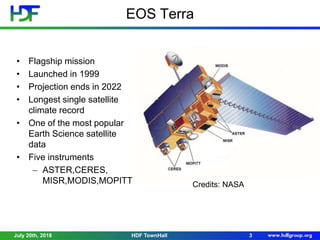
EOS Terra
• Flagship mission
• Launched in 1999
• Projection ends in 2022
• Longest single satellite
climate record
• One of the most popular
Earth Science satellite
data
• Five instruments
 ASTER,CERES,
MISR,MODIS,MOPITT
July 20th, 2018 3HDF TownHall
Credits: NASA
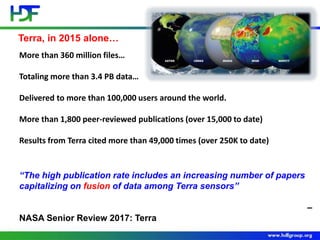
Terra, in 2015 alone…
More than 360 million files…
Totaling more than 3.4 PB data…
Delivered to more than 100,000 users around the world.
More than 1,800 peer-reviewed publications (over 15,000 to date)
Results from Terra cited more than 49,000 times (over 250K to date)
“The high publication rate includes an increasing number of papers
capitalizing on fusion of data among Terra sensors”
–
NASA Senior Review 2017: Terra
Terra Data Fusion Project
• Fuse existing Level 1B Terra radiance
products from all Terra 5 instruments into
one product
July 20th, 2018 5HDF TownHall
Why Terra Data Fusion?
• Scientific value added by data fusion of its
five instruments.
• A key recommendation from the 2007
NRC Decadal Survey on Earth Science
and Application from Space:
“…experts should... focus on providing
comprehensive data sets that combine
measuremements from multiple sensors.”
July 20th, 2018 6HDF TownHall
Challenges for Terra Data Fusion
• Huge data volumes
 1 PB input data from year 2000 to 2015
Need adequate cyberinfrastructure to tackle
• Input data residing at different locations
Need to transfer huge data volumes
July 20th, 2018 7HDF TownHall
Solutions
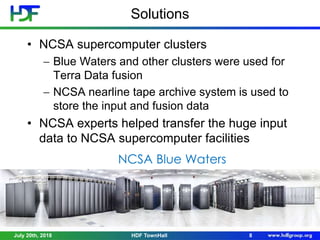
• NCSA supercomputer clusters
 Blue Waters and other clusters were used for
Terra Data fusion
 NCSA nearline tape archive system is used to
store the input and fusion data
• NCSA experts helped transfer the huge input
data to NCSA supercomputer facilities
July 20th, 2018 8HDF TownHall
NCSA Blue Waters
More Challenges
July 20th, 2018 9HDF TownHall
• Input data
 Different granularities
 Different methods to store radiance and geo-
location data
 Different file formats
• Complicate fusion file organization
• Metadata conventions need to catch up
Overcoming these challenges is what
The HDF Group contributed the most!
Different Instrument Granularities
• Map granules from different instruments to a
common granule that contains data for a single
Terra orbit.
 Contain multiple MODIS and ASTER input
granules
 Subset CERES and MOPITT input granules
July 20th, 2018 10HDF TownHall
Different Methods to Store Data
• Unpacking MODIS, ASTER and MISR radiation
data to physical units
 Need to unpack the data by following the specific
packing schemes of individual instruments
• Interpolating MODIS, ASTER and MISR
geolocation data to native radiance resolution
 Need to handle each instrument differently
July 20th, 2018 11HDF TownHall
Different File Formats of Input Granules
• All converted to HDF5 file format
 From HDF4, HDF-EOS2 and HDF-EOS5
• Also netCDF-4 compatible
 Following netCDF-4 enhanced data model
July 20th, 2018 12HDF TownHall
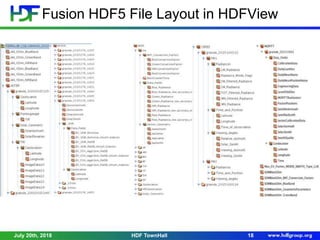
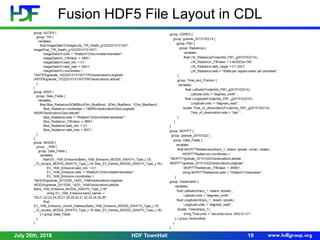
Complicate Fusion file organization
• Use HDF5 group structure to organize different
instruments and different input granules
 Each instrument represented by one group
 Each input granule stored as the subgroup of the
instrument group
July 20th, 2018 13HDF TownHall
Metadata Conventions Catch-up
• Make the fusion HDF5 file follow CF conventions
by adding key CF attributes
 Units
 Coordinates
 _FillValue
 Valid_min
 Valid_max
July 20th, 2018 14HDF TownHall
More usage of HDF5 features
• HDF5 chunking and compression are used to
reduce the total fusion file size.
July 20th, 2018 15HDF TownHall
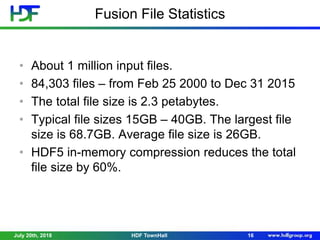
Fusion File Statistics
• About 1 million input files.
• 84,303 files – from Feb 25 2000 to Dec 31 2015
• The total file size is 2.3 petabytes.
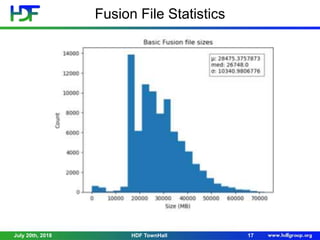
• Typical file sizes 15GB – 40GB. The largest file
size is 68.7GB. Average file size is 26GB.
• HDF5 in-memory compression reduces the total
file size by 60%.
July 20th, 2018 16HDF TownHall
Fusion File Statistics
July 20th, 2018 17HDF TownHall
Fusion HDF5 File Layout in HDFView
July 20th, 2018 18HDF TownHall
Fusion HDF5 File Layout in CDL
July 20th, 2018 19HDF TownHall
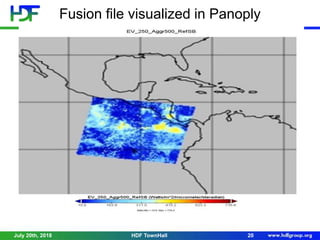
Fusion file visualized in Panoply
July 20th, 2018 20HDF TownHall
Other Work
• Validate the generated data to ensure the high
quality fusion product
• Implemented the advanced fusion resampling
and reprojection tool
 Resample / reproject the radiance fields for one
Terra instrument onto the grids used by another
Terra instrument
• Generated the NASA CMR-compliant fusion
Collection and granule metadata in ECHO 10
XML format
July 20th, 2018 21HDF TownHall
• Fusion data visualization demo
July 20th, 2018 22HDF TownHall
Thank You!
July 20th, 2018 HDF TownHall 23
Acknowledgements
This work was supported by NASA ACCESS Grant
#NNX16AM07A.
Any opinions, findings, conclusions, or
recommendations expressed in this material are
those of the author[s] and do not necessarily
reflect the views of NASA.
July 20th, 2018 24HDF TownHall
Questions/comments?
July 20th, 2018 HDF TownHall 25

NASA Terra Data Fusion

  • 1.
    NASA Terra DataFusion Kent Yang The HDF Group HDF Town Hall July 20, 2018 July 20th, 2018 HDF TownHall 1
  • 2.
    July 20th, 2018HDF TownHall 2 The Terra Data Fusion Project Team Department of Atmospheric Sciences, University of Illinois Larry Di Girolamo Guangyu Zhao Yizhe Zhan Landon Clipp Shashank Bansal Yat Long Lo Dongwei Fu Brandon Chen Department of Geography and GIS, University of Illinois Shaowen Wang Yan Liu Yizhao Gao The HDF Group MuQun (Kent) Yang H Joe Lee National Center for Supercomputing Applications, University of Illinois John Towns Kandace Turner Michelle Butler Sean Stevens David Ralia Jonathan Kim Donna Cox Stuart Levy Robert Patterson Andrew Christiensen Department of Atmospheric Sciences, Texas A&M Ping Yang Hioki Souichiro Yi Wang NASA Langely/SSAI Lusheng Liang NASA Goddard Space Flight Center Ralph Kahn Jim Limbacher
  • 3.
    EOS Terra • Flagshipmission • Launched in 1999 • Projection ends in 2022 • Longest single satellite climate record • One of the most popular Earth Science satellite data • Five instruments  ASTER,CERES, MISR,MODIS,MOPITT July 20th, 2018 3HDF TownHall Credits: NASA
  • 4.
    Terra, in 2015alone… More than 360 million files… Totaling more than 3.4 PB data… Delivered to more than 100,000 users around the world. More than 1,800 peer-reviewed publications (over 15,000 to date) Results from Terra cited more than 49,000 times (over 250K to date) “The high publication rate includes an increasing number of papers capitalizing on fusion of data among Terra sensors” – NASA Senior Review 2017: Terra
  • 5.
    Terra Data FusionProject • Fuse existing Level 1B Terra radiance products from all Terra 5 instruments into one product July 20th, 2018 5HDF TownHall
  • 6.
    Why Terra DataFusion? • Scientific value added by data fusion of its five instruments. • A key recommendation from the 2007 NRC Decadal Survey on Earth Science and Application from Space: “…experts should... focus on providing comprehensive data sets that combine measuremements from multiple sensors.” July 20th, 2018 6HDF TownHall
  • 7.
    Challenges for TerraData Fusion • Huge data volumes  1 PB input data from year 2000 to 2015 Need adequate cyberinfrastructure to tackle • Input data residing at different locations Need to transfer huge data volumes July 20th, 2018 7HDF TownHall
  • 8.
    Solutions • NCSA supercomputerclusters  Blue Waters and other clusters were used for Terra Data fusion  NCSA nearline tape archive system is used to store the input and fusion data • NCSA experts helped transfer the huge input data to NCSA supercomputer facilities July 20th, 2018 8HDF TownHall NCSA Blue Waters
  • 9.
    More Challenges July 20th,2018 9HDF TownHall • Input data  Different granularities  Different methods to store radiance and geo- location data  Different file formats • Complicate fusion file organization • Metadata conventions need to catch up Overcoming these challenges is what The HDF Group contributed the most!
  • 10.
    Different Instrument Granularities •Map granules from different instruments to a common granule that contains data for a single Terra orbit.  Contain multiple MODIS and ASTER input granules  Subset CERES and MOPITT input granules July 20th, 2018 10HDF TownHall
  • 11.
    Different Methods toStore Data • Unpacking MODIS, ASTER and MISR radiation data to physical units  Need to unpack the data by following the specific packing schemes of individual instruments • Interpolating MODIS, ASTER and MISR geolocation data to native radiance resolution  Need to handle each instrument differently July 20th, 2018 11HDF TownHall
  • 12.
    Different File Formatsof Input Granules • All converted to HDF5 file format  From HDF4, HDF-EOS2 and HDF-EOS5 • Also netCDF-4 compatible  Following netCDF-4 enhanced data model July 20th, 2018 12HDF TownHall
  • 13.
    Complicate Fusion fileorganization • Use HDF5 group structure to organize different instruments and different input granules  Each instrument represented by one group  Each input granule stored as the subgroup of the instrument group July 20th, 2018 13HDF TownHall
  • 14.
    Metadata Conventions Catch-up •Make the fusion HDF5 file follow CF conventions by adding key CF attributes  Units  Coordinates  _FillValue  Valid_min  Valid_max July 20th, 2018 14HDF TownHall
  • 15.
    More usage ofHDF5 features • HDF5 chunking and compression are used to reduce the total fusion file size. July 20th, 2018 15HDF TownHall
  • 16.
    Fusion File Statistics •About 1 million input files. • 84,303 files – from Feb 25 2000 to Dec 31 2015 • The total file size is 2.3 petabytes. • Typical file sizes 15GB – 40GB. The largest file size is 68.7GB. Average file size is 26GB. • HDF5 in-memory compression reduces the total file size by 60%. July 20th, 2018 16HDF TownHall
  • 17.
    Fusion File Statistics July20th, 2018 17HDF TownHall
  • 18.
    Fusion HDF5 FileLayout in HDFView July 20th, 2018 18HDF TownHall
  • 19.
    Fusion HDF5 FileLayout in CDL July 20th, 2018 19HDF TownHall
  • 20.
    Fusion file visualizedin Panoply July 20th, 2018 20HDF TownHall
  • 21.
    Other Work • Validatethe generated data to ensure the high quality fusion product • Implemented the advanced fusion resampling and reprojection tool  Resample / reproject the radiance fields for one Terra instrument onto the grids used by another Terra instrument • Generated the NASA CMR-compliant fusion Collection and granule metadata in ECHO 10 XML format July 20th, 2018 21HDF TownHall
  • 22.
    • Fusion datavisualization demo July 20th, 2018 22HDF TownHall
  • 23.
    Thank You! July 20th,2018 HDF TownHall 23
  • 24.
    Acknowledgements This work wassupported by NASA ACCESS Grant #NNX16AM07A. Any opinions, findings, conclusions, or recommendations expressed in this material are those of the author[s] and do not necessarily reflect the views of NASA. July 20th, 2018 24HDF TownHall
  • 25.