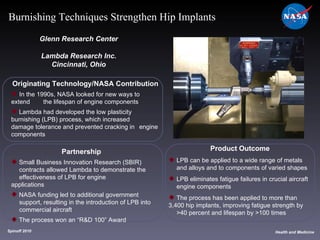
Originating Technology/NASA Contribution In the 1990s, NASA looked for new ways to extend  the lifespan of engine components Lambda had developed the low plasticity  burnishing (LPB) process, which increased  damage tolerance and prevented cracking in  engine components  Glenn Research Center Lambda Research Inc. Cincinnati, Ohio Product Outcome LPB can be applied to a wide range of metals  and alloys and to components of varied shapes LPB eliminates fatigue failures in crucial aircraft  engine components The process has been applied to more than  3,400 hip implants, improving fatigue strength by  >40 percent and lifespan by >100 times  Spinoff 2010 Title of photo Image from Article Health and Medicine Burnishing Techniques Strengthen Hip Implants Partnership Small Business Innovation Research (SBIR)  contracts allowed Lambda to demonstrate the effectiveness of LPB for engine  applications NASA funding led to additional government  support, resulting in the introduction of LPB into  commercial aircraft The process won an “R&D 100” Award
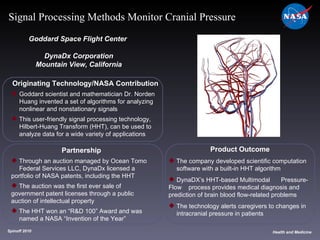
Originating Technology/NASA Contribution Goddard scientist and mathematician Dr. Norden  Huang invented a set of algorithms for analyzing  nonlinear and nonstationary signals This user-friendly signal processing technology,  Hilbert-Huang Transform (HHT), can be used to  analyze data for a wide variety of applications Goddard Space Flight Center  DynaDx Corporation Mountain View, California Product Outcome The company developed scientific computation  software with a built-in HHT algorithm DynaDX’s HHT-based Multimodal  Pressure-Flow  process provides medical diagnosis and  prediction of brain blood flow-related problems The technology alerts caregivers to changes in  intracranial pressure in patients Spinoff 2010 Title of photo Health and Medicine Signal Processing Methods Monitor Cranial Pressure Partnership Through an auction managed by Ocean Tomo  Federal Services LLC, DynaDx licensed a  portfolio of NASA patents, including the HHT The auction was the first ever sale of  government patent licenses through a public  auction of intellectual property  The HHT won an “R&D 100” Award and was  named a NASA “Invention of the Year”
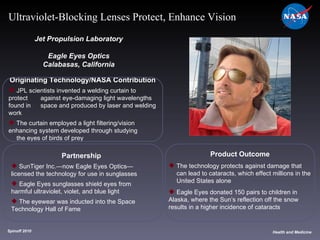
Originating Technology/NASA Contribution JPL scientists invented a welding curtain to protect  against eye-damaging light wavelengths found in  space and produced by laser and welding work The curtain employed a light filtering/vision  enhancing system developed through studying  the eyes of birds of prey Jet Propulsion Laboratory Eagle Eyes Optics Calabasas, California Product Outcome The technology protects against damage that  can lead to cataracts, which effect millions in the  United States alone Eagle Eyes donated 150 pairs to children in  Alaska, where the Sun’s reflection off the snow  results in a higher incidence of cataracts Spinoff 2010 Title of photo Health and Medicine Ultraviolet-Blocking Lenses Protect, Enhance Vision Partnership SunTiger Inc.—now Eagle Eyes Optics— licensed the technology for use in sunglasses Eagle Eyes sunglasses shield eyes from  harmful ultraviolet, violet, and blue light The eyewear was inducted into the Space  Technology Hall of Fame
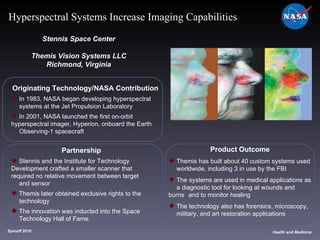
Originating Technology/NASA Contribution In 1983, NASA began developing hyperspectral  systems at the Jet Propulsion Laboratory In 2001, NASA launched the first on-orbit  hyperspectral imager, Hyperion, onboard the Earth  Observing-1 spacecraft Stennis Space Center Themis Vision Systems LLC Richmond, Virginia Product Outcome Themis has built about 40 custom systems used  worldwide, including 3 in use by the FBI The systems are used in medical applications as  a diagnostic tool for looking at wounds and burns  and to monitor healing The technology also has forensics, microscopy,  military, and art restoration applications Spinoff 2010 Title of photo Image from Article Health and Medicine Hyperspectral Systems Increase Imaging Capabilities Partnership Stennis and the Institute for Technology  Development crafted a smaller scanner that  required no relative movement between target  and sensor Themis later obtained exclusive rights to the  technology The innovation was inducted into the Space  Technology Hall of Fame
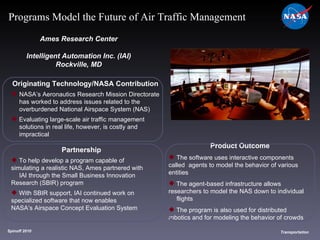
Originating Technology/NASA Contribution NASA’s Aeronautics Research Mission Directorate  has worked to address issues related to the  overburdened National Airspace System (NAS) Evaluating large-scale air traffic management  solutions in real life, however, is costly and  impractical Ames Research Center Intelligent Automation Inc. (IAI) Rockville, MD Product Outcome The software uses interactive components called  agents to model the behavior of various entities The agent-based infrastructure allows  researchers to model the NAS down to individual  flights The program is also used for distributed  robotics and for modeling the behavior of crowds Spinoff 2010 Title of photo Transportation Programs Model the Future of Air Traffic Management Partnership To help develop a program capable of  simulating a realistic NAS, Ames partnered with  IAI through the Small Business Innovation Research (SBIR) program With SBIR support, IAI continued work on  specialized software that now enables  NASA’s Airspace Concept Evaluation System
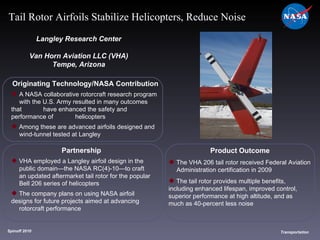
Originating Technology/NASA Contribution A NASA collaborative rotorcraft research program  with the U.S. Army resulted in many outcomes that  have enhanced the safety and performance of  helicopters Among these are advanced airfoils designed and  wind-tunnel tested at Langley Langley Research Center Van Horn Aviation LLC (VHA) Tempe, Arizona Product Outcome The VHA 206 tail rotor received Federal Aviation  Administration certification in 2009  The tail rotor provides multiple benefits,  including enhanced lifespan, improved control,  superior performance at high altitude, and as  much as 40-percent less noise  Spinoff 2010 Title of photo Transportation Tail Rotor Airfoils Stabilize Helicopters, Reduce Noise Partnership VHA employed a Langley airfoil design in the  public domain—the NASA RC(4)-10—to craft  an updated aftermarket tail rotor for the popular  Bell 206 series of helicopters  The company plans on using NASA airfoil  designs for future projects aimed at advancing  rotorcraft performance
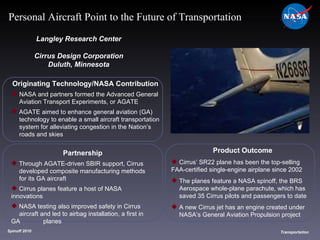
Originating Technology/NASA Contribution NASA and partners formed the Advanced General  Aviation Transport Experiments, or AGATE AGATE aimed to enhance general aviation (GA)  technology to enable a small aircraft transportation  system for alleviating congestion in the Nation’s  roads and skies Langley Research Center Cirrus Design Corporation Duluth, Minnesota Product Outcome Cirrus’ SR22 plane has been the top-selling  FAA-certified single-engine airplane since 2002 The planes feature a NASA spinoff, the BRS  Aerospace whole-plane parachute, which has  saved 35 Cirrus pilots and passengers to date A new Cirrus jet has an engine created under  NASA’s General Aviation Propulsion project Spinoff 2010 Title of photo Image from Article Transportation Personal Aircraft Point to the Future of Transportation Partnership Through AGATE-driven SBIR support, Cirrus  developed composite manufacturing methods  for its GA aircraft Cirrus planes feature a host of NASA innovations NASA testing also improved safety in Cirrus  aircraft and led to airbag installation, a first in GA  planes
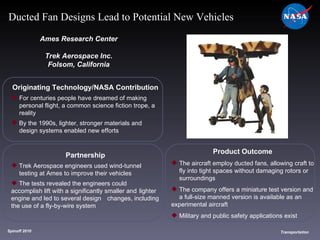
Originating Technology/NASA Contribution For centuries people have dreamed of making  personal flight, a common science fiction trope, a  reality By the 1990s, lighter, stronger materials and  design systems enabled new efforts  Ames Research Center Trek Aerospace Inc. Folsom, California Product Outcome The aircraft employ ducted fans, allowing craft to  fly into tight spaces without damaging rotors or  surroundings The company offers a miniature test version and  a full-size manned version is available as an  experimental aircraft Military and public safety applications exist  Spinoff 2010 Title of photo Transportation Ducted Fan Designs Lead to Potential New Vehicles Partnership Trek Aerospace engineers used wind-tunnel  testing at Ames to improve their vehicles The tests revealed the engineers could  accomplish lift with a significantly smaller and  lighter engine and led to several design  changes, including the use of a fly-by-wire system
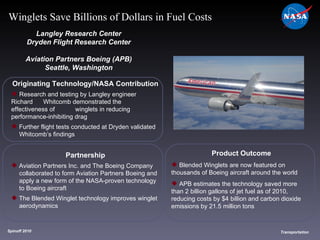
Originating Technology/NASA Contribution Research and testing by Langley engineer Richard  Whitcomb demonstrated the effectiveness of  winglets in reducing performance-inhibiting drag Further flight tests conducted at Dryden validated  Whitcomb’s findings  Langley Research Center Dryden Flight Research Center Aviation Partners Boeing (APB) Seattle, Washington Product Outcome Blended Winglets are now featured on  thousands of Boeing aircraft around the world APB estimates the technology saved more  than 2 billion gallons of jet fuel as of 2010,  reducing costs by $4 billion and carbon dioxide  emissions by 21.5 million tons Spinoff 2010 Title of photo Image from Article Transportation Winglets Save Billions of Dollars in Fuel Costs Partnership Aviation Partners Inc. and The Boeing Company  collaborated to form Aviation Partners Boeing and  apply a new form of the NASA-proven technology  to Boeing aircraft The Blended Winglet technology improves winglet  aerodynamics
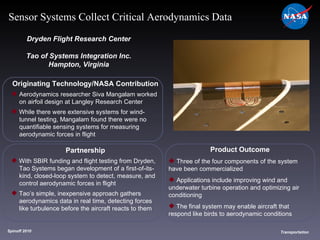
Originating Technology/NASA Contribution Aerodynamics researcher Siva Mangalam worked  on airfoil design at Langley Research Center While there were extensive systems for wind- tunnel testing, Mangalam found there were no  quantifiable sensing systems for measuring  aerodynamic forces in flight Dryden Flight Research Center Tao of Systems Integration Inc. Hampton, Virginia Product Outcome Three of the four components of the system  have been commercialized Applications include improving wind and  underwater turbine operation and optimizing air  conditioning The final system may enable aircraft that  respond like birds to aerodynamic conditions Spinoff 2010 Title of photo Image from Article Transportation Sensor Systems Collect Critical Aerodynamics Data Partnership With SBIR funding and flight testing from Dryden,  Tao Systems began development of a first-of-its- kind, closed-loop system to detect, measure, and  control aerodynamic forces in flight  Tao’s simple, inexpensive approach gathers  aerodynamics data in real time, detecting forces  like turbulence before the aircraft reacts to them
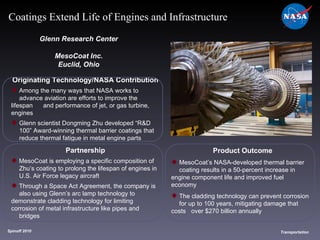
Originating Technology/NASA Contribution Among the many ways that NASA works to  advance aviation are efforts to improve the lifespan  and performance of jet, or gas turbine, engines Glenn scientist Dongming Zhu developed “R&D  100” Award-winning thermal barrier coatings that  reduce thermal fatigue in metal engine parts Glenn Research Center MesoCoat Inc. Euclid, Ohio Product Outcome MesoCoat’s NASA-developed thermal barrier  coating results in a 50-percent increase in  engine component life and improved fuel  economy The cladding technology can prevent corrosion  for up to 100 years, mitigating damage that costs  over $270 billion annually Spinoff 2010 Title of photo Image from Article Transportation Coatings Extend Life of Engines and Infrastructure Partnership MesoCoat is employing a specific composition of  Zhu’s coating to prolong the lifespan of engines in  U.S. Air Force legacy aircraft Through a Space Act Agreement, the company is  also using Glenn’s arc lamp technology to  demonstrate cladding technology for limiting  corrosion of metal infrastructure like pipes and  bridges
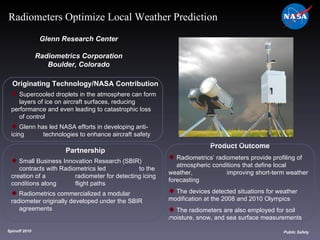
Originating Technology/NASA Contribution Supercooled droplets in the atmosphere can form  layers of ice on aircraft surfaces, reducing  performance and even leading to catastrophic loss  of control Glenn has led NASA efforts in developing anti-icing  technologies to enhance aircraft safety Glenn Research Center Radiometrics Corporation Boulder, Colorado Product Outcome Radiometrics’ radiometers provide profiling of  atmospheric conditions that define local weather,  improving short-term weather forecasting The devices detected situations for weather  modification at the 2008 and 2010 Olympics The radiometers are also employed for soil  moisture, snow, and sea surface measurements  Spinoff 2010 Title of photo Image from Article Public Safety Radiometers Optimize Local Weather Prediction Partnership Small Business Innovation Research (SBIR)  contracts with Radiometrics led  to the creation of a  radiometer for detecting icing conditions along  flight paths Radiometrics commercialized a modular  radiometer originally developed under the SBIR  agreements
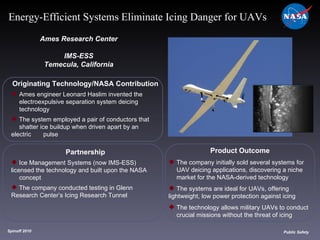
Originating Technology/NASA Contribution Ames engineer Leonard Haslim invented the  electroexpulsive separation system deicing  technology The system employed a pair of conductors that  shatter ice buildup when driven apart by an electric  pulse Ames Research Center IMS-ESS Temecula, California Product Outcome The company initially sold several systems for  UAV deicing applications, discovering a niche  market for the NASA-derived technology The systems are ideal for UAVs, offering  lightweight, low power protection against icing The technology allows military UAVs to conduct  crucial missions without the threat of icing  Spinoff 2010 Title of photo Image from Article Public Safety Energy-Efficient Systems Eliminate Icing Danger for UAVs Partnership Ice Management Systems (now IMS-ESS)  licensed the technology and built upon the NASA  concept The company conducted testing in Glenn  Research Center’s Icing Research Tunnel
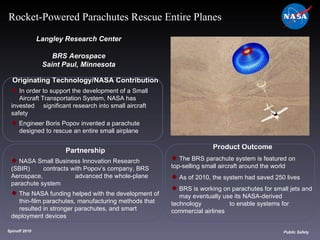
Originating Technology/NASA Contribution In order to support the development of a Small  Aircraft Transportation System, NASA has invested  significant research into small aircraft safety Engineer Boris Popov invented a parachute  designed to rescue an entire small airplane Langley Research Center BRS Aerospace Saint Paul, Minnesota Product Outcome The BRS parachute system is featured on  top-selling small aircraft around the world As of 2010, the system had saved 250 lives BRS is working on parachutes for small jets and  may eventually use its NASA-derived technology  to enable systems for commercial airlines Spinoff 2010 Title of photo Image from Article Public Safety Rocket-Powered Parachutes Rescue Entire Planes Partnership NASA Small Business Innovation Research (SBIR)  contracts with Popov’s company, BRS Aerospace,  advanced the whole-plane parachute system The NASA funding helped with the development of  thin-film parachutes, manufacturing methods that  resulted in stronger parachutes, and smart  deployment devices
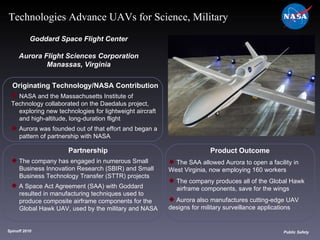
Originating Technology/NASA Contribution NASA and the Massachusetts Institute of  Technology collaborated on the Daedalus project,  exploring new technologies for lightweight aircraft  and high-altitude, long-duration flight Aurora was founded out of that effort and began a  pattern of partnership with NASA Goddard Space Flight Center Aurora Flight Sciences Corporation Manassas, Virginia Product Outcome The SAA allowed Aurora to open a facility in  West Virginia, now employing 160 workers The company produces all of the Global Hawk  airframe components, save for the wings Aurora also manufactures cutting-edge UAV  designs for military surveillance applications Spinoff 2010 Title of photo Image from Article Public Safety Technologies Advance UAVs for Science, Military Partnership The company has engaged in numerous Small  Business Innovation Research (SBIR) and Small  Business Technology Transfer (STTR) projects  A Space Act Agreement (SAA) with Goddard  resulted in manufacturing techniques used to  produce composite airframe components for the  Global Hawk UAV, used by the military and NASA
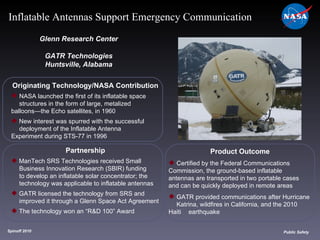
Originating Technology/NASA Contribution NASA launched the first of its inflatable space  structures in the form of large, metalized  balloons—the Echo satellites, in 1960 New interest was spurred with the successful  deployment of the Inflatable Antenna  Experiment during STS-77 in 1996  Glenn Research Center GATR Technologies Huntsville, Alabama Product Outcome Certified by the Federal Communications  Commission, the ground-based inflatable  antennas are transported in two portable cases  and can be quickly deployed in remote areas GATR provided communications after Hurricane  Katrina, wildfires in California, and the 2010 Haiti  earthquake Spinoff 2010 Title of photo Image from Article Public Safety Inflatable Antennas Support Emergency Communication Partnership ManTech SRS Technologies received Small  Business Innovation Research (SBIR) funding  to develop an inflatable solar concentrator; the  technology was applicable to inflatable antennas GATR licensed the technology from SRS and  improved it through a Glenn Space Act Agreement The technology won an “R&D 100” Award
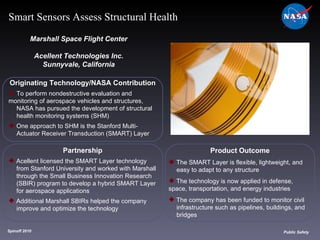
Originating Technology/NASA Contribution To perform nondestructive evaluation and  monitoring of aerospace vehicles and structures,  NASA has pursued the development of structural  health monitoring systems (SHM) One approach to SHM is the Stanford Multi- Actuator Receiver Transduction (SMART) Layer Marshall Space Flight Center Acellent Technologies Inc. Sunnyvale, California Product Outcome The SMART Layer is flexible, lightweight, and  easy to adapt to any structure The technology is now applied in defense,  space, transportation, and energy industries The company has been funded to monitor civil  infrastructure such as pipelines, buildings, and  bridges Spinoff 2010 Title of photo Image from Article Public Safety Smart Sensors Assess Structural Health Partnership Acellent licensed the SMART Layer technology  from Stanford University and worked with Marshall  through the Small Business Innovation Research  (SBIR) program to develop a hybrid SMART Layer  for aerospace applications  Additional Marshall SBIRs helped the company  improve and optimize the technology
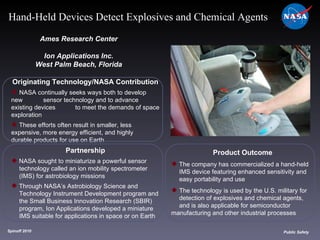
Originating Technology/NASA Contribution NASA continually seeks ways both to develop new  sensor technology and to advance existing devices  to meet the demands of space exploration These efforts often result in smaller, less  expensive, more energy efficient, and highly  durable products for use on Earth Ames Research Center Ion Applications Inc. West Palm Beach, Florida Product Outcome The company has commercialized a hand-held  IMS device featuring enhanced sensitivity and  easy portability and use  The technology is used by the U.S. military for  detection of explosives and chemical agents,  and is also applicable for semiconductor  manufacturing and other industrial processes Spinoff 2010 Title of photo Image from Article Public Safety Hand-Held Devices Detect Explosives and Chemical Agents Partnership NASA sought to miniaturize a powerful sensor  technology called an ion mobility spectrometer  (IMS) for astrobiology missions Through NASA’s Astrobiology Science and  Technology Instrument Development program and  the Small Business Innovation Research (SBIR)  program, Ion Applications developed a miniature  IMS suitable for applications in space or on Earth
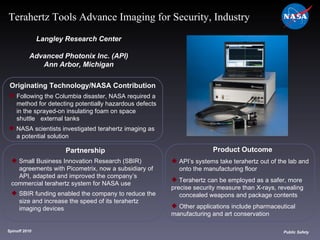
Originating Technology/NASA Contribution Following the Columbia disaster, NASA required a  method for detecting potentially hazardous defects  in the sprayed-on insulating foam on space  shuttle  external tanks NASA scientists investigated terahertz imaging as  a potential solution Langley Research Center Advanced Photonix Inc. (API) Ann Arbor, Michigan Product Outcome API’s systems take terahertz out of the lab and  onto the manufacturing floor Terahertz can be employed as a safer, more  precise security measure than X-rays, revealing  concealed weapons and package contents Other applications include pharmaceutical  manufacturing and art conservation Spinoff 2010 Title of photo Public Safety Terahertz Tools Advance Imaging for Security, Industry Partnership Small Business Innovation Research (SBIR)  agreements with Picometrix, now a subsidiary of  API, adapted and improved the company’s  commercial terahertz system for NASA use SBIR funding enabled the company to reduce the  size and increase the speed of its terahertz  imaging devices
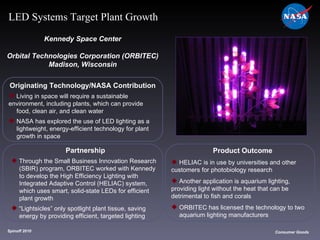
Originating Technology/NASA Contribution Living in space will require a sustainable  environment, including plants, which can provide  food, clean air, and clean water NASA has explored the use of LED lighting as a  lightweight, energy-efficient technology for plant  growth in space Kennedy Space Center Orbital Technologies Corporation (ORBITEC) Madison, Wisconsin Product Outcome HELIAC is in use by universities and other  customers for photobiology research Another application is aquarium lighting,  providing light without the heat that can be  detrimental to fish and corals ORBITEC has licensed the technology to two  aquarium lighting manufacturers Spinoff 2010 Title of photo Image from Article Consumer Goods LED Systems Target Plant Growth Partnership Through the Small Business Innovation Research  (SBIR) program, ORBITEC worked with Kennedy  to develop the High Efficiency Lighting with  Integrated Adaptive Control (HELIAC) system,  which uses smart, solid-state LEDs for efficient  plant growth “ Lightsicles” only spotlight plant tissue, saving  energy by providing efficient, targeted lighting
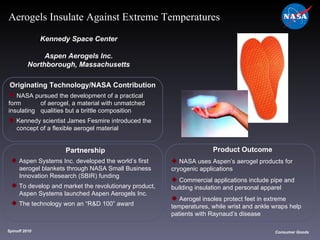
Originating Technology/NASA Contribution NASA pursued the development of a practical form  of aerogel, a material with unmatched insulating  qualities but a brittle composition Kennedy scientist James Fesmire introduced the  concept of a flexible aerogel material Kennedy Space Center Aspen Aerogels Inc. Northborough, Massachusetts Product Outcome NASA uses Aspen’s aerogel products for  cryogenic applications Commercial applications include pipe and  building insulation and personal apparel Aerogel insoles protect feet in extreme  temperatures, while wrist and ankle wraps help  patients with Raynaud’s disease Spinoff 2010 Title of photo Consumer Goods Aerogels Insulate Against Extreme Temperatures Partnership Aspen Systems Inc. developed the world’s first  aerogel blankets through NASA Small Business  Innovation Research (SBIR) funding To develop and market the revolutionary product,  Aspen Systems launched Aspen Aerogels Inc. The technology won an “R&D 100” award
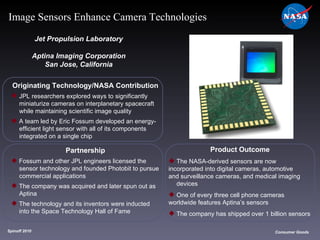
Originating Technology/NASA Contribution JPL researchers explored ways to significantly  miniaturize cameras on interplanetary spacecraft  while maintaining scientific image quality A team led by Eric Fossum developed an energy- efficient light sensor with all of its components  integrated on a single chip Jet Propulsion Laboratory Aptina Imaging Corporation San Jose, California Product Outcome The NASA-derived sensors are now  incorporated into digital cameras, automotive  and surveillance cameras, and medical imaging  devices One of every three cell phone cameras  worldwide features Aptina’s sensors The company has shipped over 1 billion sensors Spinoff 2010 Title of photo Image from Article Consumer Goods Image Sensors Enhance Camera Technologies Partnership Fossum and other JPL engineers licensed the  sensor technology and founded Photobit to pursue  commercial applications The company was acquired and later spun out as  Aptina The technology and its inventors were inducted  into the Space Technology Hall of Fame
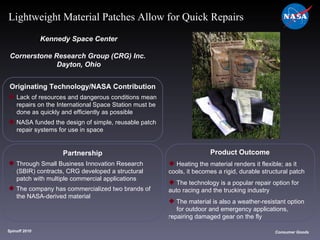
Originating Technology/NASA Contribution Lack of resources and dangerous conditions mean  repairs on the International Space Station must be  done as quickly and efficiently as possible NASA funded the design of simple, reusable patch  repair systems for use in space Kennedy Space Center Cornerstone Research Group (CRG) Inc.  Dayton, Ohio Product Outcome Heating the material renders it flexible; as it  cools, it becomes a rigid, durable structural patch The technology is a popular repair option for  auto racing and the trucking industry The material is also a weather-resistant option  for outdoor and emergency applications,  repairing damaged gear on the fly Spinoff 2010 Title of photo Consumer Goods Lightweight Material Patches Allow for Quick Repairs Partnership Through Small Business Innovation Research  (SBIR) contracts, CRG developed a structural  patch with multiple commercial applications The company has commercialized two brands of  the NASA-derived material
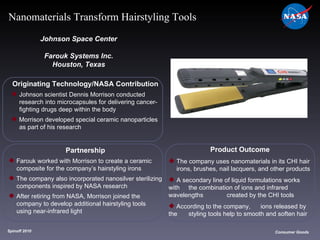
Originating Technology/NASA Contribution Johnson scientist Dennis Morrison conducted  research into microcapsules for delivering cancer- fighting drugs deep within the body Morrison developed special ceramic nanoparticles  as part of his research Johnson Space Center Farouk Systems Inc. Houston, Texas Product Outcome The company uses nanomaterials in its CHI hair  irons, brushes, nail lacquers, and other products A secondary line of liquid formulations works with  the combination of ions and infrared wavelengths  created by the CHI tools According to the company, ions released by the  styling tools help to smooth and soften hair Spinoff 2010 Title of photo Image from Article Consumer Goods Nanomaterials Transform Hairstyling Tools Partnership Farouk worked with Morrison to create a ceramic  composite for the company’s hairstyling irons The company also incorporated nanosilver sterilizing  components inspired by NASA research After retiring from NASA, Morrison joined the  company to develop additional hairstyling tools  using near-infrared light
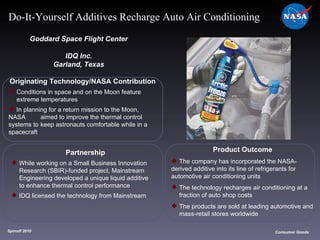
Originating Technology/NASA Contribution Conditions in space and on the Moon feature  extreme temperatures In planning for a return mission to the Moon, NASA  aimed to improve the thermal control systems to  keep astronauts comfortable while in a spacecraft Goddard Space Flight Center IDQ Inc. Garland, Texas Product Outcome The company has incorporated the NASA- derived additive into its line of refrigerants for  automotive air conditioning units The technology recharges air conditioning at a fraction of auto shop costs  The products are sold at leading automotive and  mass-retail stores worldwide Spinoff 2010 Title of photo Image from Article Consumer Goods Do-It-Yourself Additives Recharge Auto Air Conditioning Partnership While working on a Small Business Innovation  Research (SBIR)-funded project, Mainstream  Engineering developed a unique liquid additive  to enhance thermal control performance IDQ licensed the technology from Mainstream
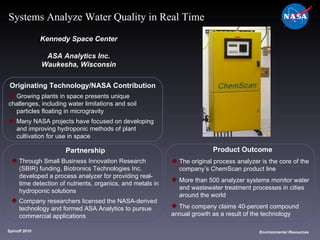
Originating Technology/NASA Contribution Growing plants in space presents unique  challenges, including water limitations and soil  particles floating in microgravity Many NASA projects have focused on developing  and improving hydroponic methods of plant  cultivation for use in space Kennedy Space Center ASA Analytics Inc. Waukesha, Wisconsin Product Outcome The original process analyzer is the core of the  company’s ChemScan product line More than 500 analyzer systems monitor water  and wastewater treatment processes in cities  around the world The company claims 40-percent compound  annual growth as a result of the technology Spinoff 2010 Title of photo Environmental Resources Systems Analyze Water Quality in Real Time Partnership Through Small Business Innovation Research  (SBIR) funding, Biotronics Technologies Inc.  developed a process analyzer for providing real- time detection of nutrients, organics, and metals in  hydroponic solutions Company researchers licensed the NASA-derived  technology and formed ASA Analytics to pursue  commercial applications
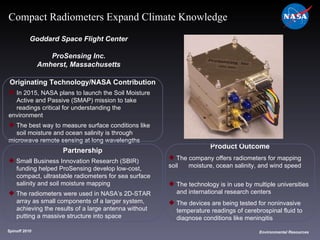
Originating Technology/NASA Contribution In 2015, NASA plans to launch the Soil Moisture  Active and Passive (SMAP) mission to take  readings critical for understanding the environment The best way to measure surface conditions like  soil moisture and ocean salinity is through  microwave remote sensing at long wavelengths Goddard Space Flight Center ProSensing Inc. Amherst, Massachusetts Product Outcome The company offers radiometers for mapping soil  moisture, ocean salinity, and wind speed The technology is in use by multiple universities  and international research centers The devices are being tested for noninvasive  temperature readings of cerebrospinal fluid to  diagnose conditions like meningitis  Spinoff 2010 Environmental Resources Compact Radiometers Expand Climate Knowledge Partnership Small Business Innovation Research (SBIR)  funding helped ProSensing develop low-cost,  compact, ultrastable radiometers for sea surface salinity and soil moisture mapping The radiometers were used in NASA’s 2D-STAR  array as small components of a larger system,  achieving the results of a large antenna without  putting a massive structure into space
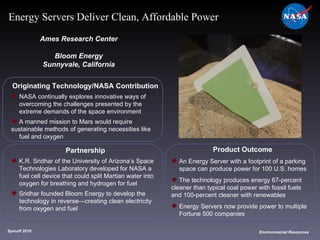
Originating Technology/NASA Contribution NASA continually explores innovative ways of  overcoming the challenges presented by the  extreme demands of the space environment A manned mission to Mars would require  sustainable methods of generating necessities like  fuel and oxygen Ames Research Center Bloom Energy Sunnyvale, California Product Outcome An Energy Server with a footprint of a parking  space can produce power for 100 U.S. homes The technology produces energy 67-percent  cleaner than typical coal power with fossil fuels  and 100-percent cleaner with renewables Energy Servers now provide power to multiple  Fortune 500 companies  Spinoff 2010 Title of photo Image from Article Environmental Resources Energy Servers Deliver Clean, Affordable Power Partnership K.R. Sridhar of the University of Arizona’s Space  Technologies Laboratory developed for NASA a  fuel cell device that could split Martian water into  oxygen for breathing and hydrogen for fuel Sridhar founded Bloom Energy to develop the  technology in reverse—creating clean electricity  from oxygen and fuel
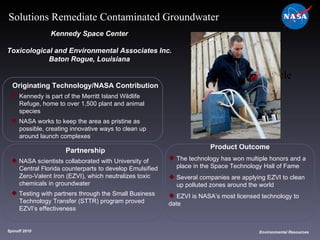
Originating Technology/NASA Contribution Kennedy is part of the Merritt Island Wildlife  Refuge, home to over 1,500 plant and animal  species NASA works to keep the area as pristine as  possible, creating innovative ways to clean up  around launch complexes Kennedy Space Center Toxicological and Environmental Associates Inc. Baton Rogue, Louisiana Product Outcome The technology has won multiple honors and a  place in the Space Technology Hall of Fame Several companies are applying EZVI to clean  up polluted zones around the world EZVI is NASA’s most licensed technology to date Spinoff 2010 Title of photo Image from Article Environmental Resources Solutions Remediate Contaminated Groundwater Partnership NASA scientists collaborated with University of  Central Florida counterparts to develop Emulsified  Zero-Valent Iron (EZVI), which neutralizes toxic  chemicals in groundwater Testing with partners through the Small Business  Technology Transfer (STTR) program proved  EZVI’s effectiveness
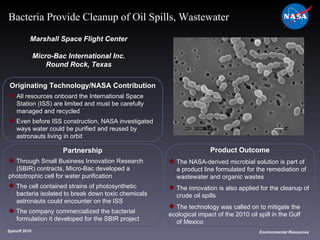
Originating Technology/NASA Contribution All resources onboard the International Space  Station (ISS) are limited and must be carefully  managed and recycled Even before ISS construction, NASA investigated  ways water could be purified and reused by  astronauts living in orbit Marshall Space Flight Center Micro-Bac International Inc. Round Rock, Texas Product Outcome The NASA-derived microbial solution is part of  a product line formulated for the remediation of  wastewater and organic wastes The innovation is also applied for the cleanup of  crude oil spills The technology was called on to mitigate the ecological impact of the 2010 oil spill in the Gulf  of Mexico Spinoff 2010 Title of photo Image from Article Environmental Resources Bacteria Provide Cleanup of Oil Spills, Wastewater Partnership Through Small Business Innovation Research  (SBIR) contracts, Micro-Bac developed a  phototrophic cell for water purification The cell contained strains of photosynthetic  bacteria isolated to break down toxic chemicals  astronauts could encounter on the ISS The company commercialized the bacterial  formulation it developed for the SBIR project
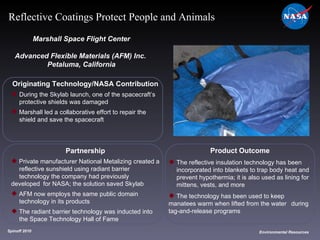
Originating Technology/NASA Contribution During the Skylab launch, one of the spacecraft’s  protective shields was damaged Marshall led a collaborative effort to repair the  shield and save the spacecraft Marshall Space Flight Center Advanced Flexible Materials (AFM) Inc.  Petaluma, California Product Outcome The reflective insulation technology has been  incorporated into blankets to trap body heat and  prevent hypothermia; it is also used as lining for  mittens, vests, and more  The technology has been used to keep  manatees warm when lifted from the water  during tag-and-release programs Spinoff 2010 Title of photo Image from Article Environmental Resources Reflective Coatings Protect People and Animals Partnership Private manufacturer National Metalizing created a  reflective sunshield using radiant barrier  technology the company had previously developed  for NASA; the solution saved Skylab AFM now employs the same public domain  technology in its products The radiant barrier technology was inducted into  the Space Technology Hall of Fame
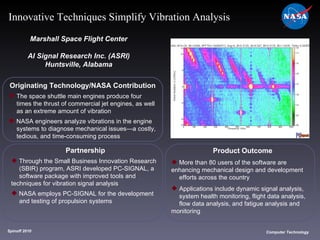
Originating Technology/NASA Contribution The space shuttle main engines produce four  times the thrust of commercial jet engines, as well  as an extreme amount of vibration  NASA engineers analyze vibrations in the engine  systems to diagnose mechanical issues—a costly,  tedious, and time-consuming process Marshall Space Flight Center AI Signal Research Inc. (ASRI) Huntsville, Alabama Product Outcome More than 80 users of the software are  enhancing mechanical design and development  efforts across the country Applications include dynamic signal analysis,  system health monitoring, flight data analysis,  flow data analysis, and fatigue analysis and  monitoring Spinoff 2010 Title of photo Computer Technology Innovative Techniques Simplify Vibration Analysis Partnership Through the Small Business Innovation Research  (SBIR) program, ASRI developed PC-SIGNAL, a  software package with improved tools and  techniques for vibration signal analysis NASA employs PC-SIGNAL for the development  and testing of propulsion systems
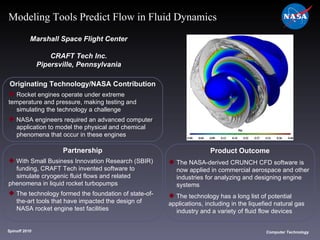
Originating Technology/NASA Contribution Rocket engines operate under extreme  temperature and pressure, making testing and  simulating the technology a challenge NASA engineers required an advanced computer  application to model the physical and chemical  phenomena that occur in these engines Marshall Space Flight Center CRAFT Tech Inc. Pipersville, Pennsylvania Product Outcome The NASA-derived CRUNCH CFD software is  now applied in commercial aerospace and other  industries for analyzing and designing engine  systems The technology has a long list of potential  applications, including in the liquefied natural gas  industry and a variety of fluid flow devices Spinoff 2010 Title of photo Computer Technology Modeling Tools Predict Flow in Fluid Dynamics Partnership With Small Business Innovation Research (SBIR)  funding, CRAFT Tech invented software to  simulate cryogenic fluid flows and related  phenomena in liquid rocket turbopumps The technology formed the foundation of state-of- the-art tools that have impacted the design of  NASA rocket engine test facilities
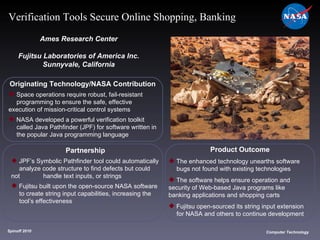
Originating Technology/NASA Contribution Space operations require robust, fail-resistant  programming to ensure the safe, effective  execution of mission-critical control systems NASA developed a powerful verification toolkit  called Java Pathfinder (JPF) for software written in  the popular Java programming language  Ames Research Center Fujitsu Laboratories of America Inc. Sunnyvale, California Product Outcome The enhanced technology unearths software  bugs not found with existing technologies The software helps ensure operation and  security of Web-based Java programs like  banking applications and shopping carts Fujitsu open-sourced its string input extension  for NASA and others to continue development Spinoff 2010 Title of photo Computer Technology Verification Tools Secure Online Shopping, Banking Partnership JPF’s Symbolic Pathfinder tool could automatically  analyze code structure to find defects but could not  handle text inputs, or strings Fujitsu built upon the open-source NASA software  to create string input capabilities, increasing the  tool’s effectiveness
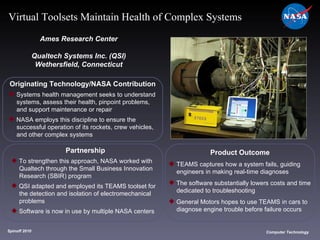
Originating Technology/NASA Contribution Systems health management seeks to understand  systems, assess their health, pinpoint problems,  and support maintenance or repair NASA employs this discipline to ensure the  successful operation of its rockets, crew vehicles,  and other complex systems Ames Research Center Qualtech Systems Inc. (QSI) Wethersfield, Connecticut Product Outcome TEAMS captures how a system fails, guiding  engineers in making real-time diagnoses The software substantially lowers costs and time  dedicated to troubleshooting General Motors hopes to use TEAMS in cars to  diagnose engine trouble before failure occurs Spinoff 2010 Title of photo Computer Technology Virtual Toolsets Maintain Health of Complex Systems Partnership To strengthen this approach, NASA worked with  Qualtech through the Small Business Innovation  Research (SBIR) program QSI adapted and employed its TEAMS toolset for  the detection and isolation of electromechanical  problems Software is now in use by multiple NASA centers
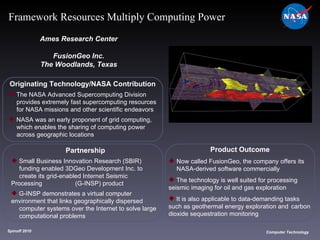
Originating Technology/NASA Contribution The NASA Advanced Supercomputing Division  provides extremely fast supercomputing resources  for NASA missions and other scientific endeavors NASA was an early proponent of grid computing,  which enables the sharing of computing power  across geographic locations Ames Research Center FusionGeo Inc. The Woodlands, Texas Product Outcome Now called FusionGeo, the company offers its  NASA-derived software commercially The technology is well suited for processing  seismic imaging for oil and gas exploration It is also applicable to data-demanding tasks  such as geothermal energy exploration and  carbon dioxide sequestration monitoring Spinoff 2010 Title of photo Computer Technology Framework Resources Multiply Computing Power Partnership Small Business Innovation Research (SBIR)  funding enabled 3DGeo Development Inc. to  create its grid-enabled Internet Seismic Processing  (G-INSP) product G-INSP demonstrates a virtual computer  environment that links geographically dispersed  computer systems over the Internet to solve large  computational problems
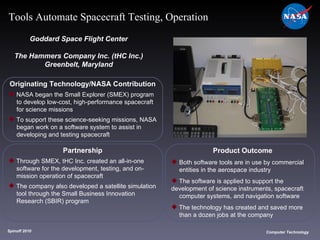
Originating Technology/NASA Contribution NASA began the Small Explorer (SMEX) program  to develop low-cost, high-performance spacecraft  for science missions To support these science-seeking missions, NASA  began work on a software system to assist in  developing and testing spacecraft Goddard Space Flight Center The Hammers Company Inc. (tHC Inc.) Greenbelt, Maryland Product Outcome Both software tools are in use by commercial  entities in the aerospace industry The software is applied to support the  development of science instruments, spacecraft  computer systems, and navigation software The technology has created and saved more  than a dozen jobs at the company Spinoff 2010 Title of photo Computer Technology Tools Automate Spacecraft Testing, Operation Partnership Through SMEX, tHC Inc. created an all-in-one  software for the development, testing, and on- mission operation of spacecraft The company also developed a satellite simulation  tool through the Small Business Innovation  Research (SBIR) program
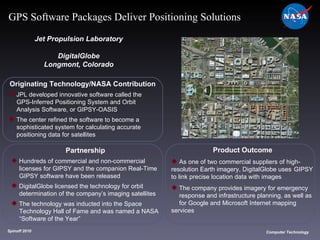
Originating Technology/NASA Contribution JPL developed innovative software called the  GPS-Inferred Positioning System and Orbit  Analysis Software, or GIPSY-OASIS The center refined the software to become a  sophisticated system for calculating accurate  positioning data for satellites Jet Propulsion Laboratory DigitalGlobe Longmont, Colorado Product Outcome As one of two commercial suppliers of high- resolution Earth imagery, DigitalGlobe uses  GIPSY to link precise location data with images The company provides imagery for emergency  response and infrastructure planning, as well as  for Google and Microsoft Internet mapping  services  Spinoff 2010 Title of photo Computer Technology GPS Software Packages Deliver Positioning Solutions Partnership Hundreds of commercial and non-commercial  licenses for GIPSY and the companion Real-Time  GIPSY software have been released DigitalGlobe licensed the technology for orbit  determination of the company’s imaging satellites The technology was inducted into the Space  Technology Hall of Fame and was named a NASA  “Software of the Year”
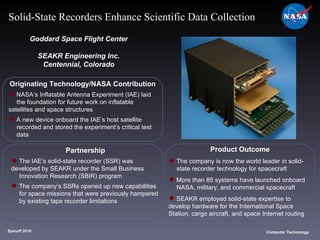
Originating Technology/NASA Contribution NASA’s Inflatable Antenna Experiment (IAE) laid  the foundation for future work on inflatable  satellites and space structures A new device onboard the IAE’s host satellite  recorded and stored the experiment’s critical test  data Goddard Space Flight Center SEAKR Engineering Inc. Centennial, Colorado Product Outcome The company is now the world leader in solid- state recorder technology for spacecraft More than 85 systems have launched onboard  NASA, military, and commercial spacecraft SEAKR employed solid-state expertise to  develop hardware for the International Space  Station, cargo aircraft, and space Internet routing  Spinoff 2010 Title of photo Computer Technology Solid-State Recorders Enhance Scientific Data Collection Partnership The IAE’s solid-state recorder (SSR) was  developed by SEAKR under the Small Business  Innovation Research (SBIR) program The company’s SSRs opened up new capabilities  for space missions that were previously hampered  by existing tape recorder limitations
Originating Technology/NASA Contribution Understanding the properties of lunar and Martian  soil is necessary to develop technologies that can  operate in those environments  NASA studies the electrostatic phenomena of  granular and bulk materials as they apply to  planetary surfaces Kennedy Space Center DEM Solutions Inc. Lebanon, New Hampshire Product Outcome EDEM’s capabilities are well suited for terrestrial  applications, such as modeling the handling of  sandy or cohesive soils The software is also applicable for  pharmaceuticals, helping with the management  of fine particles necessary for drug  manufacturing Spinoff 2010 Title of photo Computer Technology Computer Models Simulate Fine Particle Dispersion Partnership Through a NASA Seed Fund partnership, DEM  created new capabilities for its EDEM software The software provides for the simulation and  analysis of bulk materials flow in a wide range of  particle handling and manufacturing operations EDEM simulations are used in designing NASA  surface systems dust mitigation technologies
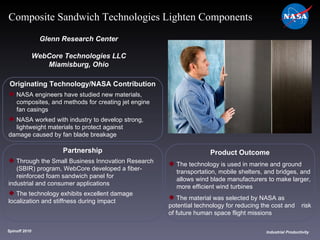
Originating Technology/NASA Contribution NASA engineers have studied new materials,  composites, and methods for creating jet engine  fan casings NASA worked with industry to develop strong,  lightweight materials to protect against  damage caused by fan blade breakage Glenn Research Center WebCore Technologies LLC Miamisburg, Ohio Product Outcome The technology is used in marine and ground  transportation, mobile shelters, and bridges, and  allows wind blade manufacturers to make larger,  more efficient wind turbines The material was selected by NASA as  potential technology for reducing the cost and  risk of future human space flight missions Spinoff 2010 Title of photo Industrial Productivity Composite Sandwich Technologies Lighten Components Partnership Through the Small Business Innovation Research  (SBIR) program, WebCore developed a fiber- reinforced foam sandwich panel for  industrial and consumer applications The technology exhibits excellent damage  localization and stiffness during impact
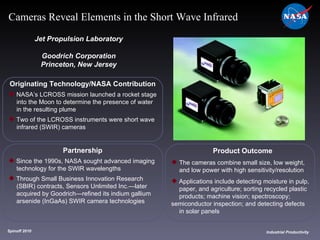
Originating Technology/NASA Contribution NASA’s LCROSS mission launched a rocket stage  into the Moon to determine the presence of water  in the resulting plume Two of the LCROSS instruments were short wave  infrared (SWIR) cameras Jet Propulsion Laboratory Goodrich Corporation Princeton, New Jersey Product Outcome The cameras combine small size, low weight,  and low power with high sensitivity/resolution Applications include detecting moisture in pulp,  paper, and agriculture; sorting recycled plastic  products; machine vision; spectroscopy;  semiconductor inspection; and detecting defects  in solar panels Spinoff 2010 Title of photo Industrial Productivity Cameras Reveal Elements in the Short Wave Infrared Partnership Since the 1990s, NASA sought advanced imaging  technology for the SWIR wavelengths  Through Small Business Innovation Research  (SBIR) contracts, Sensors Unlimited Inc.—later  acquired by Goodrich—refined its indium gallium  arsenide (InGaAs) SWIR camera technologies
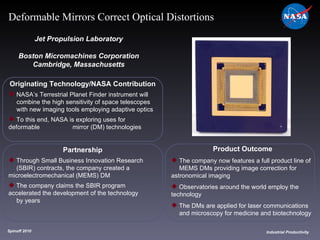
Originating Technology/NASA Contribution NASA’s Terrestrial Planet Finder instrument will  combine the high sensitivity of space telescopes  with new imaging tools employing adaptive optics To this end, NASA is exploring uses for deformable  mirror (DM) technologies Jet Propulsion Laboratory Boston Micromachines Corporation Cambridge, Massachusetts Product Outcome The company now features a full product line of  MEMS DMs providing image correction for  astronomical imaging Observatories around the world employ the  technology The DMs are applied for laser communications  and microscopy for medicine and biotechnology Spinoff 2010 Title of photo Industrial Productivity Deformable Mirrors Correct Optical Distortions Partnership Through Small Business Innovation Research  (SBIR) contracts, the company created a  microelectromechanical (MEMS) DM The company claims the SBIR program  accelerated the development of the technology  by years
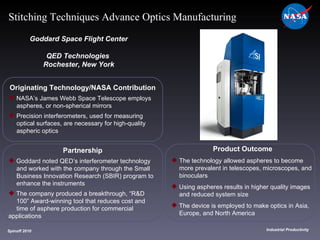
Originating Technology/NASA Contribution NASA’s James Webb Space Telescope employs  aspheres, or non-spherical mirrors Precision interferometers, used for measuring  optical surfaces, are necessary for high-quality  aspheric optics Goddard Space Flight Center QED Technologies  Rochester, New York Product Outcome The technology allowed aspheres to become  more prevalent in telescopes, microscopes, and  binoculars Using aspheres results in higher quality images  and reduced system size The device is employed to make optics in Asia,  Europe, and North America Spinoff 2010 Title of photo Industrial Productivity Stitching Techniques Advance Optics Manufacturing Partnership Goddard noted QED’s interferometer technology  and worked with the company through the Small  Business Innovation Research (SBIR) program to  enhance the instruments The company produced a breakthrough, “R&D  100” Award-winning tool that reduces cost and  time of asphere production for commercial  applications
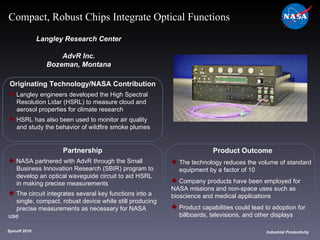
Originating Technology/NASA Contribution Langley engineers developed the High Spectral  Resolution Lidar (HSRL) to measure cloud and  aerosol properties for climate research HSRL has also been used to monitor air quality  and study the behavior of wildfire smoke plumes Langley Research Center AdvR Inc. Bozeman, Montana Product Outcome The technology reduces the volume of standard  equipment by a factor of 10 Company products have been employed for  NASA missions and non-space uses such as  bioscience and medical applications  Product capabilities could lead to adoption for  billboards, televisions, and other displays Spinoff 2010 Title of photo Industrial Productivity Compact, Robust Chips Integrate Optical Functions Partnership NASA partnered with AdvR through the Small  Business Innovation Research (SBIR) program to  develop an optical waveguide circuit to aid HSRL  in making precise measurements The circuit integrates several key functions into a single, compact, robust device while still producing  precise measurements as necessary for NASA use
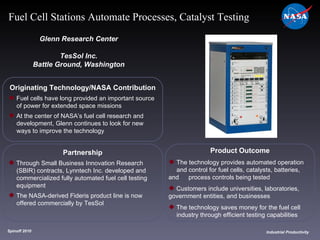
Originating Technology/NASA Contribution Fuel cells have long provided an important source  of power for extended space missions At the center of NASA’s fuel cell research and  development, Glenn continues to look for new  ways to improve the technology Glenn Research Center TesSol Inc. Battle Ground, Washington Product Outcome The technology provides automated operation  and control for fuel cells, catalysts, batteries, and  process controls being tested Customers include universities, laboratories,  government entities, and businesses  The technology saves money for the fuel cell  industry through efficient testing capabilities Spinoff 2010 Title of photo Industrial Productivity Fuel Cell Stations Automate Processes, Catalyst Testing Partnership Through Small Business Innovation Research  (SBIR) contracts, Lynntech Inc. developed and  commercialized fully automated fuel cell testing  equipment  The NASA-derived Fideris product line is now  offered commercially by TesSol
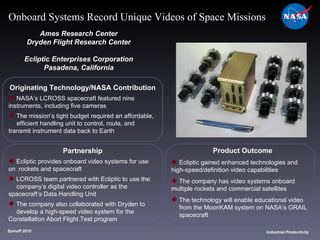
Originating Technology/NASA Contribution NASA’s LCROSS spacecraft featured nine  instruments, including five cameras The mission’s tight budget required an affordable,  efficient handling unit to control, route, and  transmit instrument data back to Earth  Ames Research Center Dryden Flight Research Center Ecliptic Enterprises Corporation Pasadena, California Product Outcome Ecliptic gained enhanced technologies and  high-speed/definition video capabilities  The company has video systems onboard  multiple rockets and commercial satellites The technology will enable educational video  from the MoonKAM system on NASA’s GRAIL  spacecraft Spinoff 2010 Title of photo Industrial Productivity Onboard Systems Record Unique Videos of Space Missions Partnership Ecliptic provides onboard video systems for use on  rockets and spacecraft LCROSS team partnered with Ecliptic to use the company’s digital video controller as the  spacecraft’s Data Handling Unit The company also collaborated with Dryden to  develop a high-speed video system for the  Constellation Abort Flight Test program
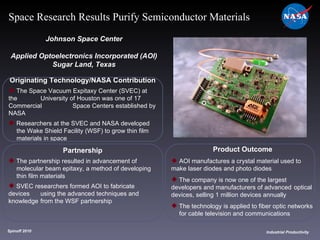
Originating Technology/NASA Contribution The Space Vacuum Expitaxy Center (SVEC) at the  University of Houston was one of 17 Commercial  Space Centers established by NASA Researchers at the SVEC and NASA developed  the Wake Shield Facility (WSF) to grow thin film  materials in space Johnson Space Center Applied Optoelectronics Incorporated (AOI) Sugar Land, Texas Product Outcome AOI manufactures a crystal material used to  make laser diodes and photo diodes The company is now one of the largest  developers and manufacturers of advanced  optical devices, selling 1 million devices annually The technology is applied to fiber optic networks  for cable television and communications Spinoff 2010 Title of photo Industrial Productivity Space Research Results Purify Semiconductor Materials Partnership The partnership resulted in advancement of  molecular beam epitaxy, a method of developing  thin film materials SVEC researchers formed AOI to fabricate devices  using the advanced techniques and knowledge  from the WSF partnership
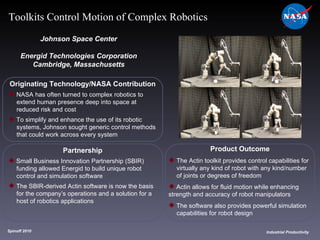
Originating Technology/NASA Contribution NASA has often turned to complex robotics to  extend human presence deep into space at  reduced risk and cost To simplify and enhance the use of its robotic  systems, Johnson sought generic control methods  that could work across every system Johnson Space Center Energid Technologies Corporation Cambridge, Massachusetts Product Outcome The Actin toolkit provides control capabilities for  virtually any kind of robot with any kind/number  of joints or degrees of freedom Actin allows for fluid motion while enhancing  strength and accuracy of robot manipulators The software also provides powerful simulation  capabilities for robot design Spinoff 2010 Title of photo Industrial Productivity Toolkits Control Motion of Complex Robotics Partnership Small Business Innovation Partnership (SBIR)  funding allowed Energid to build unique robot  control and simulation software The SBIR-derived Actin software is now the basis  for the company’s operations and a solution for a  host of robotics applications

NASA Spinoff 2010 - Presentation

  • 1.
  • 2.
    Originating Technology/NASA ContributionIn the 1990s, NASA looked for new ways to extend the lifespan of engine components Lambda had developed the low plasticity burnishing (LPB) process, which increased damage tolerance and prevented cracking in engine components Glenn Research Center Lambda Research Inc. Cincinnati, Ohio Product Outcome LPB can be applied to a wide range of metals and alloys and to components of varied shapes LPB eliminates fatigue failures in crucial aircraft engine components The process has been applied to more than 3,400 hip implants, improving fatigue strength by >40 percent and lifespan by >100 times Spinoff 2010 Title of photo Image from Article Health and Medicine Burnishing Techniques Strengthen Hip Implants Partnership Small Business Innovation Research (SBIR) contracts allowed Lambda to demonstrate the effectiveness of LPB for engine applications NASA funding led to additional government support, resulting in the introduction of LPB into commercial aircraft The process won an “R&D 100” Award
  • 3.
    Originating Technology/NASA ContributionGoddard scientist and mathematician Dr. Norden Huang invented a set of algorithms for analyzing nonlinear and nonstationary signals This user-friendly signal processing technology, Hilbert-Huang Transform (HHT), can be used to analyze data for a wide variety of applications Goddard Space Flight Center DynaDx Corporation Mountain View, California Product Outcome The company developed scientific computation software with a built-in HHT algorithm DynaDX’s HHT-based Multimodal Pressure-Flow process provides medical diagnosis and prediction of brain blood flow-related problems The technology alerts caregivers to changes in intracranial pressure in patients Spinoff 2010 Title of photo Health and Medicine Signal Processing Methods Monitor Cranial Pressure Partnership Through an auction managed by Ocean Tomo Federal Services LLC, DynaDx licensed a portfolio of NASA patents, including the HHT The auction was the first ever sale of government patent licenses through a public auction of intellectual property The HHT won an “R&D 100” Award and was named a NASA “Invention of the Year”
  • 4.
    Originating Technology/NASA ContributionJPL scientists invented a welding curtain to protect against eye-damaging light wavelengths found in space and produced by laser and welding work The curtain employed a light filtering/vision enhancing system developed through studying the eyes of birds of prey Jet Propulsion Laboratory Eagle Eyes Optics Calabasas, California Product Outcome The technology protects against damage that can lead to cataracts, which effect millions in the United States alone Eagle Eyes donated 150 pairs to children in Alaska, where the Sun’s reflection off the snow results in a higher incidence of cataracts Spinoff 2010 Title of photo Health and Medicine Ultraviolet-Blocking Lenses Protect, Enhance Vision Partnership SunTiger Inc.—now Eagle Eyes Optics— licensed the technology for use in sunglasses Eagle Eyes sunglasses shield eyes from harmful ultraviolet, violet, and blue light The eyewear was inducted into the Space Technology Hall of Fame
  • 5.
    Originating Technology/NASA ContributionIn 1983, NASA began developing hyperspectral systems at the Jet Propulsion Laboratory In 2001, NASA launched the first on-orbit hyperspectral imager, Hyperion, onboard the Earth Observing-1 spacecraft Stennis Space Center Themis Vision Systems LLC Richmond, Virginia Product Outcome Themis has built about 40 custom systems used worldwide, including 3 in use by the FBI The systems are used in medical applications as a diagnostic tool for looking at wounds and burns and to monitor healing The technology also has forensics, microscopy, military, and art restoration applications Spinoff 2010 Title of photo Image from Article Health and Medicine Hyperspectral Systems Increase Imaging Capabilities Partnership Stennis and the Institute for Technology Development crafted a smaller scanner that required no relative movement between target and sensor Themis later obtained exclusive rights to the technology The innovation was inducted into the Space Technology Hall of Fame
  • 6.
    Originating Technology/NASA ContributionNASA’s Aeronautics Research Mission Directorate has worked to address issues related to the overburdened National Airspace System (NAS) Evaluating large-scale air traffic management solutions in real life, however, is costly and impractical Ames Research Center Intelligent Automation Inc. (IAI) Rockville, MD Product Outcome The software uses interactive components called agents to model the behavior of various entities The agent-based infrastructure allows researchers to model the NAS down to individual flights The program is also used for distributed robotics and for modeling the behavior of crowds Spinoff 2010 Title of photo Transportation Programs Model the Future of Air Traffic Management Partnership To help develop a program capable of simulating a realistic NAS, Ames partnered with IAI through the Small Business Innovation Research (SBIR) program With SBIR support, IAI continued work on specialized software that now enables NASA’s Airspace Concept Evaluation System
  • 7.
    Originating Technology/NASA ContributionA NASA collaborative rotorcraft research program with the U.S. Army resulted in many outcomes that have enhanced the safety and performance of helicopters Among these are advanced airfoils designed and wind-tunnel tested at Langley Langley Research Center Van Horn Aviation LLC (VHA) Tempe, Arizona Product Outcome The VHA 206 tail rotor received Federal Aviation Administration certification in 2009 The tail rotor provides multiple benefits, including enhanced lifespan, improved control, superior performance at high altitude, and as much as 40-percent less noise Spinoff 2010 Title of photo Transportation Tail Rotor Airfoils Stabilize Helicopters, Reduce Noise Partnership VHA employed a Langley airfoil design in the public domain—the NASA RC(4)-10—to craft an updated aftermarket tail rotor for the popular Bell 206 series of helicopters The company plans on using NASA airfoil designs for future projects aimed at advancing rotorcraft performance
  • 8.
    Originating Technology/NASA ContributionNASA and partners formed the Advanced General Aviation Transport Experiments, or AGATE AGATE aimed to enhance general aviation (GA) technology to enable a small aircraft transportation system for alleviating congestion in the Nation’s roads and skies Langley Research Center Cirrus Design Corporation Duluth, Minnesota Product Outcome Cirrus’ SR22 plane has been the top-selling FAA-certified single-engine airplane since 2002 The planes feature a NASA spinoff, the BRS Aerospace whole-plane parachute, which has saved 35 Cirrus pilots and passengers to date A new Cirrus jet has an engine created under NASA’s General Aviation Propulsion project Spinoff 2010 Title of photo Image from Article Transportation Personal Aircraft Point to the Future of Transportation Partnership Through AGATE-driven SBIR support, Cirrus developed composite manufacturing methods for its GA aircraft Cirrus planes feature a host of NASA innovations NASA testing also improved safety in Cirrus aircraft and led to airbag installation, a first in GA planes
  • 9.
    Originating Technology/NASA ContributionFor centuries people have dreamed of making personal flight, a common science fiction trope, a reality By the 1990s, lighter, stronger materials and design systems enabled new efforts Ames Research Center Trek Aerospace Inc. Folsom, California Product Outcome The aircraft employ ducted fans, allowing craft to fly into tight spaces without damaging rotors or surroundings The company offers a miniature test version and a full-size manned version is available as an experimental aircraft Military and public safety applications exist Spinoff 2010 Title of photo Transportation Ducted Fan Designs Lead to Potential New Vehicles Partnership Trek Aerospace engineers used wind-tunnel testing at Ames to improve their vehicles The tests revealed the engineers could accomplish lift with a significantly smaller and lighter engine and led to several design changes, including the use of a fly-by-wire system
  • 10.
    Originating Technology/NASA ContributionResearch and testing by Langley engineer Richard Whitcomb demonstrated the effectiveness of winglets in reducing performance-inhibiting drag Further flight tests conducted at Dryden validated Whitcomb’s findings Langley Research Center Dryden Flight Research Center Aviation Partners Boeing (APB) Seattle, Washington Product Outcome Blended Winglets are now featured on thousands of Boeing aircraft around the world APB estimates the technology saved more than 2 billion gallons of jet fuel as of 2010, reducing costs by $4 billion and carbon dioxide emissions by 21.5 million tons Spinoff 2010 Title of photo Image from Article Transportation Winglets Save Billions of Dollars in Fuel Costs Partnership Aviation Partners Inc. and The Boeing Company collaborated to form Aviation Partners Boeing and apply a new form of the NASA-proven technology to Boeing aircraft The Blended Winglet technology improves winglet aerodynamics
  • 11.
    Originating Technology/NASA ContributionAerodynamics researcher Siva Mangalam worked on airfoil design at Langley Research Center While there were extensive systems for wind- tunnel testing, Mangalam found there were no quantifiable sensing systems for measuring aerodynamic forces in flight Dryden Flight Research Center Tao of Systems Integration Inc. Hampton, Virginia Product Outcome Three of the four components of the system have been commercialized Applications include improving wind and underwater turbine operation and optimizing air conditioning The final system may enable aircraft that respond like birds to aerodynamic conditions Spinoff 2010 Title of photo Image from Article Transportation Sensor Systems Collect Critical Aerodynamics Data Partnership With SBIR funding and flight testing from Dryden, Tao Systems began development of a first-of-its- kind, closed-loop system to detect, measure, and control aerodynamic forces in flight Tao’s simple, inexpensive approach gathers aerodynamics data in real time, detecting forces like turbulence before the aircraft reacts to them
  • 12.
    Originating Technology/NASA ContributionAmong the many ways that NASA works to advance aviation are efforts to improve the lifespan and performance of jet, or gas turbine, engines Glenn scientist Dongming Zhu developed “R&D 100” Award-winning thermal barrier coatings that reduce thermal fatigue in metal engine parts Glenn Research Center MesoCoat Inc. Euclid, Ohio Product Outcome MesoCoat’s NASA-developed thermal barrier coating results in a 50-percent increase in engine component life and improved fuel economy The cladding technology can prevent corrosion for up to 100 years, mitigating damage that costs over $270 billion annually Spinoff 2010 Title of photo Image from Article Transportation Coatings Extend Life of Engines and Infrastructure Partnership MesoCoat is employing a specific composition of Zhu’s coating to prolong the lifespan of engines in U.S. Air Force legacy aircraft Through a Space Act Agreement, the company is also using Glenn’s arc lamp technology to demonstrate cladding technology for limiting corrosion of metal infrastructure like pipes and bridges
  • 13.
    Originating Technology/NASA ContributionSupercooled droplets in the atmosphere can form layers of ice on aircraft surfaces, reducing performance and even leading to catastrophic loss of control Glenn has led NASA efforts in developing anti-icing technologies to enhance aircraft safety Glenn Research Center Radiometrics Corporation Boulder, Colorado Product Outcome Radiometrics’ radiometers provide profiling of atmospheric conditions that define local weather, improving short-term weather forecasting The devices detected situations for weather modification at the 2008 and 2010 Olympics The radiometers are also employed for soil moisture, snow, and sea surface measurements Spinoff 2010 Title of photo Image from Article Public Safety Radiometers Optimize Local Weather Prediction Partnership Small Business Innovation Research (SBIR) contracts with Radiometrics led to the creation of a radiometer for detecting icing conditions along flight paths Radiometrics commercialized a modular radiometer originally developed under the SBIR agreements
  • 14.
    Originating Technology/NASA ContributionAmes engineer Leonard Haslim invented the electroexpulsive separation system deicing technology The system employed a pair of conductors that shatter ice buildup when driven apart by an electric pulse Ames Research Center IMS-ESS Temecula, California Product Outcome The company initially sold several systems for UAV deicing applications, discovering a niche market for the NASA-derived technology The systems are ideal for UAVs, offering lightweight, low power protection against icing The technology allows military UAVs to conduct crucial missions without the threat of icing Spinoff 2010 Title of photo Image from Article Public Safety Energy-Efficient Systems Eliminate Icing Danger for UAVs Partnership Ice Management Systems (now IMS-ESS) licensed the technology and built upon the NASA concept The company conducted testing in Glenn Research Center’s Icing Research Tunnel
  • 15.
    Originating Technology/NASA ContributionIn order to support the development of a Small Aircraft Transportation System, NASA has invested significant research into small aircraft safety Engineer Boris Popov invented a parachute designed to rescue an entire small airplane Langley Research Center BRS Aerospace Saint Paul, Minnesota Product Outcome The BRS parachute system is featured on top-selling small aircraft around the world As of 2010, the system had saved 250 lives BRS is working on parachutes for small jets and may eventually use its NASA-derived technology to enable systems for commercial airlines Spinoff 2010 Title of photo Image from Article Public Safety Rocket-Powered Parachutes Rescue Entire Planes Partnership NASA Small Business Innovation Research (SBIR) contracts with Popov’s company, BRS Aerospace, advanced the whole-plane parachute system The NASA funding helped with the development of thin-film parachutes, manufacturing methods that resulted in stronger parachutes, and smart deployment devices
  • 16.
    Originating Technology/NASA ContributionNASA and the Massachusetts Institute of Technology collaborated on the Daedalus project, exploring new technologies for lightweight aircraft and high-altitude, long-duration flight Aurora was founded out of that effort and began a pattern of partnership with NASA Goddard Space Flight Center Aurora Flight Sciences Corporation Manassas, Virginia Product Outcome The SAA allowed Aurora to open a facility in West Virginia, now employing 160 workers The company produces all of the Global Hawk airframe components, save for the wings Aurora also manufactures cutting-edge UAV designs for military surveillance applications Spinoff 2010 Title of photo Image from Article Public Safety Technologies Advance UAVs for Science, Military Partnership The company has engaged in numerous Small Business Innovation Research (SBIR) and Small Business Technology Transfer (STTR) projects A Space Act Agreement (SAA) with Goddard resulted in manufacturing techniques used to produce composite airframe components for the Global Hawk UAV, used by the military and NASA
  • 17.
    Originating Technology/NASA ContributionNASA launched the first of its inflatable space structures in the form of large, metalized balloons—the Echo satellites, in 1960 New interest was spurred with the successful deployment of the Inflatable Antenna Experiment during STS-77 in 1996 Glenn Research Center GATR Technologies Huntsville, Alabama Product Outcome Certified by the Federal Communications Commission, the ground-based inflatable antennas are transported in two portable cases and can be quickly deployed in remote areas GATR provided communications after Hurricane Katrina, wildfires in California, and the 2010 Haiti earthquake Spinoff 2010 Title of photo Image from Article Public Safety Inflatable Antennas Support Emergency Communication Partnership ManTech SRS Technologies received Small Business Innovation Research (SBIR) funding to develop an inflatable solar concentrator; the technology was applicable to inflatable antennas GATR licensed the technology from SRS and improved it through a Glenn Space Act Agreement The technology won an “R&D 100” Award
  • 18.
    Originating Technology/NASA ContributionTo perform nondestructive evaluation and monitoring of aerospace vehicles and structures, NASA has pursued the development of structural health monitoring systems (SHM) One approach to SHM is the Stanford Multi- Actuator Receiver Transduction (SMART) Layer Marshall Space Flight Center Acellent Technologies Inc. Sunnyvale, California Product Outcome The SMART Layer is flexible, lightweight, and easy to adapt to any structure The technology is now applied in defense, space, transportation, and energy industries The company has been funded to monitor civil infrastructure such as pipelines, buildings, and bridges Spinoff 2010 Title of photo Image from Article Public Safety Smart Sensors Assess Structural Health Partnership Acellent licensed the SMART Layer technology from Stanford University and worked with Marshall through the Small Business Innovation Research (SBIR) program to develop a hybrid SMART Layer for aerospace applications Additional Marshall SBIRs helped the company improve and optimize the technology
  • 19.
    Originating Technology/NASA ContributionNASA continually seeks ways both to develop new sensor technology and to advance existing devices to meet the demands of space exploration These efforts often result in smaller, less expensive, more energy efficient, and highly durable products for use on Earth Ames Research Center Ion Applications Inc. West Palm Beach, Florida Product Outcome The company has commercialized a hand-held IMS device featuring enhanced sensitivity and easy portability and use The technology is used by the U.S. military for detection of explosives and chemical agents, and is also applicable for semiconductor manufacturing and other industrial processes Spinoff 2010 Title of photo Image from Article Public Safety Hand-Held Devices Detect Explosives and Chemical Agents Partnership NASA sought to miniaturize a powerful sensor technology called an ion mobility spectrometer (IMS) for astrobiology missions Through NASA’s Astrobiology Science and Technology Instrument Development program and the Small Business Innovation Research (SBIR) program, Ion Applications developed a miniature IMS suitable for applications in space or on Earth
  • 20.
    Originating Technology/NASA ContributionFollowing the Columbia disaster, NASA required a method for detecting potentially hazardous defects in the sprayed-on insulating foam on space shuttle external tanks NASA scientists investigated terahertz imaging as a potential solution Langley Research Center Advanced Photonix Inc. (API) Ann Arbor, Michigan Product Outcome API’s systems take terahertz out of the lab and onto the manufacturing floor Terahertz can be employed as a safer, more precise security measure than X-rays, revealing concealed weapons and package contents Other applications include pharmaceutical manufacturing and art conservation Spinoff 2010 Title of photo Public Safety Terahertz Tools Advance Imaging for Security, Industry Partnership Small Business Innovation Research (SBIR) agreements with Picometrix, now a subsidiary of API, adapted and improved the company’s commercial terahertz system for NASA use SBIR funding enabled the company to reduce the size and increase the speed of its terahertz imaging devices
  • 21.
    Originating Technology/NASA ContributionLiving in space will require a sustainable environment, including plants, which can provide food, clean air, and clean water NASA has explored the use of LED lighting as a lightweight, energy-efficient technology for plant growth in space Kennedy Space Center Orbital Technologies Corporation (ORBITEC) Madison, Wisconsin Product Outcome HELIAC is in use by universities and other customers for photobiology research Another application is aquarium lighting, providing light without the heat that can be detrimental to fish and corals ORBITEC has licensed the technology to two aquarium lighting manufacturers Spinoff 2010 Title of photo Image from Article Consumer Goods LED Systems Target Plant Growth Partnership Through the Small Business Innovation Research (SBIR) program, ORBITEC worked with Kennedy to develop the High Efficiency Lighting with Integrated Adaptive Control (HELIAC) system, which uses smart, solid-state LEDs for efficient plant growth “ Lightsicles” only spotlight plant tissue, saving energy by providing efficient, targeted lighting
  • 22.
    Originating Technology/NASA ContributionNASA pursued the development of a practical form of aerogel, a material with unmatched insulating qualities but a brittle composition Kennedy scientist James Fesmire introduced the concept of a flexible aerogel material Kennedy Space Center Aspen Aerogels Inc. Northborough, Massachusetts Product Outcome NASA uses Aspen’s aerogel products for cryogenic applications Commercial applications include pipe and building insulation and personal apparel Aerogel insoles protect feet in extreme temperatures, while wrist and ankle wraps help patients with Raynaud’s disease Spinoff 2010 Title of photo Consumer Goods Aerogels Insulate Against Extreme Temperatures Partnership Aspen Systems Inc. developed the world’s first aerogel blankets through NASA Small Business Innovation Research (SBIR) funding To develop and market the revolutionary product, Aspen Systems launched Aspen Aerogels Inc. The technology won an “R&D 100” award
  • 23.
    Originating Technology/NASA ContributionJPL researchers explored ways to significantly miniaturize cameras on interplanetary spacecraft while maintaining scientific image quality A team led by Eric Fossum developed an energy- efficient light sensor with all of its components integrated on a single chip Jet Propulsion Laboratory Aptina Imaging Corporation San Jose, California Product Outcome The NASA-derived sensors are now incorporated into digital cameras, automotive and surveillance cameras, and medical imaging devices One of every three cell phone cameras worldwide features Aptina’s sensors The company has shipped over 1 billion sensors Spinoff 2010 Title of photo Image from Article Consumer Goods Image Sensors Enhance Camera Technologies Partnership Fossum and other JPL engineers licensed the sensor technology and founded Photobit to pursue commercial applications The company was acquired and later spun out as Aptina The technology and its inventors were inducted into the Space Technology Hall of Fame
  • 24.
    Originating Technology/NASA ContributionLack of resources and dangerous conditions mean repairs on the International Space Station must be done as quickly and efficiently as possible NASA funded the design of simple, reusable patch repair systems for use in space Kennedy Space Center Cornerstone Research Group (CRG) Inc. Dayton, Ohio Product Outcome Heating the material renders it flexible; as it cools, it becomes a rigid, durable structural patch The technology is a popular repair option for auto racing and the trucking industry The material is also a weather-resistant option for outdoor and emergency applications, repairing damaged gear on the fly Spinoff 2010 Title of photo Consumer Goods Lightweight Material Patches Allow for Quick Repairs Partnership Through Small Business Innovation Research (SBIR) contracts, CRG developed a structural patch with multiple commercial applications The company has commercialized two brands of the NASA-derived material
  • 25.
    Originating Technology/NASA ContributionJohnson scientist Dennis Morrison conducted research into microcapsules for delivering cancer- fighting drugs deep within the body Morrison developed special ceramic nanoparticles as part of his research Johnson Space Center Farouk Systems Inc. Houston, Texas Product Outcome The company uses nanomaterials in its CHI hair irons, brushes, nail lacquers, and other products A secondary line of liquid formulations works with the combination of ions and infrared wavelengths created by the CHI tools According to the company, ions released by the styling tools help to smooth and soften hair Spinoff 2010 Title of photo Image from Article Consumer Goods Nanomaterials Transform Hairstyling Tools Partnership Farouk worked with Morrison to create a ceramic composite for the company’s hairstyling irons The company also incorporated nanosilver sterilizing components inspired by NASA research After retiring from NASA, Morrison joined the company to develop additional hairstyling tools using near-infrared light
  • 26.
    Originating Technology/NASA ContributionConditions in space and on the Moon feature extreme temperatures In planning for a return mission to the Moon, NASA aimed to improve the thermal control systems to keep astronauts comfortable while in a spacecraft Goddard Space Flight Center IDQ Inc. Garland, Texas Product Outcome The company has incorporated the NASA- derived additive into its line of refrigerants for automotive air conditioning units The technology recharges air conditioning at a fraction of auto shop costs The products are sold at leading automotive and mass-retail stores worldwide Spinoff 2010 Title of photo Image from Article Consumer Goods Do-It-Yourself Additives Recharge Auto Air Conditioning Partnership While working on a Small Business Innovation Research (SBIR)-funded project, Mainstream Engineering developed a unique liquid additive to enhance thermal control performance IDQ licensed the technology from Mainstream
  • 27.
    Originating Technology/NASA ContributionGrowing plants in space presents unique challenges, including water limitations and soil particles floating in microgravity Many NASA projects have focused on developing and improving hydroponic methods of plant cultivation for use in space Kennedy Space Center ASA Analytics Inc. Waukesha, Wisconsin Product Outcome The original process analyzer is the core of the company’s ChemScan product line More than 500 analyzer systems monitor water and wastewater treatment processes in cities around the world The company claims 40-percent compound annual growth as a result of the technology Spinoff 2010 Title of photo Environmental Resources Systems Analyze Water Quality in Real Time Partnership Through Small Business Innovation Research (SBIR) funding, Biotronics Technologies Inc. developed a process analyzer for providing real- time detection of nutrients, organics, and metals in hydroponic solutions Company researchers licensed the NASA-derived technology and formed ASA Analytics to pursue commercial applications
  • 28.
    Originating Technology/NASA ContributionIn 2015, NASA plans to launch the Soil Moisture Active and Passive (SMAP) mission to take readings critical for understanding the environment The best way to measure surface conditions like soil moisture and ocean salinity is through microwave remote sensing at long wavelengths Goddard Space Flight Center ProSensing Inc. Amherst, Massachusetts Product Outcome The company offers radiometers for mapping soil moisture, ocean salinity, and wind speed The technology is in use by multiple universities and international research centers The devices are being tested for noninvasive temperature readings of cerebrospinal fluid to diagnose conditions like meningitis Spinoff 2010 Environmental Resources Compact Radiometers Expand Climate Knowledge Partnership Small Business Innovation Research (SBIR) funding helped ProSensing develop low-cost, compact, ultrastable radiometers for sea surface salinity and soil moisture mapping The radiometers were used in NASA’s 2D-STAR array as small components of a larger system, achieving the results of a large antenna without putting a massive structure into space
  • 29.
    Originating Technology/NASA ContributionNASA continually explores innovative ways of overcoming the challenges presented by the extreme demands of the space environment A manned mission to Mars would require sustainable methods of generating necessities like fuel and oxygen Ames Research Center Bloom Energy Sunnyvale, California Product Outcome An Energy Server with a footprint of a parking space can produce power for 100 U.S. homes The technology produces energy 67-percent cleaner than typical coal power with fossil fuels and 100-percent cleaner with renewables Energy Servers now provide power to multiple Fortune 500 companies Spinoff 2010 Title of photo Image from Article Environmental Resources Energy Servers Deliver Clean, Affordable Power Partnership K.R. Sridhar of the University of Arizona’s Space Technologies Laboratory developed for NASA a fuel cell device that could split Martian water into oxygen for breathing and hydrogen for fuel Sridhar founded Bloom Energy to develop the technology in reverse—creating clean electricity from oxygen and fuel
  • 30.
    Originating Technology/NASA ContributionKennedy is part of the Merritt Island Wildlife Refuge, home to over 1,500 plant and animal species NASA works to keep the area as pristine as possible, creating innovative ways to clean up around launch complexes Kennedy Space Center Toxicological and Environmental Associates Inc. Baton Rogue, Louisiana Product Outcome The technology has won multiple honors and a place in the Space Technology Hall of Fame Several companies are applying EZVI to clean up polluted zones around the world EZVI is NASA’s most licensed technology to date Spinoff 2010 Title of photo Image from Article Environmental Resources Solutions Remediate Contaminated Groundwater Partnership NASA scientists collaborated with University of Central Florida counterparts to develop Emulsified Zero-Valent Iron (EZVI), which neutralizes toxic chemicals in groundwater Testing with partners through the Small Business Technology Transfer (STTR) program proved EZVI’s effectiveness
  • 31.
    Originating Technology/NASA ContributionAll resources onboard the International Space Station (ISS) are limited and must be carefully managed and recycled Even before ISS construction, NASA investigated ways water could be purified and reused by astronauts living in orbit Marshall Space Flight Center Micro-Bac International Inc. Round Rock, Texas Product Outcome The NASA-derived microbial solution is part of a product line formulated for the remediation of wastewater and organic wastes The innovation is also applied for the cleanup of crude oil spills The technology was called on to mitigate the ecological impact of the 2010 oil spill in the Gulf of Mexico Spinoff 2010 Title of photo Image from Article Environmental Resources Bacteria Provide Cleanup of Oil Spills, Wastewater Partnership Through Small Business Innovation Research (SBIR) contracts, Micro-Bac developed a phototrophic cell for water purification The cell contained strains of photosynthetic bacteria isolated to break down toxic chemicals astronauts could encounter on the ISS The company commercialized the bacterial formulation it developed for the SBIR project
  • 32.
    Originating Technology/NASA ContributionDuring the Skylab launch, one of the spacecraft’s protective shields was damaged Marshall led a collaborative effort to repair the shield and save the spacecraft Marshall Space Flight Center Advanced Flexible Materials (AFM) Inc. Petaluma, California Product Outcome The reflective insulation technology has been incorporated into blankets to trap body heat and prevent hypothermia; it is also used as lining for mittens, vests, and more The technology has been used to keep manatees warm when lifted from the water during tag-and-release programs Spinoff 2010 Title of photo Image from Article Environmental Resources Reflective Coatings Protect People and Animals Partnership Private manufacturer National Metalizing created a reflective sunshield using radiant barrier technology the company had previously developed for NASA; the solution saved Skylab AFM now employs the same public domain technology in its products The radiant barrier technology was inducted into the Space Technology Hall of Fame
  • 33.
    Originating Technology/NASA ContributionThe space shuttle main engines produce four times the thrust of commercial jet engines, as well as an extreme amount of vibration NASA engineers analyze vibrations in the engine systems to diagnose mechanical issues—a costly, tedious, and time-consuming process Marshall Space Flight Center AI Signal Research Inc. (ASRI) Huntsville, Alabama Product Outcome More than 80 users of the software are enhancing mechanical design and development efforts across the country Applications include dynamic signal analysis, system health monitoring, flight data analysis, flow data analysis, and fatigue analysis and monitoring Spinoff 2010 Title of photo Computer Technology Innovative Techniques Simplify Vibration Analysis Partnership Through the Small Business Innovation Research (SBIR) program, ASRI developed PC-SIGNAL, a software package with improved tools and techniques for vibration signal analysis NASA employs PC-SIGNAL for the development and testing of propulsion systems
  • 34.
    Originating Technology/NASA ContributionRocket engines operate under extreme temperature and pressure, making testing and simulating the technology a challenge NASA engineers required an advanced computer application to model the physical and chemical phenomena that occur in these engines Marshall Space Flight Center CRAFT Tech Inc. Pipersville, Pennsylvania Product Outcome The NASA-derived CRUNCH CFD software is now applied in commercial aerospace and other industries for analyzing and designing engine systems The technology has a long list of potential applications, including in the liquefied natural gas industry and a variety of fluid flow devices Spinoff 2010 Title of photo Computer Technology Modeling Tools Predict Flow in Fluid Dynamics Partnership With Small Business Innovation Research (SBIR) funding, CRAFT Tech invented software to simulate cryogenic fluid flows and related phenomena in liquid rocket turbopumps The technology formed the foundation of state-of- the-art tools that have impacted the design of NASA rocket engine test facilities
  • 35.
    Originating Technology/NASA ContributionSpace operations require robust, fail-resistant programming to ensure the safe, effective execution of mission-critical control systems NASA developed a powerful verification toolkit called Java Pathfinder (JPF) for software written in the popular Java programming language Ames Research Center Fujitsu Laboratories of America Inc. Sunnyvale, California Product Outcome The enhanced technology unearths software bugs not found with existing technologies The software helps ensure operation and security of Web-based Java programs like banking applications and shopping carts Fujitsu open-sourced its string input extension for NASA and others to continue development Spinoff 2010 Title of photo Computer Technology Verification Tools Secure Online Shopping, Banking Partnership JPF’s Symbolic Pathfinder tool could automatically analyze code structure to find defects but could not handle text inputs, or strings Fujitsu built upon the open-source NASA software to create string input capabilities, increasing the tool’s effectiveness
  • 36.
    Originating Technology/NASA ContributionSystems health management seeks to understand systems, assess their health, pinpoint problems, and support maintenance or repair NASA employs this discipline to ensure the successful operation of its rockets, crew vehicles, and other complex systems Ames Research Center Qualtech Systems Inc. (QSI) Wethersfield, Connecticut Product Outcome TEAMS captures how a system fails, guiding engineers in making real-time diagnoses The software substantially lowers costs and time dedicated to troubleshooting General Motors hopes to use TEAMS in cars to diagnose engine trouble before failure occurs Spinoff 2010 Title of photo Computer Technology Virtual Toolsets Maintain Health of Complex Systems Partnership To strengthen this approach, NASA worked with Qualtech through the Small Business Innovation Research (SBIR) program QSI adapted and employed its TEAMS toolset for the detection and isolation of electromechanical problems Software is now in use by multiple NASA centers
  • 37.
    Originating Technology/NASA ContributionThe NASA Advanced Supercomputing Division provides extremely fast supercomputing resources for NASA missions and other scientific endeavors NASA was an early proponent of grid computing, which enables the sharing of computing power across geographic locations Ames Research Center FusionGeo Inc. The Woodlands, Texas Product Outcome Now called FusionGeo, the company offers its NASA-derived software commercially The technology is well suited for processing seismic imaging for oil and gas exploration It is also applicable to data-demanding tasks such as geothermal energy exploration and carbon dioxide sequestration monitoring Spinoff 2010 Title of photo Computer Technology Framework Resources Multiply Computing Power Partnership Small Business Innovation Research (SBIR) funding enabled 3DGeo Development Inc. to create its grid-enabled Internet Seismic Processing (G-INSP) product G-INSP demonstrates a virtual computer environment that links geographically dispersed computer systems over the Internet to solve large computational problems
  • 38.
    Originating Technology/NASA ContributionNASA began the Small Explorer (SMEX) program to develop low-cost, high-performance spacecraft for science missions To support these science-seeking missions, NASA began work on a software system to assist in developing and testing spacecraft Goddard Space Flight Center The Hammers Company Inc. (tHC Inc.) Greenbelt, Maryland Product Outcome Both software tools are in use by commercial entities in the aerospace industry The software is applied to support the development of science instruments, spacecraft computer systems, and navigation software The technology has created and saved more than a dozen jobs at the company Spinoff 2010 Title of photo Computer Technology Tools Automate Spacecraft Testing, Operation Partnership Through SMEX, tHC Inc. created an all-in-one software for the development, testing, and on- mission operation of spacecraft The company also developed a satellite simulation tool through the Small Business Innovation Research (SBIR) program
  • 39.
    Originating Technology/NASA ContributionJPL developed innovative software called the GPS-Inferred Positioning System and Orbit Analysis Software, or GIPSY-OASIS The center refined the software to become a sophisticated system for calculating accurate positioning data for satellites Jet Propulsion Laboratory DigitalGlobe Longmont, Colorado Product Outcome As one of two commercial suppliers of high- resolution Earth imagery, DigitalGlobe uses GIPSY to link precise location data with images The company provides imagery for emergency response and infrastructure planning, as well as for Google and Microsoft Internet mapping services Spinoff 2010 Title of photo Computer Technology GPS Software Packages Deliver Positioning Solutions Partnership Hundreds of commercial and non-commercial licenses for GIPSY and the companion Real-Time GIPSY software have been released DigitalGlobe licensed the technology for orbit determination of the company’s imaging satellites The technology was inducted into the Space Technology Hall of Fame and was named a NASA “Software of the Year”
  • 40.
    Originating Technology/NASA ContributionNASA’s Inflatable Antenna Experiment (IAE) laid the foundation for future work on inflatable satellites and space structures A new device onboard the IAE’s host satellite recorded and stored the experiment’s critical test data Goddard Space Flight Center SEAKR Engineering Inc. Centennial, Colorado Product Outcome The company is now the world leader in solid- state recorder technology for spacecraft More than 85 systems have launched onboard NASA, military, and commercial spacecraft SEAKR employed solid-state expertise to develop hardware for the International Space Station, cargo aircraft, and space Internet routing Spinoff 2010 Title of photo Computer Technology Solid-State Recorders Enhance Scientific Data Collection Partnership The IAE’s solid-state recorder (SSR) was developed by SEAKR under the Small Business Innovation Research (SBIR) program The company’s SSRs opened up new capabilities for space missions that were previously hampered by existing tape recorder limitations
  • 41.
    Originating Technology/NASA ContributionUnderstanding the properties of lunar and Martian soil is necessary to develop technologies that can operate in those environments NASA studies the electrostatic phenomena of granular and bulk materials as they apply to planetary surfaces Kennedy Space Center DEM Solutions Inc. Lebanon, New Hampshire Product Outcome EDEM’s capabilities are well suited for terrestrial applications, such as modeling the handling of sandy or cohesive soils The software is also applicable for pharmaceuticals, helping with the management of fine particles necessary for drug manufacturing Spinoff 2010 Title of photo Computer Technology Computer Models Simulate Fine Particle Dispersion Partnership Through a NASA Seed Fund partnership, DEM created new capabilities for its EDEM software The software provides for the simulation and analysis of bulk materials flow in a wide range of particle handling and manufacturing operations EDEM simulations are used in designing NASA surface systems dust mitigation technologies
  • 42.
    Originating Technology/NASA ContributionNASA engineers have studied new materials, composites, and methods for creating jet engine fan casings NASA worked with industry to develop strong, lightweight materials to protect against damage caused by fan blade breakage Glenn Research Center WebCore Technologies LLC Miamisburg, Ohio Product Outcome The technology is used in marine and ground transportation, mobile shelters, and bridges, and allows wind blade manufacturers to make larger, more efficient wind turbines The material was selected by NASA as potential technology for reducing the cost and risk of future human space flight missions Spinoff 2010 Title of photo Industrial Productivity Composite Sandwich Technologies Lighten Components Partnership Through the Small Business Innovation Research (SBIR) program, WebCore developed a fiber- reinforced foam sandwich panel for industrial and consumer applications The technology exhibits excellent damage localization and stiffness during impact
  • 43.
    Originating Technology/NASA ContributionNASA’s LCROSS mission launched a rocket stage into the Moon to determine the presence of water in the resulting plume Two of the LCROSS instruments were short wave infrared (SWIR) cameras Jet Propulsion Laboratory Goodrich Corporation Princeton, New Jersey Product Outcome The cameras combine small size, low weight, and low power with high sensitivity/resolution Applications include detecting moisture in pulp, paper, and agriculture; sorting recycled plastic products; machine vision; spectroscopy; semiconductor inspection; and detecting defects in solar panels Spinoff 2010 Title of photo Industrial Productivity Cameras Reveal Elements in the Short Wave Infrared Partnership Since the 1990s, NASA sought advanced imaging technology for the SWIR wavelengths Through Small Business Innovation Research (SBIR) contracts, Sensors Unlimited Inc.—later acquired by Goodrich—refined its indium gallium arsenide (InGaAs) SWIR camera technologies
  • 44.
    Originating Technology/NASA ContributionNASA’s Terrestrial Planet Finder instrument will combine the high sensitivity of space telescopes with new imaging tools employing adaptive optics To this end, NASA is exploring uses for deformable mirror (DM) technologies Jet Propulsion Laboratory Boston Micromachines Corporation Cambridge, Massachusetts Product Outcome The company now features a full product line of MEMS DMs providing image correction for astronomical imaging Observatories around the world employ the technology The DMs are applied for laser communications and microscopy for medicine and biotechnology Spinoff 2010 Title of photo Industrial Productivity Deformable Mirrors Correct Optical Distortions Partnership Through Small Business Innovation Research (SBIR) contracts, the company created a microelectromechanical (MEMS) DM The company claims the SBIR program accelerated the development of the technology by years
  • 45.
    Originating Technology/NASA ContributionNASA’s James Webb Space Telescope employs aspheres, or non-spherical mirrors Precision interferometers, used for measuring optical surfaces, are necessary for high-quality aspheric optics Goddard Space Flight Center QED Technologies Rochester, New York Product Outcome The technology allowed aspheres to become more prevalent in telescopes, microscopes, and binoculars Using aspheres results in higher quality images and reduced system size The device is employed to make optics in Asia, Europe, and North America Spinoff 2010 Title of photo Industrial Productivity Stitching Techniques Advance Optics Manufacturing Partnership Goddard noted QED’s interferometer technology and worked with the company through the Small Business Innovation Research (SBIR) program to enhance the instruments The company produced a breakthrough, “R&D 100” Award-winning tool that reduces cost and time of asphere production for commercial applications
  • 46.
    Originating Technology/NASA ContributionLangley engineers developed the High Spectral Resolution Lidar (HSRL) to measure cloud and aerosol properties for climate research HSRL has also been used to monitor air quality and study the behavior of wildfire smoke plumes Langley Research Center AdvR Inc. Bozeman, Montana Product Outcome The technology reduces the volume of standard equipment by a factor of 10 Company products have been employed for NASA missions and non-space uses such as bioscience and medical applications Product capabilities could lead to adoption for billboards, televisions, and other displays Spinoff 2010 Title of photo Industrial Productivity Compact, Robust Chips Integrate Optical Functions Partnership NASA partnered with AdvR through the Small Business Innovation Research (SBIR) program to develop an optical waveguide circuit to aid HSRL in making precise measurements The circuit integrates several key functions into a single, compact, robust device while still producing precise measurements as necessary for NASA use
  • 47.
    Originating Technology/NASA ContributionFuel cells have long provided an important source of power for extended space missions At the center of NASA’s fuel cell research and development, Glenn continues to look for new ways to improve the technology Glenn Research Center TesSol Inc. Battle Ground, Washington Product Outcome The technology provides automated operation and control for fuel cells, catalysts, batteries, and process controls being tested Customers include universities, laboratories, government entities, and businesses The technology saves money for the fuel cell industry through efficient testing capabilities Spinoff 2010 Title of photo Industrial Productivity Fuel Cell Stations Automate Processes, Catalyst Testing Partnership Through Small Business Innovation Research (SBIR) contracts, Lynntech Inc. developed and commercialized fully automated fuel cell testing equipment The NASA-derived Fideris product line is now offered commercially by TesSol
  • 48.
    Originating Technology/NASA ContributionNASA’s LCROSS spacecraft featured nine instruments, including five cameras The mission’s tight budget required an affordable, efficient handling unit to control, route, and transmit instrument data back to Earth Ames Research Center Dryden Flight Research Center Ecliptic Enterprises Corporation Pasadena, California Product Outcome Ecliptic gained enhanced technologies and high-speed/definition video capabilities The company has video systems onboard multiple rockets and commercial satellites The technology will enable educational video from the MoonKAM system on NASA’s GRAIL spacecraft Spinoff 2010 Title of photo Industrial Productivity Onboard Systems Record Unique Videos of Space Missions Partnership Ecliptic provides onboard video systems for use on rockets and spacecraft LCROSS team partnered with Ecliptic to use the company’s digital video controller as the spacecraft’s Data Handling Unit The company also collaborated with Dryden to develop a high-speed video system for the Constellation Abort Flight Test program
  • 49.
    Originating Technology/NASA ContributionThe Space Vacuum Expitaxy Center (SVEC) at the University of Houston was one of 17 Commercial Space Centers established by NASA Researchers at the SVEC and NASA developed the Wake Shield Facility (WSF) to grow thin film materials in space Johnson Space Center Applied Optoelectronics Incorporated (AOI) Sugar Land, Texas Product Outcome AOI manufactures a crystal material used to make laser diodes and photo diodes The company is now one of the largest developers and manufacturers of advanced optical devices, selling 1 million devices annually The technology is applied to fiber optic networks for cable television and communications Spinoff 2010 Title of photo Industrial Productivity Space Research Results Purify Semiconductor Materials Partnership The partnership resulted in advancement of molecular beam epitaxy, a method of developing thin film materials SVEC researchers formed AOI to fabricate devices using the advanced techniques and knowledge from the WSF partnership
  • 50.
    Originating Technology/NASA ContributionNASA has often turned to complex robotics to extend human presence deep into space at reduced risk and cost To simplify and enhance the use of its robotic systems, Johnson sought generic control methods that could work across every system Johnson Space Center Energid Technologies Corporation Cambridge, Massachusetts Product Outcome The Actin toolkit provides control capabilities for virtually any kind of robot with any kind/number of joints or degrees of freedom Actin allows for fluid motion while enhancing strength and accuracy of robot manipulators The software also provides powerful simulation capabilities for robot design Spinoff 2010 Title of photo Industrial Productivity Toolkits Control Motion of Complex Robotics Partnership Small Business Innovation Partnership (SBIR) funding allowed Energid to build unique robot control and simulation software The SBIR-derived Actin software is now the basis for the company’s operations and a solution for a host of robotics applications