Learner resource 22
Long Form TV Drama
REPRESENTATION
Semiotics, signs and signifiers
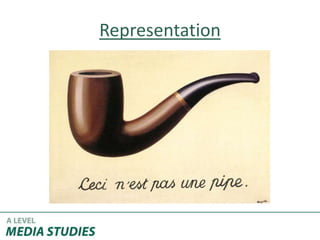
Representation
• All media products are ‘constructed’
– they are made by a producer with a specific intention to create a certain meaning
– the producer hopes the intended target audience will interpret and accept the
meaning unquestioningly.
• Producers use different elements/conventions of media language to
construct these representations.
• Producers of different long form TV dramas may use different
elements of media language to:
– offer different representations
– communicate different ideas and viewpoints about individuals, social groups, social
identities, events and issues.
• Constructed media representations ensure that the meaning
‘encoded’ in media products can be quickly read and understood by
the audience
Representation in the Media
But…how is meaning created and how do we read them?
Constructing meaning – semiotics
and signifiers
SEMIOTICS
• Semiotics is the study of making meaning.
• It looks at how ‘signs’ in our everyday lives and cultural products
can communicate messages and values about our world.
• Signs can help to tell us or communicate how we should live,
behave and think within our society.
• Signs can be verbal or non-verbal (so visual symbols, images
etc…)
Control
thinking?
Reinforce
dominant
ideology?
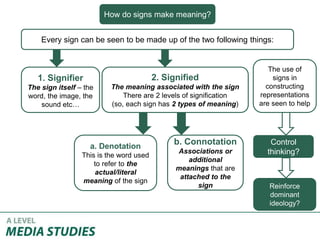
1. Signifier
The sign itself – the
word, the image, the
sound etc…
2. Signified
The meaning associated with the sign
There are 2 levels of signification
(so, each sign has 2 types of meaning)
How do signs make meaning?
Every sign can be seen to be made up of the two following things:
b. Connotation
Associations or
additional
meanings that are
attached to the
sign
a. Denotation
This is the word used
to refer to the
actual/literal
meaning of the sign
The use of
signs in
constructing
representations
are seen to help
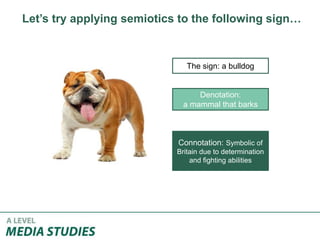
Let’s try applying semiotics to the following sign…
The sign: a bulldog
Denotation:
a mammal that barks
Connotation: Symbolic of
Britain due to determination
and fighting abilities
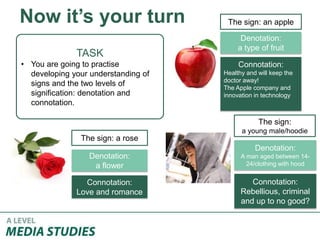
Now it’s your turn The sign: an apple
The sign:
a young male/hoodie
The sign: a rose
Denotation:
a flower
Denotation:
a type of fruit
Connotation:
Love and romance
Denotation:
A man aged between 14-
24/clothing with hood
Connotation:
Healthy and will keep the
doctor away!
The Apple company and
innovation in technology
Connotation:
Rebellious, criminal
and up to no good?
TASK
• You are going to practise
developing your understanding of
signs and the two levels of
signification: denotation and
connotation.
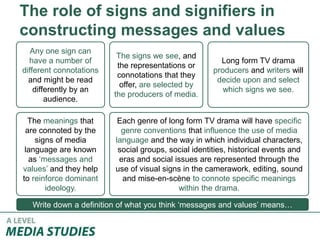
The role of signs and signifiers in
constructing messages and values
Write down a definition of what you think ‘messages and values’ means…
Any one sign can
have a number of
different connotations
and might be read
differently by an
audience.
The signs we see, and
the representations or
connotations that they
offer, are selected by
the producers of media.
Long form TV drama
producers and writers will
decide upon and select
which signs we see.
Each genre of long form TV drama will have specific
genre conventions that influence the use of media
language and the way in which individual characters,
social groups, social identities, historical events and
eras and social issues are represented through the
use of visual signs in the camerawork, editing, sound
and mise-en-scène to connote specific meanings
within the drama.
The meanings that
are connoted by the
signs of media
language are known
as ‘messages and
values’ and they help
to reinforce dominant
ideology.
TASK
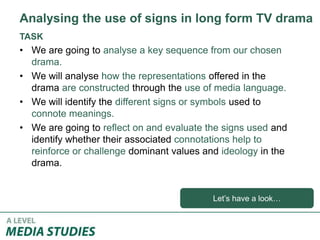
• We are going to analyse a key sequence from our chosen
drama.
• We will analyse how the representations offered in the
drama are constructed through the use of media language.
• We will identify the different signs or symbols used to
connote meanings.
• We are going to reflect on and evaluate the signs used and
identify whether their associated connotations help to
reinforce or challenge dominant values and ideology in the
drama.
Analysing the use of signs in long form TV drama
Let’s have a look…
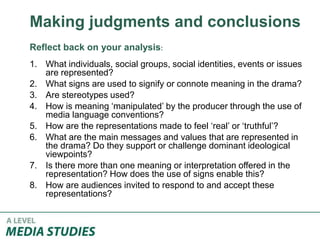
Making judgments and conclusions
Reflect back on your analysis:
1. What individuals, social groups, social identities, events or issues
are represented?
2. What signs are used to signify or connote meaning in the drama?
3. Are stereotypes used?
4. How is meaning ‘manipulated’ by the producer through the use of
media language conventions?
5. How are the representations made to feel ‘real’ or ‘truthful’?
6. What are the main messages and values that are represented in
the drama? Do they support or challenge dominant ideological
viewpoints?
7. Is there more than one meaning or interpretation offered in the
representation? How does the use of signs enable this?
8. How are audiences invited to respond to and accept these
representations?
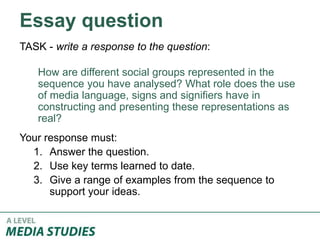
Essay question
TASK - write a response to the question:
How are different social groups represented in the
sequence you have analysed? What role does the use
of media language, signs and signifiers have in
constructing and presenting these representations as
real?
Your response must:
1. Answer the question.
2. Use key terms learned to date.
3. Give a range of examples from the sequence to
support your ideas.
OCR Resources: the small print
OCR’s resources are provided to support the delivery of OCR qualifications, but in no way constitute an endorsed teaching method that is required by the Board, and the decision to use them lies with the individual teacher. Whilst every effort
is made to ensure the accuracy of the content, OCR cannot be held responsible for any errors or omissions within these resources.
Our documents are updated over time. Whilst every effort is made to check all documents, there may be contradictions between published support and the specification, therefore please use the information on the latest specification at all
times. Where changes are made to specifications these will be indicated within the document, there will be a new version number indicated, and a summary of the changes. If you do notice a discrepancy between the specification and a
resource please contact us at: resources.feedback@ocr.org.uk.
© OCR 2018 - This resource may be freely copied and distributed, as long as the OCR logo and this message remain intact and OCR is acknowledged as the originator of this work. OCR acknowledges the use of the following content:
Bulldog - Anna Mandrikyan/Shutterstock.com; apple - Alex Staroseltsev/Shutterstock.com; rose - Elena Itsenko/Shutterstock.com; teenager – oleschwander/Shutterstock.com.
Please get in touch if you want to discuss the accessibility of resources we offer to support delivery of our qualifications: resources.feedback@ocr.org.uk

Representation

  • 1.
    Learner resource 22 LongForm TV Drama REPRESENTATION Semiotics, signs and signifiers
  • 2.
  • 3.
    • All mediaproducts are ‘constructed’ – they are made by a producer with a specific intention to create a certain meaning – the producer hopes the intended target audience will interpret and accept the meaning unquestioningly. • Producers use different elements/conventions of media language to construct these representations. • Producers of different long form TV dramas may use different elements of media language to: – offer different representations – communicate different ideas and viewpoints about individuals, social groups, social identities, events and issues. • Constructed media representations ensure that the meaning ‘encoded’ in media products can be quickly read and understood by the audience Representation in the Media But…how is meaning created and how do we read them?
  • 4.
    Constructing meaning –semiotics and signifiers SEMIOTICS • Semiotics is the study of making meaning. • It looks at how ‘signs’ in our everyday lives and cultural products can communicate messages and values about our world. • Signs can help to tell us or communicate how we should live, behave and think within our society. • Signs can be verbal or non-verbal (so visual symbols, images etc…)
  • 5.
    Control thinking? Reinforce dominant ideology? 1. Signifier The signitself – the word, the image, the sound etc… 2. Signified The meaning associated with the sign There are 2 levels of signification (so, each sign has 2 types of meaning) How do signs make meaning? Every sign can be seen to be made up of the two following things: b. Connotation Associations or additional meanings that are attached to the sign a. Denotation This is the word used to refer to the actual/literal meaning of the sign The use of signs in constructing representations are seen to help
  • 6.
    Let’s try applyingsemiotics to the following sign… The sign: a bulldog Denotation: a mammal that barks Connotation: Symbolic of Britain due to determination and fighting abilities
  • 7.
    Now it’s yourturn The sign: an apple The sign: a young male/hoodie The sign: a rose Denotation: a flower Denotation: a type of fruit Connotation: Love and romance Denotation: A man aged between 14- 24/clothing with hood Connotation: Healthy and will keep the doctor away! The Apple company and innovation in technology Connotation: Rebellious, criminal and up to no good? TASK • You are going to practise developing your understanding of signs and the two levels of signification: denotation and connotation.
  • 8.
    The role ofsigns and signifiers in constructing messages and values Write down a definition of what you think ‘messages and values’ means… Any one sign can have a number of different connotations and might be read differently by an audience. The signs we see, and the representations or connotations that they offer, are selected by the producers of media. Long form TV drama producers and writers will decide upon and select which signs we see. Each genre of long form TV drama will have specific genre conventions that influence the use of media language and the way in which individual characters, social groups, social identities, historical events and eras and social issues are represented through the use of visual signs in the camerawork, editing, sound and mise-en-scène to connote specific meanings within the drama. The meanings that are connoted by the signs of media language are known as ‘messages and values’ and they help to reinforce dominant ideology.
  • 9.
    TASK • We aregoing to analyse a key sequence from our chosen drama. • We will analyse how the representations offered in the drama are constructed through the use of media language. • We will identify the different signs or symbols used to connote meanings. • We are going to reflect on and evaluate the signs used and identify whether their associated connotations help to reinforce or challenge dominant values and ideology in the drama. Analysing the use of signs in long form TV drama Let’s have a look…
  • 10.
    Making judgments andconclusions Reflect back on your analysis: 1. What individuals, social groups, social identities, events or issues are represented? 2. What signs are used to signify or connote meaning in the drama? 3. Are stereotypes used? 4. How is meaning ‘manipulated’ by the producer through the use of media language conventions? 5. How are the representations made to feel ‘real’ or ‘truthful’? 6. What are the main messages and values that are represented in the drama? Do they support or challenge dominant ideological viewpoints? 7. Is there more than one meaning or interpretation offered in the representation? How does the use of signs enable this? 8. How are audiences invited to respond to and accept these representations?
  • 11.
    Essay question TASK -write a response to the question: How are different social groups represented in the sequence you have analysed? What role does the use of media language, signs and signifiers have in constructing and presenting these representations as real? Your response must: 1. Answer the question. 2. Use key terms learned to date. 3. Give a range of examples from the sequence to support your ideas.
  • 12.
    OCR Resources: thesmall print OCR’s resources are provided to support the delivery of OCR qualifications, but in no way constitute an endorsed teaching method that is required by the Board, and the decision to use them lies with the individual teacher. Whilst every effort is made to ensure the accuracy of the content, OCR cannot be held responsible for any errors or omissions within these resources. Our documents are updated over time. Whilst every effort is made to check all documents, there may be contradictions between published support and the specification, therefore please use the information on the latest specification at all times. Where changes are made to specifications these will be indicated within the document, there will be a new version number indicated, and a summary of the changes. If you do notice a discrepancy between the specification and a resource please contact us at: resources.feedback@ocr.org.uk. © OCR 2018 - This resource may be freely copied and distributed, as long as the OCR logo and this message remain intact and OCR is acknowledged as the originator of this work. OCR acknowledges the use of the following content: Bulldog - Anna Mandrikyan/Shutterstock.com; apple - Alex Staroseltsev/Shutterstock.com; rose - Elena Itsenko/Shutterstock.com; teenager – oleschwander/Shutterstock.com. Please get in touch if you want to discuss the accessibility of resources we offer to support delivery of our qualifications: resources.feedback@ocr.org.uk