ENGL 102-20 Fall 2018 Ben Shane
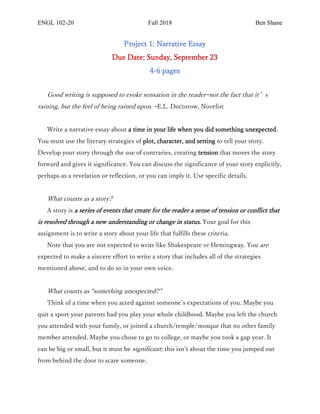
Project 1: Narrative Essay
Due Date: Sunday, September 23
4-6 pages
Good writing is supposed to evoke sensation in the reader—not the fact that it’s
raining, but the feel of being rained upon. —E.L. Doctorow, Novelist
Write a narrative essay about a time in your life when you did something unexpected.
You must use the literary strategies of plot, character, and setting to tell your story.
Develop your story through the use of contraries, creating tension that moves the story
forward and gives it significance. You can discuss the significance of your story explicitly,
perhaps as a revelation or reflection, or you can imply it. Use specific details.
What counts as a story?
A story is a series of events that create for the reader a sense of tension or conflict that
is resolved through a new understanding or change in status. Your goal for this
assignment is to write a story about your life that fulfills these criteria.
Note that you are not expected to write like Shakespeare or Hemingway. You are
expected to make a sincere effort to write a story that includes all of the strategies
mentioned above, and to do so in your own voice.
What counts as “something unexpected?”
Think of a time when you acted against someone’s expectations of you. Maybe you
quit a sport your parents had you play your whole childhood. Maybe you left the church
you attended with your family, or joined a church/temple/mosque that no other family
member attended. Maybe you chose to go to college, or maybe you took a gap year. It
can be big or small, but it must be significant; this isn’t about the time you jumped out
from behind the door to scare someone.
ENGL 102-20 Fall 2018 Ben Shane
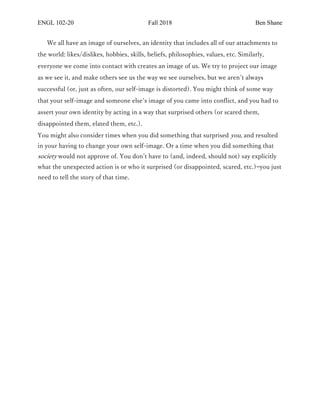
We all have an image of ourselves, an identity that includes all of our attachments to
the world: likes/dislikes, hobbies, skills, beliefs, philosophies, values, etc. Similarly,
everyone we come into contact with creates an image of us. We try to project our image
as we see it, and make others see us the way we see ourselves, but we aren’t always
successful (or, just as often, our self-image is distorted). You might think of some way
that your self-image and someone else’s image of you came into conflict, and you had to
assert your own identity by acting in a way that surprised others (or scared them,
disappointed them, elated them, etc.).
You might also consider times when you did something that surprised you, and resulted
in your having to change your own self-image. Or a time when you did something that
society would not approve of. You don’t have to (and, indeed, should not) say explicitly
what the unexpected action is or who it surprised (or disappointed, scared, etc.)—you just
need to tell the story of that time.

Narrative essay assignment sheet

  • 1.
    ENGL 102-20 Fall2018 Ben Shane Project 1: Narrative Essay Due Date: Sunday, September 23 4-6 pages Good writing is supposed to evoke sensation in the reader—not the fact that it’s raining, but the feel of being rained upon. —E.L. Doctorow, Novelist Write a narrative essay about a time in your life when you did something unexpected. You must use the literary strategies of plot, character, and setting to tell your story. Develop your story through the use of contraries, creating tension that moves the story forward and gives it significance. You can discuss the significance of your story explicitly, perhaps as a revelation or reflection, or you can imply it. Use specific details. What counts as a story? A story is a series of events that create for the reader a sense of tension or conflict that is resolved through a new understanding or change in status. Your goal for this assignment is to write a story about your life that fulfills these criteria. Note that you are not expected to write like Shakespeare or Hemingway. You are expected to make a sincere effort to write a story that includes all of the strategies mentioned above, and to do so in your own voice. What counts as “something unexpected?” Think of a time when you acted against someone’s expectations of you. Maybe you quit a sport your parents had you play your whole childhood. Maybe you left the church you attended with your family, or joined a church/temple/mosque that no other family member attended. Maybe you chose to go to college, or maybe you took a gap year. It can be big or small, but it must be significant; this isn’t about the time you jumped out from behind the door to scare someone.
  • 2.
    ENGL 102-20 Fall2018 Ben Shane We all have an image of ourselves, an identity that includes all of our attachments to the world: likes/dislikes, hobbies, skills, beliefs, philosophies, values, etc. Similarly, everyone we come into contact with creates an image of us. We try to project our image as we see it, and make others see us the way we see ourselves, but we aren’t always successful (or, just as often, our self-image is distorted). You might think of some way that your self-image and someone else’s image of you came into conflict, and you had to assert your own identity by acting in a way that surprised others (or scared them, disappointed them, elated them, etc.). You might also consider times when you did something that surprised you, and resulted in your having to change your own self-image. Or a time when you did something that society would not approve of. You don’t have to (and, indeed, should not) say explicitly what the unexpected action is or who it surprised (or disappointed, scared, etc.)—you just need to tell the story of that time.