Nanotechnology
Past, present, & the future
Samadhan Kamble, Laxman Mandal
25 April 2024
Samadhan & Laxman Nanotechnology April 25, 2024
Outline
2
Samadhan & Laxman Nanotechnology April 25, 2024
Who am I ?
A Prime Minister’s Research Fellow, a PhD scholar at IIT
Madras.
Research: Experimental High Energy Particle Physics
Collaboration: CMS experiment at Large Hadron Collider
(LHC), CERN
Topic: Search for additional Higgs bosons in the diphoton
final state
3
Samadhan & Laxman Nanotechnology April 25, 2024
Introduction
Nanotechnology is the art and science of
manipulating matter at the nanoscale (down to
1/100,000 the width of a human hair) to
create new and unique materials and products.

Nanotechnology has enormous potential to
change society and it involves manipulation
of objects on the atomic level.
4
Human Hair: ~ 105
nm
Samadhan & Laxman Nanotechnology April 25, 2024
Definition of Nanotechnology
“Nanotechnology is the understanding and control of matter
at dimensions of roughly 1 to 100 nanometers, where unique
phenomena enable novel applications.

Encompassing nanoscale science, engineering and technology,
nanotechnology involves imaging, measuring, modeling, and
manipulating matter at this length scale.”
5
Samadhan & Laxman Nanotechnology April 25, 2024
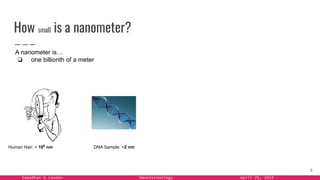
How small is a nanometer?
Human Hair: ~ 105
nm DNA Sample: ~2 nm
A nanometer is…
❏ one billionth of a meter
6
Samadhan & Laxman Nanotechnology April 25, 2024
7
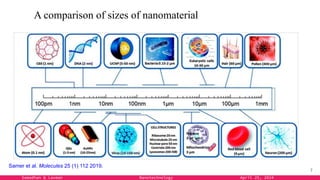
A comparison of sizes of nanomaterial
Samer et al. Molecules 25 (1) 112 2019.

Samadhan & Laxman Nanotechnology April 25, 2024
8
History
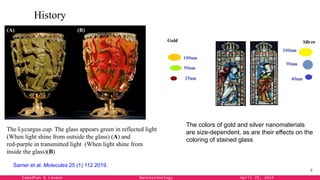
The Lycurgus cup. The glass appears green in reflected light
(When light shine from outside the glass) (A) and
red-purple in transmitted light (When light shine from
inside the glass)(B)
The colors of gold and silver nanomaterials
are size-dependent, as are their effects on the
coloring of stained glass
Samer et al. Molecules 25 (1) 112 2019.
Samadhan & Laxman Nanotechnology April 25, 2024
9
Samadhan & Laxman Nanotechnology April 25, 2024
10
Samadhan & Laxman Nanotechnology April 25, 2024
Origins of Nanotechnology
Nobel laureate Richard Feynman first conceived the idea of
molecular manufacturing in his 1959 speech, “There's Plenty
of Room at the Bottom."
Richard Feynman was the first scientist to suggest that
devices and materials could someday be fabricated to atomic
specifications
In 1986, K. Eric Drexler wrote "Engines of Creation" and
introduced the term nanotechnology from there Scientific
research really expanded over the last decade
11
Samadhan & Laxman Nanotechnology April 25, 2024
Why Nanotechnology?
At the nanoscale, the physical, chemical, and biological
properties of materials differ in fundamental and valuable
ways from the properties of individual atoms and molecules
or bulk matter.
Nanotechnology R&D is directed toward understanding and
creating improved materials, devices, and systems that
exploit these new properties.
12
Samadhan & Laxman Nanotechnology April 25, 2024
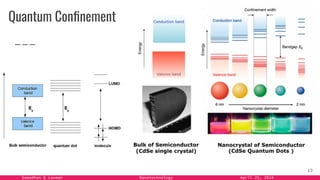
Quantum Confinement
13
Samadhan & Laxman Nanotechnology April 25, 2024
Confining the motion of electrons makes different material
14
Samadhan & Laxman Nanotechnology April 25, 2024
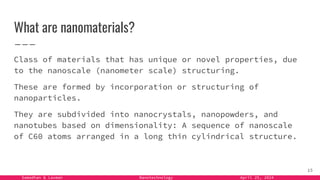
What are nanomaterials?
Class of materials that has unique or novel properties, due
to the nanoscale (nanometer scale) structuring.
These are formed by incorporation or structuring of
nanoparticles.
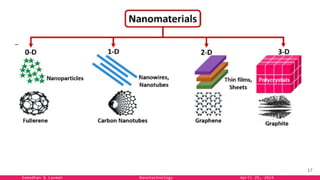
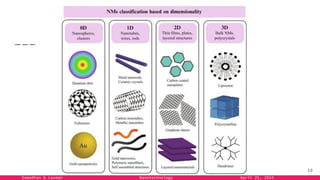
They are subdivided into nanocrystals, nanopowders, and
nanotubes based on dimensionality: A sequence of nanoscale
of C60 atoms arranged in a long thin cylindrical structure.
15
Samadhan & Laxman Nanotechnology April 25, 2024
16
Samadhan & Laxman Nanotechnology April 25, 2024
17
Samadhan & Laxman Nanotechnology April 25, 2024
18
Samadhan & Laxman Nanotechnology April 25, 2024
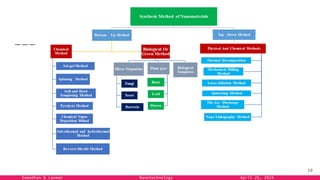
Fabrication of Nano Material
19
Samadhan & Laxman Nanotechnology April 25, 2024
20
Samadhan & Laxman Nanotechnology April 25, 2024
Applications Overview
I. NanoElectronics
● Nanotransistors
II.
21
Samadhan & Laxman Nanotechnology April 25, 2024
Nanotransistors: Introduction
22
Samadhan & Laxman Nanotechnology April 25, 2024
Nanotransistors
A nanotransistor made of graphene nanoribbons
● An international research team has now succeeded in producing
nanotransistors from graphene ribbons only a few atoms wide
● graphene nanoribbons have special electrical properties that
make them promising candidates for the nanoelectronics of the
future
● Graphene: 1D carbon layer is conductive
● Graphene nanoribbon: 2D wire is semiconductive!
○ Can be turned on/off: key component of nanotransistors
Nature 08, 2041-1723(2017)
23
Samadhan & Laxman Nanotechnology April 25, 2024
Nanotransistors
Nature 08, 2041-1723(2017)
24
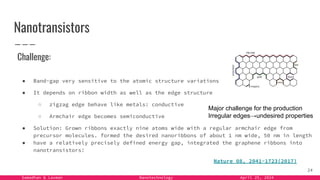
Challenge:
● Band-gap very sensitive to the atomic structure variations
● It depends on ribbon width as well as the edge structure
○ zigzag edge behave like metals: conductive
○ Armchair edge becomes semiconductive
● Solution: Grown ribbons exactly nine atoms wide with a regular armchair edge from
precursor molecules. formed the desired nanoribbons of about 1 nm wide, 50 nm in length
● have a relatively precisely defined energy gap, integrated the graphene ribbons into
nanotransistors!
Major challenge for the production
Irregular edges→undesired properties
Samadhan & Laxman Nanotechnology April 25, 2024
Nanotransistors
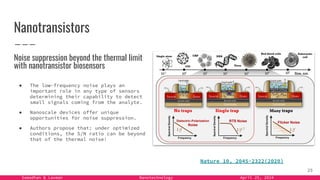
Noise suppression beyond the thermal limit
with nanotransistor biosensors
● The low-frequency noise plays an
important role in any type of sensors
determining their capability to detect
small signals coming from the analyte.
● Nanoscale devices offer unique
opportunities for noise suppression.
● Authors propose that: under optimized
conditions, the S/N ratio can be beyond
that of the thermal noise!
Nature 10, 2045-2322(2020)
25
Samadhan & Laxman Nanotechnology April 25, 2024
Nanotechnology in energy production increases efficiency and
sustainability
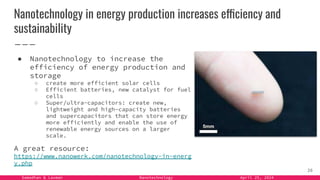
● Nanotechnology to increase the
efficiency of energy production and
storage
○ create more efficient solar cells
○ Efficient batteries, new catalyst for fuel
cells
○ Super/ultra-capacitors: create new,
lightweight and high-capacity batteries
and supercapacitors that can store energy
more efficiently and enable the use of
renewable energy sources on a larger
scale.
A great resource:
https://www.nanowerk.com/nanotechnology-in-energ
y.php
26
Samadhan & Laxman Nanotechnology April 25, 2024
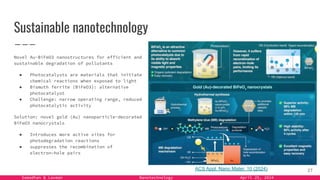
Sustainable nanotechnology
Novel Au-BiFeO3 nanostructures for efficient and
sustainable degradation of pollutants
● Photocatalysts are materials that initiate
chemical reactions when exposed to light
● Bismuth ferrite (BiFeO3): alternative
photocatalyst
● Challenge: narrow operating range, reduced
photocatalytic activity
Solution: novel gold (Au) nanoparticle-decorated
BiFeO3 nanocrystals
● Introduces more active sites for
photodegradation reactions
● suppresses the recombination of
electron–hole pairs
27
ACS Appl. Nano Mater. 10 (2024)
Samadhan & Laxman Nanotechnology April 25, 2024
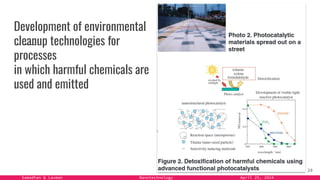
Development of environmental
cleanup technologies for
processes
in which harmful chemicals are
used and emitted
28
Samadhan & Laxman Nanotechnology April 25, 2024
Nanotechnology in medicine improves diagnosis and treatment
Nanotechnology has the potential to revolutionize the field of medicine by enabling the
development of new diagnostic tools and therapies that operate at the nanoscale.
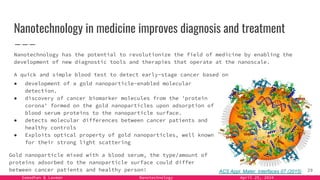
A quick and simple blood test to detect early-stage cancer based on
29
● development of a gold nanoparticle-enabled molecular
detection.
● discovery of cancer biomarker molecules from the 'protein
corona' formed on the gold nanoparticles upon adsorption of
blood serum proteins to the nanoparticle surface.
● detects molecular differences between cancer patients and
healthy controls
● Exploits optical property of gold nanoparticles, well known
for their strong light scattering
Gold nanoparticle mixed with a blood serum, the type/amount of
proteins adsorbed to the nanoparticle surface could differ
between cancer patients and healthy person! ACS Appl. Mater. Interfaces 07 (2015)
Samadhan & Laxman Nanotechnology April 25, 2024
Medical applications: cancer treatment
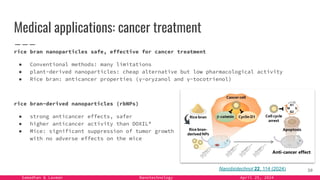
rice bran nanoparticles safe, effective for cancer treatment
● Conventional methods: many limitations
● plant-derived nanoparticles: cheap alternative but low pharmacological activity
● Rice bran: anticancer properties (γ-oryzanol and γ-tocotrienol)
30
Nanobiotechnol 22, 114 (2024)
rice bran-derived nanoparticles (rbNPs)
● strong anticancer effects, safer
● higher anticancer activity than DOXIL®
● Mice: significant suppression of tumor growth
with no adverse effects on the mice
Samadhan & Laxman Nanotechnology April 25, 2024
Day-to-day utilities
Effectiveness of different kinds of sunscreen, including those
containing nanoparticles
So nano-socks really keep your feet from smelling. How and why?
Do bandages impregnated with nanosilver really kill germs?
Are sports products with nanomaterials actually perform better?
Do clothes with nano-coating actually shed water and stains
better?
31
Samadhan & Laxman Nanotechnology April 25, 2024
The challenges of a new technology
32
Samadhan & Laxman Nanotechnology April 25, 2024
Nanotechnology is an interdisciplinary science
It needs Physics, Chemistry,
Engineering, Biology etc. so that its full potential can be exploited for the
advantage
of mankind. What has been achieved in nanotech so far is only the tip of the iceberg.
However to fully explore the potential of nanotechnology it is essential to know
what are nanomaterials, how and why do they differ from other materials, how to
synthesize/analyze the nanomaterials organize them and understand some already
proven application areas.
33
Samadhan & Laxman Nanotechnology April 25, 2024
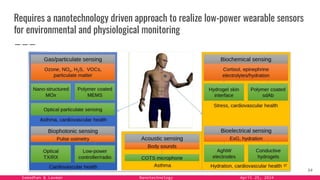
Requires a nanotechnology driven approach to realize low-power wearable sensors
for environmental and physiological monitoring
34
Samadhan & Laxman Nanotechnology April 25, 2024
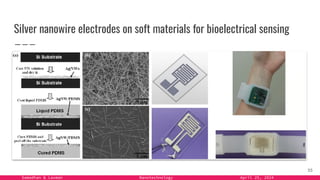
Silver nanowire electrodes on soft materials for bioelectrical sensing
35
Samadhan & Laxman Nanotechnology April 25, 2024
36
Samadhan & Laxman Nanotechnology April 25, 2024
37
Samadhan & Laxman Nanotechnology April 25, 2024
38
Samadhan & Laxman Nanotechnology April 25, 2024
Notes
Over the past 15 years, the scientific world has witnessed a dramatic interest in
nanotechnology with research contributions from physicists, chemists, biologists as
well as scientists working in the medical, agricultural, textile and environmental
fields. The varied inputs from different disciplines and their complementary nature
in the synthesis, characterization, understanding and applications from household
items to space technologies have enriched the nanotechnology basics. This can
be easily understood as about 80 journals have emerged on nanotechnology and
hundreds of thousands of papers have been published in the last 12 years or so.
Lecturers aware of this fact naturally want to introduce the new knowledge to the
young generation and prepare their students for the great challenges of sustainable
management of energy, water and environment faced by mankind.
39

Nanotechnology_nanotechnology_nanotech.pdf

  • 1.
    Nanotechnology Past, present, &the future Samadhan Kamble, Laxman Mandal 25 April 2024
  • 2.
    Samadhan & LaxmanNanotechnology April 25, 2024 Outline 2
  • 3.
    Samadhan & LaxmanNanotechnology April 25, 2024 Who am I ? A Prime Minister’s Research Fellow, a PhD scholar at IIT Madras. Research: Experimental High Energy Particle Physics Collaboration: CMS experiment at Large Hadron Collider (LHC), CERN Topic: Search for additional Higgs bosons in the diphoton final state 3
  • 4.
    Samadhan & LaxmanNanotechnology April 25, 2024 Introduction Nanotechnology is the art and science of manipulating matter at the nanoscale (down to 1/100,000 the width of a human hair) to create new and unique materials and products. Nanotechnology has enormous potential to change society and it involves manipulation of objects on the atomic level. 4 Human Hair: ~ 105 nm
  • 5.
    Samadhan & LaxmanNanotechnology April 25, 2024 Definition of Nanotechnology “Nanotechnology is the understanding and control of matter at dimensions of roughly 1 to 100 nanometers, where unique phenomena enable novel applications. Encompassing nanoscale science, engineering and technology, nanotechnology involves imaging, measuring, modeling, and manipulating matter at this length scale.” 5
  • 6.
    Samadhan & LaxmanNanotechnology April 25, 2024 How small is a nanometer? Human Hair: ~ 105 nm DNA Sample: ~2 nm A nanometer is… ❏ one billionth of a meter 6
  • 7.
    Samadhan & LaxmanNanotechnology April 25, 2024 7 A comparison of sizes of nanomaterial Samer et al. Molecules 25 (1) 112 2019.
  • 8.
    Samadhan & LaxmanNanotechnology April 25, 2024 8 History The Lycurgus cup. The glass appears green in reflected light (When light shine from outside the glass) (A) and red-purple in transmitted light (When light shine from inside the glass)(B) The colors of gold and silver nanomaterials are size-dependent, as are their effects on the coloring of stained glass Samer et al. Molecules 25 (1) 112 2019.
  • 9.
    Samadhan & LaxmanNanotechnology April 25, 2024 9
  • 10.
    Samadhan & LaxmanNanotechnology April 25, 2024 10
  • 11.
    Samadhan & LaxmanNanotechnology April 25, 2024 Origins of Nanotechnology Nobel laureate Richard Feynman first conceived the idea of molecular manufacturing in his 1959 speech, “There's Plenty of Room at the Bottom." Richard Feynman was the first scientist to suggest that devices and materials could someday be fabricated to atomic specifications In 1986, K. Eric Drexler wrote "Engines of Creation" and introduced the term nanotechnology from there Scientific research really expanded over the last decade 11
  • 12.
    Samadhan & LaxmanNanotechnology April 25, 2024 Why Nanotechnology? At the nanoscale, the physical, chemical, and biological properties of materials differ in fundamental and valuable ways from the properties of individual atoms and molecules or bulk matter. Nanotechnology R&D is directed toward understanding and creating improved materials, devices, and systems that exploit these new properties. 12
  • 13.
    Samadhan & LaxmanNanotechnology April 25, 2024 Quantum Confinement 13
  • 14.
    Samadhan & LaxmanNanotechnology April 25, 2024 Confining the motion of electrons makes different material 14
  • 15.
    Samadhan & LaxmanNanotechnology April 25, 2024 What are nanomaterials? Class of materials that has unique or novel properties, due to the nanoscale (nanometer scale) structuring. These are formed by incorporation or structuring of nanoparticles. They are subdivided into nanocrystals, nanopowders, and nanotubes based on dimensionality: A sequence of nanoscale of C60 atoms arranged in a long thin cylindrical structure. 15
  • 16.
    Samadhan & LaxmanNanotechnology April 25, 2024 16
  • 17.
    Samadhan & LaxmanNanotechnology April 25, 2024 17
  • 18.
    Samadhan & LaxmanNanotechnology April 25, 2024 18
  • 19.
    Samadhan & LaxmanNanotechnology April 25, 2024 Fabrication of Nano Material 19
  • 20.
    Samadhan & LaxmanNanotechnology April 25, 2024 20
  • 21.
    Samadhan & LaxmanNanotechnology April 25, 2024 Applications Overview I. NanoElectronics ● Nanotransistors II. 21
  • 22.
    Samadhan & LaxmanNanotechnology April 25, 2024 Nanotransistors: Introduction 22
  • 23.
    Samadhan & LaxmanNanotechnology April 25, 2024 Nanotransistors A nanotransistor made of graphene nanoribbons ● An international research team has now succeeded in producing nanotransistors from graphene ribbons only a few atoms wide ● graphene nanoribbons have special electrical properties that make them promising candidates for the nanoelectronics of the future ● Graphene: 1D carbon layer is conductive ● Graphene nanoribbon: 2D wire is semiconductive! ○ Can be turned on/off: key component of nanotransistors Nature 08, 2041-1723(2017) 23
  • 24.
    Samadhan & LaxmanNanotechnology April 25, 2024 Nanotransistors Nature 08, 2041-1723(2017) 24 Challenge: ● Band-gap very sensitive to the atomic structure variations ● It depends on ribbon width as well as the edge structure ○ zigzag edge behave like metals: conductive ○ Armchair edge becomes semiconductive ● Solution: Grown ribbons exactly nine atoms wide with a regular armchair edge from precursor molecules. formed the desired nanoribbons of about 1 nm wide, 50 nm in length ● have a relatively precisely defined energy gap, integrated the graphene ribbons into nanotransistors! Major challenge for the production Irregular edges→undesired properties
  • 25.
    Samadhan & LaxmanNanotechnology April 25, 2024 Nanotransistors Noise suppression beyond the thermal limit with nanotransistor biosensors ● The low-frequency noise plays an important role in any type of sensors determining their capability to detect small signals coming from the analyte. ● Nanoscale devices offer unique opportunities for noise suppression. ● Authors propose that: under optimized conditions, the S/N ratio can be beyond that of the thermal noise! Nature 10, 2045-2322(2020) 25
  • 26.
    Samadhan & LaxmanNanotechnology April 25, 2024 Nanotechnology in energy production increases efficiency and sustainability ● Nanotechnology to increase the efficiency of energy production and storage ○ create more efficient solar cells ○ Efficient batteries, new catalyst for fuel cells ○ Super/ultra-capacitors: create new, lightweight and high-capacity batteries and supercapacitors that can store energy more efficiently and enable the use of renewable energy sources on a larger scale. A great resource: https://www.nanowerk.com/nanotechnology-in-energ y.php 26
  • 27.
    Samadhan & LaxmanNanotechnology April 25, 2024 Sustainable nanotechnology Novel Au-BiFeO3 nanostructures for efficient and sustainable degradation of pollutants ● Photocatalysts are materials that initiate chemical reactions when exposed to light ● Bismuth ferrite (BiFeO3): alternative photocatalyst ● Challenge: narrow operating range, reduced photocatalytic activity Solution: novel gold (Au) nanoparticle-decorated BiFeO3 nanocrystals ● Introduces more active sites for photodegradation reactions ● suppresses the recombination of electron–hole pairs 27 ACS Appl. Nano Mater. 10 (2024)
  • 28.
    Samadhan & LaxmanNanotechnology April 25, 2024 Development of environmental cleanup technologies for processes in which harmful chemicals are used and emitted 28
  • 29.
    Samadhan & LaxmanNanotechnology April 25, 2024 Nanotechnology in medicine improves diagnosis and treatment Nanotechnology has the potential to revolutionize the field of medicine by enabling the development of new diagnostic tools and therapies that operate at the nanoscale. A quick and simple blood test to detect early-stage cancer based on 29 ● development of a gold nanoparticle-enabled molecular detection. ● discovery of cancer biomarker molecules from the 'protein corona' formed on the gold nanoparticles upon adsorption of blood serum proteins to the nanoparticle surface. ● detects molecular differences between cancer patients and healthy controls ● Exploits optical property of gold nanoparticles, well known for their strong light scattering Gold nanoparticle mixed with a blood serum, the type/amount of proteins adsorbed to the nanoparticle surface could differ between cancer patients and healthy person! ACS Appl. Mater. Interfaces 07 (2015)
  • 30.
    Samadhan & LaxmanNanotechnology April 25, 2024 Medical applications: cancer treatment rice bran nanoparticles safe, effective for cancer treatment ● Conventional methods: many limitations ● plant-derived nanoparticles: cheap alternative but low pharmacological activity ● Rice bran: anticancer properties (γ-oryzanol and γ-tocotrienol) 30 Nanobiotechnol 22, 114 (2024) rice bran-derived nanoparticles (rbNPs) ● strong anticancer effects, safer ● higher anticancer activity than DOXIL® ● Mice: significant suppression of tumor growth with no adverse effects on the mice
  • 31.
    Samadhan & LaxmanNanotechnology April 25, 2024 Day-to-day utilities Effectiveness of different kinds of sunscreen, including those containing nanoparticles So nano-socks really keep your feet from smelling. How and why? Do bandages impregnated with nanosilver really kill germs? Are sports products with nanomaterials actually perform better? Do clothes with nano-coating actually shed water and stains better? 31
  • 32.
    Samadhan & LaxmanNanotechnology April 25, 2024 The challenges of a new technology 32
  • 33.
    Samadhan & LaxmanNanotechnology April 25, 2024 Nanotechnology is an interdisciplinary science It needs Physics, Chemistry, Engineering, Biology etc. so that its full potential can be exploited for the advantage of mankind. What has been achieved in nanotech so far is only the tip of the iceberg. However to fully explore the potential of nanotechnology it is essential to know what are nanomaterials, how and why do they differ from other materials, how to synthesize/analyze the nanomaterials organize them and understand some already proven application areas. 33
  • 34.
    Samadhan & LaxmanNanotechnology April 25, 2024 Requires a nanotechnology driven approach to realize low-power wearable sensors for environmental and physiological monitoring 34
  • 35.
    Samadhan & LaxmanNanotechnology April 25, 2024 Silver nanowire electrodes on soft materials for bioelectrical sensing 35
  • 36.
    Samadhan & LaxmanNanotechnology April 25, 2024 36
  • 37.
    Samadhan & LaxmanNanotechnology April 25, 2024 37
  • 38.
    Samadhan & LaxmanNanotechnology April 25, 2024 38
  • 39.
    Samadhan & LaxmanNanotechnology April 25, 2024 Notes Over the past 15 years, the scientific world has witnessed a dramatic interest in nanotechnology with research contributions from physicists, chemists, biologists as well as scientists working in the medical, agricultural, textile and environmental fields. The varied inputs from different disciplines and their complementary nature in the synthesis, characterization, understanding and applications from household items to space technologies have enriched the nanotechnology basics. This can be easily understood as about 80 journals have emerged on nanotechnology and hundreds of thousands of papers have been published in the last 12 years or so. Lecturers aware of this fact naturally want to introduce the new knowledge to the young generation and prepare their students for the great challenges of sustainable management of energy, water and environment faced by mankind. 39