NAFDAC REGULATORY ACTIVITIES ON
PESTICIDES
A
Presentation at
A TWO DAY TRAINING/WORKSHOP:
ON “APPLICATION TECHNIQUES AND SAFE USE OF PESTICIDES”
UNDER THE SUSTAINABLE WEED MANAGEMENT TECHNOLOGIES FOR CASSAVA
PROJECT IN NIGERIA
ON
27th
– 28TH
April, 2015
BY
Dr. Idayat A. Mudashir
VETERINARY MEDICINES AND ALLIED PRODUCTS DIRECTORATE (VMAP)
1
CONTENTSCONTENTS INTRODUCTION
 DEFINITION
 LAWS REGULATING PESTICIDE
 NAFDAC MANDATE
 REGULATORY ACTIVITIES
 REQUIREMENT FOR PESTICIDE REGISTRATION
 REQUIREMENT FOR BULK IMPORTATION OF PESTICIDE
 SAFE USE OF PESTICIDE
 PRECAUTIONARY MEASURES
 LABELING REQUIREMENTS
 CONCLUSION
2
INTRODUCTIONINTRODUCTION
 Pesticides play an important role in the struggle to increase
food production, protect harvested food and to control
vectors of diseases.
 Current agriculture system promotes
the reliance on agrochemicals,
which has been steadily increasing
during the last few decades and
continues to grow in recent years.
3
 Many cases of accidents and death due to improper use of
pesticides have occurred in Nigeria. In many countries, there
are restrictions on the levels of there toxic chemicals in staple
food products.
 The regulatory system is designed to ensure that the
remaining residues do not constitute unacceptable health risks
to consumers.
4
DEFINITIONS
The NAFDAC Pesticide Registration Regulation (2005) defines
• Pest as any insect, rodent, nematode, fungus, weed or any other
form of plant or virus or bacteria or other microorganism.
• Pesticide as any chemical substance or mixture of substance
intended for preventing, destroying, repelling, mitigating the effect
of any pest of plants and animals.
• Agrochemical is a term used to refer to the various chemical
products used in agriculture and animal husbandry such as
fertilisers, pesticides and soil conditioners.
5
DEFINITIONSDEFINITIONS
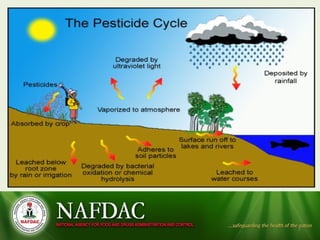
 Pesticide residue refers to pesticides that may remain on or in
food after they are applied to food crops, or as a result of
environmental contamination or animal feeding on pesticide
Treated feed
 Maximum Residue Limit (MRLs) - is the maximum concentration
of a Agrochemical residue legally permitted on a food
commodity.
6
7
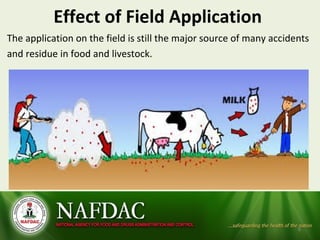
Effect of Field Application
The application on the field is still the major source of many accidents
and residue in food and livestock.
8
LAWS REGULATING PESTICIDELAWS REGULATING PESTICIDE
The purpose of laws and regulations is to protect end users from
fraudulent claims about product performance and also most
importantly protect human health and environment. NAFDAC is
empowered through her laws and regulations to determine the
intended use, quality, efficacy and safety of pesticides. E.g
 NAFDAC Act Cap N1 LFN 2004
 Counterfeit, Fake Drugs and Unwholesome Processed Food Act
Cap C34 LFN 2004
 Import (Prohibition) Act Cap 13 LFN 2004
 Pesticides Registration Regulation 2005
9
NAFDAC’S MANDATENAFDAC’S MANDATE
 NAFDAC was established by Decree 15 of 1993 as amended by
Decree 19 of 1999 and now the National Agency for Food and
Drug Administration and Control Act Cap N1 Laws of the
Federation of Nigeria, 2004.
 This Act mandates NAFDAC to regulate and control the
manufacture, importation, exportation, distribution,
advertisement, sale and use of food, drugs, cosmetics, chemicals,
detergents, medical devices and packaged water (known as
regulated products).
10
REGULATORY ACTIVITIESREGULATORY ACTIVITIES
Regulatory activities being carried out by NAFDAC are as follows:-
 Good Manufacturing Practise (GMP) Inspection.
 Product Registration / Marketing Authorization.
 Quality Control.
 Issuance of Permit for bulk Importation.
 Advert Control and Consumer complaint.
 Enforcement / Litigation.
 Pharmacovigillance and Post Marketing Surveillance.
 Collaborate with Research Institute to conduct field trial evaluation
to ascertain the safety and efficacy of Pesticides
11
REGULATORY ACTIVITIES cont’dREGULATORY ACTIVITIES cont’d
 Port Inspectorate activities which inspects all regulated
products and Routine Laboratory screening of every
Consignment of an already registered product imported into
the country.
 The Agency to sustain and promoted the safe and responsible
use of agrochemicals through workshops in collaboration with
other relevant stakeholders.
12
REGISTRATION REQUIREMENT OFREGISTRATION REQUIREMENT OF
IMPORTED PESTICIDEIMPORTED PESTICIDE
 Product Registration: The registration requirement entails the
submission of an application letter and duly completed
registration form along with relevant documents which include:
1. Notarized Power of attorney.
2. Certificate of Manufacture and Free Sale Certificate.
3. Certificate of analysis
4. GMP invitation letter
5. Certificate of Incorporation
6. Evidence of Trade mark registration
7. Notarized Declaration
13
REQUIREMENTS FOR ISSUANCE OF PERMIT FORREQUIREMENTS FOR ISSUANCE OF PERMIT FOR
BULK IMPORTATIONBULK IMPORTATION
An applicant for Import Permit must submit the following
documents with the application letter and duly completed
application form:
One copy of Certificate of Incorporation.
One copy of Certified True Copy of Memorandum and Articles of
Association.
One copy of Current Tax Clearance Certificate.
One copy Certified True Copy of Particulars of Directors-Form C07.
Material Safety Data Sheets (MSDS)
Credentials of the Technical Officer with a minimum of OND in
related Science with a copy of appointment letter.
14
REQUIREMENTS FOR ISSUANCE OF PERMIT FORREQUIREMENTS FOR ISSUANCE OF PERMIT FOR
BULK IMPORTATIONBULK IMPORTATION
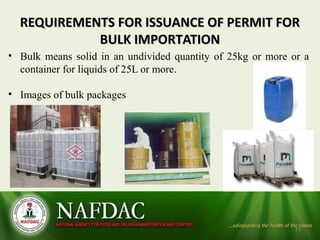
• Bulk means solid in an undivided quantity of 25kg or more or a
container for liquids of 25L or more.
• Images of bulk packages
15
SAFE USE OF PESTICIDES
Pesticides are toxic to both pests and humans. However, they
need not be hazardous to humans and non-target animal species
if suitable precautions are taken. Most pesticides intentionally or
accidentally will cause adverse effects.
The main routes of exposure of pesticides into the body. are
through the following:
1. Respiratory tract (inhalation),
2. Skin (dermal absorption)
3. Digestive. tract (ingestion)
16
PRECAUTIONARY MEASURES
 Special precautions must be taken during transport, storage
and handling.
 Spray equipment should be regularly cleaned and maintained
to prevent leaks.
 People who work with pesticides should receive proper
training in their safe use.
 Use suitable equipment for measuring pesticides.
 Appropriate Personnel Protective Equipment should be worn
in accordance to manufacturers specifications.
19
LABELING REQUIREMENT
The following are the basic labelling requirement on a Pesticide
 Trade name of the product;
 Name and quantity of active ingredient and Net content
 Purpose for which it is to be used;
 NAFDAC registration number;
 Name and address of the manufacturer;
 Date markings
 Directions for use and storage;
 First-aid instructions and advice to health personnel;
 Hazard symbol;
 Safety precautions and Warning;
20
CONCLUSION
Campaigns by NAFDAC is focused on compliance to the direction
for use and safety measures stated on product during application.
The application on the field and handling is still the major source of
many accidents.
The activities of the Agency are geared towards promoting and
protecting animal and human health by ensuring that all Pesticides /
Agrochemicals registered are of quality standard, safe, and
efficacious to assist in minimizing the detrimental effects on
handlers, end users and environments.
21
Thank You for Listening
For Further Enquiry please visit us at;
Website: www.nafdac.gov.ng
Email: vmap@nafdac.gov.ng
22

NAFDAC presentation

  • 1.
    NAFDAC REGULATORY ACTIVITIESON PESTICIDES A Presentation at A TWO DAY TRAINING/WORKSHOP: ON “APPLICATION TECHNIQUES AND SAFE USE OF PESTICIDES” UNDER THE SUSTAINABLE WEED MANAGEMENT TECHNOLOGIES FOR CASSAVA PROJECT IN NIGERIA ON 27th – 28TH April, 2015 BY Dr. Idayat A. Mudashir VETERINARY MEDICINES AND ALLIED PRODUCTS DIRECTORATE (VMAP) 1
  • 2.
    CONTENTSCONTENTS INTRODUCTION  DEFINITION LAWS REGULATING PESTICIDE  NAFDAC MANDATE  REGULATORY ACTIVITIES  REQUIREMENT FOR PESTICIDE REGISTRATION  REQUIREMENT FOR BULK IMPORTATION OF PESTICIDE  SAFE USE OF PESTICIDE  PRECAUTIONARY MEASURES  LABELING REQUIREMENTS  CONCLUSION 2
  • 3.
    INTRODUCTIONINTRODUCTION  Pesticides playan important role in the struggle to increase food production, protect harvested food and to control vectors of diseases.  Current agriculture system promotes the reliance on agrochemicals, which has been steadily increasing during the last few decades and continues to grow in recent years. 3
  • 4.
     Many casesof accidents and death due to improper use of pesticides have occurred in Nigeria. In many countries, there are restrictions on the levels of there toxic chemicals in staple food products.  The regulatory system is designed to ensure that the remaining residues do not constitute unacceptable health risks to consumers. 4
  • 5.
    DEFINITIONS The NAFDAC PesticideRegistration Regulation (2005) defines • Pest as any insect, rodent, nematode, fungus, weed or any other form of plant or virus or bacteria or other microorganism. • Pesticide as any chemical substance or mixture of substance intended for preventing, destroying, repelling, mitigating the effect of any pest of plants and animals. • Agrochemical is a term used to refer to the various chemical products used in agriculture and animal husbandry such as fertilisers, pesticides and soil conditioners. 5
  • 6.
    DEFINITIONSDEFINITIONS  Pesticide residuerefers to pesticides that may remain on or in food after they are applied to food crops, or as a result of environmental contamination or animal feeding on pesticide Treated feed  Maximum Residue Limit (MRLs) - is the maximum concentration of a Agrochemical residue legally permitted on a food commodity. 6
  • 7.
  • 8.
    Effect of FieldApplication The application on the field is still the major source of many accidents and residue in food and livestock. 8
  • 9.
    LAWS REGULATING PESTICIDELAWSREGULATING PESTICIDE The purpose of laws and regulations is to protect end users from fraudulent claims about product performance and also most importantly protect human health and environment. NAFDAC is empowered through her laws and regulations to determine the intended use, quality, efficacy and safety of pesticides. E.g  NAFDAC Act Cap N1 LFN 2004  Counterfeit, Fake Drugs and Unwholesome Processed Food Act Cap C34 LFN 2004  Import (Prohibition) Act Cap 13 LFN 2004  Pesticides Registration Regulation 2005 9
  • 10.
    NAFDAC’S MANDATENAFDAC’S MANDATE NAFDAC was established by Decree 15 of 1993 as amended by Decree 19 of 1999 and now the National Agency for Food and Drug Administration and Control Act Cap N1 Laws of the Federation of Nigeria, 2004.  This Act mandates NAFDAC to regulate and control the manufacture, importation, exportation, distribution, advertisement, sale and use of food, drugs, cosmetics, chemicals, detergents, medical devices and packaged water (known as regulated products). 10
  • 11.
    REGULATORY ACTIVITIESREGULATORY ACTIVITIES Regulatoryactivities being carried out by NAFDAC are as follows:-  Good Manufacturing Practise (GMP) Inspection.  Product Registration / Marketing Authorization.  Quality Control.  Issuance of Permit for bulk Importation.  Advert Control and Consumer complaint.  Enforcement / Litigation.  Pharmacovigillance and Post Marketing Surveillance.  Collaborate with Research Institute to conduct field trial evaluation to ascertain the safety and efficacy of Pesticides 11
  • 12.
    REGULATORY ACTIVITIES cont’dREGULATORYACTIVITIES cont’d  Port Inspectorate activities which inspects all regulated products and Routine Laboratory screening of every Consignment of an already registered product imported into the country.  The Agency to sustain and promoted the safe and responsible use of agrochemicals through workshops in collaboration with other relevant stakeholders. 12
  • 13.
    REGISTRATION REQUIREMENT OFREGISTRATIONREQUIREMENT OF IMPORTED PESTICIDEIMPORTED PESTICIDE  Product Registration: The registration requirement entails the submission of an application letter and duly completed registration form along with relevant documents which include: 1. Notarized Power of attorney. 2. Certificate of Manufacture and Free Sale Certificate. 3. Certificate of analysis 4. GMP invitation letter 5. Certificate of Incorporation 6. Evidence of Trade mark registration 7. Notarized Declaration 13
  • 14.
    REQUIREMENTS FOR ISSUANCEOF PERMIT FORREQUIREMENTS FOR ISSUANCE OF PERMIT FOR BULK IMPORTATIONBULK IMPORTATION An applicant for Import Permit must submit the following documents with the application letter and duly completed application form: One copy of Certificate of Incorporation. One copy of Certified True Copy of Memorandum and Articles of Association. One copy of Current Tax Clearance Certificate. One copy Certified True Copy of Particulars of Directors-Form C07. Material Safety Data Sheets (MSDS) Credentials of the Technical Officer with a minimum of OND in related Science with a copy of appointment letter. 14
  • 15.
    REQUIREMENTS FOR ISSUANCEOF PERMIT FORREQUIREMENTS FOR ISSUANCE OF PERMIT FOR BULK IMPORTATIONBULK IMPORTATION • Bulk means solid in an undivided quantity of 25kg or more or a container for liquids of 25L or more. • Images of bulk packages 15
  • 16.
    SAFE USE OFPESTICIDES Pesticides are toxic to both pests and humans. However, they need not be hazardous to humans and non-target animal species if suitable precautions are taken. Most pesticides intentionally or accidentally will cause adverse effects. The main routes of exposure of pesticides into the body. are through the following: 1. Respiratory tract (inhalation), 2. Skin (dermal absorption) 3. Digestive. tract (ingestion) 16
  • 19.
    PRECAUTIONARY MEASURES  Specialprecautions must be taken during transport, storage and handling.  Spray equipment should be regularly cleaned and maintained to prevent leaks.  People who work with pesticides should receive proper training in their safe use.  Use suitable equipment for measuring pesticides.  Appropriate Personnel Protective Equipment should be worn in accordance to manufacturers specifications. 19
  • 20.
    LABELING REQUIREMENT The followingare the basic labelling requirement on a Pesticide  Trade name of the product;  Name and quantity of active ingredient and Net content  Purpose for which it is to be used;  NAFDAC registration number;  Name and address of the manufacturer;  Date markings  Directions for use and storage;  First-aid instructions and advice to health personnel;  Hazard symbol;  Safety precautions and Warning; 20
  • 21.
    CONCLUSION Campaigns by NAFDACis focused on compliance to the direction for use and safety measures stated on product during application. The application on the field and handling is still the major source of many accidents. The activities of the Agency are geared towards promoting and protecting animal and human health by ensuring that all Pesticides / Agrochemicals registered are of quality standard, safe, and efficacious to assist in minimizing the detrimental effects on handlers, end users and environments. 21
  • 22.
    Thank You forListening For Further Enquiry please visit us at; Website: www.nafdac.gov.ng Email: vmap@nafdac.gov.ng 22