NATIONALPESTICIDE
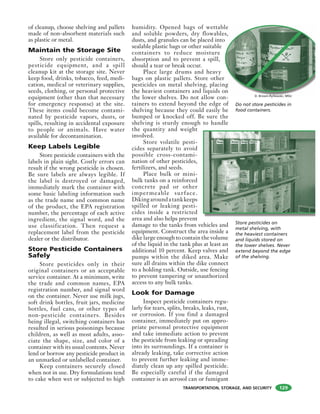
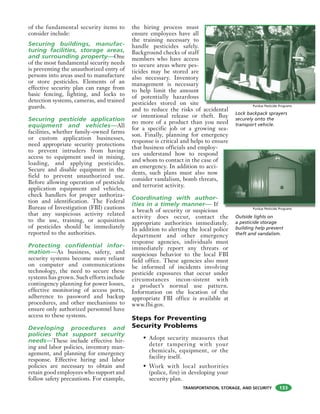
APPLICATORCERTIFICATION
COREMANUAL
NATIONAL PESTICIDEAPPLICATORCERTIFICATION CORE MANUAL
NATIONAL PESTICIDE
APPLICATORCERTIFICATION
CORE MANUAL
Editors
Carolyn Randall, Michigan State University Extension
Winand Hock, Pennsylvania State University
& EPA Consultant
Edward Crow, Maryland Department of Agriculture
Colleen Hudak-Wise, North Carolina Department
of Agriculture and Consumer Services
Jeanne Kasai, EPA Office of Pesticide Programs
Published by the National Association of State Departments
of Agriculture Research Foundation
Support for this project was made
possible through the EPA Office
of Pesticide Programs' cooperative
agreements with the Council for
Agricultural Science and Technology,
and the National Association of State
Departments of Agriculture Research
Foundation. The views expressed
herein are those of the authors and do
not necessarily represent
the views and policies of the EPA.
ACKNOWLEDGMENTS iii
This manual was produced thanks to the support of the U.S. Environmental
Protection Agency, Office of Pesticide Programs. The following team members
generously gave their time and contributed their expertise by reviewing and
contributing to the manual:
Chapter Authors
Edward Crow, Maryland Department of Agriculture
Winand Hock, Pennsylvania State University and EPA consultant
Colleen Hudak-Wise, North Carolina Department of Agriculture and Consumer Services
Mary Ketchersid, Texas A & M University Extension
Patrick O’Connor-Marer, University of California-Davis, IPM Education
Carol Ramsay, Washington State University
Carolyn Randall, Michigan State University Pesticide Safety Education Program
Murray Walton, Texas Structural Pest Control Board
Robert Wolf, Kansas State University
Core Manual Review Committee
Edward Crow, Maryland Department of Agriculture
Thomas Delaney, Professional Landcare Network
Winand Hock, Pennsylvania State University and EPA consultant
Colleen Hudak-Wise, North Carolina Department of Agriculture and Consumer Services
Jeanne Kasai, U.S. EPA Office of Pesticide Programs
Monte Johnson, USDA Cooperative State Research, Education, and Extension Service
Mary Ketchersid, Texas A & M University Extension
Lori McKinnon, Tribal Pesticide Program Council
Patrick O’Connor-Marer, University of California-Davis, IPM Education
Troy Pierce, EPA Region 4 - Atlanta, Georgia
Carol Ramsay, Washington State University
Carolyn Randall, Michigan State University Pesticide Safety Education Program
Carl Rew, Indiana State Chemist Office
William Tozer, Armed Forces Pest Management Board
Fred Whitford, Purdue University Pesticide Programs
Additional Contributors
Patricia Hipkins, Virginia Tech Pesticide Programs
Patrick O’Connor-Marer, University of California Statewide IPM Program
Richard Robbins, Armed Forces Pest Management Board
George Schultz, Armed Forces Pest Management Board
Larry Schulze, University of Nebraska
Larry Strand, University of California Statewide IPM Program
Phillip Weinstein, Michigan State University Office of Radiation, Chemical and
Biological Safety
Copy Editor
Leslie Johnson
ACKNOWLEDGMENTS
iv
CONTENTS
CONTENTS v
INTRODUCTION . . . . . . . . . . . . . . . . . . . . . . . . . . . . . . . . . . . . . . . . . . . . . xiii
CHAPTER 1 PEST MANAGEMENT
Pest Control Over the Years. . . . . . . . . . . . . . . . . . . . . . . . . . . . . . . . . . . . . 2
Pest Recognition . . . . . . . . . . . . . . . . . . . . . . . . . . . . . . . . . . . . . . . . . . . . . . 4
Ways to Identify Pests . . . . . . . . . . . . . . . . . . . . . . . . . . . . . . . . . . . . . . . . 4
Characteristic Damage. . . . . . . . . . . . . . . . . . . . . . . . . . . . . . . . . . . . . . . . 5
Pest Management Methods
Biological Control . . . . . . . . . . . . . . . . . . . . . . . . . . . . . . . . . . . . . . . . . . . 5
Mechanical Control . . . . . . . . . . . . . . . . . . . . . . . . . . . . . . . . . . . . . . . . . . 6
Cultivation
Exclusion
Trapping
Cultural Control . . . . . . . . . . . . . . . . . . . . . . . . . . . . . . . . . . . . . . . . . . . . 7
Cultural Practices
Sanitation
Physical/Environmental Modification . . . . . . . . . . . . . . . . . . . . . . . . . . . 7
Host Resistance or Genetic Control . . . . . . . . . . . . . . . . . . . . . . . . . . . . . 8
Chemical Controls . . . . . . . . . . . . . . . . . . . . . . . . . . . . . . . . . . . . . . . . . . . 8
Regulatory Pest Control . . . . . . . . . . . . . . . . . . . . . . . . . . . . . . . . . . . . . . 9
Integrated Pest Management (IPM) . . . . . . . . . . . . . . . . . . . . . . . . . . . . . 10
Why Practice IPM? . . . . . . . . . . . . . . . . . . . . . . . . . . . . . . . . . . . . . . . . . 10
Components of IPM. . . . . . . . . . . . . . . . . . . . . . . . . . . . . . . . . . . . . . . . . .11
1. Identify the Pest and Understand its Biology
2. Monitor the Pest to be Managed
3. Develop the Pest Management Goal
4. Implement the Integrated Pest Management Program
5. Record and Evaluate Results
Effectiveness of Pest Management Programs . . . . . . . . . . . . . . . . . . . . . 14
Pesticide Resistance . . . . . . . . . . . . . . . . . . . . . . . . . . . . . . . . . . . . . . . . . 14
Summary . . . . . . . . . . . . . . . . . . . . . . . . . . . . . . . . . . . . . . . . . . . . . . . . . . . . 16
Review Questions . . . . . . . . . . . . . . . . . . . . . . . . . . . . . . . . . . . . . . . . . . . . . .17
CHAPTER 2 FEDERAL PESTICIDE LAWS
Federal Insecticide, Fungicide, and Rodenticide Act (FIFRA) . . . . . . . 19
Pesticide Registration . . . . . . . . . . . . . . . . . . . . . . . . . . . . . . . . . . . . . . . . . 21
Pesticide Reregistration. . . . . . . . . . . . . . . . . . . . . . . . . . . . . . . . . . . . . . . . 22
Tolerances . . . . . . . . . . . . . . . . . . . . . . . . . . . . . . . . . . . . . . . . . . . . . . . . . . . 22
CONTENTSvi
Violative Acts and Penalties . . . . . . . . . . . . . . . . . . . . . . . . . . . . . . . . . . . . 24
Penalties . . . . . . . . . . . . . . . . . . . . . . . . . . . . . . . . . . . . . . . . . . . . . . . . . . 24
Civil Penalties
Criminal Penalties
Other Federal Laws and Regulations . . . . . . . . . . . . . . . . . . . . . . . . . . . . 25
Federal Food, Drug, and Cosmetic Act (FFDCA) . . . . . . . . . . . . . . . . . 25
Food Quality Protection Act (FQPA) . . . . . . . . . . . . . . . . . . . . . . . . . . . 25
Worker Protection Standard (WPS) . . . . . . . . . . . . . . . . . . . . . . . . . . . . 25
Endangered Species Act (ESA) . . . . . . . . . . . . . . . . . . . . . . . . . . . . . . . . 26
Federal Record-keeping Requirements. . . . . . . . . . . . . . . . . . . . . . . . . . . 26
Application Records . . . . . . . . . . . . . . . . . . . . . . . . . . . . . . . . . . . . . . . . . 26
Maintaining Training Records . . . . . . . . . . . . . . . . . . . . . . . . . . . . . . . . 27
Summary . . . . . . . . . . . . . . . . . . . . . . . . . . . . . . . . . . . . . . . . . . . . . . . . . . . . 27
Review Questions . . . . . . . . . . . . . . . . . . . . . . . . . . . . . . . . . . . . . . . . . . . . . 29
CHAPTER 3 PESTICIDE LABELING
EPA Approval of Pesticide Labeling . . . . . . . . . . . . . . . . . . . . . . . . . . . . . 32
The Label . . . . . . . . . . . . . . . . . . . . . . . . . . . . . . . . . . . . . . . . . . . . . . . . . . . 32
Background of the Label . . . . . . . . . . . . . . . . . . . . . . . . . . . . . . . . . . . . . 32
Toxicity and Toxicological Tests
Efficacy or Performance Tests
Degradation, Mobility, and Residue Tests
Effects on Wildlife and the Environment
Types of Pesticide Registration . . . . . . . . . . . . . . . . . . . . . . . . . . . . . . . . . 34
Section 3 Registrations. . . . . . . . . . . . . . . . . . . . . . . . . . . . . . . . . . . . . . . 34
Special Local Need Registrations . . . . . . . . . . . . . . . . . . . . . . . . . . . . . . 34
Emergency Exemptions . . . . . . . . . . . . . . . . . . . . . . . . . . . . . . . . . . . . . . 34
Minimum-risk Pesticides . . . . . . . . . . . . . . . . . . . . . . . . . . . . . . . . . . . . . 35
When to Read the Pesticide Label. . . . . . . . . . . . . . . . . . . . . . . . . . . . . . . 35
Parts of the Label . . . . . . . . . . . . . . . . . . . . . . . . . . . . . . . . . . . . . . . . . . . . . 36
Trade, Brand, or Product Name . . . . . . . . . . . . . . . . . . . . . . . . . . . . . . . 36
Ingredient Statement . . . . . . . . . . . . . . . . . . . . . . . . . . . . . . . . . . . . . . . . 36
Use Classification Statement . . . . . . . . . . . . . . . . . . . . . . . . . . . . . . . . . . 37
Type of Pesticide . . . . . . . . . . . . . . . . . . . . . . . . . . . . . . . . . . . . . . . . . . . 37
Net Contents . . . . . . . . . . . . . . . . . . . . . . . . . . . . . . . . . . . . . . . . . . . . . 37
Name and Address of Manufacturer . . . . . . . . . . . . . . . . . . . . . . . . . . . . 37
Emergency Telephone Number. . . . . . . . . . . . . . . . . . . . . . . . . . . . . . . . 37
Registration Numbers . . . . . . . . . . . . . . . . . . . . . . . . . . . . . . . . . . . . . . . 38
Establishment Number. . . . . . . . . . . . . . . . . . . . . . . . . . . . . . . . . . . . . . . 38
Signal Words and Symbols . . . . . . . . . . . . . . . . . . . . . . . . . . . . . . . . . . . 38
Precautionary Statements . . . . . . . . . . . . . . . . . . . . . . . . . . . . . . . . . . . . 38
Routes of Entry Statements
Specific Action Statements
Protective Clothing and Equipment Statements
Other Precautionary Statements
Statement of Practical Treatment . . . . . . . . . . . . . . . . . . . . . . . . . . . . . . 40
Environmental Hazards . . . . . . . . . . . . . . . . . . . . . . . . . . . . . . . . . . . . . 40
Special Toxicity Statements
General Environmental Statements
Physical or Chemical Hazards . . . . . . . . . . . . . . . . . . . . . . . . . . . . . . . . 41
Agricultural Use Requirements . . . . . . . . . . . . . . . . . . . . . . . . . . . . . . . 41
Restricted-entry Intervals ( REI)
CONTENTS vii
Non-agricultural Use Requirements . . . . . . . . . . . . . . . . . . . . . . . . . . . 42
Storage and Disposal . . . . . . . . . . . . . . . . . . . . . . . . . . . . . . . . . . . . . . . . 43
Directions for Use . . . . . . . . . . . . . . . . . . . . . . . . . . . . . . . . . . . . . . . . . . 43
Material Safety Data Sheets . . . . . . . . . . . . . . . . . . . . . . . . . . . . . . . . . . . . 45
Development of the MSDS . . . . . . . . . . . . . . . . . . . . . . . . . . . . . . . . . . . 45
Components of the MSDS . . . . . . . . . . . . . . . . . . . . . . . . . . . . . . . . . . . . 45
Chemical Product Identification
Physical and Chemical Properties
Fire and Explosion Hazards
Toxicological Information/Human Health Data
Cholinesterase Inhibition
Regulatory Levels and Classification
Personal Protection Recommendations
Additional Information
Summary . . . . . . . . . . . . . . . . . . . . . . . . . . . . . . . . . . . . . . . . . . . . . . . . . . . . 47
Review Questions . . . . . . . . . . . . . . . . . . . . . . . . . . . . . . . . . . . . . . . . . . . . . 49
CHAPTER 4 PESTICIDE FORMULATIONS
An Overview of the Formulation Process. . . . . . . . . . . . . . . . . . . . . . . . . 52
Solution . . . . . . . . . . . . . . . . . . . . . . . . . . . . . . . . . . . . . . . . . . . . . . . . . . 53
Suspension . . . . . . . . . . . . . . . . . . . . . . . . . . . . . . . . . . . . . . . . . . . . . . . . 53
Emulsion . . . . . . . . . . . . . . . . . . . . . . . . . . . . . . . . . . . . . . . . . . . . . . . . . . 53
Liquid Formulations. . . . . . . . . . . . . . . . . . . . . . . . . . . . . . . . . . . . . . . . . . . 53
Emulsifiable Concentrates (EC or E) . . . . . . . . . . . . . . . . . . . . . . . . . . . 53
Solutions (S) . . . . . . . . . . . . . . . . . . . . . . . . . . . . . . . . . . . . . . . . . . . . . . . 54
Ready-to-use Low-concentrate Solutions (RTU). . . . . . . . . . . . . . . . . . 54
Ultra-low Volume (ULV) . . . . . . . . . . . . . . . . . . . . . . . . . . . . . . . . . . . . 54
Invert Emulsions . . . . . . . . . . . . . . . . . . . . . . . . . . . . . . . . . . . . . . . . . . . 55
Flowables (F)/Liquids (L) . . . . . . . . . . . . . . . . . . . . . . . . . . . . . . . . . . . . 55
Aerosols (A) . . . . . . . . . . . . . . . . . . . . . . . . . . . . . . . . . . . . . . . . . . . . . . . 55
Ready-to-use Aerosols
Formulations for Smoke or Fog Generators
Liquid Baits . . . . . . . . . . . . . . . . . . . . . . . . . . . . . . . . . . . . . . . . . . . . . . . 56
Dry or Solid Formulations . . . . . . . . . . . . . . . . . . . . . . . . . . . . . . . . . . . . . 56
Dusts (D). . . . . . . . . . . . . . . . . . . . . . . . . . . . . . . . . . . . . . . . . . . . . . . . . . 56
Tracking Powders
Baits (B) . . . . . . . . . . . . . . . . . . . . . . . . . . . . . . . . . . . . . . . . . . . . . . . . . . 57
Pastes, Gels, and Other Injectable Baits
Granules (G) . . . . . . . . . . . . . . . . . . . . . . . . . . . . . . . . . . . . . . . . . . . . . . 58
Pellets (P or PS) . . . . . . . . . . . . . . . . . . . . . . . . . . . . . . . . . . . . . . . . . . . . 59
Wettable Powders (WP or W) . . . . . . . . . . . . . . . . . . . . . . . . . . . . . . . . 59
Soluble Powders (SP or WSP) . . . . . . . . . . . . . . . . . . . . . . . . . . . . . . . . . 60
Water-dispersible Granules (WDG) or Dry Flowables (DF) . . . . . . . . 60
Other Formulations . . . . . . . . . . . . . . . . . . . . . . . . . . . . . . . . . . . . . . . . . . . 60
Microencapsulated Materials . . . . . . . . . . . . . . . . . . . . . . . . . . . . . . . . . . 60
Water-soluble Packets . . . . . . . . . . . . . . . . . . . . . . . . . . . . . . . . . . . . . . . .61
Attractants . . . . . . . . . . . . . . . . . . . . . . . . . . . . . . . . . . . . . . . . . . . . . . . . .61
Impregnates . . . . . . . . . . . . . . . . . . . . . . . . . . . . . . . . . . . . . . . . . . . . . . . .61
Repellents . . . . . . . . . . . . . . . . . . . . . . . . . . . . . . . . . . . . . . . . . . . . . . . . . .61
Animal Systemics . . . . . . . . . . . . . . . . . . . . . . . . . . . . . . . . . . . . . . . . . . . .61
Pesticide/Fertilizer Combinations . . . . . . . . . . . . . . . . . . . . . . . . . . . . . .61
Fumigants . . . . . . . . . . . . . . . . . . . . . . . . . . . . . . . . . . . . . . . . . . . . . . . . . 62
Pesticide Mixtures . . . . . . . . . . . . . . . . . . . . . . . . . . . . . . . . . . . . . . . . . . . . 62
Incompatibility . . . . . . . . . . . . . . . . . . . . . . . . . . . . . . . . . . . . . . . . . . . . . 62
Adjuvants . . . . . . . . . . . . . . . . . . . . . . . . . . . . . . . . . . . . . . . . . . . . . . . . . . . 63
Types of Adjuvants . . . . . . . . . . . . . . . . . . . . . . . . . . . . . . . . . . . . . . . . . . 63
Surfactants
Stickers
Extenders
Plant Penetrants
Compatibility Agents
Buffers or pH Modifiers
Drift Control Additives
Defoaming Agents
Thickeners
How to Choose the Right Adjuvant . . . . . . . . . . . . . . . . . . . . . . . . . . . . 65
Summary . . . . . . . . . . . . . . . . . . . . . . . . . . . . . . . . . . . . . . . . . . . . . . . . . . . . 66
Review Questions . . . . . . . . . . . . . . . . . . . . . . . . . . . . . . . . . . . . . . . . . . . . . 67
CHAPTER 5 PESTICIDE HAZARDS AND FIRST AID
Toxicity, Exposure, and Hazard . . . . . . . . . . . . . . . . . . . . . . . . . . . . . . . . . 70
Harmful Effects of Pesticides. . . . . . . . . . . . . . . . . . . . . . . . . . . . . . . . . . . 71
Contact Effects . . . . . . . . . . . . . . . . . . . . . . . . . . . . . . . . . . . . . . . . . . . . 71
Systemic Effects . . . . . . . . . . . . . . . . . . . . . . . . . . . . . . . . . . . . . . . . . . . . 71
Allergic Effects . . . . . . . . . . . . . . . . . . . . . . . . . . . . . . . . . . . . . . . . . . . . 71
Exposure—How Pesticides Enter the Body . . . . . . . . . . . . . . . . . . . . . . . 72
Skin or Dermal Route . . . . . . . . . . . . . . . . . . . . . . . . . . . . . . . . . . . . . . . 73
Eyes . . . . . . . . . . . . . . . . . . . . . . . . . . . . . . . . . . . . . . . . . . . . . . . . . . . . . 73
Inhalation Route . . . . . . . . . . . . . . . . . . . . . . . . . . . . . . . . . . . . . . . . . . . 74
Oral Route . . . . . . . . . . . . . . . . . . . . . . . . . . . . . . . . . . . . . . . . . . . . . . . . 74
Product Toxicity and Health Concerns . . . . . . . . . . . . . . . . . . . . . . . . . . 74
Acute Toxicity . . . . . . . . . . . . . . . . . . . . . . . . . . . . . . . . . . . . . . . . . . . . . 74
Signal Words and Skull & Crossbones Symbol
Chronic Toxicity . . . . . . . . . . . . . . . . . . . . . . . . . . . . . . . . . . . . . . . . . . . 77
Delayed Effects . . . . . . . . . . . . . . . . . . . . . . . . . . . . . . . . . . . . . . . . . . . . 78
Symptom Recognition . . . . . . . . . . . . . . . . . . . . . . . . . . . . . . . . . . . . . . . . . 78
Cholinesterase Inhibition. . . . . . . . . . . . . . . . . . . . . . . . . . . . . . . . . . . . . 79
Cholinesterase Monitoring
First Aid for Pesticide Poisoning . . . . . . . . . . . . . . . . . . . . . . . . . . . . . . . . 80
General First Aid . . . . . . . . . . . . . . . . . . . . . . . . . . . . . . . . . . . . . . . . . . . 80
Pesticide on the Skin
Pesticide in the Eye
Inhaled Pesticide
Pesticide in the Mouth or Swallowed
Antidotes
Heat Stress . . . . . . . . . . . . . . . . . . . . . . . . . . . . . . . . . . . . . . . . . . . . . . . . . . 83
Symptoms of Heat Stress . . . . . . . . . . . . . . . . . . . . . . . . . . . . . . . . . . . . . 83
Summary . . . . . . . . . . . . . . . . . . . . . . . . . . . . . . . . . . . . . . . . . . . . . . . . . . . . 84
Review Questions . . . . . . . . . . . . . . . . . . . . . . . . . . . . . . . . . . . . . . . . . . . . 85
CONTENTSviii
CHAPTER 6 PERSONAL PROTECTIVE EQUIPMENT
Chemical-resistant Clothing. . . . . . . . . . . . . . . . . . . . . . . . . . . . . . . . . . . . 88
Protect Your Skin . . . . . . . . . . . . . . . . . . . . . . . . . . . . . . . . . . . . . . . . . . . . . 90
Work Clothes . . . . . . . . . . . . . . . . . . . . . . . . . . . . . . . . . . . . . . . . . . . . . . 90
Coveralls . . . . . . . . . . . . . . . . . . . . . . . . . . . . . . . . . . . . . . . . . . . . . . . . . 90
Chemical-resistant Suit . . . . . . . . . . . . . . . . . . . . . . . . . . . . . . . . . . . . . . 91
Chemical-resistant Apron . . . . . . . . . . . . . . . . . . . . . . . . . . . . . . . . . . . . 91
Gloves and Footwear . . . . . . . . . . . . . . . . . . . . . . . . . . . . . . . . . . . . . . . . 91
Hats . . . . . . . . . . . . . . . . . . . . . . . . . . . . . . . . . . . . . . . . . . . . . . . . . . . . . 93
Protect Your Eyes . . . . . . . . . . . . . . . . . . . . . . . . . . . . . . . . . . . . . . . . . . . . . 93
Protect Your Respiratory Tract . . . . . . . . . . . . . . . . . . . . . . . . . . . . . . . . . 94
Respirators . . . . . . . . . . . . . . . . . . . . . . . . . . . . . . . . . . . . . . . . . . . . . . . . 94
Use Respirators Properly . . . . . . . . . . . . . . . . . . . . . . . . . . . . . . . . . . . . . 96
Maintaining Personal Protective Equipment. . . . . . . . . . . . . . . . . . . . . . 98
Disposables . . . . . . . . . . . . . . . . . . . . . . . . . . . . . . . . . . . . . . . . . . . . . . . . 98
Reusables . . . . . . . . . . . . . . . . . . . . . . . . . . . . . . . . . . . . . . . . . . . . . . . . . 98
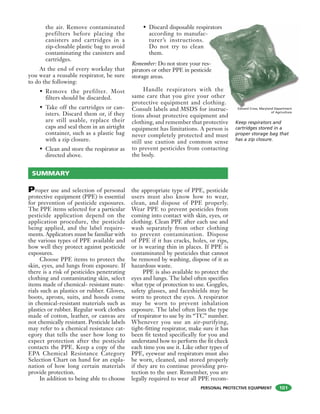
Washing PPE . . . . . . . . . . . . . . . . . . . . . . . . . . . . . . . . . . . . . . . . . . . . . . 99
Maintaining Eyewear and Respirators . . . . . . . . . . . . . . . . . . . . . . . . . 100
Summary . . . . . . . . . . . . . . . . . . . . . . . . . . . . . . . . . . . . . . . . . . . . . . . . . . . 101
Review Questions . . . . . . . . . . . . . . . . . . . . . . . . . . . . . . . . . . . . . . . . . . . . 103
CHAPTER 7 PESTICIDES IN THE ENVIRONMENT
The Environment . . . . . . . . . . . . . . . . . . . . . . . . . . . . . . . . . . . . . . . . . . . . 106
Pesticide Characteristics . . . . . . . . . . . . . . . . . . . . . . . . . . . . . . . . . . . . . . 106
Solubility. . . . . . . . . . . . . . . . . . . . . . . . . . . . . . . . . . . . . . . . . . . . . . . . . 106
Adsorption . . . . . . . . . . . . . . . . . . . . . . . . . . . . . . . . . . . . . . . . . . . . . . . 106
Persistence . . . . . . . . . . . . . . . . . . . . . . . . . . . . . . . . . . . . . . . . . . . . . . . 106
Pesticide Degradation
Volatility . . . . . . . . . . . . . . . . . . . . . . . . . . . . . . . . . . . . . . . . . . . . . . . . . 107
How Pesticides Move in the Environment . . . . . . . . . . . . . . . . . . . . . . . 107
Movement in Air . . . . . . . . . . . . . . . . . . . . . . . . . . . . . . . . . . . . . . . . . . 107
Movement in Water . . . . . . . . . . . . . . . . . . . . . . . . . . . . . . . . . . . . . . . . 107
Movement on or in Objects, Plants, or Animals . . . . . . . . . . . . . . . . . . 108
Preventing Pesticide Drift . . . . . . . . . . . . . . . . . . . . . . . . . . . . . . . . . . . . 109
Spray Drift . . . . . . . . . . . . . . . . . . . . . . . . . . . . . . . . . . . . . . . . . . . . . . . 109
Temperature Inversions
Vapor Drift . . . . . . . . . . . . . . . . . . . . . . . . . . . . . . . . . . . . . . . . . . . . . . . .111
Particle Drift (Dust Drift) . . . . . . . . . . . . . . . . . . . . . . . . . . . . . . . . . . . .111
Applicator Responsibility . . . . . . . . . . . . . . . . . . . . . . . . . . . . . . . . . . . . .112
Sources of Water Contamination. . . . . . . . . . . . . . . . . . . . . . . . . . . . . . . .112
Pesticide Contamination of Surface Water . . . . . . . . . . . . . . . . . . . . . . .113
Pesticide Contamination of Groundwater . . . . . . . . . . . . . . . . . . . . . . .113
Leaching
Soil Properties
Preventing Surface Water and Groundwater Contamination . . . . . . . .115
Preventing Pesticide Effects to Sensitive Areas and Non-target
Organisms . . . . . . . . . . . . . . . . . . . . . . . . . . . . . . . . . . . . . . . . . . . . . . . . . . .117
Sensitive Areas . . . . . . . . . . . . . . . . . . . . . . . . . . . . . . . . . . . . . . . . . . . . .117
Pesticide Effects on Non-target Organisms . . . . . . . . . . . . . . . . . . . . . .117
Non-target Plants
Bees and Other Beneficial Insects
CONTENTS ix
Fish, Wildlife, and Livestock
Protecting Endangered Species . . . . . . . . . . . . . . . . . . . . . . . . . . . . . . . . .119
Summary . . . . . . . . . . . . . . . . . . . . . . . . . . . . . . . . . . . . . . . . . . . . . . . . . . . .119
Review Questions . . . . . . . . . . . . . . . . . . . . . . . . . . . . . . . . . . . . . . . . . . . 121
CHAPTER 8 TRANSPORTATION, STORAGE, AND SECURITY
Transportation . . . . . . . . . . . . . . . . . . . . . . . . . . . . . . . . . . . . . . . . . . . . . . 124
Transport Vehicle . . . . . . . . . . . . . . . . . . . . . . . . . . . . . . . . . . . . . . . . . 124
Vehicle Operator . . . . . . . . . . . . . . . . . . . . . . . . . . . . . . . . . . . . . . . . . . 125
Other Safety Precautions . . . . . . . . . . . . . . . . . . . . . . . . . . . . . . . . . . . . 125
Transportation Security. . . . . . . . . . . . . . . . . . . . . . . . . . . . . . . . . . . . . 126
Pesticide Storage . . . . . . . . . . . . . . . . . . . . . . . . . . . . . . . . . . . . . . . . . . . . 127
Secure the Site . . . . . . . . . . . . . . . . . . . . . . . . . . . . . . . . . . . . . . . . . . . . 127
Prevent Water Damage . . . . . . . . . . . . . . . . . . . . . . . . . . . . . . . . . . . . . 127
Control the Temperature . . . . . . . . . . . . . . . . . . . . . . . . . . . . . . . . . . . . 128
Provide Adequate Lighting . . . . . . . . . . . . . . . . . . . . . . . . . . . . . . . . . . 128
Use Non-porous Materials . . . . . . . . . . . . . . . . . . . . . . . . . . . . . . . . . . 128
Maintain the Storage Site . . . . . . . . . . . . . . . . . . . . . . . . . . . . . . . . . . . 129
Keep Labels Legible . . . . . . . . . . . . . . . . . . . . . . . . . . . . . . . . . . . . . . . . 129
Store Pesticide Containers Safely . . . . . . . . . . . . . . . . . . . . . . . . . . . . . 129
Look for Damage . . . . . . . . . . . . . . . . . . . . . . . . . . . . . . . . . . . . . . . . . . 129
Note Shelf Life of Pesticides . . . . . . . . . . . . . . . . . . . . . . . . . . . . . . . . . 130
Follow These Safety Tips. . . . . . . . . . . . . . . . . . . . . . . . . . . . . . . . . . . . 130
Isolate Waste Products . . . . . . . . . . . . . . . . . . . . . . . . . . . . . . . . . . . . . . 131
Pesticide Site Security . . . . . . . . . . . . . . . . . . . . . . . . . . . . . . . . . . . . . . . . 131
Benefits of Security Efforts . . . . . . . . . . . . . . . . . . . . . . . . . . . . . . . . . . 131
Risk Assessment . . . . . . . . . . . . . . . . . . . . . . . . . . . . . . . . . . . . . . . . . . . 132
Employee Training and Security Awareness . . . . . . . . . . . . . . . . . . . . 132
Evaluating Pesticide Security . . . . . . . . . . . . . . . . . . . . . . . . . . . . . . . . 132
Steps for Preventing Security Problems . . . . . . . . . . . . . . . . . . . . . . . . 133
Summary . . . . . . . . . . . . . . . . . . . . . . . . . . . . . . . . . . . . . . . . . . . . . . . . . . . 134
Review Questions . . . . . . . . . . . . . . . . . . . . . . . . . . . . . . . . . . . . . . . . . . . 135
CHAPTER 9 EMERGENCY OR INCIDENT RESPONSE
Emergency Response Planning . . . . . . . . . . . . . . . . . . . . . . . . . . . . . . . . 137
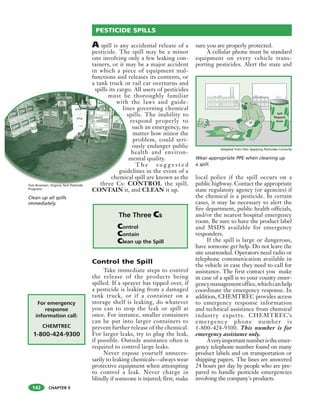
Fires . . . . . . . . . . . . . . . . . . . . . . . . . . . . . . . . . . . . . . . . . . . . . . . . . . . . . . . 140
Precautions to Reduce Fire Hazards . . . . . . . . . . . . . . . . . . . . . . . . . . . 140
Pesticide Spills. . . . . . . . . . . . . . . . . . . . . . . . . . . . . . . . . . . . . . . . . . . . . . . 142
Control the Spill. . . . . . . . . . . . . . . . . . . . . . . . . . . . . . . . . . . . . . . . . . . 142
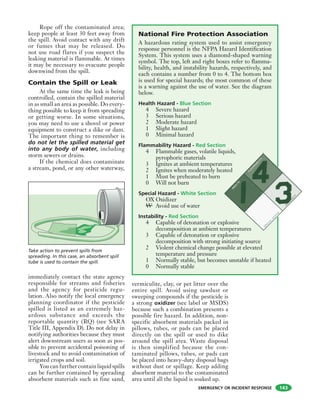
Contain the Spill or Leak . . . . . . . . . . . . . . . . . . . . . . . . . . . . . . . . . . . 143
Clean Up the Spill . . . . . . . . . . . . . . . . . . . . . . . . . . . . . . . . . . . . . . . . . 144
Prevent Spills . . . . . . . . . . . . . . . . . . . . . . . . . . . . . . . . . . . . . . . . . . . . . 145
Summary . . . . . . . . . . . . . . . . . . . . . . . . . . . . . . . . . . . . . . . . . . . . . . . . . . . 145
Review Questions . . . . . . . . . . . . . . . . . . . . . . . . . . . . . . . . . . . . . . . . . 147
CONTENTSx
CHAPTER 10 PLANNING THE PESTICIDE APPLICATION
Selecting the Pesticide . . . . . . . . . . . . . . . . . . . . . . . . . . . . . . . . . . . . . . . 150
Reviewing the Pesticide Label . . . . . . . . . . . . . . . . . . . . . . . . . . . . . . . . . 150
Compatibility of Pesticides . . . . . . . . . . . . . . . . . . . . . . . . . . . . . . . . . . . 150
Conducting a Compatibility Test . . . . . . . . . . . . . . . . . . . . . . . . . . . . . 152
Making Tank Mixes
Safe Mixing and Loading Practices . . . . . . . . . . . . . . . . . . . . . . . . . . . . . 153
Select an Appropriate Mixing/Loading Area . . . . . . . . . . . . . . . . . . . . 153
Protect Water Sources . . . . . . . . . . . . . . . . . . . . . . . . . . . . . . . . . . . . . . 153
Select Personal Protective Equipment (PPE) . . . . . . . . . . . . . . . . . . . . 153
Opening Containers . . . . . . . . . . . . . . . . . . . . . . . . . . . . . . . . . . . . . . . 154
Measuring . . . . . . . . . . . . . . . . . . . . . . . . . . . . . . . . . . . . . . . . . . . . . . . . 154
Transferring Pesticides . . . . . . . . . . . . . . . . . . . . . . . . . . . . . . . . . . . . . 154
Cleaning and Disposing of Pesticide Containers . . . . . . . . . . . . . . . . . 155
Container Rinsing Procedures. . . . . . . . . . . . . . . . . . . . . . . . . . . . . . . . 155
Applying Pesticides Correctly . . . . . . . . . . . . . . . . . . . . . . . . . . . . . . . . . 156
Personal Protective Equipment (PPE) . . . . . . . . . . . . . . . . . . . . . . . . . 156
Application Procedures . . . . . . . . . . . . . . . . . . . . . . . . . . . . . . . . . . . . . 157
After Mixing, Loading, and Application . . . . . . . . . . . . . . . . . . . . . . . . . 158
Cleaning Procedures . . . . . . . . . . . . . . . . . . . . . . . . . . . . . . . . . . . . . . . 159
Summary . . . . . . . . . . . . . . . . . . . . . . . . . . . . . . . . . . . . . . . . . . . . . . . . . . . 159
Review Questions . . . . . . . . . . . . . . . . . . . . . . . . . . . . . . . . . . . . . . . . . . . 161
CHAPTER 11 PESTICIDE APPLICATION PROCEDURES
Application Methods . . . . . . . . . . . . . . . . . . . . . . . . . . . . . . . . . . . . . . . . . 163
Safety Systems . . . . . . . . . . . . . . . . . . . . . . . . . . . . . . . . . . . . . . . . . . . . . . 164
Closed Mixing and Loading Systems . . . . . . . . . . . . . . . . . . . . . . . . . . 164
Mechanical Systems
Water-soluble Packaging
Enclosed Cabs . . . . . . . . . . . . . . . . . . . . . . . . . . . . . . . . . . . . . . . . . . . . 165
Pesticide Containment Systems . . . . . . . . . . . . . . . . . . . . . . . . . . . . . . . 165
Application Equipment . . . . . . . . . . . . . . . . . . . . . . . . . . . . . . . . . . . . . . . 166
Sprayers . . . . . . . . . . . . . . . . . . . . . . . . . . . . . . . . . . . . . . . . . . . . . . . . . 166
Sprayer Components . . . . . . . . . . . . . . . . . . . . . . . . . . . . . . . . . . . . . . . 167
Granular Applicators . . . . . . . . . . . . . . . . . . . . . . . . . . . . . . . . . . . . . . . 168
Other Application Equipment . . . . . . . . . . . . . . . . . . . . . . . . . . . . . . . . 168
Equipment Calibration . . . . . . . . . . . . . . . . . . . . . . . . . . . . . . . . . . . . . . . 169
Calculating Areas . . . . . . . . . . . . . . . . . . . . . . . . . . . . . . . . . . . . . . . . . . . . 169
Calculating the Application Rate . . . . . . . . . . . . . . . . . . . . . . . . . . . . . . . 170
Techniques for Minimizing Drift . . . . . . . . . . . . . . . . . . . . . . . . . . . . . . 172
Summary . . . . . . . . . . . . . . . . . . . . . . . . . . . . . . . . . . . . . . . . . . . . . . . . . . . .174
Review Questions . . . . . . . . . . . . . . . . . . . . . . . . . . . . . . . . . . . . . . . . . . . 175
CONTENTS xi
CHAPTER 12 PROFESSIONAL CONDUCT
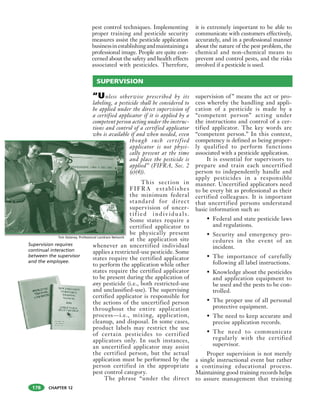
Supervision . . . . . . . . . . . . . . . . . . . . . . . . . . . . . . . . . . . . . . . . . . . . . . . . . 178
Pesticide Security and Supervision . . . . . . . . . . . . . . . . . . . . . . . . . . . . . 179
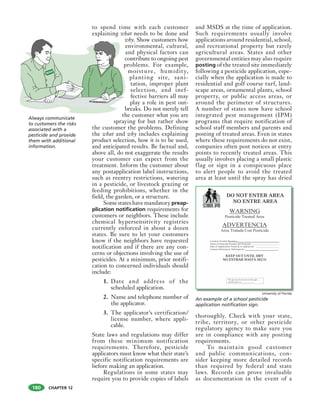
Public and Customer Communications . . . . . . . . . . . . . . . . . . . . . . . . . 179
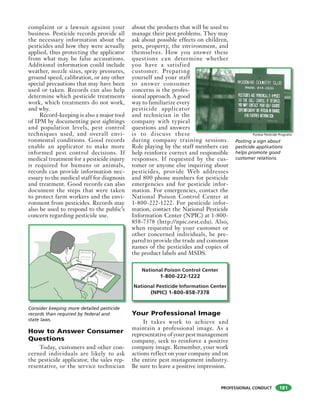
How to Answer Consumer Questions . . . . . . . . . . . . . . . . . . . . . . . . . 181
Your Professional Image . . . . . . . . . . . . . . . . . . . . . . . . . . . . . . . . . . . . 181
Summary . . . . . . . . . . . . . . . . . . . . . . . . . . . . . . . . . . . . . . . . . . . . . . . . . . . 182
Review Questions . . . . . . . . . . . . . . . . . . . . . . . . . . . . . . . . . . . . . . . . . . . 183
APPENDICES
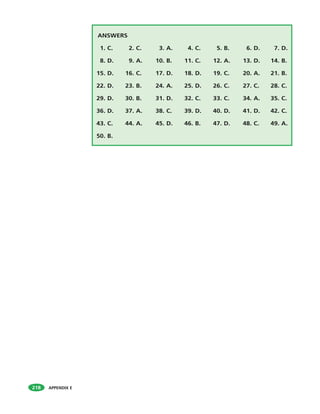
A. Answers to Review Questions . . . . . . . . . . . . . . . . . . . . . . . . . . . . . . 185
B. Glossary . . . . . . . . . . . . . . . . . . . . . . . . . . . . . . . . . . . . . . . . . . . . . . . . . 191
C. Conversions & Calculations . . . . . . . . . . . . . . . . . . . . . . . . . . . . . . . . 203
Pesticide Calculations. . . . . . . . . . . . . . . . . . . . . . . . . . . . . . . . . . . . . . . 204
Mixing Soluble and Wettable Powders . . . . . . . . . . . . . . . . . . . . . . . . . 204
Mixing Liquid Formulaions. . . . . . . . . . . . . . . . . . . . . . . . . . . . . . . . . . 205
Square Feet vs. Acre Mixing . . . . . . . . . . . . . . . . . . . . . . . . . . . . . . . 206
D. Additional Federal Pesticide Laws & Federal Record-keeping
Requirements . . . . . . . . . . . . . . . . . . . . . . . . . . . . . . . . . . . . . . . . . . . . 207
Worker Protection Standard (WPS) . . . . . . . . . . . . . . . . . . . . . . . . . 207
Pesticide Handlers . . . . . . . . . . . . . . . . . . . . . . . . . . . . . . . . . . . . . . 207
Agricultural Workers . . . . . . . . . . . . . . . . . . . . . . . . . . . . . . . . . . . . 207
Field Sanitation Standard . . . . . . . . . . . . . . . . . . . . . . . . . . . . . . . . 208
Hazardous Materials Transportation Uniform Safety Act
(HMTUSA) . . . . . . . . . . . . . . . . . . . . . . . . . . . . . . . . . . . . . . . . . . . . . . 209
Hazard Communications Standard (HCS). . . . . . . . . . . . . . . . . . . . 209
Federal Occupational Safety and Health Act (OSHA). . . . . . . . . . 210
Superfund Amendments and Reauthorization Act (SARA Title III) 210
Emergency Planning . . . . . . . . . . . . . . . . . . . . . . . . . . . . . . . . . . . . 210
Emergency Release Notification. . . . . . . . . . . . . . . . . . . . . . . . . . 210
Penalties . . . . . . . . . . . . . . . . . . . . . . . . . . . . . . . . . . . . . . . . . . . 211
Resource Conservation and Recovery Act (RCRA) . . . . . . . . . . . . .211
Federal Aviation Administration . . . . . . . . . . . . . . . . . . . . . . . . . . . . .211
Federal Trade Commission Act . . . . . . . . . . . . . . . . . . . . . . . . . . . 211
Resource Conservation and Recovery Act (RCRA) . . . . . . . . . . . . .211
Federal Aviation Administration . . . . . . . . . . . . . . . . . . . . . . . . . . . . .211
Federal Trade Commission Act . . . . . . . . . . . . . . . . . . . . . . . . . . . 211
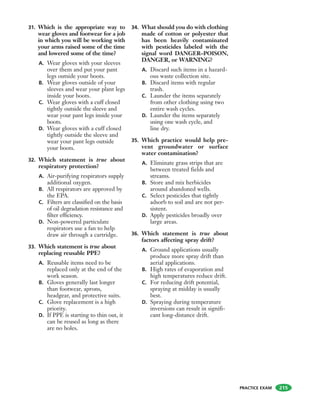
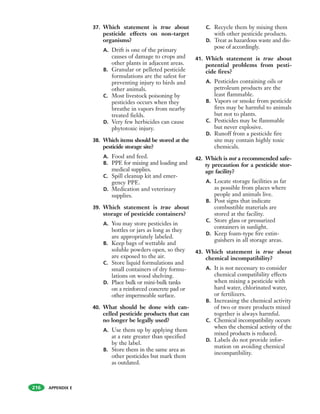
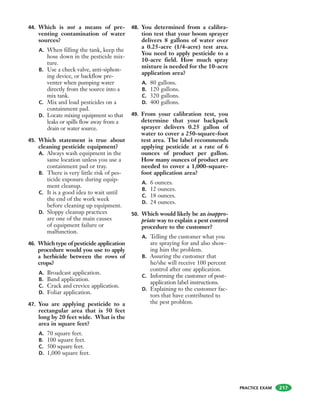
E. Practice Exam . . . . . . . . . . . . . . . . . . . . . . . . . . . . . . . . . . . . . . . . . . . . 215
F. Selected Pesticide References . . . . . . . . . . . . . . . . . . . . . . . . . . . . . . 223
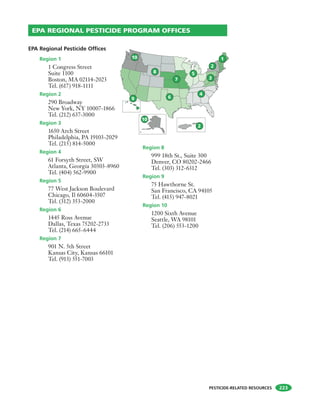
G. Pesticide-related Resources . . . . . . . . . . . . . . . . . . . . . . . . . . . . . . . . 225
EPA Regional Pesticide Program Offices . . . . . . . . . . . . . . . . . . . 227
Index . . . . . . . . . . . . . . . . . . . . . . . . . . . . . . . . . . . . . . . . . . . . . . . . . . 229
CONTENTSxii
INTRODUCTION
This manual is intended as a study
guide for preparing to take the National
Pesticide Applicator Certification Core
Exam that was developed jointly by
the U.S. Environmental Protection
Agency and the Pest Management
Regulatory Agency of Canada. Check
with the pesticide regulatory agency
within your individual state, tribe, ter-
ritory, or federal department/agency
to determine whether this manual
prepares you for commercial or private
applicator certification or recertification
or registered technician status. This
manual satisfies the basic applicator
training requirements of the Federal
Insecticide, Fungicide, and Rodenticide
Act (FIFRA). More specific pest man-
agement information and pesticide
terminology are covered in category-
specific manuals.
The National Core Exam is based
on information found in this manual.
The table of contents helps you identify
important topics and understand how
they relate to one another through
the organization of headings and
subheadings. You may also check the
index for key words and concepts. Each
chapter begins with a set of learning
objectives that help you focus on what
you should learn from the chapter.
Questions on the certification exam
pertain directly to these learning objec-
tives. As you prepare for the exam, read
each chapter and answer the review
questions located at the end. These
questions are not on the certification
exam. They are provided to help you
prepare for the exam. The answers
to the review questions are found in
Appendix A, and a sample test is found
in Appendix E.
Other appendices, including a
glossary, provide supplemental infor-
mation that help you understand the
topics covered in the chapters. Terms
in bold type throughout the manual are
defined either within the text or in the
glossary.
This cert if icat ion manual
benefits both you and the general
public. By learning how to handle
pesticides correctly, you will be able
to protect yourself, others, and the
environment from pesticide misuse.
For further information, visit:
www.epa.gov and select “Pesticides.”
HOW TO USE THIS MANUAL
INTRODUCTION xiii
xiv
PEST MANAGEMENT
PEST MANAGEMENT
Civilization has been combating insects
and other pests throughout history.
Records contain many examples of how
pestshavehadmajorimpactsonhumans.
Probably the most infamous was the
Black Plague of Europe, when millions
of people died in the 14th century from
a mysterious scourge. Only centuries
later was it determined that a bacterial
disease spread by rat fleas was the cause.
Rat fleas became infected with bacteria
while feeding on diseased rats. When
rats were unavailable as a food source,
the fleas sought other warm-blooded
hosts, often humans. Today this disease,
known as bubonic plague, can be treated
if properly diagnosed. Controlling rats
and other rodents and fleas can reduce
disease incidence.
One historical occurrence that
directly influenced the population of
the United States was the destruction
After studying this chapter, you should:
• Know the main groups of common pests.
• Know how to use pest control references and resources to
help identify pests and recognize symptoms and damage.
• Understand various pest control procedures.
• Understand integrated pest management (IPM) control options
(e.g., biological, cultural, mechanical, sanitation, chemical controls).
• Understand when preventive pest control is required.
• Understand how pest population levels trigger control procedures.
• Anticipate effects on pest, hosts, and natural enemies of relevant
environmental variables that influence pest populations (e.g.,
weather, geographic barriers, cultural practices, nutrient supply).
• Understand probable causes of non-effective pest control (e.g.,
incorrect pest identification, incorrect dosage, incorrect application
timing, incorrect pesticide product).
• Know how to plan pest control strategies that minimize the
development of pesticide resistance (e.g., rotation of pesticide types
with different modes of action, application of pesticides that do not
leave persistent residues, application of pesticides at below-label
amounts).
LEARNING OBJECTIVES
sources to
damage.
control options
chemical controls).
uired.
control procedures.
1
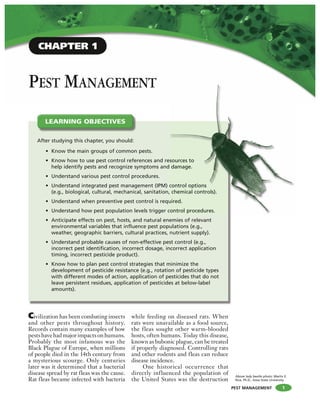
Above lady beetle photo: Marlin E.
Rice, Ph.D., Iowa State University
CHAPTER 1
2 CHAPTER 1
of Ireland’s potato crop by a pest in
the 19th century. A fungal disease
called late blight essentially eliminated
potatoes, the staple food crop. Potatoes
not destroyed in the field rotted in
storage during the winter. Thousands
of Irish starved in the resulting famine,
and more than a million migrated to
the United States. Late blight continues
to be a major problem of potatoes, but
today it is managed through the use
of resistant cultivars, proper sanitation
practices, and fungicides.
The above examples illustrate the
potential enormity and complexity
of pest problems. But what is a pest?
Webster's Dictionary defines a pest as
“any destructive or troublesome insect,
small animal, weed, etc.” Many insects,
pathogens (disease-causing organisms),
weeds, mollusks (slugs and snails),
fish, birds, and a variety of mammals,
from rats to deer, are competitors for
our livestock and crops. In addition,
some pests destroy buildings and other
structures and reduce the aesthetic and
recreational value of the landscape. The
competition between humans and pests
has evolved over time, and so have the
methods of control.
Mystery surrounded the causes of crop
failures and human and animal diseases
for many centuries. The first pest
control measures were crude—weeds
were pulled, rats were clubbed, and
beetles were plucked from foliage. The
earliest use of chemicals as pesticides
dates back to 2500 B.C., when sulfur
was burned to control insects and mites.
Through the years, experimentation
and good fortune led to the recognition
of additional chemicals with pesticidal
activity. Early plant-derived insecti-
cides included hellebore to control body
lice, nicotine to control aphids, and
pyrethrins to control a wide variety of
insects.Leadarsenatewasfirstused
in 1892 as an orchard spray. In
France during the late 19th
century, a mixture of lime
and copper sulfate was
sprayed on grapevines
todeterpassers-byfrom
picking the grapes.
The farmer found the
mixture also controlled
downy mildew, a serious
fungal disease of grapes.
Later named Bordeaux
mixture, it remains a widely
used fungicide worldwide.
Until the 1940s, pest control
chemicals were derived from plants and
inorganic compounds. During World
War II, DDT, a synthetic chemical,
played a very important role, saving
Allied soldiers from insect-transmitted
diseases. DDT was hailed as the insec-
ticide to solve all insect problems.
The introduction of countless other
synthetic organic pesticides followed.
These synthetic products launched
the modern-day chemical industry and
began a new era in pest control. Given
significant success at a relatively low
cost, pesticides became the primary
means of pest control. They provided
season-long crop protection against
pests and complemented the benefits of
fertilizers and other production prac-
tices. The success of modern pesticides,
particularly in agriculture and human
health, encouraged widespread accep-
tance and eventual reliance on them.
In recent years, however, some
drawbacks of heavy dependence on
pesticides have become increasingly
apparent. One of the most disturbing is
the development of pest resistance to
pesticides. Since the resistance of the
San Jose scale to lime sulfur was recog-
nized in 1908, hundreds of insects have
become resistant to one or more pes-
ticides worldwide. Pesticide resistance
also has arisen in more than 50 weeds
and many plant pathogens. A dramatic
example is the Colorado potato beetle
in the eastern United States. This insect
pest has developed resistance to every
major group of insecticides, making
control with chemicals difficult, if not
impossible, to achieve.
Growing concerns about the
environmental and health hazards asso-
PEST CONTROL OVER THE YEARS
insects.Le
in 189
Fra
ce
d
fu
Lat
mixtur
used fungici
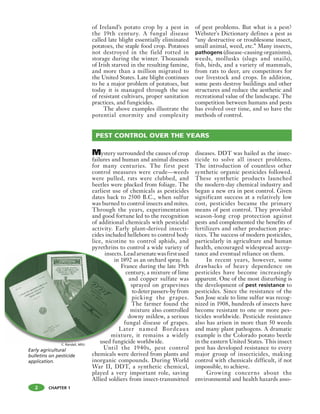
Early agricultural
bulletins on pesticide
application.
C. Randall, MSU
PEST MANAGEMENT
ciated with pesticides have also become
significant factors challenging pesticide
use. In 1962, Rachel Carson published
Silent Spring, a book that examined
pesticides and their effects on the
environment. DDT and other chlori-
nated hydrocarbons were her primary
concern because of their stability and
persistence in the environment. Their
long residual activity was a major factor
contributing to their effectiveness, but
a negative effect was their ability to
accumulate in the fatty tissue of some
animals (bioaccumulation). In certain
situations, biomagnification of the
insecticides occurred. Biomagnification
is the process whereby some organisms
accumulate chemical residues in higher
concentrations than those found in the
organisms they consume. Ecologists
refer to a food chain as the sequence
of animals feeding in the natural envi-
ronment. A particular plant, animal, or
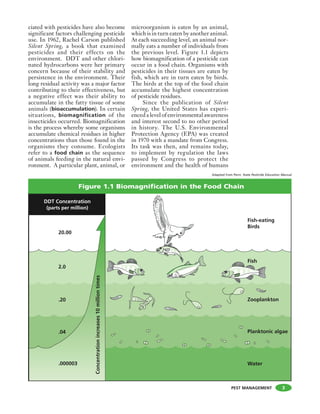
microorganism is eaten by an animal,
which is in turn eaten by another animal.
At each succeeding level, an animal nor-
mally eats a number of individuals from
the previous level. Figure 1.1 depicts
how biomagnification of a pesticide can
occur in a food chain. Organisms with
pesticides in their tissues are eaten by
fish, which are in turn eaten by birds.
The birds at the top of the food chain
accumulate the highest concentration
of pesticide residues.
Since the publication of Silent
Spring, the United States has experi-
enced a level of environmental awareness
and interest second to no other period
in history. The U.S. Environmental
Protection Agency (EPA) was created
in 1970 with a mandate from Congress.
Its task was then, and remains today,
to implement by regulation the laws
passed by Congress to protect the
environment and the health of humans
Figure 1.1 Biomagnification in the Food Chain
3
Adapted from Penn. State Pesticide Education Manual
CHAPTER 1
and other animals. Since the 1972 EPA
ban on DDT use in the United States,
regulatory action has been taken against
many chemicals, including pesticides,
thought to pose significant environ-
mental and health hazards. Public
concern has led to stringent regulation
of pesticides and changes in the types
of pesticides used.
Pests are organisms that cause
problems in various ways. Some
compete with people for food or fiber.
Others interfere with the raising of
crops, livestock, or poultry. Certain
types of pests damage property and
personal belongings or disfigure
ornamental plantings. Others
transmit or cause plant, animal, or
human diseases.
Before trying to control a pest,
you need to identify it. Be certain any
injury or observed damage is actually
due to the identified pest and not some
other cause. Once you have identified
the pest and confirmed that it is causing
damage, become familiar with its life
cycle, growth, and reproductive habits.
Then, use this information to form your
pest control plans. Misidentification
and lack of information about a pest
could cause you to choose the wrong
control method or apply the control
at the wrong time. These are the
most frequent causes of pest control
failure.
In addition, some plants are
damaged by non-living agents. These
include such things as weather extremes,
air pollutants, road salt, and inadequate
or excessive fertilization. Sometimes
this damage is mistaken for that caused
by living pests.
Ways to Identify Pests
Identify a pest by using the guide-
lines included in this chapter and then
consulting reference materials such as
identification books, Extension bul-
letins, and field guides that contain
pictures and biological information
on the pest. Another option is to have
pests examined and identified by pest
management specialists. When having
pests identified, always collect several
specimens. Have plastic bags, vials, or
other suitable containers available when
collecting samples in the field. For plant
diseases, submit undamaged specimens,
such as healthy foliage, along with the
damaged foliage. For insects and their
relatives, kill them first and send them
to the specialist in a manner that will
not damage body parts that aid in their
identification. For weed/plant samples,
it is best to submit whole plants,
including roots, vegetative structures,
and flowers, if possible. Plants may be
pressed flat between paper or cardboard
to prevent leaf crinkling or placed
in plastic bags. Be sure to include the
location and date of the collection.
The difficulty in identifying certain
insects and most mites, nematodes, and
plant pathogens in the field is their
small size. Accurate identification
requires the use of a hand lens or micro-
scope, special tests, or careful analysis
of damage. Often the pest’s host (the
animal or plant on which an organism
lives) and location are important
to making positive identifications.
Information on the environmental
conditions where you collect pests and
the time of year of collection provides
clues to the pest’s identity.
co
O
c
yo
in
du
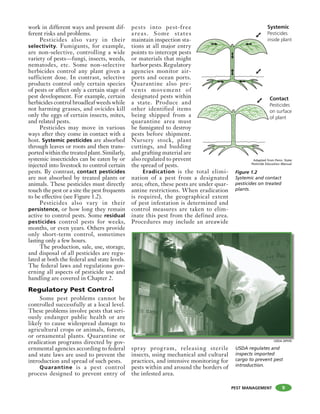
The Four Main Groups of Pests
• Weeds (undesirable plants).
• Invertebrates (insects, mites,
ticks, spiders, snails, and slugs).
• Disease agents or pathogens
(bacteria, viruses, fungi,
nematodes [roundworms],
mycoplasmas [parasitic
microorganisms], and other
microorganisms).
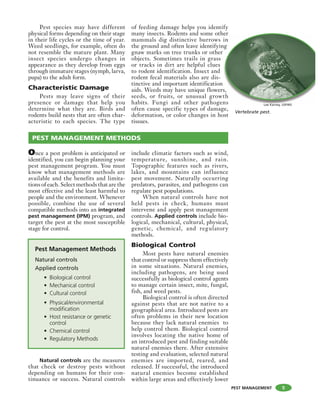
• Vertebrates (birds, reptiles,
amphibians, fish, and rodents
and other mammals).
PEST RECOGNITION
da
cy
Th
p
fa
da
Invertebrate pest.
Weed pest.
Disease pest.
4
Larry Schulze, University of Nebraska
PEST MANAGEMENT
Pest species may have different
physical forms depending on their stage
in their life cycles or the time of year.
Weed seedlings, for example, often do
not resemble the mature plant. Many
insect species undergo changes in
appearance as they develop from eggs
through immature stages (nymph, larva,
pupa) to the adult form.
Characteristic Damage
Pests may leave signs of their
presence or damage that help you
determine what they are. Birds and
rodents build nests that are often char-
acteristic to each species. The type
of feeding damage helps you identify
many insects. Rodents and some other
mammals dig distinctive burrows in
the ground and often leave identifying
gnaw marks on tree trunks or other
objects. Sometimes trails in grass
or tracks in dirt are helpful clues
to rodent identification. Insect and
rodent fecal materials also are dis-
tinctive and important identification
aids. Weeds may have unique flowers,
seeds, or fruits, or unusual growth
habits. Fungi and other pathogens
often cause specific types of damage,
deformation, or color changes in host
tissues.
Once a pest problem is anticipated or
identified, you can begin planning your
pest management program. You must
know what management methods are
available and the benefits and limita-
tions of each. Select methods that are the
most effective and the least harmful to
people and the environment. Whenever
possible, combine the use of several
compatible methods into an integrated
pest management (IPM) program, and
target the pest at the most susceptible
stage for control.
Natural controls are the measures
that check or destroy pests without
depending on humans for their con-
tinuance or success. Natural controls
include climatic factors such as wind,
temperature, sunshine, and rain.
Topographic features such as rivers,
lakes, and mountains can influence
pest movement. Naturally occurring
predators, parasites, and pathogens can
regulate pest populations.
When natural controls have not
held pests in check, humans must
intervene and apply pest management
controls. Applied controls include bio-
logical, mechanical, cultural, physical,
genetic, chemical, and regulatory
methods.
Biological Control
Most pests have natural enemies
that control or suppress them effectively
in some situations. Natural enemies,
including pathogens, are being used
successfully as biological control agents
to manage certain insect, mite, fungal,
fish, and weed pests.
Biological control is often directed
against pests that are not native to a
geographical area. Introduced pests are
often problems in their new location
because they lack natural enemies to
help control them. Biological control
involves locating the native home of
an introduced pest and finding suitable
natural enemies there. After extensive
testing and evaluation, selected natural
enemies are imported, reared, and
released. If successful, the introduced
natural enemies become established
within large areas and effectively lower
Pest Management Methods
Natural controls
Applied controls
• Biological control
• Mechanical control
• Cultural control
• Physical/environmental
modification
• Host resistance or genetic
control
• Chemical control
• Regulatory Methods
her
in
ng
s,
th
ns
Vertebrate pest.
PEST MANAGEMENT METHODS
5
Lee Karney, USFWS
CHAPTER 1
target pest populations for long periods
of time with no further need for inter-
vention. The process is complicated
because it is often difficult to locate the
native home of some pests, and natural
enemies cannot be released until it is
proven that they will not become pests
themselves. Laws have been enacted
that strictly control the importation
of all organisms, including biological
control agents, into the United States.
Other countries have similar restric-
tions.
Biological control also involves the
mass release of large numbers of natural
enemies into fields, orchards, green-
houses, or other locations to control
specific pests. This method usually
does not have long-term results, so
these natural enemies must be released
periodically. Several natural enemies
are reared or cultured commercially.
Predatory mites are used to control
plant-feeding spider mites. Parasitic
wasps and lacewings are used to control
various insect pests. Nematodes and
fungi are being studied as biological
control agents for certain weeds and
some insects. General predators such
as praying mantids and lady beetles are
sold with claims made for biological
control. In many cases, however, their
effectiveness has not been established.
Maintaining populations of
natural enemies by avoiding damaging
cultural practices or the indiscriminate
use of pesticides can be one of
the most economical means
of control. If pesticides
are part of your control
program, select types
that are known to be
less toxic to natural
enemies or, if rec-
ommended, apply
pesticides at lower-
than-label rates to
avoid harming natural
enemies. Sometimes it is
possible to modify certain
parts of the environment, such
as by planting crops or ground
covers, to maintain or enhance natural
enemies.
Mechanical Control
Mechanical control involves the
use of devices, machines, and other
physical methods to control pests or
alter their environment. Traps, screens,
barriers, fences, and nets are examples
of devices used to prevent pest activity
or remove pests from an area.
Cultivation
Cultivation is one of the most
important methods of controlling
weeds. It is also used for some insects
and other soil-inhabiting pests.
Mechanical devices such as plows,
disks, mowers, cultivators, and bed
conditioners physically destroy weeds
or control their growth and disrupt soil
conditions suitable for the survival of
some microorganisms and insects.
Exclusion
Exclusion is a mechanical control
technique that consists of using bar-
riers to prevent pests from getting into
an area. Window screens, for example,
exclude flies, mosquitoes, and other
flyinginsects.Patchingorsealingcracks,
crevices, and other small openings in
buildings can exclude insects, rodents,
bats, birds, or other pests. Fences and
ditches make effective barriers against
many vertebrate pests. Wire or cloth
mesh excludes birds from fruit trees.
Sticky material painted onto tree
trunks, posts, wires, and other objects
preventscrawlinginsectsfromcrossing.
use of pesti
the mos
of co
are
p
a
en
possi
parts of
as by planti
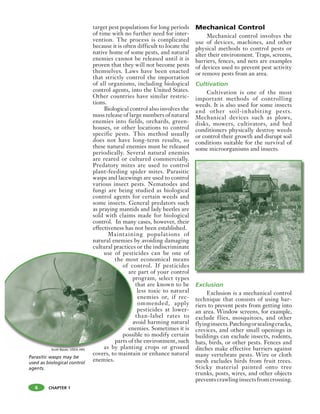
Parasitic wasps may be
used as biological control
agents.
6
Scott Bauer, USDA ARS
PEST MANAGEMENT
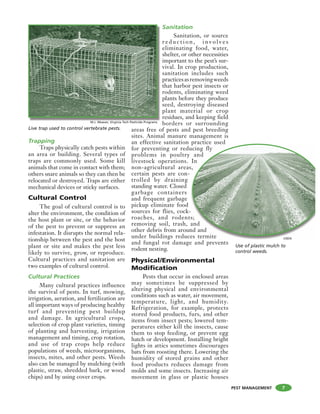
Trapping
Traps physically catch pests within
an area or building. Several types of
traps are commonly used. Some kill
animals that come in contact with them;
others snare animals so they can then be
relocated or destroyed. Traps are either
mechanical devices or sticky surfaces.
Cultural Control
The goal of cultural control is to
alter the environment, the condition of
the host plant or site, or the behavior
of the pest to prevent or suppress an
infestation. It disrupts the normal rela-
tionship between the pest and the host
plant or site and makes the pest less
likely to survive, grow, or reproduce.
Cultural practices and sanitation are
two examples of cultural control.
Cultural Practices
Many cultural practices influence
the survival of pests. In turf, mowing,
irrigation, aeration, and fertilization are
all important ways of producing healthy
turf and preventing pest buildup
and damage. In agricultural crops,
selection of crop plant varieties, timing
of planting and harvesting, irrigation
management and timing, crop rotation,
and use of trap crops help reduce
populations of weeds, microorganisms,
insects, mites, and other pests. Weeds
also can be managed by mulching (with
plastic, straw, shredded bark, or wood
chips) and by using cover crops.
Sanitation
Sanitation, or source
r e d u c t i o n , i n v o l v e s
eliminating food, water,
shelter, or other necessities
important to the pest’s sur-
vival. In crop production,
sanitation includes such
practicesasremovingweeds
that harbor pest insects or
rodents, eliminating weed
plants before they produce
seed, destroying diseased
plant material or crop
residues, and keeping field
borders or surrounding
areas free of pests and pest breeding
sites. Animal manure management is
an effective sanitation practice used
for preventing or reducing fly
problems in poultry and
livestock operations. In
non-agricultural areas,
certain pests are con-
trolled by draining
standing water. Closed
garbage containers
and frequent garbage
pickup eliminate food
sources for flies, cock-
roaches, and rodents;
removing soil, trash, and
other debris from around and
under buildings reduces termite
and fungal rot damage and prevents
rodent nesting.
Physical/Environmental
Modification
Pests that occur in enclosed areas
may sometimes be suppressed by
altering physical and environmental
conditions such as water, air movement,
temperature, light, and humidity.
Refrigeration, for example, protects
stored food products, furs, and other
items from insect pests; lowered tem-
peratures either kill the insects, cause
them to stop feeding, or prevent egg
hatch or development. Installing bright
lights in attics sometimes discourages
bats from roosting there. Lowering the
humidity of stored grains and other
food products reduces damage from
molds and some insects. Increasing air
movement in glass or plastic houses
practice used
ucing fly
and
In
s,
-
s;
and
nd and
es termite
d
Live trap used to control vertebrate pests.
Use of plastic mulch to
control weeds.
7
M.J. Weaver, Virginia Tech Pesticide Programs
USDA
CHAPTER 1
often helps to suppress fungal diseases
from developing on plants.
Host Resistance or Genetic
Control
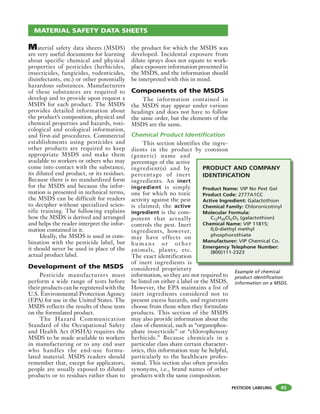
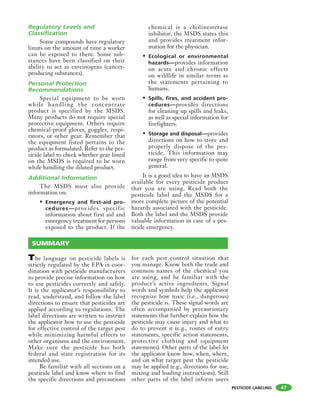
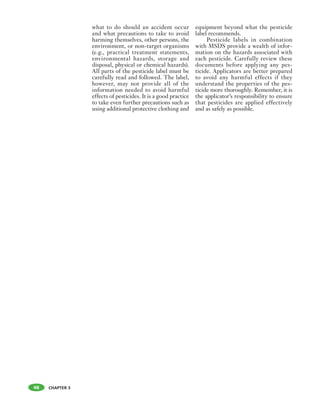
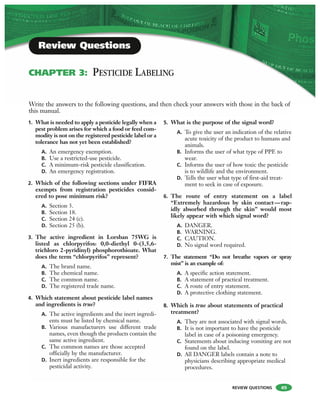
Sometimes plants and animals can
be bred or selected to resist specific pest
problems. For example, particular live-
stock breeds are selected for physical
characteristics that prevent attack by
some pests or provide physiological
resistance to disease or parasitic
organisms. Resistance also is enhanced
by maintaining the host’s health and
providing for its nutritional needs.
Certain plant varieties are naturally
resistant to insects, pathogens, or
nematodes. Many plants actually repel
various types of pests, and some contain
toxic substances. Plant resistance to
insect pests can sometimes be achieved
by transferring genetic material from
certain insect-destroying microor-
ganisms to hybrid seed. Genetic control
has been widely used in the past and
offers great promise for the future,
especially when combined with new
gene manipulation techniques.
Chemical Controls
Chemical controls are pesticides
that are either naturally derived or
synthesized. Pesticides often play a
key role in pest management programs
and frequently may be the only control
method available. Major benefits asso-
ciated with the use of pesticides are their
effectiveness, the speed and ease of con-
trolling pests, and, in many instances,
their reasonable cost compared with
other control options. Usually pest
damage stops or pests are destroyed
within a few hours (for insects) to a
few days (for weeds) after application
of a pesticide. Using a fungicide may
provide immediate, short-term pro-
tection against microorganisms.
A pesticide is defined as any
material that is applied to plants, the
soil, water, harvested crops, structures,
clothing and furnishings, or animals
to kill, attract, repel, or regulate or
interrupt the growth and mating of
pests, or to regulate plant growth.
Pesticides include a wide assortment
of chemicals with specialized names
and functions. They are commonly
grouped according to the type of pest
they control.
• Avicides control pest birds.
• Bactericides control bacteria.
• Disinfectants (antimicrobials)
control microorganisms.
• Fungicides control fungi.
• Herbicides control weeds and
other undesirable plants.
• Insecticides control insects and
related arthropods.
• Miticides (acaricides) control
mites.
• Molluscicides control snails and
slugs.
• Nematicides control nematodes
(roundworms).
• Predacides control predatory
vertabrates.
• Piscicides control pest fish.
• Repellents repel insects, related
invertebrates, birds, and mammals.
• Rodenticides control rodents.
• Defoliants cause leaves or foliage
to drop from plants.
• Desiccants promote drying
or loss of moisture from plant
tissues.
• Growth regulators are sub-
stances (other than fertilizers
or food) that alter the growth
or development of a plant or
animal.
Each group of pesticide includes
several classes or families. For example,
the classes of insecticides include, among
others, the organophosphates, organo-
chlorines, carbamates, pyrethroids,
botanicals, insecticidal soaps, and micro-
bials. The pesticides within a particular
class have similar chemical structures
or properties or share a common mode
of action. The mode of action of a
pesticide is how the pesticide works. In
other words, it is what specific system(s)
in the pest are affected by the pes-
ticide. The various classes of chemicals
8
PEST MANAGEMENT
work in different ways and present dif-
ferent risks and problems.
Pesticides also vary in their
selectivity. Fumigants, for example,
are non-selective, controlling a wide
variety of pests—fungi, insects, weeds,
nematodes, etc. Some non-selective
herbicides control any plant given a
sufficient dose. In contrast, selective
products control only certain species
of pests or affect only a certain stage of
pest development. For example, certain
herbicides control broadleaf weeds while
not harming grasses, and ovicides kill
only the eggs of certain insects, mites,
and related pests.
Pesticides may move in various
ways after they come in contact with a
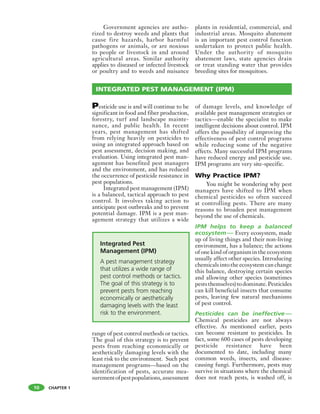
host. Systemic pesticides are absorbed
through leaves or roots and then trans-
ported within the treated plant. Similarly,
systemic insecticides can be eaten by or
injected into livestock to control certain
pests. By contrast, contact pesticides
are not absorbed by treated plants or
animals. These pesticides must directly
touch the pest or a site the pest frequents
to be effective (see Figure 1.2).
Pesticides also vary in their
persistence, or how long they remain
active to control pests. Some residual
pesticides control pests for weeks,
months, or even years. Others provide
only short-term control, sometimes
lasting only a few hours.
The production, sale, use, storage,
and disposal of all pesticides are regu-
lated at both the federal and state levels.
The federal laws and regulations gov-
erning all aspects of pesticide use and
handling are covered in Chapter 2.
Regulatory Pest Control
Some pest problems cannot be
controlled successfully at a local level.
These problems involve pests that seri-
ously endanger public health or are
likely to cause widespread damage to
agricultural crops or animals, forests,
or ornamental plants. Quarantine or
eradication programs directed by gov-
ernmental agencies according to federal
and state laws are used to prevent the
introduction and spread of such pests.
Quarantine is a pest control
process designed to prevent entry of
pests into pest-free
areas. Some states
maintain inspection sta-
tions at all major entry
points to intercept pests
or materials that might
harborpests.Regulatory
agencies monitor air-
ports and ocean ports.
Quarantine also pre-
vents movement of
designated pests within
a state. Produce and
other identified items
being shipped from a
quarantine area must
be fumigated to destroy
pests before shipment.
Nursery stock, plant
cuttings, and budding
and grafting material are
also regulated to prevent
the spread of pests.
Eradication is the total elimi-
nation of a pest from a designated
area; often, these pests are under quar-
antine restrictions. When eradication
is required, the geographical extent
of pest infestation is determined and
control measures are taken to elim-
inate this pest from the defined area.
Procedures may include an areawide
spray program, releasing sterile
insects, using mechanical and cultural
practices, and intensive monitoring for
pests within and around the borders of
the infested area.
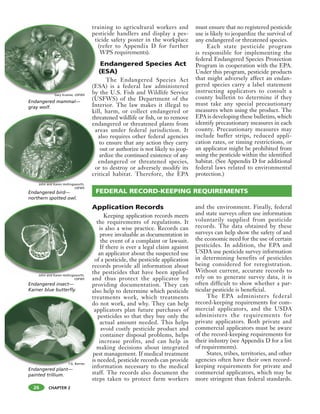
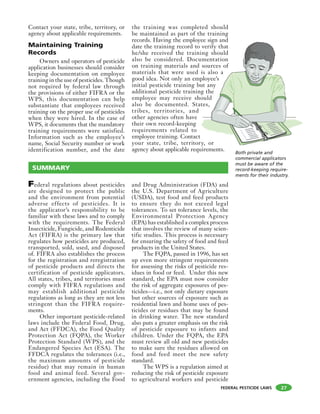
Figure 1.2
Systemic and contact
pesticides on treated
plants.
USDA regulates and
inspects imported
cargo to prevent pest
introduction.
9
USDA APHIS
Adapted from Penn. State
Pesticide Education Manual
CHAPTER 1
Government agencies are autho-
rized to destroy weeds and plants that
cause fire hazards, harbor harmful
pathogens or animals, or are noxious
to people or livestock in and around
agricultural areas. Similar authority
applies to diseased or infected livestock
or poultry and to weeds and nuisance
plants in residential, commercial, and
industrial areas. Mosquito abatement
is an important pest control function
undertaken to protect public health.
Under the authority of mosquito
abatement laws, state agencies drain
or treat standing water that provides
breeding sites for mosquitoes.
INTEGRATED PEST MANAGEMENT (IPM)
Pesticide use is and will continue to be
significant in food and fiber production,
forestry, turf and landscape mainte-
nance, and public health. In recent
years, pest management has shifted
from relying heavily on pesticides to
using an integrated approach based on
pest assessment, decision making, and
evaluation. Using integrated pest man-
agement has benefited pest managers
and the environment, and has reduced
the occurrence of pesticide resistance in
pest populations.
Integrated pest management (IPM)
is a balanced, tactical approach to pest
control. It involves taking action to
anticipate pest outbreaks and to prevent
potential damage. IPM is a pest man-
agement strategy that utilizes a wide
range of pest control methods or tactics.
The goal of this strategy is to prevent
pests from reaching economically or
aesthetically damaging levels with the
least risk to the environment. Such pest
management programs—based on the
identification of pests, accurate mea-
surementofpestpopulations,assessment
of damage levels, and knowledge of
available pest management strategies or
tactics—enable the specialist to make
intelligent decisions about control. IPM
offers the possibility of improving the
effectiveness of pest control programs
while reducing some of the negative
effects. Many successful IPM programs
have reduced energy and pesticide use.
IPM programs are very site-specific.
Why Practice IPM?
You might be wondering why pest
managers have shifted to IPM when
chemical pesticides so often succeed
at controlling pests. There are many
reasons to broaden pest management
beyond the use of chemicals.
IPM helps to keep a balanced
ecosystem— Every ecosystem, made
up of living things and their non-living
environment, has a balance; the actions
of one kind of organism in the ecosystem
usually affect other species. Introducing
chemicals into the ecosystem can change
this balance, destroying certain species
and allowing other species (sometimes
peststhemselves)todominate.Pesticides
can kill beneficial insects that consume
pests, leaving few natural mechanisms
of pest control.
Pesticides can be ineffective—
Chemical pesticides are not always
effective. As mentioned earlier, pests
can become resistant to pesticides. In
fact, some 600 cases of pests developing
pesticide resistance have been
documented to date, including many
common weeds, insects, and disease-
causing fungi. Furthermore, pests may
survive in situations where the chemical
does not reach pests, is washed off, is
Integrated Pest
Management (IPM)
A pest management strategy
that utilizes a wide range of
pest control methods or tactics.
The goal of this strategy is to
prevent pests from reaching
economically or aesthetically
damaging levels with the least
risk to the environment.
10
PEST MANAGEMENT
applied at an improper rate, or is applied
at an improper life stage of the pest.
IPM can save money— IPM can
avoid crop loss and landscape and
structural damage caused by pests and
prevent unnecessary pesticide expense.
Applicators can save on pesticide costs
because the need for control rather than
the calendar is the basis for applying
pesticides.
IPM promotes a healthy environ-
ment— We have much to learn
about the persistence of chemicals in
the environment and their effect on
living creatures. Cases of contaminated
groundwaterappeareachyear,anddisposal
of containers and unused pesticides still
pose challenges for applicators. Make
sure that environmental impacts are
considered in any pest management
decisions. Using IPM strategies helps
keep unreasonable adverse effects to a
minimum.
IPM maintains a good public
image—IPM is now demanded by
many sectors of our society. IPM has
been implemented to grow our food, to
manage turf and ornamentals, to protect
home and business structures, to manage
school grounds, and to protect humans,
pets, and livestock health.
Components of IPM
All of the components of an IPM
approach can be grouped into five
major steps: identify the pest and
understand its biology, monitor the
pest to be managed, develop a sound
pest management goal, implement an
IPM program, and record and evaluate
results.
1. I dentif y the Pest and
Understand its Biology— Despite
our best preventive efforts, some pest
outbreaks inevitably occur. The first
step in any pest management program
is to identify the pest. Never classify an
organism as a pest or treat it as a pest
until it is clearly determined to be one.
Identification is important whether you
are dealing with an insect, weed, plant
disease, or vertebrate.
The more that you know about a
pest, the easier and more successful pest
management becomes. Once you have
identified a pest, you can access infor-
mation about its life cycle and behavior,
the factors that favor development, and
the recommended control procedures.
You can also determine the significance
of the pest and the need for control.
Some pests have little impact on a plant,
animal, or structure and do not require
control. Other pests warrant immediate
control because they cause serious
damage or present a significant threat
to human health or public safety.
Most pests may be classified either
as key pests, occasional pests, or sec-
ondary pests.
Key pests may cause major damage
on a regular basis unless they are con-
trolled. Many weeds, for example, are
key pests because they compete with
crop or ornamental plants for resources
and require regular control efforts to
prevent or reduce damage.
Occasional pests become trou-
blesome only once in a while because of
their life cycles or environmental influ-
ences, or as a result of human activities.
For instance, ants sometimes become
occasional pests when sanitation prac-
tices change, providing them with food
where previously none existed. They
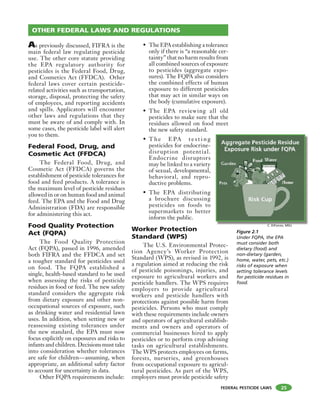
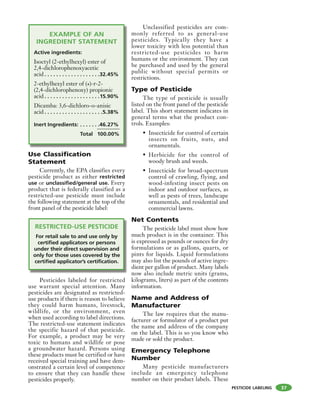
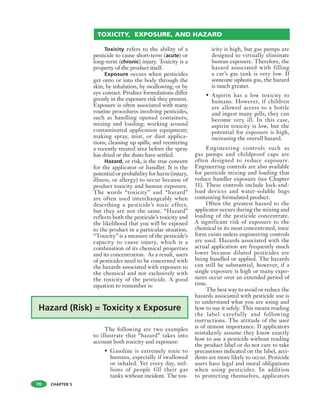
also may move into buildings after
a rainfall or other event destroys an
outdoor food source.
Secondary pests become problems
when a key pest is controlled or elimi-
nated. For example, some weed species
become pests only after key weeds,
which are normally more successful in
competing for resources, are controlled.
Certain species of fleas, ticks, and blood-
feeding bugs attack people only when
their natural hosts, such as pet dogs or
cats, are no longer present.
2. Monitor the Pest to be Man-
aged—The key to a successful
IPM program is regular monitoring.
Monitoring involves measuring pest
populations and/or the resulting damage
or losses. The procedures for monitoring
vary with the pest and the situation.
Scouting and trapping are com-
monly used to monitor insects and their
activity. Weather and temperature data
Why Practice
IPM?
• IPM helps to
keep a
balanced
ecosystem.
• Pesticides can be
ineffective.
• IPM can save
money.
• IPM promotes a
healthy
environment.
• IPM maintains
a good public
image.
11
CHAPTER 1
are particularly helpful
in following a pest’s life
cycle or in predicting
how long it takes a certain
pest to develop. Models
have been developed for
a number of insects and
plant diseases to predict
the need for and timing
of pesticide applications.
Use Pest Population
Thresholds
Producers of agri-
cultural or ornamental
products must understand
the concept of economic
thresholds. The presence
of a pest does not always
cause a loss in quality or
quantity of an agricultural
orornamentalproduct.To
justify the cost of control,
pest populations must
be large enough to cause
significant damage. This
population level is called the economic
threshold (ET). The economic threshold
is the pest population density (number of
pests per unit of area) at which control
measures are needed to prevent the pest
from reaching the economic injury level.
The economic injury level (EIL) is the
pest population density that causes losses
equal to the cost of control measures. To
make a control practice profitable, or at
least break even, it
is necessary to set
the ET below the
EIL (see Figure
1.3). Otherwise,
producers lose
money, first from
the damage caused
by the pest, and
then by the cost
of applying the
control. Setting the
ET below the EIL
triggers pesticide application and other
controls before pests reach the economic
injury level.
Economic thresholds are available
for many pests and crops. Several factors
can influence an economic threshold.
These factors include the current
value of the agricultural or ornamental
product, its stage of development, the
degree of damage caused under various
environmental conditions, the cost and
effectiveness of control measures, and the
anticipated yield. For example, even slight
damage to an ornamental or floricultural
crop may reduce the value significantly
and render it unsalable, so the economic
threshold must be set quite low.
For pest managers who are not
directly involved in production, the
concept of action thresholds is more
appropriate. An action threshold is the
pest level at which some type of pest
management action must be taken. It is a
predetermined pest level that is deemed
to be unacceptable. Factors besides
economics come into consideration for
establishing action thresholds. In some
situations, the action threshold for a
pest may be zero (i.e., no presence of the
pest is tolerated). This is especially true
when the pest is capable of transmitting
a human pathogen (mosquitoes and the
West Nile virus), has a venomous bite or
sting (some spiders, wasps), or may create
a public health emergency (cockroaches,
rodents). In an urban landscape, action
thresholds must consider not only the
economic value of the landscape but also
its ecological and aesthetic roles. Even
a slight amount of pest damage may be
unacceptable in such an environment.
Action thresholds can vary by pest (a
stinging insect in a classroom vs. an
ant), by site (a storage room vs. a school
infirmary), and by season (some pests
are present only a few weeks out of an
entire year). Often the action threshold is
expressed as the number of pests per unit
area. Below the action threshold level,
IPM technicians do not use any control
measures, though they should continue
to monitor the situation and do sani-
tation inspections as needed. Once a pest
is at or above the action threshold, the
technician should implement a full range
of IPM strategies to control the pest.
Action thresholds are easy to
understand, but establishing them is
more difficult. In a new IPM program,
a practical approach is to establish an
arbitrary action threshold for the major
pests you encounter. As you gain insight
and experience into specific pest man-
agement settings, the action levels can
be revised up or down.
Pest monitoring by using
a sweep net.
Figure 1.3
To make a control
practice profitable, or
at least break even, it
is necessary to set the
economic threshold (ET)
below the economic
injury level (EIL).
12
Peggy Greb, USDA ARS
PEST MANAGEMENT
3. Develop the Pest Management
Goal—The goal of most IPM pro-
grams is to maintain pest damage
at economically acceptable levels.
Prevention and suppression techniques
are often combined in an effective IPM
program. In rare instances, eradication
may be the goal of an IPM program.
Once the goal of the program has been
determined, the strategy for a sound
IPM program is to coordinate the use of
multiple tactics into a single integrated
system. Pesticides are just one method
for controlling pests. Non-chemical
methods may provide longer and more
permanent control of a pest and should
always be considered when developing
a pest management strategy. Evaluate
the costs, benefits, and liabilities of
each control tactic.
Prevention
Often economical and environ-
mentally sound ways are available to
prevent loss or damage from pests. Such
techniques include planting weed- and
disease-free seed and growing varieties
of plants resistant to diseases or insects.
Other choices are using cultural con-
trols to prevent weedy plants from
seeding and choosing planting and
harvesting times that minimize pest
problems. Sanitation methods often
reduce the buildup of pests. Other
preventive methods involve excluding
pests from the target area or host and
using practices that conserve natural
enemies. Making sure that plants,
poultry, or livestock receive adequate
water and nutrients often reduces stress
and susceptibility to diseases or pests.
Pesticides are sometimes used for
pest prevention. For instance, growers
treat some crops and landscapes with
preplant or preemergence herbicides
because they know weed seeds are
present. If plant pathogens have already
infected susceptible plants, economic
damage usually cannot be prevented.
For this reason, fungicides are nor-
mally applied before infection occurs
whenever environmental conditions
favor infection. Likewise, pesticides
are applied to structural lumber before
construction to protect it from insects
and fungi.
Suppression
Suppressive pest control methods
are used to reduce pest population
levels. The methods chosen usually do
not eliminate all pests but reduce their
populations to a tolerable level or to a
point below an economic injury level;
additional suppressive measures may
be required. Suppression sometimes
lowers pest populations so natural
enemies are able to maintain control.
Suppression is the goal of most pes-
ticide applications. Other techniques,
such as cultivation or mowing of
weeds and release of biological control
agents, are also used to suppress pest
populations.
Eradication
Eradication is the total elimination
of a pest from a designated area. This
is a common objective of pest control
efforts in buildings or other small,
confined spaces where, once the pest
is eliminated, it can be excluded. For
example, eliminating cockroaches,
rats, and mice from commercial food
establishments involves eradication.
Over larger areas, however, eradi-
cation is very expensive and often has
limited success. Large eradication
programs are usually directed at exotic
or introduced pests posing an areawide
public health or economic threat. Such
programs are generally coordinated
by governmental agencies. Efforts to
eliminate Mediterranean fruit fly and
hydrilla (an aquatic weed) in California
and Florida, respectively, are examples
of this type of pest management.
The pest control strategy you
choose depends on the nature of the
pest, the environment of the pest, and
economic or tolerance considerations.
Combining prevention and sup-
pression techniques usually enhances a
pest management program. Objectives
sometimes differ, however, for the
same pest in different situations. For
example, the Mediterranean fruit
fly (Med fly) is an established pest in
Hawaii, so the emphasis there is to use
prevention and suppression techniques
to reduce crop damage. Regulatory
agencies in California and Florida,
however, use eradication measures to
13
CHAPTER 1
Pesticides often play a significant
role in pest management programs.
Their use requires certain precautions
be taken to avoid the development of
resistant pest populations. Although
pest resistance can occur, it does not
cause every pesticide failure. Make sure
that you have used the correct pesticide
and the correct dosage, and that you
have applied the pesticide according
to label instructions. Sometimes a
pesticide application fails to control a
pest because the pest was not identified
correctly and the wrong pesticide was
chosen. Other applications fail because
the pesticide was not applied at the
correct time—the pest may not have
been in the area during the application,
or it may have been in a life cycle stage
or location where it was not susceptible
to the pesticide. Also, remember that
the pests that are present may be part
of a new infestation that developed long
after the chemical was applied.
Even non-chemical pest man-
agement tactics become ineffective if
the pest and the susceptible stage(s) of
its life cycle are not identified correctly.
Successful pest management programs
do not happen by accident—they
depend on careful observation, a
thorough knowledge of the pest and the
damage it causes, an understanding of
all available pest control options, and a
caring, professional attitude.
Pesticide Resistance
Pesticide resistance can be defined
as the ability of an insect, fungus, weed,
rodent, or other pest to tolerate a pes-
ticide that once controlled it. Resistance
develops because intensive pesticide
use kills the susceptible individuals in
a population, leaving only the resistant
ones to reproduce. Initially, higher
labeled rates and more frequent appli-
cations are needed to control resistant
pests. Eventually, however, the pesticide
prevent the Mediterranean fruit fly
from becoming permanently estab-
lished in these states.
4. Implement the Integrated Pest
Management Program— The fol-
lowing steps should be taken before
implementing an IPM program:
• Identify the pest.
• Set up a monitoring program.
• Know the pest level that triggers
control.
• Know what control methods are
available.
• Evaluate the benefits and risks of
each method.
When implementing the IPM
program, try to select the methods
that are the most effective and the least
harmful to people and the environment.
Use several methods whenever pos-
sible, and be sure to use them correctly.
It is also important to observe all local,
state, and federal regulations regarding
the methods chosen.
5. Record and Evaluate Results—
It is extremely important to record and
evaluate the results of your control
efforts. Some control methods, espe-
cially non-chemical procedures, are
slow to yield measurable results. Other
methods may be ineffective or even
damaging to the target crop, animal,
treated surface, or natural predators
and parasites. Consider how well your
strategies work and their impact on
the environment before implementing
them again.
Components
of IPM
1. Identify the pest
and understand
its biology.
2. Monitor the pest
to be managed.
3. Develop the pest
management
goal.
4. Implement the
integrated pest
management
program.
5. Record and
evaluate
results.
EFFECTIVENESS OF PEST MANAGEMENT PROGRAMS
14
PEST MANAGEMENT
will have little or no effect on the pest
population (see Figure 1.4).
Resistance may develop to only a
single insecticide, fungicide, herbicide,
or rodenticide. More often, however,
pest populations become resistant to all
chemically related pesticides in a class
of compounds. It is also possible for a
pest to develop resistance to pesticides
in two or more classes of compounds
with unlike modes of action.
Continual use of pesticides from the
same chemical class, such as all organo-
phosphate or all pyrethroid insecticides,
increases the likelihood that resis-
tance will develop in pest populations.
Frequent applications and persistence
of the chemical further increase the
chances of resistance occurring. Finally,
the spread of resistance through a
pest population can occur much more
rapidly in pests that have many genera-
tions per year and many offspring per
generation, such as many insects, fungi,
and rodents.
Several pest management tactics
help prevent or delay the occurrence
of pesticide resistance. One approach
involves the use of new or altered pes-
ticides. Using new compounds with
different modes of action will lessen
the likelihood of resistance developing
in a population. Unfortunately, new
replacement products are often quite
complex, difficult to synthesize, and
very costly to develop, and they have
very specific modes of action, which
can rapidly lead to the development
of resistant pest populations even after
very limited use in the field. No longer
can we expect to respond to pesticide
resistance by merely substituting one
pesticide for another.
Changing pesticide use patterns is
an important step in preventing resis-
tance. When dosages are reduced, fewer
pests are killed, so the
pressure to develop
resistant pest popula-
tions is decreased.
Applying pesticides over
limited areas reduces
the proportion of the
total pest population
exposed to the chemical,
thereby maintaining a
large pool of individuals
still susceptible to the
pesticide. This tactic has a tendency
to delay the development of a resistant
population because pesticide-susceptible
individuals in the population continue
to interbreed with resistant ones, thus
diluting the resistance in the population.
Also, treating alternate generations of
pests with pesticides that have different
modes of action decreases the selection
pressure for resistance.
Managing pesticide resistance is a
very important aspect of integrated pest
management. Monitor pest populations
carefully and treat only when necessary,
rather than treating on a calendar basis.
Good pesticide application records are
Resistance Management
• Use new or altered pesticides.
• Change pesticide use patterns.
• Treat only when necessary.
15
Adapted from U. of C. The Safe and Effective Use of Pesticides
CHAPTER 1
an important component of resistance
management. Pesticides are more effec-
tively managed when treatment history
is known. Resistance must be detected
when it is at a very low level and then
controlled by using all available pest
management techniques to extend the
useful life of our current pesticides.
To be successful, a pest management
program must start with the proper
identification of the pest. Choosing the
appropriatepestcontrolmethoddepends
on recognizing and understanding the
pest, its life cycle, habits, and habitat.
Integrated pest management (IPM) pro-
grams attempt to balance the need for
pest control with the desire to protect
the environment from risks associated
with pesticide use. IPM methods include
both chemical and non-chemical means
to prevent and control pest populations
from reaching economically damaging
levels. These prevention and control
tactics include biological, mechanical,
cultural, physical, genetic, chemical, and
regulatory methods.
MonitoringtechniquesusedinIPM
programs are critical to knowing when
and what type of control measures to
apply. Monitoring also helps to establish
pest population thresholds that may
be used for deciding when pest control
action should be taken. Evaluation and
recording results help to determine how
well the IPM program is working and
whether there are any harmful human
or environmental effects.
Minimizing pesticide resistance
is also an important consideration for
sustaining the effectiveness of pest
management programs. Many tools and
techniques are available (e.g., rotation of
pesticide types with different modes of
action, application of pesticides that do
not leave persistent residues, application
of pesticides at below-label amounts)
that prevent or delay the occurrence of
pesticide resistance. Whenever chemical
controls are used, it is critical to read
and follow all label directions correctly
to avoid misapplication.
If the pest has not been properly
identified, even non-chemical means
of pest control will fail. It is the appli-
cator’s responsibility to consider all of
the factors relevant to the pest control
situation. Beyond simply identifying the
pest and choosing a control strategy,
the applicator must consider the effects
of pest control actions on the entire
treatment site, whether an outdoor
area or inside a structure. Use good
judgment, especially when pesticides
are part of the control strategy, to avoid
harmful effects to other living organisms
and the environment.
SUMMARY
16
REVIEW QUESTIONS
1. Using barriers to prevent pests from getting
into an area is an example of which type of pest
management method?
A. Biological control.
B. Mechanical control.
C. Genetic control.
D. Chemical control.
2. Lowering the humidity of stored grains and other
food products to reduce damage from mold is
an example of which type of pest management
method?
A. Biological.
B. Mechanical.
C. Physical/environmental modification.
D. Regulatory pest control.
3. Which statement is true about biological control
methods?
A. If pesticides are part of a biological control
program to control an exotic pest, it is bet-
ter to apply them at the strongest label rate
and to choose the more toxic pesticides.
B. Modifying the environment to enhance
natural enemies is a recommended practice
in biological control.
C. Biological control involves the importation
of exotic pests to control natural enemies.
D. Using several cultural practices and a wide vari-
ety of pesticides works best in biological control.
4. Sealing cracks and crevices and small openings
in buildings is an example of which type of
mechanical control method?
A. Exclusion.
B. Trapping.
C. Cultivation.
D. Mulching.
5. Which statement is true about cultural control
practices?
A. Cultural practices alter the environment, the
condition of the host, or the behavior of the
pest to prevent or suppress an infestation.
B. Trapping is an important cultural control practice.
C. Sanitation is not considered a cultural practice.
D. Cultural controls involve the release of parasites
and predators found in foreign countries.
6. Which statement is true about regulatory pest
control?
A. Pests that pose a serious public health threat
are rarely regulated by federal and state
agencies.
B. Pests that are to be eradicated are rarely
under quarantine restrictions.
C. Airports and ocean ports are monitored by
pest quarantine regulatory agencies.
D. Entry of pests across state lines is not regulated.
7. Which statement is true about pest management
strategies in IPM?
A. The goal is often to maintain pest damage
at economically acceptable levels.
B. Eradication is never the goal of an IPM
program.
C. Pesticides are not included in an IPM
strategy.
D. Non-chemical methods usually provide only
short-term control of a pest.
Write the answers to the following questions, and then check your answers with those in the back of
this manual.
CHAPTER 1: PEST MANAGEMENT
17
Review Questions
CHAPTER 1
8. Which would be considered a preventive pest
management strategy?
A. Planting weed- and disease-free seed.
B. Releasing natural enemies to help reduce
pest populations.
C. Eliminating rodents from a commercial
food establishment.
D. Removing from an area a pest that is a
public health concern.
9. Which statement is true about action
thresholds?
A. The IPM technician needs to implement
control measures below the action threshold
level.
B. The action threshold for a pest may be set
at a zero pest population density.
C. Action thresholds are usually easy to
establish.
D. In an urban landscape, action thresholds
are usually more related to economics than
aesthetics.
10. Which would increase the likelihood of
pesticide resistance?
A. An insect has only one generation per year.
B. Continual use of the same pesticides or
pesticides from the same chemical class.
C. Limiting the number of pesticide
applications.
D. Applying a pesticide that has little or no
residual effect.
18
FEDERAL PESTICIDE LAWS
To protect public health and welfare
and to prevent adverse effects to the
environment, pesticides must be regu-
lated. The purpose of the federal and
state pesticide acts is to regulate in the
best public interest the labeling, sale
and distribution, storage, transpor-
tation, use and application, and disposal
of pesticides. In essence, pesticides are
under regulatory scrutiny from the
time of their inception in the laboratory
to their ultimate use in the field or
their disposal in an approved manner.
With the possible exception of human
and veterinary drugs, no other class
of chemicals receives such extensive
testing in the United States before
being registered and marketed.
After studying this chapter, you should:
• Know how to follow laws and regulations related to
pesticide use.
• Know how to ensure that operation records, including
application records, are accessible to officials.
• Understand the importance of maintaining records
of pesticide applications (e.g., amounts, pests, dates,
locations, registration numbers).
• Understand the importance of maintaining training
records of persons handling pesticides.
LEARNING OBJECTIVES
19
FEDERAL INSECTICIDE, FUNGICIDE, AND RODENTICIDE
ACT (FIFRA)
The U.S. Congress enacted legislation
that regulates the production, trans-
portation, sale, use, and disposal of all
pesticides. The Federal Insecticide,
Fungicide, and Rodenticide Act, com-
monly referred to by its initials, FIFRA,
was enacted in 1947. It was amended
considerably in 1972, then again in 1975,
1978, and 1988. This statute is admin-
istered by the U.S. Environmental
Protection Agency (EPA).
FIFRA provides the overall
framework for the federal pesticide
program. Under FIFRA, the EPA is
responsible for registering or autho-
rizng pesticide products for use in the
United States. Pesticide registration
decisions are based on a detailed
assessment of the potential effects
of a product on human health and
l
CHAPTER 2
CHAPTER 2
the environment when used according
to label directions. These approved
labels have the force of law. Anyone
who uses a pesticide in any way
not in accordance with the label
directions and precautions
may be subject to civil and/or
criminal penalties. FIFRA
also requires that the EPA
reevaluate older pesticides
to ensure that they meet
more recent safety stan-
dards. FIFRA requires the
EPA, states, tribes, and ter-
ritories to establish programs
to protect workers, and to
provide training and certification
for applicators.
A major provision of FIFRA gives
EPA the authority to stop the sale or
use of any pesticide. The EPA can issue
removal orders and seize products to
keep them out of the market. Also, state
restrictionsonpesticidescannotbemore
liberal than those of FIFRA. Individual
states may impose stricter regulations
on a pesticide, but the labeling and
packaging must be uniform nationwide.
Uniform packaging standards include
container type, size, and color.
Under FIFRA, all pesticides are
classified according to their potential
hazards under the circumstances in
which they are to be used. The two
main classifications are unclassified use
and restricted use, though unclassified
pesticides are commonly referred to as
general-use pesticides. It should be
noted that the EPA has classified very
few pesticides as general use. Most
pesticides that might be expected to fit
into the general-use category currently
remain unclassified. Normally they
have a lower toxicity than restricted-
use pesticides and so less potential to
harm humans or the environment.
They can be bought and used by the
general public without special permits
or restrictions. The EPA classifies a
pesticide as restricted use if use of the
pesticide might result in an unreasonable
adverse effect on human health and/or
the environment; however, application
by trained persons according to label
directions would protect against such an
effect. This restricted-use classification
must be stated on the label.
Some active ingredients in pes-
ticides may be listed in both use
categories, depending on the formu-
lation, the application method, and
the intended uses. For example, an
emulsifiable concentrate formulation of
a certain insecticide used on fruit trees
might be classified as restricted use if
it contains a high percentage of active
ingredient (e.g., 70 percent). But the
same chemical with a low percentage
of active ingredients—e.g., 5 percent
in a granular formulation used to treat
turf insects—could be classified as a
general-use pesticide.
Restricted-use pesticides (RUP)
may be sold only to certified applicators.
A certified applicator is an individual
who has been recognized (certified)
by the state, tribe, territory, or agency
responsible for regulating pesticides as
being competent to use or supervise
the use of restricted-use pesticides.
Certified applicators must know how
to read a pesticide label and be able to
follow directions to use them properly
and safely. Under FIFRA there are two
types of pesticide applicators—private
and commercial. A private applicator
is defined as a certified applicator
who uses or supervises the use of any
restricted-use pesticide for the purpose
of producing an agricultural commodity
(e.g., field and forage crops, fruit, veg-
etables, nursery stock, Christmas trees,
greenhouse plants, livestock, etc.) on
his/her own property or property he/she
rents or leases. Commercial applicatorsRestricted-use pesticides (RUPs) may be sold only to certified applicators.
The Environmental
Protection Agency (EPA)
is the agency responsible
for administering the
Federal Insecticide,
Fungicide, and
Rodenticide Act (FIFRA).
who u
not
di
m
E
ri
to
provid
for applic
20
FEDERAL PESTICIDE LAWS
are individuals who use or supervise the
use of any restricted-use pesticide for
any purpose on any property except for
those provided for under the definition
of a private applicator.
Only certified applicators or indi-
viduals under their direct supervision
may mix, load, or apply restricted-
use pesticides. To become certified,
a person must exhibit a broad-based
knowledge of and competency in pes-
ticide use and handling. This provides
an alternative to more stringent con-
trols on, or even cancellation of, the
use of these pesticides.
The certified applicator is not
permitted to use any pesticide for any
use other than that stated on the label
except when specific exemptions are
granted under Section 2 (ee) of FIFRA.
Section 2 (ee) contains provisions that
exclude several application procedures
from being classified as uses “incon-
sistent with product labeling.” (Note:
Not all regulatory agencies recognize
the provisions of Section 2 [ee] under
FIFRA. Before making pesticide
applications, you need to consult your
pesticide regulatory agency to see if
your respective state, tribe, territory,
or agency recognizes these provisions.)
These provisions allow:
• A pesticide may be applied to
control a target pest not spec-
ified on the label if the pesticide
is applied to a crop, animal, or
site specifically listed on the
label (e.g., interior of a home,
food-handling establishments,
exterior ornamental plants, corn,
tomatoes, etc.).
• Any method of application may
be used that is not prohibited by
the label.
• A pesticide may be applied at a
dosage, concentration, or fre-
quency less than that specified
on the label, except in the case of
termiticides labeled for precon-
struction treatments.
• A pesticide-fertilizer mixture
may be used if the mixture is not
prohibited by the label.
The certification process by all the
states, tribes, and territories must be
accomplished through EPA-approved
programs. Each state is responsible for
implementing the certification program.
In addition, all states have signed coop-
erative agreements with the EPA that
designate an agency within the state (i.e.,
the state lead agency) to enforce the
provisions of FIFRA. In some situations,
more than one agency within a state may
be designated to enforce various compo-
nents of FIFRA (e.g., some states have
structural pest control boards respon-
sible for regulating the structural pest
control industry).
States, tribes, territories, and some
local jurisdictions have their own legal
requirements concerning pesticide use.
You are responsible for knowing about
these requirements and complying with
them. Be sure you are up-to-date on legal
requirements at all governmental levels—
laws and regulations are constantly
evolving as pesticide application becomes
more complex and more is learned about
potential hazards. Ignorance of the law is
never an accepted excuse for a violation.
21
PESTICIDE REGISTRATION
Only certified
applicators
or individuals
under their
direct super-
vision may mix,
load, or apply
restricted-use
pesticides.
No pesticide can be registered or
offered for sale unless its labeling
provides for reasonable safeguards to
prevent injury to humans and adverse
effects on the environment. There
are several types of registration and
exemption actions that enable pesticides
to be used in the United States:
• The federal registration of pesti-
cides under Section 3 of FIFRA.
• Special local need registrations
under Section 24(c).
• Emergency exemptions under
Section 18.
• Exemption of minimum-risk
pesticides from registration
under Section 25(b) of FIFRA.
All of these registration and exemption
actions are discussed in detail in Chapter
CHAPTER 2
3, Pesticide Labeling.
Another process involves
experimental use permits
(EUPs). Under Section 5
of FIFRA, EUPs allow
manufacturers to field test
pesticides under devel-
opment. Manufacturers of
conventional pesticides are
required to obtain experi-
mental use permits before
testing new pesticides or new
uses of pesticides if they conduct
experimental field tests on 10 or more
acres of land or one or more acres of
water. Biopesticides (i.e., pesticides
derived from natural materials) also
require EUPs when used in experi-
mental settings.
TheEPAalsohasaroleinregulating
devices used to control pests. A “device”
is any instrument or contrivance (other
than a firearm) intended for trapping,
destroying, repelling, or mitigating any
pest. A black light trap is an example of a
device. Unlike pesticides, the EPA does
not require devices to be registered with
the agency but does require the pro-
ducing establishment to be registered.
Devices are subject to certain labeling,
packaging, record-keeping, and import/
export requirements.
3, Pestic
ex
(
m
test
uses of
experiment
PESTICIDE REREGISTRATION
TOLERANCES
Since the passage of the Federal
Insecticide, Fungicide, and Rodenticide
Act (FIFRA) amendments in 1988, the
EPA has been conducting a compre-
hensive review of older pesticides (those
initially registered before November
1, 1984) to consider their health and
environmental effects and to make
decisions about their future use. The
EPA examines health and safety data
for these pesticide active ingredients
and determines whether they are eli-
gible for reregistration. To be eligible,
a pesticide must have a substantially
complete database and must not cause
unreasonable risks to human health or
the environment when used in accor-
dance with its approved label directions
and precautions.
FIFRA, as amended in 1996 by the
Food Quality Protection Act (FQPA),
requires that all pesticides meet new
safety standards. The EPA must be able
to conclude “with reasonable certainty”
that no harm will come to infants,
children, or other sensitive individuals
exposed to pesticides. All pesticide
exposures from food, drinking water,
and home and garden use must be con-
sidered in determining allowable levels
of pesticides in food. The cumulative
effects of pesticides and other com-
pounds with common mechanisms of
toxicity also must be considered.
Through the reregistration
program, the EPA is ensuring that
older pesticides meet contemporary
health and safety standards and product
labeling requirements, and that their
risks are moderated. In addition, the
FQPA created a new program that
requires the EPA to review every reg-
istered pesticide on a 15-year cycle.
The public always will have assurance
that pesticides are being reviewed peri-
odically to meet current scientific and
regulatory standards. Further infor-
mation on the FQPA can be found later
in this chapter.
Pesticidesarewidelyusedinproducing
food. These pesticides may remain in
small amounts (called residues) in or on
fruits, vegetables, grains, other foods,
and animal feeds. To ensure the safety
of the food supply, the EPA regulates
the amount of each pesticide that may
remain in food or feed at harvest or
slaughter, and their residues are care-
fully monitored to avoid hazards to
humans and domestic animals that eat
them.
Before allowing the use of a pes-
ticide on food crops, the EPA sets a
tolerance, or maximum residue limit,
which is the amount of pesticide residue
22
An example of a label
for a Section 24(c) special
local need registration.
FEDERAL PESTICIDE LAWS
that may legally
remain on or in
treated crops
and animals
(and animal
products, such
as milk or eggs)
to be sold for
food or feed.
The tolerance is
the residue level
that triggers
enforcement
actions. Federal
agencies moni-
tor food and
feed products
for tolerance
violations. If
residues are found above that level,
the commodity will be condemned or
subject to seizure by the government,
and violators may be prosecuted.
In setting the tolerance,
the EPA must make a safety finding
that the pesticide can be used
with “reasonable certainty of no
harm.” To make this finding, the
EPA considers:
• The toxicity of the pesticide and
its breakdown products.
• How much of the pesticide is
applied and how often.
• How much of the pesticide (i.e.,
the residue) remains in or on
food by the time it is marketed
and prepared.
The EPA ensures that the tolerance
selected is safe. The tolerance applies to
food imported into this country, as well
as to food grown in the United States.
In addition, there must be a practical
method for detecting and measuring
levels of pesticide residues so the regu-
latory officials can ensure that residues
are below the level found to be safe.
Several government agencies
enforce the EPA’s pesticide tolerances
in food. The federal Food and Drug
Administration (FDA) tests food pro-
duced in the United States and food
imported from other countries for com-
pliance with these residue limits. State
enforcement agencies also check foods
produced in this country. In addition,
the U.S. Department of Agriculture
(USDA) tests meat and milk. The
USDA and the FDA have programs
designed to develop statistically valid
information on pesticide residues in
foods. They provide this information
to the EPA to use in its risk assessment
for pesticides. If USDA staff members
detect violations of tolerances in their
data collection program, they notify
the FDA.
Pesticide companies, or regis-
trants, must submit a wide variety of
scientific studies for review before
the EPA sets a tolerance. The data are
designed to identify possible harmful
effects the chemical could have on
humans (its toxicity), the amount of
the chemical (or breakdown products)
likely to remain in or on food, and
other possible sources of exposures
to the pesticide (e.g., through use in
homes or other places).
All of this information is used
in the EPA’s risk assessment process.
The risk assessment includes consid-
eration of the amounts and types of
food people eat and how widely the
pesticide is used (i.e., how much of the
crop is actually treated with the pes-
ticide), as well as chemistry, toxicity,
and exposure information. The EPA
also uses data from the USDA on what
foods people eat and how much they
eat, collected through the Pesticide
Data Program. Through these evalu-
ations, the EPA is ensuring the overall
safety of proposed pesticide uses, as
required by the FQPA.
The EPA is reassessing old toler-
ances for all the pesticide and other
ingredient tolerances and exemptions
that were in effect as of August 3, 1996,
when the Food Quality Protection Act
was signed. This effort is designed to
ensure that existing tolerances and
exemptions meet the safety standard set
by the FQPA.
The EPA is giving highest pri-
ority to pesticides that appear to pose
the greatest risk. This reassessment is
a large task—more than 450 pesticides
and other ingredients have tolerances
or exemptions from the requirement
for a tolerance. Approximately 9,700
tolerances were in effect when the
23
A USDA chemist prepares
extracts of fruits and
vegetables for analysis of
pesticide residues.
Stephen Ausmus, USDA Agricultural
Research Service
S h S i l l
Tolerance
The maximum
pesticide
residue limit
that may
legally remain
on or in
treated crops
and animals
or animal
products sold
for food or
feed.
CHAPTER 2
FQPA was passed.
Many tolerances can
be associated with
a given chemical
becausethatchemical
might be used on
multiple food crops,
so the review can be
highly complex.
A p e s t i c i d e
applicator cannot
measure residues
on crops and live-
stock because such measurements
require highly specialized equipment
and techniques. But by following
labeling instructions, you can be sure
that treated products have residues
well below the tolerance level when
marketed. Especially important are
instructions on correct application
rate and the minimum number of
days allowed between the pesticide
application and harvest, slaughter,
freshening, or grazing.
Both civil and criminal
penalties can be assessed
for FIFRA violations.
A variety of actions by pesticide manu-
facturers, sellers, and users are unlawful
under the provisions of FIFRA. These
acts include:
• Distributing, selling, or delivering
any unregistered pesticide.
• Making any advertising
claim about a pesticide not
included in the registration
statement.
• Selling any registered
pesticide if its content does
not conform to label data.
• Selling an adulterated or
misbranded pesticide.
• Detaching, altering,
defacing, or destroying
any part of a container
or label.
• Refusing to keep records or permit
authorized EPA inspections.
• Making a guarantee other than that
specified by the label.
• Advertising a restricted-use pes-
ticide without giving the product
classification.
• Making a restricted-use pes-
ticide available to a non-certified
applicator (except as provided
by law).
• Using a pesticide in any manner
not consistent with the label.
Penalties
Both civil and criminal penalties
can be assessed for FIFRA violations.
Civil Penalties
In general, commercial applicators,
wholesalers, dealers, and retailers “may
be assessed a civil penalty…of not more
than $5,000 for each offense” (Section
14 (a)(1) of FIFRA).
The first violation by a private appli-
cator, as defined by statute, results in a
warning from the EPA; each subsequent
offense is subject to a fine up to $1,000.
In determining civil penalties,
Section 14(a)(4) requires the EPA to
consider the size of the business, how
the penalty affects the ability of the firm
to remain in business, and the gravity
of the violation. In cases involving only
minor violations, the EPA may issue a
warning instead of assessing a penalty.
Criminal Penalties
Willful violation of FIFRA
provisions is a misdemeanor. Upon
conviction, a private applicator is
subject to a fine of up to $1,000 and/or
30 days imprisonment; a commercial
applicator is subject to a fine of up to
$25,000 and/or up to one year impris-
onment; and a producer is subject to a
fine of up to $50,000 and/or up to one
year imprisonment.
Remember, you must use all pesti-
cides according to label directions—the
label is the law!
VIOLATIVE ACTS AND FEDERAL PENALTIES
The EPA uses data from
the USDA on what food
people eat and how
much they eat, collected
through the Pesticide
Data Program.
Ken Hammond, USDA
24
Remember…
The label
is the law!
FEDERAL PESTICIDE LAWS
As previously discussed, FIFRA is the
main federal law regulating pesticide
use. The other core statute providing
the EPA regulatory authority for
pesticides is the Federal Food, Drug,
and Cosmetics Act (FFDCA). Other
federal laws cover certain pesticide-
related activities such as transportation,
storage, disposal, protecting the safety
of employees, and reporting accidents
and spills. Applicators will encounter
other laws and regulations that they
must be aware of and comply with. In
some cases, the pesticide label will alert
you to them.
Federal Food, Drug, and
Cosmetic Act (FFDCA)
The Federal Food, Drug, and
Cosmetic Act (FFDCA) governs the
establishment of pesticide tolerances for
food and feed products. A tolerance is
the maximum level of pesticide residues
allowed in or on human food and animal
feed. The EPA and the Food and Drug
Administration (FDA) are responsible
for administering this act.
Food Quality Protection
Act (FQPA)
The Food Quality Protection
Act (FQPA), passed in 1996, amended
both FIFRA and the FFDCA and set
a tougher standard for pesticides used
on food. The FQPA established a
single, health-based standard to be used
when assessing the risks of pesticide
residues in food or feed. The new safety
standard considers the aggregate risk
from dietary exposure and other non-
occupational sources of exposure, such
as drinking water and residential lawn
uses. In addition, when setting new or
reassessing existing tolerances under
the new standard, the EPA must now
focus explicitly on exposures and risks to
infants and children. Decisions must take
into consideration whether tolerances
are safe for children—assuming, when
appropriate, an additional safety factor
to account for uncertainty in data.
Other FQPA requirements include:
• The EPA establishing a tolerance
only if there is “a reasonable cer-
tainty” that no harm results from
all combined sources of exposure
to pesticides (aggregate expo-
sures). The FQPA also considers
the combined effects of human
exposure to different pesticides
that may act in similar ways on
the body (cumulative exposure).
• The EPA reviewing all old
pesticides to make sure that the
residues allowed on food meet
the new safety standard.
• T he E PA te st i ng
pesticides for endocrine-
disruption potential.
Endocrine disruptors
may be linked to a variety
of sexual, developmental,
behavioral, and repro-
ductive problems.
• The EPA distributing
a brochure discussing
pesticides on foods to
supermarkets to better
inform the public.
Worker Protection
Standard (WPS)
The U.S. Environmental Protec-
tion Agency’s Worker Protection
Standard (WPS), as revised in 1992, is
a regulation aimed at reducing the risk
of pesticide poisonings, injuries, and
exposure to agricultural workers and
pesticide handlers. The WPS requires
employers to provide agricultural
workers and pesticide handlers with
protections against possible harm from
pesticides. Persons who must comply
with these requirements include owners
and operators of agricultural establish-
ments and owners and operators of
commercial businesses hired to apply
pesticides or to perform crop advising
tasks on agricultural establishments.
The WPS protects employees on farms,
forests, nurseries, and greenhouses
from occupational exposure to agricul-
tural pesticides. As part of the WPS,
employers must provide pesticide safety
Figure 2.1
Under FQPA, the EPA
must consider both
dietary (food) and
non-dietary (garden,
home, water, pets, etc.)
risks of exposure when
setting tolerance levels
for pesticide residues in
food.
25
OTHER FEDERAL LAWS AND REGULATIONS
C. DiFonzo, MSU
CHAPTER 2
training to agricultural workers and
pesticide handlers and display a pes-
ticide safety poster in the workplace
(refer to Appendix D for further
WPS requirements).
Endangered Species Act
(ESA)
The Endangered Species Act
(ESA) is a federal law administered
by the U.S. Fish and Wildlife Service
(USFWS) of the Department of the
Interior. The law makes it illegal to
kill, harm, or collect endangered or
threatened wildlife or fish, or to remove
endangered or threatened plants from
areas under federal jurisdiction. It
also requires other federal agencies
to ensure that any action they carry
out or authorize is not likely to jeop-
ardize the continued existence of any
endangered or threatened species,
or to destroy or adversely modify its
critical habitat. Therefore, the EPA
must ensure that no registered pesticide
use is likely to jeopardize the survival of
any endangered or threatened species.
Each state pesticide program
is responsible for implementing the
federal Endangered Species Protection
Program in cooperation with the EPA.
Under this program, pesticide products
that might adversely affect an endan-
gered species carry a label statement
instructing applicators to consult a
county bulletin to determine if they
must take any special precautionary
measures when using the product. The
EPA is developing these bulletins, which
identify precautionary measures in each
county. Precautionary measures may
include buffer strips, reduced appli-
cation rates, or timing restrictions, or
an applicator might be prohibited from
using the pesticide within the identified
habitat. (See Appendix D for additional
federal laws related to environmental
protection.)
Application Records
Keeping application records meets
the requirements of regulations. It
is also a wise practice. Records can
prove invaluable as documentation in
the event of a complaint or lawsuit.
If there is ever a legal claim against
an applicator about the suspected use
of a pesticide, the pesticide application
records provide all information about
the pesticides that have been applied
and thus protect the applicator by
providing documentation. They can
also help to determine which pesticide
treatments work, which treatments
do not work, and why. They can help
applicators plan future purchases of
pesticides so that they buy only the
actual amount needed. This helps
avoid costly pesticide product and
container disposal problems, helps
increase profits, and can help in
making decisions about integrated
pest management. If medical treatment
is needed, pesticide records can provide
information necessary to the medical
staff. The records also document the
steps taken to protect farm workers
and the environment. Finally, federal
and state surveys often use information
voluntarily supplied from pesticide
records. The data obtained by these
surveys can help show the safety of and
the economic need for the use of certain
pesticides. In addition, the EPA and
USDA use pesticide survey information
in determining benefits of pesticides
being considered for reregistration.
Without current, accurate records to
rely on to generate survey data, it is
often difficult to show whether a par-
ticular pesticide is beneficial.
The EPA administers federal
record-keeping requirements for com-
mercial applicators, and the USDA
administers the requirements for
private applicators. Both private and
commercial applicators must be aware
of the record-keeping requirements for
their industry (see Appendix D for a list
of requirements).
States, tribes, territories, and other
agencies often have their own record-
keeping requirements for private and
commercial applicators, which may be
more stringent than federal standards.
FEDERAL RECORD-KEEPING REQUIREMENTS
tra
pe
t
(E
by
A
t
o
re
th
th
en
a
o
cr
Endangered bird—
northern spotted owl.
Endangered mammal—
gray wolf.
Endangered insect—
Karner blue butterfly.
tre
do
ap
m
pe
is
inEndangered plant—
painted trillium.
26
T.G. Barnes
Gary Kramer, USFWS
John and Karen Hollingsworth,
USFWS
John and Karen Hollingsworth,
USFWS
FEDERAL PESTICIDE LAWS
Contact your state, tribe, territory, or
agency about applicable requirements.
Maintaining Training
Records
Owners and operators of pesticide
application businesses should consider
keeping documentation on employee
training in the use of pesticides. Though
not required by federal law through
the provisions of either FIFRA or the
WPS, this documentation can help
substantiate that employees received
training on the proper use of pesticides
when they were hired. In the case of
WPS, it documents that the mandatory
training requirements were satisfied.
Information such as the employee’s
name, Social Security number or work
identification number, and the date
the training was completed should
be maintained as part of the training
records. Having the employee sign and
date the training record to verify that
he/she received the training should
also be considered. Documentation
on training materials and sources of
materials that were used is also a
good idea. Not only an employee’s
initial pesticide training but any
additional pesticide training the
employee may receive should
also be documented. States,
tribes, territories, and
other agencies often have
their own record-keeping
requirements related to
employee training. Contact
your state, tribe, territory, or
agency about applicable requirements.
27
Federal regulations about pesticides
are designed to protect the public
and the environment from potential
adverse effects of pesticides. It is
the applicator’s responsibility to be
familiar with these laws and to comply
with the requirements. The Federal
Insecticide, Fungicide, and Rodenticide
Act (FIFRA) is the primary law that
regulates how pesticides are produced,
transported, sold, used, and disposed
of. FIFRA also establishes the process
for the registration and reregistration
of pesticide products and directs the
certification of pesticide applicators.
All states, tribes, and territories must
comply with FIFRA regulations and
may establish additional pesticide
regulations as long as they are not less
stringent than the FIFRA require-
ments.
Other important pesticide-related
laws include the Federal Food, Drug,
and Act (FFDCA), the Food Quality
Protection Act (FQPA), the Worker
Protection Standard (WPS), and the
Endangered Species Act (ESA). The
FFDCA regulates the tolerances (i.e.,
the maximum amounts of pesticide
residue) that may remain in human
food and animal feed. Several gov-
ernment agencies, including the Food
and Drug Administration (FDA) and
the U.S. Department of Agriculture
(USDA), test food and feed products
to ensure they do not exceed legal
tolerances. To set tolerance levels, the
Environmental Protection Agency
(EPA) has established a complex process
that involves the review of many scien-
tific studies. This process is necessary
for ensuring the safety of food and feed
products in the United States.
The FQPA, passed in 1996, has set
up even more stringent requirements
for assessing the risks of pesticide res-
idues in food or feed. Under this new
standard, the EPA must now consider
the risk of aggregate exposures of pes-
ticides—i.e., not only dietary exposure
but other sources of exposure such as
residential lawn and home uses of pes-
ticides or residues that may be found
in drinking water. The new standard
also puts a greater emphasis on the risk
of pesticide exposure to infants and
children. Under the FQPA, the EPA
must review all old and new pesticides
to make sure the residues allowed on
food and feed meet the new safety
standard.
The WPS is a regulation aimed at
reducing the risk of pesticide exposure
to agricultural workers and pesticide
Both private and
commercial applicators
must be aware of the
record-keeping require-
ments for their industry.
SUMMARY
CHAPTER 2
handlers. Underthisregulation,owners
and operators of agricultural establish-
ments or commercial businesses must
comply with a list of requirements for
establishing a safe work environment
for employees. Pesticide safety training
for all agricultural workers and pes-
ticide handlers is one of the WPS
requirements.
The ESA protects endangered or
threatenedspeciesfromharm,including
any harm they might encounter from
pesticides. Under the Endangered
Species Protection Program, pesticide
products that might adversely affect
an endangered species must carry a
statement instructing applicators to
consult a county bulletin to determine
if they must take any special measures
to protect an endangered species when
using the product. It is the applicator’s
responsibility to obtain the bulletin and
comply with the special precautions.
Lastly, applicators must be aware
of federal record-keeping requirements
administered by the EPA for com-
mercial applicators and by the USDA
for private applicators. They must
also be aware of any pesticide record-
keeping requirements mandated by
their state, tribe, or territory. Even
though it is not a federal requirement,
it is a good idea to maintain employee
training records. The training records
may be required by the applicator’s
state, tribe, or territory, and training
records also document that the WPS
safety training requirement has been
met.
Laws and regulations about pes-
ticide use are constantly evolving. It is
the certified applicator’s responsibility
to stay current on legal requirements at
all governmental levels. By complying
with federal and state pesticide laws,
the applicator not only avoids penalties
but also ensures that pesticides are
handled and applied in as safe a manner
as possible.
28
REVIEW QUESTIONS 29
1. Which federal agency is responsible for regis-
tering or licensing pesticide products for use
in the United States?
A. U.S. Environmental Protection Agency
(EPA).
B. U.S. Department of Agriculture (USDA).
C. U.S. Fish and Wildlife Service (USFWS).
D. Food and Drug Administration (FDA).
2. Which federal law governs the establishment
of pesticide tolerances for food and feed
products?
A. Federal Insecticide, Fungicide, and
Rodenticide Act (FIFRA).
B. Federal Food, Drug, and Cosmetic Act
(FFDCA).
C. Food Quality Protection Act (FQPA).
D. Worker Protection Standard (WPS).
3. Which federal law requires that all pesticides
meet new safety standards?
A. Federal Insecticide, Fungicide, and
Rodenticide Act (FIFRA).
B. Federal Food, Drug, and Cosmetic Act
(FFDCA).
C. Food Quality Protection Act (FQPA).
D. Worker Protection Standard (WPS).
4. Which statement about FIFRA is false?
A. State restrictions on pesticides can be more
liberal than those of FIFRA.
B. Approved pesticide labels have the force
of law.
C. The EPA has the authority to remove
pesticide products from the market.
D. FIFRA regulates the registration and
licensing of pesticide products.
5. Experimental use permits required under
Section 5 of FIFRA can be used when conduct-
ing experimental field tests on new pesticides
or new uses of pesticides on:
A. 10 or more acres of land or 1 or more acres
of water.
B. 5 or more acres of land or 1 or more acres
of water.
C. 7 or more acres of land or 2 or more acres
of water.
D. less than 1 acre of land or water.
6. Both civil and criminal penalties can be assessed
for FIFRA violations.
A. True.
B. False.
7. Which statement about the requirements of
the FQPA is true?
A. For setting new standards, the FQPA
considers aggregate exposures to pesticides
but not cumulative exposures.
B. The FQPA does not require review of older
pesticides with established residue toler-
ances on food.
C. The FQPA does not consider additional
safety standards to account for exposure
risks to infants and children.
D. Testing of pesticides for endocrine-
disruption potential is required under the
FQPA.
Write the answers to the following questions, and then check your answers with those in the back of
this manual.
CHAPTER 2: FEDERAL PESTICIDE LAWS
Review Questions
8. Under the federal Endangered Species
Protection Program, what must be on pesti-
cide products that might adversely affect an
endangered species?
A. A label statement advising applicators to
consult a county bulletin to determine if
they must take any special precautionary
measures when using the product.
B. A label statement advising them to consult
a local conservation officer for a permit to
apply the pesticide.
C. A label statement prohibiting them from
applying pesticides in all areas where
endangered species might be harmed.
D. A label statement that lists the endangered
species that might be harmed by the
pesticide and how to prevent it.
30 CHAPTER 2
PESTICIDE LABELING
PESTICIDE LABELING
After studying this chapter, you should:
• Know how to distinguish between federal registrations,
state registrations, special local need registrations,
experimental use permits, and emergency exemptions.
• Know how to identify the common, chemical, and brand
names of pesticides on their labels.
• Know how to identify the percentage of active
ingredient in a formulation.
• Know how to determine who may use a pesticide and
how it may be used on the basis of its use classification
(i.e., restricted, unclassified).
• Understand relative hazard levels associated with
pesticides whose labels contain the following signal words:
DANGER—POISON, DANGER, WARNING, and CAUTION.
• Know how to interpret and follow label instructions (i.e.,
“directions for use”), warnings, terms, symbols, restrictions,
and precautions.
• Know how to interpret and follow personal protective equipment
statements and practical treatment/first-aid statements.
• Know how to interpret descriptions of environmental, physical, or
chemical hazards and follow necessary precautions.
• Know how to interpret and follow mixing and loading, storage, and
disposal statements.
• Know how to interpret and follow directions on restricted-entry
statements, early-entry exceptions, preharvest intervals, and
plantback/recropping limitations.
• Know how to access and interpret other documents and label
referrals (e.g., pest control specialists, Extension agents) about
pesticide uses.
• Know how to obtain and review information on material safety
data sheets (MSDS).
LEARNING OBJECTIVES
CHAPTER 3
31
CHAPTER 3
The pesticide product label is the main
method of communication between a
pesticide manufacturer and pesticide
users. The information printed on or
attached to the pesticide container is
the label. By law, pesticide users are
required to comply with all the instruc-
tions and use directions found on the
pesticide product label. Labeling, on
the other hand, includes the label itself
plus all other information referenced on
the label or received from the manufac-
turer about the product when you buy
it. The labeling may include brochures,
leaflets, and other information that
accompanies the pesticide product.
Pesticide labeling gives you instruc-
tions on how to use the product safely
and correctly.
32
No pesticide may be sold
in the U.S. before it has
been reviewed by EPA.
EPA APPROVAL OF PESTICIDE LABELING
One of the more important tools for
the safe and effective use of pesticides
is the product label. Pesticide manufac-
turers are required by law to put certain
information on the label. Failure to
heed and follow that information can
result in a pesticide accident and legal
action against the violator. Labels are
legal documents providing directions
on how to mix, apply, store, and dispose
of pesticide products.
Background of the Label
To appreciate the value of the
information on a pesticide label, one
must consider the time, effort, and
money spent to gather it. The infor-
mation on a product label is the result
of years of research. This information
takes a minimum of six years to obtain
and costs a chemical company millions
of dollars. Chemical companies con-
tinually make new compounds and then
THE LABEL
No pesticide may be sold in the United
States until the federal Environmental
Protection Agency (EPA) has reviewed
the manufacturer’s application for
registration and determined that the
use of the product does not present
an unreasonable risk to humans,
wildlife, or the environment. As part
of the registration process, the EPA
must approve all language that the
manufacturer (registrant) proposes
to include in the product labeling.
Exceptions to this are covered under a
specific exemption (see “Minimum-Risk
Pesticides” section in this chapter).
The EPA reviews the labeling to
make sure it contains all the information
needed for safe and effective use of the
pesticide product and that the infor-
mation is backed up by data submitted
(or cited) by the manufacturer. The
EPA may require the manufacturer to
change the labeling if the information
is incomplete or incorrect.
The liaison between the EPA
and the registrant is the EPA product
manager. The role of the product
manager is to coordinate the agency’s
internal review and to monitor the
status of the registration. The product
manager also facilitates discussion
among agency scientists and helps
resolve problems that occur during the
registration process. The EPA’s policy
of delegating to one product manager
the responsibility for the complete
documentation of data on a specific
active ingredient allows an individual
to view the whole picture—i.e., health
and safety issues, environmental and
wildlife concerns, and product chem-
istry. Equally important, the product
manager helps to coordinate an open
line of communication among the EPA,
the registrant, and the public.
Only after the EPA has reviewed
the labeling and registered the product
can a pesticide product be sold for use.
If the manufacturer wants to change
the information on the labeling after
the product and labeling are registered,
the EPA must approve the change.
th
re
us
a
E
sp
PeLarry Schulze, Univeristy of Nebraska
PESTICIDE LABELING
screen them for possible pesticide use.
For every new pesticide that success-
fully meets the standards, thousands
of other compounds are screened and
discarded for various reasons. Once a
promising pesticide is discovered, its
potential application must be evaluated.
If a company believes it has a worthwhile
product and a strong possibility exists
for a significant sales market, it begins
wide-scale testing and label registration
procedures. In the development and
labeling of a pesticide, the manufac-
turer is interested in proving not only
that the chemical controls the pests but
also that it does not cause unreasonable
adverse effects. Many kinds of care-
fully controlled tests are conducted to
determine the effectiveness and safety
of each pesticide under a wide range of
environmental conditions.
Toxicity and Toxicological Tests
How poisonous or dangerous is a
pesticide to humans, wildlife, and other
organisms? Does the chemical cause
any long-term (chronic) effects? Does
the chemical cause any skin (dermal)
reactions? To determine these and
other health effects, researchers admin-
ister the pesticide at various dosages
to test animals, usually rats and mice.
These toxicological tests alone often
cost a company several million dollars
to complete.
Efficacy or Performance Tests
Does the pesticide control the
target pest? The company must have
performance data to show that the
pesticide controls a particular pest or
group of pests on one or more hosts
or sites, including plants, animals, soil,
and structures. Data must show that the
pesticide, when used for its intended
purpose and according to directions, is
a useful product.
Information is also needed on crop
varieties, soil types, application methods
and rates, and number of required appli-
cations. Tests must show that the pests
are controlled, crops or animals are not
injured, yield and/or quality has been
improved, and that the pesticide defi-
nitely provides a worthwhile benefit.
Degradation, Mobility, and
Residue Tests
What happens to the pesticide
after it is applied? A series of studies is
needed to show how long it takes for
the compound to break down (degrade)
into harmless materials under various
conditions. In addition, it is important
to know if the pesticide moves through
the soil into groundwater or if it moves
into the plant from treated soil.
Residue studies are conducted for
each method of application on each
treated crop or animal. These tests
determine how much, if any, of the pes-
ticide residue or its breakdown products
remains on or in the crop or animal at
the time of harvest or slaughter. From
these data, the number of days from the
last pesticide application until harvest
or slaughter is determined. For each
pesticide used on a crop or commodity,
the EPA establishes a residue tolerance,
which is the maximum amount of a pes-
ticide residue that may legally remain
on or in food or feed at harvest or
slaughter. Tolerances are expressed in
parts per million (ppm). For example,
the tolerance for carbaryl (Sevin) insec-
ticide on blackberries is 12 ppm; on
blueberries, 10 ppm; but only 5 ppm in
poultry. Pesticide residues on or in food
or feed commodities must not exceed
the residue tolerances when the crop or
animal (including meat, milk, and eggs)
is ready for market or livestock feeding.
Although specific tolerances are not
included on product labels, preharvest
intervals (days to harvest) and/or pre-
slaughter intervals (days to slaughter) are
often listed on labels of agricultural pes-
ticides. These are the minimum number
of days that must pass between the last
application of a pesticide and the harvest
of crops or the slaughter of livestock.
Intervals are set by the EPA to allow time
for the pesticide to break down on crops
or in livestock. Adhering to these intervals
prevents residues greater than EPA-
approved tolerances on food, feed, or
animal products. Food safety is a concern
if residues exceed the EPA tolerance or if
residues are found on commodities that
do not have a tolerance. Under these
conditions, the commodity may be con-
demned and destroyed.
33
CHAPTER 3
Effects on Wildlife and the
Environment
The company must determine the
effects of field applications of the pes-
ticide on wildlife and the environment.
Any potentially harmful effects on
wildlife and the environment that are
recognized during these studies must be
included in the environmental impact
statement submitted to the EPA.
34
Section 3 Registrations
You are responsible for applying
only pesticides registered or exempted
from registration by the EPA and
your respective state,
territory, or tribe.
You may encounter
two major types of
EPA registrations—
Section 3 standard
registration or Section
24(c) special local
need. In addition,
the EPA also allows
emergency exemp-
tions from registration
(Section 18).
Federal EPA or
Section 3 registrations
are the most common.
Section 3 registra-
tions are granted
under the Federal
Insecticide, Fungicide,
a nd Rodent ic ide
Act (FIFRA). Look
for the official EPA
registration number
that must appear on
the label (except for
products that the EPA
classifies as minimum-
risk pesticides) to be
sure you are buying an
approved product.
Occasionally pest problems arise
that cannot be managed with currently
registered pesticides. Sometimes the
commodity, target, or site is not on the
registered pesticide label. In some situ-
ations, you can request a special local
need (SLN) registration or an emer-
gency exemption.
Special Local Need
Registrations
Special local need (SLN) reg-
istrations are categorized as 24(c)
registrations. They allow states to
expand or limit the uses of certain
registered pesticides within their juris-
dictions. For instance, some SLNs
allow uses of pesticides for crops or
sites not listed on the label. Others add
limitations to the uses of a federally
registered pesticide to accommodate
area-specific conditions. Manufacturers
must provide supplemental labeling
for each SLN registration.
You must have the SLN labeling
in your possession to use the pesticide
for that purpose. The registration
numbers of special local need labeling
include the SLN number and the code
for the state issuing the registration.
These registrations are legal only in the
region, state, or local area specified in
the labeling. Applying a pesticide that
has an SLN registration from another
state or region makes you subject to
civil and criminal penalties.
Emergency Exemptions
Emergency exemptions address
pest problems for which no pesticides
are registered. The EPA can issue an
emergency exemption at the request
of the state regulatory agency. First,
the state must acknowledge the need
and consider it appropriate. Usually
these needs are based on specific public
health quarantine emergencies or crises
that require the use of an unregistered
pesticide. There must be no feasible
alternative to the exemption. Known as a
Section 18 exemption, it allows the sale
and use of a certain pesticide product for
a specific non-registered purpose during
a specified period of time.
Regulations impose strict controls
TYPES OF PESTICIDE REGISTRATION
Potential adverse effects
of pesticides to wildlife
and the environment
must be included in
environmental impact
statements submitted
to EPA.
PESTICIDE LABELING
and require record keeping for all emer-
gency uses. You must understand the
special requirements and responsibilities
involved whenever you use pesticides
with emergency exemptions. The state
pesticide regulatory agency prescribes
application rates, safety precautions,
and other vital application information.
Applicators must have a copy of the
Section 18 approval in their possession
to legally use the product. Although
they are often referred to as “labels” or
“labeling,” Section 18 use instructions
are not true labels. The products have not
been registered by the EPA. Applicators
can, however, follow the instructions
found on a copy of the EPA approval
letter to the state authorizing the Section
18 exemption.
Minimum-risk Pesticides
In 1996, the EPA exempted from
registration certain pesticides considered
to pose minimum risk to humans and
the environment, provided the products
satisfy certain conditions. These products
were exempted partly on the basis of
their minimum-risk status and partly as
an effort by the EPA to reduce the cost
and regulatory burden on businesses. In
addition, this allowed the EPA to focus
its limited resources on pesticides that
pose a greater risk.
Products identified as exempt under
Section 25(b) of FIFRA do not require
EPA label approval and do not undergo
review by the agency. Furthermore, they
have no label requirements for an EPA
registration number, an EPA estab-
lishment number, any signal word, or any
personal protective equipment (PPE).
To qualify for a Section 25(b)
exemption from registration, each of
the active ingredients in
any such product must
be on a list of specified
minimal-risk active
ingredients. In addition,
any inert ingredients in
these products must also
be listed as minimal-risk
inert ingredients.
Label requirements
were established by the
EPA for minimum-risk
pesticides. Product labels
may not claim to control
microorganisms that
pose a threat to human
health. For example, the
label may list a pest such
as a mosquito or tick,
but it must not claim to
control any microor-
ganisms that the pest
transmits to humans.
Each state has
its own statutes and
regulations on pesticide
registration. Many states do not permit
the sale of a Section 25(b) product
unless it is first registered in the state.
You need to check with your state regu-
latory agency on the registration and use
requirements of Section 25(b) products.
35
Always read the label
prior to purchasing and
using the pesticide.
Applicators should read the pesticide
label and supplemental labeling thor-
oughly:
• Before buying the pesticide.
Make sure the pesticide is
registered for your intended
use. Confirm that there are no
restrictions or other conditions
that prohibit using this pesticide
at the application site. Be certain
its use is suitable for weather
conditions at the time of appli-
cation. Also, be sure it controls
the appropriate life stage of your
pest. Find out what personal
protective equipment and special
application equipment will be
needed.
• B e f o r e m i x i n g a n d
applying the pesticide.
Learn how to mix and apply the
material safely. Find out what
precautions to take to prevent
exposure to people and non-target
organisms. Learn what first aid
and medical treatments are nec-
essary should an accident occur.
• When storing pesticides.
Find out how to store the pes-
WHEN TO READ THE PESTICIDE LABEL
Tom Bowman, N.C. Dept. of Agric. & Consumer Services
CHAPTER 3
ticide properly. Understand the
special precautions to prevent
fire hazards.
• Beforedisposingofunusedpes-
ticides and empty containers.
Learn how to prevent envi-
ronmental contamination and
hazards to people. Before dis-
posal, check with your state
pesticide regulatory agency
for any disposal restrictions
and requirements, and find out
whether your state has pesticide
container recycling and waste
disposal programs available.
36
Some labels are easy to understand;
others are complicated. It is the user’s
responsibility to read and understand
the label before buying, using, storing,
or disposing of a pesticide. Each of the
label components will be discussed in
this section. See Figure 3.1 (on page 44)
for an example of a pesticide label.
Trade, Brand, or Product
Name
Every manufacturer has trade
names for its products. Most companies
register each trade name as a trademark
and will not allow any other company
to use that name without permission.
Various manufacturers use different
trade names, even though the products
contain the same active ingredient. The
brand or trade name shows up plainly
on the front panel of the label and is
the one used in advertisements and by
company salespeople.
The brand name often indicates
the type of formulation and the per-
centage of active ingredient present.
For example, “Sevin 50WP” is a brand
name. Sevin is the registered trade
name, and the formulation is a wettable
powder containing 50 percent active
ingredient.
Ingredient Statement
Every pesticide label must list the
active ingredients and the percentage of
each active ingredient found in that par-
ticular product. The active ingredient,
or simply the a.i., is the chemical or
chemicals in a pesticide product respon-
sible for the pesticidal activity. It is the
material in a pesticide formulation that
actually destroys a pest or performs a
desired function (e.g., repellent, growth
regulator). Inert ingredients are not
usually named, but the label must show
what percentage of the total contents
they make up. The ingredient statement
must list the official chemical names
and/or common names of the active
ingredients. Let’s look at the following
Sevin insecticide example:
SEVIN 50WP
Active Ingredient:
Carbaryl (1-naphthyl
N-methyl carbamate). . . . . . 50%
Inert Ingredients. . . . . . . . . 50%
The chemical name is the complex
name that identifies the chemical com-
ponents and structure of the pesticide’s
active ingredient. This name must be
listed in the ingredient statement on
the label. For example, the chemical
name of Sevin is 1-naphthyl N-methyl
carbamate.
Because chemical names or active
ingredients are usually complex, many
are given a shorter common name.
Only those common names officially
accepted by the EPA may be used in the
ingredient statement on the pesticide
label. The official common name is
usually followed by the chemical name
in the list of active ingredients. The
common name for Sevin is carbaryl. By
purchasing pesticides according to the
common or chemical names, you are
certain of getting the right active ingre-
dient, no matter what the brand name
or formulation.
PARTS OF THE LABEL
PESTICIDE LABELING 37
EXAMPLE OF AN
INGREDIENT STATEMENT
Active ingredients:
Isoctyl (2-ethylhexyl) ester of
2,4-dichlorophenoxyacetic
acid . . . . . . . . . . . . . . . . . . .32.45%
2-ethylhexyl ester of (+)-r-2-
(2,4-dichlorophenoxy) propionic
acid . . . . . . . . . . . . . . . . . . .15.90%
Dicamba: 3,6-dichloro-o-anisic
acid . . . . . . . . . . . . . . . . . . . .5.38%
Inert Ingredients: . . . . . . .46.27%
Total 100.00%
Use Classification
Statement
Currently, the EPA classifies every
pesticide product as either restricted
use or unclassified/general use. Every
product that is federally classified as a
restricted-use pesticide must include
the following statement at the top of the
front panel of the pesticide label:
RESTRICTED-USE PESTICIDE
For retail sale to and use only by
certified applicators or persons
under their direct supervision and
only for those uses covered by the
certified applicator’s certification.
Pesticides labeled for restricted
use warrant special attention. Many
pesticides are designated as restricted-
use products if there is reason to believe
they could harm humans, livestock,
wildlife, or the environment, even
when used according to label directions.
The restricted-use statement indicates
the specific hazard of that pesticide.
For example, a product may be very
toxic to humans and wildlife or pose
a groundwater hazard. Persons using
these products must be certified or have
received special training and have dem-
onstrated a certain level of competence
to ensure that they can handle these
pesticides properly.
Unclassified pesticides are com-
monly referred to as general-use
pesticides. Typically they have a
lower toxicity with less potential than
restricted-use pesticides to harm
humans or the environment. They can
be purchased and used by the general
public without special permits or
restrictions.
Type of Pesticide
The type of pesticide is usually
listed on the front panel of the pesticide
label. This short statement indicates in
general terms what the product con-
trols. Examples:
• Insecticide for control of certain
insects on fruits, nuts, and
ornamentals.
• Herbicide for the control of
woody brush and weeds.
• Insecticide for broad-spectrum
control of crawling, flying, and
wood-infesting insect pests on
indoor and outdoor surfaces, as
well as pests of trees, landscape
ornamentals, and residential and
commercial lawns.
Net Contents
The pesticide label must show how
much product is in the container. This
is expressed as pounds or ounces for dry
formulations or as gallons, quarts, or
pints for liquids. Liquid formulations
may also list the pounds of active ingre-
dient per gallon of product. Many labels
now also include metric units (grams,
kilograms, liters) as part of the contents
information.
Name and Address of
Manufacturer
The law requires that the manu-
facturer or formulator of a product put
the name and address of the company
on the label. This is so you know who
made or sold the product.
Emergency Telephone
Number
Many pesticide manufacturers
include an emergency telephone
number on their product labels. These
CHAPTER 3
companies are ready to assist anyone in
the event of an emergency (poisoning,
spill, fire) involving their products.
Registration Numbers
An EPA registration number
must appear on all pesticide labels
(except Section 25(b) labels).
The EPA registration number
indicates that the pesticide
product has been registered
and its label approved by the
EPA. Most EPA registration
numbers include just two sets
of numbers, which identify the
manufacturer and the specific
product. Occasionally a third set of
numbers is included. This is a distribu-
tor’s identification number and appears
only on labels of distributor products.
In cases of a special local need, pesticide
products may be approved for use in a
specific state. This will be indicated in
the registration number.
EXAMPLES OF EPA
REGISTRATION NUMBERS
EPA Reg. No. 3120-280-1492
“3120” identifies the manufac-
turer, “280” identifies the specific
product, and “1492” identifies the
distributor.
EPA SLN No. PA-990005
SLN indicates “special local need,”
PA means that the product is reg-
istered for use in Pennsylvania,
“99” means it was registered in
1999, “0005” means it was the fifth
special local-need product regis-
tered that year in Pennsylvania.
Establishment Number
An EPA establishment number (for
example, EPA Est. No. 5840-AZ-1)
must also appear on the pesticide label
to identify the facility that produced
the product. This is necessary in case a
problem arises or the product is found
to be adulterated in any way. The AZ in
the establishment number indicates the
product was manufactured in a specific
facility in Arizona.
Signal Words and Symbols
Most pesticide labels must include
a signal word. This important desig-
nation gives the user an indication of
the relative acute toxicity of the product
to humans and animals. The signal
word must appear in large letters on
the front panel of the pesticide label
along with the statement “Keep Out of
Reach of Children.” Very low toxicity
pesticides (Toxicity Category IV) are
no longer required to display a signal
word, although many manufacturers
still include a “caution” signal word on
the label of these products. The fol-
lowing signal words may be found on
most pesticide labels:
• DANGER—POISON, skull and
crossbones symbol—these words
and symbol must appear on all
products that are highly toxic by
any route of entry into the body.
The word “poison” must appear
in red. They can cause death in
very low doses. PELIGRO, the
Spanish word for “DANGER,”
must also appear on the label.
• DANGER—products with this
signal word can cause severe eye
damage or skin irritation.
• WARNING—this word signals
that the product is moderately
toxic either orally, dermally, or
through inhalation, or causes
moderate eye and skin irritation.
AVISO, the Spanish word for
“WARNING,” must also appear
on the label.
• CAUTION—this word signals
that the product is slightly
toxic either orally, dermally, or
through inhalation, or causes
slight eye and skin irritation.
Signal words should be used to
choose the least toxic chemical that pro-
vides the desired level of pest control.
Precautionary Statements
All pesticide labels contain addi-
tional statements to help applicators
decide what precautions to take to
protect themselves, their employees, and
other persons (or animals) that could be
Regist
m
(
n
of
man
product.
b
38
Signal words indicate the
relative acute toxicity of
the product to humans
and animals.
OSU
PESTICIDE LABELING
exposed. Sometimes these statements
are listed under the heading “Hazards
to Humans and Domestic Animals.”
These statements may be included in
several sections of the label.
Routes of Entry Statements
These statements indicate which
route or routes of entry (mouth, skin,
lungs) are particularly hazardous. Many
pesticide products are hazardous by
more than one route, so study these
statements carefully. A DANGER
signal word followed by “May be fatal
if swallowed or inhaled” gives you a
far different warning than DANGER
followed by “Corrosive—causes eye
damage and severe skin burns.”
Typical DANGER label statements
include:
• Fatal if swallowed.
• Poisonous if inhaled.
• Extremely hazardous by skin
contact—rapidly absorbed
through skin.
• Corrosive—causes eye damage
and severe skin burns.
Routes of entry statements are not
uniform on all labels; many variations
are found. More than one or even all
four precautions may appear on a label.
Typical WARNING label statements
include:
• Harmful or fatal if swallowed.
• Harmful or fatal if absorbed
through the skin.
• Harmful or fatal if inhaled.
• Causes skin and eye irritation.
Typical CAUTION label statements
include:
• Harmful if swallowed.
• May be harmful if inhaled.
• May irritate eyes, nose, throat,
and skin.
Specific Action Statements
These statements usually follow
the route of entry statements. The
specific action statements recommend
specific precautions to take and pro-
tective clothing and equipment to wear
to reduce exposure to the pesticide.
These statements are directly related
to the toxicity of the pesticide product
(signal word) and the routes of entry.
DANGER labels typically contain state-
ments such as:
• Do not breathe vapors or spray
mist.
• Do not get on skin or clothing.
• Do not get in eyes.
Typical WARNING labels often
combine specific action statements from
DANGER and CAUTION labels.
CAUTION labels generally contain
specific action statements that are less
threatening than those on the DANGER
label, indicating that the toxicity hazard
is not as great:
• Avoid contact with skin or
clothing.
• Avoid breathing dust, vapors, or
spray mists.
• Avoid getting in eyes.
Protective Clothing and
Equipment Statements
Pesticide labels vary in the type
of information they contain on pro-
tective clothing
and equipment.
Some labels carry
no such statement
at all. Other pes-
ticide labels fully
describe appropriate
protective clothing
and equipment. A
few list the kinds of
respirators that must
be worn when han-
dling and applying
the product; others
require the use of
a respirator but do
not specify a type
or model. Follow all
adviceonprotectiveclothingorequipment
that appears on the label. Note that the
lack of such a statement or the mention of
only one piece of equipment does not rule
out the need for additional protection. To
determine the proper type of protective
39
Follow label instructions
on the use of protective
clothing and equipment.
CHAPTER 3
clothing and equipment needed, consider
the signal word, the route of entry state-
ments, and the specific action statements.
Read the basic guidelines described in
Chapters 5 and 6.
Other Precautionary Statements
Labels often list other precautions
that should always be followed when
handling the product. These are self-
explanatory:
• Do not contaminate food or feed.
• Remove and wash contaminated
clothing before reuse.
• Wash thoroughly after handling
and before eating or smoking.
• Wear clean clothes daily.
• Not for use or storage in and
around a house.
• Do not allow children or
domestic animals into the
treated area.
These are commonsense state-
ments. The absence from the label of
such statements does not indicate that
these precautions should be ignored.
Statement of Practical
Treatment
This section lists first-aid
treatments recommended in case of poi-
soning or accidental exposure. Typical
statements include:
• In case of contact with skin,
wash immediately with plenty of
soap and water.
• In case of contact with eyes,
flush with water for 15 minutes
and get medical attention.
• In case of inhalation exposure,
remove victim from contami-
nated area and give artificial
respiration, if necessary.
• If swallowed, induce vomiting.
All DANGER labels and some
WARNING and CAUTION labels contain
a note to physicians describing the
appropriate medical procedures and
antidotes for poisoning emergencies.
The label should always be available in
emergencies.
Environmental Hazards
Pesticides can be harmful to the
environment. Some products are clas-
sified as restricted use because of their
environmental hazards. Watch for
special warning statements on the label
concerning hazards to the environment.
Special Toxicity Statements
If a particular pesticide is especially
hazardous to wildlife, the label will say
that. For example:
• This product is highly toxic to
bees.
• This product is extremely toxic
to fish and aquatic invertebrates.
• This product is toxic to birds
and other wildlife.
These statements alert pesticide
users to the special hazards a product
poses. They should help applicators
choose the safest product for a par-
ticular job and remind them to take
extra precautions.
General Environmental
Statements
Some of these statements appear
on virtually every pesticide label.
They are reminders to follow certain
commonsense procedures to avoid
contaminating the environment. The
absence of any or all of these statements
does not mean that you do not need to
take adequate precautions. Sometimes
40
Be familiar with first aid
procedures before using
the pesticide.
PRECAUTIONARY STATEMENTS
Hazard to Humans and Domestic Animals
WARNING/AVISO
This product may cause skin sensitization reactions in certain individuals.
Causes eye irritation. Do not get in eyes, on skin, or on clothing. Harmful if
swallowed, inhaled, or absorbed through skin. Avoid breathing spray mist.
STATEMENT OF PRACTICAL TREATMENT
If in eyes: Flush with plenty of water. Get medical attention if irritation persists.
If on skin: Wash with plenty of soap and water. Get medical attention if
irritation persists.
If swallowed: Do not induce vomiting. Promptly drink a large quantity of milk,
egg whites, or gelatin solution. If these are not available, drink large quantities
of water. Never give anything by mouth to unconscious person. Call a physician
or Poison Control Center immediately.
If inhaled: Move victim to fresh air.
PESTICIDE LABELING
these statements follow a specific
toxicity statement and provide prac-
tical steps to avoid harm to wildlife.
Examples of general environmental
statements include:
• Do not apply when runoff is
likely to occur.
• Do not apply when weather
conditions favor drift from
treated areas.
• Do not contaminate water
by improperly disposing of
rinse water and other pesticide
wastes.
• Do not apply when bees are
likely to be in the area.
• Do not apply directly to water
or to areas where surface water
is present or to intertidal areas
below the mean high water
mark.
• The use of this chemical in
areas where soils are permeable,
particularly where the water
table is shallow, may result in
groundwater contamination.
Physical or Chemical
Hazards
This section of the label describes
any special fire, explosion, or chemical
hazards the product may pose. For
example:
• Flammable—do not use, pour,
spill, or store near heat or open
flame. Do not cut or weld con-
tainer.
• Corrosive—store only in a cor-
rosion-resistant tank.
Hazard statements (hazards to
humans and domestic animals, envi-
ronmental hazards, and physical or
chemical hazards) are not located in the
same place on all pesticide labels. Some
labels group them under the headings
listed above. Other labels list them on
the front panel beneath the signal word.
Still other labels list the hazards in
paragraph form somewhere else on the
label under headings such as “Note” or
“Important.” Before using a pesticide,
examine the label carefully for these
statements to ensure that you handle
the product properly and safely.
Agricultural Use
Requirements
This section is found only on
product labels that are covered by the
EPA Worker Protection Standard
(WPS). The WPS includes require-
ments for the protection of agricultural
workers on farms and in forests, nurs-
eries, and greenhouses, and handlers
of agricultural pesticides. This section
also contains requirements for training,
decontamination, notification, emer-
41
EXAMPLE OF AN ENVIRONMENTAL
STATEMENT
Environmental Hazards
This product is toxic to aquatic inverte-
brates. Drift and runoff may be hazardous
to aquatic organisms in neighboring areas.
Under some conditions, this chemical may
also have a high potential for runoff into
surface water for several weeks or months
after application. Do not cultivate within 10
feet of aquatic areas so as to allow growth of
vegetative filter strip. Drift from applications
of this pesticide is likely to result in damage
to sensitive aquatic invertebrates in water
bodies adjacent to treatment area.
For terrestrial uses, do not apply directly
to water or to areas where surface water is
present or to intertidal areas below the
mean high-water mark, except under forest
canopy when aerially applied to control forest
pests. Do not contaminate water when dis-
posing of equipment washwaters and rinsate.
Do not apply when weather conditions favor
drift or runoff from areas treated.
This pesticide demonstrates the properties
and characteristics associated with chemicals
detected in groundwater. The use of this
chemical in areas where soils are permeable,
particularly where the water table is shallow,
may result in groundwater contamination.
CHAPTER 3
gency assistance, personal protective
equipment (PPE), and restricted-entry
intervals (REI).
Restricted-entry Intervals (REI)
Many pesticide labels include a
statement about a restricted-entry
interval (REI). The REI specifies how
much time must pass between the appli-
cation of a pesticide and the reentry of
unprotected workers into a treated area.
The EPA sets REIs.
The REI statement can be found
under the heading “Agricultural Use
Requirements.” If no REI or other
restricted-entry statement appears on
the label, then all persons should wait at
least until sprays have dried or dusts have
settled before reentering a treated area.
If there are multiple REIs on a label,
you can usually find the appropriate REI
at the beginning of the use-direction
section for each crop.
The EPA has allowed for an
exception to the WPS that permits,
under specified conditions, workers
to enter pesticide-treated areas
during a restricted-entry interval
(REI) to perform tasks that involve
short-term, limited contact with
pesticide-treated surfaces. This
exception allows workers the flex-
ibility to perform certain tasks during an
REI that could not have been foreseen
and which, if delayed, would cause
significant economic loss. However,
early-entry workers must wait at least
four hours after the application and
must be wearing the personal protective
equipment (PPE) specified on the label.
Non-agricultural Use
Requirements
The requirements in this section
apply to pesticide uses that are not
within the scope of the WPS, such as
the application of pesticides to lawns,
golf courses, ornamental plantings,
structures (except greenhouses), aquatic
areas, and rights-of-way. Specific
reentry times are not generally listed
for these uses, though the label often
cautions people and pets not to enter
treated areas until the spray has dried
or dust has settled.
42
at th
sectio
e
p
ex
ibilit
REI
Under the federal
Worker Protection
Standard (WPS), workers
must be notified about
areas treated with
pesticides so they may
avoid inadvertent
exposures.
EXAMPLE OF
AGRICULTURAL USE
REQUIREMENTS
AGRICULTURAL USE
REQUIREMENTS
Use this product only in accor-
dance with its labeling and
with the Worker Protection
Standard, 40 CFR part 170. This
standard contains requirements
for the protection of agricul-
tural workers on farms, forests,
nurseries, and greenhouses, and
handlers of agricultural pesti-
cides. It contains requirements
for training, decontamination,
notification, and emergency
assistance. It also contains spe-
cific instructions and exceptions
pertaining to the statements
on this label about personal
protective equipment (PPE)
and restricted-entry interval.
The requirements in this box
only apply to uses of this
product that are covered by the
Worker Protection Standard.
Do not enter or allow worker
entry into treated areas during
the restricted-entry interval
(REI) of 12 hours. Exception:
if the product is applied
by drenching, the Worker
Protection Standard, under
certain circumstances, allows
workers to enter the treated
area if there will be no contact
with anything that has been
treated.
PPE required for early entry to
treated areas that is permitted
under the Worker Protection
Standard and that involves
contact with anything that has
been treated, such as plants,
soil, or water is:
• Coveralls.
• Waterproof gloves.
• Shoes plus socks.
PESTICIDE LABELING
Storage and Disposal
All pesticide labels contain general
instructions for the appropriate storage
and disposal of the pesticide and its
container. State and local laws may
vary considerably, so specific instruc-
tions usually are not included. One or
more statements may appear in a special
section of the label titled “Storage
and Disposal” or under headings such
as “Important,” “Note,” or “General
Instructions.” these include:
• Store herbicides away from fer-
tilizers, insecticides, fungicides,
and seeds.
• Store at temperatures above 32°F
(0°C).
• Do not reuse container; render
unusable.
• Do not contaminate water, food,
or feed by storage or disposal.
• Triple-rinse, or equivalent,
and dispose of in an approved
landfill.
Seek sound advice if needed to
determine the best storage and disposal
procedures for your operation and
location. Read this section before you
purchase the product to be sure you can
meet the requirements.
Directions for Use
These instructions provide the
directions on how to use the product
(see Figure 3.1). The use instructions
will tell you:
• The pests that the manufacturer
claims the product will control.
• The crop, animal, or site the
product is intended to protect.
• The proper mixing instructions.
• How much to use (rate) and how
often.
• How close to harvest the product
can be applied (preharvest
interval).
• Phytotoxicity (damage to plants)
and other possible injury.
• Where and when the material
should be applied.
• Recropping, compost ing,
grazing, and other restrictions.
• How to minimize drift.
It is illegal and considered a misuse
to use any registered pesticide in a
manner inconsistent with its labeling.
Examples of pesticide misuse include
applying a pesticide to a site that is not
listed on the label, applying a pesticide at
a higher-than-labeled rate, and handling a
pesticide in a manner that violates specific
label instructions (e.g., storage near food
or water, improper container disposal).
Many terms are used on labels to
describe when and how to use pesticides.
Many technical terms also appear in
leaflets and bulletins that you may get
from your local Cooperative Extension
office, land-grant university, state and
federal pesticide regulatory agencies,
pesticide manufacturers, and profes-
sional pest management associations.
Your understanding of these terms will
help you obtain optimum results from
pesticide applications. Refer to the
glossary in this manual. If you do not
understand the directions on a label,
check with your pesticide dealer or
salesperson, a county Extension agent,
your state pesticide regulatory agency,
or your professional association.
The label provides a wealth of infor-
mation. Failure to follow the instructions
on a pesticide label can result in a
serious pesticide accident and consti-
tutes a legal violation that may make you
subject to civil or criminal prosecution.
Remember, the label is a legal document.
The user is liable for personal injury,
crop or site damage, or pollution that
occurs through misuse of a pesticide.
43
CHAPTER 344
Figure 3.1 Sample pesticide label (adapted from MSU
Pesticide Applicator Core Training Manual).
PESTICIDE LABELING
Material safety data sheets (MSDS)
are very useful documents for learning
about specific chemical and physical
properties of pesticides (herbicides,
insecticides, fungicides, rodenticides,
disinfectants, etc.) or other potentially
hazardous substances. Manufacturers
of these substances are required to
develop and to provide upon request a
MSDS for each product. The MSDS
provides detailed information about
the product’s composition, physical and
chemical properties and hazards, toxi-
cological and ecological information,
and first-aid procedures. Commercial
establishments using pesticides and
other products are required to keep
appropriate MSDS and make them
available to workers or others who may
come into contact with the substance,
its diluted end product, or its residues.
Because there is no standardized form
for the MSDS and because the infor-
mation is presented in technical terms,
the MSDS can be difficult for readers
to decipher without specialized scien-
tific training. The following explains
how the MSDS is derived and arranged
and helps the reader interpret the infor-
mation contained in it.
Ideally, the MSDS is used in com-
bination with the pesticide label, but
it should never be used in place of the
actual product label.
Development of the MSDS
Pesticide manufacturers must
perform a wide range of tests before
their products can be registered with the
U.S. Environmental Protection Agency
(EPA) for use in the United States. The
MSDS reflects the results of these tests
on the formulated product.
The Hazard Communication
Standard of the Occupational Safety
and Health Act (OSHA) requires the
MSDS to be made available to workers
in manufacturing or to any end user
who handles the end-use formu-
lated material. MSDS readers should
remember that, except for applicators,
people are usually exposed to diluted
products or to residues rather than to
the product for which the MSDS was
developed. Incidental exposure from
dilute sprays does not equate to work-
place exposure information presented in
the MSDS, and the information should
be interpreted with this in mind.
Components of the MSDS
The information contained in
the MSDS may appear under various
headings and does not have to follow
the same order, but the elements of the
MSDS are the same.
Chemical Product Identification
This section identifies the ingre-
dients in the product by common
(generic) name and
percentage of the active
ingredient(s) and by
percentage of inert
ingredients. An inert
ingredient is simply
one for which no toxic
activity against the pest
is claimed; the active
ingredient is the com-
ponent that actually
controls the pest. Inert
ingredients, however,
may have effects on
hu ma ns or ot her
animals, plants, etc.
The exact identification
of inert ingredients is
considered proprietary
information, so they are not required to
be listed on either a label or the MSDS.
However, the EPA maintains a list of
inert ingredients considered not to
present excess hazards, and registrants
choose from those when they formulate
products. This section of the MSDS
may also provide information about the
class of chemical, such as “organophos-
phate insecticide” or “chlorophenoxy
herbicide.” Because chemicals in a
particular class share certain character-
istics, this information may be helpful,
particularly to the healthcare profes-
sional. This section also often provides
synonyms, i.e., brand names of other
products with the same composition.
45
MATERIAL SAFETY DATA SHEETS
Example of chemical
product identification
information on a MSDS.
PRODUCT AND COMPANY
IDENTIFICATION
Product Name: VIP No Pest Gel
Product Code: 2777A1CC
Active Ingredient: Galactothion
Chemical Family: Chloronicotinyl
Molecular Formula:
C12H20ClI2O3 (galactothion)
Chemical Name: VIP 11815;
0,0-diethyl methyl
phosphorothiate
Manufacturer: VIP Chemical Co.
Emergency Telephone Number:
(800)111-2323
CHAPTER 3
Physical and Chemical Properties
This section describes the prod-
uct’s physical appearance and provides
information about how the product
behaves under certain physical and
chemical conditions. Particularly rel-
evant are the measures for solubility
in water, vapor pressure, stability, and
freezing/boiling point.
Water solubility is a factor in
whether a substance is likely to be carried
off the site in runoff water or in leachate.
In general, the lower the solubility, the
more likely the substance is to bind to soil
particles or organic matter rather than to
dissolve in water. A relatively high solu-
bility in water can be a benefit, however,
because water-soluble products are
excreted in urine rather
than stored in body fat.
A substance’s vapor
pressurehelpsdetermine
whether the substance
is likely to volatilize,
or form a gas. Other
factors involved include
temperature; how tightly
the substance binds to
soil particles, plants, or
the site of application;
and how much water is
present (combined with
the substance’s water
solubility). Products
with relatively high vola-
tility are more likely to
be detected through smell than products
with low volatility. Some MSDS provide
direct information about the odor of a
product. Products may range from prac-
tically odorless to very apparent.
Stability and freezing and boiling
points of a substance determine
whether a product can be stored over
the summer or winter. Freezing and
excessive heating may degrade the
product, resulting in a loss of efficacy
against the pest.
Fire and Explosion Hazards
Some substances can spontaneously
catch on fire at a certain temperature.
In such cases, the MSDS identifies the
temperature, called the flash point, at
which the substance catches fire. The
MSDS may list conditions to avoid,
such as materials that are incompatible
with the product. For instance, some
substances can react with galvanized
containers to form hydrogen gas, a
highly combustible material.
Toxicological Information/
Human Health Data
The MSDS identifies by what
route(s) of exposure the product may
be harmful (i.e., ingestion [oral],
through the mouth; dermal, through
the skin; and inhalation, by breathing
in the product’s vapors). The MSDS
also summarizes results of toxico-
logical tests performed on laboratory
animals and extrapolates them to the
potential for effects on humans. The
toxicological tests required by the EPA
include acute toxicity, chronic toxicity,
delayed toxicity, oncogenicity (ability
to cause tumors), carcinogenicity
(ability to cause malignant tumors, or
cancer), teratogenicity (ability to cause
birth defects), and fetotoxicity (other
adverse effects on the fetus, such as low
birthweight or spontaneous abortion).
The MSDS also lists symptoms of acute
overexposure and usually lists medical
conditions that may be aggravated by
exposure to the product.
It is important to remember that a
substance’s level of acute toxicity is not
related to its ability to cause chronic
or delayed effects. The MSDS usually
provides specific information about the
product’s ability to cause eye and skin
irritation or allergic responses. Allergic
responses are also not related to the
chemical’s level of acute toxicity. Thus,
it is possible for a slightly toxic pesticide
(Category III) to be associated with
adverse long-term effects or allergic
reactions and, conversely, for a highly
toxic pesticide (Category I) to have no
known long-term or allergic effects.
(See Chapter 5 for a discussion of tox-
icity categories.)
Cholinesterase Inhibition
If the pesticide can inhibit
cholinesterase (an enzyme that regu-
lates nerve impulses), the MSDS may
identify it as a cholinesterase inhibitor.
Such identification was not required
until recently.
46
Example of a physical
and chemical properties
section on a MSDS for an
herbicide product.
PHYSICAL AND CHEMICAL
PROPERTIES
Boiling Point: 212˚F Melting Point: NI
Evaporation Rate (Butyl Acetone = 1): NI
Vapor Pressure (mm Hg.): <17 @ 78 F
Vapor Density (Air = 1): >1
Specific Gravity (H20 = 1): 1.14600
Solubility in Water: Infinite
Appearance and Odor: Brown liquid;
amine odor.
Other Information:
pH = 7.5–8.0
Density = 9.63 pounds/gallon
Freezing point <35˚F
Percent volatile by volume 46%
PESTICIDE LABELING
Regulatory Levels and
Classification
Some compounds have regulatory
limits on the amount of time a worker
can be exposed to them. Some sub-
stances have been classified on their
ability to act as carcinogens (cancer-
producing substances).
Personal Protection
Recommendations
Special equipment to be worn
while handling the concentrate
product is specified by the MSDS.
Many products do not require special
protective equipment. Others require
chemical-proof gloves, goggles, respi-
rators, or other gear. Remember that
the equipment listed pertains to the
product as formulated. Refer to the pes-
ticide label to check whether gear listed
on the MSDS is required to be worn
while handling the diluted product.
Additional Information
The MSDS must also provide
information on:
• Emergency and first-aid pro-
cedures—provides specific
information about first aid and
emergency treatment for persons
exposed to the product. If the
chemical is a cholinesterase
inhibitor, the MSDS states this
and provides treatment infor-
mation for the physician.
• Ecological or environmental
hazards—provides information
on acute and chronic effects
on wildlife in similar terms as
the statements pertaining to
humans.
• Spills, fires, and accident pro-
cedures—provides directions
for cleaning up spills and leaks,
as well as special information for
firefighters.
• Storage and disposal—provides
directions on how to store and
properly dispose of the pes-
ticide. This information may
range from very specific to quite
general.
It is a good idea to have an MSDS
available for every pesticide product
that you are using. Read both the
pesticide label and the MSDS for a
more complete picture of the potential
hazards associated with the pesticide.
Both the label and the MSDS provide
valuable information in case of a pes-
ticide emergency.
SUMMARY
47
The language on pesticide labels is
strictly regulated by the EPA in coor-
dination with pesticide manufacturers
to provide precise information on how
to use pesticides correctly and safely.
It is the applicator’s responsibility to
read, understand, and follow the label
directions to ensure that pesticides are
applied according to regulations. The
label directions are written to instruct
the applicator how to use the pesticide
for effective control of the target pest
while minimizing harmful effects to
other organisms and the environment.
Make sure the pesticide has both
federal and state registration for its
intended use.
Be familiar with all sections on a
pesticide label and know where to find
the specific directions and precautions
for each pest control situation that
you manage. Know both the trade and
common names of the chemical you
are using, and be familiar with the
product’s active ingredients. Signal
words and symbols help the applicator
recognize how toxic (i.e., dangerous)
the pesticide is. These signal words are
often accompanied by precautionary
statements that further explain how the
pesticide may cause injury and what to
do to prevent it (e.g., routes of entry
statements, specific action statements,
protective clothing and equipment
statements). Other parts of the label let
the applicator know how, when, where,
and on what target pest the pesticide
may be applied (e.g., directions for use,
mixing and loading instructions). Still
other parts of the label inform users
CHAPTER 3
what to do should an accident occur
and what precautions to take to avoid
harming themselves, other persons, the
environment, or non-target organisms
(e.g., practical treatment statements,
environmental hazards, storage and
disposal, physical or chemical hazards).
All parts of the pesticide label must be
carefully read and followed. The label,
however, may not provide all of the
information needed to avoid harmful
effects of pesticides. It is a good practice
to take even further precautions such as
using additional protective clothing and
equipment beyond what the pesticide
label recommends.
Pesticide labels in combination
with MSDS provide a wealth of infor-
mation on the hazards associated with
each pesticide. Carefully review these
documents before applying any pes-
ticide. Applicators are better prepared
to avoid any harmful effects if they
understand the properties of the pes-
ticide more thoroughly. Remember, it is
the applicator’s responsibility to ensure
that pesticides are applied effectively
and as safely as possible.
48
REVIEW QUESTIONS 49
1. What is needed to apply a pesticide legally when a
pest problem arises for which a food or feed com-
modity is not on the registered pesticide label or a
tolerance has not yet been established?
A. An emergency exemption.
B. Use a restricted-use pesticide.
C. A minimum-risk pesticide classification.
D. An emergency registration.
2. Which of the following sections under FIFRA
exempts from registration pesticides consid-
ered to pose minimum risk?
A. Section 3.
B. Section 18.
C. Section 24 (c).
D. Section 25 (b).
3. The active ingredient in Lorsban 75WG is
listed as chlorpyrifos: 0,0-diethyl 0-(3,5,6-
trichloro 2-pyridinyl) phosphorothioate. What
does the term “chlorpyrifos” represent?
A. The brand name.
B. The chemical name.
C. The common name.
D. The registered trade name.
4. Which statement about pesticide label names
and ingredients is true?
A. The active ingredients and the inert ingredi-
ents must be listed by chemical name.
B. Various manufacturers use different trade
names, even though the products contain the
same active ingredient.
C. The common names are those accepted
officially by the manufacturer.
D. Inert ingredients are responsible for the
pesticidal activity.
5. What is the purpose of the signal word?
A. To give the user an indication of the relative
acute toxicity of the product to humans and
animals.
B. Informs the user of what type of PPE to
wear.
C. Informs the user of how toxic the pesticide
is to wildlife and the environment.
D. Tells the user what type of first-aid treat-
ment to seek in case of exposure.
6. The route of entry statement on a label
“Extremely hazardous by skin contact—rap-
idly absorbed through the skin” would most
likely appear with which signal word?
A. DANGER.
B. WARNING.
C. CAUTION.
D. No signal word required.
7. The statement “Do not breathe vapors or spray
mist” is an example of:
A. A specific action statement.
B. A statement of practical treatment.
C. A route of entry statement.
D. A protective clothing statement.
8. Which is true about statements of practical
treatment?
A. They are not associated with signal words.
B. It is not important to have the pesticide
label in case of a poisoning emergency.
C. Statements about inducing vomiting are not
found on the label.
D. All DANGER labels contain a note to
physicians describing appropriate medical
procedures.
Write the answers to the following questions, and then check your answers with those in the back of
this manual.
Review Questions
CHAPTER 3: PESTICIDE LABELING
9. Directions for mixing and loading a pesticide
are usually found under:
A. The agricultural use requirements.
B. The directions for use.
C. Environmental hazards.
D. Precautionary statements.
10. Who is responsible for developing MSDSs
on specific chemicals and providing them on
request?
A. The EPA.
B. The USDA.
C. OSHA.
D. The product manufacturer.
50 CHAPTER 3
PESTICIDE FORMULATIONS
Pesticide chemicals in their “raw”
or unformulated state are not usually
suitable for pest control. These concen-
trated chemicals (active ingredients)
may not mix well with water, may be
chemically unstable, and may be dif-
ficult to handle and transport. For
these reasons, manufacturers add inert
substances such as clays and solvents
to improve application effectiveness,
safety, handling, and storage. Inert
ingredients do not possess pesticidal
activity and are added to serve as a
carrier for the active ingredient. The
mixture of active and inert ingredients
is called a pesticide formulation. This
formulation may consist of:
• The pesticide active ingredient
that controls the target pest.
• The carrier, such as an organic
solvent or mineral clay.
• Surface-active ingredients, such
as stickers and spreaders.
• Other ingredients, such as stabi-
lizers, dyes, and chemicals that
improve or enhance pesticidal
activity.
Usually you need to mix a formu-
lated product with water or oil for final
application. Baits, granules, gels, and
dusts, however, are ready for use without
additional dilution. Manufacturers
package many specialized pesticides,
such as products for households, in
ready-to-use formulations.
A single active ingredient often is
sold in several kinds of formulations.
Abbreviations are often used to describe
the formulation (e.g., WP for wettable
powders); how the pesticide is used
(e.g., TC for termiticide concentrate);
or the characteristics of the formulation
(e.g., LO for a low-odor formulation).
The amount of active ingredient (a.i.)
and the kind of formulation are listed
on the product label. For example, an
80% SP contains 80 percent by weight
After studying this chapter, you should:
• Understand what a pesticide formulation is.
• Know how to interpret common abbreviations used to describe
formulations (e.g., WP, DF, EC, RTU, S, G, ULV).
• Know how to identify advantages and disadvantages of common
formulation types (e.g., dusts, granules, wettable powders, dry
flowables, microencapsulated, aerosols).
• Know how to explain the role of adjuvants (e.g., buffers,
stickers, spreaders) during pesticide application.
LEARNING OBJECTIVES
51
s stabi-
tals that
sticidal
n
CHAPTER 4
CHAPTER 4
of active ingredient and is a soluble
powder. If it is in a 10-pound bag, it
contains 8 pounds of a.i. and 2 pounds
of inert ingredient. Liquid formulations
indicate the amount of a.i. in pounds
per gallon. For example, 4F means
4 pounds of the a.i. per gallon in a
flowable formulation. Some common
formulation abbreviations are listed in
Table 4.1.
If you find that more than one
formulation is available for your pest
control situation, you should choose the
best one for the job. Before you make
the choice, ask yourself several questions
about each formulation. For example:
• Do I have the necessary appli-
cation equipment?
• Can the formulation be applied
appropriately under the condi-
tions in the application area?
• Will the formulation reach your
target and stay in place long
enough to control the pest?
• Is the formulation likely to
damage the surface to which you
will apply it?
• Could I choose a less hazardous
formulation that would still be
as effective?
To answer these kinds of questions,
you need to know something about the
characteristics of different types of for-
mulations and the general advantages
and disadvantages of each type.
A = Aerosol
AF = Aqueous flowable
AS = Aqueous solution or aqueous sus-
pension
B = Bait
C = Concentrate
CM = Concentrate mixture
CG = Concentrate granules
D = Dust
DF = Dry flowables
DS = Soluble dust
E = Emulsifiable concentrate
EC = Emulsifiable concentrate
F = Flowable (liquid)
G = Granules
GL = Gel
L = Liquid (flowable)
LC = Liquid concentrate or low concentrate
LV = Low volatile
M = Microencapsulated
MTF = Multiple temperature formulation
P = Pellets
PS = Pellets
RTU = Ready-to-use
S = Solution
SD = Soluble dust
SG = Soluble granule
SP = Soluble powder or soluble packet
ULV = Ultra low volume
ULW = Ultra low weight or ultra low wettable
W = Wettable powder
WDG = Water-dispersible granules
WP = Wettable powder
WS = Water soluble
WSG = Water-soluble granules
WSL = Water-soluble liquid
WSP = Water-soluble powder or water-
soluble packet
Table 4.1 Abbreviations for Formulations
The ingredients in pesticide products
come from many sources. Some, such
as nicotine, pyrethrum, and rotenone,
are extracted from plants. Others
have a mineral origin (e.g., copper,
sulfur), while a few are derived from
microbes (e.g., Bacillus thuringiensis).
However, the vast majority of active
ingredients are made in the laboratory.
These synthetic active ingredients may
AN OVERVIEW OF THE FORMULATION PROCESS
52
PESTICIDE FORMULATIONS
have been designed by a chemist or
discovered through a screening process
examining chemicals generated by
various industries.
Regardless of their source, pes-
ticide active ingredients have a range
of solubilities. Some dissolve readily in
water; others, only in oils. Some active
ingredients may be relatively insoluble in
either water or oil. Solubility character-
istics and the intended use of the pesticide
generally define which formulations best
deliver the active ingredient.
Usually, an active ingredient
is combined with appropriate inert
materials prior to packaging. The brief
review of basic chemical terminology
below should prove helpful in under-
standing differences among the various
types of formulations.
Solution
A solution results when a substance
is dissolved in a liquid. The components
of a true solution cannot be mechani-
cally separated. Once mixed, a true
solution does not require agitation to
keep its various parts from settling.
Solutions are frequently transparent,
although if they are dark colored, this
may not be the case.
Suspension
A suspension is a mixture of finely
divided, solid particles dispersed in a
liquid. The solid particles do not dis-
solve in the liquid, and the mixture
must be agitated to keep the particles
evenly distributed. Most suspensions
will have a cloudy, murky appearance.
The label directs the user to shake well
before using. Such products also form
suspensions when mixed with water
for application as a spray. Explicit label
information describes the need for
sufficient agitation to keep the solid
particles of the product dispersed in the
spray tank.
Emulsion
An emulsion occurs when one
liquid is dispersed (as droplets) in
another liquid. Each liquid retains its
original identity. Some degree of agi-
tation generally is required to keep the
emulsion from separating. Emulsions
usually have a milky appearance. The
active ingredient is dissolved in an oil-
based solvent. When the product is
mixed with water, an emulsion (oil in
water) is formed. An emulsifying agent
(often called an emulsifier) formulated
into product helps prevent the emulsion
from separating.
Familiarity with these terms and
processes leads to a greater under-
standing and appreciation of the
advantages and disadvantages of many
commonly used pesticide formulations.
53
LIQUID FORMULATIONS
Liquid formulations are generally
mixed with water, but in some instances
labels may permit the use of crop oil,
diesel fuel, kerosene, or some other
light oil as a carrier.
Emulsifiable Concentrates
(EC or E)
An emulsifiable concentrate for-
mulation usually contains a liquid active
ingredient, one or more petroleum-
based solvents (which give EC
formulations their strong odor), and an
agent that allows the formulation to be
mixed with water to form an emulsion.
Most ECs contain between 25 and 75
percent (2 to 8 pounds) active ingredient
per gallon. ECs are among the most
versatile formulations. They are used
against agricultural, ornamental and
turf, forestry, structural, food processing,
Forretailsaleanduseonlybycertifiedapplicators
orpersonsunderthedirectsupervisionofandonly
forthoseusescoveredbythecertifiedapplicatorís
certification.
kfhksiusj ooi
CHAPTER 4
livestock, and public health pests. They
are adaptable to many types of appli-
cation equipment, from small, portable
sprayers to hydraulic sprayers, low-
volume ground sprayers, mist blowers,
and low-volume aircraft sprayers.
Advantages:
• Relatively easy to handle,
transport, and store.
• Little agitation required—will
not settle out or separate when
equipment is running.
• Not abrasive.
• Will not plug screens or nozzles.
• Little visible residue on treated
surfaces.
Disadvantages:
• High a.i. concentration makes
it easy to overdose or underdose
through mixing or calibration
errors.
• May cause damage to desirable
plants (phototoxicity).
• Easily absorbed through skin of
humans or animals.
• Solvents may cause rubber or
plastic hoses, gaskets, and pump
parts and surfaces to dete-
riorate.
• May cause pitting or discolor-
ation of painted finishes.
• Flammable—should be used and
stored away from heat or open
flame.
• May be corrosive.
Solutions (S)
Some pesticide active ingredients
dissolve readily in a liquid carrier such
as water or a petroleum-based solvent.
When mixed with the carrier, they
form a solution that does not settle
out or separate. Formulations of these
pesticides usually contain the active
ingredient, the carrier, and one or
more other ingredients. Solutions may
be used in any type of sprayer, indoors
or outdoors.
Ready-to-use Low-concen-
trate Solutions (RTU)
Low-concentrate formulations are
ready to use and require no further
dilution before application. They
consist of a small amount of active
ingredient (often 1 percent or less per
unit volume) dissolved in an organic
solvent. They usually do not stain
fabrics or have unpleasant odors. They
are especially useful for structural and
institutional pests and for household
use. Major disadvantages of low-con-
centrate formulations include limited
availability and high cost per unit of
active ingredient. Many organic sol-
vents are harmful to foliage, so they
often cannot be used as plant sprays.
Ultra-low Volume (ULV)
These concentrates may approach
100 percent active ingredient. They are
designed to be used as is or to be diluted
with only small quantities of a specified
carrier and are used at rates of no more
than 1/2 gallon per acre. These special
purpose formulations are used mostly
in outdoor applications, such as in
agricultural, forestry, ornamental, and
mosquito control programs.
Advantages:
• Relatively easy to handle,
transport, and store.
• Remain in solution; little agi-
tation required.
• Not abrasive to equipment.
• Will not plug screens and nozzles.
• Leave little visible residue on
treated surfaces.
Disadvantages:
• Difficult to keep pesticide on
target—high drift hazard.
• Specialized equipment required.
• Easily absorbed through skin of
humans or animals.
• Solvents may cause rubber or
plastic hoses, gaskets, and pump
parts and surfaces to deteriorate.
• Calibration and application must
54
PESTICIDE FORMULATIONS
be done very carefully because of
the high concentration of active
ingredient.
Invert Emulsions
An invert emulsion contains a
water-soluble pesticide dispersed in an
oil carrier. Invert emulsions require a
special kind of emulsifier that allows
the pesticide to be mixed with a large
volume of petroleum-based carrier,
usually fuel oil. Invert emulsions aid
in reducing drift. With other formula-
tions, some spray drift results when
water droplets begin to evaporate before
reaching target surfaces; as a result, the
droplets become very small and light.
Because oil evaporates more slowly
than water, invert emulsion droplets
shrink less; therefore, more pesticide
reaches the target. The oil helps to
reduce runoff and improves rain resis-
tance. It also serves as a sticker-spreader
by improving surface coverage and
absorption. Because droplets are rela-
tively large and heavy, it is difficult to get
thorough coverage on the undersides of
foliage. Invert emulsions are most com-
monly used along rights-of-way where
drift to susceptible non-target plants or
sensitive areas can be a problem.
Flowables (F)/Liquids (L)
A flowable or liquid formulation
combines many of the characteristics of
emulsifiable concentrates and wettable
powders. Manufacturers use these for-
mulations when the active ingredient is
a solid that does not dissolve in either
water or oil. The active ingredient,
impregnated on a substance such as
clay, is ground to a very fine powder.
The powder is then suspended in a
small amount of liquid. The resulting
liquid product is quite thick. Flowables
and liquids share many of the features
of emulsifiable concentrates, and they
have similar disadvantages. They
require moderate agitation to keep them
in suspension and leave visible residues,
similar to those of wettable powders.
Flowables/liquids are easy to
handle and apply. Because they are
liquids, they are subject to spilling
and splashing. They contain solid par-
ticles, so they contribute to abrasive
wear of nozzles and pumps. Flowable
and liquid suspensions settle out in
their containers. Always shake them
thoroughly before pouring and mixing.
Because flowable and liquid formula-
tions tend to settle, manufacturers
package them in containers of 5 gallons
or less to make remixing easier.
Aerosols (A)
These formulations contain one or
more active ingredients and a solvent.
Most aerosols contain a low percentage
of active ingredients. There are two
types of aerosol formulations—the
ready-to-use type commonly available in
pressurized sealed containers, and those
products used in electrical or gasoline-
powered aerosol generators that release
the formulation as a “smoke” or “fog.”
Ready-to-use Aerosols
These formulations are usually
small, self-contained units that release
the pesticide when the nozzle valve
is triggered. The pesticide is driven
through a fine opening by an inert gas
under pressure, creating fine droplets.
These products are used in greenhouses,
in small areas inside buildings, or in
localized outdoor areas. Commercial
models, which hold 5 to 10 pounds of
pesticide, are usually refillable.
Advantages:
• Ready to use.
• Portable.
• Easily stored.
• Convenient way to buy a small
amount of a pesticide.
• Retain potency over fairly long
time.
Disadvantages:
• Practical for only very limited
uses.
• Risk of inhalation injury.
• Hazardous if punctured, over-
heated, or used near an open
flame.
• Difficult to confine to target site
or pest.
55
CHAPTER 4
Formulations for Smoke or Fog
Generators
These aerosol formulations are
not under pressure. They are used in
machines that break the liquid formu-
lation into a fine mist or fog (aerosol)
using a rapidly whirling disk or heated
surface. These formulations are used
mainly for insect control in structures
such as greenhouses and warehouses
and for mosquito and biting fly control
outdoors.
Advantages:
• Easy way to fill entire enclosed
space with pesticide.
Disadvantages:
• Highly specialized use and
equipment.
• Difficult to confine to target site
or pest.
• May require respiratory pro-
tection to prevent risk of
inhalation injury.
Liquid Baits
An increasing number of insec-
ticides and rodenticides are being
formulated as liquid baits. Liquid
rodenticides are mixed with water and
placed in bait stations designed for these
products. They have two major benefits.
Liquid rodenticides are effective in con-
trolling rodents, especially rats, in areas
where they cannot find water. They are
also effective in areas of poor sanitation
where ready availability of food renders
traditional baits ineffective.
Liquid insecticide baits are used
primarily by the structural pest control
industry for controlling ants and, to a
lesser extent, cockroaches. They are
packaged as ready-to-use, sugar-based
liquids placed inside bait stations.
Liquid insecticide ant baits have a
number of advantages. They are very
effective against certain species of
sugar-feeding ants. These ants typically
accept and transfer liquid baits into the
ant colonies. However, some ants will
not feed on liquid baits. Liquid baits
also must be replaced often.
56
Dry formulations can be divided into
two types: ready-to-use and concen-
trates that must be mixed with water to
be applied as a spray.
Dusts (D)
Most dust formulations are ready
to use and contain a low percentage of
active ingredients (usually 10 percent
or less by weight), plus a very fine, dry
inert carrier made from talc, chalk, clay,
nut hulls, or volcanic ash. The size of
individual dust particles varies.
A few dust formulations are con-
centrates and contain a high percentage
of active ingredients. Mix these with
dry inert carriers before applying.
Dusts are always used dry and can
easily drift to non-target sites. They
are widely used as seed treatments and
sometimes for agricultural applica-
tions. In structures, dust formulations
are used in cracks and crevices and
for spot treatments to control insects
such as cockroaches. Insects ingest
poisonous dusts during grooming or
absorb the dusts through their outer
body covering. Dusts also are used to
control lice, fleas, and other parasites
on pets and livestock.
Advantages:
• Most are ready to use, with no
mixing.
DRY OR SOLID FORMULATIONS
PESTICIDE FORMULATIONS
• Effective where moisture from a
spray might cause damage.
• Require simple equipment.
• Effective in hard-to-reach indoor
areas.
Disadvantages:
• Easily drift off target during
application.
• Residue easily moved off target
by air movement or water.
• May irritate eyes, nose, throat,
and skin.
• Will not stick to surfaces as well
as liquids.
• Dampness can cause clogging
and lumping.
• Difficult to get an even distri-
bution of particles on surfaces.
Tracking Powders
Special dusts known as tracking
powders are used for rodent and insect
monitoring and control. For rodent
control, the tracking powder consists
of finely ground dust combined with a
stomach poison. Rodents walk through
the dust, pick it up on their feet and
fur, and ingest it when they clean them-
selves. Tracking powders are useful
when bait acceptance is poor because
of an abundant, readily available food
supply. Non-toxic powders, such as
talc or flour, often are used to monitor
and track the activity of rodents in
buildings.
Baits (B)
A bait formulation is an active
ingredient mixed with food or another
attractive substance. The bait either
attracts the pests or is placed where
the pests will find it. Pests are killed by
eating the bait that contains the pes-
ticide. The amount of active ingredient
in most bait formulations is quite low,
usually less than 5 percent.
Baits are used inside buildings
to control ants, roaches, flies, other
insects, and rodent control. Outdoors
they sometimes are used to control
snails, slugs, and insects such as ants
and termites. Their main use is for
control of vertebrate pests such as
rodents, other mammals, and birds.
Advantages:
• Ready to use.
• Entire area need not be covered
because pest goes to bait.
• Control pests that move in and
out of an area.
MOUSE BAIT STATION
DO NOT TOUCH
MOUSE BAIT STATION
DO NOT TOUCH
57
A bulb duster used for applying dust
formulations to cracks, crevices, and voids
in buildings.
A bait station used in rodent control in the closed and open positions.
Bait formulations are placed inside the tamper-resistant station.
Dust formulations are always used dry.
Arlene Blessing, Purdue Pesticide Programs
CLOSED OPEN
CHAPTER 4
Disadvantages:
• Can be attractive to children
and pets.
• May kill domestic animals and
non-target wildlife outdoors.
• Pest may prefer the crop or
other food to the bait.
• Dead vertebrate pests may cause
odor problem.
• Other animals may be poisoned
as a result of feeding on the poi-
soned pests.
• If baits are not removed when
the pesticide becomes inef-
fective, they may serve as a food
supply for the target pest or
other pests.
Pastes, Gels, and Other
Injectable Baits
Pastes and gels are mainly used in
the pest control industry for ants and
cockroaches. Insecticides formulated
as pastes and gels are now the primary
formulations used in cockroach control.
They are designed to be injected or
placed as either a bead or dot inside
small cracks and crevices of building
elements where insects tend to hide or
travel. Two basic types of tools are used
to apply pastes and gels—syringes and
bait guns. The applicator forces the bait
out of the tip of the device by applying
pressure to a plunger or trigger.
Advantages:
• They are odorless, produce no
vapors, have low human toxicity,
and last for long periods.
• Applicator exposure is minimal.
• Hidden placements minimize
human and pet exposure.
• Very accurate in their placement
and dosage.
• Easily placed in insect harborage
for maximum effectiveness.
Disadvantages:
• Can become contaminated from
exposure to other pesticides and
cleaning products.
• When exposed to high tempera-
tures, gels can run and drip.
• May stain porous surfaces.
• Repeated applications can cause
an unsightly buildup of bait.
Granules (G)
Granular formulations are similar
to dust formulations except granular
particles are larger and heavier. The
coarse particles are made from mate-
rials such as clay, corncobs, or walnut
shells. The active ingredient either
coats the outside of the granules or
is absorbed into them. The amount
of active ingredient is relatively low,
usually ranging from 1 to 15 percent
by weight.
Granular pesticides are most often
used to apply chemicals to the soil to
control weeds, nematodes, and insects
living in the soil, or for absorption into
plants through the roots. Granular
formulations are sometimes applied
by airplane or helicopter to minimize
drift or to penetrate dense vegetation.
Once applied, granules release the
active ingredient slowly. Some granules
require soil moisture to release the active
ingredient. Granular formulations also
are used to control larval mosquitoes
and other aquatic pests. Granules are
used in agricultural, structural, orna-
mental, turf, aquatic, right-of-way, and
public health (biting insect) pest control
operations.
58
Granular formulations are larger and
heavier than dust formulations.
A bait gun used by the
pest control industry to
treat small cracks and
crevices.
Arlene Blessing, Purdue Pesticide Programs
For retail sale and use only by certified applicators
or persons under the direct supervision of and only
for those uses covered by the certified applicator’s
certification.
PESTICIDE FORMULATIONS
Advantages:
• Ready to use—no mixing.
• Drift hazard is low, and particles
settle quickly.
• Little hazard to applicator—no
spray, little dust.
• Weight carries the formulation
through foliage to soil or water
target.
• Simple application equipment
needed, such as seeders or fer-
tilizer spreaders.
• May break down more slowly
than WPs or ECs because of a
slow-release coating.
Disadvantages:
• Often difficult to calibrate
equipment and apply uniformly.
• Will not stick to foliage or other
uneven surfaces.
• May need to be incorporated
into soil or planting medium.
• May need moisture to activate
pesticide.
• May be hazardous to non-target
species, especially waterfowl and
other birds that mistakenly feed
on the seedlike granules.
• May not be effective under
drought conditions because the
active ingredient is not released
in sufficient quantity to control
the pest.
Pellets (P or PS)
Most pellet formulations are very
similar to granular formulations; the
terms often are used interchangeably.
In a pellet formulation, however, all
the particles are the same weight and
shape. The uniformity of the particles
allows use with precision application
equipment. A few fumigants are for-
mulated as pellets. However, these
are clearly labeled as fumigants. Do
not confuse them with non-fumigant
pellets.
Wettable Powders
(WP or W)
Wettable powders are dry, finely
ground formulations that look like
dusts. They usually must be mixed with
water for application as a spray. A
few products, however, may be
applied either as a dust or as
a wettable powder—the
choice is left to the
applicator. Wettable
powders contain 5
to 95 percent active
ingredient by weight;
usually 50 percent or
more. The particles
do not dissolve in water.
They settle out quickly
unless constantly agitated to
keep them suspended. Wettable
powders are one of the most widely
used pesticide formulations. They can
be used for most pest problems and in
most types of spray equipment where
agitation is possible. Wettable powders
have excellent residual activity. Because
of their physical properties, most of
the pesticide remains on the surface of
treated porous materials such as con-
crete, plaster, and untreated wood. In
such cases, only the water penetrates
the material.
Advantages:
• Easy to store, transport, and
handle.
• Less likely than ECs and other
petroleum-based pesticides to
cause unwanted harm to treated
plants, animals, and surfaces.
59
In pellet formulations, all particles are the
same weight and shape.
Arlene Blessing, Purdue Pesticide Programs
s a spray. A
may be
or as
he
e
r.
kly
ted to
Wettable
e most widely
Wettable powders
are dry, finely ground
formulations that look
like dusts.
Arlene Blessing, Purdue Pesticide
Programs
CHAPTER 4
OTHER FORMULATIONS
• Easily measured and mixed.
• Less skin and eye absorption
than ECs and other liquid for-
mulations.
Disadvantages:
• Inhalation hazard to applicator
while measuring and mixing the
concentrated powder.
• Require good and constant agi-
tation (usually mechanical) in
the spray tank and quickly settle
out if the agitator is turned off.
• Abrasive to many pumps and
nozzles, causing them to wear
out quickly.
• Difficult to mix in very hard,
alkaline water.
• Often clog nozzles and screens.
• Residues may be visible on
treated surfaces.
Soluble Powders
(SP or WSP)
Soluble powder formulations look
like wettable powders. However, when
mixed with water, soluble powders dis-
solve readily and form a true solution.
After they are mixed thoroughly, no
additional agitation is necessary. The
amount of active ingredient in soluble
powders ranges from 15 to 95 percent
by weight; it usually is more than 50
percent. Soluble powders have all the
advantages of wettable powders and
none of the disadvantages except the
inhalation hazard during mixing. Few
pesticides are available in this formu-
lation because few active ingredients are
readily soluble in water.
Water-dispersible
Granules (WDG)
or Dry Flowables (DF)
Water-dispersible granules, also
known as dry flowables, are like wet-
table powders except instead of being
dustlike, they are formulated as small,
easily measured granules. Water-dis-
persible granules must be mixed with
water to be applied. Once in water, the
granules break apart into fine particles
similar to wettable powders. The for-
mulation requires constant agitation
to keep them suspended in water. The
percentage of active ingredient is high,
often as much as 90 percent by weight.
Water-dispersible granules share many
of the same advantages and disadvan-
tages of wettable powders except:
• They are more easily measured
and mixed.
• Because of low dust, they cause
less inhalation hazard to the
applicator during handling.
60
Other formulations include chemicals
that cannot be clearly classified as liquid
or as dry/solid pesticide formulations.
Microencapsulated
Materials
Manufacturers cover liquid or
dry pesticide particles in a plastic
coating to produce a microencapsu-
lated formulation. Microencapsulated
pesticides are mixed with water and
sprayed in the same manner as other
sprayable formulations. After spraying,
the plastic coating breaks down and
slowly releases the active ingredient.
Microencapsulated materials have
several advantages:
• Highly toxic materials are safer
for applicators to mix and apply.
• Delayed or slow release of the
active ingredient prolongs its effec-
tiveness, allowing for fewer and
less precisely timed applications.
• The pesticide volatilizes more
slowly; less is lost from the appli-
cation site.
• These formulations often reduce
injury to plants.
In residential, industrial, and
institutional applications, microen-
capsulated formulations offer several
advantages. These include reduced odor,
Water-dispersible
granule after mixing.
Arlene Blessing, Purdue Pesticide
Programs
Water-dispersible
granule before mixing.
Arlene Blessing, Purdue Pesticide
Programs
D
ArleA lA ll BBne Bllllessing Purdue Pesticide
PESTICIDE FORMULATIONS
release of small quantities of pesticide
over a long time, and greater safety.
Microencapsulated materials offer
fewer hazards to the skin than ordinary
formulations. Microencapsulated mate-
rials, however, pose a special hazard to
bees. Foraging bees may carry micro-
encapsulated materials back to their
hives because they are about the same
size as pollen grains. As the capsules
break down, they release the pesticide,
poisoning the adults and brood.
Breakdown of the microencapsu-
lated materials to release the pesticide
sometimes depends on weather condi-
tions. Under certain conditions, the
microencapsulated materials may break
down more slowly than expected. This
could leave higher residues of pesticide
active ingredient in treated areas beyond
normal restricted-entry or harvest
intervals with the potential to injure
fieldworkers. For this reason, regula-
tions require long restricted-entry
intervals for some microencapsulated
formulations.
Water-soluble Packets
Water-soluble packets reduce the
mixing and handling hazards of some
highly toxic pesticides. Manufacturers
package precise amounts of wettable
powder or soluble powder formulations
in a special type of plastic bag. When
you drop these bags into a filled spray
tank, they dissolve and release their
contents to mix with the water. There
are no risks of inhaling or contacting
the undiluted pesticide as long as you
do not open the packets. Once mixed
with water, pesticides packaged in
water-soluble packets are no safer than
other tank mixtures.
Attractants
Attractants include pheromones,
sugar and protein hydrolysate syrups,
yeasts, and rotting meat. Pest managers
use these attractants in sticky traps and
capture bags. Attractants also can be
combined with pesticides and sprayed
onto foliage or other items in the
treatment area.
Impregnates
Manufacturers impregnate
(saturate) pet collars, livestock ear tags,
adhesive tapes, plastic pest strips, and
other products with pesticides. These
pesticides evaporate over time, and
the vapors provide control of
nearby pests. Some paints
and wood finishes have
pesticides incorpo-
rated into them to kill
insects or retard fungal
growth. Fertilizers also
may be impregnated
with pesticides.
Repellents
Various types of insect
repellents are available in
aerosol and lotion formulations.
People apply these to their skin or
clothing or to plant foliage to repel
biting and nuisance insects. You can mix
other types of repellents with water and
spray them onto ornamental plants and
agricultural crops to prevent damage
from deer, dogs, and other animals.
Animal Systemics
Systemic pesticides protect animals
against fleas and other external blood-
feeding insects as well as against worms
and other internal parasites. A systemic
animal pesticide is one that is absorbed
and moves within the animal. These
pesticides enter the animal’s tissues
after being applied orally or externally.
Oral applications include food additives
and premeasured capsules and liquids.
External applications involve pour-on
liquids, liquid sprays, and dusts. Most
animal systemics are used under the
supervision of veterinarians.
Pesticide/Fertilizer
Combinations
Pest managers frequently use
insecticides, fungicides, and herbicides
in combination with fertilizers. This
provides a convenient way of con-
trolling pests while fertilizing crops
or lawns. Homeowners commonly use
these combinations, although the unit
cost of pesticide in these formulations
is usually high. In commercial applica-
tions, dealers or growers custom mix
pesticides with fertilizers to meet spe-
cific crop requirements.
61
er time, and
ntrol of
aints
ve
-
ect
le in
ulations.
h i ki
Adding water-soluble
packet to a spray tank.
M.J. Weaver, Virginia Tech Pesticide
Programs
CHAPTER 4
Fumigants
Fumigants are pes-
ticides that form
poisonous gases
when applied.
S ome ac t ive
ingredients are
liqu ids when
packaged under
high pressure and
change to gases
when t hey are
released. Other active
ingredients are volatile
liquids when enclosed in an ordinary
container and therefore are not formu-
lated under pressure. Others are solids
that release gases when applied under
conditions of high humidity or in the
presence of water vapor. Fumigants
are used for structural pest control, in
food and grain storage facilities, and in
regulatory pest control at ports of entry
and at state and national borders. In
agricultural pest control, fumigants are
used in soil, greenhouses, granaries,
and grain bins.
Advantages:
• Toxic to a wide range of pests.
• Can penetrate cracks, crevices,
wood, and tightly packed areas
such as soil or stored grains.
• Single treatment usually kills
most pests in treated area.
Disadvantages:
• The target site must be enclosed
or covered to prevent the gas
from escaping.
• Non-specific—highly toxic to
humans and all other living
organisms.
• Require the use of specialized
protective equipment, including
respirators specifically approved
for use with fumigants.
62
PESTICIDE MIXTURES
Combining two or more
pesticides and applying them
at the same time is conve-
nient and cost effective. Most
pesticide manufacturers sell
some of their products as
premixes, but often you must
still combine two or more
pesticides at the time of appli-
cation. When you combine
mixtures of two or more pes-
ticides and/or fertilizers at
the time of application, you
create a tank mix. A common
tank mix involves combining
fungicides with insecticides
as a spray for tree fruit crops.
Another involves combining
two or more herbicides to increase the
number of weed species controlled.
Some people mix pesticides with
micronutrients or fertilizers. This
practice saves money by reducing the
time, labor, and fuel required for mul-
tiple applications. Tank mixes reduce
equipment wear and decrease labor
costs. They lessen the mechanical
damage done to crops and soil by heavy
application equipment. Combinations
may, however, affect the toxicity and
the physical and chemical properties
of any of the components of the tank
mix increase residues, and damage
or injure the target site, plant, or
animal.
If you mix DANGER—POISON
pesticides with WARNING or
CAUTION pesticides, treat the
mixture as a DANGER—POISON
pesticide. You must use the required
safety equipment and follow all other
label restrictions found on the label
having the greatest restrictions.
Incompatibility
Incompatibility is a condition
that prevents pesticides from mixing
together properly to form a uniform
solution or suspension. The formation
of flakes, crystals, or oily clumps, or
severe separation is unacceptable. Such
incompatible mixtures clog application
equipment and limit even distribution
of the active ingredient in the spray
Incompatibility is a
condition that prevents
pesticides from mixing
together properly to
form a uniform solution
or suspension.
Fumigant
Fumigants are packaged
in liquid and solid forms.
Both turn into poisonous
gases when applied.
Edward Crow, Maryland Department
of Agriculture
PESTICIDE FORMULATIONS
tank. This prevents good pesticide
coverage.
The cause of incompatibility may
be the chemical nature of the mate-
rials you are mixing. Impurities in the
spray tank or water also may affect
compatibility. Even the order in which
you mix pesticides in the spray tank
is important. Sometimes the types of
formulations being mixed influence
compatibility. Pesticide formulations
of the same type are rarely incom-
patible with one another because they
usually contain many of the same
inert ingredients and solvents. Always
evaluate a tank mixture by performing
the compatibility test described in
Chapter 10.
Sometimes tank mixes seem com-
patible during testing and after mixing
in the spray tank, but problems arise
during application. This is known
as field incompatibility. The tem-
perature of the water in the tank can
cause this problem. It could also be
due to water impurities. Water pH
(acidity vs. alkalinity) also may unex-
pectedly change for some unknown
reason. Sometimes the amount of time
the spray mixture has been in the tank
causes field incompatibility.
63
ADJUVANTS
TYPES OF
ADJUVANTS
Surfactants
Wetting agents
and spreaders
Stickers
Extenders
Plant penetrants
Compatibility
agents
Buffers or pH
modifiers
Drift retardants
Defoaming agents
Thickeners
Adjuvants are chemicals that do not
possess pesticidal activity. Adjuvants
are either premixed in the pesticide
formulation or added to the spray tank
to improve mixing or application or to
enhance pesticidal performance. They
are used extensively in products de-
signed for foliar applications. Adjuvants
can be used to customize the formu-
lation to specific needs and compensate
for local conditions.
The right adjuvant may reduce
or even eliminate spray application
problems, thereby improving overall
pesticide efficacy. Because adjuvants
themselves have no pesticidal properties,
they are not registered by the EPA. As
a result, there is no set of standards
for composition and quality, although
some states have modified registration
requirements for these chemicals and
may require labels, technical data sheets,
and efficacy information.
Before using any adjuvant, consult
the pesticide label. Many registered
pesticide products have very specific
recommendations on their labels for use
with one or more adjuvants. Failure to
follow these instructions is as much a
violation of the product label as inap-
propriate use of the pesticide.
If you have questions about the spe-
cific properties of an adjuvant, contact
the manufacturer before attempting to
use it. Companies that produce adju-
vants can provide labels, technical data
sheets, MSDS, supplemental labeling,
and promotional literature about their
products.
Adjuvants are designed to perform
specific functions, including wetting,
spreading, sticking, reducing evapo-
ration,reducingvolatilization,buffering,
emulsifying, dispersing, reducing spray
drift, and reducing foaming. No single
adjuvant can perform all these func-
tions, but compatible adjuvants often
can be combined to perform multiple
functions simultaneously.
Types of Adjuvants
Much of the confusion sur-
rounding adjuvants can be attributed
to the lack of understanding of adjuvant
terminology. For example, many people
use the terms adjuvant and surfactant
interchangeably. These terms can refer
to the same product because all surfac-
tants are adjuvants. However, not all
adjuvants are surfactants.
Surfactants
Surfactants, also called wetting
agents and spreaders, physically alter
the surface tension of a spray droplet.
For a pesticide to perform its function
properly, a spray droplet must be
able to wet the foliage and spread out
evenly over a leaf. Surfactants enlarge
the area of pesticide coverage, thereby
increasing the pest’s exposure to the
chemical. Surfactants are particularly
important when applying a pesticide to
waxy or hairy leaves. Without proper
CHAPTER 4
wetting and spreading, spray droplets
often run off or fail to cover leaf sur-
faces adequately. Too much surfactant,
however, can cause excessive runoff and
reduce pesticide efficacy.
Surfactants are classified by the way
they ionize or split apart into electrically
charged atoms or molecules
called ions. A surfactant
with a negative charge is
anionic. One with a positive
charge is cationic, and one
with no electrical charge is
nonionic. Pesticidal activity
in the presence of a non-
ionic surfactant can be quite
different from activity in
the presence of a cationic or
anionicsurfactant.Selecting
the wrong surfactant can
reduce the efficacy of a
pesticide product and
injure the target plant.
Anionic surfactants are
most effective when used
with contact pesticides
(i.e., pesticides that control
the pest by direct contact
rather than being absorbed
systemically). Cationic
surfactants should never be
used as stand-alone surfactants because
they usually are phytotoxic.
Nonionic surfactants, often used
with systemic pesticides, help pesticide
sprays penetrate plant cuticles. Nonionic
surfactants are compatible with most
pesticides, and most EPA-registered
pesticides that require a surfactant rec-
ommend a nonionic type.
Stickers
Astickerisanadjuvantthatincreases
the adhesion of solid particles to target
surfaces. These adjuvants can decrease
the amount of pesticide that washes off
during irrigation or rain. Stickers also
can reduce evaporation of the pesticide,
and some slow down the degradation of
pesticides by sunlight. Many adjuvants
are formulated as spreader-stickers to
make a general-purpose product.
Extenders
Some adjuvant manufacturers
have named their products “extenders.”
Extenders function like stickers by
retaining pesticides longer on the target
area, slowing evaporation, and inhibiting
degradation by sunlight.
Plant Penetrants
These adjuvants have a molecular
configuration that enhances pen-
etration of some pesticides into plants.
An adjuvant of this type may increase
penetration of a pesticide on one species
of plant but not another. Enhanced pen-
etration increases the activity of some
pesticides.
Compatibility Agents
Pesticides are commonly combined
with liquid fertilizers or other pesticides.
Certain combinations can be physi-
cally or chemically incompatible, which
causes clumps and uneven distribution in
the tank. Occasionally the incompatible
mixture plugs the pump and distribution
lines resulting in expensive cleanup
and repairs. A compatibility agent may
eliminate these problems.
Read product label directions
carefully before adding a compatibility
agent to a spray mix. You may wish to
do a compatibility test in a quart jar to
determine the stability of the mixture.
After adding the desired pesticides and
the compatibility adjuvant to the jar,
shake the mixture and then check for
clumping, separation, thickening, and
heat release. Any one of these signs indi-
cates an incompatibility problem.
Buffers or pH Modifiers
Most pesticide solutions or suspen-
sions are stable between pH 5.5 and
pH 7.0 (slightly acidic to neutral). Above
pH 7.0 (alkaline or basic), the pesticide
may be subject to degradation. Once a
pesticide solution becomes alkaline, the
risk exists that the pesticide degrades.
Buffers and acidifiers are adjuvants that
acidify and stabilize the water in the
spray tank. Buffers must be added to the
tank mix water first. The water must be
neutralized or slightly acidified prior
to adding pesticides and adjuvants
64
Figure 4.1
Surfactants increase the
ability of the pesticide to
spread evenly over the
surface of a leaf or fruit.
Adapted from Penn. State Pesticide
Education Manual
PESTICIDE FORMULATIONS
Drift Control Additives
Drift is a function of droplet size.
Small, fine drops with diameters of
100 microns or less tend to drift away
from targeted areas. Drift control
additives, also known as deposition
aids, improve on-target placement of
the pesticide spray by increasing the
average droplet size. Drift reduction
can be very important near sensitive
sites and may well be worth the small
reduction in efficacy that may result
from the change in droplet size.
Defoaming Agents
Some pesticide formulations
create foam or a frothy “head” in spray
tanks. This is often the result of both
the type of surfactant used in the for-
mulation and the type of spray tank
agitation system. The foam usually can
be reduced or eliminated by adding a
small amount of a defoaming agent.
Thickeners
As the name suggests, thickeners
increase the viscosity (thickness)
of spray mixtures. These adjuvants
are used to control drift or slow
evaporation after the spray has been
deposited on the target area. Slowing
evaporation is important when using
systemic pesticides because they can
penetrate the plant cuticle only as long
as they remain in solution.
How to Choose the Right
Adjuvant
Many factors must be considered
when choosing an adjuvant for use in a
pest management program. Following
are some guidelines:
• Useonlyadjuvantsmanufactured
and marketed for agricultural or
horticultural uses. Do not use
industrial products or household
detergents with pesticides
because they may interfere with
pesticide performance.
• Remember, there are no miracle
adjuvants. It is generally wise to
be skeptical of such claims as
“keeps spray equipment clean” or
“causes better root penetration”
unless the manufacturer has
supporting evidence to back up
such claims.
• Make sure the adjuvant has been
thoroughly tested and proven
effective for your intended use.
Test questionable products on a
limited area before proceeding
with full-scale use.
• Certain pesticides and appli-
cation procedures require
certain types of adjuvants.
Determine the correct type
and use only an adjuvant of
that type. For example, do not
substitute an anionic surfactant
when a nonionic surfactant is
recommended.
• A particular pesticide label may
require one or more adjuvants
for a certain use yet prohibit any
adjuvant for another use. Read
the pesticide label carefully.
• Using an adjuvant is not always
necessary. It is just as important
to know when not to use an
adjuvant as it is to know when
to use one.
Spray adjuvants can contribute
substantially to safe and effective pest
control. Many spray adjuvants are
available, each formulated to solve
problems associated with a particular
type of application. Check pesticide
and adjuvant labels to make sure adju-
vants are suitable for the site you plan to
spray, the target pest, your equipment,
and, of course, the pesticide you plan
to use.
Remember, many pesticide
products already contain an adjuvant.
If a pesticide is already formulated
properly for your crop, using an addi-
tional wetting agent, for example, may
not give better spreading or coverage;
instead, it could increase runoff, reduce
deposit, and even severely damage the
target plants.
65
CHAPTER 4
A pesticide formulation consists of
both active and inert ingredients. The
active ingredient (a.i.) functions as the
pesticide; the inert ingredient includes
the carrier and adjuvants. The active
ingredient includes always listed on the
product label. The type of formulation
may also be given. Persons handling
pesticides must become familiar with
the active ingredients and formulation
types to better understand the nature
of the products.
Pesticides are formulated in a
variety of processes such as being dis-
solved in a solution or dispersed in a
suspension or an emulsion. Many liquid
and dry formulations are available,
including emulsifiable concentrates
(EC), solutions (S), flowables (F), dusts
(D), baits (B), and soluble powders (SP),
to mention a few. Other formulations
are available that cannot be clearly
classified as either liquid or dry/solid
pesticide formulations. These products,
such as microencapsulated materials
and water-soluble packets, have special
properties that make them preferable
for certain pest control situations.
Understanding the relative advantages
and disadvantages of the various formu-
lation types helps the applicator decide
which one is best to use in a given pest
control situation.
Adjuvants are added to pesticide
formulations to improve the pesticide’s
ability to control pests, although the
adjuvants themselves do not possess pes-
ticidal activity. For example, surfactant
type adjuvants function as wetting
agents or spreaders that improve pes-
ticide coverage over an area such as
a leaf surface. The pesticide handler
should know how and when to use an
adjuvant. Always read the pesticide
label carefully to determine whether
adding an adjuvant is recommended for
use with the pesticide product.
In summary, the pesticide user
must consider several factors when
selecting a pesticide formulation, such
as the risks associated with the formu-
lation type, the practicality of using the
formulation on the target site or pest,
and whether it will provide effective
control. Having a basic understanding
of formulation types before using pesti-
cides helps the user avoid mistakes and
accidents in choosing, mixing, loading,
and applying the product.
66
SUMMARY
REVIEW QUESTIONS 67
1. The name “Sevin 5G” on a pesticide label indicates:
A. A granular pesticide with 5 percent inert
ingredients.
B. A gel pesticide with 5 percent active
ingredients.
C. A granular pesticide with 5 percent active
ingredients.
D. A gel pesticide with 5 percent inert ingredients.
2. Which is the pesticide formulation process by
which solid particles are dispersed in a liquid?
A. ULV solvents.
B. Solution.
C. Suspension.
D. Emulsion.
3. Which liquid pesticide formulation consists of
a small amount of active ingredient (often 1
percent or less per unit volume) dissolved in
an organic solvent?
A. Emulsifiable concentrate (EC).
B. Ready-to-use low-concentrate solutions (RTU).
C. Ultra-low volume (ULV).
D. Flowables (F)/liquids (L).
4. Which liquid pesticide formulation may approach
100 percent active ingredient?
A. Emulsifiable concentrate (EC).
B. Ready-to-use low-concentrate solutions
(RTU).
C. Ultra-low volume (ULV).
D. Aerosols (A).
5. Which is a disadvantage of both EC and ULV
formulations?
A. Solvents may cause rubber or plastic hoses,
gaskets, and pump parts and surfaces to
deteriorate.
B. Contribute to abrasive wear of nozzles
and pumps.
C. Require constant agitation to keep in
suspension.
D. Difficult to handle, transport, and store.
6. Which dry/solid formulation is mixed in water
and reduces the risk of inhalation exposure
during mixing and loading?
A. Dusts (D).
B. Wettable powders (WP).
C. Soluble powders (SP).
D. Water-dispersable granules (WDG) or dry
flowables (DF).
7. Which type of dry/solid pesticide formulation
consists of particles that are the same weight
and shape?
A. Dusts.
B. Granules.
C. Pellets.
D. Baits.
8. Which is an advantage of microencapsulated
materials?
A. They pose few hazards to bees.
B. Delayed or slow release of the active ingre-
dient prolongs its effectiveness.
C. Their pesticidal activity is independent of
weather conditions.
D. They usually require only short restricted-
entry intervals.
Write the answers to the following questions, and then check your answers with those in the back of
this manual.
CHAPTER 4: PESTICIDE FORMULATIONS
Review Questions
9. Which type of adjuvant functions as wetting
agents and spreaders (i.e., they physically alter
the surface tension of spray droplets)?
A. Surfactants.
B. Stickers.
C. Extenders.
D. Buffers.
10. Which type of adjuvant increases the viscosity
of spray mixtures?
A. Stickers.
B. Extenders.
C. Plant penetrants.
D. Thickeners.
68 CHAPTER 4
PESTICIDE HAZARDS AND FIRST AID
Pesticides are designed to be toxic
to living organisms so that control of
unwanted pests (plants, insects, rodents,
fungi, bacteria, etc.) can be achieved.
Though pesticides are also toxic to
humans, they vary significantly in the
hazards they present. In many respects,
living organisms are not all that different
from one another, and something that
is toxic to one species (animal or plant)
may also be toxic to other organisms.
This is especially true if the organisms
are related. For example, insects,
rodents, and humans are all animals
and have similarities in their nervous,
circulatory, and respiratory systems.
These similarities are the reasons that
pesticides can affect people.
Pesticides can cause both short-
term and long-term effects in humans.
Refer to the signal word on the product
label and the information contained in
the “Hazards to Humans and Domestic
Animals” section included in the
“Precautionary Statements” section of
the label to learn more about human
toxicity concerns. Products also can pose
physical and chemical risks by being
explosive and combustible. If the product
presents either a physical or a chemical
hazard, this information is included
under the “Precautionary Statements.”
Refer also to the material safety data
sheet (MSDS) for more information on
toxicity and precautions.
After studying this chapter, you should:
• Know how to identify and differentiate between types
of harmful effects (i.e., acute, delayed, allergic, chronic)
associated with pesticide application.
• Understand the hazard level classification system for
pesticides, including the associated signal words.
• Know how to identify common exposure routes for
various pesticides and application methods.
• Know how to recognize typical symptoms of pesticide exposure in
humans and be aware of the appropriate first-aid response.
• Know how to identify other health risks that may occur during
pesticide application (e.g., heat stress) and know when to give first aid.
LEARNING OBJECTIVES
69
CHAPTER 5
CHAPTER 5
Toxicity refers to the ability of a
pesticide to cause short-term (acute) or
long-term (chronic) injury. Toxicity is a
property of the product itself.
Exposure occurs when pesticides
get onto or into the body through the
skin, by inhalation, by swallowing, or by
eye contact. Product formulations differ
greatly in the exposure risk they present.
Exposure is often associated with many
routine procedures involving pesticides,
such as handling opened containers;
mixing and loading; working around
contaminated application equipment;
making spray, mist, or dust applica-
tions; cleaning up spills; and reentering
a recently treated area before the spray
has dried or the dusts have settled.
Hazard, or risk, is the true concern
for the applicator or handler. It is the
potential or probability for harm (injury,
illness, or allergy) to occur because of
product toxicity and human exposure.
The words “toxicity” and “hazard”
are often used interchangeably when
describing a pesticide’s toxic effect,
but they are not the same. “Hazard”
reflects both the pesticide’s toxicity and
the likelihood that you will be exposed
to the product in a particular situation.
“Toxicity” is a measure of the pesticide’s
capacity to cause injury, which is a
combination of its chemical properties
and its concentration. As a result, users
of pesticides need to be concerned with
the hazards associated with exposure to
the chemical and not exclusively with
the toxicity of the pesticide. A good
equation to remember is:
The following are two examples
to illustrate that “hazard” takes into
account both toxicity and exposure:
• Gasoline is extremely toxic to
humans, especially if swallowed
or inhaled. Yet every day, mil-
lions of people fill their gas
tanks without incident. The tox-
icity is high, but gas pumps are
designed to virtually eliminate
human exposure. Therefore, the
hazard associated with filling
a car’s gas tank is very low. If
someone siphons gas, the hazard
is much greater.
• Aspirin has a low toxicity to
humans. However, if children
are allowed access to a bottle
and ingest many pills, they can
become very ill. In this case,
aspirin toxicity is low, but the
potential for exposure is high,
increasing the overall hazard.
Engineering controls such as
gas pumps and childproof caps are
often designed to reduce exposure.
Engineering controls are also available
for pesticide mixing and loading that
reduce handler exposure (see Chapter
11). These controls include lock-and-
load devices and water-soluble bags
containing formulated product.
Often the greatest hazard to the
applicator occurs during the mixing and
loading of the pesticide concentrate.
A significant risk of exposure to the
chemical in its most concentrated, toxic
form exists unless engineering controls
are used. Hazards associated with the
actual application are frequently much
lower because diluted pesticides are
being handled or applied. The hazards
can still be substantial, however, if a
single exposure is high or many expo-
sures occur over an extended period of
time.
The best way to avoid or reduce the
hazards associated with pesticide use is
to understand what you are using and
how to use it safely. This means reading
the label carefully and following
instructions. The attitude of the user
is of utmost importance. If applicators
mistakenly assume they know exactly
how to use a pesticide without reading
the product label or do not care to take
precautions indicated on the label, acci-
dents are more likely to occur. Pesticide
users have legal and moral obligations
when using pesticides. In addition
to protecting themselves, applicators
TOXICITY, EXPOSURE, AND HAZARD
70
PESTICIDE HAZARDS AND FIRST AID
must be aware of unprotected people,
wildlife, or pets that may be in or
near the treatment area which could
be exposed to the pesticide during or
after the application. Taking adequate
precautions and following good safety
practices greatly reduces the potential
for accidents from pesticide use.
Remember, t he pest icide
registration process requires that man-
ufacturers perform studies to assess the
risk to applicators during the application
and the risk to unprotected people after
the application. Using the knowledge
from these studies, the manufacturer
develops product labels that provide
details on exposure concerns, personal
protective equipment, engineering
controls, symptoms of overexposure,
first aid, and postapplication restricted-
entry intervals (REIs). Be sure to read
and follow all label directions.
71
HARMFUL EFFECTS OF PESTICIDES
Human pesticide injuries occur
because products can cause damage by
contact with skin, eyes, or respiratory
tract; can be absorbed by the body and
cause systemic effects; and can induce
allergic responses. Any chemical can
be harmful; some, even deadly. Many
chemicals we are exposed to daily have
risks associated with their use because of
their toxicity and overexposure. Given
pesticides and any other chemical, the
risk of illness or injury is determined
by both the dose (level of exposure) and
the toxicity.
Contact Effects
Contact symptoms include skin
irritation (dermatitis), such as itching,
redness, rashes, blisters, and burns.
Skin discoloration may also occur.
Many herbicides and fungicides cause
dermatitis. Fumigants can cause severe
blisters. If you consider herbicides are
the most commonly applied pesticide
group, and they predominantly cause
contact injury, you can easily under-
stand why contact skin effects are the
most common form of pesticide injury
or poisoning to applicators.
Herbicides,fungicides,insecticides,
and fumigants may cause eye irritation
or injury, sometimes resulting in irre-
versible damage. Swelling, stinging,
and burning of the eyes, nose, mouth,
or throat are relatively common contact
symptoms. Permanent respiratory
damage occurs less often.
Systemic Effects
Systemic effects in humans occur
primarily when people are exposed
to pesticides that target animals. For
example, the nervous system of insects
is very similar to that of humans. Thus,
an insecticide targeting an
insect nervous system often
affects a human if the dose is
sufficient. Likewise, the blood
system in rodents is similar
to the human circulatory
system. Therefore, rodenti-
cides that target the blood
system of rodents may also
affect a human. Fumigants
are another class of pesticides
that can cause systemic injury.
The herbicide paraquat causes
lethal systemic effects in
humans.
Symptoms of systemic
injury include:
• Nausea, vomiting, diarrhea, or
stomach cramps.
• Headache, dizziness, weakness, or
confusion.
• Excessive sweating,
tearing, chills, or
thirst.
• Chest pains.
• Breathing difficulties.
• Body aches and muscle
cramps.
Allergic Effects
Allergic effects are harmful
effects some people develop in reaction
to substances that do not cause the
same reaction in most other people.
If someone develops an allergy to
CONTACT
EFFECTS
Injury at the point of contact,
including skin discoloration
and irritation (dermatitis) such
as itching, redness, rashes,
blisters, and burns. Also,
swelling, stinging, and burning
of the eyes, nose, mouth, or
throat are contact effects.
SYSTEMIC
EFFECTS
Poisoning effects that occur
at sites other than the entry
point into the body.
CHAPTER 5
a chemical contained in a product
formulation, the allergy may cause der-
matitis, blisters, or hives; it could also
cause more serious problems such as
asthma or even life-threatening shock.
Pesticide allergy symptoms are similar
to other allergy symptoms—reddening
of the eyes, itchy eyes, respiratory dis-
comfort, and asthma-like symptoms.
Unfortunately, there is no way to
predict which people will develop
allergies to a particular product.
EXPOSURE—HOW PESTICIDES ENTER THE BODY
72
ALLERGIC EFFECTS /ALLERGY
A hypersensitivity to a specific substance, often called the allergen.
An allergy may cause dermatitis, blisters, hives, and itching of
the eyes. It could also cause illness, asthma-like symptoms or life-
threatening shock. Often the entire body is affected.
Dermal exposure
• Not wearing gloves or other protective clothing.
• Not washing hands after handling pesticides, product con-
tainers, or application equipment.
• Not washing hands before using the toilet.
• Splashing or spilling pesticide on skin.
• Being exposed to spray or dust drift.
• Applying pesticides in windy weather or above your head.
• Touching treated plants, soil, or livestock.
Eye exposure
• Rubbing eyes with contaminated gloves or hands.
• Splashing pesticide in eyes.
• Handling dry formulations when not wearing eye protection.
• Applying pesticides in windy weather.
Oral exposure
• Not washing hands before eating, smoking, chewing, or
drinking.
• Splashing pesticide in mouth.
Inhalation exposure
• Handling pesticides in confined or poorly ventilated areas.
• Handling dusts or powders.
• Using an inadequate or poorly fitting respirator.
• Being exposed to spray or dust drift.
Pesticide exposure occurs when
pesticides get onto or into the body.
A pesticide can enter or contact the
human body by four primary routes of
exposure: the skin (dermal), the eyes, the
mouth (oral), and the lungs (inhalation).
Common ways in which pesticide handlers and other workers are exposed to pesticides
PESTICIDE HAZARDS AND FIRST AID
Skin or Dermal Route
In most exposure situations, the
skin is the primary route of pesticide
entry onto or into the body. Evidence
indicates that about 97 percent of all
body exposure to pesticides during a
spraying operation is by skin contact.
Dermal absorption or contact injury
may occur as the result of airborne
dust, splashes, spills, or spray mist when
mixing, loading, applying, or disposing
of pesticides. Skin exposure may also
result from contact with pesticide
residues on treated surfaces or con-
taminated equipment during cleaning
or repair.
If absorption and the resulting sys-
temic injury are the primary concerns
with a particular product, the specific
hazard depends on the extent of the
exposure, the site of contamination on
the body, the way the pesticide is for-
mulated, and the absorption rate into
the body. Some products that cause
systemic injury are just as toxic when
absorbed through the skin as when they
are swallowed.
Parts of the body differ in their
ability to absorb pesticides. Warm,
moist areas such as the groin, armpits,
head, neck, backs of hands, and tops
of the feet tend to absorb more than
the palms and forearms (Figure 5.1).
However, the palms and forearms must
still be protected because they get the
most exposure. Cuts, abrasions, and
skin rashes can increase absorption.
Pesticide formulations vary in their
ability to penetrate skin. In general,
water-soluble liquids or powders, wet-
table powders, dusts, and granular
pesticides do not penetrate skin very
easily. However, oil-based liquid formu-
lations such as emulsifiable concentrates
are readily absorbed, and wettable
powder and emulsifiable concentrate
products have a higher concentration
of active ingredient than dusts and
granules.
Application techniques can also
affect exposure levels for applicators.
Making overhead applications, using
blower application equipment for mists
and dusts, using animal pour-ons or
dipping livestock and pets are all appli-
cation methods that tend to have high
dermal exposure levels. Contaminated
hands or gloves can transfer pesticides
to other body parts. Again, a reminder
on personal hygiene—be sure to wash
your hands and gloves after each pes-
ticide handling event.
Eyes
The tissues of the eye are extremely
absorbent. Blood vessels are very close to
the surface of the eye, so pesticides can
be easily absorbed into the bloodstream.
Under certain conditions and using
certain pesticides, absorption through
the eyes can be significant and particu-
larly hazardous. Eyes are very sensitive
to many pesticides and, for their size, are
able to absorb surprisingly large amounts
of chemical. In addition to systemic con-
cerns, some products are corrosive and
can cause severe eye damage or even
blindness. Serious eye exposure can
result from airborne dusts or particles,
73
genital area 100%
abdomen 18.4%
forehead 36.3%
palm 11.8%
forearm 8.6%
foot 13.6%
ear canal 46.5%
scalp 32.1%
Figure 5.1
Some areas of the skin
absorb more pesticide
than others. A study of
the herbicide parathion
found these percentages
of the dose applied were
absorbed by the skin
over a 24-hour period
(Maibach and Feldman,
1974).
CHAPTER 5
ACUTE
TOXICITY
Injury or illness pro-
duced from a single
exposure. LD50 and
LC50 are common
measures of the
degree of acute
toxicity.
CHRONIC
TOXICITY
The ability of
small amounts
of pesticide from
repeated, prolonged
exposure to cause
injury or illness.
splashes or spills, broken hoses, spray
mists, or from rubbing the eyes with
contaminated hands or clothing.
Inhalation Route
Protecting the lungs is important
when mixing, loading, or applying
pesticides especially in confined areas.
If inhaled in sufficient amounts, pesti-
cides can cause contact damage to nose,
throat, and lung tissue. Once breathed
into the lungs, pesticides can enter the
bloodstream very rapidly and com-
pletely, eventually resulting in damage
to other body organs (systemic illness).
Another major concern is the aspiration
of petroleum solvents (emulsifiable
concentrate formulations) and other
materials into the lungs when someone
has induced vomiting after a particular
product has been swallowed. As the
person vomits, some of the material
is suctioned (aspirated) into the lungs,
where it can cause severe damage.
Oral Route
Accidental oral exposure occurs
most frequently when children have
accesstorodentbaitsorotherimproperly
stored pesticides in the home or when
pesticides have been taken from the
original, labeled container and put into
an unlabeled bottle or food container.
Unfortunately, children are the most
common victims of these mishaps.
When people work around pes-
ticides, oral exposure can occur when
liquid concentrates splash into the
mouth during mixing and loading of
pesticides or cleaning of equipment.
Never use your mouth to clear a spray
line or to begin siphoning a pesticide.
Chemicals can also be swallowed when
eating, drinking, or smoking, or even
licking one’s lips, especially if contami-
nated hands transfer product to the
mouth. Because many pesticides are
rapidly and completely absorbed by the
intestinal tract, wash your hands and
face thoroughly before eating, drinking,
or smoking. Mark all pesticide mea-
suring cups and containers to ensure
that no one uses them for water, drink,
or food. Never store pesticides in bev-
erage or other food containers. Practice
good personal hygiene and wear the
proper protective equipment to avoid
exposure. Preventing exposure is a key
principle in the safe use of pesticides.
74
PRODUCT TOXICITY AND HEALTH CONCERNS
Toxicity of a particular pesticide is
estimated by subjecting test animals
(usually rats, mice, rabbits, and dogs) to
various dosages of the active ingredient
and to each of its formulated products.
Toxicity, measured for both short-
term (acute) exposure and long-term
(chronic) exposure, is evaluated at a
range of doses that cause no immediate
effects, at doses where there are some
immediate effects, at doses where there
are delayed or long-term effects, and at
the dose where death occurs.
Acute Toxicity
Acute toxicity is the measure of
harm (systemic or contact) caused by a
single, one-time exposure event. Acute
effects are determined after test animals
have been exposed through contact
with their skin and eyes, and through
ingestion and inhalation. The harmful
effects may be systemic or contact
in nature (or a combination of both),
depending on the product, formulation,
dose, and route of exposure. Acute
effects occur shortly after exposure,
usually within 24 hours.
The following example of acute
toxicity illustrates the harmful effects
that can occur when people are exposed
to a harmful dose of alcohol:
Alcohol consumption is fairly
common. Annually, only a few
people die from lethal alcohol
toxicity due to a single exposure
event. Many people, however, have
varying levels of harmful effects due
to overexposure, such as headaches,
digestive disorders, and disorien-
tation. People’s symptoms from
drinking alcohol depend on the dose,
the exposure period, and their own
body chemistry and weight.
PESTICIDE HAZARDS AND FIRST AID
Acute systemic toxicity is the
measure of illness or death resulting
from a change in critical body function
in the animal. The common method
used for comparing acute toxicity is the
LD50, or lethal dose 50 percent. The
LD50 is the dose of a toxicant required
to kill 50 percent of the population of
test animals under a standard set of
conditions. For comparison purposes,
LD50 values of pesticides are recorded
in milligrams of toxicant per kilogram
of body weight of the test animal (mg/
kg). When the test animal is exposed
to the material by feeding, the result is
referred to as the oral LD50. When the
material is tested by skin exposure, the
result is referred to as the dermal LD50.
A few products are toxic at low doses by
either dermal or oral exposure, such as
the insecticides parathion and meth-
amidophos.
Another commonly used measure
of acute toxicity is the LC50 or lethal
concentration 50 percent. This is the
concentration of a substance in air or
water required to kill 50 percent of the
test population. The LC50 is generally
expressed as a ratio of the proportional
amount of pesticide to a total volume
of air or water. This is commonly
expressed in parts per million (ppm) or
milligrams per liter (mg/l). The LC50
is a common measure of lethal effects
of chemicals on fish and other aquatic
organisms. The LC50 values most
directly applicable to human health are
those expressing lethal concentration
of chemicals in air.
The LD50 and LC50 values are
useful in comparing the systemic tox-
icity of different active ingredients as
well as different formulations of the
same active ingredient. The lower the
LD50 value of a pesticide, the less it
takes to kill 50 percent of the popu-
lation of test animals. Therefore, the
greater the toxicity of the chemical.
Pesticides with an LD50 value of less
than 50mg/kg by oral exposure or 200
mg/kg by dermal exposure, or an LC50
value of less than 0.2 mg/l by inha-
lation exposure are legally classified as
poisons. Poisons are those products
that have the potential to kill humans
at very low exposures (less than a
teaspoon). Any product with this tox-
icity concern has the signal words
DANGER—POISON in red letters
and the skull and crossbones symbol on
the label. Products with the POISON
classification include most fumigants,
some rodenticides, several insecticides,
and a few herbicides.
The LD50 and LC50 have limita-
tions because they measure only one
toxic effect—death. They do not give
any indication of what dose may lead to
other less serious, acute systemic effects
or to other, possibly equally serious
contact effects or delayed systemic
effects. Also, they do not translate
directly to humans because our body
systems are slightly different from
those of test animals (e.g., rats, mice,
etc.). Lastly, the LD50 and LC50 are
measures of a single exposure, not the
potential buildup of effects resulting
from multiple exposures.
Some pesticides produce acute
toxic effects because of their corrosive
or irritant properties. These can result
in respiratory, skin, or eye irritation or
damage. Some can cause severe burns
or permanent blindness. Chemicals
with these irritant or corrosive prop-
erties need to be used with extra care.
Fungicides, herbicides, and some insec-
ticides pose contact injury concerns.
Manufacturers list non-lethal systemic
and contact effects in addition to the
signal word. Systemic and contact acute
toxicity concerns are indicated by the
signal words and further explained in
the “Precautionary Statements” portion
75
The lower the
LD50 value of a
pesticide, the
less it takes to
kill 50 percent of
the population
of test animals.
Therefore, the
greater the
toxicity of the
chemical.
LD50 is the amount of
pesticide that kills half of
the test animals.
Adapted from University of Illinois
General Standards manual
CHAPTER 5
of the product label under the “Hazards
to Humans and Domestic Animals”
section.
DANGER/POISON
PELIGRO
Fatal if swallowed. May cause
blindness if swallowed. May
be fatal if inhaled or absorbed
through eyes. Causes irreversible
eye damage. Do not get in eyes,
on skin, or on clothing. Do not
breath vapors or spray mist.
The EPA and the manufacturer take
into account both systemic and contact
toxicity measures in assigning the prod-
uct’s signal word and toxicity category.
These are assigned on the basis of the
greatest concern, be it oral, dermal, or
inhalation systemic effects, or skin, eyes,
or respiratory tract contact effects.
Signal words
and skull and
crossbones
symbol
There are
four distinct
signal words
found on pes-
ticide labels:
DANGER—
POISON,
DANGER,
WARNING,
andCAUTION.
Signal words are also found on other
chemicalproductsusedaroundworkand
home, such as paint, oven cleaner, dish
soap, antifreeze, and window cleaner, to
name a few. Signal words are based on
the toxicity of the product. Depending
on their toxicity, they are categorized
into several classes of hazard. Some
very low toxicity products (Hazard
Class IV) are not required to have a
signal word.
Danger—Poison
Pesticides classified as highly toxic
(Hazard Class I ) with acute oral LD50
values from a trace to 50 mg/kg must
have the signal words DANGER and
POISON (in red letters) and a skull and
crossbones symbol prominently dis-
played on the package label. The lethal
toxicity may be based on oral, dermal,
or inhalation exposure.
PELIGRO, the Spanish word for
DANGER, must also appear on the
labels of highly toxic chemicals. As
little as a few drops of a DANGER—
POISON material taken orally could
be fatal to a 150-pound person. Note
that the human oral LD50 of paraquat,
a herbicide active ingredient, is 3 to 5
mg/kg, whereas the rat oral LD50 is
150 mg/kg. Consult the precautionary
statements that follow the signal word
and symbol on the label to learn more
about the product’s hazard to humans.
Most fumigants, some insecticides and
rodenticides, and a few herbicides are
assigned the DANGER—POISON
signal word.
Danger
Some highly toxic (Hazard Class I)
pesticide products carry the signal word
DANGER (without the word “poison”
or the skull and crossbones symbol)
because of their potential to cause acute
contact injury. DANGER indicates
the potential for permanent or severe
damage to skin, eyes, or lungs. These
contact effects are more dangerous
than the acute systemic toxicity (LD50)
of the product. Several carry warnings
of concern about their causing irre-
versible eye damage at low exposures.
Consult the precautionary statements
that follow the signal word on the
label to learn more about the product’s
hazard for humans. Some herbicides,
insecticides, and antimicrobials carry
the DANGER signal word.
76
Hazard Class 1 pesticides
that are highly toxic
due to acute oral,
dermal, and inhalation
toxicity must have the
signal words DANGER
and POISON and the
Spanish word for
danger, PELIGRO, in red
letters, and the skull
and crossbones symbol
prominently displayed on
the package label.
Hazard Class 1 pesticides
that are highly toxic due
to acute contact toxicity
must have the word
DANGER but not the
word POISON or the skull
and crossbones symbol.
Larry Schulze, University of Nebraska
PESTICIDE HAZARDS AND FIRST AID
Warning
A pesticide product considered
moderately toxic (Hazard Class II) must
have the signal words WARNING and
AVISO (Spanish) on its label. If the
concern is due to systemic toxicity, the
acute oral LD50 values range from 50
to 500 mg/kg; 1 teaspoonful to 1 ounce
(2 tablespoons) of this material could
be fatal to a 150-pound person. The
concern could also be due to contact
injury to skin, eyes, or respiratory tract.
The WARNING signal word alone
does not indicate whether the concern
is systemic or contact or both. Consult
the precautionary statements that follow
the signal word on the label to learn
about the product’s specific contact or
systemic hazard for humans.
Caution
Pesticide products classified
as slightly toxic (Hazard Class III)
are required to have the signal word
CAUTIONonthepesticidelabel. Acute
toxicity may be systemic or contact in
nature. If systemic, the acute oral LD50
values are between 500 mg/kg and
5,000 mg/kg. Contact effects are gen-
erally irritation
of eyes, skin, or
respiratory tract.
C o n s u l t t h e
precautionary
statements that
follow the signal
word on the label
to learn about the
product’s contact
orsystemichazard
to humans.
Chronic
Toxicity
The chronic toxicity of a pes-
ticide is determined by subjecting test
animals to long-term exposure to an
77
Signal Word
& Symbol
Toxicity
Level &
Class
Oral
LD50
(mg/kg)
LD50
Dermal
(mg/kg)
LC50
Inhalation
(mg/l)
Contact
Injury
Concern
Toxicity Concern
DANGER—
POISON/
PELIGRO
Skull &
Crossbones
Highly toxic,
Hazard
Class I
Trace to 50
Trace to
200
Trace to
0.2
Signal word
based on
oral, dermal,
or inhalation
toxicity.
Very low dose could kill
a person (a few drops
to 1 teaspoon).
DANGER/
PELIGRO
Highly toxic,
Hazard Class
I
Corrosive—
permanent or
severe skin, eye,
or respiratory
damage.
Based on the corrosive
or irritant properties of
the product.
WARNING/
AVISO
Moderately
toxic,
Hazard Class
II
50 to 500
200 to
2,000
0.2 to 2
Moderate
skin, eye, or
respiratory
damage.
Small to medium dose
could cause death,
illness, or skin, eye, or
respiratory damage (1
teaspoon to 1 ounce).
CAUTION
Slightly
toxic,
Hazard
Class III
500 to
5,000
2,000 to
20,000
2 to 20
Mild skin, eye,
or respiratory
irritation.
Medium to large dose
could cause death,
illness, or skin, eye, or
respiratory damage (1
ounce to 1 pint or 1
pound).
CAUTION or
no signal
word
Hazard
Class IV
Greater
than 5,000
Greater
than
20,000
Greater
than 20
Slight concern
for skin, eye,
or respiratory
injury.
Slight to none
(over 1 pint or 1
pound).
Table 5.1 Toxicity Categories
Hazard Class II pesticides
must have the signal
word WARNING (AVISO
in Spanish) on its label.
Hazard Class III pesticides
are required to have the
signal word CAUTION on
the label.
Larry Schulze, University of Nebraska
CHAPTER 5
SYMPTOM RECOGNITION
active ingredient, typically two years.
The harmful effects that occur from
small, repeated doses over time are
termed chronic effects.
A non-pesticidal example of
chronic toxicity is the relationship
between tobacco and lung cancer. Not
everyone who smokes gets lung cancer.
However, a significant number of
people who smoke for years do get lung
cancer. Another example of chronic
toxicity is liver damage resulting from
long-term exposure to moderate or
high levels of alcohol.
The suspected chronic effects from
exposure to certain pesticides include
genetic changes, non-cancerous or
cancerous tumors, reproductive effects,
infertility, fetal toxicity, miscarriages,
birth defects, blood disorders, and
nerve disorders.
If a product causes chronic effects
in laboratory animals, the manufac-
turer is required to include chronic
toxicity warning statements on the
product label. This information is also
listed on the MSDS. The chronic tox-
icity of a pesticide is more difficult to
determine through laboratory analysis
than the acute toxicity.
Delayed Effects
Delayed effects are illnesses or
injuries that do not appear immedi-
ately (within 24 hours) after exposure
to a pesticide. They may be delayed for
weeks, months or even years. Whether
or not you experience delayed effects
depends on the pesticide, the extent
and route of exposure(s), and how
often you were exposed. Under
“Precautionary Statements,” the label
states any delayed effects that the pes-
ticide might cause and how to avoid
exposures leading to them. Wearing
extra protective gear and taking addi-
tional precautions may be necessary
to reduce the risk of delayed effects.
Delayed effects may be caused by
either an acute exposure or chronic
exposure to a pesticide.
78
Symptoms can be correlated with
certain groups of pesticides. For
example, borates (insecticides) tend
to be irritating to the skin, nose, and
respiratory system, while some fun-
gicides are irritants to the skin, eyes,
and mucous membranes of the respi-
ratory system. Anticoagulant-type
rodenticides may cause bloody noses
and bleeding gums. Organophosphate
and carbamate insecticides may cause
all of the systemic symptoms listed
(see sidebar on the next page) that could
ultimately result in respiratory failure
and death. Symptoms associated with
synthetic pyrethroid insecticides
include nausea, dizziness, weakness,
nervousness, eye, and skin irritation.
2,4-D and some other related herbi-
cides (dicamba, MCPA, and MCPP)
are irritating to the skin and mucous
membranes, and they can also cause
vomiting, headaches, diarrhea, and
confusion.
Because symptoms of pesticide
poisoning or exposure can vary widely,
physicians need training to recognize
this variability and treat appropri-
ately. A manual entitled Recognition
and Management of Pesticide Poisonings
provides treatment guidelines for
physicians to follow in the case of pes-
ticide poisonings. This manual can be
obtained through the EPA Office of
Pesticide Programs or from the EPA
Web site http://www.epa.gov/.
Reference material for
toxicological symptoms.
PESTICIDE HAZARDS AND FIRST AID
Cholinesterase Inhibition
Cholinesterase inhibition due to
exposure to organophosphate or car-
bamate insecticides can cause acute
or delayed effects. Each person has a
certain baseline level of cholinesterase
enzyme that is considered normal for
that individual. Organophosphate
or carbamate exposure inhibits cho-
linesterase, resulting in continual
overexcitation of nerve-to-nerve and
nerve-to-muscle communication.
Large exposures to these insecticides
can cause immediate illness. Smaller
exposures may not outwardly cause
symptoms, but small, repeated expo-
sures over several days or weeks may
continually reduce the body’s cholin-
esterase level and ultimately trigger
mild, moderate, or severe symptoms of
overexposure.
In the case of cholinesterase inhi-
bition, it is not always obvious whether
a worker is showing symptoms from an
acute exposure or experiencing delayed
effects from repeated exposures. For
example, an applicator who is exposed
to a single, large amount of an organo-
phosphate may suffer acute effects.
However, if over time the applicator is
exposed to several small amounts, cho-
linesterase levels are reduced slightly
at each exposure. Eventually, a small
additional exposure can cause illness.
In this example, the illness sets in soon
after an exposure, but only if there
were previous repeated exposures.
Cholinesterase Monitoring
The blood cholinesterase test
measures the effect of exposure to
organophosphate and carbamate insec-
ticides. Cholinesterase levels can vary
considerably between individuals so a
baseline must be established for each
person. A small percentage of the popu-
lation has a genetically determined low
level of cholinesterase. Even minimal
exposure to cholinesterase inhibitors
can present a substantial risk to these
people. Always conduct baseline
testing during the time of year when
insecticides are not being used or at
least 30 days from the most recent
exposure. Establishing an accurate
baseline value often requires that two
tests be performed at least 72 hours but
not more than 14 days apart.
If you are using organophosphate
or carbamate insecticides, cholin-
esterase tests can be periodically
taken and results
compa red w it h
your previously
established baseline
level. Also, anytime
you feel ill or have
mild or moderate
s y m p t o m s o f
poisoning, your
physician should
conduct a blood
test to evaluate
your cholinesterase
level and compare
it with the baseline
level. The purpose
of rout i ne or
emergency cholin-
esterase monitoring
is to enable a phy-
sician to recognize
the occurrence of
excessive exposure
to organophosphate
a nd c a rba m ate
insecticides. A sig-
nificant reduction
in your body’s
cholinesterase level
indicates poisoning.
A physician nor-
mally suggests that
thepesticidehandler
be removed from
further exposure.
A reduction in
cholinesterase may
require that you
have no exposure
for a certain period
to allow your body time to build new
cholinesterase. Your physician can
help to establish the frequency of
this testing program. Physicians who
specialize in occupational and envi-
ronmental medicine are most familiar
with this type of testing program.
79
Mild poisoning
• Fatigue
• Headache
• Dizziness
• Blurred vision
• Excessive sweating/salivation
• Nausea and vomiting
• Stomach cramps and diarrhea
Moderate poisoning
• Inability to walk
• Weakness
• Chest discomfort
• Constriction of pupils
• Mild symptoms more severe
Severe poisoning
• Unconsciousness
• Severe constriction of pupils
• Muscle twitching
• Running nose and drooling
• Breathing difficulty
• Coma and death
Common symptoms
associated with organo-
phospate and carbamate
insecticide poisoning
CHAPTER 5
Get medical advice immediately if you
or any of your fellow workers have
unusual or unexplained symptoms
that develop within 24 hours of a
pesticide exposure. Be alert for the
early symptoms of pesticide poisoning
and contact effects in yourself and
others. Recognizing symptoms early
and providing an immediate first-aid
response may save a life or prevent
permanent injury. Do not wait until
you or someone else gets danger-
ously ill before calling a physician or
going to a hospital. It is better to be
too cautious than to act too late. Take
the pesticide label with you, either a
duplicate copy or the one attached
to the container (or at a minimum,
the EPA registration number of the
product). To avoid contamination and
exposure, do not carry pesticides in
the passenger space of the vehicle.
The doctor needs to know the
pesticide ingredients to determine the
proper course of treatment. It is a good
idea to print off extra copies of the
label from the Internet and place one
copy in your service vehicle and one
in your office for use during medical
emergencies.
Remember, certain symptoms
are not always the result of pesticide
exposure. Common illnesses such
as the flu, heat exhaustion or heat
stroke, pneumonia, asthma, respiratory
or intestinal infections, and even a
hangover can cause similar symptoms.
Contact with certain plants such as
poison oak or poison ivy can also
produce skin effects like those resulting
from pesticide exposure. However,
when symptoms appear after contact
with pesticides, always seek medical
attention immediately.
General First-aid
First aid is the initial effort to help
a victim while medical help is on the
way. If you are alone with the victim,
make sure he/she is breathing and is not
being further exposed to the pesticide
before you call for emergency assistance.
Protect yourself from pesticide exposure
prior to and while giving assistance.
Make sure you wear the appropriate
personal protective equipment (PPE),
including a respirator, before assisting
someone in an enclosed area. Apply
artificial respiration if the victim is not
breathing and is not vomiting.
Immediate action can indeed be
a life-or-death matter in a pesticide
poisoning. The product label is the
primary source of information. Follow
the label’s specific first-aid instructions
carefully. In addition, call the National
Poison Control Center (1-800-222-
1222) or a physician. First aid is only
the first response and is not a substitute
for professional medical help. It is very
important to get the victim to a hospital
without delay. The following are a few
key points to remember when admin-
istering first aid during a pesticide
emergency:
80
National Poison
Control Center
1-800-222-1222
(Staffed 24 hours)
Animal Poison
Control Center
(APCC)
1-888-426-4435
National Pesticide
Information
Center (NPIC)
1-800-858-7378
FIRST AID FOR PESTICIDE POISONING
Always bring the label
with you when seeking
medical advice for
exposure symptoms.
PESTICIDE HAZARDS AND FIRST AID
• If oral or dermal exposure has
occurred, the first objective is
usually to dilute the pesticide
and prevent absorption.
• Always have a source of clean
water available. In an extreme
emergency, even water from a
farm pond, irrigation system, or
watering trough could be used
to dilute the pesticide.
• Never try to give anything by
mouth to an unconscious person.
• If inhalation exposure occurs,
get the victim to fresh air imme-
diately.
• Become familiar with the proper
techniques of artificial respi-
ration; it may be necessary if a
person’s breathing has stopped
or becomes impaired.
• If there is a likelihood of first
responders being directly
exposed to a pesticide, be sure
they wear appropriate PPE.
In addition to the National Poison
Control Center (it is staffed 24 hours
each day); you can call the National
Pesticide Information Center (NPIC).
Located in Corvallis, Oregon, it pro-
vides a variety of information about
pesticides to anyone in the United
States seven days per week from 6:30
a.m. to 4:30 p.m. Pacific time (1-800-
858-7378; http://npic.orst.edu). Post all
emergency numbers by the telephone
and in service vehicles involved in han-
dling pesticides.
Pets, horses, and other livestock
can also be poisoned by exposure to pes-
ticides. Emergency information on the
treatment of pets or livestock harmed
by pesticide contamination or poisoning
can be obtained by contacting the
Animal Poison Control Center (APCC)
at 1-888-426-4435.
Pesticide on the Skin
Proper hygiene helps to protect the
skin from pesticide exposure. Always
have an adequate water supply with you
anytime that skin exposure is possible.
• Remove all contaminated
clothing immediately.
• Wash the affected area, including
the hair, with water and soap,
then rinse well. Use of a shower
is best. Avoid harsh scrubbing,
which enhances pesticide
absorption.
• Gently dry the
affected area and
wrap it in loose
cloth or a blanket,
if necessary.
• If the skin has
chemical burns,
cover the area
loosely with a
clean, soft cloth.
Avoid using oint-
ments, greases,
powders, and
other medications
unless instructed
to do so by a
medical authority.
It is often best to dispose of con-
taminated clothing, especially if there is
any concern about getting the contami-
nated clothing clean. Place it in a plastic
bag, seal the bag and write on the bag the
name of the material that contaminated
it. Take it to a household hazardous
waste collection. If you decide to keep
the clothing, store and wash it separately
from the family laundry.
Pesticide in the Eye
Because the eyes readily absorb
material that gets into them, fast action
is required.
• Hold the eyelid open and imme-
diately begin gently washing the
eye with drips of clean water. Do
not use chemicals or drugs in the
wash water unless instructed to
do so by a physician or a poison
control center.
• Drip the water across the eye,
not directly into the eye, or use
an eyewash dispenser.
• Continuously rinse the eye for
15 minutes. If only one eye is
involved, be careful not to con-
taminate the other eye.
81
PESTGO
Washing your hands with
water and soap after
using pesticides prevents
skin contamination.
CHAPTER 5
• Flush under the eyelids with
water to remove debris.
• Cover the eye with a clean
piece of cloth and seek medical
attention immediately.
Inhaled Pesticide
The basic first-aid procedure for
someone who has inhaled a pesticide is
to get the exposed person to fresh air.
• Immediately carry the victim to
fresh air (do not allow the victim
to walk).
• Do not attempt to rescue
someone who is in an
enclosed, contaminated area
unless you are wearing appro-
priate PPE.
• If other people are in the area,
warn them of the danger.
• Have the victim lie down and
loosen clothing.
• Keep the victim warm and quiet.
Do not allow him/her to become
chilled or overheated.
• If the victim is convulsing, protect
the victim’s head and watch that
breathing continues.
• Keep the person’s chin up to
ensure that air passages are open
for breathing.
• If breathing stops or is irregular,
give artificial respiration.
Pesticide in the Mouth or
Swallowed
If pesticide has gotten in the mouth
but has not been swallowed, rinse the
mouth with plenty of water. After the
mouth has been thoroughly rinsed,
give the victim large amounts (up to 1
quart) of milk or water to drink. If the
pesticide is swallowed, one of the most
critical first-aid decisions is whether
to induce vomiting. Induce vomiting
only if the label instructs to do so.
Several pesticides cause more harm
when vomited than if they remain in
the stomach. To provide first aid for a
swallowed pesticide, you must know the
appropriate treatment. The decision to
induce vomiting must be made quickly
and accurately—the victim’s life may
depend on it.
Never induce vomiting if the victim:
• Is unconscious or having convul-
sions.
• Has swallowed a corrosive
poison, such as a strong alkali
or acid. The material burns the
throat and mouth as severely
coming up as it did going down.
Also, it can be aspirated into the
lungs and cause more damage.
• Has swallowed an emulsifiable
concentrate or oil solution
product, which is dissolved in
petroleum solvents. Emulsifiable
concentrates and oil solutions
may cause death if aspirated into
the lungs during vomiting.
How to Induce Vomiting
Induce vomiting only as a first-aid
measure until you can get the victim to
a hospital. Do not waste a lot of time
attempting to induce vomiting.
• Make sure the victim is kneeling
forward or lying on his side to
prevent vomit from entering
the lungs and causing additional
damage.
• First give the victim at least 2
glasses of water to dilute the
product. Do not use carbonated
beverages.
• To induce vomiting, put your
finger or the blunt end of a
spoon at the back of the throat.
Do not use anything sharp or
pointed. Do not use salt water to
induce vomiting.
• Collect some of the vomitus for
the doctor, who may need it for
chemical analysis.
Activated charcoal is another first-
aid treatment that can be administered
when a pesticide has been swallowed.
Give the patient 2 to 4 tablespoons of
activated charcoal in at least 8 ounces
of water. Activated charcoal acts as
a magnet to adsorb many chemicals.
Pharmaceutical grade activated
charcoal is available from most drug
82
PESTICIDE HAZARDS AND FIRST AID
stores. Activated charcoal prepared
for cleaning up pesticide spills may be
substituted in an emergency. Take the
victim to a physician or hospital.
Only general first-aid practices
have been discussed here. Contact the
Poison Control Center for further
assistance in administering first-aid. If
necessary, get the victim to a doctor or
hospital, and take the pesticide label
with you.
Antidotes
Antidotes are available for only
a few classes of pesticides — antico-
agulant-type rodenticides and the
organophosphate or carbamate insec-
ticides. Antidotes can be extremely
dangerous if misused, so they should be
prescribed and administered only by a
qualified physician. Antidotes should
never be used to prevent poisoning.
Atropine sulfate. This antidote
is given for carbamate insecticide
poisoning. The need and dosage
are based on the body weight of the
victim. It is always given alone for
carbamate poisoning. It can be given
repeatedly as symptoms reoccur.
Atropine sulfate in combination
with 2-PAM (protopam chloride).
This antidote combination is given
for organophosphate insecticide
poisoning. The combination actu-
ally helps to reactivate cholinester-
ase in organophosphate poisoning
cases; reactivation does not occur
with atropine treatment for car-
bamate poisonings.
Vitamin K1. This antidote is used for
treating exposures to anticoagulant
rodenticides. Anticoagulant roden-
ticides cause internal bleeding and
prevent blood clotting. Vitamin K1
helps restore the ability of the blood
to clot normally.
83
HEAT STRESS
Note: Ipecac
syrup, used as an
emetic for almost
50 years, is
no longer
recommended
for routine use
in most
poisonings.
Clinical studies
have demon-
strated no benefit
from its use.
Ipecac works too
slowly (about
20 minutes) in
inducing vomiting
and results in
only about one-
third of stomach
contents being
voided.
Heat stress occurs when the body is
subjected to a level of heat with which
it cannot cope. Heat stress can affect
both pesticide handlers and workers.
With heat stress, the heat, not pesticide
exposure, causes certain symptoms. PPE
worn during handling or early-entry
activities can increase the risk of heat
stress. The protective qualities of the
PPE may restrict the evaporation of
sweat, thus impeding the body’s natural
cooling system. If you are under a
physician’s care, consult your physician
before working in hot or humid condi-
tions. Special PPE is available to assist in
maintaining a cool body temperature.
Symptoms of Heat Stress
Mild forms of heat stress make
people feel ill and impair their ability to
do a good job. You may feel weak and
get tired sooner than usual. In addition,
you may be less alert and less able to use
good judgment. Severe heat stress, also
known as heat stroke, is life-threatening.
The normal body temperature is 97.7
degrees F. With heat stroke, body tem-
perature may exceed 105
degrees F. Staggering,
unconsciousness, or con-
vulsions may result. Lack
of sweating is a common
symptom of heat stroke.
Brain damage or even
death can occur if the
heat stroke victim is not
cooled down quickly.
More than 10 percent
of severe heat stress
victims die, including
young, healthy adults.
Sometimes victims
remain highly sensitive
to heat for months and
are unable to return to
the same work.
Heat stress symp-
toms include:
• Fatigue (exhaustion, muscle
weakness).
• Dizziness and fainting.
• Clammy skin or hot, dry skin.
Avoid heat stress
by taking breaks
and drinking water
throughout the workday.
CHAPTER 5
• Altered behavior—confusion,
slurred speech, quarrelsome,
irrational.
• Headache, nausea, and chills.
• Severe thirst and dry mouth.
• Heavy sweating or complete lack
of sweating.
Learn more about symptoms of
heat stress and take immediate action
to cool down if you suspect you may
be suffering from even mild heat stress.
Drink plenty of water and take breaks in
the shade throughout the workday.
SUMMARY
84
Pesticide risk can be summarized by the
formula hazard=toxicity x exposure,
where “toxicity” is the capacity of the
pesticide to cause short-term (acute)
or long-term (chronic) injury or illness
and “exposure” is the means by which
the pesticide gets into or onto the body.
These two factors determine the like-
lihood that harm (i.e., hazard) will occur
to the individual who handles pesticides.
Pesticide users can reduce the chances
of acute or chronic injury by taking
measures to prevent exposure.
Harmful effects of pesticides may
occur by direct contact, by uptake into
the body (i.e., systemic effects and by
allergic reactions). These risks can be
reduced by understanding pesticide
exposure routes, ways by which pesti-
cides can enter or contact the body: by
the skin (dermal), eyes, mouth (oral),
and the lungs (inhalation). Pesticide
handlers can prevent exposure by
following label directions, using the
proper application techniques, and
wearing appropriate PPE.
Another way to reduce risk is to use
the least toxic pesticide that will do the
job, thereby reducing the risk of acute
injury. In some cases, it may be better to
choose a more toxic pesticide that can
be used less frequently, thus reducing
the risk of chronic injury or illness.
The toxicity of a pesticide product is
measured by the LD50 and the LC50
values. These values determine the type
of signal word that occurs on a pesticide
label. Signal words—DANGER—
POISON, DANGER, WARNING, and
CAUTION—help the user recognize
how toxic the pesticide is and what pre-
cautions to take.
Pesticide handlers need to be aware
of the symptoms of pesticide poisoning
to know when to seek medical attention.
Not all symptoms occur immediately
following a pesticide exposure. Some
symptoms are the result of chronic
exposure (i.e., small, repeated doses
over time). People who use pesticides
routinely should have regular medical
checkups to determine if they are expe-
riencing any ill effects from pesticide
use. For example, measuring blood
cholinesterase is one way to determine if
certain insecticides are affecting an indi-
vidual before symptoms appear. People
affected by chronic toxicity must remove
themselves from the exposure situation.
Early recognition of symptoms of
pesticide poisoning is the key to pre-
venting the potential for further injury.
Victims of single, acute toxic exposures
must be assisted and taken to a doctor
or hospital immediately following any
necessary first-aid procedures. The first-
aid methods used depends on how the
exposure occurred—to the skin, eyes, or
mouth, or by inhalation. The label often
has important information on first-aid
procedures for the particular pesticide
product. Make sure a copy of the label is
readily available whenever you are using
pesticides, and take the label to the phy-
sician if a poisoning incident occurs.
REVIEW QUESTIONS 85
1. The capacity of a pesticide to cause short-term
(acute) or long-term (chronic) injury is referred
to as its:
A. Toxicity.
B. Exposure.
C. Hazard.
D. Oral LD50.
2. Which statement is false about harmful effects
of pesticides?
A. The most common form of pesticide injury
is by inhalation.
B. Fumigants can cause severe blisters.
C. Asthma-like symptoms may be caused by
allergies to pesticides.
D. Many herbicides and fungicides cause
dermatitis.
3. Which signal word is associated with Hazard
Class I and chemicals that have severe corrosive
properties but do not necessarily have very low
oral LD50 values?
A. DANGER—POISON.
B. DANGER.
C. WARNING.
D. CAUTION.
4. Which statement is true about pesticide toxicity?
A. A pesticide with an oral LD50 of 250 mg/kg
is more toxic than a pesticide with an LD50
of 5 mg/kg.
B. Manufacturers are not required to include
chronic toxicity warning statements on
product labels; only acute toxicity warnings
are included.
C. Delayed effects occur only after a single
acute toxicity exposure.
D. Cholinesterase inhibition due to exposure
to organophosphate or carbamate insecti-
cides can cause acute or delayed effects.
5. What is the purpose of routine or emergency
cholinesterase monitoring?
A. To enable a physician to recognize the
occurrence of excessive exposure to organo-
phosphate and carbamate insecticides.
B. To enable a physician to recognize the
occurrence of excessive exposure to
pyrethroid insecticides.
C. To enable the pesticide handler to know
when to stop using pesticide products dur-
ing the course of a normal workday.
D. To enable the pesticide handler to know
when he/she has been overexposed to
restricted-use pesticides.
6. When should a blood test for baseline cholines-
terase be done?
A. Baseline testing should be done during the time
of year when pesticide use is the greatest and at
least 14 days into the application season.
B. Baseline testing should be done during the
time of year when pesticides are not being
used or at least 30 days from the most
recent exposure.
C. Baseline testing should be done during the
time of year when pesticides are not being
used or within one week of the most recent
exposure.
D. Baseline testing should be done about halfway
through the application season to measure the
average amount of pesticide exposure.
Write the answers to the following questions, and then check your answers with those in the back of
this manual.
CHAPTER 5: PESTICIDE HAZARDS AND FIRST AID
Review Questions
7. Which statement is true about pesticide expo-
sure routes?
A. Oil-based liquid pesticide formulations,
such as emulsifiable concentrates, do not
absorb through the skin.
B. Evidence indicates that about 97 percent
of all body exposure to pesticides during a
spraying operation is by inhalation.
C. Some products that cause systemic injury
are as toxic when absorbed through the skin
as when they are swallowed.
D. The palms and forearms absorb more pesti-
cides than the warm, moist areas of the body.
8. Which statement is false about first-aid response
for pesticide exposure to the eye?
A. Hold the eye open and immediately begin
gently washing the eye with drips of clean
water.
B. The water should be dripped directly into
the eye, don’t use an eyewash dispenser.
C. Continuously rinse the eye for 15 minutes.
D. Flush under the eyelid with water to remove
debris.
9. What is the first thing you should do to help a
victim of inhalation exposure?
A. Get the victim to fresh air.
B. Administer artificial respiration.
C. Have the victim lie down and loosen clothing.
D. Keep the chin up to ensure that air passages
are open for breathing.
10. Which statement is true about heat stress?
A. Wearing lots of PPE prevents heat stress.
B. Constriction of pupils is a symptom of heat stroke.
C. Less than 10 percent of people affected by severe
heat stroke die.
D. Lack of sweat is a symptom of heat stroke.
86 CHAPTER 5
PERSONAL PROTECTIVE EQUIPMENT
Pesticides can pose hazards to humans.
Remember, hazard depends on the prod-
uct's toxicity and length of exposure.
The severity of a pesticide poisoning
depends on the pesticide’s chemical
makeup and formulation, its path
into the body, the amount that enters
the body, and the length of exposure.
Wearing PPE can greatly reduce the
potential for dermal, inhalation, eye,
and oral exposure, and thereby signifi-
cantly reduce the chances of a pesticide
poisoning. “PPE” refers to clothing and
devices worn to protect the human body
from contact with pesticides or pesticide
residues. PPE includes such items as
coveralls or protective suits, footwear,
gloves, aprons, respirators, eyewear, and
headgear. PPE reduces exposure but
does not necessarily eliminate it.
All pesticide handlers — ap-
plicators, mixer/loaders, flaggers,
etc. — and early-entry agricultural
workers are legally required to follow
all PPE instructions that appear on the
product label. A pesticide label lists
After studying this chapter, you should:
• Know how to identify the minimum personal protective equipment
(PPE) required during pesticide application to be in compliance with
regulations.
• Know how to select and wear safety equipment (e.g., gloves,
boots, eye protection) according to label directions and
regulations considering the length of exposure, exposure
situation, and chemical to which one is exposed.
• Know how to select and properly wear PPE for
protection of skin, eyes, and respiratory tract.
• Understand the importance of selecting, fit testing,
and wearing respiratory devices (e.g., respirators, self-
contained breathing apparatus) according to label
directions and regulations.
• Know how to inspect for signs of wear and tear, damage,
or other failures to PPE that may lead to exposure.
• Know when and how to dispose of personal protective equipment.
• Know how to clean, maintain, and store personal protective
equipment according to manufacturers’ recommendations.
LEARNING OBJECTIVES
equipment
pliance with
oves,
e
e,
87
CHAPTER 6
CHAPTER 6
The term “chemical resistant”
means that no measurable
movement of the pesticide
through the material occurs
during the period of use. Some
PPE is water resistant only. “Water
resistant” refers to PPE that keeps a
small amount of fine spray particles or
small liquid splashes from penetrating
the clothing and reaching the skin.
Waterproof (liquidproof) material
keeps water-soluble materials out, but it
may not necessarily keep out oil solvent-
based products. Waterproof materials
include items made of plastic or rubber.
Some materials are actually chemically
resistant. The chemical resistance of a
material is an indication of how strongly
it resists chemical penetration by
pesticide products during use.
Read the PPE packaging care-
fully to determine whether the
protective item is chemical
resistant, liquidproof, or
water resistant.
When making a
decision about which pro-
tective equipment to use,
follow these general guide-
lines. Cotton, leather, canvas,
and other absorbent materials
are not chemically resistant even
to dry formulations. Powders and
dusts sometimes move through cotton
and other woven materials as quickly
as liquid formulations. Also, they may
remain in the fibers even after several
launderings. Do not use a hat that has a
cloth or leather sweatband, and do not
use cloth or cloth-lined gloves, footwear,
or aprons. Cloth is difficult or impossible
to clean after it becomes contaminated
with pesticide, and it is usually too
expensive to be disposed of and replaced
after one use.
Gloves, boots, aprons, suits, and
hoods come in a variety of chemical-
resistant materials. Generally, the best
choices of materials are plastics, such as
polyvinyl chloride (PVC); rubber, such
as butyl, nitrile, neoprene, or vitron
rubber; or non-woven fabrics coated
with plastic or another barrier material
such as Tyvek®. Barrier laminate mate-
rials such as 4H® or Silver Shield®
are resistant to most pesticides, but
many pesticide handlers consider them
uncomfortable to wear and difficult to
use while performing many tasks.
The ability of a given material to
protect an individual from a pesticide
product is largely a function of the type
of solvent used to formulate the pesticide
product. Watch for signs that the material
is not chemically resistant to the pesticide
product that you are using. Sometimes it
is easy to see when plastic or rubber is
not resistant to a pesticide. The material
may change color, become soft or spongy,
swell or bubble up, dissolve or become
like jelly, crack or get holes, or become
stiff or brittle. If any of the changes occur,
discard the item and choose another type
of resistant material.
Always read the pesticide labeling
to see if it states which materials are
resistant to the pesticide product. In
some instances, a pesticide label’s PPE
the minimum PPE that a person must
wear while performing handling or
early-entry activities. If the label does
not require PPE or requires only one
or two pieces of PPE, a cautious
handler may decide to wear
additional PPE for increased
safety. Sometimes a label has
different PPE requirements for
pesticide handlers and early-
entry workers. In addition, many
states have specific labor laws
and rules that regulate access to,
training with, and use of PPE.
PPE offers various levels of pro-
tection, depending on the type of resistant
material used. Some items of PPE simply
act as filters by keeping dry or spray
material off the skin. Others offer better
protection against water-based products.
Some offer protection from chemicals
(solvent and/or active ingredient) that
makeup aconcentrated pesticideproduct.
PPE must be comfortable to ensure that
people wear it and wear it properly. This
chapter describes the types of PPE that
are typically available for protection
against pesticide exposure.
CHEMICAL-RESISTANT CLOTHING
Clothes made of cotton,
leather, or canvas are not
chemically resistant, even
to dry formulations.
Wearing appropriate
types of personal
protective equipment
(PPE) can greatly reduce
the risk of pesticide
exposure.
88
PERSONAL PROTECTIVE EQUIPMENT
description lists a code letter (A-H)
developed by EPA to help the user
select suitable PPE. The EPA Chemical
Resistance Category Selection Chart is
given in Table 6.1.
The chart’s code letters are based on
the solvents used in a pesticide product,
NOT the pesticide’s active ingredient.
By referring to this chart, a pesticide
handler can determine how long a given
material can be expected to withstand
chemical exposure by a given solvent.
Table 6.1 EPA Chemical Resistance Category Selection Chart
89
Barrier
laminate
Butyl
rubber
≥14 mils
Nitrile
rubber
≥14 mils
Neoprene
rubber*
≥14 mils
Natural
rubber
≥14 mils
Poly-
ethylene
Polyvinyl
chloride
(PVC)
≥14 mils
Vitron
≥14 mils
A
Dry &
water-based
formulations
high high high high high high high high
B high high slight slight none slight slight slight
C high high high high moderate moderate high high
D high high moderate moderate none none none slight
E high slight high high slight none moderate high
F high high high moderate slight none slight high
G high slight slight slight none none none high
H high slight slight slight none none none high
* Includes natural rubber blends and laminates.
High: Highly chemically resistant. Clean or replace PPE at end of each day’s work period. Rinse off
pesticide at breaks.
Moderate: Moderately chemically resistant. Clean or replace PPE within an hour or two of contact.
Slight: Slightly chemically resistant. Clean or replace PPE within 10 minutes of contact.
None: Not chemically resistant. Do not wear this type of material as PPE when contact is possible.
Type of Resistant Material
Selection
category
on label
CHAPTER 6
For example, if a certain pesticide label
states that the user should choose gloves
based on the guidelines in Category
E, then select only gloves made from
barrier laminate, nitrile rubber, neo-
prene rubber, or vitron. These materials
would be expected to give protection for
one or more days. Polyethylene gloves
and natural and butyl rubber gloves
would be expected to provide protection
for only 10 minutes or less.
Different materials that are
resistant to a particular pesticide do
not necessarily provide protection
for the same amount of time. Some
materials restrict pesticide entry for
a fairly long time, while others allow
the pesticide to penetrate the PPE
fairly quickly. Thin materials, such
as disposable plastic gloves, shoe
covers, or aprons, may provide the
necessary protection for short-term
tasks (taking a few minutes), but longer
jobs usually require heavier material.
Chemical resistance is often stated in
exposure time. For example, neoprene
is resistant to acetone for 30 minutes
or less, and resistant to diesel fuel for
more than 4 hours. If you wear neo-
prene gloves while handling pesticides
containing an acetone solvent, change
the gloves at least every 30 minutes
or the pesticide product (acetone plus
active ingredients) might penetrate the
gloves and get onto your hands. Check
the PPE manufacturer’s brochure for
information on the allowable length of
exposure to specific chemicals.
Another factor to consider is the
exposure situation. Chemical-resistant
materials do not protect you when they
become damaged during the pesticide-
handling task. For tasks that involve
handling sharp or pointed objects or
walking through rough terrain, select a
heavy-duty or sturdy material to ensure
chemical resistance.
90
PROTECT YOUR SKIN
Your skin usually gets the most
exposure while handling pesticides.
Pay particular attention to covering
as much of your skin as possible.
Remember that PPE protects you only
if the pesticide remains on the outside
of the protective clothing. If the pes-
ticide gets inside next to your skin,
the protective clothing works against
you. It then holds the pesticide tightly
against your skin as long as you wear
the PPE. This increases the likelihood
for contact injury or skin absorption
and systemic injury.
Work Clothes
Ordinary shirts, pants, shoes, and
other work clothes are usually not
considered PPE, even though pes-
ticide labels often indicate that specific
items of work clothing should be worn
during certain activities. Anytime you
handle pesticides or work around pes-
ticide residues, wear, at a minimum,
a long-sleeved shirt, long pants, and
socks. Make sure the long-sleeved
shirt and long pants are made of sturdy
material and are free of holes and tears.
Fasten the shirt collar completely to
protect the lower part of your neck.
The tighter the fabric weave, the better
the protection. In some instances, the
product label requires that you also
wear a coverall, a chemical-resistant
suit, or a chemical-resistant apron over
your work clothes.
Coveralls
The protection offered by
chemical-resistant clothing depends on
the fabric and design features such as
flaps over zippers, elastic at the wrists
and ankles, and seams that are bound
and sealed. Make sure coveralls are
made of sturdy material such as cotton,
polyester, a cotton-synthetic blend,
denim, or a non-woven fabric such
as Tyvek®. When wearing a coverall,
close the opening securely so the entire
body (except the feet, hands, neck,
and head) is covered. When wearing a
two-piece outfit, do not tuck the shirt
or coat in at the waist—have the shirt
extend well below the waist of the pants
and fit loosely around the hips. Wear a
coverall over a long-sleeved shirt, long
At a minimum wear
a long-sleeved shirt,
long pants, and socks
when working around
pesticides.
PERSONAL PROTECTIVE EQUIPMENT
pants, and socks when handling pes-
ticides that exhibit moderate or high
dermal toxicity or are skin irritants.
Several factors determine how
well a coverall protects you. First,
the coverall needs to fit loosely. Each
layer of clothing and each layer of air
between the pesticide and your skin
provide added protection. That is why
the coverall needs to fit loosely. If the
coverall fits too tightly, there is not a
layer of air between it and your skin,
and any pesticide that gets through the
coverall comes in direct contact with
your skin.
The design and structure of the
coveralls also affects how well they
protect you. Well designed coveralls
have tightly constructed, sealed seams
and snug, overlapping closures that
do not allow gaps and do not unfasten
readily. For example, many coveralls
have zippers that are covered by flaps
for added protection. This type of con-
struction makes it harder for pesticides
to get through these areas and come
into contact with your inner clothing
or skin. Some coveralls, such as those
made of Tyvek®, are water resistant
and disposable.
Chemical-resistant Suit
Some product labels require the
handler to wear a chemical-resistant
suit. This usually indicates the pes-
ticide is very hazardous because of
either acute or delayed effects. In these
instances, take extra care to prevent the
pesticide from getting on you.
If you expect that a large amount
of pesticide could be deposited on your
clothing over an extended period of
time, wear a chemical-resistant suit even
if the product label does not require it.
Under these circumstances, even pesti-
cides that are applied dry, such as dusts
or granules, can get through ordinary
fabric and may harm you.
Chemical-resistant suits made of
rubber or plastic are sold as one-piece
coveralls or as two-piece outfits con-
sisting of a jacket worn over overalls.
Chemical-resistant suits made of
coated non-woven fabric usually are
sold as one-piece coveralls.
The biggest drawback to chemical-
resistant suits is they may make you
uncomfortably warm. Unless you are
handling pesticides in cool or climate-
controlled environments,
heat stress becomes a major
concern. Take extra care to
avoid heat stress by drinking
plenty of water and taking
frequent rest breaks to cool
down.
Chemical-resistant
Apron
An apron protects you
from splashes, spills, and
billowing dust, and it pro-
tects your coveralls or other
clothing. Consider wearing an
apron whenever you handle
pesticide concentrates. The
product label may require that
you wear a chemical-resistant
apron when mixing or loading
a pesticide or cleaning appli-
cation equipment.
Choose an apron that extends
from your neck to at least your knees.
Some aprons have attached sleeves and
gloves. This style of apron protects
your arms and hands and the
front of your body by elimi-
nating the potential gap where
the sleeve and glove or sleeve
and apron meet.
However, an apron can
pose a safety hazard when you
are working around equipment
with moving parts. If an apron
can get caught in machinery
or get in your way, wear a
chemical-resistant suit instead.
Gloves and
Footwear
Pesticide handlers get, by
far, the most exposure from
pesticides on their hands and forearms.
Research has shown that workers
mixing pesticides received 85 percent
of the total exposure to the hands and
13 percent to the forearms. The same
study showed that wearing chemical-
resistant gloves reduced exposure by
99 percent. As a result, most product
labels require use of waterproof or
chemical-resistant gloves during
91
A well-designed coverall
makes it hard for pesti-
cides to get through to
your inner clothing or skin.
Jack Kelly Clark, University of
California Statewide IPM Program
Jack Kelly Clark, University of
California Statewide IPM Program
Choose a chemical-
resistant apron that
extends from your neck to
at least your knees.
CHAPTER 6
handling and mixing activities. Do not
wear lined gloves because the lining
can absorb pesticides. Wear gloves
anytime you might get pesticides on
your hands, such as when working
around contaminated equipment or
other contaminated surfaces.
Pesticide handlers often get pes-
ticides on their feet. Sturdy shoes and
socks are sufficient to protect your feet
during many handling activities. Canvas
and leather shoes are inappropriate
when using pesticides because these
materials absorb pesticides easily and
cannot be decontaminated. Use
waterproof or chemical-
resistant footwear when
handling pesticide con-
centrates or making
applications, or when
residues pose a high
hazard to your feet.
Some product labels
require that you wear
waterproof or chemical-
resistant footwear, which
could mean shoe covers or
boots. If a pesticide is likely to get on
your lower legs or feet, wear chemical-
resistant boots that extend past your
ankle and at least halfway up to your
knee. Wearing waterproof boots is
especially important if you enter or
walk through treated areas before the
spray has dried, such as pesticide appli-
cations made to lawns.
Some formulations may require
specific types of gloves and footwear.
Do not wear gloves or footwear when
handling certain fumigants, such as
methyl bromide. The gloves and
footwear can trap the fumigant gas
near the skin and cause burns. Other
fumigants, such as aluminum and mag-
nesium phosphide, specify gloves made
of cotton or a similar material be worn
when handling the product. Like other
pesticides, fumigant labels specify the
appropriate PPE required to protect
the applicator from exposure.
Wear gloves and footwear cor-
rectly. Make sure that you choose gloves
and footwear appropriate for the pes-
ticide being handled. Always start out
with new or freshly cleaned gloves and
footwear that are in good condition.
Do not grab a pair just because they
are handy—they may not have been
properly cleaned and may still have
pesticides on or in them. If pesticide
gets inside your gloves or footwear,
take them off immediately, wash your
hands or feet, and put on clean pro-
tective equipment. Keep several pairs
of gloves and footwear available and
change to a clean set whenever they
become damaged or you suspect the
inside has become contaminated.
Avoid contaminating the inside of
gloves and footwear. Contamination
often occurs when applicators remove
their gloves during an application to
adjust the equipment or their PPE,
open a pesticide container, or wipe
their faces, and then replace the gloves
over their contaminated hands. If
you must remove your gloves during
a handling activity, wash your gloves
thoroughly before taking them off,
wash your hands thoroughly and dry
them before you touch anything, and
put the gloves on again when you
return to work. Another common
mistake is putting on footwear with
contaminated hands, thereby trans-
ferring pesticides from your hands to
your feet and socks.
Be careful not to allow pesticides
to run down your sleeves into your
gloves. For jobs in which your arms are
mostly lowered, place sleeves outside
the gloves. Use gloves that go up over
your wrist and at least halfway to your
elbow. For jobs in which your arms
are mostly raised, leave your gloves
outside your sleeves. Fold the cuff of
cannot b
wate
re
h
r
w
resis
could m
b If
92
Figure 6.1
Farmers who wore gloves
while applying pesticides
reduced their risk of
exposure (The Farm
Family Exposure Study,
John Acquavella).
Nitrile and rubber gloves.
Edward Crow, Maryland Department
of Agriculture
PERSONAL PROTECTIVE EQUIPMENT
your gloves up 1 or 2 inches toward
your fingers to catch the pesticide
before it runs down your arm. For
many jobs, you will be working some
of the time with your arms raised and
some of the time with them lowered. In
these cases, close the glove cuff tightly
outside the sleeve and put heavy-duty
tape or an elastic band around the end
of the glove where it meets the sleeve
(see Figure 6.2). Some gloves have a
method of tightening the cuff to your
sleeve so the pesticide cannot run
down into the glove.
Take care so pesticides do not run
down your pant legs and into your
footwear. Put your pant legs outside
your boots to prevent this from
occurring.
Hats
For overhead exposure or
exposure to a lot of airborne
particles, wear something to
protect your head and neck,
such as a wide-brimmed hat
or chemical-resistant hood.
Plastic safari hats with plastic
sweatbands are a good choice
because they are relatively
cool in hot weather. More
flexible hats and hoods are
also available in chemical-
resistant materials. Hats must
not contain absorbent material
such as cotton, leather, or
straw.Manychemical-resistant
jackets or coveralls can be
purchased with attached pro-
tective hoods.
93
PROTECT YOUR EYES
Eyes are very sensitive to the chem-
icals contained in some pesticide
formulations, especially concentrates.
Eyes readily absorb pesticides. Some
product labels require a handler to
wear protective eyewear. Goggles,
a faceshield, or safety glasses with
shields at both the brow and sides are
examples of protective eyewear. Some
labels specify that a particular type of
eye protection must be worn. People
who wear contact lenses should consult
an eye doctor or their physician before
using pesticides.
Shielded safety glasses and full
faceshields are good choices in many
handling situations because they are
comfortable, do not cause fogging
or sweating, and give good eye pro-
tection. Faceshields that are cupped
inward toward your throat give better
protection from splashes than straight
faceshields. Wear goggles that fit
tightly against your face if you will
be in an open cab during an air-blast
application; flagging directly under an
aerial application; applying mists, fogs,
or aerosols indoors; or in any other sit-
uation in which you will be enveloped
in a spray, mist, or dust. Select goggles
made of polycarbonate that have pro-
tected air baffles to avoid fogging.
Either goggles or shielded safety glasses
can be worn with a half-face respirator.
Full-face respirators are supplied with
their own faceshields, so additional eye
protection is not required.
Under the agricultural Worker
Protection Standard, if the label
requires goggles for eye protection,
then the handler must have immediate
access to an eyewash dispenser at all
times. Eyewashes can be portable or set
in a fixed location such as an eyewash
station in a greenhouse. Any user han-
dling pesticide products that require
goggles should have an eyewash readily
available. If a pesticide gets past the
goggle’s protection, you do not have
time to look for clean water to flush
your eyes. Carrying an eyewash dis-
penser with you is recommended
because some corrosive and
irritant products can cause
injury within a few seconds.
ewash dis
mended
and
e
Figure 6.2
Wear gloves according
to how you are applying
the pesticide: (1) sleeves
over gloves for jobs where
your hands are mostly
lowered, (2) gloves outside
your sleeves with cuff
folded up 1 or 2 inches
when spraying above
your head, and (3) cuffed
tightly outside the sleeve
with heavy-duty tape
or an elastic band when
working with your arms
both raised and lowered.
Chemically resistant splash-proof
goggles help protect your eyes from
pesticide exposure.
Virginia Tech Pesticide Programs
CHAPTER 6
The respiratory tract consists of the
lungs and other parts of the breathing
system. It is much
more absorbent
than the skin.
Even if a pes-
ticide label does
not require it,
consider wearing
a respirator if
you are handling
any product for
which the label
states “do not
breathe vapors
or spray mist” or
“harmful or fatal
if inhaled.” In
addition, wear a
respirator if you
will be exposed
to any pesticide that can potentially be
inhaled.
Some fumigants and a few other
pesticide formulations contain a
chemical warning additive in the product
formulation that alerts you when you
begin to inhale the pesticide. Such
warning agents are often used when the
pesticide active ingredient is highly toxic
but is not easily detected by smell. The
additive may have a characteristic odor
or it may be a mild irritant to alert you
that you need leave the area or to put
on a respirator, or to warn you that your
respirator is no longer protecting you.
The federal Occupational Safety
and Health Administration (OSHA) has
regulations for a respiratory protection
program. The following eight elements
are required for all users of respirators,
including pesticide handlers:
1. Procedures to select the proper
respirator for your worksite or
job.
2. Medical evaluation to
determine ability to use a res-
pirator.
3. Fit testing for tight-fitting res-
pirators.
4. Proper use of respirators.
5. Care and maintenance of res-
pirators.
6. Breathing air quality and use
for supplied-air respirators.
7. Training on hazard recog-
nition, dangers, and proper use
and care of respirators.
8. Program evaluation on res-
pirator fit, selection, use, and
maintenance.
Most states have adopted the OSHA
respirator standard into state law.
Respirators
Respirators protect you from
breathing pesticide-contaminated air.
Various pesticide formulations require
different types of respirators. The
product label states whether you must
use a respirator and, if so, which type.
A respirator is a safety device that
covers at least the mouth and nose. Two
major groups of respirators are used
when dealing with pesticides—air-sup-
plying and air-purifying respirators.
Air-supplying respirators provide
clean, uncontaminated air from an
outside source. They are used in low-
oxygen environments and are generally
more expensive. Often their big and
bulky size puts a strain on the worker.
Air-purifying respirators use physical
and chemical filters to trap and remove
contaminants as they pass through the
respirator with the air being breathed by
the wearer. The pesticide label provides
guidance on which type of filters or car-
tridges to use. Adequate oxygen must be
present in the air that is being breathed
because an air-purifying respirator does
not supply oxygen; it only filters the air
that is being breathed.
Air-purifying devices may be
powered or non-powered. The powered
air-purifying respirators use a blower
to move the contaminated air through
a purifying filter and can be used with
either a tight-fitting facepiece or a
loose-fitting hood. The non-powered
devices can be either half-mask or full-
face devices that place a filtration unit
94
PROTECT YOUR RESPIRATORY TRACT
Supplied-air
respirator.
Self-contained breathing
apparatus (SCBA).
Air-supplying respirators
Supplied-air respirator
Self-contained breathing apparatus
(SCBA)
Air-purifying respirators
Non-powered particulate respirators
(filtering facepiece, dust/mist mask)
Powered particulate respirators
Chemical cartridge respirators (half
facemask and full facemask)
Gas masks with canisters
Types of Respirators
PERSONAL PROTECTIVE EQUIPMENT
between your breathing passage and
the contaminated air source. Filters and
cartridges are chemical specific or dust/
mist specific. A combination chemical
and dust/mist cartridge is also available.
When handling some pesticides, an
organic (OV) cartridge is required. The
components of a typical non-powered
air-purifying respirator are a snap-on
retainer, a prefilter, an air-purifying
cartridge, a facepiece that contains an
exhalation valve, and a harness.
The National Institute for
Occupational Safety and Health
(NIOSH) is the federal agency respon-
siblefortestingandcertifyingrespirators
used in conjunction with pesticides (and
other non-mining respiratory pro-
tection). Approval numbers beginning
with the letters TC are assigned to all
respirators reviewed by the agency
and must be on the box containing the
facepiece. Pesticide product labels often
specify the type of respirator required
by listing its TC number. In addition,
filters are classified on the basis of oil
degradation resistance and filter effi-
ciency. The classification levels for oil
degradation resistance are N—not oil
resistant; R—oil resistant; and P—oil
proof. The filter efficiency for each
classification level may be 95, 99, or 100
percent. The following is a list showing
several types of respirators and their TC
code designations under the NIOSH
classification system:
• TC–84A — non-powered par-
ticulate respirators (N, P, and R
filters).
• TC–21C—powered particulate
respirators only (100 series
filters).
• TC–23C — chemical cartridge
respirators.
• TC–14G — gas masks with
canisters.
• TC–19C—supplied-air respirators.
• TC–13F—self-contained
breathing apparatus.
The product formulation, toxicity,
andtypeofapplicationinfluencethetype
of respirator needed. Manufacturers use
criteria approved by the EPA to assign
95
Powered
particulate
respirator
(TC-21C).
Half facemask chemical
cartridge respirator (TC-23C).
Components of a
typical non-powered
air-purifying respirator
include a snap-on
retainer, a prefilter, an
air-purifying cartridge, and
a facepiece with exhalation
valve and harness.
Full facemask
chemical
cartridge
respirator
(TC-23C).
Gas mask with canister
(TC-14G).
n
d
tion
arness.
Non-powered
particulate
(filtering
facepiece)
respirator (TC-
84A; N, R, or
P filters; 95,
99, or 100%
efficiency).
Adapted from University of Illinois Private Applicator manual
Edward Crow, Maryland Department of Agriculture
CHAPTER 696
PPE respirator requirements on labels
(see Table 6.2). When a pesticide label
requires a respirator, wear a NIOSH-
approved respirator for use with that
particular pesticide. Remember, a single
type of respirator does not adequately
protect you from every pesticide or for-
mulation that you may use.
Filtering facepiece respirators or
non-powered particulate respirators
(TC–84A) are dust/mist-filtering respi-
rators. They offer protection from small
particles in the air. They cover the nose
and mouth to filter out dusts, mists,
powders, and particles. They are to be
disposed of after each use.
Chemical cartridge respirators
(TC–23C) and gas masks with canisters
(TC–14G) absorb harmful vapors or
gases. In addition, chemical cartridge
respirators and gas masks with canisters
usually have an external dust/mist filter.
Chemical cartridge respirators come in
both half-facemask and full-facemask
styles. The cartridge must be appropriate
for the particular contaminant (organic
vapor, phosphine, etc.).
Powered air-purifying respirators
(TC–21C) use a fan to help draw air
through an air-purifying cartridge and
may reduce respiratory stress and heat
stress, but they have a high start-up
cost. The cartridge must be appropriate
for the particular contaminant (organic
vapor, phosphine, etc.).
Supplied-air respirators (TC–19C)
use long hoses to supply air to a full
facemask. Some but not all supplied-air
respirators have a blower or compressor.
The self-contained breathing appa-
ratus (TC–13F) uses a compressed-air
tank and provides complete respiratory
protection against toxic gases in an
oxygen-deficient environment.
If the label recommends a
NIOSH/MSHA (Mine Safety and
Health Administration) respirator, this
reference is to an older classification
system. In this system TC–21C des-
ignated mist/dusk mask respirators.
Under the new NIOSH system this
designation is now TC–84A. Be sure
to use an appropriate respirator for the
pesticides you are using.
Use Respirators Properly
According to OSHA’s respiratory
protection standard (29 CFR 1910.134),
employers must provide a medical evalu-
ation to determine an employee’s ability
to use a respirator before the employee
is fit tested or required to use the respi-
rator in the workplace. Employees must
also receive training on the proper use
of the respirator for which they have
been fit tested.
To work properly and provide the
necessary protection, a respirator must
fit your face tightly. The fit test is a
method used to select the right size
respirator for the user. OSHA’s respi-
ratory protection standard requires a
fit test prior to initial use of a respi-
rator, whenever a different respirator
facepiece is used, and at least annually
thereafter. An additional fit test is
required whenever there are changes
in the user’s physical condition that
could affect respirator fit (e.g., facial
scarring, dental changes, cosmetic
Table 6.2 Label Examples Based on the EPA Respiratory Protection Criteria
Solid pesticides with
Toxicity Class II, III, or IV
Use a NIOSH-approved respirator with any
N, R, P, or 100 series prefilter.
Liquid pesticides, Toxicity Class I
Use a NIOSH-approved respirator with an organic
vapor (OV) cartridge or canister with any
N, R, P, or 100 series prefilter.
Gas applied in enclosed area
Use an air-supplying respirator with NIOSH TC–19C,
or use a self-contained breathing apparatus with
NIOSH TC–13F.
EPA Criteria Label Statement for Respiratory Protection
PERSONAL PROTECTIVE EQUIPMENT
surgery, or an obvious change in body
weight). All employees using either a
negative or positive pressure tight-
fitting facepiece respirator must pass
an appropriate fit test.
The fit test used depends on the
type of respirator and the relative
workplace exposure level. There are
both qualitative and quantitative fit
tests. In a qualitative fit test, a worker
is exposed to an atmosphere containing
an odorant, irritant, or taste agent
and then asked to breathe normally,
breathe deeply, move the head from
side to side and up and down, grimace,
bend at the waist, and talk. The wearer
reports any noticeable odor or taste
agent that leaks into the mask.
In a quantitative fit test, a
particle-counting instrument is used
to measure respirator fit by com-
paring the dust concentration in the
surrounding air with the dust concen-
tration inside the respirator. The ratio
of these concentrations is called the
fit factor. A modified filter cartridge
(or a modified respirator facepiece)
equipped with a sample port is used to
collect air from inside the respirator.
Having the sampler attached, the
wearer is asked to make the same move-
ments as described for the qualitative
fit test. During these movements, the
particle-counting device measures any
leakages.
Every time you put a respirator
on, conduct a fit check, also referred
to as a user seal check, to be sure
the respirator forms a complete seal
around your face and air cannot leak
in or out along the edges. To perform
the fit check, the respirator must be
put on properly. Make sure you have
obtained a firm and comfortable fit
against the face at all points.
There are two types of fit
checks—the positive pressure check and
the negative pressure check. “Positive
pressure” refers to the user breathing
out and exerting positive pressure on
the respirator, and “negative pressure”
refers to the user breathing in and
exerting negative pressure on the respi-
rator. The fit check must be performed
before using a respirator in the field
and may also be performed periodically
while in the field.
• Positive pressure c h e c k —
Cover the exhalation valve with
your hand and
exhale gently into
the facepiece. If
a slight positive
pressure is built
up inside the
facepiece without
any evidence of
leakage, the fit is
satisfactory. This
test method is the
most widely used
to check proper fit
in the field.
• Negativepressure
check—Close off
the air inlet valves (i.e., cover
the cartridges with your hands),
inhale gently to collapse the
facepiece slightly, and hold your
breath for 10 seconds. If the face-
piece remains slightly collapsed
and no leakage is detected, the
respirator fits properly. It may be
difficult to get a good seal when
trying to cover the inlet valves
(cartridges).
Most respirator styles will not
protect you if you have a beard or other
facial hair because it does not allow the
respirator to seal properly against your
face. If you have facial hair, use a loose-
fitting hood or helmet-style respirator.
Loose-fitting respirators include powered
particulate respirators that constantly
pump air through a cartridge or canister
into a loose-fitting helmetlike or hoodlike
head covering. The positive outward
pressure caused by the steady outflow of
air prevents contaminants from entering
the headpiece. The purified air circu-
lating over the user’s head, face, and neck
also provides some cooling. These loose-
fitting respirators do not have to form a
seal on your face, so they do not need a
medical or a fit test, and people with facial
hair can use them.
Not all loose-fitting respirators
move the air at the same rate. Most
pesticide handling tasks require a
minimum airflow rate of 4 cubic feet
per minute. If you are doing physically
strenuous work, use a respirator with
97
In a quantitative fit
test, a particle-counting
instrument is used to
measure respirator fit.
Be sure to perform a fit
check each time you use
your respirator.
Adapted from University of Illinois
Private Applicator manual
CHAPTER 6
an airflow rate of at least 6 cubic feet
per minute. Loose-fitting respirators
are not nearly as tiring or as hot as
face-sealing respirators.
If you are wearing a respirator
that filters out dusts and mists, change
the filter or respirator when you find it
is getting hard to breathe through the
respirator, or if your filter gets torn,
damaged, or wet. Do not use a fil-
tering facepiece dust/mist mask if the
pesticide soaks the mask. In this case,
use a full-face respirator.
If you are wearing a respirator
that removes vapors and gases, change
the cartridge or canister immediately
if you taste or smell pesticide, or if
the pesticide burns or stings your nose
or throat. Follow the manufacturer’s
instructions or state regulations on
when to replace filters, cartridges, and
canisters even if you do not notice a
problem. If there are no instructions,
replace filters, cartridges, and can-
isters at the end of each 8-hour work
period. To ensure the integrity of the
seal between the facemask and the car-
tridge, make sure the manufacturer of
the cartridge is also the manufacturer
of the facemask.
98
Discard contaminated
PPE in the appropriate
container.
When you finish an activity in which
you are handling pesticides or are
exposed to them, remove your PPE
right away. Start by washing the outside
of your gloves with detergent and water
before removing the rest of your PPE.
Wash the outside of other chemical-
resistant items before you remove
your gloves. This practice helps you
avoid contacting the contaminated part
of the items while you are removing
them, thus keeping the inside surface
from becoming contaminated. If any
other clothes have pesticides
on them, change them also.
Determine whether con-
taminated items should be
disposed of or cleaned for
reuse.
Disposables
Disposable PPE
items are not designed to
be cleaned and reused.
D i s c a r d t h e m
when they become
contaminated with
pesticides. Place
disposable PPE in a
separate plastic bag
or container prior
to disposal.
Chemical-resistant gloves,
footwear, and aprons labeled as dis-
posable are designed to be worn only
once and then thrown away. These
items often are made of thin vinyl, latex,
or polyethylene. These inexpensive dis-
posables may be a good choice for brief
pesticide handling activities that require
dexterity as long as the activity does
not tear the thin plastic. For example,
you might use disposable gloves, shoe
covers, and an apron while pouring
pesticide into a hopper or tank, cleaning
or adjusting a nozzle, or making minor
equipment adjustments.
Non-woven (including coated
non-woven) coveralls and hoods, such
as Tyvek®, usually are designed to be
disposed of after use. Most are intended
to be worn for only one workday. The
instructions with some coated non-
woven suits and hoods permit the user
to wear them more than once if each use
period is short and not much pesticide
gets on them. Pay close attention when
reusing these items, and be ready to
change them whenever there are signs
pesticides could be getting through the
material or the inside surface is con-
taminated.
Dust/mist masks, prefilters, can-
isters, filtering and vapor-removing
cartridges, and a few cartridge respi-
rators are disposables. They cannot be
cleaned. Be sure to replace these dis-
posable items often.
Reusables
Some PPE items, such as rubber
and plastic suits, gloves, boots, aprons,
capes, and headgear, are designed to
be cleaned and reused several times.
MAINTAINING PERSONAL PROTECTIVE EQUIPMENT
PERSONAL PROTECTIVE EQUIPMENT
However, do not make the mistake of
continuing to use these items when they
no longer offer adequate protection.
Wash the reusable items thoroughly
between uses, and inspect them for
signs of wear or abrasion. Never wash
contaminated gloves, boots, respirators,
or other PPE in streams, ponds, or
other bodies of water. Check for rips
and leaks by using the rinse water to
form a “balloon” (i.e., filling the PPE
item with water) and/or by holding the
items up to the light. Even tiny holes or
thin places can allow large quantities of
pesticide to penetrate the material and
reach your skin. Discard any PPE item
that shows sign of wear.
Even if you do not see any signs
of wear, replace reusable chemical-
resistant items regularly —the ability
of a chemical-resistant material to resist
the pesticide decreases each time an
item is worn. A good rule of thumb is
to throw out gloves that have been worn
for about 5 to 7 workdays. Extra-heavy-
duty gloves, such as those made of butyl
or nitrile rubber, may last as long as
10 to 14 days. Glove replacement is a
high priority because adequate hand
protection greatly reduces the pes-
ticide handler’s chance for exposure.
The cost of frequently replacing your
gloves is a wise investment. Footwear,
aprons, headgear, and protective suits
may last longer than gloves because
they generally receive less exposure to
the pesticides and less abrasion from
rough surfaces. Replace them regularly
and at any sign of wear. Most protective
eyewear and respirator bodies, face-
pieces, and helmets are designed to be
cleaned and reused. These items can last
many years if they are of good quality
and are maintained correctly.
Launder fabric coveralls and work
clothing after each day’s use. Do not
attempt to launder clothing made of
cotton, polyester, cotton blends, denim,
and canvas if these items are drenched
or saturated with concentrated pes-
ticides labeled with the signal word
DANGER—POISON, DANGER, or
WARNING. Always discard any such
contaminated clothing or footwear at a
household hazardous waste collection site.
Be sure to clean all reusable PPE
items between uses, even if they were
worn for only a brief period of exposure.
Pesticide residues that remain on PPE
are likely to penetrate the material.
If you wear that PPE again, pesticide
may already be on the inside of the
material next to your skin. Also, PPE
worn several times between launderings
may build up pesticide residues. The
residues can reach a level that can harm
you, even if you are handling pesticides
that are not highly toxic. After cleaning
reusable items, place them in a plastic
bag or clothing hamper away from your
personal clothes and away from the
family laundry.
Washing PPE
Always wash pesticide-contami-
nated items separately from the family
laundry. Otherwise, pesticide residues
may be transferred to the other laundry
and may harm you or your family. Be
sure that the people who clean and
maintain your PPE and other
work clothes know they can
be harmed by touching these
pesticide-contaminated items.
Instruct them to wear gloves and
an apron and work in a well-ven-
tilated area, if possible, and avoid
inhaling steam from the washer
or dryer.
Follow the manufacturer’s
instructions for cleaning
chemical-resistant items. If
the manufacturer instructs you
to clean the item but gives no
detailed instructions, follow
the “Procedure for Washing
Contaminated PPE” detailed
in this chapter. Some chemical-
resistant items that are not
flat, such as gloves, footwear,
and coveralls, must be washed
twice—once to clean the outside
of the item and a second time
after turning the item inside out.
Some chemical-resistant items,
such as heavy-duty boots and rigid hats
or helmets, can be washed by hand
using hot water and a heavy-duty liquid
detergent.
Use the following procedure for
washing non-chemical-resistant items
such as cotton, cotton/polyester, denim,
canvas, and other absorbent materials,
99
Always wash pesticide-
contaminated items
separately from family
laundry.
Jack Kelly Clark, University of
California Statewide IPM Program
CHAPTER 6
and for most chemical-resistant items.
Hang the washed items to dry, if
possible. It is best to let them hang for at
least 24 hours in an area with plenty of
fresh air. Even after thorough washing,
some items still may contain residues.
When the items are exposed to clean
air and sunlight, most residues move
to the surface of the fabric, evaporate,
or break down. You may wish to
buy two or more sets of PPE
so you can leave one set
airing while wearing the
other set. Do not hang
items in enclosed liv-
ing areas—pesticide
residues that remain
in the items may
evaporate and expose
people or animals in the
area. If it is not possible
to hang fabric items to dry,
a clothes dryer may be used.
Over time, however, the dryer may
become contaminated with pesticide
residues.
Maintaining Eyewear and
Respirators
Wash goggles, faceshields, shielded
safety glasses, respirator bodies, and
facepieces after each day of use. Use a
detergent and hot water to wash them
thoroughly. Remove any contaminants
(such as residual pesticides) under
running water with a soft brush. Sanitize
them by soaking for at least 2 minutes
in a mixture of 2 tablespoons of chlorine
bleach in 1 gallon of hot water. Rinse
thoroughly to remove the detergent
and bleach. After rinsing to remove
the detergent and bleach, dry the items
thoroughly or hang them in a clean area
to dry.
Pay particular attention to head-
bands. Replace headbands made of
absorbent materials with chemical-
resistant headbands. After each day of
use, inspect all headbands for signs of
wear or deterioration, and replace them
as needed.
Store respirators and eyewear in
an area where they are protected from
dust, sunlight, extreme temperatures,
excessive moisture, and pesticides or
other chemicals. A sturdy plastic bag
with a zip closure works well for storage.
Store respirator cartridges in an airtight
bag or they lose their effectiveness.
Respirator maintenance is espe-
cially important. Inspect your respirator
before each use. Repair or replace any
part that shows signs of wear or dete-
rioration. Maintain an inventory of
replacement parts for the respirators
you own, and do not use substitutes
or incompatible brands. If you keep
a respirator for emergency use or as a
backup, inspect it at least monthly.
If you remove your respirator
between handling activities, follow
these guidelines:
• Wipe the respirator body and
facepiece with a clean cloth.
• Replace caps, if available, over
cartridges, canisters, and pre-
filters.
• Seal the respirator (except for any
prefilters) in a sturdy, airtight
container, such as a plastic bag
with a zip closure. If you do not
seal the respirator immediately
after each use, the disposable
parts will have to be replaced
more often because cartridges
and canisters continue to collect
impurities as long as they are
exposed to the air. Prefilters,
however, do not lose their
effectiveness when exposed to
100
or break d
buy tw
so
a
p
ar
to h
a cloth
Over time, h
Procedure for Washing Contaminated PPE
1. Wash only a few items at a time so there is plenty of agi-
tation and water for dilution.
2. Wash in a washing machine, using a heavy-duty liquid
detergent and hot water for the wash cycle. Set your
washer to the longest wash cycle and two rinse cycles.
3. Use two entire machine cycles to wash items that are
moderately to heavily contaminated. (If PPE is too con-
taminated, bundle it in a plastic bag, label the bag, and
take it to a household hazardous waste collection site.)
4. Run the washer through at least one additional entire
cycle without clothing, using detergent and hot water, to
clean the machine before any other laundry is washed.
Clean goggles, face
shields, and respirator
bodies and facepieces in
detergent and hot water.
Jack Kelly Clark, University of
California Statewide IPM Program
PERSONAL PROTECTIVE EQUIPMENT
the air. Remove contaminated
prefilters before placing the
canisters and cartridges in a
zip-closable plastic bag to avoid
contaminating the canisters and
cartridges.
At the end of every workday that
you wear a reusable respirator, be sure
to do the following:
• Remove the prefilter. Most
filters should be discarded.
• Take off the cartridges or can-
isters. Discard them or, if they
are still usable, replace their
caps and seal them in an airtight
container, such as a plastic bag
with a zip closure.
• Clean and store the respirator as
directed above.
• Discard disposable respirators
according to manufac-
turer’s instructions.
Do not try to clean
them.
Remember: Do not store your res-
pirators or other PPE in pesticide
storage areas.
Handle respirators with the
same care that you give your other
protective equipment and clothing.
Consult labels and MSDS for instruc-
tions about protective equipment and
clothing, and remember that protective
equipment has limitations. A person is
never completely protected and must
still use caution and common sense
to prevent pesticides from contacting
the body.
101
SUMMARY
Keep respirators and
cartridges stored in a
proper storage bag that
has a zip closure.
Proper use and selection of personal
protective equipment (PPE) is essential
for prevention of pesticide exposures.
The PPE items selected for a particular
pesticide application depend on the
application procedure, the pesticide
being applied, and the label require-
ments. Applicators must be familiar with
the various types of PPE available and
how well they protect against pesticide
exposures.
Choose PPE items to protect the
skin, eyes, and lungs from exposure. If
there is a risk of pesticides penetrating
clothing and contaminating skin, select
items made of chemical- resistant mate-
rials such as plastics or rubber. Gloves,
boots, aprons, suits, and hoods come
in chemical-resistant materials such as
plastics or rubber. Regular work clothes
made of cotton, leather, or canvas are
not chemically resistant. Pesticide labels
may refer to a chemical resistance cat-
egory that tells the user how long to
expect protection after the pesticide
contacts the PPE. Keep a copy of the
EPA Chemical Resistance Category
Selection Chart on hand for an expla-
nation of how long certain materials
provide protection.
In addition to being able to choose
the appropriate type of PPE, pesticide
users must also know how to wear,
clean, and dispose of PPE properly.
Wear PPE to prevent pesticides from
coming into contact with skin, eyes, or
clothing. Clean PPE after each use and
wash separately from other clothing
to prevent contamination. Dispose
of PPE if it has cracks, holes, or rips,
or is wearing thin in places. If PPE is
contaminated by pesticides that cannot
be removed by washing, dispose of it as
hazardous waste.
PPE is also available to protect the
eyes and lungs. The label often specifies
what type of protection to use. Goggles,
safety glasses, and faceshields may be
worn to protect the eyes. A respirator
may be worn to prevent inhalation
exposure. The label often lists the type
of respirator to use by its “TC” number.
Whenever you use an air-purifying,
tight-fitting respirator, make sure it has
been fit tested specifically for you and
understand how to perform the fit check
each time you use it. Like other types of
PPE, eyewear and respirators must also
be worn, cleaned, and stored properly
if they are to continue providing pro-
tection to the user. Remember, you are
legally required to wear all PPE recom-
Edward Crow, Maryland Department
of Agriculture
rators
-
e
h the
other
othing.
instruc Edward Crow Maryland Department
CHAPTER 6
mended by the label. In many cases,
you may want to select additional PPE
for added protection. Make sure you
are familiar with the level of protection
provided by the PPE, and know how to
use and wear it properly.
102
REVIEW QUESTIONS 103
1. Which statement is true about PPE as required
by the label?
A. You should not wear more PPE than the
label requires.
B. Sometimes a label has different PPE
requirements for pesticide handlers and
early-entry workers.
C. You are not required to wear all the PPE
listed on the label.
D. Wearing the PPE listed on the label ensures
that you will not be exposed to pesticides.
2. Which statement is true about PPE chemical
resistance?
A. The ability of a given material to protect an
individual from a pesticide product is largely
a function of the type of solvent used to
formulate the pesticide product.
B. Cloth is easy to clean after it becomes
contaminated with a pesticide, or it can be
inexpensively disposed of after each use.
C. Cotton, leather, and canvas are chemically
resistant to dry formulations.
D. Gloves, boots, aprons, and suits made of
rubber or plastic are the least chemically
resistant.
3. If a pesticide label states that you must wear
gloves based on guidelines in Chemical
Resistance Category "D", which materials pro-
vide the best protection from the pesticide?
A. Nitrile rubber or neoprene rubber.
B. Natural rubber or polyethylene.
C. Polyvinyl chloride or vitron.
D. Barrier laminate or butyl rubber.
4. Which parts of the body are the mostly likely to
be exposed to pesticides?
A. The hands and forearms.
B. The feet and legs.
C. The chest and forearms.
D. The eyes and lungs.
5. According to the Worker Protection Standard,
what must the pesticide handler have access to if
the label requires goggles for eye protection?
A. A full faceshield to cover the goggles.
B. An eyewash dispenser.
C. A half-face respirator.
D. A full-face respirator.
6. According to EPA criteria, what type of respira-
tor must you wear when applying liquid pesti-
cide products from Toxicity Class I?
A. Use a NIOSH-approved respirator with any
N, R, P, or 100 series prefilter.
B. Use a NIOSH-approved respirator with an
organic vapor (OV) cartridge or canister
with any N, R, P, or 100 series prefilter.
C. Use an air-supplying respirator (NIOSH
TC-19C).
D. Use a self-contained breathing apparatus
(NIOSH TC-13F).
7. What is the purpose of the fit check?
A. To select the right size respirator for
the user.
B. To make sure you have a tight-fitting seal
with no leakages each time you use the
respirator.
C. To see if you can taste or smell any
substance leaking into the mask.
D. To measure respirator fit by comparing the
dust concentration in the surrounding air with
the dust concentration inside the respirator.
Write the answers to the following questions, and then check your answers with those in the back of
this manual.
CHAPTER 6: PERSONAL PROTECTIVE EQUIPMENT
Review Questions
8. Which is true about disposable PPE?
A. Inexpensive disposables may be a good choice
for brief pesticide-handling activities.
B. Non-woven coveralls and hoods are usually
designed to be worn for 7 workdays.
C. Dust/mist masks, prefilters, canisters, and
filtering and vapor-removing cartridges can
be cleaned and reused three or four times
before disposing of them.
D. Chemical-resistant gloves, footwear, and
aprons that are labeled as disposable are
designed to be worn three or four times
before disposing of them.
9. Which statement is true about washing con-
taminated PPE?
A. Wash a full load of PPE items at a time.
B. Use cold water and one wash cycle.
C. Use only very short wash cycles.
D. After washing the items, run the washer
through at least one additional entire cycle
without clothing.
10. Which statement is true about respirator
maintenance?
A. Respirator cartridges must be stored in an air-
tight bag or they lose their effectiveness.
B. Inspect respirators twice each year for signs
of wear and tear.
C. After use, prefilters should be stored in a zip-
closable bag with canisters and cartridges.
D. Use a substitute canister or cartridge if you can-
not find the replacement part for your respirator.
104 CHAPTER 6
PESTICIDES IN THE ENVIRONMENT
Governmental agencies as well as the
general public are becoming increas-
ingly concerned about the harmful
effects of pesticides on the envi-
ronment. Initially, hazards to humans
were the primary reason for the EPA to
classify a pesticide as a restricted-use
product. Now, more and more pes-
ticide labels list environmental effects
such as contamination of ground-
water or toxicity to birds or aquatic
organisms as reasons for restriction.
The EPA requires extensive envi-
ronmental testing when it evaluates
pesticide applications submitted by
manufacturers for the registration
of new pesticides. The agency is also
taking a close look at environmental
effects when it reevaluates existing
pesticide registrations.
After studying this chapter, you should:
• Understand environmental consequences of pesticide application
while considering all relevant factors (e.g., types of terrain,
drainage patterns, soil, presence of non-target organisms
and endangered species, drift, weather, groundwater and
surface water).
• Understand how to prevent pesticide drift, runoff, or loss to
unintended areas of the environment.
• Know how to identify potentially sensitive areas that could be
adversely affected by pesticide application, mixing and loading,
storage, disposal, and equipment washing.
• Understand the importance of implementing procedures to prevent
residue accumulation associated with mixing and loading and
equipment washing.
• Understand when to adjust or delay an application to minimize
environmental impact and maximize effectiveness.
LEARNING OBJECTIVES
CHAPTER 7
105
,
to
d be
ding,
o prevent
and
CHAPTER 7
The environment comprises every-
thing that is around us. It includes not
only the natural elements that the word
“environment” most often brings to
mind but also people and the manufac-
tured components of our world. Neither
is the environment limited to the out-
doors—it also includes the indoor areas
in which we live and work.
The environment is much more than
the oceans and the ozone layer. It is air,
soil, water, plants, animals, houses, res-
taurants, office buildings, and factories,
and all that they contain. Anyone who
uses a pesticide—indoors or outdoors, in
a city or on a farm—must consider how
that pesticide affects the environment.
The user must ask two questions:
1. Where is the pesticide going to
go in the environment after it
leaves its container or application
equipment?
2. What effects can this pesticide
have on those non-target sites it
may reach in the environment?
THE ENVIRONMENT
106
To understand how pesticides move in
the environment, you must first under-
stand certain physical and chemical
characteristics of pesticides and how
they determine a pesticide’s interaction
with the environment. These char-
acteristics are solubility, adsorption,
persistence, and volatilization.
Solubility
Solubility is a measure of the
ability of a pesticide to dissolve in a
solvent, usually water. Pesticides highly
soluble in water dissolve easily. These
pesticides are more likely to move with
water in surface runoff or by movement
through the soil water than are less
soluble pesticides.
Adsorption
Adsorption is the process whereby
a pesticide binds to soil particles.
Adsorption occurs because of an
attraction between the chemical and
soil particles. Typically oil-soluble
pesticides are more attracted to clay
particles and organic matter in soil than
are water-soluble pesticides. Also, pes-
ticide molecules with positive charges
are more tightly adsorbed to negatively
charged soil particles. A pesticide that
adsorbs to soil particles is less likely
to move from the spray site than a
chemical that does not adsorb tightly
to the soil.
Persistence
Persistence is the ability of a pes-
ticide to remain present and active in
its original form for an extended period
before breaking down. A chemical’s
persistence is described in terms of its
half-life, a comparative measure of the
time needed for the chemical to break
down—the longer the half-life, the more
persistent the pesticide. These residues
are sometimes desirable because they
provide long-term pest control and
reduce the need for repeated appli-
cations. However, some persistent
pesticides applied to soil, plants, lumber,
and other surfaces or spilled into water
or on soil can later harm sensitive plants
or animals, including humans. It is espe-
cially important to prevent persistent
pesticides from moving off-site through
improper handling, application, drift,
leaching, or runoff.
In addition to presenting a hazard
to persons and non-target animals
entering a treated area, application of
persistent pesticides may lead to the
presence of illegal residues on rotational
food or feed crops. Check the label for
statements about the persistence of the
pesticide and for replanting restrictions.
The rate of pesticide degradation relates
to the persistence of the pesticide.
Pesticide Degradation
Degradation processes break down
pesticide compounds into simpler and
PESTICIDE CHARACTERISTICS
PESTICIDES IN THE ENVIRONMENT
often less toxic chemicals. Some pes-
ticides break down very rapidly—in a
matter of days or even hours. Others
can be detected in the environment for
a year or more.
Pesticides are broken down or
degraded by the following processes:
• Chemical degradation—the
breakdown of chemicals by pro-
cesses that do not involve living
organisms, most commonly by
hydrolysis, a chemical reaction
with water.
• Microbial action—the process
in which chemicals are degraded
by soil microorganisms, such as
fungi or bacteria.
• Photodegradation—the break-
down of chemicals in reaction
to sunlight.
Water and temperature both affect
the breakdown of pesticides. Warm,
wet conditions can increase the speed
of pesticide breakdown; cool, dry
conditions slow down the degradation
process.
Volatility
Volatility is the tendency of a
pesticide to turn into a gas or vapor.
Some pesticides are more volatile
than others. The chance of volatil-
ization increases as temperatures and
wind increase. Volatility is also more
likely under conditions of low relative
humidity.
107
Photodegradation
Chemical degradation
Microbial degradation
Chemical
degradation
(hydrolysis)
Figure 7.1
Breakdown of pesticides
in the environment.
Pesticides that move away from the
targeted application site, either indoors
or outdoors, may cause environmental
contamination. Pesticides move in
several ways—in water, in air, attached
to soil particles, and on or in objects
(see Figure 7.2).
Movement in Air
Pesticide movement away from the
application site by wind or air currents
is called drift. People who mix, load, and
applypesticidesoutdoorsusuallyareaware
of the ease with which pesticides drift off-
site. Those who handle pesticides indoors
may not realize how easily some pesticides
move off-site in the air currents created
by ventilation systems and by forced-air
heating and cooling systems. Pesticides
may be carried off-site in the air as spray
droplets, vapors, or solid particles, even
on blowing soil particles.
Movement in Water
Most pesticide movement in water
is either by surface movement off the
treated site (runoff) or by downward
movement through the soil (leaching).
Runoff and leaching may occur when:
• Too much pesticide is applied or
spilled onto a surface.
• Too much rainwater or irrigation
water moves pesticide through the
HOW PESTICIDES MOVE IN THE ENVIRONMENT
OSU Pesticides and Groundwater
Contamination
CHAPTER 7108
soil off-site or into groundwater.
• Highly water-soluble or per-
sistent pesticides are used.
Runoff water in an outdoor envi-
ronment may move into drainage
systems, streams, ponds, or other
surface water, where the pesticides can
be carried great distances. Pesticides
that leach downward through the soil
may reach groundwater. Besides runoff
and leaching, pesticides also can enter
water through drift.
In an indoor environment, water
containing pesticides can flow into
floor drains and contaminate water
systems. A careless act such as dumping
a pesticide or rinsate down a sink or
toilet can contaminate an entire sewage
or water-treatment facility.
Some pesticides can leach in
indoor environments. In a greenhouse,
for example, pesticides may leach
through the soil or other planting
medium and contaminate other
greenhouse surfaces.
Look for special instructions on
the label that warn of pesticide hazards
caused by the movement of pesticides in
water.
Movement on or in
Objects, Plants, or Animals
Pesticides can move away from
the application site when they are on
or in objects or organisms that move
(or are moved) off-site. When pesticide
handlers bring home or wear home
contaminated personal protective
equipment, work clothing, or other
items, residues can rub off on carpeting,
furniture, and laundry items, and onto
pets and other people.
Pesticide residue is the pesticide
that remains in the environment after
an application or a spill. Pesticide
residues may be on treated crops, feed
products, or livestock. The breakdown
time ranges from less than a day to
many years, depending mostly on the
chemical structure of the pesticide’s
active ingredient.
Soil surface
Evaporation/Volatilization
Percolation/Leaching
Plant
Drift
uptake (absorption)
Degradation
Degradation
Pesticide
spray
Root zone
Water table
Groundwater
Surface water
nPrecipitatio
Surface runoff/erosio
n
degradation
Photo
Runoff
Figure 7.2
Fate of pesticides in the
environment.
Adapted from University of Illinois
General Standards manual
PESTICIDES IN THE ENVIRONMENT 109
Drift can be defined simply as the
airborne movement of pesticides to non-
target areas. Off-target movement can be
in the form of spray droplet drift, vapor
drift, or particle (dust) drift. Studies have
shown that a significant percentage of
pesticides may never reach the intended
target site because of drift. It is impossible
to eliminate drift totally, but it is possible
to reduce it to a tolerable level.
Where significant drift does occur,
it can damage or contaminate sensitive
crops, poison bees, pose health risks to
humans and animals, and contaminate
soil and water in adjacent areas.
Applicators are legally responsible for
the damages resulting from the off-target
movement of pesticides. All persons and
animals should be removed from the area
where pesticides are being applied.
Spray Drift
Spray drift refers to the off-target
movement of a pesticide during a liquid
application. This is the result of small
spray droplets being carried off-site by
air movement. Spray drift occurs more
frequently than the other two types of
drift because almost all spray applications
result in some off-target movement.
Avoid most problems associated with
spray drift by paying close attention
to spray droplet size and the wind
direction and speed. Larger spray
droplets are less likely to drift than
smaller ones. Typically, larger nozzle
orifices and lower pressures produce
larger droplets (see Table 7.1). However,
some new nozzles, such as the venturi
or air-induction nozzles produce larger
droplets when used at higher pressures
(above 40 psi).
The viscosity (thickness) of the
liquid affects droplet size. The viscosity
of a liquid is a measure of its resistance to
flow. For example, mayonnaise is more
viscous than water. As the viscosity of
the liquid increases, so does the droplet
PREVENTING PESTICIDE DRIFT
Symbol
VF
Category
Very Fine
Code
Red
Approx.
VMD2
<100
Comparative Size
Point of Needle
(25 microns)
Atomization
Fog
F
1American Society of Agricultural Engineers.
2Volume Median Diameter.
Fine Orange 100–175 Human Hair
(100 microns)
Fine Mist
Sewing Thread
(150 microns)
Fine Drizzle
Staple
(420 microns)
Light Rain
#2 Pencil Lead
(2000 microns)
Thunderstorm
Relative Size
M Medium Yellow 175–250
C Coarse Blue 250–375
VC Very
Coarse
Green 375–450
EC Extremely
Coarse
White >450
ASAE1
Standard Comparative Size
Table 7.1
American Society of
Agricultural Engineers
(ASAE) Standard (S-572)
characteristics of spray
droplets with code,
categories, symbols, and
approximate micro sizes
and relative comparisons.
Table 7.1 Characteristics of Spray Droplets
CHAPTER 7
size, thus reducing the potential for off-
target movement. Formulations such
as invert emulsions have a thick consis-
tency that aids in reducing drift. Other
formulations produce some spray drift
when water droplets begin to evaporate
before reaching the intended target.
As a result, these droplets become very
small and light and may move from the
target site. Thus, invert emulsions have
less water loss and more of the pesticide
reaches the target. Several drift control
additives can help reduce the potential
for drift. The number of large droplets
can be increased by using certain addi-
tives and thickeners. Remember, always
follow the label directions about using
any spray adjuvant intended for mini-
mizing drift.
Air movement is the most important
environmental factor influencing the
drift of pesticides from target areas.
The movement of air is influenced by
the temperature at ground level and the
temperature of the air above it. Warm
air at the soil surface is expected to occur
more often when the sun is higher in the
sky and shining on the soil. Inversion
conditions result when warmer air above
traps cooler air located near the surface
of the ground (Figure 7.3). These con-
ditions are more likely to occur in the
early morning or evening. Except in the
case of temperature inversions, the early
morning and evening are often the best
times to apply pesticides because windy
conditions are more likely to occur
around midday when the temperature
near the ground increases. This causes
hot air to rise quickly and mix rapidly
with the cooler air above it, favoring
drift. The best time to spray is when the
spray droplets move slowly upwards in
the absence of windy or inversion condi-
tions.
Low relative humidity and/or
high temperatures also can increase the
potential for spray drift. Under these
conditions, the evaporation rate of water
increases, resulting in smaller spray
droplets that drift more easily. Avoid
spraying during these times.
Reduce outdoor drift problems by
spraying when the wind speed is low, by
leaving an untreated border or buffer
area in the downwind target area, and
by spraying downwind from sensitive
areas such as residential properties,
schools, crops, waterways, or beehives.
For reducing drift indoors, pest
control operators must consider the air
circulation patterns inside of buildings.
Turn fans and air-conditioners off and
close vents where necessary to prevent
pesticides from drifting to other areas
of the structure. Using low-volatile or
non-volatile pesticides and by using
only low-pressure treatments can reduce
indoor pesticide drift problems.
Temperature Inversions
Applications made under low-wind
conditions can sometimes result in more
extensive drift than those made under
high winds. Drift that occurs over long
distances (over a mile) is most often the
result of applications made under stable
atmospheric conditions such as tem-
perature inversions.
A temperature inversion exists
when the air at ground level is cooler
than the temperature of the air above
110
Figure 7.3
Dispersion of smoke
particles under normal
and inversion conditions.
Adapted from U. of C. The Safe and Effective Use of Pesticides
PESTICIDES IN THE ENVIRONMENT
it. Under these conditions, the air is
considered stable because there is little
or no vertical air movement. Almost all
air movement associated with inver-
sions is sideways (lateral). This results
in a high concentration of small spray
droplets suspended in this layer of cool
air near the ground. These droplets can
then be carried long distances, espe-
cially if wind speeds increase. When the
spray droplets settle out, they are still
concentrated enough to cause potential
damage or harm.
Inversions can occur at any time
of the day and at any height above the
ground, but they most often develop
during the early evening hours as the
ground temperature begins to cool
and the warm air has already risen.
They intensify during the night and
may persist until midmorning, when
the ground has warmed sufficiently to
start the vertical mixing of air, causing
a dilution and separation of suspended
spray droplets. Consequently, applica-
tions made during early evening, night
or morning hours under what appear to
be ideal conditions can result in highly
damaging drift that can move long
distances. This is especially true if the
humidity is high.
These stable air conditions (inver-
sions) can be recognized by observing
the movement of dust or smoke. If
the dust or smoke rises little from its
source and tends to hang in the air, an
inversion is probably present or in the
process of developing (see Figure 7.3).
Another method of detecting inversions
is to place a thermometer at ground level
and a second thermometer high above
the ground and compare the difference
in temperature. If the temperature at
ground level is below that found at the
elevated thermometer, a temperature
inversion exists. Do not apply pesticides
under such conditions.
Vapor Drift
Vapor drift refers to the movement
of pesticides as gaseous vapors from the
target area. Some pesticides are volatile
and can change readily from a solid or
liquid form into a gas under the right
conditions. This most often occurs with
high air temperatures. Pesticides that
have volatilized into a vapor or gas may
drift farther and for a longer time than
they would have as spray droplets. Only
those pesticides that are able to volatilize
are susceptible to vapor drift. As air tem-
peratures increase, the likelihood that
these pesticides will volatilize and drift
also increases.
Whenever possible, choose a pes-
ticide formulated as a low-volatility
product. Avoid applying volatile pesti-
cides on hot days. Some products can
even volatilize several hours after appli-
cation, so beware if high temperatures
are predicted for later in the day (Figure
7.4). Many products carry precautions
against applying these products when
temperatures are above 85 degrees F or
expected to reach 85 degrees. Remember
to check label precautions for product-
specific concerns about vapor drift.
Particle Drift (Dust Drift)
Particle drift referstothemovement
of solid particles from the target area by
air during or just after an application.
These solid particles may include pesti-
cides formulated as dust or soil particles
to which pesticides are attached. Some
pesticides can remain active on soil
particles for long periods after they are
applied. If particles are blown off the
target area, contamination or damage to
sensitive areas can occur. To prevent par-
ticle drift from nearby outdoor pesticide
applications from entering a building, be
111
Wind
Vapor
Drift
90
70
80
Non-Target
Sensitive Crop
Non-Target
Sensitive Crop
Figure 7.4
Vapor drift of pesticides
is more likely to occur as
heat and wind increase
and the relative humidity
decreases.
CHAPTER 7
sure to close all windows, vents, and turn
off all circulating fans, forced-air heating
systems, and air-conditioning units.
For indoor applications of pesti-
cides, reduce particle drift by turning
off fans, forced-air heating systems, and
other air-circulating equipment. Check
pesticide labels for statements related to
these concerns.
Applicator Responsibility
The applicator is ultimately respon-
sible for managing drift. Applicators must
assess the vulnerability of neighboring
properties and those areas downwind of
the application site. Evaluate weather con-
ditions for temperature inversions, wind
direction, and wind speed before making
the all-important decision about whether
to spray. The applicator may have to make
adjustments to the application equipment
to reduce spray drift. Consider using
low-volatile formulations or adding a
drift-control additive or thickener to help
minimize drift. (For further discussion on
equipment designed to minimize drift, see
Chapter 11.) A good drift management
program includes a combination of all
drift-reducing techniques available for a
particular application.
Applicators who apply pesti-
cides indoors are also responsible for
preventing drift. They must ensure pes-
ticides do not move beyond the target
site and that all people and animals are
kept out of the treatment area according
to label instructions.
112
SOURCES OF WATER CONTAMINATION
Surface water or groundwater
contamination results from either
point-source or non-point-source
pollution (see Figure 7.5). Non-
point-source pollution from pesticide
applications has most commonly been
blamed for pesticide contamination in
the outdoor environment, but studies
are revealing that water contamination
also results from point-source pol-
lution. Point-source pollution comes
from a specific, identifiable place or
location, such as:
• A pesticide spill entering a
storm sewer.
• Back-siphoning of pesticides.
• Contaminated surface water
entering sinkholes.
• Repeated spilling of pesticides
at mixing and loading sites.
• Careless spilling of wash water
at equipment cleanup sites.
• Improper handling of spills and
leaks at storage sites.
• Improperdisposalofcontainers,
rinsate from containers, and
excess pesticides.
Non-point-source pollution
comes from a widespread area. The
movement of pesticides into streams
or groundwater following a broadcast
application to an agricultural field,
large turf area, or right-of-way is
an example of non-point-source
pollution. Indirect or non-point-
source contamination of groundwater
can occur when contaminated
surface streams interact with shallow
groundwater through subsurface flow.
Normally, surface water becomes
contaminated when water runs off
treated fields. Runoff risk is the
greatest when heavy rains immediately
follow a pesticide application.
Particle drift in a field.
Univeristy of California Statewide IPM Porgram
PESTICIDES IN THE ENVIRONMENT
Pesticide Contamination
of Surface Water
Surface water is often a source of
drinking water. Therefore, pesticide
contamination of surface water (ditches,
streams, rivers, ponds, and lakes) is a
health concern. Pesticides that move in
runoff water or with eroded sediment
may contaminate plants and animals
located downslope and may reach
sources of surface water.
Factorsaffectingrunoffanderosion
rates include slope, vegetative cover, soil
characteristics, volume and rate of water
moving downslope, temperature, and
rainfall amount and intensity. These
factors influence how much water runs
off and how much moves into the soil
(infiltration).
Runoff may be a problem for most
outdoor application sites. In areas
treated with any type of pesticide, it is
critical that runoff does not carry the
pesticide into water sources or other
vulnerable areas.
Pesticide Contamination
of Groundwater
Groundwater provides 70 percent
of the water used for public and private
water supplies, irrigation, and industry.
Like surface water, groundwater needs
to be protected from contamination.
Once groundwater is contaminated,
correcting the problem is difficult or
even impossible. Groundwater is found
underground in cracks in the bedrock
and in the spaces between soil particles,
gravel, and rocks, and is the source of
water for wells and springs.
The layer of soil, sand, gravel, or
fractured bedrock in which all available
spaces are filled with water is the satu-
rated zone. The boundary between the
saturated zone and the overlying unsatu-
rated rock and soil is known as the water
table. The overall geologic formation
from which groundwater can be drawn is
called an aquifer (see Figure 7.6).
Leaching
Some pesticides reach groundwater
by moving through the soil in a process
called leaching. For a pesticide to leach
into groundwater, it must move down
through the soil in water and resist
binding to soil particles and breaking
down into non-toxic compounds. A
pesticide’s chemical and physical charac-
teristics influence its ability to leach into
groundwater. A pesticide soluble in water
can move in water into surface water or
groundwater. Persistent pesticides are
likely to leach and contaminate ground-
water. Pesticides having high solubility,
low adsorption, and/or persistence typi-
cally have a label statement informing
the applicator of leaching concerns. A
pesticide that adsorbs or binds itself
strongly to soil particles will not leach as
easily. In addition to the characteristics
of the pesticide, soil properties and
environmental conditions also affect the
113
pesticide pesticide
stream
well
sink hole
aquifer
soil
Non-point-source Pollution Point-source Pollution
Figure 7.5
Non-point-source
pollution comes from
a widespread area and
point-source pollution
comes from a specific
identifiable place or
location.
Adapted from U. of C. The Safe
and Effective Use of Pesticides
CHAPTER 7
likelihood and extent that a pesticide will
leach.
Soil Properties
Four soil properties influence a
pesticide’s potential for leaching—
texture and structure, organic matter,
depth to groundwater, and geology.
Texture and Structure
Soil texture is the relative pro-
portions of sand, silt, and clay-sized
particles. Percolating water moves
faster in sandy soils, and fewer binding
sites are available for the adsorption of
dissolved chemicals when compared to
clay or silt soils. Though sandy soils
are more prone to pesticide movement,
leaching may also occur in clay or silt
soils.
Soil structure is the shape or
arrangement of soil particles. It plays
a big role in determining the size and
shape of the pores through which water
moves. Small amounts of pesticides
may also move through soil cracks,
114
Well
Surface water
Water table Unsaturated zone
Saturated zoneSaturated zoneGravelGravel
Fractured bedrockFractured bedrock
GroundwaterGroundwater
(aquifer)
Figure 7.6
Where groundwater
occurs.
Adapted from Penn State Pesticide Education Manual
pesticide
sandy soil (large pores)
clay soil (small pores)
soil particle
TEXTURE
(affects movement
of water particles)
coarse
(sand)
smooth
(clay, silt)
low organic content=
faster water flow and
little adsorption of
pesticides
high organic content=
higher water retention
and greater adsorption
of pesticides
high
permeability
(fast flow)
low
permeability
(slow flow)
ORGANIC CONTENT
(measures volume of
water and soil’s ability
to adsorb pesticides)
PERMEABILITY
(measures speed of
water’s downward
movement)
Table 7.2 Soil Properties
OSU Pesticides and Groundwater Contamination
PESTICIDES IN THE ENVIRONMENT
worm holes, and root channels. These
features are referred to as macropores.
Organic Matter
Organic matter consists of
decaying plant material. The higher the
soil organic matter content, the greater
the soil’s ability to hold both water and
adsorbed pesticides. Pesticides held in
the root zone are less likely to leach
into groundwater and may be taken up
by plants.
Depth to Groundwater
Areas with a shallow water table
have a greater chance for groundwater
contamination because less soil is
available to act as a filter, resulting in
fewer opportunities for the pesticide
to be degraded or adsorbed. When you
musts use pesticides in areas where the
groundwater is close to the surface,
select a pesticide having a low leaching
potential and take extra precau-
tions during mixing, application, and
cleanup.
Geology
The permeability of the geologic
layers lying between the surface of the
soil and the groundwater is also an
important factor. Highly permeable
materials such as gravel deposits allow
water and dissolved pesticides to move
downward to groundwater freely. Layers
of clay, which are much less permeable,
can inhibit and slow the downward
movement of water.
115
PREVENTING SURFACE WATER AND GROUNDWATER
CONTAMINATION
To help prevent surface water and
groundwater contamination, the EPA
requires that all pesticide products with
directions for outdoor uses must include
the environmental hazard statement
on the label: “Do not apply directly to
water, or to areas where surface water
is present, or to intertidal areas below
the mean high water mark. Do not con-
taminate water supplies when cleaning
equipment or disposing of equipment
washwaters.” Labels of pesticides, which
have been found in groundwater, must
bear groundwater warning statements.
Groundwater statements on labels help
applicators choose appropriate pesti-
cides where soils are sandy or where
extra precautions are needed to reduce
contamination risk.
You can reduce the risk of point-
or non-point-source contamination
greatly by following best management
practices (BMPs). BMPs are effective,
commonsense practices that emphasize
proper mixing, loading, application, and
disposal of pesticides. Following these
procedures greatly reduces the potential
for pesticides to cause adverse effects on
the environment.
Use IPM principles—Apply pesticides
only when and where necessary, and only
in amounts adequate to control pests.
Following IPM principles, use non-
chemical control methods whenever
possible. When using pesticides:
• Determine the type of pest and
the density of the pest population
and the proper control method.
• If a pesticide is necessary, select
the least toxic product that will
provide adequate control.
• Calibrate pesticide application
equipment regularly.
• Use spot treatments or band
applications, if possible, to
reduce pesticide use.
Identify vulnerable areas—The
presence of sandy soil, sinkholes,
wells, streams, ponds, and shallow
groundwater increases the chance of
groundwater contamination. Avoid
pesticide application in these loca-
tions, if at all possible. Never dispose
of empty pesticide containers in sink-
holes or dump or rinse sprayers into or
near sinkholes (see Chapter 10). Also
exercise care to avoid contamination of
streets, storm sewers, drainage ditches,
and other potential sources of runoff to
streams and waterways. Do not under
CHAPTER 7
any circumstances clean tanks or
intentionally discharge water from a
tank of any vehicle into a street, along
a road, or into a storm drain.
Do not mix and load near water—
Carry out mixing and loading as far as
possible (at least 50 feet) from wells,
lakes, streams, rivers, and storm drains.
When possible, mix and load the pesti-
cides at the site of application. Consider
using a sealed permanent or portable
mixing and loading pad to prevent
seepage into soil.
Keep pesticides away
from wells—Do not
store or mix pesti-
cides around wells.
Poorly constructed or
improperly capped or
abandoned wells can
allow surface water
containing pesticides
and other contami-
nants direct entry into
groundwater. These wells are some-
times located in or near treated fields
and other application sites.
Avoid back-siphoning—Back-
siphoning is the reverse flow of liquids
into a fill hose. It sucks tank contents
back into the water supply.
Back-siphoning starts with a
reduction in water pressure and
can draw very large quantities of
pesticide directly into the water
source. This happens when the
end of the water hose is allowed
to extend below the surface of
the spray mixture when filling a
spray tank. The simplest method
of preventing backflow is to
maintain an air gap between the
discharge end of the water supply
line and the pesticide solution in
the spray tank. Keep the air gap
at least twice the diameter of the
discharge pipe. Another method
for preventing back-siphoning is
to use an anti-backflow device or check
valve (see Chapter 10).
Improve land use and application
methods—Terraces and conservation
tillage practices can reduce water
runoff and soil erosion. Ideally, leave as
much plant residue as possible on the
soil surface to lessen erosion. Where
conservation tillage is not possible,
reduce runoff potential by incorpo-
rating pesticides into the soil to lower
the concentration of product on the
soil surface. In ornamental plantings,
consider using mulches to reduce water
runoff and soil erosion.
Grass buffer strips are very
effective in reducing pesticide runoff
because they trap sediment containing
pesticides and slow runoff water,
allowing more runoff water to infil-
trate the soil. Leaving untreated grass
strips next to streams, ponds, and other
sensitive areas can trap much of the
pesticide running off of treated areas.
Time pesticide applications
according to the weather
forecast—Pesticides are most sus-
ceptible to runoff from heavy rains or
irrigation during the first several hours
after application. To avoid overspraying
an area and causing drift, check the
pesticide label for application precau-
tions or restrictions during windy
conditions. Wind speed, temperature,
and humidity all affect the off-target
movement of pesticides.
Select products wisely—Whenever
possible, use pesticides that are less
likely to leach. Read labels for leaching
warnings.
Handle pesticides safely—Follow
these guidelines to prevent surface or
groundwater contamination:
• Immediately contain and control
pesticide spills.
• Check application equipment
regularly for leaks or damage.
• Mix and load pesticides away
from water sources.
• After the pesticide application is
complete, follow label directions
for proper equipment cleanup
and container disposal.
• After applying granular pes-
ticides, sweep or blow any
granules from sidewalks,
driveways, or patios onto the
treatment area.
Clean sprayers at the application
116
Maintain an air gap
between the discharge
end of the water supply
line and the spray tank
to prevent backflow of
pesticides.
Use an anti-back flow
device (check valve) to
prevent back-siphoning.
M.J. Weaver, Virginia Tech Pesticide Programs
Ed Crow, Maryland Department of Agriculture
PESTICIDES IN THE ENVIRONMENT
site, whenever possible, and at a safe
distance from wells, ponds, streams,
and storm drains. Spray the rinsate
on the treated area or on another site
listed on the pesticide label, or use
in the next tank mix. Be sure not to
exceed label rates.
117
PREVENTING PESTICIDE EFFECTS TO SENSITIVE
AREAS AND NON-TARGET ORGANISMS
To prevent adverse effects on the envi-
ronment, pesticide users must be aware
of sensitive areas, non-target plants and
animals (especially endangered species),
and harmful effects on habitat.
Sensitive Areas
In addition to water sources, sen-
sitive areas include sites where living
things could easily be injured by a pes-
ticide. Outdoor sensitive areas include:
• Schools, playgrounds, recre-
ational areas, hospitals, and
similar institutions.
• Habitats of endangered species.
• Apiaries (honeybee sites),
wildlife refuges, and parks.
• Areas where domestic animals
and livestock are kept.
• Ornamental plantings, public
gardens, and sensitive food or
feed crops.
Sensitive areas indoors include:
• Where people live, work, shop,
or are cared for.
• Where food or feed is processed,
prepared, stored, or served.
• Where domestic or confined
animals live, eat, or are otherwise
cared for.
• Where ornamental or other
sensitive plants are grown or
maintained, such as in malls and
buildings.
Sometimes pesticides must be
deliberately applied to a sensitive area to
control a pest. Only applicators who are
competent in handling pesticides should
perform these applications.
At other times, the sensitive area
may be part of a larger target site.
Whenever possible, take special precau-
tions to avoid application to the sensitive
area. Leaving an untreated buffer zone
around a sensitive area is a practical way
to avoid contaminating it.
In still other instances, the
sensitive area may be near a site
used for mixing and loading,
storage, disposal, or equipment
washing. The pesticide user must
take precautions to avoid accidental
contamination of the sensitive area.
Check the label for statements that alert
you to special restrictions around sen-
sitive areas.
Pesticide Effects on Non-
target Organisms
Pesticides may affect non-
target organisms directly causing
immediate injury, or may produce
long-term consequences through
environmental pollution. When
pesticides build up in the bodies
of animals or in the soil, they accu-
mulate. If you use the same mixing
and loading site or equipment cleaning
site over a long period, pesticides are
likely to accumulate in the soil. When
this occurs, plants and animals that
come into contact with the soil may be
harmed. The following sections discuss
the effects of pesticides on non-target
plants; bees and other beneficial
insects; and fish, wildlife, and live-
stock.
Non-target Plants
Nearly all pesticides can cause
plant injury due to chemical exposure
(phototoxicity), particularly if they are
applied at too high a rate, at the wrong
time, or under unfavorable environ-
mental conditions. Phytotoxicity can
occur on any part of a plant—roots,
stems, leaves, flowers, or fruits. Most
phytotoxic injury is due to herbicides.
Damage to crops or other plants in
one
way
l
ea.
lert
en
Sensitive area—apiary.
-
u-
ing
ing
Sensitive area—wildlife
habitat.
at
be
uss
t
e
re
re
Sensitive area—playground.
Scott Bauer, USDA ARS
USFWS
C. Randall, MSU
CHAPTER 7
adjacent areas is primarily caused by
drift, though it may sometimes be a
consequence of surface runoff.
Bees and other Beneficial
Insects
Bees pollinate many fruit, seed,
vegetable, and field crops. Applicators
must be aware of bee activity when
planning pesticide applications.
Preventing bee loss is the joint respon-
sibility of the applicator, the grower, and
the beekeeper. Before applying pesticides
toxic to bees, notify beekeepers in the
area so they can protect or move their
bee colonies. Minimize losses of bees to
insecticide poisoning by following a few
basic principles:
• Read the label and follow label
directions.
• Determine whether bees are for-
aging in the target area so you can
take protective measures.
• Whenever possible, use pesticides
and formulations least hazardous
to bees. Emulsifiable concen-
trates are safer than powders
and dust formulations. Granules
are the safest and least likely to
harm bees. Microencapsulated
pesticides pose the greatest risk
to bees.
• Choose the least
hazardous application
method. Ground
applications are less
hazardoustobeesthan
aerial applications.
• Apply chemicals in
the evening or during
early morning hours
before bees forage.
Evening applica-
tions are generally
safer to bees than
morning applica-
tions. If unusually
warm evening tem-
peratures cause bees
to forage later than
usual, delay the pes-
ticide application.
• Do not spray crops in bloom
except when necessary.
• Do not spray when weeds or other
plants around the treatment site
are in bloom.
• Do not treat an entire field
or area if spot treatments will
control the pest.
Pesticides can harm other beneficial
insects in addition to bees. Often these
beneficial insects are valuable allies in
keeping pest populations below damaging
levels. A pesticide application often harms
the beneficial insect population as much
as the target pest, so do not spray when
beneficial insects are in the target area
except when absolutely necessary.
Fish, Wildlife, and Livestock
Pesticides can be harmful to all
kinds of animals. Most injuries occur
from the direct effects of acute poi-
soning. Fish kills often result from
water pollution by a pesticide. Fish kills
are most likely to be caused by insec-
ticides, especially when small ponds or
streams are under conditions of low
water flow or volume.
Bird kills resulting from pes-
ticide exposure can occur in a number
of ways. Birds may ingest pesticide
granules, baits, or treated seeds; they
may be exposed directly to sprays; they
may consume treated crops or drink
contaminated water; or they may feed
on pesticide-contaminated insects and
other prey. Granular or pelleted formu-
lations are a particular concern because
birds and other animals often mistake
them for food. Other formulations
(liquid) may be safer when birds and
other wildlife are in or near the treated
area. Place baits properly so they are
inaccessible to pets, birds, and other
wildlife.
Animals can also be harmed when
they feed on plants or animals carrying
pesticide residues. Predatory birds or
mammals feeding on animals killed
by pesticides are a special concern.
Pesticide residues remaining on or in
the bodies of the dead animal may harm
predators. This is called secondary poi-
soning. Check the pesticide label for
statements about secondary poisoning.
The less obvious effects that occur
from long-term exposure to pesticides
118
Avoid pesticide effects to
non-target plants.
USDA
ba
USDA
Avoid spraying when
bees are actively
foraging.
co
B
I
P
sib
th
to
Pesticides can be harmful
to all kinds of animals.
Craig Koppie, USFWS
Edward Crow, Maryland
Department of Agriculture
PESTICIDES IN THE ENVIRONMENT
are a major concern. For example,
certain pesticides have been banned
because of fish and bird kills and repro-
ductive failures of several bird species.
The most important source of
livestock poisoning by pesticides has
been introduced to contaminated
feed, forage, and drinking water.
Contamination often occurs as a result
of improper or careless transportation,
storage, handling, application, or dis-
posal of pesticides.
119
PROTECTING ENDANGERED SPECIES
Consulting a county
bulletin is necessary
for pesticides that
might adversely affect
endangered species.
Certain plants and animals have been
identified as endangered or threatened
species. Make every effort to avoid causing
harm to these populations. Because all
living things are part of a complex, deli-
cately balanced network, the removal of a
single species can set off a chain reaction
that affects many others. The full signifi-
cance of an extinction is not always readily
apparent, and the long-term effects are
often difficult to predict.
An endangered species is one
on the brink of extinction throughout
all or a significant portion of its range.
A threatened species is one likely to
become endangered in the foreseeable
future. The reasons for a species’ decline
are usually complex, and thus recovery
is difficult. A major problem for most
wildlife is the destruction of habitat,
usuallytheresultofindustrial,agricultural,
residential, or recreational development.
Each state is responsible for
implementing the federal Endangered
Species Protection Program in coop-
eration with the EPA to protect
endangered and threatened species
from the harmful effects of pesticides.
Under this program, pesticide products
that might adversely affect an endan-
gered species carry a label statement
instructing applicators to
consult a county bulletin to
determine if they must take
any special precautionary
measures when using
the product. The EPA
develops these bulletins,
which identify precau-
tionary measures required
in each county where one
or more pesticides could
affect an endangered
or threatened species.
Precautionary measures
may include buffer strips,
reduced application rates
or timing restrictions, or
an applicator might be
prohibited from using the
pesticide within the iden-
tified habitat altogether.
Check with your state lead agency, local
Extension Service, or the EPA web site
(www.epa.gov) to find out the status of
available county bulletins.
SUMMARY
Regulation is necessary in the use and
classification of pesticides are regulated
becauseoftheirpotentialhazardtohumans
and the environment. An important
part of using pesticides responsibly is
considering where the pesticide is going
once it leaves the container and whether
there might be any adverse effects on
non-target sites, plants, or animals. The
user must understand the characteristics
of the pesticide (its solubility, volatility,
adsorption, and persistence) and how the
pesticide might move in the environment
(as in the air by drift or through water
by leaching and runoff) to know how to
prevent unwanted effects.
If pesticides are applied correctly at
the right time, in the right location, and
with the proper application technique,
the user can do a lot to prevent drift,
runoff, and leaching. You can reduce or
prevent drift by considering the method
of application, the spray droplet size, and
the speed and direction of the wind. In
general, applying pesticides closer to the
ground and using larger droplets reduces
drift potential. Other factors to consider
for preventing drift include the physical
CHAPTER 7120
Endangered species need
to be protected from
pesticides.
properties of the liquid, air stability,
humidity, and temperature, and the vola-
tility of the pesticide formulation.
Pesticides that enter groundwater
and surface water through runoff and
leaching present a hazard to aquatic
organisms, plants, and wildlife, and
they may enter drinking water. Factors
affecting runoff include slope, veg-
etative cover, soil characteristics,
volume and rate of water moving
downslope, temperature, and rainfall
amount and intensity. Some of these
factors also affect leaching of pesticides as
do soil properties: texture and structure,
organic matter content, the depth to
groundwater, and the geology of the area.
Consider these factors before applying
pesticides in an area. Several techniques
or “best management practices” can
prevent groundwater and surface water
contamination from pesticides, such as
identifying vulnerable areas, not mixing
or loading near water, keeping pesticides
away from wells, and avoiding back-
siphoning.
Other important environmental
considerations arise in sensitive areas.
These are areas where pesticides present
a greater risk of injury, such as to schools,
playgrounds, endangered species
habitats, and ornamental plantings. If
it is necessary to make an application
in these areas, make sure the pesticide
applicator is well trained and knows how
to apply the pesticide properly to reduce
risk to people, plants, or animals in the
area. Non-target organisms include
plants, bees and other beneficial insects,
fish, wildlife, and livestock. To avoid
exposing non-target organisms to pesti-
cides, applicators must know when and
how exposures might occur and adjust
their application practices accordingly.
To prevent harmful effects on habitats,
pesticide handlers also must avoid
the buildup of pesticides at a site. For
example, using the same mixing, loading,
and cleanup site over a long time will
result in the accumulation of pesticides
in the soil. Pesticide handlers need to
alternate locations for these activities or
use some kind of containment system
such as a mixing and loading pad to
prevent pesticide buildup.
Pesticide handlers must be aware
of any endangered or threatened species
inhabiting the area to be treated. Always
check the label for statements on endan-
gered and threatened species. It may be
necessary to consult a county bulletin
that details the procedures for protecting
them. It is the pesticide handler’s respon-
sibility not only to follow label directions
but also to use the best management
practices that present the least risk to the
environment while achieving effective
pest control.
an
lea
o
a
fac
do
Jim Reid, USFWS
REVIEW QUESTIONS 121
1. Which property of a pesticide would make it more
likely to move with water in surface runoff?
A. High solubility.
B. High adsorption.
C. High volatility.
D. A tendency to evaporate quickly.
2. Which statement is true about groundwater or
surface water contamination by pesticides?
A. Pesticides cannot reach groundwater by runoff.
B. Runoff and erosion are sources of surface
water contamination by pesticides.
C. Pesticide-contaminated surface water will not
reach groundwater.
D. Groundwater or surface water contamination
risk is low when a heavy rain immediately
follows a herbicide application.
3. Which is an example of non-point-source con-
tamination of groundwater?
A. Back-siphoning of pesticide spills at a wellhead.
B. Leaching from a pesticide mixing area.
C. Pesticides that dissolve and leach through soil
after it rains.
D. Dumping leftover pesticide products down
a well.
4. Under what soil conditions are pesticides more
likely to leach through soil?
A. A heavy clay soil, low in organic matter, where
groundwater is shallow.
B. A heavy clay soil, high in organic matter,
where groundwater is deep.
C. A sandy soil, high in organic matter, where
groundwater is deep.
D. A sandy soil, low in organic matter, where
groundwater is shallow.
5. Which is a recommended best management
practice for preventing contamination of surface
and groundwater by pesticides?
A. Use pesticides that are highly water soluble.
B. Use terrace and conservation tillage practices.
C. Clean sprayers near sinkholes.
D. Select persistent pesticides.
6. What two things should pesticide applicators be
most aware of to avoid spray drift?
A. Droplet size and wind direction and speed.
B. Air stability and temperature.
C. Viscosity of liquid pesticides and air turbulence.
D. Temperature and pesticide volatility.
7. What two things should pesticide applicators be
most aware of to avoid vapor drift?
A. Droplet size and wind direction and speed.
B. Air stability and temperature.
C. Viscosity of liquid pesticides and air turbulence.
D. Temperature and pesticide volatility.
8. Which statement about sensitive areas is true?
A. Never spray a sensitive area to control a pest
for any reason.
B. Do not spray a larger target site if it contains a
sensitive area.
C. Pesticide labels may contain statements that
list special precautions around sensitive areas.
D. Endangered species habitats are not
considered sensitive areas.
Write the answers to the following questions, and then check your answers with those in the back of
this manual.
Review Questions
CHAPTER 7: PESTICIDES IN THE ENVIRONMENT
9. Which statement is true about protecting bees
from pesticide injury?
A. Wettable powders are the safest formulation
for preventing bee injury.
B. It is best to spray crops when they are in
bloom.
C. Aerial applications are less hazardous to bees
than ground applications.
D. Applying pesticides in the evening or during
early morning is recommended.
122 CHAPTER 7
TRANSPORTATION, STORAGE, AND SECURITY
TRANSPORTATION, STORAGE,
AND SECURITY
This chapter discusses safety and
security issues while pesticides are
in transit or in storage. Accidents
involving pesticides are more likely
to occur while they are being trans-
ported. Properly maintain and design
storage sites to prevent damage and
unauthorized access to pesticides.
Pesticide safety practices include
securing pesticides in the cargo area
of the transport vehicle and pre-
venting water damage in storage areas
to prevent the accidental discharge of
pesticides. In addition, appropriate
security measures, such as locking pes-
ticides inside cargo boxes and storage
areas, prevent pesticide theft and van-
dalism. You can reduce the potential
for pesticide problems by being aware
of the conditions that leave pesticides
open to security risks and by initiating
good safety practices.
After studying this chapter, you should:
• Know how to identify components of a proper (e.g.,
secured, ventilated) storage area.
• Know how to store pesticides according to label
directions and regulations and how to post warning
signs around storage areas.
• Know how to practice inventory control methods to
prevent excess storage.
• Know how to maintain pesticide containers (e.g., protect
labels, inspect for damage, keep containers closed,
discard expired products).
• Know how to prepare for potential spills (e.g., maintain spill
kit, maintain accessible material safety data sheets).
• Know how to dispose of pesticide wastes according to label
directions.
• Know how to restrict access to pesticides by unauthorized personnel.
LEARNING OBJECTIVES
123
pill
CHAPTER 8
CHAPTER 8
It is important for every pesticide user
to understand possible hazards and the
procedures for minimizing the risks
associated with transporting pesticides.
Careless handling of containers, incor-
rectly maintained equipment, and
unforeseen accidents can all lead to pes-
ticide leaks and spills during transport.
The fact that some pesticides are highly
flammable increases the danger (fire and
toxic fumes) while they are in transit.
Another concern is that other vehicles
could scatter pesticide products that
are spilled on public roads. Such events
have the potential to injure bystanders
and animals. In addition, transportation-
related pesticide spills and leaks can
contaminate the environment, endanger
residential areas, and lead to financial
losses and legal actions.
Pesticides are transported from
manufacturers to distributors and
dealers, from retailers to end users, and
from storage sites and mixing locations to
application sites. Accidents can happen at
any point in the distribution chain, even
when transport distances are short. The
first line of defense is knowing how to
prevent transportation mishaps. When
mishaps occur, however, initiating the
appropriate response could mean the dif-
ference between a minor inconvenience
and a communitywide disaster.
Transport Vehicle
Transport vehicles should be in
good mechanical condition, including
power train, chassis, and any onboard
bulk tanks and associated fittings. In
particular, make sure safety and control
components such as brakes, tires, and
steering are in good working order. A
poorly maintained vehicle is, by itself,
a safety risk; adding pesticides to the
picture increases the potential risk
of injury or contamination should a
mishap occur. Regularly inspect appli-
cation equipment being transported.
Look for structural defects in the
equipment such as cracks, punctures,
and other causes of leaks or failure.
Always carry equipment needed to
make repairs in case a problem occurs
while the vehicle is in transit.
Never carry pesticides in the pas-
senger compartment of a vehicle because
spilled chemicals and hazardous fumes
can seriously injure the occupants.
Spilled pesticides can be difficult or
impossible to remove completely from
the vehicle’s interior, leading to long-
term exposures. If pesticides must be
carried in a station wagon, utility van,
or similarly enclosed vehicle, ventilate
the cargo and passenger compartments,
and keep passengers and pets away from
pesticides during transport. Remember,
cargo can shift during collisions and
other sudden stops, placing a safety
barrier between the passengers and the
cargo area is advisable.
The cargo area must be able to
securely hold containers and provide
protection from tears, punctures, or
impacts that could lead to container
damage. Enclosed cargo boxes provide
the greatest protection but are not
TRANSPORTATION
Secure pesticides while
transporting them even
for short distances.
Never carry pesticides in the passenger
compartment of a vehicle.
124
Edward Crow, Maryland Department of Agriculture
TRANSPORTATION, STORAGE, AND SECURITY
always practical. Cargo boxes also offer
the added benefit of security from
curious children, careless adults, or
vandals. Open truck beds are convenient
for loading and unloading, but take
precautions to minimize the possibility
of theft or losing containers on sharp
turns or bumpy roads. Never stack pes-
ticide containers higher than the sides
of the vehicle. Make sure flatbed trucks
have side and tail racks, and tie-down
rings, cleats or racks to simplify the job
of securing the load. Before loading,
inspect every cargo area for nails,
stones, or sharp edges/objects that could
damage containers. Steel beds are pref-
erable to wood because they are more
easily cleaned if a spill should occur.
Vehicle Operator
Both the owner and the operator
of the transport vehicle can be held
accountable for any injuries, con-
tamination, or damage resulting from
a chemical release that may occur. The
vehicle operator may be the only person
capable of reacting to a spill and, in
some instances, may need to assist first
response emergency personnel as they
arrive on the scene. At a bare minimum,
the vehicle operator must understand
the nature and hazards of the pesticides
being transported. Train the operator in
basic emergency response procedures,
including spill control and emergency
notification procedures. Refer to
Chapter 9, “Emergency or Incident
Response,” for specific information on
how to respond to a fire, spill, or leak
involving agricultural chemicals.
Special motor vehicle training and
licensing, in addition to pesticide training
or certification, may be required for
operators of pesticide transport vehicles.
If a load meets the U.S. Department of
Transportation (DOT) definition of a
hazardous material or substance, then
special driver training and, in some
instances, commercial driver licensing is
required.
Other Safety Precautions
Before departing, make sure that the
technical data for all pesticide products
and emergency information for spill
response are in the vehicle. A shipping
paper, also called a vehicle manifest, may
be required for certain products regu-
lated as hazardous materials under DOT
regulations. The regulatory section of a
MSDS lists whether or not the pesticide
product is a DOT-regulated product.
Product labels and material safety
data sheets contain information about
the proper storage and handling of
products, including acceptable storage
temperatures, human and environ-
mental hazards, personal protective
equipment, and emergency telephone
numbers. Provide this information in
the vehicle to help the driver or emer-
gency personnel properly respond to a
pesticide release. It is also a good idea to
have a phone number in the vehicle for
24-hour emergency assistance.
A mobile phone is strongly recom-
mended for anyone routinely involved
in the transport of pesticides or working
alone in remote locations. Always carry
a spill kit including a shovel and broom
and personal protective equipment
appropriate for the pesticides in transit
and know how to use these items. Be
familiar with the travel route so you
can anticipate and avoid problems such
as construction delays. If a pesticide
release occurs, a major traffic jam only
further complicates cleanup.
Inspect containers before loading
to be certain they are in good con-
dition. Look for legible and attached
labels, tight closures, and pesticide-free
outside surfaces. Handle containers
Jack Kelly Clark, Univ. of California Statewide IPM Program
Cargo boxes allow for secure transport
of pesticides and help prevent theft and
vandalism.
125
CHAPTER 8
carefully during loading to avoid rips
and punctures. Use packing or shipping
containers to provide extra protection
and secondary containment. Where
practical, using a synthetic liner or tar-
paulin large enough to cover the floor
and sides of the cargo area (especially
truck beds) can provide containment
and easier cleanup of spilled mate-
rials. Organize the load to maximize
stability while at the same time main-
taining access to containers for ease
of unloading. The less containers are
handled, the less likely they are to be
damaged. Secure the load with tarps,
ropes, brace bars, or other appropriate
devices to prevent containers from
shifting. Also, stabilize anything else
that could move and damage a con-
tainer during transport. Also secure
application equipment such as hand
sprayers, backpack sprayers, spreaders,
and spray tanks during transport.
Protect pesticides from tem-
perature extremes and moisture during
transit. Extremely low or high tem-
peratures (below 40 degrees F or above
110 degrees F) can alter the stability or
effectiveness of some pesticide formu-
lations. Moisture can destroy paper and
cardboard pesticide containers. Placing
a waterproof cover over the load can
provide protection from the elements,
including the hot summer sun.
Never allow people, pets, or live-
stock to ride in a cargo area loaded
with pesticides. Separate food, live-
stock feed, seed, veterinary supplies,
and plant materials from pesticides
because contamination may render
them unusable or result in a poisoning
incident. Keep herbicides separate
from other pesticides and fertilizers
because of the potential for cross-con-
tamination.
Transportation Security
Whenever possible, transport
pesticides in a locked compartment
or container. If you must use an open
vehicle to transport pesticides, never
leave it unattended. Always secure
your spray tank or mini-bulk container
when it contains a pesticide mixture.
Remember, you will be held respon-
sible if a curious child or careless
adult is poisoned or if environmental
contamination occurs because of your
negligence. Take all appropriate steps
to reduce the chance of vandalism or
theft.
The DOT requires diamond-
shaped signs called placards on
vehicles that transport certain types
and quantities of hazardous mate-
rials. Though few pesticides require
placarding, it is important to ask dis-
tributors whether what you are buying
requires placarding. Most distributors
furnish these to you if you need to
place them on your transportation
vehicles. Hazardous materials include
some pesticides; fertilizers such as
anhydrous ammonia or ammonium
nitrate; fuels such as gasoline, diesel,
and propane; and explosives such as
dynamite and detonators. Placards
LITTER
LITTER
Always secure the load
and carry in the truck a
spill kit that includes a
broom and shovel.
Pesticides stored incorrectly with feed,
seed, and fertilizers increase the risk of
contaminating non-pesticide products.
126
NC Dept. of Agriculture & Consumer Services
Adapted from University of Illinois
Privte Applicator manual
TRANSPORTATION, STORAGE, AND SECURITY
provide emergency responders with
the information necessary to quickly
assess an accident situation from a
distance, reducing the possibility of
someone approaching the accident site
without wearing the proper protective
clothing or equipment.
Persons, including farmers, who
ship or transport materials in quan-
tities that require placards are now
required to develop and implement a
transportation security plan. Vehicles
must be placarded when transporting
pesticides bearing a DOT poison
label being transported in containers
larger than 119 gallons or in quantities
greater than 1,000 pounds. Therefore,
all operations that transport pesticides
that meet these conditions must have
a security plan. The security plan
must include protection against unau-
thorized access, a security check of
employees that pick up and transport
placarded hazardous materials, and a
security plan for the intended travel
route. For further details on the
transportation security plan, contact
the Hazardous Materials Information
Center (see box below).
PESTICIDE STORAGE
Although many pesticide handlers
use existing buildings or areas within
existing buildings for pesticide storage,
it is always best to build a separate
storage facility just for pesticides.
A well-designed and maintained
pesticide storage site:
• Protects people and animals from
exposure.
• Reduces the chance of environ-
mental contamination.
• Prevents damage to pesticides
from temperature extremes and
excess moisture.
• Safeguards the pesticides from theft,
vandalism, and unauthorized use.
• Reduces the likelihood of liability.
Secure the Site
Keeping out unauthorized people,
pets, and stray animals is an important
function of the pesticide storage site.
Whether the designated area is as
small as a cabinet or closet or as large
as an entire room or building, keep
it securely locked. Post highly visible
warning signs on doors and windows
to alert people that pesticides are stored
inside. In addition, post “No Smoking”
warnings—many pesticides are highly
flammable. Security of pesticides is
covered in much more detail at the end
of this chapter.
Prevent Water Damage
Locate the pesticide storage
facility where water damage is
unlikely to occur. Carefully consider
soil and land surface characteristics
when selecting a storage site to
prevent potential contamination of
surface water or groundwater. Avoid
locating the storage facility near a
stream likely to flood or where runoff
water can be a potential problem, such
as at the base of a slope. In extreme cases
of flooding, all the pesticides from the
storage site can move into surrounding
areas. In certain situations, consider
diking or constructing some other con-
DANGEROUS
4
FLAMMABLE
3
GASOLINE
3
POISON
6
INHALATION
HAZARD
2
Examples
of placards
placed on
vehicles that
transport certain types of
hazardous materials.
OXIDIZER
5.1
1-800-HMR-4922
http://hazmat.dot.gov/infocent.htm
Applicators may need to become
familiar with many other DOT
state and federal requirements.
The DOT guidebook, Guide to
Developing an Effective Security
Plan for the Highway Transportation
of Hazardous Materials, is a useful
reference for transporters of
pesticides (http://www.fmcsa.dot.
gov/safety-security/hazmat/security-
plan-guide.htm).
Hazardous Materials
Information Center
nd
o
of
id
Maintain a well designed,
secure pesticide storage
facility with highly visible
warning signs. Keep it well
ventilated and located
where water damage is
not likely to occur.
127
Purdue Pesticide Programs
CHAPTER 8
tainment structure around the storage
facility. A common recommendation is
to set storage areas back at least 50 feet
from a well to prevent groundwater
contamination, but requirements may
vary by state.
Water or excess moisture can
damage pesticide containers and their
contents. Moisture causes:
• Metal containers to rust.
• Paper and cardboard containers
to split or crumble.
• Pesticide labeling to peel,
smear, or otherwise become
unreadable.
• Dry pesticides to clump,
degrade, or dissolve.
• Slow-release products to release
their active ingredients.
Control the Temperature
Choose a cool, well-ventilated
room or building that is insulated or
temperature-controlled. Exhaust fans
directed to the outside of the building
reduce temperatures and remove dust
and vapors from the storage facility.
Ventilation of the air from a pes-
ticide storage area into other rooms
is an unsafe practice. The pesticide
labeling often specifies the tem-
perature limits for storing a product.
Temperature extremes can decrease
the effectiveness of some pesticides.
In addition, freezing temperatures can
result in breakage of glass, metal, and
plastic containers. Excessive heat can
cause plastic containers to melt, some
glass containers to explode, and a few
pesticides to volatilize and drift from
the storage site. Always store pesticide
containers out of direct sunlight to
prevent overheating.
Provide Adequate Lighting
Be sure the pesticide storage
facility is well lighted. Pesticide han-
dlers using the facility must be able to
see well enough to read the pesticide
label and notice whether containers
are leaking or corroding. Without ade-
quate lighting, the pesticide handler
can have difficulty cleaning up spills
and leaks.
Because of the volatility of some
pesticide formulations, use only spark-
proof lighting fixtures and switches.
Use Non-porous Materials
Construct the floor of the pesticide
storage area using sealed cement, glazed
ceramic tile, no-wax sheet flooring, or
other material that is free of cracks and
easy to clean and decontaminate in the
event of a spill or leak. Carpeting, wood,
soil, and other absorbent floors are not
suitable because they are difficult or
impossible to decontaminate. A floor
that slopes into a containment system
or recessed below the level of the doors
helps to keep spilled or leaking pesti-
cides within a confined area. For ease
Do not store pesticides
in locations that can
become damp or wet.
Provide adequate lighting inside of
pesticide storage areas.
Be sure the floor of the pesticide
containment site is made of non-porous
materials such as sealed cement. A recessed
floor helps control spills or leaking
pesticides.
Paul Love, Michigan State University
USDA
128
TRANSPORTATION, STORAGE, AND SECURITY
of cleanup, choose shelving and pallets
made of non-absorbent materials such
as plastic or metal.
Maintain the Storage Site
Store only pesticide containers,
pesticide equipment, and a spill
cleanup kit at the storage site. Never
keep food, drinks, tobacco, feed, medi-
cation, medical or veterinary supplies,
seeds, clothing, or personal protective
equipment (other than that necessary
for emergency response) at the site.
These items could become contami-
nated by pesticide vapors, dusts, or
spills, resulting in accidental exposure
to people or animals. Have water
available for decontamination.
Keep Labels Legible
Store pesticide containers with the
labels in plain sight. Costly errors can
result if the wrong pesticide is chosen.
Be sure labels are always legible. If
the label is destroyed or damaged,
immediately mark the container with
some basic labeling information such
as the trade name and common name
of the product, the EPA registration
number, the percentage of each active
ingredient, the signal word, and the
use classification. Then request a
replacement label from the pesticide
dealer or the distributor.
Store Pesticide Containers
Safely
Store pesticides only in their
original containers or an acceptable
service container. At a minimum, write
the trade and common names, EPA
registration number, and signal word
on the container. Never use milk jugs,
soft drink bottles, fruit jars, medicine
bottles, fuel cans, or other types of
non-pesticide containers. Besides
being illegal, switching containers has
resulted in serious poisonings because
children, as well as most adults, asso-
ciate the shape, size, and color of a
container with its usual contents. Never
lend or borrow any pesticide product in
an unmarked or unlabelled container.
Keep containers securely closed
when not in use. Dry formulations tend
to cake when wet or subjected to high
humidity. Opened bags of wettable
and soluble powders, dry flowables,
dusts, and granules can be placed into
sealable plastic bags or other suitable
containers to reduce moisture
absorption and to prevent a spill,
should a tear or break occur.
Place large drums and heavy
bags on plastic pallets. Store other
pesticides on metal shelving, placing
the heaviest containers and liquids on
the lower shelves. Do not allow con-
tainers to extend beyond the edge of
shelving because they could easily be
bumped or knocked off. Be sure the
shelving is sturdy enough to handle
the quantity and weight
involved.
Store volatile pesti-
cides separately to avoid
possible cross-contami-
nation of other pesticides,
fertilizers, and seeds.
Place bulk or mini-
bulk tanks on a reinforced
concrete pad or other
impermeable surface.
Dikingaroundatankkeeps
spilled or leaking pesti-
cides inside a restricted
area and also helps prevent
damage to the tanks from vehicles and
equipment. Construct the area inside a
dike large enough to contain the volume
of the liquid in the tank plus at least an
additional 10 percent. Keep valves and
pumps within the diked area. Make
sure all drains within the dike connect
to a holding tank. Outside, use fencing
to prevent tampering or unauthorized
access to any bulk tanks.
Look for Damage
Inspect pesticide containers regu-
larly for tears, splits, breaks, leaks, rust,
or corrosion. If you find a damaged
container, immediately put on appro-
priate personal protective equipment
and take immediate action to prevent
the pesticide from leaking or spreading
into its surroundings. If a container is
already leaking, take corrective action
to prevent further leaking and imme-
diately clean up any spilled pesticide.
Be especially careful if the damaged
container is an aerosol can or fumigant
e
s,
g
n
Do not store pesticides in
food containers.
Store pesticides on
metal shelving, with
the heaviest containers
and liquids stored on
the lower shelves. Never
extend beyond the edge
of the shelving.
129
D. Brown-Rytlewski, MSU
CHAPTER 8
Place damaged pesticide
containers in secondary
containment.
cylinder that contains pesticides under
pressure.
Depending on the specific situ-
ation, consider the following actions:
• Use the pesticide immediately
at a site and at a rate allowed by
the label.
• Transfer the pesticide into
another pesticide container that
originally held the same pes-
ticide and has an intact label.
• Transfer the contents to an
appropriate container that can
be tightly closed. If possible,
remove the label from the
damaged container and
place it on the new
container. Otherwise,
temporarily mark the
new container with
basic labeling infor-
mation and get a copy
of the label from the
pesticide dealer or dis-
tributor as soon as possible.
• Place the entire damaged
container and its contents into
a suitable larger container
(overpack container for subse-
quent disposal).
Note Shelf Life of
Pesticides
Keep an inventory of all pesticides
in storage and mark each container with
its purchase date. Be sure to note if the
product has an effective shelf life listed
on its label. If you have questions about
the shelf life of a product, contact the
dealer or manufacturer. Signs of pes-
ticide deterioration from age or poor
storage conditions may appear during
mixing. Watch for excessive clumping,
poor suspension, layering, or abnormal
coloration during mixing. Other times,
however, the first indication of pes-
ticide deterioration from age or poor
storage conditions may be poor pest
control and/or damage to the treated
crop or surface.
To minimize storage problems,
avoid storing large quantities of pesti-
cides for long periods. Keep records of
previous usage to make good estimates
of future needs. Buy only as much as
you need for the season.
Follow These Safety Tips
The following safety tips help
prevent pesticide accidents and expo-
sures in storage areas and help people
respond appropriately to pesticide spills
and emergencies:
• Have duplicate copies of labels
available in case of an emer-
gency. Keep a material safety
data sheet available for every
chemical in the storage facility.
The Internet or the pesticide
dealer is a good source for
MSDS and labels.
• Wear the appropriate protective
clothing when handling pes-
ticide containers.
• Label all items used for handling
pesticides (measuring utensils,
protective equipment, etc.) to
prevent their use for other pur-
poses.
• Have clay, pet litter, fine sand,
activated charcoal, vermiculite,
or similar absorbent materials
readily available in case of spills
or leaks. In addition, keep a
shovel, broom, and heavy duty
plastic bags on hand.
• Check the MSDS for the types
of materials that may be needed
to deactivate spills.
• Treated seed is usually colored
with a bright dye to serve as
a warning that the seed has
Mark each container with its purchase date.
appropr
be tigh
rem
da
p
o
pe
tribu
• Place
containPurdue Pesticide Programs
Purdue Pesticide Programs
130
TRANSPORTATION, STORAGE, AND SECURITY
been treated with a pesticide.
Unfortunately, the bright colors
may be attractive to children.
Never use treated seed for feed
or mixed with untreated seed.
Handle it with the same care as
the pesticide itself and store in
a locked storage facility away
from feed, veterinary supplies,
pesticides, other chemicals,
equipment, pets, wildlife, and
children.
Keep clean water for decontami-
nation, an eyewash station, personal
protective equipment, a fire extin-
guisher rated for chemical fires,
first-aid equipment, and emergency
telephone numbers easily accessible at
all times. In addition, keep plenty of
soap, water, and paper towels available
near the storage facility.
Isolate Waste Products
Do not accumulate outdated or
cancelled pesticide products. Make
every effort to use up what you pur-
chase because leftover pesticides may
become hazardous waste. All of these
materials could be subject to additional
federal regulations on the storage,
disposal, and reporting of hazardous
materials (see SARA Title III and
RCRA in Appendix D). Outdated
products—those whose shelf life has
expired—may no longer
be effective. Cancelled
products often have a
specified period beyond
which they cannot
be legally used. Use
time-limited products
according to the label
directions before the
expiration date to avoid
generating hazardous
wastes. Follow the status
of products on the verge
of cancellation, and use
these products before
the deadline.
If you are holding pesticides or
pesticide containers for disposal or
recycling, store them in a special section
of the storage site. Be sure to follow
label directions for disposal of any
excess or leftover product. Accidental
use of pesticides meant for disposal
can be a costly mistake. Make sure all
empty containers are triple-rinsed or
pressure-rinsed before storing for dis-
posal or recycling. Refer to Chapter 10
for an explanation of triple-rinsing and
pressure-rinsing procedures. Clearly
mark properly rinsed containers. If pos-
sible, recycle these containers through a
program supported by the Ag Container
Recycling Council (ACRC) or by your
state pesticide regulatory agency.
Businesses that manufacture, refor-
mulate, sell, distribute, or transport
pesticides have long known the impor-
tance of taking risk mitigation steps for
the safety of their workers, their cus-
tomers, and their communities. Those
who distribute pesticides have empha-
sized safe storage and accurate labeling
of their products. For the pesticide user,
safety efforts have centered on reading
and following all label directions. Now
these efforts are no longer enough. Every
pesticide handling and storage facility
must now focus on its security efforts
and plan for any possible situation.
Pesticide establishments and appli-
cators need to review their security
and emergency management plans to
determine if there are additional ways
to minimize risks. Lacking effective
security procedures, a business may be
vulnerable to both internal (employee
theft) and external risks (theft and van-
dalism), putting employees, buildings
and machinery, and even sensitive
business information in jeopardy. If
the business has mobile pesticide appli-
cation equipment, particularly aerial
application equipment, take special pre-
cautions to secure the equipment.
Benefits of Security Efforts
By developing a strong security
plan, managers and individual pesticide
applicators can reduce the likelihood of
adverse effects on employees, the public,
Have a designated area
for properly rinsed
containers.
PESTICIDE SITE SECURITY
Purdue Pesticide Programs
131
CHAPTER 8
and the environment. In addition, good
security helps avoid costly losses. An
incident of any magnitude can seri-
ously disrupt business operations,
resulting in lawsuits, costly
remediation activities,
employee fear and uncer-
tainty, and damage
to the company’s or
applicator’s reputation.
Benefits of a good
securit y program
include:
• Safeguarding
employees, the community,
and the environment.
• Maintaining the integrity and
effectiveness of operations.
• Reducing legal risk, insurance
costs, and theft.
• Reducing the risk of vandalism
and sabotage.
• Protecting confidential business
information.
• Improving relationships with local
authorities and the community.
• Providing a mechanism for con-
ducting employee background
checks and identification.
Risk Assessment
The first step in developing a
solid security program is to conduct a
risk assessment. In other words, make
a list of those assets that need to be
protected, the types of possible threats
against those assets, and the likelihood
and consequences of an attack against
those assets.
Any business that involves pes-
ticides, no matter how large or small,
has the same assets, which are broadly
defined as people, information, and
property. “People” includes employees,
visitors, customers, contractors, and
those engaged in transporting pesticide
products. “Information” includes all
business information. The "Property"
that a security program might wish to
protect could include the following:
• Pesticide storage facilities.
• Vehicles.
• Application equipment.
• Bulk storage tanks.
• Mixing and loading sites.
• Waste pesticide collection and
containment facilities.
• All utilities, such as telephone,
water, gas, and electric.
• All other potentially hazardous
materials.
Several pesticides currently in
use today have acute toxicities or envi-
ronmental hazards that could make
them attractive as potential weapons.
However, any pesticide product has
the potential to be misused and cause
human, environmental, psychological,
and/or economic injury. Make sure
security measures are in place when
transporting, storing, applying, or dis-
posing of any pesticide.
Employee Training and
Security Awareness
The first line of defense in any
security program is to remind all
employees, contractors, and customers
they can serve as the eyes and ears of
a companywide security effort. They
notice much of what occurs in and
around a pesticide storage facility or
pesticide application business and can
provide an early warning when some-
thing does not seem quite right or
someone is acting suspiciously. Proper
security training and awareness can
transform these individuals into an alert
surveillance system. At a minimum
instruct all employees on pesticide
inventory control, security of storage
facilities and application equipment,
and emergency preparedness and
response. Individuals must be alert to
unusual purchases, threats, or suspi-
cious behavior by other employees or
customers.
Evaluating Pesticide
Security
The security needs and critical
control points differ for each pesticide
business and facility. However, some
ously disr
result
rem
e
•
emp
and th
• Maintai
Be sure to guard against
unauthorized entry.
Purdue Pesticide Programs
132
TRANSPORTATION, STORAGE, AND SECURITY
of the fundamental security items to
consider include:
Securing buildings, manufac-
turing facilities, storage areas,
and surrounding property—One
of the most fundamental security needs
is preventing the unauthorized entry of
persons into areas used to manufacture
or store pesticides. Elements of an
effective security plan can range from
basic fencing, lighting, and locks to
detection systems, cameras, and trained
guards.
Securing pesticide application
equipment and vehicles—All
facilities, whether family-owned farms
or custom application businesses,
need appropriate security protections
to prevent intruders from having
access to equipment used in mixing,
loading, and applying pesticides.
Secure and disable equipment in the
field to prevent unauthorized use.
Before allowing operation of pesticide
application equipment and vehicles,
check handlers for proper authoriza-
tion and identification. The Federal
Bureau of Investigation (FBI) cautions
that any suspicious activity related
to the use, training, or acquisition
of pesticides should be immediately
reported to the authorities.
Protecting confidential infor-
mation—As business, safety, and
security systems become more reliant
on computer and communications
technology, the need to secure these
systems has grown. Such efforts include
contingency planning for power losses,
effective monitoring of access ports,
adherence to password and backup
procedures, and other mechanisms to
ensure only authorized personnel have
access to these systems.
Developing procedures and
policies that support security
needs—These include effective hir-
ing and labor policies, inventory man-
agement, and planning for emergency
response. Effective hiring and labor
policies are necessary to obtain and
retain good employees who support and
follow safety precautions. For example,
the hiring process must
ensure employees have all
the training necessary to
handle pesticides safely.
Background checks of staff
members who have access
to secure areas where pes-
ticides may be stored are
also necessary. Inventory
management is necessary
to help limit the amount
of potentially hazardous
pesticides stored on site
and to reduce the risks of accidental
or intentional release or theft. Buy
no more of a product than you need
for a specific job or a growing sea-
son. Finally, planning for emergency
response is critical and helps to ensure
that business officials and employ-
ees understand how to respond
and whom to contact in the case of
an emergency. In addition to acci-
dents, such plans must also now
consider vandalism, bomb threats,
and terrorist activity.
Coordinating with author-
ities in a timely manner— If
a breach of security or suspicious
activity does occur, contact the
appropriate authorities immediately.
In addition to alerting the local police
department and other emergency
response agencies, individuals must
immediately report any threats or
suspicious behavior to the local FBI
field office. These agencies also must
be informed of incidents involving
pesticide exposures that occur under
circumstances incon-sistent with
a product’s normal use pattern.
Information on the location of the
appropriate FBI office is available at
www.fbi.gov.
Steps for Preventing
Security Problems
• Adopt security measures that
deter tampering with your
chemicals, equipment, or the
facility itself.
• Work with local authorities
(police, fire) in developing your
security plan.
Lock backpack sprayers
securely onto the
transport vehicle.
Purdue Pesticide Programs
Outside lights on
a pesticide storage
building help prevent
theft and vandalism.
Purdue Pesticide Programs
133
CHAPTER 8
• Keep an updated and accurate
inventory of all chemicals in
your possession.
• Keep the chemical storage
area secure and locked during
non-business hours and after
inventory is removed.
• Routinely review, update,
and practice your emergency
response plan and procedures.
• Post current telephone numbers
of all relevant law enforcement
and emergency response agencies
in a prominent location.
• Be cautious of unknown persons
who are interested in purchasing
large amounts of pesticides
with cash.
• Ask employees to report any
incidents of strangers expressing
unusual interest in and/or asking
questions about the toxicity of
various pesticides.
• Similarly, ask employees to
report anyone who shows
an unusual curiosity and/or
interest in pesticide application
equipment.
• Report unauthorized persons
loitering near pesticide storage
areas to local authorities.
• Require photo identification
from purchasers. Check creden-
tials carefully to determine if they
have been altered or forged.
• Restrict access of non-employees
to your pesticide storage facilities.
It is essential that good safety and
security practices be in place for pesti-
cides in transit and in storage. Spills and
accidents are more likely to occur while
transporting pesticides. The transport
vehicle must be in good mechanical
condition, and the owner/operator of
the vehicle must be trained in emer-
gency and spill response procedures. It
is also important to have the pesticide
label and MSDS for each pesticide
being carried in the vehicle to assist the
driver or emergency personnel should
a pesticide release occur.
Design and maintain pesticide
storage sites to prevent unauthorized
access and damage to pesticide con-
tainers. Keeping pesticides in a cool,
dry, well-ventilated room with adequate
lighting protects pesticide containers
and their contents from damage. Lock
the storage area and post it with highly
visible signs to warn others that pesti-
cides are stored inside. Store pesticides
in their original containers and out of
direct sunlight. Make sure labels can be
read easily. If damage to pesticide con-
tainers occurs, take appropriate steps
to prevent the pesticide from leaking
into surrounding areas and clean up
any spill carefully. Keep an inventory of
all pesticides in storage, and note if the
product has an effective shelf life on its
label to minimize storage and disposal
problems. Follow label directions for
disposing of any excess or leftover pes-
ticide products.
Attention to pesticide site security
has been on the increase. Develop
security and emergency management
plans for every pesticide handling and
storage facility to safeguard employees
and the community. Design security
plans to reduce the risk of theft, van-
dalism, and the deliberate misuse of
pesticides to harm others or the envi-
ronment. Pesticide-related businesses
must train their employees in appro-
priate security and emergency response
procedures and coordinate their efforts
with local police, emergency response
personnel, and the FBI.
SUMMARY
134
REVIEW QUESTIONS
1. Which statement about transporting pesticides
is true?
A. Carry hazardous pesticides in the passenger
compartment of a vehicle to prevent unau-
thorized access.
B. Enclosed cargo boxes offer the greatest
protection but are not always practical.
C. Operators of vehicles that transport hazardous
materials are not required to have any special
training, only a commercial driver’s license.
D. The operator is not held responsible if a
pesticide spill or accident occurs because the
vehicle was left unattended.
2. Which statement about pesticide storage facil-
ities is true?
A. If pesticides are stored in a small, locked
cabinet or closet, it is not necessary to post
warning signs.
B. Carefully consider soil and land surface
characteristics when selecting a storage site
to prevent potential contamination of water
sources.
C. Store pesticides in a warm, airtight environment.
D. The floor of the pesticide storage site should
consist of materials such as carpeting or wood.
3. To prevent damage to pesticide labels, you may
use transparent tape or a coating of lacquer or
polyurethane to protect them.
A. True.
B. False.
4. What is the first thing you should do if you
notice a damaged pesticide container?
A. Put on appropriate personal protective
equipment.
B. Transfer the contents into another sturdy
container that can be tightly closed.
C. Use the pesticide immediately at a site and at
a rate allowed by the label.
D. Clean up any spilled chemical.
5. Which practice for minimizing storage problems
is not recommended?
A. Buy large quantities of pesticides to reduce
costs and ensure that the chemicals you use
are available when you need them.
B. Keep records of previous usage to make good
estimates of future needs.
C. Mark each pesticide container with the
purchase date, and keep an inventory of all
pesticides in storage.
D. Be sure to note if the product has an effective
shelf life listed on the label.
6. What is the first step a business should take to
develop a sound pesticide security program?
A. Coordination with authorities.
B. Risk assessment.
C. Employee training in security awareness.
D. Evaluation of pesticide security.
7. Which would not be considered a good security
practice?
A. Instructing employees on pesticide inventory
control.
B. Preventing access to equipment used in
mixing, loading, or applying pesticides.
C. Replacing employees often with new personnel.
D. Reporting suspicious behavior to the FBI.
Write the answers to the following questions, and then check your answers with those in the back of
this manual.
CHAPTER 8: TRANSPORTATION, STORAGE,
AND SECURITY
135
Review Questions
CHAPTER 8136
This page is intentionally left blank.
EMERGENCY OR INCIDENT RESPONSE
Although accidents and emergencies
involving pesticides are rare; unfortu-
nately, they do occur. Many pesticide
accidents can be traced to applicator
carelessness or misuse. Pesticide acci-
dents or fires can result in water, soil,
and air contamination; damage plants,
injure livestock, wildlife, or pets; and
endanger the health of the applicator
and other people. In addition, personal
financial losses can occur from cleanup
costs, liability claims, and fines and
penalties.
Manufacturers, transporters,
dealers, and users of pesticides must
treat all pesticide leaks, spills, and fires
as emergencies and be prepared to
respond to these emergencies promptly
and correctly. Do all that you can to
prevent accidents, but be prepared in
case an emergency should arise.
After studying this chapter, you should:
• Know how to implement emergency response procedures as
necessary and to execute an emergency response plan (e.g.,
contact agencies, administer first aid, clean up spills).
• Know how to identify how unintended pesticide releases (e.g., spills,
fires) can have harmful effects on humans and the environment.
• Understand how to use emergency response equipment properly.
• Understand how to plan and implement cleanup activities or
procedures to mitigate environmental impact.
• Know how to dispose of contaminated materials from a spill
according to regulations.
• Know how to identify components of emergency response equipment
(e.g., spill cleanup kit, first-aid kit, personal protective equipment).
• Know how to restrict access to authorized personnel only.
LEARNING OBJECTIVES
A carefully thought-out emergency
response or contingency plan is one
of the most important tools you can
have to prevent an emergency situ-
ation from becoming a catastrophic
event. An emergency response plan
EMERGENCY RESPONSE PLANNING
137
CHAPTER 9
CHAPTER 9
can help protect the health and welfare
of employees and the community,
minimize environmental damage, and
potentially reduce liability in the event of
an accident. The importance of planning
for emergencies cannot be overempha-
sized. Undertake this planning with
painstaking attention.
An emergency may take the form of
a severe weather event such as a tornado
or flood or, more likely, an accident or
fire. Serious public health and environ-
mental consequences can occur when a
tank truck overturns or a hose ruptures,
spilling pesticides. An explosion and
subsequent fire in a pesticide storage
facility could result in serious
injuries and environmental
contamination, requiring
the evacuation of persons
downwind from the
site of the fire. How
you respond to a pes-
ticide emergency may
determine whether the
incident becomes nothing
more than a minor mishap
or results in a major chemical
release.
Consider the following guide-
lines when developing an emergency
response plan:
• Designate an emergency coor-
dinator. This person must have
the knowledge and authority
to direct and manage employee
responses to a pesticide emer-
gency, and to coordinate the
efforts of local emergency
response agencies such as fire,
police, and paramedics.
• Maintain a list of emergency
response agencies. Include
names and telephone numbers
of all response agencies you
may have to call to assist in an
emergency. Organize the list in
the order to be called.
• Include an outline with your
calling list of the information to
be passed along during an emer-
gency notification call; include
the following:
– Name and callback number
of the person reporting the
incident.
– Precise location of the
incident.
– General description of what
has occurred.
– The exact name, quantity, and
classification of each chemical
involved.
– The extent of any injuries.
– Potential danger to the envi-
ronment and persons living in
the area.
• Prepare a map of your facility
to include with your emergency
response plan. Show a layout of
all chemical storage buildings
and bulk storage tanks; access
roads; main shutoffs for elec-
tricity, water, and gas; perimeter
fencing that could hinder
access to the pesticide storage
facility; the location of fire
alarms, firefighting equipment,
and protective clothing; and
subsequent
facility
inju
c
m
or r
release.
Consid
Do you know what to do
in a pesticide emergency?
Be prepared for
emergency situations.
Emergency Response
Agency Contacts
• Persons/agencies required to
be notified by local, state, and
federal requirements.
• Local emergency planning
committees.
• Police and fire units.
• Paramedics and area hospitals.
• Appropriate chemical manufac-
turers and dealers.
• Containment and hazardous
waste cleanup contractors.
• Your attorney, to protect your
rights and the rights of others.
Purdue Pesticide Programs
138
EMERGENCY OR INCIDENT RESPONSE
drainage easements on the site.
Provide emergency response
agencies an updated copy of this
map whenever changes are made
at the facility (Figure 9.1).
• Provide your emergency
response agencies with an area
map that shows your facility
in relation to the surrounding
area. Fire, police, and para-
medics cannot waste time
trying to determine where your
facility is located.
• Keep a product inventory of the
types and quantities of chem-
icals stored at your facility. Let
your emergency response plan
reflect peak season storage.
The primary information in
the product inventory includes
the product names, container
volumes, and locations of con-
tainers in the storage facility.
Also, keep copies of pesticide
labels, MSDS, and a description
of protective equipment that
may be required for the chem-
icals in storage. Keep a set of
these documents at a separate
site away from the storage area.
• Keep an inventory of emergency
equipment and supplies you have
available on site, including:
– Equipment that can be used for
diking, trenching, pumping,
and vacuuming.
– Containment and cleanup mater-
ials such as absorbent materials
and neutralizing agents.
– Location and inventory of fire
extinguishers and protective
equipment.
– Anyspecializedequipmentsuch
as self-contained breathing
apparatus.
Maintain an updated list of suppliers
who can provide additional equipment
and materials that may be needed in the
event of an emergency.
The backbone of any emergency
response plan is an outline of the
exact sequence of actions to take in a
crisis. Determine which situations you
can handle on your own and which
require outside help. Plan step-by-
step procedures to respond to various
emergencies, such as fires, spills,
ammonia leaks, and transport acci-
dents. Determine who is responsible
for each specific task in the event of an
KEY TO FACILITIES
Wire Fence
Flammable (FL)
D Drain
Vehicle Access
A Absorbent
Material
W Well
S Stream
S S S
O Oxidizer
WAREHOUSE
PARKING
SHOWROOM
OFFICES
LOADING DOCK
Chemical
Storage
PropaneBulk
Loading
Pad
BULK BINS
BULK BINS
BULKBINS
Straw
Shed
Blender
Shed
Diked
Bag House
Scales
Dike
Fl Runoff
Dike
Chemical
Storage
O
T Tank
BT Bulk Tank
YD Yard Drain
S
S
A
S
S
S
S S S
T
BT BT
T
W
YD
YD
D
Propane
T
Figure 9.1
Include a facility
map as part of the
emergency response
plan.
Do you know where your
emergency equipment is?
139
CHAPTER 9
emergency. Specify in writing every
activity from sounding the alarm to
directing the response agencies. Once
internal emergency procedures have
been established, be sure to share
this information with local response
agencies. Always keep a current plan
on file with local response authorities.
Emergency response or contin-
gency planning is the key to protecting
every facility and the surrounding
community from a potentially cata-
strophic situation.
FIRES
EMERGENCYRESPONSE PLAN
RPODKFITJMCMCOSOAO
RPODKFITJMCMCOSOAO
Pesticide products vary significantly in
their flammability and storage hazard.
Those requiring extra precautions
usually include the label statement
“Do not use or store near heat or open
flame.” Pesticides containing oils or
petroleum solvents are the ones most
likely to have these warnings, although
certain dry formulations also present
fire and explosion hazards.
A number of potential problems
may be associated with pesticide fires:
• The pesticides may be highly
flammable or explosive.
• The pesticides may give off
highly toxic vapors or smoke that
may harm firefighters, nearby
residents, animals, or plants.
• Pesticide residues may be
present in the debris and soil
following a fire at a pesticide
storage facility.
• Runoff from the fire site may
contain highly toxic chemicals.
Precautions to Reduce Fire
Hazards
• Locate the storage facility as far
as possible from places where
people and animals live.
• Keep the storage facility locked
at all times.
• Post signs that indicate pesticides
are stored in the facility.
• Store combustible pesticides
away from steam lines and other
heating systems.
• Do not store glass or pressurized
containers in sunlight where they
can concentrate heat and possibly
explode or ignite.
• Install fire detection systems in
large storage areas.
• Keep foam-type fire extinguishers
approved for chemical fires in all
storage areas.
Post signs that indicate
pesticides are stored in
the facility.
Edward Crow, Maryland Department
of Agriculture
H
Ed d C M l d D
Install fire detection systems such as this
sprinkler system with a sensor.
Have a fire extinguisher approved for
chemical fires readily available.
Develop a written
emergency response
plan.
Paul Love, Michigan State University
140
EMERGENCY OR INCIDENT RESPONSE
• Notify the local fire company of
the location and contents of the
storage facility.
• Develop an emergency plan
and train all workers in its
execution.
• Keep a written inventory of the
pesticides held in storage and file
the list away from the storage
facility.
Prompt and responsible action is
essential in the event of a chemical fire.
Emergency or contingency planning
is the cornerstone of a responsible
action plan. Coordinate all details on
responding to a fire with local emer-
gency response officials and review
at least annually. Take the following
actions in the event of a chemical fire:
• Evacuate the premises.
• Notify the fire department and
inform the firefighters of the
nature of the pesticides involved.
• Provide emergency response
personnel with MSDS, which
include technical and emergency
information.
• Keep people away. Establish a
security perimeter to discourage
onlookers.
• If significant smoke is generated,
evacuate all people and animals
in the vicinity, especially those
downwind.
• Contain small fires with fog,
foam, or dry powder. If only
water is available, use it as a
fine spray or fog. Use only as
much water as absolutely nec-
essary. Do not use water jets
because they can break bags
and glass containers. Water
used to fight pesticide fires may
spread the contamination to the
surrounding area.
• Check that water and spilled
chemicals are being contained.
• For larger fires, consider with-
drawing and allowing the fire to
burn out. This option is preferred
over using water to fight the fire,
which can lead to widespread
environmental contamination.
If runoff water cannot be
avoided, build dikes to contain
the contaminated water.
• Clean and dispose of equipment
and all clothing. All personnel
involved should shower after
fighting the fire.
After the fire, do not attempt
cleanup and salvage operations until the
area has cooled, and then, under expert
supervision only.
Emergency responders
conducting a mock
emergency drill at a
facility.
Purdue Pesticide ProgramsP d P ti id P
A National Fire
Protection Association
(NFPA) warning on
a storage box for
fumigants. The strikeover
on the letter W in the
white diamond alerts
firefighters not to use
water to put out a fire.
J. Ples Spradley, University of Arkansas
Cleanup and salvage
operations after a fire
must be done under
expert supervision after
everything has cooled.
Pat Hipkins, Virginia Tech Pesticide
Programs
nt
el
er
ms
Pat Hipkins Virginia Tech Pesticide
g,
y
ay
he
J Ples Spradley University ffof Arkansas
141
CHAPTER 9
A spill is any accidental release of a
pesticide. The spill may be a minor
one involving only a few leaking con-
tainers, or it may be a major accident
in which a piece of equipment mal-
functions and releases its contents, or
a tank truck or rail car overturns and
spills its cargo. All users of pesticides
must be thoroughly familiar
with the laws and guide-
lines governing chemical
spills. The inability to
respond properly to
such an emergency, no
matter how minor the
problem, could seri-
ously endanger public
health and environ-
mental quality.
T h e s u g g e s t e d
guidelines in the event of a
chemical spill are known as the
three Cs: CONTROL the spill,
CONTAIN it, and CLEAN it up.
Control the Spill
Take immediate steps to control
the release of the products being
spilled. If a sprayer has tipped over, if
a pesticide is leaking from a damaged
tank truck, or if a container on a
storage shelf is leaking, do whatever
you can to stop the leak or spill at
once. For instance, smaller containers
can be put into larger containers to
prevent further release of the chemical.
For larger leaks, try to plug the leak,
if possible. Outside assistance often is
required to control large leaks.
Never expose yourself unneces-
sarily to leaking chemicals—always wear
protective equipment when attempting
to control a leak. Never charge in
blindly if someone is injured; first, make
sure you are properly protected.
A cellular phone must be standard
equipment on every vehicle trans-
porting pesticides. Alert the state and
local police if the spill occurs on a
public highway. Contact the appropriate
state regulatory agency (or agencies) if
the chemical is a pesticide. In certain
cases, it may be necessary to alert the
fire department, public health officials,
and/or the nearest hospital emergency
room. Be sure to have the product label
and MSDS available for emergency
responders.
If the spill is large or dangerous,
have someone get help. Do not leave the
site unattended. Operators need radio or
telephone communication available in
the vehicle in case they need to call for
assistance. The first contact you make
in case of a spill is to your county emer-
gencymanagementoffice,whichcanhelp
coordinate the emergency response. In
addition, CHEMTREC provides access
to emergency response information
and technical assistance from chemical
industry experts. CHEMTREC’s
emergenc y phone number is
1-800-424-9300. This number is for
emergency assistance only.
Averyimportantnumberistheemer-
gency telephone number found on many
product labels and on transportation or
shipping papers. The lines are answered
24 hours per day by people who are pre-
pared to handle pesticide emergencies
involving the company's products.
PESTICIDE SPILLS
p g
must be
with
lin
s
m
guid
chemic
three Cs: C
Clean up all spills
immediately.
Tom Bowman, Virginia Tech Pesticide
Programs
The Three Cs
Control
Contain
Clean up the Spill
For emergency
response
information call:
CHEMTREC
1-800-424-9300
Wear appropriate PPE when cleaning up
a spill.
Caution
Spill Area
SPILLPILLOW
SPILL
PILLOW
SPILL
PILLOW
142
Adapted from OSU Applying Pesticides Correctly
EMERGENCY OR INCIDENT RESPONSE
Rope off the contaminated area;
keep people at least 30 feet away from
the spill. Avoid contact with any drift
or fumes that may be released. Do
not use road flares if you suspect the
leaking material is flammable. At times
it may be necessary to evacuate people
downwind from the spill.
Contain the Spill or Leak
At the same time the leak is being
controlled, contain the spilled material
in as small an area as possible. Do every-
thing possible to keep it from spreading
or getting worse. In some situations,
you may need to use a shovel or power
equipment to construct a dike or dam.
The important thing to remember is
do not let the spilled material get
into any body of water, including
storm sewers or drains.
If the chemical does contaminate
a stream, pond, or any other waterway,
immediately contact the state agency
responsible for streams and fisheries
and the agency for pesticide regu-
lation. Also notify the local emergency
planning coordinator if the pesticide
spilled is listed as an extremely haz-
ardous substance and exceeds the
reportable quantity (RQ) (see SARA
Title III, Appendix D). Do not delay in
notifying authorities because they must
alert downstream users as soon as pos-
sible to prevent accidental poisoning of
livestock and to avoid contamination of
irrigated crops and soil.
You can further contain liquid spills
can be further contained by spreading
absorbent materials such as fine sand,
vermiculite, clay, or pet litter over the
entire spill. Avoid using sawdust or
sweeping compounds if the pesticide is
a strong oxidizer (see label or MSDS)
because such a combination presents a
possible fire hazard. In addition, non-
specific absorbent materials packed in
pillows, tubes, or pads can be placed
directly on the spill or used to dike
around the spill area. Waste disposal
is then simplified because the con-
taminated pillows, tubes, or pads can
be placed into heavy-duty disposal bags
without dust or spillage. Keep adding
absorbent material to the contaminated
area until all the liquid is soaked up.
Take action to prevent spills from
spreading. In this case, an absorbent spill
tube is used to contain the spill.
National Fire Protection Association
A hazardous rating system used to assist emergency
response personnel is the NFPA Hazard Identification
System. This system uses a diamond-shaped warning
symbol. The top, left and right boxes refer to flamma-
bility, health, and instability hazards, respectively, and
each contains a number from 0 to 4. The bottom box
is used for special hazards; the most common of these
is a warning against the use of water. See the diagram
below.
Health Hazard - Blue Section
4 Severe hazard
3 Serious hazard
2 Moderate hazard
1 Slight hazard
0 Minimal hazard
Flammability Hazard - Red Section
4 Flammable gases, volatile liquids,
pyrophoric materials
3 Ignites at ambient temperatures
2 Ignites when moderately heated
1 Must be preheated to burn
0 Will not burn
Special Hazard - White Section
OX Oxidizer
W Avoid use of water
Instability - Red Section
4 Capable of detonation or explosive
decomposition at ambient temperatures
3 Capable of detonation or explosive
decomposition with strong initiating source
2 Violent chemical change possible at elevated
temperature and pressure
1 Normally stable, but becomes unstable if heated
0 Normally stable
143
CHAPTER 9
In the case of dust, wettable powder,
or granular spills, you can reduce
spreading by lightly misting the material
with water or covering the spill using
some type of plastic cover. Discard the
cover after use. Disposal of all hazardous
wastes must be done in strict accordance
with state and federal laws (see RCRA,
Appendix D).
Clean Up the Spill
Once the spill has been contained,
sweep it up and place it in a steel or
fiber drum lined with a heavy-duty
plastic bag. It may then be necessary
to decontaminate or neutralize the
area. Use ordinary household bleach
in water (approximately 30 percent
bleach), hydrated lime, or a commercial
decontamination preparation to help
neutralize the spill area. Remember
to wear protective equipment. Do not
use bleach and lime together. Work
this cleaning material into the spill area
using a coarse broom. Then add fresh
absorbent material to soak up the now
contaminated cleaning solution. Sweep
up this material and place it in a plastic
bag or drum for disposal. It will be nec-
essary to repeat this procedure several
times to ensure that the area has been
thoroughly decontaminated.
The only effective way to decon-
taminate soil saturated with a pesticide
is to remove the top 2 to 3 inches of
soil. This contaminated soil is now
considered hazardous waste and must
be disposed of according to state guide-
lines. Once the contamination has been
removed, cover the area with at least 2
inches of lime, and finally, cover the lime
with fresh topsoil. Soils contaminated
as the result of application errors or
minor spills can sometimes be cleaned
up by applying activated charcoal to the
contaminated surface immediately after
the spill or misapplication. The charcoal
may adsorb or tie up enough chemical
to avoid significant plant injury and
long-term contamination. However,
application of activated charcoal to
areas where large spills have occurred
does little to reduce soil contamination
and subsequent plant damage.
Clean any vehicles and equipment
that were contaminated either as a
result of the original accident or during
the cleanup and disposal procedures.
Before you begin, be sure you are
properly clothed and protected to
avoid contact with the chemical. Use
ordinary household bleach in water
(approximately 30 percent bleach) or an
alkaline detergent (dishwashing soap)
solution to clean your equipment. Do
not mix bleach and alkaline detergent
together. Equipment such as brooms,
leather shoes, and cloth hats cannot be
effectively decontaminated and must be
discarded. Also, do not save disposable
garments and gloves or badly con-
taminated clothing. As soon as you are
CATLITTER
Caution
Spill Area
SPILLPILLOW
Use an absorbent material to help clean up a spill.
Keep emergency supplies and a shovel
on hand.
Purdue Pesticide Programs
144
Adapted from OSU Applying Pesticides Correctly
EMERGENCY OR INCIDENT RESPONSE
finished with the spill and equipment
cleanup, wash yourself thoroughly with
soap and water. Wash any part of your
skin that might have been exposed, and
always wash your face, neck, hands, and
forearms.
For legal protection, it is advisable
to keep records of your activities and
conversations with regulatory author-
ities, emergency response personnel,
and the general public when dealing
with a pesticide spill. Photographs help
document any damage as well as the
cleanup process.
Prevent Spills
A key to preventing pesticide spills
is to maintain all vehicles and appli-
cation equipment properly. Leaks and
drips from cracks or loose fittings in
equipment are indications of potential
trouble. An understanding of how spray
equipment works, especially a pumping
system, is often essential to controlling
the flow of a product and minimizing
equipment damage. Safe driving and
other good operating habits further
reduce the likelihood of a spill.
Keep a spill cleanup kit readily
available whenever you handle pesti-
cides or their containers. Also maintain
a spill kit at the business location where
pesticides are mixed, loaded, and stored,
and on each vehicle that transports pes-
ticides. If a spill occurs, you will not have
the time or the opportunity to find all of
the items.
Include the following in a kit:
• Telephone numbers for emer-
gency assistance.
• Sturdy gloves, footwear, and
apron chemically resistant to
most pesticides.
• Protective eyewear.
• An appropriate respirator, if any
of the pesticides require the use
of one.
• Containment tubes or pads to
confine the leak or spill.
• Absorbent materials, such as spill
pillows, absorbent clay, sawdust,
pet litter, activated charcoal,
vermiculite, or paper for liquid
spills.
• Sweeping compound for dry
spills.
• A shovel, broom, and dustpan.
• Heavy-duty detergent.
• A fire extinguisher rated for all
types of fires.
• Any other spill cleanup items
specified on the labeling of any
products you use regularly.
• A sturdy plastic container that
holds the quantity of pesticide
from the largest pesticide con-
tainer being handled and that
can be tightly closed.
Store spill kit items in a plastic
container and keep them clean and in
working order until needed.
The faster you can contain, absorb,
and dispose of a spilled or leaking
chemical, the less chance that it will
cause harm.
Do not leave the spill site until
someone relieves you. Have someone
present at the spill site continuously
until the chemical is cleaned up and the
danger removed. If the spill is indoors,
get out of the building. Open doors
and windows and set up a portable fan.
To prepare for a pesticide emergency or
incident, have a well-thought-out emer-
gency response plan. Make sure the
plan includes designating an emergency
response coordinator, maintaining a
list of emergency response agencies,
preparing a map of the facility, keeping
a product inventory of the types and
quantities of stored chemicals, and
knowing what emergency equipment
and supplies are available. Be sure all
employees at the facility are familiar
with the emergency response plan and
know the sequence of actions to take in
a crisis.
Pesticide fires are of particular
SUMMARY
145
CHAPTER 9
concern because of the variable nature
of pesticide products in a storage
facility. Some products are more flam-
mable than others and may even be
explosive. The pesticides may give off
vapors or smoke highly toxic to people,
animals, and the surrounding envi-
ronment. Actions to take in the event
of a pesticide fire are a key component
of any emergency response plan. It
is important to know what products
are stored and where. Emergency
response personnel must be notified of
the kind of pesticides involved so they
can take appropriate action to protect
themselves and the surrounding envi-
ronment. In some cases it may be better
to let a pesticide fire burn out rather
than spreading the contamination by
spraying the fire with water. Smaller
pesticide fires can often be dealt with
by using fog, foam, or dry powder.
When dealing with pesticide
spills, it is important to remember
the three Cs—control, contain,
and clean up the spill. Immediate
steps must be taken to control the
release of products being spilled.
Have emergency telephone numbers
readily available in the case of a large
or dangerous spill. It is important to
try to contain the spilled material in
as small an area as possible. This may
involve constructing a dike or a dam
around the spill area. It is critical to
prevent the spill from entering any
water source. Use absorbent materials
such as fine sand, vermiculite, clay, pet
litter, or absorbent materials packed
in pillows, tubes, or pads to clean up
liquid spills. Once the spill is absorbed,
it can be swept up and placed in a steel
or fiber drum lined with a heavy-duty
plastic bag. Dry pesticide spills can be
contained initially by lightly misting
the pesticide with water and covering
it with a plastic cover. The dry spill
then can be swept up and discarded in
the same manner as a liquid spill.
The best way to manage pesticide
spills is to prevent them from hap-
pening in the first place. Always keep
a spill cleanup kit available wherever
pesticides are handled. All persons
using or transporting pesticides and
other hazardous chemicals have a
responsibility to protect the public and
the environment. Doing everything
possible to avoid spills and adhering to
a few basic guidelines when handling
spills and leaks can go a long way
toward fulfilling that responsibility.
146
REVIEW QUESTIONS
1. Which statement about emergency response
planning is true?
A. Your emergency response plan should reflect
only the off-season inventory of pesticides
stored at your facility.
B. As long as you have an emergency response
plan at your facility, it is not necessary to
designate an emergency response coordinator.
C. In the event of an emergency, the first
person to contact would be your attorney.
D. It is important to keep with your emergency
list an outline of the information that should
be passed along during an emergency
notification call.
2. What is the backbone of any emergency
response plan?
A. Outlining the sequence of actions to take in
a crisis.
B. Having a pesticide inventory readily available.
C. Knowing where copies of labels and material
safety data sheets are kept.
D. Keeping an inventory of emergency
equipment and supplies on site.
3. Which is not a recommended action to take in
the event of a fire involving pesticides?
A. Construct dikes to contain contaminated
runoff water.
B. Notify the fire department and inform the
firefighters of the nature of the pesticides
involved.
C. Contain small fires with fog, foam, or dry
powder.
D. Use water jets to put out the pesticide fire.
4. Which would not be an action to take in the
case of a pesticide spill?
A. Rope off the contaminated area, keeping
people at least 30 feet from the spill.
B. Contain liquid spills by spreading absorbent
materials such as fine sand, vermiculite, clay,
or pet litter over the entire spill.
C. Use sawdust or sweeping compounds to
control pesticides that are strong oxidizers.
D. Use absorbent pillows or tubes to dike
around the spill area.
5. Which statement is true about proper cleanup
procedures for pesticide spills?
A. Remove the top 1 inch of soil to decontami-
nate soil saturated with a pesticide.
B. Sweep up the absorbed chemical and place it
in a steel or fiber drum lined with a heavy-
duty plastic bag.
C. Use bleach and lime together to clean up
spill areas.
D. Use charcoal briquets to reduce soil
contamination and subsequent plant damage.
Write the answers to the following questions, and then check your answers with those in the back of
this manual.
Review Questions
CHAPTER 9: EMERGENCY OR INCIDENT RESPONSE
147
CHAPTER 9148
This page is intentionally left blank.
PLANNING THE PESTICIDE APPLICATION
PLANNING THE PESTICIDE
APPLICATION
After studying this chapter, you should:
• Know how to select appropriate pesticides and additives.
• Know how to review pesticide label information and understand
the legal restrictions pertaining to an application, including
avoiding non-target organisms and surfaces.
• Know how to determine if two or more pesticides may be
tank mixed.
• Know how to follow the label for safe mixing and loading.
• Understand how to prevent contamination of groundwater,
surface water, or irrigation water by pesticides during mixing,
loading, and cleaning.
• Know what PPE to wear during mixing, loading, and cleaning.
• Know how to measure pesticides accurately using the proper
measuring device.
• Know how to open pesticide containers and transfer contents safely.
• Know how to rinse and dispose of pesticide containers properly.
• Know how to ensure that the pesticide is being applied correctly.
• Know how to clean and properly store application equipment
after use.
LEARNING OBJECTIVES
CHAPTER 10
Careful planning and consideration of
all details are necessary before starting
a pesticide application. Planning the
pesticide application requires knowing
how to select the appropriate pesticide
for the job and then carefully reviewing
the label. Other factors involved in
correct pesticide application proce-
dures include knowing how to test for
pesticide compatibility prior to mixing;
what PPE to wear during mixing,
loading, and cleaning; how to transfer
pesticide contents safely; and how to
clean up after an application.
149
nd
CHAPTER 10
Before selecting a pesticide for a par-
ticular application, you need to know
whether it is the right pesticide for
your particular pest management
needs, whether the pesticide
can be used safely under your
application conditions, and
how much product you need
for the area you are treating.
Before applying the
pesticide, read the label to
determine:
• What safety measures must be
followed.
• Where you can legally use the
pesticide (e.g., target sites).
• When to apply the pesticide.
Consider such factors as the life
cycle of the pest, weather condi-
tions, the preharvest and grazing
interval, and the rotational or
replanting interval.
• How to apply the pesticide
properly (including selecting
equipment and following label
directions).
• If any special use restrictions
apply, such as reentry into a
treated area or prohibitions
against certain types of appli-
cation methods or equipment.
• Whether restrictions apply on
the use of the pesticide, such
as environmental conditions,
setbacks or buffers, and drift
warnings.
Some labels call for the addition
of an adjuvant (or additive) to the spray
mixture. This may be an emulsifier,
which allows two unlike liquids (such as
oil and water) to be uniformly mixed;
a spreader or surfactant to allow for
more thorough coverage over the target
plant or insect; a sticker to help keep
the pesticide on the treated site longer;
or a penetrant to help the pesticide
pass through the outer surfaces of plant
leaves and stems or insect cuticle. Drift
control additives increase the size of
the spray droplets. Defoaming agents
eliminate foam in the spray tank. Other
types of additives include invert emul-
sifiers and buffers. (See Chapter 4
for a more detailed discussion of spray
adjuvants.)
ticular a
wheth
you
n
p
det
• W
fo
SELECTING THE PESTICIDE
Always read the label
before applying the
pesticide.
It is important to review the label care-
fully. Immediately under the heading
Directions for Use is the statement: It is a
violation of federal law to use this product
in a manner inconsistent with its labeling.
This statement, which must appear on
all EPA-registered pesticide products,
emphasizes that the pesticide must be used
as directed on the product label.
The directions for use indicate
the various crops, animals, or sites on
which you may legally use the pesticide.
It is important to follow the use instruc-
tions on the label for the specific crop,
animal, or site being treated. Under
the subheading for specific crops, sites,
or animals to be treated, the label lists
the target pests, application rates, and
general application methods. Also
consult the label on proper storage and
disposal of the pesticide and empty
containers.
REVIEWING THE PESTICIDE LABEL
Tank mixing two or more pesticides
saves time and labor and reduces
equipment and application costs. In
some cases, however, it can alter the
effectiveness of one or more of the
products.
Two or more pesticides are con-
sidered compatible when they can
COMPATIBILITY OF PESTICIDES
Tom Bowman, Virginia Tech Pesticide
Programs
150
PLANNING THE PESTICIDE APPLICATION
be mixed and applied in combination
without adversely affecting the effec-
tiveness or the physical and chemical
properties of the mixture, or causing
undesirable damage to the application
site. When problems develop from
mixing two or more products together,
the chemicals are considered incom-
patible. Incompatibility can be a matter
of timing or placement of the pesticides.
Chemical or physical incompatibility
may occur between the pesticides.
Timing incompatibility occurs
when two or more pesticides are not
equally effective in controlling pests at
the time of application. For example,
a preemergence herbicide applied to
control germinating weed seeds would
be incompatible with a herbicide best
applied just after the emergence of
weeds later in the season.
Placement incompatibility occurs
when two or more pesticides need to
be handled by different application
methods, even though the timing is
the same. For example, some herbicides
must be incorporated into the soil, while
others must remain on the soil surface.
Physical incompatibility is the
failure of the products to stay uni-
formly mixed in the spray tank.
Physical incompatibility may result in
a putty or paste formation, a separation
into layers, or a cottage cheese-looking
mixture (precipitates) that may clog
screens and nozzles and be useless in
controlling target pests.
Physical incompatibility may be
caused by improper mixing procedures,
inadequate agitation, lack of stable
emulsifiers in some emulsifiable con-
centrates (EC), or the combination of
incompatible products. Physical incom-
patibility problems may also occur
when mixing combinations of pesti-
cides with liquid fertilizers. Some ECs
are not stable in saline solutions such as
fluid fertilizers. A few pesticides are
available in special fertilizer-grade
formulations that reduce compat-
ibility problems. Other physical
incompatibility problems may occur
when pesticides are mixed with hard
water (water with a pH greater than
7.0). When wettable powders (WPs)
and ECs are improperly mixed in a
tank, a putty or paste may form at the
bottom, or an oily layer may float to the
top of the mixture.
Chemical incompatibility occurs
when mixing certain pesticides in the
spray tank alters the activity of one
or more of them. In other words, a
chemical reaction takes place.
The resulting mixture is dif-
ferent from the products applied
separately. There are two types
of chemical incompatibility.
In the first type, the pesticidal
activity of at least one of the
components is reduced when
two or more products are mixed.
This is more likely to occur
when the applicator is using
hard water, chlorinated water,
or fertilizers in the mixture.
Before using a new water source
or adding fertilizer, check the
compatibility with the pesticides
you are using (see “Conducting
a Physical Compatibility Test”).
In the second type, the activity
of two or more products applied
together may be greater than if
the individual pesticides were
applied separately. This added
effectiveness can result in losing
the selective nature of the individual
products and may cause undesirable
damage.
Pesticide labels may provide direc-
tionsforavoidingchemicalincompatibility
in the spray tank. If product mixtures are
known to tank mix without concern, the
ti
Cs
as
e
n
Ps)
n a
In this example of timing incompatibility,
a mixture of a fungicide and insecticide
was applied at the same time. The
insecticide was applied at the right stage
of development to control a moth pest
but the fungicide was applied too early to
control the fungal disease on grapes.
Physical incompatibility
results in an unsprayable
mixture, in this case,
excessive foaming.
In this case of chemical
incompatibility, mixing
pesticides reduced their
effectiveness, allowing
weeds to grow along
with the corn.
151
CHAPTER 10
label may specifically mention this. When
mixingchemicalsthatarenotlistedascom-
patible products on the label, determine
whether the products are chemically and
physically compatible before mixing them
in the spray tank. Remember, it is illegal
to mix pesticides with other products (for
example, other pesticides, adjuvants, or
carriers) when such mixtures are expressly
prohibited on the label.
Conducting a
Compatibility Test
The best way to determine if
products can be tank mixed is to read
the label. Most labels, however, do not
indicate whether products can be safely
mixed. In this case, use a jar test to test
for chemical and physical incompat-
ibility. To conduct a jar test, use a small
glass or plastic container and mix pro-
portionate amounts of all the carrier and
products you intend to mix in
the spray tank. Start by filling
the jar one-fifth to one-half
full with the carrier (water or
liquid fertilizer). Then add
proportionate amounts of
each of the products, one at a
time, in the order suggested
under “Making Tank Mixes.”
Shake the jar thoroughly after
each product is added. Allow
the mixture to stand for 10 to
15 minutes. If flakes, sludge,
gel, precipitates, or other
solids form, if the products separate into
layers, or if heat is given off, the products
cannot be safely tank-mixed. In some
cases, adding compatibility agents may
improve the mixing of the ingredients.
Making Tank Mixes
To minimize compatibility prob-
lems with tank mixes, follow correct
mixing procedures. The usual method
for tank mixing pesticides is to fill the
spray tank one-fifth to one-half full
with the carrier (usually water or liquid
fertilizer) before adding any pesticide
or adjuvant. Then begin agitation. If the
label calls for a compatibility agent like
a buffer, add it before other products.
Add and thoroughly mix the products,
one at a time, beginning with those
hardest to mix. Generally, dry products
such as wettable powders (WP), dry
flowables (DF), or water-dispersible
granules (WDG) are added first to
produce a suspension in the tank. Then
add liquid suspensions such as flowables
(F)/liquids (L), and microencapsulated
(ME) formulations. Next, add the
solution (S) and soluble powder (SP)
formulations. Add any surfactant or
other adjuvant after the suspension and
solution products. Be careful and always
add the emulsion products (EC) last.
Thoroughly mix each product
before adding the next one. To ensure
thorough mixing of dry formulations
before adding them to the mixture,
make a preslurry—mix them with
a little water to form a paste before
adding them to the tank mix. To make
certain you have a uniform spray
mixture at all times, keep the mixture
agitated during the entire application
until the tank is empty.
Smooth,
uniform mixture
COMPATIBLE
Clumping,
and separation
INCOMPATIBLE
A jar test indicates
whether two or more
pesticides can be safely
mixed.
Adapted from The Safe and Effective
Use of Pesticides, University of
California
Tank Mixing Order
1. Fill tank one-fifth to one-half full with carrier (water or liquid
fertilizer). Start agitation.
2. Add compatibility agent (if needed).
3. Add suspension products: first, dry formulations—wettable
powders (WP), dry flowables (DF), water-dispersible granules
(WDG) (as a preslurry, if necessary), then liquids—flowables (F),
liquids (L), microencapsulated (ME).
4. Add solution products—solutions (S), soluble powders (SP).
5. Add surfactants or other adjuvants (if needed).
6. Last, add emulsion products—emulsifiable concentrates (EC).
152
PLANNING THE PESTICIDE APPLICATION
Handlers who mix and load concen-
trated pesticides have an especially high
risk of accidental exposure and poi-
soning. Observe the following simple
precautions to reduce the risks involved
with this part of the job.
Select an Appropriate
Mixing/Loading Area
Locate the pesticide mixing and
loading area outdoors or indoors in a
well-ventilated, well-lighted area away
from unprotected people, animals,
food, and other items that might be
contaminated.
Protect Water Sources
When mixing, ensure that no
tank mixture can back-siphon into a
water source. When filling using a
water pipe or hose, place the pipe or
hose end well above the surface of the
pesticide mixture, leaving a distinct
air gap between the two. An air gap
prevents contamination of the hose and
keeps pesticides from back-siphoning
into the water source if a drop or loss
of water pressure occurs. If water is
pumped directly from the source
into a mix tank, use a check valve,
antisiphoning device, or backflow
preventer to prevent back-siphoning
if the pump fails. The backflow
preventer has a mechanism that
automatically closes if a drop or loss
of water pressure occurs. Check valves
are crucial for chemigation and similar
systems where pesticides are injected
into irrigation water.
Mix pesticides in areas where any
spills, leaks, and overflows cannot flow
toward a drain or into water sources. It
may be necessary to use a containment
pad (see Chapter 11). If using a per-
manent mixing and loading site, use a
mixing/loading pad. When possible,
mix and load the pesticides at the
application site, being careful not to
use the same site repeatedly and not
to contaminate any water sources.
Select Personal
Protective Equipment
(PPE)
Put on the appropriate PPE
before opening a pesticide con-
tainer. Pesticide handlers must use
all PPE that the pesticide labeling
requires.
• Body protection—If splashing
may occur during mixing or
loading tasks, or if you come
in direct contact with con-
taminated equipment, consider
wearing a bib-top apron made
of butyl, nitrile, or foil-laminate
material. The style that includes
built-in gloves and sleeves is
especially protective.
e a
le,
e
PE
SAFE MIXING AND LOADING PRACTICES
Observe all precautions when mixing and
loading pesticides.
oss
is
e
es
lar
ed
Locate the pesticide mixing and
loading site outdoors or in a well
ventilated area.
Leave a distinct air
gap between the hose
and the surface of the
pesticide mixture to
prevent back-siphoning.
Purdue Pesticide Programs
Use a backflow device
when water is pumped
directly from the source.
Purdue Pesticide Programs
Jack Kelly Clark, University of California Statewide IPM Program
153
CHAPTER 10
• Face protection — When
pouring liquid pesticides or
adding dry pesticides to a liquid,
consider wearing a faceshield to
keep splashes and dusts off the
face, nose, and mouth.
• Respiratory protection—
When handling pesticides,
choose the appropriate respi-
rator with the NIOSH code
specified on the label. Also wear
eye protection, such as shielded
safety glasses, goggles, or a
faceshield.
Opening Containers
Do not tear open paper or card-
board containers. Use a sharp knife
or scissors to open them. This reduces
the danger of spilling and also makes
bags easier to close after use. Clean
the knife or scissors afterwards, and
do not use it for other purposes. To
prevent spills, close containers
after each use. Even if you plan
to mix more of the same pes-
ticide, close the container
tightly each time. Be sure
to wear the appropriate PPE
when handling pesticide
containers.
Measuring
Liquids and some granular pes-
ticides are measured by volume;
dusts, powders, and most
dry formulations are
measured by weight.
Pesticide labels use
the English system of
measurement—i.e.,
fluid ounces, pints,
quarts, and gallons
for liquids, and
pounds and ounces
for dry materials.
The pesticide handler
needs an assortment of
glass or plastic measuring
utensils, from 1 cup to 1 gallon,
for accurately measuring liquids. Some
pesticides react with metal, especially
aluminum and iron, so avoid using
metal measuring utensils. Use an eye-
dropper to measure small quantities of
liquids. Use an accurate scale and a set
of measuring cups and spoons for mea-
suring and weighing dry pesticides.
Mark each pesticide measuring item
clearly to avoid using it for other pur-
poses. To avoid accidental poisonings,
paint handles with brightly colored
waterproof paint or attach waterproof
warning labels. When you are not using
them, keep all measuring and weighing
equipment and utensils locked in the
pesticide storage area. After each use,
clean and wash utensils before storing
them to prevent contaminating future
mixtures.
Transferring Pesticides
After measuring or weighing the
correct amount of pesticide, carefully
add it to the partially filled spray tank.
When pouring any pesticide from
its container, keep the container and
pesticide below face level. If there is
a breeze outdoors or strong air cur-
rents indoors, stand so the pesticide
cannot blow back on you. Rinse the
measuring container thoroughly and
pour the rinsate into the spray tank.
Use caution while rinsing to prevent
splashing. Never leave the spray tank
unattended while it is being filled.
When transferring wettable
powders, dusts, or other dry formula-
tions, avoid spillage and inhalation
of dusts.
ticides are m
dusts, p
dry
me
P
f
T
need
glass o
utensils, fro
Use a sharp knife to
open pesticide bags and
wear appropriate PPE.
Accurately measure
pesticides.
Jack Kelly Clark, University of
California Statewide IPM Program
When transferring wettable powders,
dusts, or other dry formulations, avoid
inhalation of dusts.
Virginia Tech Pesticide Programs
154
PLANNING THE PESTICIDE APPLICATION
There are two types of pesticide con-
tainers: rinsable and non-rinsable.
Rinse empty rinsable plastic containers
immediately because the residues can
dry quickly and become difficult to
remove. When rinsing, add the rinsate
to the spray tank as part of the pes-
ticide mixing process. Triple-rinsing or
pressure-rinsing empty pesticide con-
tainers allows them to be disposed of
as non-hazardous waste. Clearly mark
and puncture rinsed containers and
safely store them for later recycling or
disposal.
Non-rinsable containers include
bags and boxes of dry pesticides and
aerosol cans and cylinders. Empty them
as completely as possible. Some con-
tainers are designed to be returned to
the pesticide dealer or manufacturer for
refilling.
If empty pesticide containers
cannot be refilled, reconditioned,
recycled, or returned to the manufac-
turer, crush, break, or puncture them to
make them unusable except in the case
of aerosol cans. Do not leave pesticide
containers unattended at the mixing,
loading, or application site—return
them to a secured storage area until they
can be recycled or disposed of properly.
Dispose of containers in accordance
with label directions and with
federal, state, and local laws
and regulations. Do not reuse
pesticide containers or tamper
with containers designed to be
returned and refilled. Check
with your state, territorial,
or tribal pesticide regulatory
agency to determine if your
area has a container recycling
program.
Container Rinsing
Procedures
Totriple-rinseacontainer,
wear protective clothing and
follow these steps:
1. Allow the concentrate
to drain from the empty
pesticide container for 30
seconds.
2. Fill approximately 20
percent of the container volume
with water, replace the lid, and
shake the container so all the
interior surfaces are rinsed.
3. Drain the rinse water into the
spray tank, allowing it to drain
for at least 30 seconds.
4. Repeat the procedure two more
times.
Pressure-rinsing is an effective
way to make a pesticide container
non-hazardous. Pressure-rinsing
requires the use of a special nozzle
that directs water under high pressure
into the container. Check with your
chemical dealer for availability of
these nozzles. Studies have indicated
that pressure-rinsing is as effective as
triple-rinsing and it can take less time.
Puncturing the container with the
rinse nozzle also renders the container
unusable.
To pressure rinse a container, wear
CLEANING AND DISPOSING OF PESTICIDE CONTAINERS
1 2 3
Triple-rinse
containers.
A pesticide container
recycling center.
Larry Schulze, University of Nebraska
re
r
of
ed
Pressure rinsing directs
high-pressure water into
the container.
Purdue Pesticide Programs
155
Adapted from Penn State Pesticide Education Manual
CHAPTER 10
protective clothing, especially gloves
and goggles or a faceshield, and follow
these steps:
1. Allow the concentrate to drain
from the empty pesticide con-
tainer for 30 seconds.
2. While holding the container
over the spray tank in a draining
position,pushthepointedpressure-
rinse nozzle through the side of the
pesticide container.
3. Pressure-rinse the container for at
least 30 seconds, draining the rinse
water directly into the spray tank.
4. Thoroughly rinse the container
cap with a slower flow of water,
capturing the rinse water in the
spray tank.
Applicators have several important
responsibilities when applying pesti-
cides—protecting themselves, others,
the environment, and making sure
the pesticide is applied correctly.
Applicators must be sure to use the
proper PPE and follow the correct
application procedures.
Personal Protective
Equipment (PPE)
By law, applicators must wear the
PPE and other clothing the pesticide
labeling requires. Consider using addi-
tional protection for some types of
pesticide application tasks.
Hand-carried and backpack
applications—Exposure is quite
likely to occur when pesticides are
applied using hand-held application
equipment or dust shakers. Dripping
or partially clogged nozzles, leaky
hoses, or loose equipment connections
are other potential sources of exposure.
Consider wearing extra PPE to protect
the areas of your body that will be in
contact with the equipment.
Many applications performed while
on foot cause the applicator to walk into
the path of the pesticide being applied.
Whenever possible, apply pesticides so
you are backing out of the treated area.
If you must walk into the path of the
pesticide, consider wearing shin-high or
knee-high rubber boots, or other pro-
tective footwear with chemical-resistant
pants. Wear appropriate protective
clothing and equipment when entering
treated areas to fix clogged nozzles or
other malfunctioning equipment parts.
High-exposure applications—
Certain types of pesticide applications
pose a special risk because they may
expose the applicator to large amounts
of pesticide. These include:
• Mist blower or airblast sprayers.
• Aerosol and fog generators.
• High-pressure sprayers and
power dusters.
• Equipment that directs applica-
tions over your head, such as to
tree canopies or roof eaves.
APPLYING PESTICIDES CORRECTLY
PP
la
t
a
eq
or
h
Wear appropriate
protective PPE whenever
you must walk into
the path of a pesticide
application.
M.J. Weaver, Virginia Tech Pesticide
Programs
Tom Bowman, Virginia Tech Pesticide Programs
This high pressure spray application in a
Christmas tree plantation requires more
PPE than the label has listed.
156
PLANNING THE PESTICIDE APPLICATION
Pesticide exposure is quite likely
whenever you are working in these
situations. Therefore, consider wearing
more PPE than the pesticide label
requires. A chemical-resistant suit with
a hood and gloves, footwear with sealed
cuffs, and a full-face respirator or half-
face respirator with sealed goggles can
provide adequate protection for these
high-exposure applications.
Pesticides are sometimes applied
in enclosed spaces such as warehouses,
factories, restaurants, and homes;
railcars, and ship and truck cargo areas;
silos, elevators, and other grain storage
areas; and greenhouses. Applying pes-
ticides in enclosed spaces increases the
risk of inhalation and dermal exposure.
Consider using a respirator and addi-
tional protective clothing even if you
would not need it for the same appli-
cation outdoors.
Application Procedures
To ensure pesticides are being
applied properly, follow these basic pro-
cedures:
1. Before applying a pesticide, clear
all people and pets from the area.
Remove toys and pet dishes from
the application area, and cover
garden furniture, swimming
pools, and birdbaths. Even when
the pesticide application is a
narrowly directed one, such as
a crack and crevice treatment,
keep people and animals out of
the immediate area during the
application. Check the pesticide
label to find out when they can go
back into the application area. If
the label does not include specific
restricted-entry statements, keep
people and non-target animals out
of the treated area until the spray
has dried or the dust has settled.
2. Take the time to be sure that
the pesticide is reaching the
surface or area toward which
you are directing it. In the case
of granules, make sure they are
removed from non-target areas
such as sidewalks.
3. Apply the pesticide evenly and in
the correct amounts. Do not allow
liquid pesticides to form puddles
or dry pesticides to pile up in the
application area. Be especially
careful in areas where you turn or
pause your equipment. You may
have to shut off your equipment
in these areas. After the pesticide
is applied to the first part of the
target site, check to be sure the
correct amount of pesticide has
been used.
4. Ensure that the pesticide main-
tains a uniform mix or appearance
during the application. Several
pesticide formulations mixed with
liquid require agitation to remain
in suspension. Granules and dusts
should appear dry and not form
clumps on the target site.
5. Check hoses, valves, nozzles,
hoppers, and other equipment
parts often during the appli-
cation.
6. Turn equipment off when you
pause for any reason. Agitation
must be maintained if the spray
mix is a suspension of particles
(such as wettable powders,
flowables, or dry flowable for-
mulations). When you stop
an application for any reason,
depressurize spray tanks. Turn
off the main pressure valve on
the tank and release the pressure
remaining at the nozzles.
7. Check the label for any postap-
plication requirements, such as
incorporating the pesticide into
the soil.
157
After mixing, loading, or applying a
pesticide, you need to perform a few
important follow-up tasks. Take the
time to clean the pesticide equipment
and yourself properly. While the facts
of the application are still fresh in your
AFTER MIXING, LOADING, AND APPLICATION
CHAPTER 10
mind, record all information about the
application for future reference needs
and to comply with all federal and state
pesticide record-keeping laws.
Always clean all mixing, loading,
and application equipment as soon as
you finish. Do not leave equipment
containing pesticides at the mixing and
loading site or at the application site.
Avoid washing equipment repeatedly
in the same location unless you use a
containment pad or tray.
Instruct persons who clean pes-
ticide-contaminated equipment on
proper safety procedures. Equipment
cleaning presents as great a risk of
exposure to pesticides as do
many other pesticide han-
dling tasks. When cleaning
pesticide-contaminated
equipment, wear the
same PPE that the
labeling requires for
making applications,
plus a chemical-resistant
apron or other appro-
p r i a t e p r o t e c t i v e
equipment. Also consider
wearing eye protection even if
not required by the label.
Cleaning Procedures
After the equipment is empty,
clean both the inside and the outside
thoroughly, including nozzles or hopper
openings. Certain pesticides use a
carrier (e.g., petroleum-based products)
that may require special cleaning
agents or high water pressure to get the
equipment clean.
Rinsates—Rinsates from equipment
that has been cleaned contain pesti-
cides and can be harmful to people and
the environment. Do not allow rinsates
to flow into water systems, including
sink or floor drains, storm sewers,
wells, streams, lakes, or rivers. Collect
rinsates and apply them to labeled sites
at or below labeled rates. If possible,
consider rinsing your equipment at
the application site and applying the
rinsate to the labeled site.
Equipment rinsate may also be
used as a diluent for future mixtures of
pesticides if:
• The pesticide in the rinsate is
labeled for use on the target site
where the new mixture is to be
applied.
• The amount of pesticide in
the rinsate plus the amount of
pesticide product in the new
mixture does not exceed the
label rate for the target site.
• The rinsate is used to dilute a
mixture containing the same or
a compatible pesticide.
The rinsate cannot be added to a
pesticide mixture if:
• The rinsate contains strong
cleaning agents, such as bleach
or ammonia, that might harm
the plant, animal, or surface
to which the pesticide will be
applied.
• The rinsate would alter the
pesticide mixture and make it
unusable; for example, if the
pesticides are physically or
chemically incompatible.
If rinsates cannot be used, dispose
of them as you would waste pesticides.
Equipment cleanup—Clean your
equipment thoroughly after each use
or when changing chemicals. Pesticide
residues in a spray tank may corrode
metal, plug hoses, or damage pumps
and valves unless they are removed
immediately after use. Sometimes
residues react with pesticides used later,
reducing the effectiveness of the pesti-
cides. Special tank-cleaning nozzles are
available for cleaning the interior walls
of spray tanks.
Be sure to wear
appropriate PPE when
cleaning application
equipment.
Collect rinsate
and apply to a
labeled site at or
below labeled
rates.
sump
Drain Containment pad
158
cleaning pr
exposu
man
dl
p
a
p
equ
wearin
not requiredUSDA
A mixing and washing pad may require a
sump that can be pumped out to collect
rinsate after each use.
PLANNING THE PESTICIDE APPLICATION
Thoroughly rinse equipment with
a water-detergent solution (8 to 16
ounces of detergent in 30 to 40 gallons
of water). Allow the water-detergent
solution to circulate through the
system for several minutes. Remove
the nozzles and screens, and flush the
sprayer system twice with clean water.
Sloppy cleanup practices are one
of the main causes of equipment failure
or malfunction. Pesticides allowed to
dry in the application equipment tend
to clump and stick and cannot be easily
removed.
Several commercial compounds are
available to aid in tank cleaning. These
can neutralize and remove pesticide
residues, remove mineral deposits and
rust, and leave a protective film on tank
walls to help prevent corrosion.
When preparing to store your
sprayer, add 1 to 5 gallons of lightweight
oil (how much depends on the size of
the tank) before the final flushing. As
water is pumped from the sprayer, the
oil leaves a protective coating on the
inside of the tank, pump, and plumbing.
To prevent corrosion, remove nozzle
tips and screens and store them in a can
of light oil such as diesel fuel or ker-
osene. In addition, add a small amount
of oil and rotate the pump four or five
revolutions by hand to coat interior
surfaces completely. Engines, whether
air- or water-cooled, require additional
servicing. Follow the directions in the
owner’s manual.
After thoroughly cleaning and
draining the equipment, store it in a
dry, clean building. Replace worn-out,
deteriorated, or broken parts. If you
store the sprayer outside, remove the
hoses, wipe them clean of oil, and store
them inside where they will not become
damaged. When using trailer sprayers,
you may want to put blocks under the
frame or axle to reduce tire pressure
during storage.
As with any procedure involving
pesticides, remove contaminated
clothes and take a shower immediately
after cleaning equipment. Waiting until
the end of the day to clean up can allow
additional absorption of the pesticide
through the skin. Never wear contami-
nated clothing under any circumstances.
Keep contaminated clothing separate
from other laundry and tell the person
who washes the clothes of the pos-
sible hazards. Encourage him/her to
wear protective gloves while doing
the laundry. Dispose of contaminated
clothing as hazardous waste if it cannot
be decontaminated.
Take a shower
immediately after using
pesticides.
Applying pesticides correctly requires
careful planning. The user must be
able to review and understand the
label information to select the appro-
priate pesticide for the job. By law,
the applicator must adhere to the label
directions. Making tank mixes of pes-
ticides can save time, labor, and costs.
Labels do not always specify whether
products can be tank mixed. Therefore,
it is important that applicators know
how to conduct a compatibility test to
determine which products can be safely
mixed. Following the appropriate tank
mixing order can also help reduce com-
patibility problems.
Safe mixing and loading prac-
tices include selecting an appropriate
mixing/loading area, protecting water
sources, and selecting appropriate PPE.
Be sure to open, measure, and transfer
the pesticide as safely as possible and
adhere to all label directions on mixing
and loading. Pesticide users must also
properly dispose of empty pesticide
containers. Rinsable containers must be
triple- or pressure-rinsed, disposed of,
or recycled. Empty non-rinsable con-
tainers as completely as possible before
disposing, recycling, or refilling.
Procedures must be in place to
ensure pesticides are being applied
properly. Remember, to protect
yourself and the surrounding envi-
ronment, wear the appropriate PPE
and remove all people and pets from
the area. Wear all the PPE required by
the label. Consider wearing additional
PPE under high exposure applications.
After mixing, loading, and
applying pesticides, be sure to clean
equipment and yourself properly.
SUMMARY
159
CHAPTER 10
Poor equipment cleanup practices
may lead to equipment failures. To
avoid environmental contamination,
reuse application equipment rinsates
used to clean as a diluent in a spray
mixture containing the same or a
compatible pesticide. Apply these
rinsates to a labeled site at or below
the label rate. Following these safety
practices reduces exposure risks to
the applicator and the surrounding
environment.
160
REVIEW QUESTIONS
1. Determining when to apply a pesticide includes
consideration of:
A. The life cycle of the pest and weather
conditions.
B. The percent active ingredient.
C. The need for additives or adjuvants.
D. What safety measures you should follow.
2. The directions for use on a pesticide label
indicate:
A. The various crops or areas on which the
pesticide may be legally used.
B. The disposal of pesticide waste.
C. The environmental, physical, and chemical
hazards.
D. Treatment procedures in case of exposure.
3. When two or more pesticides mixed together
form a putty or paste, separate into layers, or
look like cottage cheese, it is an example of:
A. Timing incompatibility.
B. Placement incompatibility.
C. Chemical incompatibility.
D. Physical incompatibility.
4. What is the usual order for tank mixing pesticides?
A. Fill tank one-fifth to one-half full with
carrier, add suspension products, add
emulsion products, add solution products,
add surfactants (if needed), add compatibility
agent (if needed).
B. Fill tank one-fifth to one-half full with carrier,
add compatibility agent (if needed), add
suspension products, add solution products,
add surfactants (if needed), add emulsion
products.
C. Fill tank one-fifth to one-half full with
carrier, add surfactants (if needed), add
suspension products, add emulsion products,
add solution products, add compatibility
agent (if needed).
D. Fill tank one-fifth to one-half full with
carrier, add suspension products, add
emulsion products, add solution products,
add compatibility agent (if needed), add
surfactants (if needed).
5. Which statement about the proper technique
for opening pesticide containers is true?
A. You should tear open paper or cardboard
containers carefully.
B. Put on the appropriate PPE after the con-
tainers have been opened.
C. Use a sharp knife or scissors to open paper
or cardboard containers.
D. Leave the container open until you are done
mixing pesticides for the day.
Write the answers to the following questions, and then check your answers with those in the back of
this manual.
Review Questions
CHAPTER 10: PLANNING THE PESTICIDE APPLICATION
161
CHAPTER 10
6. Which statement about measuring and transfer-
ring pesticides is true?
A. When pouring any pesticide from its
container, keep the container and pesticide
above face level.
B. Metal measuring utensils are recommended
over plastic.
C. Most dusts, powders, and dry formulations
are measured by volume.
D. After adding the pesticide to the partially
filled spray tank, the measuring container
should be rinsed and the rinse solution
poured into the tank.
7. Which statement about cleaning and disposing
of pesticide containers is true?
A. Do not puncture rinsed pesticide containers.
B. When rinsing pesticide containers, pour the
rinsate down the drain.
C. Pesticide containers that cannot be recycled
or returned to the manufacturer should
be reused.
D. Containers must be disposed of in accor-
dance with label directions and federal, state,
and local laws and regulations.
8. Which statement about triple-rinsing and pres-
sure-rinsing pesticide containers is true?
A. You must wear protective clothing for triple-
rinsing but not for pressure-rinsing.
B. Triple-rinsing requires the use of a special
nozzle.
C. Both triple-rinsed and pressure-rinsed con-
tainers are considered non-hazardous waste.
D. Triple-rinsing is more effective than
pressure-rinsing.
9. Which statement about pesticide rinsates is
true?
A. Rinsates may be applied to labeled target
sites at or below labeled rates.
B. Dispose of rinsates by pouring them down
a sink or drain.
C. Rinsates containing strong cleaning agents
may be reused in pesticide mixtures.
D. The amount of pesticide in the rinsate plus
the amount of pesticide product in the new
mixture may exceed the label rate for the
target site.
10. Which statement about pesticide equipment
cleanup is false?
A. Several commercial pesticide tank-cleaning
compounds are available.
B. Sprayers should be thoroughly rinsed with a
water-detergent solution for several minutes.
C. When getting ready to store your sprayer,
add some lightweight oil to the tank before
the final flushing.
D. Leave pesticide residues in the spray tank
when changing products.
162
PESTICIDE APPLICATION PROCEDURES
LEARNING OBJECTIVES
CHAPTER 11
Today's pest management practices
require modern equipment to apply a
variety of pesticides. Pesticides may be
applied as sprays, dusts, granules, gases
(vapors), fogs, baits, rubs, or dips. The
vast array of equipment on the market
must be matched to the pesticide as
well as to the size and type of the
job to be done. To make an effective,
safe, and efficient application, read the
label first. In addition, the equipment
must be properly selected, operated,
calibrated, and maintained.
The pesticide application method you
choose depends on the nature and habits
of the target pest, the characteristics of
the target site, the properties of the
pesticide, the suitability of the application
equipment, and the cost and efficiency of
alternative methods. Your choice is often
predetermined by one or more of these
factors. Following are some common
application methods.
Band application involves applying
a pesticide in parallel strips or bands
such as between rows of crops rather
than uniformly over the entire field.
APPLICATION METHODS
After studying this chapter, you should:
• Know how to select the application procedure, equipment, and
pesticide formulation appropriate to the situation.
• Know how to use appropriate safety systems (e.g., closed
mixing and loading, enclosed cab, pesticide containment).
• Understand the factors (e.g., nozzles, volumes, pressures) that
affect calibration.
• Understand the importance of calibrating application equipment.
• Know how to calculate the size of the application area.
• Know how to determine the pesticide application rate.
• Know how to determine the amount of pesticide
concentrate and diluent to use.
• Know how to choose appropriate drift reduction practices.
of the
ffective,
nt.
163
CHAPTER 11
Basal application directs herbi-
cides to the lower portions of brush or
small trees to control vegetation.
Broadcast application is the
uniform application of a pesticide to an
entire area or field.
Crack and crevice application
is the placement of small amounts of
pesticide into cracks and crevices in
buildings, such as along baseboards and
in cabinets, where insects or other pests
commonly hide or enter a structure.
Directed-spray application spe-
cifically targets the pests to minimize
pesticide contact with non-target plants
and animals.
Foliar application directs pesticide
to the leafy portions of a plant.
Rope-wick or wiper treatments
release pesticides onto a device that is
wiped onto weeds taller than the crop,
or wiped selectively onto individual
weeds in an ornamental planting bed.
Soil application places pesticide
directly on or in the soil rather than on
a growing plant.
Soil incorporation is the use of
tillage, rainfall, or irrigation equipment
to move the pesticide into the soil.
Soil injection is the application of
a pesticide under pressure beneath the
soil surface.
Space treatment is the application
of a pesticide in an enclosed area.
Spot treatment is the application
of a pesticide to small, distinct areas.
Tree injection is the application of
pesticides under the bark of trees.
Closed systems…
• Increase handler
safety.
• Reduce the
need for some
personal protective
equipment.
• Decrease the
occurrence of spills.
• Provide a
more accurate
measurement
of pesticide
concentrate, which
reduces overdosing
or underdosing.
Closed mixing and loading systems,
enclosed application systems, and
pesticide containment systems are
excellent investments for pesticide
handlers who handle large quantities
of pesticides or handle pesticides that
are very hazardous to humans or to the
environment. These systems may be
required for certain pesticides or for
pesticide use in or near sensitive areas.
Closed Mixing and
Loading Systems
Closed mixing and loading systems
are designed to prevent pesticides
from coming in contact with handlers
or other persons during mixing and
loading. The labeling of some pesti-
cides, usually products with a high risk
of causing human health effects, may
require the use of a closed mixing and
loading system.
There are two primary types of
closed mixing and loading systems.
One type uses mechanical devices to
deliver the pesticide from the container
to the equipment. The other type uses
water-soluble packaging.
Mechanical Systems
Mechanical systems often consist
of a series of interconnected equipment
parts that allow for the safe removal of
a pesticide from its original container.
These systems minimize exposure
when rinsing the empty container and
transferring the pesticide and rinsate to
the application equipment.
Closed mixing and loading
systems are often custom-made with
Broadcast application
Crack and crevice application Foliar Application
SAFETY SYSTEMS
164
PESTICIDE APPLICATION PROCEDURES
components from several commercial
sources. Because pesticide container
openings vary in shape and size, no
single closed system can be used with all
containers. Closed systems are available
for containers as small as 2.5 gallons.
Mechanical systems are now available
to remove the pesticide concentrate
from the original container either by
gravity or by suction.
A mechanical loading system is often
used with mini-bulk containers. Mini-
bulk containers range in volume from 40
to 600 gallons and are adapted to closed
systems. The applicator can use the closed
system to attach the mini-bulk tanks
to the sprayer without exposure to the
chemical. Typically, pump and drive units
deliver the product, and a meter allows
accurate measuring from the mini-bulk
tank to the sprayer. These meters require
frequent calibration to be accurate. Mini-
bulks must be returned to the dealer for
refilling. This process eliminates the need
to triple- or pressure-rinse multiple small
containers and reduces the volume of
usedplastic
containers.
Water-soluble Packaging
Water-soluble bags are a simple
type of closed mixing and loading
system. The premeasured pesticide is
contained inside a water-soluble bag
or package. The pesticide bag is placed
unopened into the mixing tank and
dissolves in water or liquid fertilizer.
Few manufacturers, however, provide
water-soluble bags for small-volume
applications.
Enclosed Cabs
An enclosed cab—such as a tractor
cab, cockpit, or truck/vehicle cab—sur-
rounds the occupant(s) and may prevent
exposure to the pesticides being applied
as long as any doors, hatches, or
windows are kept closed at all
times during the pesticide
application. Enclosed cabs
are considered a sup-
plement to PPE, not a
replacementforit.Wear
all PPE specified on the
label while working
inside the enclosed
cab. Remember, outside
surfaces of the application
equipment and cab are
contaminated. Be sure to wear
appropriate PPE when getting
in and out of the cab and conducting
maintenance.
Pesticide Containment
Systems
If you often use the same location
to mix and load pesticides or clean
equipment, a pesticide containment
pad may be necessary. These pads
are designed to contain spills, leaks,
overflows, and waste water for reuse
by the applicator, or disposal by a com-
mercial waste management contractor.
If the spray tank contains pesticides,
keep it on the pad. These pads make
spills easier to clean up, and they may
reduce pesticide waste by allowing the
rinse water to be reused. They also help
prevent environmental contamination.
Use a permanently installed
containment pad for mixing, loading,
and equipment cleaning; where large
quantities of pesticides are handled or
stored; and where large equipment is
cleaned. The containment pad must
be made of an impermeable material
such as sealed concrete, glazed ceramic
tile, welded steel, synthetic liners,
, hatches, or
ed at all
icide
abs
-
n
are
wear
getting
nd conducting
A closed loading system.
Jack Kelly Clark, Univ. of California Statewide IPM Program
Mini-bulk tank.
Enclosed cabs are
considered a supplement
to PPE, not a
replacement for it.
Larry Schulze, University of Nebraska
165
CHAPTER 11
or no-wax sheeting. Construct a
concave pad or one having curbs,
berms, or walls high enough to
hold the largest amount of spill,
leak, or equipment wash water
likely to occur at the site. It also
must be equipped with a system for
removing and recovering spilled,
leaked, or released material by
either an automatic sump system or
a manually operated pump. Smaller
portable pads and lightweight trays
made of heavy duty plastic may be
used when mixing and loading at
the application site.
The application equipment or device
must apply the pesticide to the intended
target at the proper rate. Information
on the label specifies the legal appli-
cation rate and sometimes suggests the
appropriate equipment for use with the
product. The application equipment
can range from an aerosol can to
hand equipment to power equipment,
including aircraft. The equipment may
be carried, towed, or self-propelled.
Sprayers
The most common type of pesticide
application equipment is the sprayer—
nearly 90 percent of all pesticides are
formulated for spraying. A hydraulic
(liquid) sprayer uses water or other
liquid carrier for the pesticide.
However, in the case of
ultra-low volume (ULV)
spraying the pesticide
is applied directly as
formulated. Hydraulic
sprayers range from
large agricultural
sprayers with multiple-
nozzle spray booms and
power sprayers to small
manual backpack and hand-
held compressed-air sprayers.
In all cases, pressure from either a
pump or compressed gas or air is used to
atomize the spray mix at the nozzle.
Manual sprayers are designed for
spot treatments and for areas unsuitable
for larger units. They are relatively
inexpensive, simple to operate, maneu-
verable, and easy to clean and store.
Adjustable spray guns are commonly
used with these units, but spray booms
are available on some models.
The air-blast (or mist) sprayer
uses both water and air as carriers. The
pesticide is diluted with water (except
in ULV spraying). Spray droplets are
formed by the nozzles and delivered to
the target by an air stream. Air-blast
A mixing and loading pad.
(liquid) spr
liquid
How
u
p
man
held c
In all caseLarry Schulze, University of Nebraska
A hydraulic sprayer with
a spray boom.
Larry Schulze, University of Nebraska
A backpack sprayer is a type of hydraulic
sprayer.
APPLICATION EQUIPMENT
166
PESTICIDE APPLICATION PROCEDURES
sprayers are typically used for disease
and insect control on fruit trees, vine-
yards, vegetables, and Christmas trees.
Sprayer Components
Because sprayers use water or
other liquids to dilute and carry a pes-
ticide, a tank is necessary to contain
the spray mix. Use a tank large enough
to eliminate frequent refills but not so
large that the weight of the full tank
becomes a problem. Choose a tank
made of or coated with a material
that does not corrode and can be
easily cleaned. Corrosion and dirt
clog screens and nozzles and increase
wear on the equipment. Large tanks
require an opening in the bottom to
aid in the cleaning and draining. A
large top opening is useful for filling,
cleaning, and inspecting the tank. The
opening must have a watertight cover
to prevent spillage. A tank agitator is
useful for most sprayable formulations
but especially for wettable powders or
dry flowables. Constant mixing of a
pesticide and liquid carrier produces
a uniform spray mixture (suspension
or solution) resulting in an even appli-
cation of the chemical.
Sprayers require a pump to supply
the needed pressure and volume to the
nozzles and agitator. The pump parts
must resist corrosion and be abrasion-
resistant, especially when wettable
powders or other abrasive formulations
are used. Never operate a sprayer pump
at speeds or pressures above those rec-
ommended by the manufacturer. Some
pumps can be damaged if they are
operated dry or with a restricted flow
at the inlet or outlet. Pumps depend on
the spray liquid for lubrication and to
prevent overheating.
Nozzles are a very important part
of a sprayer. They control the amount
of material applied, the formation of
the droplets and their size, and the
distribution and pattern of the droplets.
A nozzle’s spray pattern is made up of
a wide variety of spray droplet sizes,
from very fine to extra coarse. Nozzles
are classified on the basis of the spray
pattern and the droplet size they
produce (see Figure 11.1). The size of
the nozzle opening (orifice) affects the
droplet size and flow rate. A nozzle that
primarily produces coarse droplets is
usually selected to minimize off-target
drift. A nozzle that mainly produces fine
droplets is required to obtain maximum
surface coverage of the target. Base
nozzle selection on the target pest, type
of application, coverage desired, and
potential for drift.
Nozzles are available in various
materials including brass, aluminum,
An air blast sprayer uses both water and
air as carriers.
A large capacity spray tank.
Figure 11.1 Nozzle Spray Patterns
Flat fan
Rear view Side view
Flooding flat
Solid cone Hollow cone
M.J. Weaver, Virginia Tech Pesticide Programs
B. Hines, Michigan State University
167
CHAPTER 11
plastic, stainless steel, hardened
stainless steel, and ceramic. Select the
nozzle material appropriate for the
pesticide formulation. Never use brass
or aluminum tips to apply abrasive
materials such as wettable powders
and dry flowables, because they wear
too fast. Wear destroys the proper
working of a nozzle, so replace
worn nozzles. To reduce wear,
use nozzle tips made of a
hard, wear-resistant material
such as hardened stainless
steel or ceramic. Nozzles
made of these materials
are more expensive but last
longer. Also, be sure you have
the correct nozzle screen size for
each nozzle.
Granular Applicators
Granular applicators are available
for either band or broadcast appli-
cation. They may be operated
as separate units but are often
attached to other equipment
such as planters or cultivating
equipment to combine two
or more operations. They
usually operate by gravity
feed and have an adjustable
opening to regulate the flow.
Band applicators use hoses
or tubes with deflectors on the
bottom. Broadcast applicators use
a system of tubes and deflectors or a
spinner to spread the granules. The
application rate is affected by the
ground speed; granule size, shape, and
density; field terrain; and even relative
humidity and air temperature. When
multiple band applicators are used,
each individual unit must be calibrated
with the specific material to be applied
to ensure accurate application.
Rotary and drop spreaders are
two common types of granular appli-
cators. Rotary spreaders distribute
the granules to the front and sides of
the spreader, usually by means of a
spinning disk or fan. In a drop spreader,
an adjustable sliding gate opens holes
in the bottom of the hopper and the
granules flow out by gravity feed. Drop
spreaders are preferred over rotary
spreaders when more precise placement
of the pesticide is desired.
Other Application
Equipment
Additional types of application
equipment include:
• Rubs, walk-through sprayers,
and dipping vats for controlling
pests on animals.
• Bait dispensers for control of
rodents, insects, and predators.
• Foggers for indoor pest control
and for some insect control out-
doors.
• Chemigation systems for green-
houses and field crops.
• Dusters for small-scale disease
and insect control.
Jack Kelly Clark, University of California Statewide IPM Program Jack Kelly Clark, University of California Statewide IPM Program
Rubs are used for applying pesticides to livestock. Dusters are used to apply dusts in confined areas.
for eith
catio
as
a
o
or t
bottom
A drop spreader.
Bob Wolf, Kansas State University
and dry
too f
wo
w
lo
the
each no
A rotary spreader.
Bob Wolf, Kansas State University
168
PESTICIDE APPLICATION PROCEDURES
Calibration is the process of mea-
suring and adjusting the amount of
pesticide your equipment applies
or delivers to a specific area. The
purpose of calibration is to ensure
your equipment is applying the correct
amount of material uniformly over a
given area.
Equipment is manufactured to be
adjustable. Charts or tables may be pro-
vided to assist the operator in making
adjustments to the settings. These rec-
ommended settings, however, are only
approximate and may not be appro-
priate for all situations. Therefore,
your equipment must be calibrated
periodically. This depends on the type
of equipment and the frequency of use.
The application rate of the sprayer is
affected by travel speed, nozzle size,
and sprayer pressure.
Equipment is calibrated by making
a trial run on some premeasured area
and measuring the output. For example,
using a hand-held sprayer, spray a pre-
measured test area with water using
the same pressure and techniques (i.e.,
travel speed and equipment) you would
use when applying the pesticide. After
spraying the test area, determine how
much water was used. This volume can
then be used to calculate the amount
of water and pesticide needed to cover
the intended application area.
The time invested in calibrating
your equipment is time well spent.
Accurate calibration to determine the
application rate under your operating
conditions is important for cost, effi-
ciency, and safety.
EQUIPMENT CALIBRATION
M.J. Weaver, Virginia Tech Pesticide Programs
Calibrating a backpack sprayer.
CALCULATING AREAS
For precise application, you need to
know the size of the area to be treated.
The following examples show how to
determine the size of rectangular, trian-
gular, and circular areas. See Appendix
C—Conversions and Calculations.
Why Calibrate?
The purpose of calibration is to
ensure that your equipment is
applying the correct amount of
pesticide material uniformly over a
given area. Too little pesticide may
fail to control the target pest. Too
much pesticide is illegal and can
result in damage to the treated
plant, animal, or surface; can
produce illegal residues on treated
crops and animals; and can cause
adverse effects to the environment
and non-target organisms.
169
CHAPTER 11
Use the volume from your calibration
test area to determine the amount
of pesticide product and total spray
mixture needed for your application
area. First, convert your calibrated
rate to one based on the area units
found on the label. For example, when
you calibrated the sprayer it delivered
2 gallons of water over a 250-square-
foot test area. But you need to cover
a 1,000-square-foot application area
(i.e., four times the test area). You
would then multiply 2 gallons of water
by 4 to determine that you need to use
8 gallons of spray mixture to cover
1,000 square feet. Check the pesticide
LENGTH
120ft.
43,560 sq. ft./A
WIDTH
1,320 ft.
Area = length x width
Area in square feet (sq. ft.)
1,320 ft. x 120 ft. = 158,400 sq. ft.
Area in acres (A) =
158,400 sq. ft.
= 3.6 A
2
2
43,560 sq. ft./A
43,560. sq. ft./A
CALCULATING THE APPLICATION RATE
HEIGHT
325feet
Rectangular Areas
You want to apply a pesticide to an area that measures 1,320 feet by 120 feet.
What is the area in square feet and in acres?
Note: 1 acre (A) = 43,560 sq. ft.
Area =
Note: 3.14 ( ) is a constant.
Radius is 1/2 diameter.
170
Triangular Areas
You are applying a pesticide to a triangular area that has a base of 325 feet and
a height of 150 feet. What is the area?
base x height
Area in square feet = 325 ft. x 150 ft. = 24,375 sq. ft.
Area in acres =
24,375 sq. ft.
= 0.6 A
Circular Areas
If you have a circular area that has a 90-foot diameter, the radius (r) is 45 ft.,
what is the area?
Area = 3.14r2
Area in square feet =
3.14 x 452 = 25,434 = 6,358.5 sq. ft.
Area in acres =
6,358.5 sq. ft.
= 0.15 A
BASE
150 feet
90 feet
DIAMETER
RADIUS
PESTICIDE APPLICATION PROCEDURES
label to determine the amount of pes-
ticide to add to the spray mixture. For
example, if the label recommends that
4 ounces of a liquid pesticide product
be added to give a desired finished
spray mixture of 1 gallon (there are
128 fluid ounces in 1 gallon), you add
4 ounces of product to 124 ounces of
water. If you needed to apply a total
of 8 gallons of spray mixture to cover
1,000 square feet, then you must use a
total of 32 ounces (8 times 4 ounces)
of pesticide product to 73
4 gallons of
water. If the tank capacity of the sprayer
is 4 gallons, then you need to fill up the
tank twice, using 16 fluid ounces of
product each time.
Labels vary how they recommend
pesticide application rates. Some
examples include ounces of product
per 1,000 square feet, pints/quarts/
gallons per 100 gallons, pounds
of product per acre, or
percent product in the
tank. Be sure you under-
stand how to calculate
the correct amount of
pesticide product and
diluent needed before
mak ing the final
mixture.
You determined from a calibration test that your boom sprayer delivered
10 gallons of water over a one-quarter (0.25) acre test area. You need to apply
a pesticide product to a 10-acre field (43,560 square feet = 1 acre). The pes-
ticide label recommends that 4 ounces of liquid product be added to give a
desired finished spray mixture of 1 gallon (there are 128 fluid ounces in 1
gallon). How much spray volume and how much product are needed?
Step 1. How much spray mixture is needed for the 10-acre application
area? Always use information from the calibration test. In this
example, 10 gallons of water was used over a 0.25-acre cali-
bration test area.
10 gallons
=
Y gallons
Cross multiplication:
Y =
(10 gallons x 10 acres)
= 400 gallons of spray mixture needed
Step. 2. How much pesticide product is needed to make up 400 gallons
of spray mixture? Use the label rate of 4 oz. product per 1 gal. spray.
400 gallons spray mixture x 4 ounces of liquid pesticide product
per gallon = 1,600 ounces of product needed
Step 3. How many gallons of product are needed?
Remember, 128 ounces = 1 gallon.
1,600 ounces of product
= 12.5 gallons of product
Final result: To treat 10 acres, you need a total final spray mix of 400 gallons
that includes 12.5 gallons of the concentrated product.
0.25 acre 10 acres
0.25 acre
128 ounces/gallon
Calculate the application
rate and measure the
amount of pesticide
needed.
Calculating the Application Rate
1257
171
CHAPTER 11
Spray drift removes the chemical from
the target, depositing the chemical where
it is not intended. Application tech-
niques and the equipment used greatly
influence the amount of spray drift that
occurs. Applicators must evaluate how
their equipment is set up because off-
target movement is affected by the type
of nozzle, nozzle orifice size, sprayer
pressure, and the height or distance of the
nozzles from the target. It is important
to review the pesticide label for specific
information on drift reduction tech-
niques or requirements. The applicator
must also check weather conditions such
as air stability, wind direction, and speed
at the time and place of the application
and follow all weather-related restric-
tions on the label.
Of the many nozzle types
available for applying pesticides,
several are specifically designed for
reducing drift. Whenever practical,
use large capacity (larger orifice)
nozzles to minimize drift. The appli-
cator uses the nozzle manufacturer’s
product guide to determine which
nozzle and pressure combinations
produce the desired range of spray
droplet sizes. Select nozzles to give
the largest droplet size that provides
adequate coverage at the intended
application rate and pressure.
In addition to the size of the nozzle
orifice, newer features in nozzle design
aid in drift reduction. Some new nozzle
designs incorporate air into the spray
to form an air-fluid mix. These air-
induction nozzles, known as venturi
nozzles, form a larger spray droplet,
produce fewer fine particles, and
provide energy to help transport the
droplets to the target. These nozzles,
however, require higher spray pressures
(40 to 100 psi) to be effective. Even at
these higher pressures, venturi nozzles
still dramatically reduce the potential
for drift.
Operating pressure also affects the
droplet size and output volume of the
sprayer. Doubling the pressure does
not double the flow rate. To double
the flow rate, you must increase the
pressure four times. Pressure cannot be
used to make major changes in appli-
cation rate, but it can be used to correct
minor changes because of nozzle wear.
To obtain a uniform spray pattern and
to minimize drift, keep the operating
pressure within the recommended
range for each nozzle tip. Exceeding
the recommended pressure range often
results in more drift potential. To
maintain a proper spray pattern, adjust
nozzles according to the manufacturer's
recommendations on nozzle spacing
and spray angle.
Spray height or distance from the
target site is also an important factor
in reducing drift. The closer the boom
or spray nozzle is kept to the ground
or target site, the less chance for drift;
however, watch for pattern uniformity.
For airblast sprayers, reduce drift by
minimizing spraying over the canopy
top, using the minimum air speed that
can still give good penetration into
the canopy, and considering the use of
tower sprayers.
Another tool available for mini-
mizing drift is the use of drift control
additives. Tests indicate that the use
of some drift control additives reduce
TECHNIQUES FOR MINIMIZING DRIFT
at
an
t
ca
pr
no
A wind meter is useful
for determining when to
spray.
Bob Wolf, Kansas State University
A demonstration of a method to determine
the uniformity of a nozzle spray pattern.
Pat Hipkins, Virginia Tech Pesticide ProgramsP t Hi ki Vi i i T h P ti id P
172
PESTICIDE APPLICATION PROCEDURES
downwind drift deposits by 50 to 80
percent. Drift control additives are a
specific type of chemical adjuvant. They
must be mixed and applied according
to label directions to be effective.
Research, however, has shown that
some products intended to reduce drift,
in fact, result in more drift potential.
Thoroughly evaluate drift control addi-
tives before adopting full use.
Using approved application tech-
niques and adopting new technologies
designed to reduce spray drift can
improve the performance of spray
mixes, benefit the environment, and be
more cost-effective. Any one practice
used alone may not sufficiently reduce
drift. Therefore, incorporate as many
drift-reduction techniques as practical
into your spray program (Table 11.1).
Recommended Technique Explanation
Follow label directions for reducing
drift.
Read the label and reference the nozzle manufacturer’s guide
to determine which nozzle and pressure combinations are
needed.
Select a nozzle to increase droplet size.
Large droplets are less prone to drift. Use the largest droplets
that provide necessary coverage.
Increase nozzle size resulting in higher
application volumes.
Larger capacity nozzles can reduce the amount of spray
deposited off-target.
Consider using new technologies. Drift-reduction nozzles (e.g., air-induction, venturi nozzles).
Lower boom height.
The higher the boom height is above the target, the greater
the potential for drift. Lowering the boom height a few
inches can reduce off-target drift.
Maintain appropriate travel speed.
High travel speeds may result in an unstable boom, high
boom positions and increased drift potential.
Keep nozzle close to the target.
When using hand-held equipment, keeping the nozzle close
reduces the potential for drift.
Avoid high application ground speeds
or major speed changes across the field.
Speed changes may result in pressure adjustments causing
droplet size variability. Sudden increases in speed may create
high pressure that results in more drift potential.
Avoid applications during times of high
wind speeds.
More of the spray volume moves off-target as wind increases.
Wind currents can drastically affect spray droplet deposition.
Do not spray in the presence of a
temperature inversion.
Temperature inversions prevent the dissipation of spray
particles.
Consider using buffer zones/no-spray
zones near sensitive areas.
Leave a buffer zone/no-spray zone if sensitive areas are
downwind.
Use a drift-control additive when
needed.
Drift-control additives increase the average droplet size pro-
duced by the nozzles. These additives, must not become your
only drift reducing technique. They do not make up for poor
spraying practices.
Table 11.1. Recommended Techniques for Reducing Drift
173
CHAPTER 11
To choose the appropriate pesticide
application method, pesticide users
must be aware of the nature of the
target sites, pests, and available pesti-
cides. Pesticide users must also be able
to evaluate the cost and availability
of both pesticide and non-pesticide
control methods. This information can
help in deciding which type of pesticide
application procedure, if any, provides
practical and efficient control.
Pesticide users must wear all
safety equipment specified on the label
during mixing, loading, application,
and cleanup. The use of other safety
systems also helps prevent pesticide
exposures, spills, and environmental
contamination. These include closed
mixingandloadingsystems(mechanical
systems and water-soluble packaging),
enclosed cabs, and pesticide con-
tainment systems (containment pads).
Choosing the right application
equipment is also an important factor
in managing pests successfully. The
equipment must be able to deliver
the correct amount of pesticide to
the intended target. A wide variety
of pesticide application equipment is
available, each suitable to a particular
pest control situation. For example,
on a small scale an aerosol can may
be used to control household pests,
while aircraft may be used to control
mosquitoes or forest pests over a broad
geographic area.
The most common type of
application equipment used in pest
management is the hydraulic sprayer.
These range from small hand-held
or backpack sprayers to large power
sprayers. Applicators must understand
the parts of the sprayer and how to
adjust nozzles, spray volume, and
pressure for reducing off-target drift.
Spraying under the right weather
conditions using proper application
procedures can help reduce drift.
Calibrate sprayer and granular
application equipment to ensure the
correct amount of pesticide is being
applied. Before making an application,
be sure your equipment is properly
calibrated and that you know how to
use the label information to calculate
the correct amount of pesticide.
SUMMARY
174
REVIEW QUESTIONS
Write the answers to the following questions, and then check your answers with those in the back of
this manual.
Review Questions
CHAPTER 11: PESTICIDE APPLICATION PROCEDURES
1. Which type of pesticide application procedure
involves the uniform application of a pesticide
to an entire area or field?
A. Broadcast application.
B. Band application.
C. Directed-spray application.
D. Basal application.
2. Which type of pesticide application would you
use to control cockroaches inside of buildings?
A. Broadcast application.
B. Band application.
C. Crack and crevice application.
D. Basal application.
3. An enclosed cab always provides enough pro-
tection from pesticide exposure to allow appli-
cators to use less PPE than recommended on
the label.
A. True.
B. False.
4. Which statement about containment pads is
true?
A. They should not be used if you mix and load
frequently at the same site.
B. Pads make spill cleanup more difficult.
C. Pads should be made of permeable materials.
D. Pads should be used where large quantities
of pesticides are handled or mixed.
5. Which statement about sprayer nozzles is true?
A. A nozzle that primarily produces fine
droplets is usually selected to minimize
off-target drift.
B. Coarse-sized droplets supply maximum
coverage of the target.
C. Nozzle material should be selected based on
the pesticide formulation.
D. Brass tips should be used when applying
abrasive materials.
6. Which statement about granular applicators is
true?
A. They do not require calibration.
B. Ground speed has no effect on the
application rate.
C. In a rotary spreader, lighter granules are
thrown farther than heavy ones.
D. Drop spreaders are preferred over rotary
spreaders when more precise placement of
the pesticide is desired.
7. Which technique would help to minimize off-
target drift?
A. Spray during a temperature inversion.
B. Use the largest droplets practical to provide
necessary coverage.
C. Increase the height of the nozzles above the
target.
D. Increase pressure and travel speed.
8. You are applying a pesticide to a triangular area
that has a base of 60 feet and a height of 30 feet.
What is the area?
A. 300 square feet.
B. 600 square feet.
C. 900 square feet.
D. 1,200 square feet.
175
CHAPTER 11CHAPTER 11
9. You are applying a pesticide to a circular area
with a 20-foot diameter. What is the area?
A. 128 square feet.
B. 314 square feet.
C. 400 square feet.
D. 628 square feet.
10. You have calibrated your equipment to spray
50 gallons per acre. You need to spray 1 acre.
The label calls for 3 pounds of formulation
per 100 gallons of water. How much formu-
lation should you add to the tank in order to
make 50 gallons of finished spray?
A. 1.5 pounds.
B. 2 pounds.
C. 2.5 pounds.
D. 3 pounds.
176
PROFESSIONAL CONDUCT
Webster’sdictionarydefines“profession-
alism” as the “conduct, aims, or qualities
that characterize or mark a profession or
a professional person.” Many factors have
an influence on the professional conduct
of pesticide applicators. It is important
that certified pesticide applicators
understand the rules and regulations on
supervising uncertified employees and
know how to train employees in proper
After studying this chapter, you should:
• Know how to recognize when a certified applicator
must be present during an application from information
provided on the label or by regulations.
• Understand the importance of keeping records of pesticide
training for uncertified individuals.
• Assure that an uncertified individual that you supervise can
understand and follow application procedures.
• Understand the importance of providing detailed guidance
for pesticide applications that you supervise.
• Know your responsibilities in supervising uncertified individuals.
• Understand the importance of explaining appropriate federal
and state laws and regulations to uncertified individuals that
you supervise.
• Know how to communicate with customers and explain realistic
expectations of pesticide applications.
• Know how to describe notification procedures for customers and
neighbors prior to applications (e.g., chemical sensitivity registries,
restricted-entry instructions, postapplication requirements).
• Know how to provide labels and material safety data sheets upon
request.
• Know how to provide notification and signage required by laws
and regulations for the duration of restrictions.
• Know how to address or refer public inquiries about pests and
pesticide applications.
LEARNING OBJECTIVES
CHAPTER 12
177
CHAPTER 12
pest control techniques. Implementing
proper training and pesticide security
measures assist the pesticide application
businessinestablishingandmaintaininga
professional image. People are quite con-
cerned about the safety and health effects
associated with pesticides. Therefore,
it is extremely important to be able to
communicate with customers effectively,
accurately, and in a professional manner
about the nature of the pest problem, the
chemical and non-chemical means to
prevent and control pests, and the risks
involved if a pesticide is used.
“Unless otherwise prescribed by its
labeling, a pesticide shall be considered to
be applied under the direct supervision of
a certified applicator if it is applied by a
competent person acting under the instruc-
tions and control of a certified applicator
who is available if and when needed, even
though such certified
applicator is not physi-
cally present at the time
and place the pesticide is
applied” (FIFRA, Sec. 2
(e)(4)).
This section in
FIFR A establishes
the minimum federal
standard for direct
supervision of uncer-
t if ied i nd iv iduals.
Some states require a
certified applicator to
be physically present
at the application site
whenever an uncertified individual
applies a restricted-use pesticide. Some
states require the certified applicator
to perform the application while other
states require the certified applicator
to be present during the application of
any pesticide (i.e., both restricted-use
and unclassified-use). The supervising
certified applicator is responsible for
the actions of the uncertified person
throughout the entire application
process—i.e., mixing, application,
cleanup, and disposal. In some cases,
product labels may restrict the use
of certain pesticides to certified
applicators only. In such instances,
an uncertified applicator may assist
the certified person, but the actual
application must be performed by the
person certified in the appropriate
pest control category.
The phrase “under the direct
supervision of” means the act or pro-
cess whereby the handling and appli-
cation of a pesticide is made by a
“competent person” acting under
the instructions and control of a cer-
tified applicator. The key words are
“competent person.” In this context,
competency is defined as being proper-
ly qualified to perform functions
associated with a pesticide application.
It is essential for supervisors to
prepare and train each uncertified
person to independently handle and
apply pesticides in a responsible
manner. Uncertified applicators need
to be every bit as professional as their
certified colleagues. It is important
that uncertified persons understand
basic information such as:
• Federal and state pesticide laws
and regulations.
• Security and emergency pro-
cedures in the event of an
incident.
• The importance of carefully
following all label instructions.
• Knowledge about the pesticides
and application equipment to
be used and the pests to be con-
trolled.
• The proper use of all personal
protective equipment.
• The need to keep accurate and
precise application records.
• The need to communicate
regularly with the certified
supervisor.
Proper supervision is not merely
a single instructional event but rather
a continuing educational process.
Maintaining good training records helps
to assure management that training
SUPERVISION
Supervision requires
continual interaction
between the supervisor
and the employee.
Tom Delaney, Professional Landcare Network
178
T D l P f i l L d N t k
PROFESSIONAL CONDUCT
throughout the employee’s career is
timely and relevant. Supervision requires
continual interaction between the super-
visor and the uncertified person.
Use all of today’s
communication devices
to maintain frequent
contact between
supervisors and
uncertified staff.
Pesticide security has the mission of
protecting people, facilities, and the
environment from harm. In pesticide
certification and training, pesticide
security is about allowing access to
pesticides only by competent persons.
Pesticide security is important for
all pesticide distributors, retailers,
and end users, including uncertified
individuals. Supervisors, as well as
those persons being supervised, must
be knowledgeable about security pro-
cedures. Develop a formal written
security plan that includes well-defined
communication procedures between
the supervisor and the applicator.
Given the availability of
today’s modern communication
technologies—such as cell
phones, pagers, and remote
Internet access—maintaining
frequent contact between the
certified applicator and the
uncertified staff need not be
a problem. Such technologies
permit immediate contact.
No pesticide applicator, certified or
uncertified, should be without such
communication devices today.
PESTICIDE SECURITY AND SUPERVISION
The importance of professionalism to a
successful business cannot be overstated.
A professional person or company must
strive for excellence. Professionalism
deals not only with how you and your
equipment look but also with how you
deal with other employees, customers,
the public, and, in some cases, the
media. This can all be summed up as
“your professional image.”
Professionalism includes con-
tinuing education, keeping up with
current pesticide regulations, knowing
enough to ask for outside help when you
do not have all the answers, knowing
the safety and environmental aspects of
the job, and taking the initiative to com-
municate with your customers. What
the public hears from the receptionist,
technician, and pesticide applicator
helps form their opinion of the company
as much as do the final results.
Pesticide applicators must never
give their customers or other members
of the public the impression the pes-
ticide products they use are “safe” or
imply the products or services they
offer are “safer” than those used by
other companies. Creating a profes-
sional image begins with the vocabulary
used by employees. It is important to
use terminology about pests and pesti-
cides the public can understand. Never
use phrases such as “environmentally
friendly,” “safe,” “safe for children and
pets,” “safer,” and “harmless” when
referring to pesticide products or to the
services offered by a pesticide applicator.
Also, avoid using the terms “organic,”
“natural,” or “least toxic” because these
terms lack a common definition and
are likely to confuse your customers.
Pesticide applicators must not refer to
EPA- and state-registered products as
“EPA-approved” or “state-approved.”
Such references can give the public the
impression no risks are associated with
the use of the pesticide products and
these agencies endorse, approve, or rec-
ommend the use of particular products.
Acceptable terminology may
include describing the product as
“reduced risk” and/or “less toxic.”
Explain to the customer why the risk
is reduced when compared with use of
a higher toxicity product. Also explain
whether the product requires more
applications to be as effective. Provide
customers information packets that
explain the risks associated with the
pesticide (this may include additional
information from labels or MSDS).
It is important for pesticide appli-
cators and pest management specialists
PUBLIC AND CUSTOMER COMMUNICATIONS
179
CHAPTER 12
to spend time with each customer
explaining what needs to be done and
why. Show customers how
environmental, cultural,
and physical factors can
contribute to ongoing pest
problems. For example,
moisture, humidity,
planting site, sani-
tation, improper plant
selection, and inef-
fective barriers all may
play a role in pest out-
breaks. Do not merely tell
the customer what you are
spraying for but rather show
the customer the problems. Defining
the what and why includes explaining
product selection, how it is to be used,
and anticipated results. Be factual and,
above all, do not exaggerate the results
your customer can expect from the
treatment. Inform the customer about
any postapplication label instructions,
such as reentry restrictions, watering
in a pesticide, or livestock grazing or
feeding prohibitions, whether in the
field, the garden, or a structure.
Some states have mandatory preap-
plication notification requirements for
customers or neighbors. These include
chemical hypersensitivity registries
currently enforced in about a dozen
states. Be sure to let your customers
know if the neighbors have requested
notification and if there are any con-
cerns or objections involving the use of
pesticides. At a minimum, prior notifi-
cation to concerned individuals should
include:
1. Date and address of the
scheduled application.
2. Name and telephone number of
the applicator.
3. The applicator’s certification/
license number, where appli-
cable.
State laws and regulations may differ
from these minimum notification
requirements. Therefore, pesticide
applicators must know what their state’s
specific notification requirements are
before making an application.
Regulations in some states may
require you to provide copies of labels
and MSDS at the time of application.
Such requirements usually involve
applications around residential, school,
and recreational property but rarely
agricultural areas. States and other
governmental entities may also require
posting of the treated site immediately
following a pesticide application, espe-
cially when the application is made to
residential and golf course turf, land-
scape areas, ornamental plants, school
property, or public access areas, or
around the perimeter of structures.
A number of states now have school
integrated pest management (IPM)
programs that require notification of
school staff members and parents and
posting of treated areas. Even in states
where these requirements do not exist,
companies often post notices at entry
points to recently treated areas. This
usually involves placing a small plastic
flag or sign in a conspicuous place
to alert people to avoid the treated
area at least until the spray has dried
thoroughly. Check with your state,
tribe, territory, or other pesticide
regulatory agency to make sure you
are in compliance with any posting
requirements.
To maintain good customer
and public communications, con-
sider keeping more detailed records
than required by federal and state
laws. Records can prove invaluable
as documentation in the event of a
Always communicate
to customers the risks
associated with a
pesticide and provide
them with additional
information.
BUGX
An example of a school pesticide
application notification sign.
University of Florida
180
PROFESSIONAL CONDUCT
complaint or a lawsuit against your
business. Pesticide records provide all
the necessary information about the
pesticides and how they were actually
applied, thus protecting the applicator
from what may be false accusations.
Additional information could include
weather, nozzle sizes, spray pressures,
ground speed, calibration, or any other
special precautions that may have been
used or taken. Records can also help
determine which pesticide treatments
work, which treatments do not work,
and why.
Record-keeping is also a major tool
of IPM by documenting pest sightings
and population levels, pest control
techniques used, and overall envi-
ronmental conditions. Good records
enable an applicator to make more
informed pest control decisions. If
medical treatment for a pesticide injury
is required for humans or animals,
records can provide information nec-
essary to the medical staff for diagnosis
and treatment. Good records can also
document the steps that were taken
to protect farm workers and the envi-
ronment from pesticides. Records may
also be used to respond to the public’s
concern regarding pesticide use.
How to Answer Consumer
Questions
Today, customers and other con-
cerned individuals are likely to ask
the pesticide applicator, the sales rep-
resentative, or the service technician
about the products that will be used to
manage their pest problems. They may
ask about possible effects on children,
pets, property, the environment, and
themselves. How you answer these
questions can determine whether
you have a satisfied
customer. Preparing
yourself and your staff
to answer consumer
concerns is the profes-
sional approach. A good
way to familiarize every
pesticide applicator
and technician in the
company with typical
questions and answers
is to discuss these
during company training sessions.
Role playing by the staff members can
help reinforce correct and responsible
responses. If requested by the cus-
tomer or anyone else inquiring about
pesticides, provide Web addresses
and 800 phone numbers for pesticide
emergencies and for pesticide infor-
mation. For emergencies, contact the
National Poison Control Center at
1-800-222-1222. For pesticide infor-
mation, contact the National Pesticide
Information Center (NPIC) at 1-800-
858-7378 (http://npic.orst.edu). Also,
when requested by your customer or
other concerned individuals, be pre-
pared to provide the trade and common
names of the pesticides and copies of
the product labels and MSDS.
National Poison Control Center
1-800-222-1222
National Pesticide Information Center
(NPIC) 1-800-858-7378
Your Professional Image
It takes work to achieve and
maintain a professional image. As a
representative of your pest management
company, seek to reinforce a positive
company image. Remember, your work
actions reflect on your company and on
the entire pest management industry.
Be sure to leave a positive impression.
Posting a sign about
pesticide applications
helps promote good
customer relations.
Purdue Pesticide Programs
A proportion of the survivor’s offspring
inherit the resistance traits. At the next
spraying these resistant individuals will
survive.
A proportion of the survivor’s offspring
inherit the resistance traits. At the next
spraying these resistant individuals will
Consider keeping more detailed pesticide
records than required by federal and
state laws.
181
CHAPTER 12182
Certified applicators often supervise
and instruct uncertified individuals.
Theminimumstandardforsupervision
of pesticide applications is detailed
under FIFRA. According to FIFRA,
certified applicators do not necessarily
have to be physically present during
the application. Certified applicators,
however, must be aware of any state
laws or label requirements that have
stricter standards.
To perform pesticide applications
properly, uncertified individuals need
adequate training and supervision
to become competent at their task.
Supervisors must be able to commu-
nicate effectively with employees as
well as customers and the public. Both
certified and uncertified employees
must be able to address consumer
questions clearly and accurately. It
is a violation of the federal pesticide
law to misrepresent the safety and
efficacy of any pesticide. Applicators
must also be aware of and follow up
on any preapplication notifications or
posting of treatment sites required by
their state.
Properly training employees,
enforcing security procedures, com-
municating effectively, and adhering
to federal and state pesticide laws all
contribute to a professional image.
Looking and acting professional
enhances consumer confidence in the
pest management industry.
SUMMARY
REVIEW QUESTIONS
1. According to FIFRA, what is the minimum
standard for direct supervision of a pesticide
application by uncertified individuals?
A. The application is done by a competent
person with the certified applicator present
at the time and place the pesticide is applied.
B. The application is done by a competent
person acting under the instruction and
control of a certified applicator who is
available if and when needed.
C. The application is done by a competent
person who has received a six-month
training course by a certified applicator.
D. The application is done by a person who has
passed a competency exam.
2. Under which set of circumstances would the
certified applicator be required to be physically
present at the application site?
A. Whenever a restricted-use pesticide is applied.
B. Whenever any type of pesticide is applied by
an uncertified individual.
C. If state law or the label requires it.
D. When the pesticide is being applied inside
or around a public building.
3. Which would be an appropriate way to describe
a relatively low-toxicity pesticide product to the
customer?
A. Environmentally friendly.
B. Non-toxic.
C. EPA-approved.
D. Use with caution.
4. Which is true about preapplication posting
requirements?
A. All states require notification of school staff
members 72 hours before an application is
to be made to a school.
B. Some states maintain a registry of sensitive
individuals who must be informed if a
pesticide application is going to be made
near them.
C. States do not vary in the minimum
notification requirements to concerned
individuals.
D. All states require residential areas to be
posted before a pesticide application is made.
5. Which statement about posting and notification
requirements is false?
A. Some states may require you to provide
copies of labels and material safety data
sheets at the time of application or upon
request by the customer.
B. States and other governmental entities may
require posting of treated sites immediately
following a pesticide application.
C. Posting usually involves placing a small
plastic flag or sign in a conspicuous place to
alert people to avoid treated areas.
D. Most states require posting of and
notification about pesticide applications
made in agricultural areas.
Write the answers to the following questions, and then check your answers with those in the back of
this manual.
Review Questions
CHAPTER 12: PROFESSIONAL CONDUCT
183
CHAPTER 12184
This page is intentionally left blank.
ANSWERS TO REVIEW QUESTIONS
CHAPTER 1 PEST MANAGEMENT
1. B. 2. C. 3. B. 4. A. 5. A.
6. C. 7. A. 8. A. 9. B. 10. B.
CHAPTER 2 FEDERAL PESTICIDE LAWS
1. A. 2. B. 3. C. 4. A. 5. A.
6. True. 7. D. 8. A.
CHAPTER 3 PESTICIDE LABELING
1. A. 2. D. 3. C. 4. B 5. A.
6. A. 7. A. 8. D. 9. B 10. D
CHAPTER 4 PESTICIDE FORMULATIONS
1. C. 2. C. 3. B. 4. C. 5. A.
6. D. 7. C. 8. B. 9. A. 10. D.
CHAPTER 5 PESTICIDE HAZARDS AND FIRST AID
1. A. 2. A. 3. B. 4. D. 5. A.
6. B. 7. C. 8. B. 9. A. 10. D.
CHAPTER 6 PERSONAL PROTECTIVE EQUIPMENT
1. B. 2. A. 3. D. 4. A. 5. B.
6. B. 7. B. 8. A. 9. D. 10. A.
CHAPTER 7 PESTICIDES IN THE ENVIRONMENT
1. A. 2. B. 3. C. 4. D. 5. B.
6. A. 7. D. 8. C. 9. D.
185
APPENDIX A
APPENDIX A
CHAPTER 8 TRANSPORTATION, STORAGE, AND
SECURITY
1. B. 2. B. 3. A. 4. A. 5. A.
6. B. 7. C.
CHAPTER 9 EMERGENCY OR INCIDENT RESPONSE
1. D. 2. A. 3. D. 4. C. 5. B.
CHAPTER 10 PLANNING THE PESTICIDE APPLICATION
1. A. 2. A. 3. D. 4. B. 5. C.
6. D. 7. D. 8. C. 9. A. 10. D.
CHAPTER 11 PLANNING THE PESTICIDE APPLICATION
1. A. 2. C.
3. False. It is recommended that enclosed cabs be considered a supplement
to PPE, not a replacement for it, and that all PPE specified on the label
be worn while working inside an enclosed cab.
4. D. 5. C. 6. D. 7. B. 8. C.
9. B. 10. A.
CHAPTER 12 PROFESSIONAL CONDUCT
1. B. 2. C. 3. D. 4. B. 5. D.
186
GLOSSARY
ABIOTIC Related to non-living factors, such as air
pollutants, wind, water, and temperature.
ABSORPTION The movement of a chemical
into plants, animals (including humans),
microorganisms, or soil.
ACARICIDE A pesticide used to control mites and
ticks. A miticide is a type of acaricide.
ACIDIC Having a pH less than 7.
ACTION THRESHOLD A predetermined level of pest
infestation or damage at which some type of pest
management action must be taken.
ACTIVATED CHARCOAL A finely ground charcoal
that adsorbs chemicals.
ACTIVATOR An adjuvant added to a pesticide to
increase its toxicity.
ACTIVE INGREDIENT The chemical or chemicals in
a product responsible for pesticidal activity.
ACUTE EFFECT An illness that occurs shortly after
exposure to a pesticide.
ACUTE EXPOSURE An exposure to a single dose of
pesticide.
ACUTE TOXICITY An injury produced from a single
exposure. LD50 and LC50 are common indicators
of the degree of acute toxicity. (See CHRONIC
TOXICITY.)
ADJUVANT A substance added to a pesticide
to improve its effectiveness or safety. Same as
additive. Examples: penetrants, spreader-stickers,
and wetting agents.
ADSORPTION The process whereby chemicals are
held or bound to a surface by physical or chemical
attraction. Clay and high-organic soils tend to
adsorb pesticides.
ADULTERATED PESTICIDE A pesticide that does not
conform to the specified standard or quality as
documented on its label or labeling.
AEROSOL A chemical stored in a container under
pressure. An extremely fine mist is produced when
the material, dissolved in a liquid, is released into
the air.
AGITATION The process of stirring or mixing in a sprayer.
AIR-BLAST SPRAYER A type of pesticide application
equipment that uses a large volume of air moving
at high speed to break up and disperse spray
droplets from the nozzles.
ALGAE Relatively simple plants that are
photosynthetic and contain chlorophyll.
ALGAECIDE (ALGICIDE) A pesticide used to kill or
inhibit algae.
ALKALINE Having a pH greater than 7; also called
basic.
ALLERGIC EFFECTS /ALLERGY A hypersensitivity to
a specific substance, often called the allergen. An
allergy may cause dermatitis, blisters, or hives; it
could also cause illness, asthma, or life-threatening
shock. Often the entire body is affected. Pesticide
allergy symptoms are similar to other allergy
symptoms—reddening and itching of the eyes,
respiratory discomfort, and asthma-like symptoms.
ANNUAL A plant that completes its life cycle in one year.
ANTAGONISM The reduction of pesticide activity
when two or more different pesticides are mixed
together.
ANTIBIOTIC Chemicalproducedbyamicroorganism
that is toxic to other microorganisms. Examples:
streptomycin and penicillin.
ANTICOAGULANT A chemical that prevents normal
blood clotting; the active ingredient in some
rodenticides.
ANTIDOTE A practical treatment used to counteract
the effects of pesticide poisoning or some other
poison in the body.
GLOSSARY
187
APPENDIX B
APPENDIX B
ANTI-SIPHONING DEVICE A hose attachment
designed to prevent backflow of a pesticide mix
from the spray tank into a water source.
ANTI-TRANSPIRANT A chemical applied to a plant
to reduce the rate of transpiration or water loss.
APPLICATION RATE The amount of pesticide that is
applied to a known area, such as an acre or 1,000
square feet or linear feet.
AQUIFER A geologic formation from which groundwater
can be drawn. An aquifer can be a layer of sand, gravel,
or other soil materials, or a section of bedrock with
fractures through which water can flow.
ARACHNID A wingless arthropod with two body
regions and four pairs of jointed legs. Spiders,
ticks, and mites are arachnids.
ARTHROPOD An invertebrate animal characterized
by a jointed body and limbs and usually a hard
body covering that is molted at intervals. Insects,
mites, and crayfish are arthropods.
ATROPINE (ATROPINE SULFATE) An antidote used to
treat organophosphate and carbamate poisoning.
ATTRACTANT A substance or device to lure insects
or other pests to a trap or poison bait.
AVICIDE A chemical used to kill or repel birds.
BACK-SIPHONING The movement of a liquid
pesticide mixture from a spray tank through the
filling hose into the water source.
BACTERIA (singular: BACTERIUM) Microscopic
organisms, some of which are capable of producing
diseases in plants and animals.
BACTERICIDE A chemical used to control bacteria.
BAIT A food or other substance used to attract a pest
to a pesticide or a trap.
BAND APPLICATION An application of a pesticide
or other material in or beside a crop row rather
than over the entire field. (See BROADCAST
APPLICATION.)
BASAL APPLICATION An application to plant stems
or trunks at or just above the ground line.
BENEFICIAL INSECT An insect that is useful or helpful
to humans. Examples are pollinators, parasites, and
predators of pests.
BIENNIAL A plant that completes its life cycle in
two years.
BIOACCUMULATION The ability of organisms to
accumulate or store chemicals in their tissues.
BIOLOGICAL CONTROL The control of pests using
predators, parasites, and disease-causing organisms.
It may be naturally occurring or introduced.
BIOLOGICAL DEGRADATION The breakdown of
chemicals due to the activity of living organisms,
especially bacteria and fungi in the soil.
BIOMAGNIFICATION The process whereby some
organisms accumulate chemical residues in higher
concentrations than those found in the organisms
they consume.
BIOPESTICIDE A pesticide derived from naturally
occurring materials.
BOOM A pesticide application device attached to
a truck, tractor, aircraft, or other vehicle, or held
by hand, to which multiple spray nozzles are
attached.
BOTANICAL PESTICIDE A pesticide produced from
naturally occurring chemicals in plants. Examples:
nicotine, pyrethrum, and rotenone.
BRANDNAME Theregisteredortradename,number,
or designation given to a specific pesticide product
or device by the manufacturer or formulator.
BROADCAST APPLICATION The uniform application
of a pesticide or other material over an entire field
or area.
BROADLEAF PLANTS Plants with broad, rounded,
or flattened leaves with netted veins. Examples:
dandelions and roses. Different from the narrow,
bladelike leaves with parallel veins of grasses,
sedges, rushes, and onions.
BROAD-SPECTRUM PESTICIDE A pesticide that is
effective against a wide range of pests.
BUFFERS Adjuvants used to retard chemical
degradation of some pesticides by lowering the pH
of alkaline water and maintaining the pH within a
narrow range even with the addition of acidic or
alkaline materials.
CALIBRATE/CALIBRATION To properly adjust
equipment; to determine the correct amount of
material to be applied to the target area.
CARBAMATES A group of pesticides commonly
used for control of insects, mites, fungi, and weeds.
N-methyl carbamate insecticides, miticides, and
nematicides are cholinesterase inhibitors.
CARCINOGEN A substance or agent able to produce
malignant tumors (cancer).
188
GLOSSARY
CARRIER An inert liquid, solid, or gas added to an
active ingredient to make a pesticide formulation. A
carrier is also the material, usually water or oil, used
to dilute the formulated product for application.
CAUSAL ORGANISM The organism (pathogen) that
produces a given disease.
CAUTION The signal word associated with pesticide
products classified as slightly toxic; these pesticides
have an oral LD50 greater than 500mg/kg and a
dermal LD50 greater than 2,000mg/kg.
CERTIFIED APPLICATOR A person qualified to apply or
supervise the application of restricted-use pesticides.
CHEMICAL NAME The technical name of the active
ingredient(s) found in the formulated product.
This complex name is derived from the chemical
structure of the active ingredient.
CHEMIGATION The application of pesticides or ferti-
lizers to a target site in irrigation water. Also known
as injector systems when used in greenhouses.
CHEMTREC The Chemical Transportation Emergency
Center. It supports a toll-free number that provides
24-hour information for chemical emergencies such
as a spill, leak, fire, or accident—1-800-424-9300.
CHLORINATED HYDROCARBON A pesticide
containing chlorine, carbon, and hydrogen. Many
are persistent in the environment. Examples:
chlordane, DDT, methoxychlor. Also called
ORGANOCHLORINES.
CHLOROSIS The yellowing of a plant’s normally
green tissue.
CHOLINESTERASE A chemical catalyst (enzyme)
found in humans and many other animals
that regulates the activity of nerve impulses
by deactivating the chemical neurotransmitter
acetylcholine.
CHRONIC TOXICITY The ability of small amounts
of pesticide from repeated, prolonged exposure to
cause injury. (See ACUTE TOXICITY.)
COMMERCIAL APPLICATOR A certified applicator
who uses or supervises the use of pesticides for
purposes other than those covered under a private
applicator certification.
COMMON NAME A name given to a pesticide active
ingredient by a recognized committee on pesticide
nomenclature. Many pesticides are known by a
number of trade or brand names, but each active
ingredient has only one recognized common name.
Example: the common name for Sevin insecticide
is carbaryl.
COMPATIBILITY AGENT An adjuvant used to enhance
the mixing of two or more pesticide products and/
or fertilizers.
COMPATIBLE When two or more chemicals can be
mixed together without reducing the effectiveness
or characteristics of any individual chemical in the
mixture, they are said to be compatible.
CONCENTRATION The amount of active ingredient in
a given volume or weight of formulated product.
CONTACT EFFECTS Injury at the point of contact,
includingskindiscolorationandirritation(dermatitis)
such as itching, redness, rashes, blisters, and burns.
Also, swelling, stinging, and burning of the eyes,
nose, mouth, or throat are contact effects.
CONTACT PESTICIDE Any pesticide that controls pest
organisms upon contact. These may be insecticides,
miticides, fungicides, or herbicides.
CONTAINMENT PAD An impermeable pad used
for mixing and loading pesticides and cleaning
equipment that is designed to catch spills, leaks,
overflows, and wash water for reuse or disposal.
CONTAMINATION The presence of an unwanted
substance in or on a plant, animal, soil, water, air,
or structure. (See RESIDUE.)
CORROSIVE POISON A poison containing a strong
acid or base that will severely burn the skin, mouth,
stomach, or respiratory tract.
CRACK AND CREVICE APPLICATION The application
of small amounts of pesticide into cracks and
crevices in buildings such as along baseboards and
in cabinets.
CROSS-CONTAMINATION When one pesticide
accidentally mixes with another pesticide, usually
in an improperly cleaned sprayer or in storage
because of the airborne movement of a volatile
pesticide.
CROSS-RESISTANCE When a pest population that is
already resistant to one pesticide becomes resistant
to a related chemical with a similar mode of
action.
CURATIVE PESTICIDE A pesticide that can inhibit or
kill a disease-causing organism after it is established
in the plant or animal.
DANGER—POISON The signal word associated
with pesticide products classified as highly toxic.
This signal word is also associated with pesticide
products that are corrosive or highly irritating to
skin and eyes.
189
APPENDIX B
DAYS TO HARVEST The minimum number of
days permitted by law between the last pesticide
application and the harvest date. Same as
PREHARVEST INTERVAL.
DAYS TO SLAUGHTER The minimum number of
days permitted by law between the last pesticide
application and the date the animal is slaughtered.
DECONTAMINATE To remove or degrade a chemical
residue from the skin or a surface.
DEFOAMING AGENT An adjuvant used to reduce
the foaming of a spray mixture due to agitation.
DEFOLIANT A chemical that initiates the premature
drop of leaves, often as an aid in harvesting a crop.
DEGRADATION The process by which a chemical
compound is broken down to simpler compounds by
the action of microorganisms, water, air, sunlight, or
other agents. Degradation products are usually, but
not always, less toxic than the original compound.
DELAYED TOXICITY Illnesses or injuries that do not
appear immediately after exposure to pesticides.
The effects generally occur between 24 hours and
several days after exposure.
DEPOSIT The presence of a pesticide on a treated
surface after application.
DERMAL Pertaining to the skin.
DERMAL TOXICITY The ability of a pesticide to
cause injury to a human or animal when absorbed
through the skin.
DERMATITIS The inflammation, itching, irritation, or
occurrence of a rash after exposure to a chemical.
DESICCANT A chemical that promotes drying or loss
of moisture from leaves or other plant parts. Also,
a chemical that removes water from arthropods
or destroys the waxy covering that protects these
organisms from water loss.
DETOXIFY To render a pesticide active ingredient or
other poisonous chemical harmless.
DIAGNOSIS The positive identification of a problem
and its cause.
DILUENT Any inert liquid, solid, or gaseous material
that is combined with a pesticide active ingredient
during the manufacturing process. Also, the water,
petroleum product, or other liquid in which the
formulated product is mixed before application.
Also referred to as the CARRIER.
DIRECTED APPLICATION A precise application to a
specific area or site, such as a basal application to
woody plants or a crack and crevice treatment in a
building.
DISINFECTANT A chemical or other agent that kills
or inactivates disease-producing microorganisms
in animals, seeds, or other plant parts. Also,
commonly refers to chemicals used to clean or
surface-sterilize inanimate objects.
DISPERSING AGENT An adjuvant that facilitates the
mixing and suspension of a pesticide formulation
in water.
DORMANT SPRAY A pesticide application made in
late winter or early spring before the resumption
of active growth by plants.
DOSE, DOSAGE The quantity of pesticide applied to
a given site or target.
DRIFT The airborne movement of a pesticide spray, dust,
particle, or vapor beyond the intended contact area.
DRIFT CONTROL ADDITIVE An adjuvant added to a
spray mixture to reduce drift.
DROP SPREADER A common type of granular
application equipment that has an adjustable sliding
gate that opens holes in the bottom of the hopper,
allowing the granules to flow out by gravity feed.
DRY FLOWABLE A dry, granular pesticide formu-
lation that forms a suspension when added to
water. Same as WATER DISPERSIBLE GRANULE.
DUST A finely ground, dry pesticide formulation
containing a small amount of active ingredient and
a large amount of inert carrier or diluent such as
clay or talc.
ECONOMIC INJURY LEVEL The pest population
density that causes losses equal to the cost of
control measures.
ECONOMIC THRESHOLD The pest population
density (number of pests per unit of area) at which
control measures are needed to prevent the pest
from causing economic injury.
EMULSIFIABLE CONCENTRATE A pesticide formu-
lation produced by mixing an active ingredient
and an emulsifying agent in a suitable petroleum
solvent. When it is added to water, a milky
emulsion is usually formed.
EMULSIFYING AGENT (EMULSIFIER) A chemical that
aids in the suspension of one liquid in another that
normally would not mix together.
EMULSION A mixture of two liquids that are not
soluble in each another. One is suspended as
very small droplets in the other with the aid
of an emulsifying agent. Example: emulsifiable
concentrate in water.
190
GLOSSARY
ENCAPSULATED PESTICIDE A pesticide formulation
with the active ingredient enclosed in capsules of
polyvinyl or other synthetic materials; principally
used for slow release and to prolong their
effectiveness. May also refer to a method of
disposal of pesticides and pesticide containers by
sealing them in a sturdy, waterproof container to
prevent leakage of contents.
ENCLOSED CAB Tractor cabs, cockpits, and truck/
vehicle cabs that surround the occupant(s) and may
help to prevent exposure to pesticides as long as all
doors, hatches or windows are kept closed during
the pesticide application.
ENDANGERED SPECIES Individual plants or animals
whose population has been reduced to near extinction.
ENVIRONMENT All the features that surround and
affect an organism or group of organisms.
ENVIRONMENTAL PROTECTION AGENCY (EPA) The
federalagencyresponsibleforimplementingpesticide
rules and regulations and registering pesticides.
EPA ESTABLISHMENT NUMBER A number assigned
to each pesticide production facility by the EPA.
The number indicates the plant at which the
pesticide product was produced and must appear
on all labels of that product.
EPA REGISTRATION NUMBER A number assigned to
a pesticide product by the EPA when the product
is registered by the manufacturer or the designated
agent. The number must appear on all labels for a
particular product.
ERADICANT A chemical or other agent (steam, heat)
used to eliminate an established pest from a plant,
animal, or specific site (soil, water, buildings).
ERADICATION A pest management strategy that
attempts to eliminate all members of a pest
population from a defined area.
EXPOSURE Unwanted contact with pesticides or
pesticide residues by people, other organisms, or
the environment.
FIFRA The Federal Insecticide, Fungicide, and
Rodenticide Act, a federal law dealing with pesticide
regulations and use.
FLOWABLE A pesticide formulation in which a very
finely ground solid particle, composed of both
active and inert ingredients, is suspended in a
liquid carrier. These formulations are mixed with
water before spraying.
FOAMING AGENT An adjuvant designed to reduce
pesticide drift by producing a thick foam.
FOG TREATMENT The application of a pesticide as
a fine mist or fog.
FOLIAR Refers to pesticide applications to the leaves
of plants.
FOODCHAIN Sequenceofspecieswithinanecological
community, each member of which serves as a food
source for the species next higher in the chain.
FORMULATION The pesticide product as purchased,
containing a mixture of one or more active
ingredients, carriers (inert ingredients), and other
additives diluted for safety and ease of application.
FUMIGANT A pesticide that forms gases or vapors
toxic to plants, animals, and microorganisms.
FUNGI (singular: FUNGUS) Non-chlorophyll-bearing
plants that live as saprophytes or parasites. Some
infect and cause diseases in plants, animals, and
humans or destroy wood and fiber products. Others
are beneficial—for instance, decomposers and
human food sources. Examples: rusts, mildews,
molds, smuts.
FUNGICIDE A chemical used to control fungi.
FUNGISTATIC AGENT A chemical that inhibits the
germination of fungal spores or the growth of
mycelium but does not kill the fungus.
GENERAL-USE PESTICIDE A pesticide that can be
purchased and used by the general public. (See
RESTRICTED-USE PESTICIDE.)
GERMINATION The sprouting of a seed or the
production of a germ tube (mycelium) from a
fungus spore.
GPA Gallons per acre.
GPM Gallons per minute.
GRANULE A dry pesticide formulation. The active
ingredient is either mixed with or coated onto an
inert carrier to form a small, ready-to-use, low-
concentrate particle that does not normally present
a drift hazard. Pellets differ from granules only in
their precise uniformity, larger size, and shape.
GROUNDWATER Water located in aquifers beneath
the soil surface from which well water is obtained
or surface springs are formed.
GROWTH REGULATOR A chemical that alters the
growth processes of a plant or animal.
HABITAT The place where plants or animals live,
feed, and reproduce.
HARVEST AID CHEMICAL A chemical material
applied to a plant before harvest to reduce the
amount of plant foliage. (See DEFOLIANT.)
191
APPENDIX B
HAZARD The likelihood that injury or death will
occur from a given level and duration of exposure
to a toxic chemical.
HEAT STRESS A potentially life-threatening over-
heating of the body.
HERBACEOUS PLANTS Plants that do not develop
woody tissues.
HERBICIDE A pesticide used to control weeds.
HOST A plant or animal on or in which a pest lives
and feeds.
HOST RESISTANCE The ability of a host plant or
animal to resist attack by pests or to be able to
tolerate the damage caused by pests.
HYDRAULIC SPRAYER A type of pesticide application
equipment that uses water under pressure to deliver
the pesticide to the target site.
HYDROLYSIS Breakdown of a chemical in the
presence of water.
ILLEGAL RESIDUE A quantity of pesticide remaining
on or in the crop/animal at harvest/slaughter that
is either above the set tolerance or is not allowed
to be used on the crop/animal.
IMPREGNATES Pet collars, livestock ear tags,
adhesive tapes, plastic pest strips, and other
products with pesticides incorporated into them.
These pesticides slowly emit pesticide vapors over
time and provide control of nearby pests.
INCOMPATIBLE Two or more materials that cannot
be mixed or used together.
INERT INGREDIENTS Inactive materials in a pesticide
formulation that do not possess pesticidal activity,
although some inert ingredients may be toxic or
hazardous to humans.
INGREDIENT STATEMENT The portion of the label
on a pesticide container that gives the name and
amount of each active ingredient and the total
amount of inert ingredients in the formulation.
INHALATION TOXICITY The property of a pesticide to
be poisonous to humans or animals when breathed
in through the nose and mouth into the lungs.
INOCULUM That portion of the pathogen that can
cause disease in a host.
INORGANIC PESTICIDES Pesticides of mineral
origin—they do not contain carbon.
INSECT GROWTH REGULATOR (IGR) A type
of insecticide that controls certain insects by
disrupting their normal growth process from
immature to adult.
INSECTICIDE A pesticide used to control or prevent
damage caused by insects and related arthropods.
INSECTS Arthropods characterized by a body
composed of three segments and three pairs of legs.
INSOLUBLE Refers to a chemical that does not
dissolve in a liquid. For example, a wettable
powder does not dissolve in water but rather forms
a suspension.
INTEGRATED PEST MANAGEMENT (IPM) The
use of all suitable pest control methods to keep
pest populations below the economic injury
level. Methods include cultural practices; use of
biological, physical, and genetic control agents;
and the selective use of pesticides.
INVERT EMULSION An emulsion in which water
droplets are suspended in an oil rather than the oil
droplets being suspended in water.
INVERTEBRATE A class of animals that lack
backbones. Insects, spiders, nematodes, and snails
and slugs are examples of invertebrates.
KEY PEST A pest that may cause major damage
on a regular basis unless it is controlled. (See
SECONDARY PEST.)
LABEL All printed material attached to or part of a
pesticide container. The label is a legal document.
LABELING The pesticide product label and
all supplemental pesticide information that
complements the information on the label but
may not necessarily be attached to or part of the
container.
LARVAE (singular: LARVA) Immature forms of
insects that undergo complete metamorphosis—
developmental stages are egg, larva, pupa, and adult.
LARVICIDE A pesticide used to kill insect larvae.
Commonly used to control mosquito and black fly
larvae.
LC50 The concentration of a pesticide, usually in
air or water, that can kill 50 percent of a test
population of animals. LC50 is usually expressed in
parts per million (ppm). The lower the LC50 value,
the more acutely toxic the chemical.
LD50 The dose or amount of a pesticide that can
kill 50 percent of the test animals when eaten
or absorbed through the skin. LD50 is expressed
in milligrams of chemical per kilogram of body
weight of the test animal (mg/kg). The lower the
LD50 value, the more acutely toxic the chemical.
LEACHING Themovementthroughsoilofapesticide
or other chemical that is dissolved in water.
192
GLOSSARY
LETHAL CONCENTRATION See LC50.
LETHAL DOSE See LD50.
LIFE CYCLE The series of stages that an organism
passes through during its life. Many pest species,
both plants and animals, pass through several
life stages during which their susceptibility or
tolerance to pesticides varies greatly.
MATERIAL SAFETY DATA SHEET (MSDS) Asafetydata
sheet available from the manufacturer that provides
information on chemical properties, toxicity, first
aid, hazards, personal protective equipment, and
emergency procedures to be followed in the event
of a spill, leak, fire, or transportation crisis.
METABOLITE In pesticides, a compound derived
from changes in the active ingredient through
chemical, biological, or physical reactions. The
metabolite may be simpler or more complex and
may or may not be more poisonous than the
original chemical.
METAMORPHOSIS A change in the shape, size,
and/or form of animals as they develop from eggs
through adults.
MICROBIAL DEGRADATION Breakdown of a
chemical by microorganisms.
MICROBIAL PESTICIDE Bacteria, viruses, fungi, and
other microorganisms used to control pests. Also
called BIORATIONALS.
MICROENCAPSULATED PESTICIDE A formulation in
which the pesticide active ingredient is encased in
plastic capsules that release the pesticide slowly after
application when the capsules start to break down.
MICROORGANISM An organism that is so small it
cannot be seen without the aid of a microscope.
MINI-BULK CONTAINER A container that ranges
in volume from 40 to 600 gallons and is adapted
to closed systems. A mini-bulk container can be
returned to the dealer for refilling.
MISCIBLE LIQUIDS Two or more liquids that can
be mixed and will remain mixed under most
conditions. Water and ethyl alcohol are miscible;
water and oil are not.
MITE A small arthropod similar to an insect but
with eight legs, two body parts, and no antennae.
MITICIDE A pesticide used to control mites. Same as
ACARICIDE.
MODE OF ACTION The way in which a pesticide
exerts a toxic effect on the target plant, animal, or
microorganism.
MOLLUSCICIDE A chemical used to control snails
and slugs.
MOLTING In invertebrates such as insects, spiders,
and mites, the process of shedding the outer body
covering or exoskeleton. Molting takes place to
allow the animal to grow larger.
MUTAGEN A substance or agent able to cause
genetic changes in living cells.
MYCELIUM The mass of filaments that forms the
body of a fungus.
MYCOPLASMA A microorganism possessing many
virus- and bacteria-like properties. Some cause
plant diseases.
NARROW-SPECTRUM PESTICIDE A pesticide that is
effective against only one or a few species of pests;
the term is usually associated with insecticides and
fungicides.
NATURAL ENEMIES The predators, parasites,
and pathogens that attack and often kill other
organisms.
NECROSIS The death of plant or animal tissues that
results in the formation of discolored, sunken, and
dead (necrotic) areas.
NEMATICIDE A pesticide used to control
nematodes.
NEMATODES Microscopic, colorless, worm-like
animals that live as saprophytes or parasites. Many
cause diseases of plants or animals.
NEUROTOXIN A substance or agent able to cause
disorders of the nervous system.
NO OBSERVABLE EFFECT LEVEL (NOEL) The
maximum dose or exposure level of a pesticide
that produces no observable toxic effect on test
animals.
NON-PERSISTENT PESTICIDE A pesticide that does
not remain active in the environment more than
one growing season.
NON-POINT-SOURCE POLLUTION Pollution that
comes from a widespread area. The movement of
pesticides into streams or groundwater following a
broadcast application to an agricultural field, large
turf area, or right-of-way is an example of non-
point-source pollution.
NON-SELECTIVE PESTICIDE A pesticide that is toxic
to a wide range of plants or animals without regard
to species. For example, a non-selective herbicide
can kill or damage all plants it contacts.
193
APPENDIX B
NON-TARGET ORGANISMS Plants or animals within
or adjacent to a pesticide-treated area that are not
the intended targets of a pesticide application.
NOXIOUS WEED A plant defined by law as being
particularly troublesome, undesirable, and difficult
to control.
NYMPH The developmental state of insects with
gradual metamorphosis that hatches from the egg.
Nymphs become adults.
OCCASIONAL PEST A pest that does not recur
regularly but causes damage intermittently as a
result of changing environmental conditions or
fluctuations in populations of natural enemies.
ONCOGEN A substance or agent able to induce
tumors (not necessarily cancerous) in living tissues.
(See CARCINOGEN.)
ORAL TOXICITY The occurrence of injury when a
pesticide is taken by mouth.
ORGANOPHOSPHATES A large group of pesticides
that contain the element phosphorus. Most are non-
persistent insecticides, miticides, and nematicides.
Many are highly toxic. Examples: malathion,
parathion, diazinon, chlorpyrifos.
OVICIDE A material that destroys eggs.
OXIDIZER A highly reactive chemical that is
potentially explosive and a fire hazard under certain
conditions.
PARASITE A plant, animal, or microorganism living
in, on, or with another living organism for the
purpose of obtaining all or part of its food.
PARTICLE DRIFT The airborne movement of particles
such as pesticide dusts, and pesticide-contaminated
soil from the application site.
PATHOGEN A disease-causing organism.
PELLET A pesticide formulation consisting of dry
active and inert ingredients pressed into a uniformly
sized and shaped ready-to-use material; larger than
granules.
PENETRANT An adjuvant added to a spray mixture
to enhance the absorption of a pesticide.
PERCOLATION The downward movement of water
through soil.
PERENNIAL A plant that lives for more than two
years.
PERMEABILITY Refers to the ease with which water
and dissolved pesticides can flow through porous
materials such as soil, gravel, or sand.
PERSISTENT PESTICIDE A pesticide chemical (or its
metabolites) that remains active in the environment
more than one growing season. Some compounds
can accumulate in animal and plant tissues or
remain in the soil for years.
PERSONAL PROTECTIVE EQUIPMENT (PPE) Devices
and clothing that protect pesticide applicators,
handlers, and workers from exposure to
pesticides.
PEST An undesirable organism (insect, bacterium,
fungus, nematode, weed, virus, rodent) that is
injurious to humans, desirable plants and animals,
manufactured products, or natural products.
PESTICIDE Any substance or mixture of substances
intended for preventing, destroying, repelling, or
mitigating any pest, and any substance or mixture
of substances intended for use as a plant regulator,
defoliant, or desiccant.
PESTICIDE CONCENTRATE A pesticide formulation
before any dilution occurs.
PESTICIDE HANDLER A person who works directly
with pesticides, such as during mixing, loading,
transporting, cleaning, storing, disposing, and
applying, or who repairs pesticide application
equipment.
PEST RESISTANCE The ability of an insect, fungus,
weed, rodent, or other pest to tolerate a pesticide
that once controlled it.
pH A measure of acidity/alkalinity; acid below pH7,
basic or alkaline above pH7.
PHEROMONE A substance emitted by an animal to
influence the behavior of other animals of the same
species. Some are synthetically produced for use in
insect traps.
PHOTODEGRADATION Breakdown of chemicals by
the action of sunlight.
PHYTOTOXICITY Chemical injury to plants.
PISCICIDE A chemical used to control pest fish.
PLACARDS Public notices. U.S. Department of
Transportation placards are diamond-shaped
warning signs placed on all vehicles that transport
certain types and quantities of hazardous materials.
PLANT GROWTH REGULATOR (PGR) A pesticide
used to regulate or alter the normal growth of
plants or the development of their plant parts.
POINT OF RUNOFF When a spray starts to run or
drip from the leaves and stems of plants, or the hair
or feathers of animals.
194
GLOSSARY
POINT-SOURCE POLLUTION The contamination of
water and soil from a specific, identifiable place or
location, such as a spill site or a permanent mixing,
loading, and cleaning site.
POISON CONTROL CENTER An agency, generally a
hospital, that has current information on proper
first-aid techniques and antidotes for poisoning
emergencies.
POSTEMERGENCE A pesticide that is applied after
the weed or crop plants have appeared through the
soil. Usually used to specify the timing of herbicide
applications.
PPB Parts per billion. A way of expressing amounts
of chemicals in or on food, plants, animals, water,
soil, or air. One part per billion equals 1 pound in
500,000 tons.
PPM Parts per million. One part per million equals
1 pound in 500 tons.
PRECIPITATE A solid substance that forms in a liquid
and settles to the bottom of a container; a material
that no longer remains in suspension.
PREDACIDE A pesticide used to control predaceous
animals, usually mammals.
PREDATOR An animal that attacks, kills, and feeds
on other animals. Examples of predaceous animals
are bears, wolves, coyotes, hawks, owls, snakes,
fish, spiders, and many insects and mites.
PREEMERGENCE A pesticide that is applied before
the weed or crop plants have appeared through the
soil. Usually used to specify the timing of herbicide
applications.
PREHARVEST INTERVAL Same as DAYS TO HARVEST.
PREMIX A pesticide product formulated by the
manufacturer with more than one active
ingredient.
PREPLANT PESTICIDE A pesticide applied before
planting a crop.
PRESSURE-RINSE The process of decontaminating
an empty pesticide container with water by using a
special high-pressure nozzle to rinse the container.
PRIVATE APPLICATOR A person using or supervising
the use of restricted-use pesticides to produce
an agricultural commodity on his/her own land,
leased land, or rented land, or on the lands of his/
her employer.
PROPELLANT The inert ingredient in self-
pressurized products that forces the active
ingredient from the container. (See AEROSOL.)
PROTECTANT A pesticide applied to a plant or
animal before infection or attack by the pest to
prevent infection or injury by the pest.
PROTECTIVE EQUIPMENT Equipment intended to
protect a person from exposure during the handling
and application of pesticides. Includes long-sleeved
shirts and long trousers, coveralls, suitable hats,
gloves, shoes, respirators, and other safety items
as needed.
PUPA The developmental stage of some insects
between larva and adult.
PYRETHROID A synthetic insecticide that mimics
pyrethrin, a naturally occurring pesticide derived
from certain species of chrysanthemum flowers.
QUARANTINE A regulatory method to control
the introduction and dissemination of plant and
animal pests into new areas. Involves inspections,
treatments, and destruction of contaminated
plants/animals or their parts.
RATE OF APPLICATION The amount of pesticide
applied to a plant, animal, unit area, or surface;
usually expressed as per acre or per 1,000 square
feet, linear feet, or cubic feet.
RCRA The Resource Conservation and Recovery
Act, the federal law regulating the transport,
storage, treatment, and disposal of hazardous
wastes.
REGISTERED PESTICIDES Pesticide products that
have been registered by the Environmental
Protection Agency for the uses listed on the label.
REPELLENT A compound that keeps insects, rodents,
birds, or other pests away from plants, domestic
animals, buildings, or other treated areas.
RESIDUAL PESTICIDE A pesticide that continues to
remain effective on a treated surface or area for an
extended period following application.
RESIDUE The pesticide active ingredient or its
breakdown product(s) that remain in or on the
target site or in the environment after treatment.
Pesticide residues may be on treated crops, feed
products, or livestock that are moved from the
treatment site.
RESISTANT A population of organisms that are
uninjured or unaffected by a certain dosage of
pesticide chemical used to successfully control
other populations of the same organism. Also,
plants and animals that are unaffected by a pest
species. (See TOLERANT.)
195
APPENDIX B
RESTRICTED-ENTRY INTERVAL (REI) The amount
of time that must elapse between treatment of
the crop and the time when a person can reenter
and handle the crop without wearing protective
clothing and equipment or receiving early-entry
training. Also referred to as REENTRY INTERVAL.
RESTRICTED-USE PESTICIDE A pesticide that can be
purchased only by certified pesticide applicators
and used only by certified applicators or persons
under their direct supervision. Not available for
use by the general public because of high toxicities
and/or environmental hazards.
RINSATE A liquid obtained from rinsing pesticide
containers and application equipment.
RODENTICIDE A chemical used to control rodents.
ROTARY SPREADER A common type of granular
application equipment that distributes the granules
to the front and sides of the spreader, usually by
means of a spinning disk or fan.
RTU (ready-to-use) Low-concentrate formulations
that are ready to use and require no further
dilution before application.
RUNOFF The movement of water and associated
materials on the soil surface.
SAFENER An adjuvant used to reduce the phytotoxic
effects of a pesticide.
SAPROPHYTE An organism that obtains its food
from dead or decaying organic matter.
SATURATED ZONE The layer of soil, sand, gravel, or
fractured bedrock in which all available spaces are
filled with water.
SECONDARY PEST A pest that becomes a serious
problem when a key pest or natural enemy is
controlled or eliminated.
SEED PROTECTANT A pesticide applied to seeds
before planting to protect them from insects,
fungi, and other soil pests.
SELECTIVE PESTICIDE A pesticide that is toxic to
some pests but has little or no effect on other
similar species. Example: some fungicides are so
selective that they control only powdery mildews
and no other fungi.
SERVICE CONTAINER A container designed to hold
concentrate or diluted pesticide mixtures; not the
original pesticide container.
SHELF LIFE The maximum period of time that a
pesticide concentrate can remain in storage before
losing some of its effectiveness.
SIGNAL WORDS Words that are required to appear
on every pesticide label to denote the relative
acute toxicity of the product. The signal words
are DANGER—POISON used with a skull and
crossbones symbol for potentially lethal products,
DANGER for severe skin and eye damage,
WARNING for moderately toxic, or CAUTION
for slightly toxic compounds.
SILVICIDE A herbicide used to destroy brush and trees.
SITE The crop, animal, structure, commodity, or
area where a pesticide is applied to control pests.
SLURRY A thick suspension of a pesticide made
from a wettable powder and water.
SOIL APPLICATION A pesticide applied directly on
or in the soil rather than on a growing plant.
SOIL DRENCH To soak or wet the ground surface
with a pesticide. Large volumes of the pesticide
mixture are usually needed to saturate the soil to
any depth.
SOIL INCORPORATION The movement of a pesticide
into soil by either mechanical means or irrigation.
SOIL INJECTION The placement of a pesticide below
the surface of the soil. This is a common application
method for fumigants and termiticides.
SOIL RESIDUAL PESTICIDE A chemical or agent that
prevents the growth of all organisms present in
the soil; a non-selective pesticide. Soil persistence
may be temporary or permanent, depending on the
chemical.
SOLUBILITY The ability of a chemical such as a
pesticide to dissolve in a solvent, usually water.
SOLUBLE POWDER A finely ground dry pesticide
formulation that will dissolve in water or some
other liquid carrier.
SOLUTION Mixture of one or more substances in
another substance (usually a liquid) in which all
the ingredients are completely dissolved. Example:
sugar in water.
SOLVENT A liquid such as water, oil, or alcohol that
will dissolve another substance (solid, liquid, or
gas) to form a solution.
SPACE SPRAY A pesticide applied as a fine spray or
mist to a confined area.
SPORE The reproductive unit of a fungus. A spore
is analogous to a plant seed.
SPOT TREATMENT An application to a small,
localized area where pests are found.
196
GLOSSARY
SPRAY DEPOSIT The amount of pesticide chemical
that remains on a sprayed surface after the droplets
have dried.
SPREADER An adjuvant used to enhance the spread
of a pesticide over a treated surface, thus improving
the coverage.
STABILITY Refers to the ability of a chemical such as
a pesticide to resist breaking down into metabolites.
A highly stable pesticide can be stored for long
periods without loss of activity.
STATE LEAD AGENCY (SLA) The agency within a state
or territory designated by the EPA as having the
authority for carrying out the provisions of FIFRA.
STERILANT A pesticide that prevents pests from
reproducing.
STICKER An adjuvant used to improve the adherence
of spray droplets to a plant, animal, or other treated
surface.
STOMACH POISON A pesticide that must be eaten
by an animal to be effective—it will not kill on
contact.
STRUCTURAL PESTS Pests that attack and destroy
buildings and other structures, clothing, stored
food, and manufactured/processed goods.
Examples: termites, cockroaches, clothes moths,
rats, dry-rot fungi.
SUMMER ANNUAL Plants that germinate in the
spring or summer and complete their life cycle
within one year.
SUPPLEMENTAL LABELING EPA-approved written,
printed, or graphic material supplied by the
pesticide manufacturer that provides additional
product information not present on the current
container label. The additional information may
include new application sites and rates, safety
guidelines, Worker Protection Standard and PPE
requirements, and endangered species advisories.
SURFACTANT An inert ingredient that improves the
spreading, dispersing, and/or wetting properties of
a pesticide mixture.
SUSCEPTIBLE A plant, animal, or site that is affected
by a pest. Also refers to pest populations that can
be controlled by pesticides.
SUSPENSION A pesticide mixture consisting of
fine particles dispersed or floating in a liquid,
usually water or oil. Example: wettable powders or
flowables in water.
SWATH The width of the area covered by one sweep
of an airplane, ground sprayer, spreader, or duster.
SYMPTOM Any detectable change in an organism
resulting from the activities of a pathogen or other
pest. Also, an indication of pesticide poisoning in
humans and other animals.
SYNERGISM The effect of two or more pesticides
applied together that is greater than the sum
of the individual pesticides applied separately.
Example: Pesticide X kills 40 percent of an insect
population; Pesticide Y kills 20 percent. When
applied together, X and Y kill 95 percent.
SYSTEMIC EFFECTS Poisoning effects that occur at
sites other than the entry point into the body.
SYSTEMIC PESTICIDE A chemical that is absorbed
and translocated within a plant or animal.
TANK MIX A mixture of products in a spray tank.
TARGET The plants, animals, structures, areas, or
pests at which the control method is directed.
TECHNICAL MATERIAL The pesticide active
ingredient in pure form as it is manufactured by a
chemical company. It is usually combined with inert
ingredients or additives in formulations such as
wettable powders, dusts, emulsifiable concentrates,
or granules.
TEMPERATURE INVERSION A weather-related event
that occurs when cool air is trapped near the surface
under a layer of warm air. Under these conditions
very little vertical mixing of air occurs, and small
spray droplets or vapors may remain suspended in
the cool air layer for long periods and move with
any air flow. Damage from spray drift often occurs
under such conditions.
TERATOGEN A substance or agent able to produce
abnormalities or defects in living human or animal
embryos and fetuses. These defects are not usually
inheritable.
TERMITICIDE An insecticide used to control
termites.
THICKENER A drift control adjuvant such as cellulose
or gel used to promote the formation of a greater
proportion of large droplets in a spray mixture.
TOLERANCE The maximum amount of a pesticide
residue that may legally remain on or in food or feed
commodities at harvest or slaughter; established by
the EPA for each crop and every pesticide used on
a specific crop.
TOLERANT A characteristic of organisms (including
pests) that are able to withstand a certain degree of
stress such as weather, pesticides, or attack by a pest.
TOXIC Poisonous to living organisms.
197
APPENDIX B
TOXICANT A poisonous substance such as the active
ingredient in a pesticide formulation.
TOXICITY The degree or extent to which a chemical
or substance is poisonous.
TOXICOLOGY The study of the effects of toxic
substances on living organisms.
TOXIN A naturally occurring poison produced by
plants, animals, or microorganisms. Examples: the
poison produced by the black widow spider, the
venom produced by snakes, the botulism toxin.
TRADE NAME A brand name that is registered as a
trademark by the manufacturer.
TRANSLOCATION The movement of materials
within a plant or animal from the site of entry. A
systemic pesticide is translocated.
TRANSPORTATION SECURITY PLAN A plan required
of all operations that transport pesticides in
containers that are larger than 119 gallons or
in quantities greater than 1,000 pounds. The
U.S. Department of Transportation requires that
the plan include protection against unauthorized
access, a security check for employees that pick up
and transport placarded hazardous materials, and a
security plan for the intended travel route. Vehicles
that transport pesticides in these quantities must
be placarded (see PLACARDS).
TRIPLE-RINSE The process of decontaminating an
empty pesticide container by partially filling the
container with water, replacing the lid, shaking the
container, and then pouring the rinsate in the spray
tank. This process is repeated three times.
ULTRA-LOW VOLUME (ULV) Sprays that are applied
at 0.5 gallon or less per acre, often as the undiluted
formulation.
UNCLASSIFIED PESTICIDES Pesticides that are
commonly referred to as general-use pesticides.
They can be bought and used by the general public
without special permits or restrictions.
USDA United States Department of Agriculture.
VAPOR DRIFT The movement of chemical vapors
from the application site. Like pesticide spray drift,
vapor drift can injure non-target plants or animals.
VAPOR PRESSURE The property that causes a
chemical to evaporate. The higher the vapor
pressure, the more volatile the chemical—the
easier it will evaporate.
VECTOR An animal (e.g., insect, nematode, mite) or
plant (e.g., dodder) that can carry and transmit a
pathogen from one host to another.
VERTEBRATE An animal characterized by a
segmented backbone or spinal column.
VIRUS Ultramicroscopic parasites. Viruses can
multiply only in living tissues and cause many
animal and plant diseases.
VOLATILITY The degree to which a substance
changes from a liquid or solid state to a gas at
ordinary temperatures when exposed to air.
WARNING A signal word used on pesticide products
that are considered moderately toxic; these
pesticides have an oral LD50 between 50mg/kg
and 500mg/kg or a dermal LD50 between 200 and
2,000mg/kg.
WATER-DISPERSIBLE GRANULE A dry, granular
formulation that breaks apart and disperses to
form a suspension when added to water. (See DRY
FLOWABLE.)
WATER-SOLUBLE CONCENTRATE A liquid pesticide
formulation that dissolves in water to form a true
solution.
WATER-SOLUBLE PACKET Wettable powder or
soluble powder formulations packaged in a special
type of plastic bag that dissolves and releases its
contents when placed in water.
WATER TABLE The boundary between the overlying
unsaturated rock or soil and the saturated zone.
WEED A plant growing where it is not wanted or
where it is in direct conflict with the well-being of
humans and their activities.
WETTABLE POWDER A dry pesticide formulation in
powder form that forms a suspension when added
to water.
WETTING AGENT An adjuvant used to reduce the
surface tension between a liquid and the contact
surface for more thorough coverage.
WINTER ANNUAL Plants that germinate in the fall
and complete their life cycle within one year.
WORKER PROTECTION STANDARD (WPS) A federal
regulation that intends to reduce the risk of pes-
ticide poisoning and injuries among agricultural
workers and handlers. The WPS requires agricul-
tural employers to provide protections to workers
and handlers, including but not limited to: safety
training, posting of application sites, and decon-
tamination supplies.
198
CONVERSIONS & CALCULATIONS
To use this conversion table, multiply the number in the left-hand column by the conversion factor in
the center column. This converts your original number to the units in the right-hand column.
Examples:
1.0 gallon equals how many ounces? 2.5 gallons equals how many ounces?
1.0 gallon X 128 = 128 fluid ounces 2.5 gallons X 128 = 320 fluid ounces
Multiply By To get
Acres 43,560 Square feet
Acres 4,840 Square yards
Acres 0.405 Hectares
Bushels 64 Pints
Bushels 32 Quarts
Cubic feet 1,728 Cubic inches
Cubic feet 0.037 Cubic yards
Cubic feet 7.481 Gallons
Cubic feet 59.84 Pints (liquid)
Cubic feet 29.92 Quarts (liquid)
Cups 8 Ounces (liquid)
Cups 16 Tablespoons
Feet 30.48 Centimeters
Feet 12 Inches
Feet 0.305 Meters
Feet 1/3 or 0.333 Yards
Gallons 3.785 Liters
199
Effective application of pesticides
depends on many factors. One of the
more important is to correctly cal-
culate the amount of material needed.
Unless you have the correct amount of
pesticide in your tank mix, even a cor-
rectly calibrated sprayer can apply the
wrong rate.
Manufacturers provide application
rate instructions on every pesticide
label. Due to the variety of ways in
which these recommendations are
stated (such as lbs. of active ingredient
(a.i.) per acre, lbs. of formulation per
100 gal. of spray, or ozs, of a.i. per
1,000 sq. ft.) it is often necessary to
adapt the recommendations to different
areas and volumes, or even other units.
Sometimes the amount of active ingre-
dient must be converted to the amount
of actual product. This process can be
very confusing.
Conversion Factors
Multiply By To get
Gallons 128 Ounces (liquid)
Gallons 8 Pints (liquid)
Gallons 4 Quarts (liquid)
Gallons, H2O 8.345 Pounds of water
Grams 0.001 Kilograms
Grams 1,000 Milligrams
Grams 0.035 Ounces
Grams per liter 1,000 Parts per million
Hectares 2.47 Acres
Inches 2.54 Centimeters
Kilograms 1,000 Grams
Kilograms 2.205 Pounds
Kilometers 3,281 Feet
Kilometers 0.621 Miles
Liters 0.264 Gallons
Liters 2.113 Pints (liquid)
Liters 1.057 Quarts (liquid)
APPENDIX C
APPENDIX C
Pounds per 100 gallons Directions for wettable or soluble
powders may be given in pounds of pesticide formulation per 100
gallons of carrier. You must know the capacity in gallons of your
spray tank (or the number of gallons you will be adding to your
spraytankifthejobrequiresonlyapartialtankload).Thenusethe
following formula:
Gallons in tank X Pounds per 100 gallons recommended
100 gallons
= Pounds needed in tank
Example:
Your spray tank holds 500 gallons. The label calls for 2
pounds of formulation per 100 gallons of water. How many
pounds of formulation should you add to the tank?
500 gallons X Pounds per 100 gallons (2)
100 gallons
= Pounds needed in tank (10)
500 X 2 ÷ 100 = 10
You should add 10 pounds to the tank.
Example:
You need to spray only one acre and your equipment is
calibrated to spray 60 gallons per acre. The label calls for 2
pounds of formulation per 100 gallons of water. How many
pounds of formulation should you add to the tank to make 60
gallons of finished spray?
Gallons in tank (60) X Pounds per 100 Gallons (2)
100 gallons
= Pounds needed in tank (1.2, or 19 oz)
60 X 2 ÷ 100 = 1.2
Number of pounds to add is 1.2, or 19 oz.
Pounds per acre The label may list the recommended
dosage as pounds per acre. If the job requires a full tank, you
must know how many gallons your equipment applies per acre
and spray tank capacity. Use these formulas:
200
Multiply By To get Multiply By To get
Meters 100 Centimeters
Meters 3.281 Feet
Meters 39.37 Inches
Meters 0.001 Kilometers
Meters 1,000 Millimeters
Meters 1.094 Yards
Miles 5,280 Feet
Miles 1,760 Yards
Miles per hour 88 Feet per minute
Miles per hour 1.467 Feet per second
Miles per minute 88 Feet per second
Miles per minute 60 Miles per hour
Ounces (dry) 28.35 Grams
Ounces (dry) 0.063 Pounds
Ounces (liquid) 0.063 Pints (liquid)
Ounces (liquid) 0.031 Quarts (liquid)
Parts per million 0.001 Grams per liter
Pecks 16 Pints (dry)
Pecks 8 Quarts (dry)
Pints 0.125 Gallons
Pints 0.473 Liters
Pints 2 Cups
Pints (liquid) 16 Ounces (liquid)
Pints (liquid) 0.5 Quarts (liquid)
Pounds 453.592 Grams
Pounds 16 Ounces
Pounds 0.0005 Tons
Quarts 2 Pints
Quarts 0.25 Gallons
Quarts 0.946 Liters
Quarts (liquid) 32 Ounces (liquid)
Quarts (liquid) 2 Pints (liquid)
Rods 16.5 Feet
Square miles 640 Acres
Square yards 9 Square feet
Square yards 1,296 Square inches
Tablespoons 3 Teaspoons
Temperature
(°C) + 17.98 1.8 Temperature °F.
Temperature
(°F) – 32 0.555 Temperature °C.
Tons 907.185 Kilograms
Tons 2,000 Pounds
Yards 3 Feet
Yards 36 Inches
Yards 0.914 Meters
PESTICIDE CALCULATIONS
Formulations such as wettable and soluble powders,
emulsifiable concentrates, and flowables are sold
as concentrates and must be diluted in the spray
tank with an appropriate carrier. Water is the most
common carrier, but kerosene, oil, and other liquids
are sometimes used. Below are examples of how to
properly calculate how much pesticide should be
added to a spray tank.
Mixing Soluble and Wettable Powders
CONVERSIONS & CALCULATIONS 201
400 ÷ 15 = 26.7
Acres sprayed per tankful (26.7) X Pounds formulation per acre (3)
= Pounds formulation needed in tank (80.1)
26.7 X 3 = 80.1
Add 80 pounds of pesticide formulation to the tank.
If the job requires less than a full tank, you must know how
many acres you wish to treat and how many gallons your
sprayer is pumping per acre. You must figure both the number
of gallons needed in the tank and the pounds of formulation to
add. Use these formulas:
Gallons per acre X Acres to be treated = Gallons needed in tank
Acres to be treated X Pounds formulation per acre
= Pounds formulation needed in tank
Example:
You wish to spray 3.5 acres and your equipment is applying 15
gallons per acre. The label rate is 3 pounds per acre.
Gallons per acre (15) X Acres to be treated (3.5)
= Gallons needed in tank (52.5)
15 X 3.5 = 52.5
Acres to be treated (3.5) X Pounds formulation per acre (3)
= Pounds formulation needed in tank (10.5)
3.5 X 3 = 10.5
If the recommended dosage is given as pounds of active
ingredient (a.i.) per acre, you must first convert that figure to
pounds of formulation per acre. Use the following formula:
Gallons in tank
Gallons applied per acre
= Acres sprayed per tankful
Acres sprayed per tank X Pounds formulation per acre
= Pounds formulation needed in tank
Example:
Your sprayer applies 15 gallons per acre and your tank holds
400 gallons. The label rate is 3 pounds of formulation per acre.
Gallons in tank (400)
Gallons per acre (15)
= Acres sprayed per tankful (26.7)
Then follow the formulas listed above under “pounds per acre”
to find the pounds of formulation to add to your tank.
Example:
You wish to apply 2 pounds of active ingredient per acre. Your
formulation is 80 percent WP.
Pounds of a.i. per acre (2) X 100
Percent a.i. in formulation (80)
= Pounds formulation per acre (2.5)
2 X100 ÷ 80 = 2.5
Pounds of a.i. per acre X 100
Percent of a.i. in formulation
= Pounds formulation per acre
Mixing Liquid Formulations
Rates for liquid formulations (EC, F, etc.) are often listed as pints,
quarts, or gallons per 100 gallons or per acre. Make these calcula-
tions as you did above for pounds per 100 gallons or pounds per
acre, but in the formulas substitute the appropriate liquid measure
for “pounds.”
Example:
The label rate is 2 pints of pesticide formulation per 100 gallons
of water. Your spray tank holds 300 gallons.
Gallons per tank (300) X Pints per 100 gallons (2)
100 gallons
= Pints formulation needed in tank (6)
300 X 2 ÷ 100 = 6
Example:
Your sprayer applies 22 gallons per acre and your tank holds 400
gallons. The label rate is 1.5 quarts per acre.
Gallons in tank (400) X Quarts per acre (1.5)
Gallons per acre (22)
= Quarts needed in tank (27.3)
400 X 1.5 ÷ 22 = 27.3
If the recommendation for a liquid formulation is listed as
pounds of active ingredient per acre, you must first convert that
figure to gallons of formulation to apply per acre. The label of
a liquid formulation always tells how many pounds of active
ingredient are in one gallon of the concentrated formulation (4
EC has 4 pounds of active ingredient per gallon; 6 EC contains
6 pounds per gallon, etc.)
Pounds of a.i. needed per acre
Pounds of a.i. per gallon of formulation
= Gallons of formulation per acre
Example:
The recommendation is for 1 pound of active ingredient per acre.
You purchased an 8 EC, which contains 8 pounds of active ingre-
dient per gallon. Your tank holds 500 gallons and is calibrated to
apply 25 gallons per acre.
Pounds a.i. to apply per acre (1)
Pounds a.i. per gallon (8)
1 ÷ 8 = 0.125 (1/8)
Gallons in tank (500)
Gallons per acre (25)
= Acres per tankful (20)
500 ÷ 25 = 20
Acres per tankful (20) X Gallons per acre (1/8 or .125)
= Gallons to add to tank (2.5)
20 X .125 = 2.5
=
Gallons per acre
(1/8, or 1 pint)
APPENDIX C202
Square Feet vs. Acre Mixing
The label rate is sometimes given in pounds, pints, quarts, or
gallons per 1,000 square feet. If you have calibrated your equipment
in terms of 1,000 square feet, you must adjust the formulas above
from an acre to 1,000 square feet. The following formulas may be
used with either liquid or dry formulations:
Gallons per tank
Gallons applied per 1,000 square feet by equipment
= Number of 1,000 square feet sections per tankful
Number of 1,000 square feet sections sprayed per tankful X pints,
quarts, gallons, or pounds of formulation needed per 1,000 square
feet = Amount of formulation to add to tank.
However, if you have calculated the area you are to treat in acres,
you must convert the 1,000-square-foot rate to a rate per acre as
follows:
43,560 (sq. ft. per acre)
1,000 square feet
Pints, quarts, gallons, or pounds per 1,000 square feet X 43.5 =
Pints, quarts, gallons, or pounds of formulation to apply per acre
To convert from the rate per acre to a rate per 1,000 square feet
(or 100 square feet):
Pints, quarts, gallons, or pounds
of formulation recommended per acre
43.5 (435 for 100 sq. ft.)
= Pints, quarts, gallons, or pounds of formulation
per 1,000 square feet (or 100 sq. ft.)
From Penn State Pesticide Education Manual, third edition
The section on conversion tables was adapted from the Pocket Pesticide Calibration Guide,
compiled by Frank Boys and Frank Murphey, University of Delaware.
The section on pesticide calculations was adapted from Applying Pesticides Correctly:
A Guide for Private and Commercial Applicators, North Carolina State University.
= 43.5
ADDITIONAL FEDERAL PESTICIDE LAWS & FEDERAL RECORD-KEEPING REQUIREMENTS
ADDITIONAL FEDERAL PESTICIDE
LAWS & FEDERAL RECORD-KEEPING
REQUIREMENTS
In addition to the laws and regula-
tions discussed in Chapter 2, there are
other federal statutes that affect the use,
storage, transport, disposal, and mar-
keting of pesticides. Some of these laws
and regulations fall under the jurisdiction
of the U.S. Environmental Protection
Agency; others are the responsibility of
other federal agencies. Further WPS
and record-keeping requirements are
also discussed here to supplement the
discussion in Chapter 2.
203
The U.S. Environmental Protection
Agency’s Worker Protection Standard,
as amended in 1995, is a regula-tion
aimed at reducing the risk of pesticide
poisonings, injuries, and exposure to
workers and pesticide handlers in agri-
culture. The WPS requires employers to
provideagriculturalworkersandpesticide
handlers with protections against pos-
sible harm from pesticides. Persons who
must comply with these requirements
include owners/operators of agricultural
establishments and owners/operators of
commercial businesses that are hired to
apply pesticides on agricultural establish-
ments or to perform crop-advising tasks
on such establishments. The WPS helps
protect workers and pesticide handlers
who are agricultural employees on farms
and in forests, nurseries, and greenhouses
from occupational exposure to agricul-
tural pesticides.
Pesticide handlers
Pesticide handlers under WPS are
those individuals who mix, load, or apply
agricultural pesticides; clean or repair
pesticide application equipment; or assist
with the application of pesticides.
Agricultural workers
Agricultural workers under WPS
are those individuals (e.g., weeders,
irrigators, pruners, and harvesters) who
perform tasks related to the cultivation
and harvesting of plants on farms or
in greenhouses, nurseries, or forests.
Workers include anyone employed for
any type of compensation (including
self-employed) to do tasks—such as car-
rying nursery stock, repotting plants,
or watering—related to the production
of agricultural plants on an agricultural
establishment.
Agricultural workers do NOT
include such employees as office staff,
truck drivers, mechanics, and any other
workers not engaged in worker/handler
activities.
The WPS requires agricultural
employers to provide:
WORKER PROTECTION STANDARD (WPS)
APPENDIX D
APPENDIX D
Personal protective equipment—
Personal protective equipment must
be provided and maintained for
handlers and early-entry workers.
Notification of workers—Workers
must be notified about treated
areas so they may avoid inadvertent
exposures.
Decontamination supplies—
Handlers and workers must have an
amplesupplyofwater,soap,andtowels
for routine washing and emergency
decontamination.
Emergency assistance—Trans-
portation to a medical care facility
must be made available if a worker
or handler may have been poisoned
or injured. Information must be
provided about the pesticide to which
the person may have been exposed.
Pesticidesafetytrainingandsafety
posters—Training is required for all
workers and handlers, and a pesticide
safety poster must be displayed.
Access to labeling and site-
specific information—Handlers
and workers must be informed of
pesticide label requirements. Central
postingofrecentpesticideapplications
is required.
The WPS also establishes a
restricted-entry interval (REI), which
is the time immediately after a pesticide
application during which an individual
cannot enter the treated area. Each pes-
ticide that is registered for use on sites
falling under the provisions of the WPS
has an established REI that appears on
the label. The REI is based on the tox-
icity classification of the pesticide.
The EPA has allowed for an
exception to the WPS that permits
workers, under specified conditions,
to enter pesticide-treated areas during
a restricted-entry interval (REI) to
perform tasks that involve limited
contact with pesticide-treated surfaces.
This exception allows workers the
flexibility during an REI to perform
limited-contact tasks that could not have
been foreseen and which, if delayed,
would cause significant economic loss.
At the same time, the exception includes
significant provisions to limit pesticide
exposure and risk to employees per-
forming limited-contact tasks. Check
the WPS regulation for the provisions
of the exception to allow limited-
contact early-entry activities.
Pesticide labels contain specific
information—under the section
“Agricultural Use Requirements”—on
compliance with the WPS. In addition
togeneralinformationaboutcompliance
with the WPS, this section of the label
contains specific information about the
required personal protective equipment
that must be worn, type of notification
that must be given to workers, and the
restricted-entry interval (REI) for that
particular product. Further information
on the WPS requirements can be
obtained from www.epa.gov/pesticides.
204
The Field Sanitation Standard is a
1987 Occupational Safety and Health
Administration (OSHA) regulation. In
general,itappliestoagriculturalemployers
who employ more than 10 field workers
or who maintain a labor camp. The
Field Sanitation Standard requires these
employers to provide three things to their
employees who are exposed to agricultural
chemicals: toilet facilities, hand-washing
facilities, and clean drinking water. The
standard also requires the employers to
inform each employee about the following
good hygiene practices:
• Use the water and facilities
provided for drinking, hand-
washing, and elimination.
• Drink water frequently, espe-
cially on hot days.
• Urinate as often as necessary.
Wash hands both before and
after using the toilet.
• Wash hands before eating and
smoking.
FIELD SANITATION STANDARD
ADDITIONAL FEDERAL PESTICIDE LAWS & FEDERAL RECORD-KEEPING REQUIREMENTS 205
The Hazardous Materials Transpor-
tation Uniform Safety Act (HMTUSA,
1990) relates to transporting pesticides.
Shipment of pesticides and other dan-
gerous substances across state lines is
regulated by the U.S. Department of
Transportation (DOT). The DOT issues
the rules for transporting these materials.
If you ever transport pesticides between
states, you should know that:
• The pesticides must be in their
original packages. Each package
must meet DOT standards.
• The vehicle must have a DOT-
approved sign.
• The pesticides may not be hauled
in the same vehicle with food or
feed products or with packaging
material intended for use with
such products.
• You must contact DOT imme-
diately after each accident when
someone is killed, when someone
is injured badly enough to go to
a hospital, or when damage is
more than $50,000.
• You must tell DOT about all
spills during shipment.
Contact the state, tribal, or ter-
ritorial DOT office for detailed
information on which pesticides are
listed as hazardous substances and what
rules apply to them during transport.
Under the U.S. Department of Labor,
the Occupational Safety and Health
Administration (OSHA) is respon-
sible for enforcing the provisions of
the Hazard Communication Standard
(HCS), better known as the Federal
Worker Right-to-Know law. This law
is designed to protect employees who
handle, use, or may be exposed to haz-
ardous chemicals (including pesticides)
in the workplace as part of their normal
job duties. With the exception of farms,
the HCS covers all employers with one
or more employees; farms employing
the equivalent of 10 or more full-time
employees are covered.
The requirements of the HCS fall
into the following categories:
Chemical inventory— Employers
must compile a list of all hazardous
chemicals in their workplace.
Material safety data sheets—
MSDS for each hazardous chemical
in the workplace must be kept on file
where employees can review them
without having to ask permission.
Warning labels—Each container of
hazardous chemical must be labeled,
tagged, or marked with the identity of its
contents, appropriate hazard warnings
for employee protection, and the name
of the chemical manufacturer.
Training—Employers must conduct
an information and training program
for employees exposed to hazardous
chemicals. This training must in-clude
a review of the HCS, where MSDS
are filed and how to inter-pret the
information on an MSDS, the health
effects of the hazardous chemicals
in the workplace, where personal
protective equipment is kept and
when it is used, employee work
practices to minimize exposure to
chemicals, and chemical spill response
procedures.
Written Hazard Communication
Program—The written program
must include the policies and
procedures used at the facility to
ensure that the requirements of the
HCS are met.
States, tribes, and territories often
have their own worker right-to-know
provisions, which may be more stringent
than the federal HCS. Contact your
state, tribal, or territorial authority
about applicable requirements.
HAZARDOUS MATERIALS TRANSPORTATION
UNIFORM SAFETY ACT (HMTUSA)
HAZARD COMMUNICATION STANDARD (HCS)
APPENDIX D206
The Occupational Safety and Health
Act contains requirements for all
employers to keep records of all work-
related deaths, injuries, and illnesses.
This law is administered by the U.S.
Department of Labor. Employers
must make periodic reports about any
employee who seeks medical treat-
ments, loses consciousness, is restricted
from work or motion, or transfers to
another job. Employers do not have to
report situations in which only first-aid
treatment is required. In addition, this
act requires investigation of employee
complaints related to exposure to haz-
ardous materials, including pesticides.
FEDERAL OCCUPATIONAL SAFETY AND HEALTH
ACT (OSHA)
On October 17, 1986, the Superfund
Amendments and Reauthorization
Act (SARA), was signed into law.
This act is administered by the US
EPA and revises and extends the
authorities established under the
Comprehensive Environmental
Response, Compensation, and Liability
Act of 1980 (CERCLA). Commonly
known as Superfund, CERCLA pro-
vides authority for federal cleanup of
uncontrolled hazardous waste sites and
response to spills or accidental releases
of hazardous substances. Title III of
SARA, also known as the Emergency
Planning and Community Right-
to-Know Act of 1986, is intended to
encourage and support emergency
planning efforts at the state and local
levels and to provide the public with
information on potential chemical
hazards present in their communities.
Title III is subdivided into
three parts. Subtitle A establishes
the framework for local emergency
planning. Subtitle B provides the
mechanism for community awareness
of hazardous chemicals present in
the community—i.e., it requires sub-
mission of material safety data sheets,
emergency and hazardous chemical
inventory forms, and toxic chemical
release forms to state and local govern-
ments. Only those businesses regulated
under the Occupational Safety and
Health Administration (OSHA) are
subject to the requirements of Subtitle
B, whereas any person or business
storing or using specific quantities of
certain chemicals must comply with the
requirements of Subtitle A. (Note that
agricultural operations, such as farms,
are not exempt from the requirements of
Subtitle A.) Subtitle C contains general
provisions on trade secret protection,
enforcement, and public availability of
information.
Emergency Planning
The Environmental Protection
Agency (EPA) has compiled a list of
chemicals that could cause serious,
irreversible health effects through acci-
dental releases. These are designated
“extremely hazardous substances.”
Any facility (defined as “all buildings,
equipment, structures, and other sta-
tionary items located on a single site
or on contiguous or adjacent sites and
owned or operated by the same person”)
where an extremely hazardous sub-
stance is present in an amount in excess
of the threshold planning quantity
(TPQ) is required to notify your state's
emergency response agency.
Emergency Release
Notification
Associated with each designated
extremely hazardous substance is a
reportable quantity (RQ). This section
of the regulation requires reporting of
an accidental release (such as a spill) of
any extremely hazardous substance if
the release involves an amount equal to
or greater than the RQ, and the release
is not confined to the facility. Accidental
spills and releases, such as those while
SUPERFUND AMENDMENTS AND REAUTHORIZATION
ACT (SARA TITLE III)
ADDITIONAL FEDERAL PESTICIDE LAWS & FEDERAL RECORD-KEEPING REQUIREMENTS 207
in transit are generally first reported to
local emergency responders (i.e., state
police, 911) before being reported to
other state and local authorities.
Penalties
Any person who fails to comply
with the requirements under this pro-
vision is subject to civil penalties of up
to $25,000 for each violation and up to
$25,000 for each day during which the
violation continues, in accordance with
sections 325 (b)(1) and 25(b)(2) of the
act. A person who knowingly and will-
fully fails to provide notice may, upon
conviction, be fined up to $25,000 or
imprisoned for up to two years, or both.
In the case of a subsequent conviction,
he or she may be fined up to $50,000 or
imprisoned for up to 5 years, or both.
The U.S. Environmental Protection
Agency regulates wastes under the
Resource Conservation and Recovery
Act (RCRA) also enacted in 1976. The
EPA issues a list of materials that are
considered hazardous. The RCRA also
applies to certain flammable, corrosive,
reactive, or toxic wastes, even if they are
not on the list. Therefore, some pes-
ticides could be “regulated hazardous
wastes” under the RCRA.
“Wastes” include unrinsed con-
tainers, excess pesticides and pesticide
dilutions, and rinse water and wash
water that contain a listed chemical and
cannot be used. Triple-rinsed pesticide
containers are not considered hazardous
waste under the RCRA, and as a result,
they can be disposed of in sanitary
landfills.
The RCRA regulates pesticide
users who accumulate wastes of acutely
toxic pesticides totaling 2.2 pounds
or more per month or wastes of any
RCRA-regulated pesticides totaling
2,200 pounds per month. Any such
user must register as a generator of
hazardous waste, obtain an ID number
from the EPA, and follow certain dis-
posal requirements.
States, tribes, and territories often
have their own hazardous waste laws,
which may be more stringent than the
RCRA. Contact your state, tribal, or
territorial authority about applicable
requirements.
RESOURCE CONSERVATION AND RECOVERY ACT (RCRA)
Application of pesticides from aircraft
is regulated by the Federal Aviation
Administration (FAA) and may be
regulated by your state. The FAA
judges both the flying ability of pilots
and the safety of their aircraft. FAA
rules say, as FIFRA does, that an aerial
applicator may not apply any pesticide
except as the labeling directs.
FEDERAL AVIATION ADMINISTRATION
FEDERAL TRADE COMMISSION ACT
The Federal Trade Commission
Act (FTC), under Section 5 of the
Act, prohibits unfair, misleading, or
deceptive (unsubstantiated) advertising
practices (similar to “claims differ” or
misbranding violations under FIFRA
but without product sales and distri-
bution). In the past, the FTC has been
concerned primarily with safety-related
claims for pesticides that may lead
consumers to believe that the pesticide
is less hazardous than the toxic data
indicate or as indicated by the warning
or precautionary statements (e.g., claims
of absolute human or environment
safety such as “safe,” “non-hazardous,”
or “no danger”). The FTC handles
claims that use dangling or incomplete
safety comparisons that do not inform
consumers or provide the basis of the
comparison or the characteristics being
compared (e.g., “safer,” “less toxic,” or
“less hazardous”). The FTC is also con-
cerned with claims that contradict or
APPENDIX D208
are inconsistent with the label’s safety
instructions (e.g., “easy to use,” when,
in fact, the label contains lengthy and
detailed use procedures, or “no special
protective clothing needed,” when the
label warns the user to avoid contact
with eyes or skin).
This act also gives the FTC
authority over the language used by pest
control businesses (e.g., structural and
lawn and landscape) in their advertising
and marketing programs regarding pest
control services and the pesticides that
may be used as part of the service.
Under FIFRA, Section 11 and 26(c),
EPA requires commercial applicators
to maintain records. Current federal
regulations specify that commercial
applicators must record information
on the kinds, amounts, uses, dates, and
places of applications of restricted-use
pesticides. The pesticide regulatory
authority for your area (i.e., EPA, other
federal agencies, states, tribes, ter-
ritories, or other regulatory agencies)
may require that commercial appli-
cators keep the following pieces of
information on applications:
• The name and address of the
person for whom the pesticide was
applied.
• The location of the pesticide
application.
• The pest being controlled.
• The crop, commodity, or site
where the pesticide was applied.
• The date and time of each appli-
cation.
• The trade name and EPA regis-
tration number of the pesticide
applied.
• The amount of the pesticide
applied and the percentages of
active ingredient per unit of the
pesticide used.
• The type and amount of pesticide
disposed of, method of disposal,
date of disposal, and location of
disposal site.
Federal regulations require that
records be retained for two years, and
be made available to pesticide regu-
latory officials upon request. Related
sections of FIFRA give the EPA the
authority to inspect both the books and
records and the establishments of com-
mercial pesticide applicators.
States, tribes, territories, and
other agencies often have their own
record-keeping requirements for com-
mercial applicators, which may be
more stringent than federal standards.
Contact your state, tribe, territory, or
agency about applicable requirements.
RECORD-KEEPING REQUIREMENTS FOR
COMMERCIAL APPLICATORS
FEDERAL PESTICIDE RECORD-KEEPING PROGRAM
FOR PRIVATE APPLICATORS
The United States Department of
Agriculture, Agricultural Marketing
Service (USDA AMS) administers
the federal Pesticide Record-Keeping
Program, which requires all certified
private applicators to keep records of
their use of federally restricted-use pes-
ticides for a period of two years.
The federal Pesticide Record-
Keeping Program was authorized by the
Food, Agriculture, Conservation, and
Trade Act of 1990, commonly referred
to as the 1990 Farm Bill. Under this law,
all certified private pesticide applicators
who have no requirement through state
regulations to maintain restricted-use
pesticide records must comply with
the federal pesticide record-keeping
regulations. Certified private pesticide
applicators who are required to maintain
records of restricted-use pesticide
applications under state regulations
ADDITIONAL FEDERAL PESTICIDE LAWS & FEDERAL RECORD-KEEPING REQUIREMENTS 209
will continue to keep their records as
required by their state.
The pesticide record-keeping
regulations require the certified private
pesticide applicator to record the fol-
lowing within 14 days of the application:
• The brand or product name
(trademark name) of the pesticide
being used.
• The EPA registration number.
The registration number is not
the same as the EPA establishment
number, which is also located on
the label.
• The date of the pesticide appli-
cation, including month, day, and
year.
• The location of the restricted-
use pesticide application (not the
address of the farm or business).
Options are by county, range,
township, or section; identification
system established by the USDA,
such as plat IDs used by the Farm
Service Agency (FSA) or the
Natural Resources Conservation
Service (NRCS); legal property
description, as listed on the deed of
trust or county/city records; or an
applicator-generated identification
system that accurately identifies
the location of the application.
• Crop, commodity, stored product,
or site being treated.
• Size of the area treated. Record
this information in the unit of
measure (such as acres, linear
feet, bushels, cubic feet, number
of animals, etc.) that is normally
expressed on the label in reference
to the application being made.
• The name of the private applicator
performing and/or supervising
the application.
• The certification number of the
private applicator. If the name
of the private applicator and the
certification number are kept
together, this information has to
be listed only once. (Note: the
name and certification number
may be noted at the front of a
record book if the same applicator
is making the applications.)
If you apply restricted-use pesticides
on the same day in a total area of less
than 1/10 acre (e.g., spots treatments
of noxious weeds), you are required to
record the following:
• Date of application—month, day,
and year.
• Brand or product number.
• EPA registration number.
• Total amount of pesticide applied.
• Location of the pesticide
application, designated as
“spot application,” and a short
description.
The spot treatment provision
excludes greenhouse and nursery appli-
cators, who must keep all records
required by the private applicator
record-keeping law.
Attending licensed healthcare pro-
fessionals or those acting under their
direction, USDA representatives, and
state regulatory representatives with cre-
dentials have legal access to the records.
No standard federal form is required,
so that pesticide record-keeping can be
integrated into the applicator’s current
record-keeping system.
If you do not comply with the
record-keeping requirements, you may
be fined up to $550 for a first offense
and not less than $1,100 for any later
offense (unless it is determined that
you have made a good-faith effort to
comply).
RECORD-KEEPING REQUIREMENTS UNDER
THE WORKER PROTECTION STANDARD
The Worker Protection Standard
(WPS) requires agricultural employers
to make pesticide application infor-
mation available in a central location.
The following information must be
posted: the location and description
APPENDIX D210
of the treated area; the product name
and EPA registration number; the
active ingredient and restricted-entry
interval of the pesticide; and the time
and date of application. Thus, pesticide
applicators should provide such infor-
mation to the agricultural employer of
the establishment.
Though not required by federal
law, applicators should consider main-
taining application records for all
pesticide applications, both general-
and restricted-use. In addition, you
should consider maintaining infor-
mation on the weather conditions
(i.e., temperature, wind speed, and
wind direction) at the site of appli-
cation, along with measures that may
have been used to minimize spray
drift. In addition to pesticide appli-
cation records, applicators should
consider keeping documentation
on employee training in the use of
pesticides. Though not required by
federal law through the provisions of
either FIFRA or the WPS, this docu-
mentation can help substantiate that
employees received initial training on
the proper use of pesticides when they
were hired. In the case of WPS, it will
help document that the mandatory
training requirements were satisfied.
Information such as each employee’s
name, Social Security number, or work
identification number, and the date
the training was completed should
be maintained as part of the training
records. Having the employee sign
and date the training record should
also be considered to verify that he/she
received the training. Another type of
employee training record that should
be considered is documentation on the
training materials and sources of the
materials that were used. This same
documentation should be considered
for the employee’s initial pesticide
training and any additional or updated
pesticide training the employee may
receive. As with pesticide application
records, states, tribes, territories,
and other agencies often have their
own record-keeping requirements on
employee training. Contact your state,
tribe, territory, or agency about appli-
cable requirements.
PRACTICE EXAM
PRACTICE EXAM
APPENDIX E
1. Breeding or selecting plants and
animals with characteristics for
resistance to pests is an example
of which type of pest management
method?
A. Biological control.
B. Mechanical control.
C. Genetic control.
D. Physical/environmental
modification.
2. Using a plow to destroy weeds
is an example of which type of
mechanical control method?
A. Exclusion.
B. Trapping.
C. Cultivation.
D. Irrigation.
3. Which statement is true about
chemical control as a pest manage-
ment method?
A. Pesticides play a key role in
pest management programs and
sometimes are the only control
method available.
B. Pesticides include any material
that is applied to plants and the
soil but not to water or harvested
crops.
C. A highly selective pesticide con-
trols a wide variety of pests.
D. Systemic pesticides are not ab-
sorbed by treated plants or animals.
4. Which statement is true about
pest management goals?
A. Pesticides are never used to
prevent pests.
B. Preventive and suppressive
pest control goals are rarely
combined.
C. Cultivation and mowing of
weeds are ways to prevent and
suppress pest populations.
D. Over large areas, eradication
is a practical approach to pest
control.
5. Which term describes the pest popula-
tion density that causes losses equal to
the cost of control measures?
A. Economic threshold.
B. Economic injury level.
C. Action threshold.
D. Pest threshold.
6. Which would decrease the likeli-
hood of pesticide resistance?
A. Increasing label dosages.
B. Using pesticides from the same
class of chemicals.
C. Applying the pesticide over a
wide area.
D. Using pesticides with multiple
sites of toxicity in an organism.
211
APPENDIX E
7. Whichfederallawrequiresemploy-
ers to provide agricultural workers
and pesticide handlers with protec-
tions against possible harm from
pesticides?
A. Federal Insecticide, Fungicide,
and Rodenticide Act (FIFRA).
B. Federal Food, Drug, and
Cosmetic Act (FFDCA).
C. Food Quality Protection Act
(FQPA).
D. Worker Protection Standard
(WPS).
8. What are the two main classifica-
tions of pesticides under FIFRA?
A. Organic and inorganic.
B. General-use and unclassified
use.
C. Regulated and unregulated.
D. Unclassified use and
restricted-use.
9. What is a tolerance as set by the
EPA?
A. The maximum amount of
pesticide residue that may
legally remain on or in a
commodity at the time of
harvest or slaughter.
B. The maximum amount of
pesticide residue that workers
may be exposed to during the
course of an average workday.
C. The minimum amount of
pesticide residue that may
remain on a crop during the
growing season.
D. The minimum amount of
pesticide residue that may be
consumed by a 150-pound
person on a yearly basis.
10. Which of the following sections
under FIFRA could be used to
allow the use of an unregistered
pesticide to control an "emer-
gency" pest problem?
A. Section 3.
B. Section 18.
C. Section 24 (c).
D. Section 25 (b).
11. The name “VIP No Pest 75WP”
on a pesticide label indicates:
A. The chemical name and 75
percent inert ingredients
formulated as a wettable
powder.
B. The brand name and 25
percent active ingredients,
formulated as a wettable
powder.
C. The brand name and 75
percent active ingredients,
formulated as a wettable
powder.
D. The chemical name and 25
percent active ingredients,
formulated as a wettable powder.
12. Which signal word appears on a
label with a skull and crossbones
symbol?
A. DANGER—POISON.
B. DANGER.
C. WARNING.
D. CAUTION.
13. Which statement is true about
protective clothing and equip-
ment statements?
A. Pesticide labels are very consis-
tent in the type of information
they contain on protective
clothing and equipment.
B. When a respirator is required,
the model is always specified
on the label.
C. It is not necessary to follow all
advice on protective clothing
or equipment that appears on
the label.
D. If a pesticide label does not
specifically mention a type
of protective clothing or
equipment that does not rule
out the need for the additional
protection or equipment.
14. “This product is highly toxic to
bees” is an example of which type
of precautionary statement?
A. Acute toxicity hazard.
B. Environmental hazard.
C. Physical or chemical hazard.
D. Agricultural use requirement.
212
PRACTICE EXAM
15. Which is true about REIs (re-
stricted-entry intervals)?
A. The pesticide manufacturer
sets REIs
B. The REI statement is most
often listed under “Non-agri-
cultural use requirements.”
C. REIs are not covered under
the EPA’s Worker Protection
Standard (WPS).
D. If there are multiple REIs on
a label, the REIs are usually
found at the beginning of each
use section for each crop.
16. How much active ingredient
is there in a 20-pound bag of
Atrazine 90DF?
A. 4 pounds.
B. 9 pounds.
C. 18 pounds.
D. 20 pounds.
17. What type of pesticide formula-
tion consists of a liquid dispersed
as droplets in another liquid and
may require agitation?
A. Microencapsulated.
B. Solution.
C. Suspension.
D. Emulsion.
18. Which liquid pesticide formula-
tion contains solid particles that
do not dissolve in either water or
oil and may contribute to abrasive
wear of nozzles and pumps?
A. Ultra-low volume (ULV).
B. Invert emulsions.
C. Aerosols (A).
D. Flowables (F)/liquids (L).
19. Which dry/solid formulation
requires constant agitation and
may be abrasive to pumps and
nozzles and cause them to wear
out quickly?
A. Dusts (D).
B. Granules (G).
C. Wettable powders (WP).
D. Soluble powders (SP).
20. Which type of dry/solid pesticide
formulation is always applied dry
and can easily drift to non-target
sites?
A. Dusts.
B. Granules.
C. Pellets.
D. Baits.
21. What type of formulation covers
either a liquid or dry pesticide
particle with plastic?
A. Pellets.
B. Microencapsulates.
C. Water-soluble packets.
D. Water-dispersible granules.
22. Which statement is true about
adjuvants?
A. They possess pesticidal activity.
B. They must be registered by the
U.S. Environmental Protection
Agency.
C. Adjuvants often increase spray
application problems.
D. Adjuvants are either premixed
in the pesticide formulation or
added to the spray tank mixture.
23. Which type of adjuvant increases
the adhesion of solid particles to
target surfaces?
A. Compatibility agents.
B. Stickers.
C. Drift retardants.
D. Defoaming agents.
24. Which equation reflects the rela-
tionship between pesticide safety
concerns?
A. Hazard = toxicity x exposure.
B. Toxicity = hazard x exposure.
C. Exposure = hazard x toxicity.
D. Hazard = exposure x risk.
213
APPENDIX E
25. Which statement is true about the
LD50 and LC50?
A. The LD50 and LC50 measure
multiple toxic effects.
B. The LD50 and LC50 translate
directly to humans.
C. The LD50 and LC50 measure
the potential buildup of effects
due to multiple exposures.
D. The LD50 and LC50 measure
acute toxicity.
26. Which signal word is associated
with Hazard Class II (i.e., small
to medium dose could cause
death, illness, or skin, eye, or
respiratory damage) and must
have the Spanish word “Aviso”
on the label?
A. DANGER—POISON.
B. DANGER.
C. WARNING.
D. CAUTION.
27. What should be done if cholines-
terase levels fall significantly below
baseline?
A. Have the pesticide handler
increase the use of personal
protective equipment until the
cholinesterase level builds back
up again to normal levels.
B. Remove the pesticide handler
from pesticide exposure for at
least one year.
C. Remove the pesticide handler
from pesticide exposure until
such time as the cholinesterase
level builds back up again to
normal levels.
D. Seek medical attention imme-
diately for the pesticide handler
and have them avoid mixing
and loading pesticides for 48
hours after the last exposure.
28. What would be the first objective
if dermal exposure to a pesticide
has occurred?
A. Get the victim to fresh air
immediately.
B. Administer artificial respiration.
C. Rinse the pesticide off to pre-
vent absorption.
D. Apply a first-aid ointment to
the affected area.
29. Which statement is true about
inducing vomiting for a victim of
oral pesticide exposure?
A. Always induce vomiting after
a victim has swallowed a
pesticide.
B. Induce vomiting with the victim
lying flat on his back.
C. Ipecac syrup is routinely rec-
ommended to induce vomiting.
D. Before inducing vomiting, first
give the victim at least 2 glasses
of water to dilute the product.
30. What type of PPE should you
wear during an application if large
amounts of a pesticide could be
deposited on your clothing over
an extended period of time?
A. A coverall made of a cotton-
synthetic blend.
B. A chemical-resistant suit made
of rubber or plastic.
C. A chemical-resistant rubber
apron.
D. Long-sleeved shirt and long
pants made of a woven cotton
fabric.
214
PRACTICE EXAM
31. Which is the appropriate way to
wear gloves and footwear for a job
in which you will be working with
your arms raised some of the time
and lowered some of the time?
A. Wear gloves with your sleeves
over them and put your pant
legs outside your boots.
B. Wear gloves outside of your
sleeves and wear your plant legs
inside your boots.
C. Wear gloves with a cuff closed
tightly outside the sleeve and
wear your pant legs inside your
boots.
D. Wear gloves with a cuff closed
tightly outside the sleeve and
wear your pant legs outside
your boots.
32. Which statement is true about
respiratory protection?
A. Air-purifying respirators supply
additional oxygen.
B. All respirators are approved by
the EPA.
C. Filters are classified on the basis
of oil degradation resistance and
filter efficiency.
D. Non-powered particulate
respirators use a fan to help
draw air through a cartridge.
33. Which statement is true about
replacing reusable PPE?
A. Reusable items need to be
replaced only at the end of the
work season.
B. Gloves generally last longer
than footwear, aprons,
headgear, and protective suits.
C. Glove replacement is a high
priority.
D. If PPE is starting to thin out, it
can be reused as long as there
are no holes.
34. What should you do with clothing
made of cotton or polyester that
has been heavily contaminated
with pesticides labeled with the
signal word DANGER–POISON,
DANGER, or WARNING?
A. Discard such items in a hazard-
ous waste collection site.
B. Discard items with regular
trash.
C. Launder the items separately
from other clothing using two
entire wash cycles.
D. Launder the items separately
using one wash cycle, and
line dry.
35. Which practice would help pre-
vent groundwater or surface
water contamination?
A. Eliminate grass strips that are
between treated fields and
streams.
B. Store and mix herbicides
around abandoned wells.
C. Select pesticides that tightly
adsorb to soil and are not per-
sistent.
D. Apply pesticides broadly over
large areas.
36. Which statement is true about
factors affecting spray drift?
A. Ground applications usually
produce more spray drift than
aerial applications.
B. High rates of evaporation and
high temperatures reduce drift.
C. For reducing drift potential,
spraying at midday is usually
best.
D. Spraying during temperature
inversions can result in signifi-
cant long-distance drift.
215
APPENDIX E
37. Which statement is true about
pesticide effects on non-target
organisms?
A. Drift is one of the primary
causes of damage to crops and
other plants in adjacent areas.
B. Granular or pelleted pesticide
formulations are the safest for
preventing injury to birds and
other animals.
C. Most livestock poisoning by
pesticides occurs when they
breathe in vapors from nearby
treated fields.
D. Very few herbicides can cause
phytotoxic injury.
38. Which items should be stored at the
pesticide storage site?
A. Food and feed.
B. PPE for mixing and loading and
medical supplies.
C. Spill cleanup kit and emer-
gency PPE.
D. Medication and veterinary
supplies.
39. Which statement is true about
storage of pesticide containers?
A. You may store pesticides in
bottles or jars as long as they
are appropriately labeled.
B. Keep bags of wettable and
soluble powders open, so they
are exposed to the air.
C. Store liquid formulations and
small containers of dry formu-
lations on wood shelving.
D. Place bulk or mini-bulk tanks
on a reinforced concrete pad or
other impermeable surface.
40. What should be done with can-
celled pesticide products that can
no longer be legally used?
A. Use them up by applying them
at a rate greater than specified
by the label.
B. Store them in the same area as
other pesticides but mark them
as outdated.
C. Recycle them by mixing them
with other pesticide products.
D. Treat as hazardous waste and dis-
pose of accordingly.
41. Which statement is true about
potential problems from pesti-
cide fires?
A. Pesticides containing oils or
petroleum products are the
least flammable.
B. Vapors or smoke from pesticide
fires may be harmful to animals
but not to plants.
C. Pesticides may be flammable
but never explosive.
D. Runoff from a pesticide fire
site may contain highly toxic
chemicals.
42. Which is not a recommended safe-
ty precaution for a pesticide stor-
age facility?
A. Locate storage facilities as far
as possible from places where
people and animals live.
B. Post signs that indicate
combustible materials are
stored at the facility.
C. Store glass or pressurized
containers in sunlight.
D. Keep foam-type fire extin-
guishers in all storage areas.
43. Which statement is true about
chemical incompatibility?
A. It is not necessary to consider
chemical compatibility effects
when mixing a pesticide with
hard water, chlorinated water,
or fertilizers.
B. Increasing the chemical activity
of two or more products mixed
together is always harmful.
C. Chemical incompatibility occurs
when the chemical activity of the
mixed products is reduced.
D. Labels do not provide infor-
mation on avoiding chemical
incompatibility.
216
PRACTICE EXAM
44. Which is not a means of pre-
venting contamination of water
sources?
A. When filling the tank, keep the
hose down in the pesticide mix-
ture.
B. Use a check valve, anti-siphon-
ing device, or backflow pre-
venter when pumping water
directly from the source into a
mix tank.
C. Mix and load pesticides on a
containment pad.
D. Locate mixing equipment so that
leaks or spills flow away from a
drain or water source.
45. Which statement is true about
cleaning pesticide equipment?
A. Always wash equipment in the
same location unless you use a
containment pad or tray.
B. There is very little risk of pes-
ticide exposure during equip-
ment cleanup.
C. It is a good idea to wait until
the end of the work week
before cleaning up equipment.
D. Sloppy cleanup practices
are one of the main causes
of equipment failure or
malfunction.
46. Which type of pesticide application
procedure would you use to apply
a herbicide between the rows of
crops?
A. Broadcast application.
B. Band application.
C. Crack and crevice application.
D. Foliar application.
47. You are applying pesticide to a
rectangular area that is 50 feet
long by 20 feet wide. What is the
area in square feet?
A. 70 square feet.
B. 100 square feet.
C. 500 square feet.
D. 1,000 square feet.
48. You determined from a calibra-
tion test that your boom sprayer
delivers 8 gallons of water over
a 0.25-acre (1/4-acre) test area.
You need to apply pesticide to a
10-acre field. How much spray
mixture is needed for the 10-acre
application area?
A. 80 gallons.
B. 120 gallons.
C. 320 gallons.
D. 400 gallons.
49. From your calibration test, you
determine that your backpack
sprayer delivers 0.25 gallon of
water to cover a 250-square-foot
test area. The label recommends
applying pesticide at a rate of 6
ounces of product per gallon.
How many ounces of product are
needed to cover a 1,000-square-
foot application area?
A. 6 ounces.
B. 12 ounces.
C. 18 ounces.
D. 24 ounces.
50. Which would likely be an inappro-
priate way to explain a pest control
procedure to the customer?
A. Telling the customer what you
are spraying for and also show-
ing him the problem.
B. Assuring the customer that
he/she will receive 100 percent
control after one application.
C. Informing the customer of post-
application label instructions.
D. Explaining to the customer fac-
tors that have contributed to
the pest problem.
217
APPENDIX E218
ANSWERS
1. C. 2. C. 3. A. 4. C. 5. B. 6. D. 7. D.
8. D. 9. A. 10. B. 11. C. 12. A. 13. D. 14. B.
15. D. 16. C. 17. D. 18. D. 19. C. 20. A. 21. B.
22. D. 23. B. 24. A. 25. D. 26. C. 27. C. 28. C.
29. D. 30. B. 31. D. 32. C. 33. C. 34. A. 35. C.
36. D. 37. A. 38. C. 39. D. 40. D. 41. D. 42. C.
43. C. 44. A. 45. D. 46. B. 47. D. 48. C. 49. A.
50. B.
SELECTED PESTICIDE REFERENCES
Applying Pesticide Correctly—A Guide for Private and Commercial Applicators. 1991.
Sally A. McDonald. The Ohio State University and Information Impact.
Buying and Wearing Protective Clothing for Applying Pesticides. Revised 1990.
Wanda W. Olson, Sherri A. Gahring, and Dean Herzfeld. HE-FO-3877-C.
Minnesota Extension Service, University of Minnesota.
How to Read a Material Safety Data Sheet. 1999. Amy E. Brown. Pesticide
Information Leaflet No. 29. University of Maryland, Maryland Cooperative
Extension.
Illinois Pesticide Applicator Training Manual, General Standards. 1995. P.L. Nixon,
C.D. Anderson, N.R. Pataky, R.E. Wolf, R.J. Ferree, and L.E. Bode. Special
Publication 39. University of Illinois Cooperative Extension Service in coop-
eration with the Illinois Natural History Survey.
Illinois Pesticide Applicator Training Manual, Private Applicator. 1999. B.E. Paulsrud,
P.L. Nixon, R.E. Wolf, R.J. Ferree, M. Wiesbrook. Special Publication 39-7.
University of Illinois Cooperative Extension Service.
Iowa Core Manual: A Study Guide for Commercial Pesticide Applicators and Handlers.
Revised 1999. Publication IC-445. Chapter 8: Pesticides in the Environment.
Pest Management and the Environment Program, Iowa State University
Extension, Ames, Iowa.
Low-pressure Sprayers. L.E. Bode and B.J. Butler. Circular 1192. University
of Illinois at Urbana-Champaign, College of Agriculture Cooperative
Extension Service.
Maryland Pesticide Applicator Training Series—Core Manual. Revised 1999. W.M.
Curtis and A.E. Brown. University of Maryland Cooperative Extension.
Occupational Exposure to Pesticides. 1974. Howard I. Maibach and Robert Feldman.
Report to the Federal Working Group on Pest Management from the Task
Group on Occupational Exposure to Pesticides, Washington, DC, 122-127.
Pesticide Applicator Core Training Manual: Certification, Recertification and Registered
Technician Training. Revised 2002. J. Stachecki-Johanningsmeier, C.J.
Randall. Bulletin E-2195. Michigan State University Extension.
219
APPENDIX F
APPENDIX F
Pesticide Applicator Update: How to Interpret the New NIOSH Approval Codes for
Respirators. June 1999. T. W. Dean. Publication SM-64. University of Florida
Cooperative Extension Service, Pesticide Information Office.
Pesticide Best Management Practices (BMP’s). 1996. MDA Pesticide Information
Sheet No. 16. Maryland Department of Agriculture, Pesticide Regulation
Section.
Pesticide Education Manual, A Guide to Safe Use and Handling (3rd ed.). 1996.
Winand K. Hock. The Pennsylvania State University College of
Agriculture.
Pesticide Laws and Regulations. 1991. Edward F. Vitzhum and Larry D. Schulze.
NebGuide G79-479. Cooperative Extension, Institute of Agriculture and
Natural Resources, University of Nebraska-Lincoln.
Pesticide Percutaneous Absorption and Decontamination. 2001. Ronald C. Wester
and Howard I. Maibach. Handbook of Pesticide Toxicology, Volume 1.
Principles, pp. 905-912. Robert I. Krieger, Ed. Academic Press.
Pesticides and Formulation Technology. 1994. Andrew Martin, Fred Whitford, Tom
Jordan, and Arlene Blessing. PPP-31. Purdue Pesticide Programs, Purdue
University Cooperative Extension Service.
Private Pesticide Applicator Study Guide. Revised 1997. Julie Todd. PAT 1. Chapter 8:
Pesticides in the Environment. Iowa State University Extension, Ames, Iowa.
Recognition and Management of Pesticide Poisonings (5th ed.). 1999. J.R. Reigart and
J.R. Roberts. U.S. EPA Office of Pesticide Programs.
Record Keeping Requirements for Private and Commercial Applicators. Revised
2001. Amy E. Brown. Pesticide Information Leaflet No. 14. University of
Maryland, Maryland Cooperative Extension.
Reducing/Deposition Aid Tank Mixes. 2003. R. Wolf, D. Gardisser, and C.
Minihan. Paper No. AA03-002. Presented at the Joint ASAE/NAAA
Technical Meeting, Reno, Nevada.
Respirator Protection When Using Pesticides. 2002. Patricia Hastings and George
Hamilton. Rutgers Cooperative Extension.
The Safe and Effective Use of Pesticides (2nd ed.). 1999. Patrick O’Connor-Marer.
Agriculture and Natural Resources Publ. 3324. Univ. of California Statewide
Integrated Pest Management Project.
Section 25(b) Pesticides: Minimum Risk? 2001. Amy E. Brown. Pesticide
Information Leaflet No. 37. University of Maryland, Maryland Cooperative
Extension.
Training Manual for the Private Pesticide Applicator (4th ed.). 1998. Dan Wixted,
Roger Flashinski, Chris Boerboom, and John Wedberg. Pesticide Applicator
Training, University of Wisconsin Extension.
Washington Pesticide Laws and Safety. 2003. Carol Ramsay and Carrie Foss.
Washington State University.
220
PESTICIDE-RELATED RESOURCES
221
U.S. Environmental Protection Agency
http://www.epa.gov/
U.S. Environmental Protection Agency, Pesticide Program
http://www.epa.gov/pesticides
EPA Regional Pesticide Program Offices
http://www.epa.gov/pesticides/local/index.htm
Region 1 (serves Connecticut, Maine, Massachusetts, New Hampshire,
Rhode Island, and Vermont):
http://www.epa.gov/NE/eco/pest/index.html
Region 2 (serves New Jersey, New York, Puerto Rico and the U.S. Virgin
Islands):
http://www.epa.gov/pesticides/local/region2/index.htm
Region 3 (serves Delaware, Maryland, Pennsylvania, Virginia, West
Virginia, and the District of Columbia):
http://www.epa.gov/reg3wcmd/pesticides.htm
Region 4 (serves Alabama, Florida, Georgia, Kentucky, Mississippi, North
Carolina, South Carolina, and Tennessee):
http://www.epa.gov/pesticides/local/region4/index.htm
Region 5 (serves Illinois, Indiana, Michigan, Minnesota, Ohio, and Wisconsin):
http://www.epa.gov/reg5rcra/ptb/pest/
Region 6 (serves Arkansas, Louisiana, New Mexico, Oklahoma, and Texas):
http://www.epa.gov/earth1r6/6pd/pd-p/pest.htm
Region 7 (serves Kansas, Missouri, Nebraska, and Iowa):
http://www.epa.gov/Region7/pesticides/index.htm
Region 8 (serves Colorado, Montana, North Dakota, South Dakota, Utah,
and Wyoming):
http://www.epa.gov/region8/toxics_pesticides/pests/pesthome.html
Region 9 (serves Arizona, California, Hawaii, Nevada, and the territories of
Guam and American Samoa):
http://www.epa.gov/pesticides/local/region9/index.htm
RELEVANT WEB SITES
APPENDIX G
APPENDIX G
Region 10 (serves Alaska, Idaho, Oregon, and Washington):
http://yosemite.epa.gov/R10/ECOCOMM.NSF/webpage/
Pesticides
The Office of Hazardous Materials Safety, U.S. Department of Transportation
http://hazmat.dot.gov
Pesticide Safety Programs
http://pep.wsu.edu/psp
Natural Resources Conservation Service
http://www.nrcs.usda.gov
United States Department of Agriculture
http://www.usda.gov
USDA Pesticide Recordkeeping Program (PRP)
http://www.ams.usda.gov/science/prb/sdpr.htm
Ag Container Recycling Council
http://www.acrecycle.org
National Pesticide Information Center
http://npic.orst.edu
State and Regional Poison Control Centers
http://npic.orst.edu/poison.htm
Chemtrec—the 24-hour HAZMAT Communications Center
http://www.chemtrec.org
Earth 911 (Environmental information, including local community
information)
http://www.earth911.org
Northeastern Region Pesticide Safety Education Center
http://www.nepsec.psu.edu
Southern Regional Pesticide Safety Education Center
http://ipm.ncsu.edu/srpsec/promo
Regional IPM Centers
http://www.ipmcenters.org
222
PESTICIDE-RELATED RESOURCES 223
EPA Regional Pesticide Offices
Region 1
1 Congress Street
Suite 1100
Boston, MA 02114-2023
Tel. (617) 918-1111
Region 2
290 Broadway
New York, NY 10007-1866
Tel. (212) 637-3000
Region 3
1650 Arch Street
Philadelphia, PA 19103-2029
Tel. (215) 814-5000
Region 4
61 Forsyth Street, SW
Atlanta, Georgia 30303-8960
Tel. (404) 562-9900
Region 5
77 West Jackson Boulevard
Chicago, Il 60604-3507
Tel. (312) 353-2000
Region 6
1445 Ross Avenue
Dallas, Texas 75202-2733
Tel. (214) 665-6444
Region 7
901 N. 5th Street
Kansas City, Kansas 66101
Tel. (913) 551-7003
Region 8
999 18th St., Suite 300
Denver, CO 80202-2466
Tel. (303) 312-6312
Region 9
75 Hawthorne St.
San Francisco, CA 94105
Tel. (415) 947-8021
Region 10
1200 Sixth Avenue
Seattle, WA 98101
Tel. (206) 553-1200
EPA REGIONAL PESTICIDE PROGRAM OFFICES
10
10
8
7
5
2
2
1
3
4
69
APPENDIX G224
This page is intentionally left blank.
INDEX
INDEX*
225
A
A. See Aerosol.
Absorption, 55, 58, 60, 73, 81, 90, 129, 159. See also
Adsorption.
Acaricide. See Miticide.
Acidic, 63, 64, 82. See also Alkaline.
Acidifier. See Buffer or pH modifier.
Action threshold. See Pest population thresholds.
Activated charcoal, 82, 130, 144, 145
Active ingredient, 20, 22, 32, 35, 36, 37, 45, 47, 51, 53, 54,
55, 56, 57, 58, 59, 60, 61, 62, 66, 74, 75, 76, 78, 88, 89,
94, 108, 128, 129. See also Inert ingredient.
concentration, 99, 101, 131, 137
Acute effect. See Pesticide effects.
Acute exposure. See Pesticide exposure.
Acute toxicity, 74. See Pesticide toxicity; LC50; LD50.
Adjuvant, 63, 64, 65, 66, 150, 152, 173
for spray application, 63
types of, 63
buffer or pH modifier, 64, 150
compatibility agent, 64, 152
defoaming agent, 65, 150
drift retardant, 65
extender, 64
plant penetrant, 64, 150
sticker, 51, 64, 150
surfactant, 63, 64, 150
spreader, 51, 63, 64, 66, 150
wetting agent, 63, 66
thickener, 65, 110
Adsorption, 106, 114. See Pesticide characteristics.
Adulterated pesticide, 24, 38
Aerosol (A), 52, 55, 61, 93, 129, 156, 166, 174. See Pesticide
formulation, liquid.
Agitation, 53, 54, 55, 60, 65, 151, 152, 157
Agitator, 167. See Pesticide application, equipment, sprayer
components.
Agricultural use requirements. See Pesticide label, parts of.
Air-blast sprayer, 166, See Pesticide application, equipment.
Air-purifying respirator. See Respirators.
Air-supplying respirator. See Respirators.
Alkaline, 60, 63, 64, 82, 144. See also Acidic.
Allergic effects, 71, 72. See Pesticide effects.
Animal systemic, 61. See Pesticide, systemic; Pesticide
formulation, other.
Anticoagulant, 78, 83
Antidotes. See First aid, general concerns.
Antimicrobial. See Disinfectant.
Antisiphoning device, 153. See also Back-siphoning.
Application. See Pesticide application.
Application rate, 6, 14, 24, 26, 33, 35, 116, 117, 119,
150, 158, 166, 168, 169, 170, 171, 172. See Pesticide
application, calculating the rate.
Application site, 12, 21, 34, 35, 43, 60, 106, 107, 108, 109,
112, 113, 116, 117, 124, 158, 166, 172, 178, 180
Apron, 91. See Personal protective equipment (PPE), skin
protection; Chemical resistant.
Aquifer, 113. See Groundwater.
Areas. See Calculating areas.
Arthropod, 8
Atropine sulfate, 83
Attractant, 61. See Pesticide formulation, other.
Avicide. See Pesticide.
Aviso. See Signal word, WARNING.
* Bolded numbers indicate where the term appears as a bolded text or in a section heading.
INDEX
B
B. See Bait.
Backpack sprayer. See Pesticide application, equipment.
Back-siphoning, 112, 116, 121, 153
Bacteria, 1, 4, 8, 69, 107
Bactericide. See Pesticide.
Bait (B), 51, 56, 57, 58, 66, 74, 118, 163, 168. See Pesticide
formulation, dry or solid.
Band application, 163. See Pesticide application, methods.
Basal application, 164. See Pesticide application, methods.
Bees, 40, 41, 61, 117, 118, 120. See also Beneficial insect.
Beneficial insect, 10, 117, 118, 120. See also Bees.
Best management practices (BMPs), 115
Bioaccumulation, 3
Biological control. See Pest management, methods.
Biological degradation. See Pesticide degradation.
Biomagnification, 3
Biopesticide, 22
BMP. See Best management practices.
Botanical pesticide, 8
Brand name, 36, 45. See Pesticide label, parts of.
Broadcast application. See Pesticide application, methods.
Broadleaf plants/weeds, 9
Buffer or pH modifier, 64, 150. See Adjuvant, types of.
C
Calculating areas, 169, 170
circular, 170
rectangular, 170
triangular, 170
Calibration, 54, 59, 115, 163, 169, 170, 171, 174. See
Pesticide application, equipment.
Carbamate, 8, 36, 78, 79, 83, See Pesticide, insecticide.
Carcinogenicity/carcinogen, 46, 47
Carrier, 51, 53, 54, 55, 56, 66, 152, 166
CAUTION. See Signal word.
Certified applicator, 20, 21, 28, 177, 178, 182
commercial, 20, 24, 26, 28, 178
private, 20, 26, 28
Chemical control. See Pest management, methods.
Chemical degradation, 33, 107. See Pesticide degradation.
Chemical incompatibility. See Incompatibility.
Chemical name, 36
Chemical resistant, 88, 89, 90, 91, 92, 93, 98, 99, 100, 101,
156. See Personal protective equipment (PPE).
226
apron, 87, 88, 90, 91, 98, 99, 101, 153. See Personal
protective equipment (PPE), skin protection.
footwear, 87, 88, 90, 91, 92, 98, 99, 101, 145, 156, 157.
See Personal protective equipment (PPE), skin
protection.
gloves, 87, 88, 90, 91, 92, 98, 99, 101, 145, 153, 156,
157, 159. See Personal protective equipment (PPE),
skin protection.
hats, 88, 93, 99. See Personal protective equipment
(PPE), skin protection.
suit, 88, 90, 91, 98, 99, 101, 157. See Personal
protective equipment (PPE), skin protection.
Chemigation, 168
CHEMTREC, 142. See Emergency response.
Chlorinated hydrocarbon (organochlorines), 3, 8. See also
Pesticide, persistence; Environment, pesticides in.
Cholinesterase, 46, 79, 83, 84
Chronic exposure. See Pesticide exposure.
Chronic toxicity, 77. See Pesticide toxicity.
Closed mixing and loading systems, 164. See Mixing and
loading.
mechanical, 164, 174
mini-bulk container, 165
water-soluble bags, 165, 174
Commercial applicator. See Certified applicator.
Common name, 36
Communication. See Professional conduct, public and
customer communications.
Compatibility, 150, 151. See Incompatibility.
testing, 63, 152, 159
jar test, 64, 152
Compatibility agent, 64, 152. See Adjuvant, types of.
Compatible, 150. See Compatibility.
Concentrated pesticides. See Pesticide concentrate.
Concentration. See Active ingredient; Lethal concentration,
50 percent (LC50).
Contact effects, 71. See Pesticide effects.
Contact pesticide. See Pesticide.
Container, 98, 112, 116, 124, 125, 126, 130, 146.
See Pesticide container.
Containment pad, 165, 166. See Mixing and loading, safe
practices; Pesticide application, safety systems.
Contamination, 41, 43, 73, 81, 92, 101, 107, 112, 115, 116,
117, 118, 119,120, 124, 125, 126, 127, 137, 138,
141, 143, 144, 146, 165, 174. See Environment, water
contamination.
cross-contamination, 126, 129
groundwater, 41, 105, 112, 113, 114, 115, 116, 127
sensitive areas, 117
INDEX 227
surface water, 112, 113, 115, 116, 127
Corrosive, 39, 41, 54, 73, 75, 93
poison, 82
Coveralls, 87. See Personal protective equipment (PPE),
skin protection.
Crack and crevice application. See Pesticide application,
methods.
Cross-contamination. See Contamination.
Cultivation. See Pest management, methods, mechanical
control.
Cultural control. See Pest management, methods.
Cultural practices. See Pest management, methods, cultural
control.
D
D. See Dust.
DANGER. See Signal word.
DANGER—POISON. See Signal word.
Days to harvest. See Preharvest interval.
Days to slaughter. See Preslaughter interval.
Decontamination, 42, 92, 129, 131, 144, 159
Defoaming agent, 65, 150. See Adjuvant, types of.
Defoliant. See Pesticide.
Degradation. See Chemical degradation; Pesticide
degradation.
Delayed effects, 78. See Pesticide effects.
Delayed toxicity. See Pesticide toxicity.
Deposit, 65, 172, 173. See also Drift.
Dermal exposure. See Pesticide exposure.
Dermal LD50 (lethal dose, 50 percent), 75. See LD50.
Dermatitis, 71, 72. See Pesticide poisoning, symptoms.
Desiccant. See Pesticide.
DF. See Dry flowables.
Diluent, 158, 160, 171. See also Pesticide mixture.
Directed spray application. See Pesticide application,
methods.
Directions for use. See Pesticide label, parts of.
Disinfectant (antimicrobial). See Pesticide.
Disposable PPE. See Personal protective equipment (PPE),
maintenance.
Dose/Dosage, 9, 14, 15, 21, 33, 38, 54, 58, 71, 74, 75, 77,
78, 83. See Lethal dose, 50 percent (LD50).
Drift, 41, 55, 56, 57, 58, 59, 63, 65, 107, 108, 109, 110, 116,
118, 119, 143, 150, 167, 172, 173, 174
applicator responsibility, 112
particle, 109, 111, 173
prevention of, 109
spray, 109, 110
techniques for minimizing, 172, 173
drift control additives, 172, 173
large capacity nozzles, 172
nozzle design, 172
operating pressure, 172
spray height or distance from the target site, 172
vapor, 109, 111
Drift control additives. See Drift, techniques for
minimizing.
Drift retardant, 65. See Adjuvant, types of.
Drop spreader. See Granular applicators; Pesticide
application, equipment.
Dry flowables (DF), 52, 60, 129, 152, 157, 167, 168. See
Pesticide formulations, dry or solid; Water-dispersible
granules (WDG).
Dust (D), 51, 52, 53, 54, 56, 61, 66, 70, 72, 73, 88, 91, 111,
118, 129, 144, 154, 157, 163. See Pesticide formulation,
dry or solid
Dust drift. See Drift, particle.
E
EC or E. See Emulsifiable concentrate.
Economic injury level (EIL). See Pest population thresholds.
Economic threshold (ET). See Pest population thresholds.
Efficacy. See Pesticide efficacy.
Emergency exemption, 21, 31, 34, 35. See Pesticide
registration; Section 18 exemption.
Emergency response, 80, 81, 125, 127, 129, 130, 132, 133,
134, 137, 138, 139, 140, 141, 142, 143, 145, 146, 178
CHEMTREC, 142
fires, 36, 38, 41, 46, 47, 124, 125, 131, 137, 138, 139,
140, 141, 142, 143, 145, 146
precautions to reduce fire hazards, 140
planning, 133, 137, 138, 139, 140, 141, 143, 145, 146
Emulsifiable concentrate (EC or E), 52, 53, 55, 66, 74, 82,
118, 151, 152. See Pesticide formulation, liquid.
Emulsifier, 53, 55, 150, 151
Emulsion, 53, 55, 66, 152, See Pesticide formulation,
process.
Enclosed cab, 165, 174. See Pesticide application, safety
systems.
Endangered species, 26, 28, 117, 119, 120. See
Environment.
Endangered Species Protection Program, 26
Endangered Species Act (ESA), 26, 28. See Federal pesticide
laws, other laws and regulations.
INDEX228
Environment, 3, 4, 5, 6, 7, 10, 11, 14, 16, 34, 105, 106, 107,
115, 117, 119, 120
endangered species protection, 26, 28, 117, 119, 120
pesticide movement in, 107
air, 107. See Drift.
objects, plants, or animals, 108. See Pesticide
residue.
water, 107. See Runoff; Leaching.
pesticides in, 3, 11, 16, 19, 20, 21, 22, 26, 27, 32, 33,
34, 36, 37, 40, 41, 47, 48, 105, 106, 107, 108, 112,
115, 116, 117, 118, 119, 120, 124, 127, 132, 134,
138, 146, 150, 156, 158, 160, 164, 165, 169, 173,
174, 178
protecting sensitive areas and non-target organisms,
117
non-target organisms, 117
bees and other beneficial organisms, 118
fish, wildlife, and livestock, 118
non-target plants, 117
sensitive areas, 117
water contamination, 11, 105, 106, 108, 109,
112, 113, 114, 115, 116, 118, 119, 120, 137,
143. See Groundwater; Surface water.
groundwater, 113, 115
non-point-source, 112
point-source, 112
prevention of, 43, 99, 115, 120, 143, 146, 153,
158, 165
surface water, 113, 115
Environmental Protection Agency (EPA), 3, 4, 19, 20, 21,
22, 23, 24, 25, 26, 27, 32, 33, 34, 35, 36, 37, 38, 41, 45,
46, 47, 63, 76, 78, 80, 96, 105, 115, 119
EPA. See Environmental Protection Agency.
EPA establishment number, 35, 38. See Pesticide label,
parts of.
EPA registration number, 34, 35, 38, 80, 129. See Pesticide
label, parts of.
Equipment. See Pesticide application.
Eradication. See Pest management, goals; Pest
management, methods, regulatory pest control.
ESA. See Endangered Species Act.
Evaluation. See Integrated pest management, components.
Evaporation, 63, 64, 65, 83
Exclusion. See Pest management, methods, mechanical
control.
Exposure, 70, 71. See Pesticide exposure.
Extender, 64. See Adjuvant, types of.
Eye exposure. See Pesticide exposure.
F
F. See Flowables (F)/liquids (L).
Faceshield. See Personal protective equipment (PPE), eye
protection.
Federal Food, Drug, and Cosmetic Act (FFDCA), 25, 27. See
Federal pesticide laws, other laws and regulations.
Federal Insecticide, Fungicide, and Rodenticide Act
(FIFRA), 19, 20, 21, 22, 24, 25, 27, See Federal
pesticide laws.
other laws and regulations, 25
Endangered Species Act (ESA), 26, 27, 28
Federal Food, Drug, and Cosmetic Act (FFDCA),
25, 27
Food Quality Protection Act (FQPA), 22, 23, 24,
25, 27
Worker Protection Standard (WPS), 25, 27, 28
violative acts and penalties, 24
penalties, 24
civil penalties, 24
criminal penalties, 24
Federal pesticide laws, 9, 14, 19, 25, 26, 27, 28, 32, 150,
155, 158, 178, 182
Federal record-keeping requirements, 26, 28, 35, 158
Fetotoxicity, 46
FFDCA. See Federal Food, Drug, and Cosmetic Act.
Field incompatibility, 63. See Pesticide mixture;
Incompatibility.
FIFRA. See Federal Insecticide, Fungicide, and Rodenticide
Act.
Fires. See Emergency response.
First aid, 35, 40, 45, 47, 69, 71, 80, 81, 82, 83, 84, 131
for pesticide poisoning, 80
general concerns, 80
antidotes, 83
eye, 81
inhaled, 82
mouth or swallowed, 82
how to induce vomiting, 82
skin, 81
National Poison Control Center, 80, 181
Fit check or user seal check. See Respirators; Personal
protective equipment, respiratory protection, proper
use.
Fit factor. See Respirators; Personal protective equipment,
respiratory protection, proper use.
Fit test. See Respirators; Personal protecitve equipment
(PPE), repiratory protection, proper use.
INDEX 229
Flash point, 46
Flowables (F)/liquids (L), 52, 55, 66, 152, 157. See Pesticide
formulation, liquid.
Foam additive/agent, 110
Fog treatment, 156, 163, 168
Foliar application. See Pesticide application, methods.
Food chain, 3
Food Quality Protection Act (FQPA), 22, 23, 24, 25, 27. See
Federal pesticide laws, other laws and regulations.
Footwear, 91. See Personal protective equipment, skin
protection; Chemical resistant.
Formulation. See Pesticide formulation.
FQPA. See Food Quality Protection Act.
Freezing/boiling point, 46,
Fumigant, 9, 59, 62, 71, 75, 76, 92, 94, 129. See Pesticide
formulation, other.
Fungi, 4, 5, 6, 9, 10, 13, 15, 107
Fungicide. See Pesticide.
G
G. See Granules.
General-use pesticide, 20, 37. See also Restricted-use
pesticide; Unclassified-use pesticide.
Genetic control. See Pest management, methods.
Gloves, 91. See Personal protective equipment (PPE), skin
protection; Chemical resistant.
Goggles. See Personal protective equipment (PPE), eye
protection.
Granular applicators, 168. See Pesticide application,
equipment.
drop spreader, 168
rotary spreader, 168
Granules (G), 51, 52, 58, 59, 60, 73, 91, 118, 129, 144, 152,
154, 157, 163, 168. See Pesticide formulation, dry or
solid.
Groundwater, 11, 33, 41, 108, 112, 113, 115, 116, 120, 127,
128. See Environment, water contamination.
aquifer, 113
saturated zone, 113
water table, 41, 113
Growth regulator. See Pesticide.
H
Habitat, 16, 26, 117, 119, 120
Hand-held sprayer. See Pesticide application, equipment.
Handler. See Pesticide handler.
Hats. See Personal protective equipment, skin
protection; Chemical resistant.
Hazard, 59, 61, 69, 70, 92, 120. See Pesticide hazard.
Hazard class, 76, 77. See also Signal word; Pesticide hazard;
Pesticide toxicity.
Hazard statements, 39, 40, 41, 48, 115
Heat stress, 83, 84
symptoms of, 83, 84
Herbicide. See Pesticide.
Host, 1, 4, 7, 8, 9, 11, 13, 33
Host resistance, 8, 14. See Pest management, methods.
Hydraulic sprayer, 166. See Pesticide application,
equipment.
I
Implementation. See Integrated pest management,
components.
Impregnate, 61. See Pesticide formulation, other.
Incident response. See Emergency response.
Incompatibility, 62, 63, 64, 151, 152.
See Compatibility; Pesticide mixture.
chemical, 151, 152
field, 63
physical, 151
placement, 151
timing, 151
Incompatible, 151. See Incompatibility.
Inert ingredient, 35, 36, 45, 51, 56, 63, 66. See also Active
ingredient.
Ingestion. See Pesticide exposure, oral.
Ingredient statement, 36. See Pesticide label, parts of.
Inhalation. See Pesticide exposure.
Inhalation toxicity. See Pesticide toxicity.
Insect, 2, 4, 5 6, 7 8, 9, 10, 11, 12, 13, 14, 15, 56, 57, 58, 61,
69, 71, 118, 120, 150
Insecticide. See Pesticide.
Insoluble, 53
Integrated pest management (IPM), 5, 10, 11, 12, 13, 14,
16, 26, 115, 180
components, 11
evaluation, 14, 16
INDEX230
goals, 13, 14. See Pest management, goals.
identification, 11. See Pest identification.
implementation, 14
monitoring, 11. See Pest monitoring.
Inversion. See Temperature inversion.
Invert emulsion, 55, 110, 150. See Pesticide formulation,
liquid.
Invertebrate, 4, 40
IPM. See Integrated pest management.
J
Jar test. See Compatibility, testing.
K
Key pest. See Pest identification.
L
L. See Flowables (F)/liquids (L).
Label. See Pesticide label.
Labeling. See Pesticide labeling.
Larva, 5, 58. See also Life cycle; Pupa.
Laws. See Federal pesticide laws.
LC50 (lethal concentration, 50 percent), 75, 77, 84
LD50 (lethal dose, 50 percent), 75, 76, 77, 84
dermal, 75, 76, 77
oral, 75, 76, 77
Leaching, 107, 108, 113, 116, 119, 120
Lethal concentration, 50 percent. See LC50.
Lethal dose, 50 percent. See LD50.
Life cycle, 4, 5, 11, 12, 14, 16, 150
Liquid bait, 56. See Pesticide formulation, liquid.
M
Manual sprayers, 166. See Pesticide application,
equipment.
Material safety data sheets (MSDS), 45, 46, 47, 48, 63, 69,
78, 101, 125, 130, 134, 139, 141, 142, 143, 180, 181
components of, 45
additional information, 47
chemical product identification, 45
cholinesterase inhibition, 46
fire and explosion hazards, 46
personal protection recommendations, 47
physical and chemical properties, 46
regulatory levels and classification, 47
toxicological information/human health data, 46
development of, 45
Measuring. See Mixing and loading, safe practices.
Mechanical control. See Pest management, methods.
Microbial degradation. See Pesticide degradation.
Microbial pesticide. See Pesticide.
Microencapsulated materials, 52, 60, 66, 152. See Pesticide
formulation, other.
Microorganism, 3, 4, 6, 7, 8, 35, 107
Mini-bulk container, 129, 165. See Closed mixing and
loading systems, mechanical.
Minimum-risk pesticide, 21, 32, 35. See Pesticide
registration; Section 25 (b) of FIFRA.
Mist sprayer. See Air-blast sprayer.
Mite, 2, 4, 5 6, 7, 8, 9
Miticide. See Pesticide.
Mixing and loading, 21, 47, 66, 70, 73, 74, 87, 91, 92, 107,
112, 115, 116, 117, 120, 132, 133, 145, 152, 153, 154,
158, 159, 164, 165, 166, 174
closed systems, 164, 165, 174
mechanical, 164, 165, 174
mini-bulk container, 165
water-soluble bags, 165, 174
follow-up tasks, 158
safe practices, 115, 116, 120, 150, 152, 153, 154, 155
containment pad, 116, 120, 153, 158, 165, 166, 174
measuring, 154
opening containers, 154
transferring pesticides, 154
Mixture. See Pesticide mixture.
Mobility. See Pesticide mobility.
Mode of action, 8, 15. See Pesticide.
Molluscicide. See Pesticide.
Mollusk, 2
Monitoring. See Pest monitoring.
MSDS. See Material safety data sheets.
Mycoplasma, 4
N
National Poison Control Center, 80, 181. See First aid.
Natural controls. See Pest management, methods.
Natural enemies, 5, 6, 13
Negative pressure check. See Respirators, fit check;
INDEX 231
Personal protective equipment (PPE), respiratory
protection, proper use, fit check.
Nematicide. See Pesticide.
Nematode, 4, 6, 8, 9, 58
Non-point-source, 112, 113, 115. See Environment, water
contamination; also Point-source.
Non-selective pesticide. See Pesticide.
Non-target organisms, 35, 48, 105, 117, 119, 120, 169.
See Environment, protecting sensitive areas and non-
target organisms.
bees and other beneficial insects, 118
plants, 55, 117
vertebrate animals, 58, 117, 118
Non-target sites/areas, 56, 106, 109, 119, 157
Noxious weed, 10
Nozzles, 300. See Pesticide application, equipment, sprayer
components.
O
Occasional pest. See Pest identification.
Oncogenicity, 46
Oral exposure. See Pesticide exposure.
Oral LD50 (lethal dose, 50 percent), 75. See LD50.
Oral toxicity. See Pesticide toxicity.
Organochlorine. See Chlorinated hydrocarbon.
Organophosphate, 8, 15, 45, 78, 83, Orifice. See Pesticide
application, sprayer components, nozzles.
Ovicide. See Pesticide.
Oxidizer, 143
P
P or PS. See Pellets.
Parasite, 6, 14, 56, 61
Particle drift, 111. See Drift.
Parts per million (PPM), 33
Pathogen, 2, 4, 5, 8, 10, 12, 13
Peligro. See Signal word, DANGER.
Pellets (P or PS), 52, 59, 118. See Pesticide formulation, dry
or solid.
Penalties. See Federal pesticide laws, violative acts and
penalties.
Penetrant. See Plant penetrant; Adjuvant, types of.
Percolation, 114
Permeability, 41, 115
Persistence, 3, 9, 11, 15, 106. See Pesticide; Pesticide
characteristics.
Personal protective equipment (PPE), 35, 42, 71, 80, 83,
84, 87, 88, 89, 90, 92, 96, 98, 99, 100, 101, 102, 108,
129, 131, 152, 153, 156, 157, 158, 159, 164, 165
chemical-resistant clothing, 88, 89, 90, 91, 92, 93, 98,
99, 100, 101. See also Water resistant, waterproof.
eye protection, 87, 93, 99, 100, 101, 145
faceshield, 93, 100, 101, 154, 156
goggles, 47, 93, 100, 101, 154, 156, 157
safety glasses, 93, 100, 101, 154
maintenance, 98
disposables, 90, 98, 100, 101, 145
eyewear, 100
respirators, 100, 101
reusables, 98, 99, 101
washing PPE, 40, 81, 92, 98, 99, 100, 101, 159
procedure, 100
respiratory protection, 54, 87, 94, 95, 96, 97, 98, 99,
100, 101, 101, 154. See Respirators.
proper use, 96
fit check or user seal check, 97, 101
negative pressure check, 97
positive pressure check, 97
fit factor, 97
fit test, 96, 97, 101
qualitative, 97
quantitative, 97
skin protection, 90, 91, 92, 93
chemical-resistant apron, 88, 90, 91, 98, 99, 101,
153
chemical-resistant suit, 88, 90, 91, 98, 99, 101, 157
coveralls, 90, 91, 93, 98, 99,
footwear, 87, 88, 90, 91, 92, 98, 99, 101, 144, 145,
156, 157
gloves, 47, 72, 73, 87, 88, 90, 91, 92, 93, 98, 99,
101, 145, 153, 156, 157, 159
hats, 88, 93, 144
work clothes, 90, 99, 101
Pest, 2, 4, 10, 11, 16, 33. See Pest identification; Pest
control, etc.
Pest control, 2, 3, 5, 10, 13, 16, 51, 52, 66, 174
Pest identification, 4, 5, 10, 11, 14, 16
key pest, 11
occasional pest, 11
secondary pest, 11
signs, 5
Pest management, 1, 5, 7, 8, 10, 11, 12, 13, 14, 15, 16, 65,
150, 163, 174
effectiveness, 14, 16
INDEX232
goals, 13, 14
eradication, 13
prevention, 7, 13
suppression, 7, 13
methods, 5
applied controls, 5
biological control, 5, 6, 13
chemical control, 8, 16,
cultural control, 7, 13
cultural practices, 7, 9
sanitation, 2, 7, 11, 12, 56, 180
host resistance or genetic control, 8
mechanical control, 6
cultivation, 6, 13
exclusion, 6
trapping, 7, 12, 22
natural controls, 5
physical/environmental modification, 7
regulatory pest control, 9
eradication, 9
quarantine, 9
Pest monitoring, 9, 11, 12, 14, 15, 57
Pest population thresholds, 12
action threshold, 12
economic injury level (EIL), 12
economic threshold (ET), 12
Pest recognition. See Pest identification.
Pest resistance. See Pesticide resistance.
Pesticide, 8, 9, 10, 13, 14, 15, 16, 33, 45, 47, 48, 51, 69,
87, 106, 113, 123, 140, 150
avicide, 8
bactericide, 8
contact, 9, 64
desiccant, 8
disinfectant, 8, 45
fungicide, 2, 8, 15, 43, 45, 61, 62, 71, 75, 78
growth regulator, 8, 36
herbicide, 8, 13, 15, 37, 43, 45, 61, 62, 71, 75, 76, 78,
118, 126, 151,
insecticide, 2, 3, 8, 15, 33, 36, 37, 45, 56, 58, 61, 62, 71,
75, 76, 78, 79, 83, 118
microbial, 8
miticide, 8
mode of action, 8, 15
molluscicide, 8
nematicide, 8
non-selective, 9
ovicide, 9
persistence, 3, 9, 11, 15, 106, 107, 119
piscicide, 8
predacide, 8
repellent, 8, 36, 61
residual, 3, 9, 59
rodenticide, 8, 15, 45, 56, 71, 75, 76, 78, 83,
selective, 9
selectivity, 9
systemic, 9, 61, 63, 64, 65
termiticide, 21, 51
Pesticide application, 6, 8, 12, 13, 14, 15, 16, 19,20, 21, 24,
32, 33, 34, 35, 43, 47, 51, 52, 62, 63, 64, 70, 71, 72,
73, 74, 84, 92, 93, 95, 101, 107, 110, 112, 115, 116,
117, 118, 119, 120, 133, 149, 150, 151, 156, 157, 158,
159, 160, 163, 164, 165, 166, 167, 168, 169, 170, 174,
178, 180, 181
calculating areas, 169, 170
circular, 170
rectangular, 170
triangular, 170
calculating the rate, 170
equipment, 35, 52, 54, 59, 63, 70, 72, 73, 126, 131, 132,
133, 145, 150, 155, 156, 157, 158, 159, 163, 164,
166, 167, 168, 174
air-blast sprayer, 93, 166
backpack, 232, 156, 174
calibration, 99, 54, 59, 115, 163, 169, 170, 171, 174
cleaning, 73, 74, 91, 115, 116, 117, 120, 142, 144,
145, 149, 158, 159, 160, 297, 167, 174. See
Rinsate.
granular applicators, 168
drop spreader, 168
rotary spreader, 168
hand-held, 232, 156, 166, 169, 174
high exposure, 156
hydraulic sprayer, 54, 115, 117, 159, 166, 174
manual sprayers, 166, 167
sprayer components, 167
agitator, 60, 167
nozzles, 54, 55, 59, 98, 124, 151, 156, 157, 158,
159, 166, 167, 168 172, 173, 174
orifice, 167, 172
pump, 54, 55, 59, 64, 145, 153, 159, 167
tank, 41, 53, 60, 61, 63, 64, 65, 116, 126, 150,
151, 152, 154, 155, 157, 159, 165, 167
methods, 163
band, 115, 163, 168
basal, 164
broadcast, 112, 164, 168
crack and crevice, 157, 164
INDEX
directed spray, 164
foliar, 61, 63, 64, 164
soil application, 58, 164
soil incorporation, 59, 151, 164
soil injection, 164
spot, 56, 115, 118, 164, 166
personal protective equipment (PPE), 156
pesticide selection, 150
planning, 149
procedures, 157
reviewing the label, 150
safety systems, 164, 174. See Closed mixing and
loading systems.
closed mixing and loading systems, 164
mechanical, 164
mini-bulk containers, 165
water-soluble packaging, 165. See Water-
soluble bags.
enclosed cab, 165
pesticide containment systems, 165. See
Containment pad.
Pesticide characteristics, 106
adsorption, 106, 114, 119
persistence, 106, 113, 119
degradation, 107. See Pesticide degradation.
solubility, 53, 106, 113, 116, 119
volatility, 46, 107, 111, 119,
Pesticide concentrate, 51, 54, 59, 70, 74, 88, 91, 92, 93,
99, 153, 155, 156, 165. See also Active ingredient.
Pesticide container, 32, 43, 55, 70, 72, 74, 80, 92, 126, 127,
129, 130, 131, 134, 141, 142, 145, 154, 155, 156, 159,
164, 165
cleaning, 131, 155
rinsing procedures, 155. See Triple-rinsing;
Pressure-rinsing.
disposal, 11, 26, 36, 43, 112, 116, 131, 150, 155, 160
non-rinsable, 155, 160
opening, 154
rinsable, 155, 160
storage, 127, 128, 129, 130, 131, 134, 138, 140, 150
Pesticide degradation, 33, 64, 106, 108, 115, 128
biological/microbial, 107
photodegradation, 107
Pesticide effects, 71, 72,
acute, 47, 70, 74, 75, 79, 91
allergic, 46, 71, 72, 84
chronic, 33, 46, 47, 70, 77
contact, 71, 73, 74, 75, 76, 77, 80, 84
delayed, 46, 75, 78, 79, 91
233
systemic, 71, 73, 74, 75, 76, 78, 84
Pesticide efficacy, 33, 46, 63, 64, 65, 182, 227
Pesticide emergency. See Emergency response.
Pesticide exposure, 22, 23, 25, 27, 35, 39, 46, 70, 71, 72, 75,
77, 78, 79, 80, 81, 82, 83, 84, 87, 88, 90, 91, 92, 93, 97,
99, 101, 117, 118, 119, 130, 133, 153, 156, 158, 160,
164, 165, 174
acute, 46, 74, 84
chronic, 74, 77, 84
dermal, 33, 38, 39, 40, 46, 70, 72, 73, 74, 75, 76, 81, 84,
87, 90, 91, 92, 99, 145, 159
eye, 38, 39, 40, 70, 71, 72, 73, 74, 76, 81, 84, 87, 93, 94
inhalation, 38, 39, 40, 46, 55, 56, 60, 61, 70, 72, 74, 76,
81, 82, 84, 87, 94, 101, 154,
oral, 38, 46, 61, 72, 74, 75, 76, 80, 82, 84, 87
Pesticide formulation, 36, 37, 51, 52, 53, 54, 55, 56, 57, 58,
59, 60, 61, 63, 65, 66, 70, 72, 73, 74, 75, 87, 88, 92, 93,
94, 110, 112, 118, 120, 126, 128, 129, 151, 152, 157,
166, 167, 168,
dry or solid, 37, 56, 72, 88, 129, 140, 152, 154
bait (B), 57
pastes, gels and other injectable baits, 58
dust (D), 56
granules (G), 58
pellets (P or PS), 59
soluble powder (SP or WSP), 60
tracking powder, 57
water-dispersible granules (WDG) or dry flowables
(DF), 60
wettable powder (WP or W), 59
liquid, 69, 52, 53, 55, 59, 73
aerosol (A), 55
for smoke or fog generators, 56
ready-to-use, 55
emulsifiable concentrate (EC or E), 53
flowables (F)/liquids (L), 55
invert emulsion, 55
liquid bait, 56
ready-to-use low-concentrate solution (RTU), 54
solution (S), 54
ultra-low-volume, 54
other, 60
animal systemic, 61
attractant, 61
fumigant, 62
impregnate, 61
microencapsulated materials, 60
pesticide/fertilizer combinations, 61
repellent, 61
INDEX
water-soluble packets, 52, 61, 66
process, 52
emulsion, 53
solution, 53
suspension, 53
Pesticide handler, 25, 27, 42, 66, 70, 79, 83, 84, 87, 89, 91,
92, 93, 99, 108, 120, 127, 128, 133, 153, 154, 164, 174
Pesticide hazard, 39, 59, 60, 70, 73, 75, 76, 77, 87, 91, 108,
120
Pesticide label, 16, 20, 21, 24, 26, 32, 33, 34, 35, 43, 44, 47,
48, 51, 59, 62, 63, 64, 65, 66, 70, 76, 77, 80, 82, 94, 87,
88, 90, 91, 92, 93, 94, 95, 96, 99, 100, 101, 102, 105,
106, 108, 115, 116, 117, 118, 119, 125, 126, 128, 129,
130, 134, 142, 143, 150, 151, 154, 157, 158, 159, 165,
166, 170, 171, 174, 178, 179, 180, 181
background of, 32, 33
degradation, mobility, and residue tests, 33
efficacy or performance tests, 33
toxicological tests, 33, 46
wildlife and environmental effects, 34
parts of, 36
agricultural use requirements, 41, 42
restricted-entry interval (REI), 42. See
Restricted-entry interval (REI).
directions for use, 43
emergency telephone number, 37
environmental hazards, 40
general environmental statements, 40
special toxicity statements, 40
establishment number, 35, 38
ingredient statement, 36, 37
name and address of manufacturer, 37
net contents, 37
non-agricultural use requirements, 42
physical or chemical hazards, 41. See Hazard
statements.
precautionary statements, 20, 38, 39, 40, 47, 69, 75,
76, 77
protective clothing and equipment statements,
39, 47
routes of entry statements, 39, 47
specific action statements, 39, 47
registration number, 35, 38. See EPA registration
number.
signal words and symbols, 38, 47, 75, 76. See Signal
word
skull and crossbones, 38, 75, 76
statement of practical treatment, 40, 48
storage and disposal, 43
234
trade, brand, or product name, 36
type of pesticide, 37
use classification statement, 37, 129
when to read, 16, 35, 36, 43, 47, 48, 64, 65, 66, 70, 88,
150, 152, 163
Pesticide labeling, 12, 19, 20, 21, 22, 31, 32, 33, 43, 117,
128, 129, 130, 131, 145, 150, 153, 156, 158, 164
approval of, 32
Pesticide mixture, 2, 21, 62, 63, 64, 65, 150, 151, 152, 153,
157, 158, 159, 167, 170, 171
incompatibility, 62, 63
field, 63
Pesticide mobility, 33, 106, 107
Pesticide poisoning, 25, 38, 40, 61, 71, 78, 79, 80, 81, 82,
83, 84, 87, 118, 119, 126, 129, 143, 153, 154
secondary, 119
symptoms, 71, 72, 78, 79, 80, 84. See Symptom
recognition.
Pesticide registration, 19, 21, 27, 32, 33, 34, 35, 47, 63, 71,
105. See Pesticide reregistration.
emergency exemption, 21, 34, 35
Section 18 exemption, 21, 34
minimum-risk pesticide, 20, 35
Section 25 (b) of FIFRA, 21, 35
Section 24 (c) special local need (SLN), 21, 34
Section 3 of FIFRA, 21, 34
Pesticide reregistration, 22, 26, 27
Pesticide residue, 3, 16, 22, 23, 24, 25, 27, 33, 45, 73, 87,
90, 99, 100, 106, 108, 118, 140, 155, 158.
See also Tolerance.
Pesticide resistance, 2, 10, 14, 15, 16
Pesticide site security, 131, 132, 133, 134, 178, 179
benefits of security efforts, 131
employee training and awareness, 132
evaluating, 132
risk assessment, 132
Pesticide spills. See Spills.
Pesticide storage. See Storage of pesticides.
Pesticide toxicity, 20, 22, 23, 33, 37, 38, 39, 40, 45, 46, 47,
61, 62, 70, 71, 73, 74, 75, 76, 77, 84, 94, 96, 105, 134,
146, 151
acute, 38, 46, 47, 70, 74, 75, 76, 77, 78, 79, 84, 91, 118,
133. See also LC50; LD50.
chronic, 33, 46, 47, 70, 74, 77, 84
contact, 76
delayed, 46, 74, 75, 78, 79, 91
dermal, 38, 46, 75, 76, 77, 91
inhalation, 38, 46, 74, 76, 94
oral, 38, 46, 75, 76, 77
INDEX
systemic, 73, 74, 75, 76, 77
Pesticide transportation. See Transportation of pesticides.
Pesticide/fertilizer combinations, 21, 61, 151. See Pesticide
formulation, other.
pH, 63, 64, 151. See also Acidic; Alkaline.
Pheromone, 61
Photodegradation, 107. See Pesticide degradation.
Physical incompatibility. See Incompatibility.
Physical/environmental modification. See Pest
management, methods.
Phytotoxicity, 43, 54, 64, 117
Piscicide. See Pesticide.
Placard, 126. See Transportation of pesticides, security.
Placement incompatibility. See Incompatibility.
Plant penetrant, 64, 150. See Adjuvant, types of.
Point-source, 112, 115. See Environment, water
contamination; also Non-point-source.
Poison, 38, 57, 75 76, 82, 84, 99, 127. See also Signal word;
LD50.
skull and crossbones symbol, 38, 75, 76
Poison control center. See National Poison Control Center.
Poisoning, 80, 83. See Pesticide poisoning.
Positive pressure check. See Respirators, fit check; Personal
protective equipment (PPE), respiratory protection,
proper use, fit check.
Posting of treated site, 180. See Professional conduct,
public and customer communications.
PPE. See Personal protective equipment (PPE).
PPM. See Parts per million.
Preapplication notification, 180. See Professional conduct,
public and customer communications.
Precautionary statements. See Pesticide label, parts of.
Precipitate, 151, 152
Predacide. See Pesticide.
Predator, 5, 6, 14, 118, 168
Preemergence, 151
Preharvest interval, 33, 43, 61, 150
Premix, 62, 63
Preplant pesticide, 13
Preslaughter interval, 33
Preslurry. See Slurry.
Pressure-rinsing, 131, 155, 159, 165. See Storage of
pesticides, isolate waste products.
Prevention. See Pest management, goals.
Private applicator. See Certified applicator.
Professional conduct, 14, 177, 178, 179, 180, 181, 182
pesticide security, 179
public and customer communications, 179, 180
how to answer consumer questions, 181
235
posting, 180
preapplication notification, 180
your professional image, 181
supervision, 177, 178, 179, 182
Protective clothing and equipment statements. See
Pesticide label, parts of, precautionary statements.
Pump. See Pesticide application, equipment, sprayer
components.
Pupa, 5. See also Larva; Life cycle.
Pyrethroid, 8, 15, 78
Q
Qualitative fit test. See Respirators, fit test; Personal
protective equipment, proper use, fit test.
Quantitative fit test. See Respirators, fit test; Personal
protective equipment, proper use, fit test.
Quarantine. See Pest management, methods, regulatory
pest control.
R
Rate. See Application rate.
RCRA. See Resource Conservation Recovery Act (RCRA).
Ready-to-use low-concentrate solution (RTU), 52, 54. See
Pesticide formulation, liquid.
Record-keeping, 26, 27, 28, 35, 158, 179, 180, 181. See
Federal record-keeping requirements.
training records, 27, 28, 178
Registered pesticide, 21, 22, 24, 26, 34, 43, 63, 64, 150. See
Pesticide registration.
Registration. See Pesticide registration.
Registration number. See EPA registration number;
Pesticide registration.
Regulatory pest control. See Pest management, methods.
REI. See Restricted-entry interval.
Repellent, 8, 36, 61. See Pesticide; Pesticide formulation,
other.
Reregistration. See Pesticide reregistration.
Residual pesticide. See Pesticide.
Residue. See Pesticide residue.
Resistance. See Host resistance; Pesticide resistance.
Resistant, 2, 8, 10, 13, 14, 15. See Host resistance; Pesticide
resistance.
Resource Conservation Recovery Act (RCRA), 131, 144
Respirators, 39, 47, 56, 62, 72, 80, 87, 93, 94, 95, 96, 97,
98, 99, 100, 101, 101,145, 154, 157. See Personal
INDEX
protective equipment, respiratory protection.
air-purifying, 94, 95, 96, 101
air-supplying, 94
fit check or user seal check, 97, 101
negative pressure check, 97
positive pressure check, 97
fit factor, 97
fit test, 96, 97, 101
qualitative, 97
quantitative, 97
maintenance, 100
Restricted-entry interval (REI), 42, 71
Restricted-use pesticide (RUP), 20, 21, 37, 40, 105, 178. See
also Unclassified-use pesticide; General-use pesticide.
Reusable PPE. See Personal protective equipment (PPE),
maintenance.
Rinsate, 108, 112, 117, 154, 155, 158, 160
Risk assessment, 23, 25, 27, 71, 132. See Pesticide site
security.
Rodent, 1, 4, 5, 7, 8, 57, 71, 74
Rodenticide. See Pesticide.
Rotary spreader. See Granular applicators; Pesticide
application, equipment.
Roundworm. See Nematode.
Routes of entry statements. See Pesticide label, parts of,
precautionary statements.
RTU. See Ready-to-use low-concentrate solution.
Runoff, 116, 118, 119, 127, 200, 220, 223, 228, 232
RUP. See Restricted-use pesticide.
S
S. See Solution.
Safety glasses. See Personal protective equipment (PPE),
eye protection.
Safety systems. See Pesticide application.
Sanitation. See Pest management, methods, cultural
control.
Saturated zone, 113. See Groundwater.
Secondary pest. See Pest identification.
Secondary poisoning, 118. See Pesticide poisoning.
Section 18 exemption, 21, 34. See Pesticide registration,
emergency exemption
Section 24 (c) special local need (SLN), 21, 34. See Pesticide
registration.
Section 25 (b) of FIFRA, 21, 35, 38
Section 3 of FIFRA, 34. See Pesticide registration.
Security. See Pesticide site security; Transportation of
236
pesticides; Professional conduct.
Seed treatment, 56, 118, 130
Selective pesticide. See Pesticide.
Selectivity, 9. See Pesticide.
Sensitive areas, 65, 106, 109, 116, 117, 120, 164, 173. See
Environment, protecting sensitive areas and non-target
organisms.
Shelf life. See Storage of pesticides.
Signal word, 35, 38, 39, 40, 41, 47, 75, 76, 77, 84, 99, 129
CAUTION, 38, 39, 40, 62, 76, 77, 84
DANGER, 38, 39, 40, 76, 77, 99
peligro, 38, 76, 77
DANGER—POISON, 38, 62, 75, 76, 84, 99
WARNING, 39, 39, 40, 62, 76, 77, 84, 99
aviso, 38, 76
Signs. See Pest identification.
Site. See Application site.
Skin exposure. See Pesticide exposure, dermal.
Skull and crossbones symbol, 38, 75, 76. See Poison; Signal
word.
SLN. See Section 24 (c) special local need.
Slurry/preslurry, 152
Soil application. See Pesticide application, methods.
Soil incorporation. See Pesticide application, methods.
Soil injection. See Pesticide application, methods.
Solubility, 46, 53, 106, 113, 119. See Pesticide
characteristics.
Soluble powder (SP or WSP), 52, 60, 61, 66, 129, 152. See
Pesticide formulation, dry or solid.
Solution, 53, 60, 62, 64, 65, 66, 82, 116, 144, 167.
See Pesticide formulation, process.
Solution (S), 52, 54, 66, 152. See Pesticide formulation,
liquid.
Solvent, 51, 53, 54,, 55, 63, 74, 82, 88, 89, 106, 140. See also
Solution; Solubility.
SP or WSP. See Soluble powder.
Special local need (SLN), 34, 38. See Section 24 (c) special
local need.
Specific action statements. See Pesticide label, parts of,
precautionary statements.
Spill kit. See Spills, spill cleanup kit.
Spills, 25, 38, 47, 70, 73, 74, 83, 91, 107, 108, 112, 116, 124,
125, 128, 129, 130, 134, 137, 138, 139, 142, 143, 144,
145, 146, 165
cleanup, 125, 134, 142, 144, 145, 146, 165
contain, 116, 142, 143, 144, 146
control, 116, 125, 142, 146
dry, 144, 146
liquid, 143, 146
INDEX
prevent, 129, 145, 154, 167,
spill cleanup kit, 125, 129, 144, 145, 146
Spot treatment. See Pesticide application, methods.
Spray boom, 166, 172, 173
Spray deposit. See Deposit.
Spray drift. See Drift.
Sprayer. See Pesticide application, equipment.
Spreader, 51, 59, 63, 64, 66, 126, 150. See Adjuvant, types
of, surfactant; Pesticide application, equipment.
Stability, 3, 46, 64, 126
State lead agency (SLA), 119
Sticker, 51, 55, 150, 164. See Adjuvant, types of.
Stomach poison, 57, 197. See also Poison.
Storage of pesticides, 9, 19, 25, 40, 43, 47, 101, 112, 117,
119, 123, 124, 125, 127, 128, 129, 130, 131, 132, 133,
134, 138, 140, 141, 142, 150, 154, 155, 157
control the temperature, 128
isolate waste products, 131
pressure-rinsed, 131
triple-rinsed, 131
keep labels legible, 129
look for damage, 129
maintain the site, 129
prevent water damage, 127
provide adequate lighting, 128
safety tips, 130
secure the site, 127
shelf life of pesticides, 130
store containers safely, 129
use non-porous materials, 128
Structural pest, 11, 16, 21, 54, 56, 62. See also Pest.
Suit, 91. See Personal protective equipment (PPE), skin
protection; Chemical resistant.
Supervision, 20, 21, 141, 177, 178, 179, 182. See
Professional conduct; also Certified applicator.
Supplemental labeling, 34, 35, 63
Suppression. See Pest management, goals.
Surface water, 41, 108, 112, 113, 115, 116, 120, 127. See
Environment, water contamination.
Surfactant, 63, 64, 150. See Adjuvant, types of.
Susceptible, 5, 13, 14, 15, 55
Suspension, 53, 55, 62, 64, 66, 130, 152, 157, 167. See
Pesticide formulation, process.
Symptom recognition, 71, 72, 78, 79, 80, 84
Symptoms. See Pesticide poisoning.
Systemic effects, 71, See Pesticide effects.
Systemic pesticide, 61. See Pesticide; Pesticide formulation,
other; Animal systemic.
Systemic toxicity. See Pesticide toxicity.
237
T
Tank, 167. See Pesticide application, equipment, sprayer
components.
Tank mix, 62, 63, 117, 150, 152, 159. See also Compatibility.
making, 152
order, 152
Target, 6, 13, 14, 21, 33, 34, 47, 51, 54, 55, 56, 57, 58, 59,
62, 64, 65, 66, 71, 107, 109, 110, 116, 117, 118,
150, 151, 157, 158, 163, 166, 172, 173, 174. See also
Non-target organisms; Non-target sites.
Temperature inversion, 110, 111, 173
Teratogenicity, 46
Termiticide. See Pesticide.
Thickener, 65. See Adjuvant, types of.
Thresholds. See Pest population thresholds.
Timing incompatibility. See Incompatibility.
Tolerance, 22, 23, 24, 25, 27, 33, See also Pesticide residue.
Toxic, 6, 8, 37, 38, 40, 45, 46, 60, 62, 70, 73, 75, 76, 77, 84,
94, 96, 99, 107, 118, 124, 142, 146, 179. See Pesticide
toxicity.
Toxicant, 75. See also LD50.
Toxicity, 70. See Pesticide toxicity.
Toxicological tests. See Pesticide label, background of.
Tracking powder, 57. See Pesticide formulation, dry or
solid, dust (D).
Trade name, 36, 47, 129, 181. See Pesticide label, parts of.
Training records, 27, 28. See Record keeping.
Transportation of pesticides, 19, 25, 27, 51, 54, 59, 119,
123, 124, 125, 126, 127 131, 132, 134, 137, 139, 142,
146
other safety precautions, 125
security, 123, 126, 127, 132, 134
placard, 126
transportation security plan, 127
transport vehicle, 80, 81, 123, 124, 125, 126, 127, 129,
134, 142, 144, 145
vehicle operator, 125, 134, 142
Transportation security plan, 127. See Transportation of
pesticides, security.
Trapping. See Pest management, methods, mechanical
control.
Triple-rinsing, 43, 131, 155, 162. See Storage of
pesticides, isolate waste products.
INDEX
U
Ultra-low-volume (ULV), 52, 54, 166, See Pesticide
formulation, liquid.
ULV. See Ultra-low-volume.
Unclassified-use pesticide, 20, 37, 178. See also Restricted-
use pesticide; General-use pesticide.
United States Department of Agriculture (USDA), 23, 26,
27, 28
USDA. See United States Department of Agriculture.
User seal check or fit check. See Respirators; Personal
protective equipment, respiratory protection,
proper use.
V
Vapor drift. See Drift.
Vapor pressure, 46
Vertebrate, 4, 5, 6, 7, 8, 11, 57, 58, 118
Violative acts and penalties. See Federal pesticide laws.
Virus, 4, 12
Viscosity, 65, 109
Volatility, 46, 107. See Pesticide characteristics.
238
W
WARNING. See Signal word.
Washing PPE, 99. See Personal protective equipment (PPE),
maintenance.
Water resistant, 88, 91. See Personal protective equipment
(PPE).
Water table, 41, 113. See Groundwater.
Water-dispersible granules (WDG), 52, 60, 152. See
Pesticide formulation, dry or solid; Dry flowables (DF).
Waterproof, 88, 91, 92, 126, 154. See Personal protective
equipment (PPE).
Water-soluble packaging, 52, 61, 66, 70, 165. See Closed
mixing and loading systems; Pesticide formulations,
other, water-soluble packaging.
WDG. See Water-dispersible granules.
Weed, 2, 4, 5, 6, 7, 8, 9, 10, 11, 13, 14, 37, 58, 62, 151
Wettable powder (WP or W), 36, 52, 55, 59, 60, 61, 73,
118, 129, 144, 151, 152, 154, 157, 167, 168. See
Pesticide formulation, dry or solid.
Wetting agent, 63, 66, See Adjuvant, types of, surfactant.
Work clothes, 90. See Personal protective equipment (PPE),
skin protection.
Worker Protection Standard (WPS), 25, 27, 28, 41, 42, 93.
See Federal pesticide laws, other laws and regulations.
WP or W. See Wettable powder.
WPS. See Worker Protection Standard.

Coremanual2

  • 1.
  • 2.
    NATIONAL PESTICIDE APPLICATORCERTIFICATION CORE MANUAL Editors CarolynRandall, Michigan State University Extension Winand Hock, Pennsylvania State University & EPA Consultant Edward Crow, Maryland Department of Agriculture Colleen Hudak-Wise, North Carolina Department of Agriculture and Consumer Services Jeanne Kasai, EPA Office of Pesticide Programs Published by the National Association of State Departments of Agriculture Research Foundation
  • 3.
    Support for thisproject was made possible through the EPA Office of Pesticide Programs' cooperative agreements with the Council for Agricultural Science and Technology, and the National Association of State Departments of Agriculture Research Foundation. The views expressed herein are those of the authors and do not necessarily represent the views and policies of the EPA.
  • 4.
    ACKNOWLEDGMENTS iii This manualwas produced thanks to the support of the U.S. Environmental Protection Agency, Office of Pesticide Programs. The following team members generously gave their time and contributed their expertise by reviewing and contributing to the manual: Chapter Authors Edward Crow, Maryland Department of Agriculture Winand Hock, Pennsylvania State University and EPA consultant Colleen Hudak-Wise, North Carolina Department of Agriculture and Consumer Services Mary Ketchersid, Texas A & M University Extension Patrick O’Connor-Marer, University of California-Davis, IPM Education Carol Ramsay, Washington State University Carolyn Randall, Michigan State University Pesticide Safety Education Program Murray Walton, Texas Structural Pest Control Board Robert Wolf, Kansas State University Core Manual Review Committee Edward Crow, Maryland Department of Agriculture Thomas Delaney, Professional Landcare Network Winand Hock, Pennsylvania State University and EPA consultant Colleen Hudak-Wise, North Carolina Department of Agriculture and Consumer Services Jeanne Kasai, U.S. EPA Office of Pesticide Programs Monte Johnson, USDA Cooperative State Research, Education, and Extension Service Mary Ketchersid, Texas A & M University Extension Lori McKinnon, Tribal Pesticide Program Council Patrick O’Connor-Marer, University of California-Davis, IPM Education Troy Pierce, EPA Region 4 - Atlanta, Georgia Carol Ramsay, Washington State University Carolyn Randall, Michigan State University Pesticide Safety Education Program Carl Rew, Indiana State Chemist Office William Tozer, Armed Forces Pest Management Board Fred Whitford, Purdue University Pesticide Programs Additional Contributors Patricia Hipkins, Virginia Tech Pesticide Programs Patrick O’Connor-Marer, University of California Statewide IPM Program Richard Robbins, Armed Forces Pest Management Board George Schultz, Armed Forces Pest Management Board Larry Schulze, University of Nebraska Larry Strand, University of California Statewide IPM Program Phillip Weinstein, Michigan State University Office of Radiation, Chemical and Biological Safety Copy Editor Leslie Johnson ACKNOWLEDGMENTS
  • 5.
  • 6.
    CONTENTS CONTENTS v INTRODUCTION .. . . . . . . . . . . . . . . . . . . . . . . . . . . . . . . . . . . . . . . . . . . . xiii CHAPTER 1 PEST MANAGEMENT Pest Control Over the Years. . . . . . . . . . . . . . . . . . . . . . . . . . . . . . . . . . . . . 2 Pest Recognition . . . . . . . . . . . . . . . . . . . . . . . . . . . . . . . . . . . . . . . . . . . . . . 4 Ways to Identify Pests . . . . . . . . . . . . . . . . . . . . . . . . . . . . . . . . . . . . . . . . 4 Characteristic Damage. . . . . . . . . . . . . . . . . . . . . . . . . . . . . . . . . . . . . . . . 5 Pest Management Methods Biological Control . . . . . . . . . . . . . . . . . . . . . . . . . . . . . . . . . . . . . . . . . . . 5 Mechanical Control . . . . . . . . . . . . . . . . . . . . . . . . . . . . . . . . . . . . . . . . . . 6 Cultivation Exclusion Trapping Cultural Control . . . . . . . . . . . . . . . . . . . . . . . . . . . . . . . . . . . . . . . . . . . . 7 Cultural Practices Sanitation Physical/Environmental Modification . . . . . . . . . . . . . . . . . . . . . . . . . . . 7 Host Resistance or Genetic Control . . . . . . . . . . . . . . . . . . . . . . . . . . . . . 8 Chemical Controls . . . . . . . . . . . . . . . . . . . . . . . . . . . . . . . . . . . . . . . . . . . 8 Regulatory Pest Control . . . . . . . . . . . . . . . . . . . . . . . . . . . . . . . . . . . . . . 9 Integrated Pest Management (IPM) . . . . . . . . . . . . . . . . . . . . . . . . . . . . . 10 Why Practice IPM? . . . . . . . . . . . . . . . . . . . . . . . . . . . . . . . . . . . . . . . . . 10 Components of IPM. . . . . . . . . . . . . . . . . . . . . . . . . . . . . . . . . . . . . . . . . .11 1. Identify the Pest and Understand its Biology 2. Monitor the Pest to be Managed 3. Develop the Pest Management Goal 4. Implement the Integrated Pest Management Program 5. Record and Evaluate Results Effectiveness of Pest Management Programs . . . . . . . . . . . . . . . . . . . . . 14 Pesticide Resistance . . . . . . . . . . . . . . . . . . . . . . . . . . . . . . . . . . . . . . . . . 14 Summary . . . . . . . . . . . . . . . . . . . . . . . . . . . . . . . . . . . . . . . . . . . . . . . . . . . . 16 Review Questions . . . . . . . . . . . . . . . . . . . . . . . . . . . . . . . . . . . . . . . . . . . . . .17 CHAPTER 2 FEDERAL PESTICIDE LAWS Federal Insecticide, Fungicide, and Rodenticide Act (FIFRA) . . . . . . . 19 Pesticide Registration . . . . . . . . . . . . . . . . . . . . . . . . . . . . . . . . . . . . . . . . . 21 Pesticide Reregistration. . . . . . . . . . . . . . . . . . . . . . . . . . . . . . . . . . . . . . . . 22 Tolerances . . . . . . . . . . . . . . . . . . . . . . . . . . . . . . . . . . . . . . . . . . . . . . . . . . . 22
  • 7.
    CONTENTSvi Violative Acts andPenalties . . . . . . . . . . . . . . . . . . . . . . . . . . . . . . . . . . . . 24 Penalties . . . . . . . . . . . . . . . . . . . . . . . . . . . . . . . . . . . . . . . . . . . . . . . . . . 24 Civil Penalties Criminal Penalties Other Federal Laws and Regulations . . . . . . . . . . . . . . . . . . . . . . . . . . . . 25 Federal Food, Drug, and Cosmetic Act (FFDCA) . . . . . . . . . . . . . . . . . 25 Food Quality Protection Act (FQPA) . . . . . . . . . . . . . . . . . . . . . . . . . . . 25 Worker Protection Standard (WPS) . . . . . . . . . . . . . . . . . . . . . . . . . . . . 25 Endangered Species Act (ESA) . . . . . . . . . . . . . . . . . . . . . . . . . . . . . . . . 26 Federal Record-keeping Requirements. . . . . . . . . . . . . . . . . . . . . . . . . . . 26 Application Records . . . . . . . . . . . . . . . . . . . . . . . . . . . . . . . . . . . . . . . . . 26 Maintaining Training Records . . . . . . . . . . . . . . . . . . . . . . . . . . . . . . . . 27 Summary . . . . . . . . . . . . . . . . . . . . . . . . . . . . . . . . . . . . . . . . . . . . . . . . . . . . 27 Review Questions . . . . . . . . . . . . . . . . . . . . . . . . . . . . . . . . . . . . . . . . . . . . . 29 CHAPTER 3 PESTICIDE LABELING EPA Approval of Pesticide Labeling . . . . . . . . . . . . . . . . . . . . . . . . . . . . . 32 The Label . . . . . . . . . . . . . . . . . . . . . . . . . . . . . . . . . . . . . . . . . . . . . . . . . . . 32 Background of the Label . . . . . . . . . . . . . . . . . . . . . . . . . . . . . . . . . . . . . 32 Toxicity and Toxicological Tests Efficacy or Performance Tests Degradation, Mobility, and Residue Tests Effects on Wildlife and the Environment Types of Pesticide Registration . . . . . . . . . . . . . . . . . . . . . . . . . . . . . . . . . 34 Section 3 Registrations. . . . . . . . . . . . . . . . . . . . . . . . . . . . . . . . . . . . . . . 34 Special Local Need Registrations . . . . . . . . . . . . . . . . . . . . . . . . . . . . . . 34 Emergency Exemptions . . . . . . . . . . . . . . . . . . . . . . . . . . . . . . . . . . . . . . 34 Minimum-risk Pesticides . . . . . . . . . . . . . . . . . . . . . . . . . . . . . . . . . . . . . 35 When to Read the Pesticide Label. . . . . . . . . . . . . . . . . . . . . . . . . . . . . . . 35 Parts of the Label . . . . . . . . . . . . . . . . . . . . . . . . . . . . . . . . . . . . . . . . . . . . . 36 Trade, Brand, or Product Name . . . . . . . . . . . . . . . . . . . . . . . . . . . . . . . 36 Ingredient Statement . . . . . . . . . . . . . . . . . . . . . . . . . . . . . . . . . . . . . . . . 36 Use Classification Statement . . . . . . . . . . . . . . . . . . . . . . . . . . . . . . . . . . 37 Type of Pesticide . . . . . . . . . . . . . . . . . . . . . . . . . . . . . . . . . . . . . . . . . . . 37 Net Contents . . . . . . . . . . . . . . . . . . . . . . . . . . . . . . . . . . . . . . . . . . . . . 37 Name and Address of Manufacturer . . . . . . . . . . . . . . . . . . . . . . . . . . . . 37 Emergency Telephone Number. . . . . . . . . . . . . . . . . . . . . . . . . . . . . . . . 37 Registration Numbers . . . . . . . . . . . . . . . . . . . . . . . . . . . . . . . . . . . . . . . 38 Establishment Number. . . . . . . . . . . . . . . . . . . . . . . . . . . . . . . . . . . . . . . 38 Signal Words and Symbols . . . . . . . . . . . . . . . . . . . . . . . . . . . . . . . . . . . 38 Precautionary Statements . . . . . . . . . . . . . . . . . . . . . . . . . . . . . . . . . . . . 38 Routes of Entry Statements Specific Action Statements Protective Clothing and Equipment Statements Other Precautionary Statements Statement of Practical Treatment . . . . . . . . . . . . . . . . . . . . . . . . . . . . . . 40 Environmental Hazards . . . . . . . . . . . . . . . . . . . . . . . . . . . . . . . . . . . . . 40 Special Toxicity Statements General Environmental Statements Physical or Chemical Hazards . . . . . . . . . . . . . . . . . . . . . . . . . . . . . . . . 41 Agricultural Use Requirements . . . . . . . . . . . . . . . . . . . . . . . . . . . . . . . 41 Restricted-entry Intervals ( REI)
  • 8.
    CONTENTS vii Non-agricultural UseRequirements . . . . . . . . . . . . . . . . . . . . . . . . . . . 42 Storage and Disposal . . . . . . . . . . . . . . . . . . . . . . . . . . . . . . . . . . . . . . . . 43 Directions for Use . . . . . . . . . . . . . . . . . . . . . . . . . . . . . . . . . . . . . . . . . . 43 Material Safety Data Sheets . . . . . . . . . . . . . . . . . . . . . . . . . . . . . . . . . . . . 45 Development of the MSDS . . . . . . . . . . . . . . . . . . . . . . . . . . . . . . . . . . . 45 Components of the MSDS . . . . . . . . . . . . . . . . . . . . . . . . . . . . . . . . . . . . 45 Chemical Product Identification Physical and Chemical Properties Fire and Explosion Hazards Toxicological Information/Human Health Data Cholinesterase Inhibition Regulatory Levels and Classification Personal Protection Recommendations Additional Information Summary . . . . . . . . . . . . . . . . . . . . . . . . . . . . . . . . . . . . . . . . . . . . . . . . . . . . 47 Review Questions . . . . . . . . . . . . . . . . . . . . . . . . . . . . . . . . . . . . . . . . . . . . . 49 CHAPTER 4 PESTICIDE FORMULATIONS An Overview of the Formulation Process. . . . . . . . . . . . . . . . . . . . . . . . . 52 Solution . . . . . . . . . . . . . . . . . . . . . . . . . . . . . . . . . . . . . . . . . . . . . . . . . . 53 Suspension . . . . . . . . . . . . . . . . . . . . . . . . . . . . . . . . . . . . . . . . . . . . . . . . 53 Emulsion . . . . . . . . . . . . . . . . . . . . . . . . . . . . . . . . . . . . . . . . . . . . . . . . . . 53 Liquid Formulations. . . . . . . . . . . . . . . . . . . . . . . . . . . . . . . . . . . . . . . . . . . 53 Emulsifiable Concentrates (EC or E) . . . . . . . . . . . . . . . . . . . . . . . . . . . 53 Solutions (S) . . . . . . . . . . . . . . . . . . . . . . . . . . . . . . . . . . . . . . . . . . . . . . . 54 Ready-to-use Low-concentrate Solutions (RTU). . . . . . . . . . . . . . . . . . 54 Ultra-low Volume (ULV) . . . . . . . . . . . . . . . . . . . . . . . . . . . . . . . . . . . . 54 Invert Emulsions . . . . . . . . . . . . . . . . . . . . . . . . . . . . . . . . . . . . . . . . . . . 55 Flowables (F)/Liquids (L) . . . . . . . . . . . . . . . . . . . . . . . . . . . . . . . . . . . . 55 Aerosols (A) . . . . . . . . . . . . . . . . . . . . . . . . . . . . . . . . . . . . . . . . . . . . . . . 55 Ready-to-use Aerosols Formulations for Smoke or Fog Generators Liquid Baits . . . . . . . . . . . . . . . . . . . . . . . . . . . . . . . . . . . . . . . . . . . . . . . 56 Dry or Solid Formulations . . . . . . . . . . . . . . . . . . . . . . . . . . . . . . . . . . . . . 56 Dusts (D). . . . . . . . . . . . . . . . . . . . . . . . . . . . . . . . . . . . . . . . . . . . . . . . . . 56 Tracking Powders Baits (B) . . . . . . . . . . . . . . . . . . . . . . . . . . . . . . . . . . . . . . . . . . . . . . . . . . 57 Pastes, Gels, and Other Injectable Baits Granules (G) . . . . . . . . . . . . . . . . . . . . . . . . . . . . . . . . . . . . . . . . . . . . . . 58 Pellets (P or PS) . . . . . . . . . . . . . . . . . . . . . . . . . . . . . . . . . . . . . . . . . . . . 59 Wettable Powders (WP or W) . . . . . . . . . . . . . . . . . . . . . . . . . . . . . . . . 59 Soluble Powders (SP or WSP) . . . . . . . . . . . . . . . . . . . . . . . . . . . . . . . . . 60 Water-dispersible Granules (WDG) or Dry Flowables (DF) . . . . . . . . 60 Other Formulations . . . . . . . . . . . . . . . . . . . . . . . . . . . . . . . . . . . . . . . . . . . 60 Microencapsulated Materials . . . . . . . . . . . . . . . . . . . . . . . . . . . . . . . . . . 60 Water-soluble Packets . . . . . . . . . . . . . . . . . . . . . . . . . . . . . . . . . . . . . . . .61 Attractants . . . . . . . . . . . . . . . . . . . . . . . . . . . . . . . . . . . . . . . . . . . . . . . . .61 Impregnates . . . . . . . . . . . . . . . . . . . . . . . . . . . . . . . . . . . . . . . . . . . . . . . .61 Repellents . . . . . . . . . . . . . . . . . . . . . . . . . . . . . . . . . . . . . . . . . . . . . . . . . .61 Animal Systemics . . . . . . . . . . . . . . . . . . . . . . . . . . . . . . . . . . . . . . . . . . . .61 Pesticide/Fertilizer Combinations . . . . . . . . . . . . . . . . . . . . . . . . . . . . . .61 Fumigants . . . . . . . . . . . . . . . . . . . . . . . . . . . . . . . . . . . . . . . . . . . . . . . . . 62
  • 9.
    Pesticide Mixtures .. . . . . . . . . . . . . . . . . . . . . . . . . . . . . . . . . . . . . . . . . . . 62 Incompatibility . . . . . . . . . . . . . . . . . . . . . . . . . . . . . . . . . . . . . . . . . . . . . 62 Adjuvants . . . . . . . . . . . . . . . . . . . . . . . . . . . . . . . . . . . . . . . . . . . . . . . . . . . 63 Types of Adjuvants . . . . . . . . . . . . . . . . . . . . . . . . . . . . . . . . . . . . . . . . . . 63 Surfactants Stickers Extenders Plant Penetrants Compatibility Agents Buffers or pH Modifiers Drift Control Additives Defoaming Agents Thickeners How to Choose the Right Adjuvant . . . . . . . . . . . . . . . . . . . . . . . . . . . . 65 Summary . . . . . . . . . . . . . . . . . . . . . . . . . . . . . . . . . . . . . . . . . . . . . . . . . . . . 66 Review Questions . . . . . . . . . . . . . . . . . . . . . . . . . . . . . . . . . . . . . . . . . . . . . 67 CHAPTER 5 PESTICIDE HAZARDS AND FIRST AID Toxicity, Exposure, and Hazard . . . . . . . . . . . . . . . . . . . . . . . . . . . . . . . . . 70 Harmful Effects of Pesticides. . . . . . . . . . . . . . . . . . . . . . . . . . . . . . . . . . . 71 Contact Effects . . . . . . . . . . . . . . . . . . . . . . . . . . . . . . . . . . . . . . . . . . . . 71 Systemic Effects . . . . . . . . . . . . . . . . . . . . . . . . . . . . . . . . . . . . . . . . . . . . 71 Allergic Effects . . . . . . . . . . . . . . . . . . . . . . . . . . . . . . . . . . . . . . . . . . . . 71 Exposure—How Pesticides Enter the Body . . . . . . . . . . . . . . . . . . . . . . . 72 Skin or Dermal Route . . . . . . . . . . . . . . . . . . . . . . . . . . . . . . . . . . . . . . . 73 Eyes . . . . . . . . . . . . . . . . . . . . . . . . . . . . . . . . . . . . . . . . . . . . . . . . . . . . . 73 Inhalation Route . . . . . . . . . . . . . . . . . . . . . . . . . . . . . . . . . . . . . . . . . . . 74 Oral Route . . . . . . . . . . . . . . . . . . . . . . . . . . . . . . . . . . . . . . . . . . . . . . . . 74 Product Toxicity and Health Concerns . . . . . . . . . . . . . . . . . . . . . . . . . . 74 Acute Toxicity . . . . . . . . . . . . . . . . . . . . . . . . . . . . . . . . . . . . . . . . . . . . . 74 Signal Words and Skull & Crossbones Symbol Chronic Toxicity . . . . . . . . . . . . . . . . . . . . . . . . . . . . . . . . . . . . . . . . . . . 77 Delayed Effects . . . . . . . . . . . . . . . . . . . . . . . . . . . . . . . . . . . . . . . . . . . . 78 Symptom Recognition . . . . . . . . . . . . . . . . . . . . . . . . . . . . . . . . . . . . . . . . . 78 Cholinesterase Inhibition. . . . . . . . . . . . . . . . . . . . . . . . . . . . . . . . . . . . . 79 Cholinesterase Monitoring First Aid for Pesticide Poisoning . . . . . . . . . . . . . . . . . . . . . . . . . . . . . . . . 80 General First Aid . . . . . . . . . . . . . . . . . . . . . . . . . . . . . . . . . . . . . . . . . . . 80 Pesticide on the Skin Pesticide in the Eye Inhaled Pesticide Pesticide in the Mouth or Swallowed Antidotes Heat Stress . . . . . . . . . . . . . . . . . . . . . . . . . . . . . . . . . . . . . . . . . . . . . . . . . . 83 Symptoms of Heat Stress . . . . . . . . . . . . . . . . . . . . . . . . . . . . . . . . . . . . . 83 Summary . . . . . . . . . . . . . . . . . . . . . . . . . . . . . . . . . . . . . . . . . . . . . . . . . . . . 84 Review Questions . . . . . . . . . . . . . . . . . . . . . . . . . . . . . . . . . . . . . . . . . . . . 85 CONTENTSviii
  • 10.
    CHAPTER 6 PERSONALPROTECTIVE EQUIPMENT Chemical-resistant Clothing. . . . . . . . . . . . . . . . . . . . . . . . . . . . . . . . . . . . 88 Protect Your Skin . . . . . . . . . . . . . . . . . . . . . . . . . . . . . . . . . . . . . . . . . . . . . 90 Work Clothes . . . . . . . . . . . . . . . . . . . . . . . . . . . . . . . . . . . . . . . . . . . . . . 90 Coveralls . . . . . . . . . . . . . . . . . . . . . . . . . . . . . . . . . . . . . . . . . . . . . . . . . 90 Chemical-resistant Suit . . . . . . . . . . . . . . . . . . . . . . . . . . . . . . . . . . . . . . 91 Chemical-resistant Apron . . . . . . . . . . . . . . . . . . . . . . . . . . . . . . . . . . . . 91 Gloves and Footwear . . . . . . . . . . . . . . . . . . . . . . . . . . . . . . . . . . . . . . . . 91 Hats . . . . . . . . . . . . . . . . . . . . . . . . . . . . . . . . . . . . . . . . . . . . . . . . . . . . . 93 Protect Your Eyes . . . . . . . . . . . . . . . . . . . . . . . . . . . . . . . . . . . . . . . . . . . . . 93 Protect Your Respiratory Tract . . . . . . . . . . . . . . . . . . . . . . . . . . . . . . . . . 94 Respirators . . . . . . . . . . . . . . . . . . . . . . . . . . . . . . . . . . . . . . . . . . . . . . . . 94 Use Respirators Properly . . . . . . . . . . . . . . . . . . . . . . . . . . . . . . . . . . . . . 96 Maintaining Personal Protective Equipment. . . . . . . . . . . . . . . . . . . . . . 98 Disposables . . . . . . . . . . . . . . . . . . . . . . . . . . . . . . . . . . . . . . . . . . . . . . . . 98 Reusables . . . . . . . . . . . . . . . . . . . . . . . . . . . . . . . . . . . . . . . . . . . . . . . . . 98 Washing PPE . . . . . . . . . . . . . . . . . . . . . . . . . . . . . . . . . . . . . . . . . . . . . . 99 Maintaining Eyewear and Respirators . . . . . . . . . . . . . . . . . . . . . . . . . 100 Summary . . . . . . . . . . . . . . . . . . . . . . . . . . . . . . . . . . . . . . . . . . . . . . . . . . . 101 Review Questions . . . . . . . . . . . . . . . . . . . . . . . . . . . . . . . . . . . . . . . . . . . . 103 CHAPTER 7 PESTICIDES IN THE ENVIRONMENT The Environment . . . . . . . . . . . . . . . . . . . . . . . . . . . . . . . . . . . . . . . . . . . . 106 Pesticide Characteristics . . . . . . . . . . . . . . . . . . . . . . . . . . . . . . . . . . . . . . 106 Solubility. . . . . . . . . . . . . . . . . . . . . . . . . . . . . . . . . . . . . . . . . . . . . . . . . 106 Adsorption . . . . . . . . . . . . . . . . . . . . . . . . . . . . . . . . . . . . . . . . . . . . . . . 106 Persistence . . . . . . . . . . . . . . . . . . . . . . . . . . . . . . . . . . . . . . . . . . . . . . . 106 Pesticide Degradation Volatility . . . . . . . . . . . . . . . . . . . . . . . . . . . . . . . . . . . . . . . . . . . . . . . . . 107 How Pesticides Move in the Environment . . . . . . . . . . . . . . . . . . . . . . . 107 Movement in Air . . . . . . . . . . . . . . . . . . . . . . . . . . . . . . . . . . . . . . . . . . 107 Movement in Water . . . . . . . . . . . . . . . . . . . . . . . . . . . . . . . . . . . . . . . . 107 Movement on or in Objects, Plants, or Animals . . . . . . . . . . . . . . . . . . 108 Preventing Pesticide Drift . . . . . . . . . . . . . . . . . . . . . . . . . . . . . . . . . . . . 109 Spray Drift . . . . . . . . . . . . . . . . . . . . . . . . . . . . . . . . . . . . . . . . . . . . . . . 109 Temperature Inversions Vapor Drift . . . . . . . . . . . . . . . . . . . . . . . . . . . . . . . . . . . . . . . . . . . . . . . .111 Particle Drift (Dust Drift) . . . . . . . . . . . . . . . . . . . . . . . . . . . . . . . . . . . .111 Applicator Responsibility . . . . . . . . . . . . . . . . . . . . . . . . . . . . . . . . . . . . .112 Sources of Water Contamination. . . . . . . . . . . . . . . . . . . . . . . . . . . . . . . .112 Pesticide Contamination of Surface Water . . . . . . . . . . . . . . . . . . . . . . .113 Pesticide Contamination of Groundwater . . . . . . . . . . . . . . . . . . . . . . .113 Leaching Soil Properties Preventing Surface Water and Groundwater Contamination . . . . . . . .115 Preventing Pesticide Effects to Sensitive Areas and Non-target Organisms . . . . . . . . . . . . . . . . . . . . . . . . . . . . . . . . . . . . . . . . . . . . . . . . . . .117 Sensitive Areas . . . . . . . . . . . . . . . . . . . . . . . . . . . . . . . . . . . . . . . . . . . . .117 Pesticide Effects on Non-target Organisms . . . . . . . . . . . . . . . . . . . . . .117 Non-target Plants Bees and Other Beneficial Insects CONTENTS ix
  • 11.
    Fish, Wildlife, andLivestock Protecting Endangered Species . . . . . . . . . . . . . . . . . . . . . . . . . . . . . . . . .119 Summary . . . . . . . . . . . . . . . . . . . . . . . . . . . . . . . . . . . . . . . . . . . . . . . . . . . .119 Review Questions . . . . . . . . . . . . . . . . . . . . . . . . . . . . . . . . . . . . . . . . . . . 121 CHAPTER 8 TRANSPORTATION, STORAGE, AND SECURITY Transportation . . . . . . . . . . . . . . . . . . . . . . . . . . . . . . . . . . . . . . . . . . . . . . 124 Transport Vehicle . . . . . . . . . . . . . . . . . . . . . . . . . . . . . . . . . . . . . . . . . 124 Vehicle Operator . . . . . . . . . . . . . . . . . . . . . . . . . . . . . . . . . . . . . . . . . . 125 Other Safety Precautions . . . . . . . . . . . . . . . . . . . . . . . . . . . . . . . . . . . . 125 Transportation Security. . . . . . . . . . . . . . . . . . . . . . . . . . . . . . . . . . . . . 126 Pesticide Storage . . . . . . . . . . . . . . . . . . . . . . . . . . . . . . . . . . . . . . . . . . . . 127 Secure the Site . . . . . . . . . . . . . . . . . . . . . . . . . . . . . . . . . . . . . . . . . . . . 127 Prevent Water Damage . . . . . . . . . . . . . . . . . . . . . . . . . . . . . . . . . . . . . 127 Control the Temperature . . . . . . . . . . . . . . . . . . . . . . . . . . . . . . . . . . . . 128 Provide Adequate Lighting . . . . . . . . . . . . . . . . . . . . . . . . . . . . . . . . . . 128 Use Non-porous Materials . . . . . . . . . . . . . . . . . . . . . . . . . . . . . . . . . . 128 Maintain the Storage Site . . . . . . . . . . . . . . . . . . . . . . . . . . . . . . . . . . . 129 Keep Labels Legible . . . . . . . . . . . . . . . . . . . . . . . . . . . . . . . . . . . . . . . . 129 Store Pesticide Containers Safely . . . . . . . . . . . . . . . . . . . . . . . . . . . . . 129 Look for Damage . . . . . . . . . . . . . . . . . . . . . . . . . . . . . . . . . . . . . . . . . . 129 Note Shelf Life of Pesticides . . . . . . . . . . . . . . . . . . . . . . . . . . . . . . . . . 130 Follow These Safety Tips. . . . . . . . . . . . . . . . . . . . . . . . . . . . . . . . . . . . 130 Isolate Waste Products . . . . . . . . . . . . . . . . . . . . . . . . . . . . . . . . . . . . . . 131 Pesticide Site Security . . . . . . . . . . . . . . . . . . . . . . . . . . . . . . . . . . . . . . . . 131 Benefits of Security Efforts . . . . . . . . . . . . . . . . . . . . . . . . . . . . . . . . . . 131 Risk Assessment . . . . . . . . . . . . . . . . . . . . . . . . . . . . . . . . . . . . . . . . . . . 132 Employee Training and Security Awareness . . . . . . . . . . . . . . . . . . . . 132 Evaluating Pesticide Security . . . . . . . . . . . . . . . . . . . . . . . . . . . . . . . . 132 Steps for Preventing Security Problems . . . . . . . . . . . . . . . . . . . . . . . . 133 Summary . . . . . . . . . . . . . . . . . . . . . . . . . . . . . . . . . . . . . . . . . . . . . . . . . . . 134 Review Questions . . . . . . . . . . . . . . . . . . . . . . . . . . . . . . . . . . . . . . . . . . . 135 CHAPTER 9 EMERGENCY OR INCIDENT RESPONSE Emergency Response Planning . . . . . . . . . . . . . . . . . . . . . . . . . . . . . . . . 137 Fires . . . . . . . . . . . . . . . . . . . . . . . . . . . . . . . . . . . . . . . . . . . . . . . . . . . . . . . 140 Precautions to Reduce Fire Hazards . . . . . . . . . . . . . . . . . . . . . . . . . . . 140 Pesticide Spills. . . . . . . . . . . . . . . . . . . . . . . . . . . . . . . . . . . . . . . . . . . . . . . 142 Control the Spill. . . . . . . . . . . . . . . . . . . . . . . . . . . . . . . . . . . . . . . . . . . 142 Contain the Spill or Leak . . . . . . . . . . . . . . . . . . . . . . . . . . . . . . . . . . . 143 Clean Up the Spill . . . . . . . . . . . . . . . . . . . . . . . . . . . . . . . . . . . . . . . . . 144 Prevent Spills . . . . . . . . . . . . . . . . . . . . . . . . . . . . . . . . . . . . . . . . . . . . . 145 Summary . . . . . . . . . . . . . . . . . . . . . . . . . . . . . . . . . . . . . . . . . . . . . . . . . . . 145 Review Questions . . . . . . . . . . . . . . . . . . . . . . . . . . . . . . . . . . . . . . . . . 147 CONTENTSx
  • 12.
    CHAPTER 10 PLANNINGTHE PESTICIDE APPLICATION Selecting the Pesticide . . . . . . . . . . . . . . . . . . . . . . . . . . . . . . . . . . . . . . . 150 Reviewing the Pesticide Label . . . . . . . . . . . . . . . . . . . . . . . . . . . . . . . . . 150 Compatibility of Pesticides . . . . . . . . . . . . . . . . . . . . . . . . . . . . . . . . . . . 150 Conducting a Compatibility Test . . . . . . . . . . . . . . . . . . . . . . . . . . . . . 152 Making Tank Mixes Safe Mixing and Loading Practices . . . . . . . . . . . . . . . . . . . . . . . . . . . . . 153 Select an Appropriate Mixing/Loading Area . . . . . . . . . . . . . . . . . . . . 153 Protect Water Sources . . . . . . . . . . . . . . . . . . . . . . . . . . . . . . . . . . . . . . 153 Select Personal Protective Equipment (PPE) . . . . . . . . . . . . . . . . . . . . 153 Opening Containers . . . . . . . . . . . . . . . . . . . . . . . . . . . . . . . . . . . . . . . 154 Measuring . . . . . . . . . . . . . . . . . . . . . . . . . . . . . . . . . . . . . . . . . . . . . . . . 154 Transferring Pesticides . . . . . . . . . . . . . . . . . . . . . . . . . . . . . . . . . . . . . 154 Cleaning and Disposing of Pesticide Containers . . . . . . . . . . . . . . . . . 155 Container Rinsing Procedures. . . . . . . . . . . . . . . . . . . . . . . . . . . . . . . . 155 Applying Pesticides Correctly . . . . . . . . . . . . . . . . . . . . . . . . . . . . . . . . . 156 Personal Protective Equipment (PPE) . . . . . . . . . . . . . . . . . . . . . . . . . 156 Application Procedures . . . . . . . . . . . . . . . . . . . . . . . . . . . . . . . . . . . . . 157 After Mixing, Loading, and Application . . . . . . . . . . . . . . . . . . . . . . . . . 158 Cleaning Procedures . . . . . . . . . . . . . . . . . . . . . . . . . . . . . . . . . . . . . . . 159 Summary . . . . . . . . . . . . . . . . . . . . . . . . . . . . . . . . . . . . . . . . . . . . . . . . . . . 159 Review Questions . . . . . . . . . . . . . . . . . . . . . . . . . . . . . . . . . . . . . . . . . . . 161 CHAPTER 11 PESTICIDE APPLICATION PROCEDURES Application Methods . . . . . . . . . . . . . . . . . . . . . . . . . . . . . . . . . . . . . . . . . 163 Safety Systems . . . . . . . . . . . . . . . . . . . . . . . . . . . . . . . . . . . . . . . . . . . . . . 164 Closed Mixing and Loading Systems . . . . . . . . . . . . . . . . . . . . . . . . . . 164 Mechanical Systems Water-soluble Packaging Enclosed Cabs . . . . . . . . . . . . . . . . . . . . . . . . . . . . . . . . . . . . . . . . . . . . 165 Pesticide Containment Systems . . . . . . . . . . . . . . . . . . . . . . . . . . . . . . . 165 Application Equipment . . . . . . . . . . . . . . . . . . . . . . . . . . . . . . . . . . . . . . . 166 Sprayers . . . . . . . . . . . . . . . . . . . . . . . . . . . . . . . . . . . . . . . . . . . . . . . . . 166 Sprayer Components . . . . . . . . . . . . . . . . . . . . . . . . . . . . . . . . . . . . . . . 167 Granular Applicators . . . . . . . . . . . . . . . . . . . . . . . . . . . . . . . . . . . . . . . 168 Other Application Equipment . . . . . . . . . . . . . . . . . . . . . . . . . . . . . . . . 168 Equipment Calibration . . . . . . . . . . . . . . . . . . . . . . . . . . . . . . . . . . . . . . . 169 Calculating Areas . . . . . . . . . . . . . . . . . . . . . . . . . . . . . . . . . . . . . . . . . . . . 169 Calculating the Application Rate . . . . . . . . . . . . . . . . . . . . . . . . . . . . . . . 170 Techniques for Minimizing Drift . . . . . . . . . . . . . . . . . . . . . . . . . . . . . . 172 Summary . . . . . . . . . . . . . . . . . . . . . . . . . . . . . . . . . . . . . . . . . . . . . . . . . . . .174 Review Questions . . . . . . . . . . . . . . . . . . . . . . . . . . . . . . . . . . . . . . . . . . . 175 CONTENTS xi
  • 13.
    CHAPTER 12 PROFESSIONALCONDUCT Supervision . . . . . . . . . . . . . . . . . . . . . . . . . . . . . . . . . . . . . . . . . . . . . . . . . 178 Pesticide Security and Supervision . . . . . . . . . . . . . . . . . . . . . . . . . . . . . 179 Public and Customer Communications . . . . . . . . . . . . . . . . . . . . . . . . . 179 How to Answer Consumer Questions . . . . . . . . . . . . . . . . . . . . . . . . . 181 Your Professional Image . . . . . . . . . . . . . . . . . . . . . . . . . . . . . . . . . . . . 181 Summary . . . . . . . . . . . . . . . . . . . . . . . . . . . . . . . . . . . . . . . . . . . . . . . . . . . 182 Review Questions . . . . . . . . . . . . . . . . . . . . . . . . . . . . . . . . . . . . . . . . . . . 183 APPENDICES A. Answers to Review Questions . . . . . . . . . . . . . . . . . . . . . . . . . . . . . . 185 B. Glossary . . . . . . . . . . . . . . . . . . . . . . . . . . . . . . . . . . . . . . . . . . . . . . . . . 191 C. Conversions & Calculations . . . . . . . . . . . . . . . . . . . . . . . . . . . . . . . . 203 Pesticide Calculations. . . . . . . . . . . . . . . . . . . . . . . . . . . . . . . . . . . . . . . 204 Mixing Soluble and Wettable Powders . . . . . . . . . . . . . . . . . . . . . . . . . 204 Mixing Liquid Formulaions. . . . . . . . . . . . . . . . . . . . . . . . . . . . . . . . . . 205 Square Feet vs. Acre Mixing . . . . . . . . . . . . . . . . . . . . . . . . . . . . . . . 206 D. Additional Federal Pesticide Laws & Federal Record-keeping Requirements . . . . . . . . . . . . . . . . . . . . . . . . . . . . . . . . . . . . . . . . . . . . 207 Worker Protection Standard (WPS) . . . . . . . . . . . . . . . . . . . . . . . . . 207 Pesticide Handlers . . . . . . . . . . . . . . . . . . . . . . . . . . . . . . . . . . . . . . 207 Agricultural Workers . . . . . . . . . . . . . . . . . . . . . . . . . . . . . . . . . . . . 207 Field Sanitation Standard . . . . . . . . . . . . . . . . . . . . . . . . . . . . . . . . 208 Hazardous Materials Transportation Uniform Safety Act (HMTUSA) . . . . . . . . . . . . . . . . . . . . . . . . . . . . . . . . . . . . . . . . . . . . . . 209 Hazard Communications Standard (HCS). . . . . . . . . . . . . . . . . . . . 209 Federal Occupational Safety and Health Act (OSHA). . . . . . . . . . 210 Superfund Amendments and Reauthorization Act (SARA Title III) 210 Emergency Planning . . . . . . . . . . . . . . . . . . . . . . . . . . . . . . . . . . . . 210 Emergency Release Notification. . . . . . . . . . . . . . . . . . . . . . . . . . 210 Penalties . . . . . . . . . . . . . . . . . . . . . . . . . . . . . . . . . . . . . . . . . . . 211 Resource Conservation and Recovery Act (RCRA) . . . . . . . . . . . . .211 Federal Aviation Administration . . . . . . . . . . . . . . . . . . . . . . . . . . . . .211 Federal Trade Commission Act . . . . . . . . . . . . . . . . . . . . . . . . . . . 211 Resource Conservation and Recovery Act (RCRA) . . . . . . . . . . . . .211 Federal Aviation Administration . . . . . . . . . . . . . . . . . . . . . . . . . . . . .211 Federal Trade Commission Act . . . . . . . . . . . . . . . . . . . . . . . . . . . 211 E. Practice Exam . . . . . . . . . . . . . . . . . . . . . . . . . . . . . . . . . . . . . . . . . . . . 215 F. Selected Pesticide References . . . . . . . . . . . . . . . . . . . . . . . . . . . . . . 223 G. Pesticide-related Resources . . . . . . . . . . . . . . . . . . . . . . . . . . . . . . . . 225 EPA Regional Pesticide Program Offices . . . . . . . . . . . . . . . . . . . 227 Index . . . . . . . . . . . . . . . . . . . . . . . . . . . . . . . . . . . . . . . . . . . . . . . . . . 229 CONTENTSxii
  • 14.
    INTRODUCTION This manual isintended as a study guide for preparing to take the National Pesticide Applicator Certification Core Exam that was developed jointly by the U.S. Environmental Protection Agency and the Pest Management Regulatory Agency of Canada. Check with the pesticide regulatory agency within your individual state, tribe, ter- ritory, or federal department/agency to determine whether this manual prepares you for commercial or private applicator certification or recertification or registered technician status. This manual satisfies the basic applicator training requirements of the Federal Insecticide, Fungicide, and Rodenticide Act (FIFRA). More specific pest man- agement information and pesticide terminology are covered in category- specific manuals. The National Core Exam is based on information found in this manual. The table of contents helps you identify important topics and understand how they relate to one another through the organization of headings and subheadings. You may also check the index for key words and concepts. Each chapter begins with a set of learning objectives that help you focus on what you should learn from the chapter. Questions on the certification exam pertain directly to these learning objec- tives. As you prepare for the exam, read each chapter and answer the review questions located at the end. These questions are not on the certification exam. They are provided to help you prepare for the exam. The answers to the review questions are found in Appendix A, and a sample test is found in Appendix E. Other appendices, including a glossary, provide supplemental infor- mation that help you understand the topics covered in the chapters. Terms in bold type throughout the manual are defined either within the text or in the glossary. This cert if icat ion manual benefits both you and the general public. By learning how to handle pesticides correctly, you will be able to protect yourself, others, and the environment from pesticide misuse. For further information, visit: www.epa.gov and select “Pesticides.” HOW TO USE THIS MANUAL INTRODUCTION xiii
  • 15.
  • 16.
    PEST MANAGEMENT PEST MANAGEMENT Civilizationhas been combating insects and other pests throughout history. Records contain many examples of how pestshavehadmajorimpactsonhumans. Probably the most infamous was the Black Plague of Europe, when millions of people died in the 14th century from a mysterious scourge. Only centuries later was it determined that a bacterial disease spread by rat fleas was the cause. Rat fleas became infected with bacteria while feeding on diseased rats. When rats were unavailable as a food source, the fleas sought other warm-blooded hosts, often humans. Today this disease, known as bubonic plague, can be treated if properly diagnosed. Controlling rats and other rodents and fleas can reduce disease incidence. One historical occurrence that directly influenced the population of the United States was the destruction After studying this chapter, you should: • Know the main groups of common pests. • Know how to use pest control references and resources to help identify pests and recognize symptoms and damage. • Understand various pest control procedures. • Understand integrated pest management (IPM) control options (e.g., biological, cultural, mechanical, sanitation, chemical controls). • Understand when preventive pest control is required. • Understand how pest population levels trigger control procedures. • Anticipate effects on pest, hosts, and natural enemies of relevant environmental variables that influence pest populations (e.g., weather, geographic barriers, cultural practices, nutrient supply). • Understand probable causes of non-effective pest control (e.g., incorrect pest identification, incorrect dosage, incorrect application timing, incorrect pesticide product). • Know how to plan pest control strategies that minimize the development of pesticide resistance (e.g., rotation of pesticide types with different modes of action, application of pesticides that do not leave persistent residues, application of pesticides at below-label amounts). LEARNING OBJECTIVES sources to damage. control options chemical controls). uired. control procedures. 1 Above lady beetle photo: Marlin E. Rice, Ph.D., Iowa State University CHAPTER 1
  • 17.
    2 CHAPTER 1 ofIreland’s potato crop by a pest in the 19th century. A fungal disease called late blight essentially eliminated potatoes, the staple food crop. Potatoes not destroyed in the field rotted in storage during the winter. Thousands of Irish starved in the resulting famine, and more than a million migrated to the United States. Late blight continues to be a major problem of potatoes, but today it is managed through the use of resistant cultivars, proper sanitation practices, and fungicides. The above examples illustrate the potential enormity and complexity of pest problems. But what is a pest? Webster's Dictionary defines a pest as “any destructive or troublesome insect, small animal, weed, etc.” Many insects, pathogens (disease-causing organisms), weeds, mollusks (slugs and snails), fish, birds, and a variety of mammals, from rats to deer, are competitors for our livestock and crops. In addition, some pests destroy buildings and other structures and reduce the aesthetic and recreational value of the landscape. The competition between humans and pests has evolved over time, and so have the methods of control. Mystery surrounded the causes of crop failures and human and animal diseases for many centuries. The first pest control measures were crude—weeds were pulled, rats were clubbed, and beetles were plucked from foliage. The earliest use of chemicals as pesticides dates back to 2500 B.C., when sulfur was burned to control insects and mites. Through the years, experimentation and good fortune led to the recognition of additional chemicals with pesticidal activity. Early plant-derived insecti- cides included hellebore to control body lice, nicotine to control aphids, and pyrethrins to control a wide variety of insects.Leadarsenatewasfirstused in 1892 as an orchard spray. In France during the late 19th century, a mixture of lime and copper sulfate was sprayed on grapevines todeterpassers-byfrom picking the grapes. The farmer found the mixture also controlled downy mildew, a serious fungal disease of grapes. Later named Bordeaux mixture, it remains a widely used fungicide worldwide. Until the 1940s, pest control chemicals were derived from plants and inorganic compounds. During World War II, DDT, a synthetic chemical, played a very important role, saving Allied soldiers from insect-transmitted diseases. DDT was hailed as the insec- ticide to solve all insect problems. The introduction of countless other synthetic organic pesticides followed. These synthetic products launched the modern-day chemical industry and began a new era in pest control. Given significant success at a relatively low cost, pesticides became the primary means of pest control. They provided season-long crop protection against pests and complemented the benefits of fertilizers and other production prac- tices. The success of modern pesticides, particularly in agriculture and human health, encouraged widespread accep- tance and eventual reliance on them. In recent years, however, some drawbacks of heavy dependence on pesticides have become increasingly apparent. One of the most disturbing is the development of pest resistance to pesticides. Since the resistance of the San Jose scale to lime sulfur was recog- nized in 1908, hundreds of insects have become resistant to one or more pes- ticides worldwide. Pesticide resistance also has arisen in more than 50 weeds and many plant pathogens. A dramatic example is the Colorado potato beetle in the eastern United States. This insect pest has developed resistance to every major group of insecticides, making control with chemicals difficult, if not impossible, to achieve. Growing concerns about the environmental and health hazards asso- PEST CONTROL OVER THE YEARS insects.Le in 189 Fra ce d fu Lat mixtur used fungici Early agricultural bulletins on pesticide application. C. Randall, MSU
  • 18.
    PEST MANAGEMENT ciated withpesticides have also become significant factors challenging pesticide use. In 1962, Rachel Carson published Silent Spring, a book that examined pesticides and their effects on the environment. DDT and other chlori- nated hydrocarbons were her primary concern because of their stability and persistence in the environment. Their long residual activity was a major factor contributing to their effectiveness, but a negative effect was their ability to accumulate in the fatty tissue of some animals (bioaccumulation). In certain situations, biomagnification of the insecticides occurred. Biomagnification is the process whereby some organisms accumulate chemical residues in higher concentrations than those found in the organisms they consume. Ecologists refer to a food chain as the sequence of animals feeding in the natural envi- ronment. A particular plant, animal, or microorganism is eaten by an animal, which is in turn eaten by another animal. At each succeeding level, an animal nor- mally eats a number of individuals from the previous level. Figure 1.1 depicts how biomagnification of a pesticide can occur in a food chain. Organisms with pesticides in their tissues are eaten by fish, which are in turn eaten by birds. The birds at the top of the food chain accumulate the highest concentration of pesticide residues. Since the publication of Silent Spring, the United States has experi- enced a level of environmental awareness and interest second to no other period in history. The U.S. Environmental Protection Agency (EPA) was created in 1970 with a mandate from Congress. Its task was then, and remains today, to implement by regulation the laws passed by Congress to protect the environment and the health of humans Figure 1.1 Biomagnification in the Food Chain 3 Adapted from Penn. State Pesticide Education Manual
  • 19.
    CHAPTER 1 and otheranimals. Since the 1972 EPA ban on DDT use in the United States, regulatory action has been taken against many chemicals, including pesticides, thought to pose significant environ- mental and health hazards. Public concern has led to stringent regulation of pesticides and changes in the types of pesticides used. Pests are organisms that cause problems in various ways. Some compete with people for food or fiber. Others interfere with the raising of crops, livestock, or poultry. Certain types of pests damage property and personal belongings or disfigure ornamental plantings. Others transmit or cause plant, animal, or human diseases. Before trying to control a pest, you need to identify it. Be certain any injury or observed damage is actually due to the identified pest and not some other cause. Once you have identified the pest and confirmed that it is causing damage, become familiar with its life cycle, growth, and reproductive habits. Then, use this information to form your pest control plans. Misidentification and lack of information about a pest could cause you to choose the wrong control method or apply the control at the wrong time. These are the most frequent causes of pest control failure. In addition, some plants are damaged by non-living agents. These include such things as weather extremes, air pollutants, road salt, and inadequate or excessive fertilization. Sometimes this damage is mistaken for that caused by living pests. Ways to Identify Pests Identify a pest by using the guide- lines included in this chapter and then consulting reference materials such as identification books, Extension bul- letins, and field guides that contain pictures and biological information on the pest. Another option is to have pests examined and identified by pest management specialists. When having pests identified, always collect several specimens. Have plastic bags, vials, or other suitable containers available when collecting samples in the field. For plant diseases, submit undamaged specimens, such as healthy foliage, along with the damaged foliage. For insects and their relatives, kill them first and send them to the specialist in a manner that will not damage body parts that aid in their identification. For weed/plant samples, it is best to submit whole plants, including roots, vegetative structures, and flowers, if possible. Plants may be pressed flat between paper or cardboard to prevent leaf crinkling or placed in plastic bags. Be sure to include the location and date of the collection. The difficulty in identifying certain insects and most mites, nematodes, and plant pathogens in the field is their small size. Accurate identification requires the use of a hand lens or micro- scope, special tests, or careful analysis of damage. Often the pest’s host (the animal or plant on which an organism lives) and location are important to making positive identifications. Information on the environmental conditions where you collect pests and the time of year of collection provides clues to the pest’s identity. co O c yo in du The Four Main Groups of Pests • Weeds (undesirable plants). • Invertebrates (insects, mites, ticks, spiders, snails, and slugs). • Disease agents or pathogens (bacteria, viruses, fungi, nematodes [roundworms], mycoplasmas [parasitic microorganisms], and other microorganisms). • Vertebrates (birds, reptiles, amphibians, fish, and rodents and other mammals). PEST RECOGNITION da cy Th p fa da Invertebrate pest. Weed pest. Disease pest. 4 Larry Schulze, University of Nebraska
  • 20.
    PEST MANAGEMENT Pest speciesmay have different physical forms depending on their stage in their life cycles or the time of year. Weed seedlings, for example, often do not resemble the mature plant. Many insect species undergo changes in appearance as they develop from eggs through immature stages (nymph, larva, pupa) to the adult form. Characteristic Damage Pests may leave signs of their presence or damage that help you determine what they are. Birds and rodents build nests that are often char- acteristic to each species. The type of feeding damage helps you identify many insects. Rodents and some other mammals dig distinctive burrows in the ground and often leave identifying gnaw marks on tree trunks or other objects. Sometimes trails in grass or tracks in dirt are helpful clues to rodent identification. Insect and rodent fecal materials also are dis- tinctive and important identification aids. Weeds may have unique flowers, seeds, or fruits, or unusual growth habits. Fungi and other pathogens often cause specific types of damage, deformation, or color changes in host tissues. Once a pest problem is anticipated or identified, you can begin planning your pest management program. You must know what management methods are available and the benefits and limita- tions of each. Select methods that are the most effective and the least harmful to people and the environment. Whenever possible, combine the use of several compatible methods into an integrated pest management (IPM) program, and target the pest at the most susceptible stage for control. Natural controls are the measures that check or destroy pests without depending on humans for their con- tinuance or success. Natural controls include climatic factors such as wind, temperature, sunshine, and rain. Topographic features such as rivers, lakes, and mountains can influence pest movement. Naturally occurring predators, parasites, and pathogens can regulate pest populations. When natural controls have not held pests in check, humans must intervene and apply pest management controls. Applied controls include bio- logical, mechanical, cultural, physical, genetic, chemical, and regulatory methods. Biological Control Most pests have natural enemies that control or suppress them effectively in some situations. Natural enemies, including pathogens, are being used successfully as biological control agents to manage certain insect, mite, fungal, fish, and weed pests. Biological control is often directed against pests that are not native to a geographical area. Introduced pests are often problems in their new location because they lack natural enemies to help control them. Biological control involves locating the native home of an introduced pest and finding suitable natural enemies there. After extensive testing and evaluation, selected natural enemies are imported, reared, and released. If successful, the introduced natural enemies become established within large areas and effectively lower Pest Management Methods Natural controls Applied controls • Biological control • Mechanical control • Cultural control • Physical/environmental modification • Host resistance or genetic control • Chemical control • Regulatory Methods her in ng s, th ns Vertebrate pest. PEST MANAGEMENT METHODS 5 Lee Karney, USFWS
  • 21.
    CHAPTER 1 target pestpopulations for long periods of time with no further need for inter- vention. The process is complicated because it is often difficult to locate the native home of some pests, and natural enemies cannot be released until it is proven that they will not become pests themselves. Laws have been enacted that strictly control the importation of all organisms, including biological control agents, into the United States. Other countries have similar restric- tions. Biological control also involves the mass release of large numbers of natural enemies into fields, orchards, green- houses, or other locations to control specific pests. This method usually does not have long-term results, so these natural enemies must be released periodically. Several natural enemies are reared or cultured commercially. Predatory mites are used to control plant-feeding spider mites. Parasitic wasps and lacewings are used to control various insect pests. Nematodes and fungi are being studied as biological control agents for certain weeds and some insects. General predators such as praying mantids and lady beetles are sold with claims made for biological control. In many cases, however, their effectiveness has not been established. Maintaining populations of natural enemies by avoiding damaging cultural practices or the indiscriminate use of pesticides can be one of the most economical means of control. If pesticides are part of your control program, select types that are known to be less toxic to natural enemies or, if rec- ommended, apply pesticides at lower- than-label rates to avoid harming natural enemies. Sometimes it is possible to modify certain parts of the environment, such as by planting crops or ground covers, to maintain or enhance natural enemies. Mechanical Control Mechanical control involves the use of devices, machines, and other physical methods to control pests or alter their environment. Traps, screens, barriers, fences, and nets are examples of devices used to prevent pest activity or remove pests from an area. Cultivation Cultivation is one of the most important methods of controlling weeds. It is also used for some insects and other soil-inhabiting pests. Mechanical devices such as plows, disks, mowers, cultivators, and bed conditioners physically destroy weeds or control their growth and disrupt soil conditions suitable for the survival of some microorganisms and insects. Exclusion Exclusion is a mechanical control technique that consists of using bar- riers to prevent pests from getting into an area. Window screens, for example, exclude flies, mosquitoes, and other flyinginsects.Patchingorsealingcracks, crevices, and other small openings in buildings can exclude insects, rodents, bats, birds, or other pests. Fences and ditches make effective barriers against many vertebrate pests. Wire or cloth mesh excludes birds from fruit trees. Sticky material painted onto tree trunks, posts, wires, and other objects preventscrawlinginsectsfromcrossing. use of pesti the mos of co are p a en possi parts of as by planti Parasitic wasps may be used as biological control agents. 6 Scott Bauer, USDA ARS
  • 22.
    PEST MANAGEMENT Trapping Traps physicallycatch pests within an area or building. Several types of traps are commonly used. Some kill animals that come in contact with them; others snare animals so they can then be relocated or destroyed. Traps are either mechanical devices or sticky surfaces. Cultural Control The goal of cultural control is to alter the environment, the condition of the host plant or site, or the behavior of the pest to prevent or suppress an infestation. It disrupts the normal rela- tionship between the pest and the host plant or site and makes the pest less likely to survive, grow, or reproduce. Cultural practices and sanitation are two examples of cultural control. Cultural Practices Many cultural practices influence the survival of pests. In turf, mowing, irrigation, aeration, and fertilization are all important ways of producing healthy turf and preventing pest buildup and damage. In agricultural crops, selection of crop plant varieties, timing of planting and harvesting, irrigation management and timing, crop rotation, and use of trap crops help reduce populations of weeds, microorganisms, insects, mites, and other pests. Weeds also can be managed by mulching (with plastic, straw, shredded bark, or wood chips) and by using cover crops. Sanitation Sanitation, or source r e d u c t i o n , i n v o l v e s eliminating food, water, shelter, or other necessities important to the pest’s sur- vival. In crop production, sanitation includes such practicesasremovingweeds that harbor pest insects or rodents, eliminating weed plants before they produce seed, destroying diseased plant material or crop residues, and keeping field borders or surrounding areas free of pests and pest breeding sites. Animal manure management is an effective sanitation practice used for preventing or reducing fly problems in poultry and livestock operations. In non-agricultural areas, certain pests are con- trolled by draining standing water. Closed garbage containers and frequent garbage pickup eliminate food sources for flies, cock- roaches, and rodents; removing soil, trash, and other debris from around and under buildings reduces termite and fungal rot damage and prevents rodent nesting. Physical/Environmental Modification Pests that occur in enclosed areas may sometimes be suppressed by altering physical and environmental conditions such as water, air movement, temperature, light, and humidity. Refrigeration, for example, protects stored food products, furs, and other items from insect pests; lowered tem- peratures either kill the insects, cause them to stop feeding, or prevent egg hatch or development. Installing bright lights in attics sometimes discourages bats from roosting there. Lowering the humidity of stored grains and other food products reduces damage from molds and some insects. Increasing air movement in glass or plastic houses practice used ucing fly and In s, - s; and nd and es termite d Live trap used to control vertebrate pests. Use of plastic mulch to control weeds. 7 M.J. Weaver, Virginia Tech Pesticide Programs USDA
  • 23.
    CHAPTER 1 often helpsto suppress fungal diseases from developing on plants. Host Resistance or Genetic Control Sometimes plants and animals can be bred or selected to resist specific pest problems. For example, particular live- stock breeds are selected for physical characteristics that prevent attack by some pests or provide physiological resistance to disease or parasitic organisms. Resistance also is enhanced by maintaining the host’s health and providing for its nutritional needs. Certain plant varieties are naturally resistant to insects, pathogens, or nematodes. Many plants actually repel various types of pests, and some contain toxic substances. Plant resistance to insect pests can sometimes be achieved by transferring genetic material from certain insect-destroying microor- ganisms to hybrid seed. Genetic control has been widely used in the past and offers great promise for the future, especially when combined with new gene manipulation techniques. Chemical Controls Chemical controls are pesticides that are either naturally derived or synthesized. Pesticides often play a key role in pest management programs and frequently may be the only control method available. Major benefits asso- ciated with the use of pesticides are their effectiveness, the speed and ease of con- trolling pests, and, in many instances, their reasonable cost compared with other control options. Usually pest damage stops or pests are destroyed within a few hours (for insects) to a few days (for weeds) after application of a pesticide. Using a fungicide may provide immediate, short-term pro- tection against microorganisms. A pesticide is defined as any material that is applied to plants, the soil, water, harvested crops, structures, clothing and furnishings, or animals to kill, attract, repel, or regulate or interrupt the growth and mating of pests, or to regulate plant growth. Pesticides include a wide assortment of chemicals with specialized names and functions. They are commonly grouped according to the type of pest they control. • Avicides control pest birds. • Bactericides control bacteria. • Disinfectants (antimicrobials) control microorganisms. • Fungicides control fungi. • Herbicides control weeds and other undesirable plants. • Insecticides control insects and related arthropods. • Miticides (acaricides) control mites. • Molluscicides control snails and slugs. • Nematicides control nematodes (roundworms). • Predacides control predatory vertabrates. • Piscicides control pest fish. • Repellents repel insects, related invertebrates, birds, and mammals. • Rodenticides control rodents. • Defoliants cause leaves or foliage to drop from plants. • Desiccants promote drying or loss of moisture from plant tissues. • Growth regulators are sub- stances (other than fertilizers or food) that alter the growth or development of a plant or animal. Each group of pesticide includes several classes or families. For example, the classes of insecticides include, among others, the organophosphates, organo- chlorines, carbamates, pyrethroids, botanicals, insecticidal soaps, and micro- bials. The pesticides within a particular class have similar chemical structures or properties or share a common mode of action. The mode of action of a pesticide is how the pesticide works. In other words, it is what specific system(s) in the pest are affected by the pes- ticide. The various classes of chemicals 8
  • 24.
    PEST MANAGEMENT work indifferent ways and present dif- ferent risks and problems. Pesticides also vary in their selectivity. Fumigants, for example, are non-selective, controlling a wide variety of pests—fungi, insects, weeds, nematodes, etc. Some non-selective herbicides control any plant given a sufficient dose. In contrast, selective products control only certain species of pests or affect only a certain stage of pest development. For example, certain herbicides control broadleaf weeds while not harming grasses, and ovicides kill only the eggs of certain insects, mites, and related pests. Pesticides may move in various ways after they come in contact with a host. Systemic pesticides are absorbed through leaves or roots and then trans- ported within the treated plant. Similarly, systemic insecticides can be eaten by or injected into livestock to control certain pests. By contrast, contact pesticides are not absorbed by treated plants or animals. These pesticides must directly touch the pest or a site the pest frequents to be effective (see Figure 1.2). Pesticides also vary in their persistence, or how long they remain active to control pests. Some residual pesticides control pests for weeks, months, or even years. Others provide only short-term control, sometimes lasting only a few hours. The production, sale, use, storage, and disposal of all pesticides are regu- lated at both the federal and state levels. The federal laws and regulations gov- erning all aspects of pesticide use and handling are covered in Chapter 2. Regulatory Pest Control Some pest problems cannot be controlled successfully at a local level. These problems involve pests that seri- ously endanger public health or are likely to cause widespread damage to agricultural crops or animals, forests, or ornamental plants. Quarantine or eradication programs directed by gov- ernmental agencies according to federal and state laws are used to prevent the introduction and spread of such pests. Quarantine is a pest control process designed to prevent entry of pests into pest-free areas. Some states maintain inspection sta- tions at all major entry points to intercept pests or materials that might harborpests.Regulatory agencies monitor air- ports and ocean ports. Quarantine also pre- vents movement of designated pests within a state. Produce and other identified items being shipped from a quarantine area must be fumigated to destroy pests before shipment. Nursery stock, plant cuttings, and budding and grafting material are also regulated to prevent the spread of pests. Eradication is the total elimi- nation of a pest from a designated area; often, these pests are under quar- antine restrictions. When eradication is required, the geographical extent of pest infestation is determined and control measures are taken to elim- inate this pest from the defined area. Procedures may include an areawide spray program, releasing sterile insects, using mechanical and cultural practices, and intensive monitoring for pests within and around the borders of the infested area. Figure 1.2 Systemic and contact pesticides on treated plants. USDA regulates and inspects imported cargo to prevent pest introduction. 9 USDA APHIS Adapted from Penn. State Pesticide Education Manual
  • 25.
    CHAPTER 1 Government agenciesare autho- rized to destroy weeds and plants that cause fire hazards, harbor harmful pathogens or animals, or are noxious to people or livestock in and around agricultural areas. Similar authority applies to diseased or infected livestock or poultry and to weeds and nuisance plants in residential, commercial, and industrial areas. Mosquito abatement is an important pest control function undertaken to protect public health. Under the authority of mosquito abatement laws, state agencies drain or treat standing water that provides breeding sites for mosquitoes. INTEGRATED PEST MANAGEMENT (IPM) Pesticide use is and will continue to be significant in food and fiber production, forestry, turf and landscape mainte- nance, and public health. In recent years, pest management has shifted from relying heavily on pesticides to using an integrated approach based on pest assessment, decision making, and evaluation. Using integrated pest man- agement has benefited pest managers and the environment, and has reduced the occurrence of pesticide resistance in pest populations. Integrated pest management (IPM) is a balanced, tactical approach to pest control. It involves taking action to anticipate pest outbreaks and to prevent potential damage. IPM is a pest man- agement strategy that utilizes a wide range of pest control methods or tactics. The goal of this strategy is to prevent pests from reaching economically or aesthetically damaging levels with the least risk to the environment. Such pest management programs—based on the identification of pests, accurate mea- surementofpestpopulations,assessment of damage levels, and knowledge of available pest management strategies or tactics—enable the specialist to make intelligent decisions about control. IPM offers the possibility of improving the effectiveness of pest control programs while reducing some of the negative effects. Many successful IPM programs have reduced energy and pesticide use. IPM programs are very site-specific. Why Practice IPM? You might be wondering why pest managers have shifted to IPM when chemical pesticides so often succeed at controlling pests. There are many reasons to broaden pest management beyond the use of chemicals. IPM helps to keep a balanced ecosystem— Every ecosystem, made up of living things and their non-living environment, has a balance; the actions of one kind of organism in the ecosystem usually affect other species. Introducing chemicals into the ecosystem can change this balance, destroying certain species and allowing other species (sometimes peststhemselves)todominate.Pesticides can kill beneficial insects that consume pests, leaving few natural mechanisms of pest control. Pesticides can be ineffective— Chemical pesticides are not always effective. As mentioned earlier, pests can become resistant to pesticides. In fact, some 600 cases of pests developing pesticide resistance have been documented to date, including many common weeds, insects, and disease- causing fungi. Furthermore, pests may survive in situations where the chemical does not reach pests, is washed off, is Integrated Pest Management (IPM) A pest management strategy that utilizes a wide range of pest control methods or tactics. The goal of this strategy is to prevent pests from reaching economically or aesthetically damaging levels with the least risk to the environment. 10
  • 26.
    PEST MANAGEMENT applied atan improper rate, or is applied at an improper life stage of the pest. IPM can save money— IPM can avoid crop loss and landscape and structural damage caused by pests and prevent unnecessary pesticide expense. Applicators can save on pesticide costs because the need for control rather than the calendar is the basis for applying pesticides. IPM promotes a healthy environ- ment— We have much to learn about the persistence of chemicals in the environment and their effect on living creatures. Cases of contaminated groundwaterappeareachyear,anddisposal of containers and unused pesticides still pose challenges for applicators. Make sure that environmental impacts are considered in any pest management decisions. Using IPM strategies helps keep unreasonable adverse effects to a minimum. IPM maintains a good public image—IPM is now demanded by many sectors of our society. IPM has been implemented to grow our food, to manage turf and ornamentals, to protect home and business structures, to manage school grounds, and to protect humans, pets, and livestock health. Components of IPM All of the components of an IPM approach can be grouped into five major steps: identify the pest and understand its biology, monitor the pest to be managed, develop a sound pest management goal, implement an IPM program, and record and evaluate results. 1. I dentif y the Pest and Understand its Biology— Despite our best preventive efforts, some pest outbreaks inevitably occur. The first step in any pest management program is to identify the pest. Never classify an organism as a pest or treat it as a pest until it is clearly determined to be one. Identification is important whether you are dealing with an insect, weed, plant disease, or vertebrate. The more that you know about a pest, the easier and more successful pest management becomes. Once you have identified a pest, you can access infor- mation about its life cycle and behavior, the factors that favor development, and the recommended control procedures. You can also determine the significance of the pest and the need for control. Some pests have little impact on a plant, animal, or structure and do not require control. Other pests warrant immediate control because they cause serious damage or present a significant threat to human health or public safety. Most pests may be classified either as key pests, occasional pests, or sec- ondary pests. Key pests may cause major damage on a regular basis unless they are con- trolled. Many weeds, for example, are key pests because they compete with crop or ornamental plants for resources and require regular control efforts to prevent or reduce damage. Occasional pests become trou- blesome only once in a while because of their life cycles or environmental influ- ences, or as a result of human activities. For instance, ants sometimes become occasional pests when sanitation prac- tices change, providing them with food where previously none existed. They also may move into buildings after a rainfall or other event destroys an outdoor food source. Secondary pests become problems when a key pest is controlled or elimi- nated. For example, some weed species become pests only after key weeds, which are normally more successful in competing for resources, are controlled. Certain species of fleas, ticks, and blood- feeding bugs attack people only when their natural hosts, such as pet dogs or cats, are no longer present. 2. Monitor the Pest to be Man- aged—The key to a successful IPM program is regular monitoring. Monitoring involves measuring pest populations and/or the resulting damage or losses. The procedures for monitoring vary with the pest and the situation. Scouting and trapping are com- monly used to monitor insects and their activity. Weather and temperature data Why Practice IPM? • IPM helps to keep a balanced ecosystem. • Pesticides can be ineffective. • IPM can save money. • IPM promotes a healthy environment. • IPM maintains a good public image. 11
  • 27.
    CHAPTER 1 are particularlyhelpful in following a pest’s life cycle or in predicting how long it takes a certain pest to develop. Models have been developed for a number of insects and plant diseases to predict the need for and timing of pesticide applications. Use Pest Population Thresholds Producers of agri- cultural or ornamental products must understand the concept of economic thresholds. The presence of a pest does not always cause a loss in quality or quantity of an agricultural orornamentalproduct.To justify the cost of control, pest populations must be large enough to cause significant damage. This population level is called the economic threshold (ET). The economic threshold is the pest population density (number of pests per unit of area) at which control measures are needed to prevent the pest from reaching the economic injury level. The economic injury level (EIL) is the pest population density that causes losses equal to the cost of control measures. To make a control practice profitable, or at least break even, it is necessary to set the ET below the EIL (see Figure 1.3). Otherwise, producers lose money, first from the damage caused by the pest, and then by the cost of applying the control. Setting the ET below the EIL triggers pesticide application and other controls before pests reach the economic injury level. Economic thresholds are available for many pests and crops. Several factors can influence an economic threshold. These factors include the current value of the agricultural or ornamental product, its stage of development, the degree of damage caused under various environmental conditions, the cost and effectiveness of control measures, and the anticipated yield. For example, even slight damage to an ornamental or floricultural crop may reduce the value significantly and render it unsalable, so the economic threshold must be set quite low. For pest managers who are not directly involved in production, the concept of action thresholds is more appropriate. An action threshold is the pest level at which some type of pest management action must be taken. It is a predetermined pest level that is deemed to be unacceptable. Factors besides economics come into consideration for establishing action thresholds. In some situations, the action threshold for a pest may be zero (i.e., no presence of the pest is tolerated). This is especially true when the pest is capable of transmitting a human pathogen (mosquitoes and the West Nile virus), has a venomous bite or sting (some spiders, wasps), or may create a public health emergency (cockroaches, rodents). In an urban landscape, action thresholds must consider not only the economic value of the landscape but also its ecological and aesthetic roles. Even a slight amount of pest damage may be unacceptable in such an environment. Action thresholds can vary by pest (a stinging insect in a classroom vs. an ant), by site (a storage room vs. a school infirmary), and by season (some pests are present only a few weeks out of an entire year). Often the action threshold is expressed as the number of pests per unit area. Below the action threshold level, IPM technicians do not use any control measures, though they should continue to monitor the situation and do sani- tation inspections as needed. Once a pest is at or above the action threshold, the technician should implement a full range of IPM strategies to control the pest. Action thresholds are easy to understand, but establishing them is more difficult. In a new IPM program, a practical approach is to establish an arbitrary action threshold for the major pests you encounter. As you gain insight and experience into specific pest man- agement settings, the action levels can be revised up or down. Pest monitoring by using a sweep net. Figure 1.3 To make a control practice profitable, or at least break even, it is necessary to set the economic threshold (ET) below the economic injury level (EIL). 12 Peggy Greb, USDA ARS
  • 28.
    PEST MANAGEMENT 3. Developthe Pest Management Goal—The goal of most IPM pro- grams is to maintain pest damage at economically acceptable levels. Prevention and suppression techniques are often combined in an effective IPM program. In rare instances, eradication may be the goal of an IPM program. Once the goal of the program has been determined, the strategy for a sound IPM program is to coordinate the use of multiple tactics into a single integrated system. Pesticides are just one method for controlling pests. Non-chemical methods may provide longer and more permanent control of a pest and should always be considered when developing a pest management strategy. Evaluate the costs, benefits, and liabilities of each control tactic. Prevention Often economical and environ- mentally sound ways are available to prevent loss or damage from pests. Such techniques include planting weed- and disease-free seed and growing varieties of plants resistant to diseases or insects. Other choices are using cultural con- trols to prevent weedy plants from seeding and choosing planting and harvesting times that minimize pest problems. Sanitation methods often reduce the buildup of pests. Other preventive methods involve excluding pests from the target area or host and using practices that conserve natural enemies. Making sure that plants, poultry, or livestock receive adequate water and nutrients often reduces stress and susceptibility to diseases or pests. Pesticides are sometimes used for pest prevention. For instance, growers treat some crops and landscapes with preplant or preemergence herbicides because they know weed seeds are present. If plant pathogens have already infected susceptible plants, economic damage usually cannot be prevented. For this reason, fungicides are nor- mally applied before infection occurs whenever environmental conditions favor infection. Likewise, pesticides are applied to structural lumber before construction to protect it from insects and fungi. Suppression Suppressive pest control methods are used to reduce pest population levels. The methods chosen usually do not eliminate all pests but reduce their populations to a tolerable level or to a point below an economic injury level; additional suppressive measures may be required. Suppression sometimes lowers pest populations so natural enemies are able to maintain control. Suppression is the goal of most pes- ticide applications. Other techniques, such as cultivation or mowing of weeds and release of biological control agents, are also used to suppress pest populations. Eradication Eradication is the total elimination of a pest from a designated area. This is a common objective of pest control efforts in buildings or other small, confined spaces where, once the pest is eliminated, it can be excluded. For example, eliminating cockroaches, rats, and mice from commercial food establishments involves eradication. Over larger areas, however, eradi- cation is very expensive and often has limited success. Large eradication programs are usually directed at exotic or introduced pests posing an areawide public health or economic threat. Such programs are generally coordinated by governmental agencies. Efforts to eliminate Mediterranean fruit fly and hydrilla (an aquatic weed) in California and Florida, respectively, are examples of this type of pest management. The pest control strategy you choose depends on the nature of the pest, the environment of the pest, and economic or tolerance considerations. Combining prevention and sup- pression techniques usually enhances a pest management program. Objectives sometimes differ, however, for the same pest in different situations. For example, the Mediterranean fruit fly (Med fly) is an established pest in Hawaii, so the emphasis there is to use prevention and suppression techniques to reduce crop damage. Regulatory agencies in California and Florida, however, use eradication measures to 13
  • 29.
    CHAPTER 1 Pesticides oftenplay a significant role in pest management programs. Their use requires certain precautions be taken to avoid the development of resistant pest populations. Although pest resistance can occur, it does not cause every pesticide failure. Make sure that you have used the correct pesticide and the correct dosage, and that you have applied the pesticide according to label instructions. Sometimes a pesticide application fails to control a pest because the pest was not identified correctly and the wrong pesticide was chosen. Other applications fail because the pesticide was not applied at the correct time—the pest may not have been in the area during the application, or it may have been in a life cycle stage or location where it was not susceptible to the pesticide. Also, remember that the pests that are present may be part of a new infestation that developed long after the chemical was applied. Even non-chemical pest man- agement tactics become ineffective if the pest and the susceptible stage(s) of its life cycle are not identified correctly. Successful pest management programs do not happen by accident—they depend on careful observation, a thorough knowledge of the pest and the damage it causes, an understanding of all available pest control options, and a caring, professional attitude. Pesticide Resistance Pesticide resistance can be defined as the ability of an insect, fungus, weed, rodent, or other pest to tolerate a pes- ticide that once controlled it. Resistance develops because intensive pesticide use kills the susceptible individuals in a population, leaving only the resistant ones to reproduce. Initially, higher labeled rates and more frequent appli- cations are needed to control resistant pests. Eventually, however, the pesticide prevent the Mediterranean fruit fly from becoming permanently estab- lished in these states. 4. Implement the Integrated Pest Management Program— The fol- lowing steps should be taken before implementing an IPM program: • Identify the pest. • Set up a monitoring program. • Know the pest level that triggers control. • Know what control methods are available. • Evaluate the benefits and risks of each method. When implementing the IPM program, try to select the methods that are the most effective and the least harmful to people and the environment. Use several methods whenever pos- sible, and be sure to use them correctly. It is also important to observe all local, state, and federal regulations regarding the methods chosen. 5. Record and Evaluate Results— It is extremely important to record and evaluate the results of your control efforts. Some control methods, espe- cially non-chemical procedures, are slow to yield measurable results. Other methods may be ineffective or even damaging to the target crop, animal, treated surface, or natural predators and parasites. Consider how well your strategies work and their impact on the environment before implementing them again. Components of IPM 1. Identify the pest and understand its biology. 2. Monitor the pest to be managed. 3. Develop the pest management goal. 4. Implement the integrated pest management program. 5. Record and evaluate results. EFFECTIVENESS OF PEST MANAGEMENT PROGRAMS 14
  • 30.
    PEST MANAGEMENT will havelittle or no effect on the pest population (see Figure 1.4). Resistance may develop to only a single insecticide, fungicide, herbicide, or rodenticide. More often, however, pest populations become resistant to all chemically related pesticides in a class of compounds. It is also possible for a pest to develop resistance to pesticides in two or more classes of compounds with unlike modes of action. Continual use of pesticides from the same chemical class, such as all organo- phosphate or all pyrethroid insecticides, increases the likelihood that resis- tance will develop in pest populations. Frequent applications and persistence of the chemical further increase the chances of resistance occurring. Finally, the spread of resistance through a pest population can occur much more rapidly in pests that have many genera- tions per year and many offspring per generation, such as many insects, fungi, and rodents. Several pest management tactics help prevent or delay the occurrence of pesticide resistance. One approach involves the use of new or altered pes- ticides. Using new compounds with different modes of action will lessen the likelihood of resistance developing in a population. Unfortunately, new replacement products are often quite complex, difficult to synthesize, and very costly to develop, and they have very specific modes of action, which can rapidly lead to the development of resistant pest populations even after very limited use in the field. No longer can we expect to respond to pesticide resistance by merely substituting one pesticide for another. Changing pesticide use patterns is an important step in preventing resis- tance. When dosages are reduced, fewer pests are killed, so the pressure to develop resistant pest popula- tions is decreased. Applying pesticides over limited areas reduces the proportion of the total pest population exposed to the chemical, thereby maintaining a large pool of individuals still susceptible to the pesticide. This tactic has a tendency to delay the development of a resistant population because pesticide-susceptible individuals in the population continue to interbreed with resistant ones, thus diluting the resistance in the population. Also, treating alternate generations of pests with pesticides that have different modes of action decreases the selection pressure for resistance. Managing pesticide resistance is a very important aspect of integrated pest management. Monitor pest populations carefully and treat only when necessary, rather than treating on a calendar basis. Good pesticide application records are Resistance Management • Use new or altered pesticides. • Change pesticide use patterns. • Treat only when necessary. 15 Adapted from U. of C. The Safe and Effective Use of Pesticides
  • 31.
    CHAPTER 1 an importantcomponent of resistance management. Pesticides are more effec- tively managed when treatment history is known. Resistance must be detected when it is at a very low level and then controlled by using all available pest management techniques to extend the useful life of our current pesticides. To be successful, a pest management program must start with the proper identification of the pest. Choosing the appropriatepestcontrolmethoddepends on recognizing and understanding the pest, its life cycle, habits, and habitat. Integrated pest management (IPM) pro- grams attempt to balance the need for pest control with the desire to protect the environment from risks associated with pesticide use. IPM methods include both chemical and non-chemical means to prevent and control pest populations from reaching economically damaging levels. These prevention and control tactics include biological, mechanical, cultural, physical, genetic, chemical, and regulatory methods. MonitoringtechniquesusedinIPM programs are critical to knowing when and what type of control measures to apply. Monitoring also helps to establish pest population thresholds that may be used for deciding when pest control action should be taken. Evaluation and recording results help to determine how well the IPM program is working and whether there are any harmful human or environmental effects. Minimizing pesticide resistance is also an important consideration for sustaining the effectiveness of pest management programs. Many tools and techniques are available (e.g., rotation of pesticide types with different modes of action, application of pesticides that do not leave persistent residues, application of pesticides at below-label amounts) that prevent or delay the occurrence of pesticide resistance. Whenever chemical controls are used, it is critical to read and follow all label directions correctly to avoid misapplication. If the pest has not been properly identified, even non-chemical means of pest control will fail. It is the appli- cator’s responsibility to consider all of the factors relevant to the pest control situation. Beyond simply identifying the pest and choosing a control strategy, the applicator must consider the effects of pest control actions on the entire treatment site, whether an outdoor area or inside a structure. Use good judgment, especially when pesticides are part of the control strategy, to avoid harmful effects to other living organisms and the environment. SUMMARY 16
  • 32.
    REVIEW QUESTIONS 1. Usingbarriers to prevent pests from getting into an area is an example of which type of pest management method? A. Biological control. B. Mechanical control. C. Genetic control. D. Chemical control. 2. Lowering the humidity of stored grains and other food products to reduce damage from mold is an example of which type of pest management method? A. Biological. B. Mechanical. C. Physical/environmental modification. D. Regulatory pest control. 3. Which statement is true about biological control methods? A. If pesticides are part of a biological control program to control an exotic pest, it is bet- ter to apply them at the strongest label rate and to choose the more toxic pesticides. B. Modifying the environment to enhance natural enemies is a recommended practice in biological control. C. Biological control involves the importation of exotic pests to control natural enemies. D. Using several cultural practices and a wide vari- ety of pesticides works best in biological control. 4. Sealing cracks and crevices and small openings in buildings is an example of which type of mechanical control method? A. Exclusion. B. Trapping. C. Cultivation. D. Mulching. 5. Which statement is true about cultural control practices? A. Cultural practices alter the environment, the condition of the host, or the behavior of the pest to prevent or suppress an infestation. B. Trapping is an important cultural control practice. C. Sanitation is not considered a cultural practice. D. Cultural controls involve the release of parasites and predators found in foreign countries. 6. Which statement is true about regulatory pest control? A. Pests that pose a serious public health threat are rarely regulated by federal and state agencies. B. Pests that are to be eradicated are rarely under quarantine restrictions. C. Airports and ocean ports are monitored by pest quarantine regulatory agencies. D. Entry of pests across state lines is not regulated. 7. Which statement is true about pest management strategies in IPM? A. The goal is often to maintain pest damage at economically acceptable levels. B. Eradication is never the goal of an IPM program. C. Pesticides are not included in an IPM strategy. D. Non-chemical methods usually provide only short-term control of a pest. Write the answers to the following questions, and then check your answers with those in the back of this manual. CHAPTER 1: PEST MANAGEMENT 17 Review Questions
  • 33.
    CHAPTER 1 8. Whichwould be considered a preventive pest management strategy? A. Planting weed- and disease-free seed. B. Releasing natural enemies to help reduce pest populations. C. Eliminating rodents from a commercial food establishment. D. Removing from an area a pest that is a public health concern. 9. Which statement is true about action thresholds? A. The IPM technician needs to implement control measures below the action threshold level. B. The action threshold for a pest may be set at a zero pest population density. C. Action thresholds are usually easy to establish. D. In an urban landscape, action thresholds are usually more related to economics than aesthetics. 10. Which would increase the likelihood of pesticide resistance? A. An insect has only one generation per year. B. Continual use of the same pesticides or pesticides from the same chemical class. C. Limiting the number of pesticide applications. D. Applying a pesticide that has little or no residual effect. 18
  • 34.
    FEDERAL PESTICIDE LAWS FEDERALPESTICIDE LAWS To protect public health and welfare and to prevent adverse effects to the environment, pesticides must be regu- lated. The purpose of the federal and state pesticide acts is to regulate in the best public interest the labeling, sale and distribution, storage, transpor- tation, use and application, and disposal of pesticides. In essence, pesticides are under regulatory scrutiny from the time of their inception in the laboratory to their ultimate use in the field or their disposal in an approved manner. With the possible exception of human and veterinary drugs, no other class of chemicals receives such extensive testing in the United States before being registered and marketed. After studying this chapter, you should: • Know how to follow laws and regulations related to pesticide use. • Know how to ensure that operation records, including application records, are accessible to officials. • Understand the importance of maintaining records of pesticide applications (e.g., amounts, pests, dates, locations, registration numbers). • Understand the importance of maintaining training records of persons handling pesticides. LEARNING OBJECTIVES 19 FEDERAL INSECTICIDE, FUNGICIDE, AND RODENTICIDE ACT (FIFRA) The U.S. Congress enacted legislation that regulates the production, trans- portation, sale, use, and disposal of all pesticides. The Federal Insecticide, Fungicide, and Rodenticide Act, com- monly referred to by its initials, FIFRA, was enacted in 1947. It was amended considerably in 1972, then again in 1975, 1978, and 1988. This statute is admin- istered by the U.S. Environmental Protection Agency (EPA). FIFRA provides the overall framework for the federal pesticide program. Under FIFRA, the EPA is responsible for registering or autho- rizng pesticide products for use in the United States. Pesticide registration decisions are based on a detailed assessment of the potential effects of a product on human health and l CHAPTER 2
  • 35.
    CHAPTER 2 the environmentwhen used according to label directions. These approved labels have the force of law. Anyone who uses a pesticide in any way not in accordance with the label directions and precautions may be subject to civil and/or criminal penalties. FIFRA also requires that the EPA reevaluate older pesticides to ensure that they meet more recent safety stan- dards. FIFRA requires the EPA, states, tribes, and ter- ritories to establish programs to protect workers, and to provide training and certification for applicators. A major provision of FIFRA gives EPA the authority to stop the sale or use of any pesticide. The EPA can issue removal orders and seize products to keep them out of the market. Also, state restrictionsonpesticidescannotbemore liberal than those of FIFRA. Individual states may impose stricter regulations on a pesticide, but the labeling and packaging must be uniform nationwide. Uniform packaging standards include container type, size, and color. Under FIFRA, all pesticides are classified according to their potential hazards under the circumstances in which they are to be used. The two main classifications are unclassified use and restricted use, though unclassified pesticides are commonly referred to as general-use pesticides. It should be noted that the EPA has classified very few pesticides as general use. Most pesticides that might be expected to fit into the general-use category currently remain unclassified. Normally they have a lower toxicity than restricted- use pesticides and so less potential to harm humans or the environment. They can be bought and used by the general public without special permits or restrictions. The EPA classifies a pesticide as restricted use if use of the pesticide might result in an unreasonable adverse effect on human health and/or the environment; however, application by trained persons according to label directions would protect against such an effect. This restricted-use classification must be stated on the label. Some active ingredients in pes- ticides may be listed in both use categories, depending on the formu- lation, the application method, and the intended uses. For example, an emulsifiable concentrate formulation of a certain insecticide used on fruit trees might be classified as restricted use if it contains a high percentage of active ingredient (e.g., 70 percent). But the same chemical with a low percentage of active ingredients—e.g., 5 percent in a granular formulation used to treat turf insects—could be classified as a general-use pesticide. Restricted-use pesticides (RUP) may be sold only to certified applicators. A certified applicator is an individual who has been recognized (certified) by the state, tribe, territory, or agency responsible for regulating pesticides as being competent to use or supervise the use of restricted-use pesticides. Certified applicators must know how to read a pesticide label and be able to follow directions to use them properly and safely. Under FIFRA there are two types of pesticide applicators—private and commercial. A private applicator is defined as a certified applicator who uses or supervises the use of any restricted-use pesticide for the purpose of producing an agricultural commodity (e.g., field and forage crops, fruit, veg- etables, nursery stock, Christmas trees, greenhouse plants, livestock, etc.) on his/her own property or property he/she rents or leases. Commercial applicatorsRestricted-use pesticides (RUPs) may be sold only to certified applicators. The Environmental Protection Agency (EPA) is the agency responsible for administering the Federal Insecticide, Fungicide, and Rodenticide Act (FIFRA). who u not di m E ri to provid for applic 20
  • 36.
    FEDERAL PESTICIDE LAWS areindividuals who use or supervise the use of any restricted-use pesticide for any purpose on any property except for those provided for under the definition of a private applicator. Only certified applicators or indi- viduals under their direct supervision may mix, load, or apply restricted- use pesticides. To become certified, a person must exhibit a broad-based knowledge of and competency in pes- ticide use and handling. This provides an alternative to more stringent con- trols on, or even cancellation of, the use of these pesticides. The certified applicator is not permitted to use any pesticide for any use other than that stated on the label except when specific exemptions are granted under Section 2 (ee) of FIFRA. Section 2 (ee) contains provisions that exclude several application procedures from being classified as uses “incon- sistent with product labeling.” (Note: Not all regulatory agencies recognize the provisions of Section 2 [ee] under FIFRA. Before making pesticide applications, you need to consult your pesticide regulatory agency to see if your respective state, tribe, territory, or agency recognizes these provisions.) These provisions allow: • A pesticide may be applied to control a target pest not spec- ified on the label if the pesticide is applied to a crop, animal, or site specifically listed on the label (e.g., interior of a home, food-handling establishments, exterior ornamental plants, corn, tomatoes, etc.). • Any method of application may be used that is not prohibited by the label. • A pesticide may be applied at a dosage, concentration, or fre- quency less than that specified on the label, except in the case of termiticides labeled for precon- struction treatments. • A pesticide-fertilizer mixture may be used if the mixture is not prohibited by the label. The certification process by all the states, tribes, and territories must be accomplished through EPA-approved programs. Each state is responsible for implementing the certification program. In addition, all states have signed coop- erative agreements with the EPA that designate an agency within the state (i.e., the state lead agency) to enforce the provisions of FIFRA. In some situations, more than one agency within a state may be designated to enforce various compo- nents of FIFRA (e.g., some states have structural pest control boards respon- sible for regulating the structural pest control industry). States, tribes, territories, and some local jurisdictions have their own legal requirements concerning pesticide use. You are responsible for knowing about these requirements and complying with them. Be sure you are up-to-date on legal requirements at all governmental levels— laws and regulations are constantly evolving as pesticide application becomes more complex and more is learned about potential hazards. Ignorance of the law is never an accepted excuse for a violation. 21 PESTICIDE REGISTRATION Only certified applicators or individuals under their direct super- vision may mix, load, or apply restricted-use pesticides. No pesticide can be registered or offered for sale unless its labeling provides for reasonable safeguards to prevent injury to humans and adverse effects on the environment. There are several types of registration and exemption actions that enable pesticides to be used in the United States: • The federal registration of pesti- cides under Section 3 of FIFRA. • Special local need registrations under Section 24(c). • Emergency exemptions under Section 18. • Exemption of minimum-risk pesticides from registration under Section 25(b) of FIFRA. All of these registration and exemption actions are discussed in detail in Chapter
  • 37.
    CHAPTER 2 3, PesticideLabeling. Another process involves experimental use permits (EUPs). Under Section 5 of FIFRA, EUPs allow manufacturers to field test pesticides under devel- opment. Manufacturers of conventional pesticides are required to obtain experi- mental use permits before testing new pesticides or new uses of pesticides if they conduct experimental field tests on 10 or more acres of land or one or more acres of water. Biopesticides (i.e., pesticides derived from natural materials) also require EUPs when used in experi- mental settings. TheEPAalsohasaroleinregulating devices used to control pests. A “device” is any instrument or contrivance (other than a firearm) intended for trapping, destroying, repelling, or mitigating any pest. A black light trap is an example of a device. Unlike pesticides, the EPA does not require devices to be registered with the agency but does require the pro- ducing establishment to be registered. Devices are subject to certain labeling, packaging, record-keeping, and import/ export requirements. 3, Pestic ex ( m test uses of experiment PESTICIDE REREGISTRATION TOLERANCES Since the passage of the Federal Insecticide, Fungicide, and Rodenticide Act (FIFRA) amendments in 1988, the EPA has been conducting a compre- hensive review of older pesticides (those initially registered before November 1, 1984) to consider their health and environmental effects and to make decisions about their future use. The EPA examines health and safety data for these pesticide active ingredients and determines whether they are eli- gible for reregistration. To be eligible, a pesticide must have a substantially complete database and must not cause unreasonable risks to human health or the environment when used in accor- dance with its approved label directions and precautions. FIFRA, as amended in 1996 by the Food Quality Protection Act (FQPA), requires that all pesticides meet new safety standards. The EPA must be able to conclude “with reasonable certainty” that no harm will come to infants, children, or other sensitive individuals exposed to pesticides. All pesticide exposures from food, drinking water, and home and garden use must be con- sidered in determining allowable levels of pesticides in food. The cumulative effects of pesticides and other com- pounds with common mechanisms of toxicity also must be considered. Through the reregistration program, the EPA is ensuring that older pesticides meet contemporary health and safety standards and product labeling requirements, and that their risks are moderated. In addition, the FQPA created a new program that requires the EPA to review every reg- istered pesticide on a 15-year cycle. The public always will have assurance that pesticides are being reviewed peri- odically to meet current scientific and regulatory standards. Further infor- mation on the FQPA can be found later in this chapter. Pesticidesarewidelyusedinproducing food. These pesticides may remain in small amounts (called residues) in or on fruits, vegetables, grains, other foods, and animal feeds. To ensure the safety of the food supply, the EPA regulates the amount of each pesticide that may remain in food or feed at harvest or slaughter, and their residues are care- fully monitored to avoid hazards to humans and domestic animals that eat them. Before allowing the use of a pes- ticide on food crops, the EPA sets a tolerance, or maximum residue limit, which is the amount of pesticide residue 22 An example of a label for a Section 24(c) special local need registration.
  • 38.
    FEDERAL PESTICIDE LAWS thatmay legally remain on or in treated crops and animals (and animal products, such as milk or eggs) to be sold for food or feed. The tolerance is the residue level that triggers enforcement actions. Federal agencies moni- tor food and feed products for tolerance violations. If residues are found above that level, the commodity will be condemned or subject to seizure by the government, and violators may be prosecuted. In setting the tolerance, the EPA must make a safety finding that the pesticide can be used with “reasonable certainty of no harm.” To make this finding, the EPA considers: • The toxicity of the pesticide and its breakdown products. • How much of the pesticide is applied and how often. • How much of the pesticide (i.e., the residue) remains in or on food by the time it is marketed and prepared. The EPA ensures that the tolerance selected is safe. The tolerance applies to food imported into this country, as well as to food grown in the United States. In addition, there must be a practical method for detecting and measuring levels of pesticide residues so the regu- latory officials can ensure that residues are below the level found to be safe. Several government agencies enforce the EPA’s pesticide tolerances in food. The federal Food and Drug Administration (FDA) tests food pro- duced in the United States and food imported from other countries for com- pliance with these residue limits. State enforcement agencies also check foods produced in this country. In addition, the U.S. Department of Agriculture (USDA) tests meat and milk. The USDA and the FDA have programs designed to develop statistically valid information on pesticide residues in foods. They provide this information to the EPA to use in its risk assessment for pesticides. If USDA staff members detect violations of tolerances in their data collection program, they notify the FDA. Pesticide companies, or regis- trants, must submit a wide variety of scientific studies for review before the EPA sets a tolerance. The data are designed to identify possible harmful effects the chemical could have on humans (its toxicity), the amount of the chemical (or breakdown products) likely to remain in or on food, and other possible sources of exposures to the pesticide (e.g., through use in homes or other places). All of this information is used in the EPA’s risk assessment process. The risk assessment includes consid- eration of the amounts and types of food people eat and how widely the pesticide is used (i.e., how much of the crop is actually treated with the pes- ticide), as well as chemistry, toxicity, and exposure information. The EPA also uses data from the USDA on what foods people eat and how much they eat, collected through the Pesticide Data Program. Through these evalu- ations, the EPA is ensuring the overall safety of proposed pesticide uses, as required by the FQPA. The EPA is reassessing old toler- ances for all the pesticide and other ingredient tolerances and exemptions that were in effect as of August 3, 1996, when the Food Quality Protection Act was signed. This effort is designed to ensure that existing tolerances and exemptions meet the safety standard set by the FQPA. The EPA is giving highest pri- ority to pesticides that appear to pose the greatest risk. This reassessment is a large task—more than 450 pesticides and other ingredients have tolerances or exemptions from the requirement for a tolerance. Approximately 9,700 tolerances were in effect when the 23 A USDA chemist prepares extracts of fruits and vegetables for analysis of pesticide residues. Stephen Ausmus, USDA Agricultural Research Service S h S i l l Tolerance The maximum pesticide residue limit that may legally remain on or in treated crops and animals or animal products sold for food or feed.
  • 39.
    CHAPTER 2 FQPA waspassed. Many tolerances can be associated with a given chemical becausethatchemical might be used on multiple food crops, so the review can be highly complex. A p e s t i c i d e applicator cannot measure residues on crops and live- stock because such measurements require highly specialized equipment and techniques. But by following labeling instructions, you can be sure that treated products have residues well below the tolerance level when marketed. Especially important are instructions on correct application rate and the minimum number of days allowed between the pesticide application and harvest, slaughter, freshening, or grazing. Both civil and criminal penalties can be assessed for FIFRA violations. A variety of actions by pesticide manu- facturers, sellers, and users are unlawful under the provisions of FIFRA. These acts include: • Distributing, selling, or delivering any unregistered pesticide. • Making any advertising claim about a pesticide not included in the registration statement. • Selling any registered pesticide if its content does not conform to label data. • Selling an adulterated or misbranded pesticide. • Detaching, altering, defacing, or destroying any part of a container or label. • Refusing to keep records or permit authorized EPA inspections. • Making a guarantee other than that specified by the label. • Advertising a restricted-use pes- ticide without giving the product classification. • Making a restricted-use pes- ticide available to a non-certified applicator (except as provided by law). • Using a pesticide in any manner not consistent with the label. Penalties Both civil and criminal penalties can be assessed for FIFRA violations. Civil Penalties In general, commercial applicators, wholesalers, dealers, and retailers “may be assessed a civil penalty…of not more than $5,000 for each offense” (Section 14 (a)(1) of FIFRA). The first violation by a private appli- cator, as defined by statute, results in a warning from the EPA; each subsequent offense is subject to a fine up to $1,000. In determining civil penalties, Section 14(a)(4) requires the EPA to consider the size of the business, how the penalty affects the ability of the firm to remain in business, and the gravity of the violation. In cases involving only minor violations, the EPA may issue a warning instead of assessing a penalty. Criminal Penalties Willful violation of FIFRA provisions is a misdemeanor. Upon conviction, a private applicator is subject to a fine of up to $1,000 and/or 30 days imprisonment; a commercial applicator is subject to a fine of up to $25,000 and/or up to one year impris- onment; and a producer is subject to a fine of up to $50,000 and/or up to one year imprisonment. Remember, you must use all pesti- cides according to label directions—the label is the law! VIOLATIVE ACTS AND FEDERAL PENALTIES The EPA uses data from the USDA on what food people eat and how much they eat, collected through the Pesticide Data Program. Ken Hammond, USDA 24 Remember… The label is the law!
  • 40.
    FEDERAL PESTICIDE LAWS Aspreviously discussed, FIFRA is the main federal law regulating pesticide use. The other core statute providing the EPA regulatory authority for pesticides is the Federal Food, Drug, and Cosmetics Act (FFDCA). Other federal laws cover certain pesticide- related activities such as transportation, storage, disposal, protecting the safety of employees, and reporting accidents and spills. Applicators will encounter other laws and regulations that they must be aware of and comply with. In some cases, the pesticide label will alert you to them. Federal Food, Drug, and Cosmetic Act (FFDCA) The Federal Food, Drug, and Cosmetic Act (FFDCA) governs the establishment of pesticide tolerances for food and feed products. A tolerance is the maximum level of pesticide residues allowed in or on human food and animal feed. The EPA and the Food and Drug Administration (FDA) are responsible for administering this act. Food Quality Protection Act (FQPA) The Food Quality Protection Act (FQPA), passed in 1996, amended both FIFRA and the FFDCA and set a tougher standard for pesticides used on food. The FQPA established a single, health-based standard to be used when assessing the risks of pesticide residues in food or feed. The new safety standard considers the aggregate risk from dietary exposure and other non- occupational sources of exposure, such as drinking water and residential lawn uses. In addition, when setting new or reassessing existing tolerances under the new standard, the EPA must now focus explicitly on exposures and risks to infants and children. Decisions must take into consideration whether tolerances are safe for children—assuming, when appropriate, an additional safety factor to account for uncertainty in data. Other FQPA requirements include: • The EPA establishing a tolerance only if there is “a reasonable cer- tainty” that no harm results from all combined sources of exposure to pesticides (aggregate expo- sures). The FQPA also considers the combined effects of human exposure to different pesticides that may act in similar ways on the body (cumulative exposure). • The EPA reviewing all old pesticides to make sure that the residues allowed on food meet the new safety standard. • T he E PA te st i ng pesticides for endocrine- disruption potential. Endocrine disruptors may be linked to a variety of sexual, developmental, behavioral, and repro- ductive problems. • The EPA distributing a brochure discussing pesticides on foods to supermarkets to better inform the public. Worker Protection Standard (WPS) The U.S. Environmental Protec- tion Agency’s Worker Protection Standard (WPS), as revised in 1992, is a regulation aimed at reducing the risk of pesticide poisonings, injuries, and exposure to agricultural workers and pesticide handlers. The WPS requires employers to provide agricultural workers and pesticide handlers with protections against possible harm from pesticides. Persons who must comply with these requirements include owners and operators of agricultural establish- ments and owners and operators of commercial businesses hired to apply pesticides or to perform crop advising tasks on agricultural establishments. The WPS protects employees on farms, forests, nurseries, and greenhouses from occupational exposure to agricul- tural pesticides. As part of the WPS, employers must provide pesticide safety Figure 2.1 Under FQPA, the EPA must consider both dietary (food) and non-dietary (garden, home, water, pets, etc.) risks of exposure when setting tolerance levels for pesticide residues in food. 25 OTHER FEDERAL LAWS AND REGULATIONS C. DiFonzo, MSU
  • 41.
    CHAPTER 2 training toagricultural workers and pesticide handlers and display a pes- ticide safety poster in the workplace (refer to Appendix D for further WPS requirements). Endangered Species Act (ESA) The Endangered Species Act (ESA) is a federal law administered by the U.S. Fish and Wildlife Service (USFWS) of the Department of the Interior. The law makes it illegal to kill, harm, or collect endangered or threatened wildlife or fish, or to remove endangered or threatened plants from areas under federal jurisdiction. It also requires other federal agencies to ensure that any action they carry out or authorize is not likely to jeop- ardize the continued existence of any endangered or threatened species, or to destroy or adversely modify its critical habitat. Therefore, the EPA must ensure that no registered pesticide use is likely to jeopardize the survival of any endangered or threatened species. Each state pesticide program is responsible for implementing the federal Endangered Species Protection Program in cooperation with the EPA. Under this program, pesticide products that might adversely affect an endan- gered species carry a label statement instructing applicators to consult a county bulletin to determine if they must take any special precautionary measures when using the product. The EPA is developing these bulletins, which identify precautionary measures in each county. Precautionary measures may include buffer strips, reduced appli- cation rates, or timing restrictions, or an applicator might be prohibited from using the pesticide within the identified habitat. (See Appendix D for additional federal laws related to environmental protection.) Application Records Keeping application records meets the requirements of regulations. It is also a wise practice. Records can prove invaluable as documentation in the event of a complaint or lawsuit. If there is ever a legal claim against an applicator about the suspected use of a pesticide, the pesticide application records provide all information about the pesticides that have been applied and thus protect the applicator by providing documentation. They can also help to determine which pesticide treatments work, which treatments do not work, and why. They can help applicators plan future purchases of pesticides so that they buy only the actual amount needed. This helps avoid costly pesticide product and container disposal problems, helps increase profits, and can help in making decisions about integrated pest management. If medical treatment is needed, pesticide records can provide information necessary to the medical staff. The records also document the steps taken to protect farm workers and the environment. Finally, federal and state surveys often use information voluntarily supplied from pesticide records. The data obtained by these surveys can help show the safety of and the economic need for the use of certain pesticides. In addition, the EPA and USDA use pesticide survey information in determining benefits of pesticides being considered for reregistration. Without current, accurate records to rely on to generate survey data, it is often difficult to show whether a par- ticular pesticide is beneficial. The EPA administers federal record-keeping requirements for com- mercial applicators, and the USDA administers the requirements for private applicators. Both private and commercial applicators must be aware of the record-keeping requirements for their industry (see Appendix D for a list of requirements). States, tribes, territories, and other agencies often have their own record- keeping requirements for private and commercial applicators, which may be more stringent than federal standards. FEDERAL RECORD-KEEPING REQUIREMENTS tra pe t (E by A t o re th th en a o cr Endangered bird— northern spotted owl. Endangered mammal— gray wolf. Endangered insect— Karner blue butterfly. tre do ap m pe is inEndangered plant— painted trillium. 26 T.G. Barnes Gary Kramer, USFWS John and Karen Hollingsworth, USFWS John and Karen Hollingsworth, USFWS
  • 42.
    FEDERAL PESTICIDE LAWS Contactyour state, tribe, territory, or agency about applicable requirements. Maintaining Training Records Owners and operators of pesticide application businesses should consider keeping documentation on employee training in the use of pesticides. Though not required by federal law through the provisions of either FIFRA or the WPS, this documentation can help substantiate that employees received training on the proper use of pesticides when they were hired. In the case of WPS, it documents that the mandatory training requirements were satisfied. Information such as the employee’s name, Social Security number or work identification number, and the date the training was completed should be maintained as part of the training records. Having the employee sign and date the training record to verify that he/she received the training should also be considered. Documentation on training materials and sources of materials that were used is also a good idea. Not only an employee’s initial pesticide training but any additional pesticide training the employee may receive should also be documented. States, tribes, territories, and other agencies often have their own record-keeping requirements related to employee training. Contact your state, tribe, territory, or agency about applicable requirements. 27 Federal regulations about pesticides are designed to protect the public and the environment from potential adverse effects of pesticides. It is the applicator’s responsibility to be familiar with these laws and to comply with the requirements. The Federal Insecticide, Fungicide, and Rodenticide Act (FIFRA) is the primary law that regulates how pesticides are produced, transported, sold, used, and disposed of. FIFRA also establishes the process for the registration and reregistration of pesticide products and directs the certification of pesticide applicators. All states, tribes, and territories must comply with FIFRA regulations and may establish additional pesticide regulations as long as they are not less stringent than the FIFRA require- ments. Other important pesticide-related laws include the Federal Food, Drug, and Act (FFDCA), the Food Quality Protection Act (FQPA), the Worker Protection Standard (WPS), and the Endangered Species Act (ESA). The FFDCA regulates the tolerances (i.e., the maximum amounts of pesticide residue) that may remain in human food and animal feed. Several gov- ernment agencies, including the Food and Drug Administration (FDA) and the U.S. Department of Agriculture (USDA), test food and feed products to ensure they do not exceed legal tolerances. To set tolerance levels, the Environmental Protection Agency (EPA) has established a complex process that involves the review of many scien- tific studies. This process is necessary for ensuring the safety of food and feed products in the United States. The FQPA, passed in 1996, has set up even more stringent requirements for assessing the risks of pesticide res- idues in food or feed. Under this new standard, the EPA must now consider the risk of aggregate exposures of pes- ticides—i.e., not only dietary exposure but other sources of exposure such as residential lawn and home uses of pes- ticides or residues that may be found in drinking water. The new standard also puts a greater emphasis on the risk of pesticide exposure to infants and children. Under the FQPA, the EPA must review all old and new pesticides to make sure the residues allowed on food and feed meet the new safety standard. The WPS is a regulation aimed at reducing the risk of pesticide exposure to agricultural workers and pesticide Both private and commercial applicators must be aware of the record-keeping require- ments for their industry. SUMMARY
  • 43.
    CHAPTER 2 handlers. Underthisregulation,owners andoperators of agricultural establish- ments or commercial businesses must comply with a list of requirements for establishing a safe work environment for employees. Pesticide safety training for all agricultural workers and pes- ticide handlers is one of the WPS requirements. The ESA protects endangered or threatenedspeciesfromharm,including any harm they might encounter from pesticides. Under the Endangered Species Protection Program, pesticide products that might adversely affect an endangered species must carry a statement instructing applicators to consult a county bulletin to determine if they must take any special measures to protect an endangered species when using the product. It is the applicator’s responsibility to obtain the bulletin and comply with the special precautions. Lastly, applicators must be aware of federal record-keeping requirements administered by the EPA for com- mercial applicators and by the USDA for private applicators. They must also be aware of any pesticide record- keeping requirements mandated by their state, tribe, or territory. Even though it is not a federal requirement, it is a good idea to maintain employee training records. The training records may be required by the applicator’s state, tribe, or territory, and training records also document that the WPS safety training requirement has been met. Laws and regulations about pes- ticide use are constantly evolving. It is the certified applicator’s responsibility to stay current on legal requirements at all governmental levels. By complying with federal and state pesticide laws, the applicator not only avoids penalties but also ensures that pesticides are handled and applied in as safe a manner as possible. 28
  • 44.
    REVIEW QUESTIONS 29 1.Which federal agency is responsible for regis- tering or licensing pesticide products for use in the United States? A. U.S. Environmental Protection Agency (EPA). B. U.S. Department of Agriculture (USDA). C. U.S. Fish and Wildlife Service (USFWS). D. Food and Drug Administration (FDA). 2. Which federal law governs the establishment of pesticide tolerances for food and feed products? A. Federal Insecticide, Fungicide, and Rodenticide Act (FIFRA). B. Federal Food, Drug, and Cosmetic Act (FFDCA). C. Food Quality Protection Act (FQPA). D. Worker Protection Standard (WPS). 3. Which federal law requires that all pesticides meet new safety standards? A. Federal Insecticide, Fungicide, and Rodenticide Act (FIFRA). B. Federal Food, Drug, and Cosmetic Act (FFDCA). C. Food Quality Protection Act (FQPA). D. Worker Protection Standard (WPS). 4. Which statement about FIFRA is false? A. State restrictions on pesticides can be more liberal than those of FIFRA. B. Approved pesticide labels have the force of law. C. The EPA has the authority to remove pesticide products from the market. D. FIFRA regulates the registration and licensing of pesticide products. 5. Experimental use permits required under Section 5 of FIFRA can be used when conduct- ing experimental field tests on new pesticides or new uses of pesticides on: A. 10 or more acres of land or 1 or more acres of water. B. 5 or more acres of land or 1 or more acres of water. C. 7 or more acres of land or 2 or more acres of water. D. less than 1 acre of land or water. 6. Both civil and criminal penalties can be assessed for FIFRA violations. A. True. B. False. 7. Which statement about the requirements of the FQPA is true? A. For setting new standards, the FQPA considers aggregate exposures to pesticides but not cumulative exposures. B. The FQPA does not require review of older pesticides with established residue toler- ances on food. C. The FQPA does not consider additional safety standards to account for exposure risks to infants and children. D. Testing of pesticides for endocrine- disruption potential is required under the FQPA. Write the answers to the following questions, and then check your answers with those in the back of this manual. CHAPTER 2: FEDERAL PESTICIDE LAWS Review Questions
  • 45.
    8. Under thefederal Endangered Species Protection Program, what must be on pesti- cide products that might adversely affect an endangered species? A. A label statement advising applicators to consult a county bulletin to determine if they must take any special precautionary measures when using the product. B. A label statement advising them to consult a local conservation officer for a permit to apply the pesticide. C. A label statement prohibiting them from applying pesticides in all areas where endangered species might be harmed. D. A label statement that lists the endangered species that might be harmed by the pesticide and how to prevent it. 30 CHAPTER 2
  • 46.
    PESTICIDE LABELING PESTICIDE LABELING Afterstudying this chapter, you should: • Know how to distinguish between federal registrations, state registrations, special local need registrations, experimental use permits, and emergency exemptions. • Know how to identify the common, chemical, and brand names of pesticides on their labels. • Know how to identify the percentage of active ingredient in a formulation. • Know how to determine who may use a pesticide and how it may be used on the basis of its use classification (i.e., restricted, unclassified). • Understand relative hazard levels associated with pesticides whose labels contain the following signal words: DANGER—POISON, DANGER, WARNING, and CAUTION. • Know how to interpret and follow label instructions (i.e., “directions for use”), warnings, terms, symbols, restrictions, and precautions. • Know how to interpret and follow personal protective equipment statements and practical treatment/first-aid statements. • Know how to interpret descriptions of environmental, physical, or chemical hazards and follow necessary precautions. • Know how to interpret and follow mixing and loading, storage, and disposal statements. • Know how to interpret and follow directions on restricted-entry statements, early-entry exceptions, preharvest intervals, and plantback/recropping limitations. • Know how to access and interpret other documents and label referrals (e.g., pest control specialists, Extension agents) about pesticide uses. • Know how to obtain and review information on material safety data sheets (MSDS). LEARNING OBJECTIVES CHAPTER 3 31
  • 47.
    CHAPTER 3 The pesticideproduct label is the main method of communication between a pesticide manufacturer and pesticide users. The information printed on or attached to the pesticide container is the label. By law, pesticide users are required to comply with all the instruc- tions and use directions found on the pesticide product label. Labeling, on the other hand, includes the label itself plus all other information referenced on the label or received from the manufac- turer about the product when you buy it. The labeling may include brochures, leaflets, and other information that accompanies the pesticide product. Pesticide labeling gives you instruc- tions on how to use the product safely and correctly. 32 No pesticide may be sold in the U.S. before it has been reviewed by EPA. EPA APPROVAL OF PESTICIDE LABELING One of the more important tools for the safe and effective use of pesticides is the product label. Pesticide manufac- turers are required by law to put certain information on the label. Failure to heed and follow that information can result in a pesticide accident and legal action against the violator. Labels are legal documents providing directions on how to mix, apply, store, and dispose of pesticide products. Background of the Label To appreciate the value of the information on a pesticide label, one must consider the time, effort, and money spent to gather it. The infor- mation on a product label is the result of years of research. This information takes a minimum of six years to obtain and costs a chemical company millions of dollars. Chemical companies con- tinually make new compounds and then THE LABEL No pesticide may be sold in the United States until the federal Environmental Protection Agency (EPA) has reviewed the manufacturer’s application for registration and determined that the use of the product does not present an unreasonable risk to humans, wildlife, or the environment. As part of the registration process, the EPA must approve all language that the manufacturer (registrant) proposes to include in the product labeling. Exceptions to this are covered under a specific exemption (see “Minimum-Risk Pesticides” section in this chapter). The EPA reviews the labeling to make sure it contains all the information needed for safe and effective use of the pesticide product and that the infor- mation is backed up by data submitted (or cited) by the manufacturer. The EPA may require the manufacturer to change the labeling if the information is incomplete or incorrect. The liaison between the EPA and the registrant is the EPA product manager. The role of the product manager is to coordinate the agency’s internal review and to monitor the status of the registration. The product manager also facilitates discussion among agency scientists and helps resolve problems that occur during the registration process. The EPA’s policy of delegating to one product manager the responsibility for the complete documentation of data on a specific active ingredient allows an individual to view the whole picture—i.e., health and safety issues, environmental and wildlife concerns, and product chem- istry. Equally important, the product manager helps to coordinate an open line of communication among the EPA, the registrant, and the public. Only after the EPA has reviewed the labeling and registered the product can a pesticide product be sold for use. If the manufacturer wants to change the information on the labeling after the product and labeling are registered, the EPA must approve the change. th re us a E sp PeLarry Schulze, Univeristy of Nebraska
  • 48.
    PESTICIDE LABELING screen themfor possible pesticide use. For every new pesticide that success- fully meets the standards, thousands of other compounds are screened and discarded for various reasons. Once a promising pesticide is discovered, its potential application must be evaluated. If a company believes it has a worthwhile product and a strong possibility exists for a significant sales market, it begins wide-scale testing and label registration procedures. In the development and labeling of a pesticide, the manufac- turer is interested in proving not only that the chemical controls the pests but also that it does not cause unreasonable adverse effects. Many kinds of care- fully controlled tests are conducted to determine the effectiveness and safety of each pesticide under a wide range of environmental conditions. Toxicity and Toxicological Tests How poisonous or dangerous is a pesticide to humans, wildlife, and other organisms? Does the chemical cause any long-term (chronic) effects? Does the chemical cause any skin (dermal) reactions? To determine these and other health effects, researchers admin- ister the pesticide at various dosages to test animals, usually rats and mice. These toxicological tests alone often cost a company several million dollars to complete. Efficacy or Performance Tests Does the pesticide control the target pest? The company must have performance data to show that the pesticide controls a particular pest or group of pests on one or more hosts or sites, including plants, animals, soil, and structures. Data must show that the pesticide, when used for its intended purpose and according to directions, is a useful product. Information is also needed on crop varieties, soil types, application methods and rates, and number of required appli- cations. Tests must show that the pests are controlled, crops or animals are not injured, yield and/or quality has been improved, and that the pesticide defi- nitely provides a worthwhile benefit. Degradation, Mobility, and Residue Tests What happens to the pesticide after it is applied? A series of studies is needed to show how long it takes for the compound to break down (degrade) into harmless materials under various conditions. In addition, it is important to know if the pesticide moves through the soil into groundwater or if it moves into the plant from treated soil. Residue studies are conducted for each method of application on each treated crop or animal. These tests determine how much, if any, of the pes- ticide residue or its breakdown products remains on or in the crop or animal at the time of harvest or slaughter. From these data, the number of days from the last pesticide application until harvest or slaughter is determined. For each pesticide used on a crop or commodity, the EPA establishes a residue tolerance, which is the maximum amount of a pes- ticide residue that may legally remain on or in food or feed at harvest or slaughter. Tolerances are expressed in parts per million (ppm). For example, the tolerance for carbaryl (Sevin) insec- ticide on blackberries is 12 ppm; on blueberries, 10 ppm; but only 5 ppm in poultry. Pesticide residues on or in food or feed commodities must not exceed the residue tolerances when the crop or animal (including meat, milk, and eggs) is ready for market or livestock feeding. Although specific tolerances are not included on product labels, preharvest intervals (days to harvest) and/or pre- slaughter intervals (days to slaughter) are often listed on labels of agricultural pes- ticides. These are the minimum number of days that must pass between the last application of a pesticide and the harvest of crops or the slaughter of livestock. Intervals are set by the EPA to allow time for the pesticide to break down on crops or in livestock. Adhering to these intervals prevents residues greater than EPA- approved tolerances on food, feed, or animal products. Food safety is a concern if residues exceed the EPA tolerance or if residues are found on commodities that do not have a tolerance. Under these conditions, the commodity may be con- demned and destroyed. 33
  • 49.
    CHAPTER 3 Effects onWildlife and the Environment The company must determine the effects of field applications of the pes- ticide on wildlife and the environment. Any potentially harmful effects on wildlife and the environment that are recognized during these studies must be included in the environmental impact statement submitted to the EPA. 34 Section 3 Registrations You are responsible for applying only pesticides registered or exempted from registration by the EPA and your respective state, territory, or tribe. You may encounter two major types of EPA registrations— Section 3 standard registration or Section 24(c) special local need. In addition, the EPA also allows emergency exemp- tions from registration (Section 18). Federal EPA or Section 3 registrations are the most common. Section 3 registra- tions are granted under the Federal Insecticide, Fungicide, a nd Rodent ic ide Act (FIFRA). Look for the official EPA registration number that must appear on the label (except for products that the EPA classifies as minimum- risk pesticides) to be sure you are buying an approved product. Occasionally pest problems arise that cannot be managed with currently registered pesticides. Sometimes the commodity, target, or site is not on the registered pesticide label. In some situ- ations, you can request a special local need (SLN) registration or an emer- gency exemption. Special Local Need Registrations Special local need (SLN) reg- istrations are categorized as 24(c) registrations. They allow states to expand or limit the uses of certain registered pesticides within their juris- dictions. For instance, some SLNs allow uses of pesticides for crops or sites not listed on the label. Others add limitations to the uses of a federally registered pesticide to accommodate area-specific conditions. Manufacturers must provide supplemental labeling for each SLN registration. You must have the SLN labeling in your possession to use the pesticide for that purpose. The registration numbers of special local need labeling include the SLN number and the code for the state issuing the registration. These registrations are legal only in the region, state, or local area specified in the labeling. Applying a pesticide that has an SLN registration from another state or region makes you subject to civil and criminal penalties. Emergency Exemptions Emergency exemptions address pest problems for which no pesticides are registered. The EPA can issue an emergency exemption at the request of the state regulatory agency. First, the state must acknowledge the need and consider it appropriate. Usually these needs are based on specific public health quarantine emergencies or crises that require the use of an unregistered pesticide. There must be no feasible alternative to the exemption. Known as a Section 18 exemption, it allows the sale and use of a certain pesticide product for a specific non-registered purpose during a specified period of time. Regulations impose strict controls TYPES OF PESTICIDE REGISTRATION Potential adverse effects of pesticides to wildlife and the environment must be included in environmental impact statements submitted to EPA.
  • 50.
    PESTICIDE LABELING and requirerecord keeping for all emer- gency uses. You must understand the special requirements and responsibilities involved whenever you use pesticides with emergency exemptions. The state pesticide regulatory agency prescribes application rates, safety precautions, and other vital application information. Applicators must have a copy of the Section 18 approval in their possession to legally use the product. Although they are often referred to as “labels” or “labeling,” Section 18 use instructions are not true labels. The products have not been registered by the EPA. Applicators can, however, follow the instructions found on a copy of the EPA approval letter to the state authorizing the Section 18 exemption. Minimum-risk Pesticides In 1996, the EPA exempted from registration certain pesticides considered to pose minimum risk to humans and the environment, provided the products satisfy certain conditions. These products were exempted partly on the basis of their minimum-risk status and partly as an effort by the EPA to reduce the cost and regulatory burden on businesses. In addition, this allowed the EPA to focus its limited resources on pesticides that pose a greater risk. Products identified as exempt under Section 25(b) of FIFRA do not require EPA label approval and do not undergo review by the agency. Furthermore, they have no label requirements for an EPA registration number, an EPA estab- lishment number, any signal word, or any personal protective equipment (PPE). To qualify for a Section 25(b) exemption from registration, each of the active ingredients in any such product must be on a list of specified minimal-risk active ingredients. In addition, any inert ingredients in these products must also be listed as minimal-risk inert ingredients. Label requirements were established by the EPA for minimum-risk pesticides. Product labels may not claim to control microorganisms that pose a threat to human health. For example, the label may list a pest such as a mosquito or tick, but it must not claim to control any microor- ganisms that the pest transmits to humans. Each state has its own statutes and regulations on pesticide registration. Many states do not permit the sale of a Section 25(b) product unless it is first registered in the state. You need to check with your state regu- latory agency on the registration and use requirements of Section 25(b) products. 35 Always read the label prior to purchasing and using the pesticide. Applicators should read the pesticide label and supplemental labeling thor- oughly: • Before buying the pesticide. Make sure the pesticide is registered for your intended use. Confirm that there are no restrictions or other conditions that prohibit using this pesticide at the application site. Be certain its use is suitable for weather conditions at the time of appli- cation. Also, be sure it controls the appropriate life stage of your pest. Find out what personal protective equipment and special application equipment will be needed. • B e f o r e m i x i n g a n d applying the pesticide. Learn how to mix and apply the material safely. Find out what precautions to take to prevent exposure to people and non-target organisms. Learn what first aid and medical treatments are nec- essary should an accident occur. • When storing pesticides. Find out how to store the pes- WHEN TO READ THE PESTICIDE LABEL Tom Bowman, N.C. Dept. of Agric. & Consumer Services
  • 51.
    CHAPTER 3 ticide properly.Understand the special precautions to prevent fire hazards. • Beforedisposingofunusedpes- ticides and empty containers. Learn how to prevent envi- ronmental contamination and hazards to people. Before dis- posal, check with your state pesticide regulatory agency for any disposal restrictions and requirements, and find out whether your state has pesticide container recycling and waste disposal programs available. 36 Some labels are easy to understand; others are complicated. It is the user’s responsibility to read and understand the label before buying, using, storing, or disposing of a pesticide. Each of the label components will be discussed in this section. See Figure 3.1 (on page 44) for an example of a pesticide label. Trade, Brand, or Product Name Every manufacturer has trade names for its products. Most companies register each trade name as a trademark and will not allow any other company to use that name without permission. Various manufacturers use different trade names, even though the products contain the same active ingredient. The brand or trade name shows up plainly on the front panel of the label and is the one used in advertisements and by company salespeople. The brand name often indicates the type of formulation and the per- centage of active ingredient present. For example, “Sevin 50WP” is a brand name. Sevin is the registered trade name, and the formulation is a wettable powder containing 50 percent active ingredient. Ingredient Statement Every pesticide label must list the active ingredients and the percentage of each active ingredient found in that par- ticular product. The active ingredient, or simply the a.i., is the chemical or chemicals in a pesticide product respon- sible for the pesticidal activity. It is the material in a pesticide formulation that actually destroys a pest or performs a desired function (e.g., repellent, growth regulator). Inert ingredients are not usually named, but the label must show what percentage of the total contents they make up. The ingredient statement must list the official chemical names and/or common names of the active ingredients. Let’s look at the following Sevin insecticide example: SEVIN 50WP Active Ingredient: Carbaryl (1-naphthyl N-methyl carbamate). . . . . . 50% Inert Ingredients. . . . . . . . . 50% The chemical name is the complex name that identifies the chemical com- ponents and structure of the pesticide’s active ingredient. This name must be listed in the ingredient statement on the label. For example, the chemical name of Sevin is 1-naphthyl N-methyl carbamate. Because chemical names or active ingredients are usually complex, many are given a shorter common name. Only those common names officially accepted by the EPA may be used in the ingredient statement on the pesticide label. The official common name is usually followed by the chemical name in the list of active ingredients. The common name for Sevin is carbaryl. By purchasing pesticides according to the common or chemical names, you are certain of getting the right active ingre- dient, no matter what the brand name or formulation. PARTS OF THE LABEL
  • 52.
    PESTICIDE LABELING 37 EXAMPLEOF AN INGREDIENT STATEMENT Active ingredients: Isoctyl (2-ethylhexyl) ester of 2,4-dichlorophenoxyacetic acid . . . . . . . . . . . . . . . . . . .32.45% 2-ethylhexyl ester of (+)-r-2- (2,4-dichlorophenoxy) propionic acid . . . . . . . . . . . . . . . . . . .15.90% Dicamba: 3,6-dichloro-o-anisic acid . . . . . . . . . . . . . . . . . . . .5.38% Inert Ingredients: . . . . . . .46.27% Total 100.00% Use Classification Statement Currently, the EPA classifies every pesticide product as either restricted use or unclassified/general use. Every product that is federally classified as a restricted-use pesticide must include the following statement at the top of the front panel of the pesticide label: RESTRICTED-USE PESTICIDE For retail sale to and use only by certified applicators or persons under their direct supervision and only for those uses covered by the certified applicator’s certification. Pesticides labeled for restricted use warrant special attention. Many pesticides are designated as restricted- use products if there is reason to believe they could harm humans, livestock, wildlife, or the environment, even when used according to label directions. The restricted-use statement indicates the specific hazard of that pesticide. For example, a product may be very toxic to humans and wildlife or pose a groundwater hazard. Persons using these products must be certified or have received special training and have dem- onstrated a certain level of competence to ensure that they can handle these pesticides properly. Unclassified pesticides are com- monly referred to as general-use pesticides. Typically they have a lower toxicity with less potential than restricted-use pesticides to harm humans or the environment. They can be purchased and used by the general public without special permits or restrictions. Type of Pesticide The type of pesticide is usually listed on the front panel of the pesticide label. This short statement indicates in general terms what the product con- trols. Examples: • Insecticide for control of certain insects on fruits, nuts, and ornamentals. • Herbicide for the control of woody brush and weeds. • Insecticide for broad-spectrum control of crawling, flying, and wood-infesting insect pests on indoor and outdoor surfaces, as well as pests of trees, landscape ornamentals, and residential and commercial lawns. Net Contents The pesticide label must show how much product is in the container. This is expressed as pounds or ounces for dry formulations or as gallons, quarts, or pints for liquids. Liquid formulations may also list the pounds of active ingre- dient per gallon of product. Many labels now also include metric units (grams, kilograms, liters) as part of the contents information. Name and Address of Manufacturer The law requires that the manu- facturer or formulator of a product put the name and address of the company on the label. This is so you know who made or sold the product. Emergency Telephone Number Many pesticide manufacturers include an emergency telephone number on their product labels. These
  • 53.
    CHAPTER 3 companies areready to assist anyone in the event of an emergency (poisoning, spill, fire) involving their products. Registration Numbers An EPA registration number must appear on all pesticide labels (except Section 25(b) labels). The EPA registration number indicates that the pesticide product has been registered and its label approved by the EPA. Most EPA registration numbers include just two sets of numbers, which identify the manufacturer and the specific product. Occasionally a third set of numbers is included. This is a distribu- tor’s identification number and appears only on labels of distributor products. In cases of a special local need, pesticide products may be approved for use in a specific state. This will be indicated in the registration number. EXAMPLES OF EPA REGISTRATION NUMBERS EPA Reg. No. 3120-280-1492 “3120” identifies the manufac- turer, “280” identifies the specific product, and “1492” identifies the distributor. EPA SLN No. PA-990005 SLN indicates “special local need,” PA means that the product is reg- istered for use in Pennsylvania, “99” means it was registered in 1999, “0005” means it was the fifth special local-need product regis- tered that year in Pennsylvania. Establishment Number An EPA establishment number (for example, EPA Est. No. 5840-AZ-1) must also appear on the pesticide label to identify the facility that produced the product. This is necessary in case a problem arises or the product is found to be adulterated in any way. The AZ in the establishment number indicates the product was manufactured in a specific facility in Arizona. Signal Words and Symbols Most pesticide labels must include a signal word. This important desig- nation gives the user an indication of the relative acute toxicity of the product to humans and animals. The signal word must appear in large letters on the front panel of the pesticide label along with the statement “Keep Out of Reach of Children.” Very low toxicity pesticides (Toxicity Category IV) are no longer required to display a signal word, although many manufacturers still include a “caution” signal word on the label of these products. The fol- lowing signal words may be found on most pesticide labels: • DANGER—POISON, skull and crossbones symbol—these words and symbol must appear on all products that are highly toxic by any route of entry into the body. The word “poison” must appear in red. They can cause death in very low doses. PELIGRO, the Spanish word for “DANGER,” must also appear on the label. • DANGER—products with this signal word can cause severe eye damage or skin irritation. • WARNING—this word signals that the product is moderately toxic either orally, dermally, or through inhalation, or causes moderate eye and skin irritation. AVISO, the Spanish word for “WARNING,” must also appear on the label. • CAUTION—this word signals that the product is slightly toxic either orally, dermally, or through inhalation, or causes slight eye and skin irritation. Signal words should be used to choose the least toxic chemical that pro- vides the desired level of pest control. Precautionary Statements All pesticide labels contain addi- tional statements to help applicators decide what precautions to take to protect themselves, their employees, and other persons (or animals) that could be Regist m ( n of man product. b 38 Signal words indicate the relative acute toxicity of the product to humans and animals. OSU
  • 54.
    PESTICIDE LABELING exposed. Sometimesthese statements are listed under the heading “Hazards to Humans and Domestic Animals.” These statements may be included in several sections of the label. Routes of Entry Statements These statements indicate which route or routes of entry (mouth, skin, lungs) are particularly hazardous. Many pesticide products are hazardous by more than one route, so study these statements carefully. A DANGER signal word followed by “May be fatal if swallowed or inhaled” gives you a far different warning than DANGER followed by “Corrosive—causes eye damage and severe skin burns.” Typical DANGER label statements include: • Fatal if swallowed. • Poisonous if inhaled. • Extremely hazardous by skin contact—rapidly absorbed through skin. • Corrosive—causes eye damage and severe skin burns. Routes of entry statements are not uniform on all labels; many variations are found. More than one or even all four precautions may appear on a label. Typical WARNING label statements include: • Harmful or fatal if swallowed. • Harmful or fatal if absorbed through the skin. • Harmful or fatal if inhaled. • Causes skin and eye irritation. Typical CAUTION label statements include: • Harmful if swallowed. • May be harmful if inhaled. • May irritate eyes, nose, throat, and skin. Specific Action Statements These statements usually follow the route of entry statements. The specific action statements recommend specific precautions to take and pro- tective clothing and equipment to wear to reduce exposure to the pesticide. These statements are directly related to the toxicity of the pesticide product (signal word) and the routes of entry. DANGER labels typically contain state- ments such as: • Do not breathe vapors or spray mist. • Do not get on skin or clothing. • Do not get in eyes. Typical WARNING labels often combine specific action statements from DANGER and CAUTION labels. CAUTION labels generally contain specific action statements that are less threatening than those on the DANGER label, indicating that the toxicity hazard is not as great: • Avoid contact with skin or clothing. • Avoid breathing dust, vapors, or spray mists. • Avoid getting in eyes. Protective Clothing and Equipment Statements Pesticide labels vary in the type of information they contain on pro- tective clothing and equipment. Some labels carry no such statement at all. Other pes- ticide labels fully describe appropriate protective clothing and equipment. A few list the kinds of respirators that must be worn when han- dling and applying the product; others require the use of a respirator but do not specify a type or model. Follow all adviceonprotectiveclothingorequipment that appears on the label. Note that the lack of such a statement or the mention of only one piece of equipment does not rule out the need for additional protection. To determine the proper type of protective 39 Follow label instructions on the use of protective clothing and equipment.
  • 55.
    CHAPTER 3 clothing andequipment needed, consider the signal word, the route of entry state- ments, and the specific action statements. Read the basic guidelines described in Chapters 5 and 6. Other Precautionary Statements Labels often list other precautions that should always be followed when handling the product. These are self- explanatory: • Do not contaminate food or feed. • Remove and wash contaminated clothing before reuse. • Wash thoroughly after handling and before eating or smoking. • Wear clean clothes daily. • Not for use or storage in and around a house. • Do not allow children or domestic animals into the treated area. These are commonsense state- ments. The absence from the label of such statements does not indicate that these precautions should be ignored. Statement of Practical Treatment This section lists first-aid treatments recommended in case of poi- soning or accidental exposure. Typical statements include: • In case of contact with skin, wash immediately with plenty of soap and water. • In case of contact with eyes, flush with water for 15 minutes and get medical attention. • In case of inhalation exposure, remove victim from contami- nated area and give artificial respiration, if necessary. • If swallowed, induce vomiting. All DANGER labels and some WARNING and CAUTION labels contain a note to physicians describing the appropriate medical procedures and antidotes for poisoning emergencies. The label should always be available in emergencies. Environmental Hazards Pesticides can be harmful to the environment. Some products are clas- sified as restricted use because of their environmental hazards. Watch for special warning statements on the label concerning hazards to the environment. Special Toxicity Statements If a particular pesticide is especially hazardous to wildlife, the label will say that. For example: • This product is highly toxic to bees. • This product is extremely toxic to fish and aquatic invertebrates. • This product is toxic to birds and other wildlife. These statements alert pesticide users to the special hazards a product poses. They should help applicators choose the safest product for a par- ticular job and remind them to take extra precautions. General Environmental Statements Some of these statements appear on virtually every pesticide label. They are reminders to follow certain commonsense procedures to avoid contaminating the environment. The absence of any or all of these statements does not mean that you do not need to take adequate precautions. Sometimes 40 Be familiar with first aid procedures before using the pesticide. PRECAUTIONARY STATEMENTS Hazard to Humans and Domestic Animals WARNING/AVISO This product may cause skin sensitization reactions in certain individuals. Causes eye irritation. Do not get in eyes, on skin, or on clothing. Harmful if swallowed, inhaled, or absorbed through skin. Avoid breathing spray mist. STATEMENT OF PRACTICAL TREATMENT If in eyes: Flush with plenty of water. Get medical attention if irritation persists. If on skin: Wash with plenty of soap and water. Get medical attention if irritation persists. If swallowed: Do not induce vomiting. Promptly drink a large quantity of milk, egg whites, or gelatin solution. If these are not available, drink large quantities of water. Never give anything by mouth to unconscious person. Call a physician or Poison Control Center immediately. If inhaled: Move victim to fresh air.
  • 56.
    PESTICIDE LABELING these statementsfollow a specific toxicity statement and provide prac- tical steps to avoid harm to wildlife. Examples of general environmental statements include: • Do not apply when runoff is likely to occur. • Do not apply when weather conditions favor drift from treated areas. • Do not contaminate water by improperly disposing of rinse water and other pesticide wastes. • Do not apply when bees are likely to be in the area. • Do not apply directly to water or to areas where surface water is present or to intertidal areas below the mean high water mark. • The use of this chemical in areas where soils are permeable, particularly where the water table is shallow, may result in groundwater contamination. Physical or Chemical Hazards This section of the label describes any special fire, explosion, or chemical hazards the product may pose. For example: • Flammable—do not use, pour, spill, or store near heat or open flame. Do not cut or weld con- tainer. • Corrosive—store only in a cor- rosion-resistant tank. Hazard statements (hazards to humans and domestic animals, envi- ronmental hazards, and physical or chemical hazards) are not located in the same place on all pesticide labels. Some labels group them under the headings listed above. Other labels list them on the front panel beneath the signal word. Still other labels list the hazards in paragraph form somewhere else on the label under headings such as “Note” or “Important.” Before using a pesticide, examine the label carefully for these statements to ensure that you handle the product properly and safely. Agricultural Use Requirements This section is found only on product labels that are covered by the EPA Worker Protection Standard (WPS). The WPS includes require- ments for the protection of agricultural workers on farms and in forests, nurs- eries, and greenhouses, and handlers of agricultural pesticides. This section also contains requirements for training, decontamination, notification, emer- 41 EXAMPLE OF AN ENVIRONMENTAL STATEMENT Environmental Hazards This product is toxic to aquatic inverte- brates. Drift and runoff may be hazardous to aquatic organisms in neighboring areas. Under some conditions, this chemical may also have a high potential for runoff into surface water for several weeks or months after application. Do not cultivate within 10 feet of aquatic areas so as to allow growth of vegetative filter strip. Drift from applications of this pesticide is likely to result in damage to sensitive aquatic invertebrates in water bodies adjacent to treatment area. For terrestrial uses, do not apply directly to water or to areas where surface water is present or to intertidal areas below the mean high-water mark, except under forest canopy when aerially applied to control forest pests. Do not contaminate water when dis- posing of equipment washwaters and rinsate. Do not apply when weather conditions favor drift or runoff from areas treated. This pesticide demonstrates the properties and characteristics associated with chemicals detected in groundwater. The use of this chemical in areas where soils are permeable, particularly where the water table is shallow, may result in groundwater contamination.
  • 57.
    CHAPTER 3 gency assistance,personal protective equipment (PPE), and restricted-entry intervals (REI). Restricted-entry Intervals (REI) Many pesticide labels include a statement about a restricted-entry interval (REI). The REI specifies how much time must pass between the appli- cation of a pesticide and the reentry of unprotected workers into a treated area. The EPA sets REIs. The REI statement can be found under the heading “Agricultural Use Requirements.” If no REI or other restricted-entry statement appears on the label, then all persons should wait at least until sprays have dried or dusts have settled before reentering a treated area. If there are multiple REIs on a label, you can usually find the appropriate REI at the beginning of the use-direction section for each crop. The EPA has allowed for an exception to the WPS that permits, under specified conditions, workers to enter pesticide-treated areas during a restricted-entry interval (REI) to perform tasks that involve short-term, limited contact with pesticide-treated surfaces. This exception allows workers the flex- ibility to perform certain tasks during an REI that could not have been foreseen and which, if delayed, would cause significant economic loss. However, early-entry workers must wait at least four hours after the application and must be wearing the personal protective equipment (PPE) specified on the label. Non-agricultural Use Requirements The requirements in this section apply to pesticide uses that are not within the scope of the WPS, such as the application of pesticides to lawns, golf courses, ornamental plantings, structures (except greenhouses), aquatic areas, and rights-of-way. Specific reentry times are not generally listed for these uses, though the label often cautions people and pets not to enter treated areas until the spray has dried or dust has settled. 42 at th sectio e p ex ibilit REI Under the federal Worker Protection Standard (WPS), workers must be notified about areas treated with pesticides so they may avoid inadvertent exposures. EXAMPLE OF AGRICULTURAL USE REQUIREMENTS AGRICULTURAL USE REQUIREMENTS Use this product only in accor- dance with its labeling and with the Worker Protection Standard, 40 CFR part 170. This standard contains requirements for the protection of agricul- tural workers on farms, forests, nurseries, and greenhouses, and handlers of agricultural pesti- cides. It contains requirements for training, decontamination, notification, and emergency assistance. It also contains spe- cific instructions and exceptions pertaining to the statements on this label about personal protective equipment (PPE) and restricted-entry interval. The requirements in this box only apply to uses of this product that are covered by the Worker Protection Standard. Do not enter or allow worker entry into treated areas during the restricted-entry interval (REI) of 12 hours. Exception: if the product is applied by drenching, the Worker Protection Standard, under certain circumstances, allows workers to enter the treated area if there will be no contact with anything that has been treated. PPE required for early entry to treated areas that is permitted under the Worker Protection Standard and that involves contact with anything that has been treated, such as plants, soil, or water is: • Coveralls. • Waterproof gloves. • Shoes plus socks.
  • 58.
    PESTICIDE LABELING Storage andDisposal All pesticide labels contain general instructions for the appropriate storage and disposal of the pesticide and its container. State and local laws may vary considerably, so specific instruc- tions usually are not included. One or more statements may appear in a special section of the label titled “Storage and Disposal” or under headings such as “Important,” “Note,” or “General Instructions.” these include: • Store herbicides away from fer- tilizers, insecticides, fungicides, and seeds. • Store at temperatures above 32°F (0°C). • Do not reuse container; render unusable. • Do not contaminate water, food, or feed by storage or disposal. • Triple-rinse, or equivalent, and dispose of in an approved landfill. Seek sound advice if needed to determine the best storage and disposal procedures for your operation and location. Read this section before you purchase the product to be sure you can meet the requirements. Directions for Use These instructions provide the directions on how to use the product (see Figure 3.1). The use instructions will tell you: • The pests that the manufacturer claims the product will control. • The crop, animal, or site the product is intended to protect. • The proper mixing instructions. • How much to use (rate) and how often. • How close to harvest the product can be applied (preharvest interval). • Phytotoxicity (damage to plants) and other possible injury. • Where and when the material should be applied. • Recropping, compost ing, grazing, and other restrictions. • How to minimize drift. It is illegal and considered a misuse to use any registered pesticide in a manner inconsistent with its labeling. Examples of pesticide misuse include applying a pesticide to a site that is not listed on the label, applying a pesticide at a higher-than-labeled rate, and handling a pesticide in a manner that violates specific label instructions (e.g., storage near food or water, improper container disposal). Many terms are used on labels to describe when and how to use pesticides. Many technical terms also appear in leaflets and bulletins that you may get from your local Cooperative Extension office, land-grant university, state and federal pesticide regulatory agencies, pesticide manufacturers, and profes- sional pest management associations. Your understanding of these terms will help you obtain optimum results from pesticide applications. Refer to the glossary in this manual. If you do not understand the directions on a label, check with your pesticide dealer or salesperson, a county Extension agent, your state pesticide regulatory agency, or your professional association. The label provides a wealth of infor- mation. Failure to follow the instructions on a pesticide label can result in a serious pesticide accident and consti- tutes a legal violation that may make you subject to civil or criminal prosecution. Remember, the label is a legal document. The user is liable for personal injury, crop or site damage, or pollution that occurs through misuse of a pesticide. 43
  • 59.
    CHAPTER 344 Figure 3.1Sample pesticide label (adapted from MSU Pesticide Applicator Core Training Manual).
  • 60.
    PESTICIDE LABELING Material safetydata sheets (MSDS) are very useful documents for learning about specific chemical and physical properties of pesticides (herbicides, insecticides, fungicides, rodenticides, disinfectants, etc.) or other potentially hazardous substances. Manufacturers of these substances are required to develop and to provide upon request a MSDS for each product. The MSDS provides detailed information about the product’s composition, physical and chemical properties and hazards, toxi- cological and ecological information, and first-aid procedures. Commercial establishments using pesticides and other products are required to keep appropriate MSDS and make them available to workers or others who may come into contact with the substance, its diluted end product, or its residues. Because there is no standardized form for the MSDS and because the infor- mation is presented in technical terms, the MSDS can be difficult for readers to decipher without specialized scien- tific training. The following explains how the MSDS is derived and arranged and helps the reader interpret the infor- mation contained in it. Ideally, the MSDS is used in com- bination with the pesticide label, but it should never be used in place of the actual product label. Development of the MSDS Pesticide manufacturers must perform a wide range of tests before their products can be registered with the U.S. Environmental Protection Agency (EPA) for use in the United States. The MSDS reflects the results of these tests on the formulated product. The Hazard Communication Standard of the Occupational Safety and Health Act (OSHA) requires the MSDS to be made available to workers in manufacturing or to any end user who handles the end-use formu- lated material. MSDS readers should remember that, except for applicators, people are usually exposed to diluted products or to residues rather than to the product for which the MSDS was developed. Incidental exposure from dilute sprays does not equate to work- place exposure information presented in the MSDS, and the information should be interpreted with this in mind. Components of the MSDS The information contained in the MSDS may appear under various headings and does not have to follow the same order, but the elements of the MSDS are the same. Chemical Product Identification This section identifies the ingre- dients in the product by common (generic) name and percentage of the active ingredient(s) and by percentage of inert ingredients. An inert ingredient is simply one for which no toxic activity against the pest is claimed; the active ingredient is the com- ponent that actually controls the pest. Inert ingredients, however, may have effects on hu ma ns or ot her animals, plants, etc. The exact identification of inert ingredients is considered proprietary information, so they are not required to be listed on either a label or the MSDS. However, the EPA maintains a list of inert ingredients considered not to present excess hazards, and registrants choose from those when they formulate products. This section of the MSDS may also provide information about the class of chemical, such as “organophos- phate insecticide” or “chlorophenoxy herbicide.” Because chemicals in a particular class share certain character- istics, this information may be helpful, particularly to the healthcare profes- sional. This section also often provides synonyms, i.e., brand names of other products with the same composition. 45 MATERIAL SAFETY DATA SHEETS Example of chemical product identification information on a MSDS. PRODUCT AND COMPANY IDENTIFICATION Product Name: VIP No Pest Gel Product Code: 2777A1CC Active Ingredient: Galactothion Chemical Family: Chloronicotinyl Molecular Formula: C12H20ClI2O3 (galactothion) Chemical Name: VIP 11815; 0,0-diethyl methyl phosphorothiate Manufacturer: VIP Chemical Co. Emergency Telephone Number: (800)111-2323
  • 61.
    CHAPTER 3 Physical andChemical Properties This section describes the prod- uct’s physical appearance and provides information about how the product behaves under certain physical and chemical conditions. Particularly rel- evant are the measures for solubility in water, vapor pressure, stability, and freezing/boiling point. Water solubility is a factor in whether a substance is likely to be carried off the site in runoff water or in leachate. In general, the lower the solubility, the more likely the substance is to bind to soil particles or organic matter rather than to dissolve in water. A relatively high solu- bility in water can be a benefit, however, because water-soluble products are excreted in urine rather than stored in body fat. A substance’s vapor pressurehelpsdetermine whether the substance is likely to volatilize, or form a gas. Other factors involved include temperature; how tightly the substance binds to soil particles, plants, or the site of application; and how much water is present (combined with the substance’s water solubility). Products with relatively high vola- tility are more likely to be detected through smell than products with low volatility. Some MSDS provide direct information about the odor of a product. Products may range from prac- tically odorless to very apparent. Stability and freezing and boiling points of a substance determine whether a product can be stored over the summer or winter. Freezing and excessive heating may degrade the product, resulting in a loss of efficacy against the pest. Fire and Explosion Hazards Some substances can spontaneously catch on fire at a certain temperature. In such cases, the MSDS identifies the temperature, called the flash point, at which the substance catches fire. The MSDS may list conditions to avoid, such as materials that are incompatible with the product. For instance, some substances can react with galvanized containers to form hydrogen gas, a highly combustible material. Toxicological Information/ Human Health Data The MSDS identifies by what route(s) of exposure the product may be harmful (i.e., ingestion [oral], through the mouth; dermal, through the skin; and inhalation, by breathing in the product’s vapors). The MSDS also summarizes results of toxico- logical tests performed on laboratory animals and extrapolates them to the potential for effects on humans. The toxicological tests required by the EPA include acute toxicity, chronic toxicity, delayed toxicity, oncogenicity (ability to cause tumors), carcinogenicity (ability to cause malignant tumors, or cancer), teratogenicity (ability to cause birth defects), and fetotoxicity (other adverse effects on the fetus, such as low birthweight or spontaneous abortion). The MSDS also lists symptoms of acute overexposure and usually lists medical conditions that may be aggravated by exposure to the product. It is important to remember that a substance’s level of acute toxicity is not related to its ability to cause chronic or delayed effects. The MSDS usually provides specific information about the product’s ability to cause eye and skin irritation or allergic responses. Allergic responses are also not related to the chemical’s level of acute toxicity. Thus, it is possible for a slightly toxic pesticide (Category III) to be associated with adverse long-term effects or allergic reactions and, conversely, for a highly toxic pesticide (Category I) to have no known long-term or allergic effects. (See Chapter 5 for a discussion of tox- icity categories.) Cholinesterase Inhibition If the pesticide can inhibit cholinesterase (an enzyme that regu- lates nerve impulses), the MSDS may identify it as a cholinesterase inhibitor. Such identification was not required until recently. 46 Example of a physical and chemical properties section on a MSDS for an herbicide product. PHYSICAL AND CHEMICAL PROPERTIES Boiling Point: 212˚F Melting Point: NI Evaporation Rate (Butyl Acetone = 1): NI Vapor Pressure (mm Hg.): <17 @ 78 F Vapor Density (Air = 1): >1 Specific Gravity (H20 = 1): 1.14600 Solubility in Water: Infinite Appearance and Odor: Brown liquid; amine odor. Other Information: pH = 7.5–8.0 Density = 9.63 pounds/gallon Freezing point <35˚F Percent volatile by volume 46%
  • 62.
    PESTICIDE LABELING Regulatory Levelsand Classification Some compounds have regulatory limits on the amount of time a worker can be exposed to them. Some sub- stances have been classified on their ability to act as carcinogens (cancer- producing substances). Personal Protection Recommendations Special equipment to be worn while handling the concentrate product is specified by the MSDS. Many products do not require special protective equipment. Others require chemical-proof gloves, goggles, respi- rators, or other gear. Remember that the equipment listed pertains to the product as formulated. Refer to the pes- ticide label to check whether gear listed on the MSDS is required to be worn while handling the diluted product. Additional Information The MSDS must also provide information on: • Emergency and first-aid pro- cedures—provides specific information about first aid and emergency treatment for persons exposed to the product. If the chemical is a cholinesterase inhibitor, the MSDS states this and provides treatment infor- mation for the physician. • Ecological or environmental hazards—provides information on acute and chronic effects on wildlife in similar terms as the statements pertaining to humans. • Spills, fires, and accident pro- cedures—provides directions for cleaning up spills and leaks, as well as special information for firefighters. • Storage and disposal—provides directions on how to store and properly dispose of the pes- ticide. This information may range from very specific to quite general. It is a good idea to have an MSDS available for every pesticide product that you are using. Read both the pesticide label and the MSDS for a more complete picture of the potential hazards associated with the pesticide. Both the label and the MSDS provide valuable information in case of a pes- ticide emergency. SUMMARY 47 The language on pesticide labels is strictly regulated by the EPA in coor- dination with pesticide manufacturers to provide precise information on how to use pesticides correctly and safely. It is the applicator’s responsibility to read, understand, and follow the label directions to ensure that pesticides are applied according to regulations. The label directions are written to instruct the applicator how to use the pesticide for effective control of the target pest while minimizing harmful effects to other organisms and the environment. Make sure the pesticide has both federal and state registration for its intended use. Be familiar with all sections on a pesticide label and know where to find the specific directions and precautions for each pest control situation that you manage. Know both the trade and common names of the chemical you are using, and be familiar with the product’s active ingredients. Signal words and symbols help the applicator recognize how toxic (i.e., dangerous) the pesticide is. These signal words are often accompanied by precautionary statements that further explain how the pesticide may cause injury and what to do to prevent it (e.g., routes of entry statements, specific action statements, protective clothing and equipment statements). Other parts of the label let the applicator know how, when, where, and on what target pest the pesticide may be applied (e.g., directions for use, mixing and loading instructions). Still other parts of the label inform users
  • 63.
    CHAPTER 3 what todo should an accident occur and what precautions to take to avoid harming themselves, other persons, the environment, or non-target organisms (e.g., practical treatment statements, environmental hazards, storage and disposal, physical or chemical hazards). All parts of the pesticide label must be carefully read and followed. The label, however, may not provide all of the information needed to avoid harmful effects of pesticides. It is a good practice to take even further precautions such as using additional protective clothing and equipment beyond what the pesticide label recommends. Pesticide labels in combination with MSDS provide a wealth of infor- mation on the hazards associated with each pesticide. Carefully review these documents before applying any pes- ticide. Applicators are better prepared to avoid any harmful effects if they understand the properties of the pes- ticide more thoroughly. Remember, it is the applicator’s responsibility to ensure that pesticides are applied effectively and as safely as possible. 48
  • 64.
    REVIEW QUESTIONS 49 1.What is needed to apply a pesticide legally when a pest problem arises for which a food or feed com- modity is not on the registered pesticide label or a tolerance has not yet been established? A. An emergency exemption. B. Use a restricted-use pesticide. C. A minimum-risk pesticide classification. D. An emergency registration. 2. Which of the following sections under FIFRA exempts from registration pesticides consid- ered to pose minimum risk? A. Section 3. B. Section 18. C. Section 24 (c). D. Section 25 (b). 3. The active ingredient in Lorsban 75WG is listed as chlorpyrifos: 0,0-diethyl 0-(3,5,6- trichloro 2-pyridinyl) phosphorothioate. What does the term “chlorpyrifos” represent? A. The brand name. B. The chemical name. C. The common name. D. The registered trade name. 4. Which statement about pesticide label names and ingredients is true? A. The active ingredients and the inert ingredi- ents must be listed by chemical name. B. Various manufacturers use different trade names, even though the products contain the same active ingredient. C. The common names are those accepted officially by the manufacturer. D. Inert ingredients are responsible for the pesticidal activity. 5. What is the purpose of the signal word? A. To give the user an indication of the relative acute toxicity of the product to humans and animals. B. Informs the user of what type of PPE to wear. C. Informs the user of how toxic the pesticide is to wildlife and the environment. D. Tells the user what type of first-aid treat- ment to seek in case of exposure. 6. The route of entry statement on a label “Extremely hazardous by skin contact—rap- idly absorbed through the skin” would most likely appear with which signal word? A. DANGER. B. WARNING. C. CAUTION. D. No signal word required. 7. The statement “Do not breathe vapors or spray mist” is an example of: A. A specific action statement. B. A statement of practical treatment. C. A route of entry statement. D. A protective clothing statement. 8. Which is true about statements of practical treatment? A. They are not associated with signal words. B. It is not important to have the pesticide label in case of a poisoning emergency. C. Statements about inducing vomiting are not found on the label. D. All DANGER labels contain a note to physicians describing appropriate medical procedures. Write the answers to the following questions, and then check your answers with those in the back of this manual. Review Questions CHAPTER 3: PESTICIDE LABELING
  • 65.
    9. Directions formixing and loading a pesticide are usually found under: A. The agricultural use requirements. B. The directions for use. C. Environmental hazards. D. Precautionary statements. 10. Who is responsible for developing MSDSs on specific chemicals and providing them on request? A. The EPA. B. The USDA. C. OSHA. D. The product manufacturer. 50 CHAPTER 3
  • 66.
    PESTICIDE FORMULATIONS PESTICIDE FORMULATIONS Pesticidechemicals in their “raw” or unformulated state are not usually suitable for pest control. These concen- trated chemicals (active ingredients) may not mix well with water, may be chemically unstable, and may be dif- ficult to handle and transport. For these reasons, manufacturers add inert substances such as clays and solvents to improve application effectiveness, safety, handling, and storage. Inert ingredients do not possess pesticidal activity and are added to serve as a carrier for the active ingredient. The mixture of active and inert ingredients is called a pesticide formulation. This formulation may consist of: • The pesticide active ingredient that controls the target pest. • The carrier, such as an organic solvent or mineral clay. • Surface-active ingredients, such as stickers and spreaders. • Other ingredients, such as stabi- lizers, dyes, and chemicals that improve or enhance pesticidal activity. Usually you need to mix a formu- lated product with water or oil for final application. Baits, granules, gels, and dusts, however, are ready for use without additional dilution. Manufacturers package many specialized pesticides, such as products for households, in ready-to-use formulations. A single active ingredient often is sold in several kinds of formulations. Abbreviations are often used to describe the formulation (e.g., WP for wettable powders); how the pesticide is used (e.g., TC for termiticide concentrate); or the characteristics of the formulation (e.g., LO for a low-odor formulation). The amount of active ingredient (a.i.) and the kind of formulation are listed on the product label. For example, an 80% SP contains 80 percent by weight After studying this chapter, you should: • Understand what a pesticide formulation is. • Know how to interpret common abbreviations used to describe formulations (e.g., WP, DF, EC, RTU, S, G, ULV). • Know how to identify advantages and disadvantages of common formulation types (e.g., dusts, granules, wettable powders, dry flowables, microencapsulated, aerosols). • Know how to explain the role of adjuvants (e.g., buffers, stickers, spreaders) during pesticide application. LEARNING OBJECTIVES 51 s stabi- tals that sticidal n CHAPTER 4
  • 67.
    CHAPTER 4 of activeingredient and is a soluble powder. If it is in a 10-pound bag, it contains 8 pounds of a.i. and 2 pounds of inert ingredient. Liquid formulations indicate the amount of a.i. in pounds per gallon. For example, 4F means 4 pounds of the a.i. per gallon in a flowable formulation. Some common formulation abbreviations are listed in Table 4.1. If you find that more than one formulation is available for your pest control situation, you should choose the best one for the job. Before you make the choice, ask yourself several questions about each formulation. For example: • Do I have the necessary appli- cation equipment? • Can the formulation be applied appropriately under the condi- tions in the application area? • Will the formulation reach your target and stay in place long enough to control the pest? • Is the formulation likely to damage the surface to which you will apply it? • Could I choose a less hazardous formulation that would still be as effective? To answer these kinds of questions, you need to know something about the characteristics of different types of for- mulations and the general advantages and disadvantages of each type. A = Aerosol AF = Aqueous flowable AS = Aqueous solution or aqueous sus- pension B = Bait C = Concentrate CM = Concentrate mixture CG = Concentrate granules D = Dust DF = Dry flowables DS = Soluble dust E = Emulsifiable concentrate EC = Emulsifiable concentrate F = Flowable (liquid) G = Granules GL = Gel L = Liquid (flowable) LC = Liquid concentrate or low concentrate LV = Low volatile M = Microencapsulated MTF = Multiple temperature formulation P = Pellets PS = Pellets RTU = Ready-to-use S = Solution SD = Soluble dust SG = Soluble granule SP = Soluble powder or soluble packet ULV = Ultra low volume ULW = Ultra low weight or ultra low wettable W = Wettable powder WDG = Water-dispersible granules WP = Wettable powder WS = Water soluble WSG = Water-soluble granules WSL = Water-soluble liquid WSP = Water-soluble powder or water- soluble packet Table 4.1 Abbreviations for Formulations The ingredients in pesticide products come from many sources. Some, such as nicotine, pyrethrum, and rotenone, are extracted from plants. Others have a mineral origin (e.g., copper, sulfur), while a few are derived from microbes (e.g., Bacillus thuringiensis). However, the vast majority of active ingredients are made in the laboratory. These synthetic active ingredients may AN OVERVIEW OF THE FORMULATION PROCESS 52
  • 68.
    PESTICIDE FORMULATIONS have beendesigned by a chemist or discovered through a screening process examining chemicals generated by various industries. Regardless of their source, pes- ticide active ingredients have a range of solubilities. Some dissolve readily in water; others, only in oils. Some active ingredients may be relatively insoluble in either water or oil. Solubility character- istics and the intended use of the pesticide generally define which formulations best deliver the active ingredient. Usually, an active ingredient is combined with appropriate inert materials prior to packaging. The brief review of basic chemical terminology below should prove helpful in under- standing differences among the various types of formulations. Solution A solution results when a substance is dissolved in a liquid. The components of a true solution cannot be mechani- cally separated. Once mixed, a true solution does not require agitation to keep its various parts from settling. Solutions are frequently transparent, although if they are dark colored, this may not be the case. Suspension A suspension is a mixture of finely divided, solid particles dispersed in a liquid. The solid particles do not dis- solve in the liquid, and the mixture must be agitated to keep the particles evenly distributed. Most suspensions will have a cloudy, murky appearance. The label directs the user to shake well before using. Such products also form suspensions when mixed with water for application as a spray. Explicit label information describes the need for sufficient agitation to keep the solid particles of the product dispersed in the spray tank. Emulsion An emulsion occurs when one liquid is dispersed (as droplets) in another liquid. Each liquid retains its original identity. Some degree of agi- tation generally is required to keep the emulsion from separating. Emulsions usually have a milky appearance. The active ingredient is dissolved in an oil- based solvent. When the product is mixed with water, an emulsion (oil in water) is formed. An emulsifying agent (often called an emulsifier) formulated into product helps prevent the emulsion from separating. Familiarity with these terms and processes leads to a greater under- standing and appreciation of the advantages and disadvantages of many commonly used pesticide formulations. 53 LIQUID FORMULATIONS Liquid formulations are generally mixed with water, but in some instances labels may permit the use of crop oil, diesel fuel, kerosene, or some other light oil as a carrier. Emulsifiable Concentrates (EC or E) An emulsifiable concentrate for- mulation usually contains a liquid active ingredient, one or more petroleum- based solvents (which give EC formulations their strong odor), and an agent that allows the formulation to be mixed with water to form an emulsion. Most ECs contain between 25 and 75 percent (2 to 8 pounds) active ingredient per gallon. ECs are among the most versatile formulations. They are used against agricultural, ornamental and turf, forestry, structural, food processing, Forretailsaleanduseonlybycertifiedapplicators orpersonsunderthedirectsupervisionofandonly forthoseusescoveredbythecertifiedapplicatorís certification. kfhksiusj ooi
  • 69.
    CHAPTER 4 livestock, andpublic health pests. They are adaptable to many types of appli- cation equipment, from small, portable sprayers to hydraulic sprayers, low- volume ground sprayers, mist blowers, and low-volume aircraft sprayers. Advantages: • Relatively easy to handle, transport, and store. • Little agitation required—will not settle out or separate when equipment is running. • Not abrasive. • Will not plug screens or nozzles. • Little visible residue on treated surfaces. Disadvantages: • High a.i. concentration makes it easy to overdose or underdose through mixing or calibration errors. • May cause damage to desirable plants (phototoxicity). • Easily absorbed through skin of humans or animals. • Solvents may cause rubber or plastic hoses, gaskets, and pump parts and surfaces to dete- riorate. • May cause pitting or discolor- ation of painted finishes. • Flammable—should be used and stored away from heat or open flame. • May be corrosive. Solutions (S) Some pesticide active ingredients dissolve readily in a liquid carrier such as water or a petroleum-based solvent. When mixed with the carrier, they form a solution that does not settle out or separate. Formulations of these pesticides usually contain the active ingredient, the carrier, and one or more other ingredients. Solutions may be used in any type of sprayer, indoors or outdoors. Ready-to-use Low-concen- trate Solutions (RTU) Low-concentrate formulations are ready to use and require no further dilution before application. They consist of a small amount of active ingredient (often 1 percent or less per unit volume) dissolved in an organic solvent. They usually do not stain fabrics or have unpleasant odors. They are especially useful for structural and institutional pests and for household use. Major disadvantages of low-con- centrate formulations include limited availability and high cost per unit of active ingredient. Many organic sol- vents are harmful to foliage, so they often cannot be used as plant sprays. Ultra-low Volume (ULV) These concentrates may approach 100 percent active ingredient. They are designed to be used as is or to be diluted with only small quantities of a specified carrier and are used at rates of no more than 1/2 gallon per acre. These special purpose formulations are used mostly in outdoor applications, such as in agricultural, forestry, ornamental, and mosquito control programs. Advantages: • Relatively easy to handle, transport, and store. • Remain in solution; little agi- tation required. • Not abrasive to equipment. • Will not plug screens and nozzles. • Leave little visible residue on treated surfaces. Disadvantages: • Difficult to keep pesticide on target—high drift hazard. • Specialized equipment required. • Easily absorbed through skin of humans or animals. • Solvents may cause rubber or plastic hoses, gaskets, and pump parts and surfaces to deteriorate. • Calibration and application must 54
  • 70.
    PESTICIDE FORMULATIONS be donevery carefully because of the high concentration of active ingredient. Invert Emulsions An invert emulsion contains a water-soluble pesticide dispersed in an oil carrier. Invert emulsions require a special kind of emulsifier that allows the pesticide to be mixed with a large volume of petroleum-based carrier, usually fuel oil. Invert emulsions aid in reducing drift. With other formula- tions, some spray drift results when water droplets begin to evaporate before reaching target surfaces; as a result, the droplets become very small and light. Because oil evaporates more slowly than water, invert emulsion droplets shrink less; therefore, more pesticide reaches the target. The oil helps to reduce runoff and improves rain resis- tance. It also serves as a sticker-spreader by improving surface coverage and absorption. Because droplets are rela- tively large and heavy, it is difficult to get thorough coverage on the undersides of foliage. Invert emulsions are most com- monly used along rights-of-way where drift to susceptible non-target plants or sensitive areas can be a problem. Flowables (F)/Liquids (L) A flowable or liquid formulation combines many of the characteristics of emulsifiable concentrates and wettable powders. Manufacturers use these for- mulations when the active ingredient is a solid that does not dissolve in either water or oil. The active ingredient, impregnated on a substance such as clay, is ground to a very fine powder. The powder is then suspended in a small amount of liquid. The resulting liquid product is quite thick. Flowables and liquids share many of the features of emulsifiable concentrates, and they have similar disadvantages. They require moderate agitation to keep them in suspension and leave visible residues, similar to those of wettable powders. Flowables/liquids are easy to handle and apply. Because they are liquids, they are subject to spilling and splashing. They contain solid par- ticles, so they contribute to abrasive wear of nozzles and pumps. Flowable and liquid suspensions settle out in their containers. Always shake them thoroughly before pouring and mixing. Because flowable and liquid formula- tions tend to settle, manufacturers package them in containers of 5 gallons or less to make remixing easier. Aerosols (A) These formulations contain one or more active ingredients and a solvent. Most aerosols contain a low percentage of active ingredients. There are two types of aerosol formulations—the ready-to-use type commonly available in pressurized sealed containers, and those products used in electrical or gasoline- powered aerosol generators that release the formulation as a “smoke” or “fog.” Ready-to-use Aerosols These formulations are usually small, self-contained units that release the pesticide when the nozzle valve is triggered. The pesticide is driven through a fine opening by an inert gas under pressure, creating fine droplets. These products are used in greenhouses, in small areas inside buildings, or in localized outdoor areas. Commercial models, which hold 5 to 10 pounds of pesticide, are usually refillable. Advantages: • Ready to use. • Portable. • Easily stored. • Convenient way to buy a small amount of a pesticide. • Retain potency over fairly long time. Disadvantages: • Practical for only very limited uses. • Risk of inhalation injury. • Hazardous if punctured, over- heated, or used near an open flame. • Difficult to confine to target site or pest. 55
  • 71.
    CHAPTER 4 Formulations forSmoke or Fog Generators These aerosol formulations are not under pressure. They are used in machines that break the liquid formu- lation into a fine mist or fog (aerosol) using a rapidly whirling disk or heated surface. These formulations are used mainly for insect control in structures such as greenhouses and warehouses and for mosquito and biting fly control outdoors. Advantages: • Easy way to fill entire enclosed space with pesticide. Disadvantages: • Highly specialized use and equipment. • Difficult to confine to target site or pest. • May require respiratory pro- tection to prevent risk of inhalation injury. Liquid Baits An increasing number of insec- ticides and rodenticides are being formulated as liquid baits. Liquid rodenticides are mixed with water and placed in bait stations designed for these products. They have two major benefits. Liquid rodenticides are effective in con- trolling rodents, especially rats, in areas where they cannot find water. They are also effective in areas of poor sanitation where ready availability of food renders traditional baits ineffective. Liquid insecticide baits are used primarily by the structural pest control industry for controlling ants and, to a lesser extent, cockroaches. They are packaged as ready-to-use, sugar-based liquids placed inside bait stations. Liquid insecticide ant baits have a number of advantages. They are very effective against certain species of sugar-feeding ants. These ants typically accept and transfer liquid baits into the ant colonies. However, some ants will not feed on liquid baits. Liquid baits also must be replaced often. 56 Dry formulations can be divided into two types: ready-to-use and concen- trates that must be mixed with water to be applied as a spray. Dusts (D) Most dust formulations are ready to use and contain a low percentage of active ingredients (usually 10 percent or less by weight), plus a very fine, dry inert carrier made from talc, chalk, clay, nut hulls, or volcanic ash. The size of individual dust particles varies. A few dust formulations are con- centrates and contain a high percentage of active ingredients. Mix these with dry inert carriers before applying. Dusts are always used dry and can easily drift to non-target sites. They are widely used as seed treatments and sometimes for agricultural applica- tions. In structures, dust formulations are used in cracks and crevices and for spot treatments to control insects such as cockroaches. Insects ingest poisonous dusts during grooming or absorb the dusts through their outer body covering. Dusts also are used to control lice, fleas, and other parasites on pets and livestock. Advantages: • Most are ready to use, with no mixing. DRY OR SOLID FORMULATIONS
  • 72.
    PESTICIDE FORMULATIONS • Effectivewhere moisture from a spray might cause damage. • Require simple equipment. • Effective in hard-to-reach indoor areas. Disadvantages: • Easily drift off target during application. • Residue easily moved off target by air movement or water. • May irritate eyes, nose, throat, and skin. • Will not stick to surfaces as well as liquids. • Dampness can cause clogging and lumping. • Difficult to get an even distri- bution of particles on surfaces. Tracking Powders Special dusts known as tracking powders are used for rodent and insect monitoring and control. For rodent control, the tracking powder consists of finely ground dust combined with a stomach poison. Rodents walk through the dust, pick it up on their feet and fur, and ingest it when they clean them- selves. Tracking powders are useful when bait acceptance is poor because of an abundant, readily available food supply. Non-toxic powders, such as talc or flour, often are used to monitor and track the activity of rodents in buildings. Baits (B) A bait formulation is an active ingredient mixed with food or another attractive substance. The bait either attracts the pests or is placed where the pests will find it. Pests are killed by eating the bait that contains the pes- ticide. The amount of active ingredient in most bait formulations is quite low, usually less than 5 percent. Baits are used inside buildings to control ants, roaches, flies, other insects, and rodent control. Outdoors they sometimes are used to control snails, slugs, and insects such as ants and termites. Their main use is for control of vertebrate pests such as rodents, other mammals, and birds. Advantages: • Ready to use. • Entire area need not be covered because pest goes to bait. • Control pests that move in and out of an area. MOUSE BAIT STATION DO NOT TOUCH MOUSE BAIT STATION DO NOT TOUCH 57 A bulb duster used for applying dust formulations to cracks, crevices, and voids in buildings. A bait station used in rodent control in the closed and open positions. Bait formulations are placed inside the tamper-resistant station. Dust formulations are always used dry. Arlene Blessing, Purdue Pesticide Programs CLOSED OPEN
  • 73.
    CHAPTER 4 Disadvantages: • Canbe attractive to children and pets. • May kill domestic animals and non-target wildlife outdoors. • Pest may prefer the crop or other food to the bait. • Dead vertebrate pests may cause odor problem. • Other animals may be poisoned as a result of feeding on the poi- soned pests. • If baits are not removed when the pesticide becomes inef- fective, they may serve as a food supply for the target pest or other pests. Pastes, Gels, and Other Injectable Baits Pastes and gels are mainly used in the pest control industry for ants and cockroaches. Insecticides formulated as pastes and gels are now the primary formulations used in cockroach control. They are designed to be injected or placed as either a bead or dot inside small cracks and crevices of building elements where insects tend to hide or travel. Two basic types of tools are used to apply pastes and gels—syringes and bait guns. The applicator forces the bait out of the tip of the device by applying pressure to a plunger or trigger. Advantages: • They are odorless, produce no vapors, have low human toxicity, and last for long periods. • Applicator exposure is minimal. • Hidden placements minimize human and pet exposure. • Very accurate in their placement and dosage. • Easily placed in insect harborage for maximum effectiveness. Disadvantages: • Can become contaminated from exposure to other pesticides and cleaning products. • When exposed to high tempera- tures, gels can run and drip. • May stain porous surfaces. • Repeated applications can cause an unsightly buildup of bait. Granules (G) Granular formulations are similar to dust formulations except granular particles are larger and heavier. The coarse particles are made from mate- rials such as clay, corncobs, or walnut shells. The active ingredient either coats the outside of the granules or is absorbed into them. The amount of active ingredient is relatively low, usually ranging from 1 to 15 percent by weight. Granular pesticides are most often used to apply chemicals to the soil to control weeds, nematodes, and insects living in the soil, or for absorption into plants through the roots. Granular formulations are sometimes applied by airplane or helicopter to minimize drift or to penetrate dense vegetation. Once applied, granules release the active ingredient slowly. Some granules require soil moisture to release the active ingredient. Granular formulations also are used to control larval mosquitoes and other aquatic pests. Granules are used in agricultural, structural, orna- mental, turf, aquatic, right-of-way, and public health (biting insect) pest control operations. 58 Granular formulations are larger and heavier than dust formulations. A bait gun used by the pest control industry to treat small cracks and crevices. Arlene Blessing, Purdue Pesticide Programs For retail sale and use only by certified applicators or persons under the direct supervision of and only for those uses covered by the certified applicator’s certification.
  • 74.
    PESTICIDE FORMULATIONS Advantages: • Readyto use—no mixing. • Drift hazard is low, and particles settle quickly. • Little hazard to applicator—no spray, little dust. • Weight carries the formulation through foliage to soil or water target. • Simple application equipment needed, such as seeders or fer- tilizer spreaders. • May break down more slowly than WPs or ECs because of a slow-release coating. Disadvantages: • Often difficult to calibrate equipment and apply uniformly. • Will not stick to foliage or other uneven surfaces. • May need to be incorporated into soil or planting medium. • May need moisture to activate pesticide. • May be hazardous to non-target species, especially waterfowl and other birds that mistakenly feed on the seedlike granules. • May not be effective under drought conditions because the active ingredient is not released in sufficient quantity to control the pest. Pellets (P or PS) Most pellet formulations are very similar to granular formulations; the terms often are used interchangeably. In a pellet formulation, however, all the particles are the same weight and shape. The uniformity of the particles allows use with precision application equipment. A few fumigants are for- mulated as pellets. However, these are clearly labeled as fumigants. Do not confuse them with non-fumigant pellets. Wettable Powders (WP or W) Wettable powders are dry, finely ground formulations that look like dusts. They usually must be mixed with water for application as a spray. A few products, however, may be applied either as a dust or as a wettable powder—the choice is left to the applicator. Wettable powders contain 5 to 95 percent active ingredient by weight; usually 50 percent or more. The particles do not dissolve in water. They settle out quickly unless constantly agitated to keep them suspended. Wettable powders are one of the most widely used pesticide formulations. They can be used for most pest problems and in most types of spray equipment where agitation is possible. Wettable powders have excellent residual activity. Because of their physical properties, most of the pesticide remains on the surface of treated porous materials such as con- crete, plaster, and untreated wood. In such cases, only the water penetrates the material. Advantages: • Easy to store, transport, and handle. • Less likely than ECs and other petroleum-based pesticides to cause unwanted harm to treated plants, animals, and surfaces. 59 In pellet formulations, all particles are the same weight and shape. Arlene Blessing, Purdue Pesticide Programs s a spray. A may be or as he e r. kly ted to Wettable e most widely Wettable powders are dry, finely ground formulations that look like dusts. Arlene Blessing, Purdue Pesticide Programs
  • 75.
    CHAPTER 4 OTHER FORMULATIONS •Easily measured and mixed. • Less skin and eye absorption than ECs and other liquid for- mulations. Disadvantages: • Inhalation hazard to applicator while measuring and mixing the concentrated powder. • Require good and constant agi- tation (usually mechanical) in the spray tank and quickly settle out if the agitator is turned off. • Abrasive to many pumps and nozzles, causing them to wear out quickly. • Difficult to mix in very hard, alkaline water. • Often clog nozzles and screens. • Residues may be visible on treated surfaces. Soluble Powders (SP or WSP) Soluble powder formulations look like wettable powders. However, when mixed with water, soluble powders dis- solve readily and form a true solution. After they are mixed thoroughly, no additional agitation is necessary. The amount of active ingredient in soluble powders ranges from 15 to 95 percent by weight; it usually is more than 50 percent. Soluble powders have all the advantages of wettable powders and none of the disadvantages except the inhalation hazard during mixing. Few pesticides are available in this formu- lation because few active ingredients are readily soluble in water. Water-dispersible Granules (WDG) or Dry Flowables (DF) Water-dispersible granules, also known as dry flowables, are like wet- table powders except instead of being dustlike, they are formulated as small, easily measured granules. Water-dis- persible granules must be mixed with water to be applied. Once in water, the granules break apart into fine particles similar to wettable powders. The for- mulation requires constant agitation to keep them suspended in water. The percentage of active ingredient is high, often as much as 90 percent by weight. Water-dispersible granules share many of the same advantages and disadvan- tages of wettable powders except: • They are more easily measured and mixed. • Because of low dust, they cause less inhalation hazard to the applicator during handling. 60 Other formulations include chemicals that cannot be clearly classified as liquid or as dry/solid pesticide formulations. Microencapsulated Materials Manufacturers cover liquid or dry pesticide particles in a plastic coating to produce a microencapsu- lated formulation. Microencapsulated pesticides are mixed with water and sprayed in the same manner as other sprayable formulations. After spraying, the plastic coating breaks down and slowly releases the active ingredient. Microencapsulated materials have several advantages: • Highly toxic materials are safer for applicators to mix and apply. • Delayed or slow release of the active ingredient prolongs its effec- tiveness, allowing for fewer and less precisely timed applications. • The pesticide volatilizes more slowly; less is lost from the appli- cation site. • These formulations often reduce injury to plants. In residential, industrial, and institutional applications, microen- capsulated formulations offer several advantages. These include reduced odor, Water-dispersible granule after mixing. Arlene Blessing, Purdue Pesticide Programs Water-dispersible granule before mixing. Arlene Blessing, Purdue Pesticide Programs D ArleA lA ll BBne Bllllessing Purdue Pesticide
  • 76.
    PESTICIDE FORMULATIONS release ofsmall quantities of pesticide over a long time, and greater safety. Microencapsulated materials offer fewer hazards to the skin than ordinary formulations. Microencapsulated mate- rials, however, pose a special hazard to bees. Foraging bees may carry micro- encapsulated materials back to their hives because they are about the same size as pollen grains. As the capsules break down, they release the pesticide, poisoning the adults and brood. Breakdown of the microencapsu- lated materials to release the pesticide sometimes depends on weather condi- tions. Under certain conditions, the microencapsulated materials may break down more slowly than expected. This could leave higher residues of pesticide active ingredient in treated areas beyond normal restricted-entry or harvest intervals with the potential to injure fieldworkers. For this reason, regula- tions require long restricted-entry intervals for some microencapsulated formulations. Water-soluble Packets Water-soluble packets reduce the mixing and handling hazards of some highly toxic pesticides. Manufacturers package precise amounts of wettable powder or soluble powder formulations in a special type of plastic bag. When you drop these bags into a filled spray tank, they dissolve and release their contents to mix with the water. There are no risks of inhaling or contacting the undiluted pesticide as long as you do not open the packets. Once mixed with water, pesticides packaged in water-soluble packets are no safer than other tank mixtures. Attractants Attractants include pheromones, sugar and protein hydrolysate syrups, yeasts, and rotting meat. Pest managers use these attractants in sticky traps and capture bags. Attractants also can be combined with pesticides and sprayed onto foliage or other items in the treatment area. Impregnates Manufacturers impregnate (saturate) pet collars, livestock ear tags, adhesive tapes, plastic pest strips, and other products with pesticides. These pesticides evaporate over time, and the vapors provide control of nearby pests. Some paints and wood finishes have pesticides incorpo- rated into them to kill insects or retard fungal growth. Fertilizers also may be impregnated with pesticides. Repellents Various types of insect repellents are available in aerosol and lotion formulations. People apply these to their skin or clothing or to plant foliage to repel biting and nuisance insects. You can mix other types of repellents with water and spray them onto ornamental plants and agricultural crops to prevent damage from deer, dogs, and other animals. Animal Systemics Systemic pesticides protect animals against fleas and other external blood- feeding insects as well as against worms and other internal parasites. A systemic animal pesticide is one that is absorbed and moves within the animal. These pesticides enter the animal’s tissues after being applied orally or externally. Oral applications include food additives and premeasured capsules and liquids. External applications involve pour-on liquids, liquid sprays, and dusts. Most animal systemics are used under the supervision of veterinarians. Pesticide/Fertilizer Combinations Pest managers frequently use insecticides, fungicides, and herbicides in combination with fertilizers. This provides a convenient way of con- trolling pests while fertilizing crops or lawns. Homeowners commonly use these combinations, although the unit cost of pesticide in these formulations is usually high. In commercial applica- tions, dealers or growers custom mix pesticides with fertilizers to meet spe- cific crop requirements. 61 er time, and ntrol of aints ve - ect le in ulations. h i ki Adding water-soluble packet to a spray tank. M.J. Weaver, Virginia Tech Pesticide Programs
  • 77.
    CHAPTER 4 Fumigants Fumigants arepes- ticides that form poisonous gases when applied. S ome ac t ive ingredients are liqu ids when packaged under high pressure and change to gases when t hey are released. Other active ingredients are volatile liquids when enclosed in an ordinary container and therefore are not formu- lated under pressure. Others are solids that release gases when applied under conditions of high humidity or in the presence of water vapor. Fumigants are used for structural pest control, in food and grain storage facilities, and in regulatory pest control at ports of entry and at state and national borders. In agricultural pest control, fumigants are used in soil, greenhouses, granaries, and grain bins. Advantages: • Toxic to a wide range of pests. • Can penetrate cracks, crevices, wood, and tightly packed areas such as soil or stored grains. • Single treatment usually kills most pests in treated area. Disadvantages: • The target site must be enclosed or covered to prevent the gas from escaping. • Non-specific—highly toxic to humans and all other living organisms. • Require the use of specialized protective equipment, including respirators specifically approved for use with fumigants. 62 PESTICIDE MIXTURES Combining two or more pesticides and applying them at the same time is conve- nient and cost effective. Most pesticide manufacturers sell some of their products as premixes, but often you must still combine two or more pesticides at the time of appli- cation. When you combine mixtures of two or more pes- ticides and/or fertilizers at the time of application, you create a tank mix. A common tank mix involves combining fungicides with insecticides as a spray for tree fruit crops. Another involves combining two or more herbicides to increase the number of weed species controlled. Some people mix pesticides with micronutrients or fertilizers. This practice saves money by reducing the time, labor, and fuel required for mul- tiple applications. Tank mixes reduce equipment wear and decrease labor costs. They lessen the mechanical damage done to crops and soil by heavy application equipment. Combinations may, however, affect the toxicity and the physical and chemical properties of any of the components of the tank mix increase residues, and damage or injure the target site, plant, or animal. If you mix DANGER—POISON pesticides with WARNING or CAUTION pesticides, treat the mixture as a DANGER—POISON pesticide. You must use the required safety equipment and follow all other label restrictions found on the label having the greatest restrictions. Incompatibility Incompatibility is a condition that prevents pesticides from mixing together properly to form a uniform solution or suspension. The formation of flakes, crystals, or oily clumps, or severe separation is unacceptable. Such incompatible mixtures clog application equipment and limit even distribution of the active ingredient in the spray Incompatibility is a condition that prevents pesticides from mixing together properly to form a uniform solution or suspension. Fumigant Fumigants are packaged in liquid and solid forms. Both turn into poisonous gases when applied. Edward Crow, Maryland Department of Agriculture
  • 78.
    PESTICIDE FORMULATIONS tank. Thisprevents good pesticide coverage. The cause of incompatibility may be the chemical nature of the mate- rials you are mixing. Impurities in the spray tank or water also may affect compatibility. Even the order in which you mix pesticides in the spray tank is important. Sometimes the types of formulations being mixed influence compatibility. Pesticide formulations of the same type are rarely incom- patible with one another because they usually contain many of the same inert ingredients and solvents. Always evaluate a tank mixture by performing the compatibility test described in Chapter 10. Sometimes tank mixes seem com- patible during testing and after mixing in the spray tank, but problems arise during application. This is known as field incompatibility. The tem- perature of the water in the tank can cause this problem. It could also be due to water impurities. Water pH (acidity vs. alkalinity) also may unex- pectedly change for some unknown reason. Sometimes the amount of time the spray mixture has been in the tank causes field incompatibility. 63 ADJUVANTS TYPES OF ADJUVANTS Surfactants Wetting agents and spreaders Stickers Extenders Plant penetrants Compatibility agents Buffers or pH modifiers Drift retardants Defoaming agents Thickeners Adjuvants are chemicals that do not possess pesticidal activity. Adjuvants are either premixed in the pesticide formulation or added to the spray tank to improve mixing or application or to enhance pesticidal performance. They are used extensively in products de- signed for foliar applications. Adjuvants can be used to customize the formu- lation to specific needs and compensate for local conditions. The right adjuvant may reduce or even eliminate spray application problems, thereby improving overall pesticide efficacy. Because adjuvants themselves have no pesticidal properties, they are not registered by the EPA. As a result, there is no set of standards for composition and quality, although some states have modified registration requirements for these chemicals and may require labels, technical data sheets, and efficacy information. Before using any adjuvant, consult the pesticide label. Many registered pesticide products have very specific recommendations on their labels for use with one or more adjuvants. Failure to follow these instructions is as much a violation of the product label as inap- propriate use of the pesticide. If you have questions about the spe- cific properties of an adjuvant, contact the manufacturer before attempting to use it. Companies that produce adju- vants can provide labels, technical data sheets, MSDS, supplemental labeling, and promotional literature about their products. Adjuvants are designed to perform specific functions, including wetting, spreading, sticking, reducing evapo- ration,reducingvolatilization,buffering, emulsifying, dispersing, reducing spray drift, and reducing foaming. No single adjuvant can perform all these func- tions, but compatible adjuvants often can be combined to perform multiple functions simultaneously. Types of Adjuvants Much of the confusion sur- rounding adjuvants can be attributed to the lack of understanding of adjuvant terminology. For example, many people use the terms adjuvant and surfactant interchangeably. These terms can refer to the same product because all surfac- tants are adjuvants. However, not all adjuvants are surfactants. Surfactants Surfactants, also called wetting agents and spreaders, physically alter the surface tension of a spray droplet. For a pesticide to perform its function properly, a spray droplet must be able to wet the foliage and spread out evenly over a leaf. Surfactants enlarge the area of pesticide coverage, thereby increasing the pest’s exposure to the chemical. Surfactants are particularly important when applying a pesticide to waxy or hairy leaves. Without proper
  • 79.
    CHAPTER 4 wetting andspreading, spray droplets often run off or fail to cover leaf sur- faces adequately. Too much surfactant, however, can cause excessive runoff and reduce pesticide efficacy. Surfactants are classified by the way they ionize or split apart into electrically charged atoms or molecules called ions. A surfactant with a negative charge is anionic. One with a positive charge is cationic, and one with no electrical charge is nonionic. Pesticidal activity in the presence of a non- ionic surfactant can be quite different from activity in the presence of a cationic or anionicsurfactant.Selecting the wrong surfactant can reduce the efficacy of a pesticide product and injure the target plant. Anionic surfactants are most effective when used with contact pesticides (i.e., pesticides that control the pest by direct contact rather than being absorbed systemically). Cationic surfactants should never be used as stand-alone surfactants because they usually are phytotoxic. Nonionic surfactants, often used with systemic pesticides, help pesticide sprays penetrate plant cuticles. Nonionic surfactants are compatible with most pesticides, and most EPA-registered pesticides that require a surfactant rec- ommend a nonionic type. Stickers Astickerisanadjuvantthatincreases the adhesion of solid particles to target surfaces. These adjuvants can decrease the amount of pesticide that washes off during irrigation or rain. Stickers also can reduce evaporation of the pesticide, and some slow down the degradation of pesticides by sunlight. Many adjuvants are formulated as spreader-stickers to make a general-purpose product. Extenders Some adjuvant manufacturers have named their products “extenders.” Extenders function like stickers by retaining pesticides longer on the target area, slowing evaporation, and inhibiting degradation by sunlight. Plant Penetrants These adjuvants have a molecular configuration that enhances pen- etration of some pesticides into plants. An adjuvant of this type may increase penetration of a pesticide on one species of plant but not another. Enhanced pen- etration increases the activity of some pesticides. Compatibility Agents Pesticides are commonly combined with liquid fertilizers or other pesticides. Certain combinations can be physi- cally or chemically incompatible, which causes clumps and uneven distribution in the tank. Occasionally the incompatible mixture plugs the pump and distribution lines resulting in expensive cleanup and repairs. A compatibility agent may eliminate these problems. Read product label directions carefully before adding a compatibility agent to a spray mix. You may wish to do a compatibility test in a quart jar to determine the stability of the mixture. After adding the desired pesticides and the compatibility adjuvant to the jar, shake the mixture and then check for clumping, separation, thickening, and heat release. Any one of these signs indi- cates an incompatibility problem. Buffers or pH Modifiers Most pesticide solutions or suspen- sions are stable between pH 5.5 and pH 7.0 (slightly acidic to neutral). Above pH 7.0 (alkaline or basic), the pesticide may be subject to degradation. Once a pesticide solution becomes alkaline, the risk exists that the pesticide degrades. Buffers and acidifiers are adjuvants that acidify and stabilize the water in the spray tank. Buffers must be added to the tank mix water first. The water must be neutralized or slightly acidified prior to adding pesticides and adjuvants 64 Figure 4.1 Surfactants increase the ability of the pesticide to spread evenly over the surface of a leaf or fruit. Adapted from Penn. State Pesticide Education Manual
  • 80.
    PESTICIDE FORMULATIONS Drift ControlAdditives Drift is a function of droplet size. Small, fine drops with diameters of 100 microns or less tend to drift away from targeted areas. Drift control additives, also known as deposition aids, improve on-target placement of the pesticide spray by increasing the average droplet size. Drift reduction can be very important near sensitive sites and may well be worth the small reduction in efficacy that may result from the change in droplet size. Defoaming Agents Some pesticide formulations create foam or a frothy “head” in spray tanks. This is often the result of both the type of surfactant used in the for- mulation and the type of spray tank agitation system. The foam usually can be reduced or eliminated by adding a small amount of a defoaming agent. Thickeners As the name suggests, thickeners increase the viscosity (thickness) of spray mixtures. These adjuvants are used to control drift or slow evaporation after the spray has been deposited on the target area. Slowing evaporation is important when using systemic pesticides because they can penetrate the plant cuticle only as long as they remain in solution. How to Choose the Right Adjuvant Many factors must be considered when choosing an adjuvant for use in a pest management program. Following are some guidelines: • Useonlyadjuvantsmanufactured and marketed for agricultural or horticultural uses. Do not use industrial products or household detergents with pesticides because they may interfere with pesticide performance. • Remember, there are no miracle adjuvants. It is generally wise to be skeptical of such claims as “keeps spray equipment clean” or “causes better root penetration” unless the manufacturer has supporting evidence to back up such claims. • Make sure the adjuvant has been thoroughly tested and proven effective for your intended use. Test questionable products on a limited area before proceeding with full-scale use. • Certain pesticides and appli- cation procedures require certain types of adjuvants. Determine the correct type and use only an adjuvant of that type. For example, do not substitute an anionic surfactant when a nonionic surfactant is recommended. • A particular pesticide label may require one or more adjuvants for a certain use yet prohibit any adjuvant for another use. Read the pesticide label carefully. • Using an adjuvant is not always necessary. It is just as important to know when not to use an adjuvant as it is to know when to use one. Spray adjuvants can contribute substantially to safe and effective pest control. Many spray adjuvants are available, each formulated to solve problems associated with a particular type of application. Check pesticide and adjuvant labels to make sure adju- vants are suitable for the site you plan to spray, the target pest, your equipment, and, of course, the pesticide you plan to use. Remember, many pesticide products already contain an adjuvant. If a pesticide is already formulated properly for your crop, using an addi- tional wetting agent, for example, may not give better spreading or coverage; instead, it could increase runoff, reduce deposit, and even severely damage the target plants. 65
  • 81.
    CHAPTER 4 A pesticideformulation consists of both active and inert ingredients. The active ingredient (a.i.) functions as the pesticide; the inert ingredient includes the carrier and adjuvants. The active ingredient includes always listed on the product label. The type of formulation may also be given. Persons handling pesticides must become familiar with the active ingredients and formulation types to better understand the nature of the products. Pesticides are formulated in a variety of processes such as being dis- solved in a solution or dispersed in a suspension or an emulsion. Many liquid and dry formulations are available, including emulsifiable concentrates (EC), solutions (S), flowables (F), dusts (D), baits (B), and soluble powders (SP), to mention a few. Other formulations are available that cannot be clearly classified as either liquid or dry/solid pesticide formulations. These products, such as microencapsulated materials and water-soluble packets, have special properties that make them preferable for certain pest control situations. Understanding the relative advantages and disadvantages of the various formu- lation types helps the applicator decide which one is best to use in a given pest control situation. Adjuvants are added to pesticide formulations to improve the pesticide’s ability to control pests, although the adjuvants themselves do not possess pes- ticidal activity. For example, surfactant type adjuvants function as wetting agents or spreaders that improve pes- ticide coverage over an area such as a leaf surface. The pesticide handler should know how and when to use an adjuvant. Always read the pesticide label carefully to determine whether adding an adjuvant is recommended for use with the pesticide product. In summary, the pesticide user must consider several factors when selecting a pesticide formulation, such as the risks associated with the formu- lation type, the practicality of using the formulation on the target site or pest, and whether it will provide effective control. Having a basic understanding of formulation types before using pesti- cides helps the user avoid mistakes and accidents in choosing, mixing, loading, and applying the product. 66 SUMMARY
  • 82.
    REVIEW QUESTIONS 67 1.The name “Sevin 5G” on a pesticide label indicates: A. A granular pesticide with 5 percent inert ingredients. B. A gel pesticide with 5 percent active ingredients. C. A granular pesticide with 5 percent active ingredients. D. A gel pesticide with 5 percent inert ingredients. 2. Which is the pesticide formulation process by which solid particles are dispersed in a liquid? A. ULV solvents. B. Solution. C. Suspension. D. Emulsion. 3. Which liquid pesticide formulation consists of a small amount of active ingredient (often 1 percent or less per unit volume) dissolved in an organic solvent? A. Emulsifiable concentrate (EC). B. Ready-to-use low-concentrate solutions (RTU). C. Ultra-low volume (ULV). D. Flowables (F)/liquids (L). 4. Which liquid pesticide formulation may approach 100 percent active ingredient? A. Emulsifiable concentrate (EC). B. Ready-to-use low-concentrate solutions (RTU). C. Ultra-low volume (ULV). D. Aerosols (A). 5. Which is a disadvantage of both EC and ULV formulations? A. Solvents may cause rubber or plastic hoses, gaskets, and pump parts and surfaces to deteriorate. B. Contribute to abrasive wear of nozzles and pumps. C. Require constant agitation to keep in suspension. D. Difficult to handle, transport, and store. 6. Which dry/solid formulation is mixed in water and reduces the risk of inhalation exposure during mixing and loading? A. Dusts (D). B. Wettable powders (WP). C. Soluble powders (SP). D. Water-dispersable granules (WDG) or dry flowables (DF). 7. Which type of dry/solid pesticide formulation consists of particles that are the same weight and shape? A. Dusts. B. Granules. C. Pellets. D. Baits. 8. Which is an advantage of microencapsulated materials? A. They pose few hazards to bees. B. Delayed or slow release of the active ingre- dient prolongs its effectiveness. C. Their pesticidal activity is independent of weather conditions. D. They usually require only short restricted- entry intervals. Write the answers to the following questions, and then check your answers with those in the back of this manual. CHAPTER 4: PESTICIDE FORMULATIONS Review Questions
  • 83.
    9. Which typeof adjuvant functions as wetting agents and spreaders (i.e., they physically alter the surface tension of spray droplets)? A. Surfactants. B. Stickers. C. Extenders. D. Buffers. 10. Which type of adjuvant increases the viscosity of spray mixtures? A. Stickers. B. Extenders. C. Plant penetrants. D. Thickeners. 68 CHAPTER 4
  • 84.
    PESTICIDE HAZARDS ANDFIRST AID PESTICIDE HAZARDS AND FIRST AID Pesticides are designed to be toxic to living organisms so that control of unwanted pests (plants, insects, rodents, fungi, bacteria, etc.) can be achieved. Though pesticides are also toxic to humans, they vary significantly in the hazards they present. In many respects, living organisms are not all that different from one another, and something that is toxic to one species (animal or plant) may also be toxic to other organisms. This is especially true if the organisms are related. For example, insects, rodents, and humans are all animals and have similarities in their nervous, circulatory, and respiratory systems. These similarities are the reasons that pesticides can affect people. Pesticides can cause both short- term and long-term effects in humans. Refer to the signal word on the product label and the information contained in the “Hazards to Humans and Domestic Animals” section included in the “Precautionary Statements” section of the label to learn more about human toxicity concerns. Products also can pose physical and chemical risks by being explosive and combustible. If the product presents either a physical or a chemical hazard, this information is included under the “Precautionary Statements.” Refer also to the material safety data sheet (MSDS) for more information on toxicity and precautions. After studying this chapter, you should: • Know how to identify and differentiate between types of harmful effects (i.e., acute, delayed, allergic, chronic) associated with pesticide application. • Understand the hazard level classification system for pesticides, including the associated signal words. • Know how to identify common exposure routes for various pesticides and application methods. • Know how to recognize typical symptoms of pesticide exposure in humans and be aware of the appropriate first-aid response. • Know how to identify other health risks that may occur during pesticide application (e.g., heat stress) and know when to give first aid. LEARNING OBJECTIVES 69 CHAPTER 5
  • 85.
    CHAPTER 5 Toxicity refersto the ability of a pesticide to cause short-term (acute) or long-term (chronic) injury. Toxicity is a property of the product itself. Exposure occurs when pesticides get onto or into the body through the skin, by inhalation, by swallowing, or by eye contact. Product formulations differ greatly in the exposure risk they present. Exposure is often associated with many routine procedures involving pesticides, such as handling opened containers; mixing and loading; working around contaminated application equipment; making spray, mist, or dust applica- tions; cleaning up spills; and reentering a recently treated area before the spray has dried or the dusts have settled. Hazard, or risk, is the true concern for the applicator or handler. It is the potential or probability for harm (injury, illness, or allergy) to occur because of product toxicity and human exposure. The words “toxicity” and “hazard” are often used interchangeably when describing a pesticide’s toxic effect, but they are not the same. “Hazard” reflects both the pesticide’s toxicity and the likelihood that you will be exposed to the product in a particular situation. “Toxicity” is a measure of the pesticide’s capacity to cause injury, which is a combination of its chemical properties and its concentration. As a result, users of pesticides need to be concerned with the hazards associated with exposure to the chemical and not exclusively with the toxicity of the pesticide. A good equation to remember is: The following are two examples to illustrate that “hazard” takes into account both toxicity and exposure: • Gasoline is extremely toxic to humans, especially if swallowed or inhaled. Yet every day, mil- lions of people fill their gas tanks without incident. The tox- icity is high, but gas pumps are designed to virtually eliminate human exposure. Therefore, the hazard associated with filling a car’s gas tank is very low. If someone siphons gas, the hazard is much greater. • Aspirin has a low toxicity to humans. However, if children are allowed access to a bottle and ingest many pills, they can become very ill. In this case, aspirin toxicity is low, but the potential for exposure is high, increasing the overall hazard. Engineering controls such as gas pumps and childproof caps are often designed to reduce exposure. Engineering controls are also available for pesticide mixing and loading that reduce handler exposure (see Chapter 11). These controls include lock-and- load devices and water-soluble bags containing formulated product. Often the greatest hazard to the applicator occurs during the mixing and loading of the pesticide concentrate. A significant risk of exposure to the chemical in its most concentrated, toxic form exists unless engineering controls are used. Hazards associated with the actual application are frequently much lower because diluted pesticides are being handled or applied. The hazards can still be substantial, however, if a single exposure is high or many expo- sures occur over an extended period of time. The best way to avoid or reduce the hazards associated with pesticide use is to understand what you are using and how to use it safely. This means reading the label carefully and following instructions. The attitude of the user is of utmost importance. If applicators mistakenly assume they know exactly how to use a pesticide without reading the product label or do not care to take precautions indicated on the label, acci- dents are more likely to occur. Pesticide users have legal and moral obligations when using pesticides. In addition to protecting themselves, applicators TOXICITY, EXPOSURE, AND HAZARD 70
  • 86.
    PESTICIDE HAZARDS ANDFIRST AID must be aware of unprotected people, wildlife, or pets that may be in or near the treatment area which could be exposed to the pesticide during or after the application. Taking adequate precautions and following good safety practices greatly reduces the potential for accidents from pesticide use. Remember, t he pest icide registration process requires that man- ufacturers perform studies to assess the risk to applicators during the application and the risk to unprotected people after the application. Using the knowledge from these studies, the manufacturer develops product labels that provide details on exposure concerns, personal protective equipment, engineering controls, symptoms of overexposure, first aid, and postapplication restricted- entry intervals (REIs). Be sure to read and follow all label directions. 71 HARMFUL EFFECTS OF PESTICIDES Human pesticide injuries occur because products can cause damage by contact with skin, eyes, or respiratory tract; can be absorbed by the body and cause systemic effects; and can induce allergic responses. Any chemical can be harmful; some, even deadly. Many chemicals we are exposed to daily have risks associated with their use because of their toxicity and overexposure. Given pesticides and any other chemical, the risk of illness or injury is determined by both the dose (level of exposure) and the toxicity. Contact Effects Contact symptoms include skin irritation (dermatitis), such as itching, redness, rashes, blisters, and burns. Skin discoloration may also occur. Many herbicides and fungicides cause dermatitis. Fumigants can cause severe blisters. If you consider herbicides are the most commonly applied pesticide group, and they predominantly cause contact injury, you can easily under- stand why contact skin effects are the most common form of pesticide injury or poisoning to applicators. Herbicides,fungicides,insecticides, and fumigants may cause eye irritation or injury, sometimes resulting in irre- versible damage. Swelling, stinging, and burning of the eyes, nose, mouth, or throat are relatively common contact symptoms. Permanent respiratory damage occurs less often. Systemic Effects Systemic effects in humans occur primarily when people are exposed to pesticides that target animals. For example, the nervous system of insects is very similar to that of humans. Thus, an insecticide targeting an insect nervous system often affects a human if the dose is sufficient. Likewise, the blood system in rodents is similar to the human circulatory system. Therefore, rodenti- cides that target the blood system of rodents may also affect a human. Fumigants are another class of pesticides that can cause systemic injury. The herbicide paraquat causes lethal systemic effects in humans. Symptoms of systemic injury include: • Nausea, vomiting, diarrhea, or stomach cramps. • Headache, dizziness, weakness, or confusion. • Excessive sweating, tearing, chills, or thirst. • Chest pains. • Breathing difficulties. • Body aches and muscle cramps. Allergic Effects Allergic effects are harmful effects some people develop in reaction to substances that do not cause the same reaction in most other people. If someone develops an allergy to CONTACT EFFECTS Injury at the point of contact, including skin discoloration and irritation (dermatitis) such as itching, redness, rashes, blisters, and burns. Also, swelling, stinging, and burning of the eyes, nose, mouth, or throat are contact effects. SYSTEMIC EFFECTS Poisoning effects that occur at sites other than the entry point into the body.
  • 87.
    CHAPTER 5 a chemicalcontained in a product formulation, the allergy may cause der- matitis, blisters, or hives; it could also cause more serious problems such as asthma or even life-threatening shock. Pesticide allergy symptoms are similar to other allergy symptoms—reddening of the eyes, itchy eyes, respiratory dis- comfort, and asthma-like symptoms. Unfortunately, there is no way to predict which people will develop allergies to a particular product. EXPOSURE—HOW PESTICIDES ENTER THE BODY 72 ALLERGIC EFFECTS /ALLERGY A hypersensitivity to a specific substance, often called the allergen. An allergy may cause dermatitis, blisters, hives, and itching of the eyes. It could also cause illness, asthma-like symptoms or life- threatening shock. Often the entire body is affected. Dermal exposure • Not wearing gloves or other protective clothing. • Not washing hands after handling pesticides, product con- tainers, or application equipment. • Not washing hands before using the toilet. • Splashing or spilling pesticide on skin. • Being exposed to spray or dust drift. • Applying pesticides in windy weather or above your head. • Touching treated plants, soil, or livestock. Eye exposure • Rubbing eyes with contaminated gloves or hands. • Splashing pesticide in eyes. • Handling dry formulations when not wearing eye protection. • Applying pesticides in windy weather. Oral exposure • Not washing hands before eating, smoking, chewing, or drinking. • Splashing pesticide in mouth. Inhalation exposure • Handling pesticides in confined or poorly ventilated areas. • Handling dusts or powders. • Using an inadequate or poorly fitting respirator. • Being exposed to spray or dust drift. Pesticide exposure occurs when pesticides get onto or into the body. A pesticide can enter or contact the human body by four primary routes of exposure: the skin (dermal), the eyes, the mouth (oral), and the lungs (inhalation). Common ways in which pesticide handlers and other workers are exposed to pesticides
  • 88.
    PESTICIDE HAZARDS ANDFIRST AID Skin or Dermal Route In most exposure situations, the skin is the primary route of pesticide entry onto or into the body. Evidence indicates that about 97 percent of all body exposure to pesticides during a spraying operation is by skin contact. Dermal absorption or contact injury may occur as the result of airborne dust, splashes, spills, or spray mist when mixing, loading, applying, or disposing of pesticides. Skin exposure may also result from contact with pesticide residues on treated surfaces or con- taminated equipment during cleaning or repair. If absorption and the resulting sys- temic injury are the primary concerns with a particular product, the specific hazard depends on the extent of the exposure, the site of contamination on the body, the way the pesticide is for- mulated, and the absorption rate into the body. Some products that cause systemic injury are just as toxic when absorbed through the skin as when they are swallowed. Parts of the body differ in their ability to absorb pesticides. Warm, moist areas such as the groin, armpits, head, neck, backs of hands, and tops of the feet tend to absorb more than the palms and forearms (Figure 5.1). However, the palms and forearms must still be protected because they get the most exposure. Cuts, abrasions, and skin rashes can increase absorption. Pesticide formulations vary in their ability to penetrate skin. In general, water-soluble liquids or powders, wet- table powders, dusts, and granular pesticides do not penetrate skin very easily. However, oil-based liquid formu- lations such as emulsifiable concentrates are readily absorbed, and wettable powder and emulsifiable concentrate products have a higher concentration of active ingredient than dusts and granules. Application techniques can also affect exposure levels for applicators. Making overhead applications, using blower application equipment for mists and dusts, using animal pour-ons or dipping livestock and pets are all appli- cation methods that tend to have high dermal exposure levels. Contaminated hands or gloves can transfer pesticides to other body parts. Again, a reminder on personal hygiene—be sure to wash your hands and gloves after each pes- ticide handling event. Eyes The tissues of the eye are extremely absorbent. Blood vessels are very close to the surface of the eye, so pesticides can be easily absorbed into the bloodstream. Under certain conditions and using certain pesticides, absorption through the eyes can be significant and particu- larly hazardous. Eyes are very sensitive to many pesticides and, for their size, are able to absorb surprisingly large amounts of chemical. In addition to systemic con- cerns, some products are corrosive and can cause severe eye damage or even blindness. Serious eye exposure can result from airborne dusts or particles, 73 genital area 100% abdomen 18.4% forehead 36.3% palm 11.8% forearm 8.6% foot 13.6% ear canal 46.5% scalp 32.1% Figure 5.1 Some areas of the skin absorb more pesticide than others. A study of the herbicide parathion found these percentages of the dose applied were absorbed by the skin over a 24-hour period (Maibach and Feldman, 1974).
  • 89.
    CHAPTER 5 ACUTE TOXICITY Injury orillness pro- duced from a single exposure. LD50 and LC50 are common measures of the degree of acute toxicity. CHRONIC TOXICITY The ability of small amounts of pesticide from repeated, prolonged exposure to cause injury or illness. splashes or spills, broken hoses, spray mists, or from rubbing the eyes with contaminated hands or clothing. Inhalation Route Protecting the lungs is important when mixing, loading, or applying pesticides especially in confined areas. If inhaled in sufficient amounts, pesti- cides can cause contact damage to nose, throat, and lung tissue. Once breathed into the lungs, pesticides can enter the bloodstream very rapidly and com- pletely, eventually resulting in damage to other body organs (systemic illness). Another major concern is the aspiration of petroleum solvents (emulsifiable concentrate formulations) and other materials into the lungs when someone has induced vomiting after a particular product has been swallowed. As the person vomits, some of the material is suctioned (aspirated) into the lungs, where it can cause severe damage. Oral Route Accidental oral exposure occurs most frequently when children have accesstorodentbaitsorotherimproperly stored pesticides in the home or when pesticides have been taken from the original, labeled container and put into an unlabeled bottle or food container. Unfortunately, children are the most common victims of these mishaps. When people work around pes- ticides, oral exposure can occur when liquid concentrates splash into the mouth during mixing and loading of pesticides or cleaning of equipment. Never use your mouth to clear a spray line or to begin siphoning a pesticide. Chemicals can also be swallowed when eating, drinking, or smoking, or even licking one’s lips, especially if contami- nated hands transfer product to the mouth. Because many pesticides are rapidly and completely absorbed by the intestinal tract, wash your hands and face thoroughly before eating, drinking, or smoking. Mark all pesticide mea- suring cups and containers to ensure that no one uses them for water, drink, or food. Never store pesticides in bev- erage or other food containers. Practice good personal hygiene and wear the proper protective equipment to avoid exposure. Preventing exposure is a key principle in the safe use of pesticides. 74 PRODUCT TOXICITY AND HEALTH CONCERNS Toxicity of a particular pesticide is estimated by subjecting test animals (usually rats, mice, rabbits, and dogs) to various dosages of the active ingredient and to each of its formulated products. Toxicity, measured for both short- term (acute) exposure and long-term (chronic) exposure, is evaluated at a range of doses that cause no immediate effects, at doses where there are some immediate effects, at doses where there are delayed or long-term effects, and at the dose where death occurs. Acute Toxicity Acute toxicity is the measure of harm (systemic or contact) caused by a single, one-time exposure event. Acute effects are determined after test animals have been exposed through contact with their skin and eyes, and through ingestion and inhalation. The harmful effects may be systemic or contact in nature (or a combination of both), depending on the product, formulation, dose, and route of exposure. Acute effects occur shortly after exposure, usually within 24 hours. The following example of acute toxicity illustrates the harmful effects that can occur when people are exposed to a harmful dose of alcohol: Alcohol consumption is fairly common. Annually, only a few people die from lethal alcohol toxicity due to a single exposure event. Many people, however, have varying levels of harmful effects due to overexposure, such as headaches, digestive disorders, and disorien- tation. People’s symptoms from drinking alcohol depend on the dose, the exposure period, and their own body chemistry and weight.
  • 90.
    PESTICIDE HAZARDS ANDFIRST AID Acute systemic toxicity is the measure of illness or death resulting from a change in critical body function in the animal. The common method used for comparing acute toxicity is the LD50, or lethal dose 50 percent. The LD50 is the dose of a toxicant required to kill 50 percent of the population of test animals under a standard set of conditions. For comparison purposes, LD50 values of pesticides are recorded in milligrams of toxicant per kilogram of body weight of the test animal (mg/ kg). When the test animal is exposed to the material by feeding, the result is referred to as the oral LD50. When the material is tested by skin exposure, the result is referred to as the dermal LD50. A few products are toxic at low doses by either dermal or oral exposure, such as the insecticides parathion and meth- amidophos. Another commonly used measure of acute toxicity is the LC50 or lethal concentration 50 percent. This is the concentration of a substance in air or water required to kill 50 percent of the test population. The LC50 is generally expressed as a ratio of the proportional amount of pesticide to a total volume of air or water. This is commonly expressed in parts per million (ppm) or milligrams per liter (mg/l). The LC50 is a common measure of lethal effects of chemicals on fish and other aquatic organisms. The LC50 values most directly applicable to human health are those expressing lethal concentration of chemicals in air. The LD50 and LC50 values are useful in comparing the systemic tox- icity of different active ingredients as well as different formulations of the same active ingredient. The lower the LD50 value of a pesticide, the less it takes to kill 50 percent of the popu- lation of test animals. Therefore, the greater the toxicity of the chemical. Pesticides with an LD50 value of less than 50mg/kg by oral exposure or 200 mg/kg by dermal exposure, or an LC50 value of less than 0.2 mg/l by inha- lation exposure are legally classified as poisons. Poisons are those products that have the potential to kill humans at very low exposures (less than a teaspoon). Any product with this tox- icity concern has the signal words DANGER—POISON in red letters and the skull and crossbones symbol on the label. Products with the POISON classification include most fumigants, some rodenticides, several insecticides, and a few herbicides. The LD50 and LC50 have limita- tions because they measure only one toxic effect—death. They do not give any indication of what dose may lead to other less serious, acute systemic effects or to other, possibly equally serious contact effects or delayed systemic effects. Also, they do not translate directly to humans because our body systems are slightly different from those of test animals (e.g., rats, mice, etc.). Lastly, the LD50 and LC50 are measures of a single exposure, not the potential buildup of effects resulting from multiple exposures. Some pesticides produce acute toxic effects because of their corrosive or irritant properties. These can result in respiratory, skin, or eye irritation or damage. Some can cause severe burns or permanent blindness. Chemicals with these irritant or corrosive prop- erties need to be used with extra care. Fungicides, herbicides, and some insec- ticides pose contact injury concerns. Manufacturers list non-lethal systemic and contact effects in addition to the signal word. Systemic and contact acute toxicity concerns are indicated by the signal words and further explained in the “Precautionary Statements” portion 75 The lower the LD50 value of a pesticide, the less it takes to kill 50 percent of the population of test animals. Therefore, the greater the toxicity of the chemical. LD50 is the amount of pesticide that kills half of the test animals. Adapted from University of Illinois General Standards manual
  • 91.
    CHAPTER 5 of theproduct label under the “Hazards to Humans and Domestic Animals” section. DANGER/POISON PELIGRO Fatal if swallowed. May cause blindness if swallowed. May be fatal if inhaled or absorbed through eyes. Causes irreversible eye damage. Do not get in eyes, on skin, or on clothing. Do not breath vapors or spray mist. The EPA and the manufacturer take into account both systemic and contact toxicity measures in assigning the prod- uct’s signal word and toxicity category. These are assigned on the basis of the greatest concern, be it oral, dermal, or inhalation systemic effects, or skin, eyes, or respiratory tract contact effects. Signal words and skull and crossbones symbol There are four distinct signal words found on pes- ticide labels: DANGER— POISON, DANGER, WARNING, andCAUTION. Signal words are also found on other chemicalproductsusedaroundworkand home, such as paint, oven cleaner, dish soap, antifreeze, and window cleaner, to name a few. Signal words are based on the toxicity of the product. Depending on their toxicity, they are categorized into several classes of hazard. Some very low toxicity products (Hazard Class IV) are not required to have a signal word. Danger—Poison Pesticides classified as highly toxic (Hazard Class I ) with acute oral LD50 values from a trace to 50 mg/kg must have the signal words DANGER and POISON (in red letters) and a skull and crossbones symbol prominently dis- played on the package label. The lethal toxicity may be based on oral, dermal, or inhalation exposure. PELIGRO, the Spanish word for DANGER, must also appear on the labels of highly toxic chemicals. As little as a few drops of a DANGER— POISON material taken orally could be fatal to a 150-pound person. Note that the human oral LD50 of paraquat, a herbicide active ingredient, is 3 to 5 mg/kg, whereas the rat oral LD50 is 150 mg/kg. Consult the precautionary statements that follow the signal word and symbol on the label to learn more about the product’s hazard to humans. Most fumigants, some insecticides and rodenticides, and a few herbicides are assigned the DANGER—POISON signal word. Danger Some highly toxic (Hazard Class I) pesticide products carry the signal word DANGER (without the word “poison” or the skull and crossbones symbol) because of their potential to cause acute contact injury. DANGER indicates the potential for permanent or severe damage to skin, eyes, or lungs. These contact effects are more dangerous than the acute systemic toxicity (LD50) of the product. Several carry warnings of concern about their causing irre- versible eye damage at low exposures. Consult the precautionary statements that follow the signal word on the label to learn more about the product’s hazard for humans. Some herbicides, insecticides, and antimicrobials carry the DANGER signal word. 76 Hazard Class 1 pesticides that are highly toxic due to acute oral, dermal, and inhalation toxicity must have the signal words DANGER and POISON and the Spanish word for danger, PELIGRO, in red letters, and the skull and crossbones symbol prominently displayed on the package label. Hazard Class 1 pesticides that are highly toxic due to acute contact toxicity must have the word DANGER but not the word POISON or the skull and crossbones symbol. Larry Schulze, University of Nebraska Larry Schulze, University of Nebraska
  • 92.
    PESTICIDE HAZARDS ANDFIRST AID Warning A pesticide product considered moderately toxic (Hazard Class II) must have the signal words WARNING and AVISO (Spanish) on its label. If the concern is due to systemic toxicity, the acute oral LD50 values range from 50 to 500 mg/kg; 1 teaspoonful to 1 ounce (2 tablespoons) of this material could be fatal to a 150-pound person. The concern could also be due to contact injury to skin, eyes, or respiratory tract. The WARNING signal word alone does not indicate whether the concern is systemic or contact or both. Consult the precautionary statements that follow the signal word on the label to learn about the product’s specific contact or systemic hazard for humans. Caution Pesticide products classified as slightly toxic (Hazard Class III) are required to have the signal word CAUTIONonthepesticidelabel. Acute toxicity may be systemic or contact in nature. If systemic, the acute oral LD50 values are between 500 mg/kg and 5,000 mg/kg. Contact effects are gen- erally irritation of eyes, skin, or respiratory tract. C o n s u l t t h e precautionary statements that follow the signal word on the label to learn about the product’s contact orsystemichazard to humans. Chronic Toxicity The chronic toxicity of a pes- ticide is determined by subjecting test animals to long-term exposure to an 77 Signal Word & Symbol Toxicity Level & Class Oral LD50 (mg/kg) LD50 Dermal (mg/kg) LC50 Inhalation (mg/l) Contact Injury Concern Toxicity Concern DANGER— POISON/ PELIGRO Skull & Crossbones Highly toxic, Hazard Class I Trace to 50 Trace to 200 Trace to 0.2 Signal word based on oral, dermal, or inhalation toxicity. Very low dose could kill a person (a few drops to 1 teaspoon). DANGER/ PELIGRO Highly toxic, Hazard Class I Corrosive— permanent or severe skin, eye, or respiratory damage. Based on the corrosive or irritant properties of the product. WARNING/ AVISO Moderately toxic, Hazard Class II 50 to 500 200 to 2,000 0.2 to 2 Moderate skin, eye, or respiratory damage. Small to medium dose could cause death, illness, or skin, eye, or respiratory damage (1 teaspoon to 1 ounce). CAUTION Slightly toxic, Hazard Class III 500 to 5,000 2,000 to 20,000 2 to 20 Mild skin, eye, or respiratory irritation. Medium to large dose could cause death, illness, or skin, eye, or respiratory damage (1 ounce to 1 pint or 1 pound). CAUTION or no signal word Hazard Class IV Greater than 5,000 Greater than 20,000 Greater than 20 Slight concern for skin, eye, or respiratory injury. Slight to none (over 1 pint or 1 pound). Table 5.1 Toxicity Categories Hazard Class II pesticides must have the signal word WARNING (AVISO in Spanish) on its label. Hazard Class III pesticides are required to have the signal word CAUTION on the label. Larry Schulze, University of Nebraska Larry Schulze, University of Nebraska
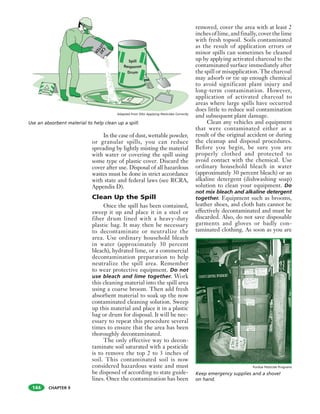
  • 93.
    CHAPTER 5 SYMPTOM RECOGNITION activeingredient, typically two years. The harmful effects that occur from small, repeated doses over time are termed chronic effects. A non-pesticidal example of chronic toxicity is the relationship between tobacco and lung cancer. Not everyone who smokes gets lung cancer. However, a significant number of people who smoke for years do get lung cancer. Another example of chronic toxicity is liver damage resulting from long-term exposure to moderate or high levels of alcohol. The suspected chronic effects from exposure to certain pesticides include genetic changes, non-cancerous or cancerous tumors, reproductive effects, infertility, fetal toxicity, miscarriages, birth defects, blood disorders, and nerve disorders. If a product causes chronic effects in laboratory animals, the manufac- turer is required to include chronic toxicity warning statements on the product label. This information is also listed on the MSDS. The chronic tox- icity of a pesticide is more difficult to determine through laboratory analysis than the acute toxicity. Delayed Effects Delayed effects are illnesses or injuries that do not appear immedi- ately (within 24 hours) after exposure to a pesticide. They may be delayed for weeks, months or even years. Whether or not you experience delayed effects depends on the pesticide, the extent and route of exposure(s), and how often you were exposed. Under “Precautionary Statements,” the label states any delayed effects that the pes- ticide might cause and how to avoid exposures leading to them. Wearing extra protective gear and taking addi- tional precautions may be necessary to reduce the risk of delayed effects. Delayed effects may be caused by either an acute exposure or chronic exposure to a pesticide. 78 Symptoms can be correlated with certain groups of pesticides. For example, borates (insecticides) tend to be irritating to the skin, nose, and respiratory system, while some fun- gicides are irritants to the skin, eyes, and mucous membranes of the respi- ratory system. Anticoagulant-type rodenticides may cause bloody noses and bleeding gums. Organophosphate and carbamate insecticides may cause all of the systemic symptoms listed (see sidebar on the next page) that could ultimately result in respiratory failure and death. Symptoms associated with synthetic pyrethroid insecticides include nausea, dizziness, weakness, nervousness, eye, and skin irritation. 2,4-D and some other related herbi- cides (dicamba, MCPA, and MCPP) are irritating to the skin and mucous membranes, and they can also cause vomiting, headaches, diarrhea, and confusion. Because symptoms of pesticide poisoning or exposure can vary widely, physicians need training to recognize this variability and treat appropri- ately. A manual entitled Recognition and Management of Pesticide Poisonings provides treatment guidelines for physicians to follow in the case of pes- ticide poisonings. This manual can be obtained through the EPA Office of Pesticide Programs or from the EPA Web site http://www.epa.gov/. Reference material for toxicological symptoms.
  • 94.
    PESTICIDE HAZARDS ANDFIRST AID Cholinesterase Inhibition Cholinesterase inhibition due to exposure to organophosphate or car- bamate insecticides can cause acute or delayed effects. Each person has a certain baseline level of cholinesterase enzyme that is considered normal for that individual. Organophosphate or carbamate exposure inhibits cho- linesterase, resulting in continual overexcitation of nerve-to-nerve and nerve-to-muscle communication. Large exposures to these insecticides can cause immediate illness. Smaller exposures may not outwardly cause symptoms, but small, repeated expo- sures over several days or weeks may continually reduce the body’s cholin- esterase level and ultimately trigger mild, moderate, or severe symptoms of overexposure. In the case of cholinesterase inhi- bition, it is not always obvious whether a worker is showing symptoms from an acute exposure or experiencing delayed effects from repeated exposures. For example, an applicator who is exposed to a single, large amount of an organo- phosphate may suffer acute effects. However, if over time the applicator is exposed to several small amounts, cho- linesterase levels are reduced slightly at each exposure. Eventually, a small additional exposure can cause illness. In this example, the illness sets in soon after an exposure, but only if there were previous repeated exposures. Cholinesterase Monitoring The blood cholinesterase test measures the effect of exposure to organophosphate and carbamate insec- ticides. Cholinesterase levels can vary considerably between individuals so a baseline must be established for each person. A small percentage of the popu- lation has a genetically determined low level of cholinesterase. Even minimal exposure to cholinesterase inhibitors can present a substantial risk to these people. Always conduct baseline testing during the time of year when insecticides are not being used or at least 30 days from the most recent exposure. Establishing an accurate baseline value often requires that two tests be performed at least 72 hours but not more than 14 days apart. If you are using organophosphate or carbamate insecticides, cholin- esterase tests can be periodically taken and results compa red w it h your previously established baseline level. Also, anytime you feel ill or have mild or moderate s y m p t o m s o f poisoning, your physician should conduct a blood test to evaluate your cholinesterase level and compare it with the baseline level. The purpose of rout i ne or emergency cholin- esterase monitoring is to enable a phy- sician to recognize the occurrence of excessive exposure to organophosphate a nd c a rba m ate insecticides. A sig- nificant reduction in your body’s cholinesterase level indicates poisoning. A physician nor- mally suggests that thepesticidehandler be removed from further exposure. A reduction in cholinesterase may require that you have no exposure for a certain period to allow your body time to build new cholinesterase. Your physician can help to establish the frequency of this testing program. Physicians who specialize in occupational and envi- ronmental medicine are most familiar with this type of testing program. 79 Mild poisoning • Fatigue • Headache • Dizziness • Blurred vision • Excessive sweating/salivation • Nausea and vomiting • Stomach cramps and diarrhea Moderate poisoning • Inability to walk • Weakness • Chest discomfort • Constriction of pupils • Mild symptoms more severe Severe poisoning • Unconsciousness • Severe constriction of pupils • Muscle twitching • Running nose and drooling • Breathing difficulty • Coma and death Common symptoms associated with organo- phospate and carbamate insecticide poisoning
  • 95.
    CHAPTER 5 Get medicaladvice immediately if you or any of your fellow workers have unusual or unexplained symptoms that develop within 24 hours of a pesticide exposure. Be alert for the early symptoms of pesticide poisoning and contact effects in yourself and others. Recognizing symptoms early and providing an immediate first-aid response may save a life or prevent permanent injury. Do not wait until you or someone else gets danger- ously ill before calling a physician or going to a hospital. It is better to be too cautious than to act too late. Take the pesticide label with you, either a duplicate copy or the one attached to the container (or at a minimum, the EPA registration number of the product). To avoid contamination and exposure, do not carry pesticides in the passenger space of the vehicle. The doctor needs to know the pesticide ingredients to determine the proper course of treatment. It is a good idea to print off extra copies of the label from the Internet and place one copy in your service vehicle and one in your office for use during medical emergencies. Remember, certain symptoms are not always the result of pesticide exposure. Common illnesses such as the flu, heat exhaustion or heat stroke, pneumonia, asthma, respiratory or intestinal infections, and even a hangover can cause similar symptoms. Contact with certain plants such as poison oak or poison ivy can also produce skin effects like those resulting from pesticide exposure. However, when symptoms appear after contact with pesticides, always seek medical attention immediately. General First-aid First aid is the initial effort to help a victim while medical help is on the way. If you are alone with the victim, make sure he/she is breathing and is not being further exposed to the pesticide before you call for emergency assistance. Protect yourself from pesticide exposure prior to and while giving assistance. Make sure you wear the appropriate personal protective equipment (PPE), including a respirator, before assisting someone in an enclosed area. Apply artificial respiration if the victim is not breathing and is not vomiting. Immediate action can indeed be a life-or-death matter in a pesticide poisoning. The product label is the primary source of information. Follow the label’s specific first-aid instructions carefully. In addition, call the National Poison Control Center (1-800-222- 1222) or a physician. First aid is only the first response and is not a substitute for professional medical help. It is very important to get the victim to a hospital without delay. The following are a few key points to remember when admin- istering first aid during a pesticide emergency: 80 National Poison Control Center 1-800-222-1222 (Staffed 24 hours) Animal Poison Control Center (APCC) 1-888-426-4435 National Pesticide Information Center (NPIC) 1-800-858-7378 FIRST AID FOR PESTICIDE POISONING Always bring the label with you when seeking medical advice for exposure symptoms.
  • 96.
    PESTICIDE HAZARDS ANDFIRST AID • If oral or dermal exposure has occurred, the first objective is usually to dilute the pesticide and prevent absorption. • Always have a source of clean water available. In an extreme emergency, even water from a farm pond, irrigation system, or watering trough could be used to dilute the pesticide. • Never try to give anything by mouth to an unconscious person. • If inhalation exposure occurs, get the victim to fresh air imme- diately. • Become familiar with the proper techniques of artificial respi- ration; it may be necessary if a person’s breathing has stopped or becomes impaired. • If there is a likelihood of first responders being directly exposed to a pesticide, be sure they wear appropriate PPE. In addition to the National Poison Control Center (it is staffed 24 hours each day); you can call the National Pesticide Information Center (NPIC). Located in Corvallis, Oregon, it pro- vides a variety of information about pesticides to anyone in the United States seven days per week from 6:30 a.m. to 4:30 p.m. Pacific time (1-800- 858-7378; http://npic.orst.edu). Post all emergency numbers by the telephone and in service vehicles involved in han- dling pesticides. Pets, horses, and other livestock can also be poisoned by exposure to pes- ticides. Emergency information on the treatment of pets or livestock harmed by pesticide contamination or poisoning can be obtained by contacting the Animal Poison Control Center (APCC) at 1-888-426-4435. Pesticide on the Skin Proper hygiene helps to protect the skin from pesticide exposure. Always have an adequate water supply with you anytime that skin exposure is possible. • Remove all contaminated clothing immediately. • Wash the affected area, including the hair, with water and soap, then rinse well. Use of a shower is best. Avoid harsh scrubbing, which enhances pesticide absorption. • Gently dry the affected area and wrap it in loose cloth or a blanket, if necessary. • If the skin has chemical burns, cover the area loosely with a clean, soft cloth. Avoid using oint- ments, greases, powders, and other medications unless instructed to do so by a medical authority. It is often best to dispose of con- taminated clothing, especially if there is any concern about getting the contami- nated clothing clean. Place it in a plastic bag, seal the bag and write on the bag the name of the material that contaminated it. Take it to a household hazardous waste collection. If you decide to keep the clothing, store and wash it separately from the family laundry. Pesticide in the Eye Because the eyes readily absorb material that gets into them, fast action is required. • Hold the eyelid open and imme- diately begin gently washing the eye with drips of clean water. Do not use chemicals or drugs in the wash water unless instructed to do so by a physician or a poison control center. • Drip the water across the eye, not directly into the eye, or use an eyewash dispenser. • Continuously rinse the eye for 15 minutes. If only one eye is involved, be careful not to con- taminate the other eye. 81 PESTGO Washing your hands with water and soap after using pesticides prevents skin contamination.
  • 97.
    CHAPTER 5 • Flushunder the eyelids with water to remove debris. • Cover the eye with a clean piece of cloth and seek medical attention immediately. Inhaled Pesticide The basic first-aid procedure for someone who has inhaled a pesticide is to get the exposed person to fresh air. • Immediately carry the victim to fresh air (do not allow the victim to walk). • Do not attempt to rescue someone who is in an enclosed, contaminated area unless you are wearing appro- priate PPE. • If other people are in the area, warn them of the danger. • Have the victim lie down and loosen clothing. • Keep the victim warm and quiet. Do not allow him/her to become chilled or overheated. • If the victim is convulsing, protect the victim’s head and watch that breathing continues. • Keep the person’s chin up to ensure that air passages are open for breathing. • If breathing stops or is irregular, give artificial respiration. Pesticide in the Mouth or Swallowed If pesticide has gotten in the mouth but has not been swallowed, rinse the mouth with plenty of water. After the mouth has been thoroughly rinsed, give the victim large amounts (up to 1 quart) of milk or water to drink. If the pesticide is swallowed, one of the most critical first-aid decisions is whether to induce vomiting. Induce vomiting only if the label instructs to do so. Several pesticides cause more harm when vomited than if they remain in the stomach. To provide first aid for a swallowed pesticide, you must know the appropriate treatment. The decision to induce vomiting must be made quickly and accurately—the victim’s life may depend on it. Never induce vomiting if the victim: • Is unconscious or having convul- sions. • Has swallowed a corrosive poison, such as a strong alkali or acid. The material burns the throat and mouth as severely coming up as it did going down. Also, it can be aspirated into the lungs and cause more damage. • Has swallowed an emulsifiable concentrate or oil solution product, which is dissolved in petroleum solvents. Emulsifiable concentrates and oil solutions may cause death if aspirated into the lungs during vomiting. How to Induce Vomiting Induce vomiting only as a first-aid measure until you can get the victim to a hospital. Do not waste a lot of time attempting to induce vomiting. • Make sure the victim is kneeling forward or lying on his side to prevent vomit from entering the lungs and causing additional damage. • First give the victim at least 2 glasses of water to dilute the product. Do not use carbonated beverages. • To induce vomiting, put your finger or the blunt end of a spoon at the back of the throat. Do not use anything sharp or pointed. Do not use salt water to induce vomiting. • Collect some of the vomitus for the doctor, who may need it for chemical analysis. Activated charcoal is another first- aid treatment that can be administered when a pesticide has been swallowed. Give the patient 2 to 4 tablespoons of activated charcoal in at least 8 ounces of water. Activated charcoal acts as a magnet to adsorb many chemicals. Pharmaceutical grade activated charcoal is available from most drug 82
  • 98.
    PESTICIDE HAZARDS ANDFIRST AID stores. Activated charcoal prepared for cleaning up pesticide spills may be substituted in an emergency. Take the victim to a physician or hospital. Only general first-aid practices have been discussed here. Contact the Poison Control Center for further assistance in administering first-aid. If necessary, get the victim to a doctor or hospital, and take the pesticide label with you. Antidotes Antidotes are available for only a few classes of pesticides — antico- agulant-type rodenticides and the organophosphate or carbamate insec- ticides. Antidotes can be extremely dangerous if misused, so they should be prescribed and administered only by a qualified physician. Antidotes should never be used to prevent poisoning. Atropine sulfate. This antidote is given for carbamate insecticide poisoning. The need and dosage are based on the body weight of the victim. It is always given alone for carbamate poisoning. It can be given repeatedly as symptoms reoccur. Atropine sulfate in combination with 2-PAM (protopam chloride). This antidote combination is given for organophosphate insecticide poisoning. The combination actu- ally helps to reactivate cholinester- ase in organophosphate poisoning cases; reactivation does not occur with atropine treatment for car- bamate poisonings. Vitamin K1. This antidote is used for treating exposures to anticoagulant rodenticides. Anticoagulant roden- ticides cause internal bleeding and prevent blood clotting. Vitamin K1 helps restore the ability of the blood to clot normally. 83 HEAT STRESS Note: Ipecac syrup, used as an emetic for almost 50 years, is no longer recommended for routine use in most poisonings. Clinical studies have demon- strated no benefit from its use. Ipecac works too slowly (about 20 minutes) in inducing vomiting and results in only about one- third of stomach contents being voided. Heat stress occurs when the body is subjected to a level of heat with which it cannot cope. Heat stress can affect both pesticide handlers and workers. With heat stress, the heat, not pesticide exposure, causes certain symptoms. PPE worn during handling or early-entry activities can increase the risk of heat stress. The protective qualities of the PPE may restrict the evaporation of sweat, thus impeding the body’s natural cooling system. If you are under a physician’s care, consult your physician before working in hot or humid condi- tions. Special PPE is available to assist in maintaining a cool body temperature. Symptoms of Heat Stress Mild forms of heat stress make people feel ill and impair their ability to do a good job. You may feel weak and get tired sooner than usual. In addition, you may be less alert and less able to use good judgment. Severe heat stress, also known as heat stroke, is life-threatening. The normal body temperature is 97.7 degrees F. With heat stroke, body tem- perature may exceed 105 degrees F. Staggering, unconsciousness, or con- vulsions may result. Lack of sweating is a common symptom of heat stroke. Brain damage or even death can occur if the heat stroke victim is not cooled down quickly. More than 10 percent of severe heat stress victims die, including young, healthy adults. Sometimes victims remain highly sensitive to heat for months and are unable to return to the same work. Heat stress symp- toms include: • Fatigue (exhaustion, muscle weakness). • Dizziness and fainting. • Clammy skin or hot, dry skin. Avoid heat stress by taking breaks and drinking water throughout the workday.
  • 99.
    CHAPTER 5 • Alteredbehavior—confusion, slurred speech, quarrelsome, irrational. • Headache, nausea, and chills. • Severe thirst and dry mouth. • Heavy sweating or complete lack of sweating. Learn more about symptoms of heat stress and take immediate action to cool down if you suspect you may be suffering from even mild heat stress. Drink plenty of water and take breaks in the shade throughout the workday. SUMMARY 84 Pesticide risk can be summarized by the formula hazard=toxicity x exposure, where “toxicity” is the capacity of the pesticide to cause short-term (acute) or long-term (chronic) injury or illness and “exposure” is the means by which the pesticide gets into or onto the body. These two factors determine the like- lihood that harm (i.e., hazard) will occur to the individual who handles pesticides. Pesticide users can reduce the chances of acute or chronic injury by taking measures to prevent exposure. Harmful effects of pesticides may occur by direct contact, by uptake into the body (i.e., systemic effects and by allergic reactions). These risks can be reduced by understanding pesticide exposure routes, ways by which pesti- cides can enter or contact the body: by the skin (dermal), eyes, mouth (oral), and the lungs (inhalation). Pesticide handlers can prevent exposure by following label directions, using the proper application techniques, and wearing appropriate PPE. Another way to reduce risk is to use the least toxic pesticide that will do the job, thereby reducing the risk of acute injury. In some cases, it may be better to choose a more toxic pesticide that can be used less frequently, thus reducing the risk of chronic injury or illness. The toxicity of a pesticide product is measured by the LD50 and the LC50 values. These values determine the type of signal word that occurs on a pesticide label. Signal words—DANGER— POISON, DANGER, WARNING, and CAUTION—help the user recognize how toxic the pesticide is and what pre- cautions to take. Pesticide handlers need to be aware of the symptoms of pesticide poisoning to know when to seek medical attention. Not all symptoms occur immediately following a pesticide exposure. Some symptoms are the result of chronic exposure (i.e., small, repeated doses over time). People who use pesticides routinely should have regular medical checkups to determine if they are expe- riencing any ill effects from pesticide use. For example, measuring blood cholinesterase is one way to determine if certain insecticides are affecting an indi- vidual before symptoms appear. People affected by chronic toxicity must remove themselves from the exposure situation. Early recognition of symptoms of pesticide poisoning is the key to pre- venting the potential for further injury. Victims of single, acute toxic exposures must be assisted and taken to a doctor or hospital immediately following any necessary first-aid procedures. The first- aid methods used depends on how the exposure occurred—to the skin, eyes, or mouth, or by inhalation. The label often has important information on first-aid procedures for the particular pesticide product. Make sure a copy of the label is readily available whenever you are using pesticides, and take the label to the phy- sician if a poisoning incident occurs.
  • 100.
    REVIEW QUESTIONS 85 1.The capacity of a pesticide to cause short-term (acute) or long-term (chronic) injury is referred to as its: A. Toxicity. B. Exposure. C. Hazard. D. Oral LD50. 2. Which statement is false about harmful effects of pesticides? A. The most common form of pesticide injury is by inhalation. B. Fumigants can cause severe blisters. C. Asthma-like symptoms may be caused by allergies to pesticides. D. Many herbicides and fungicides cause dermatitis. 3. Which signal word is associated with Hazard Class I and chemicals that have severe corrosive properties but do not necessarily have very low oral LD50 values? A. DANGER—POISON. B. DANGER. C. WARNING. D. CAUTION. 4. Which statement is true about pesticide toxicity? A. A pesticide with an oral LD50 of 250 mg/kg is more toxic than a pesticide with an LD50 of 5 mg/kg. B. Manufacturers are not required to include chronic toxicity warning statements on product labels; only acute toxicity warnings are included. C. Delayed effects occur only after a single acute toxicity exposure. D. Cholinesterase inhibition due to exposure to organophosphate or carbamate insecti- cides can cause acute or delayed effects. 5. What is the purpose of routine or emergency cholinesterase monitoring? A. To enable a physician to recognize the occurrence of excessive exposure to organo- phosphate and carbamate insecticides. B. To enable a physician to recognize the occurrence of excessive exposure to pyrethroid insecticides. C. To enable the pesticide handler to know when to stop using pesticide products dur- ing the course of a normal workday. D. To enable the pesticide handler to know when he/she has been overexposed to restricted-use pesticides. 6. When should a blood test for baseline cholines- terase be done? A. Baseline testing should be done during the time of year when pesticide use is the greatest and at least 14 days into the application season. B. Baseline testing should be done during the time of year when pesticides are not being used or at least 30 days from the most recent exposure. C. Baseline testing should be done during the time of year when pesticides are not being used or within one week of the most recent exposure. D. Baseline testing should be done about halfway through the application season to measure the average amount of pesticide exposure. Write the answers to the following questions, and then check your answers with those in the back of this manual. CHAPTER 5: PESTICIDE HAZARDS AND FIRST AID Review Questions
  • 101.
    7. Which statementis true about pesticide expo- sure routes? A. Oil-based liquid pesticide formulations, such as emulsifiable concentrates, do not absorb through the skin. B. Evidence indicates that about 97 percent of all body exposure to pesticides during a spraying operation is by inhalation. C. Some products that cause systemic injury are as toxic when absorbed through the skin as when they are swallowed. D. The palms and forearms absorb more pesti- cides than the warm, moist areas of the body. 8. Which statement is false about first-aid response for pesticide exposure to the eye? A. Hold the eye open and immediately begin gently washing the eye with drips of clean water. B. The water should be dripped directly into the eye, don’t use an eyewash dispenser. C. Continuously rinse the eye for 15 minutes. D. Flush under the eyelid with water to remove debris. 9. What is the first thing you should do to help a victim of inhalation exposure? A. Get the victim to fresh air. B. Administer artificial respiration. C. Have the victim lie down and loosen clothing. D. Keep the chin up to ensure that air passages are open for breathing. 10. Which statement is true about heat stress? A. Wearing lots of PPE prevents heat stress. B. Constriction of pupils is a symptom of heat stroke. C. Less than 10 percent of people affected by severe heat stroke die. D. Lack of sweat is a symptom of heat stroke. 86 CHAPTER 5
  • 102.
    PERSONAL PROTECTIVE EQUIPMENT PERSONALPROTECTIVE EQUIPMENT Pesticides can pose hazards to humans. Remember, hazard depends on the prod- uct's toxicity and length of exposure. The severity of a pesticide poisoning depends on the pesticide’s chemical makeup and formulation, its path into the body, the amount that enters the body, and the length of exposure. Wearing PPE can greatly reduce the potential for dermal, inhalation, eye, and oral exposure, and thereby signifi- cantly reduce the chances of a pesticide poisoning. “PPE” refers to clothing and devices worn to protect the human body from contact with pesticides or pesticide residues. PPE includes such items as coveralls or protective suits, footwear, gloves, aprons, respirators, eyewear, and headgear. PPE reduces exposure but does not necessarily eliminate it. All pesticide handlers — ap- plicators, mixer/loaders, flaggers, etc. — and early-entry agricultural workers are legally required to follow all PPE instructions that appear on the product label. A pesticide label lists After studying this chapter, you should: • Know how to identify the minimum personal protective equipment (PPE) required during pesticide application to be in compliance with regulations. • Know how to select and wear safety equipment (e.g., gloves, boots, eye protection) according to label directions and regulations considering the length of exposure, exposure situation, and chemical to which one is exposed. • Know how to select and properly wear PPE for protection of skin, eyes, and respiratory tract. • Understand the importance of selecting, fit testing, and wearing respiratory devices (e.g., respirators, self- contained breathing apparatus) according to label directions and regulations. • Know how to inspect for signs of wear and tear, damage, or other failures to PPE that may lead to exposure. • Know when and how to dispose of personal protective equipment. • Know how to clean, maintain, and store personal protective equipment according to manufacturers’ recommendations. LEARNING OBJECTIVES equipment pliance with oves, e e, 87 CHAPTER 6
  • 103.
    CHAPTER 6 The term“chemical resistant” means that no measurable movement of the pesticide through the material occurs during the period of use. Some PPE is water resistant only. “Water resistant” refers to PPE that keeps a small amount of fine spray particles or small liquid splashes from penetrating the clothing and reaching the skin. Waterproof (liquidproof) material keeps water-soluble materials out, but it may not necessarily keep out oil solvent- based products. Waterproof materials include items made of plastic or rubber. Some materials are actually chemically resistant. The chemical resistance of a material is an indication of how strongly it resists chemical penetration by pesticide products during use. Read the PPE packaging care- fully to determine whether the protective item is chemical resistant, liquidproof, or water resistant. When making a decision about which pro- tective equipment to use, follow these general guide- lines. Cotton, leather, canvas, and other absorbent materials are not chemically resistant even to dry formulations. Powders and dusts sometimes move through cotton and other woven materials as quickly as liquid formulations. Also, they may remain in the fibers even after several launderings. Do not use a hat that has a cloth or leather sweatband, and do not use cloth or cloth-lined gloves, footwear, or aprons. Cloth is difficult or impossible to clean after it becomes contaminated with pesticide, and it is usually too expensive to be disposed of and replaced after one use. Gloves, boots, aprons, suits, and hoods come in a variety of chemical- resistant materials. Generally, the best choices of materials are plastics, such as polyvinyl chloride (PVC); rubber, such as butyl, nitrile, neoprene, or vitron rubber; or non-woven fabrics coated with plastic or another barrier material such as Tyvek®. Barrier laminate mate- rials such as 4H® or Silver Shield® are resistant to most pesticides, but many pesticide handlers consider them uncomfortable to wear and difficult to use while performing many tasks. The ability of a given material to protect an individual from a pesticide product is largely a function of the type of solvent used to formulate the pesticide product. Watch for signs that the material is not chemically resistant to the pesticide product that you are using. Sometimes it is easy to see when plastic or rubber is not resistant to a pesticide. The material may change color, become soft or spongy, swell or bubble up, dissolve or become like jelly, crack or get holes, or become stiff or brittle. If any of the changes occur, discard the item and choose another type of resistant material. Always read the pesticide labeling to see if it states which materials are resistant to the pesticide product. In some instances, a pesticide label’s PPE the minimum PPE that a person must wear while performing handling or early-entry activities. If the label does not require PPE or requires only one or two pieces of PPE, a cautious handler may decide to wear additional PPE for increased safety. Sometimes a label has different PPE requirements for pesticide handlers and early- entry workers. In addition, many states have specific labor laws and rules that regulate access to, training with, and use of PPE. PPE offers various levels of pro- tection, depending on the type of resistant material used. Some items of PPE simply act as filters by keeping dry or spray material off the skin. Others offer better protection against water-based products. Some offer protection from chemicals (solvent and/or active ingredient) that makeup aconcentrated pesticideproduct. PPE must be comfortable to ensure that people wear it and wear it properly. This chapter describes the types of PPE that are typically available for protection against pesticide exposure. CHEMICAL-RESISTANT CLOTHING Clothes made of cotton, leather, or canvas are not chemically resistant, even to dry formulations. Wearing appropriate types of personal protective equipment (PPE) can greatly reduce the risk of pesticide exposure. 88
  • 104.
    PERSONAL PROTECTIVE EQUIPMENT descriptionlists a code letter (A-H) developed by EPA to help the user select suitable PPE. The EPA Chemical Resistance Category Selection Chart is given in Table 6.1. The chart’s code letters are based on the solvents used in a pesticide product, NOT the pesticide’s active ingredient. By referring to this chart, a pesticide handler can determine how long a given material can be expected to withstand chemical exposure by a given solvent. Table 6.1 EPA Chemical Resistance Category Selection Chart 89 Barrier laminate Butyl rubber ≥14 mils Nitrile rubber ≥14 mils Neoprene rubber* ≥14 mils Natural rubber ≥14 mils Poly- ethylene Polyvinyl chloride (PVC) ≥14 mils Vitron ≥14 mils A Dry & water-based formulations high high high high high high high high B high high slight slight none slight slight slight C high high high high moderate moderate high high D high high moderate moderate none none none slight E high slight high high slight none moderate high F high high high moderate slight none slight high G high slight slight slight none none none high H high slight slight slight none none none high * Includes natural rubber blends and laminates. High: Highly chemically resistant. Clean or replace PPE at end of each day’s work period. Rinse off pesticide at breaks. Moderate: Moderately chemically resistant. Clean or replace PPE within an hour or two of contact. Slight: Slightly chemically resistant. Clean or replace PPE within 10 minutes of contact. None: Not chemically resistant. Do not wear this type of material as PPE when contact is possible. Type of Resistant Material Selection category on label
  • 105.
    CHAPTER 6 For example,if a certain pesticide label states that the user should choose gloves based on the guidelines in Category E, then select only gloves made from barrier laminate, nitrile rubber, neo- prene rubber, or vitron. These materials would be expected to give protection for one or more days. Polyethylene gloves and natural and butyl rubber gloves would be expected to provide protection for only 10 minutes or less. Different materials that are resistant to a particular pesticide do not necessarily provide protection for the same amount of time. Some materials restrict pesticide entry for a fairly long time, while others allow the pesticide to penetrate the PPE fairly quickly. Thin materials, such as disposable plastic gloves, shoe covers, or aprons, may provide the necessary protection for short-term tasks (taking a few minutes), but longer jobs usually require heavier material. Chemical resistance is often stated in exposure time. For example, neoprene is resistant to acetone for 30 minutes or less, and resistant to diesel fuel for more than 4 hours. If you wear neo- prene gloves while handling pesticides containing an acetone solvent, change the gloves at least every 30 minutes or the pesticide product (acetone plus active ingredients) might penetrate the gloves and get onto your hands. Check the PPE manufacturer’s brochure for information on the allowable length of exposure to specific chemicals. Another factor to consider is the exposure situation. Chemical-resistant materials do not protect you when they become damaged during the pesticide- handling task. For tasks that involve handling sharp or pointed objects or walking through rough terrain, select a heavy-duty or sturdy material to ensure chemical resistance. 90 PROTECT YOUR SKIN Your skin usually gets the most exposure while handling pesticides. Pay particular attention to covering as much of your skin as possible. Remember that PPE protects you only if the pesticide remains on the outside of the protective clothing. If the pes- ticide gets inside next to your skin, the protective clothing works against you. It then holds the pesticide tightly against your skin as long as you wear the PPE. This increases the likelihood for contact injury or skin absorption and systemic injury. Work Clothes Ordinary shirts, pants, shoes, and other work clothes are usually not considered PPE, even though pes- ticide labels often indicate that specific items of work clothing should be worn during certain activities. Anytime you handle pesticides or work around pes- ticide residues, wear, at a minimum, a long-sleeved shirt, long pants, and socks. Make sure the long-sleeved shirt and long pants are made of sturdy material and are free of holes and tears. Fasten the shirt collar completely to protect the lower part of your neck. The tighter the fabric weave, the better the protection. In some instances, the product label requires that you also wear a coverall, a chemical-resistant suit, or a chemical-resistant apron over your work clothes. Coveralls The protection offered by chemical-resistant clothing depends on the fabric and design features such as flaps over zippers, elastic at the wrists and ankles, and seams that are bound and sealed. Make sure coveralls are made of sturdy material such as cotton, polyester, a cotton-synthetic blend, denim, or a non-woven fabric such as Tyvek®. When wearing a coverall, close the opening securely so the entire body (except the feet, hands, neck, and head) is covered. When wearing a two-piece outfit, do not tuck the shirt or coat in at the waist—have the shirt extend well below the waist of the pants and fit loosely around the hips. Wear a coverall over a long-sleeved shirt, long At a minimum wear a long-sleeved shirt, long pants, and socks when working around pesticides.
  • 106.
    PERSONAL PROTECTIVE EQUIPMENT pants,and socks when handling pes- ticides that exhibit moderate or high dermal toxicity or are skin irritants. Several factors determine how well a coverall protects you. First, the coverall needs to fit loosely. Each layer of clothing and each layer of air between the pesticide and your skin provide added protection. That is why the coverall needs to fit loosely. If the coverall fits too tightly, there is not a layer of air between it and your skin, and any pesticide that gets through the coverall comes in direct contact with your skin. The design and structure of the coveralls also affects how well they protect you. Well designed coveralls have tightly constructed, sealed seams and snug, overlapping closures that do not allow gaps and do not unfasten readily. For example, many coveralls have zippers that are covered by flaps for added protection. This type of con- struction makes it harder for pesticides to get through these areas and come into contact with your inner clothing or skin. Some coveralls, such as those made of Tyvek®, are water resistant and disposable. Chemical-resistant Suit Some product labels require the handler to wear a chemical-resistant suit. This usually indicates the pes- ticide is very hazardous because of either acute or delayed effects. In these instances, take extra care to prevent the pesticide from getting on you. If you expect that a large amount of pesticide could be deposited on your clothing over an extended period of time, wear a chemical-resistant suit even if the product label does not require it. Under these circumstances, even pesti- cides that are applied dry, such as dusts or granules, can get through ordinary fabric and may harm you. Chemical-resistant suits made of rubber or plastic are sold as one-piece coveralls or as two-piece outfits con- sisting of a jacket worn over overalls. Chemical-resistant suits made of coated non-woven fabric usually are sold as one-piece coveralls. The biggest drawback to chemical- resistant suits is they may make you uncomfortably warm. Unless you are handling pesticides in cool or climate- controlled environments, heat stress becomes a major concern. Take extra care to avoid heat stress by drinking plenty of water and taking frequent rest breaks to cool down. Chemical-resistant Apron An apron protects you from splashes, spills, and billowing dust, and it pro- tects your coveralls or other clothing. Consider wearing an apron whenever you handle pesticide concentrates. The product label may require that you wear a chemical-resistant apron when mixing or loading a pesticide or cleaning appli- cation equipment. Choose an apron that extends from your neck to at least your knees. Some aprons have attached sleeves and gloves. This style of apron protects your arms and hands and the front of your body by elimi- nating the potential gap where the sleeve and glove or sleeve and apron meet. However, an apron can pose a safety hazard when you are working around equipment with moving parts. If an apron can get caught in machinery or get in your way, wear a chemical-resistant suit instead. Gloves and Footwear Pesticide handlers get, by far, the most exposure from pesticides on their hands and forearms. Research has shown that workers mixing pesticides received 85 percent of the total exposure to the hands and 13 percent to the forearms. The same study showed that wearing chemical- resistant gloves reduced exposure by 99 percent. As a result, most product labels require use of waterproof or chemical-resistant gloves during 91 A well-designed coverall makes it hard for pesti- cides to get through to your inner clothing or skin. Jack Kelly Clark, University of California Statewide IPM Program Jack Kelly Clark, University of California Statewide IPM Program Choose a chemical- resistant apron that extends from your neck to at least your knees.
  • 107.
    CHAPTER 6 handling andmixing activities. Do not wear lined gloves because the lining can absorb pesticides. Wear gloves anytime you might get pesticides on your hands, such as when working around contaminated equipment or other contaminated surfaces. Pesticide handlers often get pes- ticides on their feet. Sturdy shoes and socks are sufficient to protect your feet during many handling activities. Canvas and leather shoes are inappropriate when using pesticides because these materials absorb pesticides easily and cannot be decontaminated. Use waterproof or chemical- resistant footwear when handling pesticide con- centrates or making applications, or when residues pose a high hazard to your feet. Some product labels require that you wear waterproof or chemical- resistant footwear, which could mean shoe covers or boots. If a pesticide is likely to get on your lower legs or feet, wear chemical- resistant boots that extend past your ankle and at least halfway up to your knee. Wearing waterproof boots is especially important if you enter or walk through treated areas before the spray has dried, such as pesticide appli- cations made to lawns. Some formulations may require specific types of gloves and footwear. Do not wear gloves or footwear when handling certain fumigants, such as methyl bromide. The gloves and footwear can trap the fumigant gas near the skin and cause burns. Other fumigants, such as aluminum and mag- nesium phosphide, specify gloves made of cotton or a similar material be worn when handling the product. Like other pesticides, fumigant labels specify the appropriate PPE required to protect the applicator from exposure. Wear gloves and footwear cor- rectly. Make sure that you choose gloves and footwear appropriate for the pes- ticide being handled. Always start out with new or freshly cleaned gloves and footwear that are in good condition. Do not grab a pair just because they are handy—they may not have been properly cleaned and may still have pesticides on or in them. If pesticide gets inside your gloves or footwear, take them off immediately, wash your hands or feet, and put on clean pro- tective equipment. Keep several pairs of gloves and footwear available and change to a clean set whenever they become damaged or you suspect the inside has become contaminated. Avoid contaminating the inside of gloves and footwear. Contamination often occurs when applicators remove their gloves during an application to adjust the equipment or their PPE, open a pesticide container, or wipe their faces, and then replace the gloves over their contaminated hands. If you must remove your gloves during a handling activity, wash your gloves thoroughly before taking them off, wash your hands thoroughly and dry them before you touch anything, and put the gloves on again when you return to work. Another common mistake is putting on footwear with contaminated hands, thereby trans- ferring pesticides from your hands to your feet and socks. Be careful not to allow pesticides to run down your sleeves into your gloves. For jobs in which your arms are mostly lowered, place sleeves outside the gloves. Use gloves that go up over your wrist and at least halfway to your elbow. For jobs in which your arms are mostly raised, leave your gloves outside your sleeves. Fold the cuff of cannot b wate re h r w resis could m b If 92 Figure 6.1 Farmers who wore gloves while applying pesticides reduced their risk of exposure (The Farm Family Exposure Study, John Acquavella). Nitrile and rubber gloves. Edward Crow, Maryland Department of Agriculture
  • 108.
    PERSONAL PROTECTIVE EQUIPMENT yourgloves up 1 or 2 inches toward your fingers to catch the pesticide before it runs down your arm. For many jobs, you will be working some of the time with your arms raised and some of the time with them lowered. In these cases, close the glove cuff tightly outside the sleeve and put heavy-duty tape or an elastic band around the end of the glove where it meets the sleeve (see Figure 6.2). Some gloves have a method of tightening the cuff to your sleeve so the pesticide cannot run down into the glove. Take care so pesticides do not run down your pant legs and into your footwear. Put your pant legs outside your boots to prevent this from occurring. Hats For overhead exposure or exposure to a lot of airborne particles, wear something to protect your head and neck, such as a wide-brimmed hat or chemical-resistant hood. Plastic safari hats with plastic sweatbands are a good choice because they are relatively cool in hot weather. More flexible hats and hoods are also available in chemical- resistant materials. Hats must not contain absorbent material such as cotton, leather, or straw.Manychemical-resistant jackets or coveralls can be purchased with attached pro- tective hoods. 93 PROTECT YOUR EYES Eyes are very sensitive to the chem- icals contained in some pesticide formulations, especially concentrates. Eyes readily absorb pesticides. Some product labels require a handler to wear protective eyewear. Goggles, a faceshield, or safety glasses with shields at both the brow and sides are examples of protective eyewear. Some labels specify that a particular type of eye protection must be worn. People who wear contact lenses should consult an eye doctor or their physician before using pesticides. Shielded safety glasses and full faceshields are good choices in many handling situations because they are comfortable, do not cause fogging or sweating, and give good eye pro- tection. Faceshields that are cupped inward toward your throat give better protection from splashes than straight faceshields. Wear goggles that fit tightly against your face if you will be in an open cab during an air-blast application; flagging directly under an aerial application; applying mists, fogs, or aerosols indoors; or in any other sit- uation in which you will be enveloped in a spray, mist, or dust. Select goggles made of polycarbonate that have pro- tected air baffles to avoid fogging. Either goggles or shielded safety glasses can be worn with a half-face respirator. Full-face respirators are supplied with their own faceshields, so additional eye protection is not required. Under the agricultural Worker Protection Standard, if the label requires goggles for eye protection, then the handler must have immediate access to an eyewash dispenser at all times. Eyewashes can be portable or set in a fixed location such as an eyewash station in a greenhouse. Any user han- dling pesticide products that require goggles should have an eyewash readily available. If a pesticide gets past the goggle’s protection, you do not have time to look for clean water to flush your eyes. Carrying an eyewash dis- penser with you is recommended because some corrosive and irritant products can cause injury within a few seconds. ewash dis mended and e Figure 6.2 Wear gloves according to how you are applying the pesticide: (1) sleeves over gloves for jobs where your hands are mostly lowered, (2) gloves outside your sleeves with cuff folded up 1 or 2 inches when spraying above your head, and (3) cuffed tightly outside the sleeve with heavy-duty tape or an elastic band when working with your arms both raised and lowered. Chemically resistant splash-proof goggles help protect your eyes from pesticide exposure. Virginia Tech Pesticide Programs
  • 109.
    CHAPTER 6 The respiratorytract consists of the lungs and other parts of the breathing system. It is much more absorbent than the skin. Even if a pes- ticide label does not require it, consider wearing a respirator if you are handling any product for which the label states “do not breathe vapors or spray mist” or “harmful or fatal if inhaled.” In addition, wear a respirator if you will be exposed to any pesticide that can potentially be inhaled. Some fumigants and a few other pesticide formulations contain a chemical warning additive in the product formulation that alerts you when you begin to inhale the pesticide. Such warning agents are often used when the pesticide active ingredient is highly toxic but is not easily detected by smell. The additive may have a characteristic odor or it may be a mild irritant to alert you that you need leave the area or to put on a respirator, or to warn you that your respirator is no longer protecting you. The federal Occupational Safety and Health Administration (OSHA) has regulations for a respiratory protection program. The following eight elements are required for all users of respirators, including pesticide handlers: 1. Procedures to select the proper respirator for your worksite or job. 2. Medical evaluation to determine ability to use a res- pirator. 3. Fit testing for tight-fitting res- pirators. 4. Proper use of respirators. 5. Care and maintenance of res- pirators. 6. Breathing air quality and use for supplied-air respirators. 7. Training on hazard recog- nition, dangers, and proper use and care of respirators. 8. Program evaluation on res- pirator fit, selection, use, and maintenance. Most states have adopted the OSHA respirator standard into state law. Respirators Respirators protect you from breathing pesticide-contaminated air. Various pesticide formulations require different types of respirators. The product label states whether you must use a respirator and, if so, which type. A respirator is a safety device that covers at least the mouth and nose. Two major groups of respirators are used when dealing with pesticides—air-sup- plying and air-purifying respirators. Air-supplying respirators provide clean, uncontaminated air from an outside source. They are used in low- oxygen environments and are generally more expensive. Often their big and bulky size puts a strain on the worker. Air-purifying respirators use physical and chemical filters to trap and remove contaminants as they pass through the respirator with the air being breathed by the wearer. The pesticide label provides guidance on which type of filters or car- tridges to use. Adequate oxygen must be present in the air that is being breathed because an air-purifying respirator does not supply oxygen; it only filters the air that is being breathed. Air-purifying devices may be powered or non-powered. The powered air-purifying respirators use a blower to move the contaminated air through a purifying filter and can be used with either a tight-fitting facepiece or a loose-fitting hood. The non-powered devices can be either half-mask or full- face devices that place a filtration unit 94 PROTECT YOUR RESPIRATORY TRACT Supplied-air respirator. Self-contained breathing apparatus (SCBA). Air-supplying respirators Supplied-air respirator Self-contained breathing apparatus (SCBA) Air-purifying respirators Non-powered particulate respirators (filtering facepiece, dust/mist mask) Powered particulate respirators Chemical cartridge respirators (half facemask and full facemask) Gas masks with canisters Types of Respirators
  • 110.
    PERSONAL PROTECTIVE EQUIPMENT betweenyour breathing passage and the contaminated air source. Filters and cartridges are chemical specific or dust/ mist specific. A combination chemical and dust/mist cartridge is also available. When handling some pesticides, an organic (OV) cartridge is required. The components of a typical non-powered air-purifying respirator are a snap-on retainer, a prefilter, an air-purifying cartridge, a facepiece that contains an exhalation valve, and a harness. The National Institute for Occupational Safety and Health (NIOSH) is the federal agency respon- siblefortestingandcertifyingrespirators used in conjunction with pesticides (and other non-mining respiratory pro- tection). Approval numbers beginning with the letters TC are assigned to all respirators reviewed by the agency and must be on the box containing the facepiece. Pesticide product labels often specify the type of respirator required by listing its TC number. In addition, filters are classified on the basis of oil degradation resistance and filter effi- ciency. The classification levels for oil degradation resistance are N—not oil resistant; R—oil resistant; and P—oil proof. The filter efficiency for each classification level may be 95, 99, or 100 percent. The following is a list showing several types of respirators and their TC code designations under the NIOSH classification system: • TC–84A — non-powered par- ticulate respirators (N, P, and R filters). • TC–21C—powered particulate respirators only (100 series filters). • TC–23C — chemical cartridge respirators. • TC–14G — gas masks with canisters. • TC–19C—supplied-air respirators. • TC–13F—self-contained breathing apparatus. The product formulation, toxicity, andtypeofapplicationinfluencethetype of respirator needed. Manufacturers use criteria approved by the EPA to assign 95 Powered particulate respirator (TC-21C). Half facemask chemical cartridge respirator (TC-23C). Components of a typical non-powered air-purifying respirator include a snap-on retainer, a prefilter, an air-purifying cartridge, and a facepiece with exhalation valve and harness. Full facemask chemical cartridge respirator (TC-23C). Gas mask with canister (TC-14G). n d tion arness. Non-powered particulate (filtering facepiece) respirator (TC- 84A; N, R, or P filters; 95, 99, or 100% efficiency). Adapted from University of Illinois Private Applicator manual Edward Crow, Maryland Department of Agriculture
  • 111.
    CHAPTER 696 PPE respiratorrequirements on labels (see Table 6.2). When a pesticide label requires a respirator, wear a NIOSH- approved respirator for use with that particular pesticide. Remember, a single type of respirator does not adequately protect you from every pesticide or for- mulation that you may use. Filtering facepiece respirators or non-powered particulate respirators (TC–84A) are dust/mist-filtering respi- rators. They offer protection from small particles in the air. They cover the nose and mouth to filter out dusts, mists, powders, and particles. They are to be disposed of after each use. Chemical cartridge respirators (TC–23C) and gas masks with canisters (TC–14G) absorb harmful vapors or gases. In addition, chemical cartridge respirators and gas masks with canisters usually have an external dust/mist filter. Chemical cartridge respirators come in both half-facemask and full-facemask styles. The cartridge must be appropriate for the particular contaminant (organic vapor, phosphine, etc.). Powered air-purifying respirators (TC–21C) use a fan to help draw air through an air-purifying cartridge and may reduce respiratory stress and heat stress, but they have a high start-up cost. The cartridge must be appropriate for the particular contaminant (organic vapor, phosphine, etc.). Supplied-air respirators (TC–19C) use long hoses to supply air to a full facemask. Some but not all supplied-air respirators have a blower or compressor. The self-contained breathing appa- ratus (TC–13F) uses a compressed-air tank and provides complete respiratory protection against toxic gases in an oxygen-deficient environment. If the label recommends a NIOSH/MSHA (Mine Safety and Health Administration) respirator, this reference is to an older classification system. In this system TC–21C des- ignated mist/dusk mask respirators. Under the new NIOSH system this designation is now TC–84A. Be sure to use an appropriate respirator for the pesticides you are using. Use Respirators Properly According to OSHA’s respiratory protection standard (29 CFR 1910.134), employers must provide a medical evalu- ation to determine an employee’s ability to use a respirator before the employee is fit tested or required to use the respi- rator in the workplace. Employees must also receive training on the proper use of the respirator for which they have been fit tested. To work properly and provide the necessary protection, a respirator must fit your face tightly. The fit test is a method used to select the right size respirator for the user. OSHA’s respi- ratory protection standard requires a fit test prior to initial use of a respi- rator, whenever a different respirator facepiece is used, and at least annually thereafter. An additional fit test is required whenever there are changes in the user’s physical condition that could affect respirator fit (e.g., facial scarring, dental changes, cosmetic Table 6.2 Label Examples Based on the EPA Respiratory Protection Criteria Solid pesticides with Toxicity Class II, III, or IV Use a NIOSH-approved respirator with any N, R, P, or 100 series prefilter. Liquid pesticides, Toxicity Class I Use a NIOSH-approved respirator with an organic vapor (OV) cartridge or canister with any N, R, P, or 100 series prefilter. Gas applied in enclosed area Use an air-supplying respirator with NIOSH TC–19C, or use a self-contained breathing apparatus with NIOSH TC–13F. EPA Criteria Label Statement for Respiratory Protection
  • 112.
    PERSONAL PROTECTIVE EQUIPMENT surgery,or an obvious change in body weight). All employees using either a negative or positive pressure tight- fitting facepiece respirator must pass an appropriate fit test. The fit test used depends on the type of respirator and the relative workplace exposure level. There are both qualitative and quantitative fit tests. In a qualitative fit test, a worker is exposed to an atmosphere containing an odorant, irritant, or taste agent and then asked to breathe normally, breathe deeply, move the head from side to side and up and down, grimace, bend at the waist, and talk. The wearer reports any noticeable odor or taste agent that leaks into the mask. In a quantitative fit test, a particle-counting instrument is used to measure respirator fit by com- paring the dust concentration in the surrounding air with the dust concen- tration inside the respirator. The ratio of these concentrations is called the fit factor. A modified filter cartridge (or a modified respirator facepiece) equipped with a sample port is used to collect air from inside the respirator. Having the sampler attached, the wearer is asked to make the same move- ments as described for the qualitative fit test. During these movements, the particle-counting device measures any leakages. Every time you put a respirator on, conduct a fit check, also referred to as a user seal check, to be sure the respirator forms a complete seal around your face and air cannot leak in or out along the edges. To perform the fit check, the respirator must be put on properly. Make sure you have obtained a firm and comfortable fit against the face at all points. There are two types of fit checks—the positive pressure check and the negative pressure check. “Positive pressure” refers to the user breathing out and exerting positive pressure on the respirator, and “negative pressure” refers to the user breathing in and exerting negative pressure on the respi- rator. The fit check must be performed before using a respirator in the field and may also be performed periodically while in the field. • Positive pressure c h e c k — Cover the exhalation valve with your hand and exhale gently into the facepiece. If a slight positive pressure is built up inside the facepiece without any evidence of leakage, the fit is satisfactory. This test method is the most widely used to check proper fit in the field. • Negativepressure check—Close off the air inlet valves (i.e., cover the cartridges with your hands), inhale gently to collapse the facepiece slightly, and hold your breath for 10 seconds. If the face- piece remains slightly collapsed and no leakage is detected, the respirator fits properly. It may be difficult to get a good seal when trying to cover the inlet valves (cartridges). Most respirator styles will not protect you if you have a beard or other facial hair because it does not allow the respirator to seal properly against your face. If you have facial hair, use a loose- fitting hood or helmet-style respirator. Loose-fitting respirators include powered particulate respirators that constantly pump air through a cartridge or canister into a loose-fitting helmetlike or hoodlike head covering. The positive outward pressure caused by the steady outflow of air prevents contaminants from entering the headpiece. The purified air circu- lating over the user’s head, face, and neck also provides some cooling. These loose- fitting respirators do not have to form a seal on your face, so they do not need a medical or a fit test, and people with facial hair can use them. Not all loose-fitting respirators move the air at the same rate. Most pesticide handling tasks require a minimum airflow rate of 4 cubic feet per minute. If you are doing physically strenuous work, use a respirator with 97 In a quantitative fit test, a particle-counting instrument is used to measure respirator fit. Be sure to perform a fit check each time you use your respirator. Adapted from University of Illinois Private Applicator manual
  • 113.
    CHAPTER 6 an airflowrate of at least 6 cubic feet per minute. Loose-fitting respirators are not nearly as tiring or as hot as face-sealing respirators. If you are wearing a respirator that filters out dusts and mists, change the filter or respirator when you find it is getting hard to breathe through the respirator, or if your filter gets torn, damaged, or wet. Do not use a fil- tering facepiece dust/mist mask if the pesticide soaks the mask. In this case, use a full-face respirator. If you are wearing a respirator that removes vapors and gases, change the cartridge or canister immediately if you taste or smell pesticide, or if the pesticide burns or stings your nose or throat. Follow the manufacturer’s instructions or state regulations on when to replace filters, cartridges, and canisters even if you do not notice a problem. If there are no instructions, replace filters, cartridges, and can- isters at the end of each 8-hour work period. To ensure the integrity of the seal between the facemask and the car- tridge, make sure the manufacturer of the cartridge is also the manufacturer of the facemask. 98 Discard contaminated PPE in the appropriate container. When you finish an activity in which you are handling pesticides or are exposed to them, remove your PPE right away. Start by washing the outside of your gloves with detergent and water before removing the rest of your PPE. Wash the outside of other chemical- resistant items before you remove your gloves. This practice helps you avoid contacting the contaminated part of the items while you are removing them, thus keeping the inside surface from becoming contaminated. If any other clothes have pesticides on them, change them also. Determine whether con- taminated items should be disposed of or cleaned for reuse. Disposables Disposable PPE items are not designed to be cleaned and reused. D i s c a r d t h e m when they become contaminated with pesticides. Place disposable PPE in a separate plastic bag or container prior to disposal. Chemical-resistant gloves, footwear, and aprons labeled as dis- posable are designed to be worn only once and then thrown away. These items often are made of thin vinyl, latex, or polyethylene. These inexpensive dis- posables may be a good choice for brief pesticide handling activities that require dexterity as long as the activity does not tear the thin plastic. For example, you might use disposable gloves, shoe covers, and an apron while pouring pesticide into a hopper or tank, cleaning or adjusting a nozzle, or making minor equipment adjustments. Non-woven (including coated non-woven) coveralls and hoods, such as Tyvek®, usually are designed to be disposed of after use. Most are intended to be worn for only one workday. The instructions with some coated non- woven suits and hoods permit the user to wear them more than once if each use period is short and not much pesticide gets on them. Pay close attention when reusing these items, and be ready to change them whenever there are signs pesticides could be getting through the material or the inside surface is con- taminated. Dust/mist masks, prefilters, can- isters, filtering and vapor-removing cartridges, and a few cartridge respi- rators are disposables. They cannot be cleaned. Be sure to replace these dis- posable items often. Reusables Some PPE items, such as rubber and plastic suits, gloves, boots, aprons, capes, and headgear, are designed to be cleaned and reused several times. MAINTAINING PERSONAL PROTECTIVE EQUIPMENT
  • 114.
    PERSONAL PROTECTIVE EQUIPMENT However,do not make the mistake of continuing to use these items when they no longer offer adequate protection. Wash the reusable items thoroughly between uses, and inspect them for signs of wear or abrasion. Never wash contaminated gloves, boots, respirators, or other PPE in streams, ponds, or other bodies of water. Check for rips and leaks by using the rinse water to form a “balloon” (i.e., filling the PPE item with water) and/or by holding the items up to the light. Even tiny holes or thin places can allow large quantities of pesticide to penetrate the material and reach your skin. Discard any PPE item that shows sign of wear. Even if you do not see any signs of wear, replace reusable chemical- resistant items regularly —the ability of a chemical-resistant material to resist the pesticide decreases each time an item is worn. A good rule of thumb is to throw out gloves that have been worn for about 5 to 7 workdays. Extra-heavy- duty gloves, such as those made of butyl or nitrile rubber, may last as long as 10 to 14 days. Glove replacement is a high priority because adequate hand protection greatly reduces the pes- ticide handler’s chance for exposure. The cost of frequently replacing your gloves is a wise investment. Footwear, aprons, headgear, and protective suits may last longer than gloves because they generally receive less exposure to the pesticides and less abrasion from rough surfaces. Replace them regularly and at any sign of wear. Most protective eyewear and respirator bodies, face- pieces, and helmets are designed to be cleaned and reused. These items can last many years if they are of good quality and are maintained correctly. Launder fabric coveralls and work clothing after each day’s use. Do not attempt to launder clothing made of cotton, polyester, cotton blends, denim, and canvas if these items are drenched or saturated with concentrated pes- ticides labeled with the signal word DANGER—POISON, DANGER, or WARNING. Always discard any such contaminated clothing or footwear at a household hazardous waste collection site. Be sure to clean all reusable PPE items between uses, even if they were worn for only a brief period of exposure. Pesticide residues that remain on PPE are likely to penetrate the material. If you wear that PPE again, pesticide may already be on the inside of the material next to your skin. Also, PPE worn several times between launderings may build up pesticide residues. The residues can reach a level that can harm you, even if you are handling pesticides that are not highly toxic. After cleaning reusable items, place them in a plastic bag or clothing hamper away from your personal clothes and away from the family laundry. Washing PPE Always wash pesticide-contami- nated items separately from the family laundry. Otherwise, pesticide residues may be transferred to the other laundry and may harm you or your family. Be sure that the people who clean and maintain your PPE and other work clothes know they can be harmed by touching these pesticide-contaminated items. Instruct them to wear gloves and an apron and work in a well-ven- tilated area, if possible, and avoid inhaling steam from the washer or dryer. Follow the manufacturer’s instructions for cleaning chemical-resistant items. If the manufacturer instructs you to clean the item but gives no detailed instructions, follow the “Procedure for Washing Contaminated PPE” detailed in this chapter. Some chemical- resistant items that are not flat, such as gloves, footwear, and coveralls, must be washed twice—once to clean the outside of the item and a second time after turning the item inside out. Some chemical-resistant items, such as heavy-duty boots and rigid hats or helmets, can be washed by hand using hot water and a heavy-duty liquid detergent. Use the following procedure for washing non-chemical-resistant items such as cotton, cotton/polyester, denim, canvas, and other absorbent materials, 99 Always wash pesticide- contaminated items separately from family laundry. Jack Kelly Clark, University of California Statewide IPM Program
  • 115.
    CHAPTER 6 and formost chemical-resistant items. Hang the washed items to dry, if possible. It is best to let them hang for at least 24 hours in an area with plenty of fresh air. Even after thorough washing, some items still may contain residues. When the items are exposed to clean air and sunlight, most residues move to the surface of the fabric, evaporate, or break down. You may wish to buy two or more sets of PPE so you can leave one set airing while wearing the other set. Do not hang items in enclosed liv- ing areas—pesticide residues that remain in the items may evaporate and expose people or animals in the area. If it is not possible to hang fabric items to dry, a clothes dryer may be used. Over time, however, the dryer may become contaminated with pesticide residues. Maintaining Eyewear and Respirators Wash goggles, faceshields, shielded safety glasses, respirator bodies, and facepieces after each day of use. Use a detergent and hot water to wash them thoroughly. Remove any contaminants (such as residual pesticides) under running water with a soft brush. Sanitize them by soaking for at least 2 minutes in a mixture of 2 tablespoons of chlorine bleach in 1 gallon of hot water. Rinse thoroughly to remove the detergent and bleach. After rinsing to remove the detergent and bleach, dry the items thoroughly or hang them in a clean area to dry. Pay particular attention to head- bands. Replace headbands made of absorbent materials with chemical- resistant headbands. After each day of use, inspect all headbands for signs of wear or deterioration, and replace them as needed. Store respirators and eyewear in an area where they are protected from dust, sunlight, extreme temperatures, excessive moisture, and pesticides or other chemicals. A sturdy plastic bag with a zip closure works well for storage. Store respirator cartridges in an airtight bag or they lose their effectiveness. Respirator maintenance is espe- cially important. Inspect your respirator before each use. Repair or replace any part that shows signs of wear or dete- rioration. Maintain an inventory of replacement parts for the respirators you own, and do not use substitutes or incompatible brands. If you keep a respirator for emergency use or as a backup, inspect it at least monthly. If you remove your respirator between handling activities, follow these guidelines: • Wipe the respirator body and facepiece with a clean cloth. • Replace caps, if available, over cartridges, canisters, and pre- filters. • Seal the respirator (except for any prefilters) in a sturdy, airtight container, such as a plastic bag with a zip closure. If you do not seal the respirator immediately after each use, the disposable parts will have to be replaced more often because cartridges and canisters continue to collect impurities as long as they are exposed to the air. Prefilters, however, do not lose their effectiveness when exposed to 100 or break d buy tw so a p ar to h a cloth Over time, h Procedure for Washing Contaminated PPE 1. Wash only a few items at a time so there is plenty of agi- tation and water for dilution. 2. Wash in a washing machine, using a heavy-duty liquid detergent and hot water for the wash cycle. Set your washer to the longest wash cycle and two rinse cycles. 3. Use two entire machine cycles to wash items that are moderately to heavily contaminated. (If PPE is too con- taminated, bundle it in a plastic bag, label the bag, and take it to a household hazardous waste collection site.) 4. Run the washer through at least one additional entire cycle without clothing, using detergent and hot water, to clean the machine before any other laundry is washed. Clean goggles, face shields, and respirator bodies and facepieces in detergent and hot water. Jack Kelly Clark, University of California Statewide IPM Program
  • 116.
    PERSONAL PROTECTIVE EQUIPMENT theair. Remove contaminated prefilters before placing the canisters and cartridges in a zip-closable plastic bag to avoid contaminating the canisters and cartridges. At the end of every workday that you wear a reusable respirator, be sure to do the following: • Remove the prefilter. Most filters should be discarded. • Take off the cartridges or can- isters. Discard them or, if they are still usable, replace their caps and seal them in an airtight container, such as a plastic bag with a zip closure. • Clean and store the respirator as directed above. • Discard disposable respirators according to manufac- turer’s instructions. Do not try to clean them. Remember: Do not store your res- pirators or other PPE in pesticide storage areas. Handle respirators with the same care that you give your other protective equipment and clothing. Consult labels and MSDS for instruc- tions about protective equipment and clothing, and remember that protective equipment has limitations. A person is never completely protected and must still use caution and common sense to prevent pesticides from contacting the body. 101 SUMMARY Keep respirators and cartridges stored in a proper storage bag that has a zip closure. Proper use and selection of personal protective equipment (PPE) is essential for prevention of pesticide exposures. The PPE items selected for a particular pesticide application depend on the application procedure, the pesticide being applied, and the label require- ments. Applicators must be familiar with the various types of PPE available and how well they protect against pesticide exposures. Choose PPE items to protect the skin, eyes, and lungs from exposure. If there is a risk of pesticides penetrating clothing and contaminating skin, select items made of chemical- resistant mate- rials such as plastics or rubber. Gloves, boots, aprons, suits, and hoods come in chemical-resistant materials such as plastics or rubber. Regular work clothes made of cotton, leather, or canvas are not chemically resistant. Pesticide labels may refer to a chemical resistance cat- egory that tells the user how long to expect protection after the pesticide contacts the PPE. Keep a copy of the EPA Chemical Resistance Category Selection Chart on hand for an expla- nation of how long certain materials provide protection. In addition to being able to choose the appropriate type of PPE, pesticide users must also know how to wear, clean, and dispose of PPE properly. Wear PPE to prevent pesticides from coming into contact with skin, eyes, or clothing. Clean PPE after each use and wash separately from other clothing to prevent contamination. Dispose of PPE if it has cracks, holes, or rips, or is wearing thin in places. If PPE is contaminated by pesticides that cannot be removed by washing, dispose of it as hazardous waste. PPE is also available to protect the eyes and lungs. The label often specifies what type of protection to use. Goggles, safety glasses, and faceshields may be worn to protect the eyes. A respirator may be worn to prevent inhalation exposure. The label often lists the type of respirator to use by its “TC” number. Whenever you use an air-purifying, tight-fitting respirator, make sure it has been fit tested specifically for you and understand how to perform the fit check each time you use it. Like other types of PPE, eyewear and respirators must also be worn, cleaned, and stored properly if they are to continue providing pro- tection to the user. Remember, you are legally required to wear all PPE recom- Edward Crow, Maryland Department of Agriculture rators - e h the other othing. instruc Edward Crow Maryland Department
  • 117.
    CHAPTER 6 mended bythe label. In many cases, you may want to select additional PPE for added protection. Make sure you are familiar with the level of protection provided by the PPE, and know how to use and wear it properly. 102
  • 118.
    REVIEW QUESTIONS 103 1.Which statement is true about PPE as required by the label? A. You should not wear more PPE than the label requires. B. Sometimes a label has different PPE requirements for pesticide handlers and early-entry workers. C. You are not required to wear all the PPE listed on the label. D. Wearing the PPE listed on the label ensures that you will not be exposed to pesticides. 2. Which statement is true about PPE chemical resistance? A. The ability of a given material to protect an individual from a pesticide product is largely a function of the type of solvent used to formulate the pesticide product. B. Cloth is easy to clean after it becomes contaminated with a pesticide, or it can be inexpensively disposed of after each use. C. Cotton, leather, and canvas are chemically resistant to dry formulations. D. Gloves, boots, aprons, and suits made of rubber or plastic are the least chemically resistant. 3. If a pesticide label states that you must wear gloves based on guidelines in Chemical Resistance Category "D", which materials pro- vide the best protection from the pesticide? A. Nitrile rubber or neoprene rubber. B. Natural rubber or polyethylene. C. Polyvinyl chloride or vitron. D. Barrier laminate or butyl rubber. 4. Which parts of the body are the mostly likely to be exposed to pesticides? A. The hands and forearms. B. The feet and legs. C. The chest and forearms. D. The eyes and lungs. 5. According to the Worker Protection Standard, what must the pesticide handler have access to if the label requires goggles for eye protection? A. A full faceshield to cover the goggles. B. An eyewash dispenser. C. A half-face respirator. D. A full-face respirator. 6. According to EPA criteria, what type of respira- tor must you wear when applying liquid pesti- cide products from Toxicity Class I? A. Use a NIOSH-approved respirator with any N, R, P, or 100 series prefilter. B. Use a NIOSH-approved respirator with an organic vapor (OV) cartridge or canister with any N, R, P, or 100 series prefilter. C. Use an air-supplying respirator (NIOSH TC-19C). D. Use a self-contained breathing apparatus (NIOSH TC-13F). 7. What is the purpose of the fit check? A. To select the right size respirator for the user. B. To make sure you have a tight-fitting seal with no leakages each time you use the respirator. C. To see if you can taste or smell any substance leaking into the mask. D. To measure respirator fit by comparing the dust concentration in the surrounding air with the dust concentration inside the respirator. Write the answers to the following questions, and then check your answers with those in the back of this manual. CHAPTER 6: PERSONAL PROTECTIVE EQUIPMENT Review Questions
  • 119.
    8. Which istrue about disposable PPE? A. Inexpensive disposables may be a good choice for brief pesticide-handling activities. B. Non-woven coveralls and hoods are usually designed to be worn for 7 workdays. C. Dust/mist masks, prefilters, canisters, and filtering and vapor-removing cartridges can be cleaned and reused three or four times before disposing of them. D. Chemical-resistant gloves, footwear, and aprons that are labeled as disposable are designed to be worn three or four times before disposing of them. 9. Which statement is true about washing con- taminated PPE? A. Wash a full load of PPE items at a time. B. Use cold water and one wash cycle. C. Use only very short wash cycles. D. After washing the items, run the washer through at least one additional entire cycle without clothing. 10. Which statement is true about respirator maintenance? A. Respirator cartridges must be stored in an air- tight bag or they lose their effectiveness. B. Inspect respirators twice each year for signs of wear and tear. C. After use, prefilters should be stored in a zip- closable bag with canisters and cartridges. D. Use a substitute canister or cartridge if you can- not find the replacement part for your respirator. 104 CHAPTER 6
  • 120.
    PESTICIDES IN THEENVIRONMENT PESTICIDES IN THE ENVIRONMENT Governmental agencies as well as the general public are becoming increas- ingly concerned about the harmful effects of pesticides on the envi- ronment. Initially, hazards to humans were the primary reason for the EPA to classify a pesticide as a restricted-use product. Now, more and more pes- ticide labels list environmental effects such as contamination of ground- water or toxicity to birds or aquatic organisms as reasons for restriction. The EPA requires extensive envi- ronmental testing when it evaluates pesticide applications submitted by manufacturers for the registration of new pesticides. The agency is also taking a close look at environmental effects when it reevaluates existing pesticide registrations. After studying this chapter, you should: • Understand environmental consequences of pesticide application while considering all relevant factors (e.g., types of terrain, drainage patterns, soil, presence of non-target organisms and endangered species, drift, weather, groundwater and surface water). • Understand how to prevent pesticide drift, runoff, or loss to unintended areas of the environment. • Know how to identify potentially sensitive areas that could be adversely affected by pesticide application, mixing and loading, storage, disposal, and equipment washing. • Understand the importance of implementing procedures to prevent residue accumulation associated with mixing and loading and equipment washing. • Understand when to adjust or delay an application to minimize environmental impact and maximize effectiveness. LEARNING OBJECTIVES CHAPTER 7 105 , to d be ding, o prevent and
  • 121.
    CHAPTER 7 The environmentcomprises every- thing that is around us. It includes not only the natural elements that the word “environment” most often brings to mind but also people and the manufac- tured components of our world. Neither is the environment limited to the out- doors—it also includes the indoor areas in which we live and work. The environment is much more than the oceans and the ozone layer. It is air, soil, water, plants, animals, houses, res- taurants, office buildings, and factories, and all that they contain. Anyone who uses a pesticide—indoors or outdoors, in a city or on a farm—must consider how that pesticide affects the environment. The user must ask two questions: 1. Where is the pesticide going to go in the environment after it leaves its container or application equipment? 2. What effects can this pesticide have on those non-target sites it may reach in the environment? THE ENVIRONMENT 106 To understand how pesticides move in the environment, you must first under- stand certain physical and chemical characteristics of pesticides and how they determine a pesticide’s interaction with the environment. These char- acteristics are solubility, adsorption, persistence, and volatilization. Solubility Solubility is a measure of the ability of a pesticide to dissolve in a solvent, usually water. Pesticides highly soluble in water dissolve easily. These pesticides are more likely to move with water in surface runoff or by movement through the soil water than are less soluble pesticides. Adsorption Adsorption is the process whereby a pesticide binds to soil particles. Adsorption occurs because of an attraction between the chemical and soil particles. Typically oil-soluble pesticides are more attracted to clay particles and organic matter in soil than are water-soluble pesticides. Also, pes- ticide molecules with positive charges are more tightly adsorbed to negatively charged soil particles. A pesticide that adsorbs to soil particles is less likely to move from the spray site than a chemical that does not adsorb tightly to the soil. Persistence Persistence is the ability of a pes- ticide to remain present and active in its original form for an extended period before breaking down. A chemical’s persistence is described in terms of its half-life, a comparative measure of the time needed for the chemical to break down—the longer the half-life, the more persistent the pesticide. These residues are sometimes desirable because they provide long-term pest control and reduce the need for repeated appli- cations. However, some persistent pesticides applied to soil, plants, lumber, and other surfaces or spilled into water or on soil can later harm sensitive plants or animals, including humans. It is espe- cially important to prevent persistent pesticides from moving off-site through improper handling, application, drift, leaching, or runoff. In addition to presenting a hazard to persons and non-target animals entering a treated area, application of persistent pesticides may lead to the presence of illegal residues on rotational food or feed crops. Check the label for statements about the persistence of the pesticide and for replanting restrictions. The rate of pesticide degradation relates to the persistence of the pesticide. Pesticide Degradation Degradation processes break down pesticide compounds into simpler and PESTICIDE CHARACTERISTICS
  • 122.
    PESTICIDES IN THEENVIRONMENT often less toxic chemicals. Some pes- ticides break down very rapidly—in a matter of days or even hours. Others can be detected in the environment for a year or more. Pesticides are broken down or degraded by the following processes: • Chemical degradation—the breakdown of chemicals by pro- cesses that do not involve living organisms, most commonly by hydrolysis, a chemical reaction with water. • Microbial action—the process in which chemicals are degraded by soil microorganisms, such as fungi or bacteria. • Photodegradation—the break- down of chemicals in reaction to sunlight. Water and temperature both affect the breakdown of pesticides. Warm, wet conditions can increase the speed of pesticide breakdown; cool, dry conditions slow down the degradation process. Volatility Volatility is the tendency of a pesticide to turn into a gas or vapor. Some pesticides are more volatile than others. The chance of volatil- ization increases as temperatures and wind increase. Volatility is also more likely under conditions of low relative humidity. 107 Photodegradation Chemical degradation Microbial degradation Chemical degradation (hydrolysis) Figure 7.1 Breakdown of pesticides in the environment. Pesticides that move away from the targeted application site, either indoors or outdoors, may cause environmental contamination. Pesticides move in several ways—in water, in air, attached to soil particles, and on or in objects (see Figure 7.2). Movement in Air Pesticide movement away from the application site by wind or air currents is called drift. People who mix, load, and applypesticidesoutdoorsusuallyareaware of the ease with which pesticides drift off- site. Those who handle pesticides indoors may not realize how easily some pesticides move off-site in the air currents created by ventilation systems and by forced-air heating and cooling systems. Pesticides may be carried off-site in the air as spray droplets, vapors, or solid particles, even on blowing soil particles. Movement in Water Most pesticide movement in water is either by surface movement off the treated site (runoff) or by downward movement through the soil (leaching). Runoff and leaching may occur when: • Too much pesticide is applied or spilled onto a surface. • Too much rainwater or irrigation water moves pesticide through the HOW PESTICIDES MOVE IN THE ENVIRONMENT OSU Pesticides and Groundwater Contamination
  • 123.
    CHAPTER 7108 soil off-siteor into groundwater. • Highly water-soluble or per- sistent pesticides are used. Runoff water in an outdoor envi- ronment may move into drainage systems, streams, ponds, or other surface water, where the pesticides can be carried great distances. Pesticides that leach downward through the soil may reach groundwater. Besides runoff and leaching, pesticides also can enter water through drift. In an indoor environment, water containing pesticides can flow into floor drains and contaminate water systems. A careless act such as dumping a pesticide or rinsate down a sink or toilet can contaminate an entire sewage or water-treatment facility. Some pesticides can leach in indoor environments. In a greenhouse, for example, pesticides may leach through the soil or other planting medium and contaminate other greenhouse surfaces. Look for special instructions on the label that warn of pesticide hazards caused by the movement of pesticides in water. Movement on or in Objects, Plants, or Animals Pesticides can move away from the application site when they are on or in objects or organisms that move (or are moved) off-site. When pesticide handlers bring home or wear home contaminated personal protective equipment, work clothing, or other items, residues can rub off on carpeting, furniture, and laundry items, and onto pets and other people. Pesticide residue is the pesticide that remains in the environment after an application or a spill. Pesticide residues may be on treated crops, feed products, or livestock. The breakdown time ranges from less than a day to many years, depending mostly on the chemical structure of the pesticide’s active ingredient. Soil surface Evaporation/Volatilization Percolation/Leaching Plant Drift uptake (absorption) Degradation Degradation Pesticide spray Root zone Water table Groundwater Surface water nPrecipitatio Surface runoff/erosio n degradation Photo Runoff Figure 7.2 Fate of pesticides in the environment. Adapted from University of Illinois General Standards manual
  • 124.
    PESTICIDES IN THEENVIRONMENT 109 Drift can be defined simply as the airborne movement of pesticides to non- target areas. Off-target movement can be in the form of spray droplet drift, vapor drift, or particle (dust) drift. Studies have shown that a significant percentage of pesticides may never reach the intended target site because of drift. It is impossible to eliminate drift totally, but it is possible to reduce it to a tolerable level. Where significant drift does occur, it can damage or contaminate sensitive crops, poison bees, pose health risks to humans and animals, and contaminate soil and water in adjacent areas. Applicators are legally responsible for the damages resulting from the off-target movement of pesticides. All persons and animals should be removed from the area where pesticides are being applied. Spray Drift Spray drift refers to the off-target movement of a pesticide during a liquid application. This is the result of small spray droplets being carried off-site by air movement. Spray drift occurs more frequently than the other two types of drift because almost all spray applications result in some off-target movement. Avoid most problems associated with spray drift by paying close attention to spray droplet size and the wind direction and speed. Larger spray droplets are less likely to drift than smaller ones. Typically, larger nozzle orifices and lower pressures produce larger droplets (see Table 7.1). However, some new nozzles, such as the venturi or air-induction nozzles produce larger droplets when used at higher pressures (above 40 psi). The viscosity (thickness) of the liquid affects droplet size. The viscosity of a liquid is a measure of its resistance to flow. For example, mayonnaise is more viscous than water. As the viscosity of the liquid increases, so does the droplet PREVENTING PESTICIDE DRIFT Symbol VF Category Very Fine Code Red Approx. VMD2 <100 Comparative Size Point of Needle (25 microns) Atomization Fog F 1American Society of Agricultural Engineers. 2Volume Median Diameter. Fine Orange 100–175 Human Hair (100 microns) Fine Mist Sewing Thread (150 microns) Fine Drizzle Staple (420 microns) Light Rain #2 Pencil Lead (2000 microns) Thunderstorm Relative Size M Medium Yellow 175–250 C Coarse Blue 250–375 VC Very Coarse Green 375–450 EC Extremely Coarse White >450 ASAE1 Standard Comparative Size Table 7.1 American Society of Agricultural Engineers (ASAE) Standard (S-572) characteristics of spray droplets with code, categories, symbols, and approximate micro sizes and relative comparisons. Table 7.1 Characteristics of Spray Droplets
  • 125.
    CHAPTER 7 size, thusreducing the potential for off- target movement. Formulations such as invert emulsions have a thick consis- tency that aids in reducing drift. Other formulations produce some spray drift when water droplets begin to evaporate before reaching the intended target. As a result, these droplets become very small and light and may move from the target site. Thus, invert emulsions have less water loss and more of the pesticide reaches the target. Several drift control additives can help reduce the potential for drift. The number of large droplets can be increased by using certain addi- tives and thickeners. Remember, always follow the label directions about using any spray adjuvant intended for mini- mizing drift. Air movement is the most important environmental factor influencing the drift of pesticides from target areas. The movement of air is influenced by the temperature at ground level and the temperature of the air above it. Warm air at the soil surface is expected to occur more often when the sun is higher in the sky and shining on the soil. Inversion conditions result when warmer air above traps cooler air located near the surface of the ground (Figure 7.3). These con- ditions are more likely to occur in the early morning or evening. Except in the case of temperature inversions, the early morning and evening are often the best times to apply pesticides because windy conditions are more likely to occur around midday when the temperature near the ground increases. This causes hot air to rise quickly and mix rapidly with the cooler air above it, favoring drift. The best time to spray is when the spray droplets move slowly upwards in the absence of windy or inversion condi- tions. Low relative humidity and/or high temperatures also can increase the potential for spray drift. Under these conditions, the evaporation rate of water increases, resulting in smaller spray droplets that drift more easily. Avoid spraying during these times. Reduce outdoor drift problems by spraying when the wind speed is low, by leaving an untreated border or buffer area in the downwind target area, and by spraying downwind from sensitive areas such as residential properties, schools, crops, waterways, or beehives. For reducing drift indoors, pest control operators must consider the air circulation patterns inside of buildings. Turn fans and air-conditioners off and close vents where necessary to prevent pesticides from drifting to other areas of the structure. Using low-volatile or non-volatile pesticides and by using only low-pressure treatments can reduce indoor pesticide drift problems. Temperature Inversions Applications made under low-wind conditions can sometimes result in more extensive drift than those made under high winds. Drift that occurs over long distances (over a mile) is most often the result of applications made under stable atmospheric conditions such as tem- perature inversions. A temperature inversion exists when the air at ground level is cooler than the temperature of the air above 110 Figure 7.3 Dispersion of smoke particles under normal and inversion conditions. Adapted from U. of C. The Safe and Effective Use of Pesticides
  • 126.
    PESTICIDES IN THEENVIRONMENT it. Under these conditions, the air is considered stable because there is little or no vertical air movement. Almost all air movement associated with inver- sions is sideways (lateral). This results in a high concentration of small spray droplets suspended in this layer of cool air near the ground. These droplets can then be carried long distances, espe- cially if wind speeds increase. When the spray droplets settle out, they are still concentrated enough to cause potential damage or harm. Inversions can occur at any time of the day and at any height above the ground, but they most often develop during the early evening hours as the ground temperature begins to cool and the warm air has already risen. They intensify during the night and may persist until midmorning, when the ground has warmed sufficiently to start the vertical mixing of air, causing a dilution and separation of suspended spray droplets. Consequently, applica- tions made during early evening, night or morning hours under what appear to be ideal conditions can result in highly damaging drift that can move long distances. This is especially true if the humidity is high. These stable air conditions (inver- sions) can be recognized by observing the movement of dust or smoke. If the dust or smoke rises little from its source and tends to hang in the air, an inversion is probably present or in the process of developing (see Figure 7.3). Another method of detecting inversions is to place a thermometer at ground level and a second thermometer high above the ground and compare the difference in temperature. If the temperature at ground level is below that found at the elevated thermometer, a temperature inversion exists. Do not apply pesticides under such conditions. Vapor Drift Vapor drift refers to the movement of pesticides as gaseous vapors from the target area. Some pesticides are volatile and can change readily from a solid or liquid form into a gas under the right conditions. This most often occurs with high air temperatures. Pesticides that have volatilized into a vapor or gas may drift farther and for a longer time than they would have as spray droplets. Only those pesticides that are able to volatilize are susceptible to vapor drift. As air tem- peratures increase, the likelihood that these pesticides will volatilize and drift also increases. Whenever possible, choose a pes- ticide formulated as a low-volatility product. Avoid applying volatile pesti- cides on hot days. Some products can even volatilize several hours after appli- cation, so beware if high temperatures are predicted for later in the day (Figure 7.4). Many products carry precautions against applying these products when temperatures are above 85 degrees F or expected to reach 85 degrees. Remember to check label precautions for product- specific concerns about vapor drift. Particle Drift (Dust Drift) Particle drift referstothemovement of solid particles from the target area by air during or just after an application. These solid particles may include pesti- cides formulated as dust or soil particles to which pesticides are attached. Some pesticides can remain active on soil particles for long periods after they are applied. If particles are blown off the target area, contamination or damage to sensitive areas can occur. To prevent par- ticle drift from nearby outdoor pesticide applications from entering a building, be 111 Wind Vapor Drift 90 70 80 Non-Target Sensitive Crop Non-Target Sensitive Crop Figure 7.4 Vapor drift of pesticides is more likely to occur as heat and wind increase and the relative humidity decreases.
  • 127.
    CHAPTER 7 sure toclose all windows, vents, and turn off all circulating fans, forced-air heating systems, and air-conditioning units. For indoor applications of pesti- cides, reduce particle drift by turning off fans, forced-air heating systems, and other air-circulating equipment. Check pesticide labels for statements related to these concerns. Applicator Responsibility The applicator is ultimately respon- sible for managing drift. Applicators must assess the vulnerability of neighboring properties and those areas downwind of the application site. Evaluate weather con- ditions for temperature inversions, wind direction, and wind speed before making the all-important decision about whether to spray. The applicator may have to make adjustments to the application equipment to reduce spray drift. Consider using low-volatile formulations or adding a drift-control additive or thickener to help minimize drift. (For further discussion on equipment designed to minimize drift, see Chapter 11.) A good drift management program includes a combination of all drift-reducing techniques available for a particular application. Applicators who apply pesti- cides indoors are also responsible for preventing drift. They must ensure pes- ticides do not move beyond the target site and that all people and animals are kept out of the treatment area according to label instructions. 112 SOURCES OF WATER CONTAMINATION Surface water or groundwater contamination results from either point-source or non-point-source pollution (see Figure 7.5). Non- point-source pollution from pesticide applications has most commonly been blamed for pesticide contamination in the outdoor environment, but studies are revealing that water contamination also results from point-source pol- lution. Point-source pollution comes from a specific, identifiable place or location, such as: • A pesticide spill entering a storm sewer. • Back-siphoning of pesticides. • Contaminated surface water entering sinkholes. • Repeated spilling of pesticides at mixing and loading sites. • Careless spilling of wash water at equipment cleanup sites. • Improper handling of spills and leaks at storage sites. • Improperdisposalofcontainers, rinsate from containers, and excess pesticides. Non-point-source pollution comes from a widespread area. The movement of pesticides into streams or groundwater following a broadcast application to an agricultural field, large turf area, or right-of-way is an example of non-point-source pollution. Indirect or non-point- source contamination of groundwater can occur when contaminated surface streams interact with shallow groundwater through subsurface flow. Normally, surface water becomes contaminated when water runs off treated fields. Runoff risk is the greatest when heavy rains immediately follow a pesticide application. Particle drift in a field. Univeristy of California Statewide IPM Porgram
  • 128.
    PESTICIDES IN THEENVIRONMENT Pesticide Contamination of Surface Water Surface water is often a source of drinking water. Therefore, pesticide contamination of surface water (ditches, streams, rivers, ponds, and lakes) is a health concern. Pesticides that move in runoff water or with eroded sediment may contaminate plants and animals located downslope and may reach sources of surface water. Factorsaffectingrunoffanderosion rates include slope, vegetative cover, soil characteristics, volume and rate of water moving downslope, temperature, and rainfall amount and intensity. These factors influence how much water runs off and how much moves into the soil (infiltration). Runoff may be a problem for most outdoor application sites. In areas treated with any type of pesticide, it is critical that runoff does not carry the pesticide into water sources or other vulnerable areas. Pesticide Contamination of Groundwater Groundwater provides 70 percent of the water used for public and private water supplies, irrigation, and industry. Like surface water, groundwater needs to be protected from contamination. Once groundwater is contaminated, correcting the problem is difficult or even impossible. Groundwater is found underground in cracks in the bedrock and in the spaces between soil particles, gravel, and rocks, and is the source of water for wells and springs. The layer of soil, sand, gravel, or fractured bedrock in which all available spaces are filled with water is the satu- rated zone. The boundary between the saturated zone and the overlying unsatu- rated rock and soil is known as the water table. The overall geologic formation from which groundwater can be drawn is called an aquifer (see Figure 7.6). Leaching Some pesticides reach groundwater by moving through the soil in a process called leaching. For a pesticide to leach into groundwater, it must move down through the soil in water and resist binding to soil particles and breaking down into non-toxic compounds. A pesticide’s chemical and physical charac- teristics influence its ability to leach into groundwater. A pesticide soluble in water can move in water into surface water or groundwater. Persistent pesticides are likely to leach and contaminate ground- water. Pesticides having high solubility, low adsorption, and/or persistence typi- cally have a label statement informing the applicator of leaching concerns. A pesticide that adsorbs or binds itself strongly to soil particles will not leach as easily. In addition to the characteristics of the pesticide, soil properties and environmental conditions also affect the 113 pesticide pesticide stream well sink hole aquifer soil Non-point-source Pollution Point-source Pollution Figure 7.5 Non-point-source pollution comes from a widespread area and point-source pollution comes from a specific identifiable place or location. Adapted from U. of C. The Safe and Effective Use of Pesticides
  • 129.
    CHAPTER 7 likelihood andextent that a pesticide will leach. Soil Properties Four soil properties influence a pesticide’s potential for leaching— texture and structure, organic matter, depth to groundwater, and geology. Texture and Structure Soil texture is the relative pro- portions of sand, silt, and clay-sized particles. Percolating water moves faster in sandy soils, and fewer binding sites are available for the adsorption of dissolved chemicals when compared to clay or silt soils. Though sandy soils are more prone to pesticide movement, leaching may also occur in clay or silt soils. Soil structure is the shape or arrangement of soil particles. It plays a big role in determining the size and shape of the pores through which water moves. Small amounts of pesticides may also move through soil cracks, 114 Well Surface water Water table Unsaturated zone Saturated zoneSaturated zoneGravelGravel Fractured bedrockFractured bedrock GroundwaterGroundwater (aquifer) Figure 7.6 Where groundwater occurs. Adapted from Penn State Pesticide Education Manual pesticide sandy soil (large pores) clay soil (small pores) soil particle TEXTURE (affects movement of water particles) coarse (sand) smooth (clay, silt) low organic content= faster water flow and little adsorption of pesticides high organic content= higher water retention and greater adsorption of pesticides high permeability (fast flow) low permeability (slow flow) ORGANIC CONTENT (measures volume of water and soil’s ability to adsorb pesticides) PERMEABILITY (measures speed of water’s downward movement) Table 7.2 Soil Properties OSU Pesticides and Groundwater Contamination
  • 130.
    PESTICIDES IN THEENVIRONMENT worm holes, and root channels. These features are referred to as macropores. Organic Matter Organic matter consists of decaying plant material. The higher the soil organic matter content, the greater the soil’s ability to hold both water and adsorbed pesticides. Pesticides held in the root zone are less likely to leach into groundwater and may be taken up by plants. Depth to Groundwater Areas with a shallow water table have a greater chance for groundwater contamination because less soil is available to act as a filter, resulting in fewer opportunities for the pesticide to be degraded or adsorbed. When you musts use pesticides in areas where the groundwater is close to the surface, select a pesticide having a low leaching potential and take extra precau- tions during mixing, application, and cleanup. Geology The permeability of the geologic layers lying between the surface of the soil and the groundwater is also an important factor. Highly permeable materials such as gravel deposits allow water and dissolved pesticides to move downward to groundwater freely. Layers of clay, which are much less permeable, can inhibit and slow the downward movement of water. 115 PREVENTING SURFACE WATER AND GROUNDWATER CONTAMINATION To help prevent surface water and groundwater contamination, the EPA requires that all pesticide products with directions for outdoor uses must include the environmental hazard statement on the label: “Do not apply directly to water, or to areas where surface water is present, or to intertidal areas below the mean high water mark. Do not con- taminate water supplies when cleaning equipment or disposing of equipment washwaters.” Labels of pesticides, which have been found in groundwater, must bear groundwater warning statements. Groundwater statements on labels help applicators choose appropriate pesti- cides where soils are sandy or where extra precautions are needed to reduce contamination risk. You can reduce the risk of point- or non-point-source contamination greatly by following best management practices (BMPs). BMPs are effective, commonsense practices that emphasize proper mixing, loading, application, and disposal of pesticides. Following these procedures greatly reduces the potential for pesticides to cause adverse effects on the environment. Use IPM principles—Apply pesticides only when and where necessary, and only in amounts adequate to control pests. Following IPM principles, use non- chemical control methods whenever possible. When using pesticides: • Determine the type of pest and the density of the pest population and the proper control method. • If a pesticide is necessary, select the least toxic product that will provide adequate control. • Calibrate pesticide application equipment regularly. • Use spot treatments or band applications, if possible, to reduce pesticide use. Identify vulnerable areas—The presence of sandy soil, sinkholes, wells, streams, ponds, and shallow groundwater increases the chance of groundwater contamination. Avoid pesticide application in these loca- tions, if at all possible. Never dispose of empty pesticide containers in sink- holes or dump or rinse sprayers into or near sinkholes (see Chapter 10). Also exercise care to avoid contamination of streets, storm sewers, drainage ditches, and other potential sources of runoff to streams and waterways. Do not under
  • 131.
    CHAPTER 7 any circumstancesclean tanks or intentionally discharge water from a tank of any vehicle into a street, along a road, or into a storm drain. Do not mix and load near water— Carry out mixing and loading as far as possible (at least 50 feet) from wells, lakes, streams, rivers, and storm drains. When possible, mix and load the pesti- cides at the site of application. Consider using a sealed permanent or portable mixing and loading pad to prevent seepage into soil. Keep pesticides away from wells—Do not store or mix pesti- cides around wells. Poorly constructed or improperly capped or abandoned wells can allow surface water containing pesticides and other contami- nants direct entry into groundwater. These wells are some- times located in or near treated fields and other application sites. Avoid back-siphoning—Back- siphoning is the reverse flow of liquids into a fill hose. It sucks tank contents back into the water supply. Back-siphoning starts with a reduction in water pressure and can draw very large quantities of pesticide directly into the water source. This happens when the end of the water hose is allowed to extend below the surface of the spray mixture when filling a spray tank. The simplest method of preventing backflow is to maintain an air gap between the discharge end of the water supply line and the pesticide solution in the spray tank. Keep the air gap at least twice the diameter of the discharge pipe. Another method for preventing back-siphoning is to use an anti-backflow device or check valve (see Chapter 10). Improve land use and application methods—Terraces and conservation tillage practices can reduce water runoff and soil erosion. Ideally, leave as much plant residue as possible on the soil surface to lessen erosion. Where conservation tillage is not possible, reduce runoff potential by incorpo- rating pesticides into the soil to lower the concentration of product on the soil surface. In ornamental plantings, consider using mulches to reduce water runoff and soil erosion. Grass buffer strips are very effective in reducing pesticide runoff because they trap sediment containing pesticides and slow runoff water, allowing more runoff water to infil- trate the soil. Leaving untreated grass strips next to streams, ponds, and other sensitive areas can trap much of the pesticide running off of treated areas. Time pesticide applications according to the weather forecast—Pesticides are most sus- ceptible to runoff from heavy rains or irrigation during the first several hours after application. To avoid overspraying an area and causing drift, check the pesticide label for application precau- tions or restrictions during windy conditions. Wind speed, temperature, and humidity all affect the off-target movement of pesticides. Select products wisely—Whenever possible, use pesticides that are less likely to leach. Read labels for leaching warnings. Handle pesticides safely—Follow these guidelines to prevent surface or groundwater contamination: • Immediately contain and control pesticide spills. • Check application equipment regularly for leaks or damage. • Mix and load pesticides away from water sources. • After the pesticide application is complete, follow label directions for proper equipment cleanup and container disposal. • After applying granular pes- ticides, sweep or blow any granules from sidewalks, driveways, or patios onto the treatment area. Clean sprayers at the application 116 Maintain an air gap between the discharge end of the water supply line and the spray tank to prevent backflow of pesticides. Use an anti-back flow device (check valve) to prevent back-siphoning. M.J. Weaver, Virginia Tech Pesticide Programs Ed Crow, Maryland Department of Agriculture
  • 132.
    PESTICIDES IN THEENVIRONMENT site, whenever possible, and at a safe distance from wells, ponds, streams, and storm drains. Spray the rinsate on the treated area or on another site listed on the pesticide label, or use in the next tank mix. Be sure not to exceed label rates. 117 PREVENTING PESTICIDE EFFECTS TO SENSITIVE AREAS AND NON-TARGET ORGANISMS To prevent adverse effects on the envi- ronment, pesticide users must be aware of sensitive areas, non-target plants and animals (especially endangered species), and harmful effects on habitat. Sensitive Areas In addition to water sources, sen- sitive areas include sites where living things could easily be injured by a pes- ticide. Outdoor sensitive areas include: • Schools, playgrounds, recre- ational areas, hospitals, and similar institutions. • Habitats of endangered species. • Apiaries (honeybee sites), wildlife refuges, and parks. • Areas where domestic animals and livestock are kept. • Ornamental plantings, public gardens, and sensitive food or feed crops. Sensitive areas indoors include: • Where people live, work, shop, or are cared for. • Where food or feed is processed, prepared, stored, or served. • Where domestic or confined animals live, eat, or are otherwise cared for. • Where ornamental or other sensitive plants are grown or maintained, such as in malls and buildings. Sometimes pesticides must be deliberately applied to a sensitive area to control a pest. Only applicators who are competent in handling pesticides should perform these applications. At other times, the sensitive area may be part of a larger target site. Whenever possible, take special precau- tions to avoid application to the sensitive area. Leaving an untreated buffer zone around a sensitive area is a practical way to avoid contaminating it. In still other instances, the sensitive area may be near a site used for mixing and loading, storage, disposal, or equipment washing. The pesticide user must take precautions to avoid accidental contamination of the sensitive area. Check the label for statements that alert you to special restrictions around sen- sitive areas. Pesticide Effects on Non- target Organisms Pesticides may affect non- target organisms directly causing immediate injury, or may produce long-term consequences through environmental pollution. When pesticides build up in the bodies of animals or in the soil, they accu- mulate. If you use the same mixing and loading site or equipment cleaning site over a long period, pesticides are likely to accumulate in the soil. When this occurs, plants and animals that come into contact with the soil may be harmed. The following sections discuss the effects of pesticides on non-target plants; bees and other beneficial insects; and fish, wildlife, and live- stock. Non-target Plants Nearly all pesticides can cause plant injury due to chemical exposure (phototoxicity), particularly if they are applied at too high a rate, at the wrong time, or under unfavorable environ- mental conditions. Phytotoxicity can occur on any part of a plant—roots, stems, leaves, flowers, or fruits. Most phytotoxic injury is due to herbicides. Damage to crops or other plants in one way l ea. lert en Sensitive area—apiary. - u- ing ing Sensitive area—wildlife habitat. at be uss t e re re Sensitive area—playground. Scott Bauer, USDA ARS USFWS C. Randall, MSU
  • 133.
    CHAPTER 7 adjacent areasis primarily caused by drift, though it may sometimes be a consequence of surface runoff. Bees and other Beneficial Insects Bees pollinate many fruit, seed, vegetable, and field crops. Applicators must be aware of bee activity when planning pesticide applications. Preventing bee loss is the joint respon- sibility of the applicator, the grower, and the beekeeper. Before applying pesticides toxic to bees, notify beekeepers in the area so they can protect or move their bee colonies. Minimize losses of bees to insecticide poisoning by following a few basic principles: • Read the label and follow label directions. • Determine whether bees are for- aging in the target area so you can take protective measures. • Whenever possible, use pesticides and formulations least hazardous to bees. Emulsifiable concen- trates are safer than powders and dust formulations. Granules are the safest and least likely to harm bees. Microencapsulated pesticides pose the greatest risk to bees. • Choose the least hazardous application method. Ground applications are less hazardoustobeesthan aerial applications. • Apply chemicals in the evening or during early morning hours before bees forage. Evening applica- tions are generally safer to bees than morning applica- tions. If unusually warm evening tem- peratures cause bees to forage later than usual, delay the pes- ticide application. • Do not spray crops in bloom except when necessary. • Do not spray when weeds or other plants around the treatment site are in bloom. • Do not treat an entire field or area if spot treatments will control the pest. Pesticides can harm other beneficial insects in addition to bees. Often these beneficial insects are valuable allies in keeping pest populations below damaging levels. A pesticide application often harms the beneficial insect population as much as the target pest, so do not spray when beneficial insects are in the target area except when absolutely necessary. Fish, Wildlife, and Livestock Pesticides can be harmful to all kinds of animals. Most injuries occur from the direct effects of acute poi- soning. Fish kills often result from water pollution by a pesticide. Fish kills are most likely to be caused by insec- ticides, especially when small ponds or streams are under conditions of low water flow or volume. Bird kills resulting from pes- ticide exposure can occur in a number of ways. Birds may ingest pesticide granules, baits, or treated seeds; they may be exposed directly to sprays; they may consume treated crops or drink contaminated water; or they may feed on pesticide-contaminated insects and other prey. Granular or pelleted formu- lations are a particular concern because birds and other animals often mistake them for food. Other formulations (liquid) may be safer when birds and other wildlife are in or near the treated area. Place baits properly so they are inaccessible to pets, birds, and other wildlife. Animals can also be harmed when they feed on plants or animals carrying pesticide residues. Predatory birds or mammals feeding on animals killed by pesticides are a special concern. Pesticide residues remaining on or in the bodies of the dead animal may harm predators. This is called secondary poi- soning. Check the pesticide label for statements about secondary poisoning. The less obvious effects that occur from long-term exposure to pesticides 118 Avoid pesticide effects to non-target plants. USDA ba USDA Avoid spraying when bees are actively foraging. co B I P sib th to Pesticides can be harmful to all kinds of animals. Craig Koppie, USFWS Edward Crow, Maryland Department of Agriculture
  • 134.
    PESTICIDES IN THEENVIRONMENT are a major concern. For example, certain pesticides have been banned because of fish and bird kills and repro- ductive failures of several bird species. The most important source of livestock poisoning by pesticides has been introduced to contaminated feed, forage, and drinking water. Contamination often occurs as a result of improper or careless transportation, storage, handling, application, or dis- posal of pesticides. 119 PROTECTING ENDANGERED SPECIES Consulting a county bulletin is necessary for pesticides that might adversely affect endangered species. Certain plants and animals have been identified as endangered or threatened species. Make every effort to avoid causing harm to these populations. Because all living things are part of a complex, deli- cately balanced network, the removal of a single species can set off a chain reaction that affects many others. The full signifi- cance of an extinction is not always readily apparent, and the long-term effects are often difficult to predict. An endangered species is one on the brink of extinction throughout all or a significant portion of its range. A threatened species is one likely to become endangered in the foreseeable future. The reasons for a species’ decline are usually complex, and thus recovery is difficult. A major problem for most wildlife is the destruction of habitat, usuallytheresultofindustrial,agricultural, residential, or recreational development. Each state is responsible for implementing the federal Endangered Species Protection Program in coop- eration with the EPA to protect endangered and threatened species from the harmful effects of pesticides. Under this program, pesticide products that might adversely affect an endan- gered species carry a label statement instructing applicators to consult a county bulletin to determine if they must take any special precautionary measures when using the product. The EPA develops these bulletins, which identify precau- tionary measures required in each county where one or more pesticides could affect an endangered or threatened species. Precautionary measures may include buffer strips, reduced application rates or timing restrictions, or an applicator might be prohibited from using the pesticide within the iden- tified habitat altogether. Check with your state lead agency, local Extension Service, or the EPA web site (www.epa.gov) to find out the status of available county bulletins. SUMMARY Regulation is necessary in the use and classification of pesticides are regulated becauseoftheirpotentialhazardtohumans and the environment. An important part of using pesticides responsibly is considering where the pesticide is going once it leaves the container and whether there might be any adverse effects on non-target sites, plants, or animals. The user must understand the characteristics of the pesticide (its solubility, volatility, adsorption, and persistence) and how the pesticide might move in the environment (as in the air by drift or through water by leaching and runoff) to know how to prevent unwanted effects. If pesticides are applied correctly at the right time, in the right location, and with the proper application technique, the user can do a lot to prevent drift, runoff, and leaching. You can reduce or prevent drift by considering the method of application, the spray droplet size, and the speed and direction of the wind. In general, applying pesticides closer to the ground and using larger droplets reduces drift potential. Other factors to consider for preventing drift include the physical
  • 135.
    CHAPTER 7120 Endangered speciesneed to be protected from pesticides. properties of the liquid, air stability, humidity, and temperature, and the vola- tility of the pesticide formulation. Pesticides that enter groundwater and surface water through runoff and leaching present a hazard to aquatic organisms, plants, and wildlife, and they may enter drinking water. Factors affecting runoff include slope, veg- etative cover, soil characteristics, volume and rate of water moving downslope, temperature, and rainfall amount and intensity. Some of these factors also affect leaching of pesticides as do soil properties: texture and structure, organic matter content, the depth to groundwater, and the geology of the area. Consider these factors before applying pesticides in an area. Several techniques or “best management practices” can prevent groundwater and surface water contamination from pesticides, such as identifying vulnerable areas, not mixing or loading near water, keeping pesticides away from wells, and avoiding back- siphoning. Other important environmental considerations arise in sensitive areas. These are areas where pesticides present a greater risk of injury, such as to schools, playgrounds, endangered species habitats, and ornamental plantings. If it is necessary to make an application in these areas, make sure the pesticide applicator is well trained and knows how to apply the pesticide properly to reduce risk to people, plants, or animals in the area. Non-target organisms include plants, bees and other beneficial insects, fish, wildlife, and livestock. To avoid exposing non-target organisms to pesti- cides, applicators must know when and how exposures might occur and adjust their application practices accordingly. To prevent harmful effects on habitats, pesticide handlers also must avoid the buildup of pesticides at a site. For example, using the same mixing, loading, and cleanup site over a long time will result in the accumulation of pesticides in the soil. Pesticide handlers need to alternate locations for these activities or use some kind of containment system such as a mixing and loading pad to prevent pesticide buildup. Pesticide handlers must be aware of any endangered or threatened species inhabiting the area to be treated. Always check the label for statements on endan- gered and threatened species. It may be necessary to consult a county bulletin that details the procedures for protecting them. It is the pesticide handler’s respon- sibility not only to follow label directions but also to use the best management practices that present the least risk to the environment while achieving effective pest control. an lea o a fac do Jim Reid, USFWS
  • 136.
    REVIEW QUESTIONS 121 1.Which property of a pesticide would make it more likely to move with water in surface runoff? A. High solubility. B. High adsorption. C. High volatility. D. A tendency to evaporate quickly. 2. Which statement is true about groundwater or surface water contamination by pesticides? A. Pesticides cannot reach groundwater by runoff. B. Runoff and erosion are sources of surface water contamination by pesticides. C. Pesticide-contaminated surface water will not reach groundwater. D. Groundwater or surface water contamination risk is low when a heavy rain immediately follows a herbicide application. 3. Which is an example of non-point-source con- tamination of groundwater? A. Back-siphoning of pesticide spills at a wellhead. B. Leaching from a pesticide mixing area. C. Pesticides that dissolve and leach through soil after it rains. D. Dumping leftover pesticide products down a well. 4. Under what soil conditions are pesticides more likely to leach through soil? A. A heavy clay soil, low in organic matter, where groundwater is shallow. B. A heavy clay soil, high in organic matter, where groundwater is deep. C. A sandy soil, high in organic matter, where groundwater is deep. D. A sandy soil, low in organic matter, where groundwater is shallow. 5. Which is a recommended best management practice for preventing contamination of surface and groundwater by pesticides? A. Use pesticides that are highly water soluble. B. Use terrace and conservation tillage practices. C. Clean sprayers near sinkholes. D. Select persistent pesticides. 6. What two things should pesticide applicators be most aware of to avoid spray drift? A. Droplet size and wind direction and speed. B. Air stability and temperature. C. Viscosity of liquid pesticides and air turbulence. D. Temperature and pesticide volatility. 7. What two things should pesticide applicators be most aware of to avoid vapor drift? A. Droplet size and wind direction and speed. B. Air stability and temperature. C. Viscosity of liquid pesticides and air turbulence. D. Temperature and pesticide volatility. 8. Which statement about sensitive areas is true? A. Never spray a sensitive area to control a pest for any reason. B. Do not spray a larger target site if it contains a sensitive area. C. Pesticide labels may contain statements that list special precautions around sensitive areas. D. Endangered species habitats are not considered sensitive areas. Write the answers to the following questions, and then check your answers with those in the back of this manual. Review Questions CHAPTER 7: PESTICIDES IN THE ENVIRONMENT
  • 137.
    9. Which statementis true about protecting bees from pesticide injury? A. Wettable powders are the safest formulation for preventing bee injury. B. It is best to spray crops when they are in bloom. C. Aerial applications are less hazardous to bees than ground applications. D. Applying pesticides in the evening or during early morning is recommended. 122 CHAPTER 7
  • 138.
    TRANSPORTATION, STORAGE, ANDSECURITY TRANSPORTATION, STORAGE, AND SECURITY This chapter discusses safety and security issues while pesticides are in transit or in storage. Accidents involving pesticides are more likely to occur while they are being trans- ported. Properly maintain and design storage sites to prevent damage and unauthorized access to pesticides. Pesticide safety practices include securing pesticides in the cargo area of the transport vehicle and pre- venting water damage in storage areas to prevent the accidental discharge of pesticides. In addition, appropriate security measures, such as locking pes- ticides inside cargo boxes and storage areas, prevent pesticide theft and van- dalism. You can reduce the potential for pesticide problems by being aware of the conditions that leave pesticides open to security risks and by initiating good safety practices. After studying this chapter, you should: • Know how to identify components of a proper (e.g., secured, ventilated) storage area. • Know how to store pesticides according to label directions and regulations and how to post warning signs around storage areas. • Know how to practice inventory control methods to prevent excess storage. • Know how to maintain pesticide containers (e.g., protect labels, inspect for damage, keep containers closed, discard expired products). • Know how to prepare for potential spills (e.g., maintain spill kit, maintain accessible material safety data sheets). • Know how to dispose of pesticide wastes according to label directions. • Know how to restrict access to pesticides by unauthorized personnel. LEARNING OBJECTIVES 123 pill CHAPTER 8
  • 139.
    CHAPTER 8 It isimportant for every pesticide user to understand possible hazards and the procedures for minimizing the risks associated with transporting pesticides. Careless handling of containers, incor- rectly maintained equipment, and unforeseen accidents can all lead to pes- ticide leaks and spills during transport. The fact that some pesticides are highly flammable increases the danger (fire and toxic fumes) while they are in transit. Another concern is that other vehicles could scatter pesticide products that are spilled on public roads. Such events have the potential to injure bystanders and animals. In addition, transportation- related pesticide spills and leaks can contaminate the environment, endanger residential areas, and lead to financial losses and legal actions. Pesticides are transported from manufacturers to distributors and dealers, from retailers to end users, and from storage sites and mixing locations to application sites. Accidents can happen at any point in the distribution chain, even when transport distances are short. The first line of defense is knowing how to prevent transportation mishaps. When mishaps occur, however, initiating the appropriate response could mean the dif- ference between a minor inconvenience and a communitywide disaster. Transport Vehicle Transport vehicles should be in good mechanical condition, including power train, chassis, and any onboard bulk tanks and associated fittings. In particular, make sure safety and control components such as brakes, tires, and steering are in good working order. A poorly maintained vehicle is, by itself, a safety risk; adding pesticides to the picture increases the potential risk of injury or contamination should a mishap occur. Regularly inspect appli- cation equipment being transported. Look for structural defects in the equipment such as cracks, punctures, and other causes of leaks or failure. Always carry equipment needed to make repairs in case a problem occurs while the vehicle is in transit. Never carry pesticides in the pas- senger compartment of a vehicle because spilled chemicals and hazardous fumes can seriously injure the occupants. Spilled pesticides can be difficult or impossible to remove completely from the vehicle’s interior, leading to long- term exposures. If pesticides must be carried in a station wagon, utility van, or similarly enclosed vehicle, ventilate the cargo and passenger compartments, and keep passengers and pets away from pesticides during transport. Remember, cargo can shift during collisions and other sudden stops, placing a safety barrier between the passengers and the cargo area is advisable. The cargo area must be able to securely hold containers and provide protection from tears, punctures, or impacts that could lead to container damage. Enclosed cargo boxes provide the greatest protection but are not TRANSPORTATION Secure pesticides while transporting them even for short distances. Never carry pesticides in the passenger compartment of a vehicle. 124 Edward Crow, Maryland Department of Agriculture
  • 140.
    TRANSPORTATION, STORAGE, ANDSECURITY always practical. Cargo boxes also offer the added benefit of security from curious children, careless adults, or vandals. Open truck beds are convenient for loading and unloading, but take precautions to minimize the possibility of theft or losing containers on sharp turns or bumpy roads. Never stack pes- ticide containers higher than the sides of the vehicle. Make sure flatbed trucks have side and tail racks, and tie-down rings, cleats or racks to simplify the job of securing the load. Before loading, inspect every cargo area for nails, stones, or sharp edges/objects that could damage containers. Steel beds are pref- erable to wood because they are more easily cleaned if a spill should occur. Vehicle Operator Both the owner and the operator of the transport vehicle can be held accountable for any injuries, con- tamination, or damage resulting from a chemical release that may occur. The vehicle operator may be the only person capable of reacting to a spill and, in some instances, may need to assist first response emergency personnel as they arrive on the scene. At a bare minimum, the vehicle operator must understand the nature and hazards of the pesticides being transported. Train the operator in basic emergency response procedures, including spill control and emergency notification procedures. Refer to Chapter 9, “Emergency or Incident Response,” for specific information on how to respond to a fire, spill, or leak involving agricultural chemicals. Special motor vehicle training and licensing, in addition to pesticide training or certification, may be required for operators of pesticide transport vehicles. If a load meets the U.S. Department of Transportation (DOT) definition of a hazardous material or substance, then special driver training and, in some instances, commercial driver licensing is required. Other Safety Precautions Before departing, make sure that the technical data for all pesticide products and emergency information for spill response are in the vehicle. A shipping paper, also called a vehicle manifest, may be required for certain products regu- lated as hazardous materials under DOT regulations. The regulatory section of a MSDS lists whether or not the pesticide product is a DOT-regulated product. Product labels and material safety data sheets contain information about the proper storage and handling of products, including acceptable storage temperatures, human and environ- mental hazards, personal protective equipment, and emergency telephone numbers. Provide this information in the vehicle to help the driver or emer- gency personnel properly respond to a pesticide release. It is also a good idea to have a phone number in the vehicle for 24-hour emergency assistance. A mobile phone is strongly recom- mended for anyone routinely involved in the transport of pesticides or working alone in remote locations. Always carry a spill kit including a shovel and broom and personal protective equipment appropriate for the pesticides in transit and know how to use these items. Be familiar with the travel route so you can anticipate and avoid problems such as construction delays. If a pesticide release occurs, a major traffic jam only further complicates cleanup. Inspect containers before loading to be certain they are in good con- dition. Look for legible and attached labels, tight closures, and pesticide-free outside surfaces. Handle containers Jack Kelly Clark, Univ. of California Statewide IPM Program Cargo boxes allow for secure transport of pesticides and help prevent theft and vandalism. 125
  • 141.
    CHAPTER 8 carefully duringloading to avoid rips and punctures. Use packing or shipping containers to provide extra protection and secondary containment. Where practical, using a synthetic liner or tar- paulin large enough to cover the floor and sides of the cargo area (especially truck beds) can provide containment and easier cleanup of spilled mate- rials. Organize the load to maximize stability while at the same time main- taining access to containers for ease of unloading. The less containers are handled, the less likely they are to be damaged. Secure the load with tarps, ropes, brace bars, or other appropriate devices to prevent containers from shifting. Also, stabilize anything else that could move and damage a con- tainer during transport. Also secure application equipment such as hand sprayers, backpack sprayers, spreaders, and spray tanks during transport. Protect pesticides from tem- perature extremes and moisture during transit. Extremely low or high tem- peratures (below 40 degrees F or above 110 degrees F) can alter the stability or effectiveness of some pesticide formu- lations. Moisture can destroy paper and cardboard pesticide containers. Placing a waterproof cover over the load can provide protection from the elements, including the hot summer sun. Never allow people, pets, or live- stock to ride in a cargo area loaded with pesticides. Separate food, live- stock feed, seed, veterinary supplies, and plant materials from pesticides because contamination may render them unusable or result in a poisoning incident. Keep herbicides separate from other pesticides and fertilizers because of the potential for cross-con- tamination. Transportation Security Whenever possible, transport pesticides in a locked compartment or container. If you must use an open vehicle to transport pesticides, never leave it unattended. Always secure your spray tank or mini-bulk container when it contains a pesticide mixture. Remember, you will be held respon- sible if a curious child or careless adult is poisoned or if environmental contamination occurs because of your negligence. Take all appropriate steps to reduce the chance of vandalism or theft. The DOT requires diamond- shaped signs called placards on vehicles that transport certain types and quantities of hazardous mate- rials. Though few pesticides require placarding, it is important to ask dis- tributors whether what you are buying requires placarding. Most distributors furnish these to you if you need to place them on your transportation vehicles. Hazardous materials include some pesticides; fertilizers such as anhydrous ammonia or ammonium nitrate; fuels such as gasoline, diesel, and propane; and explosives such as dynamite and detonators. Placards LITTER LITTER Always secure the load and carry in the truck a spill kit that includes a broom and shovel. Pesticides stored incorrectly with feed, seed, and fertilizers increase the risk of contaminating non-pesticide products. 126 NC Dept. of Agriculture & Consumer Services Adapted from University of Illinois Privte Applicator manual
  • 142.
    TRANSPORTATION, STORAGE, ANDSECURITY provide emergency responders with the information necessary to quickly assess an accident situation from a distance, reducing the possibility of someone approaching the accident site without wearing the proper protective clothing or equipment. Persons, including farmers, who ship or transport materials in quan- tities that require placards are now required to develop and implement a transportation security plan. Vehicles must be placarded when transporting pesticides bearing a DOT poison label being transported in containers larger than 119 gallons or in quantities greater than 1,000 pounds. Therefore, all operations that transport pesticides that meet these conditions must have a security plan. The security plan must include protection against unau- thorized access, a security check of employees that pick up and transport placarded hazardous materials, and a security plan for the intended travel route. For further details on the transportation security plan, contact the Hazardous Materials Information Center (see box below). PESTICIDE STORAGE Although many pesticide handlers use existing buildings or areas within existing buildings for pesticide storage, it is always best to build a separate storage facility just for pesticides. A well-designed and maintained pesticide storage site: • Protects people and animals from exposure. • Reduces the chance of environ- mental contamination. • Prevents damage to pesticides from temperature extremes and excess moisture. • Safeguards the pesticides from theft, vandalism, and unauthorized use. • Reduces the likelihood of liability. Secure the Site Keeping out unauthorized people, pets, and stray animals is an important function of the pesticide storage site. Whether the designated area is as small as a cabinet or closet or as large as an entire room or building, keep it securely locked. Post highly visible warning signs on doors and windows to alert people that pesticides are stored inside. In addition, post “No Smoking” warnings—many pesticides are highly flammable. Security of pesticides is covered in much more detail at the end of this chapter. Prevent Water Damage Locate the pesticide storage facility where water damage is unlikely to occur. Carefully consider soil and land surface characteristics when selecting a storage site to prevent potential contamination of surface water or groundwater. Avoid locating the storage facility near a stream likely to flood or where runoff water can be a potential problem, such as at the base of a slope. In extreme cases of flooding, all the pesticides from the storage site can move into surrounding areas. In certain situations, consider diking or constructing some other con- DANGEROUS 4 FLAMMABLE 3 GASOLINE 3 POISON 6 INHALATION HAZARD 2 Examples of placards placed on vehicles that transport certain types of hazardous materials. OXIDIZER 5.1 1-800-HMR-4922 http://hazmat.dot.gov/infocent.htm Applicators may need to become familiar with many other DOT state and federal requirements. The DOT guidebook, Guide to Developing an Effective Security Plan for the Highway Transportation of Hazardous Materials, is a useful reference for transporters of pesticides (http://www.fmcsa.dot. gov/safety-security/hazmat/security- plan-guide.htm). Hazardous Materials Information Center nd o of id Maintain a well designed, secure pesticide storage facility with highly visible warning signs. Keep it well ventilated and located where water damage is not likely to occur. 127 Purdue Pesticide Programs
  • 143.
    CHAPTER 8 tainment structurearound the storage facility. A common recommendation is to set storage areas back at least 50 feet from a well to prevent groundwater contamination, but requirements may vary by state. Water or excess moisture can damage pesticide containers and their contents. Moisture causes: • Metal containers to rust. • Paper and cardboard containers to split or crumble. • Pesticide labeling to peel, smear, or otherwise become unreadable. • Dry pesticides to clump, degrade, or dissolve. • Slow-release products to release their active ingredients. Control the Temperature Choose a cool, well-ventilated room or building that is insulated or temperature-controlled. Exhaust fans directed to the outside of the building reduce temperatures and remove dust and vapors from the storage facility. Ventilation of the air from a pes- ticide storage area into other rooms is an unsafe practice. The pesticide labeling often specifies the tem- perature limits for storing a product. Temperature extremes can decrease the effectiveness of some pesticides. In addition, freezing temperatures can result in breakage of glass, metal, and plastic containers. Excessive heat can cause plastic containers to melt, some glass containers to explode, and a few pesticides to volatilize and drift from the storage site. Always store pesticide containers out of direct sunlight to prevent overheating. Provide Adequate Lighting Be sure the pesticide storage facility is well lighted. Pesticide han- dlers using the facility must be able to see well enough to read the pesticide label and notice whether containers are leaking or corroding. Without ade- quate lighting, the pesticide handler can have difficulty cleaning up spills and leaks. Because of the volatility of some pesticide formulations, use only spark- proof lighting fixtures and switches. Use Non-porous Materials Construct the floor of the pesticide storage area using sealed cement, glazed ceramic tile, no-wax sheet flooring, or other material that is free of cracks and easy to clean and decontaminate in the event of a spill or leak. Carpeting, wood, soil, and other absorbent floors are not suitable because they are difficult or impossible to decontaminate. A floor that slopes into a containment system or recessed below the level of the doors helps to keep spilled or leaking pesti- cides within a confined area. For ease Do not store pesticides in locations that can become damp or wet. Provide adequate lighting inside of pesticide storage areas. Be sure the floor of the pesticide containment site is made of non-porous materials such as sealed cement. A recessed floor helps control spills or leaking pesticides. Paul Love, Michigan State University USDA 128
  • 144.
    TRANSPORTATION, STORAGE, ANDSECURITY of cleanup, choose shelving and pallets made of non-absorbent materials such as plastic or metal. Maintain the Storage Site Store only pesticide containers, pesticide equipment, and a spill cleanup kit at the storage site. Never keep food, drinks, tobacco, feed, medi- cation, medical or veterinary supplies, seeds, clothing, or personal protective equipment (other than that necessary for emergency response) at the site. These items could become contami- nated by pesticide vapors, dusts, or spills, resulting in accidental exposure to people or animals. Have water available for decontamination. Keep Labels Legible Store pesticide containers with the labels in plain sight. Costly errors can result if the wrong pesticide is chosen. Be sure labels are always legible. If the label is destroyed or damaged, immediately mark the container with some basic labeling information such as the trade name and common name of the product, the EPA registration number, the percentage of each active ingredient, the signal word, and the use classification. Then request a replacement label from the pesticide dealer or the distributor. Store Pesticide Containers Safely Store pesticides only in their original containers or an acceptable service container. At a minimum, write the trade and common names, EPA registration number, and signal word on the container. Never use milk jugs, soft drink bottles, fruit jars, medicine bottles, fuel cans, or other types of non-pesticide containers. Besides being illegal, switching containers has resulted in serious poisonings because children, as well as most adults, asso- ciate the shape, size, and color of a container with its usual contents. Never lend or borrow any pesticide product in an unmarked or unlabelled container. Keep containers securely closed when not in use. Dry formulations tend to cake when wet or subjected to high humidity. Opened bags of wettable and soluble powders, dry flowables, dusts, and granules can be placed into sealable plastic bags or other suitable containers to reduce moisture absorption and to prevent a spill, should a tear or break occur. Place large drums and heavy bags on plastic pallets. Store other pesticides on metal shelving, placing the heaviest containers and liquids on the lower shelves. Do not allow con- tainers to extend beyond the edge of shelving because they could easily be bumped or knocked off. Be sure the shelving is sturdy enough to handle the quantity and weight involved. Store volatile pesti- cides separately to avoid possible cross-contami- nation of other pesticides, fertilizers, and seeds. Place bulk or mini- bulk tanks on a reinforced concrete pad or other impermeable surface. Dikingaroundatankkeeps spilled or leaking pesti- cides inside a restricted area and also helps prevent damage to the tanks from vehicles and equipment. Construct the area inside a dike large enough to contain the volume of the liquid in the tank plus at least an additional 10 percent. Keep valves and pumps within the diked area. Make sure all drains within the dike connect to a holding tank. Outside, use fencing to prevent tampering or unauthorized access to any bulk tanks. Look for Damage Inspect pesticide containers regu- larly for tears, splits, breaks, leaks, rust, or corrosion. If you find a damaged container, immediately put on appro- priate personal protective equipment and take immediate action to prevent the pesticide from leaking or spreading into its surroundings. If a container is already leaking, take corrective action to prevent further leaking and imme- diately clean up any spilled pesticide. Be especially careful if the damaged container is an aerosol can or fumigant e s, g n Do not store pesticides in food containers. Store pesticides on metal shelving, with the heaviest containers and liquids stored on the lower shelves. Never extend beyond the edge of the shelving. 129 D. Brown-Rytlewski, MSU
  • 145.
    CHAPTER 8 Place damagedpesticide containers in secondary containment. cylinder that contains pesticides under pressure. Depending on the specific situ- ation, consider the following actions: • Use the pesticide immediately at a site and at a rate allowed by the label. • Transfer the pesticide into another pesticide container that originally held the same pes- ticide and has an intact label. • Transfer the contents to an appropriate container that can be tightly closed. If possible, remove the label from the damaged container and place it on the new container. Otherwise, temporarily mark the new container with basic labeling infor- mation and get a copy of the label from the pesticide dealer or dis- tributor as soon as possible. • Place the entire damaged container and its contents into a suitable larger container (overpack container for subse- quent disposal). Note Shelf Life of Pesticides Keep an inventory of all pesticides in storage and mark each container with its purchase date. Be sure to note if the product has an effective shelf life listed on its label. If you have questions about the shelf life of a product, contact the dealer or manufacturer. Signs of pes- ticide deterioration from age or poor storage conditions may appear during mixing. Watch for excessive clumping, poor suspension, layering, or abnormal coloration during mixing. Other times, however, the first indication of pes- ticide deterioration from age or poor storage conditions may be poor pest control and/or damage to the treated crop or surface. To minimize storage problems, avoid storing large quantities of pesti- cides for long periods. Keep records of previous usage to make good estimates of future needs. Buy only as much as you need for the season. Follow These Safety Tips The following safety tips help prevent pesticide accidents and expo- sures in storage areas and help people respond appropriately to pesticide spills and emergencies: • Have duplicate copies of labels available in case of an emer- gency. Keep a material safety data sheet available for every chemical in the storage facility. The Internet or the pesticide dealer is a good source for MSDS and labels. • Wear the appropriate protective clothing when handling pes- ticide containers. • Label all items used for handling pesticides (measuring utensils, protective equipment, etc.) to prevent their use for other pur- poses. • Have clay, pet litter, fine sand, activated charcoal, vermiculite, or similar absorbent materials readily available in case of spills or leaks. In addition, keep a shovel, broom, and heavy duty plastic bags on hand. • Check the MSDS for the types of materials that may be needed to deactivate spills. • Treated seed is usually colored with a bright dye to serve as a warning that the seed has Mark each container with its purchase date. appropr be tigh rem da p o pe tribu • Place containPurdue Pesticide Programs Purdue Pesticide Programs 130
  • 146.
    TRANSPORTATION, STORAGE, ANDSECURITY been treated with a pesticide. Unfortunately, the bright colors may be attractive to children. Never use treated seed for feed or mixed with untreated seed. Handle it with the same care as the pesticide itself and store in a locked storage facility away from feed, veterinary supplies, pesticides, other chemicals, equipment, pets, wildlife, and children. Keep clean water for decontami- nation, an eyewash station, personal protective equipment, a fire extin- guisher rated for chemical fires, first-aid equipment, and emergency telephone numbers easily accessible at all times. In addition, keep plenty of soap, water, and paper towels available near the storage facility. Isolate Waste Products Do not accumulate outdated or cancelled pesticide products. Make every effort to use up what you pur- chase because leftover pesticides may become hazardous waste. All of these materials could be subject to additional federal regulations on the storage, disposal, and reporting of hazardous materials (see SARA Title III and RCRA in Appendix D). Outdated products—those whose shelf life has expired—may no longer be effective. Cancelled products often have a specified period beyond which they cannot be legally used. Use time-limited products according to the label directions before the expiration date to avoid generating hazardous wastes. Follow the status of products on the verge of cancellation, and use these products before the deadline. If you are holding pesticides or pesticide containers for disposal or recycling, store them in a special section of the storage site. Be sure to follow label directions for disposal of any excess or leftover product. Accidental use of pesticides meant for disposal can be a costly mistake. Make sure all empty containers are triple-rinsed or pressure-rinsed before storing for dis- posal or recycling. Refer to Chapter 10 for an explanation of triple-rinsing and pressure-rinsing procedures. Clearly mark properly rinsed containers. If pos- sible, recycle these containers through a program supported by the Ag Container Recycling Council (ACRC) or by your state pesticide regulatory agency. Businesses that manufacture, refor- mulate, sell, distribute, or transport pesticides have long known the impor- tance of taking risk mitigation steps for the safety of their workers, their cus- tomers, and their communities. Those who distribute pesticides have empha- sized safe storage and accurate labeling of their products. For the pesticide user, safety efforts have centered on reading and following all label directions. Now these efforts are no longer enough. Every pesticide handling and storage facility must now focus on its security efforts and plan for any possible situation. Pesticide establishments and appli- cators need to review their security and emergency management plans to determine if there are additional ways to minimize risks. Lacking effective security procedures, a business may be vulnerable to both internal (employee theft) and external risks (theft and van- dalism), putting employees, buildings and machinery, and even sensitive business information in jeopardy. If the business has mobile pesticide appli- cation equipment, particularly aerial application equipment, take special pre- cautions to secure the equipment. Benefits of Security Efforts By developing a strong security plan, managers and individual pesticide applicators can reduce the likelihood of adverse effects on employees, the public, Have a designated area for properly rinsed containers. PESTICIDE SITE SECURITY Purdue Pesticide Programs 131
  • 147.
    CHAPTER 8 and theenvironment. In addition, good security helps avoid costly losses. An incident of any magnitude can seri- ously disrupt business operations, resulting in lawsuits, costly remediation activities, employee fear and uncer- tainty, and damage to the company’s or applicator’s reputation. Benefits of a good securit y program include: • Safeguarding employees, the community, and the environment. • Maintaining the integrity and effectiveness of operations. • Reducing legal risk, insurance costs, and theft. • Reducing the risk of vandalism and sabotage. • Protecting confidential business information. • Improving relationships with local authorities and the community. • Providing a mechanism for con- ducting employee background checks and identification. Risk Assessment The first step in developing a solid security program is to conduct a risk assessment. In other words, make a list of those assets that need to be protected, the types of possible threats against those assets, and the likelihood and consequences of an attack against those assets. Any business that involves pes- ticides, no matter how large or small, has the same assets, which are broadly defined as people, information, and property. “People” includes employees, visitors, customers, contractors, and those engaged in transporting pesticide products. “Information” includes all business information. The "Property" that a security program might wish to protect could include the following: • Pesticide storage facilities. • Vehicles. • Application equipment. • Bulk storage tanks. • Mixing and loading sites. • Waste pesticide collection and containment facilities. • All utilities, such as telephone, water, gas, and electric. • All other potentially hazardous materials. Several pesticides currently in use today have acute toxicities or envi- ronmental hazards that could make them attractive as potential weapons. However, any pesticide product has the potential to be misused and cause human, environmental, psychological, and/or economic injury. Make sure security measures are in place when transporting, storing, applying, or dis- posing of any pesticide. Employee Training and Security Awareness The first line of defense in any security program is to remind all employees, contractors, and customers they can serve as the eyes and ears of a companywide security effort. They notice much of what occurs in and around a pesticide storage facility or pesticide application business and can provide an early warning when some- thing does not seem quite right or someone is acting suspiciously. Proper security training and awareness can transform these individuals into an alert surveillance system. At a minimum instruct all employees on pesticide inventory control, security of storage facilities and application equipment, and emergency preparedness and response. Individuals must be alert to unusual purchases, threats, or suspi- cious behavior by other employees or customers. Evaluating Pesticide Security The security needs and critical control points differ for each pesticide business and facility. However, some ously disr result rem e • emp and th • Maintai Be sure to guard against unauthorized entry. Purdue Pesticide Programs 132
  • 148.
    TRANSPORTATION, STORAGE, ANDSECURITY of the fundamental security items to consider include: Securing buildings, manufac- turing facilities, storage areas, and surrounding property—One of the most fundamental security needs is preventing the unauthorized entry of persons into areas used to manufacture or store pesticides. Elements of an effective security plan can range from basic fencing, lighting, and locks to detection systems, cameras, and trained guards. Securing pesticide application equipment and vehicles—All facilities, whether family-owned farms or custom application businesses, need appropriate security protections to prevent intruders from having access to equipment used in mixing, loading, and applying pesticides. Secure and disable equipment in the field to prevent unauthorized use. Before allowing operation of pesticide application equipment and vehicles, check handlers for proper authoriza- tion and identification. The Federal Bureau of Investigation (FBI) cautions that any suspicious activity related to the use, training, or acquisition of pesticides should be immediately reported to the authorities. Protecting confidential infor- mation—As business, safety, and security systems become more reliant on computer and communications technology, the need to secure these systems has grown. Such efforts include contingency planning for power losses, effective monitoring of access ports, adherence to password and backup procedures, and other mechanisms to ensure only authorized personnel have access to these systems. Developing procedures and policies that support security needs—These include effective hir- ing and labor policies, inventory man- agement, and planning for emergency response. Effective hiring and labor policies are necessary to obtain and retain good employees who support and follow safety precautions. For example, the hiring process must ensure employees have all the training necessary to handle pesticides safely. Background checks of staff members who have access to secure areas where pes- ticides may be stored are also necessary. Inventory management is necessary to help limit the amount of potentially hazardous pesticides stored on site and to reduce the risks of accidental or intentional release or theft. Buy no more of a product than you need for a specific job or a growing sea- son. Finally, planning for emergency response is critical and helps to ensure that business officials and employ- ees understand how to respond and whom to contact in the case of an emergency. In addition to acci- dents, such plans must also now consider vandalism, bomb threats, and terrorist activity. Coordinating with author- ities in a timely manner— If a breach of security or suspicious activity does occur, contact the appropriate authorities immediately. In addition to alerting the local police department and other emergency response agencies, individuals must immediately report any threats or suspicious behavior to the local FBI field office. These agencies also must be informed of incidents involving pesticide exposures that occur under circumstances incon-sistent with a product’s normal use pattern. Information on the location of the appropriate FBI office is available at www.fbi.gov. Steps for Preventing Security Problems • Adopt security measures that deter tampering with your chemicals, equipment, or the facility itself. • Work with local authorities (police, fire) in developing your security plan. Lock backpack sprayers securely onto the transport vehicle. Purdue Pesticide Programs Outside lights on a pesticide storage building help prevent theft and vandalism. Purdue Pesticide Programs 133
  • 149.
    CHAPTER 8 • Keepan updated and accurate inventory of all chemicals in your possession. • Keep the chemical storage area secure and locked during non-business hours and after inventory is removed. • Routinely review, update, and practice your emergency response plan and procedures. • Post current telephone numbers of all relevant law enforcement and emergency response agencies in a prominent location. • Be cautious of unknown persons who are interested in purchasing large amounts of pesticides with cash. • Ask employees to report any incidents of strangers expressing unusual interest in and/or asking questions about the toxicity of various pesticides. • Similarly, ask employees to report anyone who shows an unusual curiosity and/or interest in pesticide application equipment. • Report unauthorized persons loitering near pesticide storage areas to local authorities. • Require photo identification from purchasers. Check creden- tials carefully to determine if they have been altered or forged. • Restrict access of non-employees to your pesticide storage facilities. It is essential that good safety and security practices be in place for pesti- cides in transit and in storage. Spills and accidents are more likely to occur while transporting pesticides. The transport vehicle must be in good mechanical condition, and the owner/operator of the vehicle must be trained in emer- gency and spill response procedures. It is also important to have the pesticide label and MSDS for each pesticide being carried in the vehicle to assist the driver or emergency personnel should a pesticide release occur. Design and maintain pesticide storage sites to prevent unauthorized access and damage to pesticide con- tainers. Keeping pesticides in a cool, dry, well-ventilated room with adequate lighting protects pesticide containers and their contents from damage. Lock the storage area and post it with highly visible signs to warn others that pesti- cides are stored inside. Store pesticides in their original containers and out of direct sunlight. Make sure labels can be read easily. If damage to pesticide con- tainers occurs, take appropriate steps to prevent the pesticide from leaking into surrounding areas and clean up any spill carefully. Keep an inventory of all pesticides in storage, and note if the product has an effective shelf life on its label to minimize storage and disposal problems. Follow label directions for disposing of any excess or leftover pes- ticide products. Attention to pesticide site security has been on the increase. Develop security and emergency management plans for every pesticide handling and storage facility to safeguard employees and the community. Design security plans to reduce the risk of theft, van- dalism, and the deliberate misuse of pesticides to harm others or the envi- ronment. Pesticide-related businesses must train their employees in appro- priate security and emergency response procedures and coordinate their efforts with local police, emergency response personnel, and the FBI. SUMMARY 134
  • 150.
    REVIEW QUESTIONS 1. Whichstatement about transporting pesticides is true? A. Carry hazardous pesticides in the passenger compartment of a vehicle to prevent unau- thorized access. B. Enclosed cargo boxes offer the greatest protection but are not always practical. C. Operators of vehicles that transport hazardous materials are not required to have any special training, only a commercial driver’s license. D. The operator is not held responsible if a pesticide spill or accident occurs because the vehicle was left unattended. 2. Which statement about pesticide storage facil- ities is true? A. If pesticides are stored in a small, locked cabinet or closet, it is not necessary to post warning signs. B. Carefully consider soil and land surface characteristics when selecting a storage site to prevent potential contamination of water sources. C. Store pesticides in a warm, airtight environment. D. The floor of the pesticide storage site should consist of materials such as carpeting or wood. 3. To prevent damage to pesticide labels, you may use transparent tape or a coating of lacquer or polyurethane to protect them. A. True. B. False. 4. What is the first thing you should do if you notice a damaged pesticide container? A. Put on appropriate personal protective equipment. B. Transfer the contents into another sturdy container that can be tightly closed. C. Use the pesticide immediately at a site and at a rate allowed by the label. D. Clean up any spilled chemical. 5. Which practice for minimizing storage problems is not recommended? A. Buy large quantities of pesticides to reduce costs and ensure that the chemicals you use are available when you need them. B. Keep records of previous usage to make good estimates of future needs. C. Mark each pesticide container with the purchase date, and keep an inventory of all pesticides in storage. D. Be sure to note if the product has an effective shelf life listed on the label. 6. What is the first step a business should take to develop a sound pesticide security program? A. Coordination with authorities. B. Risk assessment. C. Employee training in security awareness. D. Evaluation of pesticide security. 7. Which would not be considered a good security practice? A. Instructing employees on pesticide inventory control. B. Preventing access to equipment used in mixing, loading, or applying pesticides. C. Replacing employees often with new personnel. D. Reporting suspicious behavior to the FBI. Write the answers to the following questions, and then check your answers with those in the back of this manual. CHAPTER 8: TRANSPORTATION, STORAGE, AND SECURITY 135 Review Questions
  • 151.
    CHAPTER 8136 This pageis intentionally left blank.
  • 152.
    EMERGENCY OR INCIDENTRESPONSE EMERGENCY OR INCIDENT RESPONSE Although accidents and emergencies involving pesticides are rare; unfortu- nately, they do occur. Many pesticide accidents can be traced to applicator carelessness or misuse. Pesticide acci- dents or fires can result in water, soil, and air contamination; damage plants, injure livestock, wildlife, or pets; and endanger the health of the applicator and other people. In addition, personal financial losses can occur from cleanup costs, liability claims, and fines and penalties. Manufacturers, transporters, dealers, and users of pesticides must treat all pesticide leaks, spills, and fires as emergencies and be prepared to respond to these emergencies promptly and correctly. Do all that you can to prevent accidents, but be prepared in case an emergency should arise. After studying this chapter, you should: • Know how to implement emergency response procedures as necessary and to execute an emergency response plan (e.g., contact agencies, administer first aid, clean up spills). • Know how to identify how unintended pesticide releases (e.g., spills, fires) can have harmful effects on humans and the environment. • Understand how to use emergency response equipment properly. • Understand how to plan and implement cleanup activities or procedures to mitigate environmental impact. • Know how to dispose of contaminated materials from a spill according to regulations. • Know how to identify components of emergency response equipment (e.g., spill cleanup kit, first-aid kit, personal protective equipment). • Know how to restrict access to authorized personnel only. LEARNING OBJECTIVES A carefully thought-out emergency response or contingency plan is one of the most important tools you can have to prevent an emergency situ- ation from becoming a catastrophic event. An emergency response plan EMERGENCY RESPONSE PLANNING 137 CHAPTER 9
  • 153.
    CHAPTER 9 can helpprotect the health and welfare of employees and the community, minimize environmental damage, and potentially reduce liability in the event of an accident. The importance of planning for emergencies cannot be overempha- sized. Undertake this planning with painstaking attention. An emergency may take the form of a severe weather event such as a tornado or flood or, more likely, an accident or fire. Serious public health and environ- mental consequences can occur when a tank truck overturns or a hose ruptures, spilling pesticides. An explosion and subsequent fire in a pesticide storage facility could result in serious injuries and environmental contamination, requiring the evacuation of persons downwind from the site of the fire. How you respond to a pes- ticide emergency may determine whether the incident becomes nothing more than a minor mishap or results in a major chemical release. Consider the following guide- lines when developing an emergency response plan: • Designate an emergency coor- dinator. This person must have the knowledge and authority to direct and manage employee responses to a pesticide emer- gency, and to coordinate the efforts of local emergency response agencies such as fire, police, and paramedics. • Maintain a list of emergency response agencies. Include names and telephone numbers of all response agencies you may have to call to assist in an emergency. Organize the list in the order to be called. • Include an outline with your calling list of the information to be passed along during an emer- gency notification call; include the following: – Name and callback number of the person reporting the incident. – Precise location of the incident. – General description of what has occurred. – The exact name, quantity, and classification of each chemical involved. – The extent of any injuries. – Potential danger to the envi- ronment and persons living in the area. • Prepare a map of your facility to include with your emergency response plan. Show a layout of all chemical storage buildings and bulk storage tanks; access roads; main shutoffs for elec- tricity, water, and gas; perimeter fencing that could hinder access to the pesticide storage facility; the location of fire alarms, firefighting equipment, and protective clothing; and subsequent facility inju c m or r release. Consid Do you know what to do in a pesticide emergency? Be prepared for emergency situations. Emergency Response Agency Contacts • Persons/agencies required to be notified by local, state, and federal requirements. • Local emergency planning committees. • Police and fire units. • Paramedics and area hospitals. • Appropriate chemical manufac- turers and dealers. • Containment and hazardous waste cleanup contractors. • Your attorney, to protect your rights and the rights of others. Purdue Pesticide Programs 138
  • 154.
    EMERGENCY OR INCIDENTRESPONSE drainage easements on the site. Provide emergency response agencies an updated copy of this map whenever changes are made at the facility (Figure 9.1). • Provide your emergency response agencies with an area map that shows your facility in relation to the surrounding area. Fire, police, and para- medics cannot waste time trying to determine where your facility is located. • Keep a product inventory of the types and quantities of chem- icals stored at your facility. Let your emergency response plan reflect peak season storage. The primary information in the product inventory includes the product names, container volumes, and locations of con- tainers in the storage facility. Also, keep copies of pesticide labels, MSDS, and a description of protective equipment that may be required for the chem- icals in storage. Keep a set of these documents at a separate site away from the storage area. • Keep an inventory of emergency equipment and supplies you have available on site, including: – Equipment that can be used for diking, trenching, pumping, and vacuuming. – Containment and cleanup mater- ials such as absorbent materials and neutralizing agents. – Location and inventory of fire extinguishers and protective equipment. – Anyspecializedequipmentsuch as self-contained breathing apparatus. Maintain an updated list of suppliers who can provide additional equipment and materials that may be needed in the event of an emergency. The backbone of any emergency response plan is an outline of the exact sequence of actions to take in a crisis. Determine which situations you can handle on your own and which require outside help. Plan step-by- step procedures to respond to various emergencies, such as fires, spills, ammonia leaks, and transport acci- dents. Determine who is responsible for each specific task in the event of an KEY TO FACILITIES Wire Fence Flammable (FL) D Drain Vehicle Access A Absorbent Material W Well S Stream S S S O Oxidizer WAREHOUSE PARKING SHOWROOM OFFICES LOADING DOCK Chemical Storage PropaneBulk Loading Pad BULK BINS BULK BINS BULKBINS Straw Shed Blender Shed Diked Bag House Scales Dike Fl Runoff Dike Chemical Storage O T Tank BT Bulk Tank YD Yard Drain S S A S S S S S S T BT BT T W YD YD D Propane T Figure 9.1 Include a facility map as part of the emergency response plan. Do you know where your emergency equipment is? 139
  • 155.
    CHAPTER 9 emergency. Specifyin writing every activity from sounding the alarm to directing the response agencies. Once internal emergency procedures have been established, be sure to share this information with local response agencies. Always keep a current plan on file with local response authorities. Emergency response or contin- gency planning is the key to protecting every facility and the surrounding community from a potentially cata- strophic situation. FIRES EMERGENCYRESPONSE PLAN RPODKFITJMCMCOSOAO RPODKFITJMCMCOSOAO Pesticide products vary significantly in their flammability and storage hazard. Those requiring extra precautions usually include the label statement “Do not use or store near heat or open flame.” Pesticides containing oils or petroleum solvents are the ones most likely to have these warnings, although certain dry formulations also present fire and explosion hazards. A number of potential problems may be associated with pesticide fires: • The pesticides may be highly flammable or explosive. • The pesticides may give off highly toxic vapors or smoke that may harm firefighters, nearby residents, animals, or plants. • Pesticide residues may be present in the debris and soil following a fire at a pesticide storage facility. • Runoff from the fire site may contain highly toxic chemicals. Precautions to Reduce Fire Hazards • Locate the storage facility as far as possible from places where people and animals live. • Keep the storage facility locked at all times. • Post signs that indicate pesticides are stored in the facility. • Store combustible pesticides away from steam lines and other heating systems. • Do not store glass or pressurized containers in sunlight where they can concentrate heat and possibly explode or ignite. • Install fire detection systems in large storage areas. • Keep foam-type fire extinguishers approved for chemical fires in all storage areas. Post signs that indicate pesticides are stored in the facility. Edward Crow, Maryland Department of Agriculture H Ed d C M l d D Install fire detection systems such as this sprinkler system with a sensor. Have a fire extinguisher approved for chemical fires readily available. Develop a written emergency response plan. Paul Love, Michigan State University Paul Love, Michigan State University 140
  • 156.
    EMERGENCY OR INCIDENTRESPONSE • Notify the local fire company of the location and contents of the storage facility. • Develop an emergency plan and train all workers in its execution. • Keep a written inventory of the pesticides held in storage and file the list away from the storage facility. Prompt and responsible action is essential in the event of a chemical fire. Emergency or contingency planning is the cornerstone of a responsible action plan. Coordinate all details on responding to a fire with local emer- gency response officials and review at least annually. Take the following actions in the event of a chemical fire: • Evacuate the premises. • Notify the fire department and inform the firefighters of the nature of the pesticides involved. • Provide emergency response personnel with MSDS, which include technical and emergency information. • Keep people away. Establish a security perimeter to discourage onlookers. • If significant smoke is generated, evacuate all people and animals in the vicinity, especially those downwind. • Contain small fires with fog, foam, or dry powder. If only water is available, use it as a fine spray or fog. Use only as much water as absolutely nec- essary. Do not use water jets because they can break bags and glass containers. Water used to fight pesticide fires may spread the contamination to the surrounding area. • Check that water and spilled chemicals are being contained. • For larger fires, consider with- drawing and allowing the fire to burn out. This option is preferred over using water to fight the fire, which can lead to widespread environmental contamination. If runoff water cannot be avoided, build dikes to contain the contaminated water. • Clean and dispose of equipment and all clothing. All personnel involved should shower after fighting the fire. After the fire, do not attempt cleanup and salvage operations until the area has cooled, and then, under expert supervision only. Emergency responders conducting a mock emergency drill at a facility. Purdue Pesticide ProgramsP d P ti id P A National Fire Protection Association (NFPA) warning on a storage box for fumigants. The strikeover on the letter W in the white diamond alerts firefighters not to use water to put out a fire. J. Ples Spradley, University of Arkansas Cleanup and salvage operations after a fire must be done under expert supervision after everything has cooled. Pat Hipkins, Virginia Tech Pesticide Programs nt el er ms Pat Hipkins Virginia Tech Pesticide g, y ay he J Ples Spradley University ffof Arkansas 141
  • 157.
    CHAPTER 9 A spillis any accidental release of a pesticide. The spill may be a minor one involving only a few leaking con- tainers, or it may be a major accident in which a piece of equipment mal- functions and releases its contents, or a tank truck or rail car overturns and spills its cargo. All users of pesticides must be thoroughly familiar with the laws and guide- lines governing chemical spills. The inability to respond properly to such an emergency, no matter how minor the problem, could seri- ously endanger public health and environ- mental quality. T h e s u g g e s t e d guidelines in the event of a chemical spill are known as the three Cs: CONTROL the spill, CONTAIN it, and CLEAN it up. Control the Spill Take immediate steps to control the release of the products being spilled. If a sprayer has tipped over, if a pesticide is leaking from a damaged tank truck, or if a container on a storage shelf is leaking, do whatever you can to stop the leak or spill at once. For instance, smaller containers can be put into larger containers to prevent further release of the chemical. For larger leaks, try to plug the leak, if possible. Outside assistance often is required to control large leaks. Never expose yourself unneces- sarily to leaking chemicals—always wear protective equipment when attempting to control a leak. Never charge in blindly if someone is injured; first, make sure you are properly protected. A cellular phone must be standard equipment on every vehicle trans- porting pesticides. Alert the state and local police if the spill occurs on a public highway. Contact the appropriate state regulatory agency (or agencies) if the chemical is a pesticide. In certain cases, it may be necessary to alert the fire department, public health officials, and/or the nearest hospital emergency room. Be sure to have the product label and MSDS available for emergency responders. If the spill is large or dangerous, have someone get help. Do not leave the site unattended. Operators need radio or telephone communication available in the vehicle in case they need to call for assistance. The first contact you make in case of a spill is to your county emer- gencymanagementoffice,whichcanhelp coordinate the emergency response. In addition, CHEMTREC provides access to emergency response information and technical assistance from chemical industry experts. CHEMTREC’s emergenc y phone number is 1-800-424-9300. This number is for emergency assistance only. Averyimportantnumberistheemer- gency telephone number found on many product labels and on transportation or shipping papers. The lines are answered 24 hours per day by people who are pre- pared to handle pesticide emergencies involving the company's products. PESTICIDE SPILLS p g must be with lin s m guid chemic three Cs: C Clean up all spills immediately. Tom Bowman, Virginia Tech Pesticide Programs The Three Cs Control Contain Clean up the Spill For emergency response information call: CHEMTREC 1-800-424-9300 Wear appropriate PPE when cleaning up a spill. Caution Spill Area SPILLPILLOW SPILL PILLOW SPILL PILLOW 142 Adapted from OSU Applying Pesticides Correctly
  • 158.
    EMERGENCY OR INCIDENTRESPONSE Rope off the contaminated area; keep people at least 30 feet away from the spill. Avoid contact with any drift or fumes that may be released. Do not use road flares if you suspect the leaking material is flammable. At times it may be necessary to evacuate people downwind from the spill. Contain the Spill or Leak At the same time the leak is being controlled, contain the spilled material in as small an area as possible. Do every- thing possible to keep it from spreading or getting worse. In some situations, you may need to use a shovel or power equipment to construct a dike or dam. The important thing to remember is do not let the spilled material get into any body of water, including storm sewers or drains. If the chemical does contaminate a stream, pond, or any other waterway, immediately contact the state agency responsible for streams and fisheries and the agency for pesticide regu- lation. Also notify the local emergency planning coordinator if the pesticide spilled is listed as an extremely haz- ardous substance and exceeds the reportable quantity (RQ) (see SARA Title III, Appendix D). Do not delay in notifying authorities because they must alert downstream users as soon as pos- sible to prevent accidental poisoning of livestock and to avoid contamination of irrigated crops and soil. You can further contain liquid spills can be further contained by spreading absorbent materials such as fine sand, vermiculite, clay, or pet litter over the entire spill. Avoid using sawdust or sweeping compounds if the pesticide is a strong oxidizer (see label or MSDS) because such a combination presents a possible fire hazard. In addition, non- specific absorbent materials packed in pillows, tubes, or pads can be placed directly on the spill or used to dike around the spill area. Waste disposal is then simplified because the con- taminated pillows, tubes, or pads can be placed into heavy-duty disposal bags without dust or spillage. Keep adding absorbent material to the contaminated area until all the liquid is soaked up. Take action to prevent spills from spreading. In this case, an absorbent spill tube is used to contain the spill. National Fire Protection Association A hazardous rating system used to assist emergency response personnel is the NFPA Hazard Identification System. This system uses a diamond-shaped warning symbol. The top, left and right boxes refer to flamma- bility, health, and instability hazards, respectively, and each contains a number from 0 to 4. The bottom box is used for special hazards; the most common of these is a warning against the use of water. See the diagram below. Health Hazard - Blue Section 4 Severe hazard 3 Serious hazard 2 Moderate hazard 1 Slight hazard 0 Minimal hazard Flammability Hazard - Red Section 4 Flammable gases, volatile liquids, pyrophoric materials 3 Ignites at ambient temperatures 2 Ignites when moderately heated 1 Must be preheated to burn 0 Will not burn Special Hazard - White Section OX Oxidizer W Avoid use of water Instability - Red Section 4 Capable of detonation or explosive decomposition at ambient temperatures 3 Capable of detonation or explosive decomposition with strong initiating source 2 Violent chemical change possible at elevated temperature and pressure 1 Normally stable, but becomes unstable if heated 0 Normally stable 143
  • 159.
    CHAPTER 9 In thecase of dust, wettable powder, or granular spills, you can reduce spreading by lightly misting the material with water or covering the spill using some type of plastic cover. Discard the cover after use. Disposal of all hazardous wastes must be done in strict accordance with state and federal laws (see RCRA, Appendix D). Clean Up the Spill Once the spill has been contained, sweep it up and place it in a steel or fiber drum lined with a heavy-duty plastic bag. It may then be necessary to decontaminate or neutralize the area. Use ordinary household bleach in water (approximately 30 percent bleach), hydrated lime, or a commercial decontamination preparation to help neutralize the spill area. Remember to wear protective equipment. Do not use bleach and lime together. Work this cleaning material into the spill area using a coarse broom. Then add fresh absorbent material to soak up the now contaminated cleaning solution. Sweep up this material and place it in a plastic bag or drum for disposal. It will be nec- essary to repeat this procedure several times to ensure that the area has been thoroughly decontaminated. The only effective way to decon- taminate soil saturated with a pesticide is to remove the top 2 to 3 inches of soil. This contaminated soil is now considered hazardous waste and must be disposed of according to state guide- lines. Once the contamination has been removed, cover the area with at least 2 inches of lime, and finally, cover the lime with fresh topsoil. Soils contaminated as the result of application errors or minor spills can sometimes be cleaned up by applying activated charcoal to the contaminated surface immediately after the spill or misapplication. The charcoal may adsorb or tie up enough chemical to avoid significant plant injury and long-term contamination. However, application of activated charcoal to areas where large spills have occurred does little to reduce soil contamination and subsequent plant damage. Clean any vehicles and equipment that were contaminated either as a result of the original accident or during the cleanup and disposal procedures. Before you begin, be sure you are properly clothed and protected to avoid contact with the chemical. Use ordinary household bleach in water (approximately 30 percent bleach) or an alkaline detergent (dishwashing soap) solution to clean your equipment. Do not mix bleach and alkaline detergent together. Equipment such as brooms, leather shoes, and cloth hats cannot be effectively decontaminated and must be discarded. Also, do not save disposable garments and gloves or badly con- taminated clothing. As soon as you are CATLITTER Caution Spill Area SPILLPILLOW Use an absorbent material to help clean up a spill. Keep emergency supplies and a shovel on hand. Purdue Pesticide Programs 144 Adapted from OSU Applying Pesticides Correctly
  • 160.
    EMERGENCY OR INCIDENTRESPONSE finished with the spill and equipment cleanup, wash yourself thoroughly with soap and water. Wash any part of your skin that might have been exposed, and always wash your face, neck, hands, and forearms. For legal protection, it is advisable to keep records of your activities and conversations with regulatory author- ities, emergency response personnel, and the general public when dealing with a pesticide spill. Photographs help document any damage as well as the cleanup process. Prevent Spills A key to preventing pesticide spills is to maintain all vehicles and appli- cation equipment properly. Leaks and drips from cracks or loose fittings in equipment are indications of potential trouble. An understanding of how spray equipment works, especially a pumping system, is often essential to controlling the flow of a product and minimizing equipment damage. Safe driving and other good operating habits further reduce the likelihood of a spill. Keep a spill cleanup kit readily available whenever you handle pesti- cides or their containers. Also maintain a spill kit at the business location where pesticides are mixed, loaded, and stored, and on each vehicle that transports pes- ticides. If a spill occurs, you will not have the time or the opportunity to find all of the items. Include the following in a kit: • Telephone numbers for emer- gency assistance. • Sturdy gloves, footwear, and apron chemically resistant to most pesticides. • Protective eyewear. • An appropriate respirator, if any of the pesticides require the use of one. • Containment tubes or pads to confine the leak or spill. • Absorbent materials, such as spill pillows, absorbent clay, sawdust, pet litter, activated charcoal, vermiculite, or paper for liquid spills. • Sweeping compound for dry spills. • A shovel, broom, and dustpan. • Heavy-duty detergent. • A fire extinguisher rated for all types of fires. • Any other spill cleanup items specified on the labeling of any products you use regularly. • A sturdy plastic container that holds the quantity of pesticide from the largest pesticide con- tainer being handled and that can be tightly closed. Store spill kit items in a plastic container and keep them clean and in working order until needed. The faster you can contain, absorb, and dispose of a spilled or leaking chemical, the less chance that it will cause harm. Do not leave the spill site until someone relieves you. Have someone present at the spill site continuously until the chemical is cleaned up and the danger removed. If the spill is indoors, get out of the building. Open doors and windows and set up a portable fan. To prepare for a pesticide emergency or incident, have a well-thought-out emer- gency response plan. Make sure the plan includes designating an emergency response coordinator, maintaining a list of emergency response agencies, preparing a map of the facility, keeping a product inventory of the types and quantities of stored chemicals, and knowing what emergency equipment and supplies are available. Be sure all employees at the facility are familiar with the emergency response plan and know the sequence of actions to take in a crisis. Pesticide fires are of particular SUMMARY 145
  • 161.
    CHAPTER 9 concern becauseof the variable nature of pesticide products in a storage facility. Some products are more flam- mable than others and may even be explosive. The pesticides may give off vapors or smoke highly toxic to people, animals, and the surrounding envi- ronment. Actions to take in the event of a pesticide fire are a key component of any emergency response plan. It is important to know what products are stored and where. Emergency response personnel must be notified of the kind of pesticides involved so they can take appropriate action to protect themselves and the surrounding envi- ronment. In some cases it may be better to let a pesticide fire burn out rather than spreading the contamination by spraying the fire with water. Smaller pesticide fires can often be dealt with by using fog, foam, or dry powder. When dealing with pesticide spills, it is important to remember the three Cs—control, contain, and clean up the spill. Immediate steps must be taken to control the release of products being spilled. Have emergency telephone numbers readily available in the case of a large or dangerous spill. It is important to try to contain the spilled material in as small an area as possible. This may involve constructing a dike or a dam around the spill area. It is critical to prevent the spill from entering any water source. Use absorbent materials such as fine sand, vermiculite, clay, pet litter, or absorbent materials packed in pillows, tubes, or pads to clean up liquid spills. Once the spill is absorbed, it can be swept up and placed in a steel or fiber drum lined with a heavy-duty plastic bag. Dry pesticide spills can be contained initially by lightly misting the pesticide with water and covering it with a plastic cover. The dry spill then can be swept up and discarded in the same manner as a liquid spill. The best way to manage pesticide spills is to prevent them from hap- pening in the first place. Always keep a spill cleanup kit available wherever pesticides are handled. All persons using or transporting pesticides and other hazardous chemicals have a responsibility to protect the public and the environment. Doing everything possible to avoid spills and adhering to a few basic guidelines when handling spills and leaks can go a long way toward fulfilling that responsibility. 146
  • 162.
    REVIEW QUESTIONS 1. Whichstatement about emergency response planning is true? A. Your emergency response plan should reflect only the off-season inventory of pesticides stored at your facility. B. As long as you have an emergency response plan at your facility, it is not necessary to designate an emergency response coordinator. C. In the event of an emergency, the first person to contact would be your attorney. D. It is important to keep with your emergency list an outline of the information that should be passed along during an emergency notification call. 2. What is the backbone of any emergency response plan? A. Outlining the sequence of actions to take in a crisis. B. Having a pesticide inventory readily available. C. Knowing where copies of labels and material safety data sheets are kept. D. Keeping an inventory of emergency equipment and supplies on site. 3. Which is not a recommended action to take in the event of a fire involving pesticides? A. Construct dikes to contain contaminated runoff water. B. Notify the fire department and inform the firefighters of the nature of the pesticides involved. C. Contain small fires with fog, foam, or dry powder. D. Use water jets to put out the pesticide fire. 4. Which would not be an action to take in the case of a pesticide spill? A. Rope off the contaminated area, keeping people at least 30 feet from the spill. B. Contain liquid spills by spreading absorbent materials such as fine sand, vermiculite, clay, or pet litter over the entire spill. C. Use sawdust or sweeping compounds to control pesticides that are strong oxidizers. D. Use absorbent pillows or tubes to dike around the spill area. 5. Which statement is true about proper cleanup procedures for pesticide spills? A. Remove the top 1 inch of soil to decontami- nate soil saturated with a pesticide. B. Sweep up the absorbed chemical and place it in a steel or fiber drum lined with a heavy- duty plastic bag. C. Use bleach and lime together to clean up spill areas. D. Use charcoal briquets to reduce soil contamination and subsequent plant damage. Write the answers to the following questions, and then check your answers with those in the back of this manual. Review Questions CHAPTER 9: EMERGENCY OR INCIDENT RESPONSE 147
  • 163.
    CHAPTER 9148 This pageis intentionally left blank.
  • 164.
    PLANNING THE PESTICIDEAPPLICATION PLANNING THE PESTICIDE APPLICATION After studying this chapter, you should: • Know how to select appropriate pesticides and additives. • Know how to review pesticide label information and understand the legal restrictions pertaining to an application, including avoiding non-target organisms and surfaces. • Know how to determine if two or more pesticides may be tank mixed. • Know how to follow the label for safe mixing and loading. • Understand how to prevent contamination of groundwater, surface water, or irrigation water by pesticides during mixing, loading, and cleaning. • Know what PPE to wear during mixing, loading, and cleaning. • Know how to measure pesticides accurately using the proper measuring device. • Know how to open pesticide containers and transfer contents safely. • Know how to rinse and dispose of pesticide containers properly. • Know how to ensure that the pesticide is being applied correctly. • Know how to clean and properly store application equipment after use. LEARNING OBJECTIVES CHAPTER 10 Careful planning and consideration of all details are necessary before starting a pesticide application. Planning the pesticide application requires knowing how to select the appropriate pesticide for the job and then carefully reviewing the label. Other factors involved in correct pesticide application proce- dures include knowing how to test for pesticide compatibility prior to mixing; what PPE to wear during mixing, loading, and cleaning; how to transfer pesticide contents safely; and how to clean up after an application. 149 nd
  • 165.
    CHAPTER 10 Before selectinga pesticide for a par- ticular application, you need to know whether it is the right pesticide for your particular pest management needs, whether the pesticide can be used safely under your application conditions, and how much product you need for the area you are treating. Before applying the pesticide, read the label to determine: • What safety measures must be followed. • Where you can legally use the pesticide (e.g., target sites). • When to apply the pesticide. Consider such factors as the life cycle of the pest, weather condi- tions, the preharvest and grazing interval, and the rotational or replanting interval. • How to apply the pesticide properly (including selecting equipment and following label directions). • If any special use restrictions apply, such as reentry into a treated area or prohibitions against certain types of appli- cation methods or equipment. • Whether restrictions apply on the use of the pesticide, such as environmental conditions, setbacks or buffers, and drift warnings. Some labels call for the addition of an adjuvant (or additive) to the spray mixture. This may be an emulsifier, which allows two unlike liquids (such as oil and water) to be uniformly mixed; a spreader or surfactant to allow for more thorough coverage over the target plant or insect; a sticker to help keep the pesticide on the treated site longer; or a penetrant to help the pesticide pass through the outer surfaces of plant leaves and stems or insect cuticle. Drift control additives increase the size of the spray droplets. Defoaming agents eliminate foam in the spray tank. Other types of additives include invert emul- sifiers and buffers. (See Chapter 4 for a more detailed discussion of spray adjuvants.) ticular a wheth you n p det • W fo SELECTING THE PESTICIDE Always read the label before applying the pesticide. It is important to review the label care- fully. Immediately under the heading Directions for Use is the statement: It is a violation of federal law to use this product in a manner inconsistent with its labeling. This statement, which must appear on all EPA-registered pesticide products, emphasizes that the pesticide must be used as directed on the product label. The directions for use indicate the various crops, animals, or sites on which you may legally use the pesticide. It is important to follow the use instruc- tions on the label for the specific crop, animal, or site being treated. Under the subheading for specific crops, sites, or animals to be treated, the label lists the target pests, application rates, and general application methods. Also consult the label on proper storage and disposal of the pesticide and empty containers. REVIEWING THE PESTICIDE LABEL Tank mixing two or more pesticides saves time and labor and reduces equipment and application costs. In some cases, however, it can alter the effectiveness of one or more of the products. Two or more pesticides are con- sidered compatible when they can COMPATIBILITY OF PESTICIDES Tom Bowman, Virginia Tech Pesticide Programs 150
  • 166.
    PLANNING THE PESTICIDEAPPLICATION be mixed and applied in combination without adversely affecting the effec- tiveness or the physical and chemical properties of the mixture, or causing undesirable damage to the application site. When problems develop from mixing two or more products together, the chemicals are considered incom- patible. Incompatibility can be a matter of timing or placement of the pesticides. Chemical or physical incompatibility may occur between the pesticides. Timing incompatibility occurs when two or more pesticides are not equally effective in controlling pests at the time of application. For example, a preemergence herbicide applied to control germinating weed seeds would be incompatible with a herbicide best applied just after the emergence of weeds later in the season. Placement incompatibility occurs when two or more pesticides need to be handled by different application methods, even though the timing is the same. For example, some herbicides must be incorporated into the soil, while others must remain on the soil surface. Physical incompatibility is the failure of the products to stay uni- formly mixed in the spray tank. Physical incompatibility may result in a putty or paste formation, a separation into layers, or a cottage cheese-looking mixture (precipitates) that may clog screens and nozzles and be useless in controlling target pests. Physical incompatibility may be caused by improper mixing procedures, inadequate agitation, lack of stable emulsifiers in some emulsifiable con- centrates (EC), or the combination of incompatible products. Physical incom- patibility problems may also occur when mixing combinations of pesti- cides with liquid fertilizers. Some ECs are not stable in saline solutions such as fluid fertilizers. A few pesticides are available in special fertilizer-grade formulations that reduce compat- ibility problems. Other physical incompatibility problems may occur when pesticides are mixed with hard water (water with a pH greater than 7.0). When wettable powders (WPs) and ECs are improperly mixed in a tank, a putty or paste may form at the bottom, or an oily layer may float to the top of the mixture. Chemical incompatibility occurs when mixing certain pesticides in the spray tank alters the activity of one or more of them. In other words, a chemical reaction takes place. The resulting mixture is dif- ferent from the products applied separately. There are two types of chemical incompatibility. In the first type, the pesticidal activity of at least one of the components is reduced when two or more products are mixed. This is more likely to occur when the applicator is using hard water, chlorinated water, or fertilizers in the mixture. Before using a new water source or adding fertilizer, check the compatibility with the pesticides you are using (see “Conducting a Physical Compatibility Test”). In the second type, the activity of two or more products applied together may be greater than if the individual pesticides were applied separately. This added effectiveness can result in losing the selective nature of the individual products and may cause undesirable damage. Pesticide labels may provide direc- tionsforavoidingchemicalincompatibility in the spray tank. If product mixtures are known to tank mix without concern, the ti Cs as e n Ps) n a In this example of timing incompatibility, a mixture of a fungicide and insecticide was applied at the same time. The insecticide was applied at the right stage of development to control a moth pest but the fungicide was applied too early to control the fungal disease on grapes. Physical incompatibility results in an unsprayable mixture, in this case, excessive foaming. In this case of chemical incompatibility, mixing pesticides reduced their effectiveness, allowing weeds to grow along with the corn. 151
  • 167.
    CHAPTER 10 label mayspecifically mention this. When mixingchemicalsthatarenotlistedascom- patible products on the label, determine whether the products are chemically and physically compatible before mixing them in the spray tank. Remember, it is illegal to mix pesticides with other products (for example, other pesticides, adjuvants, or carriers) when such mixtures are expressly prohibited on the label. Conducting a Compatibility Test The best way to determine if products can be tank mixed is to read the label. Most labels, however, do not indicate whether products can be safely mixed. In this case, use a jar test to test for chemical and physical incompat- ibility. To conduct a jar test, use a small glass or plastic container and mix pro- portionate amounts of all the carrier and products you intend to mix in the spray tank. Start by filling the jar one-fifth to one-half full with the carrier (water or liquid fertilizer). Then add proportionate amounts of each of the products, one at a time, in the order suggested under “Making Tank Mixes.” Shake the jar thoroughly after each product is added. Allow the mixture to stand for 10 to 15 minutes. If flakes, sludge, gel, precipitates, or other solids form, if the products separate into layers, or if heat is given off, the products cannot be safely tank-mixed. In some cases, adding compatibility agents may improve the mixing of the ingredients. Making Tank Mixes To minimize compatibility prob- lems with tank mixes, follow correct mixing procedures. The usual method for tank mixing pesticides is to fill the spray tank one-fifth to one-half full with the carrier (usually water or liquid fertilizer) before adding any pesticide or adjuvant. Then begin agitation. If the label calls for a compatibility agent like a buffer, add it before other products. Add and thoroughly mix the products, one at a time, beginning with those hardest to mix. Generally, dry products such as wettable powders (WP), dry flowables (DF), or water-dispersible granules (WDG) are added first to produce a suspension in the tank. Then add liquid suspensions such as flowables (F)/liquids (L), and microencapsulated (ME) formulations. Next, add the solution (S) and soluble powder (SP) formulations. Add any surfactant or other adjuvant after the suspension and solution products. Be careful and always add the emulsion products (EC) last. Thoroughly mix each product before adding the next one. To ensure thorough mixing of dry formulations before adding them to the mixture, make a preslurry—mix them with a little water to form a paste before adding them to the tank mix. To make certain you have a uniform spray mixture at all times, keep the mixture agitated during the entire application until the tank is empty. Smooth, uniform mixture COMPATIBLE Clumping, and separation INCOMPATIBLE A jar test indicates whether two or more pesticides can be safely mixed. Adapted from The Safe and Effective Use of Pesticides, University of California Tank Mixing Order 1. Fill tank one-fifth to one-half full with carrier (water or liquid fertilizer). Start agitation. 2. Add compatibility agent (if needed). 3. Add suspension products: first, dry formulations—wettable powders (WP), dry flowables (DF), water-dispersible granules (WDG) (as a preslurry, if necessary), then liquids—flowables (F), liquids (L), microencapsulated (ME). 4. Add solution products—solutions (S), soluble powders (SP). 5. Add surfactants or other adjuvants (if needed). 6. Last, add emulsion products—emulsifiable concentrates (EC). 152
  • 168.
    PLANNING THE PESTICIDEAPPLICATION Handlers who mix and load concen- trated pesticides have an especially high risk of accidental exposure and poi- soning. Observe the following simple precautions to reduce the risks involved with this part of the job. Select an Appropriate Mixing/Loading Area Locate the pesticide mixing and loading area outdoors or indoors in a well-ventilated, well-lighted area away from unprotected people, animals, food, and other items that might be contaminated. Protect Water Sources When mixing, ensure that no tank mixture can back-siphon into a water source. When filling using a water pipe or hose, place the pipe or hose end well above the surface of the pesticide mixture, leaving a distinct air gap between the two. An air gap prevents contamination of the hose and keeps pesticides from back-siphoning into the water source if a drop or loss of water pressure occurs. If water is pumped directly from the source into a mix tank, use a check valve, antisiphoning device, or backflow preventer to prevent back-siphoning if the pump fails. The backflow preventer has a mechanism that automatically closes if a drop or loss of water pressure occurs. Check valves are crucial for chemigation and similar systems where pesticides are injected into irrigation water. Mix pesticides in areas where any spills, leaks, and overflows cannot flow toward a drain or into water sources. It may be necessary to use a containment pad (see Chapter 11). If using a per- manent mixing and loading site, use a mixing/loading pad. When possible, mix and load the pesticides at the application site, being careful not to use the same site repeatedly and not to contaminate any water sources. Select Personal Protective Equipment (PPE) Put on the appropriate PPE before opening a pesticide con- tainer. Pesticide handlers must use all PPE that the pesticide labeling requires. • Body protection—If splashing may occur during mixing or loading tasks, or if you come in direct contact with con- taminated equipment, consider wearing a bib-top apron made of butyl, nitrile, or foil-laminate material. The style that includes built-in gloves and sleeves is especially protective. e a le, e PE SAFE MIXING AND LOADING PRACTICES Observe all precautions when mixing and loading pesticides. oss is e es lar ed Locate the pesticide mixing and loading site outdoors or in a well ventilated area. Leave a distinct air gap between the hose and the surface of the pesticide mixture to prevent back-siphoning. Purdue Pesticide Programs Use a backflow device when water is pumped directly from the source. Purdue Pesticide Programs Jack Kelly Clark, University of California Statewide IPM Program 153
  • 169.
    CHAPTER 10 • Faceprotection — When pouring liquid pesticides or adding dry pesticides to a liquid, consider wearing a faceshield to keep splashes and dusts off the face, nose, and mouth. • Respiratory protection— When handling pesticides, choose the appropriate respi- rator with the NIOSH code specified on the label. Also wear eye protection, such as shielded safety glasses, goggles, or a faceshield. Opening Containers Do not tear open paper or card- board containers. Use a sharp knife or scissors to open them. This reduces the danger of spilling and also makes bags easier to close after use. Clean the knife or scissors afterwards, and do not use it for other purposes. To prevent spills, close containers after each use. Even if you plan to mix more of the same pes- ticide, close the container tightly each time. Be sure to wear the appropriate PPE when handling pesticide containers. Measuring Liquids and some granular pes- ticides are measured by volume; dusts, powders, and most dry formulations are measured by weight. Pesticide labels use the English system of measurement—i.e., fluid ounces, pints, quarts, and gallons for liquids, and pounds and ounces for dry materials. The pesticide handler needs an assortment of glass or plastic measuring utensils, from 1 cup to 1 gallon, for accurately measuring liquids. Some pesticides react with metal, especially aluminum and iron, so avoid using metal measuring utensils. Use an eye- dropper to measure small quantities of liquids. Use an accurate scale and a set of measuring cups and spoons for mea- suring and weighing dry pesticides. Mark each pesticide measuring item clearly to avoid using it for other pur- poses. To avoid accidental poisonings, paint handles with brightly colored waterproof paint or attach waterproof warning labels. When you are not using them, keep all measuring and weighing equipment and utensils locked in the pesticide storage area. After each use, clean and wash utensils before storing them to prevent contaminating future mixtures. Transferring Pesticides After measuring or weighing the correct amount of pesticide, carefully add it to the partially filled spray tank. When pouring any pesticide from its container, keep the container and pesticide below face level. If there is a breeze outdoors or strong air cur- rents indoors, stand so the pesticide cannot blow back on you. Rinse the measuring container thoroughly and pour the rinsate into the spray tank. Use caution while rinsing to prevent splashing. Never leave the spray tank unattended while it is being filled. When transferring wettable powders, dusts, or other dry formula- tions, avoid spillage and inhalation of dusts. ticides are m dusts, p dry me P f T need glass o utensils, fro Use a sharp knife to open pesticide bags and wear appropriate PPE. Accurately measure pesticides. Jack Kelly Clark, University of California Statewide IPM Program When transferring wettable powders, dusts, or other dry formulations, avoid inhalation of dusts. Virginia Tech Pesticide Programs 154
  • 170.
    PLANNING THE PESTICIDEAPPLICATION There are two types of pesticide con- tainers: rinsable and non-rinsable. Rinse empty rinsable plastic containers immediately because the residues can dry quickly and become difficult to remove. When rinsing, add the rinsate to the spray tank as part of the pes- ticide mixing process. Triple-rinsing or pressure-rinsing empty pesticide con- tainers allows them to be disposed of as non-hazardous waste. Clearly mark and puncture rinsed containers and safely store them for later recycling or disposal. Non-rinsable containers include bags and boxes of dry pesticides and aerosol cans and cylinders. Empty them as completely as possible. Some con- tainers are designed to be returned to the pesticide dealer or manufacturer for refilling. If empty pesticide containers cannot be refilled, reconditioned, recycled, or returned to the manufac- turer, crush, break, or puncture them to make them unusable except in the case of aerosol cans. Do not leave pesticide containers unattended at the mixing, loading, or application site—return them to a secured storage area until they can be recycled or disposed of properly. Dispose of containers in accordance with label directions and with federal, state, and local laws and regulations. Do not reuse pesticide containers or tamper with containers designed to be returned and refilled. Check with your state, territorial, or tribal pesticide regulatory agency to determine if your area has a container recycling program. Container Rinsing Procedures Totriple-rinseacontainer, wear protective clothing and follow these steps: 1. Allow the concentrate to drain from the empty pesticide container for 30 seconds. 2. Fill approximately 20 percent of the container volume with water, replace the lid, and shake the container so all the interior surfaces are rinsed. 3. Drain the rinse water into the spray tank, allowing it to drain for at least 30 seconds. 4. Repeat the procedure two more times. Pressure-rinsing is an effective way to make a pesticide container non-hazardous. Pressure-rinsing requires the use of a special nozzle that directs water under high pressure into the container. Check with your chemical dealer for availability of these nozzles. Studies have indicated that pressure-rinsing is as effective as triple-rinsing and it can take less time. Puncturing the container with the rinse nozzle also renders the container unusable. To pressure rinse a container, wear CLEANING AND DISPOSING OF PESTICIDE CONTAINERS 1 2 3 Triple-rinse containers. A pesticide container recycling center. Larry Schulze, University of Nebraska re r of ed Pressure rinsing directs high-pressure water into the container. Purdue Pesticide Programs 155 Adapted from Penn State Pesticide Education Manual
  • 171.
    CHAPTER 10 protective clothing,especially gloves and goggles or a faceshield, and follow these steps: 1. Allow the concentrate to drain from the empty pesticide con- tainer for 30 seconds. 2. While holding the container over the spray tank in a draining position,pushthepointedpressure- rinse nozzle through the side of the pesticide container. 3. Pressure-rinse the container for at least 30 seconds, draining the rinse water directly into the spray tank. 4. Thoroughly rinse the container cap with a slower flow of water, capturing the rinse water in the spray tank. Applicators have several important responsibilities when applying pesti- cides—protecting themselves, others, the environment, and making sure the pesticide is applied correctly. Applicators must be sure to use the proper PPE and follow the correct application procedures. Personal Protective Equipment (PPE) By law, applicators must wear the PPE and other clothing the pesticide labeling requires. Consider using addi- tional protection for some types of pesticide application tasks. Hand-carried and backpack applications—Exposure is quite likely to occur when pesticides are applied using hand-held application equipment or dust shakers. Dripping or partially clogged nozzles, leaky hoses, or loose equipment connections are other potential sources of exposure. Consider wearing extra PPE to protect the areas of your body that will be in contact with the equipment. Many applications performed while on foot cause the applicator to walk into the path of the pesticide being applied. Whenever possible, apply pesticides so you are backing out of the treated area. If you must walk into the path of the pesticide, consider wearing shin-high or knee-high rubber boots, or other pro- tective footwear with chemical-resistant pants. Wear appropriate protective clothing and equipment when entering treated areas to fix clogged nozzles or other malfunctioning equipment parts. High-exposure applications— Certain types of pesticide applications pose a special risk because they may expose the applicator to large amounts of pesticide. These include: • Mist blower or airblast sprayers. • Aerosol and fog generators. • High-pressure sprayers and power dusters. • Equipment that directs applica- tions over your head, such as to tree canopies or roof eaves. APPLYING PESTICIDES CORRECTLY PP la t a eq or h Wear appropriate protective PPE whenever you must walk into the path of a pesticide application. M.J. Weaver, Virginia Tech Pesticide Programs Tom Bowman, Virginia Tech Pesticide Programs This high pressure spray application in a Christmas tree plantation requires more PPE than the label has listed. 156
  • 172.
    PLANNING THE PESTICIDEAPPLICATION Pesticide exposure is quite likely whenever you are working in these situations. Therefore, consider wearing more PPE than the pesticide label requires. A chemical-resistant suit with a hood and gloves, footwear with sealed cuffs, and a full-face respirator or half- face respirator with sealed goggles can provide adequate protection for these high-exposure applications. Pesticides are sometimes applied in enclosed spaces such as warehouses, factories, restaurants, and homes; railcars, and ship and truck cargo areas; silos, elevators, and other grain storage areas; and greenhouses. Applying pes- ticides in enclosed spaces increases the risk of inhalation and dermal exposure. Consider using a respirator and addi- tional protective clothing even if you would not need it for the same appli- cation outdoors. Application Procedures To ensure pesticides are being applied properly, follow these basic pro- cedures: 1. Before applying a pesticide, clear all people and pets from the area. Remove toys and pet dishes from the application area, and cover garden furniture, swimming pools, and birdbaths. Even when the pesticide application is a narrowly directed one, such as a crack and crevice treatment, keep people and animals out of the immediate area during the application. Check the pesticide label to find out when they can go back into the application area. If the label does not include specific restricted-entry statements, keep people and non-target animals out of the treated area until the spray has dried or the dust has settled. 2. Take the time to be sure that the pesticide is reaching the surface or area toward which you are directing it. In the case of granules, make sure they are removed from non-target areas such as sidewalks. 3. Apply the pesticide evenly and in the correct amounts. Do not allow liquid pesticides to form puddles or dry pesticides to pile up in the application area. Be especially careful in areas where you turn or pause your equipment. You may have to shut off your equipment in these areas. After the pesticide is applied to the first part of the target site, check to be sure the correct amount of pesticide has been used. 4. Ensure that the pesticide main- tains a uniform mix or appearance during the application. Several pesticide formulations mixed with liquid require agitation to remain in suspension. Granules and dusts should appear dry and not form clumps on the target site. 5. Check hoses, valves, nozzles, hoppers, and other equipment parts often during the appli- cation. 6. Turn equipment off when you pause for any reason. Agitation must be maintained if the spray mix is a suspension of particles (such as wettable powders, flowables, or dry flowable for- mulations). When you stop an application for any reason, depressurize spray tanks. Turn off the main pressure valve on the tank and release the pressure remaining at the nozzles. 7. Check the label for any postap- plication requirements, such as incorporating the pesticide into the soil. 157 After mixing, loading, or applying a pesticide, you need to perform a few important follow-up tasks. Take the time to clean the pesticide equipment and yourself properly. While the facts of the application are still fresh in your AFTER MIXING, LOADING, AND APPLICATION
  • 173.
    CHAPTER 10 mind, recordall information about the application for future reference needs and to comply with all federal and state pesticide record-keeping laws. Always clean all mixing, loading, and application equipment as soon as you finish. Do not leave equipment containing pesticides at the mixing and loading site or at the application site. Avoid washing equipment repeatedly in the same location unless you use a containment pad or tray. Instruct persons who clean pes- ticide-contaminated equipment on proper safety procedures. Equipment cleaning presents as great a risk of exposure to pesticides as do many other pesticide han- dling tasks. When cleaning pesticide-contaminated equipment, wear the same PPE that the labeling requires for making applications, plus a chemical-resistant apron or other appro- p r i a t e p r o t e c t i v e equipment. Also consider wearing eye protection even if not required by the label. Cleaning Procedures After the equipment is empty, clean both the inside and the outside thoroughly, including nozzles or hopper openings. Certain pesticides use a carrier (e.g., petroleum-based products) that may require special cleaning agents or high water pressure to get the equipment clean. Rinsates—Rinsates from equipment that has been cleaned contain pesti- cides and can be harmful to people and the environment. Do not allow rinsates to flow into water systems, including sink or floor drains, storm sewers, wells, streams, lakes, or rivers. Collect rinsates and apply them to labeled sites at or below labeled rates. If possible, consider rinsing your equipment at the application site and applying the rinsate to the labeled site. Equipment rinsate may also be used as a diluent for future mixtures of pesticides if: • The pesticide in the rinsate is labeled for use on the target site where the new mixture is to be applied. • The amount of pesticide in the rinsate plus the amount of pesticide product in the new mixture does not exceed the label rate for the target site. • The rinsate is used to dilute a mixture containing the same or a compatible pesticide. The rinsate cannot be added to a pesticide mixture if: • The rinsate contains strong cleaning agents, such as bleach or ammonia, that might harm the plant, animal, or surface to which the pesticide will be applied. • The rinsate would alter the pesticide mixture and make it unusable; for example, if the pesticides are physically or chemically incompatible. If rinsates cannot be used, dispose of them as you would waste pesticides. Equipment cleanup—Clean your equipment thoroughly after each use or when changing chemicals. Pesticide residues in a spray tank may corrode metal, plug hoses, or damage pumps and valves unless they are removed immediately after use. Sometimes residues react with pesticides used later, reducing the effectiveness of the pesti- cides. Special tank-cleaning nozzles are available for cleaning the interior walls of spray tanks. Be sure to wear appropriate PPE when cleaning application equipment. Collect rinsate and apply to a labeled site at or below labeled rates. sump Drain Containment pad 158 cleaning pr exposu man dl p a p equ wearin not requiredUSDA A mixing and washing pad may require a sump that can be pumped out to collect rinsate after each use.
  • 174.
    PLANNING THE PESTICIDEAPPLICATION Thoroughly rinse equipment with a water-detergent solution (8 to 16 ounces of detergent in 30 to 40 gallons of water). Allow the water-detergent solution to circulate through the system for several minutes. Remove the nozzles and screens, and flush the sprayer system twice with clean water. Sloppy cleanup practices are one of the main causes of equipment failure or malfunction. Pesticides allowed to dry in the application equipment tend to clump and stick and cannot be easily removed. Several commercial compounds are available to aid in tank cleaning. These can neutralize and remove pesticide residues, remove mineral deposits and rust, and leave a protective film on tank walls to help prevent corrosion. When preparing to store your sprayer, add 1 to 5 gallons of lightweight oil (how much depends on the size of the tank) before the final flushing. As water is pumped from the sprayer, the oil leaves a protective coating on the inside of the tank, pump, and plumbing. To prevent corrosion, remove nozzle tips and screens and store them in a can of light oil such as diesel fuel or ker- osene. In addition, add a small amount of oil and rotate the pump four or five revolutions by hand to coat interior surfaces completely. Engines, whether air- or water-cooled, require additional servicing. Follow the directions in the owner’s manual. After thoroughly cleaning and draining the equipment, store it in a dry, clean building. Replace worn-out, deteriorated, or broken parts. If you store the sprayer outside, remove the hoses, wipe them clean of oil, and store them inside where they will not become damaged. When using trailer sprayers, you may want to put blocks under the frame or axle to reduce tire pressure during storage. As with any procedure involving pesticides, remove contaminated clothes and take a shower immediately after cleaning equipment. Waiting until the end of the day to clean up can allow additional absorption of the pesticide through the skin. Never wear contami- nated clothing under any circumstances. Keep contaminated clothing separate from other laundry and tell the person who washes the clothes of the pos- sible hazards. Encourage him/her to wear protective gloves while doing the laundry. Dispose of contaminated clothing as hazardous waste if it cannot be decontaminated. Take a shower immediately after using pesticides. Applying pesticides correctly requires careful planning. The user must be able to review and understand the label information to select the appro- priate pesticide for the job. By law, the applicator must adhere to the label directions. Making tank mixes of pes- ticides can save time, labor, and costs. Labels do not always specify whether products can be tank mixed. Therefore, it is important that applicators know how to conduct a compatibility test to determine which products can be safely mixed. Following the appropriate tank mixing order can also help reduce com- patibility problems. Safe mixing and loading prac- tices include selecting an appropriate mixing/loading area, protecting water sources, and selecting appropriate PPE. Be sure to open, measure, and transfer the pesticide as safely as possible and adhere to all label directions on mixing and loading. Pesticide users must also properly dispose of empty pesticide containers. Rinsable containers must be triple- or pressure-rinsed, disposed of, or recycled. Empty non-rinsable con- tainers as completely as possible before disposing, recycling, or refilling. Procedures must be in place to ensure pesticides are being applied properly. Remember, to protect yourself and the surrounding envi- ronment, wear the appropriate PPE and remove all people and pets from the area. Wear all the PPE required by the label. Consider wearing additional PPE under high exposure applications. After mixing, loading, and applying pesticides, be sure to clean equipment and yourself properly. SUMMARY 159
  • 175.
    CHAPTER 10 Poor equipmentcleanup practices may lead to equipment failures. To avoid environmental contamination, reuse application equipment rinsates used to clean as a diluent in a spray mixture containing the same or a compatible pesticide. Apply these rinsates to a labeled site at or below the label rate. Following these safety practices reduces exposure risks to the applicator and the surrounding environment. 160
  • 176.
    REVIEW QUESTIONS 1. Determiningwhen to apply a pesticide includes consideration of: A. The life cycle of the pest and weather conditions. B. The percent active ingredient. C. The need for additives or adjuvants. D. What safety measures you should follow. 2. The directions for use on a pesticide label indicate: A. The various crops or areas on which the pesticide may be legally used. B. The disposal of pesticide waste. C. The environmental, physical, and chemical hazards. D. Treatment procedures in case of exposure. 3. When two or more pesticides mixed together form a putty or paste, separate into layers, or look like cottage cheese, it is an example of: A. Timing incompatibility. B. Placement incompatibility. C. Chemical incompatibility. D. Physical incompatibility. 4. What is the usual order for tank mixing pesticides? A. Fill tank one-fifth to one-half full with carrier, add suspension products, add emulsion products, add solution products, add surfactants (if needed), add compatibility agent (if needed). B. Fill tank one-fifth to one-half full with carrier, add compatibility agent (if needed), add suspension products, add solution products, add surfactants (if needed), add emulsion products. C. Fill tank one-fifth to one-half full with carrier, add surfactants (if needed), add suspension products, add emulsion products, add solution products, add compatibility agent (if needed). D. Fill tank one-fifth to one-half full with carrier, add suspension products, add emulsion products, add solution products, add compatibility agent (if needed), add surfactants (if needed). 5. Which statement about the proper technique for opening pesticide containers is true? A. You should tear open paper or cardboard containers carefully. B. Put on the appropriate PPE after the con- tainers have been opened. C. Use a sharp knife or scissors to open paper or cardboard containers. D. Leave the container open until you are done mixing pesticides for the day. Write the answers to the following questions, and then check your answers with those in the back of this manual. Review Questions CHAPTER 10: PLANNING THE PESTICIDE APPLICATION 161
  • 177.
    CHAPTER 10 6. Whichstatement about measuring and transfer- ring pesticides is true? A. When pouring any pesticide from its container, keep the container and pesticide above face level. B. Metal measuring utensils are recommended over plastic. C. Most dusts, powders, and dry formulations are measured by volume. D. After adding the pesticide to the partially filled spray tank, the measuring container should be rinsed and the rinse solution poured into the tank. 7. Which statement about cleaning and disposing of pesticide containers is true? A. Do not puncture rinsed pesticide containers. B. When rinsing pesticide containers, pour the rinsate down the drain. C. Pesticide containers that cannot be recycled or returned to the manufacturer should be reused. D. Containers must be disposed of in accor- dance with label directions and federal, state, and local laws and regulations. 8. Which statement about triple-rinsing and pres- sure-rinsing pesticide containers is true? A. You must wear protective clothing for triple- rinsing but not for pressure-rinsing. B. Triple-rinsing requires the use of a special nozzle. C. Both triple-rinsed and pressure-rinsed con- tainers are considered non-hazardous waste. D. Triple-rinsing is more effective than pressure-rinsing. 9. Which statement about pesticide rinsates is true? A. Rinsates may be applied to labeled target sites at or below labeled rates. B. Dispose of rinsates by pouring them down a sink or drain. C. Rinsates containing strong cleaning agents may be reused in pesticide mixtures. D. The amount of pesticide in the rinsate plus the amount of pesticide product in the new mixture may exceed the label rate for the target site. 10. Which statement about pesticide equipment cleanup is false? A. Several commercial pesticide tank-cleaning compounds are available. B. Sprayers should be thoroughly rinsed with a water-detergent solution for several minutes. C. When getting ready to store your sprayer, add some lightweight oil to the tank before the final flushing. D. Leave pesticide residues in the spray tank when changing products. 162
  • 178.
    PESTICIDE APPLICATION PROCEDURES PESTICIDEAPPLICATION PROCEDURES LEARNING OBJECTIVES CHAPTER 11 Today's pest management practices require modern equipment to apply a variety of pesticides. Pesticides may be applied as sprays, dusts, granules, gases (vapors), fogs, baits, rubs, or dips. The vast array of equipment on the market must be matched to the pesticide as well as to the size and type of the job to be done. To make an effective, safe, and efficient application, read the label first. In addition, the equipment must be properly selected, operated, calibrated, and maintained. The pesticide application method you choose depends on the nature and habits of the target pest, the characteristics of the target site, the properties of the pesticide, the suitability of the application equipment, and the cost and efficiency of alternative methods. Your choice is often predetermined by one or more of these factors. Following are some common application methods. Band application involves applying a pesticide in parallel strips or bands such as between rows of crops rather than uniformly over the entire field. APPLICATION METHODS After studying this chapter, you should: • Know how to select the application procedure, equipment, and pesticide formulation appropriate to the situation. • Know how to use appropriate safety systems (e.g., closed mixing and loading, enclosed cab, pesticide containment). • Understand the factors (e.g., nozzles, volumes, pressures) that affect calibration. • Understand the importance of calibrating application equipment. • Know how to calculate the size of the application area. • Know how to determine the pesticide application rate. • Know how to determine the amount of pesticide concentrate and diluent to use. • Know how to choose appropriate drift reduction practices. of the ffective, nt. 163
  • 179.
    CHAPTER 11 Basal applicationdirects herbi- cides to the lower portions of brush or small trees to control vegetation. Broadcast application is the uniform application of a pesticide to an entire area or field. Crack and crevice application is the placement of small amounts of pesticide into cracks and crevices in buildings, such as along baseboards and in cabinets, where insects or other pests commonly hide or enter a structure. Directed-spray application spe- cifically targets the pests to minimize pesticide contact with non-target plants and animals. Foliar application directs pesticide to the leafy portions of a plant. Rope-wick or wiper treatments release pesticides onto a device that is wiped onto weeds taller than the crop, or wiped selectively onto individual weeds in an ornamental planting bed. Soil application places pesticide directly on or in the soil rather than on a growing plant. Soil incorporation is the use of tillage, rainfall, or irrigation equipment to move the pesticide into the soil. Soil injection is the application of a pesticide under pressure beneath the soil surface. Space treatment is the application of a pesticide in an enclosed area. Spot treatment is the application of a pesticide to small, distinct areas. Tree injection is the application of pesticides under the bark of trees. Closed systems… • Increase handler safety. • Reduce the need for some personal protective equipment. • Decrease the occurrence of spills. • Provide a more accurate measurement of pesticide concentrate, which reduces overdosing or underdosing. Closed mixing and loading systems, enclosed application systems, and pesticide containment systems are excellent investments for pesticide handlers who handle large quantities of pesticides or handle pesticides that are very hazardous to humans or to the environment. These systems may be required for certain pesticides or for pesticide use in or near sensitive areas. Closed Mixing and Loading Systems Closed mixing and loading systems are designed to prevent pesticides from coming in contact with handlers or other persons during mixing and loading. The labeling of some pesti- cides, usually products with a high risk of causing human health effects, may require the use of a closed mixing and loading system. There are two primary types of closed mixing and loading systems. One type uses mechanical devices to deliver the pesticide from the container to the equipment. The other type uses water-soluble packaging. Mechanical Systems Mechanical systems often consist of a series of interconnected equipment parts that allow for the safe removal of a pesticide from its original container. These systems minimize exposure when rinsing the empty container and transferring the pesticide and rinsate to the application equipment. Closed mixing and loading systems are often custom-made with Broadcast application Crack and crevice application Foliar Application SAFETY SYSTEMS 164
  • 180.
    PESTICIDE APPLICATION PROCEDURES componentsfrom several commercial sources. Because pesticide container openings vary in shape and size, no single closed system can be used with all containers. Closed systems are available for containers as small as 2.5 gallons. Mechanical systems are now available to remove the pesticide concentrate from the original container either by gravity or by suction. A mechanical loading system is often used with mini-bulk containers. Mini- bulk containers range in volume from 40 to 600 gallons and are adapted to closed systems. The applicator can use the closed system to attach the mini-bulk tanks to the sprayer without exposure to the chemical. Typically, pump and drive units deliver the product, and a meter allows accurate measuring from the mini-bulk tank to the sprayer. These meters require frequent calibration to be accurate. Mini- bulks must be returned to the dealer for refilling. This process eliminates the need to triple- or pressure-rinse multiple small containers and reduces the volume of usedplastic containers. Water-soluble Packaging Water-soluble bags are a simple type of closed mixing and loading system. The premeasured pesticide is contained inside a water-soluble bag or package. The pesticide bag is placed unopened into the mixing tank and dissolves in water or liquid fertilizer. Few manufacturers, however, provide water-soluble bags for small-volume applications. Enclosed Cabs An enclosed cab—such as a tractor cab, cockpit, or truck/vehicle cab—sur- rounds the occupant(s) and may prevent exposure to the pesticides being applied as long as any doors, hatches, or windows are kept closed at all times during the pesticide application. Enclosed cabs are considered a sup- plement to PPE, not a replacementforit.Wear all PPE specified on the label while working inside the enclosed cab. Remember, outside surfaces of the application equipment and cab are contaminated. Be sure to wear appropriate PPE when getting in and out of the cab and conducting maintenance. Pesticide Containment Systems If you often use the same location to mix and load pesticides or clean equipment, a pesticide containment pad may be necessary. These pads are designed to contain spills, leaks, overflows, and waste water for reuse by the applicator, or disposal by a com- mercial waste management contractor. If the spray tank contains pesticides, keep it on the pad. These pads make spills easier to clean up, and they may reduce pesticide waste by allowing the rinse water to be reused. They also help prevent environmental contamination. Use a permanently installed containment pad for mixing, loading, and equipment cleaning; where large quantities of pesticides are handled or stored; and where large equipment is cleaned. The containment pad must be made of an impermeable material such as sealed concrete, glazed ceramic tile, welded steel, synthetic liners, , hatches, or ed at all icide abs - n are wear getting nd conducting A closed loading system. Jack Kelly Clark, Univ. of California Statewide IPM Program Mini-bulk tank. Enclosed cabs are considered a supplement to PPE, not a replacement for it. Larry Schulze, University of Nebraska 165
  • 181.
    CHAPTER 11 or no-waxsheeting. Construct a concave pad or one having curbs, berms, or walls high enough to hold the largest amount of spill, leak, or equipment wash water likely to occur at the site. It also must be equipped with a system for removing and recovering spilled, leaked, or released material by either an automatic sump system or a manually operated pump. Smaller portable pads and lightweight trays made of heavy duty plastic may be used when mixing and loading at the application site. The application equipment or device must apply the pesticide to the intended target at the proper rate. Information on the label specifies the legal appli- cation rate and sometimes suggests the appropriate equipment for use with the product. The application equipment can range from an aerosol can to hand equipment to power equipment, including aircraft. The equipment may be carried, towed, or self-propelled. Sprayers The most common type of pesticide application equipment is the sprayer— nearly 90 percent of all pesticides are formulated for spraying. A hydraulic (liquid) sprayer uses water or other liquid carrier for the pesticide. However, in the case of ultra-low volume (ULV) spraying the pesticide is applied directly as formulated. Hydraulic sprayers range from large agricultural sprayers with multiple- nozzle spray booms and power sprayers to small manual backpack and hand- held compressed-air sprayers. In all cases, pressure from either a pump or compressed gas or air is used to atomize the spray mix at the nozzle. Manual sprayers are designed for spot treatments and for areas unsuitable for larger units. They are relatively inexpensive, simple to operate, maneu- verable, and easy to clean and store. Adjustable spray guns are commonly used with these units, but spray booms are available on some models. The air-blast (or mist) sprayer uses both water and air as carriers. The pesticide is diluted with water (except in ULV spraying). Spray droplets are formed by the nozzles and delivered to the target by an air stream. Air-blast A mixing and loading pad. (liquid) spr liquid How u p man held c In all caseLarry Schulze, University of Nebraska A hydraulic sprayer with a spray boom. Larry Schulze, University of Nebraska A backpack sprayer is a type of hydraulic sprayer. APPLICATION EQUIPMENT 166
  • 182.
    PESTICIDE APPLICATION PROCEDURES sprayersare typically used for disease and insect control on fruit trees, vine- yards, vegetables, and Christmas trees. Sprayer Components Because sprayers use water or other liquids to dilute and carry a pes- ticide, a tank is necessary to contain the spray mix. Use a tank large enough to eliminate frequent refills but not so large that the weight of the full tank becomes a problem. Choose a tank made of or coated with a material that does not corrode and can be easily cleaned. Corrosion and dirt clog screens and nozzles and increase wear on the equipment. Large tanks require an opening in the bottom to aid in the cleaning and draining. A large top opening is useful for filling, cleaning, and inspecting the tank. The opening must have a watertight cover to prevent spillage. A tank agitator is useful for most sprayable formulations but especially for wettable powders or dry flowables. Constant mixing of a pesticide and liquid carrier produces a uniform spray mixture (suspension or solution) resulting in an even appli- cation of the chemical. Sprayers require a pump to supply the needed pressure and volume to the nozzles and agitator. The pump parts must resist corrosion and be abrasion- resistant, especially when wettable powders or other abrasive formulations are used. Never operate a sprayer pump at speeds or pressures above those rec- ommended by the manufacturer. Some pumps can be damaged if they are operated dry or with a restricted flow at the inlet or outlet. Pumps depend on the spray liquid for lubrication and to prevent overheating. Nozzles are a very important part of a sprayer. They control the amount of material applied, the formation of the droplets and their size, and the distribution and pattern of the droplets. A nozzle’s spray pattern is made up of a wide variety of spray droplet sizes, from very fine to extra coarse. Nozzles are classified on the basis of the spray pattern and the droplet size they produce (see Figure 11.1). The size of the nozzle opening (orifice) affects the droplet size and flow rate. A nozzle that primarily produces coarse droplets is usually selected to minimize off-target drift. A nozzle that mainly produces fine droplets is required to obtain maximum surface coverage of the target. Base nozzle selection on the target pest, type of application, coverage desired, and potential for drift. Nozzles are available in various materials including brass, aluminum, An air blast sprayer uses both water and air as carriers. A large capacity spray tank. Figure 11.1 Nozzle Spray Patterns Flat fan Rear view Side view Flooding flat Solid cone Hollow cone M.J. Weaver, Virginia Tech Pesticide Programs B. Hines, Michigan State University 167
  • 183.
    CHAPTER 11 plastic, stainlesssteel, hardened stainless steel, and ceramic. Select the nozzle material appropriate for the pesticide formulation. Never use brass or aluminum tips to apply abrasive materials such as wettable powders and dry flowables, because they wear too fast. Wear destroys the proper working of a nozzle, so replace worn nozzles. To reduce wear, use nozzle tips made of a hard, wear-resistant material such as hardened stainless steel or ceramic. Nozzles made of these materials are more expensive but last longer. Also, be sure you have the correct nozzle screen size for each nozzle. Granular Applicators Granular applicators are available for either band or broadcast appli- cation. They may be operated as separate units but are often attached to other equipment such as planters or cultivating equipment to combine two or more operations. They usually operate by gravity feed and have an adjustable opening to regulate the flow. Band applicators use hoses or tubes with deflectors on the bottom. Broadcast applicators use a system of tubes and deflectors or a spinner to spread the granules. The application rate is affected by the ground speed; granule size, shape, and density; field terrain; and even relative humidity and air temperature. When multiple band applicators are used, each individual unit must be calibrated with the specific material to be applied to ensure accurate application. Rotary and drop spreaders are two common types of granular appli- cators. Rotary spreaders distribute the granules to the front and sides of the spreader, usually by means of a spinning disk or fan. In a drop spreader, an adjustable sliding gate opens holes in the bottom of the hopper and the granules flow out by gravity feed. Drop spreaders are preferred over rotary spreaders when more precise placement of the pesticide is desired. Other Application Equipment Additional types of application equipment include: • Rubs, walk-through sprayers, and dipping vats for controlling pests on animals. • Bait dispensers for control of rodents, insects, and predators. • Foggers for indoor pest control and for some insect control out- doors. • Chemigation systems for green- houses and field crops. • Dusters for small-scale disease and insect control. Jack Kelly Clark, University of California Statewide IPM Program Jack Kelly Clark, University of California Statewide IPM Program Rubs are used for applying pesticides to livestock. Dusters are used to apply dusts in confined areas. for eith catio as a o or t bottom A drop spreader. Bob Wolf, Kansas State University and dry too f wo w lo the each no A rotary spreader. Bob Wolf, Kansas State University 168
  • 184.
    PESTICIDE APPLICATION PROCEDURES Calibrationis the process of mea- suring and adjusting the amount of pesticide your equipment applies or delivers to a specific area. The purpose of calibration is to ensure your equipment is applying the correct amount of material uniformly over a given area. Equipment is manufactured to be adjustable. Charts or tables may be pro- vided to assist the operator in making adjustments to the settings. These rec- ommended settings, however, are only approximate and may not be appro- priate for all situations. Therefore, your equipment must be calibrated periodically. This depends on the type of equipment and the frequency of use. The application rate of the sprayer is affected by travel speed, nozzle size, and sprayer pressure. Equipment is calibrated by making a trial run on some premeasured area and measuring the output. For example, using a hand-held sprayer, spray a pre- measured test area with water using the same pressure and techniques (i.e., travel speed and equipment) you would use when applying the pesticide. After spraying the test area, determine how much water was used. This volume can then be used to calculate the amount of water and pesticide needed to cover the intended application area. The time invested in calibrating your equipment is time well spent. Accurate calibration to determine the application rate under your operating conditions is important for cost, effi- ciency, and safety. EQUIPMENT CALIBRATION M.J. Weaver, Virginia Tech Pesticide Programs Calibrating a backpack sprayer. CALCULATING AREAS For precise application, you need to know the size of the area to be treated. The following examples show how to determine the size of rectangular, trian- gular, and circular areas. See Appendix C—Conversions and Calculations. Why Calibrate? The purpose of calibration is to ensure that your equipment is applying the correct amount of pesticide material uniformly over a given area. Too little pesticide may fail to control the target pest. Too much pesticide is illegal and can result in damage to the treated plant, animal, or surface; can produce illegal residues on treated crops and animals; and can cause adverse effects to the environment and non-target organisms. 169
  • 185.
    CHAPTER 11 Use thevolume from your calibration test area to determine the amount of pesticide product and total spray mixture needed for your application area. First, convert your calibrated rate to one based on the area units found on the label. For example, when you calibrated the sprayer it delivered 2 gallons of water over a 250-square- foot test area. But you need to cover a 1,000-square-foot application area (i.e., four times the test area). You would then multiply 2 gallons of water by 4 to determine that you need to use 8 gallons of spray mixture to cover 1,000 square feet. Check the pesticide LENGTH 120ft. 43,560 sq. ft./A WIDTH 1,320 ft. Area = length x width Area in square feet (sq. ft.) 1,320 ft. x 120 ft. = 158,400 sq. ft. Area in acres (A) = 158,400 sq. ft. = 3.6 A 2 2 43,560 sq. ft./A 43,560. sq. ft./A CALCULATING THE APPLICATION RATE HEIGHT 325feet Rectangular Areas You want to apply a pesticide to an area that measures 1,320 feet by 120 feet. What is the area in square feet and in acres? Note: 1 acre (A) = 43,560 sq. ft. Area = Note: 3.14 ( ) is a constant. Radius is 1/2 diameter. 170 Triangular Areas You are applying a pesticide to a triangular area that has a base of 325 feet and a height of 150 feet. What is the area? base x height Area in square feet = 325 ft. x 150 ft. = 24,375 sq. ft. Area in acres = 24,375 sq. ft. = 0.6 A Circular Areas If you have a circular area that has a 90-foot diameter, the radius (r) is 45 ft., what is the area? Area = 3.14r2 Area in square feet = 3.14 x 452 = 25,434 = 6,358.5 sq. ft. Area in acres = 6,358.5 sq. ft. = 0.15 A BASE 150 feet 90 feet DIAMETER RADIUS
  • 186.
    PESTICIDE APPLICATION PROCEDURES labelto determine the amount of pes- ticide to add to the spray mixture. For example, if the label recommends that 4 ounces of a liquid pesticide product be added to give a desired finished spray mixture of 1 gallon (there are 128 fluid ounces in 1 gallon), you add 4 ounces of product to 124 ounces of water. If you needed to apply a total of 8 gallons of spray mixture to cover 1,000 square feet, then you must use a total of 32 ounces (8 times 4 ounces) of pesticide product to 73 4 gallons of water. If the tank capacity of the sprayer is 4 gallons, then you need to fill up the tank twice, using 16 fluid ounces of product each time. Labels vary how they recommend pesticide application rates. Some examples include ounces of product per 1,000 square feet, pints/quarts/ gallons per 100 gallons, pounds of product per acre, or percent product in the tank. Be sure you under- stand how to calculate the correct amount of pesticide product and diluent needed before mak ing the final mixture. You determined from a calibration test that your boom sprayer delivered 10 gallons of water over a one-quarter (0.25) acre test area. You need to apply a pesticide product to a 10-acre field (43,560 square feet = 1 acre). The pes- ticide label recommends that 4 ounces of liquid product be added to give a desired finished spray mixture of 1 gallon (there are 128 fluid ounces in 1 gallon). How much spray volume and how much product are needed? Step 1. How much spray mixture is needed for the 10-acre application area? Always use information from the calibration test. In this example, 10 gallons of water was used over a 0.25-acre cali- bration test area. 10 gallons = Y gallons Cross multiplication: Y = (10 gallons x 10 acres) = 400 gallons of spray mixture needed Step. 2. How much pesticide product is needed to make up 400 gallons of spray mixture? Use the label rate of 4 oz. product per 1 gal. spray. 400 gallons spray mixture x 4 ounces of liquid pesticide product per gallon = 1,600 ounces of product needed Step 3. How many gallons of product are needed? Remember, 128 ounces = 1 gallon. 1,600 ounces of product = 12.5 gallons of product Final result: To treat 10 acres, you need a total final spray mix of 400 gallons that includes 12.5 gallons of the concentrated product. 0.25 acre 10 acres 0.25 acre 128 ounces/gallon Calculate the application rate and measure the amount of pesticide needed. Calculating the Application Rate 1257 171
  • 187.
    CHAPTER 11 Spray driftremoves the chemical from the target, depositing the chemical where it is not intended. Application tech- niques and the equipment used greatly influence the amount of spray drift that occurs. Applicators must evaluate how their equipment is set up because off- target movement is affected by the type of nozzle, nozzle orifice size, sprayer pressure, and the height or distance of the nozzles from the target. It is important to review the pesticide label for specific information on drift reduction tech- niques or requirements. The applicator must also check weather conditions such as air stability, wind direction, and speed at the time and place of the application and follow all weather-related restric- tions on the label. Of the many nozzle types available for applying pesticides, several are specifically designed for reducing drift. Whenever practical, use large capacity (larger orifice) nozzles to minimize drift. The appli- cator uses the nozzle manufacturer’s product guide to determine which nozzle and pressure combinations produce the desired range of spray droplet sizes. Select nozzles to give the largest droplet size that provides adequate coverage at the intended application rate and pressure. In addition to the size of the nozzle orifice, newer features in nozzle design aid in drift reduction. Some new nozzle designs incorporate air into the spray to form an air-fluid mix. These air- induction nozzles, known as venturi nozzles, form a larger spray droplet, produce fewer fine particles, and provide energy to help transport the droplets to the target. These nozzles, however, require higher spray pressures (40 to 100 psi) to be effective. Even at these higher pressures, venturi nozzles still dramatically reduce the potential for drift. Operating pressure also affects the droplet size and output volume of the sprayer. Doubling the pressure does not double the flow rate. To double the flow rate, you must increase the pressure four times. Pressure cannot be used to make major changes in appli- cation rate, but it can be used to correct minor changes because of nozzle wear. To obtain a uniform spray pattern and to minimize drift, keep the operating pressure within the recommended range for each nozzle tip. Exceeding the recommended pressure range often results in more drift potential. To maintain a proper spray pattern, adjust nozzles according to the manufacturer's recommendations on nozzle spacing and spray angle. Spray height or distance from the target site is also an important factor in reducing drift. The closer the boom or spray nozzle is kept to the ground or target site, the less chance for drift; however, watch for pattern uniformity. For airblast sprayers, reduce drift by minimizing spraying over the canopy top, using the minimum air speed that can still give good penetration into the canopy, and considering the use of tower sprayers. Another tool available for mini- mizing drift is the use of drift control additives. Tests indicate that the use of some drift control additives reduce TECHNIQUES FOR MINIMIZING DRIFT at an t ca pr no A wind meter is useful for determining when to spray. Bob Wolf, Kansas State University A demonstration of a method to determine the uniformity of a nozzle spray pattern. Pat Hipkins, Virginia Tech Pesticide ProgramsP t Hi ki Vi i i T h P ti id P 172
  • 188.
    PESTICIDE APPLICATION PROCEDURES downwinddrift deposits by 50 to 80 percent. Drift control additives are a specific type of chemical adjuvant. They must be mixed and applied according to label directions to be effective. Research, however, has shown that some products intended to reduce drift, in fact, result in more drift potential. Thoroughly evaluate drift control addi- tives before adopting full use. Using approved application tech- niques and adopting new technologies designed to reduce spray drift can improve the performance of spray mixes, benefit the environment, and be more cost-effective. Any one practice used alone may not sufficiently reduce drift. Therefore, incorporate as many drift-reduction techniques as practical into your spray program (Table 11.1). Recommended Technique Explanation Follow label directions for reducing drift. Read the label and reference the nozzle manufacturer’s guide to determine which nozzle and pressure combinations are needed. Select a nozzle to increase droplet size. Large droplets are less prone to drift. Use the largest droplets that provide necessary coverage. Increase nozzle size resulting in higher application volumes. Larger capacity nozzles can reduce the amount of spray deposited off-target. Consider using new technologies. Drift-reduction nozzles (e.g., air-induction, venturi nozzles). Lower boom height. The higher the boom height is above the target, the greater the potential for drift. Lowering the boom height a few inches can reduce off-target drift. Maintain appropriate travel speed. High travel speeds may result in an unstable boom, high boom positions and increased drift potential. Keep nozzle close to the target. When using hand-held equipment, keeping the nozzle close reduces the potential for drift. Avoid high application ground speeds or major speed changes across the field. Speed changes may result in pressure adjustments causing droplet size variability. Sudden increases in speed may create high pressure that results in more drift potential. Avoid applications during times of high wind speeds. More of the spray volume moves off-target as wind increases. Wind currents can drastically affect spray droplet deposition. Do not spray in the presence of a temperature inversion. Temperature inversions prevent the dissipation of spray particles. Consider using buffer zones/no-spray zones near sensitive areas. Leave a buffer zone/no-spray zone if sensitive areas are downwind. Use a drift-control additive when needed. Drift-control additives increase the average droplet size pro- duced by the nozzles. These additives, must not become your only drift reducing technique. They do not make up for poor spraying practices. Table 11.1. Recommended Techniques for Reducing Drift 173
  • 189.
    CHAPTER 11 To choosethe appropriate pesticide application method, pesticide users must be aware of the nature of the target sites, pests, and available pesti- cides. Pesticide users must also be able to evaluate the cost and availability of both pesticide and non-pesticide control methods. This information can help in deciding which type of pesticide application procedure, if any, provides practical and efficient control. Pesticide users must wear all safety equipment specified on the label during mixing, loading, application, and cleanup. The use of other safety systems also helps prevent pesticide exposures, spills, and environmental contamination. These include closed mixingandloadingsystems(mechanical systems and water-soluble packaging), enclosed cabs, and pesticide con- tainment systems (containment pads). Choosing the right application equipment is also an important factor in managing pests successfully. The equipment must be able to deliver the correct amount of pesticide to the intended target. A wide variety of pesticide application equipment is available, each suitable to a particular pest control situation. For example, on a small scale an aerosol can may be used to control household pests, while aircraft may be used to control mosquitoes or forest pests over a broad geographic area. The most common type of application equipment used in pest management is the hydraulic sprayer. These range from small hand-held or backpack sprayers to large power sprayers. Applicators must understand the parts of the sprayer and how to adjust nozzles, spray volume, and pressure for reducing off-target drift. Spraying under the right weather conditions using proper application procedures can help reduce drift. Calibrate sprayer and granular application equipment to ensure the correct amount of pesticide is being applied. Before making an application, be sure your equipment is properly calibrated and that you know how to use the label information to calculate the correct amount of pesticide. SUMMARY 174
  • 190.
    REVIEW QUESTIONS Write theanswers to the following questions, and then check your answers with those in the back of this manual. Review Questions CHAPTER 11: PESTICIDE APPLICATION PROCEDURES 1. Which type of pesticide application procedure involves the uniform application of a pesticide to an entire area or field? A. Broadcast application. B. Band application. C. Directed-spray application. D. Basal application. 2. Which type of pesticide application would you use to control cockroaches inside of buildings? A. Broadcast application. B. Band application. C. Crack and crevice application. D. Basal application. 3. An enclosed cab always provides enough pro- tection from pesticide exposure to allow appli- cators to use less PPE than recommended on the label. A. True. B. False. 4. Which statement about containment pads is true? A. They should not be used if you mix and load frequently at the same site. B. Pads make spill cleanup more difficult. C. Pads should be made of permeable materials. D. Pads should be used where large quantities of pesticides are handled or mixed. 5. Which statement about sprayer nozzles is true? A. A nozzle that primarily produces fine droplets is usually selected to minimize off-target drift. B. Coarse-sized droplets supply maximum coverage of the target. C. Nozzle material should be selected based on the pesticide formulation. D. Brass tips should be used when applying abrasive materials. 6. Which statement about granular applicators is true? A. They do not require calibration. B. Ground speed has no effect on the application rate. C. In a rotary spreader, lighter granules are thrown farther than heavy ones. D. Drop spreaders are preferred over rotary spreaders when more precise placement of the pesticide is desired. 7. Which technique would help to minimize off- target drift? A. Spray during a temperature inversion. B. Use the largest droplets practical to provide necessary coverage. C. Increase the height of the nozzles above the target. D. Increase pressure and travel speed. 8. You are applying a pesticide to a triangular area that has a base of 60 feet and a height of 30 feet. What is the area? A. 300 square feet. B. 600 square feet. C. 900 square feet. D. 1,200 square feet. 175
  • 191.
    CHAPTER 11CHAPTER 11 9.You are applying a pesticide to a circular area with a 20-foot diameter. What is the area? A. 128 square feet. B. 314 square feet. C. 400 square feet. D. 628 square feet. 10. You have calibrated your equipment to spray 50 gallons per acre. You need to spray 1 acre. The label calls for 3 pounds of formulation per 100 gallons of water. How much formu- lation should you add to the tank in order to make 50 gallons of finished spray? A. 1.5 pounds. B. 2 pounds. C. 2.5 pounds. D. 3 pounds. 176
  • 192.
    PROFESSIONAL CONDUCT PROFESSIONAL CONDUCT Webster’sdictionarydefines“profession- alism”as the “conduct, aims, or qualities that characterize or mark a profession or a professional person.” Many factors have an influence on the professional conduct of pesticide applicators. It is important that certified pesticide applicators understand the rules and regulations on supervising uncertified employees and know how to train employees in proper After studying this chapter, you should: • Know how to recognize when a certified applicator must be present during an application from information provided on the label or by regulations. • Understand the importance of keeping records of pesticide training for uncertified individuals. • Assure that an uncertified individual that you supervise can understand and follow application procedures. • Understand the importance of providing detailed guidance for pesticide applications that you supervise. • Know your responsibilities in supervising uncertified individuals. • Understand the importance of explaining appropriate federal and state laws and regulations to uncertified individuals that you supervise. • Know how to communicate with customers and explain realistic expectations of pesticide applications. • Know how to describe notification procedures for customers and neighbors prior to applications (e.g., chemical sensitivity registries, restricted-entry instructions, postapplication requirements). • Know how to provide labels and material safety data sheets upon request. • Know how to provide notification and signage required by laws and regulations for the duration of restrictions. • Know how to address or refer public inquiries about pests and pesticide applications. LEARNING OBJECTIVES CHAPTER 12 177
  • 193.
    CHAPTER 12 pest controltechniques. Implementing proper training and pesticide security measures assist the pesticide application businessinestablishingandmaintaininga professional image. People are quite con- cerned about the safety and health effects associated with pesticides. Therefore, it is extremely important to be able to communicate with customers effectively, accurately, and in a professional manner about the nature of the pest problem, the chemical and non-chemical means to prevent and control pests, and the risks involved if a pesticide is used. “Unless otherwise prescribed by its labeling, a pesticide shall be considered to be applied under the direct supervision of a certified applicator if it is applied by a competent person acting under the instruc- tions and control of a certified applicator who is available if and when needed, even though such certified applicator is not physi- cally present at the time and place the pesticide is applied” (FIFRA, Sec. 2 (e)(4)). This section in FIFR A establishes the minimum federal standard for direct supervision of uncer- t if ied i nd iv iduals. Some states require a certified applicator to be physically present at the application site whenever an uncertified individual applies a restricted-use pesticide. Some states require the certified applicator to perform the application while other states require the certified applicator to be present during the application of any pesticide (i.e., both restricted-use and unclassified-use). The supervising certified applicator is responsible for the actions of the uncertified person throughout the entire application process—i.e., mixing, application, cleanup, and disposal. In some cases, product labels may restrict the use of certain pesticides to certified applicators only. In such instances, an uncertified applicator may assist the certified person, but the actual application must be performed by the person certified in the appropriate pest control category. The phrase “under the direct supervision of” means the act or pro- cess whereby the handling and appli- cation of a pesticide is made by a “competent person” acting under the instructions and control of a cer- tified applicator. The key words are “competent person.” In this context, competency is defined as being proper- ly qualified to perform functions associated with a pesticide application. It is essential for supervisors to prepare and train each uncertified person to independently handle and apply pesticides in a responsible manner. Uncertified applicators need to be every bit as professional as their certified colleagues. It is important that uncertified persons understand basic information such as: • Federal and state pesticide laws and regulations. • Security and emergency pro- cedures in the event of an incident. • The importance of carefully following all label instructions. • Knowledge about the pesticides and application equipment to be used and the pests to be con- trolled. • The proper use of all personal protective equipment. • The need to keep accurate and precise application records. • The need to communicate regularly with the certified supervisor. Proper supervision is not merely a single instructional event but rather a continuing educational process. Maintaining good training records helps to assure management that training SUPERVISION Supervision requires continual interaction between the supervisor and the employee. Tom Delaney, Professional Landcare Network 178 T D l P f i l L d N t k
  • 194.
    PROFESSIONAL CONDUCT throughout theemployee’s career is timely and relevant. Supervision requires continual interaction between the super- visor and the uncertified person. Use all of today’s communication devices to maintain frequent contact between supervisors and uncertified staff. Pesticide security has the mission of protecting people, facilities, and the environment from harm. In pesticide certification and training, pesticide security is about allowing access to pesticides only by competent persons. Pesticide security is important for all pesticide distributors, retailers, and end users, including uncertified individuals. Supervisors, as well as those persons being supervised, must be knowledgeable about security pro- cedures. Develop a formal written security plan that includes well-defined communication procedures between the supervisor and the applicator. Given the availability of today’s modern communication technologies—such as cell phones, pagers, and remote Internet access—maintaining frequent contact between the certified applicator and the uncertified staff need not be a problem. Such technologies permit immediate contact. No pesticide applicator, certified or uncertified, should be without such communication devices today. PESTICIDE SECURITY AND SUPERVISION The importance of professionalism to a successful business cannot be overstated. A professional person or company must strive for excellence. Professionalism deals not only with how you and your equipment look but also with how you deal with other employees, customers, the public, and, in some cases, the media. This can all be summed up as “your professional image.” Professionalism includes con- tinuing education, keeping up with current pesticide regulations, knowing enough to ask for outside help when you do not have all the answers, knowing the safety and environmental aspects of the job, and taking the initiative to com- municate with your customers. What the public hears from the receptionist, technician, and pesticide applicator helps form their opinion of the company as much as do the final results. Pesticide applicators must never give their customers or other members of the public the impression the pes- ticide products they use are “safe” or imply the products or services they offer are “safer” than those used by other companies. Creating a profes- sional image begins with the vocabulary used by employees. It is important to use terminology about pests and pesti- cides the public can understand. Never use phrases such as “environmentally friendly,” “safe,” “safe for children and pets,” “safer,” and “harmless” when referring to pesticide products or to the services offered by a pesticide applicator. Also, avoid using the terms “organic,” “natural,” or “least toxic” because these terms lack a common definition and are likely to confuse your customers. Pesticide applicators must not refer to EPA- and state-registered products as “EPA-approved” or “state-approved.” Such references can give the public the impression no risks are associated with the use of the pesticide products and these agencies endorse, approve, or rec- ommend the use of particular products. Acceptable terminology may include describing the product as “reduced risk” and/or “less toxic.” Explain to the customer why the risk is reduced when compared with use of a higher toxicity product. Also explain whether the product requires more applications to be as effective. Provide customers information packets that explain the risks associated with the pesticide (this may include additional information from labels or MSDS). It is important for pesticide appli- cators and pest management specialists PUBLIC AND CUSTOMER COMMUNICATIONS 179
  • 195.
    CHAPTER 12 to spendtime with each customer explaining what needs to be done and why. Show customers how environmental, cultural, and physical factors can contribute to ongoing pest problems. For example, moisture, humidity, planting site, sani- tation, improper plant selection, and inef- fective barriers all may play a role in pest out- breaks. Do not merely tell the customer what you are spraying for but rather show the customer the problems. Defining the what and why includes explaining product selection, how it is to be used, and anticipated results. Be factual and, above all, do not exaggerate the results your customer can expect from the treatment. Inform the customer about any postapplication label instructions, such as reentry restrictions, watering in a pesticide, or livestock grazing or feeding prohibitions, whether in the field, the garden, or a structure. Some states have mandatory preap- plication notification requirements for customers or neighbors. These include chemical hypersensitivity registries currently enforced in about a dozen states. Be sure to let your customers know if the neighbors have requested notification and if there are any con- cerns or objections involving the use of pesticides. At a minimum, prior notifi- cation to concerned individuals should include: 1. Date and address of the scheduled application. 2. Name and telephone number of the applicator. 3. The applicator’s certification/ license number, where appli- cable. State laws and regulations may differ from these minimum notification requirements. Therefore, pesticide applicators must know what their state’s specific notification requirements are before making an application. Regulations in some states may require you to provide copies of labels and MSDS at the time of application. Such requirements usually involve applications around residential, school, and recreational property but rarely agricultural areas. States and other governmental entities may also require posting of the treated site immediately following a pesticide application, espe- cially when the application is made to residential and golf course turf, land- scape areas, ornamental plants, school property, or public access areas, or around the perimeter of structures. A number of states now have school integrated pest management (IPM) programs that require notification of school staff members and parents and posting of treated areas. Even in states where these requirements do not exist, companies often post notices at entry points to recently treated areas. This usually involves placing a small plastic flag or sign in a conspicuous place to alert people to avoid the treated area at least until the spray has dried thoroughly. Check with your state, tribe, territory, or other pesticide regulatory agency to make sure you are in compliance with any posting requirements. To maintain good customer and public communications, con- sider keeping more detailed records than required by federal and state laws. Records can prove invaluable as documentation in the event of a Always communicate to customers the risks associated with a pesticide and provide them with additional information. BUGX An example of a school pesticide application notification sign. University of Florida 180
  • 196.
    PROFESSIONAL CONDUCT complaint ora lawsuit against your business. Pesticide records provide all the necessary information about the pesticides and how they were actually applied, thus protecting the applicator from what may be false accusations. Additional information could include weather, nozzle sizes, spray pressures, ground speed, calibration, or any other special precautions that may have been used or taken. Records can also help determine which pesticide treatments work, which treatments do not work, and why. Record-keeping is also a major tool of IPM by documenting pest sightings and population levels, pest control techniques used, and overall envi- ronmental conditions. Good records enable an applicator to make more informed pest control decisions. If medical treatment for a pesticide injury is required for humans or animals, records can provide information nec- essary to the medical staff for diagnosis and treatment. Good records can also document the steps that were taken to protect farm workers and the envi- ronment from pesticides. Records may also be used to respond to the public’s concern regarding pesticide use. How to Answer Consumer Questions Today, customers and other con- cerned individuals are likely to ask the pesticide applicator, the sales rep- resentative, or the service technician about the products that will be used to manage their pest problems. They may ask about possible effects on children, pets, property, the environment, and themselves. How you answer these questions can determine whether you have a satisfied customer. Preparing yourself and your staff to answer consumer concerns is the profes- sional approach. A good way to familiarize every pesticide applicator and technician in the company with typical questions and answers is to discuss these during company training sessions. Role playing by the staff members can help reinforce correct and responsible responses. If requested by the cus- tomer or anyone else inquiring about pesticides, provide Web addresses and 800 phone numbers for pesticide emergencies and for pesticide infor- mation. For emergencies, contact the National Poison Control Center at 1-800-222-1222. For pesticide infor- mation, contact the National Pesticide Information Center (NPIC) at 1-800- 858-7378 (http://npic.orst.edu). Also, when requested by your customer or other concerned individuals, be pre- pared to provide the trade and common names of the pesticides and copies of the product labels and MSDS. National Poison Control Center 1-800-222-1222 National Pesticide Information Center (NPIC) 1-800-858-7378 Your Professional Image It takes work to achieve and maintain a professional image. As a representative of your pest management company, seek to reinforce a positive company image. Remember, your work actions reflect on your company and on the entire pest management industry. Be sure to leave a positive impression. Posting a sign about pesticide applications helps promote good customer relations. Purdue Pesticide Programs A proportion of the survivor’s offspring inherit the resistance traits. At the next spraying these resistant individuals will survive. A proportion of the survivor’s offspring inherit the resistance traits. At the next spraying these resistant individuals will Consider keeping more detailed pesticide records than required by federal and state laws. 181
  • 197.
    CHAPTER 12182 Certified applicatorsoften supervise and instruct uncertified individuals. Theminimumstandardforsupervision of pesticide applications is detailed under FIFRA. According to FIFRA, certified applicators do not necessarily have to be physically present during the application. Certified applicators, however, must be aware of any state laws or label requirements that have stricter standards. To perform pesticide applications properly, uncertified individuals need adequate training and supervision to become competent at their task. Supervisors must be able to commu- nicate effectively with employees as well as customers and the public. Both certified and uncertified employees must be able to address consumer questions clearly and accurately. It is a violation of the federal pesticide law to misrepresent the safety and efficacy of any pesticide. Applicators must also be aware of and follow up on any preapplication notifications or posting of treatment sites required by their state. Properly training employees, enforcing security procedures, com- municating effectively, and adhering to federal and state pesticide laws all contribute to a professional image. Looking and acting professional enhances consumer confidence in the pest management industry. SUMMARY
  • 198.
    REVIEW QUESTIONS 1. Accordingto FIFRA, what is the minimum standard for direct supervision of a pesticide application by uncertified individuals? A. The application is done by a competent person with the certified applicator present at the time and place the pesticide is applied. B. The application is done by a competent person acting under the instruction and control of a certified applicator who is available if and when needed. C. The application is done by a competent person who has received a six-month training course by a certified applicator. D. The application is done by a person who has passed a competency exam. 2. Under which set of circumstances would the certified applicator be required to be physically present at the application site? A. Whenever a restricted-use pesticide is applied. B. Whenever any type of pesticide is applied by an uncertified individual. C. If state law or the label requires it. D. When the pesticide is being applied inside or around a public building. 3. Which would be an appropriate way to describe a relatively low-toxicity pesticide product to the customer? A. Environmentally friendly. B. Non-toxic. C. EPA-approved. D. Use with caution. 4. Which is true about preapplication posting requirements? A. All states require notification of school staff members 72 hours before an application is to be made to a school. B. Some states maintain a registry of sensitive individuals who must be informed if a pesticide application is going to be made near them. C. States do not vary in the minimum notification requirements to concerned individuals. D. All states require residential areas to be posted before a pesticide application is made. 5. Which statement about posting and notification requirements is false? A. Some states may require you to provide copies of labels and material safety data sheets at the time of application or upon request by the customer. B. States and other governmental entities may require posting of treated sites immediately following a pesticide application. C. Posting usually involves placing a small plastic flag or sign in a conspicuous place to alert people to avoid treated areas. D. Most states require posting of and notification about pesticide applications made in agricultural areas. Write the answers to the following questions, and then check your answers with those in the back of this manual. Review Questions CHAPTER 12: PROFESSIONAL CONDUCT 183
  • 199.
    CHAPTER 12184 This pageis intentionally left blank.
  • 200.
    ANSWERS TO REVIEWQUESTIONS ANSWERS TO REVIEW QUESTIONS CHAPTER 1 PEST MANAGEMENT 1. B. 2. C. 3. B. 4. A. 5. A. 6. C. 7. A. 8. A. 9. B. 10. B. CHAPTER 2 FEDERAL PESTICIDE LAWS 1. A. 2. B. 3. C. 4. A. 5. A. 6. True. 7. D. 8. A. CHAPTER 3 PESTICIDE LABELING 1. A. 2. D. 3. C. 4. B 5. A. 6. A. 7. A. 8. D. 9. B 10. D CHAPTER 4 PESTICIDE FORMULATIONS 1. C. 2. C. 3. B. 4. C. 5. A. 6. D. 7. C. 8. B. 9. A. 10. D. CHAPTER 5 PESTICIDE HAZARDS AND FIRST AID 1. A. 2. A. 3. B. 4. D. 5. A. 6. B. 7. C. 8. B. 9. A. 10. D. CHAPTER 6 PERSONAL PROTECTIVE EQUIPMENT 1. B. 2. A. 3. D. 4. A. 5. B. 6. B. 7. B. 8. A. 9. D. 10. A. CHAPTER 7 PESTICIDES IN THE ENVIRONMENT 1. A. 2. B. 3. C. 4. D. 5. B. 6. A. 7. D. 8. C. 9. D. 185 APPENDIX A
  • 201.
    APPENDIX A CHAPTER 8TRANSPORTATION, STORAGE, AND SECURITY 1. B. 2. B. 3. A. 4. A. 5. A. 6. B. 7. C. CHAPTER 9 EMERGENCY OR INCIDENT RESPONSE 1. D. 2. A. 3. D. 4. C. 5. B. CHAPTER 10 PLANNING THE PESTICIDE APPLICATION 1. A. 2. A. 3. D. 4. B. 5. C. 6. D. 7. D. 8. C. 9. A. 10. D. CHAPTER 11 PLANNING THE PESTICIDE APPLICATION 1. A. 2. C. 3. False. It is recommended that enclosed cabs be considered a supplement to PPE, not a replacement for it, and that all PPE specified on the label be worn while working inside an enclosed cab. 4. D. 5. C. 6. D. 7. B. 8. C. 9. B. 10. A. CHAPTER 12 PROFESSIONAL CONDUCT 1. B. 2. C. 3. D. 4. B. 5. D. 186
  • 202.
    GLOSSARY ABIOTIC Related tonon-living factors, such as air pollutants, wind, water, and temperature. ABSORPTION The movement of a chemical into plants, animals (including humans), microorganisms, or soil. ACARICIDE A pesticide used to control mites and ticks. A miticide is a type of acaricide. ACIDIC Having a pH less than 7. ACTION THRESHOLD A predetermined level of pest infestation or damage at which some type of pest management action must be taken. ACTIVATED CHARCOAL A finely ground charcoal that adsorbs chemicals. ACTIVATOR An adjuvant added to a pesticide to increase its toxicity. ACTIVE INGREDIENT The chemical or chemicals in a product responsible for pesticidal activity. ACUTE EFFECT An illness that occurs shortly after exposure to a pesticide. ACUTE EXPOSURE An exposure to a single dose of pesticide. ACUTE TOXICITY An injury produced from a single exposure. LD50 and LC50 are common indicators of the degree of acute toxicity. (See CHRONIC TOXICITY.) ADJUVANT A substance added to a pesticide to improve its effectiveness or safety. Same as additive. Examples: penetrants, spreader-stickers, and wetting agents. ADSORPTION The process whereby chemicals are held or bound to a surface by physical or chemical attraction. Clay and high-organic soils tend to adsorb pesticides. ADULTERATED PESTICIDE A pesticide that does not conform to the specified standard or quality as documented on its label or labeling. AEROSOL A chemical stored in a container under pressure. An extremely fine mist is produced when the material, dissolved in a liquid, is released into the air. AGITATION The process of stirring or mixing in a sprayer. AIR-BLAST SPRAYER A type of pesticide application equipment that uses a large volume of air moving at high speed to break up and disperse spray droplets from the nozzles. ALGAE Relatively simple plants that are photosynthetic and contain chlorophyll. ALGAECIDE (ALGICIDE) A pesticide used to kill or inhibit algae. ALKALINE Having a pH greater than 7; also called basic. ALLERGIC EFFECTS /ALLERGY A hypersensitivity to a specific substance, often called the allergen. An allergy may cause dermatitis, blisters, or hives; it could also cause illness, asthma, or life-threatening shock. Often the entire body is affected. Pesticide allergy symptoms are similar to other allergy symptoms—reddening and itching of the eyes, respiratory discomfort, and asthma-like symptoms. ANNUAL A plant that completes its life cycle in one year. ANTAGONISM The reduction of pesticide activity when two or more different pesticides are mixed together. ANTIBIOTIC Chemicalproducedbyamicroorganism that is toxic to other microorganisms. Examples: streptomycin and penicillin. ANTICOAGULANT A chemical that prevents normal blood clotting; the active ingredient in some rodenticides. ANTIDOTE A practical treatment used to counteract the effects of pesticide poisoning or some other poison in the body. GLOSSARY 187 APPENDIX B
  • 203.
    APPENDIX B ANTI-SIPHONING DEVICEA hose attachment designed to prevent backflow of a pesticide mix from the spray tank into a water source. ANTI-TRANSPIRANT A chemical applied to a plant to reduce the rate of transpiration or water loss. APPLICATION RATE The amount of pesticide that is applied to a known area, such as an acre or 1,000 square feet or linear feet. AQUIFER A geologic formation from which groundwater can be drawn. An aquifer can be a layer of sand, gravel, or other soil materials, or a section of bedrock with fractures through which water can flow. ARACHNID A wingless arthropod with two body regions and four pairs of jointed legs. Spiders, ticks, and mites are arachnids. ARTHROPOD An invertebrate animal characterized by a jointed body and limbs and usually a hard body covering that is molted at intervals. Insects, mites, and crayfish are arthropods. ATROPINE (ATROPINE SULFATE) An antidote used to treat organophosphate and carbamate poisoning. ATTRACTANT A substance or device to lure insects or other pests to a trap or poison bait. AVICIDE A chemical used to kill or repel birds. BACK-SIPHONING The movement of a liquid pesticide mixture from a spray tank through the filling hose into the water source. BACTERIA (singular: BACTERIUM) Microscopic organisms, some of which are capable of producing diseases in plants and animals. BACTERICIDE A chemical used to control bacteria. BAIT A food or other substance used to attract a pest to a pesticide or a trap. BAND APPLICATION An application of a pesticide or other material in or beside a crop row rather than over the entire field. (See BROADCAST APPLICATION.) BASAL APPLICATION An application to plant stems or trunks at or just above the ground line. BENEFICIAL INSECT An insect that is useful or helpful to humans. Examples are pollinators, parasites, and predators of pests. BIENNIAL A plant that completes its life cycle in two years. BIOACCUMULATION The ability of organisms to accumulate or store chemicals in their tissues. BIOLOGICAL CONTROL The control of pests using predators, parasites, and disease-causing organisms. It may be naturally occurring or introduced. BIOLOGICAL DEGRADATION The breakdown of chemicals due to the activity of living organisms, especially bacteria and fungi in the soil. BIOMAGNIFICATION The process whereby some organisms accumulate chemical residues in higher concentrations than those found in the organisms they consume. BIOPESTICIDE A pesticide derived from naturally occurring materials. BOOM A pesticide application device attached to a truck, tractor, aircraft, or other vehicle, or held by hand, to which multiple spray nozzles are attached. BOTANICAL PESTICIDE A pesticide produced from naturally occurring chemicals in plants. Examples: nicotine, pyrethrum, and rotenone. BRANDNAME Theregisteredortradename,number, or designation given to a specific pesticide product or device by the manufacturer or formulator. BROADCAST APPLICATION The uniform application of a pesticide or other material over an entire field or area. BROADLEAF PLANTS Plants with broad, rounded, or flattened leaves with netted veins. Examples: dandelions and roses. Different from the narrow, bladelike leaves with parallel veins of grasses, sedges, rushes, and onions. BROAD-SPECTRUM PESTICIDE A pesticide that is effective against a wide range of pests. BUFFERS Adjuvants used to retard chemical degradation of some pesticides by lowering the pH of alkaline water and maintaining the pH within a narrow range even with the addition of acidic or alkaline materials. CALIBRATE/CALIBRATION To properly adjust equipment; to determine the correct amount of material to be applied to the target area. CARBAMATES A group of pesticides commonly used for control of insects, mites, fungi, and weeds. N-methyl carbamate insecticides, miticides, and nematicides are cholinesterase inhibitors. CARCINOGEN A substance or agent able to produce malignant tumors (cancer). 188
  • 204.
    GLOSSARY CARRIER An inertliquid, solid, or gas added to an active ingredient to make a pesticide formulation. A carrier is also the material, usually water or oil, used to dilute the formulated product for application. CAUSAL ORGANISM The organism (pathogen) that produces a given disease. CAUTION The signal word associated with pesticide products classified as slightly toxic; these pesticides have an oral LD50 greater than 500mg/kg and a dermal LD50 greater than 2,000mg/kg. CERTIFIED APPLICATOR A person qualified to apply or supervise the application of restricted-use pesticides. CHEMICAL NAME The technical name of the active ingredient(s) found in the formulated product. This complex name is derived from the chemical structure of the active ingredient. CHEMIGATION The application of pesticides or ferti- lizers to a target site in irrigation water. Also known as injector systems when used in greenhouses. CHEMTREC The Chemical Transportation Emergency Center. It supports a toll-free number that provides 24-hour information for chemical emergencies such as a spill, leak, fire, or accident—1-800-424-9300. CHLORINATED HYDROCARBON A pesticide containing chlorine, carbon, and hydrogen. Many are persistent in the environment. Examples: chlordane, DDT, methoxychlor. Also called ORGANOCHLORINES. CHLOROSIS The yellowing of a plant’s normally green tissue. CHOLINESTERASE A chemical catalyst (enzyme) found in humans and many other animals that regulates the activity of nerve impulses by deactivating the chemical neurotransmitter acetylcholine. CHRONIC TOXICITY The ability of small amounts of pesticide from repeated, prolonged exposure to cause injury. (See ACUTE TOXICITY.) COMMERCIAL APPLICATOR A certified applicator who uses or supervises the use of pesticides for purposes other than those covered under a private applicator certification. COMMON NAME A name given to a pesticide active ingredient by a recognized committee on pesticide nomenclature. Many pesticides are known by a number of trade or brand names, but each active ingredient has only one recognized common name. Example: the common name for Sevin insecticide is carbaryl. COMPATIBILITY AGENT An adjuvant used to enhance the mixing of two or more pesticide products and/ or fertilizers. COMPATIBLE When two or more chemicals can be mixed together without reducing the effectiveness or characteristics of any individual chemical in the mixture, they are said to be compatible. CONCENTRATION The amount of active ingredient in a given volume or weight of formulated product. CONTACT EFFECTS Injury at the point of contact, includingskindiscolorationandirritation(dermatitis) such as itching, redness, rashes, blisters, and burns. Also, swelling, stinging, and burning of the eyes, nose, mouth, or throat are contact effects. CONTACT PESTICIDE Any pesticide that controls pest organisms upon contact. These may be insecticides, miticides, fungicides, or herbicides. CONTAINMENT PAD An impermeable pad used for mixing and loading pesticides and cleaning equipment that is designed to catch spills, leaks, overflows, and wash water for reuse or disposal. CONTAMINATION The presence of an unwanted substance in or on a plant, animal, soil, water, air, or structure. (See RESIDUE.) CORROSIVE POISON A poison containing a strong acid or base that will severely burn the skin, mouth, stomach, or respiratory tract. CRACK AND CREVICE APPLICATION The application of small amounts of pesticide into cracks and crevices in buildings such as along baseboards and in cabinets. CROSS-CONTAMINATION When one pesticide accidentally mixes with another pesticide, usually in an improperly cleaned sprayer or in storage because of the airborne movement of a volatile pesticide. CROSS-RESISTANCE When a pest population that is already resistant to one pesticide becomes resistant to a related chemical with a similar mode of action. CURATIVE PESTICIDE A pesticide that can inhibit or kill a disease-causing organism after it is established in the plant or animal. DANGER—POISON The signal word associated with pesticide products classified as highly toxic. This signal word is also associated with pesticide products that are corrosive or highly irritating to skin and eyes. 189
  • 205.
    APPENDIX B DAYS TOHARVEST The minimum number of days permitted by law between the last pesticide application and the harvest date. Same as PREHARVEST INTERVAL. DAYS TO SLAUGHTER The minimum number of days permitted by law between the last pesticide application and the date the animal is slaughtered. DECONTAMINATE To remove or degrade a chemical residue from the skin or a surface. DEFOAMING AGENT An adjuvant used to reduce the foaming of a spray mixture due to agitation. DEFOLIANT A chemical that initiates the premature drop of leaves, often as an aid in harvesting a crop. DEGRADATION The process by which a chemical compound is broken down to simpler compounds by the action of microorganisms, water, air, sunlight, or other agents. Degradation products are usually, but not always, less toxic than the original compound. DELAYED TOXICITY Illnesses or injuries that do not appear immediately after exposure to pesticides. The effects generally occur between 24 hours and several days after exposure. DEPOSIT The presence of a pesticide on a treated surface after application. DERMAL Pertaining to the skin. DERMAL TOXICITY The ability of a pesticide to cause injury to a human or animal when absorbed through the skin. DERMATITIS The inflammation, itching, irritation, or occurrence of a rash after exposure to a chemical. DESICCANT A chemical that promotes drying or loss of moisture from leaves or other plant parts. Also, a chemical that removes water from arthropods or destroys the waxy covering that protects these organisms from water loss. DETOXIFY To render a pesticide active ingredient or other poisonous chemical harmless. DIAGNOSIS The positive identification of a problem and its cause. DILUENT Any inert liquid, solid, or gaseous material that is combined with a pesticide active ingredient during the manufacturing process. Also, the water, petroleum product, or other liquid in which the formulated product is mixed before application. Also referred to as the CARRIER. DIRECTED APPLICATION A precise application to a specific area or site, such as a basal application to woody plants or a crack and crevice treatment in a building. DISINFECTANT A chemical or other agent that kills or inactivates disease-producing microorganisms in animals, seeds, or other plant parts. Also, commonly refers to chemicals used to clean or surface-sterilize inanimate objects. DISPERSING AGENT An adjuvant that facilitates the mixing and suspension of a pesticide formulation in water. DORMANT SPRAY A pesticide application made in late winter or early spring before the resumption of active growth by plants. DOSE, DOSAGE The quantity of pesticide applied to a given site or target. DRIFT The airborne movement of a pesticide spray, dust, particle, or vapor beyond the intended contact area. DRIFT CONTROL ADDITIVE An adjuvant added to a spray mixture to reduce drift. DROP SPREADER A common type of granular application equipment that has an adjustable sliding gate that opens holes in the bottom of the hopper, allowing the granules to flow out by gravity feed. DRY FLOWABLE A dry, granular pesticide formu- lation that forms a suspension when added to water. Same as WATER DISPERSIBLE GRANULE. DUST A finely ground, dry pesticide formulation containing a small amount of active ingredient and a large amount of inert carrier or diluent such as clay or talc. ECONOMIC INJURY LEVEL The pest population density that causes losses equal to the cost of control measures. ECONOMIC THRESHOLD The pest population density (number of pests per unit of area) at which control measures are needed to prevent the pest from causing economic injury. EMULSIFIABLE CONCENTRATE A pesticide formu- lation produced by mixing an active ingredient and an emulsifying agent in a suitable petroleum solvent. When it is added to water, a milky emulsion is usually formed. EMULSIFYING AGENT (EMULSIFIER) A chemical that aids in the suspension of one liquid in another that normally would not mix together. EMULSION A mixture of two liquids that are not soluble in each another. One is suspended as very small droplets in the other with the aid of an emulsifying agent. Example: emulsifiable concentrate in water. 190
  • 206.
    GLOSSARY ENCAPSULATED PESTICIDE Apesticide formulation with the active ingredient enclosed in capsules of polyvinyl or other synthetic materials; principally used for slow release and to prolong their effectiveness. May also refer to a method of disposal of pesticides and pesticide containers by sealing them in a sturdy, waterproof container to prevent leakage of contents. ENCLOSED CAB Tractor cabs, cockpits, and truck/ vehicle cabs that surround the occupant(s) and may help to prevent exposure to pesticides as long as all doors, hatches or windows are kept closed during the pesticide application. ENDANGERED SPECIES Individual plants or animals whose population has been reduced to near extinction. ENVIRONMENT All the features that surround and affect an organism or group of organisms. ENVIRONMENTAL PROTECTION AGENCY (EPA) The federalagencyresponsibleforimplementingpesticide rules and regulations and registering pesticides. EPA ESTABLISHMENT NUMBER A number assigned to each pesticide production facility by the EPA. The number indicates the plant at which the pesticide product was produced and must appear on all labels of that product. EPA REGISTRATION NUMBER A number assigned to a pesticide product by the EPA when the product is registered by the manufacturer or the designated agent. The number must appear on all labels for a particular product. ERADICANT A chemical or other agent (steam, heat) used to eliminate an established pest from a plant, animal, or specific site (soil, water, buildings). ERADICATION A pest management strategy that attempts to eliminate all members of a pest population from a defined area. EXPOSURE Unwanted contact with pesticides or pesticide residues by people, other organisms, or the environment. FIFRA The Federal Insecticide, Fungicide, and Rodenticide Act, a federal law dealing with pesticide regulations and use. FLOWABLE A pesticide formulation in which a very finely ground solid particle, composed of both active and inert ingredients, is suspended in a liquid carrier. These formulations are mixed with water before spraying. FOAMING AGENT An adjuvant designed to reduce pesticide drift by producing a thick foam. FOG TREATMENT The application of a pesticide as a fine mist or fog. FOLIAR Refers to pesticide applications to the leaves of plants. FOODCHAIN Sequenceofspecieswithinanecological community, each member of which serves as a food source for the species next higher in the chain. FORMULATION The pesticide product as purchased, containing a mixture of one or more active ingredients, carriers (inert ingredients), and other additives diluted for safety and ease of application. FUMIGANT A pesticide that forms gases or vapors toxic to plants, animals, and microorganisms. FUNGI (singular: FUNGUS) Non-chlorophyll-bearing plants that live as saprophytes or parasites. Some infect and cause diseases in plants, animals, and humans or destroy wood and fiber products. Others are beneficial—for instance, decomposers and human food sources. Examples: rusts, mildews, molds, smuts. FUNGICIDE A chemical used to control fungi. FUNGISTATIC AGENT A chemical that inhibits the germination of fungal spores or the growth of mycelium but does not kill the fungus. GENERAL-USE PESTICIDE A pesticide that can be purchased and used by the general public. (See RESTRICTED-USE PESTICIDE.) GERMINATION The sprouting of a seed or the production of a germ tube (mycelium) from a fungus spore. GPA Gallons per acre. GPM Gallons per minute. GRANULE A dry pesticide formulation. The active ingredient is either mixed with or coated onto an inert carrier to form a small, ready-to-use, low- concentrate particle that does not normally present a drift hazard. Pellets differ from granules only in their precise uniformity, larger size, and shape. GROUNDWATER Water located in aquifers beneath the soil surface from which well water is obtained or surface springs are formed. GROWTH REGULATOR A chemical that alters the growth processes of a plant or animal. HABITAT The place where plants or animals live, feed, and reproduce. HARVEST AID CHEMICAL A chemical material applied to a plant before harvest to reduce the amount of plant foliage. (See DEFOLIANT.) 191
  • 207.
    APPENDIX B HAZARD Thelikelihood that injury or death will occur from a given level and duration of exposure to a toxic chemical. HEAT STRESS A potentially life-threatening over- heating of the body. HERBACEOUS PLANTS Plants that do not develop woody tissues. HERBICIDE A pesticide used to control weeds. HOST A plant or animal on or in which a pest lives and feeds. HOST RESISTANCE The ability of a host plant or animal to resist attack by pests or to be able to tolerate the damage caused by pests. HYDRAULIC SPRAYER A type of pesticide application equipment that uses water under pressure to deliver the pesticide to the target site. HYDROLYSIS Breakdown of a chemical in the presence of water. ILLEGAL RESIDUE A quantity of pesticide remaining on or in the crop/animal at harvest/slaughter that is either above the set tolerance or is not allowed to be used on the crop/animal. IMPREGNATES Pet collars, livestock ear tags, adhesive tapes, plastic pest strips, and other products with pesticides incorporated into them. These pesticides slowly emit pesticide vapors over time and provide control of nearby pests. INCOMPATIBLE Two or more materials that cannot be mixed or used together. INERT INGREDIENTS Inactive materials in a pesticide formulation that do not possess pesticidal activity, although some inert ingredients may be toxic or hazardous to humans. INGREDIENT STATEMENT The portion of the label on a pesticide container that gives the name and amount of each active ingredient and the total amount of inert ingredients in the formulation. INHALATION TOXICITY The property of a pesticide to be poisonous to humans or animals when breathed in through the nose and mouth into the lungs. INOCULUM That portion of the pathogen that can cause disease in a host. INORGANIC PESTICIDES Pesticides of mineral origin—they do not contain carbon. INSECT GROWTH REGULATOR (IGR) A type of insecticide that controls certain insects by disrupting their normal growth process from immature to adult. INSECTICIDE A pesticide used to control or prevent damage caused by insects and related arthropods. INSECTS Arthropods characterized by a body composed of three segments and three pairs of legs. INSOLUBLE Refers to a chemical that does not dissolve in a liquid. For example, a wettable powder does not dissolve in water but rather forms a suspension. INTEGRATED PEST MANAGEMENT (IPM) The use of all suitable pest control methods to keep pest populations below the economic injury level. Methods include cultural practices; use of biological, physical, and genetic control agents; and the selective use of pesticides. INVERT EMULSION An emulsion in which water droplets are suspended in an oil rather than the oil droplets being suspended in water. INVERTEBRATE A class of animals that lack backbones. Insects, spiders, nematodes, and snails and slugs are examples of invertebrates. KEY PEST A pest that may cause major damage on a regular basis unless it is controlled. (See SECONDARY PEST.) LABEL All printed material attached to or part of a pesticide container. The label is a legal document. LABELING The pesticide product label and all supplemental pesticide information that complements the information on the label but may not necessarily be attached to or part of the container. LARVAE (singular: LARVA) Immature forms of insects that undergo complete metamorphosis— developmental stages are egg, larva, pupa, and adult. LARVICIDE A pesticide used to kill insect larvae. Commonly used to control mosquito and black fly larvae. LC50 The concentration of a pesticide, usually in air or water, that can kill 50 percent of a test population of animals. LC50 is usually expressed in parts per million (ppm). The lower the LC50 value, the more acutely toxic the chemical. LD50 The dose or amount of a pesticide that can kill 50 percent of the test animals when eaten or absorbed through the skin. LD50 is expressed in milligrams of chemical per kilogram of body weight of the test animal (mg/kg). The lower the LD50 value, the more acutely toxic the chemical. LEACHING Themovementthroughsoilofapesticide or other chemical that is dissolved in water. 192
  • 208.
    GLOSSARY LETHAL CONCENTRATION SeeLC50. LETHAL DOSE See LD50. LIFE CYCLE The series of stages that an organism passes through during its life. Many pest species, both plants and animals, pass through several life stages during which their susceptibility or tolerance to pesticides varies greatly. MATERIAL SAFETY DATA SHEET (MSDS) Asafetydata sheet available from the manufacturer that provides information on chemical properties, toxicity, first aid, hazards, personal protective equipment, and emergency procedures to be followed in the event of a spill, leak, fire, or transportation crisis. METABOLITE In pesticides, a compound derived from changes in the active ingredient through chemical, biological, or physical reactions. The metabolite may be simpler or more complex and may or may not be more poisonous than the original chemical. METAMORPHOSIS A change in the shape, size, and/or form of animals as they develop from eggs through adults. MICROBIAL DEGRADATION Breakdown of a chemical by microorganisms. MICROBIAL PESTICIDE Bacteria, viruses, fungi, and other microorganisms used to control pests. Also called BIORATIONALS. MICROENCAPSULATED PESTICIDE A formulation in which the pesticide active ingredient is encased in plastic capsules that release the pesticide slowly after application when the capsules start to break down. MICROORGANISM An organism that is so small it cannot be seen without the aid of a microscope. MINI-BULK CONTAINER A container that ranges in volume from 40 to 600 gallons and is adapted to closed systems. A mini-bulk container can be returned to the dealer for refilling. MISCIBLE LIQUIDS Two or more liquids that can be mixed and will remain mixed under most conditions. Water and ethyl alcohol are miscible; water and oil are not. MITE A small arthropod similar to an insect but with eight legs, two body parts, and no antennae. MITICIDE A pesticide used to control mites. Same as ACARICIDE. MODE OF ACTION The way in which a pesticide exerts a toxic effect on the target plant, animal, or microorganism. MOLLUSCICIDE A chemical used to control snails and slugs. MOLTING In invertebrates such as insects, spiders, and mites, the process of shedding the outer body covering or exoskeleton. Molting takes place to allow the animal to grow larger. MUTAGEN A substance or agent able to cause genetic changes in living cells. MYCELIUM The mass of filaments that forms the body of a fungus. MYCOPLASMA A microorganism possessing many virus- and bacteria-like properties. Some cause plant diseases. NARROW-SPECTRUM PESTICIDE A pesticide that is effective against only one or a few species of pests; the term is usually associated with insecticides and fungicides. NATURAL ENEMIES The predators, parasites, and pathogens that attack and often kill other organisms. NECROSIS The death of plant or animal tissues that results in the formation of discolored, sunken, and dead (necrotic) areas. NEMATICIDE A pesticide used to control nematodes. NEMATODES Microscopic, colorless, worm-like animals that live as saprophytes or parasites. Many cause diseases of plants or animals. NEUROTOXIN A substance or agent able to cause disorders of the nervous system. NO OBSERVABLE EFFECT LEVEL (NOEL) The maximum dose or exposure level of a pesticide that produces no observable toxic effect on test animals. NON-PERSISTENT PESTICIDE A pesticide that does not remain active in the environment more than one growing season. NON-POINT-SOURCE POLLUTION Pollution that comes from a widespread area. The movement of pesticides into streams or groundwater following a broadcast application to an agricultural field, large turf area, or right-of-way is an example of non- point-source pollution. NON-SELECTIVE PESTICIDE A pesticide that is toxic to a wide range of plants or animals without regard to species. For example, a non-selective herbicide can kill or damage all plants it contacts. 193
  • 209.
    APPENDIX B NON-TARGET ORGANISMSPlants or animals within or adjacent to a pesticide-treated area that are not the intended targets of a pesticide application. NOXIOUS WEED A plant defined by law as being particularly troublesome, undesirable, and difficult to control. NYMPH The developmental state of insects with gradual metamorphosis that hatches from the egg. Nymphs become adults. OCCASIONAL PEST A pest that does not recur regularly but causes damage intermittently as a result of changing environmental conditions or fluctuations in populations of natural enemies. ONCOGEN A substance or agent able to induce tumors (not necessarily cancerous) in living tissues. (See CARCINOGEN.) ORAL TOXICITY The occurrence of injury when a pesticide is taken by mouth. ORGANOPHOSPHATES A large group of pesticides that contain the element phosphorus. Most are non- persistent insecticides, miticides, and nematicides. Many are highly toxic. Examples: malathion, parathion, diazinon, chlorpyrifos. OVICIDE A material that destroys eggs. OXIDIZER A highly reactive chemical that is potentially explosive and a fire hazard under certain conditions. PARASITE A plant, animal, or microorganism living in, on, or with another living organism for the purpose of obtaining all or part of its food. PARTICLE DRIFT The airborne movement of particles such as pesticide dusts, and pesticide-contaminated soil from the application site. PATHOGEN A disease-causing organism. PELLET A pesticide formulation consisting of dry active and inert ingredients pressed into a uniformly sized and shaped ready-to-use material; larger than granules. PENETRANT An adjuvant added to a spray mixture to enhance the absorption of a pesticide. PERCOLATION The downward movement of water through soil. PERENNIAL A plant that lives for more than two years. PERMEABILITY Refers to the ease with which water and dissolved pesticides can flow through porous materials such as soil, gravel, or sand. PERSISTENT PESTICIDE A pesticide chemical (or its metabolites) that remains active in the environment more than one growing season. Some compounds can accumulate in animal and plant tissues or remain in the soil for years. PERSONAL PROTECTIVE EQUIPMENT (PPE) Devices and clothing that protect pesticide applicators, handlers, and workers from exposure to pesticides. PEST An undesirable organism (insect, bacterium, fungus, nematode, weed, virus, rodent) that is injurious to humans, desirable plants and animals, manufactured products, or natural products. PESTICIDE Any substance or mixture of substances intended for preventing, destroying, repelling, or mitigating any pest, and any substance or mixture of substances intended for use as a plant regulator, defoliant, or desiccant. PESTICIDE CONCENTRATE A pesticide formulation before any dilution occurs. PESTICIDE HANDLER A person who works directly with pesticides, such as during mixing, loading, transporting, cleaning, storing, disposing, and applying, or who repairs pesticide application equipment. PEST RESISTANCE The ability of an insect, fungus, weed, rodent, or other pest to tolerate a pesticide that once controlled it. pH A measure of acidity/alkalinity; acid below pH7, basic or alkaline above pH7. PHEROMONE A substance emitted by an animal to influence the behavior of other animals of the same species. Some are synthetically produced for use in insect traps. PHOTODEGRADATION Breakdown of chemicals by the action of sunlight. PHYTOTOXICITY Chemical injury to plants. PISCICIDE A chemical used to control pest fish. PLACARDS Public notices. U.S. Department of Transportation placards are diamond-shaped warning signs placed on all vehicles that transport certain types and quantities of hazardous materials. PLANT GROWTH REGULATOR (PGR) A pesticide used to regulate or alter the normal growth of plants or the development of their plant parts. POINT OF RUNOFF When a spray starts to run or drip from the leaves and stems of plants, or the hair or feathers of animals. 194
  • 210.
    GLOSSARY POINT-SOURCE POLLUTION Thecontamination of water and soil from a specific, identifiable place or location, such as a spill site or a permanent mixing, loading, and cleaning site. POISON CONTROL CENTER An agency, generally a hospital, that has current information on proper first-aid techniques and antidotes for poisoning emergencies. POSTEMERGENCE A pesticide that is applied after the weed or crop plants have appeared through the soil. Usually used to specify the timing of herbicide applications. PPB Parts per billion. A way of expressing amounts of chemicals in or on food, plants, animals, water, soil, or air. One part per billion equals 1 pound in 500,000 tons. PPM Parts per million. One part per million equals 1 pound in 500 tons. PRECIPITATE A solid substance that forms in a liquid and settles to the bottom of a container; a material that no longer remains in suspension. PREDACIDE A pesticide used to control predaceous animals, usually mammals. PREDATOR An animal that attacks, kills, and feeds on other animals. Examples of predaceous animals are bears, wolves, coyotes, hawks, owls, snakes, fish, spiders, and many insects and mites. PREEMERGENCE A pesticide that is applied before the weed or crop plants have appeared through the soil. Usually used to specify the timing of herbicide applications. PREHARVEST INTERVAL Same as DAYS TO HARVEST. PREMIX A pesticide product formulated by the manufacturer with more than one active ingredient. PREPLANT PESTICIDE A pesticide applied before planting a crop. PRESSURE-RINSE The process of decontaminating an empty pesticide container with water by using a special high-pressure nozzle to rinse the container. PRIVATE APPLICATOR A person using or supervising the use of restricted-use pesticides to produce an agricultural commodity on his/her own land, leased land, or rented land, or on the lands of his/ her employer. PROPELLANT The inert ingredient in self- pressurized products that forces the active ingredient from the container. (See AEROSOL.) PROTECTANT A pesticide applied to a plant or animal before infection or attack by the pest to prevent infection or injury by the pest. PROTECTIVE EQUIPMENT Equipment intended to protect a person from exposure during the handling and application of pesticides. Includes long-sleeved shirts and long trousers, coveralls, suitable hats, gloves, shoes, respirators, and other safety items as needed. PUPA The developmental stage of some insects between larva and adult. PYRETHROID A synthetic insecticide that mimics pyrethrin, a naturally occurring pesticide derived from certain species of chrysanthemum flowers. QUARANTINE A regulatory method to control the introduction and dissemination of plant and animal pests into new areas. Involves inspections, treatments, and destruction of contaminated plants/animals or their parts. RATE OF APPLICATION The amount of pesticide applied to a plant, animal, unit area, or surface; usually expressed as per acre or per 1,000 square feet, linear feet, or cubic feet. RCRA The Resource Conservation and Recovery Act, the federal law regulating the transport, storage, treatment, and disposal of hazardous wastes. REGISTERED PESTICIDES Pesticide products that have been registered by the Environmental Protection Agency for the uses listed on the label. REPELLENT A compound that keeps insects, rodents, birds, or other pests away from plants, domestic animals, buildings, or other treated areas. RESIDUAL PESTICIDE A pesticide that continues to remain effective on a treated surface or area for an extended period following application. RESIDUE The pesticide active ingredient or its breakdown product(s) that remain in or on the target site or in the environment after treatment. Pesticide residues may be on treated crops, feed products, or livestock that are moved from the treatment site. RESISTANT A population of organisms that are uninjured or unaffected by a certain dosage of pesticide chemical used to successfully control other populations of the same organism. Also, plants and animals that are unaffected by a pest species. (See TOLERANT.) 195
  • 211.
    APPENDIX B RESTRICTED-ENTRY INTERVAL(REI) The amount of time that must elapse between treatment of the crop and the time when a person can reenter and handle the crop without wearing protective clothing and equipment or receiving early-entry training. Also referred to as REENTRY INTERVAL. RESTRICTED-USE PESTICIDE A pesticide that can be purchased only by certified pesticide applicators and used only by certified applicators or persons under their direct supervision. Not available for use by the general public because of high toxicities and/or environmental hazards. RINSATE A liquid obtained from rinsing pesticide containers and application equipment. RODENTICIDE A chemical used to control rodents. ROTARY SPREADER A common type of granular application equipment that distributes the granules to the front and sides of the spreader, usually by means of a spinning disk or fan. RTU (ready-to-use) Low-concentrate formulations that are ready to use and require no further dilution before application. RUNOFF The movement of water and associated materials on the soil surface. SAFENER An adjuvant used to reduce the phytotoxic effects of a pesticide. SAPROPHYTE An organism that obtains its food from dead or decaying organic matter. SATURATED ZONE The layer of soil, sand, gravel, or fractured bedrock in which all available spaces are filled with water. SECONDARY PEST A pest that becomes a serious problem when a key pest or natural enemy is controlled or eliminated. SEED PROTECTANT A pesticide applied to seeds before planting to protect them from insects, fungi, and other soil pests. SELECTIVE PESTICIDE A pesticide that is toxic to some pests but has little or no effect on other similar species. Example: some fungicides are so selective that they control only powdery mildews and no other fungi. SERVICE CONTAINER A container designed to hold concentrate or diluted pesticide mixtures; not the original pesticide container. SHELF LIFE The maximum period of time that a pesticide concentrate can remain in storage before losing some of its effectiveness. SIGNAL WORDS Words that are required to appear on every pesticide label to denote the relative acute toxicity of the product. The signal words are DANGER—POISON used with a skull and crossbones symbol for potentially lethal products, DANGER for severe skin and eye damage, WARNING for moderately toxic, or CAUTION for slightly toxic compounds. SILVICIDE A herbicide used to destroy brush and trees. SITE The crop, animal, structure, commodity, or area where a pesticide is applied to control pests. SLURRY A thick suspension of a pesticide made from a wettable powder and water. SOIL APPLICATION A pesticide applied directly on or in the soil rather than on a growing plant. SOIL DRENCH To soak or wet the ground surface with a pesticide. Large volumes of the pesticide mixture are usually needed to saturate the soil to any depth. SOIL INCORPORATION The movement of a pesticide into soil by either mechanical means or irrigation. SOIL INJECTION The placement of a pesticide below the surface of the soil. This is a common application method for fumigants and termiticides. SOIL RESIDUAL PESTICIDE A chemical or agent that prevents the growth of all organisms present in the soil; a non-selective pesticide. Soil persistence may be temporary or permanent, depending on the chemical. SOLUBILITY The ability of a chemical such as a pesticide to dissolve in a solvent, usually water. SOLUBLE POWDER A finely ground dry pesticide formulation that will dissolve in water or some other liquid carrier. SOLUTION Mixture of one or more substances in another substance (usually a liquid) in which all the ingredients are completely dissolved. Example: sugar in water. SOLVENT A liquid such as water, oil, or alcohol that will dissolve another substance (solid, liquid, or gas) to form a solution. SPACE SPRAY A pesticide applied as a fine spray or mist to a confined area. SPORE The reproductive unit of a fungus. A spore is analogous to a plant seed. SPOT TREATMENT An application to a small, localized area where pests are found. 196
  • 212.
    GLOSSARY SPRAY DEPOSIT Theamount of pesticide chemical that remains on a sprayed surface after the droplets have dried. SPREADER An adjuvant used to enhance the spread of a pesticide over a treated surface, thus improving the coverage. STABILITY Refers to the ability of a chemical such as a pesticide to resist breaking down into metabolites. A highly stable pesticide can be stored for long periods without loss of activity. STATE LEAD AGENCY (SLA) The agency within a state or territory designated by the EPA as having the authority for carrying out the provisions of FIFRA. STERILANT A pesticide that prevents pests from reproducing. STICKER An adjuvant used to improve the adherence of spray droplets to a plant, animal, or other treated surface. STOMACH POISON A pesticide that must be eaten by an animal to be effective—it will not kill on contact. STRUCTURAL PESTS Pests that attack and destroy buildings and other structures, clothing, stored food, and manufactured/processed goods. Examples: termites, cockroaches, clothes moths, rats, dry-rot fungi. SUMMER ANNUAL Plants that germinate in the spring or summer and complete their life cycle within one year. SUPPLEMENTAL LABELING EPA-approved written, printed, or graphic material supplied by the pesticide manufacturer that provides additional product information not present on the current container label. The additional information may include new application sites and rates, safety guidelines, Worker Protection Standard and PPE requirements, and endangered species advisories. SURFACTANT An inert ingredient that improves the spreading, dispersing, and/or wetting properties of a pesticide mixture. SUSCEPTIBLE A plant, animal, or site that is affected by a pest. Also refers to pest populations that can be controlled by pesticides. SUSPENSION A pesticide mixture consisting of fine particles dispersed or floating in a liquid, usually water or oil. Example: wettable powders or flowables in water. SWATH The width of the area covered by one sweep of an airplane, ground sprayer, spreader, or duster. SYMPTOM Any detectable change in an organism resulting from the activities of a pathogen or other pest. Also, an indication of pesticide poisoning in humans and other animals. SYNERGISM The effect of two or more pesticides applied together that is greater than the sum of the individual pesticides applied separately. Example: Pesticide X kills 40 percent of an insect population; Pesticide Y kills 20 percent. When applied together, X and Y kill 95 percent. SYSTEMIC EFFECTS Poisoning effects that occur at sites other than the entry point into the body. SYSTEMIC PESTICIDE A chemical that is absorbed and translocated within a plant or animal. TANK MIX A mixture of products in a spray tank. TARGET The plants, animals, structures, areas, or pests at which the control method is directed. TECHNICAL MATERIAL The pesticide active ingredient in pure form as it is manufactured by a chemical company. It is usually combined with inert ingredients or additives in formulations such as wettable powders, dusts, emulsifiable concentrates, or granules. TEMPERATURE INVERSION A weather-related event that occurs when cool air is trapped near the surface under a layer of warm air. Under these conditions very little vertical mixing of air occurs, and small spray droplets or vapors may remain suspended in the cool air layer for long periods and move with any air flow. Damage from spray drift often occurs under such conditions. TERATOGEN A substance or agent able to produce abnormalities or defects in living human or animal embryos and fetuses. These defects are not usually inheritable. TERMITICIDE An insecticide used to control termites. THICKENER A drift control adjuvant such as cellulose or gel used to promote the formation of a greater proportion of large droplets in a spray mixture. TOLERANCE The maximum amount of a pesticide residue that may legally remain on or in food or feed commodities at harvest or slaughter; established by the EPA for each crop and every pesticide used on a specific crop. TOLERANT A characteristic of organisms (including pests) that are able to withstand a certain degree of stress such as weather, pesticides, or attack by a pest. TOXIC Poisonous to living organisms. 197
  • 213.
    APPENDIX B TOXICANT Apoisonous substance such as the active ingredient in a pesticide formulation. TOXICITY The degree or extent to which a chemical or substance is poisonous. TOXICOLOGY The study of the effects of toxic substances on living organisms. TOXIN A naturally occurring poison produced by plants, animals, or microorganisms. Examples: the poison produced by the black widow spider, the venom produced by snakes, the botulism toxin. TRADE NAME A brand name that is registered as a trademark by the manufacturer. TRANSLOCATION The movement of materials within a plant or animal from the site of entry. A systemic pesticide is translocated. TRANSPORTATION SECURITY PLAN A plan required of all operations that transport pesticides in containers that are larger than 119 gallons or in quantities greater than 1,000 pounds. The U.S. Department of Transportation requires that the plan include protection against unauthorized access, a security check for employees that pick up and transport placarded hazardous materials, and a security plan for the intended travel route. Vehicles that transport pesticides in these quantities must be placarded (see PLACARDS). TRIPLE-RINSE The process of decontaminating an empty pesticide container by partially filling the container with water, replacing the lid, shaking the container, and then pouring the rinsate in the spray tank. This process is repeated three times. ULTRA-LOW VOLUME (ULV) Sprays that are applied at 0.5 gallon or less per acre, often as the undiluted formulation. UNCLASSIFIED PESTICIDES Pesticides that are commonly referred to as general-use pesticides. They can be bought and used by the general public without special permits or restrictions. USDA United States Department of Agriculture. VAPOR DRIFT The movement of chemical vapors from the application site. Like pesticide spray drift, vapor drift can injure non-target plants or animals. VAPOR PRESSURE The property that causes a chemical to evaporate. The higher the vapor pressure, the more volatile the chemical—the easier it will evaporate. VECTOR An animal (e.g., insect, nematode, mite) or plant (e.g., dodder) that can carry and transmit a pathogen from one host to another. VERTEBRATE An animal characterized by a segmented backbone or spinal column. VIRUS Ultramicroscopic parasites. Viruses can multiply only in living tissues and cause many animal and plant diseases. VOLATILITY The degree to which a substance changes from a liquid or solid state to a gas at ordinary temperatures when exposed to air. WARNING A signal word used on pesticide products that are considered moderately toxic; these pesticides have an oral LD50 between 50mg/kg and 500mg/kg or a dermal LD50 between 200 and 2,000mg/kg. WATER-DISPERSIBLE GRANULE A dry, granular formulation that breaks apart and disperses to form a suspension when added to water. (See DRY FLOWABLE.) WATER-SOLUBLE CONCENTRATE A liquid pesticide formulation that dissolves in water to form a true solution. WATER-SOLUBLE PACKET Wettable powder or soluble powder formulations packaged in a special type of plastic bag that dissolves and releases its contents when placed in water. WATER TABLE The boundary between the overlying unsaturated rock or soil and the saturated zone. WEED A plant growing where it is not wanted or where it is in direct conflict with the well-being of humans and their activities. WETTABLE POWDER A dry pesticide formulation in powder form that forms a suspension when added to water. WETTING AGENT An adjuvant used to reduce the surface tension between a liquid and the contact surface for more thorough coverage. WINTER ANNUAL Plants that germinate in the fall and complete their life cycle within one year. WORKER PROTECTION STANDARD (WPS) A federal regulation that intends to reduce the risk of pes- ticide poisoning and injuries among agricultural workers and handlers. The WPS requires agricul- tural employers to provide protections to workers and handlers, including but not limited to: safety training, posting of application sites, and decon- tamination supplies. 198
  • 214.
    CONVERSIONS & CALCULATIONS CONVERSIONS& CALCULATIONS To use this conversion table, multiply the number in the left-hand column by the conversion factor in the center column. This converts your original number to the units in the right-hand column. Examples: 1.0 gallon equals how many ounces? 2.5 gallons equals how many ounces? 1.0 gallon X 128 = 128 fluid ounces 2.5 gallons X 128 = 320 fluid ounces Multiply By To get Acres 43,560 Square feet Acres 4,840 Square yards Acres 0.405 Hectares Bushels 64 Pints Bushels 32 Quarts Cubic feet 1,728 Cubic inches Cubic feet 0.037 Cubic yards Cubic feet 7.481 Gallons Cubic feet 59.84 Pints (liquid) Cubic feet 29.92 Quarts (liquid) Cups 8 Ounces (liquid) Cups 16 Tablespoons Feet 30.48 Centimeters Feet 12 Inches Feet 0.305 Meters Feet 1/3 or 0.333 Yards Gallons 3.785 Liters 199 Effective application of pesticides depends on many factors. One of the more important is to correctly cal- culate the amount of material needed. Unless you have the correct amount of pesticide in your tank mix, even a cor- rectly calibrated sprayer can apply the wrong rate. Manufacturers provide application rate instructions on every pesticide label. Due to the variety of ways in which these recommendations are stated (such as lbs. of active ingredient (a.i.) per acre, lbs. of formulation per 100 gal. of spray, or ozs, of a.i. per 1,000 sq. ft.) it is often necessary to adapt the recommendations to different areas and volumes, or even other units. Sometimes the amount of active ingre- dient must be converted to the amount of actual product. This process can be very confusing. Conversion Factors Multiply By To get Gallons 128 Ounces (liquid) Gallons 8 Pints (liquid) Gallons 4 Quarts (liquid) Gallons, H2O 8.345 Pounds of water Grams 0.001 Kilograms Grams 1,000 Milligrams Grams 0.035 Ounces Grams per liter 1,000 Parts per million Hectares 2.47 Acres Inches 2.54 Centimeters Kilograms 1,000 Grams Kilograms 2.205 Pounds Kilometers 3,281 Feet Kilometers 0.621 Miles Liters 0.264 Gallons Liters 2.113 Pints (liquid) Liters 1.057 Quarts (liquid) APPENDIX C
  • 215.
    APPENDIX C Pounds per100 gallons Directions for wettable or soluble powders may be given in pounds of pesticide formulation per 100 gallons of carrier. You must know the capacity in gallons of your spray tank (or the number of gallons you will be adding to your spraytankifthejobrequiresonlyapartialtankload).Thenusethe following formula: Gallons in tank X Pounds per 100 gallons recommended 100 gallons = Pounds needed in tank Example: Your spray tank holds 500 gallons. The label calls for 2 pounds of formulation per 100 gallons of water. How many pounds of formulation should you add to the tank? 500 gallons X Pounds per 100 gallons (2) 100 gallons = Pounds needed in tank (10) 500 X 2 ÷ 100 = 10 You should add 10 pounds to the tank. Example: You need to spray only one acre and your equipment is calibrated to spray 60 gallons per acre. The label calls for 2 pounds of formulation per 100 gallons of water. How many pounds of formulation should you add to the tank to make 60 gallons of finished spray? Gallons in tank (60) X Pounds per 100 Gallons (2) 100 gallons = Pounds needed in tank (1.2, or 19 oz) 60 X 2 ÷ 100 = 1.2 Number of pounds to add is 1.2, or 19 oz. Pounds per acre The label may list the recommended dosage as pounds per acre. If the job requires a full tank, you must know how many gallons your equipment applies per acre and spray tank capacity. Use these formulas: 200 Multiply By To get Multiply By To get Meters 100 Centimeters Meters 3.281 Feet Meters 39.37 Inches Meters 0.001 Kilometers Meters 1,000 Millimeters Meters 1.094 Yards Miles 5,280 Feet Miles 1,760 Yards Miles per hour 88 Feet per minute Miles per hour 1.467 Feet per second Miles per minute 88 Feet per second Miles per minute 60 Miles per hour Ounces (dry) 28.35 Grams Ounces (dry) 0.063 Pounds Ounces (liquid) 0.063 Pints (liquid) Ounces (liquid) 0.031 Quarts (liquid) Parts per million 0.001 Grams per liter Pecks 16 Pints (dry) Pecks 8 Quarts (dry) Pints 0.125 Gallons Pints 0.473 Liters Pints 2 Cups Pints (liquid) 16 Ounces (liquid) Pints (liquid) 0.5 Quarts (liquid) Pounds 453.592 Grams Pounds 16 Ounces Pounds 0.0005 Tons Quarts 2 Pints Quarts 0.25 Gallons Quarts 0.946 Liters Quarts (liquid) 32 Ounces (liquid) Quarts (liquid) 2 Pints (liquid) Rods 16.5 Feet Square miles 640 Acres Square yards 9 Square feet Square yards 1,296 Square inches Tablespoons 3 Teaspoons Temperature (°C) + 17.98 1.8 Temperature °F. Temperature (°F) – 32 0.555 Temperature °C. Tons 907.185 Kilograms Tons 2,000 Pounds Yards 3 Feet Yards 36 Inches Yards 0.914 Meters PESTICIDE CALCULATIONS Formulations such as wettable and soluble powders, emulsifiable concentrates, and flowables are sold as concentrates and must be diluted in the spray tank with an appropriate carrier. Water is the most common carrier, but kerosene, oil, and other liquids are sometimes used. Below are examples of how to properly calculate how much pesticide should be added to a spray tank. Mixing Soluble and Wettable Powders
  • 216.
    CONVERSIONS & CALCULATIONS201 400 ÷ 15 = 26.7 Acres sprayed per tankful (26.7) X Pounds formulation per acre (3) = Pounds formulation needed in tank (80.1) 26.7 X 3 = 80.1 Add 80 pounds of pesticide formulation to the tank. If the job requires less than a full tank, you must know how many acres you wish to treat and how many gallons your sprayer is pumping per acre. You must figure both the number of gallons needed in the tank and the pounds of formulation to add. Use these formulas: Gallons per acre X Acres to be treated = Gallons needed in tank Acres to be treated X Pounds formulation per acre = Pounds formulation needed in tank Example: You wish to spray 3.5 acres and your equipment is applying 15 gallons per acre. The label rate is 3 pounds per acre. Gallons per acre (15) X Acres to be treated (3.5) = Gallons needed in tank (52.5) 15 X 3.5 = 52.5 Acres to be treated (3.5) X Pounds formulation per acre (3) = Pounds formulation needed in tank (10.5) 3.5 X 3 = 10.5 If the recommended dosage is given as pounds of active ingredient (a.i.) per acre, you must first convert that figure to pounds of formulation per acre. Use the following formula: Gallons in tank Gallons applied per acre = Acres sprayed per tankful Acres sprayed per tank X Pounds formulation per acre = Pounds formulation needed in tank Example: Your sprayer applies 15 gallons per acre and your tank holds 400 gallons. The label rate is 3 pounds of formulation per acre. Gallons in tank (400) Gallons per acre (15) = Acres sprayed per tankful (26.7) Then follow the formulas listed above under “pounds per acre” to find the pounds of formulation to add to your tank. Example: You wish to apply 2 pounds of active ingredient per acre. Your formulation is 80 percent WP. Pounds of a.i. per acre (2) X 100 Percent a.i. in formulation (80) = Pounds formulation per acre (2.5) 2 X100 ÷ 80 = 2.5 Pounds of a.i. per acre X 100 Percent of a.i. in formulation = Pounds formulation per acre Mixing Liquid Formulations Rates for liquid formulations (EC, F, etc.) are often listed as pints, quarts, or gallons per 100 gallons or per acre. Make these calcula- tions as you did above for pounds per 100 gallons or pounds per acre, but in the formulas substitute the appropriate liquid measure for “pounds.” Example: The label rate is 2 pints of pesticide formulation per 100 gallons of water. Your spray tank holds 300 gallons. Gallons per tank (300) X Pints per 100 gallons (2) 100 gallons = Pints formulation needed in tank (6) 300 X 2 ÷ 100 = 6 Example: Your sprayer applies 22 gallons per acre and your tank holds 400 gallons. The label rate is 1.5 quarts per acre. Gallons in tank (400) X Quarts per acre (1.5) Gallons per acre (22) = Quarts needed in tank (27.3) 400 X 1.5 ÷ 22 = 27.3 If the recommendation for a liquid formulation is listed as pounds of active ingredient per acre, you must first convert that figure to gallons of formulation to apply per acre. The label of a liquid formulation always tells how many pounds of active ingredient are in one gallon of the concentrated formulation (4 EC has 4 pounds of active ingredient per gallon; 6 EC contains 6 pounds per gallon, etc.) Pounds of a.i. needed per acre Pounds of a.i. per gallon of formulation = Gallons of formulation per acre Example: The recommendation is for 1 pound of active ingredient per acre. You purchased an 8 EC, which contains 8 pounds of active ingre- dient per gallon. Your tank holds 500 gallons and is calibrated to apply 25 gallons per acre. Pounds a.i. to apply per acre (1) Pounds a.i. per gallon (8) 1 ÷ 8 = 0.125 (1/8) Gallons in tank (500) Gallons per acre (25) = Acres per tankful (20) 500 ÷ 25 = 20 Acres per tankful (20) X Gallons per acre (1/8 or .125) = Gallons to add to tank (2.5) 20 X .125 = 2.5 = Gallons per acre (1/8, or 1 pint)
  • 217.
    APPENDIX C202 Square Feetvs. Acre Mixing The label rate is sometimes given in pounds, pints, quarts, or gallons per 1,000 square feet. If you have calibrated your equipment in terms of 1,000 square feet, you must adjust the formulas above from an acre to 1,000 square feet. The following formulas may be used with either liquid or dry formulations: Gallons per tank Gallons applied per 1,000 square feet by equipment = Number of 1,000 square feet sections per tankful Number of 1,000 square feet sections sprayed per tankful X pints, quarts, gallons, or pounds of formulation needed per 1,000 square feet = Amount of formulation to add to tank. However, if you have calculated the area you are to treat in acres, you must convert the 1,000-square-foot rate to a rate per acre as follows: 43,560 (sq. ft. per acre) 1,000 square feet Pints, quarts, gallons, or pounds per 1,000 square feet X 43.5 = Pints, quarts, gallons, or pounds of formulation to apply per acre To convert from the rate per acre to a rate per 1,000 square feet (or 100 square feet): Pints, quarts, gallons, or pounds of formulation recommended per acre 43.5 (435 for 100 sq. ft.) = Pints, quarts, gallons, or pounds of formulation per 1,000 square feet (or 100 sq. ft.) From Penn State Pesticide Education Manual, third edition The section on conversion tables was adapted from the Pocket Pesticide Calibration Guide, compiled by Frank Boys and Frank Murphey, University of Delaware. The section on pesticide calculations was adapted from Applying Pesticides Correctly: A Guide for Private and Commercial Applicators, North Carolina State University. = 43.5
  • 218.
    ADDITIONAL FEDERAL PESTICIDELAWS & FEDERAL RECORD-KEEPING REQUIREMENTS ADDITIONAL FEDERAL PESTICIDE LAWS & FEDERAL RECORD-KEEPING REQUIREMENTS In addition to the laws and regula- tions discussed in Chapter 2, there are other federal statutes that affect the use, storage, transport, disposal, and mar- keting of pesticides. Some of these laws and regulations fall under the jurisdiction of the U.S. Environmental Protection Agency; others are the responsibility of other federal agencies. Further WPS and record-keeping requirements are also discussed here to supplement the discussion in Chapter 2. 203 The U.S. Environmental Protection Agency’s Worker Protection Standard, as amended in 1995, is a regula-tion aimed at reducing the risk of pesticide poisonings, injuries, and exposure to workers and pesticide handlers in agri- culture. The WPS requires employers to provideagriculturalworkersandpesticide handlers with protections against pos- sible harm from pesticides. Persons who must comply with these requirements include owners/operators of agricultural establishments and owners/operators of commercial businesses that are hired to apply pesticides on agricultural establish- ments or to perform crop-advising tasks on such establishments. The WPS helps protect workers and pesticide handlers who are agricultural employees on farms and in forests, nurseries, and greenhouses from occupational exposure to agricul- tural pesticides. Pesticide handlers Pesticide handlers under WPS are those individuals who mix, load, or apply agricultural pesticides; clean or repair pesticide application equipment; or assist with the application of pesticides. Agricultural workers Agricultural workers under WPS are those individuals (e.g., weeders, irrigators, pruners, and harvesters) who perform tasks related to the cultivation and harvesting of plants on farms or in greenhouses, nurseries, or forests. Workers include anyone employed for any type of compensation (including self-employed) to do tasks—such as car- rying nursery stock, repotting plants, or watering—related to the production of agricultural plants on an agricultural establishment. Agricultural workers do NOT include such employees as office staff, truck drivers, mechanics, and any other workers not engaged in worker/handler activities. The WPS requires agricultural employers to provide: WORKER PROTECTION STANDARD (WPS) APPENDIX D
  • 219.
    APPENDIX D Personal protectiveequipment— Personal protective equipment must be provided and maintained for handlers and early-entry workers. Notification of workers—Workers must be notified about treated areas so they may avoid inadvertent exposures. Decontamination supplies— Handlers and workers must have an amplesupplyofwater,soap,andtowels for routine washing and emergency decontamination. Emergency assistance—Trans- portation to a medical care facility must be made available if a worker or handler may have been poisoned or injured. Information must be provided about the pesticide to which the person may have been exposed. Pesticidesafetytrainingandsafety posters—Training is required for all workers and handlers, and a pesticide safety poster must be displayed. Access to labeling and site- specific information—Handlers and workers must be informed of pesticide label requirements. Central postingofrecentpesticideapplications is required. The WPS also establishes a restricted-entry interval (REI), which is the time immediately after a pesticide application during which an individual cannot enter the treated area. Each pes- ticide that is registered for use on sites falling under the provisions of the WPS has an established REI that appears on the label. The REI is based on the tox- icity classification of the pesticide. The EPA has allowed for an exception to the WPS that permits workers, under specified conditions, to enter pesticide-treated areas during a restricted-entry interval (REI) to perform tasks that involve limited contact with pesticide-treated surfaces. This exception allows workers the flexibility during an REI to perform limited-contact tasks that could not have been foreseen and which, if delayed, would cause significant economic loss. At the same time, the exception includes significant provisions to limit pesticide exposure and risk to employees per- forming limited-contact tasks. Check the WPS regulation for the provisions of the exception to allow limited- contact early-entry activities. Pesticide labels contain specific information—under the section “Agricultural Use Requirements”—on compliance with the WPS. In addition togeneralinformationaboutcompliance with the WPS, this section of the label contains specific information about the required personal protective equipment that must be worn, type of notification that must be given to workers, and the restricted-entry interval (REI) for that particular product. Further information on the WPS requirements can be obtained from www.epa.gov/pesticides. 204 The Field Sanitation Standard is a 1987 Occupational Safety and Health Administration (OSHA) regulation. In general,itappliestoagriculturalemployers who employ more than 10 field workers or who maintain a labor camp. The Field Sanitation Standard requires these employers to provide three things to their employees who are exposed to agricultural chemicals: toilet facilities, hand-washing facilities, and clean drinking water. The standard also requires the employers to inform each employee about the following good hygiene practices: • Use the water and facilities provided for drinking, hand- washing, and elimination. • Drink water frequently, espe- cially on hot days. • Urinate as often as necessary. Wash hands both before and after using the toilet. • Wash hands before eating and smoking. FIELD SANITATION STANDARD
  • 220.
    ADDITIONAL FEDERAL PESTICIDELAWS & FEDERAL RECORD-KEEPING REQUIREMENTS 205 The Hazardous Materials Transpor- tation Uniform Safety Act (HMTUSA, 1990) relates to transporting pesticides. Shipment of pesticides and other dan- gerous substances across state lines is regulated by the U.S. Department of Transportation (DOT). The DOT issues the rules for transporting these materials. If you ever transport pesticides between states, you should know that: • The pesticides must be in their original packages. Each package must meet DOT standards. • The vehicle must have a DOT- approved sign. • The pesticides may not be hauled in the same vehicle with food or feed products or with packaging material intended for use with such products. • You must contact DOT imme- diately after each accident when someone is killed, when someone is injured badly enough to go to a hospital, or when damage is more than $50,000. • You must tell DOT about all spills during shipment. Contact the state, tribal, or ter- ritorial DOT office for detailed information on which pesticides are listed as hazardous substances and what rules apply to them during transport. Under the U.S. Department of Labor, the Occupational Safety and Health Administration (OSHA) is respon- sible for enforcing the provisions of the Hazard Communication Standard (HCS), better known as the Federal Worker Right-to-Know law. This law is designed to protect employees who handle, use, or may be exposed to haz- ardous chemicals (including pesticides) in the workplace as part of their normal job duties. With the exception of farms, the HCS covers all employers with one or more employees; farms employing the equivalent of 10 or more full-time employees are covered. The requirements of the HCS fall into the following categories: Chemical inventory— Employers must compile a list of all hazardous chemicals in their workplace. Material safety data sheets— MSDS for each hazardous chemical in the workplace must be kept on file where employees can review them without having to ask permission. Warning labels—Each container of hazardous chemical must be labeled, tagged, or marked with the identity of its contents, appropriate hazard warnings for employee protection, and the name of the chemical manufacturer. Training—Employers must conduct an information and training program for employees exposed to hazardous chemicals. This training must in-clude a review of the HCS, where MSDS are filed and how to inter-pret the information on an MSDS, the health effects of the hazardous chemicals in the workplace, where personal protective equipment is kept and when it is used, employee work practices to minimize exposure to chemicals, and chemical spill response procedures. Written Hazard Communication Program—The written program must include the policies and procedures used at the facility to ensure that the requirements of the HCS are met. States, tribes, and territories often have their own worker right-to-know provisions, which may be more stringent than the federal HCS. Contact your state, tribal, or territorial authority about applicable requirements. HAZARDOUS MATERIALS TRANSPORTATION UNIFORM SAFETY ACT (HMTUSA) HAZARD COMMUNICATION STANDARD (HCS)
  • 221.
    APPENDIX D206 The OccupationalSafety and Health Act contains requirements for all employers to keep records of all work- related deaths, injuries, and illnesses. This law is administered by the U.S. Department of Labor. Employers must make periodic reports about any employee who seeks medical treat- ments, loses consciousness, is restricted from work or motion, or transfers to another job. Employers do not have to report situations in which only first-aid treatment is required. In addition, this act requires investigation of employee complaints related to exposure to haz- ardous materials, including pesticides. FEDERAL OCCUPATIONAL SAFETY AND HEALTH ACT (OSHA) On October 17, 1986, the Superfund Amendments and Reauthorization Act (SARA), was signed into law. This act is administered by the US EPA and revises and extends the authorities established under the Comprehensive Environmental Response, Compensation, and Liability Act of 1980 (CERCLA). Commonly known as Superfund, CERCLA pro- vides authority for federal cleanup of uncontrolled hazardous waste sites and response to spills or accidental releases of hazardous substances. Title III of SARA, also known as the Emergency Planning and Community Right- to-Know Act of 1986, is intended to encourage and support emergency planning efforts at the state and local levels and to provide the public with information on potential chemical hazards present in their communities. Title III is subdivided into three parts. Subtitle A establishes the framework for local emergency planning. Subtitle B provides the mechanism for community awareness of hazardous chemicals present in the community—i.e., it requires sub- mission of material safety data sheets, emergency and hazardous chemical inventory forms, and toxic chemical release forms to state and local govern- ments. Only those businesses regulated under the Occupational Safety and Health Administration (OSHA) are subject to the requirements of Subtitle B, whereas any person or business storing or using specific quantities of certain chemicals must comply with the requirements of Subtitle A. (Note that agricultural operations, such as farms, are not exempt from the requirements of Subtitle A.) Subtitle C contains general provisions on trade secret protection, enforcement, and public availability of information. Emergency Planning The Environmental Protection Agency (EPA) has compiled a list of chemicals that could cause serious, irreversible health effects through acci- dental releases. These are designated “extremely hazardous substances.” Any facility (defined as “all buildings, equipment, structures, and other sta- tionary items located on a single site or on contiguous or adjacent sites and owned or operated by the same person”) where an extremely hazardous sub- stance is present in an amount in excess of the threshold planning quantity (TPQ) is required to notify your state's emergency response agency. Emergency Release Notification Associated with each designated extremely hazardous substance is a reportable quantity (RQ). This section of the regulation requires reporting of an accidental release (such as a spill) of any extremely hazardous substance if the release involves an amount equal to or greater than the RQ, and the release is not confined to the facility. Accidental spills and releases, such as those while SUPERFUND AMENDMENTS AND REAUTHORIZATION ACT (SARA TITLE III)
  • 222.
    ADDITIONAL FEDERAL PESTICIDELAWS & FEDERAL RECORD-KEEPING REQUIREMENTS 207 in transit are generally first reported to local emergency responders (i.e., state police, 911) before being reported to other state and local authorities. Penalties Any person who fails to comply with the requirements under this pro- vision is subject to civil penalties of up to $25,000 for each violation and up to $25,000 for each day during which the violation continues, in accordance with sections 325 (b)(1) and 25(b)(2) of the act. A person who knowingly and will- fully fails to provide notice may, upon conviction, be fined up to $25,000 or imprisoned for up to two years, or both. In the case of a subsequent conviction, he or she may be fined up to $50,000 or imprisoned for up to 5 years, or both. The U.S. Environmental Protection Agency regulates wastes under the Resource Conservation and Recovery Act (RCRA) also enacted in 1976. The EPA issues a list of materials that are considered hazardous. The RCRA also applies to certain flammable, corrosive, reactive, or toxic wastes, even if they are not on the list. Therefore, some pes- ticides could be “regulated hazardous wastes” under the RCRA. “Wastes” include unrinsed con- tainers, excess pesticides and pesticide dilutions, and rinse water and wash water that contain a listed chemical and cannot be used. Triple-rinsed pesticide containers are not considered hazardous waste under the RCRA, and as a result, they can be disposed of in sanitary landfills. The RCRA regulates pesticide users who accumulate wastes of acutely toxic pesticides totaling 2.2 pounds or more per month or wastes of any RCRA-regulated pesticides totaling 2,200 pounds per month. Any such user must register as a generator of hazardous waste, obtain an ID number from the EPA, and follow certain dis- posal requirements. States, tribes, and territories often have their own hazardous waste laws, which may be more stringent than the RCRA. Contact your state, tribal, or territorial authority about applicable requirements. RESOURCE CONSERVATION AND RECOVERY ACT (RCRA) Application of pesticides from aircraft is regulated by the Federal Aviation Administration (FAA) and may be regulated by your state. The FAA judges both the flying ability of pilots and the safety of their aircraft. FAA rules say, as FIFRA does, that an aerial applicator may not apply any pesticide except as the labeling directs. FEDERAL AVIATION ADMINISTRATION FEDERAL TRADE COMMISSION ACT The Federal Trade Commission Act (FTC), under Section 5 of the Act, prohibits unfair, misleading, or deceptive (unsubstantiated) advertising practices (similar to “claims differ” or misbranding violations under FIFRA but without product sales and distri- bution). In the past, the FTC has been concerned primarily with safety-related claims for pesticides that may lead consumers to believe that the pesticide is less hazardous than the toxic data indicate or as indicated by the warning or precautionary statements (e.g., claims of absolute human or environment safety such as “safe,” “non-hazardous,” or “no danger”). The FTC handles claims that use dangling or incomplete safety comparisons that do not inform consumers or provide the basis of the comparison or the characteristics being compared (e.g., “safer,” “less toxic,” or “less hazardous”). The FTC is also con- cerned with claims that contradict or
  • 223.
    APPENDIX D208 are inconsistentwith the label’s safety instructions (e.g., “easy to use,” when, in fact, the label contains lengthy and detailed use procedures, or “no special protective clothing needed,” when the label warns the user to avoid contact with eyes or skin). This act also gives the FTC authority over the language used by pest control businesses (e.g., structural and lawn and landscape) in their advertising and marketing programs regarding pest control services and the pesticides that may be used as part of the service. Under FIFRA, Section 11 and 26(c), EPA requires commercial applicators to maintain records. Current federal regulations specify that commercial applicators must record information on the kinds, amounts, uses, dates, and places of applications of restricted-use pesticides. The pesticide regulatory authority for your area (i.e., EPA, other federal agencies, states, tribes, ter- ritories, or other regulatory agencies) may require that commercial appli- cators keep the following pieces of information on applications: • The name and address of the person for whom the pesticide was applied. • The location of the pesticide application. • The pest being controlled. • The crop, commodity, or site where the pesticide was applied. • The date and time of each appli- cation. • The trade name and EPA regis- tration number of the pesticide applied. • The amount of the pesticide applied and the percentages of active ingredient per unit of the pesticide used. • The type and amount of pesticide disposed of, method of disposal, date of disposal, and location of disposal site. Federal regulations require that records be retained for two years, and be made available to pesticide regu- latory officials upon request. Related sections of FIFRA give the EPA the authority to inspect both the books and records and the establishments of com- mercial pesticide applicators. States, tribes, territories, and other agencies often have their own record-keeping requirements for com- mercial applicators, which may be more stringent than federal standards. Contact your state, tribe, territory, or agency about applicable requirements. RECORD-KEEPING REQUIREMENTS FOR COMMERCIAL APPLICATORS FEDERAL PESTICIDE RECORD-KEEPING PROGRAM FOR PRIVATE APPLICATORS The United States Department of Agriculture, Agricultural Marketing Service (USDA AMS) administers the federal Pesticide Record-Keeping Program, which requires all certified private applicators to keep records of their use of federally restricted-use pes- ticides for a period of two years. The federal Pesticide Record- Keeping Program was authorized by the Food, Agriculture, Conservation, and Trade Act of 1990, commonly referred to as the 1990 Farm Bill. Under this law, all certified private pesticide applicators who have no requirement through state regulations to maintain restricted-use pesticide records must comply with the federal pesticide record-keeping regulations. Certified private pesticide applicators who are required to maintain records of restricted-use pesticide applications under state regulations
  • 224.
    ADDITIONAL FEDERAL PESTICIDELAWS & FEDERAL RECORD-KEEPING REQUIREMENTS 209 will continue to keep their records as required by their state. The pesticide record-keeping regulations require the certified private pesticide applicator to record the fol- lowing within 14 days of the application: • The brand or product name (trademark name) of the pesticide being used. • The EPA registration number. The registration number is not the same as the EPA establishment number, which is also located on the label. • The date of the pesticide appli- cation, including month, day, and year. • The location of the restricted- use pesticide application (not the address of the farm or business). Options are by county, range, township, or section; identification system established by the USDA, such as plat IDs used by the Farm Service Agency (FSA) or the Natural Resources Conservation Service (NRCS); legal property description, as listed on the deed of trust or county/city records; or an applicator-generated identification system that accurately identifies the location of the application. • Crop, commodity, stored product, or site being treated. • Size of the area treated. Record this information in the unit of measure (such as acres, linear feet, bushels, cubic feet, number of animals, etc.) that is normally expressed on the label in reference to the application being made. • The name of the private applicator performing and/or supervising the application. • The certification number of the private applicator. If the name of the private applicator and the certification number are kept together, this information has to be listed only once. (Note: the name and certification number may be noted at the front of a record book if the same applicator is making the applications.) If you apply restricted-use pesticides on the same day in a total area of less than 1/10 acre (e.g., spots treatments of noxious weeds), you are required to record the following: • Date of application—month, day, and year. • Brand or product number. • EPA registration number. • Total amount of pesticide applied. • Location of the pesticide application, designated as “spot application,” and a short description. The spot treatment provision excludes greenhouse and nursery appli- cators, who must keep all records required by the private applicator record-keeping law. Attending licensed healthcare pro- fessionals or those acting under their direction, USDA representatives, and state regulatory representatives with cre- dentials have legal access to the records. No standard federal form is required, so that pesticide record-keeping can be integrated into the applicator’s current record-keeping system. If you do not comply with the record-keeping requirements, you may be fined up to $550 for a first offense and not less than $1,100 for any later offense (unless it is determined that you have made a good-faith effort to comply). RECORD-KEEPING REQUIREMENTS UNDER THE WORKER PROTECTION STANDARD The Worker Protection Standard (WPS) requires agricultural employers to make pesticide application infor- mation available in a central location. The following information must be posted: the location and description
  • 225.
    APPENDIX D210 of thetreated area; the product name and EPA registration number; the active ingredient and restricted-entry interval of the pesticide; and the time and date of application. Thus, pesticide applicators should provide such infor- mation to the agricultural employer of the establishment. Though not required by federal law, applicators should consider main- taining application records for all pesticide applications, both general- and restricted-use. In addition, you should consider maintaining infor- mation on the weather conditions (i.e., temperature, wind speed, and wind direction) at the site of appli- cation, along with measures that may have been used to minimize spray drift. In addition to pesticide appli- cation records, applicators should consider keeping documentation on employee training in the use of pesticides. Though not required by federal law through the provisions of either FIFRA or the WPS, this docu- mentation can help substantiate that employees received initial training on the proper use of pesticides when they were hired. In the case of WPS, it will help document that the mandatory training requirements were satisfied. Information such as each employee’s name, Social Security number, or work identification number, and the date the training was completed should be maintained as part of the training records. Having the employee sign and date the training record should also be considered to verify that he/she received the training. Another type of employee training record that should be considered is documentation on the training materials and sources of the materials that were used. This same documentation should be considered for the employee’s initial pesticide training and any additional or updated pesticide training the employee may receive. As with pesticide application records, states, tribes, territories, and other agencies often have their own record-keeping requirements on employee training. Contact your state, tribe, territory, or agency about appli- cable requirements.
  • 226.
    PRACTICE EXAM PRACTICE EXAM APPENDIXE 1. Breeding or selecting plants and animals with characteristics for resistance to pests is an example of which type of pest management method? A. Biological control. B. Mechanical control. C. Genetic control. D. Physical/environmental modification. 2. Using a plow to destroy weeds is an example of which type of mechanical control method? A. Exclusion. B. Trapping. C. Cultivation. D. Irrigation. 3. Which statement is true about chemical control as a pest manage- ment method? A. Pesticides play a key role in pest management programs and sometimes are the only control method available. B. Pesticides include any material that is applied to plants and the soil but not to water or harvested crops. C. A highly selective pesticide con- trols a wide variety of pests. D. Systemic pesticides are not ab- sorbed by treated plants or animals. 4. Which statement is true about pest management goals? A. Pesticides are never used to prevent pests. B. Preventive and suppressive pest control goals are rarely combined. C. Cultivation and mowing of weeds are ways to prevent and suppress pest populations. D. Over large areas, eradication is a practical approach to pest control. 5. Which term describes the pest popula- tion density that causes losses equal to the cost of control measures? A. Economic threshold. B. Economic injury level. C. Action threshold. D. Pest threshold. 6. Which would decrease the likeli- hood of pesticide resistance? A. Increasing label dosages. B. Using pesticides from the same class of chemicals. C. Applying the pesticide over a wide area. D. Using pesticides with multiple sites of toxicity in an organism. 211
  • 227.
    APPENDIX E 7. Whichfederallawrequiresemploy- ersto provide agricultural workers and pesticide handlers with protec- tions against possible harm from pesticides? A. Federal Insecticide, Fungicide, and Rodenticide Act (FIFRA). B. Federal Food, Drug, and Cosmetic Act (FFDCA). C. Food Quality Protection Act (FQPA). D. Worker Protection Standard (WPS). 8. What are the two main classifica- tions of pesticides under FIFRA? A. Organic and inorganic. B. General-use and unclassified use. C. Regulated and unregulated. D. Unclassified use and restricted-use. 9. What is a tolerance as set by the EPA? A. The maximum amount of pesticide residue that may legally remain on or in a commodity at the time of harvest or slaughter. B. The maximum amount of pesticide residue that workers may be exposed to during the course of an average workday. C. The minimum amount of pesticide residue that may remain on a crop during the growing season. D. The minimum amount of pesticide residue that may be consumed by a 150-pound person on a yearly basis. 10. Which of the following sections under FIFRA could be used to allow the use of an unregistered pesticide to control an "emer- gency" pest problem? A. Section 3. B. Section 18. C. Section 24 (c). D. Section 25 (b). 11. The name “VIP No Pest 75WP” on a pesticide label indicates: A. The chemical name and 75 percent inert ingredients formulated as a wettable powder. B. The brand name and 25 percent active ingredients, formulated as a wettable powder. C. The brand name and 75 percent active ingredients, formulated as a wettable powder. D. The chemical name and 25 percent active ingredients, formulated as a wettable powder. 12. Which signal word appears on a label with a skull and crossbones symbol? A. DANGER—POISON. B. DANGER. C. WARNING. D. CAUTION. 13. Which statement is true about protective clothing and equip- ment statements? A. Pesticide labels are very consis- tent in the type of information they contain on protective clothing and equipment. B. When a respirator is required, the model is always specified on the label. C. It is not necessary to follow all advice on protective clothing or equipment that appears on the label. D. If a pesticide label does not specifically mention a type of protective clothing or equipment that does not rule out the need for the additional protection or equipment. 14. “This product is highly toxic to bees” is an example of which type of precautionary statement? A. Acute toxicity hazard. B. Environmental hazard. C. Physical or chemical hazard. D. Agricultural use requirement. 212
  • 228.
    PRACTICE EXAM 15. Whichis true about REIs (re- stricted-entry intervals)? A. The pesticide manufacturer sets REIs B. The REI statement is most often listed under “Non-agri- cultural use requirements.” C. REIs are not covered under the EPA’s Worker Protection Standard (WPS). D. If there are multiple REIs on a label, the REIs are usually found at the beginning of each use section for each crop. 16. How much active ingredient is there in a 20-pound bag of Atrazine 90DF? A. 4 pounds. B. 9 pounds. C. 18 pounds. D. 20 pounds. 17. What type of pesticide formula- tion consists of a liquid dispersed as droplets in another liquid and may require agitation? A. Microencapsulated. B. Solution. C. Suspension. D. Emulsion. 18. Which liquid pesticide formula- tion contains solid particles that do not dissolve in either water or oil and may contribute to abrasive wear of nozzles and pumps? A. Ultra-low volume (ULV). B. Invert emulsions. C. Aerosols (A). D. Flowables (F)/liquids (L). 19. Which dry/solid formulation requires constant agitation and may be abrasive to pumps and nozzles and cause them to wear out quickly? A. Dusts (D). B. Granules (G). C. Wettable powders (WP). D. Soluble powders (SP). 20. Which type of dry/solid pesticide formulation is always applied dry and can easily drift to non-target sites? A. Dusts. B. Granules. C. Pellets. D. Baits. 21. What type of formulation covers either a liquid or dry pesticide particle with plastic? A. Pellets. B. Microencapsulates. C. Water-soluble packets. D. Water-dispersible granules. 22. Which statement is true about adjuvants? A. They possess pesticidal activity. B. They must be registered by the U.S. Environmental Protection Agency. C. Adjuvants often increase spray application problems. D. Adjuvants are either premixed in the pesticide formulation or added to the spray tank mixture. 23. Which type of adjuvant increases the adhesion of solid particles to target surfaces? A. Compatibility agents. B. Stickers. C. Drift retardants. D. Defoaming agents. 24. Which equation reflects the rela- tionship between pesticide safety concerns? A. Hazard = toxicity x exposure. B. Toxicity = hazard x exposure. C. Exposure = hazard x toxicity. D. Hazard = exposure x risk. 213
  • 229.
    APPENDIX E 25. Whichstatement is true about the LD50 and LC50? A. The LD50 and LC50 measure multiple toxic effects. B. The LD50 and LC50 translate directly to humans. C. The LD50 and LC50 measure the potential buildup of effects due to multiple exposures. D. The LD50 and LC50 measure acute toxicity. 26. Which signal word is associated with Hazard Class II (i.e., small to medium dose could cause death, illness, or skin, eye, or respiratory damage) and must have the Spanish word “Aviso” on the label? A. DANGER—POISON. B. DANGER. C. WARNING. D. CAUTION. 27. What should be done if cholines- terase levels fall significantly below baseline? A. Have the pesticide handler increase the use of personal protective equipment until the cholinesterase level builds back up again to normal levels. B. Remove the pesticide handler from pesticide exposure for at least one year. C. Remove the pesticide handler from pesticide exposure until such time as the cholinesterase level builds back up again to normal levels. D. Seek medical attention imme- diately for the pesticide handler and have them avoid mixing and loading pesticides for 48 hours after the last exposure. 28. What would be the first objective if dermal exposure to a pesticide has occurred? A. Get the victim to fresh air immediately. B. Administer artificial respiration. C. Rinse the pesticide off to pre- vent absorption. D. Apply a first-aid ointment to the affected area. 29. Which statement is true about inducing vomiting for a victim of oral pesticide exposure? A. Always induce vomiting after a victim has swallowed a pesticide. B. Induce vomiting with the victim lying flat on his back. C. Ipecac syrup is routinely rec- ommended to induce vomiting. D. Before inducing vomiting, first give the victim at least 2 glasses of water to dilute the product. 30. What type of PPE should you wear during an application if large amounts of a pesticide could be deposited on your clothing over an extended period of time? A. A coverall made of a cotton- synthetic blend. B. A chemical-resistant suit made of rubber or plastic. C. A chemical-resistant rubber apron. D. Long-sleeved shirt and long pants made of a woven cotton fabric. 214
  • 230.
    PRACTICE EXAM 31. Whichis the appropriate way to wear gloves and footwear for a job in which you will be working with your arms raised some of the time and lowered some of the time? A. Wear gloves with your sleeves over them and put your pant legs outside your boots. B. Wear gloves outside of your sleeves and wear your plant legs inside your boots. C. Wear gloves with a cuff closed tightly outside the sleeve and wear your pant legs inside your boots. D. Wear gloves with a cuff closed tightly outside the sleeve and wear your pant legs outside your boots. 32. Which statement is true about respiratory protection? A. Air-purifying respirators supply additional oxygen. B. All respirators are approved by the EPA. C. Filters are classified on the basis of oil degradation resistance and filter efficiency. D. Non-powered particulate respirators use a fan to help draw air through a cartridge. 33. Which statement is true about replacing reusable PPE? A. Reusable items need to be replaced only at the end of the work season. B. Gloves generally last longer than footwear, aprons, headgear, and protective suits. C. Glove replacement is a high priority. D. If PPE is starting to thin out, it can be reused as long as there are no holes. 34. What should you do with clothing made of cotton or polyester that has been heavily contaminated with pesticides labeled with the signal word DANGER–POISON, DANGER, or WARNING? A. Discard such items in a hazard- ous waste collection site. B. Discard items with regular trash. C. Launder the items separately from other clothing using two entire wash cycles. D. Launder the items separately using one wash cycle, and line dry. 35. Which practice would help pre- vent groundwater or surface water contamination? A. Eliminate grass strips that are between treated fields and streams. B. Store and mix herbicides around abandoned wells. C. Select pesticides that tightly adsorb to soil and are not per- sistent. D. Apply pesticides broadly over large areas. 36. Which statement is true about factors affecting spray drift? A. Ground applications usually produce more spray drift than aerial applications. B. High rates of evaporation and high temperatures reduce drift. C. For reducing drift potential, spraying at midday is usually best. D. Spraying during temperature inversions can result in signifi- cant long-distance drift. 215
  • 231.
    APPENDIX E 37. Whichstatement is true about pesticide effects on non-target organisms? A. Drift is one of the primary causes of damage to crops and other plants in adjacent areas. B. Granular or pelleted pesticide formulations are the safest for preventing injury to birds and other animals. C. Most livestock poisoning by pesticides occurs when they breathe in vapors from nearby treated fields. D. Very few herbicides can cause phytotoxic injury. 38. Which items should be stored at the pesticide storage site? A. Food and feed. B. PPE for mixing and loading and medical supplies. C. Spill cleanup kit and emer- gency PPE. D. Medication and veterinary supplies. 39. Which statement is true about storage of pesticide containers? A. You may store pesticides in bottles or jars as long as they are appropriately labeled. B. Keep bags of wettable and soluble powders open, so they are exposed to the air. C. Store liquid formulations and small containers of dry formu- lations on wood shelving. D. Place bulk or mini-bulk tanks on a reinforced concrete pad or other impermeable surface. 40. What should be done with can- celled pesticide products that can no longer be legally used? A. Use them up by applying them at a rate greater than specified by the label. B. Store them in the same area as other pesticides but mark them as outdated. C. Recycle them by mixing them with other pesticide products. D. Treat as hazardous waste and dis- pose of accordingly. 41. Which statement is true about potential problems from pesti- cide fires? A. Pesticides containing oils or petroleum products are the least flammable. B. Vapors or smoke from pesticide fires may be harmful to animals but not to plants. C. Pesticides may be flammable but never explosive. D. Runoff from a pesticide fire site may contain highly toxic chemicals. 42. Which is not a recommended safe- ty precaution for a pesticide stor- age facility? A. Locate storage facilities as far as possible from places where people and animals live. B. Post signs that indicate combustible materials are stored at the facility. C. Store glass or pressurized containers in sunlight. D. Keep foam-type fire extin- guishers in all storage areas. 43. Which statement is true about chemical incompatibility? A. It is not necessary to consider chemical compatibility effects when mixing a pesticide with hard water, chlorinated water, or fertilizers. B. Increasing the chemical activity of two or more products mixed together is always harmful. C. Chemical incompatibility occurs when the chemical activity of the mixed products is reduced. D. Labels do not provide infor- mation on avoiding chemical incompatibility. 216
  • 232.
    PRACTICE EXAM 44. Whichis not a means of pre- venting contamination of water sources? A. When filling the tank, keep the hose down in the pesticide mix- ture. B. Use a check valve, anti-siphon- ing device, or backflow pre- venter when pumping water directly from the source into a mix tank. C. Mix and load pesticides on a containment pad. D. Locate mixing equipment so that leaks or spills flow away from a drain or water source. 45. Which statement is true about cleaning pesticide equipment? A. Always wash equipment in the same location unless you use a containment pad or tray. B. There is very little risk of pes- ticide exposure during equip- ment cleanup. C. It is a good idea to wait until the end of the work week before cleaning up equipment. D. Sloppy cleanup practices are one of the main causes of equipment failure or malfunction. 46. Which type of pesticide application procedure would you use to apply a herbicide between the rows of crops? A. Broadcast application. B. Band application. C. Crack and crevice application. D. Foliar application. 47. You are applying pesticide to a rectangular area that is 50 feet long by 20 feet wide. What is the area in square feet? A. 70 square feet. B. 100 square feet. C. 500 square feet. D. 1,000 square feet. 48. You determined from a calibra- tion test that your boom sprayer delivers 8 gallons of water over a 0.25-acre (1/4-acre) test area. You need to apply pesticide to a 10-acre field. How much spray mixture is needed for the 10-acre application area? A. 80 gallons. B. 120 gallons. C. 320 gallons. D. 400 gallons. 49. From your calibration test, you determine that your backpack sprayer delivers 0.25 gallon of water to cover a 250-square-foot test area. The label recommends applying pesticide at a rate of 6 ounces of product per gallon. How many ounces of product are needed to cover a 1,000-square- foot application area? A. 6 ounces. B. 12 ounces. C. 18 ounces. D. 24 ounces. 50. Which would likely be an inappro- priate way to explain a pest control procedure to the customer? A. Telling the customer what you are spraying for and also show- ing him the problem. B. Assuring the customer that he/she will receive 100 percent control after one application. C. Informing the customer of post- application label instructions. D. Explaining to the customer fac- tors that have contributed to the pest problem. 217
  • 233.
    APPENDIX E218 ANSWERS 1. C.2. C. 3. A. 4. C. 5. B. 6. D. 7. D. 8. D. 9. A. 10. B. 11. C. 12. A. 13. D. 14. B. 15. D. 16. C. 17. D. 18. D. 19. C. 20. A. 21. B. 22. D. 23. B. 24. A. 25. D. 26. C. 27. C. 28. C. 29. D. 30. B. 31. D. 32. C. 33. C. 34. A. 35. C. 36. D. 37. A. 38. C. 39. D. 40. D. 41. D. 42. C. 43. C. 44. A. 45. D. 46. B. 47. D. 48. C. 49. A. 50. B.
  • 234.
    SELECTED PESTICIDE REFERENCES SELECTEDPESTICIDE REFERENCES Applying Pesticide Correctly—A Guide for Private and Commercial Applicators. 1991. Sally A. McDonald. The Ohio State University and Information Impact. Buying and Wearing Protective Clothing for Applying Pesticides. Revised 1990. Wanda W. Olson, Sherri A. Gahring, and Dean Herzfeld. HE-FO-3877-C. Minnesota Extension Service, University of Minnesota. How to Read a Material Safety Data Sheet. 1999. Amy E. Brown. Pesticide Information Leaflet No. 29. University of Maryland, Maryland Cooperative Extension. Illinois Pesticide Applicator Training Manual, General Standards. 1995. P.L. Nixon, C.D. Anderson, N.R. Pataky, R.E. Wolf, R.J. Ferree, and L.E. Bode. Special Publication 39. University of Illinois Cooperative Extension Service in coop- eration with the Illinois Natural History Survey. Illinois Pesticide Applicator Training Manual, Private Applicator. 1999. B.E. Paulsrud, P.L. Nixon, R.E. Wolf, R.J. Ferree, M. Wiesbrook. Special Publication 39-7. University of Illinois Cooperative Extension Service. Iowa Core Manual: A Study Guide for Commercial Pesticide Applicators and Handlers. Revised 1999. Publication IC-445. Chapter 8: Pesticides in the Environment. Pest Management and the Environment Program, Iowa State University Extension, Ames, Iowa. Low-pressure Sprayers. L.E. Bode and B.J. Butler. Circular 1192. University of Illinois at Urbana-Champaign, College of Agriculture Cooperative Extension Service. Maryland Pesticide Applicator Training Series—Core Manual. Revised 1999. W.M. Curtis and A.E. Brown. University of Maryland Cooperative Extension. Occupational Exposure to Pesticides. 1974. Howard I. Maibach and Robert Feldman. Report to the Federal Working Group on Pest Management from the Task Group on Occupational Exposure to Pesticides, Washington, DC, 122-127. Pesticide Applicator Core Training Manual: Certification, Recertification and Registered Technician Training. Revised 2002. J. Stachecki-Johanningsmeier, C.J. Randall. Bulletin E-2195. Michigan State University Extension. 219 APPENDIX F
  • 235.
    APPENDIX F Pesticide ApplicatorUpdate: How to Interpret the New NIOSH Approval Codes for Respirators. June 1999. T. W. Dean. Publication SM-64. University of Florida Cooperative Extension Service, Pesticide Information Office. Pesticide Best Management Practices (BMP’s). 1996. MDA Pesticide Information Sheet No. 16. Maryland Department of Agriculture, Pesticide Regulation Section. Pesticide Education Manual, A Guide to Safe Use and Handling (3rd ed.). 1996. Winand K. Hock. The Pennsylvania State University College of Agriculture. Pesticide Laws and Regulations. 1991. Edward F. Vitzhum and Larry D. Schulze. NebGuide G79-479. Cooperative Extension, Institute of Agriculture and Natural Resources, University of Nebraska-Lincoln. Pesticide Percutaneous Absorption and Decontamination. 2001. Ronald C. Wester and Howard I. Maibach. Handbook of Pesticide Toxicology, Volume 1. Principles, pp. 905-912. Robert I. Krieger, Ed. Academic Press. Pesticides and Formulation Technology. 1994. Andrew Martin, Fred Whitford, Tom Jordan, and Arlene Blessing. PPP-31. Purdue Pesticide Programs, Purdue University Cooperative Extension Service. Private Pesticide Applicator Study Guide. Revised 1997. Julie Todd. PAT 1. Chapter 8: Pesticides in the Environment. Iowa State University Extension, Ames, Iowa. Recognition and Management of Pesticide Poisonings (5th ed.). 1999. J.R. Reigart and J.R. Roberts. U.S. EPA Office of Pesticide Programs. Record Keeping Requirements for Private and Commercial Applicators. Revised 2001. Amy E. Brown. Pesticide Information Leaflet No. 14. University of Maryland, Maryland Cooperative Extension. Reducing/Deposition Aid Tank Mixes. 2003. R. Wolf, D. Gardisser, and C. Minihan. Paper No. AA03-002. Presented at the Joint ASAE/NAAA Technical Meeting, Reno, Nevada. Respirator Protection When Using Pesticides. 2002. Patricia Hastings and George Hamilton. Rutgers Cooperative Extension. The Safe and Effective Use of Pesticides (2nd ed.). 1999. Patrick O’Connor-Marer. Agriculture and Natural Resources Publ. 3324. Univ. of California Statewide Integrated Pest Management Project. Section 25(b) Pesticides: Minimum Risk? 2001. Amy E. Brown. Pesticide Information Leaflet No. 37. University of Maryland, Maryland Cooperative Extension. Training Manual for the Private Pesticide Applicator (4th ed.). 1998. Dan Wixted, Roger Flashinski, Chris Boerboom, and John Wedberg. Pesticide Applicator Training, University of Wisconsin Extension. Washington Pesticide Laws and Safety. 2003. Carol Ramsay and Carrie Foss. Washington State University. 220
  • 236.
    PESTICIDE-RELATED RESOURCES PESTICIDE-RELATED RESOURCES 221 U.S.Environmental Protection Agency http://www.epa.gov/ U.S. Environmental Protection Agency, Pesticide Program http://www.epa.gov/pesticides EPA Regional Pesticide Program Offices http://www.epa.gov/pesticides/local/index.htm Region 1 (serves Connecticut, Maine, Massachusetts, New Hampshire, Rhode Island, and Vermont): http://www.epa.gov/NE/eco/pest/index.html Region 2 (serves New Jersey, New York, Puerto Rico and the U.S. Virgin Islands): http://www.epa.gov/pesticides/local/region2/index.htm Region 3 (serves Delaware, Maryland, Pennsylvania, Virginia, West Virginia, and the District of Columbia): http://www.epa.gov/reg3wcmd/pesticides.htm Region 4 (serves Alabama, Florida, Georgia, Kentucky, Mississippi, North Carolina, South Carolina, and Tennessee): http://www.epa.gov/pesticides/local/region4/index.htm Region 5 (serves Illinois, Indiana, Michigan, Minnesota, Ohio, and Wisconsin): http://www.epa.gov/reg5rcra/ptb/pest/ Region 6 (serves Arkansas, Louisiana, New Mexico, Oklahoma, and Texas): http://www.epa.gov/earth1r6/6pd/pd-p/pest.htm Region 7 (serves Kansas, Missouri, Nebraska, and Iowa): http://www.epa.gov/Region7/pesticides/index.htm Region 8 (serves Colorado, Montana, North Dakota, South Dakota, Utah, and Wyoming): http://www.epa.gov/region8/toxics_pesticides/pests/pesthome.html Region 9 (serves Arizona, California, Hawaii, Nevada, and the territories of Guam and American Samoa): http://www.epa.gov/pesticides/local/region9/index.htm RELEVANT WEB SITES APPENDIX G
  • 237.
    APPENDIX G Region 10(serves Alaska, Idaho, Oregon, and Washington): http://yosemite.epa.gov/R10/ECOCOMM.NSF/webpage/ Pesticides The Office of Hazardous Materials Safety, U.S. Department of Transportation http://hazmat.dot.gov Pesticide Safety Programs http://pep.wsu.edu/psp Natural Resources Conservation Service http://www.nrcs.usda.gov United States Department of Agriculture http://www.usda.gov USDA Pesticide Recordkeeping Program (PRP) http://www.ams.usda.gov/science/prb/sdpr.htm Ag Container Recycling Council http://www.acrecycle.org National Pesticide Information Center http://npic.orst.edu State and Regional Poison Control Centers http://npic.orst.edu/poison.htm Chemtrec—the 24-hour HAZMAT Communications Center http://www.chemtrec.org Earth 911 (Environmental information, including local community information) http://www.earth911.org Northeastern Region Pesticide Safety Education Center http://www.nepsec.psu.edu Southern Regional Pesticide Safety Education Center http://ipm.ncsu.edu/srpsec/promo Regional IPM Centers http://www.ipmcenters.org 222
  • 238.
    PESTICIDE-RELATED RESOURCES 223 EPARegional Pesticide Offices Region 1 1 Congress Street Suite 1100 Boston, MA 02114-2023 Tel. (617) 918-1111 Region 2 290 Broadway New York, NY 10007-1866 Tel. (212) 637-3000 Region 3 1650 Arch Street Philadelphia, PA 19103-2029 Tel. (215) 814-5000 Region 4 61 Forsyth Street, SW Atlanta, Georgia 30303-8960 Tel. (404) 562-9900 Region 5 77 West Jackson Boulevard Chicago, Il 60604-3507 Tel. (312) 353-2000 Region 6 1445 Ross Avenue Dallas, Texas 75202-2733 Tel. (214) 665-6444 Region 7 901 N. 5th Street Kansas City, Kansas 66101 Tel. (913) 551-7003 Region 8 999 18th St., Suite 300 Denver, CO 80202-2466 Tel. (303) 312-6312 Region 9 75 Hawthorne St. San Francisco, CA 94105 Tel. (415) 947-8021 Region 10 1200 Sixth Avenue Seattle, WA 98101 Tel. (206) 553-1200 EPA REGIONAL PESTICIDE PROGRAM OFFICES 10 10 8 7 5 2 2 1 3 4 69
  • 239.
    APPENDIX G224 This pageis intentionally left blank.
  • 240.
    INDEX INDEX* 225 A A. See Aerosol. Absorption,55, 58, 60, 73, 81, 90, 129, 159. See also Adsorption. Acaricide. See Miticide. Acidic, 63, 64, 82. See also Alkaline. Acidifier. See Buffer or pH modifier. Action threshold. See Pest population thresholds. Activated charcoal, 82, 130, 144, 145 Active ingredient, 20, 22, 32, 35, 36, 37, 45, 47, 51, 53, 54, 55, 56, 57, 58, 59, 60, 61, 62, 66, 74, 75, 76, 78, 88, 89, 94, 108, 128, 129. See also Inert ingredient. concentration, 99, 101, 131, 137 Acute effect. See Pesticide effects. Acute exposure. See Pesticide exposure. Acute toxicity, 74. See Pesticide toxicity; LC50; LD50. Adjuvant, 63, 64, 65, 66, 150, 152, 173 for spray application, 63 types of, 63 buffer or pH modifier, 64, 150 compatibility agent, 64, 152 defoaming agent, 65, 150 drift retardant, 65 extender, 64 plant penetrant, 64, 150 sticker, 51, 64, 150 surfactant, 63, 64, 150 spreader, 51, 63, 64, 66, 150 wetting agent, 63, 66 thickener, 65, 110 Adsorption, 106, 114. See Pesticide characteristics. Adulterated pesticide, 24, 38 Aerosol (A), 52, 55, 61, 93, 129, 156, 166, 174. See Pesticide formulation, liquid. Agitation, 53, 54, 55, 60, 65, 151, 152, 157 Agitator, 167. See Pesticide application, equipment, sprayer components. Agricultural use requirements. See Pesticide label, parts of. Air-blast sprayer, 166, See Pesticide application, equipment. Air-purifying respirator. See Respirators. Air-supplying respirator. See Respirators. Alkaline, 60, 63, 64, 82, 144. See also Acidic. Allergic effects, 71, 72. See Pesticide effects. Animal systemic, 61. See Pesticide, systemic; Pesticide formulation, other. Anticoagulant, 78, 83 Antidotes. See First aid, general concerns. Antimicrobial. See Disinfectant. Antisiphoning device, 153. See also Back-siphoning. Application. See Pesticide application. Application rate, 6, 14, 24, 26, 33, 35, 116, 117, 119, 150, 158, 166, 168, 169, 170, 171, 172. See Pesticide application, calculating the rate. Application site, 12, 21, 34, 35, 43, 60, 106, 107, 108, 109, 112, 113, 116, 117, 124, 158, 166, 172, 178, 180 Apron, 91. See Personal protective equipment (PPE), skin protection; Chemical resistant. Aquifer, 113. See Groundwater. Areas. See Calculating areas. Arthropod, 8 Atropine sulfate, 83 Attractant, 61. See Pesticide formulation, other. Avicide. See Pesticide. Aviso. See Signal word, WARNING. * Bolded numbers indicate where the term appears as a bolded text or in a section heading.
  • 241.
    INDEX B B. See Bait. Backpacksprayer. See Pesticide application, equipment. Back-siphoning, 112, 116, 121, 153 Bacteria, 1, 4, 8, 69, 107 Bactericide. See Pesticide. Bait (B), 51, 56, 57, 58, 66, 74, 118, 163, 168. See Pesticide formulation, dry or solid. Band application, 163. See Pesticide application, methods. Basal application, 164. See Pesticide application, methods. Bees, 40, 41, 61, 117, 118, 120. See also Beneficial insect. Beneficial insect, 10, 117, 118, 120. See also Bees. Best management practices (BMPs), 115 Bioaccumulation, 3 Biological control. See Pest management, methods. Biological degradation. See Pesticide degradation. Biomagnification, 3 Biopesticide, 22 BMP. See Best management practices. Botanical pesticide, 8 Brand name, 36, 45. See Pesticide label, parts of. Broadcast application. See Pesticide application, methods. Broadleaf plants/weeds, 9 Buffer or pH modifier, 64, 150. See Adjuvant, types of. C Calculating areas, 169, 170 circular, 170 rectangular, 170 triangular, 170 Calibration, 54, 59, 115, 163, 169, 170, 171, 174. See Pesticide application, equipment. Carbamate, 8, 36, 78, 79, 83, See Pesticide, insecticide. Carcinogenicity/carcinogen, 46, 47 Carrier, 51, 53, 54, 55, 56, 66, 152, 166 CAUTION. See Signal word. Certified applicator, 20, 21, 28, 177, 178, 182 commercial, 20, 24, 26, 28, 178 private, 20, 26, 28 Chemical control. See Pest management, methods. Chemical degradation, 33, 107. See Pesticide degradation. Chemical incompatibility. See Incompatibility. Chemical name, 36 Chemical resistant, 88, 89, 90, 91, 92, 93, 98, 99, 100, 101, 156. See Personal protective equipment (PPE). 226 apron, 87, 88, 90, 91, 98, 99, 101, 153. See Personal protective equipment (PPE), skin protection. footwear, 87, 88, 90, 91, 92, 98, 99, 101, 145, 156, 157. See Personal protective equipment (PPE), skin protection. gloves, 87, 88, 90, 91, 92, 98, 99, 101, 145, 153, 156, 157, 159. See Personal protective equipment (PPE), skin protection. hats, 88, 93, 99. See Personal protective equipment (PPE), skin protection. suit, 88, 90, 91, 98, 99, 101, 157. See Personal protective equipment (PPE), skin protection. Chemigation, 168 CHEMTREC, 142. See Emergency response. Chlorinated hydrocarbon (organochlorines), 3, 8. See also Pesticide, persistence; Environment, pesticides in. Cholinesterase, 46, 79, 83, 84 Chronic exposure. See Pesticide exposure. Chronic toxicity, 77. See Pesticide toxicity. Closed mixing and loading systems, 164. See Mixing and loading. mechanical, 164, 174 mini-bulk container, 165 water-soluble bags, 165, 174 Commercial applicator. See Certified applicator. Common name, 36 Communication. See Professional conduct, public and customer communications. Compatibility, 150, 151. See Incompatibility. testing, 63, 152, 159 jar test, 64, 152 Compatibility agent, 64, 152. See Adjuvant, types of. Compatible, 150. See Compatibility. Concentrated pesticides. See Pesticide concentrate. Concentration. See Active ingredient; Lethal concentration, 50 percent (LC50). Contact effects, 71. See Pesticide effects. Contact pesticide. See Pesticide. Container, 98, 112, 116, 124, 125, 126, 130, 146. See Pesticide container. Containment pad, 165, 166. See Mixing and loading, safe practices; Pesticide application, safety systems. Contamination, 41, 43, 73, 81, 92, 101, 107, 112, 115, 116, 117, 118, 119,120, 124, 125, 126, 127, 137, 138, 141, 143, 144, 146, 165, 174. See Environment, water contamination. cross-contamination, 126, 129 groundwater, 41, 105, 112, 113, 114, 115, 116, 127 sensitive areas, 117
  • 242.
    INDEX 227 surface water,112, 113, 115, 116, 127 Corrosive, 39, 41, 54, 73, 75, 93 poison, 82 Coveralls, 87. See Personal protective equipment (PPE), skin protection. Crack and crevice application. See Pesticide application, methods. Cross-contamination. See Contamination. Cultivation. See Pest management, methods, mechanical control. Cultural control. See Pest management, methods. Cultural practices. See Pest management, methods, cultural control. D D. See Dust. DANGER. See Signal word. DANGER—POISON. See Signal word. Days to harvest. See Preharvest interval. Days to slaughter. See Preslaughter interval. Decontamination, 42, 92, 129, 131, 144, 159 Defoaming agent, 65, 150. See Adjuvant, types of. Defoliant. See Pesticide. Degradation. See Chemical degradation; Pesticide degradation. Delayed effects, 78. See Pesticide effects. Delayed toxicity. See Pesticide toxicity. Deposit, 65, 172, 173. See also Drift. Dermal exposure. See Pesticide exposure. Dermal LD50 (lethal dose, 50 percent), 75. See LD50. Dermatitis, 71, 72. See Pesticide poisoning, symptoms. Desiccant. See Pesticide. DF. See Dry flowables. Diluent, 158, 160, 171. See also Pesticide mixture. Directed spray application. See Pesticide application, methods. Directions for use. See Pesticide label, parts of. Disinfectant (antimicrobial). See Pesticide. Disposable PPE. See Personal protective equipment (PPE), maintenance. Dose/Dosage, 9, 14, 15, 21, 33, 38, 54, 58, 71, 74, 75, 77, 78, 83. See Lethal dose, 50 percent (LD50). Drift, 41, 55, 56, 57, 58, 59, 63, 65, 107, 108, 109, 110, 116, 118, 119, 143, 150, 167, 172, 173, 174 applicator responsibility, 112 particle, 109, 111, 173 prevention of, 109 spray, 109, 110 techniques for minimizing, 172, 173 drift control additives, 172, 173 large capacity nozzles, 172 nozzle design, 172 operating pressure, 172 spray height or distance from the target site, 172 vapor, 109, 111 Drift control additives. See Drift, techniques for minimizing. Drift retardant, 65. See Adjuvant, types of. Drop spreader. See Granular applicators; Pesticide application, equipment. Dry flowables (DF), 52, 60, 129, 152, 157, 167, 168. See Pesticide formulations, dry or solid; Water-dispersible granules (WDG). Dust (D), 51, 52, 53, 54, 56, 61, 66, 70, 72, 73, 88, 91, 111, 118, 129, 144, 154, 157, 163. See Pesticide formulation, dry or solid Dust drift. See Drift, particle. E EC or E. See Emulsifiable concentrate. Economic injury level (EIL). See Pest population thresholds. Economic threshold (ET). See Pest population thresholds. Efficacy. See Pesticide efficacy. Emergency exemption, 21, 31, 34, 35. See Pesticide registration; Section 18 exemption. Emergency response, 80, 81, 125, 127, 129, 130, 132, 133, 134, 137, 138, 139, 140, 141, 142, 143, 145, 146, 178 CHEMTREC, 142 fires, 36, 38, 41, 46, 47, 124, 125, 131, 137, 138, 139, 140, 141, 142, 143, 145, 146 precautions to reduce fire hazards, 140 planning, 133, 137, 138, 139, 140, 141, 143, 145, 146 Emulsifiable concentrate (EC or E), 52, 53, 55, 66, 74, 82, 118, 151, 152. See Pesticide formulation, liquid. Emulsifier, 53, 55, 150, 151 Emulsion, 53, 55, 66, 152, See Pesticide formulation, process. Enclosed cab, 165, 174. See Pesticide application, safety systems. Endangered species, 26, 28, 117, 119, 120. See Environment. Endangered Species Protection Program, 26 Endangered Species Act (ESA), 26, 28. See Federal pesticide laws, other laws and regulations.
  • 243.
    INDEX228 Environment, 3, 4,5, 6, 7, 10, 11, 14, 16, 34, 105, 106, 107, 115, 117, 119, 120 endangered species protection, 26, 28, 117, 119, 120 pesticide movement in, 107 air, 107. See Drift. objects, plants, or animals, 108. See Pesticide residue. water, 107. See Runoff; Leaching. pesticides in, 3, 11, 16, 19, 20, 21, 22, 26, 27, 32, 33, 34, 36, 37, 40, 41, 47, 48, 105, 106, 107, 108, 112, 115, 116, 117, 118, 119, 120, 124, 127, 132, 134, 138, 146, 150, 156, 158, 160, 164, 165, 169, 173, 174, 178 protecting sensitive areas and non-target organisms, 117 non-target organisms, 117 bees and other beneficial organisms, 118 fish, wildlife, and livestock, 118 non-target plants, 117 sensitive areas, 117 water contamination, 11, 105, 106, 108, 109, 112, 113, 114, 115, 116, 118, 119, 120, 137, 143. See Groundwater; Surface water. groundwater, 113, 115 non-point-source, 112 point-source, 112 prevention of, 43, 99, 115, 120, 143, 146, 153, 158, 165 surface water, 113, 115 Environmental Protection Agency (EPA), 3, 4, 19, 20, 21, 22, 23, 24, 25, 26, 27, 32, 33, 34, 35, 36, 37, 38, 41, 45, 46, 47, 63, 76, 78, 80, 96, 105, 115, 119 EPA. See Environmental Protection Agency. EPA establishment number, 35, 38. See Pesticide label, parts of. EPA registration number, 34, 35, 38, 80, 129. See Pesticide label, parts of. Equipment. See Pesticide application. Eradication. See Pest management, goals; Pest management, methods, regulatory pest control. ESA. See Endangered Species Act. Evaluation. See Integrated pest management, components. Evaporation, 63, 64, 65, 83 Exclusion. See Pest management, methods, mechanical control. Exposure, 70, 71. See Pesticide exposure. Extender, 64. See Adjuvant, types of. Eye exposure. See Pesticide exposure. F F. See Flowables (F)/liquids (L). Faceshield. See Personal protective equipment (PPE), eye protection. Federal Food, Drug, and Cosmetic Act (FFDCA), 25, 27. See Federal pesticide laws, other laws and regulations. Federal Insecticide, Fungicide, and Rodenticide Act (FIFRA), 19, 20, 21, 22, 24, 25, 27, See Federal pesticide laws. other laws and regulations, 25 Endangered Species Act (ESA), 26, 27, 28 Federal Food, Drug, and Cosmetic Act (FFDCA), 25, 27 Food Quality Protection Act (FQPA), 22, 23, 24, 25, 27 Worker Protection Standard (WPS), 25, 27, 28 violative acts and penalties, 24 penalties, 24 civil penalties, 24 criminal penalties, 24 Federal pesticide laws, 9, 14, 19, 25, 26, 27, 28, 32, 150, 155, 158, 178, 182 Federal record-keeping requirements, 26, 28, 35, 158 Fetotoxicity, 46 FFDCA. See Federal Food, Drug, and Cosmetic Act. Field incompatibility, 63. See Pesticide mixture; Incompatibility. FIFRA. See Federal Insecticide, Fungicide, and Rodenticide Act. Fires. See Emergency response. First aid, 35, 40, 45, 47, 69, 71, 80, 81, 82, 83, 84, 131 for pesticide poisoning, 80 general concerns, 80 antidotes, 83 eye, 81 inhaled, 82 mouth or swallowed, 82 how to induce vomiting, 82 skin, 81 National Poison Control Center, 80, 181 Fit check or user seal check. See Respirators; Personal protective equipment, respiratory protection, proper use. Fit factor. See Respirators; Personal protective equipment, respiratory protection, proper use. Fit test. See Respirators; Personal protecitve equipment (PPE), repiratory protection, proper use.
  • 244.
    INDEX 229 Flash point,46 Flowables (F)/liquids (L), 52, 55, 66, 152, 157. See Pesticide formulation, liquid. Foam additive/agent, 110 Fog treatment, 156, 163, 168 Foliar application. See Pesticide application, methods. Food chain, 3 Food Quality Protection Act (FQPA), 22, 23, 24, 25, 27. See Federal pesticide laws, other laws and regulations. Footwear, 91. See Personal protective equipment, skin protection; Chemical resistant. Formulation. See Pesticide formulation. FQPA. See Food Quality Protection Act. Freezing/boiling point, 46, Fumigant, 9, 59, 62, 71, 75, 76, 92, 94, 129. See Pesticide formulation, other. Fungi, 4, 5, 6, 9, 10, 13, 15, 107 Fungicide. See Pesticide. G G. See Granules. General-use pesticide, 20, 37. See also Restricted-use pesticide; Unclassified-use pesticide. Genetic control. See Pest management, methods. Gloves, 91. See Personal protective equipment (PPE), skin protection; Chemical resistant. Goggles. See Personal protective equipment (PPE), eye protection. Granular applicators, 168. See Pesticide application, equipment. drop spreader, 168 rotary spreader, 168 Granules (G), 51, 52, 58, 59, 60, 73, 91, 118, 129, 144, 152, 154, 157, 163, 168. See Pesticide formulation, dry or solid. Groundwater, 11, 33, 41, 108, 112, 113, 115, 116, 120, 127, 128. See Environment, water contamination. aquifer, 113 saturated zone, 113 water table, 41, 113 Growth regulator. See Pesticide. H Habitat, 16, 26, 117, 119, 120 Hand-held sprayer. See Pesticide application, equipment. Handler. See Pesticide handler. Hats. See Personal protective equipment, skin protection; Chemical resistant. Hazard, 59, 61, 69, 70, 92, 120. See Pesticide hazard. Hazard class, 76, 77. See also Signal word; Pesticide hazard; Pesticide toxicity. Hazard statements, 39, 40, 41, 48, 115 Heat stress, 83, 84 symptoms of, 83, 84 Herbicide. See Pesticide. Host, 1, 4, 7, 8, 9, 11, 13, 33 Host resistance, 8, 14. See Pest management, methods. Hydraulic sprayer, 166. See Pesticide application, equipment. I Implementation. See Integrated pest management, components. Impregnate, 61. See Pesticide formulation, other. Incident response. See Emergency response. Incompatibility, 62, 63, 64, 151, 152. See Compatibility; Pesticide mixture. chemical, 151, 152 field, 63 physical, 151 placement, 151 timing, 151 Incompatible, 151. See Incompatibility. Inert ingredient, 35, 36, 45, 51, 56, 63, 66. See also Active ingredient. Ingestion. See Pesticide exposure, oral. Ingredient statement, 36. See Pesticide label, parts of. Inhalation. See Pesticide exposure. Inhalation toxicity. See Pesticide toxicity. Insect, 2, 4, 5 6, 7 8, 9, 10, 11, 12, 13, 14, 15, 56, 57, 58, 61, 69, 71, 118, 120, 150 Insecticide. See Pesticide. Insoluble, 53 Integrated pest management (IPM), 5, 10, 11, 12, 13, 14, 16, 26, 115, 180 components, 11 evaluation, 14, 16
  • 245.
    INDEX230 goals, 13, 14.See Pest management, goals. identification, 11. See Pest identification. implementation, 14 monitoring, 11. See Pest monitoring. Inversion. See Temperature inversion. Invert emulsion, 55, 110, 150. See Pesticide formulation, liquid. Invertebrate, 4, 40 IPM. See Integrated pest management. J Jar test. See Compatibility, testing. K Key pest. See Pest identification. L L. See Flowables (F)/liquids (L). Label. See Pesticide label. Labeling. See Pesticide labeling. Larva, 5, 58. See also Life cycle; Pupa. Laws. See Federal pesticide laws. LC50 (lethal concentration, 50 percent), 75, 77, 84 LD50 (lethal dose, 50 percent), 75, 76, 77, 84 dermal, 75, 76, 77 oral, 75, 76, 77 Leaching, 107, 108, 113, 116, 119, 120 Lethal concentration, 50 percent. See LC50. Lethal dose, 50 percent. See LD50. Life cycle, 4, 5, 11, 12, 14, 16, 150 Liquid bait, 56. See Pesticide formulation, liquid. M Manual sprayers, 166. See Pesticide application, equipment. Material safety data sheets (MSDS), 45, 46, 47, 48, 63, 69, 78, 101, 125, 130, 134, 139, 141, 142, 143, 180, 181 components of, 45 additional information, 47 chemical product identification, 45 cholinesterase inhibition, 46 fire and explosion hazards, 46 personal protection recommendations, 47 physical and chemical properties, 46 regulatory levels and classification, 47 toxicological information/human health data, 46 development of, 45 Measuring. See Mixing and loading, safe practices. Mechanical control. See Pest management, methods. Microbial degradation. See Pesticide degradation. Microbial pesticide. See Pesticide. Microencapsulated materials, 52, 60, 66, 152. See Pesticide formulation, other. Microorganism, 3, 4, 6, 7, 8, 35, 107 Mini-bulk container, 129, 165. See Closed mixing and loading systems, mechanical. Minimum-risk pesticide, 21, 32, 35. See Pesticide registration; Section 25 (b) of FIFRA. Mist sprayer. See Air-blast sprayer. Mite, 2, 4, 5 6, 7, 8, 9 Miticide. See Pesticide. Mixing and loading, 21, 47, 66, 70, 73, 74, 87, 91, 92, 107, 112, 115, 116, 117, 120, 132, 133, 145, 152, 153, 154, 158, 159, 164, 165, 166, 174 closed systems, 164, 165, 174 mechanical, 164, 165, 174 mini-bulk container, 165 water-soluble bags, 165, 174 follow-up tasks, 158 safe practices, 115, 116, 120, 150, 152, 153, 154, 155 containment pad, 116, 120, 153, 158, 165, 166, 174 measuring, 154 opening containers, 154 transferring pesticides, 154 Mixture. See Pesticide mixture. Mobility. See Pesticide mobility. Mode of action, 8, 15. See Pesticide. Molluscicide. See Pesticide. Mollusk, 2 Monitoring. See Pest monitoring. MSDS. See Material safety data sheets. Mycoplasma, 4 N National Poison Control Center, 80, 181. See First aid. Natural controls. See Pest management, methods. Natural enemies, 5, 6, 13 Negative pressure check. See Respirators, fit check;
  • 246.
    INDEX 231 Personal protectiveequipment (PPE), respiratory protection, proper use, fit check. Nematicide. See Pesticide. Nematode, 4, 6, 8, 9, 58 Non-point-source, 112, 113, 115. See Environment, water contamination; also Point-source. Non-selective pesticide. See Pesticide. Non-target organisms, 35, 48, 105, 117, 119, 120, 169. See Environment, protecting sensitive areas and non- target organisms. bees and other beneficial insects, 118 plants, 55, 117 vertebrate animals, 58, 117, 118 Non-target sites/areas, 56, 106, 109, 119, 157 Noxious weed, 10 Nozzles, 300. See Pesticide application, equipment, sprayer components. O Occasional pest. See Pest identification. Oncogenicity, 46 Oral exposure. See Pesticide exposure. Oral LD50 (lethal dose, 50 percent), 75. See LD50. Oral toxicity. See Pesticide toxicity. Organochlorine. See Chlorinated hydrocarbon. Organophosphate, 8, 15, 45, 78, 83, Orifice. See Pesticide application, sprayer components, nozzles. Ovicide. See Pesticide. Oxidizer, 143 P P or PS. See Pellets. Parasite, 6, 14, 56, 61 Particle drift, 111. See Drift. Parts per million (PPM), 33 Pathogen, 2, 4, 5, 8, 10, 12, 13 Peligro. See Signal word, DANGER. Pellets (P or PS), 52, 59, 118. See Pesticide formulation, dry or solid. Penalties. See Federal pesticide laws, violative acts and penalties. Penetrant. See Plant penetrant; Adjuvant, types of. Percolation, 114 Permeability, 41, 115 Persistence, 3, 9, 11, 15, 106. See Pesticide; Pesticide characteristics. Personal protective equipment (PPE), 35, 42, 71, 80, 83, 84, 87, 88, 89, 90, 92, 96, 98, 99, 100, 101, 102, 108, 129, 131, 152, 153, 156, 157, 158, 159, 164, 165 chemical-resistant clothing, 88, 89, 90, 91, 92, 93, 98, 99, 100, 101. See also Water resistant, waterproof. eye protection, 87, 93, 99, 100, 101, 145 faceshield, 93, 100, 101, 154, 156 goggles, 47, 93, 100, 101, 154, 156, 157 safety glasses, 93, 100, 101, 154 maintenance, 98 disposables, 90, 98, 100, 101, 145 eyewear, 100 respirators, 100, 101 reusables, 98, 99, 101 washing PPE, 40, 81, 92, 98, 99, 100, 101, 159 procedure, 100 respiratory protection, 54, 87, 94, 95, 96, 97, 98, 99, 100, 101, 101, 154. See Respirators. proper use, 96 fit check or user seal check, 97, 101 negative pressure check, 97 positive pressure check, 97 fit factor, 97 fit test, 96, 97, 101 qualitative, 97 quantitative, 97 skin protection, 90, 91, 92, 93 chemical-resistant apron, 88, 90, 91, 98, 99, 101, 153 chemical-resistant suit, 88, 90, 91, 98, 99, 101, 157 coveralls, 90, 91, 93, 98, 99, footwear, 87, 88, 90, 91, 92, 98, 99, 101, 144, 145, 156, 157 gloves, 47, 72, 73, 87, 88, 90, 91, 92, 93, 98, 99, 101, 145, 153, 156, 157, 159 hats, 88, 93, 144 work clothes, 90, 99, 101 Pest, 2, 4, 10, 11, 16, 33. See Pest identification; Pest control, etc. Pest control, 2, 3, 5, 10, 13, 16, 51, 52, 66, 174 Pest identification, 4, 5, 10, 11, 14, 16 key pest, 11 occasional pest, 11 secondary pest, 11 signs, 5 Pest management, 1, 5, 7, 8, 10, 11, 12, 13, 14, 15, 16, 65, 150, 163, 174 effectiveness, 14, 16
  • 247.
    INDEX232 goals, 13, 14 eradication,13 prevention, 7, 13 suppression, 7, 13 methods, 5 applied controls, 5 biological control, 5, 6, 13 chemical control, 8, 16, cultural control, 7, 13 cultural practices, 7, 9 sanitation, 2, 7, 11, 12, 56, 180 host resistance or genetic control, 8 mechanical control, 6 cultivation, 6, 13 exclusion, 6 trapping, 7, 12, 22 natural controls, 5 physical/environmental modification, 7 regulatory pest control, 9 eradication, 9 quarantine, 9 Pest monitoring, 9, 11, 12, 14, 15, 57 Pest population thresholds, 12 action threshold, 12 economic injury level (EIL), 12 economic threshold (ET), 12 Pest recognition. See Pest identification. Pest resistance. See Pesticide resistance. Pesticide, 8, 9, 10, 13, 14, 15, 16, 33, 45, 47, 48, 51, 69, 87, 106, 113, 123, 140, 150 avicide, 8 bactericide, 8 contact, 9, 64 desiccant, 8 disinfectant, 8, 45 fungicide, 2, 8, 15, 43, 45, 61, 62, 71, 75, 78 growth regulator, 8, 36 herbicide, 8, 13, 15, 37, 43, 45, 61, 62, 71, 75, 76, 78, 118, 126, 151, insecticide, 2, 3, 8, 15, 33, 36, 37, 45, 56, 58, 61, 62, 71, 75, 76, 78, 79, 83, 118 microbial, 8 miticide, 8 mode of action, 8, 15 molluscicide, 8 nematicide, 8 non-selective, 9 ovicide, 9 persistence, 3, 9, 11, 15, 106, 107, 119 piscicide, 8 predacide, 8 repellent, 8, 36, 61 residual, 3, 9, 59 rodenticide, 8, 15, 45, 56, 71, 75, 76, 78, 83, selective, 9 selectivity, 9 systemic, 9, 61, 63, 64, 65 termiticide, 21, 51 Pesticide application, 6, 8, 12, 13, 14, 15, 16, 19,20, 21, 24, 32, 33, 34, 35, 43, 47, 51, 52, 62, 63, 64, 70, 71, 72, 73, 74, 84, 92, 93, 95, 101, 107, 110, 112, 115, 116, 117, 118, 119, 120, 133, 149, 150, 151, 156, 157, 158, 159, 160, 163, 164, 165, 166, 167, 168, 169, 170, 174, 178, 180, 181 calculating areas, 169, 170 circular, 170 rectangular, 170 triangular, 170 calculating the rate, 170 equipment, 35, 52, 54, 59, 63, 70, 72, 73, 126, 131, 132, 133, 145, 150, 155, 156, 157, 158, 159, 163, 164, 166, 167, 168, 174 air-blast sprayer, 93, 166 backpack, 232, 156, 174 calibration, 99, 54, 59, 115, 163, 169, 170, 171, 174 cleaning, 73, 74, 91, 115, 116, 117, 120, 142, 144, 145, 149, 158, 159, 160, 297, 167, 174. See Rinsate. granular applicators, 168 drop spreader, 168 rotary spreader, 168 hand-held, 232, 156, 166, 169, 174 high exposure, 156 hydraulic sprayer, 54, 115, 117, 159, 166, 174 manual sprayers, 166, 167 sprayer components, 167 agitator, 60, 167 nozzles, 54, 55, 59, 98, 124, 151, 156, 157, 158, 159, 166, 167, 168 172, 173, 174 orifice, 167, 172 pump, 54, 55, 59, 64, 145, 153, 159, 167 tank, 41, 53, 60, 61, 63, 64, 65, 116, 126, 150, 151, 152, 154, 155, 157, 159, 165, 167 methods, 163 band, 115, 163, 168 basal, 164 broadcast, 112, 164, 168 crack and crevice, 157, 164
  • 248.
    INDEX directed spray, 164 foliar,61, 63, 64, 164 soil application, 58, 164 soil incorporation, 59, 151, 164 soil injection, 164 spot, 56, 115, 118, 164, 166 personal protective equipment (PPE), 156 pesticide selection, 150 planning, 149 procedures, 157 reviewing the label, 150 safety systems, 164, 174. See Closed mixing and loading systems. closed mixing and loading systems, 164 mechanical, 164 mini-bulk containers, 165 water-soluble packaging, 165. See Water- soluble bags. enclosed cab, 165 pesticide containment systems, 165. See Containment pad. Pesticide characteristics, 106 adsorption, 106, 114, 119 persistence, 106, 113, 119 degradation, 107. See Pesticide degradation. solubility, 53, 106, 113, 116, 119 volatility, 46, 107, 111, 119, Pesticide concentrate, 51, 54, 59, 70, 74, 88, 91, 92, 93, 99, 153, 155, 156, 165. See also Active ingredient. Pesticide container, 32, 43, 55, 70, 72, 74, 80, 92, 126, 127, 129, 130, 131, 134, 141, 142, 145, 154, 155, 156, 159, 164, 165 cleaning, 131, 155 rinsing procedures, 155. See Triple-rinsing; Pressure-rinsing. disposal, 11, 26, 36, 43, 112, 116, 131, 150, 155, 160 non-rinsable, 155, 160 opening, 154 rinsable, 155, 160 storage, 127, 128, 129, 130, 131, 134, 138, 140, 150 Pesticide degradation, 33, 64, 106, 108, 115, 128 biological/microbial, 107 photodegradation, 107 Pesticide effects, 71, 72, acute, 47, 70, 74, 75, 79, 91 allergic, 46, 71, 72, 84 chronic, 33, 46, 47, 70, 77 contact, 71, 73, 74, 75, 76, 77, 80, 84 delayed, 46, 75, 78, 79, 91 233 systemic, 71, 73, 74, 75, 76, 78, 84 Pesticide efficacy, 33, 46, 63, 64, 65, 182, 227 Pesticide emergency. See Emergency response. Pesticide exposure, 22, 23, 25, 27, 35, 39, 46, 70, 71, 72, 75, 77, 78, 79, 80, 81, 82, 83, 84, 87, 88, 90, 91, 92, 93, 97, 99, 101, 117, 118, 119, 130, 133, 153, 156, 158, 160, 164, 165, 174 acute, 46, 74, 84 chronic, 74, 77, 84 dermal, 33, 38, 39, 40, 46, 70, 72, 73, 74, 75, 76, 81, 84, 87, 90, 91, 92, 99, 145, 159 eye, 38, 39, 40, 70, 71, 72, 73, 74, 76, 81, 84, 87, 93, 94 inhalation, 38, 39, 40, 46, 55, 56, 60, 61, 70, 72, 74, 76, 81, 82, 84, 87, 94, 101, 154, oral, 38, 46, 61, 72, 74, 75, 76, 80, 82, 84, 87 Pesticide formulation, 36, 37, 51, 52, 53, 54, 55, 56, 57, 58, 59, 60, 61, 63, 65, 66, 70, 72, 73, 74, 75, 87, 88, 92, 93, 94, 110, 112, 118, 120, 126, 128, 129, 151, 152, 157, 166, 167, 168, dry or solid, 37, 56, 72, 88, 129, 140, 152, 154 bait (B), 57 pastes, gels and other injectable baits, 58 dust (D), 56 granules (G), 58 pellets (P or PS), 59 soluble powder (SP or WSP), 60 tracking powder, 57 water-dispersible granules (WDG) or dry flowables (DF), 60 wettable powder (WP or W), 59 liquid, 69, 52, 53, 55, 59, 73 aerosol (A), 55 for smoke or fog generators, 56 ready-to-use, 55 emulsifiable concentrate (EC or E), 53 flowables (F)/liquids (L), 55 invert emulsion, 55 liquid bait, 56 ready-to-use low-concentrate solution (RTU), 54 solution (S), 54 ultra-low-volume, 54 other, 60 animal systemic, 61 attractant, 61 fumigant, 62 impregnate, 61 microencapsulated materials, 60 pesticide/fertilizer combinations, 61 repellent, 61
  • 249.
    INDEX water-soluble packets, 52,61, 66 process, 52 emulsion, 53 solution, 53 suspension, 53 Pesticide handler, 25, 27, 42, 66, 70, 79, 83, 84, 87, 89, 91, 92, 93, 99, 108, 120, 127, 128, 133, 153, 154, 164, 174 Pesticide hazard, 39, 59, 60, 70, 73, 75, 76, 77, 87, 91, 108, 120 Pesticide label, 16, 20, 21, 24, 26, 32, 33, 34, 35, 43, 44, 47, 48, 51, 59, 62, 63, 64, 65, 66, 70, 76, 77, 80, 82, 94, 87, 88, 90, 91, 92, 93, 94, 95, 96, 99, 100, 101, 102, 105, 106, 108, 115, 116, 117, 118, 119, 125, 126, 128, 129, 130, 134, 142, 143, 150, 151, 154, 157, 158, 159, 165, 166, 170, 171, 174, 178, 179, 180, 181 background of, 32, 33 degradation, mobility, and residue tests, 33 efficacy or performance tests, 33 toxicological tests, 33, 46 wildlife and environmental effects, 34 parts of, 36 agricultural use requirements, 41, 42 restricted-entry interval (REI), 42. See Restricted-entry interval (REI). directions for use, 43 emergency telephone number, 37 environmental hazards, 40 general environmental statements, 40 special toxicity statements, 40 establishment number, 35, 38 ingredient statement, 36, 37 name and address of manufacturer, 37 net contents, 37 non-agricultural use requirements, 42 physical or chemical hazards, 41. See Hazard statements. precautionary statements, 20, 38, 39, 40, 47, 69, 75, 76, 77 protective clothing and equipment statements, 39, 47 routes of entry statements, 39, 47 specific action statements, 39, 47 registration number, 35, 38. See EPA registration number. signal words and symbols, 38, 47, 75, 76. See Signal word skull and crossbones, 38, 75, 76 statement of practical treatment, 40, 48 storage and disposal, 43 234 trade, brand, or product name, 36 type of pesticide, 37 use classification statement, 37, 129 when to read, 16, 35, 36, 43, 47, 48, 64, 65, 66, 70, 88, 150, 152, 163 Pesticide labeling, 12, 19, 20, 21, 22, 31, 32, 33, 43, 117, 128, 129, 130, 131, 145, 150, 153, 156, 158, 164 approval of, 32 Pesticide mixture, 2, 21, 62, 63, 64, 65, 150, 151, 152, 153, 157, 158, 159, 167, 170, 171 incompatibility, 62, 63 field, 63 Pesticide mobility, 33, 106, 107 Pesticide poisoning, 25, 38, 40, 61, 71, 78, 79, 80, 81, 82, 83, 84, 87, 118, 119, 126, 129, 143, 153, 154 secondary, 119 symptoms, 71, 72, 78, 79, 80, 84. See Symptom recognition. Pesticide registration, 19, 21, 27, 32, 33, 34, 35, 47, 63, 71, 105. See Pesticide reregistration. emergency exemption, 21, 34, 35 Section 18 exemption, 21, 34 minimum-risk pesticide, 20, 35 Section 25 (b) of FIFRA, 21, 35 Section 24 (c) special local need (SLN), 21, 34 Section 3 of FIFRA, 21, 34 Pesticide reregistration, 22, 26, 27 Pesticide residue, 3, 16, 22, 23, 24, 25, 27, 33, 45, 73, 87, 90, 99, 100, 106, 108, 118, 140, 155, 158. See also Tolerance. Pesticide resistance, 2, 10, 14, 15, 16 Pesticide site security, 131, 132, 133, 134, 178, 179 benefits of security efforts, 131 employee training and awareness, 132 evaluating, 132 risk assessment, 132 Pesticide spills. See Spills. Pesticide storage. See Storage of pesticides. Pesticide toxicity, 20, 22, 23, 33, 37, 38, 39, 40, 45, 46, 47, 61, 62, 70, 71, 73, 74, 75, 76, 77, 84, 94, 96, 105, 134, 146, 151 acute, 38, 46, 47, 70, 74, 75, 76, 77, 78, 79, 84, 91, 118, 133. See also LC50; LD50. chronic, 33, 46, 47, 70, 74, 77, 84 contact, 76 delayed, 46, 74, 75, 78, 79, 91 dermal, 38, 46, 75, 76, 77, 91 inhalation, 38, 46, 74, 76, 94 oral, 38, 46, 75, 76, 77
  • 250.
    INDEX systemic, 73, 74,75, 76, 77 Pesticide transportation. See Transportation of pesticides. Pesticide/fertilizer combinations, 21, 61, 151. See Pesticide formulation, other. pH, 63, 64, 151. See also Acidic; Alkaline. Pheromone, 61 Photodegradation, 107. See Pesticide degradation. Physical incompatibility. See Incompatibility. Physical/environmental modification. See Pest management, methods. Phytotoxicity, 43, 54, 64, 117 Piscicide. See Pesticide. Placard, 126. See Transportation of pesticides, security. Placement incompatibility. See Incompatibility. Plant penetrant, 64, 150. See Adjuvant, types of. Point-source, 112, 115. See Environment, water contamination; also Non-point-source. Poison, 38, 57, 75 76, 82, 84, 99, 127. See also Signal word; LD50. skull and crossbones symbol, 38, 75, 76 Poison control center. See National Poison Control Center. Poisoning, 80, 83. See Pesticide poisoning. Positive pressure check. See Respirators, fit check; Personal protective equipment (PPE), respiratory protection, proper use, fit check. Posting of treated site, 180. See Professional conduct, public and customer communications. PPE. See Personal protective equipment (PPE). PPM. See Parts per million. Preapplication notification, 180. See Professional conduct, public and customer communications. Precautionary statements. See Pesticide label, parts of. Precipitate, 151, 152 Predacide. See Pesticide. Predator, 5, 6, 14, 118, 168 Preemergence, 151 Preharvest interval, 33, 43, 61, 150 Premix, 62, 63 Preplant pesticide, 13 Preslaughter interval, 33 Preslurry. See Slurry. Pressure-rinsing, 131, 155, 159, 165. See Storage of pesticides, isolate waste products. Prevention. See Pest management, goals. Private applicator. See Certified applicator. Professional conduct, 14, 177, 178, 179, 180, 181, 182 pesticide security, 179 public and customer communications, 179, 180 how to answer consumer questions, 181 235 posting, 180 preapplication notification, 180 your professional image, 181 supervision, 177, 178, 179, 182 Protective clothing and equipment statements. See Pesticide label, parts of, precautionary statements. Pump. See Pesticide application, equipment, sprayer components. Pupa, 5. See also Larva; Life cycle. Pyrethroid, 8, 15, 78 Q Qualitative fit test. See Respirators, fit test; Personal protective equipment, proper use, fit test. Quantitative fit test. See Respirators, fit test; Personal protective equipment, proper use, fit test. Quarantine. See Pest management, methods, regulatory pest control. R Rate. See Application rate. RCRA. See Resource Conservation Recovery Act (RCRA). Ready-to-use low-concentrate solution (RTU), 52, 54. See Pesticide formulation, liquid. Record-keeping, 26, 27, 28, 35, 158, 179, 180, 181. See Federal record-keeping requirements. training records, 27, 28, 178 Registered pesticide, 21, 22, 24, 26, 34, 43, 63, 64, 150. See Pesticide registration. Registration. See Pesticide registration. Registration number. See EPA registration number; Pesticide registration. Regulatory pest control. See Pest management, methods. REI. See Restricted-entry interval. Repellent, 8, 36, 61. See Pesticide; Pesticide formulation, other. Reregistration. See Pesticide reregistration. Residual pesticide. See Pesticide. Residue. See Pesticide residue. Resistance. See Host resistance; Pesticide resistance. Resistant, 2, 8, 10, 13, 14, 15. See Host resistance; Pesticide resistance. Resource Conservation Recovery Act (RCRA), 131, 144 Respirators, 39, 47, 56, 62, 72, 80, 87, 93, 94, 95, 96, 97, 98, 99, 100, 101, 101,145, 154, 157. See Personal
  • 251.
    INDEX protective equipment, respiratoryprotection. air-purifying, 94, 95, 96, 101 air-supplying, 94 fit check or user seal check, 97, 101 negative pressure check, 97 positive pressure check, 97 fit factor, 97 fit test, 96, 97, 101 qualitative, 97 quantitative, 97 maintenance, 100 Restricted-entry interval (REI), 42, 71 Restricted-use pesticide (RUP), 20, 21, 37, 40, 105, 178. See also Unclassified-use pesticide; General-use pesticide. Reusable PPE. See Personal protective equipment (PPE), maintenance. Rinsate, 108, 112, 117, 154, 155, 158, 160 Risk assessment, 23, 25, 27, 71, 132. See Pesticide site security. Rodent, 1, 4, 5, 7, 8, 57, 71, 74 Rodenticide. See Pesticide. Rotary spreader. See Granular applicators; Pesticide application, equipment. Roundworm. See Nematode. Routes of entry statements. See Pesticide label, parts of, precautionary statements. RTU. See Ready-to-use low-concentrate solution. Runoff, 116, 118, 119, 127, 200, 220, 223, 228, 232 RUP. See Restricted-use pesticide. S S. See Solution. Safety glasses. See Personal protective equipment (PPE), eye protection. Safety systems. See Pesticide application. Sanitation. See Pest management, methods, cultural control. Saturated zone, 113. See Groundwater. Secondary pest. See Pest identification. Secondary poisoning, 118. See Pesticide poisoning. Section 18 exemption, 21, 34. See Pesticide registration, emergency exemption Section 24 (c) special local need (SLN), 21, 34. See Pesticide registration. Section 25 (b) of FIFRA, 21, 35, 38 Section 3 of FIFRA, 34. See Pesticide registration. Security. See Pesticide site security; Transportation of 236 pesticides; Professional conduct. Seed treatment, 56, 118, 130 Selective pesticide. See Pesticide. Selectivity, 9. See Pesticide. Sensitive areas, 65, 106, 109, 116, 117, 120, 164, 173. See Environment, protecting sensitive areas and non-target organisms. Shelf life. See Storage of pesticides. Signal word, 35, 38, 39, 40, 41, 47, 75, 76, 77, 84, 99, 129 CAUTION, 38, 39, 40, 62, 76, 77, 84 DANGER, 38, 39, 40, 76, 77, 99 peligro, 38, 76, 77 DANGER—POISON, 38, 62, 75, 76, 84, 99 WARNING, 39, 39, 40, 62, 76, 77, 84, 99 aviso, 38, 76 Signs. See Pest identification. Site. See Application site. Skin exposure. See Pesticide exposure, dermal. Skull and crossbones symbol, 38, 75, 76. See Poison; Signal word. SLN. See Section 24 (c) special local need. Slurry/preslurry, 152 Soil application. See Pesticide application, methods. Soil incorporation. See Pesticide application, methods. Soil injection. See Pesticide application, methods. Solubility, 46, 53, 106, 113, 119. See Pesticide characteristics. Soluble powder (SP or WSP), 52, 60, 61, 66, 129, 152. See Pesticide formulation, dry or solid. Solution, 53, 60, 62, 64, 65, 66, 82, 116, 144, 167. See Pesticide formulation, process. Solution (S), 52, 54, 66, 152. See Pesticide formulation, liquid. Solvent, 51, 53, 54,, 55, 63, 74, 82, 88, 89, 106, 140. See also Solution; Solubility. SP or WSP. See Soluble powder. Special local need (SLN), 34, 38. See Section 24 (c) special local need. Specific action statements. See Pesticide label, parts of, precautionary statements. Spill kit. See Spills, spill cleanup kit. Spills, 25, 38, 47, 70, 73, 74, 83, 91, 107, 108, 112, 116, 124, 125, 128, 129, 130, 134, 137, 138, 139, 142, 143, 144, 145, 146, 165 cleanup, 125, 134, 142, 144, 145, 146, 165 contain, 116, 142, 143, 144, 146 control, 116, 125, 142, 146 dry, 144, 146 liquid, 143, 146
  • 252.
    INDEX prevent, 129, 145,154, 167, spill cleanup kit, 125, 129, 144, 145, 146 Spot treatment. See Pesticide application, methods. Spray boom, 166, 172, 173 Spray deposit. See Deposit. Spray drift. See Drift. Sprayer. See Pesticide application, equipment. Spreader, 51, 59, 63, 64, 66, 126, 150. See Adjuvant, types of, surfactant; Pesticide application, equipment. Stability, 3, 46, 64, 126 State lead agency (SLA), 119 Sticker, 51, 55, 150, 164. See Adjuvant, types of. Stomach poison, 57, 197. See also Poison. Storage of pesticides, 9, 19, 25, 40, 43, 47, 101, 112, 117, 119, 123, 124, 125, 127, 128, 129, 130, 131, 132, 133, 134, 138, 140, 141, 142, 150, 154, 155, 157 control the temperature, 128 isolate waste products, 131 pressure-rinsed, 131 triple-rinsed, 131 keep labels legible, 129 look for damage, 129 maintain the site, 129 prevent water damage, 127 provide adequate lighting, 128 safety tips, 130 secure the site, 127 shelf life of pesticides, 130 store containers safely, 129 use non-porous materials, 128 Structural pest, 11, 16, 21, 54, 56, 62. See also Pest. Suit, 91. See Personal protective equipment (PPE), skin protection; Chemical resistant. Supervision, 20, 21, 141, 177, 178, 179, 182. See Professional conduct; also Certified applicator. Supplemental labeling, 34, 35, 63 Suppression. See Pest management, goals. Surface water, 41, 108, 112, 113, 115, 116, 120, 127. See Environment, water contamination. Surfactant, 63, 64, 150. See Adjuvant, types of. Susceptible, 5, 13, 14, 15, 55 Suspension, 53, 55, 62, 64, 66, 130, 152, 157, 167. See Pesticide formulation, process. Symptom recognition, 71, 72, 78, 79, 80, 84 Symptoms. See Pesticide poisoning. Systemic effects, 71, See Pesticide effects. Systemic pesticide, 61. See Pesticide; Pesticide formulation, other; Animal systemic. Systemic toxicity. See Pesticide toxicity. 237 T Tank, 167. See Pesticide application, equipment, sprayer components. Tank mix, 62, 63, 117, 150, 152, 159. See also Compatibility. making, 152 order, 152 Target, 6, 13, 14, 21, 33, 34, 47, 51, 54, 55, 56, 57, 58, 59, 62, 64, 65, 66, 71, 107, 109, 110, 116, 117, 118, 150, 151, 157, 158, 163, 166, 172, 173, 174. See also Non-target organisms; Non-target sites. Temperature inversion, 110, 111, 173 Teratogenicity, 46 Termiticide. See Pesticide. Thickener, 65. See Adjuvant, types of. Thresholds. See Pest population thresholds. Timing incompatibility. See Incompatibility. Tolerance, 22, 23, 24, 25, 27, 33, See also Pesticide residue. Toxic, 6, 8, 37, 38, 40, 45, 46, 60, 62, 70, 73, 75, 76, 77, 84, 94, 96, 99, 107, 118, 124, 142, 146, 179. See Pesticide toxicity. Toxicant, 75. See also LD50. Toxicity, 70. See Pesticide toxicity. Toxicological tests. See Pesticide label, background of. Tracking powder, 57. See Pesticide formulation, dry or solid, dust (D). Trade name, 36, 47, 129, 181. See Pesticide label, parts of. Training records, 27, 28. See Record keeping. Transportation of pesticides, 19, 25, 27, 51, 54, 59, 119, 123, 124, 125, 126, 127 131, 132, 134, 137, 139, 142, 146 other safety precautions, 125 security, 123, 126, 127, 132, 134 placard, 126 transportation security plan, 127 transport vehicle, 80, 81, 123, 124, 125, 126, 127, 129, 134, 142, 144, 145 vehicle operator, 125, 134, 142 Transportation security plan, 127. See Transportation of pesticides, security. Trapping. See Pest management, methods, mechanical control. Triple-rinsing, 43, 131, 155, 162. See Storage of pesticides, isolate waste products.
  • 253.
    INDEX U Ultra-low-volume (ULV), 52,54, 166, See Pesticide formulation, liquid. ULV. See Ultra-low-volume. Unclassified-use pesticide, 20, 37, 178. See also Restricted- use pesticide; General-use pesticide. United States Department of Agriculture (USDA), 23, 26, 27, 28 USDA. See United States Department of Agriculture. User seal check or fit check. See Respirators; Personal protective equipment, respiratory protection, proper use. V Vapor drift. See Drift. Vapor pressure, 46 Vertebrate, 4, 5, 6, 7, 8, 11, 57, 58, 118 Violative acts and penalties. See Federal pesticide laws. Virus, 4, 12 Viscosity, 65, 109 Volatility, 46, 107. See Pesticide characteristics. 238 W WARNING. See Signal word. Washing PPE, 99. See Personal protective equipment (PPE), maintenance. Water resistant, 88, 91. See Personal protective equipment (PPE). Water table, 41, 113. See Groundwater. Water-dispersible granules (WDG), 52, 60, 152. See Pesticide formulation, dry or solid; Dry flowables (DF). Waterproof, 88, 91, 92, 126, 154. See Personal protective equipment (PPE). Water-soluble packaging, 52, 61, 66, 70, 165. See Closed mixing and loading systems; Pesticide formulations, other, water-soluble packaging. WDG. See Water-dispersible granules. Weed, 2, 4, 5, 6, 7, 8, 9, 10, 11, 13, 14, 37, 58, 62, 151 Wettable powder (WP or W), 36, 52, 55, 59, 60, 61, 73, 118, 129, 144, 151, 152, 154, 157, 167, 168. See Pesticide formulation, dry or solid. Wetting agent, 63, 66, See Adjuvant, types of, surfactant. Work clothes, 90. See Personal protective equipment (PPE), skin protection. Worker Protection Standard (WPS), 25, 27, 28, 41, 42, 93. See Federal pesticide laws, other laws and regulations. WP or W. See Wettable powder. WPS. See Worker Protection Standard.