Language Diversity
in NorthCarolina DECEMBER 2023
Language diversity fosters mutual understanding within our global community. In North Carolina,
approximately one-fifth of the public school student population reports a primary language other
than English spoken in the home.
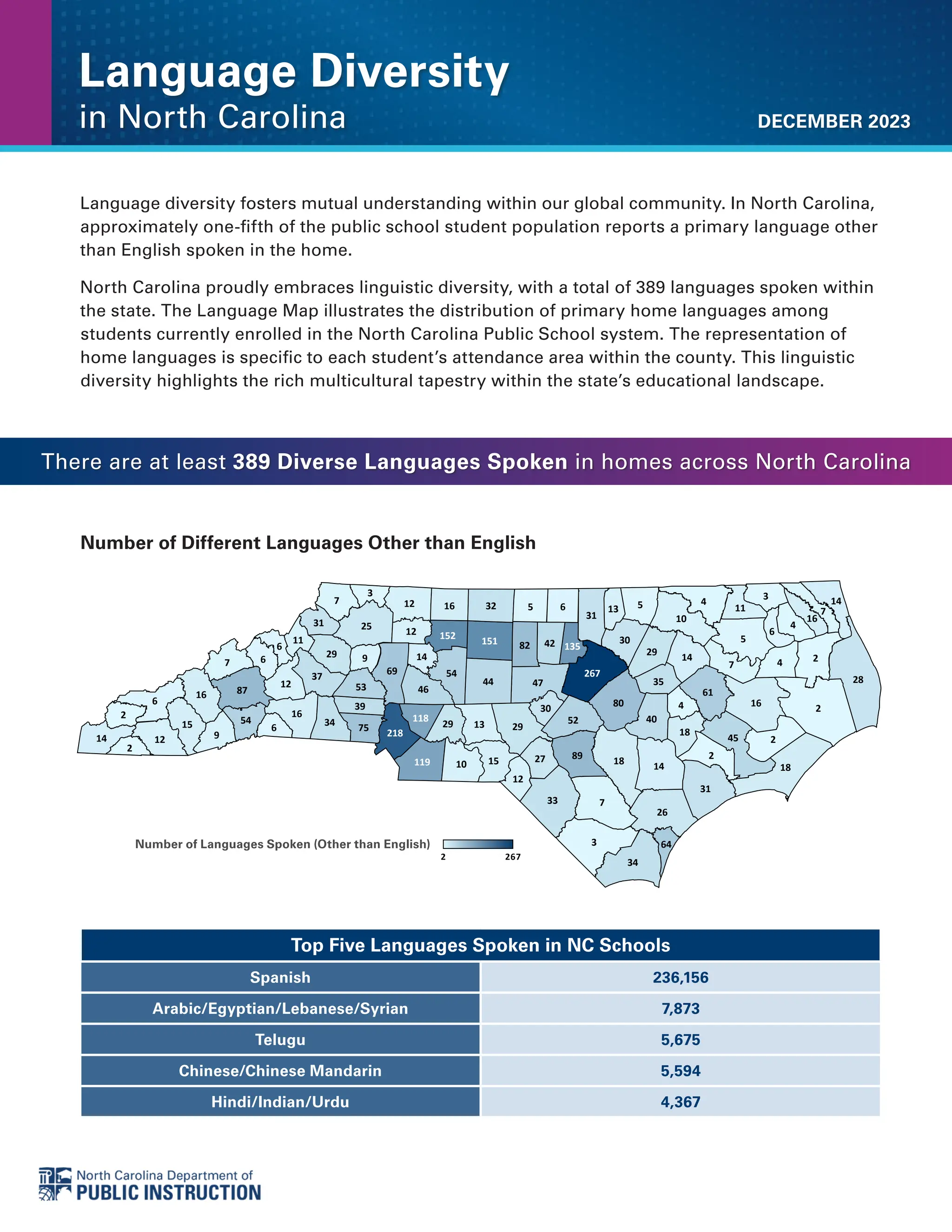
North Carolina proudly embraces linguistic diversity, with a total of 389 languages spoken within
the state. The Language Map illustrates the distribution of primary home languages among
students currently enrolled in the North Carolina Public School system. The representation of
home languages is specific to each student’s attendance area within the county. This linguistic
diversity highlights the rich multicultural tapestry within the state’s educational landscape.
Top Five Languages Spoken in NC Schools
Spanish 236,156
Arabic/Egyptian/Lebanese/Syrian 7,873
Telugu 5,675
Chinese/Chinese Mandarin 5,594
Hindi/Indian/Urdu 4,367
There are at least 389 Diverse Languages Spoken in homes across North Carolina
7
9
18
11
31 25
3
47 28
6
39
6
2
12
29
34
14
16
69
14
2
7
53
6
30
29
31
45
16
7
34 13
30
26
2
12
3
12
12
54
29
15
14
2
44
6
4
46
29
4
52
16
75
3
6
2
16
9
40
6
10 27
5
32
31
4
5
12
11
18
18
7
7
13
4
10
5
33
14
42
87
218
267
64
119
54
135
2
118
14
151
152
89
37
61
82
80
35
15
2 267
Number of Languages Spoken (Other than English)
16
Number of Languages Spoken (Other than English)
Number of Different Languages Other than English
2.
Supporting Language Developmentin North Carolina Schools
NC English Language Development (ELD) Standards
The NC ELD standards framework serves as a guide for the development of the curriculum
and instruction for multilingual learners (MLs). These standards are not intended to be
curriculum, nor do they indicate the whole of the curriculum to be written by a Public School
Unit (PSU). The ELD standards, together with cross–disciplinary academic content standards,
and disciplinary practices, define the language MLs need as they move toward college,
career, and civic readiness. The use of the NC ELD standards should be complemented by
a well-developed, content–rich curriculum, and effective pedagogical approaches within an
equitable educational program for MLs (WIDA 2020).
Global Languages Endorsement (GLE), NC’s Seal of Biliteracy
Graduating seniors demonstrate proficiency in English and a World Language. Each year,
approximately 5–10% or 5,000–11,500 graduates earn this distinction. The World Languages
recognized with GLEs since it began with the Class of 2015 are: American Sign Language (ASL),
Arabic, Chinese, French, German, Hebrew, Italian, Japanese, Latin, Persian, Russian, Spanish,
Swahili, and Ukrainian. Details and annual data are available at https://bit.ly/NCSoBLGLE
Dual Language/Immersion (DL/I) Programs
• DL/I programs, where academic content is taught in English and another language,
are growing across the state. Currently, there are 260+ DL/I programs in 8 languages
across 51 districts, 6 charter schools, and 6 private schools.
• By language: 226 Spanish, 21 Chinese, 7 French, 5 German, 4 Japanese, 1 Cherokee,
1 Greek, 1 Urdu
• By school level: 149 elementary schools, 60 middle schools, 30 high schools, 8 K-8,
19 other PreK–12
For more information about NC’s DL/I programs, go to https://bit.ly/NCDLIinfo
Resources
A variety of support for Multilingual Learners and other language acquisition and
development programs are available for PSUs across the state. Resources and types
of support for language development and programs can be found at:
• Dual Language/Immersion: bit.ly/NCDLIinfo
• English Language Development: bit.ly/NCELDwebpage
• Global Languages Endorsement, NC’s Seal of Biliteracy: bit.ly/NCSoBLGLE
• LinguaFolio: bit.ly/LF4NCHub
• NC ELD Standards Resource Hub: bit.ly/ELDStandardsHub
• World Languages: bit.ly/NCWorldLanguages
Each year, approximately 5-10%, or 5,000-11,500 graduates earn this distinction.