
Mythological approach
IN FRANKENSTEIN

MKBU Department of English

Kaushal Desai

2/27/2014

1
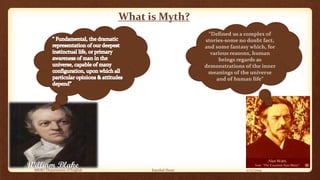
What is Myth?

2
MKBU Department of English

Kaushal Desai

2/27/2014
Significance of myth
• Myth are symbolic projections of people’s hope, values, fears
& aspirations.
• Mythos is a worldview-based traditional story or body
of mythology.

• In reality myth reflects more profound reality.
• Study of myth reveals about the mind and character of
people.

MKBU Department of English

Kaushal Desai

2/27/2014

3
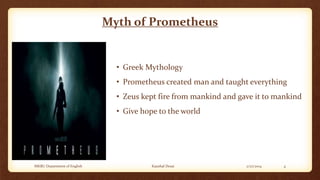
Myth of Prometheus

• Greek Mythology
• Prometheus created man and taught everything

• Zeus kept fire from mankind and gave it to mankind
• Give hope to the world

MKBU Department of English

Kaushal Desai

2/27/2014

4
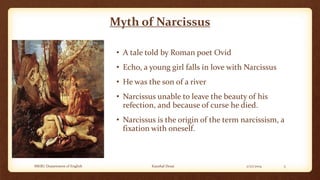
Myth of Narcissus
• A tale told by Roman poet Ovid

• Echo, a young girl falls in love with Narcissus
• He was the son of a river
• Narcissus unable to leave the beauty of his
refection, and because of curse he died.
• Narcissus is the origin of the term narcissism, a
fixation with oneself.

MKBU Department of English

Kaushal Desai

2/27/2014

5
Myth of Paradise Lost
• As a Christian myth
• John Milton takes this from Bible, Chapter 1
“Genesis”
• A long epic in English literature
• A tale that says, ‘fall of mankind’

MKBU Department of English

Kaushal Desai

2/27/2014

6
‘Frankenstein’ &
Mythology…
• Shelley incorporated a number of different sources
into her work
• Promethean myth from Ovid
• John Milton’s ‘Paradise Lost’
• S.T. Coleridge’s ‘The Rime of the Ancient mariner’

• Victor Frankenstein’s innovative work of the Titan in
creating humans as he break rules of Nature
• The novel also uses subtitle ‘The modern
Prometheus’
MKBU Department of English

Kaushal Desai

2/27/2014

7
‘Frankenstein’ &
Mythology…

MKBU Department of English

Kaushal Desai

2/27/2014

8
Interpretation of myth
• Myth-past, present is what??
• A writer tries to fit the past in the present. In present the situation is
different.
• Is it the repetition of the history-past? In a new way?

• Study of social ‘structure and the texture of the novel. Use of myth is
retelling the story …

MKBU Department of English

Kaushal Desai

2/27/2014

9
Quotes about myth
“Myth are public dreams, Dreams are private myth.”
~ Joseph Campbell

“Myth is neither a lie nor a confession it is a inflection.”
~ Roland Barthes

“Myth convert history into nature.”
~ Roland Barthes
MKBU Department of English

Kaushal Desai

2/27/2014

10
Conclusion
Hence one can say that in every culture has their own
myth and here Marry Shelley has presented it very proper
way and writes Sci-Fi that takes the charm of the novel a
higher one.

MKBU Department of English

Kaushal Desai

2/27/2014

11
MKBU Department of English

Kaushal Desai

2/27/2014

12

Mythological approach in "Frankenstein"

  • 1.
    Mythological approach IN FRANKENSTEIN MKBUDepartment of English Kaushal Desai 2/27/2014 1
  • 2.
    What is Myth? 2 MKBUDepartment of English Kaushal Desai 2/27/2014
  • 3.
    Significance of myth •Myth are symbolic projections of people’s hope, values, fears & aspirations. • Mythos is a worldview-based traditional story or body of mythology. • In reality myth reflects more profound reality. • Study of myth reveals about the mind and character of people. MKBU Department of English Kaushal Desai 2/27/2014 3
  • 4.
    Myth of Prometheus •Greek Mythology • Prometheus created man and taught everything • Zeus kept fire from mankind and gave it to mankind • Give hope to the world MKBU Department of English Kaushal Desai 2/27/2014 4
  • 5.
    Myth of Narcissus •A tale told by Roman poet Ovid • Echo, a young girl falls in love with Narcissus • He was the son of a river • Narcissus unable to leave the beauty of his refection, and because of curse he died. • Narcissus is the origin of the term narcissism, a fixation with oneself. MKBU Department of English Kaushal Desai 2/27/2014 5
  • 6.
    Myth of ParadiseLost • As a Christian myth • John Milton takes this from Bible, Chapter 1 “Genesis” • A long epic in English literature • A tale that says, ‘fall of mankind’ MKBU Department of English Kaushal Desai 2/27/2014 6
  • 7.
    ‘Frankenstein’ & Mythology… • Shelleyincorporated a number of different sources into her work • Promethean myth from Ovid • John Milton’s ‘Paradise Lost’ • S.T. Coleridge’s ‘The Rime of the Ancient mariner’ • Victor Frankenstein’s innovative work of the Titan in creating humans as he break rules of Nature • The novel also uses subtitle ‘The modern Prometheus’ MKBU Department of English Kaushal Desai 2/27/2014 7
  • 8.
    ‘Frankenstein’ & Mythology… MKBU Departmentof English Kaushal Desai 2/27/2014 8
  • 9.
    Interpretation of myth •Myth-past, present is what?? • A writer tries to fit the past in the present. In present the situation is different. • Is it the repetition of the history-past? In a new way? • Study of social ‘structure and the texture of the novel. Use of myth is retelling the story … MKBU Department of English Kaushal Desai 2/27/2014 9
  • 10.
    Quotes about myth “Mythare public dreams, Dreams are private myth.” ~ Joseph Campbell “Myth is neither a lie nor a confession it is a inflection.” ~ Roland Barthes “Myth convert history into nature.” ~ Roland Barthes MKBU Department of English Kaushal Desai 2/27/2014 10
  • 11.
    Conclusion Hence one cansay that in every culture has their own myth and here Marry Shelley has presented it very proper way and writes Sci-Fi that takes the charm of the novel a higher one. MKBU Department of English Kaushal Desai 2/27/2014 11
  • 12.
    MKBU Department ofEnglish Kaushal Desai 2/27/2014 12