MYOTOME
RATHNA PANDI V
M.P.T(ORTHOPEDICS) 1ST YEAR
SCHOOL OF PHYSIOTHERAPY
Vels institute of science and technology in
advanced studies
MYOTOME
• A myotome refers to a group of muscles innervated by the nerves of
single spinal root .
• It is responsible for the co ordination of voluntary muscle movement.
MYOTOME-purpose
• Muscle strength in a particular myotome may help to identify the
nerve root compression
Myotome -assessment
• Myotome is tested with an isometric contraction of the muscle by an
resistance with the hold time of 5 seconds
Myotome upper limb
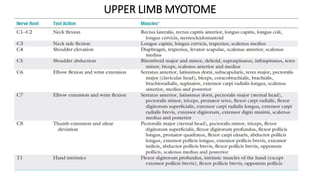
• C1-C2 –Neck flexion
• C3- Neck side flexion
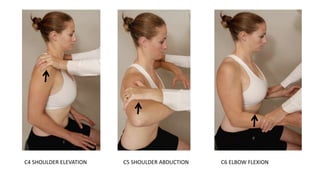
• C4-shoulder elevation
• C5- shoulder abduction
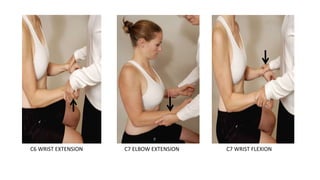
• C6– Elbow flexion and Wrist extension
• C7 – Elbow extension and wrist flexion
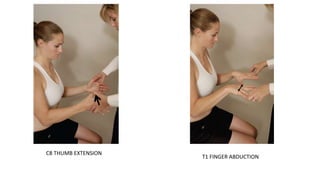
• C8 – Thumb extension and ulnar deviation
• T1 – Finger abduction
C1-C2 NECK FLEXION C3 NECK SIDE FLEXION
•
C4 SHOULDER ELEVATION C5 SHOULDER ABDUCTION C6 ELBOW FLEXION
• D
C6 WRIST EXTENSION C7 ELBOW EXTENSION C7 WRIST FLEXION
C8 THUMB EXTENSION
T1 FINGER ABDUCTION
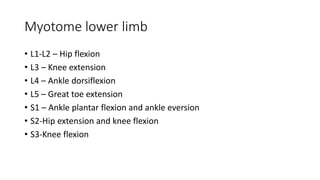
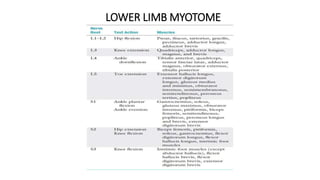
Myotome lower limb
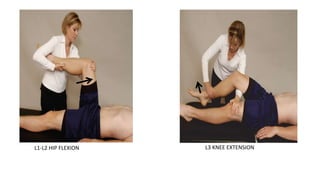
• L1-L2 – Hip flexion
• L3 – Knee extension
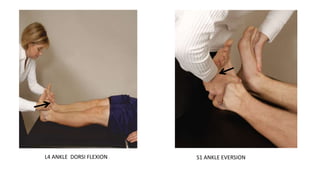
• L4 – Ankle dorsiflexion
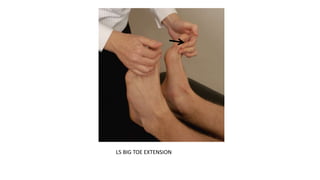
• L5 – Great toe extension
• S1 – Ankle plantar flexion and ankle eversion
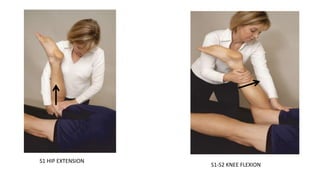
• S2-Hip extension and knee flexion
• S3-Knee flexion
•
L1-L2 HIP FLEXION L3 KNEE EXTENSION
•
L4 ANKLE DORSI FLEXION S1 ANKLE EVERSION
L5 BIG TOE EXTENSION
•
S1 HIP EXTENSION
S1-S2 KNEE FLEXION
UPPER LIMB MYOTOME
LOWER LIMB MYOTOME
source
• Books
Magee, David J. Orthopedic Physical Assessment. Philadelphia :Saunders, 2002.

Myotome assessment for physiotherapy students