Bismillah slide
• Mr. Adnan Ahmed
• M.B.A. (Finance)
• International Islamic University Islamabad.
Group Members
Introduction to the topic
Outline of the presentation
• Islamic Banking
• History of islamic banking
• Islamic Banking in Pakistan
• Difference between Islamic and Conventional
banking
• Principles of Islamic banking
• Islamic financial transactions terminologies
• Islamic laws on trading
• Islamic modes of financing
• Role of SBP in Islamic Banking
• Suggestions
• Questions
Outline Cont.
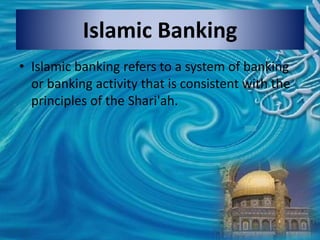
• Islamic banking refers to a system of banking
or banking activity that is consistent with the
principles of the Shari'ah.

Islamic Banking
History of Islamic Banking
• In 1960 thinking begins about Islamic Banking.
• At last in 1963, in Mit Ghamr, in Egypt, the first
Islamic interest-free bank came into being.
Islamic banking In Pakistan
• Steps for Islamization of banking were started
in 1977-78.
• From July 1, 1982 banks were allowed to
provide finance for meeting the working
capital needs of trade and industry on a
selective basis under the technique of
Musharaka.
• From July 1, 1985, all commercial banking in
Pak Rupees was made interest-free.
• The Finance Minister of Pakistan in his budget
speech for the FY02 declared the following:
“ Government is committed to eliminate Riba
and promote Islamic banking in the country.
• Meezan Bank Limited (MBL) starts its
operation from March 20, 2002 with network
of 5 branches .
Islamic banking In Pakistan(Cont.)
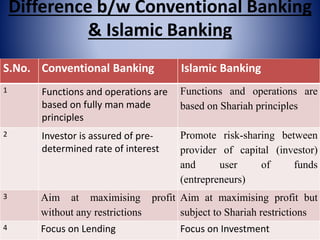
S.No. Conventional Banking Islamic Banking
1 Functions and operations are
based on fully man made
principles
Functions and operations are
based on Shariah principles
2 Investor is assured of pre-
determined rate of interest
Promote risk-sharing between
provider of capital (investor)
and user of funds
(entrepreneurs)
3 Aim at maximising profit
without any restrictions
Aim at maximising profit but
subject to Shariah restrictions
4 Focus on Lending Focus on Investment
Difference b/w Conventional Banking
& Islamic Banking
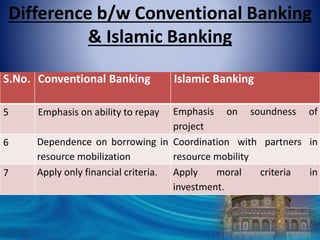
S.No. Conventional Banking Islamic Banking
5 Emphasis on ability to repay Emphasis on soundness of
project
6 Dependence on borrowing in
resource mobilization
Coordination with partners in
resource mobility
7 Apply only financial criteria. Apply moral criteria in
investment.
Difference b/w Conventional Banking
& Islamic Banking
Principles
of
Islamic Banking
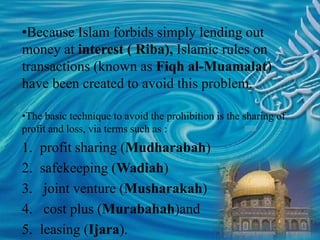
•Because Islam forbids simply lending out
money at interest ( Riba), Islamic rules on
transactions (known as Fiqh al-Muamalat)
have been created to avoid this problem.
•The basic technique to avoid the prohibition is the sharing of
profit and loss, via terms such as :
1. profit sharing (Mudharabah)
2. safekeeping (Wadiah)
3. joint venture (Musharakah)
4. cost plus (Murabahah)and
5. leasing (Ijara).
“Shariah Advisory
Council/Consultant”
•Shariah Supervisory Board (SSB) to advise them
and to ensure that the operations and activities
of the banking institutions comply with Shariah
principles.
•A number of Shariah advisory firms have now
emerged to offer Shariah advisory services to the
institutions offering Islamic financial services.
•This function works under the guidance of
Shariah Supervisory Board which comprises of
renowned Islamic Scholars from both Pakistan
and abroad.
•Successful implementation of the Islamic
Banking model rests upon the principles of
Islamic Shariah.

•A world-renowned Shariah Supervisory Board
and a highly qualified and experienced in house
Shariah Advisor are fundamental aspects of the
Bank's core.

Islamic Financial Transaction
Terminology
Bai al Inah
• Agreement b/w customer and financer
• On spot purchase
• Payment in Installments
Bai Bithman Ajil
• Sale of good
• Deffered Payment
• Agreed Profit ratio
Bai Mujjal
• Credit sale
• Contract
Mudarabah
• Special partnership
• RUB Ul MAAL and MUDARIB
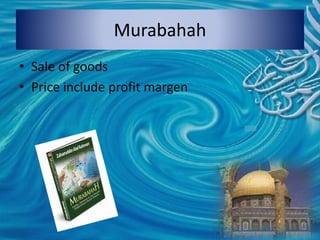
Murabahah
• Sale of goods
• Price include profit margen
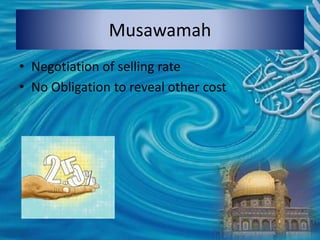
Musawamah
• Negotiation of selling rate
• No Obligation to reveal other cost
Bai salam
• Contact
• Advance payment
• Later delivory
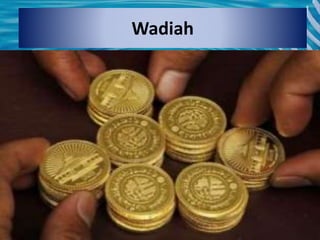
Wadiah
• In Wadiah, a bank is deemed as a keeper and
trustee of funds. A person deposits funds in
the bank and the bank guarantees refund of
the entire amount of the deposit, or any part
of the outstanding amount, when the
depositor demands it.
Wadiah
Hibah
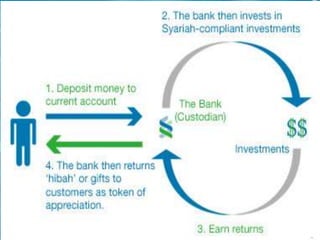
Hibah usually arises in practice when Islamic
banks voluntarily pay their customers a 'gift' on
savings account balances, representing a portion
of the profit made by using those savings account
balances in other activities.
Ijarah
• Ijarah means lease, rent or wage.
• Generally, the Ijarah concept refers to selling
the benefit of use or service for a fixed price
or wage.
Musharakah
• Musharakah is a relationship between two
parties or more that contribute capital to a
business and divide the net profit and loss pro
rata.
Qardul Hassan
Qardul Hassan
• This is a loan extended on a goodwill basis,
and the debtor is only required to repay the
amount borrowed.
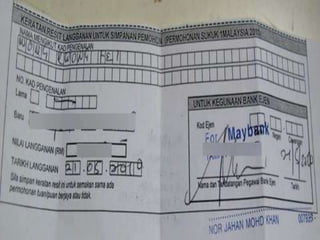
Sukuk
• Sukuk is the Arabic name for financial
certificates that are the Islamic equivalent of
bonds. However, fixed-income, interest-
bearing bonds are not permissible in Islam.
Takaful
• Insurance by combining the risks of many
people enables each individual to enjoy the
advantage provided by the law of large
numbers.
Takaful
Wakalah
• This occurs when a person appoints a
representative to undertake transactions on
his/her behalf, similar to a power of attorney.
Islamic laws on trading
The main concept in Islam and the
most obvious and strict rule is as in the
verse
“ALLAH hath permitted sale and forbidden Riba.”
Islamic Modes of Financing.
• 1.) LOANS FINANCING BY LENDING
• 2.) TRADE RELATED MODES OF FINANCING
• 3.) INVESTMENT MODE OF FINANCING
1.)LOANS FINANCING BY LENDING
• a.) Interest Free Loans With Service Charges.
• The banks are permitted to lend funds free of interest.
• They are to recover only the actual service charges from the
user of the funds .
• The maximum service charges permissible to each bank is
determined by the state bank of Pakistan.
1.)LOANS FINANCING BY LENDING
• b.)Qarze Hasna
• Under the Qarze Hasna scheme interest free loans
are granted to the students who do not have
sufficient means to pursue their education.
• The students are given interest free loans for carrying on the
studies both with in Pakistan and outside the country .
• For repayment of the loan are grace period
of two years is granted after competition
of studies
2.) TRADE RELATED MODES OF FINANCING
• a.) Mark Up or Bai Muajjal
• The mechanism of financing on the bases of mark up is as follows:-
 The customer contacts the bank for financing the purchase of goods .
 The bank purchases the required goods and sales these to him on the
price mutually agreed between the bank and the customer .
 The agreed price which is based on bases of the banks cost plus a
profit margin of the bank (mark up).
 The payment can be made by customer in lumpsum or in installments
over a specific period of time.
2.) TRADE RELATED MODES OF
FINANCING
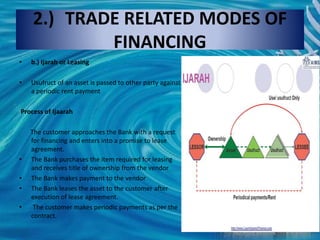
• b.) Ijarah or Leasing
• Usufruct of an asset is passed to other party against
a periodic rent payment
Process of Ijaarah
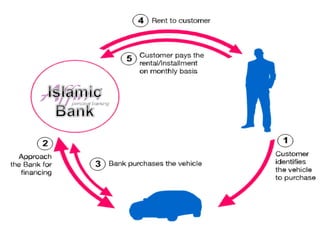
The customer approaches the Bank with a request
for financing and enters into a promise to lease
agreement.
• The Bank purchases the item required for leasing
and receives title of ownership from the vendor
• The Bank makes payment to the vendor
• The Bank leases the asset to the customer after
execution of lease agreement.
• The customer makes periodic payments as per the
contract.
2.) TRADE RELATED MODES OF
FINANCING
• c.) Istisna,a
• It is a contractual agreement under which a bank provides
finance for the manufacturing of goods and commodities .
• Istisna’a can be used for providing the facility of financing the
manufacture or construction of houses, plants, projects,
building of bridges, roads and highways.
3.) INVESTMENT MODE OF
FINANCING
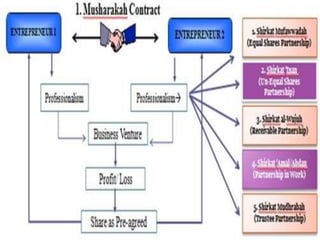
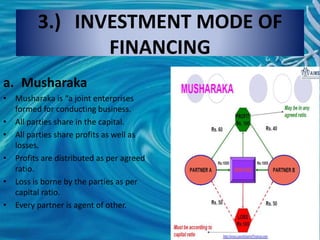
a. Musharaka
• Musharaka is “a joint enterprises
formed for conducting business.
• All parties share in the capital.
• All parties share profits as well as
losses.
• Profits are distributed as per agreed
ratio.
• Loss is borne by the parties as per
capital ratio.
• Every partner is agent of other.
3.) INVESTMENT MODE OF
FINANCING
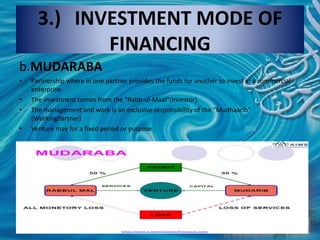
b.MUDARABA
• Partnership where in one partner provides the funds for another to invest in a commercial
enterprise.
• The investment comes from the “Rabb-ul-Maal”(Investor).
• The management and work is an exclusive responsibility of the “Mudhaarib”
(WorkingPartner).
• Venture may for a fixed period or purpose.
Objections on Islamic Banking
• Financing on fixed rates of profits?
• Fixed profits in diff modes of financing. Whats the
differrence between lending in islam and loans in
commercial banking?
• Money is the commodity. Then why it can not be
lended and earn an over profit in shape of rent while
other commodities i-e car, house can earn the same?
• Islamic banking is non valid because
it deals with commercial based SBP?
Q nd A

MY SBPFULL pptx

  • 1.
  • 2.
    • Mr. AdnanAhmed • M.B.A. (Finance) • International Islamic University Islamabad. Group Members
  • 3.
  • 4.
    Outline of thepresentation • Islamic Banking • History of islamic banking • Islamic Banking in Pakistan • Difference between Islamic and Conventional banking • Principles of Islamic banking
  • 5.
    • Islamic financialtransactions terminologies • Islamic laws on trading • Islamic modes of financing • Role of SBP in Islamic Banking • Suggestions • Questions Outline Cont.
  • 6.
    • Islamic bankingrefers to a system of banking or banking activity that is consistent with the principles of the Shari'ah. Islamic Banking
  • 7.
    History of IslamicBanking • In 1960 thinking begins about Islamic Banking. • At last in 1963, in Mit Ghamr, in Egypt, the first Islamic interest-free bank came into being.
  • 8.
    Islamic banking InPakistan • Steps for Islamization of banking were started in 1977-78. • From July 1, 1982 banks were allowed to provide finance for meeting the working capital needs of trade and industry on a selective basis under the technique of Musharaka. • From July 1, 1985, all commercial banking in Pak Rupees was made interest-free.
  • 9.
    • The FinanceMinister of Pakistan in his budget speech for the FY02 declared the following: “ Government is committed to eliminate Riba and promote Islamic banking in the country. • Meezan Bank Limited (MBL) starts its operation from March 20, 2002 with network of 5 branches . Islamic banking In Pakistan(Cont.)
  • 10.
    S.No. Conventional BankingIslamic Banking 1 Functions and operations are based on fully man made principles Functions and operations are based on Shariah principles 2 Investor is assured of pre- determined rate of interest Promote risk-sharing between provider of capital (investor) and user of funds (entrepreneurs) 3 Aim at maximising profit without any restrictions Aim at maximising profit but subject to Shariah restrictions 4 Focus on Lending Focus on Investment Difference b/w Conventional Banking & Islamic Banking
  • 11.
    S.No. Conventional BankingIslamic Banking 5 Emphasis on ability to repay Emphasis on soundness of project 6 Dependence on borrowing in resource mobilization Coordination with partners in resource mobility 7 Apply only financial criteria. Apply moral criteria in investment. Difference b/w Conventional Banking & Islamic Banking
  • 12.
  • 13.
    •Because Islam forbidssimply lending out money at interest ( Riba), Islamic rules on transactions (known as Fiqh al-Muamalat) have been created to avoid this problem. •The basic technique to avoid the prohibition is the sharing of profit and loss, via terms such as : 1. profit sharing (Mudharabah) 2. safekeeping (Wadiah) 3. joint venture (Musharakah) 4. cost plus (Murabahah)and 5. leasing (Ijara).
  • 14.
  • 15.
    •Shariah Supervisory Board(SSB) to advise them and to ensure that the operations and activities of the banking institutions comply with Shariah principles. •A number of Shariah advisory firms have now emerged to offer Shariah advisory services to the institutions offering Islamic financial services.
  • 16.
    •This function worksunder the guidance of Shariah Supervisory Board which comprises of renowned Islamic Scholars from both Pakistan and abroad. •Successful implementation of the Islamic Banking model rests upon the principles of Islamic Shariah. •A world-renowned Shariah Supervisory Board and a highly qualified and experienced in house Shariah Advisor are fundamental aspects of the Bank's core.
  • 17.
  • 18.
    Bai al Inah •Agreement b/w customer and financer • On spot purchase • Payment in Installments
  • 19.
    Bai Bithman Ajil •Sale of good • Deffered Payment • Agreed Profit ratio
  • 20.
    Bai Mujjal • Creditsale • Contract
  • 21.
  • 22.
    Murabahah • Sale ofgoods • Price include profit margen
  • 23.
    Musawamah • Negotiation ofselling rate • No Obligation to reveal other cost
  • 24.
    Bai salam • Contact •Advance payment • Later delivory
  • 25.
  • 26.
    • In Wadiah,a bank is deemed as a keeper and trustee of funds. A person deposits funds in the bank and the bank guarantees refund of the entire amount of the deposit, or any part of the outstanding amount, when the depositor demands it. Wadiah
  • 27.
    Hibah Hibah usually arisesin practice when Islamic banks voluntarily pay their customers a 'gift' on savings account balances, representing a portion of the profit made by using those savings account balances in other activities.
  • 29.
    Ijarah • Ijarah meanslease, rent or wage. • Generally, the Ijarah concept refers to selling the benefit of use or service for a fixed price or wage.
  • 31.
    Musharakah • Musharakah isa relationship between two parties or more that contribute capital to a business and divide the net profit and loss pro rata.
  • 33.
  • 34.
    Qardul Hassan • Thisis a loan extended on a goodwill basis, and the debtor is only required to repay the amount borrowed.
  • 35.
    Sukuk • Sukuk isthe Arabic name for financial certificates that are the Islamic equivalent of bonds. However, fixed-income, interest- bearing bonds are not permissible in Islam.
  • 37.
  • 38.
    • Insurance bycombining the risks of many people enables each individual to enjoy the advantage provided by the law of large numbers. Takaful
  • 39.
    Wakalah • This occurswhen a person appoints a representative to undertake transactions on his/her behalf, similar to a power of attorney.
  • 40.
  • 41.
    The main conceptin Islam and the most obvious and strict rule is as in the verse “ALLAH hath permitted sale and forbidden Riba.”
  • 42.
    Islamic Modes ofFinancing. • 1.) LOANS FINANCING BY LENDING • 2.) TRADE RELATED MODES OF FINANCING • 3.) INVESTMENT MODE OF FINANCING
  • 43.
    1.)LOANS FINANCING BYLENDING • a.) Interest Free Loans With Service Charges. • The banks are permitted to lend funds free of interest. • They are to recover only the actual service charges from the user of the funds . • The maximum service charges permissible to each bank is determined by the state bank of Pakistan.
  • 44.
    1.)LOANS FINANCING BYLENDING • b.)Qarze Hasna • Under the Qarze Hasna scheme interest free loans are granted to the students who do not have sufficient means to pursue their education. • The students are given interest free loans for carrying on the studies both with in Pakistan and outside the country . • For repayment of the loan are grace period of two years is granted after competition of studies
  • 45.
    2.) TRADE RELATEDMODES OF FINANCING • a.) Mark Up or Bai Muajjal • The mechanism of financing on the bases of mark up is as follows:-  The customer contacts the bank for financing the purchase of goods .  The bank purchases the required goods and sales these to him on the price mutually agreed between the bank and the customer .  The agreed price which is based on bases of the banks cost plus a profit margin of the bank (mark up).  The payment can be made by customer in lumpsum or in installments over a specific period of time.
  • 46.
    2.) TRADE RELATEDMODES OF FINANCING • b.) Ijarah or Leasing • Usufruct of an asset is passed to other party against a periodic rent payment Process of Ijaarah The customer approaches the Bank with a request for financing and enters into a promise to lease agreement. • The Bank purchases the item required for leasing and receives title of ownership from the vendor • The Bank makes payment to the vendor • The Bank leases the asset to the customer after execution of lease agreement. • The customer makes periodic payments as per the contract.
  • 47.
    2.) TRADE RELATEDMODES OF FINANCING • c.) Istisna,a • It is a contractual agreement under which a bank provides finance for the manufacturing of goods and commodities . • Istisna’a can be used for providing the facility of financing the manufacture or construction of houses, plants, projects, building of bridges, roads and highways.
  • 48.
    3.) INVESTMENT MODEOF FINANCING a. Musharaka • Musharaka is “a joint enterprises formed for conducting business. • All parties share in the capital. • All parties share profits as well as losses. • Profits are distributed as per agreed ratio. • Loss is borne by the parties as per capital ratio. • Every partner is agent of other.
  • 49.
    3.) INVESTMENT MODEOF FINANCING b.MUDARABA • Partnership where in one partner provides the funds for another to invest in a commercial enterprise. • The investment comes from the “Rabb-ul-Maal”(Investor). • The management and work is an exclusive responsibility of the “Mudhaarib” (WorkingPartner). • Venture may for a fixed period or purpose.
  • 50.
    Objections on IslamicBanking • Financing on fixed rates of profits? • Fixed profits in diff modes of financing. Whats the differrence between lending in islam and loans in commercial banking? • Money is the commodity. Then why it can not be lended and earn an over profit in shape of rent while other commodities i-e car, house can earn the same? • Islamic banking is non valid because it deals with commercial based SBP?
  • 51.