My life as a cyborg
Alexander Serebrenik
Eindhoven University of Technology
The Netherlands
Social aspects
of software
development
Story 1: Women, men
and software
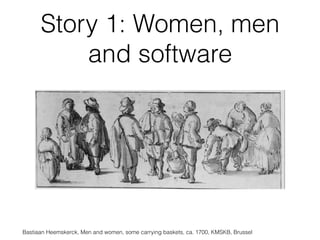
Bastiaan Heemskerck, Men and women, some carrying baskets, ca. 1700, KMSKB, Brussel
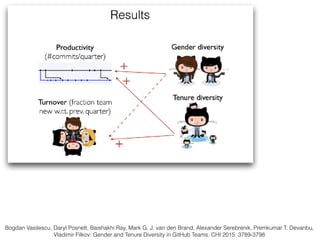
Bogdan Vasilescu, Daryl Posnett, Baishakhi Ray, Mark G. J. van den Brand, Alexander Serebrenik, Premkumar T. Devanbu,
Vladimir Filkov: Gender and Tenure Diversity in GitHub Teams. CHI 2015: 3789-3798
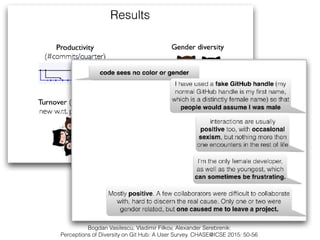
Bogdan Vasilescu, Vladimir Filkov, Alexander Serebrenik:
Perceptions of Diversity on Git Hub: A User Survey. CHASE@ICSE 2015: 50-56
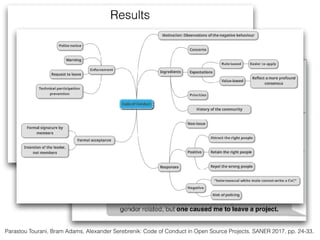
Parastou Tourani, Bram Adams, Alexander Serebrenik: Code of Conduct in Open Source Projects. SANER 2017, pp. 24-33.
Story 2: How do they
communicate?
Jos Manders. Communication. ca. 1965. SMAK - Stedelijk Museum voor Actuele Kunst. Ghent
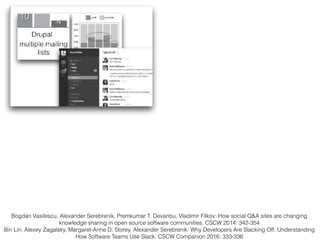
Bogdan Vasilescu, Alexander Serebrenik, Premkumar T. Devanbu, Vladimir Filkov: How social Q&A sites are changing
knowledge sharing in open source software communities. CSCW 2014: 342-354
Bin Lin, Alexey Zagalsky, Margaret-Anne D. Storey, Alexander Serebrenik: Why Developers Are Slacking Off: Understanding
How Software Teams Use Slack. CSCW Companion 2016: 333-336
Nicole Novielli, Fabio Calefato, Filippo Lanubile: The challenges of sentiment detection in the social programmer ecosystem.
SSE@SIGSOFT FSE 2015: 33-40
Robbert Jongeling, Proshanta Sarkar, Subhajit Datta, Alexander Serebrenik. On Negative Results when using Sentiment
Analysis Tools for Software Engineering Research. Empirical Software Engineering (accepted)
Daviti Gachechiladze, Filippo Lanubile, Nicole Novielli, Alexander Serebrenik. Anger and Its Direction in Collaborative
Software Development 39th International Conference on Software Engineering, New Ideas and Emerging Results 2017
Technical
aspects of
software
development
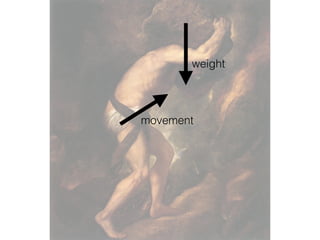
weight
movement
weight
movement
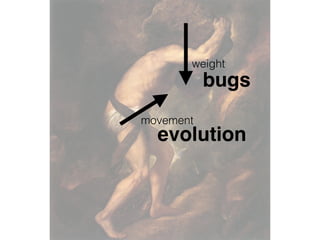
bugs
evolution
weight
bugs
Program
Here the magic
happens
Bugs
weight
bugs
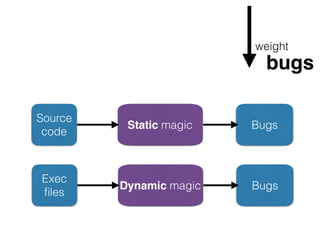
Source
code
Static magic Bugs
Exec
files
Dynamic magic Bugs
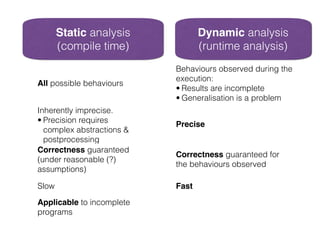
Static analysis
(compile time)
Dynamic analysis
(runtime analysis)
All possible behaviours
Behaviours observed during the
execution:
• Results are incomplete
• Generalisation is a problem
Inherently imprecise.
• Precision requires
complex abstractions &
postprocessing
Precise
Correctness guaranteed
(under reasonable (?)
assumptions)
Correctness guaranteed for
the behaviours observed
Slow Fast
Applicable to incomplete
programs
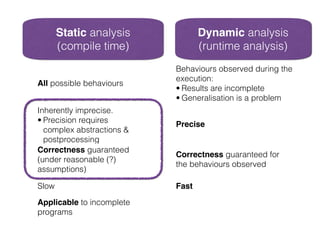
Static analysis
(compile time)
Dynamic analysis
(runtime analysis)
All possible behaviours
Behaviours observed during the
execution:
• Results are incomplete
• Generalisation is a problem
Inherently imprecise.
• Precision requires
complex abstractions &
postprocessing
Precise
Correctness guaranteed
(under reasonable (?)
assumptions)
Correctness guaranteed for
the behaviours observed
Slow Fast
Applicable to incomplete
programs
Source
code
Static analysis
Predicted
Bugs
Real
Bugs
Oracle Are they the
same?
Source
code
Static analysis
Predicted
Bugs
Real
Bugs
Oracle Are they the
same?
completeness
soundness
Source
code
Static analysis
Predicted
Bugs
Real
Bugs
Oracle
completeness
soundness
(Manual)
postprocessing
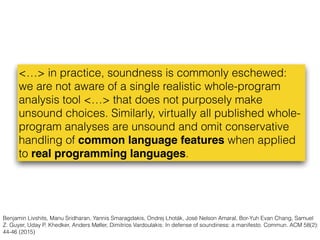
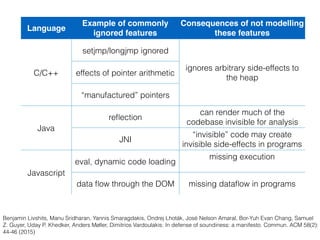
<…> in practice, soundness is commonly eschewed:
we are not aware of a single realistic whole-program
analysis tool <…> that does not purposely make
unsound choices. Similarly, virtually all published whole-
program analyses are unsound and omit conservative
handling of common language features when applied
to real programming languages.
Benjamin Livshits, Manu Sridharan, Yannis Smaragdakis, Ondrej Lhoták, José Nelson Amaral, Bor-Yuh Evan Chang, Samuel
Z. Guyer, Uday P. Khedker, Anders Møller, Dimitrios Vardoulakis: In defense of soundiness: a manifesto. Commun. ACM 58(2):
44-46 (2015)
Benjamin Livshits, Manu Sridharan, Yannis Smaragdakis, Ondrej Lhoták, José Nelson Amaral, Bor-Yuh Evan Chang, Samuel
Z. Guyer, Uday P. Khedker, Anders Møller, Dimitrios Vardoulakis: In defense of soundiness: a manifesto. Commun. ACM 58(2):
44-46 (2015)
Language
Example of commonly
ignored features
Consequences of not modelling
these features
C/C++
setjmp/longjmp ignored
ignores arbitrary side-effects to
the heap
effects of pointer arithmetic
“manufactured” pointers
Java
reflection
can render much of the
codebase invisible for analysis
JNI
“invisible” code may create
invisible side-effects in programs
Javascript
eval, dynamic code loading
missing execution
data flow through the DOM missing dataflow in programs
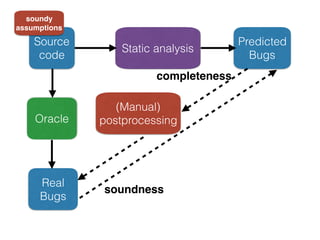
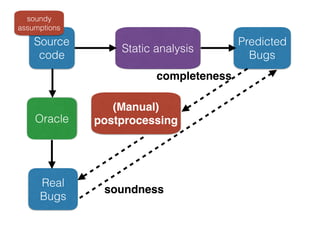
Source
code
Static analysis
Predicted
Bugs
Real
Bugs
Oracle
completeness
soundness
(Manual)
postprocessing
soundy
assumptions
Benjamin Livshits, Manu Sridharan, Yannis Smaragdakis, Ondrej Lhoták, José Nelson Amaral, Bor-Yuh Evan Chang, Samuel
Z. Guyer, Uday P. Khedker, Anders Møller, Dimitrios Vardoulakis: In defense of soundiness: a manifesto. Commun. ACM 58(2):
44-46 (2015)
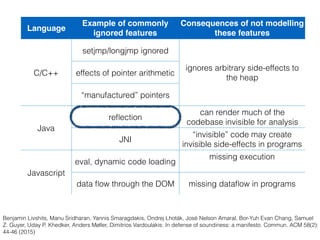
Language
Example of commonly
ignored features
Consequences of not modelling
these features
C/C++
setjmp/longjmp ignored
ignores arbitrary side-effects to
the heap
effects of pointer arithmetic
“manufactured” pointers
Java
reflection
can render much of the
codebase invisible for analysis
JNI
“invisible” code may create
invisible side-effects in programs
Javascript
eval, dynamic code loading
missing execution
data flow through the DOM missing dataflow in programs
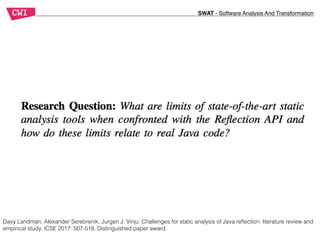
SWAT - Software Analysis And Transformation
Davy Landman, Alexander Serebrenik, Jurgen J. Vinju: Challenges for static analysis of Java reflection: literature review and
empirical study. ICSE 2017: 507-518. Distinguished paper award.
SWAT - SoftWare Analysis And Transformation
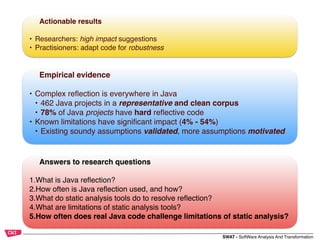
Empirical evidence
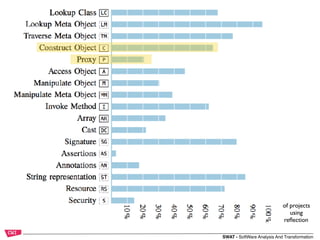
• Complex reflection is everywhere in Java
• 462 Java projects in a representative and clean corpus
• 78% of Java projects have hard reflective code
• Known limitations have significant impact (4% - 54%)
• Existing soundy assumptions validated, more assumptions motivated
Actionable results
• Researchers: high impact suggestions
• Practisioners: adapt code for robustness
Answers to research questions
1.What is Java reflection?
2.How often is Java reflection used, and how?
3.What do static analysis tools do to resolve reflection?
4.What are limitations of static analysis tools?
5.How often does real Java code challenge limitations of static analysis?
SWAT - SoftWare Analysis And Transformation
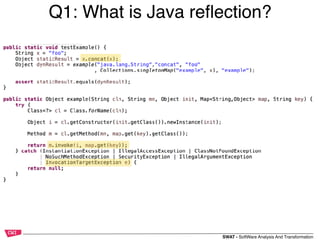
Q1: What is Java reflection?
SWAT - SoftWare Analysis And Transformation
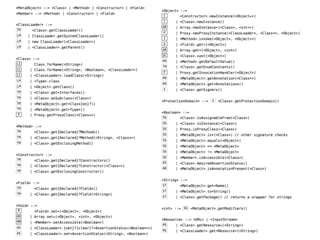
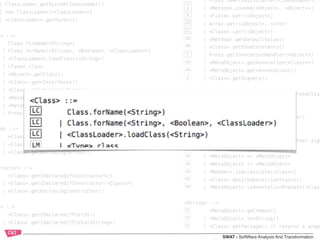
Q1: What is Java reflection?
“Hard” “Easy”
SWAT - SoftWare Analysis And Transformation
Q2: How often is reflection used?
• Corpus of 461 (cleaned) Java projects
• Maximize representativeness [55]
• Clean [clone detection]
• Parse & resolve [Rascal, Eclipse JDT]
• Categorize [see Q1]
SWAT - SoftWare Analysis And Transformation
of projects
using
reflection
SWAT - SoftWare Analysis And Transformation
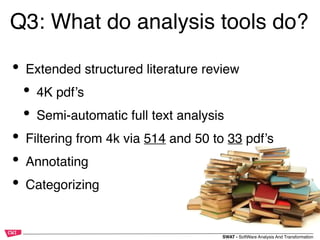
Q3: What do analysis tools do?
• Extended structured literature review
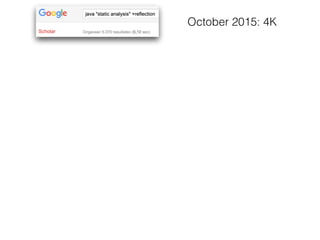
• 4K pdf’s
• Semi-automatic full text analysis
• Filtering from 4k via 514 and 50 to 33 pdf’s
• Annotating
• Categorizing
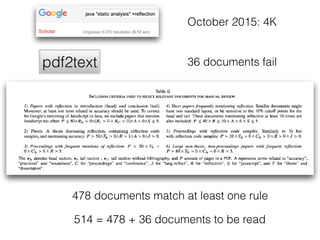
October 2015: 4K
October 2015: 4K
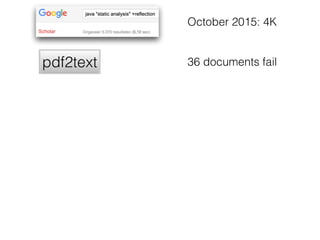
pdf2text 36 documents fail
October 2015: 4K
pdf2text 36 documents fail
478 documents match at least one rule
514 = 478 + 36 documents to be read
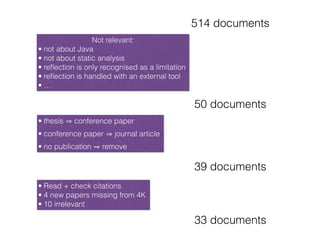
514 documents
Not relevant:
• not about Java
• not about static analysis
• reflection is only recognised as a limitation
• reflection is handled with an external tool
• …
50 documents
• thesis conference paper
• conference paper journal article
• no publication remove
39 documents
• Read + check citations
• 4 new papers missing from 4K
• 10 irrelevant
33 documents
SWAT - SoftWare Analysis And Transformation
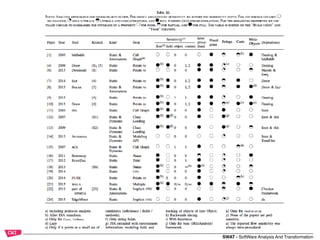
• Collect and categorize analysis papers self-reported:
• Optimistic ‘soundy’ assumptions about code
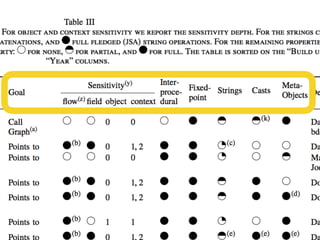
• Known limitations of the algorithms
• What is their damage in the corpus?
• Method:
• Recognize and count counter examples
• Applying AST patterns to the entire corpus
• Rascal metaprogramming language
Q4: What are the limitations?
and Q5: how do these relate to real code?
SWAT - SoftWare Analysis And Transformation
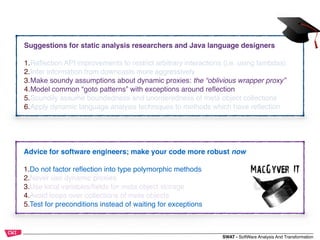
Advice for software engineers; make your code more robust now
1.Do not factor reflection into type polymorphic methods
2.Never use dynamic proxies
3.Use local variables/fields for meta object storage
4.Avoid loops over collections of meta objects
5.Test for preconditions instead of waiting for exceptions
Suggestions for static analysis researchers and Java language designers
1.Reflection API improvements to restrict arbitrary interactions (i.e. using lambdas)
2.Infer information from downcasts more aggressively
3.Make soundy assumptions about dynamic proxies: the “oblivious wrapper proxy”
4.Model common “goto patterns” with exceptions around reflection
5.Soundily assume boundedness and unorderedness of meta object collections
6.Apply dynamic language analysis techniques to methods which have reflection
SWAT - Software Analysis And Transformation
This work has been supported by the NWO TOPGO grant #612.001.011 “Domain-Specific Languages: A Big Future for Small Programs”
@jurgenvinju@davylandman @aserebrenik
Please use these artefacts for yourselves, or contact us for discussion about:
- the new soundy assumptions are a prioritized work list (*)
- the corpus is a way to validate relevance for new ideas in static analysis [3]
- tell us why we were wrong (replicate it) [63]
To the anonymous reviewers and to the members of IFIP WG 2.4
Software Implementation Technology, including Anders Møller, …
Rascal: parsing and
analysis technology
Tools: for literature
reviews and corpus
analysis
Data: corpus
Source
code
Static analysis
Predicted
Bugs
Real
Bugs
Oracle
completeness
soundness
(Manual)
postprocessing
soundy
assumptions
Source
code
Static analysis
Predicted
Bugs
Real
Bugs
Oracle
completeness
soundness
(Manual)
postprocessing
soundy
assumptions
Bad news:
1 true: 50 false alarms
J. Kamperman, “Automated software inspection: A new approach to increased software quality and productivity,” Reasoning
Inc., White paper, 2002
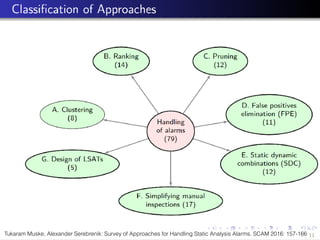
What are possible
approaches for handling
the static analysis alarms?
J. Kamperman, “Automated software inspection: A new approach to increased software quality and productivity,” Reasoning
Inc., White paper, 2002
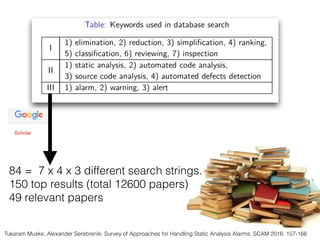
84 = 7 x 4 x 3 different search strings.
150 top results (total 12600 papers)
49 relevant papers
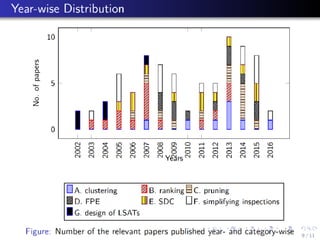
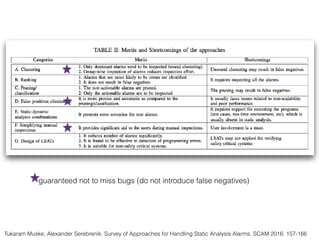
Tukaram Muske, Alexander Serebrenik: Survey of Approaches for Handling Static Analysis Alarms. SCAM 2016: 157-166
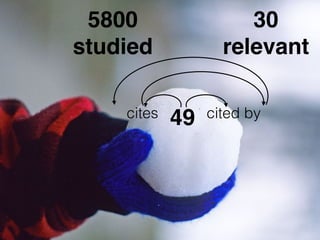
49
5800
studied
cites cited by
30
relevant
Tukaram Muske, Alexander Serebrenik: Survey of Approaches for Handling Static Analysis Alarms. SCAM 2016: 157-166
guaranteed not to miss bugs (do not introduce false negatives)
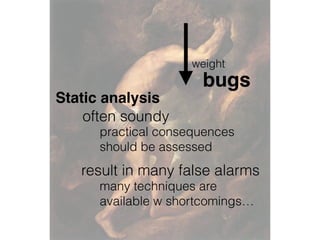
weight
bugs
Static analysis
often soundy
practical consequences
should be assessed
result in many false alarms
many techniques are
available w shortcomings…
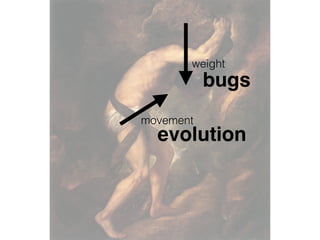
weight
movement
bugs
evolution
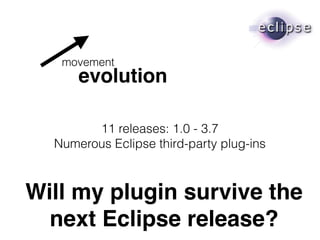
11 releases: 1.0 - 3.7
Numerous Eclipse third-party plug-ins
Will my plugin survive the
next Eclipse release?
movement
evolution
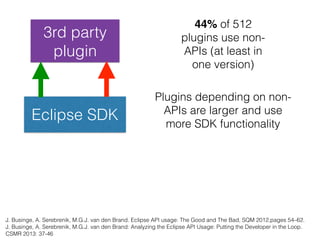
Eclipse SDK
3rd party
plugin
API
• documented
• stable [in non-
breaking releases]
• use encouraged
non-API
• internal in the
name
• undocumented
• unstable
• use discouraged
Eclipse SDK
3rd party
plugin
44% of 512
plugins use non-
APIs (at least in
one version)
Plugins depending on non-
APIs are larger and use
more SDK functionality
J. Businge, A. Serebrenik, M.G.J. van den Brand. Eclipse API usage: The Good and The Bad, SQM 2012,pages 54–62.
J. Businge, A. Serebrenik, M.G.J. van den Brand: Analyzing the Eclipse API Usage: Putting the Developer in the Loop.
CSMR 2013: 37-46
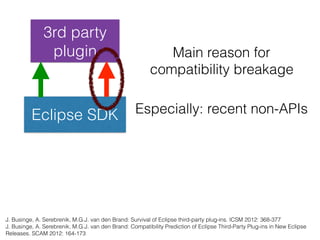
Eclipse SDK
3rd party
plugin Main reason for
compatibility breakage
Especially: recent non-APIs
J. Businge, A. Serebrenik, M.G.J. van den Brand: Survival of Eclipse third-party plug-ins. ICSM 2012: 368-377
J. Businge, A. Serebrenik, M.G.J. van den Brand: Compatibility Prediction of Eclipse Third-Party Plug-ins in New Eclipse
Releases. SCAM 2012: 164-173
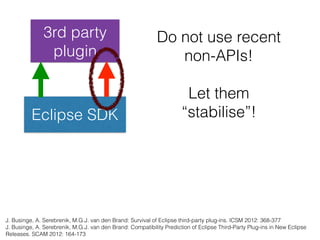
Eclipse SDK
3rd party
plugin
J. Businge, A. Serebrenik, M.G.J. van den Brand: Survival of Eclipse third-party plug-ins. ICSM 2012: 368-377
J. Businge, A. Serebrenik, M.G.J. van den Brand: Compatibility Prediction of Eclipse Third-Party Plug-ins in New Eclipse
Releases. SCAM 2012: 164-173
Do not use recent
non-APIs!
Let them
“stabilise”!
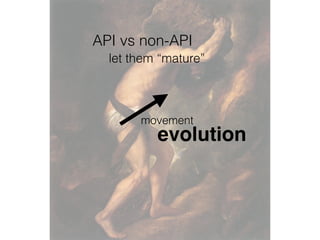
movement
evolution
API vs non-API
let them “mature”
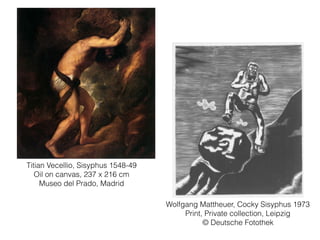
Titian Vecellio, Sisyphus 1548-49
Oil on canvas, 237 x 216 cm
Museo del Prado, Madrid
Wolfgang Mattheuer, Cocky Sisyphus 1973
Print, Private collection, Leipzig
© Deutsche Fotothek

My life as a cyborg

  • 1.
    My life asa cyborg Alexander Serebrenik Eindhoven University of Technology The Netherlands
  • 3.
  • 6.
    Story 1: Women,men and software Bastiaan Heemskerck, Men and women, some carrying baskets, ca. 1700, KMSKB, Brussel
  • 7.
    Bogdan Vasilescu, DarylPosnett, Baishakhi Ray, Mark G. J. van den Brand, Alexander Serebrenik, Premkumar T. Devanbu, Vladimir Filkov: Gender and Tenure Diversity in GitHub Teams. CHI 2015: 3789-3798
  • 8.
    Bogdan Vasilescu, VladimirFilkov, Alexander Serebrenik: Perceptions of Diversity on Git Hub: A User Survey. CHASE@ICSE 2015: 50-56
  • 9.
    Parastou Tourani, BramAdams, Alexander Serebrenik: Code of Conduct in Open Source Projects. SANER 2017, pp. 24-33.
  • 10.
    Story 2: Howdo they communicate? Jos Manders. Communication. ca. 1965. SMAK - Stedelijk Museum voor Actuele Kunst. Ghent
  • 11.
    Bogdan Vasilescu, AlexanderSerebrenik, Premkumar T. Devanbu, Vladimir Filkov: How social Q&A sites are changing knowledge sharing in open source software communities. CSCW 2014: 342-354 Bin Lin, Alexey Zagalsky, Margaret-Anne D. Storey, Alexander Serebrenik: Why Developers Are Slacking Off: Understanding How Software Teams Use Slack. CSCW Companion 2016: 333-336
  • 12.
    Nicole Novielli, FabioCalefato, Filippo Lanubile: The challenges of sentiment detection in the social programmer ecosystem. SSE@SIGSOFT FSE 2015: 33-40 Robbert Jongeling, Proshanta Sarkar, Subhajit Datta, Alexander Serebrenik. On Negative Results when using Sentiment Analysis Tools for Software Engineering Research. Empirical Software Engineering (accepted)
  • 13.
    Daviti Gachechiladze, FilippoLanubile, Nicole Novielli, Alexander Serebrenik. Anger and Its Direction in Collaborative Software Development 39th International Conference on Software Engineering, New Ideas and Emerging Results 2017
  • 14.
  • 17.
  • 18.
  • 19.
  • 20.
  • 21.
    Static analysis (compile time) Dynamicanalysis (runtime analysis) All possible behaviours Behaviours observed during the execution: • Results are incomplete • Generalisation is a problem Inherently imprecise. • Precision requires complex abstractions & postprocessing Precise Correctness guaranteed (under reasonable (?) assumptions) Correctness guaranteed for the behaviours observed Slow Fast Applicable to incomplete programs
  • 22.
    Static analysis (compile time) Dynamicanalysis (runtime analysis) All possible behaviours Behaviours observed during the execution: • Results are incomplete • Generalisation is a problem Inherently imprecise. • Precision requires complex abstractions & postprocessing Precise Correctness guaranteed (under reasonable (?) assumptions) Correctness guaranteed for the behaviours observed Slow Fast Applicable to incomplete programs
  • 23.
  • 24.
  • 26.
  • 27.
    <…> in practice,soundness is commonly eschewed: we are not aware of a single realistic whole-program analysis tool <…> that does not purposely make unsound choices. Similarly, virtually all published whole- program analyses are unsound and omit conservative handling of common language features when applied to real programming languages. Benjamin Livshits, Manu Sridharan, Yannis Smaragdakis, Ondrej Lhoták, José Nelson Amaral, Bor-Yuh Evan Chang, Samuel Z. Guyer, Uday P. Khedker, Anders Møller, Dimitrios Vardoulakis: In defense of soundiness: a manifesto. Commun. ACM 58(2): 44-46 (2015)
  • 28.
    Benjamin Livshits, ManuSridharan, Yannis Smaragdakis, Ondrej Lhoták, José Nelson Amaral, Bor-Yuh Evan Chang, Samuel Z. Guyer, Uday P. Khedker, Anders Møller, Dimitrios Vardoulakis: In defense of soundiness: a manifesto. Commun. ACM 58(2): 44-46 (2015) Language Example of commonly ignored features Consequences of not modelling these features C/C++ setjmp/longjmp ignored ignores arbitrary side-effects to the heap effects of pointer arithmetic “manufactured” pointers Java reflection can render much of the codebase invisible for analysis JNI “invisible” code may create invisible side-effects in programs Javascript eval, dynamic code loading missing execution data flow through the DOM missing dataflow in programs
  • 29.
  • 30.
    Benjamin Livshits, ManuSridharan, Yannis Smaragdakis, Ondrej Lhoták, José Nelson Amaral, Bor-Yuh Evan Chang, Samuel Z. Guyer, Uday P. Khedker, Anders Møller, Dimitrios Vardoulakis: In defense of soundiness: a manifesto. Commun. ACM 58(2): 44-46 (2015) Language Example of commonly ignored features Consequences of not modelling these features C/C++ setjmp/longjmp ignored ignores arbitrary side-effects to the heap effects of pointer arithmetic “manufactured” pointers Java reflection can render much of the codebase invisible for analysis JNI “invisible” code may create invisible side-effects in programs Javascript eval, dynamic code loading missing execution data flow through the DOM missing dataflow in programs
  • 31.
    SWAT - SoftwareAnalysis And Transformation Davy Landman, Alexander Serebrenik, Jurgen J. Vinju: Challenges for static analysis of Java reflection: literature review and empirical study. ICSE 2017: 507-518. Distinguished paper award.
  • 32.
    SWAT - SoftWareAnalysis And Transformation Empirical evidence • Complex reflection is everywhere in Java • 462 Java projects in a representative and clean corpus • 78% of Java projects have hard reflective code • Known limitations have significant impact (4% - 54%) • Existing soundy assumptions validated, more assumptions motivated Actionable results • Researchers: high impact suggestions • Practisioners: adapt code for robustness Answers to research questions 1.What is Java reflection? 2.How often is Java reflection used, and how? 3.What do static analysis tools do to resolve reflection? 4.What are limitations of static analysis tools? 5.How often does real Java code challenge limitations of static analysis?
  • 33.
    SWAT - SoftWareAnalysis And Transformation Q1: What is Java reflection?
  • 34.
    SWAT - SoftWareAnalysis And Transformation Q1: What is Java reflection? “Hard” “Easy”
  • 36.
    SWAT - SoftWareAnalysis And Transformation
  • 37.
    SWAT - SoftWareAnalysis And Transformation Q2: How often is reflection used? • Corpus of 461 (cleaned) Java projects • Maximize representativeness [55] • Clean [clone detection] • Parse & resolve [Rascal, Eclipse JDT] • Categorize [see Q1]
  • 38.
    SWAT - SoftWareAnalysis And Transformation of projects using reflection
  • 39.
    SWAT - SoftWareAnalysis And Transformation Q3: What do analysis tools do? • Extended structured literature review • 4K pdf’s • Semi-automatic full text analysis • Filtering from 4k via 514 and 50 to 33 pdf’s • Annotating • Categorizing
  • 40.
  • 41.
    October 2015: 4K pdf2text36 documents fail
  • 42.
    October 2015: 4K pdf2text36 documents fail 478 documents match at least one rule 514 = 478 + 36 documents to be read
  • 43.
    514 documents Not relevant: •not about Java • not about static analysis • reflection is only recognised as a limitation • reflection is handled with an external tool • … 50 documents • thesis conference paper • conference paper journal article • no publication remove 39 documents • Read + check citations • 4 new papers missing from 4K • 10 irrelevant 33 documents
  • 44.
    SWAT - SoftWareAnalysis And Transformation
  • 45.
    SWAT - SoftWareAnalysis And Transformation
  • 46.
    SWAT - SoftWareAnalysis And Transformation • Collect and categorize analysis papers self-reported: • Optimistic ‘soundy’ assumptions about code • Known limitations of the algorithms • What is their damage in the corpus? • Method: • Recognize and count counter examples • Applying AST patterns to the entire corpus • Rascal metaprogramming language Q4: What are the limitations? and Q5: how do these relate to real code?
  • 47.
    SWAT - SoftWareAnalysis And Transformation
  • 48.
    SWAT - SoftWareAnalysis And Transformation Advice for software engineers; make your code more robust now 1.Do not factor reflection into type polymorphic methods 2.Never use dynamic proxies 3.Use local variables/fields for meta object storage 4.Avoid loops over collections of meta objects 5.Test for preconditions instead of waiting for exceptions Suggestions for static analysis researchers and Java language designers 1.Reflection API improvements to restrict arbitrary interactions (i.e. using lambdas) 2.Infer information from downcasts more aggressively 3.Make soundy assumptions about dynamic proxies: the “oblivious wrapper proxy” 4.Model common “goto patterns” with exceptions around reflection 5.Soundily assume boundedness and unorderedness of meta object collections 6.Apply dynamic language analysis techniques to methods which have reflection
  • 49.
    SWAT - SoftwareAnalysis And Transformation This work has been supported by the NWO TOPGO grant #612.001.011 “Domain-Specific Languages: A Big Future for Small Programs” @jurgenvinju@davylandman @aserebrenik Please use these artefacts for yourselves, or contact us for discussion about: - the new soundy assumptions are a prioritized work list (*) - the corpus is a way to validate relevance for new ideas in static analysis [3] - tell us why we were wrong (replicate it) [63] To the anonymous reviewers and to the members of IFIP WG 2.4 Software Implementation Technology, including Anders Møller, …
  • 50.
    Rascal: parsing and analysistechnology Tools: for literature reviews and corpus analysis Data: corpus
  • 51.
  • 52.
    Source code Static analysis Predicted Bugs Real Bugs Oracle completeness soundness (Manual) postprocessing soundy assumptions Bad news: 1true: 50 false alarms J. Kamperman, “Automated software inspection: A new approach to increased software quality and productivity,” Reasoning Inc., White paper, 2002
  • 53.
    What are possible approachesfor handling the static analysis alarms? J. Kamperman, “Automated software inspection: A new approach to increased software quality and productivity,” Reasoning Inc., White paper, 2002
  • 54.
    84 = 7x 4 x 3 different search strings. 150 top results (total 12600 papers) 49 relevant papers Tukaram Muske, Alexander Serebrenik: Survey of Approaches for Handling Static Analysis Alarms. SCAM 2016: 157-166
  • 55.
  • 56.
    Tukaram Muske, AlexanderSerebrenik: Survey of Approaches for Handling Static Analysis Alarms. SCAM 2016: 157-166
  • 58.
    Tukaram Muske, AlexanderSerebrenik: Survey of Approaches for Handling Static Analysis Alarms. SCAM 2016: 157-166 guaranteed not to miss bugs (do not introduce false negatives)
  • 59.
    weight bugs Static analysis often soundy practicalconsequences should be assessed result in many false alarms many techniques are available w shortcomings…
  • 60.
  • 61.
    11 releases: 1.0- 3.7 Numerous Eclipse third-party plug-ins Will my plugin survive the next Eclipse release? movement evolution
  • 62.
    Eclipse SDK 3rd party plugin API •documented • stable [in non- breaking releases] • use encouraged non-API • internal in the name • undocumented • unstable • use discouraged
  • 63.
    Eclipse SDK 3rd party plugin 44%of 512 plugins use non- APIs (at least in one version) Plugins depending on non- APIs are larger and use more SDK functionality J. Businge, A. Serebrenik, M.G.J. van den Brand. Eclipse API usage: The Good and The Bad, SQM 2012,pages 54–62. J. Businge, A. Serebrenik, M.G.J. van den Brand: Analyzing the Eclipse API Usage: Putting the Developer in the Loop. CSMR 2013: 37-46
  • 64.
    Eclipse SDK 3rd party pluginMain reason for compatibility breakage Especially: recent non-APIs J. Businge, A. Serebrenik, M.G.J. van den Brand: Survival of Eclipse third-party plug-ins. ICSM 2012: 368-377 J. Businge, A. Serebrenik, M.G.J. van den Brand: Compatibility Prediction of Eclipse Third-Party Plug-ins in New Eclipse Releases. SCAM 2012: 164-173
  • 65.
    Eclipse SDK 3rd party plugin J.Businge, A. Serebrenik, M.G.J. van den Brand: Survival of Eclipse third-party plug-ins. ICSM 2012: 368-377 J. Businge, A. Serebrenik, M.G.J. van den Brand: Compatibility Prediction of Eclipse Third-Party Plug-ins in New Eclipse Releases. SCAM 2012: 164-173 Do not use recent non-APIs! Let them “stabilise”!
  • 66.
  • 67.
    Titian Vecellio, Sisyphus1548-49 Oil on canvas, 237 x 216 cm Museo del Prado, Madrid Wolfgang Mattheuer, Cocky Sisyphus 1973 Print, Private collection, Leipzig © Deutsche Fotothek