Achieving Quality with
 Development Tools
Agenda

●   Bugs in Software
●   Why do bugs occur?
●   Product Quality
●   Kind of Tests
●   Bug Finding Techniques
●   Static Analysis
●   Static Analysis Challenges
●   Static Analysis Philosophy
●   Our Accuracy Goal
●   Bugs vs Style
●   Tools used for efficient development and achieve quality
Bugs in software

• Programmers are smart

• We have good techniques (e.g., unit testing, pair

programming, code inspections) for finding bugs early

So, most bugs remaining in production code must be
subtle, and require sophisticated techniques to find.

• Right?
Why do bugs occur?


●   Everybody makes dumb mistakes.

●   Java (and similar languages) have very large standard
    libraries.

●   Many possibilities for confusion and misuse.

●   Many possibilities for latent bugs (e.g., hashcode/equals).

●   Programmers play fast and loose with threads.
Product Quality


Lots of obvious bugs find their way into production software

● Testing and code inspections will not find every bug.

● Very hard to get high test coverage for a large system

● Limits to frequency, completeness of code inspections

● Techniques to find more bugs automatically are valuable

Quality is the responsibility of everyone on the team.
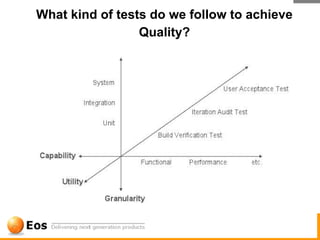
What kind of tests do we follow to achieve
                 Quality?
Bug Finding Techniques
● Code Inspections
  - Effective but have to be applied manually.

● Dynamic Techniques (Testing, Assertions)
  - Examine runtime behaviour and examine paths that are
  actually executed(advantages and disadvantages).

● Static Techniques
  - Explore abstractions of all possible behaviours.
  - Strongest formal proof of correctness (prohibitively
  difficult).
  - Partial verification demonstrates that some property holds
  for all executions.
  - Unsound techniques can identify “probable” bugs will miss
  some real bugs and may give inaccurate warnings.
Static Analysis


Let the computer figure out where (some of) the bugs
are.

  • Tools on static analysis to find bugs- Checkstyle,
  PMD, FindBugs, ESC/Java, Cqual, apart from other
  tools, papers, techniques etc,.

We think it should be!
Static Analysis Challenges


● Fundamental limits to static analysis

● Nontrivial properties of programs are undecidable

● Be consistently conservative: could choose to

● Never miss a real bug (but report some false positives)

● Never report a false positive (but miss some real bugs)

● Both false positives and false negatives are possible
Static Analysis philosophy


Two approaches to devising a static analysis to find bugs:

1. Given an analysis technique, figure out what bugs it
could find

2. Given a bug, figure out an analysis that could be used to find
occurrences of similar bugs
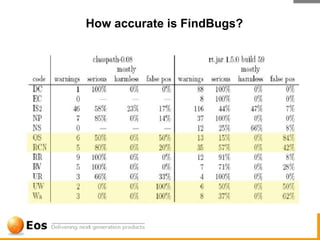
Accuracy Goal


Our goal is that at least 70% of high and medium priority
warnings should be real bugs.

• We manually classified warnings produced by tool for
several real applications and libraries.

• In general, we came close to achieving our goal.
Bugs vs Style
It is important to distinguish bug checkers from style
checkers-

●   Style checkers warn about dubious or dangerous coding
    idioms: however, instances of those idioms may not be
    particularly likely to be a bug

●   Bug checkers warn about code idioms that are likely to be
    actual bugs.

●   Style checkers are useful for enforcing consistent coding
    standards and help prevent certain kinds of bugs.
Style checker
By following a coding standard, we ensure that the source code
is predictable in its semantics and understood in the same
manner across the development team.

We make a clear distinction between standards related to style
and standards related to best practices.

Examples of style standards are where to place braces and how
to use whitespace.

Examples of best practices are when to use interfaces and how
to implement an equals method.
Tools used for fixing Bugs and
                   following Style

● Eclipse
● PMD
● FindBugs
● EclEmma
PMD
●   Syntactic checks on program source code

●   No dataflow component

●   Mainly detects violations of stylistic conventions
    – May be symptomatic of deeper problems

●   Contains a number of rule sets that define detectors for
    different style violations
    – Also tool for detecting suspected cut-and-paste code

●   Extensible – either using Java or XPath

●   Documentation contains details for using and extending
    rulesets
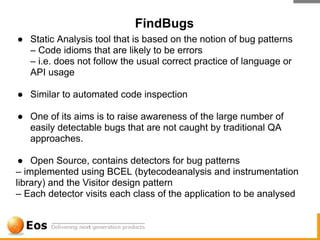
FindBugs
● Static Analysis tool that is based on the notion of bug patterns
  – Code idioms that are likely to be errors
  – i.e. does not follow the usual correct practice of language or
  API usage

● Similar to automated code inspection

● One of its aims is to raise awareness of the large number of
  easily detectable bugs that are not caught by traditional QA
  approaches.

 ● Open Source, contains detectors for bug patterns
– implemented using BCEL (bytecodeanalysis and instrumentation
library) and the Visitor design pattern
– Each detector visits each class of the application to be analysed
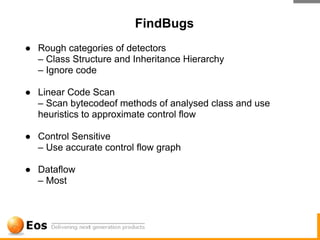
FindBugs
● Rough categories of detectors
  – Class Structure and Inheritance Hierarchy
  – Ignore code

● Linear Code Scan
  – Scan bytecodeof methods of analysed class and use
  heuristics to approximate control flow

● Control Sensitive
  – Use accurate control flow graph

● Dataflow
  – Most
How accurate is FindBugs?
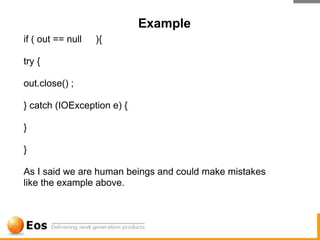
Example
if ( out == null   ){

try {

out.close() ;

} catch (IOException e) {

}

}

As I said we are human beings and could make mistakes
like the example above.
What can FindBugs do?

●   Correctness bugs

    Null Pointer Dereference
    Return value ignored

●   Multithreaded correctness bugs

    Inconsistent synchronization
    Unconditional wait

●   Malicious code vulnerabilities

    Mutable static
    Returning a reference to an internal array
EclEmma

●   EclEmma is a free java tool that calculates the percentage of
    code accessed by tests. It can be used to identify which parts
    of the java program are lacking test coverage.

●   Our goal is to acheive > 80% of coverage
Conclusion


●  PMD and FindBugs helps find out bugs and follow coding
standard during the development stage.

●   EclEmma is used for measuring the code coverage.

●   The number of bugs found in the test environment or
    production becomes lesser by using these tools.

Achieving quality with tools case study

  • 1.
    Achieving Quality with Development Tools
  • 2.
    Agenda ● Bugs in Software ● Why do bugs occur? ● Product Quality ● Kind of Tests ● Bug Finding Techniques ● Static Analysis ● Static Analysis Challenges ● Static Analysis Philosophy ● Our Accuracy Goal ● Bugs vs Style ● Tools used for efficient development and achieve quality
  • 3.
    Bugs in software •Programmers are smart • We have good techniques (e.g., unit testing, pair programming, code inspections) for finding bugs early So, most bugs remaining in production code must be subtle, and require sophisticated techniques to find. • Right?
  • 4.
    Why do bugsoccur? ● Everybody makes dumb mistakes. ● Java (and similar languages) have very large standard libraries. ● Many possibilities for confusion and misuse. ● Many possibilities for latent bugs (e.g., hashcode/equals). ● Programmers play fast and loose with threads.
  • 5.
    Product Quality Lots ofobvious bugs find their way into production software ● Testing and code inspections will not find every bug. ● Very hard to get high test coverage for a large system ● Limits to frequency, completeness of code inspections ● Techniques to find more bugs automatically are valuable Quality is the responsibility of everyone on the team.
  • 6.
    What kind oftests do we follow to achieve Quality?
  • 7.
    Bug Finding Techniques ●Code Inspections - Effective but have to be applied manually. ● Dynamic Techniques (Testing, Assertions) - Examine runtime behaviour and examine paths that are actually executed(advantages and disadvantages). ● Static Techniques - Explore abstractions of all possible behaviours. - Strongest formal proof of correctness (prohibitively difficult). - Partial verification demonstrates that some property holds for all executions. - Unsound techniques can identify “probable” bugs will miss some real bugs and may give inaccurate warnings.
  • 8.
    Static Analysis Let thecomputer figure out where (some of) the bugs are. • Tools on static analysis to find bugs- Checkstyle, PMD, FindBugs, ESC/Java, Cqual, apart from other tools, papers, techniques etc,. We think it should be!
  • 9.
    Static Analysis Challenges ●Fundamental limits to static analysis ● Nontrivial properties of programs are undecidable ● Be consistently conservative: could choose to ● Never miss a real bug (but report some false positives) ● Never report a false positive (but miss some real bugs) ● Both false positives and false negatives are possible
  • 10.
    Static Analysis philosophy Twoapproaches to devising a static analysis to find bugs: 1. Given an analysis technique, figure out what bugs it could find 2. Given a bug, figure out an analysis that could be used to find occurrences of similar bugs
  • 11.
    Accuracy Goal Our goalis that at least 70% of high and medium priority warnings should be real bugs. • We manually classified warnings produced by tool for several real applications and libraries. • In general, we came close to achieving our goal.
  • 12.
    Bugs vs Style Itis important to distinguish bug checkers from style checkers- ● Style checkers warn about dubious or dangerous coding idioms: however, instances of those idioms may not be particularly likely to be a bug ● Bug checkers warn about code idioms that are likely to be actual bugs. ● Style checkers are useful for enforcing consistent coding standards and help prevent certain kinds of bugs.
  • 13.
    Style checker By followinga coding standard, we ensure that the source code is predictable in its semantics and understood in the same manner across the development team. We make a clear distinction between standards related to style and standards related to best practices. Examples of style standards are where to place braces and how to use whitespace. Examples of best practices are when to use interfaces and how to implement an equals method.
  • 14.
    Tools used forfixing Bugs and following Style ● Eclipse ● PMD ● FindBugs ● EclEmma
  • 15.
    PMD ● Syntactic checks on program source code ● No dataflow component ● Mainly detects violations of stylistic conventions – May be symptomatic of deeper problems ● Contains a number of rule sets that define detectors for different style violations – Also tool for detecting suspected cut-and-paste code ● Extensible – either using Java or XPath ● Documentation contains details for using and extending rulesets
  • 16.
    FindBugs ● Static Analysistool that is based on the notion of bug patterns – Code idioms that are likely to be errors – i.e. does not follow the usual correct practice of language or API usage ● Similar to automated code inspection ● One of its aims is to raise awareness of the large number of easily detectable bugs that are not caught by traditional QA approaches. ● Open Source, contains detectors for bug patterns – implemented using BCEL (bytecodeanalysis and instrumentation library) and the Visitor design pattern – Each detector visits each class of the application to be analysed
  • 17.
    FindBugs ● Rough categoriesof detectors – Class Structure and Inheritance Hierarchy – Ignore code ● Linear Code Scan – Scan bytecodeof methods of analysed class and use heuristics to approximate control flow ● Control Sensitive – Use accurate control flow graph ● Dataflow – Most
  • 18.
    How accurate isFindBugs?
  • 19.
    Example if ( out== null ){ try { out.close() ; } catch (IOException e) { } } As I said we are human beings and could make mistakes like the example above.
  • 20.
    What can FindBugsdo? ● Correctness bugs Null Pointer Dereference Return value ignored ● Multithreaded correctness bugs Inconsistent synchronization Unconditional wait ● Malicious code vulnerabilities Mutable static Returning a reference to an internal array
  • 21.
    EclEmma ● EclEmma is a free java tool that calculates the percentage of code accessed by tests. It can be used to identify which parts of the java program are lacking test coverage. ● Our goal is to acheive > 80% of coverage
  • 22.
    Conclusion ● PMDand FindBugs helps find out bugs and follow coding standard during the development stage. ● EclEmma is used for measuring the code coverage. ● The number of bugs found in the test environment or production becomes lesser by using these tools.