Business  Intelligence Portfolio Marlboro, NJ  [email_address] Ph: 732.598.2703 Lenny   Finkel Business Intelligence Professional
Data Modeling   T-SQL Programming SQL Server Integration Services (SSIS)  SQL Server Analysis Services (SSAS)  MDX Programming and KPIs SQL Server Reporting Services (SSRS)  SharePoint  and Performance Point Server
Introduction:  This portfolio illustrates my experience in the Microsoft business intelligence suite of products. Audience:  Recruiters, Hiring Managers, Technical and non-Technical professionals. Project Goals:  Increase revenue growth, boost sales, optimize performance.
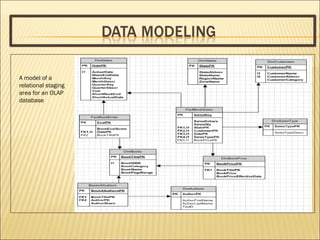
A model of a relational staging area for an OLAP database
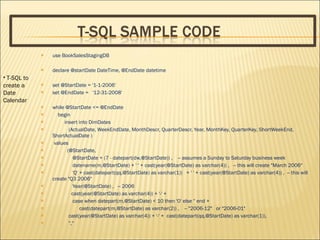
use BookSalesStagingDB declare @startDate DateTime, @EndDate datetime set @StartDate = '1-1-2006' set @EndDate =  '12-31-2008' while @StartDate <= @EndDate begin insert into DimDates (ActualDate, WeekEndDate, MonthDescr, QuarterDescr, Year, MonthKey, QuarterKey, ShortWeekEnd, ShortActualDate ) values  (@StartDate,  @StartDate + (7 - datepart(dw,@StartDate)) ,  -- assumes a Sunday to Saturday business week datename(m,@StartDate) + ' ' + cast(year(@StartDate) as varchar(4)) ,  -- this will create &quot;March 2006&quot; 'Q' + cast(datepart(qq,@StartDate) as varchar(1))  + ' ' + cast(year(@StartDate) as varchar(4)) ,  -- this will create &quot;Q3 2006&quot; Year(@StartDate) ,  -- 2006 cast(year(@StartDate) as varchar(4)) + '-' +  case when datepart(m,@StartDate) < 10 then '0' else '' end +  cast(datepart(m,@StartDate) as varchar(2)) ,  -- &quot;2006-12&quot;  or &quot;2006-01&quot; cast(year(@StartDate) as varchar(4)) + '-' +  cast(datepart(qq,@StartDate) as varchar(1)),  '','' T-SQL to  create a Date Calendar
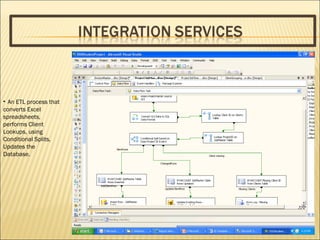
An ETL process that converts Excel  spreadsheets, performs Client Lookups, using Conditional Splits,  Updates the Database.
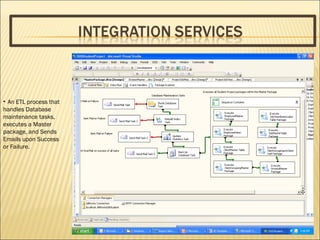
An ETL process that handles Database maintenance tasks, executes a Master package, and Sends Emails upon Success or Failure.
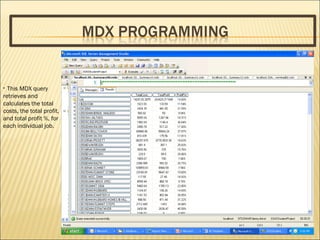
This MDX query retrieves and calculates the total costs, the total profit, and total profit %, for each individual job.
With member [TotalCosts] as  Sum( {[Total Labor Cost], [Total Material Cost], [Total Overhead]} ) member [TotalProfit] as  Sum( { [Total Labor Profit], [Total Material Profit], [Additional Labor Profit] } ) member [ProfitPct] as  ([TotalProfit] / ([TotalCosts] + [TotalProfit] ) ), format_string = 'percent' Select { [TotalCosts], [TotalProfit], [ProfitPct]} on columns, nonempty ( {[Job Master].[Description], [Job Master].[Description].children } ) on Rows  From [All Works Cube] MDX code to retrieve and calculate the total costs, the total profit, and total profit %, for each individual job.
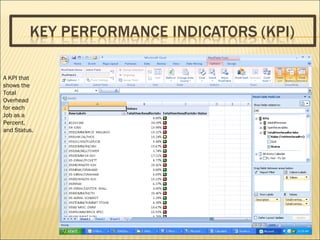
A KPI that shows the Total Overhead for each Job as a Percent, and Status.
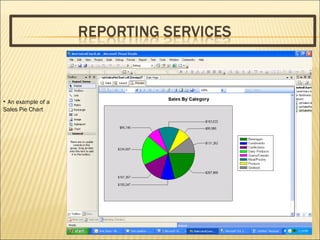
An example of a Sales Pie Chart
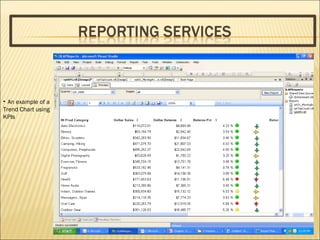
An example of a Trend Chart using KPIs
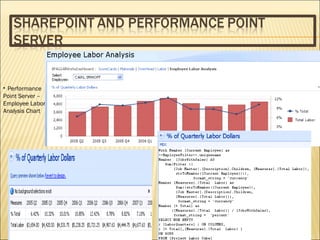
Performance Point Server – Employee Labor Analysis Chart

My Business Intelligence Portfolio

  • 1.
    Business IntelligencePortfolio Marlboro, NJ [email_address] Ph: 732.598.2703 Lenny Finkel Business Intelligence Professional
  • 2.
    Data Modeling T-SQL Programming SQL Server Integration Services (SSIS) SQL Server Analysis Services (SSAS) MDX Programming and KPIs SQL Server Reporting Services (SSRS) SharePoint and Performance Point Server
  • 3.
    Introduction: Thisportfolio illustrates my experience in the Microsoft business intelligence suite of products. Audience: Recruiters, Hiring Managers, Technical and non-Technical professionals. Project Goals: Increase revenue growth, boost sales, optimize performance.
  • 4.
    A model ofa relational staging area for an OLAP database
  • 5.
    use BookSalesStagingDB declare@startDate DateTime, @EndDate datetime set @StartDate = '1-1-2006' set @EndDate = '12-31-2008' while @StartDate <= @EndDate begin insert into DimDates (ActualDate, WeekEndDate, MonthDescr, QuarterDescr, Year, MonthKey, QuarterKey, ShortWeekEnd, ShortActualDate ) values (@StartDate, @StartDate + (7 - datepart(dw,@StartDate)) , -- assumes a Sunday to Saturday business week datename(m,@StartDate) + ' ' + cast(year(@StartDate) as varchar(4)) , -- this will create &quot;March 2006&quot; 'Q' + cast(datepart(qq,@StartDate) as varchar(1)) + ' ' + cast(year(@StartDate) as varchar(4)) , -- this will create &quot;Q3 2006&quot; Year(@StartDate) , -- 2006 cast(year(@StartDate) as varchar(4)) + '-' + case when datepart(m,@StartDate) < 10 then '0' else '' end + cast(datepart(m,@StartDate) as varchar(2)) , -- &quot;2006-12&quot; or &quot;2006-01&quot; cast(year(@StartDate) as varchar(4)) + '-' + cast(datepart(qq,@StartDate) as varchar(1)), '','' T-SQL to create a Date Calendar
  • 6.
    An ETL processthat converts Excel spreadsheets, performs Client Lookups, using Conditional Splits, Updates the Database.
  • 7.
    An ETL processthat handles Database maintenance tasks, executes a Master package, and Sends Emails upon Success or Failure.
  • 8.
    This MDX queryretrieves and calculates the total costs, the total profit, and total profit %, for each individual job.
  • 9.
    With member [TotalCosts]as Sum( {[Total Labor Cost], [Total Material Cost], [Total Overhead]} ) member [TotalProfit] as Sum( { [Total Labor Profit], [Total Material Profit], [Additional Labor Profit] } ) member [ProfitPct] as ([TotalProfit] / ([TotalCosts] + [TotalProfit] ) ), format_string = 'percent' Select { [TotalCosts], [TotalProfit], [ProfitPct]} on columns, nonempty ( {[Job Master].[Description], [Job Master].[Description].children } ) on Rows From [All Works Cube] MDX code to retrieve and calculate the total costs, the total profit, and total profit %, for each individual job.
  • 10.
    A KPI thatshows the Total Overhead for each Job as a Percent, and Status.
  • 11.
    An example ofa Sales Pie Chart
  • 12.
    An example ofa Trend Chart using KPIs
  • 13.
    Performance Point Server– Employee Labor Analysis Chart

Editor's Notes

  • #2 Business Intelligence Professional
  • #5 A model of a relational staging area for an OLAP database
  • #6 T-SQL to create a Date Calendar
  • #7 An example of a Pie Chart
  • #8 An example of a Pie Chart
  • #9 An example of a Pie Chart
  • #10 An example of a Pie Chart
  • #11 A KPI that shows the Total Overhead for each Job as a Percent and Status
  • #12 An example of a Pie Chart
  • #13 An example of a Pie Chart
  • #14 An example of a Pie Chart