My B2 Evaluation
Initially, being given the brief of this project, I had a
strong idea on exactly what I would work on to
help my clients as much as possible. Researching
the client and their specific requirements that I
needed to meet was a familiar and exciting
experience as it symbolized a new start in the
course. Looking through the many pieces of past
work and analysing every detail throughout the
patterned history of Sunderland Culture, the client.
Analysing was necessary as I required to gather
the codes and conventions and the rationales for
specific approaches. A platform which helped me
drastically in this process was YouTube, it
contained all the client’s past products and the
more recent work from them. This helped direct
me towards my project and to have a good idea of
the wants and needs of my client.
As my course progressed, after forming initial
planning and rationales for my project, utilizing
peer assessment became a very useful tool to
gain a view on how my project was going. Making
corrections according to this peer assessment was
vital in retaining the audience that the project was
aiming for, which was for a teenage audience in
my short film, gaining feedback for this was vital
and peer assessment had changed the course of
my project. Signing detailed paperwork to ensure
crew safety and crew permission to work at
specific locations was a part of my pre-production
process throughout my journey. This professional
practise familiarised me with the media industry
and helped to give my project a truly professional
feel, requiring signatures from personnel and
permission from site managers. Detailing my
process throughout finally getting to produce a
project was a process that needed to be
documented, creating my own production diary
helped put my entire production process into a
scope, outlining the successes and many
struggles that had occurred along the way of
shooting. Despite my lengthy pre-production, the
struggles I encountered throughout producing my
short film for the client were totally unforeseen, this
is due to weather and other unpredictable
variables that hindered my production progress.
However, the pre-production process of this
project helped me to no end whilst working
towards the end product of my short film project.
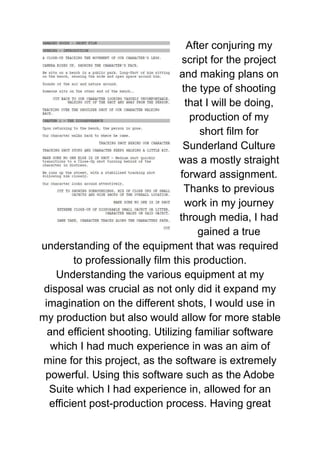
After conjuring my
script for the project
and making plans on
the type of shooting
that I will be doing,
production of my
short film for
Sunderland Culture
was a mostly straight
forward assignment.
Thanks to previous
work in my journey
through media, I had
gained a true
understanding of the equipment that was required
to professionally film this production.
Understanding the various equipment at my
disposal was crucial as not only did it expand my
imagination on the different shots, I would use in
my production but also would allow for more stable
and efficient shooting. Utilizing familiar software
which I had much experience in was an aim of
mine for this project, as the software is extremely
powerful. Using this software such as the Adobe
Suite which I had experience in, allowed for an
efficient post-production process. Having great
knowledge of the editing software allowed me to
focus on creative ideas in editing rather than
discovering how to use the software. Adobe
Premiere Pro was the specialized software of
choice for my production; it was a perfect choice. It
allowed me to add many effects and allowed free
reign over the colour grade of my short film.
Reflecting on the production process of this project
for Sunderland Culture, some problems cropped
up in the shooting of my short film, these problems
required creative fixes to workaround this. This
ended up having an adverse effect, making my
product more fit the intended meaning of the
scene. An example of this is the glitchy sequence
near the beginning of the short film. Another
problem was time management, vital crew
members required other duties, so some shooting
days were severely limited due to the small
amount of time available from the crew members,
this problem was solved by efficiently managing
the time we had and filming parts which required
as little time as possible.
Upon the completion of my product, I would say
that I stuck to many codes and conventions
established by earlier work and work that I have
analysed in the past. An example of this is using
music during a dramatic moment, this occurs
during the middle of my film when one of the
characters are running away from another, I use a
lot of non-diegetic sound to emphasize this
dramatic moment. Diegetic sound is a cornerstone
of my work, which is used throughout the entirety
of my project, especially when it comes to
background music, I have also used sound effects
to make sure that sound works as expected.
Another example of following codes and
conventions is the variety of shots used in the final
project, for example, to show when a character is
lonely, I have used a wide shot which shows just
how lonely the character is. This is shown on the
opening shot of the film. The use of these codes
and conventions is a big improvement amongst my
past work where I feel as though I didn’t stick to
these codes and conventions very well, especially
when it came to using non-diegetic sound and
overall experimentation in editing. With these
codes and conventions met, I would say that I
have met the brief as it all brings together a project
that mixes the two main genres of the teenage
audience and, uses music which panders to this
audience.
I feel like researching different award-winning short
films severely helped me on my journey, as it
helped me gather tonnes of inspiration. It was
extremely useful to always consider this existing
work along every step of the production, for
example, it helped with my shot production and
coming up with different ideas for different shots.
Gathering feedback along the way brought me
back on track with the audience and allowed me to
make sure that they were satisfied with the work
that I had done as my test audience was very
similar to my final product audience. When it came
to post-production experimenting with Adobe
Premiere Pro was a fun experience for an
enthusiast such as me. I loved experimenting with
different colour grades, filters and effects that
helped stylize my project and to overall improve
my skill with the software. This work has helped
me achieve elsewhere, the valuable experience
and hours of knowledge gained when it comes to
the practical sides such as recording with
specialized software and equipment, writing scripts
in professional software such as CeltX and being a
leader in a team of a diverse range of people.
Ultimately, I believe that I have stuck closely to the
brief that was given to me, as it is aimed towards
an audience of people ranging between the ages
of 16 – 25 and I have stuck to my initial idea of
creating a short film which shows the different
sights of Sunderland. I have responded to
setbacks creatively by implementing creative
workarounds and improvements, an example of
this is decreasing the amount of dialogue in the
short film, as the area was quite windy at the time
of filming. This allowed me to add non-diegetic
sound to create an ambient sound to the short film,
removing the jarring sound of the wind. I have
learned a lot from this experience, such as how to
act in a professional way, how to direct a team and
the unforeseen issues that may pop up when
creating a project like this in the media industry. If
given the opportunity to do this a second time, I
would more carefully plan my shooting days
around the expected whether of that specific day,
this way I won’t have to create workarounds to
solve bad recording quality later in the post-
production process. I would, however, keep my
directing ability the same, and write my own script
again if given this opportunity a second time. Due
to the limited amount of problems experience in
the end, I would do much the same as this project
has been a massive success.

My B2 Evaluationnnnnlojgdfhdfdfhdfg.docx

  • 1.
    My B2 Evaluation Initially,being given the brief of this project, I had a strong idea on exactly what I would work on to help my clients as much as possible. Researching the client and their specific requirements that I needed to meet was a familiar and exciting experience as it symbolized a new start in the course. Looking through the many pieces of past work and analysing every detail throughout the patterned history of Sunderland Culture, the client. Analysing was necessary as I required to gather the codes and conventions and the rationales for specific approaches. A platform which helped me drastically in this process was YouTube, it contained all the client’s past products and the more recent work from them. This helped direct me towards my project and to have a good idea of the wants and needs of my client. As my course progressed, after forming initial planning and rationales for my project, utilizing peer assessment became a very useful tool to gain a view on how my project was going. Making corrections according to this peer assessment was vital in retaining the audience that the project was
  • 2.
    aiming for, whichwas for a teenage audience in my short film, gaining feedback for this was vital and peer assessment had changed the course of my project. Signing detailed paperwork to ensure crew safety and crew permission to work at specific locations was a part of my pre-production process throughout my journey. This professional practise familiarised me with the media industry and helped to give my project a truly professional feel, requiring signatures from personnel and permission from site managers. Detailing my process throughout finally getting to produce a project was a process that needed to be documented, creating my own production diary helped put my entire production process into a scope, outlining the successes and many struggles that had occurred along the way of shooting. Despite my lengthy pre-production, the struggles I encountered throughout producing my short film for the client were totally unforeseen, this is due to weather and other unpredictable variables that hindered my production progress. However, the pre-production process of this project helped me to no end whilst working towards the end product of my short film project.
  • 3.
    After conjuring my scriptfor the project and making plans on the type of shooting that I will be doing, production of my short film for Sunderland Culture was a mostly straight forward assignment. Thanks to previous work in my journey through media, I had gained a true understanding of the equipment that was required to professionally film this production. Understanding the various equipment at my disposal was crucial as not only did it expand my imagination on the different shots, I would use in my production but also would allow for more stable and efficient shooting. Utilizing familiar software which I had much experience in was an aim of mine for this project, as the software is extremely powerful. Using this software such as the Adobe Suite which I had experience in, allowed for an efficient post-production process. Having great
  • 4.
    knowledge of theediting software allowed me to focus on creative ideas in editing rather than discovering how to use the software. Adobe Premiere Pro was the specialized software of choice for my production; it was a perfect choice. It allowed me to add many effects and allowed free reign over the colour grade of my short film. Reflecting on the production process of this project for Sunderland Culture, some problems cropped up in the shooting of my short film, these problems required creative fixes to workaround this. This ended up having an adverse effect, making my product more fit the intended meaning of the scene. An example of this is the glitchy sequence near the beginning of the short film. Another problem was time management, vital crew members required other duties, so some shooting days were severely limited due to the small amount of time available from the crew members, this problem was solved by efficiently managing the time we had and filming parts which required as little time as possible.
  • 5.
    Upon the completionof my product, I would say that I stuck to many codes and conventions established by earlier work and work that I have analysed in the past. An example of this is using music during a dramatic moment, this occurs during the middle of my film when one of the characters are running away from another, I use a lot of non-diegetic sound to emphasize this dramatic moment. Diegetic sound is a cornerstone of my work, which is used throughout the entirety of my project, especially when it comes to background music, I have also used sound effects to make sure that sound works as expected. Another example of following codes and conventions is the variety of shots used in the final project, for example, to show when a character is lonely, I have used a wide shot which shows just how lonely the character is. This is shown on the opening shot of the film. The use of these codes and conventions is a big improvement amongst my past work where I feel as though I didn’t stick to these codes and conventions very well, especially when it came to using non-diegetic sound and overall experimentation in editing. With these codes and conventions met, I would say that I have met the brief as it all brings together a project
  • 6.
    that mixes thetwo main genres of the teenage audience and, uses music which panders to this audience. I feel like researching different award-winning short films severely helped me on my journey, as it helped me gather tonnes of inspiration. It was extremely useful to always consider this existing work along every step of the production, for example, it helped with my shot production and coming up with different ideas for different shots. Gathering feedback along the way brought me back on track with the audience and allowed me to make sure that they were satisfied with the work that I had done as my test audience was very similar to my final product audience. When it came to post-production experimenting with Adobe Premiere Pro was a fun experience for an enthusiast such as me. I loved experimenting with different colour grades, filters and effects that helped stylize my project and to overall improve my skill with the software. This work has helped me achieve elsewhere, the valuable experience and hours of knowledge gained when it comes to the practical sides such as recording with
  • 7.
    specialized software andequipment, writing scripts in professional software such as CeltX and being a leader in a team of a diverse range of people. Ultimately, I believe that I have stuck closely to the brief that was given to me, as it is aimed towards an audience of people ranging between the ages of 16 – 25 and I have stuck to my initial idea of creating a short film which shows the different sights of Sunderland. I have responded to setbacks creatively by implementing creative workarounds and improvements, an example of this is decreasing the amount of dialogue in the short film, as the area was quite windy at the time of filming. This allowed me to add non-diegetic sound to create an ambient sound to the short film, removing the jarring sound of the wind. I have learned a lot from this experience, such as how to act in a professional way, how to direct a team and the unforeseen issues that may pop up when creating a project like this in the media industry. If given the opportunity to do this a second time, I would more carefully plan my shooting days around the expected whether of that specific day, this way I won’t have to create workarounds to
  • 8.
    solve bad recordingquality later in the post- production process. I would, however, keep my directing ability the same, and write my own script again if given this opportunity a second time. Due to the limited amount of problems experience in the end, I would do much the same as this project has been a massive success.