Mobile Virtual Network Operator Presented by: Syndicate 4 Unmesh Chitnis 08020541012 Disha Seth 08020541015 Mohit Malik 08020541028 Samruddhi Dadhe 08020541046 Vaibhav Misra 08020541053
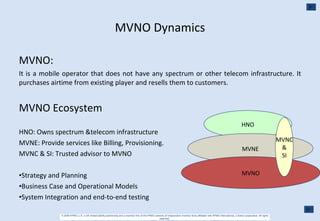
MVNO Dynamics MVNO: It is a mobile operator that does not have any spectrum or other telecom infrastructure. It purchases airtime from existing player and resells them to customers. MVNO Ecosystem  HNO: Owns spectrum &telecom infrastructure MVNE: Provide services like Billing, Provisioning. MVNC & SI: Trusted advisor to MVNO Strategy and Planning  Business Case and Operational Models  System Integration and end-to-end testing  HNO MVNE MVNO MVNC & SI
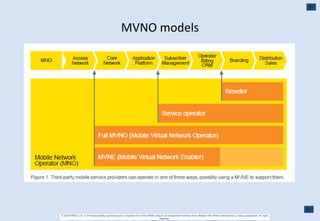
MVNO models
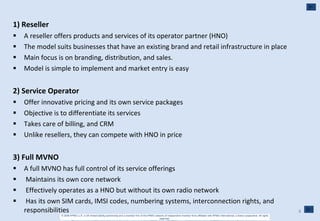
1) Reseller  A reseller offers products and services of its operator partner (HNO)  The model suits businesses that have an existing brand and retail infrastructure in place  Main focus is on branding, distribution, and sales.  Model is simple to implement and market entry is easy  2) Service Operator  Offer innovative pricing and its own service packages  Objective is to differentiate its services  Takes care of billing, and CRM  Unlike resellers, they can compete with HNO in price  3) Full MVNO  A full MVNO has full control of its service offerings  Maintains its own core network  Effectively operates as a HNO but without its own radio network  Has its own SIM cards, IMSI codes, numbering systems, interconnection rights, and  responsibilities
Key environmental Factors HNO’s are open to MVNOs Competitive market Low penetration and Under served segments Friendly Regulatory regime Number Portability Critical success factors Know the customer Strong brand Up sell, cross sell, bundle
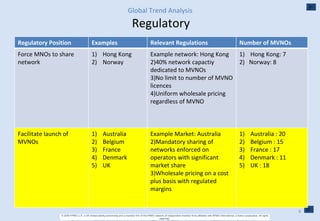
Global Trend Analysis   Regulatory Regulatory Position Examples Relevant Regulations Number of MVNOs Force MNOs to share network Hong Kong Norway Example network:  Hong Kong 40% network capactiy dedicated to MVNOs No limit to number of MVNO licences Uniform wholesale pricing regardless of MVNO Hong Kong: 7 2)  Norway: 8 Facilitate launch of MVNOs Australia Belgium  France  Denmark UK Example Market: Australia Mandatory sharing of networks enforced on operators with significant market share Wholesale pricing on a cost plus basis with regulated margins Australia : 20 Belgium  : 15 France : 17 Denmark : 11 UK : 18
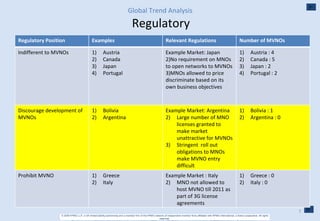
Global Trend Analysis   Regulatory Regulatory Position Examples Relevant Regulations Number of MVNOs Indifferent to MVNOs Austria Canada Japan  Portugal Example Market: Japan No requirement on MNOs to open networks to MVNOs MNOs allowed to price discriminate based on its own business objectives Austria : 4 Canada : 5 Japan : 2 Portugal : 2 Discourage development of MVNOs  Bolivia  Argentina Example Market: Argentina Large number of MNO licenses granted to make market unattractive for MVNOs Stringent  roll out obligations to MNOs make MVNO entry difficult  Bolivia : 1 Argentina : 0 Prohibit MVNO Greece  Italy  Example Market : Italy MNO not allowed to host MVNO till 2011 as part of 3G license agreements  Greece : 0 Italy : 0
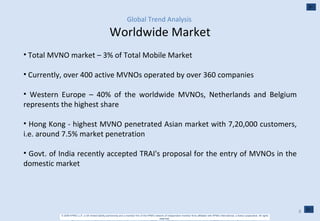
Global Trend Analysis   Worldwide Market Total MVNO market – 3% of Total Mobile Market Currently, over 400 active MVNOs operated by over 360 companies Western Europe – 40% of the worldwide MVNOs, Netherlands and Belgium represents the highest share Hong Kong - highest MVNO penetrated Asian market with 7,20,000 customers, i.e. around 7.5% market penetration Govt. of India recently accepted TRAI's proposal for the entry of MVNOs in the domestic market
Global Trend Analysis   Various Models DISCOUNT MVNOs  – provide cut-price call rates to the market segments. These include Virgin Mobile and Easy Mobile LIFESTYLE MVNOs  – focus on specific niche market demographics. Like, Boost Mobile in US and  ID&T Mobile in Europe   ADVERTISING-FUNDED MVNOs  -  like Blyk or MOSH Mobile build revenues from advertising to give a set amount of free voice, text and content to their subscribers. ETHNIC MVNOs  -  like Lebara target ethnic communities by providing inexpensive calls to their home country.
Impact of MVNO The impact may be categorized under the following parameters: Penetration of mobile communication in emerging markets  Changes in policy regulations Increase in Usage Increase in competition giving rise to innovation MVNO in 3G Data only MVNOs
MVNO in India VIRGIN – TTSL  “Think Hatke” On 6 th  Aug 2008, TRAI released recommendation on introduction of MVNO in Indian Telecom Market Key recommendations MVNO free to choose its business model No limit on number of MVNOs attached to an MNO MNO to pay the spectrum charges for utilisation of spectrum by MVNO Entry fees for MVNOs – 10% of MNOs subject to a maximum of Rs. 5 crore for Metro/ Category A, Rs. 3 crore for Category B and Rs. 1 crore for Category C service areas Annual license fees same as that of MNO of the service area No Roll out Obligations for MVNO FDI limit 74% (same as MNO)
MVNO in India Challenges MNP implementation Reducing Tariffs, Shrinking ARPU and low profit margins Price sensitive customer Financial Viability Policies
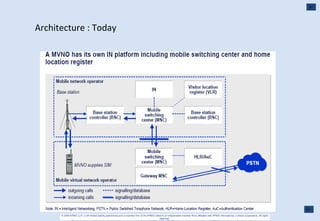
Architecture : Today
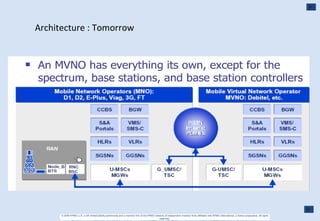
Architecture : Tomorrow
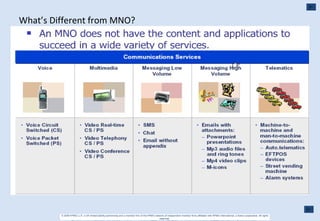
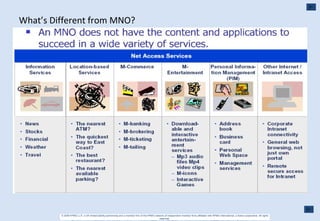
What’s Different from MNO?
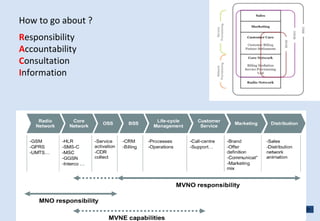
How to go about ? R esponsibility A ccountability C onsultation I nformation
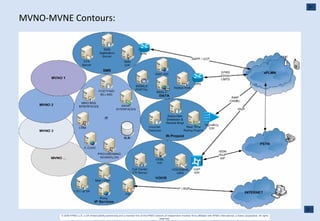
MVNO-MVNE Contours:
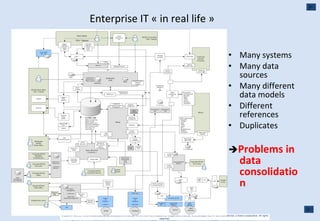
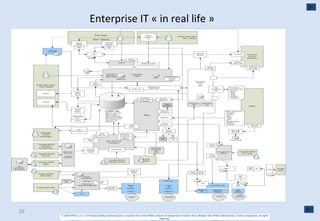
Enterprise IT « in real life » Many systems Many data sources Many different data models Different references Duplicates  Problems in data consolidation
Topsy-Turvydom : Who’s the savior? MVNE!!!!
A Real case to address:- What ? Why? How?
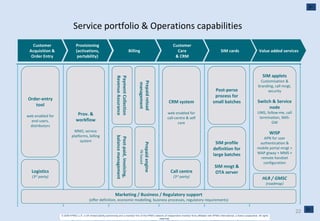
Service portfolio & Operations capabilities Customer Acquisition & Order Entry Provisioning (activations, portability) Billing Customer Care & CRM Value added services SIM cards Order-entry tool web enabled for end-users, distributors Prov. & workflow MNO, service platforms, billing system CRM system web enabled for call-centre & self care Prepaid reload management Prepaid engine IN based Post-perso process for small batches SIM profile definition for large batches SIM mngt & OTA server SIM applets Customisation & branding, call mngt, security Switch & Service node UMS, follow-me, call termination, SMS-GW WISP APN for user authentication & mobile portal mngt + WAP gtway + MMS + remote handset configuration HLR / GMSC (roadmap) Marketing / Business / Regulatory support (offer definition, economic modelling, business processes, regulatory requirements) Logistics (3 rd  party) Call centre (3 rd  party) Post-paid, invoicing, balance management Payment Collection Revenue Assurance
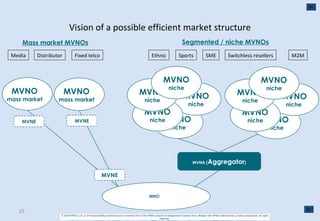
Vision of a possible efficient market structure Mass market MVNOs Segmented / niche MVNOs Ethnic Sports SME Switchless resellers MVNA ( Aggregator ) M2M Media Distributor Fixed telco MVNE MVNE MVNE MVNO mass market MNO MVNO mass market MVNO niche MVNO niche MVNO niche MVNO niche MVNO niche MVNO niche MVNO niche MVNO niche MVNO niche MVNO niche
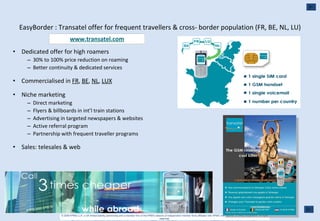
EasyBorder : Transatel offer for frequent travellers & cross- border population (FR, BE, NL, LU) Dedicated offer for high roamers 30% to 100% price reduction on roaming Better continuity & dedicated services Commercialised in  FR ,  BE ,  NL ,  LUX Niche marketing Direct marketing Flyers & billboards in int’l train stations Advertising in targeted newspapers & websites Active referral program Partnership with frequent traveller programs Sales: telesales & web www.transatel.com
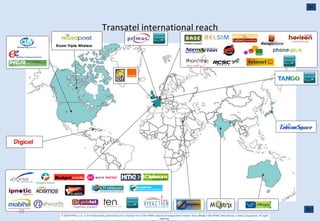
Transatel international reach Roam Triple Wireless
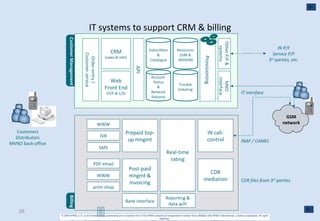
IT systems to support CRM & billing Billing Customer Management Provisioning CRM (sales & mkt) Order-entry / Customer service Real-time rating IN call-control CDR mediation Prepaid top-up mngmt Post-paid mngmt & invoicing WWW IVR SMS PDF email WWW print-shop Bank interface Reporting & data w/h Customers Distributors MVNO back-office IT interface  INAP / CAMEL CDR files from 3 rd  parties GSM network Other P/F & systems MNO interface IN P/F Service P/F 3 rd  parties, etc. Web Front End (O/E & C/S) API Account  Status & Network features Trouble ticketing Subscribers & Catalogue Resources (SIM & MSISDN)  Accounting reports
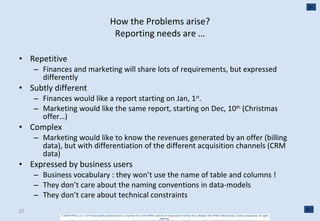
How the Problems arise? Reporting needs are … Repetitive Finances and marketing will share lots of requirements, but expressed differently Subtly different Finances would like a report starting on Jan, 1 st .  Marketing would like the same report, starting on Dec, 10 th  (Christmas offer…) Complex Marketing would like to know the revenues generated by an offer (billing data), but with differentiation of the different acquisition channels (CRM data) Expressed by business users Business vocabulary : they won’t use the name of table and columns ! They don’t care about the naming conventions in data-models They don’t care about technical constraints
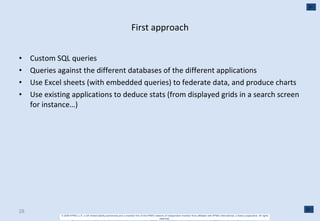
First approach Custom SQL queries Queries against the different databases of the different applications Use Excel sheets (with embedded queries) to federate data, and produce charts Use existing applications to deduce stats (from displayed grids in a search screen for instance…)
Enterprise IT « in real life »
Complexity Queries are complex Samples : mvno_activation_monitoring.sql mvno_dump_accounts.sql mvno_financial_report.sql process_monitoring.sql This kind of queries : Use many tables, sometimes from several databases, sometimes from several systems Needs many indexes Produce large result sets Are long to execute
Volumes 1 MVNO = 10,000 to 100,000 subscribers Around 200 CDRs (call data records) per subscriber per month (Up to 800 CDRs per month for some specific offers with a lot of data traffic) 100,000 subs * 200 CDRs * 12 months = 240 M CDRs / year 800 bytes of storage per CDR (including indexes) =~ 190 GB of storage per MVNO per year    doing a SELECT query over the whole data of the year (for instance, sum of all traffic) would require a lot of time of execution, and a lot of resources (disk, CPU) on production server 1 MVNO = 5 tariff-plans = 10,000 rates implemented in billing Call destination analysis tables (numbering plans) = 600,000 destinations in the world
No reactivity to change One report = one query    catastrophic !! Each set of reports evolution needs a project organization : specification by business,  technical specification (complexity to interpret business requirements) testing,  move to production Even for minor changes !!
OLTP models are not adapted OLTP- Online transaction processing is the common modeling for business applications transaction-oriented data is highly normalized (cf. 3 normal forms) OLTP models are not designed for large queries Performance impact, database locking OLTP models are not designed to maintain history Often, OLTP systems store a snapshot of reality. For instance, they store the current status of some entity, but not all the history of statuses for that entity and the dates of each change. Keeping all activity for a long time in OLTP systems would have an important impact : Difficult to administrate indexes Performance impact Time to backup & restore database (because systems fail one day or another) OLTP models are not adapted to reporting Data normalization decompose data into many tables and joins, resulting in complex queries
The result : 90% of time spent in developing and producing the reports, 10% spent to analyze them Use of user-interfaces not designed for reporting Too few people know how to produce the key reports Performance impact on production systems Reports are incomplete, no sufficient history “ I have data everywhere, and sometimes I forgot some data-source in my reports” “ I get data from many different systems to fill-in my Excel sheet” “ I’m not totally confident in my reports” “ I make a lot of hypotheses in my simulation, but I cannot verify them”
All these problems = the field of BI Difficulties in data acquisition Need dedicated tools to collect data from different systems, with cleaning and consolidation capabilities Difficulties in data storage with OLTP on production systems Need different data-models to store history Need different databases to store history Need different engine to do the analysis and calculations Difficulties in data restitution with SQL Need tools usable by business users BI = Business Intelligence = Field of technologies that facilitate acquisition, analysis and restitution of data to help in taking decisions
Project organization
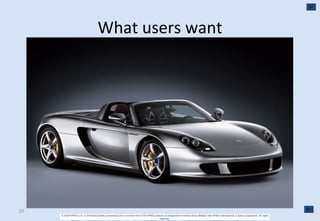
What users want
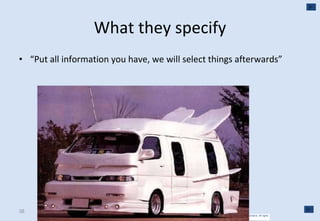
What they specify “ Put all information you have, we will select things afterwards”
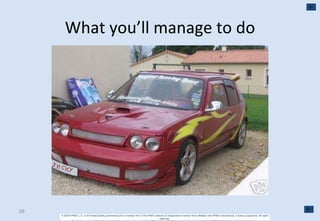
What you’ll manage to do
Then How to run Square wheeled Car?
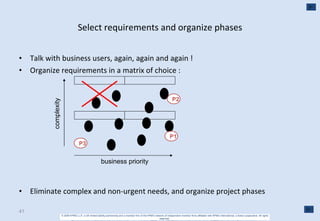
Select requirements and organize phases Talk with business users, again, again and again ! Organize requirements in a matrix of choice :  Eliminate complex and non-urgent needs, and organize project phases complexity business priority P1 P2 P3
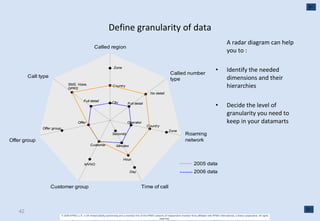
Define granularity of data A radar diagram can help you to : Identify the needed dimensions and their hierarchies Decide the level of granularity you need to keep in your datamarts
Learnings from experience… Dimension design : beware of cardinality ! Example : Time dimension First design : one table for all granularities, from year to second 365*24*3600 = up to 31’536’000 rows by year !!! This design was catastrophic on performance of everything : loading, pre-processing, querying, custom calculations (advanced MDX) In fact, bad analysis of business need Day granularity was enough for most of time dimension usage (date of bill-cycle, date of call, date of subscriber creation, etc.) = 365 rows per year Second granularity was useful in a unique case : time of call placement, only 86400 rows and rarely used. 2 different time dimensions : a “Date” dimension (used a lot), and a “Time” dimension (used once in the model) Result : Pre-processing time improved by a factor of 20…
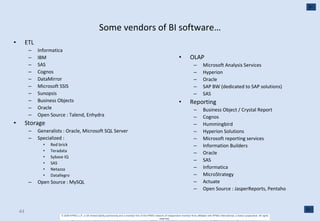
Some vendors of BI software… ETL Informatica IBM SAS Cognos DataMirror Microsoft SSIS Sunopsis  Business Objects Oracle Open Source : Talend, Enhydra Storage Generalists : Oracle, Microsoft SQL Server Specialized : Red brick Teradata Sybase IQ SAS Netazza Datallegro Open Source : MySQL OLAP Microsoft Analysis Services Hyperion Oracle SAP BW (dedicated to SAP solutions) SAS Reporting Business Object / Crystal Report Cognos Hummingbird Hyperion Solutions Microsoft reporting services Information Builders Oracle SAS Informatica MicroStrategy Actuate Open Source : JasperReports, Pentaho
Thank You

MVNO Case

  • 1.
    Mobile Virtual NetworkOperator Presented by: Syndicate 4 Unmesh Chitnis 08020541012 Disha Seth 08020541015 Mohit Malik 08020541028 Samruddhi Dadhe 08020541046 Vaibhav Misra 08020541053
  • 2.
    MVNO Dynamics MVNO:It is a mobile operator that does not have any spectrum or other telecom infrastructure. It purchases airtime from existing player and resells them to customers. MVNO Ecosystem HNO: Owns spectrum &telecom infrastructure MVNE: Provide services like Billing, Provisioning. MVNC & SI: Trusted advisor to MVNO Strategy and Planning Business Case and Operational Models System Integration and end-to-end testing HNO MVNE MVNO MVNC & SI
  • 3.
  • 4.
    1) Reseller A reseller offers products and services of its operator partner (HNO) The model suits businesses that have an existing brand and retail infrastructure in place Main focus is on branding, distribution, and sales. Model is simple to implement and market entry is easy 2) Service Operator Offer innovative pricing and its own service packages Objective is to differentiate its services Takes care of billing, and CRM Unlike resellers, they can compete with HNO in price 3) Full MVNO A full MVNO has full control of its service offerings Maintains its own core network Effectively operates as a HNO but without its own radio network Has its own SIM cards, IMSI codes, numbering systems, interconnection rights, and responsibilities
  • 5.
    Key environmental FactorsHNO’s are open to MVNOs Competitive market Low penetration and Under served segments Friendly Regulatory regime Number Portability Critical success factors Know the customer Strong brand Up sell, cross sell, bundle
  • 6.
    Global Trend Analysis Regulatory Regulatory Position Examples Relevant Regulations Number of MVNOs Force MNOs to share network Hong Kong Norway Example network: Hong Kong 40% network capactiy dedicated to MVNOs No limit to number of MVNO licences Uniform wholesale pricing regardless of MVNO Hong Kong: 7 2) Norway: 8 Facilitate launch of MVNOs Australia Belgium France Denmark UK Example Market: Australia Mandatory sharing of networks enforced on operators with significant market share Wholesale pricing on a cost plus basis with regulated margins Australia : 20 Belgium : 15 France : 17 Denmark : 11 UK : 18
  • 7.
    Global Trend Analysis Regulatory Regulatory Position Examples Relevant Regulations Number of MVNOs Indifferent to MVNOs Austria Canada Japan Portugal Example Market: Japan No requirement on MNOs to open networks to MVNOs MNOs allowed to price discriminate based on its own business objectives Austria : 4 Canada : 5 Japan : 2 Portugal : 2 Discourage development of MVNOs Bolivia Argentina Example Market: Argentina Large number of MNO licenses granted to make market unattractive for MVNOs Stringent roll out obligations to MNOs make MVNO entry difficult Bolivia : 1 Argentina : 0 Prohibit MVNO Greece Italy Example Market : Italy MNO not allowed to host MVNO till 2011 as part of 3G license agreements Greece : 0 Italy : 0
  • 8.
    Global Trend Analysis Worldwide Market Total MVNO market – 3% of Total Mobile Market Currently, over 400 active MVNOs operated by over 360 companies Western Europe – 40% of the worldwide MVNOs, Netherlands and Belgium represents the highest share Hong Kong - highest MVNO penetrated Asian market with 7,20,000 customers, i.e. around 7.5% market penetration Govt. of India recently accepted TRAI's proposal for the entry of MVNOs in the domestic market
  • 9.
    Global Trend Analysis Various Models DISCOUNT MVNOs – provide cut-price call rates to the market segments. These include Virgin Mobile and Easy Mobile LIFESTYLE MVNOs – focus on specific niche market demographics. Like, Boost Mobile in US and ID&T Mobile in Europe ADVERTISING-FUNDED MVNOs - like Blyk or MOSH Mobile build revenues from advertising to give a set amount of free voice, text and content to their subscribers. ETHNIC MVNOs - like Lebara target ethnic communities by providing inexpensive calls to their home country.
  • 10.
    Impact of MVNOThe impact may be categorized under the following parameters: Penetration of mobile communication in emerging markets Changes in policy regulations Increase in Usage Increase in competition giving rise to innovation MVNO in 3G Data only MVNOs
  • 11.
    MVNO in IndiaVIRGIN – TTSL “Think Hatke” On 6 th Aug 2008, TRAI released recommendation on introduction of MVNO in Indian Telecom Market Key recommendations MVNO free to choose its business model No limit on number of MVNOs attached to an MNO MNO to pay the spectrum charges for utilisation of spectrum by MVNO Entry fees for MVNOs – 10% of MNOs subject to a maximum of Rs. 5 crore for Metro/ Category A, Rs. 3 crore for Category B and Rs. 1 crore for Category C service areas Annual license fees same as that of MNO of the service area No Roll out Obligations for MVNO FDI limit 74% (same as MNO)
  • 12.
    MVNO in IndiaChallenges MNP implementation Reducing Tariffs, Shrinking ARPU and low profit margins Price sensitive customer Financial Viability Policies
  • 13.
  • 14.
  • 15.
  • 16.
  • 17.
    How to goabout ? R esponsibility A ccountability C onsultation I nformation
  • 18.
  • 19.
    Enterprise IT « inreal life » Many systems Many data sources Many different data models Different references Duplicates  Problems in data consolidation
  • 20.
    Topsy-Turvydom : Who’sthe savior? MVNE!!!!
  • 21.
    A Real caseto address:- What ? Why? How?
  • 22.
    Service portfolio &Operations capabilities Customer Acquisition & Order Entry Provisioning (activations, portability) Billing Customer Care & CRM Value added services SIM cards Order-entry tool web enabled for end-users, distributors Prov. & workflow MNO, service platforms, billing system CRM system web enabled for call-centre & self care Prepaid reload management Prepaid engine IN based Post-perso process for small batches SIM profile definition for large batches SIM mngt & OTA server SIM applets Customisation & branding, call mngt, security Switch & Service node UMS, follow-me, call termination, SMS-GW WISP APN for user authentication & mobile portal mngt + WAP gtway + MMS + remote handset configuration HLR / GMSC (roadmap) Marketing / Business / Regulatory support (offer definition, economic modelling, business processes, regulatory requirements) Logistics (3 rd party) Call centre (3 rd party) Post-paid, invoicing, balance management Payment Collection Revenue Assurance
  • 23.
    Vision of apossible efficient market structure Mass market MVNOs Segmented / niche MVNOs Ethnic Sports SME Switchless resellers MVNA ( Aggregator ) M2M Media Distributor Fixed telco MVNE MVNE MVNE MVNO mass market MNO MVNO mass market MVNO niche MVNO niche MVNO niche MVNO niche MVNO niche MVNO niche MVNO niche MVNO niche MVNO niche MVNO niche
  • 24.
    EasyBorder : Transateloffer for frequent travellers & cross- border population (FR, BE, NL, LU) Dedicated offer for high roamers 30% to 100% price reduction on roaming Better continuity & dedicated services Commercialised in FR , BE , NL , LUX Niche marketing Direct marketing Flyers & billboards in int’l train stations Advertising in targeted newspapers & websites Active referral program Partnership with frequent traveller programs Sales: telesales & web www.transatel.com
  • 25.
    Transatel international reachRoam Triple Wireless
  • 26.
    IT systems tosupport CRM & billing Billing Customer Management Provisioning CRM (sales & mkt) Order-entry / Customer service Real-time rating IN call-control CDR mediation Prepaid top-up mngmt Post-paid mngmt & invoicing WWW IVR SMS PDF email WWW print-shop Bank interface Reporting & data w/h Customers Distributors MVNO back-office IT interface INAP / CAMEL CDR files from 3 rd parties GSM network Other P/F & systems MNO interface IN P/F Service P/F 3 rd parties, etc. Web Front End (O/E & C/S) API Account Status & Network features Trouble ticketing Subscribers & Catalogue Resources (SIM & MSISDN)  Accounting reports
  • 27.
    How the Problemsarise? Reporting needs are … Repetitive Finances and marketing will share lots of requirements, but expressed differently Subtly different Finances would like a report starting on Jan, 1 st . Marketing would like the same report, starting on Dec, 10 th (Christmas offer…) Complex Marketing would like to know the revenues generated by an offer (billing data), but with differentiation of the different acquisition channels (CRM data) Expressed by business users Business vocabulary : they won’t use the name of table and columns ! They don’t care about the naming conventions in data-models They don’t care about technical constraints
  • 28.
    First approach CustomSQL queries Queries against the different databases of the different applications Use Excel sheets (with embedded queries) to federate data, and produce charts Use existing applications to deduce stats (from displayed grids in a search screen for instance…)
  • 29.
    Enterprise IT « inreal life »
  • 30.
    Complexity Queries arecomplex Samples : mvno_activation_monitoring.sql mvno_dump_accounts.sql mvno_financial_report.sql process_monitoring.sql This kind of queries : Use many tables, sometimes from several databases, sometimes from several systems Needs many indexes Produce large result sets Are long to execute
  • 31.
    Volumes 1 MVNO= 10,000 to 100,000 subscribers Around 200 CDRs (call data records) per subscriber per month (Up to 800 CDRs per month for some specific offers with a lot of data traffic) 100,000 subs * 200 CDRs * 12 months = 240 M CDRs / year 800 bytes of storage per CDR (including indexes) =~ 190 GB of storage per MVNO per year  doing a SELECT query over the whole data of the year (for instance, sum of all traffic) would require a lot of time of execution, and a lot of resources (disk, CPU) on production server 1 MVNO = 5 tariff-plans = 10,000 rates implemented in billing Call destination analysis tables (numbering plans) = 600,000 destinations in the world
  • 32.
    No reactivity tochange One report = one query  catastrophic !! Each set of reports evolution needs a project organization : specification by business, technical specification (complexity to interpret business requirements) testing, move to production Even for minor changes !!
  • 33.
    OLTP models arenot adapted OLTP- Online transaction processing is the common modeling for business applications transaction-oriented data is highly normalized (cf. 3 normal forms) OLTP models are not designed for large queries Performance impact, database locking OLTP models are not designed to maintain history Often, OLTP systems store a snapshot of reality. For instance, they store the current status of some entity, but not all the history of statuses for that entity and the dates of each change. Keeping all activity for a long time in OLTP systems would have an important impact : Difficult to administrate indexes Performance impact Time to backup & restore database (because systems fail one day or another) OLTP models are not adapted to reporting Data normalization decompose data into many tables and joins, resulting in complex queries
  • 34.
    The result :90% of time spent in developing and producing the reports, 10% spent to analyze them Use of user-interfaces not designed for reporting Too few people know how to produce the key reports Performance impact on production systems Reports are incomplete, no sufficient history “ I have data everywhere, and sometimes I forgot some data-source in my reports” “ I get data from many different systems to fill-in my Excel sheet” “ I’m not totally confident in my reports” “ I make a lot of hypotheses in my simulation, but I cannot verify them”
  • 35.
    All these problems= the field of BI Difficulties in data acquisition Need dedicated tools to collect data from different systems, with cleaning and consolidation capabilities Difficulties in data storage with OLTP on production systems Need different data-models to store history Need different databases to store history Need different engine to do the analysis and calculations Difficulties in data restitution with SQL Need tools usable by business users BI = Business Intelligence = Field of technologies that facilitate acquisition, analysis and restitution of data to help in taking decisions
  • 36.
  • 37.
  • 38.
    What they specify“ Put all information you have, we will select things afterwards”
  • 39.
  • 40.
    Then How torun Square wheeled Car?
  • 41.
    Select requirements andorganize phases Talk with business users, again, again and again ! Organize requirements in a matrix of choice : Eliminate complex and non-urgent needs, and organize project phases complexity business priority P1 P2 P3
  • 42.
    Define granularity ofdata A radar diagram can help you to : Identify the needed dimensions and their hierarchies Decide the level of granularity you need to keep in your datamarts
  • 43.
    Learnings from experience…Dimension design : beware of cardinality ! Example : Time dimension First design : one table for all granularities, from year to second 365*24*3600 = up to 31’536’000 rows by year !!! This design was catastrophic on performance of everything : loading, pre-processing, querying, custom calculations (advanced MDX) In fact, bad analysis of business need Day granularity was enough for most of time dimension usage (date of bill-cycle, date of call, date of subscriber creation, etc.) = 365 rows per year Second granularity was useful in a unique case : time of call placement, only 86400 rows and rarely used. 2 different time dimensions : a “Date” dimension (used a lot), and a “Time” dimension (used once in the model) Result : Pre-processing time improved by a factor of 20…
  • 44.
    Some vendors ofBI software… ETL Informatica IBM SAS Cognos DataMirror Microsoft SSIS Sunopsis Business Objects Oracle Open Source : Talend, Enhydra Storage Generalists : Oracle, Microsoft SQL Server Specialized : Red brick Teradata Sybase IQ SAS Netazza Datallegro Open Source : MySQL OLAP Microsoft Analysis Services Hyperion Oracle SAP BW (dedicated to SAP solutions) SAS Reporting Business Object / Crystal Report Cognos Hummingbird Hyperion Solutions Microsoft reporting services Information Builders Oracle SAS Informatica MicroStrategy Actuate Open Source : JasperReports, Pentaho
  • 45.