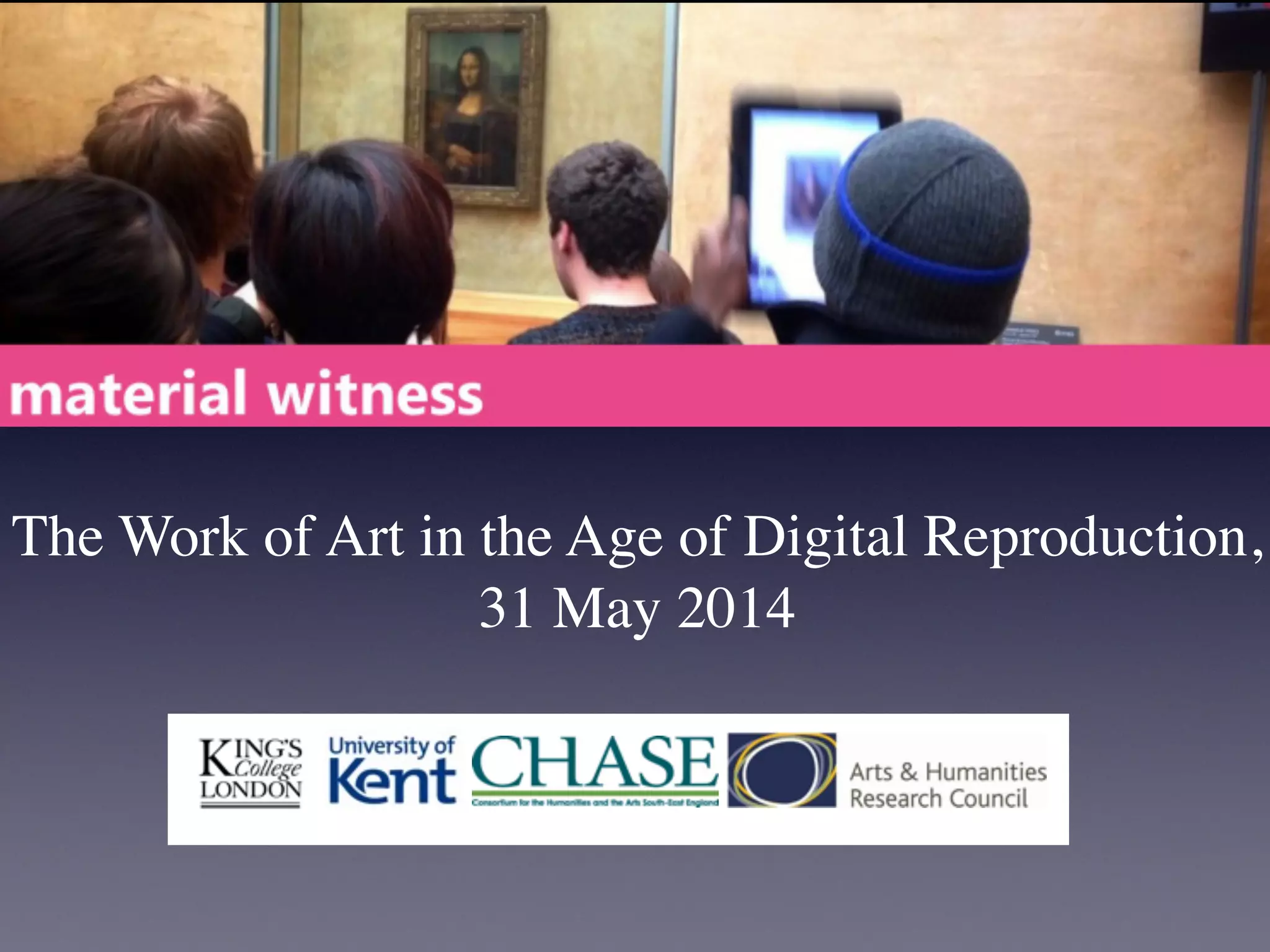
The Work of Art in the Age of Digital Reproduction,
31 May 2014
For more information about Material Witness, please visit our blog: materialwitness.me.!
10:00! Registration & coffee!
10:30 Session 1: Walter Benjamin’s Work of Art in the Age of Technological Reproduction
• Andrew Prescott (King’s College London):The Digital Aura!
• Neil Cox & Dana MacFarlane (University of Edinburgh):Workshopping Benjamin and Heidegger !
12:30 Lunch
1:30 Session 2: The Age of Digital Reproduction
Anchor paper: Michael Takeo Magruder (King’s College London): reproduction/remixing/redistribution: artistic
processes for a born-digital age!
Michael is currently a LeverhulmeTrust artist-in-residence at KCL, where he is working on a body of collaborative new media
artworks entitled De/coding the Apocalypse, based on The Book of Revelation. He has recently published a new monograph,
entitled (re)mediations 2000-2010 (2012, Peterborough Museum & Art Gallery, UK), that outlines the last decade of his work
within the areas of news media, mobile devices and virtual worlds.!
Material Witness scholars:
• Sarah Biggs (Courtauld Institute/British Library): Medieval Manuscripts in the Digital Age !
• Elinor Carmi (Goldsmiths, University of London):Are you spam or not? The aura of authenticity in social
network sites (SNS)!
• Sara Choudhrey (University of Kent): Islamic Art in the Age of Digital Reproduction !
• Alexandra Reghina Draghici (Goldsmiths, University of London): Material Relations: Embodiment as
Reproduction !
3:30 Tea
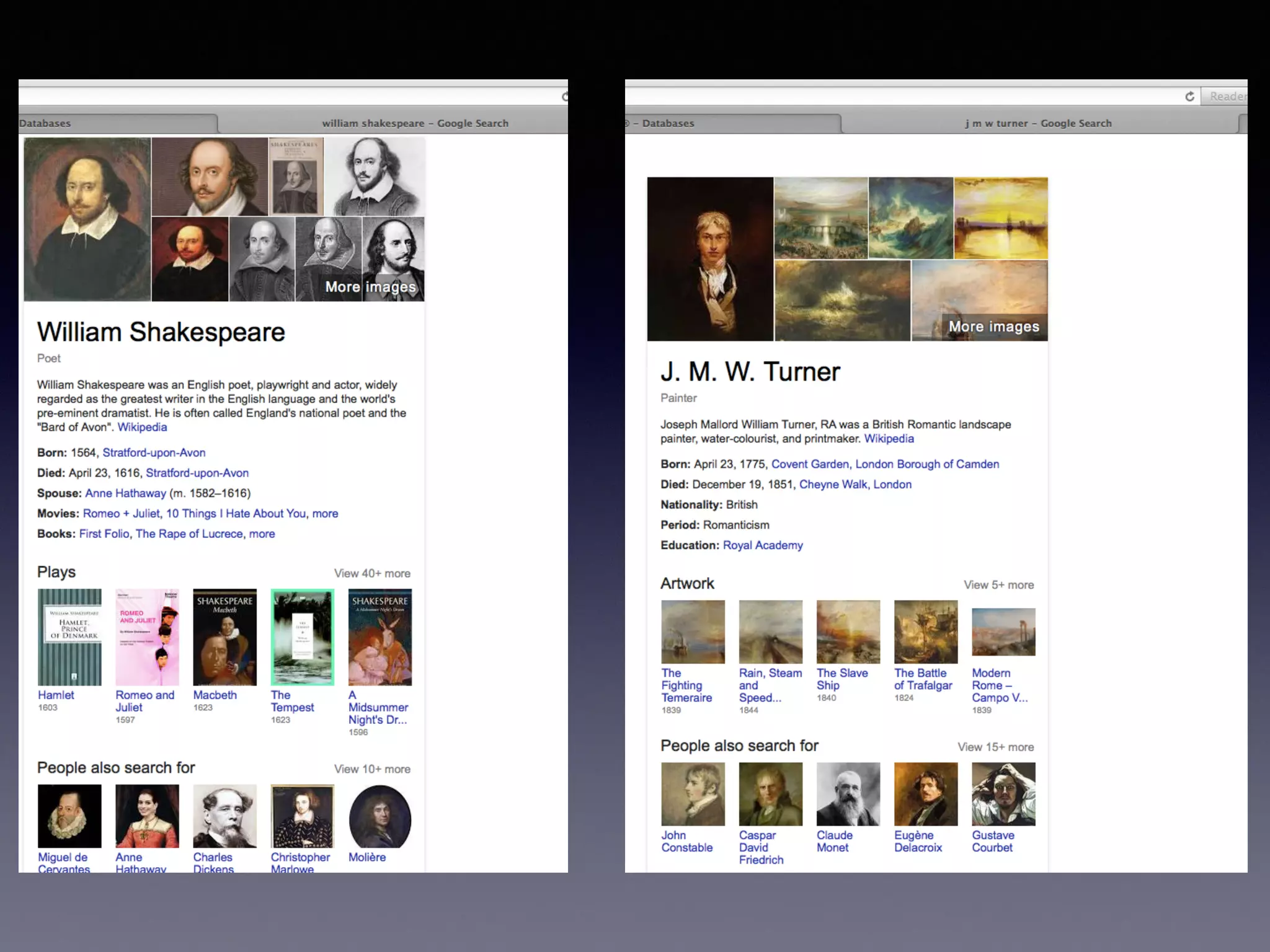
4:00 Keynote: Mark Leckey: UniAddDumThs
!Mark is a British artist and curator who works with collage, music, and film. His film Industrial Lights and Magic won theTurner
Prize in 2008. He recently curated the show The Universal Addressability of Dumb Things, which explored the relationships
between objects, digital avatars, and people, a configuration that he describes as ‘technoanimism’.!
5:00 Reception
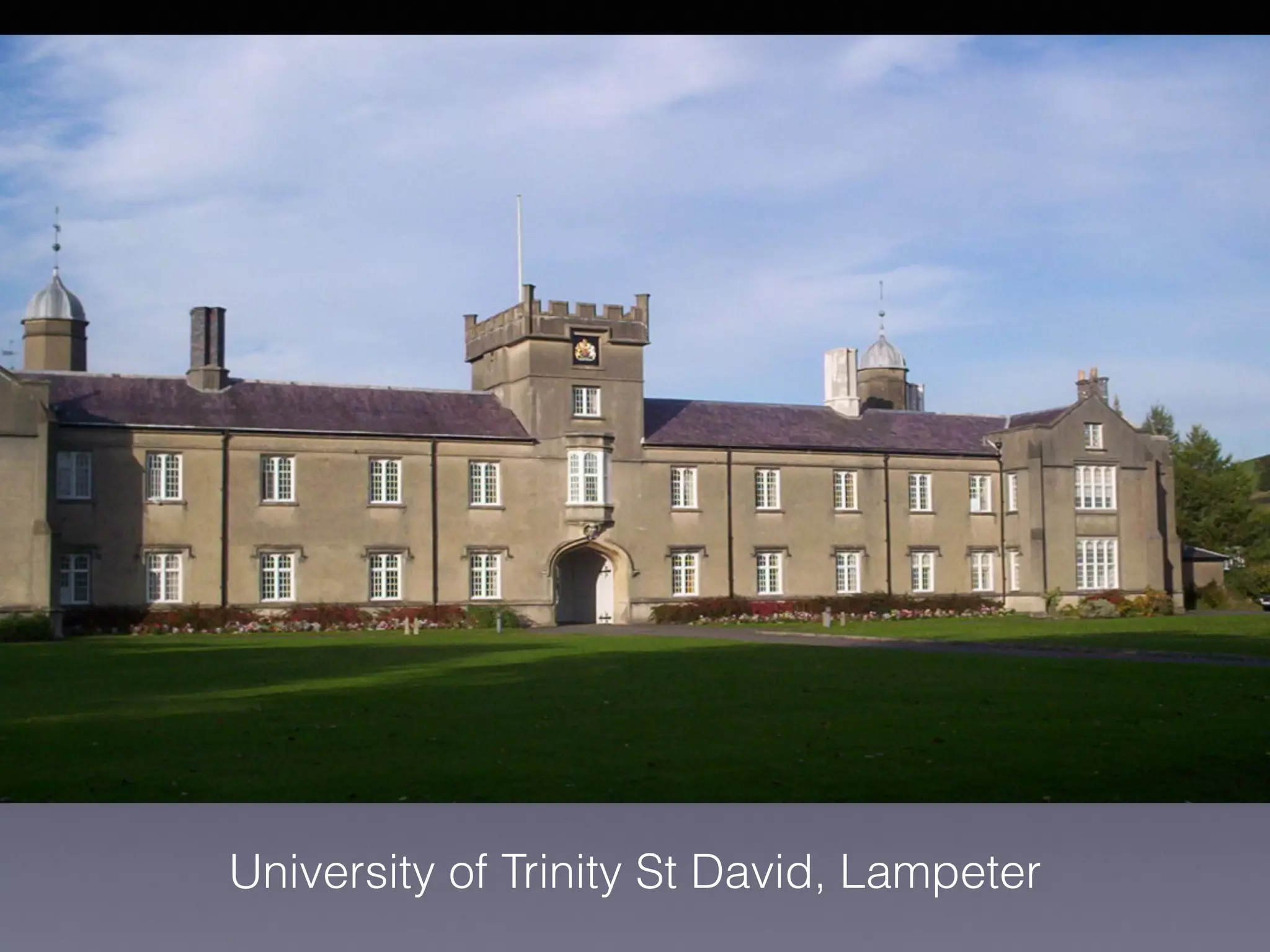
University of Trinity St David, Lampeter
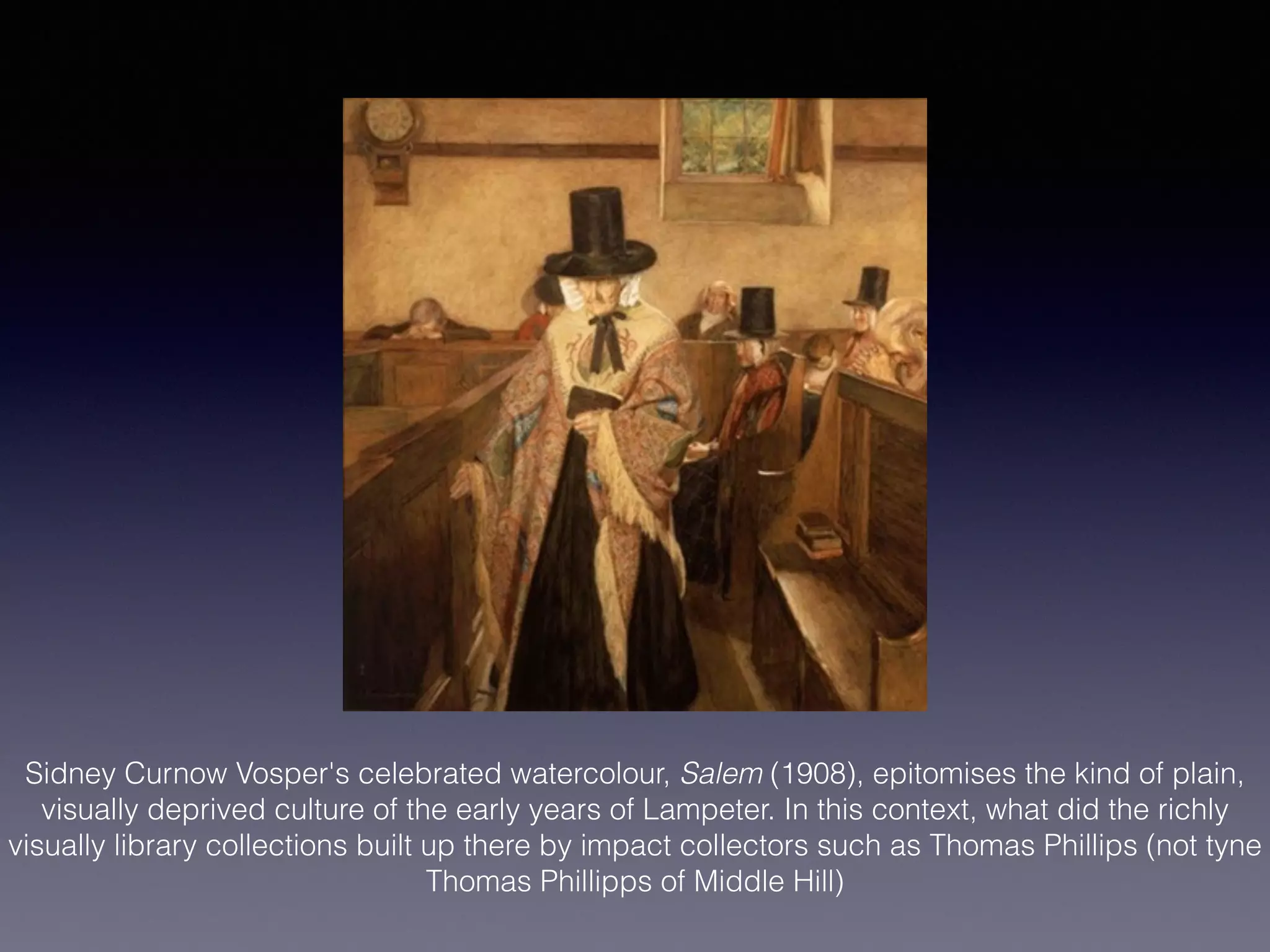
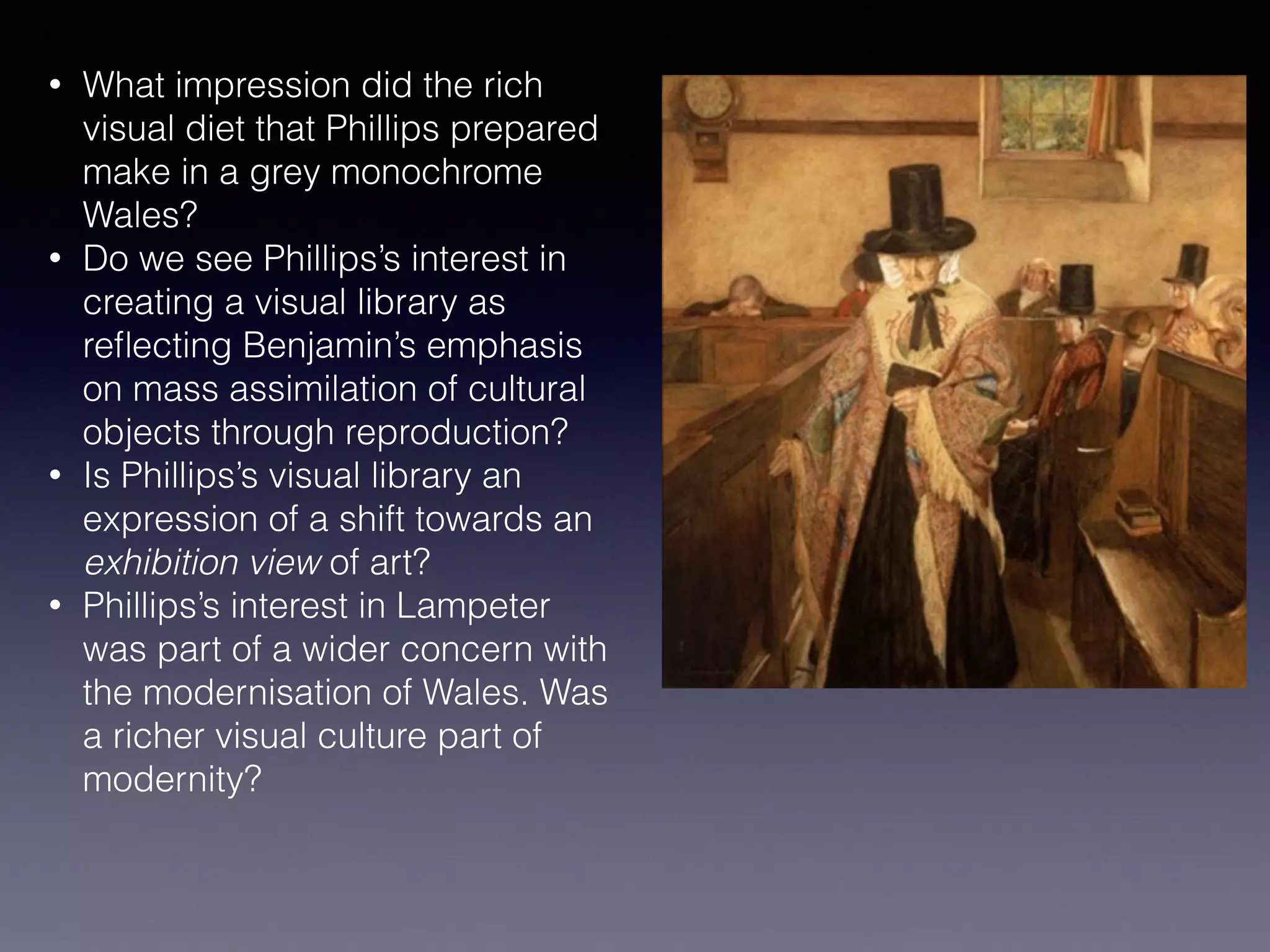
Sidney Curnow Vosper's celebrated watercolour, Salem (1908), epitomises the kind of plain,
visually deprived culture of the early years of Lampeter. In this context, what did the richly
visually library collections built up there by impact collectors such as Thomas Phillips (not tyne
Thomas Phillipps of Middle Hill)
!
The Digital Aura: riffs on Walter
Benjamin’s ‘The Work of Art in an
Age of Technical Reproduction’
Andrew Prescott
Material Witness Workshop
31 May 2014
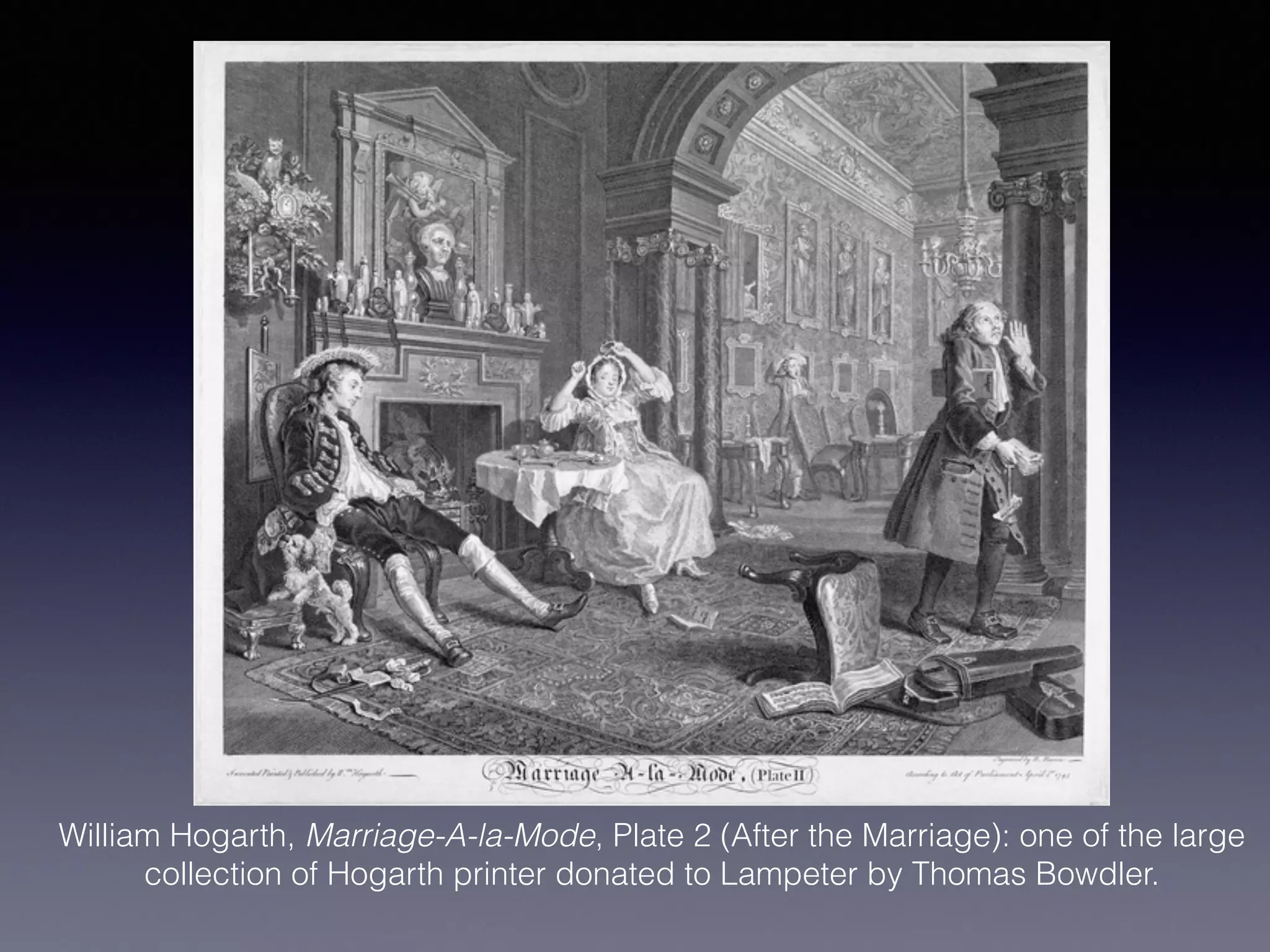
William Hogarth, Marriage-A-la-Mode, Plate 2 (After the Marriage): one of the large
collection of Hogarth printer donated to Lampeter by Thomas Bowdler.
!
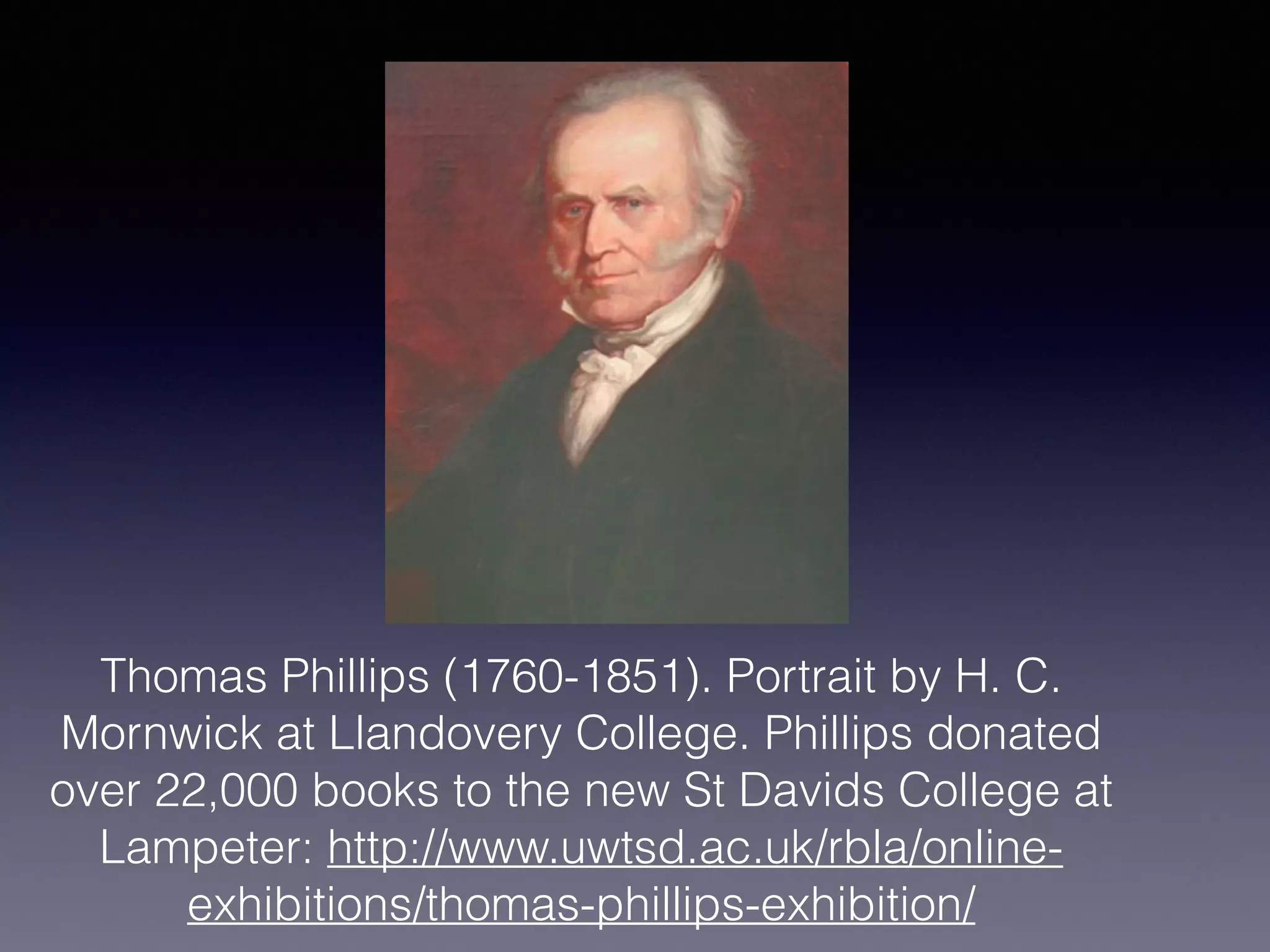
Thomas Phillips (1760-1851). Portrait by H. C.
Mornwick at Llandovery College. Phillips donated
over 22,000 books to the new St Davids College at
Lampeter: http://www.uwtsd.ac.uk/rbla/online-
exhibitions/thomas-phillips-exhibition/
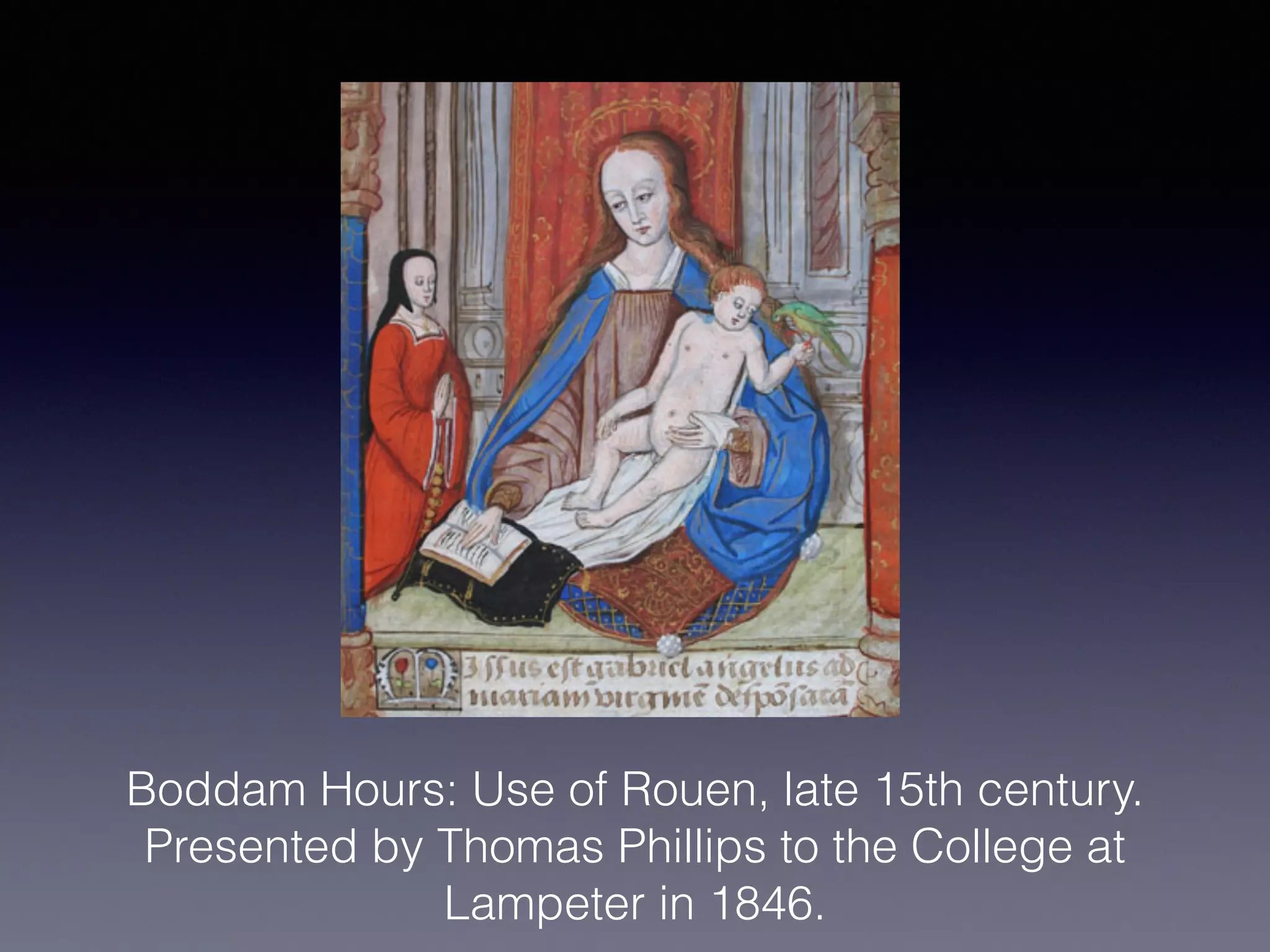
Boddam Hours: Use of Rouen, late 15th century.
Presented by Thomas Phillips to the College at
Lampeter in 1846.
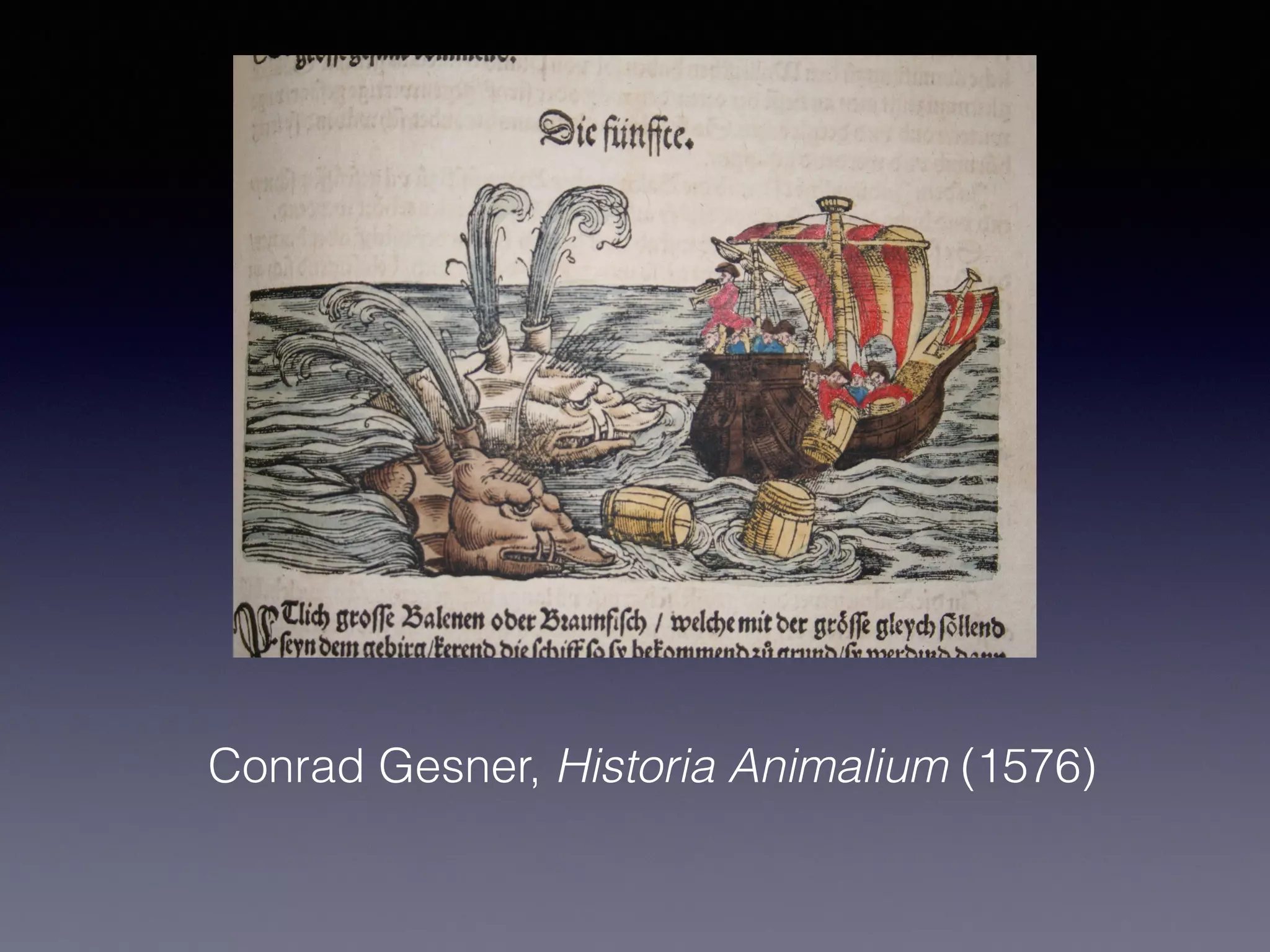
Conrad Gesner, Historia Animalium (1576)
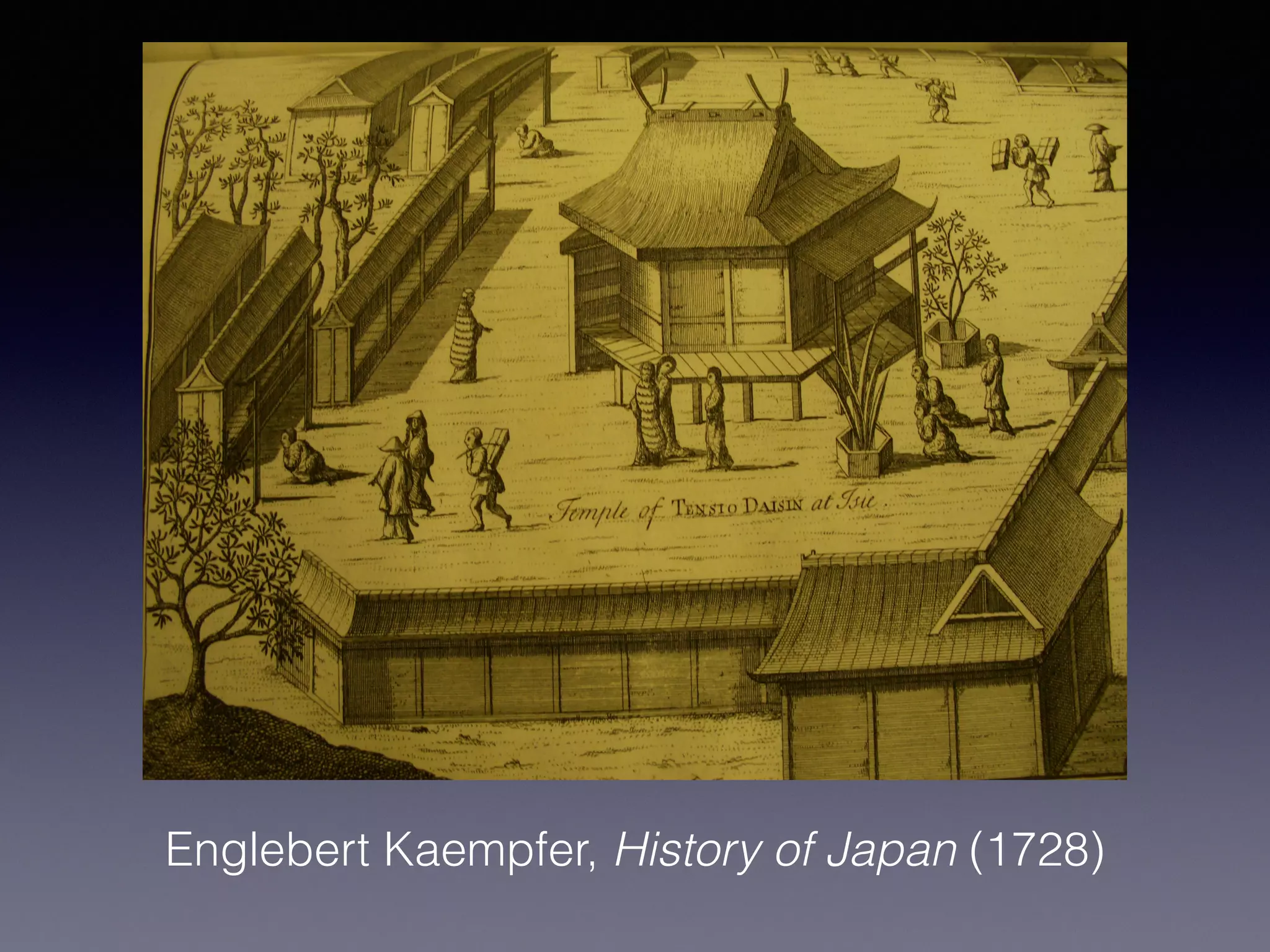
Englebert Kaempfer, History of Japan (1728)
Edward Young. The Complaint, and the
Consolation or, Night thoughts. London, 1797.
[Illustrated by William Blake]
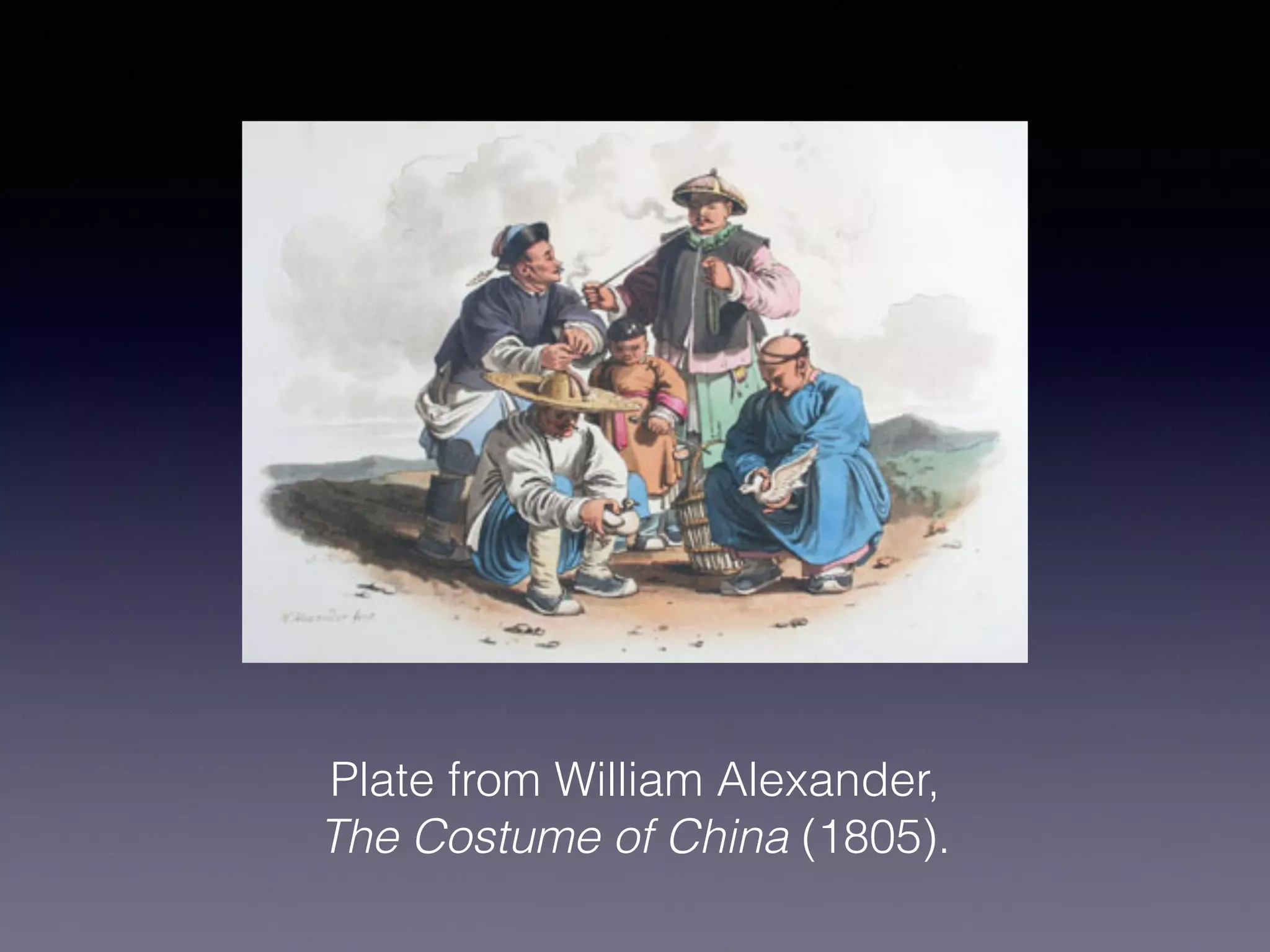
Plate from William Alexander,
The Costume of China (1805).
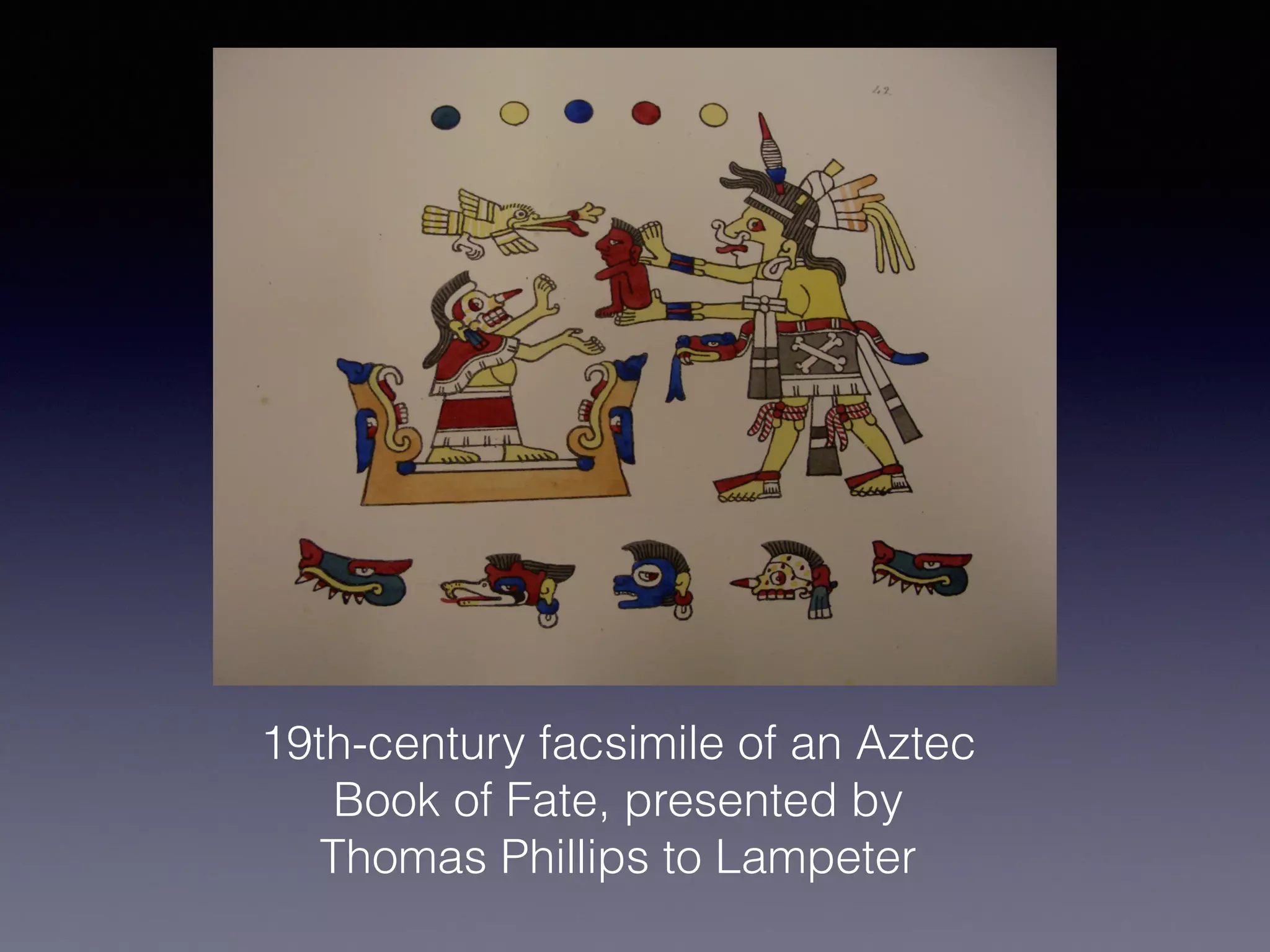
19th-century facsimile of an Aztec
Book of Fate, presented by
Thomas Phillips to Lampeter
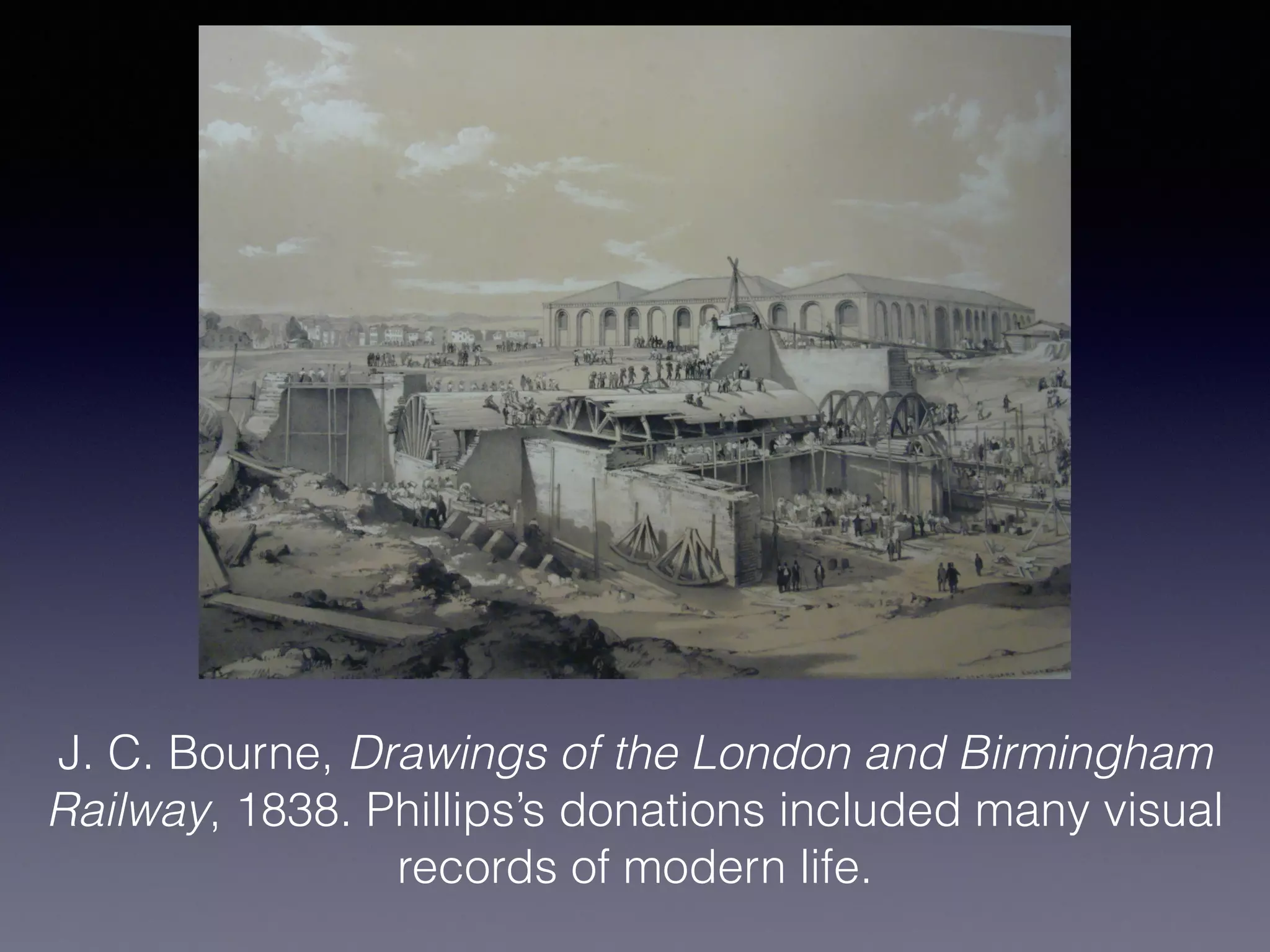
J. C. Bourne, Drawings of the London and Birmingham
Railway, 1838. Phillips’s donations included many visual
records of modern life.
• What impression did the rich
visual diet that Phillips prepared
make in a grey monochrome
Wales?
• Do we see Phillips’s interest in
creating a visual library as
reflecting Benjamin’s emphasis
on mass assimilation of cultural
objects through reproduction?
• Is Phillips’s visual library an
expression of a shift towards an
exhibition view of art?
• Phillips’s interest in Lampeter
was part of a wider concern with
the modernisation of Wales. Was
a richer visual culture part of
modernity?
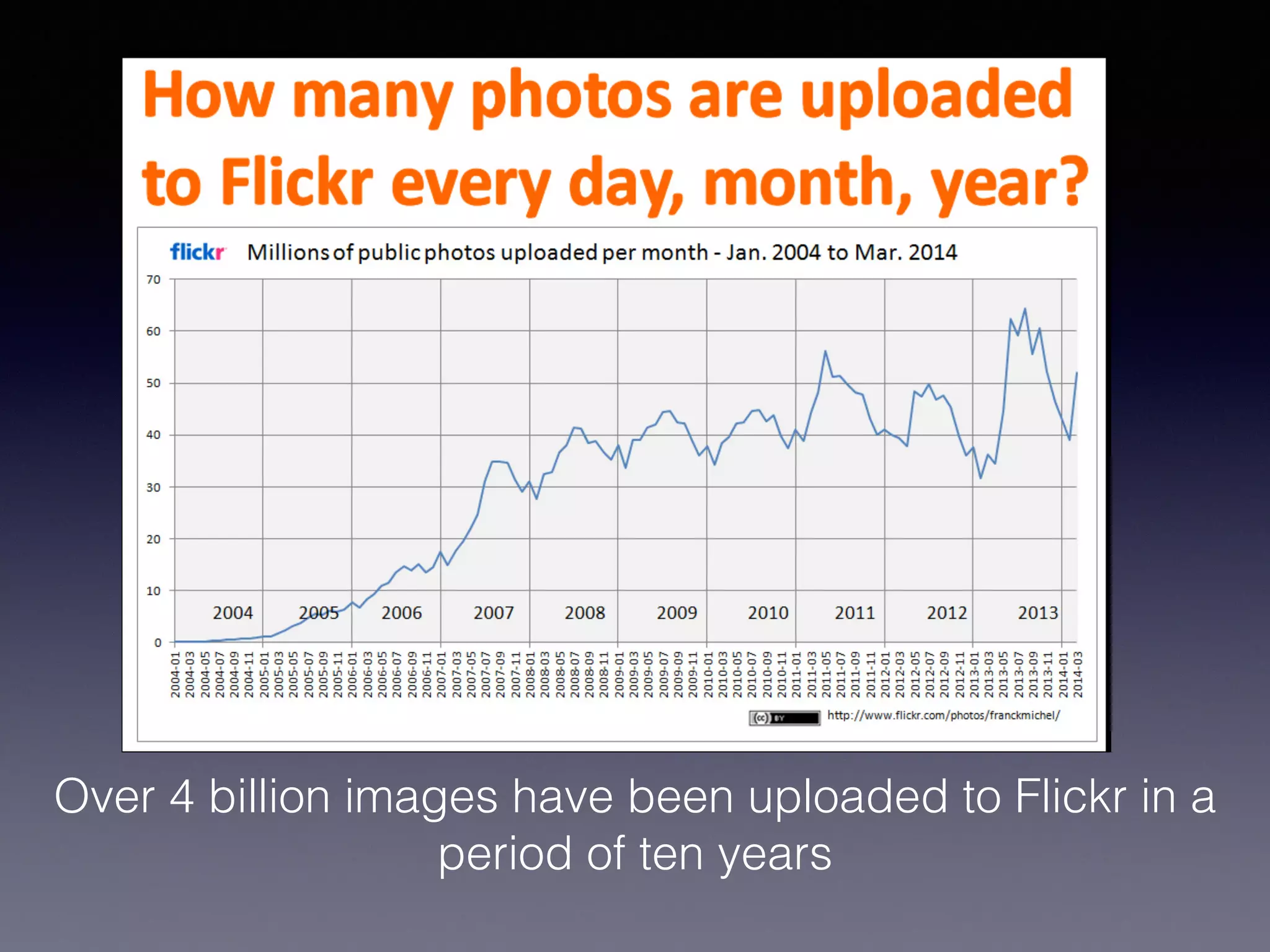
Over 4 billion images have been uploaded to Flickr in a
period of ten years
Some YouTube Statistics!
!•! More than 1 billion unique users visit YouTube each month!
!•! Over 6 billion hours of video are watched each month on
YouTube—that's almost an hour for every person on Earth!
!•! 100 hours of video are uploaded to YouTube every minute!
!•! 80% of YouTube traffic comes from outside the US!
!•! YouTube is localised in 61 countries and across 61
languages!
!•! According to Nielsen, YouTube reaches more US adults
aged 18-34 than any cable network!
!•! Millions of subscriptions happen each day. The number of
people subscribing daily is up more than 3 times since last
year, and the number of daily subscriptions is up more
than 4 times since last year
Apple states that, “iTunes users have downloaded more than
one billion TV episodes and 380 million movies from iTunes to
date, and they are purchasing over 800,000 TV episodes and
over 350,000 movies per day.”
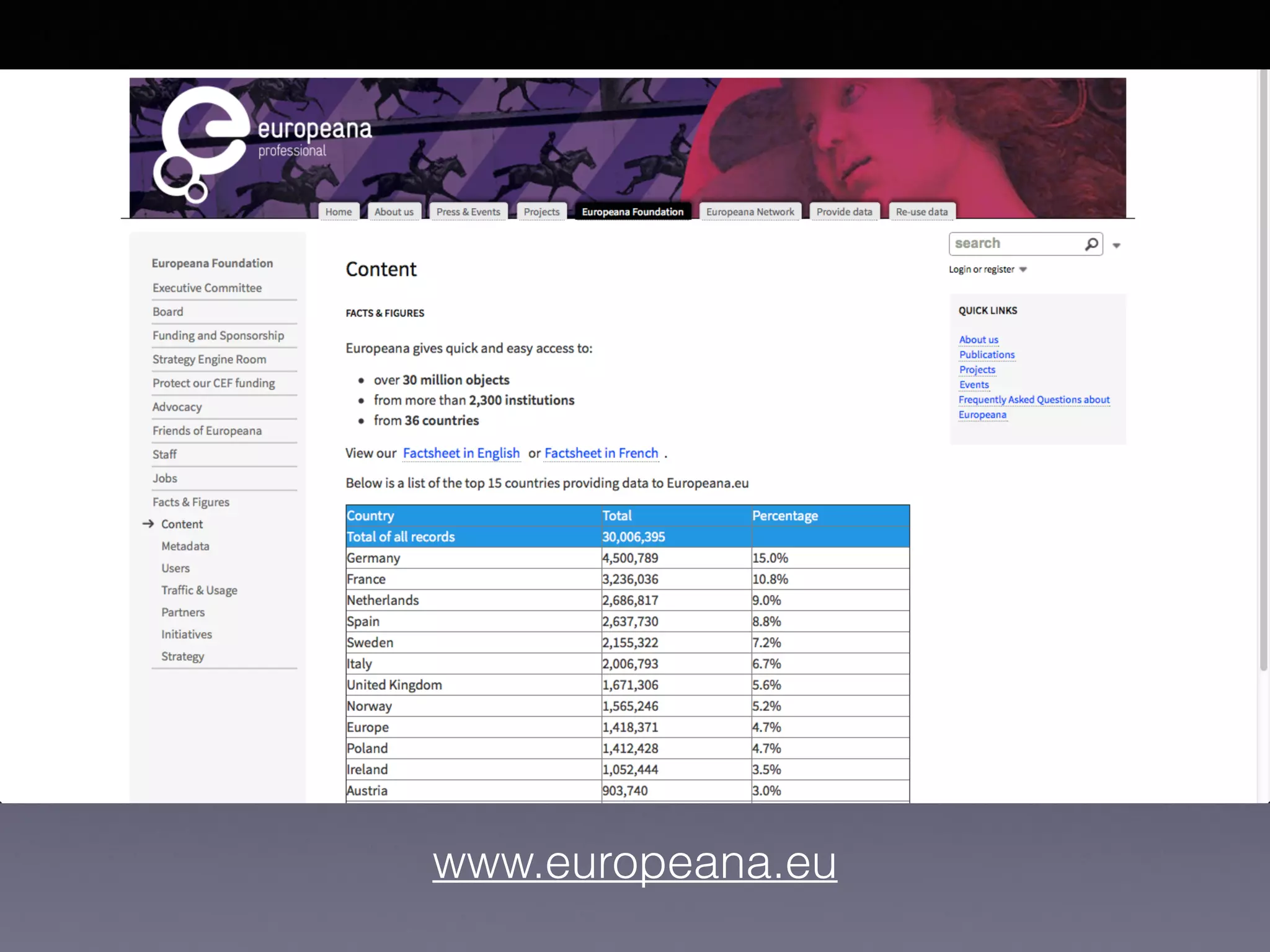
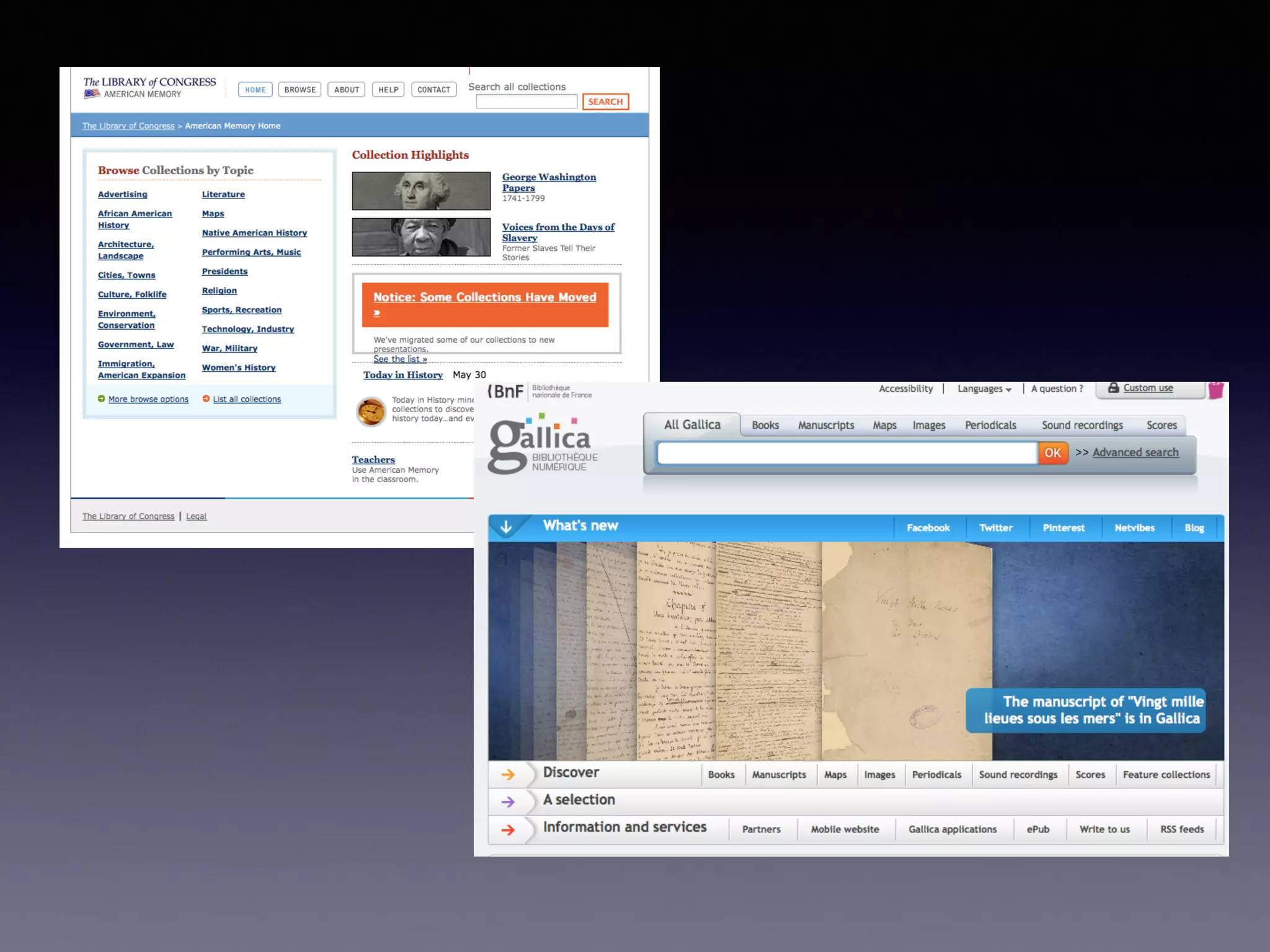
www.europeana.eu
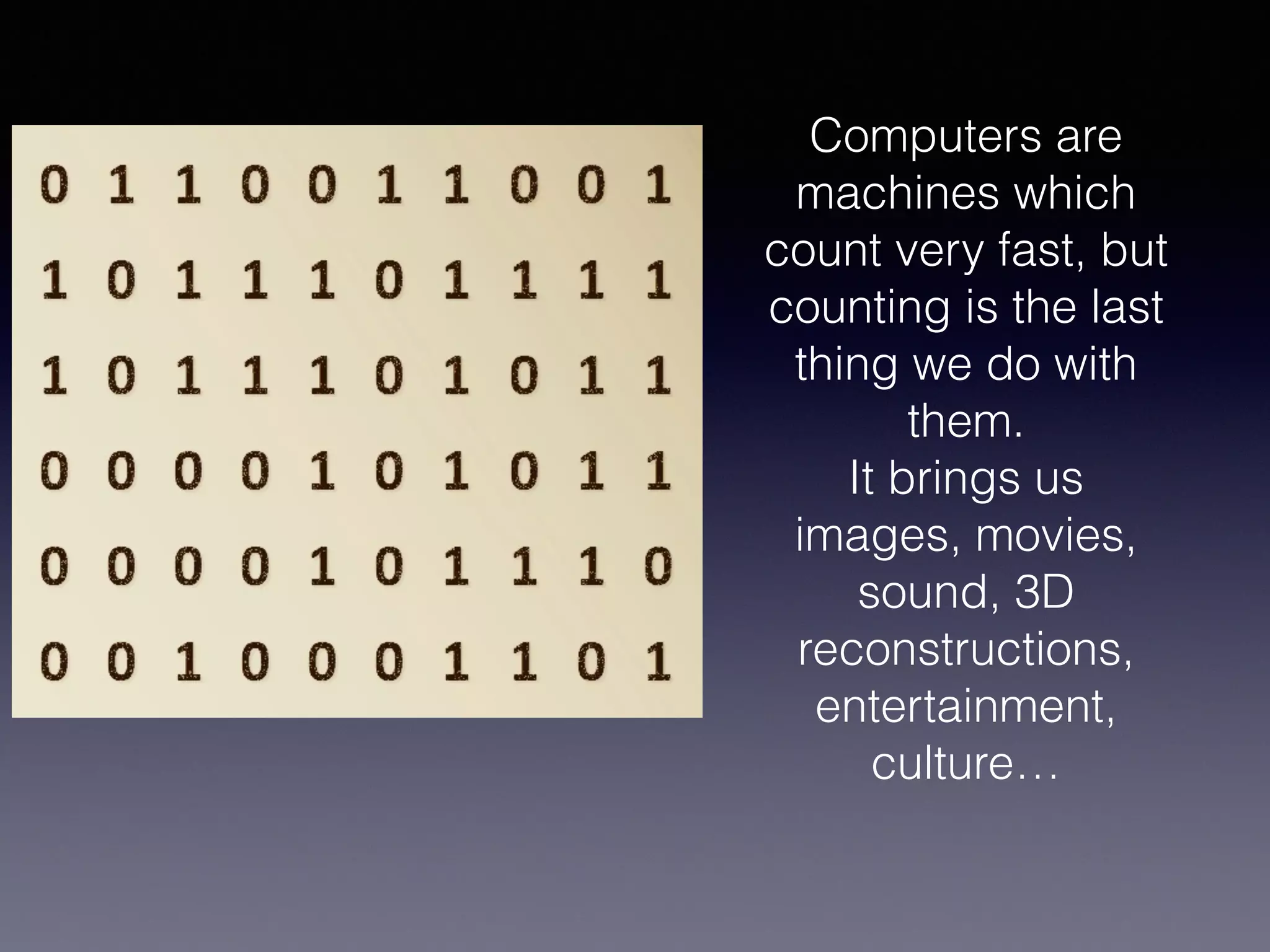
Computers are
machines which
count very fast, but
counting is the last
thing we do with
them.
It brings us
images, movies,
sound, 3D
reconstructions,
entertainment,
culture…
• Benjamin’s essay on ‘The Work of Art in the Age of its Technological
Reproducibility’ (1935-6) appears increasingly prescient as we
become flooded with images: ‘The cathedral leaves its site to be
received in the studio of an art lover; the choral work performed in an
auditorium or in the open is enjoyed in a private room’.
• Digitisation of existing cultural artefacts is a means of rendering them
reproducible
• Demand for digitisation and access: ‘the desire of the present-day
masses to “get closer to things”… by assimilating it as reproduction
• But as the digital corpus grows, issues of authenticity (not just
manipulation but scale, colour, cropping, etc)
• This reproducibility changes their cultural status, although the exact
nature of this change unclear (do they become more open or more
controlled?)
• Benjamin’s emphasis on changes in the nature of cultural labour
and production seem particularly pertinent
• New types of involvement in cultural labour: crowd-sourcing, out-
working, team working
• New relationship between the audience and the artwork
• Erosions of distinction between author and user (anticipates Web
2.0?)
• For Benjamin, film was a means of the masses reconciling
themselves to new technology
• We can see our use of computers for entertainment as a means of
humanising a technology which poses serious issues in terms of
privacy, surveillance, identity and control.
• The collapse of distinctions between cultural objects
• In a digital environment, distinctions in format between
print, manuscript, oil, watercolour, sound, movie, material
object collapse
• All objects can be stored and documented in a digital
form
• The only differences between libraries, archives, museums
and art galleries are differences of file format and
metadata
• Is this the liquidation of tradition that Benjamin
anticipated?
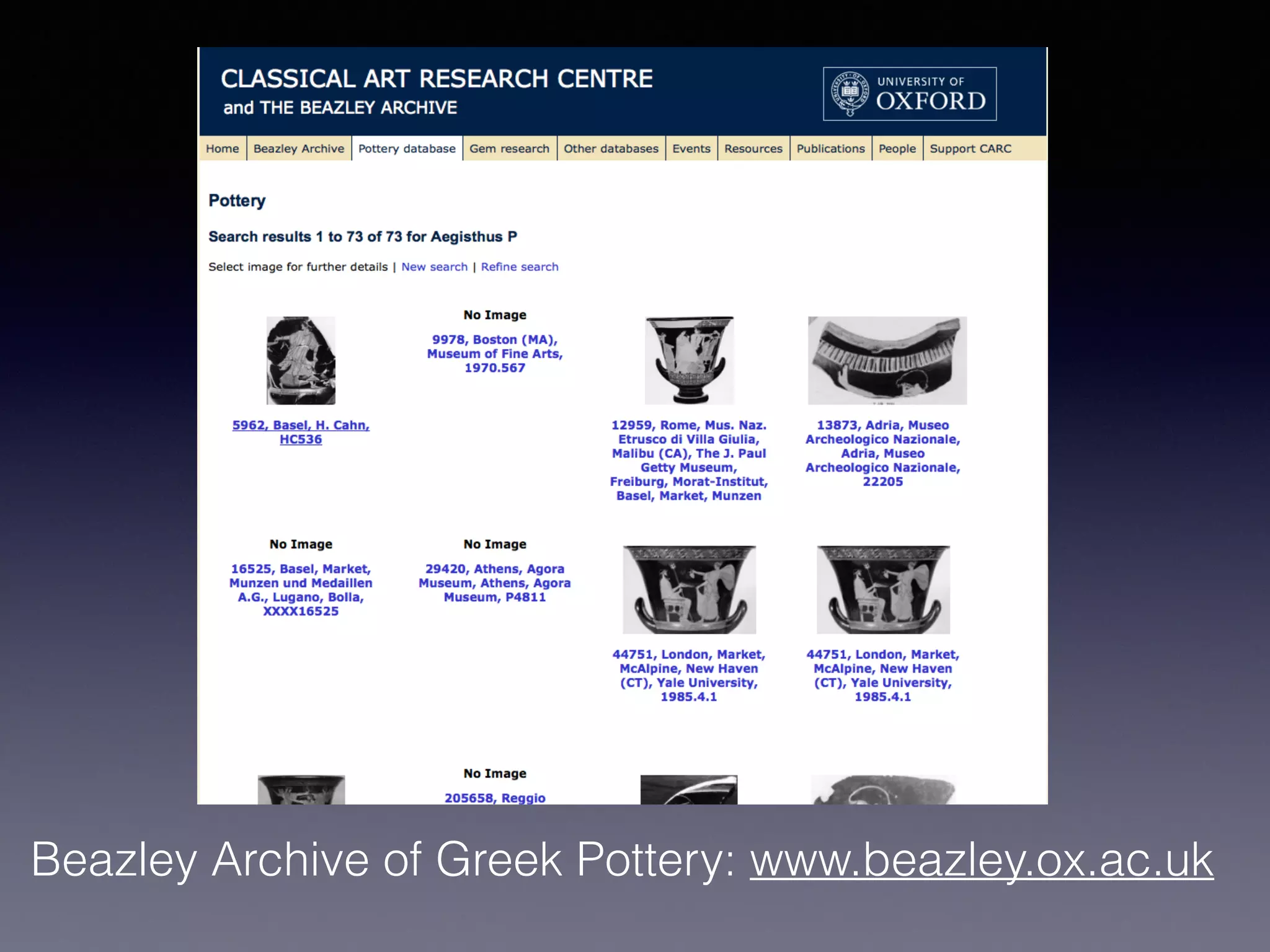
Beazley Archive of Greek Pottery: www.beazley.ox.ac.uk
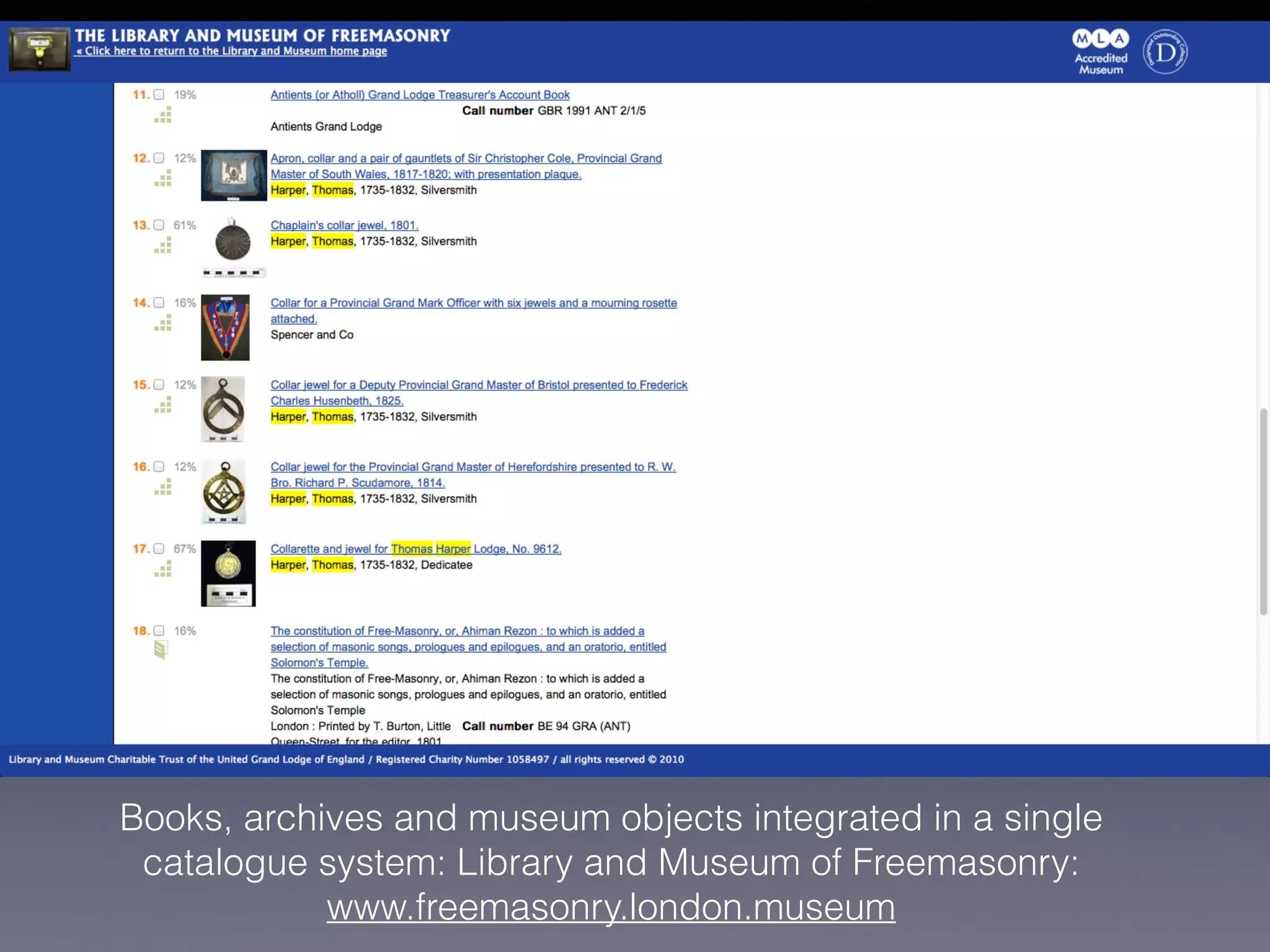
Books, archives and museum objects integrated in a single
catalogue system: Library and Museum of Freemasonry:
www.freemasonry.london.museum
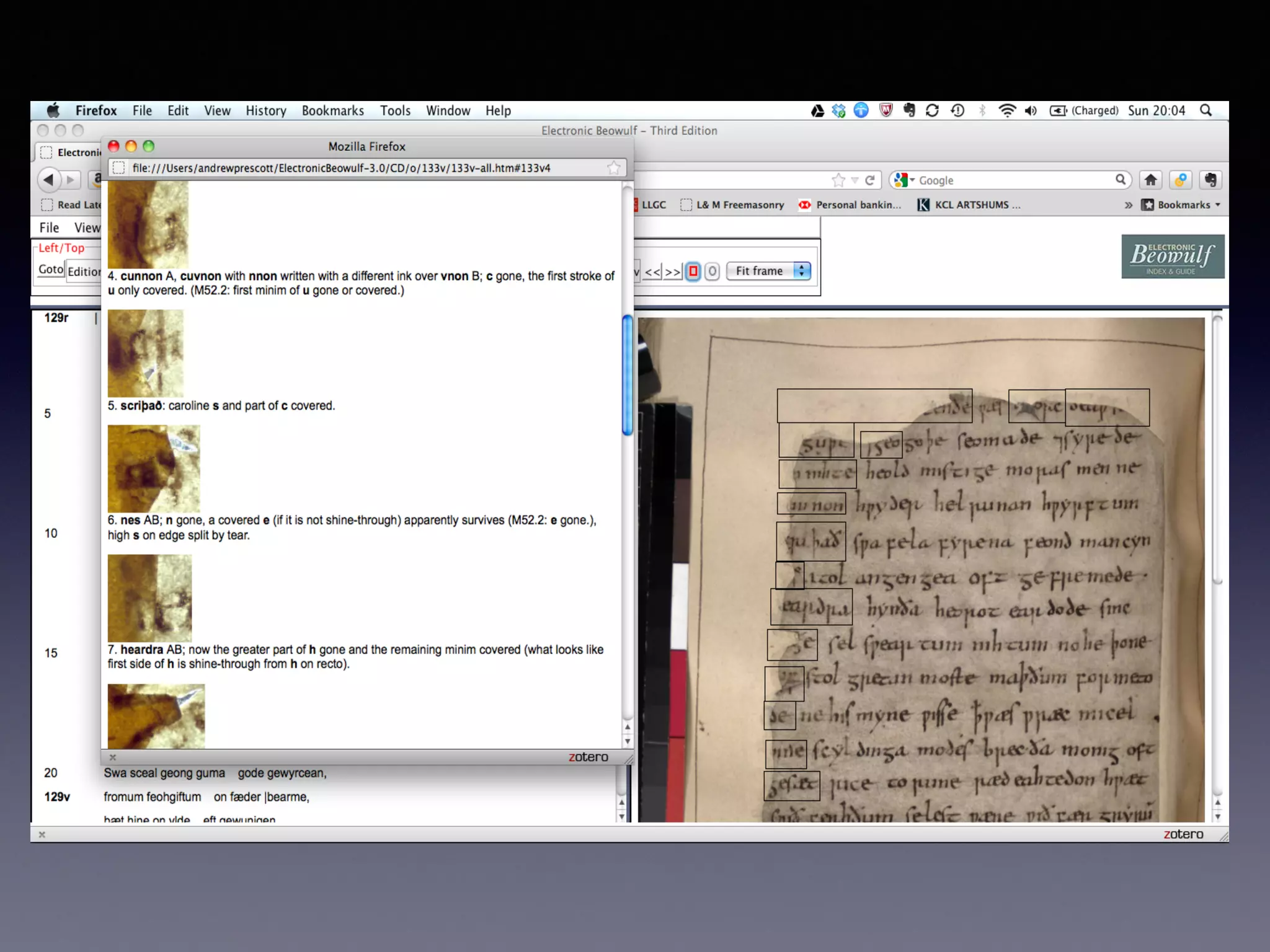
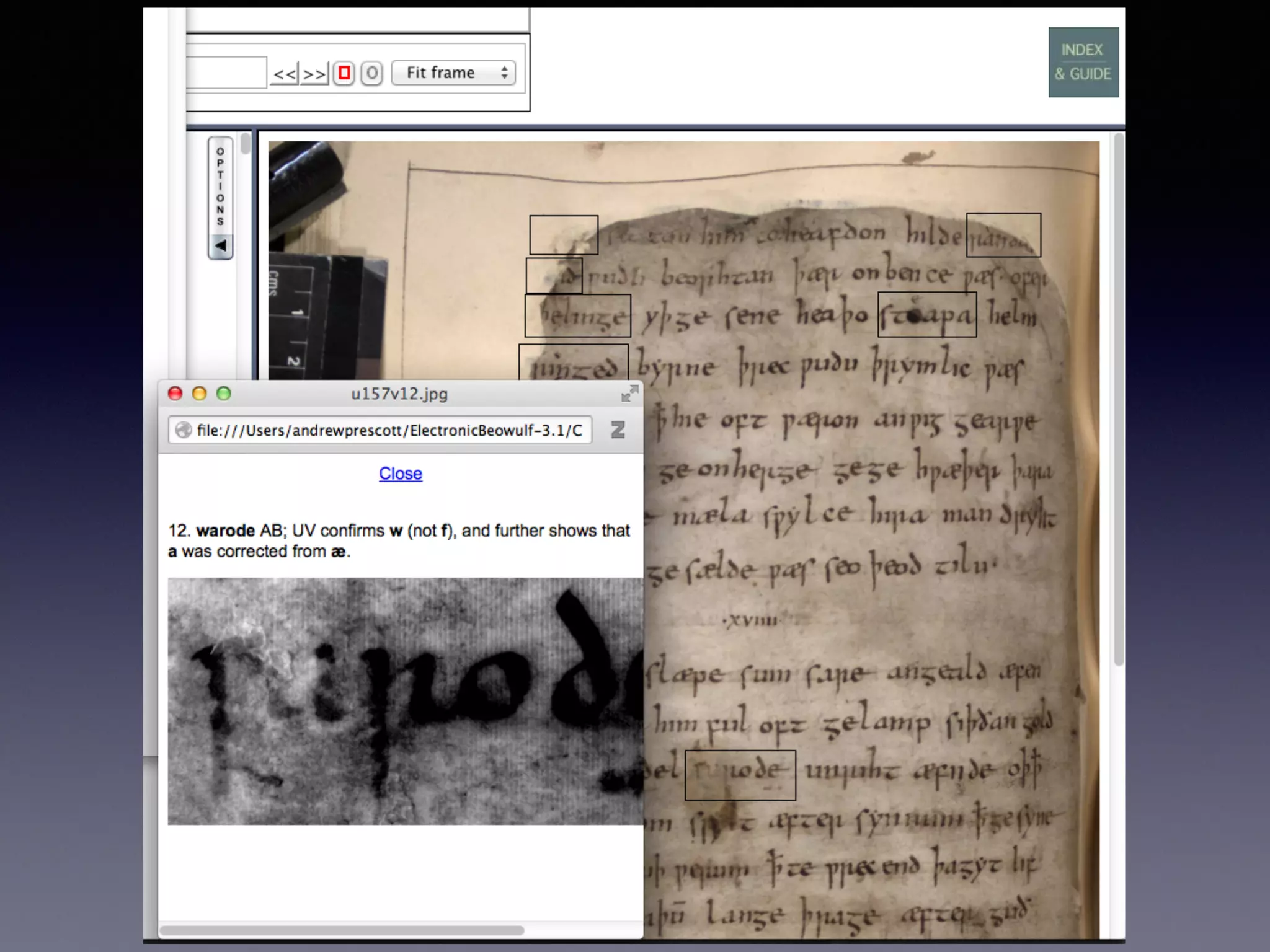
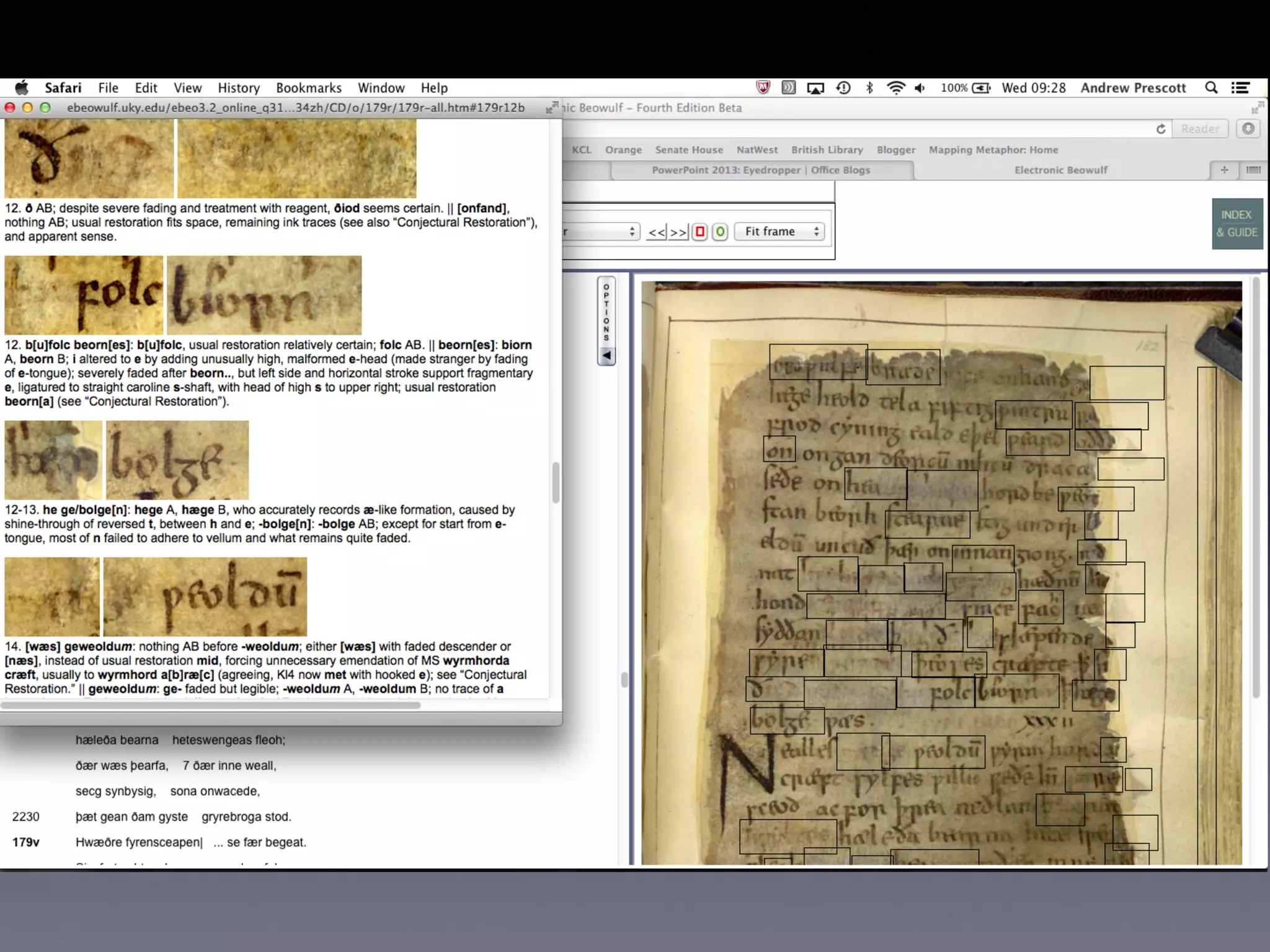
• Benjamin argued that the reproducibility of works
of art weakened the sense of aura
• He welcomed the prospect of the liquidation of
tradition and undermining of old distinctions - ‘a
shattering of tradition which is a renewal of
humanity’
• ‘Shakespeare, Rembrandt, Beethoven will films …
All legends, all mythologies, and all myths, all the
founders of religions, indeed, all religions await
their celluloid resurrection, and the heroes are
pressing at the gates’
• I want to examine briefly three areas where the
position might be more complicated in the digital
environment than Benjamin suggests
• Rather than undermining ‘aura’, photographs and
digital images can have their own considerable sense
of time and place which amounts to a ‘digital aura’
• ‘Authenticity’ is difficult: digital representations can
sometimes have claim to greater authenticity
• Rather than liquidating traditions, digital
reproducibility may instead be reinforcing them
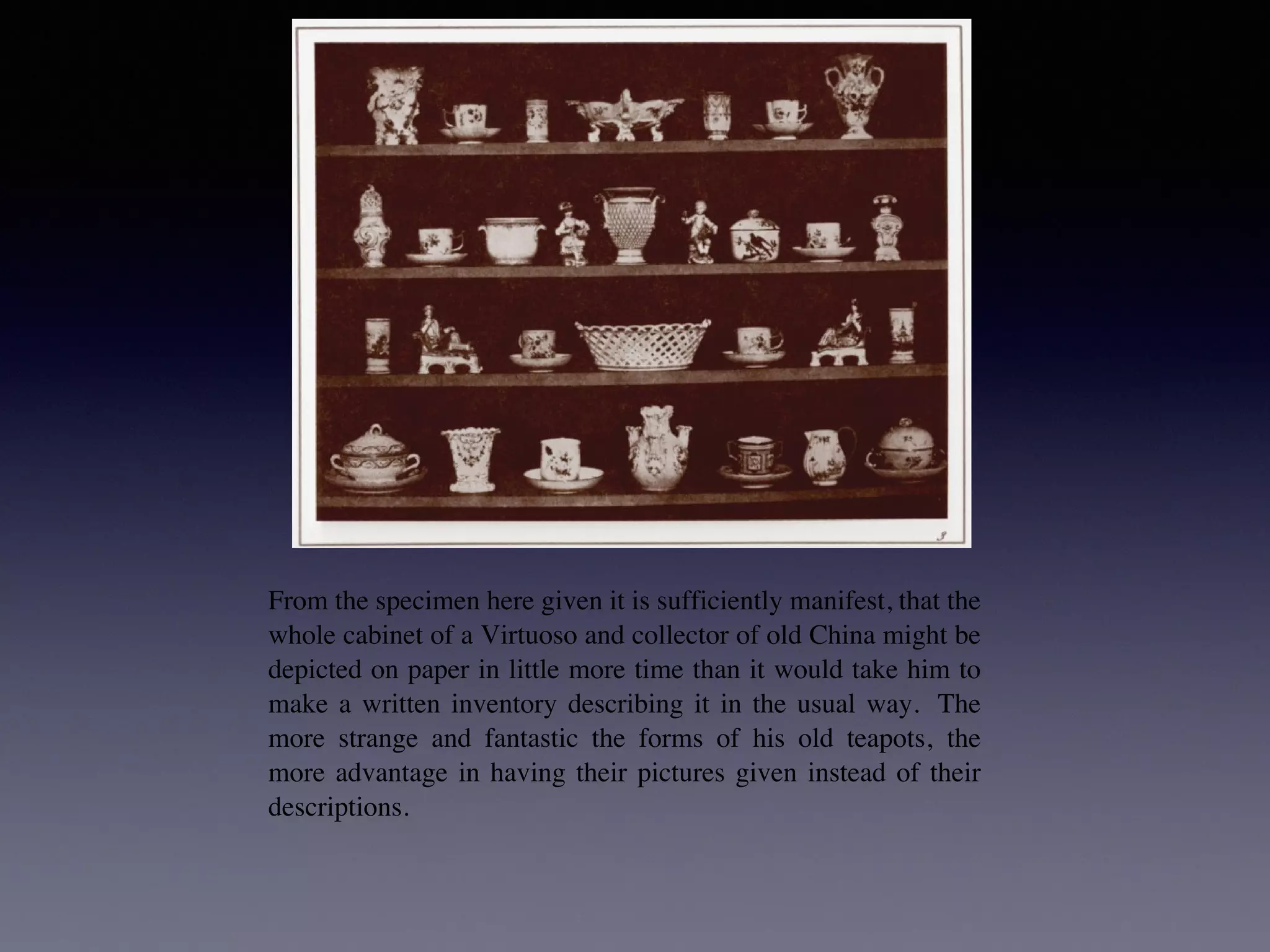
PLATE III. ARTICLES OF CHINA.
From the specimen here given it is sufficiently manifest, that the
PLATE III. ARTICLES OF CHINA.
From the specimen here given it is sufficiently manifest, that the
whole cabinet of a Virtuoso and collector of old China might be
depicted on paper in little more time than it would take him to
make a written inventory describing it in the usual way. The
more strange and fantastic the forms of his old teapots, the
more advantage in having their pictures given instead of their
descriptions.
And should a thief afterwards purloin the treasures—if the
mute testimony of the picture were to be produced against him in
court—it would certainly be evidence of a novel kind; but what
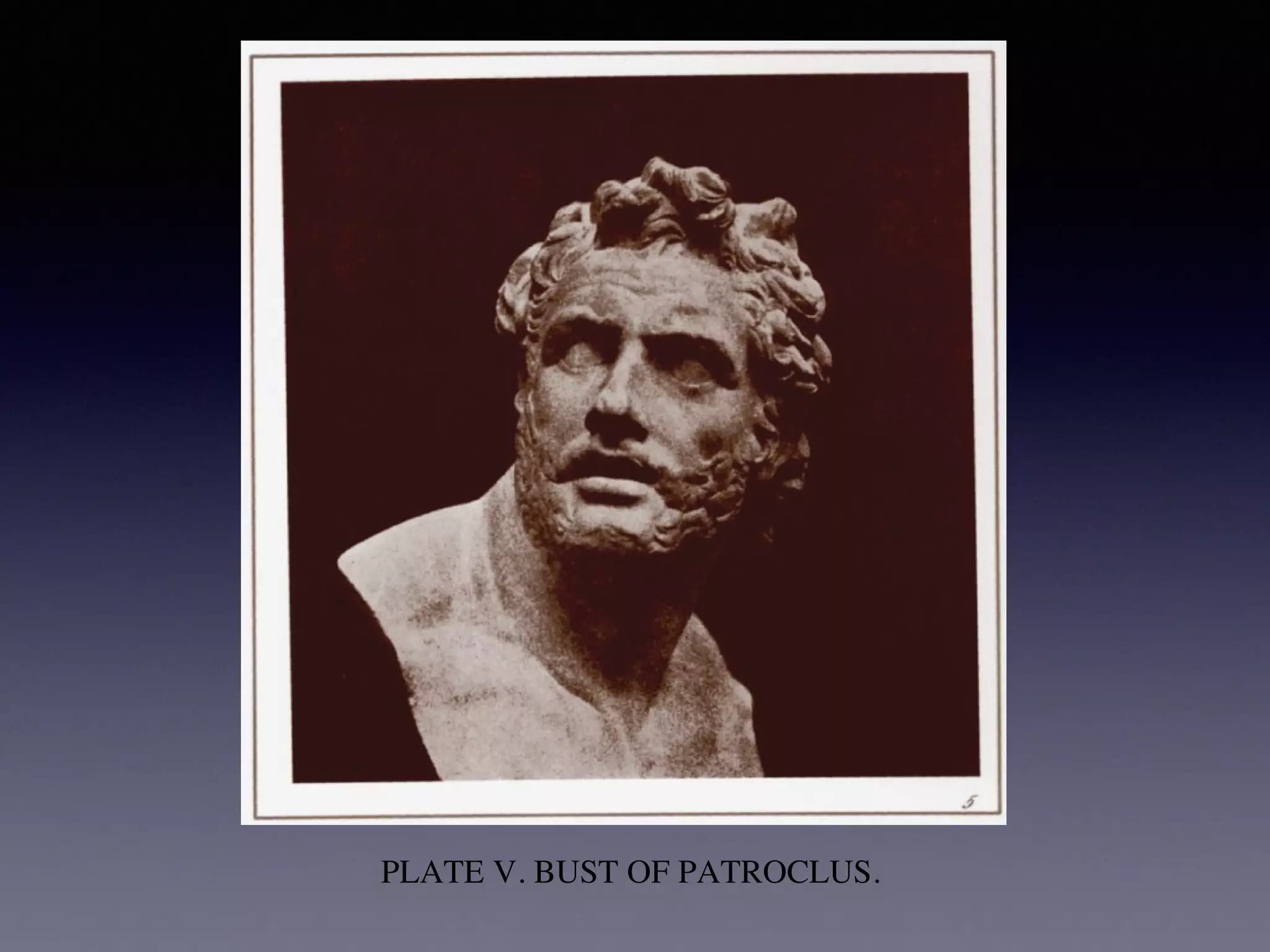
PLATE V. BUST OF PATROCLUS.
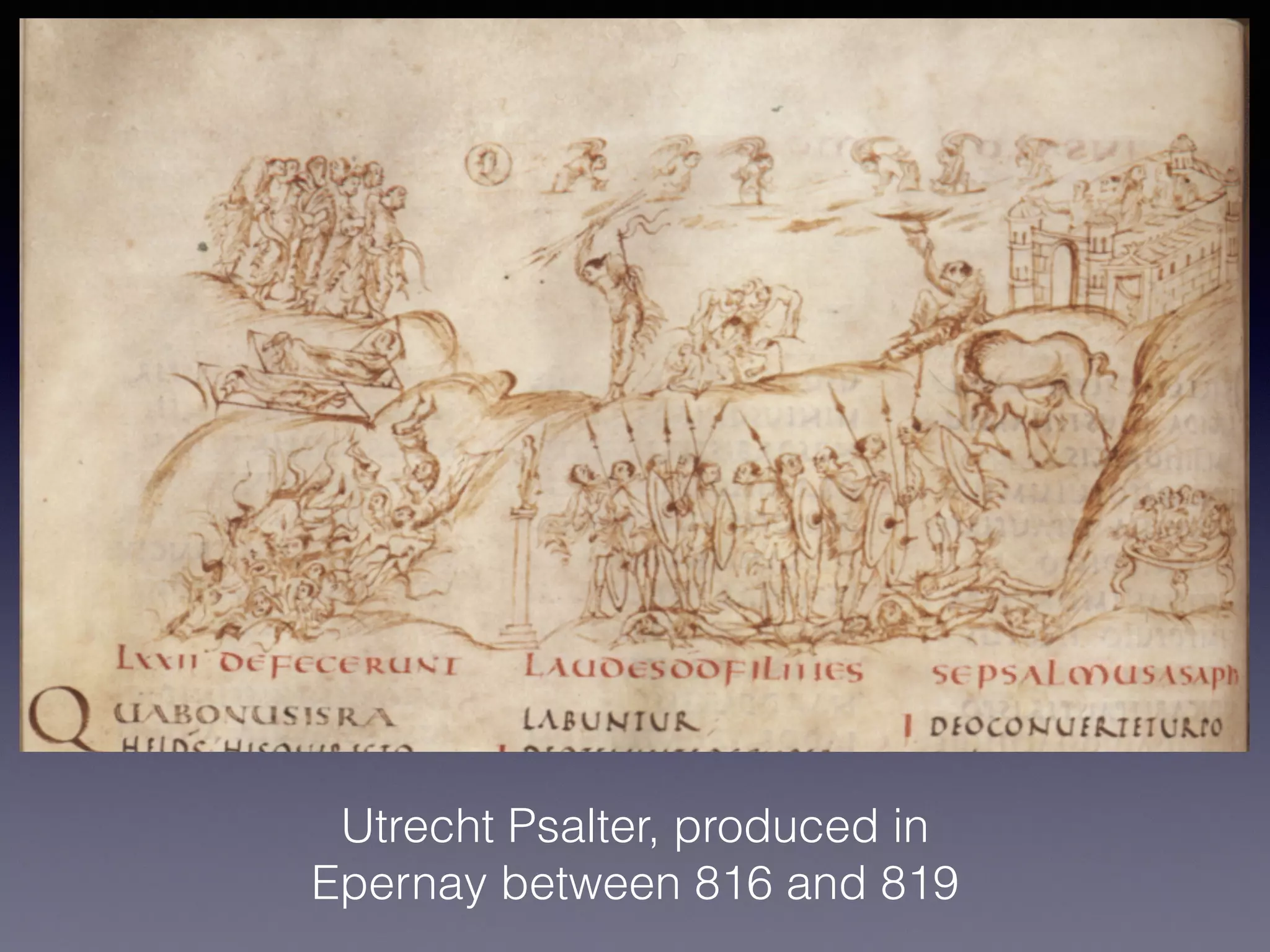
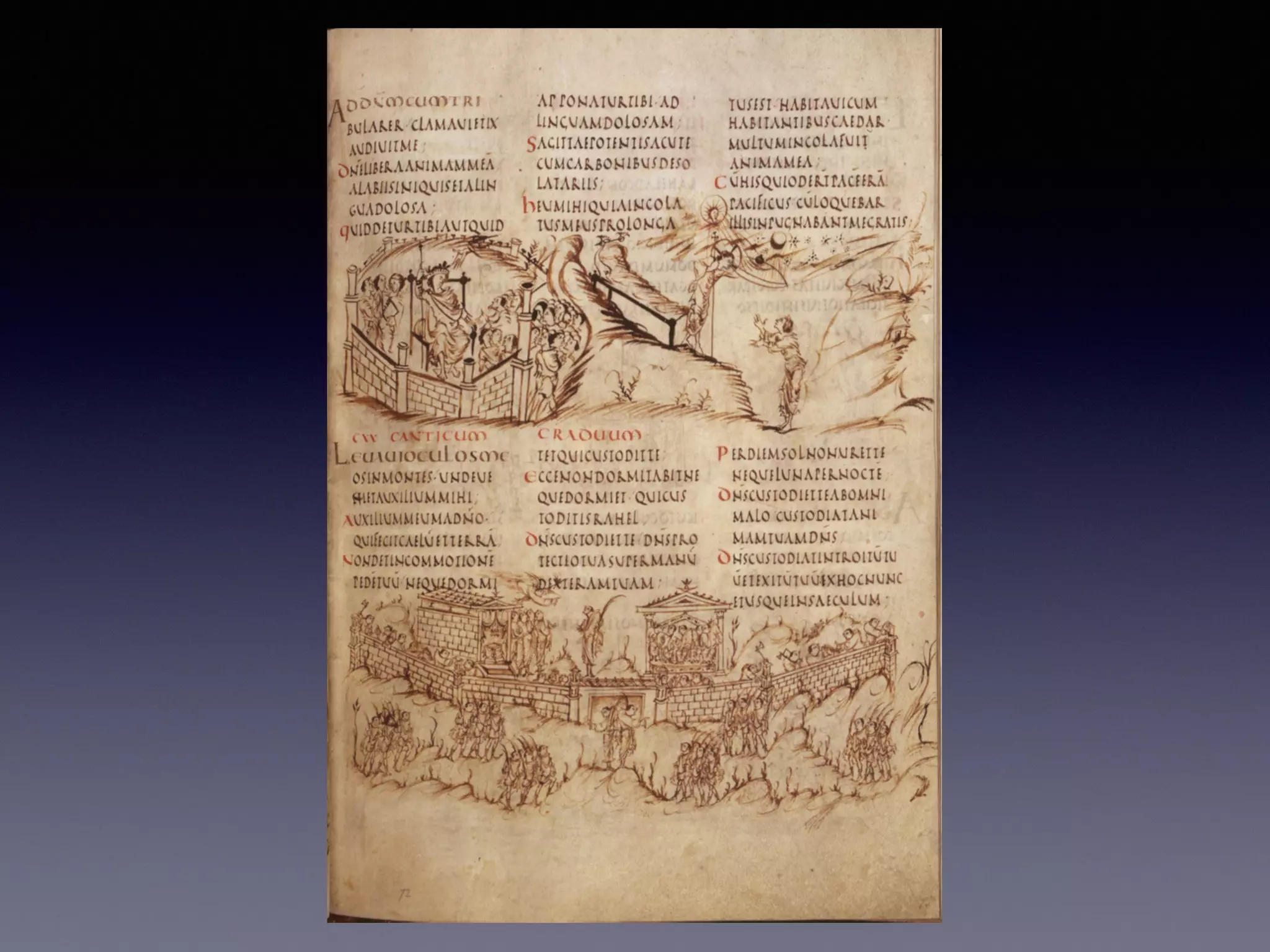
Utrecht Psalter, produced in
Epernay between 816 and 819
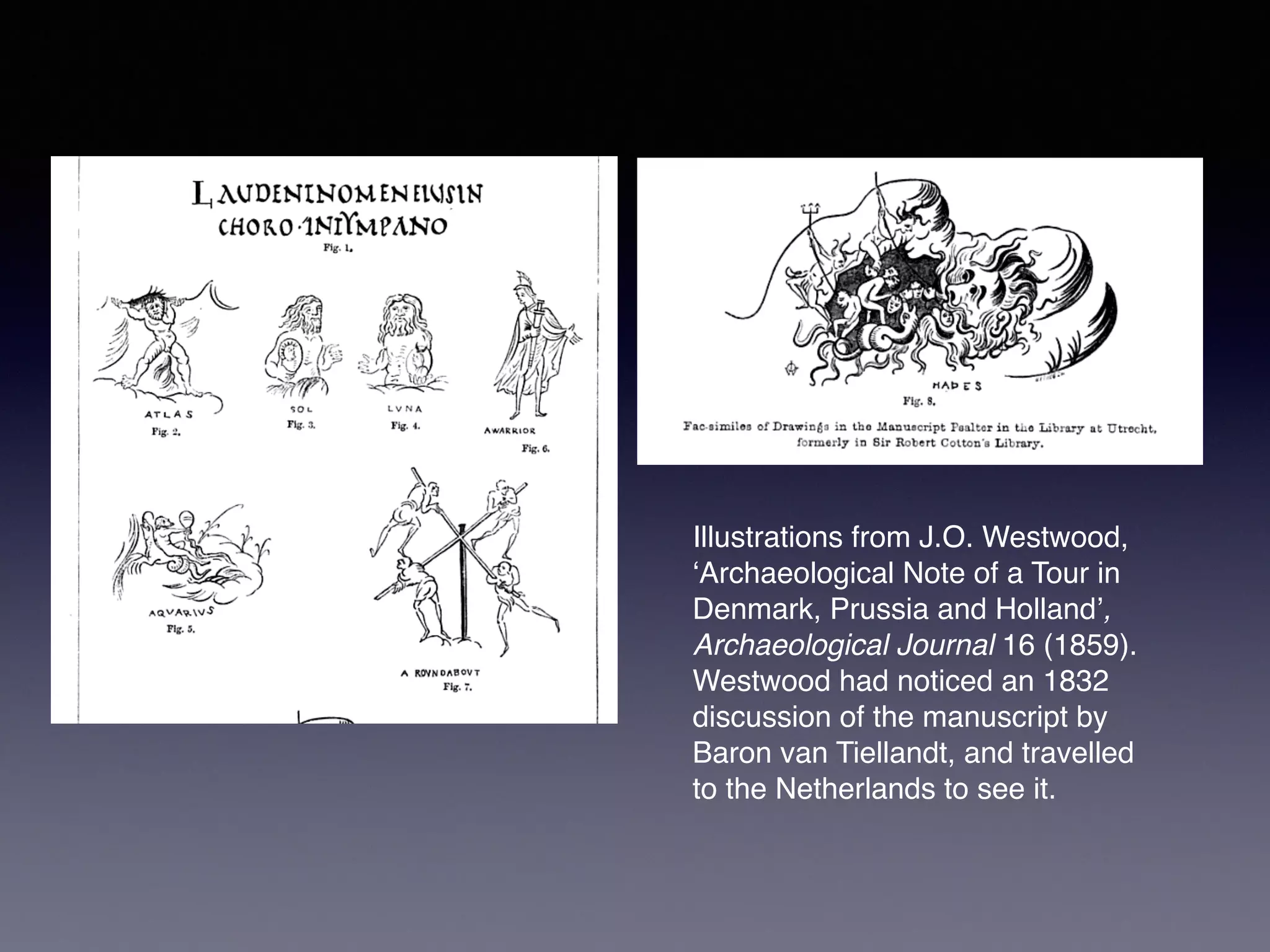
Illustrations from J.O. Westwood,
‘Archaeological Note of a Tour in
Denmark, Prussia and Holland’,
Archaeological Journal 16 (1859).
Westwood had noticed an 1832
discussion of the manuscript by
Baron van Tiellandt, and travelled
to the Netherlands to see it. !
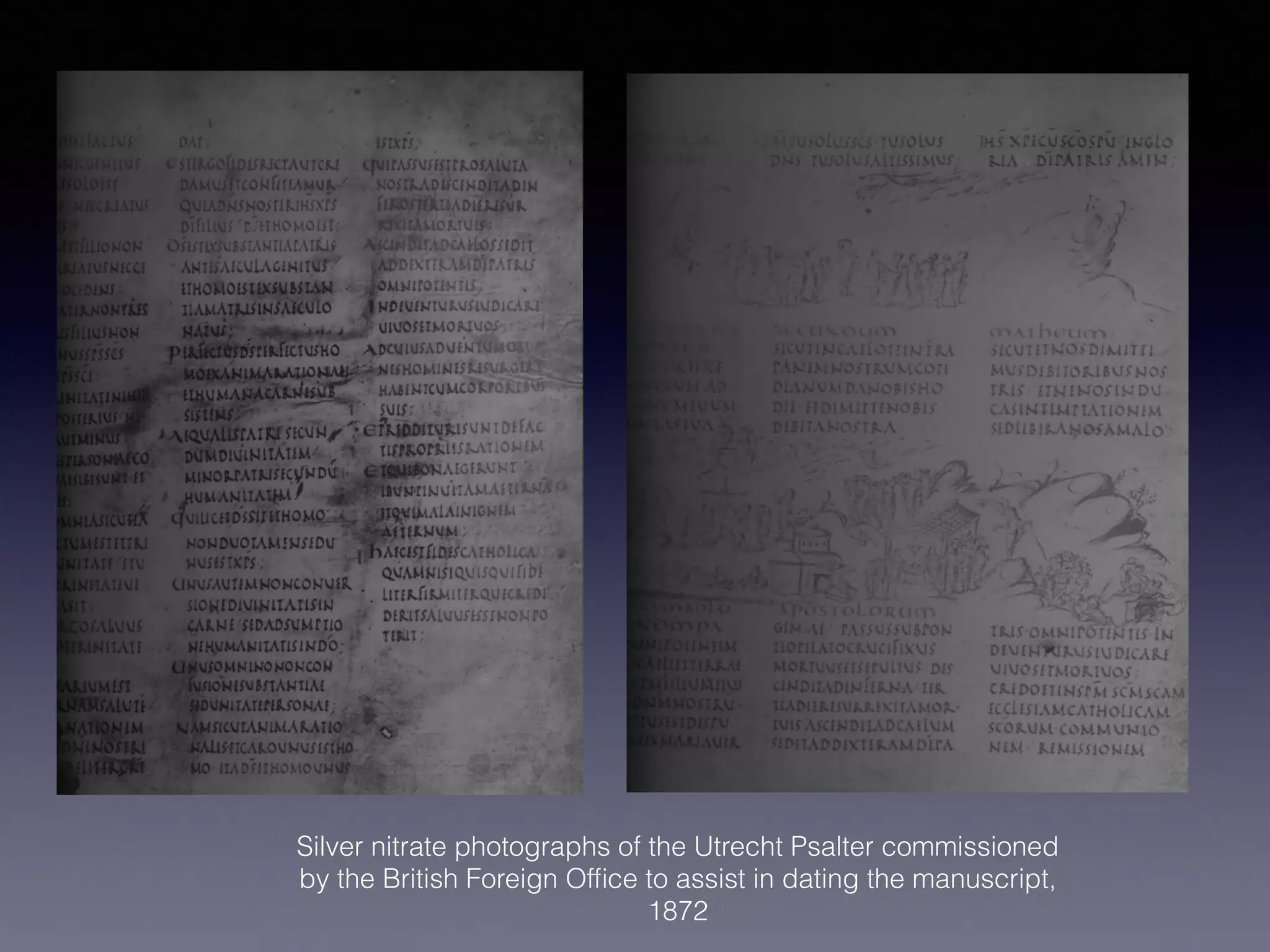
Silver nitrate photographs of the Utrecht Psalter commissioned
by the British Foreign Office to assist in dating the manuscript,
1872
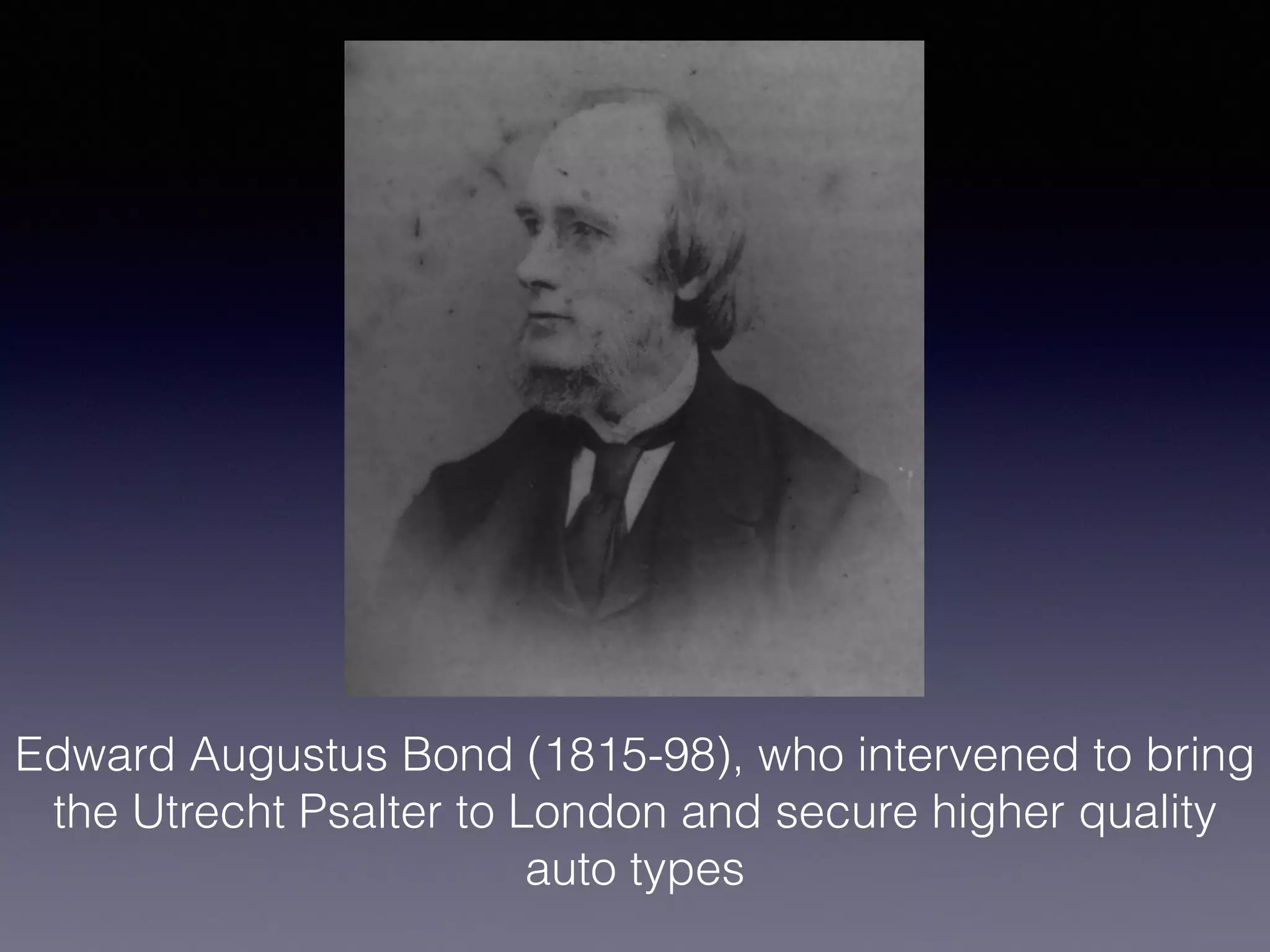
Edward Augustus Bond (1815-98), who intervened to bring
the Utrecht Psalter to London and secure higher quality
auto types
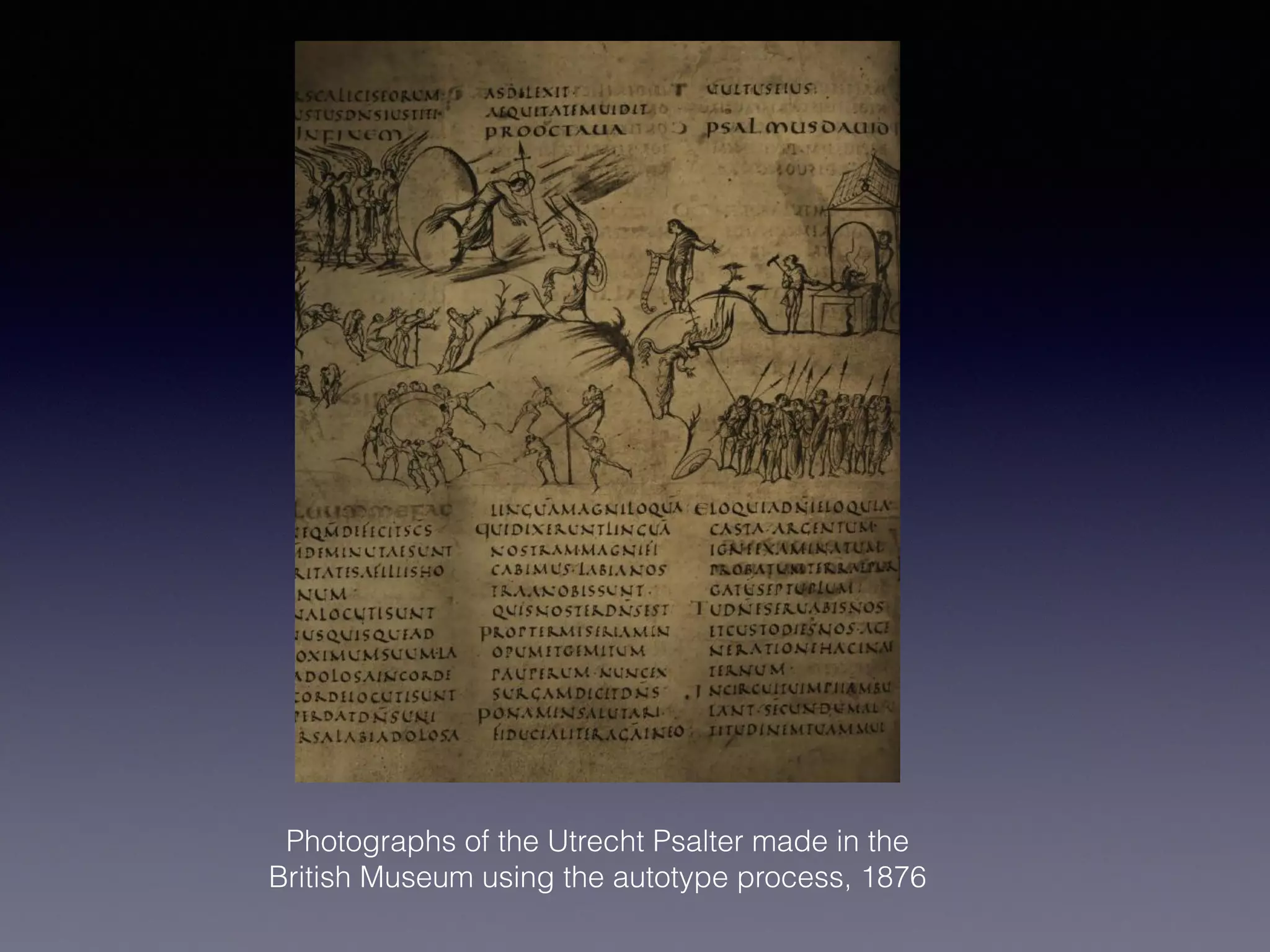
Photographs of the Utrecht Psalter made in the
British Museum using the autotype process, 1876
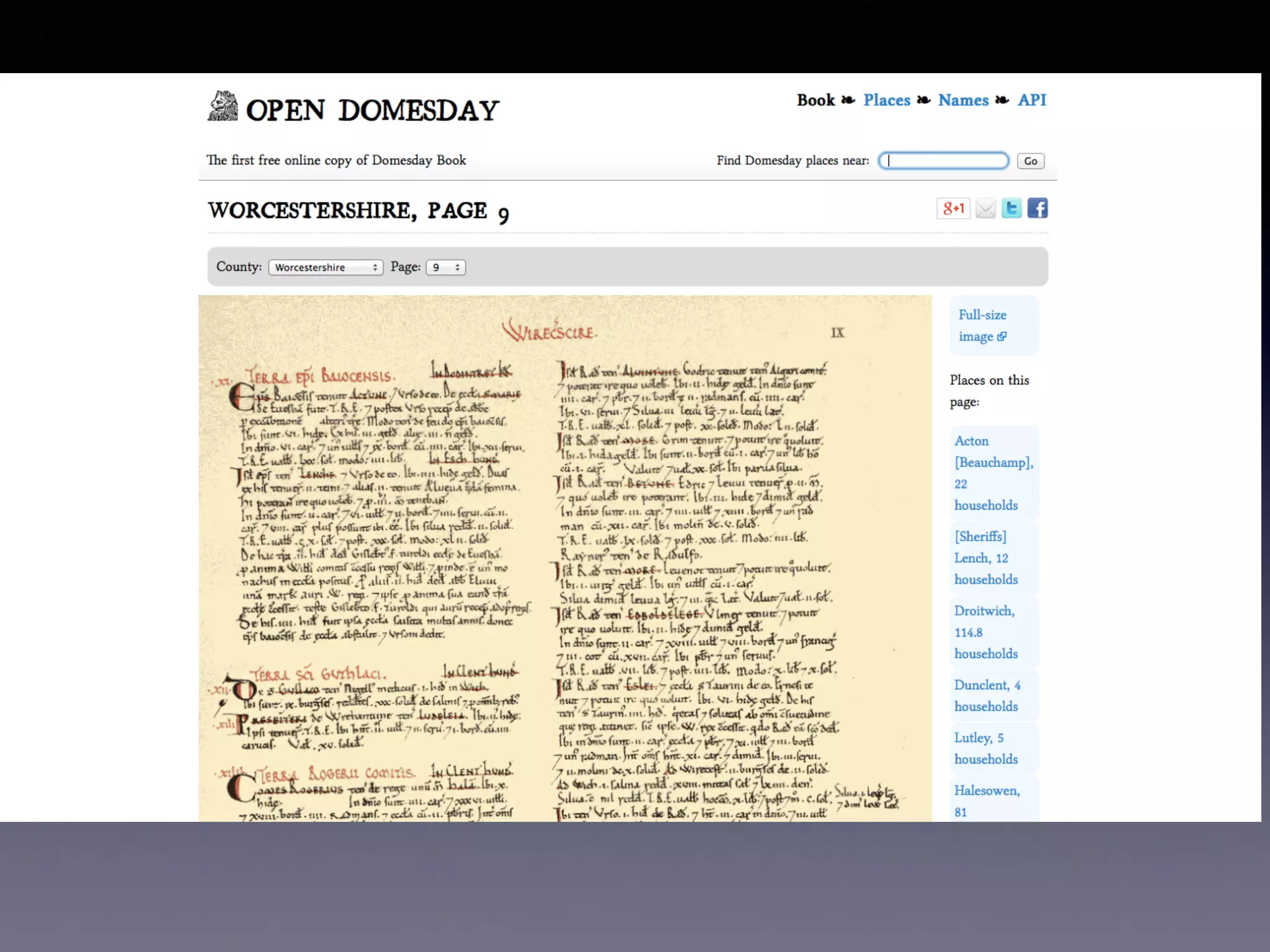
• The Norman Conquest moved into cyberspace yesterday as the Domesday
Book's online edition was launched (Guardian, 2006)
• FANS of Chaucer will soon be able see the original 15th-century printed
pages of his Canterbury Tales from the comfort of their homes (Liverpool
Echo, 2003)
• Call it virtual Vincent. Amsterdam's famed Van Gogh Museum on Monday
launched a new site on the World Wide Web aimed at ensuring art lovers get
a glimpse of the Dutch master's work - including rare paintings, drawings,
watercolors and letters not on display anywhere else. (Associated Press,
2003)
• Austria's traditionally conservative Salzburg festival is launching Mozart into
cyberspace this summer with an updated production of one of his most
popular operas.On a stage littered with television and computer monitors, the
real world meets the virtual as singers serenade projected images in the 18th
century composer's opera The Abduction from the Seraglio (Reuter 1997)
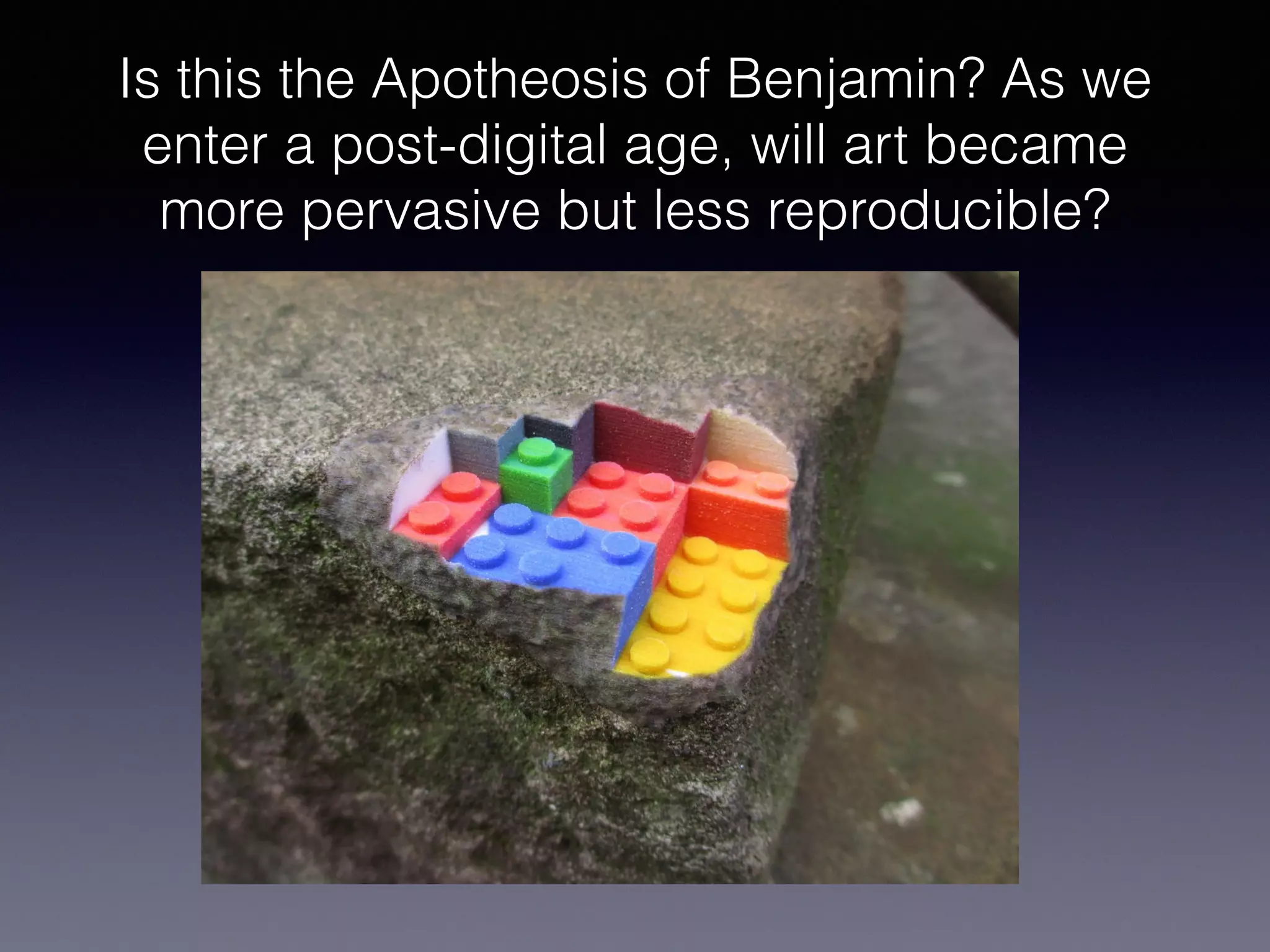
Is this the Apotheosis of Benjamin? As we
enter a post-digital age, will art became
more pervasive but less reproducible?
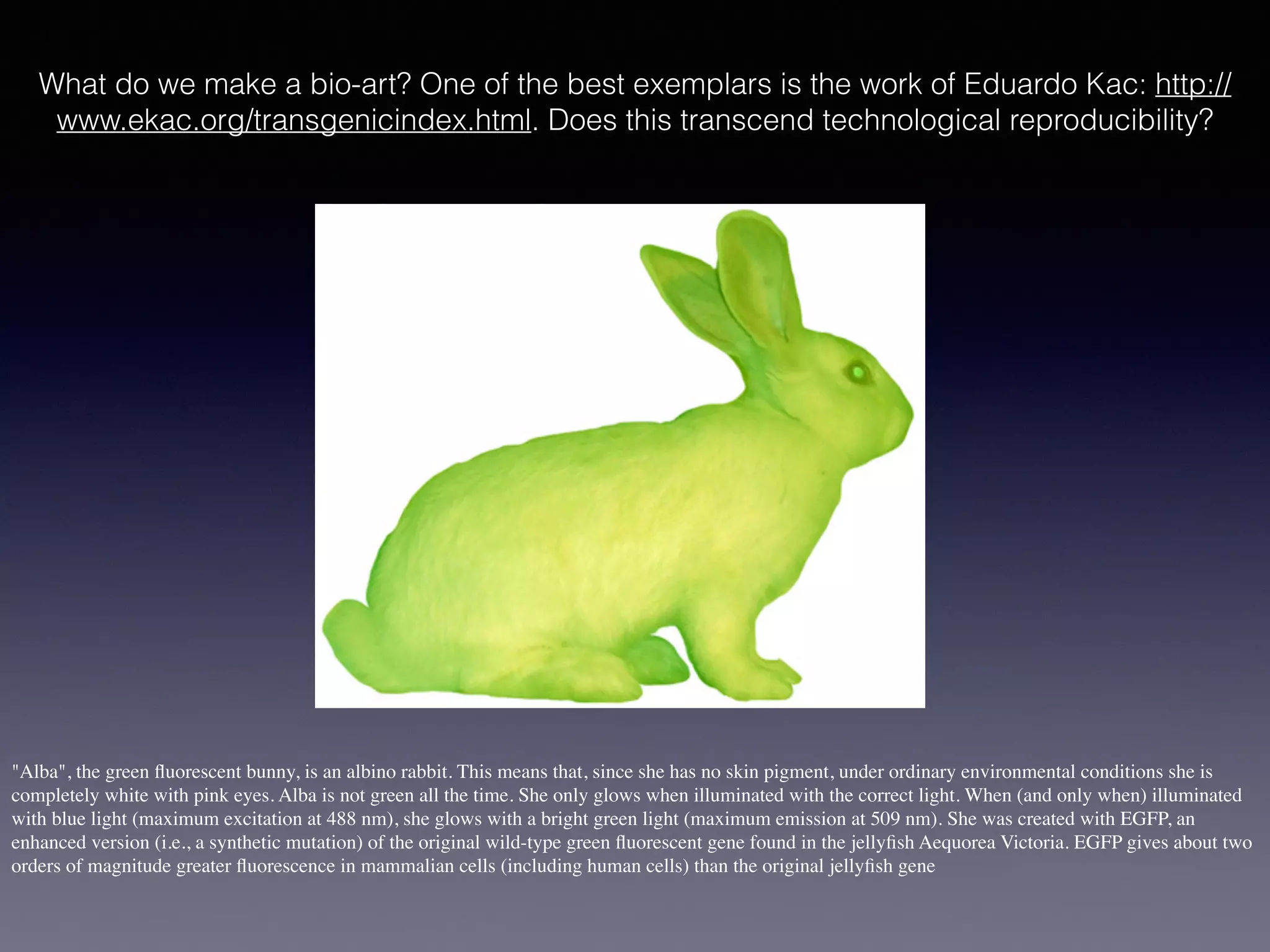
"Alba", the green fluorescent bunny, is an albino rabbit. This means that, since she has no skin pigment, under ordinary environmental conditions she is
completely white with pink eyes. Alba is not green all the time. She only glows when illuminated with the correct light. When (and only when) illuminated
with blue light (maximum excitation at 488 nm), she glows with a bright green light (maximum emission at 509 nm). She was created with EGFP, an
enhanced version (i.e., a synthetic mutation) of the original wild-type green fluorescent gene found in the jellyfish Aequorea Victoria. EGFP gives about two
orders of magnitude greater fluorescence in mammalian cells (including human cells) than the original jellyfish gene
What do we make a bio-art? One of the best exemplars is the work of Eduardo Kac: http://
www.ekac.org/transgenicindex.html. Does this transcend technological reproducibility?
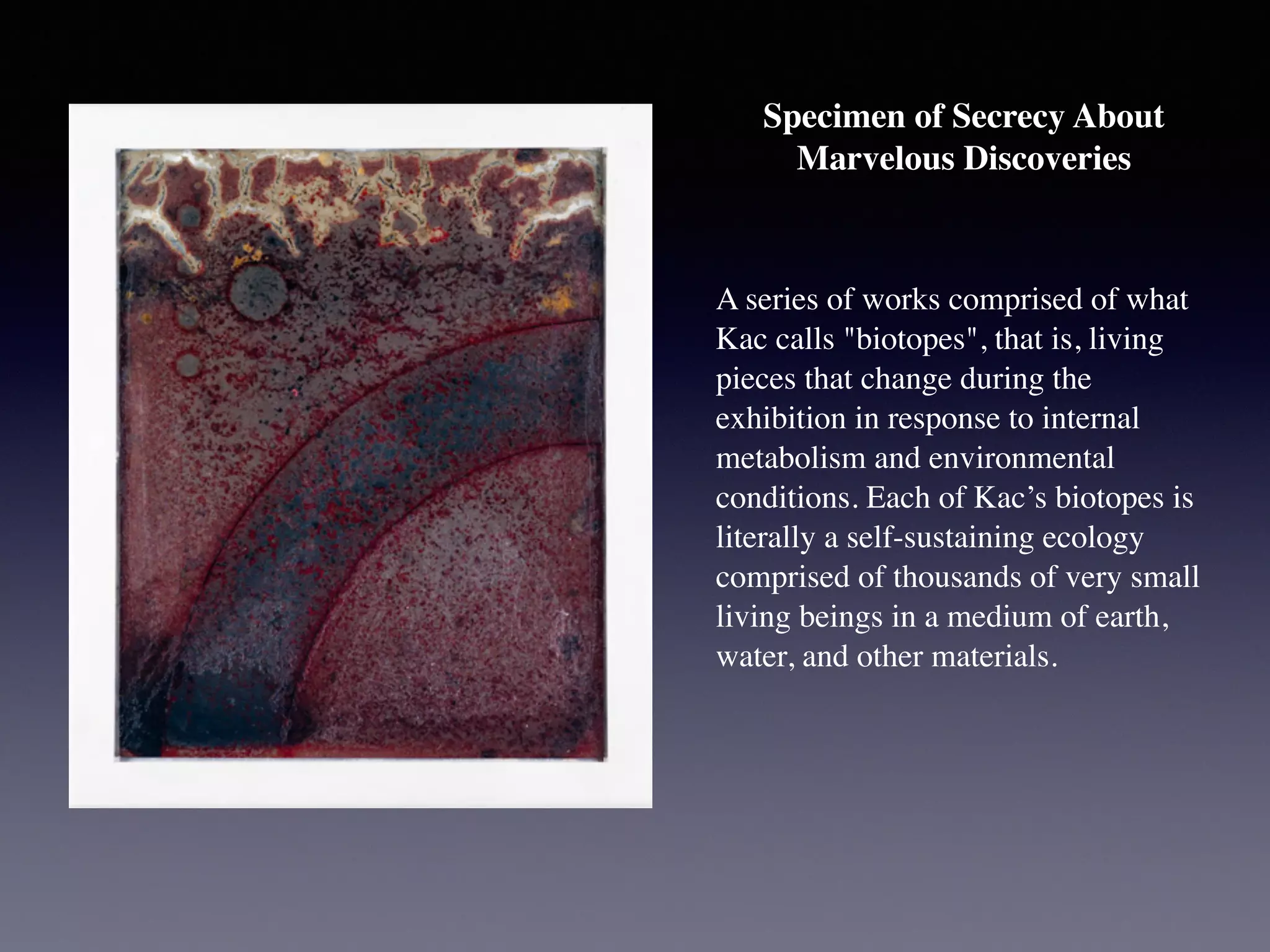
Specimen of Secrecy About
Marvelous Discoveries	

A series of works comprised of what
Kac calls "biotopes", that is, living
pieces that change during the
exhibition in response to internal
metabolism and environmental
conditions. Each of Kac’s biotopes is
literally a self-sustaining ecology
comprised of thousands of very small
living beings in a medium of earth,
water, and other materials.

The Digital Aura: riffs on Walter Benjamin

  • 1.
    The Work ofArt in the Age of Digital Reproduction, 31 May 2014 For more information about Material Witness, please visit our blog: materialwitness.me.! 10:00! Registration & coffee! 10:30 Session 1: Walter Benjamin’s Work of Art in the Age of Technological Reproduction • Andrew Prescott (King’s College London):The Digital Aura! • Neil Cox & Dana MacFarlane (University of Edinburgh):Workshopping Benjamin and Heidegger ! 12:30 Lunch 1:30 Session 2: The Age of Digital Reproduction Anchor paper: Michael Takeo Magruder (King’s College London): reproduction/remixing/redistribution: artistic processes for a born-digital age! Michael is currently a LeverhulmeTrust artist-in-residence at KCL, where he is working on a body of collaborative new media artworks entitled De/coding the Apocalypse, based on The Book of Revelation. He has recently published a new monograph, entitled (re)mediations 2000-2010 (2012, Peterborough Museum & Art Gallery, UK), that outlines the last decade of his work within the areas of news media, mobile devices and virtual worlds.! Material Witness scholars: • Sarah Biggs (Courtauld Institute/British Library): Medieval Manuscripts in the Digital Age ! • Elinor Carmi (Goldsmiths, University of London):Are you spam or not? The aura of authenticity in social network sites (SNS)! • Sara Choudhrey (University of Kent): Islamic Art in the Age of Digital Reproduction ! • Alexandra Reghina Draghici (Goldsmiths, University of London): Material Relations: Embodiment as Reproduction ! 3:30 Tea 4:00 Keynote: Mark Leckey: UniAddDumThs !Mark is a British artist and curator who works with collage, music, and film. His film Industrial Lights and Magic won theTurner Prize in 2008. He recently curated the show The Universal Addressability of Dumb Things, which explored the relationships between objects, digital avatars, and people, a configuration that he describes as ‘technoanimism’.! 5:00 Reception
  • 2.
    University of TrinitySt David, Lampeter
  • 3.
    Sidney Curnow Vosper'scelebrated watercolour, Salem (1908), epitomises the kind of plain, visually deprived culture of the early years of Lampeter. In this context, what did the richly visually library collections built up there by impact collectors such as Thomas Phillips (not tyne Thomas Phillipps of Middle Hill) !
  • 4.
    The Digital Aura:riffs on Walter Benjamin’s ‘The Work of Art in an Age of Technical Reproduction’ Andrew Prescott Material Witness Workshop 31 May 2014
  • 5.
    William Hogarth, Marriage-A-la-Mode,Plate 2 (After the Marriage): one of the large collection of Hogarth printer donated to Lampeter by Thomas Bowdler. !
  • 6.
    Thomas Phillips (1760-1851).Portrait by H. C. Mornwick at Llandovery College. Phillips donated over 22,000 books to the new St Davids College at Lampeter: http://www.uwtsd.ac.uk/rbla/online- exhibitions/thomas-phillips-exhibition/
  • 7.
    Boddam Hours: Useof Rouen, late 15th century. Presented by Thomas Phillips to the College at Lampeter in 1846.
  • 8.
    Conrad Gesner, HistoriaAnimalium (1576)
  • 9.
  • 10.
    Edward Young. The Complaint,and the Consolation or, Night thoughts. London, 1797. [Illustrated by William Blake]
  • 11.
    Plate from WilliamAlexander, The Costume of China (1805).
  • 12.
    19th-century facsimile ofan Aztec Book of Fate, presented by Thomas Phillips to Lampeter
  • 13.
    J. C. Bourne,Drawings of the London and Birmingham Railway, 1838. Phillips’s donations included many visual records of modern life.
  • 14.
    • What impressiondid the rich visual diet that Phillips prepared make in a grey monochrome Wales? • Do we see Phillips’s interest in creating a visual library as reflecting Benjamin’s emphasis on mass assimilation of cultural objects through reproduction? • Is Phillips’s visual library an expression of a shift towards an exhibition view of art? • Phillips’s interest in Lampeter was part of a wider concern with the modernisation of Wales. Was a richer visual culture part of modernity?
  • 15.
    Over 4 billionimages have been uploaded to Flickr in a period of ten years
  • 16.
    Some YouTube Statistics! !•!More than 1 billion unique users visit YouTube each month! !•! Over 6 billion hours of video are watched each month on YouTube—that's almost an hour for every person on Earth! !•! 100 hours of video are uploaded to YouTube every minute! !•! 80% of YouTube traffic comes from outside the US! !•! YouTube is localised in 61 countries and across 61 languages! !•! According to Nielsen, YouTube reaches more US adults aged 18-34 than any cable network! !•! Millions of subscriptions happen each day. The number of people subscribing daily is up more than 3 times since last year, and the number of daily subscriptions is up more than 4 times since last year
  • 17.
    Apple states that,“iTunes users have downloaded more than one billion TV episodes and 380 million movies from iTunes to date, and they are purchasing over 800,000 TV episodes and over 350,000 movies per day.”
  • 18.
  • 19.
    Computers are machines which countvery fast, but counting is the last thing we do with them. It brings us images, movies, sound, 3D reconstructions, entertainment, culture…
  • 20.
    • Benjamin’s essayon ‘The Work of Art in the Age of its Technological Reproducibility’ (1935-6) appears increasingly prescient as we become flooded with images: ‘The cathedral leaves its site to be received in the studio of an art lover; the choral work performed in an auditorium or in the open is enjoyed in a private room’. • Digitisation of existing cultural artefacts is a means of rendering them reproducible • Demand for digitisation and access: ‘the desire of the present-day masses to “get closer to things”… by assimilating it as reproduction • But as the digital corpus grows, issues of authenticity (not just manipulation but scale, colour, cropping, etc) • This reproducibility changes their cultural status, although the exact nature of this change unclear (do they become more open or more controlled?)
  • 21.
    • Benjamin’s emphasison changes in the nature of cultural labour and production seem particularly pertinent • New types of involvement in cultural labour: crowd-sourcing, out- working, team working • New relationship between the audience and the artwork • Erosions of distinction between author and user (anticipates Web 2.0?) • For Benjamin, film was a means of the masses reconciling themselves to new technology • We can see our use of computers for entertainment as a means of humanising a technology which poses serious issues in terms of privacy, surveillance, identity and control.
  • 22.
    • The collapseof distinctions between cultural objects • In a digital environment, distinctions in format between print, manuscript, oil, watercolour, sound, movie, material object collapse • All objects can be stored and documented in a digital form • The only differences between libraries, archives, museums and art galleries are differences of file format and metadata • Is this the liquidation of tradition that Benjamin anticipated?
  • 23.
    Beazley Archive ofGreek Pottery: www.beazley.ox.ac.uk
  • 24.
    Books, archives andmuseum objects integrated in a single catalogue system: Library and Museum of Freemasonry: www.freemasonry.london.museum
  • 25.
    • Benjamin arguedthat the reproducibility of works of art weakened the sense of aura • He welcomed the prospect of the liquidation of tradition and undermining of old distinctions - ‘a shattering of tradition which is a renewal of humanity’ • ‘Shakespeare, Rembrandt, Beethoven will films … All legends, all mythologies, and all myths, all the founders of religions, indeed, all religions await their celluloid resurrection, and the heroes are pressing at the gates’
  • 26.
    • I wantto examine briefly three areas where the position might be more complicated in the digital environment than Benjamin suggests • Rather than undermining ‘aura’, photographs and digital images can have their own considerable sense of time and place which amounts to a ‘digital aura’ • ‘Authenticity’ is difficult: digital representations can sometimes have claim to greater authenticity • Rather than liquidating traditions, digital reproducibility may instead be reinforcing them
  • 28.
    PLATE III. ARTICLESOF CHINA. PLATE III. ARTICLES OF CHINA. From the specimen here given it is sufficiently manifest, that the PLATE III. ARTICLES OF CHINA. PLATE III. ARTICLES OF CHINA. From the specimen here given it is sufficiently manifest, that the whole cabinet of a Virtuoso and collector of old China might be depicted on paper in little more time than it would take him to make a written inventory describing it in the usual way. The more strange and fantastic the forms of his old teapots, the more advantage in having their pictures given instead of their descriptions. And should a thief afterwards purloin the treasures—if the mute testimony of the picture were to be produced against him in court—it would certainly be evidence of a novel kind; but what
  • 29.
    PLATE V. BUSTOF PATROCLUS.
  • 31.
    Utrecht Psalter, producedin Epernay between 816 and 819
  • 33.
    Illustrations from J.O.Westwood, ‘Archaeological Note of a Tour in Denmark, Prussia and Holland’, Archaeological Journal 16 (1859). Westwood had noticed an 1832 discussion of the manuscript by Baron van Tiellandt, and travelled to the Netherlands to see it. !
  • 34.
    Silver nitrate photographsof the Utrecht Psalter commissioned by the British Foreign Office to assist in dating the manuscript, 1872
  • 35.
    Edward Augustus Bond(1815-98), who intervened to bring the Utrecht Psalter to London and secure higher quality auto types
  • 36.
    Photographs of theUtrecht Psalter made in the British Museum using the autotype process, 1876
  • 37.
    • The NormanConquest moved into cyberspace yesterday as the Domesday Book's online edition was launched (Guardian, 2006) • FANS of Chaucer will soon be able see the original 15th-century printed pages of his Canterbury Tales from the comfort of their homes (Liverpool Echo, 2003) • Call it virtual Vincent. Amsterdam's famed Van Gogh Museum on Monday launched a new site on the World Wide Web aimed at ensuring art lovers get a glimpse of the Dutch master's work - including rare paintings, drawings, watercolors and letters not on display anywhere else. (Associated Press, 2003) • Austria's traditionally conservative Salzburg festival is launching Mozart into cyberspace this summer with an updated production of one of his most popular operas.On a stage littered with television and computer monitors, the real world meets the virtual as singers serenade projected images in the 18th century composer's opera The Abduction from the Seraglio (Reuter 1997)
  • 50.
    Is this theApotheosis of Benjamin? As we enter a post-digital age, will art became more pervasive but less reproducible?
  • 52.
    "Alba", the greenfluorescent bunny, is an albino rabbit. This means that, since she has no skin pigment, under ordinary environmental conditions she is completely white with pink eyes. Alba is not green all the time. She only glows when illuminated with the correct light. When (and only when) illuminated with blue light (maximum excitation at 488 nm), she glows with a bright green light (maximum emission at 509 nm). She was created with EGFP, an enhanced version (i.e., a synthetic mutation) of the original wild-type green fluorescent gene found in the jellyfish Aequorea Victoria. EGFP gives about two orders of magnitude greater fluorescence in mammalian cells (including human cells) than the original jellyfish gene What do we make a bio-art? One of the best exemplars is the work of Eduardo Kac: http:// www.ekac.org/transgenicindex.html. Does this transcend technological reproducibility?
  • 53.
    Specimen of SecrecyAbout Marvelous Discoveries A series of works comprised of what Kac calls "biotopes", that is, living pieces that change during the exhibition in response to internal metabolism and environmental conditions. Each of Kac’s biotopes is literally a self-sustaining ecology comprised of thousands of very small living beings in a medium of earth, water, and other materials.