+
Music Video Production
Case Study
Dan Bell
+
Unit 29 - Music Video Production
 We will look at Music Videos from a number of perspectives, this
template is for you to write up your notes and to complete your
case study.
 The document is split into 3 different tasks, each with separate
questions to answer.
 Task 1 is concerned with the purposes of music videos and the
strategies employed by labels and artists
 Task 2 is concerned with the styles, techniques and conventions of
music video production
 Task 3 is your own case study into a minimum of three music
videos where you can unpack and discuss the videos considering
everything you have looked at in Task 1 and 2
+
Unit 29 – Music Video Production
 Learning outcomes, this case study is concerned with the first
two learning outcomes of the unit:
1. Understand the purpose of music videos
2. Understand the styles, conventions, and techniques of music
videos
3. Be able to originate and plan a music video production for a
specific music track
4. Be able to work to complete production of a music video.
+
Unit 29 – Music Video Production
Assessment Criteria
 The assessment criteria addressed by this case study, further
details are in your project brief:
+
Notes on completing the case study
 It is often easier to show something you are discussing than to
take time describing it. With this in mind, feel free to add lots of
illustrative images from your chosen video examples. Links to
YouTube/Vevo/etc are also encouraged.
 Remember, when you make a point or define something, you
should follow this with an example, an explanation of this and
then link to further texts/videos where possible.
 If you don’t think there is enough room to add your full
response to a question, don’t just reset the font size to really
small, add an extra slide wherever necessary.
+
Task 1 - Purposes
+
Task 1 - Purposes
 Q1 - Outline the 3 core purposes of music video with a short
explanation for each:
 Entertainment: a major purpose of a music video is to entertain
people by the use of music and a film to go with it.
 Sales: an artist will make a video to go with their song to
promote the song as it is a good way of getting people to get
into the song so they will buy the record or download it.
 Branding/identity: This will be where an artist will attempt to
create a style that their fans will recognize as will posible
purchases to their music. Their videos reflect a combination of
their style, etc…
+
Task 1 - Purposes
 Q2 – What are some of the broader purposes of music videos? Think about some of the strategies employed by artists in their
videos and how they represent themselves, you could consider where the artist is on a major label, independent label of
unsigned, is there a difference between them?
 One purpose of creating a music video is that it will allow a band/singer to have the freedom of not having to play live. It also
will allow the audience to interpret a song by listening to it with a video going on in the background. When the Beatles stopped
performing live they started to focus more on creating films. As bands become bigger/more famous they don’t tend to tour as
much as those just getting onto the scene. People in the UK are more likely to watch Taylor Swift on a video than they are to
see her live.
 The advantage of making a video is it will make their song more popular to increase sales.
 They may have a political or social message
 Other artists may feature in order to promote themselves a little bit more.
Taylor Swift The Beatles
+
Task 1 - Purposes
 Q3 – Describe what is ‘synergy’ is and how it has been used in music
videos [min. 3 examples of synergy and convergance]
 Is the interaction or cooperation of 2 or more organizations, substances or
other agents to produce a combined effect greater than the sum of their
separate effects.
 Was originally pioneered by Disney in the 1930’s, it allowed different
companies to use Mickey Mouse in different companies and adverts.
 Men in black featured Will Smith as one of the characters and he also
sang the title track which lead to music video and also an album. The
music video featured MIB related characters such as aliens.
 Robbie Williams did a song featuring Kylie Minogue with a video to give
exposure to both of them in order to increase sales for both.
+
Task 1 - Purposes
 Q4 – Branding; select an artist you like and look at how they present themselves in their music videos. Explain
what their ‘brand’ is, who is appeals to and why they might have done this.
 In Calvin Harris’ videos he does not feature himself very often, he may occasionally show up and he is
normally singing along to his song. There are a lot of women in his videos and also a lot of very expensive
equipment which suggests that he is very popular and has a lot of money. His videos would mainly appeal to
teenagers in general. Men because the women in the video will appeal to them and the women because they
will aspire to be like the females in the video.
 Olly Murs likes to promote himself as a cheeky-chappy sort of performer, he dances around a lot often in the
company of women. His audience would be teenagers (mainly girls). He also has a very urban kind of feel to
his videos.
Calvin Harris’ ‘Summer’ video Olly Murs
+
Task 1 - Purposes
 Q5 – Compare One Direction and Animal Collective music videos [find
them on YouTube!], what can you discern about each act from their videos?
What is the main aim? Explain why.
 Animal Collective’s videos are very bizarre in comparison to One Direction’s.
1D’s main audience is early-mid teenage girls, in some scenes of their videos
the camera will mainly show their faces. Animal Collective’s ‘My Girls’ uses
abstract images of people playing music. Their videos are very colorful and
creative whereas 1D videos tend to be quite straightforward with no special
effects done to them. This is because teenagers tend to stick to things that
are very simple but entertaining.
+
Task 2 – Styles, Techniques
and Conventions
+
Task 2 – Styles, Techniques and
Conventions
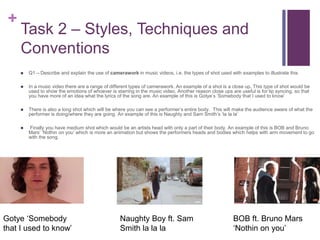
 Q1 – Describe and explain the use of camerawork in music videos, i.e. the types of shot used with examples to illustrate this
 In a music video there are a range of different types of camerawork. An example of a shot is a close up. This type of shot would be
used to show the emotions of whoever is starring in the music video. Another reason close ups are useful is for lip syncing, so that
you have more of an idea what the lyrics of the song are. An example of this is Gotye’s ‘Somebody that I used to know’
 There is also a long shot which will be where you can see a performer’s entire body. This will make the audience aware of what the
performer is doing/where they are going. An example of this is Naughty and Sam Smith’s ‘la la la’
 Finally you have medium shot which would be an artists head with only a part of their body. An example of this is BOB and Bruno
Mars’ ‘Nothin on you’ which is more an animation but shows the performers heads and bodies which helps with arm movement to go
with the song.
Gotye ‘Somebody
that I used to know’
Naughty Boy ft. Sam
Smith la la la
BOB ft. Bruno Mars
‘Nothin on you’
+
Task 2 – Styles, Techniques and
Conventions
 Q2 - Describe and explain the use of editing in music videos, i.e. the types of shot used
with examples to illustrate this
 The camera may accommodate actions from performers such as dancing, walking and
running but can also be used to create a dynamic effect to stage performances like
constantly circling the band as they perform on stage. An example of this is Bruce
Springsteen’s ‘Dancing in the dark’ which is not an actual live performance but the video is
created to give you the feeling that it is.
 Close ups do predominate as in most TV, partly because of the size of the screen and
partly because of their desire to make a sense of intimacy for the viewer. It also
emphasises half of the commodity on sale. An example of a singer who always tends to
have the camera on them all the time in their videos is Taylor Swift especially in one of her
latest songs ‘Blank space’
 A major difference between Bruce Springsteen and Taylor Swift is that Taylor Swift’s videos
tend to have a story going on in them (mainly about love and relationships) whereas Bruce
Springsteen’s tend to be more of a live performance and him keeping it real.
+
Task 2 – Styles, Techniques and
Conventions
 Q3 - Describe and explain some of the technical developments in music videos, i.e. the types of shot used
with examples to illustrate this
 The main innovation in developing modern day music videos was video recording and editing processes along
with a number of related effects like chroma-key or green screens. An example of this ‘Atlas’ by Battles. In this
video they’re in a glass cube in outer space. To make it look like they were in space CGI would have been put
in place. Another song is called ‘Rocking the suburbs’ by Ben Folds in which it is just 1 person as the entire
band, tis will have been done as a green screen.
 The advent of a high-quality colour videotape recorders and portable video cameras enabled many pop acts to
produce promotional videos conveniently cheap and quick compared to relatively high costs of using film. The
internet has been a major development as that is the way that people will watch music as you can watch it any
time for free on YouTube.
Battles ‘Atlas’ Ben Folds ‘Rocking the subburbs’
+
Task 2 – Styles, Techniques and
Conventions
Q4 – Genre conventions; often music videos adhere to genre conventions within their visual style and production techniques. Select a
recognisable genre and use illustrations to explain what their genre conventions are…
Hip hop artists generally dress in away that will make them look very wealthy in their videos, this will include “bling”, leather jackets that will be
really expensive and also a fashionable pair of sunglasses. The scenery is usually either in a rough neighborhood in which they may have grown
up if they’re just getting onto the hip hop map or if they’re well known it will be in a city with a lot of sunshine and clubs like Miami or LA. Other
performers in the videos would usually be streetwise people for artists just getting into the industry and ladies with minimal clothing on for those
who could claim to be superstars. Their videos tend to have no special effects in as the target audience would be early-mid teens (ages 13-20)
therefore they may find it hard to follow loads of things going on at once with special effects. Snoop Dogg’s ‘Gin & juice’ was one of the first
songs and was set in his house to start with before going into his rough neighborhood where he is surrounded by gangsters. This is much
different from Kanye West’s ‘Power’ where he symbolises himself to be a god. In Taio Cruz’s ‘Break your heart’ he is in a sunshine speedboat
town such as Miami and is surrounded by women with very little on. One thing all these videos have in common is that the main performer is
always in the centre of the screen like in Kanye West’s video he does not make any movement but as the camera gradually zooms out he is
always to the centre and never the left or right. They all wear mainstream clothing so that they look cool to go with their style of music. All of the
artists tend to have a bit of swagger and arrogance about them.
Snoop Dogg ‘Gin & juice’ Kanye West
‘Power’
Taio Cruz ‘Break
your heart’
+
Task 2 – Styles, Techniques and
Conventions
 Q5 - John Stuart’s description of the music video “incorporating, raiding and reconstructing” is
essentially the essence of intertextuality [something asserted by Andrew Goodwin]. Can you
explain what intertexuality is and find some examples of it in music videos?
 Intertextuality is the visual reference in a music video coming from a wide range of sources, the
three most common are cinema, fashion and art photography. The aim of intertextuality is for
someone to make their video look like a scene from a specific film, for example Madonna’s 1985
track ‘Material Girl’ the video for which looked like a sequence from the 1953 film ‘Gentlemen
prefer blondes’. There is sometimes references to video games like Das Racists song ‘Who’s that
brooown?’
Gentlemen prefer
blondes
Madonna ‘Material girl’ Das Racist ‘Who’s that
brooown?’
+
Task 3 – Case Study
+
Task 3 – Case Study
 For your individual case study you are required to prepare
material on a minimum of three music videos.
 This should provide discussion on the usage of the following:
 Purpose of the video [consider the strategy of the artist and the
intention behind the video, remember the core purposes and break
this down into the other purposes we discussed]
 Style[s] used
 Techniques employed
 Intertextuality
 Camerawork/editing
 Genre conventions
+
Task 3 – Case Study
 You should include a video link for the video
 George Ezra ‘Blame It On Me’
https://www.youtube.com/watch?v=H4ifSrE8iSg
 Bastille ‘Pompeii’ https://www.youtube.com/watch?v=F90Cw4l-8NY
 The Proclaimers ‘500 Miles’
https://www.youtube.com/watch?v=tM0sTNtWDiI
 You can include as many illustrative stills as you like
 Be creative in your approach, it is suggested you use the heading on the
previous slide a guide on how to structure your response to get you
started
 Remember, make a point, use a specific part of the chosen video as an
example, explain yourself and then link to another video where possible
+
The Proclaimers ‘500 Miles’
 This is a very early example of a music video.
 In this video there is a lot of focus on the main artists and does
not really tell a story like Bastille’s ‘Pompeii’ does. A lot of the
video is of the Proclaimers lip-syncing along to their own song.
This portrays them as very serious artists. the only colour
feature in the video is the artists, this suggests that they
intended to be the focus of the video. The artists wear normal
every day clothes instead of fancy clothing which in some
videos would go with the song.
 This song goes down in the Celtic rock and folk pop genre
Singer in colour,
background in white
+
Bastille ‘Pompeii’
 Is a narrative video. The artist is the main character and it it only
really shows him singing along to the song when it is the chorus.
This is a very surreal video as it jump cuts between shots as if it’s
from a nightmare. It is set in a city where there is very few people
left and the ones that are have been turned into zombies while the
artist/actor is the only one left normally so he is trying to escape. In
the final scene he is in a national park with the very final scene of
the video being where he turns into a zombie. This would go down
as a pop/indie song.
 In this video there are a lot of long shots to represent him running
away from the zombies and also there is a lot of close ups of the
zombies to show the effect of their faces. This video is a bit.
This is the example of the
differences in camera
work, the possessed
people.
+
George Ezra ‘Blame It On Me’
 This video is made to go along with what was happening in the song. George
Ezra is being victimised, in the video he gets shot by a toy gun, he gets run
over and is tackled by an entire rugby team. He also suffers unfortunate events
like something landing on his shirt, being ran over and ending up in the middle
of a police gun fight
 There are a few uses of comedy in this video
 In this video there is a mixture of wide shots and close up. The close ups are
where something goes wrong for him and the wide shots are of him walking
down the street.
 George Ezra is classified as a folk singer.
 George Ezra’s video is similar to Bastille’s in the sense that it mixes real life in
with things that are not quite so real. They are all very similar because in each
video something is happening though Bastille’s and Ezra’s are easier to
understand as they are a lot more recent therefore the picture is significantly
clearer.
This is the difference in
camera technique when
something has gone wrong
and something is normal.

Mv u29 assignment 1 form

  • 1.
  • 2.
    + Unit 29 -Music Video Production  We will look at Music Videos from a number of perspectives, this template is for you to write up your notes and to complete your case study.  The document is split into 3 different tasks, each with separate questions to answer.  Task 1 is concerned with the purposes of music videos and the strategies employed by labels and artists  Task 2 is concerned with the styles, techniques and conventions of music video production  Task 3 is your own case study into a minimum of three music videos where you can unpack and discuss the videos considering everything you have looked at in Task 1 and 2
  • 3.
    + Unit 29 –Music Video Production  Learning outcomes, this case study is concerned with the first two learning outcomes of the unit: 1. Understand the purpose of music videos 2. Understand the styles, conventions, and techniques of music videos 3. Be able to originate and plan a music video production for a specific music track 4. Be able to work to complete production of a music video.
  • 4.
    + Unit 29 –Music Video Production Assessment Criteria  The assessment criteria addressed by this case study, further details are in your project brief:
  • 5.
    + Notes on completingthe case study  It is often easier to show something you are discussing than to take time describing it. With this in mind, feel free to add lots of illustrative images from your chosen video examples. Links to YouTube/Vevo/etc are also encouraged.  Remember, when you make a point or define something, you should follow this with an example, an explanation of this and then link to further texts/videos where possible.  If you don’t think there is enough room to add your full response to a question, don’t just reset the font size to really small, add an extra slide wherever necessary.
  • 6.
    + Task 1 -Purposes
  • 7.
    + Task 1 -Purposes  Q1 - Outline the 3 core purposes of music video with a short explanation for each:  Entertainment: a major purpose of a music video is to entertain people by the use of music and a film to go with it.  Sales: an artist will make a video to go with their song to promote the song as it is a good way of getting people to get into the song so they will buy the record or download it.  Branding/identity: This will be where an artist will attempt to create a style that their fans will recognize as will posible purchases to their music. Their videos reflect a combination of their style, etc…
  • 8.
    + Task 1 -Purposes  Q2 – What are some of the broader purposes of music videos? Think about some of the strategies employed by artists in their videos and how they represent themselves, you could consider where the artist is on a major label, independent label of unsigned, is there a difference between them?  One purpose of creating a music video is that it will allow a band/singer to have the freedom of not having to play live. It also will allow the audience to interpret a song by listening to it with a video going on in the background. When the Beatles stopped performing live they started to focus more on creating films. As bands become bigger/more famous they don’t tend to tour as much as those just getting onto the scene. People in the UK are more likely to watch Taylor Swift on a video than they are to see her live.  The advantage of making a video is it will make their song more popular to increase sales.  They may have a political or social message  Other artists may feature in order to promote themselves a little bit more. Taylor Swift The Beatles
  • 9.
    + Task 1 -Purposes  Q3 – Describe what is ‘synergy’ is and how it has been used in music videos [min. 3 examples of synergy and convergance]  Is the interaction or cooperation of 2 or more organizations, substances or other agents to produce a combined effect greater than the sum of their separate effects.  Was originally pioneered by Disney in the 1930’s, it allowed different companies to use Mickey Mouse in different companies and adverts.  Men in black featured Will Smith as one of the characters and he also sang the title track which lead to music video and also an album. The music video featured MIB related characters such as aliens.  Robbie Williams did a song featuring Kylie Minogue with a video to give exposure to both of them in order to increase sales for both.
  • 10.
    + Task 1 -Purposes  Q4 – Branding; select an artist you like and look at how they present themselves in their music videos. Explain what their ‘brand’ is, who is appeals to and why they might have done this.  In Calvin Harris’ videos he does not feature himself very often, he may occasionally show up and he is normally singing along to his song. There are a lot of women in his videos and also a lot of very expensive equipment which suggests that he is very popular and has a lot of money. His videos would mainly appeal to teenagers in general. Men because the women in the video will appeal to them and the women because they will aspire to be like the females in the video.  Olly Murs likes to promote himself as a cheeky-chappy sort of performer, he dances around a lot often in the company of women. His audience would be teenagers (mainly girls). He also has a very urban kind of feel to his videos. Calvin Harris’ ‘Summer’ video Olly Murs
  • 11.
    + Task 1 -Purposes  Q5 – Compare One Direction and Animal Collective music videos [find them on YouTube!], what can you discern about each act from their videos? What is the main aim? Explain why.  Animal Collective’s videos are very bizarre in comparison to One Direction’s. 1D’s main audience is early-mid teenage girls, in some scenes of their videos the camera will mainly show their faces. Animal Collective’s ‘My Girls’ uses abstract images of people playing music. Their videos are very colorful and creative whereas 1D videos tend to be quite straightforward with no special effects done to them. This is because teenagers tend to stick to things that are very simple but entertaining.
  • 12.
    + Task 2 –Styles, Techniques and Conventions
  • 13.
    + Task 2 –Styles, Techniques and Conventions  Q1 – Describe and explain the use of camerawork in music videos, i.e. the types of shot used with examples to illustrate this  In a music video there are a range of different types of camerawork. An example of a shot is a close up. This type of shot would be used to show the emotions of whoever is starring in the music video. Another reason close ups are useful is for lip syncing, so that you have more of an idea what the lyrics of the song are. An example of this is Gotye’s ‘Somebody that I used to know’  There is also a long shot which will be where you can see a performer’s entire body. This will make the audience aware of what the performer is doing/where they are going. An example of this is Naughty and Sam Smith’s ‘la la la’  Finally you have medium shot which would be an artists head with only a part of their body. An example of this is BOB and Bruno Mars’ ‘Nothin on you’ which is more an animation but shows the performers heads and bodies which helps with arm movement to go with the song. Gotye ‘Somebody that I used to know’ Naughty Boy ft. Sam Smith la la la BOB ft. Bruno Mars ‘Nothin on you’
  • 14.
    + Task 2 –Styles, Techniques and Conventions  Q2 - Describe and explain the use of editing in music videos, i.e. the types of shot used with examples to illustrate this  The camera may accommodate actions from performers such as dancing, walking and running but can also be used to create a dynamic effect to stage performances like constantly circling the band as they perform on stage. An example of this is Bruce Springsteen’s ‘Dancing in the dark’ which is not an actual live performance but the video is created to give you the feeling that it is.  Close ups do predominate as in most TV, partly because of the size of the screen and partly because of their desire to make a sense of intimacy for the viewer. It also emphasises half of the commodity on sale. An example of a singer who always tends to have the camera on them all the time in their videos is Taylor Swift especially in one of her latest songs ‘Blank space’  A major difference between Bruce Springsteen and Taylor Swift is that Taylor Swift’s videos tend to have a story going on in them (mainly about love and relationships) whereas Bruce Springsteen’s tend to be more of a live performance and him keeping it real.
  • 15.
    + Task 2 –Styles, Techniques and Conventions  Q3 - Describe and explain some of the technical developments in music videos, i.e. the types of shot used with examples to illustrate this  The main innovation in developing modern day music videos was video recording and editing processes along with a number of related effects like chroma-key or green screens. An example of this ‘Atlas’ by Battles. In this video they’re in a glass cube in outer space. To make it look like they were in space CGI would have been put in place. Another song is called ‘Rocking the suburbs’ by Ben Folds in which it is just 1 person as the entire band, tis will have been done as a green screen.  The advent of a high-quality colour videotape recorders and portable video cameras enabled many pop acts to produce promotional videos conveniently cheap and quick compared to relatively high costs of using film. The internet has been a major development as that is the way that people will watch music as you can watch it any time for free on YouTube. Battles ‘Atlas’ Ben Folds ‘Rocking the subburbs’
  • 16.
    + Task 2 –Styles, Techniques and Conventions Q4 – Genre conventions; often music videos adhere to genre conventions within their visual style and production techniques. Select a recognisable genre and use illustrations to explain what their genre conventions are… Hip hop artists generally dress in away that will make them look very wealthy in their videos, this will include “bling”, leather jackets that will be really expensive and also a fashionable pair of sunglasses. The scenery is usually either in a rough neighborhood in which they may have grown up if they’re just getting onto the hip hop map or if they’re well known it will be in a city with a lot of sunshine and clubs like Miami or LA. Other performers in the videos would usually be streetwise people for artists just getting into the industry and ladies with minimal clothing on for those who could claim to be superstars. Their videos tend to have no special effects in as the target audience would be early-mid teens (ages 13-20) therefore they may find it hard to follow loads of things going on at once with special effects. Snoop Dogg’s ‘Gin & juice’ was one of the first songs and was set in his house to start with before going into his rough neighborhood where he is surrounded by gangsters. This is much different from Kanye West’s ‘Power’ where he symbolises himself to be a god. In Taio Cruz’s ‘Break your heart’ he is in a sunshine speedboat town such as Miami and is surrounded by women with very little on. One thing all these videos have in common is that the main performer is always in the centre of the screen like in Kanye West’s video he does not make any movement but as the camera gradually zooms out he is always to the centre and never the left or right. They all wear mainstream clothing so that they look cool to go with their style of music. All of the artists tend to have a bit of swagger and arrogance about them. Snoop Dogg ‘Gin & juice’ Kanye West ‘Power’ Taio Cruz ‘Break your heart’
  • 17.
    + Task 2 –Styles, Techniques and Conventions  Q5 - John Stuart’s description of the music video “incorporating, raiding and reconstructing” is essentially the essence of intertextuality [something asserted by Andrew Goodwin]. Can you explain what intertexuality is and find some examples of it in music videos?  Intertextuality is the visual reference in a music video coming from a wide range of sources, the three most common are cinema, fashion and art photography. The aim of intertextuality is for someone to make their video look like a scene from a specific film, for example Madonna’s 1985 track ‘Material Girl’ the video for which looked like a sequence from the 1953 film ‘Gentlemen prefer blondes’. There is sometimes references to video games like Das Racists song ‘Who’s that brooown?’ Gentlemen prefer blondes Madonna ‘Material girl’ Das Racist ‘Who’s that brooown?’
  • 18.
    + Task 3 –Case Study
  • 19.
    + Task 3 –Case Study  For your individual case study you are required to prepare material on a minimum of three music videos.  This should provide discussion on the usage of the following:  Purpose of the video [consider the strategy of the artist and the intention behind the video, remember the core purposes and break this down into the other purposes we discussed]  Style[s] used  Techniques employed  Intertextuality  Camerawork/editing  Genre conventions
  • 20.
    + Task 3 –Case Study  You should include a video link for the video  George Ezra ‘Blame It On Me’ https://www.youtube.com/watch?v=H4ifSrE8iSg  Bastille ‘Pompeii’ https://www.youtube.com/watch?v=F90Cw4l-8NY  The Proclaimers ‘500 Miles’ https://www.youtube.com/watch?v=tM0sTNtWDiI  You can include as many illustrative stills as you like  Be creative in your approach, it is suggested you use the heading on the previous slide a guide on how to structure your response to get you started  Remember, make a point, use a specific part of the chosen video as an example, explain yourself and then link to another video where possible
  • 21.
    + The Proclaimers ‘500Miles’  This is a very early example of a music video.  In this video there is a lot of focus on the main artists and does not really tell a story like Bastille’s ‘Pompeii’ does. A lot of the video is of the Proclaimers lip-syncing along to their own song. This portrays them as very serious artists. the only colour feature in the video is the artists, this suggests that they intended to be the focus of the video. The artists wear normal every day clothes instead of fancy clothing which in some videos would go with the song.  This song goes down in the Celtic rock and folk pop genre Singer in colour, background in white
  • 22.
    + Bastille ‘Pompeii’  Isa narrative video. The artist is the main character and it it only really shows him singing along to the song when it is the chorus. This is a very surreal video as it jump cuts between shots as if it’s from a nightmare. It is set in a city where there is very few people left and the ones that are have been turned into zombies while the artist/actor is the only one left normally so he is trying to escape. In the final scene he is in a national park with the very final scene of the video being where he turns into a zombie. This would go down as a pop/indie song.  In this video there are a lot of long shots to represent him running away from the zombies and also there is a lot of close ups of the zombies to show the effect of their faces. This video is a bit. This is the example of the differences in camera work, the possessed people.
  • 23.
    + George Ezra ‘BlameIt On Me’  This video is made to go along with what was happening in the song. George Ezra is being victimised, in the video he gets shot by a toy gun, he gets run over and is tackled by an entire rugby team. He also suffers unfortunate events like something landing on his shirt, being ran over and ending up in the middle of a police gun fight  There are a few uses of comedy in this video  In this video there is a mixture of wide shots and close up. The close ups are where something goes wrong for him and the wide shots are of him walking down the street.  George Ezra is classified as a folk singer.  George Ezra’s video is similar to Bastille’s in the sense that it mixes real life in with things that are not quite so real. They are all very similar because in each video something is happening though Bastille’s and Ezra’s are easier to understand as they are a lot more recent therefore the picture is significantly clearer. This is the difference in camera technique when something has gone wrong and something is normal.