INDEX 
Mutual fund 
Flow Chart 
Myths of mutual fund 
History of mutual fund 
Types of mutual fund 
Organization of mutual fund 
SEBI Guidelines 
Advantage of mutual fund 
Disadvantage of mutual fund 
Reason to invest 
How to invest 
NAV
WHAT IS MUTUAL FUND ? 
A Mutual Fund is a trust that pools the savings of a 
number of investors who share a common financial 
goals. 
 The money thus collected is then invested in capital 
market instruments ( shares, debentures and other 
securities) 
Anybody with an investible surplus can invest in 
Mutual funds.
MYTHS OF MUTUAL FUND 
Mutual funds invest in shares. 
Mutual funds are prone to very high risk/ actively traded. 
Mutual funds are very new in the financial market. 
It is for short term and long term. 
One need a large sum to invest in mutual fund. 
The good thing about mutual funds is that don't need to pay 
attention to them.
HISTORY OF INDIAN MUTUAL FUNDS INDUSTRY 
The mutual fund industry in India started in 1963 
with the formation of Unit Trust of India at the 
initiative of the government of India and reserve 
bank. 
The mutual fund industry can be broadly put into 
four phases according to the development of the 
sector.
Phases of Mutual Funds 
First Phase – 1963-1987 
Unit Trust of India (UTI) was established in 1963 by an Act of 
Parliament. It was set up by the RBI and functioned under the 
Regulatory and administrative control of the RBI. 
Second Phase – 1987- 1993 (Entry of Public Sector 
funds) 
SBI Mutual Fund was the first followed by Canbank Mutual fund 
(Dec 1987), Punjab National Bank Mutual Fund (Aug 1989), Indian 
Bank Mutual Fund (nov 1989), Bank of India (june 1990), Bank of 
Baroda Mutual Fund (Oct 1992). 
The LIC established its mutual fund in 1989 and GIC in 1990. 
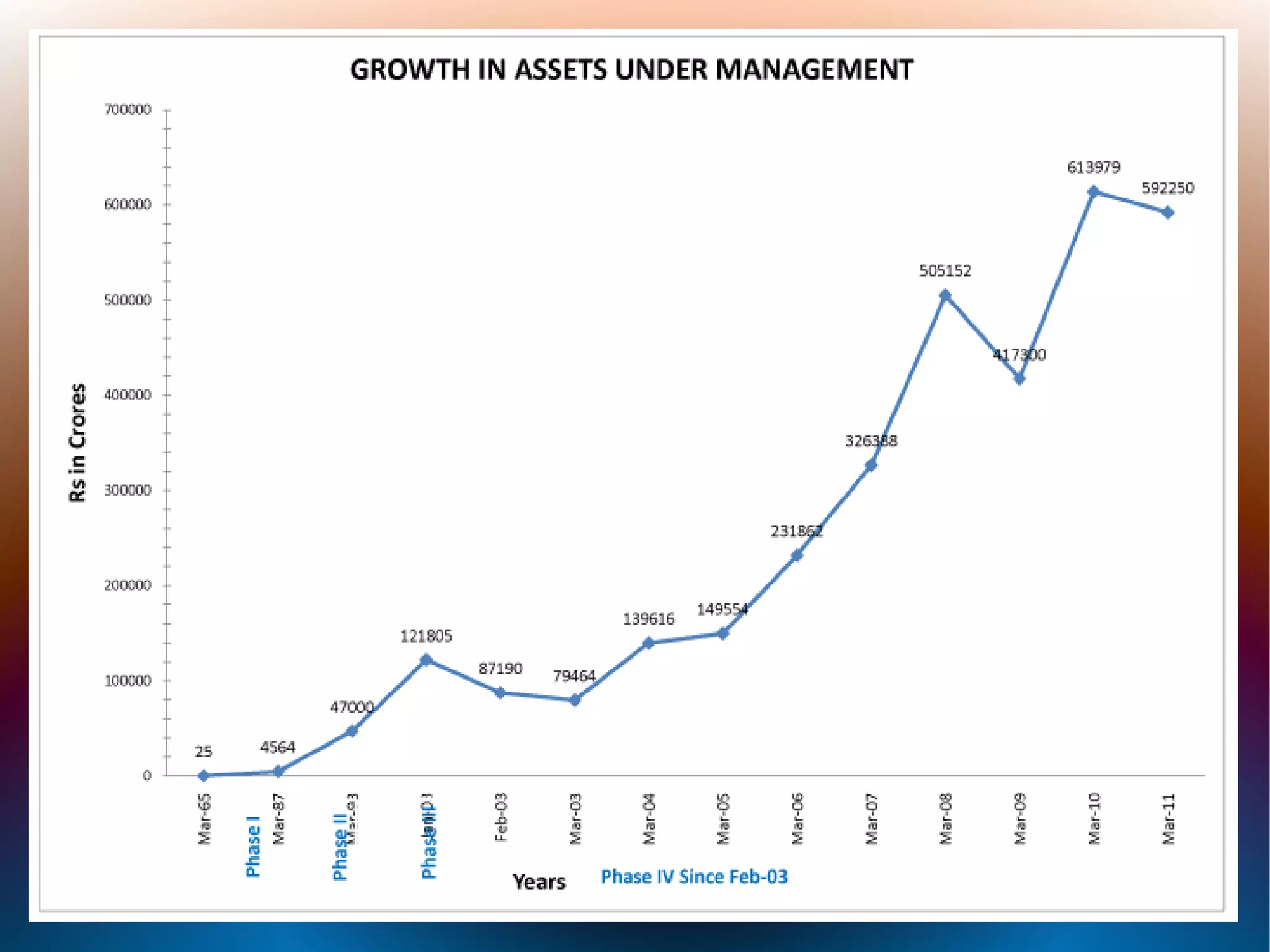
At the end of 1993, the mutual fund industry had assets under 
management of Rs. 47,004 ccrroorreess
CONTINUED................................... 
Third Phase – (1993-2003) Entry of Private Sector 
Funds) 
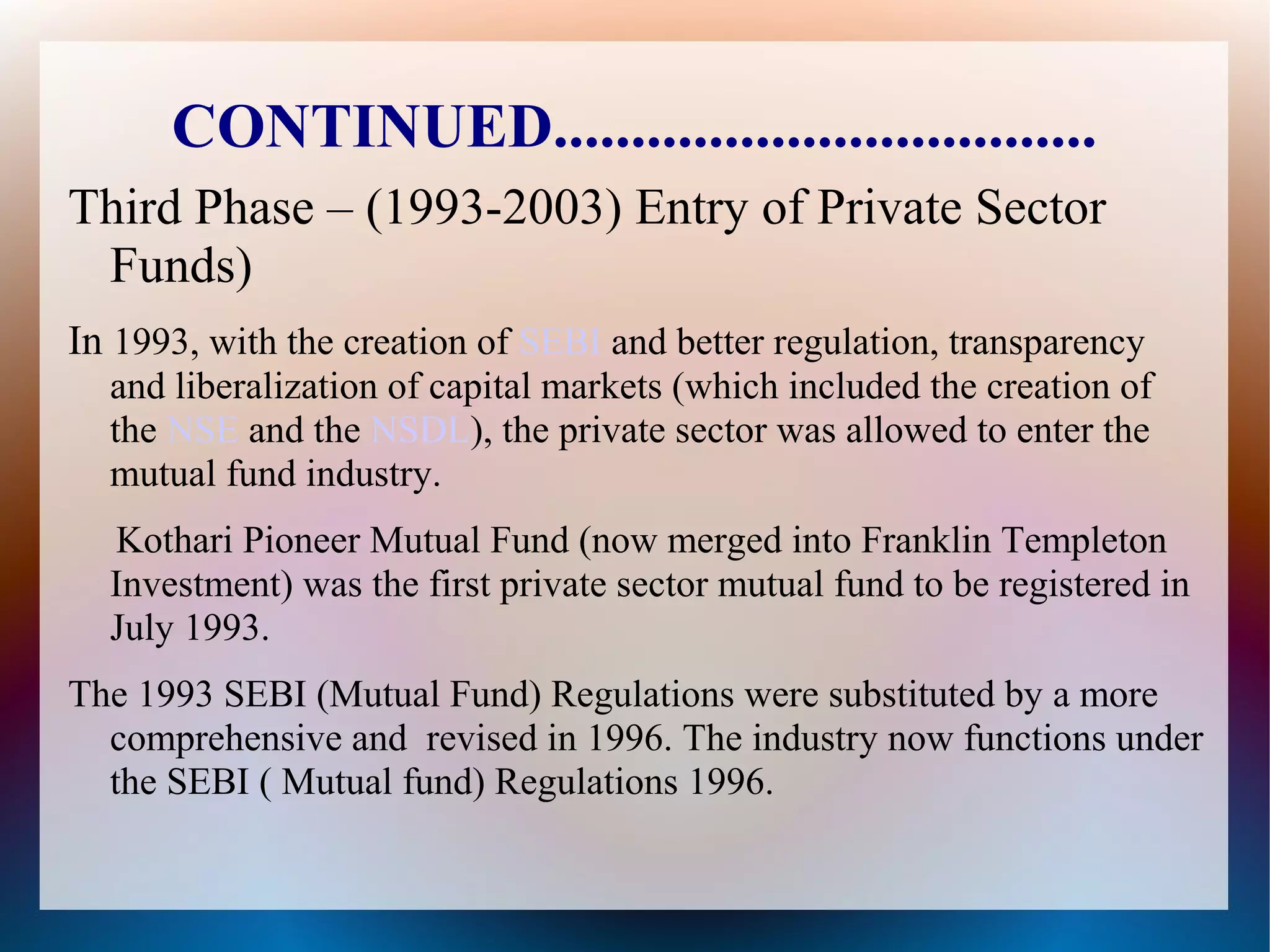
In 1993, with the creation of SEBI and better regulation, transparency 
and liberalization of capital markets (which included the creation of 
the NSE and the NSDL), the private sector was allowed to enter the 
mutual fund industry. 
Kothari Pioneer Mutual Fund (now merged into Franklin Templeton 
Investment) was the first private sector mutual fund to be registered in 
July 1993. 
The 1993 SEBI (Mutual Fund) Regulations were substituted by a more 
comprehensive and revised in 1996. The industry now functions under 
the SEBI ( Mutual fund) Regulations 1996.
Continued..................................... 
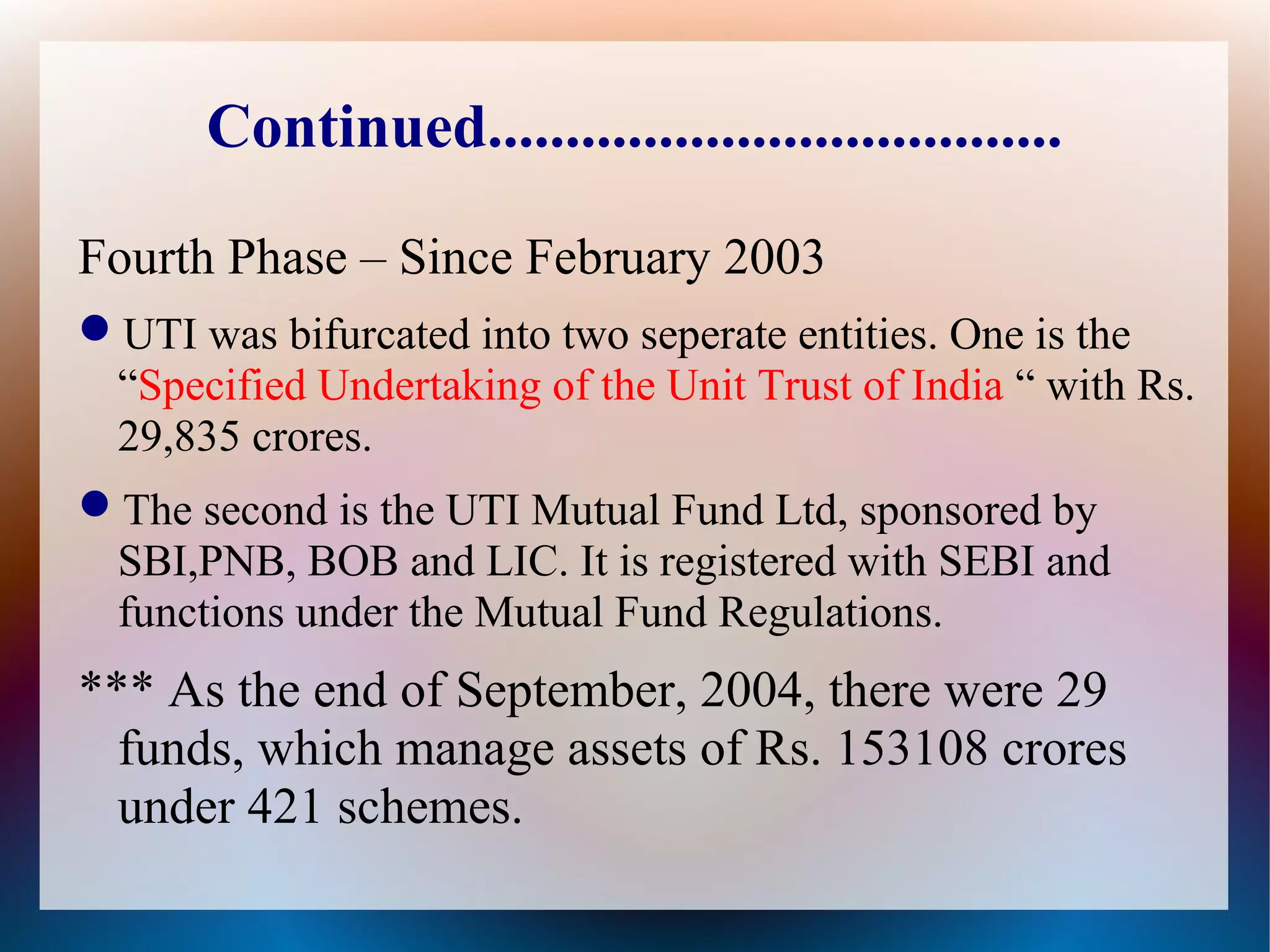
Fourth Phase – Since February 2003 
UTI was bifurcated into two seperate entities. One is the 
“Specified Undertaking of the Unit Trust of India “ with Rs. 
29,835 crores. 
The second is the UTI Mutual Fund Ltd, sponsored by 
SBI,PNB, BOB and LIC. It is registered with SEBI and 
functions under the Mutual Fund Regulations. 
*** As the end of September, 2004, there were 29 
funds, which manage assets of Rs. 153108 crores 
under 421 schemes.
TYPES OF MUTUAL FUND SCHEMES 
BY STRUCTURE 
Open – Ended Schemes 
Close – Ended Scheme 
BY INVESTMENT OBJECTIVE 
Growth Schemes 
Income Schemes 
Balanced Schemes 
OTHER SCHEMES 
Money Market Schemes 
Tax Saving Schemes 
Special Schemes 
Index Schemes
ON THE BASIS OF STRUCTURE 
i) Open – Ended Schemes 
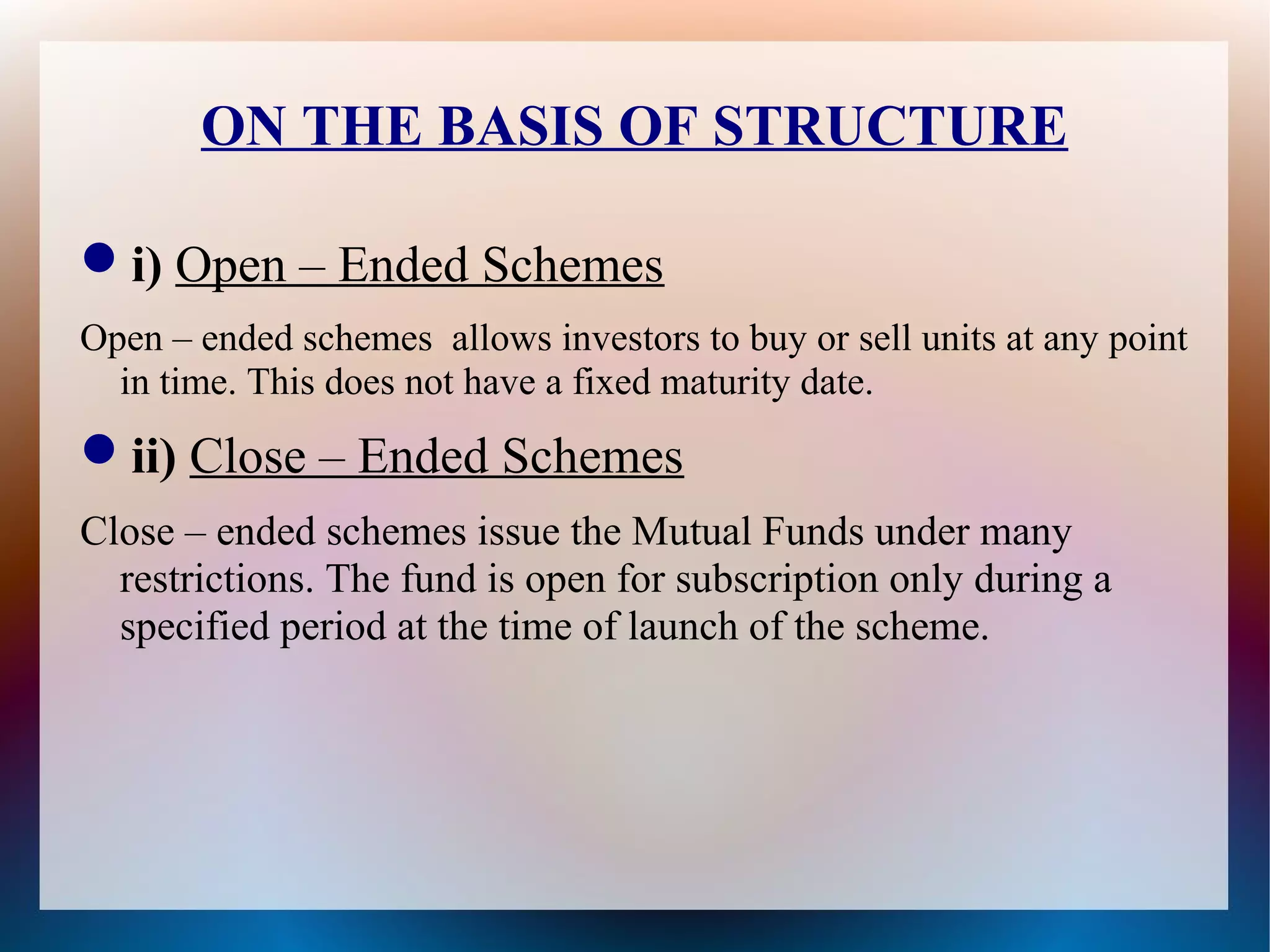
Open – ended schemes allows investors to buy or sell units at any point 
in time. This does not have a fixed maturity date. 
ii) Close – Ended Schemes 
Close – ended schemes issue the Mutual Funds under many 
restrictions. The fund is open for subscription only during a 
specified period at the time of launch of the scheme.
ON THE BASIS OF INVESTMENT OBJECTIVE 
i) Growth Schemes: 
In the growth Scheme, all profits made by the fund are re-invested into the 
scheme. This money increases the Net Asset Value (NAV). This scheme is 
not good one for the investor who wishes to receive regular cash payouts 
from his/her investments. 
ii) Income or Dividend Schemes 
The dividend option does not re- invest the profits made by the fund through its 
investments. Instead, it is given to the investor from time to time. 
iii ) Balanced Schemes 
The aim of Balanced schemes is to provide both growth and regular 
income. Such schemes invest both in equities and fixed income 
securities in the proportion indicated in their offer documents.
Other Mutual Funds Schemes 
 i) Money Market Schemes 
It is open ended mutual funds whose amount will be only invested in 
money market. These funds invest in short term ( one day to one year) 
debt obligation such as Treasury bills, certificates of deposit, and 
commercial paper. 
ii) Tax Saving Schemes 
Tax Saving schemes of mutual funds which saves the tax of investors. 
Tax benefits to be mentioned under the “objects of the offering” 
column.
Continued............................. 
iii) Special Schemes 
This is the mutual funds which has something special 
and mutual funds provider will mention this in 
invitation form. 
iv) Index Schemes 
In this schemes, the funds collected by mutual funds 
are invested in shares forming the stock Exchange 
index. Eg- Nifty Scheme of UTI Mutual fund and 
Sensex Index Scheme of Tata Mutual Fund.
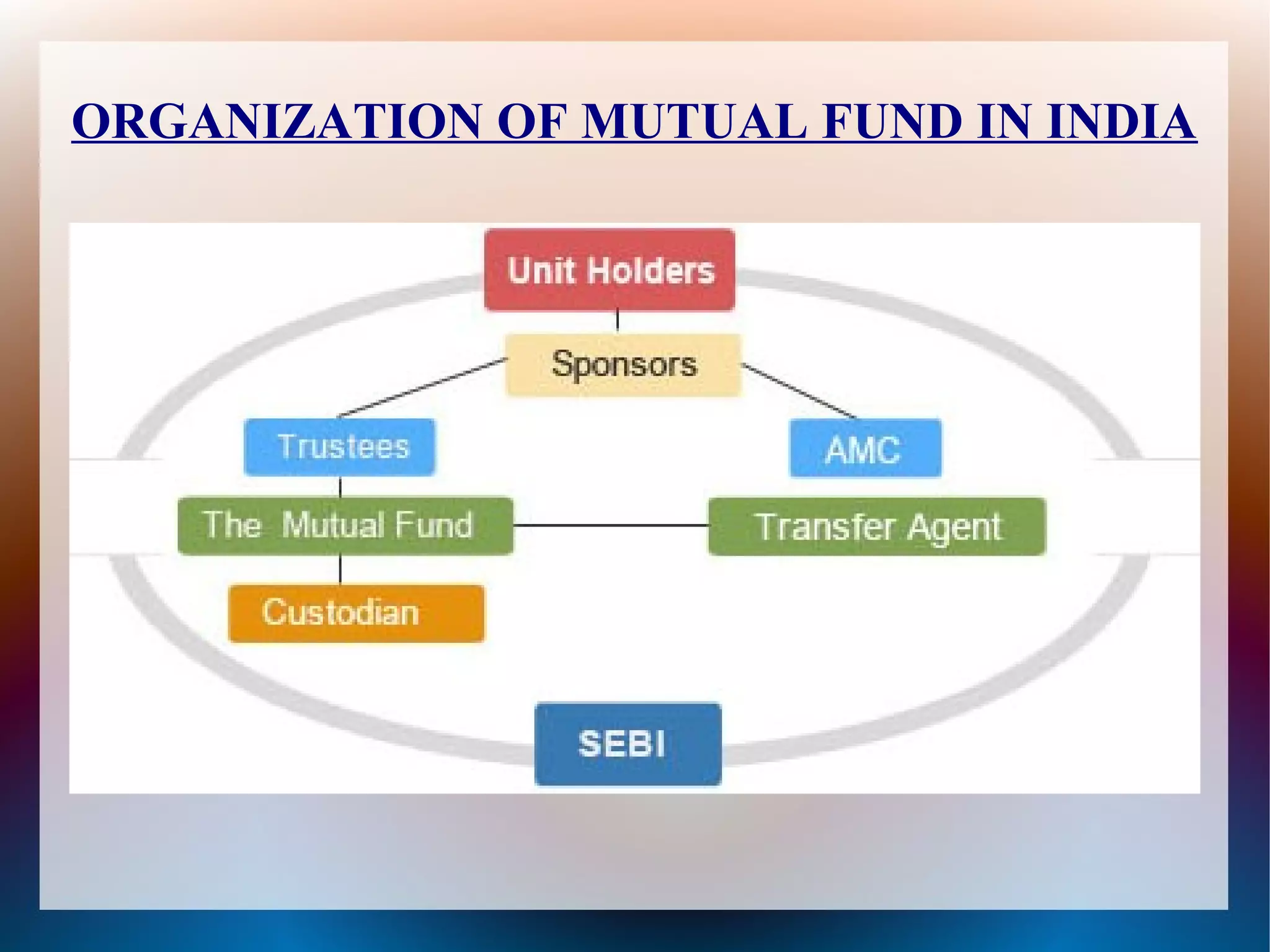
ORGANIZATION OF MUTUAL FUND IN INDIA
SEBI Guidelines on Mutual Funds 
* The M.F company must be a registered company. 
* M.F shall be established in the form of Trusts under the Indian Trust 
Act to be authorized for business by the SEBI 
* SEBI has power to withdraw the authorization given to any AMC if it 
found to be not serving the interest of investor as well as the capital 
market. 
* Both AMC & trustees should be treated as 2 seperate legal entities. 
* Each Scheme of M.F. Must be compulsory registered with the SEBI 
before it is floated in the market.
ADVANTAGES OF MUTUAL FUNDS 
Professional management 
Minimization of risk 
Return of potential 
Liquidity 
Choices of schemes 
Tax benefits
DISADVANTAGES OF MUTUAL FUNDS 
Costs control not in the hands of an investor 
Delay in redemption of the units and the money 
Difficulty in selecting a suitable fund scheme
REASON TO INVEST IN MUTUAL FUND 
Expert on your side 
Limited risk 
Convenience 
Investor protection 
Quick access to your money 
Transparency 
Low transaction costs 
Tax benefits
HOW TO INVEST IN MUTUAL FUNDS 
Step 1: Identify the investment need 
Step 2: Choose the right mutual fund 
Step 3: Select the ideal mix of schemes
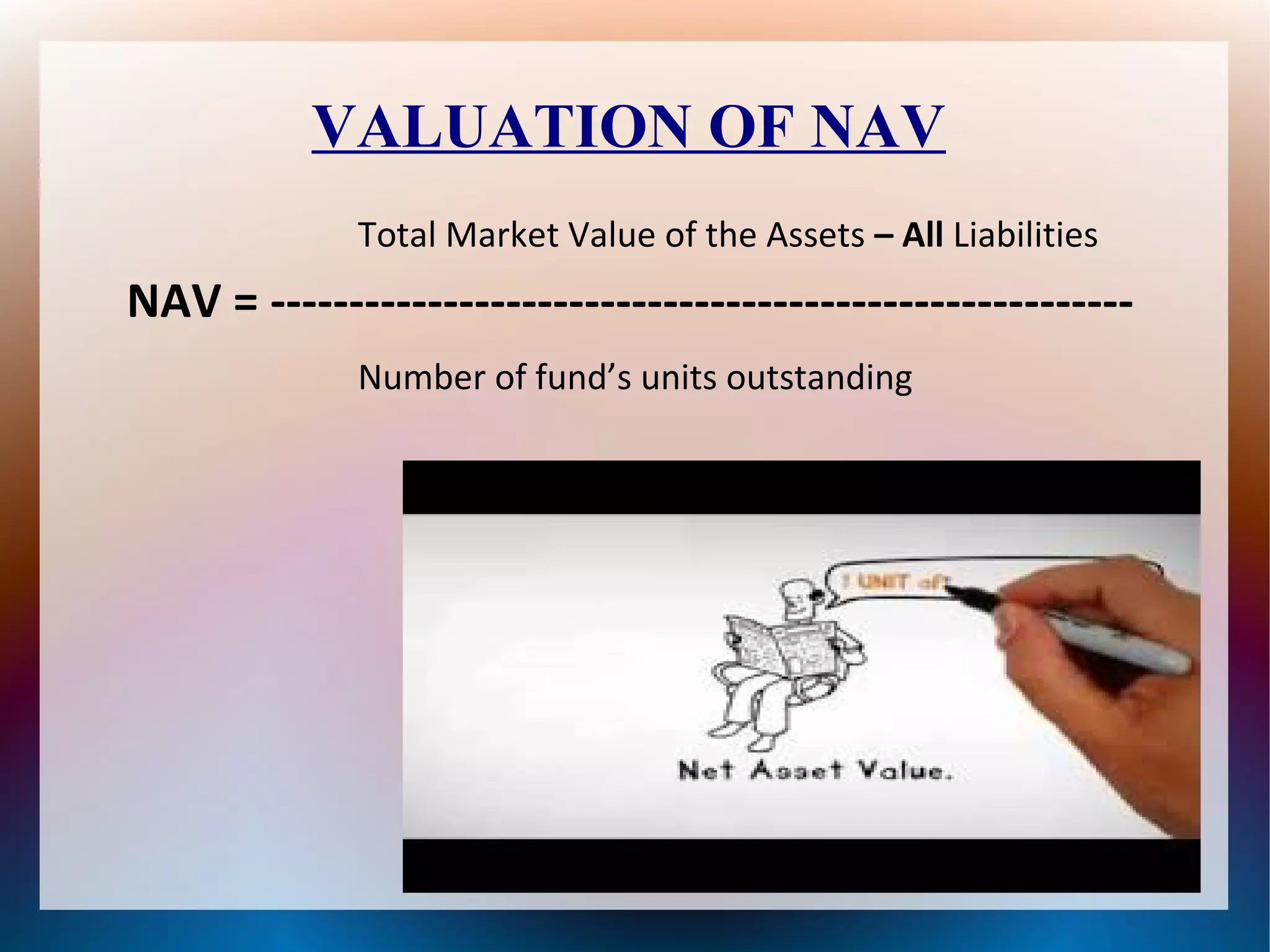
VALUATION OF NAV 
Total Market Value of the Assets – All Liabilities 
NAV = ------------------------------------------------------- 
Number of fund’s units outstanding
VARIOUS M.F IN INDIA
Conclusion 
Mutual fund industry is one of the fastest 
growing industry in India and it has already 
established in foreign countries. Investing in 
Mutual Funds is more safe as compared to 
equity as well as it give handsome returns.
MOST IMPORTANT THINGS 
Mutual Fund investment are subject to 
market risks. Please read the Statement of 
Additional Information (SAI) and 
Scheme Information Document (SID) 
carefully before investing.
MUTUAL FUND (AFSANA)

MUTUAL FUND (AFSANA)

  • 2.
    INDEX Mutual fund Flow Chart Myths of mutual fund History of mutual fund Types of mutual fund Organization of mutual fund SEBI Guidelines Advantage of mutual fund Disadvantage of mutual fund Reason to invest How to invest NAV
  • 3.
    WHAT IS MUTUALFUND ? A Mutual Fund is a trust that pools the savings of a number of investors who share a common financial goals.  The money thus collected is then invested in capital market instruments ( shares, debentures and other securities) Anybody with an investible surplus can invest in Mutual funds.
  • 5.
    MYTHS OF MUTUALFUND Mutual funds invest in shares. Mutual funds are prone to very high risk/ actively traded. Mutual funds are very new in the financial market. It is for short term and long term. One need a large sum to invest in mutual fund. The good thing about mutual funds is that don't need to pay attention to them.
  • 6.
    HISTORY OF INDIANMUTUAL FUNDS INDUSTRY The mutual fund industry in India started in 1963 with the formation of Unit Trust of India at the initiative of the government of India and reserve bank. The mutual fund industry can be broadly put into four phases according to the development of the sector.
  • 7.
    Phases of MutualFunds First Phase – 1963-1987 Unit Trust of India (UTI) was established in 1963 by an Act of Parliament. It was set up by the RBI and functioned under the Regulatory and administrative control of the RBI. Second Phase – 1987- 1993 (Entry of Public Sector funds) SBI Mutual Fund was the first followed by Canbank Mutual fund (Dec 1987), Punjab National Bank Mutual Fund (Aug 1989), Indian Bank Mutual Fund (nov 1989), Bank of India (june 1990), Bank of Baroda Mutual Fund (Oct 1992). The LIC established its mutual fund in 1989 and GIC in 1990. At the end of 1993, the mutual fund industry had assets under management of Rs. 47,004 ccrroorreess
  • 8.
    CONTINUED................................... Third Phase– (1993-2003) Entry of Private Sector Funds) In 1993, with the creation of SEBI and better regulation, transparency and liberalization of capital markets (which included the creation of the NSE and the NSDL), the private sector was allowed to enter the mutual fund industry. Kothari Pioneer Mutual Fund (now merged into Franklin Templeton Investment) was the first private sector mutual fund to be registered in July 1993. The 1993 SEBI (Mutual Fund) Regulations were substituted by a more comprehensive and revised in 1996. The industry now functions under the SEBI ( Mutual fund) Regulations 1996.
  • 9.
    Continued..................................... Fourth Phase– Since February 2003 UTI was bifurcated into two seperate entities. One is the “Specified Undertaking of the Unit Trust of India “ with Rs. 29,835 crores. The second is the UTI Mutual Fund Ltd, sponsored by SBI,PNB, BOB and LIC. It is registered with SEBI and functions under the Mutual Fund Regulations. *** As the end of September, 2004, there were 29 funds, which manage assets of Rs. 153108 crores under 421 schemes.
  • 11.
    TYPES OF MUTUALFUND SCHEMES BY STRUCTURE Open – Ended Schemes Close – Ended Scheme BY INVESTMENT OBJECTIVE Growth Schemes Income Schemes Balanced Schemes OTHER SCHEMES Money Market Schemes Tax Saving Schemes Special Schemes Index Schemes
  • 12.
    ON THE BASISOF STRUCTURE i) Open – Ended Schemes Open – ended schemes allows investors to buy or sell units at any point in time. This does not have a fixed maturity date. ii) Close – Ended Schemes Close – ended schemes issue the Mutual Funds under many restrictions. The fund is open for subscription only during a specified period at the time of launch of the scheme.
  • 13.
    ON THE BASISOF INVESTMENT OBJECTIVE i) Growth Schemes: In the growth Scheme, all profits made by the fund are re-invested into the scheme. This money increases the Net Asset Value (NAV). This scheme is not good one for the investor who wishes to receive regular cash payouts from his/her investments. ii) Income or Dividend Schemes The dividend option does not re- invest the profits made by the fund through its investments. Instead, it is given to the investor from time to time. iii ) Balanced Schemes The aim of Balanced schemes is to provide both growth and regular income. Such schemes invest both in equities and fixed income securities in the proportion indicated in their offer documents.
  • 14.
    Other Mutual FundsSchemes  i) Money Market Schemes It is open ended mutual funds whose amount will be only invested in money market. These funds invest in short term ( one day to one year) debt obligation such as Treasury bills, certificates of deposit, and commercial paper. ii) Tax Saving Schemes Tax Saving schemes of mutual funds which saves the tax of investors. Tax benefits to be mentioned under the “objects of the offering” column.
  • 15.
    Continued............................. iii) SpecialSchemes This is the mutual funds which has something special and mutual funds provider will mention this in invitation form. iv) Index Schemes In this schemes, the funds collected by mutual funds are invested in shares forming the stock Exchange index. Eg- Nifty Scheme of UTI Mutual fund and Sensex Index Scheme of Tata Mutual Fund.
  • 16.
  • 17.
    SEBI Guidelines onMutual Funds * The M.F company must be a registered company. * M.F shall be established in the form of Trusts under the Indian Trust Act to be authorized for business by the SEBI * SEBI has power to withdraw the authorization given to any AMC if it found to be not serving the interest of investor as well as the capital market. * Both AMC & trustees should be treated as 2 seperate legal entities. * Each Scheme of M.F. Must be compulsory registered with the SEBI before it is floated in the market.
  • 18.
    ADVANTAGES OF MUTUALFUNDS Professional management Minimization of risk Return of potential Liquidity Choices of schemes Tax benefits
  • 19.
    DISADVANTAGES OF MUTUALFUNDS Costs control not in the hands of an investor Delay in redemption of the units and the money Difficulty in selecting a suitable fund scheme
  • 20.
    REASON TO INVESTIN MUTUAL FUND Expert on your side Limited risk Convenience Investor protection Quick access to your money Transparency Low transaction costs Tax benefits
  • 21.
    HOW TO INVESTIN MUTUAL FUNDS Step 1: Identify the investment need Step 2: Choose the right mutual fund Step 3: Select the ideal mix of schemes
  • 22.
    VALUATION OF NAV Total Market Value of the Assets – All Liabilities NAV = ------------------------------------------------------- Number of fund’s units outstanding
  • 23.
  • 24.
    Conclusion Mutual fundindustry is one of the fastest growing industry in India and it has already established in foreign countries. Investing in Mutual Funds is more safe as compared to equity as well as it give handsome returns.
  • 25.
    MOST IMPORTANT THINGS Mutual Fund investment are subject to market risks. Please read the Statement of Additional Information (SAI) and Scheme Information Document (SID) carefully before investing.