MUTUAL FUND AND ITS TYPES
Seminar on
Presented By: NISHANTHI AN
M.B.A. 1ST Year “B”
Roll no.- 12
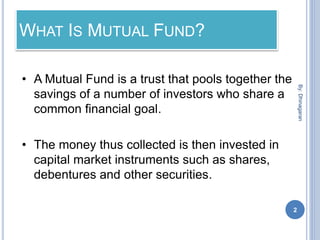
WHAT IS MUTUAL FUND?
• A Mutual Fund is a trust that pools together the
savings of a number of investors who share a
common financial goal.
• The money thus collected is then invested in
capital market instruments such as shares,
debentures and other securities.
By:Dhinagaran
2
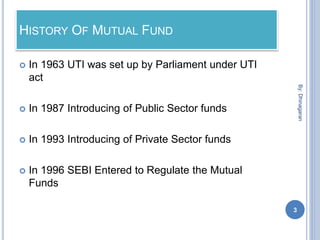
HISTORY OF MUTUAL FUND
 In 1963 UTI was set up by Parliament under UTI
act
 In 1987 Introducing of Public Sector funds
 In 1993 Introducing of Private Sector funds
 In 1996 SEBI Entered to Regulate the Mutual
Funds
3
By:Dhinagaran
Mutual Fund Operations
By:Dhinagaran
4
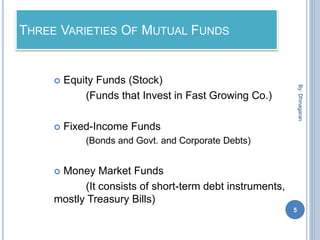
THREE VARIETIES OF MUTUAL FUNDS
 Equity Funds (Stock)
(Funds that Invest in Fast Growing Co.)
 Fixed-Income Funds
(Bonds and Govt. and Corporate Debts)
 Money Market Funds
(It consists of short-term debt instruments,
mostly Treasury Bills)
5
By:Dhinagaran
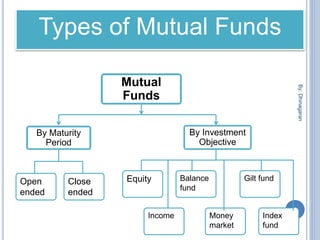
Types of Mutual Funds
Mutual
Funds
By Maturity
Period
By Investment
Objective
Equity
Income
Balance
fund
Money
market
Gilt fund
Index
fund
Close
ended
Open
ended
By:Dhinagaran
6
INVESTMENT STRATEGIES
 Systematic Investment Plan (SIP)
 Invest Fixed sum Every Month
 Systematic Withdrawal Plan (SWP)
 Withdraw Money on a Regular Basis
By:Dhinagaran
7
Advantages of Mutual Funds
Professional Management
 Minimization of risk
 Return Potential
 Low Costs Liquidity
 Choice of schemes
 Tax benefits
By:Dhinagaran
8
Dis-Advantages of Mutual Funds
 Loss of Control
 Fees and Expenses
 Poor Performance
 Size
 Too Many Choices
By:Dhinagaran
9
Various Mutual Funds in India
 State Bank of India mutual fund
 ICICI prudential mutual fund
 TATA mutual fund
 HDFC mutual fund
 Birla sun life mutual fund
 Reliance mutual fund
 Kotak Mahindra mutual fund etc..
By:Dhinagaran
10
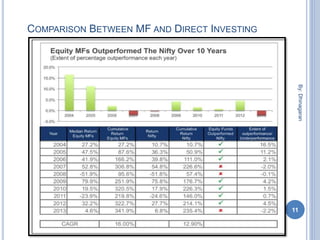
COMPARISON BETWEEN MF AND DIRECT INVESTING
11
By:Dhinagaran
12

Mutual fund

  • 1.
    MUTUAL FUND ANDITS TYPES Seminar on Presented By: NISHANTHI AN M.B.A. 1ST Year “B” Roll no.- 12
  • 2.
    WHAT IS MUTUALFUND? • A Mutual Fund is a trust that pools together the savings of a number of investors who share a common financial goal. • The money thus collected is then invested in capital market instruments such as shares, debentures and other securities. By:Dhinagaran 2
  • 3.
    HISTORY OF MUTUALFUND  In 1963 UTI was set up by Parliament under UTI act  In 1987 Introducing of Public Sector funds  In 1993 Introducing of Private Sector funds  In 1996 SEBI Entered to Regulate the Mutual Funds 3 By:Dhinagaran
  • 4.
  • 5.
    THREE VARIETIES OFMUTUAL FUNDS  Equity Funds (Stock) (Funds that Invest in Fast Growing Co.)  Fixed-Income Funds (Bonds and Govt. and Corporate Debts)  Money Market Funds (It consists of short-term debt instruments, mostly Treasury Bills) 5 By:Dhinagaran
  • 6.
    Types of MutualFunds Mutual Funds By Maturity Period By Investment Objective Equity Income Balance fund Money market Gilt fund Index fund Close ended Open ended By:Dhinagaran 6
  • 7.
    INVESTMENT STRATEGIES  SystematicInvestment Plan (SIP)  Invest Fixed sum Every Month  Systematic Withdrawal Plan (SWP)  Withdraw Money on a Regular Basis By:Dhinagaran 7
  • 8.
    Advantages of MutualFunds Professional Management  Minimization of risk  Return Potential  Low Costs Liquidity  Choice of schemes  Tax benefits By:Dhinagaran 8
  • 9.
    Dis-Advantages of MutualFunds  Loss of Control  Fees and Expenses  Poor Performance  Size  Too Many Choices By:Dhinagaran 9
  • 10.
    Various Mutual Fundsin India  State Bank of India mutual fund  ICICI prudential mutual fund  TATA mutual fund  HDFC mutual fund  Birla sun life mutual fund  Reliance mutual fund  Kotak Mahindra mutual fund etc.. By:Dhinagaran 10
  • 11.
    COMPARISON BETWEEN MFAND DIRECT INVESTING 11 By:Dhinagaran
  • 12.