1.1 SUMMARY
A man can establish his right over land in many different ways. It may
be through, inheritance, a transfer like sale-purchase, will, mortgage,
lease, exchange, auction, decrees of courts and settlement by the
government. If there occurs any change of ownership or any transfer of
land due to any reasons stated above the transferee or the heir is
required to have his name recorded as owner through mutation to update
the record.
1.2 MUTATION
• In general sense, mutation means “a change or alteration in form or
qualities”. But in the parlance of law it has a different meaning. In the
parlance of law by the term “mutation” it generally means, insertion of
the name of the new owner in the Khatiyan (record-of-rights).
• According to Black’s Law Dictionary the term ‘mutation’ is
“especially applied to designate the change which takes place in the
property of a thing in its transmission from one person to another.
Mutation, therefore, happens when the owner of the thing sells,
exchanges, or gives it.”
Continued…..
• Ad-interim change, amendment, correction and updating of land
records are made through mutation. By mutaining a property, the new
owner gets the land recorded on his name in the land revenue
department and the government is able to change land tax from the
rightful owner.
1.3 DISTINCTION BETWEEN REGISTRATION & MUTATION
• Registration is the process of documentation to the records in any
office either public or private. Registration of land is a full and final
agreement signed between two parties. Once a land is registered will
become the lawful owner of the property and is fully responsible for it
in all aspects.
• Once the land is registered in sub-registrar office, the buyer of the land
has to get the title of the land updated in his/her name in the local
revenue office [Assistant Commissioner (Land) Office]. This is
knowns as mutation.
• Thus, registration of land and mutation of land are two different
things. Mutation of land happens after the registration of land.
1.4 TYPES OF MUTATION
Mutation is of two types, namely,
• mutation of agricultural land; and
• mutation of non-agricultural land.
Continued…..
• MUTATION OF AGRICULTURAL LAND
Mutation of agricultural land is a must. Without mutation of the land,
title will not pass to the new owner.
• MUTATION OF NON-AGRICULTURAL LAND
In case of non-agricultural land, failure to mutate does not take away
one’s right in the sale deed. That is even though the mutation has not
done, the purchaser’s title will not be affected.
1.5 GROUNDS FOR MUTATION APPLICATION
Mutation and updating land records are required in the following cases:
If the land owner dies and his/her successors want to update the
records. [sec. 143 (a) of State Acquisition and Tenancy Act, 1950]
Leading Case: Idris Ali vs. State, 38 DLR 270
If the ownership of land is transferred through sale, gift, will,
waqf, trust etc., by registered deed. [sec. 143(a) of the State
Acquisition and Tenancy Act, 1950]
If a person becomes owner of a land by the decree of a land by the
decree of a civil court.
Continued…..
If the ownership of land is transferred through sale, gift, will,
waqf, trust etc., by registered deed. [sec. 143(a) of the State
Acquisition and Tenancy Act, 1950]
If a person becomes owner of a land by the decree of a land by the
decree of a civil court.
For abandonment or diluvion or acquisition of land. [Sec. 143 (d)
of the SAT Act, 1950]
If land ownership is dissolved for alluvion or under sections 90,
91, 92 and 93 of the State Acquisition and Tenancy Act, 1950.
Continued…..
For pre-emption under section 96 (7) of the State Acquisition and
Tenancy Act, 1950.
Leading Case: Ganga Singh and Another vs. Santosh Kumar and
Another (1961)
For equitable/simple mortgage.
Leading Case: Navin Singh and Another vs. State of Haryana and
Others (2008) 149 PLR 59
For affidavit.
1.6 IMPORTANCE OF MUTATION
• Through the mutation of land, a buyer is able to acquire the rights of
the land.
• Considering the fact, Government amended the Registration Act, 1908
and the Transfer of Property Act, 1882 in 2004 with effect from July 1,
2005. Pursuant to the amendment of the both Act-
Seller name must be included in the latest Khatiyan (record-of-
rights) if he/she is the owner of the property by way of other than
by inheritance; or
The name of the seller or his/her predecessor must be included in
the latest Khatiyan (record-of-rights), if he/she is owner of the
property by inheritance.
Continued…..
• Failure in timely mutation terribly frustrates the assessment and
collection of land revenue, transfer of land and fixation of title and
possession, land use and settlement.
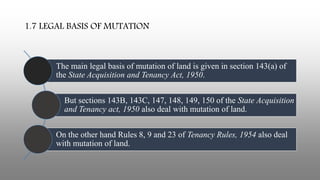
1.7 LEGAL BASIS OF MUTATION
The main legal basis of mutation of land is given in section 143(a) of
the State Acquisition and Tenancy Act, 1950.
But sections 143B, 143C, 147, 148, 149, 150 of the State Acquisition
and Tenancy act, 1950 also deal with mutation of land.
On the other hand Rules 8, 9 and 23 of Tenancy Rules, 1954 also deal
with mutation of land.
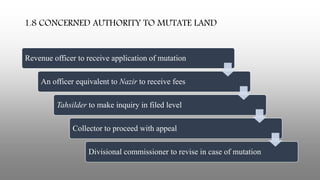
1.8 CONCERNED AUTHORITY TO MUTATE LAND
Revenue officer to receive application of mutation
An officer equivalent to Nazir to receive fees
Tahsilder to make inquiry in filed level
Collector to proceed with appeal
Divisional commissioner to revise in case of mutation
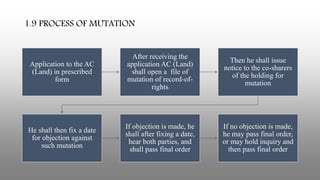
1.9 PROCESS OF MUTATION
Application to the AC
(Land) in prescribed
form
After receiving the
application AC (Land)
shall open a file of
mutation of record-of-
rights
Then he shall issue
notice to the co-sharers
of the holding for
mutation
He shall then fix a date
for objection against
such mutation
If objection is made, he
shall after fixing a date,
hear both parties, and
shall pass final order
If no objection is made,
he may pass final order,
or may hold inquiry and
then pass final order
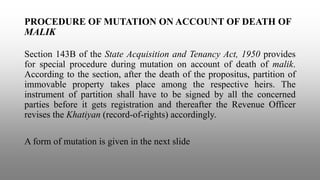
PROCEDURE OF MUTATION ON ACCOUNT OF DEATH OF
MALIK
Section 143B of the State Acquisition and Tenancy Act, 1950 provides
for special procedure during mutation on account of death of malik.
According to the section, after the death of the propositus, partition of
immovable property takes place among the respective heirs. The
instrument of partition shall have to be signed by all the concerned
parties before it gets registration and thereafter the Revenue Officer
revises the Khatiyan (record-of-rights) accordingly.
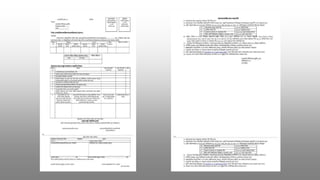
A form of mutation is given in the next slide
1.10 CONSEQUENCE OF MUTATION
• When a case of mutation is concluded with an order of inserting a
name, a record-of-rights has to be opened in the prescribed manner the
AC (Land) should duly sign the record-of-rights.
• Copies of the record-of-rights should be sent to the Tahsil Office, to
the collector’s record room and a copy should be attached with the
original volume of the record-of-rights.
• Record-of-rights prepared and finalized as a result of the mutation case
should not overlap any ‘number’ of any existing record-of-rights on
the contrary.
• At the same time a ‘bata’ number for the new record-of-rights should
take the number.
Continued…..
• Where the new Khatiyan (record-of-rights) bearing numbers as 10/1
and 10/2 were applied, it is imperative to open separate holdings in the
Demand Register (Register II).
• The Revenue Officer (AC Land) or the Field Kanungo should sign
certificate in the remark column of the Register II.
1.11 APPEAL AGAINST MUTATION ORDER
• According to section 147 appeal may be made from both,
• original order; and
• appellate order.
• An appeal can be made to the
• Collector if the order is made by the Revenue Officer/AC (Land);
• Commissioner of the division, if the order is made by the Collector;
• Board of Land Administration, if the order is made by the
Commissioner of the division
Continued…..
• An appeal shall be made within,
• 30 (thirty) days if lies to the Collector;
• 60 (sixty) days if lies to the Commissioner of the Division; and
• 90 (ninety) days if lies to the Board of Land Administration
1.12 REVISION AGAINST ORDER OF MUTATION
• An application of revision may be made against any order regarding
mutation under section 149 of the State Acquisition and Tenancy Act, 1950.
According to section 149 of the Act, three authorities have the right to
revision,
• the Collector;
• the Commissioner; and
• the Board of Land Administration.
• The Collector or the Commissioner may revise the order regarding
mutation,
• on his own motion; or
• by the application made by any aggrieved person.
• But the Board of Land Administration shall revise such order only on his
own motion.
Continued…..
• The Collector shall revise such order within one month of the date of
such order.
• The Commissioner of Division shall revise such order within three
months of the date of such order.
• The Board of Land Administration shall revise such order within six
months of the date of such order.
• The Board of Land Administration may at any time order the
correction of any entry in a record-of-rights prepared and finally
published which, it is satisfied, has been made owing to a bona fide
mistake.
Continued…..
• An order shall not be revised under section 149 if an appeal has been
preferred against such order.
• No order for correction shall be made by the Board of Land
Administration until reasonable notice has been given to the parties
concerned to appeal and be heard in the matter.
1.13 REVIEW AGAINST MUTATION ORDER
• Section 150 of the State Acquisition and Tenancy Act, 1950, contains
provisions for review.
• It authorizes a Revenue Officer to review any order passed by himself
or by any of his predecessors in office.
• However, an application for review of an order shall not be entertained
unless it is made within thirty days from the date of such order.
• Again, an order shall not be reviewed if an appeal has been preferred
against such order or an application for revision of such order has been
made to the superior Revenue Authority.
1.14 MUTATION AND TITLE OF THE LAND
• Record-of-rights itself is not a document of title. It is an evidence of
present possession [32 DLR 252].
• Mere mutation and payment of rents do not confer any title on any
person [Shahani Bibi vs. Nur Islam 4 BLC 195].
• However, when supported by other evidence, mutation would be a
valuable evidence. Rent paid after mutation will also become piece of
evidence.
• Rent receipts though not documents of title, are important items of
evidence of possession.
1.15 CONCLUSION
Mutation is a very important process for the transfer of any property.
Though it does not contain any conclusive evidentiary value, it does
contain some evidentiary value with other documents of property. No
the other hand without mutation the government will not be able to
impose tax and other governmental fees from the real owner. So,
whenever any person get the ownership of any property by any means,
he must complete the process of mutation.
Mutation of land
Mutation of land

Mutation of land

  • 2.
    1.1 SUMMARY A mancan establish his right over land in many different ways. It may be through, inheritance, a transfer like sale-purchase, will, mortgage, lease, exchange, auction, decrees of courts and settlement by the government. If there occurs any change of ownership or any transfer of land due to any reasons stated above the transferee or the heir is required to have his name recorded as owner through mutation to update the record.
  • 3.
    1.2 MUTATION • Ingeneral sense, mutation means “a change or alteration in form or qualities”. But in the parlance of law it has a different meaning. In the parlance of law by the term “mutation” it generally means, insertion of the name of the new owner in the Khatiyan (record-of-rights). • According to Black’s Law Dictionary the term ‘mutation’ is “especially applied to designate the change which takes place in the property of a thing in its transmission from one person to another. Mutation, therefore, happens when the owner of the thing sells, exchanges, or gives it.”
  • 4.
    Continued….. • Ad-interim change,amendment, correction and updating of land records are made through mutation. By mutaining a property, the new owner gets the land recorded on his name in the land revenue department and the government is able to change land tax from the rightful owner.
  • 5.
    1.3 DISTINCTION BETWEENREGISTRATION & MUTATION • Registration is the process of documentation to the records in any office either public or private. Registration of land is a full and final agreement signed between two parties. Once a land is registered will become the lawful owner of the property and is fully responsible for it in all aspects. • Once the land is registered in sub-registrar office, the buyer of the land has to get the title of the land updated in his/her name in the local revenue office [Assistant Commissioner (Land) Office]. This is knowns as mutation. • Thus, registration of land and mutation of land are two different things. Mutation of land happens after the registration of land.
  • 6.
    1.4 TYPES OFMUTATION Mutation is of two types, namely, • mutation of agricultural land; and • mutation of non-agricultural land.
  • 7.
    Continued….. • MUTATION OFAGRICULTURAL LAND Mutation of agricultural land is a must. Without mutation of the land, title will not pass to the new owner. • MUTATION OF NON-AGRICULTURAL LAND In case of non-agricultural land, failure to mutate does not take away one’s right in the sale deed. That is even though the mutation has not done, the purchaser’s title will not be affected.
  • 8.
    1.5 GROUNDS FORMUTATION APPLICATION Mutation and updating land records are required in the following cases: If the land owner dies and his/her successors want to update the records. [sec. 143 (a) of State Acquisition and Tenancy Act, 1950] Leading Case: Idris Ali vs. State, 38 DLR 270 If the ownership of land is transferred through sale, gift, will, waqf, trust etc., by registered deed. [sec. 143(a) of the State Acquisition and Tenancy Act, 1950] If a person becomes owner of a land by the decree of a land by the decree of a civil court.
  • 9.
    Continued….. If the ownershipof land is transferred through sale, gift, will, waqf, trust etc., by registered deed. [sec. 143(a) of the State Acquisition and Tenancy Act, 1950] If a person becomes owner of a land by the decree of a land by the decree of a civil court. For abandonment or diluvion or acquisition of land. [Sec. 143 (d) of the SAT Act, 1950] If land ownership is dissolved for alluvion or under sections 90, 91, 92 and 93 of the State Acquisition and Tenancy Act, 1950.
  • 10.
    Continued….. For pre-emption undersection 96 (7) of the State Acquisition and Tenancy Act, 1950. Leading Case: Ganga Singh and Another vs. Santosh Kumar and Another (1961) For equitable/simple mortgage. Leading Case: Navin Singh and Another vs. State of Haryana and Others (2008) 149 PLR 59 For affidavit.
  • 11.
    1.6 IMPORTANCE OFMUTATION • Through the mutation of land, a buyer is able to acquire the rights of the land. • Considering the fact, Government amended the Registration Act, 1908 and the Transfer of Property Act, 1882 in 2004 with effect from July 1, 2005. Pursuant to the amendment of the both Act- Seller name must be included in the latest Khatiyan (record-of- rights) if he/she is the owner of the property by way of other than by inheritance; or The name of the seller or his/her predecessor must be included in the latest Khatiyan (record-of-rights), if he/she is owner of the property by inheritance.
  • 12.
    Continued….. • Failure intimely mutation terribly frustrates the assessment and collection of land revenue, transfer of land and fixation of title and possession, land use and settlement.
  • 13.
    1.7 LEGAL BASISOF MUTATION The main legal basis of mutation of land is given in section 143(a) of the State Acquisition and Tenancy Act, 1950. But sections 143B, 143C, 147, 148, 149, 150 of the State Acquisition and Tenancy act, 1950 also deal with mutation of land. On the other hand Rules 8, 9 and 23 of Tenancy Rules, 1954 also deal with mutation of land.
  • 14.
    1.8 CONCERNED AUTHORITYTO MUTATE LAND Revenue officer to receive application of mutation An officer equivalent to Nazir to receive fees Tahsilder to make inquiry in filed level Collector to proceed with appeal Divisional commissioner to revise in case of mutation
  • 15.
    1.9 PROCESS OFMUTATION Application to the AC (Land) in prescribed form After receiving the application AC (Land) shall open a file of mutation of record-of- rights Then he shall issue notice to the co-sharers of the holding for mutation He shall then fix a date for objection against such mutation If objection is made, he shall after fixing a date, hear both parties, and shall pass final order If no objection is made, he may pass final order, or may hold inquiry and then pass final order
  • 16.
    PROCEDURE OF MUTATIONON ACCOUNT OF DEATH OF MALIK Section 143B of the State Acquisition and Tenancy Act, 1950 provides for special procedure during mutation on account of death of malik. According to the section, after the death of the propositus, partition of immovable property takes place among the respective heirs. The instrument of partition shall have to be signed by all the concerned parties before it gets registration and thereafter the Revenue Officer revises the Khatiyan (record-of-rights) accordingly. A form of mutation is given in the next slide
  • 18.
    1.10 CONSEQUENCE OFMUTATION • When a case of mutation is concluded with an order of inserting a name, a record-of-rights has to be opened in the prescribed manner the AC (Land) should duly sign the record-of-rights. • Copies of the record-of-rights should be sent to the Tahsil Office, to the collector’s record room and a copy should be attached with the original volume of the record-of-rights. • Record-of-rights prepared and finalized as a result of the mutation case should not overlap any ‘number’ of any existing record-of-rights on the contrary. • At the same time a ‘bata’ number for the new record-of-rights should take the number.
  • 19.
    Continued….. • Where thenew Khatiyan (record-of-rights) bearing numbers as 10/1 and 10/2 were applied, it is imperative to open separate holdings in the Demand Register (Register II). • The Revenue Officer (AC Land) or the Field Kanungo should sign certificate in the remark column of the Register II.
  • 20.
    1.11 APPEAL AGAINSTMUTATION ORDER • According to section 147 appeal may be made from both, • original order; and • appellate order. • An appeal can be made to the • Collector if the order is made by the Revenue Officer/AC (Land); • Commissioner of the division, if the order is made by the Collector; • Board of Land Administration, if the order is made by the Commissioner of the division
  • 21.
    Continued….. • An appealshall be made within, • 30 (thirty) days if lies to the Collector; • 60 (sixty) days if lies to the Commissioner of the Division; and • 90 (ninety) days if lies to the Board of Land Administration
  • 22.
    1.12 REVISION AGAINSTORDER OF MUTATION • An application of revision may be made against any order regarding mutation under section 149 of the State Acquisition and Tenancy Act, 1950. According to section 149 of the Act, three authorities have the right to revision, • the Collector; • the Commissioner; and • the Board of Land Administration. • The Collector or the Commissioner may revise the order regarding mutation, • on his own motion; or • by the application made by any aggrieved person. • But the Board of Land Administration shall revise such order only on his own motion.
  • 23.
    Continued….. • The Collectorshall revise such order within one month of the date of such order. • The Commissioner of Division shall revise such order within three months of the date of such order. • The Board of Land Administration shall revise such order within six months of the date of such order. • The Board of Land Administration may at any time order the correction of any entry in a record-of-rights prepared and finally published which, it is satisfied, has been made owing to a bona fide mistake.
  • 24.
    Continued….. • An ordershall not be revised under section 149 if an appeal has been preferred against such order. • No order for correction shall be made by the Board of Land Administration until reasonable notice has been given to the parties concerned to appeal and be heard in the matter.
  • 25.
    1.13 REVIEW AGAINSTMUTATION ORDER • Section 150 of the State Acquisition and Tenancy Act, 1950, contains provisions for review. • It authorizes a Revenue Officer to review any order passed by himself or by any of his predecessors in office. • However, an application for review of an order shall not be entertained unless it is made within thirty days from the date of such order. • Again, an order shall not be reviewed if an appeal has been preferred against such order or an application for revision of such order has been made to the superior Revenue Authority.
  • 26.
    1.14 MUTATION ANDTITLE OF THE LAND • Record-of-rights itself is not a document of title. It is an evidence of present possession [32 DLR 252]. • Mere mutation and payment of rents do not confer any title on any person [Shahani Bibi vs. Nur Islam 4 BLC 195]. • However, when supported by other evidence, mutation would be a valuable evidence. Rent paid after mutation will also become piece of evidence. • Rent receipts though not documents of title, are important items of evidence of possession.
  • 27.
    1.15 CONCLUSION Mutation isa very important process for the transfer of any property. Though it does not contain any conclusive evidentiary value, it does contain some evidentiary value with other documents of property. No the other hand without mutation the government will not be able to impose tax and other governmental fees from the real owner. So, whenever any person get the ownership of any property by any means, he must complete the process of mutation.