Music tribe research
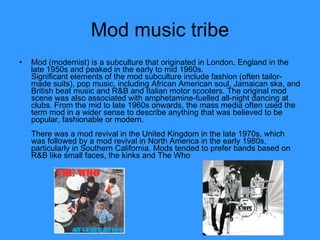
Mod music tribe Mod (modernist) is a subculture that originated in London, England in the late 1950s and peaked in the early to mid 1960s. Significant elements of the mod subculture include fashion (often tailor-made suits), pop music, including African American soul, Jamaican ska, and British beat music and R&B and Italian motor scooters. The original mod scene was also associated with amphetamine-fuelled all-night dancing at clubs. From the mid to late 1960s onwards, the mass media often used the term mod in a wider sense to describe anything that was believed to be popular, fashionable or modern. There was a mod revival in the United Kingdom in the late 1970s, which was followed by a mod revival in North America in the early 1980s, particularly in Southern California. Mods tended to prefer bands based on R&B like small faces, the kinks and The Who
Heavy metal music tribe Heavy metal is a genre of rock music that developed in the late 1960s and early 1970s, largely in England and the United States. With roots in blues-rock and psychedelic rock, the bands that created heavy metal developed a thick, massive sound, characterized by highly amplified distortion, extended guitar solos, emphatic beats, and overall loudness. Heavy metal lyrics and performance styles are generally associated with masculinity and machismo. Early heavy metal bands such as Led Zeppelin, Black Sabbath and Deep Purple attracted large audiences, though they were often critically reviled, a status common throughout the history of the genre. In the mid-1970s Judas Priest helped spur the genre's evolution by discarding much of its blues influence; Motörhead introduced a punk rock sensibility and an increasing emphasis on speed. Bands in the New Wave of British Heavy Metal such as Iron Maiden followed in a similar vein. Before the end of the decade, heavy metal had attracted a worldwide following of fans known as “metal heads" or head bangers.
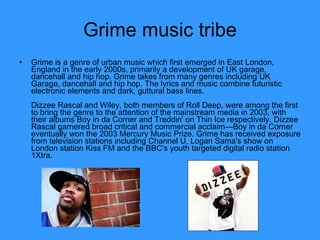
Grime music tribe Grime is a genre of urban music which first emerged in East London, England in the early 2000s, primarily a development of UK garage, dancehall and hip hop. Grime takes from many genres including UK Garage, dancehall and hip hop. The lyrics and music combine futuristic electronic elements and dark, guttural bass lines. Dizzee Rascal and Wiley, both members of Roll Deep, were among the first to bring the genre to the attention of the mainstream media in 2003, with their albums Boy in da Corner and Treddin' on Thin Ice respectively. Dizzee Rascal garnered broad critical and commercial acclaim—Boy in da Corner eventually won the 2003 Mercury Music Prize. Grime has received exposure from television stations including Channel U, Logan Sama's show on London station Kiss FM and the BBC's youth targeted digital radio station 1Xtra.
Classical music tribe Classical music is the mainstream music produced in or rooted in the traditions of Western music, involving a broad period from roughly the 9th century to present time. Classical music is often distinguished by its wide use of instruments of varying tones and pitches to create a deep, rich sound. Classical music has been affected by the invention and improvement of instruments over time.
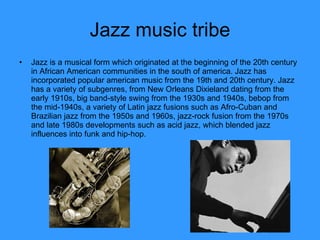
Jazz music tribe Jazz is a musical form which originated at the beginning of the 20th century in African American communities in the south of america. Jazz has incorporated popular american music from the 19th and 20th century. Jazz has a variety of subgenres, from New Orleans Dixieland dating from the early 1910s, big band-style swing from the 1930s and 1940s, bebop from the mid-1940s, a variety of Latin jazz fusions such as Afro-Cuban and Brazilian jazz from the 1950s and 1960s, jazz-rock fusion from the 1970s and late 1980s developments such as acid jazz, which blended jazz influences into funk and hip-hop.
Pop music tribe Pop music is a music genre that was developed in the mid-1950s as a softer alternative to rock and roll. It is often targeted towards a youth market mainly girls, they usually target them through relatively short and simple love songs.

Music trib research

  • 1.
  • 2.
    Mod music tribeMod (modernist) is a subculture that originated in London, England in the late 1950s and peaked in the early to mid 1960s. Significant elements of the mod subculture include fashion (often tailor-made suits), pop music, including African American soul, Jamaican ska, and British beat music and R&B and Italian motor scooters. The original mod scene was also associated with amphetamine-fuelled all-night dancing at clubs. From the mid to late 1960s onwards, the mass media often used the term mod in a wider sense to describe anything that was believed to be popular, fashionable or modern. There was a mod revival in the United Kingdom in the late 1970s, which was followed by a mod revival in North America in the early 1980s, particularly in Southern California. Mods tended to prefer bands based on R&B like small faces, the kinks and The Who
  • 3.
    Heavy metal musictribe Heavy metal is a genre of rock music that developed in the late 1960s and early 1970s, largely in England and the United States. With roots in blues-rock and psychedelic rock, the bands that created heavy metal developed a thick, massive sound, characterized by highly amplified distortion, extended guitar solos, emphatic beats, and overall loudness. Heavy metal lyrics and performance styles are generally associated with masculinity and machismo. Early heavy metal bands such as Led Zeppelin, Black Sabbath and Deep Purple attracted large audiences, though they were often critically reviled, a status common throughout the history of the genre. In the mid-1970s Judas Priest helped spur the genre's evolution by discarding much of its blues influence; Motörhead introduced a punk rock sensibility and an increasing emphasis on speed. Bands in the New Wave of British Heavy Metal such as Iron Maiden followed in a similar vein. Before the end of the decade, heavy metal had attracted a worldwide following of fans known as “metal heads" or head bangers.
  • 4.
    Grime music tribeGrime is a genre of urban music which first emerged in East London, England in the early 2000s, primarily a development of UK garage, dancehall and hip hop. Grime takes from many genres including UK Garage, dancehall and hip hop. The lyrics and music combine futuristic electronic elements and dark, guttural bass lines. Dizzee Rascal and Wiley, both members of Roll Deep, were among the first to bring the genre to the attention of the mainstream media in 2003, with their albums Boy in da Corner and Treddin' on Thin Ice respectively. Dizzee Rascal garnered broad critical and commercial acclaim—Boy in da Corner eventually won the 2003 Mercury Music Prize. Grime has received exposure from television stations including Channel U, Logan Sama's show on London station Kiss FM and the BBC's youth targeted digital radio station 1Xtra.
  • 5.
    Classical music tribeClassical music is the mainstream music produced in or rooted in the traditions of Western music, involving a broad period from roughly the 9th century to present time. Classical music is often distinguished by its wide use of instruments of varying tones and pitches to create a deep, rich sound. Classical music has been affected by the invention and improvement of instruments over time.
  • 6.
    Jazz music tribeJazz is a musical form which originated at the beginning of the 20th century in African American communities in the south of america. Jazz has incorporated popular american music from the 19th and 20th century. Jazz has a variety of subgenres, from New Orleans Dixieland dating from the early 1910s, big band-style swing from the 1930s and 1940s, bebop from the mid-1940s, a variety of Latin jazz fusions such as Afro-Cuban and Brazilian jazz from the 1950s and 1960s, jazz-rock fusion from the 1970s and late 1980s developments such as acid jazz, which blended jazz influences into funk and hip-hop.
  • 7.
    Pop music tribePop music is a music genre that was developed in the mid-1950s as a softer alternative to rock and roll. It is often targeted towards a youth market mainly girls, they usually target them through relatively short and simple love songs.