Music
Magazine
Evaluation..
Dan O’Kane
In what ways does your media product use,
develop or challenge forms and conventions
of real media products?
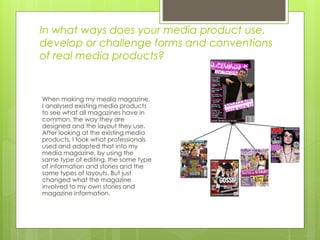
When making my media magazine,
I analysed existing media products
to see what all magazines have in
common, the way they are
designed and the layout they use.
After looking at the existing media
products, I took what professionals
used and adapted that into my
media magazine, by using the
same type of editing, the same type
of information and stories and the
same types of layouts. But just
changed what the magazine
involved to my own stories and
magazine information.
How does your media product represent particular
social groups?
I designed my media
magazine to be for
teenagers and young
adults, to make sure my
media magazine appeals
to this age range when
getting research for my
magazine and taking my
questionnaire I made sure
that I mostly asked this age
range the questions so
that I can get their opinion
and design it to what they
want.
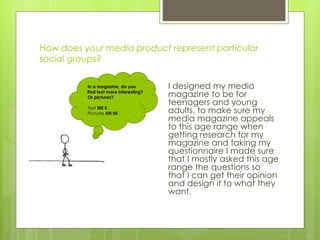
In a magazine, do you
find text more interesting?
Or pictures?
Text IIIII II
Pictures IIIII IIII
What kind of media institution might distribute your
media product and why?
I want my music
magazine to be seen as
an essential for music
lovers, as heat is loved by
people who love gossip.
So I want my magazine
to be heavily advertised
to make it stand out over
other music magazines
and make it seem that it
holds the most
information.
Who would be the audience for your media product?
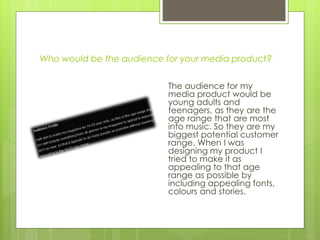
The audience for my
media product would be
young adults and
teenagers, as they are the
age range that are most
into music. So they are my
biggest potential customer
range. When I was
designing my product I
tried to make it as
appealing to that age
range as possible by
including appealing fonts,
colours and stories.
How did you attract/address your audience?
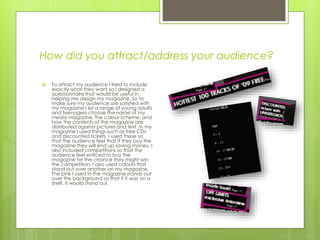
 To attract my audience I tried to include
exactly what they want so I designed a
questionnaire that would be useful in
helping me design my magazine. So to
make sure my audience are satisfied with
my magazine I let a range of young adults
and teenagers choose the name of my
media magazine, the colour scheme, and
how the contents of the magazine are
distributed against pictures and text. In my
magazine I used things such as free CDs
and discounted tickets, I used these so
that the audience feel that if they buy the
magazine they will end up saving money. I
also included competitions so that the
audience feel enticed to buy the
magazine for the chance they might win
the competition. I also used colours that
stand out over another on my magazine.
The pink I used in the magazine stands out
over the background so that if it was on a
shelf, it would stand out.
What have you learnt about technologies from the process of
constructing this product?
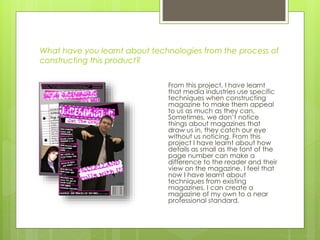
From this project, I have learnt
that media industries use specific
techniques when constructing
magazine to make them appeal
to us as much as they can.
Sometimes, we don’t notice
things about magazines that
draw us in, they catch our eye
without us noticing. From this
project I have learnt about how
details as small as the font of the
page number can make a
difference to the reader and their
view on the magazine. I feel that
now I have learnt about
techniques from existing
magazines, I can create a
magazine of my own to a near
professional standard.
Looking back at your preliminary task, what do you feel you
have learnt in the progression from it to the full product?
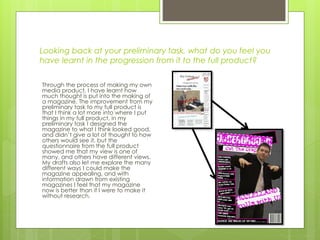
Through the process of making my own
media product, I have learnt how
much thought is put into the making of
a magazine. The improvement from my
preliminary task to my full product is
that I think a lot more into where I put
things in my full product, in my
preliminary task I designed the
magazine to what I think looked good,
and didn’t give a lot of thought to how
others would see it, but the
questionnaire from the full product
showed me that my view is one of
many, and others have different views.
My drafts also let me explore the many
different ways I could make the
magazine appealing, and with
information drawn from existing
magazines I feel that my magazine
now is better than if I were to make it
without research.

Music magazine presentation

  • 1.
  • 2.
    In what waysdoes your media product use, develop or challenge forms and conventions of real media products? When making my media magazine, I analysed existing media products to see what all magazines have in common, the way they are designed and the layout they use. After looking at the existing media products, I took what professionals used and adapted that into my media magazine, by using the same type of editing, the same type of information and stories and the same types of layouts. But just changed what the magazine involved to my own stories and magazine information.
  • 3.
    How does yourmedia product represent particular social groups? I designed my media magazine to be for teenagers and young adults, to make sure my media magazine appeals to this age range when getting research for my magazine and taking my questionnaire I made sure that I mostly asked this age range the questions so that I can get their opinion and design it to what they want. In a magazine, do you find text more interesting? Or pictures? Text IIIII II Pictures IIIII IIII
  • 4.
    What kind ofmedia institution might distribute your media product and why? I want my music magazine to be seen as an essential for music lovers, as heat is loved by people who love gossip. So I want my magazine to be heavily advertised to make it stand out over other music magazines and make it seem that it holds the most information.
  • 5.
    Who would bethe audience for your media product? The audience for my media product would be young adults and teenagers, as they are the age range that are most into music. So they are my biggest potential customer range. When I was designing my product I tried to make it as appealing to that age range as possible by including appealing fonts, colours and stories.
  • 6.
    How did youattract/address your audience?  To attract my audience I tried to include exactly what they want so I designed a questionnaire that would be useful in helping me design my magazine. So to make sure my audience are satisfied with my magazine I let a range of young adults and teenagers choose the name of my media magazine, the colour scheme, and how the contents of the magazine are distributed against pictures and text. In my magazine I used things such as free CDs and discounted tickets, I used these so that the audience feel that if they buy the magazine they will end up saving money. I also included competitions so that the audience feel enticed to buy the magazine for the chance they might win the competition. I also used colours that stand out over another on my magazine. The pink I used in the magazine stands out over the background so that if it was on a shelf, it would stand out.
  • 7.
    What have youlearnt about technologies from the process of constructing this product? From this project, I have learnt that media industries use specific techniques when constructing magazine to make them appeal to us as much as they can. Sometimes, we don’t notice things about magazines that draw us in, they catch our eye without us noticing. From this project I have learnt about how details as small as the font of the page number can make a difference to the reader and their view on the magazine. I feel that now I have learnt about techniques from existing magazines, I can create a magazine of my own to a near professional standard.
  • 8.
    Looking back atyour preliminary task, what do you feel you have learnt in the progression from it to the full product? Through the process of making my own media product, I have learnt how much thought is put into the making of a magazine. The improvement from my preliminary task to my full product is that I think a lot more into where I put things in my full product, in my preliminary task I designed the magazine to what I think looked good, and didn’t give a lot of thought to how others would see it, but the questionnaire from the full product showed me that my view is one of many, and others have different views. My drafts also let me explore the many different ways I could make the magazine appealing, and with information drawn from existing magazines I feel that my magazine now is better than if I were to make it without research.