
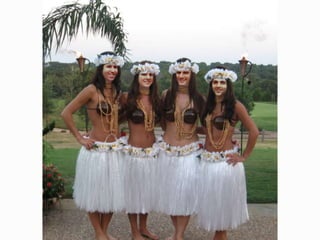
Mango Goes HawaiianStarting with the owners…
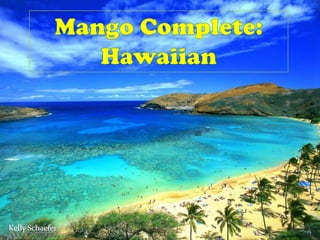
MangoComplete:HawaiianKelly Schaefer
Hawaiian Language(ʻŌleloHawaiʻi)Language family: Polynesian (a sub-family of Austronesian languages)Correct orthography (spelling) of the state:                 	HAWAIʻI(special symbol = ʻokina)Correct orthography of the adjective: 	HAWAIIAN  (no ʻokina)Why?  The ʻokina represents a sound (the glottal stop) and saying “Hawaiʻi” without it is incorrect.  “Hawaiian” is an ENGLISH word so it doesn’t use the ʻokina.
Languages of Hawaiʻi2 official languages:EnglishHawaiianHawaiian Creole English (HCE):Often simply called “Pidgin” in HawaiʻiThis is not a dialect of English nor one of Hawaiian.  Like any creole, it combines aspects of both but is its own language.Endangered language: native speakers are under 0.1% of the statewide population (as of 2001)
History: Endangerment and Revival1778: First reported European discovery (James Cook, British)1820: American Protestant missionaries arrive, establishing an alphabet in order to translate the Bible, preach in Hawaiian, and convert natives to Christianity.Despite the spread of literacy, many native Hawaiian speakers left to explore other areas of the world and many non-Hawaiians immigrated to Hawaiʻi, bringing diseases with themResult: sharp decrease in status of Hawaiian and # of speakers
History(continued)1830s to 1950s: Hawaiian was banned in schools and students who used it were punishedResults: some parents chose to abandon speaking Hawaiian; others felt pressure to do so.  Both contributed to the language’s decline.1980s: Movement to increase the number of fluent speakers started by establishing public immersion schools.One result: national parks had their names changed to observe Hawaiian spelling
Island of Niʻihau: An exceptionOn Niʻihau, the prevalence of Hawaiian is the reverse:Hawaiian is the first language here with English as a foreign language.Niʻihau has been privately owned for over 100 years and outsiders are rarely allowed to visit.The dialect of Niʻihau is significantly different than “standard” Hawaiian.
Spelling and PronunciationHawaiian has only 12 letters, plus the ʻokina (considered a consonant).A, E, I, O, U, H, K, L, M, N, P, W, and ʻ. Consonants:/m/, /n/, /p/, /t/~/k/*, /h/, /w/~/v/*, /l/*There is variation between /t/ and /k/, as well as /w/ and /v/, for historical and orthographic reasons
Spelling and Pronunciation(continued)VowelsShort: /i/, /u/, /ɛ/ ~ /e/, /o/, /ɐ/ ~ /ə/Long: /iː/, /uː/, /eː/, /oː/, /aː/ These are written with macrons: ā, ō, etc. The distinction matters and can completely change the meaning of a word!Diphthongs: composed of two vowel sounds. Greek: δίφθογγος, diphthongos; di = two, phthongos = sound.E.g., au, oi, ai, etc.Long vowels can also be part of a diphthong.
GrammarAnalytic (lack of inflection) - grammatical relationships conveyed via unbound morphemesLack of verb conjugationTense, aspect, and mood is marked by using particlesSentence structure is VSO: Verb – Subject – ObjectDistinguishes between singular, dual, and plural. E.g. “you by yourself,” “you two,” and “you all”.Also distinguishes between inclusive and exclusive we: “just you and me,” “you, me, and other people,” “someone else and me, but not you,” and “other people and me, but not you.”
Cultural SensitivityWhen marketing and selling to native Hawaiians, do NOT call it a “foreign language.”Hawaiian is the native language of the islands, and the Anglicization of Hawaiʻi is a sensitive matter.For Hawaiian residents, call it a “second language” course.
Fun tidbitsWikipedia: the “wiki” comes from Hawaiian, and it means “fast”.Another term we’re familiar with, “muumuu,” is also Hawaiian – but we say it completely wrong!Muʻumuʻuis correct and it simply means “dress”.And a Dave Barry quote:“The Hawaiian language is quite unusual because when the original Polynesians came in their canoes, most of their consonants were washed overboard in a storm, and they arrived here with almost nothing but vowels. All the streets have names like Kal'ia'iou'amaa'aaa'eiou, and many street signs spontaneously generate new syllables during the night.”
mahalo!

Hawaiian presentation

  • 1.
    Mango Goes HawaiianStartingwith the owners…
  • 4.
  • 5.
    Hawaiian Language(ʻŌleloHawaiʻi)Language family:Polynesian (a sub-family of Austronesian languages)Correct orthography (spelling) of the state: HAWAIʻI(special symbol = ʻokina)Correct orthography of the adjective: HAWAIIAN (no ʻokina)Why? The ʻokina represents a sound (the glottal stop) and saying “Hawaiʻi” without it is incorrect. “Hawaiian” is an ENGLISH word so it doesn’t use the ʻokina.
  • 6.
    Languages of Hawaiʻi2official languages:EnglishHawaiianHawaiian Creole English (HCE):Often simply called “Pidgin” in HawaiʻiThis is not a dialect of English nor one of Hawaiian. Like any creole, it combines aspects of both but is its own language.Endangered language: native speakers are under 0.1% of the statewide population (as of 2001)
  • 7.
    History: Endangerment andRevival1778: First reported European discovery (James Cook, British)1820: American Protestant missionaries arrive, establishing an alphabet in order to translate the Bible, preach in Hawaiian, and convert natives to Christianity.Despite the spread of literacy, many native Hawaiian speakers left to explore other areas of the world and many non-Hawaiians immigrated to Hawaiʻi, bringing diseases with themResult: sharp decrease in status of Hawaiian and # of speakers
  • 8.
    History(continued)1830s to 1950s:Hawaiian was banned in schools and students who used it were punishedResults: some parents chose to abandon speaking Hawaiian; others felt pressure to do so. Both contributed to the language’s decline.1980s: Movement to increase the number of fluent speakers started by establishing public immersion schools.One result: national parks had their names changed to observe Hawaiian spelling
  • 9.
    Island of Niʻihau:An exceptionOn Niʻihau, the prevalence of Hawaiian is the reverse:Hawaiian is the first language here with English as a foreign language.Niʻihau has been privately owned for over 100 years and outsiders are rarely allowed to visit.The dialect of Niʻihau is significantly different than “standard” Hawaiian.
  • 10.
    Spelling and PronunciationHawaiianhas only 12 letters, plus the ʻokina (considered a consonant).A, E, I, O, U, H, K, L, M, N, P, W, and ʻ. Consonants:/m/, /n/, /p/, /t/~/k/*, /h/, /w/~/v/*, /l/*There is variation between /t/ and /k/, as well as /w/ and /v/, for historical and orthographic reasons
  • 11.
    Spelling and Pronunciation(continued)VowelsShort:/i/, /u/, /ɛ/ ~ /e/, /o/, /ɐ/ ~ /ə/Long: /iː/, /uː/, /eː/, /oː/, /aː/ These are written with macrons: ā, ō, etc. The distinction matters and can completely change the meaning of a word!Diphthongs: composed of two vowel sounds. Greek: δίφθογγος, diphthongos; di = two, phthongos = sound.E.g., au, oi, ai, etc.Long vowels can also be part of a diphthong.
  • 12.
    GrammarAnalytic (lack ofinflection) - grammatical relationships conveyed via unbound morphemesLack of verb conjugationTense, aspect, and mood is marked by using particlesSentence structure is VSO: Verb – Subject – ObjectDistinguishes between singular, dual, and plural. E.g. “you by yourself,” “you two,” and “you all”.Also distinguishes between inclusive and exclusive we: “just you and me,” “you, me, and other people,” “someone else and me, but not you,” and “other people and me, but not you.”
  • 13.
    Cultural SensitivityWhen marketingand selling to native Hawaiians, do NOT call it a “foreign language.”Hawaiian is the native language of the islands, and the Anglicization of Hawaiʻi is a sensitive matter.For Hawaiian residents, call it a “second language” course.
  • 14.
    Fun tidbitsWikipedia: the“wiki” comes from Hawaiian, and it means “fast”.Another term we’re familiar with, “muumuu,” is also Hawaiian – but we say it completely wrong!Muʻumuʻuis correct and it simply means “dress”.And a Dave Barry quote:“The Hawaiian language is quite unusual because when the original Polynesians came in their canoes, most of their consonants were washed overboard in a storm, and they arrived here with almost nothing but vowels. All the streets have names like Kal'ia'iou'amaa'aaa'eiou, and many street signs spontaneously generate new syllables during the night.”
  • 15.