

HAWAII
The Fiftieth State of
    the U.S.A.
HPU Summer Institute, 2009
The State of Hawaii is a state in the United States,
located on an archipelago in the central Pacific Ocean
southwest of the continental United States, southeast
of Japan, and northeast of Australia. The state was
admitted to the Union on August 21, 1959, making it
the 50th state. Its capital is Honolulu on the island of
Oahu.
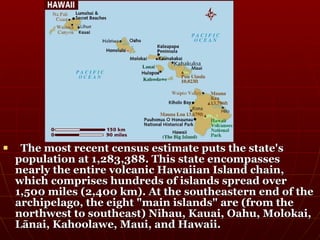
    The most recent census estimate puts the state's
    population at 1,283,388. This state encompasses
    nearly the entire volcanic Hawaiian Island chain,
    which comprises hundreds of islands spread over
    1,500 miles (2,400 km). At the southeastern end of the
    archipelago, the eight "main islands" are (from the
    northwest to southeast) Nihau, Kauai, Oahu, Molokai,
    Lānai, Kahoolawe, Maui, and Hawaii.
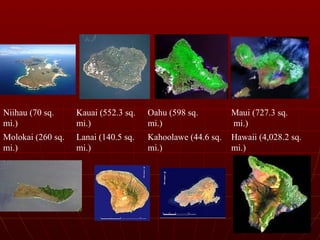
Niihau (70 sq.     Kauai (552.3 sq.   Oahu (598 sq.         Maui (727.3 sq.
mi.)               mi.)               mi.)                  mi.)
Molokai (260 sq.   Lanai (140.5 sq.   Kahoolawe (44.6 sq.   Hawaii (4,028.2 sq.
mi.)               mi.)               mi.)                  mi.)
   All of the Hawaiian islands
    were formed by volcanoes
    erupting from the sea floor
    from a magma source. The
    theory maintains that as
    the tectonic plate beneath
    much of the Pacific Ocean
    moves in a northwesterly
    direction, the hot spot
    remains stationary, slowly
    creating new volcanoes.
    This explains why only
    volcanoes on the southern
    half of the Big Island, and
    the Loihi Seamount deep
    below the waters off its
    southern coast, are
    presently active, with Loihi
    being the newest volcano to
    form.
The climate of Hawaii is typical for a tropical area,
although temperatures and humidity tend to be a bit
less extreme than other tropical locales due to the
constant trade winds blowing from the east. Summer
highs are usually in the upper 31°C during the day and
mid 24 °C at night. Winter temperatures during the
day are usually in the low to mid 28 ° and (at low
elevation) seldom dipping below the mid 18 °C at
night.
   Hawaii is one of four U.S. states that were
    independent prior to becoming part of the
    United States, along with the Vermont
    Republic (1791), the Republic of Texas (1845),
    and the California Republic (1846), and one of
    two (Texas was the other) with formal
    diplomatic recognition internationally.The
    Kingdom of Hawaii existed from 1810 until
    1893 when the monarchy was overthrown by
    resident American (and some European)
    businessmen. It was an independent republic
    from 1894 until 1898, when it was annexed by
    the United States, becoming a territory in
    1900, and a state in 1959.
State Symbols
  of Hawaii
 
Hawaii was once an independent kingdom. (1810 - 1893)
The flag was designed at the request of King
Kamehameha I. It has eight stripes of white, red and blue
that represent the eight main islands. The flag of Great
Britain is emblazoned in the upper left corner to honor
Hawaii's friendship with the British.
The National Coat of Arms
The National Seal
Hawaiian NENE
National Bird
Humpback Whale


Hawaiian Monk
Seal
      National Mammals
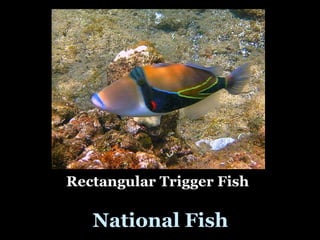
Rectangular Trigger Fish

   National Fish
Hibiscus


    National Flower
Summer Institute
 Hawaii Pacific
  University.
Honolulu, Hawaii
     USA
     2009
Arrival
Waikiki Aqua
Marina Hotel
Ph.D. Sandra Mackey
Assistant Professor Jean
     Kirschenmann
Ph.D. Hanh Nguyen
Assistant Professor
 Catherine Sajna
Ph.D. Carlos Juares
Assistant Professor
 Barbara Hannum
Workshops
Presentation of the Song ‘Yankee Doodle”
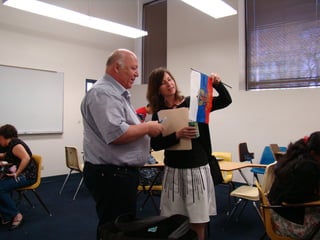
Visit of Maria Snarsky
Self Presentation
Presentation
     of
“Celebrate!”
Presentation of a Lesson Plan
Getting the
Graduation
Certificates
Hawaii
Hawaii
Hawaii
Hawaii
Hawaii
Hawaii

Hawaii

  • 1.
    HAWAII The Fiftieth Stateof the U.S.A. HPU Summer Institute, 2009
  • 2.
    The State ofHawaii is a state in the United States, located on an archipelago in the central Pacific Ocean southwest of the continental United States, southeast of Japan, and northeast of Australia. The state was admitted to the Union on August 21, 1959, making it the 50th state. Its capital is Honolulu on the island of Oahu.
  • 3.
    The most recent census estimate puts the state's population at 1,283,388. This state encompasses nearly the entire volcanic Hawaiian Island chain, which comprises hundreds of islands spread over 1,500 miles (2,400 km). At the southeastern end of the archipelago, the eight "main islands" are (from the northwest to southeast) Nihau, Kauai, Oahu, Molokai, Lānai, Kahoolawe, Maui, and Hawaii.
  • 4.
    Niihau (70 sq. Kauai (552.3 sq. Oahu (598 sq. Maui (727.3 sq. mi.) mi.) mi.) mi.) Molokai (260 sq. Lanai (140.5 sq. Kahoolawe (44.6 sq. Hawaii (4,028.2 sq. mi.) mi.) mi.) mi.)
  • 5.
    All of the Hawaiian islands were formed by volcanoes erupting from the sea floor from a magma source. The theory maintains that as the tectonic plate beneath much of the Pacific Ocean moves in a northwesterly direction, the hot spot remains stationary, slowly creating new volcanoes. This explains why only volcanoes on the southern half of the Big Island, and the Loihi Seamount deep below the waters off its southern coast, are presently active, with Loihi being the newest volcano to form.
  • 6.
    The climate ofHawaii is typical for a tropical area, although temperatures and humidity tend to be a bit less extreme than other tropical locales due to the constant trade winds blowing from the east. Summer highs are usually in the upper 31°C during the day and mid 24 °C at night. Winter temperatures during the day are usually in the low to mid 28 ° and (at low elevation) seldom dipping below the mid 18 °C at night.
  • 7.
    Hawaii is one of four U.S. states that were independent prior to becoming part of the United States, along with the Vermont Republic (1791), the Republic of Texas (1845), and the California Republic (1846), and one of two (Texas was the other) with formal diplomatic recognition internationally.The Kingdom of Hawaii existed from 1810 until 1893 when the monarchy was overthrown by resident American (and some European) businessmen. It was an independent republic from 1894 until 1898, when it was annexed by the United States, becoming a territory in 1900, and a state in 1959.
  • 8.
    State Symbols of Hawaii
  • 9.
      Hawaii was oncean independent kingdom. (1810 - 1893) The flag was designed at the request of King Kamehameha I. It has eight stripes of white, red and blue that represent the eight main islands. The flag of Great Britain is emblazoned in the upper left corner to honor Hawaii's friendship with the British.
  • 10.
  • 11.
  • 12.
  • 13.
  • 14.
  • 15.
    Hibiscus National Flower
  • 16.
    Summer Institute HawaiiPacific University. Honolulu, Hawaii USA 2009
  • 17.
  • 20.
  • 23.
  • 24.
  • 25.
  • 26.
  • 27.
  • 28.
  • 30.
  • 35.
    Presentation of theSong ‘Yankee Doodle”
  • 39.
  • 41.
  • 53.
    Presentation of “Celebrate!”
  • 59.
    Presentation of aLesson Plan
  • 63.