Artifacts of the Dawn
of Electricity
Detailed Item Descriptions
SPARK
1
Table of Contents
PART ONE ……………………………………………………………………………………….……….. 2-3
Items 1-20 ………………………………………………………………………………………….. 2
Items 21-31 ……………………………………………………………………………..…………. 3
PART TWO …………………………………………………………………………………………..………. 4
Items 32-45 ………………………………………………………………………….…………….. 4
Terms Used …………………………………………………………………………….……………… 5-11
Coulomb Torsion Balance ………………………………………………………………….… 5
Electrical Egg Stand ……………………………………………………………………………. 6
Electrical Orrey …………………………………………………………………..………………..6
Electrophorus ……………………………………………………………………….……………… 6
Electroscope ………………………………………………………………………………….……… 7
Franklin’s Bells …………………………………………………………………………………….. 8
Grenet Cell ………………………………………………………………………….………….……. 9
Leyden Jar ………………………………………………………………………….………….…… 10
Luminous Frame ………………………………………………………………………………… 10
Mercury Tube …………………………………………………………………..……………….. 10
Scintillating Tube ……………………………………………………………………….…….… 11
Volta Cannon ……………………………………………………………………………………… 11
Sources ………………………………………………………………………………………………..….…. 12
2
Part One
* Included in Terms Used section
1. Harris Electroscope, ca 1900*
2. Gold Leaf Electroscope, Watkins and Hill, 2nd Quarter 19th Century*
3. Electroscope, German, Max Kohl, ca 1900
4. Upright Discharger, 1800
5. Electrical Aurora Tube, likely American, ca 1840
6. Horizontal Leyden Jar, English, 1830*
7. Early Gold Leaf Leyden Jar, Late 18th Century*
8. Early Gold Leaf Leyden Jar, Late 18th Century*
9. Demonstration Leyden Jar*
10. Leyden Jar, American, likely Daniel Davis, ca 1840*
11. Thunder Façade, English, 4th Quarter 18th Century
12. Franklin’s Bells, Late 18th Century*
13. Grenet Cell, 1888*
14. Grenet Cell, 1888*
15. Electrostatic Experiment Kit, French, 1895
16. Electrostatic Experiment Kit, German, Meiser and Mertig, 1905
17. Electrostatic Experiment Kit, English, 1st Quarter 19th Century
18. Volta Multi-Pistol
19. Volta Pistol
20. Volta Air Cannon*
3
21.Volta Cannon, Italy, 1st Quarter 20th Century*
22. Early Volta Cannon, Italy, 1787*
23. Electrostatic Bells, 2nd Half 19th Century
24. Scintillating Spiral Tube, English, ca 1850*
25. Spiral Tube Array, 1870
26. Planetarium, Early 19th Century
27. Electrophorus*
28. Electrostatic Induction Apparatus, French
29. Electrostatic Induction Apparatus, French
30. Henley’s Universal Discharger, J. Newman, London, 1st Quarter 19th
Century
31. Friction Machine, American, Mid 19th Century
4
Part Two
* Included in Terms Used section
32. Electrical Orrey, American, ca 1850*
33. Pith Ball Demonstration Apparatus, 1900
34. Electrical Sportsmen, Last Quarter 18th Century
35. Electrical Sportsmen with Leyden Jar, Joseph Wightman, Mid 19th
Century
36. Insulating Stools, English, 1st Quarter 19th Century
37. Scintillating Glass Globe, Italian, ca 1820*
38. Spiral Tube, American, 1850
39. Shower of Mercury Tube, French, ca 1850*
40. Coulomb Torsion Balance*
41. Magnetite with Holder and Leather Case
42. Magnetite with Holder
43. Electrical Egg Stand, English, ca 1840*
44. Electrostatic Sphere, Italian, Late 19th Century
45. Luminous Frame, French, 4th Quarter 19th Century*
5
Terms Used
Coulomb Torsion Balance
Number: 40
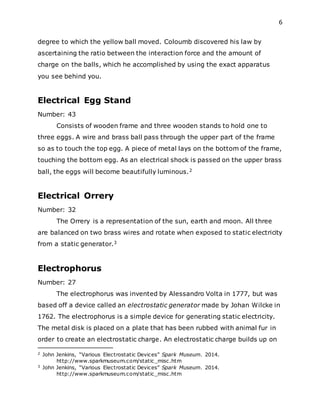
The Coulomb Torsion Balance was invented by Charles Augustin
Coulomb in 1785. It was the first device capable of making quantitative
measurements of electrical charge. It was through the use of this invention
that Coulomb developed his own law which reads; “the force between two
point charges is directly proportional to the product of magnitude of two
charges, and inversely proportional to the square of the distance between
them”.1
The device was used by placing a needle with a charged metal ball
(shown as yellow in diagram above) at the end of the torsion fiber, and
placing a second ball (shown as blue in diagram above) within the needle’s
circumference inside of the cylindrical glass case. The charge within the blue
ball would repel the yellow ball, and cause it to oscillate within the glass
case. The scale around the glass case was used to help determine the
1 Tutor Vista, Coulomb’s Torsion Balance, Youtube, 4:06 minutes,
http://youtu.be/FYSTGX-F1GM
6
degree to which the yellow ball moved. Coloumb discovered his law by
ascertaining the ratio between the interaction force and the amount of
charge on the balls, which he accomplished by using the exact apparatus
you see behind you.
Electrical Egg Stand
Number: 43
Consists of wooden frame and three wooden stands to hold one to
three eggs. A wire and brass ball pass through the upper part of the frame
so as to touch the top egg. A piece of metal lays on the bottom of the frame,
touching the bottom egg. As an electrical shock is passed on the upper brass
ball, the eggs will become beautifully luminous.2
Electrical Orrery
Number: 32
The Orrery is a representation of the sun, earth and moon. All three
are balanced on two brass wires and rotate when exposed to static electricity
from a static generator.3
Electrophorus
Number: 27
The electrophorus was invented by Alessandro Volta in 1777, but was
based off a device called an electrostatic generator made by Johan Wilcke in
1762. The electrophorus is a simple device for generating static electricity.
The metal disk is placed on a plate that has been rubbed with animal fur in
order to create an electrostatic charge. An electrostatic charge builds up on
2 John Jenkins, “Various Electrostatic Devices” Spark Museum. 2014.
http://www.sparkmuseum.com/static_misc.htm
3 John Jenkins, “Various Electrostatic Devices” Spark Museum. 2014.
http://www.sparkmuseum.com/static_misc.htm
7
the disk and can be transferred to a leyden jar or other object (such as an
electroscope).4
Electroscope
Numbers: 1, 2
The term electroscope is given to instruments which serve two primary
purposes: 1) to determine if a body is electrified, and 2) to determine the
nature of the electrification. An electrometer, on the other hand, is a
specialized form of electroscope that includes a calibrated scale for reading
the strength of the charge.5
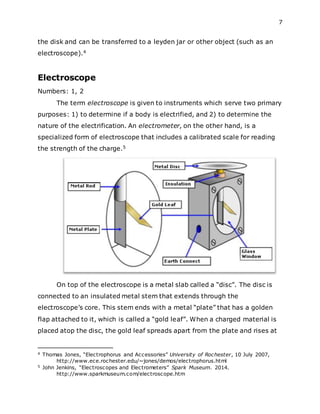
On top of the electroscope is a metal slab called a “disc”. The disc is
connected to an insulated metal stem that extends through the
electroscope’s core. This stem ends with a metal “plate” that has a golden
flap attached to it, which is called a “gold leaf”. When a charged material is
placed atop the disc, the gold leaf spreads apart from the plate and rises at
4 Thomas Jones, “Electrophorus and Accessories” University of Rochester, 10 July 2007,
http://www.ece.rochester.edu/~jones/demos/electrophorus.html
5 John Jenkins, “Electroscopes and Electrometers” Spark Museum. 2014.
http://www.sparkmuseum.com/electroscope.htm
8
an angle.6 The museum’s Static Electricity Learning Center provides an
electroscope for visitors to engage with.
Franklin’s Bells
Number: 12
Franklin's Bells were one of the first devices to detect electromagnetic
charges of a thunderstorm. This apparatus was one of the first “electric
bells” in existence, as it used the electrons in the air to propel a metal ball to
and fro between two metal bells. In order to give the bells a natural charge,
a lightning rod was placed atop Franklin’s chimney, and was attached to a
wire that lead straight down to the bell on the right. The bell on the left was
connected to a grounding rod that allowed the electrons to flow through the
bell, down into the earth.
As thunderstorms approached, the negative electrons below the storm
clouds would push the negative charges down through the lightning rod and
into the bell it was attached to. The negative charge on the bell would repel
the negative charge on the ball and transfer the negative electrons to the
alternate, positively charged bell. This positively charged bell would be
connected to the grounding line so that the negative electrons could pass
through the bell and continue on toward the ground. After this occurrs, both
the bell and the ball return to being positively charged, thus repelling one
another to begin the entire process again. It is important to note that
electron fields act similar to magnets in that positive and negative charges
attract, while two positive or two negative charges repel (as shown in the
diagram on page 9).7
6 Kieth Gibbs, “The Gold Leaf Electroscope” School Physics. 2013.
http://www.schoolphysics.co.uk/
7 Rimstar, Franklin’s Bell How it Works, Youtube, 3:27 minutes, 14 Dec 2012,
http://youtu.be/fEqudsyIWzk.
9
Lastly, Franklin was not the first to invent this type of device. German
professor Andrew Gordon was in fact the first to create an electronic bell
system in the year 1742. It was Franklin who decided to apply the bells to
practical purposes, which is why he is most often attributed to this particular
bell system.8
Grenet Cell
Numbers:13, 14
A grenet cells is a single-element battery source with flasks of varying
volumetric capacity, from 1/3 liter to 3 liters. These battery elements, when
filled with an acid solution and placed in series, were a common source of
electrical current prior to the development of the dry-cell battery.9
8 “Franklin Bells,” physicscentral.com, 2004, http://www.thebakken.org/artifacts/franklin-
bells.htm.
9 John Jenkins, “Grenet Cell” Spark Museum. 2014.
http://www.sparkmuseum.com/grenet.htm
10
Leyden Jar
Numbers: 6, 7, 8, 9, 10
Leyden Jars were the first devices to store electricity. When an
electrical charge is applied to the external knob, positive and negative
charges accumulate within the two metal coatings surrounding the interior
and exterior surfaces of the glass jar. The glass separating the metals acts
as a buffer that does not allow the metals to connect and discharge. The
result is that the charges will hold each other in equilibrium until a discharge
path is provided. Leyden Jars were first used in experiments, and later as
condensers in early wireless equipment.10
Luminous Frame
Number: 45
Words, phrases, and pictures were constructed on the surface of the
glass plate using lead foil. When voltage was applied from a static machine,
the words and pictures seemed to be displayed in sparks, just as in the
schintillating spiral tubes.11
Mercury Tube
Number: 39
Glass tubes filled with mercury would glow bright if shaken every so
often. Often these tubes would be placed on a mahogany turned base 7" in
diameter. This particular hollow glass tube with brass moulding on top is 33"
tall. 12
10 “Leyden Jar Tutorial,” magnet.sfu.edu, 2013,
http://www.magnet.fsu.edu/education/tutorials/java/leydenjar/
11 John Jenkins, “Various Electrostatic Devices” Spark Museum. 2014.
http://www.sparkmuseum.com/static_misc.htm
12 John Jenkins, “Various Electrostatic Devices” Spark Museum. 2014.
http://www.sparkmuseum.com/static_misc.htm
11
Scintillating Spiral Tube
Number: 24
Scintillating tubes were a popular form of electromagnetic
entertainment throughout the 18th and 19th centuries. A line of small foil
diamonds or discs are placed inside a handblown glass tube, with only a
small space separating the pieces. A dramatic electric display of sparkling
light is created when a static charge is applied to the brass ball on top of the
tube, as the charge spirals down the path of foil diamonds.13
Volta Cannon
Numbers: 20, 21
Volta cannons, pistols and canisters were created by Alessandro Volta
around the year 1777. Volta would fill the gasometer of the cannon or pistol
with swamp gas and seal the barrel with a cork. Toward the opposing end of
the cannon or pistol there is a metal rod tipped with a brass ball which would
serve as an electric spark plug. If the gas were flammable and the
proportions were right, it would explode when sparked.
Volta’s early pistols were capable of sending a lead ball twenty feet,
and could dent a board. Long after its scientific use had gone, Volta cannons
remained a favorite lecture hall demonstration. These devices were hardly
practical as weapons, and certainly not as effective as the gunpowder
weapons that had been around several hundreds of years.14
13 John Jenkins, Where Discovery Sparks Imagination (Bellingham: The American Museum
of Radio and Electricity, 2009), 24.
14 John Jenkins, “Volta Cannons” Spark Museum. 2014.
http://www.sparkmuseum.com/collections/dawnoftheelectricalage/voltacannon.htm
12
Sources
“Franklin Bells.” physicscentral.com. Last modified 2004.
http://www.thebakken.org/artifacts/franklin- bells.htm.
Gibbs, Keith. “The Gold Leaf Electroscope” School Physics. Accessed
2013.http://www.schoolphysics.co.uk/.
Jenkins, John. “Electroscopes and Electrometers” Spark Museum. Accessed
2014. http://www.sparkmuseum.com/electroscope.htm
-- “Grenet Cell” Spark Museum. 2014.
http://www.sparkmuseum.com/grenet.htm.
-- “Various Electrostatic Devices,” Spark Museum.accessed
2014. http://www.sparkmuseum.com/static_misc.htm.
-- “Volta Cannons” Spark Museum. Accessed 2014.
http://www.sparkmuseum.com/collections/dawnoftheelectricalage/volt
acannon.htm.
-- Where Discovery Sparks Imagination. Bellingham:The American Museum
of Radio and Electricity, 2009.
Jones, Thomas. “Electrophorus and Accessories” University of Rochester, 10
July 2007,
http://www.ece.rochester.edu/~jones/demos/electrophorus.html.
“Leyden Jar Tutorial.” Magnet.sfu.edu. Last modified 2013.
http://www.magnet.fsu.edu/education/tutorials/java/leydenjar/.
Rimstar. Franklin’s Bells How it Works. Youtube, 3:27 minutes. 14 December
2012. http://youtu.be/fEqudsyIWzk.
Vista, Tutor. Coulomb’s Torsion Balance. Youtube, 4:06 minutes. 26 April
2010. http://youtu.be/FYSTGX-F1GM.

MuseumItemGuide

  • 1.
    Artifacts of theDawn of Electricity Detailed Item Descriptions SPARK
  • 2.
    1 Table of Contents PARTONE ……………………………………………………………………………………….……….. 2-3 Items 1-20 ………………………………………………………………………………………….. 2 Items 21-31 ……………………………………………………………………………..…………. 3 PART TWO …………………………………………………………………………………………..………. 4 Items 32-45 ………………………………………………………………………….…………….. 4 Terms Used …………………………………………………………………………….……………… 5-11 Coulomb Torsion Balance ………………………………………………………………….… 5 Electrical Egg Stand ……………………………………………………………………………. 6 Electrical Orrey …………………………………………………………………..………………..6 Electrophorus ……………………………………………………………………….……………… 6 Electroscope ………………………………………………………………………………….……… 7 Franklin’s Bells …………………………………………………………………………………….. 8 Grenet Cell ………………………………………………………………………….………….……. 9 Leyden Jar ………………………………………………………………………….………….…… 10 Luminous Frame ………………………………………………………………………………… 10 Mercury Tube …………………………………………………………………..……………….. 10 Scintillating Tube ……………………………………………………………………….…….… 11 Volta Cannon ……………………………………………………………………………………… 11 Sources ………………………………………………………………………………………………..….…. 12
  • 3.
    2 Part One * Includedin Terms Used section 1. Harris Electroscope, ca 1900* 2. Gold Leaf Electroscope, Watkins and Hill, 2nd Quarter 19th Century* 3. Electroscope, German, Max Kohl, ca 1900 4. Upright Discharger, 1800 5. Electrical Aurora Tube, likely American, ca 1840 6. Horizontal Leyden Jar, English, 1830* 7. Early Gold Leaf Leyden Jar, Late 18th Century* 8. Early Gold Leaf Leyden Jar, Late 18th Century* 9. Demonstration Leyden Jar* 10. Leyden Jar, American, likely Daniel Davis, ca 1840* 11. Thunder Façade, English, 4th Quarter 18th Century 12. Franklin’s Bells, Late 18th Century* 13. Grenet Cell, 1888* 14. Grenet Cell, 1888* 15. Electrostatic Experiment Kit, French, 1895 16. Electrostatic Experiment Kit, German, Meiser and Mertig, 1905 17. Electrostatic Experiment Kit, English, 1st Quarter 19th Century 18. Volta Multi-Pistol 19. Volta Pistol 20. Volta Air Cannon*
  • 4.
    3 21.Volta Cannon, Italy,1st Quarter 20th Century* 22. Early Volta Cannon, Italy, 1787* 23. Electrostatic Bells, 2nd Half 19th Century 24. Scintillating Spiral Tube, English, ca 1850* 25. Spiral Tube Array, 1870 26. Planetarium, Early 19th Century 27. Electrophorus* 28. Electrostatic Induction Apparatus, French 29. Electrostatic Induction Apparatus, French 30. Henley’s Universal Discharger, J. Newman, London, 1st Quarter 19th Century 31. Friction Machine, American, Mid 19th Century
  • 5.
    4 Part Two * Includedin Terms Used section 32. Electrical Orrey, American, ca 1850* 33. Pith Ball Demonstration Apparatus, 1900 34. Electrical Sportsmen, Last Quarter 18th Century 35. Electrical Sportsmen with Leyden Jar, Joseph Wightman, Mid 19th Century 36. Insulating Stools, English, 1st Quarter 19th Century 37. Scintillating Glass Globe, Italian, ca 1820* 38. Spiral Tube, American, 1850 39. Shower of Mercury Tube, French, ca 1850* 40. Coulomb Torsion Balance* 41. Magnetite with Holder and Leather Case 42. Magnetite with Holder 43. Electrical Egg Stand, English, ca 1840* 44. Electrostatic Sphere, Italian, Late 19th Century 45. Luminous Frame, French, 4th Quarter 19th Century*
  • 6.
    5 Terms Used Coulomb TorsionBalance Number: 40 The Coulomb Torsion Balance was invented by Charles Augustin Coulomb in 1785. It was the first device capable of making quantitative measurements of electrical charge. It was through the use of this invention that Coulomb developed his own law which reads; “the force between two point charges is directly proportional to the product of magnitude of two charges, and inversely proportional to the square of the distance between them”.1 The device was used by placing a needle with a charged metal ball (shown as yellow in diagram above) at the end of the torsion fiber, and placing a second ball (shown as blue in diagram above) within the needle’s circumference inside of the cylindrical glass case. The charge within the blue ball would repel the yellow ball, and cause it to oscillate within the glass case. The scale around the glass case was used to help determine the 1 Tutor Vista, Coulomb’s Torsion Balance, Youtube, 4:06 minutes, http://youtu.be/FYSTGX-F1GM
  • 7.
    6 degree to whichthe yellow ball moved. Coloumb discovered his law by ascertaining the ratio between the interaction force and the amount of charge on the balls, which he accomplished by using the exact apparatus you see behind you. Electrical Egg Stand Number: 43 Consists of wooden frame and three wooden stands to hold one to three eggs. A wire and brass ball pass through the upper part of the frame so as to touch the top egg. A piece of metal lays on the bottom of the frame, touching the bottom egg. As an electrical shock is passed on the upper brass ball, the eggs will become beautifully luminous.2 Electrical Orrery Number: 32 The Orrery is a representation of the sun, earth and moon. All three are balanced on two brass wires and rotate when exposed to static electricity from a static generator.3 Electrophorus Number: 27 The electrophorus was invented by Alessandro Volta in 1777, but was based off a device called an electrostatic generator made by Johan Wilcke in 1762. The electrophorus is a simple device for generating static electricity. The metal disk is placed on a plate that has been rubbed with animal fur in order to create an electrostatic charge. An electrostatic charge builds up on 2 John Jenkins, “Various Electrostatic Devices” Spark Museum. 2014. http://www.sparkmuseum.com/static_misc.htm 3 John Jenkins, “Various Electrostatic Devices” Spark Museum. 2014. http://www.sparkmuseum.com/static_misc.htm
  • 8.
    7 the disk andcan be transferred to a leyden jar or other object (such as an electroscope).4 Electroscope Numbers: 1, 2 The term electroscope is given to instruments which serve two primary purposes: 1) to determine if a body is electrified, and 2) to determine the nature of the electrification. An electrometer, on the other hand, is a specialized form of electroscope that includes a calibrated scale for reading the strength of the charge.5 On top of the electroscope is a metal slab called a “disc”. The disc is connected to an insulated metal stem that extends through the electroscope’s core. This stem ends with a metal “plate” that has a golden flap attached to it, which is called a “gold leaf”. When a charged material is placed atop the disc, the gold leaf spreads apart from the plate and rises at 4 Thomas Jones, “Electrophorus and Accessories” University of Rochester, 10 July 2007, http://www.ece.rochester.edu/~jones/demos/electrophorus.html 5 John Jenkins, “Electroscopes and Electrometers” Spark Museum. 2014. http://www.sparkmuseum.com/electroscope.htm
  • 9.
    8 an angle.6 Themuseum’s Static Electricity Learning Center provides an electroscope for visitors to engage with. Franklin’s Bells Number: 12 Franklin's Bells were one of the first devices to detect electromagnetic charges of a thunderstorm. This apparatus was one of the first “electric bells” in existence, as it used the electrons in the air to propel a metal ball to and fro between two metal bells. In order to give the bells a natural charge, a lightning rod was placed atop Franklin’s chimney, and was attached to a wire that lead straight down to the bell on the right. The bell on the left was connected to a grounding rod that allowed the electrons to flow through the bell, down into the earth. As thunderstorms approached, the negative electrons below the storm clouds would push the negative charges down through the lightning rod and into the bell it was attached to. The negative charge on the bell would repel the negative charge on the ball and transfer the negative electrons to the alternate, positively charged bell. This positively charged bell would be connected to the grounding line so that the negative electrons could pass through the bell and continue on toward the ground. After this occurrs, both the bell and the ball return to being positively charged, thus repelling one another to begin the entire process again. It is important to note that electron fields act similar to magnets in that positive and negative charges attract, while two positive or two negative charges repel (as shown in the diagram on page 9).7 6 Kieth Gibbs, “The Gold Leaf Electroscope” School Physics. 2013. http://www.schoolphysics.co.uk/ 7 Rimstar, Franklin’s Bell How it Works, Youtube, 3:27 minutes, 14 Dec 2012, http://youtu.be/fEqudsyIWzk.
  • 10.
    9 Lastly, Franklin wasnot the first to invent this type of device. German professor Andrew Gordon was in fact the first to create an electronic bell system in the year 1742. It was Franklin who decided to apply the bells to practical purposes, which is why he is most often attributed to this particular bell system.8 Grenet Cell Numbers:13, 14 A grenet cells is a single-element battery source with flasks of varying volumetric capacity, from 1/3 liter to 3 liters. These battery elements, when filled with an acid solution and placed in series, were a common source of electrical current prior to the development of the dry-cell battery.9 8 “Franklin Bells,” physicscentral.com, 2004, http://www.thebakken.org/artifacts/franklin- bells.htm. 9 John Jenkins, “Grenet Cell” Spark Museum. 2014. http://www.sparkmuseum.com/grenet.htm
  • 11.
    10 Leyden Jar Numbers: 6,7, 8, 9, 10 Leyden Jars were the first devices to store electricity. When an electrical charge is applied to the external knob, positive and negative charges accumulate within the two metal coatings surrounding the interior and exterior surfaces of the glass jar. The glass separating the metals acts as a buffer that does not allow the metals to connect and discharge. The result is that the charges will hold each other in equilibrium until a discharge path is provided. Leyden Jars were first used in experiments, and later as condensers in early wireless equipment.10 Luminous Frame Number: 45 Words, phrases, and pictures were constructed on the surface of the glass plate using lead foil. When voltage was applied from a static machine, the words and pictures seemed to be displayed in sparks, just as in the schintillating spiral tubes.11 Mercury Tube Number: 39 Glass tubes filled with mercury would glow bright if shaken every so often. Often these tubes would be placed on a mahogany turned base 7" in diameter. This particular hollow glass tube with brass moulding on top is 33" tall. 12 10 “Leyden Jar Tutorial,” magnet.sfu.edu, 2013, http://www.magnet.fsu.edu/education/tutorials/java/leydenjar/ 11 John Jenkins, “Various Electrostatic Devices” Spark Museum. 2014. http://www.sparkmuseum.com/static_misc.htm 12 John Jenkins, “Various Electrostatic Devices” Spark Museum. 2014. http://www.sparkmuseum.com/static_misc.htm
  • 12.
    11 Scintillating Spiral Tube Number:24 Scintillating tubes were a popular form of electromagnetic entertainment throughout the 18th and 19th centuries. A line of small foil diamonds or discs are placed inside a handblown glass tube, with only a small space separating the pieces. A dramatic electric display of sparkling light is created when a static charge is applied to the brass ball on top of the tube, as the charge spirals down the path of foil diamonds.13 Volta Cannon Numbers: 20, 21 Volta cannons, pistols and canisters were created by Alessandro Volta around the year 1777. Volta would fill the gasometer of the cannon or pistol with swamp gas and seal the barrel with a cork. Toward the opposing end of the cannon or pistol there is a metal rod tipped with a brass ball which would serve as an electric spark plug. If the gas were flammable and the proportions were right, it would explode when sparked. Volta’s early pistols were capable of sending a lead ball twenty feet, and could dent a board. Long after its scientific use had gone, Volta cannons remained a favorite lecture hall demonstration. These devices were hardly practical as weapons, and certainly not as effective as the gunpowder weapons that had been around several hundreds of years.14 13 John Jenkins, Where Discovery Sparks Imagination (Bellingham: The American Museum of Radio and Electricity, 2009), 24. 14 John Jenkins, “Volta Cannons” Spark Museum. 2014. http://www.sparkmuseum.com/collections/dawnoftheelectricalage/voltacannon.htm
  • 13.
    12 Sources “Franklin Bells.” physicscentral.com.Last modified 2004. http://www.thebakken.org/artifacts/franklin- bells.htm. Gibbs, Keith. “The Gold Leaf Electroscope” School Physics. Accessed 2013.http://www.schoolphysics.co.uk/. Jenkins, John. “Electroscopes and Electrometers” Spark Museum. Accessed 2014. http://www.sparkmuseum.com/electroscope.htm -- “Grenet Cell” Spark Museum. 2014. http://www.sparkmuseum.com/grenet.htm. -- “Various Electrostatic Devices,” Spark Museum.accessed 2014. http://www.sparkmuseum.com/static_misc.htm. -- “Volta Cannons” Spark Museum. Accessed 2014. http://www.sparkmuseum.com/collections/dawnoftheelectricalage/volt acannon.htm. -- Where Discovery Sparks Imagination. Bellingham:The American Museum of Radio and Electricity, 2009. Jones, Thomas. “Electrophorus and Accessories” University of Rochester, 10 July 2007, http://www.ece.rochester.edu/~jones/demos/electrophorus.html. “Leyden Jar Tutorial.” Magnet.sfu.edu. Last modified 2013. http://www.magnet.fsu.edu/education/tutorials/java/leydenjar/. Rimstar. Franklin’s Bells How it Works. Youtube, 3:27 minutes. 14 December 2012. http://youtu.be/fEqudsyIWzk. Vista, Tutor. Coulomb’s Torsion Balance. Youtube, 4:06 minutes. 26 April 2010. http://youtu.be/FYSTGX-F1GM.