Think of the answer silently

Bellringer: What are some different
  types of exhibits in museums?
Virtual Tour
• Smithsonian Natural History
  – http://www.mnh.si.edu/panoramas/
• Talk about what we noticed during the tour
Museum Flow
• “The way in which a work is displayed influences our
  perception of it and our reactions to it”
• A museum is not just arranged in a line, chronologically
• Importance of presence, presentation and
  representation.
   – By presence, we mean the bringing together within a given
     space of a set of material objects
   – By presentation we can highlight different things to draw
     attention or evoke emotion at certain times in the story
   – By representation, we understand that many different
     objects brought together can make a whole
Museum Flow
• We have to tell a story through our objects,
  exhibits, and interpretations
  – Start with the beginning of our story (the theme
    we have chosen) at the entrance and the end of
    the story at the exit
  – Enrich the story through the exhibits
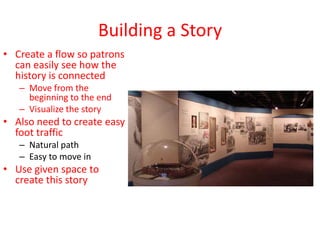
Building a Story
• Create a flow so patrons
  can easily see how the
  history is connected
   – Move from the
     beginning to the end
   – Visualize the story
• Also need to create easy
  foot traffic
   – Natural path
   – Easy to move in
• Use given space to
  create this story
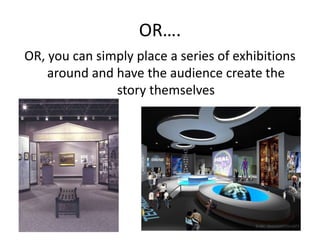
OR….
OR, you can simply place a series of exhibitions
    around and have the audience create the
               story themselves
Interactive vs. “Do Not Touch”
• Art Museums are generally “Do Not Touch”, as
  our museums with artifacts
• Interactive museums encourage patrons to
  experience the subject matter
• Can have both
Evoking Emotion
• Holocaust Museum, Museum of Slavery
  – Exhibits can be placed in the flow to have a large
    impact on the patron
  – The presentation of the material can also be
    manipulated to evoke the most emotion
Other Exhibits
• Use of metaphors and art as well as history to
  best explain your story
• Use of technology
  – Video, audio
Making Decisions
• Where will our museum be? Munier Center or Old
  Parish Center?
• How will we arrange it? Beginning to end or nonlinear?
• In what order will our exhibits/topics be?
• What do we want to include? Documents? Interactive
  material? Objects?
• Do we want to have a centerpiece?
• Do we want to evoke a certain emotion? If so, how?
• Should we include non-historical materials to better
  tell the story?
• What materials do we need?
Creating Flow
• In small groups, sketch a floor plan for our
  museum
• Share and finalize floor plan
In Partners
• Based on floor plan and exhibits, divide up
  work between partners
• Research in pairs (computer lab)
• Finalize exhibits and materials

Museum lesson 2

  • 1.
    Think of theanswer silently Bellringer: What are some different types of exhibits in museums?
  • 2.
    Virtual Tour • SmithsonianNatural History – http://www.mnh.si.edu/panoramas/ • Talk about what we noticed during the tour
  • 3.
    Museum Flow • “Theway in which a work is displayed influences our perception of it and our reactions to it” • A museum is not just arranged in a line, chronologically • Importance of presence, presentation and representation. – By presence, we mean the bringing together within a given space of a set of material objects – By presentation we can highlight different things to draw attention or evoke emotion at certain times in the story – By representation, we understand that many different objects brought together can make a whole
  • 4.
    Museum Flow • Wehave to tell a story through our objects, exhibits, and interpretations – Start with the beginning of our story (the theme we have chosen) at the entrance and the end of the story at the exit – Enrich the story through the exhibits
  • 5.
    Building a Story •Create a flow so patrons can easily see how the history is connected – Move from the beginning to the end – Visualize the story • Also need to create easy foot traffic – Natural path – Easy to move in • Use given space to create this story
  • 6.
    OR…. OR, you cansimply place a series of exhibitions around and have the audience create the story themselves
  • 7.
    Interactive vs. “DoNot Touch” • Art Museums are generally “Do Not Touch”, as our museums with artifacts • Interactive museums encourage patrons to experience the subject matter • Can have both
  • 8.
    Evoking Emotion • HolocaustMuseum, Museum of Slavery – Exhibits can be placed in the flow to have a large impact on the patron – The presentation of the material can also be manipulated to evoke the most emotion
  • 9.
    Other Exhibits • Useof metaphors and art as well as history to best explain your story • Use of technology – Video, audio
  • 10.
    Making Decisions • Wherewill our museum be? Munier Center or Old Parish Center? • How will we arrange it? Beginning to end or nonlinear? • In what order will our exhibits/topics be? • What do we want to include? Documents? Interactive material? Objects? • Do we want to have a centerpiece? • Do we want to evoke a certain emotion? If so, how? • Should we include non-historical materials to better tell the story? • What materials do we need?
  • 11.
    Creating Flow • Insmall groups, sketch a floor plan for our museum • Share and finalize floor plan
  • 12.
    In Partners • Basedon floor plan and exhibits, divide up work between partners • Research in pairs (computer lab) • Finalize exhibits and materials