Discussions:
Mapping and
Methodology
Open Social Mapping
Participatory modeling of social systems
Oct 17, 2019
Ryan J. A. Murphy (with Jennifer DeCoste and Heather Laird)
ryan@systemic.design
Introduction
• From the RSD8 call for proposals:
• “Building, activating, and amplifying capacity to co-design and co-
produce with real stakeholders has always been a challenging
commitment.”
• The challenge is that so many methods abstract the real
stakeholder
• E.g., personas, journey maps, projected empathy
• Best case: representatives of every relevant stakeholder group
2019-10-17 | Open Social Mapping 3
Introduction
• When we work with stakeholders, we observe,
and we agglomerate or synthesize our
observations into models, theories, prototypes,
and so on.
• These tools are useful! But:
• When these tools are based on bad information,
they are less useful, potentially even risky
4
Introduction
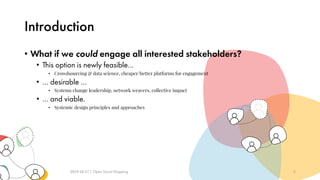
• What if we could engage all interested stakeholders?
• This option is newly feasible…
• Crowdsourcing & data science, cheaper/better platforms for engagement
• … desirable …
• Systems change leadership, network weavers, collective impact
• … and viable.
• Systemic design principles and approaches
2019-10-17 | Open Social Mapping 5
Open Social Mapping
• “Open social mapping” combines actor modeling, social network modeling and
analysis, customer relationship management (CRM) systems, and crowdsourcing
• The idea: stakeholders map themselves
• As a result, open social mapping platforms may help systemic designers
understand the aggregate of many stakeholders (rather than depend on
representations)
• Even better: open social mapping platforms help to map the dynamics of social
systems—who works with who, what barriers are common to which stakeholders,
etc.
2019-10-17 | Open Social Mapping 6
Possible benefits:
• Centering the stakeholder
• It is possible to visualize and even connect directly with real stakeholders in these social
systems
• It may help build trust and transparency with/between disparate stakeholder groups
• Systemic CRMs
• Designers can identify key disconnects between subgroups or individuals and make those
connections
• Increase contrast on the unknowns in a social system
• These maps make visual the diversity of a stakeholder group, helping designers to
investigate who might be missing or excluded
• Stakeholders can see themselves (+ others)
• Decentralizes the tool by providing the same utility to stakeholders as generated for the
project team
2019-10-17 | Open Social Mapping 7
Possible benefits:
• Open Social Maps facilitate “frame translation”
• As stakeholders reconcile their data (e.g., challenges, work, etc.) with the
instances represented on the map, it becomes easy to see when the same concept
is represented by different language
• Open Social Maps challenge boundary frames
• The modeling of real social networks allow designers to make informed decisions
about who and what to involve in deeper investigations
2019-10-17 | Open Social Mapping 8
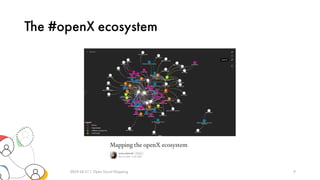
The #openX ecosystem
2019-10-17 | Open Social Mapping 9
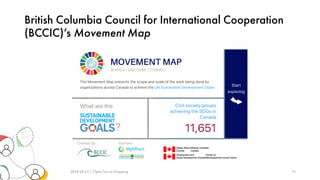
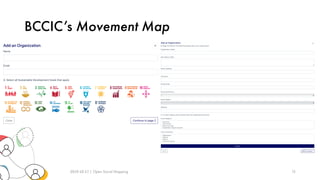
British Columbia Council for International Cooperation
(BCCIC)’s Movement Map
2019-10-17 | Open Social Mapping 10
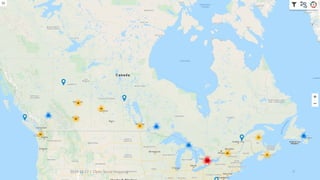
BCCIC’s Movement Map
2019-10-17 | Open Social Mapping 11
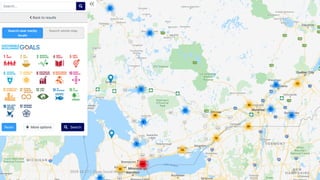
BCCIC’s Movement Map
2019-10-17 | Open Social Mapping 12
BCCIC’s Movement Map
2019-10-17 | Open Social Mapping 13
The Interoperable Mapping Project (IMP!)
• Maps developed with civil servant and multi-sectoral innovation
groups in Canada
• Collected over 350 meaningful entries across 7 mini-open maps and one larger
map
• Maps continue to develop slowly
• Some maps took off: people co-opted and changed IMP to their
own needs
• Kind of like Creative Commons, licensing and networks-of-networks may be
needed to keep it together.
2019-10-17 | Open Social Mapping 14
WeavEast’s open social mapping project
2019-10-17 | Open Social Mapping 15
• Project Purpose
• Increase awareness of who is doing what in Atlantic Canada
• A tool for practitioners to find each other, connect, and scheme virtuously together
• Demonstrate to Government and other potential funders the breadth and scope of
what is happening, what is needed in the region - speaking with one voice
• Goals
• Build relationships – connecting actors within the network, strengthening existing
relationships
• Unearthing initiatives, creating momentum for new initiatives through
collaboration
• Identifying critical levers for change/intervention by observing patterns surfacing
in the map
WeavEast’s open social mapping project
• Process timeline:
1. Mapping begins! Who are the actors?
• But wait—what is a social innovator?
• Result: developing a spectrum to help participants place themselves
2. Designing the map. What are the protocols?
• What data is open? Who has access?
• How to start—uploading old data or starting fresh and organically?
• What tools? (There are many options)
2019-10-17 | Open Social Mapping 16
WeavEast’s open social mapping project
• Process timeline:
3. Stepping back: what do we want to map?
• Geographical location
• Stakeholder type (Government, Board members, Funders, “friends of”, various project
Advisory councils, etc.)
• Issue or focus area (e.g. Youth, Housing, Seniors, Food security, specific project
initiatives, etc.)
• Community Connections: Community project groups / activity workgroups / Partnership
relationships / Affiliations
• Population serviced (e.g. what demographic groups are served by this work)
• Events that they may have attended...
• Endless tags
4. Stepping further back: how to maintain the map over time, as scope and data
types change?
2019-10-17 | Open Social Mapping 17
WeavEast’s open social mapping project
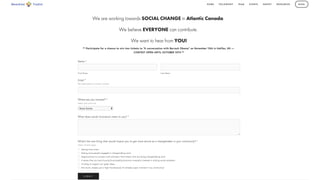
• Current state:
• Trust-building and value proposition development—pause the mapping!
2019-10-17 | Open Social Mapping 18
2019-10-17 | Open Social Mapping 19
Key issues
• Promotion, data capture and upkeep
• How to sustain momentum, maintain data, and transfer ownership?
• Privacy of data
• What are participants comfortable with? How to support and involve the
vulnerable?
• Power dynamics and politics
• Who leads these projects? What of language?
• Interoperability and redundant maps
• Preventing self-mapping burnout, helping maps help each other
2019-10-17 | Open Social Mapping 20
Conclusion
• Help?
• It’s clear that there’s a “there” there—people and orgs keep going on the open
social mapping journey
• But…
• What potential benefits are actually realized?
• What designs help realize these benefits?
• Workshop! 4-5:30pm on Saturday in the Steelcase Commons
2019-10-17 | Open Social Mapping 21
References
Collopy, F. (2009, June 7). Lessons Learned — Why the Failure of Systems Thinking Should Inform the Future of Design Thinking. Retrieved May 5, 2019, from Fast Company website: https://www.fastcompany.com/1291598/lessons-
learned-why-failure-systems-thinking-should-inform-future-design-thinking
Geiger, D., Rosemann, M., Fielt, E., & Schader, M. (2012). Crowdsourcing Information Systems - Definition, Typology, and Design. Thirty Third International Conference on Information Systems, Orlando 2012, 11.
Gopal, S., & Clarke, T. (2015, December). System Mapping: A Guide to Developing Actor Maps. Retrieved from http://fsg.org/tools-and-resources/system-
mapping?utm_source=fsg&utm_medium=email&utm_campaign=07182016ecocyclemapping&utm_source=newsletter&utm_medium=email&utm_content=Download%20the%20Guide&utm_campaign=07182016ecocyclemapping
Human Centered Design Toolkit. (2009). Retrieved from https://www.ideo.com/post/design-kit
Jones, P. H. (2014). Systemic Design Principles for Complex Social Systems. In G. S. Metcalf (Ed.), Social Systems and Design (pp. 91–128). https://doi.org/10.1007/978-4-431-54478-4_4
Kania, J., & Kramer, M. (2011). Collective Impact. Stanford Social Innovation Review, 36–41. Retrieved from https://ssir.org/images/articles/2011_WI_Feature_Kania.pdf
Kolko, J. (2010). Sensemaking and framing: A theoretical reflection on perspective in design synthesis. Design Research Society. Retrieved from http://www.designresearchsociety.org/docs-procs/DRS2010/PDF/067.pdf
Lukyanenko, R., & Parsons, J. (2018). Beyond Micro-Tasks: Research Opportunities in Observational Crowdsourcing. Journal of Database Management, 29(1), 1–22. https://doi.org/10.4018/JDM.2018010101
Miaskiewicz, T., & Kozar, K. A. (2011). Personas and user-centered design: How can personas benefit product design processes? Design Studies, 32(5), 417–430. https://doi.org/10.1016/j.destud.2011.03.003
Muller, M., & Druin, A. (2012). Participatory Design: The Third Space in Human– Computer Interaction. In J. Jacko (Ed.), Human–Computer Interaction Handbook (Vol. 20126252, pp. 1125–1154). https://doi.org/10.1201/b11963-57
Newman, M. (2010). Networks: An Introduction. Oxford, New York: Oxford University Press.
Payne, A., & Frow, P. (2005). A Strategic Framework for Customer Relationship Management. Journal of Marketing, 69(4), 167–176. https://doi.org/10.1509/jmkg.2005.69.4.167
Senge, P., Hamilton, H., & Kania, J. (2015). The Dawn of System Leadership. Stanford Social Innovation Review, 13(1), 27–33. Retrieved from https://networkpeninsula.org/wp-
content/uploads/2014/12/The_Dawn_of_System_Leadership-1.pdf
Van Alstyne, G., & Logan, R. K. (2007). Designing for Emergence and Innovation: Redesigning Design. Artifact, 1(2), 120–129. https://doi.org/10.1080/17493460601110525
Weisbord, M., & Janoff, S. (2007). Get the Whole System in the Room. The Journal for Quality and Participation, 30(3), 4–8. Retrieved from http://search.proquest.com/docview/219115072/abstract/34CBD29280604DB0PQ/1
Wendt, T. (2017, January 10). Empathy as Faux Ethics. Retrieved May 5, 2019, from EPIC website: https://www.epicpeople.org/empathy-faux-ethics/
whitcroft, aimee. (2018, November 20). Mapping the openX ecosystem. Retrieved May 5, 2019, from quicksand website: https://medium.com/quicksand/mapping-the-openx-ecosystem-8033ab9e5fcf
whitcroft, aimee. (n.d.). The #openX ecosystem - a map [Ecosystem map]. Retrieved from https://kumu.io/aimeew/the-openx-ecosystem
2019-10-17 | Open Social Mapping 22

Murphy Mapping and Methodology

  • 1.
  • 2.
    Open Social Mapping Participatorymodeling of social systems Oct 17, 2019 Ryan J. A. Murphy (with Jennifer DeCoste and Heather Laird) ryan@systemic.design
  • 3.
    Introduction • From theRSD8 call for proposals: • “Building, activating, and amplifying capacity to co-design and co- produce with real stakeholders has always been a challenging commitment.” • The challenge is that so many methods abstract the real stakeholder • E.g., personas, journey maps, projected empathy • Best case: representatives of every relevant stakeholder group 2019-10-17 | Open Social Mapping 3
  • 4.
    Introduction • When wework with stakeholders, we observe, and we agglomerate or synthesize our observations into models, theories, prototypes, and so on. • These tools are useful! But: • When these tools are based on bad information, they are less useful, potentially even risky 4
  • 5.
    Introduction • What ifwe could engage all interested stakeholders? • This option is newly feasible… • Crowdsourcing & data science, cheaper/better platforms for engagement • … desirable … • Systems change leadership, network weavers, collective impact • … and viable. • Systemic design principles and approaches 2019-10-17 | Open Social Mapping 5
  • 6.
    Open Social Mapping •“Open social mapping” combines actor modeling, social network modeling and analysis, customer relationship management (CRM) systems, and crowdsourcing • The idea: stakeholders map themselves • As a result, open social mapping platforms may help systemic designers understand the aggregate of many stakeholders (rather than depend on representations) • Even better: open social mapping platforms help to map the dynamics of social systems—who works with who, what barriers are common to which stakeholders, etc. 2019-10-17 | Open Social Mapping 6
  • 7.
    Possible benefits: • Centeringthe stakeholder • It is possible to visualize and even connect directly with real stakeholders in these social systems • It may help build trust and transparency with/between disparate stakeholder groups • Systemic CRMs • Designers can identify key disconnects between subgroups or individuals and make those connections • Increase contrast on the unknowns in a social system • These maps make visual the diversity of a stakeholder group, helping designers to investigate who might be missing or excluded • Stakeholders can see themselves (+ others) • Decentralizes the tool by providing the same utility to stakeholders as generated for the project team 2019-10-17 | Open Social Mapping 7
  • 8.
    Possible benefits: • OpenSocial Maps facilitate “frame translation” • As stakeholders reconcile their data (e.g., challenges, work, etc.) with the instances represented on the map, it becomes easy to see when the same concept is represented by different language • Open Social Maps challenge boundary frames • The modeling of real social networks allow designers to make informed decisions about who and what to involve in deeper investigations 2019-10-17 | Open Social Mapping 8
  • 9.
    The #openX ecosystem 2019-10-17| Open Social Mapping 9
  • 10.
    British Columbia Councilfor International Cooperation (BCCIC)’s Movement Map 2019-10-17 | Open Social Mapping 10
  • 11.
    BCCIC’s Movement Map 2019-10-17| Open Social Mapping 11
  • 12.
    BCCIC’s Movement Map 2019-10-17| Open Social Mapping 12
  • 13.
    BCCIC’s Movement Map 2019-10-17| Open Social Mapping 13
  • 14.
    The Interoperable MappingProject (IMP!) • Maps developed with civil servant and multi-sectoral innovation groups in Canada • Collected over 350 meaningful entries across 7 mini-open maps and one larger map • Maps continue to develop slowly • Some maps took off: people co-opted and changed IMP to their own needs • Kind of like Creative Commons, licensing and networks-of-networks may be needed to keep it together. 2019-10-17 | Open Social Mapping 14
  • 15.
    WeavEast’s open socialmapping project 2019-10-17 | Open Social Mapping 15 • Project Purpose • Increase awareness of who is doing what in Atlantic Canada • A tool for practitioners to find each other, connect, and scheme virtuously together • Demonstrate to Government and other potential funders the breadth and scope of what is happening, what is needed in the region - speaking with one voice • Goals • Build relationships – connecting actors within the network, strengthening existing relationships • Unearthing initiatives, creating momentum for new initiatives through collaboration • Identifying critical levers for change/intervention by observing patterns surfacing in the map
  • 16.
    WeavEast’s open socialmapping project • Process timeline: 1. Mapping begins! Who are the actors? • But wait—what is a social innovator? • Result: developing a spectrum to help participants place themselves 2. Designing the map. What are the protocols? • What data is open? Who has access? • How to start—uploading old data or starting fresh and organically? • What tools? (There are many options) 2019-10-17 | Open Social Mapping 16
  • 17.
    WeavEast’s open socialmapping project • Process timeline: 3. Stepping back: what do we want to map? • Geographical location • Stakeholder type (Government, Board members, Funders, “friends of”, various project Advisory councils, etc.) • Issue or focus area (e.g. Youth, Housing, Seniors, Food security, specific project initiatives, etc.) • Community Connections: Community project groups / activity workgroups / Partnership relationships / Affiliations • Population serviced (e.g. what demographic groups are served by this work) • Events that they may have attended... • Endless tags 4. Stepping further back: how to maintain the map over time, as scope and data types change? 2019-10-17 | Open Social Mapping 17
  • 18.
    WeavEast’s open socialmapping project • Current state: • Trust-building and value proposition development—pause the mapping! 2019-10-17 | Open Social Mapping 18
  • 19.
    2019-10-17 | OpenSocial Mapping 19
  • 20.
    Key issues • Promotion,data capture and upkeep • How to sustain momentum, maintain data, and transfer ownership? • Privacy of data • What are participants comfortable with? How to support and involve the vulnerable? • Power dynamics and politics • Who leads these projects? What of language? • Interoperability and redundant maps • Preventing self-mapping burnout, helping maps help each other 2019-10-17 | Open Social Mapping 20
  • 21.
    Conclusion • Help? • It’sclear that there’s a “there” there—people and orgs keep going on the open social mapping journey • But… • What potential benefits are actually realized? • What designs help realize these benefits? • Workshop! 4-5:30pm on Saturday in the Steelcase Commons 2019-10-17 | Open Social Mapping 21
  • 22.
    References Collopy, F. (2009,June 7). Lessons Learned — Why the Failure of Systems Thinking Should Inform the Future of Design Thinking. Retrieved May 5, 2019, from Fast Company website: https://www.fastcompany.com/1291598/lessons- learned-why-failure-systems-thinking-should-inform-future-design-thinking Geiger, D., Rosemann, M., Fielt, E., & Schader, M. (2012). Crowdsourcing Information Systems - Definition, Typology, and Design. Thirty Third International Conference on Information Systems, Orlando 2012, 11. Gopal, S., & Clarke, T. (2015, December). System Mapping: A Guide to Developing Actor Maps. Retrieved from http://fsg.org/tools-and-resources/system- mapping?utm_source=fsg&utm_medium=email&utm_campaign=07182016ecocyclemapping&utm_source=newsletter&utm_medium=email&utm_content=Download%20the%20Guide&utm_campaign=07182016ecocyclemapping Human Centered Design Toolkit. (2009). Retrieved from https://www.ideo.com/post/design-kit Jones, P. H. (2014). Systemic Design Principles for Complex Social Systems. In G. S. Metcalf (Ed.), Social Systems and Design (pp. 91–128). https://doi.org/10.1007/978-4-431-54478-4_4 Kania, J., & Kramer, M. (2011). Collective Impact. Stanford Social Innovation Review, 36–41. Retrieved from https://ssir.org/images/articles/2011_WI_Feature_Kania.pdf Kolko, J. (2010). Sensemaking and framing: A theoretical reflection on perspective in design synthesis. Design Research Society. Retrieved from http://www.designresearchsociety.org/docs-procs/DRS2010/PDF/067.pdf Lukyanenko, R., & Parsons, J. (2018). Beyond Micro-Tasks: Research Opportunities in Observational Crowdsourcing. Journal of Database Management, 29(1), 1–22. https://doi.org/10.4018/JDM.2018010101 Miaskiewicz, T., & Kozar, K. A. (2011). Personas and user-centered design: How can personas benefit product design processes? Design Studies, 32(5), 417–430. https://doi.org/10.1016/j.destud.2011.03.003 Muller, M., & Druin, A. (2012). Participatory Design: The Third Space in Human– Computer Interaction. In J. Jacko (Ed.), Human–Computer Interaction Handbook (Vol. 20126252, pp. 1125–1154). https://doi.org/10.1201/b11963-57 Newman, M. (2010). Networks: An Introduction. Oxford, New York: Oxford University Press. Payne, A., & Frow, P. (2005). A Strategic Framework for Customer Relationship Management. Journal of Marketing, 69(4), 167–176. https://doi.org/10.1509/jmkg.2005.69.4.167 Senge, P., Hamilton, H., & Kania, J. (2015). The Dawn of System Leadership. Stanford Social Innovation Review, 13(1), 27–33. Retrieved from https://networkpeninsula.org/wp- content/uploads/2014/12/The_Dawn_of_System_Leadership-1.pdf Van Alstyne, G., & Logan, R. K. (2007). Designing for Emergence and Innovation: Redesigning Design. Artifact, 1(2), 120–129. https://doi.org/10.1080/17493460601110525 Weisbord, M., & Janoff, S. (2007). Get the Whole System in the Room. The Journal for Quality and Participation, 30(3), 4–8. Retrieved from http://search.proquest.com/docview/219115072/abstract/34CBD29280604DB0PQ/1 Wendt, T. (2017, January 10). Empathy as Faux Ethics. Retrieved May 5, 2019, from EPIC website: https://www.epicpeople.org/empathy-faux-ethics/ whitcroft, aimee. (2018, November 20). Mapping the openX ecosystem. Retrieved May 5, 2019, from quicksand website: https://medium.com/quicksand/mapping-the-openx-ecosystem-8033ab9e5fcf whitcroft, aimee. (n.d.). The #openX ecosystem - a map [Ecosystem map]. Retrieved from https://kumu.io/aimeew/the-openx-ecosystem 2019-10-17 | Open Social Mapping 22