M
unicipal drinking water providers looking to
quickly come into regulatory compliance or
to solve other potable water problems where
activated carbon adsorption vessels are the answer
sometimes turn to rental equipment as a quick remedy.
As the efficiency and cost factors are evaluated over
time, the rented vessels can be purchased or upgraded as
a permanent drinking water purification solution.
	 When Sussex County, Del. saw a steady increase
in tetrachloroethylene (PCE) levels in potable water at
its Industrial Airpark Well #2, engineering consultants
began evaluating three different methods of treatment.
These possible treatment technologies included ion
exchange, which was found to be ineffective in removing
PCE; air stripping, which required additional pumping;
and activated carbon, which was determined to be the
most effective and economical solution.
	 “The Delaware Division of Public Health did a
random test at the Sussex County Industrial Airpark
system and discovered relatively high concentrations of
PCE,” said Heather Sheridan, Sussex County director
of environmental services. “Though the concentration
was below the state’s maximum contaminant level, we
wanted to take a proactive approach. On the advice of
our consultants we moved quickly to install GAC water
treatment equipment.”
	 The county’s Department of Environmental
Services, which runs and maintains the two systems,
deemed the PCE concentration level an emergency and
decided that renting a GAC adsorption system was the
fastest way to address the issue.
	 The nature of the problem required an immediate
response and meant the normal bidding process was
put on hold until a temporary system was installed. The
Sussex County Engineering Department rented and
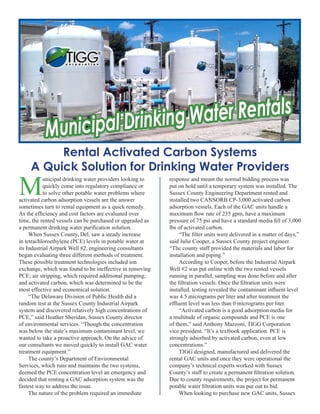
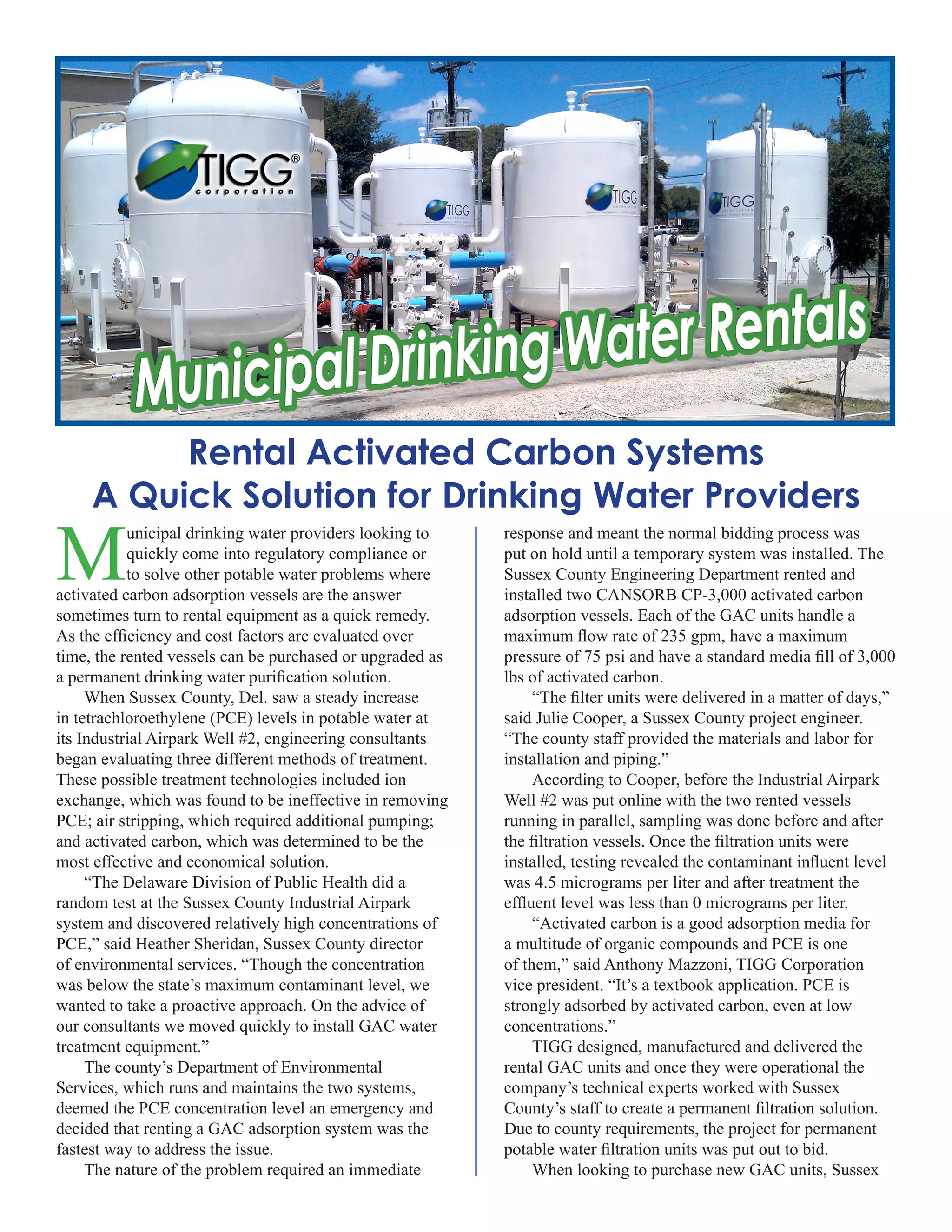
installed two CANSORB CP-3,000 activated carbon
adsorption vessels. Each of the GAC units handle a
maximum flow rate of 235 gpm, have a maximum
pressure of 75 psi and have a standard media fill of 3,000
lbs of activated carbon.
	 “The filter units were delivered in a matter of days,”
said Julie Cooper, a Sussex County project engineer.
“The county staff provided the materials and labor for
installation and piping.”
	 According to Cooper, before the Industrial Airpark
Well #2 was put online with the two rented vessels
running in parallel, sampling was done before and after
the filtration vessels. Once the filtration units were
installed, testing revealed the contaminant influent level
was 4.5 micrograms per liter and after treatment the
effluent level was less than 0 micrograms per liter.
	 “Activated carbon is a good adsorption media for
a multitude of organic compounds and PCE is one
of them,” said Anthony Mazzoni, TIGG Corporation
vice president. “It’s a textbook application. PCE is
strongly adsorbed by activated carbon, even at low
concentrations.”
	 TIGG designed, manufactured and delivered the
rental GAC units and once they were operational the
company’s technical experts worked with Sussex
County’s staff to create a permanent filtration solution.
Due to county requirements, the project for permanent
potable water filtration units was put out to bid.
	 When looking to purchase new GAC units, Sussex
Rental Activated Carbon Systems
A Quick Solution for Drinking Water Providers
County decided to upgrade from the 3,000 pound carbon
beds in the rental units and go with two adsorbers with
a maximum flow rate of 500 gpm, 125 psi, and a 10,000
activated carbon bed. This upgrade allowed the system
to operate at higher flow rates and the larger carbon bed
increased the amount of time in between spent carbon
change outs.
	 “The TIGG model was used as a basis for
specification, though Sussex County specifications
allowed for an approved equivalent,” Cooper said.
“However, the units submitted by the successful bidder
on the permanent installation project were TIGG vessels.
	 Sussex County acquired two CANSORB CP-8,000
units. The piping and valving was designed so that the
two vessels would run in lead-lag configuration. Once
the lead vessel’s medium is spent, the system can be
valved to run only through the lag vessel. When the
carbon in the isolated vessel is replaced, the system is
then set to lead-lag again, with the replenished vessel
becoming the lag vessel. Thus, the two vessels are
replenished with new carbon alternately and the system
is never off line.
	 These two units are capable of purifying a combined
1,440,000 gallons of water a day. They are constructed
of carbon steel and are lined on the inside with an NSF-
approved high solids epoxy for potable service to help
prevent corrosion.
	 The CANSORB-CP line is engineered to promote
the even distribution of water as it travels downward
through the carbon bed. The area where the carbon
actively adsorbs contaminants from the influent water
is the mass transfer zone. As the carbon becomes spent
the mass transfer zone moves down the bed. The flow
rate and contaminant concentration levels are factors in
determining how quickly the carbon reaches capacity.
	 While Sussex County rented its GAC equipment
to get out in front of a potential PCE problem, the San
Antonio Water System (SAWS) rented activated carbon
adsorption systems to proactively remove TOC and
TTHMs from Canyon Lake, a Central Texas potable
surface water supply. SAWS wanted to reduce the
potential for formation of disinfection byproducts (DBP)
in its distribution system, and ensure compliance with
EPA Stage 2 DBP regulations.
	 SAWS rented three activated carbon dual-vessel
skid systems that went online in San Antonio, August
14. The combined systems are capable of purifying more
than 5 million gallons of water a day. The units can run
either in series or parallel. Each system holds 40,000 lbs
of granular activated carbon and purifies water at 1,500
gpm.
	 The dual-vessel systems are comprised of two
CP20K-10 granular activated carbon adsorption vessels
connected with a 12-valve pipe rack. In order to meet
their flow rate requirements, the SAWS system is
operated in parallel.
	 TIGG won the competitively bid contract to rent
the units to the San Antonio Water System on July 3.
The agreement could be worth up to $2.5 million and
includes spent carbon exchange and disposal services
	 “Although we’ve been manufacturing the dual-
vessel CP 20K-10 system for years, this is the first time
we’ve supplied a client with the complete system on a
skid,” Mazzoni said. “We specifically engineered each
skid to ship on a single flatbed truck. Plus, the skids
simplify the setup process and help reduce labor costs.”
	 The EPA’s Stage 2 DBP Regulations compliance
deadline for water providers serving less than 10,000
people occurs in 2013, with possible extensions granted.
However, with limited money available and regulations
looming renting GAC equipment can be a way to
meet the regulatory deadlines. This factor, along with
reduced up front capital costs and quick response times
to emergency situations makes rental GAC adsorption
equipment a viable option for many municipal water
providers.
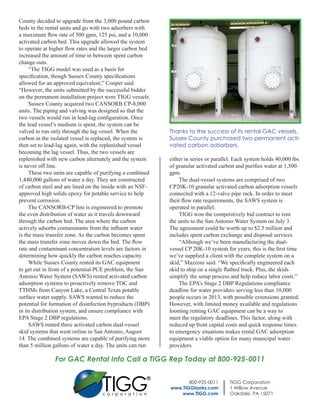
Thanks to the success of its rental GAC vessels,
Sussex County purchased two permanent acti-
vated carbon adsorbers.
For GAC Rental Info Call a TIGG Rep Today at 800-925-0011
800-925-0011
www.TIGGtanks.com
www.TIGG.com
TIGG Corporation
1 Willow Avenue
Oakdale, PA 15071

Renting GAC Systems for Municipal Drinking Water Purification

  • 1.
    M unicipal drinking waterproviders looking to quickly come into regulatory compliance or to solve other potable water problems where activated carbon adsorption vessels are the answer sometimes turn to rental equipment as a quick remedy. As the efficiency and cost factors are evaluated over time, the rented vessels can be purchased or upgraded as a permanent drinking water purification solution. When Sussex County, Del. saw a steady increase in tetrachloroethylene (PCE) levels in potable water at its Industrial Airpark Well #2, engineering consultants began evaluating three different methods of treatment. These possible treatment technologies included ion exchange, which was found to be ineffective in removing PCE; air stripping, which required additional pumping; and activated carbon, which was determined to be the most effective and economical solution. “The Delaware Division of Public Health did a random test at the Sussex County Industrial Airpark system and discovered relatively high concentrations of PCE,” said Heather Sheridan, Sussex County director of environmental services. “Though the concentration was below the state’s maximum contaminant level, we wanted to take a proactive approach. On the advice of our consultants we moved quickly to install GAC water treatment equipment.” The county’s Department of Environmental Services, which runs and maintains the two systems, deemed the PCE concentration level an emergency and decided that renting a GAC adsorption system was the fastest way to address the issue. The nature of the problem required an immediate response and meant the normal bidding process was put on hold until a temporary system was installed. The Sussex County Engineering Department rented and installed two CANSORB CP-3,000 activated carbon adsorption vessels. Each of the GAC units handle a maximum flow rate of 235 gpm, have a maximum pressure of 75 psi and have a standard media fill of 3,000 lbs of activated carbon. “The filter units were delivered in a matter of days,” said Julie Cooper, a Sussex County project engineer. “The county staff provided the materials and labor for installation and piping.” According to Cooper, before the Industrial Airpark Well #2 was put online with the two rented vessels running in parallel, sampling was done before and after the filtration vessels. Once the filtration units were installed, testing revealed the contaminant influent level was 4.5 micrograms per liter and after treatment the effluent level was less than 0 micrograms per liter. “Activated carbon is a good adsorption media for a multitude of organic compounds and PCE is one of them,” said Anthony Mazzoni, TIGG Corporation vice president. “It’s a textbook application. PCE is strongly adsorbed by activated carbon, even at low concentrations.” TIGG designed, manufactured and delivered the rental GAC units and once they were operational the company’s technical experts worked with Sussex County’s staff to create a permanent filtration solution. Due to county requirements, the project for permanent potable water filtration units was put out to bid. When looking to purchase new GAC units, Sussex Rental Activated Carbon Systems A Quick Solution for Drinking Water Providers
  • 2.
    County decided toupgrade from the 3,000 pound carbon beds in the rental units and go with two adsorbers with a maximum flow rate of 500 gpm, 125 psi, and a 10,000 activated carbon bed. This upgrade allowed the system to operate at higher flow rates and the larger carbon bed increased the amount of time in between spent carbon change outs. “The TIGG model was used as a basis for specification, though Sussex County specifications allowed for an approved equivalent,” Cooper said. “However, the units submitted by the successful bidder on the permanent installation project were TIGG vessels. Sussex County acquired two CANSORB CP-8,000 units. The piping and valving was designed so that the two vessels would run in lead-lag configuration. Once the lead vessel’s medium is spent, the system can be valved to run only through the lag vessel. When the carbon in the isolated vessel is replaced, the system is then set to lead-lag again, with the replenished vessel becoming the lag vessel. Thus, the two vessels are replenished with new carbon alternately and the system is never off line. These two units are capable of purifying a combined 1,440,000 gallons of water a day. They are constructed of carbon steel and are lined on the inside with an NSF- approved high solids epoxy for potable service to help prevent corrosion. The CANSORB-CP line is engineered to promote the even distribution of water as it travels downward through the carbon bed. The area where the carbon actively adsorbs contaminants from the influent water is the mass transfer zone. As the carbon becomes spent the mass transfer zone moves down the bed. The flow rate and contaminant concentration levels are factors in determining how quickly the carbon reaches capacity. While Sussex County rented its GAC equipment to get out in front of a potential PCE problem, the San Antonio Water System (SAWS) rented activated carbon adsorption systems to proactively remove TOC and TTHMs from Canyon Lake, a Central Texas potable surface water supply. SAWS wanted to reduce the potential for formation of disinfection byproducts (DBP) in its distribution system, and ensure compliance with EPA Stage 2 DBP regulations. SAWS rented three activated carbon dual-vessel skid systems that went online in San Antonio, August 14. The combined systems are capable of purifying more than 5 million gallons of water a day. The units can run either in series or parallel. Each system holds 40,000 lbs of granular activated carbon and purifies water at 1,500 gpm. The dual-vessel systems are comprised of two CP20K-10 granular activated carbon adsorption vessels connected with a 12-valve pipe rack. In order to meet their flow rate requirements, the SAWS system is operated in parallel. TIGG won the competitively bid contract to rent the units to the San Antonio Water System on July 3. The agreement could be worth up to $2.5 million and includes spent carbon exchange and disposal services “Although we’ve been manufacturing the dual- vessel CP 20K-10 system for years, this is the first time we’ve supplied a client with the complete system on a skid,” Mazzoni said. “We specifically engineered each skid to ship on a single flatbed truck. Plus, the skids simplify the setup process and help reduce labor costs.” The EPA’s Stage 2 DBP Regulations compliance deadline for water providers serving less than 10,000 people occurs in 2013, with possible extensions granted. However, with limited money available and regulations looming renting GAC equipment can be a way to meet the regulatory deadlines. This factor, along with reduced up front capital costs and quick response times to emergency situations makes rental GAC adsorption equipment a viable option for many municipal water providers. Thanks to the success of its rental GAC vessels, Sussex County purchased two permanent acti- vated carbon adsorbers. For GAC Rental Info Call a TIGG Rep Today at 800-925-0011 800-925-0011 www.TIGGtanks.com www.TIGG.com TIGG Corporation 1 Willow Avenue Oakdale, PA 15071