ACHARIYA
COLLEGE OF ENGINEERING TECHNOLOGY
(Approved by AICTE and affiliated to Pondicherry University)
An ISO 9001:2008 Certified Institution
UNIT I
DC-CIRCUITS
MODULE_1_LAWS
PREPARED BY
Mrs.B.PRIYA
AP/EEE/ACET
POTENTIAL DIFFERENCE (V):
The difference in potential of two charged bodies is called Potential
difference. Potential difference is called voltage.
The voltage is the energy required for movement of charge from
one point to another.
𝑉𝑜𝑙𝑡𝑎𝑔𝑒(𝑉) =
𝑊𝑜𝑟𝑘𝑑𝑜𝑛𝑒
𝐶ℎ𝑎𝑟𝑔𝑒
=
𝑑𝑤
𝑑𝑞
[𝑢𝑛𝑖𝑡 𝑖𝑠
𝑗𝑜𝑢𝑙𝑒𝑠
𝑐𝑜𝑢𝑙𝑜𝑚𝑏
𝑜𝑟 𝑉𝑜𝑙𝑡]
POWER (P):
The rate at which the work is done in an electric circuit
Electric 𝑃𝑜𝑤𝑒𝑟 =
𝑊𝑜𝑟𝑘𝑑𝑜𝑛𝑒 𝑖𝑛 𝐸𝑙𝑒𝑐𝑡𝑟𝑖𝑐 𝑐𝑖𝑟𝑐𝑢𝑖𝑡
𝑇𝑖𝑚𝑒
=
𝑊
𝑇
𝑃 = 𝑉 𝐼 𝑤𝑎𝑡𝑡𝑠, 𝑃 = 𝐼2𝑅𝑤𝑎𝑡𝑡𝑠, 𝑃 =
𝑉2
𝑅
𝑤𝑎𝑡𝑡𝑠
LAWS
CURRENT:
It is defined as the rate of flow of charge with respect to time.
𝐶𝑢𝑟𝑟𝑒𝑛𝑡 𝐼 =
𝐶ℎ𝑎𝑟𝑔𝑒
𝑇𝑖𝑚𝑒
=
𝑑𝑞
𝑑𝑡
[𝑢𝑛𝑖𝑡 𝑖𝑠 𝑐𝑜𝑢𝑙𝑜𝑚𝑏/𝑠𝑒𝑐𝑜𝑛𝑑or Ampere].
ENERGY:
It is the capacity for doing work. Energy may be existed in the form
of mechanical, chemical, electrical, etc.
𝑤𝑜𝑟𝑘𝑑𝑜𝑛𝑒 𝑊 = 𝑃𝑜𝑤𝑒𝑟 𝑃 × 𝑇𝑖𝑚𝑒 (𝑇)
CLASIFICATION OF ELECTRIC CIRCUIT ELEMENTS:
The electrical elements are classified into
 Active elements
 Passive elements
LAWS
ACTIVE ELEMENTS:
Active elements supply voltage (or) current to the circuit to
operate it. Voltage and current source are active elements.
PASSIVE ELEMENTS:
It either dissipates energy in the form of heat (or) stores energy
from the external source.
eg: Resistor (R), Inductor (I), Capacitor (C)
 Resistor – dissipates energy in the form of heat. Unit of
resistance is ohm.
 Inductor – stores energy in the Magnetic field. Unit of
inductance is Henry.
 Capacitor – Stores energy in the electrostatic field. Unit of
capacitance is Farad.
LAWS
OHMS LAW
At constant Temperature the steady current flowing through
the conductor is directly proportional to the Potential
difference between two ends of the conductor
V = I R
KIRCHHOFF’S LAW
 Kirchhoff’s Current Law
 Kirchhoff’s Voltage Law
LAWS
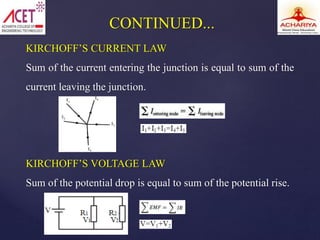
KIRCHOFF’S CURRENT LAW
Sum of the current entering the junction is equal to sum of the
current leaving the junction.
KIRCHOFF’S VOLTAGE LAW
Sum of the potential drop is equal to sum of the potential rise.
CONTINUED...
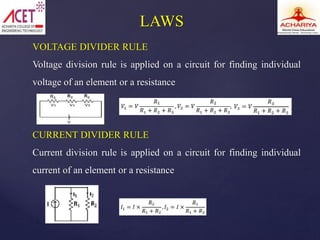
VOLTAGE DIVIDER RULE
Voltage division rule is applied on a circuit for finding individual
voltage of an element or a resistance
CURRENT DIVIDER RULE
Current division rule is applied on a circuit for finding individual
current of an element or a resistance
LAWS
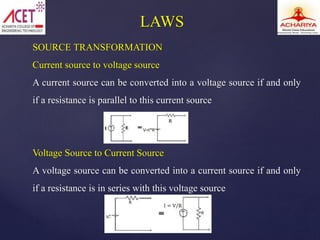
SOURCE TRANSFORMATION
Current source to voltage source
A current source can be converted into a voltage source if and only
if a resistance is parallel to this current source
Voltage Source to Current Source
A voltage source can be converted into a current source if and only
if a resistance is in series with this voltage source
LAWS
SERIES AND PARALLEL CIRCUITS:
 Series – Resistors connected in Series
 Parallel – Resistors connected in Parallel
Resistors Connected in Series:
IR = I [R1 + R2 + R3]
RS = R1 + R2 + R3
LAWS
V = V1+ V2 + V3
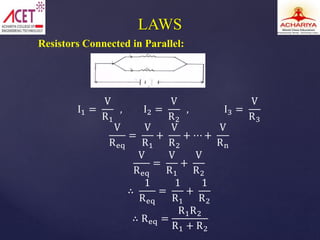
Resistors Connected in Parallel:
I1 =
V
R1
, I2 =
V
R2
, I3 =
V
R3
V
Req
=
V
R1
+
V
R2
+ ⋯ +
V
Rn
V
Req
=
V
R1
+
V
R2
∴
1
Req
=
1
R1
+
1
R2
∴ Req =
R1R2
R1 + R2
LAWS
THANK YOU

BEEE-UNITI-MODULE1.pptx

  • 1.
    ACHARIYA COLLEGE OF ENGINEERINGTECHNOLOGY (Approved by AICTE and affiliated to Pondicherry University) An ISO 9001:2008 Certified Institution UNIT I DC-CIRCUITS MODULE_1_LAWS PREPARED BY Mrs.B.PRIYA AP/EEE/ACET
  • 2.
    POTENTIAL DIFFERENCE (V): Thedifference in potential of two charged bodies is called Potential difference. Potential difference is called voltage. The voltage is the energy required for movement of charge from one point to another. 𝑉𝑜𝑙𝑡𝑎𝑔𝑒(𝑉) = 𝑊𝑜𝑟𝑘𝑑𝑜𝑛𝑒 𝐶ℎ𝑎𝑟𝑔𝑒 = 𝑑𝑤 𝑑𝑞 [𝑢𝑛𝑖𝑡 𝑖𝑠 𝑗𝑜𝑢𝑙𝑒𝑠 𝑐𝑜𝑢𝑙𝑜𝑚𝑏 𝑜𝑟 𝑉𝑜𝑙𝑡] POWER (P): The rate at which the work is done in an electric circuit Electric 𝑃𝑜𝑤𝑒𝑟 = 𝑊𝑜𝑟𝑘𝑑𝑜𝑛𝑒 𝑖𝑛 𝐸𝑙𝑒𝑐𝑡𝑟𝑖𝑐 𝑐𝑖𝑟𝑐𝑢𝑖𝑡 𝑇𝑖𝑚𝑒 = 𝑊 𝑇 𝑃 = 𝑉 𝐼 𝑤𝑎𝑡𝑡𝑠, 𝑃 = 𝐼2𝑅𝑤𝑎𝑡𝑡𝑠, 𝑃 = 𝑉2 𝑅 𝑤𝑎𝑡𝑡𝑠 LAWS
  • 3.
    CURRENT: It is definedas the rate of flow of charge with respect to time. 𝐶𝑢𝑟𝑟𝑒𝑛𝑡 𝐼 = 𝐶ℎ𝑎𝑟𝑔𝑒 𝑇𝑖𝑚𝑒 = 𝑑𝑞 𝑑𝑡 [𝑢𝑛𝑖𝑡 𝑖𝑠 𝑐𝑜𝑢𝑙𝑜𝑚𝑏/𝑠𝑒𝑐𝑜𝑛𝑑or Ampere]. ENERGY: It is the capacity for doing work. Energy may be existed in the form of mechanical, chemical, electrical, etc. 𝑤𝑜𝑟𝑘𝑑𝑜𝑛𝑒 𝑊 = 𝑃𝑜𝑤𝑒𝑟 𝑃 × 𝑇𝑖𝑚𝑒 (𝑇) CLASIFICATION OF ELECTRIC CIRCUIT ELEMENTS: The electrical elements are classified into  Active elements  Passive elements LAWS
  • 4.
    ACTIVE ELEMENTS: Active elementssupply voltage (or) current to the circuit to operate it. Voltage and current source are active elements. PASSIVE ELEMENTS: It either dissipates energy in the form of heat (or) stores energy from the external source. eg: Resistor (R), Inductor (I), Capacitor (C)  Resistor – dissipates energy in the form of heat. Unit of resistance is ohm.  Inductor – stores energy in the Magnetic field. Unit of inductance is Henry.  Capacitor – Stores energy in the electrostatic field. Unit of capacitance is Farad. LAWS
  • 5.
    OHMS LAW At constantTemperature the steady current flowing through the conductor is directly proportional to the Potential difference between two ends of the conductor V = I R KIRCHHOFF’S LAW  Kirchhoff’s Current Law  Kirchhoff’s Voltage Law LAWS
  • 6.
    KIRCHOFF’S CURRENT LAW Sumof the current entering the junction is equal to sum of the current leaving the junction. KIRCHOFF’S VOLTAGE LAW Sum of the potential drop is equal to sum of the potential rise. CONTINUED...
  • 7.
    VOLTAGE DIVIDER RULE Voltagedivision rule is applied on a circuit for finding individual voltage of an element or a resistance CURRENT DIVIDER RULE Current division rule is applied on a circuit for finding individual current of an element or a resistance LAWS
  • 8.
    SOURCE TRANSFORMATION Current sourceto voltage source A current source can be converted into a voltage source if and only if a resistance is parallel to this current source Voltage Source to Current Source A voltage source can be converted into a current source if and only if a resistance is in series with this voltage source LAWS
  • 9.
    SERIES AND PARALLELCIRCUITS:  Series – Resistors connected in Series  Parallel – Resistors connected in Parallel Resistors Connected in Series: IR = I [R1 + R2 + R3] RS = R1 + R2 + R3 LAWS V = V1+ V2 + V3
  • 10.
    Resistors Connected inParallel: I1 = V R1 , I2 = V R2 , I3 = V R3 V Req = V R1 + V R2 + ⋯ + V Rn V Req = V R1 + V R2 ∴ 1 Req = 1 R1 + 1 R2 ∴ Req = R1R2 R1 + R2 LAWS
  • 11.